HAPPENINGS Summer


A natural foods cooperative since 1976
OPEN EVERY DAY TO EVERYONE
Store hours 7:00am - 8:00pm
Organic Espresso & Juice Bar
7:00am - 6:00pm
Soup & Salad Bar
10:30am - 7:00pm Hot Bar
10:30am - 6:00pm
Burrito & Taco Bar
10:30am - 7:00pm
Bagel Bar
7:00am - 2:30pm
721 South State Street
Ukiah, CA 95482
707 462-4778
WELLNESS WEDNESDAYS
15% Off All Wellness, Health & Beauty
Every second Wednesday
Wednesday, July 8
Wednesday, August 12
Wednesday, September 9
BOARD OF DIRECTORS MEETINGS
5:30pm
All members invited to attend.
Email board@ukiahcoop.com for the online link 24 hours before the scheduled meeting.
Monday, July 20
Monday, August 17
Monday, September 21
MISSION: VISION:
We join together for a common purpose: to sell trusted food and goods for the health of our community.
We envision a thriving, healthy community in which we are a vital link in the local food system.
www.ukiahcoop.com
email: UNF@ukiahcoop.com
UNF Management
Interim General Manager
Wynston Estis
Facilities
Dan Thompson-Sagehorn
Finance
Joe Riemann
Food Service
Chance Breen
Floor Manager
Lodie DeAlba
Grocery
Lenny Mller
Human Resources
Dagoberto González
Information Technology
Tasha Jelen
Marketing & Outreach
Yvonne Boyd
Produce
Libee Uhuru
Wellness / Health & Beauty, Front End
Katie McClure
Co-op Beet
Editor
Yvonne Boyd
Design & Production
Nicole Martensen - Tierra Design
Contributors
Jon Steinman, Jen Dalton, Yvonne Boyd
Views expressed in the Co-op Beet are the writers’ opinions and are not necessarily the views of Ukiah Natural Foods Co-op.


50 YEARS OF THE UKIAH NATURAL A Brief History
The Ukiah Natural Foods Co-op has been a cornerstone of Mendocino County's natural foods movement since 1976. What began as a small buying club formed by local back-to-the-land homesteaders grew into one of Northern California's longest-standing community-owned grocery stores.
In 1976, the co-op was officially incorporated as the Homestead Exchange, a name it still legally retains today. The original operation was modest, running out of a garage near Gobbi Street and focused on providing access to wholesome foods that were difficult to find in conventional grocery stores at the time. As community interest in natural and organic foods expanded, the co-op quickly outgrew its first location and moved to a larger facility on East Perkins Street.
Throughout the 1980s and 1990s, the co-op became a gathering place for people committed to healthy eating, sustainable agriculture, and cooperative values. In 1998, responding to continued growth, the organization moved to its current location at 721 South State Street in Ukiah.
Over the decades, the co-op evolved from a small specialty store into a full-service natural foods grocery. It developed strong relationships with local farmers and producers, expanded its organic offerings, and became known for its

commitment to certified organic produce, local sourcing, and community education. Today, the store serves thousands of member-owners and shoppers from throughout Mendocino County.
A major milestone came in 2021 when the co-op completed a significant expansion and remodel, adding nearly 5,800 square feet of space. The project introduced expanded food-service offerings, café seating, offices, and customer amenities, helping position the co-op for future growth.
What has remained constant through five decades is the cooperative model itself. Owned by its members and governed by an elected board, the Ukiah Natural Foods Coop continues to operate with a mission centered on health, wellness, local food systems, sustainability, and community benefit. Profits are reinvested through patronage dividends, local donations, and community programs that strengthen the region it serves.
As the co-op celebrates its 50th anniversary in 2026, it stands as a testament to the vision of the original founders—a community-owned marketplace that has grown from a garage buying club into a vital local institution while remaining true to its guiding principle:
"Let's Eat Local Together."
NATURAL FOODS CO-OP:
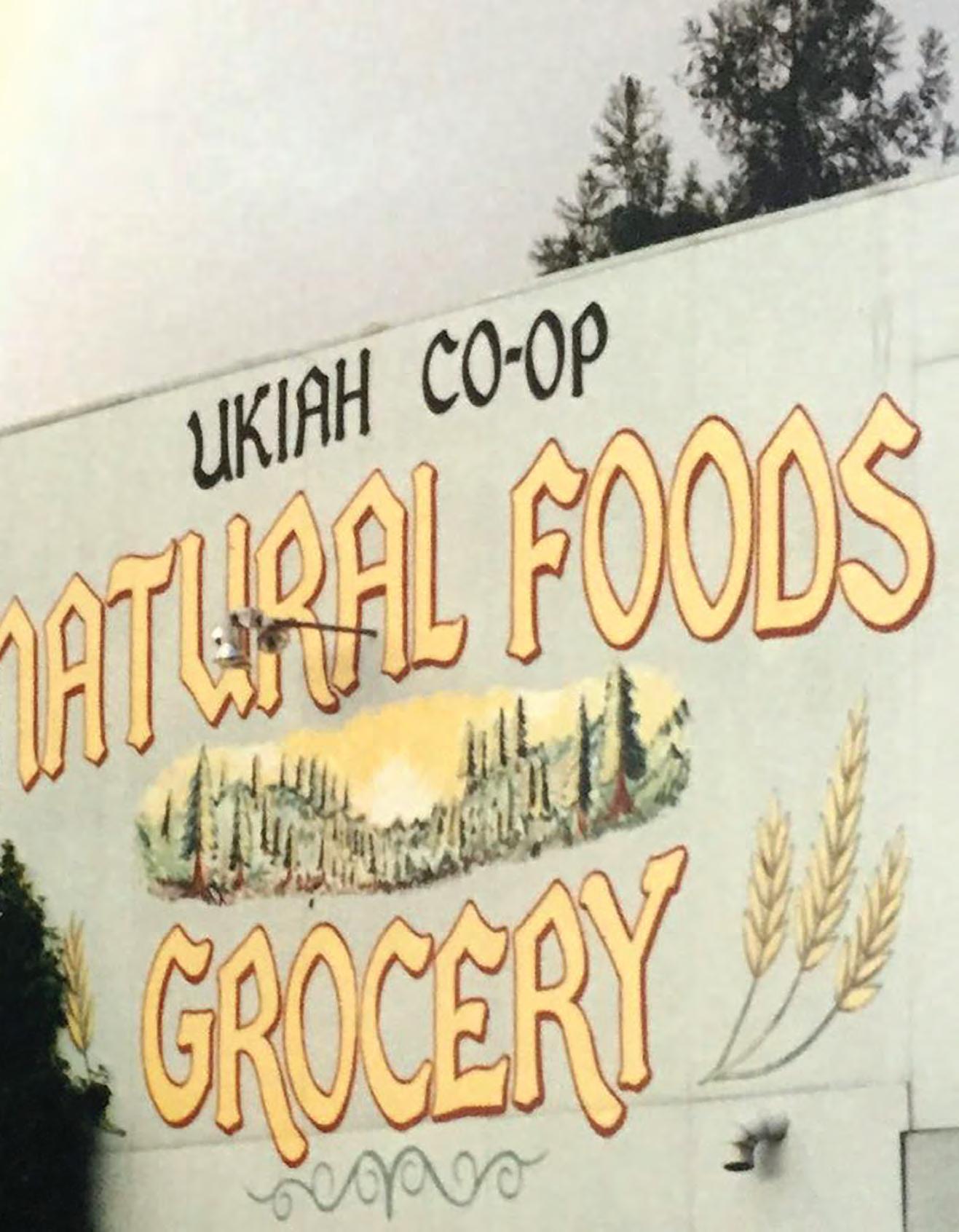
FROM THE
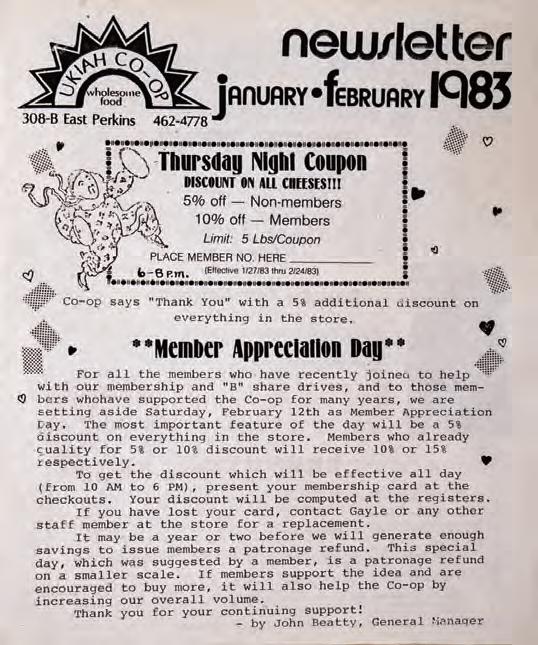
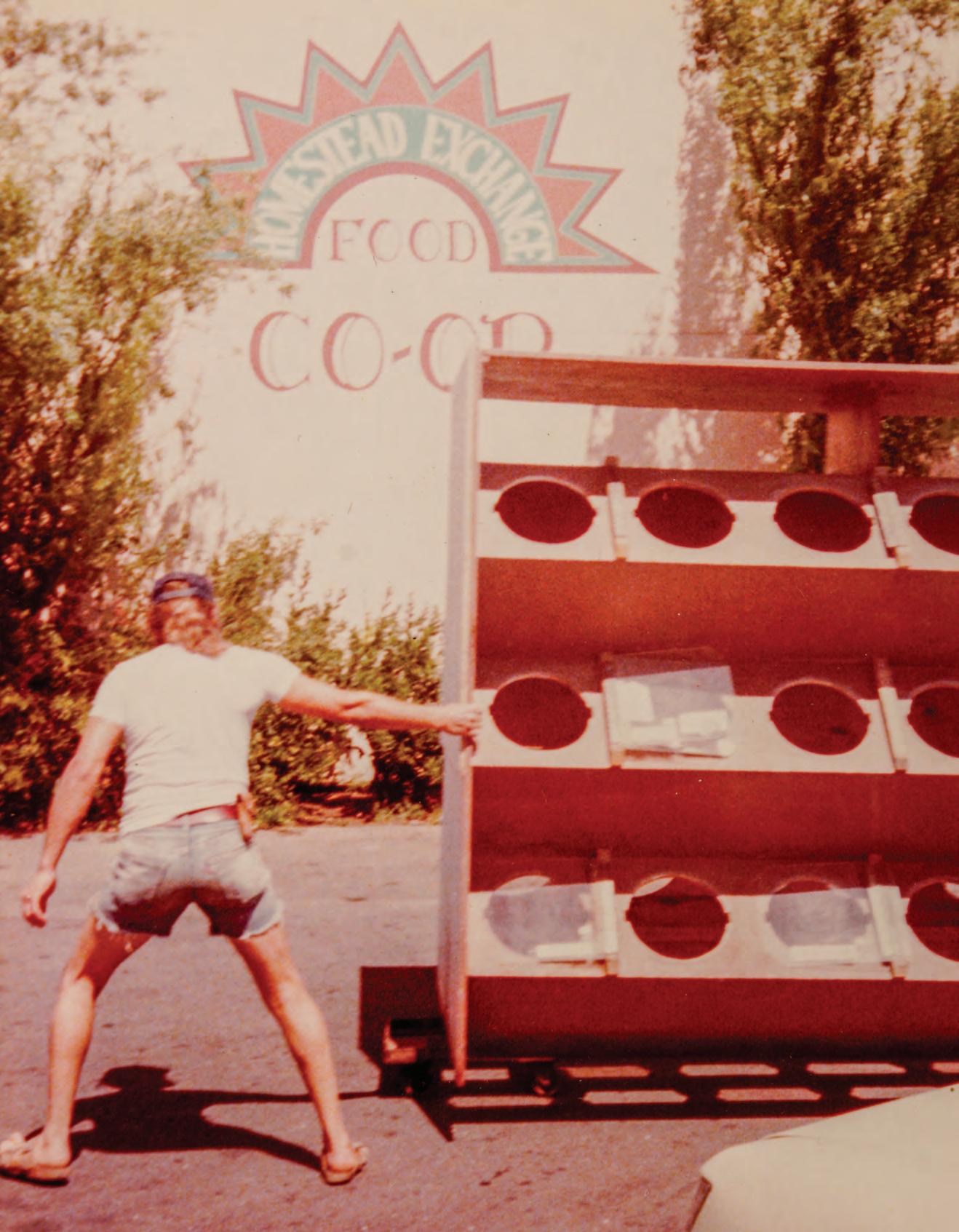
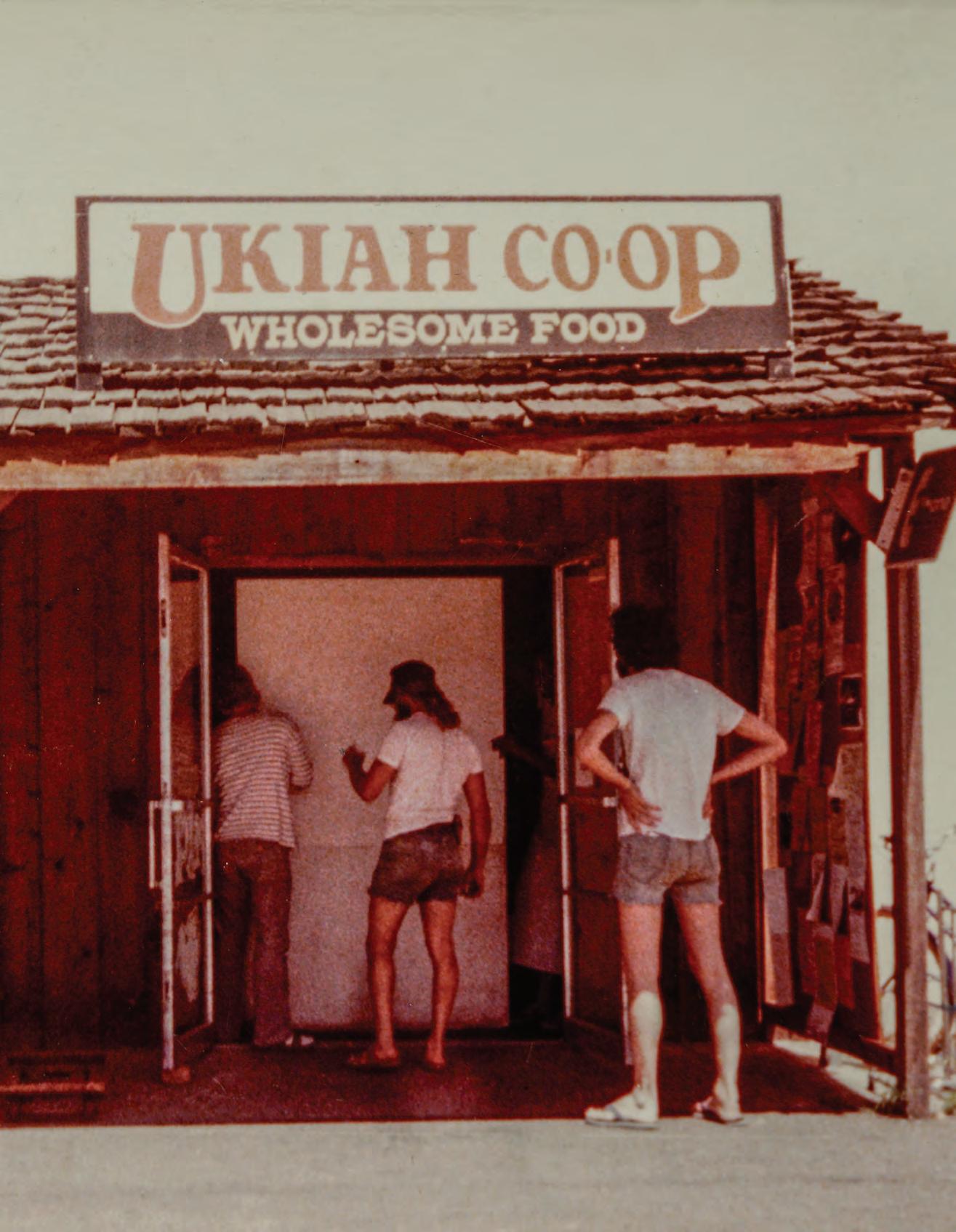
Our first Co-op members, 1976:
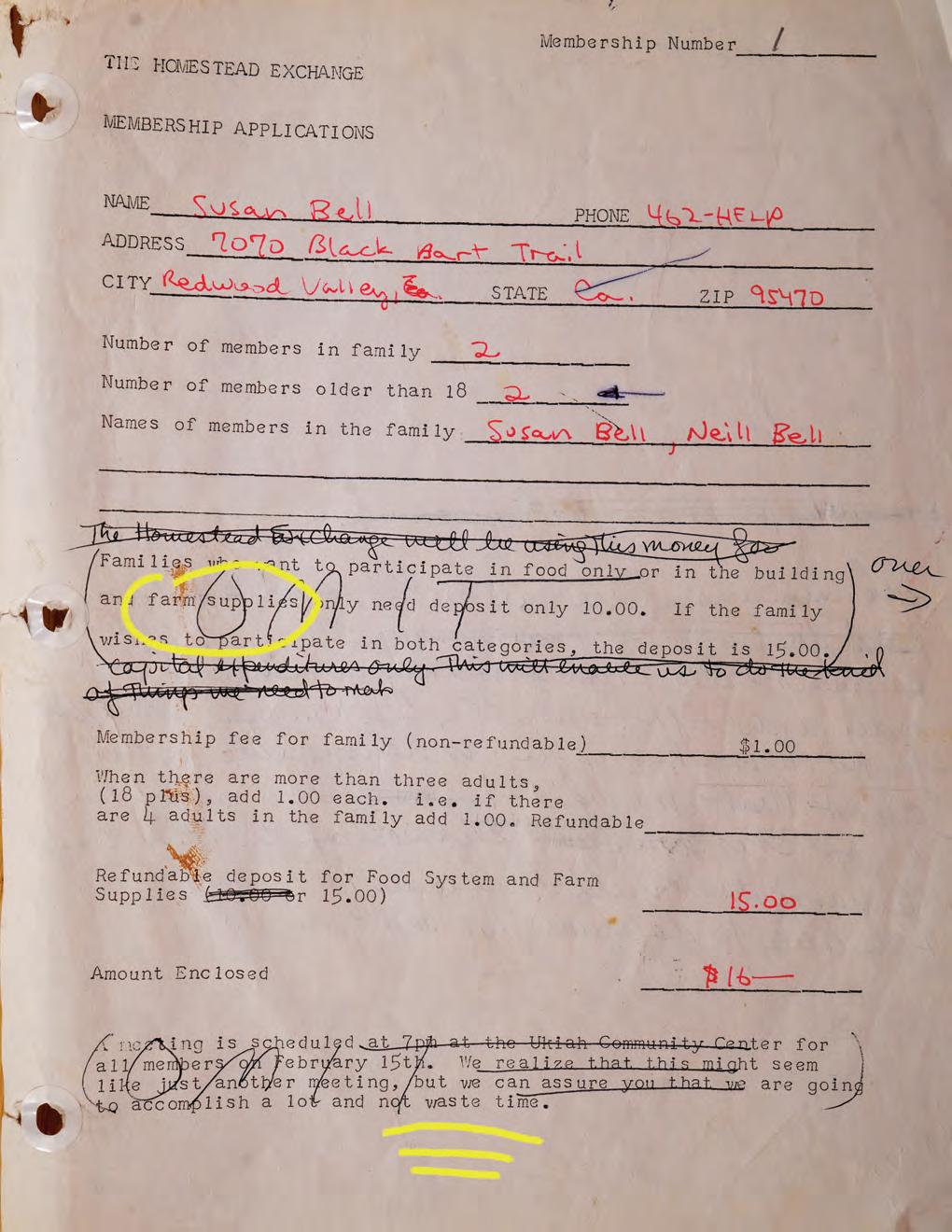
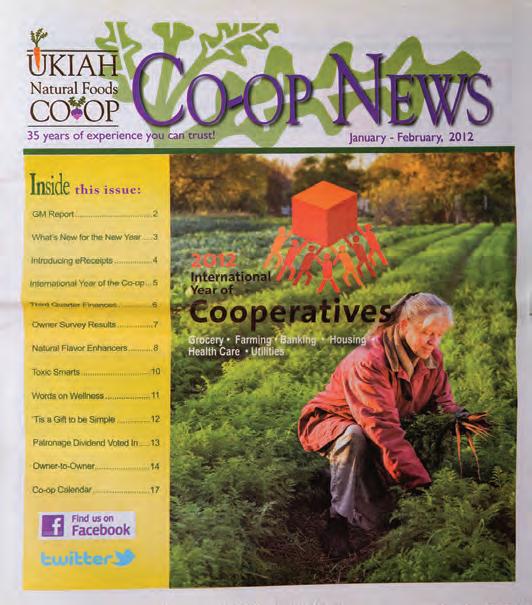
ARCHIVES
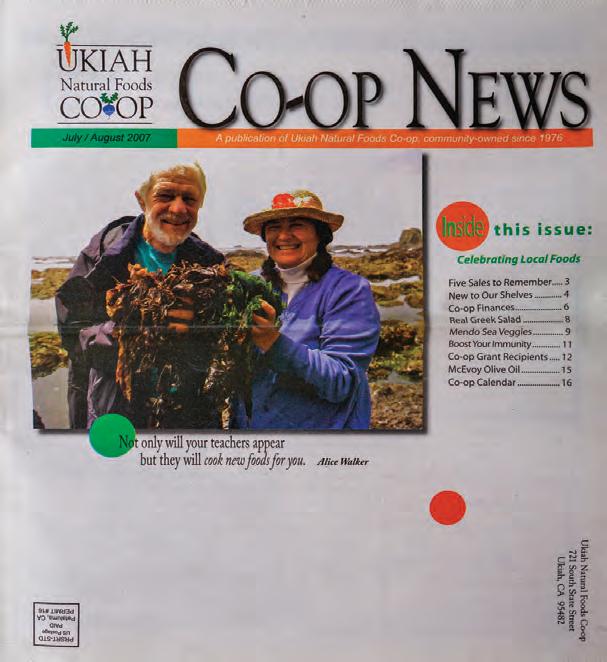
Board meeting minutes, 1989:
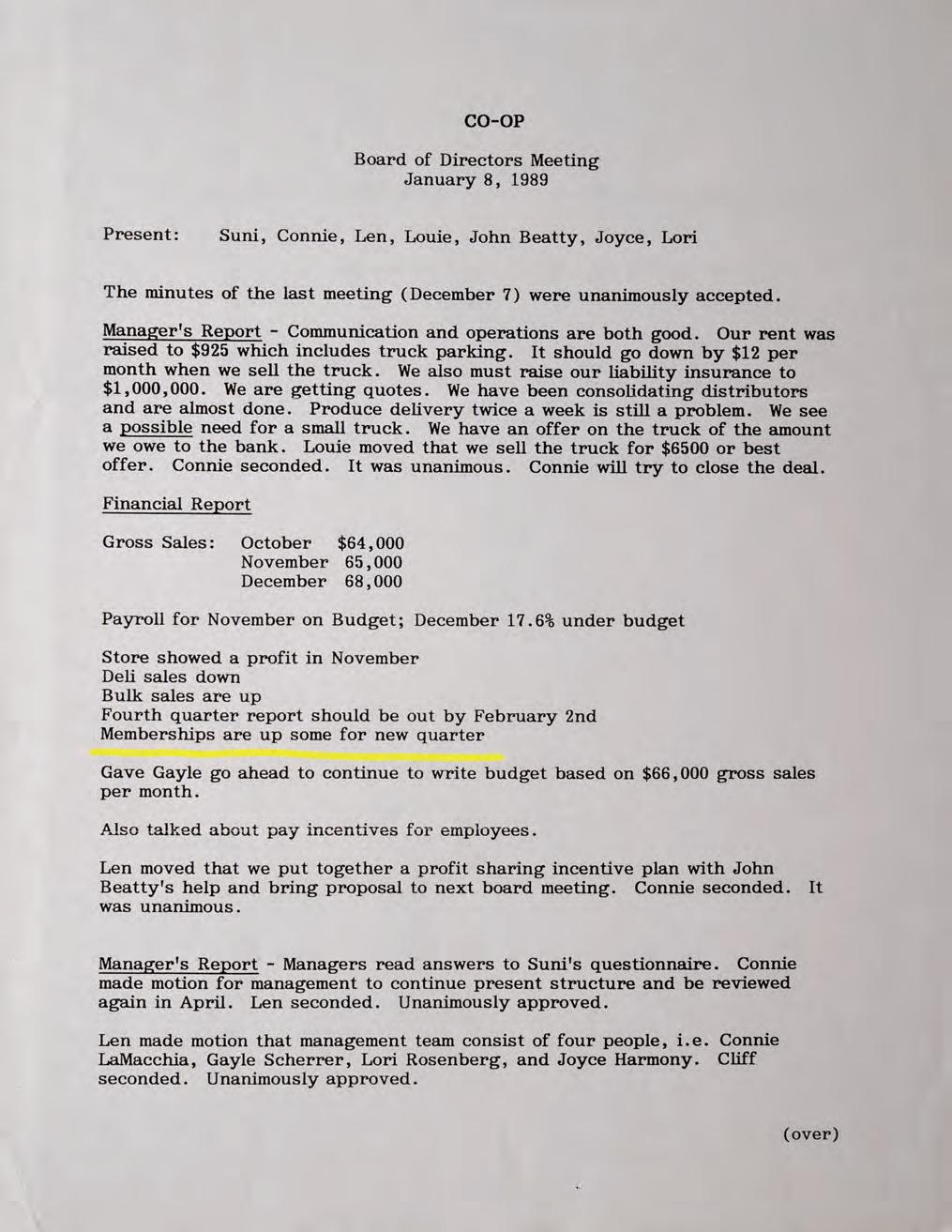
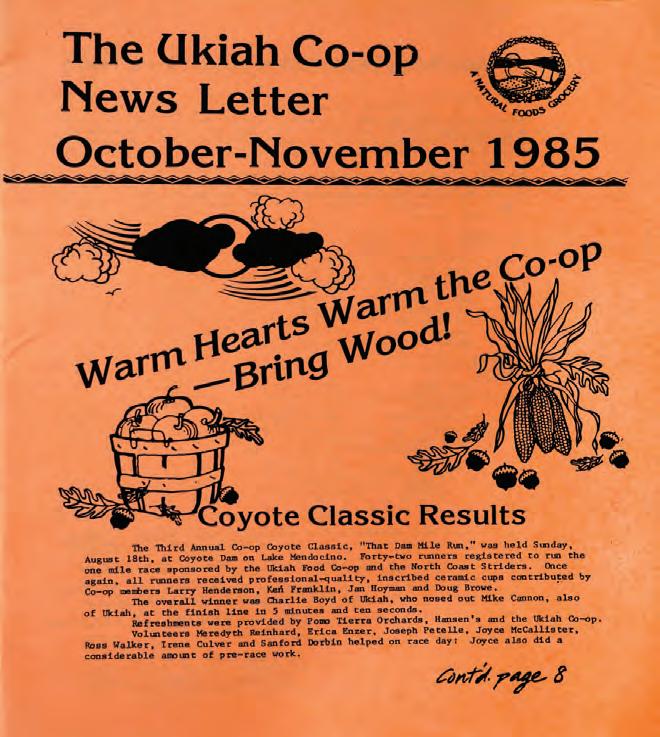
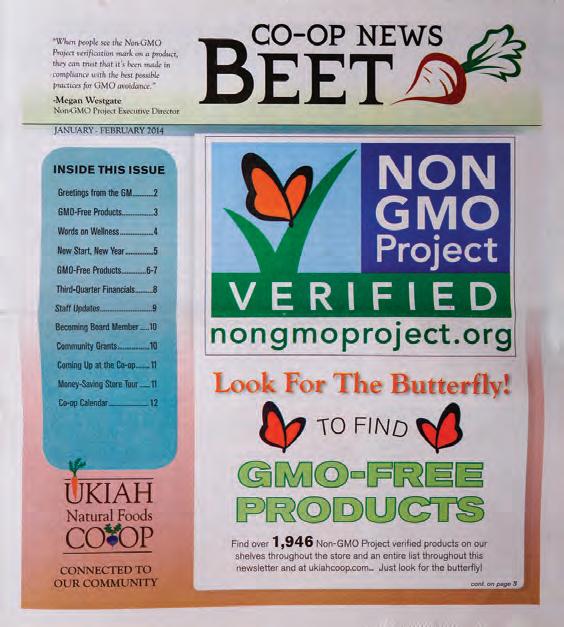
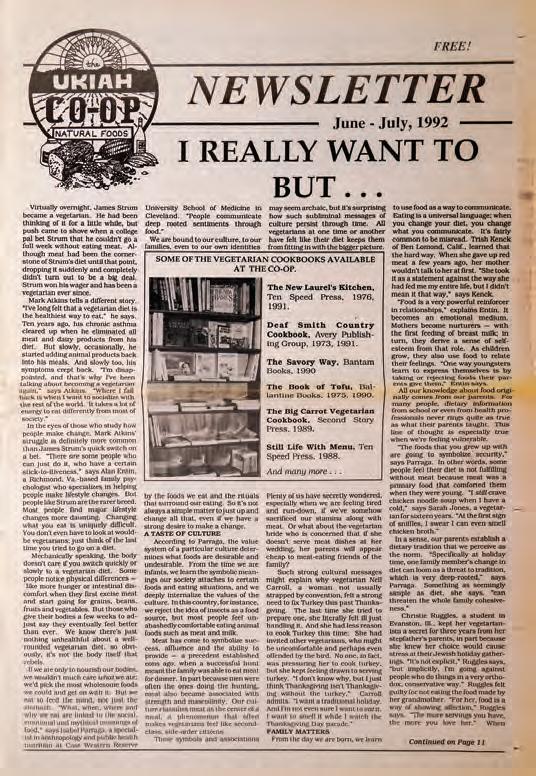
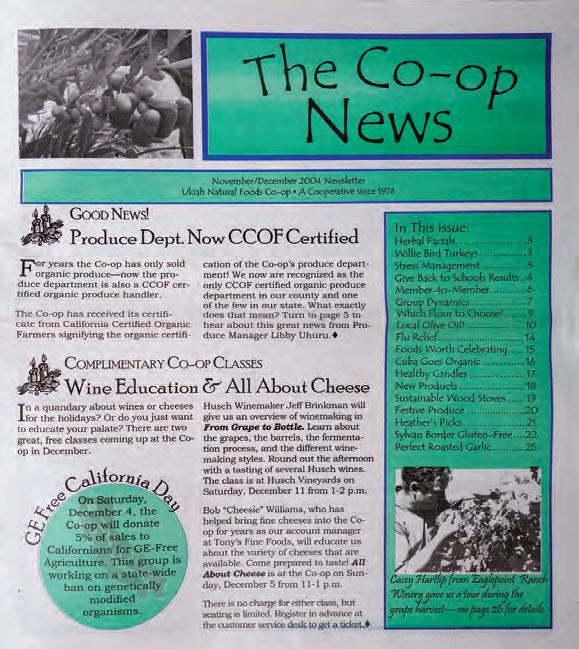
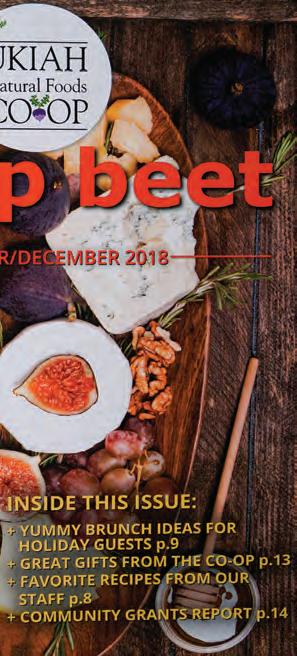
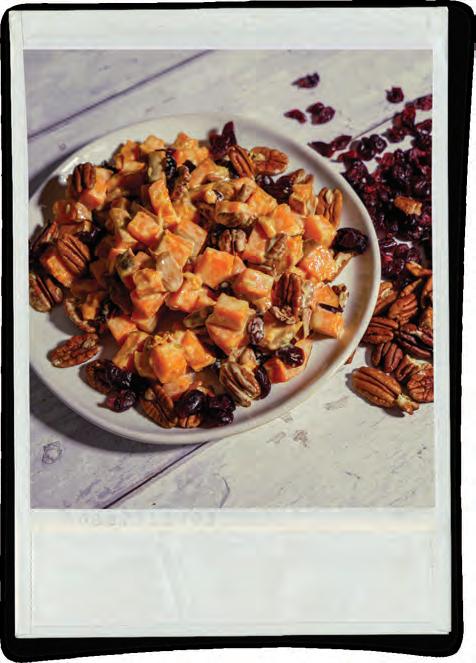
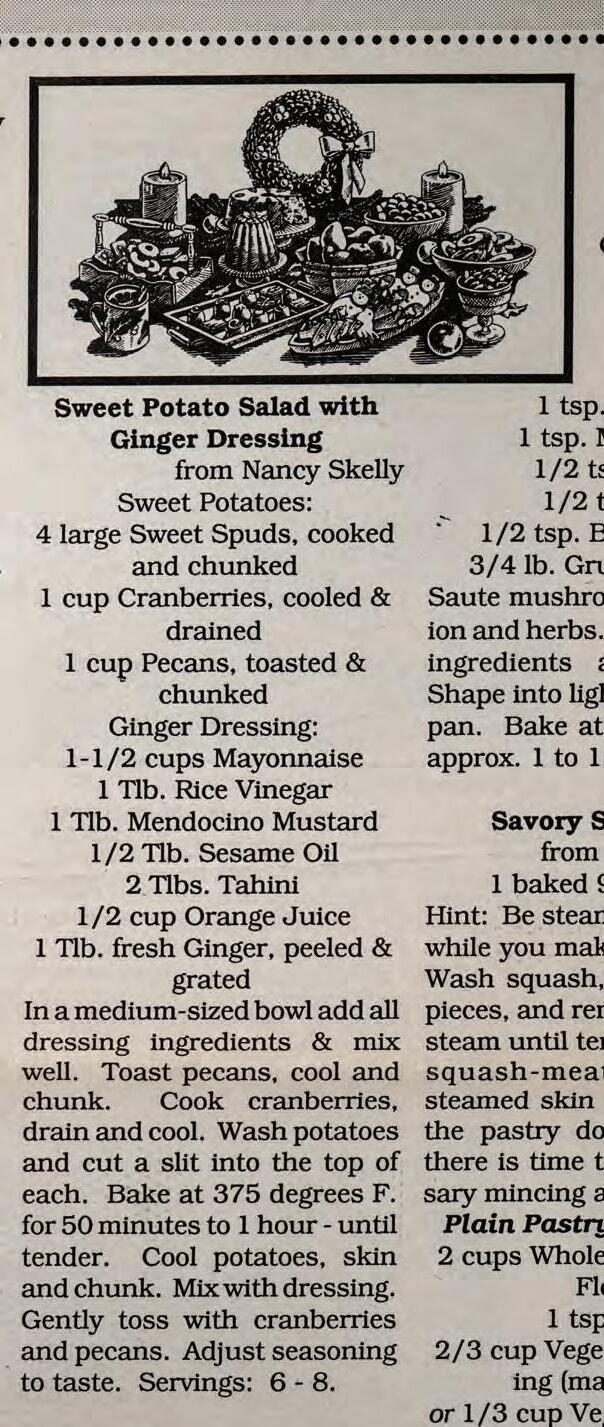
Recipes FROM THE CO-OP BEET ARCHIVES
Thought you had enough carrot & raisin salad back then? Think again!
Or maybe you were born in the 21st Century? This is what people actually ate back in the day...


I've spent the better part of my career at the intersection of food, community, and systems change — and if there's one thing I've learned, it's that the grocery store is where all of it converges. Across years of facilitating cooperative work — bringing diverse groups together around shared goals — I've seen one truth hold steady: the work only moves forward when people can name and stand on common values. Without that shared ground, collaboration stalls. With it, communities can navigate disagreement, hold complexity, and still walk forward together. When I came to our co-op, I recognized something rare: our eight cooperative principles are that common ground, made explicit. They are our shared values, written down and agreed upon. That recognition is a large part of why I wanted to serve on this Board — to help steward the very thing that makes this kind of work possible.
In Grocery Story: The Promise of Food Co-ops in the Age of Grocery Giants, author Jon Steinman makes an observation that I wholeheartedly agree with, given my almost three decades working with a diverse array of food professionals: despite everything the food movement has accomplished — transforming farms, dinner plates, school cafeterias, farmers' markets — the grocery store itself has received surprisingly little attention. It's the epicenter of our modern food-gathering ritual, the place where the power of the food system is most concentrated, and yet it's largely been left out of the conversation about change. Corporate giants have quietly consolidated their grip on what communities can access, which producers get to survive, and what local food economies can become. Steinman calls transforming the grocery store aisle the emerging frontier of the food movement. I couldn't agree more.
That's what brought me to our co-op. And it's what drove me to join the Board.
My path into food systems wasn't a straight line — but every turn deepened the same question: who controls our food, and what would it look like if that power belonged to the community? That question has been the thread running through my work, and it's what led me here.
When I look at the eight principles guiding our co-op, I see exactly that structure.
Voluntary and Open Membership, Democratic Member Control, Member Economic Participation. These three principles describe something rare in the food retail landscape: an institution where the people it serves actually own and govern it. I've seen firsthand how transformative it is when communities move from being consulted to being in charge — and that conviction is what drew me to cooperative governance. My commitment to the Board is to protect and deepen that shift.
Autonomy
and independence matter more now than ever. As Steinman documents, corporate grocery consolidation has real costs — food deserts, squeezed-out local producers, weakened community economies. A coop's ability to stay grounded in its members rather than external pressures is both a strength and a responsibility I take seriously.

JEN DALTON Boardmember
WHY I JOINED THE BOARD OF DIRECTORS
Food co-ops are one of the most tangible answers to that question. Steinman's book documents what I've witnessed firsthand for the 15 years I’ve been a member: co-ops don't just offer an alternative shopping experience — they actively redirect dollars
"I've seen firsthand how transformative it is when communities move from being consulted to being in charge."
into local food economies, strengthen relationships with regional producers, and improve food access for low-income community members. They return decision-making power to the people who actually live and eat here. As Steinman puts it, the grocery cart can be a vehicle for social change. But only if the store behind it is structured to make that possible.
Education, Training, and Infor- mation. A co-op that invests in its members, its staff, and the broader public isn't just a grocery store — it's a civic institution. This principle resonates deeply with me, and upholding it is part of why I'm here.
Cooperation Among Coopera- tives speaks to something I believe in at my core: that the most durable change is built through networks of trust, not by any single organization working alone. In my work with large cooperative groups, we like to say we are learning and moving at the speed of trust. This principle isn't just aspirational — it's a practice I'm committed to, as we learn together how to trust and collaborate.
Concern for Community is why I do this work. The through-line across everything I've done has always been the same question: how do we make this planet and our store better for the people most often left out?
Which brings me to the eighth principle — Equity, Belonging, Inclusivity, and Accessibility. Steinman is clear that food coops have a unique ability to enhance food access for low-income community members. That's not accidental — it requires deliberate, proactive governance. A career spent working to improve the lives of our immigrant, low-income, and historically marginalized neighbors has shaped how I approach every table I sit at. It shapes how I show up on this Board.
The food movement has done remarkable work. But if we haven't transformed where most people actually get their food, we've left the most important frontier largely untouched. Our co-op is doing something about that — and it's doing it from common ground. These eight principles are the values we can come back to time and again, the foundation that lets us move forward even when the path isn't always clear. Serving on this Board is, for me, an opportunity to help hold that ground steady — and to keep us walking it together.
If you shop at a food co-op, co-own a food co-op, or work at a food co-op, this article is for you.
It’s written as a reminder— —that food co-ops are a people’s movement— —with shared histories going back generations.
From early Black-led co-ops inspired by civil-rights leaders like W.E.B. Du Bois, to depression-era co-ops of the 1930s, to the many waves of co-op formation that followed—all have been inspired by deep commitments to human rights, equal rights, food sovereignty and economic democracy.
Your food co-op is a descendant of these people and their efforts.
Their work set in motion the very reasons why you are reading these words now.
Your co-op and this publication are part of an uninterrupted lineage of change.
There’s value in reminding ourselves of this. Co-ops thrive and remain relevant when the people who use them remember where they came from and why they exist.
For food co-ops, this is no easy task.
Food co-ops are as much “grocery store” as they are “co-op,” but their grocery DNA—being the most visible—often feels dominant, like a child who appears to take after one parent more than the other.
It’s why food co-ops so often wrestle with the dominant grocery narrative among shoppers:
—“my relationship to grocery stores is transactional.”
This transactional narrative is largely invisible.
“The grocery store is a food and price-provider.”
“The shopper is a consumer and price-taker.”
“The success of this relationship is determined by the cheapest price, greatest value, and maximum convenience.”
We can say “co-ops are different” as loudly and as often as we want, but food co-ops still confront these transactional storylines.
Without a dedicated and ongoing effort to remain connected to our “co-op” genes, we risk losing sight of the other coop “parent.” By remembering that our co-ops are linked to democracy movements of generations past, we’re adding an essential ingredient to the work of storytelling and narrative change.
This work also benefits from disrupting the prevailing beliefs of what a grocery store is and what it does.
Grocery stores are not neutral
A grocery store is not just a grocery store. It’s a health-shaping, economy-shaping, and planet-shaping institution, sitting at the most powerful juncture within food supply-chains. A grocery store determines which foods make it to market—and which don’t. The grocery store is a gatekeeper—determining the future of food.
—and yet, no one holds them accountable for their role in these four key areas of influence.
Instead, grocery stores are most often governed and controlled by absentee owners, where shareholder primacy serves as the sole mechanism of accountability.
This is why the term “Grocery Democracy” is so powerful. It disrupts the transaction narrative.
It’s also an invitation.
It invites all grocery shoppers (co-op shoppers included) to reconsider the position of grocery stores in our lives and communities.
Why groceries make people feel powerless
Groceries can make people feel powerless. Especially now. When I examine the origins of this disempowerment, I always return to the same thing—the deeply-rooted transactional grocery experience. The good news? We might be living through the most opportune time to change it.
Rising grocery prices, industry consolidation, fear of concentrated economic power, supply chain instability, tariffs, social fragmentation, distrust of institutions, people and communities feeling less in control.
Grocery Democracy is more relevant today because the gap between who uses the food system and who controls it has never been more visible—or more consequential.
This is a powerful moment for movement-building and imagining a different future.
If we continue treating grocery stores like vending machines, we risk passing that transactional relationship—and the disempowerment that comes with it—on to future generations.
But if a grocery store becomes something we participate in, not just something we use, we flip the script. We begin to see grocery stores as “community infrastructure” and “essential services,” and we begin to understand our role as one of “citizen-consumer” with a civic responsibility.
When grocery stores become “essential community infrastructure,” the narrative changes—our grocery dollars are no longer “expenses,” but “investments”—actual contributions to our communities, and to the people who handle our food from soil and sea to shelf.
By anchoring Grocery Democracy in how we think and how we shop, we are effectively challenging assumptions of what a grocery store is and where democracy lives.
This is less about changing how things look, and much more about how the relationship feels and what it means.

GROCERY DEMOCRACY Rise of
the Citizen-Consumer
DEMOCRACY Citizen-Consumer
What is Grocery Democracy?
Grocery Democracy is not just an abstract concept.
It means ordinary people having influence over the institutions that feed them.
It means shoppers becoming active stakeholders.
It means participating in the economy instead of moving through it only as consumers.
It means grocery stores being governed by the people who use them.
It moves the narrative from grocery stores as transactional to relational.
The “Citizen-Consumer”
In a Grocery Democracy, we become “citizen-consumers.”
Equal Exchange co-founder Rink Dickinson uses this language of “citizen-consumer” to help flip the script on unprecedented consolidation throughout food supply chains. As economic power concentrates into fewer hands—alongside the political power accompanying it—consumers can respond by using the same logic of consolidation.
“Consumers are the group that is not consolidated and, unlike our farmer partners, not even organized. As long as consumers stay unorganized their power is questionable and, similar to farmers, consolidation is only making things worse. But this group is the sleeping giant. This is the group with the most potential to make a massive change in the food system. And the requirement is to get organized and to think differently.”
– Rink Dickinson, co-founder, Equal Exchange
When shoppers begin to see themselves as “citizenconsumers,” we anchor the narrative change even deeper.
Whereas a “consumer” asks: “what’s cheapest?” or “what’s the best quality or value?”
A “citizen-consumer” asks:
Who owns this?
Who benefits?
What kind of community does this create?
What is my role and responsibility?
By offering shared-ownership of a grocery store, and by recirculating benefit back into the store and the people who depend on it, the food co-op model is facilitating that very possibility—where people can become citizens within the economy.
This is the co-op story—Grocery Democracy. But the risk remains.
Democracy at our food co-ops is not inevitable—not when the dominant grocery experience of transaction is so strong.
We must keep reminding ourselves and one another of how democracy shows up in food co-ops and we must continue to engage differently.
words by JON STEINMAN
photgraphy
by
YVONNE BOYD Marketing & Outreach Manager
Jon Steinman is a food systems thinker, author, and educator with a 25-year career shaping how communities engage with food. He is the author of Grocery Story: The Promise of Food Co-ops in the Age of Grocery Giants (New Society Publishers) www.grocerystory.coop
BEYOND THE BALLOT BOX
How democracy shows up at food co-ops
The easiest and most potent example of Grocery Democracy in a food co-op is our capacity to elect a board of directors to govern the store. But democracy shows up in many other ways, beyond the ballot box.
Power
When power concentrates into fewer hands, co-ops act as a remedy by distributing power more widely and equitably. No single co-op member has more power than any other.
This is also what democracy looks like.
Public grocery stores
Long before the current conversations about public grocery stores, food co-ops were already demonstrating what democratically governed grocery infrastructure can look like. When a food co-op supports other community organizations, they become community development agencies. When a food co-op stocks local products— working one-on-one with suppliers to help grow their businesses— the co-op becomes an economic development agency. This is the work of a public institution.
Democratizing the economy
Democracy and the economy are inseparable—something made increasingly visible as concentrated economic power translates into concentrated political power. This makes democracy within the economy an essential ingredient to the survival of democracy in politics. When we invest our food dollars into co-operative enterprises, citizen-consumers are rebalancing economic and political power.
This is also what democracy looks like.
Economic durability
Never before has a food co-op been sold to private interests. Why? Because no GM/CEO or board of directors can make that decision without approval by the co-op’s member-owners—often numbering in the thousands. The durability of the co-op model is also what
democracy looks like. It transforms grocery shoppers from passive consumers into citizen-consumers—entrusting us with protecting a community asset across generations.
Belonging
Within the hope to preserve and expand democracy, is often a deeper desire for connection and meaning. People are hungry for spaces where they matter beyond transactions. Food co-ops— and Grocery Democracy—remind us how democracy is not only a political system, but a habit of participation and belonging. This is experiential democracy.
In this narrative, “belonging” isn’t only to what’s in front of us and around us, it’s also about belonging to movements for economic democracy that span generations.
Next time you walk through the doors of your food co-op—say to yourself—“this is what democracy looks like.”
‘Movement’ implies ‘momentum’
Counter-culturalism requires effort. Just as movement implies momentum.
This is not only the work of the co-op’s communication team, but something we can all take part in.
The timing couldn’t be better.
Power is concentrating into fewer hands.
Many are feeling a democracy deficit and loss of control.
This is the momentum.
Momentum means continuing to show up—resisting the transactional story we inherited, and strengthening the co-op story we want future generations to inherit.
It means organized citizen-consumers expanding the venue for democracy.
It means remembering that grocery stores are not just places we use to transact business, but institutions shaped by people and generations before us—and institutions we can continue shaping together.
Remembering where we came from.
Participating in what we build together.
Telling the story forward.
This is what democracy looks like!
MAGNESIUM MAGIC 5 Major Health Benefits of Magnesium
From New Chapter’s Blog
Magnesium is a big deal because it’s an essential mineral for many living organisms, including humans. Magnesium benefits in the body include hundreds of functions, including energy production, muscle contraction, and blood pressure regulation. Let’s take a look at 5 major reasons you may want to add this wonder-mineral to your everyday routine.
What is Magnesium?
Magnesium is a chemical element that has the symbol Mg and the atomic number 12. It is one of the alkaline earth metals, which are located in group 2 of the periodic table. Magnesium is usually found on Earth in combination with other elements, such as carbon, oxygen, and calcium. Some of the main sources of magnesium are earth minerals like magnesite, dolomite, carnallite, and brucite. Magnesium can also be extracted from seawater or mineral waters by various methods.
Fun fact: Magnesium is a component of chlorophyll, the green pigment that allows plants to perform photosynthesis.
What is magnesium good for?
Magnesium is involved in more than 300 enzyme reactions that regulate various processes in the body.
What does magnesium do for the body?
According to the National Institutes of Health, magnesium plays a key role in cardiovascular health, blood sugar modulation, DNA repair, energy metabolism, protein synthesis, and nerve transmission. As an electrolyte, magnesium also helps the body to stay properly hydrated. These are just a few of its many important jobs.
Many Americans aren’t getting enough dietary magnesium
A four-year study of American men and women showed that nearly half (48%) consume less than the recommended amount of magnesium (NHANES, 2013-2016). There are several possible reasons why Americans are not getting enough magnesium in their diets.
• Low magnesium choices in diet: Many people don’t eat enough foods that are good sources of magnesium, such as nuts, seeds, whole grains, beans, leafy vegetables, and dairy products. Instead, people’s diets include more processed foods that are low in magnesium and other nutrients. Studies on processed foods, such as wheat, rice, and corn, find that the milling process reduces magnesium content by up to 80%.
• Decreasing magnesium content in soil: Another issue is that increased agricultural production of grains has led to soil being stripped of magnesium that is not being replaced. Plants need magnesium to thrive, but commercial fertilizers don’t tend to include magnesium. This leads to a growing magnesium deficiency in soils, and therefore in our food supply and diets.
• Stress: Under stressful conditions, the body may require more magnesium. On top of that, occasional stress could lead to magnesium depletion. This can cause what one study calls a “Viscous Circle,” where stress leads to magnesium loss and low magnesium levels increase the effects of stress.
Signs of Low Magnesium
Over time, not getting enough magnesium can cause issues. These include:
• Feeling tired
• Feeling irritable
• Feeling queasy
• Muscle cramping or weakness
If you have questions about your magnesium levels, consult with your healthcare professional. They can perform blood tests or use other methods to assess your magnesium status and recommend appropriate care.
What are the benefits of magnesium supplements?
Sure, you try to eat well. But we’re all only human, and maybe we’re not loading up on magnesium-rich leafy greens, nuts, seeds, beans, and whole grains. To help you make sure you’re getting enough of this critical mineral, a magnesium supplement may be beneficial. Here are 5 major benefits of magnesium:
1. Muscle Support, Muscle Recovery, Muscle Relaxation - Magnesium is a critical co-factor in certain biochemical reactions that support healthy muscle function and muscle relaxation. (It can be great to take before sleep!)
2. Bone Support - Magnesium is a key bone-health mineral, contributing to healthy bone mineral density.
3. Heart Support, Cardiovascular Support - Magnesium is essential for supporting heart health and overall cardiovascular function.
4. Healthy Nerve Transmission - Magnesium plays an important role in mineral transport across cell membranes, which is part of healthy nerve transmission.
5. Cellular Energy Support - Magnesium helps fuel your cells' energy production. The body uses magnesium ions to bind with ATP (adenosine triphosphate), which is the energy-carrying molecule for cells.
When should I take magnesium supplements?
If you’ve decided to take daily magnesium to support your wellness goals, you can take it at the time of day that best suits your needs. Many people enjoy taking magnesium later in the day to support winding down and restful sleep. Others like to take it for muscle recovery benefits (such as to avoid muscle or leg cramps). You can try different times to see what works for you. You can also check with your healthcare professional for a personalized plan.
What foods have magnesium?
Whether or not you take a magnesium supplement, you can definitely get some of your daily recommended amount by eating more foods that are rich in this nutrient. Here are some top foods that are bursting with this mineral:
• Nuts & seeds are rich in magnesium - They’re not only delicious but also nutritious. Nuts and seeds are packed with protein, healthy fats, fiber, and antioxidants. They also contain a good amount of magnesium, especially almonds, cashews, and pumpkin seeds. A 1-oz. serving of pumpkin seeds provides 36% Daily Value (DV) of magnesium.
• Leafy greens are rich in magnesium - Dark Leafy Greens are among the healthiest foods you can eat. They are loaded with vitamins, minerals, and phytochemicals that themselves have health benefits. A half-cup serving of cooked spinach offers ~19% DV for magnesium.
• Beans are rich in magnesium - Beans (legumes) are a great source of plant-based protein, fiber, iron, and folate. They also contain magnesium, especially black beans and lima beans. A 1/2-cup serving of cooked black beans supplies ~14% DV for magnesium.
These are just some examples of the foods that have high levels of magnesium. Eating more of these foods can help you meet your magnesium intake needs and support your overall health.
Looking for magnesium? We have all New Chapter minerals on sale for 40% off for the month of July.