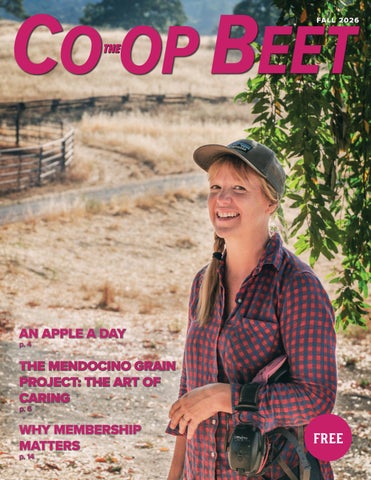
CO OP BEET
FAL L 2 0 2 6
THE
AN APPLE A DAY p. 4
THE MENDOCINO GRAIN PROJECT: THE ART OF CARING p. 6
WHY MEMBERSHIP MATTERS p. 14
FREE
GREETINGS FROM THE INTERIM GENERAL MANAGER MY SUMMER IN UKIAH Hi all, it’s been amazing to experience summer in Ukiah. I’ve worked in Southern California, but not in Northern California until now. It’s a stunning landscape, and everyone has been very welcoming. It’s been rewarding to work with your Co-op Board of Directors, management team, staff, and community. In my time with your co-op, we worked on systems and processes throughout the organization. We paid close attention to teamwork, operational efficiency, financial reporting, and General Manager reporting to improve accountability during the summer months. TEAMWORK The Marketing team recently established a Promotions Team meeting that includes all department managers and assistant managers in monthly planning. Having Marketing spearhead the themes that organize our product promotions, while giving product teams a voice in the process, has greatly improved our cohesion on those campaigns. Department teams have convened several meetings to review procedures and processes. From these meetings, we refined our ordering and receiving procedures in grocery and produce. These improvements matter because much of our work is ordering, receiving, and stocking products. Better methods reduce out-of-stocks, improve efficiency, strengthen the shopping experience, and lower costs, which supports the Co-op’s sustainable operations.
Currently, the committee and our management team are focused on the Coop’s flat year-over-year sales growth and shrinking owner participation. Sales growth is an important indicator of whether the Co-op is meeting the needs of our owners and shoppers. This year’s sales growth is not even keeping up with inflation, which is concerning. At the store level, we are working to improve our in-stock rates and create cleaner, more compelling promotions and displays to make shopping easier for Coop shoppers. We hope that by consistently having the items you come to the Co-op for, we will rebuild your trust in the Co-op’s service and encourage you to shop with the Co-op first.
A natural foods cooperative since 1976 OPEN EVERY DAY TO EVERYONE Store hours 7:00am - 8:00pm Organic Espresso & Juice Bar 7:00am - 6:00pm Soup & Salad Bar 10:30am - 7:00pm Hot Bar 10:30am - 6:00pm Burrito & Taco Bar 10:30am - 7:00pm Bagel Bar 7:00am - 2:30pm 721 South State Street Ukiah, CA 95482 707 462-4778 www.ukiahcoop.com email: UNF@ukiahcoop.com
UNF Management Interim General Manager Wynston Estes Facilities Dan Thompson-Sagehorn Interim Food Service Phil Castro Another exciting development is our marketing department’s new “local” signs that make it easier to find these items on our shelves. We are also discussing the value of Co-op ownership and how we can add to it. More on this initiative soon. GENERAL MANAGER REPORT The board and I have added policy reporting to our monthly meetings. This
Floor Manager Lodie DeAlba Grocery Lenny Mller Human Resources Dagoberto González Information Technology Tasha Jelen Marketing & Outreach Yvonne Boyd Produce Libee Uhuru Wellness / Health & Beauty, Front End Katie McClure
Co-op Beet Editor Yvonne Boyd FINANCIAL REPORTING The finance committee, accounting manager, and general manager have committed to a new approach to reporting and monitoring the Co-op’s financials. We are using a dashboard that focuses our attention on key performance metrics, in addition to monthly financial statements. This allows us to discuss the drivers of our financial performance, both good and challenging, more expeditiously.
2
will make the GM’s areas of accountability clearer to the board and improve consistency in the metrics reported as they develop the annual calendar for these reports. It’s been a real pleasure to support your Co-op over the past few months. You’ve got a wonderful Co-op here in Ukiah. Best wishes for your continued success, Wynston Estes
Design & Production Nicole Martensen - Tierra Design Cover Photograph Yvonne Boyd - Ranchomatic Studios Contributors Yvonne Boyd, Maria Landaeta Andrade, Christine Rodrigues Views expressed in the Co-op Beet are the writers’ opinions and are not necessarily the views of Ukiah Natural Foods Co-op.
2
MESSAGE FROM WYNSTON
3
FALL HAPPENINGS
4-5
APPLES & PEARS
6-11
THE MENDOCINO GRAIN PROJECT
12-13 RECIPES
14-15 A NEW CHAPTER
BOARD OF DIRECTORS board@ukiahcoop.com
MARIA LANDAETA A N D R A D E ANTHONY B ROW N I N G GID EON B U RD IC K JEN DALTON TIM D OLAN KY M AY ERS ANGIE M cC HES NE Y CHRIST INE ROD RI G U E S ST EP HEN TU RNER
OCTOBER IS MEMBER MONTH join for some cool swag, coupons, and to be entered into a gift basket and card raffle. 5 winners will be chosen.
Fall HAPPENINGS WELLNESS WEDNESDAYS
BOARD OF DIRECTORS MEETINGS
15% Off All Wellness, Health & Beauty
5:30pm
Every second Wednesday
Email board@ukiahcoop.com for the online link.
All members invited to attend.
Wednesday, October 14
Monday, October 19
Wednesday, November 11
Monday, November 16
Wednesday, December 9
Monday, December 21
ORDER TURKEYS STARTING NOVEMBER 1 Orders can be made by phone 707-462-4778, or at the customer service desk. Choose between Mary’s organic, Mary’s non-GMO, or Willybird non-GMO. Limited quantity. We will also have ducks and Cornish game hens.
HOLIDAY CALENDAR Closed Thanksgiving Day, Christmas Day & New Year’s Day. Closing at 4pm on Christmas Eve. 3
The Sweet Taste of
Apples & Every year, the Board Development Committee has the privilege of reviewing applications from co-op members who want to give back to this community we all love — and this year, we are pleased to introduce three wonderful candidates who will be joining the UNF Board of Directors for 2026–2027. What stands out about this group is the breadth of their experience. Anthony Browning is a familiar face right here at UNF, with a background in retail grocery operations and a systems-thinking mindset. Jen Dalton is a seasoned food systems professional and a co-op member for 16 years, with deep roots in our local farming and food community.
T
Maria Landaeta Andrade brings many years of experience as an educator and food operator, along with a heartfelt commitment to cooperative and community-centered values. Together, they complement our existing board with fresh perspectives on operations, food systems, and cooperative stewardship. We are glad to welcome them. Please take a moment to read their full applications below and join me in welcoming Anthony, Jen, and Maria to the board! In cooperation, Christine Rodrigues Chair, Board Development Committee
here is something special about biting into an apple or pear grown close to home. Maybe it is the crispness of the fruit, the sweetness that seems just a little more intense, or simply knowing that what you are eating was grown by someone in your own region. When local apples and pears arrive at the market, it is a delicious reminder that eating local and eating in season go hand in
hand. Here in Mendocino County and the surrounding North Coast, orchards are part of the agricultural landscape and local farmers help bring fresh, flavorful fruit to our tables. Shopping for locally grown apples and pears is more than a trip to the produce department—it is a way to connect with the seasons, support the people who grow our food, and keep more of our food dollars in our community.
EAT WHAT’S IN SEASON
One of the simplest ways to eat better is to eat with the seasons. When fruit is naturally available from nearby farms, it does not have to travel thousands of miles to reach your kitchen. Seasonal produce is harvested when it is ready, giving you the opportunity to enjoy fruit at its freshest. Apples and pears are especially wonderful because there are so many varieties, each with its own personality. Some apples are crisp and tart, while others are sweet and juicy. Pears can be buttery and delicate or firm and refreshing. Trying different varieties can turn an everyday piece of fruit into a small adventure. And don't be afraid to ask questions. What's new? What's especially sweet right now? Which variety is best for eating out of hand, baking, or making applesauce? Your local grocery store is a great place to discover new favorites and learn more about the farmers and foods in your area.
SHOP LOCAL, SUPPORT LOCAL
4
When you choose locally grown produce, you are supporting more than a farm. You are helping strengthen the network of people and businesses that make our local food system possible.
Local:
words & photography by YVONNE BOYD
s r a e P & in Season Marketing & Outreach Manager
Farmers, farm workers, truckers, distributors, retailers, restaurants, and other local businesses are all connected. Choosing local food helps keep those connections strong. Your grocery dollars become part of the community rather than simply passing through it. That is one of the great things about shopping at a local food co-op. A co-op is rooted in its community, and local products are an important part of that connection. Every time you choose a locally grown apple or pear, you are making a small choice that can have a much bigger impact.
APPLES AND PEARS BEYOND THE SNACK
Of course, apples and pears are delicious all by themselves. Toss one into a lunch bag, slice one for an afternoon snack, or keep a bowl of fruit on the counter where everyone can grab a piece. But seasonal apples and pears also deserve a place in the kitchen. Slice apples into a salad with greens, nuts, and a simple vinaigrette. Add diced pears to oatmeal or yogurt. Roast pears with winter squash, or pair thinly sliced apples with cheese for an easy appetizer. Bake them into a crisp, pie, or simple fruit cake. You can even sauté apples with a little cinnamon for a warm topping for pancakes or oatmeal. There is no shortage of ways to enjoy them—and eating seasonally gives you a reason to try something different throughout the year. The next time you see a beautiful display of local apples and pears, take a moment to appreciate what you are looking at. You are seeing the work of local farmers, the rhythm of the seasons, and a piece of the place we call home. Shop local. Eat in season. Let’s eat local together! And when local apples and pears are at their best, enjoy every crisp, juicy bite.
5
THE MENDO CINO GRAIN PRO JECT FARMING WITH PURPOSE, LOVE, 6 AND COMMUNITY
words & photography by YVONNE BOYD
Marketing & Outreach Manager
" we are creating an opportunity for small farmers who want to produce small batches of grain "
Rachel Britten Owner/Operator/Farmer, Mendocino Grain Project
7
T
here is something special about food when you know where it comes from—not just the farm where it was grown, but the hands that planted it, harvested it, cleaned it, milled it, packaged it, and cared for it every step of the way. That is the heart of The Mendocino Grain Project. Locally rooted and deeply connected to the land and community, The Mendocino Grain Project is doing something increasingly rare: growing and processing food close to home, by hand and with intention. It is a working farm, a grain processor, a resource for other local farmers, and, perhaps most importantly, a project built around the belief that a stronger local food system creates a stronger community. At the center of it all is Rachel Britten, who has operated and farmed The Mendocino Grain Project since 2020. In 2024, The Mendocino Grain Project became a project of Ridgewood Ranch, a 501(c)(3) nonprofit organization. While the organizational structure has evolved, Rachel continues to operate and lead the project, guiding the work and managing what happens to the crops after harvest and supporting harvest when needed. Rachel's enthusiasm for the land, for farming, and for the people who make up Mendocino County is evident in everything she does. And everything she does has a purpose.
8
FROM FIELD TO BAG The Mendocino Grain Project was originally founded by Doug Mosel in 2009. When Rachel took over in 2020, she carried that vision forward while continuing to build a truly local grain operation. Today, Rachel works with local and regional farmers to support the production of wheat, including heirloom pastry wheat, heirloom bread wheat, and ancient grains, as well as heirloom rye and lentils. But the work doesn't stop when the crop comes out of the field. The Mendocino Grain Project helps shepherd the crop through the many steps between harvest and the finished product. That includes cleaning, processing, milling, packaging, and preparing grains for market. Rachel's role has evolved along with the project: rather than managing every step from seed to flour herself, she now focuses on coordinating the work after harvest, supporting farmers and harvest operations, and making sure each crop moves through the system with care. That level of connection is unusual in modern agriculture, where a grain may travel hundreds or thousands of miles through multiple companies before it reaches a consumer. Here, the distance between the field and the finished product can be measured in steps rather than states. There is no unnecessary waste and no sense of treating any part of the process as disposable. Every step is considered. Every resource matters. Every grain has value. It is farming and food production done with purpose and love. That phrase isn't simply a nice way to describe the project. It is something you can see in Rachel's approach to the work. She cares about the land, the crops, the finished product, the farmers she works with, and the people who ultimately eat the food.
HELPING BUILD FOOD SECURITY CLOSE TO HOME Food security can sound like a big, complicated issue, but at its most basic level it means making sure communities have reliable access to food. The Mendocino Grain Project is helping address that need right here in Mendocino County. By supporting the production and processing of grains locally, the project helps create a food system that is less dependent on longdistance transportation and distant suppliers. It keeps agricultural knowledge and food-processing skills in the region. It creates opportunities for local farmers and gives consumers access to food grown much closer to home. The Mendocino Grain Project also processes and sells products grown by farmers throughout Mendocino, Humboldt, and Sonoma counties. That includes rolled oats, heirloom beans, quinoa, and other crops that can be brought into the local food system through processing close to home. In doing so, Rachel is helping create infrastructure for other farmers.
A RESOURCE FOR LOCAL FARMERS The project offers a variety of custom services that help farmers get their crops ready for market. Those services include custom seed cleaning and harvest support, seed conditioning for a wide variety of crops, dehulling oats and ancient grains, custom bagging, and quinoa processing, including scarifying.
9
These may sound like behind-the-scenes services, but they are essential pieces of a healthy local agricultural economy. A farmer can grow an incredible crop, but getting that crop cleaned, processed, packaged, and ready for consumers can be one of the biggest challenges of bringing food to market. The Mendocino Grain Project helps fill that gap. It is another way Rachel is strengthening the agricultural community—by making it possible for other farmers to succeed and thrive.
NOTHING IS DONE JUST BECAUSE IT HAS ALWAYS BEEN DONE THAT WAY There is an unmistakable sense of care in Rachel's work. She approaches farming with the understanding that the land is something to work with, not simply work on. She pays attention to the details. She takes pride in doing things well. And she understands that local food isn't only about geography. It is about relationships. Relationships with the soil. Relationships with other farmers. Relationships with customers. Relationships with the community. And relationships with the food itself. That care is reflected in the project's philosophy of minimizing waste and making the most of what is grown. When you are involved in the many steps between field and finished package, you see the value of the entire process differently. You understand the work that went into every handful of grain. You understand that food is not just a commodity. It is the result of land, weather, time, knowledge, labor, patience, and love.
Rachel pouring grain into a spiral hopper that is over 100 years old.
10
A DIFFERENT KIND OF LOCAL BUSINESS The Mendocino Grain Project represents the kind of local organization that communities need more of. It farms. It processes. It creates products. It supports other farmers. It keeps food dollars circulating locally. It preserves agricultural knowledge. And it helps make it possible for people to eat food grown closer to home.
Rachel and her sister, Sarah. Most of all, it demonstrates what can happen when someone genuinely cares about the work they do. For Rachel, farming isn't simply about putting a crop in the ground and bringing it to market. It is about being part of something bigger—a local food system that can nourish people, support farmers, respect the land, and strengthen the community. Her role continues to evolve as The Mendocino Grain Project grows. Today, that means coordinating the many moving pieces after harvest, supporting farmers and harvest operations, overseeing processing and milling, and finding ways to make the most of what is grown. She helps clean. She mills. She packages. She supports other farmers. She solves problems. She finds ways to use what is available rather than waste it. And she keeps building something that belongs to this place. That may be the most beautiful thing about The Mendocino Grain Project: it is truly local, from beginning to end—not because one person does every step alone, but because Rachel has helped create a network of farmers and community members working together to keep food connected to the place where it is grown. In a world where so much of our food travels great distances and passes through countless hands before reaching us, Rachel Britten and The Mendocino Grain Project offer another possibility.
Food can be grown here. Processed here. Shared here. And enjoyed here. With purpose. With care. And, above all, with love.
11
SOFT 100% WHOLE WHEAT SANDWICH BREAD
EVERY SUNDAY SCONES WITH SONORA FLOUR courtesy of Rachel Britten yield: 6 scones
courtesy of Jamie Boys
Equipment
• Two 9×5 inch OR 8.5×4.5 inch loaf pans (highly recommend the smaller loaf pans to get a consistent rise)
Ingredients
• 6 to 6½ cups whole wheat flour (we suggest Mendocino Grain Project) • 2½ cups warm water between 105110 degrees F • 1½ Tbsp instant active dry yeast OR regular active dry yeast • 1/4 to 1/3 cup honey, sugar or molasses • 1/3 cup oil • 2½ tsp salt
Preparation
1. Combine water, yeast and 2 cups of the flour in a mixing bowl. Set aside to sponge for 15-20 minutes, until risen and bubbly (warmer weather takes 15 min, cooler temps usually needs 20). 2. Add honey, oil, salt, and 4 cups of flour. Mix until dough starts to clean sides of bowl. Change to dough hook (or turn out to knead by hand), and knead 6 to 7 minutes (10 by hand). Add only a few tablespoons of flour at a time if dough sticks to sides, being careful not to add too much. 3. Form into two loaves and place in greased 9×5 pans (or 8.5×4.5 inch pans for a better rise). Allow to rise in a warm place for 50-60 minutes, until 1/2 to 1-inch above pans. TIP: You may need 15-30 minutes longer if your kitchen is cold – or less time if it's warm – but don't let it overproof (rise too much) or the loaf will fall when baked. Preheat oven to 350 degrees ten minutes before rising time is done. 4. Bake for 30 minutes, rotating halfway through if needed. 5. Immediately remove from pans to cool on a rack. Allow to completely cool before slicing.
12
Ingredients
• 2 cups Sonora flour (also works great with any Mendocino Grain Prroject flour, including rye!) • ⅓ cup coconut sugar (or granulated sugar) • 1 Tbsp baking powder • ½ tsp sea salt • Zest of one lemon or orange • 6 Tbsp cold unsalted butter, cut into small squares • 1 large egg • ½ cup heavy whipping cream • ½ cup dried, frozen, or fresh fruit
Preparation
1. Whisk the first 5 ingredients together (dry ingredients plus zest). 2. Cut in cold butter until butter is the size of small peas. (Using a pastry blender, two butter knives, or short, quick pulses in a food processor.) 3. Whisk together egg and cream, and add to the dry ingredients. Stir gently with a fork until the moisture is distributed throughout. Add dried, frozen, or fresh fruit. If the dough seems dry at this point, add 1 - 2 Tbsp of extra cream. Take care to minimize mixing; see handling note in next step. 4. Turn the mixture out onto a lightly floured surface and lightly press together/ knead the dough until it just comes together (less is more, a few dry flour crumbs are fine, over kneading can create tough scones). 5. Shape into a flat-ish sphere and cut into 6 equal triangle shapes. 6. Brush with egg wash (egg whisked with 1 Tbsp of water) and coarse sugar (optional). 7. Bake at 425 degrees F for 12 - 15 minutes or until bottoms are brown and tops are beginning to brown.
APPLE CIDER DOUGHNUTS courtesy of Val Goodrich yield: 1 dozen doughnuts plus doughnut holes
• 2 cups apple cider • 3 cups all-purpose flour • 1/2 cup whole wheat flour (we suggest Mendocino Grain Project Senora Wheat) • 2/3 cup packed brown sugar • 2 tsp baking powder • 3/4 tsp salt • 1/2 tsp baking soda • 1/4 tsp each ground cardamom, nutmeg, cinnamon and allspice • 2 large eggs, room temperature • 6 Tbsp butter, melted and cooled • Oil for deep-fat frying
Ingredients
Preparation
RE
1. In a small saucepan, bring cider to a rapid boil; cook over high heat until reduced by half, about 12 minutes. Cool completely. 2. Whisk together flours, brown sugar, baking powder, salt, baking soda, and spices. In a separate bowl, whisk eggs, melted butter and cooled cider; stir into dry ingredients just until moistened (dough will be sticky). Refrigerate, covered, until firm enough to shape, about 1 hour. 3. Divide dough in half. On a floured surface, pat each portion to 1/2-in. thickness; cut with a floured 3-in. doughnut cutter. 4. In an electric skillet or deep fryer, heat oil to 325°. Fry doughnuts, a few at a time, until golden brown, 2-3 minutes on each side. Fry doughnut holes, a few at a time, until golden brown and cooked through, about 1 minute on each side. Drain on paper towels; cool slightly. If desired, dip doughnuts into glaze or sugar of your choice.
ECIPES 13
A New Chapte
by Maria Landaeta Andrade
I UNF Boardmember
joined the Ukiah Natural Foods Co-op Board this spring at an unusually important moment. The past several months have brought transition, difficult conversations, and important questions from staff and members about leadership, trust, and what comes next. Being part of the Board during this time has given me a closer look at the care and responsibility involved in stewarding a community-owned business, and at the work happening behind the scenes as we prepare for the Co-op's next chapter. One thing I learned quickly is that ours is an oversight Board, not an operational Board. Much of our work happens through our relationship with the General Manager and through committees focused on finance, owner relations, GM evaluation, Board development, and other priorities. Some of those structures are evolving, including early work toward Policy Governance to create greater clarity and accountability between the Board and GM. Right now, one of our most important responsibilities is choosing our next General Manager.
keep the Co-op moving forward. An interim GM is not necessarily here to reinvent an organization. The work is often about stabilizing, strengthening communication, supporting staff and managers, and preparing the organization for its next leader.
HOW HAS THE SEARCH WORKED? The position was advertised regionally and nationally through the Co-op, regional publications, Columinate job board, Indeed, and other outlets. As of August 19, we had received 25 applications, each reviewed against the required qualifications. Candidates who met those requirements moved to a preliminary phone screening with Melanie, followed by an interview with the full Executive Search Committee and Wynston. Our next step is to select the strongest finalists for on-site visits in Ukiah. Importantly, the position remains open until filled. Advancing current candidates does not mean the Board has decided one of them must be hired. New qualified candidates continue to be welcomed and follow the same process: screening, an ESC interview, and, if selected as a finalist, an on-site visit and final Board interview.
STAFF PARTICIPATION MATTERS
Following a difficult and very public period for the Co-op, the Board felt this search needed a fresh start, with an emphasis on trust, participation, and professional guidance. Rather than reusing the qualifications from the previous GM search, we began by asking: What does our Co-op need from its General Manager at this moment? Leadership Team members, including HR, department managers, and Board members, helped identify the qualities and experience they considered most important. Their input was combined into a new matrix of Required and Highly Desired Qualifications. Accountability, integrity, team leadership, financial management, collaboration, communication, strategic thinking, and retail grocery experience emerged as top priorities. Required qualifications are the first filter; highly desired qualifications help us evaluate which candidates may be best suited to lead the Co-op forward. The Board also hired Melanie Reid of Columinate to bring professional HR and cooperative executive-search expertise to the process.
Staff and management helped shape the qualifications for the position and will play another important role during finalist visits. Finalists will tour the store, meet staff and management, answer questions, and give employees an opportunity to provide feedback. The full Board will then interview the finalists and consider all of that input before making a decision. The distinction is important: the Executive Search Committee manages the search and makes recommendations, but the full Board ultimately hires the General Manager after considering input from staff and management. Earlier this year, members attended Board meetings asking for greater transparency and collaboration regarding new leadership. We heard that, and this process has intentionally created opportunities for staff and management participation while keeping responsibility for the final decision clear. By the time this issue reaches you in October, the search may have advanced considerably. We may be meeting finalists, making a hiring decision, welcoming a new GM, or still searching for the right person. Whatever stage we're in, I hope sharing the process helps members understand how thoughtfully this decision is being approached.
A FRESH EXECUTIVE SEARCH COMMITTEE
WHAT WILL THE NEXT GM INHERIT?
Our Executive Search Committee consists of Stephen Turner, Chair; Anthony Browning; and me, with Melanie serving as our consultant. This is a new committee: none of us served on the previous Executive Search Committee. We heard members ask for a fresh start, and the Board felt that new perspectives were important while still allowing us to learn from the useful work done during the previous search. Stephen brings longer-term Board experience, while Anthony and I are newer members; Anthony also brings the perspective of a Co-op employee. Acting General Manager Wynston Estis has joined us for candidate interviews. Wynston came to UNFC during this transition with experience supporting other cooperatives through periods of change. Before her arrival, our management team stepped in to carry additional responsibilities and worked closely together to
Our next GM will not arrive to a blank slate. The management team has already developed a comprehensive business plan and task matrix. There are opportunities to strengthen prepared foods and grab-and-go, use our limited store space more effectively, improve merchandising and member incentives, and respond to a challenging economic environment. The next GM will also step into a Board that is beginning a likely transition toward Policy Governance, a model intended to create clearer expectations, accountability, and boundaries between the Board and the General Manager. That work is still developing, but the goal is to give the next GM a stronger, more sustainable governance relationship from the start. There is cultural work ahead as well. Rebuilding trust and strengthening communication among staff, management, the
WHAT DOES OUR CO-OP NEED NOW?
14
er For Our Co-Op Board, and our membership will be essential. Our next GM will need to manage a complex grocery operation while listening, building relationships, and turning long-term vision into practical action.
STAYING CONNECTED Members have several ways to communicate with the Co-op. The purple slips at the front of the store can be used for requests and feedback, and members can always email the Board. Messages are shared with all Board members through our secretary; because individual members generally don't respond on behalf of the whole Board, an official response can sometimes take time, but your messages are seen. We invite members to attend Board meetings and watch the store bulletin boards, where we're working to make more organizational and financial information available.
FIFTY YEARS AND THE NEXT CHAPTER
The Ukiah Natural Foods Co-op has been here for 50 years because generations of people have participated not only by shopping but also by working, serving, asking questions, volunteering, and taking responsibility for something they collectively own. We are at another moment of transition. There is work ahead, but also tremendous opportunity. Elsewhere in this issue, you'll find information about upcoming Board openings. I hope you'll read it. This is a meaningful time to get involved as our Co-op welcomes new leadership and reflects on its next 50 years. Being on the Board during this period has reinforced something I believe about cooperatives: they are strongest when participation is not simply an idea, but something we practice together.
WHO GOVERNS THE CO-OP? YOU DO. by CHRISTINE RODRIGUES
Chair, UNF Board Development Committee
Ukiah Natural Foods is owned by more than 6,300 member-owners, and it is governed by a board elected from among them. That is unusual. A sixteen-million-dollar retail business run by people who also push carts through its aisles is a real form of democracy, and, like any democracy, it depends on members willing to do the work. Three board seats open in April 2027. If you have ever wondered whether you belong in that room, this is an invitation to consider it seriously. Directors do not run the store. They hire and support the General Manager, set policy, monitor the co-op's financial health, and hold the store accountable to its owners. It takes a range of skills to do that well: finance, human resources, retail, community relations, governance experience, and a commitment to cooperative values. No single background is required. No one arrives knowing everything, and the people already in those seats will help you learn. Meetings are on the third Monday of each month at 5:30. Directors serve on at least two committees, and some months require more. The co-op's next chapter is being written now. The search for a permanent General Manager is underway, and the board seated in 2027 will help shape what comes after. Strong, varied, community-minded voices make that work better. Yours may be one of them. THE DETAILS Three seats, three-year terms, beginning April 2027. Applications available Fall 2026, accepted beginning January 2027. Candidates must be member-owners in good standing for at least 180 days before the election. Service is unpaid; expenses are reimbursed. The information packet and application link are at www.ukiahcoop.com/boardelections. Questions or interest: board@ukiahcoop.com
15