Owner of the Declaration Bundesverband der Deutschen Ziegelindustrie e.V.
Publisher Institut Bauen und Umwelt e.V. (IBU)
Programme holder Institut Bauen und Umwelt e.V. (IBU)
Declaration number EPD-BDZ-20230091-ICG1-EN
Issue date 20.03.2023
Valid to 19.03.2028
Facing bricks
Bundesverband der Deutschen Ziegelindustrie e.V.
www.ibu-epd.com | https:/ /epd-online.com
1. General Information
Bundesverband der Deutschen Ziegelindustrie e.V,
Programme holder
IBU – Institut Bauen und Umwelt e.V. Hegelplatz 1 10117 Berlin Germany
Declaration number EPDBDZ20230091ICG1EN
This declaration is based on the product category rules: Bricks, 01.08.2021 (PCR checked and approved by the SVR)
Issue date 20.03.2023
Valid to 19.03.2028
Dipl.Ing. Hans Peters (Chairman of Institut Bauen und Umwelt e.V.)
Florian Pronold (Managing Director Institut Bauen und Umwelt e.V.)
Facing bricks
Owner of the declaration Bundesverband der Deutschen Ziegelindustrie e.V. Reinhardtstraße 1216 10117 Berlin Germany
Declared product / declared unit 1 m² facing bricks
Scope:
Application of this document is restricted to facing bricks manufactured by member companies of the Bundesverband der Deutschen Ziegelindustrie e.V. For this Declaration, data from 2021 was made available by 11 member companies and a total of 11 production locations. These members represent around 90% of the manufacturers of facing bricks united in the federal association. Depending on their respective production quantities, the production volume of these companies accounts for approx. 90% of the German market.
The owner of the declaration shall be liable for the underlying information and evidence; the IBU shall not be liable with respect to manufacturer information, life cycle assessment data and evidences.
The EPD was created according to the specifications of EN 15804+A2. In the following, the standard will be simplified as EN 15804
Verification
The standard EN 15804 serves as the core PCR Independent verification of the declaration and data according to ISO 14025:2011 internally X externally
Matthias Klingler, (Independent verifier)
2. Product
2.1 Product description/Product definition
Facing bricks belong to the group of heavyclay building materials.
Based on massrelated annual production, the shares contributed to overall production by the individual companies were identified and used to calculate the weighted average values. This EPD presents the LCA results for one square metre (1 m²) each of facing bricks. (EU) Directive No. 305/2011 (CPR) applies for placing the product on the market in the European Union/European Free Trade Association (EU/EFTA) (with the exception of Switzerland). The products require a Declaration of Performance taking consideration of the DIN EN 7711: 2015: Specification for masonry units – Part 1: Clay masonry units
2.2 Application
Facing bricks are used as exposed brickwork in double wall constructions in exterior areas not protected from weathering or as exposed brickwork in indoor applications.
2.3 Technical Data
Structural data
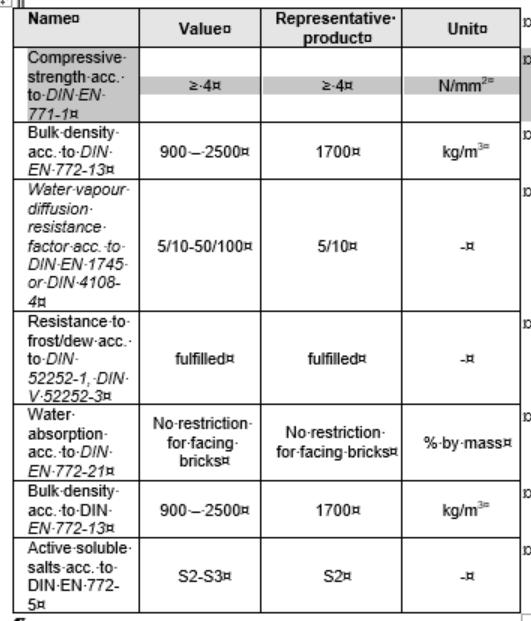
All relevant structural data is listed in the following table. All other structural data in accordance with the PCR. Bricks are not listed as they are not of relevance in practice for the declared product or do not comply with the structural data.
Name
Compressive strength nach DIN EN 7721 (für HMZ, VMZ) >=4 N/mm2
Gross density nach DIN EN 77213 (für HMZ und VMZ) 900 2500 kg/m3
Water vapour diffusion resistance factor nach DIN 41084 (für HMZ und VMZ) 50/100
Freezethaw resistance nach DIN V 522523, DIN 522522, DIN 522521, DIN EN 1344 für Pflasterziegel, DIN EN 1054512 (für VMZ und Riemchen) erfüllt
Water absorption nach DIN EN 77221, DIN EN 105453 (für VMZ und Riemchen)
Active soluble salts nach DIN EN 7725 (für VMZ)
keine Einschränkung für VMZ M.%
S2S3
The respective national regulations apply for usage. For facing bricks in accordance with EN 7711: the application rules of DIN 20 000401: 201701: Application of building products in structures – Part 401: Rules for using facing bricks in accordance with DIN EN 7711:201511.
2.4 Delivery status
Facing bricks are available in various shapes and sizes depending on the respective application. The respective dimensions and permissible tolerances are regulated in the following standard:
• EN 7711 in conjunction with DIN 20000401
2.5 Base materials/Ancillary materials
Facing bricks comprise the base materials of clay/loam (around 92%) and sand (around 8%).
Clay/loam: natural earth of varying natural mineralogical composition (aluminium oxide (Al2O3), silicon oxide (SiO2), iron(III)oxide (Fe2O3)). Materials are quarried close to the surface in selected natural mineral deposits.
Other natural clay components: clay/loam contains natural deposit components of varying percentages such as colouring ferrous oxide, for example.
For this reason, various fired colours can arise depending on the clay involved. Clay/loam can also contain lime and dolomite.
Sand and firing waste are added as shortening material for offsetting the natural fluctuations in the mineralogical composition of the raw clay for very plastic (finegrain) clays. Manganese oxide and iron oxide are used to achieve certain colours.
The product / At least one partial product contains substances from the ECHA list of candidates of Substances of Very High Concern (date: 15.12.2022) exceeding 0.1% by mass: no The product / At least one partial product contains other carcinogenic, mutagenic, reprotoxic (CMR) substances in categories 1A or 1B which are not on the candidate list, exceeding 0.1% by mass in at least one partial product: no Biocide products were added to this construction product or it has been treated with biocide products (this then concerns a treated product as defined by the (EU) Ordinance on Biocide Products No. 528/2012): no
2.6 Manufacture
Pit operation
The main components (loam and clay) are extracted in
opencast mines. After the topsoil has been removed and, if necessary, archaeological sites have been processed, extraction is usually carried out with excavators. Depending on the road conditions, transport entails the use of suitable trucks. Conveyor belts can be used for short distances. When the pits are exhausted, they are recultivated in accordance with nature conservation guidelines and, if necessary, returned to their previous use.
Processing raw materials
The individual raw material components are sampled and analysed in the laboratory for their ceramic properties and their mineralogical and chemical compositions. In the processing stage, the components are combined into the operating mass according to their ceramic properties, homogenised and stored.
Forming
The production mass is extruded and cut to the respective formats using cutters.
Various parameters such as press vacuum, moisture and plasticity are checked regularly. Excess operating mass and faulty pressings are returned in full to the mass circuit.
Drying
Drying serves as preparation of the plastic tile for the subsequent firing process and takes place over 1–2 days at approx. 60–120 °C, depending on the model. Due to its shrinkage behaviour, the ceramic material reacts very sensitively and must therefore be dried under defined conditions. Various drying parameters and the residual moisture are constantly monitored. Dried bricks that have been sorted out (dry quarry) are returned to the production mass in the raw material preparation department.
Firing
The bricks are fired in tunnel kilns and bogie hearth furnaces (also in ring furnaces in rare cases) at approx. 1000–1200 °C using natural gas. The firing time incl. the heating and cooling phase is approx. 1–2 days. The firing process gives the bricks their ceramic properties, which make them durable and longlasting.
Quality control
The requisite ceramic quality properties according to EN 7711 and the product dimensions to be adhered to are regularly controlled internally in the factory's own production control and additionally monitored externally at least once a year.
2.7 Environment and health during manufacturing Safety experts are appointed for occupational health and safety and company doctors are available in the factories with regular consultation hours.
If necessary, the flue gas from the fire is purified in flue gas purification plants. The emission values are monitored regularly and fall below the limits permitted under the Federal Immission Control Act (BImSchG). Noise and dust emissions are also controlled and the limits are strictly observed. Waste generated during the production of bricks is collected separately, recycled or disposed of properly according to the waste codes.
The energy input for tile production is kept as low as possible and the specific energy requirement is constantly improved. Energy management systems according to ISO 50001 or alternative systems according to SpaEfv for SMEs are operated at all production sites.
2.8 Product processing/Installation
Facing bricks are laid and connected to the loadbearing shell in accordance with the structural requirements, for example using anchors.
2.9 Packaging
The polyethylene (PE) foils are recyclable. Noncontaminated PE foils (ensure singlevariety collection) and reusable pallets made of wood are taken back by the building trade (reusable pallets against deposit payments) and returned to the brickworks which redirect foils to disposal companies via a contractual agreement.
2.10 Condition of use
Facing bricks are regarded as being very durable and resilient. Material composition is not altered during use.
2.11 Environment and health during use
Cutting, drilling and grinding of ceramic building materials such as facing bricks releases dust that may contain respirable quartz components.
Wet cutting equipment or equipment with dust extraction should be used to avoid the release of dust. For protection, a suitable dust mask should be worn as personal protective equipment in addition to gloves, safety goggles and ear protection.
2.12 Reference service life
When installed in accordance with the rules of technology, the Reference Service Life (RSL) is 150 years (PCR document issued by the European Brick and Tile Industry Association (TBE)).
Description of the influences on the ageing of the product when applied in accordance with the rules of technology.
2.13 Extraordinary effects
Fire
In the event of a fire, no toxic gases and vapours can arise which impair visibility. Facing bricks comply with the requirements of building material class A1 in accordance with DIN 4102 (and/or EN 135012) 'not flammable'.
fire protection
Name Value
Building material class A1
Burning droplets
Smoke gas development
Water
When influenced by water (e.g. driving rain), no waterpolluting components can be washed out thanks to the solid, ceramic bond.
Mechanical destruction
Unforeseen mechanical destruction is not associated with any risks to the environment or living organisms.
2.14 Re-use phase
Singlevariety facing bricks can be taken back by brick manufacturers and recycled in ground form as leaning agents in production. This practice has been applied with broken product for decades. The possibilities of further use are as aggregate for crushed brick concrete, as filling or bulk material in the area of road construction and civil engineering, as substrate in garden design and landscape gardening, as material for refilling mines and quarries, when building sound barriers and as tennis powder and tennis sand.
2.15 Disposal
Where these recycling options are not practical, brick residue, broken bricks and leftover bricks incurred on the building site are easy to dispose of and do not pose any extraordinary risks to the environment. Owing to the chemically neutral, inert and immobile nature of bricks, they can be stored in class I landfills
in accordance with the Landfill Ordinance and/or used in mines and quarried in accordance with Z 1.1. The waste code is AVV 17 01 02 Bricks and Tiles (List of Wastes Ordinance (AVV)).
3. LCA: Calculation rules
3.1 Declared Unit
The Declaration refers to 1 m² wall comprising facing bricks (brick size (mm): 240 x 115 x 71, mortar joint: 12, without mortar).
Name
Gross density 1700 kg/m3
Declared unit 1 m² conversion factor (mass/declared unit) 0,159 t/m2 layer thickness 0,71 m
For IBU core EPDs (where clause 3.6 is part of the EPD): for average EPDs, an estimate of the robustness of the LCA values must be made, e.g. concerning the variability of the production process, geographical representativeness and the influence of background data and preliminary products compared to the environmental impacts caused by the actual production.
3.2 System boundary
Type of EPD: cradle to plant gate – with options. The Life Cycle Assessment takes into account the extraction of raw materials, the transport of raw materials and actual product manufacturing, including packaging materials (Modules A1–A3). Transport to the construction site (Module A4) and treatment of the packaging materials in the waste incineration plants following installation of the product (Module A5) are also part of the system boundaries. At the end of its useful life, the product is deconstructed using a digger (Module C1). After transport of the deconstructed product (Module C2), about 6 % of the facing bricks are to be disposed of in an inert waste landfill (Module C4), 94 % can be reused after processing (Module C3). Credits incurred by recycling firing waste are declared in Module D. Credits for electricity and thermal energy following thermal utilisation of packaging within Module A5 are also considered in Module D/1.
3.3 Estimates and assumptions
Data sets are not available for all raw materials or preliminary products in the GaBi 10 database. For some substances, the processes were estimated with preliminary products similar in terms of production and environmental impact. Assumptions are made regarding the collated productionrelated emissions. For companies that are not subject to monitoring by the competent authorities for selected parameters and thus cannot provide measured values, an estimate is made based on the information provided by the other companies.
3.4 Cut-off criteria
All data from the operating data survey is taken into consideration, i.e. all starting materials used according to the formula, auxiliary materials, as well as the thermal and electrical energy used. Accordingly, material and energy flows accounting for a share < 1 % are also considered. All data provided is integrated in the LCA model. Transport costs are included for all basic materials, the shipping of products (A4) and in the endoflife scenario (C2). The wear factor of the wooden pallet as well as the machinery, equipment and infrastructure required in production are not considered.
It can be assumed that the processes not considered would each have contributed less than 5 % to the impact categories
2.16 Further information
More information is available at www.ziegel.de.
under review.
3.5 Background data
The GaBi 10 software system for comprehensive analysis developed by thinkstep AG was used for modelling the facing brick manufacturing process. The consistent data sets contained in the GaBi 10 database are documented in the online GaBi documentation.
The basic data in the GaBi database was applied for energy, transport and consumables. The Life Cycle Assessment was modelled for Germany as a reference area. This means that apart from the production processes, the preliminary stages also of relevance for Germany, such as the provision of electricity or energy carriers, are used. The general electricity mix, thermal energy from natural gas, heating oil and liquid gas for Germany with the reference year 2018 are taken into account.
Emissions from the firing process are recorded as primary data on the basis of measurements taken by members of the Bundesverband der Deutschen Ziegelindustrie e.V.
3.6 Data quality
Data for the production year 2021 is used to model the product stage of the bricks. All other background data sets of relevance were taken from the GaBi 10 software database. The database was last updated in 2022. Data is collected on the products examined by the research agency of the Bundesverband der Deutschen Ziegelindustrie e.V. in the actual plants. The deviations in the environmental impacts in the course of averaging carried out for the raw materials used and media consumption of the participating plants are small. The majority of data for upstream chains originates from industrial sources and was collected under consistent time and methodbased constraints. Importance is attached to a high degree of completeness when collating material and energy flows of environmental relevance. The data quality can therefore be regarded as good.
3.7 Period under review
2021 is the period under review. The data represents an annual average over 12 months.
3.8 Geographic Representativeness
Land or region, in which the declared product system is manufactured, used or handled at the end of the product´s lifespan: Germany
3.9 Allocation
Production data from 11 plants was made available for manufacturing the products under review. The requisite raw materials were allocated to the respective products in line with their formulations.
Allocation of the productspecific applications entailed allocating fuels and packaging materials by volume produced while electricity and diesel requirements as well as indirectly allocable raw materials were allocated by mass.
3.10 Comparability
Basically, a comparison or an evaluation of EPD data is only possible if all the data sets to be compared were created according to EN 15804 and the building context, respectively
the productspecific characteristics of performance, are taken into account. The background data is taken from the GaBi 10 database 2022 (version 10.6.1.35).
4. LCA: Scenarios and additional technical information
Characteristic product properties of biogenic carbon
The total mass of biogenic carbonaceous materials and associated packaging is less than 5% of the total mass of the product. The packaging materials contain 0.032 kg biogenic carbon.Note: 1 kg of biogenic carbon is equivalent to 44/12 kg of CO2
A5 is not declared including the disposal of the packaging material on the construction site, the amounts of packaging materials included in the LCA calculations must be declared as technical scenario information for Module A5. Transport to construction site (A4)
Name Value Unit
Litres of fuel
In case a reference service life according to applicable ISO standards is declared then the assumptions and inuse conditions underlying the determined RSL shall be declared. In addition, it shall be stated that the RSL applies to the reference conditions only.
The same holds for a service life declared by the manufacturer. Corresponding information related to inuse conditions needs not be provided if a service life taken from the list of service life by BNB is declared.
Reference service life
l/100km
Transport distance 150 km
Capacity utilisation (including empty runs) 85 %
construction installation process (A5)
Name Value Unit
Output substances following waste treatment on site 0.18 kg
Environmental impact caused by installation losses is not included in the LCA results as they are dependent on the construction project and can vary. The LCA results for a specific installation loss can be calculated for the additional environmental impact caused by the manufacture and disposal of installation losses (e.g. installation loss of 3%, multiplication of the LCA results by 1.03 for A1A3).
Reuse, recovery and recycling potential (D), relevant scenario information
Scenario D: credits as a result of recycling building rubble processing
At the EndofLife stage of facing bricks, a material credit for gravel is applied under this recycling scenario.
This scenario was chosen because the aforementioned raw material is most frequently substituted in practice in the course of broken bricks as a primary raw material.
Scenario D/1: credits resulting from the recycling of packaging materials (from Module A5) are shown in Module D/1.
5. LCA: Results
DESCRIPTION OF THE SYSTEM BOUNDARY (X = INCLUDED IN LCA; MND = MODULE OR INDICATOR NOT DECLARED; MNR = MODULE NOT RELEVANT)
Product stage
Benefits and loads beyond the system boundaries
GWP = Global warming potential; ODP = Depletion potential of the stratospheric ozone layer; AP = Acidification potential of land and water; EP = Eutrophication potential; POCP = Formation potential of tropospheric ozone photochemical oxidants; ADPE = Abiotic depletion potential for nonfossil resources; ADPF = Abiotic depletion potential for fossil resources; WDP = Water (user) deprivation potential)
RESULTS OF THE LCA - INDICATORS TO DESCRIBE RESOURCE USE according to EN 15804+A2: 1 m² facing bricks
PERE = Use of renewable primary energy excluding renewable primary energy resources used as raw materials; PERM = Use of renewable primary energy resources used as raw materials; PERT = Total use of renewable primary energy resources; PENRE = Use of nonrenewable primary energy excluding nonrenewable primary energy resources used as raw materials; PENRM = Use of nonrenewable primary energy resources used as raw materials; PENRT = Total use of nonrenewable primary energy resources; SM = Use of secondary material; RSF = Use of renewable secondary fuels; NRSF = Use of nonrenewable secondary fuels; FW = Use of net fresh water
RESULTS OF THE LCA – WASTE CATEGORIES AND OUTPUT FLOWS according to EN 15804+A2: 1 m² facing bricks
HWD = Hazardous waste disposed; NHWD = Nonhazardous waste disposed; RWD = Radioactive waste disposed; CRU = Components for reuse; MFR = Materials for recycling; MER = Materials for energy recovery; EEE = Exported electrical energy; EET = Exported thermal energy
RESULTS OF THE LCA – additional impact categories according to EN 15804+A2-optional: 1 m² facing bricks
PM = Potential incidence of disease due to PM emissions; IR = Potential Human exposure efficiency relative to U235; ETPfw = Potential comparative Toxic Unit for ecosystems; HTPc = Potential comparative Toxic Unit for humans (cancerogenic); HTPnc = Potential comparative Toxic Unit for humans (not cancerogenic); SQP = Potential soil quality index
Disclaimer 1 – for the indicator “Potential Human exposure efficiency relative to U235”. This impact category deals mainly with the eventual impact of lowdose ionizing radiation on human health of the nuclear fuel cycle. It does not consider effects due to possible nuclear accidents, occupational exposure or radioactive waste disposal in underground facilities. Potential ionizing radiation from the soil, radon and from some construction materials is also not measured by this indicator.
Disclaimer 2 – for the indicators “abiotic depletion potential for nonfossil resources”, “abiotic depletion potential for fossil resources”, “water (user) deprivation potential, deprivationweighted water consumption”, “potential comparative toxic unit for ecosystems”, “potential comparative toxic unit for humans – cancerogenic”, “Potential comparative toxic unit for humans not cancerogenic”, “potential soil quality index”. The results of this environmental impact indicator shall be used with care as the uncertainties on these results are high as there is limited experience with the indicator.
6. LCA: Interpretation
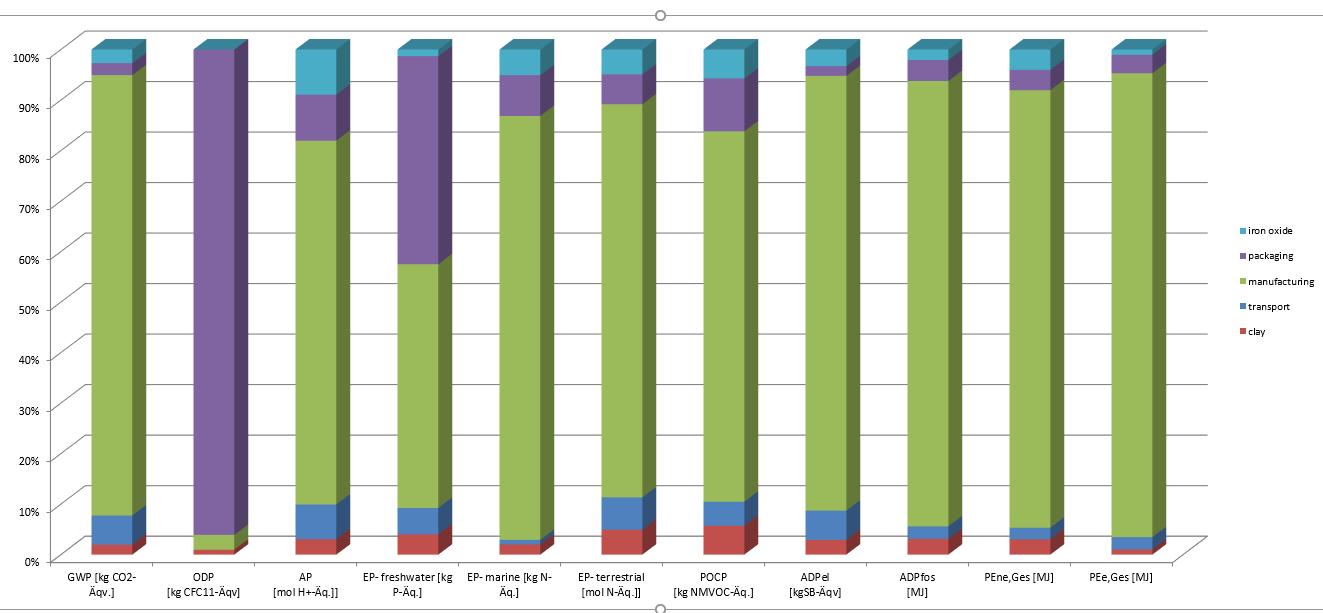
The following bar chart shows the most important factors influencing key indicators of the impact and life cycle inventory analysis for production (A1A3) for the relevant product.
The evaluation of the Life Cycle Assessment results of the facing bricks shows that the environmental impacts in all environmental categories are dominated by energy consumption during the manufacturing process (electricity and thermal energy from natural gas in particular) in the factory.
7. Requisite evidence
Tests and evaluations indicate that the natural radioactivity of facing bricks permits unrestricted usage of these construction materials from a radiological perspective.
They do not contribute towards any relevant increase in radon concentrations indoors and their contribution to the inhalation dose is negligible in comparison to the percentage of radon in soil (Info sheet: Natural radionuclides in building materials).
Packaging, transport, the clay used and the iron oxide only play a very minor role.
The majority of waste is incurred by the upstream chains of the raw materials, whereby largely nonhazardous waste is incurred. Radioactive waste is incurred within the framework of production of electrical energy.
The deviation of the impact assessment results from the declared average value is low.
The data quality for the modelling of the facing bricks of the Bundesverband der Deutschen Ziegelindustrie e.V. can be rated as good. Corresponding consistent data records were available in the GaBi 10 database for the base products and auxiliaries used. For some substances, the processes were estimated with similar preliminary products in terms of production and environmental impact.
A standardisation of the results for life cycle inventory and impact assessment is not carried out, as this could lead to misleading statements.
7.1 Radioactivity
Measurement of the nuclide content in Bq/kg for Ra226, Th232 and K40. In Germany, there are currently no statutory limit values specified for assessing the radioactivity of building materials. Assessment can be performed on the basis of: EU Commission “Radiation Protection 112” document OENORM 5200 Nordic Countries' Recommendation 2000.
8. References
Standards
DIN 4102-1
DIN 41021:199805: Fire behaviour of building materials and building components – Part 1: Building materials, concepts,
requirements and tests
DIN 20000-401
DIN 20000401:201701: Application of construction products in structures – Part 401: Rules for using facing bricks in
accordance with DIN EN 7711:201511
DIN 52252-1
DIN 522521:198612: Testing the frost resistance of facing bricks; freezing of single bricks on all sides
DIN EN 772-5
DIN EN 7725:201812: Specification for masonry units – Part 5: Determination of the active soluble salts content of clay masonry units
DIN EN 772-13
DIN EN 77213:200009: Specification for masonry units – Part 13: Determination of net and gross dry density of masonry units (except for natural stone)
DIN EN 772-21
DIN EN 77221:201107: Test methods for masonry units – Part 21: Determination of water absorption of clay and calcium silicate masonry units by cold water absorption
DIN EN 1344
DIN EN 1344:201510: Clay pavers – Requirements and test methods
DIN EN 13501-2
DIN EN 135012:201612: Fire classification of construction products and building elements – Part 2: Classification using data from fire resistance tests, excluding ventilation services
DIN EN 15804
DIN EN 15804: 2012+A2:2019+AC:2021: Sustainability of construction works – Environmental Product Declarations –Core rules for the product category of construction products
DIN EN ISO 14025
DIN EN ISO 14025: 2011: Environmental references and declarations – Type III environmental declarations – Principles and processes
DIN EN ISO 10545-3
DIN EN ISO 105453:201806: Ceramic tiles – Part 3: Determination of water absorption, apparent porosity, apparent relative density and bulk density
DIN EN ISO 10545-12
DIN EN ISO 1054512:199712: Ceramic tiles – Part 12: Determination of frost resistance
DIN EN ISO 50001
DIN EN ISO 50001: 201812: Environmental management systems – Requirements with guidance for use: Specifications for systematic energy management
EN 771-1
EN 7711:201511: Specification for masonry units – Part 1: Facing bricks
Other literature
AVV
List of Wastes Ordinance (AVV) Ordinance on the List of Wastes dated 10 December 2001 (Federal Law Gazette No. I p. 3379), last amended by Article 1 of the Directive dated 30 June 2020 (Federal Law Gazette No. I, p. 1533)
BImSchG
Federal Immission Control Act (BImSchG): Act protecting against harmful environmental impact caused by air pollution, noise, shocks and similar processes
EWC
Ordinance governing the European Waste Catalogue (List of Wastes – AVV)
GaBi software
GaBi 10 data set documentation for the software system and databases, LBP, University of Stuttgart and thinkstep AG, LeinfeldenEchterdingen, 2021 (http://documentation.gabi software.com/), Thinkstep AG, LeinfeldenEchterdingen, 2021
IBU 2021
General principles for the EPD range of Institut Bauen und Umwelt e.V. (IBU), Version 2.0, Berlin: Institut Bauen und Umwelt e.V., 2021, www.ibuepd.com
Info sheet
Natural radionuclides in building materials, Federal Office for Radiation Protection, 2012
PCR, Part A
Product category rules for buildingrelated products and services Part A: Calculation rules for the Life Cycle Assessment and requirements on the Project Report, in accordance with EN 15804+A2:2021 (v. 1.2); Berlin: Institut Bauen und Umwelt e.V. (pub.); 17 November 2021 Institut Bauen und Umwelt e.V. (pub.); 17 November 2021
PCR: Bricks
Product category rules for buildingrelated products and services Part B: Requirements on the EPD for bricks, Institut Bauen und Umwelt e.V., version 1.7, 2016
SpaEfv
EnSpAusglESysV:20130731
Regulation on energy efficiency improvement schemes in connection with energy and electricity tax relief in special cases (Peak Compensation Efficiency Scheme Ordinance – SpaEfV)
TBE PCR document
Product Category Rules for Environmental Product Declarations for Construction Clay Products, Tiles and Bricks Europe, 2014
(EU) Directive No. 305/2011 DIRECTIVE (EU) No. 305/2011 OF THE EUROPEAN PARLIAMENT AND COUNCIL, 09 March 2011, establishing harmonised conditions for marketing building products and replacing Council Guideline 89/106/EEC
(EU) Ordinance on Biocide Products No. 528/2012 DIRECTIVE (EU) No. 528/2012 OF THE EUROPEAN PARLIAMENT AND COUNCIL, 22 May 2012, on placing biocide products on the market and use thereof.
The literature referred to in the Environmental Product Declaration must be listed in full.Standards already fully quoted in the EPD do not need to be listed here again.
The current version of PCR Part A and PCR Part B of the PCR document on which they are based must be referenced.
Publisher
Institut Bauen und Umwelt e.V. Hegelplatz 1 10117 Berlin Germany
Programme holder
Institut Bauen und Umwelt e.V. Hegelplatz 1 10117 Berlin Germany