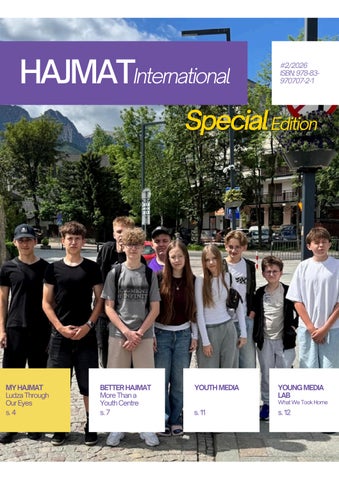
HAJMATInternational
#2/2026 ISBN: 978-83970707-2-1
Special Edition
MY HAJMAT Ludza Through Our Eyes s. 4
BETTER HAJMAT More Than a Youth Centre s. 7
YOUTH MEDIA
YOUNG MEDIA LAB
What We Took Home
s. 11
s. 12
HAJMATInternational
INSIDE:
MY HAJMAT EDITOR-IN-CHIEF
STR. 4
Piotr Jaros
BETTER HAJMAT
LAYOUT
STR. 7
FEIS YOUTH MEDIA STR. 11 YOUNG MEDIA LAB STR. 11 YOUR NEWSPAPER IN 8 STEPS STR. 13
Funded by the European Union. Views and opinions expressed are however those of the author(s) only and do not necessarily reflect those of the European Union or the Foundation for the Development of the Education System (FRSE). Neither the European Union nor FRSE can be held responsible for them.
2
PREFACE
Welcome to Hajmat International #2! What makes a place feel like home? A lake promenade, a park where friends meet, a youth centre, or a school where a new editorial team is finding its voice? In this issue, young people from Poland, Czechia and Latvia introduce the places and communities that matter to them. This special edition grew out of Young Media Lab, an Erasmus+ youth exchange organised by Fundacja FEIS in Murzasichle in June 2026. Participants explored volunteering, regional identity, entrepreneurship, civic engagement, ecology and sport through media work. They developed stories, photographs and other materials in international teams, sharing ideas and learning from feedback. The pages that follow bring that experience back to everyday life. Young people in Ludza describe their town and youth centre. Contributors from Karviná explain how their region is changing and how young people can take part. In Godów, participants took another step: they formed an editorial team and published the first issue of their own school newspaper. Together, these stories show different ways to speak about a place, contribute to a community and make young voices heard. Warmly, The Editorial Team of Hajmat International (Młody Hajmat, FEIS Foundation)
3
MY HAJMAT
Based on a contribution Latvian group
Ludza Through Our Eyes
from
the
Ludza is a town in eastern Latvia where water and history are part of the everyday landscape. Between Great and Small Ludza Lakes, walks along the shore lead to views of medieval castle ruins and streets with historic wooden buildings. For the young people who contributed to this issue, Ludza combines a peaceful atmosphere with opportunities to be active. The lake promenade is a place to meet friends, while youth spaces and sports grounds offer other ways to spend time together. The town’s landmarks are part of the setting in which their own stories unfold.
Visitors may first notice the castle ruins or the lakes. The local perspective adds something else: the places where people gather after school, plan an activity or simply enjoy being together. Discovering Ludza through young eyes means paying attention to both its heritage and its daily life.
X 4
Latgale: Where We Belong
Based on a contribution from the Latvian group The Latvian group introduces Latgale as the “Land of Blue Lakes”. Nature is an important part of their account of the region: lakes, rivers and open landscapes sit alongside cultural traditions that give this part of Latvia its character. Their description connects Latgalian identity with pottery, folk music and hospitality. Festivals and creative workshops offer ways to encounter these traditions and share them with others. Regional culture appears here as something people practise, rather than something they only look back on. For an international reader, these details offer an invitation to explore beyond a country’s capital. A region can be introduced through the things its residents value: a craft, a song, a landscape or a gathering. The young contributors’ account of Latgale brings these elements together into a picture of the place they call home.
X 5
Karviná: A Transformation
Town
in
Based on a contribution from the Czech group Karviná lies close to the Polish border, in a region shaped by coal mining and connections between communities on both sides of the border. For generations, industry influenced local life. Today, the young contributors describe a town that is changing and looking towards new possibilities. Their picture of Karviná includes its historic centre, château, spa and parks, as well as places where nature is returning to former mining landscapes. The surrounding region brings industrial heritage, recreation and community life into close contact. Change is visible in the spaces people use and in the ways they imagine the future of their town. The border is another part of this story. Proximity to Poland creates opportunities to meet people, join exchanges and develop activities together. Silesian food, community ties and shared histories also connect the region across national boundaries. A favourite local place mentioned by the group is Božena Němcová Park. Close to the centre, it offers room for walking, sport, meeting friends or simply sitting for a while. Its appeal is in that flexibility: young people can use it in their own way.
X 6
ICH HAJMAT ICH BETTER HAJMAT ICHHAJMAT HAJMAT
More Than a Youth Centre| Młodzież z Drohobycza Ludza
Based on a contribution from the Latvian group
The group’s account makes clear why a youth centre can become a favourite place. It offers both the practical resources to make things and the social space to feel at home.
For the Latvian contributors, Ludza County Children and Youth Center is a place to learn, meet friends and try out ideas. Dance, music, robotics, photography and theatre are among the activities they describe. The centre brings different interests into one shared space. Its value is also in the time between organised activities. Young people can play board games, relax after school and work together on projects. Creative rooms and digital equipment support media workshops and youth initiatives, while the atmosphere makes it possible to ask for help and find others with similar interests. Life around the centre includes volunteering, environmental activities and digital projects. These experiences give young people ways to contribute as well as participate. A small idea can become something to organise with friends, document and share.
X 7
X 8
ICH HAJMAT ICH BETTER HAJMAT ICHHAJMAT HAJMAT
Based on a contribution from the Czech group The Karviná Youth Council brings together young people who want to take part in the life of their town. Its members learn through experience: preparing events, discussing ideas with local representatives, working in teams and making decisions.
Learning by Doing in Karviná Młodzież z Drohobycza
Young people can also tell the stories of that work. Articles, interviews, photographs and videos offer ways to explain what is happening in a town from their perspective. In their contribution, the Czech group presents youth media as a possibility for connecting young residents, schools, organisations and the wider community.
These activities make communication and cooperation practical skills. Organising something for other people means listening, agreeing on responsibilities and turning an idea into an activity. The council gives young people a setting in which they can practise that work and see where their contribution matters. The Czech group describes a varied youth scene, with sport, music, culture, cafés and time with friends alongside volunteering and community projects. Erasmus+ exchanges add opportunities to learn with people from other countries. Local involvement and international experience can support each other: new ideas travel back into the places where participants live.
X 9
ICH HAJMAT ICH BETTER HAJMAT ICHHAJMAT HAJMAT
Editorial text based on the Polish group’s result confirmed by FEIS After Young Media Lab, young participants in Poland formed an editorial team and began producing their own school newspaper in Godów. Their first issue of Młody Hajmat appeared in September 2026, turning the experience of an international exchange into a printed publication for a local school community. The cover brings together school life and a wider European perspective under the line “Our school | Europe | New horizons”. It introduces Erasmus+, announces material about partners from Czechia and Latvia, and invites readers to discover studentfocused content and an art competition. Printed copies show the project taking a form that readers can hold, browse and share.
From Young zMedia Lab to Our Młodzież Drohobycza Own Newspaper
The editorial team plans to publish monthly. The first issue is already a completed result; regular publication is the next stage of their work. The young team also continues to cooperate through the organiser’s volunteering programme. This is a concrete example of learning continuing after an exchange. The participants created a team, produced an issue and set themselves a new publishing goal. Their school now has a publication made by young people, with a route for that work to continue.
X 10
ICH HAJMAT ICH YOUTH MEDIA ICHHAJMAT HAJMAT
Editorial synthesis contributions
From Młodzież Media Users z Drohobycza to Media Makers
of
the
groups’
A school newspaper, a youth centre’s digital channels and an idea for a new local medium can all give young people space to tell their own stories. The contributions to this issue show different stages of that work. In Godów, the Polish team has published its first printed issue and plans to continue monthly. The newspaper gives the group a shared editorial project rooted in school life and connected to international experience.
The Czech contribution looks at the role a youth-led medium could play in Karviná. Articles, interviews, photographs and videos could link young people with schools, organisations and the town. It is a vision for further development, connected to the group’s experience of civic involvement. These approaches share an interest in making media, choosing stories and giving local youth a voice. Young Media Lab provided a common experience from which each group could take its own next step.
In Ludza, the youth centre already uses social media and digital platforms to report on activities, exchanges and community projects. Photography workshops and media creation are part of its work. The Latvian contributors describe a regular digital magazine as an exciting possible next step, rather than an existing publication.
X 11
ICH HAJMAT ICH YOUNG MEDIA LAB ICHHAJMAT HAJMAT
Edited summaries of the Czech and Latvian contributions, not verbatim quotations The Latvian group describes Young Media Lab as an opportunity to develop practical skills in digital media, interviewing, photography and teamwork. Creating stories with peers from other countries was an important part of the experience. Their account also recalls discovering the environment and hospitality of Poland and seeing how media can connect people across cultures. The Czech contributors emphasise listening, cooperation and presenting their own ideas. Meeting people from other countries helped them recognise shared questions despite different backgrounds. Making something together within a few days became a memorable part of the exchange.
What Młodzież We Took z Drohobycza Home
The Polish follow-up adds a practical continuation to these reflections. The new editorial team in Godów used the period after the exchange to create and publish a school newspaper. Across the contributions, international learning leads back to local places: a youth centre, a youth council and a school. This edition brings those perspectives together. The stories remain rooted in the contributors’ own communities, while the publication gives them a shared space and an international readership.
X 11 12
ICH HAJMAT YOUR NEWSPAPER IN ICH ICHHAJMAT HAJMAT 8 STEPS A practical route from a first idea to your first issue. Start small: a short issue that you can finish is enough to begin. 1.FIND YOUR PURPOSE Decide who you are writing for and what you want to share. Complete one sentence together: “Our newspaper helps … discover …”. Choose a name and a focus, such as school life, your town or young people’s ideas. 2.BUILD YOUR TEAM Invite people who enjoy writing, taking photos, drawing, interviewing or organising. Share the roles: editor, reporter, photographer and designer. One person can try more than one role. Agree who will support the team at your school or youth organisation. 3. PLAN A SMALL FIRST ISSUE Choose three or four stories: an interview, a local story, a photo feature and an invitation to get involved. For each, write down the author, length, images and deadline. Choose print, a digital PDF or both, and check what time and budget you have.
Młodzież z Drohobycza
4. GO OUT AND GATHER STORIES Talk to people, ask open questions and take notes. Record names and sources accurately. Take your own photographs and agree how interviews and images will be used. Look for details that help readers understand the story. 5. WRITE, CHECK AND EDIT Give each story a clear headline and explain the main point at the start. Check names, dates and factual claims against your sources. Separate opinions from facts and keep quotations faithful. Ask a teammate to read your draft and suggest improvements. 6. DESIGN FOR REAL READERS Use readable type, short paragraphs and a consistent layout. Add captions and credit authors and photographers. Use images you have permission to publish. Include your issue number and a way for readers to contact the team. Check that the PDF is readable on a phone too.
X 11 13
ICH HAJMAT ICH ICHHAJMAT HAJMAT
Młodzież z Drohobycza
7. PUBLISH AND INVITE PEOPLE IN Proofread the final file together and test every link and QR code. Agree distribution with your school or organisation, then share the issue through the channels available to you. Tell readers how they can suggest a topic or contribute to the next issue.
8. LISTEN AND KEEP GOING Ask readers what they enjoyed and what they would like next. Discuss what worked for the team and what took too much time. Choose a realistic publishing rhythm, rotate roles and plan your next editorial meeting.
9. YOUR FIRST MEETING Decide your audience, choose three stories, share the roles and set the next meeting. You now have a starting plan.
X 11 14
ICH HAJMAT ICH COOPERATION ICHHAJMAT HAJMAT
Work Młodzież with us! z Drohobycza
JOIN THE CREATORS OF “HAJMAT INTERNATIONAL”! Are you a young person full of ideas and passion, eager to share your voice with others? Hajmat International is the place for you! Our magazine is a space where young people from Upper Silesia – and beyond – can express themselves, develop their skills, and make an impact on the world around them.
FEIS
Do you have an interesting story, thoughts on an important topic, or want to share your experiences? Write to us! HOW TO GET INVOLVED? It’s simple! Send us your work or express your interest in cooperation by emailing: office@feis.org.pl
FEIS
You can also fill out the application form on our website: [https://feis.org.pl/wspolpracuj/]
X 11 21
ICH HAJMAT ICH COOPERATION ICHHAJMAT HAJMAT
Work Młodzież with us! z Drohobycza
MORE THAN JUST A MAGAZINE… As part of the FEIS Foundation, you cannot only publish in Hajmat International but also take part in our youth exchanges, training programmes, and other international opportunities. Develop your skills and broaden your horizons with us! FEIS
FOLLOW US ON SOCIAL MEDIA! Stay up to date with our upcoming events, publications, and opportunities by following us on Facebook, Instagram, and other platforms.
FEIS
We are here for you – and because of you. Hajmat International is a space where every voice matters. Whether you are a writer, artist, photographer, or simply want to make a difference – you’ll find your place here.
LET’S CREATE TOGETHER – JOIN US!
FEIS
X 11 22
Hajmat International #2 — Young Media Lab Published by Fundacja FEIS. Developed from contributions by young people from Poland, Czechia and Latvia, with editorial adaptation and translation. Young Media Lab partners: Fundacja FEIS, Poland; Petrklíč help, z.s., Czechia; Ludzas novada Bērnu un jauniešu centrs, Latvia. Project: 2025-1-PL01-KA151-YOU-000298210, Erasmus+. Discover more FEIS publications in our library: https://feis.org.pl/biblioteka/