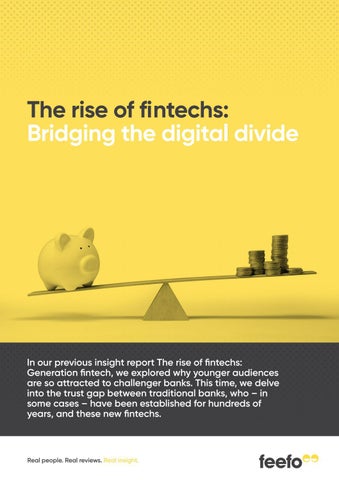
The rise of fintechs: Bridging the digital divide
In our previous insight report The rise of fintechs: Generation fintech, we explored why younger audiences are so attracted to challenger banks. This time, we delve into the trust gap between traditional banks, who – in some cases – have been established for hundreds of years, and these new fintechs.
Real people. Real reviews. Real insight.
FINTECH REPORT
BRIDGING THE DIGITAL DIVIDE
The challenge of consumer trust Despite their popularity, the majority of UK consumers that use challenger banks do not use them as their main bank account. In fact, just 11% of Starling and 16% of Monzo customers use these challengers as their primary account[1]. There are several factors at play here. First of all, consumers are loyal to their current banks – just 4.8% planned to switch providers in 2020 and 1.4% had actually switched providers the previous year[2]. Even when consumers say they are going to switch, they often do not. Why? Well, largely consumers are happy with their current bank – 48% say their bank provides a great service while just 11% say theirs offers a poor service[2].
The most concerning finding for challenger banks, however, is that they are nowhere near as trusted as their traditional counterparts. 68% of UK consumers trust their current bank, but just 17% believe challengers are just as reliable and trustworthy as traditional banks. Unsurprisingly, this means 47% said they would prefer to use a traditional institution over a fintech (just 11% said the reverse)[2].
68%
17%
47%
11%
of UK consumers trust their current bank
believe challengers are just as reliable and trustworthy as traditional banks
said they would prefer to use a traditional institute over a fintech
said they would prefer to use a fintech over a traditional institute
References: [1] YouGov https://yougov.co.uk/topics/finance/articles-reports/2021/01/26/what-kind-brit-banks-fintech [2] YouGov https://yougov.co.uk/topics/finance/articles-reports/2020/04/07/can-fintech-challengers-break-banks
Fintech Report: Bridging the digital divide
FINTECH REPORT
BRIDGING THE DIGITAL DIVIDE
This is going to be a hard mountain for fintechs to climb. Traditional banks are trusted because they are well established (some have been around for hundreds of years), have a global presence and millions of customers. They are not just current and savings account providers, they support businesses, supply mortgages and even sell insurance. Just 9% of Brits could name any challenger bank when asked[2], proving that the awareness for these fintechs just isn’t there yet. While it may take time for fintechs to become more established, and therefore more trusted, it is important to note that they are still successfully challenging the status quo in a somewhat stagnated industry. 29% of consumers think challenger banks offer new and truly innovative services and 26% believe they will revolutionise the banking sector[2].
29% 26% of consumers think challenger banks offer new and truly innovative services
believe challenger banks will revolutionise the banking sector
Furthermore, 51% of Europeans say safety and security is the top consideration when choosing a digital banking solution[3], highlighting a key area that fintechs should focus on if they want to become more trustworthy.
References: [2] YouGov https://yougov.co.uk/topics/finance/articles-reports/2020/04/07/can-fintech-challengers-break-banks [3] Mastercard https://www.mastercard.com/news/europe/en-uk/newsroom/press-releases/en-gb/2020/november/ life-under-the-new-normal-accelerates-digital-banking-adoption-across-europe/
Fintech Report: Bridging the digital divide
[2]
FINTECH REPORT
BRIDGING THE DIGITAL DIVIDE
Customer experience is the key to banking evolution There is no doubt that banking is evolving, and traditional providers are playing catch up. Fintechs have truly shaken up the industry, but both they and their traditional counterparts face numerous challenges in the years ahead.
Consumers are changing, as are their expectations. The COVID-19 pandemic has increased the importance of digital channels. It is no longer enough to provide an ‘okay’ digital experience; it has to be exceptional. Feefo’s own data recently revealed that service levels dropped by 18.5% at the height of the pandemic[4] as businesses struggled to keep up with changing expectations. The good news is, there is an easy way for traditional and challenger banks to keep up with their evolving audiences: listen to their customers. At quick Google search for ‘bank reviews’ shows that not many traditional banks are actively collecting public-facing feedback. In a world where 96% of consumers use reviews in some way[5], collecting and displaying your customer feedback is vital if banks want to retain current customers and attract new ones. More importantly, the insight customer feedback gives businesses is truly invaluable for building a better customer experience. Feedback allows businesses to identify their
strengths and weaknesses, understand what products they need to develop or improve, discover who their customers are and they want and need from their services, and so much more.
Thank you for banking with us. We would love to hear what you think.
References: [4] Feefo ‘The demand on customer experience during COVID-19’ https://www.feefo.com/en/business/resources/reports/april-2021-report [5] Feefo ‘The 2019 Feefo Consumer Report https://www.feefo.com/en/business/resources/reports/the-2019-feefo-consumer-report
At Feefo, whether big or small, challenger or traditional, we can help banks discover more about their customers and give them the tools and insight they need to improve their customer experience. To find out more, get in touch with our friendly experts today. sales@feefo.com | 020 3196 8098 | feefo.com
Fintech Report: Bridging the digital divide