
Alignment with the LSIP Guidance and the methodology
Outline of the Evidence Base and priority sector selection
How the LSIP considers Environmental and Net Zero Goals and Equality of Opportunity
Describes the Governance Structure
The Skills England LSIP guidance states that “Thecontentofeachplanshouldreflectthe sectorskillsprioritiesofthearea,asidentified bytheStrategicAuthority…….togetherwith feedbackfromemployersontheirspecific skillsneeds,whichmayalsogobeyondthese priorities” The Strategic Authority (SA) for this LSIP is Cornwall Council.
Federation of Small Business (FSB), as Employer Representative Body (ERB) have therefore, worked collaboratively with the SA’s skills lead, skills team and notably, their strategic boards (Economic Forum - EF and Workforce and Skills Board – WSB) to ensure that there is alignment with local economic strategy and specifically the shared implementation of their existing Workforce and Skills Strategy (launched Feb 2026).
The ERB have also independently engaged with the business community, providers and a number of sector bodies to ensure that any additional skills needs are met and findings from any recently published, in depth, sector reports are also reflected in the LSIP priorities.
Prior to the announcement of the next LSIP, the SA were already working on their Workforce and Skills Strategy that compliments their Good Growth Plan. Considerable evidence gathering and strategic planning had therefore recently been commissioned by the –SA (whoaredevolvedforskillsdelivery)and by various sector groups, so the area was well prepared and quite well advanced in its strategic positioning. With the ERB having been represented on both the Economic Forum and Workforce & Skills Board for some time, they have been continuously involved in the shaping of these economic plans which has given a strong foundation for production of this LSIP and has made alignment a natural process.
The Economic Forum, Workforce and Skills Board, Sector Groups, businesses, stakeholders and providers have been updated and consulted throughout the production of all strategies in a collaborative approach and have jointly authorised publication. It follows therefore, that the LSIP has been produced in the same manner to dovetail with the suite of strategies.
This Local Skills Improvement Plan (LSIP) has been developed through a structured, multi-phase methodology combining project planning and mobilisation, business, provider and stakeholder engagement, qualitative and quantitative research, and iterative testing of findings. The approach builds on the foundations of the first LSIP while incorporating new evidence, expanded collaboration, and a strengthened governance framework.
(October–December 2025)
1.1
From October to December 2025, the FSB undertook an internal mobilisation phase to establish the project infrastructure required for the new LSIP. This included:
• Formation of the internal project team – based on the previous team with some staff changes.
• Development of a marketing and communications strategy
• Planning of engagement activity, research commissioning and a whole project timeline aligned with budgets and timescales.
In parallel, external mobilisation activities were initiated to ensure early alignment with partners and stakeholders. Key actions included:
• Initial engagement with the Strategic Authority (SA) to agree priority sectors, working methods, and data-sharing arrangements
• Identification of target audiences and stakeholder groups
28 Nov 2025 - a data request was submitted to the SA for two specific data sets
STAGE 1: Sectors, occupations and gaps and STAGE 2: Relevant technical education delivery that the ERB used as a basis to test known LMI and skills data with businesses and stakeholders at focus groups, meetings and events.
• Communications with training providers including FE and HE and independent training providers, employers, stakeholders and wider partners about the initiation of work on the new LSIP and attending external events to promote the forthcoming activity.
• Commissioning of research, consultancy and development of governance structures
• Establishment of Contracts, MOUs, Terms of Reference, and a presentation of the plan of work to the Workforce and Skills Board which was agreed on 3rd December 2025.
Further presentations were also made to the Economic Forum and Economic Resilience Group to ensure all parties were up to speed with the project.
This phase marked the ERB’s transition from oversight of the first LSIP to the start of joint working arrangements with the SA of a new LSIP . Delivery of the first LSIP continues until publication of the new LSIP. Consideration of this transition —and how ongoing LSIP actions inform the new LSIP was integrated throughout the development process.
A comprehensive programme of research and engagement was undertaken to build the evidence base for this new LSIP.
Between December 2025 and February 2026, thirteen engagement sessions and a survey were organised, promoted and delivered:
• A comprehensive survey was created, supported by our commissioned research company, Habit 5. The survey ran from 21st January to 8th February 2026 and was widely promoted via a combination of direct and social media marketing and partner circulation.
The marketing plan was implemented with a combination of direct email (to ERB database – purchased data – circulation to the SA and partners to share with their contacts etc.), a combination of paid and organic social media to promote focus groups, the survey and the open door policy that invited anyone to interact with us on the LSIP with direct contact details of the LSIP lead put in the public domain.
An updated website with individual branding for the new LSIP was created to distinguish the new project from the past LSIP and to give a fresh, eye-catching new look. This complimented by new banners and presentation collateral to again demonstrate this was a new project, not more of the same which may have had the off-putting effect of making people think they had already consulted last time.
Promoted the new LSIP and LSIP contacts at ad hoc external events and meetings
• Face-to-face business / sector specific focus groups
• Online business / sector specific focus groups
Dedicated, in-person Provider Forum - 27 January 2026 with FE / HE / ITPs / awarding boards / Careers Hub and school representative. This provided a chance to understand the context regarding education and training provision and enabled providers from Further Education and Higher Education to share insight on current delivery, challenges and opportunities.
Seetimetablebelow
The sessions were co-designed and hosted by the ERB and chaired by Habit5 in accordance with accredited research body rules.
Habit 5 then produced analysis on the focus groups and the survey for the ERB to incorporate into the LSIP evidence. SeeANNEXA.
FSB outreach summary Dec 2025 to mid-Feb 2026
Social reach – 120,105
Social impressions – 394,238
Social link clicks – 1560
Direct marketing emails – 29,522
Email opens – 5,613
Email direct click through to survey – 97
FG bookings (from social) – 72 115 booked – total attended 73
FG bookings (from other) – 43
Survey replies – 281 started – Less 39 Disqualified = 242 useable
TOTAL ENGAGEMENTS TAKEN INTO RESEARCH ANALYSIS: 315 to 10th February
Bookings for LSIP Conference = 56 (see detail in 2.3 below)
Post Conference email circulated slides with draft priorities for open consultation = 200+ (N.B.TheinformationwassenttoconferenceattendeesandCareersHubconferenceattendeesastheLSIPteamattendedbothtodiscuss theLSIPpriorities–thiswasthemainopportunitytogatherfeedbackonthedraftedprioritiesfollowingdataassessmentandresearch.)
TOTAL ENGAGEMENTS UP TO DATE OF DRAFT on 31st March = 515+
Note:doesnotincludeCouncilorotherpartneractivity–thiswillbeadditionaltotheabove butwearenotabletoquantifytoanyaccuratemeasure.
As well as a dedicated forum (27th Jan) and invitations to all providers and stakeholders to the LSIP conference (26 Feb), providers from Further Education, Higher Education and the Independent Training Providers Group (The Devon and Cornwall Training Provider Network), are all represented on the CIoS Workforce and Skills Board which is the overarching governing body for both the CIoS Workforce and Skills Strategy and the CIoS LSIP. This includes representatives from the Cornwall College Group and Plymouth University. Further senior representation on the Board includes the Chair, Professor Emma Hunt (ViceChancellor, Falmouth University).
Providers have therefore been given consultation opportunity at every stage of the development of the LSIP. Aside from the formal meetings there have also been individual meetings, ad hoc conversations and email correspondence with the CIoS LSIP leads to ensure that information is shared. Particular attention has been given to supporting the development of their Accountability Statements which care has been taken to make sure they also reflect the requirements of the CIoS LSIP.
Aside from business and stakeholder engagement, the research phase also included:
1. Gathering existing evidence and reports and mapping priority occupations (SOC and SIC codes) and skills against, Individual Learning Records (ILR), Local Market Intelligence (LMI), priority sectors and investment areas.
2. Commissioning detailed skills analysis of data to define gaps and evidence the need for actions, particularly around emerging technologies, future workforce needs and crosscutting skills.
3. Re-testing the issues raised, priorities established and suggested actions.
4. After satisfactory testing of the thematic priorities that were arrived at from the above, the ERB and the SA had a final review of how these matched with local strategies and implementation plans to ensure that the LSIP conclusions, actions and activities were aligned.
The analytical process underpinning the new LSIP followed a structured sequence:
1. Labour Market Analysis - Use of employment levels, vacancy data, and forecasts to identify a draft list of skills shortage occupations.
2. Review of Existing Evidence - Analysis of reports and external sources to identify upskilling needs and skills gaps in the current workforce.
3. Employer Validation - Consultation with employers to confirm or amend identified shortages and gaps, producing a validated set of sector-specific skills needs.
4. Skills System Assessment - Collection of feedback from employers and providers on the performance of the local skills system.
5. Provision Mapping - Comparison of publicly funded education and training provision with identified skills needs across:
• 16–19 technical education
• Adult skills provision
• Apprenticeships
• Technical and professional higher education
6. Identification of Required Change - Determination of what needs to change within the skills system (e.g., new provision, expansion, reduction, or curriculum changes).
7. Action Planning - Development of a detailed action plan outlining:
• Sector-specific priorities
• Cross-cutting initiatives
• Actions to address system-level issues
• Employer-led upskilling and workforce development opportunities
During a Council designated “Cornwall Skills Month” an LSIP conference, delivered jointly with the Careers Hub in February 2026, provided a platform to validate and refine the evidence base:
• Sharing emerging insights
• Testing proposed approaches
• Engage a wider audience of employers, providers, and stakeholders
• Attendees were consulted to confirm or challenge identified skills shortages and
upskilling needs and the performance and responsiveness of the local skills system
An email with the slides was sent to all participants of the LSIP conference and the Careers Hub Conference (both held together with a total of about 200 participants) asking for any feedback that they hadn’t had the opportunity to give in person.
3. Iterative Development and Testing (February–March 2026)
3.3 Analytical Synthesis
Between February and March 2026, data analysis, evidence testing, and report drafting were undertaken to consolidate findings into a coherent plan.
3.4 Governance and Approvals
• The LSIP project plan was presented to the WSB on 3 December 2025
The Economic Forum was updated on LSIP progress on 22 January 2026
The Economic Resilience Group was updated on LSIP progress on 19 November 2025 and 21 January 2026
Regular meetings with the SA Skills Team and Skills England ensured that the LSIP was on track and priorities and actions were evidence based and aligned with SA strategies.
• Approval of the substantial draft from the WSB on 23 March 2026
• The substantive draft report focusing on parts 1 &2 and Annex C was submitted on 31 March 2026 with SE feedback and adjustments then implemented by the ERB mid-April.
4. Finalisation, Design and Publication (April–June 2026)
4.1 Refinement and Design
From 31st March to 15 May 2026, the LSIP report underwent further refinement, design, and final sign-off by the ERB and SA at an exceptional WSB meeting on 14 May 2026.
Design work was led by FSB Policy designers in collaboration with Cornwall Council to ensure alignment with the Council’s existing strategic suite.
4.2 Publication
The final, second, CIoS LSIP Report scheduled for print and publishing in Summer 2026.
The focus of the development of the CIoS LSIP has been with employers and providers in order to steer the formation of our LSIP by economic and commercial need. However, in order to capture the views of those in the workforce and to monitor effectiveness from an end user perspective, it is recognised that the following organisations will play a valuable part in shaping the delivery of the CIoS LSIP over it’s 3 year timeline. Planned, more detailed, engagement is as follows:
Whilst the TUC is represented in the LSIP governance structure on the Workforce and Skills Board, we will further convene a two-way consultation on localised skills needs and delivery with representatives of the workforce via the TUC and other Trade Unions operating in the area. Focus will be on those unions with a membership that align with LSIP’s sectors and themes.
The local representatives of these organisations have been involved in the LSIP governance and steering groups since the first LSIP and we shall continue to involve them. Once the delivery phase commences there will be opportunities for individual consultation to ensure that the CIoS LSIP is providing meaningful outcomes for those they represent also.
The Good Growth Plan is the economic strategy for Cornwall. It defines the structure for growth in Cornwall and Isles of Scilly and therefore is a basis for what the current and future skills need in the county is and has been key in guiding the focus of the LSIP.
The plan identifies the need for Good Growth and a partnership approach. Good Growth in the context of this plan means growth that is sustainable, inclusive, and improves overall quality of life — not just GDP. It incorporates economic output, social progress, fairness, environmental responsibility and long-term resilience.
The plan identifies economic opportunities and areas for priority investment in sectors that fit into three groupings and the CIoS LSIP has also followed this theme:
Distinctive sectors - those in which Cornwall has unique strengths.
Core sectors - those at the heart of Cornwall's economy.
Foundational sectors - the enabling building blocks of the economy.
Details of the plan and the evidence base that has been incorporated into the CIoS LSIP evidence can be found here and other reports referred to can be found in the reference and bibliography of the main report:
Cornwall Good Growth Plan - https://www.cornwall.gov.uk/media/24dkjyyb/cornwall-goodgrowth-plan-update-03_03_2025.pdf
Good Growth Plan Evidence report 1https://www.cornwall.gov.uk/media/heyn45pl/cornwall-good-growth-plan-evidence-report1.pdf
Good Growth Plan Evidence report 2 - https://www.cornwall.gov.uk/media/owslflki/cornwallgood-growth-plan-evidence-report-2.pdf
For the Isles of Scilly, they also have an Island Futures Plan: https://www.scilly.gov.uk/sites/default/files/document/planning/20220704_CIOSLEP%20Island%20Futures.pdf Last published in 2022 and is currently under review.
The CIoS Workforce and Skills Board (WSB) have also drafted a Workforce and Skills Strategy. This Strategy sets out a shared vision for a future where everyone—no matter their background or where they live—can access good jobs, develop their skills, and thrive in a
changing economy. It focuses on four key areas: inspiring the next generation, transforming productivity, driving innovation and ensuring opportunity for all. Considerable, and recent, research had already taken place to produce this strategy so the ERB has considered that as part of the evidence base and sought to verify and expand upon that work in order to ensure that the CIoS LSIP is business led.
From the priority sectors identified in the Good Growth Plan and the Workforce and Skills strategy the SA selected and defined the top priority sectors that are to be in focus in the LSIP. The ERB reviewed the sectors from their knowledge and via engagement with businesses. The resulting agreed sectors then became the themes for research and engagement.
Other local plans and reports reviewed:
The ERB also gathered all of the available sector research and deep dive reports to refer to in developing the LSIP e.g. Agri-Food, Digital, Marine, Critical Minerals etc and, via the WSB, documented a timetable or plan of forthcoming sector group work so that as an ongoing process, we included as much of this as possible within the draft and the final LSIP. The sector groups have done considerable research with businesses in their own sector so this was also valuable and essential evidence to confirm what the data is suggesting to the CIoS LSIP and to reinforce the other research that the ERB has also completed.
Wider strategies and evidence reviewed and contextualised:
We have naturally needed to consider wider plans as part of the decision making on which sectors should be in the scope of this second round of the LSIP. Whilst also considering local plans and other key documents listed in the reference and bibliography pages of the main report, we have also needed to investigate broader reporting for absolute context . Includes:
Assessment of priority skills to 2030 -a detailed analysis of future employment needs across ten critical sectors, aligned with the government’s Industrial Strategy and Plan for Change.
Skills England: skills for growth and opportunity - Findings of Skills England’s analysis and engagement with sectors on the growth and skills offer and the skillsneeds assessments for 10 priority sectors
Skills England place-based assessment of skills - DfE local skills dashboard
Get Britain Working Plans – Being developed locally by the SA alongside government guidance and incorporated into wider skills plans and the LSIP.
The Immigration White Paper – that will also have a bearing on available workforce and eligibility to be able to work in the UK.
The UK's Modern Industrial Strategy 2025 and links to associated papers on sectors:
o Advanced Manufacturing Sector Plan
o Clean Energy Industries Sector Plan
o Creative Industries Sector Plan
o Defence Industrial Strategy 2025: Making Defence an Engine for Growth
o Digital and Technologies Sector Plan
o Financial Services Growth and Competitiveness Strategy
o Life Sciences Sector Plan
o Professional and Business Services Sector Plan
Great South West: https://greatsouthwest.co.uk/insights/ Various reports listed below including their recently published Industrial Workforce Plan. Which the ERB also had involvement in.
Insights from the Great South West Investment Brochure 2026
Ports Investment Case Summary
Housing Prospectus 2026
Leading the UK’s Defence & Security (Defence Prospectus)
Agrifood Industries Growth Plan
A New Nuclear Future
Tracking and Supporting High Growth Businesses
The Strength of the Region’s High Growth Businesses Across the IS-8 Sectors
The State of Growth in the Great South West
Manufacturing / Industrial Workforce Plan (Manufacturing Investment Plan)
Great South West Investment Brochure 2025
Further external data sources:
The ERB submitted a detailed, two-part data request, for job vacancies, current data on priority occupations and skills delivery from the SA (18/11/25). This data was drawn from Lightcast, Data Cube access and other SA sources of data and presented to the ERB in an Excel format. (A summary of this data can be found in Annex A and the full Excel workbook is available on request from the ERB).
The ERB then analysed and tested this data with employers in the Core, Distinctive and Foundational sectors of the Good Growth Plan to find out how that data translated in real world situations, what the gaps are and what future skills needs employers will have that the data won’t show.
The ERB also referenced a helpful, new, Skills England – Local Skills Dashboard and recently released ONS BRES data, via https://www.nomisweb.co.uk/datasets/newbres6pub Labour Market and Skills Projections, 2020-35). LSIP-specific forecasts for net change (change in total jobs required) and replacement (when someone leaves the workforce) demand by sector: https://www.gov.uk/government/publications/labour-market-and-skillsprojections-2020-to-2035
ONS Regional GVA by Industry: City and Enterprise Regions, table B3 2022, via https://www.ons.gov.uk/economy/grossvalueaddedgva/datasets/regionalgrossvalueaddedbal ancedbycombinedauthoritycityregionsandothereconomicandenterpriseregionsoftheuk
Location quotient data by travel to work area (anything above 1.2 can be considered a specialism), via https://www.ons.gov.uk/employmentandlabourmarket/peopleinwork/employmentandemploy eetypes/articles/understandingtownsindustryanalysis/2021-12-13
Assessment of Priority Skills, see figure 3, via: https://www.gov.uk/government/publications/assessment-of-priority-skills-to2030/assessment-of-priority-skills-to-2030#employment-demand-to-2030
Skills England’s occupational maps by SOC code: https://occupationalmaps.skillsengland.education.gov.uk/maps/occupation-search?searchTerm=5434
Office for National Statistics (ONS) (2009) UK Standard Industrial Classification of Economic Activities
NB. More recent datasets and forward-looking analysis reference UK SIC 2026 and UK SOC 2026, aligned with current ONS standards were also reviewed but due to timescales of this LSIP the previous classifications were used as the basis for analysis as this happened before the new data sets were available.
DfE Individual Learning Records (ILR) was also incorporated into our data set and accessed by our skills consultancy company, THINK.
Note: It is important to ensure that the CIoS LSIP compliments wider plans so as not to be at odds with the ambitions of neighbouring geographic regions or national policies, regardless of any other emerging bodies or political changes such as combined authorities and regional partnerships.
The ERB for CIOS already works well with the neighbouring SW LSIP teams and are keen to support matters that, in particular, involve travel to work areas across the Tamar. For example, the Defence sector. The sharing of information across LSIPs and meetings between ERBs has been helpful to add further context and the group will continue to meet as the LSIP delivery phase progresses.
The Local Skills Improvement Plan for Cornwall and the Isles of Scilly integrates net-zero considerations by aligning skills planning with the Good Growth Plan, which emphasises sustainable, environmentally responsible development. The LSIP draws on evidence from priority sectors such as clean energy, renewable technologies, critical minerals, construction, and engineering—many of which are central to the region’s transition to a low-carbon economy. Through labour-market analysis, employer engagement, and sector-specific deep dives, the plan identifies the green and technical skills required to support decarbonisation, future workforce needs, and emerging clean-technology industries. Net-zero priorities are also reinforced through the review of national strategies, including the Clean Energy Industries Sector Plan and the Assessment of Priority Skills to 2030, ensuring that local
training provision supports both environmental objectives and long-term economic resilience.
The CIoS LSIP places strong emphasis on ensuring opportunity for all by drawing on Cornwall Council’s broader equality and inclusion objectives and draws on their Equality, Inclusivity and Diversity plan that was refreshed in 2025 - summary herehttps://www.cornwall.gov.uk/media/ssrfqe1u/equality-diversity-inclusion-plan-easy-readfinal-2024.pdf. These values are also clearly reflected in the Councils Workforce and Skills Strategy and shared in the LSIP. There are consistent themes in all of these plans which are built around fairness, inclusivity, and access to good jobs for every resident regardless of background or geography.
With the Council and ERB’s engagement with VCSE organisations, sector bodies and frontline delivery partners who support people furthest from the labour market, the LSIP seeks to address issues that matter to them. Through focus groups, surveys, provider forums, and open access events the LSIP has also ensured that the voices of smaller businesses, harder-to-reach employers, and diverse communities are represented.
Barriers such as transport, housing, childcare, health and geographic isolation were consistently identified through employer and stakeholder engagement, particularly affecting participation in rural communities and the Isles of Scilly. Whilst the Council will be taking these issues forward separately, actions within the LSIP emphasise modular delivery, local access, wrap-around support and place-based models to widen participation and ensure that the opportunities for people created by the LSIP, are not determined by location or circumstance.
The analytical framework also highlights the importance of transferable skills, foundational capabilities, and accessible education pathways across all sectors, supporting social mobility and reducing inequalities. By further aligning with wider local plans such as the Good Growth Plan and “Get Cornwall and Isles of Scilly Working,” the LSIP promotes an inclusive skills system that enables people of all ages and circumstances to participate fully in the region’s economy and benefit from future growth.
Within their Good Growth Strategy Cornwall Council have considered and mapped the Good Growth priorities with the 8 IS sectors in the following way:
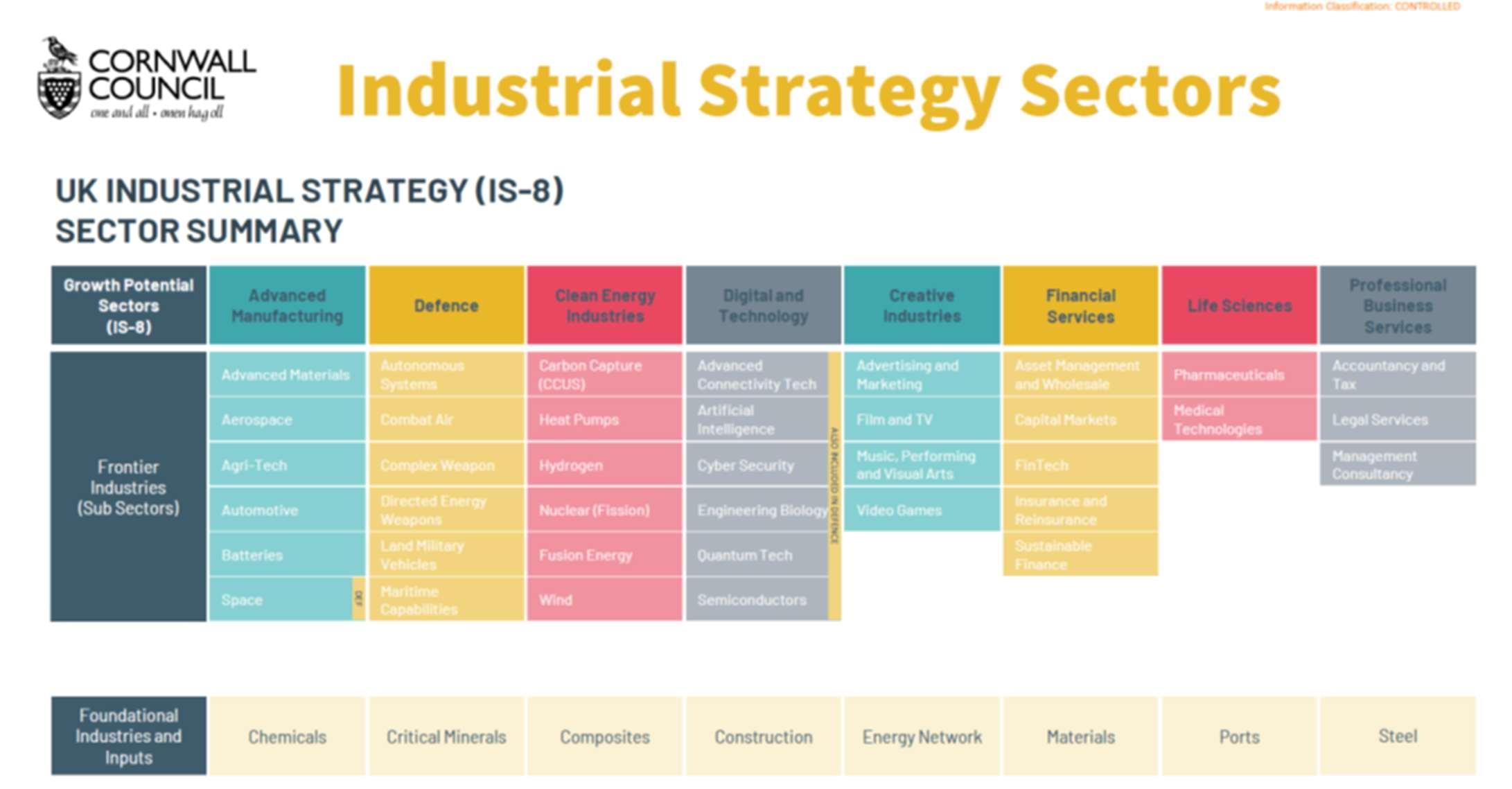
N.B. There are also 2 further foundational sectors in the UKs Modern Industrial Strategy: Construction and Health & Adult Social Care that also need to be considered within the LSIP.
The Council have then further mapped out how local growth sectors sit alongside the UK Modern Industrial Strategy as follows:
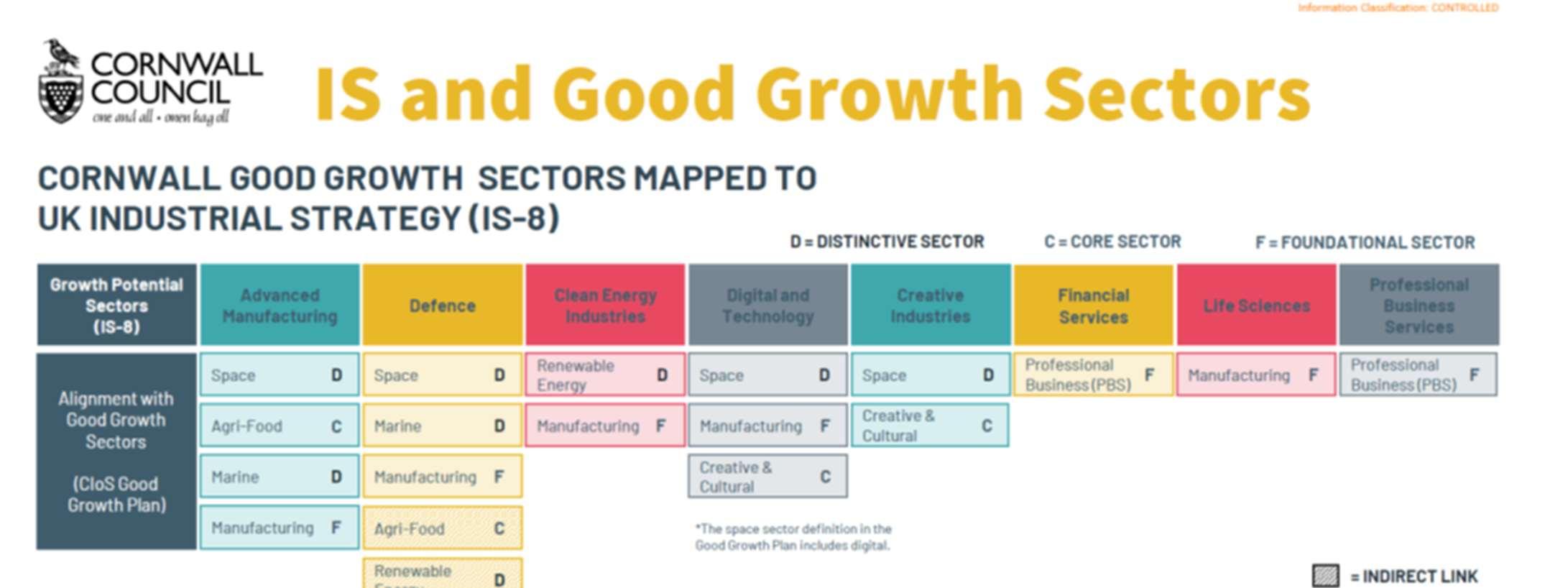

And this is the mapping of how critical, core, distinctive and Foundational sectors are viewed within Good Growth Plan.
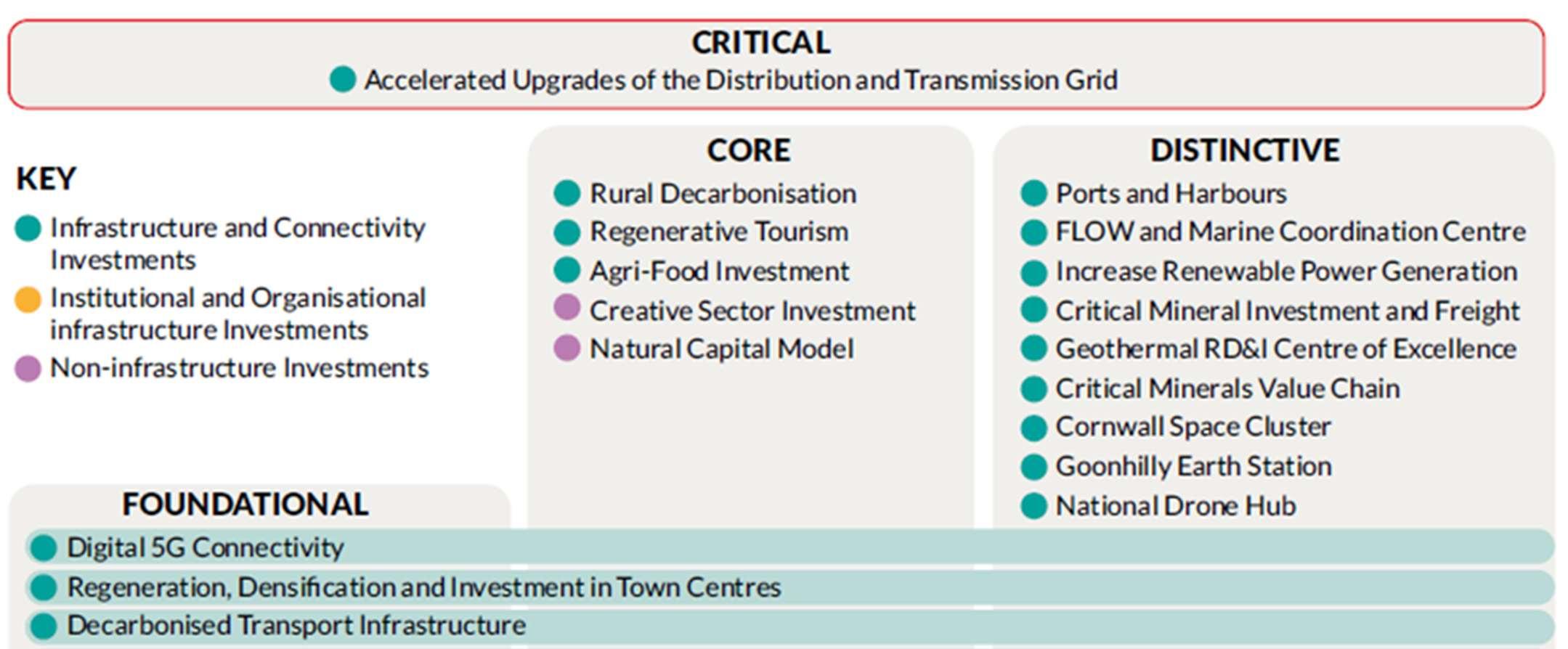
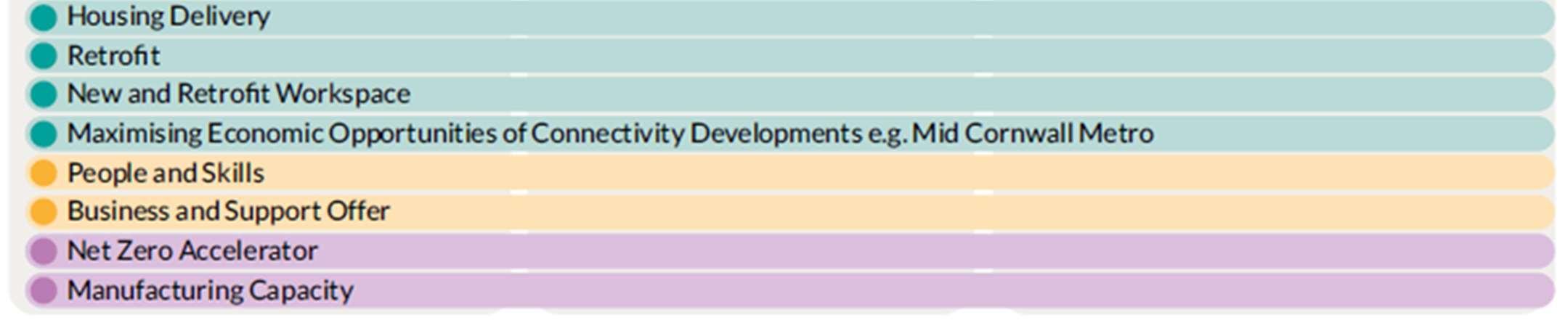
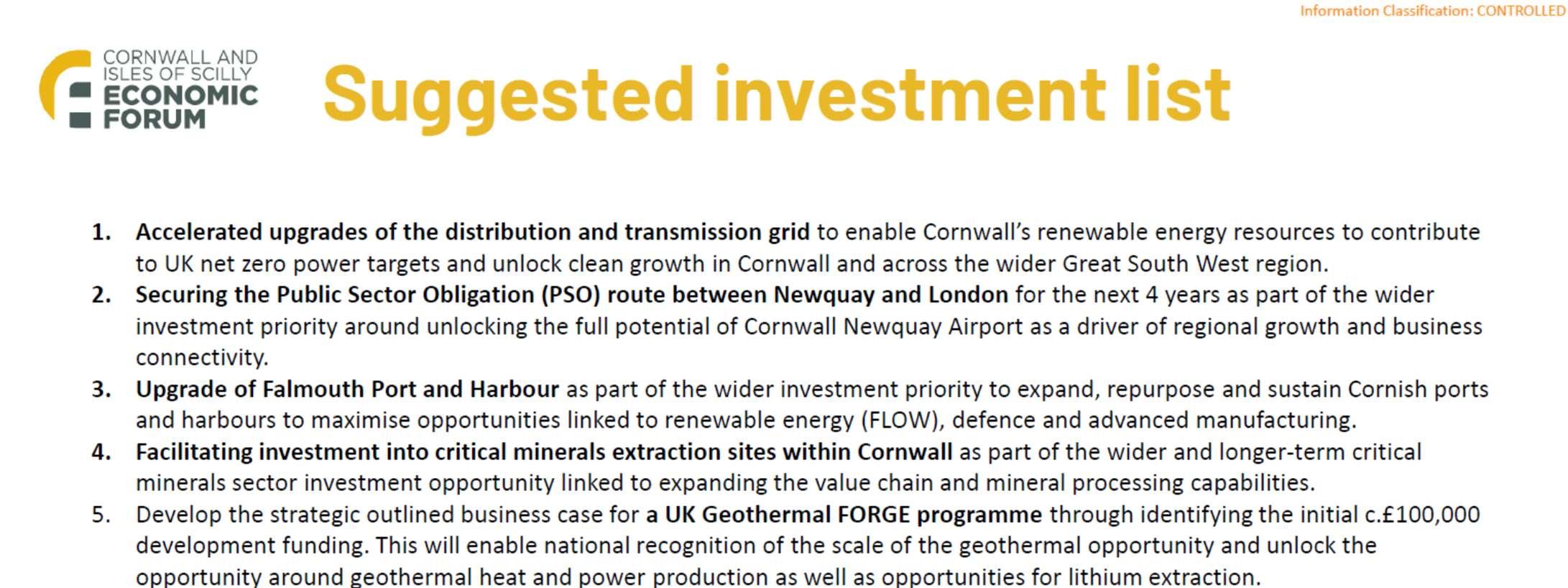
Recent discussions on investment priorities have also been helpful and need to be considered through the lens of priority skills in order to deliver these ambitions. An outline discussed at the Economic Forum on 23/10/2025 was broadly agreed as:

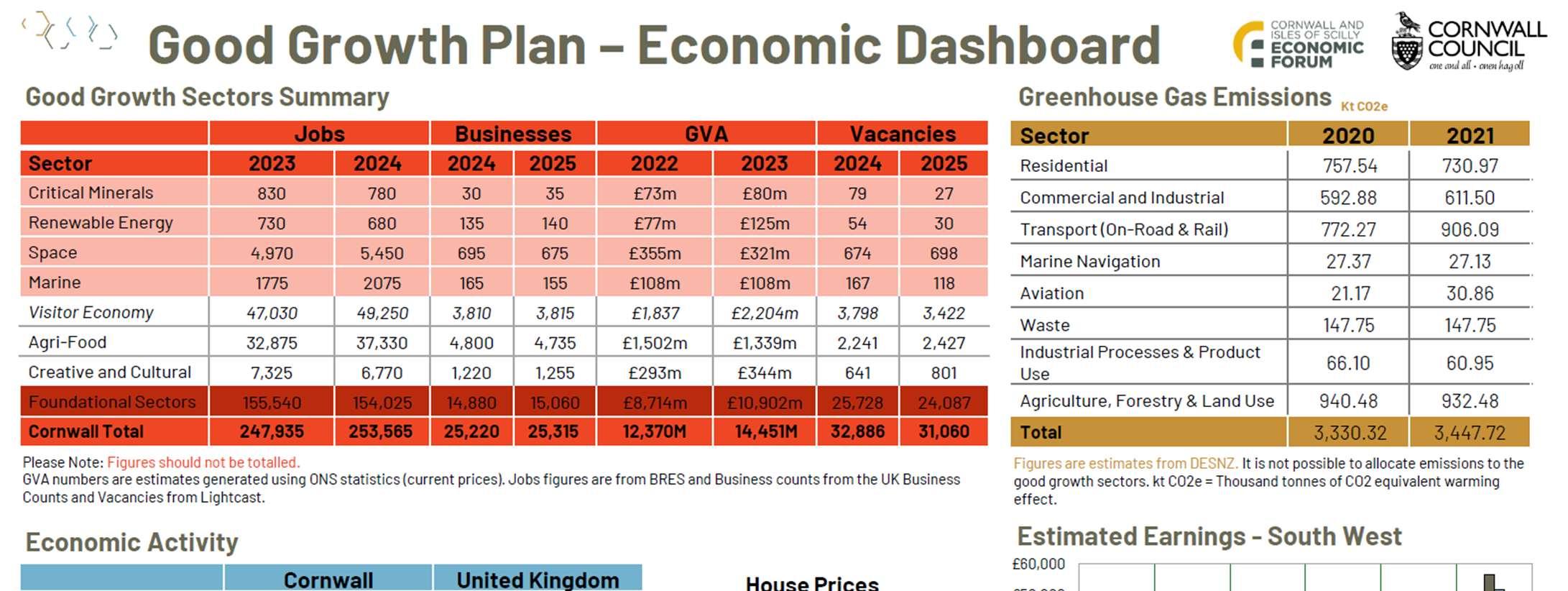
A helpful dashboard is also regularly shared by the SA for added insight. This is an example of from March 2026 but it is updated regularly and can be used in measuring KPIs (inAnnex B)when we later come to review the benefits of LSIP actions and activities.

With many skills being transferable across sectors and many sectors being dependant on other sectors, this LSIP also considers occupations relating to the types of skills that CIoS needs to achieve future growth and prosperity. Sometimes the foundations of a skill is what is needed and sector specific skills then can be honed working in that sector. E.g. a good engineer is a good engineer wherever they are working. A further example list is below:
Digital and data skills – from AI and analytics to cybersecurity and digital literacy
Engineering and technical skills – especially relevant to clean energy, space, defence, and manufacturing
Green skills – sustainability, environmental compliance, and circular economy thinking
Project management and leadership – essential for innovation and productivity
Communication and collaboration – particularly important in creative, health, and professional services
So the LSIP also looks at what support can be given to sectors groups and businesses in specific sectors to then train good workers, with basic relevant skills, on to specialise in a given industry.
Evidence from ERB research:
As noted above. Focus Groups, surveys and business engagement opportunities were necessary to validate the evidence base and ensure that the LSIP is not just led by data and reports but buy real and current businesses. This was organised by the ERB in conjunction with research company, Habit5 for the agreed LSIP sectors as follows:
Distinctive Sectors
*Space & Air – Online
Critical Minerals – In person
*Marine – Online
Renewable Energy – Online
Core Sectors
*Agri-Food – Online
Creative and Cultural - Online
Visitor Economy - Online
Foundational (or Enabling) Sectors
Construction – Online
Health & Adult Social Care – in person
*Manufacturing (and Engineering) - Online
*Digital and Technology – Online
Professional & Bus Services - Online
*Defence (is covered in each of these sectors)
LeadersfromalloftheabovesectorssitontheEconomicForumandWorkforceandSkills BoardsandtheCIoSLSIPEmployer/SectorSteeringGroupistobebemadeupofleaders andbusinessesfromtheLSIPsectorstoensureclearbusinessengagementanddialogue throughouttheLSIPprocess.
Employer Representative Body ERB and Strategic Authority (SA)
The ERB and SA have worked closely together on the content and final production of the LSIP. Research has been shared and all activity has been mutually supported. Complimenting the ERBs business engagement, research, data mapping and content production the SA’s proposed Functions will include:
• Governance and reporting for the Workforce and Skills Board, including preparation of papers and coordination of approvals.
• Working with the Data and Intelligence teams to provide evidence and insight for the CIoS Local Skills Improvement Plan (CIoS LSIP).
• Mapping of the current skills offer across Cornwall and the Isles of Scilly.
• Ensuring strategic alignment with:
The Cornwall Good Growth Plan
The Workforce and Skills Strategy
The “Get Cornwall and Isles of Scilly Working” Plan
Other relevant plans and strategies, national, regional, local
• Support for meetings and events, including logistics and stakeholder engagement.
• Drafting of content, including briefings, reports, and communications.
The CIoS LSIP is embedded into the Workforce and Skills Board (WSB) and has a regular agenda item at the full board meetings (past dates 3rd December 2025, 23rd March 2025 & 14th May – exceptional meeting for LSIP sign off) with the ability to circulate papers and meet as needed online to address any issues or queries as they arise.
Members of the board: https://www.cornwall.gov.uk/media/1cdhkfwt/cios-workforce-andskills-board-membership-final-without-contacts.pdf This has enabled all parties to act swiftly and ensure that progress on the LSIP is agreeable to all key stakeholders and the SA alike.
This steering group will be ongoing to oversee the CIoS LSIP delivery. It will be for employers, led by employers, from all of the sectors in scope. The design is for one experienced sector leader and one business that has not engaged in such a process before (hence bringing in those harder to reach), from each sector. These representatives of their sectors will be charged with bringing the employer voice of their sector to each regular meeting that will be held online for everyone’s convenience. The ERB will then ensure that information is captured from these representatives and fed into the CIoS LSIP section of the Workforce and Skills Board. MeetingdatesTBConcethisboardisconvenedinphase2but arelikelytobeevery6to8weeksforthedurationoftheLSIP.
Training providers (FE, HE & ITPs) will be represented on the CIoS LSIP Employer / Sector Steering Group in an advisory capacity to highlight issue on delivery of business asks. This will be valuable feedback for all and a catalyst for problem solving. Where issues cannot easily be solved, this will inform the CIoS LSIP of what actions need to be taken and alert the board to any issues so that timely solutions can be investigated throughout the life of the CIoS LSIP.
The ERB and SA will also be meeting with training providers individually and also as part of the Devon and Cornwall Training Provider Network (DCTPN). We will invite them to the monthly update meetings that will be open to all. There was an in-person Training Provider Focus group on 27th January that explained this process and was agreed by those present.
Other key partners:
Partners such as Seectec Plus, Workwell, Careers Hub, the Apprenticeship Ambassador Network, JCP and DWP will also play an important part in delivery of the CIoS LSIP and will be invited to advise on the CIoS LSIP Employer / Sector Board.
Open to all, face to face update meetings will be short, presentation and discussion style, meetings that all businesses, stakeholders, providers and anyone interested in LSIP can come to. There will be a number of these to ensure a variety of times that people can attend at least one. However, there will be no limit on how many times people can attend. Frequency of these events will depend on when there is activity to update on.
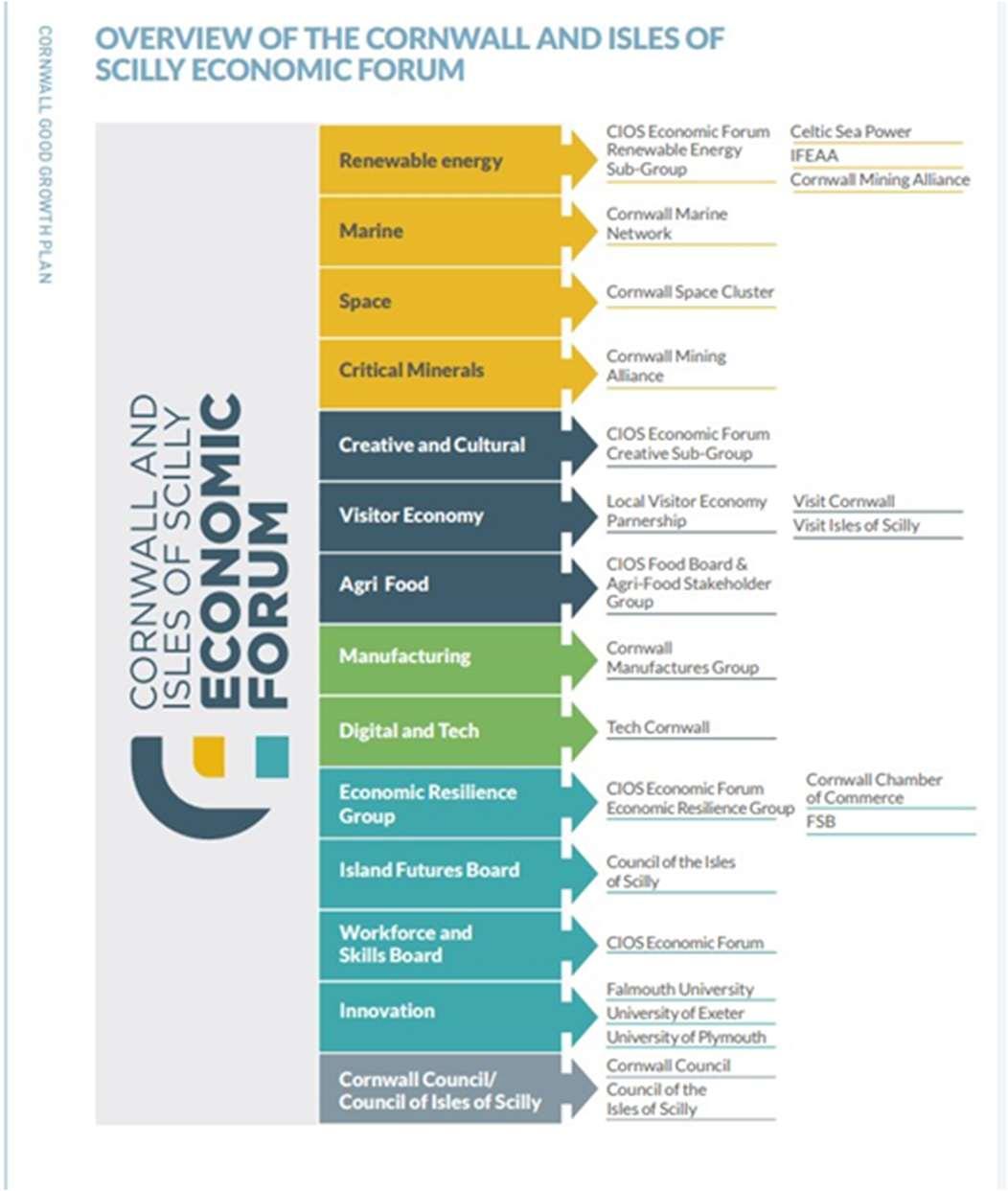
There are a number of sector groups already in place illustrated in the following diagram:
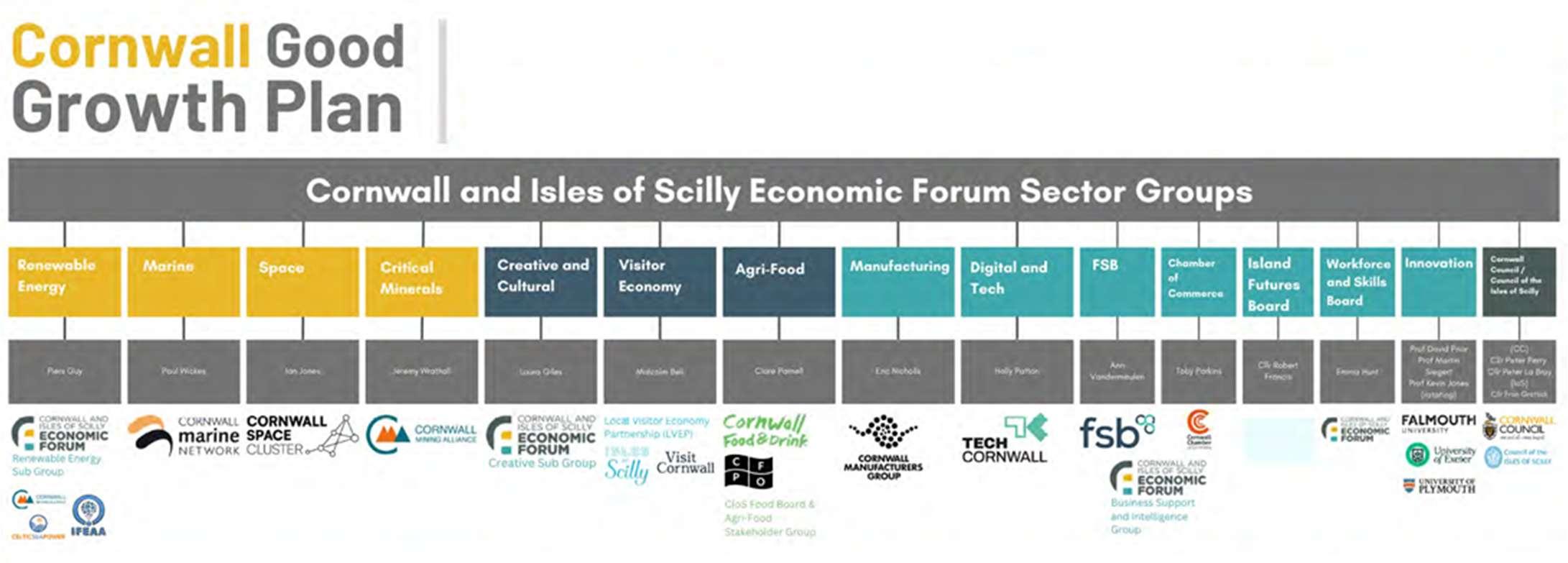
To avoid duplication of the work of already active sector groups the ERB has engaged with them directly on research and reports that they already have or will be undertaking and invite them to be represented on the CIoS LSIP Employer / Sector Steering Group that will steer the delivery of the CIoS LSIP.