Factsheet 1 Mental Health Challenges in Young People
Factsheet 1: Mental Health Challenges in Young People
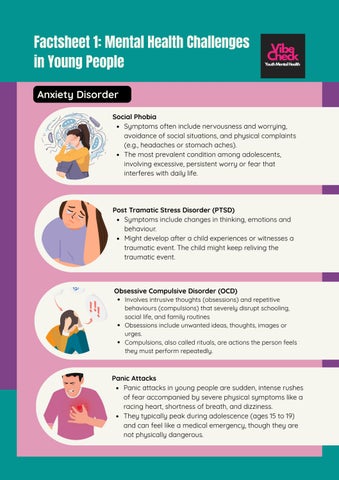
Anxiety Disorder
Social Phobia
Symptoms often include nervousness and worrying, avoidance of social situations, and physical complaints (eg, headaches or stomach aches)
The most prevalent condition among adolescents, involving excessive, persistent worry or fear that interferes with daily life
Post Tramatic Stress Disorder (PTSD)
Symptoms include changes in thinking, emotions and behaviour.
Might develop after a child experiences or witnesses a traumatic event The child might keep reliving the traumatic event.
Obsessive Compulsive Disorder (OCD)
Involves intrusive thoughts (obsessions) and repetitive behaviours (compulsions) that severely disrupt schooling, social life, and family routines
Obsessions include unwanted ideas, thoughts, images or urges
Compulsions, also called rituals, are actions the person feels they must perform repeatedly
Panic Attacks
Panic attacks in young people are sudden, intense rushes of fear accompanied by severe physical symptoms like a racing heart, shortness of breath, and dizziness They typically peak during adolescence (ages 15 to 19) and can feel like a medical emergency, though they are not physically dangerous
Factsheet 1: Mental Health Challenges in Young People
Depressive Disorders
Major Depressive Disorder (MDD)
Also known as clinical depression. It occurs in distinct "episodes" lasting two weeks or more, characterized by a persistent low mood, loss of interest in hobbies, fatigue, and difficulty concentrating. Symptoms include loss of interest, sleep/appetite changes, and "dark" thoughts. It can present as irritability, social withdrawal, and changes in sleep or appetite
Persistent Depressive Disorder (Dysthymia)
Involves a less severe but more continuous low mood that lasts for at least one year in young people under 15 (or two years for older individuals) It is often described as feeling chronically "down."
Bipolar Disorder
Characterised by oscillating manic (extreme shifts in mood, alternating between periods of severe depression and high, manic "ups", often with psychotic features The onset of symptoms frequently emerges during mid to late adolescence (15-18 years old)
Psychotic Depression
A severe form of major depression where an individual might experience hallucinations (seeing or hearing things that aren't there) or delusions.
Factsheet 1: Mental Health Challenges in Young People
Eating Disorders
Anorexia
Characterised by an obsessive fear of gaining weight leading individuals to severely restrict their food intake, exercise excessively, or use other methods to lose weight It often results in a significantly low body weight and a distorted body image
Bulimia
Involves recurrent, frequent episodes of eating unusually large amounts of food in a short period (bingeing) paired with a feeling of lack of control. This is followed by compensatory behaviours such as self-induced vomiting, excessive exercise, or misuse of laxatives to prevent weight gain.
Binge Eating Disorder (BED)
Defined by recurring episodes of consuming abnormally large quantities of food in a short time accompanied by feelings of a loss of control and intense shame Unlike bulimia, these binges are not followed by compensatory purging or fasting behaviors
Other Specified Feeding or Eating Disorder
Eating disorders that cause significant distress or impairment but do not meet the exact clinical criteria for Anorexia or Bulimia (for example, meeting all criteria for Anorexia except being underweight).
Factsheet 1: Mental Health Challenges in Young People
Emerging Psychosis
Disturbances in thoughts and feelings, including delusions (false beliefs) or hallucinations (seeing/hearing things).
Less common, but serious conditions that can emerge in late adolescence.
Symptoms include paranoia and hallucinations This requires urgent professional care
Self Harm
Usually, a maladaptive coping mechanism to manage overwhelming emotions, not necessarily a suicide attempt
Mental Health Crisis
A situation where someone feels overwhelmed by emotions, stress, or trauma. This can lead to thoughts or actions harmful to themselves or others, including suicidal thoughts, aggressive behaviour, or severe psychotic states (delusions/hallucinations)
Suicide
Suicide is when a person causes their own death on purpose. Before trying to take their own life, a young person may have thoughts of wanting to die This is called suicidal ideation
The young person may also have suicidal behavior That’s when a person is focused on doing things that cause their own death.
Always treat suicidal ideation as serious and perform an initial risk assessment
Factsheet 1: Mental Health Challenges in Young People
Behavourial Disorders
Attention Deficit Hyperactivity Disorder (ADHD)
Inattention such as difficulty concentrating, losing instructions, disorganization, and struggling to complete tasks
Hyperactivity including constant fidgeting, restlessness, or an inability to sit still.
Impulsivity like interrupting others, blurting out answers, and acting without thinking of consequences
Conduct Disorder (CD).
A behavioural and emotional disorder diagnosed in childhood or adolescence characterised by a repetitive and persistent pattern of behaviour that violates the basic rights of others and major age-appropriate societal norms. This includes aggressive behaviour toward people or animals, destruction of property, deceitfulness or theft, and serious violations of rules
The information in this factsheet is designed to help you better understand mental health and what you can do to better support a young person who might be going through a tough time. It is to provide you with support and in turn confidence to offer initial assistance and guide a young person toward professional help