T H E O F F I C I A L P U B L I C AT I O N O F T H E F O R E I G N C O R R E S P O N D E N T S ’ C L U B
|
H O N G KO N G
|
OCTOBER 2026
PHOTO: BEN MARANS
FROM THE PRESIDENT
Dear Members, The last few months have been busy, for us as a club, Hong Kong as a city, and for the world. The news cycle has felt relentless and devastating most days. One of the great losses we suffered in September was that of Gloria Steinem. She was best known for her social activism, but first Steinem was a journalist, and her story still inspires women journalists today. Steinem went from taking assignments for traditional “women’s stories” in the 1950s and 1960s to carving out a place for herself in New York’s media scene as a journalistic force to be reckoned with. She helped get New York Magazine off the ground before founding the trailblazing Ms. magazine a few years later where she helped give women a voice in politics and social issues. From there, as they say, the rest is history. Looking around my journalism classroom at HKBU or my newsroom in Admiralty, it is notable now that the women outnumber the men. In the 50 years since Ms. magazine’s founding, women have taken on more roles covering “hard news” and winning spots leading teams and publications. The diversity that we’ve seen come into reporting, be it from women, people of colour or those of different backgrounds, is a real win for everyone, as it only makes news more relevant, well-rounded and informed. For that, we have to thank a tenacious woman from Toledo, Ohio who helped change the world. Thank you, Ms. Steinem. In the coming weeks there will be many opportunities to raise a glass around the bar and commiserate over whatever the latest headline news of the day is. Hopefully the FCC will make that experience a bit brighter with the multitude of events we have coming up. We’ll have our annual Champagne Night in November, holiday meals for dining in and taking away, and festive activities for the whole family. Our speaker schedule is looking full too, including a talk about the Macau Motorcycle Grand Prix in November to accompany our Wall exhibit around the Main Bar and a visit from the fabulous author Tony Parsons later that month. As we head into the holiday season in just a few short weeks, keep the Club in mind for all of your bookings. We offer options for fine dining or our general fare, at regular tables or in private rooms. I know I always love being in the Club during the last few weeks of the year as everyone is buzzing with excitement, the mulled wine is steaming and the decorations are up. The gingerbread front desk is my personal favourite! Be sure to try a sample when you go by. I look forward to seeing you around the Club soon. Cheers,
Morgan M. Davis President
THE CORRESPONDENT | OCTOBER 2026
1
The Foreign Correspondents’ Club, Hong Kong 2 Lower Albert Road, Central, Hong Kong Tel: (852) 2521 1511 Fax: (852) 2868 4092 Email: fcc@fcchk.org Website: www.fcchk.org
The Board of Governors 2026-2027 President Morgan M. Davis
First Vice President Jing Yang
Second Vice President Christopher Slaughter Correspondent Member Governors Jennifer Jett, Karen Koh, Dean Napolitano, Peter Parks, Paul Tait, Daniel Ten Kate, Laura Westbrook, William Zheng Journalist Member Governors Zela Chin, Joe Pan Associate Member Governors Fu Ka Min, Tom, Alan Forbes Macdonald, Lynne Mulholland, Stephen Vickers Club Treasurer Stephen Vickers Club Secretary Fu Ka Min, Tom
Professional Committee Conveners: Zela Chin, Morgan M. Davis, Jing Yang, William Zheng Press Freedom Committee Conveners: Morgan M. Davis, Laura Westbrook, Jing Yang, William Zheng Constitutional Committee Conveners: Fu Ka Min, Tom, Peter Parks Membership Committee Conveners: Zela Chin, Jennifer Jett, Joe Pan Communications Committee Conveners: Paul Tait, Laura Westbrook, Jing Yang Finance Committee Treasurer: Stephen Vickers Convener: Lynne Mulholland House/Food and Beverage Committee Conveners: Karen Koh, Lynne Mulholland Wine Tasting Group Chairperson: Cammy Yiu Building – Project and Maintenance Committee Conveners: Alan Forbes Macdonald, Christopher Slaughter Wall Committee Conveners: Peter Parks, Christopher Slaughter Charity Committee Conveners: Morgan M. Davis, Dean Napolitano
CONTRIBUTORS John Batten John writes on art, heritage, culture and urban planning. He is the Convenor of the Central & Western Concern Group that lobbied for the conservation of PMQ, Tai Kwun, Central Market etc. He is also President of the Hong Kong Art Critics' Association and a Director of the arts charity Rooftop Institute.
Aaron Busch Aaron is the FCC’s first Social Media Journalist Member, writing on various online outlets since 2020. He splits his time between news reporting and cricket commentating, as well as broadcasting in Hong Kong and internationally. His nightly Substack on Hong Kong news can be found at tripperhead.com
Robert E. Gerhardt, Jr. Robert is a New York City based photographer and freelance write His photographs and writings have been published nationally and internationally including in The Hong Kong Free Press, The Guardian, The New York Times, and The Diplomat.
Steven Knipp A long-time Hong Kong resident, Steven is a veteran American journalist and photographer. His work has appeared in scores of outlets including The Washington Post, The New York Times and National Geographic, as well as other publications and websites across Europe, North America, Asia and Australia.
Hugo Novales Hugo is originally from Chicago and joined the FCC just prior to graduating from HKU's Master of Journalism programme. As the Club’s in-house journalist, he covers events for the website and social media, contributes to The Correspondent, and also helps organise and promote workshops for early/mid-career journalists.
Christina Pantin Christina is a Malaysia-born, U.S. citizen who is fluent in financial journalism and corporate communications. She is the Founder of communications consultancy Toot and a Founding member of Global Commtrepreneurs Network and Web3 Women. She has lived in six countries and enjoys public speaking.
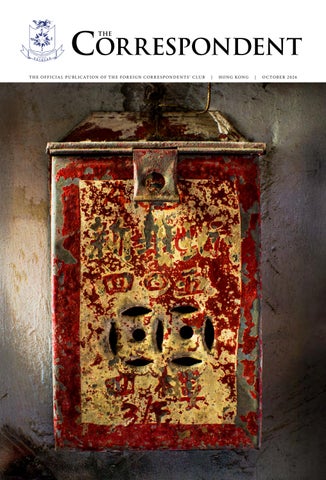
Editor Ann Tsang Email: editor@fcchk.org Design Artmazing! Cover Image David Elliott Printing Elite Printing: Tel: 2558 0119 Advertising Enquiries FCC Front Office: Tel: 2521 1511
2
THE CORRESPONDENT | OCTOBER 2026
The Foreign Correspondents’ Club Hong Kong was Incorporated in Hong Kong on 21 May, 1952. The Correspondent ©2026 is published four times a year by The Foreign Correspondents’ Club, Hong Kong. All views expressed in all articles are those of the authors and are not necessarily those of The Foreign Correspondents’ Club Hong Kong. All content contained in The Correspondent may not be reproduced in any manner whatsoever without authorisation. Advertisers warrant and represent that the descriptions of the products or services advertised are true in all respects. The Foreign Correspondents’ Club Hong Kong assumes no responsibility for claims made by advertisers and makes no recommendations as to the purchase or sale of any product, service or item. ©2026 by The Foreign Correspondents’ Club Hong Kong. All rights reserved.
CONTENTS THE COR R ESPONDEN T
|
OCTOBER 2026
1 From the President 4 Club News
8
8 Governors, Gaffes and Keeping the Lights On The story of the FCC's four-and-a-half decades at the old ice house on Lower Albert Road isn't just a tale of dead phones, dodgy plumbing and the occasional bar brawl. It's also a surprisingly civilised chronicle of how a rowdy press club managed to stay on speaking terms with Hong Kong's leadership - even when both sides had good reasons to throw in the towel. 14 Staff Profile: The Banquet & Events Team Meet the trio that ensure every single FCC event runs smoothly and impressively, ensuring that our Members and guests have a memorable time: Catering & Events Manager Salina Chan; Assistant Banquet Manager Michael Santos and Events Executive Sheeta Wong.
14
26
18 Member Profile: Wisley Lau An undergraduate double-majoring in Journalism and Politics and Public Administration at the University of Hong Kong in his final year, Wisley Lau recently joined the FCC as its youngest member. He speaks about his studies, Substack, what drew him to the Club and what he has his sights set on after graduation. 20 The Last Post Built in 1976, the General Post Office is one of the last surviving structures on the Central Reclamation redevelopment site. As bulldozers close in, John Batten explores what the city stands to lose: not just a building, but a piece of its modernist civic legacy. 26 Lantau’s Water Buffalo: Can They Survive? In the shadow of Hong Kong's gleaming skyscrapers, an unlikely population endures. Lantau Island's 180 water buffalo - descendants of the working animals that once ploughed the SAR’s rice paddies - now navigate a precarious existence. Beloved by tourists and championed by devoted guardians like "Buffalo Jean”, these gentle giants have become an unexpected symbol of Hong Kong's vanishing rural heritage. Yet their survival hangs in the balance as development pressures mount and conflicts with residents increase. 28 On The Wall 31 Don McCullin’s Vietnam A new book presents a retrospective of famed photographer Don McCullin's work from the Vietnam War. McCullin, who will turn 91 this fall, has indicated that this will be his last book, and brings together his most famous photographs from the War, and many that have never been previously published or exhibited.
36
34 Regime Change Two of America's most dogged political reporters take us inside the first year of Donald Trump's second Presidency - a term unshackled from the guardrails that defined his first. Based on a thousand interviews and unprecedented White House access, Regime Change charts the expansion of Presidential power to its breaking point in a portrait of American power fundamentally transformed. 36 Life Is A Cabaret Photographer Dustin Pittman stood steadfast behind his camera and watched the latter half of the 20th century tell its story before his curious eyes. His life-is-a-cabaret vision served as his passport to fashion shoots, backstage access at fashion shows, rock concerts, nightclubs, and the biggest spectacle of all - the streets of New York.
46
40 44 46 48 52 53 56
In Vino Veritas Food For Thought Reciprocal Club: National Liberal Club, London New On The Block Obituary: Kevin Pha Guffy Click! A Final Word
THE CORRESPONDENT | OCTOBER 2026
3
CLUB NEWS 33% ENTRANCE FEE REDUCTION FOR CURRENT MEMBERS’ FAMILIES
IMAGE: LAKSHMI HARILELA
Congratulations to the new 8th FCC Governor for 20262027. Daniel Ten Kate began serving following the General Meeting held on 21 August 2026. Daniel is Executive Editor for Asia Economy and Government at Bloomberg.
At its meeting on Saturday, 25 July 2026, the Board of Governors resolved to make the Family Members Programme – traditionally offered in the lead-up to Christmas – a permanent Membership Programme at the Club. This applies to a Member’s parents, children and siblings, as well as other relatives including aunts, uncles, nieces, nephews, cousins, grandchildren and grandparents. For details, please contact our Membership Department at membership@fcchk.org or by calling 2521 1511. Membership has its privileges so invite your family to join the FCC family today!
IMAGE: MIKE EPSTEIN
8TH GOVERNOR APPOINTED TO THE BOARD
GIFTS GALORE!
IMAGE: LAKSHMI HARILELA
Looking for stocking fillers? Look no further than the FCC’s e-shop or purchase merchandise direct from the Club at great prices. From hoodies to caps, notebooks to coffee mugs, umbrellas to tote bags, and more, prices range to fit all budgets. Grab a gift now while stocks last!
4
THE CORRESPONDENT | OCTOBER 2026
VICTORIAN TILES REIMAGINED
IMAGE: LAKSHMI HARILELA
The FCC’s historic Victorian floor tiles have inspired a new piece of Club merchandise: a pair of beautifully designed absorbent coasters. Created by Vera and Vincy of the FCC’s Marketing Department, the coasters feature two different designs based on the Club’s distinctive tiles. They absorb condensation like a sponge, eliminating the annoying “coaster lift” problem, and come in individual packaging, making them perfect as gifts. The tiles were originally. discovered beneath cheap red Canton tiles during the Club’s 2002 refurbishment, and had laid hidden for decades. Researcher Simpson Wong traced their origin to Minton and Co., a renowned U.K. pottery manufacturer. Herbert Minton revived the lost art of making encaustic tiles in 1836, crafting designs by layering different colours of clay rather than simply painting on the surface. The tiles were originally laid when the Dairy Farm Building was expanded in 1917. Their inlaid patterns, about two centimetres thick, have ensured the vibrant colours have remained intact for over a century.
INTRODUCING THE WEDNESDAY WIRE Bert’s very own mixologist Diwash Gurung also got a round of applause for the two specialty drinks he crafted especially for the event: ‘On The Record’, a light Campari to break the ice, and ‘Off The Record’, a heavy-hitting Scotch infused with lemon tea and ginger. “As a relatively new Member to the FCC, I really enjoyed the chance to connect with new people and catch up with some familiar faces,” said Graeme Acres, a Correspondent Member who joined the FCC in September. “I think it’s a great idea to set aside a bit of time every month to just chat and get know other people in the industry, and I’m certainly looking forward to the next one!” Are you a Correspondent or Journalist member? Then swing by ‘The Wednesday Wire’ to meet your fellow media peers. The next one will be held on 4 November, 2026.
IMAGES: FCCHK
On 7 October, the FCC held its first edition of ‘The Wednesday Wire’, a new monthly meet-up exclusively for the Club’s Correspondent and Journalist Members. Held in Bert’s every first Wednesday of the month, this casual event allows the Club’s reporters, editors, freelancers and other media professionals to connect with one another. To kick things off at this first-ever gathering, President Morgan Davis gave a welcome message that thanked all the people that have worked together to bring ‘The Wednesday Wire’ to life, including former Clare Hollingworth Fellow Amy Sood, FCC in-house journalist Hugo Novales, and Correspondent Member Jono Thomson who joined the FCC with this type of event in mind. Longtime Member Edith Terry also gave a short speech to commemorate the late Gloria Steinem and her life’s work that paved the way for a multitude of women journalists after her.
THE CORRESPONDENT | OCTOBER 2026
5
THE FCC PODCAST
SELINA CHENG AND OTHER NEWS FROM MORGAN M. DAVIS FCC President Morgan M. Davis discusses a recent public statement made on behalf of the FCC Board and its membership regarding journalist Selina Cheng’s recent court victory, which was related to her role as the elected Chair of the Hong Kong Journalists Association. She also discusses other major issues and stories facing journalists working in Hong Kong - including ongoing
coverage of the aftermath of the Himalayas flood disaster, Hong Kong’s evolving role as Asia’s international finance hub, the upcoming agenda for FCC lunchtime speaker events, and a call for Gen Z journalists to apply for the 2026/2027 Clare Hollingworth Fellowship. Listen now: https://open.spotify.com/ episode/4nKpxaIXBKs09eJWRWruCr.
KOREAN MESSIAH: JONATHAN CHENG ON THE CHRISTIAN ROOTS OF NORTH KOREA’S PERSONALITY CULT
Pyongyang was once a city so dominated by Christianity that it was known as the “Jerusalem of the East”. Today it stands as the capital of North Korea’s oppressive dictatorship that
6
THE CORRESPONDENT | OCTOBER 2026
has become one of the world’s harshest persecutors of the Christian faith. Editor and journalist Jonathan Cheng is the China Bureau Chief for the Wall Street Journal and the author of Korean Messiah (2026), a detailed, decade-long investigation into the Christian roots that helped create North Korea’s personality cult. At the centre of this story is the country’s founder, Kim II Sung, son of two fervent Christians and progenitor of an ideology known as Kimilsungism, an exercise in idolatry that has elevated him, and his successor son and grandson, to Christ-like status, from the humble manger where he was born lo the subway seat on which the venerated leader once placed his posterior, cordoned off as if it were a religious relic. This Q&A with the author is moderated by FCC Correspondent Governor Jennifer Jett. Listen now: https://open.spotify.com/ episode/4nKpxaIXBKs09eJWRWruCr.
SPEAKERS’ CORNER
THE FRAGILE DRAGON: KER GIBBS ON CHINA’S HIDDEN VULNERABILITIES
CREDIT: FCCHK
By Hugo Novales
C
hina is routinely cast as a dragon: powerful, ancient and ascending. The metaphor captures both the nation’s cultural mythology and its emergence as the world’s second superpower. But Ker Gibbs, former President of the American Chamber of Commerce in Shanghai, has chosen to qualify the image. In his view, China is not simply a dragon, it is a fragile one. Gibbs’ book The Fragile Dragon: China’s Strengths and the Limits to its Power, published earlier this year, synthesises decades of experience across public and private sector roles in Asia. The title itself is a provocation, suggesting that beneath the armour of rapid development and geopolitical assertiveness lie structural weaknesses that are often overlooked or misunderstood. At an FCC Club Lunch this August, Gibbs sat down with Jing Yang, Asia Bureau Chief for The Information and the Club’s First Vice President, to discuss the thesis of his book and what it reveals about contemporary China. Gibbs opened by acknowledging what is obvious to most observers: China excels in many domains. Manufacturing capacity, infrastructure development, technological adoption at scale and state coordination are all areas where Beijing has demonstrated formidable capability. But excellence in some areas does not translate into invulnerability across the board. “There are weaknesses in China, as I describe throughout the book,” Gibbs said. “China’s good at a lot of things, but not great at everything.” He identified two principal vulnerabilities. The first is geographical: China maintains multiple contested borders with neighbouring states, disputes that remain unresolved and may never be fully settled. The second weakness, and in Gibbs’s assessment the more consequential, is relational. China’s ties with its major trading partners are, in his words, “very poor”. “I’d call that [a] weakness,” he said, “particularly given the degree to which China’s prosperity hinges on stable cross-border flows”. Much of the discussion focused on digital decoupling.
China’s internet censorship regime, commonly known as the ‘Great Firewall’, has created a bifurcated digital world. Those outside mainland China cannot easily access Chinese platforms. Those within cannot readily browse Amazon, Meta or X. In their place, Beijing has cultivated a parallel digital ecosystem that is domestically controlled and tightly regulated. Gibbs arg ued t hat t his opacit y has f uel led misunderstanding, particularly among so-called China hawks whose assessments of Chinese intentions and capabilities are often distorted by incomplete information. “In some ways China with its five-year plans is quite transparent, but on another level, Beijing doesn’t want to be understood,” he said. The author went further, suggesting that Beijing’s complaints about U.S.-led decoupling ring somewhat hollow given that China itself initiated a form of decoupling more than a decade ago. “The Great Firewall has effectively sealed off [China’s] digital economy from the rest of the world. What is that if it’s not decoupling?” he said. Gibbs is the son of a Chinese mother and an American father. As tensions between Washington and Beijing have intensified, he has been asked repeatedly which side he would choose in the event of conflict. His answer reframes the question. “A war between the U.S. and China is just unthinkable. But if your mother and father had a fight, do you want one of them to win? Or do you just want the fight to be over?” The metaphor of the fragile dragon is useful not because it diminishes China, but because it complicates our understanding of it. Gibbs’s book invites a more textured reading of China’s trajectory: one that acknowledges its accomplishments without overstating its capabilities, recognises its ambitions without assuming their inevitability, and takes seriously the constraints that shape Beijing’s choices. n The full discussion is available on the FCC’s YouTube channel.
THE CORRESPONDENT | OCTOBER 2026
7
FEATURE
GOVERNORS, GAFFES AND KEEPING THE LIGHTS ON The story of the FCC’s four-and-a-half decades at the old ice house on Lower Albert Road isn’t just a tale of dead phones, dodgy plumbing and the occasional bar brawl. It’s also a surprisingly civilised chronicle of how a rowdy press club managed to stay on speaking terms with Hong Kong’s leadership - even when both sides had good reasons to throw in the towel.
A
t the heart of the FCC’s relationship with Hong Kong’s leadership was the ritual renegotiation of rent terms at Lower Albert Road: once every seven years, now trimmed to every three, like a marriage counselling session neither party could afford to skip. Governments needed to keep the foreign press moderately content (or at least off their backs), and the FCC needed a roof that didn’t leak quite as much. Let’s call it co-dependency.
IMAGE: RAY CRANBOURNE
The Gubernatorial Gallery When Governor Sir Edward Youde formally opened the Lower Albert Road premises on 9 November, 1982, he was awarded Membership No. 1 - a tradition that would stick
with his successors, save for one notable exception. Youde, a Middle Kingdom scholar with the gravitas to match, set the tone: the FCC mattered, even if its Members occasionally forgot where they’d left their notebooks. His successor, Sir David Wilson, was cut from similar cloth - another Foreign Office mandarin fluent in Mandarin and diplomatic understatement. He took questions at the Club in the early 1990s and engaged in what witnesses described as a “relatively polite debate” with the ascendant Emily Lau. Given Lau’s reputation for not suffering fools (or Governors) gladly, “relatively polite” was high praise indeed. Then came Chris Patten, Hong Kong’s last Governor and arguably the FCC’s most enthusiastic patron. Patten
Governor Edward Youde, who officially opened the Lower Albert Road premises in November 1982, shaking hands with Bill Seitz, with from left, Eddie Ko, Robert Delfs, Peter Mosley and Hugh Van Es.
8
THE CORRESPONDENT | OCTOBER 2026
IMAGE: SOPHIE BOUQUEREL
Former Governor Chris Patten at the FCC.
understood the value of a well-placed beer and a well-timed quote. He took his No. 1 Membership seriously, dropping by the bar from time to time for a pint - crucially, without hordes of eager correspondents descending on him like seagulls on discarded fish and chips. The implicit bargain was simple: let the man drink in peace, and he’d keep talking. It worked. Even after his departure in 1997, Patten returned to the Club - first as the EU’s Commissioner of External Relations, and later to promote his books. The Chief Executives Hong Kong’s first Chief Executive, Tung Chee-hwa, was the only leader not to receive Membership No. 1. But the story behind his first visit as CE carries more weight than any membership card. Back in the 1970s, Tung’s father had been a Club regular, dropping by for lunch when the FCC was already known for its decent Chinese food. Young Tung occasionally tagged along. When he returned as Chief Executive, the Club presented him not with No. 1, but with his father’s old Membership number. Tung, not known for displays of sentimentality, appreciated the gesture. Donald Tsang, bow-tie intact, worked his way up the
governmental ladder - Finance Secretary, Chief Secretary, Chief Executive - visiting the FCC at each stage like a seasoned climber checking base camps. His last appearance was at a diplomatic cocktail reception in March 2012. The bow-tie, for once, was gone and in his speech, he noted the media’s habit of lambasting Chief Executive candidates and expressed relief that the spotlight wasn’t on him. Within a week, it was. The irony was not lost on those present. CY Leung, who had been a Member briefly in 1977, spoke at the Club in December 2012. His staff, however, were terrified he might be presented with a gift - possibly something embarrassing, like a book on conflict resolution or a stress ball. After considerable negotiation, then-President Doug Wong offered CY his old Membership number which he was happy to accept. His politically correct minders however were not, and the number was politely returned. Just before CY’s visit, the Club celebrated its 30th anniversary at Lower Albert Road with Carrie Lam, then Chief Secretary for Administration, as Guest of Honour. She would later describe the FCC as “a valuable asset to the city” - a line that aged interestingly depending on which year you read it.
THE CORRESPONDENT | OCTOBER 2026
9
IMAGE: FCC ARCHIVE
FEATURE
Regulars at the Main Bar pre-renovation.
Renovations and the Baseball Bat Incident The last 20 or so years have seen significant changes to the Club, but not all of them were welcomed with open arms. Government departments grew stricter about fire safety, accessibility and other such matters, triggering renovations at every level. Some changes were aesthetic, but that’s when the trouble started. First came Bert’s. Then the Main Bar renovation of 20022003 - a decision so contentious it nearly tore the Club apart. Bar fights erupted and Members threatened to show up with baseball bats to stop construction. Others threatened legal injunctions. It was, in short, the most passionate display of interior design debate Hong Kong had ever witnessed. The renovation went ahead anyway. Today, the Bar is thriving, but the memory of the old one still lingers, along with the people and stories it carried with it. Speaker Central Today, the FCC is far more than a watering hole, though it remains one of the best bars on the planet. It has shaken off some of its rough edges while retaining its edge on press freedom. Like its predecessors in Chungking (1943), Shanghai (1949) and Conduit Road (the 1950s), the Club isn’t
10
THE CORRESPONDENT | OCTOBER 2026
afraid to campaign for a cause. Since the early 1990s, the FCC has shifted toward a more professional role, particularly leading up to the Handover in 1997. A Press Freedom Committee was formed under Francis Moriarty’s leadership. Speaker lunches, panel discussions, press conferences and seminars became the norm, with China, Hong Kong, and the Handover dominating the agenda. The Handover itself was the FCC’s finest hour. Organised by then-President Keith Richburg and his Board, the Club hosted daily press conferences (sometimes four a day), lunch speakers (including opposition leader Martin Lee on Handover Day itself), seminars and panel discussions. Something happened every day. It was chaos, but the good kind - servicing not only Correspondent and Journalist Members but also the hordes of visiting hacks who descended on Hong Kong like locusts. Since then, the Club has remained a platform for debate. Literally hundreds of speakers have had their say, some more eloquently than others, some with more to say than others. The frequency has been impressive: two to three speakers a week at times, covering everything from geopolitics to literature to why certain correspondents should never be allowed near a microphone after 9:00 pm.
Author James Clavell
Author Robert Elegant
Former Prime Minister of Singapore Lee Kuan Yew
Former Chinese Premier Zhu Rongji
THE CORRESPONDENT | OCTOBER 2026
IMAGES: FCC ARCHIVE
Entrepreneurs and airline founders Richard Branson and Sir Freddie Laker
11
IMAGE: HUBERT VAN ES
FEATURE
FCC senior staff. From left: Sammy, Stephen, Simon, Andrew, Gilbert (Tiger), Michael, Irene and Rebo.
Charity, Community and Shared Catastrophes In 2002, the FCC extended itself into the broader Hong Kong community with its first annual Charity Ball. By the time the balls ended in 2015, 179 underprivileged children had received scholarships, and three language centres had been established. The Charity Ball was founded by Dave Garcia, Thomas Crampton and Andy Chworowsky, with an active committee headed by the indefatigable Lynn Grebstadt. The FCC Charity Foundation was formed in 2016 to continue the work. When major events unfold around the world, Members gravitate to the Club - not just to witness them, but to share them. When the first World Trade Center tower was hit on 9/11, the Main Bar went quiet with puzzlement. When the second plane hit, there were no illusions. As the night progressed, more people drifted in, staring at the screens in silence or frantically trying to contact relatives in New York. Soon the Bar was full - shock, grief, bewilderment and anger shared among strangers and friends alike. Other events have drawn crowds: the Gulf Wars, the London Underground bombing, the Bali bombing, the
12
THE CORRESPONDENT | OCTOBER 2026
Boxing Day tsunami, World Cups, Olympics, Obama’s first election, Trump’s shock win, royal weddings, state funerals. Despite the devices we carry to watch news as it happens, many still choose to share these moments at the Club. SARS, Jazz and Defiant Normalcy One event that tested the Club - and revealed its character - was the outbreak of SARS in 2002-03. Many Members left town or stopped going to public places. Former General Manager Gilbert Cheng, his staff, and the Board decided emphatically: business as usual. The FCC Jazz Festival was born. The house was full. Members made a stand - not just for the Club, but for Hong Kong. Around the same time, the first Photographer of the Year Awards began, driven by Terry Duckham. More than 200 entries flooded in. The winner of the student section, Dominic Nahr, went on to become an award-winning photojournalist. 100 and Still Counting Two doyens of the journalist world - Clare Hollingworth and Anthony Lawrence - marked their centenaries at the Club.
IMAGE: FCC ARCHIVE
IMAGE: ROBIN MOYER
Clare Hollingworth
Anthony Lawrence
Anthony celebrated his 100th birthday in 2011, addressing the crowd with all the style of his BBC radio days. Clare Hollingworth’s 100th followed in 2012, with a packed Main Dining Room listening to tributes from around the globe. But it’s Clare’s 85th birthday in 1996 that lingers most vividly. Lord MacLehose, the man who had secured the Club’s present home, was the chief guest. Governor Chris Patten attended to honour the war correspondent who had covered practically every conflict from World War II onwards. One tribute, from Jon Swain and John Burns reporting from Afghanistan, read: “Clare, the tanks you saw crossing the Polish frontier on 3 September, 1939, have arrived here, but without your expertise we’re a little lost. Could you pack your bag and get here soonest?” Clare passed away in January 2017, aged 105. Friends and relatives gathered at the Club to share memories of the pioneering journalist who never stopped asking questions.
complaints, disciplinary issues, policy challenges - usually the storm passes. But twice, in 1993 and 1999, EGMs were called to oust sitting Presidents. Both Presidents were overwhelmingly supported. The issues have faded. The memories haven’t. At the end of 2012, former General Manager Gilbert Cheng celebrated 40 years at the FCC - 13 as General Manager. Gilbert’s memory was legendary. When an Absent Member returned after 25 years, he didn’t just remember his name and number—he remembered his drink.
Politics, Presidents and Gilbert’s Legendary Memory FCC Boards often grapple with press freedom issues, but Club politics occasionally rear their head. Grumbles,
Still Standing, Still Drinking The FCC does many worthy things these days. It campaigns, it educates, it advocates. But at heart, the hard-drinking, hard-living FCC of old is still there. It remains a place where people eat, drink, meet, argue and party. Looking back over the decades, the Club has been home to some fascinating characters, brilliant journalists and thousands of honest professionals from all walks of life. There are many more names and stories that could be mentioned but that would require a book, or at least another round. n
THE CORRESPONDENT | OCTOBER 2026
13
STAFF PROFILE
BEHIND THE SCENES
MEET THE TEAM THAT MAKES EVERY FCC EVENT UNFORGETTABLE
W
hen guests arrive at a function at the FCC, they see elegance, seamless service and a setting that effortlessly blends heritage with hospitality. What they don’t see is the meticulous planning, split-second decision-making and teamwork that happens behind the scenes to make it all appear effortless. For Catering & Events Manager Salina Chan, Assistant Banquet Manager Michael Santos and Events Executive Sheeta Wong, creating memorable events is an art, and between them, they have more than 13 years of combined experience at the FCC, navigating everything from intimate Member celebrations to high-profile diplomatic receptions. Their work requires not only technical expertise and logistical precision, but also creativity, cultural sensitivity and the ability to remain calm when the unexpected inevitably occurs. The FCC is not your typical banquet venue. Housed in a historic building with distinctive character and a membership that includes journalists, diplomats, authors and public figures, every event carries a certain weight. As Salina explains, “One of the biggest challenges is balancing expectations. Our Members and guests come from a wide range of backgrounds and often have very specific requirements. We host everything from corporate functions and media events to private celebrations, so attention to detail is essential.” The building itself adds complexity. Its layout and heritage require careful planning to ensure events run smoothly while respecting the venue’s history and charm. Michael echoes this, noting the constant need to balance high expectations with the venue’s unique constraints. “It’s about understanding the space, knowing what works and being creative within those parameters,” he says. For Salina, Michael and Sheeta, serving the FCC’s Members and guests has shaped their approach to hospitality. Michael points to the importance of strict discretion, strong attention to detail and top-tier professionalism, particularly when serving prominent figures. Salina adds that while their approach to service remains consistent for every guest, certain events become especially memorable because of the individuals involved or the significance of the topics being discussed. Ask Salina about her most memorable function, and she immediately recalls an Election Watch Party breakfast that
14
THE CORRESPONDENT | OCTOBER 2026
welcomed more than 600 guests over three hours. The event required seamless co-ordination across multiple teams and flawless execution under intense time pressure. “As it was a breakfast event, the set-up window was extremely tight, which meant every detail had to be planned well in advance,” Salina recalls. “Attendees were constantly arriving and departing throughout the morning, so managing that volume required close communication between the events team, the kitchen and the restaurant and concierge teams to ensure everything operated smoothly.” Adding to the complexity was the live broadcast of election results, which demanded close collaboration with the Club’s A-V technician to ensure all systems functioned flawlessly. “Given the nature of the occasion, any technical disruption could have significantly impacted the overall experience, so extensive preparation and testing were carried out beforehand,” she explains. Despite the logistical challenges, the event succeeded because of exceptional teamwork. “What I remember most is the incredible collaboration behind the scenes,” Salina says. “Despite the tight timeline, every department worked together to deliver a successful and exciting event. Seeing hundreds of guests engaged in the live coverage and enjoying the atmosphere made all the planning worthwhile.” For Michael, a standout moment came during a highprofile diplomatic cocktail event that ran seamlessly, again due to meticulous team coordination. Both experiences demonstrate that when the stakes are high, preparation and teamwork make all the difference. The most memorable function that Sheeta has worked on to date was a charity event organised by Inspiring Girls Hong Kong. “They had an ‘Alice in Wonderland’ theme and our team took care of everything - from the specially designed décor to customising themed cocktails just for the event. I would love to work with them again!” Hospitality at the FCC sometimes means accommodating the unusual. Salina recalls one particularly ambitious request where a client wanted to transform the space into an immersive experience, complete with customised décor, audio-visual elements and a carefully choreographed journey for the attendees. “The surprise wasn’t just the theme itself; it was the level of precision,” she says. “They wanted the guest journey to feel intentional, so we had to think about how people would
IMAGE: LAKSHMI HARILELA @ LOVE TRUE LIGHT
From Election Watch Parties with 600 guests to diplomatic cocktails, the FCC’s banquet team orchestrates some of Hong Kong’s most memorable events. We speak to Catering & Events Manager Salina Chan, Assistant Banquet Manager Michael Santos and Events Executive Sheeta Wong about the challenges, triumphs and unexpected moments that come with hosting functions at one of the city’s most storied venues.
L-R: Sheeta Wong, Michael Santos, Salina Chan
STAFF PROFILE
“Guests today are generally much more informed and detail-oriented. They often come with very specific expectations and seek personalised experiences rather than standard event packages.” ~ Salina Chan
move through the venue, how the visuals would land at the right moments and how the sound would support the atmosphere throughout the event.” The challenge lay in balancing creativity with practical realities. “We ended up doing extensive planning with multiple departments, aligning on décor placement, guest flow and timing, then tailoring the food and drinks to the concept as well,” Salina explains. “What I enjoy most about requests like this is that they push us beyond a standard event setup. They require creative thinking, collaboration and problem-solving, and when it all comes together, it’s incredibly rewarding.” When clients present unfamiliar cultural requirements or dietary restrictions, the approach is always the same: listen carefully, ask questions and collaborate closely with the kitchen and relevant departments. “Whether the request involves religious dietary practices, allergies or cultural traditions, our goal is always to create an event that respects and accommodates everyone’s needs while maintaining the highest standards of quality and service,” Salina says. Michael’s method mirrors this philosophy: consulting directly with guests and working closely with the Club’s chefs to ensure both authenticity and safety. Even with meticulous planning, the unexpected happens. Salina recalls a water leak discovered just before main service that threatened the setup, tables and linens. “Because it was time-sensitive, the team moved quickly and stayed calm,” she says. “We acted fast, adjusted the layout where needed and went into trouble-shooting mode at the source while the team worked in parallel.” Crucially, they kept the client informed throughout. “That communication helped ensure there were no surprises and that expectations remained aligned while we made rapid changes behind the scenes,” Salina explains. “The best part was that the guests were largely unaware of what had happened. In hospitality, that’s often the ideal outcome: handling the problem quickly enough that the night still feels seamless and well-managed.” For Michael, maintaining composure during highpressure moments comes down to clear communication, remaining calm and executing standard protocols under pressure. Salina agrees that thorough preparation is the foundation of confidence. “The more precisely an event is planned, the easier it becomes to stay composed when something unexpected happens,” she says. “Equally important is remaining calm and solution-focused. Guests
16
THE CORRESPONDENT | OCTOBER 2026
may not see what’s going on, but they can feel the energy in the room.” Salina has witnessed significant shifts in guest expectations and service delivery over her three years at the FCC. “Guests today are generally much more informed and detail-oriented,” she observes. “They often come with very specific expectations and seek personalised experiences rather than standard event packages.” Dietary requirements have become more varied, with increased demand for vegetarian, vegan, gluten-free and allergy-conscious options. Sustainability has also moved to the forefront, with guests more likely to ask about sourcing, waste reduction and environmental initiatives. Interactive food experiences have also become a major trend. “We see more carving stations and food formats that encourage guests to engage with the service rather than simply receive plated meals,” Salina notes. “These elements add excitement, but they also require careful planning around timing, staffing and food safety.” Technology has also transformed events. “We now need tighter coordination with our A-V technician and more detailed run-of-show planning, so presentations, sound, visuals and guest movement all work smoothly together,” she adds. Michael, with a decade of service at the FCC, has witnessed these changes first-hand. His experience emphasises the importance of adapting while maintaining the Club’s core values of excellence and attention to detail. Adaptability is also crucial. “Events rarely run exactly the way you imagine, so being able to adjust quickly while keeping standards high is essential,” Salina explains. “Just as important is a genuine commitment to customer service, because in hospitality, guests can feel the difference when you truly care.” The ability to remain calm under pressure and anticipate guest needs before they arise is just as important. “That could mean noticing small issues early, adjusting service pace or simply being one step ahead so the experience remains seamless,” she adds. Despite the challenges and pressure, the team finds deep satisfaction in their work. For Salina, the most rewarding moments come when Members and guests share positive feedback. “When that happens, it’s a wonderful recognition of everyone’s hard work and dedication. You can see how the team’s preparation, attention to detail and professionalism come together in a way that people genuinely feel.” She particularly enjoys events that feel like “building
IMAGE: LAKSHMI HARILELA @ LOVE TRUE LIGHT
something, almost like playing SIM City,” where every decision impacts the flow of the function. “What I enjoy most about that style is the creativity and the challenge,” she explains. Sheeta feels that working at the FCC is very different to other event-related jobs she has done. “As a club, we see Members every day; everybody has a different background and it’s interesting to be able to chat with them to learn more about their profession. It’s the people here that really add to the enjoyment of my job.” If given unlimited resources, Salina’s ideal banquet would be one that tells a story and brings people together memorably. “Guests arriving to a glass of Champagne and a beautifully selected wine journey throughout the evening, with each wine carefully paired to complement the menu and spark conversation. The setting would be elegant yet welcoming, blending the Club’s heritage with contemporary touches. There would be exceptional food, inspiring speakers and the kind of attentive service that makes every guest feel genuinely valued.” Most importantly, she would want to see “a diverse mix of Members and guests sharing ideas, stories and laughter around the table. When people leave feeling not only impressed, but also more connected, that is the perfect banquet for me, and what I believe the FCC does best.”
The banquet team’s work becomes even more demanding as the festive season approaches and the Club prepares for one of its busiest periods. Peak periods require detailed event orders, regular departmental briefings and strong communication. “During busy times, teamwork becomes even more important,” Salina notes. “Everyone understands their responsibilities, supports each other and remains focused on delivering a consistently high standard of service despite the increased workload.” For Members planning events, whether intimate dinners or larger celebrations, knowing the expertise and dedication behind the scenes offers reassurance. As Salina puts it, “At the FCC, we believe great events are about more than just food and wine; they’re about bringing people together, creating meaningful connections and building lasting memories. We look forward to helping our Members celebrate many special occasions, especially during the upcoming festive season.” Behind every memorable function at the FCC stands a team that combines passion, professionalism and an unwavering commitment to excellence. Whether managing 600 breakfast guests, navigating a water leak minutes before service or transforming the Club into an immersive experience, Salina, Michael, Sheeta and their colleagues ensure that every event reflects the very best of what the FCC represents. n
THE CORRESPONDENT | OCTOBER 2026
17
MEMBER PROFILE
WISLEY LAU
Born in Shenzhen, Wisley Ho Yue Lau has called Hong Kong home since primary school, learning not just Cantonese but embracing the city’s institutions. An undergraduate double-majoring in Journalism and Politics and Public Administration at the University of Hong Kong in his final year, Wisley recently joined the FCC as its youngest member. He speaks about his studies, Substack, what drew him to the Club and what he has his sights on after graduation. By Christina Pantin WL: It started in 2017 from two magazines I bought while I was walking past an MTR station - a copy of TIME magazine issue that bore the headline “China Won” and an issue of The Economist which was about social media. I bought them because I thought they looked interesting and then it became a habit to read and consume news, information and analysis, not only in those two magazines, but also in The New York Times and beyond. TC: You’re quite the news junkie. What do you read? WL: I usually read the Financial Times, The Guardian, The New York Times and The Economist when I wake up. I do print and digital, but print is easier on my eyes, and the feeling is different.
The Correspondent (TC): You are the FCC’s youngest member. When did you join? Wisley Lau (WL): I joined at the beginning of August when I was 20 TC: You write your own Substack, Nerd Writes The World, you were a columnist for your high school paper RCHK Truth and had your own podcast Teen Nerd Talks. At HKU, you are currently senior student ambassador for the Journalism Student Committee, and you’ve held down a part-time job at NOW TV. And yet, journalism wasn’t your first choice as a major. Why? WL: Politics was my first choice as it’s my first love, but then I discovered I could do a double major and that was definitely something I wanted to do, because if I just studied politics, I didn’t think it would be as fulfilling. TC: You’re known as a current affairs maven, and one of your HKU journalism professors (and FCC Member), Jennifer Deayton, swears you would be a champ at quiz contests. You even organised a quiz event at HKU in Year 2. Where did this obsession come from?
18
THE CORRESPONDENT | OCTOBER 2026
TC: How unique are these passions for your age group and among your classmates? WL: Young people don’t seem to really be engaged in news. I’ve become that person that they go to and ask “what’s your take on this news event, or that conflict situation?” I first started my Substack in May 2023 when I was fresh out of my International Baccalaureate exams and had nothing better to do. I didn’t really intend it to be for a wide audience – it’s more about what I like to write. My focus is mainly on global politics and international relations. TC: I’ve had a look and it’s pretty colourful, especially the illustration of some of your articles with memes. Why?
IMAGE: LAKSHMI HARILELA @LOVETRUELIGHT
WL: I use memes as a way of conveying messages; it’s not that serious I have to admit, but I feel they can effectively summarise some of the issues. It’s refreshing for people. TC: What are your stats? WL: 626 subscribers and 2,400 followers the last time I checked. I think it rose significantly when Trump came into office in 2025. Most of my readers are actually from the U.S. and I provide it all for free. TC: What was the trigger for you to join the FCC, your first impressions and what do you like most about the Club? WL: My first time at the FCC was literally on [U.S.] Election Day [in 2024]. Initially I thought, ‘Oh wow, this is somewhere elite and I can’t get in because of the [Club’s] status, and a lot of famous journalists and smart people are Members. But when I came for the November event, I felt it was a really interesting place, not only because of its history, but it’s a Club that gives opportunities to people, whether they’re journalists or students, to interact with each other and learn. With the election event, it created a mood of togetherness being part of an event that you would otherwise read about in the news or watch on TV. [Note: The Club hosted its traditional U.S. Election Results Breakfast Buffet and Watch Party on the morning of 6 November, 2024, which featured a speech by U.S. Consul General Gregory May] TC: You already had a sense of the Club though from attending its annual Journalism Conference.
WL: Yes, I participated last year and again this year. I found both times extremely rewarding - I learned a lot, built connections and contacts with various reporters from different backgrounds and I was really impressed by the speakers. TC: As a young journalist, what’s your main takeaway from meeting seasoned journalists at events like the conference and at the Club? WL: Respect for the craft. My Substack is built on the work of intrepid reporters. TC: As the youngest Member of the Club, what recommendations would you make to our Board and employees about recruiting younger Members like you? WL: Perhaps to organise events that are more appealing to young people, like the Open House event I recently attended (for young journalists/journalism students). TC: What’s next for you, Wisley? You have a capstone project about the use of AI in journalism and journalism studies in Hong Kong which includes a survey. WL: Part of me believes that I can be an international affairs reporter, focusing on diplomacy talks, or an academic in either international relations or media studies. I’m looking for a job opportunity and I would like to do a Master’s degree programme. I’ve applied to five universities - Stanford, Yale, Columbia, Oxford and LSE - all for international relations. TC: All excellent choices! We wish you the best of success. WL: Thank you for giving me this opportunity to tell my story. n
THE CORRESPONDENT | OCTOBER 2026
19
FEATURE
20
THE CORRESPONDENT | OCTOBER 2026
THE LAST POST Built in 1976, the General Post Office is one of the last surviving structures on the Central Reclamation redevelopment site. As bulldozers close in, John Batten explores what the city stands to lose: not just a building, but a piece of its modernist civic legacy. Images: Lakshmi Harilela @ LoveTrueLight
THE CORRESPONDENT | OCTOBER 2026
21
IMAGE: LAKSHMI HARILELA @ LOVETRUELIGHT
FEATURE
Collage of the Hong Kong skyline created entirely from postage stamps at the entrance of the GPO. Back in 2005, it officially took the title of the largest stamp mosaic in the world, featuring more than 69,000 used stamps donated by Post Office staff and 98 global postal administrations.
T
he General Post Office (GPO) was built exactly 50 years ago and, together with the former Star Ferry car park, both soon to be demolished, represents the last surviving buildings on the Central Reclamation redevelopment site. This vast development area is transforming the Central to Admiralty waterfront, dominated by the enormous Central Yards shopping mall now taking shape. Eventually, the City Hall precinct and Statue Square will be Central’s only remaining fragments of the 1960s-era former shoreline. Designed by government architect K.M. Tsang, the Hong Kong General Post Office we know today replaced its Edwardian predecessor, which stood on the corner of Des Voeux Road and Pedder Street. Now occupied by Worldwide House, the old GPO building was demolished during the construction of Hong Kong’s first MTR line. Relocated to newly reclaimed land next to Jardine House, the current GPO is an example of Brutalist architecture. Its hard-edged concrete appearance sits at one end of a spectrum of exemplary modern civic architecture designed by government architects for public use. Whether a school, hospital, medical clinic, courthouse, police station, community centre, market or government office, post-war Hong Kong public buildings share common functional characteristics, translated into forms inf luenced by
22
THE CORRESPONDENT | OCTOBER 2026
worldwide modernist architectural trends, particularly from the U.K. The modernist mantra of “form follows function” is particularly strong in Hong Kong and aligns with conservative building and planning codes that emphasise practicality. Seen in the GPO, the functional character of the city’s public architecture requires buildings to have good accessibility and emergency stairways; purposely narrow and recessed windows to deter illegal access and provide protection from extreme heat and rain; and open spaces and wide corridors for pedestrians to move freely and avoid potential crowding. Traditionally, post offices were public buildings offering important communication facilities. When the Hong Kong GPO was built in 1976, postal, telegraph, parcel and longdistance telephone facilities were how people and businesses communicated. Now, post offices around the world are closing as communication shifts online and posted mail has declined sharply. Every Hong Kong district and many public estates still have post office branches, although this will undoubtedly change. The GPO’s main postal hall is cavernous and now mostly quiet. Despite the dominance of private courier companies, the parcel counters continued to do good business until last year. The tightening of “de minimis” exemptions in the
IMAGE: LAKSHMI HARILELA @ LOVETRUELIGHT
Corridor of PO Boxes
U.S.A. and the European Union curtailed e-commerce and parcel-sending from certain countries, including to and from Hong Kong. There is still a poste restante counter, a traditional and free postal collection service previously favoured by travellers whose mail from anywhere in the world would be kept until collected by the addressee. I asked who now uses the service and was told that some mainland Chinese customers have mail and small packages sent to the GPO’s poste restante. One attribute of a posted letter that may curtail its diminishing use is privacy. A written letter sent and received is private. It cannot be digitised unless scanned. It can be read and destroyed if the receiver wishes. Letters can also be kept and archived for the future. Revenge and hatred are anonymous in a letter; and unlike cyber harassment, that rage is contained, whether personal, racist, sexist, or expressing a fringe or radical opinion. A letter, unless made public, cannot go viral. Past the GPO’s main lobby, adjacent and up a staircase, lies a labyrinth of corridors holding thousands of individual post office boxes. Rented for a nominal fee, they are perfect for businesses, or for those who frequently travel or have an insecure home letterbox. They exude an air of mystery: rows of small, silent boxes, disturbed only when unlocked, offering a glimpse of a person clearing their mail before
disappearing anonymously. These boxes offer convenience and privacy, as my neighbour Ruby knows. Once, unexpectedly, I met Ruby among the rows of letterboxes in the Sheung Wan PO Box lobby. Shocked, she eyed me and asked, “What are you doing here?” “Checking my mail.” The obvious answer, as I stood alongside my PO box. Relaxing a little but still worried, she added, “Please, don’t tell Henry!” “Of course not!” I replied. Ruby and her husband Henry were my neighbours for 20 years. Ruby later confided that she had some personal bank accounts and the mail went to her PO box. Henry, however, was unaware of this, despite their 50-year marriage. A woman with some financial independence, and perhaps more, protected herself through mail going to a post office box. An alternative site for a new GPO has not been announced, so the current one continues to operate, located at Connaught Place with an excellent view of Jardine House’s Henry Moore sculpture. It offers full services, especially for bulk mailers who still flock to its ground floor to efficiently arrange mass mail-outs of magazines, newsletters and invoices, all franked by machine, a service that avoids the labour of hand-licking and adhering stamps.
THE CORRESPONDENT | OCTOBER 2026
23
IMAGE: LAKSHMI HARILELA @ LOVETRUELIGHT
FEATURE
Service counters on the ground floor of the GPO
The gestation of the Central Reclamation began in the late 1980s and 1990s, focusing on new road and rail links to ease persistent traffic congestion in Central and Wan Chai. Such developments are also strategically planned to build additional above-ground, revenue-raising commercial developments and any necessary infrastructure, such as water pumping facilities. In the early 2000s, the Tamar reclamation, the site of the former British Royal Navy facilities including a dry dock, and the three phases of the Central Reclamation were approved by the Legislative Council and Town Planning Board. During the statutory hearings, the Society for Protection of the Harbour, the Conservancy Association, Designing Hong Kong and the Central & Western Concern Group presented objections and suggestions for improvements. Concerns such as the narrowing of the harbour, the height of buildings, dominance of roads and freeways, requests for better pedestrian access links with the rest of Central, and ideas for better-designed parks and open spaces were all raised. However, during these hearings, the existing buildings
24
THE CORRESPONDENT | OCTOBER 2026
on these redevelopment sites were overlooked, with almost no discussion about their heritage significance or consideration for their preservation. The Planning Department mentioned new public facilities but didn’t discuss the possible conservation of any existing structure. Likewise, community groups were focused on better development of the site rather than raising the possible future conservation of four significant buildings: the Star Ferry pier and car park, Queen’s Pier and the GPO. This was a huge oversight. Despite some media coverage about the Central Reclamation, the general public had little knowledge about what it actually entailed until contractors started demolishing the Star Ferry pier in 2006. At that point, crowds of people and families gathered to peacefully protest and bid the beloved structure farewell. The pier embodied the collective memories of generations who had travelled between Central and Tsim Sha Tsui, the main commuter route before the arrival of the MTR. At an urgently convened Legislative Council meeting, government officials promised that the pier’s clock tower,
IMAGE: LAKSHMI HARILELA @ LOVETRUELIGHT
Artist’s impression of Henderson Land’s Central Yards, 2018. Courtesy of Henderson Land
clock, time mechanism and bells, which imitated the chimes of London’s Big Ben, would be preserved and rebuilt on-site in the future. Soon after, Queen’s Pier was occupied by demonstrators for months, until then-Development Secretary Carrie Lam initiated negotiations and met protesters at the location. She promised that the heritage pier and its signage would be dismantled and later reassembled at the new Central Reclamation site. At the same time, artist impressions of a completed Central Reclamation were unveiled and promoted as a “new gateway” for Hong Kong. Images of the reclaimed waterfront with new Outlying Island and Star Ferry piers were shown. Running parallel to Exchange Square towards the sea and covering the GPO in front of Jardine House would be a “ground-scraper”, a label designed to obfuscate a bulky nine-storey complex of commercial and retail buildings. Highlighted in these impressions was a new park, but 20 years later it is still unbuilt and the current vacant land can be hired for events, most prominently by Clockenflap, Hong Kong’s annual music festival.
In 2018, as the government called for bids from property developers to buy and develop the third phase of the Central Reclamation, a campaign to preserve the GPO was mounted by the Central & Western Concern Group. As part of a huge redevelopment project, successfully persuading authorities to conserve the building was always going to be difficult. At the time, calls for its conservation were dismissed by the Antiquities Advisory Board, noting that only structures over 50 years of age were eligible for a heritage assessment and historical grading. Besides, only built structures accorded ‘monument’ status would be protected. Now, having passed the 50-year mark, a letter requesting a heritage assessment of the GPO will be sent. Soon, views of Victoria Harbour from the lower floors of Exchange Square and Jardine House will be lost. The garden between the Mandarin Oriental hotel and the Cenotaph will be redeveloped. The former Star Ferry car park will be gone. And walking from Statue Square to the Star Ferry or City Hall will be totally different to what, for millions of people, was once such a familiar path. n
THE CORRESPONDENT | OCTOBER 2026
25
FEATURE
LANTAU’S WATER BUFFALO: CAN THEY SURVIVE?
In the shadow of Hong Kong’s gleaming skyscrapers, an unlikely population endures. Lantau Island’s 180 water buffalo—descendants of the working animals that once ploughed the SAR’s rice paddies—now navigate a precarious existence. Beloved by tourists and championed by devoted guardians like “Buffalo Jean”, these gentle giants have become an unexpected symbol of Hong Kong’s vanishing rural heritage. Yet their survival hangs in the balance as development pressures mount and conflicts with residents increase.
IMAGE: STEVEN KNIPP
Story and images by Steven Knipp
T
he next time you’re sauntering through Central District, casually cutting through Exchange Square’s outdoor Forum, pause for a moment to ponder the full-sized bronze water buffalo sculptures. The pair, commissioned at considerable expense by Hongkong Land, pay homage to the genial water buffalo that played an essential role in Hong Kong’s once-thriving farming community—employed by hundreds of rural farmers as four-legged tractors in Hong Kong’s rice paddies. Most people believe the buffalo are long gone. But, as usual, most people are wrong. In fact, just a few minutes’ stroll from Exchange Square, a 30-minute voyage from Pier Six brings you to Lantau’s Silvermine Bay. Here the locals of Mui Wo regularly either celebrate or scold the buffalo, while habitually mingling with the local herd. According to the Agriculture, Fisheries & Conservation Department (AFCD), the area is home to at least 180 water buffalo. Of that number, some 120 of these amiable but sadeyed and decidedly Rubenesque animals live in or near the wetlands of verdant Silvermine Bay. Based on a wildly unscientific survey I’ve taken over the
26
THE CORRESPONDENT | OCTOBER 2026
past decade, I’m confident that the majority of Hong Kongers view the buffalo fondly. Perhaps because just by still being here, they add a calming, bucolic vision of a 1930s Asia to the world’s most frenzied metropolis? These hefty 600- to 1,200-kilogram but mostly gentle giants are especially beloved by tourists, domestic and international, who love to pose with them as if they were portly pop stars. The Tourism Board even publicises Lantau’s buffalo on local buses, as well as in their worldwide online eco-travel promotions highlighting Hong Kong’s unexpected wildlife. What’s more, local universities confirm that Lantau’s water-loving bovines have created the ideal habitat for an array of bird life— everything from elegant white egrets and brown herons to shimmering blue kingfishers—simply by continuously wading through the coastal wetlands. Among the various advocates for Lantau’s buffalo is Mrs. Leung Siu-wah - known locally as “Buffalo Jean”. She is a native islander who has taken the welfare of the buffalo to heart. For nearly 20 years, Jean has been taking care of the
IMAGES: STEVEN KNIPP
roaming herds, using her own money and that from donations to provide medical treatment for injuries. She has even assisted with births and spent time with them to ensure their comfort in their last days. Jean has given many of them names, and they even come when called—like a beloved pet cat in an urban apartment might. But not everyone on Lantau reveres the buffalo. A small but vocal minority grinds its teeth, referring to them as “troublemakers”. Some Lantau landowners are keen to sell their agricultural property to urban property developers at a tidy profit. Other complaints range from blocking cars on the island’s narrow roads to greedily gorging on the tasty flowers and fruits growing in people’s backyards. Some years ago, there was an uproar among newly arrived expats outraged when the buffalo deposited multiple ‘cowpies’ in the Mui Wo children’s playground. They demanded the banishment of all of Lantau’s buffalo. Cooler heads prevailed, however, and the government built a simple fence with a gate. Problem solved. The buffalo, incidentally, weren’t interested in sampling the swings or slides. They merely elbowed into the playground seeking refuge from the rain, under the playground’s protective sunroof—after all, they’re all wearing leather… As my mother used to say about me, water buffalo are far smarter than they look. I learned this during my first week in Mui Wo. Returning from the grocery store, I came across two buffalo on my footpath. To thank them for moving out of my way, I handed over a couple of California apples. But after doing this a second time, I had to stop: the two of them started to follow me home. The humorous aspect ends, however, when injuries ensue. The AFCD confirms that in recent years, there have been an increasing number of people, local and visitors alike, injured by the big bovines. The government has reacted to the problem with a multi-pronged approach to reduce
“human–bovine conflicts”. Measures have included removing some aggressive buffalo from the island if they are “causing a public nuisance or damage to the environment”. There have also been greater efforts to educate the public about not annoying the buffalo. In one case, injuries were caused to bystanders when a group of teenage boys from the city climbed on the back of a buffalo and pulled its tail. The timid animal, needless to say, fled in panic, accidentally knocking down a father and daughter. The AFCD has also hired local herdsmen who are responsible for shooing stray buffalo away from busy roads, beaches, homes and shops. The herdsmen also notify the department when they discover an injured bovine. Not all the injuries have been to humans. In a 2007 attempt to move some buffalo off Lantau, 16 of the 17 animals accidentally died in transit; they were severely injured or suffocated having been packed too tightly into the government trucks. While some Lantau residents claim the government is indifferent to the buffalo’s fate, the AFCD says that managing the local herd needs a balanced approach. And their longterm survivability “largely hinges on the availability of suitable habitats”. Lantau’s wandering buffalo herds are a vivid, close-at-hand example of the classic global debate between development and conservation. The struggle to balance demand for urban growth and corporate profits with the indefinable need to protect the natural world and allow people to live within sight of Mother Nature exists everywhere. The defenders of Lantau’s buffalo now ask: despite the continuing development here, can some space be retained on the SAR’s largest island (twice the size of Hong Kong Island) for these regal living relics of Hong Kong’s proud pastoral past? n
THE CORRESPONDENT | OCTOBER 2026
27
ON THE WALL: OCTOBER 2026
FACES OF ASIA: KATHARINA HESSE
CREDIT: KATHARINA HESSE
A nine-year-old North Korean refugee boy in northern China holding a drawing of his former home for the series ‘Borderland: North Korean Refugees’
Several thousand Chinese (and foreigners) watch the Opening Ceremony of the 2008 Olympic Games in Beijing’s Wangfujing street
T
hroughout October, the FCC is pleased to present ‘Faces of Asia’ by German documentary photographer Katharina Hesse, whose work is grounded in longterm reporting and close observation. Trained in Sinology at INALCO in Paris, she has lived and worked predominantly in China since 1993, based mainly in Beijing. Katharina has documented social and cultural change in China through sustained photographic project over a period of more than two decades. Her work is rooted in close access and long-term presence, combining portraiture and archival research to situate individual lives within broader social and political contexts. Alongside China, she has reported and photographed in multiple Asian countries, particularly across Southeast and East Asia. Initially Katharina spent eight years working with Newsweek in Beijing, contributing to major stories from
28
THE CORRESPONDENT | OCTOBER 2026
within an international newsroom. That experience strongly shaped her photographic and journalistic approach. She later continued her career as an independent photographer, collaborating with international media and agencies, including Getty Images. Her portraits have received awards, and one of her long-term documentary projects on sex workers in Bangkok resulted in a published book. Her work has appeared widely in international publications including Der Spiegel, Le Monde, the Financial Times, Vanity Fair and Newsweek, and has been exhibited in major documentary photography events such as Visa pour l’Image (Perpignan), the Noorderlicht Photo Festival, Moving Walls 20 (Open Society Foundations), and DokFoto (Oslo). Katharina currently lives and works between Hanover and Berlin.
ON THE WALL: NOVEMBER 2026
ARMCO ALLEY: THE MACAU MOTORCYCLE GRAND PRIX STEPHEN DAVISON
CREDIT: STEPHEN DAVISON
Peter Hickman (Aspire-Ho BMW) wins the 2018 Macau Grand Prix
Ian Hutchinson (PBM Kawasaki) dodges under the armco exiting Melco Hairpin during the opening qualifying session for the 2009 Macau Grand Prix
Guy Martin relaxes in the packing crate in which his AIM Yamaha R1 was transported to the 2006 Macau Grand Prix.
S
tephen Davison is the joint proprietor and principal photographer of Northern Ireland’s leading photographic agency, Pacemaker Press International. Growing up in Ireland, the spiritual home of motorcycle road racing, Stephen was inspired to pick up a camera after watching his hero, Joey Dunlop, in action on the narrow Irish lanes. Stephen has photographed the Macau Motorcycle Grand Prix since 2003 and his images of the famous street race have been regularly published in magazines in the U.K. and Ireland, as well as numerous international publications including Motor Cycle News (U.K.), Cycle World (USA), Moto Journal (France) and Motorrad (Germany). “The Macau Motorcycle Grand Prix produces a unique spectacle as road racers pit their skills against the obvious dangers of racing between Armco barriers and concrete walls,” Stephen reflects. “No other bike race takes place in such a challenging and unforgiving arena. Macau leaves no margin for error as the racers and their machines are dwarfed by skyscrapers, where the famous black and yellow barriers and brightly lit neon signs produce a spectacular backdrop in every image. The razzamatazz of race day represents the pinnacle of the action, but perhaps my favourite aspect of the Macau Grand Prix follows early morning practice as I make my way down from the Guia Hill to be immersed in the frenetic energy of the restless city.”
Paul Jordan displays the mark left on his helmet after he rubbed against an Armco barrier during practice for the 2023 Macau Grand Prix
Stephen has produced 10 books on motorcycle road racing, including Joey Dunlop: King of the Roads; Beautiful Danger; Ragged Edge; Hard Roads; Flying Finn; Between the Hedges; John McGuinness: TT Legend; Road Racers; Guy Martin: Road Racer and The Dunlop Dynasty: The World’s Greatest Road Racing Family. The photographer is currently compiling a book to mark the 60th anniversary of the Macau Motorcycle Grand Prix and his latest publication, The Wee Roads: Irish National Road Racing, has just been released by Merrion Press.
THE CORRESPONDENT | OCTOBER 2026
29
ON THE WALL: DECEMBER 2026
HIMALAYAS - A PORTRAIT: BASIL PAO
Words and images by Basil Pao
Village girl in Lekhani, Nepal
The Annapurna Ridge, Nepal
Gantey, Phobjika Valley, Bhutan
omewhere around 1,500 BCE, the indigenous people named their home Himālaya, the “Abode of Snow”. Today, scientists refer to the region as the “Third Pole”, because its lakes and glaciers contain the third-largest deposit of ice and snow in the world - after the Arctic and Antarctica. And like the other two Poles, the snow is melting, fast. Unlike the other Poles, more than 53 million people inhabit its mountains and valleys across six nations; and from its springs rise some of Asia’s most important rivers - the Indus, the Ganges, the Tsang’Po-Brahmaputra - and their combined drainage basin is home to more than 600 million people across south Asia. The sheer force and violence of the recent cataclysmic
flood along the Nepal-Tibet border came as a shock, although hardly a surprise. With the softening of the permafrost by rising temperatures, massive floods have been wreaking havoc across the Himalayas for many years. This exhibition - a small sampler from the book - is a tribute to all the beautiful and generous people I have had the privilege of meeting and photographing, and to their offspring and the millions who were not yet born during my travels in the Himalayas between 1992 and 2007. My sincere hope is that their boundless resilience and indomitable spirit will give them the strength to survive the uncertain times and troubles ahead under the shadows of the awe-inspiring massifs they call home. n
CREDIT: BASIL PAO
Barber Shop in Dharamsala, India
S
30
THE CORRESPONDENT | OCTOBER 2026
FEELING BOOKISH
VIETNAM: DON MCCULLIN
This new book presents a retrospective of famed photographer Don McCullin’s work from the Vietnam War. McCullin, who will turn 91 this autumn, has indicated that this will be his last book, and brings together his most famous photographs from the War, and many that have never been previously published or exhibited. All images ©️Don McCullin
IMAGES: DON MCCULLIN
By Robert E. Gerhardt, Jr.
Portrait of Don McCulllin
2
025 marked 50 years since the Fall of Saigon, when the South Vietnamese capital fell to the communist North Vietnamese forces, marking the end of the War in Vietnam. With the passing of those five decades, many of the photojournalists who covered the war have also passed on. Some, like Henri Huet, Larry Burrows, and Dickey Chapelle never lived to see the end of the fighting. Others, like Philip Jones-Griffiths, Catherine Leroy, Tim Page, Eddie Adams, Bunyo Ishikawa and Françoise Demulder, passed away in the intervening years. But Sir Don McCullin is one of the few still here. Even now, his work stands out among the best of all those who covered the War and made photographs that still carry weight today. “His work is one of a kind as he approached it with such humility,” says Stuart Smith, Director and Co-Founder of GOST Books. “Taking his experiences of previous domestic and international social and political conflicts, he brought a unique eye to what was happening in Vietnam, not only focusing on the battlefield but the people around it and
US Marines with heavy machine guns coming under sniper fire
affected by the situation as a whole. Taking those images, he looked at the situation as an embedded soldier, a father and a man.” Now just shy of 91, McCullin is publishing what he refers to as his “last ever book”, a retrospective of his time in Vietnam. The book is a product of a deep dive through his archive, featuring around 100 black-and-white photographs and more than 20 in colour. While his well-known photographs from the War are included, almost half of the images in the book have never been published or seen before in exhibitions of McCullin’s work. Smith and McCullin spent a lot of time going through the latter’s archive looking at both the photos that have been seen many times and then digging further to find those taken that had not been selected originally. They were looking for photographs to help in the understanding of the time and place. “Each photo tells a story or a viewpoint from his time in Vietnam. It was vital to show not only the ‘famous’ images but let viewers see the expanded story; the shots taken at
THE CORRESPONDENT | OCTOBER 2026
31
IMAGE: DON MCCULLIN
FEELING BOOKISH
“American soldier in an abandoned home sheltering from sniper fire. Many homes in Hué had been owned by civil servants, professors working at the local university and other intellectuals or political party members. Before the arrival of the Americans, the North Vietnamese forces captured Hué in January 1968 and carried out summary executions and the mass murder of 2,800–6,000 people” Don McCullin
32
THE CORRESPONDENT | OCTOBER 2026
IMAGE: DON MCCULLIN
Image as seen in The Sunday Times, March 1968
the same time, but from different angles or perspectives,” Smith explains. “The face of an injured father and child; a GI cradling a dog; of bodies from both sides strewn on the field.” The result is a beautifully printed testament to McCullin’s time in Vietnam between 1965 and 1972. It also includes his personal notes and ephemeral material such as magazine spreads, ID cards, contact sheets and photos showing their press use, editing plans and notes. The captions in the book - taken from recordings of conversations between Smith and McCullin - present a way for McCullin to document the story of his time in Vietnam, and allow him the opportunity to reflect on the War and its fear, horror, violence and bloodshed with the advantage of time and distance that many others were never afforded. But this safe distance can also reveal darker truths. McCullin stated in The Times of London in 2025, “None of the pictures I’ve taken have done any good at all. It’s silly when anyone says ‘your pictures make such a difference’. They’ve made no difference whatsoever. I’m preaching to the converted.” As a photographer myself, I can understand McCullin’s sentiment. Vietnam was not the last war. The photographs made there did not end it. The lessons learned during its years were quickly forgotten in Afghanistan, Iraq, and now Iran. But I also think there is more to it than that, and that McCullin’s photographs, along with others from the War, did make a difference in certain ways. They showed the American public, and the world, the horrors of what was going on in Vietnam. They demonstrated
the cost of battle through the dead, wounded, and shaken. They changed public opinion and revealed the truth that many tried to hide under the rug. They made people question what they were told versus what they saw. Without them, there would be a gap. The photographs also create an unwavering document that says, “Look at this. This is what war is like. And this is what happened in Vietnam.” They are a historical record of that period that could easily be overlooked if it weren’t for the photographs. No one can forget when you look at them, whether it is in this book, or any others from Vietnam. I was too young to know the War, having been born a few years after the Fall of Saigon. My children, and the generations younger than I, have no connection to the War at all other than the history books. The photographs are what we have to try and understand what happened. This is why McCullin’s photographs are important. This is how they have done some good. “They are timeless. The moments of humanity during conflict he shows us are something that are universal,” Smith says. “The images show Vietnam, but the faces of those caught in the conflict - families, soldiers, and children, are something that we continue to see today in so many places online and in newspapers.” n ‘Vietnam’ is published by GOST. The book is also being produced in special editions including signed, special edition cover and boxes, and one with a limited edition print. More information can be found on https://gostbooks.com/ where the book can also be purchased.
THE CORRESPONDENT | OCTOBER 2026
33
FEELING BOOKISH
REGIME CHANGE Two of America’s most dogged political reporters take us inside the first year of Donald Trump’s second Presidency - a term unshackled from the guardrails that defined his first. Based on a thousand interviews and unprecedented White House access, Regime Change charts the expansion of Presidential power to its breaking point in a portrait of American power fundamentally transformed. By John Batten
R
egime Change is a timely and exhaustive exploration of Donald Trump’s first year in his second term as President of the United States. Published this year and sitting at #1 on The New York Times bestseller list for nonfiction, its publication date is strategic. It would have been logical for journalists Maggie Haberman and Jonathan Swan to have extended their investigations to the forthcoming mid-term elections. However, if the Republicans lose control of the legislature, the Democratic Party could stymie many of Trump’s most egregious plans and the ‘story’ stagnates. Also, a lame-duck presidency – the final years after the mid-terms of a President’s second and final constitutionally allowed term – reduces Trump’s perceived influence. Publishing now is a good bookseller’s strategy. The authors both work for The New York Times and conducted “more than a thousand interviews with a wide range of people close to Trump”. Despite its narrow recent research timeframe, the book is tightly written and edited – its production has not been rushed. Dealing with a range of issues, some of national security significance, the writers are upfront about their sources and attributions. Direct quotes are from first-hand or very close sources, whereas paraphrased speech is used “because witnesses or participants in the dialogue cannot recall the precise wording but are confident about the message expressed”. Investigative journalist Swan and Haberman, the Times’ White House Correspondent, were eventually able to meet Trump to clarify his version of events. In that interview, unsurprisingly, they found him “digressive, boastful, charming, combative, veering from subject to subject, with an energy that made it, as we had anticipated, nearly impossible, to hold him on any one topic for long.” The topics tackled in the book are many, including Gaza and U.S. support for Israel, Venezuelan President Nicolás Maduro’s kidnapping, the Epstein scandal, immigration and the use - and abuse - of the law to impose residency restrictions, the start of the Iran war, Trump and his family’s personal enrichment, trade tariffs, attacks on U.S. democracy and institutions, and the appointment of cronies to government positions. Throughout the book, the Trump administration’s aggression and motivations when dealing with any issue are, though not exhaustively, explored. Often, it is the obvious:
34
THE CORRESPONDENT | OCTOBER 2026
simply Trump’s obsessive need for retribution and his greed, vanity, indifference and contrariness. Divided into short chapters, Regime Change is familiar reading for those following the Trump news cycle. The book provides context, ambience and drama to those first-year, real-life news stories. Scenes are realistically imagined. This journalism is comparable - but with more factual reporting to the “non-fiction fiction” of Truman Capote’s In Cold Blood. The book has many strengths, including explaining the
FEELING BOOKISH
role of the administration’s most influential people and their intra-relationships. Trump invariably takes centre stage, but his administration is enabled by many, ranging from Republican legislators to tech tycoons and their money. In particular, his (unelected) White House staff mirror Trump’s right-wing, anti-liberal views and together they have created the public face of this administration. Trump’s first White House administration was disorganised, with frequent personnel changes, but employed staff who did follow established U.S. Government norms. In contrast, his second administration has purposefully created chaos and disinformation to upend the work of many U.S. Federal Government departments and agencies. The book identifies Trump’s staff devising strategies to implement policies often by-passing the federal legislature by simply issuing presidential executive orders, and adopting a creative interpretation of laws and procedures. Susie Wiles is the White House Chief of Staff. She ran Trump’s Florida campaign in 2016 and was his re-election national co-campaign manager in 2024. Her organisational experience has imposed an administrative framework and coordination between internal White House departments and good liaison with a range of Trump supporters, influencers, right-wing and conservative media, and Republican Party and legislature leaders. Stephen Miller is involved in all of Trump’s key decisions and responsible for developing and pushing through many of the administration’s most aggressive policy initiatives. A right-wing conservative, he was Trump’s speechwriter in the first administration and is the current White House Deputy Chief of Staff for Policy and the U.S. Homeland Security Advisor. These dual roles have given him unprecedented influence. Miller is largely responsible for the administration’s antiimmigration agenda and the deployment and tactics, often overly violent, of the U.S. Immigration and Customs Enforcement (ICE) staff. In tandem, Steven Cheung, the current White House Communications Director is responsible for the administration’s bull-dog-like macho altercations with the mainstream media. He is often the source of Trump’s constant social media messaging, now often accompanied by AI-generated memes and short videos. Cheung, whose Chinese parents immigrated to the U.S. from Hong Kong and Japan, previously worked on Trump’s successful 2016 and 2024 Presidential campaigns and, appropriately, had a stint as Communications Director for the Ultimate Fighting Championship (UFC) – the wrestling and boxing kick-fest beloved by Trump. Cheung keeps a relatively low public profile, whereas the combative public face of the administration was Karoline Leavitt, the former White House Press Secretary, who has now retired but previously reported to Cheung. Elon Musk and Ron Dermer have been two other great influences during the first year of Trump’s second
administration. They receive contrasting coverage in the book. Dermer was the Israeli Ambassador to the U.S. from 2013 to 2021 and is now Prime Minister Benjamin Netanyahu’s closest strategic advisor and one of the pivotal Israeli officials dealing with Gaza, Iran and the Middle East. He is constantly liaising and negotiating with the Trump administration and lobbied the U.S. to join Israel in attacking Iran. The brief role of Musk in the early months of Trump’s administration, however, is a case study in one-time influence and then rapid demise – thoroughly reported in Regime Change. Musk, the world’s richest person and major Republican Party campaign donor, dominated the news immediately after Trump’s re-election due to his gung-ho enthusiasm to expose government inefficiency by setting up and heading DOGE, the Department of Government Efficiency. Trump gave Musk temporary White House insider status and allowed his attendance at cabinet meetings, despite having no official government position. He quickly overextended his wide brief with a combination of arrogance and interference in federal departmental decision-making. Trying to unilaterally fire and appoint staff was over-reach and Trump’s cabinet secretaries asserted their own connections and ganged up against Musk. Trump duly stripped him of his responsibilities. Later, as is infamously reported, DOGE uncovered few government financial irregularities and made fewer budget savings. Musk and Trump have a personal hotand-cold relationship and will undoubtedly find mutual touch points in the final years of this Presidency. J.D. Vance and Marco Rubio are politically close to Trump and publicly support his policies and brazen Truth Social self-promotion. Regime Change emphasises Trump’s informal light-touch in meetings that are often very fluid; the President’s door is open and even senior staff unrelated to an issue will wander in to join a meeting. Trump asks for opinions and gives staff minimal direction when approving decisions. He is indifferent to consequences and rarely morally motivated about how anything is achieved: he leaves it to his enablers. They know he doesn’t care about the law and government procedures. His administration is intent on complete regime change over the perceived liberal agenda of the past. Haberman and Swan generally maintain an objective viewpoint throughout the book but pointedly, Regime Change contains no photographs and its front cover is gold and slightly embossed, which can easily scratch and (intentionally?) tarnish. A simple black and white photograph of The White House is shown on the back cover. There is no photograph of Donald J. Trump. He must be aggrieved not to have his image in such a best-selling book. n Regime Change Maggie Haberman & Jonathan Swan Simon & Schuster, 2026, 464pp
THE CORRESPONDENT | OCTOBER 2026
35
FEATURE
LIFE IS A CABARET
Photographer Dustin Pittman stood steadfast behind his camera and watched the latter half of the 20th century tell its story before his curious eyes. His life-is-a-cabaret vision served as his passport to fashion shoots, backstage access at fashion shows, rock concerts, nightclubs, and the biggest spectacle of all - the streets of New York. Images Dustin Pittman
IMAGE: DUSTIN PITTMAN
By Ronald Sklar
Lou Reed (1974)
D
ustin Pittman’s clicking camera always made itself heard above the noise - from the dazzling decadence of Studio 54 and the claustrophobic chaos of CBGB to the insanely magical runways of Bryant Park (and the behindthe-scenes drama that fuelled the flow of the catwalks). He has captured icons as diverse as Anna Wintour, Calvin Klein and Naomi Campbell, and his work has appeared everywhere from LIFE magazine to Rolling Stone and Vogue. In the late 1970s and into the late ‘80s, Pittman brought his bluntly spontaneous black-and-white style to the fashion industry’s centre of gravity, W magazine, as house photographer. He went on to capture fashion in London, Paris and Milan for the New York Times Fashion Magazine with the legendary style editor Carrie Donovan. He regularly captured images of the world’s most fabulous people, both
36
THE CORRESPONDENT | OCTOBER 2026
on the street and from the streets and has proved time and time again that people are strange when you’re a stranger. Pittman’s pre-Big Apple beginnings, however, were as humble as apple pie. He grew up on a farm in the Mohawk Valley in the foothills of the Adirondack Mountains in upstate New York. It was there that he went to work inside a barn, not to milk cows and bale hay, but to take pictures (with his Brownie camera). His eye was on the future though, beyond the blue horizon. “I started out in fashion, believe it or not, shooting animals,” says Pittman. “We had a farm full of horses, cows and chickens. My two cows, Heidi and Flower, were my first two models. That’s where I really started to learn about photography and light. The light slats in the barn, and the way the light flowed, intrigued me.” Later, his older brother, a poet, moved to Greenwich
IMAGE: DUSTIN PITTMAN
Iggy Pop (1969)
Village, and Dustin soon followed suit. This was just in time for the ‘60s - and bohemian Manhattan - to flower, along with Pittman himself. “I wanted to immediately network and start the ball rolling from day one,” he recalls. “I enrolled in film school at the School of Visual Arts and started assembling images right away. I was kind of lucky. With everything that was going on, I met a lot of people fast; I was on a roll.” Soon enough, he rolled with Andy Warhol and the cast of his famous (for 15 minutes) Factory. Pittman’s walk on the wild side allowed him to get up close and personal with some of the most out-there characters of the in-crowd. “At a fountain in Central Park on Sundays, there was this big fashion scene and at that time, there was a café serving sangria. Everybody would dress up and walk around strutting their stuff. One weekend I was there, and (Andy Warhol protégé) Ingrid Superstar started talking to me. She then took me down to the Factory where I met Warhol. We clicked immediately and started hanging out together, going to parties, dinners, openings and events. During that period, I would make these short films using the Factory cast of characters: Sylvia Miles, Holly Woodlawn, Candy Darling, Jackie Curtis, Taylor Mead…We would shoot any time at the drop of a hat. If they had something to say, I wanted to record it on film.” All Pittman knew at the time was that these people were
really interesting. They were intelligent and very creative. They were unusual and marched to a different beat. “I liked that,” he says. “Divine lived next door to me. I spent all day photographing Gloria Swanson as she posed for me, balancing a long-stemmed rose on her false eyelash. She was so proud of that trick!” Pittman’s bold style eventually catapulted him through the exclusive doors of W magazine. Even though by the mid-’70s he had a world of experience behind him, the photographer found himself on training wheels once again. “My training ground at W was pretty intense,” he says. “I was working right-hand with [owner and editor] John Fairchild. At that time, it was known as ‘the bible of fashion’, and people didn’t mess with W. I shot everything. One day I would be shooting Halston and the next I’d be on a seaplane for a swimsuit spread.” Pittman was trained to get things done. “These were major productions. I had to deliver and had to do my homework to make sure I had the right equipment and the right people. I worked with dozens of different editors at W, and one of the most important things I learned there was how to get along with people. Because Nancy Reagan loved W, I was the only photographer permitted to run alongside her and Ronald Reagan [during Reagan’s inaugural parade, in 1981]. All the rest of the press were in a truck following us.”
THE CORRESPONDENT | OCTOBER 2026
37
Gloria Swanson (1980)
Sophia Loren (1979)
Halston (1979) THE CORRESPONDENT | OCTOBER 2026
David Hockney (1981)
38
IMAGES: DUSTIN PITTMAN
FEATURE
IMAGE: DUSTIN PITTMAN
Anna Wintour (2008)
Also on tap was the famous Calvin Klein campaign shoot of the early ‘80s, which even to this day is considered one of the most expensive fashion photo shoots in history. “Calvin was on top of his game,” recalls Pittman. “He hired 60 or so models, and I shot them. It was amazing. There was Jerry Hall, Iman … I didn’t have a lot of time to shoot; the models kind of knew what I wanted and I knew what I had to do.” Although Pittman’s ability allowed him to scale the heights of pop culture, his rules of thumb remained humble. “I started out with just one simple camera and natural light,” he says. “I used to watch this TV show called Million Dollar Movie, where they would show old black-and-white films with wonderful lighting, and I got a lot of ideas from that. When I got to New York, my style and philosophy was always ‘The Polaroid School of Photography’ - keep it light. At one point in my career, I would travel with 35 cases,
five assistants, two vans, account executives, art directors, creative directors, a crew of 60! Then I didn’t want to do that anymore as I found that the more equipment you have, the more freedom you lose.” Pittman has downsized everything but his imagination, and his love for the subjects that inspire him. “Life inspires me and my passion for people. New York still also really inspires me - even if I shoot the same street twice, there’s always something different going on.” The photographer has always been fascinated by his surroundings. “I like watching people, the way they stand, their body language, what they’re wearing, the crook of their necks. My style has always been very spontaneous as I don’t want to miss the moment, because as soon as it comes, it’s gone. You keep your eye open and look, watch and wait…” n
THE CORRESPONDENT | OCTOBER 2026
39
IN VINO VERITAS
SURPRISE WINNER AT INTERNATIONAL WHISKY TASTING
By David Brightling
A
(and the Americans) by having the highest score for Pinot Noirs, and the winner, Misha’s Vineyard Cantata Pinot Noir 2022, is on our wine list as a result. In our second tasting – this time of sparkling wines – the French were upstaged again, this time by Roebuck Estates 2017 from England. A table of French Members and guests described it as a “catastrophe” – not only because of the result (an English sparkling defeating a French Champagne), but the fact that some of them had scored the English sparkling first! It too, is now on our wine list. Watch for a blind tasting of Old and New World Chardonnays in the new year! The whiskies from our latest event are now on offer at the Club. Why not sample them and see if you agree with results from our first Blind Tasting of International Whiskies. Future whisky events are under development now. We hear that Switzerland and India are making some great ones!
IMAGE: LAKSHMI HARILELA @ LOVE TRUE LIGHT
n American small batch bourbon pipped a Scottish single malt, while a Canadian sherry-finished rye whisky finished third in a blind tasting held at the Club on 16 September. Whiskies from Japan, Ireland and Taiwan rounded out the results in that order. The Member scores were close, however, reflecting the high quality of the whiskies on offer. The tasting was hosted by Suresh Kanji from Town House, suppliers of Riedel glassware, and each attendee was given four Riedel whisky glasses as a souvenir of the evening. Blind tastings often produce surprising results, as the judges – whether professional or amateur – don’t know what they are tasting and are not influenced by labels, country of origin, terroir, or other factors. Blind tastings have certainly produced surprises at our two previous events. In our first tasting, the Kiwis shocked the French
Highest to lowest ranking shown from left to right. Image: Lakshmi Harilela@Love True Light
40
THE CORRESPONDENT | OCTOBER 2026
BERT’S CANADIAN THANKSGIVING COCKTAIL SPECIAL: THE TORONTO By David Brightling This rye whisky based cocktail is rumoured to have been a popular drink in its namesake town in the 1920s. It has a well-balanced recipe made for slow sipping and savouring: 2 oz Canadian Club Rye Whisky ¼ oz Fernet-Branca ¼ oz simple syrup 2 dashes of Angostura bitters The ingredients are stirred, not shaken, and garnished with a sliver of orange peel. Our resident Mixologist Diwash Gurung mixed me one at press time and it was delicious, so we featured it in Bert’s on Monday, 12 October, Thanksgiving Day in Canada. It will be available until the end of November – longer if it becomes popular.
CHRISTMAS IN A GLASS Our resident Mixologist Diwash Gurung has been hard at work creating a trio of festive cocktails that will be available Club-wide from 1-31 December, all priced at HK$59. Pictured opposite from left to right: Gingerbread White Russian Vodka, Kahlua, Cream, Homemade Ginger & Cinnamon Syrup Jingle Fizz Gordon’s Gin, Prosecco, Cranberry Juice, Fresh Lemon Juice, Fresh Raspberries Victoria Harbour Frost Baileys, Orange Liqueur, Hong Kong Style Milk Tea, Whipped Cream
IMAGES: LAKSHMI HARILELA @ LOVE TRUE LIGHT
WINE TASTING GROUP CHAIRMAN’S FESTIVE CHOICE Our Wine Tasting Group Chairman Cammy Yiu recommends an excellent value-for-money ‘Seasonal Six’ mixed selection wine package, perfect for the upcoming holiday season. The package includes the festive Thienot Brut NV, an elegantly crisp French Champagne, Louis Moreau Chablis 2025, a classic, unoaked 100% Chardonnay from Burgundy and the gorgeously garnet-coloured Givry Clos Saint-Pierre Premier Cru Pinot Noir 2019 from France’s Domaine Thenard. At an amazing package price of HK$2,400 for 6 bottles (retail value HK$3,400), this makes a perfect gift to yourself or to your friends and family.
THE CORRESPONDENT | OCTOBER 2026
41
IN VINO VERITAS
THE ART OF PAIRING WINE WITH TURKEY Turkey has an undeserved reputation as a challenging wine pairing. Too often dismissed as bland or difficult, it’s actually one of the most accommodating proteins on the table. The secret lies not in the bird itself, but in understanding what makes it work: mild, savoury flavour, tender texture, and a remarkable ability to absorb the character of whatever accompanies it, from herb butter to cranberry sauce to rich gravy. This versatility is precisely what makes turkey such a compelling canvas for wine. Whether you’re planning a Thanksgiving gathering or a Christmas dinner at home, the right bottle can transform a good meal into a memorable one. Here are some recommendations from Food & Beverage Manager Michael Chan available at the Club that will do exactly that. By Michael Chan
Chardonnay: The Reliable Classic If there’s one wine that feels at home beside a goldenroasted turkey, it’s Chardonnay. The grape’s natural acidity cuts through the richness of the meat, while its texture mirrors the succulence of a well-cooked bird. But not all Chardonnays are created equal, and the choice between Old World and New World expressions offers two very different experiences. Old World Chardonnays, particularly those from Burgundy, tend towards restraint. Expect citrus, green apple, wet stone and a lean, refreshing profile that won’t compete with delicate seasonings. New World bottles, by contrast, often bring riper stone fruit flavours, a rounder mouthfeel, and occasionally a touch of oak that echoes the caramelised skin of the turkey. Recommended J. Lohr Chardonnay 2023, California Takeaway price: HK$400 A rich, buttery California Chardonnay featuring notes of toasted vanilla and baked apple. Its creamy texture beautifully complements lean turkey breast and rich gravy, making it the classic white pairing for roast turkey and chestnut stuffing. Pinot Noir: The Red Wine Solution For those who instinctively reach for red, Pinot Noir is the answer. It’s one of the few red wines with enough brightness and finesse to complement white meat without overwhelming it. The key is its acidity and relatively light body, both of which allow the wine to integrate rather than dominate.
42
THE CORRESPONDENT | OCTOBER 2026
Recommended Hunter’s Pinot Noir 2024, Marlborough, New Zealand Takeaway price: HK$295 This Marlborough Pinot Noir delivers supple, silky tannins that respect lean turkey white meat without drying out the palate or creating a harsh finish. The ripe plum, wild berry and red cherry fruit profile acts as a natural liquid bridge to the cranberry sauce. Lively natural acidity cuts through the heaviness of the gravy and roast potatoes, refreshing the palate between bites. Riesling: The Unsung Hero Riesling doesn’t get enough credit at the holiday table, which is a shame, because it may be the most versatile wine of all. Its high acidity and range of sweetness levels, from bonedry to lusciously off-dry, make it adaptable to nearly any style of turkey preparation. It’s also one of the few wines that can gracefully handle the sweet-and-savoury tension of cranberry sauce. Dry Rieslings offer crisp green apple, lime zest and stony minerality. They refresh the palate and keep rich dishes in check. Off-dry versions add a layer of stone fruit, honey and floral sweetness that can soften the intensity of spice or balance the saltiness of cured meats in the stuffing. Recommended Prinz von Hessen Riesling Trocken Hessenstein, Rheingau, Germany Takeaway price: HK$325 A dry German style characterised by crisp citrus notes,
IMAGE: PAK KHEI @STUDIO8IGHT
bright acidity and clean minerality will clean the palate between bites of fatty roasted skin, buttery potatoes and savoury stuffing while contrasting nicely with tangy cranberry sauce. Sparkling Wine: The Festive Wild Card Sparkling wine is often relegated to the toast, but it deserves a place at the table. Champagne and other traditional-method sparklers bring two qualities that make them ideal turkey companions: bright acidity and effervescence. The bubbles scrub the palate clean, cutting through fat and refreshing the mouth between bites. The acidity does the same work as in still wines, but with an added textural lift. Beyond their functional virtues, sparkling wines simply feel celebratory. They elevate the occasion, turning an already special meal into something more memorable. Recommended Champagne: Thiénot Brut NV., Champagne, France Takeaway price: HK$590 Sparkling Wine: Roebuck Classic Cuvée 2017, Sussex, England Takeaway price: HK$580
The lively bubbles and crisp acidity of Thiénot Brut lift the heavy, comforting elements on the plate - slicing straight through the fat of the turkey skin, rich gravy and roasted potatoes without feeling harsh or overly dry. English sparkling wines are world-renowned for their exceptionally high, refreshing acidity due to cool climate growing conditions. The extra years of bottle aging on the Roebuck Classic Cuvée 2017 vintage give it a complex, nutty, baked-apple character that pairs wonderfully with turkey, roast potatoes and glazed chestnuts. A Final Thought Pairing wine with turkey isn’t about finding the one “correct” bottle. It’s about understanding the structure of the wine, the flavours on the plate, and the mood of the occasion. Chardonnay brings elegance and brightness. Pinot Noir offers warmth and versatility. Riesling provides refreshment and range. Champagne and sparkling wine add joy. The real art is in the balance: not just between wine and food, but between tradition and experimentation, restraint and indulgence, formality and comfort. Turkey may be the centrepiece, but the right wine makes it worth remembering. Cheers to a delicious and memorable meal! n
THE CORRESPONDENT | OCTOBER 2026
43
FOOD FOR THOUGHT
IMAGES: FCCHK
THE FESTIVE SEASON AT THE FCC
I
t’s almost that time of year again and as always, the culinary team at the FCC is busy preparing in earnest. The Club’s holiday season events are perennially popular, and this year promises to be no exception. The festivities kick off with the serving of mulled wine from 1 December, followed by our Christmas Bazaar (8 & 9 December) and the Kids’ Christmas Party (13 December). On 16 December the Hong Kong Welsh Male Voice Choir promise to be in their usual fine form as they set the mood for the festive season by treating members to a repertoire of traditional Christmas carols. Christmas Eve brings a celebratory five-course set menu (with vegetarian options) at HK$888 per person served in the Main Dining Room. The meal begins with an appetiser of Winter Root Vegetable Salad with Warm Maple-Fig Dressing, followed by Fricassée Escargots with a Purée of Sweet Carrot and Winter Truffle Potato Soup. Guests can choose Roasted Home-Smoke Infused French Pigeon or Seared Fillet of Chilean Sea Bass with White Bean Purée for the main course, and the feast is completed with a dessert of Chocolate Cheese Log Cake with Poached Dried Figs and Cranberries. The Club’s bountiful Christmas Day buffet includes appetisers, an assorted sashimi and sushi corner, oysters and poached seafood on ice, a carving station featuring
44
THE CORRESPONDENT | OCTOBER 2026
roast prime rib of beef and traditional roast U.S. Butterball turkey with stuffing, a host of main courses and desserts, as well as an action counter preparing pan-fried French toast with apple compote. Priced at HK$688 per person / children under 12 HK$298. Then of course, there’s our annual New Year’s Eve Gala Countdown Party on 31 December, this year with a Hollywood theme. Tickets are priced at HK$1,388 per person, with an Early Bird Special at HK$1,288 per person. We look forward to seeing you at one or all of these events. Book now to avoid disappointment! n If you’re planning to entertain at the office or at home, the FCC makes it easy with our Thanksgiving and Christmas takeaway menus featuring both hot and cold items, including all of your festive favourites – from Honey-glazed U.K. Bone-in Ham, Madeira Sauce and Apple Sauce to Roast Butterball Turkey with Chestnut Stuffing, Cranberry and Giblet Sauce to mince pies, Christmas pudding, Yule log and much more. The takeaway service is available from 15 - 30 November (Thanksgiving) and 7 - 30 December (Christmas).
IMAGES: PAK KHEI @STUDIO8IGHT
THE CORRESPONDENT | OCTOBER 2026
45
RECIPROCAL CLUB
NATIONAL LIBERAL CLUB, LONDON
There are certain establishments in London that seem to exist outside time, places where history actively inhabits every corner, every portrait-lined corridor, every well-worn leather chair. The National Liberal Club on Whitehall Place is precisely such an institution, and my first visit as a guest proved memorable in ways both expected and delightfully surprising. Images courtesy of the National Liberal Club
IMAGE: NATIONAL LIBERAL CLUB
Special thanks to Michael Duckworth
F
rom the moment one enters the National Liberal Club, there’s an unmistakable sense of occasion tempered by genuine welcome. The rooms possess that rare quality of being both grand and comfortable, stately yet somehow intimate - a balance that speaks to over a century of thoughtful hospitality. The furnishings suggest permanence without stuffiness, tradition without pretension. This is a club designed for serious conversation and convivial dining in equal measure, and it accomplishes both with considerable aplomb. The historical ambience is, naturally, unavoidable. Indeed, I gave up attempting to count the portraits of Gladstone adorning the walls—a fitting tribute, perhaps, to the Grand Old Man himself, whose presence seems to permeate the very atmosphere. One imagines him striding through these same rooms, deep in heated debate about Home Rule or the
46
THE CORRESPONDENT | OCTOBER 2026
Bulgarian question, pausing perhaps to sample whatever 19th century equivalent of the club’s excellent wine list was then on offer. Speaking of which, the culinary offerings proved a revelation. The quality and variety of both the food and wine exceeded expectations, but the true star of my inaugural meal was the Soufflé Arnold Bennett - a creation combining smoked haddock with a three-cheese and herb sauce, served as a starter in the Dining Room. Exquisite hardly does it justice. Light yet substantial, traditional yet sophisticated, it embodied the Club’s own character in edible form. One suspects that Mr. Bennett himself, that most metropolitan of novelists, would have approved heartily. Service throughout was pleasantly unobtrusive, that form of professional hospitality where one’s needs are anticipated rather than merely responded to.
IMAGES: NATIONAL LIBERAL CLUB
The Dining Room
The Smoking Room
The exquisitely symmetrical marble staircase – the largest of its kind in Europe.
But what truly makes the National Liberal Club so charming and inviting? Certainly, the vast stone garden terrace overlooking the Thames contributes significantly. There’s something profoundly civilised about taking one’s coffee whilst watching the river’s timeless progress. Perhaps it’s the pervasive aura of politics after hours, that sense that important decisions have actually been made here over a fine port rather than a more expected time and place. The Club’s art collection offers its own great pleasures. Beyond the inevitable Gladstone gallery, one encounters glorious sketches and Punch-like caricatures that transport one back to the 1800s and early 1900s. It’s reassuring to discover that our Victorian and Edwardian predecessors possessed a robust sense of humour, one that has translated remarkably well across the decades. Indeed, this historical wit finds its contemporary echo in unexpected places - I was particularly taken by a plucky advertisement for a lecture on the history of men’s breeches, a reminder that even the most earnest institutions benefit from not taking themselves entirely seriously.
The National Liberal Club manages what few establishments can: it honours its distinguished past whilst remaining vibrantly present. It’s a place where history breathes, where good food and thoughtful conversation continue traditions established when Gladstone himself walked these halls. For anyone seeking respite from London’s relentless modernity, or simply a superb Soufflé Arnold Bennett, I cannot recommend it highly enough. n National Liberal Club 1 Whitehall Pl, London SW1A 2HE, United Kingdom Tel: +44 20 7930 9871 E: secretariat@nlc.org.uk nlc.org.uk The FCC’s reciprocal club network is a valuable benefit to Members who travel regularly. To arrange a letter of introduction to the National Liberal Club or to one of our 99 other reciprocal clubs, please speak to our friendly front desk staff or write to concierge@fcchk.org.
THE CORRESPONDENT | OCTOBER 2026
47
NEW MEMBERS
NEW ON THE BLOCK
The FCC extends a warm welcome to its new Members who come from a wide range of sectors, further adding to the diversity of the Club. Here’s a summary of who they are and what they do.
Correspondent
LAURA HE
Editor AsianInvestor Wealth I am a financial editor and journalist, currently serving as the Editor of AsianInvestor Wealth. My work focuses on Asia’s ultra-high-net-worth wealth, private markets and macro strategy, tracking how geopolitics and AI technology shape capital flows. Previously, I worked for CNN Business, Dow Jones, Forbes, and Xinhua. I won a CNN Stellar Award for my China coverage and hold an MA in Journalism from Stanford University. I enjoy sharing market insights on LinkedIn and am always up for a great conversation. Outside of work, I like hiking, reading and hitting the open road for long drives across the great West. I am thrilled to join the FCC and look forward to meeting fellow Members at the Club. www.linkedin.com/in/laura-he-55034943/
Journalist
WISLEY LAU HO YUE
As a journalism student at HKU, I was interested in joining the FCC after participating in several of the Club’s events, including the 2024 U.S. Election Watch Party and recent journalism conferences. I am currently studying journalism and politics and public administration and in my spare time, I work on my ‘Nerd Writes The World’ Substack and write about current developments in global politics and the news. As a new Member, I cannot wait to learn more from fellow Members and participate in various FCC events. I split my time living in Hong Kong and Shenzhen. www.linkedin.com/in/ho-yue-lau-921a01215 https://nerdwrites.substack.com/
Associate
SIMON BARZILAY
I am a Partner in Global Sage, a global boutique executive search firm, specialising in financial services. I grew up in Dorset and after attending university in Edinburgh have enjoyed a varied career: Chartered Accountant, Asian equities research & sales and, for the last 20 years, executive search. Asia has always been the main focus of my work. I first lived in Hong Kong in the early 1990s and after working in Seoul and London, I relocated back to Hong Kong at the beginning of this year. It is fantastic to be back and I am delighted to have been accepted as a Member of the FCC. The Main Bar has always been my favourite watering hole and over the years I have enjoyed many interesting events and social evenings at the Club as a guest. I now look forward to many happy times at the Club as a Member.
48
THE CORRESPONDENT | OCTOBER 2026
Associate
SHANE QUINN
Disputes Lawyer Maples and Calder (Hong Kong) LLP Originally from Northern Ireland, I moved to Hong Kong from the British Virgin Islands in 2022. I first stumbled upon the FCC online, watching some of the Club’s events on YouTube from afar and I now look forward to attending these events in person. While my day job keeps me busy advising on offshore law, I contribute from time to time to my local newspaper at home (Strabane Chronicle) and to the Belfast Telegraph. I work at Maples and Calder (Hong Kong) LLP. www.linkedin.com/in/shane-quinn-%E7%9B%9B%E9%94%9F-60782149/
Associate
CHEN LAU
I have spent the past 20 years at the heart of China’s distressed investment and restructuring market — advising on, and investing in, some of the most complex insolvency situations across the Greater China region, most recently as a partner at PwC. It is a world that sits at the crossroads of law, finance and geopolitics, and one that has never been short of drama. These days I am also a part-time student at the Chinese University of Hong Kong, exploring religious studies — a pursuit that, perhaps unexpectedly, has given me a richer lens through which to understand the region and the world. I look forward to meeting many of you at the bar.
PROFESSIONAL CONTACTS CHRISTIAAN HART PHOTOGRAPHY, providing professional sports, commercial, corporate and aerial photography in Hong Kong and throughout Asia. Studio portrait sessions available, for more information visit www.christiaanhart.com or call +852 96878282
SOOTHE YOUR SOUL, LIGHTEN YOUR SPIRIT, GLADDEN YOUR HEART HOUR OF LOVE - AM 1044 METRO PLUS Prison Visitation on the Air Every Sunday 7:30 - 10:00pm l Live on Facebook
THE CORRESPONDENT | OCTOBER 2026
49
MEMBER MOVEMENTS
OTHER NEW MEMBERS FULL NAME
POSITION
COMPANY
Pierre Mark Cadoret Kin Keung Danny Chan Valerie Mo-yin Chan Lawrence Shuen-shee Chang
Training Captain Barrister-at-Law Barrister-at-Law Digital Production Editor Editorial Department (Freelance)
Cathay Pacific Airways Ltd. Century Chambers Chambers of Lawrence Lok S.C.
Wat Kwan Vanessa Cheng Ngai Christy Cheung Paul Anthony Dwyer Elizabeth Fung
Solicitor Head of Human Resources Chartered Surveyor Director
Minter Ellison LLP Tykhe Capital Group Ltd. Dwyer & Co. Ltd. HSBC
Xiaorui Ge Kim Tae Hoon
Technology Research, APAC Global Markets Head, Legal, Digital Assets Financing & Securities (Global) Executive Director & Chief Financial Officer Solicitor Founder & Chairman Freelancer Reporter Business Operations Partner Executive Vice President & Chief of Staff to Chairman & CEO
BNP Paribas
Melco Resorts & Entertainment
LEGCO Member Teacher Director Teacher Senior Advisor to the CEO
Legislative Council English Schools Foundation Infowise Corporate Ltd. English Schools Foundation Hong Kong Exchanges and Clearing Ltd.
Kwok Hung Keung Chun Fung Li Stanley Martin Middleton Moodie Magdalene Elizabeth Osborne Zhang Qianwei Alexis Stefanidis Akiko Takahashi Ka Piu Tang Michael Watson Leung Cheuk Hee Wilson James Lee Whyman Qiumei Yang
SCMP
Standard Chartered Bank (HK) Ltd. Ming Fai International Holdings Ltd. CFN Lawyers LLP The Moodie Davitt Report Bloomberg L.P. Schragels Ltd.
MEMBER MOVEMENTS ABSENT MEMBER Aaron Glen Busch Yuen Ling Eliza Chan Lister Chang Lueng Gee Becky Cho
Director Warden and Estate Manager Director Deputy Secretary-General (Strategic Communications)
Simon James Cox Emerging Markets Editor Anthony Robert Dick Retired Diana Marie Dorahy Suwen Magdalene Fung
50
THE CORRESPONDENT | OCTOBER 2026
Tripperhead Ltd. SKH Ming Hua Theological College Great Sun Estates Ltd. The Hong Kong Jockey Club The Economist Dilysi Ltd. The Straits Times, SPH Media Trust
FULL NAME
POSITION
COMPANY
Miu King Yvonne Ip John Alistair King Siu Yin Shirley Lau Li Hsien Lee Justin Kee Len Lim Jonathan Mark Lloyd James Philip Alban Marsh Luke Roshan Pachymuthu Christopher Page Smith Stephen Raymond Park Andrew Powner Peter Ritchie Hon Cheung Stephen So Mark Taylor Neil Taylor Verena Della Vedova Roderick Terence Whalley Tak Keung Edward Yau
Finance & Admin Manager Senior Contract Engineer Journalist Architectural Project Manager Director Group Corporate Secretary Freelance Freelance Chief Executive Financial Consultant Partner Director Director Managing Partner, Director Freelance Foreign Lawyer Director Greater China Representative
First American Title Insurance Co. MTR Corporation Ltd. Agencia EFE Spanish News Allied Properties Kandid Productions Ltd. Jardine Matheson Ltd. Montel News Earnest Knight + Co Prudential Haldanes CMS (Asia) Ltd. T.M. Ho, So & Leung CPA Ltd. Sesame Capital Ltd. Rodel & Partner HK RTW Development Ltd. United Transportation (HK) Ltd.
RESIGNED Daniel John Barratt David Boycott Kai Chun Fung Pui Ki Ha Lay Puay Ho Marina Yu Poon Stephen William Tennant John Wing Kit Wong Sui Lun Wong Qian Wang
Regional Director Retired Editor, Education Post and Jiu Jik Freelance Correspondent Retired Technical Director Certified Public Accountant Managing Editor Deputy Editor
Ambrey SCMP Sin Chew Jit Poh Melco PBL Entertainment John W. K. Wong & Co Vice Media Asia Pacific Deal Street Asia (Hong Kong SAR)
DECEASED Rebecca Terner Lentchner Kung Yao Perry Lok
REACTIVATED Li Meng De Bakker Feroz Haider David Martin Hodson Laurence Michael McDonald Vivien Pong Anthony Wong
Freelance Managing Director Hon. Fellow VP & Group Transformation Officer Office Manager CEO
GSP Finance Co (Bangladesh) Ltd. HKU Ericsson Ltd. Drs. Nicolson & Associates A&S Broadcast Ltd.
THE CORRESPONDENT | OCTOBER 2026
51
OBITUARY
KEVIN PHA GUFFY (1956 - 2026)
K
evin Guffy grew up in Portland, Oregon. He received his first guitar during his childhood, a birthday present from his dad. It was no bigger than a ukulele, but it had all six strings and was bright red. Kevin taught himself to play, and as he got older he began playing with local bands in the city. Portland has a rich jazz and blues scene that leans heavily into West Coast Blues, a genre that emerged on the Pacific coast in the 1930s. It was here that Kevin honed his craft among legends of the time, including Jim Pepper, a saxophonist and composer of Native American heritage. Pepper, also a pioneer of jazz-rock fusion, liked to infuse elements of indigenous music into his songs to give them a distinct spiritual air. This unique blend of jazz, rock and spirituality left a deep influence on the young Kevin. After graduating from Portland State University with a degree in geography, Kevin joined a touring rock band. Thus began a lifelong journey as guitarist, performer, songwriter and teacher that would span five decades and three continents. In 2005, the journey brought Kevin to Hong Kong as lead guitarist in the house band at JJ’s, that famed nightspot of the Grand Hyatt hotel. It was a plum job that even came with a stylish room in the hotel. In retrospect, Kevin arrived as the curtains were slowly coming down on a golden age of Hong Kong nightlife. Back in those early years of the new millennium, we all stayed out late and partied like it was 1999. This meant good jobs for musicians coming in from all over the world. But sadly, this would not last. In 2009,
52
THE CORRESPONDENT | OCTOBER 2026
JJ’s closed its doors, a victim of changing times and tastes. For Kevin, though, Hong Kong had become a kind of home by then. Perhaps here, he found no burdens and no expectations; just freedom to further hone his craft. He packed himself and all his gear into a small flat in Wan Chai. He took in students, got on radio shows like RTHK’s Morning Brew, hosted by Phil Whelan, and played gigs in venues around town. One such venue was Bert’s, where for several years Kevin had a monthly slot. FCC Members will remember the big sounds of Kevin’s limegreen Stratocaster, and gravelly renditions of his original song “Don’t Let the Blues Pass You By”. But really, for Kevin all that was secondary. His real occupation, his mission – what he spent many hours each day striving to do — was to make that perfect sound; to achieve that harmonious combination of tune, tone and feeling so as to capture the true essence of the guitar. It was, by his own admission, a journey he would never complete. Because, he reasoned, true perfection ought to be unattainable; one could only get so close to God. In December 2025, Kevin was diagnosed with late-stage pancreatic cancer. Fearing he had little time left, he wanted to be with his daughter, Haley, and his grandson, Jude. So just like that, a 20-year stay in Hong Kong came to an end, and Kevin headed home to Haley in Charlotte, North Carolina. In May 2026, he passed away holding Haley’s hand. He was 70. For Members who wish to remember Kevin, his music can be found on Spotify and YouTube. As Kevin himself would say, don’t let the blues pass you by! n
CLICK!
A PORTUGUESE WINE JOURNEY
A big thank you to everyone who joined us for our Portuguese Wine Dinner on 29 July. We were delighted to welcome guest speaker Arthal Prem Kumar, Vidigueria Wine Agent for Hong Kong & Macau, who shared some fascinating wine insights and knowledge throughout the night. The Vidigueira, Cuba and Alvito Winemaking Cooperative hails from Portugal’s Alentejo region, renowned for its elegant reds and crisp whites shaped by granite soils and warm sunshine. A full house of Members and their guests enjoyed a superb Portuguese-inspired three-course dinner perfectly paired with six Vidigueria wines, making for an unforgettable evening of flavours, learning and excellent company.
CELEBRATING ARGENTINE VINES
On 26 August, it was Argentina’s turn in the spotlight as we hosted a Wine Dinner featuring Bodega Santa Julia from Mendoza, widely celebrated for its vibrant Malbecs and sustainable winemaking at high altitudes. The event featured guest speaker Mr. Conor McLaughlin, Asia Pacific Brand Ambassador, whose career has spanned private client sales in Hong Kong; hands-on experience with Australian wineries and fine wine retail. The FCC kitchen pulled out all the stops to present a four-course Argentine-themed dinner that began with Chupín de Pescado (Argentine fish soup) and concluded with traditional Argentine Rogel (layer cake with dulce de leche and meringue).
VIVA ESPANA!
Spanish wines from over 20 wineries with snack buffet food. The highest rated wine is now the FCC Wine of the Month.
CREDIT: FCCHK
An evening for fun and f lavours took place on the Verandah on 2 September at the Spanish Wine Social, an open competition where Members tasted and graded
THE CORRESPONDENT | OCTOBER 2026
53
CLICK!
PROST!
8 September brought a lively evening of German food, music, and good cheer at Bert’s with our German Edition Carving Night featuring Chef Peter Find of Heimat. Members and guests indulged in a full carving station with favourites including Fleischkäse (Baked veal meatloaf), Spiessbraten (Oven roasted pork), Krustenbraten (Slow roasted pork belly) and Grilled German Nürnberger Sausage, alongside classic sides, warm dishes, delicious desserts and free-flow Erdinger Weissbier beer. The night ended with everyone taking home a complimentary beer mug as a souvenir of the festivities.
CUE-ING UP
CREDIT: FCCHK
19 September saw the staging of the FCC Pool Players’ Society’s annual tournament at Bert’s. The Dr. Chi Feng Cup honours the late, great sharpshooter who was both loved and feared when he demonstrated his skill at the table. This year’s champion was Scott McLean, who triumphed over 1st Runner-Up Becky Lee.
54
THE CORRESPONDENT | OCTOBER 2026
A CLOSE CALL
Quiz Masters Andy Chworowsky and Chris Bhojwani donned newly designed FCC aprons at the Club’s most recent Quiz Night. A highly competitive and closely contested battle eventually saw the ‘Yorkshire Puddings’ triumph by just one point over joint runners-up ‘Ementee’ and ‘Joey Division’. The winning team members took home an FCC apron and a bottle of wine each.
A TASTE OF GERMANY
CREDIT: FCCHK
An exclusive evening of modern German gastronomy with Chef Peter Find of Heimat delighted diners on 22 September. Bringing over 30 years of international culinary experience to our tables, Chef Peter is renowned for transforming classic German fare into sophisticated, modern cuisine. Named Global Chef of the Year by The Ritz-Carlton Group and Chef of the Year by The Hotelier Awards China, his restaurant Heimat by Peter Find has been honoured as a Michelin Restaurant Selection for four consecutive years, as well as featuring in the Tatler Best Awards in 2025 and 2026. Beyond his extraordinary talent and accolades, Chef Peter’s warm, down-to-earth presence turns every meal into a memorable experience.
THE CORRESPONDENT | OCTOBER 2026
55
A FINAL WORD
THE ICONIC GUIDE TO ELEVATING YOUR CURATED PRESS RELEASE WRITING
T
here exists, in the darker corners of the marketing universe, a place where language goes to die. It’s called the corporate press release, and if you’ve read more than three in your lifetime, you’ll know that they all sound suspiciously similar - as though written by the same exhausted soul who’s given up on originality and now simply rotates through an approved list of buzzwords like a bingo caller at a particularly depressing retirement home. At the top of this list, reigning supreme with all the subtlety of a foghorn, sits the word “iconic”. Everything, it seems, is iconic now. The restaurant is iconic. The hotel is iconic. The sandwich is iconic. Never mind that the establishment opened last Tuesday or that an icon, by definition, requires some passage of time and cultural significance. No, no -if you’ve installed a few Edison bulbs and exposed brick, you’re already halfway to iconic status. Add a couple of neon signs and it might as well be a monument paying homage to Wanchai in the late 20th century.. Close behind in the race to drain meaning from the English language is “elevate”. Chefs no longer cook; they elevate. Mixologists don’t make drinks; they elevate the cocktail experience. Interior designers elevate spaces. Even the poor hotel concierge is now tasked with elevating your stay, presumably via some sort of spiritual winch. One wonders what exactly we’re elevating these things from. Mediocrity? The ground floor? Our own crushing sense that perhaps a burger is just a burger, no matter how many times a press release tells us it’s been elevated? Then there’s “curate”, a word that once had a perfectly respectable job in museums and art galleries, but has since been kidnapped and forced into marketing servitude. Menus are curated. Playlists are curated. Someone on Instagram curated their breakfast. The word has been so thoroughly beaten into submission that actual curators - you know, people with degrees in art history who spend years studying conservation techniques -must weep quietly into their archival gloves.
56
THE CORRESPONDENT | OCTOBER 2026
But wait, there’s more! No modern press release would be complete without describing something as “bespoke”. Never custom-made, never tailored, always bespoke. Your bespoke experience. Your bespoke journey. Your bespoke toilet paper, probably, if the marketing department has anything to say about it. The word suggests Savile Row tailoring and artisanal craftsmanship when what it usually means is “we let you choose between three options”. “Experiential” deserves special mention for being essentially meaningless. All experiences are, by definition, experiential. That’s rather the point of them. Yet press releases breathlessly promise experiential dining, experiential retail, experiential experiences. One longs for them to cut out the middleman and simply promise experiences, though even that feels like setting the bar rather low. We must also spare a thought for “artisanal”, “handcrafted” and “authentic”, three words that now mean absolutely nothing but sound vaguely credible. Your artisanal soap. Your handcrafted cocktail. Your authentic experience. All of these things were probably mass-produced by a corporation, mixed by a tired bartender following a laminated recipe card, or carefully designed by a focus group to feel authentic, which rather defeats the purpose. The tragedy is that somewhere beneath this avalanche of empty adjectives, there might actually be something worth saying. Perhaps the restaurant is genuinely good. Perhaps the hotel has an interesting design. Perhaps the sandwich is, in fact, rather tasty. But we’ll never know, because the press release has buried any actual information under seventeen layers of iconic, elevated, curated, bespoke, experiential, artisanal nonsense. So here’s a modest proposal for everyone writing press releases: try honesty. Tell us what you’re actually offering. Use specific details instead of vague superlatives. And for the love of all that’s holy, let the word “iconic” rest. It’s tired. It’s overworked. It deserves a nice lie-down somewhere quiet. Preferably somewhere that isn’t described as a curated wellness destination. n
C
M
Y
CM
MY
CY
CMY
K
24-HOUR EMERGENCY CARE Pets Central covers Hong Kong with 3 emergency centers. NORTH POINT 28118907 G/F & 1/F, Yan Wo Building, 70 Java Road, North Point MONG KOK 23092139 1/F & 2/F Sun Ming Bldg. 484-488 Shanghai Street, Mong Kok, Hong Kong SAI KUNG 27920833 Shop 8, 66 Yi Chung Street, Sai Kung, New Territories, Hong Kong
Consultation by Appointment.
TSEUNG KWAN O 8:30AM-8:30PM 22446684 PARK ISLAND MOBILE CLINIC 11AM-7PM WED & 10AM-7PM SUN 62230903 RealPetsCent ral
www.pets-central.com