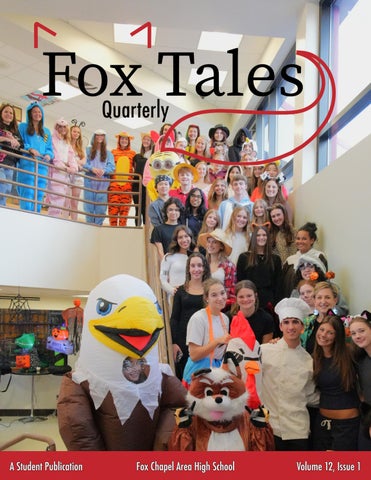
A Student Publication
Fox Chapel Area High School
Volume 12, Issue 1
IN THIS ISSUE New Teachers
1–3 FC Clubs Fox Chapel Area High School offers 100 clubs!
FC Accomplishments
FC
4–5
Technology
9–13
6–8 FC Athletics
Professional Sports
18–21 14–16
Math and Science
Student Health
25–27
30–32
Meet the New Teachers!
By Zoey Liu and Delaney Liu
What made you want to become a teacher? Both my parents were teachers and coaches, and I always saw the impact they had on their students in school and later in life. What subject do you teach, and what do you enjoy most about it? I teach Physics (AP and Accelerated). I enjoy the complicated problem solving and realworld application that physics demonstrates. Mr. Bubonics Physics
If you weren't a teacher, what career would you choose? I would want to be a physical therapist for athletes I think, I don't really know though, I have always wanted to teach high school and coach high school football.
If you could give students one piece of advice for high school, what would it be? A couple B's or bad grades is not the end of the world. Your effort and how you treat people is what matters and will carry you behind high school.
What made you want to become a teacher? It took me a while to figure out I wanted to be a teacher actually. I was taking a lot of literature classes for fun in college. For work, I was managing a local pool where I coached the swim team and taught swim lessons. One day, I saw a kid I was teaching finally master the skill we had been working on. Seeing that "lightbulb" moment made me realize I really enjoyed helping people learn new skills. I decided then to change my major and pursue teaching. Mrs. Hegarty English
What subject do you teach, and what do you enjoy most about it? I teach English. I grew up reading books every chance I could and loved the window into a character's life. As I've gotten older, everything about this subject fascinates me. Although I'm clearly biased, I genuinely believe it's the only subject that applies to all aspects of your life now and in the future. It teaches you skills in communicating, collaborating, comprehension, critical thinking, speaking/presenting, but, more importantly, it allows you to connect and understand other people and the world we live in. It's not just about "reading a book"—it's about making sense of the world you see around you and seeing issues from another perspective.
If you weren't a teacher, what career would you choose? That's so tough. I really believe I was meant to be a teacher. Outside of teaching though, I am also a soccer coach and that brings me joy every day. Recently I've been really interested in the mental fitness aspect of playing a sport. If I were to shift careers or go back to school, I might pursue Sports Psychology. If you could give students one piece of advice for high school, what would it be? If I could give students one piece of advice, it would be to have an open mind. About people. About interests. About learning. I would say that this is the time to pursue all the things you're even slightly interested in to see what clicks. It's also a time to branch out and meet different types of people. I've met some of the best friends in my life just because we were partnered in a class, or happened to sit near each other one day. Learning is a privilege and we often take it for granted. Be open to the subjects you think you hate and the ones that challenge you because you never know what lessons might stick.
FOX TALES NOVEMBER 2026
1
What made you want to become a teacher? I have a few influences that made me want to teach. My grandfather was a special educator and a huge influence on me. I spent my childhood working at the summer day camp he ran for students who struggled at general day camps. I also fell in love with teaching physics to other students in high school and college. My original goal was to be a professor of physics, but I dropped that when I realized research was not my thing, I really just wanted to teach it. Mr. Strumpf Physics
What subject do you teach, and what do you enjoy most about it? I teach Physics as well as Physical Science, but my training is in Physics teaching primarily. I love how learning about physics really opens your mind to the world in a new way. I love the excitement of looking at things differently after learning a new idea in physics. I also, as my students know, enjoy a really nice, challenging, physics problem.
If you weren't a teacher, what career would you choose? I was a software engineer for 10 years before switching to teaching, but if I had to do something after teaching (I will never go back to software) I would want to run or work at a planetarium. If you could give students one piece of advice for high school, what would it be? Besides "take my physics class," I would suggest this: try to remember at least once a day how absolutely remarkable it is that we get to be on a tiny planet fueled by a sun in a potentially infinite universe surrounded by plants, animals, friends, music, film, and more, and that on this planet we get to spend 7 hours a day learning about that universe.
Mrs. Gigliotti Business
What made you want to become a teacher? My journey toward teaching started in 7th grade with my Algebra I teacher, Mrs. Walther. Her energy, enthusiasm, and genuine love for math were contagious, and for a long time, I was convinced I would follow in her footsteps as a math teacher. However, my path shifted once I began taking business courses in high school and college, where I discovered a second passion. I was torn between the two fields until a business professor mentioned that my university offered a degree in Business Education. After meeting with the department head, I realized it was the perfect intersection of my love for business and my desire to teach. I changed my major shortly after and never looked back. What subject do you teach, and what do you enjoy most about it? I currently teach Career & Financial Essentials and Introduction to Business. What I love most about these subjects is their immediate, real-world relevance. It is rewarding to pull back the curtain for students and show them how businesses operate behind the scenes, but even more fulfilling is equipping them with practical financial literacy. Knowing I am teaching them critical money management that they will directly apply for the rest of their lives makes every lesson feel impactful.
If you weren't a teacher, what career would you choose? If I weren't a teacher (and a full-time mom!), I would be a professional race car driver. I've always had a passion for fast, high-performance cars; there's nothing quite like the feel and control of driving a manual transmission. Trading the classroom for the racetrack would definitely be my dream alternative career. If you could give students one piece of advice for high school, what would it be? Don't worry about where you stand on the high school social ladder—popularity completely fades the moment you walk across the graduation stage. Instead, focus on building meaningful relationships. Surround yourself with kind, positive, and honest people who lift you up and push you to be your best self; those are the connections that truly matter.
2 NOVEMBER 2026 FOX TALES
What made you want to become a teacher? I have always enjoyed art and being creative, and I found science to be an intriguing subject. Teaching secondary science requires a lot of creativity—in making visuals, coming up with lab activities, and creating models to represent different phenomena. I loved that teaching science was a job that allowed me to be creative and also delve into a subject I really care about. What subject do you teach, and what do you enjoy most about it? I teach astronomy. I will also be teaching environmental science in the spring. I really (continued from page 1) Mrs. Rowlands do enjoy all fields of science! What I appreciate most about astronomy is that it has framed Astronomy my perspective on how I want to live life. When you understand how fleeting human life is in terms of celestial time, and how rare life is in general in the universe, you tend to What made you want to become a teacher? appreciate things more and not get bent out of shape by the small stuff. If you weren't a teacher, what career would you choose? I would love to be an environmental field scientist, or work for a nonprofit like Allegheny Goatscape. Both would require me to spend time outdoors and possibly with animals, which I enjoy, and the work would positively contribute to the environment, which is important and rewarding, in my opinion. If you could give students one piece of advice for high school, what would it be? Now more than ever, do not hesitate to try things outside your comfort zone. Whether it is something big or small—put yourself out there. If you try something for a few weeks and you hate it, quitting isn't a failure—but never trying it in the first place means missing out on potential passions, skills, or lifelong friends.
To all of our new teachers, welcome to Fox Chapel!
Students Named Semifinalists In Coca-Cola Scholars Program
T
wo Fox Chapel Area High School students, Noelle at the 2027 Scholars Banquet in April in Atlanta. Fouron and Nico Zgurzynski, have been selected A joint effort of Coca-Cola Bottlers across the as Semifinalists for the prestigious 2027 class of the country and The Coca-Cola Company, the Coca-Cola Coca-Cola Scholars Program. Noelle and Nico are Scholars Program is the largest corporate-sponsored, two of 1,227 high school seniors from across the achievement-based scholarship program in the nation, and two of only 62 from Pennsylvania, to United States. With the addition of the 2027 class, the be selected as Semifinalists. More Coca-Cola Scholars Foundation will than 113,000 students applied for have provided more than 7,300 Coke the program this year. Students are Scholars nationwide with more than selected as Semifinalists based on their $93 million in scholarships over the academic records and achievements, course of 39 years. and are highly accomplished service"We believe that identifying these oriented leaders who are making a young leaders throughout the country positive impact in their schools and Noelle Fouron and Nico Zgurzynski have and encouraging their passion for been selected as Semifinalists for the serving others not only empowers communities. Coca-Cola Scholars program. The Semifinalists will now submit the students but also lifts up those an essay, a recommendation, and a transcript, and 250 around them," said Jane Hale Paulsen, president of Regional Finalists will be named in early January. They the foundation. "The Coca-Cola system is dedicated will then complete an interview and a total of 150 Coca- to giving back to the communities they serve, and the Cola Scholars will be named in late February. Scholars Coca-Cola Scholars Foundation is proud to be a part of will receive a $20,000 scholarship and will be honored that commitment."
FOX TALES NOVEMBER 2026
3
Students Win Third Place & Honorable Mention in National PSA Contest
F
ox Chapel Area High School 2026 graduate Emily executive director of Impact Teen Drivers, the sponsor Korczyski was named a third-place national winner of the contest, "Your campaign stood out for its for directing and producing, and creativity, positive messaging, an advanced media production and commitment to promoting class of 2025-2026 high school safe driving and riding behaviors students was named an while helping prevent reckless honorable mention winner, in the and distracted driving … We were 2026 Create Real Impact Contest especially inspired by your efforts in the high school campaign to highlight positive solutions category. and strategies that can help stop The students produced a preventable car crashes and create public service announcement safer communities for everyone." (PSA) titled, "The Final Rose," that The goal of the Create Real was a take on "The Bachelorette," Impact contest, open to students The FCAHS students who worked on the honorable from across the United States with a student giving a "Final mention-winning PSA are pictured here with Michelle Rose" to the safest driver. Johnson, the Impact Teen Drivers education outreach ages 14-22, was to emphasize the The students involved with importance of avoiding reckless coordinator for Pennsylvania. producing the PSA were 2026 and distracted driving and reducing graduates Deniko Agurs, Quinn Carey, Samuel Kieffer, teen driving injuries and fatalities on roadways and Emily Korczynski, and Eugenia Mettenburg; 2025-2026 walkways. The students were to create a PSA that juniors Lauren Bachman, Harry Bradley, Dax Buitrago, could be shared on social media. Fox Chapel Area High Finnegan DeRensis, Elias George, Logan Rapp, James School received a Create Real Impact Educational Grant Saleone, Nico Tavolario, and Jeffery Zacharias; and of $500 for the students' honorable mention win. 2025-2026 sophomores Jonah Driver, Omar Elshahat, The PSA created by Fox Chapel Area High School Giuliana Foley, and Jacob Kull. students can be viewed at: According to a letter from Kelly Browning, the https://www.youtube.com/watch?v=mfoFxCKJDi0
Join the Fearless Bible Club!
A
re you a Christian student at FCAHS? If so, you should consider joining the Bible Club to explore the Bible and your faith. The Fearless Bible Club was started in the 2018–2019 school year by the two older sisters of current senior and president Nolan Horne. The club has two meetings a week: a Bible study on Tuesday mornings and a prayer at the flagpole near the auditorium from 7:10–7:20. Some mornings, there may even be donuts thanks to Nolan! The Fearless Bible Club has two main missions: to provide a group that empowers Christian students by meeting together before school and to share the Gospel with the other students in our school while helping club members learn how to share the Gospel. In our meetings, we encourage each other to share the Gospel and provide support to each other through the challenges
4 NOVEMBER 2026 FOX TALES
By Matthew Bartolacci
associated with sharing the Gospel. This year, the Fearless Bible Club is going to be taking a more active approach to school events like Homecoming, Boo Bash, and others. We have a stand at the Homecoming Carnival where we are selling desserts as a fundraiser for charity. 100% of the proceeds are going to be donated to our chosen charity! Stop by and see us! On September 23, we participated in a national event called See You at the Pole. Schools all over the country go to their flagpoles to pray over their schools and country. It is a spot of unity within the high school body of Christ. After this event, the Tuesday Bible studies and Thursday flagpole prayers began. If you are interested, please email Nolan Horne (Horne_Nolan@student.fcasd.edu) to be placed on the email list.
Fox Chapel Club Crossword By Zoey Liu and Delaney Liu Fox Chapel Club Crossword 1
2
3 4 5 6 7
8 9
10
Across
Across the French language, 3. Group centered on exploring 3. Group centered culture, and cuisine.on exploring the French language, culture, and cuisine. 5. The school literary magazine or quarterly publication. 5. The school literary magazine or quarterly 7. Future Health Professionals; dedicated to students publication. pursuing careers. 7. Futuremedical Health Professionals; dedicated to students 8. Distributive Education Clubs of America; Prepares pursuing medical careers. emerging leaders and entrepreneurs in marketing, 8. Distributive Education Clubs of America; Prepares finance, and hospitality. emerging leaders and entrepreneurs in marketing, 9. Technology Student Association; focuses on finance, and hospitality. STEM, engineering, and tech design. 9. Technology Student Association; focusesmental, on 10. Group dedicated to promoting physical, engineering, and tech design. andSTEM, emotional well-being. 10. Group dedicated to promoting physical, mental, and emotional well-being.
Down Down 1. Club empowering female students pursuing STEM 1. Club empowering female students pursuing STEM fields. fields. 2. Club where students simulate real courtroom cases and legalwhere procedures. 2. Club students simulate real courtroom cases 4. Foxes Leadership Council; student-led organization and legal procedures. focused on school leadership and spirit. 4. Foxes Leadership Council; student-led organization 5. Future Business Leaders of America; prepares focused on school leadership and spirit. students for careers in business. Future Businesswho Leaders America; prepares 6.5.Club for students love of solving equations and students for careers in business. competing in math competitions.
6. Club for students who love solving equations and competing in math competitions.
Answers on page 9.
FOX TALES NOVEMBER 2026
5
Off the Rails: The Fox Chapel Marching Band Looks for Continued Success
A
Friday night during the fall quarter is one of the most festive times of the entire school year. Students, families, and teachers alike return to the school grounds those evenings to take in the sights and sounds of a football game in Fox Chapel's beautiful stadium. However, a fact that spectators may not be so aware of is that they are getting to experience one of the most talented marching bands the state has to offer. The marching band season is not something to be taken lightly, with practices beginning in the summer and seemingly never ending. But the hours upon hours of dedication and hard work culminate in a tight knit marching band that finds success year in and year out. This year, the marching band is led by drum majors Nadre Digbohou (senior) and Axel deBruyn (junior), color guard captains Camden Krotine and Emma Smith (both seniors), and band directors Daryl Lesnik, Evan Hertrick, Joshua Branker, and Karli Umholtz. The band kicked off performing at the 76th Kennywood Fall Fantasy Parade, where over 130 local marching bands performed alongside hand-made floats, an event that spanned 18 nights. But the band season ramps up quickly, and every hour must be spent wisely in order to have the best possible finished product. Each year the band dedicates their time to one big show that they ultimately perform at the PIMBA Championship that takes place at Gateway High School. The path to the championship spans the entire season, as the band plays at every football game, the Allegheny Marching Band Festival at Shaler, and three other PIMBA shows at different high schools in the area. The bar couldn't be higher for the Marching Foxes, who won the PIMBA Class AA Championship last year. Following the incredibly successful season, the band
6 NOVEMBER 2026 FOX TALES
By Eli Olifson
was promoted to class AAA, which will prove to be a difficult task, yet one the Foxes will definitely be prepared for. So, what did the band perform this year? The title of the show is Off the Rails, and it describes the story of a runaway train. The soundtrack is diverse, to say the least, fusing music from The Red Hot Chili Peppers, Queen, Donny Darko, and Ozzy Osbourne. Senior Brass Captain Collin Fasanella explained how this year's performance is "extra ambitious," as it features moving props and intense choreography. Fasanella explains that "Multiple times throughout the show, the props— which take the shape of rails—are moved, stood upon, and spun," which he believes "adds an entire extra dimension to the show" and "capture the attention of the audience and competition judges alike." Moving up in classes in PIMBA has made it a necessity for the band to have a more elaborate set than before, but there are other non-visual aspects that also help isolate this show from others in the past. A typical performance, according to senior Nadre Digbohou, would feature maybe one soloist. She explained that to her, what makes this show stand out is "the prominent featuring of different students throughout the show." With multiple soloists from both the band and color guard, Off the Rails showcases the incredible talent within every facet of the band. Before the season began, it would have seemed likely that the Marching Foxes would face some turbulence as they advanced in classes. However, from the beginning of the year they have proved that this is exactly where they belong. In their first PIMBA show, the Foxes placed first in class AAA, asserting themselves in this new level. Expectations coming both from outside and inside the band are high, as they have their sights set on another PIMBA Championship win. Color Guard Captain Camdine Krotine explains what the future prospects of the band look like,
and why the expectations are reasonably so high. The fierce leadership of senior captains has shaped the underclassmen to be ready to take on the responsibilities of the band in the next few years. According to Krotine, "the underclassmen have all been stepping up a lot this year and are extremely involved," which has made him "very positive that the band will be in good hands once the seniors graduate." Krotine also expressed the belief that the band will be expanding in the next few years with more and more underclassmen expressing interest, and a lot of potential in this younger generation of Marching Foxes. The Foxes' success can be highly attributed to their
connectedness as a team, a spirit that grew as they won in class AA last year. Fasanella believes that the feeling of victory last year has certainly carried over into this year, with the band performing with a "defending champions" mentality, and wanting to protect it. And protect it they did. The Fox Chapel Marching Foxes brought home the victory in class AAA, winning first place at the PIMBA Championship on Saturday, October 24th. The massive victory caps off an undefeated season for the band, which placed first in every single competition. The band has had an incredible run this year, and hopes to continue this winning trend for years to come.
FOX TALES NOVEMBER 2026
7
FC Tops Regional & State-Wide Rankings
F
ox Chapel Area School District is the district in which we all reside. It includes 4 distinct elementary schools, one middle school, and one high school. The district has won many awards over the past few years, and it is being shown in the rankings. On September 28th of this year, Niche released its annual school district rankings. Fox Chapel had much of an impact in the top spots. The district ranked #1 in the Pittsburgh region out of 78 other districts. They also ranked #2 in the entire state of Pennsylvania among more than 490 districts—behind only TredyffrinEasttown School District in Wayne, PA. Additionally, the district ranked #35 in the entirety of the United States with 10,000+ districts. Other rankings include the #1 best place to teach in the Pittsburgh region, with the #5 best teachers, and the #19 best district for athletes. Overall, the district received an A+ grade from Niche, with every individual school receiving one as well. Niche puts Fox Chapel Area High School as the thirdbest high school in the Pittsburgh region, behind North Allegheny High School and Mount Lebanon Senior High School, and #9 in the state as a whole. Other rankings schools in our district received are Fairview Elementary at #4, O'Hara Elementary at #11, Hartwood Elementary at #13, and Kerr Elementary at #14 for best public elementary school statewide. Dorseyville Middle School ranked #4 for best public middle school in the state. In a 2026-2027 report published by US News, Fox Chapel Area High School came in third for the Pittsburgh region, behind Peters Township at 1 and Upper St. Clair at 2. They ranked Fox Chapel 14th within Pennsylvania. Recently, the Pittsburgh Business Times submitted its ranking of schools based on the state standardized test scores of the Keystone Exams and PSSA's this past
By Kamerin Jackson
year. Fox Chapel Area School District came in first for this for the third consecutive year as well. They not only ranked #1 for the Pittsburgh region, but #1 for the state also. Let it be known that these rankings do not include private schools such as Shady Side Academy, as they are not required to take statestandardized testing. The Great Schools Organization gives Fox Chapel Area High School a 9/10 overall grade and 10/10 in categories such as Test Scores and College Readiness. O'Hara Elementary and Hartwood Elementary received an overall grade of 10/10, Dorseyville Middle School and Fairview Elementary received a 9/10, and Kerr Elementary received a 8/10. These are some of the most impressive scores in the region. Overall, the Fox Chapel Area School District is a very prestigious place to live, with nationally recognized academic and athletic programs accompanied by outstanding teachers. As members of this Fox Chapel community, we see firsthand the opportunities, privileges, and resources that we have available to us. These accomplishments are something that students and teachers can take pride in and be proud to say that they attend Fox Chapel.
Students Place in National FBLA Competition
F
ox Chapel Area High School 20252026 juniors Noelle Fouron and Ainsley Goode placed at the 2026 Future Business Leaders of America (FBLA) National Leadership Conference. They won seventh place in the nation while competing as a team in the Financial Planning category.
8 NOVEMBER 2026 FOX TALES
The FBLA National Leadership Conference was held in San Antonio, Texas, June 29-July 2. More than 13,000 students from high schools across the United States and Canada participated in various business, technology, and presentation events at the competition.
Opinion: The Second Generation Tesla Roadster
F
By Shiva Subramanian
lying cars have been a staple in genres like science very long time, and most likely, the Performance and fiction in books and movies. They have captured the Thruster variant will come out mainstream. imaginations of many millions of children and adults Even then, there will be many many restrictions. alike. Well, Elon Musk, chief executive officer of both Making a flying car is one thing, but it still will have Tesla and SpaceX, revealed a flying car on October to pass regulation. This could pose many problems as 15, 2026. According to current infrastructure is Fortune, the flying model not designed for flying has 10 thrusters and cars if Elon is to ever make expected production of a Rocket variant that is 2028. It took flight and somehow available to the hovered in the air for a public. They would have few seconds. According to sort out issues like how to Fortune, there is a high would it be able Performance model that to fly, whether it would is "road ready", a Thrust pose safety threats to model that has thrusters other aircraft or buildings, with cold gas that could responsible usage of do 0-60 miles in under the car, flying car traffic While Elon Musk's newly revealed Tesla flying car concept offers a a second, and a Rocket control, landing gear and revolutionary vision, its feasibility remains highly debated. model which is the spots, and if extra training one Elon revealed and is invite-only. There could be would be necessary, among other things. It would be different uses like when there is significant traffic the interesting to see how Tesla would handle these issues car could fly over the traffic jam, or the car could fly if they release a Rocket variant to the public maybe 20 over bridges and rivers. years down the line. I think innovators and innovations like this should However, there would be significant cost be celebrated and encouraged. This car could pioneer considerations to be kept in mind as flying is not a new revolution in transportation and provide fast cheap even with modern aircraft. Flying cars could be and quicker than ever transportation. This cold gas extremely expensive as it costs $250,000 just to reserve technology could be used in other applications like the Thrust variant, according to TechCrunch. I also helicopters. expect there to be some delays as these deadlines are However, the feasibility of this project is debated. a little ambitious in my opinion. Then again, flying cars Tesla has delivered on many innovative and modern may be the future to come and criticisms to this could inventions such as the cybertruck and assistive self be as criticisms to the first IPhone. In the end, only driving software for their popular Tesla models like time will tell if Elon Musk could make this concept car the Model Y. On the other hand, the flying car is only a a mainstream use or if it would remain invite only and concept car at this stage. Elon Musk is also known for not street legal. extremely delayed timelines like with cybertruck. This raises questions on whether they will actually deliver. Additionally, the flying version would not be street legal. My conclusion is that we have to be cautiously optimistic with this concept car. It is certainly impressive and has the potential to be a game changer, but there is also massive hype regarding this. We also have to keep in mind that this is more of a tech demo than anything as there is no guarantee even by Tesla that this will be released. According to CBS, the FAA does not even consider it an aircraft. It is very unlikely that the Rocket variant will come into public use for a Fox Chapel Club Crossword: Answer Key 3 ACROSS: FRENCHCLUB 5 ACROSS: FOXTALESQUARTERLY 7 ACROSS: HOSA 8 ACROSS: DECA 9 ACROSS: TSA 10 ACROSS: WELLNESSCOUNCIL 1 DOWN: WOMENINSCIENCE 2 DOWN: MOCKTRIAL 4 DOWN: FLC 5 DOWN: FBLA 6 DOWN: MATHCLUB
FOX TALES NOVEMBER 2026
9
Meta was just sued for $17.1 billion. How much did it cost you?
By Linden Trac
F
acebook, Instagram, Whatsapp, Oculus, and Meta AI. What do these all have in common? They are all apps and services owned by Meta. There are almost 3.6 billion daily active users on Meta-owned apps and services.1 What exactly does Meta do? According to their official website, they "[build] technology that connects you to people, interests and experiences that matter to you."2 On that same company information page, there are five principles:
Meta has acquired 91 other companies, including Instagram, Whatsapp, and Oculus.
1. Give people a voice 2. Build connection and community 3. Serve everyone 4. Keep people safe and protect privacy 5. Promote economic opportunities In 2023, 47 Attorneys General (representing 43 states, 3 territories and commonwealths, and the District of Columbia) filed a lawsuit that would ultimately question the legitimacy of the fourth principle.3 This lawsuit alleged that Meta illegally collected the data of children under the age of thirteen who used its platforms. They also claimed that Meta designed their platforms to be "addicting" for young users and lied to the public about the safety of Facebook and Instagram.
10 NOVEMBER 2026 FOX TALES
These actions violated federal and state laws, including the Children's Online Privacy Protection Act (COPPA). Although Meta has restrictions set in place to prevent people under the age of thirteen from being on its platforms, many of these underage users register false birthdates to easily bypass this rule. This lawsuit raises the question, "Why is Meta being punished for violating the law, even though they have policies set in place to prevent underage users?" In response, regulators and state attorneys argued that Meta did not actively enforce the restriction and continued to design their systems to be addicting and unsafe. Key testimonies from whistleblowers— or insiders who report illegal, unethical, or unsafe activities within an organization—revealed that company leaders were aware of the dangers of their online platforms, yet never took reasonable steps to reduce the harm on young users. Throughout the trial, Meta would continue to deny these allegations and claim that they were protected by Section 230 of the Communications Decency Act.4 Ultimately, after eight days at trial (Aug. 18–Aug. 26), Meta agreed to a settlement in which they must pay $17.1 billion over a ten-year period to the states and territories that are part of this lawsuit. Meta must undergo significant changes to how its platforms operate in order to make them more safe for minors. These changes include: • A default two hour daily limit for all users under 18
•
•
years old (may be lifted by a parent or guardian). If other social media platforms agree to similar terms, this may change to one hour. A default nighttime block from 12:00 a.m. to 6:00 a.m. for all users under 18 years old (may be lifted by a parent or guardian). If other social media platforms agree to similar terms, this may change to 10:00 p.m. to 7:00 a.m. A ban on displaying the number of likes/reactions for all users under 18 years old.
considerable settlement for everlasting damages? Will these new changes make a significant difference to the safety of Meta-owned social media apps and services? Will other companies such as TikTok, Snapchat, Roblox, and more be tried in similar trials in the future? These are just a few questions being asked in response to this landmark trial. This trial is just the beginning of the ever-changing landscape of social media. References: https://stockanalysis.com/stocks/meta/metrics/daily-active-users/ https://www.meta.com/about/company-info/ 3 https://ag.ny.gov/press-release/2026/attorney-general-james-secures-171-billion-andgroundbreaking-reforms-meta 4 https://www.congress.gov/crs-product/R46751 5 https://www.npr.org/2026/08/26/nx-s1-5944781/meta-settlement-child-safety-lawsuit 1
Although $17.1 billion may seem like a staggering amount to pay, Meta reportedly made over $16 billion in net profit last quarter.5 Is only a quarter's profit a
2
Fox Chapel Receives $50,000 National Moonshot Grant
T
he Fox Chapel Area School District, in partnership with the Center for Innovation in Education, has been awarded a $50,000 Remake Learning National Moonshot Grant. The funds will support an initiative titled "Building the Village: Schools as Infrastructure for Community Prosperity." During the next year, the Fox Chapel Area School District and the Center for Innovation in Education will co-create a prototype of a Community Impact Council, a coordinating body comprising students, the school district. municipal partners, and community organizations. The group will explore what it would take for the Fox Chapel Area to become a Blue Zone, a community where people live measurably longer, healthier, and more connected lives because of the environments and social structures around them. Two products will result: a Community Prosperity Roadmap to help ensure that isolated efforts compound into measurable community progress, and a shared accountability scorecard to gather early, trackable signs that the community is moving toward Blue Zone conditions. "This work will create a school-community
partnership where the district isn't just a venue for programs, but a genuine engine of shared prosperity," says Dr. Mary Catherine Reljac, Fox Chapel Area School District superintendent. "Fox Chapel Area students already demonstrate extraordinary leadership capacity. This initiative asks, 'What happens when we give that capacity a real coordination role on a wider scale, not as a future aspiration, but now?' " The Center for Innovation in Education, founded in 2013, supports education leaders to create durable, community-owned solutions to complex problems. The Remake Learning National Moonshot Grants are made possible by the Grable Foundation, Siegel Family Endowment, Richard King Mellon Foundation, The Heinz Endowments, and The Buhl Foundation. Remake Learning stewards the Pittsburgh learning ecosystem and advances the future of learning worldwide. Since 2021, Remake Learning has awarded Moonshot Grants to 130 projects, totaling more than $5.75 million in investment in bold ideas with the potential to shape the future of teaching and learning.
FOX TALES NOVEMBER 2026 11
How AI Data Centers Are Affecting You
A
rtificial Intelligence is a major part of the world as we know it today, whether in a positive or negative light. Schools choose to incorporate AI in every day lessons in order to teach the youth about the world around them. Many students choose to use AI to make their lives easier, whether using it to write an essay for them or creating a picture for them. A lot of people fail to realize that this intelligence that is unseen by many has an actual form in the real world. AI comes from supercomputers all over the world, with 12,000 to 12,250 active data centers in 179 different countries. The United States makes up for 4,767 of these data centers, or 1/3 world-wide. These facilities are over 10,000 square feet, and a lot of the time, they expand over acres of land. Inside these facilities are millions of chips and wires that are wiring from questions and generations all over the world. These computers may seem cool, but the only cool part is the water that cools them down. According to the Florida Water & Pollution Control Operators Association, about 75-90% of data centers worldwide rely on water-based cooling systems. Only 10-25% are water-free systems. Many of the water used for cooling is freshwater, with about 57% of the water supplies coming from potable water systems. One large data center uses around 5 million gallons of water per day.
12 NOVEMBER 2026 FOX TALES
By Giselle Silva In the United States alone, data centers use 628 million gallons of water per day. That is over 1,496 times the amount that the average family uses every day (300 gallons)! Many people may say that does not matter. Water is a replenishable source, after all, it will just go through its cycle and we will have fresh water. However, this sentiment does not account for the way the water cycle actually works. When water evaporates and vapor travels up into the clouds, these clouds do not stay still. They move. This movement causes a lot of the water that comes back down to simply turn into runoff, and go to plants and mud instead of supplying human kind. The use of fresh water in some areas exceeds the processes meant to recycle it. As of January 2026, the UN stated that the world is in a state of global water bankruptcy. We have been in this state for over 50 years, but many have used simpler terms, such as water crisis. This term was simply changed in 2026 to describe how dire this state is. Water bankruptcy is not a distant threat, but a present reality. The threat of AI data centers only adds to this sentiment. If we were already experiencing water shortages before, how could we recover from the removal of over 449 million gallons of water per day? It is not only water that we need to worry about;
these data centers affect communities in exponential ways. According to the World Resource Institute, a single AI Data Center uses as much power as 100,000 households, and larger ones will consume 20 times as much. Grid Strategies says that up to 90 gigawatts worth of data centers could come online by 2030. To put that statement into perspective, that size is 9 times the amount that New York City uses during summer demand. AI data centers also release harmful air pollutants every single day. Nitrogen Oxides and Greenhouse Gases are continuously being released daily as a result of millions of requests globally. In Memphis, Tennessee, locals and the NAACP filed a notice with the intent to sue under the Clean Air Act, for plans to build up to 30 natural gas turbines for these data centers. These turbines compress the outside air and burn fuel consistently. This burning releases fine particulate matter, or PM2.5, which is widely known as one of the most harmful pollutants to human health.
Additionally, data centers can be incredibly noisy. The generators and cooling systems of these large facilities can reach upwards of 100 decibels. This is roughly the equivalent to the sound of a chainsaw. Imagine having to hear that noise level every single day, and not being able to get away from it. Residents of Loudon County, Virginia, reported disruptions of sleep, headaches, and lower quality of life because of the noise of the nearby data center. According to the decibel chart, a person should only be in the range of 100 decibel noise for 30 minutes. Even so, this noise from the computers can sometimes go
on for hours or even days. This exposure can cause noiseinduced hearing loss to many communities globally. Even with so many paragraphs, I have not even scratched the surface of how harmful AI data centers are to our world. We are causing so much pain to our communities, to our environment, and to our atmosphere, and for what? A drawing you couldn't even bother trying to draw yourself (or ask an artist to draw it for you)? An essay for your teacher that you couldn't even bother to write, so now even the people who write well have to suffer for your laziness? Have fun watching that funny generated video about birds while their homes are being destroyed by the computers you are funding. I am not here to incriminate any single person that uses AI. I believe it has some good purposes for society. These purposes, however, do not include generative AI. Why should we be destroying our environment for something we have been doing for generations? The human race is born to create. Without the passion to make, what are we but shells of the society we once were? I ask you to think the next time you use AI. The next time you are tempted to use AI for generative purposes, think about what you are influencing for our environment. How your one generation is burning fuel, harming our atmosphere, and worsening the lives of millions. You may think that your single effort will not change the world, but you will feel much better when you look at a task and know you can perform. When you can draw something on your own without a block of code. When you can write an essay for someone and feel proud of the work you did. If enough people live with this mindset, then there will be no need for generative AI, and they will become a moment in history. References: https://programs.com/resources/data-center-statistics https://www.fwpcoa.org/content.aspx?page_id=5&club_id=859275&item_id=130961 3 https://www.preventionweb.net/news/world-enters-era-global-water-bankruptcy-unscientists-formally-define-post-crisis-reality 4 https://www.wri.org/insights/us-data-center-growth-impacts 5 https://www.lincolninst.edu/publications/land-lines-magazine/articles/land-waterimpacts-data-centers 6 https://environment.yale.edu/news/article/data-centers-urban-heat-and-ai-growth 1 2
Be Part of a Film!
D
o you want to be part of the production of the screwbite fIlm company's first feature film, Blissheart? Scan the QR code or call or text at 412-897-9480 to feel a sense of romance and fantasy.
By Elijah Turner
If that doesn't interest you, we are also producing a short thriller show to extend the Halloween season. Scan the QR code, and get the chance to experience the thrills and chills of your life!
FOX TALES NOVEMBER 2026 13
the first quarter comes to a close for fox chapel athletics
I
by eli olifson
t's hard to believe that the school year is almost ¼ of the way done, but fall is here and winter is on the horizon. With that, fall sports at Fox Chapel Area High School are beginning to ramp up for playoffs, with WPIAL and State dreams at stake. As the season approaches its end, let's take a look back at how all the Foxes did during this busy first quarter. Cross Country Cross country is a major strength at FC for both the boys and girls. This is made abundantly evident through both teams winning their sections and earning a spot in WPIALs this year. That makes it 8 straight section wins for the boys team. On an individual note, Senior Nolan Horne won the section individually, ensuring that he will make an appearance at states, and Sophomore Asher Eckel won the WPIAL meet individually, an incredible feat that makes him one of the top runners in the state.
Field Hockey Field hockey has proven to be a powerhouse and a team to beat not only in the section but also in the WPIAL. This year has proven to be no different. The Foxes have racked up wins this season, asserting themselves as a dominant force in the section. They have won some close games against teams like Peters, who they beat 1-0, and they've blown some teams out of the water, such as a 6-0 win over Latrobe. Unfortunately, the Foxes suffered a narrow loss in the WPIAL playoffs, getting outscored 3-1. The team will hope to build off this next year and keep all their momentum from this season.
14 NOVEMBER 2026 FOX TALES
Football The football season at FC has had ups and downs. The boys opened up the season hot, taking down the Allderdice Dragons at home in an exciting 27-24 win. The Foxes, however, hit a skid after that, facing tough opponents and suffering some unfortunate losses. However, the season ended on a high note, with the Foxes emerging victorious against Connelsville. FC does have some talent that should prove to help them in the next few years. Quarterback Gianni Fusaro, who is only a Junior, has been a bright spot both on offense and defense.
Soccer Both the boys and girls soccer teams are big names in their section, and both lived up to the hype this year. The boys are currently 10-4 overall and 8-2 in the section. The Trib has them ranked third, which gives them a legit shot at a bye in the playoffs. The team's young core has proven to be a strength. Senior Paul Fitzsimmons has been a standout on the field, as well as Junior Carson Torres and Sophomore Rowan Fincher. The boys' most recent game (at the time of writing) was an overtime thriller that they won 2-1. They moved on to the semifinals this week. The girls team had yet another incredible season, something that is becoming quite normal for them. Currently 10-1-2 (according to MaxPreps), they should be set up to be a top seed in the playoffs. The team won WPIALs in 2025 and 2023, and was a finalist in 2024, as well as being section champs 3 years in a row. The girls team has survived thus far in WPIAL playoffs, and is set up for another deep playoff run.
Golf If one had to choose the sport at which Fox Chapel is the best, this would be the common answer. After going undefeated in the section, the boys team placed second in the WPIAL, narrowly losing by 2. Senior Carson Kittsley placed third for individuals. The girls team also had an incredibly impressive season, going undefeated and winning some tough matchups. Notably, the Foxes secured the undefeated season with a 180-208 win over North Allegheny. After winning the section, the Foxes went 5/5 on individual qualifiers, earning the top 3 finishes as well. The 5 qualifiers were Clara Koteski, Abigail Freyvogel, London Bitar, Lucy Koteski, and Enza Soose.
FOX TALES NOVEMBER 2026 15
athlete spotlight: joe yoshikawa by eli olifson 1.) What is your favorite FC Football memory? "Probably beating Allderdice this year after losing to them two years in a row. It was especially redeeming since some of the guys on Allderdice were trash talking online, and we were able to prove ourselves on the field."
3.) What makes this year different from the others and what does it say about the future of FC Football? "In the past few years, our team has heavily relied on a small number of seniors to perform and help win games. I think the biggest change this year is how we have shifted away from this dynamic and have been able to rely on a multitude of different players. We even have 3 freshmen starting on offense and defense who play major roles for us. Because of this shared cohesiveness, we have more trust in each other on the field and can rely on each other for breaks when we need, instead of constantly being solely counted on to make every single play."
2.) How has the program developed and grown in your 4.) What do you most look forward to about Friday time on the team? night home games? "The program "The moment I look forward to the most on Friday has definitely taken nights is seeing all the supporters in the stands. It's Joe Yoshikawa is the student body vice president and the captain of the FC multiple steps forward an amazing feeling to momentarily glance up at the Football team. in my time with the bleachers and see a loud and rowdy student section program. In my first cheering the team on. The large numbers of season (sophomore year), parents, students, and community supporters I remember a senior class reminds me that our effort isn't just for us, but who often slacked off and also so that we can represent our community didn't take practice too with pride." seriously. As a result, we ended up going 2-8 that 5.) If you could year. However, the past two tell all the years have seen seniors underclassmen lead the team by example, football with heavy dedication in players one the weight room, continual message, what attendance, and increased would it be? team bonding experiences "Cherish like team dinner. As a result, every moment we had greater cohesion that you get During the homecoming football as a team and have seen to step on the game on Friday, October 16th, the greater success. By creating field and play. Foxes played against Indiana Area a team culture of hard work You never know Senior High. and dedication, each Fox when an injury Chapel Football team has can wipe you out for a play, a game, or even a increased in strength, skill, and mindset every year." whole season."
16 NOVEMBER 2026 FOX TALES
FCAHS RAIL Endorsed
F
ox Chapel Area High School has earned the evidence of the district's diligence in teaching the use Responsible AI (artificial intelligence) in Learning of AI in a responsible manner. (RAIL) Endorsement in AI Literacy, Safety, and Ethics "The Fox Chapel Area School District centers its work from the Middle States Association (MSA). The purpose on learning and teaching while preparing its students of RAIL, and of this endorsement in particular, is to for their futures. Being a future-focused district means help schools "stay safe and stay ahead" with AI. Fox using technology and artificial intelligence tools in Chapel Area High School is among the first 50 schools ways that enhance learning, teaching, and working. worldwide to receive this endorsement. By co-creating our approach with students and staff, According to an email from the MSA AI professional the district is finding ways to responsibly use artificial peer review team, "As a member of RAIL's 'Founding intelligence to enhance innovation and opportunities, Fifty,' you are a pioneer as the world of education and is also identifying areas where artificial intelligence grapples with the implications of generative AI. Your may not be as effective for the desired goals," said commitment to this work has set a powerful Dr. Reljac. "The RAIL endorsement example for how schools can lead in complemented our efforts to provide adopting AI responsibly and ethically. Your students and staff with a framework for work is … a signal to your community that using artificial intelligence at appropriate your school is proactively shaping the future times, in appropriate ways, and within of learning." ethical guidelines for learning." In order to be RAIL endorsed in AI The RAIL endorsement for Fox Literacy, Safety, and Ethics, Fox Chapel Area FCAHS has earned the RAIL Chapel Area High School covers two High School met requirements for practices endorsement to "stay safe and years, from July 2026 through July 2028. ahead" with AI. (evidence of AI literacy and training The endorsement is the world's only materials and resources), program (plans to comprehensive implementation framework implement responsible AI), infrastructure (descriptions for AI in K-12 schools and systems. for those who will lead school AI efforts), governance The MSA is a Philadelphia-based, non-profit (handbook statements and policies on AI), and culture educational accreditation organization that evaluates & identity (aligning the district's mission, vision, and and accredits public, private, and faith-based schools values statements to responsible AI use). (pre-K through secondary), and higher education Fox Chapel Area School District Superintendent Dr. institutions to ensure rigorous standards and Mary Catherine Reljac says the RAIL Endorsement is continuous improvement.
Foxtoberfest
By PJ Hart
FOX TALES NOVEMBER 2026 17
"The Show" Risks Cancellation of its 2027 Season A Look into Major League Baseball's Labor Dispute
W
here is baseball headed this offseason? As the 2026 MLB season wraps, the buzz in the baseball world isn't about who ends up on top. Instead, the dominant point of discussion amongst fans, players, owners, and journalists has been about what's coming. The current Collective Bargaining Agreement (CBA) between MLB and the MLBPA expires on December 1, 2026. If the two sides can't come to an agreement by then, the state of the 2027 season will be left in jeopardy. The team owners are prepared to enter a work stoppage, otherwise known as a lockout. In the event of a lockout, the players will lose total contact with their teams. They will not be paid and will be barred from using team facilities, medical staff, and training equipment. Front offices will be unable to make any transactions and coaches and management are not permitted to contact players. Understanding why negotiations between the MLB and the Player's Association have broken down starts with recognizing the current state of the MLB and its problems. Why may a lockout happen? The disconnect between owners and players is best simplified to one main issue: the proposed introduction of a salary cap. Put simply, a salary cap is a limit on what a team's ownership can spend on player payroll. The MLB currently doesn't have one, and all three of its main competitors, the NBA, NFL, and NHL do. The NBA has a soft cap, meaning that the limit can be exceeded. However, there are heavy taxes and penalties for going past the limit. If the payroll becomes too high, severe handicaps are placed on the team's front office. These can come in the forms of draft and trade restrictions or even roster freezes. The NFL and NHL have a hard cap, which bars teams from exceeding the limit. The MLB does currently have its own version of a soft cap. However, the tax largely isn't effective, rendering it seemingly nonexistent in its effect. Teams that exceed $244 million in salary have to pay a Competitive Balance Tax, which increases with
18 NOVEMBER 2026 FOX TALES
By Grant Fenton salary and for repeat offenders. Teams that exceed the limit may also get their draft picks downgraded. The tax is the most significant penalty imposed, and most big market teams just approach it as an extra operational expense that they can afford. The lack of penalties creates sky high labor expenses for big market owners and a lack of talent affordability for owners in small markets. Therefore, Major League Baseball is proposing the introduction of a salary cap and floor system. This new system would include a hard cap of $245.3 million and a floor of $171.2 million. The players remain persistently opposed to any system that includes a hard cap, leading to the stalemate between the MLB and the MLBPA. Why do owners support a salary cap? While owners are united under their support for a salary cap, they are not united in their justifications for their support. Small market owners want more competitive balance, while big market owners want to reduce their labor costs. The MLB has a revenue sharing system designed to ease revenue disparities between teams, but it is not designed to redistribute all revenue equally. It requires each team to give 48% of their revenue to the shared pool, which is divided equally among the thirty teams. However, the total revenue of big market teams is significantly larger than that of small market teams due to discrepancies in local media deals and stadium revenues. This results in the 52% kept by the Yankees or Dodgers being significantly larger than the 52% retained by the Tampa Bay Rays, for example. The small market teams have the least amount of money and the big market teams have the most. Because of this gap, big market teams can spend much more on player salaries, forcing small market owners to either close the gap out of their own pocket, or surrender their ability to sign star talent. The owners argue that the lack of a salary cap and floor not only allow big market teams to spend excessively, but also disincentivizes the spending of small market
teams. They find themselves unable to compete with the gargantuan payrolls found at the top end of the league, so they instead opt to minimize spending altogether. The owners' belief is that a salary cap and floor will level the financial playing field, and thus there will be a more even distribution of talent across the thirty teams. Unlike small market owners, the owners of teams in big markets aren't very concerned with competitive balance, as the current system keeps them consistently in contention for titles. However, many of them are eyeing other off-field benefits from the new system—a salary cap would provide owners a fixed amount of business expenses and end the current unpredictable and ever escalating labor costs of the current system, thereby generating higher profit margins. The cap would also cut down on the extensive free agent bidding wars that are beneficial to players, but detrimental to owners. The MLB's proposed structure for the new system also includes a 50-50 revenue split between owners and players, placing a predictable limit on the players' share of future economic growth.
A labor strike in 1994 forced the cancellation of the remainder of the Major League Baseball season and the World Series. History may repeat itself as MLB prepares for an impending lockout.
Why don't players support a salary cap? The players' perspective is simple—for one, they oppose any system that artificially puts a ceiling on their earning power. Additionally, the 50-50 revenue splits and free agency restrictions being proposed would significantly affect the total revenue share distributed to players, as well their ability to drive up the demand for their talent. While its proponents argue that the new system would actually raise the salaries of the majority of players, the MLB Player's Association (MLBPA) rejects this. They believe that teams will still sign stars to massive salaries, meaning that cap restrictions will force teams to allocate their remaining resources to the rest of their players via minimum salaries. The MLBPA argues this would effectively eliminate the "middle class" of MLB
players. Additionally, the players reject the belief that the MLB has a competitive balance issue. Three time Cy Young winner Max Scherzer summarized the player perspective, saying "Look, we can talk about competitive balance and go over the numbers and how it compares to other sports. Competitive balance in baseball is excellent and actually better than the other sports... Every team in Major League Baseball has the ability to compete, and there are teams that are choosing not to who have the ability to do more, the wherewithal to do more." Where do the fans stand? The MLB leads all American professional sports leagues in attendance by a large margin, so while fans are often an afterthought in the struggles between the MLB and its players' association, they wield significant influence and can greatly affect the league's bottom line. Currently, many fans find themselves entirely opposed to a lockout but also strongly in favor of implementing a salary cap to improve competitive balance. Support for a cap system among fans increased significantly at this year's trade deadline, when the Dodgers traded for Detroit Tigers star pitcher Tarik Skubal. Many cited this as evidence of the current system being unfair, but Skubal disagreed, saying, "Every team could trade for me. Every team could make that acquisition". However, the fan outrage wasn't about this one trade, but rather the fact that a team already considered unfair became even better. The Dodgers currently have fifteen players that were signed in free agency; their massive payroll is about five times that of the small market Cleveland Guardians. Simply put, the Dodgers are able to "buy" an elite team via free agency without having to successfully develop their own prospects, which is a luxury most other teams cannot afford. In January of 2026, they signed Kyle Tucker, a standout for the Chicago Cubs, to a four year, $240 million deal. For the Dodgers, however, it hardly makes a difference, which has led to much frustration amongst fans—especially those of smaller market teams, who watch as their teams attempt to draft and develop talent and make target acquisitions, while other teams effectively purchase an all-star team in a pay-to-play system. What will happen? The outcome of the league's labor battle remains uncertain. It remains possible that the 2027 season could begin on time, be delayed, or be canceled all together. What is known is that both the players and owners are stubborn and reluctant to deviate from their respective positions, making the path to an agreement unclear. The timing and content of the eventual deal between the sides will be deeply consequential for the future of baseball in America.
FOX TALES NOVEMBER 2026 19
Why Going Pro in Baseball is Statistically Impossible
F
By Luke Shin
or millions of young baseball players, the dream smaller than 2 to 3 centimeters. A tiny miscalculation is the same: make it to the major leagues. They results in a swing-and-miss or weak contact. There's practice for endless hours, also always the possibility play through countless of getting hit in the head or games, and spend years anywhere in the body while trying to compete at standing in the batters the highest level. But box. For pitchers, throwing behind that dream is a a baseball at elite speeds number that most players with intense spin rates never think about: The puts them at higher risk intimidating odds that for injury, specifically UCL, show only about 0.6% of Rotator Cuff, and Labral high school baseball players tears. Getting a hit 3 out will ever go pro in Major 10 times makes a player an Only 0.6% of high school baseball players will ever go pro in MLB. League Baseball (MLB). elite hitter. In almost every This percentage is higher other sport failing 70% than for sports like basketball (0.03%) and football of the time gets you benched, cut, or fired. Failure is (0.08%), but these numbers only tell part of the story. inevitable in baseball, even for the best players in the Beyond the percentages is the relentless story of why world. baseball is uniquely difficult. The intense filtering of So now that we know why baseball is so hard, competition through the "minor league system" goes let's look at why it's so hard to go play professionally. beyond surface-level understanding. Thousands of The drop off begins in high school. There are roughly talented players enter 480,000 high school the baseball pipeline baseball players in the but only a minuscule United States. Of those fraction will ever reach 480,000 only about MLB. 36,000 (7.5%) will make Baseball is one of it to any level of college the hardest sports to baseball (NCAA D1, D2, become "good" at; it's a D3, and NAIA). Out of game built on failure. In all draft-eligible high baseball, the distance school and college between the pitcher's players, only about 600 mound and home to 1200 are selected plate is 60 ft and 6 in. each year in the MLB The average fastball in draft. This means only MLB is 94.8 MPH, but around 0.2% of high elite pitchers can throw school players are anywhere to 100+ MPH. drafted and only about It takes the ball roughly 10.5% of NCAA senior 400 milliseconds to players are selected. There are five levels in MiLB: Rookie, Single-A, High-A, AA, and AAA. reach home plate. Unlike in other sports, That's the same amount of time it takes for humans to getting drafted by a team in MLB does not guarantee blink. It takes the human brain 80 to 100 milliseconds a spot on the roster. You have only earned the right to just to process visual information. A batter must decide play in MiLB (Minor league baseball) which is where the to swing before the ball is even halfway to the plate. real elimination of competition begins. On top of that, the bat-to-ball contact window is often There are five distinct hierarchical levels in MiLB,
20 NOVEMBER 2026 FOX TALES
Rookie Ball (Lowest level), Single-A, High-A, Double-A, and Triple-A (Highest level). Think of these levels as levels to a video game; each gets increasingly harder to succeed in. Only 10-15% of all minor league players will reach MLB. In high school or college, the goal is to win games as a team. In the minor leagues, winning does not matter to front offices and team owners; individual player development does. This creates an insanely competitive environment where teammates actively compete against each other for starting roles. There's always someone out there to take your job, someone younger, more talented, more athletic, or more coachable. Pedigree matters far less than current performance; players must consistently prove themselves. This means every player has a short leash regardless of reputation. Most are able to make it to Double-A. But this is where it gets murky. The talent difference in Double-A is drastic compared to the lower levels. The average fastball in Single-A is 91.1 MPH, whereas the average fastball in Double-A is 92 MPH, a significant, challenging jump. This is where most players who cannot perform steadily fall short and get cut. Mistakes and flaws are exposed, leaving an even tighter margin for error. Only the top players will make
it to Triple-A, from which 50-60% will reach MLB, mainly because injuries occur or short-term roster openings create opportunities. Building a lasting career in MLB is different, barely 10% of all minor leaguers will stick around to become permanent major league veterans. The mental pressure at this stage is intense, as players realize they are just one step away from achieving their aspirations. For those who do make it, the jump from Triple-A to the majors, requires a level of consistency and mental toughness that only a select few truly possess. From day one, players will have to compete with established veterans who have already "succeeded" at the highest level. Rookies are thrust into the spotlight, and mistakes become more scrutinized as fans are critical of player performance. Ultimately, the journey through the minor leagues is a prolonged process of elimination. While talent gets a player noticed, it is the rare combination of mental resilience, adaptability, and relentless trial and error that determines who thrives. For those who rise from Rookie Ball to Triple-A, stepping onto a Major League field isn't just a career milestone; it is the hard-earned realization of a lifelong dream.
FCAHS Students Named 2027 National Merit Semifinalists/Commended Students
S
ix Fox Chapel Area High School seniors have been Merit Scholarship Program. Approximately 16,000 designated as National Merit Semifinalists and 18 advance to become Semifinalists and about 34,000 have been named Commended Students in the 2027 are Commended. The Semifinalists represent less National Merit Scholarship Program. The Semifinalists than one percent of the nation's high school seniors from Fox Chapel Area High School are Zachary Chan, and the Commended Students scored in the top 5%. Nathan Chu, Brynn Gamblin, A Semifinalist must have an Simon Goode, Adam Nimr, and outstanding academic record Ozlem Sayrak. The Commended throughout high school, be Students from Fox Chapel Area endorsed and recommended High School are Max Choset, by a high school official, write Ella Ettinger, Grant Fenton, an essay, and earn SAT or ACT Ainsley Goode, Zhanyu Jiang, scores that confirm the student's William Kelly, Rachel Kim, Tristan earlier performance on the Kobylinski, David Kong, Mikhail qualifying test. Semifinalists must Lukichev, Sofia Melani, Georgy also participate in school and The Fox Chapel Area High School National Merit Semifinalists are, front row, left to right, Ozlem Sayrak, community activities, demonstrate Pistsov, Rayyan Saidi, Aislynn Senn, Taylor Stocker, Altrian Story, Brynn Gamblin, and Zachary Chan, and, back row, left leadership abilities, and receive to right, Nathan Chu, Simon Goode, and Adam Nimr. Leonidas Vandapel, and Gabriel other awards and honors. The Yassin. Commended Students are All of these students were selected based on their recognized for their exceptional academic promise. 2025 Preliminary SAT/National Merit Scholarship The Semifinalists now have the opportunity to Qualifying Test (PSAT/NMSQT) scores. Each year, advance to the Finalist level and compete for 6,700 more than 1.3 million juniors complete the PSAT/ National Merit Scholarships worth approximately $24 NMSQT and are automatically entered in the National million to be offered in the spring of 2027.
FOX TALES NOVEMBER 2026 21
Homecoming 2026
22 NOVEMBER 2026 FOX TALES
Homecoming 2026
FOX TALES NOVEMBER 2026 23
Students and Graduates Named AP Scholars
A
total of 228 current Fox Chapel Area High School Schmidt, Mischa Scholz, Liesel Schwartz, Aislynn students and 2026 graduates were named Senn, Abigail Shelton, Emma Smith, Param Thawani, Advanced Placement (AP) Scholars by the College Joshua Ummer, Leonidas Vandapel, Joe Yoshikawa, and Board for demonstrating college-level achievement on HanYing Zhang. the AP examinations taken in May 2026. The College The following graduates/students qualified for the Board recognizes three levels of achievement based on AP Scholar with Honor award by earning an average the number of courses and exams. score of at least 3.25 on all AP The following graduates/ exams taken, and scores of 3 or students qualified for the AP higher on four or more of these Scholar with Distinction award exams: 2026 graduates Maxwell by earning an average score of Bruno, Rocco Didomenico, Lilly 3.5 on all AP exams taken, and Hunkele, Grady Johnson, Colby scores of 3 or higher on five Koloshinsky, Jeanne Leboulanger, Occuring annually in May, AP exams are or more of these exams: 2026 Meredith Lowe, Fiona McCarthy, administered by the College Board in 42 courses. graduates Maya Agarwal, Marin Evan Suanders, Evan Skvarla, Students have the opportunity to submit their Airik, Arman Alborzi, Prachi Behal, Robert Svenson, and Morgan exam scores for college credit. Maeve Beresford, Karsten Buchert, Van Kirk; 2026-2027 seniors Victor Burkhardt, Anya Butler, Alana Calig, Ross Calig, Holden Driver, Aiden Drucker, Collin Fasanella, Caroline Lily Cannon, Aaron Chung, Molly Classen, Tobias Franklin, Abigail Freyvogel, Brooklyn Harper, Nolan Conklin, Catherine Conway, Michael Costello, Atia Horne, Lydia Humes, Darshen Jayaratnam, Luke Kaizer, DiGioia, Samantha Dinh, Greta Erdner, Mikayla Feder, Riley Kaufmann, Norah Kovach, Camden Krotine, Jane Ori Goldin, Laila Golla, Caroline Grimsley, Eduardo Maurer, Iris Minturn, Luke Montgomery, Eli Olifson, Guirola Diaz, Charles Hahl, Elisabeth Hamilla, Priscila Allison Olivieri, Evelyn Owens, Charlotte Rusche, Hayetian, Riley Hemingray, Zelia Herald, Aavree Hill, Olivia Schooley, Sadie Stephenson, Heidi Stiger, Taylor Vesta Homayoun, Zinta Jacob, Sophia Jacobs, Alan Stocker, Hayden Trac, Camila Trott, Dashel Wilson, Jiang, Eloise Johnson, Avery Jones, Nora Kelley, Warren Gabriel Yassin, and Nico Zgurzynski; and 2026-2027 Kerstetter, Daniel Kidane, Akshay Lath, Joanna Li, juniors Akari Inada and Amelia Tedesco. Steven Li, Korra Littwin, Gavin Lynch, Mary Lynch, The following graduates/students qualified for Bailey Mack, James Manges, Max Melocchi, Eugenia the AP Scholar award by receiving scores of 3 or Mettenburg, August Mierwald, Allison Milgrub, Dayna higher on three or more AP exams: 2026 graduates Mullan, Faye Muller, Sophia Nguansiri, Gavin Nguyen, Summer Burkhart, Dylan Calig, Luci Carvelli, Claire Gabriel Nosik, Mira Owens, Zehra Ozkaya, Marilyn Conti, Michael Didomenico, Emma DiRocco, Anderson Pekarcik, Sarah Rached, Charlotte Rattner, Joshua Dockey, Charles Hill, Keitaro Inada, Auden Jacobson, Shah, Mason Shelkey-Bray, Joseph Shin, Rodrigo Silva, Maggie Jones, Charlotte McLeland, Ayla Ojanen, Sean Lorenzo Smiraglio, Aspen Smouse, Emma Srodes, Regan, Kayleigh Sejvar, Sophia Tai, Samantha Van Benjamin Sun, Emilia Sutkowski, Yash Tahiliani, Kirk, Anais Wang, and Yixin Zhang; 2026-2027 seniors Theodore Tedesco, Umayma Trebak, Samuel Troutman, Nisreen Al-Bataineh, Braxton Bielawski, Max Bryson, Nikolaj Vavpetic, Joseph Weber, Ian Wellman, Michael Margaret Carter, Aubrielle Cheatham, Matthew Clark, Winter, and Helen Xu; and 2026-2027 seniors Jolie Elise Dressman, Paige Dugan, Despina Gambotto, Cessna, Zachary Chan, Max Choset, Nathan Chu, Nadre Juliette Hirshberg, Ethan Kabus, Tristan Kobylinski, Digbohou, Evan Donaldson, Ella Ettinger, Kathryn Joshua Laman, Victoria Macklin, Lucia McElwain, Fasanella, Grant Fenton, Noelle Fouron, Brynn Gamblin, Haley Moore, Sienna Mort, Neko Mourra, Drew Moyer, Remi Goldstein, Ella Golomb, Ainsley Goode, Simon Josiah Muaya, Adam Nimr, Haruki Ono, Eli Ramirez, Goode, Sarah Huang, Zhanyu Jiang, William Kelly, Evie Rosen, Franklin Sherman, Josephine Stanczak, Rachel Kim, Keita Komatsu, Oussama Lahham, Hannah Brady Stocker, Ava Wegley, Victor White, Phineas Wood, Liu, Mikhail Lukichev, Sofia Melani, Kayla Nguyen, Mark and David Zakrocki; and 2026-2027 juniors Lucas Christopher Ong, Harrison Parker, Ayush Patel, Melanie Ahern, Maddox Chiu, Bridget Hemingray, Steven Hu, Pietz, Georgy Pistsov, Lia Pizzella, Simon Richter, Philip Johnson, Asher Peng, Grace Smiraglio, Siddarth Desmond Ruff, Rayyan Saidi, Ozlem Sayrak, Marlowe Srinivasan, Henry Sun, and Ayden Wang.
24 NOVEMBER 2026 FOX TALES
FCAHS 2026 graduate Ori Goldin was awarded an Advanced Placement International Diploma (APID). The APID is a globally recognized certificate awarded to students who display exceptional achievement across a variety of disciplines. The award is available to international students attending secondary schools outside the United States and to U.S. high school students applying to universities outside the country. The APID certifies outstanding academic excellence
with a global perspective. Students receiving an APID must score a 3 or higher on 5 or more AP exams. Advanced Placement exams are graded on a 5-point scale, with 5 being the highest. Most of the nation's four-year colleges and universities award credit and/or advanced placement for qualifying exam scores. Every year, AP examinations are offered in a wide variety of subject areas, each consisting of multiple choice and free-response (essay or problem-solving) questions.
Caffeine Check
B
etween 83% and 96% of high school-aged students consume caffeine. A typical student morning involves long lines at coffee shops and walking into school with an iced latte. As the intensity of school ramps up, students drink more and more energy drinks and coffee. Caffeine has become fuel for high school life, but students rarely stop to think about how much they actually consume. It is important to realize safe limits, the reality of consumption, and the costs of relying on caffeine. The medical benchmark is 100mg of caffeine per day for teenagers at a maximum. That means one small cup of coffee. Popular caffeine options include espresso drinks, which contain at least two shots totaling 150mg+ of caffeine, and energy drinks, which tend to have even more. A single popular drink often at least doubles the daily limit. More so, when kids drink more than one caffeinated drink per day, it becomes two to three times this amount of caffeine. Some students will have two 200mg energy drinks in a day, which quadruples the daily limit. Beyond going over the limit, students also develop a grind mentality. They rely on caffeine for late-night studying, balancing extracurricular activities, early start times, and other obligations. However, caffeine doesn't actually create
By William Kelly energy; it blocks receptors in your brain, masking fatigue and leading to a crash cycle in which kids drink more caffeine to get through exhaustion. There is also a sleep debt trap in which caffeine is used as a substitute for sleep, which is a dangerous hole to dig yourself into. High caffeine levels combined with sleep deprivation trigger physical symptoms like jitteriness, high blood pressure, increased heart rate, upset stomachs, and anxiety. More importantly, caffeine only increases shortterm alertness. Lack of sleep hurts long-term memory, making it harder to recall information on tests. There is always a happy medium. No need to cut out caffeine altogether, but it is key to be mindful of your consumption. Check nutrition labels and serving sizes to determine a drink's caffeine content, set a cutoff time so caffeine doesn't interfere with sleep, and hydrate alongside caffeinated drinks. Once more, no amount of caffeine can replace real rest. Treat your body well, because the things you do now may have lasting effects for the rest of your life. References: 1 2 3
https://www.medicalnewstoday.com/articles/307526 https://doi.org/10.15620/cdc/252460 https://doi.org/10.1080/15502783.2025.2525378
FOX TALES NOVEMBER 2026 25
All About Concussions
H
ave you ever had to watch your favorite sport from the sidelines for weeks after a hit to the head, or miss school because the bright lights bothered you and you felt too tired to concentrate through the constant headaches? Well, if so, you are among the vast number of people who suffer from a concussion each year. In 2017, 15.1% or about 2.5 million students in the US reported having at least one concussion related to sports or physical activity during the previous year (CDC Self-Reported Concussions). For many students and athletes, a concussion can take away the activities they enjoy most. But do you really know what actually happens inside the brain after a concussion, and why one hit can have lingering effects? Most people have heard the term "concussion" and automatically assume that any brain injury must be one. However, to understand why thinking like this is incorrect, one must first comprehend what a concussion fundamentally is. A concussion is a specific type of mild traumatic brain injury (mTBI) that can affect how the brain functions for weeks at a time (CDC Concussion Basics). It can occur when a direct hit to the head, a collision, a fall, or another force causes the head and brain to move rapidly. It is also important to note that a concussion does not necessarily mean that the brain has suffered visible structural damage. Roughly 95% of the time, a CT scan or MRI will appear normal even if a person is experiencing significant symptoms (UPMC ImPACT Concussion Testing). This pattern is due to the many changes that occur at the cellular and chemical level rather than from a physical injury that can be seen on a scan. Neurons, the specialized cells responsible for sending and receiving information through the nervous system, can be disrupted by a sudden movement of the brain. This disruption can be detrimental to processes such as memory, concentration, balance, vision, and coordination (CDC Concussion Signs and Symptoms). To understand why a concussion can cause such a wide range of symptoms, it is important to look beyond what initially happens and examine what's running inside the brain at the cellular level. When a person gets a concussion, their brain experiences a sudden change in movement inside the skull. Disruptions can cause the brain to accelerate, decelerate, or rotate, stretching and disrupting the neuron membranes (CDC Concussion Basics). Although the brain may not have obvious structural damage, these cellular disruptions can trigger a chain
26 NOVEMBER 2026 FOX TALES
By Ario Homayoun
of chemical changes known as the neurometabolic cascade (Neurometabolic Cascade of Concussion). One of the first changes that happens involves the movement of ions, electrically charged particles that help neurons communicate. Neurons normally control the amounts of sodium (Na+) and potassium (K+) that move between the inside and outside of the cell (Neurometabolic Cascade of Concussion). After a concussion, these balances can be disrupted, causing a lot of potassium to leave neurons while a lot of sodium enters. This causes neurons to also release excessive amounts of glutamate, a neurotransmitter that stimulates other neurons. All of these changes together cause neurons to become extra active as they attempt to restore their normal chemical balance (Neurometabolic Cascade of Concussion). Recovery after a concussion requires the use of a large amount of energy. ATP powers proteins such as the sodium-potassium pump, which transfers sodium and potassium back across the cell membrane (Neurometabolic Cascade of Concussion). Energy demand increases as the brain works abnormally hard to restore normal levels. Blood flow to the brain is reduced following a concussion, creating a temporary discrepancy between the brain's energy needs and its available supply. This energy imbalance can interfere with normal brain function and contribute to symptoms such as headaches, dizziness, difficulty concentrating, and problems with memory or coordination. In other words, a concussion is not simply the brain "getting shaken." It can trigger a complex
chain of mechanical, electrical, and chemical changes that temporarily disrupt how brain cells communicate and use energy. The effects of a concussion can appear in many different ways because different parts of brain function can be disturbed. Symptoms for many will include a headache, dizziness, nausea, sensitivity to light or noise, blurred or double vision, or problems with balance. Cognitive symptoms can be just as noticeable, including difficulty concentrating, slowed thinking, memory problems, or feeling foggy (CDC Signs and Symptoms of Concussion). Many athletes may also experience unusual fatigue, irritability, or difficulty sleeping. A common misconception is that a person needs to lose consciousness or have symptoms immediately after the injury to have a concussion. Neither of these assumptions is correct, as concussions can occur while fully conscious and symptoms may appear hours after the initial injury (CDC Signs and Symptoms of Concussion). A concussion is primarily a functional injury, meaning there is no single scan or test that can confirm every concussion. Doctors instead combine a patient's symptoms and description of the injury with neurological and cognitive examinations (CDC What to do After a Concussion). Doctors may test memory and attention, reaction time, coordination, balance, eye movements, and the ability to solve problems. CT scans and MRIs can be useful for looking for more serious injuries such as bleeding or structural damage, but they generally do not diagnose a concussion itself (UPMC ImPACT Concussion Testing). At UPMC in Pittsburgh, they have developed
several tools to make concussion evaluations more detailed. One is the Vestibular/Ocular Motor Screening (VOMS), which examines five areas involving vision, eye movement, and the balance system: smooth eye movements, rapid eye movements, the ability to focus on a nearby target, the vestibulo-ocular reflex, and visual-motion sensitivity (UPMC — VOMS). Symptoms such as dizziness, headache, nausea, or fogginess can be measured during these tasks. UPMC reports that VOMS takes about five to 10 minutes and can help identify problems that traditional balance tests may miss (UPMC — VOMS). Another tool used by UPMC is ImPACT, a computerized neurocognitive assessment that measures areas such as verbal and visual memory, processing speed, and reaction time (UPMC — VOMS). Athletes can complete a baseline test before an injury, allowing doctors to compare their performance after a suspected concussion. However, ImPACT by itself does not diagnose a concussion; it is a single part of a larger clinical evaluation. Together, these symptoms and tests demonstrate why diagnosing a concussion is more complicated than simply looking for an injury on a brain scan. It requires examining how well the brain is actually functioning. References: https://www.cdc.gov/heads-up/signs-symptoms/index.html https://www.cdc.gov/traumatic-brain-injury/response/index.html https://www.cdc.gov/heads-up/about/index.html 4 https://www.cdc.gov/mmwr/volumes/67/wr/mm6724a3.htm 5 https://dam.upmc.com/services/orthopaedics/services/sports-medicine/services/ concussion/voms 6 https://www.upmc.com/services/orthopaedics/services/sports-medicine/services/ concussion/baseline 7 https://pmc.ncbi.nlm.nih.gov/articles/PMC155411/ 1 2 3
FOX TALES NOVEMBER 2026 27
Boo Bash 2026
28 NOVEMBER 2026 FOX TALES
Boo Bash 2026
FOX TALES NOVEMBER 2026 29
A Math Minute A quarterly report about numbers and mathematics. TODAY'S TOPIC: The Language of Mathematical Symbols Imagine that you are a scientist at an international research station in Antarctica. A crucial piece of equipment has just failed, and the temperature is rapidly plummeting. You need help to fix the equipment, but the four other scientists at the station are from India, Germany, Brazil, and China. Unfortunately, you do not speak any of their languages and they do not speak English. How will you still be able to communicate with each other to solve the problem?
By Rishi Krishnamurthy
M
y name is Rishi Krishnamurthy, and I am a sophomore. Each quarter, I write an article about numbers and mathematics. I intend to continue A Math Minute through my senior year, so make sure to follow along in each issue. In the last issue, I discussed the various mathematical patterns that appear throughout nature, from seemingly simple behaviors of animals to surprisingly sophisticated models of population changes. I described how deeply mathematics is embedded in the natural world even in everyday shapes and forms. In this issue, I will be discussing the language of mathematics. You may have guessed that to solve the problem in Antarctica, the scientists could just communicate using mathematics. While people throughout the world may not share a spoken language, they can still communicate if they all understand the symbols, the measurements, the equations, and the calculations that constitute the language of mathematics. Although this may sound
Mathematics allows people from different cultures and languages to communicate complex ideas through a comprehensive system of symbols and notations.
30 NOVEMBER 2026 FOX TALES
Ancient civilizations recorded mathematical knowledge using words, illustrations, and early numerical systems.
trite, mathematics is truly a universal language that we all should be able to understand. Can you imagine how difficult it would be to communicate mathematics without symbols? We would need to write out our ideas in words every time. Mathematical notation is crucial in its capacity to allow complex ideas to be expressed clearly and universally. Even though mathematics is uniform throughout the world today, mathematical symbols were not always standardized. In fact, the evolution of mathematical notation has been studied in depth and is generally considered to be divided into three stages in history. The first stage, the rhetorical stage, involved the writing of mathematics entirely in words. During the rhetorical stage, the Babylonians and Egyptians solved sophisticated problems long before modern symbols existed. The second stage, the syncopated stage, introduced the usage of abbreviation as mathematics became more complex. The final stage, the symbolic stage, took over as words and abbreviations were replaced with a system of symbols, which gradually evolved into the notation we use today.
Mathematical symbols allow powerful ideas to be expressed in a universal language understood by mathematicians worldwide.
Mathematicians use a wide variety of symbols. Some represent operations, such as +, –, ×, and ÷. Others represent relationships, such as < and >. The equals sign (=) was introduced in 1557 by Welsh mathematician Robert Recorde, who felt that "no two things can be more equal" than two parallel lines. The symbol ≈ is used to indicate that two quantities are approximately equal, while ≠ is used to indicate that they are not equal. Set theory introduces another host of symbols. The notation ∈ represents "is an element of"; writing 3 ∈ {1, 3, 5} asserts that 3 belongs to that set. Common sets also have standard symbols, such as ℝ for the set of real numbers or ℤ for the set of integers. One mathematical symbol that you have certainly used before is the Greek letter π. In math class, we first encounter π as the ratio of the circumference of a circle to its diameter. However, π has also appeared throughout other fields in mathematics, physics, engineering, and even probability and statistics. Another prominent symbol introduced by John Wallis in 1655 is ∞, which represents infinity. The exact origin of this symbol is uncertain; some mathematicians believe that it originated from ancient Roman numerals, while others infer that it came from the idea of a ribbon twisted into a loop. Other important symbols which you may have encountered before include theta (θ), which represents an angle; delta (Δ), which represents a change in a quantity; sigma (Σ), which represents a summation (the addition of a sequence of numbers), and the absolute value (|x|), which represents the distance of a number from zero. In probability, P(A) represents the probability that an event A occurs. Even symbols we are familiar with can hold special meanings in mathematics, such as the factorial symbol, "!". For example, 5! = (5)(4)(3)(2)(1) = 120. Another important group of symbols is those that appear in mathematical proofs. Some of the most common symbols include ∀, which represents "for all"; ∃, which represents "there exists"; and |, which represents "such that." As an example of this notation, the statement ∀x ∈ ℤ, ∃k ∈ ℤ | x2 = k indicates that the square of every integer is also an integer. Additional
logical symbols include ⇒, which represents "implies" and ⇔, which represents "if and only if." Though these symbols may initially seem strange, they can allow long statements to be expressed succinctly. One important aspect of mathematical symbols is the amount of information they can communicate in a very small space. For instance, the Pythagorean Theorem, a2 + b2 = c2, expresses an astounding formula connecting the sides of right triangles with only a few symbols. Writing the same statement entirely in words would require a much longer explanation. The importance of these symbols is even higher when dealing with advanced mathematics. A single equation might summarize an entire page of written descriptions! Symbols also help reveal connections between different areas of mathematics. For example, the connections between exponents and logarithms can be easily seen through symbolic relationships. As you might have learned, if ax = b, x = logab. Without the usage of symbols, being able to recognize these patterns would be more difficult. Mathematical notation is important in other fields as well. Programming languages often use mathematical symbols, such as the comparison operators < and >. Engineers use mathematical symbols to create designs for projects from buildings to electronic circuits. Even economists represent financial models using mathematical symbols. Tens of thousands of mathematical symbols are used every day. Even today, mathematicians continue to create new notations. For this reason, mathematics is known as a living language. Many mathematical symbols are not widely known yet very important, such as the aleph (ℵ),used in set theory to describe different sizes of infinity. If you are interested in exploring mathematical symbols further, I would like to recommend the book The Language of Mathematics: The Stories Behind the Symbols by Raúl Rojas. This recent publication serves as a compilation of various mathematical symbols as well as their fascinating histories. This book is easily approachable in that you can read any section without needing prior knowledge and is understandable for students who have little exposure to higher-level mathematics. Finally, as usual, I will end with a joke. This week, the joke involves a student who insisted that mathematical symbols form a language of their own. Her skeptical English teacher did not agree and asked her to write an ordinary sentence using only mathematical symbols. Without hesitating, the student wrote: √–1 8 Σ π. After looking at the symbols for several moments, the teacher admitted that she did not understand. The student smiled and said, "It reads, 'I ate some pie.'"
FOX TALES NOVEMBER 2026 31
The Science Behind Dreams By Salam Saidi
D
id you know that the electrical patterns of a sleeping brain can be almost identical to the patterns of an awake brain? Although the body is resting during sleep, the brain stays remarkably active. This brain activity is responsible for the creation of dreams. Dreams are defined as thoughts, images, or feelings during sleep that we are able to recall once we wake up. Dreams are most commonly visual, but they can involve all senses, including smell, sound, and taste. An average person dreams for around two hours each night, most commonly during REM sleep, or rapid eye movement sleep.
Dreams during REM sleep are more lifelike and usually stranger compared to non-REM dreams, which usually have more specific thoughts about time and place. REM sleep occurs multiple times during a night in periods, but these dreams become more common and longer during the second half of the sleep period. This trend means the dream happens right before one would wake up, which explains why people tend to remember dreams that happen in the REM sleep more than other dreams. Brain activity also increases during REM sleep, resembling the awake brain. Specifically, regions of the brain that involve emotion become more active during REM sleep than regions that involve logic. These heightened emotions can explain the bizarre and realistic nature of REM dreams compared to non-REM dreams. Although scientists have learned a lot about what happens in the brain during dreams, they still do not know exactly why we dream about certain things. This uncertainty led to many different interesting theories
32 NOVEMBER 2026 FOX TALES
about the purpose of dreams. One idea is that we dream to fulfill our wishes. In the early 1900s, Sigmund Freud, who was an Austrian neurologist, proposed the idea that dreams were made of images from our lives with symbolic meanings that relate to our subconscious wishes. He claimed that when someone wakes up from a dream, they should think back on the images in their dreams and analyze them to reveal their unconscious wishes. He thought that this practice could resolve psychological issues. Another common theory is the idea that we dream to remember. In 2010, researchers conducted a study where subjects had to complete a 3D maze twice. The experiment group went through a training session on the complex maze followed by a 90 minute nap, while the control group just waited 90 minutes while awake. The researchers found that the people who napped and dreamt of the maze during the 90 minute period performed up to 10 times better than the people who stayed awake or the people who just napped. As a result, the study suggested that certain memory processes can only happen when humans are dreaming. One final theory is we dream to forget. There are trillions of neural connections in your brain, which are created by everything that you do, think, or learn. A 1983 theory called reverse learning showed that during sleeping, the neocortex reviews your connections and removes the unnecessary ones. This removal process results in dreams. Without this system, the brain could be overwhelmed by too many connections, leading to parasitic thoughts that could disrupt thinking needed while awake. Dream research is still a very active field that still has so much to discover. New technology allows researchers to study brain activity during sleep more closely than ever before. The science behind why we dream is one of the most mysterious things the human brain does, and still, no one can fully explain why dreams happen.
Meet The Staff Volume 12, Issue 1 2026 – 2027 School Year First Quarter
Matthew Bartolacci Writer
Grant Fenton Sports Writer
PJ Hart Photographer
Ario Homayoun Writer
Kamerin Jackson Writer
William Kelly Writer
Rishi Krishnamurthy Co-Editor-in-Chief
Delaney Liu Writer
Zoey Liu Writer
Giuliana Miller Writer
Eli Olifson Sports Writer
Salam Saidi Writer
Luke Shin Sports Writer
Giselle Silva Writer
Shiva Subramanian Writer
Linden Trac Writer
Elijah Turner Writer
Eliana Wellman Co-Editor-in-Chief
Special thanks to Inter-State, Gordon Snyder Photography, Bonnie Berzonski, and Jill Leonard for their contributions. Fox Tales is a quarterly news publication created by the students of Fox Chapel Area High School. The mission of this publication is to showcase the many positive happenings in the Fox Chapel Area School District and surrounding community. Fox Chapel Area School District is comprised of six municipalities: Aspinwall, Blawnox, Fox Chapel and Sharpsburg boroughs, and Indiana and O'Hara townships. To contribute articles, photographs, or letters, please contact the Fox Tales faculty sponsor, Lisa Gibson, at Lisa_Gibson@fcasd.edu or (412) 967-2479. Letters should not exceed 350 words. Fox Chapel Area High School 611 Field Club Road Pittsburgh, PA 15238 www.fcasd.edu (412) 967-2430 Dr. Michael Hower, Lead Principal Dr. Michelle Young, Program Principal (A–L) Dr. Nicole Smith, Program Principal (M–Z)
FOX TALES NOVEMBER 2026 33
NHS Induction