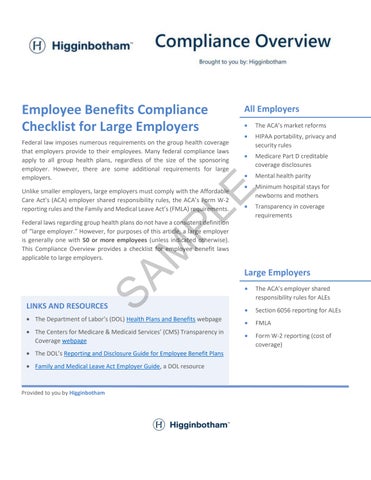

Employee Benefits Compliance Checklist for Large Employers
Federal law imposes numerous requirements on the group health coverage that employers provide to their employees. Many federal compliance laws apply to all group health plans, regardless of the size of the sponsoring employer. However, there are some additional requirements for large employers.
Unlike smaller employers, large employers must comply with the Affordable Care Act’s (ACA) employer shared responsibility rules, the ACA’s Form W-2 reporting rules and the Family and Medical Leave Act’s (FMLA) requirements.
Federal laws regarding group health plans do not have a consistent definition of “large employer.” However, for purposes of this article, a large employer is generally one with 50 or more employees (unless indicated otherwise). This Compliance Overview provides a checklist for employee benefit laws applicable to large employers.
LINKS AND RESOURCES
The Department of Labor’s (DOL) Health Plans and Benefits webpage
The Centers for Medicare & Medicaid Services’ (CMS) Transparency in Coverage webpage
The DOL’s Reporting and Disclosure Guide for Employee Benefit Plans
Family and Medical Leave Act Employer Guide, a DOL resource

Provided to you by Higginbotham

AllEmployers
TheACA’smarketreforms
HIPAAportability,privacyand securityrules
MedicarePartDcreditable coveragedisclosures
Mentalhealthparity
Minimumhospitalstaysfor newbornsandmothers
Transparencyincoverage requirements

LargeEmployers
TheACA’semployershared responsibilityrulesforALEs
Section6056reportingforALEs
FMLA
FormW-2reporting(costof coverage)

Affordable Care Act (ACA)
Health Coverage Requirements
The ACA’s market reforms apply to health plans and health insurance issuers, with narrow exceptions for certain types of plans (for example, retiree medical plans). The following checklist provides a high-level overview of key ACA market reforms that apply to large employer plans:
No annual or lifetime dollar limits on essential health benefits (EHB)—Applies to all health plans.
Out-of-pocket maximums on EHB cannot exceed certain limits—Applies to all non-grandfathered health plans.
Out-of-pocket Maximum Limits
Cannot impose a waiting period that exceeds 90 days—Applies to all health plans.
No pre-existing condition exclusions on any covered individuals—Applies to all health plans.
Cannot discriminate against plan participants who participate in clinical trials—Applies to all non-grandfathered health plans.
SAMPLE
Must cover specific preventive care services without imposing cost-sharing requirements—Applies to all nongrandfathered health plans.
Health plans that provide dependent coverage of children must make coverage available for adult children up to age 26—Applies to all health plans.
Cannot rescind coverage for covered individuals, except in cases of fraud or intentional misrepresentation of material fact—Applies to all health plans.
Notices and Disclosures
The ACA created several notice and disclosure obligations for group health plans, such as:
Statement of Grandfathered Status—Plan administrator or issuer must provide this statement on a periodic basis with participant materials describing plan benefits, such as the summary plan description (SPD) and open enrollment materials. This requirement only applies to grandfathered plans.
This Compliance Overview is not intended to be exhaustive nor should any discussion or opinions be construed as legal advice. Readers should contact legal counsel for legal advice.
Notice of Rescission—Plan administrator or issuer must provide a notice of rescission to affected participants at least 30 days before the rescission occurs.
Notice of Patient Protections and Selection of Providers—Plan administrator or issuer must provide a notice of patient protections/selection of providers whenever the SPD or similar description of benefits is provided to a participant. These provisions relate to the choice of a health care professional and benefits for emergency services.
Uniform Summary of Benefits and Coverage—Plan administrator or issuer must provide the uniform summary of benefits and coverage (SBC) to participants and beneficiaries at certain times, including upon application for coverage and at renewal. Plan administrators and issuers must also provide a 60-day advance notice of material changes to the summary that take place mid-plan year.
Exchange Notice—Employers must provide all new hires with a written notice about the ACA’s health insurance Exchanges.
W-2 Reporting
The Form W-2 reporting obligation applies to employers sponsoring group health plans and requires them to disclose the aggregate cost of the coverage provided to employees on employees’ Forms W-2. Small employers (those that file fewer than 250 Forms W-2) are exempt until further guidance is provided. The purpose of the reporting requirement is to provide information to employees regarding how much their health coverage costs. The reporting does not mean that the cost of the coverage is taxable to employees.
Employer Shared Responsibility (Pay or Play) Rules
Under the ACA’s pay or play rules, applicable large employers (ALEs) that do not offer health coverage to their full-time employees (and dependent children) that is affordable and provides minimum value will be subject to penalties if any fulltime employee receives a government subsidy for health coverage through an Exchange.
SAMPLE
To qualify as an ALE, an employer must employ,onaverage, at least 50 full-time employees, including full-time equivalent employees (FTEs), on business days during the preceding calendar year. All employers that employ at least 50 full-time employees, including FTEs, are subject to the ACA’s pay or play rules, including for-profit, nonprofit and government employers.
Sections 6055 and 6056 Reporting
The ACA requires ALEs to report information to the Internal Revenue Service (IRS) and to full-time employees regarding their employer-sponsored health coverage. The IRS uses the information that ALEs report to verify employer-sponsored coverage and to administer the employer shared responsibility provisions. This reporting requirement is found in Section 6056 of the Internal Revenue Code (Code).
In addition, the ACA requires every health insurance issuer, sponsor of a self-insured health plan, government agency that administers government-sponsored health insurance programs and any other entity that provides minimum essential coverage to file an annual return with the IRS reporting information for eachindividual who is provided with this coverage. Related statements must also be provided to individuals. This reporting requirement is found in Code Section 6055.
This Compliance Overview is not intended to be exhaustive nor should any discussion or opinions be construed as legal advice. Readers should contact legal counsel for legal advice.
Returns must be filed electronically with the IRS by March 31 (or Feb. 28, if filed on paper) of the year after the calendar year to which the returns relate. Beginning in 2024, most employers that are subject to ACA reporting must file their returns electronically. Written statements must be provided to employees no later than 30 days from Jan. 31 of the year following the calendar year in which coverage was provided.
ALEs that sponsor self-insured plans
Must report:
(1) Information under Section 6055 about health coverage provided; and
(2) Information under Section 6056 about offers of health coverage.
COBRA
ALEs that sponsor insured plans (or no health plan)
Must report information under Section 6056. These employers are not required to report under Section 6055.
Non-ALEs that sponsor selfinsured plans
Non-ALEs that sponsor insured plans (or no health plan)
Must report information under Section 6055. These employers are not required to report under Section 6056. These employers are not required to report under either Section 6055 or Section 6056.
COBRA applies to employers that had 20 or more employees on more than 50% of the typical business days during the previous calendar year. COBRA requires employers to provide eligible employees and their dependents who would otherwise lose group health coverage as a result of a qualifying event with an opportunity to continue group health coverage.
COBRA includes a number of notice/disclosure requirements. The following COBRA notices are required to be provided in certain situations:
Initial/General COBRA Notice—Plan administrator must generally provide anexplanation of COBRA coverage and rights within 90 days of when group health plan coverage begins.
Notice to Plan Administrator—Employer must notify the plan administrator of certain qualifying events, such as an employee’s termination or reduction in hours, an employee’s death, an employee’s Medicare entitlement and the employer’s bankruptcy. The notice must be provided within 30 days of the qualifying event or the date coverage would be lost as a result of the qualifying event, whichever is later.
SAMPLE
COBRAElectionNotice—Planadministratormust generallyprovide theCOBRAelectionnoticewithin14 daysafter being notified of the qualifying event (or 44 days after the qualifying event if the employer is the plan administrator).
Notice of Unavailability of COBRA—If an individual is not eligible for COBRA, the plan administrator must generally provide a notice of COBRA unavailability within 14 days after being notified of the qualifying event (or 44 days after the qualifying event if the employer is the plan administrator).
Notice of Early Termination of COBRA—Plan administrator must provide an early termination notice as soon as practicable following the determination that COBRA coverage will terminate earlier than the end of the maximum coverage period.
This Compliance Overview is not intended to be exhaustive nor should any discussion or opinions be construed as legal advice. Readers should contact legal counsel for legal advice.
Notice of Insufficient Payment—Plan administrator must notify a qualified beneficiary that the COBRA payment was not significantly less than the correct amount before coverage is terminated for nonpayment.
Premium Change Notice—Plan administrator should provide a notice of premium increase at least one month prior to the effective date.
A model general notice and a model election notice are available from the DOL.
Employee Retirement Income Security Act (ERISA)
General Requirements
ERISA applies to employee welfare benefit plans, including group health plans, unless specifically exempted. Church and government plans are not subject to ERISA. ERISA imposes a variety of compliance obligations on the sponsors and administrators of group health plans. For example, ERISA establishes strict fiduciary duty standards for individuals who operate and manage employee benefit plans and requires that plans create and follow claims and appeals procedures. ERISA requires plan administrators to provide the following notices/disclosures:
Summary Plan Description (SPD)—Plan administrator must automatically provide an SPD to participants within 90 days of becoming covered by the plan. An updated SPD must be provided at least every five years if changes have been made to the information contained in the SPD. Otherwise, an updated SPD must be provided at least every 10 years.
Summary of Material Modifications (SMM)—Plan administrator must provide an SMM automatically to participants within 210 days after the end of the plan year in whichthe change was adopted. If benefits or services are materially reduced, participants generally must be provided with the SMMwithin 60 days from adoption.Also, plan administrators and issuers must provide 60 days’ advance notice of any material modification to plan terms or coverage that takes effect mid-plan year and affects the content of the SBC. The 60-day notice can be provided to participants through an updated SBC or by issuing an SMM.
Plan Documents—Plan administrator must provide copies of plan documents no later than 30 days after a written request.
SAMPLE
Summary Annual Report (SAR)—Plan administrators of ERISA plans are subject to the SAR requirement, unless an exception applies. The SAR is a narrative summary of the Form 5500 and includes a statement of the right to receive a copy of the plan's annual report. The SAR must generally be provided within nine months after the end of the plan year. If the deadline for filing the Form 5500 was extended, the SAR must be provided within two months afterthe end oftheextension period.Plansthat areexempt from the annual Form5500 filingrequirement are not required to provide the SAR. Large, completely unfunded health plans are also exempt from the SAR requirement. However, large insured health plans must provide the SAR.
This Compliance Overview is not intended to be exhaustive nor should any discussion or opinions be construed as legal advice. Readers should contact legal counsel for legal advice.
Form 5500 Requirements
The Form 5500 requirement applies to plan administrators of ERISA plans, unless an exception applies. Small health plans (fewer than 100 participants) that are fully insured, unfunded or a combinationof fully insured and unfunded, are exempt from the Form 5500 filing requirement.
The Form 5500 is used to ensure that employee benefit plans are operated and managed according to ERISA’s requirements. The filing requirements vary according to the type of ERISA plan. Unless an extension applies, the Form 5500 must be filed by the last day of the seventh month following the end of the plan year (that is, July 31 of the following year for calendar year plans).
Family and Medical Leave Act (FMLA)
The FMLA applies to private sector employers with 50 or more employees in 20 or more workweeks in the current or preceding calendar year, as well as all public agencies and all public and private elementary and secondary schools. The FMLA provides eligible employees with job-protected leave for certain family and medical reasons. An employer must maintain group health coverage during the FMLA leave at the level and under the conditions that coverage would have been provided if the employee had not taken leave.
The FMLA requires employers to provide the following notices/disclosures:
General Notice—Covered employers must prominently post a general FMLA notice where it can be readily seen by employees and applicants for employment. If the employer has any FMLA-eligible employees, it must also include the general notice in the employee handbook or other written employee guidance or distribute a copy of the notice to each employee upon hiring.
Eligibility/Rights and Responsibilities Notice—Written guidance must be provided to an employee when he or she notifies the employer of the need for FMLA leave. The employer must detail the specific expectations and obligations of the employee and explain the consequences for failing to meet these obligations.
Designation Notice—Afterthe employerhassufficientinformation, itmust provide adesignationnotice informing the employee whether the leave is designated as FMLA leave.
Model forms are available from the DOL.
SAMPLE
Genetic Information Nondiscrimination Act (GINA)
GINA applies generally to group health plans, and prohibits the improper collection, use or disclosure of genetic information byemployers andhealthplans.GINAgenerally prohibits grouphealthplans andhealthinsuranceissuersfrom: (1) adjusting group premium or contribution amounts on the basis of genetic information; (2) requesting or requiring an individual or an individual's family members to undergo a genetic test; and (3) Collecting genetic information, either for underwriting purposes or prior to or in connection with enrollment.
In addition, GINA requires the following notices/disclosures, which generally apply to employers with 15 or more employees:
This Compliance Overview is not intended to be exhaustive nor should any discussion or opinions be construed as legal advice. Readers should contact legal counsel for legal advice.
Whenever an applicant or employee is sent for a medical examination, covered employers must inform health care providers not to collect genetic information, including family medical history, as part of the employmentrelated medical examination.
An additional "warning" is required when requests for health-related information are made (e.g., to support an employee's request for reasonable accommodation or a request for sick leave), but only if the request for medical documentation is made in a way that is likely to result in receipt of genetic information.
HIPAA Portability
HIPAA’s portability rules apply to group health plans and health insurance issuers, unless an exception applies. Plans with fewerthantwo participants who are current employees (for example, retiree health plans) are exempt. HIPAA’s portability rules are designed to help individuals transition from one source of health coverage to another. HIPAA’s portability provisions prohibit discrimination based on health status and provide for special enrollment opportunities.
HIPAA’s portability rules require the following notices/disclosures:
Notice of Special Enrollment Rights—Plans and issuers must provide the special enrollment rights notice at or before the time an employee is initially offered the opportunity to enroll in the plan.
Notice of Alternative Wellness Program Standard—Group health plans and issuers that offer health-contingent wellness programs must disclose the availability of an alternative standard to receive a reward under the wellness program. This disclosure must be included in all materials that describe the wellness program.
HIPAA Privacy and Security
The HIPAA Privacy and Security Rules apply to health plans, health care clearinghouses and health care providers that transmit health information electronically (covered entities), unless an exception exists. The rules also apply to business associates (service providers to covered entities) that use protected health information (PHI). A self-funded health plan with fewer than 50 participants that is administered by the employer that established and maintains the plan is exempt.
The HIPAA Privacy Rule governs the use and disclosure of an individual’s PHI. The HIPAA Security Rule creates standards with respect to the protection of electronic PHI. The HIPAA Privacy and Security Rules require the following notices/disclosures:
SAMPLE
Notice of Privacy Practices—Plans and issuers must provide a Notice of Privacy Practices when a participant enrolls, upon request and within 60 days of a material revision. At least once every three years, participants must be notified about the notice’s availability.
Notice of Breach of Unsecured PHI—Covered entities and their business associates must provide notification following a breach of unsecured PHI without unreasonable delay and in no case later than 60 days following the discovery of the breach.
This Compliance Overview is not intended to be exhaustive nor should any discussion or opinions be construed as legal advice. Readers should contact legal counsel for legal advice.
Special Rules for Fully Insured Plan
The plan sponsor of a fully insured health plan has limited responsibilities with respect to the Notice of Privacy Practices. The extent of its limited responsibilities depends on whether the plan sponsor has access to PHI for plan administration purposes.
If the sponsor of a fully insured plan has access to PHI for plan administrative functions, it is required to maintain a Privacy Notice and to provide the notice upon request.
If the sponsor of a fully insured plan does not have access to PHI for plan administrative functions, it is not required to maintain or provide a Privacy Notice.
A plan sponsor's access to enrollment information, summary health information and PHI that is released pursuant to a HIPAA authorization does not qualify as having access to PHI for plan administration purposes.
Children’s Health Insurance Program Reauthorization Act (CHIPRA)
States may offer eligible low-income children and their families a premium assistance subsidy to help pay for employersponsored coverage. If an employer’s group health plan covers residents in a state that provides a premium subsidy, the employer must send an annual notice about the available assistance to all employees residing in the state. A model notice is available from the DOL.
Medicare Part D Creditable Coverage Disclosures
The Medicare Part D requirements apply to group health plan sponsors that provide prescription drug coverage to individuals who are eligible for Medicare Part D coverage. Employer-sponsored health plans offering prescription drug coverage to individuals who are eligible for coverage under Medicare Part D must comply with the following disclosure requirements:
Disclosure NoticesforCreditableor Non-CreditableCoverage—A disclosure notice must be provided to Medicare Part D eligible individuals who are covered by, or apply for, prescription drug coverage under the employer’s health plan. The purpose of the notice is to disclose the status (creditable or non-creditable) of the group health plan’s prescription drug coverage. It must be provided at certain times, including before the Medicare Part D Annual Coordinated Election Period (Oct. 15 through Dec. 7 of each year).
SAMPLE
Disclosure to CMS—On an annual basis (within 60 days after the beginning of the plan year) and upon any change that affects the plan’s creditable coverage status, employers must disclose to the Centers for Medicare and Medicaid Services (CMS) whether the plan’s coverage is creditable.
Model forms are available from CMS.
Mental Health Parity and Addiction Equity Act (MHPAEA)
MHPAEA imposes parity requirements on group health plans that provide benefits for mental health or substance use disorders. For example, plans must offer the same access to care and patient costs for mental health and substance use disorder benefits as those that apply to general medical or surgical benefits.
MHPAEA applies to group health plans offering mental health and substance use disorder benefits. There is an exception for health plans that can demonstrate a certain cost increase and an exception for small health plans with fewer than two participants who are current employees (for example, retiree health plans). There is also an exception for employers with
This Compliance Overview is not intended to be exhaustive nor should any discussion or opinions be construed as legal advice. Readers should contact legal counsel for legal advice.
50 or fewer employees during the preceding calendar year. However, to satisfy the essential health benefits requirement, mental health and substance use disorder benefits must be provided in a manner that complies with MHPAEA. Thus, through this ACA mandate, small employers with insured plans are also subject to the mental health parity requirements.
Under MHPAEA, the plan administrator or the health insurance issuer must disclose the criteria for medical necessity determinations with respect to mental health or substance use disorder benefits to any current or potential participant, beneficiary or contracting provider upon request and the reason for any denial of reimbursement or payment for services with respect to mental health or substance use disorder benefits to the participant or beneficiary.
In addition, plans and issuers are required to conduct comparative analyses of the nonquantitativetreatment limitations (NQTLs) used for medical and surgical benefits as compared to mental health and substance use disorder benefits. The comparative analyses, and certain other information, must be made available upon request to applicable agencies. If, upon review of the analyses, federal agencies find that a plan is out of compliance with mental health parity laws, corrective actions will be specified for the plan to come into compliance, which the plan will have 45 days to implement. If the plan is still not in compliance after those 45 days, the plan must notify all individuals enrolled in the noncompliant plan within seven days.
Michelle’s Law
Michelle’s Law applies to employer-sponsored group health plans. Plans with fewer than two participants who are current employees (for example, retiree health plans) are exempt. Michelle’s law ensures that dependent students who take a medically necessary leave of absence do not lose health insurance coverage. If a health plan requires a certification of student status for coverage, plan administrators and issuers must include a description of Michelle’s Law with any notice regarding a requirement for certification of student status.
Michelle’s Law was enacted before the ACA required group health plans to provide coverage for dependent children up to age 26, regardless of student status. Now that the ACA’s coverage expansion for dependents is effective, Michelle’s Law has limited applicability. In general, it only applies if a plan offers coverage for dependents who are not covered by the ACA mandate (for example, dependents who are older than age 26) and conditions eligibility on student status.
Newborns’ and Mothers’ Health Protection Act (NMHPA)
SAMPLE
The NMHPA applies to group health plans that provide maternity or newborn infant coverage. Under the NMHPA, group health plans may not restrict mothers’ and newborns’ benefits for hospital stays to less than 48 hours following a vaginal delivery and 96 hours following a delivery by cesarean section. The plan’s SPD must include a statement describing the NMHPA’s protections for mothers and newborns.
Women’s Health and Cancer Rights Act (WHCRA)
The WHCRA applies to group health plans that provide coverage for mastectomy benefits. Plans with fewer than two participants who are current employees (for example, retiree health plans) are exempt. The WHCRA requires health plans that provide medical and surgical benefits for a mastectomy to also cover:
All stages of reconstruction of the breast on which a mastectomy has been performed;
Surgery and reconstruction of the other breast to produce a symmetrical appearance; and
This Compliance Overview is not intended to be exhaustive nor should any discussion or opinions be construed as legal advice. Readers should contact legal counsel for legal advice.
Prostheses and physical complications of mastectomy, including lymphedemas.
Plans must provide a notice describing rights under WHCRA upon enrollment and on an annual basis after enrollment.
Transparency in Coverage Requirements
Group health plans and health insurance issuers are subject to many requirements designed to increase health care transparency and protect consumers against surprise medical bills. These requirements come from final rules regarding transparency in coverage (TiC Final Rules), which were issued by the Departments of Labor, Health and Human Services and the Treasury (Departments) in November 2020, and the Consolidated Appropriations Act of 2021 (CAA), which was signed into law in December 2020.
Key requirements from the TiC Final Rules and the CAA are outlined below. In general, most employers will rely on their issuers, third-party administrators (TPAs) and other service providers to satisfy most of the requirements. Unless otherwise specified, these requirements apply to group health plans, including self-insured plans and fully insured plans, and health insurance issuers. Excepted benefits (for example, limited-scope dental and vision benefits) and account-based group health plans, such as health reimbursement arrangements (HRAs) and health flexible spending accounts (FSAs), are not subject to these requirements.
Ban on Balance Billing
Effective for plan or policy years beginning on or after Jan. 1, 2022, plans and issuers must provide protections against balance billing and out-of-network cost sharing with respect to emergency services, air ambulance services furnished by nonparticipating providers and nonemergency services furnished by nonparticipating providers at participating facilities. Anindependent dispute resolution(IDR)process allowsplans, issuers, non-participatingproviders andemergencyfacilities to resolve disputes over out-of-network rates.
In addition, plans and issuers must publicly post a notice of these protections and include the notice with any explanation of benefits (EOB) for an item or service to which the protections apply. The Departments issued a model notice that plans and issuers may use (but are not required to use) to meet these disclosure requirements.
Public Posting of MRFs
SAMPLE
Plans (excluding grandfathered plans) and issuers must display three separate machine-readable files (MRFs) in a standardized format and provide monthly updates. Federal agencies deferred enforcement of the first and second MRFs related to disclosing in-network and out-of-network data until July 1, 2022. Enforcement of the third MRF relating to prescription drugs was temporarily delayed until further notice. FAQ guidance from September 2023, announced the end of the enforcement delay. Future guidance will specify an implementation timeline for the MRF relating to prescription drugs.
Files must be available on an internet website, and the files must be accessible free of charge, without having to establish a user account, password, or other credentials, and without having to submit any personal identifying information such as a name, email address, or telephone number.
This Compliance Overview is not intended to be exhaustive nor should any discussion or opinions be construed as legal advice. Readers should contact legal counsel for legal advice.
Price Comparison Tool
Plans (excluding grandfathered plans) and issuers must make an internet-based self-service tool available to participants, beneficiaries and enrollees to disclose the personalized price and cost-sharing liability for covered items and services, including prescription drugs. Upon request, plans and issuers must provide this information in paper form.
An initial list of 500 shoppable services must be available via the internet-based self-service tool for plan years that begin on or after Jan. 1, 2023. A list of the remainder of all items and services will be required for these self-service tools for plan years that begin on or after Jan. 1, 2024.
Because the CAA created a similar price comparison tool requirement, the Departments have indicated that they will likely view compliance with the internet-based self-service tool (discussed above) to satisfy the CAA’s price comparison tool requirement. However, the CAA also requires plans and issuers to provide cost comparison information over the telephone upon request, which is an additional requirement that plans and issuers must comply with beginning in 2023.
Reporting Prescription Drug Costs
Plans and issuers must report information on prescription drugs and health care spending to the Departments. This reporting process is referred to as the “prescription drug data collection” (or “RxDC report”) and was initially required to be submitted by Dec. 27, 2022. However, the Departments provided a submission grace period, through Jan. 31, 2023, for plans and issuers that make good faith efforts to submit 2020 and 2021 data. Subsequent RxDC reports are due by June 1 of each year, covering data for the preceding year.
Prohibition on Gag Clauses
Plans and issuers cannot enter into contracts with providers, TPAs or other service providers that would restrict the plan or issuer from providing, accessing or sharing certain information about provider price and quality and deidentified claims. Plans and issuers must annually submit an attestation of compliance with these requirements. According to FAQs issued by the Departments, health plans and issuers must submit their first attestation of compliance with the prohibition on gag clauses by Dec. 31, 2023, covering the period beginning Dec. 27, 2020, through the date of attestation. Subsequent attestations, covering the period since the last attestation, are due by Dec. 31 of each following year.
SAMPLE
Transparency in Coverage Requirements (Special Enforcement Policies)
While technically in effect, special enforcement policies apply to the following provisions pending further guidance by the Departments. According to a series of FAQs issued on Aug. 20, 2021, until further guidance is issued, plans are expected to implement these requirements using a good faith, reasonable interpretation of the law.
Continuity of Care
Plans and issuers must provide continuity of care to qualifying covered individuals when terminations of certain contractual relationships result in changes in provider or facility network status.
Insurance Identification Cards
Plans and issuers must include on any physical or electronic ID card, any applicable deductibles and out-of-pocket maximum limitations, and a telephone number and website address for individuals to seek consumer assistance.
This Compliance Overview is not intended to be exhaustive nor should any discussion or opinions be construed as legal advice. Readers should contact legal counsel for legal advice.
Accuracy of Provider Network Directories
Plans and issuers must maintain participating provider directories on a public website; regularly verify and update the directory information; and have a process in place for responding to requests for information about participating providers. If inaccurate information is provided, a covered individual cannot be required to pay more than in-network cost sharing.
SAMPLE
This Compliance Overview is not intended to be exhaustive nor should any discussion or opinions be construed as legal advice. Readers should contact legal counsel for legal advice.