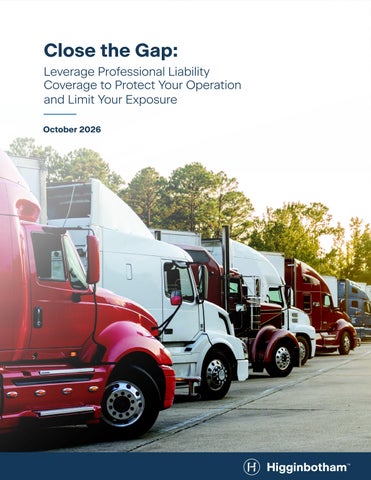
Close the Gap: Leverage Professional Liability Coverage to Protect Your Operation and Limit Your Exposure October 2026
Introduction
Key Takeaways
Motor carriers and freight brokers face risk at every point in the supply chain. Verisk CargoNet reported that even though the total number of supply chain crime incidents remained stable in 2025, estimated losses rose to $725 million — a 60% increase from 2024.3 Even when cargo arrives intact, a service-related error can result in thousands of dollars in legal fees or settlement demands. Traditional insurance policies, such as auto liability, general liability and cargo, are not typically designed to address that kind of loss on their own. Professional Liability insurance is designed for that purpose. Taking the time to understand what Professional Liability insurance covers, what it doesn’t and why it matters could save carriers and brokers significant exposure.
Understanding Professional Liability in Transportation Professional Liability insurance — sometimes referred to as Errors & Omissions (E&O), Logistics Professional Liability, Freight Broker Professional Liability or Transportation Professional Liability — is designed to protect against financial loss arising from professional services, operational mistakes, negligent acts, errors or omissions. Policy forms, definitions and exclusions vary significantly by insurer, so the same fact pattern may be treated differently depending on the carrier and policy language. Understanding Professional Liability as the broader coverage concept and recognizing where specific policy forms like E&O fit within that framework is essential for any transportation professional assessing their true exposure. In the transportation industry, Professional Liability exposure could arise from a misrouted shipment that costs a shipper a production deadline,
•
Auto, cargo and general liability may not respond to a service failure. Professional Liability is designed to help fill that gap.
•
Coverage you carry but don’t match to your operation may not respond when you need it.
•
Missing documentation can hurt you more than the mistake itself.
a failed carrier vetting decision that results in cargo theft or a missed pickup that triggers a contractual penalty. When a claim arises, a Professional Liability policy may provide coverage for defense costs, including attorney fees, even when the insured is not ultimately found at fault, and may also provide indemnity for covered settlements or judgments, subject to the terms, conditions and exclusions of the policy. Motor carriers, freight brokers and thirdparty logistics (3PL) providers may be required to carry Professional Liability insurance under contractual obligations with shippers, retailers, manufacturers and other 3PLs, particularly when those contracts impose such requirements. For motor carriers, this coverage becomes especially important when taking on dispatch, subcontracting or logistics coordination roles. For freight brokers and 3PLs, managing third-party carrier vetting and freight coordination can be critical, as a single oversight can create significant financial exposure. Yet many operators carry little to no coverage for exposures
Auto and General Liability Will Not Fill the Gap One of the most common misconceptions across all transportation operations is the belief that auto liability or general liability will cover financial loss. Auto liability is generally designed to cover bodily injury and property damage. General liability typically will not respond to a purely financial loss unless property damage is also present. When a shipper suffers a financial loss due to a service failure with no physical damage, neither may respond, and that gap may create a Professional Liability exposure that should be evaluated.
Cargo Insurance and Contingent Cargo Are Not Substitutes for Professional Liability Cargo insurance is designed to cover physical loss or damage to freight, not financial loss from a service failure.5 When cargo arrives intact, but a shipper loses money due to a delay, routing error or missed delivery window, cargo insurance may not respond, and the resulting exposure should be evaluated under Professional Liability. For freight brokers, the confusion centers on Contingent Cargo versus Professional Liability. Contingent Cargo forms vary considerably, but these policies are generally intended to respond when a motor carrier’s underlying Cargo coverage fails or is inadequate.6 Contingent Cargo should not be assumed to cover a broker’s separate professional services or operational liability exposures, such as those tied to coordination or carrier vetting. Brokers who rely on Contingent Cargo for those exposures may find themselves without coverage when a claim arises.
Contractual Liability Is Broader Than Most Operators Realize Broker-carrier agreements and shipper contracts contain indemnification clauses that transfer risk from shippers and brokers to motor carriers, often making carriers liable for cargo loss and damage, and sometimes for legal defense costs.1 Depending on the allegations and policy language, Professional Liability may address certain contractual exposures that fall outside the scope of other policies. These misconceptions are also showing up in claims. As transportation operations have grown more complex, they continue to generate Professional Liability claims across the sector. The following section examines where those exposures are concentrating.
02
Where Professional Liability Exposure Turns into a Claim Double brokering and identity theft schemes are among recurring sources of Professional Liability and Cyber Liability exposure. Double brokering generally occurs when a broker or motor carrier that accepted a shipment hands it to another party to move without the knowledge or authorization of the shipper or the party that tendered it.7 Identity theft schemes involve individuals who impersonate legitimate carriers or brokers to divert loads, leaving brokers and 3PLs exposed to significant financial losses and facing questions about whether proper due diligence was conducted. Breakdowns in carrier vetting continue to generate Professional Liability claims across freight brokerage and 3PL operations. When a broker places freight with a carrier who fails to perform, is uninsured or has an unsatisfactory safety rating on the Federal Motor Carrier Safety Administration’s (FMCSA) website,2 the vetting process can become the focal point of a negligence claim. Courts have taken notice. In a unanimous decision in Montgomery v. Caribe Transport II, LLC, the Supreme Court held that the Federal Aviation Administration Authorization Act’s (FAAAA) safety exception preserves state-law negligent hiring claims against freight brokers — meaning federal law does not preempt such claims.4 The underlying allegations centered on information available regarding the motor carrier’s safety history and what the broker knew or should have known when selecting that carrier. While Montgomery itself did not establish a specific ongoing monitoring requirement, the decision reinforces the scrutiny brokers face regarding how carriers are selected.
From a risk-management standpoint, it underscores the importance of a documented process for vetting and, on an ongoing basis, monitoring a carrier’s safety history, operating authority, insurance coverage and other qualification criteria, particularly where that documentation is incomplete or inconsistent. Service failures tied to tight delivery windows and contractual penalties continue to generate claims. When a missed window triggers a penalty clause, the financial loss is borne directly by the party responsible for coordination. Retailers increasingly enforce strict appointment scheduling, and penalties for late or incomplete deliveries can reach 3% of item value under some major retailer programs.8 Documentation gaps remain a persistent driver of claim severity. Incomplete records, undocumented communications and unclear contract terms can turn a minor dispute into a larger legal issue. Legal outcomes in the transportation industry consistently turn on specific facts, jurisdictional nuances and the precise language of contracts and insurance policies, and it is often not the incident itself, but the documentation gaps surrounding it that determine the outcome. A broker who prevails in one jurisdiction may face a very different result in another, which makes understanding coverage terms before a claim arises essential.
The following examples illustrate how these exposures materialize across motor carrier and broker/3PL operations:
SCENARIO
TYPICAL DEFENDANTS
COMMON ALLEGATIONS
Shipper or Consignee
Motor Carrier; occasionally Broker if involved in scheduling or logistics coordination
Service failure, breach of contract, missed service commitments
Professional Liability
Financial loss allegations may be uninsured. The motor carrier may be responsible for defense costs, settlement, judgment, contractual penalties, and lost production, delay damages, or other consequential financial loss allegations.
Shipper
Broker, 3PL; occasionally Shipper named in downstream litigation
Negligent carrier selection, negligent retention, breach of contract
Professional Liability
Broker or 3PL may have no coverage for negligent selection allegations and could be responsible for defense costs and damages.
Shipper
Broker, 3PL, downstream broker; occasionally Shipper
Negligent oversight, breach of agreement, failure to follow routing or carrier-selection requirements
Professional Liability; Cyber may also be evaluated depending on the facts.
Coverage disputes may arise and defense costs may fall directly on the broker or 3PL if Professional Liability coverage is not in place.
Shipper or Consignee
Broker, Motor Carrier, Customs Broker (where applicable)
Administrative error causing financial loss, delay, rejected shipment, regulatory noncompliance
Professional Liability
Delays, chargebacks, contractual penalties, and resulting financial damages may be uninsured.
Motor Carrier; occasionally Broker depending on involvement and allegations
Failure to maintain required temperature, failure to follow instructions, spoilage, cargo loss, property damage, service failure, breach of contract
Cargo; Professional Liability may also be evaluated depending on the allegations, policy language, and coverage position of the Cargo insurer.
Coverage disputes may arise regarding whether physical damage occurred, whether spoilage or contamination exists, whether policy exclusions apply, or whether the loss constitutes a covered cargo claim. Additional allegations involving service failures, rejected loads, contractual obligations, lost product value, or consequential financial losses may create uninsured exposure if Professional Liability coverage is not maintained.
1 Missed delivery window
2 Improper carrier vetting
3 Double brokering
4 Paperwork error
5 Temperaturecontrol failure
COVERAGE COMMONLY EVALUATED
DEMAND MADE BY
Shipper
IF NO PROFESSIONAL LIABILITY COVERAGE
Vetting failures, documentation gaps, double brokering and missed windows are not hypothetical risks. They are the fact patterns behind active claims, and the operators best positioned to defend against them take deliberate steps before a claim ever arises.
04
Build a Stronger Defense Before You Need One Whether you’re a motor carrier, freight broker or 3PL, no operation is immune from the potentially devastating costs of a lawsuit. A few proactive steps can significantly reduce your exposure. Read Your Contracts Before You Sign Every contract comes with responsibilities attached, and some can make you liable if something goes wrong. Know what you’re agreeing to and make sure your insurance would cover it.
Audit Your Carrier Vetting Process Carrier vetting is one of the most scrutinized areas when a claim arises. Establish a documented, repeatable vetting process that includes authority verification, safety record review and insurance confirmation. A process that lives only in someone’s head won’t hold up when you need it most.
Close the Documentation Gap Most claims are won or lost on documentation. Maintain complete records of communications, dispatch instructions, delivery confirmations and any deviations from standard procedure. When something goes wrong, missing records can hurt you more than the mistake itself.
Understand Where Your Other Policies May Not Reach Auto liability, general liability and cargo insurance each have defined boundaries. These policies may cover financial or consequential damages arising from an otherwise covered loss, such as covered bodily injury or property damage. However, professional services, errors or omissions can create additional exposure, particularly when the resulting loss is purely economic and may not trigger a covered loss under those policies in the first place. Talk to your broker about where those policies may stop responding and whether Professional Liability is in place to help fill that gap.
Don’t Treat Professional Liability as Just Another Box to Check Many operators secure Professional Liability coverage only because a contract requires it. The exposures driving today’s claim trends — double brokering, vetting failures, missed windows, documentation disputes — exist regardless of what a contract mandates. Make sure your Professional Liability policy reflects what your business actually does, not just the minimum required by a shipper or contract.
06
Conclusion The freight industry’s legal and financial landscape is shifting in real time. Court decisions are redrawing liability lines, professional liability claims can create significant financial exposure and the contractual obligations motor carriers, brokers and 3PLs operate under leave little room for coverage gaps. Professional Liability insurance is not an afterthought. It is designed to address exposures that result in purely economic loss, which auto, cargo and general liability may not be designed to address in the same way. The operators most at risk are not always the ones without coverage; they are often the ones who have it but have not matched it to what their business actually does. Understanding what a Professional Liability policy covers, where other policies stop and how contract language assigns liability are the
Don’t Wait for a Claim to Find the Gap Higginbotham works with motor carriers, freight brokers and 3PLs to evaluate Professional Liability coverage in the context of their specific operations, contractual obligations and risk profile. For questions about your current coverage or program structure, visit Higginbotham.com.
Sources 1.
Armistead, B. (n.d.). Broker Shipper Contracts and The Broker’s Assumption of Shipper and Carrier Liability. Truck Broker Insurance Network. https://truckbrokerinsurancenetwork.gtu-ins.com/brokershipper/
2.
Beyond insurance, carrier vetting crucial to protecting freight brokers. (2021, February 11). Reliance Partners. https:// reliancepartners.com/freight-broker-insurance2/beyond-insurance-carrier-vetting-crucial-to-protecting-freightbrokers/
3.
Cargo Theft Losses Surge to Estimated $725 Million in 2025, Verisk CargoNet Analysis Reveals. (2026, January 22). Verisk. https://www.verisk.com/company/newsroom/cargo-theft-losses-surge-to-estimated-$725-million-in-2025verisk-cargonet-analysis-reveals/
4.
Collins, N. (2026, May 15). Court rules freight brokers can face negligent hiring suits under state law. SCOTUSblog. https://www.scotusblog.com/2026/05/court-rules-freight-brokers-can-face-negligent-hiring-suits-under-state-law/
5.
Flexport. (n.d.) What’s The Difference Between Cargo Insurance And Cargo Liability Insurance? Flexport. https://www. flexport.com/help/2312-cargo-insurance-and-cargo-liability-insurance/
6.
Kinek, M. (2026, February 6). Contingent Cargo Liability: What is it and How is it Different?. TLI. https://shiptli.com/ logistics/contingent-cargo-liability-what-is-it-and-how-is-it-different/
7.
Putterman, M. (2026, April 14). Freight Broker Liability in Double-Brokering Scenarios. Putterman Law. https://puttermanlaw.com/blog/freight-broker-liability-in-double-brokering-scenarios/
8.
Weber Logistics. (2025, February 27). How Retail Chargebacks Work and What You Can Do About Them. Weber Logistics. https://www.weberlogistics.com/blog/california-logistics-blog/how-retail-chargebacks-work-and-what-youcan-do-about-them
Higginbotham.com
866-316-3427