Red flags for your HR program 28 | Food expert sees big farm opportunity 10
eastern EDITION / COUNTRY-GUIDE.CA / November 2016
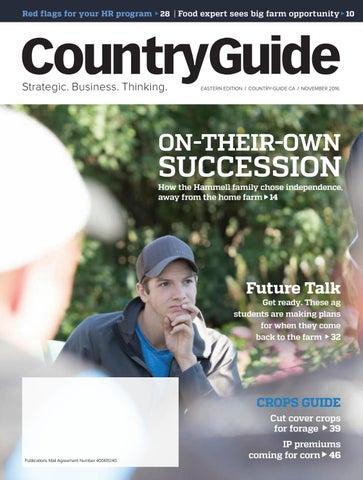
On-their-own
succession
How the Hammell family chose independence, away from the home farm14
Future Talk
Get ready. These ag students are making plans for when they come back to the farm 32
CROPS GUIDE Cut cover crops for forage 39
Publications Mail Agreement Number 40069240
IP premiums coming for corn 46
PROTECT YOUR SUCCESS
WITH THE
NEW STANDARD
IN SEED TREATMENT
INTRODUCING NEW DUPONT™ LUMIVIA™ INSECTICIDE SEED TREATMENT. DuPont™ Lumivia™ is the new standard in corn seed treatment that: • Protects against key early season insect pests, such as wireworm, cutworm and seedcorn maggot* • Provides excellent seedling protection • Simplifies your seed treatment decisions • Offers a favourable environmental profile
Lumivia™: Make every seed count. Questions? Ask your seed provider, call 1-800-667-3925 or visit lumivia.dupont.ca
DuPont™ Lumivia™ is a DuPont™ Lumigen® seed sense product. *Suppression As with all crop protection products, read and follow label instructions carefully. Member of CropLife Canada. Unless indicated, trademarks with ®, TM or SM are trademarks of DuPont or affiliates. © 2016 DuPont.
1869 DuPont Lumivia Ad_CountryGuideEast.indd 1
10/7/16 2:29 PM
8 MACHINERY
Challenger tames the tiger Twin-transmission 1000 Series tractors create a new category of machinery design.
Inside country guide / Vol. 135 Issue no. 12 / NOVEMber 2016
Business
39 CROPS GUIDE
10
ungry consumers h Food expert Dana McCauley sees big opportunities for farmers in today’s rapidly evolving food market.
22
entorships get real m Today’s mentorships are more relevant than ever, with a focus on business management and financial success.
28
ow good are your h HR skills? These three red flags are telling you that your farm might be a lot more efficient if you plug into HR advice.
52
t he robots are here As CNH unveils its driverless tractors, get set for the biggest breakthrough since the internal combustion engine.
56
t he other glyphosate ‘Resistance’ Our Gerald Pilger interviews the activists who want to ban agriculture’s biggest herbicide.
39 The forage value of cover crops
44 New in IP and edible bean varieties
46 A market for
non-GMO corn
60
48 Pest Patrol 50 Weather 62
Guide Life
66 Clutter busting 101 68 Health 69 Hanson Acres 70 Reflections
64
f inancial analysis AND PLANNING Use these financial ratios to set the strategic direction for your farm. f amily meetings that work It may seem risky to get the whole family together, but with this approach, it pays off. HR — how to deal with a manipulator We all try to manipulate each other sometimes, but here’s what to do when someone you farm with takes it to extremes.
32 Their future
Do we really want the next generation to succeed? A busload of ag students on their way home to start farming give senior editor Maggie Van Camp a window into the decisions that the family can make to boost the value of these young farmers, and the family assets.
14 Independence Sometimes, as the Hammell family discovers, the best choice is for the next generation to build their own farm, instead of folding them into the home operation.
Our commitment to your privacy At Farm Business Communications we have a firm commitment to protecting your privacy and security as our customer. Farm Business Communications will only collect personal information if it is required for the proper functioning of our business. As part of our commitment to enhance customer service, we may share this personal information with other strategic business partners. For more information regarding our Customer Information Privacy Policy, write to: Information Protection Officer, Farm Business Communications, 1666 Dublin Avenue, Winnipeg, MB R3H 0H1. Occasionally we make our list of subscribers available to other reputable firms whose products and services might be of interest to you. If you would prefer not to receive such offers, please contact us at the address in the preceding paragraph, or call 1-800-665-1362.
4
NOVEMBER 2016 / COUNTRY-GUIDE.CA
WHEN YOU’VE SHOWN THE WORLD WHAT WORKS,
THERE ARE BOUND TO BE SOME IMITATORS. For 20 years, we’ve left the competition with some pretty big tracks to fill. But in the rush to keep up, there are a few things the copies have missed. Like our exclusive five-axle design. It gives our Steiger® Quadtrac,® Steiger Rowtrac™ and Magnum™ Rowtrac tractors a smoother ride and more power to the ground with less berming and compaction. Which is one of the advantages of paying your dues, instead of paying homage. Learn more at caseih.com/tracks.
©2016 CNH Industrial America LLC. All rights reserved. Case IH is a trademark registered in the United States and many other countries, owned by or licensed to CNH Industrial N.V., its subsidiaries or affiliates. www.caseih.com
EDITOR’S NOTE
1666 Dublin Ave., Winnipeg, MB R3H 0H1 (204) 944-5765 Fax (204) 944-5562
We’re making the connection Finally we’re actually moving into an agriculture that knows exactly how to integrate business management for better, more profitable decisions in the field.
EDITORIAL STAFF Editor: Tom Button 12827 Klondyke Line, Ridgetown, ON N0P 2C0 tom.button@fbcpublishing.com (519) 674-1449 Fax (519) 674-5229 Senior Editor: Maggie Van Camp mvancamp@fbcpublishing.com (905) 986-5342 Fax (905) 986-9991 Production Editor: Ralph Pearce ralph.pearce@fbcpublishing.com (226) 448-4351 Field Editor: Lisa Guenther lisa.guenther@fbcpublishing.com Field Editor: Shannon VanRaes shannon.vanraes@fbcpublishing.com Online Editor: Greg Berg country-guide.ca Design & Layout: Jenelle Jensen
I know that many of you have been following our series of financial management columns written by the faculty and teachers at AgriFood Management Excellence, the group that offers the advanced CTEAM educational program. If you haven’t, I recommend you pause over this month’s column on page 60, which explores how to build bridges between what you can glean from your financial statements and the directions and objectives you may want to set for your farm. Preceding columns in the series can be obtained through our website at www.country-guide.ca, and although they aren’t quick reads (it’s worth having a pad of paper and a pen so you can scratch away at some numbers as you read) you will feel, if you’re like the other readers I have talked to, that your time has been well spent. You will find these columns all take a similar theme. Indeed, I would say it is becoming a central theme of the entire magazine, addressing the kind of decisions that may be the most critical of all the decisions you face in the next few years. In this period of volatility, opportunity and risk, how do you integrate business management and your operational workflow, so the job assignments you give yourself tomorrow will drive the farm in the best possible direction? I suppose this might sound like MBA-speak, but the truth is that most farmers across the country are already a long way down this path. It is one of the great points of differentiation between how today’s farms are being run, versus the farms of 20 or 40 years ago.
6
NOVEMBER 2016 / COUNTRY-GUIDE.CA
Fewer farms today get financial advice solely in order to reduce their tax burden. Taxes are still a significant issue, of course, but farmers today are seeking insight into how better to structure their farms, how to address succession issues, how to allocate resources for growth, and so much more. This changing tide is perfectly captured by an observation from farm adviser Richard Cressman in Maggie Van Camp’s must-read story “Independence,” starting on page 14. Cressman often works with families in the midst of difficult succession discussions, with the parents wondering, is the next generation really up to the job? Can I trust the farm to them? Increasingly, Cressman says, he sees parents making that decision based on whether the “kids” are interested in and whether they understand the farm’s financial statements. It’s an observation in line with what I see as well, and it is a million miles from the standard complaint of previous years, when Dad might be 65 years old and son may never have seen the books. Not surprisingly, this transition isn’t uniform everywhere in the industry, but it is a lot more developed than many have believed, and much more advanced than anyone outside of agriculture is aware of. Which is a good thing, because it’s becoming clear that this isn’t just a best practice, it’s vital to the future competitiveness of the farm, as you’ll see it in every story in this issue. Are we getting it right? Let me know at tom.button@fbcpublishing.com.
ADVERTISING SALES Sales Director: Cory Bourdeaud’hui cory@fbcpublishing.com (204) 954-1414 Fax (204) 944-5562 Lillie Ann Morris lamorris@xplornet.com (905) 838-2826 Kevin Yaworsky kyaworsky@farmmedia.com (250) 869-5326 Advertising Services Co-ordinator: Arlene Bomback ads@fbcpublishing.com (204) 944-5765 Fax (204) 944-5562 Glacier Farm Media President: Bob Willcox bwillcox@farmmedia.com Publisher: Lynda Tityk lynda.tityk@fbcpublishing.com Editorial Director: Laura Rance laura@fbcpublishing.com Production Director: Shawna Gibson shawna@fbcpublishing.com Circulation Manager: Heather Anderson heather@fbcpublishing.com Contents of this publication are copyrighted and may be reproduced only with the permission of the editor. Country Guide, incorporating the Nor’West Farmer and Farm & Home, is published by Farm Business Communications. Head office: Winnipeg, Manitoba. Printed by Transcontinental LGMC. Country Guide is published 13 times per year by Farm Business Communications. Subscription rates in Canada — Farmer $43 for one year, $64 for 2 years, $91 for 3 years. (Prices include GST) U.S. subscription rate — $35 (U.S. funds). Subscription rate outside Canada and U.S. — $50 per year. Single copies: $3.50.
Publications Mail Agreement Number 40069240. We acknowledge the financial support of the Government of Canada through the Canada Periodical Fund of the Department of Canadian Heritage.
Canadian Postmaster: Return undeliverable Canadian addresses (covers only) to: Circulation Dept., PO Box 9800, Winnipeg, Manitoba R3C 3K7. U.S. Postmaster: Send address changes and undeliverable addresses (covers only) to: Circulation Dept., PO Box 9800, Winnipeg, Manitoba R3C 3K7. Subscription inquiries:
Call toll-free 1-800-665-1362 subscription@fbcpublishing.com U.S. subscribers call 1-204-944-5766 Country Guide is printed with linseed oil-based inks. PRINTED IN CANADA Vol. 135 No. 12
www.agcanada.com
ISSN 1915-8491
The editors and journalists who write, contribute and provide opinions to Country Guide and Farm Business Communications attempt to provide accurate and useful opinions, information and analysis. However, the editors, journalists, Country Guide and Farm Business Communications, cannot and do not guarantee the accuracy of the information contained in this publication and the editors as well as Country Guide and Farm Business Communications assume no responsibility for any actions or decisions taken by any reader for this publication based on any and all information provided.
XTEND YOUR YIELD Xtend your yield potential with Roundup Ready 2 Xtend™ soybeans Built on the proven performance of Roundup Ready 2 Yield® technology Tolerance to both dicamba and glyphosate Extended control of resistant and tough-to-control weeds
Learn more at GenuityTraits.ca ALWAYS FOLLOW GRAIN MARKETING AND ALL OTHER STEWARDSHIP PRACTICES AND PESTICIDE LABEL DIRECTIONS. Details of these requirements can be found in the Trait Stewardship Responsibilities Notice to Farmers printed in this publication. ©2016 Monsanto Canada, Inc.
machinery
Brand executives believe the 1000 Series machines can replace two tractors by combining the pulling power of a smaller articulated tractor with the convenience of a rigid-frame machine.
Challenger tames the tiger Two transmissions drive AGCO’s new 1000 Series By Scott Garvey / CG Machinery Editor
A
t this year’s U.S. Farm Progress Show in Boone, Iowa, AGCO’s senior VP and general manager for the Americas Bob Crain was clearly enthusiastic about the new tractors he was there to introduce, particularly the 1000 Series very-high horsepower, rigid-frame models that were originally introduced under the Fendt brand last year. Now, they are also available as Challengers. “This (1000 Series) gets a lot of people excited,” Crain said. “And the reaction of our dealers — and just as important, our customers — has been outstanding. Some have been telling me we potentially have a tiger by
GCO used the U.S. Farm Progress Show in Boone, Iowa, in August to unveil a 1000 Series tractor wearing Challenger badges. The tractor was initially introduced last year as a Fendt. Photo: Scott Garvey
8
NOVEMBER 2016 / COUNTRY-GUIDE.CA
the tail here, so we have to figure out how to tame this thing and work with it. It’s a new segment of the market we’re dealing with, almost taking the place of a fourwheel drive with power to the ground and the flexibility and manoeuvrability of a row-crop tractor.” With AGCO’s Challenger brand dealership outlets numbering more than 400 across North America, getting these tractors into a coat of yellow paint means they’re bound to see much broader distribution and, therefore, more interest from U.S. and Canadian farmers. By comparison, the company’s Fendt-focused dealerships amount to a relative handful. So this move was likely critical from a marketing standpoint, especially given the investment AGCO has made developing these tractors. “The tractor was probably four or five years in development,” Crain explains. “I’m sure the idea for something this large, especially with the two transmissions on it, has been there for many, many years. But the bulk of the work has been done in the last four or five years.” “In the current industry and the current atmosphere, most of us (ag equipment brands) are very focused on short-term stuff,” he continued. “That said, I think the true test of a company that’s going to be here, that has staying power, is the investments it’s making for the future.” Crain tied the innovation directly to AGCO corporate strategy: “I’m lucky enough to work for a company with a CEO and a board that has not allowed us to take our foot off the accelerator.”
Photo: AGCO
All 1000 Series tractors come equipped with either conventional Michelin Agribib radial or Michelin IF Axiobib tires.
The 1000 Series Challengers remain essentially the same tractors as the Fendt versions, although their components get Challenger nomenclature. Under the hood, they are one of the few machines in the AGCO stable to use something other than AGCOPower diesels. Instead, they get a MAN 12.4 litre, six cylinder that puts out 1,770 pound-feet of torque at a leisurely 1,100 r.p.m. “You can go from 30,000 pounds to 50,000 pounds (of ballasted weight) with this machine,” said Josh Keeney, tactical marketing manager. “We incorporated a low-speed high-torque engine, and all the components in that tractor are designed to work within that maximum 1,100 r.p.m. range. At 1,100 r.p.m. you never increase
your engine speed because you need hydraulics.” To turn all that muscle into effective traction, the 1000 Series tractors use “torque vectoring,” which means basically that two transmission outputs deliver differing drive torque to each axle independently. “Unlike today’s conventional fourwheel-drive tractors that use a fixed torque ratio between the front and rear axle, AccuDrive employs variable four-wheel drive that distributes the torque independently over two transmission outputs on each axle,” said Keeney. “An intelligently controlled, four-wheel clutch manages the torque, so it can be shifted between the axles according to need. We call it Challenger Torque Vectoring, and this is how we get the
In the cab, operators get the use of a 10.4-inch AccuTerminal and colour-coded controls.
power and traction of an articulated tractor into a fixed-frame platform.” The four models in the 1000 Series offer 396 to 517 horsepower. Optional dual hydraulic pumps can push oil flow up to 430 litres per minute through six rear remotes. When it comes to digital technology, the 10.4-inch AccuTerminal has four GB of memory capacity and 15 implement memory spaces, and it can handle two remote camera inputs. “It plays in a different segment that we’re creating,” said Crain. “It’s a 500-plus-horsepower, rubber-tired tractor. We think it can take the place of two different tractors, even a smaller articulated tractor, truly putting power to the ground with all the versatility of a rubber tire tractor.” CG
Ready to make the grade? We’ll help you balance the books
Looking for objective, actionable advice? You can rely on Collins Barrow, the audit, tax and advisory experts, to help grow your knowledge – and your business. Be sure to practice what we teach.
6821_Farm-print-ad_Nov.indd 3
2016-10-13 4:02 PM
BUSINESS
Hungry consumers Food guru Dana McCauley is forecasting great new opportunities for farmers
H
ave you ever thought there might be an opportunity in knowing what foods will be hot in the next few years? Ever wonder if you should really care? For our Country Guide readers, I asked Toronto’s
Q. What drives food trends? McCauley: There’s a push and a pull. Push usually comes from self-interest, like when the cheese producers push fondue. But what really drives food trends is the pull — that is, what consumers want — when you fill an unmet need. I look to see what’s gaining traction in food service and whether or not there is a parallel in the mainstream. If there isn’t, then there may be a market opportunity there.
Q. How do you quantify food trends? McCauley: It’s really hard. There is some data but people may not know what they want. Like Henry Ford said, if you had asked people what they wanted they would have said faster horses. It takes good background to understand the gap between intentions and actions. People tend to overestimate how much interest they 10
NOVEMBER 2016 / COUNTRY-GUIDE.CA
By Helen Lammers-Helps
Dana McCauley — chef, recipe developer, food trend watcher, and executive director of Food Starter, a nonprofit food incubator — to gaze into her crystal ball and tell us what she sees coming down the pipe. Mainly, she tells us, it’s good news for farmers.
have in trying something. Trend data is directional, but the numbers are only significant when they are very big or very small.
Q. So the million-dollar question... what’s going to be hot in the next few years? McCauley: I think the interest in Canadiana and homegrown will be strong. With the Pan Am games in 2015, a strong performance at the 2016 Olympics and now we’re moving into the sesquicentennial (Canada’s 150th birthday), there’s a lot of patriotism. The local food movement has laid the groundwork. Red and white food and hometown classics like regional dishes will be hallmarks in 2017. This is great news for ag if you want to move up the value chain. There is a distrust of science so people are more interested in eating like their ancestors. Nutrition sci-
ence has flip-flopped. In the 1990s the focus was on eliminating fat. Now that science has proven that dietary cholesterol is not as bad as they once thought, there is a celebration of whole foods like butter and eggs, and an uptick in butter and egg sales. Sales for squeeze cheese and margarine are falling off. Unfortunately, this distrust of science also leads to fears about GMOs.
Q. What trends are dying? McCauley: I wish I could say the Extreme Eating trend was dying. There’s a yin and a yang with eating patterns. While there is a trend to eating smaller portions and more vegetables, there is also the shock value of eating insects. The trend towards massive portions, conspicuous consumption and wastefulness is dying. Mainstream grocers are joining the “ugly fruit and vegetables” movement.
Q. What about bacon? McCauley: The bacon trend has faded a bit. There is bacon fatigue but it will continue to be out front and centre for the next little while as part of the “hoser culture” I mentioned earlier. Bacon is still popular with the teens and early 20-somethings, a kind of teenaged rebellion.
Q. What do you see as far as generational influences? McCauley: We see a lot of emphasis on Millennials in marketing but, sadly, the poor Millennials graduated with a lot of debt, are not getting full-time jobs with benefits, and now they are having kids so they don’t have a lot of money. They are looking for value. They are Walmart and No Frills shoppers but they also want organic milk from a local cow. They are a tough group to make money on. On the other hand, the Boomers are asset rich. It’s smarter to focus on them. They are interested in products that help them to feel good and live longer, like functional foods for joint health or cancer prevention. They also entertain a lot and will pay extra for “water cooler-worthy” foods. For Gen Z (the generation after the Millennials) it’s all about speed, having things right now and gamifying things. They use technology to pre-order and to get delivery. Pokemon is just the first generation of its type, and businesses that can figure out how to use this type of marketing will benefit. I don’t think they are going to outgrow tech.
Q. What about the trend of eating exotic meats? McCauley: I think that there will be small growth in exotic non-native meats such as emu if they offer significant health benefits over other protein choices. The potential for growth in native species (duck, venison, rabbit) is much higher as we see Canadians reflecting on our heritage and feeling proud of being Canadian
in the wake of the Pan Am Games and Olympics and in anticipation of Canada’s 150th celebrations.
Q. What’s your prediction on whether vegetarian/vegan eating will increase or decrease? McCauley: I see it definitely increasing. As movements such as meatless Monday and the foodservice offering of meatless options improves, more people are finding it normal to eat non-meat dishes on occasion. That said, 100 per cent veganism is not likely to become the norm, but more people who generally are carnivores will begin to eat meatless foods as part of their regular repertoire.
Q. What about interest in animal welfare and/or certified humane farming methods? McCauley: There will be lots! Research shows that failed and/or lapsed vegetarians convert very strongly to humane animal products when they return to meat eating.
Q. What about organic food? McCauley: Organics remain a strong category especially with Millennial moms who want to give their kids a strong start in the world. Most research shows that from the day she is aware of her pregnancy, many young women start eating organic and that they continue until the baby becomes fairly independent. This is also a committed value shopper and you’ll see Costco and Walmart trying very hard to please her with organic products.
Q. Do you have any specific advice for farmers? McCauley: Agri-tourism is definitely trending up and the Ontario Culinary Tourism Alliance is doing a good job developing the market as with the Butter Tart Trail. Quebec has done the same, especially with maple syrup. Agri-tourism has already been well-established in Europe for many years. For example, people would buy olive oil from Tuscany or cheese and ham from Parma. We are just catching up here and there are huge opportunities for farmers. Lots of tourism departments are getting involved now too. What’s really important for someone with an established farm is to look longer term. All of the predictions are that our populations are growing not from birth, but from immigration, mostly from the Middle East and Asia. Farmers should look at the demographic predictions. For example, if there are a lot of Muslims moving into your area, learn more about Halal customs. CG
For more info on food trends, subscribe to Dana McCauley’s Food Trends TV on YouTube. COUNTRY-GUIDE.CA / NOVEMBER 2016
11
Looks like the latest soybean seed innovation has met its match.
If you’re planting the very latest soybean technology, doesn’t it deserve protection to match? New Engenia™ herbicide is exclusively designed for dicamba-tolerant crops. Its new, highly concentrated liquid formulation offers easier handling and a lower use rate. Engenia is also an effective tool for managing Group 2-, triazine- and glyphosate-resistant biotypes. In other words, it seems tough weeds have also met their match. Visit agsolutions.ca/engenia or contact AgSolutions® Customer Care at 1-877-371-BASF (2273) for more info.
110202019_Engenia_2017_DPS_CG-E_v2.indd 1
STEWARDSHIP IS YOUR PRIORITY.
Introducing Engenia, our most advanced dicamba formulation for Roundup Ready 2 Xtend™ soybeans.
There are several factors to consider when using a dicamba herbicide such as:
Nozzles – use nozzles to ensure extremely coarse to ultra-coarse droplets Wind speed – spray when wind speeds are between 3 to 16 km/h
Ground speed – maintain sprayer speed at 25 km/h or less Boom height – keep spray boom height no higher than 50 cm above crop canopy Sensitive crop awareness – identify neighbouring crop species
Application volume - use a minimum spray volume of 10 GPA Additives/adjuvants – only use approved tank mixtures and adjuvants
DETERGENT
Sprayer cleanout – triple rinse, use a detergent-based cleaner
Always read and follow label directions. AgSolutions is a registered trade-mark, and ENGENIA is a trade-mark of BASF Corporation; all used with permission by BASF Canada Inc. ©2016 BASF Canada Inc. Monsanto Company is a member of Excellence Through Stewardship® (ETS). Monsanto products are commercialized in accordance with ETS Product Launch Stewardship Guidance, and in compliance with Monsanto’s Policy for Commercialization of Biotechnology-Derived Plant Products in Commodity Crops. These products have been approved for import into key export markets with functioning regulatory systems. Any crop or material produced from these products can only be exported to, or used, processed or sold in countries where all necessary regulatory approvals have been granted. It is a violation of national and international law to move material containing biotech traits across boundaries into nations where import is not permitted. Growers should talk to their grain handler or product purchaser to confirm their buying position for these products. Excellence Through Stewardship® is a registered trademark of Excellence Through Stewardship. ALWAYS READ AND FOLLOW PESTICIDE LABEL DIRECTIONS. Roundup Ready 2 Xtend™ soybeans contain genes that confer tolerance to glyphosate and dicamba. Agricultural herbicides containing glyphosate will kill crops that are not tolerant to glyphosate, and those containing dicamba will kill crops that are not tolerant to dicamba. Contact your Monsanto dealer or call the Monsanto technical support line at 1-800-667-4944 for recommended Roundup Ready® Xtend Crop System weed control programs. Roundup Ready 2 Xtend™ and Roundup Ready® are trademarks of Monsanto Technology LLC, Monsanto Canada Inc. licensee. ©2016 Monsanto Canada Inc.
2016-10-14 8:11 AM
BUSINESS
Independence T
he roads here are typical for this part of rural Ontario, running between neighbouring towns. On either side, at the end of long maple-sided lanes are well-kept dairy, beef and crop farms divided into 100-acre parcels, with red and black barns stamped proudly with farm names, usually family names. Occasionally too a lane is overgrown, an empty barn tumbles into itself, and fence-rows have been removed so the fields can be cropped with larger equipment, reminding us that nothing is ever guaranteed in agriculture. On this particular concession, just south of Tara, though, a new enterprise has sprung up at the end of one lane. Five years ago Amanda and Steve Hammell built a new free-stall barn with a robotic milking system. The Hammells have learned that sometimes it’s easier to build something new than to try to force the situation. And not just in the dairy barn. The couple were among the 10 people selected through the Dairy Farmers of Ontario’s new entrant program, which means they got 12 kg of quota loaned to them for five years. Now, with constantly purchasing quota and an additional allocation, the Hammells are milking 36 cows, filling 46 kg of quota. But they’re not stopping there. Steve and Amanda are in the process of adding to their existing facilities so they’ll be able to raise their own heifers, have a better place to house dry cows, and put in additional stalls for milking cows, and they have their eyes set on boosting their cow health, longevity, and days to calving. Meanwhile, on the farm directly to the west, Steve’s parents, Jim and Marie, and his brother, Tim, milk cows in a separate business. It wasn’t always this way. 14
NOVEMBER 2016 / COUNTRY-GUIDE.CA
Steve’s farming career began in 2001, after he graduated with his diploma in agriculture and came home to work on the family farm. By 2006, the family was milking about 80 cows, owned about 100 kg of quota and 400 acres, and paid a salary to the younger generation. They built a new barn and the parents formed a corporation, the sons earning commons shares each year while father Jim owned most of the equity as preferred shares. A couple of years later, Steve and Amanda were married and purchased what used to be his grandparents’ farm next door. “We were adamant about having something of our own, something to build of our own and in our own names,” says Amanda. Richard Cressman, farm family communication and relationship coach from New Hamburg, Ont. says it’s a real phenomenon. Building something of your own can be very motivating, he says. It can be satisfying, and often it’s emotionally easier. Nor does it get stuck in all the relationship baggage from childhood, or unrealistic child-based assumptions. It also avoids the mismatched expectations that can arise in family groups, the group decision-making, and the pressure to constantly communicate. “Ever yone should own their own kitchen,” Cressman says. “And,” he adds, “a corporation should be structured keeping in mind how to dissolve it at the end of the day.” In the Hammells’ case, although the legal transfer of the family business had begun, the parents hadn’t allocated any management authority to the younger generation. Their two sons were paid wages and had shares, but had very limited say in any decisions. For Steve, approaching his 30s and starting a family, having no control to make changes was very stressful. For many parents, the most difficult part
Photography: Rovers Photography
Sometimes, the best solution can be for the next generation to build a farm of their own By Maggie Van Camp
/ CG Senior Editor
of succession can be letting the younger generation make changes to a business they’ve worked on so hard, and that they’ve poured their hearts into and sacrificed for over so many years. In today’s world, too, the older generation is often physically still young and healthy, and retirement hasn’t really entered their minds. Even now Steve’s parents are only 64 and 62. “The transition of control is the hard thing to do,” says Steve. “For many parents it’s really hard to even talk about retirement.” Cressman says the transition of power has to be voluntary and it has to come from the
parents, and sometimes it’s very subjective and dependent on the whole family situation over many years, even generations. One of the keys, Cressman has noticed, is whether the parents are confident the kids understand the numbers. If they do, the parents have a sort of default belief that the kids will do the work. Only then do they begin to transfer the decision-making. “The transition of management should happen before the transition of ownership,” says Cressman who helps families when there’s been a breakdown in communication, and who is often called in after the legal
structure for succession has been created but transition of management has failed. He’s frustrated with succession planners who follow a formula for succession, write a legal prescription (often involving insurance they happen to be selling) and do no work on how to transfer management. “Wills don’t get changed and everything is put on the shelf to collect dust,” he says. That’s more or less what happened at the Hammells. Mom and Dad did a great job of Continued on page 18
It was the best decision — having two separate businesses instead of sharing one,” says Steve, with Amanda on their farm, just down the road from the family operation
COUNTRY-GUIDE.CA / NOVEMBER 2016
15
aitc-canada.ca Working together to enhance the knowledge, understanding, and appreciation of agriculture in everyday life. Agriculture in the Classroom Canada (AITC-C) is a Canadian, non-profit organization poised to harness and foster the energy, intelligence, skills and passion that exist in Canadian students. AITC-C is the vehicle into Canadian schools to tell our agriculture and food story by providing accurate, balanced and current curriculum-linked information to enhance understanding and build public trust.
INVEST IN OUR NEXT GENERATION. BECOME A PARTNER IN CANADA’S CLASSROOMS!
Visit aitc-canada.ca or call 1-204-867-0437
for information on sponsorship and partnership opportunities.
Current Educational Initiatives:
March 1–31, 2017
Current Funding Partners:
education programs
s
Building agricultur
e awaren ess thr ou
gh ed u
catio n
AITC-C member organizations reach hundreds of thousands of students each year! Together, we are committed to: • Offering more opportunities to positively influence the next generation about agriculture • Expanding provincial initiatives and resources to a national scale • Identifying and managing national projects in collaboration with agri-food industry partners • Coordinating delivery of curriculum-linked resources and programs about agriculture for a national audience • Facilitating networking and partnership opportunities with the agri-food sector • Acting as a voice for agriculture education in Canada
Current Provincial Member Organizations: • • • • •
BC Agriculture in the Classroom Foundation Agriculture in the Classroom – Alberta Agriculture in the Classroom – Saskatchewan Agriculture in the Classroom – Manitoba AgScape “The voice of Agriculture in the Classroom Ontario” • Agriculture and Food Education – Nova Scotia Department of Agriculture • Prince Edward Island Agriculture Sector Council • Agriculture in the Classroom Program – Newfoundland and Labrador
allaboutfood.aitc.ca
AITC-C gratefully acknowledges the support of
BUSINESS creating a company and issuing shares, but they had no pathway for transitioning the decision-making to the next generation. Complicating their succession, another sibling came home to the farm to work. Multiple successors are not always at the same phase in life, and this can cause problems. Although the Hammell brothers got along, they had very different goals. Tim wasn’t married and was happy to get paid a wage. On the other hand, Steve wanted to have family time and was ready for change and to make improvements. “I wanted to contribute to the operation but my ideas weren’t even being considered,” says Steve. In academic circles, farm succession refers to the transfer of managerial control over the use of farm business assets. In 2010, Matt Lobley, professor at the University of Exeter in the U.K. identified a common problem with succession called “the farmer’s boy,” describing an adult son who spends years working for his father but has little input into managerial activities or decision-making, and is mostly used for manual labour. The son never develops the skills he will need to take over the farm business, so when his father retires (or dies), he often lacks the motivation, confidence and competence to assume control. Or the stress gets to him or his wife. By 2009, Steve was coming home angry and stressed, and Amanda was pregnant with their first child. Over the years, the whole family had met with three different farm advisers to work out a solution, but the working environment wasn’t changing. However, one of those advisers said something that gave Steve and Amanda the confidence to think about starting a farm of their own. “He turned to us and asked, ‘Why don’t you consider going on your own? You have the ability to succeed, why not?’” Despite the advantages of economies of scale, families shouldn’t forget the power of independence. Yes, working with siblings, children and parents can be a wonderful way to expand a farm and take advantage of scale, but it requires a shared goal and similar work priorities. For some families, creating segregated businesses and helping each other instead of forcing everyone to make decisions and work together every day is a much better option. “Succession is a process and there’s no one right answer,” says Steve. “It’s different for everyone.” Frustrated but not defeated, the Hammells made a joint family decision for Steve to leave the farm and find employment
18
NOVEMBER 2016 / COUNTRY-GUIDE.CA
somewhere else, so he took a job with a landscaping company for the summer. In the fall, he found work doing sales at a dairy supply company. Taking this time to work off farm turned out to be an excellent decision, because Steve saw the inside workings of many dairy operations, learning and asking questions all the while. With two incomes, the young couple were able to finish paying off their farm’s mortgage, bought a small Angus herd, and had another child. In the evenings and on weekends, Amanda and Steve crunched numbers and dreamt. They looked at buying existing dairy farms, but because the cap on quota prices was drying up the amount of quota available on the exchange, the premium for ongoing dairy farms had almost doubled. Leveraging Amanda’s finance background, they built several business plans, complete with budgets. Then they stress tested their numbers. Admittedly, it was difficult to use real numbers, and it was hard to build feed rations or develop a herd health program when they didn’t even have any cows yet. Consistently, however, the numbers warned them there were risks ahead. It would only work with help from the new entrant program. Otherwise, they wouldn’t be able to cash flow their start into dairy farming. It would also only work by owning a farm already, and by injecting off-farm income. For years, too, all the money the farm would make would have to be poured back into the operation, and the couple wouldn’t be able to take any draws, despite all their work. However, they also knew Steve loved dairy farming, and they knew this is what they wanted to do with the rest of their lives. “Do what you love to do,” Steve now says. “You’re going to be at it 365 days a year.” In January 2011, they were accepted into the Dairy Farmers of Ontario’s new entrant program, but there was a key proviso. They had to be up and running by January of the following year, which meant they needed to source their financing, build a barn, buy cows and be in production in less than 12 months. Continued on page 20
BEST out there
RANCHER 420
For over 40 years, Honda ATVs have delivered unmatched comfort, total control and legendary reliability to tackle the toughest tasks and terrain. Hard work is made easy with a Honda ATV.
FOREMAN 500
See the wide range of hard-working Rancher, Foreman and Rubicon models at your local Honda ATV dealer and visit honda.ca
Honda ATVs & Power Equipment Canada
@HondaATVPECA
Always wear protective clothing when operating your Honda product. Please respect the environment. Obey the law and read your owner’s manual thoroughly before operating your Honda Product. Model images and specifications subject to change without notice. Visit honda.ca for additional safety information.
honda.ca
BUSINESS When it came to getting financed, they tendered to four lending agencies, including the one Amanda works for. It helped that their land had doubled in value since they originally bought their farm. Plus, with supply management and off-farm jobs, they had guaranteed cash flow, and when they were also able to borrow some money from Amanda’s parents that they only pay monthly interest on, the loan value was treated in calculations as equity since there is no set repayment requirement. This stronger debt-to-equity position gave them the ability to also finance the purchase of a robotic milker, which proved an important part of the mix. “The robot enables us to have family time,” says Steve. “And to work off farm.” Having the robotic milker also allows them to more fully leverage Steve’s management skills, and to make data-based decisions instead of spending the time physically milking. “He’s an information nut,” says Amanda, smiling and shaking her head. Having a robotic milker allows Steve to meet the bus, and he is able to care for the
kids after school while Amanda finishes her day working as a senior finance specialist working in agricultural lending with RBC. They get up at 5 a.m., so Steve can do chores and put in the extra management needed to get the cows to a higher level of production. Amanda organizes the kids, and gets them on the bus and to daycare. They both have offfarm jobs, Steve as a municipal councillor. The Hammells understand their farm is small, and they know that institutions could deem it not big enough to be efficient. However, compared to many larger farms, they carry very low machinery overhead and draw little for their labour. And they sweat the numbers, maximizing litres per cow, per paid labour and per fixed equipment costs. “Many farms struggle to hire qualified people and it ends up with someone who just runs through chores, missing all the information management needed to manage a dairy herd effectively. Nine out of 10 times, cow care pays for itself,” says Steve. “It’s all in the details.” Managing the cows with data, information and close attention has paid off with
high production levels. In 2015, their herd was the top for total herd management scores in their county and eighth in Ontario. Would their approach work for other farm hopefuls? If you are contemplating farming on your own, you need an above-average work ethic, says Steve. And to be viable, you have to be in the top 10 per cent, which in the dairy sector means high scores for production, reproduction, longevity and milk quality. It’s just a fact, Steve says. “You have to be above average to be a startup and survive.” Beyond lost opportunity costs due to scale, there are costs to setting up a separate farm. “When we left the corporation, we left years of work and investment, and we left an established infrastructure and support system,” says Steve. However, they’re happy they went on their own before it affected their family relationships. Indeed, as they continue along this path of segregated succession, they’re happy that those relationships are getting stronger. “We still have family harmony; we celebrate birthdays, Christmas dinner together,
To survive as a startup, your production has to be above average, says Steve. And, adds Amanda, everything has to have a financial payback. Every decision has to make money
20
NOVEMBER 2016 / COUNTRY-GUIDE.CA
and all that important stuff. And we still help each other,” says Amanda. A recent research report from Spain, called “Extended farm family arrangements: What statistics do not say about agricultural structure,” identified that farms today are no longer single household and single family, but are much more complicated. Often they consist of two or more households linked by a collateral relationship with complex structures, involving up to six households from three generations, like farm family networks. These farms were not always within one corporation and instead were commonly branched out on their own, but helped from each other. These were called horizontal multi-family farms. In the survey, the horizontal multi-family farms exhibited the greatest economic size in the study area. Researcher Olga María Moreno-Pérez identified the advantages of extended family partnerships compared to mono-family farms as economies of scale in certain aspects of farm management, and more efficient use of farm irrigation infrastructure (this was an area of Spain domi-
nated by greenhouse production). Although many of these horizontal family farms were separate businesses, they enjoyed the synergies of shared resources. Like the horizontal family farms in the Spanish survey, the Hammells have also been able to take advantage of synergies with family farming nearby. They rent equipment from Steve’s dad and brother and they help each other during crunch times, like harvest. Having this nearby line of equipment to lease has helped them keep their fixed machinery costs to a minimum, so their farm only has to financially carry one loader tractor and TMR mixer. Also, a neighbouring aunt and uncle, retired dairy farmers, have helped them tremendously. Steve and Amanda rent them their land and the uncle helps with the cows, loving the daily routine of working with animals. “Uncle Ron’s an integral part of our operation, and when it gets busy he’s able to help out. He’s here every day,” says Amanda. For a dairy farmer, investing in more quota is the fundamental way to make more money, spreading B:8.625” more income over your
fixed assets and increasing gross income. Every month they continue to bid on quota on the exchange and last year were given additional production. However, these purchases come with a political risk that the Hammells are quite aware of. They’re convinced they’ll have at least 10 to 15 years until any trade deal threatens the existence of supply management and their quota value. With the world dairy price plummeting recently, it makes Canada’s quota and tariff system look stable, says Steve. “The biggest risk right now is the system collapsing from within.” To help them sort out production and strategic decisions, they’ve built a small team of advisers, leaning on an accountant, a banker, a vet and a nutritionist. Also, most of their friends in the area are farmers. “For us it was the best decision — having two separate businesses instead of sharing one,” says Steve. “It’s just me and him,” says Amanda. “We’ve got no one else to blame if things don’t go right. It’s made us stronger as a couple.” CG
T:8.125” S:7”
THE FUTURE OF AGRICULTURE DEPENDS ON IT The experts at Mix It Up are committed to help build a strong resistance management strategy for your farm.
Find solutions on the NEW MixItUp.ca website.
BUSINESS
Today’s mentorships are more relevant than ever, with a focus that includes business management, risk analysis, employee motivation and much more By Angela Lovell
Across Canada, the beef sector is earning praise for its industryleading mentorship programs, delivered by producers like Saskatchewan’s Aaron and Adrienne Ivey.
22
NOVEMBER 2016 / COUNTRY-GUIDE.CA
Photography: TracyPortraits, Melville, Sask.
Mentorships get real
O
n the traditional family farm, parents, grandparents and other family members have always been the mentors for those who follow, and agriculture today owes a tremendous debt to them for having trained generation after generation of new farmers. But today is also different. Canada’s farms are more complex than ever, and they’re only getting more complicated as time goes on. And today’s new farmers face different challenges than those of their farming parents. It isn’t that Mom and Dad no longer have anything to teach their sons and daughters. It’s that, in order to get a complete education, more young farmers and new farmers are having to acquire new skills, and they’re having to look beyond the farm for the mentors to teach them. That’s why Adrienne and Aaron Ivey have both been mentors in separate mentorship programs, and why they believe so strongly in the power of mentorships to help young producers grow the ag industry in Canada. It's also a signal that the next generation is up to the job, says Adrienne, who raises cattle with Aaron on his family’s farm near Ituna, Sask. When they opt for mentorship, she says, “They’re doing it because it’s a conscious choice. It’s not just bred into them.”
If I’d known then what I know now For 12 months, Adrienne mentored 26-year-old Angela Kumlin, who together with husband Matt (28) raise a commercial and purebred herd on Matt’s family cattle ranch near Cochrane, Alta. Adrienne didn’t hesitate to become a mentor for the Cattlemen’s Young Leaders (CYL) program because she remembers what it was like starting out in beef production herself, having grown up on a grain farm. “I couldn’t help thinking, what if I would have known all the things I know now when I first started?” she says. “Aaron’s parents and family have been enormous mentors for us, as well as my family, but we’ve learned a lot of lessons from making mistakes. Those have been great learning opportunities for us, and any time that we can pass that learning on, that’s a wonderful thing. “The beef industry is competitive, but it’s also very nurturing,” Adrienne adds. “There is no sense withholding information, because that won’t do the industry any good. It’s important to share all of our knowledge as widely as we can, and that’s what’s great about these programs.” The CYL program started as a pilot in Alberta six years ago, and since then has become a flagship program of the Canadian Cattlemen’s Association, which now attracts around 70 applicants a year from all across Canada. That number is whittled down to 24 and then a selection committee brings it down to the final 16 who are interviewed by a selection panel that questions them about their learning goals, and matches each up with a mentor who has the appropriate skills and personality to help them achieve their goals. “The CYL is a program that many other industries want to use as a model to base similar programs on, so that’s a compliment to the program’s level of interest and relevance,” says Jill Harvie, CYL program manager.
The CYL selection committee is made up of individuals who are well connected and have a large network of contacts in the beef industry, and they are usually able to come up with names of people who are a good fit as mentors. That’s important because each year’s mentees are different and have different goals. But mentors all have some common attributes that are vital to the success of the program. “Mentors obviously need to have the skills and life experience that the mentees are looking for, but they also need to be willing to share their network,” says Harvie. “So that means inviting mentees to meet other people at their place of business, or at conferences, or meetings, or events and help them make connections in the industry.” Mentees go through a rigorous selection process, and first and foremost they need to demonstrate a passion for the Canadian beef industry. “We look for a self-starter and public speaker, who shows good leadership skills, and has the professionalism that is required to be a representative of the Canadian beef industry at international and domestic events,” says Harvie. “We are looking at investing in people who want to have a longterm, beef-related career, or be a beef producer, and be involved in the betterment of the industry and be an advocate for the industry.”
Today’s mentors share skills that strengthen individual farms, and that at the same time help to advance the overall industry Continued on page 24
Growing Soybean Culture
COUNTRY-GUIDE.CA / NOVEMBER 2016
23
BUSINESS Seeking out informal mentors Other mentorships are less formal, as in the case of Blake Hall who operates Tamara Ranch near Red Deer, Alta. Hall, who has no farm background, caught the farming bug in his late teens, and then laid out a pathway to get his start. “Over the course of a few years, where I’d been working on farms on the weekends, immersing myself in food culture, reading lots, and going to various courses, seminars, and conferences, I could see myself being drawn towards certain parts of agriculture,” says Hall, who had developed a set of goals for things he needed to learn. He quickly realized the best way to do that was working alongside farmers who could share their wisdom and experience. “Over a year, I sent an email out to 40 or 50 farms asking if, in exchange for labour, I could go work for them and learn from them for a week to two months. Of that original group that I emailed, I only ended up visiting four farms, but by the end of the trip I had visited two dozen farms,” says Hall. “You’d meet somebody and you’d be really interested in something that they were into, or talking about, or doing, and then they’d refer you to somebody else. It all evolved on its own into a sort of network over the course of the year. And that flexibility meant that I was able to meet people who I otherwise wouldn’t have ever known or sought out.” Hall spent a year working on farms in New Jersey, Vermont, Ontario, the Prairies and the Peace Country of British Columbia before coming back to Alberta and purchasing his first 30 cows. He sought out mentors who could teach him about low-stress livestock handling, direct marketing, and pasturebased livestock production, all of which he uses in his directmarketing beef operation today. “There’s no way I could be where I’m at now if I hadn’t taken that time,” says Hall.
As a mentee, Angela Kumlin meanwhile had heard about the mentorship program from friends who had gone through it, but she also had some specific goals in mind. “The five things I wanted to focus on were business management, especially how to manage risk in your business, managing employees, grass management, succession planning for family, and advocating for our industry,” she says, adding she’d been told that mentors and mentees were always well matched by the program. “I remember getting off the phone with Adrienne the first time, and giving my husband a rundown of what she and her husband do, and where they’re at, and he said, ‘WOW, they picked people who are right where we want to be in 10 years.’ That gave us a really good boost of confidence that this is possible, and we can go for it.” Although a decade separates them in age, Adrienne and Angela have a lot in common. Both grew up on grain farms and both have agricultural degrees. Both have worked in agribusiness — Kumlin with BASF although she is currently on maternity leave after recently having her first child. After university, Adrienne managed a local independent agricultural retailer and then worked in marketing for BrettYoung Seeds before deciding that with a growing farm and young family, she needed to be full time on the farm. Outside of the actual mentorship, the Cattlemen’s program has lots of other components for the mentees which help them develop skills such as negotiations training, board governance and leadership skills. Interestingly, not all mentees are primary producers. “One of the mentees in our group was a lawyer who wanted to learn about agricultural policy, and his mentor got him into the negotiations for the country-of-origin labelling discussions in Geneva, Switzerland,” says Kumlin. “The opportunities to see and learn things that you would never get to otherwise are pretty significant, so I would encourage people who aren’t primary producers to apply for the program as well.”
For more on Hall, see the upcoming December issue of Country Guide. Continued on page 26
FarmSmart Agricultural Conference Mark your calendars for FarmSmart 2017!
FarmSmart Friday
Friday, January 20, 2017
RIM Manulife Financial Sportsplex, Forbes Hall, Waterloo, Ontario CompactionSmart We All Have It So Let's Manage It.
@FarmSmart17
FarmSmart
Saturday, January 21, 2017
University of Guelph, Rozanski Hall Guelph, Ontario Customize your day from over 50 timely topics.
1-877-424-1300
Details and registration available soon! www.farmsmartconference.com 24
NOVEMBER 2016 / COUNTRY-GUIDE.CA
“To the consumer, our story doesn’t exist until we tell it.” Andrew Campbell, Agvocate Dairy Producer
Be somebody who does something. Be an agvocate. Learn more at AgMoreThanEver.ca.
38484 E AMTE Andrew Be Somebody_8.125x10.75.indd 1
2016-10-11 11:28 AM
BUSINESS
It’s important to share all of our information as widely as we can,” says mentor Adrienne Ivey
26
NOVEMBER 2016 / COUNTRY-GUIDE.CA
Connecting to real-world agriculture While his wife Adrienne worked with the CYL program, Aaron Ivey’s mentorship experience was with a different program, which matches cattle producers and other industry leaders with scientific researchers. The goal of the Beef Researcher Mentorship Program, delivered through the Canadian Beef Research Council, is to provide opportunities for researchers who have come to Canada from other countries to better understand Canadian beef production, and to help them make contacts within the Canadian cattle industry. Aaron got involved in the program when it piloted in 2014, after serving as chair of the Saskatchewan Forage Council and Saskatchewan Forage Network, which had lobbied the provincial government to fund two forage breeder positions at the University of Saskatchewan. One of those breeders, Dr. Bill Biligetu hails originally from Inner Mongolia, China, and became Aaron’s mentee. “It was a great opportunity to help bridge the gap between the research community and what’s happening on the farm,” says Aaron. “Hopefully we can help to expedite the process between the research that’s being done and making it applicable to primary production.” “My primary goal was to better understand the forage beef industry, and to expand my connections with the industry,” says Biligetu. “Aaron is a really knowledgeable person and he invited me two times to his farm, once in 2014 when it was very dry, and again in 2015 when it was wet, and discussed how he dealt with these different challenges, so I learned from a realworld situation.” Biligetu spent several days at Aaron’s and neighbouring farms, he kept in regular contact with Aaron by phone, and attended some producer zone meetings with him, where Aaron became a facilitator as much as a mentor. “It was a great opportunity to introduce him to a broader spectrum of industry and help increase engagement,” says Aaron. “At a lot of the meetings he would talk about his research, and there were always questions from the floor, and that was valuable for him because these researchers don’t know what avenues there are to get out and touch base with primary industry, so that was a great aspect of the program.” Biligetu says the program has also helped to shape his research focus. “This program has made me think more and more about what the end-user — the producer — is really looking for and how they can apply my research,” he says. Meanwhile, Aaron and Adrienne both feel they got as much value from the programs as the mentees did. “I’m always thinking about different ways of doing things, and it was good to be able to bounce those ideas off Bill,” says Aaron. “And it also helped me to broaden my network and meet some new people.” Adrienne adds that mentoring gave them a chance for self-reflection. “Any time you have to explain to someone else what you’re doing, and why you’re doing it, and take a second look at the decisions you make and the outcomes, is an excellent thing.” CG
PROSeeds is proud to bring Legend Seeds corn to Eastern Canada. A new corn line-up is here. And it’s LEGEND-ary.
proseeds.ca
PROSeeds has created a golden moment by partnering with Legend Seeds. Both are independent, family-owned companies dedicated to grower success. PROSeeds now offers a Legend Seeds corn line-up carefully selected and suited for growing conditions in Eastern Canada. Our extensive trials in Ontario, Quebec, and the Maritimes have confirmed that Legend Seeds corn performs exceptionally well in the diverse growing conditions in Eastern Canada. Legend Seeds corn is available in a full heat unit range from 2300 to 3300 and offers both conventional and traited hybrids. We are growing our product portfolio with Legend Seeds corn, and we now offer a full product line-up. With more flexibility and more options, PROSeeds is now your complete crop solutions provider. This is a golden moment for corn and soybean growers. Try Legend Seeds corn from PROSeeds and make it Legendary.
BUSINESS
How good are your HR skills? Is it time to upgrade? By Lisa Guenther / CG field editor
N
ot only are our farms getting bigger and more complex, but farm families are also getting smaller as farming couples have fewer kids, just like other Canadians. It’s a demographic combination that has changed the ag labour dynamic, says Leah Knibbs. For many farmers, the days of running the farm by putting the family to work or by hiring the kid down the road are gone. Knibbs would know. She owns a human resources consulting firm (Kn/a HR Consulting), and is a partner in a recruiting firm (Kn/a Sourcing People), so she hears about labour issues from the people most directly impacted — the farmers. She started her human resources practice while living on the farm in Saskatchewan, and she may be the only HR consultant who has raised pigs and meat rabbits. After 25 years, she moved from the farm into Weyburn where her company has agribusiness clients, including primary producers. With fewer available farm kids, farmers are finding themselves more often pulling in employees from other industries, Knibbs says. And that can be where the challenge starts, partly because those employees may not understand agriculture, and also because the employees expect a certain level of HR sophistication from their employers. New employees who don’t have a farm background may not realize how long the hours can be, or how physically hard the work is, says Tracy Biernacki-Dusza, a project manager with the Canadian Agricultural Human Resource Council (CAHRC). There can be a disparity between what employees and employers expect, she adds. To succeed in that new environment, will you have to brush up your own HR skills? Or could it be time to actually hire someone to manage your HR for you?
28
NOVEMBER 2016 / COUNTRY-GUIDE.CA
If you are going to have employees, you can never run away from being a supervisor,” says HR consultant Leah Knibbs. It’s a role, she says, that pays well when it’s done well The evolution of HR on the farm People tell Biernacki-Dusza that they’re farmers, so you can’t call what they do “HR.” “Well,” she responds, “Have you hired someone? Are you paying them?” If you answer yes, she says, HR is part of your job description. It’s something you’re accountable for, and it’s something that, for the sake of the farm, you need to do well. Knibbs compares it to the way accounting has evolved as the nature of farming has changed. “Accounting used to look like taking a shoebox of receipts to the accountant,” says Knibbs. Then farm journals came in, followed by more complex recordkeeping and analysis, so today’s farmers have more sophisticated systems. The thing is, while farmers may never have enjoyed doing book work, they went through this accounting revolution because they began to understand the benefits that it produced. And the more they followed what their accountants were talking about, the more they were
motivated to make accounting a core — and enjoyable — part of their farm management. Now, the same thing is happening with HR on the farm. But is your farm still at the shoebox stage of HR practice? And if it is, what’s the best way to begin your own evolution? The first step is to recognize that major transformations are underway as farmers look for better ways to lead their people. Over the last year, for instance, Biernacki-Dusza oversaw the creation of National Occupational Standards for 11 commodities, including beef and crop production. Those standards include job descriptions that also define the skills and knowledge an employee needs for the job. Biernacki-Dusza and her colleagues outlined four roles within each of those commodities — entry level, experienced level, supervisor, and manager. Unlike other industries, where most workers have defined roles, a farm employee may just be expected to show up and to fit in, doing the jobs that they get assigned. After all, that’s what farmers do too. On any given day, most farmers do a combination of jobs that range in skill level from labourer to senior manager, Biernacki-Dusza says. “I think that’s such a unique thing.” However, while that kind of flexibility can seem a plus to the farmer, it can leave the employee uncertain about what’s expected of them. That doesn’t mean the approach is wrong. It just makes it more important that the farmer and the employee get on the same page, especially because the non-farm employee may not really have any experience operating outside of very clear roles and expectations. So while a farmer might wonder why any-
one would bother defining all those roles in the first place, a lot of it is about outlining the expectations and tasks of an entry-level employee when the farmer hires help. On the farm, Biernacki-Dusza explains, information tends to be passed along verbally, making it easy to miss something. You’re still the boss Having employees means you need to be able to talk to them about your expectations. You also need to manage and measure their performance, and you need to be able to do that while taking on all the other tasks that come with being a manager. And that can actually be more difficult in a farm context, partly because there can be an unwritten tendency for the employee to almost become part of the family, says Knibbs. “I think those relationships are wonderful when there is that camaraderie,” she says. “But I’ve seen that camaraderie get in the way of good business.” Biernacki-Dusza agrees farmers need to have some formality in the employeremployee relationship. “It’s to protect yourself, and to protect the employee.” Writing everything down helps avoid surprises, since everyone knows what to expect if there’s a disagreement, she says. And it’s not just the non-family employees who can benefit from good leadership in the HR department, although farmers do need to keep in mind that if family members are treated differently than other employees, those employees might perceive unfairness, Biernacki-Dusza says. It’s an extra reason for having actual job descriptions. Besides, our experts agree,
THE NEXT GENERATION SEEDCOMMAND™ INCOMMAND™ 1200 SUREDRIVE™ HYDRAULIC DOWN FORCE
Getting help The good news for farmers is that there are resources to help them become better managers. For instance, Tracy Biernacki-Dusza, project manager with the Canadian Agricultural Human Resource Council (CAHRC), says her organization is revamping its website and the AgriSkills HR Toolkit so they’re in plain English to make it easier for farmers unfamiliar with human resources jargon. The revised tool kit will help farmers identify and manage their HR problems. The tool kit can be obtained by clicking on the tool kit tab at the council’s site, www.cahrc-ccrha.ca.
National job board The council has also created a national agriculture job board at retail. agrijobmatch.ca. Farmers can pull in and customize the job descriptions that CAHRC recently completed, and they can also post job ads. As well, the site provides an interview guide, and once employees have been hired, the site’s job descriptions can help farmers design training for a new employee. Meanwhile, Knibbs and her colleagues are developing an HR boot camp that will include four modules. “It’s not going to make you an HR expert, but you’re going to be at least aware and have some of the basic skills.”
continued on page 30
www.agleader.com
Talk with us today. Kearney Planters Thamesville, ON 519-678-3206
Maple Lane Farm Service Inc. Mount Forest, ON 519-323-4289
Ag Tech GIS Sales & Leasing, Inc. See it all at agleader.com/products/seedcommand
(SMS Dealer) Embro, ON 519-475-6878
BUSINESS those descriptions will also make it easier to navigate your way through succession. Job descriptions will make it easier to transfer certain tasks to the next generation, so they can have some autonomy and not have Dad looking over their shoulder all the time. As well, descriptions can make it easier to assign a son or daughter to supervise an employee (or employees). With a description, everyone can be clear on how the job will be assessed at the end of the day, and it will be easier to mentor the son or daughter on their leadership skills. Do it yourself or contract it out? When Knibbs went into business, one of the best pieces of advice she got was, “Know what you do well, and buy the rest.” This advice probably rings true for many farmers too, who are no strangers to contracting services from agronomists, custom harvesters and accountants. Taking on more land feeds into this need as well. “Time pressures tend to help you sort out your priorities,” Knibbs says. Farmers need to decide what they do well because that’s where they can be effective and make their money. Whether that should include people management is partly a personal choice, Knibbs says. A lot of it comes down to whether the farmer likes doing it, and how it fits into the overall business plan. Some farmers can justify hiring a foreman, or contracting an HR firm to help with bigger questions such as how to hire and keep employees. But the day-to-day stuff is still going to be in their hands, Knibbs says. “If you are going to have employees, you can never run away from being a supervisor,” she says. As the farm grows, someone will need to be able to manage people. Usually, farm families figure out who has the best head for it, she says, which is a good approach. “I think you have to look at the people in your family, each individually, because everybody has certain skills,” says BiernackiDusza. Farm families should consider what each person has been exposed to within the family business. Doing this helps foster discussion around succession planning, and identifies what skills are needed, BiernackiDusza adds. Knibbs says there’s no magic test to measure a person’s HR skills. But there are all kinds of self-analysis tools to figure out what kind of leader you are, she says. 30
NOVEMBER 2016 / COUNTRY-GUIDE.CA
Three red flags Is it time to call in an HR consultant to boost your farm’s performance? The first warning sign seems like it should be an obvious one. But it isn’t always that simple. This red flag is a farm that can’t keep staff. The trouble is, it’s easy to blame the employees instead of taking a hard look at whether the problem is closer to home, says Leah Knibbs of consulting firm Kn/a HR Consulting in Weyburn, Sask. The easy thing is to complain that employees don’t have a work ethic. But that only goes so far, Knibbs counters. “If you can’t keep staff, the common denominator is you.” Another red flag is when you are losing sleep over someone’s performance or attitude, whether it’s a family or non-family employee. “You’ve got something in your belly that’s working on you,” says Knibbs. Typically, she says, it means you’re seeing problems with an employee’s performance, but you don’t know how to address it. The third flag is if you find yourself wondering if you are meeting employment standards set out by law, and you’re
To Knibbs, asking questions is the key to evaluating one’s HR potential. “How good am I at leading and managing my people?” Next, Knibbs says, it’s a matter of figuring out whether expectations of employees are clear, whether the farmer is following laws and regulations, and how the farm’s recent hires have turned out. Knibbs compares it to asking questions about a crop rotation. How did the barley perform when it followed the lentils? Biernacki-Dusza suggests farmers read through CAHRC’s Agri HR Toolkit, an online resource to help farmers manage people. If a farmer wonders if they need help hiring employees after reading through the recruitment and retention section, she says, they probably do. On the farm Working with an HR expert can help as well, Knibbs says. For example, hiring a pro to develop an employee manual means it will likely include good practices and be
not exactly sure how to find out, such as questions about how you are compensating your staff, how you are handling their health and safety, or the conditions of their employment. The first step is to put your issues into perspective. You aren’t the only one to have questions, Knibbs says. The HR environment is changing, both in terms of employee expectations and in terms of the rules and regulations, and rural employers of all kinds are finding it can be a challenge to keep up. Farmers facing HR issues should remember that they’ve overcome new problems already. Knibbs compares it to her family’s experience on their own farm when wheat midge first started chewing through southern Saskatchewan crops. Her husband was losing sleep over this new problem. “So what does he do? He calls somebody who knows about this stuff, and then he increased his capacity,” Knibbs says. “And dealing with wheat midge just became a regular thing.”
current, and that the farmer will learn from the process too. Creative farmers could also create their own HR support groups, similar to other peer groups focused on things like benchmarking costs. The group could invite speakers, Knibbs says. CAHRC is also developing resources to help farmers train employees. Right now they’re working on an e-learning pilot for broiler breeders. The online courses will cover the reasons behind practices such as foot baths and washing eggs, BiernackiDusza says. The aim is to give employees the why, then allow the producer to show employees how to do it on the farm, she adds. Knibbs is confident farmers can up their HR game. They’re smart people, she says. Plus they’ve done it in other areas already. Says Knibbs: “If they looked at HR in the same way that they looked at building their capacity in other areas, it would be much easier.” CG
USE A GLYPHOSATE THAT WORKS IN YOUR TANK AND ON YOUR WEEDS. Credit ® Xtreme is a patented glyphosate formulation containing Dual-Salt Technology™ . Its high-load formulation provides excellent GM crop safety, fast and complete control of troublesome weeds, and exceptional compatibility with phenoxy herbicides, even in hard water. To get extreme compatibility and weed control, contact your retailer or visit Nufarm.ca
©2016 Nufarm. Important: Always read and follow label instructions. Credit ® and Dual-Salt Technology™ are trademarks or registered trademarks of Nufarm. 16-OF-51885
BUSINESS
We find out what these university students are thinking as they prepare to head home to the farm. They know their opportunities are great, but their challenges are humbling too
By Maggie Van Camp / CG Senior Editor
32
NOVEMBER 2016 / COUNTRY-GUIDE.CA
A
gaggle in ball caps, T-shirts, jeans and flannel politely stumbled off the bus. They’re third-year students in the University of McGill’s farm management and technology program, and they were on a tour of Ontario farms. They stopped at mine to discuss business structure, succession and the future of agriculture. On closer look and listen, the differences start to shine. They range from 18 to 32 years old. Long hair and short, beards and braids, darker and pale, all shapes and sizes, and — about half of the group of 40 are female. As in most student discussions, their talk reflects everything from fiery passion to empathy to teenage disdain and shyness, including some moments of brilliance, all spoken in impeccable English. I try to coax out their underlying motivations, their fears, their cockiness and their pearls of wisdom and honesty. I tell them I’m recording their comments, but no names will be used, so they can be completely candid. This is a smart, ambitious, passionate lot. The majority of them says they’re plan-
ning to farm, many to take over the family farm. Of those, quite a few have siblings involved already, and about a third are from dairy farms. In Quebec, they are called “la relève agricole” — the next generation taking over the farm, working in the agricultural industry, potentially leading the province, the country. Predictably, they’re cautiously optimistic, and more than a little worried. This generation knows that the business realities of farm size will be a challenge for them, and that the outlook for scientific advances is in a precarious balance with consumer attitudes. They also know they’ll need to grapple with shrinking margins, trade scares, and farm succession. But in the midst of all this, they are also grateful. “My parents gave me this passion and the family values around this way of living,” said one young man. “I already love my farm and want to continue our family farm tradition,” said another. “My parents are looking forward to seeing what the future holds for the family farm.”
Photography: Deb DeVille
Their future
The succession quandary All these students know that regardless of sector, entry costs for young farmers today are intimidating. “Many farmers are over 50 years old and their children do not want the farm,” one told me. “In 10, 15, or 20 years there may not be many farms left without a manager, because young people do not want to get into it.” Making it worse, another told me, is that many family farms are selling out because the families can’t make a succession deal work. “Family farms are the very heart of agriculture, and without the continuation of this tradition, the future of agriculture will be bleak.” So, I asked, what must the Canadian family farm do to survive? Students shouted out answers like “diversify,” “specialize production” and “grow in size to maintain margins.” “The current tendency curves more towards specialization and expansion with farm sizes increasing and farm numbers decreasing,” said one deep-thinking individual. Some even predicted what family farms will look like: “… it will need a lot of employees and probably a herd manager. It will be industrial farms with all the same production at a lower production cost.” The students said value adding will help some smaller farms survive, and a lot more farms will start trying new things to attract customers to their farms. Otherwise, the outlook is tough, unless there’s enough off-farm income to meet family needs. Their generation accepts this as a reality. “If families on farms want to be self-sufficient, then they need to get larger. This may involve buying out a smaller neighbouring property or creating a new business entirely,” said one young woman. “The face of the Canadian family farm will definitely be a fast-changing one.” Eventually most of these students hope to farm. For some it will take years to build enough equity, while others have a clear understanding with their family about the ownership they will be eligible to acquire over specific time frames. Some also plan to work on other farms or for agribusiness and to pursue further education. They say the job market looks good. However, most will graduate in their early 20s and head directly home to the family farm. In fact, many are already integrated into its management and ownership. “I already bring new ideas to the farm,” said one student. “Some are well taken; others don’t get approval.” Many of the students feel obligated to their parents to continue the legacy, and not surprisingly, this creates a sense of tension for some of these young people. “The most difficult part of not knowing what I am going to do after I graduate is the possibility of letting my family down,” confessed one student. “I do want a farm later on, just not right away, and not necessarily my family farm.” Several of those planning to go home also expressed concern about the burdens they will have to shoulder once their parents retire, and the challenge of figuring out a fair deal that will be fair to the parents but also be affordable for the next generation. According to many of these young successors, most of their parents are tired, and they’re ready to retire after years of struggling to make the farm strong enough to succeed to the next generation. But there is still a chasm to cross before they get there. Many of these students expect it will be difficult to work with siblings, and they expect they will feel their parents aren’t listening to them. “As the new manager you want to improve the business, but you don’t want to offend your parents,” one young farmer explained. “We all have different ideas sometimes on where we want to take the farm.” continued on page 34
COUNTRY-GUIDE.CA / NOVEMBER 2016
33
BUSINESS
The biggest question It’s clear this is a generation that is divided on supply management and on international trade, raising doubts about how long things can continue without some sort of resolution. The class is divided between those who think international trade is good for Canadian farmers and those who are concerned about protecting supply management. It’s divided too about whether smaller farmers will be able to compete internationally. A student put the issue in perspective: “Canadian agriculture is already heavily dependent on the international trade market; around half of all agricultural revenue comes from exports.” Another student saw international trade as a great expansion opportunity that the supply-managed farms are missing out on. “It will positively impact the industry with growing markets across the world… Supply management is a fairy tale soon coming to an end.” “Why should a country produce a product that it is not good at producing?” another asked. “A cheap product on the market doesn’t necessarily mean poor quality.” Another said that even outside supply management, farmers will have to come 34
NOVEMBER 2016 / COUNTRY-GUIDE.CA
I expected the students to feel overwhelmed by the challenges they face. Instead, they’re thoughtful, practical, and determined to tackle their toughest challenges head on up with new business plans to meet new international trade regulations. “We may need stricter production and handling rules.” However, many of the group see the opening of our borders as a threat. “At first, it will favour big enterprise and make the family enterprise disappear,” one student said. “However, even our big enterprises that can produce at lower cost won’t be able to compete with countries that have the cheapest labour and warmer temperatures and that can produce all year round.” Many of the comments are very protectionist. I heard from one student: “We should be a country that is self-sufficient and limit imports so consumers will have to buy local.” But these students are also clear eyed. “For those under supply management, we must prepare for the worst and try to diversify in case,” said one. “Trade will inevita-
bly make prices drop and jeopardize supply management,” added another. Yet the students from supply-managed farms also say there is nothing really new here. They were weaned on similar fears, they pointed out, and the future dairy farmers in the group swept the concern away by saying that supply management has been threatened for decades, and that it has always survived. Besides, they added, the banks are still loaning for quota purchases. Said one student: “The quota/TPP situation needs a definite outcome. Right now, too many dairy farmers are scared and don’t know what will happen. The thought of losing quota affects every decision… dairy farmers are scared of dropping farm values, dropping milk prices and competition from the U.S. with its diafiltered milk.” continued on page 36
5.5 CCA points (3.5 PD + 2 CM)
MARKETING WORKSHOP Wednesday, December 7, 2016 10:00 am to 3:30 pm
Teatro Conference & Event Centre 121 Chisholm Drive, Milton, Just off the 401
John DePutter, President, DePutter Publishing
Are the Bear Markets Over? Are Bull Markets Brewing?
A look at the cycles and trends for corn, soybeans, wheat, livestock, and the Canadian$. What you need to know now about pricing opportunities and worst-case risks? Join John DePutter for a discussion about the primary price market drivers this coming winter and strategies to get the most from what the markets have to offer.
John Lanthier, MarketSmart Inc
Commodity Fundamentals and Risk Management Strategies in Oversupplied Markets
As a grain market advisor, John coaches many of Ontario’s largest producers. He will speak on how to read futures and local market signals. His company, MarketSmart, provides market guidance, fundamental forecasts and hedging strategies – as well as advice on contracting opportunities and inventory management.
DRONES. Are They Really Practical Yet? – Brian Hall, Ag Business and Crop Inc. “Grain Girls” Marketing Club – Donna Archer, Maizeing Acres Grain Dryer Panel – The Pros and Cons of These Systems:
Top Dry and Tower Systems – Wayne Bruchacher, Horst Systems Shivvers and Super B – Joe Seili, Huron Feeding Systems Grain Handler – Clarence Pronk, C&A Distributing
Sponsors:
Early Bird Registration $109 until Nov 28th ($150 after early bird cut-off). Includes lunch.
Register at www.ifao.com or 519-986-3560
Mark Your Calendars for the IFAO Annual Conference – Feb 21 and 22, 2017
BUSINESS Looking for a high-tech answer These students hope technology will help solve their biggest challenges, or at least help keep things in balance. “New technology will be found every day,” one student told me. “The challenge is to keep producing goodquality products and not to turn into big factory farms which populations (i.e. consumers) are afraid of.” The students believe technology will boost their productivity and sustainability and lower their cost of production. They are also looking to technology to improve labour efficiency, hoping they can eliminate much of the hands-on labour they’ve watched their parents do. One student confidently predicted, “In 20 years, farmers will be able to do many things that we haven’t even thought of yet.” But these students aren’t hiding from the challenging side of technology. They predict technology will drive more expansion and vertical integration, with more production shifting to larger and larger farms, especially as more people choose to leave the industry and as opportunity costs continue to spur size. They also know that success hinges on their being able to reduce input costs while delivering quality products to their customers. They’ve got to be price competitive, particularly against lower-cost countries. As I heard time and again, “Consumers do not want to pay more for their food.” Which brought us to the next big point of discussion. It’s one that shows they understand what they’re getting into. Farming to give consumers what they want can conflict with farming to feed the world. Half of the group sees population growth as their opportunity. “Canadian agriculture will have to evolve and find new ways to produce more with the same resources,” said one student. Another nodded agreement, and said: “The big opportunities will be to grow and potentially be able to expand in other countries.” “And to promote high-quality Canadian agricultural products to sell to our own population, or even abroad,” added another. The other half of the group, by contrast, feels the opportunities for Canadian farmers will be to take advantage of niche markets, and to either diversify or specialize in specific markets. They peppered out their ideas — from organic production, maple syrup, lamb, grass fed, pasture raised, and 36
NOVEMBER 2016 / COUNTRY-GUIDE.CA
Consumer activism, climate change, the outlook for supply management… they’re all factoring into the business plans that McGill students believe will guide them through a successful career.
agritourism — many of which are incorporated into the business plan projects due at the end of the year. “Top opportunities in the next 20 years are to grow unique and original products that will differentiate our produce from others,” said one student. “In my opinion, the greatest opportunity for Canadian farmers, is the growing organic market.” A couple of students said the trend toward vegetarianism and veganism will cause disruptions for meat and dairy producers while providing opportunities in the marketplace for others. “Public beliefs, such as becoming vegetarian or vegan, are something that can destroy the meat industry as a whole because people believe the things they hear. No one knows how their food is grown anymore.” At the same time, several predicted, they will need to deal with water quality and phosphorus problems in waterways, with more farmers using sustainable soil management practices. And they all agreed that climate change will bring big changes. “In 20 years farmers will have to deal with greater occurrences of extreme weather caused by climate change and depletion of agricultural land,” predicts one student. That extreme weather will create big variations in crop prices, worried another. As well, new weeds and insects will arrive, and crop growth and development will also change. Others see climate change as an opportunity, such as seeding two crops in the
same year. “With global warming, in 20 years I’m pretty sure a lot more farmers will do this, which will increase the profitability and efficiency of the farm businesses,” said one. Another said the warming climate opens up the possibility to expand their land base. “In 20 years, farms will be beginning to invest on land farther north.” All of them nodded in agreement though that their generation will have to get better at communicating with consumers. We need to help consumers understand agriculture deeper than what the media portrays, particularly about GMOs. “If we want to have the trust of the people and still be able to make their food, then we must educate the public and be more open to teaching them how we really do things.” The solution, they said, starts with educating all non-farming public schoolchildren about how their food is produced and how to cook. “Cooking is a life skill greatly tied to agriculture. In most teenagers, this skill is not present,” said one student. Almost all said that in their farm careers, they will need to be more transparent and they will need to organize more farm visits to show consumers how their food is produced, to convince consumers to support their farmers. “Our challenge is going to continue to be convincing the misled public that agriculture is not a harsh industry that mistreats our livestock,” said a freckled girl in a 4-H jacket. “The blindfolded society believes what they hear.” CG
SPONSORED CONTENT Presented by
This editorial was supplied by Farm Credit Canada and edited by Glacier FarmMedia’s sponsored content team. Country Guide’s editorial department had no involvement in the creation of the content.
3 Habits of SuCCeSSful farmerS By BRaND maNagEmENT TEam, FarM CrediT Canada
C
ontinual learning is important if you want to be successful at anything, and agriculture is no different. Three industry experts from FCC’s learning event speaker lineup share some key habits that have propelled them to success. NetworkiNg Networking is a valuable tool for any ent repreneur and should be part of your business plan — it’s also a part of our ag knowledge events. Sharing and learning from other farmers is the foundation of Lance Stockbrugger’s plan for success. Stockbrugger farms 4,000 acres of cereals and oilseeds and also worked as a chartered accountant. As par t ow ner of LDS Farms, Lance has spent the past 20 years not only sharing his agriculture knowledge with producers, but also learning from them. “I’ve met with hundreds of clients over the years, talking to them about what worked in their operation. I learn from their knowledge and experiences, and then take that back and adapt it to our farm — trying new and innovative ideas that may have been
tried by other farmers,” says Stockbrugger. By exchanging ideas with your network, you’ll learn new concepts and skills that will help your business. techNology Successful producers embrace technology and while it may take a few minutes a day, the longterm payoff is often worth it. “Technology is a big, fast changing sector and it’s not something we all gravitate towards,” says soybean and wheat producer Peter Gredig. He knows first-hand the importance of technology. Peter is a partner of AgNition Inc., a company developing mobile products and strategies for agribusiness, producer organizations and farmers across North America. “One of the most common complaints I hear from farmers at the technology seminars I do for Farm Credit Canada is they just can’t keep up with all this technology. It can be intimidating, but it’s not going away and it’s becoming a cornerstone of agriculture. Investing as little as 30 to 60 minutes a month will make a huge difference,” says Gredig.
ecoNomic treNds Reading headlines and watching trends is another great habit successful business owners share. “Ag r iculture is t r uly a global industr y,” says FCC Vice-President and Chief Agricultural Economist J.P. Gervais. “Many events that happen outside our borders have a significant impact on a farm operation’s bottom line. When you understand the trends, it’s easier to see the opportunities for your operation. “The financial world is a fast-paced sector. Many global trends are expected to shape
Discover your
the economic environment in agriculture. From oil prices to the Canadian dollar to the health of the Chinese economy, these economic drivers impact your business.” The business of agriculture is ever-changing. J.P. and his team of economists turn bigpicture scenarios into easy-toread snapshots you can use to help manage your operation. By focusing on continual improvements and ongoing learning, your success can only grow. For more ag knowledge and business adv ice, stay curious and take advantage of opportunities like free FCC learning events.
Fuel your success with a must-see learning event near you • Practical business tips
business breakthrough
• Industry experts • Business, finance and sector-specific topics • Free for everyone involved in agriculture, agribusiness and agri-food
Call 1-800-387-3232 | fcc.ca/Breakthrough
BUSINESS
SAVE UP TO 26%! Give the gift of…
7 ways to upgrade how their family operates their farms How could their family farms improve the way they operate, and help integrate the next generation? These answers from our McGill students might be exactly what your children are thinking too, but are too shy and respectful to say to your face.
✃
Please respond by
December 23, 2016
1. Improve labour management
Gift #1 ✃
❍ 1 Year $43.00 $32.00 ❍ 2 Years $64.00 $43.00 ❍ New Subscription ❍ Renewal Gift Name:___________________________________________ ___________________________________________ Address:_____________________________________________ City/Town: ________________________Prov.: _____________ Postal Code:___________________ Ph: ___________________ Sign Gift Card : _______________________________________
Another said his family often works 16- to 18-hour days and needs to be more conscious of time. “Eventually this puts a toll on our communication when everyone starts to get a little too tired and grumpy.” 2. Define roles and jobs On too many farms, our students said, “Everyone is in charge of everything and no one is in charge of one thing.” Jobs overlap, and opinions do too, sometimes leading to unnecessary inefficiency and friction.
Gift #2 ❍ 1 Year $43.00 $32.00 ❍ 2 Years $64.00 $43.00 ❍ New Subscription ❍ Renewal Gift Name:___________________________________________ Address:_____________________________________________ City/Town: ________________________Prov.: _____________ Postal Code:___________________ Ph: ___________________ Sign Gift Card : _______________________________________
It gets even more complicated in multi-generational contexts. “Being a three-generation farm means a lot of shareholders, which means people get into other people’s jobs.” 3. Hold meetings
Please attach a sheet with additional gifts.
✃
✃
Gifts Are From: My Name: ___________________________________________ Address:_____________________________________________ City/Town: __________________________________________ Prov:______________ Postal Code: ______________________ Phone:_____________________ Fax: ____________________
$
Additional Gifts: 1 year ($32.00) or 2 years ($43)
$
Manitoba Residents add 8% PST (we’ll pay the GST)
$
Total
$
4. Recognize individual skill sets One young man who is planning to work with his father on their farm is also learning about equipment and mechanics, so assuming he just wants to work with the cattle is limiting. 5. Set goals One “la relève” student said his family needs to set up game plans for action. He’d like to see them set shortterm goals and even put long-term plans in place, keeping them flexible but still useful as a decision guide.
New gift subscriptions start with the January 2017 issue.
6. Embrace change
Or call toll-free: 1-800-665-1362 E-mail: subscription@fbcpublishing.com
Family and non-famil y side-by-side? 23
| New liberal tax on quota 26
EAstErN EDItION / COUNtrY-GUIDE.CA
/ JUlY/AUGUst 2016
It’S twO CaREERS
Husband and wife Sonia and Gordon Decker strengthen their farm partnership 12
Cleaning up ‘sweat equity’
Yesterday’s standard turns explosive 40
CROPS GUIDE
New winter wheat for 2016 29
38
NOVEMBER 2016 / COUNTRY-GUIDE.CA ExpEriEncE
Publications Mail Agreement
Number 40069240
Everything
in AgriculturE
SEPT. 13-15/2016 Full details on pg 51
One of the students said her family needs to become less averse to change. “We need to stop doing things the old way,” she said. “That needs to change if we want to stay profitable.”
✃
✃
❍ Cheque enclosed ❍ Charge My: ❍ Visa ❍ Mastercard Credit Card #: _______________________________________________ Expiry Date: ________________________________________________ Are you currently: ❑ Farming ❑ Ranching
Mail this ad with payment to: Country Guide 1666 Dublin Ave, Winnipeg, MB R3H OH1
Using scheduled family meetings to improve communication and avoid misunderstandings should improve life quality. One student said that routine meetings would allow his family to have better communication to do work more efficiently and have fewer useless fights. Defining roles is a good idea, but also knowing that you can help each other is useful, added another student.
Tax Deduction: Farm-related subscriptions qualify as a deductible business expense. Order today and save on your 2016 return! My 1st subscription: 1 year ($32.00) or 2 years ($43)
Build a more defined work schedule and assign job responsibilities. Parents should get past their hesitation to hire help when it makes sense, one student said.
7. Better financial recording Several students said their families need to do better at recording and sharing financial information. “Our family needs to work harder on doing paperwork, from organizing it to getting it done on time,” said one student.
PG. 46 Premiums for non-GMO corn? Interest is growing. Maybe it really is time for corn to join the IP soybean league. PG. 44 These new varieties take more of the risk out of IP and edible bean cropping.
The forage value of cover crops Especially in dry years, cover crops can be worth their weight for grazing or even baling By Amy Petherick
Photography: Sandy Black
E
Cover crop blends are getting tested for forage quality across the West, with encouraging results in early studies.
xtended drought has forced many farmers across Eastern Canada to seek alternate feed sources for the coming winter. It’s even got some producers thinking about the cover crops on their farm and on neighbouring farms. The growing popularity of cover crops among grain farmers may have come at just the right time for cattle farmers who are sitting around their kitchen tables this fall, discussing culling options. It isn’t all roses. Without knowing just what the feed value might be that’s locked in those covers, many livestock producers may not want to risk introducing their herd to such novel feedstuffs. Similarly, many crop producers are equally hesitant to disturb the soil rehabilitation process, which is why they planted the covers in the first place, and many of these farmers have neither the equipment nor the forage-harvesting experience to bring these blended crops to market. But the popularity of grazing cover crops in Western Canada may offer solutions to both groups of farmers in the East. Although it’s far from a common practice, there is a buzz about grazing cover crops both for the improvement of your soils and as a means to reduce winter feeding costs. Some researchers have been hearing anecdotes and chasing scientific evidence for a year or more. For instance, Nora Paulovich of the North Peace Applied Research Association in Alberta says it’s been about three or four years for her. Paulovich says that for years, farmers have been operating under the assumption that if you’re planting more than one crop, some plants will naturally rob the nutrients and moisture that the other crop needs from the soil. But what she’s seen in her crop garden is that this really doesn’t seem to be true, and there are actually beneficial relationships between many species which give rise to improved performance on all accounts, particularly in extreme weather conditions. CONTINUED ON PAGE 40
COUNTRY-GUIDE.CA / NOVEMBER 2016
39
crops Guide “We had an extremely dry year last year, nothing grew well, and we had lots of grasshoppers,” Paulovich offers as an example, “but some of our producers had cover crop mixes that did do very well. One fellow had a diverse mix he seeded the same day right next to a monoculture triticale. The triticale looked horrible, grasshoppers moved in and ate most of it, but the cocktail mix right adjacent was amazing.” Cocktail blends seem to kick-start soil microbes, which then dine and take up more nutrients more efficiently than in monocultures, Paulovich says. No one blend is clearly triumphing over others as far as she can tell, and everyone is still experimenting to find what they like best, but Paulovich says they do find that aiming to include a cool-season grass species, a cool-season broadleaf, a warm-season grass, and a warm-season broadleaf is a good place to start. “The ryegrasses are fantastic,” Paulovich says as she starts to tick through a mental list of species they’ve worked with. “I’m not a huge fan of sorghumgrass. Crimson clover is doing well, the hairy vetch is absolutely awesome, and the cows really do like millet. Our brassicas and kale are doing well. Buckwheat turned out to be an awesome crop this year. We are thinking about maybe cutting back the spring oats seeding rate; it is taking over a bit.” This year they seeded between 30 and 40 pounds per acre of oats in their blend and she figures they’ll cut that back to five or 10 pounds per acre after watching it canopy over other young seedlings way too soon in the growing season. She says they also put 20 to 25 pounds of forage peas in with that, as well as other species of brassicas which she recommends keeping below one pound per acre. Other species added to her trials this year include hairy vetch, millet, sunflower, kale, sorghum-sudan, bursting clover, crimson clover, italian rye, tillage radish and grazing turnips. Learning all she can at work helps with the learning curve at home, where Paulovich raises cattle with her husband and kids. “It’s fun to go out there and see what the cows go for first,” she says. Last year was very dry, so she admits they let the cows take the pasture down more than she would have liked at first. “If you have a good year, mob graze so that they leave quite a bit behind and tramp that into the ground,” she suggests.
We put it up in a round bale and leave the bale in the field,” says Manitoba’s Clayton Robins. Then, he says, “we strip graze and just take the plastic off the bales as we get to them.”
40
NOVEMBER 2016 / COUNTRY-GUIDE.CA
Building organic matter Over in Rivers, Man., another farmer doing a lot of his own grazing research is Clayton Robins. Unlike Paulovich, Robins is very focused on studying the impact of very specific plant species on cattle nutrition so he’s grazing his commercial herd on tetraploid italian ryegrass, aurora festuloliumn (a hybrid between ryegrass and fescue), chicory and plantain. If his soils weren’t so saline, he says, he would grow red clover too but instead he’s getting better results from sweet clover, yellow blossom, and hairy vetch. “We also tried some brassicas this year, some of the hybrid brassicas out of New Zealand and were very disappointed in them,” Robins says. “There is a lot of canola, so fleabeetles are naturally very high and few plants survived.” In designing his blend, Robins targets at least 50 per cent grass in his final stands. That’s hard to achieve, he admits, but it offers the highest level of sugar to the cattle and he says it’s a slow-release energy that rivals green barley. Going into all that lush pasture, it’s important to manage intake moisture by providing a dry feed source, a very good-quality hay or straw. “One of the things I learned early on is the tipping point seems to be 17 or 18 per cent dry matter in a growing plant,” he explains. “Once you’re below that, you’re going to run into digestive upsets and intake issues.”
alternate crops
Limit grazing is recommended until you get a good feel for forage quality.
Like so many farmers, Robins seeds his forages under oats and fababeans. “Then we put it up as a round bale and we leave the bales in the field,” he says. It’s a timesavings advantage, bringing the cattle back to graze the same fields later. “We strip graze, just take the plastic off as we reach those bales, and provide two bales a day for a herd of 35 cows.” In addition to producing a highly digestible feed, Robins says he’s found that another advantage of focusing specifically on high-sugar-producing plants for feed is that these plants also produce a lot of sugar in the roots to drive soil biology. As a result, he’s building organic matter extremely fast in his soil and he also says he’s seen huge improvements in water infiltration this year, compared to four or five years before he got started with these cover crops. “Places in the field where water would normally lay, where we couldn’t have walked let alone get a tractor by, we took the main crop off and the surface of the soil wasn’t even sticky.”
A second look Meanwhile, Dr. Bart Lardner, a professor at the University of Saskatchewan and active researcher with the Western Beef Development Centre, offers some sober thought. “If we’re improving soil this much, yes, I totally agree we need to do rotational cropping to improve organic matter and retain nitrogen, it’s a good thing,” Lardner says, “but let’s huddle down and do some research.” Lardner isn’t contesting any of the work completed by Paulovich or Robins, but he says there are individuals in the industry who make claims he’d like to put to the test next year. There isn’t any silver bullet that’s going to work for everyone, he believes. In times of drought, farmers’ backs are particularly up against a wall and he sympathizes. “You, as a producer, have to look at all these different options and then figure out which one will work in your environment.” Use your common sense, he urges. CONTINUED ON PAGE 42
Why Follow… When You Can Lead? It takes the right skills, experience, education and expertise to be a leader. The Advanced Agricultural Leadership Program (AALP) is a 19-month executive development program designed to help you develop leadership skills and a thorough understanding of today’s key issues and opportunities in agriculture. Not to mention you’ll join a network of 450+ top leaders from Ontario’s agriculture industry. Take the lead. Apply for AALP Class 17 today. To learn more, visit www.ruralontarioinstitute.ca/aalp or call 519-826-4204.
COUNTRY-GUIDE.CA / NOVEMBER 2016
41
crops Guide
On Robins’ farm, good forage-producing cover crops also seem to be the best choices for improving organic matter and overall soil quality.
Before you ever start feeding, take samples pre-graze. Remember though that the sample is a subsample for your whole field, and if your results seem suspiciously high or low, test twice. Look for the protein score, fibre levels, energy, ADF and NDF, and then check with specialists to make sure you can balance the nutritive value of those forages according to the needs of your animals. Lardner says research on grazing alternatives seems cyclical in popularity. “About 15 years ago, turnip was all the rage,” he recalls. The Western Beef Development Centre has several fact sheets as a result, many of which take feed costs into account. Some of these novel seeds may be high priced, so these valuations of some of the more conventional grazing options could be worth taking into consideration, he says. Lastly, Lardner advises producers to monitor and manage for nitrates, just as they usually would during any ‘shock environment.’ “I’ve grazed one per cent nitrate cautiously, without any negative issues in terms of animal issues in the past,” he says, but he also notes that gestating animals are not the same as young stock, which would be different again from dry cows. “Don’t treat it like you put your cows out for summer pasture,” Lardner says. “You have a new system out there. Limit graze and move the wire every four days.” CG
Grow informed. With the new web series: AGGronomyTV
AgCanada.com is proud to present this new informative web video series. AGGronomyTV is a series of videos that covers today’s top issues related to soil management and crop production. Video topics include: New Seeding Technology Tire Performance 4R Stewardship
Crop Suitability for
NW Saskatchewan Plus more…
Growing Soybeans
Scan the code or visit the website for more information
www.agcanada.com/aggronomytv 42
NOVEMBER 2016 / COUNTRY-GUIDE.CA
Sponsored by
The Canadian Association of Farm Advisors (CAFA) Inc. is a national, non-profit professional umbrella organization dedicated to assisting farm families and businesses by increasing the skills of farm advisors and consultants.
www.cafanet.com
The cafaNET.ca Network BY LIZ ROBERTSON, M.A., CAFA EXECUTIVE DIRECTOR
W
hen we — the Canadian Association of Farm Advisors (CAFA) Inc. — went to get our URL, we couldn’t get www.cafa.ca or cafa. com as they were already taken. We needed to add “net” at the end of our acronym making it cafanet.ca (.com). When I think about it, the “Net” tagged on nicely summarizes what CAFA is largely about — NETworking. Our members NETWORK within the farm sector as they regularly learn about trends and issues affecting their farm clients. They NETWORK with other professionals who provide advice to farmers and thus are Canada’s only national NETWORK of farm advisors. Dr. Ivan Misner, the founder and Chairman of BNI — Business Network International — and the “Father of Modern Networking” once said that “Networking is more about farming than hunting. It’s about cultivating relationships.” Mutually beneficial professional relationships are connections that help find solutions and create business opportunities. In-person networking takes a handshake and time to cultivate and build trust. These trusted relationships are what help any business succeed.
A very old expression states “It is not what you know but who you know.” CAFA members have credentials and technical expertise in many fields — taxes, law, banking, risk management, family coaching and everything in between. They surround themselves with complementary professionals to offer comprehensive and holistic guidance to their farm clients. Those other professionals help round out the farm advisory team and fill in any missing skill sets. The next three successful Farm Succession Updates take place in Saskatchewan (Nov. 3), Manitoba (Nov. 10) and Alberta (Feb. 9). Some of the best farm advisors in each province will provide high-level professional development to
farmers and advisors. These Succession Updates are based on the Three Circle Model. The three circles of family, management and ownership overlap, interact and drive the dynamics of all family businesses. The Farm Succession Updates provide an opportunity to learn more about these circles, how to understand them and then how apply that knowledge as we consult with our farm families. CAFA is hosting our second annual Farm Tax Update in Guelph (Nov. 17), also available online by Agriwebinar, sponsored by Farm Management Canada and the AgriFood Management Institute. Professional development information will be shared by some of the finest farm advisors. The information offered at these updates is top notch, making them premier educational events focused on farm families and businesses. In-person networking will also allow you to meet and interact with those who provide skilled and knowledgeable farm advisory services. This is another excellent example of how NETWORKING is so important to our industry. To learn more about networking at CAFA’s Farm Tax and Succession Updates and about the benefits of being part of Canada’s only national network of farm advisors, go to www. cafaNET.ca or contact Liz Robertson at info@ cafaNET.com or call her at 1-877-474-2871.
SAVE THE DATE Saskatchewan Farm Succession Update: Thursday, November 3, 2016 Smiley’s Buffet, Saskatoon Manitoba Farm Succession Update: Thursday, November 10, 2016 Niverville Heritage Centre, Niverville Farm Tax Update, The Delta, Guelph Nov. 17 (via Agriwebinar)
Toll free: 1-877-474-2871 Email: info@cafanet.com PO Box 270 • Seven Sisters Falls, MB • R0E 1Y0
Follow us on Twitter @CAFANET
crops Guide
New in IP and edible bean varieties When you opt to grow food-grade or edible beans, the challenges are substantial — but so are the potential benefits By Ralph Pearce / CG Production Editor
I
n the past few years, production of identity-preserved (IP) food-grade soybeans and edible beans has seen ebbs and flows based on their respective markets, with growers signing up and dropping out in ways that the trade says are much harder to predict. The comparative ease and reliability of growing transgenic corn and soybeans is hard to deny. And admittedly, there are challenges with IP soybean and edible bean production, such as weed management and the need to deal with a contract. Still, there’s a stable core of what we might call “premium producers” who return year after year because of the opportunity for higher gross returns per acre. And it’s true. Producers who grow food grade or edibles well tend to do very well themselves. And it’s hard to see why they won’t continue to do well. Canada has an exceptional global reputation for its bean quality, both among buyers and processors. Asian buyers continue to demand IP soybeans from Canada, while consumers in the U.K. are particularly fond of white beans from Ontario and Manitoba. Higher protein and sugar levels in our variety genetics, along with the added skill and management that growers use to bring these crops to a healthy harvest, help set us in a unique class. The challenges are hard to deny but as long as there are benefits — as well as the prospect of increased consumption on a
44
NOVEMBER 2016 / COUNTRY-GUIDE.CA
North American scale — growers will continue to include edible beans and IP soybeans for their crop plans, and to realize a healthier bottom line through premiums. Below, we feature 10 new varieties with the opportunity to drive the Canadian brand even further, based on what we’re hearing from their breeders As always, we strive to be as comprehensive as we can with these types of listings, and we also recommend you check with your local dealers. And if you’re planning on growing IP soybeans or edible beans in 2017, book early. Identity-Preserved (IP)/ food-grade soybean varieties Dow Seeds DS045CO is a conventional soybean variety for the 2700 CHU area. It has good white mould tolerance and comes in larger seed sizes and has an imperfect yellow hilum. Last year, it was pending registration. DS143CO is another of Dow’s conventional soybean varieties, suitable for the 2900 CHU area, with a yellow hilum and featuring excellent yields and above-average protein content. This is another variety that was pending registration last year. Hensall District Co-operative HDC Celebrity is an IP soybean with excellent yield for its category. It’s a variety with a 0.5 relative maturity and an imperfect yellow hilum. Its field characteristics include tawny
pubescence, a slender plant structure and excellent standability. It’s also the earliest food-grade variety with soybean cyst nematode (SCN) resistance. This variety was also offered last year. HDC Adare has a relative maturity of 1.0, as well as an imperfect yellow hilum. It also has a tawny pubescence and is a medium intermediate bush type of plant. Like HDC Celebrity, it’s an early food-grade variety with SCN resistance, and has an overall excellent disease package. SeCan OAC Strive is a 2675 HU (0.3 RM) imperfect yellow hilum soybean variety available through SeCan’s Eastern Canada member network. This variety has impressive emergence and early-season growth, as well as good lodging resistance. Currently under evaluation by end-users, OAC Strive has higher-than-normal protein content and is anticipated to be an excellent variety for IP food-grade programs. OAC Eve is an attractive imperfect yellow hilum soybean variety for IP food-grade programs. This 2800 HU (1.0 RM) SeCan variety is exclusively available through the Snobelen Farms network of retailers. Contact Snobelen Farms for contract availability. OAC Prosper is a yellow hilum soybean variety suited for 2950 HU (1.8 RM) growing regions. Resistant to soybean cyst nematode, OAC Prosper has good seed size, high seed protein content, and excellent yield potential. Due to its shorter-stature plant type and increased branching, OAC Prosper also has good lodging resistance. This SeCan variety is available exclusively through Huron Commodities. Edible bean varieties White beans Hensall District Co-operative Bolt is a fast-emerging variety, with a 90-day maturity and a very erect plant architecture, ideal for direct harvest. It also boasts resistance to anthracnose (Race 73) and is large in seed size. Fathom was registered as a first for North America last year, with both common bacterial blight resistance and anthracnose resistance. Its maturity is 97 days, and grows as an upright bush with vine. Mist is another registration from last year, listed as a 98-day mid- to full-season variety, with excellent root strength, resistance to common bacterial blight and an upright plant architecture. CG
The Southwest Soil and Crop Improvement Associations and the Ontario Ministry of Agriculture, Food and Rural Affairs present….. Wednesday & Thursday
JANUARY 4-5, 2017
“TRADITION MEETS INNOVATION” 2017 FEATURE SPEAKERS
REGISTER FOR THE CONFERENCE
WEDNESDAY JANUARY 4, 2017
• Pre-Registration Only:
Jerry Carroll Comedian Farmer
Act fast, this conference sells out!
November 1 to December 20, 2016 Unless sold out
• Register online or by phone
Dirt in my DNA
THURSDAY JANUARY 5, 2017 Greg Peterson Ag Advocate
www.southwestagconference.com or 1.866.222.9682
Discounted rates and early bird prizes ends
November 25, 2016
I’M Farming and I Grow It
Conference Sold Out? Live Too Far Away?
DON’T MISS THESE
New this year for January 5th only
• “Corn Command Centre!” Ken Ferrie • “Micronutrient Mayhem” Rigas Karamanos • “Super Soybeans” Tristan Mueller • “$$$ in Planting Technology” Aaron Stevanus, Aaron Breimer Plus over 40 concurrent sessions to choose from!
SWAC’s livestreaming of pre-selected sessions
Visit the “new” SWAC website for information on registration, conference details and sponsorship opportunities.
SEE YOU AT THE CONFERENCE!
www.southwestagconference.ca
Follow us on Twitter @SWAgConf Join the conversation #SWAC17
crops Guide
A market for non-GMO corn Consumer demand is having a larger impact on what and how farmers may grow By Ralph Pearce / CG Production Editor
I
n times with volatile commodity prices, farmers are apt to put more effort into researching opportunities such as identity-preserved markets, particularly for soybeans. After all, as we often hear, a $1 premium looks better if soybeans drop towards $10 per bushel than when they’re above $13. But what if there could be IP premiums for nonGMO corn? Marketers are watching two emerging trends. The first is the growing consumer interest in locally produced, “natural” food production, despite how loosely it might be defined, including how it’s grown, processed and even packaged. The second is the willingness of growers to meet consumer demands regardless of whether they share the beliefs at the bottom of those demands, such as whether GMO is a potential danger. Sometimes it’s a simple case of recognizing that if you don’t grow it, someone else will. Other times, it’s a more positive belief that consumers ought to be able to buy what they want. It’s in this environment that Ingredion Canada is hoping to fill its needs in the coming years. The company’s eastern Ontario plant near Cardinal has offered premiums in the immediate area in the past, and added a new program for the 2016 growing season, including paid premiums. It is a unique opportunity for those from that part of the province who are willing to follow specific protocols in return for increased value. Ingredion Canada has a long history that dates back more than 100 years, with the Cardinal plant starting operations in 1858. It became part of the company now known as Ingredion in 1919. In addition to the Cardinal plant (which also accepts GMO corn hybrids), Ingredion also has a processing plant in London, Ont. Unlike the Cardinal facility, there is no non-GMO market opportunity for the London plant.
46
NOVEMBER 2016 / COUNTRY-GUIDE.CA
“Our non-GMO corn program addresses a small but growing segment of the market that’s driven by consumers,” says Kevin Hachler, Ingredion Canada’s manager of commodity purchasing, who adds that it’s an opportunity for all parts of the supply chain, including the farm level. “We see this as a tremendous opportunity for area growers to generate additional income on their farm by contracting and growing non-GMO corn. It’s not a hybrid-specific program, but we do have IP protocols and best management practices (BMPs) that the growers are going to need to follow, from planting through to drying and transportation of the corn.” Growers will sign agreements promising to grow corn according to set protocols for non-GMO corn hybrids and to deliver the corn within certain time periods. For the 2016 growing season, the program offered a $25-per-tonne premium over the posted commodity price for corn. The crop gets bin tested after harvest, and the corn will also be tested for GMO traits as it comes into the plant. Hachler is quick to say that this market opportunity is not for every farmer, and that for now, it’s being viewed as a limited-size market, at least where Ingredion’s customers are concerned. Not exactly new, but… Unlike other premium markets, there’s no rush on the part of Ingredion or other processors to ratchet down their premiums. For now, they see bullish news in the combination of the demand for non-GMO products, which doesn’t seem likely to drop any time soon, plus the ever-growing list of uses for corn. “I believe that a premium is always going to have to be on that non-GMO corn market if they want to run that plant to full capacity,” says Grant Watson, vice-president of marketing and sales for Country Farm Seeds. “I don’t see it disappearing for the fact that we’re back to what the consumer wants, and once the consumer gets what they want, they’re going to continue to want it, so the premium is going to stay up.” Watson also believes those premiums could be effective in securing non-GMO acreage for the plant. With bearish market forecasts into 2017 and beyond, he says, growers will be looking for ways to generate additional revenue with their corn, and the non-GMO premiums may be among their most attractive opportunities. Yet it’s consumer demand that Watson says will really drive non-GMO corn production. Food processors and manufacturers are listening to consumers, more so than 10 or 20 years ago. That increasing demand has far more influence in securing or maintaining premiums. “Years ago, we would have said the organic market was less than viable, because we knew the market was
alternate crops pretty small and nobody wanted to play in it,” says Watson. “But in today’s world, the IP market has fired up quite well, and the general consumer has become wiser to reading labels in grocery stores and about what they want to put in their bodies, so that changes the marketplace a lot.” More growers taking notice Instead of dismissing the lessons from the organic market, more farmers are taking heed of them, and they’re asking more questions of seed dealers as a result. It was at the 2015 edition of Canada’s Outdoor Farm Show that Watson first crossed paths with Ingredion, and the response since then has been remarkable. In early 2016, at winter shows in eastern Ontario and Quebec, Watson and his colleagues were approached by growers wanting to know more about the non-GMO market, with specific questions about Ingredion’s Cardinal plant. “The main focus area is around the Cardinal plant, and that tends to encompass
mostly eastern Ontario,” says Hachler. “The odd time we’ll get into Quebec as well, but the main focus will be the natural draw areas of that plant.” Again, Hachler emphasizes the relatively small size of the opportunity for growers. It isn’t for everyone, and for now, it’s fairly limited in its location. Among the other stipulations of the agreement, growers must opt out of GMO corn hybrids for a minimum of one year before planting a non-GMO hybrid in the same field, a move that minimizes the risk of contamination from volunteer corn. From an agronomic perspective, Watson believes the move to non-GMO hybrids is relatively risk free, and that it’s very similar to GMO lines. In addition to the premium on non-GMO hybrids that helps generate higher revenues, he adds, there’s the savings on GMO hybrid seed. He also notes that fertility on a non-GMO or traited hybrid is largely the same. “I don’t care which it is, if you don’t feed it, you’re not going to get the yield you’re
looking for, so that cost is the same,” says Watson, adding that weed management may be different, but more because of the varied tank mixes growers are now using. “The notion that glyphosate is cheap to spray may not be totally true, but a non-GMO hybrid is going to cost you a little more.” The other factor that’s favouring this market is the development of non-GMO hybrids. Where some of the larger genetics companies have opted out of non-GMO markets, Watson is finding more researchers and breeders are willing to engage in the development of those hybrids. And he believes the demand for those, whether they are for eastern Ontario, or eventually southwestern Ontario, is only going to grow. “We share the program with Ingredion,” says Watson. “We’ve been making the growers aware of the program and who it’s through and what they’ve offered, and that we can supply them with the non-GMO seed they’re looking for to grow into that market.” CG
Accepting applications now for Fall 2017 entry.
Associate Diploma in Equine Care and Management www.ridgetownc.uoguelph.ca/equine Learn from experts about equine nutrition, reproduction, health, conditioning and management while expanding your knowledge of equine business and finance.
COUNTRY-GUIDE.CA / NOVEMBER 2016
47
Crops GUIDE #pesTpatrol 1
#PEST PATROL with Mike Cowbrough, OMAFRA Farmers are reducing weed seed return after cereal harvest
I
was driving down a long country road and noticed two large fields where winter wheat had been harvested almost eight weeks earlier. Each had a beautiful thick canopy of oats.
2
Figure 1. An oat cover crop planted almost eight weeks ago following winter wheat harvest.
That same day, when I came across a field that had been left fallow, it became clear why so many farmers had chosen to plant an oat cover crop. There were significantly more annual weed species with mature seed heads in the field left fallow. Figure 2. A field left fallow almost eight weeks after wheat harvest. Notice the abundance of annual weed species with mature seed heads.
3
4
Out of curiosity, I decided to harvest the weed species in 20 random areas (each area was a square metre) in each field to quantify the difference in weed seed produced. Below is a good representation of the amount and types of weed species found in each field. Figure 3. Field No. 1 with oat cover crop had lamb’s quarter, common ragweed and pigweed. Figure 4. Weeds harvested within a square metre in field No. 2 with an oat cover crop. There was annual sow thistle and lamb’s quarter. Figure 5. Weeds harvested within one square metre of the field left fallow. From left to right: lamb’s quarters, pigweed, Canada fleabane, spiny annual sow thistle and common ragweed.
5
Figure 6. The reduction in weed seed produced in each field by taking dry weight of seed heads and comparing each field as a percentage of the fallow field.
6 Oat cover crop (Field No. 2)
Have a question you want answered?
Oat cover crop (Field No. 1)
Fallow
#PestPatrol on twitter.com @cowbrough or email Mike at mike.cowbrough@ontario.ca.
0 Cowbrough, 2016
48
NOVEMBER 2016 / COUNTRY-GUIDE.CA
20
40
60
80 100
Reduction in weed seed (expressed as a percentage of fallow field)
All photos courtesy of Mike Cowbrough, OMAFRA
Bottom line: Farmers who are utilizing cover crops after wheat harvest are seeing a reduction in the amount of annual weed seeds produced and returned to the soil. Perennial weeds can be managed throughout October at the same time that the volunteer wheat and oat cover crop is retired. CG
. e g n a h c s n o Seas n o i t a i c e r pp a r u O . t ’ n s e o d
Thank you for another growing season! Here’s to a continued safe and happy #harvest16, from all of us at Bayer. Got #harvest16 photos? Send us your fall favourites @Bayer4CropsCA
cropscience.bayer.ca or 1 888-283-6847 or contact your Bayer representative. Always read and follow label directions. Bayer CropScience Inc. is a member of CropLife Canada.
@Bayer4CropsCA
Crops GUIDE weather
ld Co owy Sn
MILD WITH AVERAGE PRECIPITATION
ld Mi et w ods ri pe
Ontario
**
**
COLD AND SNOWY
Hea sno vy at ti w mes
**
NEAR-NORMAL TEMPERATURES AND PRECIPITATION
c di ir o w / Pe sno in ra
R DE AL MILNORME N N AG THAAVER ITATIO P I EC PR
November 13 to DecemberNational 10, 2016
• Nov. 13-19: Temperatures fluctuate from mild to colder. Windy at times. Occasional snow, mixed with rain in the southern regions on two or three occasions. Chance heavy precipitation. Colder with periodic snow in the north and west. • Nov. 20-26: Variable temperatures with frosty nights in all but the southwest. Windy. Changeable weather with occasional snow, heavy in places, especially in lee of open waters. Intermittent snow and colder in the north and west. • Nov. 27-Dec. 3: Expect unsettled and changeable conditions as mild, fair days alternate with snow or rain in the south and heavy snow, higher wind chills in central and northern areas. Windy at times. • Dec. 4-10: Fair on several days with seasonable to mild temperatures in the south. Colder, windy intrusions bring heavier lake-effect snow on a couple of days. Periods of snow and colder in the west and north.
Quebec
• Nov. 13-19: Variable temperatures as gusty winds prevail on most days. Nighttime frost is common in most areas. Fair weather interchanges with rain or snow in the south and heavier snow in central and northern areas. • Nov. 20-26: Variable temperatures often leaning to the cold side with higher wind chills. Generally fair, but snow occurs on two or three days, heavy in places and mixed at times with rain in southern regions.
50
COOLER THAN NORMAL
MILDER THAN NORMAL
un M i pe set ld rio tle ds d
NEAR NORMAL
NOVEMBER 2016 / COUNTRY-GUIDE.CA
• Nov. 27-Dec. 3: Unsettled as disturbances move through. Fair days alternate with snow, at times heavy, especially near open waters. Seasonable throughout with a few milder days with rain in the south. • Dec. 4-10: Seasonable to mild with some thawing in the south. A few blustery days. Expect snow on many days, mixed at times with rain in the south. Chance of heavy precipitation in a few areas.
Atlantic provinces
• Nov. 13-19: Frost in several inland areas although highs at times climb above normal. Fair apart from intermittent heavier rain on a few days this week, changing to snow in western and northern regions. Windy. • Nov. 20-26: Fair overall but a weather system threatens with strong winds and heavy rain in coastal and eastern regions and snow elsewhere. Temperatures fluctuate and at times trend toward the cold side. • Nov. 27-Dec. 3: Look for unsettled and occasionally stormy weather on several days this week bringing a variety of conditions ranging from fair skies and mild temperatures to rain and heavier snow in many areas. Windy. • Dec. 4-10: Strong winds prevail on several days as disturbances move through. Highs above zero in coastal areas and east but sub-zero elsewhere. Unsettled on two or three days with snow or rain, possibly heavy in places.
highlights
November 13 to December 10, 2016 As temperatures dip and weather disturbances become more vigorous, many areas of Canada will experience their first taste of winter in this period. Outbreaks of strong winds, heavy snow or rain, and higher wind chills will usher in these changes. Temperatures and precipitation amounts will fluctuate widely from the Alberta/British Columbia border eastward through the Prairies and into Ontario and Quebec, although Canada as a whole should end up with an average that is close to normal. The major exception may be over the Prairies, where occasional heavy snow will occur at times. The change to more winter-like weather will be delayed somewhat in western British Columbia and the Atlantic provinces as milder-than-usual temperatures and average precipitation totals prevail on these opposite sides of the country.
Prepared by meteorologist Larry Romaniuk of Weatherite Services. Forecasts should be 80 per cent accurate for your area; expect variations by a day or two due to changeable speed of weather systems.
Balancing Act Tips for optimizing forage-based rations, and planning for next season’s crop
By Trudy Kelly Forsythe
In a modern dairy farm, feed costs represent by far the greatest expense — around 40 per cent of the gross income — says Robert Berthiaume, a dairy production expert in forage systems with Valacta in Quebec. He adds that forages constitute 50 per cent of the feed costs, or 20 per cent of the gross income.
"Most producers use computer programs or technical advisers to balance their rations," says Berthiaume, explaining after the above steps are complete, the program or technical adviser will recommend supplements to balance the supply of nutrients with the requirements of the animal.
Since forages make up a large portion of a dairy cow's diet, nutrient composition is very important. However, one challenge for producers is that forage composition is extremely variable.
Planning Your Crop
Bill Weiss, an extension specialist of animal science at the Ohio State University, gives corn silage as an example explaining its neutral detergent fibre (NDF) content can be plus or minus 10 to 15 per cent. This means, if the average corn silage is 40 per cent NDF, they usually see silage with as low as 36 per cent NDF whereas others are as high as 44 per cent NDF. "Alfalfa could vary by twice that amount," he adds, explaining it can vary farm-tofarm, year-to-year and field-to-field. Both Berthiaume and Weiss recommend producers take representative samples of their forages and send them to a lab for analysis to know exactly what they have to offer. Then, determine the requirements of the animal to be fed since the needs of a lactating cow differ to those of a growing heifer, for example. Next, predict, as accurately as possible, how much forage will the animal eat.
CANADIAN FORAGE & GRASSLAND ASSOCIATION www.canadianfga.ca Ph: 506-260-0872
The analysis also help's plan yield and quality of next season's forage crops. Look at the forage analysis for indicators of quality such as NDF and crude protein contents. For alfalfa, Weiss says, NDF should be in the high 30s or low 40s. "If they aren't, they need to look at better harvest management," he says. "If fibres are higher than optimal, it's because they cut too late." Fibre digestibility is better when evaluating corn silage. If it's too low, Weiss says the crop was cut too late or the producer selected the wrong hybrid for the conditions. Weiss recommends producers talk to their seed company about better hybrids and then ensuring they harvest at the right maturity. Another recommendation is calculating the herd's inventory needs of the herd. "If they know they're going to be short, or they are consistently short, they should consider forages that increase yield," says Weiss. "There are newer varieties of alfalfa that have been bred
to maintain quality so they can be cut more mature without a loss in quality but with improved yields." Producers should also look at management practices. "Yield is inversely co-related with quality so if delaying harvest you will increase yield but decrease quality," says Weiss. "They have to determine the economic value. It may be that a higher-quality harvest with a lower yield is more economical." Berthiaume also suggests identifying fields where the yields are low and designing a plan to renovate them.
Silage Management There are substantial losses of nutrients between when forage is harvested and when it is fed to the cow, but good silage management can help. It is important to harvest forages at the right dry matter concentration for the structure it will be stored in. Using high-quality, proven inoculants, filling the silo rapidly and sealing can also help reduce nutrient losses substantially. "Producers paid for this, they grew this and they don't want it to lose quality or quantity," says Weiss. "Increasing yield by doing storage correctly is a huge opportunity on most farms."
BUSINESS
Photography: Case IH
at
Operating on their own, these autonomous tractors will help eliminate the on-farm labour crunch.
The robots are here Get set for the biggest change since the invention of the tractor
S
tanding in front of a fully autonomous T8 tractor, New Holland’s vice-president, Bret Lieberman summed up what the company is telling its people in just two sentences at this year’s U.S. Farm Progress Show in Boone, Iowa. “This industry has evolved considerably over the last 100 years,” Lieberman said. “I don’t think that any of us can expect we’re going to be here 100 years from now if we don’t continue to evolve.” And if his T8 tractor, or the fully robotic tractor at sister company Case IH’s display nearby were any indication, the next stage of evolution in the whole farm equipment industry will be more profound than anything we’ve experienced since the change from horses to gasoline-powered tractors. While the Iowa show had an ample supply of more conventional introductions, it was clear that the 400-horsepower Magnum tractor at the Case IH display was what had show-goers talking. The reason was clear, because this tractor doesn’t even have an operator cab.
52
NOVEMBER 2016 / COUNTRY-GUIDE.CA
By Scott Garvey / CG Machinery Editor
There’s no driver’s seat. The Magnum stopped farmers in their tracks, and it had crowds of onlookers around it from the time the show gates opened in the morning until they closed at the end of the day. The Case IH version of an autonomous tractor involved exactly the same technology that was in Lieberman’s blue T8. In fact, it even came out of the same R&D program within CNH Industrial (parent company of NH and Case IH). But unlike the off-the-shelf T8 NH tractor fitted with autonomous add-on systems, the Magnum was the image of a high-horsepower tractor built from the ground up to be run robotically. The message is… get used to it. “We think an autonomous vehicle with today’s farm conditions is a perfect match,” said Case IH’s vice-president, Jim Walker, as he stood in front of his futuristiclooking Magnum tractor. “At the show today we’re trying to get an idea from Midwest producers, what would
they do with it? How would they like for us to fine-tune it? How would they like us to move forward? We’re ready to learn and we’re eager to get it into the marketplace as soon as we can.” And just what kind of time frame does CNH Industrial have in mind when they talk about soon? The company’s CEO addressed that question at a meeting with financial analysts during the show. “Our CEO gave a range of somewhere around three years and we’ll be ready for the market,” said Lieberman. That means that for some “first-tier” producers who rely primarily on new machines and who cycle through them every couple of years, this year could be the last time they go shopping for tractors that need drivers. The implications for farmers and for the machinery sector go much deeper than calculating how much the companies can save on glass for their windshields. They involve wholesale changes to the makeup of farm fleets — and beyond. For example, farmers who now use a
pair of 600-horsepower conventional tractors with 80-foot seed drills may choose to replace them with three autonomous 400-horsepower robots and the smaller implements they require. Then again, because robots can work virtually continuously, growers may not even need to match horsepower on a one-to-one basis. “You could have two, three or four of these autonomously working in the field while one operator supervises,” said Leo Bose, AFS marketing manager at Case IH. “We have four cameras, lidar technology as well as radar to work with a tablet interface or full-office computer. These are pre-programmed routes as well as pre-programmed tasks.” That allows one supervisor to be inside several virtual cabs at once. According to brand executives, that multiplication of manpower is what has really driven the move to push autonomous system development.
Jim Walker is vice-president of Case IH North America.
Continued on page 54
Watch AgCanada TV and be inspired AgCanada TV web series informs and motivates farmers Gain a new perspective on your farm, your family and your future with this informative video series from Farm Credit Canada.
INFORMATIVE:
INSPIRATIONAL:
FCC Chief Agricultural Economist, J.P. Gervais, explains the predicted ups and downs of the 2016 Canadian economy and their effect on the agriculture industry.
Sylvain Guimond, best-selling author and sports psychologist, shares 6 strategies for leading a successful life.
Current AGCanadaTV topics include:
Exchange Rates and Their Effect on Canadian Exports
J.P. Gervais, explains the relationship between exchange rates and Canadian exports and why Canada remains competitive despite the declining dollar.
Ag Industry Scores Viral Victory Greg Peterson, from Peterson Farm Brothers, discusses his success using various forms of social media to promote agriculture.
5 Keys to a Successful Agribusiness Kevin Stewart helps you focus on your farm’s future with these five tips for successful agribusiness.
Start watching: www.agcanada.com/video
Watch all the episodes Now!
AGCanadaTV is sponsored by
COUNTRY-GUIDE.CA / NOVEMBER 2016
53
BUSINESS “As I spend time in the field with dealers and customers, one of the common concerns about moving agriculture forward is labour, finding the people necessary to perform the tasks in the field,” said Lieberman. “Labour continues to be a concern for our customers. We believe that trend is going to continue, so we want to have that technology.” As a journalist, however, when I tweeted out a picture of the robot Magnum, a reader replied that she thought farmers liked being in fields, and that being in the cab doing the work was actually an important part of deriving satisfaction from their profession. It seems she isn’t the only one in the Twitter universe to have that thought. “We know that for our customers who are typically in the cab of the tractor, this is more than a job,” Lieberman continued. “Agriculture is a lifestyle. As we talk to farmers we can see the response to the technology, but we also see the response on the heartstrings as, wow, not being in the cab of the tractor! So it is an emotional thing when we demonstrate this change in technology.” Yet although today’s machines still need a farmer in the cab, the truth is that current technology is doing more and more of the actual work. Going autonomous just means the few remaining tasks will get done automatically too. “With PLM (New Holland’s Precision Land Management technology), it basically runs the tractor through most operations, and 90 per cent of the time the operator is just a passenger,” Lieberman said. “The autonomous package allows that to go completely autonomous.” Motioning to the cabbed T8 behind him, he said, “This is the way I see it. This is the evolution. The PLM tools today can do a large portion of the tasks we’re talking about. With autonomy in the unit, this gets us to the next stage. Our vehicle concept here is a little bit different (than the cabless Magnum). You can see we have a cab on the tractor. This is a basic T8 tractor that has all the autonomous devices added to it.” Bret Lieberman, vice-president of New Holland North America talks about the autonomous T8 his brand introduced to farmers during the Boone show. Photo: Scott Garvey
54
NOVEMBER 2016 / COUNTRY-GUIDE.CA
By making the autonomous technology an add-on feature to an off-the-shelf conventional tractor, robotics eases almost invisibly into equipment design. And Lieberman even discussed the potential of autonomous drive kits becoming retrofit options farmers can purchase and add to compatible tractors already in service. “This technology is relatively simple to transfer from one vehicle to another,” he said. “Certainly we think there are (other) applications in smaller things like orchards and vineyards where you are in a more controlled environment and running at a slower pace and having simpler tasks like spraying.” And autonomous tractors may see more initial interest from specialty growers in regions other than broad-acre farming for another reason: legal regulations allowing for a broad range of autonomous equipment operation. “In the western provinces, we’re there pushing and asking for legislation,” said Walker. “In California they have legislation and they’ll be the early adopters.” It’s hard to say whether making self-driving systems seem like just another option on familiar-looking tractors will soothe the uneasiness some farmers may experience when looking at a completely cabless tractor, especially those who value their seat time. But it does provide manufacturers with another way to get producers back through dealership doors and interested in new machinery again, something that has been increasingly difficult for them to do recently. Not only has the lower Canadian dollar raised effective sticker prices, lower revenues have made those dollars harder to come by, and sales have been further reduced by a glut of used equipment fitted with almost as much technology as new machines. As he neared the end of a presentation to members of the farm media gathered around him and his autonomous T8 tractor, Lieberman reiterated his belief that brands will have little choice but to move to autonomy. “This is an evolving industry,” he said. “If we don’t evolve, we’re probably not going to be part of it.” CG
CHRISTIAN FARMERS Federation Of Ontario
Annual Convention & Banquet Tuesday NOV 29 2016
Emerging Opportunities for Ontario Agriculture
Pasture Pork
Marketing
Fence Row
Eat Local
St George Banquet Hall, 665 King St. N Waterloo
Speakers Fence Row Farming
Pasture Pork
Jeffrey Linton
Jim EbY
Thornsten Arnold
Dean Glenney has been farming for 50 years. He has spent the last 20 years exploring and perfecting fence row farming, a practice where he plants continuously on exactly the same row year after year. Find out how this pioneering farmer was able to increase proďŹ tability, reduce runoff and soil erosion all while building soil health through this innovative practice.
Jeffrey Linton has been in the pig business all his life. For the last 6 years he has been developing and reďŹ ning his husbandry skills that he learned abroad. Listen to Jeffrey discuss his humane and sustainable production and how giving his animals the best care and comfort allows him to be able to produce the best pork.
As a life-long dairy farmer, Jim Eby has developed a passion for the Guernsey breed. When a policy changeallowed for individual farmers to brand and market the milk from their own farm, Jim jumped at the opportunity to do so. Find out how Jim has made Golden Guernsey milk and products branded by Eby Manor available for marketing on store shelves.
Thornsten was the lead consultant for the Eat Local Grey Bruce business plan, and has been a driving force to make the distribution alliance a reality. Listen as Thorsten discusses how local organic food systems hold the solution for higher employment, a better environment, good health and greater purpose in life.
Dean GlennEy
Innovative Marketing
Eat Local Grey Bruce
Thank you to our partners
For more information on this event please go to www.christianfarmers.org
BUSINESS
The other glyphosate ‘resistance’ Who are the Canadian activists who are pushing for a glyphosate ban, and why are they so convinced they’re right? By Gerald Pilger
I
n the September issue of Country Guide I wrote about the Avaaz movement’s effort to ban glyphosate (The Target is Glyphosate). As I reported then, if you haven’t heard of Avaaz, you should go to its website today. The prestigious Guardian newspaper says Avaaz (whose name means “voice” in several European languages) is the world’s most powerful online network of environmental activists. In just five years, Avaaz has amassed a membership of almost 44 million people, and it is still growing. Thousands of dedicated volunteers are overseen by core teams on six continents, and one of their key objectives is to force glyphosate off the market. Reader reaction to my initial column ranged from a real fear that glyphosate is in danger to a sort of dismissal that such a ban could ever happen here. Unfortunately, it is already happening in countries around the world, and the list keeps get longer… and closer to our agriculture. Sri Lanka has already banned the use of glyphosate, and El Salvador and Malta have passed laws banning glyphosate, although those laws have not yet come into effect. Bermuda has banned the import of glyphosate, and Colombia has outlawed the use of glyphosate for eradication of illegal coca plantations grown for cocaine production. The Netherlands has already banned the use of glyphosate for home garden use, and France has passed legislation to ban home and garden use of glyphosate by 2022. As well, Brazil’s government is currently debating a ban on glyphosate. Importantly, activists in those countries are getting inspiration from Canada. The Pesticide Action Network in the U.K. has published an extensive list of regions globally which have banned glyphosate, and 56
NOVEMBER 2016 / COUNTRY-GUIDE.CA
its list includes “Canada — eight of 10 Canadian provinces have in place some form of restriction on the use of non-essential cosmetic pesticides including glyphosate. These cannot be used in public areas or by the public out of doors.” The list gets a lot longer when you consider the many Canadian municipalities that have enacted bylaws banning pesticides for cosmetic use (which in many cases includes glyphosate). The Pesticide Free B.C. website provides links to 40 communities in that province alone which have banned pesticide use. To find out why there can be strong support for such bans, I emailed and talked with a number of activists. The Activists I simply wanted to know who are the activists, the environmentalists, and the Canadian Avaaz members who support a glyphosate ban in Canada, and why are they so convinced that they are in the right when they argue that glyphosate use should be discontinued? Priscilla Judd of Lumby, B.C. is likely the type of person most farmers picture when asked who they think wants a ban on glyphosate. She is a self-described activist and supports a number of environmental and social causes. Judd also signed the “Independent Scientists Manifesto on Glyphosate” which calls for: “… governments at all levels to ban the spraying of glyphosate herbicides. As professionals who have read the literature of glyphosate herbicides and their effects we have concluded that they are causing irreparable harm.” Judd also describes herself as: “survivor of a pesticide violation.” She is not only opposed to the use of glyphosate, she opposes the use of all pesticides. “Organic
Glyphosate and sustainable agriculture I must clarify a statement I made in “The Target is Glyphosate” in the September issue of Country Guide. Poor wording created the impression that I believe glyphosate is used in organic production. This is not the case. Kate Storey, Manitoba Organic Alliance president correctly pointed out “Glyphosate is not a Permitted Substance in organics and is not permitted for use in organics.” In the article, I had meant to refer to growers who have both conventional and organic production systems, but I did not make this clear. A dualsystem producer can use glyphosate in their conventional crops, but not in areas certified organic. I apologize for this error and for any issues it has created.
is the future. We have to go organic; it is sustainable!” But Judd is especially opposed to glyphosate. In our interview, she talks of maps she has found on the Internet showing the vast area of North America which grows GMO crops, and she firmly believes that glyphosate kills everything including beneficial soil microbes, leaving the soil dead. Judd has participated in the March against Monsanto, she has been active in the creation of a GMO-free zone around her community, and she blogs about the dangers of conventional agricultural practices. She is also a singer/songwriter who profits from promoting and selling her antiGMO and anti-Monsanto songs and CDs online. As another example, Peter Subda of Courtney, B.C. has supported a number of Avaaz initiatives including the call for banning glyphosate. He has a master’s degree in electronic engineering and is an organic farmer. He says “glyphosate is a horrible substance and should not be used by farmers and homeowners. They do not know how much damage it does.” Subda also believes glyphosate is a much continued on page 58
Congratulations to our 2017 Scholars Nuffield Canada Agricultural Scholarships expand the horizons of innovative Canadian agriculturalists. Nuffield scholars travel internationally to gather information, build relationships and learn best practices to be disseminated in their home countries. The Program has sent nearly 1700 scholars from the UK, Canada, New Zealand, Australia, France, Holland, Brazil, the United States and Ireland around the world looking for the best in agricultural technologies, policies and networks.
Reports
Jason Fransoo, Calgary, AB Jason studied economics at the University of Alberta (Edmonton) and obtained a Master’s Degree in Public Policy at the University of Calgary. With a strong background in the grain industry, he is the Commercial Manager, Fertilizers, for the Canadian Pacific Railroad. Jason will study global grain transportation systems in the search for practices and policies that could offer benefit to systems in Canada. Jason’s scholarship is supported by Glacier Media. Twitter: @JasonFransoo
Below are three brief summaries of research reports which will soon be published. Colin Hudon (Manitoba) – “The business of farming versus the business of farmland ownership - The evolution of farm business models on the Canadian Prairies”. The consolidation of farmland ownership has been an ongoing trend over the last several decades. I believe that this trend is going to continue and at an increasing rate due to factors such as the steadily increasing age demographic of prairie farmers, economies of scale, technology development, and increasing capital intensity of farming. An emerging trend across the prairies is the Colin at Blue Duck increase of alternative capital and alternative models Station in New Zealand. of farm production. This has the potential to supercharge the speed at which these changes are occurring.Throughout my travels I saw that these alternative business models should effectively have a place on the prairies, and by restricting access to alternative capital we are creating a looming liquidity issue for prairie farmers in the years ahead.
Nicole MacKellar, Guelph, ON Educated at McMaster University, Nicole is an active member in her family’s cash crop operation and works as the Manager of Market Development at the Grain Farmers of Ontario. Nicole will study the possibilities for branding of commodities that are further processed into ingredients. Nicole’s scholarship is supported by Grain Farmers of Ontario. Twitter: @NMackellar
Becky Parker (British Columbia) – “ Inspiring Gen Z to Consider Careers in Agriculture and Food”
Kristina Polziehn, Sturgeon County, AB Kristina holds a Master of Science Degree from the University of Alberta with an extensive background in plant science and agronomy. Currently the President of Axiom Agronomy Ltd., an independent crop consulting company, Kristina plans to study the applications for remote sensing in crop production, through the use of manned and unmanned aircraft. Kristina’s scholarship is supported by the Alberta Wheat Commission. Twitter: @AxiomAgronomy
Matt Hamill, Red Deer, AB Matt studied business administration at Red Deer College, through Mount Royal College, and works as an ag lender. In 2014 he co-founded Red Shed Malting, one of the first specialty malt houses in Alberta. Matt will study craft malting company best practices, looking for ways to grow and improve the malt industry, and other valueadded opportunities, in Canada. Matt’s scholarship is supported by the Western Grains Research Foundation. Twitter: @HamillMatt
Many countries around the world, including Canada, are experiencing a labour shortage in the agri-food sector. One potential source of labour is Generation Z (Gen Z), youth born 1993 through 2011. However, few Gen Zers know about the diversity of careers in agri-food. My research examines educational methods to inspire youth to consider careers in agri-food. In my travels, I found that the most successful programs were collaborations between education (schools and education organizations), youth development organizations, and the agri-food sector. My report outlines the best examples of these programs, along with requirements for success and opportunities for expansion.
Becky Parker at Canada’s Outdoor Farm Show where she ran an Ag Careers Competition based on New Zealand’s Young Farmers Get Ahead Day.
Greg Donald (PEI) - “Key Success Factors for the Potato Industry”
Thanks to our investors for their continued support of our scholars.
With my Nuffield research, I studied the current state and the key success factors for the processing potato sector in Belgium; the seed sector in the Netherlands; and the fresh sector in Great Britain. Numerous potato industry events attended, including the World Potato Congress in China and North American Potato Expo’s also broadened my perspective. The key implications include an ever increasing Greg Donald at Dewulf need for research and extension efforts to improve factory in Roeselare, marketable yields, the value of exclusive market Belgium oriented varieties, effective disease management, and environmental sustainability. Also important will be efforts to strengthen PEI’s brand and the development of new products offering greater consumer convenience. There are endless opportunities to ensure long term success by collaborating with stakeholders on PEI, across Canada, and around the world.
For full copies of these and many other reports, please visit
Follow us on twitter
@NuffieldCanada
www.nuffield.ca
BUSINESS more persistent chemical than Monsanto claims. He cites lectures that he has attended by Dr. Thierry Vrain as well as information he has read online. “People have lived for millennia in harmony with the environment, so why do we need to screw around with something that does so much harm?” he asked me. “We are driving ourselves into extinction.” Robert Abell of Kanata, Ont. also signed the Monsanto Manifesto. He is at the other end of the spectrum, with a PhD in science education and background in chemistry. Abell says he has carefully studied 50 to 60 papers that raise issues about the safety of glyphosate, and he can quickly recite reports saying glyphosate remains in the environment longer (up to seven years in soils and oceans) than industry and government want us to believe. Abell talks of documented health problems in places like Sri Lanka and Ecuador where populations that have been exposed to glyphosate have much higher rates of some diseases. Abell says he “simply does not trust mainstream research.” He feels the peerreview process is broken, and that regulatory oversight by government has been compromised by industry interests. “Glyphosate destroys the land. It degrades the soil,” he believes, and he also sees dangers in the development of glyphosate resistance in plants. Mostly he is concerned about the increase in chronic disease that correlates closely with the increase in glyphosate usage. He points out that glyphosate is an antibacterial agent and therefore is likely to have an impact on the bacteria in the human gut. He feels this could have profound effects on health. In the middle, meanwhile, are those like Joe Kiceniuk who spent over 20 years as a toxicologist in Nova Scotia. Kiceniuk signed the call for a glyphosate ban because he feels it is no longer being used appropriately. He is dead against the use of glyphosate as a desiccant in food crops. In fact he says he is opposed to any use of glyphosate in the human food chain. Kiceniuk says 80 per cent of our healthcare budget is now spent on the treatment of chronic non-communicable diseases like heart attacks, cancer, and diabetes. He feels sublethal exposure to pesticides is part of the reason for such health problems. He points out that glyphosate residue is now found in everything. “I am not opposed to the proper use of 58
NOVEMBER 2016 / COUNTRY-GUIDE.CA
glyphosate outside the human food chain. Farmers must read the instructions and know what they are doing when applying any pesticide. They have to realize this is dangerous stuff. It must be kept out of the food chain.” Resisting the Glyphosate Ban The question is, what are Canada’s farm groups doing to save glyphosate? Here is what I found out: CropLife Canada is “the trade association representing the manufacturers, developers and distributors of plant science technologies, including pest control products and plant biotechnology” in Canada. President and CEO Ted Menzies described the push for a ban on glyphosate as a “blind attack.” He said that proponents calling for a glyphosate ban have not talked with farmers about the benefits glyphosate provides. “Glyphosate is an amazing tool which allows farmers to grow more food. It has minimal toxicity, and there is nothing better or safer for farmers to use.” The primary strategy taken by CropLife Canada is to reach out to grower groups and organizations, saying, “We urge farmers to share their story, to tell how the use of glyphosate has enabled zero tillage and resulted in improved soils, and how there would be millions more acres under the plow without glyphosate.” Menzies says CropLife Canada provides farmers with training in using Twitter and social media sites to tell their personal stories. He suggests farmers “don’t dwell on the negative.” Instead, he says, farmers should explain how you share the goals of the public, and that you want to farm sustainably and produce healthy food, which is why you use glyphosate. “Tell your story,” he says. “Be proud of what you do.” Ron Bonnett, president of the Canadian Federation of Agriculture feels there is a real risk of municipal glyphosate bans, and even at the provincial level. He explains that pesticide approval and registration at the federal level is very much evidence based, and the PMRA does a good job at ensuring pesticides are effective and safe. However, decisions at lower levels of government are often based on opinions rather than hard evidence. Bonnett says agriculture needs to build public trust. “We need to start to tell the story of how today’s pesticides are better than the older products they have replaced. That story is not getting out.”
Yet Bonnett says it is very difficult for agriculture to tell its story in the face of misinformation that activists can spread with a short tweet or Facebook post. As another example, James Battershill, general manager of Keystone Agricultural Producers in Manitoba, says farmers must inform the public about glyphosate, how it is used, and the benefits it provides. Battershill says we must make sure the public knows that if glyphosate isn’t protected, farmers will have to use more pesticides not less. Farmers also need to explain that the adoption of zero tillage only happened because of pesticides like glyphosate, he says, and that without glyphosate tillage would again be required, resulting in erosion and soil degradation. As well, the public needs to be told that the risks from glyphosate are not what they are being made out to be by those seeking to ban its use, Battershill says: “Glyphosate provides benefits both for farmers and the general public.” Norm Hall, president of the Agricultural Producers Association of Saskatchewan says APAS has not taken any action against the potential banning of glyphosate at this time. However, he added: “Farmers need every tool… we will do everything in our power to fight against a ban of glyphosate or any other tool in our tool box.” Yet possibly the most interesting reply came from Shannon Scofield, executive director of the Agricultural Federation of Alberta. The AFA immediately put the issue to its board, which issued the following statement: “We (AFA) feel that Avaaz, and other activist groups like it, do pose a serious threat to the modern agriculture practices that many Canadian farmers have adopted. However, the bigger threat may be that oftentimes consumers are turning to biased and incorrect information sources as a basis for their food choices, rather than sound, scientific evidence. Recently, we have seen examples of this in many different sectors of the industry, from the marketing of hormone-free meat as a healthier food choice to the vilification of GMOs.” “Canadian farmers rely heavily on export markets,” AFA’s board also said. “Glyphosate bans in any of the countries that we currently do business with could drastically change how we operate. “This is our livelihood,” the AFA board said. “We cannot allow organizations like Avaaz to be the loudest.” CG
The ‘Risk-Monger’ Dr. David Zaruk is an environmental health risk research analyst at the Facultés Universitaires Saint-Louis, Brussels, and he blogs under the pseudonym “The Risk-Monger.” In March of this year, Zaruk listed 10 reasons why glyphosate is a good herbicide (expanded versions of each of these points can be found in his blog post: risk-monger.com/2016/04/12/tenreasons-why-glyphosate-is-good/). His 10 reasons for defending glyphosate include: 1. Controlling invasive weeds leads to better agricultural yields. 2. Better yields = less land in production = more meadows and biodiversity. 3. Extremely low toxicity levels compared to (organic) alternatives. 4. Allows for no- or low-till farming — better for soil management.
5. Reduces CO2 emissions (compared to organic). 6. Glyphosate saves lives. 7. It is much more affordable and effective than other options. 8. Glyphosate is off patent so no single company is profiting heavily from it. 9. Glyphosate-resistant crops allow for more ecological weed management practices. 10. There is overwhelming scientific evidence that glyphosate is safe for humans. Similarly, Dr. Steve Savage is an agricultural scientist out of California who blogs under “Applied Mythology.” In his March 15, 2015 post “Why Organic Can’t Fulfill Our Food Supply Ideals” Savage says: “But increasingly, the “natural” constraints of organic are making it difficult or even impossible for organic farmers to implement what we now know to be best for us, best for the environment, or best for the food supply.”
Even the “Father of Organic Gardening” in Texas, Malcom Beck wrote in 2001: “Nature could approve of glyphosate if used properly in some conditions.” In the published article he argued that the tillage that organic producers rely on is an unsustainable farming practice. www.plantanswers.com/roundup.htm
(Note from Gerald Pilger: As a producer, I applaud the market that organic has created and is profiting from. However I am troubled by both organic growers and conventional growers attacking the agronomic practices and tools each use to create equally safe and nutritious food for the public. If only everyone would market their production in an honest way; explaining truthfully the virtues of the food they are producing rather than seeking market share by denigrating production methods of other farmers. In a hungry world there is certainly room for both farming methods!)
The 2017
“Where the serious bull buyers are lookin g”
WESTERN CANADA’S ALL BREEDS BULL SALE SOURCE For six years the Bull Buyer’s Guide has been the Canadian Cattlemen’s source for bull sale information.
WHY SHOULD YOU ADVERTISE IN THE BULL BUYERS GUIDE • Massive Distribution (91,000) Promotes your bull sale to cattlemen across Western Canada in leading ag publications. • Covers All Breeds: The only Bull Buyers Guide that reaches commercial cattlemen across all breeds that may not be getting the individual breed publications. • Unbeatable Value: One low price gets you into all 3 publications • Full Colour Ad: Send it to us press ready or don’t have an ad, no problem, we’ll build it at no extra charge
PUBLICATION DISTRIBUTION MID JANUANY ISSUES: Deadline: Dec. 12, 2016
LATE FEBRUARY ISSUES: Deadline: Feb. 1, 2017
January 9 - Saskatchewan AgDealer
February 20 - Saskatchewan AgDealer
January 12 - Manitoba Co-operator
February 23 - Manitoba Co-operator
January 16 - Alberta Farmer
February 27 - Alberta Farmer
Mike Millar
National Advertising Sales Cell: 306-251-0011 mike.millar@fbcpublishing.com
Tiffiny Taylor
National Advertising Sales Cell: 204-228-0842 tiffiny.taylor@fbcpublishing.com
Book an ad in the 2017 Bull Buyers Guide and save huge money on ads booked in Canadian Cattlemen, Grainews/ Cattleman’s Corner and other leading ag publications. Call for details.
REMINDER Contact your Rep to tell them about your Post Sale Results so we can publish them in Canadian Cattlemen
COUNTRY-GUIDE.CA / NOVEMBER 2016
59
AME management
Larry Martin, Principal / Agri-Food Management Excellence
Financial analysis and planning These examples show how standardized financial statements can be a powerful source of insight into your operational management
P
ast columns in this space addressed aspects of strategic planning and financial management. Experience suggests that their close connection is not always recognized by managers. The intent of this column is to show how financial ratios can affect strategic direction and help focus on plans.
The Planning Model We follow Harvard strategist, Michael Porter and his planning elements. (See Joan Magretta, Understanding Michael Porter). • External Analysis: Examine your market environment to understand the things you don’t control, but must respond to. This includes understanding current and potential customers, as well as knowing the product characteristics and services they value that can offer you opportunities. What are competitors doing that threaten your position or provide additional opportunities? What changes in technology or other factors may have an impact on your position or opportunities? What changes in macro-social or economic factors threaten your current position or provide opportunity to improve it? • Value Proposition: Articulate how you will respond to the external environment to provide value to your customers and, therefore, profits to your business. This defines: 1. Products and/or services you will provide. 2. Your target customers. 3. The relative price you will charge. For many commodity producers this is straightforward; you will produce high-quality products for intermediaries (e.g. elevators, feed mills and packers) at prevailing market prices. But for producers who want to differentiate, understanding who wants what (and why) is critical in focusing their businesses. It may result in one farm supplying consumers directly, while another focuses on wholesalers or processors. Nearly everyone has at least limited impact on pricing to the extent that they can negotiate a premium for extra value, or price under the prevailing market. • Internal Analysis: Ask how well our internal supply chain delivers consistently on our value proposition, and what needs to be improved. This is similar to the strengths and weaknesses in a SWOT analysis, but done against the backdrop of delivering consistently on our value proposition. It examines all aspects of the operation to evaluate how effectively they deliver against the 60
NOVEMBER 2016 / COUNTRY-GUIDE.CA
value proposition. Where is improvement necessary? Typical questions for each area from input purchasing through production, marketing, financing, or human resource management include: What can we leverage to improve our position? What needs to improve? What should we stop doing? What do we need to do that we’re not doing? • Strategic Intents: From the internal analysis, what four major things will we focus on achieving? These may include improved operations, acquiring new assets, improving or acquiring new human resource skills, or improving financing. • Operational Plans: Turn each strategic intent (above) into operations. Define for each strategic intent what actions will be taken; by whom (who is accountable); timelines (deadlines for accountabilities); what resources are required; and how we will measure whether it was done correctly and how well, and whether it had the desired effect. Role of Financial Analysis Planning is not an event; it’s a process. It proceeds by deciding what to do, implementing the plan, and evaluating progress and effectiveness. It also includes tweaking — i.e. changing on the fly as new things are learned. Then you start over for the next planning period. Financial analysis has at least two roles. • Evaluation: This involves measuring performance. The plan should have goals or use benchmarks to determine effectiveness. Our most recent article noted a number of financial benchmarks. For example, gross margin should exceed 65 per cent of sales, while direct operating costs should be 15 to 20 per cent or lower. • Internal Analysis: The evaluations also give insight into the internal analysis. If Gross Margin is less than 65 per cent, it reflects either a major production problem (yields too low), a marketing problem, or a fundamental question about whether the right products are being produced. If Direct Operating Costs are worse than the benchmark, it often reveals that there is too much labour for the size of operation, and it likely signifies the need to increase sales or manage labour more effectively. If better than the benchmark, it may signal potential to use the labour management processes in an expanded operation. Similarly, Debt/EBITDA over 6.5 is likely too risky to increase borrowings, thereby signaling
Growing Canada La culture du Canada for 150 years
depuis 150 ans
#canag150
to pay down debt, while a ratio under 2.0 shows there is plenty of room to borrow for expansion. Recall the two farms from our last column. Farm A has Gross Margin of 63 per cent, Direct Operating Costs of 26 per cent and Debt/EBITDA of 8.3:1. The internal analysis for Farm A would focus on how operations can be improved to get more revenue out of its existing assets, and how to pay down debt. Farm B has Gross Margin of 71 per cent, Direct Operating Cost of 23 per cent, Debt/EBITDA of 1.6:1, and a very high cost of land rental. While there will be some focus on improving operations, the major focus will be on reducing land rental cost and, perhaps, using some of the farm’s substantial borrowing power. Conclusion We find in CTEAM that using financial ratios as part of a disciplined strategic planning and management process gives powerful information and focus for operations to excel. This article contains the basic structure for a process that works. CG
2017 CYFF Young Farmers Conference FebRuaRY 23-27, 2017 Westin ottaWa ottaWa, on We all share the same table.
THE REAL STORY OF AG
Pull up a chair.
network with young farmers of various commodities from coast to coast!
“We take pride in knowing we would feel safe consuming any of the crops we sell. If we would not use it ourselves it does not go to market.”
Register as a young farmer at cyff.ca for a chance to win prizes including an all expense paid trip to the 2017 CYFF Young Farmers Conference “Growing Canada for 150 years”
– Katelyn Duncan, Saskatchewan
“The natural environment is critical to farmers – we depend on soil and water for the production of food. But we also live on our farms, so it’s essential that we act as responsible stewards.” – Doug Chorney, Manitoba
“The welfare of my animals is one of my highest priorities. If I don’t give my cows a high quality of life they won’t grow up to be great cows.”
educate energize empower
– Andrew Campbell, Ontario
Young farmers: the future of Canada’s agriculture sector
Safe food; animal welfare; sustainability; people care deeply about these things when they make food choices. And all of us in the agriculture industry care deeply about them too. But sometimes the general public doesn’t see it that way. Why? Because, for the most part, we’re not telling them our story and, too often, someone outside the industry is. Egg Farmers of Canada is a proud sponsor of the
The journey from farm to table is a conversation we need to make sure we’re Canadian Young Farmers' Forum. a part of. So let’s talk about it, together.
Larry Martin is a principal of Agri-Food Management Excellence and is one of the instructors in AME’s Canadian Total Excellence in Agriculture Management program. www.agrifoodtraining.com.
Tohow learn about Canada’s Visit AgMoreThanEver.ca to discover youmore can help improve and createegg realistic industry visit eggfarmers.ca perceptions of Canadian ag.
Nos jeunes agriculteurs : le futur du secteur agricole canadien Les Producteur d'œufs du Canada sont fiers partenaires de la Table pancanadienne de la relève agricole.
Pour en savoir plus sur l'industrie canadienne des œufs, visitez producteursdoeufs.ca
Box 24, Middle lake, SaSkatchewan S0k 2x0
1-888-416-2965
•
info@cyff.ca
canadian Young Farmers Forum
@cYFF
www.cyff.ca
the country guide mobile app is ready when you are! Keep up to date on all the latest agriculture news that matters to you with the new Country Guide mobile app! INSTANT ACCESS TO: • • • • • • • •
Daily regional news Daily market news Commodity futures Crops news WeatherFarm data Livestock news Machinery tips & reviews Plus much more!
IT’S FREE! Scan the code to get the app – or visit agreader.ca Available for Android devices, iPhones and iPad. Part of the
More great agricultural apps available!
network
Sponsored by
COUNTRY-GUIDE.CA / NOVEMBER 2016
61
BUSINESS
Family meetings It may seem risky to get the whole family together for a farm meeting. It’s also smart
Too many farms abandon their family meetings when the first one takes a tough turn. But that’s actually a reason to keep at it, says adviser Jolene Brown. You’ve already done the hard part
By Shannon VanRaes / CG Field Editor
H
aving guided farm families through some of their most challenging periods, Jolene Brown understands why regular meetings fall by the wayside in many businesses. “It’s because of the way the last one ended. Nothing got done, someone took over, somebody cried, people walked out, people had so much work to do and the meeting just wasted time, so they don’t want to meet again,” says the self-described professional speaker, author, farmer and family business consultant. “But we meet for specific purposes, important ones,” adds the Iowa-based consultant. Karen Laprade of Vancouver-based Lead Family Enterprise Advisors is a mediator, facilitator and family business adviser who specializes in conflict resolution, leadership development and relationship building, but she says that by the time many family enterprises contact her, they have waited so long to tackle issues, they are in crisis. “Don’t wait,” Laprade says. “Often I get the phone call when someone dies or the conflict is so intense that people are exiting the business and someone has said, I’m leaving, I’m walking away, I don’t want to have anything to do with the business, let alone the family… and it is very difficult to bring things back on track at that point. So do not wait to have that meeting, that discussion.” Both experts stress that if the first steps toward regular family business meetings prove too daunting, or if meetings continue to fall apart without accomplishing anything, then it’s time to seek outside assistance. 62
NOVEMBER 2016 / COUNTRY-GUIDE.CA
“When it is high stakes in the moment, that is when having a facilitator is really important,” says Laprade. “Because people may be yelling, they may be walking out, slamming doors, which really means that they feel like they are not being heard. So somebody in that room really needs to change that, change the strategy, build those communication skills.” One of the ways Brown changes the tone and gets people thinking differently is to have them literally change places. “The first thing I usually do when I’m at a meeting with them, is I make them stand up and all take one chair to the left, so I have the daughter-in-law in Dad’s chair and they become very nervous,” explains Brown. “But then I say, you brought me here because things needed to change, so now we’re practising change and you’re doing a real good job.”
A change of location can also be a big help when it comes to levelling the playing field during family meetings, especially when big-ticket items are on the agenda. “I would like them to have a safe environment,” Brown says. “So no, this isn’t the Thanksgiving table, it may be a kitchen table at another time, it may be a table out in the shop, it might be a space at a hotel you’ve rented, the location just needs to be one where everyone feels that they all have an equal opportunity and a safe environment.” Neutrality is key, adds Laprade. “A lot of people, in the interest of time, say, oh let’s just grab a quick call or have a quick conversation onsite. But we know that when there are difficult discussions to be had, a neutral location is really helpful,” she says. “So go off site, off the farm, don’t do this in Mom and Dad’s living room, don’t do it on any one person’s home turf.”
Photography: Shannon VanRaes
that work
Neutrality is also in the scales when a facilitator is brought in to assist with family business meetings. It can be tempting to turn to already trusted advisers, like a family lawyer or farm accountant, but Laprade says those choices present another pitfall and could actually set the business back. “In my opinion, that sets it up for spouses or children, cousins or some family members, or shareholders to feel like it isn’t a fair process, that it’s not objective, that they are just going to be told what to do again,” she says, adding that while it can be hard for a family to bring in an outsider, especially if they expect to air dirty laundry, there are real benefits to having someone without a dog in the fight facilitate a meeting. “Bringing in an outsider means you’re bringing in someone who doesn’t have a stake in the outcome, so they’re not going to sway any one decision, they are not going to tell people what to do,” says Laprade. “Families are the best people to decide what they need to have happen, they just need some help to get through the process, someone to guide them, to manage communication and keep them on track, keep them positive and keep it fair. So an outside facilitator is good to have at the outset, not forever, but to get things going.” Facilitators can also work with businesses to help them decide what type of meetings work for them and how often they should occur, but it’s up to the family to decide who participates and what their role in the business is. Once the first steps are taken to leap into regular business meetings, Brown says there are some steps to follow to see the practice through.
“Set aside time for meetings, say, the first Thursday morning every month, say, at 10 a.m. that day we do not intentionally schedule anything else,” says Brown. “Now calving and planting, these things happen, you have to know these things may disrupt a schedule, but plan ahead when you can, stay on track, use the agenda.” Between meetings, Brown recommends hanging a draft agenda in a neutral place, one that people can add items to or circle template items that they want discussed at the next meeting. If an item not on the current agenda is raised during a meeting, Brown advises it be added to the agenda for the next meeting. And while some meetings must be chaired by a company’s CEO, she stresses that chairs should be rotated during other meetings. “The person who is leading a meeting also has to be real clear that we don’t personalize things and we don’t dredge up the past, you know all the inequity, all the inequality, that’s all in the past, and we’re here to talk about what we’re doing today and look ahead to what we are doing in the future,” Brown says. “And then anyone can call a time out at a meeting, if things get too hot, if people start to personalize, if there are attacks, then the chair has to call a 10 minute break.” Beyond the family meetings, business decisions and day-to-day management issues, it’s also vital that farm families remember what is really important to them. “If families break bread together, if they like to eat together and do things together, then when conflict is high, sometimes taking a break (to enjoy a family activity) is helpful,”
says Laprade. “You can often forget the family aspect of things… and really, the family is why you are doing this.” Of course, there can be legal reasons for meeting too. “Some meetings are required by law. So if you want to stay legal and compliant, you need to have them,” Brown says. “For example, if you are a corporation or a partnership, or a limited liability company, you had better take a look at your structure documents, because I will just bet they say that you will have to have an annual meeting and you’re going to have to have a board of directors meeting if you’re a corporation.” If farm family enterprises don’t fulfil legal obligations, the repercussions can resonate both within and without the family. Citing one American case where a sister with shares in the family farm sued her relatives after they failed to properly inform her of an annual stockholder meeting, Brown emphasizes that the first step to avoiding trouble is to understand and review your own procedures. But even then, make sure you keep your focus on the broader benefits. Once family business meetings evolve into a pattern where conflicts can be resolved and business can be improved, there is less stress and the benefits begin to expand, adds Brown. “It’s so exciting. People truly understand that it can be good, and they see how much can be accomplished,” Brown says. “But if we’re not pulling together towards that common goal, if there are little things that are bugging you or irritating you and you don’t take care of them at this level, we can’t move forward.” CG
Trait Stewardship Responsibilities Notice to Farmers Monsanto Company is a member of Excellence Through Stewardship® (ETS). Monsanto products are commercialized in accordance with ETS Product Launch Stewardship Guidance, and in compliance with Monsanto’s Policy for Commercialization of Biotechnology-Derived Plant Products in Commodity Crops. These products have been approved for import into key export markets with functioning regulatory systems. Any crop or material produced from these products can only be exported to, or used, processed or sold in countries where all necessary regulatory approvals have been granted. It is a violation of national and international law to move material containing biotech traits across boundaries into nations where import is not permitted. Growers should talk to their grain handler or product purchaser to confirm their buying position for these products. Excellence Through Stewardship® is a registered trademark of Excellence Through Stewardship. ALWAYS READ AND FOLLOW PESTICIDE LABEL DIRECTIONS. Roundup Ready® technology contains genes that confer tolerance to glyphosate, an active ingredient in Roundup® brand agricultural herbicides. Roundup Ready 2 Xtend™ soybeans contain genes that confer tolerance to glyphosate and dicamba. Agricultural herbicides containing glyphosate will kill crops that are not tolerant to glyphosate, and those containing dicamba will kill crops that are not tolerant to dicamba. Contact your Monsanto dealer or call the Monsanto technical support line at 1-800-667-4944 for recommended Roundup Ready ® Xtend Crop System weed control programs. Acceleron® seed applied solutions for canola contains the active ingredients difenoconazole, metalaxyl (M and S isomers), fludioxonil and thiamethoxam. Acceleron® seed applied solutions for canola plus Vibrance® is a combination of two separate individually-registered products, which together contain the active ingredients difenoconazole, metalaxyl (M and S isomers), fludioxonil, thiamethoxam, and sedaxane. Acceleron® seed applied solutions for corn (fungicides and insecticide) is a combination of four separate individuallyregistered products, which together contain the active ingredients metalaxyl, trifloxystrobin, ipconazole, and clothianidin. Acceleron® seed applied solutions for corn (fungicides only) is a combination of three separate individually-registered products, which together contain the active ingredients metalaxyl, trifloxystrobin and ipconazole. Acceleron® seed applied solutions for corn with Poncho®/VoTivo™ (fungicides, insecticide and nematicide) is a combination of five separate individually-registered products, which together contain the active ingredients metalaxyl, trifloxystrobin, ipconazole, clothianidin and Bacillus firmus strain I-1582. Acceleron® seed applied solutions for soybeans (fungicides and insecticide) is a combination of four separate individually registered products, which together contain the active ingredients fluxapyroxad, pyraclostrobin, metalaxyl and imidacloprid. Acceleron® seed applied solutions for soybeans (fungicides only) is a combination of three separate individually registered products, which together contain the active ingredients fluxapyroxad, pyraclostrobin and metalaxyl. Acceleron®, Cell-Tech™, DEKALB and Design®, DEKALB®, Genuity and Design®, Genuity®, JumpStart®, Optimize®, RIB Complete®, Roundup Ready 2 Technology and Design®, Roundup Ready 2 Xtend™, Roundup Ready 2 Yield®, Roundup Ready®, Roundup Transorb®, Roundup WeatherMAX®, Roundup Xtend™, Roundup®, SmartStax®, TagTeam®, Transorb®, VaporGrip®, VT Double PRO®, VT Triple PRO® and XtendiMax® are trademarks of Monsanto Technology LLC. Used under license. Fortenza® and Vibrance® are registered trademarks of a Syngenta group company. LibertyLink® and the Water Droplet Design are trademarks of Bayer. Used under license. Herculex® is a registered trademark of Dow AgroSciences LLC. Used under license. Poncho® and Votivo™ are trademarks of Bayer. Used under license. ©2016 Monsanto Canada Inc.
COUNTRY-GUIDE.CA / NOVEMBER 2016
63
hR
By Pierrette Desrosiers / work psychologist
How to deal with a manipulator (without going crazy yourself!)
“I
t is always about him. He doesn’t care about his children or spouse or employees’ needs. He treats me like I cannot think for myself and that I have no value. I’m going completely crazy.” Does this ring a bell? If so, you’re probably dealing with a manipulator. We all manipulate from time to time. We try to influence others to do what we want. It is part of being human. However, some people have very strong narcissistic traits. For them, manipulation is the primary way they interact with others. It would be easy to tell someone, “Just leave the manipulator. Don’t have anything to do with them,” but manipulators are often husbands, wives, parents or children. It is not easy to erase them from our lives. So, how does one go about dealing with them without losing your own mental health and self-esteem? Manipulators bring out a range of emotions in others: shame, fear, guilt, anger, doubt, and sadness. They play with the vulnerability of their victims like a cat plays with a mouse. There can be no clear and mature communication with them. True communication is about wanting to be understood and to understand others. It is about connection. To communicate is to share honest information — expectations, fears, joys, needs and frustrations. But communicating with a manipulator is harder than with most people. Here are just some of the techniques used by manipulators. (For the complete list, see my website.*) Manipulators: • B urden others with guilt while appealing to family ties, friendship, or professional ethics. • Evade responsibilities, or push them onto others. • Remain vague when communicating their claims, needs, feelings, and opinions. • Change opinions, behaviours and feelings depending on people and situations.
64
NOVEMBER 2016 / COUNTRY-GUIDE.CA
• Dispute the qualities, abilities and personalities of others. • Let others convey their messages for them. • Suddenly change the subject in the course of a conversation. • Lie. • Do not tolerate criticism or negative evidence against them. • Do not care for the rights, opinions and wishes of others. • O ften wait until the very last moment to give commands to others or to instigate them to act. • Exert themselves in making compliments that gain your sympathy, or give presents, or they suddenly become very caring toward you. As a result of treatment from a person like this, one farm woman told me, “I feel that my needs are not heard. It’s always me who is the problem. My esteem is at floor level.” So how can you better manage your relationship with a manipulator? 1. Understand and recognize all of their techniques. Knowledge is your first arm. Learn the list. 2. Recognize your vulnerability, i.e. your need to please, to be loved, to feel competent. The manipulator will use these against you. 3. Forget about a healthy, mature relationship. Emotionally, the manipulator is a child. Do not expect more. A dog barks; it will not meow. So, too, a manipulator only manipulates. The more chronic the pattern is, the less you can expect from them. 4. Erase the fuzzy ambiguities. Rephrase any ambiguous phrases and ask them to confirm: “Is that what you are telling me?” 5. Learn to say “NO” without justifying it. For example, if you do not want to go to a party, then say you do not want to go. You do not have to give more reasons. Justification gives the manipulator ammunition. 6. Use the broken record technique: A broken record repeats the same sounds. “No, thank you, I’m not interested.” But why? It’s cheap!
“No thank you, I’m not interested.” But you will love it! “No, thank you, I’m not interested.” 7. Know the difference between facts and opinions: When someone makes judgments about you and your choices, it’s just their opinion. Do not debate controversial subjects, ideas or opinions. Learn to cut those conversations short. 8. Don’t answer questions when you are emotional: Ask for time to think. “I need time to think about what you told me. I will give you an answer in two days.” 9. Set up consequences: Manipulators will often only consider changing their behaviour when they know there are actual consequences. Be sure to deploy the consequences. That ability is one of the most important tools to possess. Finally, you need courage to tolerate the discomfort and anxiety. Be aware that the difficulty level varies depending on several factors: the level of the pathology of the manipulator, your vulnerability, how long the dynamic has been present, and the support of those around you. Many victims of manipulators will need professional help to see clearly and survive psychologically. CG (*pierrettedesrosiers.com/documents/TOOL_30_p-manipulator_ characteristics_JG.pdf)
Pierrette Desrosiers, MPS, CRHA is a work psychologist, professional speaker, coach and author who specializes in the agricultural industry. She comes from a family of farmers and she and her husband have farmed for more than 25 years. Contact her at: pierrette@pierrettedesrosiers.com. www.pierrettedesrosiers.com
GET FARM FRESH AG NEWS DELIVERED RIGHT TO YOUR INBOX! SUBSCRIBE TODAY! IT’S EASY to SIGN UP - and FREE! Glacier FarmMedia publications have been providing farmers with insight and information on agriculture for over 100 years. Our diverse family of magazines, newspapers and websites cover all aspects of the industry with keen insight and award-winning reporting. Everyday we deliver the latest agricultural news that effects you and your livelihood. Now you can get this essential news — from the sources you choose — delivered directly to your inbox!
Get the same up to date agricultural news content from Canada’s most trusted farming publications DELIVERED FREE to your tablet, smartphone or desktop!
HERE’S HOW: 1. Visit www.freefarmnews.com and simply select the newsletters you want to receive from the list shown. Choose as many as you like! 2. Enter your email and postal code and then click the SIGN UP button – it’s that easy! You will receive a confirmation notice when you’re done.
It works on mobile too! Scan the QR code with your phone to choose your free newsletters!
Signup today at: www.freefarmnews.com
life
Clutter Busting 101 These tips really will help you take charge of the stuff in your office, and in your life
D
o you feel stressed by the clutter on your desk, the dining room table and the kitchen counter? Are you tired of tripping over things that “might come in handy” someday? Do you have a basement full of stuff that’s too valuable to throw away, but you can’t decide what to do with it? If you answered yes to any of these questions, you are not alone. A 2012 survey by the Professional Organizers of Canada showed 70 per cent of us are not nearly as organized as we’d like to be, says Nathalie Pedicelli, a professional organizer in Montreal. To make matters worse, adds Kim Eagles, a professional organizer in Moncton, N.B., we all have different comfort levels when it comes to clutter, which means clutter can mushroom into a big source of conflict if one person wants to keep everything, and the other wants to get rid of it. The important thing, Eagles says, is to not judge or attack the other person. Through communication it is possible to come up with solutions that everyone can live with, she says. Maybe the easiest solution is simply for each person to have their own individual space which they can keep as they like, says Eagles. Clutter is only a problem when it’s stressing people, she emphasizes. When clutter is a problem, it can help to understand where it’s coming from. Eagles suggests you start by asking yourself a few questions: What is this stuff? Why is it here? How did it get here? “It’s usually about unmade decisions, things that don’t have a home or that you haven’t dealt with,” she says. That’s how so many things get piled in the home office in a kind of “stash and dash” reflex, agrees Pedicelli. When visiting new clients, Eagles sees common patterns in the things that have accumulated. In our consumerist society, these include old décor items, books, hobby items, and unwanted gifts. Sometimes we have too many of one thing so the containers we have for them are overflowing. We also have trouble getting rid of stuff with an emotional attachment, such as family heirlooms or things we used to like. Sometimes clutter gets out of control when we’re going through a difficult time. After a divorce, illness, death, or having kids, it can be difficult to catch up. Pedicelli says, and she adds that memory loss, aging, loss of mobility or a diagnosis of depression, OCD or ADHD may also hamper our ability to stay organized. In some cases, people have never learned organizational skills so they don’t know where to start, and
66
NOVEMBER 2016 / COUNTRY-GUIDE.CA
By Helen Lammers-Helps
both Pedicelli and Eagles encourage those who are really struggling to seek professional assistance. Pedicelli uses the “3 Cs: Curate, Contain and Control” to tackle clutter. The first step in this clutter-busting strategy is to curate your stuff. To explain what she means by curate, Pedicelli uses the example of someone who collects John Deere merchandise. You start collecting a few things and then the family buys you more, she says, and the next thing you know you have a house full of John Deere stuff. “But there’s a fine line between a collection and clutter,” she says. Start a “Maybe Box” Pedicelli’s solution is to set a timer for 15 minutes, get a basket and round up all of the items. Keep the ones you really love and for the rest, ask yourself if you really need that many. “If you have a dozen hats, do you need to keep them all or could you keep just three?” she asks. If you aren’t sure, then start a “Maybe Box.” After a few weeks, revisit the Maybe Box and see if you are ready to let it go now. The next step in Pedicelli’s 3 Cs strategy is to contain the clutter. Just as it’s easier to count your cattle in a pen than when they are out in the pasture, it’s easier to see what you have if you store it all together, says Pedicelli. But don’t rush out to buy containers, she says. Most people already have enough containers around the home, and some containers can be repurposed such as using empty mason jars to store office supplies. Things that you use together should be kept together, continues Pedicelli. For example, in her home she has a Breakfast Station where she keeps butter, peanut butter, and bread, and a Coffee Station for coffee, mugs and sugar. The Launch Pad is an area by the back door where she puts everything she’ll need the next day. In the shop, a peg board with outlines of the tools that are supposed to be there lets people easily see what’s missing and know where the tools belong. The last step in Pedicelli’s 3 Cs strategy is to control the clutter. For example, when dealing with mail which is a common source of clutter, Pedicelli recommends having a sorting station in the area where you open the mail. Immediately put items you don’t want into the recycling bin, trash or shredder. For unsolicited mail from charities, write “not interested” and Return to Sender on it. Pedicelli keeps several tall upright laundry baskets lined with plastic bags in her garage for things she is discarding. She has one for hazardous wastes, one for
What clutter? Clutter usually falls into one of five categories that spell BRASH, says professional organizer Nathalie Pedicelli. Understanding the source of clutter can help tame it. B — Bargain. Things you buy because they were on sale but that you don’t really need, or things that you bought too much of because of the price. It isn’t a deal if you don’t use what you bought. Think twice before making a purchase. R — Reminder. Items you leave out to remind you to do something such as leaving out a pill bottle to remind you to take meds. Instead, put a reminder on your calendar. A — Aspirational. Things you buy for a hobby or a sport, books we hope to read, clothes that no longer fit. Instead of hanging on to books we hope to read one day, make a list and go digital or borrow
them from the library. If you’re hanging onto clothes that no longer fit, be realistic about whether you’ll wear them again. S — Sentimental. If you have an item that belonged to a relative that you don’t use but can’t bear to part with, can you repurpose the item for another use? Could you take a picture of it and then sell the item and use the money to buy something for the family? Do you have boxes of old family photos that you could you pay a teenager to scan? H — Home. Everything needs a home to go to when not in use. In other words, if it doesn’t have a home, give it one.
donations and one for garage sale items. “Label the laundry baskets and keep them in a designated spot,” she says. When a bag is full, you can deal with it appropriately. To reduce the amount of paper work you’re keeping, she recommends going on a “filing diet.” Work on a few folders at a time. Sort items into a few piles and keep a paper shredder handy. For instance, separate bills from non-bills and then separate the bills into paid and unpaid. If it’s not paid, file it in an Action file to be paid. Separate school papers from other items. One plastic tote per child should be enough to save artwork. Keep up with maintenance The final step in Pedicelli’s decluttering program is maintenance. Here are some of her favourite strategies for maintaining order. Use a timer and choose one bite-sized task to focus on, such as organizing the top desk drawer. For teens, she likes to set up a give-away box. When they have something they have outgrown or a book they no longer read, it goes into the give-away box. Every few weeks, go through the box and add it to the appropriate bins in the garage. With kids in the household, the other system Pedicelli likes is the Sanity Basket. She puts the things the kids have left lying around the house into the Sanity Basket. Once a week, for example on Sunday afternoon, she cleans it out and donates whatever has been left in there. Eventually kids will fetch their stuff back from the box, she says. If you don’t know where to begin, Eagles recommends starting with what bugs you the most. What do you most want to see improved? Do you long for a tidy entrance? Or is it the kitchen that drives you crazy? Another way to look at the situation is to focus your
attention on what you don’t want. Are you tired of tripping over shoes? If so, concentrate on creating a storage area for shoes. Having that dream or end goal in mind will keep you motivated. Next, plan how it will happen, says Eagles. Who is going to help and when is it going to get done? “Enlist all of your family members’ ideas in creating new systems,” she advises. The important thing is to make organizing a habit while also keeping in mind that it’s hard to change habits, says Eagles. “Don’t expect too much change too fast,” she says. “Start with small easy changes.” It’s easiest to create habits if you tie them to routines such as morning, after-school and bedtime, says Pedicelli. “And it helps if you start the routines when the kids are young,” she adds. The key, both our experts agree, is to keep your goal reasonable. It isn’t perfection. Instead, happiness is progress. CG
Resources Professional Organizers of Canada www.organizersincanada.com
Nathalie Pedicelli’s web site www.OrganizeThriveMonetize.com.
She offers a free 30-minute clutter diagnostics session. For a copy of Kim Eagles’ e-book, Release the Clutter www.releasetheclutter.com
You’ll find helpful tips on her blog at kaossolutions.com. One of Kim’s favourite blogs to follow is orgjunkie.com.
COUNTRY-GUIDE.CA / NOVEMBER 2016
67
GUIDE LIFE health
By Marie Berry / lawyer & pharmacist
THE INCREASING problem of allergies
T
here does seem to be an increase in allergies, with about 30 per cent of adults and 40 per cent of children affected in Canada. This trend is thought to be due to several factors, including the fact that today we are able to diagnose allergies that previously may have been dismissed as a sensitive stomach or dry skin. As well, allergens (i.e. the substances that cause allergic reactions) are also more numerous today and exposure to them is more likely, for example with the number and types of drugs having increased in recent decades, and with nut products being more widely used in processed foods such as granola bars. Environmental exposure and exposure by contact is also more common because more different types of chemicals are around us. An allergy is your body’s attempt to rid itself of a foreign substance that you have breathed in, eaten, or even touched. The immune system produces antibodies to the foreign substance or allergen, and the result is a release of substances such as histamine and leukotrienes which cause the swelling, itching, and redness that are the symptoms of the allergy. It can take several exposures to the allergen to produce the reaction because it can take your body several exposures to produce the numbers of antibodies needed to elicit the allergic reaction. (It is a myth that you suddenly become allergic to a substance. Instead, it just takes time for your immune system to manufacture the antibodies.) If members of your family have allergies, then you also have a good
chance of having allergies. Age can be a factor too, with more children than adults being affected, although allergies in the elderly are more difficult to diagnose because of the greater number of drugs and medical conditions that may be involved. Sometimes where you work, play, or even live can play a role. For example, working outdoors on a farm may mean you may be more susceptible to pollen and plant material or even livestock. Other environmental factors such as tobacco smoke, cold air, or even stress can also be implicated. Keeping a diary of your activities including your diet may help you pinpoint what makes an allergy worse or improves it. Environmental allergies can be linked to pollen from trees, grasses, and weeds, mould, cat or dog dander, dust mites, and inhaled chemicals… that is, just about anything to which you may be exposed. Allergic rhinitis or hay fever affects anywhere from 10 to 30 per cent of the population, although it may be under-reported because many sufferers self-treat with non-prescription products. Skin allergies are largely caused by touching something to which you are allergic, for example poison ivy, dish soap, or metal jewelry. These allergies are termed contact dermatitis, and a variety of symptoms can be produced ranging from rashes to eczema and hives. Often skin allergies resolve on their own or are treated with non-prescription products. Thus they tend to be underreported and those that are reported tend to be more serious. (Latex skin allergies do seem to be reported
more consistently by health-care professionals who need to wear latex gloves, with one to six per cent of them being affected.) Food allergies affect six to eight per cent of children and four per cent of adults, with peanuts accounting for about one per cent of cases. Peanuts are the most common cause of food allergies, followed by milk, then shellfish. However, some incidents of stomach irritation may be misidentified as an allergy. Drug allergies affect about 10 per cent of the population. Penicillin is most often implicated, but other antibiotics, supplements derived from plants, and non-steroidal antiinflammatory drugs like ibuprofen can also cause an allergic response. Insect stings like bee and wasp stings are painful, but also produce a severe allergic reaction in about five per cent of people. Antihistamines are ideal for allergies, but need to be taken soon enough after symptoms begin in order to be most effective in blocking the effects of histamine. That means you should take your antihistamine for your cat allergy before you visit your grandmother and her cats. Severe allergic reactions (i.e. anaphylaxis) can mean swelling and edema of the throat, inability to breathe, low blood pressure, wheezing, and severely itchy skin. Epinephrine is a hormone that is able to constrict blood vessels and open airways. It is available as an automatic injection EpiPen, which can be administered for anaphylaxis. If you have a severe reaction to anything, you should always carry an EpiPen with you. Don’t leave home without it! CG
Next Issue Supplements are often in the news with recommendations on which ones to avoid and with sales pitches for ones that promise to “improve your health and life.” But their effectiveness and usefulness may be somewhere in the middle between absolutely dangerous and absolutely helpful. Next issue, we’ll look at supplements and some ideas on how to choose the supplements that are best for you. 68
NOVEMBER 2016 / COUNTRY-GUIDE.CA
Marie Berry is a lawyer/pharmacist interested in health and education.
GUIDE LIFE Hanson Acres By Leeann Minogue
H
elen was excited about her trip to Calgary to spend Thanksgiving with her children and their families. “Four days. Long time,” her partner Ed said. “Are you sure you won’t come with me?” she asked. “Harvest.” Ed was still having difficulty talking after his stroke. When he could, he used one-word answers. “I know,” Helen sighed. It was a short flight from Regina to Calgary, but she wasn’t totally comfortable flying on her own. Still, Helen understood why Ed wouldn’t go. He couldn’t run the combine or a grain truck this year, but he could still be part of the action. Since the Hansons had started combining, Ed had been out the door of his Weyburn condo every morning before seven, off to the farm to spend his days running errands and offering advice. Farming was new to Helen — her husband had run a carpet store in Medicine Hat — but it wasn’t hard for her to see Ed’s passion for the business he’d run all his life. While her solo flight to Calgary was smooth and uneventful, a lot of the moments that passed during the weekend were awkward. Helen’s grown sons still weren’t 100 per cent happy about their father being replaced by an unhealthy farmer. “Are you sure they’re not using you?” her son Brent asked. “It’s a lot of work, looking after a sick man. And they left you to travel out here all by yourself. Sounds to me like they’re taking advantage.” Brent’s brother Craig had his own concerns. “Melanie really took it out of me in the divorce. I could use some help with Neil’s tuition fees.” Helen had been silent. Her husband hadn’t left a fortune, and she had no idea how many years she had ahead of her. “I know you give Neil money every year. Maybe you could advance us a few payments,” Craig said. “Or
Hanson Acres
Setting the holiday table Maybe home really is where the ham is maybe Ed could help out. You’re doing so much for him and his family.” Maybe Craig had a point, Helen thought. Looking after Ed since his stroke was no easy feat. And spending so much time in Saskatchewan, she was missing time with her sixteen-year-old granddaughters. They were easy to please. “We can’t wait for turkey!” they chimed. Brent’s wife offered her help. “You do the meal. I’ll bring dessert,” she said. Helen’s husband had loved turkey. Given a choice, Helen would have preferred ham, but the least she
bars from the bakery. It wasn’t traditional, but Helen didn’t mind. After she finished washing the dishes, Helen settled down to enjoy a coffee with her sons and their wives. It wasn’t long before the boys circled around to the topic at the top of their minds. “Maybe you should move out here, Mom,” Brent said. “You shouldn’t have to be a fulltime nursemaid,” Craig added. “And if you’re going to help a family, why not your own family? If you lived here, you could stay with the twins
His face stretched into his slow, lopsided smile. He reached out his good right hand to squeeze hers. “You’re home,” he said could do was give her grandchildren a traditional Thanksgiving meal. Turkey, stuffing, mashed potatoes, turnips, carrots and a jelly salad. There was work to do before she could even start cooking at Craig’s house. “I’ve let things go a little since Melanie left,” Craig said, seeing his house through his mother’s eyes. Between vacuuming, tidying cupboards, and helping Craig catch up with the laundry, Helen’s weekend passed quickly. On Sunday, Helen cooked, humming while she listened to the comforting sounds of her family watching TV in Craig’s living room. T h e t u r ke y w a s p e r f e c t l y browned and juicy. The twins even ate the turnips. After Helen and the twins cleared the table, Brent’s wife brought out a platter of Nanaimo
when Brent and Mae go out of town. You could help me with this place.” Helen had a sleepless night, wondering if her boys were right. Donna was waiting at the airport on Monday afternoon when Helen came down the escalator in the arrivals hall. “Did you have a nice time?” Donna asked, as she rolled Helen’s suitcase out to the parking lot. “Of course,” Helen said. “Well Ed’s certainly missed you,” Donna said. “We all have. Dealing with Ed really is a full-time job.” Helen was quiet. Donna changed the subject. “Alma Myers called, looking for you,” Donna said. “She was worried when you missed the Quilters meeting on Friday. I told her you were visiting family.” Continued ON page 70
COUNTRY-GUIDE.CA / NOVEMBER 2016
69
GUIDE LIFE
Reflections by Rod Andrews retired Anglican bishop
“Thanks,” Helen said. For the rest of the drive, they listened to music and made small talk. But when they reached Weyburn, rather than turn off the highway toward Ed’s condo, Donna kept going. “I hope you don’t mind coming out to the farm before you unpack.” “Well…,” Helen began. “Ed’s out there. We were hoping you could drive him home.” “Doesn’t he have his truck?” Helen asked. Donna was quiet. Helen worried. Was Ed doing worse? Couldn’t he drive? Now what was she in for? “Okay,” Helen finally said. Maybe the Hansons did see her as Ed’s nurse. It was nearly dinnertime. Helen was getting hungry, and it would be late by the time she brought Ed home from the farm and put together a meal. She tried not to show her disappointment. When they got to the farm, Donna pulled up in front of her house. “I see Ed’s truck at the shop,” Helen said. “I’ll track him down and get him home.” “He’ll be in the house,” Donna said, leaving Helen wondering how she could be so confident. When they reached the porch, Donna’s husband Dale threw open the door from the inside. “Helen!” he said, stepping outside in his sock feet to give her a quick hug. “We’re glad to have you home.” Inside, the air was thick with the smell of roasting ham. Donna and Dale’s daughter-in-law emerged from the kitchen wearing oven mitts and carrying a casserole dish. “Hi Helen! We missed you,” Elaine said. “Just let me get these scalloped potatoes to the table.” Helen slipped off her shoes and stepped in. Elaine’s two children were playing with Legos in the corner. The table was laid out with a tablecloth and wineglasses. Ed was seated at one end, holding a glass with a straw, while Elaine’s husband Jeff worked around him to lay out the good china and silverware. When they saw Helen, little Jenny and Connor dropped their toys and ran to give her a hug. “Grandma Helen! Surprise!” Jenny shouted. “We’re having two Thanksgivings!” Connor explained. “We know you had Thanksgiving in Calgary,” Dale said, handing Helen a glass of wine. “We had turkey here on Sunday, but something was missing. We figured out it was you.” “Grandpa told us you’d rather have ham than turkey,” Jeff said. “And Ed went through your binder to find your raisin pie recipe,” Elaine said. “I hope mine turned out as well as yours always does.” “I don’t know what to say,” Helen said. “Don’t say anything,” Donna said. “Just take a seat at the table.” Helen took the chair next to Ed. His face stretched into his slow lopsided smile. He reached out his good right hand to squeeze hers. “You’re home,” he said. CG Leeann Minogue is the editor of Grainews, a playwright and part of a family grain farm in southeastern Saskatchewan.
70
NOVEMBER 2016 / COUNTRY-GUIDE.CA
T
he radio in my pickup truck plays folk and country music. I have been reflecting on songs about land. “This land is your land, this land is my land,” “It’s good to touch the green, green grass of home,” and “Dusty old farmer out working your fields.” Tim McGraw and Faith Hill sing about the love of land and home: “Oh I miss a little dirt on the road, I miss corn growin’ in a row, I miss being somebody everybody knows, there everybody knows everybody, I miss those small-town routes, walkin’ around in muddy boots, The sound of rain on an old tin roof. It’s time we head on back.” Stuart McLean took his CBC travelling show “Vinyl Café” to Hudson, Que. He spoke about his childhood in Quebec where two distinct societies occupied the same land. He illustrated ways the French and English in Quebec have found accommodation since. He challenged his listeners to go further and find commonality with the first inhabitants of the land. The work of the federal Truth and Reconciliation Commission raised awareness of the gap in understanding between Canada’s First Nations and “the settlers.” Fundamentally different ideas about land create a divide. Many public events now begin with an acknowledgment “that we are meeting on the traditional land of First Nations.” Jim Jeffery spent much of his life on a ranch in southern Sask atchewan. The land has been owned by members of his family since 1893. Years ago Jim registered his own cemetery and had his coffin made. He used branding irons for his horses and cows to adorn a simple pine box. In the 1960s Jim moved to British Columbia, but he always yearned for the family land in Saskatchewan and returned often. Jim spent the last year in a nursing home in Victoria, B.C. Although fragile in health, the 95-year-old was determined to get back to the land he loved. With just a few days left to live his family began investigating ways for him to make the 2,000-kilometre journey. The best way for Jim to travel would be by ambulance. Arrangements were made and Jim was loaded into an ambulance. Family members followed. The first part of the journey was by ferry. The convoy grew as more family members joined. The ambulance bringing Jim home proceeded through the mountains and foothills and onto the plains Jim loved so much. Jim’s daughter, Denise Jeffery, said he relaxed when told he was home in Saskatchewan. The ambulance made a brief stop in Caronport, Sask. so Jim could see his 89-year-old sister Daisy. In the final stretch to the ranch a “welcome home” sign greeted the convoy. The ambulance took him to the door of the “old farmhouse” where his large and loving family gathered around him. Jim knew he was home on the family land. He died two days later in the house where he was born. His homemade coffin was carried by a team of horses and a wagon to his cemetery. It was the wagon that had brought Jim’s parents across the Prairies, and that he had restored. The caption below the picture says, “The old cowboy has hung up his hat.” The Bible is a book about land, about the gift of land and the significance of land. Words and images in the Bible express the depth of emotion people feel about land and their place in it. The creation account declares, “God saw everything he had made, and indeed, it was very good.” Suggested Scripture: Genesis 28:10-22, Deuteronomy 11 Rod Andrews is a retired Anglican bishop. He lives in Saskatoon.
COUNTRY GUIDE & CAA ARE OFFERING
2 UNFORGETTABLE VACATION EXPERIENCES TAKE YOUR PICK!
July 5 – July 15, 2017 Shades of Ireland – 10 days (Small group tour)
Highlights include Dublin (city tour), Kilkenny (its medieval atmosphere) Waterford (Waterford Crystal), Killarney (National Park, Ross Castle, Ring of Kerry coastal road and lake sailing!), Limerick (visit dairy farm, 700’ Cliffs of Moher, Kilbeggan (visit Whiskey distillery territory), Kingscourt (Cabra Castle)
$2909 per person land tour only*
Air discounts apply for reservations made by December 15, 2016
COUNTRY GUIDE SUBSCRIBERS SAVE AN EXTRA $100 PER COUPLE Visit: https://gateway.memberchoice vacations.com/link/755292
February 12 – March 3, 2018 Three Kingdoms of Indonesia – 19 days Vietnam, Cambodia and Laos – Includes 36 meals
Highlights includes Ho Chi Minn/ Saigon (Reunification Palace, Mekong River cruise), Hoi An (China Beach), Hue/Hanoi (Forbidden Purple City, Hanoi Hilton POW), Halong Bay cruise, Luang Prabang (Baci ceremony, Wat Xieng), Siem Reap (Angkok Wat)
$5949 per person land tour and Indochina airfare only*
Extension options to Hong Kong, Bangkok, Phu Quoc (Call for details)
COUNTRY GUIDE SUBSCRIBERS SAVE AN EXTRA $100 PER COUPLE Visit: https://gateway.memberchoicevacations.com/link/764865
*based on double occupancy and includes accommodations, ground transportation, and meals as per the tour description as well as a 24/7 tour guide
SPACE IS LIMITED! FOR FULL DETAILS, OTHER OCCUPANCY RATES AND AN INFORMATION PACKAGE CONTACT:
Pam Dixon
1-855-262-6001
Travel Consultant – CAA
pamd@caamanitoba.com
Operated by CAA Member Choice Vacations®
Here’s to farmers
who’ve never heard of an 8-hour workday.
#neverstopgrowing ,
,
® SM TM
Trademarks and service marks of DuPont, Pioneer or their respective owners. © 2016 PHII.
PION2026_CG_East_IBC_Final.indd 1
2016-10-05 9:36 AM