F I N A N C E
|
B R O K E R
B U S I N E S S
|
W E L L N E S S
BROKER S eptember 2026
STOP TRYING TO SOLVE PROBLEMS YOU DON’T HAVE
WHEN TECHNOLOGY KNOWS THE NUMBERS But Not the Business
TOP MENTORS TELL IT STRAIGHT
All New STRAIGHT TALK
Leading industry experts tackle the tough questions
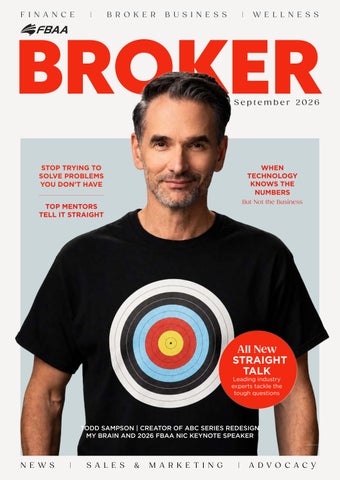
TODD SAMPSON | CREATOR OF ABC SERIES REDESIGN MY BRAIN AND 2026 FBAA NIC KEYNOTE SPEAKER
N E W S
|
S A L E S
&
M A R K E T I N G
|
A D V O C A C Y
In this issue
IN THE CHAIR The Honourable Nicholas (Nick) Sherry AO
04
2
A NEW CHAPTER. By FBAA CEO Leo Gagic
STOP TRYING TO SOLVE PROBLEMS YOU DON’T HAVE By Brad East PUSHING FOR FAIRER BROKER OUTCOMES By David Carson
06 10
12
15. INSIDE SOUTH AUSTRALIA’S BROKING MARKET 30. CPD SHOULD DO MORE THAN TICK BOXES 42. FBAA 2026 NATIONAL INDUSTRY CONFERENCE SPECIAL FEATURE MEET THE SPEAKERS
WHEN TECHNOLOGY KNOWS THE NUMBERS BUT NOT THE BUSINESS By Samara Sweeney
STRAIGHT TALK By Gerald Foley, Marios Rokka and Rishi Bhatia
WHEN AN IDEA BECOMES A MOVEMENT By Beth Comino and Victoria Coster
28 20 16
TOP MENTORS TELL IT STRAIGHT By Shariff Rahman, Samir Neupane, Joe Mennea and Andrew Larcombe
34
3
From
THE CHAIR The Honourable Nicholas Sherry AO
4
I
am honoured to write my first column as Chair of the FBAA, following my appointment as external director and Chair in midJune.
I join the organisation at a key time. Over the past year, the Board has made important decisions through its annual Strategic Review and Business Plan update to strengthen and modernise the FBAA. These efforts are especially important as we prepare for the retirement of our long-serving CEO, Peter White AM, and transition to new leadership. A key part of this transition has been the appointment of Leo Gagic as CEO. Leo brings experience across leadership, strategy, transformation and operations, including helping organisations navigate significant periods of change. Since joining the FBAA, he has spent considerable time listening to members, industry partners and the FBAA team to better understand where the organisation can make the greatest difference. In his article in this issue, Leo shares some of those early reflections and the priorities shaping the FBAA's next chapter. We have also welcomed Cara Hayward as Chief Financial Officer and Nancy Sundar as Head of Quality Assurance and Compliance. A Certified Practising Accountant, Cara brings extensive experience in financial management, governance and organisational transformation across professional services, advisory and memberbased organisations. Nancy brings more than 18 years of experience across governance, risk, regulatory compliance, quality assurance and information security. Both appointments further strengthen the FBAA's leadership capability as we move into this next phase. Alongside these leadership appointments, and subject to the completion of the final audit, the Australian business achieved a modest surplus for the 2025–26 financial year. Following careful review, the Board also decided to close the New Zealand business and focus the organisation's resources on delivering greater value for FBAA members in Australia. A significant program of work is underway, with further initiatives planned for delivery by the end of 2026. These include strengthening FBAA communications and marketing and taking a more forward-looking approach to policy development and representation on behalf of members. Our goal is to ensure brokers' voices
and interests are heard by governments, financial providers and regulators. We also plan to review the Board and committee structure, including their respective roles, composition and oversight responsibilities. This is an ambitious change agenda, but I feel confident we can deliver it. The FBAA Board is knowledgeable, experienced and deeply committed to the organisation and its members. Importantly, the Board is prepared to work hard, ask difficult questions and remain focused on meaningful outcomes. In July, I attended the National Executive Summit with Board members, state Presidents and Vice Presidents, and the executive team. The Summit delivered valuable discussion about the FBAA, member needs, and the broader environment in which brokers operate. I was impressed by the quality of the conversation and the readiness to challenge ideas respectfully and constructively. These discussions will be invaluable as we implement the change agenda and identify where the FBAA can have the greatest impact. I would like to acknowledge our state Presidents, Vice Presidents and committee members. These voluntary roles demand considerable time, knowledge and energy. Their connection to brokers in each state is vital to the FBAA’s strength, and their commitment is sincerely appreciated. I look forward to meeting many of you at the 2026 FBAA National Industry Conference: Still Human on Thursday, 29 October, from 8.00 am to 3.00 pm at the ICC Sydney. As someone new to the organisation, I look forward to meeting members of the broker community in person, hearing about the opportunities and challenges you face, and continuing conversations that will help shape the FBAA’s future. You can explore the full FBAA National Industry Conference: Still Human feature, including this year’s speaker line-up and conference agenda, on page 42 of this issue. I look forward to seeing you in Sydney.
5
A New Chapter.
After his first few months as FBAA CEO, Leo Gagic shares what has struck him most about Australia’s broking community, what’s shaping his thinking and where he sees the profession heading next.
S
ince joining the FBAA, what surprised me most wasn’t the fast pace of the industry or how much things are changing.
It’s the people. I’ve met brokers from all over Australia, and no matter their business size or location, one thing stands out. They truly care about their clients. They focus on getting the best results, doing what’s right, and building relationships that last long after settlement. In our industry, we often talk about lending, regulation, technology, and markets. But at the core, it’s about people helping others make some of the biggest financial decisions of their lives. The more I see, the more I appreciate the responsibility brokers have and the value they offer.
6
During my career, I’ve worked in leadership, strategy, transformation, and operations, often with organisations facing real change. These experiences showed me that lasting success doesn’t come from one person or one idea. It comes from having a clear purpose, great people and a drive to keep improving.
That’s what attracted me to the FBAA: the opportunity to lead an organisation with a genuine impact on its members, while supporting a profession that plays such an important role in the lives of Australians. We already have a great deal to be proud of, but we also have an opportunity to make the FBAA even more valuable to its members. We’re strengthening our advocacy, simplifying member services, investing in technology and creating a more connected member experience. We’re also aligning our organisational structure, so we have the right capability to respond to the evolving needs of members and the industry. For me, the real test is whether members can actually feel the difference. It’s not enough to just talk about member value. You should feel it—in the support you get, the education available to you, how you connect with us, and knowing there’s a strong voice for you when important decisions are made. I also believe we have a real chance to keep raising the profile of brokers. Consumers now have more information and choices than ever, but that doesn’t always make financial decisions easier. In fact, it makes trusted, professional guidance even more important. The same idea applies to how we support brokers.
Introducing FBAA CEO
Leo on stage at the 2026 National Finance Brokers Day
Leo had the honour of presenting long-standing FBAA member and broker Lance Cure with an award celebrating 40 years in the industry. 7
There’s a lot competing for your attention: technology, regulation, market changes, clients, staff, and the daily demands of running a business. We need to respect that. Our job is to help members focus on what matters, offer the right education and support, and make sure your voice is heard by policymakers and regulators. If we can help brokers spend less time dealing with distractions and more time focusing on their clients and building strong businesses, that’s a good sign we’re doing our job. If we haven’t met yet, I hope we get the chance at the upcoming FBAA National Industry Conference in Sydney on Thursday, 29 October. This year’s theme is Still Human, which reminds me of what has stood out most since I joined the FBAA: the people.
Our industry will keep changing. Technology will shape how we work and open up new opportunities. But through it all, the relationships brokers build, their judgement, and the trust clients place in them will always matter. To me, that’s what Still Human is all about. It’s not about resisting change. It’s about embracing what’s next while remembering what makes this profession valuable. That’s a future I’m excited to be part of. If you haven’t registered for this year’s FBAA National Industry Conference, head to page 42 to discover what’s in store, including our speakers, agenda and what to expect on the day. See you in Sydney.
Leo and Joanna James, FBAA Chief Commercial Officer, at the 2026 Adviser Australian Broking Awards
8
9
Pushing for fairer broker outcomes
W
hether it’s broker pay or the new anti-money laundering rules, the FBAA’s Regulatory Engagement Group is making sure brokers have a voice when decisions are made. By David Carson, Head of Regulatory Affairs & Advocacy, FBAA
brokers shouldn’t lose pay for events they can’t influence.
Advocacy means more than reacting after decisions are set. It’s about spotting issues early, sharing solid evidence with decisionmakers, and helping them see how rules actually affect brokers and their clients.
We also raised concerns about unlicensed referral and introducer programs, and about accreditation processes that can cancel a broker’s accreditation without good reason or for issues unrelated to their performance. We’re not trying to create conflict with lenders. Good relationships between brokers and lenders are vital for our industry and for customers. We just want fairness, consistency, and a real review of whether current pay practices match their original purpose.
Since June, the FBAA’s Regulatory Engagement Group has focused on two main issues: unfair payment practices impacting brokers and the confusion caused by the expanded Anti-Money Laundering and Counter-Terrorism Financing rules. We’ve also met with ASIC and worked with AUSTRAC as part of our ongoing advocacy.
Calling for fairer remuneration practices In July, the FBAA made a submission to Treasury during its review of unfair trading protections for small businesses. This was a key chance to share brokers’ long-standing concerns directly with the government. We focused on how clawback and net-ofoffset payments work. These can be triggered by things brokers can’t control, like a client’s divorce, moving house, selling property, or cancelled development plans. We believe
10
Clawback and net-of-offset rules were meant to stop misconduct, not punish brokers for normal changes in a client’s life. These rules were set over five years ago and haven’t been properly reviewed since. We think it’s time for a fresh look.
Seeking clarity on expanded AML/CTF obligations Our other focus is the expansion of Australia’s AML/CTF laws. From 1 July 2026, these rules will cover more services, including those offered by real estate agents, lawyers, and accountants. One new service, which covers help with certain debt or equity financing, has caused confusion about whether some commercial finance and asset brokers are included. This matters because, if they are, brokers could face significant new requirements for enrolment, AML/CTF programs, customer checks, reporting, record-keeping, and ongoing compliance.
Advocacy
We don’t think the government intended to include commercial and asset finance broking in the expanded AML/CTF rules, although ambiguous drafting has left it open to interpretation. The FBAA has spoken with AUSTRAC to get answers and will keep working for a clear, practical outcome for the industry. Members shouldn’t have to figure out complicated rules on their own.
Turning broker experience into evidence These issues highlight why broker feedback is so important. Governments and regulators don’t always see how policies work in real life unless the industry shares its experience.
Through REGS, the FBAA turns broker input into formal submissions, meetings with regulators, and practical advice. You can find copies of the FBAA’s submissions and updates on our advocacy work on the FBAA REGS and Advocacy webpage.
If a new issue is affecting your business or clients, we want to hear from you. FBAA members can share feedback through the FBAA Member Portal or by emailing REGS at regs@fbaa.com.au.
David Carson
Head of Regulatory Affairs & Advocacy, FBAA
11
STOP TRYING TO SOLVE PROBLEMS YOU DON'T HAVE
E
very broker I meet has a list that’s going to fix all their problems. A new website. A new CRM. A social strategy. An asset finance arm. A podcast. A BDM. The list gets longer every year, but the business doesn’t seem to grow any bigger. I just came back from an overseas trip where I learnt the opposite lesson. The brokers growing fastest weren't working from a massive list. They were doing one thing, deliberately, until it stopped being a problem. This isn’t a new idea. Manufacturing has worked this way for decades: every system has exactly one purpose and any improvement made in any other area is a distraction. It looks like progress on a spreadsheet but it doesn’t make any notable difference. Your brokerage is a system, too. And, right now, it has one part that’s holding back everything else.
12
FIND THE ISSUE There are only a handful of ways that you can improve your business. And only one of them will actually work for you today: Demand Not enough people are getting in touch. You’ve set up the rest of the business so it works, there just aren’t enough leads. There are plenty of ways to increase demand – ads, social media, SEO and more. You just have to find out what works for you. Margin You're writing decent volume but keeping very little of it. The fix is one of two things: what a client is worth to you over their lifetime or what it costs you to win one. Capacity The work exists but there's nobody to do it. In most small brokerages this shows up as the founder doing tasks that an employee really should be doing. This never appears in a single conversion metric.
Education Business
Capability You've hired someone, but they can't do the job yet. This is the one most owners misdiagnose, because the symptom looks identical to a demand problem: enquiries going nowhere. Training and close management are required. Systems You can’t handle high volume. Files stall, compliance gets sloppy, clients chase you instead of the other way around. If you're not sure which is yours, the numbers will tell you. Pull twelve months’ data and look at four things: what it costs you to acquire a client, what a client is worth to you, where deals drop off and how much of the pipeline still routes through you personally. One of those will be visibly out of line with the rest. Sometimes the right answer isn’t obvious. Brokers can be certain they have a demand problem when really they have a capability problem: plenty of enquiries, but very few who end up converting. Buying more leads in that situation is paying to widen a pipe that’s blocked further down. Likewise, some owners think they have a capability or capacity issue, when really the systems they’ve set up are holding everything up.
That isn’t failure. That’s the system telling you where to look next.
“Your brokerage is a system, too. And, right now, it has one part that’s holding back everything else.” It’s also why growth in a broking business feels lumpy rather than smooth. You’re clearing one blockage at a time, and each one lets a bit more through until the next one bites. If I had to say what brokers should be focused on right now, it isn’t rates or policy or the market. It’s a question that’s simpler and less comfortable: if my business could only improve at one single point over the next 90 days, which would actually change my settlement numbers? Answer that honestly, then ignore everything else until it’s done. Most brokers don’t need a new strategy. They need to finish the one thing they know is broken.
FIX ONLY THAT ISSUE Here’s the hard part. Once you’ve found the problem, everything else goes on hold. No new service. No new niche. No new referral vertical. No rebrand. These won’t fix your main problem. Side quests feel like progress because they’re new and they give us something to tick off on our to-do lists. But, be honest, they rarely move the needle. Finding the problem and fixing it is usually boring: call scripts, contact times, a document checklist, a process rewrite or a difficult conversation with someone in your team. It’s not the work that many people really enjoy, but it’s also the only work that really improves numbers. Give it a defined window. Six weeks. One metric. One person accountable, even if that person is you.
THEN MOVE TO THE NEXT ONE
Brad East
Managing Director, Wisebuy Home Loans and Dealify
When you fix an issue, it doesn’t disappear, it relocates. Solve your demand issues and suddenly you have problems with capacity. Solve those capacity issues and then margin becomes the problem, because you’ve just added cost.
13
MORTGAGE BROKER ASSIST YOUR EXPERT LOAN PROCESSING SOLUTION
BACKEND SUPPORTFor
MORTGAGE BROKERS Let us handle the lodgements and scenarios while you grow the business efficiently.
HOW WE WORK TO STREAMLINE YOUR LOAN PROCESSING
01
02
03
04
Review Scenarios
Check documents
Lodge deals
Track Settlements
WHAT WE DO AT A GLANCE
Virtual Assistant Support
Loan File Processing
No Setup Cost
No Device Cost
No Hiring Cost
No Training Cost
Mentoring & Marketing Support
0412-028-735
www.mortgagebrokerassist.com.au
admin@mortgagebrokerassist.com.au
SCHEDULE A CALL
INSIDE SOUTH AUSTRALIA’S BROKING MARKET Andrew Dallisson
FBAA South Australian State Manager
R
egulatory change and commercial uncertainty dominate conversations, but South Australia’s brokers remain committed to modifying and moving forward. Since taking on the FBAA State Manager role, I’ve spent considerable time out in the field, sitting with brokers, meeting aggregators and speaking with lenders to understand what is happening across South Australia’s market. It is a close-knit, relationship-driven community, and the more conversations I have, the clearer the common themes become. Regulatory change is front and centre. Since 10 August, SMSFs have generally been unable to enter into new borrowing arrangements to purchase residential property. The lead-up to the change created considerable activity and confusion as brokers worked to support trustees hoping to act before the deadline. Attention has now turned to understanding the new rules and helping clients navigate their options. ASIC’s scrutiny of compliance with the best interests duty is also attracting attention; the regulator is using information from aggregators to examine how BID is being applied in practice. For brokers, clear documentation, sound reasoning and consistent processes have never been more important. Uncertainty also surrounds the expanded AML/CTF regime. Commercial and asset finance brokers, in particular, are asking where their activities sit within the designated services framework. The FBAA has sought clarification
because brokers should not be left guessing about their obligations. Much of what I’m hearing locally reflects the concerns raised in the FBAA’s July 2026 submission to Treasury regarding unfair trading practices. In dealing with the impact of unpredictable commission arrangements on small broking businesses, the submission put it plainly: “Such erratic interference with commission payments creates considerable worry and uncertainty for small business owners whose cash flow is constantly under threat.” That concern is real in South Australia. Clawbacks, delays under net-of-offset arrangements, channel conflict and accreditation pressure are all issues brokers raise with me regularly. They are looking for fairness, honesty and a level playing field. They also want confidence that the challenges affecting their businesses are being heard and raised with the people who can address them. Despite these pressures, South Australian brokers remain optimistic. Many are diversifying into commercial finance, asset finance and private lending, creating new opportunities for their businesses and clients. The next 12 months will be defined by adaptation and opportunity. By remaining focused on compliance, strengthening industry relationships and staying close to what brokers are experiencing, South Australia’s broking community will be well placed for whatever lies ahead.
15
When Technology Knows The Numbers But Not The Business With Samara Sweeney, Aurelius Capital
Commercial Finance
A
s technology plays a bigger role in commercial lending, Samara Sweeney believes brokers who really get to know the businesses behind each application will stand out. In Australia, there is a widening gap between what businesses need to grow and what major banks are willing to fund. Non-bank and private lenders now fill this space, giving brokers more choices. Still, Samara Sweeney from Aurelius Capital thinks many business owners do not know about these options or how to use them. This situation gives brokers a chance to offer real guidance in a market that can be hard for clients to handle alone. Here, knowing the business is just as important as knowing the numbers, especially as technology and AI become more involved in preparing and reviewing applications. “The data can only tell you so much,” Sweeney says. “You still need to understand the story and the people behind it to offer a proper solution.” This difference matters most for businesses without property to use as security. Sweeney says that in Australia, getting affordable commercial loans still mostly depends on whether the owner has property to back the application. While unsecured loans have grown thanks to fintech and non-bank lenders, they often cost more and can add pressure for businesses already dealing with cash-flow issues. “There are so many business owners who don’t have property, whether they are entrepreneurs building startup companies or established business owners who have chosen to invest back into their business rather than buying a home,” she says.
“One of the best opportunities for commercial brokers in the next year is to focus on a niche and build a reputation as a credible expert.” For these clients, not owning property can make it harder to get funding, no matter how much they have put into their business. Sweeney sees unsecured SME loans as both a big challenge and a major opportunity in commercial finance. However, brokers need to think about the longterm impact of the loans they suggest. Getting capital might fix a short-term problem, but if the loan is too expensive, the business could stay stuck with cash-flow issues.
What businesses are seeking finance for Sweeney says most SME clients need working capital and cash-flow support, and more are also looking for acquisition finance. This includes owners wanting to buy into an existing business, buy out a partner, or buy a business completely. She also sees PAYG employees, worried about their jobs, starting to look at owning businesses themselves. Numbers alone rarely tell the full story in these deals. Brokers need to know why the client wants finance, what their goals are, and how the debt will fit into the business. This context is especially important when presenting an application to a lender that may not know the client, the industry, or the situation. This also shows why specialising is valuable. Sweeney thinks one of the best opportunities for commercial brokers in the next year is to focus on a niche and build a reputation as a credible expert. A broker with real expertise in a certain type of lending or client market can become a go-to referral partner for others who need help in that area. This is important for residential brokers thinking about moving into commercial finance. Diversifying is more than just offering more products or services. It means learning about different business models, knowing what questions to ask, and spotting when a deal needs specialist help. Sweeney says ongoing education is key, but it should be purposeful. Brokers often stick to familiar events and webinars, but real career development happens when they try new things and challenge their usual way of thinking. “Brokers I know are always looking for fresh opportunities to learn, whether that is attending a conference in a different city, engaging with a new lender on panel or teaching themselves about marketing online,” she says.
Using AI without losing sight of the client Sweeney thinks technology will help commercial broking as lenders improve their portals and credit tools. She also expects more embedded and API-driven lending, which should speed things up. Her worry is not about brokers using AI, but about some relying on it instead of really understanding the application. Sweeney says she has seen credit papers that look like they were made by putting a client’s financials into an AI tool, with little sign the broker understands the client’s needs. The data
17
might be clear, but that does not always explain the business or make a strong case for the loan. She thinks this will create a split between brokers who use AI to work better and those who use it to skip understanding the deal and just focus on volume. As lenders, clients, and partners get used to AI-generated work, she believes they will start to see the difference between a good-looking application and one that shows real business knowledge. “Eventually, the market will start to tell the difference between brokers who genuinely comprehend their clients’ needs and those who are simply processing a transaction,” she says. The relationship between broker and lender will still be important. Fast decisions matter, but Sweeney says the best lenders work with brokers, look past obvious problems, and really understand each deal. She also wants more transparency in credit decisions, especially when applications are declined. She says declines often come back with little explanation, which makes it hard for brokers to guide clients, fix problems in the application, or do better next time. Better portals and faster decisions help, but knowing why a lender made a decision helps brokers have better conversations with clients and plan for the next steps.
Building confidence in commercial broking As more brokers move into commercial finance, Sweeney thinks there should be ongoing talks about minimum education and professional standards. Rules can vary depending on the type of finance, but she wants to see more consistent standards for brokers working in areas not covered by the same rules as consumer mortgage lending. Many commercial brokers already put their clients’ interests first. Sweeney believes raising education and professional standards across the board would help protect the industry’s reputation and build trust with clients, lenders, and referral partners. Her main point is that though technology will keep changing commercial lending, brokers will still need knowledge, judgement, and strong relationships. They will get faster systems and better tools, but their real value comes from understanding the client, the funding’s purpose, and the business itself. Brokers who mix technology with real expertise will be best positioned for the opportunities ahead.
EQ Briefings | EQ Conferences | EQ Subscriptions
eqeconomics.au
Straight Talk REAL CONVERSATIONS. A STRONGER INDUSTRY.
Some of the most important conversations in our industry can be tough. Straight Talk is where Broker Magazine tackles them.
New Feature
THE QUESTION
How can the industry strengthen trust between lenders and brokers?
I
n every issue, we ask a timely question to a group of respected industry experts and invite them to share their views.
Brokers and lenders work side by side every day. Both rely on delivering good outcomes for customers, and with brokers now playing a big role in how Australians access finance, that relationship is crucial.
As the industry evolves, so do the questions and the people we feature. Depending on the topic, we invite brokers, lenders, aggregators, economists, advocates, and other leaders to share their insights.
But there are still points of tension.
Our goal isn’t to create controversy or force agreement. We want to encourage open, constructive discussions about the issues brokers face, even the uncomfortable ones. For our first Straight Talk column, we’re focusing on one of the industry’s most important working relationships.
Gerald Foley, CEO, nMB
Issues like channel conflict, clawbacks, retention pricing, communication, and how brokers support customers after settlement all raise real questions about what a true lender-broker partnership should be. Instead of avoiding these topics, we asked three experienced industry professionals to share their perspectives.
Marios Rokka, FBAA VIC State President, & Lending Centre Australia
Rishi Bhatia, Mortgage & Finance Broker, KRIA Mortgages
21
Gerald Foley CEO, nMB
T
rust comes from transparency, respect, consistency and a shared focus on good customer outcomes. In the past 20 years, brokers have become the preferred channel and trusted advisers for most Australian borrowers. People value choice, competition, and professional advice. To keep that trust, lenders and brokers need to see each other as strategic partners, not just as distribution channels or product providers. Unfortunately, it sometimes feels like the latter. Communication is a critical starting point. Brokers need clear, timely information about policy changes, service levels and credit appetite so we can set realistic expectations with our clients. Equally, lenders benefit when brokers provide complete applications, quality submissions and constructive feedback from the market. Trust grows when decisions are consistent, turnaround times are predictable, and everyone is working toward the same goal: helping customers reach their goals responsibly and sustainably. Above all, lenders and brokers should keep the customer at the centre. There is no doubt lenders with direct channels — generally banks — would prefer customers to come to them directly. Who wouldn’t?
22
“Trust grows when decisions are consistent, turnaround times are predictable, and everyone is working toward the same goal.” But it’s important to keep recognising that customers choose how they get finance and advice. That recognition should continue after settlement, with lenders acknowledging the broker’s ongoing role in supporting the customer throughout their loan journey. The Australian broker channel has matured significantly and the level of professionalism across the industry continues to rise. By investing in collaboration, sharing information openly and keeping customer outcomes at the centre of every decision, lenders and brokers can strengthen trust and ensure the industry continues to thrive for many years to come.
Marios Rokka FBAA VIC STATE PRESIDENT Lending Centre Australia Pty Ltd
T
rust between lenders and brokers isn’t broken. However, there is an undertone that needs attention if we’re going to strengthen the relationship and recognise the value brokers provide. For me, one of the biggest — and undoubtedly most controversial — issues is clawback. It’s an issue that has long left a sour taste in the broker-lender relationship when it occurs. Brokers work hard to meet all our compliance and regulatory responsibilities, including our Best Interests Duty and responsible lending obligations. We painstakingly work through our clients’ goals and objectives, assess the appropriate product type and then consider credit policies to match the client with the right lender.
“We’re responsible for acting in our client’s best interests. We handle the introduction, the application, and often the relationship long after settlement.”
We undertake our own detailed credit analysis, present our findings to the lender and manage the application through approval and settlement. And our work often doesn’t end there. Brokers continue to maintain relationships with both the client and lender well beyond settlement. That’s part of where trust in the broker-lender relationship is developed. Then, at some point, the client may decide to discharge their loan and the lender claws back the broker’s commission. This is the tipping point. If we truly have a strong relationship built on trust, I think we need to be willing to have a conversation about what happens in those circumstances. If a broker can demonstrate that they have diligently managed the client relationship — a relationship that may also have benefited the lender through additional products such as bank accounts and credit cards — should the broker automatically carry the entire cost when that customer leaves? We’re responsible for acting in our client’s best interests. We handle the introduction, the application and often the relationship long after settlement. But if the client leaves the lender during the clawback period, the broker can lose income, time, and sometimes face real financial costs. I’d like to see lenders come together with the broking industry and have a genuine conversation about whether that burden could be shared through changes to the current system. Because in many cases, it isn’t the broker who has caused the clawback.
23
Rishi Bhatia Mortgage & Finance Broker, KRIA Mortgages
F
or me, one of the biggest challenges is transparency within the channel partnership.
When both parties focus on mutual transparency, the end customer benefits from a smoother and fairer experience. We need to avoid channel conflict and remember that we’re all working for the success of our customer. Ultimately, we’re a partnership. It is disappointing when different channels within a lender have different success criteria, and brokers feel that branch or direct channels are looking for broker-originated clients. Pricing is one area where this becomes particularly frustrating. Often, a lender won’t match pricing when we first approach them, forcing the broker to conduct a market search on the client's behalf. Yet once a formal discharge request is received, a competitive rate may suddenly become available. I’d like to see lenders have the guts to match that pricing before we submit the discharge. That could save the lender from losing a good customer, protect its back book and allow the broker to continue working towards the right outcome for the client.
24
“We aren’t working against you; we’re working for the client.” The discharge process itself also needs to be seamless. We now use digital signatures and online documentation throughout so much of the lending journey, yet parts of the discharge process can still be unnecessarily cumbersome. Making that experience faster and easier would ultimately improve the customer experience as well. But the biggest message I have for lenders is this: As brokers, we value our partnership. We aren’t working against you; we’re working for the client. If you treat us like your own, we’ll own the outcome too.
What’s striking isn’t that our three contributors agree on everything. They don’t need to. They’ve identified different pressure points in a complex commercial relationship: recognition of the broker’s ongoing role, clawbacks, channel conflict, retention pricing, communication and transparency. But underneath their responses is a common idea. Partnership needs to work when things get difficult, not only when everything is going well. Lenders have commercial realities. Brokers have obligations to their clients and businesses to run. At times, those interests will inevitably pull in different directions. Perhaps strengthening trust isn’t about removing those tensions altogether. It’s about creating a relationship strong and transparent enough to deal with them when they arise. And there is one place where the interests of both sides should ultimately meet: the customer. If lenders and brokers can keep that common ground at the centre of the relationship-while being prepared to have frank conversations about the areas where the relationship isn’t working as well as it could – that’s a pretty good place to start.
25
Opening doors to more clients? It’s a Bluestone thing. Solve complex scenarios with our flexible credit assessment and award-winning team. Unlock your next chapter at Bluestone.com.au/brokers
Australian Credit Licence 390 183
Reverse your thinking about
Over 60s lending Partner with us to deliver flexible lending solutions to a growing sector with diverse needs – borrowers aged 60+
Contact us for more information about our flexible lending solutions: Email: brokers@householdcapital.com Phone: 1300 571 737 Website: householdcapital.com.au
When an Idea
Becomes a Movement W
hen we first started talking about financial literacy in schools, the idea was actually quite simple. We could both see the same gap. Young Australians were preparing to enter adulthood, where they would be expected to make decisions about money, saving, credit, debt, superannuation and eventually home ownership. Yet many were doing so without ever being taught how these things work in the real world. We believed our industry could help change that. We didn’t anticipate how many people across the finance industry would feel the same. What began as an idea between the two of us has quickly grown into something much bigger. More than 100 finance professionals have now signed up to become financial literacy educators, and 87 schools are officially booked for 2026, with that number still growing. Our foundation sponsors, FBAA, Bluestone Home Loans and Ryker Capital, backed the vision early. Since then, AFG, LMG Leading Ladies and Brokerversity, Women in Finsure, Loan Options, Nectar Mortgages and SFG have rallied around it too. For us, this is perhaps the most exciting part. We are seeing an industry come together around something that matters. People who might ordinarily sit in different businesses, networks or even compete with one another are stepping forward with a shared purpose. We are also seeing a strong number of women putting their hands up. The program is certainly not limited to women, but there is something
28
powerful about seeing women across finance wanting to pass their knowledge and experience on to the next generation. Recently, we brought together some of these educators for a podcast and filming day and asked them one simple question: Why did you join the program? Why is it important, and what are you excited to see? The Leading Ladies community has been a wonderful example of this momentum, with women from across the network stepping forward to become educators. Tram Nguyen, Leading Ladies, told us, “It’s so important for the next generation, particularly girls, to understand how crucial financial independence is. If we can give them that foundation before they leave school, we’re setting them up to make confident decisions for the rest of their lives.” For Justine Harris, Nectar Mortgages, the impact can begin with something very small: “Even a small amount of knowledge gained early can have an enormous impact over a lifetime.”
Education
And Liz Zaki, Leading Ladies, summed it up: “Financial success comes from good habits, not guesswork.” She also captured the reality of what our educators are taking on when she added, “If I can keep a bunch of 15–16-year-olds engaged for a few hours, I deserve my own award!”
the students and communities we are trying to reach.
That same desire to create change extends well beyond one community. Rafka Veas, Women in Finsure, spoke about education as an opportunity to break down financial barriers: “I hope we can empower a generation to look beyond their family’s circumstances and feel confident in shaping their own financial future responsibly.”
More than 100 educators and 87 participating schools are only the beginning. We are setting the tone for what comes next, because perhaps our greatest opportunity isn’t simply helping the next generation when they eventually become our clients.
Different voices and different experiences, but the same willingness to step forward. This year, the program is also expanding through our work with the KARI Foundation, where we are developing a culturally appropriate financial literacy curriculum for Aboriginal and Torres Strait Islander students. It reinforces something we believe strongly: financial education cannot be one-size-fits-all. It needs to connect with
For us, this is when you realise that what started as an idea has become something else. It is becoming an industry movement.
It’s helping prepare them long before they need us.
Beth Comino & Victoria Coster Co-Founders, Financial Literacy Education
29
CPD
Should Do More Than Tick Boxes If professional development does not change anything in your business, what exactly was the point?
T
he mortgage and finance industry never stands still. Technology changes. Client expectations change. Regulation changes. The way we attract, serve and retain customers changes. And increasingly, the way a brokerage creates value is changing too.
Importantly, the subject matter needs to be flexible because a course on AI, fraud, customer expectations or business systems can quickly lose its usefulness if it isn’t kept current.
For brokers, the challenge is not a shortage of information. It is finding useful, current information, making sense of it quickly and then putting it to work in a very busy business.
Good business education should follow three simple steps.
From information to implementation Over the past few weeks, I have been speaking with brokers around the country at the FBAA Elevate roadshows. The feedback has been remarkably consistent. Brokers want education that goes beyond product knowledge and compliance. They want practical help with the business itself. They are asking: How do I build a business that is less dependent on me? How do I use AI without creating new risks? How do I improve my systems? How do I create stronger client relationships? How do I build a team? And, increasingly, how do I create a business that one day has real value to someone else? Those are business questions, not simply broking questions. That is the thinking behind CPD-Go. We built it around a simple idea: useful education needs to fit into a broker’s working life and help them run their business better.
30
Listen. Learn. Do.
First, listen or read widely enough to challenge the way you currently do something. Second, work out what the idea means for your own business. Not every new trend, technology or management theory deserves to be adopted. Third, do something with it. Change a process. Test an approach. Review a cost. Document a system. Ask your team a better question. Then measure what happens. That final step is where much professional development falls down. Information is easy to consume. Implementation takes effort.
Build capability, not just knowledge Many of the conversations I had across the Elevate tour were with brokers interested in growing, structuring and ultimately selling their business. One thing Elevate confirmed for me is that better businesses aren’t necessarily run by people who know the most. Better businesses are run by people who are good at turning useful information into better decisions, stronger systems and repeatable behaviours. That approach will build a better broking business.
Education
So the next time you choose something to learn, ask three questions: 1.
Is this current and relevant to the business I am running today? 2. What could I change as a result? 3. How will I know whether that change worked? If education answers those questions, it becomes much more than CPD. It becomes one of the tools you use to build a better business.
Anthony Bishop Founder and Owner CPD-Go
“Better businesses are run by people who are good at turning useful information into better decisions, stronger systems, and repeatable behaviours.” Ready to turn professional development into practical action? Explore CPD-Go’s range of courses through the FBAA Learning Centre and find learning you can put to work in your business. Click to explore CPD courses
Learning Centre
31
Learning Centre
An exciting new initiative of the FBAA, the Learning Centre is an online platform that offers you the freedom to learn at your own pace and in your preferred style.
Multi-Style Learning:
Ease of Access:
Engage with audio, video and written materials – pick the style that works best for you.
Access courses anytime, anywhere, with flexible online learning that fits your busy schedule.
Comprehensive Content:
Personalised Learning:
Whether you’re looking to improve your business performance or build resilience in your career, the FBAA Learning Centre offers a wide array of learning topics for every stage of your professional journey.
Choose from a range of content that suits your individual needs, from business finance, product knowledge, marketing strategies and customer service to mental health and wellbeing support
Learn More
32
Education
Learn More
Learn More
Learn More
Learn More
Learn More
33
Top Mentors Tell It Straight We invited four finalists in the FBAA Awards of Supremacy Mentor of the Year category to share the real-world lessons and honest advice they believe every new broker should hear.
Shariff Rahman
Mortgage Broker Assist 34
Samir Neupane 8848 Finance
New Broker
E
xperience is one of the industry’s greatest resources, but it only helps the profession grow when people are willing to share it. For this feature, we spoke with four people who have spent years guiding brokers through the realities of building a career and a business. Shariff Rahman, Samir Neupane, Joe Mennea and Andrew Larcombe are finalists in the Mentor of the Year category at the 2026 FBAA Awards of Supremacy. We asked them to reflect on what their experience has taught them and share the advice they believe could make the greatest difference to someone new to the industry today.
Joe Mennea
Financial Consulting Australia
Finishing your qualification is just the first step. Building a successful broking business is a different challenge. New brokers need to learn lender policies, compliance rules, and new technology, all while finding clients, building referral relationships, and earning the trust of people making major financial decisions. Many do this on their own, often wondering if they know enough and feeling pressure to have every answer right away. If you are new to broking or still finding your feet in your first few years, this conversation is for you. There are no shortcuts, but these insights may help you work with more clarity and confidence, with the reassurance that you were never expected to know everything from the start.
Andrew Larcombe Morbanx Aggregation
35
What is the biggest mistake new brokers make in their first five years?
What is the first skill every new broker should master?
Joe Mennea
The first skill every new broker should master is scenario analysis—the ability to break down a client’s situation, identify the real problem and map out the right pathway. This skill is the backbone of long-term success because it drives accuracy, speed and trust.
The biggest mistake a broker makes can happen before they even become a broker: they fail to plan their business and identify their potential client sources. The old saying, “When you fail to plan, you plan to fail,” rings true in many cases. I hear from aspiring brokers every day who have completed their broking course and joined, or are about to join, an aggregator, yet have no idea how much time it will take or where their clients will actually come from. Every new business needs a solid business plan, and broking is no different. In your first five years, keep coming back to your plan. Check what’s working, what isn’t, and what needs to change. Spend as much time improving your business as you do working in it.
What is one piece of advice you would give every broker on their first day? Shariff Rahman One of the most valuable phrases a new broker can learn is: “That’s a great question. Let me double-check the details and come back to you with the right advice.” Clients don’t expect perfection from someone new. They want honesty, professionalism, and follow-through. Guessing answers or pretending to know everything can quickly hurt your credibility. In my experience, clients appreciate transparency much more than false confidence. You’ll gain knowledge with every situation you face, but your reputation starts from day one. Being honest, reliable, and committed to finding the right solution will always build more trust than pretending to know it all.
36
Samir Neupane
When I started, I treated every file the same way. Only after I learned to slow down and look at each scenario carefully did my approvals become more consistent. Scenario analysis helps you ask better questions, spot lender concerns, and avoid extra back-and-forth. Once you can assess a scenario with confidence, you stop guessing and start truly advising. Clients rely on you because you spot risks before they do. Developing this skill early will save you years of frustration, rework, and declined deals.
In your experience, what separates brokers who simply survive from those who build exceptional, long-term careers? Andrew Larcombe In my experience, the difference is that exceptional brokers think beyond the next settlement. Brokers who simply survive are often reactive. They chase the next lead, respond to whatever is most urgent, and rely on individual transactions to keep the business moving. Brokers who build enduring careers create structure around everything they do. They maintain meaningful relationships with clients and referral partners, follow consistent processes, manage their numbers, invest in their professional development and treat compliance as part of delivering good advice rather than an administrative burden. They also understand that their reputation is built over years but can be damaged by one poor decision. The strongest brokers are not necessarily the loudest or the fastest. They are the ones who remain dependable, adaptable and focused on doing the right thing when the market becomes more challenging. Article continues page 38
What do you wish someone had told you when you became a broker? Joe Mennea
What industry change should newer brokers prepare for now? Shariff Rahman
Engage a good mentor. We did not have mentors when I joined the industry and, like most brokers at the time, we learned through trial and error.
Today’s clients are more informed than ever before. They have access to online research, comparison tools, AI and financial information long before they speak to a broker. That means our role is evolving.
Mentors become your confidants and guide you throughout your journey. When brokers engage a mentor, however, they need to use that relationship properly. Mentors are not mind readers and cannot call every day to check in, but they must be available when you need them. Your mentor should become a trusted source of information.
We are no longer simply information providers; we are trusted advisers who help clients interpret that information and make confident decisions. At the same time, lender policies, compliance requirements and industry regulations continue to change rapidly.
I also wish someone had told me to be ready for the solitude. Coming out of the corporate world, I didn't realise how lonely it could be to work for yourself, by yourself. It can be daunting to start a new business and sit alone, without a feedback loop, a sounding board, or even a colleague to have coffee or lunch with. You can ease that feeling by going to networking events, conferences, training days, and other industry gatherings. Connecting with others helps you feel less isolated and reminds you that you’re part of a larger community.
What daily habit can make the greatest difference to a broker’s performance? Samir Neupane The top performers I have mentored all share one habit: they review their pipeline every single day—not reactively, but proactively. They know exactly where every file is sitting, what the next step is and what could go wrong. This daily habit builds momentum. It helps prevent surprises, lowers client anxiety, and keeps deals moving. When I started doing this, my turnaround times improved a lot and my clients felt more supported because I was always prepared for the next step. Top brokers don’t wait for problems—they look ahead and anticipate them. A five-minute daily pipeline check can save hours of extra work and protect your reputation. It’s a small habit that makes a big difference.
38
New brokers should keep learning and stay adaptable throughout their careers. Those who mix technical skills with real human advice, strong communication and trusted relationships will continue to thrive, no matter how the industry or technology changes.
Finish this sentence... “If every new broker understood ______, they’d build a stronger business.” Andrew Larcombe If every new broker understood that they are building a trust-based business, not simply arranging loans, they’d build a stronger business. A loan application is only one part of the relationship. Long-term success comes from understanding the client’s needs, providing appropriate guidance, communicating clearly and remaining available after settlement. It also comes from treating referral partners with respect, maintaining good records, taking compliance seriously and making decisions that protect the client’s interests, even when there is no immediate financial reward. The brokers who recognise this early tend to develop stronger reputations and more resilient businesses. They stop viewing each transaction as an isolated opportunity and start seeing every interaction as part of a relationship that may continue for many years. When trust becomes the foundation, referrals, repeat business and professional credibility are far more likely to follow.
One message emerges from all these answers: You don’t need to know everything on your first day, but you do need to start with the right foundations. A business plan gives you direction. Scenario analysis teaches you how to think. Daily discipline keeps the business moving. Honest communication creates trust. A mentor gives you somewhere to turn when experience has not yet supplied the answer. Most importantly, mentoring shows new brokers that feeling uncertain in the early years doesn’t mean you’re failing. It’s just part of learning a complex job while building your business, your reputation, and your future. The strongest brokers aren’t always the most confident at the start. They’re the ones who keep learning, ask good questions, reflect honestly, and seek help before a small uncertainty turns into a big mistake. A good mentor can’t build your business for you, but they can help you see further ahead, make better choices, and remind you that you’re not alone on this journey.
2026 THU. OCT. 29TH Sydney Town Hall The 2026 FBAA Awards of Supremacy Mentor of the Year will be announced at the FBAA Gala Dinner and Awards of Supremacy in Sydney on 29 October. Join us as we celebrate those making a significant difference in Australia’s broking industry. See page 49 for event details.
Advertorial
Brokers Who Are Winning Are Automating Their Admin Manual systems, piles of paper, blaring telephones and a stack of loan applications: how does anything get done? The brokers who are winning are working smarter, not harder. They’ve brought on a team member that never clocks off, never misses a compliance requirement, and never lets an enquiry fall through the cracks. That team member is builureAI. Smart brokers are automating admin; with specialised AI agents pre-built for Australia’s financial services sector. Brokers can stop fielding unqualified telephone and website enquiries, chasing documents and manually filling in loan applications—and get back to what actually grows a practice: looking after clients.
builureAI’s FrontDesk, Voice AI agent, and Mortgage AI products work the way a great team member does: quietly, reliably, and always with your clients’ best interests front of mind. They strip away the hours that could be more productively spent elsewhere, and let brokers focus on building their practices and delivering the kind of service that earns referrals. And like any good team member, they know the rules. builureAI’s suite is compliant with all applicable legislation: the Privacy Act, the Fair Work Act, and the NCCP Act, giving brokers peace of mind over and above the efficiencies they bring to a modern practice. Winning brokers aren’t doing it alone. They’ve got builureAI in their corner. To see how builureAI works for your practice, contact us at sales@builure.com.au.
Your best broker isn't chasing payslips.
See it run on your stack.
Book a free 15-minute demo Australian-hosted
Works with your existing CRM
sales@builure.com.au Built for mortgage brokers
STILL HUMAN
NIC NATIONAL INDUSTRY CONFERENCE
SYDNEY
THURS. OCT. 29 REGISTER NOW
TIME IS RUNNING OUT
NIC Feature
THE INDUSTRY WILL BE THERE. WILL YOU? Thursday 29 October 8.00 am – 3.00 pm
International Convention Centre Sydney (ICC Sydney)
Watch the official video
REGISTER NOW
43
MEET THE SPEAKE
HON. COURTNEY HOUSSOS What’s Next for NSW? Housing, Finance and the Economy
Hon. Courtney Houssos MLC serves as the NSW Minister for Finance, the Minister for Domestic Manufacturing and Government Procurement, and the Minister for Natural Resources. She was elected to the NSW Legislative Council in 2015, and in doing so became the state’s first woman to hold the office of Minister for Finance and the first woman to be responsible for the NSW mining sector. Minister Houssos, who was brought up in Forster on the NSW Mid North Coast, has a solid understanding of regional communities, business and the financial difficulties that Australian families are experiencing. At FBAA NIC 2026, she will present the government’s view on housing, finance, consumer debt and the wider economic prospects, as well as the issues that she thinks are most important to brokers and their clients.
WARREN HOGAN The New Economic Reality:
How Demographic Change and Technology Are Reshaping Business In the 2020s, a new economy has come into being. The environment in which all businesses operate is being fundamentally reshaped by demographic change, rising labour and capital costs, and rapid advances in digital technology. In this thought-provoking session, Warren Hogan, a leading economist, will look at the forces causing this change, the uncertainty they are generating and the new demands which are being made of business leaders. Although these shifts have the potential to lead to higher productivity, greater profitability and an improvement in living standards, it also poses a clear challenge: businesses have to be willing to adapt. What this means for brokers is that they need to know not just where the economy is going, but also how technology, shifting customer expectations, and the new competitive environment will influence the way they lead, make decisions, and generate value. To succeed in this new economy, businesses will need to think differently, be adaptable and to have the confidence to accept change—without neglecting the important role of human judgement and leadership in dealing with what lies ahead.
44
ERS
Leading Keynote Speaker
NATALIE WATERS
TODD SAMPSON
Building Trust in a Digital World
Thriving in Rapid Change
In a world where information is everywhere, and decisions are increasingly automated, one thing hasn’t changed:
Right now, the pace of change in the industry is relentless. New tools. New systems. New expectations. The pressure to adapt — quickly — is constant. Todd Sampson’s work is built around one core idea:
People still choose to work with someone they trust. Natalie Waters has spent her career in environments where understanding people isn’t optional — it’s critical. From frontline operations across Australia’s borders and the Southern Ocean to working alongside intelligence agencies and government leaders, and facilitating hostage negotiation training, Natalie has developed deep expertise in behavioural profiling and human decision-making. She understands how people think, what drives their behaviour, and — most importantly — what builds trust. At NIC 2026, Natalie will focus on: • The fundamentals of human trust • How to read behaviour and intent • How to communicate more effectively with different personality types • How to influence outcomes in high-stakes conversations
We are far more capable than we think — and we can train ourselves to perform better. As the creator of ABC series Redesign My Brain, Todd explores the science of how we think, adapt and improve — challenging the long-held belief that our abilities are fixed. At NIC 2026, Todd will take you inside this thinking, sharing practical insights on how to: • Stay clear and focused in fast-moving environments • Adapt your thinking when there is no playbook • Push beyond perceived limits • Build mental resilience and improve performance over time His experience operating in extreme environments — from Everest to conflict zones — reinforces one key message: Your ability to think, adapt and perform is trainable — and it’s your greatest advantage in a rapidly changing world.
45
NIC NATIONAL INDUSTRY CONFERENCE
SYDNEY THURS. OCT. 29
STILL HUMAN
REGISTER NOW
46
Ask anyone who’s attended an FBAA National Industry Conference and they’ll tell you— it’s unlike any other event on the calendar. Learn How to Thrive in Rapid Change
Drawing on his groundbreaking work through ABC TV series Redesign My Brain and experiences operating in some of the world’s most demanding environments, Todd Sampson will challenge the way you think about change. Discover practical strategies to strengthen your mental resilience, adapt faster, think more clearly under pressure and build the mindset needed to thrive in a rapidly changing industry.
Build the Ultimate Competitive Advantage Technology Can’t Replace Behavioural profiling specialist Natalie Waters will reveal what really drives human decision-making, why clients choose one broker over another, and how understanding behaviour can help you communicate more effectively, build stronger relationships and guide clients with greater confidence.
Take Practical Ideas Back to Your Business NIC isn’t about theory—it’s about practical outcomes. Every keynote, panel discussion and conversation has been designed to leave you with ideas, strategies and insights you can immediately apply to your business, your client relationships and the way you approach the opportunities and challenges ahead.
Build Relationships That Matter Reconnect with brokers, lenders, aggregators and industry leaders from across Australia. Whether it’s a conversation over coffee, new introductions at the Industry Expo or reconnecting with long-standing colleagues, some of the most valuable opportunities at NIC begin between the sessions.
Step Away to Move Forward Sometimes the best thing you can do for your business is step away from it. NIC allows you to think strategically, challenge your perspective and return with renewed energy, fresh ideas and a clearer vision for the year ahead.
STRENGTHEN WHAT TECHNOLOGY CAN’T REPLACE WORLD-CLASS SPEAKERS INAUGURAL INDUSTRY EXPO FEATURING 50+ LEADING BRANDS IDEAS & CONNECTIONS TO SHAPE YOUR NEXT 12 MONTHS
VIEW FULL AGENDA
CPD HOURS
REGISTER NOW
47
A Night Under the Chandeliers Sydney Town Hall sets the stage for the 2026 FBAA Gala Dinner & Awards of Supremacy.
F
ollowing a day of insight, innovation and connection at NIC 2026, the industry will gather for an evening dedicated to celebrating excellence. On Thursday, 29 October, the FBAA Gala Dinner & Awards of Supremacy will make its debut at the magnificent Sydney Town Hall, one of Australia’s most iconic and historic venues. Beneath grand chandeliers and surrounded by the timeless elegance of this treasured landmark, brokers, lenders and industry leaders from across Australia will come together for what promises to be one of the most memorable evenings in the association’s history. This year’s Gala theme, A Night Under the Chandeliers, pays homage to the grandeur and sophistication of Sydney Town Hall, creating the perfect backdrop for an evening of recognition, connection and celebration. Complementing the evening’s atmosphere is the optional dress theme, Venetian Masquerade, inviting guests to embrace a touch of old-world glamour and
mystery with black-tie attire, elegant masks and timeless style. Guests can look forward to a premium dining experience, entertainment and invaluable networking opportunities, before the evening culminates in the highly anticipated FBAA Awards of Supremacy ceremony. More than simply an awards night, the Gala Dinner is an opportunity to recognise outstanding achievement, reconnect with colleagues and peers, and celebrate the individuals whose dedication and commitment continue to elevate the broking profession. As one of the industry’s most prestigious honours, the Awards of Supremacy recognise excellence across 18 categories, celebrating outstanding performance in residential, commercial and asset finance, business development, mentoring and industry leadership. At the pinnacle sits the coveted National Broker of the Year award — the highest honour bestowed by the FBAA, reserved for those who truly set the benchmark for excellence.
2026 THU. OCT. 29TH Sydney Town Hall
49
Advertorial
LMI: helping clients determine whether it’s right for them Introducing the new LMI Fundamentals course from Helia and FBAA The property ownership journey can be complex. High property prices and ongoing cost-of-living pressures can leave clients feeling that their home ownership goals are out of reach. Mortgage brokers play an important role in simplifying this complexity. By explaining the pathways available, brokers can help clients make informed decisions about which approach best supports their circumstances and long-term goals. Lenders Mortgage Insurance (LMI) is one option that clients with a smaller deposit may consider. When explained early and alongside other alternatives, LMI can help clients weigh the trade-off between entering the market sooner and waiting to save a larger deposit.
Clients with less than a 20% deposit may be surprised to learn that LMI costs can vary significantly depending on factors such as the deposit size and loan amount. In most cases, a lower loan-to-value ratio (LVR) results in a lower LMI premium. Brokers need to feel confident explaining LMI, how it can be used, how much it is likely to cost, and the alternatives available. This helps clients understand where LMI sits within their broader options and decide whether it is appropriate for their situation.
Introducing LMI Fundamentals This practical need led to the creation of the new Lenders Mortgage Insurance (LMI) Fundamentals course by Helia and FBAA.
What is Lenders Mortgage Insurance (LMI)? LMI is an insurance policy that protects the lender if a borrower defaults on their loan and the sale of the property does not recover the full outstanding loan amount. Using LMI can help eligible borrowers access a home loan with a smaller deposit than may otherwise be required. The cost of LMI is generally paid by the borrower and usually added to the loan, subject to the lender’s requirements.
Weighing up the options LMI can be an option for a broad range of clients, including first home buyers, investors and upgraders who may not have enough equity available from the sale of their existing property.
Phil Van Laeren
Interim Head of Sales and Partnerships, Helia 50
The self-paced course covers the fundamentals of LMI and the alternatives available, applying this knowledge to real borrower scenarios and the conversations brokers may have with clients. It is designed for brokers who want to strengthen their knowledge, refresh their understanding or build confidence when explaining LMI in clear, practical language. The course is available at no cost to FBAA members and provides brokers with one CPD point. Brokers can learn more and access the course through the FBAA Learning Centre. Disclaimer:
Lenders Mortgage Insurance (LMI) is insurance that protects lenders/credit providers and cannot be provided directly to home buyers. Eligibility criteria, terms and conditions apply. The information contained in this article is general information. It does not constitute legal, tax, credit or financial advice, and is not tailored to a home buyer’s specific circumstances. Home buyers should consider their own personal circumstances and seek advice from their professional advisers before making any decisions that may impact their financial position.
LENDERS MORTGAGE INSURANCE LMI FUNDAMENTALS Learn how LMI works and how to confidently discuss it with clients as part of a balanced lending strategy. • Self-paced eLearning • 1 CPD Point • Free
REGISTER NOW
Webinar Calendar
Click here for all upcoming FBAA webinars.
23
September
29
September
30
September
07 October
CYBER RESILIENCE: IS YOUR BUSINESS MORE EXPOSED THAN YOU THINK?
Learn where brokers are most exposed, common cyber threats, and practical steps to strengthen your business.
REGISTER NOW
THE DEAL IS IN THE NUMBERS
You’ll learn how to follow the money, identify the income that matters, recognise common red flags and understand how the numbers connect before your application reaches Credit.
REGISTER NOW
TURNING DEPOSIT BARRIERS INTO PROPERTY PATHWAYS
How Lenders Mortgage Insurance (LMI) can help brokers have clearer conversations with clients about the different pathways available to them.
REGISTER NOW
SMART DATA = TOP PERFORMANCE
Explore four new, data-backed Growth Workshops designed to help brokers boost profitability, attract high-value clients, build referral partnerships and unlock new SME finance opportunities.
REGISTER NOW
Events Calendar
Click here for all upcoming FBAA events.
14
October
14
October
29 October
29 October
BONDI JUNCTION - NSW Coffee Meet FBAA Coffee Meets is a relaxed, high-value networking event designed to bring brokers together over good coffee, meaningful conversations and practical industry insights.
REGISTER NOW
SURFERS PARADISE - QLD Coffee Meet FBAA Coffee Meets is a relaxed, high-value networking event designed to bring brokers together over good coffee, meaningful conversations and practical industry insights.
REGISTER NOW
SYDNEY - NSW National Industry Conference
A day of inspiring speakers, practical insights and valuable connections, designed to help you adapt to change, strengthen your business and return with fresh ideas for the year ahead.
REGISTER NOW
SYDNEY - NSW Gala Dinner & Awards of Supremacy
An evening of dining, entertainment and connection, culminating in the prestigious FBAA Awards of Supremacy, celebrating excellence across the broking industry.
REGISTER NOW
“Technology can make you faster. Relationships are what make you memorable.”