Biotech Clusters in The United States: Autumn 2004 Mark Kelly – Woods Bagot
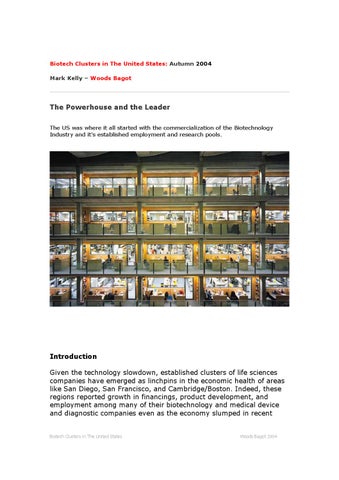
The Powerhouse and the Leader The US was where it all started with the commercialization of the Biotechnology Industry and it’s established employment and research pools.
Introduction Given the technology slowdown, established clusters of life sciences companies have emerged as linchpins in the economic health of areas like San Diego, San Francisco, and Cambridge/Boston. Indeed, these regions reported growth in financings, product development, and employment among many of their biotechnology and medical device and diagnostic companies even as the economy slumped in recent
Biotech Clusters in The United States
Woods Bagot 2004
years. And, global pharmaceutical companies are doing more than making collaborative investments in biotech and device companies in these clusters; they are also relocating their research and development to these locales.
In this Paper, we will explore how clusters get launched and then take a look at the key ingredients that make up a successful technology cluster using San Diego – home to one of today’s fastest growing biomedical clusters – as a model. Finally, we will explore the migration of R&D operations from a handful of pharmaceutical giants like AstraZeneca, Novartis AG, Merck & Co. Inc., and Pfizer into these yeasty biomedical discovery environments.
Biotech Clusters in The United States
Woods Bagot 2004
Humble Beginnings The notion of clusters, of course, is not new. In his seminal 1998 report “Clusters and the New Economy,” Harvard researcher Michael Porter defined clusters as “geographic concentrations of interconnected companies and institutions in a particular field.” These critical masses of closely located and closely related companies have long been studied – whether it’s entertainment in Hollywood or finance on Wall Street
Biotech Clusters in The United States
Woods Bagot 2004
So, how do clusters get started?
Porter and fellow researchers assert that most clusters can trace their roots to historical circumstances. The largest life sciences cluster, for instance, lies in the San Francisco Bay Area. The Bay is home to more than 700 biomedical companies and some 31 universities and research institutions. The Bay Area cluster began 25 years ago when Herbert Boyer, a biochemist at the University of California, San Francisco, sought to launch a company that would commercialize new medicines derived from recombinant DNA technology. With the help of venture capitalist Robert Swanson, Boyer founded Genentech – the world’s first biotechnology company – in South San Francisco. Likewise, the vibrant biotech cluster in Cambridge, Mass. had its beginnings in research done at Harvard and MIT.
Once a cluster begins to form, a chain of events take place that perpetuates as the strength and the visibility of the cluster grows. Growth of the cluster is initially encouraged by success stories that signal opportunity. As the hope of replicating the successes emerges, entrepreneurs take notice and individuals with ideas or relevant skills migrate to the cluster location from other regions. Next, specialized suppliers, financiers, and service firms move in to aid young companies. Finally, local institutions develop specialized research and training programs to feed the growing demand for technology and talent.
Biotech Clusters in The United States
Woods Bagot 2004
Case Study: San Diego Clusters comprise a set of ingredients including researchers, entrepreneurs, venture capitalists, well-trained and educated workers, and specialized professional services. The importance of each ingredient is undeniable, yet the proximity to research centers and institutions is perhaps the most critical element of success for technology clusters. Consider San Diego. Once a region losing jobs due to defense industry downsizing, San Diego has emerged today as one of the most advanced centers in the United States for biomedicine. The region, in fact, lays claim to the most concentrated and diverse life sciences cluster in the world. More than 35,000 people work at the 400 companies located within the county’s 4,200 square miles. That is 38 percent more life sciences companies per square mile than the Bay Area, long thought to be the center of biotech.
Such a strong life sciences cluster is an invaluable resource to San Diego. For instance, while the economies in many tech-rich metro areas were hurt badly during the technology meltdown, San Diego’s economy was impacted far less dramatically. This is largely due to the fact that San Diego’s technology economy includes a significant focus on life sciences – as opposed to only software or only telecom – and was better positioned to withstand the downturn. In the most recent Pricewaterhouse Coopers Money Tree™ report, San Diego’s life sciences companies (biotech, medical devices, and healthcare services) led the way with $95 million or 61% of the total funds invested in San Diego during the quarter.
Biotech Clusters in The United States
Woods Bagot 2004
Much of San Diego’s success in breeding life sciences companies and attracting venture capital stems from three world-class biological research institutes within walking distance of one another: the University of California, San Diego; the Scripps Clinics; and the Salk Institute. Of equal importance, however, has been the ability to translate their research into viable commercial products and the proximity to biotech ventures that have done so. Many regions have outstanding scientists doing great work, but they aren’t encouraged to turn their work into commercial applications. In San Diego, a program called UCSD CONNECT was created to link life sciences and other entrepreneurs with the resources they need for success: technology; money; management; partners; and support services. CONNECT is widely regarded as one of the nation’s most successful regional programs for fostering the commercialization of promising research. Meanwhile, there tends to be lots of movement between San Diego’s clustered biotech companies and laboratories, especially among midlevel and senior researchers and management. Such movement drives entrepreneurs, innovation, and ultimately the creation of new jobs.
Biotech Clusters in The United States
Woods Bagot 2004
Why Do Biomedical Industry Clusters Flourish in California?
It’s no accident that the biomedical R&D industry is vibrant in California. California has long been known as a frontier state, a place of discovery, experimentation, and knowledge creation. Thus, it is an apt home to a large, flourishing, and renowned life sciences academic research community that includes the nine-campus: • • • • • • • •
University of California, The 23-campus California State University, Stanford University, University of Southern California, Caltech, And private research institutions such as The Salk Institute, The Scripps Research Institute, And The Burnham Institute.
Academics at these institutions, often collaborating with scientists in commercial companies, conduct broad-based scientific studies, funded largely through sustained federal and state government investment. These studies often serve as the source of important private sector innovations. The state’s world-class academic research institutions also are the wellspring of a well-educated and skilled biomedical R&D industry workforce. A fertile milieu for strong economic performance grows from a culture that values entrepreneurial spirit and high productivity, combined with public and private investment capital, and successful institutions that act as industry anchors. These vital and dynamic ingredients combine to form a robust regional economy in each of the seven clusters of California’s biomedical R&D industry — from the Bay Area to San Diego. Biomedical industry growth provides increased personal income, which can improve the quality of life, and stimulate more investment. Growth in each regional economy contributes to a prosperous California economy.
Power in Numbers As biotech hotbeds like San Diego continue to gain visibility as ideal environments for biomedical discovery, they are also becoming magnets for global pharmaceutical companies. Switzerland-based
Biotech Clusters in The United States
Woods Bagot 2004
Novartis, for example, recently founded two new research facilities in San Diego: The Novartis Agricultural Discovery Institute, which will emphasize agricultural research; and the Novartis Institute of Functional Genomics, a 410,000 square-foot facility that focuses on the functioning of human genes in preventing diseases. Johnson & Johnson will move into the area as well, building a new facility due for completion in 2004. The J&J research center will house 600 scientists and staff.
Meanwhile, Pfizer gained a foothold in San Diego when it acquired Warner-Lambert Co., which had purchased biotech pioneer Agouron Pharmaceuticals Inc. in 1999. Today, its La Jolla Laboratory has about 1,300 scientists.
Cambridge/Boston is another cluster location attracting major pharmaceutical investment. AstraZeneca, for one, is building out its R&D center in the Boston area. The unit currently houses about 370 employees, 320 of which are scientists. Amgen, the Thousand Oaks, Calif.-based Company, sited its 285,000-square-foot research building
Biotech Clusters in The United States
Woods Bagot 2004
in Cambridge. Pfizer and Merck are also migrating to the area. Pfizer opened a 70-person Pfizer Discovery Research Center in Cambridge in 1999 and Merck is planning a 300,000 square-foot facility in Boston’s Longwood Medical neighborhood, which is set to open in 2004. And, most recently, Novartis relocated its R&D headquarters from Basel, Switzerland, to Cambridge. The Novartis Institute for Biomedical Research Inc. began operations earlier this year with 350 scientists occupying lab space on the campus of MIT and plans for a second building that will accommodate roughly 600 more researchers by 2004.
Chief among the reasons cited for these big pharma moves are the talent base and cutting edge science found in today’s biotech clusters. The best hospitals, universities, and research centers are clustered in these areas and local academics and physicians are eager to work together to discover new medicines and biomedical therapies. Add to that the presence of hundreds of biotech ventures and other pharmaceutical companies and the cross-fertilization of ideas and skills makes these locations attractive R&D sites. Recruiting new employees with R&D or manufacturing skills, for instance, is easier if there is already a large base of pharmaceutical or biotech workers right in the neighborhood
Conclusion Modern competitive advantage in the life sciences revolves around transforming technical vision and insight into novel solutions and
Biotech Clusters in The United States
Woods Bagot 2004
therapies. The clustering of biotech and medical device firms around world-class universities and research institutions in San Diego, San Francisco, and Boston has spawned some of the most dynamic and vibrant hotbeds for life sciences discovery and development. These clusters offer an extensive and renewable resource of ideas and talent and, will continue to lure some of the pharmaceutical industry’s biggest players.
Biotech Clusters in The United States
Woods Bagot 2004
Biotech Clusters in The United States
Woods Bagot 2004