OTA
vs Direct Booking: A Complete Guide for Hotels to Improve Revenue and Profitability
In today's hospitality industry, hotels face a crucial decision: Should they rely on Online Travel Agencies (OTAs) or focus on increasing direct bookings?
Platforms like Booking.com, Expedia, Agoda, and MakeMyTrip have transformed the way travelers book accommodations. While OTAs provide visibility and convenience, direct bookings offer greater control and profitability for hotels.
The reality is that both channels have their place. The challenge lies in finding the right balance.
Understanding OTAs
An Online Travel Agency (OTA) acts as a marketplace where travelers can compare and book hotels.
Popular examples include:
• Booking.com
• Expedia
• Agoda
• MakeMyTrip
• Airbnb
OTAs attract millions of travelers every day and help hotels reach a global audience.
Advantages
of OTAs
Increased visibility
OTAs expose hotels to travelers who may never have discovered the property otherwise.
Higher occupancy rates
Hotels often experience more bookings through OTA platforms, especially during low-demand periods.
International reach
OTAs help hotels attract guests from different countries and markets.
Marketing support
Many OTAs invest heavily in advertising, reducing the hotel's need to acquire every guest independently.
Disadvantages of OTAs
High commission fees
Most OTAs charge commissions ranging from 15% to 30% per booking.
Reduced profitability
Higher commissions mean lower net revenue.
Limited guest ownership
Hotels receive restricted access to guest information, making repeat marketing difficult.
Dependence risk
Heavy reliance on OTAs can make hotels vulnerable to algorithm changes and commission increases.
Understanding Direct Bookings
Direct bookings occur when guests reserve rooms through:
• Hotel websites
• Phone calls
• Email inquiries
• Social media channels
• Walk-ins
Unlike OTA reservations, direct bookings eliminate third-party commissions.
Advantages of Direct Bookings
Higher profit margins
Hotels retain the full booking value without paying commissions.
Better guest relationships
Hotels can communicate directly with guests before and after their stay.
Improved customer loyalty
Direct booking guests are more likely to become repeat customers.
Better data collection
Hotels gain valuable guest insights that can improve future marketing efforts.
Disadvantages of Direct Bookings
⚠ Requires marketing investment
Hotels must actively promote their properties online.
⚠ Website optimization is essential
A poorly designed booking experience can reduce conversion rates.
⚠ Competitive market
Hotels compete with OTAs that often dominate search results.
OTA vs Direct Booking: A Quick Comparison
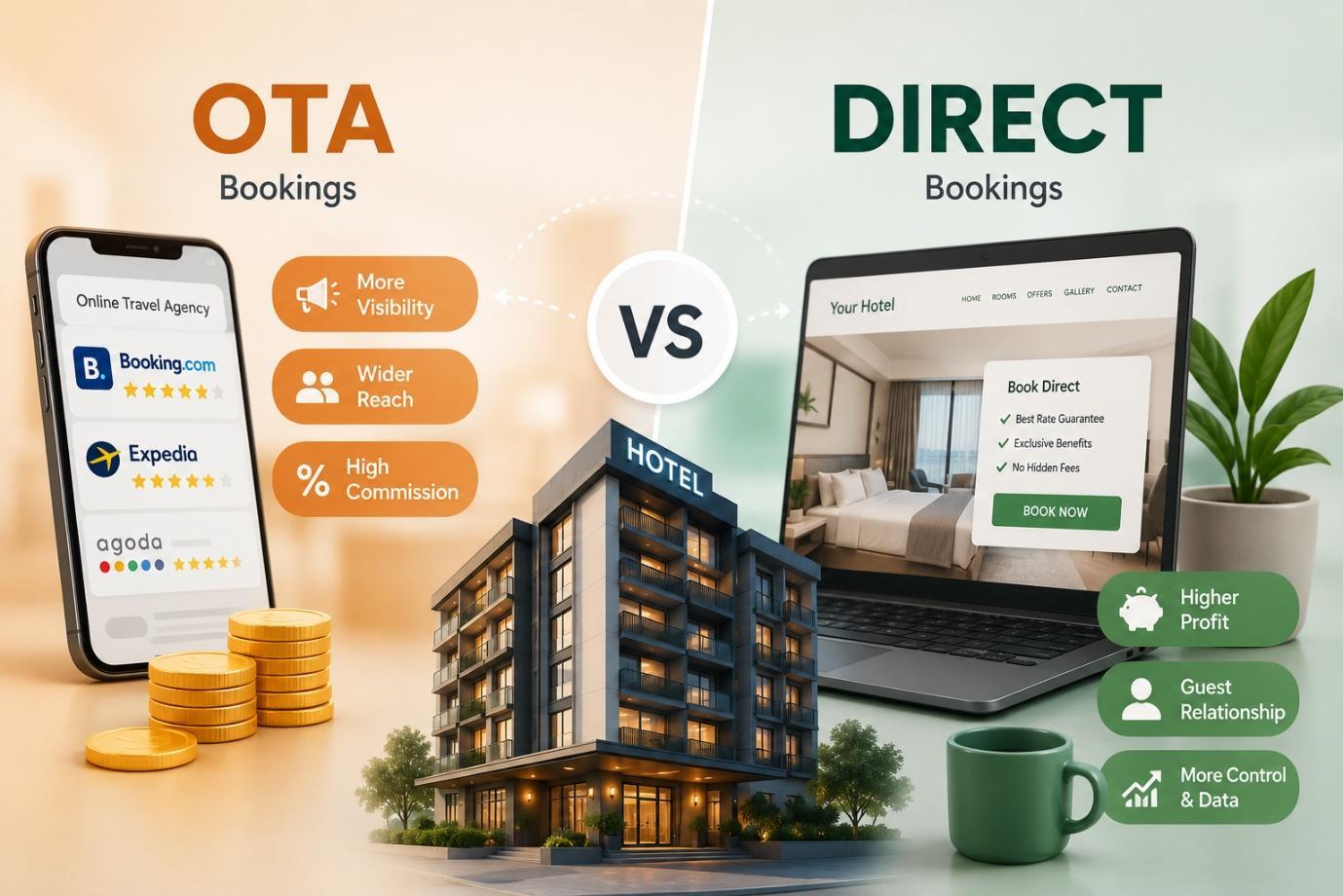
Factor OTA Booking Direct Booking
Visibility High Depends on marketing
Commission High None
Guest Data Limited Full access
Profit Margin Lower Higher
Brand Control Limited Complete
Customer Loyalty Lower Higher
The comparison clearly shows that while OTAs generate demand, direct bookings generally produce better long-term profitability.
Why Hotels Should Not Abandon OTAs
Many hotel owners assume that direct bookings should completely replace OTAs.
This is rarely the best approach.
OTAs serve an important role by introducing new guests to the property.
For independent hotels and boutique properties, OTA platforms often provide exposure that would otherwise require significant marketing budgets.
Think of OTAs as a customer acquisition channel rather than a long-term dependency.
The goal is not to eliminate OTAs but to reduce excessive reliance on them.
Why Direct Bookings Matter More Than Ever
The hospitality industry has become increasingly competitive.
As commission costs rise, hotels are focusing on strategies that increase direct revenue.
A direct booking offers several advantages:
• Higher revenue per room
• Better guest communication
• Improved repeat business
• Stronger brand recognition
• More marketing opportunities
Hotels that successfully increase direct bookings often experience stronger overall profitability, even if occupancy remains unchanged.
Strategies to Increase Direct Bookings
1. Build a User-Friendly Website
Your website should provide:
• Fast loading speed
• Mobile responsiveness
• Easy navigation
• Simple booking process
A complicated booking experience can cause potential guests to abandon their reservations.
2. Offer Exclusive Website Benefits
Many hotels encourage direct bookings by offering:
• Complimentary breakfast
• Room upgrades
• Flexible cancellation policies
• Early check-in or late checkout
These incentives create value without significantly affecting profitability.
3. Invest in SEO
Search Engine Optimization helps hotels attract organic visitors.
Ranking for searches such as:
• Best hotels in Chennai
• Family hotels near Marina Beach
• Business hotels in Bangalore can generate valuable direct traffic.
4. Leverage Email Marketing
Guest databases can become powerful marketing assets.
Personalized offers, seasonal promotions, and loyalty rewards encourage repeat bookings.
5. Use Revenue Management Effectively
Pricing plays a critical role in booking decisions.
Hotels that optimize rates according to demand trends often achieve stronger direct booking performance.
Many hospitality businesses work with revenue management specialists to identify opportunities for improving occupancy, pricing, and profitability.
Resources from TheIvar (https://www.theivar.in/) provide insights into hotel revenue optimization and tourism business growth.
The Ideal Approach: A Balanced Distribution Strategy
Successful hotels rarely depend entirely on one channel. Instead, they create a balanced distribution mix.
A typical strategy may look like:
• 40–60% Direct Bookings
• 30–50% OTA Bookings
• Remaining bookings through corporate, travel agent, or group channels
This approach combines OTA visibility with direct booking profitability.
The Future of Hotel Distribution
Technology continues to reshape guest booking behavior.
Travelers increasingly:
Book through mobile devices
Research extensively before purchasing
Compare reviews across multiple platforms
Seek personalized experiences
Hotels that invest in direct booking channels while strategically utilizing OTAs will be better positioned for sustainable growth.
The future belongs to properties that use OTAs for exposure and direct bookings for profitability.
Conclusion
OTA bookings and direct bookings are not competitors they are complementary tools.
OTAs provide visibility, reach, and customer acquisition. Direct bookings provide profitability, guest ownership, and long-term growth.
The most successful hotels understand how to leverage both channels effectively. Many achieve this by partnering with a hospitality consultant who can guide pricing, distribution, marketing, and revenue strategies.
Rather than choosing one over the other, focus on building a balanced distribution strategy that maximizes occupancy while protecting profit margins.