002 Hardware & Fastener Components no.72/2026
Hardware & Fastener Components no.72/2026 007
008 Hardware & Fastener Components no.72/2026
010 Hardware & Fastener Components no.72/2026
Hardware & Fastener Components no.72/2026 011
Hardware & Fastener Components no.72/2026 013
014 Hardware & Fastener Components no.72/2026
Hardware & Fastener Components no.72/2026 015
Hardware & Fastener Components no.72/2026 017
018 Hardware & Fastener Components no.72/2026
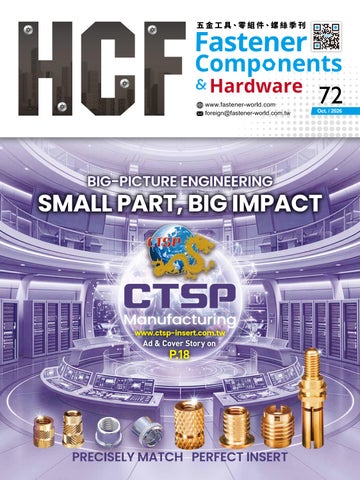
COVER STORY
Small Parts. Big Engineering Capability.
CTSP Redefi fin nes Precision Part Value Through Big-Picture Engineering
小零件背後,是一整套工程能力!金泰興以「全局思考」重新定義精密零件的價值 In high-end manufacturing, small threaded inserts can affect product strength, durability, reliability, assembly efficiency, and massproduction stability. A manufacturer’s value therefore depends not only on producing parts to drawings, but on understanding their role within the customer’s product, assembly process, and production environment. CTSP integrates design, materials, manufacturing,
quality, installation, and production requirements to reduce risk, improve efficiency, and create greater value.
From Build-to-Print to Big-Picture Engineering
As products become lighter, more precise, reliable, and complex, traditional build-to-print manufacturing is often insufficient. Material, tolerances, geometry, surface treatment, installation, and manufacturing processes are interconnected, affecting assembly, fastening performance, service life, and production stability. With more than 20 years of experience, CTSP extends its expertise into product development and engineering collaboration. By discussing materials, geometry, tolerances, processes, installation,
application requirements, and mass-production feasibility, CTSP identifies risks early and resolves complex issues before mass production.
Hardware & Fastener Components - no.72/2026
Engineering Capability from Design to Mass Production
True engineering capability must translate design into stable, repeatable, scalable production. CTSP manufactures more than 20 million precision components per month. Automated machining, vision measurement, optical sorting, and digital process management turn customized requirements into controlled, repeatable processes. Its engineering and quality systems integrate process control, inspection, and traceability from raw materials through final shipment. Automation delivers not only capacity, but consistent quality through standardization, digitalization, automated inspection, and systematic control.
Materials, Quality, Cost, and Risk—Considered Together
CTSP evaluates brass, stainless steel, carbon and alloy steels, and aluminum alloys together with geometry, installation conditions, mechanical requirements, application environments, surface treatment, and production volume. The best solution is not necessarily the most expensive material or complex process, but one that meets performance requirements while balancing quality, manufacturability, risk, and cost. Early design decisions can affect tooling, machining, inspection, assembly, production stability, and total manufacturing cost. CTSP provides engineering support from development through mass production, reducing trial-and-error,
revisions, abnormalities, quality issues, and downstream risks.
Beyond Manufacturing: Integrated Supply Chain Capability
Customers increasingly emphasize material sourcing, traceability, supply chain transparency, regulatory compliance, documentation, sustainability, and supply stability. Precision manufacturing therefore requires integrated engineering, manufacturing, quality, information, compliance, and supply chain management. CTSP is transforming into an engineering-oriented manufacturing partner, connecting requirements, design, materials, process development, testing, production, quality control, documentation, traceability, and delivery. Early involvement helps identify issues when they are easier and less costly to resolve.
020 惠達雜誌
CTSP’s contact: General Manager Lee
Email: inquiry@ctsp-insert.com.tw
COVER STORY From a Single Component to the Complete Application
An insert’s performance depends not only on the insert itself, but also on mating materials, installation methods, torque, pull-out requirements, geometry, operating environment, and assembly processes. CTSP evaluates the complete application to develop solutions practical for both performance and mass production.
Quality Is Designed into the Process
Hardware & Fastener Components - no.72/2026
Quality cannot depend solely on final inspection. CTSP combines process planning, tooling control, dimensional inspection, automated optica l sor ting, production monitoring, and traceability to minimize variation, improve repeatability, and maintain stable quality across batches.
Small Part, Big Impact
Behind every threaded insert lies expertise in materials, precision machining, tooling, surface treatment, quality control, automated inspection, engineering, and massproduction management. By integrating these capabilities,
CTSP creates value beyond a component ’s physical size. Its big-picture engineering strategy simplifies complex customer challenges and advances toward integrated engineering ser vices—from design to mass production , material selection to quality verification, and individual components to complete applications.
For CTSP, advanced manufacturing is not simply about making a small part better, but making it contribute to the success of the entire product.
Copyright owned by Fastener World / Article by Dean Tseng 惠達雜誌
021
COMPANY FOCUS
Breaking Tools Limitations:
突破傳統工具侷限 首君用數位AI翻轉用戶體驗 Copyright owned by Fastener World Article by Gang Hao Chang, Vice Editor-in-Chief
Stand Tools Reinvents Users’ Experience with Digital & AI Tech Having gradually transitioned from traditional hand tools to the development of digital hand tools, Stand Tools Enterprise is arguably one of Taiwan’s most knowledgeable professional manufacturers when it comes to understanding the needs of hand tool users. For nearly 40 years, the company has continuously invested in the R&D and manufacturing of ratchet screwdrivers, magnetic tools, and digital hand tools. After four years of development, the company successfully launched its first industrial-grade digital hand tool in 2008, elevating Stand Tools from a manufacturer of traditional DIY-grade hand tools to a major professional manufacturer with the R&D capabilities to produce industrial-grade digital hand tools. In addition to continuing to provide customers with traditional DIY hand tools, the company has also developed digital tools to meet the new-generation industrial demands and expand into entirely new customer segments.
Integrating Mechatronics and IC Technology: Intuitive Design Better Meets User Needs
Hardware & Fastener Components - no.72/2026
Many members of Stand Tools’ R&D team have backgrounds in mechanical and electronic engineering, giving the company signif icant technical advantages. As a result, since entering the digital sector, Stand Tools’ capabilities in integrating nanotech, electronic engineering, semiconductors, mechanical engineering, and IC design have become even more evident. Coupled with the geographical advantages of being located in Central Taiwan and the prevailing trend toward highvalue-added transformation across many industries, Stand Tools’ products integrate IC electronic components from nearby high-tech partners, tool motherboards, and inhouse developed software. In recent years, the company has also gradually expanded into the field of AI, creating more possibilities for its products through a combination of inhouse development and outsourcing. “We have extensive experience working with diverse supplier cultures. The greatest challenge in developing digital tools lies not in the hardware or software itself, but in helping hardware and software engineers understand the bottlenecks in machining and helping machinists understand the limitations of software—so they can communicate their ideas and collaborate to create products,” said Brand Hsiao, CFO of Stand Tools. Ease of use is one of Stand Tools’ top priorities in product development. In addition to durability, the precise data measurement and convenient data logging methods are all designed to minimize customer risks and solve application challenges (for example, using memory cards to avoid the risk of data loss due to temporary wireless connection interruptions). By transitioning from traditional to digital operations, Stand Tools has a greater opportunity than its peers to capitalize on AI business opportunities. Its client base has expanded from DIY customers to include automotive/ motorcycle repair, machinery, aviation, and electronics, and the company has also established collaborations with
022 惠達雜誌
a large Chinese vehicle manufacturer, as well as other clients from major engineering projects, nuclear energy, power plants, oil fields, bridge piers, and national defense sectors. As Taiwan’s first hand tool manufacturer to obtain national-level laboratory certification, Stand Tools has a deeper understanding than its peers of how to implement rigorous quality control, and its extensive experience makes it easier to align with overseas clients. When responding to clients’ OEM design requirements, the company provides the most appropriate development recommendations based on the market potential and growth prospects of their products, ensuring that clients never undertake projects simply for the sake of doing so.
Building Distribution Channels with Self-Owned Brands & Implementing ESG to Create New Corporate Value Drawing on the experiences of peers in Europe, the U.S., and Japan, Stand Tools is expanding its domestic and international distribution channels through various self-owned brands, with the aim of deepening customer impressions of its products by building a strong brand image. At the same time, the company has integrated ESG principles into its operational management, strengthening green and eco-friendly carbon-reduction initiatives such as energy management, improving equipment efficiency, solar energy applications, and reducing wastewater pollution. Additionally, by practicing sound corporate governance, enhancing employee ser vices and training, and even sponsoring a “Little Athletes” program for elementary and middle school students, the company is actively fulfilling its corporate social responsibilities. CFO Hsiao stated that the future of business will inevitably move toward more transparent management. We have observed many valuable lessons from the European, U.S., and Japanese markets. Although the industry faces numerous challenges, we will strive to enhance our brand’s added value, proactively target high-potential markets, and use more robust technology to improve the users’ experience, thereby opening up more market opportunities.
Stand Tools contact: Brand Hsiao, CFO / Email: brand.hsiao@standtools.com
專用離合器鎖緊螺帽套筒
適用機車薄型螺帽
Japanese motorcycle aftermarket parts manufacturer Daytona Corp. launched its new “Clutch Lock Nut Socket” on August 24, 2026, specifically designed to remove the thin clutch nuts commonly found on scooters. The new product is available in 4 sizes to accommodate different applications.
Hardware Innovation Alley
Designed with the characteristics of thin clutch nuts in mind, the socket features a flat, precision-machined contact surface that distributes force more evenly. This design helps minimize damage to the corners of the nut even when applying high torque of 40–60 N∙m or more. Featuring a 12.7 mm (1/2-inch) drive size, the socket can also be used with impact wrenches, helpi ng i mprove ef f iciency during motorcycle maintenance and repair work.
五金新品大道
SPECIAL FEATURE
Clutch Lock Nut Socket for Thin Scooter Clutch Nuts
Daytona has b e e n d evelo pi n g motorcycle a f termarket products since its establishment in 1972. With a focus on product planning and development, the company provides parts and services tailored to riders’ needs and aims to build a brand supported by motorcycle enthusiasts around the world.
Compiled by Fastener World
10-Piece TORX PLUS® Bit Set for High-Torque Applications 10件式 TORX PLUS® 起子頭套組,滿足高扭力鎖固需求 Mayhew Tools has introduced a new 10-piece TORX PLUS® Bit Set, designed to provide higher torque transfer and reduce cam-out in demanding automotive, industrial, and construction applications.
According to Mayhew Tools, the TORX PLUS® drive design enables greater torque transfer than conventional TORX® systems while helping minimize cam-out. The design can improve fastening efficiency and contribute to longer service life for both bits and fasteners. The set also features a dedicated storage rail that keeps the bits organized and readily accessible, allowing operators to quickly identify the required size while maintaining an orderly workspace.
Ultra-Thin Compact Wrench for Double-Nut Applications 專為雙螺帽作業打造的極薄扳手 Japanese hand tool manufacturer Asahi Metal Industry has introduced its new “Ultra-Thin Compact Wrench,” designed specifically for double-nut fastening and removal operations. The wrench combines a slim profile with high strength, making it suitable for applications where working space is limited. The wrench features a thin profile designed to accommodate low-profile nuts. In double-nut applications, it can avoid interference from the standard nut positioned above and directly access the lower nut, providing greater convenience when working in confined spaces. 惠達雜誌
Hardware & Fastener Components - no.72/2026
Released on July 9, 2026, the set includes ten Dual Drive TORX PLUS® bits in sizes T10IP, T15IP, T20IP, T25IP, T27IP, T30IP, T40IP, T45IP, T50IP, and T55IP.
023
SPECIAL FEATURE
To balance slimness and strength, the new wrench is manufactured with a thickness close to that of JIS-standard lowprofile nuts. It is made from carbon steel and undergoes appropriate heat treatment to achieve strength equivalent to JIS requirements. Compared with stainless steel, the heat-treated steel construction also provides higher strength. The wrench also features laser-marked size indications, providing clear and durable identification that is resistant to wearing off during prolonged use. This allows operators to quickly select the appropriate wrench size in demanding working environments.
Universal Heavy-Duty Stapling Solutions for Professional Contractors 通用型重型釘槍工具系列,滿足專業施工需求 Paslode has launched its new Universal Heavy-Duty Stapling Program, a comprehensive manual fastening platform featuring 5 professional-grade tools and universal 3/8-inch crown staples. The new lineup is designed for stapling and tacking applications across construction, remodeling, maintenance and repair. The range includes 3 compression staplers—the Heavy-Duty Pro Stapler, 5-in-1 Pro Stapler and 2-in-1 Pro Stapler—as well as 2 hammer tackers, the Pro Hammer Tacker and Compact Hammer Tacker. The tools are designed for applications including house wrap, roofing paper, underlayment, insulation, carpet padding, upholstery, trim components and temporary jobsite materials. The new platform is built around Paslode Heavy-Duty Universal 3/8-inch Crown Staples and is also compatible with most heavyduty competitor staples. The universal staples are 20-gauge, galvanized chisel-point fasteners available in 1/4-, 5/16-, 3/8- and 1/2inch lengths, with multiple packaging options. According to Paslode, the lineup emphasizes durability, user comfort and quick loading to minimize jobsite downtime. The combination of compression staplers, hammer tackers and universal-fit staples provides contractors and dealers with a streamlined manual fastening solution for multiple trades. Paslode, part of Illinois Tool Works’ ITW Construction Products division, has more than 90 years of experience developing cordless and pneumatic fastening solutions for professional contractors.
Torque Driver for Greater Precision in Manual Implant Procedures 扭力起子,提升手動植牙操作精準度
Hardware & Fastener Components - no.72/2026
Dental technology company Conmetior has introduced the TactiqTM Torque Driver, a finger-powered torque control device designed for the final tightening stage of implant prosthetic procedures. The instrument brings preset torque control to manual workflows while preserving the tactile feedback familiar to clinicians.
024 惠達雜誌
TactiqTM multiplies finger force by 5.5 and uses an internal mechanical declutch mechanism that disengages once the preset torque threshold is reached. The driver then spins freely and produces an audible click, signaling that the specified torque has been achieved. Three torque settings—10, 15 and 20 Ncm—are available to accommodate specifications commonly used across different implant systems and restorative components. The device is designed to address the need for controlled final tightening. Under-tightening can affect joint stability, while excessive torque may place additional stress on screws, prosthetic components or implant connections. Conmetior advises clinicians to follow the torque specifications provided by the relevant implant manufacturer and verify compatibility when selecting a TactiqTM configuration. TactiqTM features interchangeable latch-style mandrel tips for compatibility with a broad range of implant systems. The driver is machined from medicalgrade stainless steel and incorporates a deep diamond-knurled grip for controlled rotation with gloved hands. Its matte, bead-blasted finish helps reduce glare under operatory lighting. The instrument is also autoclavable at 135°C for an 18-minute sterilization cycle, supporting routine clinical reprocessing. According to Conmetior, TactiqTM was developed internally to provide clinicians with preset torque control without requiring them to change their established manual technique.
Hardware & Fastener Components no.72/2026 025
SPECIAL FEATURE
al i r o t i d E
2027 Global Hardware
Components Market Outlook Report 社論:2027全球五金零組件市場展望報告 Copyright owned by Fastener World / Article by Dean Tseng
Demand Shift, Supply Chain Restructuring & New Landscape of Competition for High-Value Products Fasteners are like the “backbone of manufacturing,” while hardware components (Table 1) are like an entire “skeletal system” hidden behind global manufacturing. Springs, steel wire products, hinges, brackets, door and window hardware, furniture hardware, locks, rubber seals, and various mounting and mechanical components may each have a relatively low unit price, yet they are widely used in automobiles, construction, machinery, electronic equipment, data centers, aerospace and energy facilities.
Table 1. Scope of 〝Hardware Component〞 Defined in this Article HS Codes Category Title 7320 Springs and spring leaves 7326.2 8302
Hardware & Fastener Components - no.72/2026
3926.3 4016.93 8301 8308.1 8305
Content Leaf springs, coil springs and other types of springs. Certain wire clips, wire positioning parts and wire fasteners used for Articles of iron or steel wire fixing applications. Metal fittings and brackets for furniture, Hinges, casters, vehicle fittings, architectural fittings, furniture doors/windows, vehicle bodies, etc. fittings, brackets and similar products. Plastic fittings for furniture, vehicle bodies, Plastic furniture fittings, vehicle fittings and similar assembly etc. components; may include certain plastic fixing and mounting parts. Rubber gaskets, washers and other sealing Rubber washers, seals, certain O-rings and other products related products to sealing/fixing. Padlocks, vehicle locks, furniture locks, other locks, and fasteners Locks, padlocks and lock-type fasteners and lock components incorporating locking functions. Mainly used for garments, footwear, leather goods and other Base-metal hooks, eyes and eyelets manufactured products. Base-metal fittings for loose-leaf binders Binder/file fittings, paper clips, index tags and strip staples. and files, paper clips and staples
In its latest September 2026 outlook, OECD projected global GDP growth of 2.9% in 2026 and 3.0% in 2027, indicating that the global economy is not heading into a broad-based recession. The U.S. is projected to grow 2.2% and 2.1% in 2026 and 2027, respectively; the euro area is projected at 1.0% in both years; and China is expected to slow from 4.5% in 2026 to 4.2% in 2027. Meanwhile, AI-related investment remains an important force supporting global production, trade and investment. The key questions for the global hardware components market are: Which industries are investing? Which countries are expanding manufacturing capacity? Which supply chains are moving? From this perspective, the global hardware components market in 2026 is less a broad recovery than a “shift in demand gears.”
Global Hardware Components Demand Is Not Recovering Across the Board—It Is Splitting The most striking feature of the global economy in 2026 is the widening gap in business conditions across industries.
026 惠達雜誌
The automotive industry shows a similar pattern. The Boston Consulting Group’s 2026 Global Automotive Supplier Study indicates that global demand for automotive components is still expected to grow over the long term, but the value pool is being redistributed. Batteries, electrical and electronic systems, ADAS, autonomous driving and softwarerelated fields are growing faster, while components associated with traditional internal-combustion powertrains face structural decline. The study also notes that suppliers’ challenges have shifted from the acute post-pandemic crisis to a “new normal” combining interest rates, costs, labor shortages, geopolitical risks and demand volatility.
Table 2. Applications of Key Components in EVs Main Application on EVs 1. Support for underbody suspension and shockabsorbing systems Springs
2. Mounting of powertrain/electrical components such as drive motors and inverters
1. Changes in safety and rigidity: battery brackets must provide very high crash-energy absorption and structural protection.
2. Integrated die-casting trend: to reduce part count and weight, many traditional steel brackets are shifting to 3. Mounting of onboard radars, cameras and other one-piece aluminum-alloy structures. sensors 1. Connections for conventional four-door vehicle doors and rear tailgates
Hinges
1. Much higher rigidity requirements: heavier battery packs require greater load capacity and fatigue life.
2. Gas struts for powered tailgates and front trunks 2. Lightweight design: high-strength steel or composite materials are used to reduce vehicle weight and extend 3. Miniature return mechanisms for interior buttons driving range. and storage compartments 1. Mounting and crash-protection structures for heavy battery modules
Brackets
Technical Changes & Challenges in the EV Era
2. Opening/closing mechanisms for front trunks 3. Connections for EV charging-port doors
1. Waterproofing and dust protection for battery packs, motors and high-voltage electronics
1. New component demand: conventional vehicles do not have front-trunk or charging-port-door hinges, creating new demand in EVs. 2. Smart and concealed designs: hinge designs must accommodate streamlined bodywork, such as concealed hinges, and electronic/electric opening systems. 1. Very high water/dust protection: high-voltage battery systems have a high short-circuit risk, requiring seals to meet high standards such as IP67/IP69K.
Seals
2. Air sealing and sound insulation for doors and windows
Locks
1. Electronic security locks for doors and front/rear 1. Full electronic and digital integration: conventional mechanical locks are shifting to electronically integrated luggage compartments locks supporting phone sensing or concealed handles. 2. Anti-pullout electronic locks for charging 2. Dedicated lock applications: “charging-gun electronic connectors locks” help prevent charging interruption or accidental removal of the charging connector.
2. Stricter acoustic requirements: without engine noise, wind and road noise become more noticeable, requiring better sound absorption and air sealing.
Yet a vehicle does not suddenly stop needing springs, brackets, hinges, seals, locks or other metal components simply because it shifts from an internal-combustion engine to an electric powertrain (Table 2). What is really changing is which components see rising or falling demand, as well as customers’ requirements for performance, materials, reliability and supply. Hardware component companies therefore cannot track only “volume”; they must also track structural changes across industries.
U.S. Demand Is Shifting from “General Manufacturing” to “High Investment Intensity” According to the UN Comtrade Database (Figure 1), U.S. imports of the 8 hardware component categories selected in Table 1 were approximately US$16.580 billion in 2021, rising to US$18.879 billion in 2022; they fell to US$16.737 billion in 2023, recovered to US$17.679 billion in 2024, and stood at US$16.552 billion in 2025. Over the same period, exports increased from US$6.173 billion in 2021 to US$7.183 billion in 2025. More noteworthy is the change in weight.
Hardware & Fastener Components - no.72/2026
Product Title
SPECIAL FEATURE
On one hand, parts of Europe’s traditional manufacturing sector continue to face pressure from energy, labor, interest rates and competition. On the other, U.S. investment in AI infrastructure, data centers, aerospace and selected manufacturing industries is emerging as a new pillar of demand.
U.S. hardware component import weight rose from approximately 2.682 million tons in 2021 to 2.807 million tons in 2022, fell to 2.325 million tons in 2023, recovered to 2.567 million tons in 2024, and declined again to 2.284 惠達雜誌
027
Hardware & Fastener Components - no.72/2026
China’s Role as the Global Manufacturing Base Remains, but Its Demand Structure Is Changing China is simultaneously a manufacturing base, an export base, and an upstream supplier to other manufacturing bases in Asia. From changes in hardware component trade between 2021 and 2025 (Figure 2), China has maintained substantial expor t capacity, ser ving not on ly domestic demand but also large manufacturing markets in Vietnam, Thailand, India and elsewhere in Asia. For HS 8302, for example, China’s exports to Vietnam reached approximately US$846 million in 2025, up 3.2% from US$820 million in 2024; hinge exports alone rose from about US$174 million to US$196 million, up 12.6%. This shows that even when some final-product manufacturing activities move outside China, Chinese hardware components can still “go overseas” with the supply chain. T h e r e a l ch a n g e i n C h i n a’s h a r d w a r e components i ndustr y is therefore the restructuring of manufacturing-base functions. Some compan ies conti nue to center thei r operations on large-scale manufacturing and exports from China, while others are beginning to establish new production nodes in Southeast Asia, India and Mexico in coordination with customers, creating hybrid models such as “Made in
028 惠達雜誌
190
Unit: USD 100 Million
T h e U.S. c on s t r u c t ion m a r ke t f u r t h er i l lu s t r a t e s t h i s “s h i f t i n dem a nd gea r s.” According to the U.S. Census Bureau and the National Association of Home Builders, U.S. housing star ts declined from 1.3671 million units in 2024 to 1.3587 million units in 2025; cumulative starts in January–August 2026 were about 930,000 units, with the f ull-year total estimated at roughly 1.30–1.35 million units. T he housing market has not shown strong expansion, but this cannot be directly interpreted as weak demand for U.S. construction hardware. The A merican Institute of A rchitects’ July 2026 construction forecast showed signif icant divergence within the U.S. nonresidential market: data centers are driving commercial construction investment, while manufacturing construction spending is facing adjustment. In other words, weak traditional constr uction demand does not mean all construction hardware demand is weak; demand is shifting toward data centers, energy, infrastructure and high-tech manufacturing facilities. For suppliers, the implication is clear: in the U.S. hardware components market, market position may matter more than the overall market size.
Fig. 1. U.S. Hardware Components Global Import & Export Value 210
170
188.79 167.37
165.8
176.79
165.52
150 130 110 90 70 50
61.73 2021
69.76
72.41
74.25
71.83
2022
2023
2024
2025
Import
Export
Data Source: UN Comtrade
Fig. 2. China Hardware Components Global Import & Export Value 300.00
Unit: USD 100 Million
SPECIAL FEATURE
million tons in 2025. In other words, the value of imports in 2025 had broadly returned to the 2021 level, while import weight was below the 2021 level. This indicates that the U.S. market is not growing simply by “buying more weight”; its product mix and unit value are changing.
266.47
281.99
256.84
266.02
265.51
27.43
26.84
26.15
2023
2024
2025
250.00 200.00 150.00 100.00 50.00 0.00
38.52
32.48
2021
2022 Import
Export
Jan-Aug 2026 import value at USD 1.77 billion (-3%), export at 17.8 billion (-2%); ;Data Source: China customs
China + overseas assembly” or “Chinese supply + regional production.” This also explains why Chinese suppliers continue to have a strong presence in Southeast Asian hardware components import markets. For Chinese suppliers, the next stage of competition is no longer simply about mass production. The key is whether they can convert their existing scale, cost advantages and comprehensive supply chain into high reliability, fast delivery, customization and regional supply capabilities required by automotive, electronics, energy, machinery, construction and emerging manufacturing industries. Therefore, the key questions for China’s hardware market in 2026–2027 are which parts of manufacturing will remain in China, which will follow customers overseas, and whether Chinese suppliers can continue to control component supply chains for overseas manufacturing bases. China may no longer be the “world’s factory” in the future, but it may increasingly become the “component supply center behind the world’s factories.”
Taiwan: Traditional Hardware Components Are Being Repositioned Amid Soaring AI Exports Taiwan is positioned at the core of global AI, semiconductor and advanced electronics manufacturing supply chains. At the same time, exports of traditional Taiwanese hardware components are undergoing a clear contraction. This is not simply a market decline; it is more accurately a redistribution of demand within Taiwan’s manufacturing sector. Taiwan’s hardware component exports to the world fell from US$2.349 billion in 2021 to US$1.932 billion in 2025, a decline of about 17.7%, while imports rose from US$552 million to US$606 million, up about 9.7% (Figure 3). In 2025, the trade sur plus between expor ts and impor ts narrowed from about US$1.570 billion to about US$1.325 billion, down about 18% over five years. Taiwan remains a net exporter of these products, but its traditional hardware component model, which relied heavily on overseas sales, is being reshaped. The issue for Taiwan is not a lack of export demand; rather, demand is shifting from traditional manufacturing toward AI and high-tech manufacturing.
Hardware & Fastener Components no.72/2026 029
Hardware & Fastener Components - no.72/2026
Taiwan Is Moving from “Traditional Hardware Manufacturing” to “HighValue Components” Rather than describing Taiwan’s hardware components industry simply as being in decline, it is more precise to say that Taiwan is undergoing a reallocation of manufacturing resources. At one end, traditional products such as springs, steel wire products, locks, brackets and seals face declining export volumes amid global demand f luctuations, competition from lower-cost suppliers in China and Southeast Asia, and supplycha i n ad ju stment s by i nter nationa l customers. At the other end, demand related to semiconductor equipment, AI servers, electronic components, advanced packaging and high-end manufacturing equipment is increasing rapidly. If products can further enter semiconductor equipment, AI data centers, precision machinery, aerospace, energy equipment or high-end automotive supply chains, Taiwanese companies need to consider how to convert their existing capabilities in metalworking, precision forming, surface treatment, tooling, heat treatment and quality management into component capabilities required by high-tech industries— gradually transforming “general industrial
030 惠達雜誌
Unit: USD 100 Million
Taiwan’s hardware components have not lost competitiveness across the board; rather, performance varies considerably by product. HS 8302 brackets, fittings and similar products remain the largest export category. Exports reached US$631 million in 2025, accounting for about 48.9% of total exports of the 8 product categories; HS 8301 locks generated US$368 million in exports, or about a 28.6% share. Together, the two categories approached US$1 billion and accounted for approximately 77.5% of 2025 exports of the 8 categories. In other words, products supported by more comprehensive manufacturing capabilities, demanding q u a l it y req u i rement s a nd est a bl i shed application markets continue to maintain substantial export scale. In addition, exports of HS 4016.93 sealing gaskets, washers and other seals still reached US$192 million i n 2 025, i nd ica t i n g t h a t s ea l i n g a nd functional components retain an established international market base. Compared with standardized hardware, these products are more readily integrated into automotive, machinery, industrial equipment and energy applications where reliability requirements are higher.
Fig. 3. Taiwan Hardware Components Global Import & Export Value 30.00 25.00
23.49
24.56
20.00
19.69
20.97
19.32
15.00 10.00
5.52
5.59
4.90
5.26
6.06
2021
2022
2023
2024
2025
5.00 0.00
Import
Export
Jan-Aug 2026 import value at USD 458 million (+18%), export at 129 million (-3%); ;Data Source: Taiwan customs
Fig. 4. EU Hardware Components Global Import & Export Value 130 125
Unit: USD 100 Million
SPECIAL FEATURE
HS 8302 and 8301 Remain the Two Pillars of Taiwan’s Hardware Components Exports
125.13
124.77
120
115.53
115.2
119.39
115 110 105 100 95 90
87.77
94.31
91.27
89.13 81.43
85 80
2021
2022
2023 Import
2024
2025
Export
Data Source: UN Comtrade
consumables” into “high-specification, mission-critical components.” Taiwan’s real target should be higher-value component positions.
Europe: Manufacturing Conditions Are Weak, but High-Value Hardware Components Still Have Room to Survive EU hardware component imports (Figure 4) rose from US$8.777 billion in 2021 to US$9.127 billion in 2022, fell to US$8.143 billion in 2023, recovered to US$8.913 billion in 2024, and increased further to US$9.431 billion in 2025. Exports were US$12.477 billion in 2021, US$11.553 billion in 2022, US$11.520 billion in 2023, US$11.939 billion in 2024, and recovered to US$12.513 billion in 2025. The EU has both substantial import demand and greater export capacity, indicating that its hardware component industry still has deep manufacturing and re-export capabilities. However, the cost pressures facing European manufacturing cannot be ignored. Würth Group, for example, recorded sales of €10.9 billion in the f irst half of 2026, up 4.3% year on year, while also pointing to rising energy prices, geopolitical uncertainty and weak industrial activity in Germany as ongoing pressures; Eastern Europe and South America, meanwhile, provided stronger growth momentum. SFS Group is also restructuring its global production and distribution network in 2026, explicitly seeking to concentrate production in fewer sites, reduce complexity and allocate resources to applications with greater differentiation and customer value, while maintaining a “local supply” strategy. This points to an important market signal: the next step for Europe’s hardware components industry may not be to expand capacity across all products, but to retain high-value manufacturing while moving some cost-sensitive products to more costcompetitive locations. For standardized, heavy, low-unit-price and highly price-competitive hardware components—such as generalpurpose hinges, brackets, standard springs and some commodity hardware—European manufacturers have an economic rationale for shifting part of production to Asia or other cost-competitive regions amid energy, labor and compliance pressures. By contrast, medical
Hardware & Fastener Components - no.72/2026
Figure 5 shows that Japan’s hardware component imports were US$1.829 billion in 2021, US$1.843 billion in 2022, US$1.790 billion in 2023, US$1.729 billion in 2024, and recovered to US$1.782 billion in 2025. Exports fell from US$2.026 billion in 2021 to US$1.654 billion in 2023, stood at US$1.655 billion in 2024, and US$1.653 billion in 2025. In terms of weight, Japan’s imports declined steadily from about 232,700 tons in 2021 to 202,000 tons in 2025, while export volume fell from 89,500 tons to 80,100 tons. Japan shows declining weight but relatively stable value. When manufacturers are no longer increasing volumes of standardized products but continue to demand greater precision, lighter weight, higher reliability and special specifications, volume does not necessarily rise while the value of hardware components can remain stable. Japan’s automotive market shows a si m i la r pat ter n. Accord i n g to the International Organization of Motor Vehicle Manufacturers, sales of all types of new vehicles in Japan reached about 4.566 million units in 2025, up 3.3% from 2024 but still below the 5.195 million units recorded i n 2019. Japan is therefore not a typical “volume-growth market,” but rather a maturedemand, high-specification-manufacturing and equipment-upgrade market.
India Is a Dual Engine of “Demand + Manufacturing” Worth Watching Long Term India’s GDP growth rate was about 7.6% i n 2025, relatively stron g amon g major large economies, while net foreign direct i nvestment i n f lows were approx i mately US$39.1 billion. Hardware component trade also expanded (Figure 6): imports rose from US$1.204 billion in 2021 to US$1.458 billion
032 惠達雜誌
India’s growth story follows a clear sequence: population growth → urbanization → infrastructure expansion → factory investment → rising vehicle use → machinery and equipment growth → more hardware component demand. According to the International Organization of Motor Vehicle Manufacturers, sales of all types of vehicles in India reached about 5.518 million units in 2025, up 5.5% from 2024 and 44.6% above 2019. This indicates that India is not simply a mature replacement market; new demand and the establishment of manufacturing capacity are occurring simultaneously across relevant industries.
ASEAN’s Opportunity Is Not “Low Cost,” but Its Role as a Supply Chain Node Southeast Asia is becoming an important node in the restructuring of the global hardware component supply chain, and its role is no longer def ined simply by the traditional advantage of lowcost manufacturing. Trade data (Figure 7) show that ASEAN’s role is expanding toward both ends of the spectrum—as a production base and as a demand market. ASEAN exports to the world rose from US$3.104 billion in 2021 to US$3.874 billion in 2025, a 5-year increase of about 24.8%; imports rose much more sharply from US$4.507 billion to US$5.862 billion, up about 30.1%. The expansion of the ASEAN hardware component market has therefore been faster on the import side. The demand for hardware component imports, reaching as high as US$5.862 billion, also indicates significant scope for external sourcing within the supply chain. This change is important. In 2025, ASEAN’s global import plus export trade in the hardware components covered above reached US$9.736 billion, up about 27.9% from US$7.611 billion in 2021. Meanwhile, the trade deficit widened from US$1.403 billion to US$1.988 billion. This does not simply indicate a lack of manufacturing capability in ASEAN; it can instead be interpreted as evidence that expansion of local manufacturing, factory Fig. 5. Japan Hardware Components Global Import & Export Value 21
20.26
20
Unit: USD 100 Million
Japan’s Market Is Mature, but “Lower Volume, Higher Value” Deserves Attention
in 2025, while exports increased from US$945 million to US$1.009 billion. More importantly, India’s exports also increased during 2021– 2025, indicating that the country is gradually developing a dual role as both a demand market and a manufacturing base.
19
18.29
18.43 17.9
18
17.82 17.29
17.68
17
16.54
16 15
2021
2022
2023 Import
16.55
16.53
2024
2025
Export
Data Source: UN Comtrade
Fig. 6. India Hardware Components Global Import & Export Value 15.00
Unit: USD 100 Million
SPECIAL FEATURE
components, precision stampings and highly customized industrial components involve certif ication, quality risk, lead times and engineering services, giving Europe stronger incentives to retain manufacturing capacity for these higher-value-density products. Europe and Asia may therefore develop a new division of labor: Europe retains hightechnology, highly certified and fast-response manufacturing; Asia handles large-volume and cost-sensitive parts; and European customers connect the two through local warehousing, technical services and supply-chain management. Suppliers will increasingly need to distinguish which products are worth producing locally in Europe and which are better sourced from Asia.
13.00
13.83
13.69
14.00
14.19
14.58
12.04
12.00 11.00 10.00
8.83
9.00 8.00
9.72
9.45
2021
10.09
8.50
2022
2023 Import
2024
2025
Export
Data Source: UN Comtrade
Hardware & Fastener Components - no.72/2026
Thailand is Automotive and Industrial Manufacturing Oriented T hai land has long mai ntai ned comprehensive automotive, machiner y, home-appliance and electronics clusters, so demand for hardware components comes not only from newly established factories but also from an industrial ecosystem that has operated for many years. Thailand’s hardware component exports to the world (Figure 8) rose from US$1.244 billion in 2021 to US$1.473 billion in 2025, up about 18.4%; imports increased from US$2.276 billion to US$2.526 billion, remaining above exports, with 2025 imports about 1.7 times exports. Thailand is not merely manufacturing hardware components for reexport; it is also a manufacturing market with substantial demand for imported components. Thai manufacturers continue to source large quantities of hardware, mechanical parts and industrial components from overseas and integrate them into automotive, machinery, electronics, home appliances and other production systems. For suppliers, this means sustained B2B component demand rather than a one-time factory-building oppor tunity. Suppliers that can enter local OEM, Tier 1 & 2 and industrial equipment supply chains can access longterm, recurring component demand.
034 惠達雜誌
58.62
Unit: USD 100 Million
60 55 50
45.07
49.95
47.78
45.65
45 40 35 30
31.04 2021
33.18
35.11
32.07
2022
2023 Import
2024
38.74
2025
Export
Data Source: AseanStat
Fig. 8. Thailand Hardware Components Global Import & Export Value 30
Unit: USD 100 Million
The significance of Southeast Asia to the global market is therefore changing. It is no longer simply a destination to which factories are moved; it is becoming a n i n t e r m e d i a t e s u p p l y- c h a i n h u b connecting China, Taiwan, Japan, South Korea, Europe and the U.S. For hardware component suppliers, the advantage of Southeast Asia is not merely the pursuit of the lowest production cost, but access to emerging manufacturing clusters and local supply opportunities in automotive, electronics, machinery, furniture, home appliances and infrastructure. Companies that can establish stable local inventories, lead times, quality certifications, technical services and customer relationships are more likely to become part of the supply chain. For Taiwanese companies, the value of ASEAN is not merely to “diversify China production risk,” but potentially to transform from simple exporters into par ticipants in regional supply-chain networks.
Fig. 7. ASEAN Hardware Components Global Import & Export Value 65
25
27.39
26.24
25.26
22.76
22.62
20 15 10
12.44
12.96
2021
2022
13.88
13.49
2023 Import
2024
14.73
2025
Export
Data Source: AseanStat
Fig. 9. Indonesia Hardware Components Global Import & Export Value Unit: USD 100 Million
SPECIAL FEATURE
investment and supply-chain localization are creating greater component demand. In other words, when companies move production capacity to Vietnam, Thailand, Malaysia and Indonesia, they need not only local low-cost labor but also a complete supply system for springs, hardware fittings, mechanical parts and other industrial components.
1.90
1.75
1.89
1.84
1.80
1.78
1.02
1.03
1.09
1.05
2024
2025
1.70 1.50 1.30 1.10
0.93
0.90 0.70 0.50
2021
2022
2023 Import
Export
Data Source: AseanStat
Indonesia is Population and Domestic-Demand Driven Indonesia’s defining feature is not export orientation but a domestic market created by its large population, urbanization and manufacturing expansion. Indonesia’s global import plus export trade in hardware components increased from US$268 million in 2021 to US$294 million in 2025, a five-year increase of about 9.7%; exports rose from US$175 million to US$189 million, up about 7.7%, while imports increased from US$93.48 million to US$105 million, up about 12.5%. Indonesia is not only a hardware component production market; it is also generating growing import demand. In 2021 (Figure 9), Indonesia’s exports were about 1.88 times imports, but by 2024 the ratio had fallen to about 1.63, indicating that import demand was growing faster than exports. In 2025, exports recovered to US$189 million, and the trade surplus widened from about US$69.75 million in 2024 to US$83.37 million, although it remained below the US$81.62–81.99 million levels recorded in 2021–2022. This indicates that Indonesia’s market is gradually shifting from a pure export supply base toward a structure combining “local manufacturing + import supplementation + domestic consumption.” This change is consistent with Indonesia’s recent investment direction. In 2025, Indonesia’s realized investment reached IDR 1,931.2 trillion, a year-on-year increase of 12.7%. Investment in industries related to "basic metals, metal products, and non-machinery/ equipment" totaled IDR 262 trillion—accounting for 13.6% of the total— making it a key investment sector. That same year, the manufacturing sector grew by 5.3%, while the machinery and equipment industry expanded by 13.98%, signaling growing demand for industrial equipment,
SPECIAL FEATURE
metal products, and related components. Demand for hardware components in Indonesia can therefore be understood as a three-layer market: “population-driven domestic demand + manufacturing upgrade + infrastructure and urbanization.” For suppliers, Indonesia’s importance does not primarily come from how much it can export, but from the fact that it is becoming one of Southeast Asia’s markets with a huge end-consumer population, manufacturing investment and component import demand—turning its demographic dividend into a “dual-engine market of domestic demand and manufacturing” for hardware components.
Latin America: Large Demand Markets Still Rely on Overseas Supply
Hardware & Fastener Components - no.72/2026
Latin America’s global import plus export trade in hardware components fell to US$12.231 billion in 2025, but was still about 13.1% higher than the US$10.815 billion recorded in 2021. Imports remained higher than exports throughout the period (Figure 10), with imports rising from US$6.926 billion in 2021 to US$7.601 billion in 2025, while exports increased from US$3.888 billion to US$4.630
036 惠達雜誌
billion. Over the 5-year period, imports increased about 9.7% and exports about 19.1%, indicating t h a t L a t i n A m e r i c a’s e x p o r t capability is improving, but import demand remains larger. This region is not without manufact ur i n g capability; rather, overall supply remains insufficient to fully meet local demand, leaving overseas suppliers with an important role.
Mexico: Domestic Demand and Exports Expanding in Parallel M e x i c o’s g l o b a l h a r d w a r e component imports (Figure 11) rose from US$4.120 billion in 2021 to US$4.755 billion in 2025, up about 15.4% over 5 years; exports rose from US$3.436 billion to US$4.226 billion, up about 23.0%. Mexico’s market is clearly expanding. It is not simply an import-dependent market serving domestic demand; it is also increasing its own export capacity. Mexico recorded a trade def icit in hardware components in each of the 5 years, but the deficit did not continuously widen: it was about US$684 million in 2021 and narrowed to US$529 million in 2025. Export coverage of imports also increased from 83.4% in 2021 to 88.9% in 2025, indicating that Mexico is simultaneously importing large quantities of component s to support manufacturing while increasing domestic production and export capability. This is consistent with Mexico’s established automotive, electronics, home-appliance, aerospace and machinery manufacturing clusters. In 2024, Mex ico’s automotive component expor ts were approximately US$106 billion, and the country had more than 2,100 automotive component companies; northern Mexico, the Bajío and ot her m a nu f act u r i n g clu s ter s have developed Tier 1–3 supplier networks. Nearshoring therefore brings not only “more factories” but also sustained demand for hardware components. Mexico is shifting from “a production base close to the U.S.” toward “a major component dema nd cent er a nd manufacturing export platform within the North American supply chain.” As automotive, electronics, home appliances and industrial
The defining feature of the Middle East hardware component market is not the scale of traditional manufacturing, but the “engineering-driven demand” generated by large projects, infrastructure, energy transition, urban development and highend commercial construction. Middle Eastern hardware component imports (Figure 12) were US$3.759 billion in 2021 and remained at US$3.579 billion in 2025. Exports fell from US$1.858 billion in 2021 to US$1.817 billion in 2025. Although the 2025 market size was below the 2023 peak, impor ts r em a i ned clos e to t w ice ex por t s, showing that the region continues to have a clear net-impor t prof ile for hardware components. Saudi Arabia’s hardware component i mpor ts, for example, rose from US$621 million in 2021 to US$962 million in 2025, up about 55% in 4 years, indicating relatively stable component demand gener ated by la r ge i n f r a s tr uct u r e projects, housi n g, com mercial development and industrial investment. Saudi Arabia is also promoting local manufacturing through Vision 2030 and has proposed developing local manufacturing capabilities in building hardware and f ittings, water pumps and electrical components to reduce reliance on imports. Large projects in Saudi Arabia and the UAE continue to cover transportation, housing, energy, tourism, data centers and smart cities. Approximately US$951 billion worth of projects are currently under execution in the Gulf region, indicating that demand is supported not simply by a short-term construction boom but by large, long-term investment programs. The Middle East is notable because large projects are shifting hardware demand from simple component procurement toward high-specification, customized, system-level packages and long-term supply. This demand profile also offers
038 惠達雜誌
Unit: USD 100 Million
80.00 70.00
69.26
80.76
74.54
74.32
60.00 50.00 40.00 30.00
38.88
2021
43.21
2022
76.01
46.86
47.75
46.30
2023
2024
2025
Import
Export
Data Source: UN Comtrade
Fig. 11. Mexico Hardware Components Global Import & Export Value 55.00
Unit: USD 100 Million
Middle East: EngineeringDriven Demand Is Moving from Large Construction Projects to High-Specification Components
Fig. 10. Latin America Hardware Components Global Import & Export Value 90.00
50.66
50.00 45.00
35.00
47.55
46.07
45.19 41.20
41.56
42.31
42.26
2023
2024
2025
38.05
40.00
30.00
34.36
2021
2022 Import
Export
Data Source: UN Comtrade
Fig. 12. Middle East Hardware Components Global Import & Export Value 45
Unit: USD 100 Million
SPECIAL FEATURE Hardware & Fastener Components - no.72/2026
equipment continue to expand production in Mexico, the key issues to watch are which components will move with these supply chains and which products will gradually shift from imports to local Mexican production.
40
42.47
41.5
40.22
37.59
35.79
35 30 25 20 15
18.58
2021
21.86
21.23
2022
19.54
2023 Import
2024
18.17
2025
Export
Data Source: UN Comtrade
potential points of alignment with Taiwan’s hardware component processing capabilities.
Global Hardware Component Supply Chain & Reordering of Product Value The U.S. remains a huge end-demand market, while the Middle East is driven by large projects and energy investment, and India, Thailand and Mexico are gradually becoming new manufacturing and supply-chain nodes. The global supply chain, once relatively clear in terms of “where products are made and where they are sold,” is now becoming a more complex 3-layer structure in which production bases, regional manufacturing nodes and final demand markets are being recombined. Meanwhile, market value is becoming increasingly decoupled from product weight. Mature markets such as Japan show that even when import weight declines, value does not necessarily fall at the same rate. Global hardware component demand is shifting from “buying more” to “buying more value”—high-strength materials, stainless steel, special alloys, precision machining, special surface treatments, and components that can be directly integrated into automotive, AI equipment, aerospace, energy and advanced machinery will increasingly determine corporate market value rather than simple weight and volume. The global hardware components market in 2026 is therefore undergoing a reordering of supply chains and product value. Entering 2027, companies will compete not only on price, but on proximity to new manufacturing bases, speed of entry into emerging applications, higher-specification products and more resilient global supply networks.
Hardware & Fastener Components no.72/2026 039
EXHIBITION PREVIEW- RUSSIA & VIETNAM
A New Point of Attraction for the Russian Fasteners and Hardware Market 俄羅斯莫斯科國際五金工具展 (MITEX) – 俄羅斯扣件與五金市場的全新亮點
Date: 11/10-13, 2026 Venue: Crocus Expo IEC For the second year in a row, the special section MITEX Fasteners has been consistently formed as an independent and professional platform for the fasteners and hardware market. The project is part of the Moscow International Tool Expo – MITEX, the largest in Russia and the CIS countries, which will be held on November 10-13, 2026 in Moscow, at the Crocus Expo IEC. Already in 2025, the project showed a solid start: 55 companies from Russia, China and India presented their solutions, and the exhibition itself demonstrated how high the market's interest in a specialized format entirely dedicated to fasteners is. The growth in demand for fasteners in Russia is offset by an increase in supplies from abroad. Today, the Russian fasteners market is developing in difficult conditions: Demand from construction and industry is growing, but at the same time competition from imports is increasing. In response, domestic manufacturers are increasingly rebuilding their business models: investing in equipment upgrades, automation, and new materials, expanding product lines, developing cooperation with scientific and engineering centers, and building more flexible logistics. In this strategy, industry events such as MITEX Fasteners become an important tool — this is where companies can demonstrate the level of their products, find new partners and respond more quickly to market demands.
Participation in MITEX Fasteners provides a unique opportunity to review the market for fasteners and hardware systems, monitor trends and prices, and sign contracts for the supply of products and equipment. MITEX Fasteners was created for such a dialogue. The exhibition is built around the real needs of the industry and covers the entire path of fasteners — from production to end use: • Industrial and construction fasteners; • Assembly and installation systems; • Nails and wire; • Equipment and technologies for the manufacture of fasteners; • Solutions for testing and quality control; • Standardization and certification; • Packaging, storage, logistics and sales. MITEX Fasteners is not just an exhibition section, but a working environment for finding solutions, strengthening the positions of Russian manufacturers and forming a new competitive architecture of the fasteners market in Russia. MITEX is the only international exhibition in Russia, the CIS countries and Eastern Europe that presents the full range of tools: power tools and hand tools, equipment for metalworking, construction and repair, painting and varnish coatings, equipment for processing and cutting metal, glass, stone and other materials, gardening equipment, inventory and much more. In 2025, the exhibition area was 50,000 square meters, with 927 companies from 7 countries participating. Read more on the exhibition website www.mitexpo.ru/en/
Vietnam International Hardware & Hand Tools Expo 2026 Hardware & Fastener Components - no.72/2026
2026 越南胡志明國際五金工具展 (VHHE)
Date: 12/3-5, 2026 Venue: Saigon Exhibition and Convention Center (SECC) The 11th Vietnam International Hardware & Hand Tools Expo 2026 (VHHE 2026) will take place from December 3–5, 2026 at Hall B, Saigon Exhibition and Convention Center (SECC), Ho Chi Minh City. Building on the success of previous editions, VHHE continues to aff irm its position as one of the leading specialized exhibitions in the mechanical engineering and supporting industries in Vietnam. The event serves as a vital bridge connecting industry players, promoting domestic consumption, expanding opportunities to participate in global supply chains, and spreading the DIY trend among consumers.
040 惠達雜誌
In 2025, the exhibition welcomed many renowned domestic and international brands. The event featured 348 exhibitors with over 455 booths and attracted 21,026 visitors from 65 countries and territories. VHHE is a comprehensive trade event covering the full value chain— from manufacturing, repairing, assembling, and construction to personal device usage (DIY). The exhibition continues to support the development of Vietnam’s mechanical engineering industry. With an expected scale of over 450 booths across 6,000 sqm, the show will highlight five key product groups: Tools, Power Tools, Fasteners, Building Hardware, and Personal Protective Equipment (PPE). These categories serve a wide range of industries, including engineering, manufacturing, construction, and DIY applications. The event will be held concurrently with the 24th Vietnam Expo HCMC 2026, organized by VINEXAD—one of Vietnam’s leading exhibition organizers. With an estimated 1,000 booths from over 20 countries and territories, the combined event is expected to welcome approximately 25,000 trade visitors over three days.
Hardware & Fastener Components no.72/2026 041
泰國曼谷國際金屬加工設備展 (METALEX) 40 週年
Date: 11/18-21, 2026 METALEX, the No. 1 Machine Tools a nd Metalwork ing Event in ASEA N, organized by the region’s leading exhibition organizer RX BITEC, will mark its 40th anniversary under the theme “Infinite Possibilities,” bringing together the region’s metalworking community to explore new technologies, solutions and opportunities. For 40 years, METALEX has built a strong legacy among metalwork ing professionals across the region and beyond, ser ving as a platfor m for innovative mach iner y, t he latest equipment a nd cutting-edge solutions from thousands of leading global brands. This year, the event will occupy 55,000 square meters across Halls 98–104 of the Bangkok International Trade and Exhibition Centre (BITEC), bringing together more than 3,000 brands from leading technology providers and over 100,000 industry professionals from more than 50 countries over four days.
Hardware & Fastener Components - no.72/2026
EXHIBITION PREVIEW- THAILAND
Celebrates 40th Anniversary with “Infinite Possibilities”
042 惠達雜誌
Venue: BITEC
Alongside live demonstrations and showcases covering machine tools, sheet metalworking, robots, welding, wire and tube, metrology, tools and tooling, factory automation, AI, pump and valves, as well as equipment and accessories, METALEX 2026 will introduce four special highlights to mark its 40th anniversary: •
FUTURE TECH@ METALEX: Witness the next-generation innovations transforming the manufacturing industry, reinforcing METALEX’s position as the No. 1 metalworking exhibition in ASEAN.
•
METALEX NETWORKING GALA: An exclusive networking event bringing together industry professionals and representatives from invited organizations to foster stronger relationships and meaningful business collaborations.
•
METALEX TOMORROW: A series of high-impact, interdisciplinary seminars featuring insights and forward-looking perspectives from international speakers.
•
ASEAN COMMUNITY: A special business-matching service designed to connect METALEX exhibitors with buyers and industry associations from ASEAN member countries.
METALEX 2026 will take place from 18–21 November 2026, 10:00–18:00 hrs., at BITEC, Bangkok. Exhibit space is now open for booking. To explore infinite possibilities of doing business in Thailand and ASEAN, visit www.metalex.co.th or contact metalex@rxbitec.com.
INDUSTRY FOCUS
Building the AI Economy:
The Fastener Demand Opportunity in the United States
AI will not transform the fastener industry because an AI model uses more bolts. The opportunity comes from the physical system required to make AI work. For fastener manufacturers and distributors, the key questions are which parts are being constructed, which phase each project has reached, and what specifications and delivery requirements will control procurement. Demand could be substantial, but it will not be evenly distributed. The scale of the opportunity is becoming clearer as AI workloads push data-center power demand higher. The Lawrence Berkeley National Laboratory’s United States Data Center Energy Usage Report: 2025 Update estimates that U.S. data centers used 192 terawatt-hours of electricity in 2024, or 4.7% of national consumption. Its reference case projects 649 terawatt-hours in 2030, equivalent to 11.8% of projected U.S. electricity use. The study’s broader uncertainty range reaches 521 to 843 terawatt-hours, or 9.5% to 15.3% of national consumption. Those figures do not translate directly into a fastener forecast. Electricity demand can be met through new construction, expansion, more efficient chips and higher utilization. Even so, the direction is important: the AI economy requires continuing investment in physical infrastructure.
打造 AI 經濟 : 美國扣件需求商機 AI Data Centers and Reputable Demand
The data center itself will remain the most visible source of demand. AI facilities are often designed for high density, rapid
deployment and phased expansion. The buildings must support heavy electrical equipment, large cooling systems, extensive cable pathways and dense server installations. That produces a wide range of fastener requirements rather than one dominant
product category.
Construction can require structural bolts and anchor rods for steel, concrete anchors, threaded rod and strut hardware for mechanical and electrical systems, self-drilling screws for panels and roofing, pipe-support connections, cable-tray hardware, equipment anchors and fasteners used in HVAC and fire-protection systems. Interior fit-out adds rack and enclosure connections, raised-floor components and hardware for power-distribution equipment. The piece count can be significant because the same connection is repeated across large buildings and multiple halls. A supplier that wins an approved vendor position may participate in several phases, with recurring replenishment as capacity expands. Meta’s Richland Parish project in Louisiana illustrates the scale of this local economic activity. Meta says the four-million-square-foot campus will house its largest multi-gigawatt AI training cluster, known as Hyperion. One year after breaking ground, the company reported more than US$875 million in contracts with Louisiana businesses, work involving more than 160 local businesses, 3,700 construction workers supported to date and a peak construction workforce expected to reach 5,000. The project’s surrounding investments also include more than US$300 million for roads, water and wastewater infrastructure.
The U.S. Department of Energy has explicitly defined AI infrastructure as more than a building full of servers. In a 2025 request for information, the department grouped data centers with specialized cooling facilities and associated energy supply, including generation, transmission, substations and storage. That is a useful framework because each layer creates different connection points and purchasing channels. 惠達雜誌
Hardware & Fastener Components - no.72/2026
Artificial intelligence is moving from a software story into an industrial buildout. The United States is building multi-gigawatt data centers, upgrading power infrastructure, expanding advanced chip manufacturing and connecting campuses with high-speed networks. That physical expansion could become a major new source of construction and mechanical, electrical and plumbing demand for the fastener industry.
043
INDUSTRY FOCUS
Microsoft’s Fairwater development in Wisconsin offers another indication of how AI facilities can generate repeated construction demand. Microsoft says its local hyperscale construction spending is expected to reach US$4.7 billion between 2024 and 2028. Its first facility is operational, while a second adjacent facility is under construction, including foundation work, steel erection and underground utilities. The company says nearly 10,000 construction workers contributed to development of the first facility. These projects also show why schedule performance matters. Data centers are built to bring revenue-generating computing capacity online quickly. A missing anchor or unavailable specialty fastener can hold up an entire trade. Suppliers that offer kitting, bar-coded packaging, vendor-managed inventory, local stocking and rapid replenishment may compete with project reliability rather than unit price alone.
Power Infrastructure
The largest indirect opportunity may sit outside the datacenter fence. AI campuses require substantial and reliable power, which can mean new substations, transformers, switchgear, distribution systems, transmission connections, backup generation and batteries. These projects use fasteners in structural steel, equipment supports, busbar and cable systems, grounding assemblies, enclosures, pipework, access platforms and maintenance infrastructure. Outdoor substations and generation sites also create demand for galvanized, coated or stainless products that can withstand weather, moisture, chemicals and thermal cycling.
Power infrastructure is typically procured through utilities, electrical contractors, engineering-procurement-construction firms and equipment manufacturers rather than directly by a data-center operator. A fastener manufacturer may benefit from the AI boom without ever selling to a cloud company; its customers may be a substation fabricator, transformer supplier, generator integrator or utility contractor.
Hardware & Fastener Components - no.72/2026
DOE’s AI infrastructure request underscores the importance of this market. It asks about co-locating data centers with energy sources and identifies long lead times for power and onsiteenergy equipment as a potential challenge. For fastener suppliers, long-lead equipment creates an incentive for early qualification and stocking agreements, especially where a fastener is part of a certified assembly or must meet a particular coating, strength or traceability requirement. AI servers generate a different infrastructure profile from conventional enterprise computing. Higher chip density increases the need for advanced power distribution and thermal
044 惠達雜誌
management. Microsoft describes its Fairwater AI data centers as using two-story designs, NVIDIA Blackwell systems, highthroughput networking and closed-loop liquid cooling. The company also says its AI network connects facilities in different states with dedicated fiber infrastructure. For the fastener industry, liquid cooling can expand demand for pipe clamps, brackets, supports, equipment-mounting hardware and corrosion-resistant connections. Dense electrical and fiber installations increase the need for cable-tray hardware, rack connections, grounding hardware and containment systems. This is also where specialized products can outperform commodity products. Vibration resistance, material compatibility, corrosion protection, installation access and documentation may matter more than a small difference in purchase price. Suppliers that understand data-center mechanical, electrical and plumbing specifications will be better positioned than those treating the market as a generic commercial-building opportunity.
Opportunities for Semiconductor Expansion
AI demand is also encouraging investment in the semiconductor supply chain. In March 2025, Taiwan Semiconductor Manufacturing Company (TSMC) said it intended to expand its U.S. investment to US$165 billion, including three additional fabrication plants, two advanced packaging facilities and a research and development center. TSMC said the expansion was intended to support AI and other advanced applications and could support 40,000 construction jobs over four years. Semiconductor fabrication plants are not ordinary industrial buildings. They require cleanrooms, ultra-pure water, chemical distribution, process gases, exhaust systems, vibration control and engineered mechanical infrastructure. That can create demand for stainless and specialty fasteners, cleanroom-compatible hardware, anchors, supports and products with rigorous material and lot documentation.
There are constraints. Data-center projects can be delayed by power availability, permitting, financing, community opposition or changing technology. More efficient chips could reduce the amount of infrastructure required for a given level of computing, while a small number of hyperscale operators may concentrate purchasing power. Domestic content rules, tariffs, certification requirements and long lead times can also raise the cost of entering the market.
INDUSTRY FOCUS
An Opportunity for Prepared Suppliers
The AI boom is therefore likely to benefit the U.S. fastener industry, but the gains will be uneven. Standard screws, anchors, threaded rods and strut hardware may see volume growth from data-center construction. Larger structural and corrosion-resistant products may benefit from power and industrial projects. Specialty stainless, high-strength, vibration-resistant and highly documented products may find opportunities in cooling systems, semiconductor facilities and critical electrical equipment.
For manufacturers and distributors, the best response is to follow the project before the fastener order is released. Identify the owner, general contractor, steel fabricator, MEP contractor, equipment OEM and utility connection. Determine the project pha se, t hen a l ig n i nventor y, approva ls, packaging, or igin do cu m ent a t ion a nd d el ive r y capabil it y wit h it. Foreig n manufacturers can participate where they bring scale, specialized technology or capacity that is not readily available domestically. The strongest route may involve U.S. production or processing, qualified distributors, local inventory and pa r t nersh ips wit h compl ia nt contractors. Domestic-content requirements do not eliminate overseas suppliers, but they make origin and supply-chain structure commercially important.
Hardware & Fastener Components - no.72/2026
America’s AI buildout is not simply a request for more bolts. It is a request for reliable connections across a new industrial ecosystem. Fastener compa n ies t hat ca n provide the right product, the right documentation and the right deliver y model may f ind that AI creates a durable source of demand well beyond the walls of the data center. Copyright owned Fastener World Article by Sabrina Rodriguez
惠達雜誌
045
INDUSTRY FOCUS
Key Guidelines on
CBAM Regulations and Carbon Emissions Reporting
CBAM法規與碳排申報重點指引
CBAM affects many industries. Although the official implementation period begins in 2026, many timelines and implementation details are still subject to change and adjustment. To address this, Taiwan Institute of Economic Research (TIER) and European Fastener Distributor Association (EFDA) held a CBAM briefing in August to summarize the key points regarding CBAM and carbon emissions calculations for the fastener industry.
Key CBAM Process Guidelines
Hardware & Fastener Components - no.72/2026
Under the CBA M regulations, fasteners are classif ied as products for which carbon emissions from thermal/cold energy related precursors (direct emissions) and electricity consumption during the manufacturing process (indirect emissions) must be calculated. However, direct emissions do not include electroplating, cutting, welding, and finishing. If the manufacturing process takes place at a secondary facility or is outsourced but the processed products are subsequently returned to the main facility, it is treated as having been carried out at the main facility. The EU published draft rules on carbon fee of fsets in the second quarter of this year and updated the default reporting values in July of the same year. In the future, it will also issue formal technical guidelines for third-country manufacturers and verification bodies, as well as publish detailed rules on reporting formats and procedures. Furthermore, to prevent carbon leakage in downstream products, the EU aims to expand t he s cope of cover ed products by 2028 to i nclude automotive bodies and chassis/metal furniture subject to steel and aluminum products a s wel l a s com po site metal items. Manufacturers are required to provide EU fastener importers with an English carbon emissions report verif ied by a body recognized by the EU or compliant with Regulation (EU) 2018/2067. On-site verification is required in the first year (and at least once every two years thereafter); subsequent verifications may be conducted virtually, provided there are no signif icant changes. The first batch of EU-accredited bodies is expected to be announced in the second half of 2026. Non-EU verification bodies may apply for accreditation from EU accreditation bodies that offer cross-border services. EU importers, acting on behalf of manufacturers, must file declarations with EU customs through the CBAM platform (the initial declaration and purchase of CBAM certificates must
046 惠達雜誌
be completed by September 30, 2027). The information provided by manufacturers must include an annual monitoring plan (though no standardized template is currently available), and starting in 2028, manufacturers must complete registration on the CBA M platform so that verification bodies can generate reports from the system and EU importers can directly select and apply.
Key Points for Calculating Carbon Emissions When calculating carbon emissions, the year of impor t is generally used as the basis for determining the product’s carbon emissions; however, i f there is suf f icient evidence to identify the product’s production date, the actual production date shall be used. Currently, the EU has made several adjustments to its regulations regarding precursors, including: the concept of “relevant precursors” is no longer used; the repor ting period is defaulted to the year of manufacture for complex products; for precursors used at the same facility and falling under the same CN code that span multiple repor ting periods or involve multiple suppliers, a weighted average is generally applied; precursors produced in the EU and exempt regions may be subject to zero-emission calculations following verification and may use country-specific default values; and default values and actual values may be used in combination. EU default values are set by country; if no default value exists for a specific country, the default value for “Other Countries and Reg ion s” appl ies. F ur ther more, these default values will be subject to annual markups of 10%, 20%, and 30% during the 2026–2028 period, respectively. Additionally, to ensure fair competition in terms of carbon costs, the EU is also phasing out free emission allowances for industry.
INDUSTRY FOCUS
TIER recommends that manufacturers follow four key steps when filing reports in accordance with CBAM regulations. First, estimate the carbon content of products for the formal phase (calculate the costs based on both actual and default values). Second, launch a monitoring plan to integrate CBAM regulations into management processes (the plan must include 22 specific items, such as facilities and products within the monitoring scope, monitoring methods, precursor/heat and electricity f lows, exhaust gas and CO2 treatment, and quality control systems). Third, identify a verification body and plan for verification. Finally, monitor and calculate data, and complete the emissions report.
Which Items does the CBAM Simplify? 1.
Importers whose annual cumulative net weight of imported CBAM products does not exceed 50 metric tons are exempt from CBAM obligations.
2. Reporters may freely choose to use actual values or default values.
3. The system boundary of the whole manufacturing process must align with the EU ETS coverage boundar y, excluding processes with lower emissions.
4. The deadline for declaration and CBAM certificate submission has been extended to September 30, 2027.
5. Authorized declarants are permitted to delegate their CBAM reporting access rights to third parties, such as consultants or environmental experts. 6. When calculating the embedded emissions of CBAM products, the emissions of their precursors produced in the EU whose carbon cost have been paid will be set to be zero.
7.
Eliminate the requirement to verify embedded emissions calculated using default values.
Hardware & Fastener Components - no.72/2026
8. Only products calculated using actual emissions require verification. 9.
When reliable data from the exporting country is unavailable, the default value shall be based on the average of the top 10 exporting countries with the highest emission intensity.
10. Certified verification bodies must complete registration in the CBAM system.
11. The obligation for EU importers to purchase CBAM certificates is extended to February 1, 2027. (Declaration is still required in 2026, and the price of the certificate is the quarterly average price of EU ETS allowances. In the second quarter of 2026, the price per certificate was 75.28 euros.)
12. Carbon cost offsets are expanded to include carbon costs paid in any third country. If the default value is used in declaration, only the annual default carbon cost (expected to be announced in 2027) can be referenced.
048 惠達雜誌
A lexander Kolodzik, Secretar y General of EFDA , noted that the cost of CBA M must already be factored into fastener imports in 2026, with the relevant carbon fees due by 2027 and annual declaration required to be completed by September 30, 2027. However, to maintain optimal competitiveness, it is recommended that manufacturers strictly avoid using default values for reporting and instead provide verified actual carbon emission data. This will not only prevent EU importers from bearing the burden of inflated carbon emission costs but also allow Taiwanese manufacturers to remain competitive. All relevant process carbon emission data within the system boundary provided by manufacturers (including fastener manufacturers themselves and precursor manufacturers) must be cer tif ied by an EUaccredited body, and the 2027 verification must be conducted on-site (the entire process typically takes between 2 weeks and 3 months). Data verification for each CN code is subject to a 5% tolerance; any deviation exceeding this tolerance will result in the automatic application of default values. Currently, EFDA has made signif icant progress regarding certain aspects of the CBAM regulations, but work is still ongoing in other areas (such as limiting CBAM costs to precursors, correcting default values, and allowing the use of actual emission data after 09/30/2027). I n r es pon se to a tr ader’s q ues tion a bout whether they, like manufacturers, must register on the CBAM platform by 2028, Alex stated that this requirement still needs to be conf irmed. Some traders expressed concerns that sharing information about their manufacturing partners with EU importers might involve disclosing trade secrets. Alex said he understood these concerns but noted that transparent information sharing is a core principle of the CBAM. He suggested that if traders could shift their mindset and view data transparency as an integral part of their product quality, this might also serve as a way to foster long-term partnerships with their customers. Copyright owned by Fastener World Article by Gang Hao Chang, Vice Editor-in-Chief
050 Hardware & Fastener Components no.72/2026
Taiwan Fasteners on Alert 美國關稅戰進入「查身分」時代 台灣扣件警訊升高
INDUSTRY FOCUS
U.S. Tariff War Enters “Origin Check ” Era:
Supply Chains Under Tighter Origin Scrutiny as White House Names Over 40 Countries as Facilitating Chinese Transshipment
Canada, the EU, India, Japan, Mexico, and South Korea in the first tier of major economies associated with transshipment risks. However, this does
Figure 1. Statistics on the Value of China's Fastener Exports to Various Countries Unit: USD 100 Million
How Chinese goods circumvent high tariffs to enter the U.S. has long been a major concern for the U.S. government. In its report The Great Transshipment Scam, the White House alleges that China has established a “shadow transshipment network” spanning more than 40 countries, enabling Chinese products to acquire a different “national identity” through third countries before entering the U.S. at lower tariff rates. The report places Taiwan,
120.00
80.00
40.00
0.00
2021 2022 2023 2024 2025 Jan-July 2025 Jan-July 2026
World
U.S.A
EU+UK
90.90 109.36 91.39 95.64 100.43 58.34 61.84
12.57 16.48 12.27 13.54 12.61 7.62 7.86
21.40 21.67 17.06 18.97 19.86 11.64 11.46
ASEAN+Japan/ S. Korea/India 23.43 30.60 25.57 24.86 27.03 15.58 17.78
Other Countries 33.50 40.61 36.50 38.27 40.92 23.50 24.73
Non-U.S. Regions 78.33 92.88 79.12 82.10 87.81 50.72 53.98
Data from the General Administration of Customs of China (Figure 1) also point to an apparent expansion of Chinese fastener exports beyond the U.S. market. Over the past 5 years (2021-2025), China’s global fastener exports increased by 10%, rising from 9 to 10 billion USD. From January to July this year, exports grew by 6% year-on-year to US$6.1 billion. Exports to the United States increased by only 3%, while exports to the EU declined slightly by 1%. In contrast, exports to ASEAN, Japan, South Korea, and India surged by 14%, while exports to other markets rose by 5%. Non-U.S. regions accounted for as much as 87% of China’s fastener exports, leaving the U.S. with only 13%. The U.S. Department of Commerce has long imposed antidumping and countervailing duties on steel threaded rods from China. It has also made clear that even if such products are sent to a third country for cutting, chamfering, coating, packaging, or assembly with other components, they may still be considered Chinese products if the processing is insufficient to fundamentally alter their essential character. A U.S. Customs and Border Protection ruling issued last year provides a representative example. In that case, wire rod sourced from China or Vietnam was shipped to Malaysia, where it underwent straightening, cutting, chamfering, and full-threading before being exported. CBP determined that these processing operations did not constitute a “substantial transformation,” and that the country of origin continued to depend on the origin of the wire rod. In other words, sending Chinese materials to a third country for further processing, assembly, repacking, relabeling, or documentation changes will not make the product "Made in Malaysia". For Taiwan’s fastener industry, perhaps the warning is not that Taiwan was named in the White House report. Rather, it is that the U.S. has elevated country-of-origin enforcement to a new policy level. Customers and customs authorities may increasingly scrutinize the origin of steel, the locations where cold forming and thread rolling take place, heat treatment and surface finishing processes, supply chain records, and actual manufacturing activities. White House trade adviser Peter Navarro has also indicated that the U.S. is beginning to use AI tools to strengthen product-origin identification. Complete material traceability, production records, and origin documentation will no longer be merely part of quality management—they may become the next “passport” for maintaining access to the U.S.. As the tariff war shifts from comparing duty rates to verifying product identity, those that can demonstrate where their products are genuinely made will stand a better chance of earning customer trust amid the global supply chain restructuring. Copyright owned by Fastener World / Article by Dean Tseng 惠達雜誌
Hardware & Fastener Components - no.72/2026
not mean that Taiwan has been identified as an accomplice in illegal origin laundering. Rather, these economies have extensive links with Chinese supply chains, well-developed Data from the General Administration of Customs of China industrial bases, and substantial export capacity to the U.S., making illicit transshipment easier to conceal within large volumes of legitimate trade.
057
INDUSTRY FOCUS
Blind Spots and Pitfalls in CBAM Reporting Monitoring Plan CBAM申報避開盲點雷區 建立完整監測計畫 Since the EU’s CBAM mandatory reporting requirement officially took effect on January 1, 2026, it has accelerated carbon reduction efforts in high-emission industries such as fasteners and steel. However, due to the numerous regulations and complex implementation procedures, many manufacturers have encountered significant difficulties in actually collecting carbon emissions data and submitting subsequent reports. According to CBAM requirements, all carbon emissions reported for 2026 must be verified by an EU-accredited third party and subject to on-site audits. In addition, CBAM certificates will go for sale starting in February 2027, and manufacturers must report and submit the corresponding certificates for imports in 2026 before September 30, 2027. Currently, only manufacturers with shipments weighing less than 150 kilograms per consignment or with an annual total import volume of less than 50 metric tons are exempt from CBAM reporting. To help manufacturers quickly familiarize themselves with the CBAM reporting process and key considerations, a special seminar titled “Preparing for CBAM: Strategies and Readiness for the Fastener Industry,” organized by the MIRDC and co-hosted by TÜV NORD Taiwan, was held at Taiwan Steel University of Science and Technology in late July.
Unlike ISO 14064-1, which assesses an entire corporate facility, does not mandate the inclusion of outsourced processes as precursors, and requires data on annual total energy consumption, the CBAM assesses goods of a single specification, mandates the inclusion of outsourced processes as precursors, and requires precise, allocated data for specific production lines. This seminar specifically highlighted common pitfalls encountered during CBAM reporting, urging manufacturers to pay close attention. It also provided guidance on establishing a comprehensive monitoring plan to reduce the risk of manufacturers facing high carbon taxes due to incorrect carbon footprint calculations or incurring substantial fines resulting from verification findings that do not reflect actual conditions.
TÜV NORD Taiwan has identified several common pitfalls faced by Taiwanese manufacturers when f iling CBAM declarations and has proposed corresponding solutions:
Hardware & Fastener Components - no.72/2026
▲ TÜV NORD
058 惠達雜誌
o-Pao Huang Taiwan CSO, Ku
Hardware & Fastener Components no.72/2026 059
INDUSTRY FOCUS
Blind Spot: Incorrectly defining system boundaries based on ISO 14064-1 standards, resulting in inventory data that does not correspond to EU CN code products. Solution: Define system boundaries based on the actual production flow of CBAM goods.
Blind Spot: Excessively including non-process-related emissions (e.g., refrigerants from office air conditioning, employee commuting) during the audit. Solution: Exclude carbon emission sources not directly related to production. Blind Spot: The misconception that having an ISO 140641 inventory is sufficient to meet verification requirements, leading to the rejection of the application by the verification body due to a lack of documentation regarding data flows and quality control systems.
Blind Spot: Treating secondary data or EU default values as substitutes for missing data increases the risk of overestimating carbon tariffs. Solution: Ensure that valid actual data is available for all core precursors and processes.
Blind Spot: Focusing on a factory’s total annual GHG emissions in metric tons, but incorrect allocation distorts carbon emissions data for individual products, making it impossible to verify. Solution: Establish an accurate attribution model, link production orders with energy meters, and implement product-level allocation.
Solution: Prepare an English-version monitoring plan that covers the 22 statutory minimum requirements.
Blind Spot: Assuming that a trading company can prepare data or establish a monitoring plan on the factory’s behalf, which leads to a lack of authorization for the factory’s actual operations and results in the plan being rejected during the substantive verification phase.
Blind Spot: Relying on carbon footprint statements or general invoices provided by suppliers as evidence of emissions, but the supplier’s data is deemed invalid, resulting in a failure to calculate precursor carbon emissions.
Solution: Ensure that the factory assumes compliance responsibility in accordance with the regulations, and manages the data flow and develops the monitoring plan by itself.
Solution: Strictly review the qualifications of upstream suppliers’ verification bodies to ensure they are CBAM-approved.
Hardware & Fastener Components - no.72/2026
In addition, TÜV NORD Taiwan highlighted several major pitfalls that manufacturers must pay close attention to, including: unit conversion errors resulting in extremely high carbon emissions figures; data quality control systems remaining in the planning stage rather than the implementation stage; mistakenly including scrap or offcuts in the denominator for qualified production when calculating carbon emissions per unit; claiming to use low-carbon green electricity without supporting evidence such as a compliant Power Purchase Agreement (PPA); failure to correctly allocate thermal energy when multiple product specifications share the same heat treatment or production line; citing supplier precursor data without verifying whether the reporting period aligns with the production date of the final goods; arbitrarily substituting missing data with averages when measurement instruments malfunction; and unauthorized changes to data sources or calculation formulas at different times.
The accuracy of data sources is critical for carbon emissions reporting. According to TÜV NORD Taiwan, using carbon emissions per metric ton of steel fasteners (tCO2e) as an example, purchasing certified “green steel” can reduce the risk of carbon emissions premiums by more than 38% compared to purchasing standard steel without emissions reporting.
The aforementioned monitoring plans that factories are required to develop on their own will also serve as the basis for audits, particularly regarding system boundaries (the covered physical and chemical processes), carbon emission sources, data on precursors such as wire rods, and error-proofing and crosschecking mechanisms for data flow activities. The MIRDC stated that monitoring plans must cover 6 major categories (including 22 key verification points) and clearly specify:
1. Basic facility information and system boundaries 2. Information on produced goods, non-CBAM goods, and precursors 3. Monitoring methodologies and calculation parameters 4. Special energy sources and emission streams 5. Treatment of electricity and indirect emissions 6. Data quality and internal control systems
TÜV NORD Taiwan emphasizes: “An accurate monitoring plan is the cornerstone of CBAM compliance and a key factor in fastener companies’ competitiveness when securing orders in the EU market. We remind companies to ensure they are fully prepared before formal verification begins in 2027.”
Copyright owned by Fastener World / Article by Gang Hao Chang, Vice Editor-in-Chief
060 惠達雜誌
Hardware & Fastener Components no.72/2026 061
INDUSTRY FOCUS
Impact of ESG and
ISO 14001:2026
Revision on the Hardware, Tools, and Components Industry
ESG及ISO 14001:2026標準改版對五金工具零組件產業影響
Introduction ISO 14001 is the world's most common Environmental Management System (EMS) standa rd. The Inter national Organization for Standardization (ISO) officially published the latest Environmental Management System standard, ISO 14001:2026, in April 2026. ISO 14001:2026 provides a threeyear transition period for the previous standard (ISO 14001:2015). Certificates issued under ISO 14001:2015 must be converted to the new version and reissued before the end of April 2029; otherwise, they will become invalid. ISO 14001:2026 does not make structural revisions and continues to maintain the same HighLevel Structure (HLS) as other international management system standards such as ISO 9001. It takes risk management as its core concept (refer to ISO 31000 Risk Management – Principles and Guidelines) and operates through the PDCA (Plan-Do-Check-Act) continual improvement cycle. It also emphasizes the participation of all employees to achieve the target performance of core management.
In recent years, ESG (Environmental, Social, and Governance) has become a core indicator for measuring the competitiveness and sustainable development of enterprises worldwide. Many international corporations, investment institutions, and even governments require companies to publicly disclose specific ESG reports to ensure that they have taken substantial actions in environmental protection, social responsibility, and corporate governance. ISO 14001 requires organizations to continuously monitor and improve their environmental performance. Environmental performance is the foundation of the environmental data required by ESG. The data generated by ISO 14001, together with its systematic legal compliance identification and evaluation mechanism, not only helps ensure compliance with environmental regulations but can also be directly used as important supporting evidence in ESG reports for climate change, waste management, and energy and resource consumption.
ISO 14001:2026 From Environmental Management to a Sustainable Future
Hardware & Fastener Components - no.72/2026
Reviewing the historical development of the ISO 14001 environmental management standard helps illustrate the future trend of global sustainable development requirements. (Figure 1) ▼ Figure 1. From Environmental Management to a Sustainable Future
����
ISO ����� was introduced
062 惠達雜誌
ISO ����� Development and Revision Timeline ����
����
APRIL ����
APRIL ����
APRIL ����
ISO �����:���� was released
ISO �����:���� was published
ISO �����:���� was officially published
Audits to ISO �����:���� would no longer be conducted
ISO �����:���� becomes invalid
(Including initial certification audits, surveillance audits, recertification audits, and transition audits)
(Organizations currently certified to ISO �����:���� must transition to ISO �����:���� before this date)
INDUSTRY FOCUS
The main changes in ISO 14001:2026 include strengthening the consideration of climate change and biodiversity in the analysis of an organization's internal and external context, introducing a new clause on planning for changes, expanding the scope of value chain control, and further emphasizing a life cycle perspective. A clause-by-clause comparison between ISO 14001:2026 and ISO 14001:2015 is summarized below. Clause
Main Changes in the 2026 Edition
Significance and Impact
4.1
More specific requirements. It clearly requires that identified internal and external issues shall include environmental conditions that are affected by the organization or capable of affecting the organization, such as the type and degree of pollution, availability of natural resources, climate change, biodiversity, and ecosystem health.
Strengthened environmental management. Focuses on the substantive issues related to the context of the organization. Organizations are required to incorporate macro-environmental issues such as climate change and biodiversity, rather than focusing only on direct regulatory compliance.
4.2
Minor wording revision. Organizations are required to determine the relevant needs and expectations (requirements) of interested parties and identify which of them will be addressed through the environmental management system.
Establishes a clearer link between interested party requirements and compliance obligations, emphasizing that the environmental management system is a tool for responding to stakeholder expectations.
4.3
When considering control and influence, the standard explicitly requires consideration of the organization's influence over the life cycle of activities, products, and services.
Life cycle perspective. Life cycle considerations must be included when defining the scope of the environmental management system.
The original clause is reorganized into: • 6.1.1 General
6.1
• 6.1.2 Environmental aspects (explicitly requiring identification of environmental aspects under both normal and abnormal conditions) • 6.1.3 Compliance obligations • 6.1.4 Risk s and oppor tunities (requirement s determined separately)
Aligned with the structure of ISO 9001. Risks and opportunities are addressed separately, maintaining consistency with other management system standards. The revision also improves practicality by requiring the identification of abnormal operating conditions, enabling more comprehensive identification of environmental aspects (e.g., emissions during equipment start-up, shutdown, or maintenance).
Hardware & Fastener Components - no.72/2026
• 6.1.5 Planning actions (formerly 6.1.4)
6.3
New clause. When an organization determines changes affecting the environmental management system, the changes shall be implemented in a planned manner and managed to ensure intended results are achieved (Annex A.6.3).
Strengthened change management. Introduces a systematic approach to managing changes, such as process modifications, equipment upgrades, and organizational restructuring, to prevent environmental performance from deteriorating due to uncontrolled changes.
8.1
Terminology updated. "Outsourced processes" is replaced with "externally provided processes, products and services." Requirements are aligned with a life cycle perspective.
Expanded supply chain scope. The focus extends beyond outsourced processes to include externally provided products and services, supporting life cycle management.
9.2.2
More explicit requirements. Each internal audit must define the audit objectives, audit criteria, and audit scope.
Improved internal audit management. Internal audit planning becomes more systematic and consistent with the terminology of ISO 19011, enhancing audit effectiveness.
The original clause is reorganized into: 9.3
• 9.3.1 General • 9.3.2 Management review inputs • 9.3.3 Management review results The original clause is reorganized into:
10
064 惠達雜誌
• 10.1 Continual Improvement (combining former Clauses 10.1 and 10.3) • 10.2 Nonconformity and Corrective Action
Clearer management review requirements. Specifies what shall be included in management review inputs and outputs, ensuring that all key issues are reviewed. Simplified str uc ture with emphasis on continual improvement. The ultimate objective of environmental management is not only to address nonconformities through corrective actions but also to achieve continual improvement.
Hardware & Fastener Components no.72/2026 065
INDUSTRY FOCUS
Clause
Main Changes in the 2026 Edition
Annex A
Provides explanatory guidance.
Significance and Impact Of fers detailed explanations of the intent of each clause, key concepts, and implementation methods, particularly regarding the life cycle perspective, risks and opportunities, change management, and supply chain (outsourcing) control.
Based on the revisions introduced in ISO 14001:2026 and the trend of shifting from environmental management toward a sustainable future, the standard focuses on the following three key areas:
01 02 03
Organizational context, environmental considerations, and planning (including climate change concepts and a greater focus on carbon emissions and ecosystems). Process control and change management.
Supply chain and life cycle management.
These three key areas are all aligned with the objectives of ESG and sustainable development.
The Impact of ESG and the ISO 14001:2026 Revision on the Hardware, Tools, and Components Industry In response to ESG requirements, the revision of ISO 14001:2026, and the trend toward a sustainable future, the hardware, tools, and components industry should review the three key areas of ISO 14001:2026 and confirm the application of the following products, services, and related activities.
1. Organizational Context, Environmental Considerations, and Planning Has the organization identified background issues related to greenhouse gas emissions, energy, ecosystems, climate, and climate change? Does the identification of environmental aspects include abnormal operating conditions? Are opportunities limited only to cost reduction, or have opportunities for low-carbon transformation also been identified? Have the risks and opportunities related to climate change been addressed? The following evidence should be implemented to demonstrate compliance with ISO 14001:2026 and ESG requirements:
Hardware & Fastener Components - no.72/2026
a. Internal and external issues Records should include information related to carbon emission policies, energy, green supply chain requirements, and other issues concerning fastener products.
b. Records should be maintained for greenhouse gas emission inventories, carbon neutrality initiatives (such as self-generated solar power or other renewable energy), or the environmental performance of different types of hardware, tools, and components during production and supply. Greenhouse gas inventories may be implemented in accordance with ISO 14064-1. Carbon neutrality measures may refer to ISO 14064-2 for establishing emission reduction and carbon neutrality objectives. For manufacturers of construction-related hardware, tools, and components, the environmental performance of products may be determined with reference to REGULATION (EU) 2024/3110 (Construction Products Regulation) and ESG requirements (see Fastener World Magazine No. 217 and No. 218). For example, products may comply with the life cycle scope defined in EN 15804 and obtain an Environmental Product Declaration (EPD) in accordance with European regulations.
c. Environmental aspects should include records of risks and opportunities arising from abnormal operating conditions or natural disasters, such as extreme heat, extreme cold, drought, heavy rainfall, snowstorms, and other climate change-related events.
066 惠達雜誌
Hardware & Fastener Components no.72/2026 067
INDUSTRY FOCUS
2. Process Control, Change Management, Supply Chain, and Life Cycle Processes, products, and services—including externally provided processes, products, and services—should be managed in a manner that is consistent with the expected life cycle perspective. Therefore, life cycle requirements supporting product supply may be planned and established based on relevant standards. For example, organizations may refer to REGULATION (EU) 2024/3110 (Construction Products Regulation) and the three life cycle scopes supported by EN 15804 (see Fastener World Magazine No. 218). To meet ESG requirements and environmental declarations for product sustainability, the following life cycle scopes may be considered:
a. Cradle-to-Gate Covers the product stage from raw material extraction to the factory gate of the fastener product.
b. Cradle-to-Grave Covers the entire life cycle, including raw materials, manufacturing, the factory gate, customer use, maintenance, and end-of-life disposal of the fastener product.
c. Cradle-to-Gate with Options Covers the product stage and optionally includes additional stages, such as product use, maintenance, or end-of-life processes.
The change management mechanism should cover product design, processes, products, services, and externally provided processes. When engineering changes, material substitutions, or supply chain (outsourcing) changes occur, the responsible ESG or environmental management department should determine the associated environmental risks and opportunities.
Hardware & Fastener Components - no.72/2026
Supply chain management has become an indispensable part of environmental management and the life cycle perspective under ESG and sustainable development requirements. Carbon management throughout the industry background and the upstream and downstream hardware, tools, and components supply chain has become a requirement for a sustainable future. For example, under CBAM, manufacturers of hardware, tools, and components whose EU import tariff codes fall within the scope of CBAM must submit carbon emission data quarterly to EU importers. If accurate carbon emission data cannot be provided, manufacturers may face the risk of being excluded from green supply chains. The global hardware, tools, and components industry is no longer competing only in terms of price and quality, but is also entering a new stage of qualification competition driven by ESG and
sustainable development requirements. In addition to environmental management covering raw materials, manufacturing, and the supply chain, carbon emissions are becoming an important qualification criterion. Green manufacturing practices—such as improving energy efficiency, promoting recycling, and reducing waste— have become important environmental management risks and opportunities under ESG. For manufacturers of hardware, tools, and components, establishing an ESG-oriented sustainable supply chain, including outsourced electroplating and surface treatment technologies that utilize environmentally friendly and non-toxic substances for corrosion protection, will also become an important element of publicly disclosed ESG reports and environmental management practices.
Reference 1. Wei-Ming Wang, Fastener World Magazine No. 217, Fastener World Inc., p.316-320 2. Wei-Ming Wang, Fastener World Magazine No. 218, Fastener World Inc., p.266-268 3. ISO 14001:2026 Environmental management systems — Requirements with guidance for use
068 惠達雜誌
Copyright owned by Fastener World / Article by Wei-Ming Wang
Hardware & Fastener Components no.72/2026 069
INDUSTRY FOCUS
Thailand's Automotive Components Industry (Part 2) 新興市場商機—泰國汽車零組件(下篇) (Part 1 of this article has been published in the August issue No.71 of Hardware & Fastener Components Magazine p. 98) Copyright owned by Fastener World / Article by James Hsiao
Emerging Market Opportunities – Thailand's Automotive Components Industry
Hardware & Fastener Components - no.72/2026
(1) Thailand's Commitment to Developing the EV Industry To achieve its goals of carbon neutrality by 2050 and net-zero greenhouse gas emissions by 2065, the Thai government launched the "30@30" policy in 2021, aiming for 30% of domestically produced vehicles (approximately 725,000 units) to become zero-emission vehicles (ZEVs) by 2030. In February 2022, the government introduced the EV3.0 electric vehicle promotion scheme, centered on a subsidy program. The incentives cover three categories of vehicles—passenger cars, pickup trucks, and motorcycles—and are built on three major pillars: purchase subsidies, reduced import tariffs, and lower excise taxes. Initially, purchase incentives for passenger cars applied only to vehicles with a retail price below THB 2 million. Vehicles equipped with batteries of less than 30 kWh were eligible for a subsidy of THB 70,000, while those with batteries exceeding 30 kWh could receive subsidies of up to THB 150,000. In addition to purchase subsidies, the Thailand Board of Investment (BOI) introduced investment incentives to foster the development of the EV supply chain. The first phase, launched in 2017, targeted both electric vehicles and hybrid vehicles, with Japanese automakers primarily applying under the hybrid vehicle category. The second phase, introduced in 2021, excluded hybrid vehicles while retaining incentives for other EV projects. Chinese EV manufacturers, including Great Wall Motor, also became eligible for these incentives. Furthermore, based on automakers' investments in upstream supply chains, tax exemption incentives have been available since 2023, with a maximum exemption period of up to 11 years. Companies such as BMW have also applied for these incentives.
(2) Phased Incentive Measures for the EV Industry (EV3.0–EV3.5) Thailand launched the first phase of its EV industry incentive program, EV3.0, in 2022. A total of 13 brands from 15 automakers participated in the program, covering electric passenger vehicles, electric pickup trucks, and electric motorcycles, thereby stimulating the growth of Thailand's EV industry.
070 惠達雜誌
Hardware & Fastener Components no.72/2026 071
INDUSTRY FOCUS
In November 2023, Thailand approved the second phase of its EV incentive program, EV3.5, covering the period from 2024 to 2027. The new measures provide opportunities for new automakers to invest in and establish production facilities in Thailand while encouraging investment in electric passenger vehicles, electric pickup trucks, and electric motorcycles. Manufacturers already participating in EV3.0 may also apply for additional incentives under the new scheme. Subsidies are provided according to vehicle type and battery capacity. Electric passenger vehicles priced below THB 2 million with battery capacities of less than 50 kWh are eligible for subsidies ranging from THB 20,000 to THB 50,000 per vehicle, while those with battery capacities exceeding 50 kWh receive THB 50,000 to THB 100,000 per vehicle. In addition, during the first two years of the program (2024–2025), completely built-up (CBU) imports of eligible electric passenger vehicles received import duty reductions of up to 40%. Although electric passenger vehicles priced below THB 7 million are not eligible for purchase subsidies, their excise tax has been reduced from 8% to 2%. For vehicles manufactured in Thailand, electric pickup trucks priced below THB 2 million and equipped with batteries larger than 50 kWh are eligible for subsidies of THB 50,000 to THB 100,000 per vehicle. Electric motorcycles priced below THB 150,000 with battery capacities exceeding 3 kWh receive subsidies ranging from THB 5,000 to THB 10,000 per vehicle.
To qualify for EV3.5, manufacturers must also meet localization requirements. Eligible participants include manufacturers already enrolled in EV3.0 as well as those qualif ied under the EV3.0 incentive scheme. Beginning in 2026, manufacturers are required to produce two domestically manufactured EVs for every imported completely built-up (CBU) EV (a 1:2 ratio) to offset vehicle imports. In addition, localized production of battery cells, battery modules, or battery packs must begin before January 2026. Thailand's EV manufacturing is no longer limited to simple battery pack assembly, which generates relatively low added value. Instead, the country aims to localize the production of key components such as battery cells, Power Control Units (PCUs), and Domain Control Units (DCUs) to expand the domestic supply chain and create greater value-added manufacturing.
(3) Promoting the Upgrade of Automotive Manufacturing BOI has approved the Investment Promotion Measures for Automotive Industry Upgrade, encouraging automakers to adopt automation systems and robotics to improve the production efficiency of conventional vehicles, hybrid electric vehicles (HEVs), and plug-in hybrid electric vehicles (PHEVs). Eligible applicants include both existing automotive manufacturers operating in Thailand—regardless of whether they currently receive BOI investment privileges—and new investment projects, provided that applications are submitted within 2024. Manufacturers using automation systems or robots with at least 30% local Thai content are entitled to a three-year corporate income tax exemption, with the tax exemption covering 100% of the investment value spent on purchasing automation systems or robots. Those using automation systems or robots with less than 30% local content are also eligible for a three-year corporate income tax exemption, although the tax exemption is limited to 50% of the investment value.
Hardware & Fastener Components - no.72/2026
As the automotive industry is one of Thailand's key industries and is currently undergoing a transition toward next-generation technologies, upgrading manufacturing capabilities will help accelerate industrial transformation and strengthen Thailand's position as a manufacturing base that utilizes advanced technologies. At the same time, the EV3.5 program is expected to attract new investors to establish EV production facilities in Thailand while encouraging conventional automakers to transition toward EV manufacturing. These initiatives will help maintain Thailand's position as ASEAN's largest automotive manufacturing and export hub, while supporting the country's goals of achieving carbon neutrality by 2050 and net-zero greenhouse gas emissions by 2065.
(4) Investment Incentives for Thailand's Automotive and Auto Parts Industries Automotive Components: Corporate income tax exemptions are available for automotive component manufacturers, with duration varying by investment zone. Zone 1 projects are eligible for three years of tax exemption (within industrial estates); Zone 2 projects receive three years (outside industrial estates) or seven years (within industrial estates); and Zone 3 projects qualify for eight years of tax exemption. Figure 1 illustrates the industrial zones eligible for investment incentives for Thailand's automotive components industry. Key Automotive Components: Manufacturers of designated key automotive components are eligible for an eight-year corporate income tax exemption nationwide, as well as import duty exemptions on machinery used to manufacture these key components. Eligible products include anti-lock braking system (ABS) components, substrates for catalytic converters, electronic fuel injection systems, automobile transmissions, batteries for electric vehicles, traction motors for electric vehicles (such as hybrid and fuel cell vehicles), Electronic Stability Control (ESC) systems, regenerative braking systems, electric air conditioning systems for automobiles, rubber tires for vehicles, and automotive electronic components. Through corporate income tax exemptions and tax reduction measures, the Thai BOI actively supports the development of key components for new energy vehicles and electric vehicles. The BOI has also established a classification system for key automotive components. Table 1 summarizes Thailand's investment incentive policies for the automotive components industry.
072 惠達雜誌
INDUSTRY FOCUS
Source: BOI; Industrial Technology Research Institute (ITRI), Industry, Science and Technology International Strategy Center, July 2026.
Figure 1. Investment Incentive Industrial Zones for Thailand's Automotive Components Industry
Table 1. Thailand's Investment Incentive Policies for the Automotive Components Industry Category
A1
A2
Description Strengthens R&D and enhances the competitiveness of Thailand's automotive industry.
Investment Incentives / Benefits
EV Component Categories
Conventional Automotive Component Categories
—
—
• Catalytic converter • Key EV components substrates (traction motors, motor • 8-year corporate income • Electronic fuel injection controllers, etc.) tax exemption systems • Inverters, converters, and • Import duty exemption • Automotive transmissions on-board chargers Limited existing investment on raw materials used for in Thailand; strengthens export production • EV batteries and battery • Engine Control Units industrial infrastructure (ECUs) management systems • VAT exemption and increases added (BMS) • Anti-lock Braking value through advanced Systems (ABS) technologies. • Electric air-conditioning
Hardware & Fastener Components - no.72/2026
systems and related components
074
• EV chargers and charging stations
A3
Emerging investment sectors in Thailand involving high-tech applications that promote industrial development.
• 5-year corporate income tax exemption • Import duty exemption on raw materials used for export production • VAT exemption
—
• Idle Stop systems • Electronic Stability Control (ESC) systems • Automotive tires • Powder metallurgy products, automotive sheet metal components, fuel pumps, injection pumps, fuel injectors • Drivetrain and transmission components (ring gears, transmission gears, torque converters, propeller shafts, drive shafts, differentials, etc.) • Turbochargers and related components • Molds, dies, and jigs & fixtures
惠達雜誌
INDUSTRY FOCUS
• Non-ferrous metal forming (including forging)
A4
Lower technological level than A1–A3; strengthens Thailand's automotive supply chain.
• 3-year corporate income tax exemption • Import duty exemption on raw materials used for export production
—
• Engine components (cylinder heads, cylinder blocks, camshafts, pistons, intake/exhaust valves, connecting rods, crankshafts, etc.) • Vehicle safety systems (seat belts, airbags, braking systems) and related components
• VAT exemption
• Steering systems, cooling systems (water pumps), and related components • Automotive sheet metal forming (including nonferrous metals)
• Tax incentives based on competitiveness enhancement
B1
Does not involve advanced technologies but provides • Import duty exemption on machinery significant value to the automotive industry value • Import duty exemption chain. on raw materials used for
—
• Automotive production and assembly equipment
export production
• Automotive wire harnesses
• VAT exemption
B2
Does not involve advanced • Import duty exemption technologies but provides on raw materials used for significant value to the export production automotive industry value • VAT exemption chain.
• Engine assembly equipment
—
—
Source: BOI; Industrial Technology Research Institute (ITRI), Industry, Science and Technology International Strategy Center, July 2026.
Hardware & Fastener Components - no.72/2026
BOI classifies key automotive components into different incentive categories based on their technological sophistication: ‧ Category A1 (Strengthening R&D and enhancing the competitiveness of Thailand's automotive industry) and Category A2 (Limited existing investment in Thailand with advanced technologies that strengthen industrial infrastructure and increase value-added) are eligible for an eight-year corporate income tax exemption, import duty exemptions on raw materials used for export production, and VAT exemptions. ‧ Category A3 (Emerging high-tech industries with limited existing investment in Thailand that promote industrial development) is eligible for a five-year corporate income tax exemption, import duty exemptions on raw materials used for export production, and VAT exemptions. ‧ Category A4 (Industries with lower technological requirements than Categories A1–A3 that strengthen Thailand's industrial supply chain) is eligible for a three-year corporate income tax exemption, import duty exemptions on raw materials used for export production, and VAT exemptions. ‧ Category B1 (Industries that do not employ advanced technologies but make signif icant contributions to the automotive value chain) is eligible for tax incentives based on the level of competitiveness enhancement, import duty exemptions on machinery, import duty exemptions on raw materials used for export production, and VAT exemptions. ‧ Category B2 (Industries that do not employ advanced technologies but make signif icant contributions to the automotive value chain) is eligible for import duty exemptions on raw materials used for export production and VAT exemptions.
076 惠達雜誌
Hardware & Fastener Components no.72/2026 077
INDUSTRY FOCUS
Thailand's Automotive and Auto Parts Production and Sales (1) Japanese Automakers Continue to Dominate Market Share While Chinese Brands Expand Rapidly According to the Federation of Thai Industries (FTI), Thailand produced, sold domestically, and exported automobiles and motorcycles in December 2025 under the continued impact of the government's EV production compensation policy. Automobile production reached 113,000 units in December 2025, down 12.6% from November but 8.6% higher than the same month a year earlier. The increase was mainly driven by the rapid growth in EV production, allowing manufacturers to meet the import compensation requirements stipulated under the government's EV incentive programs. Among battery electric passenger vehicles (BEVs), 75.7% of production was exported, highlighting Thailand's strong export orientation, while 27,661 units, or 24.3%, were sold in the domestic market. Total automobile production for the year reached 1.456 million units, while domestic vehicle sales totaled 621,000 units, representing a 0.9% decline compared with 2024. Figure 2 shows Thailand's automobile production and sales in 2025, while Figure 3 compares the sales performance of major automakers in Thailand during the same year.
Source: Industrial Technology Research Institute (ITRI), Industry, Science and Technology International Strategy Center, July 2026.
Figure 3. Comparison of Major Automakers and Vehicle Sales in Thailand (2025)
Unit: Vehicle
Hardware & Fastener Components - no.72/2026
200,000 150,000 100,000 50,000 0 Toyota Honda
BYD
Isuzu
MG
Mitsub
Mitsubishi
ishi
Ford
Great Wall
Chery
Aion
Sales 169,20 71,510 41,180 38,838 22,665 22,419 18,764 14,260 12,353 11,969 Source: Industrial Technology Research Institute (ITRI), Industry, Science and Technology International Strategy Center, July 2026.
Positive factors supporting domestic vehicle sales include the formation of a new government following democratic elections; increased foreign direct investment (FDI), with approved investment projects exceeding THB 1 trillion; the new administration's early economic stimulus measures aimed at easing living costs and boosting purchasing power; interest rate cuts by the Bank of Thailand; and the reopening of cross-border trade following the easing of border tensions with Cambodia.
078 惠達雜誌
INDUSTRY FOCUS
Factors weighing on domestic sales include delays in forming the government, which postponed the utilization of the fiscal year 2027 budget; slower exports caused by the United States' reciprocal tariff measures; appreciation of the Thai baht, which has hurt exporters—particularly agricultural exporters—and increased travel costs for foreign tourists; abnormal weather conditions; declining birth rates and population, which have weakened demand for infantand child-related products and services such as kindergartens, primary schools, and baby food; recurring border conf licts; concerns over cross-border scam incidents that may reduce foreign tourists' sense of security; household debt exceeding 80% of GDP, prompting financial institutions to tighten lending and directly affecting automobile sales; and the continued decline in the industrial production index, with capacity utilization remaining below 60%, thereby constraining investment, employment, household income, consumer spending, and overall economic growth.
(2) Consumer Preferences in Thailand's Automotive Components Market Thailand's automotive components market is divided into two major segments: the original equipment manufacturing (OEM) market and the aftermarket (AM). Product quality is the primary consideration for Thai consumers. Approximately 51% of consumers remain loyal to OEM services. Most vehicle dealers in Thailand provide three- to five-year warranty coverage through insurance companies, requiring vehicle owners to have their cars serviced or repaired at authorized dealerships. Depending on the insurance policy, customers receive varying levels of reimbursement, such as paying only for replacement parts while labor costs are waived. While quality remains the top priority, consumers are also highly price-conscious. About 36% of Thai consumers insist on using genuine OEM parts. In the aftermarket, 82% of consumers consider product quality to be the most important factor, while 79% pay close attention to brand reputation and pricing. The skill level and service speed of mechanics are each valued by 76% of consumers, and 68% consider the accessibility of parts distributors when making purchasing decisions. Repair costs at independent repair shops are typically 30% to 50% lower than those at authorized dealerships. During the first 3 years of vehicle ownership, most Thai consumers continue to use dealership service centers for maintenance and repairs. Once the warranty expires, however, many owners switch to independent repair shops and opt for lower-priced, non-OEM replacement parts. Because aftermarket components are generally less expensive but vary considerably in quality, many automotive component suppliers have actively expanded into the AM market. Thailand's automotive parts replacement business is concentrated in several commercial districts where numerous parts retailers operate. Competition in the aftermarket is highly price-sensitive, with significant price differences across product segments. Low-cost alternatives from countries such as China and Vietnam have entered Thailand's midand low-end aftermarket in large volumes. Meanwhile, some Tier 1 suppliers manufacture products through certified production lines or subsidiaries and market them under their own brands to both the Original Equipment Service (OES) and aftermarket (AM) channels. Among domestic Thai manufacturers, competitive strengths are mainly found in brake discs, sheet metal body parts, and in-vehicle audio system modifications, while capabilities in automotive electronics and key EV components remain relatively limited. Meanwhile, some Tier 1 suppliers manufacture products through certified production lines or subsidiaries and market them under their own brands to both the OES and aftermarket channels. Among domestic Thai manufacturers, competitive strengths are mainly found in brake discs, sheet metal body parts, and in-vehicle audio system modifications, while capabilities in automotive electronics and key EV components remain relatively limited. Figure 4 shows consumer preferences in Thailand's automotive components market.
Hardware & Fastener Components - no.72/2026
Figure 4. Consumer Preferences in Thailand's Automotive Components Market
080 惠達雜誌
Source: Industrial Technology Research Institute (ITRI), Industry, Science and Technology International Strategy Center, July 2026.
INDUSTRY FOCUS
(3) Analysis of Thailand's Automotive Components Production, Sales, Imports, and Exports Thailand's automotive components market recorded sales of US$22.08 billion in 2025. Most locally manufactured components are products that utilize domestically available raw materials and enjoy strong market demand. These products generally involve relatively low technological complexity, lower value-added, or pollution-intensive manufacturing processes, including tires, forgings, castings, stampings, gear sets and other metal components, battery assembly, and plastic injection-molded parts. The Thai government has identified automotive assembly and manufacturing as one of its priority industries. Over the next 5 years, it plans to continue promoting the development of the automotive sector while strengthening Thailand's position as ASEAN's largest vehicle assembly and production base. As new vehicle models enter production and domestic demand continues to expand, the need for greater localization of automotive components and higher local content has become increasingly important.
082 惠達雜誌
Japanese automakers have driven the expansion of their component suppliers into Thailand, mak ing the countr y's automotive supply chai n more comprehensive than those of other ASEA N countries. W hile key components such as engine systems, electronically controlled continuously variable transmissions (eCVTs), and fuel supply systems are still imported from Japan, many automotive components manufactured in Thailand are supplied not only to local vehicle assembly plants but are also expor ted to other ASEA N countries. In 2025, Thailand's automotive component exports reached US$19.84 billion, representing a 2.2% increase from 2024, while imports totaled US$12.87 billion, a 2.1% decline from the previous year. As shown in Figure 5, Thailand's automotive components market is characterized by exports consistently exceeding imports. Thailand's major automotive component expor t products include body panels, brake system components, steel wheels, machined parts, and automotive tires. In 2025, the top export destinations were Japan (11.4%), Indonesia (10.3%), Malaysia (8.9%), China (8.3%), and the United States (7.8%), with the top five markets accounting for 46.7% of total exports. Figure 6 illustrates Thailand's major export destinations and their respective shares. Thailand's principal automotive component imports consist of automotive electronics, chassis components, engine systems, steering systems and components, drivetrain systems, and key brake and suspension components. In 2025, the country's leading import sources were Japan (49.3%), China (25.1%), Germany (7.4%), the U.S (2.5%), and Indonesia (2.1%), with the top 5 suppliers accounting for 86.4% of total imports. Figure 7 shows Thailand's major import sources and their market shares. Most of the high-value, critical components used by vehicle assembly plants in Thailand continue to be imported from Japan. At the same time, components produced by Japanese suppliers' satellite factories in Thailand are distributed to assembly plants in other countries. Given the considerable differences in manufacturing quality and technological capabilities among ASEAN countries, Japanese automotive brands continue to maintain a strong market presence throughout the region.
Figure 5. Forecast of Thailand's Automotive Component Imports & Exports Unit: Million USD
Hardware & Fastener Components - no.72/2026
Japanese automakers have maintained a long-term presence in Thailand's automotive industry, and vehicle manufacturers continue to play a decisive role in shaping the country's automotive supply chain. Since many of the companies investing in Thailand are leading global automakers from Japan, Europe, and the U.S., they operate within established global supply chain networks. A s a result, many high-value, critical components used in Thai assembly plants are impor ted f rom Japan. At the same time, components produced by satellite manufacturing facilities in Thailand are distributed to assembly plants in other countries. Given the signif icant dif ferences in manufacturing quality and technological capabilities among ASEAN countries, coupled with the dominant market position of Japanese
automotive brands across the region, a substantial proportion of Thailand's automotive component exports is destined for other ASEAN markets.
25,000 20,000 15,000 10,000 5,000 0
2023
2024
2025
2026(e)
2027(f)
19,121
19,408
19,835
20,390
21,001
12,645
13,150
12,874
13,016
13,367
Export growth rate
1.5%
1.1%
2.2%
2.8%
3.0%
Import growth rate
4.0%
2.4%
-2.1%
1.1%
2.7%
Automotive component exports Automotive component imports
5.0% 4.0% 3.0% 2.0% 1.0% 0.0% -1.0% -2.0% -3.0%
Source: Industrial Technology Research Institute (ITRI), Industry, Science and Technology International Strategy Center, July 2026.
INDUSTRY FOCUS
Figure 6. Major Export Destinations and Shares of Thailand's
Figure 7. Major Import Sources and Shares of Thailand's Automotive Components (2025)
Automotive Components (2025) Indonesia, Japan, 11.4%
2.1%
Other, 13.6%
Indonesia,
USA, 2.5%
10.3%
Germany, 7.4%
Malaysia, 8.9%
Japan, 49.3%
Other, 53.3% China, 8.3%
China, 25.1%
USA, 7.8%
Source: Industrial Technology Research Institute (ITRI), Industry, Science and Technology International Strategy Center, July 2026.
Source: Industrial Technology Research Institute (ITRI), Industry, Science and Technology International Strategy Center, July 2026.
Business Opportunities in Thailand's Automotive Components Industry (1) Taiwan's Automotive Components Are Primarily Exported to Europe and the U.S., Complementing Thailand's Industry As Taiwan's automotive market is dominated by Japanese brands, local suppliers have developed strong manufacturing capabilities for related automotive components. Major export products include replacement parts such as rubber and plastic components, automotive sunshades, tires, vehicle lighting, bumpers, forged and stamped parts, hoods, fenders, radiators, condensers, automotive belts, instrument panels, and rearview mirrors. Taiwan also has an established international presence in automotive electronics, including in-vehicle infotainment systems, advanced driver assistance systems (ADAS), and key electric vehicle components such as electric motors, powertrain systems, and charging equipment. The U.S. is Taiwan's largest export market for these products, followed by Asia and Europe.
Hardware & Fastener Components - no.72/2026
China, supported by leading global automakers, Sino-foreign joint ventures, and domestic automotive brands, possesses a comprehensive automotive supply chain in which Chinese vehicle manufacturers provide raw materials and key components for automotive parts production. Automotive components are widely used in both vehicle assembly and the aftermarket. Supported by its vast domestic market, most leading international automotive component manufacturers have established production and sales operations in China. In addition to supplying vehicle assembly plants, China exports automotive components to emerging markets, including ASEAN, the Middle East, and Latin America, making it a net exporter of automotive components. In Japan, 71.8% of automotive component production is supplied to domestic OEM vehicle manufacturers, while 8.2% serves the replacement and repair market. The remaining 20.0% is supplied to vehicle body manufacturers and automotive repair markets both within Japan and overseas. Stable political and economic conditions have supported domestic consumption, while relatively stable raw material prices and electricity costs have contributed to continued growth in exports of automotive components to the U.S. and other emerging markets. South Korea's automotive components industry is similar to Taiwan's in that it is composed primarily of small and medium-sized manufacturers. Supported by a well-established domestic automotive industry, Korean automakers provide raw materials and key components for their suppliers. In recent years, Korean automotive manufacturers have actively expanded into emerging markets in Central and Eastern Europe, the Middle East, and Latin America. Thailand serves as Japan's second-largest automotive production base. Most automotive components manufactured locally utilize readily available domestic raw materials and focus on products with strong market demand. These products are generally characterized by relatively lower technological complexity, lower value-added, or pollution-intensive manufacturing processes. Thailand has developed competitive capabilities in products such as tires, forgings, castings, stampings, gear sets, other metal processing components, battery assembly, and plastic injection-molded parts. As ASEAN's largest automobile manufacturing base, Thailand also exports one-ton pickup trucks to North American markets.
(2) Taiwan's Proven Expertise in Key EV Components Provides a Competitive Advantage for Expanding into Thailand As the automotive industry continues its transition toward electrification and digitalization, Taiwan has not only established its own domestic vehicle brands but has also developed internationally competitive capabilities in key electric vehicle components. Taiwanese manufacturers of electric motors, inverters, converters, battery management systems (BMS), charging stations, power devices, and wire harnesses have successfully entered global EV supply chains, creating new growth opportunities for Taiwan's EV component industry. The EV industry is a highly integrated sector
084 惠達雜誌
INDUSTRY FOCUS Hardware & Fastener Components - no.72/2026
characterized by significant Figure 8. Competitive Automotive Component Segments for Taiwanese Companies tech nological bar r ier s Expanding into Thailand and substantial capital requi rements. Compared with manufacturers i n t h e E U, t h e U. S ., Ja pa n, a nd even C h i n a, Taiwan has demonstrated strong technological competitivenes s i n the d e vel o pm en t of k ey E V components. Recognizing Thailand's position as A SE A N's leadi n g automotive manufacturing a n d c om p on en t s hu b, Taiwanese listed companies have actively expanded their investment in the country, attracted by its abundant wor k f or ce, s u p p or t i ve industrial policies, mature supply chain, and promising market potential. By leveraging Thailand's policy Source: Industrial Technology Research Institute (ITRI), Industry, Science and Technology International s uppor t for E V i ndu str y Strategy Center, July 2026. development, Ta i wa ne s e compa n ies ca n est a bl i sh strategic partnerships with local manufacturers to develop Thailand's EV components industry, using the country as a production base to serve both the ASEAN region and global markets. Figure 8 shows the competitive automotive component segments for Taiwanese companies expanding into Thailand.
惠達雜誌
085
HARDWARE WORLD NEWS
五金零組件全球新聞
HARDWARE & FASTENER COMPONENTS WORLD NEWS
compiled by Fastener World
ASSOCIATION NEWS
HAI Calls for More Housing to Unlock € 1.76 Billion Annual Market Opportunity 愛爾蘭五金協會籲增加住宅供應,每年為五金建材市場創造 17.6 億歐元商機
Hardware Association Ireland (HAI) is urging continued action to increase housing supply, highlighting the potential economic benefits for Ireland’s hardware and building materials sector. The association’s campaign focuses on three areas: renovating empty homes, converting
“above the shops” properties and enabling more rural family homes.
HAI estimates that renovating 5,500 empty homes annually could generate €385 million in buildingmaterial sales. Converting 5,000 above-shop properties could add another €625 million, while an additional 5,000 rural family homes could generate €750 million annually once regulations are relaxed. Together, the three sectors could create 15,500 additional homes each year, potentially accommodating 50,000 people and generating an estimated €1.76 billion in additional annual business for the sector. HAI also estimates that 15,000 additional households could contribute €947 million annually to spending on goods and services. The association said it will continue lobbying for policy changes and monitor housing delivery across local authorities.
IFI Kevin Vollmert Prioritizes Talent and Industry Advocacy IFI 主席 Kevin Vollmert 聚焦人才培育與產業政策倡議
Kevin Vollmert has begun his term as Chairman of the Industrial Fasteners Institute (IFI), bringing nearly 20 years of experience at ITW Shakeproof, where he led commercial, applications engineering and innovation teams. Over the next 12 months, Vollmert will focus on strengthening member value, workforce
Hardware & Fastener Components - no.72/2026
development and regulatory advocacy while advancing the IFI’s strategic roadmap through 2027. Key priorities include expanding membership, increasing engagement and enhancing technical training through the institute’s committees and educational programs.
Addressing the industry’s persistent labor shortage is another major focus. The IFI’s registered apprenticeship program, developed with Marshall University, currently has five member companies onboarding apprentices, with another 18 in the pipeline. The program aims to build a stronger workforce of skilled cold heading and threading operators. Vollmert also highlighted the importance of coordinated trade advocacy amid tariff pressures, including Section 232 measures affecting steel, aluminum and copper. With IFI membership now reaching 200 companies, Vollmert is encouraging more manufacturers to experience the organization’s resources and industry network firsthand. He said stronger connections among members, committees and staff will help build a more resilient and influential fastener industry.
MARKET WATCH: TARIFF
US-Canada Tariff Escalation Raises Cost Concerns for Small Businesses 美加關稅升級,五金與螺絲等小型企業面臨成本上升壓力
The escalating U.S.-Canada trade dispute is raising concerns among small businesses over higher costs and weaker demand. The United States imposed 50% tariffs on about $27.6 billion of Canadian goods effective Aug. 22, with measures covering products in sectors including steel and aluminum.
086 惠達雜誌
Hardware & Fastener Components no.72/2026 087
HARDWARE WORLD NEWS
Hardware retailers say tariff-related cost increases are already affecting products such as screws, wires, plastic goods and building materials. Jesse
Prager, owner of Rittenhouse Hardware, said higher material costs are forcing retailers to raise prices, but excessive increases could eventually reduce consumer demand and pressure business margins. Plywood tariffs could also affect construction activity, potentially reducing demand for related hardware such as screws and caulk.
Businesses seeking U.S.-made alternatives may face limited options, while domestic products can also become more expensive when their raw materials are subject to tariffs. Canada responded on Sept. 8 with 15%, 25% and 50% counter-tariffs covering about $27.6 billion of U.S. imports, targeting sectors including steel, appliances, agricultural equipment and electronics.
Makita Q1 Profit Beats Expectations, but Tariff Refunds Raise Concerns Makita 第一季獲利優於預期,但關稅退款引發市場疑慮
Makita reported stronger-than-expected operating profit for the AprilJune 2026 quarter, but investors questioned the underlying strength of its core business after tariff refunds contributed significantly to the earnings improvement.
Revenue rose 11% year on year to ¥206.5 billion, while operating profit increased 17% to ¥30.5 billion, exceeding market expectations of about ¥28 billion. Net profit climbed 19% to ¥22.8 billion. The improvement in operating profit was supported by better cost ratios following U.S. tariff refunds. North American revenue increased 19%, helped by promotions at major home-center chains ahead of the 2026 FIFA World Cup and the weaker yen. Sales of cordless gardening equipment also grew in Japan. However, Western Europe and Asian markets remained challenging, raising concerns about the pace of broader demand recovery. Makita maintained its full-year forecast, expecting revenue of ¥820 billion, operating profit of ¥110 billion and net profit of ¥81 billion for fiscal 2027. Investors are now watching whether demand growth can offset persistent weakness in Europe and Asia.
INDUSTRY DEVELOPMENT
Baipu Industrial Park Breaks Ground, Opening New Opportunities for Kaohsiung Fastener Industry 白埔園區動土啟動產業轉型
高雄扣件業迎接半導體與 AI 供應鏈商機
The Baipu Industrial Park, located on the border of Gangshan and Ciaotou Districts in Kaohsiung, Taiwan, officially broke ground on September 21. Covering approximately 88.73 hectares, the park is positioned as a hub for semiconductor advanced equipment and materials verification as well as AI advanced manufacturing. The development is expected to create new opportunities for
Kaohsiung’s established fastener, metalworking and precision machinery industries to upgrade and enter highervalue semiconductor, AI server components and high-precision components supply chains.
Hardware & Fastener Components - no.72/2026
Under the current plan, approximately 25 hectares in the southern section will accommodate TSMC and related suppliers, including two R&D and testing centers. In the northern section, ASE is planning 2 new facilities focused on advanced packaging and AI serverrelated applications. The park is expected to attract more than 20 semiconductor-related companies. Kaohsiung Mayor Chen Chi-Mai emphasized that the city's strengths in metalworking, fasteners, thermal management, and precision machinery also provide a strong foundation for developing semiconductor equipment and AI server supply chains. Taiwan’s Ministry of Economic Affairs said Baipu will be connected with the Nanzih Science Park and other technology industrial parks to strengthen the regional semiconductor cluster. The Kaohsiung City Government also plans to leverage the existing metalworking and machinery clusters in Gangshan and Benjhou, promoting cooperation among end users, R&D resources and industrial park facilities, including technology verification and digital twin applications. For fastener manufacturers, the significance of Baipu extends beyond the development of another industrial park. It could provide a pathway for companies to upgrade existing manufacturing capabilities and develop high-precision components, equipment structural parts and specialized metalworking products for semiconductor and AI applications.
088 惠達雜誌
According to current plans, the park will progressively enter phases such as factory construction by tenants and the launch of testing centers starting in 2027; it is expected to transform into a technology industrial park by 2028, with standard factory buildings and third-party testing centers coming online by 2029. For the Gangshan fastener industry, the coming years represent a critical window for observing the formation of the industrial cluster, identifying supply chain collaboration opportunities, and driving the shift toward high-value products.
HARDWARE WORLD NEWS
Kaohsiung Metalworking Industry Targets Aerospace and Drones, Opening New Opportunities for Taiwanese Fastener Makers 高雄金屬加工業瞄準航太與無人機
扣件廠迎高值化轉型契機
Amid global supply chain restructuring and the transition toward net-zero manufacturing, Kaohsiung’s metalworking and fastener industries are accelerating efforts to enter higher-value markets. With established aerospace clusters in Gangshan, Luzhu and Renwu Districts of Kaohsiung, together with strong capabilities in precision machining and metal manufacturing, local companies are increasingly targeting aerospace certification and drones as key areas for industrial upgrade. According to Taiwan’s Ministry of Economic Affairs, Taiwan’s aerospace industry generated NT$161.2 billion in output in 2025, with Kaohsiung accounting for approximately NT$48.3 billion, or nearly 30% of the national total. About 75% of aircraft engine component orders
manufactured in Taiwan are processed by Kaohsiung companies, highlighting the city’s capabilities in precision chemical processing and surface treatment.
As demand for next-generation fuel-efficient aircraft engines increases, the Performance Review Institute has also revised the NADCAP Chemical Processing accreditation standard AC7108, introducing additional requirements related to green chemistry, sustainability management and risk control. Kaohsiung’s Department of Economic Development has launched advanced certification training to help local fastener and metalworking companies prepare for the new requirements, reduce transition costs and strengthen their ability to pursue aerospace component orders. Meanwhile, the rapid growth of the global drone market is creating another potential application for the region’s metalworking and fastener manufacturers. Drone systems require precision metal components such as frames, motor housings, landing gear, heat-dissipation parts and numerous fasteners. For Kaohsiung companies with expertise in CNC machining, aluminum and magnesium alloys, as well as surface treatment, aerospace and drone supply chains could provide new opportunities to upgrade existing manufacturing capabilities and move toward higher-value applications.
EU Steel Traceability Rules Effective in October, Creating Potential Opportunities for Taiwan Fasteners 歐盟 10 月啟動鋼材溯源新制
台灣扣件供應鏈迎轉單契機
The European Union introduced new “Melt & Pour” traceability requirements for steel products on October 1, requiring the origin of steel to be traced back to the initial steelmaking stage. The measure is designed to tighten controls on origin circumvention and third-country transshipment. Combined with reduced duty-free import quotas and a 50% tariff on imports exceeding the quota, the new rules are expected to accelerate restructuring of the steel supply chain.
Hardware & Fastener Components - no.72/2026
Under the new system, European importers will need to provide information on the country where steel was melted and poured, as well as relevant furnace identification data. Subsequent processing in a third country, such as galvanizing, cutting or painting, will no longer be sufficient to change the original steel origin. For Taiwan suppliers, supply-chain traceability could become a competitive advantage. China Steel Corporation (CSC) operates an integrated steelmaking system capable of providing comprehensive material and production records. Downstream manufacturers that have long sourced steel from CSC, including Chun Yu, can also connect their products with documentation showing the origin of their steel inputs. As European buyers place greater emphasis on supply-chain transparency, the new rules could create additional opportunities for Taiwanese steel and fastener manufacturers to capture redirected orders.
New Mexico PFAS Labeling Rule Put on Hold by Federal Court 新墨西哥州 PFAS 標示規定遭聯邦法院暫緩
A federal judge has issued a preliminary injunction blocking New Mexico’s new PFAS product labeling requirement, temporarily relieving manufacturers and distributors facing a Jan. 1, 2027 compliance deadline. The New Mexico Environment Department adopted the rule on May 5, 2026, requiring products containing intentionally added per- and polyfluoroalkyl substances (PFAS) to display an Erlenmeyer flask symbol containing the letters “PFAS.” The rule took effect July 1 and was described as the first requirement of its kind worldwide. The National Association of Manufacturers and other industry groups challenged the rule in federal court, arguing that the mandatory label violates the First Amendment by compelling speech and is not purely factual.
090 惠達雜誌
Hardware & Fastener Components no.72/2026 091
HARDWARE WORLD NEWS
On Sept. 16, the court granted a preliminary injunction, finding that the trade associations were likely to succeed in their constitutional challenge. The judge also questioned whether the labeling requirement was sufficiently connected to New Mexico’s stated goals of protecting public health, safety and the environment. New Mexico may appeal the decision to the 10th U.S. Circuit Court of Appeals. Meanwhile, manufacturers and distributors should continue monitoring developments as states adopt differing approaches to PFAS regulation.
COMPANIES DEVELOPMENT
Instantor R-Press Fittings Expand Availability Through RSL Group Instantor R-Press 管件透過 RSL 集團擴大供應
Instantor has expanded distribution of its R-Press fittings through RSL Group Wholesalers, giving air conditioning and refrigeration installers wider access to a faster and safer pipejoining solution. RSL Group, established in 1946, supplies more than 30
leading brands across the UK and Ireland, with branches in major cities including London, Manchester, Glasgow, Belfast, Dublin and Cork. Designed for high-pressure applications up to 48 bar, Instantor R-Press fittings are suitable for refrigeration, air conditioning, heat pumps and variable flow systems. The flame-free installation eliminates the need for hot work permits and fire watches, while reducing installation time, downtime and risks in confined spaces. The partnership marks another expansion for the R-Press range, which has gained strong market interest since its launch at InstallerSHOW 2025. Both companies highlighted their shared focus on innovation, quality, technical expertise and long-term customer relationships.
Omega Flex Redesigns TracPipe Fittings for Easier Installation Omega Flex 重新設計 TracPipe 管件,提升安裝便利性
Omega Flex has redesigned the fittings for its TracPipe flexible gas piping system, aiming to improve installation efficiency, consistency and ease of use. Developed based on contractor feedback, the new fittings feature a silicone cover that prevents exposed stainless steel at the joint and offer a more intuitive design. Available in sizes from 3/8-inch to 2 inches for both
TracPipe and TracPipe PSII systems, the fittings are designed for natural gas and propane applications in residential, commercial and industrial buildings.
Smaller fittings are direct replacements for existing AutoFlare fittings and retain the same installation process while adding greater flexibility. Larger 1-1/4- to 2-inch fittings feature a four-bolt design requiring less torque and physical effort, while swivel technology helps reduce hose torsion. Omega Flex said the unified fitting platform simplifies product selection and installation. Free training, assembly videos and installation instructions are also available to support contractors.
Hardware & Fastener Components - no.72/2026
Punch Industry Supplies Key Components for JAXA Reusable Rocket RV-X Flight Test 日本 Punch Industry 為火箭提供關鍵零件
Japan’s Punch Industry announced that RV-X, a reusable rocket experimental vehicle developed by the Japan Aerospace Exploration Agency (JAXA), successfully completed a flight test on July 11, 2026, at the Noshiro Rocket Testing Center in Akita Prefecture. The vehicle successfully ascended, moved horizontally and landed vertically. RV-X is part of JAXA’s research into reusable space transportation systems and is designed to verify guidance and control technologies required for recovering and reusing the first stage of future rockets. During the latest test, the vehicle rose approximately 10 meters, moved horizontally about 15 meters, and then returned to the ground. Punch Industry supplied the “Quick Disconnect” metal components that connect the fuel-injection hoses to the rocket body. These components maintain a secure connection
during the injection of fuels such as liquid hydrogen and liquid oxygen, while enabling the hoses to be rapidly disconnected and withdrawn before engine ignition.
Because liquid hydrogen can reach temperatures as low as approximately -253°C, the Quick Disconnect must operate reliably under extremely low-temperature conditions without being affected by condensation or icing. Once disconnected, its valves immediately close to prevent fuel leakage. Punch Industry also machined the hose-to-body connection surfaces to an accuracy of 0.001 mm to ensure critical gastightness. The components were manufactured at the company’s Kitakami and Miyako plants.
092 惠達雜誌
Hardware & Fastener Components no.72/2026 093
HARDWARE WORLD NEWS
Snap-on Expands Digital Support for Diagnostic Tool Customers Snap-on 擴大數位支援服務,強化診斷工具客戶服務
Snap-on has expanded its digital assistance services through its Customer Care Team, offering customers more convenient ways to find information and receive support for diagnostic tools. New resources at Snap4Help include a searchable Knowledge Base for frequently asked questions, AIpowered chat for instant assistance, and access to live Customer Care representatives during staffed hours. Customers who begin with AI chat can also seamlessly transfer to a live agent when additional support is required. Snap-on Diagnostics Marketing and Client Services Director Helen Cox said the expanded services provide customers with greater flexibility in choosing how they receive assistance, whether through self-service resources, AI support or direct contact with an expert. The new digital capabilities are designed to help technicians quickly troubleshoot issues, access relevant information and maximize the value of their Snap-on diagnostic tools. Founded in 1920, Snap-on generated US$4.7 billion in sales in 2025 and is headquartered in Kenosha, Wisconsin.
Atlas Copco’s XB Cordless Assembly Tools Win Red Dot Design Award 2026
Atlas Copco XB 無線組裝工具榮獲 2026 年紅點設計獎
Atlas Copco Group’s Industrial Technique business area has received the Red Dot Design Award 2026 for its Atlas Copco XB range, a new generation of cordless assembly tools developed for modern manufacturing environments. The XB tools combine speed, precision and connectivity with
an ergonomic and durable design, supporting consistent quality and efficient workflows across standard assembly applications. The range is also designed to help manufacturers
advancing toward smart factories maintain productivity and improve tightening accuracy.
Atlas Copco said the tools were developed with a strong focus on operator comfort, reliability and easy integration into daily production. Their durable construction is intended to ensure dependable performance during continuous use in demanding industrial environments. Håkan Andersson, Business Area President of Industrial Technique, said the award highlights the importance of user-centered design in industrial tools and reflects the XB range’s focus on intuitive operation and reliable performance. The Red Dot Design Award recognizes products demonstrating outstanding design quality and innovation. The 2026 award ceremony was held July 7 in Essen, Germany.
Shaper Products to Join Festool Portfolio Following Decade-Long Collaboration Shaper 產品將於 2027 年納入 Festool 產品組合,深化十年合作
Hardware & Fastener Components - no.72/2026
TTS Group has announced that Shaper Tools’ product lineup will officially become part of the Festool portfolio beginning in 2027, following nearly a decade of collaboration between the two brands. The partnership began in 2016, when TTS Group closely followed Shaper’s development of Origin, described as the world’s first handheld CNC router. Festool and Shaper later expanded their cooperation to include manufacturing Origin and producing Shaper’s BenchPilot. According to TTS Group Co-CEO Dr. Wolfgang Knorr, Shaper’s digital technologies and capabilities complement Festool’s long-standing application expertise, creating opportunities for solutions that combine digital intelligence with practical craftsmanship.
Both companies share a focus on quality, precision and professional woodworking. As Shaper products transition into the Festool portfolio, Festool said it will continue supporting existing Shaper customers throughout the change. TTS Tooltechnic Systems, the parent company of Festool, employs around 3,000 people worldwide and generated €807 million in revenue in 2025. Founded in Germany in 1925, Festool specializes in precision-engineered power tools for professional tradespeople.
Stanley Black & Decker Records USD 118 Million Tariff Refund Gain, Plans to Boost Growth Investments Stanley Black & Decker 認列 1.18 億美元關稅退款收益
094 惠達雜誌
將加速成長投資
Stanley Black & Decker recognized a pre-tax gain of USD 118 million in Q2 from Phase 1 of the International Emergency Economic Powers Act (IEEPA) tariff refund process. CEO Christopher Nelson said the company plans to use the
refunds to accelerate growth investments, while it has also submitted claims for Phase 2 refunds.
Hardware & Fastener Components no.72/2026 095
HARDWARE WORLD NEWS
U.S. Customs and Border Protection launched its IEEPA refund system in April after the U.S. Supreme Court invalidated the tariffs imposed under the Trump administration. However, the company excluded potential future refunds from its 2026 financial guidance due to uncertainty over timing and amounts. Stanley Black & Decker raised its adjusted full-year EPS outlook to US$5.20-US$5.80, with the midpoint representing an estimated 18% increase from the previous year. First-half adjusted earnings reached US$357.9 million, or US$2.36 per share, while full-year revenue is expected to remain broadly in line with last year. The company expects the latest Section 301 tariffs to have an impact similar to previous IEEPA tariffs over the coming months. Meanwhile, inflationary pressures from battery metals, tungsten and oil are offsetting some tariff-related benefits.
In Q2, Tools & Outdoor sales rose 3% to US$3.56 billion, driven by U.S. power tool demand. Engineered Fastening sales fell 18% to $396 million, largely due to the divestiture of its aerospace manufacturing business.
Singapore Fastener Distributor Sin Lian Seng Targets US$28M Nasdaq IPO 新加坡扣件經銷商 Sin Lian Seng 擬赴美上市,IPO 募資上看 2,800 萬美元
Singapore-based fastener and solar solutions provider Sin Lian Seng has filed with the U.S. Securities and Exchange Commission (SEC) for an initial public offering that could raise up to US$28 million. The company plans to offer approximately 6.3 million shares at an estimated price of US$4 to US$5 each. At the midpoint of the proposed range, Sin Lian Seng Construction would have an implied market capitalization of about US$73 million. The company intends to list on the Nasdaq under the ticker ININ. Founded in 1986, Sin Lian Seng Construction supplies bolts, nuts and other industrial components to customers in the construction, mechanical and electrical, maritime and manufacturing sectors. The company expanded beyond its traditional fastener business in June 2025 through the acquisition of Lumenx Energy, entering Singapore’s solar photovoltaic engineering, procurement and construction market. Sin Lian Seng Construction reported approximately US$6 million in revenue for the year ended December 31, 2025. The company initially filed its IPO registration confidentially on December 19, 2025, marking a potential new milestone for the Singaporebased fastener distributor as it seeks access to U.S. capital markets.
Würth Group Reports 4.3% Sales Growth in 1H26 as Digital Business Expands Würth 集團 2026 上半年營收成長 4.3%,數位業務占比持續攀升
Germany-based Würth Group, the world’s largest fastener products distributor, reported solid financial growth for the first half of 2026 despite continued economic challenges across global markets. The group generated €10.9 billion in sales, up 4.3% year over year, or 5.2% on a currency-adjusted basis. Operating profit increased 8.4% to €515 million.
Digital sales continued to strengthen, with Würth’s eBusiness accounting for 25.3% of total first-half sales, following the company’s first full-year result above 25% in 2025. Würth cited elevated energy costs, geopolitical uncertainty and weak industrial activity, particularly in Germany, as ongoing pressures on its markets. However, the company reported strong performance from its Electronics eiSos and Chemicals businesses, while its fastening technology segment, Arnold Group, showed signs of recovery. Eastern Europe and South America also contributed positive growth momentum. Würth said recent order intake provides confidence for continued business performance through the remainder of 2026. The group ended June with approximately 86,700 employees, including around 44,000 sales staff, maintaining a workforce level broadly unchanged from the previous year.
Gersan Elektrik Explores Strategic Partnership with SmartBolts Hardware & Fastener Components - no.72/2026
Gersan Elektrik 與 SmartBolts 洽談策略合作,探索智慧扣件新商機
Türkiye-based company Gersan Elektrik Ticaret ve Sanayi A.Ş. has signed a non-binding statement of intent with U.S.-based SmartBolts to explore potential strategic cooperation in the manufacture, commercialization, distribution, financing and development of products and technologies. The discussions remain exploratory and are subject to legal, technical, financial, regulatory and commercial reviews, due diligence and further negotiations. No partnership, joint venture or other binding commitment has been established at this stage. SmartBolts develops tension-indicating fasteners featuring a visual system designed to show bolt tension, helping improve installation reliability, inspection efficiency and maintenance visibility in critical bolted connections. Gersan said the discussions form part of its broader internationalization strategy and could complement its existing industrial capabilities and market expansion efforts. The announcement follows Gersan’s recent application to have its
shares cross-traded on the OTCQX Market in the United States. Chairman Erkan İzgi said the two initiatives represent complementary steps toward increasing the company’s international visibility in both capital markets and industrial business channels. Any future cooperation would require definitive agreements and approvals from both parties and their respective advisors.
ZJK Wins Large-Volume Orders for AI Infrastructure Components 中國中金科五金獲得 AI 基礎設施零組件大批量訂單
ZJK Industrial Co., Ltd., a precision parts and hardware manufacturer serving the AI infrastructure sector, has secured largevolume purchase orders for AI infrastructure components from several major customers.
096 惠達雜誌
HARDWARE WORLD NEWS
The company said the orders ref lect customers’ recognition of its R&D capabilities, manufacturing quality and delivery reliability, and are expected to strengthen cooperation in the AI server hardware industry. ZJK has begun deliveries and is expanding production capacity to meet demand. As next-generation AI chips consume more power, liquid cooling is becoming a standard solution for high-density AI computing infrastructure. ZJK expects the growing AI liquid cooling
market to drive demand for liquid cooling quick connectors and other precision metal structural components.
Management said the AI infrastructure components market offers strong long-term growth potential over the next three to five years. ZJK plans to expand dedicated liquid cooling production lines and increase R&D investment in related precision metal components to support continued growth in its AI hardware business.
ACQUISITIONS
Marco Sealing Solutions Acquires Global O-Ring and Seal, Expands U.S. Footprint Marco Sealing Solutions 收購 Global O-Ring and Seal,擴大美國布局
Marco Sealing Solutions has acquired Houston-based Global O-Ring and Seal, strengthening its U.S. distribution network and sealing product capabilities. Announced Sept. 1, the deal adds Global’s
Houston facility to Marco’s operations in New Hampshire and Florida. Financial terms were not disclosed.
Founded in 2008, Global supplies O-rings, backup rings, X-rings, cord stock and other sealing products to industrial distributors worldwide. It stocks more than 125 million O-rings and offers same-day shipping. Global’s Houston facility and team will remain in place. Marco said customers will gain access to a broader product portfolio, OEM engineering resources and custom material development. The acquisition is Marco’s 10th since partnering with Align Capital Partners and its third deal this year, following Pride Seals in May and Rocket Seals in July.
Edgewater Invests in Parker Manufacturing to Expand Engineered Fastener Platform Edgewater 投資 Parker Manufacturing,擴大高階工程扣 件布局
The Edgewater Funds has invested in Parker Manufacturing Group, a precision fastener manufacturer serving the aerospace, defense and semiconductor industries. The deal represents the second investment
Hardware & Fastener Components - no.72/2026
in Edgewater’s engineered-fastener platform, launched in April 2026 with its investment in AFT Industries.
Based in Arizona, Parker produces highly engineered screws, bolts and studs for demanding applications, machining components to tolerances measured in ten-thousandths of an inch. Its products are manufactured from advanced materials including A286 stainless steel, Inconel and titanium, with around 60% built to customer-specific specifications. Parker serves major customers across aerospace, defense, missile, naval systems and semiconductor equipment, including Boeing, Airbus, Lockheed Martin, Northrop Grumman, Raytheon and Collins Aerospace. The company operates three divisions and more than 250 pieces of manufacturing equipment. Edgewater plans to support further expansion through organic growth and acquisitions. The investment combines Parker’s
precision manufacturing capabilities with AFT’s distribution and value-added processing services, creating a broader platform for engineered fastening solutions. Edgewater said the strategy reflects growing demand for reliable, highly
specialized fasteners across aerospace, defense and semiconductor applications.
098 惠達雜誌
Hardware & Fastener Components no.72/2026 099
100 Hardware & Fastener Components no.72/2026
Hardware & Fastener Components no.72/2026 101
Hardware & Fastener Components no.72/2026 103