004 Hardware & Fastener Components no.71/2026
Hardware & Fastener Components no.71/2026 005
008 Hardware & Fastener Components no.71/2026
010 Hardware & Fastener Components no.71/2026
Hardware & Fastener Components no.71/2026 011
012 Hardware & Fastener Components no.71/2026
Hardware & Fastener Components no.71/2026 013
016 Hardware & Fastener Components no.71/2026
COVER STORY
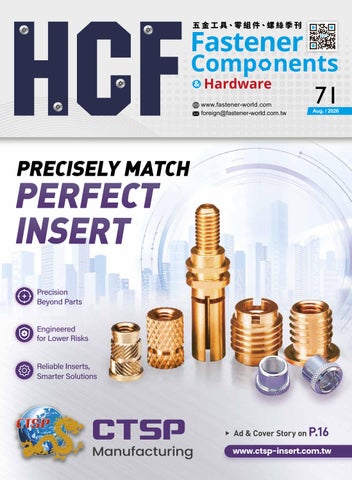
Lowers Customers' Total Cost, Not Just Part Prices provided by CTSP
金泰興:成本持續攀升,真正該降低的不是單價,而是客戶的總成本 ◆ Delivering Greater Value Through Smart Manufacturing and Engineering Excellence As manufacturers worldwide continue to face rising material prices, labor shortages, increasing energy costs, and ongoing supply chain disruptions, procurement strategies are evolving. Today's purchasing decisions are no longer driven solely by unit price—they are increasingly focused on reducing the Total Cost of Ownership (TCO). For many industrial products, the cost of a precision fastener represents only a small fraction of the finished product. However, inconsistent quality, dimensional variation, delayed deliveries, production interruptions, excessive inspection requirements, or field failures can generate costs far exceeding the value of the component itself. As a result, global OEMs and Tier 1 suppliers are shifting away from selecting suppliers based solely on price. Instead, they seek manufacturing partners capable of improving operational efficiency, minimizing risk, and creating long-term value throughout the supply chain. With more than two decades of expertise in precision fasteners and CNC machined components, Chin Tai Sing Precision Manufacturing (CTSP) has embraced this philosophy by continuously investing in smart manufacturing, engineering innovation, and advanced quality systems— helping customers improve competitiveness through lower total ownership costs rather than lower purchase prices.
◆ Smart Quality Management Minimizes Supply Chain Risk In today's increasingly complex global supply chains, quality management extends fa r beyond product con for m it y. CTSP has est ablished a comprehensive digital quality management system featuring complete lot traceability, AI-assisted inspection, automated optical inspection (AOI), precision measuring equipment, and digitized quality records. Every production batch can be traced quickly and accurately, improving root-cause analysis and corrective action efficiency while reducing operational risk.
Hardware & Fastener Components - no.71/2026
◆ Manufacturing Innovation That Creates Measurable Cost Savings
◆ From Component Manufacturer to Engineering Partner
Rather than simply manufacturing according to customer drawings, CTSP Rather than competing by cutting prices, frequently collaborates with engineering teams during product development to CTSP focuses on improving manufacturing optimize material selection, tolerance design, manufacturing processes, product processes to increase productivity and eliminate structure, and machining feasibility. This collaborative approach shortens development inefficiencies. Continuous investments in CNC cycles, reduces engineering changes, improves assembly efficiency, and creates more machining technology, automatic lathes, multistable, cost-effective manufacturing solutions. process integration, automated inspection systems, and digital production management have enabled t he compa ny to increase ◆ Continuous Investment in Smart Manufacturing manufacturing efficiency, reduce production The company continues investing in automation, digital production management, precision waste and material loss, shorten lead times, machining, and quality validation systems to meet the demanding requirements of global customers improve equipment utilization, lower energy in the automotive, electronics, industrial equipment, and high-precision manufacturing sectors. consumption, and deliver highly consistent product quality.
◆ Helping Customers Succeed Is the Ultimate
These improvements translate into more Competitive Advantage reliable delivery schedules, lower defect rates, reduced incoming inspection costs, Through engineering expertise, manufacturing innovation, and smart production less rework and production downtime, technologies, CTSP helps customers reduce Total Cost of Ownership, improve product quality, and improved manufacturing stability. accelerate product development, increase manufacturing efficiency, and build resilient supply True cost competitiveness is achieved not chains, because true manufacturing value is not defined by producing more parts—it is defined by sacrificing quality, but by delivering by helping customers become more competitive. higher efficiency while maintaining exceptional manufacturing standards. CTSP’s contact: General Manager Lee / Email: inquiry@ctsp-insert.com.tw Article provided by CTSP
018
惠達雜誌
Hardware & Fastener Components no.71/2026 019
020 Hardware & Fastener Components no.71/2026
Hardware & Fastener Components no.71/2026 021
Hardware & Fastener Components no.71/2026 023
SPECIAL FEATURE
Winners of Reddot, iF Design, and Taiwan Excellence Awards 2026 2026紅點設計獎、iF設計獎、 台灣精品獎得主 Compiled by Fastener World
Chair Castor DE-SERIES The DE-SERIES chair castors combine smooth rolling performance with integrated electrical conductivity, meeting the specific requirements of laboratories a nd medical facilities. Their internal structure incorporates a slot for iron wires that serve as a conduction pathway. Electrical charge is safely transferred through the metal shaft and dissipated via the conductive material of the outer wheels. By minimising the amount of conductive material used, the castors maintain both dimensional stability and flexibility. Manufacturer: Jenpjou Enterprise Co., Ltd., Taiwan
Hardware & Fastener Components - no.71/2026
Fanttik 3.7V Electric Screwdriver S2 Pro This home electric screwdriver transforms screw fastening from a chore into a smooth, precise, and one-stop experience. Through systematic innovation, it solves core user pains—not by stacking specs, but via electromechanical torque control for accuracy, integrated design for convenience, and advanced interaction and aesthetics for emotional appeal. It redefines home assembly and repair as a more effortless, confident, and orderly modern lifestyle. Manufacturer: Shenzhen Fanttik Technology Innovation Co., Ltd., China
David Gas electricity-insulating Pipe Fittings David is a gas-insulated pipe fitting product, and its application scene is mainly located at the joint between the gas water heater and the pipeline. The main function of this product is to make the voltage at the joint end of the gas corrugated pipe zero when the water heater has a leakage accident, so as to avoid the gas safety accident caused by the electric spark caused by the leakage of the gas corrugated pipe. At the same time, the mixed use of transparent materials and lights makes the alert prompt more obvious and quick. It also better meets the needs of users and enhances the product experience. Manufacturer: Rifeng Enterprise Group Co., Ltd, China
024 惠達雜誌
025 Hardware & Fastener Components no.71/2026
SPECIAL FEATURE
CoreCap - BTI-166 Bicycle valve Stop struggling with Presta’s fragility and the "ridiculous to-do list". CoreCap is engineered to remove the flaws. For tubeless performance, the "big ball valve" generates 300% flow, making seating the bead a "breeze". This high flow and an anti-clogging design eliminates the "mess and all the effort for nothing" with no unscrewing cores anymore. For ebike/commuter ease of use, it provides full Schrader pump compatibility, meaning no adapter needed. This durable, toolless design delivers the simplicity and reliability valued by urban users, fixing Presta’s physical weakness. Manufacturer: BBB Cycling, The Hague, NL
HOTO PivotDrive Cordless Screwdriver T he Pivot Dr ive is a versatile household tool, desig ned specifically for narrow and hard-to-reach spaces. Its unique 90° pivot design allows effortless switching between straight and pistol grip modes, ensuring comfort across different scenarios. The innovative biased axis structure eliminates blind spots at corners, enabling precise screwdriving even close to walls and frames. Equipped with torque adjustment across seven levels, it handles everything from delicate electronics to demanding wooden joints, with realtime values displayed on an integrated LCD. A pressure-sensitive trigger provides precise low-speed and powerful high-speed.
HOTO PixelDrive Cordless Screwdriver The HOTO 4V PixelDrive Cordless Screwdriver delivers precision fastening through precise torque control (0.5–6.0Nm) and an intuitive dotmatrix display for real-time battery/torque monitoring. Its dual-stage trigger enables gentle starts (100RPM) or rapid driving (250RPM), while an autoilluminating LED ensures visibility in confined spaces. The modular 3-layer case organizes 30 corrosion-resistant bits, eliminating clutter. Tailored for tasks from electronics repair to furniture assembly, its compact cylindrical form with ergonomic textured grip reduces hand fatigue, and elevates DIY into a seamless experience.
Hardware & Fastener Components - no.71/2026
Manufacturer: Shanghai HOTO Technology Co., Ltd., China
CONU Kegelmutter Conical Nut, Taper Nut, Screw Nut The CONU® cone nut revolutionizes fastening technology. Its conical shape with a larger angle creates a unique self-locking and self-countering effect, without extra components. It forms a flat, clean surface that enhances safety, aesthetics, and aerodynamics. Easy to mount, vibration-proof, and as strong as traditional nuts. CONU® proves that even a nut can embody design – flat, safe, strong. Manufacturer: F. REYHER Nchfg. GmbH & Co. KG, Germany
026 惠達雜誌
SPECIAL FEATURE
OLYM Casters The OLYM Series casters are specifically designed for seamless integration with tubular trolleys. The hollow single-wheel construction not only enhances load-bearing capacity but also gives the product a sleek and streamlined appearance, optimizing spatial collaboration and flexibility. The customizable color options cater to the diverse needs of users and environments, allowing each trolley to showcase its unique style. Manufacturer: Robby Technology (Zhongshan) Co., Ltd., China
Adjustable Super Duty Air Ratchet Wrench This product embodies INNOVALUE by pioneering a tool-free ±40° angle adjustment mechanism, surpassing conventional 30° limits and eliminating the need for external tools. This breakthrough directly addresses a common pain point in narrow-space operations, offering both flexibility and safety. Ergonomic design with balanced weight and antislip grip enhances user comfort, while rear exhaust and dustproof features reduce environmental interference. Through precision casting and lifecycle-focused engineering, the product also supports sustainability and durability. It not only innovates in function but delivers tangible value to professional users in automotive, aerospace, and industrial fields. Manufacturer: KUANI GEAR CO., LTD., Taiwan
Delta Smart Screwdriving System SD3 Series
Hardware & Fastener Components - no.71/2026
A high-precision screwdriving tool integrating servo motor control, real-time torque sensing, and intelligent software. Engineered for demanding applications in electrical and automotive electronics, it delivers fastening accuracy, quality assurance, and operational efficiency.
028 惠達雜誌
Key features include: 1. Real-time torque and angle monitoring to prevent screwdriving errors. 2. Multi-axis synchronized screwdriving boosts productivity and product alignment. 3. Supports data upload and traceability to reduce human error and ensure consistent quality. 4. Provides 3 modular designs: straight, right-angle, and telescopic options. 5. Smart Screwdrivers apply lightweight matte black metal housing with laser-engraved branding for durability and design. 6. Ergonomic anti-slip rubber grip enhances operational stability and safety. Manufacturer: DELTA ELECTRONICS, INC., Taiwan
XRW101 Mini Stubby Ratchet Wrench XRW101 delivers high performance and innovation in a compact, durable electric manual ratchet wrench. Delivering 320 RPM and 62 Nm of torque, it enhances fastening efficiency by up to 20 times, significantly reducing operation time. The USB-C fast-charging system offers quick and convenient power with minimal downtime. Engineered with premium motors, precision gear sets, and a patented anti-loosening jaw, the XRW101 ensures outstanding durability and a long service life. Its soft-grip body offers anti-slip protection and shock absorption for stable, comfortable operation during extended use. Weighing only 0.5 kg and measuring 220 mm, it is the world’s smallest electric + manual ratchet wrench. Additional features include built-in LED lighting, a forward/reverse switch, and a trigger lock for safe, intuitive control. Eco-friendly materials and a modular design further enhance user experience and support sustainable manufacturing. Manufacturer: BASSO INDUSTRY CORP., Taiwan
Hardware & Fastener Components no.71/2026 031
Hardware & Fastener Components no.71/2026 033
PREMIUM TOOL SUPPLIERS
CHIAO CHANG Riveters-
100% Developed & Made in Taiwan with Competitors-Outpacing Performance 喬章拉鉚工具 - 100% 台灣研製 性能大勝同業
C
Cordless Riveter
hiao Chang Pneumatic Tool Corp., a developer and manufacturer of industrial-grade pneumatic and power riveting tools, has had its products sold globally under its own “CCP” brand for 40+ years and has been also the designated OEM partner for many world-renowned tool manufacturers. It provides a wide range of pneumatic riveters and rivet nut tools, as well as power riveters to users in the aerospace, automotive, construction, sheet metal fabrication, and various thin sheet metal structural fastening industries demanding high-quality performance. The impressive durability of its products, combined with ergonomic, labor-saving designs and ease of maintenance & repair, has earned the company the favor and certification of major industry clients.
Patented in USA and Taiwan / Faster, Lighter, and More Durable
Chiao Chang insists that all its products are developed and made in Taiwan, refusing to follow the industry’s practice of copying European & U.S. designs or engaging in cut-price competition. This approach ensures that the products’ structure and design truly meet customer needs, while the company’s strong R&D capabilities also enhance the products’ durability.
Take its best-selling pneumatic riveters and rivet nut tools as examples: not only have they been qualified for various patents in Taiwan and the U.S., but also feature no oil leakage, 1.3 times faster riveting speed, a 15–20% reduction in weight, and 1.5 times greater durability. The five series of power riveters have also secured seven U.S. patents and comply with the latest version of Regulation 62841. “The ER-1 (6.4–3.2) cordless riveter can pull 30,000 pcs of Ø6.4 (1/4”) structural rivets continuously without jamming, and its mechanism remains in good working order without requiring replacement, producing no grating high-pitched noise. The ER-2 (4.8–2.4) cordless riveter dominates the industry with a rivet feeding speed of just 1.2 seconds per cycle, and likewise, it does not suffer from rivet jams or structural malfunctions requiring part replacement,” said Mr. Yu Tang Lin of Chiao Chang. The ER-1+ cordless riveter capable of pulling over 30,000 pcs of rivets (6.4–2.4) of any material and the ER-1 PRO cordless riveter capable of pulling over 30,000 pcs of rivets (7.9–6.4) of any material, as well as the ER-lockbolt cordless lockbolt, which can pull Huck bolts of any material, all demonstrate exceptional quality.
Hardware & Fastener Components - no.71/2026
Made from Highly Durable Materials and Customizable as Per Request
038 惠達雜誌
Air Riveter
With a deep understanding of the varying market needs of customers in different countries, Chiao Chang backed by 40 years of experience in the R&D and manufacturing of rivet tools offers customized solutions tailored to specific requirements. In addition to actively collaborating with domestic technical research institutions on R&D, the company begins with rigorous material selection, leverages the advantages of local production in Taiwan, and conducts extreme durability testing on every new product before shipment to verify its reliability, ensuring customers receive high-quality products they can trust. Lin added, “Chiao Chang’s factory fully complies with the requirements of the ISO 9001 standard. Our pneumatic tools have passed the EU CE certification, and our power tools, batteries, and chargers have been also certified by TÜV Rheinland Taiwan, ensuring that our quality meets int’l standards. In the future, we’ll continue to participate in overseas trade shows in the fastener, hardware, and automotive sectors to actively enhance the CCP brand’s reputation for high quality and its int’l visibility.” Copyright owned by Fastener World / Article by Gang Hao Chang, Vice Editor-in-Chief
Chiao Chang contact: Mr. Yu Tang Lin Email: aft817@ccp-tw.com.tw
Hardware & Fastener Components no.71/2026 039
HARDWARE WORLD NEWS
五金零組件全球新聞
Hardware & Fastener Components World News Association News +++ Melissa Patel Elected NFDA President for 2026-2027 Melissa Patel當選美國扣件經銷商協會2026–2027 年度理事長 Melissa Patel of Field has been elected as the 2026-2027 president of the National Fastener Distributors Association. Angela Philippart of AFC Industries will serve as vice president, Scott Camp of Atlas Distribution Services will serve as associate chair, and Ed Smith of Wurth Industry USA will remain on the Board as immediate past president. Kevin Hochstetler of Martin Supply, George Hunt III of Brighton Best International, Tim Roberto of LindFast Solutions Group, and Brandon Wiley of NAPPCO Fastener Company have been elected to serve on the Board of Directors effective June 17, 2026. Continuing on the NFDA Board are Harry Doherty of Fasco Inc., Christian Reich of Goebel Fasteners, and Jennifer Sturm of Empire Bolt & Screw. Recognition was paid during the meeting to retiring Board members Steve Andrasik of Brighton Best International, Alex Goldberg of AMPG, Scott Longfellow of Huyett, and Scott McDaniel of Martin Supply.
Market Watch: Tariff
Hardware & Fastener Components - no.71/2026
+++ FWPA Launches New Standard for Timber Fastener Testing FWPA協會推出新版木構建築扣件測試標準 Forest and Wood Products Australia (FWPA) has introduced FWPA Standard T01, a new industry testing standard that establishes a unified method for evaluating the performance of timber fasteners and connectors. Developed by the ARC Advance Timber Hub at the University of Queensland in collaboration with the Engineered Wood Products Association of Australasia, the standard provides consistent procedures for measuring strength, stiffness, ductility, and slip behavior in timber connections. Covering both sawn timber and engineered wood products, T01 includes testing for lateral and axial loading as well as individual fasteners and complete connection assemblies. The resulting data can be used for structural design under AS 1720.1. Rather than replacing existing Australian Standards, T01 complements them by providing reliable testing methods until the next comprehensive revision of AS 1649. Released as the 2026 first edition, it currently covers Category A and B fasteners, helping improve the consistency, transparency, and comparability of test results across the timber construction industry.
040 惠達雜誌
+++ Canada Launches C$1.5 Billion Support Package for Metals Industry Hit by U.S. Tariffs 加拿大推出15億加幣援助方案 協助金屬產業因應美國關稅衝擊 The Canadian government has announced a C$1.5 billion support package to help domestic manufacturers affected by new U.S. tariffs on steel, aluminum, and copper products. The measures include a new C$1 billion financing program through the Business Development Bank of Canada (BDC) and an additional C$500 million under the Regional Tariff Response Initiative. The BDC program will provide favorable financing to companies that rely heavily on steel, aluminum, or copper in their production and have been impacted by revised U.S. Section 232 tariffs. Under the updated rules, derivative products made primarily from these metals are now
Hardware & Fastener Components no.71/2026 041
HARDWARE WORLD NEWS
subject to a 25% tariff on their full value, replacing the previous method that taxed only the metal content. Canada criticized the U.S. measures as "unfair and unjustified," saying the funding aims to improve liquidity, strengthen industrial resilience, and help manufacturers adapt to changing market conditions. The government also reaffirmed its own 25% tariffs on selected U.S. steel-derived imports, including fasteners, wire products, wind towers, and prefabricated buildings, as part of its response.
Industry Development +++ India–UK CETA Opens New Export Opportunities for Punjab’s Manufacturing Sector 印度–英國CETA開啟旁遮普製造業出口新商機 The implementation of the India–UK Comprehensive Economic and Trade Agreement (CETA) on July 15, 2026 is expected to create significant growth opportunities for Punjab’s manufacturers by improving export competitiveness, attracting investment, and expanding global supply chain participation. The Chamber of Industrial & Commercial Undertakings (CICU) highlighted that nearly 99% of Indian exports will gain duty-free access to the UK market, while tariffs have been eliminated on 1,143 textile and engineering product categories. The agreement is expected to help increase India–UK bilateral trade toward US$100 billion by 2030. Ludhiana, one of India’s major manufacturing hubs, is expected to be among the key beneficiaries. The city’s industries, including fasteners, auto components, bicycle parts, hand tools, machine tools, textiles, and agricultural machinery, are projected to gain greater access to UK buyers due to reduced tariff barriers. CICU stated that Punjab’s MSMEs now have opportunities to expand exports and integrate into global supply chains. However, manufacturers must focus on quality improvement, technological upgrades, automation, and international certifications to meet UK and global standards. The agreement is also expected to boost employment in machining, engineering, logistics, and manufacturing, while improving Punjab’s competitiveness against suppliers from China, Turkey, and other markets. CICU believes CETA will help position Ludhiana as a stronger global manufacturing and export hub.
Hardware & Fastener Components - no.71/2026
+++ World Steel Association: Vietnam Joins World's Top 10 Steel Producers for the First Time 世界鋼鐵協會:越南首度躋身全球十大鋼鐵生產國 Vietnam has entered the world's top 10 steel-producing countries for the first time after surpassing Italy in crude steel output, according to the World Steel Association. The country produced 2.1 million tons of crude steel during the latest reporting period, a 4% year-on-year increase. From January to April 2026, Vietnam's crude steel production reached 8.5 million tons, up 8.4% from the same period last year. Meanwhile, Iran fell from the top 10 to 12th place after disruptions caused by attacks on major steel facilities, further strengthening Vietnam's position among the world's leading steel producers. The Vietnam Steel Association attributed the achievement to the industry's rapid modernization and expanded product range. Once reliant on imported billets, Vietnam now manufactures a wide variety of value-added steel products, including engineering steel, bolt and screw steel, spring steel, and rail steel. Leading producer Hoa Phat Group played a major role, contributing 11 million tons in 2025, or nearly 45% of the country's output. Its crude steel production is forecast to exceed 14 million tons in 2026, supporting Vietnam's continued growth as Southeast Asia's largest steel producer.
042 惠達雜誌
Hardware & Fastener Components no.71/2026 043
HARDWARE WORLD NEWS
+++ CLEPA Urges EU to Strengthen Local Automotive Supply Chain Under Industrial Accelerator Act 歐洲汽車零組件供應商協會籲歐盟透過《工業加速法》強化在地汽車供應鏈 The European Association of Automotive Suppliers (CLEPA) has urged the European Parliament and Council to preserve the European Commission's proposed definition of a "European vehicle" under the Industrial Accelerator Act (IAA), warning that weaker rules could accelerate the offshoring of manufacturing and threaten Europe's industrial competitiveness. According to CLEPA, around 75% of the components used in vehicles built in Europe are currently sourced locally. However, imports of automotive components from China reached €8.2 billion in 2025, shifting the EU's trade balance in the sector from a nearly €7 billion surplus to a €0.7 billion deficit within five years. Without stronger safeguards, Europe could lose up to 350,000 automotive jobs by 2030. CLEPA also called for the IAA to include the automotive components sector, tighten rules against subsidized non-EU imports, and adjust foreign investment thresholds for battery and EV supply chains. The association emphasized that these measures, combined with closer cooperation with trusted partners such as the UK and EFTA countries, are essential to strengthening Europe's manufacturing base, supplychain resilience, and long-term innovation capacity.
+++ EU Plans New Supply Chain Tool to Reduce Dependence on China
歐盟擬推新供應鏈工具
Hardware & Fastener Components - no.71/2026
降低對中國依賴
044 惠達雜誌
The European Commission is preparing a new economic security measure aimed at reducing the EU’s reliance on China for critical materials and industrial supplies. EU Trade Commissioner Maroš Šefčovič announced that the bloc is considering a new tool requiring companies to diversify their supply chains by sourcing from at least three different suppliers. The initiative follows recent disruptions involving semiconductors and rare earth materials, both essential to Europe’s automotive, green technology, and defense industries. China’s previous restrictions on rare earth exports and chip-related supply disruptions have raised concerns over Europe’s vulnerability to single-source dependence. Šefčovič emphasized that economic security is a shared responsibility, urging European companies to treat geopolitical risks as part of their core business strategies. However, the proposal may face resistance from industries concerned that supplier diversification could increase costs.
HARDWARE WORLD NEWS
+++ U.S. Senators Propose Ban on Chinese Vehicles and Connected Technologies 美國參議員提案禁止中國製車輛及車聯網技術進入市場 A bipartisan group of U.S. senators has introduced the Connected Vehicle Security Act of 2026, proposing to ban Chinese-made vehicles and connected vehicle technologies from the U.S. market over national security and economic concerns. Introduced by Senator Bernie Moreno (Ohio) and Senator Elissa Slotkin (Michigan), the bill would prohibit the import, sale, and operation of vehicles manufactured in China or other designated foreign adversaries. It would also ban Chinesedeveloped connected technologies, including vehicle software, hardware, and data systems. The legislation would authorize the U.S. Department of Commerce to identify and block high-risk vehicle technologies while establishing enforcement measures to keep prohibited products out of the market. Software-related restrictions would take effect in 2027, followed by hardware restrictions in 2030, allowing time for domestic supply chain adjustments. General Motors (GM) welcomed the proposal, stating that it supports policies that strengthen U.S. manufacturing and ensure fair competition. Supporters argue the measure will enhance national security, protect the domestic automotive industry, and reduce dependence on Chinese technology in connected vehicles. Europe currently relies heavily on China, which processes around 90% of the world’s rare earth materials. At the same time, EU-China trade tensions are increasing amid concerns over Chinese industrial overcapacity, unfair competition, and a record EU trade deficit of €359.9 billion. While the new policy aims to strengthen supply chain resilience, it could further strain relations with Beijing, which has warned of potential retaliation against measures restricting Chinese companies’ access to the European market.
+++ Mexico Seeks to Strengthen Auto Supply Chain Through Greater Local Sourcing
Hardware & Fastener Components - no.71/2026
墨西哥推動汽車供應鏈在地化
強化本土採購提升產業競爭力
Mexico is stepping up efforts to expand its domestic automotive supply chain as heavy reliance on imported components continues to limit value creation despite the country's status as a global vehicle manufacturing hub. The automotive sector contributes 4.5% of Mexico's GDP and 31% of manufacturing exports, with vehicle exports exceeding US$185.7 billion in 2025. Industry experts say Mexico has strong potential to localize production of higher-value components, including specialized fasteners, precision metal parts, and electronic systems. However, high production costs—particularly for steel and aluminum—and growing imports from China remain major challenges. Chinese suppliers accounted for 16% of Mexico's auto parts imports in 2025, second only to the United States. Industry leaders are urging greater investment in advanced manufacturing, technology, and supplier development to move beyond traditional assembly operations. They also emphasize improving logistics efficiency and supply chain integration to enhance competitiveness. Analysts believe that strengthening local suppliers and increasing value-added production will be essential for Mexico to secure long-term growth and resilience in the global automotive industry.
Companies Development +++ Chun Yu: Strong Outlook for Steel Structural Fastener Orders 春雨鋼結構扣件訂單前景旺 Fastener manufacturer Chun Yu stated at its June 28 shareholders’ meeting that, driven by robust demand from domestic tech plant expansions, commercial buildings, and public infrastructure projects, order visibility for steel structural fasteners has extended into next year, supporting stable operations. Chun Yu has established production bases in Taiwan, China, and Indonesia, each with distinct market positioning, focusing respectively on domestic sales and Southeast Asia, creating strategic regional advantages. The company maintains a leading market share in Taiwan’s construction fasteners sector, benefiting from ongoing expansions by major tech firms such as TSMC, which have kept demand elevated.
046 惠達雜誌
Hardware & Fastener Components no.71/2026 047
HARDWARE WORLD NEWS
Despite cautious overseas customers due to uncertainties surrounding U.S. tariff policies, the company maintained core profitability in Q1. However, global demand recovery remains slow amid high interest rates and inventory adjustments. With inventory levels in Europe and the U.S. gradually normalizing and demand from infrastructure and energy transition projects emerging, the market is expected to improve in the second half of the year, for which Chun Yu is well prepared.
+++ Boltun Targets High-End Smart Vehicle Fasteners to Drive Long-Term Growth 恒耀搶攻智能車高 階扣件市場 帶動 營收長期成長 Boltun is actively expanding into the smart vehicle sector, aiming to capture opportunities arising from AIdriven autonomous driving applications. The company noted that as electric and autonomous vehicles evolve, requirements for precision, fatigue resistance, and lightweight design are increasing, with high-end fasteners priced up to 10 times higher than those used in traditional internal combustion engine vehicles, making them a key growth driver. Although automakers are adopting vertical integration and part reduction strategies to lower component counts, advanced vehicles demand higher quality and performance, benefiting high value-added products. Boltun continues to invest in R&D to strengthen its technological capabilities and position itself for long-term market opportunities. In terms of performance, May revenue reached NT$968 million, up 2.99% year-on-year, while cumulative revenue for the first 5 months totaled NT$4.82 billion, up 2.04%. Q1 EPS stood at NT$0.61, ref lecting stable overall operations.
+++ Aerospace Demand Surge Fills Capacity, NAFCO Sees Strong Growth Momentum
Hardware & Fastener Components - no.71/2026
航太需求爆發 帶動訂單滿載 豐達科營運動 能強勁 NAFCO is benefiting from record backlogs at Boeing and Airbus, along with increased replacement demand driven by longer f light routes amid
048 惠達雜誌
geopolitical tensions. May consolidated revenue reached NT$469 million, up 11.86% month-on-month and 56.16% year-on-year. Cumulative revenue for the first 5 months totaled NT$2.093 billion, up 32.13%, both hitting record highs for the period. Analysts noted that amid tight supply of aircraft engines and structural fasteners, NAFCO is operating at full capacity, with order visibility extending up to 5 years. The company is also advancing smart manufacturing upgrades across its facilities, while accelerating the ramp-up of its new Malaysia plant to expand capacity. As labor shortages and inflation continue to strain Western aerospace supply chains, production is increasingly shifting toward Asia. With key certifications such as AS9100 and Nadcap, NAFCO stands among a limited number of globally qualified suppliers. Rising maintenance bottlenecks and a surge in component replacement demand are further strengthening its order momentum.
+++ Rising Wire Rod Prices Boost Operations, Tycoons Group Sees Improved Sales and Profitability 線材漲價助攻營運回溫 聚亨產銷與獲利同 步改善 Tycoons stated at its investor conference that the recent NT$1,000 per ton increase in wire rod prices by Taiwan CSC for Q3 has lifted inventory values, while growth in wire processing and high value-added products has strengthened overall operating momentum, with further profit expansion expected. The company noted that its strategy focuses on wire processing, integrated one-stop services,
Hardware & Fastener Components no.71/2026 049
HARDWARE WORLD NEWS
and product upgrades, supported by a diversified footprint across Taiwan, Thailand, Vietnam, and China. Its Thailand operation, positioned in the ASEAN market, continues to benefit from stable demand and serves as a key growth driver. Financially, Q1 consolidated revenue reached NT$3.46 billion, up 57% year-on-year and 35% quarter-on-quarter, ref lecting clear improvements in orders and shipments. Ongoing global inventory destocking in the fastener industry, coupled with gradually recovering demand in Europe and the U.S., as well as China’s steel output control policies, will help rebalance supply and demand, positioning Tycoons to benefit from the industry upturn.
+++ Packer Fastener Expands Midwest Footprint with New Indianapolis Distribution Hub Packer Fastener設立印第安納配送中心 擴大中西部布局 Packer Fastener has opened a new 40,000 sq. ft. distribution center in Lebanon, Indiana, strengthening its presence in the U.S. Midwest and enhancing regional supply capabilities. The Green Bay-based fastener and industrial supply distributor said the Indianapolis-area facility will support growing demand from commercial contractors, manufacturers, and fabricators, particularly in fast-expanding sectors such as data centers, renewable energy, and power generation. By positioning inventory closer to customers in a key manufacturing corridor, the new hub is expected to reduce lead times, improve delivery speed, and enhance supply chain reliability. The company emphasized its strategy of expanding into high-growth markets while building localized inventory and service capabilities. The Indianapolis expansion follows the opening of a distribution center in Columbus, Ohio, just over a year ago, ref lecting Packer Fastener’s ongoing growth momentum and commitment to strengthening its national distribution network.
+++ Bosch Announces CEO Transition and New Leadership Team Bosch宣布執行長交棒
全新領導團隊7月正式上任
Bosch has announced a major leadership reshuff le effective July 1, 2026. CEO Dr. Stefan Hartung will step down at his own request after leading the company since 2022. During his tenure, he strengthened Bosch's focus on growth, innovation, and long-term competitiveness despite challenging market conditions.
Hardware & Fastener Components - no.71/2026
Deputy Chairman Dr. Christian Fischer will succeed Hartung as CEO. Fischer has played a key role in Bosch's strategic development, leading major growth initiatives and overseeing the company's largest-ever acquisition—the HVAC business of Johnson Controls and Hitachi. Bosch believes his strategic vision and leadership will accelerate the company's ongoing transformation. As part of the transition, CFO Dr. Markus Forschner and Mobility business head Dr. Markus Heyn will become deputy chairmen of the board. Forschner will reinforce financial stability and disciplined transformation, while Heyn will contribute technology expertise and mobility industry leadership. The new management structure is designed to strengthen Bosch's innovation capabilities and ensure sustainable growth amid evolving global market challenges.
+++ Simpson Strong-Tie’s Quik Drive Project Pro Wins Popular Mechanics 2026 Tool Award Simpson Strong-Tie產品榮獲《Popular Mechanics》2026年度工具大獎 Simpson Strong-Tie has received a 2026 Tool Award from Popular Mechanics for its Quik Drive® Project Pro™ screw driving tool. The attachment converts almost any cordless drill into an auto-feed screw driver, enabling DIY users to complete decking, fencing, flooring, and porch projects up to 4 times faster. Editors praised its ease of use, speed, and reliable auto-feed system, noting they drove a strip of 30 deck screws in about two minutes during testing. Although positioned as a budget-friendly option, the Project Pro incorporates the same core designs, patented technologies, and manufacturing processes found in Simpson StrongTie’s professional-grade Quik Drive systems. The tool also features an adjustable depth-of-drive dial and includes a battery strap and T-25 bit.
050 惠達雜誌
Hardware & Fastener Components no.71/2026 051
HARDWARE WORLD NEWS
+++ Ingersoll Rand Marks Strong Sustainability Progress in 2025 Ingersoll Rand 2025 年永續發展再創里程 碑 ESG表現與創新成 果亮眼 Ingersoll Rand reported another milestone year in sustainability, highlighting significant achievements in environmental performance, innovation, and employee engagement in its 2025 Sustainability Report. The company retained its leadership in ESG by earning a fourth consecutive place on the Dow Jones Best-in-Class Indices, ranking first in North America and among the global top 5% in S&P Global's Corporate Sustainability Assessment. It was also named to CDP's A List for the third straight year. Environmentally, the company achieved 67% progress toward its Science Based Targets initiative (SBTi)-validated greenhouse gas reduction goal, doubled sustainable product launches to 364, and met its zero-waste-to-landfill target across qualifying sites. Ingersoll Rand also strengthened its peoplefirst strategy, recording a workplace injury rate 78% below the industry average, granting equity to approximately 3,600 employees, and maintaining employee engagement within the top 10% of manufacturing companies. The company was also listed in the 2026 Fortune 500, ref lecting its continued commitment to sustainable growth, innovation, and operational excellence.
+++ Einhell Confirms Growth Strategy, Expands Global Battery Ecosystem Einhell持 續成長 加 速擴大全 球無線動 力工具電 池生態系布局 At its 2026 Annual General Meeting, Einhell reaffirmed its growth outlook despite a challenging market environment, reporting first-half revenue slightly above last year's level while expecting stronger momentum in the second half. Growth will be supported by the launch of Einhell PROFESSIONAL in Australia and expanded distribution across international markets. The company's Power X-Change (PXC) battery platform remains its primary growth engine. Revenue from PXC products rose 8% in the first half of 2026, accounting for over 58% of Group sales. Einhell is the lifestyle battery power platform in the DIY and professional world. It stands for maximum cordless excellence in the home, workshop, garden and leisure sectors. With one battery for more than 350 tools, Power X-Change ensures cordless freedom and complete f lexibility. Einhell is also broadening its product portfolio, expanding its PROFESSIONAL range, E-Case storage system, and robotic lawnmower lineup. Internationally, the company is accelerating expansion in the Middle East, Africa, India, Latin America, and Australia, while exploring a majority acquisition in the U.S. DIY market. Backed by continued investment in its global brand and long-term partnership with the Mercedes-AMG PETRONAS Formula One Team, Einhell aims to sustain long-term international growth.
Hardware & Fastener Components - no.71/2026
+++ Arrow Tool Group Appoints Chee Min Hong to Lead Product and Brand Strategy Arrow Tool Group任命Chee Min Hong出任產品管理暨品牌行銷副總裁 Arrow Tool Group has appointed Chee Min Hong as Vice President of Product Management, eCommerce and Brand Marketing, reinforcing its commitment to product innovation and brand growth. With more than 25 years of global experience, Hong has held leadership roles at MANSCAPED, Philips, and Thomson, specializing in product management, marketing, business development, and brand strategy. In his new role, Hong will oversee product management, e-commerce, and brand marketing, working closely with Arrow Tool Group and GreatStar to accelerate innovation, strengthen brand positioning, and expand the company's tool portfolio for professional users and DIY consumers. CEO Roberto Izaguirre said Hong's expertise in connecting consumer insights with product development will support the company's long-term growth strategy. The appointment ref lects the industry's increasing focus on integrating product management, digital commerce, and brand marketing to respond more quickly to evolving customer demands.
052 惠達雜誌
compiled by Fastener World
Hardware & Fastener Components no.71/2026 053
V20 ADVANCED 電池
提升 DIY 工具動力與續航表現
CRAFTSMAN, a Stanley Black & Decker brand, has introduced its new V20 ADVANCED™ Batteries, designed to provide greater power and longer runtime for demanding DIY projects while remaining fully compatible with the existing V20 cordless tool lineup.
054 惠達雜誌
Compatible with more than 100 CRAFTSMAN V20 tools, ranging from power tools to outdoor equipment, the new batteries allow users to upgrade the performance of their existing tools without replacing them. CRAFTSMAN said the launch reflects its commitment to helping DIY users complete larger projects faster and with fewer interruptions through enhanced cordless battery technology.
Ball Star Bit Socket Set with Enhanced Grip Technology 球頭星型套筒起子組
強化狹小空間鎖固性能
GripEdge Tools has introduced its new 9-piece RPT 1/4- and 3/8-inch Drive Long Ball Star Bit Socket Set (BST9LS), designed for automotive, industrial, marine, and commercial applications where fasteners are difficult to access. The set features GripEdge's second-generation Ball Star geometry, allowing up to 15.5 degrees of pivot for angled engagement in confined spaces. It also incorporates the company's patented Rounding Prevention Technology (RPT), which provides up to 50% more grip on undamaged fasteners and up to 400% more grip on damaged fasteners than conventional tools, helping reduce fastener stripping and rounding.
Manufactured from durable S2 tool steel, the 6-inch-long sockets feature a slim profile for improved access and large, high-visibility size markings for easier identification in low-light work environments. Available in sizes T10 to T50, the new socket set is designed to improve efficiency and reliability for professionals performing maintenance and repair in challenging working conditions.
MarineLOK 316 Stainless Steel Structural Fasteners Compiled by Fastener World
Hardware Innovation Alley
Built with advanced tabless cell technology, the batteries operate at lower temperatures, improving performance and efficiency during heavy-duty applications. The new lineup includes a 6Ah model delivering up to three times the power and runtime, and a 3Ah version offering 96% more power and up to 50% longer runtime compared with previous models.
五金新品大道
Hardware & Fastener Components - no.71/2026
SPECIAL FEATURE
V20 ADVANCED Batteries for Higher Power and Longer Runtime
MarineLOK 316 不鏽鋼結構扣件
鎖定海洋工程應用
FastenMaster, a division of OMG Building Products, has introduced MarineLOK, a heavy-duty 316 stainless steel structural fastener designed for marine and coastal construction applications requiring superior corrosion resistance. Engineered for use within 1,000 feet of saltwater, MarineLOK is intended to replace traditional ½-inch lag screws in wood-to-wood structural connections. The fastener features a patent-pending design combining a Type-17 sharp point, serrated cutting teeth, and wood-clearing inner threads to improve installation speed, cutting performance, and finish quality. It also incorporates a T50 drive system for secure engagement and a SureSink™ head for a clean appearance. Available in lengths ranging from 3 to 10 inches, MarineLOK is suitable for docks, boardwalks, marine decks, boat houses, and other environments exposed to saltwater and corrosive conditions. According to FastenMaster, the new product expands its LOK structural fastener portfolio by providing contractors with a marinegrade fastening solution that combines durability, corrosion resistance, and installation efficiency for demanding outdoor applications.
SPECIAL FEATURE
Diamond Deck & Wood Screws for HighPerformance Outdoor Applications Diamond Deck & Wood Screws
提升戶外施工鎖固性能
Woodgrain, Inc. has introduced its new Diamond Deck & Wood Screws, a premium fastening solution designed for decking, outdoor construction, and treated lumber applications. The new screws feature patented TTX drive technology, a Typhoon head with nibs, and a DXAS coarse thread design to reduce cam-out, wobble, and installation torque while improving driving efficiency. According to Woodgrain, performance testing showed the screws achieved leading results in driving speed, torque, and pull-out resistance. Diamond Screws also feature a 2,000-hour Nano corrosion-resistant coating and are approved for exterior use and ACQ-treated lumber applications. The product is backed by a limited lifetime fastener warranty, providing long-term durability for demanding outdoor environments. Woodgrain said the new product line addresses common installation challenges faced by contractors while offering distributors a premium fastening solution with strong market potential. The company believes Diamond Screws will help dealers enhance product value, improve customer satisfaction, and support sales growth in the high-performance fastener market.
Neluma Floating Solar Platform for Global Expansion
搭配卡扣式緊固元件的 Neluma 漂浮式太陽能平台加速全球市場布局
ARaymond has officially launched Neluma, its floating photovoltaic (FPV) platform, following the successful validation of a pilot project in France. Designed for reservoirs, agricultural ponds, industrial water bodies, and artificial lakes, the modular system can be adapted to various site configurations.
Neluma features 100% recyclable aluminum catamaran floats and ARaymond's clipon fastening system, which simplifies installation, reduces on-site fastening work, and eliminates the need for retightening during operation. The company also deploys mobile micro-factories near project sites to manufacture and assemble components locally, reducing transportation costs and accelerating project delivery. The first 260 kW pilot installation in Savoie, France, was completed in just seven days and has operated without corrective maintenance since entering service in 2024.
Hardware & Fastener Components - no.71/2026
ARaymond is now expanding Neluma through regional production hubs in France, India, and Brazil, targeting floating solar projects on reservoirs, quarries, and agricultural water bodies. The company believes the platform's sustainable design and localized manufacturing model will support the growing global demand for floating solar energy solutions.
Next-Generation Cold Forging Dies for High-Precision Chamfered Screws 新一代冷鍛模具
提升倒角螺絲製造效率與精度
ZJK Industrial (China) has introduced its next-generation cold forging dies for chamfered screws, designed to improve manufacturing efficiency, reduce production costs, and enhance precision for advanced manufacturing industries, including AI infrastructure, industrial robotics, electric vehicles, aerospace, and semiconductor equipment. The new dies enable chamfers to be formed directly during the cold forging process, eliminating conventional secondary chamfering operations. According to ZJK, the technology increases production efficiency by 30–50%, reduces production line equipment investment by more than 40%, and achieves tighter dimensional tolerances of within 0.10 mm. The process also delivers smoother screw surfaces, improved corrosion resistance, and better assembly compatibility. The company said the innovation addresses longstanding limitations of traditional chamfering methods while meeting the growing demand for highly consistent fasteners used in automated assembly, robotic fastening, and machine vision inspection systems. Driven by strong demand from AI infrastructure, industrial automation, and electric vehicle markets, ZJK reported 2025 revenue growth of 48.39% to US$56.1 million. The company expects the new technology to strengthen its competitive position in precision manufacturing and support longterm growth in high-end industrial applications.
056 惠達雜誌
Hardware & Fastener Components no.71/2026 057
058 Hardware & Fastener Components no.71/2026
Hardware & Fastener Components no.71/2026 059
PREMIUM TOOL SUPPLIERS
Introduces the KH3300 AIR Ultra-Thin Ratchet Series 磯慶全新 KH3300 AIR 超薄棘輪扳手系列
Ultra-Thin Design Meets Lightweight Handling for Maximum Efficiency.
As modern vehicles and industrial equipment become increasingly compact, technicians are faced with growing challenges when working in confined spaces. To meet these demands, A-KRAFT proudly introduces the KH3300 AIR Ratchet Series— an innovative combination of an ultra-thin profile, lightweight construction, and a precision 90-teeth ratchet mechanism engineered for professional performance.
Built for Tight Spaces
The KH3300 AIR Series features an exceptionally low-profile ratchet head, allowing easier access to hard-to-reach fasteners in engine compartments, machinery, and maintenance environments. With head thickness reduced by up to 35% compared to that of conventional ratchets, technicians can work more efficiently where space is limited.
Hardware & Fastener Components - no.71/2026
Lightweight Yet Durable
Designed with a lightweight skeletal structure, the KH3300 AIR reduces overall weight by approximately 25–28% while maintaining outstanding strength and durability. The lighter design helps reduce user fatigue during repetitive tasks and extended service operations, improving both comfort and productivity.
Precision 90-Teeth Ratchet Mechanism
At the heart of the KH3300 AIR is a high-performance 90-teeth ratchet mechanism requiring only a 4° action arc. This enables smooth and efficient operation even in confined working spaces. Manufactured with premium Chrome Molybdenum (Cr-Mo) steel gears, the series delivers excellent torque performance, durability, and a long service life.
Designed for Professional Applications
Available in 1/4", 3/8", and 1/2" drive sizes, the KH3300 AIR Series is ideal for automotive repair, industrial maintenance, equipment servicing, and professional tool markets worldwide.
By combining accessibility, lightweight performance, and durability, the KH3300 AIR reflects A-KRAFT's commitment to developing innovative solutions for modern technicians.
060 惠達雜誌
Copyright owned by Fastener World / Article provided by A-KRAFT
A-KRAFT contact: Sales Manager Hsu
Email: info@akraft.com.tw
PREMIUM TOOL SUPPLIERS
NCG Tools
Innovative Tools Born for Every Riveting Application 昶彰 - 為鉚接應用而生的創新工具
F
ounded in 1979 originally as a parts manufacturer for riveters, NCG Tools has transformed into a professional producer since 1983, dedicated to the manufacturing, export and sales of riveters featuring innovative design and improved functions. The technical expertise of its team, supported by new technologies and capabilities as well as its wealth of experience in troubleshooting customers’ technical issues, have allowed the company to build a solid foundation to innovate riveting solutions best suited to its customers’ needs. These innovations include the best-selling “2-in-1 Drill Attachment for Fastening Blind Rivets & Rivet Nuts (AU103)”, “Compact Heavy Duty Multi-Function 2-in-1 Fastening Tool (HF303)” and “Hand Riveter J705”.
2-in-1 Drill Attachment for Fastening Blind Rivets & Rivet Nuts
AU103
The AU103 model enables users to fasten blind rivets and rivet nuts using cordless drills, allowing fast and effortless fastening operation. Its patented OmniMandrel System allows the use of screws of any head type as mandrel for fastening rivet nuts, and allows to fasten blind rivets by simply changing accessories.
Compact Heavy Duty MultiFunction 2-in-1 Fastening Tool
Hardware & Fastener Components - no.71/2026
With a compact size of only 270 mm in length, an all steel and aluminum construction, and the full rivet fastening range of 2.4-6.4 mm, the HF303 model allows the users to fasten blind rivets or rivet nuts with only one tool set. Customized and specialized mandrels are not needed anymore.
J705
HF303
Modern Hand Riveter
The J705 model is an easy-to-use industrial grade riveter for users to easily fasten sheet metals together with blind rivets or any other applications requiring the use of blind rivets. It also features a strong aluminum body frame. The innovations of NCG Tools have always been impressive to users in every practical application. The 360 degrees swivel head, multi-function fastening capability, foldable handle, and the unique omni-mandrel system are all manifestations of NCG’s leadership in providing customers with better riveting performance and experience.
NCG Tools contact: Sam Liu, Manager
Email: ncg@ncgtools.com
Copyright owned by Fastener World / Article by Gang Hao Chang, Vice Editor-in-Chief
062 惠達雜誌
INDUSTRY FOCUS
Global Major
Infrastructure and Construction Projects with Great Fastener Demand
全球重大基建計畫與扣件需求展望
Which Megaprojects can Genuinely Open New Markets for Fastener Suppliers?
Global construction demand is not rising evenly. In October 2025, the World Steel Association estimated global steel demand at about 1,749 million tonnes for 2025 and initially forecast 1,773 million tonnes for 2026. By April 2026, it had revised the 2026 outlook to 1,724 million tonnes, representing growth of only 0.3%.
Hardware & Fastener Components - no.71/2026
The message for fastener executives is clear: waiting for a broad market boom is a weak strategy. Growth must be found in concentrated pockets of investment where tunnels, bridges, rail systems, stations, airports and energy facilities create years of specification-driven demand. Major infrastructure projects attract fastener manufacturers for an obvious reason: scale. A new railway, airport, tunnel or power plant can require millions of structural bolts, anchors, rail fastenings, threaded components, support-system fixings and specialised connection products. But scale can be deceptive. A large project may generate substantial orders without helping a supplier build a sustainable market position. A manufacturer can spend years qualifying, win one contract, deliver the products and still have no local distribution, no access to the next project and no recurring business. For CEOs, therefore, the critical question is not: How many fasteners will this project consume? It is: Can this project give our company access to a larger and repeatable market? A megaproject becomes strategically valuable when it leaves the supplier with assets that remain after construction ends: certification, local production, relationships with major contractors, access to system manufacturers, a recognised technical reference and an aftermarket position. Seven major projects across seven regions illustrate very different market-entry opportunities. They should not be treated equally.
064 惠達雜誌
An Executive Comparison
Table 1 considers the attractiveness of each project for an established international fastener manufacturer. It is not a ranking of project size. It evaluates the wider market that each project could unlock. The table reveals an important distinction. The largest potential markets are not necessarily the easiest or most profitable to enter. India offers enormous repeat potential but demands localisation. The United States offers scale but imposes formidable domestic-content and qualification barriers. Nuclear power promises high-value business but excludes most conventional fastener manufacturers. The correct opportunity depends on the supplier’s existing capabilities, capital and appetite for long-term investment.
North America:
Hudson Tunnel as a Localisation Decision The Hudson Tunnel Project is constructing nine miles of new passenger railway between New York and New Jersey, including nearly five miles of tunnel boring beneath the Hudson River. The programme comprises ten construction packages, seven of which are in progress or will be completed by mid-2026. The new tunnel is expected to enter service in 2035.
The project is expected to generate US$19.6 billion in economic activity and an average of US$87 million per month in purchases of goods and services. The Gateway Development Commission also explicitly states that it prioritises purchases from American businesses. That final point determines the market-entry strategy.
INDUSTRY FOCUS
Table 1.
Project and Region
Wider Market Entry Difficulty Potential
Localisation Pressure
RepeatBusiness Potential
Best Suited to
Mumbai–Ahmedabad High-Speed Rail, India
★★★★
★★★
★★★★
★★★★
Technology-led manufacturers prepared to localise
Al Maktoum International Airport, Dubai
★★★
★
★
★★★★
Construction, façade, MEP and system-fastening suppliers
Rail Baltica, Europe
★★★
★★★
★
★★★★
Approved or technically differentiated rail suppliers
Sydney Metro West, Australia
★★★
★★★
★★★
★★★
Suppliers offering labour and lifecycle savings
São Paulo Metro Line 6, Brazil
★★★
★★
★★★
★★★
Partnership-oriented manufacturers
Hudson Tunnel Project, United States
★★★★
★★★★
★★★★
★★★★
Suppliers prepared to invest in a US operating structure
El Dabaa Nuclear Power Plant, Egypt
☆
★★★★★
★★★
★★
High-integrity and nuclearcapable suppliers
Selective: ☆ Medium: ★ Medium-high: ★★ High: ★★★ Very high: ★★★★ Extremely high: ★★★★★
For foreign fastener manufacturers, Hudson Tunnel is not primarily an export opportunity. It is a test of whether the US infrastructure market is large enough to justify localisation. US transportation procurement has moved toward stronger domestic-content requirements. In 2025, the Federal Highway Administration finalised changes ending the general Buy America waiver for manufactured products used in federally supported highway and bridge projects. Although individual rules differ across transport programmes and contracts, the direction of policy is unmistakable: foreign manufacturers relying entirely on imported finished products face increasing disadvantages. A supplier serious about this market should use Hudson Tunnel as the business case for acquiring or partnering with a US manufacturer, establishing domestic finishing and testing, or licensing proprietary fastening technology to a qualified local producer. That structure could later serve rail projects across the Northeast Corridor, as well as bridges, metros, airports and utility infrastructure. The upside is enormous. The risk is equally clear. Establishing a US operation for one speculative contract would be reckless. The investment makes sense only when the company has a differentiated product and a wider five-to-ten-year infrastructure pipeline. Hudson Tunnel is attractive for companies ready to become American suppliers. It is a poor target for companies seeking occasional export orders.
Hardware & Fastener Components - no.71/2026
Latin America: São Paulo Line 6 as an Ecosystem Entry
São Paulo Metro Line 6–Orange represents more than R$19 billion of committed investment. Once completed, the line will extend 15.3 kilometres and include 15 stations, ventilation structures, a control centre, maintenance facilities and train-stabling areas. The first six stations have begun commercial operation since 2 July 2026. Its wider strategic value lies in the Brazilian supply ecosystem surrounding the project. The line includes rolling stock, stations, tunnelling, electrical systems, platform equipment, maintenance infrastructure and long-term operation. Alstom’s 22 six-car trains are being produced at its Taubaté plant, demonstrating the importance of Brazil’s domestic rail-manufacturing base. A foreign fastener manufacturer will struggle to build a serious Brazilian position by shipping irregular container loads through a general importer. Customers require Portuguese-language support, local stock, assistance with approvals and the ability to respond when installation problems occur. The better strategy is to use Line 6 to enter the network of Brazilian rolling-stock producers, steel fabricators, tunnel-equipment companies, maintenance contractors and rail-system integrators. A specialist manufacturer could contribute corrosionresistant anchors, locking systems, structural assemblies or application knowledge, while a Brazilian partner provides production, finishing, inventory and customer access.
066 惠達雜誌
The project’s concession str ucture also creates an aftermarket opportunity. Construction supply can lead to inspection, replacement and maintenance business during the operating period. Suppliers that record installation locations, product batches and expected service lives can move from selling components to managing fastening performance. The danger is enter ing th rough a wea k distributor with no influence over specifications. That produces low-margin sales and little strategic control. Brazil is suitable for manufacturers prepared to build a genuine local partnership. It is not suitable for companies that confuse exporting with market entry.
Europe: Rail Baltica as a Qualification Passport
Rail Baltica is planned as an approximately 870-kilometre railway connecting Estonia, Latvia and Lithuania to Poland and the wider European network. The estimated cost of the first implementation phase is €15.3 billion. In April 2026, the organisation published a consolidated procurement plan covering the three Baltic states, while procurement of major superstructure materials continued to advance. For fastener manufacturers, Rail Baltica’s greatest value is not the Baltic market alone. It is the possibility of creating a recognised European rail reference. European railway buyers do not change critical components simply because a challenger offers a lower price. They evaluate fatigue life, interoperability, installation performance, ele ct r ica l b e h av iou r, c oa t i ng d u r a bi l it y, t r a c e a bi l it y a n d lo ng- t e r m m a i n t e n a n c e consequences. That makes initial qualification difficult. But the same barrier protects a supplier once it has been approved.
INDUSTRY FOCUS
A manufacturer of rail clips, sleeper screws, anchor systems, turnout fasteners or electrification fixings should aim to become part of a complete railway system rather than remain an isolated component vendor. The key customers may be sleeper producers, turnout manufacturers, electrification companies and track-system integrators—not the project owner itself. If the supplier’s component becomes incorporated into an approved system, the system manufacturer can carry that product into future European projects. Rail Baltica is particularly attractive for companies with a measurable technical advantage: longer fatigue life, reduced maintenance, faster installation, improved insulation, better traceability or lower embodied carbon. A commodity supplier with no railway approvals and no technical differentiation will burn money pursuing this opportunity. Rail Baltica offers exceptional qualification value. It should be targeted by companies that want a long-term European rail position, not by producers seeking a one-time volume order.
Middle East: Al Maktoum Airport as a Regional Product Platform
Al Maktoum International Airport is planned on a 70-square-kilometre site with 19.4 million square metres of built facilities, five runways and 400 contact gates. At ultimate capacity, it is designed to handle nearly 260 million passengers and 12 million tonnes of cargo annually. It forms the centre of the wider Dubai South aviation and logistics development. The scale is extraordinary, but size is not the main strategic attraction.
Hardware & Fastener Components - no.71/2026
Airport contractors, façade specialists, baggage-system companies, passenger-bridge manufacturers, mechanical contractors and automated-transport suppliers commonly operate across several Gulf states. Approval by one of these groups can therefore generate repeat business in Saudi Arabia, Qatar, the UAE and neighbouring markets. The supplier should not approach Al Maktoum with a catalogue containing thousands of unrelated fasteners. That positioning is weak and replaceable. A stronger approach is to create an air port fastening platform: corrosion-resistant façade fixings, fire-rated anchors, vibration-resistant mechanical connections, traceable baggagesystem fasteners and packaged assemblies for passenger bridges or automated transport. The objective is to make the package reusable by contractors on other airports and complex buildings. Dubai Aviation Engineering Projects require new contractors to complete prequalification before becoming eligible to tender. However, direct qualification with the owner is only one route. For many fastener producers, approval by specialist subcontractors and equipment manufacturers will create more repeatable business. The Gulf also rewards availability. A regional warehouse and technical-support capability can serve airports, data centres, hotels, metros, logistics centres and industrial projects from the same base. The main risk is intense competition. A supplier offering nothing beyond acceptable quality and a low price will be treated as interchangeable. Al Maktoum is one of the best regional channel-building opportunities, especially for companies that can turn products into application-specific fastening systems.
068 惠達雜誌
Asia: India’s High-Speed Rail as the Strongest Long-Term Growth Bet
The Mumbai–Ahmedabad High-Speed Rail corridor ex tends 508 kilometres, with around 90% of the alignment elevated. It combines viaducts, steel bridges, stations, overhead systems, noise barriers, ballastless track and a 21-kilometre tunnel section near Mumbai. Construction reached major milestones throughout 2025 and 2026. The project alone is important. The pipeline behind it is much more important. India’s 2026–27 Union Budget announced seven additional high-speed rail corridors. Government analysis placed their combined length at nearly 4,000 kilometres and their potential investment at approximately ₹16 lakh crore. This changes the strategic calculation. Qualification on the first corridor could become a foundation for an entire generation of railway investment.
However, India’s objective is not to remain dependent on imported technology. It intends to develop domestic manufacturing and engineering capability. A foreign supplier that wins an early order but refuses to localise may educate the market and then be replaced. The strongest strategy is therefore to combine proprietary technology with Indian production. Suitable models include licensing, a joint venture, a technical partnership or a majorityowned local operation. The company should retain control of the critical knowledge— design, materials, heat treatment, coating or quality processes— while progressively localising manufacturing and service. Products with potential include fatigue-resistant bridge assemblies, ballastless-track components, vibration-control solutions, electrification fasteners and digitally traceable safetycritical connections. The opportunity is not limited to high-speed rail. The capabilities established could transfer into metro systems, freight corridors, conventional railway upgrades and bridge construction. India offers the strongest long-term growth potential in the group. But it requires commitment. Companies unwilling to transfer capability, invest locally and develop Indian management should stay out.
Africa: El Dabaa as a Quality-System Transformation Egypt’s El Dabaa Nuclear Power Plant will contain four VVER-1200 units with a combined capacity of 4.8 GW. The reactor pressure vessel for Unit 1 was installed in November 2025, followed by installation of the 330-tonne Unit 2 vessel in July 2026. By late 2025, approximately 55% of contract and subcontract orders had reportedly been localised in Egypt. For most fastener companies, direct pursuit of nuclear safetyclass applications would be a bad strategy. Nuclear supply demands rigorous material control, traceability, inspection, process qualification, non-conformance management and long-term record retention. A conventional construction-fastener manufacturer cannot create these capabilities through marketing claims. El Dabaa should instead be viewed as a qualification ladder. A supplier can begin with non-safety buildings, conventional mechanical systems or balance-of-plant applications. It can then use those projects to strengthen documentation, train employees and demonstrate controlled production.
Hardware & Fastener Components no.71/2026 069
INDUSTRY FOCUS
The resulting quality capability can open markets beyond nuclear power, including oil and gas, petrochemicals, desalination, power generation and highintegrity industrial construction. In that sense, the most valuable outcome may not be nuclear revenue. It may be transforming the company into a supplier capable of serving industries where failure is expensive and traceability is mandatory. The risk is obvious: qualification costs can consume years of management attention, while the addressable product scope may remain narrow. El Dabaa is not a mass-market fastener opportunity. It is a strategic capabilitybuilding opportunity for technically mature manufacturers only.
Oceania: Sydney Metro West as a Contractor-Network Entry Point
Sydney Metro West is a 24-kilometre underground railway connecting Westmead, Parramatta and central Sydney. Four major contracts were awarded at the end of 2025. The linewide package includes 60 kilometres of track and the installation of ventilation, power, communications, fire systems, cross-passages and a major stabling and maintenance facility.
The surrounding market is substantial. Infrastructure Australia’s 2025 report placed the country’s five-year Major Public Infrastructure Pipeline at A$242 billion, 14% higher than the previous outlook. Transport represented A$129 billion of that pipeline. Australia is therefore attractive, but price-led exporters frequently underestimate its barriers. Customers expect documented compliance, dependable local support, safe installation procedures and products that reduce whole-life project risk. The strongest fastener proposition is not lower component cost. Australian labour is expensive, so products that reduce installation time, rework, inspection or maintenance can create far more value. Examples include preassembled fastening kits, visual torque verification, faster anchor systems, longer-life coatings and traceable connections. The strategic target should be the national contractor, not only the individual project. Large contractors reuse qualified suppliers across transport, energy, water, mining and public-building projects. An accepted product on Sydney Metro West can therefore become an Australian reference that travels between projects and states.
Hardware & Fastener Components - no.71/2026
The main risk is entering without local engineering and inventory support. A distant overseas factory cannot resolve urgent site problems fast enough. Australia is attractive for technically disciplined suppliers whose products save labour or lifecycle cost. Commodity manufacturers will find the market expensive and frustrating. References 1. 2. 3. 4. 5. 6. 7. 8. 9. 10. 11. 12. 13.
Gateway Development Commission, Hudson Tunnel Project Overview and Procurement Information, 2025–2026. Gateway Development Commission, Economic Impact of the Hudson Tunnel Project. US Department of Transportation, Buy America Requirements for Manufactured Products, January 2025. ACCIONA, São Paulo Metro Line 6 Project Progress and First Stations, 2025–2026. Alstom, Line 6–Orange Rolling Stock and Brazilian Manufacturing, 2025–2026. Rail Baltica, 2026 Procurement Plan and Superstructure Materials Procurement. Rail Baltica, Updated Cost-Benefit Analysis and First-Phase Investment. Dubai Aviation Engineering Projects, Al Maktoum International Airport Masterplan. National High-Speed Rail Corporation Limited, Mumbai–Ahmedabad High-Speed Rail Project Overview and 2026 Progress. Government of India, Press Information Bureau, High-Speed Rail Corridors Announced in the 2026–27 Budget. Rosatom, El Dabaa Nuclear Power Plant and Unit 2 Reactor Vessel Installation, 2026. Sydney Metro, Sydney Metro West Project Overview and 2026 Contract Progress. Infrastructure Australia, 2025 Infrastructure Market Capacity Report.
Conclusion
There is no universally best project. There is only the project that matches the company’s capability and strategic ambition.
For a technology-led manufacturer prepared to localise, India offers the strongest long-term growth case. For a supplier seeking access to multiple countries through contractors and integrators, Dubai offers the strongest regional channel opportunity. For a company already close to European rail standards, Rail Baltica offers the greatest qualification and reference value. For manufacturers with labour-saving systems and strong technical documentation, Australia offers an attractive repeat-project market. For firms willing to develop local industrial partnerships, Brazil can provide construction and aftermarket growth. For com pa n ies pr epa r e d to i nvest substantially in domestic manufacturing or processing, the United States offers unmatched scale but the highest localisation barrier. For suppliers with high-integrity quality systems, El Dabaa can create a route into nuclear and other critical industrial markets. For ordinary fastener producers, it is a distraction. The wrong way to select a megaproject is to rank projects by construction value and chase the largest one. The correct method is to ask five harder questions: 1.
Will project qualif ication remain valuable elsewhere?
2.
Can we establish a repeatable channel beyond the project?
3.
Are we willing to meet the localisation requirement?
4.
Do we possess a technical advantage worth protecting?
5.
Will the first project lead to a second, third and tenth customer?
A megaproject should not be treated as an oversized purchase order. It should be treated as a market-entry investment. The winning supplier is not the company that sells the greatest number of bolts during construction. It is the company that remains in the market and continues winning business long after the ribbon has been cut.
Copyright owned by Fastener World / Article by Dr. Sharareh Shahidi Hamedani, Taylor's University
070 惠達雜誌
INDUSTRY FOCUS
U.S. Fastener Tool Trade in Q1 2026: An Analysis of the Americas' Leading Trading Partners 2026 首季美國緊固工具貿易: 主要貿易夥伴剖析
Data note: The data for this article is derived from the US Census trade statistics. US Census trade statistics analyze imports across all modes of transportation. The value is calculated in CIF USD or FOB USD. The HS Codes represented in this article are 820411, 820412, 820420, 820540, 820570, and 8207. The U.S. fastener tool market remained closely tied to global manufacturing supply chains during the first quarter of 2026, with imports continuing to play a critical role in supporting domestic demand across the automotive, construction, industrial equipment, and retail sectors. While official U.S. Census trade statistics provide the broad picture of import and export activity, shipment-level trade data offers additional insight into the companies and supply chains moving the greatest volumes of fastener tools into the United States. Together, these datasets illustrate both the scale of U.S. trade and the commercial relationships that underpin the market. The broader industrial distribution sector also continued to show healthy demand entering 2026, reflecting ongoing investment across manufacturing and industrial end markets.
U.S. Fastener Tool Import
Key Trade Trends from Q1 2026
1.2
During the first quarter of 2026, the United States imported US$1.042 billion worth of fastener tools within this product category, representing a yearover-year decrease of less than 1% compared to Q1 2025. This relatively flat performance indicates a stable import market despite ongoing shifts in global trade and supply chain dynamics.
1.0
US$1.05 bn
US$1.042 bn
2025 Q1
2026 Q1
0.8
decline less than 1%
0.6 0.4 0.2 0.0
▼ United States - Import by Country (2025Q1 vs 2026Q1) Hardware & Fastener Components - no.71/2026
2025 - Q1 Country of Origin
2026 - Q1
Volume Change
General Total Value CIF (USD)
%
General Total Value CIF (USD)
%
General Total Value CIF (USD)
%
China
228,476,881.00
21.75
155,785,650.00
14.95
-72,691,231.00
-31.82
Taiwan
172,390,888.00
16.41
149,503,104.00
14.35
-22,887,784.00
-13.28
Japan
83,377,812.00
7.94
144,691,933.00
13.88
61,314,121.00
73.54
Germany
120,786,025.00
11.50
126,587,135.00
12.15
5,801,110.00
4.81
Vietnam
50,105,442.00
4.77
70,462,052.00
6.76
20,356,610.00
40.63
S. Korea
44,312,285.00
4.22
63,671,050.00
6.11
19,358,765.00
43.69
Canada
95,400,817.00
9.08
47,765,975.00
4.59
-47,634,842.00
-49.94
Thailand
22,368,227.00
2.13
38,736,551.00
3.72
16,368,324.00
73.18
Italy
29,358,241.00
2.80
32,084,987.00
3.08
2,726,746.00
9.29
India
35,280,040.00
3.36
28,437,039.00
2.73
-6,843,001.00
-19.40
Total
1,050,702,703.00
100.00
1,042,453,724.00
100.00
-8,248,979.00
-0.79
072 惠達雜誌
Hardware & Fastener Components no.71/2026 073
INDUSTRY FOCUS
U.S. Fastener Tool Source 15%
China remained the leading source of U.S. fastener tool imports, accounting for nearly 15% of total import value. Taiwan and Japan followed closely, each contributing approximately 14%, while Germany represented 12% of total imports. Germany's position among the leading suppliers is consistent with its advanced manufacturing sector, particularly its automotive and industrial machinery industries, where precision tooling plays a critical role.
China Taiwan Germany 12%
14%
Japan 14%
Monthly import activity peaked in March 2026, reaching US$386 million, the highest monthly value of the quarter. During March, Japan and Taiwan emerged as the leading trading partners, while January—the second strongest month of the quarter—was led by China, Taiwan, and Germany. These monthly shifts highlight the dynamic nature of global sourcing and production schedules while reinforcing the consistent importance of these major supplier markets. Looking at product categories, HS 820730 (tools for pressing, stamping, or punching) represented the largest share of imports, accounting for nearly 24% of total import value during Q1 2026. This was followed by HS 820750 (tools for drilling) at approximately 14% and HS 820420 (socket wrenches) at 9.5%. These three categories also ranked as the leading imports during Q1 2025, demonstrating continued demand for core industrial tooling products.
Hardware & Fastener Components - no.71/2026
▼ United States - Import by Category (2025Q1 vs 2026Q1)
074
2025 - Q1
2026 - Q1
HS Code (6)
General Total Value CIF (USD)
%
General Total Value CIF (USD)
820730 - Tools For Pressing, Stamping Or Punching, And Parts Thereof, Of Base Metal
212,968,030.00
20.27
820750 - Tools For Drilling, Other Than Rock Drilling, And Parts Thereof, Of Base Metal
154,264,771.00
820420 - Socket Wrenches With Or Without Handles, Drives And Extensions, And Parts Thereof, Of Base Metal
Volume Change %
General Total Value CIF (USD)
%
249,251,151.00
23.92
36,283,121.00
17.04
14.69
145,308,994.00
13.94
-8,955,777.00
-5.81
111,119,336.00
10.58
98,023,019.00
9.41
-13,096,317.00
-11.79
820790 - Other Interchangeable Tools, And Parts Thereof, Of Base Metal
110,336,396.00
10.51
91,332,279.00
8.77
-19,004,117.00
-17.23
820770 - Tools For Milling, And Parts Thereof, Of Base Metal
78,574,463.00
7.48
80,204,677.00
7.70
1,630,214.00
2.08
820411 - Spanners And Wrenches, Hand-Operated, Non-Adjustable, And Parts Thereof, Of Base Metal
83,921,652.00
7.99
75,559,250.00
7.25
-8,362,402.00
-9.97
820719 - Interchangeable Tools For Handtools, Whether Or Not Power-Operated, Or For MachineTools, Including Rock Drilling Or Earth Boring Tools; Base Metal Parts
48,274,915.00
4.60
70,764,876.00
6.79
22,489,961.00
46.59
820570 - Vises, Clamps And The Like, And Parts Thereof, Of Base Metal
44,860,802.00
4.27
46,410,803.00
4.46
1,550,001.00
3.46
820540 - Screwdrivers, And Parts Thereof, Of Base Metal
47,384,959.00
4.51
43,663,437.00
4.19
-3,721,522.00
-7.86
820740 - Tools For Tapping Or Threading, And Parts Thereof, Of Base Metal
44,184,078.00
4.21
35,718,119.00
3.43
-8,465,959.00
-19.17
820412 - Spanners And Wrenches, Hand-Operated, Adjustable, And Parts Thereof, Of Base Metal
37,716,156.00
3.59
30,946,584.00
2.97
-6,769,572.00
-17.95
820713 - Rock Drilling Or Earth Boring Tools With Working Part Of Cermets, And Parts Thereof
27,604,497.00
2.63
26,781,192.00
2.57
-823,305.00
-2.99
820760 - Tools For Boring Or Broaching, And Parts Thereof, Of Base Metal
20,970,037.00
2.00
20,320,230.00
1.95
-649,807.00
-3.10
820720 - Dies For Drawing Or Extruding Metal, And Parts Thereof, Of Base Metal
19,081,853.00
1.82
19,928,971.00
1.92
847,118.00
4.44
820780 - Tools For Turning, Of Base Metal
9,440,758.00
0.90
8,240,142.00
0.80
-1,200,616.00
-12.72
1,050,702,703.00
100.00
1,042,453,724.00 100.00
-8,248,979.00
-0.79
Total
While the overall product mix remained relatively consistent, several categories experienced notable year-over-year changes. Imports of HS 820750 declined by nearly 6%, while HS 820420 increased by approximately 12%. HS 820790 (interchangeable tools not elsewhere specified) recorded a 17% decrease, whereas HS 820719 (interchangeable tools for hand tools) experienced the strongest growth of any category, increasing 46% compared to the first quarter of 2025. 惠達雜誌
075 Hardware & Fastener Components no.71/2026
INDUSTRY FOCUS
U.S. Fastener Tool Export
O n t h e ex p o r t si d e , t h e Un i t e d S t a t e s s h i p p e d approximately US$526 million in fastener tools during Q1 2026. Canada and Mexico remained the country's dominant export destinations, together accounting for roughly 40% of total export value, underscoring the importance of North American manufacturing supply chains. The United Kingdom and Germany followed as secondary export markets, each representing approximately 4% of total exports.
0.6
US$0.556 bn
US$0.526 bn
2025 Q1
2026 Q1
0.5
decline less than 5.33%
0.4 0.3 0.2 0.1 0.0
▼ United States - Export by Country (2025Q1 vs 2026Q1) Country of Origin
2025 - Q1
2026 - Q1
Volume Change
FOB Value (USD)
%
FOB Value (USD)
%
FOB Value (USD)
%
Canada
162,894,795.00
29.29
161,805,089.00
30.73
-1,089,706.00
-0.67
Mexico
104,509,027.00
18.79
104,732,346.00
19.89
223,319.00
0.22
U.k.
20,888,572.00
3.76
22,711,500.00
4.32
1,822,928.00
8.73
Germany
22,542,329.00
4.06
22,618,921.00
4.30
76,592.00
0.34
China
12,894,550.00
2.32
15,116,728.00
2.88
2,222,178.00
17.24
Australia
12,988,119.00
2.34
13,116,347.00
2.50
128,228.00
0.99
Netherlands
11,004,045.00
1.98
12,710,342.00
2.42
1,706,297.00
15.51
Saudi Arabia
11,739,282.00
2.12
11,849,695.00
2.26
110,413.00
0.95
Japan
17,965,677.00
3.23
11,085,464.00
2.11
-6,880,213.00
-38.30
India
7,529,314.00
1.36
9,059,284.00
1.73
1,529,970.00
20.33
Total
556,216,819.00
100.00
526,577,382.00
100.00
-29,639,437.00
-5.33
The leading export categories were HS 820720 (dies for drawing or extruding metal) and HS 820719 (interchangeable tools for hand tools), each accounting for approximately 19% of total export value, followed by HS 820750 (tools for drilling) at 10%. Despite remaining among the largest export categories, several products experienced notable declines compared to Q1 2025. Exports of HS 820740 (tools for tapping or threading) fell by 24%, while HS 820720 declined by 28%, suggesting softer demand within these product segments during the quarter.
▼ United States - Export by Category (2025Q1 vs 2026Q1)
Hardware & Fastener Components - no.71/2026
HS Code (6)
2025 - Q1
2026 - Q1
Volume Change
FOB Value (USD)
%
FOB Value (USD)
%
FOB Value (USD)
%
820730 - Tools For Pressing, Stamping Or Punching, And Parts Thereof, Of Base Metal
104,036,709.00
18.71
102,902,417.00
19.55
-1,134,292.00
-1.10
820719 - Interchangeable Tools For Handtools, Whether Or Not Power-Operated, Or For MachineTools, Including Rock Drilling Or Earth Boring Tools; Base Metl Parts
121,648,165.00
21.88
102,411,077.00
19.45
-19,237,088.00
-15.82
820750 - Tools For Drilling, Other Than Rock Drilling, And Parts Thereof, Of Base Metal
49,934,879.00
8.98
52,441,766.00
9.96
2,506,887.00
5.03
820790 - Other Interchangeable Tools, And Parts Thereof, Of Base Metal
52,393,732.00
9.42
45,911,732.00
8.72
-6,482,000.00
-12.38
820411 - Spanners And Wrenches, Hand-Operated, Non-Adjustable, And Parts Thereof, Of Base Metal
42,456,111.00
7.64
40,638,714.00
7.72
-1,817,397.00
-4.29
820770 - Tools For Milling, And Parts Thereof, Of Base Metal
33,244,216.00
5.98
38,737,733.00
7.36
5,493,517.00
16.53
820713 - Rock Drilling Or Earth Boring Tools With Working Part Of Cermets, And Parts Thereof
31,726,223.00
5.71
31,190,939.00
5.93
-535,284.00
-1.69
820570 - Vises, Clamps And The Like, And Parts Thereof, Of Base Metal
21,640,325.00
3.90
21,722,485.00
4.13
82,160.00
0.38
820420 - Socket Wrenches With Or Without Handles, Drives And Extensions, And Parts Thereof, Of Base Metal
19,969,545.00
3.60
21,603,912.00
4.11
1,634,367.00
8.19
076 惠達雜誌
2026 - Q1
Volume Change
FOB Value (USD)
%
FOB Value (USD)
%
820760 - Tools For Boring Or Broaching, And Parts Thereof, Of Base Metal
17,090,182.00
3.08
17,109,106.00
3.25
18,924.00
0.12
820412 - Spanners And Wrenches, HandOperated, Adjustable, And Parts Thereof, Of Base Metal
11,279,446.00
2.03
12,518,225.00
2.38
1,238,779.00
10.99
820740 - Tools For Tapping Or Threading, And Parts Thereof, Of Base Metal
16,187,630.00
2.92
12,360,293.00
2.35
-3,827,337.00
-23.65
820720 - Dies For Drawing Or Extruding Metal, And Parts Thereof, Of Base Metal
17,077,778.00
3.08
12,204,791.00
2.32
-4,872,987.00
-28.54
820540 - Screwdrivers, And Parts Thereof, Of Base Metal
9,933,777.00
1.79
8,048,619.00
1.53
-1,885,158.00
-18.98
820780 - Tools For Turning, Of Base Metal
7,598,101.00
1.37
6,775,573.00
1.29
-822,528.00
-10.83
556,216,819.00
100.00
526,577,382.00
100.00
-29,639,437.00
-5.33
Total
FOB Value (USD)
%
INDUSTRY FOCUS
2025 - Q1
HS Code (6)
Supply Chains Continue to Reflect Industrial Demand Shipment data for the quarter indicates that trade remained concentrated among large industrial distributors, retailers, and automotive manufacturers. Companies such as Apex Tool Group, The Home Depot, and Toyota ranked among the leading U.S. importers by shipment activity, reflecting the diverse industries that depend on fastener tools. On the supplier side, manufacturers including Apex Tool facilities in China, Toyota in Japan, and Toyo Sun Machinery in Japan accounted for a significant share of shipments entering the U.S. Rather than representing shifts toward a single supplier or geography, these rankings reinforce the continued importance of established manufacturing networks across Asia. Automotive manufacturers, in particular, remain prominent participants in fastener tool trade as specialized tools move alongside broader vehicle production and maintenance supply chains. The presence of suppliers from China and Japan, alongside importers spanning industrial distributors, retailers, and automotive manufacturers, illustrates that sourcing strategies remain diversified rather than concentrated in a single market. Many manufacturers continue to balance cost, manufacturing expertise, quality requirements, and lead times when selecting suppliers, particularly for specialized industrial tools.
Tariffs remain an important consideration for companies importing industrial tools and components. While shipment data alone cannot determine whether sourcing decisions were driven by tariff policies, manufacturers continue to evaluate supplier locations alongside landed costs, customs duties, logistics expenses, and overall supply chain resilience. Beyond pricing and availability, importers must navigate an increasingly complex trade compliance environment. Product classification, country of origin determinations, customs valuation, sanctions screening, and evolving import regulations all play an important role in ensuring shipments move efficiently through customs while minimizing compliance risk.
Automotive Continues to Influence Trade Patterns The prominence of automotive manufacturers among both importers and exporters highlights the sector's ongoing influence on fastener tool demand. Vehicle production relies heavily on precision fastening equipment throughout manufacturing, maintenance, and aftermarket operations, making automotive supply chains a consistent driver of international trade volumes. Industrial distributors and home improvement retailers also remain significant participants, serving professional contractors, manufacturers, and consumers through extensive distribution networks. The mix of importers observed during Q1 2026 demonstrates that demand extends well beyond any single industry, reflecting the essential role fastener tools play across manufacturing, infrastructure, and commercial construction. 惠達雜誌
Hardware & Fastener Components - no.71/2026
Tariffs and Trade Compliance have Become Increasingly Complex
077
INDUSTRY FOCUS EXHIBITION PREVIEW - TAIWAN
The automotive sector continues to be a major consumer of fastening tools throughout vehicle manufacturing, assembly, maintenance, and aftermarket operations. As vehicle production evolves, including the growth of electric vehicles and advanced manufacturing techniques—the demand for specialized tooling remains an important driver of international trade. As manufacturers continue to balance cost, availability, regulatory requirements, and geopolitical uncertainty, trade data will remain an important indicator of how sourcing strategies evolve. Monitoring both official trade statistics and shipment-level activity provides a more complete picture of where demand is growing, which suppliers are expanding their presence, and how global supply chains continue to adapt.
Copyright owned by Fastener World / Article by Sabrina Rodriguez
The Largest Taiwan Hardware Show Set to Ignite in Taichung’s Manufacturing Hub
【全台最大五金工業生態系】2026 TiTE x IHT 規模上看千攤!
Hardware & Fastener Components - no.71/2026
The 2026 Taiwan International Tools & Hardware Expo x International Hardware Expo Taiwan (TiTE x IHT), co-organized by the Taiwan Hand Tool Manufacturers' Association (THTMA) and Lanza International Co., Ltd., will take place from October 20–22, 2026, at the Taichung International Convention and Exhibition Center (TICEC). Under the theme "From Manufacturing to Co-Creation: AI Empowerment & Smart Upgrade," the event is set to become Asia’s most effective industrial sourcing platform.
Following its milestone success in 2025 as the inaugural event for the TICEC—which attracted buyers from over 70 countries—TiTE x IHT is seeing unprecedented momentum. For the 2026 edition, over 300 enterprises have already registered, with booth bookings surpassing 700. Organizers anticipate the scale to reach 500 exhibitors and over 1,000 booths, solidifying its status as Taiwan’s largest and most integrated hardware industrial ecosystem.
700
Booths Secured: Taichung Emerges as Asia’s Sourcing Decision Epicenter
By hosting the event in Taichung, the heart of Taiwan’s hardware, metal processing, and precision machinery clusters, TiTE x IHT offers a unique strategic advantage that city-center exhibitions cannot replicate. Taichung is rapidly becoming the essential hub for global supply chain realignment.
October 20–22, 2026 | Taichung International Convention and Exhibition Center (TICEC)
078 惠達雜誌
FASTENER POLAND TAIWAN EXHIBITORS PREVIEW
Rising Demand in Central Europe Drives Momentum for
FASTENER POLAND 2026
波蘭克拉科夫 螺絲展
T
Vertex
Sun Through Jau Yeou Ray Fu
Sen Hong An Chang Sheng Chiao
San Yung
Keyuse
SRC TIFI Mao Chuan
Taiwan Precision
Vertex
San Yung
Joker Homn Reen Kheiron
L&W Sheng Qian
Taiwan Precision
Linkwell
Hardware & Fastener Components - no.71/2026
Sen Hong An Chang Sheng Chiao
Boss
Keyuse
SRC TIFI Mao Chuan
Joker Homn Reen Kheiron
L&W Sheng Qian
Linkwell
C&H
Tai Huei
Boss
C&H
Dar Yu
Tai Huei
Chien Tsai
Chite
TAIWAN PAVILION
SYMAS / MAINTENANCE TRADE FAIR
出入口 RECEPTION
出 入 口
Taiwan Pavilion Sponsor
D092
NO.
FASTENER WORLD INC. www.fastener-world.com
foreign@fastener-world.com.tw
Established in 1987, Fastener World Inc. is a worldrenowned marketing media for fasteners, hardware, and industrial components industries. With a team of over 30 years of experience in offering the global industry the most effective marketing solutions and the combination of printed magazines, online B2B platform, representation of leading int’l trade shows, and instantaneous business info service, Fastener World provides the industry with diversified marketing approaches to promote their brand awareness and boost order intake.
080 惠達雜誌
Sun Through Jau Yeou Ray Fu
Home Soon
he FASTENER POLAND® trade fair has been the most important meeting for the fastener Dar Yu industry, where key purchasing decisions are made. During the last edition, over 170 exhibitors Chien from 17 countries presented their products. Among the Tsai products on display at the booths were high-tensile screws, structural rivets and double-ended fasteners, riveting tools, Chite optical screw measurement systems, and fasteners for the automotive industry. Last year's event attracted 3,054 visitors from 36 countries. The largest representation of companies from outside Poland was made up of entrepreneurs from the Czech Republic, Slovakia, Italy, Germany, and Romania. Guests from as far away as Saudi Arabia, Japan, and South Korea were also present.
Taiwan Agent,
October 14th-15th 2026 EXPO Krakow
Home Soon
D133
NO.
TAIWAN INDUSTRIAL FASTENERS INSTITUTE - TIFI www.fasteners.org.tw
tifi.tw@msa.hinet.net
Participating in government public projects and undertaking com m issioned ser vices for gover n ment agencies a nd organizations. Organizing delegations to attend international fastener trade exhibitions, assisting members in expanding global business opportunities. Publishing a monthly fastener journal that provides domestic and international production and sales information for members’ operational reference.
FASTENER POLAND TAIWAN EXHIBITORS PREVIEW
D148
D115
www.an-chiao.com.tw
www.lwfasteners.com.tw
L & W FASTENERS COMPANY
D094
D117
www.screwboss.com
www.linkwell.com.tw
BOSS PRECISION WORKS CO., LTD.
LINKWELL INDUSTRY CO., LTD.
D113
D135
www.chtaiwan.com.tw
www.maochuan.com.tw
C & H INTERNATIONAL CORP.
D076
CHIEN TSAI MACHINERY ENTERPRISE CO., LTD. www.jiancai.com.tw
D075
MAO CHUAN INDUSTRIAL CO., LTD.
D155
RAY FU ENTERPRISE CO., LTD. www.ray-fu.com
D130
CHITE ENTERPRISES CO., LTD.
SAN YUNG ELECTRIC HEAT MACHINE CO., LTD.
D077
D150
www.dar-yu.com.tw
www.senchang.com
www.chite.com.tw
DAR YU ENTERPRISE CO., LTD.
D127
www.sanyung.com
SEN CHANG INDUSTRIAL CO., LTD.
D116
HOMN REEN ENTERPRISE CO., LTD.
SHENG QIAN CO., LTD.
D131
D132
www.homnreen.com
www.sheng-sy.com/
HOME SOON ENTERPRISE CO., LTD.
SPECIAL RIVETS CORP.
D149
D153
www.homesoon.com.tw
HONG SHENG CO., LTD. www.fastener-world.com/zh/ supplier/hongsheng
D154
JAU YEOU INDUSTRY CO., LTD. www.jauyeou.com
D128
www.srcrivet.com
SUN THROUGH INDUSTRIAL CO., LTD. www.sunthrough-industrial.com
D093
TAI HUEI SCREW INDUSTRY CO., LTD. www.taihuei.com
D129
JOKER INDUSTRIAL CO., LTD.
TAIWAN PRECISION FASTENER CO., LTD.
D147
D152
www.keyuse.com.tw
www.vertexprecision.com.tw
www.joker-fastener.com
KEY-USE INDUSTRIAL WORKS CO., LTD.
www.taiwan-precision-fastener.com
VERTEX PRECISION INDUSTRIAL CORP.
D095
KHEIRON CORP.
Hardware & Fastener Components - no.71/2026
AN CHIAO MOLDS CO., LTD.
www.dreihner.com
惠達雜誌
081
INDUSTRY FOCUS
Financial Reports of
Japanese Fastening Tool Companies 日本緊固工具大廠財報 Monetary unit in JPY millions except for EPS
Companies
Financial Year 2026
Punch Industry
30.94
40,822
1,685
1,613
868
33.65
Change (%)
+3.1
+20.5
+36.4
-1.9
-8.0
2027 Prospect
45,000
2,300
2,250
1,100
39.95
Change (%)
+6.9
+13.2
+2.2
+29.2
+29.1
777,600
104,705
108,017
79,414
299.95
753,130
107,038
108,477
79,338
294.90
Change (%)
+3.2
-2.2
-0.4
+0.1
+1.7
2027 Prospect
820,000
110,000
111,000
81,000
313.45
Change (%)
+5.5
+5.1
+2.8
+2.0
+4.5
9,494
1,959
2,011
1,442
58.38
9,431
1,767
1,779
1,264
50.80
+0.7
+10.9
+13.0
+14.0
+14.9
2025
2025
Ended Mar.
Ended Mar.
Change (%) 2026
1,364
1,473
1,089
50.16
7,591
1,002
1,091
787
35.94
Change (%)
+3.5
+36.1
+35.0
+38.5
+39.5
2027 Prospect
8,600
1,500
1,600
1,100
50.64
Change (%)
+9.4
+10.0
+8.6
+0.9
+0.9
8,334
753
817
501
207.68
9,046
847
944
544
224.59
Change (%)
-7.9
-11.1
-13.4
-7.9
-7.5
2027 Prospect
8,500
630
670
470
194.51
Change (%)
+2.0
-16.4
-18.0
-6.3
-6.3
5,711
182
191
122
65.77
5,708
205
222
77
41.38
Change (%)
+0.1
-11.5
-14.1
+58.9
+58.9
2027 Prospect
5,730
180
180
120
64.26
Change (%)
+0.3
-1.2
-5.9
-2.3
-2.2
Hardware & Fastener Components - no.71/2026
2026 2025
2026 2025
082 惠達雜誌
Ended Mar.
Ended Mar.
Ended Mar.
34,300 vs. 32,970
1,181,185 vs. 1,106,525
19,595 vs. 19,941
Undisclosed 7,859
2025
Lobtex
2026 vs. 2025 Total Assets
EPS
851
Ended Mar.
2027 Prospect
KTC
Net Profit
2,201
2026
Tone
Ordinary Profit
2,031
2025
NS Tool
Operating Profit
42,100
2026
Makita
Revenue
18,108 vs. 14,531
15,790 vs. 16,288
8,418 vs. 8,611
Makita’s 2026 revenues were JPY 777,600 million, up 3.2% from JPY 753,130 million in 2025. Net profit was JPY 79,414 million in 2026, up 0.1% from JPY 79,338 million in 2025. Total assets increased to JPY 1,181,185 million in 2026 from JPY 1,106,525 million in 2025. The company expects 2027 revenue at 820,000 million, up 5.5%.
INDUSTRY FOCUS
Punch Industry’s 2026 revenues were JPY 42,100 million, up 3.1% from JPY 40,822 million in 2025. Net profit was JPY 851 million in 2026, down 1.9% from JPY 868 million in 2025. Total assets increased to JPY 34,300 million in 2026 from JPY 32,970 million in 2025. The company expects 2027 revenue at 45,000 million, up 6.9%.
NS Tool’s 2026 revenues were JPY 9,494 million, up 0.7% from JPY 9,431 million in 2025. Net profit was JPY 1,442 million in 2026, up 14.0% from JPY 1,264 million in 2025. Total assets decreased to JPY 19,595 million in 2026 from JPY 19,941 million in 2025. Tone’s 2026 revenues were JPY 7,859 million, up 3.5% from JPY 7,591 million in 2025. Net profit was JPY 1,089 million in 2026, up 38.5% from JPY 787 million in 2025. Total assets increased to JPY 18,108 million in 2026 from JPY 14,531 million in 2025. The company expects 2027 revenue at 8,600 million, up 9.4%.
KTC’s 2026 revenues were JPY 8,334 million, down 7.9% from JPY 9,046 million in 2025. Net profit was JPY 501 million in 2026, down 7.9% from JPY 544 million in 2025. Total assets decreased to JPY 15,790 million in 2026 from JPY 16,288 million in 2025. The company expects 2027 revenue at 8,500 million, up 2.0%. Lobtex’s 2026 revenues were JPY 5,711 million, up 0.1% from JPY 5,708 million in 2025. Net profit was JPY 122 million in 2026, up 58.9% from JPY 77 million in 2025. Total assets decreased to JPY 8,418 million in 2026 from JPY 8,611 million in 2025. The company expects 2027 revenue at 5,730 million, up 0.3%.
Hardware & Fastener Components - no.71/2026
Compiled by Fastener World Updated on Aug. 3, 2026
惠達雜誌
083
EXHIBITION REVIEW - ITALY & THAILAND
Fastener Fair Italy 2026
Embracing the CBAM Era: Taiwan Seeks Business Opportunities in Fastener Applications in Europe 2026 義大利米蘭螺絲展 - 迎接 CBAM 時代 台灣爭取歐陸扣件應用商機
The show returned to the CityLife-Allianz MiCo on June 24–25 this year, attracting more than 200 exhibitors. It featured products including industrial fasteners and fastening components, construction fasteners, assembly & installation systems, fastener manufacturing technologies, factory equipment, and related accessories. In addition to companies from Italy and other parts of Europe, there was a notable increase in the number of exhibitors from Asia this year. As the exclusive sales agent in Taiwan for the show, Fastener World also brought 19 Taiwanese exhibitors as a group to attend this year, including BOLTUN, CORNWALL, FIRSTSTRING, FAREAST METAL, GOOD YEAR HARDWARE, SHENG QIAN, SOURCING SOLUTIONS FASTENERS, L & W, HWA HSING, TSUNAMI PRECISION MOLD, SCREWTECH, YOUR CHOICE FASTENERS & TOOLS, RAY FU, WAN IUAN, JI LI DENG, CHIREK, MAO CHUAN, SHAW GUANG, WINGTONE, thereby facilitating seamless connections between EU buyers and Taiwan’s high-quality supply chains. Buyers who visited Fastener World’s booth not only inquired about traditional fastener products but also expressed procurement needs for fasteners used in aerospace applications. Many visiting buyers told Fastener World that they have always had a very favorable impression of the quality of Taiwanese fasteners, and they hope to identify the most suitable sourcing partners and suppliers. The next edition of the exhibition will be held again at PVA Expo Prague in Prague, Czech Republic, on April 26–27, 2028. For the latest exhibition updates, please contact the exhibition’s exclusive sales agent in Taiwan, Fastener World (Tel: +886-6-2954000 / Email: foreign@fastener-world.com.tw).
Subcon Thailand 2026
ASEAN Holds Significant Potential for Smart Manufacturing and High-end Innovative Products
Hardware & Fastener Components - no.71/2026
2026 泰國曼谷國際工業零組件展 - 東協智慧製造與高端創新產品市場潛力大 At this leading trade show held from May 13 to 16, which brought together exhibitors specializing in industrial, automotive, electronic, aerospace, and medical device components, fasteners & molds, automation, software & surface treatment, and industrial products and services, as well as potential buyers from these sectors, innovative product solutions developed through the integration of smart manufacturing, AI, automation, and cutting-edge technologies became a hot topic and a major highlight throughout the 4-day event. According to observations by Fastener World staff at the event, the exhibition not only showcased cutting-edge innovations in fields such as machine tools, sheet metal processing, automation, robotics, plastics/rubber processing, smart manufacturing, and industrial parts procurement, but also integrated the entire industry ecosystem. Through seminars, numerous buyermatching sessions, and international pavilions (such as the Taiwan Pavilion and the Korea Pavilion), the event facilitated business connections, investment opportunities, and strategic partnerships. In particular, the automotive sector, green energy and electric vehicles, electronics and manufacturing technologies, ASEAN investment, and digital solutions were hot topics at this year’s seminars. The next exhibition will be held at the same venue from May 12 to 15, 2027, as ASEAN actively seeks to establish its voice on the global stage for next-generation smart manufacturing and high-end product innovation.
084 惠達雜誌
Copyright owned by Fastener World / Article by Gang Hao Chang, Vice Editor-in-Chief
Rising Opportunities in ASEAN Automation and Automotive Sectors
2026 馬來西亞吉隆坡工具機暨金屬加工設備展 東協自動化與車用商機湧現
The Malaysian flagship manufacturing and automation technology exhibition successfully concluded from May 20 to 23, 2026, at Malaysia International Trade and Exhibition Centre (MITEC). This year’s event brought together over 1,500 brands and companies from 19 countries, showcasing the latest innovations in smart manufacturing, industrial automation, robotics, metalworking, and advanced engineering. The exhibition attracted professional buyers, engineers, and industry decision-makers from 45 countries and regions. Exhibits covered metalworking machinery, precision measurement, laser cutting, Industry 4.0, automation control, robotic applications, smart logistics, and AI-driven manufacturing solutions. According to observations from Fastener World’s exhibition staff, most visitors were local Malaysians, with a significant portion showing demand for fasteners. In light of current tariff pressures and international logistics risks, many expressed a preference for overseas suppliers to establish local production facilities in Malaysia to enable localized supply. Visitors were primarily buyers and engineering contractors, while exhibitors were largely from the automation engineering sector, including robotics, automated guided vehicles, and 3D printing. As global supply chains continue to restructure and demand for smart manufacturing accelerates, Southeast Asia is entering a new phase of industrial transformation. Malaysia is expected to maintain its role as a key regional manufacturing hub. The organizer has announced that the next edition will be held from May 5 to 8, 2027, at the same venue.
EXHIBITION REVIEW - MALAYSIA & INDONESIA
METALTECH & AUTOMEX 2026
Fastener & Hardware Indonesia 2026
Emerging Trends in Southeast Asia’s Supply Chain Restructuring
Indonesia’s automotive, construction, and manufacturing sectors have been growing steadily. In recent years, the country’s annual imports of fasteners have averaged around USD 550 million, positioning Indonesia as an increasingly important emerging player in both regional and global fastener supply chains. The 2026 Fastener & Hardware Indonesia was held from May 20 to 22 at the Jakarta International Expo. The event occupied 8,000 square meters of exhibition space and featured over 150 exhibitors, along with 15,000 visitors from 15 countries. Exhibits included a diverse array of products and solutions such as industrial fasteners, fixing components, assembly and installation systems, as well as warehousing and logistics services, highlighting the increasingly close integration between the fastener industry and the automotive, construction, and manufacturing sectors. Based on observations from Fastener World’s exhibition staff, manufacturers, traders, and procurement representatives from Indonesia, China, India, South Korea, and across Southeast Asia actively engaged in business discussions during the event. Business cards collected at Fastener World’s booth were primarily from local Indonesian buyers, indicating that the exhibition is a highly specialized event focused on Indonesia’s domestic automotive parts market. In addition, Indonesia’s fastener industry continues to grow steadily, driven by the automotive, construction, and manufacturing sectors. In recent years, increasing volumes of multinational procurement have shifted toward Southeast Asia, signaling an accelerating trend of regional supply chain restructuring and industrial relocation. As Indonesia’s manufacturing sector continues to expand and its automotive industry transitions toward electrification, demand for fasteners and related fastening technologies is expected to grow further.
Hardware & Fastener Components - no.71/2026
2026 印尼雅加達國際扣件五金展 - 東南亞供應鏈重組趨勢浮現
Copyright owned by Fastener World / Article by Dean Tseng 惠達雜誌
085
EXHIBITION REVIEW - JAPAN & MEXICO
Manufacturing World Tokyo 2026
Stable Market Demand; High-End Applications Draw Attention 2026 日本東京工業展 - 市場需求穩定 高端應用受關注
Manufacturing World Tokyo officially opened at Tokyo Big Sight from July 1–3, 2026. The exhibition this year was geared more toward expanding the domestic Japanese market. There were not many exhibitors specializing in fasteners; the focus remained primarily on mid- to high-end products such as titanium, stainless steel, CNC precision parts, machined parts, assembly components, and custom parts, with applications predominantly in the machinery, semiconductor, military & defense, and other high-end industries. 65% of the exhibitors were from Japan, with international exhibitors also coming from China, Taiwan, South Korea, Southeast Asia, and Europe and the Americas. Some international exhibitors participated in the event with the hope of finding distributors in Japan to gain a foothold in the Japanese market. The 2026 event featured 2,109 exhibitors and reached 81,697 visitor counts, with the majority of this year’s attendees coming from within Japan. In addition to Fastener World, which was on-site to distribute specialized buyers’ guides, engage in in-depth discussions with local Japanese buyers, gather local market intelligence, and monitor industry trends in Japan, several Taiwanese exhibitors (such as Spec Products, Masterpiece Hardware, and Glorbal Sales) also participated in the event with the aim of expanding their presence in the Japanese market. The next exhibition, to be held in Tokyo, will return to its usual June schedule and is expected to welcome global exhibitors and visitors again at Tokyo Big Sight on June 16–18, 2027.
Copyright owned by Fastener World / Article by Gang Hao Chang, Vice Editor-in-Chief
INA PAACE Automechanika Mexico 2026 North America's Automotive Aftermarket Supply Hub Draws Global Attention
Hardware & Fastener Components - no.71/2026
2026 墨西哥市國際汽車零配件、維修工具及檢測設備展 北美汽車售後供應鏈樞紐地位再受矚目
INA PAACE Automechanika Mexico 2026 was held from July 8–10 at Centro Banamex in Mexico City. The show expanded to more than 34,000 square meters for the first time, marking the largest edition in its history and attracting over 700 exhibitors from around the world. The strong exhibitor turnout underscored the market's confidence in Mexico's thriving automotive aftermarket industry. As one of Latin America's leading trade fairs for automotive parts, repair equipment, and maintenance technologies, the event showcased a comprehensive range of products, including auto parts, electronic systems, repair tools, diagnostic equipment, body repair solutions, tire service equipment, digital solutions, and smart maintenance technologies. The show drew buyers and industry professionals from Mexico, the U.S., Central and South America, as well as other international markets. According to observations from the exhibitor of Fastener World, the show introduced 4 new dedicated zones—Heavy Duty, Last Mile Delivery, Vehicle Customization, and Tire Repair & Service—to reflect the latest developments in the automotive industry. These additions highlighted the growing demand for logistics fleets, commercial vehicle maintenance, vehicle customization, and tire aftermarket services, while expanding the exhibition's scope beyond passenger vehicles to commercial transportation and professional repair services. The next edition will take place July 7–9, 2027, again at Centro Banamex in Mexico City. For Taiwanese suppliers, Mexico presents an attractive gateway to the North American aftermarket. Companies offering cost-effective products, reliable quality, short lead times, and compliance with North American s t an d ar d s w i ll b e we ll p o s i ti o n e d to strengthen their presence in both Mexico's aftermarket and the broader regional supply chain.
086 惠達雜誌
Copyright owned by Fastener World / Article by Dean Tseng
Hardware & Fastener Components no.71/2026 087
INDUSTRY FOCUS
A Roadmap for AI Applications in the Fastener and Fastening Tools Industry 數位智造的啟航AI在緊固工具與扣件業的應用藍圖
Copyright owned by Fastener World Article by Dr. Arthur Hsu
I. Introduction: From Experience-Driven to Data-Driven
Hardware & Fastener Components - no.71/2026
The fastener and fastening tools industry has long built its competitive advantage on mature manufacturing processes, a comprehensive supply chain, and customization capabilities. However, in the face of product premiumization, tight market lead times, rising quality demands, and supply chain restructuring, traditional operational models—which rely on manual experience, scheduling, and inspection—are now reaching their limits. The value of AI lies not in replacing human labor, but in transforming the expertise of departments such as sales, R&D, production, quality assurance, and warehousing into data that can be analyzed, predicted, and continuously optimized. From intelligent quoting, drawing analysis, generative design, production scheduling, forging force monitoring, and AOI visual inspection, to smart logistics and AI-powered customer service, AI is gradually integrating the entire value chain. Fastening tools and fasteners both fall under the category of fastening products, but there are some differences in the focus of AI implementation. Fastener manufacturing centers on optimizing processes such as cold forging, heat treatment, tooling, and quality inspection; fastening tools, on the other hand, focus on product design, assembly, functional testing, and after-sales service. However, both sectors can leverage AI to integrate ERP, MES, AOI, Vision AI, and corporate knowledge bases, thereby establishing an AI-driven smart manufacturing system that spans order processing, design, production, quality assurance, logistics, and customer service. The value chains for AI applications in the fastener tools and fastener industries are summarized in Table 1.
Table 1. Overview of AI Applications in the Fastening Tools and Fasteners Industry Manufacturing Value Chain
Current Condition
AI Module
AI Technology
Expected Benefits
Order Processing and Business Operations
Quotations rely on manual processing, and order information is scattered
AI Quotations, Customer Service, Email Analysis, Order Forecasting & Comparison
LLM, OCR, RAG, Similar Order Search
Improving Order Processing Efficiency and Response Times to Customers
R&D Production Management
Molding Process
088 惠達雜誌
Multimodal Models, AI-Generated Design, Mold Mold design relies on Vector Retrieval, CAD/ Design, Drawing Search, AI experience, and managing CAE Integration drawings can be challenging Knowledge Base, AI BOM AI Scheduling, Data Analysis, AI APS, Optimization Scheduling and material ERP Decision-Making, AI Smart Algorithms, Digital planning rely heavily on Middle Platform, AI Production Twin production planning. Utilization Analysis AI Mold Adjustment Guidance, Mold adjustment and AI Forging Force Monitoring, Sensors, Edge AI, equipment monitoring rely AI Mold Maintenance and Machine Learning on experienced master Calibration, Sensory Force craftsmen Analysis
Shorten design and development timelines Improving Utilization Rates and On-Time Delivery Stabilize process quality and reduce unplanned downtime
INDUSTRY FOCUS
Manufacturing Value Chain
Current Condition
Lack of real-time analysis Heat Treatment and for process parameter Process Control adjustments Quality Management Warehousing and Logistics Integrated CrossDomain
AI Module
AI Technology
AI SPC, Process Parameters, Quality Prediction, Anomaly Alerts
Time Series Analysis, Forecasting Models, Statistical Process Control
Improving the Consistency of Heat Treatment Quality
Vision AI, Deep Learning, Image Classification
Improving Testing Efficiency and Traceability Capabilities
AMR Scheduling, Path Optimization, AMR
Reducing Inventory Costs and Logistics Lead Times
Agent, API, RAG, Knowledge Graph
Establish a CrossDepartmental Smart Decision-Making Platform
AOI, Visual Inspection, Relying on manual sampling Metallographic Inspection, Defect Detection, AI Defect and visual inspections Classification, Quality History AI Inventory Management, Limitations on inventory, AI Smart Shelving, AI picking, and shipping Logistics Optimization, Wire efficiency Management, AI Picking System data is independent of one another
AI Agent, Cross-System Integration
Expected Benefits
Note: LLM(Large Language Model), OCR(Optical Character Recognition), RAG(Retrieval-Augmented Generation), API(Application Programming Interface), AMR(Autonomous Mobile Robot)、AOI(Automated Optical Inspection)
II. The AI Revolution in Business and R&D a. AI-Powered Automated Order Processing and Smart Quotation System
24/7 Cross-Border AI Customer Service System
AI-Powered Automated Order Processing and Smart Quotation System
Hardware & Fastener Components - no.71/2026
AI-Driven Mold AI-Powered Smart 1. From Analyzing Order Requirements in Emails Generation and Warehousing and to Smart Quoting: The most time-consuming part Design Optimization Logistics AI Applications of quoting fasteners is interpreting information such Optimization in the Fastener and as specifications, materials, quantities, delivery times, Fastening Tools Industry and certifications from customer emails. AI can combine OCR, multimodal models, and field extraction technology to automatically convert drawings, attachments, and text into AI Visual structured data, and integrate with ERP or quoting systems. AI-Powered Inspection and Smart By combining this with historical quotes, material costs, Scheduling System Quality Control manufacturing labor hours, and inventory data, a “similar AI-Based Die order search + cost model” is established to quickly estimate Calibration and reasonable prices and assess gross margin risks. By comparing Forging Force Monitoring similar cases to provide suggested quotes, this approach prevents cost underestimation and allows staff to focus on analyzing special cases.
2. Reducing quotation time and increasing order intake: The benefits of AI implementation can be quantified. In practice, AI is used to analyze emails and compare them with historical orders, shifting the first round of quotations from manual review to AIassisted processing, which significantly reduces lead time; Customer response time was reduced from 12 hours to 4 hours, the quote success rate increased from 63% to 70%, and the customer complaint resolution rate rose from 50% to 80%, effectively improving response speed, quote accuracy, order intake, and customer trust.
b. AI-Driven Mold Generation and Design Optimization 1. Accelerating Mold Development and Process Planning with Generative Design: Generative AI can analyze fastener drawings and integrate materials, dimensional tolerances, forming conditions, and equipment capabilities to help generate recommendations for mold design, forming processes, and machining methods. In practice, by establishing a mold database and using multimodal models to learn drawing features and process correlations, the system automatically generates machining steps, design guidelines, and preliminary BOMs, while estimating process requirements such as materials, molds, heat treatment, and surface treatment. This significantly reduces manual setup time and the risk of omissions; Generative AI can simultaneously consider design requirements, resources, and manufacturing constraints, making it suitable for the development of high-mix, lowvolume products. After implementation, design and materials management processes are centralized, shortening project development timelines by approximately 20%. 2. Establishing a Mold Knowledge Base and Drawing Management System: AI can integrate drawings, modification records, mold service life, failure causes, and craftsmen’s experience to create a searchable knowledge base. Through vector databases and RAG technology, designers can quickly search for historical cases by keyword, drawing, or defect, accelerating the transfer of technical knowledge and reducing the risk of rework caused by using outdated drawings or incorrect manufacturing methods.
090 惠達雜誌
INDUSTRY FOCUS
III. Core AI Applications in Production and Quality Control a. AI-Powered Scheduling System 1. Integrating Process Information with Dynamic Scheduling Management: Fastener scheduling involves integrated management across processes and resources, covering stages from coil to material feeding, heading, thread rolling, heat treatment, surface treatment, and packaging. Any delay at any station will affect delivery times. AI scheduling first integrates information on orders, materials, machines, molds, and external suppliers to establish a unified data platform, then links with ERP, CRM, and production data to optimize scheduling. In the face of rush orders, material shortages, equipment malfunctions, or delays from external suppliers, the system can instantly reschedule work orders and start times based on real-time shop floor conditions. By combining this with Digital Twin technology to simulate production status, it rapidly evaluates alternative solutions, transforming scheduling into a dynamic management process that is continuously optimized. 2. Improving Equipment Utilization and Production Decision-Making Efficiency: AI-powered intelligent scheduling can effectively improve equipment utilization, material availability, and on-time delivery rates. In practice, after implementation, equipment utilization increased from 85% to 95%, material availability in scheduling rose from 80% to 88%, capacity utilization improved from 65% to 85%, and the time required to generate reports was reduced from 2 hours to 5 minutes. AI scheduling does not replace production planning; rather, through data integration, anomaly alerts, and simulation analysis, it helps production planners transition from reactive troubleshooting to proactive decision-making.
b. AI-Based Die Calibration and Forging Force Monitoring 1. Optimizing forming processes by combining sensors with forging force analysis: Processes such as heading, thread rolling, and tapping have long relied on master craftsmen to make judgments based on sound, vibration, temperature rise, and forming conditions. The key to AI implementation lies in using external sensors to collect process signals—such as pressure, displacement, vibration, temperature, and current—and correlating them with product dimensional data and defect records, thereby enabling a phased transition to digitalization without the need for a complete equipment overhaul. The force waveform during forging reflects process stability. When material anomalies, die wear, positioning deviations, or insufficient lubrication occur, AI can analyze the signals in real time to identify abnormalities. Combined with optical measurement, geometric calculations, and equipment compensation mechanisms, it provides die adjustment recommendations, transforming the die adjustment process from an experience-driven approach to data-driven management. 2. Shifting from post-production inspection to in-process prevention: Traditional quality control often identifies quality issues only after a product is completed, which can easily lead to waste in downstream processing and materials. By integrating AI with forging force monitoring, optical measurement, and model analysis, real-time alerts for process deviations can be issued during the heading or thread rolling stages, elevating quality management from “post-production inspection” to “in-process prevention.” At the same time, by incorporating predictive maintenance mechanisms, equipment failure trends can be identified in advance, reducing tooling costs, downtime, and the risk of batch scrapping.
Hardware & Fastener Components - no.71/2026
c. AI Visual Inspection and Smart Quality Control 1. AI Identifies Product Defects and Improves Inspection Efficiency: The trend in fastener quality inspection is toward AOI combined with AI. AI compensates for the limitations of rule-based inspection in recognizing complex textures and multiple defects. It performs image classification and anomaly detection for cracks, burrs, missing teeth, forming abnormalities, surface scratches, and plating defects, and can also be applied to metallographic structure identification. In practice, after implementing AI-based metallographic analysis, inspection time has been reduced from 1–2 hours to 15–30 minutes, labor requirements have decreased by 70%–80%, and human interpretation errors have dropped from 15%–20% to 2%–3%; Combining forging force monitoring with AI visual inspection can further reduce the missed-defect rate from 10% to below 5%. The key performance indicators before and after the implementation of AI in fastener and fastening tool manufacturing processes are summarized in Table 2. 2. Establishing Real-Time Quality History and Traceability Capabilities: By combining AI inspection with process monitoring, it is possible to integrate process parameters, mold status, inspection results, and anomaly records to establish a comprehensive quality history and traceability mechanism. This capability meets the quality traceability requirements of highreliability industries such as automotive, aerospace, and semiconductors, and helps incorporate AI analysis results into quality management and continuous improvement processes.
Table 2. Pre- and Post-Implementation Performance Indicators for AI Adoption in Fastener Tooling and Fastener Manufacturing Processes Indicator
Pre-Implementation Post-Implementation
Quote Response Time
~12 hrs
~4 hrs
Quote Success Rate
~63%
~70%
Customer Complaint Resolution Rate
~50%
~80%
092 惠達雜誌
Performance Faster quoting process, improved timeliness in securing orders Understanding specifications leads to more accurate quotations Real-time customer service responses and status updates
Pre-Implementation Post-Implementation
INDUSTRY FOCUS
Indicator
Performance
Equipment Utilization Rate
~85%
~95%
More stable scheduling and resource utilization
Scheduling Material Availability Rate
~80%
~88%
More accurate material preparation and start times
Capacity Utilization Rate
~65%
~85%
Product Yield Rate
~95%
~99%
Missed-detection rate
~10%
<5%
Metallographic Inspection Time
1–2 hrs
15–30 mins
Errors in Manual Interpretation
15–20%
2–3%
Days of Inventory Turnover
~75 days
~52 days
Order forecasting and inventory level optimization
Total Cost from Order Receipt to Delivery
Reference value 100
~85–90
Total production costs have decreased by approximately 10–15%
AI scheduling and utilization analysis to address bottlenecks Moving process monitoring upstream to reduce batch defects AOI and AI recognition reduce omissions Significantly faster assessment of heat treatment quality Metallographic expert knowledge stabilized in a model
IV. AI Applications in Logistics and Customer Service a. AI-Powered Smart Warehousing and Logistics Optimization 1. Dynamic Planning of Shipping Routes and Inventory Management: In the fastener logistics industry, the most common challenges are frequent rush orders, a wide variety of items, and scattered information—not a lack of warehouse space. When handling rush orders, consolidated shipments, or early shipments, manual scheduling can easily lead to conflicts in picking, container loading, and shipping sequences. AI can integrate order priorities, storage locations, packaging requirements, ERP inventory data, and shipping schedules to plan optimal shipping routes. In practice, after implementing AI-driven inventory management and order forecasting, inventory accuracy improved to 95%, excess inventory levels decreased by approximately 30%, and inventory turnover days were reduced from 75 to 52, effectively improving material flow and supply chain management. 2. Reduce the risk of shipping errors and enhance supply chain resilience: When fastener products are mixed up, missing, or mislabeled, it can easily lead to rework, shipping costs, and customer complaints. AI can integrate information on orders, warehouse locations, picking, packaging, container loading, and shipping to verify quality inspection status, packaging requirements, and container consolidation needs in advance, thereby reducing the risk of shipping errors and establishing end-to-end logistics traceability.
b. 24/7 Cross-Border AI Customer Service System
2. Improving Customer Complaint Resolution Efficiency and Customer Satisfaction: Practical case studies show that after implementing 24/7 AI customer service, the customer complaint resolution rate increased from 50% to 80%. AI customer service integrates order status and quality records, streamlines processing workflows, and enhances information transparency.
V. Summary: The Integrated Benefits of AI Adoption a. Moving from isolated improvements to end-to-end optimization: Start by implementing AI in high-impact areas such as intelligent quoting, drawing analysis, scheduling, and quality inspection, then gradually integrate it across forming, heat treatment, quality assurance, logistics, and customer service. Once data across these systems is interconnected, AI can evolve from a standalone tool into a cross-departmental decision-making platform, continuously building up the company’s knowledge and data assets. b. Reducing Total Production Costs from Order Receipt to Delivery: Practical case studies show that AI can simultaneously improve quoting efficiency, shorten development timelines, optimize scheduling, increase yield rates, reduce inspection oversights, improve inventory management, and accelerate the resolution of customer complaints, resulting in a reduction of approximately 10% to 15% in total production costs from order receipt to delivery. The adoption of intelligent solutions has increased output value, reduced operating costs, and driven corporate investment. Next Article Focus: As the roadmap for AI applications becomes more comprehensive, the challenges of implementation also become more apparent. These include the digitization of legacy equipment, the structuring of experiential knowledge, ERP/MES integration, and issues related to organizational culture and talent development. Most of these challenges stem from hardware, data, processes, and organizational factors, rather than AI technology itself. The next article will further explore the practical challenges and feasible solutions for implementing AI in fastening tools and fasteners.
惠達雜誌
Hardware & Fastener Components - no.71/2026
1. AI-powered customer service addresses cross-time zone needs: Since the European and American markets are the primary customers for fasteners, time zone differences often cause delays in responses; AI customer service can prioritize routine tasks such as delivery date inquiries, order status updates, product specifications, and common customer complaints. Once the system is integrated with ERP, MES, and shipping systems, order, production, and shipping statuses can be checked in real time. Combined with RAG and the corporate knowledge base, this enables centralized handling of customer complaints, quality assessment criteria, and document templates, thereby enhancing cross-time-zone service.
093
INDUSTRY FOCUS
「夥伴」的質變戰略 從「供應商」到 全球電動車競局重塑中,
Global EV Landscape Is Being Reshaped—
From “Supplier” to “Strategic Partner”
The global automotive industry is accelerating its transition toward electrification. Once regarded as a policy-driven niche product, EVs have become a key battleground for automakers worldwide and an increasingly mainstream choice for consumers. Supported by ambitious carbon reduction targets, stricter emissions regulations, advances in battery technology, and the continued expansion of charging infrastructure, the global EV market has maintained strong momentum in recent years. As the market matures, however, regional development has begun to diverge. China continues to dominate as the world's largest EV market, Europe has experienced slower growth following adjustments to government incentive programs, while the U.S. has maintained steady expansion backed by industrial policy support. Meanwhile, emerging markets are gradually revealing significant growth potential.
Hardware & Fastener Components - no.71/2026
For the automotive supply chain, the rapid expansion of the EV market is reshaping not only vehicle manufacturing but also demand for batteries, electric motors, power electronics, charging equipment, and related components. This transformation presents new opportunities—as well as new technological challenges—for fastener manufacturers and other key component suppliers. This article examines recent EV sales performance and market trends from global, regional, and national perspectives, and explores their implications for the automotive industry and its supply chain.
Global EV Sales More Than Triple in Five Years Global EV sales have continued to expand steadily in recent years (Figure 1), increasing from 6.6 million units in 2021 to 21 million u n it s i n 2025 — a n i mpr essive 218% growth in just 5 years. This Unit: Vehicle Fig. 1. Global EV Sales remarkable increase underscores that 55,000,000 60,000,000 electrification has become one of the defining trends shaping the global 50,000,000 automotive industry. T he ma rket expa nde d rapid ly between 2021 and 2023. Although growth moderated slightly in 2024, g lo b a l E V s a l e s s u r p a s s e d t h e 20-million-unit milestone in 2025, reflecting continued demand driven by carbon reduction policies, declining battery costs, a growing variety of EV models, and ongoing improvements in charging infrastructure.
094 惠達雜誌
40,000,000 30,000,000 20,000,000 10,000,000
6,600,000
10,000,000
14,000,000
17,000,000
21,000,000
0 2021
2022
2023
2024
2025
2035 Year
Data Source: International Energy Agency (IEA)
Regional EV Sales: China's Overwhelming Dominance From a regional perspective (Figure 2), the global EV industry is becoming increasingly concentrated, with China serving as the primary engine of growth. China's 2025 sales (13 million units) not only far exceed those of Europe (4.2 million units) and the U.S. (1.5 million units), but are also approaching Europe's projected 2035 market size of 14 million units. This indicates that China has reached, roughly a decade ahead of Europe, a comparable level of market development through its strong policy support, vertically integrated supply chain, leadership in battery technology, competitive vehicle offerings, and enormous domestic demand. Europe continues to grow, but sales plateaued between 2023 and 2024, reflecting the combined effects of subsidy adjustments and increasing market maturity. The U.S. market has maintained stable, albeit more moderate, growth. Meanwhile, Southeast Asia and the Middle East remain relatively small today, yet both are expected to experience significant expansion by 2035, with Southeast Asia forecast to reach 2.7 million units, highlighting the emergence of new growth engines for the global EV industry.
INDUSTRY FOCUS
Looking ahead, the International Energy Agency (IEA) projects global EV sales to reach 55 million units by 2035, representing a further 161% increase over the 2025 level. The forecast suggests that EV penetration will continue rising throughout the next decade, creating another wave of opportunities for automotive components, batteries, charging infrastructure, automotive fasteners, and the broader supply chain.
Fig. 2. EV Sales by Specific Regions
Unit: Vehicle
16,000,000
14,000,000
14,000,000
13,000,000
11,000,000
12,000,000 10,000,000
8,100,000
8,000,000
6,000,000
6,000,000 4,000,000 3,300,000 2,000,000 2,300,000 630,000 0
2,700,000
990,000
3,200,000
3,200,000
1,400,000
1,600,000
4,200,000
3,100,000
1,500,000
2,700,000
2021
2022
2023
2024
2025
China
3,300,000
6,000,000
8,100,000
11,000,000
13,000,000
2035 -
Europe
2,300,000
2,700,000
3,200,000
3,200,000
4,200,000
14,000,000
USA
630,000
990,000
1,400,000
1,600,000
1,500,000
3,100,000
Southeast Asia
15,000
46,000
160,000
240,000
540,000
Middle East
8,100
17,000
36,000
87,000
150,000
2,700,000 -
China's rapid expansion is also fundamentally reshaping the competitive landscape. As Chinese automakers leverage their domestic economies of scale and aggressively expand overseas, their growing market presence is placing mounting pressure on traditional automotive powerhouses in Europe, Japan, South Korea, and the U.S. The global EV industry is gradually evolving from a multi-polar competitive market into one increasingly influenced by China's leadership. Such concentration means that global EV demand, component procurement, battery supply chains, and related industries are becoming increasingly sensitive to China's policy decisions, consumer demand, and competitive dynamics. For EV component and fastener suppliers, this represents both t r e mendo u s ma rket opp or t u n it ie s a nd increasing dependence on developments within the Chinese market.
Top 10 EV Markets: China Alone Nearly Triples the Rest Combined Looking at EV sales by individual country reveals an even higher level of market concentration. In 2025, China remained the world's largest EV market with 13 million units sold (Figure 3), accounting for an extraordinary 73.8% of total sales among the world's top ten EV markets—nearly three times the combined total of the other 9 countries. China's sales exceeded those of second-ranked U.S. (1.5 million units) by approximately 8.7 times and surpassed Germany (860,000 units) by more than fifteenfold. These figures illustrate that the global EV market has shifted from one characterized by competition among several major automotive nations to one increasingly dominated by a single market. China is no longer merely the world's largest EV consumer; it has become the principal force shaping global 惠達雜誌
Hardware & Fastener Components - no.71/2026
Data Source: International Energy Agency (IEA)
095
INDUSTRY FOCUS Hardware & Fastener Components - no.71/2026
EV demand, supply chain strategies, technological development, and pricing dynamics. As Chinese automakers continue expanding internationally, the challenge facing automakers worldwide is no longer simply accelerating electrification, but finding ways to remain competitive against China's scale, cost advantages, and highly integrated supply chain.
Traditional Automotive Powers’ Sales in the EV Era C o m p a r i n g t h e wo rld's t r a d it io n a l automotive manufacturing giants—China, the U.S., Germany, South Korea, and Japan— reveals that the global automotive industry is undergoing an unprecedented shift in competitive power. For decades, the internal combustion engine era was dominated by manufacturers from Europe, North America, Japan, and South Korea. In the EV era, however, competitive adva ntages have increasingly shifted toward China. China's EV sales surged from 3.3 million units in 2021 to 13 million units in 2025 (Figure 4)—nearly quadrupling within 4 years. Not only has China established a commanding lead over every other major automotive producer, but the gap continues to widen. By comparison, the U.S. market has grown steadily to 1.5 million units, still only about one-ninth the size of China's market. Germany has experienced f luctuations due to shifting consumer demand and policy adjustments, wh i le Ja p a n a n d So u t h Ko r e a — o n c e dominant forces in the global ICE market— have maintained relatively modest EV sales, indicating a slower pace of electrification. These figures demonstrate that competition is no longer defined by brand heritage, engine technology, or manufacturing capability alone. Instead, success increasingly depends on battery supply chains, software integration, smart manufacturing, and the broader newenergy ecosystem. Those capable of building complete EV industrial ecosystems and achieving economies of scale will be best positioned to lead the next generation of the automotive industry. Judging from current market performance, China has established a clear first-mover advantage.
096 惠達雜誌
Fig. 3. Top 10 Countries by EV Sales, 2025 S. Korea 220,000 1.2%
Spain 230,000 1.3%
Italy 190,000 1.1%
China USA
Netherlands 230,000 1.3%
Germany UK
Türkiye 240,000 France 1.4% 450,000 2.6% UK 700,000 4.0% Germany 860,000 4.9%
China 13,000,000 73.8%
France Türkiye Netherlands Spain S. Korea
USA 1,500,000 8.5%
Italy Data Source: International Energy Agency (IEA)
Unit: Vehicle
Fig. 4. EV Sales of Primary Fuel Car Manufacturing Countries, 2021-2025 Unit: Vehicle 12,000,000 10,000,000 8,000,000 6,000,000 4,000,000 2,000,000 0
China
USA
Germany
S. Korea
Japan
2021
3,300,000
630,000
680,000
91,000
44,000
2022
6,000,000
990,000
830,000
140,000
96,000
2023
8,100,000
1,400,000
700,000
130,000
140,000
2024
11,000,000
1,600,000
570,000
130,000
100,000
2025
13,000,000
1,500,000
860,000
220,000
100,000
Year
You Are No Longer Just a “Supplier” You Are a “Problem Solver” From sustained global market expansion and widening regional disparities to increasingly concentrated market shares and shifting competitive dynamics among major automotive nations, one conclusion is becoming increasingly evident: the global EV industry has entered a fundamentally new stage of development. This transformation extends far beyond the replacement of internal combustion engines with electric drivetrains—it represents a profound restructuring of the global automotive competitive landscape. Backed by an enormous domestic market, an integrated battery supply chain, mature manufacturing capabilities, and strong policy support, China has evolved into far more than the world's largest EV market. It has established formidable economies of scale and industrial advantages that are reshaping global competition. Meanwhile, traditional automotive leaders—including the U.S., Germany, Japan,
More importantly, competition is no longer centered solely on vehicle sales. It now extends across the entire new-energy ecosystem—from battery materials, power semiconductors, charging infrastructure, and intelligent software to every critical component throughout the supply chain. Those capable of building integrated, cost-competitive industrial ecosystems will ultimately define the next era of automotive leadership. For suppliers worldwide, the challenge is no longer simply adapting to EV growth, but positioning themselves within the new global market order that China is helping shape.
Trusted engineering partners delivering high-reliability fastening solutions for the world's leading EV manufacturers
tech nologica l i n novation, a nd supply chain resilience. For Taiwan's fastener industry, only by continuously investing in technology, increasing product value, and participating in collaborative EV development programs can companies evolve from component suppliers into indispensable strategic partners in the rapidly reshaping global automotive landscape.
INDUSTRY FOCUS
and South Korea—continue to possess world-class brands and engineering exp er t ise, yet i nc r ea si ngly fa ce pressure to keep pace with China's rapid progress in electrification and supply chain integration.
Copyright owned by Fastener World Article by Dean Tseng
Hardware & Fastener Components - no.71/2026
F o r Ta i wa n's f a s t e n e r i n d u s t r y, t h is t ra nsfor mation presents bot h unprecedented challenges and valuable o p p o r t u n i t i e s. C o m p a n i e s s u c h a s Boltun have already made significant investments in developing EV fastener solutions, demonstrating that Taiwanese manufacturers are successfully evolving from conventional automotive fastener suppliers into participants in the global new-energy vehicle supply chain. Yet as China's manufacturing scale and cost advantages continue to expand, competing solely on price or standardized products is unlikely to be a sustainable strategy. Future competitiveness will instead depend on delivering high-value solutions—including high-strength, lightweight, corrosionresistant, and high-reliability fasteners— w h i l e a l s o p r ov i d i n g e n g i n e e r i n g capabilities such as co-development with automakers, rapid platform integration, global quality management, and sustainable manufacturing. In other words, Taiwan's fastener industry should not be competing against China's manufacturing capacity— it should be competing to satisfy the global market's growing demand for quality, reliability, and innovation. Taiwanese ma nu fact urer s must move beyond seeing themselves simply as EV fastener suppliers and instead position themselves as trusted engineering partners delivering high-reliability fastening solutions for the world's leading EV manufacturers. Over the coming decade, success in the automotive industry will no longer be determined by engine displacement, but by the strength of industrial ecosystems, 惠達雜誌
097
INDUSTRY FOCUS
新興市場商機—泰國汽車零組件 ( 上篇 )
Emerging Market Opportunities –
Thailand's Automotive Components Industry (Part 1)
The Automotive Industry: A Pillar of Thailand's Economy
Hardware & Fastener Components - no.71/2026
Thailand is the second-largest economy in ASEAN and is currently undergoing an economic transformation. The country's GDP consists of approximately 60% from services, 32% from industry, and 8% from agriculture. Its economic growth has slowed in recent years, with the GDP growth forecast to range between 1.5% and 2.5% in 2026. In 2018, Thailand launched its 20-Year National Strategy (2018–2037), aiming to achieve the high-income nation status by 2037. To support this vision, the government introduced the Thailand 4.0 strategy, which seeks to shift the economy away from low value-added manufacturing toward innovation-driven, high value-added industries. In 2021, Thailand further adopted the Bio-Circular-Green (BCG) Economy Model as its national development framework, promoting sustainable economic growth while advancing the Thailand 4.0 vision. The long-term objective is to move the country's manufacturing sector up the value chain—from OEM (Original Equipment Manufacturing) to ODM (Original Design Manufacturing) and ultimately OBM (Original Brand Manufacturing). The automotive industry—including both vehicle manufacturing and automotive components—remains one of the cornerstones of Thailand's industrial economy. In 2025, the sector accounted for 10.7% of Thailand's GDP, while exports of complete vehicles and automotive components represented 14.2% of the country's total exports, equivalent to approximately 7–7.7% of GDP. This critical industry employs around 850,000 people and generates substantial demand for upstream industries such as steel, rubber, plastics, and electronics. For long, Thailand has served as Japan's second-largest automotive production base and has earned the nickname "Detroit of the East." Japanese automakers have traditionally dominated the country's automotive landscape. However, under the Thai government's "30@30" electric vehicle policy—which targets EVs accounting for at least 30% of total vehicle production by 2030—Chinese EV manufacturers such as BYD and GWM (Great Wall Motor) have established manufacturing operations in Thailand, gradually reshaping the country's automotive ecosystem. Thailand's automotive components market, including both OEM and aftermarket products, reached US$34.04 billion in 2025. Locally manufactured components are primarily those that utilize readily available domestic raw materials, meet strong local demand, involve relatively mature technologies, generate lower added value, or require pollution-intensive manufacturing processes. These include tires, forgings, castings, stampings, gear assemblies, various metal components, battery assembly, and plastic injection-molded parts.
Recognizing the strategic importance of the sector, the Thai government has designated automotive manufacturing and assembly as priority industries for future development. Building upon its position as ASEAN's largest automotive production hub, Thailand is actively promoting industrial upgrade and transformation. As new vehicle models enter production and domestic demand continues to expand, the need to increase the localization of automotive components—and raise local content levels—has become increasingly urgent. As shown in Figure 1, Thailand produced 1.456 million vehicles in 2025, ranking the 11th worldwide. Both vehicle manufacturing and automotive components remain export-oriented industries, with exports consistently exceeding imports.
098 惠達雜誌
4,000.0
3,453.1
3,000.0
2,000.0 1,000.0
1,024.4 841.0
649.1
414.9
410.2
409.2
264.4
227.4
146.4
145.6
145.2
114.8
0.0
INDUSTRY FOCUS
Production (10,000 Vehicles)
Figure 1. Comparison of Vehicle Production Among Major Countries in 2025
Source: OICA; Industrial Technology Research Institute (ITRI), Industry, Science and Technology International Strategy Center (July 2026)
Thailand's Proactive Push for Economic Policies
(1) Advancing Thailand 4.0 to Upgrade Industrial Capabilities
To foster long-term economic growth, the Thai government introduced the Thailand 4.0 initiative in 2016 and officially launched it in February 2017. The strategy adopts a new economic model centered on the development of 10 targeted industries, with defense and education later added in 2019 as two additional strategic sectors. The target industries are divided into short- to medium-term and longterm priorities. The former focuses on adding value to Thailand's existing industrial strengths through advanced technologies. These include next-generation automotive, smart electronics, affluent medical and wellness tourism, agriculture and biotechnology, and food technology. The latter are intended to become Thailand's future growth engines, encompassing robotics, aviation and logistics, biofuels and biochemicals, digital industries, and medical hubs. Thailand 4.0 is supported by a 20-year National Economic and Social Development Plan (2017–2036), implemented in 4 five-year phases. Its primary objective is to leverage technology to enhance the value of traditional industries across Industry 4.0, Service 4.0, Trade 4.0, and Agriculture 4.0, thereby driving Thailand’s economic growth.
(2) Developing the Eastern Economic Corridor (EEC)
EEC spans the provinces of Chonburi, Rayong, and Chachoengsao, extending Thailand's established Eastern Seaboard industrial zone. Following the enactment of the Eastern Special Development Zone Act in February 2018, the government introduced a wide range of investment incentives for investors. Japanese companies remain the largest group of foreign investors in the EEC, accounting for approximately 50% of all foreigni nvest e d ent e r p r ises i n t h e z one. Figure 2. Thailand's Eastern Economic Corridor Development Plan Their investments are concentrated primarily in automotive manufacturing and components as well as electronic The first 5-year phase combines public and components. T he second phase of private investment (US$ 47 billion) the EEC development pla n (2022 – 2 0 2 6) a l lo ca t es T H B 398 bi l l ion U-Tapao International Airport Establish New Towns / Hospitals Construction (US$5.7 billion) ( US$11.5 billion ) for inf rast r uct ure investment. The program focuses on upgrading public Map Ta Phut Port Enrich Tourism Facilities inf rast r uct u re, logistics networks, Construction ( US$5.7 billion ) research capabilities, and technology ( US$300 million ) services while promoting 10 strategic Increase Industrial industries. These include next-generation Infrastructure automotive, smart electronics, affluent Laem Chabang ( US$14 billion ) Ports Construction medical and wellness tourism, food for ( US$2.5 billion ) the future, automation and robotics, Highway Construction aviation, biochemicals and eco-friendly ( US$1 billion ) petrochemicals, digital industries, and High-speed Railway Construction medical hubs. Figure 2 illustrates the Double-track Railway ( US$4.5 billion ) major initiatives undertaken as part of Construction ( US$1.8 billion ) Thailand's EEC development strategy.
EEC
Hardware & Fastener Components - no.71/2026
To attract foreign investment, the Thai government has committed US$300 billion to infrastructure development and the EEC project, with incentives including corporate income tax exemptions of up to 15 years, a reduction in personal income tax for foreign professionals from 35% to 15%, and 5-year work permits issued through a one-stop service center. These measures support the Thailand 4.0 vision, with the government aiming to more than double Thailand's per capita GDP from US$6,000 in 2017 to US$13,000 by 2036, while positioning the country to join the ranks of developed economies within the next two decades.
Source: OICA; Industrial Technology Research Institute (ITRI), Industry, Science and Technology International Strategy Center (July 2026)
惠達雜誌
099
INDUSTRY FOCUS
Thailand's Automotive Industry Clusters and Supply Chain
(1) Thailand's Automotive Industry Clusters
Thailand's automotive component manufacturers are primarily clustered around the Bay of Bangkok, maintaining close proximity to vehicle assembly plants. As automotive components belong to the heavy manufacturing industry, efficient transportation and logistics are essential for supporting just-in-time production and assembly operations. Consequently, most component suppliers are strategically located near major OEM manufacturing facilities. As shown in Figure 3, Thailand's automotive manufacturing clusters are distributed across several key provinces.
Figure 3. Thailand's Automotive Industry Clusters Pathum Thani Province: Vehicle body components 18% Engine components 13% Electrical components 13% Suspension and braking systems 10% Transmission, gearbox and steering system 8% Other components 38% Bangkok: Vehicle body components 9% Engine / electrical components 6% Transmission, gearbox, steering system 6% Suspension and braking systems 4% Automotive component mold manufacturing 3% Other components 72% Samut Prakan: Vehicle body components 22% Electrical components 15% Engine components 8% Transmission, gearbox and steering system 8% Suspension and braking systems 5% Automotive component mold manufacturing 4% Other components 38%
Chonburi Province: Vehicle body components 25% Engine components 22% Transmission, gear shifting, and steering 15% Electrical components 9% Suspension and braking systems 4% Automotive component mold manufacturing 4% Other components 21%
Rayong Province: Vehicle body components 24% Engine components 15% Transmission and speed change systems 15% Steering system 15% Suspension and braking systems 2% Electrical components 10% Automotive component mold manufacturing 2% Other components 17%
Source: Thailand Board of Investment (BOI); Industrial Technology Research Institute (ITRI), Industry, Science and Technology International Strategy Center (July 2026)
Hardware & Fastener Components - no.71/2026
(2) Thailand's Automotive Supply Chain
100
Upstream automotive components—such as pistons, connecting rods, and crankshafts—typically require high-precision manufacturing, while many single-function components, including exhaust mufflers, automotive lighting, rearview mirrors, and steering wheels, are produced from rubber or plastic materials. Most precision manufacturing firms in Thailand are joint ventures backed by large conglomerates or led by foreign companies, such as Bosch, Magna, IHI (Ishikawajima-Harima Heavy Industries), and Valeo. Purely Thai domestic manufacturers or joint ventures (such as Shiroki and Tai Steel) account for a relatively small share. The technology used is largely derived from parent companies—primarily Japanese component manufacturers—and production typically requires certification and technical approval from these overseas parent firms to meet highquality standards. The majority of products are supplied directly to assembly plants for vehicle production. Taiwanese companies have already established a presence in Thailand’s steering wheel and automotive sheet metal manufacturing sectors. Tire manufacturers are optimistic about the automotive tire market in Thailand and across ASEAN, and are actively expanding with second production facilities. Meanwhile, automotive lighting manufacturers are actively setting up plants in Chonburi Province to position themselves for the ASEAN and emerging markets.
(3) Thailand's Midstream and Downstream Automotive Component Industry Is Primarily Focused on Subsystems
Thailand's automotive component industry consists of three major groups: global industry leaders, joint-venture manufacturers, and local Thai companies. As automotive components are durable products with long service lives, supplier qualification and certification processes are both stringent and time-consuming. Many subsystem or functional modules are assembled from numerous upstream components. Although Thailand is Japan’s second-largest automotive production base, the manufacturing and assembly capabilities of joint ventures and local Thai firms remain relatively limited. As a result, most components are supplied by leading international automotive parts manufacturers in the form of Completely Built-Up (CBU) units for vehicle assembly. Leading Taiwanese automotive component manufacturers recognized the market potential of ASEAN countries years ago and have since established a presence in key electric vehicle components, including EV charging systems, electric motors and drive controllers, inverters, and power converters. They have also expanded into in-vehicle ICT products, infotainment systems, and tire pressure monitoring systems. Table 1 presents a comparative analysis of component manufacturers in Thailand. 惠達雜誌
Country
Company Profile
Source of Raw Materials (or Components)
Market Entry Strategy
Major Export Markets
Taiwan
Primarily SMEs
Taiwan, Japan, China
Enter the Thai market through partnerships with international parent companies
China
Medium- to large-sized enterprises
China
OEM vehicle market (Chinese-branded vehicles) and aftermarket
China, EU, Central & South America
Japan
Companies of all sizes
Japan
OEM vehicle manufacturing market
ASEAN, India
S. Korea
Companies of all sizes
S. Korea
OEM vehicle manufacturing market
U.S., Central & Eastern Europe, Central & South America, China
Primarily SMEs
Thailand (rubber raw materials), Japan (key automotive components)
Supplies components for Component exports to passenger cars and one-ton ASEAN, re-export to pickup truck assembly, as well Japan and North America as the aftermarket
Thailand
EU, Japan, North America
INDUSTRY FOCUS
Table 1. Comparison of Automotive Component Manufacturers Operating in Thailand
Source: Industrial Technology Research Institute (ITRI), Industry, Science and Technology International Strategy Center (July 2026)
China, Japan, and S. Korea’s Deployment in Thailand’s Automotive Industry (1) Competition and Collaboration Among China, Japan, and South Korea
1.
Japan: Long-standing dominance and supply chain leadership. Japanese automakers (such as Toyota, Honda, and Isuzu) have cultivated the Thai market for decades, establishing the most comprehensive ICE vehicle supply chain and earning Thailand the title “Detroit of the East.” Currently, Japanese brands hold over 80% of the market share, with pickup trucks as their primary sales driver. In response to market shifts, Japanese automakers are adopting a dual strategy of hybrid electric vehicles (HEVs) and battery electric vehicles (BEVs) to maintain their position. However, they face challenges from the low-price competition of Chinese EVs, as well as Thailand’s high household debt and tightening auto loan conditions. Some traditional Japanese automakers (such as Suzuki) have announced withdrawal from the Thai market or significant production cuts.
2.
China: Rapid expansion driven by EV advantages. Chinese automakers—including BYD, Great Wall Motor, and SAIC MG— have accelerated investment in Thailand, positioning the country as their primary manufacturing base for expanding into the ASEAN market. In 2024, BYD opened its first passenger vehicle manufacturing plant in ASEAN in Thailand. Supported by the Thai government's net-zero emissions policies and EV purchase incentives, Chinese brands have rapidly increased their market share. At the same time, their aggressive pricing strategies have triggered intense price competition while placing growing pressure on local Thai component suppliers, as Chinese automakers continue to rely heavily on their established domestic supply chains.
3.
S. Korea: Strategic allocation across global and ASEAN markets. Hyundai Motor Group has become the world’s third-largest automotive group, with its ASEAN strategy focused on emerging markets such as Indonesia and Thailand. Although S. Korea’s market share in Thailand is smaller compared to China and Japan, Korean automotive component manufacturers—mostly small and medium-sized enterprises—are actively seeking alliances in Thailand and expanding into emerging ASEAN markets.
Hyundai has been approved to invest USD 28 million in Thailand to jointly establish EV and power battery production facilities, with assembly of EVs and batteries set to begin in 2026 in southeastern Bangkok. Thailand’s Board of Investment (BOI) has also approved a separate investment plan of THB 1 billion for EV and battery assembly plants. Hyundai has partnered with Thonburi Automotive Assembly Plant for this project. The new facility, located in the southeastern Bangkok area, is scheduled for completion in 2026 and will assemble battery electric vehicles along with an equivalent number of power batteries locally. The Thai government is committed to positioning the country as a regional leader in EVs and their upstream and downstream industries within ASEAN. Supported by policies such as the EV 3.5 program, 18 automakers from China, Japan, and Europe have either established or are planning to establish manufacturing facilities in Thailand. Key components such as power batteries are also being widely localized, attracting multiple battery manufacturers to set up production capacity in the country. According to government projections, EVs will account for at least 30% of Thailand’s total vehicle production by 2030, with more supply chain players expected to enter the market. 惠達雜誌
Hardware & Fastener Components - no.71/2026
In recent years, China, Japan, and S. Korea have developed closely intertwined supply and competitive relationships with Thailand’s automotive industry. Thailand, the largest automotive manufacturing and export hub in ASEAN, is currently undergoing a transition from traditional internal combustion engine vehicles to electric vehicles. The following outlines the current industry landscape and competitive dynamics of Chinese, Japanese, and Korean automakers in the Thai market:
101
INDUSTRY FOCUS Thailand’s automotive sales reached 621,000 units in 2025, representing an 8.5% year-on-year increase, with BEVs growing by as much as 80%. Despite weakened consumer demand over the past two years due to tight credit conditions, government stimulus measures, export recovery, and aggressive expansion by Chinese automakers have driven market growth. In 2026, market growth is expected to moderate to 3.2%, but improving financing conditions and the entry of new brands should continue to support sales expansion. The global automotive industry is undergoing significant transformation. Traditional automakers face pressures from high tariffs and environmental regulations, requiring accelerated localization and new energy strategies to maintain competitiveness. Thailand’s booming EV market reflects strong demand in emerging Asian markets and highlights the rapid transformation of global automotive technologies and business models. Looking ahead, shifts in U.S. tariff policies, the advancement of new energy regulations worldwide, and the rise of Chinese and other Asian players will pose significant challenges to global automotive leaders. The ability to navigate geopolitical economics and market innovation will shape the industry landscape in 2026. As the global EV market continues to expand, Chinese automakers are aggressively targeting ASEAN markets. Led by companies such as BYD, these firms are leveraging price competitiveness and technological advantages not only to increase market share but also to challenge the long-standing dominance of Japanese automakers in the region. This shift is reshaping consumer purchasing decisions and fundamentally transforming the automotive supply chain ecosystem.
(2) Rising Market Share of Chinese Automakers and the Gradual Erosion of Japanese Brand Dominance
Hardware & Fastener Components - no.71/2026
In 2025, total vehicle sales across the 10 ASEAN countries reached 3.161 million units, representing a year-on-year increase of 0.6%. Japanese automakers have long maintained a leading position in the region; however, in recent years, Chinese brands have steadily captured market share through their electric vehicle offerings. According to data from MarkLines and various national automotive industry sources, Chinese-brand vehicles increased their market share across major ASEAN markets in 2025. In Indonesia, Chinese automakers’ market share rose from 2.2% in 2019 to 6.1% in 2025. In Thailand and Malaysia, market share climbed significantly to 12.1% and 24.2%, respectively, from nearly zero in 2019. In Singapore and the Philippines, Chinese brands have also shown steady growth. In contrast, Japanese vehicles have seen declining market share: in Indonesia, their share fell by 6.1 percentage points since 2019 to 82.3%, while in Thailand and Malaysia it decreased to 75.3% and 72.6%, respectively.
102
(3) Accelerated Production Expansion by Chinese Automakers and Restructuring of Thailand’s Supply Chain
Beyond sales growth, Chinese automakers are rapidly expanding their production footprint in ASEAN. In July 2024, BYD launched its first passenger vehicle plant outside China in Thailand. Great Wall Motor and SAIC Motor’s MG brand have also begun local production of battery electric vehicles. In addition, BYD and GAC plan to establish production bases in Indonesia, while Zhejiang Geely Holding and BYD are expanding dealership networks across ASEAN countries. As electrification accelerates, demand for EVs in ASEAN continues to rise. GlobalData forecasts that the share of battery electric vehicles in Thailand will increase from 10.2% in 2023 to 18.4% by 2030, and further to 27.2% by 2035.
(4) Challenges Facing Japanese Automakers: Production Cuts and Structural Adjustments
Japanese automakers entered ASEAN markets starting in the 1960s, but their transition toward electrification has been slower than that of Chinese competitors. In response to market changes, Nissan planned to partially shut down its plant near Bangkok by September 2025, affecting approximately 1,000 employees. Honda is planning to consolidate its two plants in Thailand, reducing production capacity by more than 50%. Suzuki and Subaru both decided to withdraw from the Thai market in 2024. As Europe and the U.S. raise tariffs on Chinese electric vehicles, Chinese automakers are accelerating their expansion into ASEAN, further eroding the market share of Japanese brands. Although Japanese automakers still maintain a relatively large sales volume in ASEAN, failure to accelerate EV production and sales strategies may result in the loss of their long-held market dominance. 惠達雜誌
Copyright owned by Fastener World / Article by James Hsiao
INDUSTRY FOCUS 2025泰國工業五金及零組件貿易分析
Thailand recorded substantial two-way trade in industrial hardware and mechanical components during 2025. Across the six product groups examined—HS 7315, 7320, 8302, 848190, 8482 and 848340—the country imported approximately US$1.752 billion and exported approximately US$1.544 billion. This produced a combined trade deficit of approximately US$208.7 million. Exports covered approximately 88.1% of imports, showing that Thailand is simultaneously a major buyer, producer and exporter of these products.
2025 Trade Summary: Gears, Gearboxes and Speed Changers
HS 8302:
HS 7315:
Iron and Steel Chains
6 Major
Industrial Hardware & Components Trade Categories in Thailand HS 848190:
Mountings, Fittings, Hinges, Castors and Related Hardware
HS 7320:
Iron and Steel Springs
Valve Parts
HS 8482:
Ball and Roller Bearings
HS Code
Imports
Exports
Trade Balance
7315
126.43m
78.33m
-48.10m
62.0%
+19%
+5%
7320
157.08m
125.98m
-31.09m
80.2%
+14%
+16%
8302
450.84m
341.56m
-109.28m
75.8%
+31%
-2%
848190
253.02m
146.72m
-106.30m
58.0%
+21%
+39%
8482
593.58m
692.83m
+99.25m
116.7%
+4%
+7%
848340
171.34m
158.13m
-13.21m
92.3%
+5%
+7%
Selectedproduct total
1,752.28m
1,543.55m
-208.73m
88.1%
—
—
The combined figures indicate that import demand expanded faster than export performance in 2025. Based on the product-level growth rates reported in the Trade Map files, the selected import basket increased by approximately 14%, while exports grew by roughly 8%.
Import Supply Is Highly Concentrated Across the six selected product groups, China supplied approximately US$796.6 million, representing 45.5% of Thailand’s combined imports. Japan supplied another US$427.4 million, or 24.4%. Together, China and Japan accounted for approximately 69.8% of the selected import value. 惠達雜誌
Hardware & Fastener Components - no.71/2026
HS 848340:
Unit: US$ Export/ Import Export Import Growth, Growth, Coverage 2024–2025 2024–2025
103
INDUSTRY FOCUS
This concentration is commercially significant. New international suppliers are not entering an open market. They are competing against:
Main Supplier
Combined Value Across Selected Products
Share of Selected Imports
China
US$796.56m
45.5%
Japan
US$427.37m
24.4%
• China’s price, scale and product breadth;
USA
US$86.75m
5.0%
• Japan’s long-standing automotive and industrial relationships;
Germany
US$86.63m
4.9%
• German and American technical brands;
India
US$38.95m
2.2%
• Domestic and foreign-owned manufacturers operating inside Thailand.
The five largest supplying countries represented approximately 82% of total imports across these product categories.
Thailand’s Exports Are More Geographically Diversified Thailand’s exports were distributed more widely than its imports. The five largest destinations accounted for approximately 48.6% of the selected export value, compared with 82% concentration among the five largest import sources.
Main Export Destination
Combined Value Across Selected Products
Share of Selected Exports
USA
US$256.70m
16.6%
China
US$168.32m
10.9%
This distribution demonstrates that Thailand functions as a regional and international production platform. Its component exports serve North America, East Asia, Southeast Asia, Africa and Latin America.
Japan
US$121.12m
7.8%
Indonesia
US$117.09m
7.6%
South Africa
US$87.55m
5.7%
HS 8302: Mountings, Fittings, Hinges, Castors and Related Hardware HS 8302 was Thailand’s second-largest import category among the six product groups examined. Thailand imported approximately US$450.84 million and exported approximately US$341.56 million of HS 8302 products in 2025, creating a trade deficit of US$109.28 million. Imports increased by 31%, while exports declined by 2%. This was the widest divergence between import and export performance among the selected categories. China supplied approximately US$303.55 million, equivalent to 67.3% of Thailand’s HS 8302 imports. The next largest suppliers were: • USA: US$29.99 million; • Japan: US$24.96 million; • Germany: US$14.11 million;
Hardware & Fastener Components - no.71/2026
• Philippines: US$12.66 million.
104
The United States was the largest destination for Thai HS 8302 exports, purchasing approximately US$96.99 million, or 28.4% of the total. Other important destinations included South Africa, Malaysia, Japa n a nd A rgenti na. T he strong impor t growt h indicates substantial demand across vehicle hardware, architectural fittings, furniture hardware, material handling and industrial mounting applications.
HS 8482: Ball and Roller Bearings Bearings were the largest product category in both imports and exports. Thailand imported approximately US$593.58 million and exported US$692.83 million of ball and roller bearings and parts in 2025. The category generated a trade surplus of US$99.25 million, making HS 8482 the only net-exporting product group among the six categories examined. Imports increased by 4%, while exports grew by 7%. Japan supplied approximately US$233.06 million, representing 39.3% of imports. China supplied another US$170.57 million, or 28.7%. Together, the two countries controlled approximately 68% of Thailand’s bearing imports.
The principal export destinations were: • China: US$122.66 million; • Indonesia: US$66.26 million; • Singapore: US$56.72 million; • Japan: US$53.97 million; • Hong Kong: US$52.72 million.
The results show that Thailand is not simply an end market for bearings. It is an important manufacturing and export base. Foreign bearing suppliers must therefore compete not only with imports but also with major production operations located within Thailand.
惠達雜誌
Thailand imported approximately US$253.02 million and exported US$146.72 million of valve parts in 2025. The resulting trade deficit was US$106.30 million, the second-largest deficit among the selected product groups. Imports grew by 21%, while exports increased by a much stronger 39%. The rapid export expansion indicates that Thailand’s valve-component manufacturing base was developing, but domestic and industrial demand still required significantly more imported products than the country exported. China supplied approximately US$129.96 million, accounting for 51.4% of imports. Japan supplied another US$53.16 million, or 21.0%. Together, China and Japan supplied approximately 72.4% of Thailand’s imported valve parts. The main export destinations were:
INDUSTRY FOCUS
HS 848190: Valve Parts
Exports to the United States increased by 100% between 2024 and 2025. Exports to Germany grew by 44%, while exports to China increased by 43%. The category offers an opportunity, but it is already highly competitive. A new supplier will require a clear specialization in areas such as corrosion resistance, hygienic processing, highpressure applications, leakage reduction or rapid spare-parts availability.
• USA: US$34.20 million; • Japan: US$30.94 million; • China: US$16.83 million; • Vietnam: US$10.24 million; • Germany: US$9.59 million.
HS 848340: Gears, Gearboxes and Speed Changers Thailand imported approximately US$171.34 million and exported US$158.13 million of gears, gearing, ball or roller screws, gearboxes and other speed changers in 2025. The trade deficit was relatively limited at US$13.21 million, and exports covered approximately 92.3% of imports. Imports increased by 5%, while exports grew by 7%. China supplied approximately US$90.70 million, representing 52.9% of imports. Japan supplied a further US$34.01 million, or 19.9%. These three countries accounted for approximately 85% of Thailand’s HS 848340 exports.
Thailand’s export side was highly concentrated: • USA: US$70.67 million, or 44.7%;
This concentration is a risk. A decline in demand, a customer relocation or a change in purchasing policy in any of these markets could materially affect Thai exports in the category. At the same time, the near-balanced trade position confirms that Thailand possesses meaningful local manufacturing and assembly capability in power-transmission components.
• South Africa: US$41.74 million, or 26.4%; • Argentina: US$22.05 million, or 13.9%.
HS 7320: Iron and Steel Springs Thailand imported approximately US$157.08 million and exported approximately US$125.98 million of iron and steel springs in 2025.
Both trade flows expanded:
The main export destinations were: • Indonesia: US$19.57 million; • China: US$14.10 million;
• Imports increased by 14%;
• Vietnam: US$11.56 million;
• Exports increased by 16%.
• Philippines: US$10.37 million;
China was Thailand’s largest supplier, providing approximately US$51.15 million, or 32.6% of i mpor ts. Japa n supplie d US$36.16 million, or 23.0%. The United States, Indonesia and Malaysia were also significant suppliers.
• South Africa: US$9.55 million. Exports to the Philippines increased by 62%, while exports to South Africa grew by 64% between 2024 and 2025. The export pattern is more geographically diversified than the import structure and shows that Thailand serves both Asian manufacturing markets and more distant industrial destinations.
HS 7315: Iron and Steel Chains Thailand imported approximately US$126.43 million and exported US$78.33 million of iron and steel chains and parts in 2025. The trade deficit was US$48.10 million, and exports covered only 62.0% of imports. Imports increased by 19%, compared with export growth of only 5%. This widening difference indicates that domestic and industrial demand expanded faster than Thailand’s export performance. China supplied approximately US$50.63 million, or 40.0% of imports. Japan supplied US$46.02 million, or 36.4%. Together, these two countries accounted for 76.4% of Thailand’s chain imports. 惠達雜誌
Hardware & Fastener Components - no.71/2026
The trade deficit was US$31.09 million, while exports covered 80.2% of imports.
105
INDUSTRY FOCUS
Exports to Brazil increased by 28%, while exports to the three largest markets—Indonesia, Vietnam and China—declined by 3%, 5% and 10%, respectively. This suggests that export growth was being supported by secondary and emerging markets rather than Thailand’s largest established destinations.
Thailand’s principal export destinations were: • Indonesia: US$15.48 million; • Vietnam: US$10.51 million; • China: US$8.16 million; • Brazil: US$7.04 million; • India: US$5.95 million.
Main Conclusions from the 2025 Data 1. Thailand is both an import market and a production platform Exports of US$1.54 billion across the selected categories are too large to describe Thailand merely as a buyer of foreign industrial components. The country has significant manufacturing capability, particularly in bearings, gears, springs, mountings and valve components.
2. Bearings are Thailand’s strongest export-oriented category HS 8482 generated a US$99.25 million surplus and represented approximately 45% of combined exports across the selected product groups. This is a manufacturing-strength category, not an obvious import-substitution gap.
3. HS 8302 and valve parts produced the largest deficits HS 8302 generated a deficit of US$109.28 million, while valve parts produced a deficit of US$106.30 million. Together, they accounted for more than the entire combined deficit because Thailand’s bearing surplus offsets part of their shortfalls.
4. China dominates Thailand’s imported hardware supply China supplied almost half of all imports across the six selected categories. Its dominance was especially strong in: • HS 8302: 67.3%;
• HS 848190: 51.4%;
• HS 848340: 52.9%;
• HS 7315: 40.0%.
Any supplier entering standard or price-sensitive products will face severe Chinese competition.
5. Japan remains strategically important Japan represented approximately 24.4% of combined imports. Its strongest positions were in bearings, chains, springs and machinery-related components. This reflects Thailand’s long-standing Japanese automotive, electronics and machinery ecosystem.
6. Thailand’s export markets are more diversified than its supply base
Hardware & Fastener Components - no.71/2026
China and Japan supplied nearly 70% of imports, while the five largest export destinations accounted for less than half of exports. This gives Thailand broader demand exposure internationally, although individual categories—particularly HS 848340— remain highly concentrated.
106
7. The opportunity is in specialization, not general hardware The data do not support entering Thailand as another general hardware supplier. A more defensible opportunity exists in products that deliver longer service life, lower maintenance requirements, reduced downtime, improved corrosion resistance, stronger performance under high-load or high-temperature conditions, full traceability, compatibility with automated systems, faster local replacement, or application-specific engineering. These benefits give suppliers a clearer and more commercially relevant reason to compete beyond price alone. A catalogue is not a market position. To succeed in Thailand, a supplier must identify a specific operational problem within a clearly defined industry and demonstrate how its product solves that problem more effectively than the alternatives already available.
specialization
Where is the opportunity?
general hardware
Copyright owned by Fastener World / Article by Behrooz Lotfian 惠達雜誌
INDUSTRY FOCUS
Malaysia & Indonesia 2025馬來西亞及印尼工業零組件市場及商機 Malaysia and Indonesia almost imported exactly the same value of selected industrial components in 2025. Across six product groups—ball and roller bearings, gears and gearboxes, valve parts, base-metal fittings, iron and steel springs, and iron and steel chains—Malaysia imported approximately US$1.55 billion, while Indonesia imported approximately US$1.55 billion.
That similarity, however, is deceptive. Behind the nearly identical import totals are two fundamentally different industrial market structures. Malaysia combines substantial domestic demand with a strong manufacturing, assembly, export and regional distribution base. Indonesia, by contrast, is considerably more dependent on imported components and appears to absorb a much larger share of them into its domestic industrial economy. For international suppliers, the distinction matters. The two countries should not be approached with the same product
strategy, channel structure or value proposition. The lazy conclusion would be that Indonesia is automatically the more attractive market because its trade deficit is larger. That conclusion is wrong. A larger deficit indicates greater import dependence, but it says nothing by itself about accessibility, margins, customer concentration, technical requirements, incumbent relationships or the ability of a new supplier to win business. The real question is not which country imports more. The real question is where a supplier can establish a defensible position.
Similar Import Scale, Different Industrial Roles Across the six categories examined, Malaysia imported approximately US$1.553 billion and exported US$803.4 million. This produced a trade deficit of about US$750 million, with exports covering 51.7% of imports. Indonesia imported approximately US$1.546 billion but exported only US$426.7 million. Its resulting deficit was substantially larger at approximately US$1.119 billion, while exports covered only 27.6% of imports. (in USD) Imports 1.553bn 1.546bn
Exports 803.4m 426.7m
Malaysia exported almost twice as much as Indonesia despite importing nearly the same total value. This suggests that Malaysia is more deeply integrated into international manufacturing and regional supply chains. Imported components may be consumed domestically, incorporated into manufactured goods, processed, assembled or redistributed to neighbouring markets. Indonesia’s lower export coverage suggests a different role. Its industrial-component imports appear to be driven more heavily
Trade Balance 750.0m 1.119bn
Export/Import Coverage 51.7% 27.6%
by domestic manufacturing, infrastructure, equipment operation, maintenance and replacement demand. This does not mean that every imported component remains in the country. Some may be incorporated into vehicles, machinery or finished products exported under different customs classifications. Nevertheless, within these six component categories, Indonesia displays significantly greater import dependence.
Bearings: Scale in Indonesia, Industrial Depth in Malaysia Ball and roller bearings were the largest category in both countries. Indonesia imported approximately US$567.6 million of bearings, compared with Malaysia’s US$412 million. Indonesia’s trade deficit reached US$411.7 million, more than twice Malaysia’s deficit of US$171.4 million.
惠達雜誌
Hardware & Fastener Components - no.71/2026
Country Malaysia Indonesia
107
INDUSTRY FOCUS
(in USD) Bearings Imports Exports Trade balance Export/Import Coverage Indonesia therefore offers the larger demand pool and the greater degree of import dependence. However, the market is mature and highly competitive. China, Japan and Thailand collectively domi nate I ndonesia n bea ri ng supply, while established Japanese, European and American brands benefit from installed equipment bases, engineering credibility and longstanding distributor relationships. Malaysia’s smaller deficit should not be interpreted as weaker commercial potential. Its export value of US$240.5 million
Malaysia 412.0m 240.5m -171.4m 58.4%
Indonesia 567.6m 155.8m -411.7m 27.5%
indicates a more developed bearing-related manufacturing or redistribution ecosystem. Malaysia may therefore offer stronger opportunities for suppliers seeking to serve manufacturers, exporters or regional supply chains rather than only domestic replacement demand. A broad bearing catalogue is not a strategy in either country. Suppliers need an application-based position around service life, reliability, precision, operating temperature, load performance, maintenance reduction or rapid replacement availability.
Gears and Gearboxes: The Strongest Technical Opportunity Gears and Gearboxes Imports Exports Trade Balance Export/Import Coverage Gears, gearboxes and speed-changing equipment represent one of the most strategically attractive categories in both markets. Malaysia imported US$229.2 million and exported only US$35.8 million, resulting in an export/import coverage ratio of just 15.6%. Indonesia imported a larger US$279.6 million and exported US$86.9 million, producing coverage of 31.1%. Despite the difference in trade structure, the two countries recorded almost identical deficits: approximately US$193.4 million in Malaysia and US$192.7 million in Indonesia. This category offers something many industrial-component markets do not: room for technical differentiation.
Malaysia 229.2m 35.8m -193.4m 15.6%
Gear and gearbox purchases are inf luenced by torque, efficiency, operating conditions, equipment compatibility, load, vibration, service requirements, expected operating life and the financial cost of downtime. Customers cannot always switch suppliers based purely on price. Indonesia may offer the larger machinery-related demand base, while Malaysia may offer opportunities linked to manufacturing, systems integration and export-oriented industrial customers. For suppliers capable of providing application engineering, technically equivalent replacements, faster delivery or lower total cost of ownership, gears and gearboxes deserve priority in both markets.
Hardware & Fastener Components - no.71/2026
Valve Parts: Malaysia Is the More Developed Platform
108
Valve Parts Imports Exports Trade Balance Export/Import Coverage Malaysia imported US$353.4 million of valve parts and exported US$218.1 million. Indonesia imported only US$185.9 million and exported US$24.7 million. Malaysia is therefore not merely a buyer of valve parts. It appears to possess meaningful manufacturing, assembly, integration or redistribution activity. Its import and export values both showed positive longer-term growth, suggesting an established and active industrial ecosystem. Indonesia’s exports covered only 13.3% of imports, making it much more dependent on external supply. Its supplier base was also relatively diversified, including China, Singapore, the United States, Italy and Japan. This diversity suggests that the
惠達雜誌
(in USD)
Indonesia 279.6m 86.9m -192.7m 31.1%
Malaysia 353.4m 218.1m -135.3m 61.7%
(in USD)
Indonesia 185.9m 24.7m -161.2m 13.3%
market contains both commodity and technically demanding applications. Malaysia is likely the stronger location for suppliers targeting export-oriented manufacturers, industrial assemblers and regional operations. Indonesia may be more attractive for suppliers focused on domestic energy, processing, infrastructure, maintenance and replacement demand. The relevant opportunity is not “valve parts” in general. The category must be divided by pressure rating, material, corrosion requirements, certification, industry and operating conditions. Without that segmentation, the market analysis remains too broad to support a serious sales strategy.
Industrial Fittings Imports Exports Trade Balance Export/Import Coverage
Malaysia 352.1m 212.5m -139.6m 60.3%
(in USD)
Indonesia 325.3m 44.2m -281.1m 13.6%
Base-metal mountings and fittings generated substantial imports in both countries. Malaysia imported US$352.1 million, while Indonesia imported US$325.3 million. The similarity ends there. Malaysia exported US$212.5 million, compared with only US$44.2 million from Indonesia. Malaysia’s exports covered 60.3% of imports, while Indonesia’s covered just 13.6%.
INDUSTRY FOCUS
Industrial Fittings: Large Numbers, Brutal Competition
Indonesia’s deficit of US$281.1 million appears highly attractive at first glance. However, China supplied nearly 74% of its imports. This level of concentration signals an aggressively price-driven market dominated by Chinese scale, assortment and manufacturing economics. Entering Indonesia with standard catalogue fittings would be a weak move. Unless a supplier possesses a clear advantage in materials, corrosion resistance, load performance, certification, design, customisation or supply reliability, it will be forced into direct price comparison with Chinese producers. Malaysia presents a more sophisticated opportunity. The country imports large quantities of fittings but also exports significant volumes to the United States, Japan, Singapore, Australia and New Zealand. Suppliers may therefore find opportunities within Malaysian manufacturing and export supply chains, especially when quality consistency, documentation and delivery performance matter.
Chains: A Secondary, Application-Specific Market Chains Imports Exports Trade Balance Export/Import Coverage
Malaysia 91.7m 40.6m -51.1m 44.3%
(in USD) Indonesia 105m 23.5m -81.5m 22.4%
Iron and steel chains and chain parts were among the smaller categories in both countries. Malaysia imported US$91.7 million and exported US$40.6 million. Indonesia imported US$105 million and exported US$23.5 million. Both countries remain net importers, but Malaysia again demonstrates stronger export capability. Its exports were directed substantially toward neighbouring ASEAN markets, while Indonesia’s export performance was more concentrated and volatile. Neither market supports a generic chain-selling strategy. Chinese and Japanese suppliers already occupy strong positions, while machinery compatibility and established maintenance specifications can make customers reluctant to change brands. The opportunity is more likely to exist in specific conveyor, transmission, mining, agricultural, processing or heavy-industry applications where wear resistance, load capacity, safety and maintenance intervals can be quantified.
Springs Imports Exports Trade Balance Export/Import Coverage
Malaysia 115m 56m -59m 48.7%
(in USD)
Indonesia 82.8m 91.6m 8.8m 110.6%
Springs provide the sharpest contrast between Malaysia and Indonesia. Malaysia imported approximately US$115 million and exported US$56 million, generating a deficit of US$59 million. Indonesia imported only US$82.8 million but exported US$91.6 million, creating a trade surplus of US$8.8 million. It was the only one of the six Indonesian categories in which exports exceeded imports. Indonesia’s spring exports were heavily concentrated in Japan, indicating meaningful domestic manufacturing capability, potentially linked to Japanese automotive, machinery or industrial supply chains. For a general spring supplier, this makes Indonesia less attractive than what the import figures alone might suggest. Local manufacturers are clearly capable of competing internationally.
惠達雜誌
Hardware & Fastener Components - no.71/2026
Springs: The Clearest Difference Between the Two Markets
109
INDUSTRY FOCUS
However, Indonesia continues to import growing quantities of springs. The opportunity therefore lies in the gaps: specialised geometries, materials, tolerances, smaller production runs, demanding operating conditions or products not manufactured efficiently by local producers. Malaysia remains more import-dependent in springs and may offer greater space for specialised foreign suppliers, particularly those serving export-oriented manufacturers.
China Dominates, but Not in Every Segment China was the largest combined supplier to both markets. It accounted for approximately 32.8% of the selected Malaysian imports and 40.7% of Indonesian imports. Its position was particularly strong in standard fittings, springs, chains and lower-cost industrial components. Japan was also highly influential, especially in Indonesia, where it supplied approximately 19.1% of total imports across the six categories. Japanese companies benefit from deep connections to Indonesia’s automotive, machinery and manufacturing sectors.
Malaysia’s supply structure gave Singapore a more prominent role. However, imports recorded as coming from Singapore should not automatically be interpreted as Singapore-manufactured products. Singapore frequently operates as a regional warehousing, invoicing, logistics and redistribution centre. This distinction is commercially important. A supplier examining customs data must identify the actual manufacturer, regional distributor and end user rather than assuming that the recorded exporting country represents the product’s true origin.
Malaysia Is the Platform; Indonesia Is the Demand Market The most important conclusion from the comparison is not that one country is better than the other. It is that each country serves a different strategic purpose.
. Malaysia is the stronger regional platform Its higher export coverage, broader destination structure and significant exports in bearings, valve parts and fittings suggest a more developed industrial ecosystem. It may be the better choice for suppliers seeking to work with export-oriented manufacturers, multinational operations, regional distributors and technically capable industrial customers.
. Indonesia is the larger import-dependence opportunity Its deficit of more than US$1.1 billion reflects major demand for externally supplied components. The strongest opportunities are likely to be tied to domestic manufacturing, infrastructure, energy, mining, processing, equipment maintenance and replacement demand. However, Indonesia may also be harder to penetrate. Larger demand does not eliminate price pressure, distributor dependence, technical qualification requirements or the strength of incumbent Chinese and Japanese suppliers.
Hardware & Fastener Components - no.71/2026
Final Assessment Indonesia offers the greater volume of import dependence. Malaysia offers the stronger industrial and regional platform. For gears and gearboxes, both markets deserve serious attention. Indonesia provides larger demand, while Malaysia shows exceptionally low export coverage and significant dependence on imported supply. For bearings, Indonesia offers greater scale, but competition is intense and market growth is limited. Malaysia may provide better access to manufacturers and regional supply chains. For valve parts, Malaysia appears more developed and internationally integrated, while Indonesia offers a more importdependent domestic opportunity.
For fittings, Malaysia is strategically more attractive. Indonesia’s large deficit is real, but Chinese dominance makes standard products a poor entry proposition. For chains, opportunities must be application-specific in both markets. For springs, Malaysia is the clearer import opportunity, while Indonesia should be approached only with specialised products that fill gaps in its existing domestic manufacturing base. The trade data establishes where dependence and industrial activity exist. It does not, by itself, identify where a supplier can win. That requires moving beyond national trade totals to eightdigit product classifications, end-user industries, purchasing specifications, incumbent brands, distributor structures, unit prices and customer-level operational problems. The numbers identify the battlefield. They do not provide the strategy.
Copyright owned by Fastener World / Article by Dr. Sharareh Shahidi, Taylor’s University
110
惠達雜誌
/// 2025菲律賓及越南工業五金市場貿易剖析 ///
Copyright owned by Fastener World / Article by Shervin Shahidi Hamedani
INDUSTRY FOCUS
Industrial Hardware Trade in the Philippines and Vietnam in 2025
I
ndustrial hardware is rarely the most visible part of a construction project, furniture product, vehicle or factory system, but it is essential to how these products are assembled, installed and operated. Across Southeast Asia, rising manufacturing activity and infrastructure development continue to support the demand for hinges, castors, brackets and other mounting hardware. The Philippines and Vietnam, however, play different roles in this market. The Philippines is primarily an import and distribution market, although it has developed a notable export position in hinges. Vietnam operates on a much larger scale, combining strong demand for imported hardware with a growing manufacturing and export base. This article examines products classif ied under HS 8302, covering hinges, castors, brackets, automatic door closers and base-metal mountings and fittings for buildings, furniture and motor vehicles.
Philippine hinge exports
Vietnam’s hardware shipments from China
The latest available f igures show two important developments. Philippine hinge exports expanded sharply, strengthening the country’s position in this specialised segment. In Vietnam, overall hardware shipments from China continued to rise, with particularly strong growth in hinges.
Selected 2025 Industrial Hardware Indicators Market and indicator
(in USD)
2024
2025
Change
Philippine hinge imports
23.1 million
28.6 million
+23.8%
Philippine hinge exports
30.4 million
62.7 million
+106.3%
China’s total HS 8302 exports to Vietnam
820.0 million
846.0 million
+3.2%
China’s hinge exports to Vietnam
174.0 million
196.0 million
+12.6%
China’s castor exports to Vietnam
50.4 million
47.0 million
-6.7%
Hardware & Fastener Components - no.71/2026
What Changed in 2025?
The Vietnam's figures measure exports reported by China rather than Vietnam’s total imports. They should therefore be used as indicators of market scale and supplier trends, not as complete national import totals. 惠達雜誌
111
INDUSTRY FOCUS
The Philippines: Broad Import Demand and a Strong Hinge Niche The Philippines relies heavily on imported industr ial hardware. The latest complete subcategory breakdown available on a consistent basis is for 2024, when brackets, building fittings, hinges, furniture fittings and vehicle fittings formed the largest parts of the market.
Main Philippine Industrial Hardware Segments Product Segment
(in USD)
Approx. 2024 Import Value
Brackets and similar fixtures
35.0 million
Building mountings and fittings
25.1 million
Hinges
23.1 million
Furniture mountings and fittings
21.4 million
Vehicle mountings and fittings
20.2 million
Other mountings and fittings
14.7 million
Automatic door closers
6.5 million
Castors
4.8 million
The market is spread across several industries and distribution channels. Brackets and building f ittings ser ve constr uction, commercial interiors and equipment installation. Furniture fittings supply cabinet, furniture and interior-product manufacturers. Vehicle fittings are connected to automotive assembly, replacement parts and transport-equipment production. This diversity not only creates opportunities for overseas suppliers, but it also means that a single distributor may not reach every customer group. Building hardware, furniture fittings and vehicle components often move through different importers, dealers and industrial supply networks.
◆ Hinge Exports Changed the Philippine Picture
Hardware & Fastener Components - no.71/2026
Hinges are the clearest exception to the country’s import-led hardware market.
112
Philippine hinge imports increased from approximately US$23.1 million in 2024 to US$28.6 million in 2025. During the same period, exports more than doubled from US$30.4 million to US$62.7 million. The country consequently recorded an estimated hinge trade surplus of about US$34.1 million in 2025. Exports were more than twice the value of imports. This result indicates that the Philippines has developed a meaningful export-production niche in hinges. It does not mean that the wider industrial hardware market is self-suff icient, since most other HS 8302 segments remain strongly dependent on imported products.
◆ China Leads Standard Hardware Supply China remains the leading source of standard hinges, brackets, castors and building fittings for the Philippine market. Its advantages include manufacturing scale, wide product availability and competitive prices. Other suppliers remain important where buyers require particular technical or quality characteristics. Japan, Thailand, South Korea, Germany, the United States and Taiwan participate in specialised segments involving higher load capacity, corrosion resistance, dimensional accuracy, specific finishes or recognised product standards.
惠達雜誌
For i nter n at ion a l m a nu f act u r er s, the Philippine opportunity is therefore likely to sit between low-cost commodity hardware and the most expensive premium brands. Suppliers able to provide consistent quality, f lexible order volumes, dependable regional delivery and local technical support may f ind room to compete. Stock availability is particularly important. Industrial users and contractors of ten requi re several product t y pes and dimensions in the same order, together with replacement availability and clear performance documentation.
Vietnam: a Larger Market Tied to Industrial Production V i e t n a m’s i n d u s t r i a l hardware demand is closely connected to its furniture, vehicle, appliance, machinery and expor t-manufactur ing sectors. China expor ted approx imately US$846 million of HS 8302 products to Vietnam in 2025, up from US$820 million in 2024. Although this represents the f low from one supplier rather than Vietnam’s complete import market, the value demonstrates both the scale of Vietnamese demand and China’s dominant position. Large quantities of imported hardware are used in factories producing furniture, doors and windows, appliances, vehicles, storage systems and other f i n ished products for domestic and international customers.
◆ Hinge Demand Continued to Expand Hinges were one of the strongest visible growth areas in 2025. Chinese hinge exports to Vietnam increased from approximately US$174 million in 2024 to US$196 million in 2025, an increase of 12.6%. Demand comes from several established Vietnamese industries, particularly wooden and metal furniture, cabinets, doors, windows, appliances, vehicle interiors and commercial buildings. Vietnam’s position as a major furniture and manufactured-product exporter also means that some impor ted hardware is incor porated into f in ished goods that are subsequently shipped overseas. Chinese products dominate the high-volume segment, but South Korean, Taiwanese, Japanese and European suppliers also participate where manufacturers require par ticular designs, materials, finishes or technical specifications.
INDUSTRY FOCUS
◆ Castors Remain Substantial Despite a Decline China’s castor exports to Vietnam decl i ned f rom approx i mately US$50.4 million in 2024 to US$47 million in 2025, a decrease of 6.7%. The decline contrasts with the grow th i n h i n ges, showi n g that individual hardware segments do not necessarily move in the same d i rection. Cha n ges i n f actor y inventories, customer demand, prices or sourcing arrangements may affect each product group differently. Vietnam nevertheless remains an important castor market. Demand is suppor ted by factor y trolleys, logistics equipment, industrial and office furniture, hospital equipment, storage systems and other materialhandling applications.
Hardware & Fastener Components - no.71/2026
◆ Vehicle Hardware Has a More Diverse Supply Base
114
These values remain limited compared with Vietnam’s imported hardware f lows, but they demonstrate the country’s capacity to manufacture f inished products for overseas customers. Vietnam’s industrial base creates several possibilities for foreign companies. They can sell finished products through distributors, supply specialised hardware directly to factories, source products from Vietnamese manufacturers or establish OEM and private-label relationships.
Two Markets Requiring Different Strategies Market Factor Main market role Strongest visible segment Main standard-product supplier Export position Main entry route Main competitive requirement
Philippines Import and distribution market Hinges, including export production
Vietnam Large import market and manufacturing platform Hinges, building fittings and castors
China
China
Strong specialised hinge niche
Developing across several hardware segments Distributor, direct factory Local importer or distributor supply, OEM or sourcing partnership Quality consistency, scale, Availability, range, pricing traceability and technical and service approval
China dominates many general hardware categories, but Vietnam’s vehicle mountings and fittings have a more varied supplier structure.
The Philippines offers the more straightforward distribution opportunity. Suppliers with reliable inventory, reasonable minimum orders and local customer support can compete between low-cost commodity products and premium international brands.
South Korea, Thailand, Japan, Malaysia and China all participate i n th is seg ment. T he pat ter n ref lects V ietnam’s i nter national automotive industry, where foreign m a nu f a c t u r er s a n d c om p on en t suppliers have established production and assembly operations.
Vietnam offers greater scale, but it is also more competitive. Chinese suppliers are already deeply established in the highest-volume categories. New entrants therefore need a clear advantage in product life, load performance, corrosion protection, dimensional accuracy, cer tif ied materials, custom design or engineering support. Vietnam also provides opportunities beyond selling finished hardware. Its established manufacturing base makes it a potential location for direct factory supply, OEM production and regional sourcing.
For veh icle-r elated h a rd wa r e suppl ier s, market access may therefore depend less on general distribution and more on becoming an approved supplier to assemblers, component manufact urer s or established production networks.
◆ Vietnam is Also Developing Export Capability Vietnam should not be considered only as a destination for imported hardware. Vietnamese producers export hinges, castors, furniture fittings and other hardware to developed and regional market s. I n 2025, Sout h Kor ea impor ted approximately US$7.32 million of Vietnamese hinges, while the United States imported about US$2.71 m i l l ion of V ietna mese castors. 惠達雜誌
Outlook The industrial hardware markets of the Philippines and Vietnam are expanding from different foundations. The Philippines remains primarily dependent on imported hardware, with demand distributed across construction, furniture, automotive and industrial applications. Its sharp increase in hinge exports during 2025, however, shows that the country has developed a specialised manufacturing and export position within the wider market. Vietnam operates at a substantially larger scale. Its factories import large volumes of hinges, castors, brackets and other mountings to support domestic and export production. China remains the dominant supplier, but the country is also developing its own hardware export capability. For industrial hardware companies, the commercial distinction is clear. The Philippines is principally a market to enter through distribution. Vietnam is both a customer market and a potential production and sourcing platform. Resources UN Comtrade, international trade records for HS 8302 and its subcategories. World Bank World Integrated Trade Solution, detailed bilateral HS6 trade statistics. Observatory of Economic Complexity, 2024 and 2025 product and bilateral trade profiles. International Trade Centre Trade Map, annual product statistics. Philippine Statistics Authority, international trade statistics. Vietnam Customs and the National Statistics Office of Vietnam.
116 Hardware & Fastener Components no.71/2026