002 Fastener World no.219/2026
Fastener World no.219/2026 005
008 Fastener World no.219/2026
010 Fastener World no.219/2026
011 Fastener World no.219/2026
014 Fastener World no.219/2026
Fastener World no.219/2026 015
016 Fastener World no.219/2026
COVER STORY
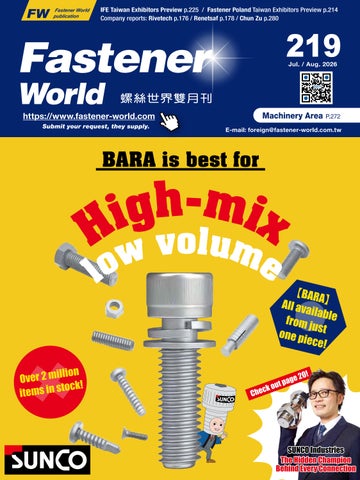
The Hidden Champion Behind Every Connection
How It Built a Global Business Through People, Purpose, and the Humble Screw
Have you ever stopped to consider what life would be like without screws? Somewhere within a 3-foot radius of you right now, at least one is quietly holding something together. Yet without these tiny components, virtually every industry would falter. Among the unseen contributors to global stability is SUNCO
Industries, Japan’s largest specialized fastener trader—a hidden champion with a growth story written not in cold numbers, but in “people”.
PRESIDENT YOSHIHIDE OKUYAMA
At SUNCO, people are not just assets, but the heart of the organization. Yasuko Tamaki, a 95-year-old female employee recognized by Guinness World Records as the world’s oldest administration worker, has served the company since its early days. Her New Year’s cards carry words of appreciation for colleagues across departments she never directly interacts with. With deep knowledge of each employee’s role, she has become a living storyteller, guiding the next generation through firsthand accounts of past challenges that no report could capture.
Tamaki ger Yasuko Section Mana Record Holder) (Guinness
Women-friendly Workplace / SUNCO’s Women Power!
020
Fastener World no.219/2026 惠達雜誌
COVER STORY “Grand Ring” diorama
y Bo ket c So
SUNCO’s philosophy extends far beyond its longest-serving staff. More than 50% of its annual new hires are women, and the company has built systems that encourage female participation in decision-making. Its Kurumin certification for childcare support ensures that parental leave and flexible work arrangements are standard practice, not exceptions. Employees return to work with minimal disruption, preserving productivity while honoring life milestones. The company ships roughly 25 million screws globally each day with a 99.999% accuracy rate. Behind this precision lies SUNCO’s “People × Technology” philosophy: advanced logistics systems integrated with the
daily discipline of part-time staff who stand at the center of operations. Some have worked for over 30 years, and their trust in the company is so deep that during the 2018 Osaka earthquake, employees returned to work until 11 p.m. after briefly preparing dinner for their families.
“Play hard. Deliver stronger.”
Pr e si d e nt Yo shihi d e O k u yam a ’s l e a d e r ship philosophy is simple: “Play hard. Deliver stronger.” He believes work should support life, not dominate it. “People work in order to enjoy their lives,” he notes.
encouraged long-term employment, allowing individuals—especially late-bloomers—to gradually discover where they truly excel. SUNCO’s creativity extends beyond operations. The company has transformed screws into art—installations made from colorful resin screws, mosaic art, and a diorama recreating Expo 2025 Osaka’s “Grand Ring” constructed entirely from 1,600 stainless steel screws. Even its overseas expansion strategy revolves around “Socket Boy,” a mascot wearing a hexagon socket head cap screw and blue Happi coat. The mascot has become the company’s global brand signature, accompanied by a magazine named after the mascot and a website that celebrates Japanese screw culture. What unites SUNCO’s initiatives is their mindset of creating what doesn’t yet exist in the industry. From the
world’s oldest Guinness-holding employee to single-screw shipping services accounting for over 60% of domestic sales, SUNCO continues pursuing distinctive strategies that no other company has dared to attempt. In a world obsessed with short-term productivity and talent mobility, SUNCO Industries proves that organizational continuity, mutual support, and lifelong engagement can drive extraordinary results. The screws remain unseen, but the people behind them are anything but invisible. (This article is authorized and paraphrased from the original 5-part story by SUNCO Industries published in Business by LA Times Studios.)
This mindset has created opportunities for homemakers and
Sunco Industries’ contact: Purchasing Dept. International Trade Section Email: export@sunco.co.jp
Copyright owned by Fastener World / Article by Dean Tseng
惠達雜誌 Fastener World no.219/2026
021
024 Fastener World no.219/2026
026 Fastener World no.219/2026
027 Fastener World no.219/2026
028 Fastener World no.219/2026
Fastener World no.219/2026
031
Fastener World no.219/2026 035
Fastener World no.219/2026 037
040 Fastener World no.219/2026
Fastener World no.219/2026 041
042 Fastener World no.219/2026
043 Fastener World no.219/2026
044 Fastener World no.219/2026
045 Fastener World no.219/2026
046 Fastener World no.219/2026
Fastener World no.219/2026 047
050 Fastener World no.219/2026
Fastener World no.219/2026 051
060 Fastener World no.219/2026
061 Fastener World no.219/2026
064 Fastener World no.219/2026
Fastener World no.219/2026 065
066 Fastener World no.219/2026
Fastener World no.219/2026 067
068 Fastener World no.219/2026
Product Range ISO 9001 / IATF 16949 / BSCI
Automobile Fasteners Chipboard Screws Collated Screws Concrete Screws Drywall Screws Multi-Stroke Forming Self-Drilling Screws Stainless Screws Tapping Screws Window Screws
886-7-621-1759 886-7-622-1859 jau@ms10.hinet.net jysales@mail.jauyeou.com www.fastener-world.com/en/supplier/jau-yeou/ No. 500, Shengsen Rd., Kangshan Dist., Kaohsiung City 820, Taiwan
Bi-metal
www.jauyeou.com
Fastener World no.219/2026 069
070 Fastener World no.219/2026
074 Fastener World no.219/2026
Fastener World no.219/2026 075
Fastener World no.219/2026 077
Fastener World no.219/2026 079
080 Fastener World no.219/2026
Fastener World no.219/2026 081
082 Fastener World no.219/2026
Fastener World no.219/2026 083
086 Fastener World no.219/2026
089 Fastener World no.219/2026
090 Fastener World no.219/2026
Fastener World no.219/2026 091
092 Fastener World no.219/2026
094 Fastener World no.219/2026
Fastener World no.219/2026 097
098 Fastener World no.219/2026
Fastener World no.219/2026 099
102 Fastener World no.219/2026
Fastener World no.219/2026 103
104 Fastener World no.219/2026
106 Fastener World no.219/2026
107 Fastener World no.219/2026
108 Fastener World no.219/2026
Value Solution Provider Best choice for pre-coating
TSLG 耐落是全球扣件預塗膠首選品牌
NYLOK
®
precote®
高雄廠 : 高雄市湖內區中山路二段二巷 53 弄 9 號 TEL: 886-7-6996777 / FAX: 886-7-6998999 / E-mail:tslg.kh@tslg.com.tw 耐落系台灣耐落股份有限公司註冊商標 precote®系德國 omniTECHNIK 公司註冊商標 NYLOK®系美國NYLOK公司註冊商標
www.tslg.com.tw
112 Fastener World no.219/2026
Fastener World no.219/2026 113
SPECIAL FEATURE
Editorial-
As Competitors Expand, Is the “Value” of Taiwan Being Recognized? From January to April this year, Taiwan’s fastener exports totaled approx. 363,000 tons, a decline of more than 11% compared to last year. In monetary terms, this amounts to approx. USD 1.33 bn, representing a 4.7% drop. For Taiwan’s fastener industry, the underlying causes warrant further investigation: Is it due to unfavorable macroeconomic conditions? Are competitors poaching orders? Or is the industry’s own competitiveness relatively lacking? Amid sluggish market orders, we’d like to thank TIFI Chairman Yung-Yu Tsai for his continued efforts—including lobbying the government for funding—to stem the decline in Taiwan’s fastener exports, as well as the government for actively promoting training programs on AI upgrades to support the industry’s development and modernization. Given the current market situation, competition from China is undoubtedly one of the main factors. Not only has Taiwan been affected, but many countries—including Europe, the U.S., and Japan—have also taken notice of the threat posed by China’s low-price dumping and have successively imposed AD measures. However, this also highlights a problem: aside from joining the price war, do Taiwanese fasteners have no other value to offer? Especially after Fastener World recently participated in international trade shows in China, Thailand, Indonesia, Malaysia, Japan, Italy, and other countries, we have come to deeply appreciate that peers in other countries have long adopted a more proactive stance toward global expansion and transformation in response to market competition and shifting industry trends. If Taiwanese fastener manufacturers continue to rely on outdated business models to address future challenges, they may ultimately be left with nothing.
Keeping Pace with AI-Driven Innovation: A “Great Leap Forward” Era Is Taking Shape for China's Fastener Manufacturers 20-30 years ago, Taiwan did indeed hold an advantage over China in fastener manufacturing, technology, and management. However, in recent years, as many Chinese fastener manufacturers have aggressively invested in state-of-the-art equipment for smart production and AI-powered warehousing, and built factories with monthly production capacities often reaching tens of thousands of tons—and even leveraged their advantage as a source of cheaper wire rod, along with government support through initiatives like “the Belt and Road Initiative,” to expand their global market share— they have snatched away orders from competitors in many countries (Taiwan alone is estimated to have lost 20% of its orders annually). Additionally, the booming development of EVs in China has driven the industry to gradually shift from low-end standard parts toward mid-to-high-end components,
114
Fastener World no.219/2026 惠達雜誌
Fastener World no.219/2026 115
SPECIAL FEATURE
simultaneously spurring growth in the fields of electromechanical systems, shipbuilding, machinery & equipment, semiconductors, and defense. Driven by the massive annual demand of over 10 million metric tons for fasteners—both for domestic and export markets—China’s improving quality, technology, and operational efficiency are making it increasingly difficult for Taiwanese fastener manufacturers, which lack the support of a large domestic market, to compete. In addition to the domestic market, Chinese manufacturers have been going all out in recent years to invest and expand into Southeast Asia, Europe, and the Americas, while actively capitalizing on hot trends such as AI robots, automation, precision automotive components, smart manufacturing, and unmanned vehicles. At certain trade shows held in Thailand, Malaysia, and Indonesia, over 70% of exhibitors were from China or affiliated with Chinese companies. This is not only due to Chinese government subsidies that support companies’ overseas expansion— and even encourage domestic exhibition companies to organize events abroad—but also because intense domestic competition drives Chinese firms to boldly invest greater capital and effort into global expansion and the search for new markets. Knowing both oneself and the competition, when the biggest rivals in the market are fighting so hard, Taiwan’s fastener industry really needs to give this serious thought. One exhibitor pointed out that Chinese fasteners are indeed highly price-competitive today, and even machinery, dies, and related peripheral equipment are cheaper than those from Taiwan. Therefore, the entire Taiwanese fastener supply chain—from upstream to midstream to downstream—should work together to assess the situation and identify the positioning and direction for the future development of Taiwan’s fastener industry.
“Global Sourcing & Sales” Will be a Future Industry Trend
EXPORT
116
Fastener World no.219/2026 惠達雜誌
211545
256681
297382
300103
302189
322076
335551
571937
582738
625187
There have long been signs that Chinese companies are quietly expanding their global footprint. In Thailand, a country with a well-developed automotive industry and an annual production capacity of around 1.5 million vehicles, many Chinese automakers and parts suppliers have aggressively captured market share, driving the maturation of the local supply chain and putting significant pressure on Japanese and Korean suppliers in the region. It is reported that nearly 70% of the EVs on Thailand’s roads are Chinese brands. In Indonesia and Malaysia, an increasing number of Chinese companies are also investing and setting up factories. Beyond Southeast Asia, major Chinese automaker BYD has also been extensively establishing factories in Europe, the U.S., and other regions, collaborating with local supply chains to capture market share with mid- to low-priced EVs. Moreover, it is not just automakers; many other Chinese companies are also setting up factories overseas, indicating that global sourcing and sales have become the new trend in today’s market strategy. Table 1 shows the top 10 destinations for Chinese automobile exports in 2025. Several major European and American distributors who flew to Thailand specifically to attend this exhibition also stated that, influenced by geopolitical factors between China and Taiwan, they hope to find more supply sources in Table 1. Top 10 Destinations for Chinese Automobile Exports Southeast Asia and leverage the demand advantages of these in 2025 (Unit: Vehicle) countries’ domestic markets to establish a global sourcing and sales strategy. As shown in Table 2, which details ASEAN’s global fastener import and export performance for 2024, the influence of some ASEAN countries within the fastener supply chain is gradually being recognized by European and American buyers. Taiwanese companies can also keep pace with this trend. They might consider forming JVs with trusted, long-term European and American clients to establish factories in Southeast Asia or other countries, thereby creating more opportunities to secure long-term supply contracts.
Fastener World no.219/2026 117
SPECIAL FEATURE Table 2. ASEAN’s Global Fastener Import and Export Performance for 2024 (Unit: USD) Country
Import and Export
Export
Import
ASEAN
6,012,199,233
2,083,686,976
3,928,512,257
Thailand
1,641,051,400
594,401,993
1,046,649,407
Vietnam
1,414,186,943
541,867,807
872,319,136
Singapore
903,848,859
409,706,882
494,141,977
Malaysia
948,610,812
328,480,582
620,130,230
Despite the Impact of Tariffs and Exchange Rates, Demand Remains Steady; Seeking Business Opportunities in the OEM/ ODM Supply Chain
Driven by President Trump’s “Made in America” policy, the 50% tariff imposed under Indonesia 631,946,225 131,574,510 500,371,715 Section 232 has indeed placed significant Philippines 361,664,934 75,141,464 286,523,470 cost pressure on U.S. importers purchasing fasteners, and there is no prospect of a Myanmar 11,697,552 1,942,098 9,755,454 tariff reduction in the short term. However, Brunei Darussalum 8,840,775 392,180 8,448,595 data from various sources indicate that Cambodia 81,708,776 124,994 81,583,781 global fastener production has not shown Laos 7,520,802 48,475 7,472,327 any significant decline, suggesting that the global economy is not in a state of complete Timor-Leste 1,122,155 5,991 1,116,165 downturn. As long as the New Taiwan Dollar does not appreciate sharply over a short period in H2 this year as it has in the past, fastener sales to the U.S. should not experience major disruptions. Therefore, the top priority for Taiwanese fastener manufacturers right now should be demonstrating their irreplaceable value to customers and capitalizing on positive market developments to secure more orders. For example, Toyota recently announced a plan to establish a production line in Taiwan for its flagship models destined for the Japanese market, and Foxtron’s EVs also represent niche markets that manufacturers can actively target. Taiwan’s fasteners and related components still hold a strong technological edge. As long as companies can effectively leverage these strengths and demonstrate them to customers, achieving another industry milestone—such as “70% of Tesla’s parts coming from Taiwan”—will not be difficult. Although Taiwan’s economy is now driven by the high-tech sector, making it increasingly difficult for traditional industries to operate, there is still great potential for success if businesses can align with industry trends—such as AI, automotive, defense, and precision machinery—and penetrate the supply chains of highend OEM/ODM clients, rather than remaining stuck in a trade-channel mindset. Major manufacturers must also play a leading role in helping smaller partner companies define their own market positions. Currently, Taiwan’s hand tool, automotive parts, and CNC industries are gradually embracing the AI trend and shifting toward precision manufacturing with small-batch, diversified production. They must find ways to showcase their unique, high-value-added products and services. If the fastener industry continues to cling to outdated practices and focus solely on price competition for exports, it will ultimately be left to take the brunt of the competition.
The Mindset of “Setting Up Extra Factories Outside China and Taiwan (China-Taiwan+1)”
China
Taiwan
+1?
Finally, we’d also like to urge buyers in Europe and the U.S. not to be misled by market rumors; the so-called “setting up extra factories outside China and Taiwan” issue is not as serious as outsiders claim. According to the data, Taiwan’s total global exports across all industries exceeded USD640 billion in 2025, with exports projected to reach nearly USD 900 billion by 2026. 80% of these exports consist of high-tech semiconductor products. Taiwan’s fastener exports are estimated to be around USD 4 billion in 2026—a negligible amount. Furthermore, should a war disrupt supply, we believe that for over 90% of Taiwan’s fasteners, alternative suppliers can be found worldwide, so there is no need to fear the “China-Taiwan +1” scenario. Not to mention that many major manufacturers from Europe, the U.S., and Japan continue to invest in Taiwan on a scale of tens of billions to hundreds of billions of U.S. dollars—decisions made after thorough risk assessments, clearly demonstrating that Taiwan’s overall conditions remain highly favored by international giants. The value of Taiwan’s fasteners cannot be measured solely by price; their true value lies in their superior technology, quality management, and more flexible customer service. Copyright owned by Fastener World
118
Article by Gang Hao Chang, Vice Editor-in-Chief
Fastener World no.219/2026 惠達雜誌
122 Fastener World no.219/2026
Fastener World no.219/2026 123
124 Fastener World no.219/2026
Fastener World no.219/2026 127
INDUSTRY FOCUS
Financial Reports of Fastener Companies Updated on Jun. 25, 2026
Monetary unit in millions except for EPS
India Companies
Mahindra Fasteners
Sterling Tools Limited
(in Million INR)
Financial Year (Ended March)
Total Income/ Revenue
Pre-tax Profit
Net Profit (Loss)
EPS (Loss)
2026
1,710.594
195.764
145.060
24.62
2025
1,694.856
200.303
148.695
25.23
Change (%)
+0.9
-2.3
-2.4
-2.4
2026
3,872.237
7.362
(22.634)
(1.19)
2025
3,858.140
45.571
33.253
1.74
Change (%)
+0.3
-83.8
---
---
2026
8,395.051
476.500
293.284
8.02
2025
10,379.535
766.352
582.931
16.05
Change (%)
-19.1
-37.8
-49.7
-50.0
2026
62,888.2
5,928.5
2025
59,554.2
5,417.5
Change (%)
+5.5
+9.4
2026 vs. 2025 Total Assets 2,072.362 vs. 1,952.130
2,244.100 vs. 2,417.863
8,211.145 vs. 7,906.847
Mahindra Fasteners’ 2026 total income was INR 1,710.594 million, up 0.9% from INR 1,694.856 million in 2025. Net profit was INR 145.060 million in 2026, down 2.4% from INR 148.695 million in 2025. Total assets increased to INR 2,072.362 million in 2026 from INR 1,952.130 million in 2025. Panchmahal Steel Limited’s 2026 total income was INR 3,872.237 million, up 0.3% from INR 3,858.140 million in 2025. Net profit was a loss of INR 22.634 million in 2026, compared to a INR 33.253 million gain in 2025. Total assets decreased to INR 2,244.100 million in 2026 from INR 2,417.863 million in 2025. Sterling Tools Limited’s 2026 total income was INR 8,395.051 million, down 19.1% from INR 10,379.535 million in 2025. Net profit was INR 293.284 million in 2026, down 49.7% from INR 582.931 million in 2025. Total assets increased to INR 8,211.145 million in 2026 from INR 7,906.847 million in 2025. Sundram Fasteners Limited’s 2026 revenue was INR 62,888.2 million, up 5.5% from INR 59,554.2 million in 2025. Net profit was INR 5,928.5 million in 2026, up 9.4% from INR 5,417.5 million in 2025. Total assets are yet to be disclosed.
128
Fastener World no.219/2026 惠達雜誌
Fastener World no.219/2026 129
INDUSTRY FOCUS
Japan Companies
Operating Profit
(in Million JPY)
Financial Year (Ended March)
Revenue
Ordinary Profit
2026
25,548
1,174
2025
26,073
1,459
Change (%)
-2.0
-19.5
2027 Prospect
27,000
1,600
Change (%)
+5.6
+36.2
2026
352,650
48,078
2025
353,038
Change (%)
Net Profit
EPS
51,275
34,079
361.44
49,200
52,147
44,767
461.95
-0.1
-2.3
-1.7
-23.9
-21.7
2027 Prospect
367,000
50,800
50,000
34,000
365.10
Change (%)
+4.1
+5.7
-2.5
-0.2
+1.0
2026 vs. 2025 Total Assets
393,590 vs. 379,816
KFC’s 2026 revenues were JPY 25,548 million, down 2.0% from JPY 26,073 million in 2025. The company forecasts 2027’s revenue at JPY 27,000 million, up 5.6%. NIFCO’s 2026 revenues were JPY 352,650 million, down 0.1% from JPY 353,038 million in 2025. The company ended the year with a net profit of JPY 34,079 million in 2026, down 23.9% from JPY 44,767 million in 2025. Total assets increased to JPY 393,590 million in 2026 from JPY 379,816 million in 2025. The company forecasts 2027’s revenue at JPY 367,000 million, up 4.1%.
South Korea Companies
(in Million KRW)
Financial Year
Sales
Operating Profit
Net Profit
2025
349,105
14,274
4,621
2024
372,823
11,180
7,420
Change (%)
-6.4
+27.7
-37.7
2025 vs. 2024 Total Assets 500,875 vs. 408,573
Taeyang Metal Industrial's 2025 sales were KRW 349,105 million, down 6.4% from KRW 372,823 million in 2024. Net profit was KRW 4,621 million in 2025, down 37.7% from KRW 7,420 million in 2024. Total assets increased to KRW 500,875 million in 2025 from KRW 408,573 million in 2024.
Malaysia Companies
(in Million MYR)
Financial Year
Gross Profit
Pre-tax Profit
Net Profit
EPS
2025
33.455
9.676
5.756
3.75
2024
29.455
10.496
1.682
1.10
Change (%)
+13.6%
-7.8%
+242.2%
+240.9%
Tong Herr’s 2025 gross profit was MYR 33.455 million, up 13.6% from MYR 29.455 million in 2024. Net profit was MYR 5.756 million in 2025, up 242.2% from MYR 1.682 million in 2024. Total assets decreased to MYR 654.432 million in 2025 from MYR 684.354 million in 2024.
130
Compiled by Fastener World
Fastener World no.219/2026 惠達雜誌
2025 vs. 2024 Total Assets 654.432 vs. 684.354
Fastener World no.219/2026 131
INDUSTRY FOCUS
Top Taiwanese Companies Revenue Ranking (2023-2025) ◢ Fastener ◢ Wire Rod ◢ Machine ◢ Hand Tool ◢ Hardware Parts
(1) Fastener Manufacturers
(in NTD 0.1 bn)
Ranking Among Top 2,000 Taiwanese Manufacturers Year Ranking 2025 2024 2023
Company Name
Revenue
Revenue Earnings Profit Total Asset Growth (%) After Tax Margin (%)
1
↓ 293
288
272
Tong Ming Enterprise
127.33
1.51
6.08
4.77
147.11
2
↓ 316
273
286
QST International
114.51
-12.83
4.15
3.62
233.34
3
↓ 409
365
372
Chun Yu Works
83.08
-9.35
0.55
0.66
115.47
4
↓ 499
467
444
San Shing Fastech
62.16
-8.84
8.91
14.33
87.55
5
↓ 521
452
448
Boltun
57.73
-19.19
0.61
1.06
120.44
6
↑ 581
646
610
OFCO
50.62
22.39
-1.62
-3.20
53.75
7
↑ 671
719
741
NAFCO
40.55
15.79
3.31
8.16
80.58
8
↓ 789
738
675
Jinn Her Enterprise
30.60
-9.63
---
---
165.90
9
↓ 827
760
732
Jau Yeou Industry
28.69
-10.57
---
---
34.57
10
↓ 853
851
722
Lu Chu Shin Yee
27.17
-0.18
0.57
2.10
49.02
11
↓ 907
843
804
Sumeeko
24.94
-9.64
0.59
2.37
37.47
12
↑ 920
922
914
Spec Products
24.43
1.45
1.69
6.92
20.80
13
↑ 929
930
881
Intai Technology
24.05
1.22
2.50
10.40
48.50
14
↓ 1002
938
907
Sheh Fung Screws
20.73
-10.72
0.71
3.42
33.91
15
↓ 1198
1155
1116
Rodex Fasteners
14.83
-5.00
0.03
0.20
24.81
16
↓ 1245
1166
1132
King Point (PATTA)
13.73
-10.79
0.35
2.55
26.43
Among fastener manufacturers, a total of 16 companies were ranked among Taiwan’s Top 2,000 Enterprises by revenue in 2025. This was 2 fewer than the 18 companies listed in 2024 and even fewer than the 20 companies that made the list in 2023. The number of fastener manufacturers on the ranking has now declined for 3 consecutive years. Compared with the peak of 22 companies in 2022, the total number has fallen by 6, regressing to a level close to that seen 7 years ago in 2018 (Figure 1).
132
Fastener World no.219/2026 惠達雜誌
Fastener World no.219/2026 133
INDUSTRY FOCUS Fig 1. Number of Fastener Manufacturer Entrants in Revenue
Ranking of Top 2,000 Taiwanese Corpora�ons
Number of Companies
25 23 20
21
22
21
19 17
20
19
18 16
15
15 2018
2019
2020
2021
2022
2023
2024
2025
Year
In terms of revenue scale, the top 3 companies were Tong Ming Enterprise, QST International, and Chun Yu Works. Notably, Tong Ming Enterprise and QST International switched positions once again in the 2025 ranking. These 3 companies altogether generated NT$32.492 billion in revenue in 2025, accounting for 43.6% of the total revenue of NT$74.515 billion generated by all 16 entrants. Companies that improved their ranking positions in 2025 are marked with red upward arrows. Only 4 companies achieved a higher ranking, the same number as in 2024. Compared with 2022, when 17 ranked companies moved up the list, this represents a decline of more than fourfold. Meanwhile, as many as 12 companies reported revenue declines in 2025. The average revenue growth rate of all 16 ranked companies was -4.02%. Although this was a significant improvement over the -14.6% recorded in 2023, it remained well below the 2024 average of 1.42%. The average profit margin in 2025 was 4.09%, substantially lower than the 9.11% recorded in 2024 and also below the 8.78% reported in 2023. These figures reflect the sharp fluctuations experienced by Taiwan’s leading fastener manufacturers. Following record-high order volumes in 2022, the industry saw a significant drop in demand in 2023. Although companies maintained positive profitability on average in 2025, the overall revenue growth momentum of Taiwan’s fastener sector remained weaker than that of the broader Top 2,000 Taiwanese enterprises, while the number of fastener companies making the ranking continued to decline. Although demand from global industrial, construction, and general manufacturing sectors has begun to recover, the rebound has not been strong enough to drive substantial growth across Taiwan’s fastener industry. Many companies continue to face declining revenues and lower rankings, indicating that the sector remains in a period of adjustment. Nevertheless, several companies have demonstrated impressive profitability despite the challenging market environment. One notable example is San Shing Fastech. The company generated NT$6.216 billion in revenue in 2025, down 8.84% from 2024. However, its after-tax profit reached NT$891 million, resulting in an outstanding profit margin of 14.33%. Not only was it the most profitable fastener manufacturer in this survey, but it also recorded the highest profit margin among all entrants.
Another noteworthy trend is the superior performance of companies serving the aerospace and high-precision fastener markets. NAFCO recorded revenue growth of 15.79% in 2025, reaching NT$4.055 billion, with after-tax profits of NT$331 million and a profit margin of 8.16%. Meanwhile, Intai Technology generated NT$2.405 billion in revenue and achieved an even higher profit margin of 10.40%. Despite the fact that the overall fastener market has yet to fully recover, NAFCO, which focuses on aerospace applications, and Intai Technology, a supplier to the medical industry, have both maintained steady growth and strong profitability. Their performance highlights the growing importance of aerospace, medical, precision machinery, and other specialized industrial applications as key development directions for Taiwan’s fastener industry. In terms of total assets, the top 3 entrants in 2025 were QST International, Jinn Her Enterprise, and Tong Ming Enterprise, unchanged from 2024. From the perspective of asset utilization efficiency, companies such as San Shing Fastech, Spec Products, Intai Technology, and NAFCO demonstrated superior returns on assets. Among them, San Shing Fastech generated nearly NT$900 million in profit with total assets of less than NT$9 billion, significantly outperforming some larger enterprises with asset bases exceeding NT$10 billion. This indicates that, in today’s market environment, competitive advantage is increasingly shifting from scale-driven operations to technology-driven and value-driven business models. Looking at the overall performance of the 2025 entrants, three major trends can be identified. First, the traditional standard fastener market has not yet fully emerged from the downturn, and many large manufacturers continue to face pressure from declining revenues. Second, high value-added products have become the key to maintaining profitability, with high-end fasteners significantly outperforming standard products. Finally, industry polarization is becoming increasingly evident. Large enterprises continue to leverage economies of scale and global operations to maintain their market positions, while small and medium-sized companies are achieving stronger profitability through technological expertise and niche-market strategies. As global supply chain restructuring and manufacturing upgrades continue to advance, value-added specialization and technological differentiation are expected to become the core drivers of Taiwan’s international competitiveness in the fastener industry.
(2) Fastener Traders Ranking Among Top 2,000 Taiwanese Manufacturers
134
2025
2024
2023
↑ 99
101
77
(in NTD 0.1 bn) Company Name
Revenue
Revenue Growth (%)
Earnings After Tax
Profit Margin (%)
Total Asset
Brighton Best International
232.29
2.29
31.28
13.47
444.41
Fastener World no.219/2026 惠達雜誌
Fastener World no.219/2026 135
INDUSTRY FOCUS In the fastener trading category, only Brighton Best International was ranked among Taiwan’s Top 2,000 Enterprises in 2025, the same as in 2024. The company recorded revenue growth of 2.29% in 2025, reaching NT$23.229 billion. This marks a clear turnaround from the 7.78% revenue decline reported in 2024. Its profit margin also improved from 10.00% in 2024 to 13.47% in 2025, maintaining strong double-digit profitability growth. It is worth noting that many Taiwanese fastener trading companies have established overseas operations and do not report their overseas revenues separately. In addition, some conduct business under multiple corporate entities. Were it not for these factors, more fastener trading companies would likely have appeared on the ranking.
(3) Fastener-related Material & Equipment Manufacturers Ranking Among Top 2,000 Taiwanese Manufacturers Ranking
Year
Company Name
Revenue
(in NTD 0.1 bn)
Revenue Earnings Profit Total Asset Growth (%) After Tax Margin (%)
2025
2024
2023
1
↓ 17
16
14
China Steel Corporation
3,171.55
-12.03
-43.49
-1.37
6,738.47
2
↓ 77
55
53
Dragon Steel Corporation
617.54
-24.72
-79.68
-12.90
1,499.81
3
↓ 215
135
107
Chung Hung Steel Corporation
190.22
-37.55
-18.48
-9.72
268.86
4
↑ 365
407
373
Tycoons
93.42
16.72
-0.06
-0.06
104.59
5
↓ 424
410
409
New Best Wire
77.34
-2.59
1.93
2.50
84.43
6
↑ 542
677
540
Tycoons Worldwide Group (Thailand)
54.34
39.62
1.25
2.30
60.33
7
↓ 607
564
573
Kuang Tai Metal Industrial
47.41
-6.53
---
---
58.82
8
↓ 850
748
750
Quintain Steel
27.34
-16.67
-2.39
-8.74
136.52
9
↑ 914
931
974
Yuang Hsian Metal
24.64
3.75
---
---
21.99
10
↓ 1151
1149
1171
Chen Nan Iron Wire
16.30
2.71
1.03
6.32
23.54
Among the companies in the materials segment, 6 firms reported positive revenue growth in 2024, but only 3 achieved revenue growth in 2025. Tycoons Worldwide Group (Thailand) posted the strongest growth rate, reaching 39.62%, while Chen Nan Iron Wire recorded the highest profit margin at 6.32%. After returning to positive growth in 2024 with an average revenue growth rate of 1.59%, Taiwan’s fastener-related material suppliers saw their growth momentum weaken again in 2025, with the average growth rate falling to -3.70%.
(4) Hand Tool Manufacturers Ranking Among Top 2,000 Taiwanese Manufacturers Ranking
Year
(in NTD 0.1 bn)
Company Name
Revenue
Revenue Growth (%)
Earnings After Tax
Profit Total Asset Margin (%)
2025
2024
2023
1
↑ 676
739
633
Mobiletron
40.04
19.70
0.58
1.45
92.00
2
↓ 696
602
613
Stanley Chiro International
38.14
-18.07
-0.17
-0.45
106.94
In the hand tools category, Stanley Chiro International, which achieved revenue growth of 9.12% in 2024, experienced a reversal in 2025, posting a decline of 18.07%. By contrast, Mobiletron rebounded from a 16.46% revenue decline in 2024 to achieve growth of 19.70% in 2025. The former’s revenue decreased from NT$4.655 billion in 2024 to NT$3.814 billion in 2025, while the latter’s revenue increased from NT$3.345 billion to NT$4.004 billion over the same period. In terms of capital scale, however, Stanley Chiro International maintains a capital base exceeding NT$10 billion.
136
Source: Commonwealth Magazine Issue no. 848 Compiled by Fastener World
Fastener World no.219/2026 惠達雜誌
Fastener World no.219/2026 137
INDUSTRY FOCUS
Taiwan CSC’s Q3 2026 Production & Sales Conference
TIFI Chairman Yung-Yu Tsai:
Taiwan Fastener Industry Needs to Move Beyond a Price-Competition Mindset Following Taiwan CSC’s NT$1,000 per ton adjustment to bar and wire rod prices (for low-carbon, medium-to-high-carbon, cold-drawn, and lowalloy grades) in Q2 this year, the latest Q3 wire rod list prices have been also announced by mid-June (an NT$1,000 increase per ton). This May, Taiwan’s fastener exports to 89,000 tons (compared to approximately 363,000 tons in Jan. to Apr. this year, a YoY decrease of 11.15%). Coupled with the 50% tariffs imposed under U.S. Section 232 and the soaring raw material costs resulting from the indirect impact of the Strait of Hormuz blockade, these factors have led participating manufacturers to pay particular attention to the trend of Taiwan CSC’s Q3 wire rod pricing. However, TIFI Chairman Yung-Yu Tsai specifically reminded industry reps that the real challenge currently facing Taiwan fastener industry is not who can sell at the lowest price; rather, the future growth opportunities for the industry lie in the value that manufacturers themselves can create for their customers. The conference also invited reps from InvestTaiwan of the Ministry of Economic Affairs (MOEA) to brief industry participants on the Taiwanese government’s 3 latest investment subsidy programs: the “Action Plan to Welcome Taiwanese Businesses Back to Invest in Taiwan,” the “Action Plan to Accelerate Investment by Enterprises Rooted in Taiwan,” and the “Action Plan to Accelerate Investment by SMEs.” These initiatives will provide critical support to companies interested in investing in Taiwan and accelerating their upgrading and transformation.
● Overview of the Global Economy, Steel Market, and Bar, Wire, and Fastener Markets
TIFI Chairman Yung-Yu Tsai
138
Fastener World no.219/2026 惠達雜誌
Data show that while Q1 2026 GDP across various countries has been robust and manufacturing activity continues to expand, factors such as oil price, inflation, logistics uncertainties, and tariffs may dampen
INDUSTRY FOCUS growth momentum in Europe and the U.S. in the future. Looking at global Q1 performance, U.S. growth was primarily driven by infrastructure spending and AI; Europe remained flat due to high energy costs; China benefited from stable exports; Japan saw steady export performance; and Southeast Asia maintained a GDP growth forecast of 4.6%; In the steel market, global steel demand is projected to reach 1.724 billion tons in 2026 (with expectations of growth to 1.762 billion tons in 2027); short-term variables include trade barriers and the costs of coal and iron ore. There are signs of a decline in the scale of China’s steel exports. In the new home and automotive markets, U.S. housing starts rose 4.8% YoY in April, while new car sales fell 6.0% YoY. European automobile sales in April rose 5.1% YoY; Taiwan’s Q1 imports of bars and wire totaled 196,000 metric tons, up 3% YoY. Exports of screws and nuts for the first 4 months of this year reached 373,300 metric tons, down 11.5% YoY, with an average unit price of US$3.67/KG, up 7.3% YoY.
● Taiwan's Value Isn't About Competing on Price and Volume: Seize the Opportunity at This Year's IFE in Phoenix The Essence of Taiwan Lies in a “Sense of Trust” Faced with intense market competition, the removal of the 20% U.S. tariff on fentanyl exports from China, and rising costs of raw materials due to the appreciation of NTD, many industry players believe that cutting prices to win orders is the way to regain market share. However, Chairman Tsai does not believe this is a long-term strategy for the development of Taiwan fastener industry. He pointed out that the current wave of price increases is far less severe than the impact caused by the previous surge in shipping costs. If overseas customers did not strongly object at that time, why do Taiwanese manufacturers now need to compete on price to boost volume? Especially as various adverse factors, such as labor shortages in Taiwan, impact the development of the fastener industry, the key is to focusing on how to help customers recognize the irreplaceable value that sets Taiwan apart from its Chia-Cheng Lee, VP of Commercial Division competitors. If companies merely rush into investments to meet customers’ “extra operation outside Taiwan and China” demands, it could ultimately lead to a dead end. Chairman Tsai emphasized that engaging in direct price wars with competitors from emerging economies is fundamentally pointless, as Taiwanese companies simply cannot compete on price. Instead, the “sense of trust” they provide to customers is the most irreplaceable value Taiwanese manufacturers offer. In particular, given that Taiwan fastener industry has a longer history than those of China or Vietnam, with master craftsmen boasting 20 to 30 years of experience being a common sight, it is simply unreasonable to compare the products they create with those of competitors on a price-only basis.
Are You Doing a Good Job Managing Customer Relationships? In this age of advanced IT, many manufacturers often rely on a few phone calls and emails to quickly process customer orders. Chairman Tsai believes that face-to-face communication and building a rapport with customers are the keys to ensuring a steady stream of orders. The upcoming IFE in October represents the best opportunity for Taiwan fastener industry to consolidate and develop client relationships and strengthen those ties. TIFI will also increase the number of exhibition booths to 12 and open up space for the fastener industry members who do not secure their booths to display catalogs, play company videos, and even invite key buyers. Chairman Tsai noted that capitalizing on the opportunities presented by U.S. President Trump’s policy to expand domestic demand, coupled with exhibition and marketing subsidies of NT$20 million each from the ITA (MOEA) and the Kaohsiung City Government, represents a once-in-a-lifetime opportunity for Taiwan fastener industry. Furthermore, if a fastener company’s clients are particularly influential, TIFI may be able to coordinate with ITA to provide subsidies to invite them to attend the exhibition.
Taiwan's Quality Still Leads That of Its Emerging Competitors In the past, when European and American customers encountered quality issues with fasteners sourced from suppliers in China and other countries, the suppliers’ solution was not to recall and destroy the products but to simply ship a new batch. Does this mean there is a risk that substandard inventory could enter the market, leading to more customer complaints? Chairman Tsai believes that not only Taiwan fastener industry but also overseas buyers should recognize that Taiwan’s supply chain remains irreplaceable compared to competitors in other emerging economies when it comes to providing fasteners of assured quality. If buyers simply insist on forcing Taiwanese manufacturers to lower prices, high-quality Taiwanese fasteners will eventually be driven out of the market. This scenario, where “bad money drives out good,” benefits neither party. Especially with operating costs like steel and electricity prices continuing to rise, there is no reason why fastener prices shouldn’t increase! Taiwanese fastener manufacturers must also clearly recognize that if price were the sole issue, why are fastener factories in developed countries still operating normally? With a global population of billions, the demand for fasteners remains constant, and the economic outlook for next year is expected to gradually improve. The key lies in whether manufacturers can demonstrate their true value. When orders are slow, they must be even more proactive in expanding their reach, as that is where the opportunities lie. Copyright owned by Fastener World / Article by Gang Hao Chang, Vice Editor-in-Chief 惠達雜誌 Fastener World no.219/2026
139
ASSOCIATION Massimiliano Salini, Member of the European Parliament and Rapporteur, during his speech to the EIFI audience
General Assembly 2026 Call for closer trading ties as London hosts major European fastener manufacturer’s assembly I
nfluential leaders from the European fastener sector were in London recently to discuss the need for greater collaboration, sovereign production and the threat of cheap imports from the Far East.
The European Industrial Fastener Institute (EIFI), which represents over 300 member companies employing 113,000 people, held its three-day General Assembly in the UK capital. The profound transformation affecting manufacturing and its respective supply chains was at the heart of all discussions, with Europe and the UK’s industrial future set to depend on its collective ability to combine competitiveness, resilience and innovation with strategic autonomy. Both the Automotive Market and the General Industry & Distribution Market Group sessions addressed geopolitical instability, trade tensions, competitiveness, sustainability, regulation and the accelerating reconfiguration of global industrial value chains. They also acknowledged that whilst economic pressures were bringing unprecedented uncertainty, there were new opportunities emerging in construction, nuclear and defence. “London provided a fantastic backdrop for this year’s General Assembly, which was extremely timely considering the global uncertainty,” explained EIFI President Paolo Pozzi, who opened the event. “We represent 75% of all European fastener production, so there were lots of industry experts present to discuss tariffs, rising energy prices and other key issues, including the Carbon Border Adjustment Mechanism (CBAM) and the growing impact of Artificial Intelligence (AI).” He continued: “A key contribution was delivered by Tommaso Pardi, Director of GERPISA - Le Réseau International de L'Automobile. He examined the rapid expansion of Chinese automotive exports, the implications for European industrial sovereignty, and the need for stronger ‘Made in Europe’ industrial policies and local content strategies.” The EIFI is a non-profit making organisation representing the interests of the European fasteners manufacturing industry and its supply chain. It brings together six national trade associations from France, Germany, Italy, Poland, Spain and the UK, as well as several individual companies from Austria, Belgium, Croatia, Romania, Sweden and Switzerland. Services for members range from think tanks and reflection forums to co-ordination of technical activities, analysis of the market and lobbying on a pan-European level. In 2024, its membership was responsible for 1,700 k tonnes of production, worth more than €10bn. Paolo Pozzi, President of the EIFI
140
Fastener World no.219/2026 惠達雜誌
ASSOCIATION
(left to right) Liam Halligan (Daily Telegraph columnist and economist) chaired a Brexit panel with Jamie Mcleod (Crowe UK LLP) Matthew Ogg (Society of Motor Manufacturers and Traders (SMMT) and Tommaso Pardi (GERPISA - Le Réseau International de L'Automobile)
Competitive Europe The main keynote speech was delivered by Massimiliano Salini, Member of the European Parliament and Rapporteur, on CO emissions standards for vehicles under the EU ‘Fit for 55’ climate package.
Steve Morley, President of the Confederation of British Metalforming, added: “It’s always a major honour to host the EIFI, an organisation we work extremely closely with to support UK fastener manufacturers.
He focused on the need for a stronger and more competitive European industrial policy, capable of safeguarding strategic manufacturing sectors and their supply chains.
“Europe will always be one of our closest trading allies and there is plenty we can do to ensure regulation - both current and future - aligns so that positive trade arrangements can be made and completed. The biggest threat for both parties is cheap imports from the Far East and that’s something we’re all committed to addressing.”
During his speech, Mr. Salini addressed key topics currently at the centre of the European debate, including industrial competitiveness, trade defence instruments, technological neutrality, energy transition and the impact of global overcapacities on European industries. Hans Führlbeck, General Manager at EIFI, picked up the story: “The three days were crammed with discussion and strategic insights and that really resonated with our delegates, who also had time to explore London and nearby Windsor Castle. “Jelte Wiersma, Secretary General of CEMA, provided an in-depth overview of global agricultural machinery markets, international trade dynamics and the growing competitive pressure from China, while also analysing the effects of US trade policy and emerging opportunities linked to new trade agreements with Canada, Mercosur and India. “We also heard from PwC UK’s Alex Hawley on new European compliance framework around packaging, Digital Product Passports and the growing importance of data across our sector. “Being in the UK, we had to address the issue of Brexit ten years on and the opportunities that could exist from closer alignment between the two parties when it comes to trade. That was a fascinating conversation facilitated by Daily Telegraph columnist and well-known economic commentator Liam Halligan and proved there was a lot of interest in greater collaboration.”
EIFI is set to celebrate its 50th anniversary and 2027, with plans underway to mark the milestone with the largest General Assembly yet. Paolo Pozzi, President of the EIFI, concluded: “All of the discussions confirmed that Europe must continue pursuing its climate and sustainability objectives while ensuring that industrial competitiveness remains at the centre of EU policymaking. “The European industrial fasteners sector, and its supply chain, are essential to many strategic industries, including automotive, machinery, construction and infrastructure. “In an increasingly challenging global environment, manufacturers need balanced, pragmatic and predictable policies capable of supporting investment, innovation and employment across Europe. “EIFI will continue to support a strong and competitive European industrial base, promoting open dialogue between institutions and industry.” For further information, please visit www.eifi.org
惠達雜誌 Fastener World no.219/2026
141
143 Fastener World no.219/2026
European News
EUROPEAN NEWS
by Fastener + Fixing Magazine www.fastenerandfixing.com
Fontana Gruppo Acquires KAMAX Group
Continuing its expansion strategy, Fontana Gruppo has signed an agreement for the acquisition of KAMAX Group, strengthening itself as a player of recognised quality and a global leader in the fastener sector.
The transaction – which is subject to approval by the relevant authorities – will further strengthen Fontana’s European and global footprint, with Kamax’s significant manufacturing presence in Germany, Spain, Slovakia, the Czech Republic, Poland and China. Following the transaction, Fontana Group will have a total of
42 plants, employing more than 9,000 people – generating approximately €2 billion in revenue.
“From a strategic, industrial, and managerial perspective, this acquisition represents an important opportunity for business development, strengthening our distinctive positioning in the fastener sector, while generating significant prospects for growth and value creation,” comments Giuseppe Fontana, CEO of Fontana Group. “With its 15 plants, KAMAX brings a significant contribution to the Group in terms of technological capabilities and knowhow. This strategic operation represents a further step in the process of our global expansion, which in 2025 also saw the completion of the acquisitions of RTF in India and MNP in the United States.” Martin Burgholte, chairman advisory board at KAMAX Group, adds: “After three generations of building a successful and highly respected company with a unique DNA in the global fastener industry, the shareholders of KAMAX Group are opening a new chapter by transferring all their shares to Fontana Gruppo. We are pleased that, following this decision, KAMAX will become a vital part of an even stronger organisation and remain within the hands of a successful family owned company.” “This is not a transaction born of necessity, but a strategic decision made from a position of strength,” concludes Martin. “It was essential for us to find a partner who shares our values and is committed to further developing the KAMAX heritage. We are convinced that this step represents the most logical and effective way to unlock our combined potential and to secure a sustainable leadership position in our industry. Continuity is a cornerstone of this transaction and we firmly believe that the deep expertise and experience of both our teams will provide a strong foundation for future growth.”
146
Hilti Group Enters 2026 Business Year Strong
Hilti Group sales grew 1.9% in local currencies in the 2025 business year. The strong appreciation of the Swiss franc led to a negative currency effect of 4 percentage points on sales. In total, Hilti reported sales of CHF 6.3
billion (€6.8 billion) (-2.1%). Given continued strong investments and negative currency effects, the operating result dropped by 5.3% to CHF 728 million.
Jahangir Doongaji, CEO at Hilti Group commented: “In a year marked by ongoing global uncertainty, we navigated the radically changed tariff environment, drove productivity in operations and continued to invest significantly in our future. We can thus enter the 2026 business year from a position of strength. With our highly motivated global team, we will stay the course and continue to implement our strategy.”
Sales in the Americas region grew 9.3% in local currencies. The business also delivered solid doubledigit growth in the US market despite the dynamic tariff environment. In Europe, sales decreased in local currencies (-1.9%) in an overall soft construction market. The Middle East/Africa region reported growth of 12.9% in local currencies, driven by growing construction activity in the Middle East. Sales in the Asia/Pacific region declined by 2.1% in local currencies, mainly due to the challenging environment in North Asia. Furthermore, Hilti Group continued to strengthen its innovation pipeline, with more than 70 new products and services launched in 2025. Investments in research and development reached CHF 459 million, equalling 7.3% of Group sales. The software business gained further momentum with annual recurring revenue growth of 28% and an established customer base of more than 25,000. In addition, Hilti further expanded its production and supply network in the Americas, eastern Europe and India to secure its long-term supply chain resilience in a dynamic and complex global environment. The development of the construction market is expected to remain uncertain in 2026. It is likely that the Swiss franc will remain strong due to geopolitical instability and trade barriers. In line with its 'Lead 2030' strategy, Hilti will further strengthen its innovation pipeline in hardware, software and services.
Fastener World no.219/2026 惠達雜誌
EUROPEAN NEWS Würth Group Returns to Growth
After a slight decline in sales in 2024, the Würth Group returned to growth in 2025. The globally operating group of companies, leading in the development, production, and sale of assembly and fastening materials, closed the 2025 fiscal year reporting sales of €20.7 billion (2024: €20.2 billion). This corresponds to an increase of 2.3%, or 3.2% after adjustments to reflect currency effects.
Robert Friedmann, chairman of the central management board of the Würth Group, comments: “The global challenges have not diminished and nevertheless, we were able to continue on our growth trajectory. While the manufacturing industry remains in a period of weakness, limiting stronger sales growth, the business units serving the skilled trades continued their stable development.” German companies of the Würth Group closed the 2025 fiscal year reporting sales of €8 billion, a slight increase of 1%. The companies outside Germany recorded growth of 3.2% (4.7% adjusted for currency effects), achieving sales of €12.6 billion. The eBusiness segment also recorded above average growth. Sales through the Group’s digital sales channels totalled €5.2 billion, bringing their share in total Würth Group sales to a new high of 25.2%. “Against a challenging backdrop, our customers expect intelligent, practical solutions across the board,” continues Robert. “By consistently leveraging modern technologies, digitalisation, and Artificial Intelligence (AI), we provide tangible relief and help strengthen our customers’ competitive position. Our customers are increasingly sourcing products through digital channels. At the same time, our field sales representatives remain the central points of contact for our customers. Digital solutions and AI help them fulfil this role even more effectively.”
Böllhoff Acquires Stöger Automation
With effect from 1st April 2026, Böllhoff has taken over the business operations of Stöger Automation GmbH, to expand its portfolio in the field of joining technology to include screwdriving technology and flow drill insertion systems. With over 35 years’ experience, Stöger Automation from Königsdorf, Bavaria, is an experienced specialist in screwdriving, insertion, riveting and feeding technology. The company will be integrated into the Böllhoff Group as an independent associated company. The Stöger site in Königsdorf will remain in operation, thereby securing around 70 jobs in Bavaria, whilst also continuing Stöger’s existing customer relationships and expertise. Within the Böllhoff Group, Stöger will work closely with Böllhoff Systemtechnik, Böllhoff’s business unit specialising in automated processing systems for a wide variety of fasteners. In the medium term, this is expected to drive growth in the whole area of Setting Technology at Böllhoff Group, with all customers benefiting from an even broader range of services. “The acquisition of Stöger fills a gap in our technology portfolio and strengthens our position as a competence leader in 360° Joining Technology,” comments Dr. Ralf Adenstedt, managing director at Böllhoff Systemtechnik. “Screwdriving technology and flow drill insertion systems are a logical addition to our product range – a clear sign that we continue to grow as a group of companies."
First CBAM Certificate Price Now Available
The European Commission has published the first price of CBAM regulation certificates for 2026 Q1, set at €75.36 per tCO2e – marking an important milestone in the
implementation of CBAM and enabling companies to calculate CBAM related costs with greater certainty, particularly when using default values.
For 2026, CBAM certificate prices will be determined on a quarterly basis. Therefore, there will be four prices in 2026 (one per quarter). Each price will only apply to emissions in CBAM goods imported into the Union during the quarter it relates to. “Each quarterly price will be calculated by the Commission as the average of EU Emissions Trading System (EU ETS) auction clearing prices,” comments the European Commission. “This ensures a fair and consistent alignment with the EU carbon market. From 2027 onwards, the Commission will calculate and publish weekly prices.” Although authorised CBAM declarants will only begin purchasing CBAM certificates from February 2027 (covering their 2026 imports), the Commission hopes that early publication of these costs will enhance transparency, provide stakeholders with timely information and reduce the risk of inconsistent or unofficial price estimates circulating in the market. “By making these prices available in advance, the Commission establishes a clear and reliable reference point for all stakeholders, helping them plan ahead. A full overview of all 2026 price publication dates is available online,” concludes the Commission.
148
Fastener World no.219/2026 惠達雜誌
EUROPEAN NEWS Fabory Acquires Metrik
Fabory has acquired Metrik Fasteners B.V and Stern Instruments B.V (together, “Metrik”). The acquisition strengthens Fabory’s specialist
support for customers across the Benelux petrochemical and energy markets, reinforcing its position as a leading supplier of high-quality, critical fastening solutions.
Metrik has established a strong reputation in sectors where safety, compliance and reliability are paramount, including petrochemicals, power generation, renewable energy and offshore. The business is recognised for its technical expertise, specialist product portfolio and close collaboration with leading manufacturers. The combined capabilities of Fabory and Metrik will provide customers with greater technical depth in performance critical applications. While Fabory
and Stokvis are strongly positioned in large-scale turnarounds and MRO (Maintenance, Repair & Operations) supply, Metrik brings additional expertise in complex fastening applications and specialist energy projects.
Martin Verdegaal, CEO of Fabory, said: “We are proud to welcome Metrik to Fabory. Its expertise in the energy and petrochemical markets aligns closely with our strategy to grow further in critical segments. Together, we bring enhanced technical knowledge, specialist supply capabilities and a shared commitment to reliability and long-term partnership.”
惠達雜誌 Fastener World no.219/2026
149
Japanese News Japanese News
JAPANESE NEWS
News provided by: Nono Kobayashi Writer of SOCKET BOY Magazine www.socketboy.com
Quality, Branding, and Collaboration— Japanese Fastener Makers Recast Their Global Strategy
At a recent roundtable in Osaka hosted by Sunco Industries, 7 participants described Japanese fastener industry as steadily shifting from a domestic mindset toward a more globally engaged one. Their comments revealed not only the obstacles that continue to shape export decisions, but also a shared confidence that Japanese fasteners still have strong room to grow overseas if companies can better communicate their value, build stronger organizations, and adapt to changing market conditions. The roundtable participants were: 1. Yoshifumi Taniguchi - President, Nakaumi Industries Co. Ltd. 2. Atsushi (Attsie) Hashimoto - President, Unytite Corporation 3. Tateo Murakami - Deputy General Manager, Fastening Division, Nippon Fastener Corporation 4. Daisuke Shiba - Executive Managing Director, Kishu Fastener Group 5. Yuki Kariya - Managing Director, QP Fastening Works Co. Ltd. 6. Miki Hiraoka - Manager, Sunco Industries Co. Ltd. 7. Tomokazu Takada - Assistant Section Manager, Sunco Industries Co. Ltd.
One recurring theme was the importance of quality. Yuki Kariya (QP Fastening Works) said his Japanese products continue to enjoy a strong reputation
abroad, especially in Europe where reliability matters more than price alone. For threaded rod producers and precision fastener makers, price competition remains intense,
but some customers have begun to recognize that stable quality can outweigh a small cost difference. As Yoshifumi Taniguchi (Nakaumi Industries) put it, a European buyer reportedly said Japanese products could not be replaced by anything else, leading to large-volume orders for his company. That kind of response, the participants suggested, shows that quality can still be a decisive differentiator in overseas markets.
2 3
1 7 4
6 5
Meanwhile, the discussion made clear that quality alone is no longer enough. Brand recognition and external communication are becoming essential. Several participants agreed that even excellent products can be overlooked if the manufacturer is not well known abroad. As a result, they are investing more heavily in trade magazines, multilingual websites, B2B platforms, social media (as with Nakaumi Industries using Instagram), and direct outreach. Tomokazu Takada (Sunco Industries) noted that overseas customers are often impressed by not only product performance, but also the sincerity and attentiveness that Japanese firms bring to customer service. In this sense, Japanese-style service is becoming part of the export value proposition. The roundtable also highlighted the organizational challenges behind international expansion. Atsushi Hashimoto (Unytite Corporation) stressed that export success depends on people, internal systems, and shared know-how, not just sales ambition. Overseas businesses often center on a small number of departments or individuals, which can make expansion fragile. To address this, Miki Hiraoka said Sunco Industries is trying to build cross-functional structures that involve sales, purchasing, production, and management more broadly. Human resource development, English communication, and information sharing were repeatedly cited among the participants as key priorities. The next step is to make overseas business a company-wide capability rather than a specialized function.
Manufacturing competitiveness was another major issue. Japan’s labor shortages and rising costs are pushing some firms toward automation and new factory investment. Daisuke Shiba (Kishu Fastener Group) said he is planning a highly automated plant to improve cost
150
Fastener World no.219/2026 惠達雜誌
JAPANESE NEWS competitiveness and create a production system customers will actively choose. Tateo Murakami (Nippon Fastener Corporation) noted that it is revisiting earlier export experiences and reconsidering export to the U.S. under different conditions. The participants also saw opportunities in niche markets and regulatory frameworks. Some fasteners that are common in Japan are still rare in overseas markets, which creates openings for Japanese suppliers. Others pointed to specific industries such as robotics, machine tools, construction, and automotive applications where quality and technical requirements are high. Regional opportunities vary as well: Europe rewards established quality, the Middle East offers demand for climate-resistant products, the U.S. combines large scale with niche potential, and India and Indonesia stand out for future demand growth.
Looking ahead, the participants do not see globalization as a matter of simply exporting more products. They see it as a broader transformation involving branding, organization, product development, and strategic market selection. Many are also seeking stronger cooperation with industry associations and public support systems, believing that collective efforts can accomplish more than individual firms working alone. Their message was clear: Japanese fastener makers still have a strong global story to tell, but future success will depend on how well they turn familiar domestic strengths into clearly visible overseas advantages.
Sankyo Accelerates Growth Strategy Focused on North America and India, Targets ¥30 Billion in Group Sales by 2030
News provided by: Daiki Goto News Writer of Kinsan Fastener News www.neji-bane.jp
Okawa Screw Targets ¥10 Billion in Sales by Centennial Anniversary Through Global Expansion and Forging Technology Innovation Okawa Screw Manufacturing is accelerating its growth strategy toward its 100th anniversary in 2034. The company aims to become a ¥10 billion-sales enterprise by strengthening its overseas production network, deepening its cold forging technologies, expanding capital investment, and pursuing mergers and acquisitions. For the fiscal year ended December 2025, sales increased 7.7% year-on-year to ¥7.0
billion, marking a record high. Operating profit rose significantly. The company benefited from increased revenue from machinery sales associated with the relocation of equipment from domestic facilities to its new Indonesian operation, while sales of its core brake hose fittings also expanded.
President Tomoki Okawa
For the current fiscal year, the company projects sales of ¥6.9 billion. Although the forecast reflects the absence of one-time revenue gains recorded in the previous year, management expects underlying business growth to continue. The company plans to begin mass production in Japan around August of EV charging connector terminals, a product developed utilizing its core cold forging technology and expected to become a new source of revenue. The product is characterized by a forging and press-forming process that minimizes machining operations to the greatest extent possible, making it a flagship example of the company’s advanced cold forging capabilities. As part of its overseas expansion strategy, Okawa Screw Manufacturing will establish a new production base in Karawang, Indonesia. The company will lease part of a local fastener manufacturer’s factory and install its own production line, with mass production expected to begin within the year. The investment responds to customer requests for local production and reflects Indonesia’s import tariffs on finished components. Under the planned production scheme, semi-finished products will be shipped from the company’s Thai operation, while cleaning, assembly, brazing, and other downstream processes will be carried out locally. The Thai facility will continue to serve as the company’s
principal manufacturing base for the ASEAN region.
Looking further ahead, the company is also considering entry into India, which management views as a major growth market. Market research, including potential M&A opportunities, is currently underway. President Okawa emphasized that “success in India, with its enormous market potential, will be the key to sustainable long-term growth.” He explained that local material procurement still presents quality challenges, and therefore the company initially plans to import cold-headed blanks and undertake downstream processing in India. The target customer base will include not only Japanese-affiliated companies but also local manufacturers.
For the fiscal year ended December 2025, consolidated sales increased 6% yearon-year to ¥26.58 billion. The acquisition of Togyo Denki Seisakusho Co., Ltd. (Gunma Prefecture), a manufacturer specializing in plastic molding, assembly, and press processing, in April 2025 contributed to the increase in revenue. In Japan, however, sales at existing group companies declined due to reduced automobile production for the North American market following additional U.S. import tariffs, as well as temporary production suspensions by some automakers caused by China's tightening export controls. Overseas operations benefited from
strong orders destined for the United States and Mexico, allowing the group to achieve overall revenue growth.
In contrast, sales in China and Southeast Asia remained f lat or declined due to sluggish production by Japanese automakers operating in the region. On the prof it side, domestic earnings improved as price revisions helped offset rising raw material costs, energy expenses, and labor costs. Overseas, however, profits were negatively affected by U.S. tariff measures, resulting in lower earnings in the Americas and reducing overall overseas profitability. F o r t h e c u r r e n t f i s c a l ye a r, t h e company expects a business environment characterized by continued uncertainty both domestically and internationally. While additional tariffs in the United States pose challenges, expanding vehicle production within North America is viewed as a positive factor. At the same time, automakers are reassessing their EV strategies following the abolition of EV subsidy programs, creating uncertainty regarding the launch timing of products for which the company had
惠達雜誌 Fastener World no.219/2026
151
JAPANESE NEWS anticipated receiving orders. Management is therefore closely monitoring the potential impact on sales plans.
President Ryosuke Yamamoto
Overseas, North America and India are regarded as strategic growth bases. In Mexico, largescale injection molding machines are being added, while in India the company has begun installing molding equipment following the completion of factory expansion work. The U.S. subsidiary is projected to generate sales of ¥1.4 billion this fiscal year, an increase of 9% from the previous year. Across North America as a whole, sales are expected to reach approximately ¥3.6 billion, with management targeting growth to ¥6 billion by 2030. Commenting on North America, President Yamamoto stated, “North America is an area that is compensating for weakness in China and other Asian markets. It offers substantial growth potential. While tariff issues remain a concern from a trade perspective, we intend to leverage the sales advantages of having an established presence in the region.”
India, which is expected to become a major plastics molding production base, is targeted to achieve sales of ¥2 billion by 2030. Strengthening trading functions is considered essential to reaching this goal. As automakers expand their presence in India and increasingly demand local sourcing, President Yamamoto believes that procurement sources will become increasingly polarized between suppliers capable of delivering high quality and precision and those that cannot. The company plans to utilize sourcing expertise developed in China by establishing a quality assurance system under which products procured from local suppliers are inspected and certified through its own quality control processes.
TRUSCO Launches Largest Logistics Hub “Planet Aichi” to Strengthen Nationwide Supply Network
Trusco Nakayama, one of Japan’s leading industrial tool and equipment wholesalers, commenced operations at its largest logistics center, “Planet Aichi,” on May 18. The facility is positioned as a key base for strengthening the company’s core wholesale functions—its overwhelming product assortment and shipping capabilities—with the goal of establishing a one-million-item inventory system and enhancing its nationwide supply capacity.
The facility occupies a site area of 41,634 square meters and offers a total floor space of 89,162 square meters, equivalent to approximately two Tokyo Domes. At the time of opening, inventory stood at around 620,000 items,
with plans to eventually exceed one million items. By the end of 2026, the center is expected to employ 150 personnel. The company envisions a maximum shipping capacity of 100,000 order lines per day. Annual shipment value is projected
at approximately ¥12 billion in 2026, with long-term plans to develop the facility into a logistics hub capable of handling shipments worth up to ¥100 billion annually. Total investment amounts to approximately ¥30 billion.
Planet Aichi fulfills three major roles: (1) serving as a distribution center capable of supplying more than one million inventory items throughout Japan; (2) providing concentrated support, including company-operated delivery services, to the Chubu region, one of Japan’s major manufacturing clusters; and (3) acting as an expansion base for TRUSCO’s proprietary “combined shipment and direct-to-user delivery” service. The “combined shipment and direct-to-user delivery” system consolidates multiple products into as few packages as possible and ships them directly to manufacturing sites. By bypassing the conventional distribution process that routes products through retailers, the system improves efficiency across the entire supply chain. It reduces the number of packages caused by split shipments while cutting lead times, packaging materials, freight costs, environmental impact, and labor requirements by approximately half. The launch of Planet Aichi is expected to further strengthen this service. It will also improve support for drop-shipping operations utilized by e-commerce businesses and serve as a foundation for providing uniform nationwide service from Aichi Prefecture, located in the center of Japan.
152
Fastener World no.219/2026 惠達雜誌
Nitto Seiko Posts Strong First-Quarter Growth as Automotive Fasteners and AI-Driven Data Center Demand Boost Earnings
Nitto Seiko’s consolidated financial results for the first quarter of 2026 showed increases in both sales and profits. The company’s core
Fastener Division performed solidly, led by automotive-related demand, while the Machinery & Tools Division benefited from growing demand from data centers driven by the expansion of AI-related investment. Net sales rose 8.8% year-on-year to
¥12.594 billion. Operating profit increased 82.5% to ¥987 million, ordinary profit climbed 79.9% to ¥956 million, and quarterly net profit attributable to owners of the parent surged 149.4% to ¥604 million.
In the Fastener Division, sales of screws and components for the automotive sector increased. Demand for precision screws
used in gaming consoles remained at a high level despite order adjustments by customers. In addition, earnings improved due to contributions from two Indian companies acquired through M&A and consolidated as subsidiaries in March of the previous year, as well as a decline in M&Arelated expenses that had been incurred during the same period a year earlier.
T he Mach iner y & Tools Division was affected by a reduction in planned model change projects within Japan’s automotive industry. However, demand related to CASE (Connected / Autonomous / Shared & Services / Electric) technologies and overseas markets for screw fastening machines provided support. Large-scale equipment projects for general-purpose engine manufacturers also contributed to performance, while sales expansion for data center applications progressed both in Japan and overseas.
Fastener World no.219/2026 153
154 Fastener World no.219/2026
American News
AMERICAN NEWS
News provided by: John Wolz, Editor of FIN (globalfastenernews.com) Mike McNulty, FTI VP & Editor (www.fastenertech.com)
U.S. Tariffs Refund Process Begins
U.S. Customs launched the tariff refund portal, starting the first phase of refunds to U.S. companies forced to pay levies later ruled unconstitutional by the Supreme Court.
Not all the goods imported under the illegal tariffs immediately qualify for refunds. U.S. Customs estimates that it owes a total of $166 billion in tariff refunds, with the initial phase tackling the majority of affected imports. The vast majority of eligible importers owed a collective $127 billion reportedly signed up for electronic payments (an agency requirement). After refund requests are approved, it could take 60-90 days to return the money to the importer, according to the latest federal guidance. U.S. tariffs have forced double-digit price hikes on fasteners in the past year, as well as supply chains disruptions for companies manufacturing fasteners and other metal products. The duties have created a “rough sea” for the U.S. fastener industry, according to Larry Spelman, the outgoing chairman of the Industrial Fasteners Institute. The U.S. continues to rely on imported fasteners, with roughly 33% of domestic demand met by imports, mainly from Taiwan, China, Japan, Mexico, and Canada. At least
30% of U.S. fastener imports — nearly 1.2 million tons — came from Taiwan in 2025. While Taiwan and the U.S. renegotiated reciprocal tariffs to 15% in January, Taiwan fastener exports still face a 50% tariff under Section 232 provisions applied by the Trump administration.
Fastener industry insiders estimate the U.S. has capacity to replace about 20% of all fastener imports, hamstrung by a skilled worker shortage, machinery backlog and limited domestic wire rod capacity.
American Securities Completes Sale of MW Components to Rosebank Industries
Private equity firm, American Securities LLC, New York, NY, USA, completed the sale of MW Components, Charlotte, NC, USA, a leading manufacturer of highly engineered specialty fasteners, springs and precision metal components, to Rosebank Industries plc, London, UK, in a transaction valued at US$950 million. MW Components supplies mission-critical components to customers across aerospace and defense, electronics, semiconductors, medical, energy, agriculture and other diversified industrial end markets.
156
Fastener World no.219/2026 惠達雜誌
Fastenal Marks 25 Years in Mexico
Fastenal Co. marked its 25th anniversary in Mexico. The decision to enter the Mexico market came in 2000, and Fastenal’s Apodaca branch began operating in 2001.
Those early days brought some unique challenges, according to international sales VP Nick Groth. “There was a lot of knocking on doors and making introductions with our ‘Big Blue’ catalog recalled Groth. “But people didn’t understand the Fastenal name, and there isn’t a great Spanish translation. We went with ‘sujetar todo,’ which roughly translates to ‘hold everything.’” The Fastenal team listened, learned, and adapted to the needs of local customers, primarily manufacturers. In 2005, the team expanded westward by opening a branch in Mexicali, Baja California. By 2008, the business was large enough to open a distribution center on the outskirts o Monterrey. The following year, a strategic sales force was developed to navigate cross-border logistics, complex complia nce requirements, a nd dema nding production schedules. In 2024, Fastenal completed construction on a new distribution center in Monterrey. Over the years, several Mexico-honed strategies have helped accelerate Fastenal’s evolution from an industrial distributor to a strategic supply chain partner. “Mexico pushed Fastenal to evolve,” said Mario Vargas, who today serves as Fastenal's regional VP in Shanghai.
Since American Securities’ investment in 2017, the company has transformed through a combination of strategic acquisitions, operational enhancements and investments in talent, equipment and technology. During American Securities’ ownership, MW Components expanded its exposure to high-growth end markets and strengthened its digital and e-commerce capabilities through development of its proprietary “SNAP” software platform to facilitate rapid quoting activity. The company also
completed nine strategic add-on acquisitions that broadened its product portfolio, expanded manufacturing capabilities and enhanced commercial reach across North America.
LSG Promotes Bryan Wheeler & Alexis Euwema
Bryan Wheeler
Lindfast Solutions Group (LSG), Blaine, MN, USA, announced the promotion of Bryan Wheeler to Vice President, Sales Operations. Wheeler brings more than a decade of proven leadership to this role, most recently serving as Sales Director at Star Stainless Screw Company. Throughout his tenure, he has consistently demonstrated strong commercial acumen, operational excellence and a steadfast commitment to advancing the business through collaboration and innovation.
Crescent Manufacturing Announces Expansion with New Facility
USA fastener manufacturer Crescent Manufacturing announced a US$3 million investment for a new 20,000 f t 2 f a cili t y in B url i n g t o n , CT, U SA .
AMERICAN NEWS Alexis Euwema
LSG also announced t he promotion of Alexis
Euwema to Vice President, Corporate Financial Planning & Analysis. I n
this expanded leadership role, Euwema will lead LSG’s enterprisewide FP&A strategy, partnering closely with executive leadership to strengthen financial discipline, en ha nce forecasting capabilities and drive long-term value creation across the organization. Euwema joined LSG in 2025 resulting from the acquisition of AZ Wire and Cable where she served as CFO.
This project reflects the company’s ongoing commitment to growth, innovation and the strengthening of American manufacturing.
The expansion was made possible through the collaboration and support of key partners, including AdvanceCT, the Connecticut Department of Economic and Community Development (DECD), M&T Bank, Borghesi Building & Engineering, ConnSTEP and the US Small Business Administration. These collective efforts, along with support from the Town of Burlington and the State of Connecticut, played a critical role in bringing the project to life. The expansion will enhance Crescent Manufacturing’s production c ap a c i t y, i mp r o v e o p e r a t i o n al efficiencies and position the company to meet increasing demand across several industries including aerospace, defense and infrastructure. The new facility will also support the integration of advanced manufacturing technologies and improved workflow systems.
Steven Wilson, Owner of Crescent Ma nufact u r ing, sa id, “T h is expa nsion positions us to serve our customers better while strengthening our foundation for the next 65 years. We are grateful for the st rong pa r tnerships a nd progra ms that support domestic manufacturing and enable companies like ours to invest confidently in the future.” Construction is currently underway, with completion expected by October 2026. The expansion marks a significant milestone for Crescent Manufacturing, reinforcing the company’s confidence in its workforce, partners and the long-term strength of USA manufacturing.
惠達雜誌 Fastener World no.219/2026
157
EXHIBITION PREVIEW—TAIWAN
2026: The Lagrest Taiwan Hardware Show Join nearly 600 exhibitors in Taichung, the heart of Taiwan’s industrial cluster, from Oct 20-22, 2026. Experience the "Exhibition as Factory" model: confirm premium quality on-site and conduct factory audits within 30 minutes. Leveraging Taiwan’s renowned manufacturing stability, we offer a 24-hour decision cycle to streamline your global supply chain. Source directly from the source. Your hub for reliability.
Website: https://www.hardwareexpotw.com/en-us/
158
Fastener World no.219/2026 惠達雜誌
Fastener World no.219/2026 159
Brazilian News
BRAZILIAN NEWS
The South Korean Success Model
News provided by: Sergio Milatias, ‘Revista do Parafuso’ (The Fastener Brazilian Magazine) revistadoparafuso@revistadoparafuso.com www.revistadoparafuso.com
Brazil, which was wealthier than South Korea in the 1950s, now has a GDP per capita at only about 25% of South Korea’s US$35,500. In 1950, Brazil’s per capita income exceeded that of South Korea. Today, however, the situation has reversed dramatically. Brazil’s income level stands at only about 20% of that of the United States, while South Korea has reached approximately 70%, with a per capita GDP nearly four times higher than Brazil’s. This widening gap reflects Brazil’s longstanding challenges with macroeconomic stability. Despite maintaining high levels of public spending, the country has struggled to translate this expenditure into meaningful gains in infrastructure, education quality, or productivity. Persistent fiscal deficits continue to drive up public debt and increase financing costs. Economists argue that simply raising taxes is no longer an effective solution. Instead, they advocate reducing mandatory expenditures and subsidies. In addition, low domestic savings—further strained by fiscal imbalances—limit Brazil’s capacity for investment and long-term growth. As a result, Brazil faces a pattern of high spending, low efficiency, and constrained growth, effectively “aging before becoming wealthy,” in stark contrast to South Korea’s development trajectory. Nevertheless, significant opportunities remain for structural improvement. Source: Carlos Rodolfo Schneider, President of Ciser, one of the most important fastener manufacturers in South America
FEIMEC 2026: Over 70,000 Visitors
A major platform for machinery, tools, equipment, and technology sectors, drawing participants from more than 40 countries. FEIMEC (International Machinery and Equipment Fair), the successor to the former “Feira da Mecânica” which ceased operations after 2016, held its fifth biennial edition in May in São Paulo, Brazil.
Marking its continued consolidation, the event attracted over 70,000 visitors, featured more than 1,100 exhibiting brands, and welcomed professionals from over 40 countries. Over five days, the exhibition showcased advanced technologies, fostered strategic connections, and highlighted solutions aligned with Industry 4.0. Although Brazil does not host a dedicated fastener exhibition, FEIMEC provided solid representation from mechanical sector exhibitors, including fastener manufacturers and distributors. Among them was Naschold, a family-owned company founded in 1980 and currently managed by its first and second generations. “FEIMEC plays a crucial role in networking, business development, and building partnerships across our various sectors,” said CEO Rolando Naschold, son of founder Ricardo Naschold. “Within just one month after the event, we have already seen ta ngible results t h rough new contacts and follow-up visits.” Images: FEIMEC Press Of fice; by Enio Piotto
160
Fastener World no.219/2026 惠達雜誌
BRAZILIAN NEWS
EV Expansion May Reduce Fastener Demand in Automobiles
Brazil’s annual production of light vehicles has remained relatively stable at around 2.5 million units. However, recent developments indicate a shift in market dynamics. In the week this article was prepared,
Chinese automaker BYD—having only begun local production in Brazil in 2025—rose to fourth place among the country’s topselling automotive brands. This ranking includes both imported and Chinese brands are gaining market share in Brazil faster than expected.
locally assembled vehicles, with current production still heavily reliant on imported component kits (CKD and SKD).
In May 2026, BYD sold 21,700 units, ranking behind Fiat (49,609 units; local production since 1976), Volkswagen (42,985 units; since 1953), and Chevrolet (27,363 units; since 1925), while slightly surpassing Hyundai (20,239 units; since 2007).
From a fastener industry perspective, this trend may signal a potential decline in demand for high-value components such as bolts, screws, and nuts. Battery electric vehicles (BEVs), in particular, eliminate traditional powertrain systems—including engines and transmissions—thereby reducing the need for many high-precision fasteners.
BEVs have become especially popular in Brazil’s metropolitan areas, particularly among ridehailing drivers due to their cost-saving potential. At the same time, Brazil benefits from alternative energy solutions, most notably sugarcanebased ethanol, which offers environmental advantages comparable to electric mobility. The
country’s automotive market is still dominated by flex-fuel vehicles capable of running on gasoline, ethanol, or any combination of the two.
Current market share distribution is as follows: flex-fuel vehicles account for 70.6%, diesel 9.7%, battery electric vehicles 5.8%, hybrids 5.7%, plug-in hybrids 5.1%, and gasoline-only vehicles 3.0%. Sources: www.autoindustria.com.br / www.anfavea.com.br / www.detran.sp.gov.br/detransp
惠達雜誌 Fastener World no.219/2026
161
FASTENER WORLD NEWS
Market Watch: Tariff Korean Fastener Exporters Hit by U.S. Steel Tariffs South Korean small and mediumsized manufacturers are facing significantly higher U.S. tariffs after Washington revised its tariff calculation method for steel-intensive imports. According to a survey by the Korea Federation of SMEs, 20.8% of 600 surveyed companies reported higher tariffs, with an average increase of 16.2 percentage points. Products with high steel content—including fasteners, molds, and automotive parts—have been among the hardest hit. Under the revised rules, tariffs are now based on the customs value of the finished product rather than the value of its steel content. Products made entirely of steel, aluminum, or copper are subject to a 50% tariff, while those containing at least 15% of these materials face a 25% tariff.
Association News Melissa Patel Elected NFDA President for 2026-2027 Melissa Patel of Field has been elected as the 2026-2027 president of the National Fastener Distributors Association. Angela Philippart of AFC Industries will serve as vice president, Scott Camp of Atlas Distribution Services will serve as associate chair, and Ed Smith of Wurth Industry USA will remain on the Board as immediate past president. Kevin Hochstetler of Martin Supply, George Hunt III of Brighton Best International, Tim Roberto of LindFast Solutions Group, and Brandon Wiley of NAPPCO Fastener Company have been elected to serve on the Board of Directors effective June 17, 2026. Continuing on the NFDA Board are Harry Doherty of Fasco Inc., Christian Reich of Goebel Fasteners, and Jennifer Sturm of Empire Bolt & Screw. Recognition was paid during the meeting to retiring Board members Steve Andrasik of Brighton Best International, Alex Goldberg of AMPG, Scott Longfellow of Huyett, and Scott McDaniel of Martin Supply.
162
Fastener World no.219/2026 惠達雜誌
A Korean fastener manufacturer said the change doubled its tariff burden from about 25% to 50%, squeezing profit margins as customers resisted sharing additional costs. Another automotive parts supplier reported losing new business opportunities as U.S. buyers increasingly shifted sourcing to domestic suppliers to avoid higher import tariffs.
Industry Development FWPA Launches New Standard for Timber Fastener Testing Forest and Wood Products Australia ( F W P A ) h a s introduced FWPA Standard T01, a new industry testing standard that establishes a unified method for evaluating the performance of timber fasteners and connectors. Developed by the ARC Advance Timber Hub at the University of Queensland in collaboration with the Engineered Wood Products Association of Australasia, the standard provides consistent procedures for measuring strength, stiffness, ductility, and slip behavior in timber connections. Covering both sawn timber and engineered wood products, T01 includes testing for lateral and axial loading as well as individual fasteners and complete connection assemblies. The resulting data can be used for structural design under AS 1720.1. Rather than replacing existing Australian Standards, T01 complements them by providing reliable testing methods until the next comprehensive revision of AS 1649. Released as the 2026 first edition, it currently covers Category A and B fasteners, helping improve the consistency, transparency, and comparability of test results across the timber construction industry.
FASTENER WORLD NEWS India Faces Industry Pushback Over Fastener Quality Rules India’s Global Trade Research Initiative (GTRI) has called for the withdrawal of Quality Control Orders (QCOs) on fasteners, citing rising costs, supply disruptions, and limited quality gains. GTRI said the current “one-product-one-licence” system is ill-suited to an industry characterized by high product variation and small-batch production, leading to duplication and compliance delays. Fasteners, though accounting for less than 1% of production costs, are critical inputs across sectors including automotive, construction, and aerospace, where shortages can halt operations. Industry groups warned that compliance costs are escalating, with multiple certifications required for different product specifications, adding significant financial burden on manufacturers, particularly MSMEs. The regulatory framework has also prompted some foreign suppliers to exit the Indian market, tightening supply of specialized fasteners and driving up prices. GTRI noted that India both imports and exports fasteners, reflecting complementary capabilities rather than dependency. It cautioned that restrictive regulations could undermine manufacturing competitiveness and hinder the “Make in India” initiative by increasing costs for essential industrial inputs.
EU Tightens Steel Import Safeguards, Impacting Swiss Exporters The European Union has introduced stricter steel import safeguard measures from July 1, following approval by the Council of Member States. The new rules reduce duty-free steel import quotas by approximately 47% and increase tariffs on imports exceeding those quotas from 25% to 50%. Under the revised system, up to 18.3 million metric tons of steel can still enter the EU dutyfree each year. Imports above the quota, however, will face the higher tariff rate. The measures are also expected to affect Swiss steel exporters, as Switzerland is not exempt from the revised safeguards. According to the European Commission, Switzerland and the EU are currently negotiating dutyfree quota arrangements for Swiss steel products. The new rules are intended to strengthen protection for the EU steel industry while reshaping trade conditions for overseas suppliers, including Swiss manufacturers.
惠達雜誌 Fastener World no.219/2026
163
FASTENER WORLD NEWS Companies Development Chun Yu: Strong Outlook for Steel Structure Fastener Orders Fastener manufacturer Chun Yu stated at its June 28 shareholders’ meeting that, driven by robust demand from domestic tech plant expansions, commercial buildings, and public infrastructure projects, order visibility for steel structure fasteners has extended into next year, supporting stable operations. Chun Yu has established production bases in Taiwan, China, and Indonesia, each with distinct market positioning, focusing respectively on domestic sales and Southeast Asia, creating strategic regional advantages. The company maintains a leading market share in Taiwan’s construction fasteners sector, benefiting from ongoing expansions by major tech firms such as TSMC, which have kept demand elevated. Despite cautious overseas customers due to uncertainties surrounding U.S. tariff policies, the company maintained core profitability in Q1. However, global demand recovery remains slow amid high interest rates and inventory adjustments. With inventory levels in Europe and the U.S. gradually normalizing and demand from infrastructure and energy transition projects emerging, the market is expected to improve in the second half of the year, for which Chun Yu is well prepared.
Targets HighEnd Smart Vehicle Fasteners to Drive Long-Term Growth Boltun is actively expanding into the smart vehicle sector, aiming to capture opportunities arising from AI-driven autonomous driving applications. The company noted that as electric and autonomous vehicles evolve, requirements for precision, fatigue resistance, and lightweight design are increasing, with high-end fasteners priced up to 10 times higher than those used in traditional internal combustion engine vehicles, making them a key growth driver. Although automakers are adopting vertical integration and part reduction strategies to lower component counts, advanced vehicles demand higher quality and performance, benefiting high value-added products. Boltun continues to invest in R&D to strengthen its technological capabilities and position itself for long-term market opportunities. In terms of performance, May revenue reached NT$968 million, up 2.99% year-on-year, while cumulative revenue for the first 5 months totaled NT$4.82 billion, up 2.04%. Q1 EPS stood at NT$0.61, reflecting stable overall operations.
164
Fastener World no.219/2026 惠達雜誌
Aerospace Demand Surge Fills Capacity, NAFCO Sees Strong Growth Momentum NAFCO is benefiting from record backlogs at Boeing and Airbus, along with increased replacement demand driven by longer flight routes amid geopolitical tensions. May consolidated revenue reached NT$469 million, up 11.86% month-on-month and 56.16% yearon-year. Cumulative revenue for the first 5 months totaled NT$2.093 billion, up 32.13%, both hitting record highs for the period. Analysts noted that amid tight supply of aircraft engines and structural fasteners, NAFCO is operating at full capacity, with order visibility extending up to 5 years. The company is also advancing smart manufacturing upgrades across its facilities, while accelerating the ramp-up of its new Malaysia plant to expand capacity. As labor shortages and inflation continue to strain Western aerospace supply chains, production is increasingly shifting toward Asia. With key certifications such as AS9100 and Nadcap, NAFCO stands among a limited number of globally qualified suppliers. Rising maintenance bottlenecks and a surge in component replacement demand are further strengthening its order momentum.
Rising Wire Rod Prices Boost Operations, Tycoons Group Sees Improved Sales and Profitability Tycoons stated at its investor conference that the recent NT$1,000 per ton increase in wire rod prices by Taiwan CSC for Q3 has lifted inventory values, while growth in wire processing and high value-added products has strengthened overall operating momentum, with further profit expansion expected. The company noted that its strategy focuses on wire processing, integrated one-stop services, and product upgrades, supported by a diversified footprint across Taiwan, Thailand, Vietnam, and China. Its Thailand operation, positioned in the ASEAN market, continues to benefit from stable demand and serves as a key growth driver. Financially, Q1 consolidated revenue reached NT$3.46 billion, up 57% year-on-year and 35% quarter-on-quarter, reflecting clear improvements in orders and shipments. Ongoing global inventory destocking in the fastener industry, coupled with gradually recovering demand in Europe and the U.S., as well as China’s steel output control policies, will help rebalance supply and demand, positioning Tycoons to benefit from the industry upturn.
FASTENER WORLD NEWS Expands Midwest Footprint with New Indianapolis Distribution Hub
West Special Fasteners Wins UK King’s Award for Manufacturing Innovation
Packer Fastener has opened a new 40,000 sq. ft. distribution center in Lebanon, Indiana, strengthening its presence in the U.S. Midwest and enhancing regional supply capabilities. The Green Bay-based fastener and industrial supply distributor said the Indianapolis-area facility will support growing demand from commercial contractors, manufacturers, and fabricators, particularly in fast-expanding sectors such as data centers, renewable energy, and power generation. By positioning inventory closer to customers in a key manufacturing corridor, the new hub is expected to reduce lead times, improve delivery speed, and enhance supply chain reliability. The company emphasized its strategy of expanding into high-growth markets while building localized inventory and service capabilities. The Indianapolis expansion follows the opening of a distribution center in Columbus, Ohio, just over a year ago, reflecting Packer Fastener’s ongoing growth momentum and commitment to strengthening its national distribution network.
U.S. Army Tests Show IperionX Titanium Fasteners Outperform Grade 8 Steel IperionX has reported that its titanium fasteners exceeded the performance of high-strength SAE Grade 8 steel in independent tests conducted by the U.S. Army DEVCOM Ground Vehicle Systems Center and Westmoreland Mechanical Testing & Research. The evaluation found that the Ti-6Al-4V titanium fasteners delivered torque-to-yield values of 563–615 ft-lbf, 20% higher than comparable Grade 8 steel fasteners. In some cases, the titanium fasteners did not yield within initial Army test limits, indicating superior strength. Tensile testing also showed yield strength of 135–137 ksi and ultimate tensile strength of up to 152 ksi, surpassing typical aerospace-grade titanium benchmarks while matching or exceeding steel performance. In addition to strength, titanium fasteners offer 40–45% weight reduction and enhanced corrosion resistance, making them attractive for defense, aerospace, and industrial applications. The company said the results validate its patented titanium processing technologies and support the development of a fully domestic U.S. titanium supply chain. IperionX aims to scale production of high-performance, cost-competitive titanium components for critical sectors.
166
Fastener World no.219/2026 惠達雜誌
West Special Fasteners, a UK manufacturer of high-integrity fasteners and precision components, has received the 2026 King’s Award for Enterprise in the Innovation category, the nation’s highest business honor. The company was recognized for developing an advanced forging and heat treatment process that enables the production of fasteners from corrosion-resistant alloys, including super duplex and highnickel materials. The innovative hot forging technology improves energy efficiency while reducing material waste by up to 40%. Designed for demanding applications in offshore energy, subsea, nuclear, and defense industries, the company’s fasteners are used in landmark projects worldwide, including the Triton Submarine, Singapore’s Helix Bridge, and Portsmouth’s Spinnaker Tower. Founded in 1999 and based in Derbyshire, West Special Fasteners produces around 850,000 fasteners annually. The company said its long-term commitment to continuous process improvements and material innovation has enabled it to remain competitive in an evolving global market while delivering reliable fastening solutions for extreme operating environments.
Opens Integrated Fastener Manufacturing Plant in India Super Screws Pvt. Ltd. has commissioned a new vertically integrated cold forging fastener manufacturing facility in Bawal, Haryana, significantly expanding its production capacity and product range. Designed as a greenfield project, the plant integrates the entire manufacturing process—from raw material processing to finished fasteners—enhancing quality, efficiency, and supply reliability. The new facility produces fasteners from M2 to M28 with lengths up to 500 mm, serving industries that require high-performance and precisionengineered components. Super Screws is also entering
Fastener World no.219/2026 167
168 Fastener World no.219/2026
FASTENER WORLD NEWS
the precision component segment, strengthening its ability to provide end-to-end manufacturing solutions. Equipped with advanced cold forging lines, integrated heat and surface treatment, and automated inspection systems, the plant emphasizes operational excellence and quality assurance. It was also built in line with ESG principles, incorporating energy-efficient technologies, optimized resource use, waste reduction, and high workplace safety standards. The company said the investment will improve manufacturing flexibility, support growing customer demand in India and overseas, and reinforce its long-term strategy for sustainable growth and advanced manufacturing.
Hillman Breaks Ground on New Ohio Distribution and Office Campus
Optimas Relocates Ohio Distribution Center to Enhance Supply Chain Efficiency Optimas Solutions has relocated its Ohio distribution center from Lockbourne to a new 44,385-square-foot facility in Grove City, aiming to improve logistics efficiency and strengthen supply chain responsiveness. Located near major transportation routes, the new site is expected to provide faster service for customers, suppliers, and carriers. The facility has been designed around 5S workplace organization principles, with optimized inventory layout, material flow, and workspaces to improve operational efficiency and safety. The existing Lockbourne team will continue operating the new center, ensuring a smooth transition and maintaining service continuity. The relocation is part of Optimas’ broader strategy to enhance its distribution network and support future growth. Headquartered in Wood Dale, Illinois, the company reported US$577 million in 2025 revenue and supplies fasteners, C-Class components, engineering, inventory management, manufacturing, distribution, and quality services to customers worldwide.
Hillman Solutions Corp. has begun construction of a new 715,000-square-foot campus in Forest Park, Ohio, marking a major expansion of its operations in the Cincinnati area. The multipurpose facility will serve as the company’s distribution center while also housing offices and operational support functions. As the sole tenant, Hillman plans to consolidate several regional operations into one centralized location to improve collaboration, operational efficiency, and customer service. The site also offers room for a future expansion of up to 162,000 square feet. The project is being developed with Hillwood Investment Properties on the former Forest Fair Mall site. Construction is expected to be completed by mid2027. Hillman said the new campus reflects its longterm commitment to employees, customers, and the local community while supporting future business growth. The project will also help transform the former retail property into a modern logistics and operations hub.
Sterling Tools Appoints Sandeep Bist to Lead HR for Fasteners Business Sterling Tools Limited has appointed Sandeep Bist as Head – HR & Administration for its fasteners business. The appointment strengthens the company’s leadership team as it continues expanding its automotive fastener operations. Bist brings extensive human resources experience from the automotive and manufacturing sectors. Before joining Sterling Tools, he served as Head of Talent Acquisition at Spark Minda, leading leadership hiring, employer branding, and talent management initiatives. His previous roles also include senior HR positions at MOTUL, RACL Geartech, Oerlikon Graziano Trasmissioni India, Prearey Lall & Sons, and Shriram Pistons & Rings, where he gained expertise in talent acquisition, performance management, employee engagement, organizational development, and HR strategy.
惠達雜誌 Fastener World no.219/2026
169
FASTENER WORLD NEWS
Expands U.S. Distribution Through Colony Hardware Partnership
Sterling Tools said Bist’s experience will support the company’s people development and administrative functions while strengthening its fasteners business. Founded in 1979, Sterling Tools is one of India’s leading automotive fastener manufacturers, supplying standard, chassis, and engine fasteners to OEM customers in India and international markets, including the U.S., Europe, South America, and the Middle East.
Canadian fastening equipment manufacturer MURO has expanded the availability of its auto-feed screw driving systems in the United States through a new distribution partnership with Colony Hardware. The agreement provides U.S. contractors and industrial customers with direct access to MURO’s full range of auto-feed tools and collated fasteners via Colony Hardware’s nationwide supply network.
Wins Contract for California HighSpeed Rail Fastening Systems Vossloh AG has secured a contract worth more than €40 million to supply concrete sleepers and rail fastening systems for the first construction section of the California High-Speed Rail project, the first purpose-built high-speed railway in the United States. The contract covers a 192-kilometer section and includes the delivery of 335,000 concrete sleepers equipped with integrated fastening systems designed for trains operating at speeds of up to 350 km/h. Production will take place at Vossloh’s facility in Pueblo, Colorado, with deliveries beginning in the third quarter of this year.
Designed for high-volume applications such as roofing, framing, marine construction, transportation, and infrastructure projects, MURO’s integrated fastening systems combine screw drivers and compatible collated fasteners to improve productivity while reducing sourcing complexity and downtime. The expansion strengthens MURO’s presence in North America, building on its distribution network across more than 16 countries. By leveraging Colony Hardware’s established sales and logistics infrastructure, the company aims to improve product accessibility and provide faster, more reliable supply for construction and industrial customers throughout the U.S. market.
The company said the fastening systems are engineered to provide high reliability, long service life, and reduced maintenance requirements. CEO Oliver Schuster noted that the project represents a key milestone for Vossloh in the U.S. market and is expected to strengthen its position for future high-speed rail projects. The contract also highlights growing investment in U.S. high-speed rail infrastructure and the increasing adoption of proven rail technologies from international suppliers.
Acquisitions + Rox Capital Acquires Interstate Threaded Products to Build Industrial Fastener Platform Rox Capital Partners has acquired U.S.-based Interstate Threaded Products, marking the launch of its industrial fastener platform. The Dallas-headquartered company manufactures and distributes specialty threaded fasteners for sectors including infrastructure, power generation, construction, telecommunications, and industrial manufacturing. Founded in 1973, Interstate is led by President Rick Stone, who will remain in his role to ensure continuity. The company is recognized for its strong customer relationships and diversified end-market exposure across North America. Rox Capital said the acquisition provides a foundation for future expansion through both organic investment and add-on acquisitions. The firm highlighted Interstate’s established market position and operational strength as key drivers for long-term growth. Rox brings prior fastener industry experience, having previously invested in Amifast, a U.S. distributor acquired in 2017 and later sold in 2021. With this transaction, Rox aims to scale its presence in the specialty fastener segment and capitalize on ongoing demand from mission-critical industries.
170
Fastener World no.219/2026 惠達雜誌
compiled by Fastener World
Fastener World no.219/2026 171
Fastener World no.219/2026 173
Fastener World no.219/2026 175
COMPANY FOCUS
RIVETECH
A Top Choice for Multi-Material Fastening Applications
W
ith a mission to provide “innovative and comprehensive fastening solutions,” Rivetech’s proprietary Split Rivet Nut offers customers a new fastening option that stands out from traditional fasteners and delivers significant advantages. This product not only fully embodies the Rivetech R&D team’s commitment to high-quality standards but also meets customers’ requirements for time-saving, high efficiency, high strength, stability, fastening of dissimilar materials, and even energy saving & carbon reduction— all in one solution. Since its launch, it has garnered significant attention in the market and stands as one of the most promising rivet nuts offered by the few rivet nut manufacturers in Taiwan.
Replacing Weld Nuts Without Damaging Mating Parts Weld nuts use electric welding to secure automotive sheet metal, a process that is time-consuming and limited to securing steel components. The Rivetech Split Rivet Nut not only secures automotive sheet metal, but is also suitable for diverse materials such as soft interior trim, plastic parts, aluminum, and fiberglass, without the risk of damaging the materials. Available in common materials such as aluminum, stainless steel, and carbon steel, it can secure panels with thicknesses ranging from 0.5 to 7.1 mm, covering nearly all application ranges.
A key feature is the exceptional stability achieved through its onepiece construction (no secondary processing). Through specialized inspections, Rivetech ensures that each batch meets quality and yield standards to satisfy OEM/ODM order requirements. As an IATF 16949-certified company, Rivetech’s products are not only adopted by automotive manufacturers, but have also successfully expanded into sectors such as office chairs, large-scale sports venues, and semiconductors to meet customers’ needs for energy saving & carbon reduction, and equipment fastening. Rivetech’s Director Carrie Liu stated: “Solving customers’ problems is our corporate motto. Our products are suitable for a wide range of applications; in addition to fully retaining the advantages and characteristics of existing products, we can flexibly adjust tensile and torque values according to customer requirements and provide comprehensive test reports.”
MultiMaterial
176
High Stability
Fastener World no.219/2026 惠達雜誌
Customization
Self-developed Traceability Management System; Strict QC Enables Entry into Major Manufacturers' Supply Chains Rivetech’s flexible management has given the company a highly competitive edge in product lead times, QC, and cost management. This approach not only allows Rivetech to effectively handle semiconductor clients’ orders—which are characterized by small batches, high variety, and tight deadlines—but also enables the company to confidently meet the stringent quality requirements of U.S. clients known for their rigorous QC standards and whose orders are often considered too challenging for competitors to undertake. As a result, Rivetech has earned the trust of these clients. Director Liu stated: “To ensure quality, we’ve developed our own traceability management system. Every batch of products shipped from our factory is assigned a unique traceability code, and even our in-house developed molds and wire materials have corresponding serial numbers and records of their movements. The most critical manufacturing
processes must be completed under our supervision, and we’ve digitized our internal systems as much as possible to ensure that integrated data is readily available upon request.” Such a proactive QC has earned Rivetech partnerships with several leading rivet nut manufacturers in Europe and the U.S. Director Liu emphasized: “Product stability is built into the design. Quality isn’t ensured through inspection but during the manufacturing process. We aim for the highest quality from the very beginning. In the future, we hope to further expand into high-end application markets such as semiconductor equipment, energy storage systems, and lowEarth orbit satellites, while introducing Made-in-Taiwan split rivet nuts to more international customers worldwide as a fastening solution recognized for its high efficiency, low-carbon features, safety, and reliability.”
Rivetech's contact: Carrie Liu Email: carrie@rivetech.com.tw Copyright owned by Fastener World / Article by Gang Hao Chang, Vice Editor-in-Chief
COMPANY FOCUS
Deeply Rooted in Cold Forging,
Renetsaf Elevates Custom Fasteners to the Global Stage
Renetsaf’s contact: Luffy Chen, Sales Department
R
enetsaf leverages over 50 years of cold forging expertise to specialize in the development and production of customized special fasteners, nuts, copper and aluminum fasteners. Since its establishment in 2010, the company has built a strong reputation among international clients as a reliable long-term partner, supported by solid technical know-how and consistent product quality. The company operates from a facility of approximately 3,305m 2 and employs around 20 skilled staff. It is ISO 9001 certified, underscoring its commitment to quality management. Production equipment includes 7 nut forming machines and 20 through-feed tapping machines, complemented by tensile testers, Rockwell hardness testers, drill point testers, profile projectors, and various thread and ring gauges, enabling strict quality control to ensure every batch meets customer specifications.
Material Expertise Drives Competitive Advantage Customization is Renetsaf’s core strength, with more than half of products tailored to specific customer requirements. The company recognizes that cold forging offers clear advantages in cost efficiency and production capacity, while also understanding its limitations in dimensional tolerances and forming complexity. When handling custom requests, the company provides optimized manufacturing recommendations based on product design and works closely with customers to define achievable tolerance ranges. For applications requiring higher precision, the company can incorporate secondary machining processes to meet exact specifications, achieving an optimal balance between quality, cost, and production efficiency. In addition, the company possesses in-depth knowledge of copper and aluminum wire properties and cold forging limitations. This enables accurate evaluation of whether materials can meet customers’ required mechanical properties and processing conditions. By integrating process expertise with material science, the company has established a strong competitive edge in the custom fastener market. Its products are widely used in transportation, electronics, and construction applications, with over 80% exported to Europe and North America—demonstrating strong international recognition of its quality.
178
Fastener World no.219/2026 惠達雜誌
Email: sales@renetsaf.com
Guided by the principles of “Quality First, Continuous Improvement, and Customer Satisfaction,” the company implements standardized operating procedures and control plans throughout its entire production process. Key quality control points are established at every stage, supported by inprocess self-inspections and routine checks. The company employs Incoming Quality Control (IQC), In-Process Quality Control (IPQC), and Final Quality Control (FQC). Advanced measurement equipment enables digitalized quality management, ensuring that dimensions, appearance, and functionality comply with customer drawings and specifications. A structured system for handling nonconformities and implementing corrective and preventive actions helps continuously improve processes and minimize quality risks.
A Trusted Long-time Partner for Custom Fasteners The company believes that true competitiveness lies in the seamless integration of technology, quality, and service. For global buyers seeking reliable solutions for custom fasteners, the company stands out as a dependable partner of choice. It also places strong emphasis on talent development, regularly conducting training in quality awareness, manufacturing techniques, and inspection skills. By fostering a culture of proactive quality control and problem-solving, the company ensures continuous accumulation of expertise—forming a solid foundation for long-term competitiveness. Looking ahead, the company aims to further expand its global market presence, diversify its product offerings, and serve a broader international customer base. Renetsaf continues to move steadily toward its goal of becoming an international supplier of high-quality special fasteners. eng
right Co p y
orl ner W Faste y b d owne
ticle d / Ar
an Ts by De
Fastener World no.219/2026 179
Impact Analysis of the
US-Israel-Iran War on Taiwan
Fastener Industry (Part 2)-
Change and Transformation in the Face of Adversity (Note: Part 1 of this article has been published in Fastener World Magazine May issue, 2026, p.243)
“
01
Intro
A New Game in Which Geopolitical Effects Have Become the Norm
The article (part 1) analyzed the impact of the U.S.-Iran conflict on the Strait of Hormuz and the global shipping system, as well as on transportation costs and delivery schedule stability. It examined disruptions to maritime and land transportation in the Middle East, rising energy prices, and the risk of supply chain disruptions, along with changes in fastener demand in the Middle Eastern and European markets before and after the war. As of June of this year, U.S.-Iran negotiations remained deadlocked, The short-term conflict has gradually crystallized into a pattern of long-term geopolitical confrontation, indicating that regional markets are shifting from stable growth to a state of high uncertainty and structural reorganization. Global shipping insurance risks and risks associated with the Red Sea and Middle Eastern shipping routes remain high. Consequently, Taiwan’s fastener industry continues to face pressures such as rising raw material costs and order volatility. As geopolitical risks become the new normal and customers place greater emphasis on supply chain security, supply chain shortening and localization have become prevailing trends; a purely export-oriented model is no longer sufficient to navigate these changes. Therefore, this article will explore market strategies in the Middle East during and after the conflict, the restructuring of European supply chains, and the new positioning of Taiwan’s fastener industry amid the global supply chain restructuring.
The Trend Toward Shorter Supply Chains and 02 Localization Caused by the War Table 1 lists the top three importing countries in the Middle East in 2025 and the main fastener suppliers to the warring nations. Against the backdrop of escalating conflict in the Middle East and increasing global logistics risks, supply chains are shifting from a long, intercontinental model toward a structure characterized by “shorter chains” and “localization.” Based on data from the Middle East’s major importers in 2025, Turkey’s primary fastener suppliers were Germany (20.6%), China (15.8%), and the U.S. (10.2%); Saudi Arabia, the UAE, and Iran, meanwhile, relied heavily on China but were also diversifying their supply sources to include India, the U.S., and neighboring countries to mitigate war-related risks. Due to the impact of the conflict, Israel and Iran concentrated their supply sources on specific countries. For example, Iran’s dependence on China reached 60.8%, and its supply chain was showing trends toward contraction and politicization.
“
Table 1. Top Three Importing Countries in the Middle East in 2025 and the Main Fastener Suppliers to the Warring Nations Importer Turkey
180
Import Origin Import Value Import Share
(Unit: US$0.1 bn; %)
Supplier-1
Supplier-2
Supplier-3
Supplier-4
Supplier-5
Supply from Taiwan
Germany 1.50 20.6%
China 1.15 15.8%
USA 0.74 10.2%
Italy 0.70 9.6%
France 0.65 9.0%
Ranking: 7 0.28 3.9%
Fastener World no.219/2026 惠達雜誌
INDUSTRY FOCUS (Unit: US$0.1 bn; %) Importer Saudi Arabia
UAE
Israel
Iran
Import Origin Import Value Import Share Import Origin Import Value Import Share Import Origin Import Value Import Share Import Origin Import Value Import Share
Supplier-1
Supplier-2
Supplier-3
Supplier-4
Supplier-5
Supply from Taiwan
China 2.45 39.3% China 2.08 40.3% USA 0.69 36.8% China 0.45 60.8%
India 0.60 9.7% USA 0.61 11.8% China 0.46 24.7% UAE 0.14 18.9%
USA 0.46 7.3% Germany 0.45 8.8% Germany 0.14 7.7% Taiwan 0.05 7.0%
UAE 0.41 6.6% India 0.37 7.2% Taiwan 0.11 6.0% Turkey 0.04 5.4%
Germany 0.39 6.3% Japan 0.27 5.3% Switzerland 0.08 4.1% Germany 0.01 1.8%
Ranking: 6 0.32 5.1% Ranking: 8 0.18 3.5% N/A N/A N/A N/A N/A N/A
Table 2 lists the key suppliers to Europe’s major fastener importing countries in 2025; the European market was also showing a trend toward supply chain restructuring. Germany’s import sources were diversified across China (12.9%), Italy (12.4%), and Taiwan (11.6%), indicating that it continued to pursue globalized procurement while maintaining regional supply flexibility; Germany and the UK had a relatively high dependence on China (approximately 21%), but intra-European self-sufficiency (e.g., in Germany and Italy) also accounted for a significant share. In particular, Poland and Italy relied heavily on European sources
(e.g., Germany accounted for 29.9% and 27.2%, respectively), indicating that Eastern and Southern Europe were embracing the trend toward supply chain localization. The war shifted companies’ focus from pursuing the lowest costs to prioritizing supply security and stable delivery times. The Middle East market was trending toward “diversification and regional prioritization” driven by risk mitigation and geopolitical considerations, while Europe was accelerating the trend toward “regional integration and nearshoring” characterized by shorter supply chains and localization.
(Unit: US$0.1 bn; %)
Table 2. Key Suppliers to Major European Fastener Importers in 2025 Importer Germany
France
UK
Poland
Italy
Import Origin Import Value Import Share Import Origin Import Value Import Share Import Origin Import Value Import Share Import Origin Import Value Import Share Import Origin Import Value Import Share
Supplier-1
Supplier-2
Supplier-3
Supplier-4
Supplier-5
China 6.29 12.9% Germany 4.27 21.1% China 3.27 21.3% Germany 4.35 29.9% Germany 3.46 27.2%
Italy 6.02 12.4% Italy 3.07 15.2% USA 2.13 13.8% China 1.75 12.0% China 2.62 20.6%
Taiwan 5.62 11.6% USA 2.20 10.9% Taiwan 1.88 12.2% Italy 1.10 7.6% Taiwan 0.90 7.1%
USA 2.95 6.1% Taiwan 1.60 7.9% Germany 1.84 12.0% USA 1.03 7.1% USA 0.60 4.7%
Turkey 2.92 6.0% China 1.55 7.7% Italy 1.38 9.0% Taiwan 0.92 6.3% France 0.57 4.5%
Strategy A: Fastener Market Strategy in the Middle East 03 Market During and After the War Table 3 shows the categories of fasteners imported by major Middle Eastern importing countries and countries involved in armed conflicts in 2025; According to the import categories of fasteners for major importing countries and warring nations in the Middle East in 2025, the regional demand structure continued to be dominated by “steel screws and bolts,” complemented by nuts, washers, and other fastener products. Demand for fasteners in the Middle Eastern market was centered on infrastructure, machinery and equipment, and maintenance projects. For example, Turkey’s imports of screws and bolts were valued at around US$303 million, while
Saudi Arabia’s were US$315 million, indicating that demand for standard fasteners in large economies remained stable and substantial. Although Israel and Iran had smaller overall markets, their demand was still dominated by screws and bolts, reflecting the stability of basic maintenance and industrial demand even amid conflict or sanctions. 惠達雜誌 Fastener World no.219/2026
181
INDUSTRY FOCUS Table 3. Fastener Categories Imported by Major Middle Eastern Importing Countries and Those Involved in Armed Conflicts in 2025 Importer Turkey
Saudi Arabia
UAE
Israel
Iran
(Unit: US$0.1 bn; %)
Category-1
Category-2
Category-3
Category-4
Category-5
Imported Item
Iron and steel screws and bolts
Iron and steel nuts
Iron and steel nonthreaded articles
Iron and steel threaded articles
Iron and steel washers
Import Value
3.03
1.60
0.79
0.48
0.43
Imported Item
Iron and steel screws and bolts
Iron and steel threaded articles
Iron and steel nonthreaded articles
Iron and steel washers
Iron and steel nuts
Import Value
3.15
0.59
0.57
0.52
0.43
Imported Item
Iron and steel screws and bolts
Iron and steel threaded articles
Iron and steel nuts
Iron and steel nonthreaded articles
Iron and steel washers
Import Value
2.36
0.86
0.73
0.33
0.32
Imported Item
Iron and steel screws and bolts
Iron and steel nuts
Iron and steel threaded articles
Iron and steel nonthreaded articles
Iron and steel washers
Import Value
0.92
0.25
0.23
0.13
0.12
Imported Item
Iron and steel screws and bolts
Iron and steel selftapping screws
Iron and steel nuts
Iron and steel washers
Iron and steel threaded articles
Import Value
0.32
0.21
0.15
0.03
0.03
As the post-war recovery phase begins, demand will shift toward “reconstruction and long-term investment.” Countries such as Saudi Arabia and the UAE, which were already actively promoting large-scale infrastructure projects, may increase their investments post-war, including in high-strength structural bolts and industrialgrade fasteners. Turkey, leveraging its manufacturing capacity and role as a transit hub, is poised to become a key node in the regional reconstruction supply chain. Meanwhile, Iran may unleash latent reconstruction demand once sanctions are eased.
In wartime scenarios, demand for fasteners tends to be “oriented toward immediate repairs or reconstruction.” Due to damage to infrastructure and increased equipment maintenance needs, standardized fasteners that can be supplied quickly become the primary procurement items. At the same time, the procurement process will place greater emphasis on delivery times and supply stability rather than being purely price-driven. In particular, countries engaged in conflict, such as Israel, may see an increase in demand for high-strength or special-specification fasteners to support the maintenance of military and critical infrastructure.
Strategy B: The War Impacts the Resilience of Europe’s 04 Market Fastener Supply Chain Structure Table 4 shows the categories of fastener imports by major European importing countries in 2025. Although Europe is not a direct combat zone in the Middle East conflict, as a global hub for manufacturing and consumption, it will still face indirect impacts at the energy and supply chain levels, thereby accelerating the restructuring of resilient supply chains. Core markets such as Germany, France, and the UK all have a high demand for steel screws and bolts. Among these, Germany’s import value reached as high as US$2.170 billion, far exceeding that of other categories. Due to the automotive and machinery industries’ heavy reliance on standard fasteners, overall demand in Europe remained centered on basic industrial applications and was characterized by both scale and stability. However, against the backdrop of increased uncertainty caused by the war in the Middle East, Europe has gradually adjusted its procurement strategy. First, to mitigate the risks associated with long-distance transportation, Europe has begun to strengthen its regional supply capabilities. In particular, the role of Eastern European countries (such as Poland), where manufacturing costs are relatively low, has grown within the supply chain, driving the circulation and demand for fasteners within the region. Second, European customers are moving toward establishing a “multi-source supply system,” increasing the proportion of supplies from Europe and neighboring regions to avoid disruptions from a single source. Table 4. Categories and Values of Fastener Imports by Major European Importing Countries in 2025 Importer Germany
182
Category-1
(Unit: US$0.1 bn; %)
Category-2
Category-3
Category-4
Category-5
Imported Item
Iron and steel screws and bolts
Iron and steel nuts
Iron and steel nonthreaded articles
Iron and steel selftapping screws
Iron and steel threaded articles
Import Value
21.70
7.69
4.57
4.18
3.31
Fastener World no.219/2026 惠達雜誌
INDUSTRY FOCUS Importer France
Imported Item Import Value
UK
Imported Item Import Value
Poland
Imported Item Import Value
Italy
Imported Item Import Value
Category-1 Iron and steel screws and bolts 8.60 Iron and steel screws and bolts 6.28 Iron and steel screws and bolts 5.50 Iron and steel screws and bolts 4.76
Category-2 Iron and steel nuts 3.04 Iron and steel nuts 2.34 Iron and steel nuts 2.29 Iron and steel threaded articles 1.69
Category-3
Category-4
Category-5
Iron and steel threaded articles 1.95 Iron and steel threaded articles 1.53 Iron and steel selftapping screws 1.57
Iron and steel nonthreaded articles 1.82 Iron and steel selftapping screws 1.39 Iron and steel nonthreaded articles 1.32 Iron and steel nonthreaded articles 1.33
Iron and steel selftapping screws 1.70 Iron and steel nonthreaded articles 1.32 Iron and steel threaded articles 1.02 Iron and steel selftapping screws 1.17
Iron and steel nuts 1.68
Conclusion: Transforming and Rebuilding Taiwan’s New Global 05 Position in the Fastener Industry Amid Adverse Conditions Faced with geopolitical turmoil triggered by the U.S.-Israel-Iran war, soaring energy prices, and the risk of disruptions to global supply chains, Taiwan’s fastener industry is at a turning point, transitioning from a traditional export-oriented model to one focused on regional and high-value-added supply. The following recommendations are offered for Taiwan’s fastener industry:
a. Seizing Opportunities in Middle East Reconstruction and European Integration: Regarding post-war reconstruction in the Middle East, given the stable demand for fasteners from major economies such as Saudi Arabia and the UAE, companies can target business opportunities in infrastructure development and machinery maintenance required for post-war reconstruction. Regarding European market integration, as Europe shifts toward “nearshoring” and elevates the supply status of Eastern Europe, companies should carefully evaluate establishing supply hubs linked to Europe’s major fastener importing countries, thereby embedding Taiwanese products into Europe’s resilient supply chains.
c. Carbon Reduction Measures: Given that the European CBAM imposes stricter stability requirements on green products, manufacturers may consider using low-carbon steel wire developed by domestic upstream steel mills and employing scrap recycling technologies to strengthen their “green credentials” for entering the European market and leverage the competitive advantages of transitioning to a green premium.
b. Enhancing Supply Chain Agility and Resilience Through AI: To address delivery schedule instability caused by war, we can implement AI predictive models to optimize inventory levels, ensuring that “delivery reliability”—a key procurement metric— is maintained even when transportation is disrupted. By digitally simulating production processes, we can quickly respond to realtime demands for high-strength or special-specification fasteners from countries involved in conflict, such as Israel.
d. Validation and Value-Added Strategies: To meet the maintenance needs of military and critical infrastructure in countries such as Israel, manufacturers should seek validation for aerospace and defense-grade high-strength fasteners, shifting from standard parts to specialized fasteners with high unit prices and high irreplaceability. In the European market, Taiwanese manufacturers should provide European companies with one-stop, high-specification solutions, establishing a diversified supply chain and a comprehensive portfolio of fasteners.
e. Cross-disciplinary Integration and New Product Development: Future trends in fastener products include lightweight design, long-lasting corrosion resistance, and precision smart technology. Metal fasteners currently account for nearly half of the market share, but the pace of replacement by composite materials—such as aluminum, titanium, and magnesium alloys—is accelerating. Carbon fiber composite fasteners are also gradually being adopted in lightweight applications within the aerospace and new energy vehicle sectors. In terms of environmental performance, due to the global ban on Cr6+ coatings, eco-friendly coatings such as Teflon, zinc-nickel alloys, and Dacromet have become mainstream. The salt spray resistance of conventional products has been improved to over 1,000 hours, and restorative coatings help extend the service life of fasteners used in wind power and marine engineering by 30%. The following is an overview of fastener developments in various sectors: 1. New Energy Vehicles: As power batteries, electronic control systems, and battery-swapping technology become more widespread, demand is growing for specialized fasteners that offer high strength, excellent sealing performance, resistance to loosening, and a wide operating temperature range. Lightweight materials such as aluminum and titanium alloys—which can replace traditional carbon steel—are becoming a key focus of R&D. 惠達雜誌 Fastener World no.219/2026
183
INDUSTRY FOCUS 2. Green Energy: Offshore wind power projects generate strong demand for large-diameter, high-strength bolts, and there is growing demand for fasteners capable of withstanding wind force of 10–12 and providing salt spray corrosion resistance for over 5,000 hours. Meanwhile, the expansion of wind turbine installations and the replacement of aging equipment are also driving growth in the market for related components. 3. Aerospace: By focusing on high-value-added fasteners to target the high-end market, the resumption of commercial aircraft production and the trend toward localization of defense manufacturing in various countries are driving demand for high-end fasteners such as titanium alloys and superalloys, whose unit prices far exceed those of ordinary fasteners. 4. Global Infrastructure: The resumption of infrastructure projects in Europe and the U.S., accelerating urbanization in Asia-Pacific such as China and India, and the launch of energy projects in the Middle East continue to drive demand for products such as highstrength structural bolts, embedded anchor bolts, and seismic fasteners. 5. Smart Fasteners: Fasteners equipped with RFID or QR codes can monitor preload, temperature, vibration data, and other parameters in real time. Micro-screws with micron-level tolerances are widely used in electronics and semiconductor equipment, as well as in the engineering machinery sector, including applications such as precision micro-fasteners for robot joints and hydraulic components.
f. Localized M&A and Enhanced Logistics Models: Establish global regional hubs and evaluate the feasibility of setting up distribution warehouses or assembly facilities in Europe or the Middle East, or acquiring local distributors to replace long-distance transportation with localized solutions. Regarding logistics routes, to address the long-term risk of a blockade of the Strait of Hormuz, companies should establish diversified sea-air intermodal transport models and use flexible pricing to offset the impact of fluctuations in ocean freight and insurance costs. Copyright owned by Fastener World / Article by Dr. Arthur Hsu
184
Fastener World no.219/2026 惠達雜誌
INDUSTRY FOCUS
Fastener Trade Statistics of the Philippines and Vietnam: 2025 Results and the 2026 Outlook
Two ASEAN Markets, Two Completely Different Opportunities The Philippines and Vietnam are both important Southeast Asian markets for fastener manufacturers, tooling producers, machinery suppliers, heat-treatment specialists, coating companies and industrial distributors. The Philippines is principally an import-driven fastener market. Its industrial sector, construction projects, electronics manufacturers, vehicle assemblers and maintenance businesses rely heavily on imported fasteners. Vietnam operates on a different level. It is a large importer of fasteners, but it is also a manufacturing and export platform. Vietnamese factories consume imported fasteners in electronics, machinery, appliances, vehicles and industrial assemblies, while the country’s own fastener manufacturers supply both domestic and international customers.
Statistical Snapshot Indicator
Philippines
Vietnam
Latest direct 2025 HS 7318 September 2025 observation Fastener imports in latest US$25.0 million in direct observation September
Full-year China-origin supply and Q1 product data China exported US$680 million to Vietnam during 2025 Vietnam remained a significant global Fastener exports in latest US$4.56 million in fastener exporter, although a complete direct observation September official 2025 HS 7318 total was not publicly available at the time of writing US$20.4 million Fastener trade balance in Not yet available as a complete 2025 HS deficit in latest direct observation 7318 balance September Total merchandise trade in US$218.68 billion US$930.05 billion 2025 Total merchandise exports US$84.48 billion US$475.04 billion in 2025 Total merchandise imports US$134.20 billion US$455.01 billion in 2025 Latest national 2026 period January–April January–May Total merchandise trade in US$79.15 billion US$445.12 billion latest 2026 period
The table reveals the enormous difference in industrial scale. Vietnam’s total merchandise trade in the first five months of 2026 alone was more than twice the Philippines' trade for the whole of 2025. That does not make the Philippines unattractive. It means the market-entry strategy must be different.
The Philippine Fastener Market in 2025 1 In September 2025, the Philippines imported US$25.0 million of iron and steel fasteners and exported US$4.56 million. The result was a monthly fastener trade deficit of approximately US$20.4 million. Imports were about 5.5 times the value of exports during the month. This is the clearest current signal about the structure of the Philippine fastener market. The country has some export-oriented production, but domestic demand is substantially greater than the value of fasteners shipped abroad.
Exportoriented Main Export Destinations
Philippine fastener exports declined slightly between August and September 2025, falling from US$4.73 million to US$4.56 million. The 3.53% monthly decline was not large enough to suggest an industry collapse, but it confirms that export activity was relatively modest compared with import demand. The main export destinations in September were the United States at approximately US$1.36 惠達雜誌 Fastener World no.219/2026
185
INDUSTRY FOCUS million, Japan at US$1.24 million, South Korea at US$530,000, Germany at US$325,000 and France at US$252,000. This destination structure is important. The Philippines is not exporting only to low-standard or price-driven markets. Its fastener producers are reaching the United States, Japan, South Korea and Germany— countries where buyers generally demand tighter dimensional tolerances, material traceability, coating consistency and dependable quality systems. However, these exports remain concentrated. A limited number of foreign-owned or internationally qualified manufacturers probably account for a substantial portion of the trade. The Philippines does not yet possess the broad fastener manufacturing ecosystem found in Vietnam, China, Taiwan or Japan.
Wider Philippine Trade Conditions in 2025 2 Total Philippine merchandise trade reached US$218.68 billion in 2025, an increase of 8.9%. Exports rose to US$84.48 billion, while imports reached US$134.20 billion. The country recorded a goodstrade deficit of US$49.72 billion. Manufactured goods generated US$67.59 billion and represented 80% of Philippine exports. Electronic products alone generated US$45.89 billion, or 54.3% of total exports. This manufacturing structure directly affects fastener demand. Electronics factories require precision screws, miniature fasteners, captive components, SEMS products, grounding screws and fasteners with controlled cleanliness or surface finishes. Suppliers that enter the Philippines with nothing more than general-purpose construction bolts will miss a major part of the industrial opportunity.
On the import side, raw materials and intermediate goods reached US$48.45 billion in 2025, while capital goods reached US$40.67 billion. Together, these categories accounted for about two-thirds of all Philippine imports. This suggests that a considerable portion of imports supported production, assembly and capital investment rather than final consumer demand. Fastener and tooling suppliers should therefore analyse industrial users, not only construction-material wholesalers.
The Philippine Market in January–April 2026 3 Philippine exports reached US$29.93 billion during January– April 2026, increasing 11.2% year on year. Imports rose 13.5% to US$49.22 billion. Total four-month merchandise trade was therefore approximately US$79.15 billion, and the goods deficit was approximately US$19.29 billion. April was particularly import-heavy. Exports reached US$7.21 billion, while imports reached US$13.17 billion, creating a monthly deficit of US$5.97 billion. Raw materials and intermediate goods accounted for US$5.03 billion, or 38.2%, of April imports. Capital goods added another US$3.68 billion, representing 27.9%. China remained the leading source, supplying US$3.92 billion, or 29.7% of April imports. Complete Philippine HS 7318 statistics for January–April 2026 were not publicly available at the time of writing. It would therefore be dishonest to present a made-up fastener growth rate. Nevertheless, the industrial import mix is positive for fastener demand. Raw materials, components, machinery and transport equipment all require fastening products, assembly tooling and maintenance support.
https://oec.world/en/profile/bilateral-product/iron-fasteners/reporter https://psa.gov.ph/content/international-merchandise-trade-statistics-philippines-2025 3 https://psa.gov.ph/content/international-merchandise-trade-statistics-philippines-april-2026-preliminary 1 2
Vietnam’s Fastener Trade Position in 2025 Trade Map statistics show that Vietnam imported approximately US$945.28 million of iron and steel fasteners under HS 7318 in 2025. During the same year, Vietnam exported approximately US$705.88 million, producing a fastener trade deficit of US$239.41 million. Vietnam’s imports were therefore about 1.34 times the value of its exports. Vietnam imported an average of approximately Main Import US$78.77 million of fasteners per month in Origins 2025. Monthly imports ranged from US$49.53 million in February to US$94.31 million in December. The strong December figure suggests that purchasing remained active at the end of the Mian Export year, potentially reflecting production demand, inventory Destinations replenishment or preparation for manufacturing orders scheduled for early 2026. The country’s import supply structure was highly concentrated. China supplied US$680.10 million, representing 71.95% of Vietnam’s total mirrorrecorded fastener imports. South Korea ranked second at US$74.53 million, equal to 7.88%, followed by Japan at US$42.74 million, Taiwan at US$42.36 million and Hong Kong (China), at US$30.36 million. Together, the five largest suppliers accounted for approximately 92% of Vietnam’s fastener imports in 2025.
186
Fastener World no.219/2026 惠達雜誌
INDUSTRY FOCUS Leading Suppliers
2025 Import Value
Share of Total Imports
China
US$680.10 million
71.95%
S. Korea
US$74.53 million
7.88%
Japan
US$42.74 million
4.52%
Taiwan
US$42.36 million
4.48%
Hong Kong
US$30.36 million
3.21%
Leading Export 2025 Export Value Share of Total Destinations Exports Germany
US$137.43 million
19.47%
USA
US$101.79 million
14.42%
Netherlands
US$54.54 million
7.73%
Poland
US$40.26 million
5.70%
Vietnam’s export structure was much more diversified than its import structure. Germany was the largest destination for Vietnamese fasteners in 2025, purchasing approximately US$137.43 million, or 19.47% of total exports. The United States followed with US$101.79 million, representing 14.42%. The Netherlands received US$54.54 million, Poland US$40.26 million, Canada US$37.73 million and Japan US$35.49 million. Germany and the United States together accounted for approximately 33.9% of Vietnam’s fastener exports. The six largest destinations represented about 57.7%, leaving a substantial portion distributed across other European, Asian and international markets. This diversified export profile is strategically important. It shows that Vietnam’s fastener sector is already integrated into demanding international supply chains. Germany, the United States, Japan, Canada and major European markets typically require documented material origin, dimensional consistency, coating control, mechanical-property testing, production traceability and effective corrective-action systems.
Vietnam should therefore not be described merely as a producer of inexpensive standard fasteners. Its 2025 export performance indicates Canada US$37.73 million 5.35% meaningful capability in internationally traded and potentially higherJapan US$35.49 million 5.03% specification fastening products. At the same time, the US$239.41 million trade deficit reveals a continuing gap between domestic and export-oriented production capacity and the total requirements of Vietnam’s industrial economy. The country exports substantial quantities of fasteners but continues to import even greater volumes, particularly from China and other East Asian manufacturing centres. For international fastener manufacturers, this creates two different opportunities. The first is to supply products that Vietnamese manufacturers do not yet produce competitively or consistently. The second is to supply fasteners directly to foreign-invested factories operating in Vietnam, especially companies producing electronics, machinery, vehicles, appliances and export-oriented assemblies. For tooling and machinery producers, Vietnam’s combined import and export trade of approximately US$1.65 billion in 2025 demonstrates a sizeable production ecosystem. Local fastener manufacturers need heading dies, carbide punches, thread-rolling dies, trimming tools, forming simulation, heat-treatment equipment, surface-treatment technology, optical sorting and automated inspection.
Vietnam’s Wider Trade Engine in 2025 4 Vietnam’s total merchandise trade reached US$930.05 billion in 2025, rising 18.2%. Exports increased to US$475.04 billion, while imports reached US$455.01 billion. The country recorded a US$20.03 billion goods-trade surplus. Manufactured products generated US$421.47 billion and accounted for 88.7% of Vietnam’s exports. Capital goods represented US$426.11 billion, or 93.6%, of imports under the statistical agency’s broad classification. The foreign-invested sector accounted for US$367.09 billion, or 77.3%, of exports. It also generated US$317.63 billion of imports.
Vietnam in January–May 2026 Vietnam’s merchandise trade accelerated sharply during the first five months of 2026. Total trade reached US$445.12 billion, increasing 25%. Exports rose 19.5% to US$215.66 billion, while imports jumped 30.8% to US$229.46 billion. The country recorded a US$13.80 billion goods-trade deficit. Manufactured products represented US$193.71 billion, or 89.8%, of exports. Capital goods represented US$215.99 billion, or 94.1%, of imports. China supplied US$92.6 billion of Vietnam’s imports during the five-month period. The import increase was considerably faster than export growth. This does not necessarily represent economic weakness. In a manufacturing economy, a surge in imported components, machinery and production inputs can precede a later increase in finished-product exports. It may also reflect inventory building, new production capacity, front-loaded purchases or concern over future tariffs and supply-chain restrictions. 4
Conclusion The Philippines and Vietnam offer different opportunities for the fastener industry. The Philippines is mainly an import-driven market, creating demand for reliable supply, local inventory and specialized products. Vietnam is both a major importer and exporter, with 2025 fastener imports of approximately US$945.28 million and exports of US$705.88 million. Vietnam offers greater scale and manufacturing depth, while the Philippines provides stronger opportunities in distribution and import substitution. In both markets, generic suppliers will face heavy price competition. The best opportunities will go to companies that offer technical value, reliable delivery, traceability, longer tool life or lower production costs.
https://www.nso.gov.vn/en/data-and-statistics/2026/01/press-release-social-economic-situation-in-the-fourth-quarter-and-2025
Copyright owned by Fastener World / Article by Dr. Sharareh Shahidi Hamedani, Taylor's University 惠達雜誌 Fastener World no.219/2026
187
TURKISH NEWS
Turkish News News provided by: Irem Yaren BAYSAL, Editor of Fastener Eurasia Magazine www.fastenereurope.com
Rising Output and Demand Meet Export Headwinds and CBAM Pressure in Türkiye Steel Sector Foreign Trade Balance
The export-to-import coverage ratio, which stood at 83.4% in the January–April period of 2025, declined to 78.1% during the same period of 2026.
World Steel Production
Steel Production
In April 2026, Türkiye’s crude steel production increased by 9.4% year-on-year to 3.3 million tons. During the January–April period, production rose by 6.3% to 13 million tons.
Steel Consumption
Finished steel consumption increased by 12% in April 2026 compared to the same month of 2025, reaching 3.3 million tons. In the first four months of the year, finished steel consumption rose by 9.7% year-on-year to 13.2 million tons.
Exports
In April 2026, steel product exports increased by 11.3% in volume compared to the same month of 2025, reaching 1.3 million tons, while export value rose by 9.3% to USD 885.5 million. During the January–April period, steel product exports declined by 3.3% in volume to 4.8 million tons and by 5.5% in value to USD 3.2 billion compared to the corresponding period of 2025.
Imports
In April 2026, steel product imports increased by 17.7% year-onyear in volume to 1.6 million tons, while import value rose by 7.8% to USD 1.1 billion. During the January–April period, steel product imports increased by 6.3% in volume to 5.9 million tons and by 0.9% in value to USD 4.1 billion compared to the same period of 2025.
188
Fastener World no.219/2026 惠達雜誌
According to the data released by the World Steel Association (worldsteel), global crude steel production in April 2026 decreased by 1.9% year-on-year to 153.4 million tons. During the January–April period, global production declined by 2% compared to the same period of the previous year, reaching 613.3 million tons. During the January–April period, China's crude steel production fell by 4.1% year-on-year to 331.1 million tons. India, ranked second, increased its crude steel production by 9.4% to 58.7 million tons, while the United States recorded a 6.6% increase, reaching 28.1 million tons.
Assessment
The Turkish steel industry outperformed the global average in crude steel production during the first four months of the year. However, the consequences of the conflict between
the United States, Israel, and Iran, which have led to rising energy prices, together with the annual impacts of the Carbon Border Adjustment Mechanism (CBAM), are expected to adversely affect the sector.
While crude steel production increased by 6.3% year-on-year to 13 million tons and finished steel consumption rose by 9.7% to 13.2 million tons during the first four months of the year, foreign trade data indicate a more cautious outlook for the industry. In the January–April period, steel product exports declined by 3.3% in volume to 4.8 million tons, whereas imports increased by 6.3% to 5.9 million tons. As a result, the export-to-import coverage ratio fell from 83.4% to 78.1%. During the first four months of 2026, losses in the EU market deepened due to CBAM implementation, with exports to the region declining by 16.3% in volume and 17.5% in value. Although exports to South America increased by 31%, this growth was insufficient to offset the overall decline in exports.
TURKISH NEWS The negative impact on the Turkish steel industry is becoming increasingly evident as the European Union advances measures aimed at protecting its steel imports. The possibility that the quotas planned for Türkiye may remain below historical levels
suggests that the advantages provided by the Customs Union and Free Trade Agreements are being gradually disregarded, thereby placing Turkish steel producers at a competitive disadvantage.
Although access to public procurement opportunities under the EU’s “Made in Europe” approach may theoretically be available, quota restrictions significantly limit Turkish steel exports to the European market, preventing these opportunities from being utilized effectively in practice. In contrast, European-origin products continue to enjoy unrestricted access to the Turkish market without any quota limitations, further exacerbating the competitive imbalance. Should ongoing negotiations with the EU fail to produce concrete results in the future, pressure on Turkish steel exports is likely to intensify further. Therefore, it is considered essential to swiftly implement trade policy measures similar to those adopted by many steelproducing countries, particularly the United States and the European Union, in order to protect the domestic market against both EUorigin restrictions and the increasing volume of imports from third countries.
Cooling Production and Demand Signal Adjustment Phase for Türkiye’s Auto Industry
In the January–May 2026 period, total automotive production decreased by 10% and passenger car production declined by 20% compared to the same period of the previous year. During this period, total production reached 538,718 units, while passenger car production amounted to 301,367 units. In the January–May 2026 period, the total market contracted by 8% year-on-year to 468,507 units. During the same period, the passenger car market declined by 10%, reaching 356,256 units. In the commercial vehicle segment, production increased by 6% in January–May 2026 compared to the same period of the previous year. Production of heavy commercial vehicles rose by 8%, while light commercial vehicle production increased by 6%. During the January–May period, the commercial vehicle market remained at the same level as the previous year, totaling 112,251 units. The light commercial vehicle market increased by 2%, whereas the heavy commercial vehicle market declined by 11%. Compared to the same period of the previous year, total automotive exports decreased by 15% in volume terms during the January–May 2026 period, while passenger car exports declined by 29%. In the January–May period, total automotive exports amounted to 373,825 units, while passenger car exports reached 180,849 units. In the January–May 2026 period, total automotive exports increased by 2% year-on-year in value terms, reaching approximately USD 16.6 billion. During the same period, passenger car exports declined by 8%, totaling USD 4.4 billion.
Norm Fasteners Recognized by Hyundai as Supplier of the Year for New Project Development
Norm Fasteners has once again demonstrated the strength of the Turkish automotive supply industry on the global stage by winning the “2025 Supplier of the Year” award from Hyundai Motor Group in the “New Project Development” category. Every year, Hyundai Motor Group honors companies among its worldwide suppliers that stand out across various categories for their superior performance, innovative approach, and customer-oriented project management. Representing success in quality, reliability, and collaboration within the global supply chain, this award is recognized as a hallmark of international prestige in the automotive sector.
A Significant Global Achievement for Norm Fasteners
Recognized in the “New Project Development” category, Norm Fasteners certified its success in new project development processes and its engineering competence in the international arena in 2025. In an organization where over 100 suppliers were evaluated, the fact that no Turkish company has won this award in the “New Project Development” category for the past three years makes Norm Fasteners' achievement even more significant.
The decisive factors behind this success were the localization projects offered to customers, the effective management of these projects, and the development of fast, flexible, and reliable solutions tailored to the needs of the automotive industry.
Strong Position in the Global Supply Chain
Norm Fasteners continues to contribute to the transformation of the automotive sector with its innovative solutions and high-quality standards. This award from Hyundai Motor Group reinforces the company’s strong position in international markets and signifies the global validation of Turkey’s production and engineering capabilities.
惠達雜誌 Fastener World no.219/2026
189
INDUSTRY FOCUS
China’s Fasteners Accelerate Transformation Copyright owned by Fastener World / Article by Dean Tseng
Over the past decade, global perceptions of China’s fastener industry have largely remained anchored in “low cost, high volume, and standardized products.” However, with the comprehensive upgrade of China’s manufacturing sector, the explosive growth of the EV industry, and the rapid adoption of smart manufacturing technologies, China’s fastener industry is no longer confined to a low-end contract manufacturing role within the global supply chain. Instead, it is steadily moving toward higher value-added, technologically advanced, and globally integrated development. Notably, this wave of transformation is not limited to isolated upgrades. It represents a structural shift encompassing factory equipment, material R&D, application markets, and overseas investment. For Taiwan’s fastener industry, long recognized for its strengths in technology and quality, China’s upmarket move is evolving from a phase of “catching up” into a new source of competitive pressure.
1
2
Smart Factory
High-end Material
China's Transformation
3
4
5
EV
Overseas Investment
Robot / Drone
Smart Factory Construction Gains Momentum One of the most visible changes in China’s fastener industry in recent years is the rapid development of smart factories. In the past, many Chinese plants were associated with labor-intensive operations and rudimentary management. Today, however, newly built facilities are benchmarking directly against European and American smart factory standards. From automated warehousing and MES systems to autonomous transport vehicles and digital production traceability, the scale of transformation is significant.
190
Fastener World no.219/2026 惠達雜誌
Hisener’s smart factory serves as a representative example. It not only features highly automated production lines but also emphasizes digital management and real-time production data, enhancing both efficiency and quality stability. Meanwhile, China’s first intelligent production line for large-diameter, high-strength bolts has been launched in Chengdu. Utilizing a domestically developed hot forging technology, the line has improved production efficiency by 50%, marking a further breakthrough in China’s capability to manufacture large, high-end fasteners.
INDUSTRY FOCUS These investments reflect Chinese companies’ strong ambition to move into high-end manufacturing. In contrast, many small and mediumsized fastener manufacturers in Taiwan have yet to fully digitalize their processes, and equipment upgrades tend to be more conservative. While Taiwan has long led with stable quality and flexible manufacturing, Chinese players are rapidly closing the gap through bold, largescale capital investments.
“
In addition, China’s support for smart manufacturing has evolved from fragmented local subsidies to centrally coordinated, large-scale industrial upgrade programs. These include equipment subsidies, digital transformation incentives, and the development of industrial parks, all of which are accelerating the industry’s overall advancement.
Advancing High-end Material Development
Beyond manufacturing upgrades, China is actively pursuing breakthroughs in high-end materials. One example is Pangang Group’s successful development of 1500 MPa ultra-high-strength, hightoughness titanium alloy wire rod. This achievement is significant because it meets the stringent requirements of aerospace fasteners. Aerospace fasteners are widely regarded as the pinnacle of high-end fasteners, requiring not only exceptional strength but also lightweight properties, corrosion resistance, and fatigue durability. Historically, this segment has been dominated by a small number of suppliers from Europe, the United States, and Japan. China’s progress in ultra-high-strength titanium alloys indicates its gradual entry into high-value sectors such as aerospace, advanced defense, and new energy equipment. This represents more than a single material breakthrough—it signals a broader transition from “processing and manufacturing” to “materials technology.” If China succeeds in building a comprehensive high-end materials supply chain, its impact on the global fastener market will be profound, as material capability ultimately defines the technological ceiling of an industry.
“
China’s fastener industry is shifting from a cost-driven advantage to a more comprehensive edge built on efficiency, technology, and scale.
exceptional strength
lightweight properties
corrosion resistance
EV Boom Creates Upgrade Opportunities The rapid expansion of the global EV market has also become a key driver of China’s fastener industry upgrade. Competition in China’s EV sector has shifted from battery range to smart cockpits, autonomous driving, and integrated in-vehicle systems, leading to increased demand for specialized fasteners. Zhejiang Huayare Auto Parts has noted that rising demand for smart cockpit features has driven rapid growth in sales of high-precision, highvalue customized fasteners. This indicates that Chinese fastener companies are no longer limited to supplying standard automotive components but are increasingly involved in next-generation vehicle design and system integration.
More importantly, China is the world’s largest EV market, with vast domestic demand and a highly integrated supply chain. From BYD to Xiaomi Auto, and from batteries and electronic control systems to structural components, Chinese companies have built a highly localized ecosystem. This allows fastener manufacturers to participate quickly in product development and validation—a proximity advantage that export-oriented economies often lack. As China’s new energy vehicle sector continues to expand, demand for high-end automotive fasteners will grow in tandem, further driving technological upgrades.
Accelerating Overseas Expansion Amid global supply chain restructuring and geopolitical risks, Chinese fastener companies are actively expanding overseas. For example, Shandong Tengda Fasten Tech has announced plans to invest RMB 200 million to establish a plant in Thailand. Chinese firms have also been actively exploring high-end manufacturing and new energy vehicle component markets in Malaysia to mitigate trade risks through Southeast Asian diversification. Chinese automotive brands have also been rapidly gaining traction in South Africa, driving parallel growth in demand for automotive fasteners. As Chinese carmakers globalize, their fastener supply chains can “go global” alongside them. This marks a shift from simple export activity to the establishment of overseas production bases, logistics hubs, and localized supply capabilities.
惠達雜誌 Fastener World no.219/2026
191
INDUSTRY FOCUS
Rising Global Market Share
“
While the value of China’s fastener exports to Japan has remained relatively stable at around USD 330–340 million, its share by volume has exceeded 70%, indicating Japan’s growing reliance on Chinese supply. In contrast, Taiwan’s market share has been declining year by year. Some Japanese industry players have begun to recognize that Chinese products are gradually replacing domestic suppliers, raising concerns about a potential “China shock” over the next decade.
“
China’s export competitiveness in fasteners has improved significantly in recent years and is rapidly penetrating the Japanese supply chain.
In Latin America, China is the largest fastener supplier to Brazil, Argentina, Chile, and Peru, and the second largest to Mexico, with market shares ranging from 20% to 35%. China is steadily dominating the fastener import market across Central and South America. Against the backdrop of U.S.-China tensions, its expansion in the region—accelerated during the Trump era—has intensified and continues to reshape global dynamics.
AI Robotics and Drones Open New Markets
Future Outlook for Chinese Fasteners
The rapid growth of China’s AI robotics and drone industries is creating new blue ocean opportunities for the fastener sector. Humanoid robots, industrial robots, and low-altitude economy applications all require miniature, high-precision, and lightweight fasteners. The drone industry, in particular, relies heavily on aluminum alloys, titanium alloys, and specialized structural components, necessitating high-performance fastening solutions.
Overall, China’s fastener industry is shifting its focus from “manufacturing” to “technology.” Smart factories, advanced materials, EVs, global expansion, and AI-driven applications are collectively driving this transformation. However, challenges remain, including the establishment of a high-end brand image and geopolitical concerns surrounding reliance on Chinese supply chains.
“
“
China is already a global hub for the drone industry, and with AI robotics designated as a national strategic priority, demand for related fasteners is expected to surge.
For Chinese fastener companies, early entry into these emerging supply chains offers the potential to secure higher margins and stronger technological positioning.
Looking ahead, several key opportunities stand out: further breakthroughs in aerospace and defense markets; new applications driven by the EV sector; and the development of localized manufacturing capabilities amid global supply chain restructuring. China’s fastener industry is evolving rapidly—and this transformation is only just beginning. Aerospace and defense markets
EV-Driven Applications
Localized Manufacturing
China vs. Taiwan—Diverging Trajectories, Widening Competitive Gap As the “China shock” enters a truly globalized phase, an important question emerges: is Taiwan—a key competitor with China in overseas export markets—seeing its room for survival squeezed? Clues can be found in customs data. According to statistics from General Administration of Customs of China (Figure 1), China’s fastener exports to the world during January–May from 2022 to 2026 were USD 4.025 billion, 3.977 billion, 3.700 billion, 4.102 billion, and 4.185 billion, respectively. In other words, after bottoming out in 2024, global demand for fasteners rebounded.
192
Fastener World no.219/2026 惠達雜誌
INDUSTRY FOCUS As overseas buyers resumed procurement, China’s exports rose 10.8% from USD 3.70 billion to USD 4.102 billion, not only recovering to but surpassing the 2022 level of USD 4.025 billion. In the first 5 months of this year, exports climbed further to USD 4.185 billion, confirming a clear upward trend. Taiwan’s fastener export value to the world (Figure 2), however, tell a completely different story. Over the same January–May periods from 2022 to 2026, export values were USD 2.643 billion, 2.051 billion, 1.788 billion, 1.796 billion, and 1.675 billion, respectively. Although export value bottomed out in 2024 and saw a slight rebound in 2025, the recovery margin was minimal—just 0.4%.
This year, the export value fell again to a new low, indicating that the downward trend has yet to reverse (the same applies to export weight; see Figure 3). As the world’s largest and second-largest fastener exporters respectively, the gap between China and Taiwan has widened significantly. In the same period of 2022, the difference was USD 1.382 billion; by 2024 it had expanded to USD 1.911 billion; and in the same period of 2026, it surged to USD 2.509 billion. In other words, over the past 5 years, the export competitiveness gap has ballooned by 81.5%. One could argue that from 2023 to 2024, global inventory destocking caused exports from both China and Taiwan to decline. However, what followed is more concerning: the historical correlation between the two has broken down, and the gap has continued to widen. This suggests that Taiwan’s export competitiveness has yet to bottom out, and that its market share is being steadily absorbed by China.
Tables 1 and 2 present the top 10 export destinations and values for China and Taiwan over the same period, along with a comparison between the two. The results show that China has pivoted toward emerging markets, with a highly diversified export destination structure. Taiwan, by contrast, continues to focus primarily on Europe and the U.S. But in the context of a “Globalized China shock,” is this strategy still viable? ▼ Table 1 Table 1 shows that China’s export values to emerging markets far exceed Taiwan’s. Moreover, China’s export value to Germany—one of Taiwan’s key target markets—is already 37.6% higher than Taiwan’s, while its export value to Japan exceed Taiwan’s by 62.4%. Among the top 10 destinations listed in Table 1, Taiwan surpasses China only in the U.S. market, by 32.9%— and even that advantage is partly supported by the current geopolitical and economic environment between the U.S. and China.
Top 10 Export Destinations and Value of Chinese Fasteners (Jan-May, 2022-2026, in USD)
Compared with Taiwan’s Export Value (in USD)
1
U.S.A
527,707,727
701,718,482
2
Vietnam
306,015,151
19,248,301
3
Russia
199,329,756
5,414,871
4
Germany
191,124,380
138,856,323
5
Thailand
166,865,075
30,446,218
6
Japan
141,244,574
86,946,228
7
India
133,005,976
24,120,478
8
Australia
124,161,201
23,100,262
9
S. Korea
123,515,003
4,678,573
10
Malaysia
119,314,510
7,978,417
惠達雜誌 Fastener World no.219/2026
193
INDUSTRY FOCUS ▼ Table 2 Table 2 further reveals that, aside from the U.S., Taiwan only outperforms China in exports to the Netherlands (by 49.1%). In nearly all other advanced markets that Taiwan traditionally targets, China has already overtaken Taiwan. This is a clear warning sign: Taiwan has not only failed to catch up with China in emerging markets, but is also being surpassed in its core markets in Europe and North America. As Chinese fasteners “bloom everywhere,” Taiwan risks being left with diminishing options if it continues to rely solely on its traditional focus on American and European markets.
Top 10 Export Destinations and Values of Taiwanese Fasteners (Jan-May, 2022-2026, in USD)
Compared with China’s Export Value (in USD)
1
U.S.A
701,718,482
527,707,727
2
Germany
138,856,323
191,124,380
3
The Netherlands
86,946,228
58,306,476
4
Japan
84,008,071
141,244,574
5
Canada
79,126,538
82,982,858
6
Mexico
57,287,558
112,655,445
7
UK
51,332,342
111,024,081
8
China
49,673,285
---
9
France
34,028,260
35,007,341
10
Spain
32,585,660
48,554,627
Crisis or Opportunity? For Taiwan, the “China shock” Presents Both a Warning and a Call to Action Taiwan has long enjoyed a reputation for high quality and strong service—advantages that once made it difficult for China to compete head-on. Today, however, China’s rapid transformation, driven by smart manufacturing, is breaking that balance. Increasing numbers of Chinese fastener manufacturers now boast monthly production capacities in the tens of thousands of tons. More advanced, larger-scale smart and low-carbon factories are becoming the standard for new fastener plants in China. Chinese manufacturers are adopting electric furnaces and lowcarbon wire materials, while Taiwan CSC is still working to develop and improve such materials—and continues to face relatively higher cost structures. In these areas, Chinese firms are already competing directly with Taiwan and beginning to show tangible results, as evidenced by the customs data. Taiwan also faces the structural challenge of the “five highs”:
high land costs
wages
electricity prices
raw material costs
taxes
These factors weaken Taiwan’s price competitiveness against China. At the same time.
China is rapidly moving into higher value-added segments, leaving Taiwan little room to proceed gradually. Greater investment in high-end, high-value fastener products is now essential.
194
Fastener World no.219/2026 惠達雜誌
There is, however, a potential path forward worth considering. The South Korean government has announced plans to invest the equivalent of approximately NTD 17 trillion, led by major corporations such as Samsung Electronics and SK Hynix, to build a domestic semiconductor production base, including four new memory chip fabs. Similarly, TSMC continues to expand its wafer fabrication facilities in the U.S. These industry leaders are taking the initiative to secure their future by building and strengthening semiconductor ecosystems. China, for its part, has already established large-scale industrial and research parks hosting many fastener companies.
Could Taiwan’s fastener industry follow suit—led by its leading firms and supported by government— to build its own “fastener science parks,” perhaps starting in Southeast Asia? As China’s fastener giants continue to emerge, Taiwan can no longer rely on going it alone. It must collaborate with government, understand its competitors deeply, and respond proactively. In a global market that is shifting from globalization toward regionalization and more diversified sourcing, decisive action is essential to secure a place. Do not just wait. Do not “see how things go.” Only by acting now can this crisis be turned into an opportunity for Taiwan’s fasteners.
INDUSTRY FOCUS
Potential U.S. Fastener Demand Markets in 2026: Industrial Machinery & Equipment in Focus Copyright owned by Fastener World / Article by Sabrina Rodriguez
As
the U.S. manufacturing sector continues to navigate economic uncertainty, shifting trade policies, and evolving supply chain strategies, fastener suppliers are closely watching where the next wave of demand may emerge. While traditional end markets such as automotive and construction remain important, industrial machinery and equipment appears poised to offer significant opportunities for fastener consumption in 2026. Industrial machinery encompasses a broad range of equipment, from robotics and machine tools to earthmoving equipment and industrial processing systems. Although these sectors differ in their applications, they share one common characteristic: they are highly dependent on fasteners for assembly, installation, maintenance, and repair. As manufacturers invest in automation and modernization of production facilities, and expand infrastructure-related projects, demand for industrial fasteners is likely to follow. Among the many segments that ma ke up the industr ial machinery landscape, factory automation and robotics, CNC machine tools, and construction and heavy equipment stand out as three areas with particularly st rong potent ia l to suppor t fastener demand in 2026.
Factory automation and robotics, CNC machine tools, and construction and heavy equipment stand out as three areas with particularly strong potential to support fastener demand in 2026.
Why Industrial Machinery Matters to Fastener Suppliers Industrial machinery is among the most fastener-intensive sectors of the manufacturing economy. Fasteners play a critical role in virtually every stage of equipment production and operation, from the assembly of machine frames and structural components to the installation of electrical systems, motion controls, guarding systems, and hydraulic equipment.
Unlike some end-use markets that rely heavily on one-time purchases, industrial machinery also generates substantial aftermarket demand. Equipment must be maintained, repaired, upgraded, and periodically rebuilt throughout its service life. As a result, fastener demand is driven not only by new machinery production but also by ongoing maintenance activities that continue long after equipment leaves the factory floor. This combination of original equipment manufacturing (OEM) demand and aftermarket demand creates a stable and diversified source of fastener consumption. For suppliers seeking growth opportunities in 2026, understanding which machinery segments are attracting investment may provide valuable insight into future fastener demand trends.
Factory Automation and Robotics: Investing in Productivity Factory automation has become a strategic priority for manufacturers across a wide range of industries. Persistent labor shortages, rising labor costs, and increasing productivity expectations have encouraged companies to invest in automation technologies that improve efficiency and reduce operational risk. Industrial robots, automated assembly systems, conveyor networks, machine vision systems, and collaborative robots are becoming increasingly common in modern manufacturing facilities. In addition to helping manufacturers address workforce challenges, these technologies support reshoring initiatives by making domestic production more competitive.
惠達雜誌 Fastener World no.219/2026
195
INDUSTRY FOCUS For fastener suppliers, the growth of automation extends far beyond the robots themselves. Automated production cells require extensive supporting infrastructure, including machine frames, guarding systems, mounting structures, material handling equipment, and control cabinets. These systems rely on a wide variety of fasteners, including machine screws, socket head cap screws, lock nuts, washers, and specialty fastening solutions designed for vibration resistance and precision assembly. A single robotic production cell can contain hundreds or even thousands of fasteners distributed throughout its supporting systems. As automation investments continue to expand, demand for the fasteners that hold these systems together is expected to grow as well.
The Foundation of Manufacturing Expansion If automation represents the future of manufacturing, CNC machine tools remain its foundation. Machining centers, lathes, milling machines, grinding systems, and other precision machine tools are essential for producing components used throughout the industrial economy. Whenever manufacturers expand production capacity, establish new facilities, or bring production closer to home, investment in machine tools often follows. These machines enable manufacturers to produce parts with the precision, efficiency, and consistency required in today's competitive environment. Machine tools themselves are complex assemblies that rely heavily on fasteners. Structural frames, sheet metal enclosures, motion systems, tool changers, electrical cabinets, and coolant systems all require extensive fastening solutions. Precision and reliability are especially important, as machine tool performance depends on maintaining tight tolerances and long-term stability.
In addition to supporting demand during the manufacturing and installation phases, CNC machine tools generate ongoing aftermarket opportunities. Fasteners are routinely replaced during maintenance procedures, machine upgrades, and retrofits. As manufacturers continue investing in productivity-enhancing technologies, machine tools are likely to remain an important source of industrial fastener demand.
Key Drivers Behind U.S. Industrial Machinery Demand in 2026 Several underlying trends are expected to support demand for industrial machinery and equipment in the United States in 2026. Ongoing reshoring efforts and investments in domestic manufacturing capacity continue to drive purchases of production equipment, machine tools, and factory systems as companies seek to strengthen supply chain resilience and expand local operations. At the same time, persistent labor shortages and rising labor costs are accelerating the adoption of automation technologies, including industrial robots, automated material handling systems, and smart manufacturing solutions designed to improve productivity. Meanwhile, rapid growth in AI-related data center construction, energy infrastructure upgrades, and broader industrial development is creating demand for construction and heavy equipment needed to support these large-scale projects. Together, these trends are generating opportunities across multiple machinery segments and, by extension, supporting demand for the fasteners used to assemble, install, maintain, and repair this equipment. For fastener suppliers, understanding these macroeconomic and industrial drivers may provide valuable insight into where future demand is likely to emerge in the year ahead.
Reading the Signals: What HS 7318 Import Data Suggests for 2026 Recent import data for HS Chapter 7318 provides a mixed picture of U.S. fastener demand heading into 2026. Comparing the first quarter of 2026 with the same period in 2025 (Table 1), total U.S. imports of fasteners under HS 7318 declined by 16.7% in terms of CIF value, falling from US$1.78 billion to US$1.49 billion. The decline was reflected across several major supplying countries, including Taiwan (-17.6%), China (-27.9%), and Mexico (-36.5%), suggesting softer import demand compared with the elevated levels seen a year earlier.
Table 1. U.S. Imports of Fasteners under HS 7318 (Q1 2026 Vs. Q1 2025) 2025 - Q1 Country of Origin General Total Value CIF (USD) Taiwan 584,741,887.00
196
2026 - Q1 General Total Value CIF % (USD) 32.77 482,033,138.00
Volume Change General Total Value CIF % (USD) 32.43 -102,708,749.00
% -17.57
China
336,602,746.00
18.87
242,685,212.00
16.33
-93,917,534.00
-27.91
Japan
160,136,364.00
8.98
133,830,498.00
9.01
-26,305,866.00
-16.43
Germany
82,612,427.00
4.63
80,823,040.00
5.44
-1,789,387.00
-2.17
Canada
99,042,006.00
5.55
75,785,271.00
5.10
-23,256,735.00
-23.49
Italy
71,515,773.00
4.01
74,288,530.00
5.00
2,772,757.00
3.88
India
77,732,904.00
4.36
72,631,902.00
4.89
-5,101,002.00
-6.57
S. Korea
78,821,589.00
4.42
71,614,189.00
4.82
-7,207,400.00
-9.15
Mexico
59,707,876.00
3.35
37,901,160.00
2.55
-21,806,716.00
-36.53
France
31,991,041.00
1.80
31,970,789.00
2.16
-20,252.00
-0.07
Total
1,784,710,656.00
100.00
1,486,498,832.00
100.00
-298,211,824.00
-16.71
Fastener World no.219/2026 惠達雜誌
INDUSTRY FOCUS
Taiwan and China still account for nearly half of all U.S. fastener imports, with a combined marke.
Despite the decline, Taiwan maintained its position as the dominant supplier to the U.S. market, accounting for 32.4% of total import value in the first quarter of 2026. Although imports from Taiwan fell year-over-year, its market share remained largely unchanged from 32.8% in the first quarter of 2025, underscoring the country's continued importance in supplying industrial and manufacturing fasteners to the United States. China remained the second-largest supplier, though its market share declined from 18.9% to 16.3% as imports fell nearly 28%. Together, Taiwan and China still accounted for nearly half of all U.S. fastener imports, with a combined market share of 48.8%.
Looking at product categories, screws and bolts (HS 7318.15), the largest fastener category and one heavily associated with industrial machinery and equipment applications, declined 18% year-over-year. Washers (HS 7318.22) fell 21%, while wood screws (HS 7318.11) dropped 31%. The primary exception was self-tapping screws (HS 7318.12), which increased 12.5% during the period.
Table 2. U.S. Imports of Fasteners Under HS 7318 by Category (Q1 2026 Vs. Q1 2025) HS Code (6) 731815 - Threaded Screws And Bolts Others, With Or Without Their Nuts Or Washers, Of Iron Or Steel 731816 - Nuts, Threaded, Of Iron Or Steel 731814 - Self-Tapping Screws, Threaded, Of Iron Or Steel 731829 - Nonthreaded Articles (Fasteners) Others, Of Iron Or Steel 731822 - Washers, Other Than Lock Washers, Of Iron Or Steel 731819 - Threaded Articles Of Iron Or Steel Others 731821 - Spring Washers And Other Lock Washers, Of Iron Or Steel 731824 - Cotters And Cotter Pins, Of Iron Or Steel 731823 - Rivets Of Iron Or Steel 731812 - Wood Screws Other Than Coach Screws, Threaded, Of Iron Or Steel 731813 - Screw Hooks And Screw Rings, Threaded, Of Iron Or Steel 731811 - Coach Screws, Threaded, Of Iron Or Steel
Total
2025 - Q1 General Total Value CIF (USD)
%
2026 - Q1 General Total Value CIF (USD)
%
Volume Change General Total Value CIF (USD)
%
791,262,279.00
44.34
646,067,083.00
43.47
-145,195,196.00
-18.35
375,009,553.00
21.02
320,676,778.00
21.58
-54,332,775.00
-14.49
323,152,541.00
18.11
266,695,556.00
17.95
-56,456,985.00
-17.48
95,710,990.00
5.37
79,426,954.00
5.35
-16,284,036.00
-17.02
83,397,429.00
4.68
65,181,246.00
4.39
-18,216,183.00
-21.85
41,564,807.00
2.33
40,030,494.00
2.70
-1,534,313.00
-3.70
21,640,966.00
1.22
20,354,647.00
1.37
-1,286,319.00
-5.95
18,399,300.00
1.04
17,321,890.00
1.17
-1,077,410.00
-5.86
17,271,598.00
0.97
15,180,539.00
1.03
-2,091,059.00
-12.11
7,010,306.00
0.40
7,888,239.00
0.54
877,933.00
12.53
4,738,769.00
0.27
3,849,111.00
0.26
-889,658.00
-18.78
5,552,118.00
0.32
3,826,295.00
0.26
-1,725,823.00
-31.09
1,784,710,656.00 100.00
1,486,498,832.00 100.00
-298,211,824.00 -16.71
Despite the weaker year-over-year performance, the comparison with the previous quarter (Table 3) suggests a more positive shortterm trend. Between the fourth quarter of 2025 and the first quarter of 2026, total U.S. fastener imports increased 5.3% in CIF value. Imports from Mexico rose 17.5%, while India, Taiwan, and Canada all recorded quarter-over-quarter gains, indicating some recovery in purchasing activity as 2026 began. Monthly data showed a similar pattern, with imports declining from US$511.1 million in January to US$451.0 million in February before rebounding to US$524.4 million in March, the highest monthly total of the quarter. The composition of imports (Table 4) also reflects the importance of industrial and manufacturing-related applications within the U.S. market. During the first quarter of 2026, screws and bolts (HS 7318.15) accounted for 43.8% of total import value, followed by nuts (HS 7318.16) at 22.2% and self-tapping screws at 16.6%. Together, these categories represented more than 80% of total import value, highlighting the continued importance of machinery, manufacturing, and equipment-related sectors in supporting U.S. fastener demand.
惠達雜誌 Fastener World no.219/2026
197
INDUSTRY FOCUS Table 3. U.S. Imports of Fasteners Under HS 7318 (Q1 2026 Vs. Q4 2025) Country of Origin
2025 - Q4 General Total Value CIF (USD)
%
2026 - Q1 General Total Value CIF (USD)
Volume Change General Total Value CIF (USD)
%
%
Taiwan
443,315,765.00
31.42
482,033,138.00
32.43
38,717,373.00
8.74
China
240,690,026.00
17.06
242,685,212.00
16.33
1,995,186.00
0.83
Japan
140,165,610.00
9.94
133,830,498.00
9.01
-6,335,112.00
-4.52
Germany
75,762,720.00
5.37
80,823,040.00
5.44
5,060,320.00
6.68
Canada
69,754,127.00
4.95
75,785,271.00
5.10
6,031,144.00
8.65
Italy
71,076,246.00
5.04
74,288,530.00
5.00
3,212,284.00
4.52
India
65,701,289.00
4.66
72,631,902.00
4.89
6,930,613.00
10.55
S. Korea
66,261,626.00
4.70
71,614,189.00
4.82
5,352,563.00
8.08
Mexico
32,249,773.00
2.29
37,901,160.00
2.55
5,651,387.00
17.53
France
31,105,418.00
2.21
31,970,789.00
2.16
865,371.00
2.79
1,486,498,832.00 100.00
75,368,216.00
5.35
Total
1,411,130,616.00 100.00
Table 4. U.S. Imports of Fasteners Under HS 7318 by Category (Q1 2026 Vs. Q4 2025) HS Code (6) 731815 - Threaded Screws And Bolts Others, With Or Without Their Nuts Or Washers, Of Iron Or Steel 731816 - Nuts, Threaded, Of Iron Or Steel 731814 - Self-Tapping Screws, Threaded, Of Iron Or Steel 731829 - Nonthreaded Articles (Fasteners) Others, Of Iron Or Steel 731822 - Washers, Other Than Lock Washers, Of Iron Or Steel 731819 - Threaded Articles Of Iron Or Steel Others 731821 - Spring Washers And Other Lock Washers, Of Iron Or Steel 731824 - Cotters And Cotter Pins, Of Iron Or Steel 731823 - Rivets Of Iron Or Steel 731812 - Wood Screws Other Than Coach Screws, Threaded, Of Iron Or Steel 731813 - Screw Hooks And Screw Rings, Threaded, Of Iron Or Steel 731811 - Coach Screws, Threaded, Of Iron Or Steel
Total
198
2025 - Q4 General Total Value CIF (USD)
%
2026 - Q1 General Total Value CIF (USD)
%
Volume Change General Total % Value CIF (USD)
619,674,820.00
43.92
646,067,083.00
43.47
26,392,263.00
4.26
314,191,106.00
22.27
320,676,778.00
21.58
6,485,672.00
2.07
242,543,890.00
17.19
266,695,556.00
17.95
24,151,666.00
9.96
75,386,471.00
5.35
79,426,954.00
5.35
4,040,483.00
5.36
60,636,587.00
4.30
65,181,246.00
4.39
4,544,659.00
7.50
33,672,055.00
2.39
40,030,494.00
2.70
6,358,439.00
18.89
20,063,622.00
1.43
20,354,647.00
1.37
291,025.00
1.46
15,938,347.00
1.13
17,321,890.00
1.17
1,383,543.00
8.69
13,585,959.00
0.97
15,180,539.00
1.03
1,594,580.00
11.74
6,768,122.00
0.48
7,888,239.00
0.54
1,120,117.00
16.55
3,815,441.00
0.28
3,849,111.00
0.26
33,670.00
0.89
4,854,196.00
0.35
3,826,295.00
0.26
-1,027,901.00
-21.18
100.00 1,486,498,832.00
100.00
75,368,216.00
5.35
1,411,130,616.00
Fastener World no.219/2026 惠達雜誌
INDUSTRY FOCUS Challenges & Factors to Watch While the outlook for industrial machinery and equipment remains generally positive, several factors will influence the pace of fastener demand growth in 2026. Economic uncertainty, interest rates, trade policy developments, and capital spending decisions could affect the timing of new equipment purchases and facility expansions. Manufacturers may continue to prioritize investments that improve productivity and operational efficiency, but broader economic conditions will likely shape the scale and speed of those investments. The rapid expansion of data centers, semiconductor facilities, power generation projects, and supporting infrastructure has become an increasingly important source of demand for industrial machinery, automation systems, and heavy equipment. These projects not only require substantial capital investment but also create downstream demand for the fasteners used throughout equipment manufacturing, installation, and maintenance. Therefore, the booming development of AI infrastructure is continuously creating new growth opportunities for the fastener industry. However, questions remain regarding the long-term pace of AI-driven investment. While demand for computing capacity and supporting infrastructure has fueled a wave of construction and equipment purchases in recent years, some industry observers have begun to question whether the market can sustain its current growth trajectory indefinitely. If rising development costs, energy constraints, or changing investment priorities begin to slow the pace of AI-related projects, demand growth in certain machinery segments could eventually moderate. One of the most Important factor: AIrelated infrastructure
Neve r t h ele ss, f a c t o r y a ut om a t io n and robotics, CNC machine tools, and const r uction a nd heavy equipment a re expected to remain among the most important industrial machinery segments supporting fastener consumption in 2026. Backed by reshoring initiatives, manufacturing moder n izat ion ef for ts, i n f rast r uct u re development, and ongoing productivity investments, these sectors continue to offer mea n ingf ul oppor t un it ies for fastener suppliers seeking growth in an evolving industrial landscape. Although the industrial machinery and equipment sector encompasses a wide ra nge of appl icat ions, severa l segments appear particularly well positioned to support U.S. fastener demand in 2026. Factory automation and robotics continue to gain momentum as manufacturers pursue productivity improvements and labor-saving solutions, while investments in CNC machine tools reflect ongoing efforts to expand and modernize domestic manufacturing capacity. At the same time, infrastructure development, industrial construction, and heavy equipment activity remain important sources of demand for high-strength and specialty fastening products. Recent HS 7318 import trends suggest that demand for industrial fasteners remains closely tied to broader investment in manufacturing and equipment-related industries. While economic conditions and capital spending patterns will continue to shape the pace of growth, the long-term drivers supporting automation, reshoring, and industrial development remain firmly in place. For fastener suppliers, these machineryrelated sectors may represent some of the most promising opportunities for growth as the U.S. market moves into 2026.
惠達雜誌 Fastener World no.219/2026
199
INDUSTRY FOCUS The global automotive industry is accelerating its transition toward electrification. Once regarded as a policy-driven niche product, EVs have become a key battleground for automakers worldwide and an increasingly mainstream choice for consumers. Supported by ambitious carbon reduction targets, stricter emissions regulations, advances in battery technology, and the continued expansion of charging infrastructure, the global EV market has maintained strong momentum in recent years. As the market matures, however, regional development has begun to diverge. China continues to dominate as the world's largest EV market, Europe has experienced slower growth following adjustments to government incentive programs, while the U.S. has maintained steady expansion backed by industrial policy support. Meanwhile, emerging markets are gradually revealing significant growth potential. For the automotive supply chain, the rapid expansion of the EV market is reshaping not only vehicle manufacturing but also demand for batteries, electric motors, power electronics, charging equipment, and related components. This transformation presents new opportunities—as well as new technological challenges—for fastener manufacturers and other key component suppliers. This article
examines recent EV sales performance and market trends from global, regional, and national perspectives, and explores their implications for the automotive industry and its supply chain.
Global EV Sales More Than Triple in Five Years
Global EV sales have continued to expand steadily in recent years (Figure 1), increasing from 6.6 million units in 2021 to 21 million units in 2025—an impressive 218% growth in just 5 years. This remarkable increase underscores that electrification has become one of the defining trends shaping the global automotive industry.
The market expanded rapidly between 2021 and 2023. Although growth moderated slightly in 2024, global EV sales surpassed the 20-million-unit milestone in 2025, reflecting continued demand driven by carbon reduction policies, declining battery costs, a growing variety of EV models, and ongoing improvements in charging infrastructure.
Fig. 1. Global EV Sales
Unit: Vehicle
55,000,000
60,000,000 50,000,000 40,000,000 30,000,000 20,000,000 10,000,000
6,600,000
10,000,000
14,000,000
17,000,000
21,000,000
0 2021
2022
2023
2024
2025
2035 Year
Data Source: International Energy Agency (IEA)
Global EV Landscape Is Being Reshaped—
From “Supplier” to “Strategic Partner”
200
Fastener World no.219/2026 惠達雜誌
Fastener World no.219/2026 201
INDUSTRY FOCUS Fig. 2. EV Sales by Specific Regions
Unit: Vehicle
16,000,000
14,000,000
14,000,000
13,000,000
11,000,000
12,000,000 10,000,000
8,100,000
8,000,000
6,000,000
6,000,000 4,000,000 3,300,000 2,000,000 2,300,000 630,000 0
2,700,000
990,000
3,200,000
3,200,000
1,400,000
1,600,000
4,200,000
3,100,000
1,500,000
2,700,000
2021
2022
2023
2024
2025
China
3,300,000
6,000,000
8,100,000
11,000,000
13,000,000
2035 -
Europe
2,300,000
2,700,000
3,200,000
3,200,000
4,200,000
14,000,000
USA
630,000
990,000
1,400,000
1,600,000
1,500,000
3,100,000
Southeast Asia
15,000
46,000
160,000
240,000
540,000
Middle East
8,100
17,000
36,000
87,000
150,000
2,700,000 -
Data Source: International Energy Agency (IEA)
Looking ahead, the International Energy Agency (IEA) projects global EV sales to reach 55 million units by 2035, representing a further 161% increase over the 2025 level. The forecast suggests that EV penetration will continue rising throughout the next
decade, creating another wave of opportunities for automotive components, batteries, charging infrastructure, automotive fasteners, and the broader supply chain.
Regional EV Sales: China's Overwhelming Dominance
From a regional perspective (Figure 2), the global EV industry is becoming increasingly concentrated, with China serving as the primary engine of growth. China's 2025 sales (13 million units) not only far exceed those of Europe (4.2 million units) and the U.S. (1.5 million units), but are also approaching Europe's projected 2035 market size of 14 million units. This indicates that China has reached, roughly a decade ahead of Europe, a comparable level of market development through its strong policy support, vertically integrated supply chain, leadership in battery technology, competitive vehicle offerings, and enormous domestic demand. Europe continues to grow, but sales plateaued between 2023 and 2024, reflecting the combined effects of subsidy adjustments and increasing market maturity. The U.S. market has maintained stable, albeit more moderate, growth. Meanwhile, Southeast Asia and the Middle East remain relatively small today, yet both are expected to experience significant expansion by 2035, with Southeast Asia forecast to reach 2.7 million units, highlighting the emergence of new growth engines for the global EV industry.
China's rapid expansion is also fundamentally reshaping the competitive landscape. As Chinese automakers leverage their domestic economies of scale and aggressively expand overseas, their growing market presence is placing mounting pressure on traditional automotive powerhouses in Europe, Japan, South Korea, and the U.S. The global EV industry is gradually evolving from a multi-
polar competitive market into one increasingly influenced by China's leadership.
Such concentration means that global EV demand, component procurement, battery supply chains, and related industries are becoming increasingly sensitive to China's policy decisions, consumer demand, and competitive dynamics. For EV component and fastener suppliers, this represents both tremendous market opportunities and increasing dependence on developments within the Chinese market.
Top 10 EV Markets: China Alone Nearly Triples the Rest Combined
Looking at EV sales by individual country reveals an even higher level of market concentration. In 2025, China remained the world's largest EV market with 13 million units sold (Figure 3), accounting for an extraordinary 73.8% of total sales among the world's top ten EV markets—nearly three times the combined total of the other 9 countries. China's sales exceeded those of second-ranked U.S. (1.5 million units) by approximately 8.7 times and surpassed Germany (860,000 units) by more than fifteenfold.
These figures illustrate that the global EV market has shifted from one characterized by competition among several major automotive nations to one increasingly dominated by a single market. China is no longer merely the world's largest EV consumer; it has become the principal force shaping global EV demand, supply chain strategies, technological development, and pricing dynamics. As Chinese automakers continue expanding internationally, the challenge facing automakers worldwide is no longer simply accelerating electrification, but finding ways to remain competitive against China's scale, cost advantages, and highly integrated supply chain.
202
Fastener World no.219/2026 惠達雜誌
INDUSTRY FOCUS Traditional Automotive Powers’ Sales in the EV Era
Compa r i ng t he world's t rad it iona l automotive manufacturing giants—China, t he U.S., Ger ma ny, Sout h Korea, a nd Japan—reveals that the global automotive industry is undergoing an unprecedented shift in competitive power. For decades, the internal combustion engine era was dominated by manufacturers from Europe, North America, Japan, and South Korea. In the EV era, however, competitive advantages have increasingly shifted toward China. China's EV sales surged from 3.3 million units in 2021 to 13 million units in 2025 (Figure 4)—nearly quadrupling within 4 years. Not only has China established a commanding lead over every other major automotive producer, but the gap continues to widen. By comparison, the U.S. market has grown steadily to 1.5 million units, still only about one-ninth the size of China's market. Ger many has exper ienced f luctuations due to sh if ting consumer dema nd a nd policy adjustments, while Japan and South Korea—once dominant forces in the global ICE market—have maintained relatively modest EV sales, indicating a slower pace of electrification. These figures demonstrate that competition is no longer defined by bra nd her itage, engine tech nology, or manufacturing capability alone. Instead, success increasingly depends on battery supply chains, software integration, smart manufacturing, and the broader new-energy ecosystem. Those capable of building
complete EV industrial ecosystems and achieving economies of scale will be best positioned to lead the next generation of the automotive industry. Judging from current market performance, China has established a clear first-mover advantage.
Fig. 3. Top 10 Countries by EV Sales, 2025 S. Korea 220,000 1.2%
Spain 230,000 1.3%
Italy 190,000 1.1%
China USA
Netherlands 230,000 1.3%
Germany UK
Türkiye 240,000 France 1.4% 450,000 2.6% UK 700,000 4.0% Germany 860,000 4.9%
China 13,000,000 73.8%
France Türkiye Netherlands Spain S. Korea
USA 1,500,000 8.5%
Italy Data Source: International Energy Agency (IEA)
Unit: Vehicle
Fig. 4. EV Sales of Primary Fuel Car Manufacturing Countires, 2021-2025 Unit: Vehicle 12,000,000 10,000,000 8,000,000 6,000,000 4,000,000 2,000,000 0
China
USA
Germany
Korea
Japan
2021
3,300,000
630,000
680,000
91,000
44,000
2022
6,000,000
990,000
830,000
140,000
96,000
2023
8,100,000
1,400,000
700,000
130,000
140,000
2024
11,000,000
1,600,000
570,000
130,000
100,000
2025
13,000,000
1,500,000
860,000
220,000
100,000
Year
You Are No Longer Just a “Supplier” You Are a “Problem Solver”
From sustained global market expansion and widening regional disparities to increasingly concentrated market shares and shifting competitive dynamics among major automotive nations, one conclusion is becoming increasingly evident: the global EV industry has entered a fundamentally new stage of development. This transformation extends far beyond the replacement of internal combustion engines with electric drivetrains—it represents a profound restructuring of the global automotive competitive landscape. Backed by an enormous domestic market, an integrated battery supply chain, mature manufacturing capabilities, and strong policy support, China has evolved into far more than the world's largest EV market. It has established formidable economies of scale and industrial advantages that are reshaping global competition. Meanwhile, traditional automotive leaders—including the U.S., Germany, Japan, and South Korea— continue to possess world-class brands and engineering expertise, yet increasingly face pressure to keep pace with China's rapid progress in electrification and supply chain integration. More importantly, competition is no longer centered solely on vehicle sales. It now extends across the entire new-energy ecosystem— from battery materials, power semiconductors, charging infrastructure, and intelligent software to every critical component throughout the supply chain. Those capable of building integrated, cost-competitive industrial ecosystems will ultimately define the next era of automotive leadership. For suppliers worldwide, the challenge is no longer simply adapting to EV growth, but positioning themselves within the new global market order that China is helping shape.
惠達雜誌 Fastener World no.219/2026
203
INDUSTRY FOCUS For Taiwan's fastener industry, this transformation presents both unprecedented challenges and valuable opportunities. Companies such as Boltun have already made significant investments in developing EV fastener solutions, demonstrating that Taiwanese manufacturers are successfully evolving from conventional automotive fastener suppliers into participants in the global new-energy vehicle supply chain. Yet as China's manufacturing scale and cost advantages continue to expand, competing solely on price or standardized products is unlikely to be a sustainable strategy. Future competitiveness will instead depend on delivering high-value solutions—including high-strength, lightweight, corrosion-resistant, and highreliability fasteners—while also providing engineering capabilities such as co-development with automakers, rapid platform integration, global quality management, and sustainable manufacturing. In other words, Taiwan's Trusted engineering fastener industry should not be competing against China's manufacturing partners delivering capacity—it should be competing to satisfy the global market's growing demand high-reliability for quality, reliability, and innovation. Taiwanese manufacturers must move
fastening solutions for the world's leading EV manufacturers
beyond seeing themselves simply as EV fastener suppliers and instead position themselves as trusted engineering partners delivering highreliability fastening solutions for the world's leading EV manufacturers.
Over the coming decade, success in the automotive industry will no longer be determined by engine displacement, but by the strength of industrial ecosystems, technological innovation, and supply chain resilience. For Taiwan's fastener industry, only by continuously investing in technology, increasing product value, and participating in collaborative EV development programs can companies evolve from component suppliers into indispensable strategic partners in the rapidly reshaping global automotive landscape. Copyright owned by Fastener World / Article by Dean Tseng
204
Fastener World no.219/2026 惠達雜誌
INDUSTRY FOCUS
Indonesia and Malaysia Copyright owned by Fastener World / Article by Behrooz Lotfian
Indonesia and Malaysia are two of Southeast Asia’s most important markets for industrial fasteners, but they offer fundamentally different commercial opportunities. Demand-oriented, localisation and import-substitution strategy
Becoming a manufacturing, distribution and regional-export platform
US$537 million
US$587 million
import
US$102 million export
Indonesia is primarily a large, import-dependent consumption market. Its construction industry, automotive assembly operations, mining sector, machinery producers, shipyards, energy projects and general manufacturing base generate substantial demand for screws, bolts, nuts, washers, rivets and engineered fastening systems. In the latest fully comparable annual HS 7318 dataset, Indonesia imported approximately US$537 million of iron and steel fasteners while exporting only about US$102 million. This produced a fastener trade deficit of roughly US$435 million and an import-to-export ratio of more than five to one.
import
US$285 million export
Malaysia is also a net importer, but its position is more balanced. It combines domestic consumption with contract manufacturing, electronics production, automotive assembly, aerospace activities, oil and gas services, export-oriented engineering and regional distribution. Malaysia imported approximately US$587 million of HS 7318 products and exported around US$285 million, producing a trade deficit of approximately US$302 million. Its export base was therefore almost three times the size of Indonesia’s despite Malaysia’s considerably smaller population and domestic economy.
The combined recorded trade of the two countries—imports plus exports—was approximately US$1.51 billion in the latest fully comparable dataset. Combined imports reached around US$1.12 billion, while combined exports approached US$388 million.
Indonesia: A Large Import-Dependent Fastener Market Indonesia imported approximately US$537 million of HS 7318 fasteners in the latest fully comparable annual dataset. Imports had declined by around 8.7% from approximately US$589 million in the previous year, but they still represented about 0.24% of Indonesia’s total merchandise imports. Indonesia exported approximately US$102 million of HS 7318 products, down about 11.9% year on year. Fasteners accounted for only around 0.04% of the country’s total merchandise exports. The difference between US$537 million of imports and US$102 million of exports demonstrates that Indonesia’s domestic fastener industry has not yet satisfied the full technical range, certification level, quality consistency or production volume required by its industrial economy. The country’s approximate import-to-export ratio was 5.3 to one. Its estimated fastener trade deficit of US$435 million was about 44% larger than Malaysia’s fastener deficit.
惠達雜誌 Fastener World no.219/2026
205
INDUSTRY FOCUS Indonesia’s Major Fastener Import Sources Include: Japan
China
US$212 million (39%)
Thailand
US$86 million (16.1%)
Australia
Germany
Singapore
S. Korea
USA
Italy
US$30 million
US$26 million
US$24 million
US$23 million
US$20 million
US$16 million
US$40 million
This supplier structure is unusual and strategically important. In many emerging markets, China dominates standard fastener imports by a wide margin. Indonesia’s dependence on Japan indicates that a significant portion of its demand is connected to Japanese automotive, machinery and industrial supply chains. Japanese vehicle manufacturers and component suppliers have operated in Indonesia for decades. Their supply systems tend to require approved materials, precise tolerances, controlled heat
treatment, documented processes, reliable coatings and longterm quality consistency. These requirements favour established suppliers over unknown low-cost entrants. China’s position is still substantial and is likely stronger in general-purpose screws, construction fasteners, standard nuts and bolts, retail hardware and price-sensitive industrial applications. Thailand’s role reflects its automotive and engineering integration with other ASEAN economies.
For exporters, Indonesia should therefore not be treated as one homogeneous market. It contains at least three major competitive arenas: Price-driven standard fasteners, where Chinese suppliers are extremely difficult to beat. Japanese-linked automotive and machinery supply chains, where approvals and reliability matter more than the lowest price. Project and maintenance demand from mining, energy, infrastructure, marine and heavy industry, where availability, corrosion resistance and technical support can create higher margins.
Indonesia’s major export destinations included:
Indonesia’s Export Structure: HS 731815—Other threaded screws and bolts HS 731816 Nuts
US$68 million (66%)
US$20 million (19.8%)
HS 731829 Other non-threaded articles HS 731822 Washers
US$3.2 million
Philippines 21%
Germany 18%
Thailand 11.3%
Japan 6.1%
Netherlands 6%
India 5.5%
Malaysia 5.3%
Singapore 3.9%
US$7 million
The Philippines, Thailand, Malaysia and Singapore demonstrate Indonesia’s regional ASEAN role. Germany and the Netherlands indicate participation in European industrial and distribution channels, although the exact amount of genuine Indonesian value added must be assessed carefully. Some exports may involve foreign-owned manufacturers, contract production or re-exporting. Indonesia’s fastener exports fell faster than its imports during the reference year. That is not a positive competitive signal. It suggests that Indonesia’s domestic producers were not yet gaining enough international market share to offset weaker global conditions.
206
Fastener World no.219/2026 惠達雜誌
INDUSTRY FOCUS Evidence from 2024 Product-Level Trade More recent subcategory data reinforce China’s position in price-sensitive product segments. Indonesia imported approximately US$17.55 million of self-tapping iron or steel screws under HS 731814 in 2024. China supplied roughly US$10.11 million, or close to 58% of the subcategory’s import value. Japan supplied about US$1.96 million, while the United States, Singapore and Italy were also meaningful suppliers. The unit-value differences between origins are likely to reflect product specifications, coating systems, materials, tolerances, certification and shipment mix— not merely supplier margins. For 2025, one commercial trade-data source estimated Indonesian imports under the more specific national code 73181590 at approximately US$96 million. That figure should not be confused with total HS 7318 trade, because it covers only one national tariff line. It nevertheless confirms that general screws and bolts remain a major import category for Indonesia.
Malaysia: A Manufacturing and Regional Trade Platform Malaysia imported approximately US$587 million of HS 7318 fasteners in the latest fully comparable dataset. Imports declined by only about 2.6% from approximately US$603 million in the previous year. Malaysia exported approximately US$285 million, down around 19.4% from US$354 million. Despite this decline, Malaysia remained a much stronger fastener exporter than Indonesia.
This difference reflects Malaysia’s position as an export-oriented manufacturing economy. Its fastener demand is connected not only to domestic construction but also to electrical and electronics production, semiconductor equipment, automotive manufacturing, precision engineering, aerospace, medical devices, oil and gas, fabricated metal products and machinery.
Malaysia’s import-to-export ratio was approximately 2.1 to one, compared with Indonesia’s 5.3 to one. Exports covered almost 49% of imports, while Indonesia’s exports covered only around 19% of its import bill.
More recent market data indicate that Malaysia imported approximately US$673 million of iron fasteners in 2025. Currency conversion, revisions and differences in data methodology mean this figure should not be inserted directly into the historical USdollar series without adjustment. It does, however, confirm that Malaysia remains a major fastener-importing economy.
Malaysia’s Major Fastener (HS 7318) Import Sources Include: China
US$196 million (33%)
Japan
Singapore
US$121 million (20%)
US$71 million (12.1%)
USA
Taiwan
Thailand
Germany
US$45 million
US$23 million
US$20 million
US$19.5 million
Indonesia Hong Kong
US$16 million
US$15.5 million
Singapore’s 20% share requires careful interpretation. Singapore is a major logistics, warehousing, trading and regional-headquarters centre. A portion of Malaysia’s imports recorded as originating from or dispatched through Singapore may be manufactured elsewhere. China’s leadership points to a more price-competitive sourcing structure than Indonesia’s. However, Japan, the United States and Germany remain significant, indicating continuing demand for high-specification products.
Malaysia’s Export Destinations Include: Singapore
19% (US$54 million)
Thailand
13%
USA
10.2%
Germany
Turkey
China
7.9%
6.3%
4.4%
Netherlands Poland
3.9%
3.6%
Italy
Japan
3.1%
2.7%
惠達雜誌 Fastener World no.219/2026
207
INDUSTRY FOCUS This is a geographically diversified export portfolio. Malaysia is not limited to ASEAN; it sells meaningful volumes into North America and Europe. HS 731815 represented approximately 60% of Malaysian fastener exports, worth around US$174 million. Nuts contributed roughly US$33 million, and other threaded articles under HS 731819 generated approximately US$25 million. Nevertheless, the 19.4% decline in Malaysian fastener exports should not be ignored. A strong historical export position does not guarantee future competitiveness. Commodity producers face pressure from China, Vietnam, India, Thailand and Taiwan. Malaysian companies need to move toward precision, certification, engineering collaboration and shorter regional lead times.
“FASTENERS” Trade Statistics of Indonesia and Malaysia in 2026 Indonesia: strong imports and continued dependence on foreign supply. Indonesia imported approximately US$130.98 million of fasteners during the first four months of 2026 (Table 1). Average monthly imports were approximately US$32.75 million. April recorded the strongest monthly result at US$36.29 million, approximately 24% above March and 19% above January. The recovery in April suggests that the March decline was not necessarily evidence of a structural weakening in demand. It may instead reflect shipment timing, inventory cycles, project schedules or customsclearance patterns. Indonesia exported approximately US$32.83 million of fasteners during the same four-month period (Table 2).
Table 1. Indonesia’s Fastener Import (Jan-Apr, 2026), in US$ Million 2026 Jan Feb Mar Apr January–April Total
Imports 30.51 34.95 29.23 36.29 130.98
Table 2. Indonesia’s Fastener Export (Jan-Apr, 2026), in US$ Million 2026 Jan Feb Mar Apr January–April Total
Exports 9.07 10.08 7.67 6.01 32.83
Unlike imports, Indonesian exports weakened during the period. Exports declined from US$10.08 million in February to US$6.01 million in April—a reduction of approximately 40% in two months. April exports were also around 34% below January’s level. Consequently, Indonesia recorded an estimated fastener trade deficit of approximately US$98.15 million between January and April 2026. Exports covered only around 25% of imports, meaning that Indonesia imported roughly four dollars of fasteners for every dollar it exported.
This confirms the central argument of the broader market analysis: Indonesia remains primarily a large consumption and import-substitution opportunity, rather than a major fastener export platform. If the average pace of the first four months continued unchanged, Indonesia’s 2026 imports would approach approximately US$393 million, while exports would reach around US$98 million. However, this simple annualization should be treated cautiously. Fastener trade can be affected by automotive production schedules, major infrastructure projects, mining investment, inventory replenishment and irregular industrial shipments.
Malaysia: Higher Trade Intensity and a Stronger Export Base Malaysia imported approximately US$184.80 million of fasteners during the first three months of 2026 (Table 3). Malaysia’s average monthly imports were approximately US$61.60 million, nearly twice Indonesia’s monthly average during the reported period. January was the strongest month, followed by a decline of around 12% in February. Imports then stabilized in March, rising slightly to US$59.16 million. This pattern indicates a large and relatively consistent industrial demand base rather than an isolated increase caused by one exceptional month. Malaysia exported approximately US$91.30 million of fasteners during the first quarter (Table 4).
Table 3. Malaysia’s Fastener Import (Jan-Apr, 2026), in US$ Million 2026 Jan Feb Mar January–March Total
208
Imports 66.90 58.74 59.16 184.80
Fastener World no.219/2026 惠達雜誌
Table 4. Malaysia’s Fastener Export (Jan-Apr, 2026), in US$ Million 2026 Jan Feb Mar January–March Total
Exports 33.50 27.06 30.74 91.30
INDUSTRY FOCUS Conclusion The fastener markets of Indonesia and Malaysia are both commercially significant, but their structures and opportunities are clearly different. Indonesia is primarily a large, import-dependent market, supported by construction, automotive production, mining, infrastructure and general manufacturing. Its persistent trade deficit shows that domestic production still does not fully meet the country’s demand in terms of volume, quality, certification and technical range. This creates opportunities for import substitution, local warehousing, technical distribution and specialised products.
Success will therefore depend on more than low prices. Companies need reliable quality, recognised certification, local inventory, rapid delivery, technical support and a clear market specialisation. Indonesia should be approached mainly as a demand, localisation and import-substitution opportunity, while Malaysia should be treated as a manufacturing, distribution and regional-export platform.
References
Malaysia, by contrast, has a more balanced trade position and a much stronger export base. Its role in electronics, automotive manufacturing, precision engineering, oil and gas, aerospace and regional logistics makes it a more suitable platform for specialised production, regional distribution and higher-value exports.
1. Fastener World Magazine, “ASEAN Fastener Trade Statistics Insights,” Issue No. 216, 2026; statistics based on HS 7318 and international trade records.
The partial 2026 data reinforce this distinction. Indonesia continues to import far more than it exports, while Malaysia demonstrates stronger trade intensity and export capability. However, neither market offers easy growth. Competition from China remains severe in standard fasteners, while Japanese, European, American and Taiwanese suppliers maintain strong positions in high-specification segments.
4. Department of Statistics Malaysia, External Trade Statistics, Malaysia, 2024 and monthly external-trade releases for 2025.
2. United Nations Statistics Division, UN Comtrade Database, annual merchandise-trade statistics. 3. World Bank, World Integrated Trade Solution, UN Comtrade-based product and partner statistics.
5. Statistics Indonesia, BPS, Exports and Imports of Indonesia in December 2025. 6. Observatory of Economic Complexity, HS 7318 world and bilateral product profiles. 7. UNCTAD, Key Statistics and Trends in International Trade 2024. 8. WTO, Tariff and Trade Data: Malaysia country profile.
惠達雜誌 Fastener World no.219/2026
209
EXHIBITION - MALAYSIA + INDONESIA
METALTECH Rising Opportunities in ASEAN Automation and Automotive Sectors May 20 to 23 The Malaysian flagship manufacturing and automation technology exhibition successfully concluded from May 20 to 23, 2026, at Malaysia International Trade and Exhibition Centre (MITEC). This year’s event brought together over 1,500 brands and companies from 19 countries, showcasing the latest innovations in smart manufacturing, industrial automation, robotics, metalworking, and advanced engineering. It further reinforced METALTECH’s position as a key platform for manufacturing industry exchange in Southeast Asia.
Centered on the theme “Driving Industrial Excellence, Redefining Smart and Sustainable Manufacturing,” the exhibition attracted professional buyers, engineers, and industry decision-makers from 45 countries and regions. Exhibits covered metalworking machinery, precision measurement, laser cutting, Industry 4.0, automation control, robotic applications, smart logistics, and AI-driven manufacturing solutions, offering a comprehensive view of the latest trends in global manufacturing transformation and upgrade.
During the exhibition, numerous internationally renowned brands and industry leaders unveiled their latest technologies and application solutions. On-site business interactions were highly active, fostering cross-border collaboration and business matchmaking opportunities. Concurrent forums, technical seminars, and industry summits addressed topics such as smart factories, green manufacturing, automation integration, and ESG sustainability. The organizer noted that the event was held alongside the Advanced Machinery & Engineering Summit (AMES), further strengthening collaboration among industry, government, academia, and research institutions, and injecting new momentum into regional manufacturing innovation.
Indonesia Emerging Trends in Southeast Asia’s Supply Chain Restructuring May 20 to 22 Indonesia’s automotive, construction, and manufacturing sectors have been growing steadily. In recent years, the country’s annual imports of fasteners have averaged around USD 550 million, positioning Indonesia as an increasingly important emerging player in both regional and global fastener supply chains. 2026 Fastener & Hardware Indonesia was held from May 20 to 22 at Jakarta International Expo, attracting professionals from the fastener, tools, equipment, and hardware components industries.
210
Fastener World no.219/2026 惠達雜誌
The exhibition served as a platform for companies and industry professionals to showcase products, innovations, and technologies, covering a wide range of fastening and fixing solutions as well as hardware and tools. The event occupied 8,000 square meters of exhibition space and featured over 150 exhibitors, along with 15,000 visitors from 15 countries. Exhibits included a diverse array of products and solutions such as industrial fasteners, fixing components, assembly and installation systems, as well as warehousing and logistics services, highlighting the increasingly close integration between the fastener industry and the automotive, construction, and manufacturing sectors.
Copyright owned by Fastener World / Article by Dean Tseng
EXHIBITION - THAILAND
Thailand 2026 ASEAN Holds Significant Potential for Smart Manufacturing and High-end Innovative Products
May 13 to 16 Subcon Thailand, billed as ASEAN’s largest industrial subcontracting and business matching event, was grandly held at the BITEC exhibition center from May 13 to 16 this year. A total of 233 exhibitors from Thailand and abroad seized this rare annual opportunity to tap into business opportunities in the rapidly growing ASEAN market.
At this leading trade show, which brought together exhibitors specializing in industrial, automotive, electronic, aerospace, and medical device components, fasteners & molds, automation, software & surface treatment, and industrial products and services, as well as potential buyers from these sectors, innovative product solutions developed through the integration of smart manufacturing, AI, automation, and cutting-edge technologies became a hot topic and a major highlight throughout the four-day event. In line with the global trend toward smarter, more environmentally friendly, low-carbon, and fully integrated production, Thailand’s subcontracting and component supply industry has gradually emerged as a key driver of this wave of transformation in recent years. Building on the success of the previous edition, which was projected to generate over 22 billion baht in trade value for the industry, this year’s Subcon Thailand served as a premier networking platform for fostering innovation and creating new business partnerships. Visitors also gained insights into the demands and trends of the Thai and broader ASEAN markets regarding industrial technology, procurement opportunities, and business prospects through this event.
According to observations by Fastener World staff at the event, the exhibition not only showcased cutting-edge innovations in fields such as machine tools, sheet metal processing, automation, robotics, plastics/rubber processing, smart manufacturing, and industrial parts procurement, but also integrated the entire industry ecosystem. Through seminars, numerous buyer-matching sessions, and international pavilions (such as the Taiwan Pavilion and the Korea Pavilion), the event facilitated business connections, investment opportunities, and strategic partnerships. In particular, the automotive sector, green energy and electric vehicles, electronics and manufacturing technologies, ASEAN investment, and digital solutions were hot topics at this year’s seminars.
The next exhibition will be held at the same venue from May 12 to 15, 2027, as ASEAN actively seeks to establish its voice on the global stage for next-generation smart manufacturing and high-end product innovation. Copyright owned by Fastener World / Article by Gang Hao Chang, Vice Editor-in-Chief
惠達雜誌 Fastener World no.219/2026
211
SPECIAL FEATURE
Dr. Fastener —
Comparing Zinc Plating, Black Oxide, Zinc Flake, Passivation, Anodizing, and Their Corrosion Performance
In this segment of Dr. Fastener, I was asked to compare the corrosion protection performance of the above list of finishing processes. On the surface, this might be a simple task to just rank order them in their corrosion resista nce ef f icacy. However, it really isn’t that simple because most of these processes are extremely different from one another and can’t just be lined up and categorized as best to worse. Therefore, I will take the approach of trying to answer questions that reveal the strengths and purpose of each of these processes/ finishes. In doing so, I hope that I can put into perspective how each assist in combating oxidation or corrosion and those that are better at it than the others.
Q:
Can you provide a brief description of each process?
A: Yes.
•
Zinc Plating is actually zinc electroplating. Today’s zinc plated parts are well engineered “systems” comprised of several key components. They start with a zinc electroplating, where pure zinc is deposited on the base steel part. The zinc layer can vary in thickness. A “commercial zinc” is likely to be about 5 microns or less while more demanding requirements like those found in automotive may drive the zinc layer as high as 13 microns. Following plating, zinc parts are immersed in a trivalent chromate solution (these days often referred to as passivation). The trivalent chromate generates a conversion layer at the surface, which is more inert than the pure zinc layer, aiding in the overall corrosion protection. Finally, these days most zinc plated parts are finished with a sealer that boosts corrosion protection even higher.
•
Q:
Black Oxide is the generation of iron oxide, Magnetite (Fe3O 4). It is formed by immersing steel (and other viable metal) parts in a heated solution of sodium hydroxide, and nitrite and nitrate salts. It produces a very rich and attractive black color. However, plain Black Oxide has no real corrosion resistance. If corrosion resistance is desired, subsequent immersion in oil or wax is necessary but only achieves minimal protection.
•
A: Yes, they are all plating, coating, or conversion processes that provide corrosion or oxidation protection of the base parts to which they are applied. It should
Zinc Flake refers to a generic family of coatings where sintered zinc (or aluminum) particles are integrated into a binder substance (similar to paint) that is normally applied to fasteners in a dip spin process. Parts are immersed, spun to fling off the excess and produce consistent coating thickness, and cured in a low temperature oven. These finishes are almost always multilayered with at least a base and single topcoat. Some of these systems though may have more than two layers. Because they are multilayered and applied in a paint-like matrix, they tend to be thick, often about 20 microns or more. They are available in silver-gray and black. Corrosion performance is a function of coating choice and application and starts at about 400 hours to red rust in a salt spray cabinet and gives as high as 2,000 hours to red rust.
•
Passivation refers to a process reserved for stainless steel. Parts are immersed in acid which essentially make the natural oxide layer that forms on stainless steel more passive, thus, protecting them even more from oxidation. Most fasteners are passivated in either citric, nitric, or acetic acid.
•
Anodizing is a process reserved primarily for aluminum and titanium. These materials form a natural, inert surface oxide. Anodized boosts the strength of that oxide against oxidation and provides for a harder wear surface.
Considering this list of processes, do they have anything in common?
be understood though, that in each case, these processes may also produce other performance benefits beyond just corrosion protection.
212
Fastener World no.219/2026 惠達雜誌
Q:
Q:
SPECIAL FEATURE
Of the first three, can you Beyond corrosion comment on corrosion protection, 1的下面放METAL FLAKE,2的下面放ZINC ELECTROPLATE,3的下面放BLACK OXIDE do the first protection ability? three finishes provide any other unique capabilities?
Metal Flake
Zinc Electroplate
Black Oxide
A: Although the answer is somewhat relative because it depends to some extent on the thickness and overall plating system components, in general corrosion protection goes in this decreasing order; metal flake, zinc electroplate, and black oxide. As pointed out above, metal flake coatings are highly customizable with some versions routinely providing 1,500 to 2,000 hours to red rust in a salt spray cabinet. Zinc electroplating is strongly a function of thickness and sealer type. Zinc platings typically range from about 72 hours to about 400 hours to red rust. Some may perform in excess of 400 hours, but you would not expect a zinc electroplate to go to 1,000 hours. There are, however, zinc-alloy finishes such as Zinc-nickel that can go to about 1,000 hours. Black Oxide, as mentioned above, has little or no inherent corrosion protection. In a dry environment black oxide will hold up well, but one would not expect performance in a moderate or severe environment.
Q:
Of the first three, do they come in different colors?
A: Yes and no. Of the three, zinc electroplating comes with the most options, although it is basically only three colors; silver, yellow, and black. Zinc electroplating can be dyed to provide alternative
Q:
colors, like green, blue, or red, although these are dyes and not permanent, especially if exposed to ultraviolet rays from the sun. Metal flake comes
in black and silver-grey. Black Oxide comes only in black.
Of the first three, what is the availability?
A: In fastener centric manufacturing regions, it should be no problem to find viable sources for any of these finishes. Commercial zinc electroplaters are likely the most common because zinc plating is, by far, the most common fastener finish globally. Therefore, there are many sources. Metal flake coatings continue to gain popularity beyond just automotive applications. For these, a lot of capacity has been added in the last twenty years, and it should not be difficult to find a competent applicator. Likewise, black oxide should not pose a problem finding a competent applicator.
A: Both zinc plated parts and metal flake routinely are waxed or applied with some form of lubricant to provide friction modification. This is a subject that has garnered a lot of interest in the automotive arena. Zinc parts can be supplied in a variety of colors, so it is popular in industries like electrical components, where zinc plated screws may be dyed green to identify grounding posts. Black oxide can provide a sensational black color. This attribute can make it a good choice when appearance is important, and items are used in dry or very light duty environments. Black oxide also can mask reflection and is, thus, commonly used in the defense industry on exposed fasteners that must not be reflective for fear of exposing a concealed position.
Q:
Why are stainless parts passivated?
A: The passivation process does a couple of things. Foremost it boosts the performance of the chromium oxide making the parts more resistant to oxidation and the formation of surface rust from stray iron particles that may get on the surface from contact with steel or iron. In this regard, passivation also provides a cleaning process for stainless steel parts. During processing stainless steel parts are normally collected in steel receptacles. When parts exit thread rolling or forming machines and bump into the side of these steel containers, they pick up small particles of iron. These micro iron particles can then oxidize leaving small rust spots on the surface of the part. Most customers will see this and believe that the parts are rusting. Passivation solves this problem because it cleans the surface along with boosting the oxide performance to prevent any future contamination from causing a problem.
Q:
Why are aluminum parts anodized?
A: Once again, anodizing boosts the performance of the oxide. It also has the effect of making the oxide layer denser so that it becomes more wear resistant. Additionally, some anodizing processes create what is called a cellular oxide layer, where the oxide layer has deep wells or troughs. These readily accept lubricants or dyes and explain why aluminum parts can come in so many unique colors.
Wrap-up In summary, these are all different methods/processes to add corrosion or oxide protection to fasteners. Of course, there are many different options available beyond these five, although these five represent a large percentage of the finishing methods applied to fasteners. Like so many other things related to fasteners, it is important for users and suppliers to understand what the different options are and the advantages and disadvantages that they bring. Copyright owned by Fastener World / Article by Laurence Claus 惠達雜誌 Fastener World no.219/2026
213
FASTENER POLAND TAIWAN EXHIBITORS PREVIEW
Rising Demand in Central Europe
Drives Momentum for
FASTENER POLAND 2026
T
October 14th-15th 2026 / EXPO Krakow 214
he new year is a time for new projects, challenges, and plans. When thinking about promoting and acquiring new business contacts in global markets, it's worth considering participating in the FASTENER POLAND® Trade Fair. The 9th edition of this unique trade fair for fasteners and fixing technology in Central and Eastern Europe will take place on October 14th-15th 2026 in EXPO Krakow, Poland. Polish industry consumes large quantities of fasteners annually. The main industries are automotive, aerospace, and construction. Construction is also a significant segment. Industrial development is driving increased demand for specialized, high-quality fasteners. For several years now, the FASTENER POLAND® trade fair has been the most important meeting for the fastener industry, where key purchasing decisions are made. During the last edition over 170 exhibitors from 17 countries presented their products. Among the products on display at the booths were high-tensile screws, structural rivets and double-ended fasteners, riveting tools, an optical screw measurement system, and fasteners for the automotive industry. Last year's event attracted 3,054 visitors from 36 countries. The largest representation of companies from outside Poland was made up of entrepreneurs from the Czech Republic, Slovakia, Italy, Germany, and Romania. Guests from as far away as Saudi Arabia, Japan, and South Korea were also present. T he FAST E N E R P OL A N D® t ra de fa i r is a lso a n opportunity to gain expert knowledge about the current market situation. The annual conference attracts audiences interested in current and future challenges, such as CBAM. Sales for booth and exhibition space for the upcoming event have already begun. The organizers are providing a wide range of options tailored to exhibitors' needs. For more show info, contact the organizers’ sales agent in Taiwan, Fastener World, at foreign@fastener-world.com.tw
Fastener World no.219/2026 惠達雜誌
FASTENER POLAND TAIWAN EXHIBITORS PREVIEW Vertex
Vertex
Sun Through Jau Yeou Ray Fu
Sun Through Jau Yeou Ray Fu
Home Soon Sen Hong An Chang Sheng Chiao
San Yung
Keyuse
SRC TIFI Mao Chuan Taiwan Precision
Home Soon San Yung
Joker Homn Reen
Sen Hong An Chang Sheng Chiao
Keyuse
Kheiron Boss
SRC TIFI Mao Chuan
Linkwell
L&W Sheng Qian
C&H
Tai Huei
Taiwan Precision Dar Yu
Joker Homn Reen Kheiron Boss
Chien Tsai
Linkwell
L&W Sheng Qian
C&H
Tai Huei
Dar Yu Chien Tsai
Chite
SYMAS / MAINTENANCE TRADE FAIR
TAIWAN PAVILION
Chite
出入口 RECEPTION
D92
出 入 口
匯匯匯匯匯匯匯匯
FASTENER WORLD INC. foreign@fastener-world.com.tw
Established in 1987, Fastener World Inc. is a world-renowned marketing media for fasteners, hardware, and industrial components industries. With a team of nearly 40 years of experience in offering the global industry the most effective marketing solutions and the combination of printed magazines, online B2B platform, representation of leading int’l trade shows, and instantaneous business info service, Fastener World provides the industry with diversified marketing approaches to promote their brand awareness and boost order intake.
Our publications include: ‧ Fastener World Magazine Bimonthly Edition
‧ China Fastener World Magazine
‧ Hardware & Fastener Components Magazine
‧ Emerging Fastener Markets Magazine
‧ Fastener World Europe Special Edition Our publication has a circulation of over 10,000 printed copies per issue sent to more than 200 countries and we participate in at least 30 int’l trade shows per year. We are also the exclusive sales agent in Taiwan of Fastener Fair Global, IFE, Fastener Poland, Fastener Fair India, Fastener Fair Mexico, etc. 惠達雜誌 Fastener World no.219/2026
215
FASTENER POLAND TAIWAN EXHIBITORS PREVIEW
D113
NO.
D076
NO.
C & H INTERNATIONAL CORP.
CHIEN TSAI MACHINERY ENTERPRISE CO., LTD.
C & H International is a professional fastener and hardware sourcing company based in Taiwan. Through our extensive supply chain network, we are able to provide a wide range of standard and custom-engineered fasteners, including print-to-specification products, to fully support our customers' requirements. Our strong partnerships with qualified manufacturers throughout Asia enable us to deliver competitive pricing, consistent quality, and reliable supply. In addition to our extensive product knowledge and application expertise, we have a thorough understanding of the critical importance of quality, delivery performance, and customer service. To ensure the highest standards, we work closely with a TAFaccredited laboratory (equivalent to A2LA accreditation) to provide comprehensive testing and quality assurance services that meet the demanding requirements of high-end markets. At C & H International, we are committed to building longterm partnerships by offering competitive costs, superior quality, and dependable delivery performance. If your company is seeking a reliable supplier to reduce costs, improve product quality, and strengthen supply chain performance, we are confident that our services can provide significant value.
Chien Tsai Machinery was founded in Taiwan at 1973. Main product is thread rolling machine with screws diameter 1.0mm to 42.0mm and thread length up to 600mm. Products are exported globally around the world like Europe, Asia, America. Chien Tsai expanded its scale in 2017, acquiring another 30 acres of land in Jiashan, China, establishing Zhejiang Jiancai Machinery Co., Ltd. Our company has passed the ISO9001, ISO14001, ISO45001 certification.
www.chtaiwan.com.tw info@chtaiwan.com.tw
D075
NO.
CHITE ENTERPRISES CO., LTD. www.chite.com.tw chite@chite.com.tw
We, Chite Enterprises Co., Ltd, specialize in various fastener products (screws, bolts, nuts per standards and drawings). We have factories and branch offices in Taiwan, Vietnam and China. With our manufacturing experience and various sources, we provide a wide range of fasteners with high quality and competitive prices. Below is a list of Chite’s advantages: *Having established factories in Taiwan, Vietnam and China, providing customers with different options in purchasing. *A wide range of product sizes and items of high quality. *30 years of fastener manufacturing and trading experience, exporting fasteners to over 80 countries. *CE certificate of EN 14566 and EN 14592. Certificate of ISO 9001, ISO 14001 and ISO 45001. TAF certified QC lab test before each shipment. *Great sourcing ability for various kinds of products with competitive prices. We are a leading fastener manufacturer specializing in screws, bolts, nuts, washers, threaded rods, stampings and customized metal parts. With manufacturing factories in Taiwan, China and Vietnam, we offer flexible sourcing solutions, stable quality, competitive pricing and reliable delivery to customers worldwide.
216
Fastener World no.219/2026 惠達雜誌
www.jiancai.com.tw jiancai@jiancai.com.tw
Automatic Thread Rolling New Generation High Performance Machine, Brand new mechanism design with high speed output: CTR8N-3” Product Range: M5-M8 Screw length: 75mm Thread Length: 50mm Rolling dies stationary length: 127/140/25 Main Power: 15HP Max. Output: 110-350 pcs/min.
D077
NO.
DAR YU ENTERPRISE CO., LTD. www.dar-yu.com.tw info@dar-yu.com.tw
Daryu Enterprise Co., Ltd. is a Taiwan-based manufacturer and supplier of fasteners, DIY hardware, and retail-ready assortments. We specialize in screws, fastening solutions, customized packaging, and OEM/ODM services. By integrating product development, packaging design, quality control, and supply chain management, we help distributors, importers, and retailers bring reliable, market-ready products to customers. Our commitment to quality, flexibility, and service has earned the trust of partners across Europe and North America. We specialize in retail-ready packaging solutions for DIY hardware and fasteners, offering screws, nuts, washers, and assorted fastening kits. Our services include product sourcing, packaging design, private labeling, quality control, and global logistics support. Through flexible OEM/ODM solutions, we help importers, distributors, and retailers launch market-ready products efficiently, enhancing shelf appeal, operational efficiency, and customer satisfaction."
FASTENER POLAND TAIWAN EXHIBITORS PREVIEW
D131
NO.
匯匯匯匯匯匯匯匯匯匯
HOME SOON ENTERPRISE CO., LTD.
D149
NO.
HONG SHENG CO., LTD.
www.homesoon.com.tw home.soon@msa.hinet.net
www.fastener-world.com/zh/supplier/hongsheng hong1.sheng2@msa.hinet.net
Home Soon Enterprise Co., Ltd., established in 1982, is a Taiwanbased manufacturer and exporter of hand tools, providing OEM/ODM solutions worldwide. Our product range includes screwdriver bits, bit holders, nut setters, hex keys, tool sets, and hand tool accessories for construction and industrial applications.
We are a Taiwan-based manufacturer specializing in customengineered special fasteners and custom screws for many years, with production capabilities ranging from M4 to M12, and lengths up to 400mm. We focus on high-quality special fasteners, stainless steel screws, and high-strength industrial components for applications in precision machinery, automotive, and high-end industrial sectors. With advanced multi-stage cold forging technology, heading, and secondary processing capabilities, we provide tailored solutions for complex products such as ball studs, segmented die screws, open die parts, and re-heading components. Supported by automated inspection systems and strict quality control procedures, we ensure consistent product quality and reliable performance. We are your most reliable partner. Welcome to visit our booth to discuss collaboration!
At this exhibition, we will showcase screwdriver bits, nut setters, tool sets, and hand tool accessories. Manufactured with premium materials and precision processes, our products offer high torque, excellent wear resistance, and long-lasting durability for professional and industrial applications. We also provide flexible OEM/ODM solutions to support customers' customized product development needs.
匯匯匯匯匯匯匯匯
匯匯匯匯匯匯匯匯匯匯
D154
NO. JAU YEOU INDUSTRY CO., LTD. www.jauyeou.com jau@ms10.hinet.net
Certified to ISO 9001, IATF 16949, and BSCI, Jau Yeou Industry's product range includes automobile fasteners, drywall screws, chipboard screws, multi-stroke forming, collated screws, self-drilling screws, tapping screws, concrete screws, stainless screws, window screws, auto parts, and bi-metal srcews.
D128
NO.
JOKER INDUSTRIAL CO., LTD. www.joker-fastener.com info@joker.com.tw
Joker Industrial Co., Ltd. is a Taiwanese fastener manufacturer with over 40 years of expertise in construction anchors, exporting more than 90% of its output to Europe. In 2014 it became Asia's first concrete screw maker certified to ETA Option 1. Its portfolio spans 40+ types of anchors and fasteners, including heavy-duty anchors, ETAand seismic-certified concrete screws, A4 stainless steel screws, IATF 16949 automotive jack nuts, and hollow-wall anchors. Its patented structures cut material use while raising load capacity, backed by fully integrated stamping, coldforming, threading, and zinc die-casting. Certified to ETA, IATF 16949, and ISO 9001, and guided by its ""Little Things Matter"" philosophy, JOKER delivers innovative, reliable fixing solutions to customers worldwide. Engineered for composite panel façades, the Sandwich Panel Concrete Screw features an A4-316 body with oversized EPDM washer to neutralize thermal expansion stress and ensure lasting stability. It replaces pre-embedded rail systems for fast, error-free on-site installation. It is ETA certified (cracked & uncracked concrete), fire-rated, and Seismic C1 approved, with multiple embedment depths and bimetal A2/A4 options. Direct factory supply, consistent quality, competitive pricing.
惠達雜誌 Fastener World no.219/2026
217
FASTENER POLAND TAIWAN EXHIBITORS PREVIEW
D147
NO.
D115
NO.
KEY-USE INDUSTRIAL WORKS CO., LTD.
L & W FASTENERS COMPANY
KEY-USE Industrial Works Co., Ltd. has over 35 years of experience in fastener design and manufacturing. Certified to IATF 16949, ISO 14001, and ISO 14064-1, we specialize in customized and automotive fasteners. Our products are manufactured from carbon steel, stainless steel, brass, and other materials to meet diverse customer requirements. Guided by our core values of quality consistency and customer satisfaction, we are committed to providing reliable products and professional service to customers worldwide.
L&W Fasteners specializes in industrial fasteners and custom hardware solutions. Our products include screws, bolts, nuts, washers, and special cold-forged parts for global markets.
www.keyuse.com.tw sales@keyuse.com.tw
www.lwfasteners.com.tw king-lin@lwfasteners.com.tw
L&W showcases structural bolts, socket screws, lock nuts, anchor bolts and customized fasteners. We provide one-stop sourcing, quality control and global logistics solutions. 匯匯匯
KEY-USE offers diversified fastener manufacturing capabilities, from material selection to customized surface finishing, ensuring solutions that meet customer requirements. Our main products include Special Bolts, Automotive Fasteners, T-bolts, Hammer Bolts, Welding Bolts, Studs, Assembling Parts, and Pressing Screws, as well as various customized fastening solutions for a wide range of industrial applications.
D117
NO.
LINKWELL INDUSTRY CO., LTD. www.linkwell.com.tw service@linkwell.com.tw Linkwell Group, established in 1977, specializes in manufacturing and exporting various fasteners, screws, nuts, washers, automotive parts, stampings and threaded rods, including standard and nonstandard parts. These products are used in automotive, furniture, home appliances, construction, machinery, industrial applications, and electronics. We have factories in Taiwan, Mainland China, Malaysia, Indonesia, and Vietnam. For more information, please visit our website. Our focus at this exhibition is to promote various types of construction screws, sheet metal screws and self-drilling screws manufactured by our Vietnam factory. We also emphasize that Linkwell Group is a manufacturer with a presence in Southeast Asia, capable of supplying competitive products from different countries.
218
Fastener World no.219/2026 惠達雜誌
D135
NO.
MAO CHUAN INDUSTRIAL CO., LTD. www.maochuan.com.tw maochuan@maochuan.com.tw
Mao Chuan Industrial Co., Ltd. , founded in the 1970s, is a Taiwanese premier OEM manufacturer, specializing in advanced metal stamping processes. While initially focused on hardware and footwear components, we have evolved through five strategic phases of development. Nowadays, we utilize high-quality progressive die processes to engineer versatile solutions for the automotive, construction, electronics, and industrial appliance sectors. Our main products include U Nuts, J Nuts, Cage Nuts, Weld Nuts, Washers, and Customized Parts. Committed to international standards, Mao Chuan has obtained international quality certifications including VDA 6.1, ISO 9001, ISO 14001, IATF 16949, and has earned EcoVadis Bronze in 2024; exporting our premium products across Europe and America and worldwide. As a trusted single point of contact, we simplify complex engineering requests by providing integration and one-stop services. Our comprehensive capabilities span the entire production lifecycle, including custom design prototyping, precision assembly, and final retail packaging.
FASTENER POLAND TAIWAN EXHIBITORS PREVIEW
D155
D130
NO. RAY FU ENTERPRISE CO., LTD.
NO. SAN YUNG ELECTRIC HEAT MACHINE CO., LTD.
Ray Fu specializes in the manufacturing of screws and cold heading wire, offering a comprehensive range of fastening solutions for construction, automotive, and aerospace applications. With a fully integrated production system covering wire manufacturing, screw production, heat treatment, finishing, quality inspection, packaging, and export, Ray Fu provides efficient one-stop sourcing for global customers. Visitors will discover high-performance fastening products, flexible OEM/ODM capabilities, and reliable supply chain solutions backed by international certifications, including ISO 9001, IATF 16949, AS 9100D, BIS, ETA. Ray Fu offers a comprehensive range of fastening products for construction, industrial, automotive, and aerospace applications. The product portfolio includes self-drilling / self-tapping / roofing / wood / chipboard / deck / drywall / concrete / machine / collated screws and customized fasteners manufactured to customer specifications. Produced with strict quality control and supported by advanced manufacturing capabilities, Ray Fu’s products are designed to deliver reliable performance, durability, and installation efficiency across a wide range of environments. In addition to standard products, Ray Fu provides flexible OEM/ODM services, helping customers develop fastening solutions tailored to specific application requirements and market needs.
Taiwan San-Yung Company was established in 1970. San-Yung is praised as the world's best supplier of continuous furnace, based on very excellent performance and experience in the fastener industry. San-Yung occupies over 85% of the market share in Taiwan’s fastener industry. Also, many famous European fasteners companies have chosen our furnaces, like WÜRTH GROUP, NORM, WKRETMET, HECO, EJOT, NEDSCHROEF, FONTANA, TR FASTENINGS, RAWLPLUG KOELNER, MARCOPOL, etc. Continuous Bright Carburizing (Hardening) Quenching Furnace: 1. Uniform temperature: The inner uniform temperature can be guaranteed to meet CQI-9 norms, further to get stable and precise heat treatment quality. 2. After-sale service: San-Yung owns the strongest team of salesservice division to offer periodical sales-service and also transfers the know-how of heat-treatment for customers, San-Yung also offers online service by video conference and remote control.
www.ray-fu.com export@ray-fu.com
www.sanyung.com tsy@sanyung.com
D132
D150
NO. SEN CHANG INDUSTRIAL CO., LTD.
NO. SPECIAL RIVETS CORP.
www.senchang.com sc337@ms6.hinet.net
www.srcrivet.com srcrivet@ms12.hinet.net
SEN CHANG Industrial Co., Ltd. is a Taiwan-based manufacturer specializing in stainless steel fasteners and cold heading wire with over 50 years of industry experience. Our product range includes selfdrilling screws, self-tapping screws, machine screws, SEMS screws, and stainless steel wires. By utilizing high-quality materials sourced from Taiwan and Japan, we provide both standard and customized solutions for customers in construction, industrial, electronics, and automotive applications worldwide.
Special Rivets Corp. (known as SRC) is a major global manufacturer of professional blind fastening systems. Founded in 1983, the company has grown into one of Asia's largest and most prominent suppliers of full-line blind rivets, blind rivet nuts and riveting tools. It exports products to over 150 countries worldwide, serving a massive client base of industrial, automotive, and construction distributors. While headquartered in Taiwan, it has scaled its manufacturing with IATF 16949 certified production facilities in Mainland China and a major 45,000-square-meter facility in Thailand established to meet the growing international demand in the U.S., Europe, Southeast Asia and around the world. Together, its capacity reaches over 500 million blind rivets per month.
At Fastener Poland 2026, SEN CHANG will highlight its stainless steel self-drilling screws, self-tapping screws, SEMS screws, and cold heading wire products. With expertise in both fasteners and wire materials, we offer A2, A4, and 410 stainless steel solutions for diverse industrial applications. Our strengths include corrosion-resistant products, flexible customization, stable quality, and reliable delivery, making SEN CHANG a trusted longterm partner for global customers.
Main Products: * Blind Rivets * Blind Rivet Nuts * Riveting Tools
惠達雜誌 Fastener World no.219/2026
219
FASTENER POLAND TAIWAN EXHIBITORS PREVIEW
D153
NO.
SUN THROUGH INDUSTRIAL CO., LTD.
D133
NO.
www.sunthrough-industrial.com sunthrough@gmail.com
TAIWAN INDUSTRIAL FASTENERS INSTITUTE - TIFI
With nearly 30 years of experience in the fastener industry, Sun Through Industrial Co., Ltd. has been devoting to developing quality new products that save time and labor. To better support our partners all over the world, we focus on quality, efficiency as well as innovation. The Spiral Self-Drilling Screw series has been an outstanding one which fulfills the drilling capacity requirements up to 30mm. The available sizes are 5.5mm, 6.3mm and 8.0mm in diameters from 38mm to 400mm in length. Looking ahead, we will surely and continuously grow and progress towards a promising future with our partners.
Participating in government public projects and undertaking commissioned services for government agencies and organizations. Organizing delegations to attend international fastener trade exhibitions, assisting members in expanding global business opportunities. Publishing a monthly fastener journal that provides domestic and international production and sales information for members’ operational reference.
www.fasteners.org.tw tifi.tw@msa.hinet.net
Patent Self-Drilling Screws Materials: carbon steel, bi-metal Drilling capacity: max. 30mm Screw diameters: 5.5mm, 6.3mm, 8.0mm Screw lengths: 38mm~400mm
D129
NO.
TAIWAN PRECISION FASTENER CO., LTD. www.taiwan-precision-fastener.com sales@taiwan-precision-fastener.com
Taiwan Precision Fastener is dedicated to being the most reliable supplier of the best quality products. We strive to exceed our customers' requirements and expectations in every possible way. We are a professional wood screw producer. Our products include wood screws, Mill Point self-drilling screws, chipboard screws, self-drilling screws, patented wood screws and selftapping screws. Furthermore, we provide our own patented designs of wood screw for professional users. TPF has strong design capabilities and products that are unique and innovative. Our designs can help customers (with their private label) expand their market, increase their market share, and gain greater profits. If you are tired of losing customers over price concerns, and need screws with unique and excellent performance, our patented designs can fully satisfy your expectations. In addition to CE, now ETA (ETA 19/0779) is available on all wood screws. In the current market, most wood screws use a Type 17 cutting point. We not only provide wood screws with Type 17, but also wood screws with “ XDC point ”, a newly patented design. We believe this brand-new product will make you a leader in your market and help you to surpass all your competitors. We also provide all kinds of packing way, such as small box, carton, bucket, and customized packing box."
220
Fastener World no.219/2026 惠達雜誌
D152
NO.
VERTEX PRECISION INDUSTRIAL CORP.
www.vertexprecision.com.tw sales@vertexprecision.com.tw
Vertex Precision, established in 2005 in Kaohsiung, Taiwan, is a premier onestop manufacturer specializing in high-quality custom bolts, nuts, and fasteners. As an IATF 16949 certified manufacturer, the company delivers reliable solutions worldwide across diverse industries, including automotive, electric vehicles, electronics, appliances, solar energy, and AI industry.Our comprehensive product portfolio features custom Ball Studs, MAThread and MATpoint screws, double thread studs, rivets, bushings, and plastic screws. Beyond manufacturing, Vertex Precision provides technical support and key value-added services such as component assembly and tailored packaging options. Dedicated to engineering excellence and customer satisfaction, the company is committed to being an all-in-one partner and a trusted one-stop solution provider for global fastener needs.Vertex Precision specializes in custom bolts and nuts, offering advanced products like ball studs, patented MAThread® screws, and V-TEX® wood screws. The company's core advantage lies in stringent quality and green manufacturing. It holds IATF 16949 and A2LA laboratory certifications, as well as ISO 14001 and ISO 14064 for carbon footprint verification, actively utilizing low-carbon EAF materials. Equipped with advanced multistage cold formers and CNC machines, Vertex offers robust technical support and key value-added assembly services. With 70% of its portfolio serving the automotive EV industry, Vertex is a trusted Tier supplier for global brands, delivering reliable, onestop, and sustainable fastener solutions worldwide.
FASTENER POLAND TAIWAN EXHIBITORS PREVIEW
D094
D127
NO.
NO.
HOMN REEN ENTERPRISE CO., LTD.
BOSS PRECISION WORKS CO., LTD. www.screwboss.com sales@screwboss.com
www.homnreen.com jliu@mail.homnreen.com.tw
Boss Precision Works Co., Ltd., was established in 1994. Our company is a fastener product supplier which produces various fasteners such as well-known Timber Structure Screws (ETA 19/0739) and Self-Drilling Screws (CE EN: 14566) in Kaohsiung, Taiwan. Boss offers professional technical services recommending the most accurate fasteners with the proper applications to customers. With many years of experience and knowledge in the fastener industry, we are happy to work with you through the design and development process to accommodate your requirements, no matter where you are in the world. We are undoubtedly a trustworthy supplier, able to assist your business and are capable of maintaining product consistency and managing quality control in every development phase, given that we are an ISO-9001 2015 certified supplier and have ET Assessment 19/0739 and CE EN: 14566 Certificates.
Our Taiwan and Vietnam plants offer fasteners in size #2 -3/8" (M2-M8) and up to 15" (380mm) in length. The available product categories include self-drilling screws, self-tapping screws, chipboard screws, drywall screws, thread rolling (trilobular) screws, concrete screws, machine screws, sems screws and combi screws in both inch and metric specifications.
Our main products: Timber Structure Screws, Self-Drilling Screws, Roofing Screws, Wood Working Screws, Drywall Chipboard Screws, Particle Board Screws and Machine Screws.
D148
NO.
AN CHIAO MOLDS CO., LTD.
www.an-chiao.com.tw chen.chinjen@msa.hinet.net
D095
NO.
KHEIRON CORP.
www.dreihner.com kheiron.k460300@msa.hinet.net
D116
NO.
SHENG QIAN CO., LTD. www.sheng-sy.com/ s698y2766@gmail.com
D093
NO.
TAI HUEI SCREW INDUSTRY CO., LTD. www.taihuei.com service@taihuei.com
惠達雜誌 Fastener World no.219/2026
221
IFE TAIWAN EXHIBITORS PREVIEW
The Ultimate Gathering for the Fastener Industry:
October 7–9, 2026 | Phoenix Convention Center, Halls 1–4 Get ready for a milestone event in the fastener industry—one that promises both tradition and innovation in an all-new location. The International Fastener Expo (IFE), North America's largest and most established gathering for suppliers, distributors, and OEMs in the fastener industry, is heading to an exciting new location: Phoenix, October 7-9, 2026. We are thrilled to bring IFE to Phoenix for the first time, providing fresh opportunities to build connections, uncover new business partners, and experience vibrant networking events in the North American market while cultivating lasting relationships with industry leaders across the continent.
IFE is more than just a trade show; it is the epicenter of innovation and connection for the fastener world. The event consistently attracts over 5,000 attendees from 30 countries, representing a diverse range of high-stakes industries, including: Construction, Aerospace, Military, Electronics, Automotive.
This new setting in Phoenix opens the door to fresh collaborations and unmatched networking experiences. Attendees and exhibitors alike will have the chance to interact with industry leaders, decision-makers, and key influencers, making every conversation meaningful. Phoenix’s energy and hospitality set the stage for memorable networking receptions, educational sessions, and spontaneous connections that can propel your business forward.
See you in Phoenix!
惠達雜誌 Fastener World no.219/2026
225
IFE TAIWAN EXHIBITORS PREVIEW
3537
TAIWAN EXHIBITORS
CHONG CHENG FASTENER CORP.
4045
AL-PRO METALS CO., LTD.
DAR YU ENTERPRISE CO., LTD.
3942
3843
www.aimreachfasteners.com
www.alpro-metals.com
www.cfc.net.tw
3138
www.dar-yu.com.tw
ANCHOR FASTENERS INDUSTRIAL CO., LTD.
DE HUI SCREW INDUSTRY CO., LTD.
4138
ANGELRAY CO.,LTD.
DE XIN METAL CO., LTD.
3232
A-PLUS SCREWS INC.
DIN LING CORP.
3234
ASIA TECHNICAL SERVICES
DRAGON IRON FACTORY CO., LTD.
3442
3043
www.anchorfast.com.tw
www.angelray.com.tw
www.a-plusscrewsinc.com.tw
www.asiatec.com
www.dehuiscrew.com
3842
www.fastener-world.com/en/supplier/dexin
3545
www.din-ling.com
3554
www.dragoniron.com.tw
A-STAINLESS INTERNATIONAL CO., LTD.
E CHAIN INDUSTRIAL CO., LTD
3249
AUTOLINK INTERNATIONAL CO., LTD.
ELEVATE INTERNATIONAL CO., LTD.
BI-MIRTH CORP.
3439
E-MARK TOOLS INTERNATIONAL CO.,LTD.
CHANG YI BOLT CO., LTD.
3555
EVEREON INDUSTRIES, INC.
3845
3445
www.a-stainless.com.tw
www.auto-link.com.tw
www.bi-mirth.com
www.changy.com.tw
www.sqf.com.tw
3944
www.elevate-hardware.com
3854
www.emark.com.tw
3745
www.ydsevereon.com
CHANNG CHIN INDUSTRY CORP.
FANG SHENG SCREW CO., LTD.
CHARNG GUEY MACHINERY CO., LTD.
239
FASTENER JAMHER TAIWAN INC.
3233
FENG YI TITANIUM FASTENERS
www.channg-chin.com.tw
www.cg-machinery.com.tw
CHI NING CO., LTD. www.chi-ning.com
3641
CHIREK FASTENER CORPORATION www.chirek.com.tw
3449
CHITE ENTERPRISES CO., LTD. www.chite.com.tw
228
3454
AIMREACH ENTERPRISES CO., LTD.
Fastener World no.219/2026 惠達雜誌
www.yfs.com.tw
4141
www.jamher.com
3452
(FENG YI STEEL CO., LTD.)
www.fengyi-ti.com
3945
FILROX INDUSTRIAL CO., LTD. www.filrox.com.tw
3143
FONG PREAN INDUSTRIAL CO., LTD. www.fongprean.com
IFE TAIWAN EXHIBITORS PREVIEW FONG WUNS CO., LTD.
3541
4043
www.fongwuns.com.tw
www.jungshen.com.tw
FONTEC SCREWS CO., LTD.
3443
K.S. TERMINALS INC.
FOSS REACH MANUFACTURING CO., LTD.
3743
KAN GOOD ENTERPRISE CO., LTD.
3543
3746
www.fontec.com.tw
www.foss-reach.com
JUNG SHEN TECHNOLOGY CO., LTD.
3645
www.ksterminals.com.tw
4041
www.kangoodco.com
GAIN DEN PRECISION CO., LTD.
KATSUHANA FASTENERS CORP.
GOFAST CO., LTD.
3841
KIND-AUSPICE INDUSTRIAL CO., LTD.
HI LINK INDUSTRIAL CO., LTD.
3556
KINGWIN PRECISION CO., LTD.
HOMN REEN ENTERPRISE CO., LTD.
3744
KONFU ENTERPRISE CO., LTD.
3742
3145
www.gainden.com
www.gofast.com.tw
hilink99.com.tw
www.homnreen.com
www.katsuhana.com.tw
3756
www.kindauspice.com.tw
3654
www.kingwin.tw
443
www.konfu.com.tw
HONG YUAN PM CO., LTD.
KWANTEX RESEARCH INC.
HSIUNG JEN INDUSTRIAL CO., LTD.
3549
L & W FASTENERS COMPANY
HU PAO INDUSTRIES CO., LTD.
3542
LINKWELL INDUSTRY CO., LTD.
HWA HSING SCREW INDUSTRY CO., LTD.
3557
LOCKSURE INC.
4039
3644
hy-pm.com.tw
www.hsiungjen.com
www.hupao.com.tw
www.hwahsing.com
www.kwantex.com.tw
3141
www.lwfasteners.com.tw
3045
www.linkwell.com.tw
3455
www.locksure.com.tw
J.C. GRAND CORPORATION
MAC PRECISION HARDWARE CO.
3941
3238
www.jcgrand.com
www.machardware.com.tw
JAU YEOU INDUSTRY CO., LTD.
MAO CHUAN INDUSTRIAL CO., LTD.
3844
JET FAST COMPANY LIMITED
MASTERPIECE HARDWARE INDUSTRIAL CO., LTD.
3544
JI LI DENG FASTENERS CO., LTD.
MECHANICAL HARDWARES CO.,
3656
3655
www.jauyeou.com
www.jetfast.com.tw
www.jldfasteners.com.tw
JOUST FAR EAST CO., LTD. www.jfe-metalworking.com.tw
www.maochuan.com.tw
3235
www.jcy.com.tw
4038
www.mhardwares.com
METAL FASTENERS CO., LTD. www.fasteners.com.tw
惠達雜誌 Fastener World no.219/2026
229
IFE TAIWAN EXHIBITORS PREVIEW MOLS CORPORATION
3037
3456
www.molscorp.com.tw
www.scffastener.com
QUINTAIN STEEL CO., LTD.
4139
SHUN YUI INDUSTRIAL CO., LTD.
RAY FU ENTERPRISE CO., LTD.
3237
3643
www.ray-fu.com
www.splasticinjectionmould.com
3041
REXLEN CORP.
3457
www.rexlen.com.tw
www.sintecmetal.com
3855
3446
www.quintain.com.tw
RI YUE XING PRECISION INDUSTRIAL CO., LTD. www.riyuexing.com.tw
3451
RONG YIH JIANG ENTERPRISE CO., LTD. www.rongyih.com
246
SAN SHING FASTECH CORP. www.sanshing.com.tw
3552
SCREWTECH INDUSTRY CO., LTD. www.screwtech.com.tw
3334
SE FA ENTERPRISE CO., LTD. www.sefascrew.com.tw
3438
SHAW GUANG ENTERPRISE CO., LTD. www.shawguang.com.tw
3657
SHEH FUNG SCREWS CO., LTD. www.shehfung.com
3351
SHEH KAI PRECISION CO., LTD. www.shehkai.com
3741
SHEN CHOU FASTENERS INDUSTRIAL CO., LTD.
4037
www.shunyui.com
SHYANG SHENG PRECISE INDUSTRY CO., LTD. SINTEC CO., LTD.
SOON PORT INTERNATIONAL CO., LTD. www.soonport.com
3538
SPEC PRODUCTS CORP. www.spec.com.tw
3441
SPECIAL RIVETS CORP. www.srcrivet.com
3551
STANDING INDUSTRIAL CO., LTD. www.stddco.com
3044
SUPERIOR QUALITY FASTENER CO., LTD. www.sqf.com.tw
3943
TAIWAN FASTENER TRADING ASSOCIATION - TFTA www.tfta.com.tw
3241
TAIWAN INDUSTRIAL FASTENERS INSTITUTE www.fasteners.org.tw
3350
TAIWAN PRECISION FASTENER CO., LTD. www.taiwan-precision-fastener.com
3946
TAIWAN SHAN YIN INTERNATIONAL CO., LTD. www.shanyin.com.tw
shenchou.com.tw
3144
3755
www.ticl.com.tw
SHIN GUANG YIN ENTERPRISE CO., LTD.
THREAD INDUSTRIAL CO., LTD.
www.sgy.com.tw
4046
3550
www.w-atai.com
SHIN JAAN WORKS CO., LTD. www.shinjaan.com.tw
230
SHUENN CHANG FA ENTERPRISE CO., LTD.
Fastener World no.219/2026 惠達雜誌
WA TAI INDUSTRIAL CO., LTD.
IFE TAIWAN EXHIBITORS PREVIEW 3843
DE HUI SCREW INDUSTRY CO., LTD. www.dehuiscrew.com
Founded in 1988, Taiwan-based De Hui Screw is a premier manufacturer specializing in construction fasteners. We offer a comprehensive range of high-quality products, including selfdrilling, stainless steel, roofing, decking, and drywall screws, alongside custom manufacturing tailored to drawings or samples.
Driven by our core values—superior quality, exquisite packaging, prompt delivery, and thoughtful service—we are your trusted partner for global fastener solutions. Visit our booth to explore how we can support your business!
3745
EVEREON INDUSTRIES, INC. www.ydsevereon.com
Founded in 1994 in Taichung, Taiwan, Evereon Industries, Inc. is a leading global manufacturer of stainless steel worm gear hose clamps, worm drive hose clamps, and customized clamps. We deliver precision-engineered fastening solutions across a diverse range of industries, including automotive, industrial machinery, plumbing, agriculture, and heavy-duty sectors. Evereon offers a comprehensive product styles, including worm gear hose clamps, worm drive hose clamps, high torque hose clamps, butterfly clamps, ear clamps, and CV joint boot clamps. With a deep technical expertise and flexible production capabilities, we are confident that Evereon will be your reliable partner for quality hose clamps.
4141
FASTENER JAMHER TAIWAN INC. www.jamher.com
Fastener Jamher Taiwan Inc. specializes in the manufacturing of high-quality customized nuts and special parts, backed by over 20 years of industry experience. Jamher is certified to international certifications, including IATF 16949, ISO 9001, ISO 14064-1, ISO 14067 and ISO 14001, ensuring consistent quality and reliability. With advanced equipment and efficient processes, Jamher delivers precise and durable fastening solutions for diverse industrial applications.
Available materials include carbon steel, stainless steel, brass, aluminum, and other alloys. With strong engineering capabilities and flexible customization services, Jamher is committed to meeting customers’ unique requirements while maintaining exceptional product performance and customer satisfaction.
3556
3549
HI LINK INDUSTRIAL CO., LTD.
HSIUNG JEN INDUSTRIAL CO., LTD.
Founded in 2007, HI LINK INDUSTRIAL CO. LTD. is a professional manufacturer in the stainless steel screws. We not only specialize in manufacturing products to the international specifications but also are skillful in the development of special customized stainless steel screws. Our founder is a technician who is very familiar with the manufacturing process of stainless steel screws. With the rich experience, we have developed into a factory capable of supplying diversified products with the competitive price, superior quality and service.
Hsiung Jen is a professional manufacturer of metal fastening components for the automotive and motorcycle industries. Our product range includes U-Nuts, high-pressure hose clamps, lamp clips, and various multipurpose fastening clips. With over 20 years of continuous third-party certification to ISO 9001 and IATF 16949 standards, we have been serving as a trusted Tier 1 and Tier 2 supplier within the supply chains of leading automotive manufacturers.
hilink99.com.tw
232
Fastener World no.219/2026 惠達雜誌
www.hsiungjen.com
IFE TAIWAN EXHIBITORS PREVIEW 3557
HWA HSING SCREW INDUSTRY CO., LTD. www.hwahsing.com
Founded in 1973, Hwa Hsing Screw Industry Co., Ltd. is a Taiwan-based manufacturer with over 50 years of expertise in precision fasteners. Our product range covers self-tapping screws, chipboard screws, self-drilling screws, deck screws, drywall screws, machine screws, and special screws — engineered to meet the demands of distributors, contractors, and OEMs worldwide. Visit our booth at the International Fastener Expo to discover our latest offerings and explore partnership opportunities. Your Demand, Our Motivation.
3844
4043
www.jetfast.com.tw
www.jungshen.com.tw
JET FAST COMPANY LIMITED
JUNG SHEN TECHNOLOGY CO., LTD.
Founded in 1979 in southern Taiwan, Jet Fast is a professional manufacturer in Blind Fasteners with IATF16949 certificate. The line encompasses more than 400 items in different sizes & materials. We offer the high-quality Rubber Nut-Insert & Metal Rivet Nut with speedy service to facilitate customers’ requirement of various applications. Our products are mainly used on automotive, industry and DIY markets for architecture among Europe and North America with a great worldwide reputation. The dimension can be customized according to customer’s needs.
JUNG SHEN TECHNOLOGY CO., LTD. was established in 2022 and is headquartered in Taiwan.
Combining a number of experts with more than decades of experience in welding, materials, mechanism, and management, we have successfully developed stable manufacturing technology and high-quality products that can meet a large amount of demand for Bi-Metal screws in the world. Our Competitive Advantages
1. Material Inspection
2. Forming & Cleaning
4. Well Type Annealing Furnace
3. Automatic Welding Machine • Microcontroller Unit,
• Resistance-based Welding,
• Multistage current control (To ensure product yield > 99.50%),
• Automated Production (Size from 22mm 400mm) • Automatic detection for NG products, • No-machining after welding
5. Straightening, Drill Pointing & Thread Rolling
6. High Frequency & Tempering
• Workpieces rotate 360° to be heated evenly • Micro-controller Unit Control & Thermostat Setting
• Precise partial heat treatment
4041
KAN GOOD ENTERPRISE CO., LTD. www.kangoodco.com
We specialize in producing various metal fasteners, DIY hardware kits and reusable construction anchors. Our kits include essential assembly tools such as hex wrenches, screws, instruction manuals, and custom parts. Each package is prepared using semi-automatic machinery with precise weighing and inspection to ensure accuracy and quality. We also design durable, reusable anchors for building applications, offering reliable solutions for both DIY projects and professional construction needs. With our expertise in packaging and component integration, we provide buyers with complete, ready-to-use kits that combine convenience, efficiency, and trusted performance.
3644
MAC PRECISION HARDWARE CO. www.machardware.com.tw
MAC Precision Hardware was established in 1978 and operates manufacturing facilities in Kaohsiung, Taiwan, and Ningbo, China. As an IATF 16949 certified manufacturer, we specialize in high-precision, customized metal components designed to meet the most demanding industry requirements. Our product portfolio includes inserts, standoffs, shafts, bearings, special screws, nuts, and other custom-engineered parts. These products are widely used in the automotive, electronics, medical, industrial machinery, and consumer product sectors. With over 45 years of manufacturing experience, advanced production capabilities, strict quality control, and reliable on-time delivery, MAC Precision Hardware has built long-term partnerships and earned the trust of customers worldwide. 惠達雜誌 Fastener World no.219/2026
233
IFE TAIWAN EXHIBITORS PREVIEW 3238
MAO CHUAN INDUSTRIAL CO., LTD. www.maochuan.com.tw
Mao Chuan- Professional Stamping manufacturer
With years of experience in cooperation with tire 2 automotive supply chain, Mao Chuan is strictly conducted under IATF 16949/ VDA 6.1 /ISO 14001/ ISO 14064-1/ ISO 9001 quality & environmental management. Mao Chuan has a wide range of products, including Automotive Metal Parts, Spring Nuts & Clips, Nuts, Bushing/Sleeving, Washer, Deep Drawing, Clamp, Backet, Weld Nut for seats belts, compression limiters and various customized component products. You are very welcome to provide us drawings or samples with specification for evaluation, we will offer you best price promptly.
3655
METAL FASTENERS CO., LTD. www.fasteners.com.tw
Metal Fasteners specializes in precision fasteners and metal components in brass, steel, aluminum, and stainless steel. With Cold Forming, Turning, and CNC capabilities, we offer efficient and flexible manufacturing solutions. Our S, CLS, SO, and BSO series use cold forming, delivering seamless parts with no cut-off marks, no secondary finishing, and a flat, refined appearance, ensuring high quality and cost competitiveness.
4139
QUINTAIN STEEL CO., LTD. www.quintain.com.tw
Quintain Steel is a Taiwan-based fastener manufacturer specializing in construction screws and fastening solutions for global markets. Our main products include drywall screws, decking screws, collated screws, self-drilling screws, and threaded rods, serving professional construction, distribution, and DIY applications. With integrated steel resources, experienced manufacturing capabilities, and ISO 9001:2015 quality management, we are committed to delivering stable quality, reliable supply, and flexible service. Backed by decades of steel industry experience, Quintain Steel continues to support customers with competitive products, responsive communication, and long-term partnership value.
3237
RAY FU ENTERPRISE CO., LTD. www.ray-fu.com
Ray Fu specializes in the manufacturing of screws and cold heading wires, offering a comprehensive range of fastening solutions for construction, automotive, and aerospace applications. With a fully integrated production system covering wire manufacturing, screw production, heat treatment, finishing, quality inspection, packaging, and export, Ray Fu provides efficient one stop sourcing for global customers. Visitors will discover high performance fastening products, flexible OEM/ODM capabilities, and reliable supply chain solutions backed by international certifications, including ISO 9001, ISO 14001, IATF 16949, AS 9100D, BIS, ETA, CE, ISO 14064 1, and ISO 27001.
3041
REXLEN CORP.
www.rexlen.com.tw
Taiwan-based Rexlen, with 40+ years of expertise since 1977, specializes in high-quality, customized fasteners and components.
ISO/IATF 16949 certified factories and dual TAF/A2LA certified labs ensure top-tier quality for a wide range of products including automotive parts, CNC machined parts, and stamping parts. Partner with Rexlen for your one-stop fastener solution. More information is available on the Rexlen website.
234
Fastener World no.219/2026 惠達雜誌
IFE TAIWAN EXHIBITORS PREVIEW 3451
RONG YIH JIANG ENTERPRISE CO., LTD. www.rongyih.com
Established in 1990, Rong Yih has been committed to manufacturing power tool accessories, such as Mag. Nut-setters, Mag. Bit-holders, and all kinds of special Socket Adapters and Ratcheting screwdrivers. We welcome the opportunity to design and manufacture the best tools for customers.
3334
SE FA ENTERPRISE CO., LTD. www.sefascrew.com.tw
Visit SEFA Enterprise in Phoenix This October!
Established in 1994, SEFA is an ISO 9001 and CE-certified manufacturer specializing in highquality screws—including self-tapping, self-drilling, and customized fasteners. With over 500 tons of monthly manufacturing capacity and premium finishes like Ruspert and Magni, we meet your precise standards. Let’s build a greener future together with our sustainable manufacturing.
3456
SHUENN CHANG FA ENTERPRISE CO., LTD. www.scffastener.com
Shuenn Chang Fa Enterprise Co., Ltd. (SCF)’s commitment to ESG principles allowed them to apply for ISO 14064-1, positioning the company as one of the leading ESG factories in Taiwan. They are now working on ESG compliance that aligns with GRI rules.
Throughout its 40-year history since its inception, the company has maintained a steadfast focus on the production of customized design screws, specialized long screws, and automotive screws. The majority of these screws are manufactured in-house and subjected to rigorous inspection at each stage of the production process. SCF has earned certifications including IATF 16949, ISO 14001, and ISO/IEC 17025, attesting to its commitment to quality and environmental standards. Additionally, SCF provides a comprehensive range of customized screws, with lengths spanning from 10mm to 1000mm, offering customers a one-stop solution to meet their diverse needs.
3437
YOUR CHOICE FASTENERS & TOOLS CO., LTD.
www.ycs.com.tw
Founded in 1992, Your Choice Fasteners & Tools Co., Ltd. (YCS) is a Taiwan-based manufacturer specializing in construction fasteners, including self-drilling screws, self-tapping screws, and customized fastening solutions. Our products are designed for reliable performance, with screw lengths up to 360 mm and drilling capacity through steel thickness from 0.5 mm to 20 mm. With ISO 9001:2015 and CE certifications, YCS supplies customers across Europe and North America with stable quality, technical support, and dependable delivery to achieve monthly capacity of 1000 tons. Welcome to visit our booth and discover how Your Choice can support your fastening needs with engineering-driven solutions.
3332
YOW CHERN CO., LTD.
www.yowchern.com.tw
Yow Chern continuously upgrades equipment such as multi stroke machines, CNC lathes, and multi axis milling machines to focus on precision fasteners. For EV charging device of copper products, it demonstrates strong integration and customization, meeting automotive industry standards. By enhancing added value and developing high end fasteners, it builds unique competitiveness. 惠達雜誌 Fastener World no.219/2026
235
IFE TAIWAN EXHIBITORS PREVIEW 3454
3555
CHONG CHENG FASTENER CORP.
CHANG YI BOLT CO., LTD.
Advanced Locking Washer Nut Solution for Reliable Fastening
Finding a reliable fastener manufacturer shouldn’t be the hardest part of your supply chain. Welcome to Chang Yi Bolt Co., Ltd. Based in Taiwan, we’re bringing our manufacturing expertise straight to the IFE 2026 in Phoenix. We know that industrial production demands consistency, which is exactly what our factory delivers. At this year’s show, we are highlighting two of our core product lines: Thread Rolling Screws and Thread Cutting Screws.
www.cfc.net.tw
For decades, CFC has specialized in the development and manufacturing of high-quality fastening solutions. With extensive expertise in cold forging, assembly technology, and precision manufacturing, CFC provides innovative locking nut solutions for customers worldwide. Comprehensive Anti-Loosening Product Portfolio
CFC offers a complete range of locking washer nuts designed to improve fastening security and assembly efficiency:
• • •
•
Nylon Insert Washer Nut: Prevailing torque designed for superior vibration resistance. Ideal for automotive and industrial application. Flange Washer Nut: Provide mechanical locking action and vibration. Prevent loosening under dynamic loads and vibration.
Conical Washer Nut: Even Load Distribution, Reduces localized stress on the mating surface. Certain conical washer designs provide springlike action that helps maintain preload. Reduce the risk of loosening caused by vibration or dynamic loading.
Bi-Metal Washer Nut Assemblies: Combine the advantage of different materials. Enhance corrosion resistance and fastening reliability.
www.changy.com.tw
These fasteners represent our deep specialization in industrial-grade components. But more importantly, they showcase our manufacturing flexibility. At Chang Yi Bolt, our production lines are built to handle your exact needs:
• •
Standard Products: High-volume, reliable fasteners built to strict industry specs for your everyday production runs.
Custom Solutions: Made-to-print parts engineered precisely to your unique blueprints and technical demands.
Whether you are looking for reliable off-the-shelf standard components or highly specialized custom designs, we have the factory capacity and the technical know-how to make it happen. Stop by our booth at IFE 2026 to check out our Thread Rolling and Thread Cutting Screws in person. Let's talk about how Chang Yi Bolt can build a lasting partnership with your business.
Designed for Safety and Performance
CFC locking washer nuts helps manufacturers:
•
Reduce the risk of fastener loosening
•
Increase product reliability
• • •
Improve assembly safety
Lower maintenance costs
Support automated assembly processes
Precision Manufacturing and Quality Assurance
All products are manufactured under strict quality control standards using advanced cold forging and assembly technologies. Customized designs, special materials, and various surface treatment are available to meet customer-specific requirements and international standards.
Discover how CFC’s locking washer nut solutions can enhance fastening performance, improve operational safety, and create long-term value for your products.
236
Fastener World no.219/2026 惠達雜誌
3043
E CHAIN INDUSTRIAL CO., LTD www.sqf.com.tw
E CHAIN INDUSTRY CO., LTD. specializes in the manufacturing and export of screws, nuts, bolts, and various metal fasteners. Our products are widely used in automotive components, construction hardware, machinery equipment, energy industries, and industrial assembly applications. With strong customized development capabilities, E CHAIN can manufacture special fasteners according to customers’ drawings, samples, and specifications. We place great emphasis on dimensional accuracy, strength, corrosion resistance, and consistent quality. For automotive and industrial applications, we are able to provide material certificates, inspection reports, surface treatment information, and related quality documents upon request. Guided by the principles of “Quality First, Professional Service, Stable Delivery, and Sustainable Management,” E CHAIN continuously improves its manufacturing processes and quality management systems. We also actively respond to ROHS, REACH, CBAM, and ESG sustainability trends, providing global customers with reliable, high-quality, and competitive fastening solutions. E CHAIN Industry — Empowering every fastener to connect the world.
IFE TAIWAN EXHIBITORS PREVIEW 3945
FILROX INDUSTRIAL CO., LTD. www.filrox.com.tw
Taiwan's most professional development and manufacturing supplier.
Manufacturing is an industry built on steady progress, where every achievement is earned through dedication. Since producing its first hollow rivet in 1975, FILROX has continuously expanded its product portfolio to include blind rivets, rivet nuts, rivet screws, special screws, and a wide range of fastening solutions. For more than 4 decades, FILROX has remained committed to the continuous advancement of technology and quality. The company has invested in advanced automated production facilities, including precision cold forging machines ranging from 1-die 2-blow to 6-die 6-blow configurations, tapping machines, automated optical sorting systems, blind rivet assembly lines, and other manufacturing equipment. These capabilities provide customers with greater flexibility in product design, dimensions, and application development, while the company's extensive tapping capacity enables agile production scheduling to meet diverse customer requirements. To ensure consistent product excellence, FILROX has implemented quality management systems and is certified to ISO 9001 standards. By listening closely to the needs of partners worldwide, the company continuously refines its manufacturing processes, quality assurance, and customer service. With high-quality products, standardized production systems, responsive service, and the ability to adapt quickly to market demands, FILROX has evolved into a diversified enterprise integrating professional manufacturing, product development, and global sales.
3143
FONG PREAN INDUSTRIAL CO., LTD. www.fongprean.com
Founded in 1986, Fong Prean Industrial Co., Ltd. specializes in drywall screws, wood screws, self-tapping screws, self-drilling screws, collated screws, and customized fastening solutions for construction and industrial applications.
Guided by the philosophy “We Live for Solving Problems,” Fong Prean continuously develops innovative fastening products and provides comprehensive OEM/ODM services to customers worldwide. The company operates under ISO 9001 and ISO 14001 certified management systems and exports to more than 25 countries. At the 2026 International Fastener Expo in Phoenix, Fong Prean will showcase a range of high-performance fastening products and innovative solutions designed to improve installation efficiency and reliability. Visitors are welcome to meet with our team and explore future cooperation opportunities.
3841
GOFAST CO., LTD. www.gofast.com.tw
Gofast Co., Ltd. Engineering team supports our customers in facing the problems they experienced.
To provide an adjusting screw with stable friction, a special designed nylon ring is added over this threaded compression limiter.
From the concept to prototype, from PPAP samples to serial production, Gofast team demonstrates our flexibility while working on different projects.
This is a nut that our customer supplied to an OEM for years. However, there is complaint from time to time about its counterpart, the bolt, which would get loosening during vehicle operation. The customer came to us and addressed their needs. A prototype was provided shortly to the requirement.
惠達雜誌 Fastener World no.219/2026
237
IFE TAIWAN EXHIBITORS PREVIEW 3542
HU PAO INDUSTRIES CO., LTD. www.hupao.com.tw
Hu Pao Industries Co., Ltd. has over 40 years of professional manufacturing experience and specializes in the R&D and production of high-quality automotive fasteners. The company is certified under the IATF 16949 and ISO 9001 quality management systems. Its main products include weld nuts, flange weld nuts, anti-loosening nuts, and various custom cold-forged nuts, which are widely used in the global automotive industry. The company possesses comprehensive capabilities in cold forging, threading, press fitting, 100% optical sorting, and quality inspection. From product development, sample production, and PPAP documentation to mass production and delivery, we provide customers with comprehensive and professional technical support and solutions to ensure consistent product quality and reliable delivery times.
At this year’s International Fastener Expo in Phoenix, we will showcase our latest automotive fastening products and manufacturing technologies, demonstrating our capabilities in high-precision manufacturing, consistent quality, and customized services. We cordially invite global buyers to visit our booth to exchange ideas and explore new opportunities for collaboration.
4039
J.C. GRAND CORPORATION www.jcgrand.com
JC Grand is a leading Taiwan-based manufacturer and exporter of industrial fasteners and metal hardware components. For nearly 50 years, JC Grand has been serving customers globally with high quality fasteners and customized hardware products from its factories in Asia. All locations are ISO9001 and IATF16949 certified, and focused on cost-effectively delivering products and services of exceptionally consistent quality to our clients.
Internal production capabilities include cold heading, thread rolling, drill point forming, heat treatment (neutral hardening, carburizing and carbo-nitriding), zinc alloy plating, dip-spin organic topcoats, washer assembly, optical sorting, custom packaging and worldwide logistics. Current production and export average ~ 300 containers per month. US customers collectively occupy nearly 1/3rd of production capacity; if one includes the entire North American market, that ratio increases to over 40%.
JC Grand's proprietary ZNK+ alloy plating facility opened in 2023, focused on preventing corrosion in severe outdoor environments. Monthly production capacity has recently expanded to 800 tons per month, and is currently employed in extreme ISO Class 4 and 5 environments (salt spray requirements in excess of 2000 hours) in North American, European, Australia and New Zealand markets.
JC Grand's priorities at the 2026 IFE expo include meeting with existing customers, new customers and exchanging industry information (including tariffs and current pricing). Our customers are always looking to differentiate their product portfolios and lower their overall costs of purchasing, while adding value whenever possible. This year’s focus is on introducing expanded capacity of JC Grand's proprietary ZNK+ zinc-rich multimetal alloy coating system. JC Grand is also working closely with customers in the US market to optimize supply chain activities to reduce the burden of higher import tariffs. Please come and see us!
238
Fastener World no.219/2026 惠達雜誌
3941
JAU YEOU INDUSTRY CO., LTD. www.jauyeou.com
JAU YEOU INDUSTRY CO., LTD. was established in 1979 and has over 40 years of expertise in fastener manufacturing. Under the leadership of Chairman Mr. Tea-ren Sun, the company has steadily grown into one of Taiwan’s Top 10 fastener manufacturers through its commitment to quality, innovation, and customer satisfaction.
JAU YEOU holds a range of internationally recognized certifications, including IATF 16949:2016, ISO 9001:2015, EN 14566, EN 14592, ISO 14064-1:2018, and BSCI, demonstrating our dedication to quality management, sustainability, and social responsibility. JAU YEOU INDUSTRY CO., LTD. has established a global footprint, exporting to regions worldwide, including the United States, Europe, and Japan.
Guided by our core philosophy, “Do the things right at the first time to ensure quality and enhance efficiency,” we have built a strong reputation for delivering reliable products and earning the trust of customers worldwide.
Building upon decades of manufacturing experience and technical expertise, JAU YEOU continues to expand beyond construction fasteners into broader applications, including automotive fasteners and customized fastening solutions. From product development to mass production, we are committed to providing comprehensive services and meeting the diverse needs of our global customers.
IFE TAIWAN EXHIBITORS PREVIEW KATSUHANA
FASTENERS CORP.
3746
KATSUHANA FASTENERS CORP. www.katsuhana.com.tw
Katsuhana—The Flower of Victory, Committed to Excellence and Win-Win Partnerships
Katsuhana Enterprise, a professional screw manufacturer from Taiwan, is certified with ISO9001, CE 14566, and 14592. With over 25 years of experience in the fastener industry, our skilled team specializes in drywall screws, self-drilling screws, self-tapping screws, roofing screws, and painted screws, all of which are renowned for their superior quality.
The name “Katsuhana” in Japanese translates to “The Flower of Victory,” symbolizing our pursuit of excellence and our promise to create win-win collaborations with our clients. Embracing the high standards of the Japanese market, we provide top-notch service and product quality to customers worldwide, earning the trust of loyal clients across North America, Europe, and beyond.
Producing high-quality screws requires not only advanced equipment but also expertise from experienced professionals. Katsuhana combines state-of-the-art machinery with skilled techniques to ensure that every stage of the production process meets customers' stringent quality requirements. Over the years, our products have been widely utilized in indoor and outdoor construction, light steel framing, furniture, and more. We continue to build long-term partnerships by consistently delivering stable and reliable quality.
At Katsuhana, we emphasize steady high quality, accurate delivery times, satisfactory service, and reasonable pricing. By deeply understanding our customers' individual needs and communicating effectively, we ensure prompt responses to their requests. We welcome you to experience a smooth and trustworthy procurement process with Katsuhana, where reliability and confidence flourish.
3145
3141
KWANTEX RESEARCH INC.
L & W FASTENERS COMPANY
Kwantex Research Inc. launches AS’(KTX® Archimedes’ Secret®) Wood Screw with better function and U.S. design patent, through the innovative integration of special TTX® drive, Tornado Ribs and AS’(Archimedes’ Secret®) Thread, it brings a more stable and force-saving fastening experience to professional users in the trend of pursuing both efficiency and quality in high-end woodworking and construction engineering.
L&W Fasteners Company – Your Trusted Fastener Partner for Over 30 Years
www.kwantex.com.tw
The patented TTX® drive features a unique six-hook design that prevents cam-out, ensures a secure fit with TTX® bits and delivers superior torque transfer. TTX® bits fit snugly into all standard six-lobe drives and conversely all six-lobe bits are compatible with TTX® drives. The head with Tornado Ribs design can help bore the hole, cut and press the wood fiber, it results in smooth finish without burrs and reduces the wood split risk, suitable for outdoor wood structural and high quality woodworking application.
AS’(Archimedes’Secret®) Threads are engineered to quickly grip the wood surface and shape the hole without cutting wood fibers. This allows the thread root to bond directly with the material, increasing fastening strength. The thread design also reduces driving torque, prevents splitting and loosening and maintains excellent pullout resistance—reportedly making it a superior alternative to conventional TY-17 or dualthread cut designs. It also provides up to 50% energy saving compared to regular screws, and surpasses most screws in the market. AS’(KTX® Archimedes’ Secret®) Wood Screw redefines the value of professional wood screw installation with its high efficiency, high completeness, and high reliability.
www.lwfasteners.com.tw
For more than 30 years, L&W Fasteners Company has been dedicated to providing high-quality fastening solutions to customers worldwide, with a primary focus on the North American market. Through our commitment to reliability, professionalism, and customer satisfaction, we have established a strong reputation as a trusted sourcing and supply-chain partner in the fastener industry.
L&W offers customers flexible sourcing options and competitive manufacturing solutions supported by an extensive network of qualified manufacturers’ partnership across Taiwan, China, and Thailand. Our strong local connections and decades of industry experience enable us to continuously develop new quality source, identify capable suppliers, and efficiently manage projects bid case from initial inquiry to final delivery to our customers.
Our product range includes a comprehensive selection of fasteners manufactured in accordance with major international specifications such as IFI (ASME), DIN, JIS, and ISO standards, as well as OEM and special-made products tailored to customer requirements. Our manufacturing capabilities cover cold-forged, hot-forged, machined, and stamped fastener products, ranging from standard specifications to custom and hard-to-source sizes. Available materials include carbon steel, stainless steel, alloy steel, and brass, serving a wide range of industrial applications.
Beyond supplying fasteners, L&W help customers streamline sourcing, reduce procurement risks, and improve supply chain efficiency. Our team works closely with customers from product development through production and delivery, ensuring quality, competitive pricing, and dependable service every step of the way. We warmly welcome customers and industry partners worldwide to visit us at International Fastener Expo and discover how L&W can support for your fastening needs and new business opportunities for mutual growth and success.
惠達雜誌 Fastener World no.219/2026
239
IFE TAIWAN EXHIBITORS PREVIEW 3045
LINKWELL INDUSTRY CO., LTD. www.linkwell.com.tw
We specialize in the manufacture and export of a wide range of standard and customized fasteners for construction, automotive, furniture, industrial and general engineering applications.
Our product range includes Self Drilling Screws, Self Tapping Screws, Chipboard Screws, Thread Forming Screws, Drywall Screws, Concrete Screws, Window Frame Screws, Metal Frame Screws, Roofing Screws, Collated Screws, Furniture Screws, Deck Screws, Distance Screws, Hanger Bolts, Eye Screws, Sems Screws, Machine Screws, Stainless Steel Screws, and various special screws manufactured according to customer drawings and specifications.
We offer a comprehensive selection of head styles, drive systems, thread designs and point configurations to meet diverse application requirements. Customized products can be developed based on technical drawings, samples or specific performance requirements.
In addition to screws, we supply standard and non-standard bolts for automotive and industrial applications. Our nut product range includes Metal Lock Nuts, Hex Nuts, Square Nuts, Nylon Insert Lock Nuts, Flange Nuts, Cap Nuts, Cage Nuts, Weld Nuts, Knurled Nuts, Tee Nuts, Coupling Nuts, Strut Nuts, Toggle Wing Nuts, Wheel Nuts, Clinch Nuts, Automotive Nuts and other special nuts produced according to customer specifications.
Available materials include Carbon Steel, Stainless Steel and Brass, with a variety of surface treatments and coatings available upon request. We provide reliable manufacturing solutions supported by strict quality control and consistent production standards.
To meet different market demands, we also provide customized packaging, private labeling, barcode labeling, assortment and kitting solutions. With production capabilities across multiple manufacturing locations and extensive export experience, we are committed to delivering high-quality fastening solutions, competitive pricing, stable supply, and professional customer service to customers worldwide.
3037
3552
www.molscorp.com.tw
www.screwtech.com.tw
MOLS CORPORATION MOLS Group has nearly 40 years of experience in screw manufacturing and operates a supply chain system with screw manufacturing, heat-treating and painting. MOLS group expanded the business scope step by step. The screw manufacturing factory was set up in 1991, heat treat factory in 2004 and painting factory in 2018. MOLS is specialized in manufacturing Roofing Screws, Self-Tapping Screws, RV Screws, Gutter Zip Screws, HAVC Screws, Self-Drilling Screws, Home Appliance Screws and Triangular Thread Screws that are used in various industries. MOLS is dedicated to providing our best to all of our customers and use our valuable resources to create maximum benefits for our customers. Introduction of Modern Painting Equipment
MOLS Group has worked out an achievement in the head painted screws in recent years, especially on Roofing Screws, Gutter Screws and RV Screws, and we also paint any screws that are required for head painting. In order to offer our customers steady lead time and good quality on painted screws, MOLS invested millions of US dollars to establish the painting factory as well as modern painting equipment. The customized modern automatic painting equipment has sufficiently increased the painting capacity and also avoided hand racking screws causing the unstable lead times. To ensure our customers have the good quality products, MOLS made a lot of effort to improve the screw performance in regard to drilling time and paint adhesion. The paint adhesion on screw heads and EPDM bonded washers is critical, so MOLS not only conducts the performance test with the testing machine but also imitates the real-world test on how customers use the screws in their applications. The painting colors are customized to meet customers’ needs, and we offer more than hundreds of colors to match customers’ applications.
240
Fastener World no.219/2026 惠達雜誌
SCREWTECH INDUSTRY CO., LTD.
Established in 1998, Screwtech Industry Co., Ltd. has excelled in the field of precision fasteners, specializing in screws ranging from M1 to M14. Their strength lies in an integrated production process—encompassing forming, secondary processing, and surface treatment—supported by advanced smart monitoring to ensure high precision and consistency.
They offer a versatile range of materials, including low-carbon steel, alloy steel, stainless steel, and copper, precisely catering to the demanding needs of electronics, automotive parts, medical devices, and machinery.
Quality is Screwtech’s core competitive advantage. The company strictly adheres to international standards, including ISO 9001, ISO 14001, ISO 45001, and IATF 16949, while fully complying with RoHS and REACH environmental regulations. Every stage, from incoming material inspection to final packaging, undergoes rigorous monitoring using precision instruments to ensure superior yield rates. Through stable supply chain capabilities and a steadfast commitment to ESG sustainability, Screwtech effectively meets the modern industrial demand for high-efficiency, environmentally friendly, and high-quality fastening solutions.
IFE TAIWAN EXHIBITORS PREVIEW 3351
SHEH KAI PRECISION CO., LTD. www.shehkai.com
Sheh Kai Precision Co., Ltd. is a Taiwan-based fastening manufacturer with over 30 years of experience serving the global construction and industrial markets. The company specializes in concrete screw anchors, bi-metal self-drilling screws, and professional drill bits, supplying customers across North America, Europe, and other international markets.
Sheh Kai's concrete screw anchor is ICC certified (ESR4376). The anchor is approved for cracked and uncracked concrete and qualified for Seismic Design Categories A through F. It is also recognized for Florida High Velocity Hurricane Zone (HVHZ) applications, making it suitable for structural fastening, MEP systems, cable trays, pipe supports, and infrastructure projects. Designed for fast and efficient installation, the anchor eliminates curing time, allows removability, and helps reduce overall installation costs. Combined with reliable performance and code-compliant approvals, it provides an effective solution for professional concrete fastening applications. Sheh Kai continues to invest in product development, certification programs, and manufacturing excellence to support distributors, importers, and fastening brands worldwide.
3741
SHEN CHOU FASTENERS INDUSTRIAL CO., LTD. www.shenchou.com.tw
Connecting the World with Taiwanese Precision: SHEN CHOU FASTENERS
Since our inception in 1989, SHEN CHOU FASTENERS has been at the absolute forefront of the industry as a premier, highly specialized manufacturer of stainless steel fasteners. For nearly 40 years, we have remained true to our core values of pragmatic operations, transforming our unwavering commitment to quality into the strongest support for our global clientele. Our dedication to manufacturing excellence and environmental responsibility is firmly backed by international certifications, including ISO 9001 and ISO 14064-1 for carbon footprint verification, alongside strict adherence to IFI and ASTM standards.
In today’s volatile global market, we thoroughly understand that North American and global buyers demand absolute material integrity, supply chain stability, and sustainable compliance. As stainless steel specialists, we utilize optimized, systematic management and punctual delivery to effectively mitigate procurement risks for our overseas partners. Beyond offering standard parts, we excel in highly flexible, tailor-made R&D capabilities, precision-engineering premium solutions directly from customer blueprints. Our comprehensive stainless steel product portfolio is engineered for maximum corrosion resistance and durability, featuring:
• • • • •
High-strength stainless steel screws (Grade 304 / 316 with advanced tensile strength e.g. A2-70~110) Heavy-duty concrete and masonry screws High-security tamper-resistant screws Specialized composite decking screws
High-penetration Self-drilling screws
Every single stage of our production line—from heading and threading to final systematic inspection—undergoes rigorous testing to guarantee flawless dimensioning and structural functionality. At Shen Chou Fasteners, we don't just manufacture hardware; we deliver the enduring strength of sustainable stainless steel.
SHEN CHOU FASTENERS: Securing your trust with decades of stainless steel expertise, connecting the limitless future of the global market.
3538
SPEC PRODUCTS CORP. www.spec.com.tw
Based in Taiwan and Suzhou China, Spec Products Corp. has been an Integrated Industrial Parts manufacturer and supplier since 2001.
Our factory is certified to IATF – 16949 and ISO-9001, while our lab is certified to A2LA (American Association for Lab Accreditation). We export more than 20,000 items made to customers’ prints or samples per year to USA, Europe, Japan and China, including cold/ hot forging, turning, plastic ejection and stamping, etc., from either our own or sub-contracted factories. We offer best manufacturing recommendation for cost saving and easier assembly. VMI (Vendor Management Inventory) and well-designed logistics have been the value for our long-term customers. Besides, we also own product patents including Nordic Bolt & Nut (Wedge Locking Fastener), Spec Locking Washer, Aluminum H.T Processes and some assembly devices, etc.
惠達雜誌 Fastener World no.219/2026
241
IFE TAIWAN EXHIBITORS PREVIEW 3441
SPECIAL RIVETS CORP. www.srcrivet.com
Special Rivets Corp. (known as SRC) is a major global manufacturer of professional blind fastening systems. Founded in 1983, the company has grown into one of Asia's largest and most prominent suppliers of full-line blind rivets, blind rivet nuts and riveting tools. They export products to over 150 countries worldwide, serving a massive client base of industrial, automotive, and construction distributors. While headquartered in Taiwan, they have scaled their manufacturing with IATF 16949 certified production facilities in Mainland China and a major 45,000-square-meter facility in Thailand established to meet growing international demand in the U.S., Europe, Southeast Asia and around the world. Together, their capacity reaches over 500 million blind rivets per month.
Blind Rivets •
Suitable for applications where the back of the joint cannot be accessed
•
Installed quickly and easily from one side of the workpiece
•
Material: Aluminum, Steel, Stainless Steel, Copper and Monel
• • •
Type: Standard Open End, Closed-End, Large Flange, Peel, Multi-Grip, Structural High Strength Designed according to the international standards, SRC blind rivets easily get access to various riveting tools for best performance. Colored blind rivets match Pantone, RAL or your color sample upon request
Blind Rivet Nuts • • • •
Installed quickly and easily from one side of the workpiece
Once placed, the internal threads are ready for a screw or bolt
Designed to provide an efficient and cost-effective method of placing permanent threads in thin materials
Perfect for usage in metal, fiberglass and rigid plastic previously too thin for tapped threads
Riveting Tools • • •
Ideal for installing blind rivets from one side of the workpiece
Ranging from heavy-duty manual hand riveters to high-volume pneumatic (airhydraulic) production riveters
Featuring heat treated jaws and nosepieces for longer riveter life and easy switching between nosepieces to change rivet sizes.
3043
SUPERIOR QUALITY FASTENER CO., LTD. www.sqf.com.tw
Superior Quality Fastener Co., Ltd. was established in 2008 and is a professional fastener trading company. The company is mainly responsible for international business development, customer service, export sales, and market channel management. With long-term experience in the screws, nuts, and hardware fastener market, we help customers obtain stable product supply that meets their specific requirements.
Superior Quality Fastener Co., Ltd. works closely with the manufacturing side of E Chain Industry Co., Ltd., integrating product development, manufacturing, quality confirmation, packaging, shipment, and export services to provide customers with one-stop fastener solutions. Through the market experience of the trading company and the production capability of the manufacturing side, the company can respond more precisely to customers’ needs for specifications, delivery schedules, quality, and customized products.
The company continues to implement quality and environmental management systems and has obtained certifications including ISO 9001, ISO/TS 16949, EN 14592, EN 14566, IATF 16949, and ISO 14001, demonstrating its commitment to quality management, professional service, and sustainable business development.
3350
TAIWAN PRECISION FASTENER CO., LTD. www.taiwan-precision-fastener.com
Taiwan Precision Fastener Co., Ltd. is dedicated to being the most reliable supplier of the best quality products. We strive to exceed our customer's requirements and expectations in every possible way.
We are a professional wood screw producer. Our products include wood screws, Mill Point self-drilling screws, chipboard screws, self-drilling screws, patented wood screw and self-tapping screws. Furthermore, we provide our own patented designs of wood screws for professional users. TPF has strong design capabilities and products that are unique and innovative. Our designs can help customers (with their private label) expand their market, increase their market share, and gain greater profits.
If you are tired of losing customers over price concerns, and need screws with unique and excellent performance, our patented designs can fully satisfy your expectations. In addition to CE, now ETA (ETA 19/0779) is available on all wood screws. In current market, most wood screws use a Type 17 cutting point. We not only provide wood screws with Type 17, but also wood screws with “ XDC point ”, a newly patented design. We believe this brand-new product will make you a leader in your market and help you to surpass all your competitors. We also provide all kinds of packing ways, such as, small box, carton, bucket, and customized packing box.
242
Fastener World no.219/2026 惠達雜誌
IFE TAIWAN EXHIBITORS PREVIEW 3946
TAIWAN SHAN YIN INTERNATIONAL CO., LTD. www.shanyin.com.tw
Taiwan Shan Yin International Co., Ltd. (TSY) is committed to developing high-performance fastening solutions designed for modern construction and industrial applications. Our product portfolio covers patented construction screws, standard construction screws, industrial fasteners, self-tapping screws, self-drilling screws, automotive fasteners, electronic screws and customized OEM / ODM fastening products to support a wide range of industries and market demands.
Beyond offering a comprehensive fastening product range, TSY continuously invests in patented fastening technologies, multi-material solutions and high corrosion resistance coating systems to help global partners improve installation efficiency and strengthen market competitiveness. Through optimized thread geometry, reverse-tip technology, cutting structures and performance-driven enhancements, TSY screws deliver faster installation, reduced wood splitting risks and improved overall fastening performance across a wide range of applications, including timber construction, decking, outdoor projects, steel framing, industrial installations and diversified fastening applications.
TSY's multi-material fastening solutions are designed for wood, plastic boards, drywall, steel sheets and selected concrete applications, helping customers simplify inventory management and improve installation convenience. In addition, SKT® Coating is engineered for outdoor and high-humidity environments, providing long-term anti-corrosion protection and durability for demanding construction conditions.
In addition to product innovation, TSY offers flexible OEM / ODM partnership support backed by manufacturing capabilities in Taiwan and Malaysia, ensuring stable supply, rapid development and global market assistance. More than just a fastener manufacturer, TSY is a fastening solution partner dedicated to helping customers build stronger market competitiveness and co-create premium advantages through innovative fastening solutions and long-term partnership support.
3144
THREAD INDUSTRIAL CO., LTD. www.ticl.com.tw
THREAD Industrial Co., Ltd. continues to strengthen its position as a reliable fastening manufacturer through quality enhancement and supply chain diversification. As part of its ongoing commitment to international customers, the company has been actively advancing its JIS certification program for bolts and nuts, further strengthening its capability to serve the Japanese market and customers requiring high-standard fastening products.
In parallel, THREAD continues to invest in inspection and quality assurance systems, including optical sorting and advanced measurement technologies, to improve product consistency and manufacturing reliability.
Beyond quality improvements, THREAD has expanded its manufacturing footprint with production bases in both Taiwan and Vietnam. This dual-base strategy provides customers with greater sourcing flexibility and supply chain resilience while maintaining the company's long-standing commitment to quality and service.
Established in 1987 and operating from a 60,000-square-meter facility in Kaohsiung, Taiwan, THREAD manufactures a wide range of carbon steel nuts, bolts, and screws for global industries including automotive, construction, agriculture, industrial equipment, and infrastructure. By combining vertically integrated manufacturing, continuous quality improvement, and a diversified production network, THREAD remains focused on creating long-term value for customers worldwide. 惠達雜誌 Fastener World no.219/2026
243
EXHIBITION - ITALY
Italy 2026 Embracing the CBAM Era: Taiwan Seeks Business Opportunities in Fastener Applications in Europe
June 24 to 25 The biennial Fastener Fair Italy returned to CityLife-Allianz MiCo on June 24–25 this year, attracting more than 200 exhibitors. This event is not only the most specialized fastener and fastening technology trade show in Southern Europe, but also a major European industry gathering that many leading fastener manufacturers make a point of attending. Serving as a vital platform that brings together manufacturers, distributors, and end users to facilitate industry networking and interaction, the exhibition this year featured products including industrial fasteners and fastening components, construction fasteners, assembly & installation systems, fastener manufacturing technologies, factory equipment, and related accessories. In addition to companies from Italy and other parts of Europe, there was a notable increase in the number of exhibitors from Asia this year.
As the exclusive sales agent in Taiwan for the show, Fastener World also brought 19 Taiwanese exhibitors as a group to attend this year, including BOLTUN, CORNWALL, FIRST-STRING, FAREAST METAL, GOOD YEAR HARDWARE, SHENG QIAN, SOURCING SOLUTIONS FASTENERS, L & W, HWA HSING, TSUNAMI PRECISION MOLD, SCREWTECH, YOUR CHOICE FASTENERS & TOOLS, RAY FU, WAN IUAN, JI LI DENG, CHIREK, MAO CHUAN, SHAW GUANG, WINGTONE. They aimed to provide the EU market, which prioritizes quality and CBAM carbon reduction, with more competitive products and services from Taiwan, thereby facilitating seamless connections between EU buyers and Taiwan’s high-quality supply chains. According to on-site reports from Fastener World staff, buyers who visited our booth not only inquired about traditional fastener products but also expressed procurement needs for fasteners used in aerospace applications. Many visiting buyers told Fastener World that they have always had a very favorable impression of the quality of Taiwanese fasteners, and they hope
244
Fastener World no.219/2026 惠達雜誌
to identify the most suitable sourcing partners and suppliers amid the various challenges currently facing the European and Italian industries such as price, quality, and the impact of AD measures. During the exhibition, the organizer made a special announcement regarding a major change in the event: The next edition will be held in Prague, Czech Republic, for the first time. By leveraging Prague’s strategic proximity to Germany, Poland, and other key European urban hubs—as well as its position as a central hub for Central Europe’s transportation, automotive, heavy industry, and electronics sectors— the organizer aims to transition the exhibition into a roadshow across different countries, thereby connecting exhibitors with business opportunities for supply chain collaboration across more nations.
EXHIBITION - ITALY Fareast
Cornwall
Chirek
Boltun
First-String
Good Year
Ji Li Deng
Hwa Hsing
Screwtech
L&W
Mao Chuan
Sheng Qian
Shaw Guang
Ray Fu
Sourcing Solutions
Tsunami
Wingtone
Wan Iuan
Your Choice
The next edition of the exhibition will be held again at PVA Expo Prague in Prague, Czech Republic, on April 26–27, 2028. For the latest exhibition updates or to register for the next edition to strengthen your presence in the European market, please contact the exhibition’s exclusive sales agent in Taiwan, Fastener World (Tel: +886-6-2954000 / Email: foreign@fastener-world.com.tw).
Copyright owned by Fastener World / Article by Gang Hao Chang, Vice Editor-in-Chief
惠達雜誌 Fastener World no.219/2026
245
INDUSTRY FOCUS
Taiwan’s Fastener Strategy Amid
Poland’s Logistics & Global Supply Chain Restructuring
Taiwan has long held a pivotal position in the global market, particularly in steel fasteners such as screws and nuts, where its export volume consistently ranks among the world’s leading suppliers. In recent years, however, the international landscape has undergone significant shifts due to the Russia–Ukraine war, followed by the restructuring of European supply chains. Poland’s role as a logistics hub has become increasingly prominent during the conflict and is expected to grow further in the post-war period. Taiwan’s fastener exports have experienced a notable decline, dropping from USD 6,140,351 thousand in 2022 to USD 4,200,762 thousand in 2025—a sharp decrease of 31.59% (see Table 1). When this trend is examined alongside trade data between Taiwan and Poland in steel fasteners, as well as Poland’s import structure (see Table 2), it reveals strategic blind spots within Taiwan’s fastener industry. Taiwanese industry players must confront this reality and recalibrate their strategies to better align with the opportunities emerging from Poland’s logistics role and the broader restructuring of global supply chains. Table 1. Comparison of Taiwan’s Global and Poland Export Values for Steel Fasteners (HS 7318), 2021–2025 (Unit: USD Thousand)
Item
2021 Exports
2022 Exports
2023 Exports
2024 Exports
2025 Exports
Global
5,319,169
6,140,351
4,599,738
4,373,848
4,200,762
Poland
81,783
90,732
66,044
76,701
78,836
According to Table 1, Taiwan’s global exports of steel fasteners (HS 7318) showed considerable fluctuations between 2021 and 2025. The export value rose from USD 5.319 billion in 2021 to a recent peak of USD 6.140 billion in 2022, before dropping sharply to USD 4.599 billion in 2023. This downward trend continued, reaching USD 4.200 billion in 2025. These fluctuations reflect the combined effects of post-pandemic demand recovery and geopolitical disruptions on global markets. In contrast, Taiwan’s exports to Poland, while representing only a small share of its total exports, have remained relatively stable, increasing from USD 81.78 million in 2021 to USD 90.73 million in 2022, declining to USD 66.04 million in 2023 amid market volatility, then rebounding to USD 76.70 million in 2024 and further to USD 78.84 million in 2025. Overall, exports to Poland have consistently ranged between USD 70 million and USD 90 million. This suggests that while the Polish market offers resilience, Taiwan’s fastener industry has not sufficiently prioritized its development, resulting in limited growth. Compared with major suppliers such as Germany, China, and the U.S., Taiwan’s market share in Poland remains relatively low, indicating an underdeveloped presence in the Eastern European market. If Taiwanese fastener manufacturers can more actively leverage Poland’s strategic position as a logistics hub—particularly in conjunction with anticipated reconstruction demand in Ukraine—they may significantly increase their market share in Poland and expand their influence across Europe. In other words, Poland currently represents an underdeveloped yet high-potential market for Taiwan’s fastener industry. With stronger strategic focus, it could become a new driver of export growth for Taiwan in the future.
246
Fastener World no.219/2026 惠達雜誌
INDUSTRY FOCUS Poland, located in Central Europe, has a population of approximately 37.5 million. Its capital is Warsaw, the official language is Polish, and its currency is the Polish złoty (PLN), with an exchange rate of roughly PLN 3.6551 to USD 1. Positioned at the crossroads of Europe’s geopolitical and economic landscape, Poland has become a frontline state in terms of security and logistics following the outbreak of the Russia–Ukraine war on February 24, 2022. According to data from the International Trade Centre (ITC), Poland’s imports of steel fasteners (HS 7318) grew from USD 1,246,710 thousand in 2021 to USD 1,455,110 thousand in 2025, representing an increase of 16.72%. In contrast, Taiwan’s fastener exports to Poland declined from USD 97,177 thousand in 2021 to USD 91,954 thousand in 2025, a negative growth rate of 5.37% (see Table 2). Taiwan’s relative performance reflects a decline of 22.09%, as compared to Poland’s import increase of 16.72%, indicating that Taiwan’s steel metal industry has not effectively capitalized on Poland’s evolving role in the supply chain following the Russia–Ukraine war. Table 2. Top 10 Sources of Poland’s Steel Fastener (HS 7318) Imports in 2021–2025 (Unit: USD Thousand)
Item 1 2 3 4 5 6 7 8 9 10
Country World Germany China Italy USA Taiwan France Czech Republic Vietnam Unspecified Region Spain
2021 Imports 1,246,710 361,362 210,130 98,582 43,790 97,177 36,190 33,975 25,795 11,659 24,021
According to Table 2, Poland’s imports of steel fasteners (HS 7318) showed steady growth from 2021 to 2025, increasing from USD 1.247 billion to USD 1.455 billion. This trend indicates that demand for fasteners in Poland has experienced tangible growth, partly driven by the Russia– Ukraine war. Among the import sources, Germany consistently ranked 1st, with imports reaching USD 435 million in 2025 and accounting for roughly 30% of the total, underscoring its central role in Europe’s manufacturing and supply chains. Although China’s import value declined after 2022, it remained the 2nd-largest supplier in 2025 at USD 176 million. Italy, the U.S., and Taiwan ranked 3rd to 5th, respectively. Notably, U.S. exports exceeded USD 100 million in 2025, reflecting a gradual expansion in market share. Taiwan, by contrast, recorded USD 91.95 million, representing a negative growth rate of 5.37%, suggesting that its competitiveness in the Polish fastener market needs to be strengthened. Other sources, including France, the Czech Republic, Vietnam, and Spain, each recorded import values between USD 30 million and USD 50 million. While these countries are secondary sources, they highlight the diversification of Poland’s import structure. It is also worth noting that imports categorized as “unspecified regions” reached USD 37.54 million in 2025, indicating that some sources were not clearly identified, possibly due to re-exports or special trade arrangements. Overall, Poland’s steel fastener import structure is dominated by Germany, followed by China and Italy, with the U.S. steadily increasing its presence. With stable demand growth, Poland represents not only a key export destination in Europe but also a strategic market worthy of deeper cultivation and expansion for Taiwan’s fastener industry.
2022 Imports 1,312,399 374,725 185,607 107,399 57,040 113,560 32,338 44,809 36,917 19,474 21,402
2023 Imports 1,323,606 400,385 130,904 136,932 69,151 79,469 39,655 48,192 34,987 26,198 28,713
2024 Imports 1,379,256 417,816 163,301 131,245 78,205 86,982 50,777 46,072 31,345 28,901 33,728
2025 Imports 1,455,110 435,124 175,708 110,110 102,934 91,954 54,971 45,948 40,323 37,542 34,727
Since Russia’s invasion of Ukraine in 2022, Poland has become one of the frontline supportive countries in Europe. Its geographic position has exposed it directly to the spillover effects of the war, while also placing it at the center of refugee assistance, military logistics, and energy supply restructuring. As the conflict gradually moves toward a later stage, Poland’s post-war role is becoming increasingly clear: it is poised to serve as a gateway for Ukraine’s reconstruction and as a central logistics hub for Eastern Europe. Following the outbreak of war, more than 4 million Ukrainian refugees entered Poland, placing significant pressure on housing, healthcare, education, and social welfare systems. Although both the Polish government and civil society have demonstrated a high degree of resilience and inclusiveness, long-term refugee integration will require substantial fiscal resources and institutional adjustments. Meanwhile, Poland has become the primary transit corridor for NATO and U.S. military aid to Ukraine. Weapons, ammunition, and equipment are transported through Poland’s borders into Ukraine, placing unprecedented strain on its railways, road networks, and border crossings. This has accelerated infrastructure upgrades and enhanced Poland’s dual-use logistics capabilities for both civilian and military purposes. Baltic ports such as Gdynia and winoujcie, along with eastern rail corridors, have emerged as strategic nodes. These routes not only handle military shipments but also facilitate the transport of grain, energy supplies, and humanitarian aid. As a result, Poland’s position within Europe’s logistics network has been significantly elevated. Figure 1 illustrates Poland’s connectivity with Germany, the Baltic states, Ukraine, and neighboring Central European countries, highlighting its geopolitical advantage in post-war supply chain restructuring and Ukraine’s reconstruction. Following the end of the Russia–Ukraine war, Ukraine is expected to require massive volumes of materials for the reconstruction of its infrastructure, energy facilities, and urban systems. Demand for construction materials, machinery, and energy equipment is expected to grow exponentially. In this context, Poland, by virtue of its geographic location and established transportation infrastructure, will naturally serve as a primary distribution hub. Large volumes of goods will be transported into Ukraine via Poland’s ports and rail networks, forming a stable and efficient supply chain. Polish companies are also expected to benefit significantly in areas such as engineering contracting, warehousing and logistics, and supply chain management, further strengthening the country’s strategic position in Eastern Europe. As Black Sea shipping remains constrained, 惠達雜誌 Fastener World no.219/2026
247
INDUSTRY FOCUS Figure 1. Poland's Strategic Position in Europe the center of gravity of European supply chains is gradually shifting northward, positioning Poland as a key logistics hub between Eastern and Western Europe. Looking ahead, Poland is likely to emerge as the “logistics gateway” to Eastern Europe—linking Germany and the Baltic states while serving as a frontline support base for Ukraine’s reconstruction. For Taiwan’s fastener industry, this presents a critical opportunity: by leveraging Poland’s role as a transshipment hub, companies can more efficiently access the Ukrainian market and identify new growth drivers amid the restructuring of European supply chains. Strategic Directions for Taiwan’s Fastener Industry: Focusing on Poland’s role as a transshipment hub and the reconstruction needs of Ukraine. In the post-war period, Ukraine’s reconstruction of infrastructure, energy facilities and cities will drive substantial demand for steel fasteners, which are essential components in construction materials, machinery, and engineering projects. Given Poland’s geographic and infrastructural advantages, it will function as the primary gateway for materials, machines and energy equipment entering Ukraine via ports and rail systems. Taiwanese fastener manufacturers should seize this opportunity and consider the following strategic directions: ★ Strengthen European market presence: Treat Poland as a strategic base by establishing warehousing and distribution centers to leverage its logistics hub status. This can shorten supply chains and improve delivery efficiency. Meanwhile, use Poland as an entry point into Ukraine to participate directly in reconstruction projects and meet the growing demand for fasteners in infrastructure and industrial equipment. ★ Advance low-carbon transformation and sustainability: The EU’s CBAM will pose new challenges for exporters. Taiwanese manufacturers should adopt green production processes, invest in energyefficient equipment, and utilize renewable energy to reduce carbon emissions. Establishing transparent carbon footprint systems will help meet EU requirements, enhance export competitiveness, and secure longterm positioning in the European market. ★ Upgrade product value and differentiation: Focus on innovation and upgrade of construction fasteners. With rising fastener demand driven by Ukraine’s reconstruction and broader European infrastructure renewal, particularly in bridges, steel structures, energy facilities, and urban development, manufacturers should shift from standard products toward high-strength, corrosion-resistant, and seismic-resistant fasteners to increase added value. ★ Promote strategic partnerships and supply chain integration: Taiwanese fastener companies can pursue joint ventures or technological collaborations with European firms to enhance trust and market influence. Building partnerships with Polish logistics providers will help ensure supply chain stability and reinforce Poland’s role as a key transshipment hub. ★ Diversify markets: While focusing on Poland and Ukraine, Taiwanese manufacturers should also expand into Southeast Asia and the Middle East to mitigate geopolitical risks. Through brand internationalization and an emphasis on quality and sustainability, companies can move beyond price-based competition and elevate the global image of Taiwan’s fastener industry. The Russia–Ukraine war has fundamentally reshaped the structure of European supply chains, with Poland set to become a central hub for logistics and reconstruction in the post-war era. For Taiwan’s fastener industry, this represents a critical opportunity for strategic repositioning. Looking ahead, several strategic directions should be prioritized. First, Poland should be established as a forward operating base, with warehousing and distribution centers developed
248
Fastener World no.219/2026 惠達雜誌
This figure was generated by Copilot AI
to capitalize on its geographic advantages. This would enable Taiwanese firms to access Ukraine’s reconstruction market more effectively and meet the substantial demand for fasteners in infrastructure, construction materials, and machinery. Second, advancing low-carbon transformation is essential. Manufacturers must adopt green production processes, integrate renewable energy, and establish transparent carbon footprint systems to comply with the EU’s CBAM and maintain export competitiveness. Third, investment in the development and upgrade of high-value construction fasteners is crucial. As reconstruction projects expand across Europe—particularly in Ukraine—demand for high-strength, corrosion-resistant, and seismic-resistant fasteners will increase rapidly. These products must not only withstand the structural stresses of large-scale steel frameworks and bridges, but also comply with Europe’s stringent standards for safety and sustainable construction. Fourth, companies should actively pursue international partnerships and logistics alliances, including joint ventures and technological collaborations with European firms, as well as stable supply chain networks with Polish logistics providers. This will ensure agility and responsiveness amid post-war reconstruction and ongoing supply chain restructuring. Finally, market diversification remains a key. While deepening engagement in Europe, Taiwanese companies should also expand into Southeast Asia and the Middle East to mitigate geopolitical risks. Additionally, advancing brand internationalization—emphasizing quality and sustainability— will help shift competition away from price alone. Through these strategies, Taiwan’s fastener industry can not only reinforce its position as a leading global exporter, but also gain strategic initiative amid the restructuring of European supply chains, transforming from "an OEM supplier" to "a highend solution provider". This is not merely about maintaining existing advantages; it is an oppor tunity to redef ine its international role. As Poland emerges as the logistics gateway for Ukraine’s reconstruction, Taiwanese fastener manufacturers that successfully position themselves with strengths in low-carbon production, smart manufacturing, and high-value products will secure an irreplaceable role in the next phase of global supply chain evolution—unlocking new growth momentum while establishing a stronger and more clearly defined global brand and strategic identity. Copyright owned by Fastener World / Article by Dr. Wayne Sung
INDUSTRY FOCUS
Opportunities for Taiwanese Manufacturers:
A Look at the European Auto Industry’s Transformation (Part 2) ( Part 1 of this article was published in hardewre & Fastener Components Magazine, May 2026, P.74 )
01
Taiwan’s Exports of Automotive Components to Major European Countries
a. Product Certification — E/e-mark Certification Similar to certification requirements in the North American market, countries worldwide require imported automotive components to comply with local regulations before they can be sold domestically. Although certification requirements vary by country, the overall framework is broadly consistent, typically covering product validation, quality management system certification, and pre-shipment inspections. The following provides a brief overview of the European product certification system. According to the EU Framework Directive 2007/46/EC, automotive components (components or separate technical units) that comply with relevant regulations and are properly labeled or marked must be accepted for sale within EU member states. The directive covers vehicles, systems, and components (or separate technical units), and specifies individual directives or regulations applicable to road vehicles and special-purpose vehicles. These regulations are divided into two main categories: (1) EU Directives (EC Directives) and (2) Corresponding United Nations Economic Commission for Europe regulations (ECE Regulations). Certification based on EU Directives is commonly referred to as EC certification or e-mark certification, while certification based on ECE Regulations is known as ECE certification or E-mark certification. Under both EU Directives and ECE Regulations, all motor vehicles and their components imported into EU member states must comply with applicable requirements to meet fundamental safety and environmental standards. Products bearing the E/e-mark indicate compliance with the regulations of the issuing country. Each member state is required to incorporate these regulatory standards into its national legislation to ensure that both manufacturers and end users comply with essential safety and environmental requirements. For products covered by existing regulations, testing must be conducted, certification must be obtained, and appropriate labeling or marking must be applied. Products without the required E/e-mark are prohibited from being sold or used within EU member markets.
b. Procedures and Requirements for E/e-mark Certification Initial Assessment of Manufacturer Quality System: At the initial application stage, EU transportation authorities assess the manufacturer’s quality system to ensure that mass-produced products maintain consistent quality with the tested samples. This is typically verified through: Certification under ISO 9001 or IATF 16949 (formerly TS 16949), or factory audits to evaluate the effectiveness of the quality management system
Type Testing: Certification testing is conducted in accordance with the specific regulations applicable to the product for which approval is sought.
Conformity of Production (COP): Ongoing quality control measures are implemented to ensure that mass-produced items remain consistent with the approved specifications, as required by relevant regulations. 惠達雜誌 Fastener World no.219/2026
249
INDUSTRY FOCUS c. Taiwan’s Exports of Automotive Components to Major European Countries According to statistics from the Taiwan Transportation Vehicle Manufacturers Association (TTVMA), Taiwan’s automotive component exports have shown steady growth over the past 5 years. The U.S. remains the largest export destination, followed by Japan, China, European countries (including the UK, Germany, the Netherlands, and Italy), and Australia. Segmented by market type, Taiwan’s automotive component industry is primarily oriented toward the aftermarket (AM), rather than the OEM market. Due to the limited scale of Taiwan’s domestic OEM market, the development of OEM components has been relatively constrained. However, with the rapid economic growth of China in recent years—alongside a significant increase in its domestic demand for vehicles and automotive components—many Taiwanese manufacturers have expanded into the Chinese market and established close partnerships with Chinese automakers. Meanwhile, influenced by global economic conditions and cost considerations, European and American automakers have gradually shifted OEM production to Asian countries. Such outsourced production is still largely focused on non-critical components. Taiwan possesses a well-integrated automotive component supply chain across upstream, midstream, and downstream sectors. Most manufacturers benefit from flexible production capabilities, enabling them to efficiently meet diverse, small-volume orders compared to traditional mass production models. Additionally, with the advancement of production automation and Industry 4.0, along with the implementation of refined production management practices such as lean manufacturing and the Toyota Production System, Taiwan’s manufacturing quality has reached international standards. Meanwhile, as smart vehicles and active safety systems gain global traction, Advanced Driver Assistance Systems (ADAS) are becoming standard automotive features. Many Taiwanese electronics manufacturers have already invested in ADAS development. Leveraging their established R&D capabilities and a comprehensive industrial supply chain, ADAS is poised to become a key growth driver for Taiwan’s automotive component industry.
▽ Figure 1. Comparison of Taiwan’s Automotive Component Export Value to Major European Countries in 2025
Unit: NTD Million
Germany
UK
Italy
Spain
France
Export Value
Source: Customs Administration, Ministry of Finance (April 2026)
UK
Italy
250
Figure 1 compares the export value of Taiwan’s automotive components to major European countries in 2025. Ranked by export value, the leading destinations are Germany, the UK, Italy, Spain, and France. A brief overview of key export destinations and product categories is provided as follows. Taiwan is an important supplier of automotive components to Germany, particularly in fasteners, EV components, and the aftermarket sector. Production demand from major German automakers such as Volkswagen, BMW, and Mercedes-Benz directly influences the revenue of Taiwanese suppliers. Exports to Germany are largely concentrated in the aftermarket, where Taiwan’s strengths in flexible manufacturing and high-mix, low-volume production are evident. Automotive lighting systems account for approximately half of the total export value, followed by electrical components, including automotive electronic systems. Mechanical and body components—such as transmission systems, tires, and collision parts (e.g., bumpers and sheet metal parts)— also represent key export items.
The UK is Taiwan’s 4th-largest export destination for automotive components. Major export items include wheels, bolts and nuts, and EV-related components, with a strong focus on the aftermarket. Taiwanese manufacturers typically collaborate with local distributors in the UK, leveraging competitive pricing and mature supply chain capabilities, while complying with EU or UK product safety certification standards, particularly for electronic and safety-related components. Key products include wheels (with export value reaching NTD2.25 billion in 2025) and automotive fasteners such as bolts and nuts, which are highly competitive in the UK market. The aftermarket segment focuses on automotive lighting, collision parts, transmission systems, and electronic components. As the UK automotive industry undergoes transformation, demand for EV-related components is also increasing. Taiwan’s exports of automotive components to Italy are primarily concentrated in the aftermarket, including automotive lighting, electrical components, tires, and transmission systems. Italy is one of Taiwan’s key automotive component trading partners in Europe, with close bilateral cooperation. Taiwan is not only Italy’s 8th-largest importer of machine tools, but its automotive fasteners are also highly recognized for their quality in the Italian market. Other export items include lighting assemblies, electrical components, tires, transmission systems, and collision parts. Fastener World no.219/2026 惠達雜誌
INDUSTRY FOCUS Taiwan’s automotive component exports to Spain show strong growth potential, largely driven by the complementary nature of the two countries’ industries. Spain is the 2nd-largest automobile producer in Europe and is actively advancing its EV transition under the PERTE program. Taiwanese components are competitive in areas such as metal fasteners (e.g., screws and nuts), transmission systems, and drive shafts, creating opportunities for collaboration in both the aftermarket and EV component sectors. Among export products, parts and accessories (HS Code 8714) are the most significant category. Traditional automotive components, including iron and steel fasteners such as nails, screws, bolts, and nuts (HS Code 7318), remain Taiwan’s export strengths and enjoy stable demand in Spain’s aftermarket. As Spain accelerates its EV transition and aims to increase the automotive sector’s contribution to GDP to 15% by 2030, emerging opportunities are expected in EV-related components such as electric drive motors, battery management systems, and charging infrastructure.
Spain
France
Taiwan’s exports of automotive components to France are mainly focused on the aftermarket and specific electronic components. While not a primary trade segment between the two countries, there is strong potential for technological collaboration. Driven by the transformation of France’s automotive industry—particularly toward electrification—and EU regulatory requirements, Taiwan is seeking to expand cooperation with French companies in areas such as lightweight materials, automotive electronics, and EV components to help optimize French supply chains. The French automotive components industry is undergoing rapid transformation, emphasizing supply chain digitalization and green transition. This creates opportunities for Taiwanese manufacturers with competitive technological capabilities in electronics and components. Major French automotive electronics companies, such as Valeo, have previously established operations or engaged in investment partnerships in Taiwan, laying the groundwork for deeper collaboration in smart vehicle and electrification technologies. To expand exports to France, Taiwanese automotive component suppliers must comply with the EU’s stringent E-mark certification requirements to enter the supply chains of French automakers such as Renault and PSA Group. As France faces a widening automotive trade deficit and increased competition from Chinese automotive brands, the French industry is placing greater emphasis on supply chain resilience. Taiwanese companies can leverage their strengths in high-quality, technologically advanced components to gain market entry.
02
Entering the European Automotive Supply Chain: Opportunities for Taiwanese Firms
Europe has become one of the fastest-growing EV markets in the world and a major production hub for EVs. To achieve “zero-carbon” transportation and carbon neutrality goals, the EU has announced the implementation of the Euro 7 emissions standards in 2026, which will impose stricter limits on nitrogen oxide (NOx) emissions from new vehicles. This is prompting automakers to accelerate investment in EV development and manufacturing. Building on Taiwan’s successful integration into the supply chains of major U.S. EV manufacturers, Taiwanese companies are also well-positioned to become key partners in the future EU electric vehicle supply chain. The following briefly outlines Taiwanese firms’ current participation and strategic opportunities in entering the European EV supply chain.
Taiwan’s Auto Component Strengths
After-service
Telematics System
Autonomous Driving System
Critical Component Development
Vertical Integration
Certification Alignment
a. Taiwan’s Existing Pathways into Leading Automakers’ Supply Chains With the rapid growth of the EV industry, the share of automotive electronic systems continues to rise. Taiwanese automotive electronics and component manufacturers benefit from strengths such as reliable delivery schedules and high product quality, providing a solid foundation for industry development. Currently, Taiwan’s ICT and electronics manufacturing service providers are expanding into the automotive electronics sector, entering international markets with products such as in-vehicle cameras, automotive displays, onboard computers, and telematics systems. These efforts are gradually strengthening Taiwan’s role within the global automotive supply chain. Taiwanese telematics 惠達雜誌 Fastener World no.219/2026
251
INDUSTRY FOCUS infotainment systems hold approximately 50% market share in Europe, while automotive cameras have obtained certification from leading European automakers. In addition, Taiwanese automotive displays and navigation systems offer strong price-performance advantages in both European and American markets, enhancing their competitiveness in entering the European market. In the areas of powertrain and charging systems, Taiwanese manufacturers are recognized by customers for their quality and delivery reliability, while actively participating in new product development. They have already established partnerships with European EV manufacturers and achieved successful implementation. Leading power supply companies are collaborating with European automakers to develop powertrain systems and charging infrastructure.
Taiwanese firms also supply components to Infineon, thereby entering the supply chains of BMW and Mercedes-Benz, or collaborating with Audi on charging station development. Leading fastener manufacturers have already supplied components to European automakers such as Volkswagen. Through referrals within established supply networks, Taiwanese firms have gained increased acceptance among European automakers and their supply chains, effectively shortening the time required to enter OEM supply systems and improving their chances of being included in procurement lists. Although Taiwanese battery manufacturers face challenges in competing with China in terms of raw material access and economies of scale, they have demonstrated success in niche and customized applications.
b. Platform Integration and Joint Certification Volkswagen is advancing both connected vehicle technologies and autonomous driving in parallel, accelerating the development of autonomous EVs. Through collaboration with Microsoft, VW is building cloud platform capabilities, applying Microsoft’s cloud technologies to connected vehicles to enhance digital mobility services such as ride-sharing and leasing. This also enables more efficient deployment of over-the-air (OTA) updates. VW is moving toward a vertically integrated model, including in-house design of autonomous driving chips. To remain competitive, automakers must define clear strategies for autonomous system development. Given the demanding operating environment for automotive semiconductors, manufacturers must establish integrated platforms combining both hardware and software capabilities to maintain a competitive edge. In terms of cybersecurity, the EU’s General Data Protection Regulation (GDPR) addresses the vast amount of data generated by connected and autonomous vehicles—including mobility data,
maintenance records, insurance information, and personal preferences. These issues involve data ownership, usage rights, privacy protection, and antitrust considerations. GDPR requires that data collected, processed, and utilized through automated means must ensure user privacy while enabling effective use of transportation and vehicle data. Regarding automotive standards and certification, international standards such as ISO 26262 and IATF 16949 serve as basic entry requirements. However, control over automotive electronics reliability standards and certification processes largely rests with Tier 1 suppliers and automakers. Taiwan’s certification systems for automotive electronics reliability are increasingly aligning with EU standards, with progress toward mutual recognition. Products validated in Taiwan can undergo additional certification in destination markets, facilitating expansion into European business opportunities.
c. Supporting Startups in Developing Key Components and Modules European governments actively support startups in innovative development. Participating in the development of key components and modules for emerging automakers provides Taiwanese firms with opportunities to enter the European market. For example, the German startup Sono Motors targets a niche market for solar-powered EVs. Its Sion model features a body made of solar-integrated polymer materials, combining solar energy concepts with vehicle design, while relying on external supply chains for most components to reduce costs. Such companies tend to focus on business model innovation and often face limited funding in their early stages, creating opportunities for Taiwanese firms to supply systems such as powertrains, energy management solutions, charging systems, and EV chassis. Another example is Germany-based Electric Brands, which introduced the modular eBussy vehicle. This model emphasizes customization through modular design, allowing the same chassis to be adapted for passenger transport, cargo use, or camper applications. The development of distinctive modules, shorter development cycles, and cost-effective customization align well with the core strengths of Taiwanese manufacturers.
d. Replicating the Tesla Supply Chain Entry Model Tesla has reshaped the traditional automotive supply model with an ICT-driven approach. Taiwan’s strengths in vertical integration, flexibility, and responsiveness align well with Tesla’s fast-paced and innovation-driven requirements, enabling Taiwanese firms to successfully enter Tesla’s supply chain. This success has also served as a springboard for entering other automakers’ supply systems. For instance, as Mercedes-Benz adopts certain Tesla-related technologies, Taiwanese suppliers within Tesla’s supply chain—providing components such as motors and transmissionrelated parts—have also gained opportunities to supply Mercedes-Benz, opening new pathways for Taiwan’s automotive supply chain. Given that Europe remains dominated by traditional automakers and that EV platform development entails high costs, Taiwanese firms can leverage their strengths in the aftermarket and proven track records in component supply to pursue collaboration opportunities.
252
Fastener World no.219/2026 惠達雜誌
INDUSTRY FOCUS Manufacturers can also engage with emerging automakers during their early development stages, replicating the approach used during Tesla’s early phase when Taiwanese companies participated in prototype development. Subsequently, many continued supplying massproduced powertrain components (such as motors and electronic control units) and charging equipment. Their familiarity with Tesla’s product validation and testing standards can be leveraged to pursue further collaboration with European automakers.
e. Learning from the Foxconn–Stellantis Joint Venture Model The collaboration between Foxconn and Stellantis offers a potential model for Taiwanese firms entering international markets. Foxconn, under Hon Hai Technology Group, signed a memorandum of understanding with Stellantis—the world’s 4thlargest automaker—to establish a joint venture, Mobile Drive. This venture focuses on providing advanced smart cockpit and connected vehicle solutions. Key development areas include in-vehicle infotainment systems, in-vehicle communication solutions, and cloud service platforms. Software development spans smart cockpit applications, AI-powered in-vehicle systems, 5G communications, and e-commerce integration. By leveraging smart cockpit technologies and related capabilities, the partnership integrates industry resources to deliver system and subsystem solutions. Traditional supply chain structures among leading European automakers typically require suppliers to pass through multiple tiers (Tier 2, Tier 1) before reaching OEMs, making direct engagement difficult and extending development and validation
timelines. To enter the European market, Taiwanese firms may consider strategies such as alliances, joint development, and acquisitions. Drawing on the MIH Alliance model initiated by Hon Hai Technology, joint development with local universities or companies can provide indirect access to European vehicle specifications and future assembly or sales opportunities. Acquisitions, on the other hand, can offer more immediate access to local orders and facilitate entry into contracts with German automakers. In the field of battery materials, participation in multinational alliances such as MIH can help position Taiwanese firms within opportunities. Battery manufacturers within the MIH ecosystem include companies such as CATL and Samsung SDI. Compared to smart cockpit and connected vehicle solutions—where Taiwan’s strengths lie in ICT competitiveness and rapid development— battery material suppliers can leverage the platform to attract collaboration with automakers.
03 Strategic Opportunities for Industry Deployment 03 Europe, as a major economic bloc comprising 27 EU member states, supports the production, sales, and market growth of the automotive industry. Automotive manufacturing relies on an extensive network of satellite factories to form a comprehensive supply chain. Currently, major European countries are undergoing a transition toward vehicle electrification, facing multiple challenges such as high production costs, supply and allocation of key components, adjustments to national purchase subsidy policies, and the influx of low-priced electric vehicles from China. These factors have contributed to declining sales in traditional automotive segments and workforce reductions. The rapidly evolving automotive landscape presents strategic opportunities for Taiwan’s automotive component industry. Taiwan’s automotive sector demonstrates high precision in stamping dies and fastener manufacturing, with advanced precision manufacturing technologies that complement those of European countries. Automotive components such as electrical systems, braking system components, aluminum alloy wheels, wiring harnesses, brake pads, and automotive lighting benefit from Taiwan’s manufacturing expertise, high quality, and cost competitiveness. These strengths position Taiwanese firms to potentially fill supply chain gaps in the European automotive components market. Copyright owned by Fastener World / Article by James Hsiao
惠達雜誌 Fastener World no.219/2026
253
INDUSTRY FOCUS
Thailand Fastener Trade Update:
Import Pressure, Export Gains and the 2026 Market Test Copyright owned by Fastener World; Article by Shervin Shahidi Hamedani
Thailand’s fastener market is enters 2026 with strong industrial demand, continued reliance on imported supply and clearer export gains in selected overseas markets. The country still imports far more iron and steel fasteners than it exports, but recent partner-side data show that Thai suppliers are gaining ground in markets such as the European Union, Japan and the United States. This makes Thailand an important fastener market to watch. It is not only a domestic consumption market for screws, bolts, nuts, washers and rivets. It is also becoming a more visible supply point within Asia’s changing industrial chains. For a country with strong activity in automotive production, electronics, machinery, construction, appliances and industrial assembly, fasteners remain small but essential components. When production expands, fastener demand usually moves with it.
A Fastener Market Still Pulled by Industrial Demand The latest complete country-level benchmark confirms the scale of Thailand’s fastener demand. In 2024, Thailand imported USD 1.037 billion of iron and steel fasteners under HS 7318 and exported USD 594.5 million. This left a trade deficit of about USD 442.8 million, with exports covering 57.3 percent of imports. The purpose of this benchmark is not to make 2024 the main story, but to show the market size Thailand carried into the latest trade cycle. A country importing more than USD 1 billion of fasteners is a major destination for global suppliers and an important ASEAN market. ▼ Table 1. Thailand’s Fastener Trade Position
Import
Export
Trade Deficit
USD
USD
USD
1.037
594.5
442.8
billion
million
million
Exports VS. Imports
57.3%
Thailand’s import dependence reflects the structure of its manufacturing base. Industrial users need fasteners with different grades, coatings, tolerances, quality approvals and customer specifications. Some products can be supplied locally, while others continue to come from established overseas sources because of technical requirements, buyer approval or price competitiveness.
China and Japan Still Anchor Thailand’s Supply China and Japan remain the two main external pillars of Thailand’s fastener supply chain, but they serve the market differently. China continues to dominate the volume side, while Japan appears more concentrated in higher-value industrial supply.
254
Fastener World no.219/2026 惠達雜誌
INDUSTRY FOCUS China exported USD 254 million worth of fasteners to Thailand in the first three quarters of 2025, with a reported volume of about 107,000 tons. Even without the fourth quarter, Thailand was already China’s sixth-largest fastener export market during that period. This confirms Thailand’s role as a major destination for high-volume fastener supply. Japan also remained a key supplier. In 2025, Japan exported 33,797 tons of fasteners to Thailand, valued at 39.686 billion yen. Converted at the 2025 annual average exchange rate, this equals about USD 265.3 million. The value is close to China’s reported January to September shipments, but Japan’s volume was much lower, giving Japan a far higher unit value per ton.
▼ Table 2. Latest Supply-Side Signals for Thailand
Japan
China (Jan. to Sep. 2025) USD
254 million
107,000 tons
2,374 per ton
Approx. Unit Value USD
(Full year 2025)
265.3 USD
million
Strong volume supply
33,797 tons
7,851 per ton
Approx. Unit Value USD
Higher-value industrial supply
Note: Japan’s yen value is converted using the 2025 annual average exchange rate of 149.5686 yen per U.S. dollar. China’s figures cover January to September 2025, while Japan’s figures cover the full year. The unit-value gap is one of the most useful insights in the latest data. China’s reported exports to Thailand averaged about USD 2,374 per ton, while Japan’s exports averaged about USD 7,851 per ton. This does not mean one source is better than the other. It shows that Thailand imports different product mixes from each country. China appears stronger in high-volume, price-competitive supply, while Japan appears more focused on higher-value fasteners used
in quality-sensitive applications such as automotive, machinery and precision manufacturing. For Thai manufacturers, this dual supply structure is useful but also risky. China supports cost and availability. Japan supports technical reliability and customer-approved supply. The challenge is to balance price, quality, delivery time and supply-chain resilience.
Thai Exports Gain Ground in Key Markets Thailand’s fastener export position is stronger than its import deficit suggests. Recent partner-side data show positive movement in demanding markets, especially the EU and Japan, while the United States remains an important destination.
The EU imported EUR 119.19 million of HS 7318 fasteners from Thailand in 2025, compared with EUR 103.47 million in 2024. Import volume increased from 60.34 million kg to 74.37 million kg. Using the 2025 annual average exchange rate, the 2025 EU value equals about USD 129.0 million, with an approximate unit value of USD 1,734 per ton.
Japan’s import data also show growth. Japan imported 4,195 tons of fasteners from Thailand in 2025, valued at 4.842 billion yen. Converted to U.S. dollars, this equals about USD 32.4 million, with an approximate unit value of USD 7,715 per ton. In 2024, Japan imported 3,656 tons from Thailand, valued at 3.997 billion yen.
The United States remained another important destination. U.S. imports of screws, bolts, nuts, washers and similar iron or steel articles from Thailand reached USD 119.06 million in 2025. The available source does not provide a comparable quantity figure, so a unitvalue calculation is not included for the U.S. market.
惠達雜誌 Fastener World no.219/2026
255
INDUSTRY FOCUS Destination Market
2024
Table 3. Thailand’s Export Signals in Selected Markets Approx. 2025 USD 2025 Change Equivalent
EU import value EUR 103.47 million from Thailand EU import volume 60.34 million kg from Thailand Japan import value 3.997 billion yen from Thailand Japan import volume 3,656 tons from Thailand U.S. import value from Not used as Thailand comparison
EUR 119.19 million
+15.2%
74.37 million kg
+23.2%
4.842 billion yen
+21.1%
4,195 tons
+14.7%
USD 119.06 million
2025 market confirmation
Approx. 2025 Unit Value
About USD 129.0 million
About USD 1,734 per ton
About USD 32.4 million
About USD 7,715 per ton
USD 119.06 million
Not available
The export unit values show that Thailand’s shipments to Japan had a much higher unit value than shipments to the EU. This suggests that Thailand’s fastener exports are not uniform across markets. Japan may be buying a more technical or higher-value product mix, while the EU may include a larger share of volume-oriented products. These figures are commercially important because the EU, Japan and the United States are demanding markets. Buyers usually expect consistent quality, correct classification, reliable packaging, traceability, material documentation and stable delivery. Thailand’s ability to increase exports to the EU and Japan suggests that Thai suppliers are finding space where reliability and documentation matter, not only price.
Early 2026 Trade Conditions: Strong Exports, Heavier Imports Thailand’s wider trade figures in early 2026 show an active but pressured industrial environment. In April 2026, exports reached USD 31.583 billion, up 23.1 percent year on year. Imports rose faster, increasing 45.0 percent to USD 41.604 billion.
This produced a monthly trade deficit of USD 10.021 billion. For January to April 2026, Thailand’s exports reached USD 127.753 billion, up 18.9 percent. Imports reached USD 147.251 billion, up 35.7 percent, leaving a trade deficit of USD 19.498 billion.
Table 4. Thailand’s Trade Context in Early 2026 Indicator
April 2026
Jan. to Apr. 2026
Total exports
USD 31.583 billion
USD 127.753 billion
Total imports
USD 41.604 billion
USD 147.251 billion
Export growth
+23.1%
+18.9%
Import growth
+45.0%
+35.7%
Trade balance
-USD 10.021 billion
-USD 19.498 billion
+27.5%
+22.8%
Industrial product export growth
For fastener companies, the industrial product figure is especially relevant. Industrial exports increased 27.5 percent in April and 22.8 percent during the first four months of the year. The official trade release also showed expansion in product groups closely linked with fastener consumption, including computers and equipment, automobiles and parts, telephones and components, integrated circuits, machinery and parts, and rubber products. This does not prove that fastener exports grew at the same rate. It does show that Thailand’s industrial base remained active. When automotive parts, machinery, electronics and assembly-related exports expand, the demand environment for fasteners usually improves through production, replacement, maintenance and export manufacturing.
What the Latest Data Mean for Suppliers The latest figures point to two layers of opportunity. For foreign suppliers, Thailand remains attractive because its industrial base still requires large volumes of imported fasteners. China and Japan already hold strong positions, but there is still room for suppliers offering certified products, stable delivery, corrosion-resistant finishes, technical support and application-specific fasteners. For Thai manufacturers, the opportunity is more selective. Competing directly with China in basic high-volume products is difficult, while competing with Japan in highly approved precision segments
256
Fastener World no.219/2026 惠達雜誌
requires strong technical capability. The more realistic growth space is in reliable industrial fasteners, flexible orders, shorter lead times, regional delivery and export-ready documentation. For distributors, the key advantage will be inventory depth and technical service. Thailand’s buyers need both price-competitive products and higher-value fasteners for automotive, machinery, electronics, construction and industrial assembly. Distributors that can reduce sourcing risk and support product selection will remain important.
INDUSTRY FOCUS Export Growth Will Depend on Capability Thailand’s export gains in the EU and Japan show that Thai fastener producers can compete in demanding markets. The next stage, however, will depend less on volume and more on quality systems, traceability, material certificates, coating information, product testing and correct documentation. This is becoming more important because export markets are paying closer attention to origin, transshipment and compliance risks. For Thai suppliers, transparent documentation can become a practical competitive advantage, especially when selling to buyers in the United States, the EU and Japan.
Product Segments to Watch Screws and bolts remain the most important product group to watch because they are widely used in automotive, machinery, electronics, metal fabrication and construction. Self-tapping screws are also important because of their use in appliances, sheet metal, electrical products and light manufacturing. Nails, tacks and staples should be monitored separately. They are fastening-related products, but their demand drivers and pricing are different from industrial screws, bolts, nuts and washers.
Risks and Market Outlook Thailand’s fastener outlook is active but not risk-free. The main risk is supply concentration. China and Japan are essential suppliers, but dependence on a few major sources exposes Thai buyers to freight disruption, exchange-rate pressure, tariff changes and geopolitical uncertainty. Margin pressure is another issue. Strong Chinese supply keeps prices competitive in standard product categories. Thai producers that remain in basic products may struggle unless they offer faster delivery, better service or more technical value. The 2026 outlook remains positive but selective. Domestic demand should be supported by manufacturing, export production, maintenance and infrastructure-related activity. Import demand is also likely to remain strong because many Thai manufacturers still depend on approved overseas suppliers. Export growth should continue where Thai suppliers can meet buyer requirements for quality, documentation and delivery reliability. The strongest opportunity is not to position Thailand only as a low-cost producer, but as a reliable regional fastener supply base for ASEAN and selected global markets.
Conclusion Thailand’s fastener market is moving on two tracks. The country remains heavily dependent on imported fasteners, especially from China and Japan, but Thai exports are also gaining ground in important markets such as the EU, Japan and the United States. The latest data show a market shaped by strong industrial demand, import pressure and selective export growth. For the fastener industry, Thailand should be watched closely in 2026 because it reflects a wider shift in Asian manufacturing. Buyers want cost efficiency, but they also need quality, documentation, reliable delivery and supplychain resilience. The companies best positioned for this market will be those that can offer more than low prices. Reliable supply, consistent quality, technical support and proper documentation will define Thailand’s next phase in the fastener trade.
Sources: Thailand Ministry of Commerce, Trade Policy and Strategy Office, Thai International Trade in April 2026. Yieh Corp., Thailand’s Fastener Market Expected to Grow in 2026. Trading Economics, United States Imports from Thailand of Screws, Bolts, Nuts, Washers and Similar Articles of Iron or Steel, based on UN Comtrade. Tilleke & Gibbins, Thailand’s US and EU Export Outlook for 2026: Transshipment, Origin Risks, and Enforcement.
惠達雜誌 Fastener World no.219/2026
257
EXHIBITION - CHINA
Shanghai 2026 Exhibitors Expand Domestic Demand and the Presence in the Middle East and Southeast Asia
June 24 to 26 Fastener Expo Shanghai was grandly held from June 24 to 26 this year at the National Exhibition and Convention Center (Shanghai). This year’s event spanned three halls: Halls 1.1 and 2.1, which featured finished fastener products, and Hall 3, which showcased fastener equipment, wire, molds, and consumables. Approximately 1,400 exhibitors occupied over 70,000 square meters of exhibition space.
Fastener World, which has successfully helped numerous Chinese fastener companies establish domestic market channels and international marketing networks over the years, continued to participate in this event this year. At the show, we provided the latest supplier information on high-quality fastener products, machinery, and related products from both China and overseas, and exchanged views with many exhibitors on the Chinese market and overseas expansion strategies.
Many local businesses told Fastener World that, due to U.S. tariffs continuing to drive up customers’ import costs and the EU’s complex CBAM certification requirements raising market entry barriers, they have shifted their focus to the domestic market as well as Southeast Asia and the Middle East. Exhibitors in the automotive parts and machinery sectors noted that half of their current revenue came from domestic Chinese orders, and that most of this year’s orders have been secured well in advance. Business strategies this year are generally conservative, with a tendency to first adopt a wait-and-see approach regarding global market trends. Many overseas buyers hailed from the Middle East and India, primarily inquiring about finished fasteners, machinery, and other products. During the exhibition, the organizer also arranged numerous events, including the B2B International Buyer Matchmaking Sessions, The Fastener Anti-Loosening Performance Invitational Tournament & Anti-Loosening Technology Forum, and the Global Fastener Industry Ecosystem Conference, among others.
258
Fastener World no.219/2026 惠達雜誌
EXHIBITION - CHINA
The organizer has not yet announced details about the next exhibition. For more information, please continue to follow Fastener World’s official website at www.fastener-world.com Copyright owned by Fastener World / Article by Gang Hao Chang, Vice Editor-in-Chief
惠達雜誌 Fastener World no.219/2026
259
TECHNOLOGY
e h t f o d n E e h t t t u a o ght dge Ab i L A e l ! y w l l o Fina l of Kn e n n u T
n i n o i t c i Fr
s d a e Thr
was
d e r e v o c s Di
Rudyard Kipling: “There’s nothing so contagious as screws going.” (in “The Ship That Found Herself”) When the known expert on tribology Prof. Peter Jost wrote his magnificent “Jost Report”, published in 1966, he had no idea what contradictory meaning the friction has on the screw connections. He was only interested in global impact of friction and wear on energy consumption, economic, expenditure, and carbon dioxide emissions. The friction of the screw connections is, however, very specific and requires separate attention. Without friction, no preloaded screw connection would be possible. The basic condition for reliable operation of bolted joints is exact tightening which requires precise torque wrenches and information about friction ratios on contact surfaces, i.e. under the screw head and nut, but especially between the threads.
Behavior of Bolted Joints During Assembly and Under Operating Conditions To understand the importance of friction in threaded joints, it is important to analyze their behavior during assembly and under operating conditions. Fig. 1 shows that the assembly takes place in two stages. First, there is loose screwing until the nut touches the contact surface, and only then does the actual tightening follow. From a thermodynamic point of view, the system enters a nonequilibrium state (see the right side of Fig. 1) with a natural tendency to return to the equilibrium state. To prevent this from happening, friction is important.
Specifics About Friction in Bolted Joints Leonardo da Vinci already proved in his experiments that friction depends on the roughness of the contact su r face a nd t he mag n it ude of t he act i ng force a nd does not depend on the size of the contact area. FF = µ. FN (1) FF - friction force in [N], FN - normal force in [N] and µ - friction coefficient (dimensionless number)
260
Fastener World no.219/2026 惠達雜誌
Fig. 1
TECHNOLOGY Fig. 2
As can be seen from Fig. 2, when tightening bolted joints, only a small part of input energy is useful, and that is the one used to preload the joint. The rest, (Mthread) and (Mhead), serve to overcome friction in thread and under heads. The next specific feature of screw connections is so-called friction paradox. When tightening, friction is undesirable, but after assembly it is necessary not to loosen (see the direction of friction force FF when tightening and in operating conditions where dangerous self-loosening of screws occurs on Fig. 4).
Fig. 3
Fig. 4
From the above it follows that a bolted joint is a machine with a very low efficiency coefficient η ~ 0,2 (ca 20%). Nevertheless, it is the dominant structural element in the mechanical joining of components (compared with welding, gluing, riveting, etc.). In connection with friction, one more interesting fact is worth commenting on. Despite the fact that the main consumer of input energy is friction in the thread, the vast majority of competent institutions only have a methodology for measuring friction on flat surfaces. Most of the development capacities of the relevant institutions are devoted to increasing the friction under the head of a bolt or nut. In this, friction in the thread (Fig. 3) is unaccountably neglected. This is also documented in Fig. 5, which represents the most commonly used methods of securing bolted joints in practice. Two of them are based on the principle of increasing friction in the contact surfaces (I and II) and only one of them (III) uses friction in the thread, which is the only one that does not depend on the assembly force FM. This is not the result of a misunderstanding of the meaning of friction in threads, but the absence of relevant data on friction there. This is crucial for the total breakdown of bolted joints after they are loosened (s. preamble oven). It is always first an initial sharp decrease and then a gradual loss of the original mounting force. It is enough to notice the course of the loss of assembly force in any Junker test. There is always an initial sharp drop, for which the force ratios under the screw head and nut and plastic deformation of unevenness of contact surfaces are responsible, and then a gradual loss of the original assembly force (Fig. 6).
e e
e
e
e
e
eee e
Fig. 6 Fig. 5
惠達雜誌 Fastener World no.219/2026
261
TECHNOLOGY Fig. 7
Fig. 8
However, the sporadically used methodologies for testing friction in the thread are burdened with a systematic error, as they do not respect the permitted manufacturing tolerances of screws and nuts according to the standard ISO 2768. The result is a high scattering of the measured values (Fig. 7). From the basic formula (1) it can be deduced that in the case of bolted joints the torque depends on the coefficient of friction µ and the applied force F, so M = f (µ.F). This is an important statement in terms of the accuracy of measuring friction in threads, because it requires the same constant force F for all measurements. Only under such an assumption can the measurement results be reliable. The designer needs exact friction values in order to prescribe the correct assembly conditions, This basic condition for measuring friction in threads is met by the presented system for stabilizing force conditions between threads. More than once, accidents have occurred not because the assembly conditions were not observed, but because the assembly instructions were incorrectly compiled. Torque Stabilization System (TSS) s. model in Fig. 8 can do it. The solution is obvious - to ensure constant force ratios between the internal and external threads when measuring thread friction.
Conclusion As it was shown, threaded joints represent difficult tribological system when the friction plays contradictory role which is necessary during operation but undesirable during assembly. In contrast to other structural elements such as toothed washers, bearings and similar tribological pairs, in this case the friction is not so important from the service wear and energy consumption point of view but from the aspect of the exact assembly and safety of construction. Despite these, professor H. P. Jost is right. It is important to pay increased attention to tribology of threaded joints. Investment to that will return in the way of reliability of products and credibility of producers. Copyright owned by Fastener World / Article by Jozef Dominik
262
Fastener World no.219/2026 惠達雜誌
INDUSTRY FOCUS
Transition and Application of the
2026 Revised ISO 9001 Quality Management Standard ISO 9001-2026 coming up!
Introduction
ISO 9001 is the world’s most widely recognized standard for quality management systems (QMS). Since its initial release in 1987, it has undergone several major revisions, evolving from a manufacturing-focused quality assurance framework into a core management tool emphasizing risk management, stakeholder expectations, and integration with organizational strategy. Following the publication of ISO 9001:1987 (1st edition), subsequent revisions were released which were ISO 9001:1994 (2nd edition), ISO 9001:2000 (3rd edition), ISO 9001:2008 (4th edition), and ISO 9001:2015 (5th edition). The revision cycle has averaged 6 to 8 years. ISO 9001:2026
represents the next update following ISO 9001:2015, marking a gap of over a decade.
The ISO standard revision process consists of 7 stages: (1) Preliminary Stage, (2) Proposal Stage (AWI), (3) Preparatory Stage (WD), (4) Committee Stage (CD), (5) Draft International Standard (DIS) Stage, (6) Final Draft International Standard (FDIS) Stage, and (7) Publication Stage. The standard has now reached the FDIS
stage, indicating that the official version of the revised ISO 9001 is expected to be published in the 2nd half of 2026. A transition period will follow, during which both the old and new versions will remain valid. After this period, only the latest version will be recognized as the ef fective standard.
Key Differences in ISO 9001:2026
The Final Draft International Standard (FDIS) of ISO 9001:2026 has now been released. Based on past experience, the FDIS content typically carries over almost entirely into the final published version. A comparison between ISO 9001:2015 and ISO 9001:2026 (FDIS) shows that the new version does not fundamentally alter the existing structure. Instead, it builds upon the High-Level Structure (HLS) framework common to ISO management system standards, introducing flexible enhancements to meet evolving quality management needs. Table 1 compares the main differences between ISO 9001:2015 and ISO 9001:2026 (FDIS) versions in terms of their various considerations.
From the perspective of system upgrades and modernization, the revised ISO 9001 emphasizes the expansion and optimization of the quality management system, including: 1.
Extending the focus from “customer satisfaction” to the entire customer experience across the product lifecycle—anticipating needs, creating value, and incorporating emerging concerns such as climate-related risks and their impact on customers.
2.
Strengthening top management leadership by integrating quality culture and climate risk response into strategic quality management priorities, thereby enhancing leadership involvement and accountability.
3.
Incorporating sustainability (ESG), climate change, AI-driven digital tools, technological innovation, quality culture, and expanded stakeholder engagement—including supply chains, regulatory authorities, employers, employees, and shareholders— as essential quality elements within the QMS. 惠達雜誌 Fastener World no.219/2026
263
INDUSTRY FOCUS Table 1. Key Differences Between ISO 9001:2015 and ISO 9001:2026 (FDIS) Differences
2015 (5th Edition)
Key Difference
2026 (FDIS, 6th Edition)
Process compliance; meeting standard requirements
Avoid “compliance for Value creation and sustainability compliance's sake”; processes must link to business value
New Requirements
Not specified
1. Climate change inclusion; 2. Ethics and integrity management; 3. Ethics for emerging technologies; 4. Lifecycle and customer experience
These four are mandatory audit items; organizations must establish mechanisms as a priority
Risk Management
Combined risk and opportunity management approach
Separate management mechanisms for risks and opportunities, with independent preventive action systems
Requires both risk mitigation and proactive opportunity development
Management Focus
Documented Management
Emphasis on maintaining Allows electronic and clouddocumented records based records with emphasis on (including electronic) traceability
Leadership
Implicit requirement for leadership involvement
Explicit requirement for active leadership and direct responsibility for quality culture and climate response
Top management must lead and integrate quality culture into strategy
Not addressed
Encourages appropriate use of AI, internet, and IoT, including ethical review
Adopt digital tools pragmatically; focus on quality improvement, not trend-following
Covers all externally provided Covers outsourced and services with riskproduction processes only products based control
Apply differentiated supplier management by risk level; address supply chain decarbonization related to climate change
Application of Digital Technologies Supply Chain Management
Change of Limited to system-level Management and Emergency Response changes
4.
5.
6.
264
ISO 9001
Enhancing the identification and management of risks and opportunities by clearly distinguishing between negative risks and positive opportunities, enabling more precise preventive measures. Where appropriate, organizations are encouraged to adopt a strategic approach and track continuous improvement KPIs separately for risks and opportunities. Integrating the management and associated risks of emerging technologies—such as AI, automation, and IoT—into the QMS where applicable. Emphasizing “resilience management” and a “preventionoriented approach” to strengthen an organization’s ability to respond effectively to disruptions, such as supply chain interruptions and climate-related impacts.
Fastener World no.219/2026 惠達雜誌
Can be simplified; focus on retrievable, verifiable, and traceable records
Expands to process-level changes and emergency Broader scope and stronger preparedness (e.g., supply chain resilience in risk response disruptions, climate impacts)
For organizations already compliant with ISO 9001:2015, the newly introduced requirements in the revised ISO 9001 serve as the primary focus for system upgrades and are also essential audit items for transition compliance. These include:
1. Integration of Climate Change Considerations:
Addressing climate risks, carbon emissions and greenhouse gas policies, impacts on production and services, implications for the supply chain, and the implementation of climate-related assessments and reviews.
2. Incorporation of Ethics, Integrity, and Quality Culture:
Establishing appropriate ethical governance mechanisms, along with review and management processes to ensure both the organization and its suppliers comply with ethical standards. Promoting company-wide quality culture through structured programs and practices.
3. New Requirements on Emerging Technology Ethics:
Evaluating and managing risks associated with digital technologies such as AI, the internet, and IoT already applied within the QMS. Ensuring that the use of such technologies supports quality control, with proper review and risk management mechanisms in place.
4. Lifecycle and Customer Experience:
Lifecycle thinking is a shared element between ESG considerations and the revised ISO 9001, and is also a key factor in customer experience under climate change awareness.
INDUSTRY FOCUS In addition, organizations are expected to strengthen the identification and management of risks and opportunities by clearly distinguishing between negative risks and positive opportunities. This requires more explicit preventive measures and performance tracking within the existing QMS. Once risks related to unexpected events—such as supply chain disruptions or climate impacts—are identified, corresponding preventive actions and emergency response mechanisms should be established. Considering the revised ISO 9001’s emphasis on aligning processes with business value, organizations must define and demonstrate how performance objectives for each operational process contribute to value creation and sustainable development, which is also an essential component of the upgraded QMS.
Conclusion
The revised ISO 9001 quality management system places clear emphasis on embedding quality culture within organizational operations. By adopting a customer experience and value-driven approach, quality management now encompasses the entire lifecycle of products and services—from design and production to after-sales service. The value delivered at each stage of customer experience becomes central to meeting customer needs and achieving satisfaction. Accordingly, “customer experience” can be incorporated into quality policy objectives, performance metrics, and the expression of quality culture, reinforcing the goal of consistently meeting and exceeding customer expectations. From the perspective of broader economic and societal trends—namely strategic integration, digital intelligence, and sustainable development—the revised ISO 9001 not only retains its customer-centric management philosophy but also incorporates the application and governance of emerging technologies such as AI and automation. In addition, ESG and corporate sustainability considerations are integrated into the QMS framework. As a result, the revised ISO 9001 evolves into a comprehensive management tool that aligns strategic trends and drives innovation and sustainable growth.
Copyright owned by Fastener World / Article by Wei Ming Wang
惠達雜誌 Fastener World no.219/2026
265
INDUSTRY FOCUS
s c i n o r t c e l E r e m u s n o C s ’ a n n o i t c Ch a p m I s t I d n a Market mand
e D w e r c S o Micr
Copyright owned by Fastener World Article by Behrooz Lotfian
The consumer electronics market in China is often described in sweeping terms — “largest in the world,” “engine of growth,” “driver of supply chain dynamics.” These claims have a factual basis, but the key question for component suppliers is not hyperbole: How exactly does the scale and trajectory of the Chinese consumer electronics ecosystem influence demand for micro-level precision components such as micro-screws? To answer this, we must link market statistics about electronics production and consumption to data on micro-screw production and applications.
Part I — The Scale and Structure of China’s Consumer Electronics Market To understand component demand, we start with macro-scale:
Overall Market Size and Growth1 Reliable industry data show that China’s consumer electronics market is massive:
These figures underscore China’s central role not only as a manufacturer but also as a major consumption market, especially within segments like smartphones, tablets, laptops, e-readers, and smart home appliances.
Segment Breakdown: What Drives Revenue Within this huge revenue pool, some product categories are particularly important: • Smartphones are consistently the largest revenue segment in China’s consumer electronics market, making up a major share of unit volumes and total revenues. • Telephony (mobile phones) alone is forecast to reach over USD 115 billion in revenue in 2025 within the Chinese market.2
US$ 214.4 bn
in revenue in 2024
US$ 347.7 bn
in revenue by 2030
Chinese Consumer Electronics Market CAGR~8.4%
from 2025-2030
• Emerging segments — including e-readers and Internet-connected devices —are often the fastest-growing categories, indicating a shift from basic devices toward more diverse electronic products. This segmentation matters because different device types require different quantities and types of miniaturized components — including micro-screws. Smartphones, for example, are among the most screw-intensive products due to their compact, high-density internal assemblies.
Domestic Production vs. Consumption3 China’s consumer electronics ecosystem is dual-faceted:
• In 2024, the Chinese consumer electronics market generated about USD 214.4 billion in revenue. Forecasts estimate that by 2030, this could rise to about USD 347.7 billion, implying a compound annual growth rate (CAGR) of ~8.4% from 2025 to 2030.
266
Fastener World no.219/2026 惠達雜誌
• It is one of the world’s largest consumption markets, driven by large middle-class demand, growing digital adoption, and e-commerce penetration. 1.
https://www.grandviewresearch.com/horizon/outlook/consumer-electronics-market/china
2.
https://www.statista.com/outlook/cmo/consumer-electronics/telephony/china
3.
https://www.info-china.com.cn/index/Article/show/id/24/cat_id/14
INDUSTRY FOCUS Market Size and Production Volume4 Dual Facets of China’s Consumer Electronics Ecosystem
One of the world’s largest consumption markets
The dominant global manufacturing hub
• It is concurrently the dominant global manufacturing hub — a status reinforced by concentrated ecosystems around Shenzhen, Dongguan, and the broader Guangdong manufacturing belt. Domestic production volume (not just revenue) has a direct link to component demand. For example, China’s electronics manufacturing revenue exceeded 14.5 trillion RMB (~USD 2 trillion) in 2023, with rapid growth in smart devices and connected products. Within that ecosystem — electronic components alone exceeded 5 trillion RMB (~USD 700 billion) in market size. This integrated supply chain — from components and assembly to finished consumer products — reinforces sustained demand for not just semiconductors and printed circuit boards but also precision mechanical components like micro screws.
Part II — The Micro Screws Market: Size, Usage, and Key Dynamics To evaluate how consumer electronics affects micro-screw demand, we need a careful look at the micro-screws market itself.
What are Micro-Screws and Where are They Used? “Micro-screws” are small-diameter threaded fasteners — typically below about 2.5 mm in diameter — used to secure components inside electronic assemblies. They are essential in: • Mobile phones and tablets • Laptops and wearables • IoT devices (e.g., smart speakers, sensors) • Precision medical equipment (in smaller volumes) In consumer electronics, these screws often secure PCBs, housing shells, connectors, displays, and internal modules. Because modern devices are increasingly miniaturized, the number of screws per device has risen in recent product generations as engineers t r a de la rger si ngle fasteners for multiple smaller screws that better distr ibute mechanical loads and fit compact spaces.
Micro-screws represent a specialized slice of the overall mechanical fasteners market — and precise public data are limited because this segment is often covered by paid industry reports. Still, some credible figures exist: • In 2023, production of screws in the size range around M2.0–M2.5 — which is typical for electronic assemblies — exceeded 1.56 billion units worldwide. • Alongside that, production of even smaller screws (M1.0– M1.9) used for ultra-compact devices reached about 1.1 billion units in 2023, driven by demands from wearables and micro-optical assemblies. These figures suggest that global micro-screw production volumes exceed several billion units annually, with substantial technical precision.
China’s Share in Micro Screw Production5 Existing industry estimates indicate: • China produces more than 1.5 billion micro-screws annually, representing over 55% of global manufacturing capacity. • Japan and South Korea together produce about 600 million units, specializing in high-precision segments like medical screws and premium electronics components. These figures indicate China’s dominance not only as a consumer of electronics but also as a global supplier of the core mechanical building blocks used in those products.
Part III — How Consumer Electronics Demand Drives Micro-Screw Usage Having laid out the scale of both markets, we can now trace the causal link from consumer electronics activity to micro-screw demand.
Production Volumes Multiply Fastener Needs Consider a simplified quantitative thought experiment grounded in real statistics: • China’s smartphone market alone involves hundreds of millions of units shipped annually. In 2024, total Chinese smartphone shipments exceeded 285 million units, a modest increase over prior years.6 • Even at a conservative estimate of 30 micro-screws per smartphone (some models use more), this implies over 8.5 billion micro screws used in smartphone assembly per year in China alone. • If we include other categories — laptops, tablets, wearables, smart IoT devices — the total number of required microscrews could easily exceed 10–15 billion units annually in China’s electronics ecosystem.
4.
https://www.marketgrowthreports.com/market-reports/micro-screws-market-111413
5.
https://www.marketgrowthreports.com/market-reports/micro-screws-market-111413
6.
https://www.ft.com/content/f934f79c-5239-4713-a5b5-15f4e7ac225d
惠達雜誌 Fastener World no.219/2026
267
INDUSTRY FOCUS Conclusion Localization of Manufacturing Strengthens Demand Stability China’s consumer electronics supply chain — including component manufacturing, PCB assembly, and device integration — continues to deepen: • Electronics manufacturing revenue topped 14.5 trillion RMB (~USD 2 trillion) in 2023. • Export value of Chinese electronics products accounted for roughly 38% of the global market in 2023. • China’s electronics component market — including semiconductors, passive components, and active devices — exceeded 77 billion USD in 2024.7 These figures demonstrate that China’s entire electronics ecosystem is vertically integrated and both export- and domestic-oriented. The result is a massive base of production volume, which in turn supports high micro-screw demand.
Related Growth in Adjacent Electronics Segments China’s electronics industry is not monolithic; segments that contribute to micro-screw demand are expanding, too: •
Active components (semiconductors and IR devices) reached over 80 billion USD in revenue in 2023 and are projected to grow.
•
Smart IoT device adoption and MEMS systems (e.g., sensors used in mobile and wearable devices) are growing, with MEMS projected to expand from around 680 million USD in 2025 to nearly 1.5 billion USD by 2033.8
268
Fastener World no.219/2026 惠達雜誌
China’s consumer electronics market is not just large by headline revenue figures. It is structurally central to global electronics manufacturing, deeply integrated with domestic component industries, and a major driver of mechanical fastener demand at scale. The evidence shows that: • The consumer electronics market in China is among the largest in the world, with revenues exceeding USD 200 billion annually and substantial growth projected through 2030. • Micro-screws — although a niche mechanical component — are produced in multi-billion‐unit volumes globally, with nearly half of demand coming from electronics applications. • China accounts for more than half of global micro-screw manufacturing capacity, reflecting the sheer scale of local electronics assembly activities. • Structural trends such as miniaturization, high-density assemblies, and multi-device ecosystems reinforce ongoing growth in micro-screw usage. These data together paint a realistic picture: China’s consumer electronics industry is a foundational driver of micro-screw demand. This is not speculative hype but logical inference from credible market statistics. 7.
https://www.databridgemarketresearch.com/nucleus/china-electroniccomponents-market
8.
https://www.verifiedmarketreports.com/frontier-insight/outlook/micro-electromechanical-systems-mems-market/china/
Fastener World no.219/2026 267
271 Fastener World no.219/2026
Fastener World no.219/2026 273
Fastener World no.219/2026 275
277 Fastener World no.219/2026
278 Fastener World no.219/2026
Fastener World no.219/2026 279
COMPANY FOCUS
Combining Speed and Precision:
CHUN ZU Unveils a New Generation of Smart Screw Forming Machine C
hun Zu Machinery Industry, the leading brand of screw forming machines under the Taiwan Steel Group (TSG), has been marketing its products globally for 52 years. This year, the CBF-84S Bolt Former, which made its debut at trade shows in Germany and Kaohsiung, has once again attracted significant market attention. This is not merely a model designed for faster production speed; it is also the first next-generation smart screw forming machine developed by Chun Zu to address the rapidly evolving precision requirements of the mid-to-high-end market.
“Plug-and-Play” Modular Quick-Release Design for Easier Maintenance and Repair The CBF-84S Bolt Former, which symbolizes Chun Zu’s official entry into the development of high-end, advanced models, features four key characteristics: 1. By integrating the space-consuming staircases, conveyor belts, and motor enclosures found in traditional models, the machine can be shipped in a standard container without extra packaging. Upon arrival, customers simply need to plug it in and fill the lubricant tank to start operation, eliminating the need for engineers to travel specifically for installation. 2. The area needed to accommodate the machine has been reduced by 15%, effectively improving the utilization of floor space in the customer’s factory. 3. The unit featuring a quick-release design allows for the direct replacement of faulty components and a rapid resumption of production (future plans include a modular design that combines a humanmachine interface to identify issues, enabling production to continue simply by replacing the IC board). 4. To meet the demands of high-end markets in Europe, the U.S., and Japan, the machine incorporates a sound-insulated enclosure design that complies with the EU’s highest standards, along with an air barrier to block oil fume emissions, demonstrating its commitment to environmental, social, and governance (ESG) goals.
280
Fastener World no.219/2026 惠達雜誌
In addition to these four standard features, it also offers customers the option to select an energy-saving design. Through an energy recovery mechanism, it is estimated to help customers save at least 30% on electricity consumption. Furthermore, to address issues such as labor shortages and high labor costs in Europe and the U.S., it can incorporate a smart all-servo control mode that intelligently adjusts production lines during off-peak and peak periods to achieve optimal operational efficiency. The intuitive, oneclick operation automatically displays recommended adjustments and parameters, eliminating the need for calibration by experienced technicians; even novices can operate the system directly after a brief training session.
COMPANY FOCUS
Seizing Business Opportunities in the Mid-to-High-End Fastener Market: “3 New Machines, 2 Solutions” to Be Unveiled as Early as Year-End
Crafting Precision Equipment to Provide Customers with the Best Possible Machinery Experience
Chun Zu’s high-speed machines can reach a production rate of 240 pcs/min., and the company continues to optimize their internal mechanisms with the goal of increasing the output to 300–400 pcs/min. while keeping costs within a range acceptable to customers. As early as this November, the company plans to launch 3 more new models. Vice President Rice Chu believes that high-precision fields such as fasteners for humanoid robots represent new markets with tremendous development potential. Chun Zu identified this business opportunity two years ago and will spare no effort to capture the market share. Chun Zu’s competitive edge lies in its ability to help customers integrate smart equipment into their production processes, adopt more cost-effective “onfloor control” computing, assist with retrofitting legacy machines (including reducing power consumption and improving oil circulation efficiency in preparation for the AI era), and leverage the benefits of external integration with MES and ERP systems to maximize customers’ equipment utilization rates (with an expected 75% reduction in labor requirements).
In response to the market trend of “speed and precision,” Chun Zu’s team continues to focus on developing models with strong market demand. By incorporating more intelligent designs, the company aims to help existing customers optimize and upgrade their production lines, and by launching new models, it hopes to assist customers in refining their products to perfection. Chun Zu aspires to be more than just an equipment supplier; it aims to be the premier solution provider that helps customers optimize quality, cost, and speed. “We’ve even integrated more precise inspection systems into our equipment—using lenses with the same specifications as those from the renowned manufacturer Keyence to achieve a rotational detection accuracy of 0.01 degrees—to help customers ensure product quality,” said Vice President Chu.
“In the future, Chun Zu will not only strengthen its presence in high-end markets in Europe, the U.S., and Japan, but will also provide equipment to customers in labor-intensive manufacturing sectors who require models that offer high speed and cost competitiveness. In an era that emphasizes smart automation, we are committed to providing our customers with better solutions,” said Vice President Chu.
Vice President Chu emphasized: “Chun Zu has indeed accumulated a wealth of experience and expertise over its 52-year history, but with the advent of the AI era and the accelerating pace of market change, if we don’t keep up with the pace, we will be left behind by the trend toward intelligent transformation. We are working hard to overcome this challenge. Thinking from the customer’s perspective and continuing to provide them with the best solutions is the cornerstone of Chun Zu’s development for the next 50 years. We have many loyal, long-standing customers who have been using our equipment for over 40 years. In addition to continuing to serve and support them, we aspire to be like an elephant—helping to steadily guide these customers as they cross the threshold of digital transformation. We know that R&D is always the core lifeblood of a company. In the future, we will continue to strengthen our capabilities in developing new machines, actively address supply chain challenges, and grow alongside our customers.”
Chun Zu Machinery's contact: Rice Chu, Vice President
hine c a M ming
or F w e r rt Sc
rice@chunzu.com.tw
a m S • rmer
Fo t l o B 4S 8 F B C
f -Chie tor-in i d E e g, Vic Chan g Hao
C
an e by G Articl / d l r Wo stener b y Fa d e n 惠達雜誌 Fastener World no.219/2026 ght ow opyri
281
282 Fastener World no.219/2026
Fastener World no.219/2026 283
285 Fastener World no.219/2026
286 Fastener World no.219/2026
287 Fastener World no.219/2026
288 Fastener World no.219/2026
Fastener World no.219/2026 289
EXHIBITION - JAPAN
Tokyo 2026 Stable Market Demand; High-End Applications Draw Attention
July 1 to 3 Manufacturing World Tokyo officially opened at Tokyo Big Sight from July 1–3, 2026. Held annually on a rotating basis in Nagoya, Tokyo, Osaka, and Fukuoka, this large-scale trade show is Japan’s premier event covering industries such as mechanical parts machining technology and surface treatment, industrial ODM/EMS, medical devices & equipment, design and manufacturing solutions, digital technology and artificial intelligence, factory equipment, 3D printing, and inspection & measurement, etc.
Overall, the exhibition this year was geared more toward expanding the domestic Japanese market. There were not many exhibitors specializing in fasteners; the focus remained primarily on mid- to high-end products such as titanium, stainless steel, CNC precision parts, machined parts, assembly components, and custom parts, with applications predominantly in the machinery, semiconductor, military & defense, and other high-end industries. 65% of the exhibitors were from Japan, with international exhibitors also coming from China, Taiwan, South Korea, Southeast Asia, and Europe and the Americas. Some international exhibitors participated in the event with the hope of finding distributors in Japan to gain a foothold in the Japanese market. According to the post-event statistical report released by the
organizer, the 2026 event featured 2,109 exhibitors and reached 81,697 visitor counts, with the majority of this year’s attendees coming from within Japan. During the 3-day event, the organizer also invited reps from several leading Japanese companies to host special lectures analyzing current industry technologies and trends. With the Japanese market remaining stable recently, this year’s exhibition turnout and visitor numbers were comparable to previous years. In addition to Fastener World, which was on-site to distribute specialized buyers’ guides, engage in in-depth discussions with local Japanese buyers, gather local market intelligence, and monitor industry trends in Japan, several Taiwanese exhibitors (such as Spec Products, Masterpiece Hardware, and Glorbal Sales) also participated in the event with the aim of expanding their presence in the Japanese market.
The next exhibition, to be held in Tokyo, will return to its usual June schedule and is expected to welcome exhibitors and visitors from around the world once again at Tokyo Big Sight on June 16–18, 2027.
290
Fastener World no.219/2026 惠達雜誌
Copyright owned by Fastener World / Article by Gang Hao Chang, Vice Editor-in-Chief
Fastener World no.219/2026 291
294 Fastener World no.219/2026
295 Fastener World no.219/2026
296 Fastener World no.219/2026
Fastener World no.219/2026 297
Fastener World no.219/2026 303
304 Fastener World no.219/2026
Fastener World no.219/2026 305