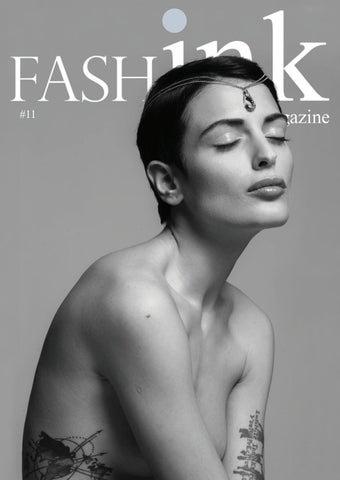
#11
2
3
ink
FASH on the cover: Agustina Ph. Stefano Padovani
magazine
#11
Stefano Padovani Editor & Ideator production@fashink.com Lucia Capelli Director Cristina Balestrini Creative Director advertising@fashink.com Andrea Tisci Fashion Editor fashion@fashink.com Shelly Wahweotten Story Teller Elena Gentile Beauty Editor
Talita Savorani Writer & Accessories contributor Isabella Gaspardo Foreing Consultant Michelle Dorrell Baking Master Lara Zibret Architecturink Scout Giusva Cosentino Miusic Guru
info@fashink.com STAFF CONTRIBUTOR
Emilio Bergomi, Danila Cattani, Filipe Chaves, Claudio Ciliberti, Mario Chiarenza, Davide Gariboldi, Karine LeclĂŠre, Gaia Marchini, Davide Messora, Samuela Nova, Andrea Perego, Beatrice Salvioni
SEASON CONTRIBUTOR
Arcangelo Argento, Simone Bertolotti, Vittore Buzzi, Massimo Cesarini, Monica Cesarini, Matteo Iovine, Aldo & Angelo Lanciano, EvaLaReina, Fabio Prina, Paola Redaelli, Gianfilippo Nicola Rolando, Angelo Zhao
4
CONTRIBUTORS
KARINE LECLÈRE
Karine Leclère, born in Dieppe (France), she moves to Paris to get a diploma as fashion designer – something she had been dreaming about since she was five years old. She became the manager of his historical archive of vintage clothing in 2015, her life and her passion revolve around her eighteen-year-old son, tattoos, wolves, dogs, cats and vintage clothes and accessories (especially from the ‘40s and ‘50s).
BEATRICE SALVIONI
Beatrice has a degree in literature - something that according to many will never be of any use to her - and continues to be an obsessive collector of stories. As a consequence of her obession she’s now happily addicted to writing.
MARCO ZUCCOLOTTO
Marco, Pier Luigi’s brother, follows in his footsteps working in the family business and makes the most of his creativity and manual skills by designing and creating furnishing accessories.
PIER LUIGI ZUCCOLOTTO
Floriculturist Pier Luigi Zuccolotto was born in the heart of Milan and derives his artistic inspiration from observing nature and the plant world in particular.
5
p. 08
TABLE OF CONTENTS Editorial p. 8 Fashion Moment p. 10
p. 10
We Believe p. 26 Tattoo Icons p. 34 Fashink People p. 46
p. 46
Musicalism p. 70 The Outsider p. 86 p. 70 6
E F S
inked people for alternative fashion
Spring|Summer
p.100
Hooked in me p. 100 My name is Cindy p. 112
p.112
That touch of shade p. 132 Vegink p. 142 Diet p. 146
p.142
Drink p. 152 Bits & Pieces p. 154 p. 152 7
EDITORIAL Stefano Padovani
All kinds of self-harm, pure masochism: apparently selfinflicted pain is the trend of the new millennium. But why is it so? I often have to do with beautiful models, and I’ve always thought that they’re a world apart: their beauty and perfection are always unique, everything they do, anything they wear seems to come from another planet. Yet if you look closer you notice that there’s something very wrong. Cutting oneself and even worse phenomena prove that human beings have problems they just can’t cope with, or at least that they use psychological and physical pain as an outlet. History teaches us that there exist punishments inflicted for religious purposes - self-flagellation, for example - , so it’s possible that our psyche brings us back in time and leads us to do this kind of things as a punishment for our unconscious mistakes. Marquis Donatien-Alphonse-François de Sade and his erotica classics used to be considered underground at the very least, while nowadays he seems to have achieved movie star status and fame. Much of what he wrote was conceived while he was in prison, so it might as well have been his way of punishing himself for his crimes, or alternatively a means of escape from that situation, given that some of his short stories are of a philosophical nature. We yearn for peace of mind, yet ironically we look for discomfort. There are people who spend considerable amounts of money to be hit, whipped, stamped on and much more by individuals who by now have turned this into a profession, such as the so-called Dominatrixes. It’s hard to believe that the mind can take things this far, but in fact age, social class and sexual orientation are totally irrelevant: it’s just curiosity and the desire to try something new that fuel this search for irrational and often dangerous experiences. Here at FASHink we’ve found our way to unlove ourselves. The magazine is expanding really fast: starting from an initial 118 pages, it is now 186 pages long. Our followers are increasing too, so we take it as a token of gratitude for what we propose through the magazine and for what we love to do. Being slightly late with the latest issues of FASHink has represented our way to feel pain: we hope that our viewers and partners understand that this is our notso-secret corner where we can go and kneel on grits
.
Stefano Padovani 8
Model EvaLaReina 9
Fashion Moment by TFG At the age of 20, Thierry Mugler left his hometown of Strasbourg, France. His destination: Paris. There, his allure and style were on display for all to see. Mugler would often wear his own creations and a freelance career as a designer soon opened up to him. He create his first collection in 1973 called «Café de Paris». Going against folkloric, unstructured fashion, the collection had an urban, sexy, flirty vibe, confident in itself. It exuded avant-garde ultra-femininity, a dramatization of the everyday unveiling of a woman. It was the same Thierry Mugler style that debuted with the creation of his house in 1974. Four years later, he was named «Designer of the Year» by both the press and the public. His success story had begun. Throughout the 1980s, the Thierry Mugler brand shone brightly with acclaimed collections, ingenious fashion shows that he conceived and directed, painting-like photos that he created himself, short films, video clips and films. Couture by Thierry Mugler is both art and science. His cuts captivate while creating a stir. His silhouettes are distinct and instantly recognizable: anatomical, graphic, ultra-feminine and meticulous. Close-fitting suits, rhinestone sheath dresses, structured bustiers, extravagant dresses and whimsical pieces each reveal conquering icons, extravagant divas, glamorous fairy-like stars and victorious sun goddesses. Contemporary heroines who summon dreams, fantasy, metamorphosis, conquest, the future and the extraordinary at fashion shows – events that are larger than life yet perfected to the detail Fashion designer and perfume creator Thierry Mugler above all has a penchant for showmanship.
As a free, inspired visionary, his mind is teeming with wild dreams to realise and realities to invent. The designer has told these extraordinary legends through two shows bearing his signature as an artist. At the Comedia in Paris, the “Mugler Follies” reinvents the art of the cabaret combining technique, eroticism and elegance. It tells the story of a young woman in search of making her dreams of becoming a tightrope walker come true. At the Friedrichstadt-Palast in Berlin, “The Wyld – Out of this world” has transformed the German capital into a futuristic urban jungle, a theatre of cosmic love. Each is something never before seen or experienced! Thierry Mugler is also a very talented photographer. “He’s one of the greats,” master Peter Lindbergh once said. To create his shots, the designer travels all over the world in search of extraordinary settings and destinations. He is fascinated by gigantic proportions. In his paintinglike photos, landscape becomes architecture and architecture becomes landscape. Thierry Mugler expresses this art of staging with the same strength in perfume advertising campaigns, which he photographs or films. It is also seen in video clips he has created for George Michael, Mylène Farmer, Beyoncé,… Just some of the modern icons turned Mugler fans. Many stars, one universe. Great inspiration for the whole fashion world
.
https://inter.mugler.com 10
AS A CHILD, I HAD A VERY HARD TIME LIVING IN THE WORLD THAT IS IMPOSED ON US. I DREAMED OF CREATING ANOTHER WORLD, TO MY SCALE – ONE THAT WAS MY OWN...THIERRY MUGLER
11
Claudio Ciliberti
Let me tell you a story... so the owner kindly takes us on a small tour of what looks like a gallery of strange stuffed animals. One of them in particular strikes us: it’s a sort of oversize ostrich [a giant moa, tn] and our guide explains that this animal is now extinct because of the settlers who used to hunt it for its meat. As we continue our drive, we notice that while the landscapes are mostly deserted, the wildlife is incredibly rich: as a matter of fact, the man-to-fauna ratio in New Zealand is roughly 1:2. After picking up two hitchhikers who are heading to the same town as us, early in the evening we stop for the night and the receptionist of our small hotel informs us that everything shuts down at 8 pm and opens again at 5 am, more or less like in Australia. When we finally get to our destination the next day, we discover that there’s going to be
We leave Australia for New Zealand and arrive in Auckland, its capital. At our hotel we are shocked to find a totally automated system to welcome us instead of a reception desk, and we have a lot of difficulties understanding how to check in. The following morning we leave our room with the intention of visiting the city, as we always do, but we soon realize that it’s smaller than we thought and our tour ends earlier than expected. Back in Sydney, the Maori friend of our friend Marco had asked us to bring a letter to his mother, so we decide to hire a car and immediately start our journey to his hometown. Not a soul is on the road except for us, and the only other living beings we see are a few sheep scattered in the fields. A giant cow-shaped sign points to a restaurant nearby, so we stop for lunch. It’s rather obvious that we’re not locals,
12
moko on her chin, the typical tattoo worn by Maori women - is a real treat for my eyes. She explains that violent territorial clashes had historically taken place in the area, so nowadays hardly any whites are seen around there. We relive the experience at the first tattoo studio we visit, where the tattoo artist is very unfriendly because of the colour of our skin. Later on, when he understands that I’m in good faith and that I only wish to get tattoos as memories of this journey, he accepts to tattoo me. After drawing on my skin with a felt-tip marker, he starts working with the typical stick with needles on his top and a small mallet – it goes without saying that tattoo machines are out of question over there. The entire process lasts about three hours and is extremely painful, but New Zealand and its tribes will stay in my heart forever
a typical Maori show that evening, which we will see, and deliver the letter we had been given in Australia to its addressee. The next morning the owner of the guest house we’re staying at gives us a roadmap and shows us the way to a reserve hosting the typical local population. At the entrance there are four huge men waiting for us, who ask us why we’re there and tell us that we have five minutes to come up with a valid reason before they kick us out. Feeling disheartened, we resign ourselves and make our way back to the parking place, but to our surprise a lady stops us and introduces herself as the manageress of the reserve. From then on things change radically: we are offered food and entertained with stories and a lot of information on tribal lifestyle. The lady looks peaceful and serene, and the fact that she’s covered in tattoos - including the
.
13
ATELIER ORAFO CREATIVO14 VIA MASCHERONI MILANO www.fabiolissi.com
15
MIND MY OWN BUSINESS mone���� BY THE
Si
FASHINK GROUP
16
i t t o l o ert
��B
17
del mondo’ and gets in touch with Simone to summon him at celebrated recording studio Angelo Studio in Garlasco (Italy), where he spends several months and realizes just how much he enjoys studio work. The following year just before the start of the tour, besides employing him as an instrumentalist Ron appoints him as musical director of his band: this will turn out to be an important educational experience for Simone, because the introduction to the world of Italian songwriters will come in handy a few years later. On 8th July 2004 he’s in charge of the musical direction of ‘Insieme per la speranza’, a major charity concert supporting the fight against ALS and featuring Italian music stars Lucio Dalla, Biagio Antonacci, Loredana Bertè, Luca Carboni, Ron and Mario Lavezzi. From then on, Simone is practically always on tour with a variety of singers, often as a musical director as well as a backing musician. In 2006 Simone feels that the time is ripe to open WhiteStudio, his own recording studio in his hometown of Cremona, and to start out as a producer. It is in that magical place
Simone Bertolotti, born in Cremona (Italy) in 1980, enters the world of music at the age of four, when he starts studying piano, and from then onwards this is what his life will be about. At fourteen he registers for the composition course held by Professor Paolo Perezzani at ‘Lucio Campiani’ Academy of Music in Mantua (Italy), and in his teenage years he gets into keyboards and programming. As he starts collaborating with a number of local bands, his passion is gradually turning into a proper job, but he continues his education studying piano and harmony under Professors Massimo Colombo and Fabio Nuzzolese, amongst others. 2002 marks a turning point in his career: Simone is now twentyone and is picked to join the band accompanying Italian singersongwriter Gianluca Grignani on the promotional tour for his successful ‘Uguali e diversi’ album as piano player, keyboardist and programmer. In 2003 Ron, one of the authorities of Italian songwriting, is about to record his latest album ‘Le voci 18
S I M O N E
19
20
21
In 2011 he follows Elisa on ‘Ivy’, her extra-long theatre tour, during which besides piano, Rhodes electric piano and acoustic guitar, he plays unusual instruments like glockenspiel, vibraphone, marimba, harmonium and Mellotron synthesizer. In the same year Laura Pausini ask him to produce the two tracks they have co-written and that will appear in her ‘Inedito’ album, to be issued on 11th November 2011. In 2012 historic American label Decca issues ‘Steppin’ on water’, a greatest hits album by Elisa containing a number
that he will collaborate with a variety of top level Italian singers and songwriters - Laura Pausini, Eros Ramazzotti, Elisa, Giusy Ferreri, Francesco Renga, Belinda, Francesca Michielin, Roby and Francesco Facchinetti, Virginio, Alessandro Casillo, L’Aura, Loredana Bertè, Vasco Rossi, Valerio Scanu, Niccolò Agliardi, Paolo Meneguzzi, Fabio Curto, Ivan Graziani, Tony Maiello, etc. Two years later Italian MTV appoints him as musical producer of ‘Ultrasounds’, a programme to be shot at WhiteStudio.
22
fashink: How would you describe your job to someone who isn’t in the music business?
of tracks featuring Simone’s work. In 2013 Laura Pasini involves him in the production of ’20 The greatest hits’, a celebration of the international popstar’s twenty-year career. The month of December 2016 sees the opening of WhiteStudio 2.0, a huge space that includes a 100 sq m recording room and several control rooms to allow him to work on all sorts of productions. In April 2018 Simone is appointed teacher of pop-rock ensemble music at ‘Giuseppe Verdi’ Academy of Music in Milan.
Simone: A good friend of mine came up with the best description ever in my opinion, so here it is. ‘A producer is the strange fellow sitting in a room full of buttons who makes the most of an album’s budget: he works side by side with his artists, bringing out the best in them, perfecting the tracks with the patience and expertise of an artisan, the sensibility of an artist and the
23
image is just another aspect of personality and therefore doesn’t deserve any less to be expressed in full. What’s more, I can testify that this type of self-expression has always been appreciated by the artists I’ve worked with.
insight of a businessman. He’s a sort of alchemist of the seven notes, which are actually twelve for the record, and he’s simultaneously both a guru and an accountant’. F: In a field where an artist’s look is key, do you think the same goes for the producer?
F: Besides being a producer, you’re also a very gifted musician and can play lots of instruments. One would argue that this in-depth musical know-how is definitely a plus: is it really the case?
S: Well, I’m an uber-aesthete myself, so my look has always been important for me, especially in my touring years. In fact I remember looking for the best items to bring along according to the type of tour, given that back in the day there were no designers lending their outfits to artists as they do today. I’ve always taken into consideration the colour and placement of my instruments on the stage too, and more than once I’ve actually had keyboards repainted to match the rest of the stage. I’m crazy, I know... Unlike musicians, producers are seen as nerdy guys and tend to look the part, especially here in Italy, so for myself I’m happy with the definition of ‘elegant nerd’. Seriously though, I’ve always been convinced that clothes make the man: in my opinion the external
S: Yes, it is: being a musician makes a lot of difference as far as what I can do best is concerned, that is poprock productions. Unfortunately nowadays the market is saturated with hit-and-run products that only require really basic musical expertise, but that’s another story that has nothing to do with my specific function. Having said that, some of the biggest names in this business are not musicians – take Rick Rubin, for example. This doesn’t stop me from wholeheartedly looking up to them, because this proves that anything goes, as long as the final result is excellent. 24
F: Today’s market requests and consumes at the speed of light music that’s extremely mainstream and commercial, leaving little or no room – and chances – for talented artist who are probably less marketable and therefore profitable. What do you think we can expect from the future?
the first steps if you want to become a producer? S: I was lucky enough to enter this particular sector about twenty years ago, when big money was being spent and people still bought records, so personally I’m afraid there’s not a lot of hope for the next generation, at least not until the market changes. I’m referring to production, because if we talk about trap and stuff like that of course things are very different. But I must say that I don’t see much longing, or even motivation in general in young people nowadays, and it was those emotions that fuelled my generation
S: Sadly, this is something we need to learn to accept, but because I’m a dreamer I will always believe that quality is our salvation and continue along that path undaunted. Anyway I have a hunch that pretty soon a grunge revival will come and save our souls!
.
F: Iconic artists that emerged twenty or even thirty years ago remain unsurpassed and their supremacy isn’t even remotely threatened by any newcomer. Do you have any idea why? S: Because of the overall cultural levelling that’s being imposed on us. It’s as simple as that. F: Unlike what happens to talent show contestants, your job hardly gets any visibility: how do you take
Shot at White Studio Milano 25
we believe by the fashink Group
Martina Tosi Martina Tosi, born in Florence on 27th October 1993, starts out very early as a promotional model in some of the top nightclubs in her hometown and then moves on by working as a commercial promoter and fashion and hairstyling model, taking part in contests and shows and modifying her look according to her clients’ requests and to current fashion trends. After a six-month experience as a hostess at Palazzo Strozzi Museum, she works as an advertising space seller for a b2b magazine, an apparel shop assistant, a dental assistant and a mystery client. She gets into the world of photography in 2014, out of curiosity and just for fun at first, but her days quickly fill up with shootings, photo events and workshops and she earns a reputation thanks both to her beauty and to
her attitude and professionalism – something that isn’t as common as one might think, given that many self-managed models often aren’t experienced enough for the jobs they get. While travelling around Italy for work, Martina meets photographers, writers, poets and artists who ask her to perform during art exhibitions and for photography books and international publications, including fashion expert Alberto Buzzanca and art specialist Roberto Kusterle. After meeting top Italian photographers such as Paolo Tallarigo, she models for a variety of editorials and magazines: ‘Playboy’, ‘GQ’, ‘Fluffer’, ‘Miraflores’, ‘Nif ’, ‘Normal’, ‘Art About’, ‘B-Authentique’, ‘Modellenland’ and many more. In 2016 Martina founds Dama model agency, with the intention of both expanding her career as a model 26
27
28
29
still works as a model, so thanks to her beauty and the trust and respect she has earned over the years today she’s a success both as a model and an agent.It goes without saying that managing Dama eats up most of her time and she can only model parttime, but on the other hand she’s extremely happy when her boys and girls get confirmed after a casting. Martina makes the most of contemporary technologies allowing people to run their business from anywhere in the world and travels a lot for scouting purposes. In the future she might create a children’s department in her agency, given that this specific fashion and advertising industry sector is booming and that there are very few agencies representing children. She’s well aware of the fact that her agency doesn’t have a permanent HQ gives it an edge over others in terms of internationality: in fact, she’s often abroad, to model herself, to follow her models’ work or quite simply because nowadays boundaries are almost non-existent and her agency is free to operate in other countries and environments. Even though working only as a model felt safe and easy, by now the challenges of her new career have turned into a certainty that she can’t do without anymore
and helping out boys and girls in their first approach with this specific domain of work by sharing her own experience. As a matter of fact, the biggest professional obstacles she met in the recent past were precisely those derived from being inexperienced and left to her own devices when it came to finding solutions to the various problems that would occur. She cannot stress enough her role as a tutor for the talents she promotes, and in turn they find it very reassuring to have someone like her to protect them and look after their interests: photography, fashion and showbiz in general are in fact rife with pitfalls that can be quite threatening for the so-called ‘new faces’. Her job consists in selecting and assessing in terms of personality and behaviour the potential new talents. As Martina often says, physical beauty in itself is not enough, because what is crucial is the full understanding of the client’s need. Most brands have a very clear idea of what they want to convey in their advertising campaigns, so she must know who the perfect models are for each casting in order to collaborate to the creation of events, photo shootings and campaigns that are successful and therefore meet her clients’ expectations. Given her young age and her highly appreciated polished look, Martina
.
30
31
32
33
Tat ico by The
34
fash
ttoo ons
hink Group
35
My name is Stefania Pallestrini and I was born in Pavia (Italy) on 28th February 1991. I started my current career as a tattoo artist about four years ago. I’ve been living in Milan for a year or so, but I’ve been working at Best of Times Tattoos [in Milan, tn] for about two years. Being a fully trained tattoo artist is my lifetime goal.
I am thirty years old and I’ve been a tattoo artist for seven years. Before that, I studied and graduated as an engineer programmer. I love travelling, people and wild nature. I live in small city in Russia, even if I’m not sure I can still say that I live there, because I travel a lot and normally never spend more than a month in the same place. But then when I’m back in my city it’s always amazing and I love to spend time with my family, the most important thing in my life.
fashink: Do you think your look makes you a trend setter in the tattoo industry?
36
Marina: I don’t think I’m something special because of the way I dress or look, and I don’t imagine other people would take me as example of style. In the industry most of the people are more casual in style, but I love a more elegant look for myself and this doesn’t stop me from going out and presenting myself just the way I like. I wear high heels when I work, and I do the same when I go to conventions.
Stefania: My look is surely striking, even in an environment where tattoos are the new normal, but I think my image reflects my inner world so much that it becomes oneof-a-kind [and therefore cannot be replicated, tn]. F: Today people can became tattoo artists after a one-week crash course: what do you think?
37
38
39
M: I don’t think it’s a problem: there are so many talented people out there who otherwise might never realize that they are. I believe that unless people try something out they cannot know whether they are talented or not, or if they need to learn from schools or courses. Nowadays it’s so easy, you can just try it, so why not?
studio, with a great artist to learn skills from, and try to steal a little bit of his/her talent and experience. I believe that at the end of the day, as much as someone can copy or take inspiration from other artists, they will still do artwork with their own style and imprinting. S: My advice would be to have more patience and to perfect their technique, which is something they often overlook out of selfconceit and too much haste while cutting their teeth. If you want to achieve results and recognition in this job you need to be serious about it and work hard.
S: I’m against this kind of courses. What you need to become a tattoo artist are tons of training, passion and most of all practical experience, and not a one-week course. F: What would you suggest to young people who want to enter the tattoo industry, since lately it seems that in this job apprenticeship has become a thing of the past?
F: You take good care of your physical appearance and you’ve become very recognizable in the business: to which extent do you think this recognition is due to your talent, rather than your look?
M: First of all I think they should find a path to follow as far as style is concerned, and plan who they would like to become. Then they should find a great tattoo
M: I hope that people notice my works before my appearance, although I do look after myself quite 40
a lot, even if I’m a very shy person. Sometimes when I have pictures taken I look like a professional model, but truly I’m actually quite reserved and naive in front of the camera. For me this [my talent, tn] is the most important thing and I hope I get recognized for the pieces I create before they way I look. I’m a young w o m a n , therefore I’m sure that sometimes I could be taken for a new artist, but I do have a lot of experience, and I do have my own style and my own way of designing. Travelling for work often doesn’t leave me enough time to look my best because it doesn’t allow me to do anything else besides work, so this is when people mostly focus on my work and not that much on the way I look.
nothing to do with any external factor. You can’t tart up talent. F: How much do fashion and trends affect your life? M: All my life is about travelling. I don’t have much time to think about what’s in and what’s out. I own a lot of dresses and jeans, but I mainly wear dresses: I love knee-length dresses! To be honest I buy what I like, and not what the trend and fashion of the moment suggest buying. When I pack my suitcase I put in my best dresses and my high-heel shoes and there I am, ready to go! S: My style doesn’t necessarily follow the trends of the moment: I’ve always had well-defined and sometimes unconventional tastes. However, there are a few brands and designers that I quite like and that I wear constantly
.
S: I don’t think you can actually define any such extent. My look undoubtedly projects a strong image, but my skills have 41
ink on the road
FASH
by Shelly Wahweotten
I still didn’t spend the kind of quality time with my family, then, as maybe I needed. I was still on a searching journey of myself, trying to figure out ways to grow out of the rut I felt like I was in.
I can’t really say that I have been living my best life this year. Maybe the outside perspective - I have. With my parents getting older and career getting stronger, it almost feels like anything and everything can slip thru your fingers in a split second. The struggle is just to hold on, when not desperately trying to hold together. I remember about a decade ago, my dad had some troubles with his chest, and rushed to the hospital to see if he was suffering a heartattack. Turns out, his diet was causing him to have acid reflux and the doctor prescribed him some pills for it. He was also supposed to eat better, which isn’t always easy for an older person. Years later, my dad seems pretty normal in his routine and activities and life goes on. There was always that thing in the back of my mind haunting me though. It was that minor thought of losing my dad, and what on earth would I do when it does happen.
Some years later, heartache and suffering between, I moved away from my familiar family and friends, to try to build a bigger life in a larger city. That was in 2011.Things worked out easily during my transition, arriving with job and apartment already in line. This year, 2018, I feel it’s time for me to return home. Not because I’ve failed in any sort of way, in fact, quite the opposite. In my time away I’ve done the same thing anyone can do, struggle and overcome; it’s just a matter of how you choose to deal with struggle. The last thing I wanted to do was go running back home, crying that I have failed, or even worse, blame everything that failed me. So I worked my way through all the hardships in the best way I knew how.
42
get thrown in to a suitcase, the case closed, and then sat on to zip the fat thing shut. I had never seen anyone pack like that before, and hope I don’t ever have to again, cause it sends me into a laughing fit. “WHAT IN THE HELL ARE YOU DOING? ALL THAT SHIT IS GOING TO FALL OUT WHEN THAT BAG BURSTS OPEN!” No matter how many times it would happen - he would tape it all back together. He didn’t care as long as he got to the next convention, and things would figure themselves out eventually. They boys and myself would switch off each week as who was going with Reese, and whatever convention was on the books that weekend. Out of 52 weeks per year, Reese traveled about 45 of them, on the same airline, racking up an ungodly amount of flyer miles. The airport knew him by name, along with his little pain in the ass dog, Diego, who ate garbage most of the time and hated everyone.
Flashback to 2011, and I’ve taken a job in a busy neighborhood of Kansas City, called Westport, at a shop (then-called) Timeless Tattoo. The area is a popular bar scene, which includes it’s fair share of hipsters, punks, college-age baby drinkers, entrepreneurs, dives, restaurant-chains, tattoo shops and bums. Timeless was a walk-in corner shop that employed myself, a piercer, a couple of other tattooers, an apprentice, and a hurricane Katrina survivor named Reese. Reese taught me a lot about traveling and tattooing. I had done it once before on my own, but was young and dumb and didn’t really have the same insight on how to go about it. I had never flown with needles in my luggage before. I was still new-ish to flying, so liquids and packing them was still a learning curve. Some days I would watch Reese bark orders at the apprentice to ‘throw that light in there, I don’t care how it fits.’ The flood light would
43
come-ups re-ignited my fire again. I wanted bigger things. More exposure. Gain more experience than I had been getting. Maybe make it in a metropolitan city. At this point in time, I think i did alright as I’m constantly busy. I work in 4 cities at a time usually, and get recognition for the works I’ve put out there. I still feel there is something, if not a lot, missing, so there is always more work to be done until I know what that is. Over Christmas this past year, I felt some isolation creeping back in. It was cold, dark, lonely in my house and town, and all I wanted to do was stay home with my puppies, sew, draw, cook food, and watch movies. All things normal people do, but a traveler rarely gets a chance for. Work was fine, but it started to feel stagnant. Then came the news that my mom was diagnosed with breast cancer again, and the black cloud rained for what seems like months now. She had it 15 years ago, but now at almost 70 years old, her overall body and health aren’t as strong as they used to be. When it happened then, the lump was small, removed surgically, and some radiation was done afterwards to keep it from coming back. My mom was pretty strong and obviously resilient about that time, but I wasn’t as close and available to her as I want to be now.
That’s something I’m missing right now I guess, travel partners. Thinking back on it, and they are as much help as needed. Reese would jail-sleep thru the whole flight, and work was on once we landed. My job as a newer companion was to book the car, do the driving, and do what Reese says, cause it’s his gig, I’m just along for the training. This went on for a while before Reese passed away. Life got the best of him in late 2012, and we laid him to rest. After that, a much darker period occurred in my life, but that’s a different story for a different kind of time. It did, however, lead me to a new team at Revelation Tattoo in early 2013. The same team I have been on for the last 5 years. I learned a lot from Reese, that staff, and some of the associated friends during that time, mostly about letting go of some past work ideals from a small town. Where I am from, older tattooers try to parent their clientele in ways you shouldn’t try to dictate another adults life. There is a lot of old-school mentality that stifles growth and development in an ever-changing industry. Which, Kansas City has a stronger rooted tattoo history than the smaller town I am from originally, and learning that history of
44
again. Hitch-hiking to North Dakota and being immersed in my ancestors people again brought back my life that I forgot I was missing. I was so busy tattooing that I didn’t realize the amount of disconnection I had developed. Coming back from that time in history, I started to eat with my elders again. I sweat with my elders at Standing Rock and almost forgot what it was like to pray in those ways, let alone pray at all. I remember praying for our people at that place, praying for our safety, the land, our ancestors, praying for protection and guidance, while suffering with those prayers, so they have meaning and pure intent with those requests. I prayed for my dad’s heart, too. He was at Standing Rock also, but at different times with my older brother Knowas (Little Eagle), and cousin Nishwabnoquah, which means Windy woman. For those that have known me in the ‘white’ world, and as a tattooer, I have been known NOT to pray, have faith, or believe. Which is still fine, differences make us individual. But I still had questions about things. Going back to peyote church answered so many of them, and it’s almost like a blink of time that i’ve only missed when not inside, praying in a tipi with my family. For hundreds and hundreds of years before colonization, we have carried the same traditions, no matter how they have tried to take it away from us.
This diagnosis has come with a much harder plan of action. Chemotherapy is something we haven’t had many close experiences with, and now that is what we are doing. It’s been a nightmare, a struggle, a bond and a definite/permanent mark on our family’s timeline, but it’s also just a mark, not a scar. That is why I feel like going home. I want to plant a kiss on my mom’s forehead while she rests and recovers every week. I want to wake up and cuddle my puppies every morning and make them breakfast. I want to wash my folks dishes and fold their laundry. All the things I hated doing before, I just want to do again, so I can be close to them when they needs me the most. As much life that can be lived thru traveling, especially in this field of art, you can experience, literally, the world. Believe me when I say it’s great, but no matter how far away you can go, how many things you can see, touch, smell, taste, hear.....nothing connects you like the blood you come from. A few years ago, I attended the pipeline protests in North Dakota, and reconnected with something I had lost for a long period of time - myself. Culturally, I had checked out, mostly because of what I chose for my career path. An old ideal of ‘tattoos are for bad people’ kept me from going to see my elders very much. I quit showing up for pow-wows. I got older, gained some drinking weight, grew out of my regalia, and started to forget. I hadn’t looked at my dance shawl in forever, and now I can barely keep up with the simple steps. I also hadn’t been back to my reservation in a long time, so there was a lot of things to miss. Peyote meetings, sweats, naming ceremonies, language, births, and numerous pow-wows,
So it may not necessarily be a “house” that I want to go home to, but a family that I am undoubtedly a part of
.
45
PE
P L E O
by the fashink Group Photo by Stefano Padovani
GIANNI ROL AND O Gianni Rolando, born in Tortona (Italy) on 24th May 1953, realizes very soon that his innate talent as a singer might secure him a future, ever since he first starts singing with the local boys’ choir, ‘Piccoli Cantori’, directed by Monsignor Giuseppe Scappini. When a family friend convinces him to attend an audition, Gianni sits in the auditorium for a while, listening to the other children, and is so thrilled that he will do so several other times before actually joining the choir and being allowed to sing. In the meanwhile he ‘s smart enough to learn all the songs he’s heard by heart, so when his moment comes Father Scappini is so
46
47
48
49
impressed that he immediately appoints him solo singer in the treble voices choir. The group, which will be renamed after Lorenzo Perosi, a famous musician from Tortona, takes part to many events and contests and Gianni sings every single time. When the choir sings for the Pope in Rome, his voice is so outstanding that he is appointed sole solo singer for all Italian singing schools. Now Gianni needs to study music and to learn how to play several instruments, and after moving to Romagna with his father he commutes to Milan to continues his musical education. As he grows up, his voice changes of course, but remains excellent. He’s contacted for an audition by Italian pop singer and songwriter Armando Savini, who at the time is very successful and has a band, and in 1970 he joins him on his lengthy Italian tour, singing in front of large audiences. It is then that Gianni starts to get into motorbikes, in spite of his father’s disapproval: first he starts to hang out with a mechanic from Faenza, then he meets and makes friends with famous champion riders, always following the races through the press and the limited information available in the early ‘70s. One day his mechanic friend invites him to spend the day with him at Misano Adriatico circuit, where he’s going for some tests with a number of pilots: Gianni has never set foot in a circuit before, and after all these years he still fondly remembers the smell
50
of castor oil coming from the Kawasaki 500cc’s exhaust pipes. Standing by the pit wall, Gianni pulls off the same trick he used with the choir: he learns about changing gears from listening to the engine’s variations in sound as the bike runs past him, lap after lap. When his friend smilingly asks him if he’d like to try riding the bike, even though he’s scared and he’s never done it before, he borrows a suit and a helmet and after a short briefing enters the circuit. All he can think of is the noises he has heard so far, but as time goes by he starts to feel confident, until he suddenly falls and crashes the bike, luckily without harming himself. He then walks back to the pits, as cool as a cucumber, and with a smile tells the team that the bike is very damaged from his fall, but to his amazement instead of shouting at him they tell him that he’s run faster than their own pilot, and even suggest that he should give racing a go. Although flattered, Gianni is panicking because he will have to tell his father that besides having ridden a racing bike in the first place, he has destroyed it, and that he’s therefore going to be held responsible for his son’ behaviour. His father is very strict and has a military mentality, so for Gianni the only acceptable strategy is to explain him enthusiastically that he’s just been given the chance to ride a bike in a circuit, that is in an environment that’s much safer than the road, and that racing represents a
51
concrete opportunity to make some money. With the help of the mechanic, who has spotted his talent, he surprisingly manages to talk his father into buying him his first racing motorcycle, a Suzuki 500cc, after of course paying damages. His very first race takes place on the Modena circuit in 1976, and even though he has no idea how a bike is built – he’s so candid as to ask for advice because he doesn’t even know where the first gear is, given that in racing bikes they’re located upside down - , what to do during a race and how to tune the bike up, he rushes headlong into the Italian championship and makes it to the last race in Vallelunga, where unfortunately he fails to win the title due to a mechanical breakage. Overwhelmed by the experience, Gianni decides to put aside music, because he realizes that bike racing is much more likely to get him fame and beautiful women – the latter being the main reason for wanting to become a professional pilot. Placing third in the national Junior championship means he’s going to take part in the MotoGP, that is in something that he’s only read about in the press so far and that is populated by his ultimate heroes - Barry Sheen, Kenny Roberts, Giacomo Agostini and many others, who soon become fellow racers and rivals. With the help of his motorcycle club and a few friends he finds small sponsorships, so that he can focus on racing only. Thanks to his luck and his racing style he enters the Nava-Olio Fiat team, AKA Team Gallina, alongside aces such as Gianfranco Bonera and Virginio Ferrari, which is currently ranking number one worldwide and therefore represents his best chance ever to race and win. Gianni has a sociable and curious personality, so he doesn’t think twice before knocking on the doors of his idols’ motorhomes to introduce himself, and he easily befriends them. This is a brand new world for him and its system doesn’t really resonate with him, but he loves it because amongst other things it allows him to spend time with music superstars like George Harrison and Eric Clapton. Back then the racing team was one big family, and racers would spend their free time together, going out and having fun: it’s a completely unimaginable world considering how things work today, when racing is almost a job like 52
53
54
any other and everything revolves around money and business in general. His father is naturally his number one fan: he follows him around wherever he goes without being intrusive and helps him deal with his sponsors and his daily needs without ever being in the way. Silverstone, UK: it’s Gianni first MotoGP race and he’s in the front row as the first Italian pilot, ahead of much more famous racers like for instance future world champion Marco Lucchinelli. During the very first lap his bike seizes up and hurls him into the air: he is rushed into hospital and his conditions are so bad that based on hearsay information Italian TV and radio reporters spread the news of his death. When he wakes up from his coma, the first person he sees is fifteen times world champion Giacomo Agostini: the great ‘Ago’ is here, he’s come to see Gianni Rolando, a young, inexperienced and virtually unknown racer. Gianni is obviously overjoyed and still distinctly remembers that feeling, but this is how things were: real friendships blossomed – and in fact many of these racers still see each other regardless of living completely different lives – and respect was an absolute value for them, both within and without the circuits. As a matter of fact, it is precisely ‘Ago’ who calls Gianni’s mother to reassure her that his son is not dead at all. Each and every one of these guys is something of a bad boy, but they are all very close. Just to give you an idea, they don’t do any proper training activity, mainly because their first and foremost priority is getting laid. They race on a Sunday, but from Monday to Friday their main occupation is going out, having fun and meeting as many girls as possible, and on a Friday when they meet for the races they spend their time telling each other about their week. At times some of them even turn up with a black eye as a consequence of a brawl at some club, but for them this is perfectly normal. With the exception of Giacomo Agostini, the only racer who takes training – and everything else - seriously, for them the closest thing to training is a metal spring, simulating the changing gear movement: by squeezing it in their hand they exercise their forearms just a tiny bit. It’s no wonder that ‘Ago’ has won fifteen World Championship titles, after all. Gianni tells that doping at the time meant a few beers too much and a bit 55
56
57
of cannabis, while today it has become an integral part of any kind of sport, given that the performance standards required from athletes are extremely high.After his last year in the MotoGP as a rider, mounting the official Cagiva and alongside world champion Marco Lucchinelli, Gianni starts working as a tech/spokeman for Agip Petroli, once again moving on to something else in his life. Following his father’s example, Gianni has always done a lot of charity work. He’s been a Knight of Malta for over twenty years and after one of the recent big earthquakes in Italy the Order assigns him the task of raising funds to provide initial emergency aid for the population. When he and the late and great Spanish champion Angel Nieto are asked by a famous Italian TV commenter why they always look ecstatic after racing, regardless of winning it or not, their answer is disarmingly simple: they look that way because once again they’re still alive at the end of the race. Unlike today, unfortunately fatalities used to be extremely common in those days.
58
Gianni continues to operate in the MotoGP world and to make the most of his fame to do some good. He is in fact Ambassador for solidarity causes of the Order of Malta and the self-appointed Prince of San Bernardino, a tiny deserted island in the middle of the Red Sea that he has reclaimed and that hosts a charity foundation of the same name. One of his latest concepts, regrettably derived from first-hand experience, is providing housing for separated and divorced fathers, who often find themselves in dire straits. Alas, in 2018 Gianni discovers he has cancer and is currently fighting back as hard as he can, maintaining the stamina and high spirits that have always been his own. Gianni will always remain a great champion, not only for his sports achievements, but also for everything else he does when he’s not on a circuit. His pride and joy are his lust for life, his children Gigia and Gian Filippo and Ginevra, his son’s newly-born daughter
.
59
Architectur
& Co
The Rebirth of The Wood
by Lara Zibret
“Abandoned factories and forgotten, construction, railway stations, modern buildings, man-made architectures for human but immortalized free from his presence, the “non-places”, where the space is empty, where the corners, facades, heavy metals, glass and cuts that willingly blend with the sky create a single body, waiting to be frozen in a moment.” Croatian photographer Lara Zibret sharing her moments.
60
61
From gardening to interior design. This two brothers,from Milan, Pierluigi and Marco Zuccolotto decide to give a second chance to the peacies of woods that are usualy through away and made from them peaces of art. The wood used for their sculpture are the once we can find in the area of Lombardy, like oak, brich, beech, acacia. Basicaly anything they can find in the nature.
62
63
“We make the worst ruined parts of the wood become the most beautiful.�
64
65
66
67
68
69
B TO
70
E
UE N I T N O C
D
N T W I O O R T O T E D HE M & T ND U O S BY
OS C S VA U I G
I NO T EN
In this issue we will take a walk on the streets of Detroit, revisiting the city’s splendour and trying to get a taste of the sound and of the unmistakable style of its iconic music scene: Motown. Between the mid ‘50s and the early ‘60s, at the apex of the American industrial revolution’s economic boom, as a result of a fifty-years growth Detroit had become the capital of North American car industry. There are many reasons why this flourishing Michigan city was renamed ‘Motor City’, but they mainly have to do with its citizen Henry Ford, the founder of the world-famous automobile brand, and with General Motors, which is still one of the industry’s key players. These were also the days of the birth of modern technology, of the radio, of mass media and of men’s suits of Italian inspiration, worn by both notorious gangsters and white collars. Besides scrap iron, factory exhaustion smokes and workers’ sweat, what Detroit also produced in huge quantities was musical talents, and it was precisely the fact that is was known as ‘Motor City’ that played its part when it came to naming downtown Detroit’s talents forge, ‘Motown Records’. It can be safely stated that the record label’s birth is the big bang of the vast majority of contemporary music, and we owe it all to its founder, the 71
brilliant Berry Gordy Jr. Born in 1929, the seventh of eight children, after a career in boxing that never really took off Berry decided to make the most of his love for music, his knack for lyric writing and his business acumen and in early 1959 he established ‘Tamla Records’, which would then become ‘Motown Record Corporation’ in April 1960. Motown Records Inc. has owned
artists such as Ne-Yo, Migos and Bruno Mars. It all began with Berry getting a loan of 800 dollars from his family’s savings fund and producing TamlaMotown’s first-ever record in January 1959, Marv Johnson’s ‘Come To Me’ – the first of a long series of hits. He also put together something that nowadays we would call a showcase, the ‘Gordy Star Attraction Show’, for
or promoted at least fifty satellite companies specialized in several musical genres, but the sounds it stands for and that made its fortune are soul and rhythm’ n’ blues. Superstars proudly produced and managed by Motown include the Temptations, Marvin Gaye, the Commodores, Stevie Wonder, Diana Ross and the Supremes, the Jackson Five and Michael Jackson, up to contemporary
which he very quickly managed to gather highly respected soul pioneers such as Marv Johnson, Eddie Holland, the Miracles and Mable John. The fat, strong, very funky bass lines and the unique voices that were typical of that sound laid the foundations of pop music as we know it and enjoy it today. Even though Berry was an extraordinary business man, he was also a man of values and had a big 72
heart. For instance, he was a very close and loving friend of Michael Jackson. The Jackson Five had started out with Motown and everybody knew about the notorious behaviour of Joe Jackson, a violent and greedy man keen on harassing the band’s member, who happened to be his own children. He mostly picked on Michael because he was more famous and more talented than his little
from the artists themselves to the show sets, the concert bills and the record covers. Diana Ross and the Supremes’ big hair, elegant skirt suits, sequins and jewellery, the Temptations’ pastel-tone evening suits and bow ties: this dress code went hand in hand with records that have become legendary – we’re talking about almost two hundred chart hits among the most popular
brothers, and Gordy suffered just as if he was his own son. In an interview he gave after the death of the ‘king of pop’, he revealed that Michael was somehow forced to leave the label all of a sudden by his father’s increasing hunger for money and power. This brand-new musical scene had its own peculiar and unique style that was strong and iconic, positive, shiny and irresistibly cool in every detail,
ever. The Motown sound marked the start of a cultural movement that spread all over the US and became crucial for music and pop culture. By the ‘70s it had established as a part of social life and youth culture and had become a lifestyle shared by kids in every single State. The afro-American soul it represented was exactly the opposite of the newly-born hippie movement in terms of way of thinking, 73
style of dressing and sound. Just to give you an idea, one of the most successful TV series of the recent past, the Netflix production ‘The Get Down’, is 100% pure ‘Motown Style’. The landmarks of the first ten years of Gordy’s project include signing Marvin Gaye and the Miracles in 1960 and a twelve-year-old Stevie Wonder the following year. As the label’s productions started climbing the
The early ’70s saw the establishment of many sub-labels all over the world; in 1971 the label was awarded its second Grammy for the album ‘Why I Oppose The War In Vietnam’ by civil rights leader Dr. Martin Luther King, and Stevie Wonder opened for the Rolling Stones on tour. Considering the extension of the market it was devouring, in 1972 the label felt that it had outgrown
charts and hitting number one more and more often, Motown became unstoppable and signed the Four Tops and Diana Ross and the Supremes. Soon after that came the number ones in the UK charts, that is in the second musical market par excellence, in a country where they really meant business with the Beatles, the Rolling Stones, David Bowie and later on the birth of glam rock with Brian Eno.
Detroit and moved its headquarters to Los Angeles.We cannot talk about Motown without talking about producer and songwriter Norman Whitfield, who made the history of the label by starting the era of politicized music, with lyrics focusing on social exposure and therefore closer in spirit to the hippie cultural revolution of the ‘70s. Whitfield penned some of contemporary music’s immortal hits: 74
only in the years of his collaboration with Berry, he wrote the Temptations’ ‘Wish It Would Rain’, ‘Papa Was A Rollin’ Stone’ and the psychedelic ‘Cloud Nine’, which got the label its first Grammy in 1969. However, Whitfield’s masterpiece during his Motown years is undoubtedly ‘Heard It Through The Grapevine’: at first produced with Gladys and the Pips, it was re-edited with Marvin Gaye,
soul band, the Undisputed Truth. As a matter of fact, besides a handful of hits – big ones though - included in the soundtrack of the film ‘Car Wash’, which he wrote and produced, from then on Whitfield’s production never reached the creative peaks of the Motown years again. One of the last occasions in which he came back under the spotlights was when he was accused of tax evasion
whom it is attributed to today, and later on was covered by Creedence Clearwater Revival, with much critical and public acclaim.Whitfield made an important contribution to the success of the label from around 1965 to 1974, when Warner Bros offered to provide financial backing for his own label. As a sort of severance payment for his hard work for Motown, he brought along with him his latest acid
in 2005, and a few years later he departed this world as a very happy old man. In conclusion, we can say that Berry Gordy, who also worked as a film and TV producer, definitely made the most of those 800 dollars. It’s really true what they say: ‘when there’s a will there’s a way’
.
75
by Gaia Marchini
ORTclub photo by Stefano Padovani
SP
76
Elia Di Noia Born: Bologna Italy 01/08/1974 Height: 170 cm Weight: 56 kg Profession: Entrepreneur web: www.facebook.com/charmeeliadinoia Career: Started on IFBB Italian Competitions from 2016. Currently Amatorial athlete Cat. Bikini Coach: Mirko Caselli Results: 2016 Gran Prix Ercole Farnese Torino (Italy) Cat. Bikini + 1.69 pos 3rd 2016 Italian Championship Bussolengo (Italy) Cat. Bikini Over 35 pos 6th Cat. Bikini + 1.69 pos 4th 2017 One Way Fitness Roma (Italy) Cat. Bikini Over 35 pos 6th 2017 Notte Dei Campioni Bussolengo (Italy) Cat. Wellness pos 3rd 2017 Italian Championship Roma (Italy) Cat.Wellness pos 4th 2017 Ludus Maximus Roma (Italy) Cat. Bikini Over 40 pos 3rd Cat. Bikini + 1.69 pos 2nd 2017 Womans World Champ. Biarrits (France) Cat. Bikini Master Over 35 2017 Arnold Classic Barcellona (Spain) Cat. Over 35 2018 Dimond Cup Malta Cat. Bikini Over 35 pos 6th 2018 European Championship Malta Cat. Bikini over 40 2018 Gran Prix Ercole Farnese Roma (Italy) Cat. Bikini over 40 pos 4th 2018 Notte delle stelle Bussolengo (Italy) Cat. Bikini over 40 pos 4th Cat. Bikini over 35 pos 2nd 77
exception, so I resist, keep my head down and continue to look straight ahead at my objective. However, taking up yoga has helped me a lot with my difficulties during athletic preparation. I’ve had three children, so four years ago I began to work on the way I felt about my body after the pregnancies and finally got into yoga. It has really made a difference on how I deal with my feelings and perceive my body, so now I am capable of tackling with desire and temptation in a very natural and passive way. When you reach that level of awareness, all the efforts you’re making to reach your final target become much easier to carry out. For example, in the periods when I can afford to eat something fancy I prefer to go out for a good dinner and have a nice glass of wine instead of giving in to a cheat meal, that is a meal in which you can just binge eat and pig out on junk food. F: How did you get into bodybuilding and what led you to take part in competitions? E: It all happened almost randomly. After my third pregnancy I wanted to know whether at my age, which was almost forty at the time, my
fashink: Diet is a key factor for practicing bodybuilding, in particular for the Bikini category. You own a patisserie: how do you manage to juggle your job and your sport’s dietary restrictions? Do you ever yield to temptation? E: It surely isn’t easy: working full-time surrounded by creams, pastries, croissants and chocolate means struggling with temptation all the time. However, I’m extremely focused on my targets and I’m well aware that if I want to achieve them I need to stay on course. When I’m in the patisserie and I feel like eating a cream choux, to get a reminder of its negative effects on my physical shape all I need to do is think about my final goal. Bodybuilding requires a carefully designed and very restrictive diet: for some people in time this might prove to be too much of a sacrifice, and in this case in my opinion they ought to quit. Working in the patisserie while following my passion can be stressful, but luckily there are times throughout the year when I can relax and treat myself a bit, while when I’m preparing for a competition I know that I cannot eat anything that isn’t in my planned diet, without 78
79
80
81
82
My body reacted very well to trainings and to heavier and heavier weights, so about a year after my first competitions I started to make the podiums. F: The sport you practice requires constant and lengthy training sessions. You’re a mother of three and a professional sportswoman: what’s your day like? Do you reckon you are an example for your children? E: Well, my life is really busy: even though my three children are rather independent, dealing with them is a lot like managing a small company! Our days start very early: we wake up at 5.30 and get Loris, 15, Elia, 8, and Richard, 2, ready for school. In turn my partner and I take them to school, but before that I prepare my takeaway lunch, so that I can make the most of my day by not having to stop what I’m doing. As I said before, when I’m in the patisserie I eat nothing of what I prepare and stick to my diet plan. I know it sounds impossible, but I manage to find the time to take the kids to their after-school activities and to spend two hours training in the gym, which I consider my down time, my relaxation. My training is planned in detail and takes up five to six days a week.
body could still react to physical stimulations of some kind and be again as fit as it used to be, so I decided to see a personal trainer. Before starting to do bodybuilding I had practiced yoga, done spinning and run marathons, yet none of these sports had radically changed my body. I chose to work with an expert, Mirco Caselli, and in my attempts to understand what I could actually do to feel good about my physique once again I started my challenge with the maximum consideration and respect for my body, without pushing myself too hard. My body began to react very positively and the results I got after a couple of months were really amazing. My starting point was watching competitions on the TV when I was a little girl and admiring those glamourous girls who got to wear fabulous swimwear on their sculpted bodies. My first competitions were not a lot of fun obviously, because I showed next to women that were much younger and much better prepared than me. Even qualifying for those competitions was a feat, yet I didn’t lose my heart: paradoxically, the harder it was for me, the more I felt determined to up the ante. 83
F: One of the main focus points of both trainer and athlete during the preparation for a competition is the presentation of the athlete’s muscular structure to the audience and to the judges. Do you think your tattoos affect the valuation of your performance? Do you see them as a sort of added value? E: Unfortunately there have been times when my tattoos have played against me, because even though I was in perfect shape and my posing was extremely precise I got very low points. When I finally understood that this happened because of my tattoos, together with my trainer I decided to start using cover products on the tattooed areas. What surprised me the most, however, was the fact
that this specific negative reaction only took place during the Italian competitions, while abroad being tattooed almost seemed to be a plus. F: Bodybuilding is often perceived as a definitely masculine sport, because the female athletes’ bodies look really extreme. On the contrary, you have managed to retain all your femininity. What’s your opinion on the matter? E: In bodybuilding there are several categories, determined by weight and physical shape. I compete in the Bikini category, where the criteria to be assessed are bodily harmony and muscle tone, and not the maximization of body shapes. A female Bikini athlete needs to look unmistakeably feminine: her target while she trains is obtaining well-
84
F: At the patisserie you wear a uniform and in the gym you wear sportswear. Do you follow fashion or do you have your own style? Do you like showing off the results of your efforts? E: I feel comfortable in any style of clothes, that is both when I choose a casual look and when I dress up and wear something really bodyconscious. I’m a mother and an entrepreneur, so my lifestyle doesn’t leave me a lot of free time to follow fashion, and to be honest after all I’m not that interested. On the contrary, being on stage in a very skimpy competition bikini feels completely different, but I guess it’s because this is the culmination of all my efforts and sacrifices, which are something I’m very proud of!
defined yet graceful muscles, while on the contrary the Body Fitness athletes have much bigger muscles. Besides, I think it’s important to underline that aesthetic canons are changing, given that both in Italy and worldwide there are less and less Body Fitness and Body Builder female athletes. Personally I wouldn’t feel at ease ‘within’ an extreme body shape, because I chose bodybuilding precisely to glorify my femininity, which for me means honouring a woman’s and a mother’s body. Another aspect I really love about the Bikini category is the so-called ‘posing’, that is the choreography of movements we prepare for the presentation routine on the stage.
.
85
THE
OUTSIDER When you look at a picture taken by Vittore Buzzi you realize he sees things in a very peculiar way. Just as the year he was born in is peculiar: 1968, a year of challenges, brimming with inspiration in human relations and with the possibility of making the world a fairer place.
by Bestrice Salvioni | Photo by Vittore Buzzi 86
87
It’s the early ‘90s and the world of photography in Switzerland is very much alive, pivoting as it does around Fernando Garzoni, the president of Swiss bank Banca del Gottardo, which keeps in its vault one of the largest collections of photographs in the world and has hosted exhibitions of works by immortals such as Robert Frank and Irving Penn. When he’s twenty-four Vittore Buzzi is commissioned to write a piece on one of these exhibitions – the event dedicated to Irving Penn, the iconic portraitist, the creator of photos that really look at you, with eyes that never let you go. Needless to say, the exhibition is gorgeous, and during his visit Buzzi is mesmerized by the black and white portrait of Picasso, with the
This is a year when people really believe in change. The social contest Buzzi grows up in is quite interesting, because it’s opening up to the world and is eager to expand its horizons, so he’s grateful to those wonderful early years that have left their mark on him and gifted him with that wish to look at the people around him straight in the eye that has never abandoned him. His is a very wealthy family, but it doesn’t share the same outlook on the world, so to escape the sense of weight he feels when he’s at home and to avoid getting drafted as soon as he gets his diploma he flees to Lugano, in Switzerland, where he works as an editor in charge of the entertainment section and of the sports page in a local daily.
88
‘You wished you could see Irving Penn’s platinum prints, didn’t you? Put the gloves on please, and open those boxes’. There they are. Marvellous. Buzzi and Garzoni start talking about art and photography, and as a token of appreciation for that article the president gifts him with two backstage passes – one for himself and one for the daily’s photographer – for Estival Jazz, a festival boasting the presence of all the major jazz musicians worldwide that is held every summer around Canton Ticino and is one of the many events sponsored by the bank. What happens next is a moment of serendipity that might qualify for movie material, and just goes to show that all it takes is a coincidence, one single moment,
artist’s face half in shadow and his piercing eye transfixing the viewer. He writes his review and as a personal note expresses his sorrow for not having had the chance to see Irving Penn’s famous platinum prints, made using an extremely expensive technique that has reached its peak in the hands of a number of photographers including Penn himself. Two days after the article is published, the newspaper’s director calls Vittore into his office: the bank’s president has loved his piece and wants to meet him. The president’s office is huge and there’s a slight and suave man sitting behind a monumental desk, on which there lay two closed boxes and a pair of fine cotton gloves.
89
CFP Bauer, meets important authors and learns much from photography historian and critic Roberta Valtorta. He takes part in several conceptual and reportage photography contests, he wins and deludes himself into thinking that this is what he can do for a living - be an artist, an author, the photographer of stories. But life has a sick sense of humour, taking you by the hand as if you were a child and then suddenly leaving you alone in the middle of a crowd, so now you must learn to fend for yourself. Vittore Buzzi meets the challenge and starts taking photographs of other, less interesting subjects: weddings, party favours, industrial items and up to the arrival of digital technology packages of
to start a new life. On the opening day of the festival it turns out that the daily’s photographer must undergo immediate surgery for appendicitis, so Vittore Buzzi gets the pass and his camera and rushes to Estival Jazz. He has access to all areas and can see what the rest of the audience cannot, so he’s there, inches away from great piano players like Michel Camillo and Friedrich Gulda and their music, taking pictures of them: it’s an epiphany, a love at first sight. ‘This is what I want to do as a job’, he says. ‘I want to be close to people, I want to listen to them and look into their eyes’. After working at the daily for four and a half years, Buzzi returns to Italy and attends a photography course at Milanese institute
90
rely on me’, and lends him a hand with the purchase of the house where he currently lives.
veterinary antibiotics, given that he owns the necessary equipment - a view camera. Making a living solely with the income derived from taking pictures is really difficult, but even though he could ask his family for help, Buzzi doesn’t and keeps on looking at the world through his lens. The only relative that’s close to his heart is his grandfather, who had always wished that Vittorio would get a degree in BA at prestigious Milanese university Bocconi. In fact Vittorio has listened to him and by the time he’s twenty-three he’s passed all his exams and chosen the title of his thesis. What he really wants, though, is to continue on the path of photography. ‘I don’t understand you’, his grandfather confesses, ‘but if you need help you can
Buzzi starts to travel, always carrying around his camera and his books, which are now stored in a chock-full bookcase. ‘I’ve always read while I was travelling, and the more you read the more curious you become’, he says. ‘I wanted to see the world, but most of all I wanted to see the people. Looking at pictures taken by Salgado or by other great reportage photographers wasn’t enough for me. I wanted to be there myself, to see with my own eyes’. Vision is a word Buzzi uses a lot: it’s curiosity that drives him to travel, it’s the desire to see and understand our fellow human beings,
91
Durga 92
93
Stefania Pallestrini 94
95
Claudio Ciliberti 96
97
their job he’s only left with thirty seconds. He doesn’t panic, though: he’s ready, all he needs for his portraits are a light in his pocket, a camera and two seconds’ time. Why is this man’s face made up of light and shadow so mesmerizing? Because after all it’s a metaphor: we can only see one aspect of a person, and the others will always remain secret, hidden away from our sight. A light, a darkened room et voilà: an intense photo full of mystery. ‘After all, if you sit for a photo portrait you’re aware you’re being photographed’, he says. ‘But if I ask you to close your eyes, then you don’t see me anymore and let yourself go’. This is the reason why some portrait sitters have their eyes open while others don’t: it’s a matter of trust, of surrendering oneself to the photographer without any fear.
because listening to other people’s stories and accounts is not enough, you have to go out there yourself and experience things and events in person. He travels extensively, meets tons of people and even finds the time to win several important awards, including the World Press Photo in 2013: here he presents his reportage on Let Wei, an almost brutal Burmese martial art similar to Thai boxing but even tougher, given that only a KO victory is considered valid. These photos are seen by millions of people, and when Buzzi returns to the location of his shooting, as he often does, he finds out that the discipline is now being taught more widely, and even to foreigners. Seeing other people and letting other people see: this is what Vittore Buzzi is keen on. It’s precisely this innate curiosity that has led him to envision his new series of portraits, depicting tattooed faces. ‘I don’t have any tattoos’, he says. ‘I don’t even think I could ever get tattooed at all. This is a world I know nothing about, but I find it intriguing’. The interplay of light and shadow on these faces is still indebted to Picasso’s eye in Irving Penn’s portrait that left Buzzi lovestruck in Switzerland , but by now he has reworked it and made it unmistakeably his own. He’s been utilizing this particular effect for quite some time now. He uses it for the very first time when he meets musician Goran Bregovic just before a charity concert in Milan. He’s told that he only has two minutes’ time, and after the journalists and the TV and radio reporters have all done
Vittore Buzzi has worked a lot; he never managed to make a living with reportages alone, especially at a time when editors are not on your side and getting published is increasingly difficult, but he never gave up. In his search for clients he has often come across projects he has grown fond of - the Betharramite Fathers, for example. This religious institute of pontifical right has a motto that sums all its missionary work: Here I am. Vittorio is currently working on a reportage on the final years of this order: like many others, it’s facing the issues of the decline in vocations and the gradual ageing of its members, but it’s losing the fight and is therefore destined to disappear. Wedding photography has represented a substantial part of his activity since 2002, when he suddenly finds himself needing 98
classes, however, often in Milan - a city that has a lot to show to a keen observer - , and his brief tuition spells at Milanese art school Scuola Mohole has now grown into three-month workshops.
money after his separation and the end of the antibiotics packages job. Once again, everything starts by means of a twist of fate: one of his friends is an American photographer who has a client couple who’s getting married in Italy, but on the planned dates the photographer has a previous engagement, so he asks Buzzi to go in his place. At first he’s not excited at all, it’s not to his liking and he’s reluctant to accept, but then he turns up and enjoys it. He realizes that the secret is always the same, even in wedding photography: telling a story. Vittore Buzzi interprets weddings in an unusual and very personal manner: he treats them as if they were the subject of a reportage.
‘Getting rich is not my purpose’, he claims. What he wants more than anything else is to tell stories and to show people the world, hopefully inspiring them to go and see for themselves the places he has seen and photographed. ‘I want to arouse people’s curiosity, to encourage them to go out there and see the world, to look at other people in the eye with a steady gaze, without any fear’. This is Vittore Buzzi: the eye behind the camera that never tires of telling stories and to feel a sense of wonder
.
Today Buzzi continues to work for the Betharramites, to tells us about people and companies with his pictures and to shoot weddings, even though the market is under siege and might implode due to fierce competition. His approach to reportage work is conceptual, aiming at capturing the panorama’s essence and secret history. His landscapes are silent sceneries, something to contemplate, or to listen to as if they were poems, and his locations are heterogeneous: a small town in Lombardy, a village on the Adriatic coast where a walk takes place at dawn, secluded spots of Juno Beach, where the Allied troops landed in 1944. As for photography courses, Vittore Buzzi reports a deep market change: now that camera manufacturers give away free tutorials in order to sell their products he finds it’s impossible to maintain competitive rates. He still gives individual
www.vittorebuzzi.it 99
hooked in me Photography Stefano Padovani Stylist TFG Group Make-up/Hair Samuela Nova Agustina @Beyond Models Shot @KRUDE STUDIO, Milan Jewellery Collection by Fabio Lissi
Ps 100
Black gold eagle plume carabiner bracelet 101
Double bronze eagle plume carabiner silver chain
102
Bronze skull carabiner silver scarf chain
103
Striate agate silver skull and rose thorns
104
Bronze carabiner components
105
Bronze eagle plume carabiner
106
107
Silver cobra carabiner silver chain necklace
108
Bronze eagle plume carabiner silver chain
109
Skul and rose thorns silver earing
110
Bronze rose thorns carabiner earings
111
Photography Stefano Padovani assisted by Davide Messora Stylist Karine LeclĂŠre Models Martina @Brave Massimo Cesarini @Tres Jolie Makeup/Hair Samuela Nova
Ps
112
Martina Star blu sunglasses A.N.G.E.L.O VINTAGE ARCHIVE USA flag bandana A.N.G.E.L.O VINTAGE ARCHIVE GIORGIE PORGIE cotton mesh tank top PVC transparent belt A.N.G.E.L.O VINTAGE ARCHIVE, LEVI STRAUSS denim short Gianmarco Lorenzi USA flag metal heels boots Massimo LONGCHAMP sunglasses A.N.G.E.L.O VINTAGE ARCHIVE tank top and PULL&BEAR denim short model own craft leather sandals model own
113
Jagato sunglasses with rhinestones A.N.G.E.L.O VINTAGE ARCHIVE VAKKO leather cow-girl jacket Karine own, gold swimsuit A.N.G.E.L.O VINTAGE ARCHIVE, EL VAQUERO cow-girl boots with studs and rhinestones A.N.G.E.L.O VINTAGE ARCHIVE
114
Bag: Salar
G.G.SPORT green plastic sunglasses A.N.G.E.L.O VINTAGE ARCHIVE, USA army camouflage tank top A.N.G.E.L.O VINTAGE PALACE, TAMIGI striped swimsuit A.N.G.E.L.O VINTAGE ARCHIVE 115
FIORUCCI denim bikini with striped cotton fabric A.N.G.E.L.O VINTAGE ARCHIVE 116
White cow-boy hat with black leather tapes TISCI VINTAGE ARCHIVE, metal mesh necklace A.N.G.E.L.O VINTAGE ARCHIVE, GIORGIO ARMANI UNDERWEAR eyelet top A.N.G.E.L.O VINTAGE ARCHIVE, Jean Paul GAULTIER zipped pants A.N.G.E.L.O VINTAGE PALACE SENDRA suede cow-girl boots A.N.G.E.L.O VINTAGE PALACE
117
Gianni Versace sunglasses A.N.G.E.L.O VINTAGE ARCHIVE, sleeveless Lee kid rider jacket denim Karine own, LA PERLA swimsuit A.N.G.E.L.O VINTAGE ARCHIVE, elastic belt- Metal buckle with rhinestones A.N.G.E.L.O VINTAGE ARCHIVE, EL VAQUERO cow-girl boots with studs and rhinestones A.N.G.E.L.O VINTAGE ARCHIVE
118
COPELAND’S felt cow-boy hat A.N.G.E.L.O VINTAGE ARCHIVE, TAMIGI bikini with John Player Special print A.N.G.E.L.O VINTAGE ARCHIVE, black suede chaps trimmed with studs and rhinestones A.N.G.E.L.O VINTAGE ARCHIVE
119
PVC peack A.N.G.E.L.O VINTAGE ARCHIVE, sleeveless Lee denim jacket A.N.G.E.L.O VINTAGE ARCHIVE, RoolyGo striped bikini top A.N.G.E.L.O VINTAGE ARCHIVE, LEVI STRAUSS white bandana on cuff Karine own, RUE ROYALE volleyball chenille hot pants A.N.G.E.L.O VINTAGE ARCHIVE
120
VERA PELLE red leather perfecto A.N.G.E.L.O VINTAGE ARCHIVE, ModZart super slim 5 pockets pants-spaghetti print A.N.G.E.L.O VINTAGE ARCHIVE, SENDRA black cow-girl boots A.N.G.E.L.O VINTAGE ARCHIVE
121
Black studded cow-girl hat A.N.G.E.L.O VINTAGE ARCHIVE, red bandana A.N.G.E.L.O VINTAGE ARCHIVE, ALAIA swimsuit A.N.G.E.L.O VINTAGE ARCHIVE, SENDRA black cow-girl boots A.N.G.E.L.O VINTAGE ARCHIVE
Special Thanks Monica Cesarini Tres Jolie Hotel, Cattolica Circolo Tennis Cerri, Hotel Vienna, Cattolica 122
123
Photography Stefano Padovani Model Tyler@Beyond Models Make-up/Grooming Elena Gentile Shot @American Dreams, Lissone
Ps
DIY
play whit make up smudge, spray colour get dirty
124
125
126
127
128
129
130
131
That Touch of SHADE
Photography Stefano Padovani Stylist Andrea Tisci Model Eva @Brave Make-up/Hair Emilio Bergomi Shot @KRUDE STUDIO, Milan
132
Ps
Haori: Haori Harmat Shirt: French Connection Rings: Sheila Cunha LOCUS - Godio&Tosco
133
Shirt: Vale Orchid Pants: Tom Rebl Shoes: Converse Chain: Vale Orchid Necklace: Sheila Cunha
134
Total look: Massimo Crivelli Bag: Pomikaki Hair comb: TEK
135
Jacket: Avant Toi Pants: Marc Point Bracelet: Gio di GiĂ
Cardigan : LEON LOUIS 136
Dress: Point I GONGINI Robe: Marc BARBARA Bag: Dcs by Venusia - Carla Sorrenti Shoes: Tisci Vintage Collection
137
Jumpsuit: ESCADA Scarf: BkiB Eyewear: Silhouette Shoes: Tisci Vintage Collection
138
Scarf: BkiB Jacket: NVK Daydoll
139
Dress: Massimo Crivelli Eyewear: Saturnino Eyewear Shoes: Tisci Vintage Collection
140
Dress: Mangano Mini handbag: Pomikaki Ring: LOCUS - Godio&Tosco Shoes: Tisci Vintage Collection
141
|Vegink kitchen| by Filipe
Chaves
banana tartare
Chaves Lagarto, the vegan tattooed chef who became a model. Filipe Chaves, AKA Lagarto, born in Lorena, Brazil, in 1983 is a vegan chef specialized in vegetarian organic cuisine, aiming at using exclusively natural ingredients, which he always chooses personally and often grows himself. His motivation is derived from his understanding of the strict connection between food and the human body and of the importance of food in our life. In May 2007 Felipe gets his diploma as International Chef at Centro Universitàrio Senac in São Paulo, Brazil. He works as a chef at renowned restaurants such as Alex Atala and as a contributor to a number of blogs, besides collaborating to projects like Yah Cozinha Roots, Veganeasy – a vegan and vegetarian catering service – and Jasmine. Filipe is also an international top model, is often the protagonist of TV interviews and teaches cooking classes to students groups and foodies in Brazil. portrait by The fashink Group in collaboration with teatro7|Lab 142
143
144
|Vegink kitchen|
BANANA TARTARE Ingredients (serves 4) 6 diced bananas 2 yellow peppers, peeled, oven-baked for 50 mins and diced nuts to decorate salad or rocket Preparation: Mix the diced bananas and peppers and season. Put some salad or rocket on the side and garnish with the almonds.
145
DIET HEALTH GUIDE by Davide Gariboldi
Davide Gariboldi is a Personal Trainer who is very much in demand at the moment; his clients are individuals who aim at achieving perfect physical fitness and very competitive sport performances. Many of them are in fact sport professionals, who trust in his expertise. Davide is also an outstanding operator when it comes to post-trauma rehabilitation. He never misses an edition of Mister Olimpia in Las Vegas and of Arnold Classic; he is in excellent terms with many athletes and with some of the top-level trainers in the body-building world. Just to name a few, Davide is both a close collaborator and a good friend of Chad Nichols (Ronnie Coleman’s long-lasting trainer) and Dave Palombo. He is currently busy keeping fit and following his clients full-time.
146
DIET #11 My protocol for a person who follows a diet to keep fit provides the so-called ‘cheat meal’, that is a variable period of time when the client can have any of the foods that are strictly forbidden by the diet. The main reason for momentarily interrupting the diet is giving the metabolism a vital shock by feeding him more calories that the average: in this way it will speed up and burn more calories during its rest period by converting more T4 thyroid hormone into T3 - the active hormone. It has in fact been observed that in low-carb diets this conversion is not that effective, given that this kind of diet significantly lowers the thyroid hormone. In the case I follow this conversion mainly takes place because of glycogen accumulating in the liver. During these periods normally my clients tend to feel like eating mostly carbs and sugars. It has been noticed that when they go back to their balanced diet in the days immediately after cheat meals, their metabolism continues to burn many more calories for while: this is the strong point of my method. Besides, it’s practically impossible to follow a strict diet indefinitely without suffering from some form of stress, so following this procedure also helps in maintaining one’s psychological and emotional balance. As a rule I prescribe a cheat meal – one single off-diet meal per week – to clients who haven’t achieved their ideal physical shape yet, while a cheat day – an entire off-diet day per week – is what works for clients who are already fit. During cheat meals and days I also suggest that my clients momentarily stop taking any kind of supplements included in the regular diet. For a custom dietary programmes please contact: dave@davidegariboldi.net
147
ink
by Michelle Dorrell
“Baked Vanilla Cheesecake”
I’m Michelle Dorrell, i am tattooed mother from England. Ever since i was a very young girl I developed passion for cooking and tattoos. portrait by The fashink Group in collaboration with teatro7|Lab 148
149
ink BAKED VANILLA CHEESECAKE Ingredients 200g digestive biscuits 55g unsalted butter 225g golden caster sugar 3tbsp cornflour 2 vanilla pods A few drops of vanilla extract 740g cream cheese 2 eggs 240ml double cream Method for making 1. Heat the oven. 2. Crush the biscuits. 3. Melt the butter and add the crushed biscuits and mix together. 4. Press the mixture firmly into the bottom and slightly up the sides of the tin, then place in refrigerator to cool. 5. Into a large bowl add the cream cheese, sugar, vanilla extract & seeds then mix on a slow speed until smooth. 6. Whisk the eggs and add to the mixture together with the cream then mix until thick and creamy . 7. Pour the mixture into the chilled base and cook for 30-35mins. 8. Take a look after 30mins and if the cheesecake is set round the outside and wobbly in the middle, leave for a further 5mins then cool and eat. 150
151
Xibalda Demon belonging to Central American cultural tradition, whose task is to carry the souls of the deceased to hell. 45ml Don Julio blanco tequila 15ml Zacapa23 ron 60ml Citrus and water 10ml Chilli pepper 10ml Demerara sugar and chocolate Technic: blazer
152
DRink
153
Bits & pieces
by Talita Savorani
Spring and summer are almost here... Time to clean up your messy wardrobes but at the same time to freshen up your style! Inside this issue of FASHINK MAGAZINE, we will advise you a couple of items for small girls and boys, ladies, men and your cozy place too to enjoy the upcoming seasons and a new look.
Each pair has ‘“fabulously evil” written on the in-step so guys, you already know who are you dealing with! This collection was ultra glam, plastic and fantastic; shoes are flexible, water resistant, with padded insoles and a recyclable PVC design. They also designed a special and more recent collection for small ladies and toddlers too, exploiting DISNEY’s princesses’ designs and adding plastic applications on the top of the shoe itself. The world’s most endearing storyteller brings its characters to the feet of adoring small fans. They feature Disney’s main characters such as the Beauty & the Beast, Mickey and Minnie Mouse, The Little Prince and Cinderella. True-to-life embellishments and prints adorn these MELISSA shoes, with a quality craftsmanship and innovative plastic materials.
Put a little pep in your step with these uniquely MELISSA stylish shoes, they are all made from eco-friendly and hypoallergenic materials. Choose among boots, sandals, pumps and ballet flats. Brazilian plastic shoe company MELISSA created a collection of flats in honor of DISNEY’s most terrific villains: five styles have been released including female villains such as Ursula, Cruella de Vil, Maleficent, Evil Queen and Lady Tremaine. Pointed toes, dark shades and that particular plastic bubblegum smell.
Men can have fun and play with their style
154
during spring too, especially if they are used to wear a shaved or short hair cut. WAHL offers its 5-star series of tattoo hair trimmers, designed for the busy barbers; it can be used at home too or obviously in a professional way: precision and power for your multi-cultural customers. This cordless fine-line tattoo trimmer allows you to create any design with ease; it features a powerful professional AC motor and precision adjustable blades. This is the perfect tool for precision trims and crisp outlines. This lightweight trimmer is designed for detailed hair tattooing, facial hair detailing and for reaching tight areas with accuracy. This WAHL 5-star cordless tattoo trimmer kit includes the trimmer itself, a wall plug charger, a pre-shave brush, oil, a cleaning brush, operating instructions and a red blade guard. Show your creativity and design away, enjoy a fresh haircut for this summer, guys!
play with tiny friends and mums. Definitely lovely! Adults are on board too for this brand: the “Hyperactive throw” by TOKIDOKI - edition of 300 - is a part of a new collection of luxury limited editions blankets. Built using an unbelievably soft fleece - printed one side with an even softer faux fur graphite grey back. Each design is delivered with a sequentially numbered certificate of authenticity; it is also available in three different sizes. This edition was created for the LA/EDN Gallery Show at Gregorio Escalante Gallery in Los Angeles and price is around £60 for each. A little present for a small budget. What about going bigger? Get yours “Singapore wing chair” by TOKIDOKI - edition of 33 only -. A British classic which has been given an up to date twist thanks to the awesome colorful prints. Each chair is sequentially numbered with an authenticity certificate printed on the bottom of the chair. Unfortunately, price is exclusive too: around £1600 for one piece.
TOKIDOKI amazed us with a double surprise: a collection of luxury furniture for adults and homes plus a cute pinky collection for our daughters. For the cutest ones, BARBIE collaborated with the imaginative lifestyle brand TOKIDOKI to celebrate the brand’s anniversary. This lovely Barbie doll wears a shimmering silvery sequin top, an iconic TOKIDOKI print skirt with bright tulle under layer, stylish heels and colorful jewelry. Her hair is dyed using crazy colors; illustrated tattoos decorate her upper chest and arms. Other accessories include a shopping bag and her pink cactus pet on a leash. They also upholstered a furniture toy for little ladies, with a small table (and a punk pinky skull on it) and two armchairs to
The sun destroys our tattoos since it causes faded colors and blurry lines of old ones. Although they should last forever, their shape changes according to the whims of sunlight! Luckily, you can prevent those nasty rays from damaging your beautiful work of art. If you love the beach and the sea or if you just frequently enjoy the sun, take a few precautions if you want to keep those tattoos looking crisp for a few decades. One of those precautions is to use a tattoo sunscreen as much as you can. COPPERTONE created this photo-stable, hypoallergenic tattoo sunscreen in order to satisfy your needs. It is available in two different packaging: lotion and spray. As easy as you want it! Of course,
155
swimsuit with a different tattoo print and for all the small gentlemen, matching daddy’s outfit on the beach. Another project perfect for this summer and that will unleash your imagination concerns the fire painted and tattooed surfboards by WALKER SUFRBOARDS, with some guests such as Stephen Bowers and Quentin Goreburnt Fish which have been crafted in Southern Australia in collaboration with those artists. The surfboards are built using solid laminated and a marine skeletal frame. They are real “functioning works of art” to enjoy the sea, sealed internally and waterproofed externally, thanks to a fiberglass coating. Each board is uniquely hand made using a range of artisan techniques. Peter Walker studied at the School of Art: he worked in his own studio for 14 years in Tasmania before moving to Adelaide in the late 90’s and later start his own company. So hurry up, summer is almost over! Spread your style everywhere, at the seaside, in the cities, everywhere! Enjoy blooming flowers with your beloved ones and wild sunsets on the ocean. Don’t forget your new and colorful style, wear it and show it to the world.
lotion sunscreen does a better job of covering you up, but that doesn’t mean you should underestimate sprays. It offers a SPF50 and it protects against both UVA and UVB rays, so you don’t have to worry about any of your skin getting damaged while you enjoy yourself outside. Among its ingredients: octinoxate and zinc oxide. Once you got your sunscreen and all you need to sunbathe, just your swimwear is missing. Anyway, MC 2 SAINT BARTH offers you a wide range of swimwear and bikinis for ladies, men and children too. Enjoy their tattoo-printed fabrics and wear it all summer long. Mid-length swim shorts for the guys, boasting a tattoo fantasy with a regular fit; crafted using microfiber and comfortable while swimming plus a backside pocket with Velcro closure to bring your personal belongings with you. For women, the tattooprint bikini available in two versions: with the Libra top - a bandeau with wavy edges and removable padding - and two different bottoms: the Venus one - a Brazilian hipster slip - or the Moon one - a bottom with wavy edges -. Same story for the small ladies with the “Little girls love tattoo” two-piece
156
157
Via Maestri Campionesi, 25 20135 Milan Italy e-Store: www.fcf.it mail: fcf@fcf.it 158
159
FDF 161
NEXT ISSUE #12
The anniversary
ISSUE FASH
ink
inked people for alternative fashion 162
magazine