We share these stories from the stolen lands of the Wurundjeri and Boonwurrung people of the Kulin Nation. Sovereignty was never ceded. The team at Farrago pays our respects to the Traditional Owners and Elders past and present, who have and continue to be the first storytellers on this land. It is the responsibility of all writers, readers and students to consider the colonial ideologies that remain upheld and unquestioned in so-called Australia, and to resist these structures through education. This always was, and always will be Aboriginal land, and we encourage all readers of Farrago to nurture an understanding of the Indigenous histories from the places you call home.
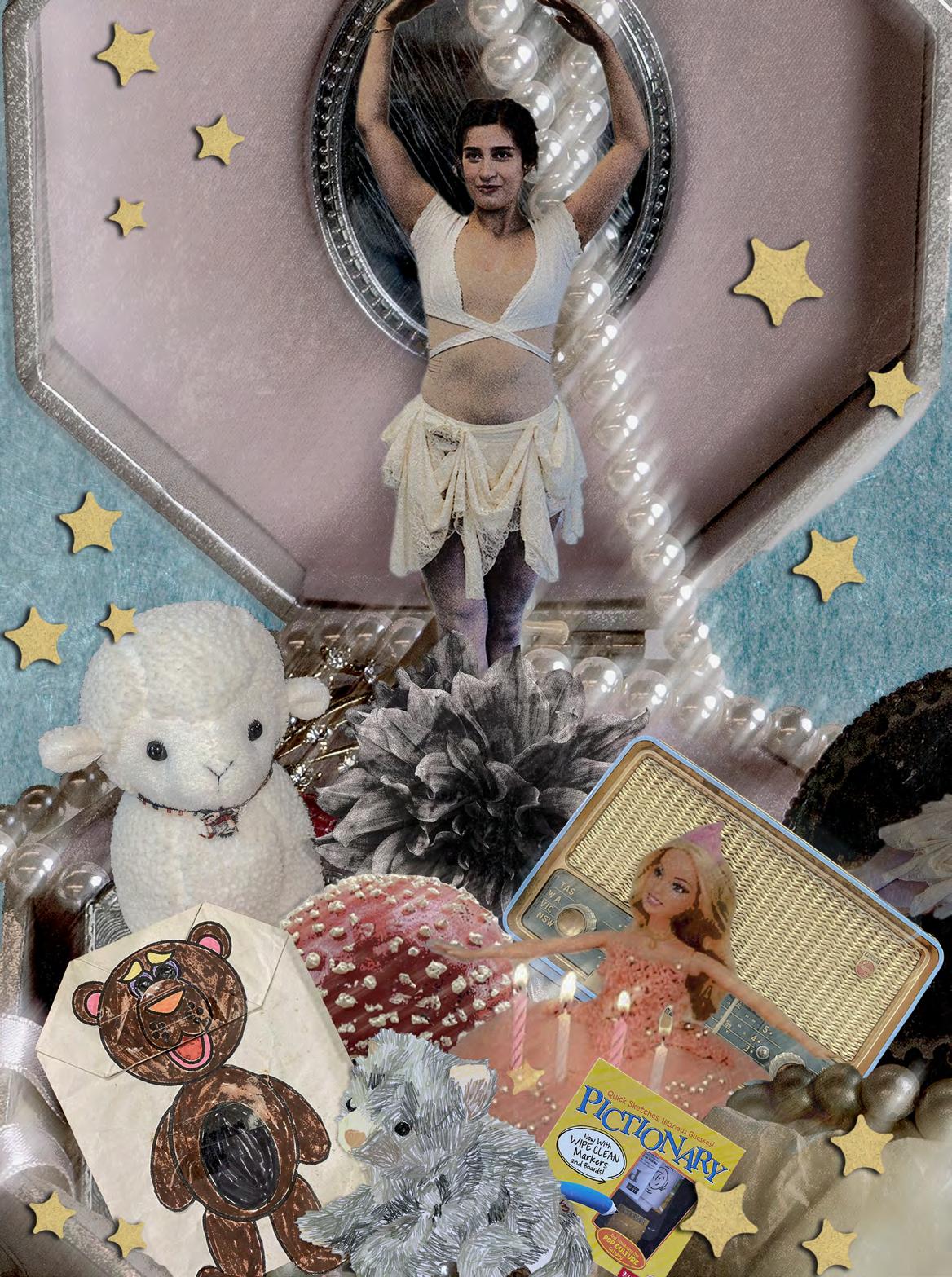
visual art photography scripts diaries/logs ekphrasis prose poetry creative essays fiction music lyrics performances installations
Above Water is open for pitches & submissions until May 25, 2026
Instagram: @abovewateranthology
Email: abovewater@farragomagazine.com
Farrago is the publication of the University of Melbourne Student Union (UMSU) and published by the General Secretary. The views expressed herein are not necessarily those of UMSU. To raise an issue with the Union, please contact the President and General Secretary at president@union.unimelb.edu.au and secretary@union.unimelb.edu.au respectively.
by Kosdown Printing. Please keep or recycle after reading.
Editorial page 2
op-ed
Why I Can’t Stop Making Memory Boxes
Sabine Pentecost page 4
UMSU Office Bearer Reports page 6
News In Brief page 8
Inside Tehran, Heard from Melbourne
Harry Robertson page 11
Narco-Subs In The Pacific
Finley Monaghan-Mc Grath page 13
Women Aren’t “Breeders”, They’re Footballers.
Taylah Xuereb page 16
Archival Zine
Chiaki Chng, Victoria Bahana, Farah Hassan page 18
Photography
Wil Simmonds page 21
Warp and Weft
Maria Quartel page 22
Has Timothée Chalamet Condemned
Ballet & Opera to the Cultural Graveyard?
Rachel Thornby page 24
Modern Love
Ashley Syers page 26
Hope Against Hope and Amor Fati
Sonnet Mamgain page 28
It’s Nice to Know That You’re There
Roby D’Ottavi page 30
The Voices That Don’t Make It In
Paridhi Chhajed page 31
Opening Pandora’s Box
Vanessa Cheng page 32
Toddler Me on Xmas Day
Amelia Andrighetto page 33
The Role of Fugly Clothes in the Face of Facism
Mia Horsfall page 34
Reading the Heart
Zoe Bespalov page 36
Pandora’s Box
Gagan Sandhu page 38
When You Grow Up, What Do You Leave Behind?
Anika Bartholomeusz page 42
Because Broke Uni Students Want to Celebrate Birthdays too
Eleni Pope page 44
Frenchie Brings Luxury Parisian Fare to Melbourne
Saria Ratnam page 48
Unveiling the Woman Behind Every Mother
Zeinab Jishi page 50
Lily Allen’s West End Girl and the Economic Disruption of Artistry
Grace Dwyer page 52
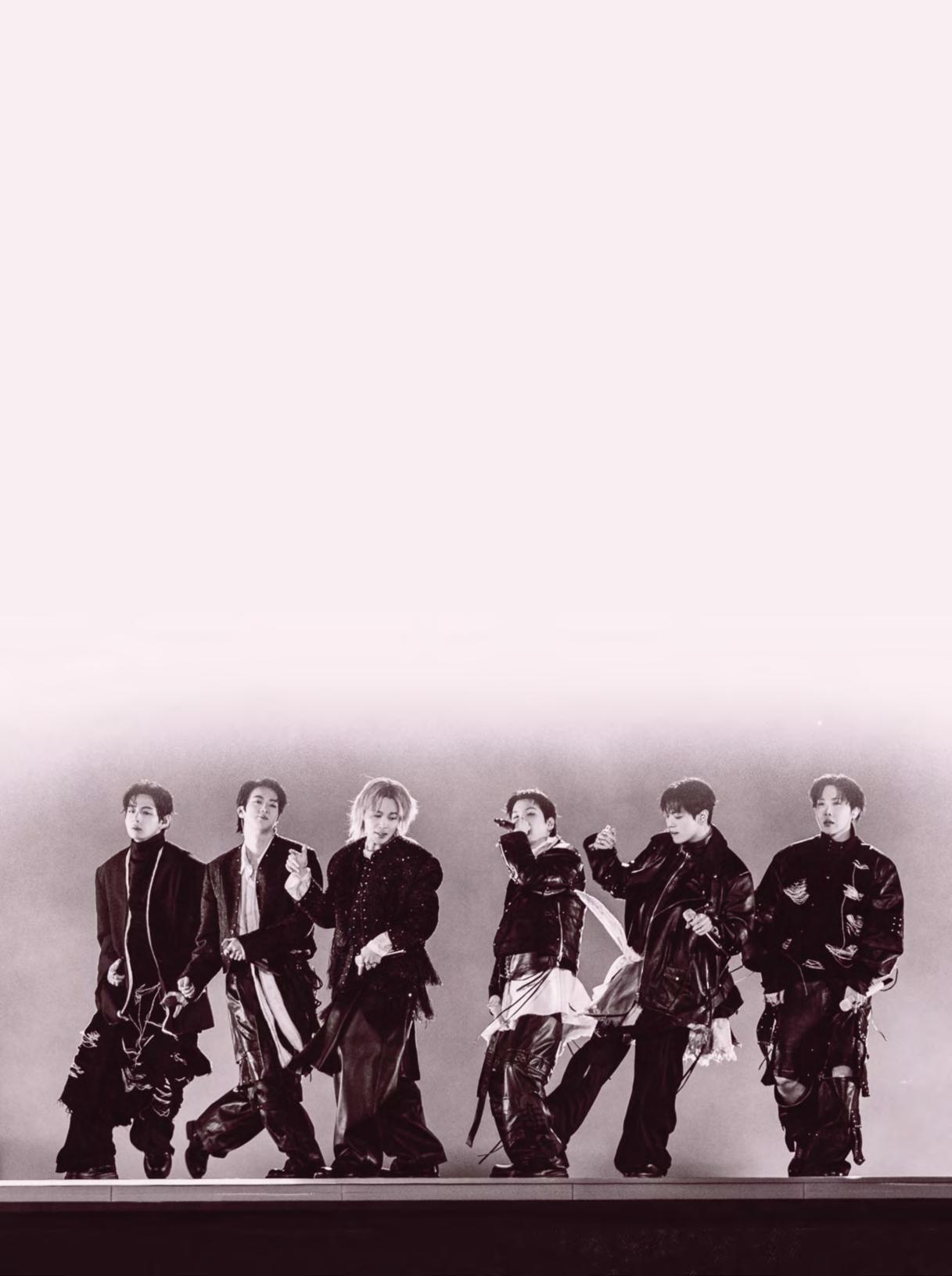
3 Generations, One BTS Comeback
Junae Won page 54
Photography
Wil Simmonds, Nina Nguyen page 56
Ode to my Trichotillomania
Sabine Pentecost page 58
An Exorcism
Maxwell page 59
Swollen
Sammy Ackerley page 60
Dyke’s Daily
Veronica Kwong page 62
One Man In A (Sinking) Boat
Amaya Sachdev page 62
The Last Two Left
Amelie Hughes page 63
Beth and the Bear
Lilian Anjeli page 64
You Are In Samsara
Jacaranda Liu page 65
FARRAGOSSIP. page 66
Archival Zines
Victoria Bahana, Farah Hassan page 67
Me, Myself and I Ella Brown page 70
Photography
Will Tingate, Felicity Bayne page 72
Photography
Saria Ratnam, Amelie Hughes page 74
AFL Astrology
Harry Robertson page 76
Puzzles
Jemima Healy, Honey Raut, Lucy Russ page 78
Cover story by Lauren Luchs, Chiaki Chng, Sabine Pentecost & Nathan Pham
The 2026 Editors of Farrago Magazine are Ruby Weir-Alarcon, Sabine Pentecost, Maria Quartel & Chiaki Chng
SABINE PENTECOST
I’ve been thinking about the perfect little worlds we create for ourselves, within ourselves. They dissolve, quickly swallowed sugar on the tongue, keeping us afloat in many ways. But what happens to all that we hide from? Is there something ugly waiting to be let out?
The submissions for this edition of Farrago have opened my eyes to that which is collectively hidden and equally, collectively cherished. We are not so different from one another. Comfort is siphoned from a shared pool. The double edged sword of childhood wounds and heals in cycle. It’s nice not to feel alone in these things.
Despite all this thinking, I can’t decide whether it’s better for us to keep the box sealed or to fling it open without care for consequence. Perhaps we each decide that for ourselves.
RUBY WEIR-ALARCON
I’ve always hated writing my editorial. I know, I know—this is only my second one, but still. Every time I sit down to do it, I ponder about whether or not it will be good enough, how it will look next to the rest of the magazine, which is filled with thoughtful and considered pieces.
I’ve never said this aloud, but I suppose this inherently relates to Pandora’s box, and the things we fear and hide. Coming from a science background, we’ve always been taught and shown that new advancements can only come from the bad—and therefore that opening Pandora’s box becomes a necessary evil for hope to blossom. We think back to the past advancements from wars, from disease, from environmental decay—and can’t help but see the parallels in the world we are living today. As humans we seem to need to see something destroyed for us to act. We can see this through the climate crisis, the horrors unfolding in the growing wars and global conflict and toying the line around genetic editing. We decide what’s good and what’s bad on whims, and we rush into things that just cause destruction.
Lorem ipsum
We just seem to do everything too late. We hide from ourselves and the damage we are causing the world until it’s almost, and sometimes is, too late.
But still. I’ve always hated writing my editorial.
MARIA QUARTEL
Recently I've been hiding from my HECS-Debt. I hide from the UniMelb portal that leads me to finding out how much I owe the government for my arts degree every time my mum questions me about it. My degree whose required readings challenge me to look to the areas of society we collectively hide from, yet whose assignments and career prospects encourage me to continue to never stop hiding. What do you do with a Media and Communications major if not create the same ads you spent three years dissecting to prove their negative impacts on society?
This edition led me to many conversations around the same core question we all look away from: are our degrees serving us? The news team worries their carefully trained investigative skills are worthless in a media landscape that rapidly adopts precarious freelance work and ditches stable contracts. The arts team questions whether their craft has a place in the world beyond its production being commercialised. The archive team reflects on the worth of studying history when at critical times its most important lessons are dismissed.
As students with HECS-Debt that will linger for decades, we hide from these questions. We simply look away and send cold emails to everyone and anyone that may employ us. In this struggle we lose space and time to confront critical questions. Does this world serve us? How do we imagine new worlds? I encourage the reader to reflect on these questions as they move through the following pages, and encourage the opening of Pandora's box for the creation of new ways of existing.
CHIAKI CHNG
Our moment sees an uptick in Body Keeps The Score1 sentiment, whether it be due to a growing sense of medical literacy in the mainstream, a growing disillusionment about the state of public health and welfare, or a desperation to understand and to fix.
Our urgency to feel healthy and normal again suffices in explaining why we’re so obsessed with releasing trauma through jaw posture stretches and childhood photo-posting on TikTok. Me, personally—I’ve been guāshāing the fuck out of my acupuncture points in order to alleviate my TMJ headaches in a non-botoxful way. It works, admittedly, but I fantasise about the epic release I will experience when I do eventually go to the orthodontist or doctor or spiritual healer or on a nature walk and all my problems are all magically solved. What comes to mind is B. Preciado’s theory of the pharmaco-pornographic complex:
“In this period of the body’s techno-management, the pharmaco-pornographic industry synthesizes and defines a specific mode of production and of consumption, a masturbatory temporization of life, a virtual and hallucinogenic aesthetic of the body, a particular way of transforming the inner in outer space and the city in a private junkspace by means of self-surveillance devices and ultra fast information distribution, resulting in continuous and uninterrupted loops of desire and resistance, of consumption and destruction, of evolution and self-extinction.”2
It just seems very relevant in this time, when we beat ourselves up over not having Healed yet; when we shake our heads at people we don’t understand and hope they get better; when the inherent privilege of a PTSD diagnosis is concurrent to the active and constant traumatising and re-traumatising of people who do not live to see beyond trauma3
Is this by design? When quick fixes for healing and feeling are sold to a select few in vials and eugenics, what happens when we sit and watch?
1. van der Kolk B. The Body Keeps the Score: Brain, Mind and Body in the Healing of Trauma. Penguin Books; 2015. 2. Preciado B. Preciado, B. (2008). Pharmaco‐Pornographic Politics: Towards a New Gender Ecology.; 2008.
3. Kalia S. Understanding Palestine’s colonial, intergenerational trauma from a mental health perspective. The Hindu. https://www.thehindu.com/sci-tech/health/understanding-palestines-colonial-intergen erational-trauma-from -a-mental-health-pers pective/article675373 80.ece.;November 16, 2023.
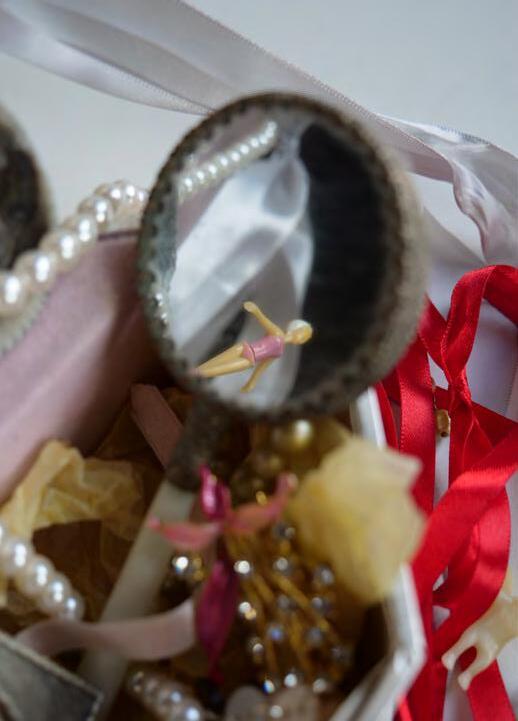
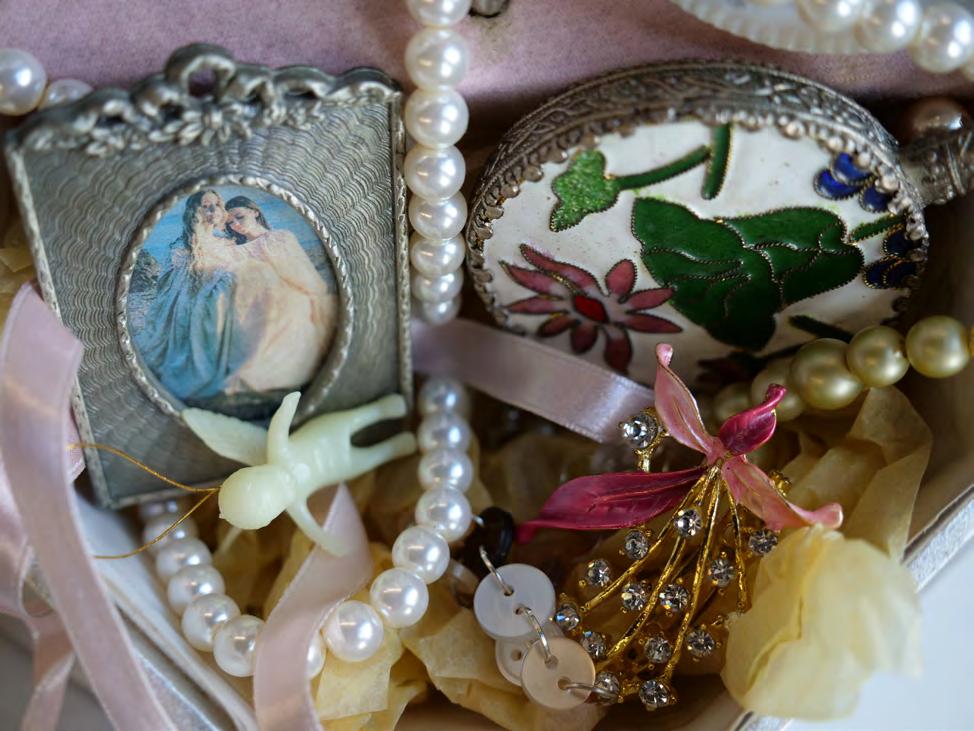
Why I Can’t Stop Making Memory Boxes
Words by Sabine Pentecost
My biggest fear is forgetting my own life.
The idea that things I once gave so much attention could cease to exist, culled neural pathways swept into the furnace of the mind. I used to despair about such things–I’m someone who lies awake at night, choking on thoughts instead of sleeping. But I’ve discovered a solution through materialising the ephemeral.
I collect things and sort them neatly, year on year. Any time I want, I can slip comfortably into the waters of my old selves, I exercise my memory to make sure it’s still there. Everything in its place. If you look under my bed there is a strange assortment of vessels:
An oblong white box: year twelve. The plastic golden trophy I got from my history teacher. Photobooth strips from my ex’s work Christmas party. My VCE results letter–the envelope ravaged, desperation immortalised.
A vintage biscuit tin commemorating Wimbledon: my Europe trip. The smell of my perfume that year, blessings from the Virgin Mary at Montserrat, a paper bag from Shakespeare & Company containing all of the postcards I bought at museums but could never part with.
A larger box with decoupage peeling at the edges: second year of university. The water bottle I was given by that guy from my favourite band, gumnuts from a morning walk on Easter weekend, the photobooth strip documenting my first kiss with my boyfriend.
A tall thin tin with a chicken pressed into the side: every birthday card I’ve ever received. Echoes of myself throughout the years–who I am, reflected back at me through the words of others. A ‘sweetheart’ to someone at some time.
There is no sense organ for time, no objective linearity to it, only the structure imposed by the brain. We make sense of things as humans out of inclination, I certainly do. My brain tries to put my past into neat little boxes under my bed–labelled with pastel coloured paper and silver Sharpie.
As we age, time loses its elasticity. Like our skin, it wrinkles and crepes, losing things beneath the folds of days and hours. This can be attributed to a few things.
Predictability shrinks time, just as constant chaos seems to render its linearity impotent. I find that my brain needs something to hold onto, an anchor point of novelty or nostalgia. When our lives become monotonous increments, there are fewer mental time-stamps to cling onto for buoyancy. We can drown in the formlessness.
We paid more attention to everything when we were kids, something I view as a perfect combination of heightened wonder and lack of algorithmic spoon-feeding. We aren’t forced to pay attention anymore. By creating a memory box to fill each year, I force myself to stop and notice the objects surrounding key memories. I have to think to myself: is this a memento? Should I save it for my box? Can I attach a memory to it and use it to unspool the tight coil of time?
When I open the boxes and run my hands over their contents, time feels like it did when I was a kid–slowmoving and filled to the brim.
It is through these boxes that I can construct and archive my sense of self, that I can imagine time as a web of all these events, happening sequentially but also over and over again. Each time I open a box after a long period, I get to travel back.
I’ve moved around a lot recently. The boxes lived not under my bed, but in a storage unit resting under a stack of dining chairs. I unpacked them properly last week and opened every single box, one after the other. I’ve never felt time hit me from every angle like that. Suddenly, I remembered myself.
At times over the past few months, my life has felt somewhat transient. As if I’m slipping in and out of the regular timeline, and not creating new memories as quickly as I could before. When you don’t have something to anchor you, a representation of yourself to return to, you lose a sense of who that is supposed to be. You forget. And I like who I’ve been and who I am. I don’t wish to lose her to time. And so I reopen time, unspool it and wrap it around myself, again and again…
Photos by Sabine Pentecost
UMSU Office Bearer Reports
President
Lushomo (Lushy) Chingaya
Over the past few weeks, the Safe@ Uni, Safe@Home campaign has continued to build momentum, creating space for important conversations about student safety. We’ve explored key issues including sexism, racism, ableism, gender-based violence, and safety on campus and at home.
A key milestone has been the launch of the 2025 Racism Report, reinforcing what many students already know: racism at university is systemic and ongoing. It serves as both a call to action and a foundation for continued advocacy.
I’ve also been supporting students impacted by visa fee increases. We will continue to advocate for greater financial relief for International students.
This work is ongoing and driven by you! Your voices and experiences shape UMSU and there are many ways to get involved, including our new working groups for satellite, college and graduate students.
General Secretary
Daniel Motika
It’s been a busy and exciting start to the semester for UMSU, and I’m especially proud of what Departments have managed to achieve already. The Welfare Department worked tirelessly to take on the Frozen Meals program in time for semester, distributing thousands of meals to students in need. When the University tried to cut the program, the Welfare Office Bearers stood up and managed to convince the University to transfer the program to UMSU. The People of Colour Department also delivered the first ever UMSU-led Lantern Festival, adding to the vibrant range of cultural
celebrations on campus. Meanwhile, the Education Department has been working alongside Lushy and me to push for greater fee transparency around additional subject costs, such as excursions, as well as for earlier release of the exam timetable, among many other improvements. This is just the beginning of many more wins to come, and I can’t wait.
Welfare
Tsun Ying (Cynthia)
Wong & Alexander Hams
UMSU Welfare has seen a strong start for the semester. Over the past few weeks, we have been running Union Mart on every academic day, serving up to 1000 students per week. A new addition to this year is our frozen meals, which students can access during their regular visit to Union Mart. If you are studying at Southbank, Burnley, or Werribee, be sure to check out our Union Mart service on your campus too. A big thank you to everyone who has supported us along the way. Make sure to follow our Instagram to stay up to date!
Clubs & Societies
Alex Gwynn & Seamus Donellan
The Clubs and Societies department has had a productive year so far in 2026! We have made several changes to the C&S regulations, and have begun the process of affiliating new clubs. We have also held an Executive Mixer for our hard working club committee members, which we will host again in Semester 2. We’re also working hard on introducing tiered funding and updating the UMSU Clubs platform to make events and clubs easier to discover and become involved in!
Southbank
Elizabeth Pardallis, Caleb Jarcevic, Charlotte Dickinson & Tirion Luff-White
What’s happening on Southbank? Since we last updated you, the semester has been in full swing. We’ve been running our regular events and collectives; breakfasts on Mondays and Wednesdays and BBQ on Tuesdays. We’ve also been more in touch with our co-departments this semester! We’ve had visits from the President, Women’s and Welfare - and we’ve been collaborating with the Media department on the Above Water Anthology. What’s next? Business as usual! But also, our clubs have been up to some really cool stuff... follow us at @umsu_southbank to learn more about everything happening at Southbank!
Education
Corbin Afanasyev, Hesheya T Anandan, Hredey Kapoor & Rutvi Tolani
... We have been chasing around the University on getting internal procedures and communication to tutors updated to eliminate deadnaming from tutorials, as well as negotiating the logistics to deliver preferred names on student ID cards. Moreover, with the support of the Earth Sciences Students Society, we have been working to make field trip costs more transparent and accurate, because no student should be hundreds of dollars out of pocket with surprise charges.
We ALSO have a few exciting events coming up this semester, so keep an eye on our socials for updates!
Updates from the purple names on campus...
Activities
Saaisha Vohra
The past few weeks have been the most rewarding of my term as an office bearer, characterised by consistent delivery despite leadership transitions and operational challenges. We successfully executed five ʻBites and Bustles’ events, engaging over 600 students, and hosted SoUP with 800 attendees. Additionally, we launched the ʻParty Safe with Tobias’ campaign to promote safer partying.
We also organised St. Patrick’s Day, ʻTobias Loves You,’ and Transgender Day of Visibility events, further establishing the department as a hub for student engagement. Moving forward, we are scaling ʻBites and Bustles,’ planning a large-scale endof-exams event, and strengthening our safety initiatives.
Tobias Trunke loves you <3
People Of Colour
Anyang Wal & Chengyang (Eason) Gu
Festival of Nations marked a historic first for UMSU POC: our very first initiative of its kind, and a powerful celebration of the diversity, pride, and energy of our community. The event transformed campus into a space of culture, connection, and joy, bringing students together through performance, food, and shared belonging. Alongside this, the release of the 2025 Racism Report was another major milestone, amplifying student voices and pushing the University to confront racism with greater seriousness and accountability. Together, these achievements reflect the growing strength of POC student organising: bold in celebration, fearless in advocacy, and impossible to ignore.
Creative Arts
Yashesvi Verma & Ethan McNeill
Over the past month, Creative Arts organised several initiatives to encourage student participation in the arts. We hosted a Paint and Sip collective, providing a relaxed space for students to explore painting socially. An Art Hive featuring an airclay workshop allowed participants to engage in hands-on creative expression. We also facilitated an Art Therapy session at Southbank, offering students an opportunity to engage with art for wellbeing and reflection. In addition, we supported an Arts and Crafts Market, creating a platform for student artists to showcase and sell their work. In the coming period, we will begin advocacy work focused on increasing access to rehearsal and creative spaces on campus.
For live reporting and timely updates, visit www.farragomagazine.com and follow @farragomagazine on Instagram and Twitter/X.
Melbourne Crime Rate Rises
Words by Taylah Xuereb
Crime in Melbourne has risen 9.2 per cent in 2025, with the municipality recording 46,695 offences, compared to last year’s 42,746 offences, according to Victoria’s Crime Statistics Agency.
Melbourne’s offence rate per 100,000 population (23,997.8) is the highest it has been since 2016.
Theft from a motor vehicle (5,905) was the most common offence, an increase from the previous year (4,372).
Melbourne recorded the highest number of offences (25,744), followed by Docklands (4,182), Southbank (4,178), Carlton (3,200) and North Melbourne (2,455).
All of these suburbs recorded an increase in offences over the past year.
Victoria recorded 630,592 offences in 2025, a 4.2 per cent increase from the year prior.
Across the state, record family violence arrests saw one offender arrested every half hour.
“With 230,213 different victims of crime, we are seeing far too many innocent community members harmed,” Deputy Commissioner Regional Operations Bob Hill said. “This is simply not acceptable as we want Victorians to not only be safe but feel safe in their community.”
Australian Farmers Facing Diesel Shortages, Warning of Higher Food Prices
Words by Bridie Golding
The war in Iran is not only affecting fuel prices at metropolitan bowsers, but also driving diesel prices significantly higher in regional and rural areas. As a result, farmers are now facing severe diesel shortages and potential fuel rationing, which are likely to have flow-on effects for food prices around the country.
Regional and rural areas have already been the first to run out of fuel; Robinvale in Victoria’s northwest ran out on March 15. Australasian Convenience and Petroleum Marketers Association chief executive officer Rowan Lee told the ABC that “this is not an isolated incident at all, it’s happening in communities right across Australia.”
Farmers and truck drivers are two of the groups most affected by rising diesel prices. With prices nearing $3 per litre across the country, the shortage is significantly affecting their operations, as many areas are currently in either summer harvest or winter sowing season, both of which require machinery to be in near-constant use. Fertiliser is also in short supply, as 75 per cent of the world’s supply travels through the Strait of Hormuz.
Because of this, farmers are warning that food prices are likely to increase. National Farmers’ Federation president Hamish McIntyre said “dairy, fruit and vegetables could rise by 40 to 50 per cent […] it’s cost of delivery plus cost to farmers.”
Experts have suggested that fuel rationing is a possibility in coming months if the war in Iran continues past late April. On March 23, ABC Radio Melbourne reported that multiple service stations around Melbourne were out of diesel.
The federal government has created a coordinator to assess supply chains, and the Australian Competition and Consumer Commission (ACCC) will investigate price gouging by major fuel suppliers.
The Energy Minister, Chris Bowen, has reiterated that there is no need to panic-buy fuel, and that there has been no interruption to Australia’s fuel supply.
Labor Wins Big in South Australia As One Nation Surges
Words by Pryce Starkey
On 21 March, the incumbent Labor government of South Australian premier Peter Malinauskas secured a second term with a historic majority. Labor won almost all seats in the lower house of the state parliament, and nearly wiped out all of its state Liberal MPs.
While the Malinauskas Labor government celebrated its emphatic victory, media attention was focused on Pauline Hanson’s insurgent One Nation party, which has threatened to upend the Australian political establishment nationwide.
One Nation achieved a historic result at the election, receiving a 23 per cent primary vote, the party’s best showing in a state election since the 1998 Queensland election. One Nation’s primary vote was higher than the Liberal Party, which achieved a primary vote of just 19 per cent.
Labor remained relatively unscathed by One Nation’s surge, achieving a primary vote of 38 per cent, enduring only a small 3 per cent swing against it.
However, Labor faced some closer-than-expected contests in some of its seats in metropolitan Adelaide, where One Nation greatly overperformed expectations.
In the seat of Light, comprising the town of Gawler and the northern suburbs of Adelaide, One Nation saw a 19 per cent swing towards it, coming just short of ousting Labor.
Pauline Hanson, who was present in South Australia to campaign for the election, revelled in her party’s result, celebrating the party’s new MP’s, including state party leader Cori Bernandi, and four members of the lower house.
“Guess what mate, I’m leaving you some landmines. They’re called One Nation members of parliament,” Hanson warned the Premier.
Hanson also hinted at her further involvement in future elections, referencing the by-election in the NSW seat of Farrer, vacated by former Liberal leader Sussan Ley, as well as the Victorian state election, to be held in November.
“This is the start of it, and I’m going to go after Farrer and we’re going to look at the state Victorian elections. People are crying out for One Nation down there, so there is a movement that is happening.”
Australia’s EU Trade Deal is About More Than Cheaper Prosecco
Words by Syakira Setiananda
After eight years of stalled talks, Australia and the European Union have finally concluded negotiations on a free trade agreement — and while the headlines have focused on prosecco, parmesan, and cheaper BMWs, the deal is really about geopolitics.
Announced on March 24, the agreement links Australia closer to the EU, a bloc of roughly 450 million people and one of the world’s largest economies. On paper, it promises the usual freetrade benefits: tariff reductions, expanded market access, and lower prices on imported goods. Australian consumers may soon see cheaper European cars, food, wine, and fashion, while exporters gain easier access to the EU market. The government says wine producers alone could save around A$37 million from tariff cuts.
But the timing matters as much as the economics. In an era shaped by supply-chain insecurity, China’s dominance in critical minerals, and the return of aggressive tariff politics under Donald Trump, the deal is also a strategic alignment. Canberra and Brussels have paired the trade agreement with deeper cooperation on defence, cybersecurity, maritime security, and critical minerals, suggesting this is less a narrow trade pact than a broader political hedge.
Still, free trade remains unevenly distributed. Australia’s red meat industry has condemned the beef and lamb quotas as inadequate, calling the deal a missed opportunity. So while the Prime Minister has framed the agreement as a “win-win”, the politics of who actually wins — and by how much — remains far from settled.
Farrago to Join the Student Media Association
Words by Pryce Starkey
Farrago will join the Student Media Association (SMA), its editorial team has confirmed. In a publicised statement, Farrago ’s editors confirmed their intention to join the SMA, Australia’s first and only national body of student journalists.
“In a media landscape where work is ever more precarious, the Farrago editorial team feels very proud to be joining the Student Media Association,” editor Maria Quartel said in a statement.
“We are excited to collaborate with other publications to ensure that students nationwide are given opportunities to enter a media industry that permits them to explore their voice in a safe space.”
The SMA was founded in August last year in the aftermath of the 2025 Student Journalist Convention at the University of Sydney, where Farrago was a participant.
According to its constitution, the SMA’s primary aims include advocating on behalf of student publications, enabling communication between student journalists, supporting publications against censorship and budget cuts, and promoting student contributions in the arts, culture, and journalism.
“It would be great for the oldest student publication in Australia to join the other fourteen member publications currently in the Student Media Association,” SMA President Imogen Sabey told Farrago
“I look forward to seeing the editors follow through on their expressed intention to join the union, and later working with Farrago to [address] the myriad issues facing Victorian student publications.”
Membership would grant Farrago access to a range of assets, including student journalism resources, advocacy services, eligibility for leadership positions in the SMA, and access to a growing network of student journalists across the country.
“[ Farrago could] experience the benefits of media unionism and interact with a media network beyond its own campus,” Sabey said.
Current members of the SMA include publications like Honi Soit (University of Sydney), Lot’s Wife (Monash University), and Woroni (Australian National Univerisity), among eleven others.
To secure membership in the SMA, Farrago would only be required to fill out the relevant forms and pay the 3 per cent membership dues if able.
Rideshare Giants Raise Fares as Fuel Prices Surge
Words by Finn Monaghan-Mc Grath
Uber and DiDi have increased fares across Australia, introducing new surcharges in response to increased fuel prices faced by drivers across the country.
Both companies say that these changes are designed to offset high operating costs for drivers, with costs being passed onto their customer bases.
A spokesperson for Uber told AAP that they project the surcharges will increase driver earnings, on average, by an additional six per cent across Australia. The company also confirmed minimum fares in Melbourne will rise to $11.50.
Uber has made it clear that these changes are permanent. Conversely, DiDi claims its surcharges are temporary and solely designed to support drivers during a period of increased operating costs.
DiDi is doing so by employing a temporary five-cent-perkilometre surcharge to support their drivers.
Both rideshare providers are planning on continuing to monitor fare structures as fuel prices and cost-of-living pressures continue to evolve.
Everyone Rides Free: Victorian State Government Introduces Free Public Transport Until End of April
Words by David Wu
On 29 March, the Allan Labor Government announced that it would introduce free public transport across the state from Tuesday 31 March to Thursday 30 April.
On 29 March, the Allan Labor Government announced that it would introduce free public transport across the state from Tuesday 31 March to Thursday 30 April.
During this period, students and other Victorian residents will no longer need to tap on, and can travel for free on all trains and buses, trams in Metropolitan Melbourne, and regional trains and coaches.
As the average price of fuel soars above $2.50 per litre for petrol, and over $3.00 per litre for diesel, this $50 million policy aims to relieve cost-of-living pressures for Victorians by reducing fuel demand. In a statement to the media, Premier Jacinta Allan said that she was “determined to do everything within [her] control to help Victorians deal with rising fuel prices.”
Currently, ticketing on a concession Myki is capped at $5.70 per day, and this policy will thus save concession card holders $125 a month for full-time students travelling five days a week, and double that for full-fare card holders.
Read the full article online at www.farragomagazine.com
Calls to End Intervention: “U.S. Imperialism Out!”
Words by Iman Amani
In the evening of Wednesday, 1 April 2026, activists assembled in front of the State Library of Victoria to protest U.S. interference in Latin America, amid ongoing U.S. intervention in Cuba and Venezuela.
Demonstrators raised banners and signs bearing slogans such as “Break the blockade of Cuba! Hands off Venezuela! Defeat Imperialism!”, “Manos fuera de Latinoamérica!” (Hands off Latin America!), and “Hasta La Victoria Socialista!” (Until the socialist victory!). Collectively, the messages underscored long-standing frustration towards U.S. intervention in Latin America, which protestors cited as the primary driver of regional instability throughout the decades.
The rally emerged in the wake of Operation Absolute Resolve, which resulted in Venezuelan President Nicolás Maduro and his wife Cilia Flores, being taken into U.S. custody, as well as the Trump administration’s tightening of sanctions on oil shipments in Cuba, which has resulted in one of the worst fuel shortages in the country’s history.
The rally opened with an address by Chris, a representative of the Revolutionary Communist Organisation, who condemned U.S. foreign policy, declaring that “[the] blockade follow[ed] decades of U.S. sanctions”.
Read the full article online at www.farragomagazine.com
Israel Launches Unprecedented Attack on Lebanon, Killing Hundreds
Words by Zeinab Jishi
Israel has launched a large-scale attack on Lebanon, striking over 100 sites in 10 minutes in its war against the Iranianbacked militant group Hezbollah, violating an ongoing ceasefire agreement. Areas targeted by the strikes include the Lebanese capital, Beirut, the Bekaa Valley and southern Lebanon.
The Civil Defence, Lebanon’s emergency medical service, said that at least 254 people have been killed in the attacks, with another 1,165 wounded.
“We could hear a series of enormous, deep, booming explosions coming not just from the southern suburbs but many other parts of the city,” Al Jazeera’s senior correspondent Malcolm Webb reported, “Many of the locations were in places where nobody expected strikes to hit. It caused panic and chaos in the streets. Children were crying.”
Lebanese prime minister Nawaf Salam made a statement on X condemning Israel’s disregard for the principles of international and humanitarian law, accusing it of targeting residential neighbourhoods and unarmed civilians.
Read the full article online at www.farragomagazine.com
BBQgate: UMSU Under Fire Over ‘Trans Erasure’ Scandal
Words by Pryce Starkey
The University of Melbourne Student Union (UMSU) is facing backlash after its Queer Department advertised an event called ʻLGBBQ’, scheduled just days before International Transgender Day of Visibility (TDOV).
Students were quick to notice the quiet omission of the “T”, as well as the timing of the event, which was to be held on Thursday 26 March, just five days before TDOV, raising questions about whether the Queer Department had intentionally omitted trans representation, or if it had simply neglected to recognise the symbolic significance of the omission ahead of TDOV.
UniMelb’s transgender community and other student activists have criticised UMSU, accusing it of trans erasure. On the Instagram post advertising the event, a barrage of comments criticised the alleged exclusion, calling out the responses of UMSU Office Bearers (OBs) who supported the pun.
Read the full article online at www.farragomagazine.com
Waking Up to Explosions and Missed Calls: Inside Tehran, Heard from Melbourne
Words by Harry Robertson
Every night in Melbourne, Darius* wakes in the dark and checks his phone.
He’s not expecting good news. He simply hopes for any news at all.
An Iranian Australian academic, Darius [whose identity is protected due to fear of reprisals upon his family] is torn between life in his new home and the chaos unfolding in his former city
“I get up in the night and check my phone to see if I received any messages,” he said. “Even just a missed call.”
Like many Iranians abroad, he has struggled to reach family members since widespread internet restrictions began following the latest escalation of conflict in the country.
“The majority of people don’t have access to the internet,” he said. “I can’t connect with my parents. Like a lot of other people, it brings stress.”
For many in the Iranian diaspora, communication with loved ones has become sporadic or impossible. Internet restrictions have become a common tactic during periods of unrest in Iran. According to the BBC, online services during protests, limiting the ability of demonstrators to organise and preventing images of violence from spreading internationally.
For families outside the country, the shutdown has another consequence: silence.
“It’s not just about the internet,” Darius said. “It’s about people losing their voice.”
Inside Iran, people are living with a different kind of uncertainty.
A Tehran resident, speaking via a complex encrypted messaging system and whose identity has been withheld for safety reasons, describes a city that alternates between routine and chaos.
“Naturally, we have a sense of fear.”
During the day, the city can appear almost unchanged. Traffic moves through Tehran’s crowded streets, and some shops remain open.
“If you drive around when the bombs don’t hit, you think everything is normal,” the resident said.
But the illusion rarely lasts long.
“Every few hours missiles hit the corners of the city, and all the houses shake.”
The explosions can be heard kilometres away, sending people rushing to windows or into hallways to check on neighbours.
“Especially at night when we sleep at home, we wake up to the sound of an explosion.”
Despite the violence, basic supplies remain available, though economic pressures are mounting.
“Food and water are not a problem right now,” the resident said. “Only food prices have almost doubled in stores.”
Businesses, however, are struggling.
“Most businesses are paralysed and lost,” they said. “Most say this is no problem if all this pressure and stress
lead to the government going away.”
Iran has faced prolonged economic hardship, with sanctions and domestic mismanagement contributing to rising prices and unemployment. Waves of protests in recent years have been met with harsh crackdowns, leaving thousands dead or imprisoned.
“People tried everything civil in their capacity,” Darius said. “And it didn’t work.”
Frustration with Iran’s leadership has grown significantly in recent years, according to the resident in Tehran.
“People have been tired of the government for a long time,” they said. “I can boldly say that between 80 and 90 per cent of people hate the government now.”
The resident said public anger intensified following mass protests earlier this year.
“After the January protests that killed more than 30,000 people in Iran, we realised that a government that wants to maintain itself at any cost and has no problem with crimes against its people—we have no power to confront it with empty hands.”
For many, economic hardship has added to the resentment.
“With the bad economic situation and hyperinflation, we only want the end of the government,” they said.
Darius adds that such sentiments are unsurprising given the violence and repression many Iranians have experienced.
“Thousands have been killed, and human rights were seriously jeopardised,” he said.
He pointed to BBC reports of protesters being shot and accounts suggesting some victims were attacked even after receiving medical
treatment.
“People with a bullet in their head still receiving medical aid…medics won’t treat someone who is already dead.”
According to Darius, these events have pushed many Iranians to a point where they believe fundamental change is inevitable.
“This regime has to go.”
Many Iranians initially hoped change could come from internal protests alone. But after repeated crackdowns, some have begun reconsidering whether outside assistance is necessary.
The Tehran resident echoed that shift in thinking.
“We ourselves wanted to change everything without the intervention of a foreign government,” they said. “But after the protests and the killings, we realised we have no power to confront it with empty hands.”
Even so, the future remains uncertain. Some opposition supporters have begun discussing the possible return of Iran’s former monarchy under the son of the last Shah, while others warn against replacing one unchecked power with another.
“We must be very careful about what happens after these changes,” the resident said. “But the priority is to oust the regime.”
In Melbourne, Darius says the silence from Iran is often the hardest part.
One fellow Iranian colleague recently told him that she had received a single missed call from her mother in Tehran.
“I was so happy,” she recalled. “I never thought I’d be so excited just to see a missed call.”
Narco-Subs In The Pacific: A Growing Blind Spot for Drug Enforcement In Oceania
“If you don’t even have the basic legal framework when there are people on a ship... how are you going to manage when there are no people?”
Words by Finley Monaghan-Mc Grath
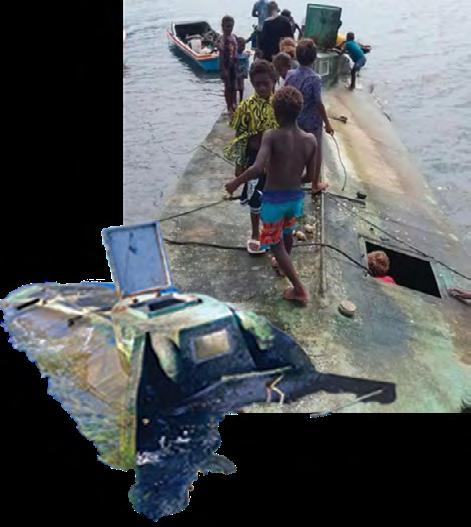
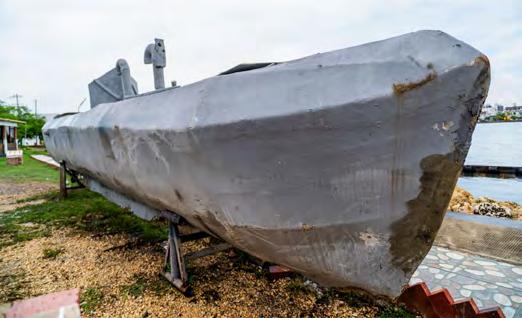
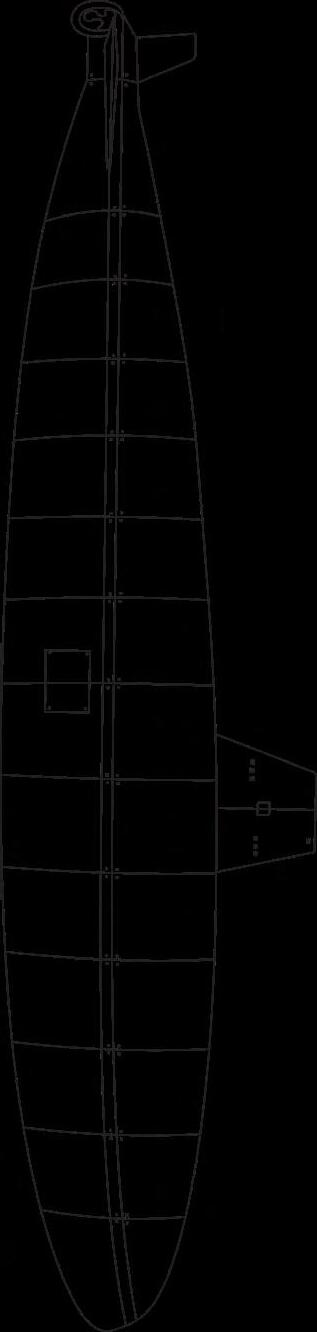
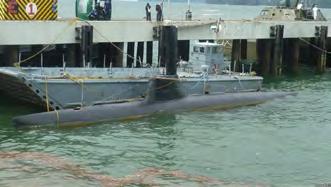
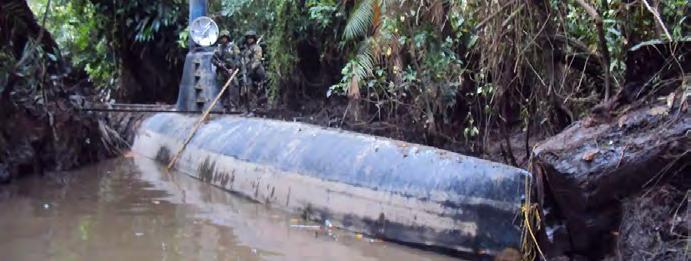
Seven semi-submersible “narco-subs” have been found in recent months drifting at sea or washed up on the shores of Pacific Island countries (PIC) carrying illicit drugs bound for Australia and New Zealand, according to the ABC.
The US Drug Enforcement Administration have reported that organised crime groups on both sides of the Pacific Ocean are increasing their activity in PIC, as these nations function as transhipment and re-exportation hubs between Australia, New Zealand and the Americas. Of the seven vessels discovered since August 2024, only one was successfully intercepted, with the rest appearing to be abandoned after offloading.
While narco-subs have long been used by Latin American cartels on shorter, less complex routes, their recent appearance across the Pacific suggests these networks are now capable of operating far further afield than previously imagined. As a result, authorities across Oceania are confronting a new trafficking method—one that is exceptionally difficult to detect, intercept and control.
Maritime law experts warn that the current counternarcotic strategies and legislation across the Pacific are outdated and ill-equipped to respond. As enforcement struggles to keep pace, narco-sub technology is rapidly improving.
In July 2025, the Colombian Navy intercepted the most advanced narco-sub to date.
Categorised as an Autonomous Underwater Vehicle (AUV), the uncrewed vessel—equipped with a GPS device, satellite systems, multiple Starlink antennas and surveillance cameras—may be the first indicator that international drug trafficking is entering a new autonomous chapter.
This could dramatically reduce the role of the weakest link in transnational drug smuggling, human operators.
The
Evolution of Narco-Sub Technology
Professor Víctor Manuel Sánchez Valdés, a researcher of public security and organised crime from the Autonomous University of Coahuila, told Farrago the reasons behind the constant technological advancements made by transnational cartels:
“The key lies in the high profitability of the business. Finding more efficient and safer transport methods translates directly into greater profits, which incentivises constant innovation.”
“To achieve this, criminal organisations not only experiment empirically, but also rely on highly qualified professionals, including engineers and specialised technicians.”
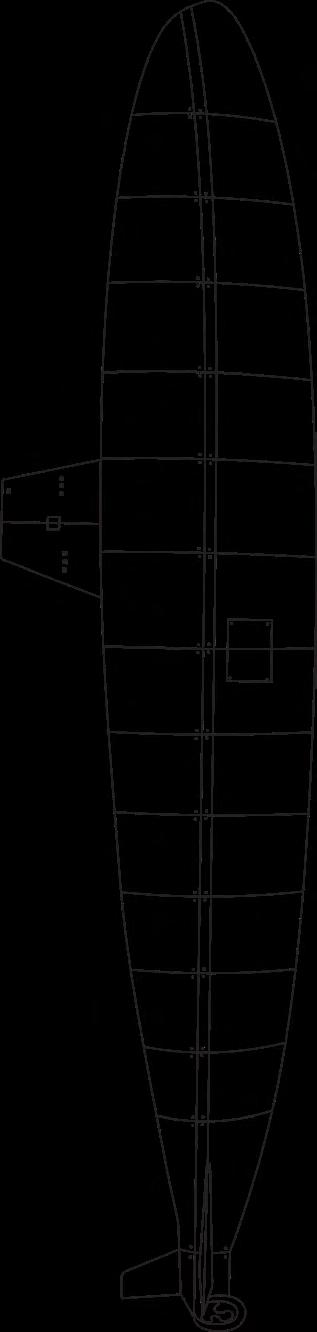
While a fully submersible vessel was discovered in Venezuela as recently as 2022, most traffickers seem to still rely on semi-submersibles, which operate mostly under the ocean’s surface, significantly reducing their physical, acoustic and thermal profiles. This makes them incredibly difficult to detect through aerial or maritime surveillance.
Professor Alexander Gillespie, an international law expert from the University of Waikato, told Farrago that these emerging smuggling methods are just the tip of the iceberg and that “there will be a lot more that they haven’t found.”
Estimates from MIT suggest it costs around $2 million dollars to make these semi-submersibles, yet Professor Gillespie says these costs are negligible compared to the profits generated in Australian and New Zealand’s drug markets.
Ben Maenu’u, “Narco sub used as ‘island-hopping’ vessel,” The Australian, 2025.
“Narco sub found floating in Solomon Islands waters,” ABC News, October 5, 2025.
Carlos Parra Rios, “Uncrewed fiberglass narco sub intercepted off Tayrona National Park,” MIT Technology Review , February 19, 2026.
“Narco sub found floating in Solomon Islands waters,” ABC News, October 5, 2025.
Uniquely Profitable
The latest United Nations World Drug Report reveals that Australia has the highest rates of cocaine consumption in the world, with 4.5 per cent of Australians consuming the illicit substance, doubling that of the rate in the US. Furthermore, The Guardian has reported that the cost of cocaine in Australia is between three and six times higher than the US. These factors are why transnational criminal organisations are willing to direct a significant amount of resources to meet demand.
Professor Gillespie highlighted that the scale of drugs passing through the Pacific is increasing, and that, “the busts that are happening in the Pacific right now are just mind blowing and the trend each year as they just get bigger and bigger.”
In New Zealand, customs officers have been consistently stopping the same amount of methamphetamine each week— for the past year— which once totalled the country’s entire annual seizures of the drug in 2014.
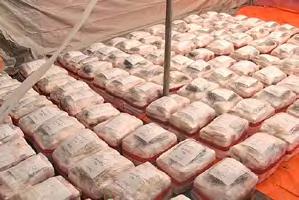
Since January, 2.6 tonnes of cocaine worth $780 million was apprehended alongside an Ecuadorian crew in Fiji, which was suspected to have been originally transported to the island via a narco-sub that is yet to have been located.
Also, 11.5 tonnes of cocaine worth $3.4 billion was discovered by French Polynesian authorities across three seizures, two of which were suspected of being bound for Australia and New Zealand.
The Pacific; an Easily Exploitable Region
The emergence of what has been dubbed the “Pacific drug highway” is partly caused by PIC having less policing and prosecuting capabilities than Australia and New Zealand. Organised crime groups have exploited vast, under-patrolled areas while infiltrating local communities, contributing to an increase in drug use and associated crime.
One of the ships that was intercepted near French Polynesia was allowed to continue on its course without any arrests being made. The five tonnes of cocaine it was carrying were dumped into the sea.
French Polynesian President Moetai Brotherson explained to the ABC that they were not prepared to prosecute the crew due to already overcrowded prisons.
Professor Gillespie highlighted the significance of these lack of policing resources:
“A lot of the Pacific isn’t just developing. It’s the least developed […] and the politics at the international level right now, is about giving less to these countries rather than giving more,” he said.
“If you want to secure the region, you have to make sure that the police and security in the Pacific is of a much greater standard than what it is right now […] You’ve got to give them the resources that they need to police.”
Professor Natalie Klein, an expert on the law of the sea, explained to Farrago that gaps within legal frameworks are also contributing to a weak security structure in the region. Specifically, many PIC are not parties to the United Nations Convention Against Illicit Traffic in Narcotic Drugs and Psychotropic Substances, 1988.
“It’s important in terms of creating the international law framework that will allow a country to prosecute somebody who is not one of their nationals, who is not necessarily located in their territory... but for anyone who enters their territorial sea or comes into their maritime areas.
French Embassy in Australia, “Cocaine seizure in French Polynesia operation,” ABC News January 22, 2026.
Fiji Police, “Cocaine transported in parcels weighing 2.6 tonnes,” ABC News , January 22, 2026.
“As a preliminary matter, if [those] PIC became parties to that treaty, the first thing they have to do is really just adopt the national legislation to make sure that they’ve got laws in place that will criminalise this activity.”
Professor Klein also highlighted how these treaties contain obligations around prosecution standards and information sharing that are useful to create stronger counternarcotic strategies.
She expects that becoming a party to these treaties will inadvertently deter countries in the region from adopting tactics pursued by the US in relation to the targeted killing of suspected drug traffickers, as such strategies flaunt long-established rules of international law.
This is of particular concern considering that the opposition leader in the Solomon Islands, Matthew Wale, recently praised the US approach.
The Ever-Evolving Game of Cat and Mouse
These developments occurring in how drugs are trafficked to the Pacific point to a rapidly shifting counternarcotic and security landscape in the region.
While it is uncertain how governments within the region will respond to these new threats, Professor Klein warns that the use of autonomous technology in global drug trafficking is no longer hypothetical.
“It’s going to happen. It’s just a question of how well we’re going to be able to develop the technology to detect those types of vehicles and then have the resources to deploy to actually go and seize it at sea.”
AUVs remove the human element, which reduces labour costs, creates more room for cargo and removes risk of potential informants when intercepted.
These uncrewed vessels have the potential to move slower across longer and less monitored routes, they could wait out patrols, loiter near rendezvous points and if one is about to be intercepted, the owners could scuttle (deliberately sink) the subs from afar.
“If you don’t even have the basic legal framework when there are people on a ship,” Professor Klein said, “how are you going to manage when there are no people?”
Some quotes have been translated to English .
Ecuadorian Defense Ministry, “Troops seize vessel in nature reserve near Colombian border,” BBC News, 2025.
Royal United Services Institute (RUSI), 2025.
John Otis, BBC Mundo 2011.
Daniele Volpe, “Submarine used by drug cartels on display at naval base in Guayaquil,”
The New York Times, October 22, 2025.
Women Aren’t “Breeders”, They’re Footballers.
Words by Taylah Xuereb
ACollingullie Wagga Demons assistant coach has stepped down after making misogynistic remarks towards his own players during an online stream of a local women’s AFL game.
“Well, we’ve got a real issue in our society overall, with the body shape of our women. They’re our breeders, mate,” the unnamed coach said.
The second participant in the stream condoned these comments, consistently agreeing with the remarks.
“Even the young girls you know, the body shapes are all wrong. You think about when we were growing up, you know the body shapes of girls. You hardly saw any fat girls,” the coach said.
In response to the incident, the Collingullie Wagga Demons club has stated the assistant coach has stepped down from his club commitments.
“We take this matter extremely seriously and are currently working closely with the AFL to address the situation,” the club stated.
Misogyny in Public Discourse
This incident contributes to the rise in conservative views amongst men. A recent Ipsos and King’s College London study, which surveyed 23,000 people worldwide, found that almost a third of Gen Z men believe a wife should obey her husband.
Lauren Rosewarne, an Associate Professor in the School of Social and Political Sciences at the University of Melbourne, spoke to Farrago about the current state of misogyny in common public discourse.
When asked about the phenomenon of men not critiquing the misogynistic behaviours of other men, Professor Rosewarne detailed how some of these men choose this avenue to either avoid being “shamed or mocked or considered soft” or because they simply don’t see the misogynistic aspects of such language and actions.
The fact that this incident was livestreamed caused it to be vastly shared online.
Professor Rosewarne details the repercussions of this.
“The mainstreaming of misogyny works to normalise it.”
Professor Lauren continued to unpack how this platform comes with some advantages as it “showcase[s] that there are still many people who consider such attitudes to not be revolting.”
Melbourne University Women’s Football Club
Despite this, there are a plethora of clubs and communities supporting women in AFL.
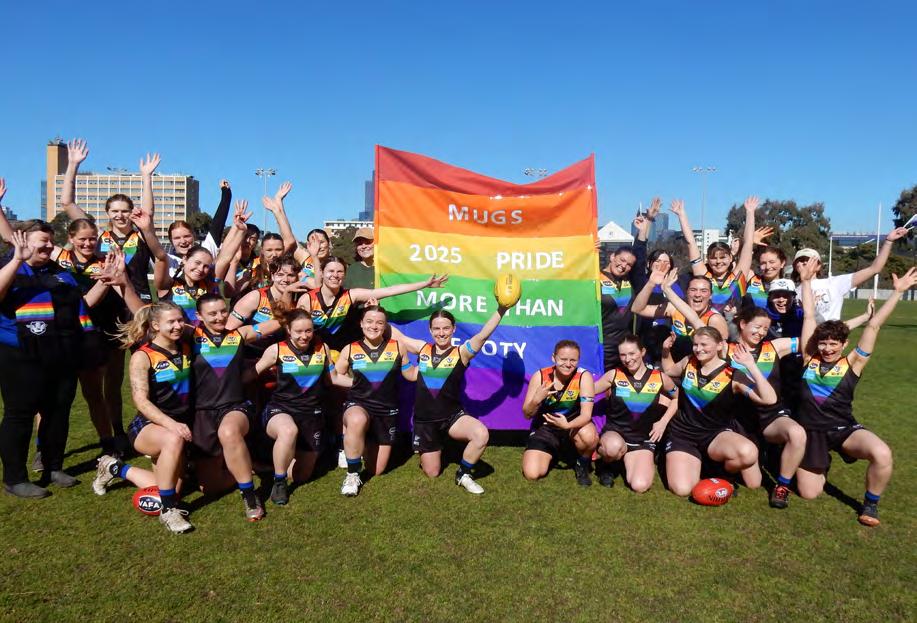
At the University of Melbourne, the Melbourne University Women’s Football Club (MUWFC) wants to keep creating inviting environments for women to play football.
MUWFC Co-President Michelle Andrews spoke to Farrago , “MUWFC was forged by women creating a safe space for women to play football. At
that time, women were even more of a minority in footy than what they are now.”
Established in 1996, the MUWFC is the oldest female led football club in the country, and has five seniors premierships to its name.
But the club is focused on more than simply winning games; they’re focused on supporting the community.
“I feel like I can play my best football because I know every player, coach, support staff and committee member is behind me,” MUWFC player Gabby McDonald said.
In previous years, the club has enforced action plans and crafted strategies to tackle issues relating to the LGBTQ+ community, First Nations peoples, sustainability and mental health.
“Paving the way for women has bled through to paving the way for many different groups. Everyone deserves a place to play this game,” Andrews said.
From 2022 to 2025, the club initiated a series of action plans including its “MUWFC Pride Strategy”, which details the ways the club would facilitate the needs of the queer community through education, advocacy and support, and policy.
“The LGBTQ+ community has always been a part of our inclusive nature and that isn’t going to change. We want everyone at Melbourne University and in our community to feel welcome and enjoy playing footy together.”
This support isn’t taken for granted by the club’s players, or the “Mugars” as they are nicknamed.
“Many Mugars identify with the Queer community, and I feel MUWFC is the most inclusive space I’ve been a part of. We are all stronger due to our diversity, our strong stance on social issues,” said Megan Gilmore, an MUWFC player and committee member.
This sport is currently dealing with the issue of women not feeling comfortable playing the game due to gender-based setbacks within clubs.
A study conducted by researchers from both Federation University and Victoria University found women’s teams in male-dominated sports
struggle to maintain support from their clubs.
Some women’s teams reported they were pushed aside to make space for their male counterparts. The study also found that their participation retention was “much lower” compared to men’s teams.
“We need girls and women to keep playing the game, keep training, keep learning. We are seeing a drop off in senior players across all clubs at the moment and we need to find ways to encourage women to keep playing once they hit Under 19’s and beyond,” Andrews said.
One of the ways MUWFC is aiming to rectify this issue is by encouraging community involvement in the club’s operations. The club is working to utilise UniMelb students to further connect the student cohort to the team.
Future initiatives plan on utilising the skills of the UniMelb’s students. This possibly includes those studying physiotherapy who can potentially develop experience as sports trainers for the club, and dentistry students who can make mouth guards for the players.
“There are both challenges and advantages inherent to being a university football club, but the university—especially MU Sport—have made it clear that they are willing to work with us and support us in any way they are able,” McDonald said.
Above all, MUWFC is currently highlighting the advantages of women playing AFL. From the physical benefits of agility, strength and stamina to the not so obvious advantages of strategy and socialisation, the rewards outweigh the costs for women playing the sport.
“I think all UniMelb students should get involved in representing their university through sport. For me, it has added so many dimensions to my studies and helped me grow in confidence and leadership, making me a well-rounded individual ready for my future career,” Gilmore said.
The MUWFC is currently welcoming new players of all skill levels and all gender identities.
Photography by MUWFC
Zine-structions FROM THE ARCHIVE TEAM
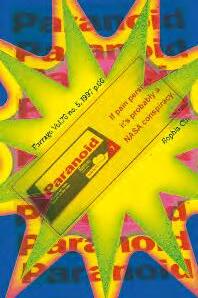
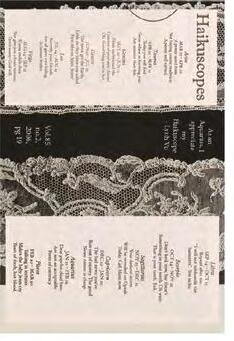
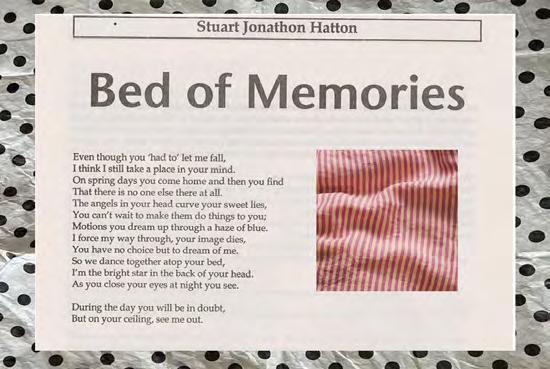
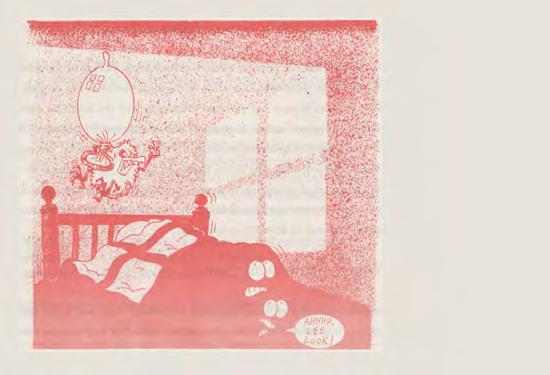
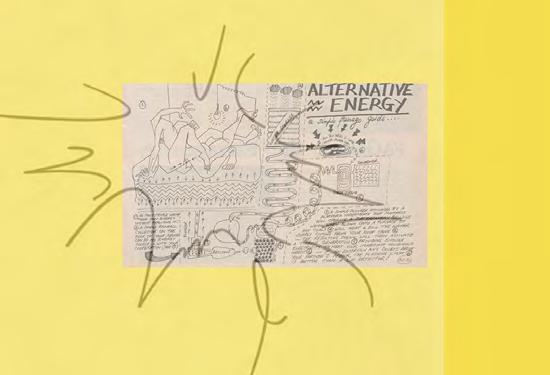
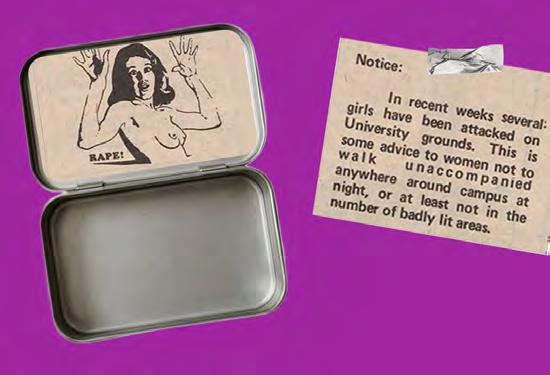
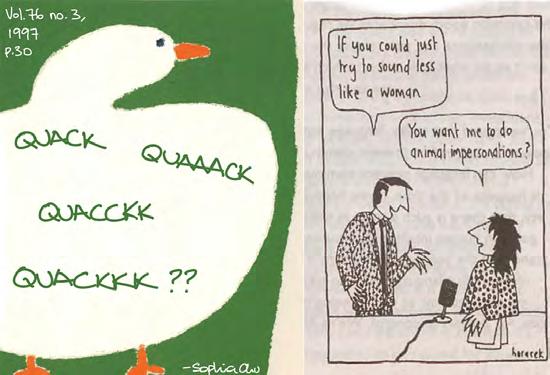
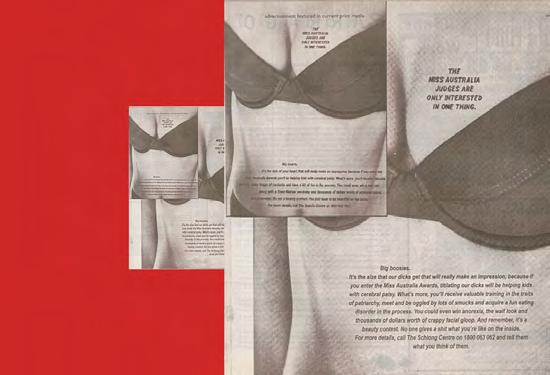
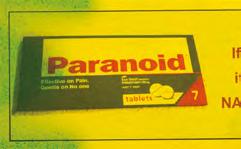
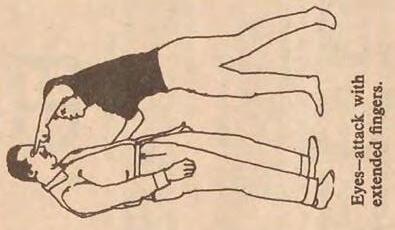
The story of Pandora’s Box has been interpreted in nearly every-which-way. Some take the legend at face value, a cursed crate opened only to wreak havoc upon the world. Others lean into the temptation and deception of the box, sought after for the mere possibility of good fortune. As a whole, whatever is at the bottom of that box is quite literally a mixed bag, and if that’s not what Farrago is known for then I don’t know what is. The following selection of ads, curiosities and oddities from the archives depicts the bottom of our metaphorical Pandora’s box—the sexy, the ugly, the silly and the bizarre.
How to assemble our tear-away zines
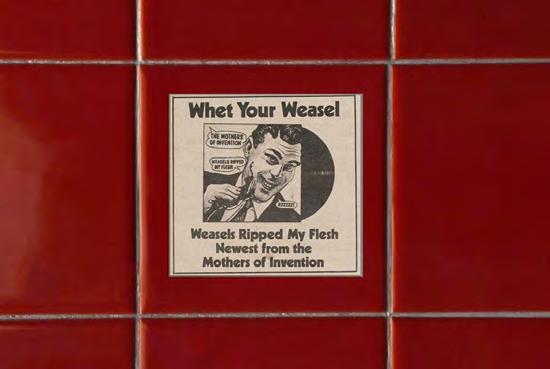
In
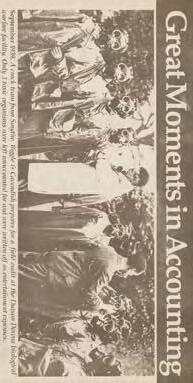
Frank Zappa’s band Mothers of Invention released their 8th studio album ‘Weasels Ripped My Flesh’ and it was advertised in Farrago with the tagline ‘Whet your weasel’.
- Arkie Nelson
line.”)
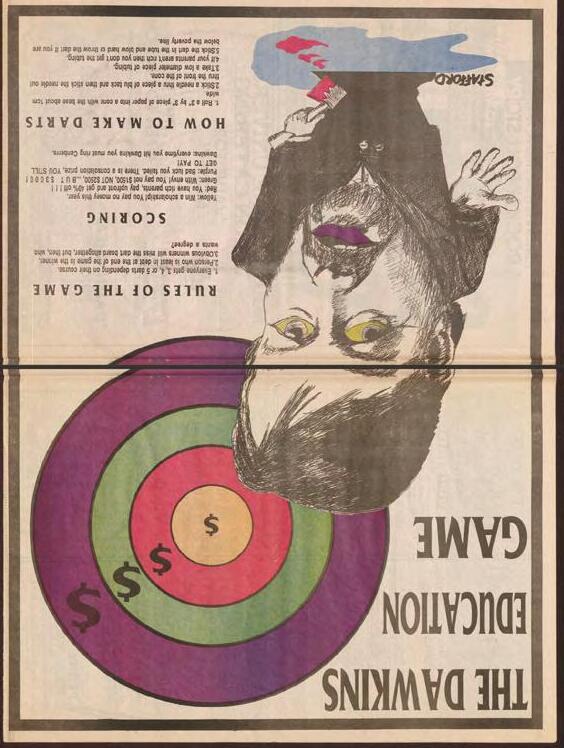
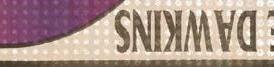
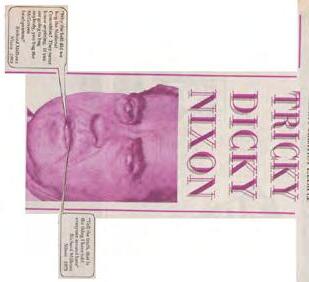
A double-page spread intended to be used as a dartboard. Featuring then-Education Minister John Dawkins, the piece is a response to the government’s decision to properly reintroduce university fees in 1989. Of note is the game’s objective of being the “least in debt at the end of the game,” and its emphasis on the inequitable outcomes the reintroduction of fees would produce (“You have rich parents, pay upfront and get 40% off!!!” and “Stick the dart in the tube and blow hard or throw the dart if you are below the
if they can’t help themselves first? Please make sure you take care of yourself!” Lynh Vu
“How can future psychologists help
Photography by Wil Simmonds
224 April 2026
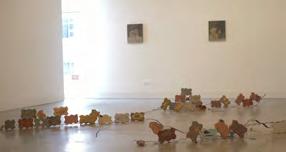
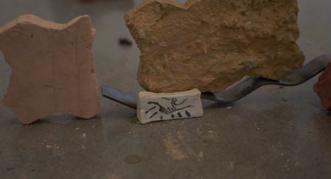
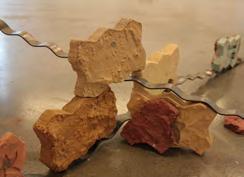
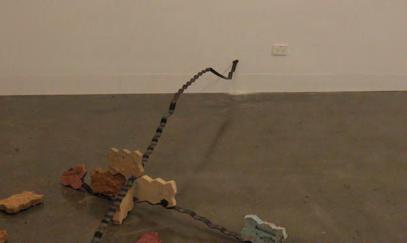
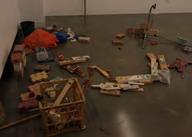
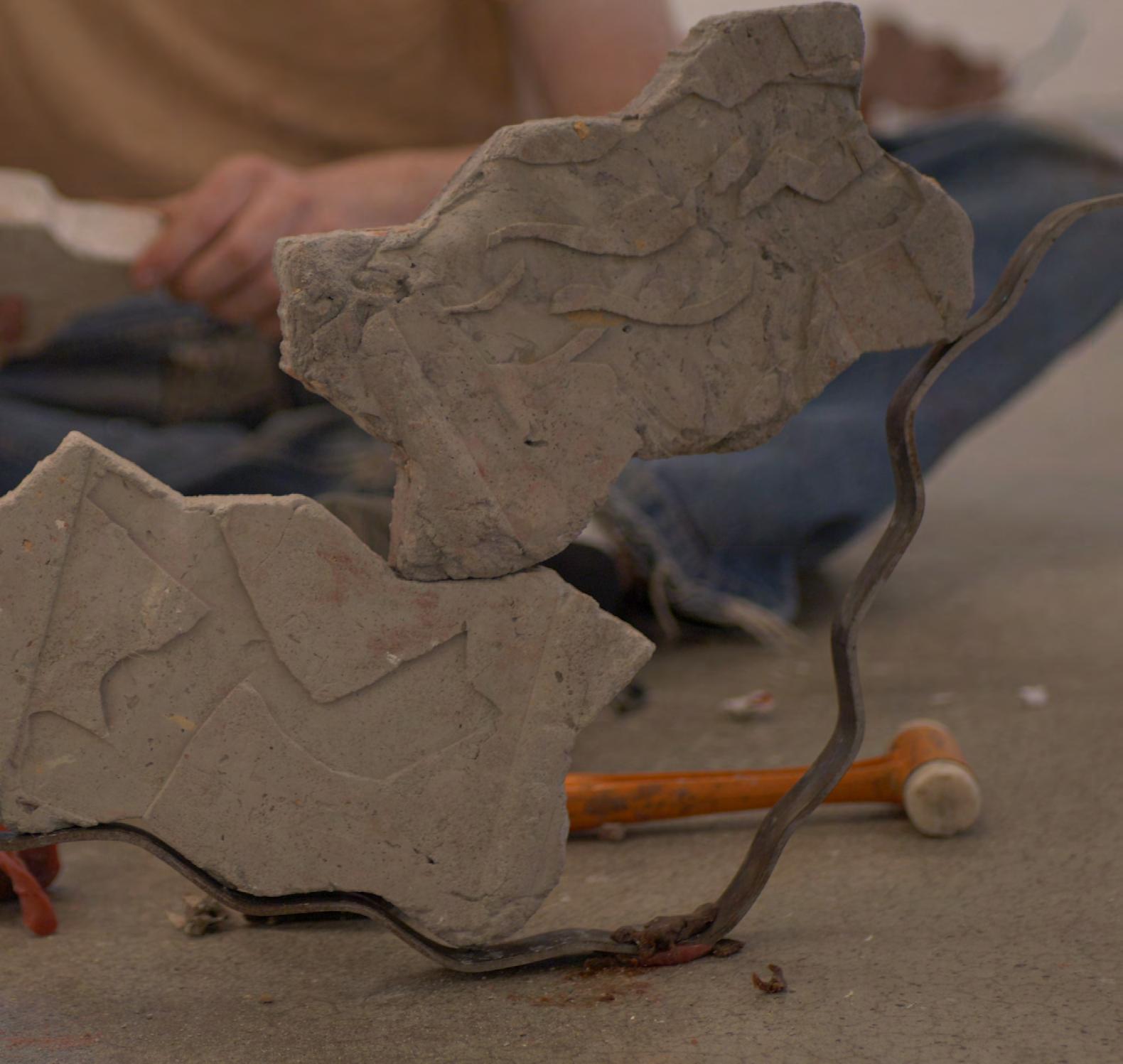
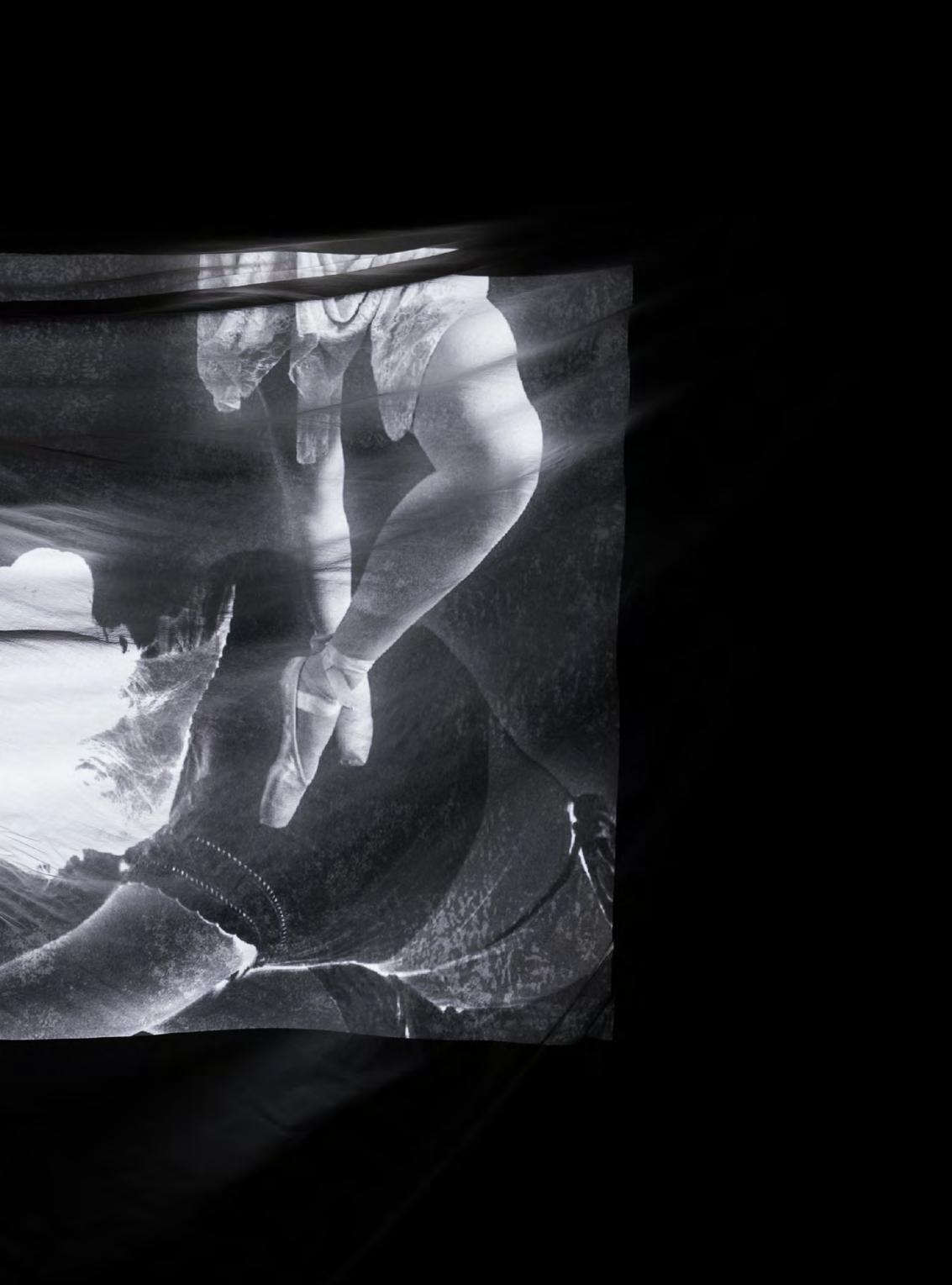
In conversation with Leo Loscher and Michael Doyle on their exhibition Warp and Weft : “The sculpture hinting at the moments in the paintings with a sort of tension” “The way the colour and symbols follow one another..there is more to just telling a story but it’s interesting how the symbols follow each other through texture and colour” “Trying to fill a void… that was the idea for the work” “Through the structure there are inevitably gonna be holes throughout it. Using that metaphor of absence and presence” “Were just existing and the world is just trying to fill a sort of gap even if it is material or emotional or cultural or social” “The space between things is just as much part of the work as the things” “When making art I love feeling like you have moments where you are part of something bigger” “It felt weird having it in kind of the white room… it made the work feel more like a product of something…putting it in the room makes it feel like a product” “The white cube is not neutral…It has a brutal oppressive history”
Read more at farragomagazine.
com
Coverage by Maria Quartel
Photography by Will Tingate and Irene Pinato
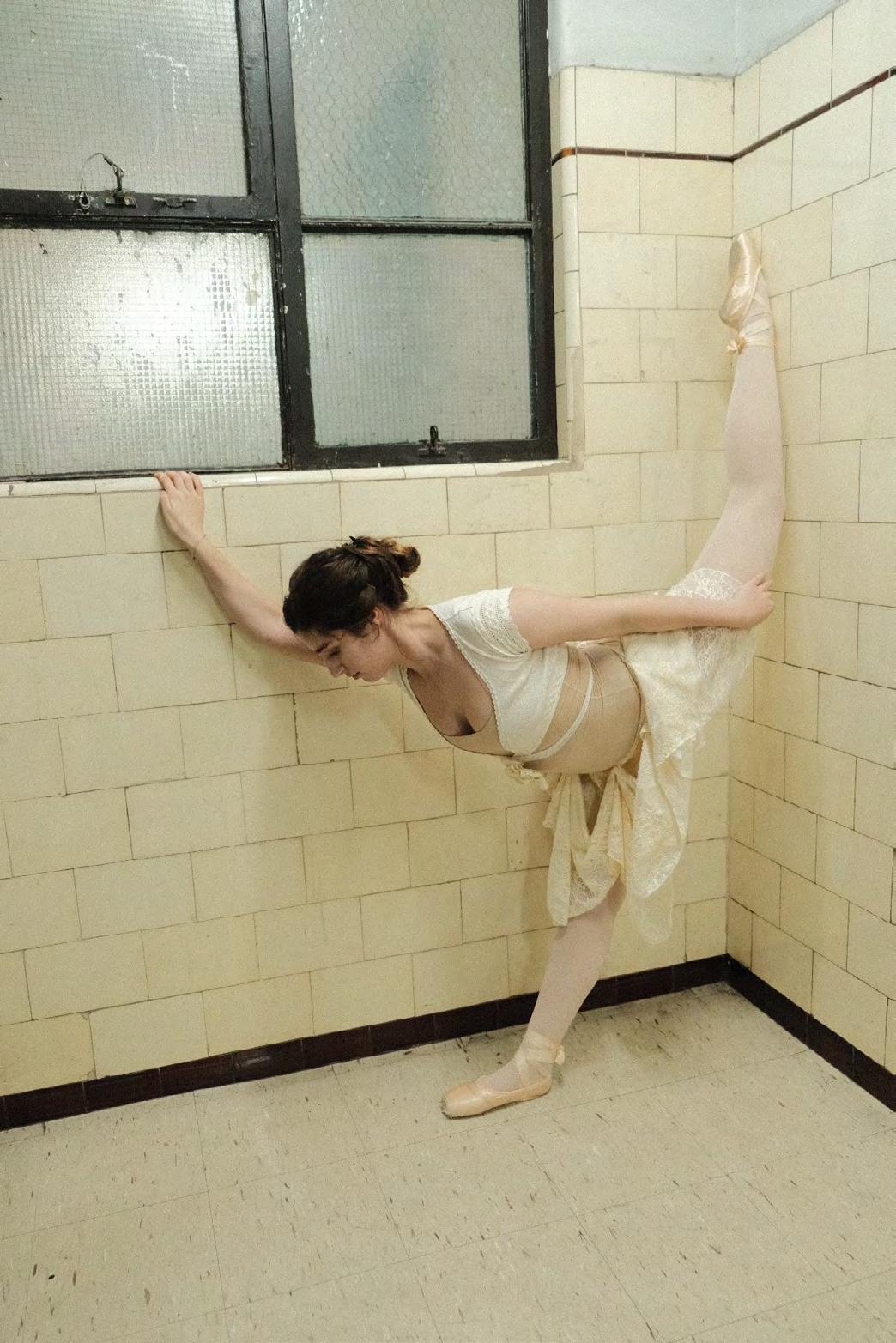
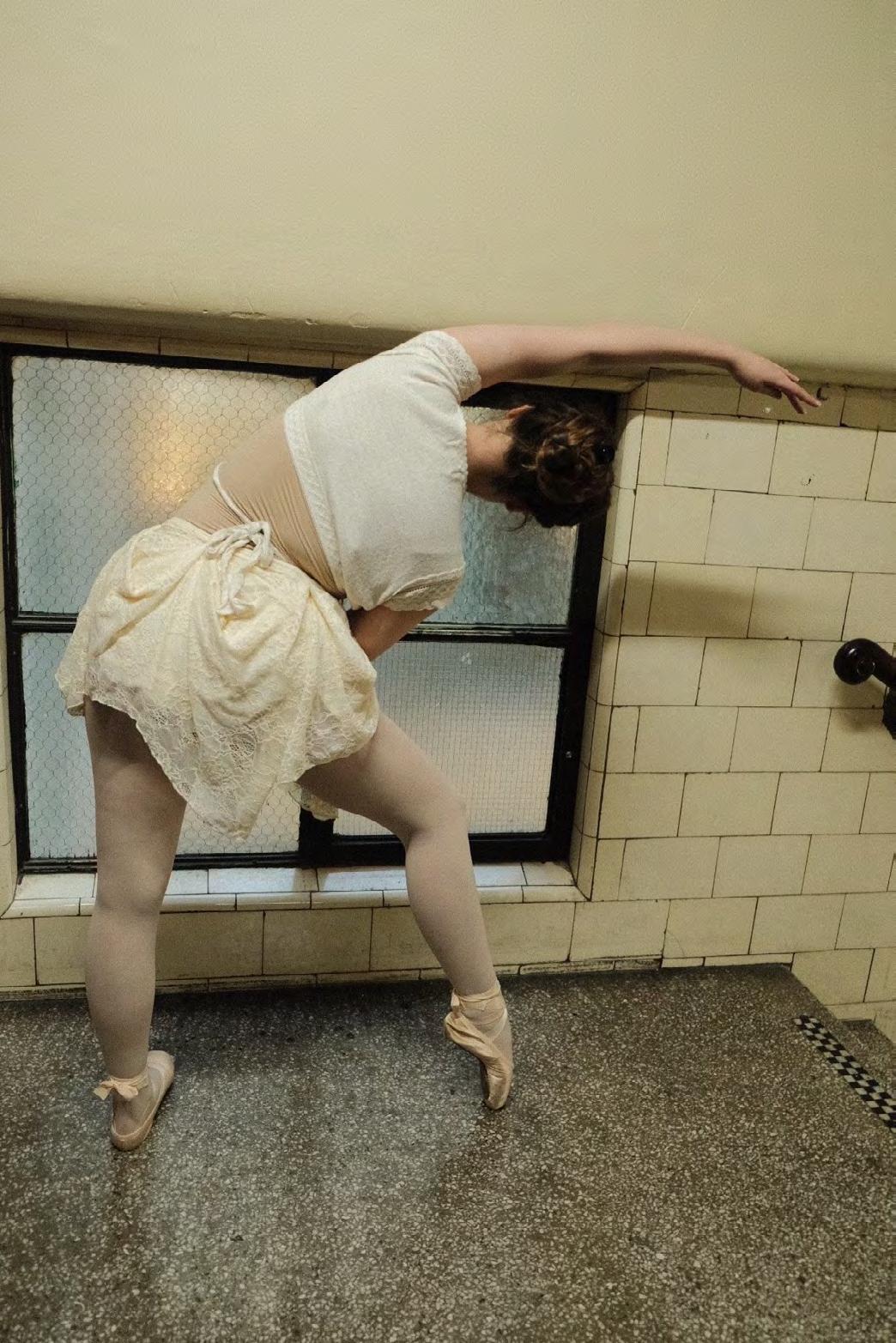
Has Timothée Chalamet Condemned
to the Cultural Graveyard?
Words by Rachel Thornby
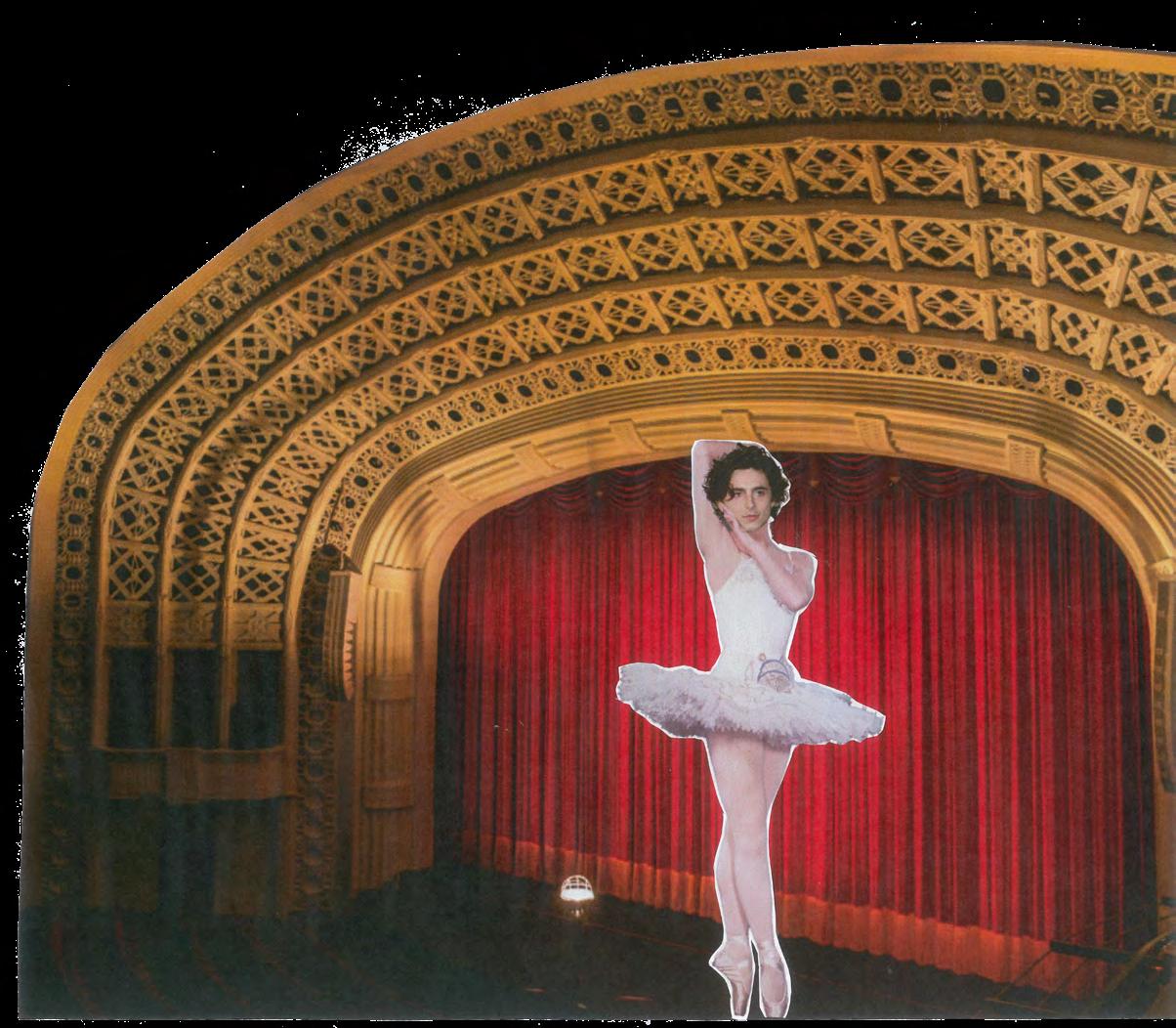
Timothée Chalamet’s words have echoed across the world: it’s official, no one is interested in ballet or opera anymore. Once touted as Hollywood’s favourite white boy, Chalamet’s assertion that “no one cares about this anymore” was met with proof that some people do care very much. Both ballet and opera professionals and fans alike flooded social media showing off their impressive skills while chastising Chalamet. What was particularly important to them was upholding artforms that are hundreds of years old. Singing and dancing aren’t going anywhere, but what do we lose if we don’t uphold professional counterparts? It’s not just that we lose connection with our past, it signifies a dark future where art continues to vanish.
Chalamet’s infamous quote is just a short snippet of a longer discussion in a February 2026 Variety interview alongside Matthew McConaughey. Although Chalamet’s comments were controversial and a little tone-deaf, they were made in reference to the growing pressure for filmmakers to pander towards audiences’ shortened attention spans.
Ironically, it seems the majority of people online discussing Chalamet’s comments have failed to take the time to watch the interview. While Chalamet might not have explicitly meant that ballet and opera deserve to fall to the wayside, he has certainly been criticised as if it was so.
There is a minority in agreement with Chalamet’s argument, however misconstrued their perception of it may be. They argued in comment sections that people are too damn sentimental these days. That it is inevitable ballet and opera will fall on the chopping block going the way of letter writing, calligraphy and handmade lace, and it’s just as well because ballet and opera are “too boring”. If people already feel this way about ballet and opera, when will other art forms join them? When will painting,
theatre and film be lost? When will the dopamine-fuelled scroll finally win?
While it is objectively true that ballet and opera see smaller audiences than blockbuster movies, it is also true that they still hold artistic value. It’s a common argument to claim that we should keep art alive, but it’s easier to say than do. Likely, most of the people online critiquing Chalamet’s comments do not frequent the theatre for local performances of Swan Lake or La Bohème . It’s not necessarily their fault; going to professional performances can be expensive. The cyclical problem is that when ticket sales fall, prices increase as companies try to desperately keep themselves afloat.
This fate isn’t reserved only for antiquated art forms; cinemas are also struggling to get bodies into seats. This dilemma—discussed in Chalamet’s famous interview— didn’t make it to everyone’s For You Page, because controversy is better for engagement than considered discussion. Majority of film audiences will only go to the cinema to see the latest blockbuster or the films that social media influencers tell them are worth seeing before they come out on streaming. When the only movies making money in Hollywood are major blockbusters, the only films that will be funded are homogonous copycats designed to appeal to the widest audience possible. Arguably, there are more film fans in the world than ballet or opera fans, so where is the outcry in defence of artistic liberty?
It was only a month before the interview that Netflix received public backlash for their ʻsecond screen’ strategy, wherein they directed creatives to make content consumable for viewers watching and scrolling at the same time. Many took to their keyboards condemning Netflix for controlling film and television artistry, claiming they shouldn’t ʻdumb down’ art. This online criticism seems to have died down as quickly as it started. Direct exposition and
clunky dialogue are becoming the only way for viewers to understand what is going on because they can’t be bothered to look up. If this new model is going to make Netflix money, they’re not going to change. If opera and ballet are boring, apparently now too are television and film.
While the arts struggle to stay alive, social media is thriving. Hours can go by as we scroll away our lives, drip feeding money into the pockets of tech billionaires that get rich off isolating us and shortening our attention spans. When the social media algorithm can produce a feed perfectly curated for you, why would you bother engaging with a movie for two hours that might not speak to you directly? You can watch 120 short form videos that tell you who you are and how you can be exactly like everyone else instead. Of course when short form content has become the norm, it’s too easy to keep scrolling. A movie, ballet or opera feels boring because it’s long, so instead we reach for our phones. If the best way to take our money is already in our pockets, they’re going to stop funding the art that felt irreplaceable until recently. We’ve unintentionally trained ourselves to be comfortable accepting this reality when art has always been a means of resistance. It’s no wonder that when we stop creating and consuming art for the sake of expression and start consuming art created to make money, we grow apathetic.
It is no coincidence that ballet and opera have been discussed more in the last month than the last five years. Big name celebrities have the power to bring important topics back to the forefront of the cultural consciousness. It’s a shame Timothée Chalamet’s moment in the spotlight left a sour taste in the mouths of art professionals across the world instead of encouraging people to wake up and engage again. As a viewer, what you consume is what they create. Use this power wisely.
Modern Love:
Words by Ashley Syers
This article consists of anonymous quotes from a range of people of all ages, genders and walks of life and love.
I
n the words of the late David Bowie, “there’s no sign of life, it’s just the power to charm […] but I try, I try, never going to fall for (modern love)”. In a world saturated with different depictions and presentations of it, we are constantly presented with this end goal of romantic love. Given that this is a natural feeling shared by all living creatures, the question arises: are we, as human beings in the modern day, being fed an artificial image of modern love?
Love. This universal emotion, felt for mothers, fathers, brothers, sisters, friends, or pets. Love is a bond to another being that has become a generational practice. However, when I address the topic of modern love, I am specifically looking at romantic love.
I am not here arguing the existence of love. I would rather examine romantic love as an expectation for the everyday person. How we live, breathe, and navigate the world under the influence of romantic love, whether this modern love is an innovation or a lie.
The feeling of being in love
The feeling of love is not something that can be defined. You cannot study an emotion that occurs so naturally by giving it a percentage value. There is no analytical or quantitative marker to identify definitively that you are, in fact, in love.
Anonymous: I think it’s a weird thing to—well, it’s not a weird thing. I think, for me, it’s a feeling in my chest. It’s a feeling I can feel that is just—it’s like seeing a pot come to a boil. You know, in a weird metaphorical way, I can feel it rising, and I can feel complete, and
You want to elaborate on that a bit more?
Anonymous: I think like the moment, if you’re with a person and you have that feeling, but you’re not maybe consciously recognising that feeling, and then maybe leaving that circumstance, not in the sense of breaking up, but it is just maybe going home and kicking back for a few hours, and you miss that person, and you miss them deeply, and you are very excited to be back in that situation again and with that person. I think that, for me at least, helps me know.
Why is it that love is understood when it is absent? Do we need to have loved and lost to identify that we even loved in the first place? Is this then a case of love as an experience of coming down?
Commodified love
So, have you ever been in love?
Anonymous: Yes, I have.
How did you know?
satisfied, and whole. And it’s a very special feeling. But I think it’s more recognisable when you don’t feel those things. You can know you’re properly in love when you’re not experiencing it. You know what I mean?
For some, romantic love has become a commodity, with the performance of “perfect relationships” a modern means of communicating status. This is observed in shows such as Married at First Sight , which millions of Australians tune into every week, where relationship “experts” pair individuals with their on-paper match. Here, relationships and romantic love have become a form of entertainment. They have become something that can be organised by outsiders rather than the individuals
Is It What We Fall For?
who, by the end, must decide whether their “love” is authentic. It is a dumpster fire of superficial discourse and curated discussions that fast pass meet-cutes and speed run connections, all for most relationships to reveal themselves as fleeting lust or clout mines.
Do you think we are given a manufactured image of love in our media or in how we engage socially?
Anonymous: Oh, hell yeah. In what ways do you think it’s the most obvious?
Anonymous: You can find someone who may be right for you in that time, but I don’t think the concept of a soulmate exists like, film and TV […]. You can find someone who you love dearly, but it’s not gonna be like some guided person from the universe who’s gonna suit every single unrealistic expectation you have for a relationship. Although the average person is not submitting their life to be dissected on television, we can still see this presentational and image-based modern love through our dating apps. How would you describe this modern love?
Anonymous: I see friends all the time going on dating apps and going on these dates that, seemingly, they don’t feel real to me when I see these interactions being had, in the sense that the connection they’re building with this person is purely based off a momentary physical attraction and rather than knowing something about their personality.
Dating apps are curated with “about me” prompts, the images we choose and the filters we overlay. One could argue we are being conditioned into a belief that romantic love is something we can have a checklist for, either for ourselves or the people we pursue. In theory, this can give an individual the opportunity to seek out their “dream person” both physically and emotionally.
Another interviewee described this ability to select and expect qualities in a person as a “doubled-edged sword”. In an environment where people pick and choose what they do and do not want, without room for sacrifice, normal traits and characteristics are narrowed down to “icks”, restricting our ability to see deeper. Is this commodified view of shopping for a lover disposing of our ability to form long-lasting and genuine connections?
This interviewee also highlights how the media we consume influences our romantic ideations:
“characters that many fantasise [about] in movies are just that— characters. They are written for you to perceive them as attractive for the sole purpose of entertainment, when in reality people like that don’t exist in the real world since we are human and not characters”.
The idea of love as selfish
The lust of romantic love seems to be more individualistic than the desire of more communal love between family and friends. Exemplary of this idea, one interviewee expressed that their expectations for romantic love are that it is something we are entitled to as people, something almost selfish in its nature.
Why do [you] think romantic love is a selfish thing when familial and friendship aren’t necessarily? What makes that different?
Anonymous: Well, because there’s usually a price to be paid for it, with romantic love.
Yeah. Do you want to elaborate?
Anonymous: I think someone’s going to get hurt, usually. Possibly one or two of the people who are in love.
But that’s an argument that it will end, right?
Anonymous: I think most romantic love ends a lot sooner than you would expect...or you would hope
That’s a pessimistic take on it.
Anonymous: Well, it’s extremely romantic, you know, in that sense. In this perspective, is there an argument to be made that suffering is intrinsic to love? Is heartbreak a convention of this feeling?
Maybe love is self-indulgent. For generations, seeking romantic love came with restrictions and rules, and many could have mistaken fidelity and long-term partnership as love, but now, romantic love comes as adulterous pursuits of comfort and connection. Is excitement mistaken for love? Is routine mistaken for love?
Is it selfish to desire a brief encounter of passions? Can that love be considered as valuable as a longterm commitment?
You could read every article or critical paper attempting to make sense of love. But in the end, there is no “perfect love”.
Modern love, as fantastical and commodified as it can be, cannot be narrowed into one firm sentence or understanding.
Is modern love just a new phrase I am placing on something that has been around for as long as we can remember?
We could run around in endless circles trying to make sense of it and always come up with something new. So, is modern love what we fall for?
Hope Against Hope and Amor Fati
Words by Sonnet Mamgain
Religious people are often seen as the hopeful ones. But being an atheist with a chronic condition taught me that hope isn’t the private property of any faith or culture—and that’s exactly why it survives.
There is something very tantric about Emily Dickinson’s “Hope” is the thing with feathers. The poem is widely considered the poster child for exploring hope in literature. Likening hope to an eternal birdsong, Dickinson portrays it as deeply personal and indelible. For Dickinson, hope does not just leave a poignant imprint on our minds—it “perches in the soul”. Hope is humanity’s precious gift that perpetually resides in the depths of Pandora’s box. Even if you aren’t familiar with Dickinson you would be familiar with the sentiment. Hope is something we lean on constantly. As a cultural artifact, hope is ubiquitous. It is thrown around in idioms— there’s light at the end of the tunnel! It is sung about in songs. It is depicted in paintings. It is seen in prayers. In our digitised landscape, hope is even reel-ified for easy consumption—I hope something good happens to you today! Given hope’s pervasive universality, it is worth questioning why our relationship with hope (the pagan archangel) is so complicated.
For most of human history, humans have engaged in spiritual, religious or supernatural beliefs. We have often turned to higher powers, spirits or gods to navigate and make sense of our elliptical realities. For instance, in the New Testament, we witness Jesus Christ as the “hope of all the world”. Similarly, other religions continue this marriage of hope and God. Consider the Bhagavad Gita (Hinduism’s 700-verse Song of God) that posits “God”—the guiding ray of light—as being the hope that “dwells in the heart of all beings”. As a result, I find it fitting to interrogate hope as a system of faith. Multiple studies tracking the correlation between faith and the intensity of hope have established that religious individuals tend to be more hopeful. According to a study as recent as December 2025, titled Where Hope Thrives: Demographic Variation in Hope across 22 Countries , individuals who attended a religious service more than
once a week reported considerably higher levels of hope across multiple counts. As a self-fashioned atheist, I am drawn to this substantial correlation. Why does religion make us more hopeful? Danish theologian and philosopher Soren Kierkegaard may offer us a working explanation.
Most Kierkegaardian scholars distinguish between “heavenly” and “earthly” hope. Earthly hope is positioned as the innate confidence we have in the world around us, encompassing the confidence we have in ourselves and others. Yet Kierkegaard is quite critical about this variant of hope. In a culture where some of our most beloved childhood films celebrate this type of hope, such as Toy Story and Frozen , we might question why faith in ourselves, and our loved ones isn’t enough. For Kierkegaard, the answer lies in the unstable and finite nature of earthly hope—it is fated to result in misery.
Kierkegaard’s perspective stung me deeply during my final years of high school when I developed a rare digestive disorder called Superior mesenteric artery (SMA) syndrome. According to some estimates, SMA syndrome effects only 0.1% of the general population and when undetected leads to serious consequences. In my case, I vividly remember vomiting up to thirty to sixty times every single day for about two years. I remember the failures of various medical interventions from stringent diets to hypnotherapy. I remember crying and hoping but, most pertinently, I remember experiencing phases of utter hopelessness. Confidence in myself and loved ones wasn’t enough. I was torn between two poles. On the one hand, I would try to relentlessly prepare for my VCE exams, and, on the other hand, I would find myself staring at pasty walls in hospital rooms. In fact, I sat my final VCE exams while being hooked onto an NG feeding tube. Spending an extended period without a diagnosis, there wasn’t much I could do about my condition.
In Kierkegaardian terms, my condition reflected the inevitable collapse of my earthly hope, leading me to a state of despair. Far from simple, Kierkegaard’s suggested remedy for my despair was spiritually rigorous. Fortunately, Kierkegaard’s remedy is captured in quite an easy catchphrase: “Hope against Hope”.
Speaking figuratively, Hope against Hope is an absurd leap of faith. Speaking more laconically, Hope against Hope is the transformation of our earthly hopes into heavenly hopes. Unlike our earthly hope, which is both temporal and uncertain, heavenly hope is anchored in the eternal. As Norwegian Philosopher Roe Fremstedal identifies, Kierkegaard’s object of hope “appears to be a society whose members are virtuous and happy, something which amounts to the highest good or the Kingdom of God”. Thus, our relationship with hope hinges on our relationship with the eternal.
“Are you reading Kierkegaard?” I am asked on the train. I turn around and witness my neighbour keenly staring at my laptop screen as I prepare my notes for this piece. I was surprised that they could recognise Kierkegaard. After conversing, I found out they were once a liberal arts student and had taken a philosophy class where Kierkegaard was quite the deal. We bonded instantly. As a person of faith, they told me how they found the Kirkegaardian manifestation of hope fiercely passionate. While ʻpassionate’ wouldn’t be my preferred adjective to describe the Kierkegaardian portrait of hope, the image my neighbour painted was striking and was neatly captured in the slogan they put forward: embrace faith. Kierkegaard tells us to embrace divine possibility despite worldly evidence violently pulling us in the other direction.
I wish I could resonate with my spirited neighbour. Unfortunately, I find the proposition of fiercely embracing divinity too taxing. I suspect part of this relates to my staunch atheism. Despite
this I wouldn’t label myself as “hopeless”. In fact, I would even call myself more hopeful than some of my more religious friends (not that having hope is a competition!). Why is it the case then that studies and our general intuitions lead us to affiliate religion with greater intensities of hope? Is it because studies that conceptualise hope offer a narrow definition? Does an objective definition of hope even exist? At least, for most of us, hope relates to ideas of more optimistic futures and active goal setting to overcome adversities. It is because of this mindset that we associate figures such as Alyssa Liu and Zohran Mamdani with hope. Liu and Mamdani certainly don’t offer us promises of divine interventions, but they embody a form of active and worldly hope that affirms life rather than escaping it. For instance, after retiring early and rejecting the toxic pressures of professional figure skating, Liu returned to the sport only to secure gold in the 2026 Winter Olympics. Similarly, Mamdani’s 2025 victory, as a progressive figure and New York’s first South Asian mayor, was a breath of fresh air in a cynical sociopolitical ecosystem. As a result, I am drawn to examine Liu and Mamdani through a Nietzschean lens that replaces the Kierkegaardian heavenly leap and explains hope through more secular terms.
On the surface, Nietzsche’s illustration of hope confronts us as seriously depressing and bleak. In Nietzsche’s Human, All too Human, “Pandora brought the box containing
evils and opened it”. However, “one evil”, namely hope, “did not fly out of the box”. Instead, this “greatest of evils” resides in the box where it “lengthens the ordeal of man”. As I see it, Nietzsche is criticising a passive variant of hope. The kind of version where “hoping” is the same as “wishful thinking” and self-inflicted deception. We witness this kind of “hoping” in multiple cases. For instance, choosing to stay in a draining and unhealthy relationship only because we hope things will get better without us taking any action. For Nietzsche, by engaging in this variant of hope we torment ourselves by continuing to subsist in an undesirable present only because we hope for a better future. Accordingly, his invocation of Amor Fati (which translates to loving one’s fate) replaces passive hope with an active affirmation of reality. On a simplistic level, Amor Fati involves loving everything that happens to you all the way from the good and pleasant to the bad and ugly. However, more intricately, it operates to redesign our system of hoping. Instead of hoping things outside our control will change, this Latin phrase pushes us to love life not just as it is but as it becomes. At its core, Amor Fati is an active process of love even when it hurts.
In my own life, I strive to pursue Amor Fati when addressing the complicated relationship I have with my health. Accepting SMA syndrome as an inescapable experience threaded into the praxis of my life, I endeavour to transform it into a source of creative
possibilities. For instance, rather than resenting my health and wishing it away, I have been aiming to use it as material for poetic experimentation.
As a result, I find myself engaging in the practice of deliberately fragmenting my verses to replicate the experience of disembodiment. Thus, what I see in Liu, Mamdani and my own poetry is not a heavenly leap or a passive resignation of hope but a secular Amor Fati. To put forward my own catchphrase, Nietzsche tells us to “hope by affirming life!”.
Perhaps the most important thing to remember about hope is that it isn’t a caricature.
Nor is a hope the private property of any one philosopher, faith or culture. There is no “high priest of Hope” or “pundit of hoping”. Instead, hope is something which is constantly rewritten and reinvented. It is a versatile body of water that stretches across Dickinson’s bird, Kierkegaard’s leap, Nietzsche’s Amor Fati, Liu’s return, Mamdani’s win and my fragmented poetry. Hope is elliptical and it exists subtly. It exists in our comfort drink, morning walks, conversations and even in more gentle moments. Consider the time you watered your indoor plant because you promised yourself you wouldn’t let it die. Perhaps, in that way, hope in Pandora’s box is more simple than complicated. Perhaps it is whatever keeps us moving, whether that be our faith, our will or a secular affirmation of radical love. We cannot package hope into one neat shape and maybe that’s precisely why it survives.
It’s nice to know that you’re there
Words by Roby D’Ottavi
I’m seeing someone new.
She’s sweet and beautiful and smart and short, and she makes me feel like a 16-year-old again.
I’m 27. Not 16.
The other morning she left her sweater on my bed. It’s a simple sweater: navy and red, striped, made from European wool. It fits me like a glove. On a whim, I wore the sweater to university. I didn’t spray my own eau de toilette. I wanted to keep her scent on it for as long as possible. It was a nice surprise when I found some blonde hair strands in the corners of the neckline. They’re like little sweet treats.
I noticed a small stain towards the bottom of the sweater, and it made me smile. I still imagine her somewhere in Europe, spilling ice cream on herself in a clumsy, klutz-like way.
She probably hates that the sweater has a stain, but like her scent, I see it as evidence of her presence and soul.
I’ve lived with people before. Whenever a relationship ends, I find myself dreading the discovery of their items.
My last girlfriend had striking red hair, and a few months after we broke up, I kept finding her hair all over the place. I would almost sob every time I picked a strand up. I hated finding her hair ties or clips. I gave away all the books I knew she loved.
Goodbye, Annie Ernaux!
She’d bought me a beautiful vintage watch, which I couldn’t bring myself to wear. I eventually gave it to the local Savers. It’s their problem now.
On my bedside table, I have a little Spider-Man that has watched me grow. My Nonno and I bought it together on a hot summer’s day in 2007. We were in Ascoli Piceno, a small town in a small province in a small region in Italy. While this toy probably cost five euros at the time, to me it’s
priceless. Inside this piece of plastic, my Nonno’s soul exists. Whenever I look at it, I go back to that day like it happened hours ago. I forget every traumatic, heartbreaking, depressing thing that has happened since, and I’m nine years old with my grandfather, whom I share a name with. Despite my Nonno’s passing 11 years ago, he lives beside my bed every day.
I like that whenever I look at this sweater, I see the girl I have a schoolboy crush on. I didn’t notice this at the time, but she kidnapped a sweater of my own. She too likes that the sweater smells like me. She likes that when she wears it, she can imagine the places I went in it. The people I spoke to. The memories I’ve had. There’s a part of me that doesn’t want her to return my sweater, as I like the idea that my soul lives in her cupboard, and sometimes on her body.
When a relationship ends, the thought of your ex’s soul lingering in objects hurts. But the thought of my Nonno or my crush’s soul being in my presence, or on my body, fills me with a 16-year-old’s joy. I wonder if this delight will inevitably pass too. Will this sweater bring me great dread? Or, like the Spider-Man beside my bed, will it be something I look at fondly, day by day?
The simple answer is that I don’t know. I haven’t lived that part yet and pretending I know how this will all play out is foolishly dishonest. Perhaps that’s what makes it feel so significant. I think we look for answers to things that time itself hasn’t decided yet.
There is a real joy to the unknown of this sweater’s importance. Sometimes objects can feel powerful because we can’t recognise what they mean yet.
Suffice to say, it’s nice to know that you’re there.
The Voices That Don’t Make It In
Words by Paridhi Chhajed
Have you ever felt strangely intimidated to speak out in the classroom? The opportunity arrives and you suddenly become hyper-aware of your accent—of the way certain words sound when you say them.
I’m a first-year student in my second semester, and I’ve felt it more times than I can count. It hasn’t gotten easier. Every day I walk into class telling myself I’ll participate a little more. And every day I leave disappointed in myself, knowing I had something to say but didn’t.
I sit there with fully formed thoughts I want to share. But when my tutor asks a question, I look down at my laptop. I avoid eye contact. There’s a sense of inferiority that creeps in. Alongside it comes a pressure: to succeed, to assert your identity, to stand out in a room where you already feel like you do. There’s a pause. A silence that stretches just a little too long, where the tutor is hopeful that someone, anyone, will share something, say anything. But by the time I’ve convinced myself to speak, the moment has already passed. Someone else speaks.
Usually, it’s a white student who breaks that silence— unhesitating, filling the space before I muster up the courage.
Ironically, that same pressure I feel to succeed is what holds me back. It turns participation into performance. Speaking up no longer feels like contributing—it feels like risking getting it wrong.
When I first brought up how I felt to other international students, I realised how common this feeling is. It also made me confront the uncomfortable fact that I had internalised it. I had started to expect that local, often white, students would answer first and adjusted myself accordingly. One friend said bluntly, “There’s always this expectation that the white students will answer. I hate that.”
She also pointed out something I wasn’t fully aware of—how classrooms divide themselves. People of colour at one table, white students at another, cementing their places within the first few weeks of semester. Like an unspoken, but unanimous, agreement from all sides.
Another friend spoke about the pressure to always get it right. The hesitation to speak even when you have something meaningful to add, because the fear of being wrong gets there first.
At a global university as highly ranked as the University of Melbourne, there’s an expectation that shapes how you present yourself as an international student—how you speak and take up space. But it isn’t something enforced by the university or even by those around you. It’s an expectation you place on yourself.
It shows up in small, almost innocent ways at first. The way you rehearse sentences in your head before saying them out loud, the way you fixate on your accent and your word choice. Over time, that self-consciousness becomes paralysing—convincing you to stay silent, because the effort to speak feels like too much to take on.
Maybe the problem isn’t that international students have nothing to say. Maybe it’s that we’ve been fed messages—through the media we consume, the systems shaped by colonisation and the kinds of voices we hear amplified—that some voices are easier to hear than others.
We’re told university is a space for discussion, debate and diverse perspectives. But diversity means very little if some voices feel safer staying silent. Because after a while, you stop raising your hand. Not because you don’t belong in the conversation—but because you start to wonder whether the conversation was ever started with you in mind.
by Sabine Pentecost
Photo
Opening Pandora’s Box: The Dark Side of Knowledge and Wonder
Words by Vanessa Cheng
Wonder is a sense of questioning, astonishment, and curiosity— but does gaining knowledge destroy our sense of wonder? Is opening the Pandora’s box, finding out every single answer to every single wonder, really what we want?
As “well-educated” students, we are constantly analysing and interpreting every theory and question we have. We are endlessly opening Pandora’s boxes, and within each opening of the box brings satisfaction, joy, and relief. We want to know everything. But what happens when curiosity begins to redefine life itself? In 1996, Scotland experts acquired significant knowledge about cloning. They attempted to produce genetically modified animals as organ donors for humans or even as a method to preserve endangered species. The damn wonders. Yet in 2003, Dolly the Sheep, the world’s first cloned mammal, was euthanised at an early age of six years old after severe arthritis was found in her hind legs. This concept of cloning life, which is
supposed to be unique and beautiful in its own way, has increasingly become a process as if we could produce life like we produce cars in a factory. It exposes humanity’s cold efficiency in euthanising Dolly once she was deemed defective, like disposing a piece of faulty machinery into the bin. The Vatican’s and German media criticised this process and warned that it carried “ugly echoes of Nazi eugenics experiments”. When we try to open every single box, curiosity stops being wonder—but rather control—reducing the meaning of life into something we can manufacture, evaluate, and manipulate.
Even other wonders, as imaginary and unreal as living on Mars, only illustrate human nature’s darkest side—greed. In 2017, a group of NASA scientists decided to open another Pandora’s box—they discovered liquid water on Mars. This surprise led to their further quest to search for life in the universe and human settlement on Mars. We are trying to find a second Earth. Let that thought sink in. How ridiculous is this? We are willing to abandon our planet rather than take responsibility for deterioration of the very planet sustaining us. Curiosity, here, is no longer innocent. When we constantly try to open Pandora’s box and satisfy our inner wonders and curiosity, we are only further illustrating our kinds as unsatisfied, whose pursuit are distancing from meaning.
Humans are not only opening Pandora’s boxes like a greedy child tearing through presents on Christmas morning—we are willingly surrendering control over what lies within.
The Little Albert Experiment in 1920, conducted by John B. Watson and Rosalie Rayner, was designed to explore whether behavioural conditioning applies to humans—a concept inspired by Ivan Pavlov’s work with dogs. The experiment demonstrated that humans, like animals, develop conditioned responses through intentional stimuli such as loud noises.
Scientists call this a record-breaking finding, an academic triumph, but what exactly have we proven? We have only proved that humans, like animals, develop conditioned responses; we are predictable and reducible to stimulus and response. Yet, by showing that both dogs and humans exhibit conditioned responses, are we not also implying that a less cognitively developed organism, dogs, can sense and behave in ways like humans? If a dog and a child can be controlled the same way, what does that mean for human determinism?
The question is no longer about what we found when we opened Pandora’s box, but rather what the opening took away from us. Perhaps the most unsettling part of this is not that we are able to be conditioned, but that we voluntarily are willing to be manipulated and controlled.
As humans, we always like to believe that knowledge expands our horizon—that every single certificate to our wonder brings us closer to truth and control. But what we are really discovering is something far less comforting. With every box we open, something pops out that we cannot stIck back in—consequence, doubt, greed. Maybe the question is not what we should discover or which box we should open next, but whether we should open any at all.
Art by Amelia Andrighetto
TODDLER ME ON XMAS DAY 2026, Oil on Canvas, 7.2 x 5 inch
The Role of Fugly Clothes in the Face of Fascism
Words by Mia Horsfall
My favourite item of clothing I own is a jacket my mum bought in Canada in the winter of 2008. We lived in the foothills of the Rockies, so anything short of Antarcticaexpedition-rated attire was infeasible to wear in December, but it reminded her of Christmas, so she bought it anyway. It’s a rich shade of red, vibrant and warm at once. A thick rope laces its way in a corset-style up the back of the jacket, and when I was a little it reminded me of a pirate. The bottom of the jacket flares out in a flouncy skirt and ends just below my bum. It’s lined with a pretty pink and brown pinstripe cotton that reminds me of the wallpaper in one of my favourite children’s books, Eloise . My mum’s shoulders are narrower than mine, so it’s a little tight when I put it on, but I wear it anyway. I give a small twirl side to side, look at my silhouette, pin my hair up and look for similarities between my smile and my mother’s.
I was shocked last winter when I realised I hadn’t worn the jacket out, or even attempted to style it, since my mum had passed it down to me. I was too focused on trying to replicate the outfits of the “it girls” on social media to examine the legacy pieces I had sitting in front of me.
The insularity of the digital world, coupled with the expansion of fastfashion corporations, has resulted in an accelerating similarity of personal styles. The immediacy with which we
can access information, inspiration, and connection (parasocial or otherwise) has leaked its way into our physical world, and now we demand the same expedited access to our clothing. The result? Homogeny. When Inditex, H&M group and Shein are competing to be the biggest and best suppliers of the latest and greatest, dominant fashions quickly devolve into muted variations of social media trends. A friend brought up how, when we were younger, style was a holistic representation of the self. Now, fashion sense seems to be signalled by the must-have items of the moment.
“It’s almost like,” she notes, “I can unequivocally know someone is fashionable if they have a few trending brands. Solomon shoes, a Crumpler bag. Literally, they could have those two things and pair it with the most boring outfit in the world, low-rise jeans and a black tank, and I would probably think they have cool fashion.”
Fashion sense seems to increasingly exist not on a spectrum of subcultures and aesthetics, but as a Boolean operator that can be toggled between “Yes” and “No”. In the assessment of someone’s style, we are less concerned with their eye for colours, layering choices, patterns and silhouettes and more with the particular brands they’re sporting.
“Ah yes,” we seem to say, “It girl, cool girl. You get it.”
We have particular items that
indicate our association with the cultural zeitgeist. It’s almost a relief to compose an outfit that comprises two or three principal items and know you’re presenting a simple, pleasing front that requires little effort but is broadly accepted as “cool”.
This is not necessarily a problem. Fashion, at least in recent memory, has often been dominated by particular trends, brands and cycles. As Ariana Gjoni (2025) notes, “from a sociological perspective, fashion serves as a powerful tool for constructing and negotiating identity”. Fashion has always functioned as a delicate membrane between our interior worlds and our communities. If fashion is a semiotic tool to communicate selfidentity to others, as Roland Barthes (1983) suggests, then, necessarily, social influence and trends must play a part.
It becomes a problem when trends are born at dizzying speeds, adopted en masse and then killed on social media. This, coupled with the capacity for fast-fashion companies to massproduce garments, results not only in the crippling environmental effects (responsible for up to 8 per cent of annual greenhouse gas emissions, in case we forgot!), but also in the disintegration of personal identity. What do you actually like to wear when there isn’t a social collective nodding along in agreement at the checkout line?
Fashion has always operated as a sticky social consciousness for the attitudes of communities towards self-actualisation. In cultures and communities where social mobility is limited and self-expression is restricted, there is a revocation of fashion, as individuality is eliminated in the name of a collective commitment to beige, argues Nihan Akdemir (2018). The constriction of selfexpression is beneficial to these political environments; they rely on you submitting to being told who you are and what you should look like. It’s why subcultures are so often born out of resistance. If your sense of style is so easily malleable in the hands of fashion corporations, your value system is just a stone’s throw away from the same influence.
Here’s the thing fast-fashion
companies and influencers understand about us that we don’t: the question “will other people like me in this?” is a more convenient one to answer than “do I like this on me?”
Because it’s hard to know what is truly authentic to you, that latter question is a bit tricky. Can we untangle the webs of content we’re ensnared in to pick out what social image we want to portray while feeling connected to ourselves? Truly, I think many of us already have. We find inspiration in our mothers, in their weathered jeans, worn-through boots, and warmest winter jackets. Inspiration in our little sisters’ love of vibrancy, sparkle and fluorescence. In our neighbours, when I crane my neck over the balcony of my apartment and see the flags of colour hanging on laundry horses, kaleidoscopic in the evening sun. We find inspiration in the iridescence of the shells in our pockets, the dramatic coils of the steam from our tea and in the sharp cut of the skyline against a storm.
When I started to interrogate myself for reasons why I was making the fashion choices I was, I found many of them were rooted in the immaterial. I was emulating a lifestyle, personality and career through the clothes I was choosing to wear. Almost all of it was aspiration. Very little of it was a representation of my life or approached as an artistic process. Experimenting with big, beaded, garish and colourful jewellery has been one of my favourite ways to push myself out of my comfort zone, one chunky, turquoise ring at a time. The great thing about thrifting is that it demands creativity. When clothes are a little fugly and aren’t ready-made to fit into a perfectly curated wardrobe, you’re forced to ask yourself what draws you to particular items. I feel lucky to live in a city and a suburb where shopping second-hand seems to be the norm. Whilst Melbourne isn’t perfect, the strong thrift culture here has certainly made it easier for me to venture into more experimental territories than I would have otherwise felt comfortable.
There’s a collective importance in choosing to wear clothes that go against the trends, but there’s an individual responsibility as well. Forcing yourself to confront what you identify
with, how you want to express it, and why is an exercise in creativity and exaction. Incidentally, it also means you’re less likely to participate in trends that are eroding our own senses of self, filling our landfills at light speed and slicing into the hands of Bangladeshi children. A study conducted by the Rights Lab at the University of Nottingham found that in 2024, up to 210,000 Bangladeshi children were illegally employed in hazardous working conditions for the Ready-Made Garment industry. Demanding yourself to interrogate your own personal style does more than just bring you a sense of self; it removes you from the supply chain that places the lives of children in danger.
The uncomfortable part of reckoning with your own fashion sense is that, invariably, you will mess up. You will put together kooky outfits that don’t quite meet the vision you had in your head, that get side-eyes on the streets or make you want to leave the party early and change. You’ll wear ill-fitting clothes that make you acutely aware of every physical insecurity you’ve ever had. But the beautiful part of this is that you take yourself less seriously. You begin to be drawn to pieces for their differences. You will seek out clothes that offer singularity, like a particularly unique pattern or screenprint.
There is no “end goal” of fashion. You have never reached your final form, style-wise. The request to “wear fashion authentic to you” might be an impossible one, as we are constantly in flux, and are invariably shaped by people, trends, and culturally defining moments. Fashion sense is characterised by dynamism. But the process of taking time to consider why you like the things you do and what you’re trying to express in your fashion is a valuable one. It offers you something greater than interesting beading and eye-catching colour— individuality in the face of a collective push towards uniformity. Sometimes, the inspiration you need is the red pirate coat that’s been sitting in your mum’s closet for close to two decades, and not the New York influencer in yet another white tee.
Reading the Heart
Words by Zoe Bespalov
Mum found the book in the kids’ section of a local bookstore.
The girl on the cover had bright eyes that suggested she was awake, smart in a way that adults might call naughty when really it’s just intelligence. As a woman prone to a similar kind of naughtiness, among other types of naughtiness, this spoke to Mum.
She stood and read it by the counter, head bobbing in agreement, had a nice refreshing cry, then we headed home with the book in her arms.
The Skull , Jon Klassen.
A girl runs away through a forest—from what, we do not know. She comes across a house with a lonesome skull residing within, who offers her shelter in return for her companionship. The girl learns that each night, the skull’s skeletal body returns to the house to terrorise it. When it comes banging on the door, she leads it off a cliff, grinds down the bones in a bucket, and drops it into a bottomless pit.
That is the end. The skull and the girl are both safe from the parts of their past that pursue them, each doing for the other what they were unable to do for themselves. It’s an odd book, sweet, and brutally kind. It located and validated a part of my mother that hadn’t been spoken to in a long time.
As children, my sister and I were encouraged to read steadily, and widely.
As we grew away from kids’ books, our mum’s recommendations to us became more situationally relevant. Are You There God? It’s Me, Margaret , became The Second Sex , became The Body Keeps The Score , became The Hite Report —aaahh!
The books recommended by mum were feminine, sexual, sometimes overwhelmingly dense. Being deep in the elementally paralysing shame that comes with early puberty, I was having none of it.
With time my lexicon grew, and I became able to engage in the conversation myself, trading in written loves, experiences, preoccupations.
Mum would put forward Written On The Body , by Jeanette Winterson.
I’d reach for Dream Work , by Mary Oliver. Her answer, A Natural History Of Love , Diane Ackerman.
I’d counter with Gathering Moss , Robin Wall Kimmerer. Breasts and Eggs , Mieko Kawakami.
Women Talking , Miriam Toews. Girl, Woman, Other , Bernardine Evaristo.
Inside My Mother , Ali Cobby Eckerman.
A book could be proposed for any situation. To address any question or complexity; to run its fingers over a problem until it finds the fault lines and pours itself in.
There was a book for when we found two tiger slugs midair under our porch, suspended in a glorious act of upside-down fornication. A book for when my sister fell through the decaying floorboards of our house.
The house in question has more books than room for books, piles growing in places at once familiar and mysterious, under bed sheets, in the peg basket. In that way the house becomes something of a book itself, history and oddity stretching between every room.
Between the two are parallels, strange and prophetic. The through-line in all this literary-life affinity is the kids’ books
Monsieur Rat , Federica Mossetti.
A rat, desperate for a glorious moustache alike to that of his finely-haired brethren, pursues a TV ad for a miracle moustache cream that promises to make his hairs long and rippling. Alas, when he overcompensates with multiple tubes, his hair grows, and grows, and grows until it’s long enough to knit with, until it trails on the ground behind him. Monsieur Rat wanders along, feeling despondent, when a flash of blue catches his eye—a handsome she-rat, with a gorgeous electric blue moustache of her own! The rats embrace, enmeshed in a soft bed of their collective moustache, and all is well with the world.
The family taxidermy rat, Christopher, alias Monsieur Rat, was born of Etsy for a humble $60. Quite reasonable for a taxidermy rat, one would think—alas, the bargain was soon illuminated upon Christopher’s arrival. Mum lifted him up out of his tin can bed to find that what looked like a perfectly normal horizontal rat, was at the same time a grotesquelooking upright rat, amateurly taxidermied and from the back, no longer looking like much of a rat at all. Christopher resides in a glass dome in the lounge room and taunts the cats with his provocative stillness.
**Strega Nona , Tomie dePaola.
Strega Nona, the local witch, and her magic pasta pot help cure her Calabrian townspeople of their ailments. Her helper Big Anthony secretly watches as Strega Nona summons never-ending pasta to the pasta pot and tries to replicate it while she’s out. What he doesn’t know is the special song and the crucial three kisses that break the pasta’s spell. When it comes time to wind it down, he can’t make the pasta stop! It keeps on coming, filling the floor, the room, until it explodes in a glutenous tidal wave from Strega Nona’s house, barrelling down towards the town and its people, who fear their time is up. At the last moment, who appears but Strega Nona! She sings the pasta its song, blows it three kisses, and stops it in its tracks.
My Sicilian mother is not as much a witch as Strega Nona or other witches we know, but she is much more of a witch than most. I am reminded, among other examples, of her pentagram phase, where every day for weeks she would make pentagrams out of long thin sticks tied together, and hang them all over the front of our house. They began to fill up the inside of the house too, and she was giving them away to people left and right. Skateboarding around the block each day, my sister and I started to notice a mysterious lack of sticks, despite the many trees. At this point we elected to intervene, concerned for the environmental implications. The rest of the witchy stuff continues to this day.
I’m writing a library for my future kids, and I often wonder to myself whether what I’m writing is appropriate at all - whether it’s too crude, too silly, too earnest. However, life is wild, and smelly, and fun, and it’d do both life and children an injustice not to have books that reflect the same.
I want my children to be reminded of the things that are in their orbit, and those that aren’t. To be good to others, and to arrange their own universes in a manner that brings them peace.
The enduring relevance of children’s literature is testament to its fundamental kindness. There’s so much kindness it’d be near impossible for me to hold it all at once. I’d have to get up on a chair if I wanted to trace the height, the length and the breadth of it. I think about what these books have done, and continue to do for me as I enter adulthood.
They’ve held ears to my chest and charted the movements within.
Books written for kids are written for everyone.
I want my children’s place to be alongside literature that teaches them where their heart is, what it is to be human, and I want them to stay there, because that’s where the love is.
Gagan Sandhu
Pandora’s Box 3D Render
“The mythology of Pandora’s Box is interesting as the conclusion conveys the idea of how some things are better left untouched. Perhaps this is the same idea we live under, when we pick ‘Natural Diamonds’ over ‘Lab Grown Diamonds’ as gifts for our significant others. Even when there is no difference between the two except for the exploitation required to harvest ‘blood diamonds’, we still feel better when we spend thousands or millions on a gift.
‘Ignorance is bliss’ is the motto that capitalism flourishes on when the system divids the consumer from the labourer. So we, in Western countries, can delude ourselves over the ‘quality’ of some stones whilst the person who is digging toils for a grain of wheat. How do they feel, seeing the incomprehensible price tag of those same diamonds that they dug in order to survive another day?
Maybe some secrets are better left alone, but others must be revealed to the world.”
Words by Eleni Pope
Because broke Uni Students Want to CelebrateBirthdaystoo
Between nostalgia and tradition exists the uniquely Australian childhood birthday party experience. It’s more than an iced cake; it’s the entire spread laid out on the table that makes the party worth going to, right? Flimsy paper plates piled with an array of treats that may be typical but are tried and true and undeniably delicious in that classic way. Whether that be soft white bread lathered with margarine and speckled with vibrant, crunchy sprinkles, or chocolate-y treats slightly melted from the heat amongst the array of overly sweet delights. And let’s not forget the mysterious coconut covered tidbit of some kind, because, well, that’s just how it’s always been done.
I thought it was about time we put these traditions into practice now that I am a university student, so I attempted to whip up a classic Australiana birthday dessert spread. I rated each dish based on cost, time, difficulty, and how feasible it is in a share house where the oven can be hit or miss, and the budget is even tighter. Now that many of us are in university, these criteria are the most important things to think about.
Legend: More stars = better for broke, time-poor students (cheap, quick, easy, realistic)
Rum Balls
Rum balls are surprisingly simple to make. Crush the biscuits, add cocoa, condensed milk, and coconut. Mix. Roll the mixture into delightful little balls, set in the fridge until firm and voilà, you’re all set! Forget the oven, ditch the precision, and maximise your fridge use.
Basic Ingredients
1 packet plain biscuits—I recommend half a packet of basic biscuits and the other half with character, such as mint slice for example, to make this recipe your own.
¼ cup cocoa powder
1 can condensed milk
1.5 cups of desiccated coconut
A splash of rum (optional)
Optional add-ins of your choice!
Most of the ingredients you might already have in your pantry, but even if you don’t, these indulgent chocolate balls are cheap, quick to make and basically foolproof. Even without the rum, the humble truffles deliver on their promise od a rich chocolate flavour and a subtle touch of Australian tropicana from that bite of coconut. Their adaptability is what truly sets them apart in a student environment. Feel free to toss in a roughly chopped chocolate bar of your choice or even any alcoholic flavouring you have on hand. Tweak the proportions and let your creativity run wild!
Rum balls prioritise a university student’s chaotic lifestyle with their adaptability. That’s the reason behind their effectiveness. c
Hedgehog Slice
A Hedgehog slice is the even more efficient but slightly more expensive cousin of a rum ball. It’s the same fundamental concept with its use of chocolate, biscuits, and a binding agent, but rather than measuring and rolling it, you simply flatten the mixture into a tray and let it chill before cutting into squares.
Basic Ingredients
And of course, optional add-ins c c c c
1 packet plain biscuits—I prefer scotch fingers for their crumbly, buttery quality.
2 blocks of chocolate of your preference
1 can condensed milk
½ block of butter.
By removing the somewhat tedious job of measuring out and shaping individual portions, it is a simpler recipe. You simply cut and serve. Much like rum balls, hedgehog slices are quite forgiving. Feel free to mix and match ingredients, adjust ratios, play with textures and it all comes together seamlessly. However, the addition of the butter to add that classic fudginess you get with slices and the use of chocolate rather than cocoa powder does make the recipe a little pricier, so that is something to be mindful of. Despite the difference in price, it’s interesting to note how both recipes lean more towards approximation than strict precision. They take for granted that you might not have a lot and make that completely unimportant.
Sharehouse-ability: AAAAA
Difficulty: AAAAA
Cost: AAA
Time: AAAAA
Fairy bread probably doesn’t even qualify as a fullfledged recipe, but that’s exactly what makes it so perfect for an on-the-go university student catering for friends. Or maybe you just need a quick bite of nostalgia to heal your inner child via a spontaneously made slice of fairy bread. It’s more of an iconic symbol than an actual food.
Basic Ingredients
c c
1 loaf of white bread—no sourdough here please! Butter/margarine Hundreds and thousands (sprinkles) obviously!
In just a few minutes, with nothing more than a butter knife, you can whip this up at almost no cost! Everything is already made, with no room for measurements or enhancements. By placing the ingredients on the kitchen counter you’ve already made it. It’s fascinating to note that the worth of fairy bread isn’t tied to the effort put in or even its flavour, to be honest. Its effectiveness lies in its immediate recognisability. It conveys the idea of “birthday” without needing any further clarification. Hundreds and thousands = birthday, essentially. It’s not something you challenge; it’s something you embrace.
Cost: AAAAA
Time: AAAAA
Difficulty: AAAAA
Sharehouse-ability: AAAAA
Fairy Bread
Butterfly Cupcakes
Now, these little beauties could be considered the ʻShowstopper’ recipe challenge of the lot—Great British Bake Off fanatics know what I’m talking about!
Basic Ingredients
1 cup plain flour
½ cup sugar
½ block of butter
2 eggs
¼ cup of milk
2 tbsp icing sugar
300ml whipping cream
As much vanilla as your heart desires
To skip the technical stuff, basically mix everything together, pour into a cupcake tray and bake at 180 degrees Celsius for 20 minutes. After that, let them cool down before cutting off the tops at an angle so there’s a spot for the cream to sit - remember to be as delicate as the flutter of a butterfly’s wings when doing this as the top you cut off will be used. Next, dollop some cream delicately in the little well you made, before carefully cutting the top in half, placing the round top side down atop the cream to form the wings of your butterfly cupcake. And, of course, dust with icing sugar. When you stack them up against the no-bake alternatives, these come across as a more finicky endeavour.
While they remain attainable, it’s clear that they’ve become a bit more cumbersome. The oven situation is a real challenge; not every shared house boasts a fully functioning one, and even when they do, it requires a level of commitment if it’s not already being used as a heater in winter.
Despite its higher difficulty level, it’s clear that they stand out as the most visually appealing. The delicate “wings” and the light dusting of icing sugar create an impression of effort that sets them apart from the rest.
Cost: AAA
Time: AA
Difficulty: AAA
Sharehouse-ability: AA
*no butterflies were harmed in the making of these cupcakes
When you piece everything together, a clear trend appears: the treats that thrive in a student kitchen aren’t exactly the showstoppers. They are the options that stand out for being affordable, quick, user-friendly and effortlessly shareable.
And that really highlights the power of nostalgia.
What we think of as “birthday food” isn’t always about the complexity level of it—it’s really about what was most memorable and ever-present in our celebrations. These foods stick around because they’re tried and true. They embrace the idea that great results can come from a simple setup and affordable ingredients you might already have. They’re incredibly scalable, adaptable, and, perhaps most crucially, they have a remarkable track record of being delicious.
A new era of the typical Australian birthday sweet treats is now in motion. The dream of a flawlessly decorated, elaborate birthday setup doesn’t quite fit into the reality of student life. Time is tight, funds are scarce, and kitchens can be chaotic; shared spaces are anything but predictable.
What we have left are the versions of sweet treats that truly align.
However, that doesn’t imply that the significance is gone. It becomes more apparent. Preparing these classical indulgences today, under new circumstances and limitations, really brings to light what has always mattered about them. It wasn’t about their impressive appearance—it was all about how simple they were to create, share, and replicate.
Nostalgia isn’t rooted in perfection. It stems from a sense of familiarity, and in a student’s kitchen, familiarity is something you’re almost guaranteed to be able to afford.
(And if all else fails, the classic Woolies mud cake will always have your back).
Happy baking!
Frenchie brings luxury Parisian fare to Melbourne—but everything is $14
“I’m the caviar man. Do you want to have a bump with me? Or a glass of champagne?”
The caviar-man tipped his fedora, grinning out of a three-piece suit. He gestured to the silver trolley in front of him, laden with silver spoons of caviar and champagne flutes.
At this point, you might have the impression that I’m the kind of person who can afford the fine-dining lifestyle. I can’t. I didn’t, in fact, meet this caviarman at Vue de Monde or Gimlet . He approached my table at Frenchie , a new French-inspired restaurant on Collins St where everything on the menu is $14. Yes, even the caviar.
Months before an opening date was announced, Frenchie and its novel premise were gaining traction online. I didn’t realise it had finally opened its doors until, one random Monday afternoon in February, my cousin mentioned that she’d visited it the week before.
I wanted to visit it that very night—I figured that on a cool Monday evening it would be pretty quiet. I was wrong. The entire dining room was full; my boyfriend and I had to wait 20 minutes for a spot at the bar. (I found out later that this was their first night opening at full capacity). But the wait was certainly worth it.
The menu is divided into ʻbites,’ ʻseafood,’ ʻmeat’ and ʻvege.’ Waiters recommend picking two dishes
per person. We started off with the gnocchi à la parisienne , and it was easily the best gnocchi I’ve ever eaten. Taking that first bite was the first time I really understood what ʻmelt in your mouth’ meant. So perfectly crispy and pillowy and cheesy. The canard confit was a touch dry, but coated in a lovely sauce and seated atop delicious potatoes salardaise. The joue de boeuf—both the meat and the mashed potatoes beneath it—were delightfully rich and soft. I also tried an escargot for the first time in my life, which wasn’t exactly my cup of tea, but the brioche and sauce it was served with were tasty.
The drinks were impressive too— the Parisian Iced Tea , containing gin, French earl grey, ginger, spicy blood orange and yuzu tonic, was fresh, floral and citrusy—and, of course, only $14. I don’t think I’ve ever had a cocktail in Melbourne at that price, and this was one of the better ones. The Hibiscus Mandarin Frais was an equally wonderful mocktail counterpart. What really made my night, though, were the service and the atmosphere. The waitstaff were attentive and warm, constantly coming over to check on us and offer recommendations. The caviar-man was a wonderfully whimsical touch; together with a DJ,
and all the waiters in their pinstriped Frenchie outfits, the room felt novel, vibrant and fun. Set against booths upholstered in red velvet, burgundy curtains, art-deco light fittings and a gleaming gold-tiled marble bar, the restaurant feels at once luxurious and alive.
Restaurants like Frenchie make me feel excited about the future of Melbourne’s dining scene. I’ve noticed a few other restaurants pop up lately— Times New Roman in Brunswick East for example—that feature artfully designed decor, thoughtfully curated limited-item menus, quality food, and a commitment to offering a threecourse-meal-plus-drinks experience at a low price point.
What a wonderful thing—to be able to go out to a beautifully designed restaurant and eat an entree, main and dessert or cocktail for less than $40. I know that’s not super cheap –but it’s the kind of dining experience that was previously reserved for a much higher level of wealth. A night like that makes me feel special, and it’s certainly not something I can usually afford. I love living in a city where, every now and then, I can slip into a little world cloistered away from some busy Melbourne street, and live a different kind of life for a night.
Unveiling the Woman Behind Every
Words by Zeinab Jishi
Art by Lauren Luchs
A little girl with small pigtails stumbled past me towards a picture of a taxidermy giraffe in the exhibition. Right behind her, her mother held on to both sides of her so she wouldn’t fall. Without containing her toddler’s excitement, letting her lead the way, the mother made sure she was safe.
MOTHER: Stories from the NGV Collection encapsulates this spirit. How a mother is always right behind their child. In reality, however, motherhood goes beyond this scene. MOTHER tells every side of the story—wholesome, shocking and deeply tragic. It illuminates the aspects of motherhood that are left in the shadows, too taboo to bring up. It demystifies the mother’s body and puts it inside a deeply political context. The relationship between a mother and her child does not happen in a vacuum; its creation, its development and its potential division emerge within the world around it and from the pressures placed on the matriarch.
The exhibition is divided into three stages: Creating, Giving and Leaving. From ancient cave drawings to contemporary illustrations, the exhibition navigates diverse representations of motherhood, its blessings and its challenges.
The story of the mother is one that is deeply complex and difficult to grasp, thus the exhibition is structured in that fashion. Despite the apparent thematic connectedness, I wasn’t sure if this effect was by design or a flaw. Because the placards of some sections were placed too deep into each room, it was hard to see the connection between the different artworks until having moved around the space a second time. Each section explored an aspect of motherhood and, while some sections offered a coherent story, others failed to present a clear timeline. One noteworthy moment is the placement of Patricia Piccinini’s Nest (2006), a sculpture of an anthropomorphised mother motorcycle and her motorcycle offspring, right next to an English Nursing day dress from
c. 1845. The aesthetic contrast is indeed jarring and I really couldn’t see how the two interact with each other.
Representations of the mother and her child is an enduring subject in the history of art and attempting to condense it in one exhibition is bound to encourage a cacophony of images, colours and styles. While I do think the exhibition could have benefitted from more cohesion, I don’t see how feasible that is. It is certainly an impossible task to present such a complex topic within a confined space and with the NGV’s limited collection. Because of this, the exhibition often felt like there were missing pieces in the complex tapestry that is motherhood.
The first painting in MOTHER was Virgin of the Adoption (1858) by the famous neoclassical artist, JeanAuguste-Dominique Ingre. The Virgin Mary is often idealised as the perfect mother: self-sacrificing, gentle and a virgin. The exhibition proceeded to portray anything but that, instead showcasing mothers who do not fit within this ideal.
The black and white photographs displayed throughout MOTHER were some of my favourite artworks in the exhibition. Specifically, the untitled series of photographs (1974) by Christine Godden that depicted a childbirth. I have always had a crippling fear of pregnancy, the way it absolutely transforms the body, literally stretching your organs to make space for the foetus. But it’s also because of how little I know about it. Seeing still images of the different stages of childbirth suddenly made what was once completely unknowable and thus terrifying seem fathomable. There was no romanticisation of the process, just an unfiltered and unedited black and white series of photographs.
The art in the exhibition was not always beautiful and neither did it attempt to illustrate mothers as perfect. While women are always expected to perform for a gaze, to conceal their flaws in the presence of a camera, the
artworks in the section “Bad Mother” did the exact opposite. It was one of my favourite sections of the exhibition because it refused to align with the mainstream narrative. In fact, it actively ridiculed it, exposing how unattainable western standards of motherhood are, even to mythological women like Lilith and Medea.
Destiny Deacon’s Home Video (1987) depicted a mother, Delores, who refuses to conform to western ideals of being a “good mother”, rather she acts in this darkly humorous way. The piece is comedic and sharp; it places a mirror in front of the negative stereotypes projected onto Aboriginal mothers. It is definitely worth witnessing yourself in person so that you can truly appreciate how Deacon controls her voice, face and body language to create a well-crafted yet authentic scene.
“To love and to lose” was the most emotionally resonant section—deeply tragic, each painting forces you to linger, allowing the emotions conveyed to firstly pass through your eyes and settle within yourself. Petin - to abduct, steal by John Packham (1999) portrayed the horrifying image of an Aboriginal mother having her baby stolen from her by a white man. With the presentation of the white man’s stoic face and of the mother on her knees in complete agony, you cannot help but internalise the mother’s pain, overwhelmed by just an inkling of it within you. The stillness of the landscape in the backdrop of a horrifying event intensifies the helplessness of the situation and the outrage I felt at how cruel and violent of an act it is to disrupt the relationship between a mother and her child.
MOTHER is the kind of exhibition that will settle in your mind forever. To not visit the exhibition is to lose out on a profound reexperience of birth in ways that are the same but also completely different to yours. The exhibition exposes the aspects of motherhood that mainstream depictions don’t want you to see because to witness a mother’s humanity is to recognise how exploited she is.
In2006, fresh-faced and foul-mouthed
Lily Allen made a name for herself with catchy, tongue-in-cheek British pop. Last October, she proved that her production and songwriting have only matured and evolved—but that’s not why her album West End Girl took off. It’s a shocking blow-by-blow recount of Allen’s tumultuous and eventually catastrophic relationship with actor David Harbour, which often feels more like a diary entry than concept record. It’s also now a rapidly selling tour, in talks to be adapted into a play, and, obviously, available for purchase in the form of several different limited edition vinyls and plenty of merchandise.
We’re living in a golden age of pop culture comebacks, and Allen absolutely nailed hers. She’s brought her messy, tell-all lyricism straight from the 2000s, which, in a media landscape saturated with media training and fluffy celeb interviews, we crave a public figure with a bit of bite. The lyrical content of West End Girl is a salacious slam dunk: Allen recreates phone calls, text messages, lists the sex toys she found in Harbour’s apartment; she walks us through her dating profile; all the while trapped in a sickening cycle of relationship anxiety. However, good lyrical fodder doesn’t always make for fantastic lyricism, and many musicians (see: Taylor Swift) produce their least interesting and most vapid work when rehashing personal drama. Luckily, Allen balances her more surface level, tabloid details with enough depth to sustain a full-length album. More importantly, she does it interestingly. West End Girl starts by exploiting the tonal dissonance between emotional turmoil and polished production: the title track greets us with pretty, naïve bossa nova before a gut punch of an uncomfortably realistic phone call; “Ruminating” uses its highly synthesised vocals and harsh beat so you can feel Allen’s paranoia; and
“Nonmonogamummy” has a neat moment where she slurs “I love you”, only to be cut off by the pre-chorus’ desperate insistence that Allen’s “just trying to be open”. The album then reaches peak tabloid journalism: in “Madeline”, Allen and Harbour’s affair partner exchange texts; in “Pussy Palace”, she takes the train to Harbour’s apartment, and finds increasingly concerning evidence of his “double life” as a sex addict. While these specific tracks have enough gossipy buzz to sustain themselves, the album starts to dip lyrically in the second half. Some songs, like “4chan Stan”, make up for their clunky lyrics (does Lily Allen know what 4chan is?) with stellar production, but others add nothing but runtime (see: “Beg For Me” and “Let you W/In”). But as with many albums released today, West End Girl is only nominally about its musical content. It’s about the aforementioned pop-culture narrative, of course, but what Allen seems to be truly pushing is the aesthetic.
One of the selling points (or drawbacks, depending on who you are) of West End Girl is the emotional rawness of the whole thing. Seeping into every song, interview, and concert set piece is Allen’s simultaneously unfiltered but curated performance of a pain that is evidently far from over. Which is what makes West End Girl ’s whole aesthetic so striking—and also maybe why I feel so cynical about how West End Girl has been commodified within an inch of its life. Everything from the album cover’s oil-painting to Allen’s languid and lavish visualisers for each track is, like the music itself, exquisitely produced. A classic tension between glamour and disaster: Allen pushes luxurious sponsorships and backstage shots on her Instagram, all while she re-enacts the tumultuous breakdown of her marriage.
Her current tour, titled “Lily Allen performs West End Girl ” makes the most of this aesthetic, marketing the evening as a piece of theatre rather than a traditional concert. Each
night, Allen performs the album in its entirety, adorned with meticulous outfits and set pieces, charging $290 AUD for General Admission. The tour isn’t just financially capitalising on the album, either. In today’s attention economy, an artist needs a gimmick (or several) they can trot out at each venue: think Sabrina Carpenter’s “Juno” positions, or Role Model’s “Sally”. A bit of theatrics is appreciated, and some artists can convincingly pull it off, but there’s plenty of copycat tours that seize the opportunity for a viral moments— West End Girl being no exception. The most egregious is an incredibly transparent attempt to create a TikTok dance for “Nonmonogamummy”, which cheapens the song and feels out of place in an otherwise unchoreographed show. I could go on, but the point is that the more West End Girl is used for brand partnerships and attempted viral moments, the more Allen chips away at the album’s genuine gut-punching impact.
There’s a “good for her” mentality embodied by a lot of Allen’s fans— which, sure, good on Lily Allen for living what appears to be her best life while revisiting her lowest moments—but to delve into the death of the ʻsell-out’ label and glorification of financial success would be an entirely new article. For the moment, I guess I’ll just point out that we, the public, do not have to sit and watch the rich and famous increase their wealth and power without being a little critical. It’s the least we could do.
There’s so much more to talk about here. The moral greyness of Allen’s naming and shaming, the speculation on how the album will age, how the fast-moving pop-culture cycle necessitates a lot of this hollow capitalisation on an otherwise commendable work of art. One thing is undeniably true: twenty years on, Lily Allen knows how to use chaos to her advantage better than ever.
Lily Allen’s West End Girl and The Economic Disruption of Artistry
Words by Grace Dwyer
I used to wake up to Jungkook gazing down at me, legs stretching outwards and hands sliding down to his neck. There was also one of him pointing at me, one of him in a box, one of his top off, one with his top half-off and, of course, several of him posing with the rest of his band.
This isn’t a Y/N fanfiction, I’m referring to my old roommate Sanjana’s side of our dorm. It was the first thing I’d see after opening my eyes in the morning as a chronic right-side sleeper. BTS was always in the background of my conscious life—from cluelessly watching them achieve milestones on the news, slandering their name to sound more likeable to some of my Western friends to watching movies with my partner next to a portrait of the seven boys watching us. The band was always involved my life in some way, and I’m confident the same can be said for a lot of people around my age. So, it only felt right to watch their Gwanghwamun comeback performance on 21 March, a free concert to debut their newest album Arirang , their first full-group performance since 2022.
With no place to stay in Seoul, my closest alternative was watching their Netflix live performance on my grandparent’s TV in the countryside of Korea. With all the anticipation from the news and the government notifying people of upcoming transport blockades, once I shouted that it was time, everyone in the house promptly trickled in to see what the big deal was.
The farmland audience was, from oldest to youngest: my grandpa, my grandma, my aunt and me. Representatives of three generations tuned into one show. There is a plethora of factors that differentiate us beyond mere age. My grandpa loves trot music and sweets, my grandma loves flowers and is surprisingly progressive, my aunt has solo-travelled Europe extensively and I write my opinion on things and post
them on the internet.
It was as if BTS knew families like us would be gathering to watch, opening with “Body to Body”, a track that leaned more sentimental than its suggestive title. Traditional singers joined in with a sample of “Arirang”, a folk lament that pulls at Korean people’s heartstrings more than their country’s national anthem, and which also carries the title of BTS’ comeback album. There was much more hype felt around their following track “Hooligan”, where RM laughed in triplets that I attempted to imitate and most likely the track that triggered my grandparents’ confusion to the artists’ fame. Following tracks featured Mike Will Made It and JPEGMafia with “2.0” and “FYA,” respectively, a nod to their first three albums which established the band as an old-school American hip hop-leaning group.
It was around “Butter” when the domestic commentating began. My aunt asked if anyone wanted a bite of the cheese fries she bought earlier (she only asks me for music recommendations when I’m playing R’n’B). Grandpa hollered, “Why do people listen to this?” at least four times, accompanied with the occasional “What’s so great about this?” and “This is no fun.”
I paid no attention to them, too enamoured with Jimin’s new hairstyle.
Grandma snapped at him, “So what, the kids say they like it!”, a passive-aggressive way of telling him to zip it. This distracted me enough for me to blurt out a point I knew he would respect more: although BTS’ music isn’t for everybody, their cultural influence left significantly positive effects on Korea’s economy that we all benefit from. Everyone nodded and the comments subsided substantially.
If I counted my grandpa’s comments as part of the show like it forcefully was, they formed perhaps
the more entertaining segments of my watching experience. The boys talking in between tracks were heartwarming and inspiring in contrast. If there was one agreed thought across the board, it was disappointment at the lack of dances the boys were so known for. But, considering they all were recently discharged from the military on top of RM’s injury that left him on a stool for most of the performance, their vocals and six-person choreography were as clean as before their enlistment.
Closing with “Dynamite” and “Mikrokosmos”, the former whose lyrics I ironically memorised in high school to ironically sing and dance to, I was reminded of how resistant I was to K-pop during my teens, listening to it exclusively in ways that I thought were ʻrebellious’ or ʻironic’.
Aside from growing up from my fair share of internalised racism, there was an element of hating BTS from an inability to understand its immediate appeal and bulletproof solidarity from its fans. For grandpa, he was most likely confused over how these seven eunuchs (his words not mine) have dominated modern pop culture for the past decade. His behaviour reminded me of an ex-situationship, one that exclusively listened to SoundCloud rappers, laughed at me whenever they saw a pop artist on my search bar and said that Harry Styles should kill himself. Yikes. I wonder what would change if they recognised K-pop’s domestic and international collaborations is part of what drives its success. But maybe both are being wilfully ignorant out of fear that their super awesome niche/nostalgic music taste was being swept over by a more mainstream musical phenomenon.
I can think of countless stories where BTS had made a critical change in people’s lives. Sanjana found one of her closest friends from an ARMY forum. My aunt’s friend crawled out of her depression running a local BTS fan club. My friend’s mother became more accepting of their queerness after listening to BTS. I found comfort watching their performances online during my first year of law school in a new country. Korean small businesses thrived. Regardless of a person’s ARMY status, BTS left a spark that only grew into a flame during their military service years. So, whenever I hear unsolicited slander of BTS or any pop artist, I can’t help but see my grandpa in their face.
by Junae Won
Photography by Wil Simmonds
by Nina Nguyen
Photography
Ode to my Trichotillomania
by Sabine Pentecost
Someone once told me if you rip a leaf off the plant and twist its stem between fingernails, it yields a scream that can’t be heard.
I find it too easy to ignore the hurt like it isn’t a— part of me born dead a ghost growing out the back of my head calling out, rotting but still yearning mercy whispering screams that can’t be heard.
Tiny threads litter discarded progress like starting from the very beginning. just to fail glittering despite it all: functioning most days a ticked box
my scream that can’t be heard.
Design by Jane Green
The Devil was in her children. The Devil was in her children and when that happens all you can do is get Him out.
The mother was on the brink of tears. The father pursed his lips as his disappointments received their punishment.
The children had had one job: to attend church on their own while their parents were away. They were at that age when they should have known better. The eldest was sixteen and the youngest twelve, with two more in between. The mother was furious. Wasn’t there a single brain cell bouncing around those thick skulls? Too much good genetic material, food, and money wasted otherwise.
Now they were made to kneel in front of the rosewood shoe cabinet. On it stood a giant glow-in-the-dark statue of the Mother of Jesus, posing on a giant petri dish filled with plastic pebbles only slightly larger than grains of sand. In her hands she held the Saviour of Mankind. She was surrounded by three candles, always lit at night (a practice abandoned the moment word was received that their parents had touched down in Bali). The tiny flickering flames would light up the statue, as if the Holy Virgin herself was standing around a campfire. In front of the statue was a crucifix that came up to the waist of the Virgin. Not the plain cross of the Protestants, but one with an extra Jesus, half-naked and strewn across the cross’s horizontal arms, his miniature face contorted in agony.
The Devil needed to be beaten out.
The mother handled the cane like an expert swordsman. With every gush of fury she administered another blow, each one landing like a crack of thunder. The boys had gotten the worst of it. The youngest was shaking like a leaf in the wind. She sobbed hard tears that went uncomforted; the cane had only grazed her twice. From the beginning it had been a massive gamble. All four had felt discomfort at the idea of skipping out.
True, no one really wanted to go in the first place, but to skip out on church was sacrilegious. It’d been a little daring, a little dangerous, but in the end the minute hand had completed its swift march around the circumference of the clock, and nothing changed. The children had breathed a sigh of relief— one step closer to independence. This would be a secret the four of them would share, they decided. When they were older, they would meet and remember the time they’d skipped out on church, a brief reprieve from the shadow of their parents.
But somehow their parents knew. Maybe they could see it in their eyes, smell the lies on their breath. And then the cane would make its inevitable appearance.
“Stop crying!” the mother screamed at her daughter. “These are the consequences. If you didn’t want this y’all should’ve gone to church! What would Mother Mary say, huh? You think this is what Jesus wants? You wanna
go to Hell?”
The youngest broke out into fresh sobs—dying echoes of the wails released when the canes had first unsheathed. Her two elder brothers stared into the middle distance, silent. Her youngest brother placed a comforting hand on her shoulder, but the father quickly told him to remove it.
“So much time to use your phones and your computers, but it’s impossible to take one hour out of your busy lives to go to church and thank God,” scolded the mother, subconsciously tapping the rattan cane against her unmarked thigh.
The children said nothing while they were being struck. What could be said against an enemy whose mind was already set?
The mother began to cry, fresh tears rolling down her lined face—wrinkles she’d more than once attributed to her
decision, long ago, to have children.
“Y’all are a disgrace,” she sobbed. “All four of my children are disgraces. How could y’all do this to me?”
“My knees hurt,” the youngest cried.
“Don’t get up,” said the mother. The cane sliced through the air.
“Lead the rosary,” the father ordered the eldest, who was slumped over, drained.
“Hail Mary, full of grace. The Lord is with you,” he intoned, his delivery betraying contempt.
“Properly!” the parents chorused.
The second eldest clenched his fists together, locking his fingers and fixing the cross with a blank stare, his expression as lifeless as his Saviour’s.
“Blessed art thou amongst women and blessed is the fruit of thy womb, Jesus,” the eldest began.
“Holy Mary, mother of God, pray for us sinners now, and at the hour of our death, Amen,” continued his siblings.
The youngest wiped the tears from her eyes with a chubby arm. “Amen,” she said, lip quivering.
“Y’all better pray you don’t go to Hell,” the mother said. “At your age and still you disobey your parents. I can’t stand it.”
No one answered. The rosary went on, one slow death march of hail Marys after another. Their words were the same, but each prayed for different things.
“We do this because we care,” said the mother.
“We care more than other parents out there,” said the father.
The mother shook. She clenched the cane in her grip, seized by another episode of manic fury—a flurry of beatings about to begin.
“The Devil is in my children,” she said.
Swollen
SwollenSwollen
Words by Sammy Ackerley
She trudged around the familiar paddocks with a dogged determination, as if she could outpace the thoughts that were hungering to swallow her whole. The sun was coming to life in glorious hues of honey over the hills, but she paid it no attention. Beside her, hanging a bit back, as if he too sensed her sullen mood and didn’t wish to disturb it, trotted her old childhood friend, Rusty. At nearly fourteen years old his limbs ached with age, yet he never missed the opportunity to accompany his dear friend on the rare occasion she came home. Though she was physically here walking a path they had done together countless times, her mind was still somewhere back in the city, discarded by the miles she had travelled to come here.
Her parents, to their credit, had been much too indulgent of her when she’d arrived late last night. They’d answered the door with the routine hesitance all country kin did with unexpected visitors so late. When they took in the dishevelled husk of their rarely seen daughter a range of emotions passed over their faces. Surprise, confusion, worry was hurriedly plastered over by the stoic mask of calmness that reared her. They weren’t warm people by nature, so when her mum had opened her arms to envelope her in a hug it was painfully awkward. Yet she fell into it with relief all the same.
They never got a chance to ask her about it. I don’t want to talk about it were her first words, directed mostly at her father, eyeing him from behind her mother’s stilted hug. He stood passively in the cramped hallway, studying
the situation as though he was watching Rusty act up with the sheep- gauging whether he’d need to step in or not. She couldn’t decipher which way he was leaning, and it was a solid beat before he said the words, Alright then. Her mother followed; she always did, extricating herself from the embrace, suddenly self-conscious. I’ll get the spare bed ready.
But not talking about it and not thinking about it were two different things. All night she’d squirmed around in the too small bed, checking and rechecking her phone. Thinking about a different bed she’d been in just that morninglarger, newer too, and yet just as nightmarish in its own ways. At least here she could lay the fault on the old and wilting mattress, as sleep cast her from its embrace. And so, she’d risen early and set out walking, trying to stamp out the ache swelling in her chest.
She hadn’t fallen madly in love with the first boy who’d showered her in attention after leaving home- she wasn’t that cliché. There had been many awkward dates and failed starts before she met him. He was a whirlwind. Warmth flowed from him; the sun itself had seared his name upon the earth. He gifted his love liberally, and she simply couldn’t snatch enough of it. That first summer they shared had yawned before her, bursting wide with thoughtful dates, with conversation that cradled and tested her; poetic praise that tanned her skin with a soft, golden glow. Before she knew it, they were moving in together- despite her dad’s cautious objections.
It was hard to pinpoint the exact moment things changed. It was a gradual shift, from the comforting coolness of winter into the oppressive heat of summer. What was once a waterfall of love, withered to a trickle. She became a beggar holding out a tongue for lone drops, parched and cracked like the dam back home come the summer sun. When it dried up each year there was nowhere to swim anymore, and she’d spend the long days hiding in the shade of the farmhouse. It was always her last respite, and the one she still clung to now.
Her father would curse at the shimmering heat in the sky, as if his bellows could avert the will of the Gods. He had never been a man of quiet patience. He had never listened when she tried to show him how water could still be found- if one only fell to their knees and dug in the deepest clay. He had never loved the dam enough to dig deeper. It was just another instrument to be worked on the farm, like Rusty with the sheep.
Without realising it her boots sloshed into the damp sludge surrounding the dam. She glanced up, surprised. She’d made it to her favourite spot quicker than expected. Her eyes wandered over the landscape in front of her as her body softened at the welcome sight. Her phone pinged rapidly with incoming apologies, but she ignored them, focusing instead on the view. It was nearing the end of autumn and the harshness wrought by summer drought was beginning to be cleansed with rain.
She remembered, vividly, the joy each year after the first heavy
rainfall graced the land. Heading outside with Rusty, they’d race across the hilly paddocks, zipping with wild abandon in the autumn breeze. The smell of fresh rain was invigorating. And that first dive into the cold, raw water after months of stifling heat was euphoric.
She loved the rainy season; it had always seemed so soft and gentle against the cruelty of summer. The dam, always waiting, for her to slip into its cool embrace. Beneath the silty water everything was still.
She couldn’t hear her father’s yells or Rusty’s barks, only the gentle pricks of rain kissing the surface. She would try to count them out as she held her breath. The higher the number, the easier it became to forget you weren’t anyplace else.
One year, the rain didn’t stop. The dam swelled and swelled until it couldn’t hold any longer. She held the body of a drowned lamb that day.
And yet, she never stopped coming back to enjoy the sweet, crisp waters, just like today as she and Rusty wandered in.
Art by Anika Bartholomeusz
Words by Veronica Kwong
Design by Ashley Oetomo
Melbourne summers were for median strip picnics, skirts so short that your thighs itched on the tram seat and days that swam away at the local pool. But no one ran the inner-north baths scene quite like the Melbourne lesbians. Dom, Alexandra, Clover and Sophie found themselves at their usual Saturday morning pool spot. The Carlton Baths (along with Cinema Nova on a Monday night) was what Sophie described as “Hinge in real life”.
“Look at that girl reading Monkey Grip,” Sophie continued her theory, “That’s such an overused mating call. We’ve all lied about reading Helen Garner to get laid by a girl who works at Readings.” Her eyes were fixed on a woman on the other side of the pool.
“Jesus Sophie, not everyone’s as desperate as you.” Clover, who both appreciated Garner’s authenticity and had slept with a woman who worked at Readings, was usually the first to see through Sophie’s cynicism. She tried to spot Monkey Grip-woman, but the sea of people made it nearly impossible. Just minutes after the girls arrived, the grass turned more skin coloured than green, dotted with the occasional pop of a patterned or glittery bikini sitting alongside multicoloured book covers. At midday a spot on the poolside-lawn became a precious commodity, something as difficult to find as a park on Rathdowne Street.
Dom, on the other hand, was unfazed by the abundance of beautiful women and books from the ʻCultural Studies’ section. Before the girls even had time to sunscreen each other’s backs she was in the fast lane kicking off on her second lap of backstroke. This was what Dom could liken to a baptism. A weekly cleansing (if you could consider the public pool water clean in any way). Solitude for herself and her body and her mind. Minutes of uninterrupted routine. Breathing as the only sound that mattered. Fingertips flitting in and out of the water. Fingertips to water to air to water to air to. “Fuck.”
She had hit something with her hand. Something sturdy and moving. She turned around to see that her worst nightmare had come true—hitting another swimmer’s head while doing backstroke in the pool.
“I’m so sorry…” She was flustered as she took her goggles off and turned to face her victim, but paused before any more words came out. She rubbed her eyes to make sure that, in her blurred and panicked state, she had not imagined a mirage or an apparition of what appeared to be the most beautiful woman she had ever laid eyes on. Beautiful, even with her goggles and swimming cap on. Beautiful, even after having just been hit in the head by Dom’s arm.
“Don’t even worry about it, darl.” She winked, popped her goggles back over her eyes and swam off.
And just like that, Dom’s dream girl (fast swimmer, great arms, cute wink) freestyled away from her, their moment washed away in the chlorine, leaving just Dom and her ashamedness to finish off the lap.
Read the rest at farragomagazine.com
SINKING SINKING ( ) ( ) ONE MAN IN ABOAT ONE MAN IN ABOAT
I think I have to drop out of uni. Bad things ONLY happen to me. I’m going to rip all my hair out, hair by hair, until I’m bald like a baby.
As you may remember, I only missed the preference entry period by two DAYSand they still didn’t let me put in my preferences! They gave me the most diabolical timetable allocations this sem, including but not limited to an 8am tutorial on a FRIDAY. How the hell am I going to go out at night if I’ve been awake since six in the morning? I’ll have to start scheduling an afternoon nap if I want to make it anywhere.
I didn’t even know I had a tute this morning until last night. I was scrolling on my phone (I’m going to stop from Monday) when I decided to check my schedule and saw the tute in my calendar. I had to force myself immediately to go to sleep so that I got at least five hours before today which meant I got no wind-down time or sleep hygiene at all.
And I still barely made it to my tutorial this morning. I wanted to be friendly for once so I smiled and introduced myself to everyone at my table before ice-breakers or anything. There was the most stunning girl I had ever seen sitting at my table opposite me. She had big, curly red hair and an eyebrow piercing. I was so mesmerised, I don’t even remember her name.
We all started chatting and she asked me if I’d taken Advanced Physics. That was the first sign that something was not right. Then the tutor pulled up her lecture slides and I saw a picture of a skyscraper on the first page. I to ask her (the beautiful girl) what class we were sitting in and she replied rather casually…Engineering Mechanics. ENGINEERINGMECHANICS?
I realised two things in that moment.
1. I would have to sneak out of there.
2. I may never again see the angel in front me.
I had to take my chance., I always say, you miss 100%of the shots you don’t take…
so I opened up Instagram and I passed my phone to her. I had to tap her hand to get her attention away from the lecture slides but fortunately she smiled and requested herself from my phone. It’s still stuck on requested but I’m sure she’s just really locked-in and too busy and hasn’t seen it yet. She’ll probably accept me in a week or so when she has some free time. You have to be zen about these things.
I got to my actual tutorial (Spanish 1) just as they were starting ice-breakers. I wasn’t sure what the prompt was but the people ahead of me in the circle, were giving their names, degrees, and a word like “new”, then “tough”, then “intellectual”. I assumed people were describing themselves, so when it was my turn, I said “ladies man” to get a couple of laughs. Turns out, they were describing their degrees at uni and the tutor felt compelled to ask me if I understood English.
Is that even allowed anymore?
Twenty minutes later, she asked if anybody had done the reading and seeing as I’m an active listener, I nodded. She then asked me to explain what I had learnt and I had to pretend like I’d misheard her. It might have been the worst thing that has happened to me all year. And I understood none of the Spanish she said. I took this subject as a WAM booster but if I continue like this, I’m in trouble.
The worst part of it all is that I got caught by a Myki rat at Lincoln Square on my way home. I tapped on as soon as I saw him but, as it turns out, I left my wallet at home so I didn’t have my concession card on me. He’s written me up and I’ve already been given a warning before so I know I’m definitely getting a fine. I’m thinking I might contest it on the grounds of unfairness and unkindness.
Anyway, I need to start saving from now to pay off my fine so I’ve told the boys that I can only go to Carlton Club tonight (free entry). I’m going to do pre’s with Dad’s port in the cupboard. Saving requires sacrifice. More tomorrow.
Design by Sophie Igbinovia
Words by Amaya Sachdev
Curtains open halfway - stop. A couch is boxed in by three walls - you are, of course, the fourth. On top of the couch sits ALICE curled around the arm, looking at LUKE, hastily bolting three locks at the door. He throws a joke into the silence between them, a stone to break the water before jumping. He sits on the opposite end of the couch from ALICE. .
LUKE Sorry about them, at least you know why I’ve got the locks, hah.
ALICE No no it’s okay, I’ve been staying inside more too, what else can you do these days?
He’s about to take her question literally -
ALICE So what do you like to watch?
LUKE [ready] I mean anything with Al Pacino, he’s one of the, if not the -
Thank God he’s interrupted by a FLASH coming through the window behind them. LUKE hops up, winding the window shut and closing the blind.
LUKE I was trying to get some fresh air in before, but now it’s coldHe jogs to the other window, winding it shut. Another loud BANG and FLASH at this window. ALICE stays staring ahead. It never happened – LUKE drops the blind. He sits a bit closer to ALICE this time.
LUKE You know what we should watch - Shutter Island.
ALICE Isn’t that a war movie – I can’t watch war movies, I start thinking about people in real life wars and, it just makes me so sad.
LUKE Well you know what’s a real movie-movie – Taxi Driver.
A knock at the door. ALICE and LUKE turn closer into each other.
ALICE If it’s got any death in it, I really don’t want to watch it, just with everything going on.
A shot? A car backfiring? Fireworks?
ALICE and LUKE pay closer attention to each other.
ALICE I know! We could watch Star Wars! [raises eye brows, doing him a favour]
LUKE Mm yeah, I have always felt a connection to Luke, I’m just not really into any thing political right now…
ALICE Let’s go to the movies.
Beat.
ALICE That’s only if you want to though?
LUKE I could be down, do you want to?
ALICE Yeah why not? I mean it’s comfy here… and free, but I think once we get there…
Someone screams outside the walls.
LUKE Okay, just let me grab my jumper.
ALICE walks to the front door looking back at LUKE before she starts undoing the locks. Luke walks to the opposite wall, looking back at ALICE. Kids’ screams roll around the walls outside.
ALICE It is nice in here.
It’s an empty room.
LUKE Thanks, and free like you said. But I will if you want to.
A BANG against the door from outside. ALICE slams the locks shut again, they both run-walk to the couch.
ALICE Mm the movies make me anxious anyway. All those people. Don’t love being in a crowd anymore.
LUKE [hand on knee] I’m calling it then, let’s stay here, sometimes you have to put yourself first.
ALICE Are you sure?
LUKE One hundred percent. With everything going on, I just feel lucky to watch a movie with you.
Flashes of light cut under the blinds. A knock on the door, louder. Yells from a crowd grow, louder.
ALICE We are lucky.
ALICE looks back at the windows one last time, then leans her head on LUKE’s shoulder. They stare ahead. They look like they’re ready to watch a movie. Beat. The curtains open, revealing the whole stage. A parade of people wind around LUKE and ALICE’s box. Their celebrations leap outside of themselves under red and orange lights. Sometimes in the high of their dance they fall against the walls, laughing as they rejoin the throng. Kids scream, chasing each other in weaves through the crowd. Drums bang a rhythmic march. Some knock in invitation on the front door as they pass. It’s a celebration, and everyone is there. They’re dancing like their bodies will never need to stop. You wouldn’t want to miss it. ALICE and LUKE, in their box, are staring ahead. ALICE jumps as there’s a bang. LUKE pulls her closer in and looks wearily around. All life, all colour, all movement is happening outside the box. Now it spills off the stage, stretching up the aisles towards you. It won’t go back in the box, so go with it.
CURTAIN
Words by Lilian Anjeli
Chapter One.
Beth tossed and wriggled until noon, when the friction-turned-heat in her bedroom became unbearable, and she woke with a gasp. She had dreamt herself running and she could feel the earth turning under her feet. She had felt powerful and scared and out of breath and tired. As she stared blearily at her ceiling, Beth was sure it had been someone else sleeping in her skin, something else, leeching off her rest while she had to run.
Beth’s room smelt of human-being, warmth and dust. She could have drawn the curtain and opened her window, which was what she would have done had she been the vivacious protagonist of a romcom or musical. But Beth’s room was barely ten centimetres from a corrugated iron fence, and she couldn’t bear to look at ugly things before breakfast. Instead, she turned on her lamp. She preferred dim orange to the harshness of daylight anyway. Her eyes glowed yellow and darted over her desk until they settled on their goal: her dainty purple jewellery box. She turned it over and twirled the key-like crank before deciding on the day’s earrings. A skinny pink ballerina leapt up and twirled to off-key Tchaikovsky. Beth never knew whether silver or gold suited her better. The ballerina slowed as she pondered, and Beth wound her up again.
Beth worked at a pub near her mother’s house, where she had intermittently lived throughout her twenties. She almost went to school, but had missed every deadline ever set for her, which didn’t bode well for applications. She was a habitual creature, and her only habits were waking, working and looking at her glorious, infinite, sticky phone. If someone had asked her, Beth would say she was a waitress, although that wasn’t technically true. ‘Waitress’ was too gendered, so in an outof-character equality effort, The Sovereign Hotel entitled Beth the infinitely less sexy ‘food runner’.
Waitress was the backstory of a down-on-herluck woman, working to support herself before she got to be an exorbitantly wealthy movie star. Despite having no desire to be an actress, Beth supposed that, if she were to become a movie star, it would make the eleven years of waitressing worth it. If she didn’t, then she would just have been a food runner. Her shift passed, dim and fuzzy. She moved
rhythmically. It was satisfying: pass to table, punch docket, back to pass, pass to table, punch docket, back to pass, stack glasses. Toilet down the corridor to your left, sir; sir; ma’am; thank you, sir; enjoy, ma’am. Back to pass. She used the customer bathroom. There was a staff-specific one out the back, but its harsh lights were blades to her eyes. The customer’s lights were dim and kind.
Later, clocked off, Beth didn’t stay to drink with her coworkers. She worked with a lot of goodlooking people, who all skilfully navigated social interactions with ease and beauty. Beautiful people freaked Beth out. The way they all laughed, so beautiful and in sync. Too beautiful was as offensive as too ugly. So, she left, averagely. She didn’t absorb the trip home. The world moved around her, jumpy, and then she was home, looked at her phone, fell asleep.
Running again. With others, not quite human, but not distinctly animal either. Just a some-kindof-thing. She moved, and the world moved around her. She ran. She ran and she ran into the path of a great grizzly bear. It reared up her. She jolted awake. Her ceiling greeted her, cracked and patiently waiting to be stared at. All was silent but the dull buzz of household electricity. She breathed in four, like an old psychologist suggested. She held it for as long as she could, which was unlikely to be psychologically advisable, but something to do. She caught her breath and noticed that her room’s musty smell, that never changes, had changed. There was something warm, something inhaling her exhale. She hauled herself upward, and there, at the foot of her bed, rearing up at her, was the bear of her dreams. Ferocious and huge, it reached the ceiling and spanned wall to wall. Its mouth agape, its paws sporting ten knife-like claws, curved, yellowed and striking at Beth. Something in her mind fought for survival, tried to retrieve bear information, tried to make Beth run. But panic couldn’t cut through the thick night. Her head was too heavy. Every thoughtscrambled before it fully formed. It was too hard. There was a bear in her bedroom.
Beth lay down and floated back to friendly oblivion.
Design by Marc Lebon
You Are In Samsara
Deva:
The first stage of hell does not look like hell at first. It is a paradise with pools of wine to drown out your sorrows. There is a jungle of gluttony where pig’s meat and cake slathered with cheese and cream grow opulently on trees. There, like a god who gorges himself fat on mortal offerings, you briefly feel something like happiness, as if you are fulfilled. You indulge in mindless eating, mindless drinking, mindless pleasure, eyes glossy and aimless, numbing yourself with all you can eat.
You may be convinced that you have escaped suffering, but you have not. Upon this realization, you will have arrived at
Asura: the second stage of hell—a realm of constant warfare. You will never escape the clashing of swords, echoing even in sleep. Sleep comes fitfully and rage never rests. It sears savagely through your bones like a snake’s scorching venom. Poison is in your veins, seeping into your heart and mind.
This the realm of demigods. Delusions of eternal fulfilment fall away like the loosening of a blind fold. There is now a deadly wasp rotting inside every fig that was once sweet. You are tempted to unleash your hatred upon the world, upon others, upon the circumstances which you swear are to blame for your fall from grace. You may fight it all in your mind for some semblance of revenge, screaming your throat raw for “justice!” But that fire will too be depleted. With no fight left within you, you will descend like a tired, lifeless sufferer, into
Preta and Naraka: the third and fourth stages of hell. In the third stage, you will be hungry ghost deprived of everything that you once were, roaming the blackened earth for anything to fill your hollowness.
You crave the joy and love of the past to fill the gaping hole from your heart to your stomach. Everything you
Words by Jacaranda Liu
eternal darkness and fires. The world opens to wild, untamed fields, where wind howls ceaselessly. You are amongst the lawless animals, the roaming predators and prey. Your only goal is to stay alive. Like a rabbit, huddling with your colony for safety, you do not have the ability to survive on your own like you once did. Like a solitary beast, growling with hunger, you feed yourself with all the strength of your legs and claws. Slowly, you are surviving. You will notice that you are eating, drinking, as you did before all these hells corrupted your perception of the world. With a flicker of clarity, you will reach the sixth stage,
consume falls through. You are no longer surprised when you slip into the fourth stage— the deep abyss called rock bottom. This is Hell, for all hell is worth. Suffering seems to be endless, and fires seem to burn for an eternity. But you will eventually notice that there is no lower you can go. Through the flames, you may see a ladder. It leads up towards
Tiryagyoni: the fifth stage. You will leave behind the
Manushya: where you will find, in a moment of déjà vu, that you are human once more, and that you have been human this whole time.
The human mind, you discover, does not free you from suffering. It is a ruthless god, bringing evil and pain into existence, throwing you constantly back into the hells of your creation. For as long as your soul clings onto its worldly attachments, Samsara will continue endlessly like Ouroboros devouring its own tail. In the twinkling cosmic dark, you may find meaning in this cycle, and come to love in spite of the pain. I, who have suffered, choose to love people and this world, even if my Samsara continues.
I hope I do not come to regret it much. Sometimes, though, I wonder if my Ouroboros can one day slough its skin and release its tight jaw. Perhaps it may fly away untethered, like a feather, into the stars beyond.
FARRAGOSSIP.
i’m coming to the realisation that i love my hospitality job and would prefer to do it for the rest of my life than be doing a theatre show eight times a week. i just finished studying a performing arts related degree but in my second year i started working at a company in their hospitality department. i’ve always loved working: my first job was at an italian restaurant so i guess i took the papa’s pizzeria mindset and ran with it. at this company i’ve had a lot of opportunity for growth and was also recently promoted. most people who work there see it as a bridge; a way to make money until they get a real job. but not me. it’s just that.. i spent years convincing my (wog) parents to accept the fact that i want to pursue the creative arts. and i would never stop singing – there are other avenues to do that, that are not theatre and that don’t stop me from working this hospo job. but i’m just really struggling to really come to terms that i don’t want music theatre enough. most of all, i’m scared of being a cop-out and letting my skill and talent go to waste after all the years i’ve told myself that i was meant for something bigger. couldn’t this hospo job be my “something bigger”?
only you can determine whether or not you are a cop-out—choosing a different path to the one you chose when you were 18 doesn’t make you a failure, it makes you human. if you enjoy your hospo job, enjoy it! there is no point you pursuing a field just because you are good at it. i think the best way to come to terms with this is to really think about where you see yourself in 10, 15 years and where you want to be in life. if musical theatre isn’t there, or isn’t there right now, that’s fine—you are allowed to change your mind and your path. sometimes it’s nice to have your skills for yourself and have something be a hobby, because at the end of the day, if you pursued theatre and grew to hate the very thing you once loved, wouldn’t that be worse?
tldr: follow your heart, life is short <3 farragirl
My birthday was yesterday, my best friend cancelled on plans we had made a month ago saying she was too sick to come. I still went out with another friend and I saw the location of my best friend was at a place over an hour away during the time we were supposed to meet up. I asked her later what she had gotten up to that day, she said she was bed ridden the whole time. I confronted her asking why she wouldn’t just tell me if she didn’t want to come. She’s now angry at me for confronting her because she was just “running errands”, over an hour away, while apparently being bed ridden.
girl, i fear she isn’t your friend—at least not a very good one. I feel however, that some further context is required. have you had a fight recently? done something to potentially upset her? i think this could be one of those cases where she is upset and simply doesn’t want to ruin your birthday? even then, i don’t like the fact that she’s lied when you confronted her. the best way forward would be to sit down together and tell her how it made you feel—maybe you’ll be able to sort it out, maybe you won’t— but at least you will know. xoxo farragirl
got a problem?
Down
with the king! Up with the free UMSU condoms!
Vol.78 no.8, 1999
The cover of the joint publication with Lot’s Wife in 1966 shows a confronting cartoon depicting a barechested US president Lyndon B Johnson gesturing at a caricature of Mao and a seminaked woman representing Vietnam saying, “Sure I raped her… If I hadn’t done it he would have.” The woman’s exposed nipples were ordered to be rubbed out when this was published.
- Deitra Kanellos
Vol.44 no.13, 1966, pg.1
- Janice Hui and Sophia Chu
is is an ad for STD and AIDS prevention.
When you and your partner are in bed at night, the one intruding and o ending you - look at the middle nger - is not a criminal but an STD or the AIDS virus! OMG!
Luckily, the condom caught him!
- Annie Fu
A notice intended to help women avoid assault on campus appears to place the responsibility on the victims, and shows no e orts to help resolve the issue. e patronising tone is only enhanced by the cartoonish topless woman, who unbelievably is not the only topless woman featured in this edition of Farrago.
They meant “big hearts”, because “it’s the size of your heart that will really make an impression...”
This ad for the Miss Australia Awards was featured in public print media and Farrago played on it by redesigning its caption
Vol.58 no.9, 1980, p.17
- Sophia Chu
- Janice Hui
- Indy Reading
Vol.48 no.13, 1970 (pg4)
“ A house with three t e l ev i s i ons was u gly?! No way! I didn’t want to fight with my sister r d en n I ! H fantastic! Even now, I’d love to have those vintage TVs
FROM THE ARCHIVES
“How it feels to eat a banh mi indoors”
- Eric Xie
The cartoon you see before you, originally stated to be illustrated by one such Peter Palmer, is the result of this year’s first image caption competition held internally at Farrago Magazine. It was previously featured in Farrago Vol. 27 no.8, 1951 above the original caption “Are you from a newspaper, or do you work in Farrago?”
While funny in its own right (and still an absolutely 100% accurate depiction of Farrago team members even today), we at the Farrago Magazine Archive team want to aim higher. Failing that, at least more crass.
Over the next year, we’re recaptioning more old Farrago illustrations such as this one, and we’d like to invite you (yes YOU, dear reader) to put your metaphorical hat in the ring. Keep a look out on our socials for the next round of caption submissions for Edition 3!
“I” ~ The adult self.
“You” ~ The teen.
“She” ~ The child.
“We” ~ Maeve.
The neighbour’s grey kitty dashed under a parked car this morning, it was pretty like silver, and our head flicked over instinctively once she’d noticed. Our toes twitched to tiptoe over, and the pspsps was on the tip of our tongue. She knelt and peered under the car; she longed to reach out and collect the soft kitten into a warm cuddle where we could bury our nose in its fur.
I felt morning dew soak our jeans and decided this was far enough. Her excitement wasn’t nearly worth our while when we were already late for class. She receded and I turned our head forward, clutched our coat tighter, and marched up the hill to the train station.
A yawn overtook our features as you rose from your slumber and a faint headache pulsed. You stood us on platform one, where the middle door to the front carriage always stopped. Guided by the yellow lights of the train, we sat on the orange disabled chair, next to the old woman and not the man opposite, right by the door, emergency button within reach, where you had a perfect view of everyone else. You eyed anybody with jitters, greasy hair, odd-looking clothes, or carrying an overly large bag with a cigarettesmoke-soaked smell.
I pulled our phone from our pocket to end your pointless spiral.
I pinched the bridge of our nose and tried to ignore the bustle of the tram stop to lessen our migraine. You’d been overly insistent on the train today; whatever the case, you’d been determined to shake control from my grasp and leap from the strangers that came a little too close.
She stirred slightly when you sat us down on the tram opposite an older lady. The woman had wiry black hair, and her puffer jacket was an odd greenish colour, and she was sporting brilliant purple and white striped stockings. An image sprung forth in our mind of a witch who appeared in childhood picture books Mum read us. I had forgotten, but she remembered the kooky witch perfectly.
She came to the surface, convinced that witch sat across from us now. When the witch leant over, she was waiting to greet her.
“Sorry, Miss, but...” The witch’s accent, most likely eastern European, had her enthralled. “Th-the library?”
We nodded, understanding. “Just stay on this tram and get off in two stops. It’ll be right in front of you.”
“Thank you,” the witch smiled, and a warm bubble rose in our stomach.
“I love your stockings!” she blurted and I felt you still. You hadn’t been expecting her to take the reins after your presence had been so stifling. The knot in our throat clumped and we swallowed stiffly as our nervousness caught up with us. But the witch only laughed with crinkled crow-footed eyes and got off the tram at her stop.
*
You fumed in the back of our mind and encouraged our migraine to throb a little harder. We winced at the sensation as we walked through the empty hallway to our next class. It didn’t matter that nothing had happened, you were always overprotective of her. You writhed in displeasure, but I had resumed control, and I wasn’t letting it go so easily.
We hung our coat over the back of our chair. I’d taken our normal seat at the front of the class, a quieter spot where I wouldn’t have to worry about you getting out of hand. I watched uncomfortably as a group of strangers poured into the classroom, and you grew itchier by the second. Their class had been cancelled this week, so they had joined ours.
“Do you mind if we sit with you?” Our head whipped up at the voice. Fucking perfect, I thought.
A boy who usually sat on the back table where the strangers had taken territory stared at us expectantly. He wore jeans and a baggy knitted sweater with a mop of messy brown curls, and I knew you were drooling. He seemed to be a magnet for other people like him—a girl carrying a tote woven with plastic bags, and another whose platinum hair was too short to wear all up. Said collection of people was waiting in front of us.
You bubbled to a boil, but I covered you with a lid.
“Sure,” we said and chatted with them. The class started and I felt you failing to flick our eyes across to Mr Messy Curls and the platinum girl you assumed was his girlfriend.
It was while we were working
on the group activity that the tutor approached us.
“You name was Maeve, wasn’t it?” I nodded and tried to shake the sense of foreboding that had settled on our shoulders.
Our tutor knelt by our chair, and I felt you start to tick through possibilities of what she was about to say in our mind. Though, I don’t think you ever would have guessed this:
“About the essay from last Friday…” Our tutor swallowed, and I felt you hit the panic button before she had even said a word. “I didn’t receive your submission. It’s perfectly alright if there was an issue with the online portal, but you’ll have to send an appeal to get this overlooked.”
Her voice faded into nothing, and our face stared blankly at hers. You had turned into a hurricane, ripping the ropes of control from my hands in your storm of thoughts and anxieties. Our migraine roared as I desperately tried to pin you down and limit the mess you were making.
Images flashed quickly while you rampaged, tying knot after knot after knot.
Thoughts of getting an appeal approved, not getting approval, having a late assignment and losing marks, potentially failing the assignment, everything being fine, and nothing being fine.
Stay calm, it was obviously the portal. We submitted. I called into the chaos, hoping you’d hear me.
Our head nodded and thanked our teacher for her help, completely on autopilot. We returned to our work and felt the prickles run across our back.
A thousand tiny eyeballs stared at us, wondering why we’d been spoken to.
The final straw was when you saw platinum girl and plastic girl whisper to each other before flicking their eyes to us. At that moment, you threw me and I fell back more and more in our mind as your presence became too overwhelming for us all to fit in together.
Everything was black.
*
I pressed our palm to our head. Even in the inky darkness and damp cold weather our migraine throbbed at every glimpse of the streetlights which fractured our shadow three ways. The darkness only perpetuated your anxiety, and the knot you’d tied so tightly had sunk deep in our gut.
When your anxiety abated enough to let me back into our mind it was a mess. It looked like our bedroom but with thoughts flung left, right, and centre instead of dirty laundry. It was so cluttered I could barely think.
While your thoughts echoed, I pieced together everything that had happened. Every sidewards glance, every fiddle with a bracelet or ring, anything that could be capricious, you’d latched onto like flies on shit. Nothing had happened, as usual, and you’d extrapolated whatever you saw, all in your effort to shield her from possibilities she’d never imagine.
Our migraine pulsed and I brought our feet to a halt, squeezing our eyes shut.
You need to calm down, I thought to ourselves. Just stop.
A meow broke the silence. A very close meow. Our eyes opened and the grey cat was in front of us. It strode over confidently, eyeing us just enough to gauge whether we were friendly, before curling between our legs. I couldn’t feel its fur through our jeans, but I imagined it was softer than clouds.
She pushed forward before either of us realised it, rushing out of your protectiveness and away from my instruction, and knelt us down.
“Hi kitty,” she smiled. Our hands ran along the kitten’s back, fingers tangling in longish grey fur. It meowed again and shut its yellow eyes in delight.
Our hands must be magic! A giggle reverberated in our mind. I needed to push forward again, drag her back so we could stand up and just get home. We needed to cook dinner, finish our homework, take a shower, and, most importantly, get our hands on the migraine pills we keep in our bedside table.
But I didn’t. We knelt with the kitty for a while. You and I watched her coddle it and scratch under its chin and run our hand over its feather-duster tail. You and I watched her look up at the sky and count the twelve stars we could see and name all the colours that were hovering from the dusk. You and I never agreed on much, but we agreed on this.
It was her turn.
Photography by Will Tingate
Photography by Felicity Bayne
Photography by Saria Ratnam
by Amelie Hughes
Photography
Words by Harry Robertson
Aries (Mar 21 – Apr 19) – St Kilda Saints
You are wired for impulse. This is either your greatest strength, or the reason people hesitate before handing you responsibility. When you’re right, you’re undeniable. When you’re wrong, it’s usually because you moved too fast to notice. Like Stephen Milne, you exist for high-stakes moments: chaotic, loud, and impossible to ignore. Naturally, you align with the St Kilda Football Club.
They spend big, take risks, and operate with the financial discipline of someone three drinks deep at 1�17am. It might work. It might not. But for now, they’re enjoying being watched, and that’s half the point.
Taurus (Apr 20 – May 20) – Geelong Cats
AFL
A A
You’re unpredictable in a way that’s either captivating or mildly concerning. Like the Greater Western Sydney Giants or the West Coast Eagles, you oscillate between relevance and chaos, often without warning. Your associations tend to be… interesting. You’re drawn to the flawed and the infamous, people like Israel Folau, who leave behind complicated legacies.
Cancer (Jun 21 – Jul 22) - Fremantle Dockers OR Port Adelaide Power
starts to interrogate you. Despite your evident talents, your temper can get the better of you. Think of Tom Lynch trying to knock out the entire Crows backline last year. And people love that almost as much.
Virgo (Aug 23 – Sep 22) –Collingwood
Magpies
Taurus energy is about control disguised as calm. You don’t avoid chaos; you just refuse to participate in it. Which is why you are the Geelong Football Club of the zodiac. Methodical. Sustainable. Slightly unnerving in how consistently competent you are. You value structure, loyalty, and doing things “the right way,” even if no one can fully explain what that means. And yet—like Geelong’s fascination with figures like Bailey Smith—you occasionally attach yourself to volatility. Not because you need it, but because you suspect people might find you boring otherwise.
You care deeply. Possibly too deeply. Loyalty is your defining trait, even when it’s inconvenient. That puts you somewhere between the Fremantle Football Club and the Port Adelaide Football Club, clubs that inspire intense devotion while remaining slightly outside the mainstream. You pride yourself on emotional intelligence, which is another way of saying you feel everything at full volume. Like teams that swing wildly in form, your moods can shift without warning. You have stars (Zak Butters, Caleb Serong) but there’s always a quiet fear they’ll leave for something brighter. Not because they have to, but just because they can.
Leo (Jul 23 – Aug 22) - Hawthorn Hawks OR Richmond Tigers
Gemini (May 21 – Jun 20) – West Coast Eagles OR Greater Western Sydney Giants Geminis don’t have a personality problem, they have a surplus of them.
Leos don’t just want attention, they assume it’s already theirs. You fit comfortably with either the Hawthorn Football Club or the Richmond Football Club: clubs that understand performance as both sport and theatre.
Like Jack Ginnivan or Dustin Martin, you thrive under pressure, particularly when other people are watching. But your confidence has a shadow. When things turn—and they always do—you become an easy target. The same spotlight that once validated you
Virgos believe in systems. Not because systems are perfect, but because chaos is worse. Which makes you the Collingwood Football Club of the zodiac: structured, scrutinised, and weirdly energised by pressure. You overthink. Constantly. Even your strengths feel like problems you haven’t solved yet.
There’s a quiet anxiety that maybe your best moments are behind you—but also a suspicion that this is just another phase of the plan.
Like Collingwood itself, you are not always aesthetically pleasing. But when everything clicks, you’re impossible to ignore. And the noise, criticism, praise, all of it; just becomes part of the system.
Libra (Sep 23 – Oct 22) – Brisbane
Lions OR Melbourne Demons
Libras are defined by contradiction. You want balance, but you’re drawn to instability. That’s why you sit somewhere between the Melbourne Football Club and the Brisbane Lions, teams that are talented enough to dominate, but complicated enough to never feel secure. Both have reached the top. Both have flirted with dysfunction. Scandals, pressure, the vague sense that something isn’t quite aligned.
You invest emotionally in players like Kysaiah Pickett or Charlie Cameron, not just because they’re good, but because they’re compelling. And that’s the real issue—you don’t just
Astrology F F
want success; you want a narrative. Preferably one that doesn’t abandon you halfway through.
Scorpio (Oct 23 – Nov 21) - Adelaide Crows OR North Melbourne Kangaroos
Scorpios don’t rebuild. They disappear, then re-emerge with a completely different energy and act like it was intentional the whole time. That’s why you’re either the North Melbourne Football Club or the Adelaide Football Club. Both have lived through long, uncomfortable phases where nothing quite worked—but also carry the quiet belief that when it turns, it really turns.
You are intense, loyal, and slightly confrontational in a way that makes people unsure whether they trust you or fear you. Possibly both. There’s always an undercurrent with you. A sense that something bigger is happening beneath the surface. And like these clubs, you don’t need everyone to understand it—you just need it to eventually pay off.
Sagittarius (Nov 22 – Dec 21) –Western Bulldogs
Sagittarius is optimism weaponised. You believe things will work out not because there’s evidence, but because it would be more interesting if they did.
Which makes you the Western Bulldogs. A club that turned something improbable into something inevitable, at least once, and has been chasing that feeling ever since.
Like Marcus Bontempelli, you balance charisma with actual substance, which is rarer than it should be. You play fast, think later, and trust that momentum will carry you through. Sometimes it does. Sometimes it absolutely does not. But either way, you’d rather live with the chaos than
the alternative, which is predictability.
Capricorn
(Dec 22 – Jan 19) –
Carlton Blues
Capricorns don’t advertise ambition. They store it, quietly, patiently. Like it’s accruing interest that may or may not ever be paid out.
You are disciplined, selfserious, and preoccupied with legacy. Not just success, but the idea of success, how it will eventually be interpreted, contextualised, redeemed. Which is why you’re the Carlton Football Club. A club that still moves like a powerhouse in theory, even after two decades of evidence suggesting otherwise. The past isn’t just remembered, it’s actively carried, sometimes to the point of distortion. There’s a gap between expectation and reality that never quite closes. But instead of lowering the expectation, you just extend the timeline.
You’re not chaotic enough to collapse, and not dynamic enough to fully break through. So, you exist in this strange middle ground, permanently building, rarely arriving. And when it does finally click, you won’t treat it like a surprise. You’ll treat it like a correction.
Aquarius
(Jan 20 – Feb 18)
– Sydney Swans
make difficult things look controlled, almost inevitable. And when people try to define you, they usually end up describing something slightly outdated.
You have a penchant for attracting the aloof and unpredictable, like the Swans do with big name full forwards. Just be careful that the actions of people don’t dictate your own selfworth.
Aquarius doesn’t want to be different. It just is. You operate slightly outside the norm, often ahead of it, occasionally in a way that confuses people who are still trying to catch up. That’s why you align with the Sydney Swans. A club that consistently does things its own way and rarely feels the need to explain why. There’s a professionalism to you, but also a quiet detachment. You’re engaged, but never fully consumed. Like Errol Gulden, you
Pisces (Feb 19 – Mar 20) – Essendon Bombers OR Gold Coast Suns Pisces lives in possibility. Reality is more of a suggestion. You are imaginative, emotional, and occasionally hard to pin down. Like these clubs, capable of brilliance, but not always on a schedule anyone else understands. Which makes you the Gold Coast Suns. A team that exists in a kind of perpetual “what if”, always hinting at something bigger without fully arriving there. Maybe this is your year? There’s talent. There’s excitement. There are moments where everything aligns and it feels like this might finally be it. And then it drifts.
Or maybe you’re Essendon. Someone with a storied history only to be marred by a scandal you haven’t been fully able to shake. They cycle through management like you do interests.
You must be wary that your innate creativity doesn’t become unrealistic, leaving you feeling metaphorically at the bottom of the ladder.
Webword Puzzles
Puzzle 1
Answers to clues from 1 to 11 are all six-letter words ending with S. If you answer them correctly, the letters in the outermost ring moving clockwise from 1 will reveal a word describing e!ects of unrestrained curiosity.
Clues for Puzzle 1:
1. Strokes of bad luck; jinxes.
2. PaciÞc, Atlantic, Arctic, Southern, Indian.
3. Gets on my _ _ _ _ _ _.
4. Surprises; stuns; astounds.
5. A mass departure of people/things from one location.
6. Valdivia (1960) is the largest of these ever recorded.
7. Blisters, sores.
8. Mistakes.
9. Owls, bats, foxes all come out during _ _ _ _ _ _.
10. Theft, or allegedly in Victoria, using a vacuum cleaner after 10pm.
Answers to clues from 1 to 10 are all seven-letter words ending with E. If you answer them correctly, the letters in the outermost ring moving clockwise from 1 will reveal a word describing potential adversity from unrestrained curiosity.
Clues for Puzzle 2
1. Fault; inaccuracy; lapse; omission.
2. A sudden drive to act.
3. To fall, trip, or lose balance.
4. A long crevice or split in rock or ground.
5. Tra#c _ _ _ _ _ _ _
6. To unleash and set free.
7. You’re in _ _ _ _ _ _ _!
8. Ignorant; unknowing.
9. Used in an idiom: On the road to _ _ _ _ _ _ _.
10. Cost; fee; price.
Outer Ring: _ _ _ _ _ _ _ _ _ _
One Million
Demi Strigas
COVER MODEL
Lauren Luchs
COVER DESIGNER
SUB-EDITING MANAGERS:
Emily Macfarlane & Alex Revyakina
SUB-EDITORS:
Lachlan Carroll
Hayley Yeow
Erin Ibrahim
Pip Murphy-Hoyle
Harrison Abbott
Andi Misa
Zoe Hibbard
Ella Brown
Kaya McGloin
Amandi Fernando
Syakira Setiananda
Pryce Starkey
Taylah Xuereb
Finley Monaghan-Mc Grath
Phoebe Irish
Ben Shaw
Sophia Chu
FEATURES MANAGERS:
Saria Ratnam, Lucy Russ & Fergus Sinnott
CREATIVE MANAGERS: Helani Munidasa, Pip Murphy-Hoyle & Khush Shah
We share these stories from the stolen lands of the Wurundjeri and Boonwurrung people of the Kulin Nation. Sovereignty was never ceded. The team at Farrago pay our respects to the Traditional Owners and Elders past and present, who have and continue to be the first storytellers on this land. It is the responsibility of all writers, readers and students to consider the colonial ideologies that remain upheld and unquestioned in so-called Australia, and to resist these structures through education. This always was, and always will be Aboriginal land, and we encourage all readers of Farrago to nurture an understanding of the Indigenous histories from the places you call home.