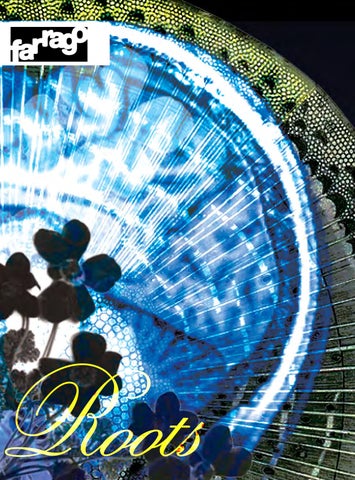
Roots
We share these stories from the stolen lands of the Wurundjeri and Boonwurrung people of the Kulin Nation. Sovereignty was never ceded. The team at Farrago pay our respects to the Traditional Owners and Elders past and present, who have and continue to be the first storytellers on this land. It is the responsibility of all writers, readers and students to consider the colonial ideologies that remain upheld and unquestioned in so-called Australia, and to resist these structures through education. This always was, and always will be Aboriginal land, and we encourage all readers of Farrago to nurture an of the Indigenous from the and places you call home. We share theseunderstanding stories from the stolen lands ofhistories the Wurundjeri Boonwurrung people of the Kulin Nation. Sovereignty was never ceded. The team at Farrago pay our respects to the Traditional Owners and Elders past and present, who have and continue to be the first storytellers on this land. It is the responsibility of all writers, readers and students to consider the colonial ideologies that remain upheld and unquestioned in so-called Australia, and to resist these structures through education. This always was, and always will be Aboriginal land, and we encourage all readers of Farrago to nurture an understanding of the Indigenous histories from the places you call home.
NOTICE OF ELECTION
NOTICE is hereby given of the 2026 University of Melbourne Student Union (UMSU) annual student elections. Positions to be filled include (I) Office Bearers, Committees and the Students’ Council, (II) delegates to the National Union of Students, and (III) several vacant positions to beAbove filled through for theanthology remainder of 2026. is yourby chance to help Water isby-election a joint literary and artsThis project Farrago Magazine, shape theCreative future of Arts the Student Union. Through its multimodal workshop UMSU & Southbank. program andofexhibition, seeks toatencourage in The the arts The formal notice of the election, including a full list positons, canitbe found the Electionstudent Websiteengagement (see link below). and provide a space for emerging artists and writers to develop their craft. website also contains a copy of the Electoral Regulations, under which the elections are governed.
This year, its theme is crisis. INFORMATION FOR VOTERS
All students are eligible to vote. The election will be held 7th – 11th September. There are two ways to vote: either by attending polling place on campus during election week, or by applying for an electronic postal vote, which will be sent visuala art to you by email. Information on how to vote, polling places, and applications for an electronic vote are on the elections photography website. (Unlike previous years, you won’t automatically be sent a voting link.)
scripts
open for pitches & submissions
ELECTION GUIDE
Thediaries/logs Farrago election guide will contain policy statements from candidates and tickets, and be available online at Issuu.
ekphrasis
INFORMATION FOR CANDIDATES prose Nominations for candidates are open from the 27th July to 14th August 2026. Information for candidates including forms creative essays fiction
and deadlines can be found on the Election Website.
WHERE TO LEARN MORE
The election is run by an independent Returning Officer. More information, including contact details for the Returning music Officer, can be found on the Election Website, below or via the QR code. lyrics umsu.unimelb.edu.au/elections
performances installations
Stephen Luntz Above Quota Elections Pty Ltd Instagram: @abovewateranthology Email: abovewater@farragomagazine.com Returning Officer returningofficer@union.unimelb.edu.au
Cartoon sourced from Vol. 27, no. 2, 1951.
Farrago is (UMSU) the publication of the University of Melbourne Student Farrago is the publication of the University of Melbourne Student Union and published by the General Secretary. Union (UMSU) and published by theplease General Secretary. The views expressed herein are not necessarily those of UMSU. To raise an issue with the Union, contact the The views expressed herein are not necessarily those of UMSU. To President and General Secretary at president@union.unimelb.edu.au and secretary@union.unimelb.edu.au respectively. raise an issue with the Union, please contact the President and at president@union.unimelb.edu.au and This magazine is printed on recycled paper by Kosdown Printing.General Please Secretary keep, share, repurpose or recycle after reading. secretary@union.unimelb.edu.au respectively.
“the ladies sure love a man who can cook.
This magazine is printed on recycled paper by Kosdown Printing.
2
31 32
Featured Photography
Editorial
Will Tingate
op-ed
4 6 7 8
On The Protection of Trees Freda Porter
Are We Doomed or Destined? What AI Means for the Next Generation of Graduates Evie Gill
UMSU Office Bearer Reports
Featured Art Rosie Guiliano
Young People Need Domestic, Family and Sexual Violence Education
34
The Problem with Creative Writing Workshops
Keely Boyle
10
Victoria has No Strategy for Youth Homelessness. Advocates Say it’s Costing Young Lives Harry Robertson
14
A Medley of Excuses: Why UniMelb’s Demolition Frenzy Doesn’t Add Up
Declan Chan
16
A Farrago Breakdown of Australian Free Speech
Zeinab Jishi
19 20
Featured Art Lauren Luchs
Breath of मिर् च ी: The Roots Behind the Red
Divya Mehta
22
In the Shadow of the Olive Trees
Mia Horsfall
24 28
Marla Sukroo, Jill Holtzclaw
The Queer History of Farrago Harper Hopkins
What Does Farrago Do To A Person?
James Muller
65 66 66 67 68 69 70 71 72 74 76 77 78 80
Tongue
36
Ava Wilcox
38 42 43 44 46
Heirloom
Rosie Guiliano, Victoria Bahana, Charlene Hui
His Fish Ella Brown
New Bodies Ben Shaw
Contents
Finley Monaghan-Mc Grath
13
Grounded / Beach Walk
Alexander Homoc
Scholarly, Social, Silly: Mabel Shelley is Giving Sexpression a Makeover
Taylah Xuereb
Highly Potent Synthetic Opioids: Navigating Australia’s Evolving Drug Market
58 60 62
The Burden of Language Sonnet Mamgain
House no. 611 Aroma Imran
Mercy
Ashley Oetomo
Siapaku? Who am I? Wan Makhzanah Huriyah
JW Anderson: What Happens When the Most Disruptive Designer in Fashion Becomes the Establishment? Keisha Rawlins
48 50
What’s On My R4 Card? Hayley Yeow
To Be Liked, Just As You Are: Why Rom-Coms Stay With Us
Sophie Kehle
52
Waterlogged Euphoria at Primavera Sound
Saria Ratnam
54
Emma Hardy Dives into the Shadows of Menstrual Illnesses in Periodic Bitch Marnie Reeves
Planting Culture Saria Ratnam
56
Monsters Never Die: Why Vampires Endure Through AMC’s Interview With The Vampire
Point Leo Zen Lam
decolonial kitchen (a list) Harrison Abbott
Azadi
Tanisha Dhillon
Macintosh 2000 Lily Mae West
The Man Who Can’t Look Up Arun Patel
Hiraeth
Ashley Syers
Sister of Wisdom Esther Alex
Grief is an Ocean Jacaranda Liu
Beth and the Bear Chapter Three Lilian Anjeli
Puzzles
Honey Raut, Jade Seabrook
Thank You!
Anandi Ganguly
Cover Story by Ruby Weir-Alarcon The 2026 Editors of Farrago Magazine are Ruby Weir-Alarcon, Felicity Bayne, Sabine Pentecost & Maria Quartel
RUBY WEIR-ALARCON 2
SABINE PENTECOST
E D I T O R I A L S
I must confess, this break I have been off gallivanting. Travelling across Europe as someone who has little to no roots there is both a freeing and a lonely feeling, I find myself looking for gum trees and chasing the bird sounds I never notice when at home. My love and my sense of self is deeply tied to place, extending from a time that came long before me and will tether those that come after. Being away from the places that bind me to family and tradition, while exhilarating in its destabilisation of my routine, has made me realise where my roots lie. I swam in the sea on the east coast of Ireland and I closed my eyes to reach for the sea I know, mistaking the cold bite of the Irish Sea for the Southern Ocean as my skin tasted it from every direction. I can feel my roots with me, even across the world.
I’ve been stressed. You would assume that once Semester One dragged itself to an end and freedom loomed near, the stress would come to an end. A weight finally lifted from my shoulders— but no. I tasked myself with creating this Edition’s cover, an easy feat I assumed. What would come would be hours and hours of procrastination, and filling my time with anything BUT Farrago Magazine Edition Four. The cover is really weird. I played around with it for days, fixated on exploring Farrago’s deep history, incorporating old covers into my designs and focusing on a tribute, rather than something new. But that’s when I realised—the beauty of archival Farrago and their covers is the absurdity of it all. Creating a tribute to all of those who have come before us is nearly impossible, and rather the real tribute lies in continuing their legacy—a legacy that has shaped itself around the definition of ʻfarrago’. And so that is what this has become. A confused, messy, jumble of different things. In the cover, you can see a scan of my brain (which I have very covertly attempted to hide the rather large dent in the top of my head) overlaid with archival plant drawings—an attempt to connect with the overarching concept of Roots.
FARRAGO MAGAZINE
MARIA QUARTEL
FELICITY BAYNE
My room is full of shitty digital cameras. Some are pilfered from my parents, whilst others have come about as recent purchases attached to the never-ending pursuit of getting off my phone. I’m kind of haunted by the fact that taking photos means you might remember something less—I mean, the whole point is to capture moments forever, right? 100,517 pictures on my phone; a laptop completely out of storage; several boxes of childhood drawings stuffed under my dad’s spare bed. It’s one of my driving fears that if I can’t remember exactly where I’ve come from, I will surely lose any sense of who I am. I think I’m plagued by the thought of forgetting. After all, what is a tree without its roots? The question is mildly poetic and obtusely on the nose for Edition Four. An obvious answer in my mind is that the tree is dead, standing tall with wilted leaves, starved from the inside out. That seems to make sense. But, I must remind myself—people are not trees. Shocking, I know. Unlike our tall timber friends, I am not alive right now because I intentionally hold on to everything I have ever been; the ecosystem of my past below me. Undoubtedly, I live in this moment shaped by my past, but I don’t need proof of my life to know I’ve lived it. Unlike the tree, which must physically tether with its roots to survive (literally a plant), my metaphorical roots live on in me through the person I am, even if I have forgotten how I became her. Not remembering my first ever photos doesn’t erase the fact that I took them, gallivanting about with a waterproof, terrible quality, chunky bright-pink beast of a children’s camera. Enjoy this edition, think back to your roots. Remember that lives are intangible things.
I recently watched Chronicle of the Years of Fire. The movie follows the Algerian national liberation movement through a series of revolts and unrelenting suffering. It demonstrates something often missing from many of the narratives we are fed. Revolution is slow and requires the hands of many generations. The movie was a breath of fresh air from the individuality propaganda that much of our media is incessant on churning out. I am not me but where I have come from. I feel the past and future generations manifest through my fleeting time on earth. This is a humbling and grounding feeling. To forget one’s roots is to deny the inevitable future. In forgetting where we come from and feeling severed from the past, we become incapable of conceptualising what is to come.
VOL. 102 EDITION FOUR
3
OP-ED
Words by Freda Porter
O
n the fifth of May 2026, three 150-year-old Elm trees were felled on the western side of Fitzroy’s Edinburgh Gardens. After a fraught battle, some internet campaigning, Facebook NIMBY-ing and hallowed ʻcommunity-consultation’, the chainsaws were fired up and on a still morning, the trees came down. As children, I imagine most of us learnt about trees as objects for our play and enjoyment. I know I did, attending primary school on the border of the Edinburgh Gardens. These very Elm trees had been hidden behind in games of hide and seek, had their roots tripped over and seen a multi-coloured glut of bottle tops collected from beneath their canopies, always providing shade on hot summer afternoons. I remember learning in class one day that each ring in a tree trunk’s cross-section represented a year of its life. Photosynthesis expanded it outwards, and upwards, and as each year passed the bark would thicken and another ring would appear. History tells us exactly how old these Fitzroy Elms were, but only the visual of its orange-hued trunk, sliced in half, could make it so blatant. The Elm, while not native, has a very long and profound history within colonial Australia, but also in ecology altogether. The Elm was one of the
Image from Melburnian, Wikipedia, 2006 4 FARRAGO MAGAZINE
On The Of earliest introduced species planted in Australia and its prevalence was intended to evoke the British pastoral, and the grand European-style avenue design of urban green spaces and Victorian parks. Elms are the first deciduous trees to ever drop their leaves in mainland Australia and mark the arrival of British settlement and the introduction of entirely new flora and fauna at odds with native plant evolution, up until that point. Throughout the 20th Century, Dutch Elm Disease progressively wiped out nearly all mature Elm trees in the Northern Hemisphere and New Zealand. Spread by the elm bark beetle, the tree accelerates its own death as its immune system kicks into gear. Slowly but surely, the upper leaves yellow prematurely, the branches begin to droop, and the tree begins to die. Various methods, including environmentally disruptive fungicides and insecticides, ringbarking and the rather sinister term of ʻsanitary felling’, saw little success and by 1973 an approximate 25 million Elm trees in the United Kingdom had died alone. Let alone the further millions in North America, Europe and Asia. Melbourne is now home to the world’s oldest, and most significant collection of Elm trees in the world with their conservation seen in a plotted out plan by the City of Melbourne and the National Trust Heritage List. Consultation bodies regularly convene to ensure trees’ ongoing preservation, and all local councils have in-house
arborists who maintain the trees we look at and walk past every day. Four Elms were planted in 1845 in the eastern corner of the now established Royal Botanic Gardens. Even though only two survive, they join the heralded group of the oldest known exotic trees in Victoria. Elms have a lifespan of up to 300 years, so it is no real shock then, that for the tree-lovers and local historians of Melbourne that the chainsawing of three of these 150-year-old trees was a blindsiding act, and well worthy of making local news. I am not making value, or judgement statements in writing about this event though—rather I hope to cultivate more interest in the status and sanctity of our local green spaces. When the avenues that form the Edinburgh Gardens were laid out in the 1860s, extensive planting of Dutch Elms began and followed suit in the Darling, Fitzroy and Carlton Gardens in 1882. The land was reserved to provide leisure space for residents in the growing suburbs of Melbourne. The gardens are still a social hub today, and the trees have seen changing demographics and varying public uses throughout their long history. It must be acknowledged too, that this history continues, and these three trees were cut down to expand the tennis club (gaining two new courts, for a total of four), which has occupied the same site since 1888, boasting a waitlist nearing three years. There are ongoing efforts to redevelop and
Protection Trees continue planting in these parks with new styles, with an emphasis on native species. It is a shame the decision to fell three Elms was deemed necessary to achieve this. I try to keep up with the statuses of my local green spaces and am genuinely interested in our social understanding of urban greenery—I know generally about some of Melbourne’s grander, or more rare specimens and observe the powerful link between age, grandiosity and scale, when I look at trees that are older than any human ever could be. I have previously noticed the two missing Elms in University Square, a public park at the centre of the University of Melbourne’s sprawling campus, linking the Law School and Commerce Faculty, with the Science and Arts bases of the Parkville campus. I noticed this in 2022 whilst performing boat races as a part of the infamous University of Melbourne Prosh Week. There was an obvious gap in the short avenue of Elms, something I was reminded of when the date that the Edinburgh Garden’s Elms were to be cut down was announced. It sent me searching. The University Square park was redeveloped as a part of the Grattan Street overhaul, making way for construction of the Metro Tunnel and Parkville Station. The City of Melbourne Council has published the redevelopment’s Master Plan on their website (admittedly in numerous documents, and it’s quite hard to
find) since 2016. It was created in consultation with the University of Melbourne who wanted Grattan Street closed permanently to cars and the park absorbed into the campus for their own use. There were compromises made to keep the road open. These plans offer limited detail about species, or timelines for growth, but they proudly state the number of additional trees that have been planted, using buzzwords like ʻactivation’ to delineate the value of new seating areas or green spaces. The project is nearing completion 10 years on. Based on Google Earth imaging sometime between October 2017 and December 2018 a total of 23 mature Dutch Elm trees were cut down to make way for the expansion of the overall green area in University Square. What followed was the absorption of bay-parking spots and road space along both the eastern and western side of University Square, the planting of native-grass beds, replacement of old-style benches and protection between footpaths and the now oneway, one-lane road called Leicester Street. The eastern side, Barry Street is still closed as of the time of writing. I was too young to hear of any hullabaloo when these trees were cut down and don’t remember a time before University Square was under construction, fenced at points and a bit of a rigmarole to navigate. So, when I found out that the two central Elms that were missing had died naturally
OP-ED
and been lopped and removed in stages I thought nothing remarkable of it. I was shocked however, that Melbourne City Council, in talks with the University of Melbourne, felled 23 healthy trees, with the justification of making more green space. Old Google Earth photos show students splayed out on the grass and a rather ornate, established park. It is a baffling decision—and it makes me sad to have lost the shade once provided by treecanopies which sat on the footstep of Australia’s pre-eminent university. I think of The Corkman Pub on the south-eastern corner of University Square, which was illegally bulldozed in 2016 and became the poster child of Victorian Heritage protection efforts. Following long-winded court orders, jail-time for the developers, a brief stint as a public park and numerous attempts at appeal, the Court insisted the pub be reconstructed with its original facade. In the precedentsetting case, the facade has now been restored, but the inside is a concrete shell, and there has not been a tenant found. The Pub overlooks the missing Elms, which used to line University Square. Pubs can be rebuilt. A tree takes 50 years to grow to maturity again. Trees are a great equaliser, and their benefits to humans are wellknown. They have their own natural lifecycle which supersedes that of humans and in most species. We should be their patron, not their destroyer. VOL. 102 EDITION FOUR
5
UNIVERSITY OF MELBOURNE STUDENT UNION
UMSU Office Bearer Reports Updates from the purple names on campus...
President
Lushomo (Lushy) Chingaya
full list on our UMSU webpage to join one today!
Welfare
Tsun Ying (Cynthia) Wong & Alexander Hams Hey hey! Over the past few weeks, I’ve worked with the University to improve and update its student complaints webpage and support information, making it easier for students to understand their options and access help when they need it. Now you can know what’s expected and the rough timelines towards getting real outcomes! We’ve also increased student representation within university, with a new Graduate Researcher Forum starting Semester Two and two new UMSU positions on the University’s research committee, ensuring graduate researchers have a stronger voice in decision-making. I’ve also been developing the Safer Communities Project which involves a Southbank creative competition and a mini postcard project. I hope to encourage more conversations about what safety means on our campus and turn our ideas into action. ALSO, keep your eyes open for the anti-racism campaign launching through POC, it’s going to be HUGE and get involved! Keep up with me on Insta! @umsu_ president :)
Clubs & Societies
Alex Gwynn & Seamus Donellan
Did you spot Gunter the C&S Penguin at O-Week@UMSU? Clubs Expo Semester Two was a huge success! We are so grateful to our incredible student clubs who hosted stalls, and the students who came along to meet them! The C&S department is busy at work developing policies, organising events for club executives, and promoting our amazing clubs. We currently have 250+ affiliated clubs for you to choose from, so check out the 6
FARRAGO MAGAZINE
Welfare has had an incredible Semester One. Thank you everyone for your support!! This semester, we opened Union Mart every academic day, ran Welfare Brunch three times a week, hosted three Arts Therapy workshops, and delivered a whole range of activities during Stress Less Week. On the advocacy side, we have continued fighting for a better CAPS tracking system and more multilingual appointments to make the service more accessible to students. We have got so much planned for Semester Two, and we cannot wait to share the journey with you! Want to get involved? Join our Welfare Volunteer team!
Southbank
Elizabeth Pardallis, Caleb Jarcevic, Charlotte Dickinson & Tirion Luff-White What’s happening on Southbank? Well, starting with what just happened: Muse Festival, a student-run theatre festival that takes up all of the performing arts building for three days, happened over the break. It was a hit with 40 performances and exhibitions and 200 students taking part. Going into Semester Two, Southbank Department will recommence regular scheduling; Tuesday BBQ, breakfasts and frozen meals, with some new additions! We will be running Southbank Pop-Ups as an alternative to collectives and, in collaboration with the Women’s Department, Women’s Self-Defence classes. To continue keeping up-todate with us, follow @umsu_southbank on Instagram! Stay tuned to the @umsuclubs Instagram to see what clubs are getting up to!
More UMSU... Council Meetings
https://umsu.unimelb.edu.au/about/ studentscouncil
Council Minutes
https://umsu.unimelb.edu.au/about/ studentscouncil/council-minutes
Farrago Live Reportage @farragomagazine on Twitter
Ida Bar!
Level 1, Building 168
General Secretary, Activities, Creative Arts, Education, International, Burnley, Environment, People of Colour, Queer, Women’s & Disabilities Departments were all invited to submit statements, but failed to before the due date.
2007 2009 2018 source: google maps
design by rosie giuliano VOL. 102 EDITION FOUR
7
NEWS
Young People Need Domestic, Family and Sexual Violence Education Words by Taylah Xuereb
What Were You Wearing?’s Fight for Mandatory DFSV Education
In 2024, the Australian Institute of Family Studies found over half of young Australians aged 16 to 19 have experienced sexual harassment, yet Victorian students in years 10 to 12 do not undertake mandatory domestic, family and sexual violence (DFSV) education. Today, What Were You Wearing? (WWYW?) is fighting to change that. The Australian charity dedicated to ending DFSV is starting a new national campaign focusing on DFSV education for young people, with a Victorian petition calling to implement mandatory DFSV education for year 10 to 12 students. This petition needs 10,000 signatures to be presented to the State Government’s Legislative Council, and will stop accepting signatures on 13 January 2027. WWYW? member and leader of this campaign, Abbey Hardie spoke to Farrago about why young Australians need this amendment to their education. “The Australian curriculum mandates what is taught within schools, but doesn’t determine the frequency [or availability of the education]. [Sex education] is often not intersectional and often doesn’t engage topics such as emotional abuse, coercive control, online abuse, or [how to seek health advice],” Hardie said. The campaign aims to prevent cycles of violence and victim-blaming 8
FARRAGO MAGAZINE
culture, by tackling Australia’s current DFSV crisis through education and prevention, with the goal of teaching young people how to recognise violent behaviours and understand why these actions aren’t acceptable. “There are education of things like reproduction, healthy and respectful relationships. But there are currently no educational frameworks […] that delve into topics such as consent and different forms of abuse that are just beyond physical.” The most recent (2021-2022) Personal Safety survey conducted by the Australian Bureau of Statistics reported that 1 in 6 women and 1 in 9 men have experienced childhood abuse. This is why a key aspect of this campaign is teaching students how to identify and report DFSV and other inappropriate behaviours that challenge their safety. The need for young people to acquire this skill is becoming increasingly vital as new technology-facilitated threats such as sextortion are emerging. In 2025, eSafety received more than 3,300 reports of sextortion, which is a form of online blackmail where the victim is coerced into sending sexual images of themselves, and are then threatened to comply with the offender’s demands to prevent these images from being shared. Sextortionists are using artificial intelligence to create fake, “attractive” online identities, and are targeting Australian teenage boys, with 42 per cent of these reports coming from males aged 18 to 24. “Students are often reporting that they think that the […] education they
are receiving is not as relevant and comprehensive as they would like,” Hardie said. The issue with sex education in Victorian high schools isn’t that it doesn’t exist, but more so that it can lack diversity, consistency and relevancy. What Were You Wearing?’s DFSV petition is being sponsored by Greens MP for Northern Metro, Anasina GrayBarberio, who told Farrago why she is backing this campaign. “It’s so important that as a parliamentarian, I do everything in my power to bring this issue to Parliament to let the government know that this is an area where we can make change in our high schools to protect young women, and also educate our young men,” Gray-Barberio said. If this petition manages to collect 10,000 signatures, Gray-Barberio will present the petition to the upper house of parliament, opening a debate to decide whether the government will consider the recommendations of the document. At the time of publishing this article, Sherele Moody’s Australian Femicide Watch had reported 42 women had been killed. “It’s a political choice for governments [not to act on femicide] because they want to prioritise investment. [DFSV] is not anything new for our communities,” Gray-Barberio stated. “Call your local MP, email your local MP, and ask them: What are you doing about the epidemic of family violence in this state and in this country? Why aren’t you speaking up about it?”
NEWS
Intimate Partner Violence in Adolescent Relationships
A 2023 Australian Institute of Family Studies study found that three in ten 18 to 19 year olds (nearly 30 per cent) have experienced intimate partner violence in the year leading up to the national study. Intimate partner violence, in this study, is specifically defined as physical, sexual or psychological violence within a current or previous sexual or romantic relationship. More recent research conducted by LaTrobe University between October 2024 and April 2025 found Australian teens are still experiencing high rates of intimate partner violence. More than half of the 4,400 young Australians aged 14 to 18 surveyed had reported being in a relationship for more than three months. 44 per cent of this group had experienced verbal abuse within a relationship, 37 per cent felt frightened of an intimate partner, and 31 per cent had experienced technology-facilitated harassment or tracking by a partner. 18 per cent of this group had experienced physical violence by a partner, consisting of being hit, pushed, or grabbed. Young women were more likely than young men to be subjected to violence, harassment or fear within a relationship. In terms of consent, more than one in five of those surveyed said they had experienced unwanted sex. Of this 21 per cent, some had agreed to sex to avoid upsetting their partner (63 per cent), had agreed after they had initially said no because someone kept asking (56 per cent), were too intoxicated to consent (30 per cent), or were physically forced to have sex (28 per cent). Deputy Director of the Australian Research Centre in Sex, Health and Society, and the lead investigator on this survey, Professor Jennifer Power spoke to Farrago about her team’s findings. “There’s less attention on sexual violence and intimate partner violence among young adolescents,” Professor Power said. “[High rates of intimate partner
violence amongst young people] is consistent with high rates of sexual violence among the whole population.” Professor Power also detailed how sex education in Australia is of a low standard, leaving gaps in young people’s knowledge on sex and their bodies. This leads to young people searching for alternative sources, as conversations with their educators and parents are generally lacking depth. “A lot of young people go and look at pornography because they’re curious about sex. People reach an age where they want to see what sex looks like […] and online pornography is so accessible now that’s where people go,” Professor Power said. “There’s a sort of combination of the accessibility of pornography, the curiosity factor, and just the absence of other good sex education.” This can be problematic when easily-accessible online pornography can consist of violent and misogynistic content. According to Archives of Sexual Behaviour, 45 per cent of Pornhub and 35 per cent of Xvideos scenes include at least one act of physical aggression, and women are the targets of this aggression 97 per cent of the time. Moreover, Professor Power detailed how her findings also concluded that young people aren’t always aware of the sexual health resources they have access to. This includes not knowing how to access a sexual health clinic or how to use their medicare card to pay for one without their parents seeing the transaction on their medical records.
The Existing Respectful Relationships Initiative
The Respectful Relationships program is a Victorian Government initiative that currently delivers mandatory relationship and consent education for students from prep to year 12. “Implementing a whole-school approach to Respectful Relationships was a recommendation of Victoria’s Royal Commission into Family Violence and helps build a culture of respect and gender equality in our schools,” the Department of Education told Farrago.
This Royal Commission also found that a sustained effort to teach relationships and sexuality education (RSE) is compulsory to achieve the generational behavioural change needed. The Victorian Government has invested $129 million since 2016 into the Respectful Relationships initiative, which is implemented within over 2,000 government, Catholic and independent schools. This education is designed to focus on gender equality, mutual respect, consent education, and is entirely separate to sex education within the curriculum. The program aims to combat gender-based violence, discrimination and harassment. “The government’s invested quite a bit in consent education, which is great. However, the curriculum is very loose, so schools don’t necessarily have to implement or achieve any kind of objectives,” Professor Power said. Moreover, most sex education does end in year 10, leaving year 11, 12 and tertiary education students to miss out on important elements of DFSV and general sex education. Crucially, these are the life stages when most young people start to have sexual and romantic relationships. Another gap in the current implementation of RSE is the inadequate training teachers receive. Teachers aren’t specifically trained to teach RSE, despite how difficult it can be to deliver such a program to students. “Increasing restrictions on social media and access to pornography […] doesn’t make sense without more investment in RSE and without working with education departments to resource teachers,” Professor Power stated. The Respectful Relationships program plays an important role in educating young people on consent, but What Were You Wearing?, Anasina Gray-Barberio MP, and more importantly, young Australians need more. “It’s not enough that we are just talking about consent. We should also be talking about prevention. We should be normalising having these conversations about violence,” GrayBarberio said. VOL. 102 EDITION FOUR
9
NEWS
Highly Potent Synthetic Opioids: Navigating Australia’s Evolving Drug Market Words by Finley Monaghan-Mc Grath
10
FARRAGO MAGAZINE
N
ew synthetic opioids are rapidly reshaping illicit drug markets and fuelling public health crises globally. While Australia has not experienced an opioid crisis like that of the United States or parts of Europe, it hasn’t been immune to the emergence of novel synthetic opioids (NSOs). The most prominent NSOs detected in Australia are nitazenes, a class of synthetic opioids which dramatically vary in potency. While some are comparable in strength to fentanyl, others can be significantly more potent and up to 500 times stronger than heroin. They have been implicated in at least 33 fatal overdoses nationwide, 24 of which occurred in Victoria. Nitazenes and other NSOs are rarely bought and sold in Australia under their real names. Instead, they have been found in drugs like cocaine, MDMA and ketamine, where they are likely accidental contaminants. This often occurs because chemists operating unregulated clandestine laboratories do not adhere to strict chemical control procedures. As a result, cross-contamination and manufacturing errors are a leading cause of NSO detections in stimulants, dissociatives, and other substances. They have also appeared in opioids like heroin, where they are more likely to have been deliberately added as adulterants to increase potency. Associate Professor Jennifer Schumann, the Head of the Drug Intelligence Unit at the Victorian Institute of Forensic Medicine, told Farrago that, “the majority of our synthetic opioid detections have been detected in people who thought that they were using non-opioid substances”. Even among opioid users, the emergence of NSOs globally has increased the risks of fatal overdose due to their incredibly high potency. Although detections of nitazenes and other NSOs remain relatively sporadic in Australia, experts caution that the current situation may not remain stable as synthetic drugs are becoming increasingly globalised. Speaking with Farrago, drug policy specialist Associate Professor Monica Barratt at the National Drug Research
NEWS
Despite nitazenes and other NSOs being described as emerging threats, many of them were synthesised last century, decades before appearing in contemporary illicit markets. Fentanyl and nitazenes were developed in the late 1950s, but only fentanyl was approved for medical use, as nitazenes were considered too dangerous. Unlike semi-synthetic opioids such as heroin and oxycodone, these NSOs are produced entirely through chemical synthesis rather than being derived from naturally occurring opiates. Since the mid 20th century, fentanyl has played an important role in medicine, and more recently, a devastating role in the illicit drug trade. Nitazenes, on the other hand, never sustained a presence in the global drug market—aside from isolated detections in Europe, Russia and the US. For decades, nitazenes remained little more than obscure anecdotes and entries in pharmaceutical literature that had been long forgotten. It wasn’t until international regulations were imposed on fentanyl that nitazenes became a key element of the world’s contemporary illicit drug trade.
Companies located mostly in China manufactured the majority of the fentanyl that was used in the US. Following sustained pressure from US administrations, the Chinese government eventually banned all fentanyl-related substances in 2019. It’s important to note that chemical producers are continuing to send fentanyl precursors to organised crime groups in Mexico, which is now the largest synthesiser and source of fentanyl for the US. Subsequently, while some disruptions have occurred to the fentanyl market, it still remains one of the most common NSOs across illicit markets. As fentanyl became more difficult to produce on a mass scale, international chemical producers turned to decade-old pharmaceutical literature in search of alternative compounds. Nitazenes were among them. As chemists began diversifying and adapting their production to evade newly restrictive legislation on fentanyl; nitazenes re-emerged within illicit drug markets in a capacity that has increased exponentially by way of quantity and geography. Since their return in 2019, nitazenes have been detected in 37 countries, with Australia recording its first detection in 2021. Reports suggest they are now one of the most prevalent NSOs detected globally. Australian Federal Police have reported at least 47 nitazene seizures since July 2023, across multiple drug categories and jurisdictions. Notably, these detections are comparatively low to other countries and other drug detections domestically. Nonetheless, they represent how international factors impact the Australian drug market.
North America’s Fentanyl Crisis
The Globalisation of Drugs
Institute, made it clear that predicting how NSOs are going to continue to impact Australia is incredibly difficult and it is uncertain whether things will worsen. Still, Dr Barratt questioned whether Australia is ready for a potential outbreak: “If things were to change […] and we find for a number of different reasons, a whole heap of new potent synthetic opioids arrive on our shores, will we be prepared?”
Old “New” Opioids
The on-going North American fentanyl crisis started in 2013. Since then, the world has watched as one specific NSO has resulted in hundreds of thousands of deaths. It was originally used to strengthen heroin but eventually became the prominent opioid of choice for many users.
One potential factor that may further increase the presence of NSOs in Australia is the indirect impacts of legislation recently passed by the Taliban. For decades Afghanistan has been responsible for up to 80 per cent of the world’s opium production—that VOL. 102 EDITION FOUR
11
NEWS
was until the Taliban outlawed all drug cultivation in 2021. Whilst existing stockpiles of heroin have sustained markets internationally, estimates suggest that they will likely run out at the end of 2026. The United Nations Office on Drugs and Crime (UNODC) reports that global heroin seizures have fallen by more than half compared with pre-2021 levels. As heroin becomes scarcer, the UNODC warns criminal organisations may increasingly turn to synthetic opioids, making the emergence of new NSOs around the world a potential indicator of a broader shift. There are multiple factors that make NSOs appealing for these criminal organisations. They, unlike heroin, do not require opium cultivation and can be manufactured anywhere with access to comparatively cheap precursor chemicals. Their extreme potency also means that relatively small quantities can be transported and concealed easier than plant-based drugs. Somewhat fortunately, Australia is currently more isolated than Europe and North America from Afghani heroin shortages, as South-East Asia is Australia’s key heroin supplier. However, a more general shift globally toward synthetic alternatives could increase the level in which deadly NSOs appear in Australia. The possibility of contamination, adulteration and direct importation inadvertently increases for Australia as synthetic opioids become more permanent elements of the global illicit drug trade. Dr Barratt pointed out that “even though it’s not happening all around us right now, it’s possible.”
Online Marketplaces
The intersection between NSO availability and online marketplaces adds an additional layer of complexity for governments attempting to regulate these substances internationally. China banned all nitazenes in 2025, and while there have been indications that their availability has marginally reduced, they are still accessible to buy across dark and surface online markets with vendors located across 12
FARRAGO MAGAZINE
the globe. Dr Nicola Man, a biostatistician at the National Drug and Alcohol Research Centre, explained to Farrago that even regularly accessible surface web shops, purported to be originating from Asia, are still vending nitazenes. Farrago found multiple examples of these advertisements on the opensource web, sourced 9 July 2026. Due to the relative ease of synthesising NSOs, it is difficult for countries to regulate them through law enforcement. For example, Isonitazine was scheduled by China in 2021, however, reports across both surface and dark websites showed that its availability grew in the years following. Dr Man explained that this example shows that “the market can often pivot in such ways as to make the drug still be available in spite of regulations and law enforcement.” Furthermore, China’s 2025 scheduling of nitazenes has prompted some manufacturers to diversify production once again. Detections of orphine analogues—a newly emerging class of NSOs—have been increasing globally.
An Uncertain Future
Dr Schumann warned that across Australia, “every state [and territory] needs a potent synthetic opioid response plan that’s ready to kick into gear, because it could happen tomorrow—we just don’t know.” To effectively respond to NSOs, experts across Australia’s public health systems highlighted the importance of continuing to develop the country’s multi-layered protection mechanisms. Currently, only the ACT and Victoria have fixed drug testing services. Sites such as the Victorian Pill Testing Service in Fitzroy allow people to anonymously test substances for free. Researchers and frontline workers told Farrago that expanding these services nationally—including in regional and remote communities— would strengthen Australia’s ability to detect emerging drug threats. Furthermore, issues with lagging coronial data are impeding researchers’ ability to triangulate drugchecking data with detailed reports
from fatal overdoses. Dr Schumann explained, “When we’re looking at emerging drug problems, and we’ve got new drugs popping up every couple of months, looking at data that’s two years old is almost redundant for a drug market tha’s changing so quickly.” Alongside improved monitoring, naloxone is an important and existing safeguard against opioid overdoses. As of June 2026, Victoria has introduced free naloxone vending machines across the state, providing public access to a medication that can rapidly reverse opioid overdoses. Naloxone is also available free of charge through participating pharmacies. As Australia prepares for the possibility of a synthetic opioid crisis, Dr Schumann stressed that harm reduction is not only the responsibility of governments and health services but also extends to all individuals who use recreational substances. “You don’t just carry naloxone if you use opioids, you carry naloxone if you use any illicit drugs, because there’s so much adulteration of the market, you just don’t know what you’re going to get,” she said. The dangers posed by NSOs extends beyond their potency. It is also their sinister ability to remain hidden among completely unrelated drugs, placing a large subset of Australian society at risk.
NEWS
Victoria has No Strategy for Youth Homelessness. Advocates Say it’s Costing Young Lives. Words by Harry Robertson
V
ictoria is the only state without a dedicated youth homelessness strategy, as new data reveals the crisis is worsening and a landmark sector assembly pushes the government to act. New analysis by the Council to Homeless Persons (CHP) found there is just one outreach worker for every 272 rough sleepers in Victoria, with no dedicated assertive outreach programs anywhere in the state for young people sleeping rough alone. Lucas Testro, CHP’s director of policy and communications, said the absence of a youth-specific strategy meant young people were perpetually falling between the cracks of a system not designed for them. “Homelessness is not a failure of young people. It’s a failure of systems,” Testro said to Farrago. In April 2025, CHP convened the Victorian Youth Homelessness Assembly, bringing together approximately 150 sector leaders, practitioners, researchers and people with lived experience to agree on priorities for a long-overdue state strategy. Douschka Dobson, senior policy and advocacy officer at Melbourne City Mission (MCM), said the system’s fragmentation was its most damaging feature. Speaking to Farrago, Dobson said “Young people are almost forced into a choice between their housing needs and their mental health support needs.
Those systems aren’t together for them.” Dobson said 15 and 16-year-olds were cycling through emergency departments for mental health crises, only to then have to prioritise finding shelter over getting treatment. They said the two problems compounded each other—the longer a young person is homeless, the further their mental health deteriorates. A 50 per cent rise in mental health issues among young Victorians over the past decade has intensified the pressure. Data from the Australian Institute of Health and Welfare shows a young person connected to a homelessness service dies by suicide every four days, nationally. Dobson said a dedicated strategy was essential to breaking this cycle. “We currently have a system that was built for the ʻ90s,” they said. “The idea was you give a young person six weeks in a refuge and off they go into housing. That was possible then. It’s absolutely impossible now.” MCM’s Amplify program—the only family violence case management service embedded at a youth access point in Victoria—offers a glimpse of what integrated support can look like. Dobson said the majority of young people presenting homeless at the Frontyard youth access service were fleeing family violence. Amplify places specialist workers and peer supporters at the point of first contact, removing the burden from young
people to identify or disclose their situation themselves. Despite a Royal Commission recommendation in 2021 for 500 supported beds for young people at the intersection of homelessness and mental ill health, Dobson said five state budgets had passed without the commitment being fulfilled. The 2026 Victorian Budget confirmed $26 million to expand assertive outreach and emergency accommodation, which CHP welcomed as a step forward. Dobson said budget measures alone would not resolve a structural problem. “Funding announcements are not a strategy,” Dobson said. “Young people need a coordinated, government-wide plan.” Budget papers also show average wait times for social housing are expected to rise to 18.1 months, climbing to 18.6 months for victimsurvivors of family violence on the priority list this year. The sector’s call for a Victorian Youth Homelessness Strategy, which would enable a whole-of-government approach coordinating housing, mental health and early intervention, has gained momentum through the Assembly process and subsequent advocacy to the Minister for Housing. Dobson said the case was simple. “Every organisation, every business has a strategy, I just don’t know why there isn’t one for young people experiencing homelessness.” VOL. 102 EDITION FOUR
13
NEWS
A Medley of Excuses: Why UniMelb’s Demolition Frenzy Doesn’t Add Up. Words by Declan Chan
I
n June 2023, the University of Melbourne unveiled its Estate Master Plan (EMP), part of which is to demolish six buildings along Grattan St to free up 22,000 square metres for new green space, stitching together a historically inward-facing campus and opening it to the city. The move fits in as part of its long term Strategy 2030 vision to foster a more resilient, sustainable and outward-facing university. Central to the proposed works is the John Medley Building which houses around 380 to 400 staff within the Schools of Culture and Communication, and Social and Political Sciences, according to employees who work there. Originally designed by Sir Roy Grounds, a mid-century architect whose work also includes Hamer Hall and the NGV, the historical building has stood as an archway into the University since 1971. The EMP, originally planned in conjunction with the Fishermans Bend campus, foresaw the Arts Faculty’s relocation to the Old Engineering building upon its vacancy. However, since the University’s withdrawal in late 2025, the ultimate location of the displaced staff remains unknown. The abrupt relocation and the University’s reasons have raised questions and unrest amongst teaching staff regarding the potential consequences of the demolition.
What’s wrong with John Medley?
In February this year, staff were notified of their order to vacate by mid-2027. The Dean of Arts, Jennifer Balint cited “limitations, including major accessibility issues” that make 14
FARRAGO MAGAZINE
the John Medley building unfit for continued use into the University’s future. Interestingly, the building received a $4.5 million refurbishment less than a decade ago. Professor Alison Young, a criminology professor and Deputy Director of the Melbourne Centre for Cities, was involved in the consultation for that work. According to Young, accessibility was barely discussed. “I honestly don’t think there was a huge amount of discussion about toilets or corridor widths,” Young said. “It was more cosmetic, things like carpets and bookcases.” The refurbishment, carried out between 2016 and 2019, extended the building’s elevator shafts, added disabled-access toilets to some floors and refurbished three of its six floors. A planned full refurbishment, which included subdividing the building’s large offices, was never completed, according to Young. She stated the work was paused over questions about subdividing offices, before COVID-19 shelved it permanently. Citing the building’s accessibility shortcomings as grounds for demolition, Young argues, ignores the fact that they were never properly addressed in the first place. “I refuse to believe that the only way to solve the problem is to demolish the building,” she said.
Greenwashing?
The plan’s central ambition is the creation of 22,000 square metres of new parkland along Grattan Street, which the University casts as a biodiversity corridor and a gesture of openness to the surrounding city. Despite this, beneath the veneer of greenification, the raze incurs a
significant environmental cost. “Every demolition releases what’s called embodied carbon in a building. It releases it into the atmosphere,” Young continued, “Demolition is incredibly bad for climate change. New builds also involve a great deal of carbon release. In almost every situation, a retrofit is better sustainably for all of us.” Professor David Nichols, an Urban Planning academic, echoed a similar point. “Whatever the [accessibility] issues are, I’m confident that it would cost a lot less to fix those problems within an existing building.” The demolition also raises the issue of asbestos. The John Medley and other slated mid-century buildings would need to be sealed and meticulously deconstructed, driving up cost. Although it’s unlikely to pose a health risk, one arts academic, who wished to remain unnamed, noted a rebuild could span an incoming student’s entire degree. “The University admits that it’s struggling to attract students back to campus. I don’t think turning [the] campus into a giant demolition site will help with that problem.”
On whose dime?
The University of Melbourne’s 2025 Annual Report, released this May, stated an operating deficit of $124 million, the fourth consecutive year the University has reported a shortfall, with staffing costs listed as the primary pressure. According to the National Tertiary Education Union, the deficit doesn’t exist. The same report shows a surplus of $22 million when investment revenue, endowment returns and infrastructure income are included. “[It] is not a neutral accounting
NEWS
truth. It is political and managerial framing,” wrote NTEU UniMelb branch president David Gonzalez. For teaching staff, that framing has had consequences. Hiring and wage freezes alike have left departing academics unreplaced and subjects cut, whilst the University is simultaneously committed to demolishing and rebuilding a functional building. “I have to go on leave next year and there’s a subject that I teach that I won’t be able to teach,” incoming NTEU branch secretary James Murphy told Farrago. “There are really good people to hire to take it over, but we’re not allowed to. The subject gets arrested instead.” The cost of demolishing and rebuilding the site has not been made public.
Grounds for demolition?
The John Medley Building was assessed as having “high heritage value” in a 2005 audit by heritage consultants Lovell Chen, and was added to the Australian Institute of Architects’ Register of Twentieth Century Architecture in 2019. Christopher Marshall, an art history professor who works in the building, lodged a nomination for the John Medley Building to Heritage Victoria earlier this year. The body is now assessing whether the building holds heritage significance at a state level. If approved, the nomination advances to the Heritage Council of Victoria, which makes the final decision on listing. Marshall said he expects the University to contest the nomination, though not on the grounds of its development plans. “They can’t say that. They have to do it on the grounds that it’s not significant in a heritage sense,” Marshall said. During the process, the University, as the building’s owner, is able to lodge submissions opposing the listing. The University has previously questioned the building’s heritage value and the Royal Historical Society of Victoria has noted it is not considered among Grounds’ more significant works.
A lack of consultation?
The University’s EMP FAQs state that an 18-month consultation process was undertaken, “involving a crosssection of the University community, including staff and students.” But Marshall said staff were given no say. “They didn’t consult us. No one asked me my opinion.” Additionally, the John Medley was the first and current home of Indigenous studies at the university, which sits against the stated cultural ambitions. In its list of cultural benefits, the plan promises the “preservation of numerous heritage-listed buildings to conserve the character and identity of the campus” and commits to “reflecting the cultural values of Traditional Owners and other Knowledge Holders in the estate”. The hurried relocation is likely to impact learning outcomes. Since the withdrawal from the Fishermans Bend campus, the School of Social and Political Science will be relocated to a call centre near Lincoln Square, while the School of Culture and Communication will reside in the Elisabeth Murdoch Building. The move prompted weariness amongst staff due to the lack of private office space and open floor design. “It’s gonna be very difficult, I would say, impossible to do all the parts of our job there. And a lot of people [will] end up working from home,” said Evgeny Postnikov, an Associate Professor in International Relations. The same unnamed arts academic warned the disruption could carry a psychosocial toll the University had not accounted for, particularly for neurodiverse staff, predicting a significant number of academics could end up on stress leave. Following the first move, staff will be relocated to the Raymond Priestly Building, which is also slated for demolition by the same EMP. The University is yet to locate a final permanent home for either school.
A lecture theatre for whom?
The facility replacing the John Medley Building, overlooking the new
parkway, features a 300-seat lecture theatre, along with laboratory spaces, according to a staff meeting hosted by University administration. However, since COVID-19, international and domestic enrolment growth has stalled. The University’s 2025 Annual Report records total student load at 58,142 EFTSL, its highest level on record, but growth has slowed sharply, from 7.4 per cent in 2024 to just 0.4 per cent in 2025. International student load fell by 1.6 per cent over the same period, which the University attributed to new federal commencement caps and rising visa costs. The construction of a teaching space in place of the John Medley building has therefore garnered concern regarding the allocation of resources away from teaching staff and towards unrealised student capacity. “They’re not prioritising teaching, learning, or the way that staff work,” said Murphy. The mismatch sits against the University’s stated commitments to placing students “at the heart” of its mission and delivering an “outstanding on-campus experience”. A University of Melbourne spokesperson stated that “consultation is currently underway to ensure support for relocation next year”. Dan Baird, the University’s director of corporate development, declined an invitation to discuss the project. The same University of Melbourne spokesperson maintained a demolition may be necessary to deliver a “contemporary, purpose-built teaching building that will become a focal point for student activity at Parkville”. The University did not respond to Farrago’s questions on the project’s cost, its consultation process for the original demolition decision, or its impact on the Indigenous Studies Program. The project is scheduled to run until 2040. For now, staff and students still pass beneath the John Medley archway on their way into the University. Whether it stands for the next generation of graduates remains an open question. VOL. 102 EDITION FOUR
15
NEWS
A Farrago Breakdown of Australian Free Speech Words by Zeinab Jishi
16
FARRAGO MAGAZINE
I
n Australia, there is no federal law which broadly enshrines free speech. Instead, the right is predominantly shaped through human rights treaty commitments, legislation and constitutional interpretations. Consequently, the boundaries of free speech remain ambiguous and continually shifting, leaving protesters and journalists in the dark regarding what they can and cannot do. “We live in a particularly dangerous era for free speech,” Stephen Lawrence, a Member of the Legislative Council, said to Farrago, citing volatile politics and the weakening of liberal values internationally for why governments are deprioritising free speech. In response, Farrago has produced a breakdown on how freedom of political expression is both protected and restricted in Australia.
NEWS
How does freedom of expression in Australia work?
Free speech is protected by Australia’s commitment to international treaties, seven of which Australia is party to. In 1980, Australia ratified the International Covenant on Civil and Political Rights (ICCPR), which requires parties to protect freedom of expression. However, Article Four of the ICCPR, enables countries to take measures which deviate from their obligations under the Covenant “in time of public emergency which threatens the life of the nation and the existence of which is officially proclaimed.” Freedom of expression is also significantly shaped by the High Court. In 1977, High Court Justice Lionel Murphy declared, “elections of federal Parliament provided for in the Constitution require freedom of speech and other communication”, towards the end of a judgement. This concept evolved in Australian Capital Television v Commonwealth and Nationwide News Pty Ltd v Wills (1992) into the implied freedom of political communication. The Court found that because members of Parliament must be directly chosen by the people, according to the constitution, Australians must be able to communicate and receive information about political matters in order for that system to function. Freedom of expression in Australia does not operate as a personal right, rather it is a limit on legislative and other government power to constrain political speech. Lawrence said the implied freedom of speech greatly depends on social movements and committed lawyers to use it adequately, arguing it has not yet revealed its full force. “It is vulnerable and can be taken away by the High Court at any time,” he explained. “A comprehensive constitutional framework protecting human rights would be far preferable to an implied freedom, in my view, but it will need to be fought for.” The implied nature of the right becomes controversial as restriction on free speech can be easily
justified to protect public safety and national interest and is made legal by exceptions provided by Article Four of the ICCPR.
How Legislation has Crushed Political Dissent
The vagueness of free speech rights in Australia has enabled the use of broad and ambiguous terms in legislation to crack down on protesters. On 6 February 2025, the Federal Parliament passed the Criminal Code Amendment (Hate Crimes) Bill 2025 which removed the requirement to intend force or violence. The new laws empower police officers to issue “move on” directions for demonstrations and protests, if they occur in or near a place of worship. They also expand the aggravating circumstances to include when an offence is only partly, rather than entirely, motivated by hatred or prejudice. The NSW Law Reform Commission expressed concern that the ambiguity of terms such as “hatred” make them “an inappropriate standard for the criminal law”. Following the Bondi Beach Shooting on 14 December 2025, the government swiftly legislated Combatting Antisemitism, Hate and Extremism (Criminal and Migration Laws) Act 2026 after the Labor and Liberal parties voted to shut down debate in both houses of Parliament. The new laws give the government powers to proscribe organisations as “hate groups” based on whether their conduct would “cause a reasonable person… to be intimidated, to fear harassment or violence, or fear for their safety”, and criminalises political communication deemed to be “violent extremist material”. Those convicted can be jailed for up to 15 years, and non-citizens can be deported or have their visas denied. The government, alongside the Liberal party, voted to defeat a series of amendments to the bill, including clarifying that “a person’s conduct is not taken to be motivated by hatred solely because it involves criticism of the policies, actions or institutions of a
foreign state, or discussion of matters of international law”. Independent Senator Fatima Payman sought to uphold an amendment which reiterates a 2025 Federal Court judgement that criticism of Israel and Zionism is not inherently antisemitic, but it was voted down. “I am deeply concerned by the extraordinary powers granted to Ministers to cancel visas and weaken protections for peaceful protest,” Payman told Deepcut. “I hope the government is prepared to deal with the unintended consequences of this hasty lawmaking and the results of the much-delayed Royal Commission.” Independent MP Kate Chaney, also pushed to amend new provisions to the act which made it so the decision to criminalise association with banned groups is subject to regular review. It was also rejected. In an interview with Deepcut, Chaney attributed the banning of organisations as an authoritarian strategy, stressing the importance of safeguards to ensure procedural fairness. Appearing on the ABC’s 7.30 on 20 January, Attorney-General Michelle Rowland confirmed that an organisation could be listed as an illegal hate group for publicly stating that Israel is committing a genocide in Gaza, is an apartheid state, or should not exist. This is provided those comments caused Jewish Australians to feel harassed or intimidated. In an opposite turn of events, in NSW, the government attempted to push for the Public Assembly Restriction Declaration law in an attempt to stop protests which would threaten “social cohesion”—this was struck down. “Maintaining a nebulous concept like ʻsocial cohesion’ is not of itself a legitimate reason to curtail human rights,” noted Lawrence, warning against believing the invocation of good faith social objectives which ultimately operate as a “stalking horse for stifling dissent and free speech.”
How National Security Laws Censor Journalists
The 2026 World Press Freedom Index was recently released by VOL. 102 EDITION FOUR
17
NEWS
Reporters Without Borders, the index ranks 180 countries and territories by journalists’ ability to do their job. Australia fell four places to 33rd. The index attributed pressure applied by authorities as the reason for its decline. One of the most notable cases of the use of authority to repress journalists was the Australian Federal Police (AFP) raid on the ABC—an action enabled by the weaponisation of crime acts which serve to defend national security. On 1 April, the AFP wrote a letter demanding for fingerprints of two senior journalists in relation to three alleged offences concerning unlawfully obtaining information and receiving sensitive government information. The two journalists had produced seven stories on the illegal activities of Australian special forces soldiers in Afghanistan between 2009 and 2013 with information from leaked documents. Then, on 5 June, armed AFP officers raided the ABC’s Sydney headquarters, sorting through 9,214 documents and emails. The Sydney Morning Herald also revealed the AFP had accessed the metadata of journalists nearly 60 times, justified by national security laws. The managing director of the ABC, David Anderson, said the accuracy of the stories that prompted this raid had never been challenged. “When the AFP executed its search warrant here at the ABC last June 5th, its raid was seen—internationally—for exactly what it was: an attempt to intimidate journalists for doing their jobs.” The AFP was able to conduct such an operation because of acts such as the National Security Legislation Amendment Act 2014, which expanded the surveillance capabilities of the Australian intelligence community and has been severely criticised for its criminalisation of whistleblowing. When the broadcaster challenged the validity of the raid in February 2020, it was dismissed by the federal court. Kieran Pender, Senior Lawyer at the Human Rights Law Centre, criticised the use of national security laws 18
FARRAGO MAGAZINE
to suppress legitimate criticism of government decisions and shut down transparency in Australia. Nonetheless, legislation has protected the speech of journalists as well. In Lattouf v ABC (No 2), the Federal Court clarified the scope of the Fair Work Act 2009 which states that an employee must not be terminated due to their holding and expression of a political opinion. Lattouf was unlawfully terminated from her casual presenter role on ABC’s local radio after sharing a post from Human Rights Watch that accused Israel of war crimes. Justice Rangiah said there was a clear “orchestrated campaign by proIsrael lobbyists to have Lattouf taken off air” which alarmed senior ABC managers into dismissing her.
The Influence of Israel Lobby Groups
Zionist lobby groups have played a noteworthy role in pushing for laws which undermine freedom of expression. These efforts are conducted through public submissions to draft legislation and parliamentary inquiries, alongside direct consultation. Deepcut’s analysis of parliamentary submissions across numerous pieces of legislation found that pro-Israel lobby groups have systematically supported the expansion of hate speech and antiprotest laws where legitimate political expression becomes entangled in criminal legislation. The Executive Council of Australian Jewry (ECAJ), a right-wing Zionist group, has played one of the largest roles in lobbying for a pro-Israel position in the political establishment. The ECAJ pushed the federal government in 2010 to exclude an “intent” condition in the offence of urging violence against protected groups under a Commonwealth hate crimes law. Whilst it was not adopted at the time, it was passed in the Criminal Code Amendment (Hate Crimes) Bill 2024, which was made after the 7 October attacks. The Jewish Community Council
of Victoria (JCCV) as well as the Australia/Israel &; Jewish Affairs Council (AIJAC) have influenced state level legislation in Victoria. In 2022, AIJAC advised the Victorian government to follow the UK counter-extremist policy, shifting focus away from far-right ideology towards Islamist and “extreme left” ideology. This framework was partially adopted by Victoria Police, however, focus was still placed on nationalist and racist violent extremist movements. Recently, representatives from the ABC and SBS have been summoned to the Royal Commission into Antisemitism and Social Cohesion following complaints that the two broadcasters’ coverage was biased against Israel. Spearheaded by Coalition Senator and prominent advocate for Israel, Sarah Henderson, along with other media outlets, the complaint came after the ABC and SBS refused to adopt the International Holocaust Remembrance Alliance (IHRA) definition of antisemitism, which has been criticised for its chilling effect on free speech. The head of the AIJAC’s Sydney office, Arsen Ostrovsky—who previously said “there are no civilians. Only accomplices” in Gaza in a post on X—testified in the Royal Commission. “Unfortunately, our measures I think are counterproductive and ill thought out,” he said, adding how easily groups can essentially manipulate the government, through “media tricks”, into “ham-fisted [sic] crackdowns” on genuine grassroots movements for justice. Overall, the trajectory of free speech in Australia has seen a government that is increasingly less tolerant of dissent which Lawrence attributed to a faltering liberal world order and the rise of the far-right’s presence on the internet and also in politics. “I urge young people and students to get involved in fighting for a better Australia and commend those already involved,” he said. “A better Australia is an independent one, free of anyone’s war machine, a fairer one and one that plays our role in lending a real helping hand around the world.”
Art by Lauren Luchs VOL. 102 EDITION FOUR
19
W
hat gives culture its roots? Is it the traditions we celebrate, the stories we inherit, or the people whose work quietly keeps those traditions alive? India’s identity as the land of spices is woven into its history. For centuries, nations fought to control what grew from this land. Today, spices remain a source of pride, carrying stories of place, memory, and identity across generations. Yet, it took me 21 years of visiting the same spice shop in Jodhpur to finally see its roots. Until then, I had only known the front of the shop—the shelves lined with spices and the familiar faces serving the pride.
20
FARRAGO MAGAZINE
While men occupied the visible front of the trade, women worked behind the walls, surrounded by towering sacks of fiery red chillies. In a room where I could barely breathe for two minutes, they have spent decades breathing the same air, repeating the same labour, quietly sustaining a tradition that many of us simply consume. Like roots beneath a tree, they remain invisible, yet everything above the surface depends on them. It made me question where culture truly begins, and who bears the burden of keeping it alive. Perhaps the deepest roots of any culture are not found in the artefacts we proudly display or the traditions we publicly celebrate, but in the unseen hands and invisible labour that sustain them across generations.
Breath of मिर् च ी: The Roots Behind the Red Words and photography by Divya Mehta
Photography by Iman Amani Azmi VOL. 102 EDITION FOUR
21
In the Shadow FEATURES
Art by Felicity Bayne
“To Palestinians, the tree is sacred, and so is the land bearing it.” Sarah Ali Words by Mia Horsfall
of the Olive Trees 22
FARRAGO MAGAZINE
M
y grandmother’s early years in Melbourne were characterised by loss. Nan was five years old when she found out her father had died in World War 2. The middle sister of three, her youngest sister died from tuberculosis at just six years old. Their mother abandoned them. She came home from school one day to find her gone. Her oldest sister, Kathleen, only eight years old at the time, took my grandmother’s hand and marched them across town, from St Kilda up to the slums of Carlton to live with their great-grandmother and other distant relatives. In 1954, when Nan was 17 years old, she wrote to the Australian Department of Defence asking for the details of where her father was buried. Private Albert Frederick Kemp VX5802, serving with the Australian Imperial Force, 2/7 Battalion, Australian Infantry, died on 13 February 1942 age 26, and is buried in Plot B Row A Grave 3 in Gaza War Cemetery, Gaza. For decades, visiting her father’s grave was a vision that lay out of the reach. But in 1992, seven kids, a divorce and 40 years later, she began the process of seeking permission from the Israeli government to visit her father’s grave in Gaza. Eventually, after years of communication, research and planning, Israel granted her a two-hour permit to visit the Gaza War Cemetery. For Nan, the journey to visit her father was her greatest service of love. A man from the Palestinian Liberation Organisation (PLO) greeted her on the other side of the armed checkpoint. “Hello, Mrs Spence!” She didn’t know how he knew her name and she had not expected to be met by anyone on the Palestinian side of the Erez crossing. But he met her with a smile, her name and a car, and drove her to the entrance of the war cemetery. There, she spoke with the cemetery caretakers, through the bits of broken Arabic and English. Upon entering, her first impressions were of how beautifully the cemetery was kept. Each grave was clean, the impressed lettering wiped free of grime. The grass was clipped short and flower bushes had been planted between each headstone. Recalling her
FEATURES
impressions of the site, Nan remarked “they [the Palestinian caretakers] take great pride in keeping the cemetery beautiful.” She sat down on the grass in front of the headstone, read the inscription and wept.
Fighting for those he loved, our darling Daddy died. Nan placed a wreath, a photo of her father and an Australian flag at the foot of his grave. When she left the cemetery, she was met by the same man who had picked her up from the Erez crossing. He asked what she would like to do for the remaining time she had been allowed in Gaza. She replied she would just like to look around. He took her back to his house where she met his mother and aunty, and was offered coffee and food. She watched children walking to school in their uniforms and met his nephew who played with a toy gun. They smiled for a picture, and she purchased a keffiyeh and a Palestinian flag from a shopfront. Nan’s process to visit Palestine was a multi-year-long endeavour. Recounting it to me, she laid out piles of stapled letters to and from the Israeli embassy, coordinating with the PLO on her behalf. She was not allowed to contact them directly. She travelled through the armed checkpoints by herself, walking the one kilometre strip of the Erez crossing with a wreath, her purse and a plastic bottle of water. She underwent security screenings from armed members of the Israeli Occupation Force. She underwent a two-hour Mossad interrogation upon leaving and had her luggage searched. From the Palestinians she met? A greeting, a clean headstone and a cup of coffee. There’s a sick feeling in my stomach when I think of the gentleness the caretakers kept the headstones with. I imagine them pruning the flower bushes, sweeping eucalypt leaves from the bases of each headstone. I imagine the Gazan sun beating onto their backs whilst they mowed the lawn. I imagine my great-grandfather’s bones growing ancient in the shadow of the olive trees, swaddled in the
cool, rich Earth. It’s a bizarre, unsettling thing to confront; the roots of your family laying in a place where the Indigenous people are being pulled from their ground. Among the daily horrors coming out of Palestine, the stories of bravery, resilience and defiance in the face of brutality, I think of the caretakers my Nan met. I think of the care and compassion they took in tending to the graves of an imperialist war, whilst being unable to bury their own dead. There’s a dizzying irony there; a career dedicated to the respect of the dead. My great-grandfather’s grave isn’t there anymore. Earlier this year, my grandmother learned that Israel had bulldozed the war cemetery, ripping the Earth from beneath the bodies. Aerial imagery shows that the Australian section of the cemetery has been cleared, the headstones removed and the land turned over. The caretakers, as far as we know, have been evacuated to Egypt. The olive trees are gone. My Nan’s voice quivers. “I hate to think of his bones laying there, exposed.” I imagine my great-grandfather’s bones bleaching in the Palestinian sun. I imagine cement engulfing them, laying foundations for Israeli settlements. I imagine the names and lives of the Palestinians whose bones may neighbour his, the lives they led in their homeland. Amongst the photo albums and letters, Nan brings out the keffiyeh she bought in Palestine to show me: “I only really wear it to the protests nowadays.” My 89-year-old grandmother, with a cane in one arm and a daughter on the other, marching down ANZAC parade to Parliament house, to demand an end to the genocide of the Palestinian people. It’s her duty, she tells me, to the people who shelter her heritage in their soil. I think of my great-grandfather’s bones being turned to dust, feeding a new growth of olive trees in Gaza. I hope their branches shelter the land. I hope they shade Palestinians as they rebuild their home.
VOL. 102 EDITION FOUR
23
FEATURES
24
FARRAGO MAGAZINE
FEATURES
The Burden Of
Language WORDS BY SONNET MAMGAIN
The Weight of Civilization In Black Skin, White Masks political philosopher Frantz Fanon argues that to speak a language is to “assume a culture” and “support the weight of a civilization.” In saying this, Fanon was referring to how black Antilleans adopt the French language to climb the social ladder, ultimately forcing them to internalise the colonial culture that devalues their own identity. However,
Fanon’s statement also alludes to a broader burden: the weight of speaking or unspeaking a language. In my English degree, we often study how language operates as our most powerful force. It is what connects us, bonding us over words tied together like pearls on a thread. Yet when fractured and assaulted, language also draws lines in the sand. Perhaps that’s why staccatos in speeches are always uncomfortable.
Monkeys on the Roof Last year, I lost my nanu to a terrible accident. A routine morning walk changed everything. Struck by a car, my nanu survived in a coma for more than a year before succumbing to his injuries. 2025 was the first time I went back to India after a long time. I had never imagined that I would be returning to Doon Valley for a funeral. Let alone the funeral of a man I love. I remember sitting VOL. 102 EDITION FOUR
25
FEATURES
in the car and watching monkeys have sex on the roof of the Buddhist monastery. As a child I would always laugh at the sight. But this absurdity could no longer amuse me. I could only think of my nanu who would drive me through these gullies on his scooty and tell me all about the stupa and the monastery, intentionally mixing Hindi with Garhwali like street vendors who would mix their spices. I found this flavour quite uncomfortable, but he wanted me to inherit the words which were dying out. The words which formed the vulnerable roots of the language my family belongs to. Back then I didn’t understand the lesson my nanu was trying to teach me: language is fragile.
Amnesiac Alphabet I didn’t realise the fragility of language until after my nanu’s death. Statistically, there are 2.5 million speakers of Garhwali (an Indigenous Indian language spoken near the Himalaya). Nonetheless, UNESCO classifies the language as “vulnerable”. There are many reasons behind Garhwali’s vulnerability. Urbanisation, institutional absence, social stigma and a lack of intergenerational transmission means that Garhwali is predominantly spoken by elderly individuals. The younger generation hardly speaks the language. In my own family, my cousins who have been born and raised in the Garhwal region stumble over simple tenses when attempting to put together a decent sentence. They are hardly the only ones. My mother often notes how individuals from her own generation have lost touch with the language they were raised with. Migrating into urban centres, these individuals stop speaking the language until one day, what was once so natural to them becomes seemingly segmented. I like to think of this as a deliberate form of intergenerational amnesia. Sometimes, I want to denounce 26
FARRAGO MAGAZINE
this intergenerational amnesia, but I can’t. I am also an amnesic patient.
Memory Fortunately, my linguistic amnesia doesn’t erode my childhood memories of my nanu: Chow Mein at Asia Garden Cafe, walking through Clement Town Cantonment, a rickshaw ride through Mussoorie. However, now that he is gone, the memory that stands out most pertinently is the memory of his playful nagging. He would frequently nag me to speak Garhwali and learn Hindi despite knowing my English-dominant upbringing. Still, every year when I would visit him, he would always buy me a heap of Hindi language workbooks and sporadically endeavour to hold conversations in Garhwali. He wanted me to know these languages like I knew the back of my hand. It was a simple request coming from a man who could bridge the vast divides between English, Hindi, Tibetan, and Russian. I cannot say I completely failed him. I can speak Hindi fluently (in an albeit thick English accent) but cannot read or write it. I can fully understand Garhwali but struggle to stitch together my sentences. So, maybe my failure has only been only partial.
Failed Staccatos are uncomfortable because language is our anchor in the world. Therefore, my failure is not partial. My failure is a complete failure.
The Drawer of Scraps After nanu died I found scraps of his writing in the family library. For an organized man, he ironically wrote poetry in a very unorganized manner. My mother would always tell him to keep a dedicated diary or to collect his poetry in a folder. I believe he tried but those scraps
would always end up somewhere. I found pages of his poetry inside the Oxford Dictionary and verses scribbled inside a short-story collection of Akbar and Birbal. Every now and then, my mausi frequently stumbles upon his poetry inside random drawers or tucked between random sheets. It reminds me of a trail. A trail of words he has left behind for us to discover. Unfortunately, I cannot discover the entirety of his trail. He wrote his poetry in Hindi and despite wanting to, I cannot read it. It is here that Fanon’s words make sense to me. To speak a language is to assume a culture but to lose a language is to lose access to it. I can touch and feel my nanu’s handwriting. However, my inability to read his handwriting is not just a simple gap in literacy—it is the residue of a cultural displacement I have inherited without choosing.
A Non-Consensual Inheritance Language is a non-consensual inheritance. Many of my friends with a transnational identity struggle, through no fault of their own, to speak their native language. Some of them were raised with parents who intentionally chose to not pass down their mother tongue. Some of them found the labyrinth of bilingualism or multilingualism too hard to navigate. Some consciously abandoned their language because the last thing you want as a child is to stick out like a sore thumb. Some of them carry their language in broken fragments like I do. But what is the politics behind unlearning a language? It is not loud and clamouring. It is not an intense soliloquy delivered before a madding crowd. It is quotidian and almost imperceptible. Consider a parent switching to English at a dinner table, a child embarrassed to speak with an accent, a school curriculum that discards regional and indigenous languages. Unlearning is not a single moment but a chain of
FEATURES
slow erosions. It happens bit by bit. It happens through choices shaped by forces larger than us. The reason why I couldn’t learn to read and write Hindi is because I had to work strenuously to master English in a classroom where I was one of the only people of colour. The reason why I couldn’t learn to speak Garhwali fluently is because my parents tried to ensure that my Hindi-speaking skills were impeccable before the multilingualism confused me. I consented to none of this.
Ganges When my nanu lay on his comabed I made a pact. If he survived, I would commit myself to the cause of masterfully speaking Garhwali. I would practice day and night. I would walk around in an uncomfortable skin (English is the only language that brings me comfort) and trip over my alphabet before rising again. He is dead now. My mother took me to the River Ganges where they scattered his ashes. A little girl came up to me and begged me for money by the riverbed. I told her I didn’t have any. “What country are you from?” she asked me as we stood by the water. “How do you know I’m not from here?” I asked her. “Your language” she told me. “It sounds different. You sound different.”
Misdiagnosis Maybe I am not an amnesic patient after all. Maybe I am just misdiagnosed. People often assume that forgetting is always deliberate. They treat it like a haphazard decision that is made lightly and enacted daily. And sometimes it is—Garhwali is full of deliberate forgetting. Parents “accidentally” stop speaking the language to their children, believing they are protecting them from the inconvenience of slipping
into a devalued tongue. And in their defence, Hindi certainly has greater cultural capital than Garhwali, though in practice it is the hybrid tongue of Hinglish that dominates. I have beef with Hinglish. It rewards assimilation more than preservation. Similarly, forgetting Garhwali to speak Hindi is also a form of assimilation by its own right. Accordingly, it is at this point of assimilating that the process of misdiagnosis slowly seeps in. When a language becomes socially inconvenient, marginalised, and delegitimised the child who grows up without it is blamed for a forgetting that was never theirs to choose. So maybe forgetting a language is a form of sociopolitical amnesia. We don’t choose to forget. We are raised in systems that imbue forgetting with medicinal value. Systems built on the erasure of Indigenous languages, the global hegemony of English, the Eurocentrism behind canonised texts, the hierarchy of accents, and the implications of a curriculum centred on systems of cultural authority.
Can the Subaltern Speak?
Western Sydney. Written against a decolonial context, Araluen’s words speak to the burden vested in language. Her tribulations and uncertainty are not simply a series of linguistic hiccups. They accentuate how the subaltern isn’t silent because she lacks a voice. She is silent because the structures around her have delegitimised her speech and erased her language. Araluen speaks into a landscape that has assaulted and crushed her native tongue. But still, she speaks on. I cannot claim the violence behind Araluen’s hesitation. Her struggles with language emerge from a colonial history far heavier and more violent than anything I have ever experienced but the logic is familiar: forgetting was never personal. It was never voluntary. It springs from a historical hierarchy of audibility which articulates which languages are heard and which dissolve into thin air. My own loss lingers within the architecture of this structure. I love my nanu, but language has always been a non-consensual inheritance.
In her seminal essay “Can the subaltern speak?” literary theorist and feminist critic Gayatri Chakravorty Spivak questions whether the subaltern can speak. But perhaps that’s the wrong question to ask. Perhaps it is more important to ask if we can learn to listen to those we have already silenced. Evelyn Araluen’s poem “Learning Bundjalung on Tharawal” captures this dynamic beautifully. Fracturing into a bilingual collage, the poem draws attention to the hope and grief the speaker navigates as she reflects on the process of learning and reclaiming language as an adult. “And god, I don’t even know / if I’m saying it right,” Araluen’s speaker says as they endeavour to learn their ancestral language (Bundjalung) while living on stolen land on Tharawal in VOL. 102 EDITION FOUR
27
Planting Culture FEATURES
WORDS BY SARIA RATNAM
UniMelb’s Burnley Campus Is Turning Food Aid Into A Source Of Culture And Community
M
any Parkville students don’t know that the University of Melbourne has a campus in Burnley, where the agricultural department is located. Even fewer know that this campus is the site of a small-scale social and environmental revolution. On this small, concealed plot of land beside the Yarra River, two Master’s students have singlehandedly devised a food-growing project which addresses not only the issue of food insecurity faced by Parkville students, but the cultural displacement of international students at the University as well. In early 2025, Ian Adams and Thomas Li, the Burnley UMSU Office Bearers, noticed that many fertile land plots on the Burnley Campus were going to waste—they were either empty of plants or overrun with unharvested produce or weeds. As part of Chris Williams’ ʻFood Production for Urban Landscapes’ subject, each student 28
FARRAGO MAGAZINE
receives a five-metre plot of land, which they get to maintain over the second semester, after the subject’s conclusion. Tom explains to me that while “some students maintain that [plot of land], some students […] go back to their home countries, or they get busy, and a lot of these plots become quite wild.” He and Ian realised that “there’s a lot of food being produced at Burnley, through Chris’ subjects and the campus in general, that is going to waste; so it seemed like common sense, really, that the obvious thing to do was to reduce this food waste, harvest or glean the food that is being produced at the Burnley campus and redistribute it to students who don’t have the time, the money, the know-how or the social relations to get fresh food.” And this was how the Grown for Students, By Students project was born. Tom and Ian harvested the produce that had already grown, and wasn’t going to be harvested, from these plots of land. They then hand-
delivered it to Union Mart, the Parkville campus’ food bank. Ian, smiling, tells me that this was one of the “inspiring moments” for him, “seeing people’s faces light up [as tray loads of food] get delivered to them, almost out of the blue.” From here, the project grew: Ian and Tom, and a team of student volunteers, began not only harvesting excess produce at Burnley, but also growing it themselves. They conducted surveys and one-on-one conversations with students about what produce to grow. Tom tells me that “a lot of the food [requested by students] was pretty standard […] like broccoli, leafy greens, lettuce, spinach, chillies. But some students want okra, skinny eggplant […] these kinds of foods are not so accessible at regular supermarkets.” As Tom related these findings, it occurred to me that not only are these vegetables inaccessible at supermarkets, but that even if they were, supermarkets themselves might be financially inaccessible for the
FEATURES
students who are obtaining their food through Union Mart. This is what makes Tom and Ian’s initiative so inspiring. They began to grow rayo ko saag, sweet potato leaves, kangkung—making food that’s already physically scarce in Melbourne accessible to students for free. Tom earnestly shared stories of how students have reacted to this produce. One time last year, he observed the reaction to a delivery of sugarcane: “students were just really fascinated. Like some students went ʻI’ve never seen sugar in this form, in the cane form,’ whereas some students would be like ʻoh, wow, I haven’t had this since I was a child.’” He remembered them standing in small groups, explaining to each other how to eat it, by making an incision in the bark before removing the outer husk and chewing the inside. Tom remarks that when students are asked what foods they want to see at Union Mart, they often think of nutritional value or necessity. But the way that the students reacted to the sugarcane delivery led him to realise that “social relations that are formed by foods which don’t just hold nutritional value” are overlooked but crucial and deeply meaningful as well, offering a “historical or cultural connection to the students’ home country” which then enables students to connect with one another. A delivery of sweet potato leaves resulted in a similar reaction: Tom remembers them “sharing their home cultural traditions,” with one student describing how their mother would cook the leaves, and another sharing that their auntie would harvest and sell them. Tom remarks that “in the context of a food bank,” which can be an “almost shameful environment,” the importation of culturally significant produce transforms the space into a “lightning rod for social connection and sharing […] which elevates food relief to a different level, I think.” I was struck by the beauty of this; organic moments of connection, spontaneously arising in a typically shameful and individualist environment, thanks to the culturally significant produce Tom and Ian, and their team, grow and deliver to
Parkville. From the stories they share with me, it’s clear that this moment of delivery, of recognition, offers students not only a way to reconnect with their own cultural roots, but also to connect with those of other students—using their personal memories as a point of connection, allowing for the forging of interpersonal bonds as well as the validation and collection of cultural memories. You wouldn’t think that all of this could be facilitated by a delivery of sweet potato leaves—but clearly that’s all it takes sometimes to break down the barriers of social stigma in an environment like a food bank, and spark conversations while doing so. And the benefits don’t only lie with the students who receive the produce. Tom notes that a key part of the project is to “provide a green space, just a nice outdoor space [for students] to hang out and do gentle work with plants and weeding and that kind of stuff […] a few of our volunteers have really enjoyed the opportunity to head out to Bernie, be around and love the garden.” The ʻby students’ of the title reflects an integral aspect of the project—giving students the opportunity to garden, a rarity in a modern urban environment like Melbourne. Volunteers get to experience the uniquely mindful, peaceful activity that is spending time in the garden, but in a way that’s especially rewarding, and which reminds them of the interdependence between humans and nature. The other day I decided to visit the Burnley Campus myself. It was a freezing cold Sunday morning; I wandered down various paths, circling the nursery, classrooms and garden plots. I saw two people as I entered, but a few minutes later they were gone—I felt entirely alone, entirely isolated from the rest of the city’s population for fifteen minutes. I stood beside a patch of kale and tried to imagine what it would feel like to come here early in the morning and water the seedlings, returning a few weeks later to pull the plants gently out of the soil. For a brief moment the sun came out, and I felt a desire to spend the whole day here, to tend to the plants around me in the cold. I often discuss the challenges of maintaining links to one’s culture as a
second or third generation immigrant with my dad, who emigrated from Sri Lanka as a child. He can barely speak the language that his ancestors spoke—he can cobble together a few sentences if he needs to, but is far from fluent. He’s learning, however, to cook an increasing number of Sri Lankan dishes. I can’t speak a word of Tamil, but I’m trying to inherit my grandmothers’ recipes. My dad and I agree that the loss of language amongst children of immigrants is inevitable, but that food remains a viable means of intergenerational cultural transmission. But standing in the Burnley Campus gardens, I wonder if gardening could be an equally beautiful and lasting means of maintaining links to one’s culture— maintaining one’s roots. As the child of two immigrants,
VOL. 102 EDITION FOUR
29
I’ve seen the excitement on my dad’s face as he showed my sister and I how to eat a mangosteen—interlocking his fingers and holding the fruit between his hands, squeezing his palms together until the hard, wooden exterior cracked open. I’ve seen my mum and grandmother excitedly stop the car to buy a fresh coconut off a roadside seller, so that we could try drinking the coconut water straight from the fruit. These moments are privileges only afforded to us during holidays in Sri Lanka—although we might occasionally chance upon a mangosteen or bittergourd in Melbourne, they’re often expensive and imported, and don’t taste fresh or anywhere near as delicious as those back home. This kind of produce also wasn’t available at all in Australia when my grandparents and parents first migrated here. They would have benefited immensely from an initiative like Tom and Ian’s. Luckily for my grandparents and parents, however, they migrated with their families and friends. As a result, they could build diasporic communities in Australia which allowed for the preservation and circulation of culture through food, language and the recreation of their pre-migration lifestyles. For many international students at the University of Melbourne, this is not the case. They’ve come here alone, uprooted from their families and cultures and marooned in the isolating, homogenising (or at the very least, disorienting) environment of university, instead of a microcosm of their home country, which my grandparents and parents moved into. The produce provided by the Grown for Students, By Students project is a welcome intrusion into this culturally sterilised environment which such a large proportion of international students inhabit, offering a small dose of comfort and familiarity while also being a genuine means of social and financial aid. Ian and Tom are transforming Union Mart from a place that helps international students to survive, to one that helps them to live, to feel at home while they’re away from it. But in a more long term sense, I hope that, whether they interact 30
FARRAGO MAGAZINE
with Ian and Tom’s project by receiving produce or growing it, some international or migrant students who settle in Australia after their studies come to see gardening and culturally significant produce as a means of maintaining a link to their culture, as well as to nature, throughout their lifetimes, and subsequently passing this ritual down to future generations. I hope there’s one student out there who plants a rayo ko saag seed on a plot of land at the Burnley Campus, and ends up teaching their children and grandchildren how to grow it decades later, when language has been lost and their home country is a distant memory.
If you’re interested in heading to the Burnley Campus to do some planting for the Grown for Students project, reach out to Ian and Tom via email or Instagram. @umsuburnley, burnley@union.unimelb.edu.au. Photography by Ian Adams and Thomas Li
Photography by Will Tingate
VOL. 102 EDITION FOUR
31
FEATURES
Are We Doomed or Destined? What AI Means for the Next Generation of Graduates
Images sourced from Comic Book Plus. Fantastic Adventures (May 1939), illustrated by Julian S. Krupa.
32
Words by Evie Gill
In today’s lectures, the professor stands at the front of the lecture hall, explaining concepts in the same way they did in 1855, when the University of Melbourne was established. Though now half the room quietly considers whether the concept, model, or framework that originally took decades to develop, and would take each of us hours to understand properly, could be done by ChatGPT in seconds? This is not necessarily something you say out loud. Indeed, it sounds ungrateful and lazy, as though you are missing the point. Nonetheless, it’s there, this low-level hum beneath our university experience right now: What exactly are we preparing for? Ash Waring, a University of Melbourne student, put this in a way that stuck with me: “It’s scary,” she said, “because they’re cutting off the bottom half of the corporate ladder, so there’s less grad roles. And then it’s hard to understand the purpose behind learning basic content like WACC when AI can do the basics without us.” This is an honest evaluation of what’s happening: the entry-level role, our dream graduate position, the thing we continue to build our CVs toward, seems to be exactly where automation will hit first. There’s a clear job that used to exist for people like us. Not necessarily the most glamorous job, more so the job before the “job”. The one where you were focused on learning whilst doing the “boring” tasks, while someone more senior decided whether you were worth keeping. Globally, entry-level job postings have fallen 29 percentage points since January 2024 (Randstad, 2025 Global Workplace Blueprint). AI FARRAGO MAGAZINE
hasn’t just automated the tasks; it has removed the reason to let us in. When ChatGPT originally launched in late 2022, I remember the reaction being a strange mix of fascination and quiet panic. Here lay a tool which could draft emails, summarise lectures, write cover letters and solve problems in under thirty seconds, which would have taken us weeks to merely halfunderstand otherwise. People keep pointing out that this is not the first time that technology has destabilised industries. For instance, the Internet, spreadsheets, and ATMs. However, these only threatened tasks rather than an entire credential, which is one of the reasons why students find it so unsettling.
The anxiety is real. So is the exaggeration. I will point out that there is a version of this conversation that spirals straight to doom. “AI will take all jobs” “XXX degree is becoming obsolete” “We are graduating into a world that doesn’t require us.” I don’t quite buy that, fully. But I’ve also stopped finding comfort in the rhetoric of ʻdon’t worry, everything will be fine’, mainly because this largely comes from people who already have jobs. Mark McDougall, the Global CIO of Computershare, oversees technology across a global organisation and has watched multiple waves of automation reshape the workforce. However, he remains measured about the integration of AI: “I see AI as another evolution in process automation. What will be transformative is using AI to perform tasks that were previously out of
FEATURES
reach for a human due to sheer volume or complexity. In this case, it complements humans rather than replaces them.” It is a useful corrective to the doom spiral. Although what strikes me more is what he has to say about people during this time and who he believes will thrive in such an era. In his words: “Working in a global organisation requires the building of human relationships and trust, AI can never replace this. People who thrive are those who deliver business and customer outcomes in a complex global environment with the full trust and support of those around them.” Trust isn’t exactly something you learn in a class or can achieve via a prompt, yet something Mark made explicit in his answer to me.
The anxiety is about something older than AI. We have watched the generation above us build careers that, by their own admission, sometimes felt hollow. Full of performance and process, and not enough actual meaning. They felt full of individuals who had optimised for stability and ended up, decades later, facilitating stakeholder alignment across cross-functional work structures. So, when we are told we must prepare for the workforce, the question that lies underneath this is: What version of the workforce are we actually preparing for? If AI is automating auxiliary parts of the profession, such as the formatting and research that needs no human input, then losing them might not be the crisis. It actually might be, in a strange way, a sort of permission for us. What if now, we can consider what we actually want to contribute as opposed to letting a job title answer that for us?
So, what actually holds? Vanessa Tran, another UniMelb student, has thought more carefully about this than most people I know: “From my current perspective, all I can do is keep learning about how the world works and developing my ʻsoft’ skills that are portable, like
communication, critical thinking, leadership and my work ethic. I am preparing for the future by staying quite detached from the idea of myself in any one industry.” This detachment is quite an aspirational ideology, and one which I have actively been trying to adopt. It is not about giving up and accepting the odds are against us; instead it’s a bet that adaptability will compound in a way which specific technical skills will likely not be able to. Hugo McGovern, another student, sees this slightly differently: “Negotiation, deals and agreements all fundamentally rely on trust between two parties. I think faceto-face contact and meetings will have a resurgence within business as AI continues to advance.” It may sound counterintuitive until you actually think about it. As the more technical sides of business become automated, it is likely that more weight will fall on moments that cannot be automated, such as managing a relationship or making a call under pressure when you are not able to access data for a clean answer. Although AI is able to do a lot of things, it cannot replicate the credibility that a human employee provides by actually being in these scenarios. Dana McDonald, a Data Engineer at Atlassian and Founder of the AI Startup, On Me Group, speaks from the other side of this equation, as someone who has recently been hired and watched the graduate market shift in real time, saying that “grads now have the tools and resources no other generation before them has had.” And her advice is direct: “As the new generation is coming into the workforce, I think it is invaluable to be deep in AI tools. You want to be the person that comes in, knows how to use it and can help make an AI-positive change in the workplace.” “Be a sponge. Absorb every bit of information from as many people as possible. Ask questions, stupid ones, but don’t ask them more than once.” Dana is not describing a generation that is falling behind. She is describing one that is going to be ahead, if it chooses to be:
“The majority of extremely successful people I know have not had a traditional career and pathway, so it’s important to be open to different things.” Mark echoes this from the other side of the hiring table: “I love graduates who have worked in a café, bar or equivalent as they have had experience in customer service. AI will replace a lot of tasks that are mundane or commoditised, leaving much more interesting and higher-value work for the graduate to perform.” I will not pretend that I have this figured out, I don’t, most of us don’t. In fact, I am increasingly suspicious of anyone who says that they do. However, I think optimising our LinkedIn profiles for a job landscape that may look entirely different in three years is the wrong game. Though I think, as demonstrated by the students I have spoken to, they’re already understanding the rules of the new game by asking better questions than just “will I get a job?” They are looking beyond this to ask what kind of work is worth pursuing and what skills they need to develop to be good at this type of work. So, in fact, we might not be doomed, though we might also not be destined for anything in particular. We started this piece in a lecture theatre, quietly considering if any of it mattered. Here’s what I think: The degree, the grad role, those were always just the door. What is on the other side of that door is still ours to decide. Yes, the door may be changing shape, but we are the first cohort that gets to figure out what we are walking towards, rather than blindly following those in front of us. So, the lecture is still going, we’re just no longer waiting for it to tell us what to do.
VOL. 102 EDITION FOUR
33
FEATURES
The Problem with Words by Keely Boyle
Creative Writing Workshops
Content Warnings: This essay includes discussions about racism and bigotry in classroom settings, as well as briefly mentioning serious topics like selfharm, incest and sexual assault. For as long as I’ve been studying creative writing at UniMelb, I’ve heard over and over again how valuable writing workshops are. Tutors, students and lecturers alike all place an incredible amount of stock in this feedback process. I was so nervous for my first workshop. I’d written a sad little poem about my high school lesbian heartbreak. To my relief, the feedback was overwhelmingly positive, which is probably what I needed back then. From that point onwards, I was sold. I believed wholeheartedly in the value of workshops. I looked forward to them every semester, and when I graduated and took a year off, I found that I really missed them.
Whenthought feedbackout isn’t
When I returned for my master’s, I expected to feel the same way as I did during my undergrad, but a lot changed in the year I took off. I was more confident, less willing to take shit and more willing to give honest feedback. When the feedback I received was positive, it felt like a creative dead end because no one offered good advice on how to continue elevating my work, and when it was negative, it wasn’t constructive at all. I started to really question the process and even found myself wondering: have I ever received genuinely helpful advice during a creative writing workshop? I realised I had often had people point out writing techniques in my stories and then say absolutely nothing useful about them: “You know, there are some metaphors in this paragraph.” 34
FARRAGO MAGAZINE
“Yes.” “Is that intentional?” “Is the metaphor I put in my creative fictional story, written for a creative writing class in a creative writing postgraduate degree, intentional? “Well, is it?” “…yes.” It felt like people were more worried about saying something smart than about giving coherent and wellmeaning advice. In one class, a woman absolutely tore my piece to shreds in the written feedback she sent me—only for her to change her tune entirely during the actual workshop when she saw that everyone else liked it: “Is it too personal?” “Yes.” “Does it make sense?” “No.” “Is the second person POV effective?” “No, I’d try something else.” I shit you not, these were the kind of responses she gave me. It was at this point that I found myself questioning if this woman was being harsh about my work on purpose because she was bitter about the feedback I’d given her a few weeks prior (I told her Taylor Swift was not the most marginalised musician ever and that she should avoid suggesting that in her piece). In another class, I submitted a piece featuring a scene where someone picked up a bag of horse manure from the side of the road. Actual feedback I received: “It might be a little unrealistic for there to be a poo store where people can buy poo.” But perhaps my biggest workshop pet peeve of all—worse than Taylor Swift motivated revenge negging or absurdly incorrect poo store related observations—is what I like to call, the diary entry comment. It goes something like this: “This reads like a diary entry.” Okay.
Is that good or bad? Is the writing too juvenile? Too personal? Too self-indulgent? What does that comment even mean? It feels like a comment designed to discount someone’s creative decisions and make them feel insecure about their abilities. It’s a piece of feedback I’ve rarely seen given to a man. Which brings me to my next point: there are a lot of identity politics taking place in creative writing classes.
When feedback collides with bigotry These writing classes often largely consist of cis white rich people who all have chips on their shoulders about the fact that they haven’t experienced real hardships. Consequently, every piece feels like either self-indulgent virtue-signalling or a trauma dump with no content warnings. The result is culturally appropriative work and some truly socially isolating feedback. In my undergrad, I was largely perceived as a woman, and in creative writing classes, that’s not so much of a barrier, since women make up the majority of these classes anyway. However, now that I’m visibly and openly nonbinary, the nature of the sort of feedback I receive is always worse. No amount of pronoun circles or separating myself from my written characters helps: if I write a female protagonist, people will inevitably assume that character is me and end up misgendering me. In one class, I explained how my story was inspired by real events but was fictional. It was a story about a teenage girl. The comments were along the lines of: ʻwhen you did this, when you did that…’, or ʻthis is such a great story about what it means to be a woman.’ On the surface, these didn’t seem like ill-intended insults, but I remember
FEATURES
finding it strange that people in a master’s level university subject were unable to tell the difference between a fictional teenage girl and me (a nonbinary 25-year-old). In another class, I wrote a story mentioning my transness and my desire for top surgery. In the story, I happened to mention an Umbrella Academy poster I have on my wall. This was the feedback I got: “It’s interesting you mention the Umbrella Academy. Because you know… Elliot Page…” I’ve read accounts of white women talking about how they like to sleep with black men in an uncomfortable amount of detail. I’ve read the work of an author whom I can only describe as a dormant incel. And I’ve read just a frankly bizarre amount of incest stories. Not carefully thought-out explorations of family dynamics, enmeshment or abuse, but plot twists of incest seemingly included for no other reason than shock value, or to capitalise off a smut BookTok category. I’ve watched white, Australian classmates push international students to write about their “diverse experiences” instead of letting them explore other topics. I’ve seen people write about self-harm for seemingly no story-relevant purpose and then fail to provide content warnings. Same with sexual assault. I’ve seen people appropriate the language and stories of Aboriginal Australians to propel their white saviour complexes in completely exploitative ways. I’ve been in classes where people have written strangely racist fantasy monsters under the guise of exploring how white Australian culture treats First Nations people. I’ve seen a white student tell a Chinese student that she should incorporate the one-child policy into her piece (her piece was a kid’s fantasy story with zero relation to this topic).
The silence follows that
I feel like maybe I’m meant to keep workshops confidential. But I think that’s part of the problem; these spaces can be so insular, especially in master’s level subjects. I’ve read plenty of bad, well-intentioned stories. I have no issue with these. I have no issue
members of the class. If we want with writers who want to try new things workshops to be as valuable as we and work on new skills. say they are, then we need to have an But I can’t help but feel a little taken in-depth look at how they function and aback by some of the content I’ve been be honest with ourselves about what exposed to. It all seems so callous. drives our writing and our feedback. So selfish. Even in classes where sensitivity in writing is the goal, it so Have I ever received genuinely helpful writing workshop?It often feels like my fellow writers aren’t advice during a creative felt like people were more worried about even trying. saying something smart than about And the worst part is the silence. giving coherent and well-meaning advice.It People seem afraid to challenge these feels like a comment designed to discount problematic stories or comments. I someone’s creative decisions and make know our tutors are underpaid and them feel insecure about their abilities. undertrained to handle this kind of It ’s a piece of feedback I’ve rarely seen given thing. I don’t want to fault them too to a man. No amount of much, but the lack of response is so pronoun circles or separating myself from frustrating sometimes, especially my written characters helps: if I write a when so much of the content we’re female protagonist, people will inevitably studying in class is attempting to stop assume that character is me and end up misgendering me.I feel us from doing the very thing that I see like maybe I’m meant to keep workshops confidential. But I think that ’s part of the so many of my classmates doing. The problem; these spaces can be so insular, especially in worst anyone ever seems to get is a master’s level subjects.But I can’t help but feel a litt le taken compliment sandwich. If writers are aback by some of the content only receiving compliments or vague I’ve been exposed to. observations, how will anyone ever It all seems so callous. improve? How will we stop writers So selfish. Even in from repeating the same mistakes classes where sensitivity other writers have been making for in writing is the goal, it so centuries? often feels like my fellow Even when I’ve built up the courage writers aren’t even trying. to speak up, to question why certain Have I ever received genuinely helpful advice during a things have been written or said, I’ve creative writing workshop?It felt like people were more worried about saying something actually found myself cut off by a tutor smart than about giving coherent and well-meaning advice.It feels like a comment or someone else in class. If anyone designed to discount someone’s creative decisions and make them feel insecure about says or writes anything bigoted, their abilities. It ’s a piece of feedback I’ve the goal seems to be to change the subject before it gets too awkward. I know writing is supposed to make people uncomfortable sometimes, but the notion of workshops being a safe space for everyone to explore whatever they want only works if rarely seen given to that flexibility applies to everyone. a man. No amount of pronoun circles or separating myself from my written characters When pieces pushing conventional helps: if I write a female protagonist, people will inevitably assume that character is me storytelling barriers are punished and end up misgendering me.I feel like maybe I’m meant to keep workshops confidential. or piled onto for petty reasons, but But I think that ’s part of the problem; these spaces can be so insular, especially in bigotry is glazed over, we’re effectively master’s level subjects.But I can’t help but feel a litt le taken aback by some of the content I’ve been exposed elevating the same types of writers to. It all seems so and the same types of stories over and callous. So selfish. over. We’re only creating a safe space Even in classes where for certain individuals. sensitivity in writing As it stands, I find most creative is the goal, it so often writing workshops to be volatile, feels like my fellow passive-aggressive spaces. Workshop writers aren’t even participants tend to lack etiquette and trying. often accidentally (but sometimes on purpose), give empty feedback that, at And the worst part is the silence. best, is not very helpful and, at worst, isolates and demoralises marginalised Images sourced from the University of Melbourne.
VOL. 102 EDITION FOUR
35
FEATURES
L
ong before they became copresident of the University of Melbourne’s sexiest club, Mabel Shelley had a passion for discussing sexuality. “I’ve always liked the transgressive,” they tell me with a smile over coffee at Castro’s Kiosk, backdropped by the Elisabeth Murdoch Building’s frowning Victorianera architecture. In powder blue eyeshadow and a drag-punk pairing of leopard print and tartan, Shelley could be the breath of fresh air collegiate sex education may well need. Shelley is a 20-year-old Gender Studies major. For the last two years, they have served as the co-president of Sexpression, a student-led club with the mission of facilitating frank and informative conversations among young adults about sex, relationships, and power. Best described by Patrick Baldwin, Shelley’s co-president, Sexpression offers students “a great mix of academic discussions of sexuality and also a great opportunity to get a university-funded vibrator.” Yep, that’s a thing. One might ask why a sexual literacy club needs to exist at all. Don’t these things get taught in iconically awkward PE lessons in high school? The answer is kind of. Sex education in primary and secondary schools in Australia features the big hits: puberty, contraception, safe sex practices, and, since 2023, when the curriculum became mandated nationally, lessons on consent and respectful relationships. But still there’s a lot being left out. Even at The University of Melbourne, education around intimacy begins and ends at compulsory modules for first year students focused on preventing sexual violence and misconduct. But is this really all young people need to know to live happy, healthy sex lives? This is where Sexpression comes in, inviting university students to take a peek into the wide world of sexual literacy. “It’s such a prime time for people to explore themselves,” Shelley explains. “They’re adults so they can finally be independent and come into who they are and for a lot of people that includes sexual experimenting […] so if we can give some guidance to navigate that
36
FARRAGO MAGAZINE
responsibly, respectfully, I think that’s really important.” Since its establishment in 2019, Sexpression has centred sexual health in its mission, but under Shelley’s leadership, the focus has broadened. Drawing on their gender studies background, Shelley has guided the club towards a careful balance of scholarly discourse and upbeat social events. Just after dark one Thursday night, once the rush of classes had subsided, a group of students perched around a table of snacks in the chemistry building for Sexpression’s monthly book club. Despite the classroom setting, this event was by no means a lecture. Between sips of a juice box, Shelley read passages from a sticky note-riddled copy of Alice Wong’s Disability Intimacy and threw questions out to the audience. The group debated fetishisation, representation in pornography and the nuances of skin hunger as they grazed on a dinner of popcorn and chips. Days later, when I ask Shelley if they felt like an expert on sex and sexuality given the considerable amount of research they put into club events like this one, they visibly grimace. An evident no. As a student society, Sexpression is an exercise in “collective learning.” “I’m always learning more,” they explain. “I don’t want to use my position as co-president to teach people, but more to organise people to get educated […] It’s a student club. It’s for us to all meet and learn together.” Set free to wander the internet as a kid, Shelley was drawn to feminist accounts on Instagram and Twitter, enthralled by questions of how society views gender, sexuality, and selfexpression. As a queer person with an “uncompromising” spirit, they felt out of place growing up in the Western suburbs of Sydney. During lunch breaks in high school, they roamed the streets of Melbourne via Google Maps, imagining what it would be like to move away and live in a city that seemed so full of colour, art, and expression. Perhaps a more accepting place. These days, Melbourne is Shelley’s home. But even here, as a student at a prestigious university characterised
by its solemn scholarship, Shelley is still intent on pushing the boundaries, whether through theatrical fashion or their work with Sexpression. “I always like to stay true to myself, even in situations that it may not be expected or welcome, like somewhere as serious as university. I just like to have fun with how I look and what I do,” they tell me. In 2025 Shelley introduced Horny Karaoke to Sexpression’s repertoire, an event that merges their intellectual interest in sexuality and gender with their love of drag and performing onstage. Picture around 50 university students gathered in front of a stage in the colourful Evie’s Disco Diner in Fitzroy. Early nerves begin to subside after a few drinks and the line for the microphone starts to snake around the room with contestants. Competitors belt out Troye Sivan’s “Rush” and “Fuck the Pain Away” by Peaches in hopes of winning prizes for 'horniest song choice’, ʻbest vocals’, and ʻmost sensual performance’. If this sounds a bit silly, that’s the point. “Sex in society can be really serious. It can be daunting and really sad and unjust. But it can also just be fun and silly,” Shelley explains. “Sex is just a part of people’s lives and it’s often times silly and funny.” To Baldwin, the broadening of Sexpression’s attention to scholarly and social events is evidence of Shelley’s influence. Though Shelley’s far too courteous to admit it themselves, Baldwin was only too happy to tell me that Sexpression has been “blowing up” since Shelley became co-president. “Silly is a good word,” he tells me. “[Shelley’s] got a really colourful, silly personality.” Events like Horny Karaoke that take a break from serious subjects and embrace the fun, light-hearted side of sex in our culture have grown the attendance of Sexpression’s events from 20 odd people to over 100, suggesting sex education with a sense of humour might be exactly what people want. But despite its growing popularity, Sexpression is not everyone’s cup of tea. There are certainly some who aren’t so sure about vibrator
FEATURES
giveaways and Horny Karaoke nights being a part of the University’s culture. Sexpression’s safe sex stalls on the South Lawns always get their fair share of anxious giggles and quizzical side-eyes from the student body, but to Shelley and Baldwin, most of their pushback isn’t mean-spirited. “We always approach them with a smile and offer them a condom and if they don’t take it, they don’t take it,” Shelley says, acknowledging the club has its sceptics. “It’s not gonna be for everyone and that’s fine, but I think it’s good to stay curious.”
Design by Felicity Bayne
Scholarly, Social, Silly: Mabel Shelley is Giving a Makeover
Words by Ava Wilcox VOL. 102 EDITION FOUR
37
HEIRLOOM Art direction by Rosie Guiliano and Victoria Bahana Photography by Charlene Hui 38
FARRAGO MAGAZINE
VOL. 102 EDITION FOUR
39
where do we go? hair from my mother, eyes from my father
is reinvention p everything i
40
FARRAGO MAGAZINE
Who a
how did we get here?
possible when is inherited?
are we?
VOL. 102 EDITION FOUR
41
House no.611 Design by Aroma Imran 42
FARRAGO MAGAZINE
Mercy Art by Ashley Oetomo
VOL. 102 EDITION FOUR
43
Siapaku?
Somewhere along the way, English quietly became the main language I thought in. I can’t pinpoint when, which is in itself unsettling. Occasionally, I’ll be halfway through explaining something to my mum before realising I’ve constructed the whole idea in English and am translating it backwards as I speak. It’s like trying to remember where a song originally came from after hearing the cover too many times. Mandarin arrived differently. Not through family but through classrooms. For years, it was just another subject. Vocabulary lists. Dictation. Characters that looked impossibly complicated until, slowly, they didn’t. Then something shifted—not fluency, but curiosity. I started watching Chinese dramas without really noticing that I was doing it to practise the language. Eventually, I wasn’t just learning Mandarin; I was spending time inside a world that had previously been closed to me. People often talk about language as inheritance but Mandarin taught me that languages can also be adopted. You don’t always need to be born into one for it to become part of your life. I don’t have Chinese heritage. That almost makes my relationship with it more meaningful. It wasn’t handed to me—and that, I think, is why I keep choosing to come back to it, even after years of intermittent study. Spanish, again, feels different. Spanish is the only language I chose before anyone expected anything from me. Nobody said I ought to learn it. I simply liked the way it sounded, liked how it moved. I liked rolling my r’s when nobody was listening. I liked how words I’d only ever read in novels suddenly belonged in my own mouth. In Malay, I’m someone’s family. In English, I’m usually someone’s colleague or friend. Spanish asks almost nothing of me.
Who am I?
Words by Wan Makhzanah Huriyah
T
here are things I can say in Malay that English cannot quite hold. Not because they’re particularly intimate. Mostly because English changes their meaning. Sayang. People usually translate it as love, but that always feels incomplete. My mum still calls me sayang whenever we talk. If I translated it literally every time, she’d be greeting me with “love”, which somehow sounds far more sentimental than she might usually intend. Sometimes, sayang means affection. Sometimes it means pity. Sometimes it simply is a pet name. English insists on choosing one meaning, maintaining an air of simplicity. Malay doesn’t seem to mind that all of them can exist at once. I don’t think I realised the true extent of this until I left home. Before that, languages were just... there. Like electricity or running water. I spoke Malay with my family, English at school, switched between the two without thinking, and never really questioned what either language was doing to me. I assumed they were just different ways of saying the same things. But they never were. There have always been jokes that only make sense to me in English. Frustrations that have always arrived in Malay before they’ve become
44
FARRAGO MAGAZINE
thoughts. And every now and then, usually after my Spanish class, I’ll catch myself thinking, I don’t think I’d have said that myself in English. That sentence doesn’t really make grammatical sense. I’m leaving it there because neither does the feeling. People often say that language shapes the way we see the world. That may be true. But I’ve started wondering whether language also shapes the person doing the seeing. Or maybe it doesn’t shape us at all. Maybe it simply reveals parts of us that were already there. I still haven’t decided.
Malay feels less like a language than a place. It’s the sound of my mum calling me from the other room because dinner’s ready. It’s relatives talking over one another during Eid until nothing can be heard except laughter. It’s the language I fall back into when I’m ill, tired, or startled. If I stub my toe, I don’t swear in English. I don’t choose that. My brain does. Some emotions seem to have Malay homes. Not because English lacks the vocabulary but because those emotions have always lived there. Distance was what finally made that obvious. Unlike Malay, English wasn’t something developed predominantly at home, but it grew alongside my childhood just the same, present since kindergarten through a bilingual education I took entirely for granted. I read English books. I watched English television. I wrote short essays in English long before I understood what an essay really was.
There’s something strangely liberating about speaking a language where nobody has known you long enough to mistake you for an earlier version of yourself. I don’t know whether that freedom comes from the language itself or from being a beginner. Maybe they’re the same thing.
When I moved to Melbourne the balance shifted. English became completely dominant, unavoidable, everywhere: the medium of university, friendship, and the market where I spend too many afternoons. Malay became rarer. There were fewer reasons to speak it, fewer people to speak it with, and in its absence, I noticed, for the first time, how much of myself had been living inside it. The jokes and comebacks that only worked in Malay. The texture of certain family conversations. The way some emotions had always had Malay homes, and now, in English, felt faintly homeless. Mandarin became something I had studied rather than something I inhabited, time for it quietly swallowed by the busyness of my new life. Spanish got tangled up with university life, maintained through electives and accompanying me during late nights in the library. Language, I began to understand, is not just about words. Each one carries a world with it. When a language falls away, even partially, some portion of the world it holds falls with it; not cleanly, but in pieces you only notice later. We talk about putting down roots when we move somewhere new. But nobody mentions that transplanting a plant usually damages its roots first. The soil is different. The light comes from a different angle. The plant has to survive the transition before it can begin to settle. And it has to do that alone, often without being told how. I find myself thinking about how often international students are expected to make that transition look seamless. To arrive, adjust, and flourish, as if the change were only geographical. As if nothing else is being rearranged in the process. Nobody hands you a care guide for
the first winter.
The first time I went home after moving to Melbourne, I expected everything to feel the same. It did, and it didn’t. The street outside my house looked exactly as it always had. The food tasted right; it tasted like home, which is a phrase I had understood abstractly and now understood in my body. My mother spoke Malay, and I answered in Malay, and for a moment it felt as though all of it had simply not happened. As if I had stepped out of a room for a short vacation and stepped back into it unchanged. But other things had shifted. A cafe I had loved was gone: the chairs, the menu, the specific afternoon rush I had associated with it. Relatives felt further away in ways I couldn’t fully locate, even as I saw them again. The neighbourhood shops I had grown up frequenting had been redeveloped into something I didn’t recognise. Friends who had promised to stay in touch had drifted, in the gentle, blameless way that people do when life carries them elsewhere. I understood all of this. What I hadn’t anticipated was something subtler: finding myself reaching for English words in the middle of Malay sentences. Not because the Malay wasn’t there but because English had become so habitual that it arrived first. I noticed myself code-switching in ways I hadn’t before, translating thoughts back into Malay, like subtitling a film I had once known by heart. Pausing mid-sentence to locate a word that should have come naturally. Watching myself do it with a slight sense of distance, as if I were not entirely the speaker. I had changed in the course of becoming myself. I had simply not noticed the moment it happened. People who move between countries often claim a second home. I understand that impulse. But there is something that rarely gets said: having two homes can sometimes feel uncomfortably close to having none. Not because either place is unwelcoming. But because you are never entirely where you are.
Part of me remains in Malaysia: in my grandmother asking when I am coming back, in the language I now speak mainly on phone calls, in the version of me that still belongs to that neighbourhood. Part of me remains in Melbourne: in the people I have built a life with here, in the person I became in my first years of independence. I am never fully absent from either place. But I am never less for it either. Malaysia has always been certain. What Melbourne gave me was not division, but expansion—more ground to stand on and more selves to draw from. This is not a complaint. It is simply a condition I think many people quietly recognise. You build two lives—both are real and both are yours. But they don’t always translate cleanly into one another. For a long time, I thought roots were places—a city, a country, a street, a kitchen where someone used to cook. Now I am less certain. Perhaps roots are not where we come from, but what continues to shape us after we leave: a language spoken at the dinner table, a phrase that survives translation, a joke that only works in one tongue, a word we reach for instinctively when we are angry, or grieving, or in love. Malay is a root. English is a root. Mandarin, imperfectly learned and still growing, is a root. Spanish, chosen freely and entirely my own, is becoming one. I used to think learning languages meant adding something to myself. Now I wonder if it revealed something else—that there was never a single self to begin with. There were always several, waiting for the right context, the right words, the right voice. So when people ask me about my roots, I answer without hesitation: Malaysia. But I also know the answer is larger than that. It begins to touch on what has made me who I am today. Siapaku? Who am I? Maybe the answer is like sayang: it can hold more than one meaning at once, and doesn’t need to choose.
VOL. 102 EDITION FOUR
45
REVIEWS & CULTURE
JW Anderson
what happens when the most disruptive designer in fashion becomes the establishment? WORDS BY KEISHA RAWLINS
THE FW22
JW Anderson menswear show gave us many things, the most important of which was a pigeon bag. It’s not a bag shaped vaguely like a bird or printed in a feather motif. It’s a hyperrealistic resin pigeon retailing for $1,520 and selling out immediately. This is Jonathan Anderson’s most famous work, and it tells you everything you need to know about him. The absurdity of the bag is fashion. Across both his eponymous brand JW Anderson and his decade-long tenure as creative director at Loewe, he has built a world where fashion’s self-seriousness was always one pigeon clutch or tomato bag away from collapse. This “so what” attitude is what made his appointment to Dior so 46
FARRAGO MAGAZINE
strange. Dior, the most French, most institutional, most chandelier-andwhite-glove house in the world, handed the keys to the guy who made viral internet objects for a living. Everyone in the fashion industry lost their minds. During his debut, before showing a single garment, he screened a film by Adam Curtis, spliced with horror movie clips and archival Dior footage, runway moments and glimpses of every creative director who had held the job before him, going back to Christian Dior himself. The show notes read: “daring to enter the house of Dior requires an empathy with its history, a willingness to decode its language. Not to erase it, but to store it.” The clothes were beautiful, bold and referential. Critics loved it. The internet argued
about it for two weeks. At JW Anderson and Loewe, Anderson had room to be strange. JW Anderson was his playground. Loewe was a sleepy Spanish leather goods house nobody outside the industry cared about when he arrived. He could make it weird because weird was the whole pitch. Dior is different. It is the most watched house in the world, with a fragrance empire, a museum, a couture atelier and a legacy so heavy that John Galliano, the last eccentric Brit to run it, couldn’t hold the weight. A provocation from outside is a statement. The same provocation from inside is a liability. One year on, the armour is coming off. On 13 May 2026, Anderson staged his Dior Cruise show in the David
REVIEWS & CULTURE
Geffen Galleries at LACMA in Los Angeles. The runway was styled like a vintage Hollywood backlot, complete with fog, streetlamps, and a lineup of vintage Cadillacs. Show notes were a movie script written as if Anderson himself were a character narrating the collections’ inspirations. It was the most Dior-legible thing he’s done— cinematic, referential and glamorous in a way the house understands. However, the real highlight of the show was a shirt. A collaboration with LA artist Ed Ruscha printed with the phrase “says I, to myself, says I”, which meant different things based on who was reading it. For the LA crowd it was the title of Ruscha’s recent exhibition at LACMA. For anyone who grew up watching Derry Girls, it was
a quote by Uncle Colm, a character who was famous for boring people senseless with his stories. A joke that meant nothing to almost everyone in the room but everything to anyone who grew up where Anderson did. There’s something defiant about that. He made it to the top of the fashion world and snuck in a piece of his home, something unglamorous, funny and completely his own, into a house that has never really made space for that kind of thing. Anderson has talked about wanting to move Dior away from a fixed image and towards something harder to pin down but easier to feel, where the house has a sensibility rather than a signature, something you recognise instinctively without being able to fully
explain why. The cruise show got there. The car key charms, the poppy heels in collaboration with Nina Christen, the Derry Girls shirts. All recognisably him, all legible as Dior first. Maybe that’s Anderson growing into the role of custodian, someone who tends to the house rather than shakes it, or maybe it’s the beginning of something Dior hasn’t seen before. Whether the pigeon bag ever makes sense at Dior is a different question, and probably one only Anderson can answer, somewhere a few collections from now, when nobody is asking it anymore.
VOL. 102 EDITION FOUR
47
48
Design by Tom Weir-Alarcon
FARRAGO MAGAZINE
C OOKING M AMA In Cooking Mama , the player follows a stepby-step recipe to cook a dish. These range from gyoza, to spaghetti Neapolitan or even just white rice. Cooking Mama was the origin of my need for perfection- I needed her to tell me I was "even better than Mama" for every dish, or I felt incomplete. It capitalises on simple time-limited player input to keep the momentum of the game going and expands on what is a simple concept by introducing food combinations later on (I mixed spaghetti Neapolitan and potato salad, which looked as horrible as it sounds). The mini-games are short and sweet, built to keep a player engaged, which I was. Chopping ingredients, shaping burger patties or breaking eggs, every task requires just enough concentration while keeping things fresh between recipes. Also, Mama is looming over you the whole time with a clock. I will forever love Cooking Mama and her slightly unnerving smile. She also has no nose! Horrifying!
D OGZ Dogz is often viewed as a game that tried to capitalise on the success of Nintendogs . Players take on the role of a child adopting a new puppy. You can train it, walk it and care for it. You also have to potty train it. As your bond with your pup grows, you can even enter it into competitions. It is, objectively, boring. Its gameplay loop is repetitive and uninteresting. For example, having breakfast and dinner with your family is not skippable, has no interactions and features the same dialogue every time. Looking back, it's more of a life simulator than a pet simulator - you can even play board games, vacuum up trash and talk to your parents, none of which have anything to do with raising a dog. While not the most interesting, it is one that I find myself returning to, though I do think it's the nostalgia doing the heavy lifting.
B ARBIE IN THE 12 D ANCING P RINCESSES
Released in the same year as the DS Lite, Barbie in the 12 Dancing Princesses - released as a tie-in with the movie-is a platform game where you take the form of Genevieve (played by Barbie) trying to find her sisters after Duchess Rowena has stolen them and hidden them away. You explore the castle and golden pavilion from the movie, jumping from place to place and defeating monsters with a range of skills that relate to each sibling. These include bug catching, stilts, and ribbons. Despite its nostalgia, now that I'm playing it again, it's genuinely fun. The skills are creative and relevant to the characters (using a ribbon as what is essentially a grappling gun is genius), and there are a wide range of enemies and puzzles to overcome as you move from level to level. It's also surprisingly difficult, which isn't what I expected with a game advertised for young children. Although maybe I'm just not that great at platformers. Overall, it's really held up, and I will be playing it again when Barbie Rewind releases in November.
One afternoon, my family took me to a bustling mall in Kuala Lumpur. I was living in Taiwan at the time but had returned home to visit my extended family for the holidays. I probably would have been about 8 years old. We stopped by a store run by an old man with a glass display counter and a floor-to-ceiling wall of cartridges behind him. That day, my parents let me get an R4 card for my pale blue DS Lite. An R4 card is an unlicensed cartridge that can be loaded with multiple games on a single chip. I stood at the counter, sifting through a catalogue to decide which ones I wanted loaded onto the chip. There weren't any images, so I was going off of titles alone. I picked out about 20, and soon after I went home with a chip in my hand and lots of time to play. I'm not sure how many of these games are as good as I think they are, or if nostalgia has tampered with my memory. Now that it's been 20 years since the DS Lite's release, I thought I'd look back through some of my favourites I had loaded on my R4 card and see whether they've stood the test of time.
What's On My R4 Card? Words by Hayley Yeow
REVIEWS & CULTURE
Brain Age - or Dr Kawashima's Brain Training -is a set of mini-games designed to, as the title suggests, train your brain. It features a series of puzzles all in an effort to lower your "brain age". My favourites were by far the Stroop test (name the colour of the word that you see, even if the word is not the colour) and the sudoku, which I still love to this day. This is a video game that is largely reliant on what the DS Lite offers to make it more fun. Turning the console sideways and using the stylus can feel a bit gimmicky, but Brain Age can feel a bit like that. It does have its charm, but over time it feels less like a game and more like a Buzzfeed quiz that you take and then quickly move on to doing something else. The devilish Dr Kawashima on my screen tossing math problems at me very quickly became boring, as there aren't a huge number of puzzles you can do. I could only write so many numbers before it started to just feel like I was back in middle school. So, while it was fun to revisit, I doubt it's something I can play often. And, thankfully, my brain age was kind of low, so I don't feel too worried.
In Dragon Quest IX , you play as a Celestrian-an angelic being that is responsible for protecting mortals. But, after a malevolent force attacks the player character, they wake up as a mortal now tasked with finding a way back home. This is still the only Dragon Quest game I've ever played. I was never into JRPGs (Japanese role-playing games), but I had, for some reason, chosen to get this one on my R4 card. I've never been so happy to play a JRPG than while playing this, and it's hard to imagine a better first Dragon Quest installment to play. The visuals were just as great as I remembered. The music ranges from slightly unnerving battle music to chirpy town themes, all of which I loved and felt slightly emotional hearing again. Its exploration and combat mechanics are straightforward enough to be enjoyable for a small child playing it for the first time and an inexperienced twenty-something revisiting it decades later. This is probably still the only Dragon Quest game I'll ever play, unless they remake it, and I'm okay with that.
20 years later, the DS Lite and its games still hold up surprisingly well. It's a light, compact console and its two screens provide players and publishers a lot of space to innovate. I'm glad to say that many of these games are just as good as I thought they were when I was younger. This was not a controlled experiment, though I did try and stay objective. A lot of my time was spent exclaiming, "Oh my God, I remember this!" so I do think nostalgia played its part. I did realise that I was willing to sit through bugs, choppy graphics and longer than normal loading times to play these. Although the visuals and player experience is no longer up to par with the standard of triple-A games published nowadays, so many of them still have solid and positive experiences to offer the average player. They were heartfelt and genuine, which I struggle to find in some modern games nowadays. And, one final thing that I'd be remiss not to mention is the R4 card. This glorious chip held everything I could want. They are, however, now illegal to distribute, so for legal purposes none of this ever happened and I've never played a video game before.
DR KAWASHIMA'S BRAIN TRAINING
DRAGON QUEST IX: SENTINELS OF THE STARRY SKIES
MIC
REVIEWS & CULTURE
VOL. 102 EDITION FOUR
49
REVIEWS & CULTURE
TO Bjust a e s yLIK e D ou are
WHY ROM-COMS STAY WITH US WORDS BY SOPHIE KEHLE
I am the type of person who uses movies to switch off and relax. 99 per cent of the time, the thought of watching a film with more than just one minor conflict feels like a mighty task that I just don’t have the brain space to conquer. That’s how I have inadvertently settled on romantic comedies as my most beloved and rewatched genre, comfort food for the mind to consume thoughtlessly. But where does this comfort stem from, and although consumed thoughtlessly, why has this genre stuck with me above all else? Can it simply be the ease of the relationships depicted: faithful friends, devoted family, and whilst potentially hiccupy along the way, a perfect romantic relationship? Has the ease of this genre created an appetite for easy to digest relationships outside of these 50
FARRAGO MAGAZINE
cinematic universes, or can they really teach us something about love? The imperfect or better yet perfectly flawed woman, despite all odds, gets the guy. The cynic in me, fatigued by unsuccessful Hinge dates, can’t help but criticise this aspect of the genre. Surely, it’s all just unrealistic, sappy and potentially even marriage propaganda. But no. I know that my enjoyment of rom-coms stems from something deeper within them, a certain je ne sais quoi, an undefinable sentiment. I may be a cynic, but rom-coms may be what feeds my dwindling optimism in a world of dying romance. My most cherished and rewatched rom-coms are undeniably When Harry met Sally (1989) and Bridget Jones’s Diary (2001). However, my exhaustive list of beloved is much longer, including famous titles such as How to Lose
a Guy in 10 Days (2003), The Holiday (2006), Knocked Up (2007) and 27 Dresses (2008) to name a few. This list represents the films I find myself repetitively returning to and seeking comfort from. Their protagonists often resonate with me, bumbling, white, single women, often working in some kind of creative industry such as writing. But before delving deeper into the success and familiarity of these films, I first need to acknowledge the lack of diversity not just within my own list, but within the genre itself. While there are a few successful POC-led rom-coms, such as Hitch (2005) and How Stella Got Her Groove Back (1998), the genre is overwhelmingly white and heterosexual. So, what makes romcoms so enjoyable, when on paper their ideals are outdated, their cast
REVIEWS & CULTURE
racially homogenous and their narratives plots eye-roll and cringeevoking. Furthermore, why is it that successful rom-coms exist only in the epoch of the ʻ90s and 2000s, and why is Hollywood unable to reproduce anything similar today? One final question remains: why do rom-coms such as When Harry Met Sally and Bridget Jones’s Diary have their roots buried so deep within my psyche? While answering this question requires some more complex analysis, my conclusion is the balance struck in these films between aspiration and realism. At every level of the ʻ90s and 2000s rom-com, you can feel yourself in the protagonists’ shoes, or at least wishing you were. From the setting to the styling, from the worldbuilding to the witticisms, rom-coms seamlessly balance fantasy and authenticity. The success of When Harry Met Sally, written by Rob Reiner and Nora Ephron and directed by the former, kicked off the Hollywood popularity of the genre. Many of the commonly reproduced, sappy rom-com clichés stem from this film: the slow burn of friends-to-lovers, the romanticisation of the big city, and most critically the grand romantic gesture at the end of the film. For those woefully unfamiliar (and please rectify this immediately), When Harry Met Sally chronicles the unlikely friendship between cynic Harry Burns (Billy Crystal) and gogetter Sally Albright (Meg Ryan) set against a New York City backdrop. While the two characters manage separate struggles in their love lives, they grow to love each other first as friends and then as something more. While this is a simple concept, the film is supported by charismatic acting and excellent writing, as well as fulfilling subplots, including the romance between Harry’s friend Jess (Bruno Kirby) and Sally’s friend Marie (Carrie Fisher). Furthermore, the individual characterisations of Harry and Sally are developed, with audiences being able to not just understand but empathise throughout the film, so when Harry realises his feelings for Sally seemingly out of nowhere, it isn’t cringe or random, it is cathartic. Bridget Jones’s Diary operates in an entirely different world, but
employs the same worldbuilding principles. Bridget, played by Renee Zellweger, is an idiosyncratic British publicist whose personality could be embarrassing but ultimately endears. Her rushed sensibility and chaotic sense of style has even come to be known as the “frazzled English woman” aesthetic online. The story arc of her parents’ rocky marriage and separation frame her romantic struggles and provide fullness and relatability to her character. So, every time Bridget almost inevitably makes a fool of herself, you can relate to her awkwardness and root for her success. To me (who relates almost too much to Bridget’s inability to shut up), while the romantic plotline is entertaining and charming, it is secondary to my love for Bridget herself. This must be the case for many, since three sequels have followed, all with differing love interests and plotlines with Bridget’s personal development as the central theme. But as aforementioned, the success of these romantic comedies lies in the balancing act between aspiration and reality. This becomes most obvious when comparing films such as When Harry Met Sally and Bridget Jones with contemporary romantic comedies such as Anyone but You (2023), The Idea of You (2024) and Materialists (2025)—although I am hesitant to place the latter in this category. While I am not saying these movies are definitively “bad”—in fact I quite enjoyed Celine Song’s Materialists—they are most definitely different from my beloved rom-coms of the ’90s and 2000s. In my opinion, and whilst I do acknowledge the less than desirable writing on these films plays a huge role, their real failure is the distance at which they operate from the everyday person. The pairing of uber-attractive Sydney Sweeney and Glenn Powell feels artificial and simply cannot compare to the intimate and relatable chemistry of Harry and Sally. And although these newer rom-coms have entertaining narratives, they don’t sink into you like older rom-coms tend to do. The realisation I’ve gained from this comparison is that the comfort I seek from ʻ90s and 2000s
rom-coms is not merely the romantic pairings, meet-cutes or even the grand gesture itself, but the aspirational message that flawed people are loved despite their shortcomings. Harry is emotionally stunted and commitment phobic. Sally is neurotic to the point of parody. Bridget smokes too much, drinks too much, and humiliates herself roughly every fifteen minutes. These flaws aren’t something that the characters must address, in fact quite the opposite. In the respective grand gestures at the end of both films Harry and Mark Darcy (Colin Firth) recite not what they love about Sally and Bridget but rather list off their flaws. Harry:
I love that you get cold when it’s seventy one degrees out, I love that it takes you an hour and a half to order a sandwich, I love that you get a little crinkle above your nose when you’re looking at me like I’m nuts, I love that after I spend a day with you I can still smell your perfume on my clothes and I love that you are the last person I want to talk to before I go to sleep at night. Similarly, in Mark Darcy’s confession, he lists what he loves about Bridget despite her ridiculous elements and “verbal diarrhoea”. He ultimately concludes “I like you very much. Just as you are”—a line that no matter how many times I rewatch the film, makes me cry. They highlight that Sally’s and Bridget’s flaws are quirks that make them who they are and are something to love not despite but because of. They are seen, mess and all, and loved regardless. Ultimately, to me a flawed person as anyone is, that is the fantasy. Not the glossy coupling of Anyone But You, not the delusion of The Idea of You, and not the wealth and glamour in Materialists. Within the dating market that I find myself encountering today, which is majority online, unfulfilling and most significantly increasingly appearance based, the concept of being loved for your flawed personality is radical. So, while you may still look down on the romantic comedy because of its schmaltz and naivety, I think in a world of being brainwashed into productivity and perfection, I’ll stick with my optimistic delusion. VOL. 102 EDITION FOUR
51
REVIEWS & CULTURE
I was told by a friend a few weeks ago that being “inherited cool” is far less impressive than being first-generation cool—that stumbling upon a dusty Disintegration vinyl in an op-shop discount bin gives you more clout than having your dad indoctrinate you from a young age. The advantage of having inherited my coolness from my dad, however, is that as soon as I sent him the lineup for Primavera Sound Music Festival 2026, with The Cure, Massive Attack and My Bloody Valentine as headliners, among others, he rushed to book flights to Barcelona as I figured out how to book festival tickets in Spanish. So, nearly a year later, I found myself walking through the gates of Parc del Forum, Barcelona, equally ecstatic and nervous at the prospect of navigating a festival in a foreign country. I was struck by how wellorganised the venue was—it took barely any time to pass through security and ticket-scanning, and all of the stages took less than five minutes to walk to. There was an extensive food pavilion set up, and I was surprised by the fact that everyone had to bring a reusable cup or purchase one for
their drinks—a sustainability initiative which I’ve never seen, and which I can’t imagine being implemented, at an Australian festival. Blood Orange was set to play on one of the two side-by-side main stages at 6�20. Arriving less than 10 minutes before, I’d expected it to be packed, but it was surprisingly spacious—I wandered towards the front, stopping less than 20 metres in front of the stage, where I still had plenty of dancing room. The heads of the crowd were outlined by the early evening sunlight, warm and gentle. The summery, laid-back atmosphere was a perfect match for Blood Orange’s sultry, groovy set–from the jazzy, cool “Somewhere in Between” to the sexy perfection that is “Champagne Coast,” his propulsive rhythms, solid beats and sultry vocals sounded better than any recording thanks to Primavera’s masterful acoustics. Next up was Ravyn Lenae, whose music I’m not especially familiar with, but whose choreography was particularly captivating, accompanying impressive vocals and live backing. Towards the end of her set, however, it began to rain, and by the time she
finished it was pouring. The festival organisers handed out ponchos as everyone rushed to find shelter. While my dad huddled with dozens of others under a cluster of trees, I decided to brave the storm to see Oklou on a smaller stage, however, whose futuristic electronic-dance set was made even more electric by the nowtorrential rain. Joining my dad again, we started to walk back towards the main stages for Massive Attack, but we could soon tell that something was wrong. The crowd didn’t seem to be moving, and we were still hundreds of metres away from the stage. People around us were saying that security had pushed everyone out of the main stage area as the storm picked up, and it was now barricaded off. Apparently Alex G and Mac DeMarco’s sets, on a different stage, had just been called off. Someone said that Massive Attack’s set had been cancelled too—there were no signs, or PA announcements, but a few people had enough reception to access the festival Instagram. The lack of communication was surprising given the high level of organisation that the festival had displayed so far.
WATERLOGGED WORDS AND PHOTOGRAPHY BY SARIA RATNAM
EUPHORIA at primavera sound
52
FARRAGO MAGAZINE
REVIEWS & CULTURE
We decided to retreat to the food area, along with most festivalgoers. My clothes were soaked through and my phone had been waterlogged. “There is currently no music playing at this music festival,” a girl beside me announced in a very thick British accent. We waited half an hour, and then an hour, and people started to leave. And then, with no prior announcement, the lights at one of the stages adjoining the food pavilion snapped on. Like a beacon from the heavens, the voice of Father John Misty boomed to life. Everyone cheered. And, within a few minutes, a post on the Festival Instagram— Massive Attack would be playing on the main stage at 12�30, two hours after their original set time. We rushed towards the main stage. After another half-hour, the guards removed the barricade. The crowd ran through the gates, laughing and whooping as we splashed through huge puddles on the grass. The energy was feverish and triumphant—it had been worth it to wait all this time in the rain. Massive Attack were still going to play. At 12�15, there were still several people on the stage, literally scooping water off the
stage with buckets and hurling it onto the grass. They were still going at 12�30. Minutes later, the rain started again. Another Instagram post. It wasn’t safe for any act to play on the main stages for the rest of the night—they were too exposed to the rain. Massive Attack, Doja Cat and Bad Gyal were cancelled. Acts on the smaller stages would resume shortly. We went to watch 2hollis and then Fcukers, both high in energy and intensity, leaving the venue around 3�30 am (there were acts programmed until 6 am every night. Spanish festivals are crazy.) The next night was, fortunately, uneventful weather-wise. Hearing “When the Sun Hits” performed by Slowdive at sunset was dreamily, ethereally beautiful. Although I don’t listen to much of Ethel Cain’s music, and didn’t feel like I could really appreciate her set as a result, her voice was sharp and haunting. The only act I found incredibly disappointing was Addison Rae. Her choreography felt overly rehearsed—polished to the point of being lifeless. It was hypersexualised in a submissive, trad-wife way, rather than a subversive one—like a regressive Britney Spears. Her voice
fell flat too. But that left me feeling even more astounded by how good The Cure was. This was the act my dad and I had both been waiting for—our favourite band, the reason we’d come all this way. And it didn’t disappoint. Robert Smith’s voice sounds exactly as it does on each studio album, in spite of the fact that they were recorded over forty years ago. His sweeping two-and-ahalf-hour set took us through every Cure era, from Disintegration to Wish. The highs of “Friday I’m In Love” and the atmospheric lows of “Closedown”. And the final night was somehow even better. Big Thief was outstanding—Adrianne Lenker’s hoarse, rich voice floated over the crowd at sunset like an autumn leaf. Little Simz performed a pulsing, rapidly and perfectly-rhythmed rap set. And the xx, the last act we watched, was breathtaking—one of the most beautiful live music performances I’ve been lucky enough to experience. It was one of the few times in my life where I felt like I was inside the music, or the music was inside me, in a way that I can’t explain.
As their distinctively haunting melodies travelled through the night sky to a crowd of thousands, I felt sad and peaceful all at once. Like my heart had been broken but I could see the beauty in that, in everything. There was something indescribably poignant about that moment. Perhaps it was an awareness that I probably wouldn’t ever stand beside my father beneath a starlit Spanish sky, watching our favourite bands, again; fulfilling our respective adolescent dreams, forged thirty years apart. VOL. 102 EDITION FOUR
53
REVIEWS & CULTURE
Emma Hardy Dives into the Shadows of Menstrual Illnesses in Words by Marnie Reeves
“Don’t judge a book by its cover.” A saying
you’ve all been warned, but in this case, gosh, I’m glad I did. Pottering through the colourful stacks of Brunswick Bound—my local bookstore on Sydney Road—I come face to face with the gasping feminine werewolf, her jaw agape to reveal a set of shiny gnashers. Flipping it over, I read the blurb. I draw on my disjointed and vague knowledge of Premenstrual Syndrome (PMS), but Premenstrual Dysphoric Disorder (PMDD) had never before entered my consciousness. A few days later, I’m picking up a book from the Brunswick library, and the werewolf glares back at me from the “Top 20 Winter” display. I lunge at the book, check it out, charge home on my bike, brew a French press and start reading. Written against the backdrop of North Fitzroy throughout the tumultuous in-and-outs of lockdown stages, Emma Hardy gives a raw and resilient account of living with PMDD. As a memoir that asserts itself in the feminist revisionary genre, Hardy’s book does not follow a clean-cut narrative arc because, as Hardy asserts, her story would need a resolution, a happy ending or perhaps a heroic character. PMDD does not allow for any of these. Instead, her memoir takes the form of an ongoing spiral. As her illness takes hold of her every 29 days when her oestrogen levels plummet, Hardy, in her luteal phase, enters an overwhelmingly bad mood, a state of monstrosity and misery over seemingly… nothing. Then, her period arrives, her mood lifts and she can hardly remember why she was so unhappy. In her search for answers, Hardy embarks on an odyssey to uncover the myths and taboos of menstruation and the circalunar cycle. Turning to literature, she dives into the historic depiction of menstruating women 54
FARRAGO MAGAZINE
PERIODIC BITCH as werewolves: how women’s bodies have become sites of cultural anxieties and disgust. She stumbles over crime scenes: how women have succumbed to their most monstrous impulses. She interrogates dangerous Freudian notions of female hysteria and a world of medicine entrenched in misogyny and investigates the history of the contraceptive pill with its disturbing roots in eugenics and racism. She tunes into podcasts to try to help her make sense of her experience, hunting for answers in a world that tries its best to cover up menstruation. She endures an onslaught of medical appointments with psychologists, endocrinologists, GPs, hypnotherapists; the list goes on. What punctuates Hardy’s detective work are monthly spirals into PMDD, where a dark despair enshrouds her. I am in awe of Hardy’s unflinching honesty to her readers. She reports on drug-fuelled nights on caps delivered by “Uber Eats drivers”, descending into a sobbing mess because her partner has failed one too many times to replace the loo roll, his ability to not sweat the small stuff causing pangs of jealousy. She thinks herself meaningless in her luteal phase, that she’s a psycho for going silent and being unable to pull herself out of her despair. She scolds herself for being terrible company, unable to do anything more than lie inert on her bedroom floor and melt into nothingness. I found Hardy’s memoir a rarity in this sense, to put the dark, selfdebasing emotions of her unwell self in writing is courageous in my eyes. I truly believe this book was meant to find itself in my hands. Not only because of the double chance encounter in my beloved suburb of Brunswick, but because it has arrived at a time in my life where I am beginning to tune into the inner workings of my cycle. For too long I have been deaf to changes in my hormones. I wouldn’t have been able
to tell you what happens in the luteal phase, let alone what PMS entails, which is crazy for an experience that recurs 12 times a year. Periodic Bitch is not some patronising self-help book about how to deal with anger and misery, but a vital and honest book which exposes a dire lack of research and treatment options for menstrual illnesses. In writing this review, I hope others will find solace, just as I did, in Hardy’s memoir. As Hardy weaves social theory into her prose, exploring how coming of age in young girls has become synonymous with werewolf transformation, she explains, “When these women become wolves—literal embodiment of PMS bitches—there’s some irony in the fact that everyone tells them it’s fine, it’s normal, when really it’s not. The truth is that few women know what is normal when it comes to their cycles. The norm is to expect women to suffer.” The book is infuriating. You will seethe at the ignorance of the medical system which has, for too long, misunderstood, misdiagnosed or mythologised menstrual illnesses because they know so little about illnesses that affect women more than men (more is known about male pattern baldness than menstruation. Harrowing, right?). This book is comforting. Not just for those affected by PMS or PMDD, but endometriosis, menorrhagia and any illness which has been met with, “periods are painful, that’s just the way it is.” Periodic Bitch will teach you to listen to your body, pay attention to your cycle and its various phases, talk openly with others about menstruation and, most importantly, advocate for yourself. It’s your body; therefore, you know it best. If you can pick up one book this winter break, let it be this one. Lend it to your friends, family and partners who menstruate, also to those who don’t. Everyone will be moved in some way by Hardy’s work. I finished it and turned back to page one immediately.
REVIEWS & CULTURE
Art by Lauren Luchs VOL. 102 EDITION FOUR
55
REVIEWS & CULTURE
Monsters Never Die Why Vampires Endure Through AMC’s Interview With The Vampire WORDS BY ANANDI GANGULY
I
first stumbled across Interview with the Vampire on the wilds of the internet through a video edit set to Hozier’s “It Will Come Back”. In about thirty seconds, I was sold. It had everything I want in a story—gothic horror dripping with candlelight and velvet, romance that’s messy and all-consuming, unreliable narrators who can’t help but embellish, and that heightened atmosphere that only comes with a period setting. It felt tailor-made for me. As excitement builds around Season Three of the series, now retitled The Vampire Lestat, I found myself returning to a much older question: why does vampirism hold us so tightly? Why do vampires, more than any other creature of the supernatural 56
FARRAGO MAGAZINE
menagerie, keep rising from the coffin of popular culture? My own teenage years were largely backdropped by Twilight (2008) and The Vampire Diaries (2009), but vampires have long since moved past their YA glitter phase, and are back in forms richer, stranger and more audacious. In just the last few years we’ve had What We Do in the Shadows (2019), Midnight Mass (2021), Nosferatu (2024), Sinners (2025), Dracula (2025) and this sumptuous television adaptation of Anne Rice’s novel. So, why do they endure while other monsters fade? For me, the answer begins with Anne Rice. Her series The Vampire Chronicle, starting with Interview with the Vampire in 1976, practically defined the modern vampire. Her novel
redrew the map with elements like the bonds between maker and fledgling, the theatricality of New Orleans as their stage, and the idea that being undead is not just a curse but a theatre of desire, guilt and memory. Rice’s contemporary form of vampirism was first adapted for screen by Neil Jordan with the 1994 film Interview with the Vampire, starring Tom Cruise and Brad Pitt. Two decades later arrived the AMC television adaptation building on the foundation of its source material, deepening its themes of memory, desire and immortality into something far richer. I think vampirism endures because it crystallises humanity’s deepest contradictions in a way no other monster can. Interview with the Vampire embodies this, in its
REVIEWS & CULTURE
relationships, its gothic atmosphere, its obsession with storytelling itself. This is the thread I want to explore. Vampires have worn many masks across history. First the monster, then the tragic soul, then the romantic hero. The earliest folklore and Stoker’s 1897 novel Dracula gave us the vampire as plague-bearer and predator, an unholy thing crawling out of graves. By the mid-twentieth century, the figure softened into the Byronic hero, creatures who hated their own hunger. With dramas like Dark Shadows (1991) and Forever Knight (1992), we saw beings trying to reconcile with the monstrosity of their nature. Most recently, in the twenty-first century, they became love interests. In Twilight (2008) or The Vampire Diaries (2009), we see that fangs were less a curse than an attractive accessory, and while still morally grey, these vampires did become universally desirable sex symbols. What Anne Rice does, with Interview with the Vampire and what the AMC adaptation heightens, is collapse all three forms into one. Lestat is still the dazzling and dangerous monster, reminding us of Dracula’s menace. Louis is the tragic conscience, narrating his grief and guilt with all the weight of a Byronic hero. But together they slip into the romantic, selling immortality as beauty, desire, transcendence. In one living room we get the entire lineage of the vampire, centuries of literary history replayed as a family quarrel.
where love devours as much as it gives. Lestat dazzles, charms, enthralls, but every tenderness is edged with control. Louis yearns, resists, yields, but cannot escape. Together they embody the genre’s contradiction in intimacy that feeds and wounds in the same gesture. Vampirism here is an expression of an all consuming relationship that offers ecstasy and ruin in the same breath. Loneliness runs like a vein through all of them. How could it not? Vampires are forced to watch the centuries pile up with lovers buried, fashions changed, entire societies risen and collapsed. You either develop a thick skin, a disregard for human life, or you retreat from humanity altogether just to shield yourself from the pain. And still, the hunger for companionship gnaws through. Some form covens, others find companions, all of them trying to fill the endless night with someone who understands. Lestat, in a moment of vulnerability, admits his fear of being alone to Louis. The Vampire Armand later echoes it and Louis himself later weaponises it, threatening Lestat with abandonment, proof of just how powerful and terrifying the prospect is. Because humans crave connection, it is what societies are built on after all. Fleeting moments of intimacy and recognition that make the hardships and struggles bearable; vampires are no different. Creatures who can survive anything except the silence of eternity by themselves.
The first thing the series does is envelop viewers in its atmosphere. Candlelit parlors, velvet drapes, the heaviness of New Orleans air as every shot is thick with seduction. The camera lingers on faces too long, dialogue is stretched into silences, and suddenly you feel the pull of vampirism yourself. Initially it’s less about plot than atmosphere, as the show makes you sink into it the same way Louis sinks into Lestat’s orbit. And within that setting, the central relationship becomes the clearest allegory for vampirism’s allure and danger. Louis de Pointe du Lac and Lestat de Lioncourt are lovers locked in a dance of power and dependency,
Vampirism in Interview with the Vampire also works excellently as a postcolonial allegory, exposing cycles of exploitation of bodies, of labour and land. The AMC series grounds this in New Orleans, a city whose wealth was built on slavery and racial hierarchy. One of the changes made in the AMC adaptation from the books is the brilliant choice to make Louis’s identity that of a black Creole man. He is doubly marked as being othered in a society coded for whiteness, yet wealthy enough to profit from that same system. Before he is turned, Louis runs brothels and gambling houses, exerting ownership over women whose labour and bodies sustain his fortune. After
The Many Lives of the Vampire
The Gift and the Curse
The Politics of the Vampire
he becomes a vampire, that extractive dynamic is literalised as he feeds to live, even as he despises himself for it. Lestat is a European intruder who sweeps in with charm and violence, consuming Louis’s city, his livelihood and his very body. He also assumes vampirism renders human hierarchies irrelevant. He believes immortality frees Louis from the racial hierarchy that once constrained him, failing to recognise that becoming a vampire does not erase the lived experience of being a Black man in 1910 New Orleans. For Lestat, race belongs to the human world while for Louis, it remains an inescapable reality. Louis is at once colonised and coloniser. Louis is also an unreliable narrator. The true horror and beauty of living forever that your story never stops shifting. To live eternally is to retell endlessly, never settling on one truth and in a way Louis’ story mirrors our own cultural retellings of vampires. Nosferatu, Dracula, Twilight, Interview with the Vampire—each is another reinvention, each insisting it is the truth. And the show makes us complicit. We lean forward, seduced by Louis’s voice, even as we doubt his performance. We are hungry for the next confession, even if it contradicts the last. As the show goes on, the structure becomes even knottier. Some distortions are explained away such as Armand altering Louis’s memories. Other times, Louis himself suppresses or embellishes, editing out what might not flatter him. The result is a haunting portrait where memory is as much a predator as any vampire, and narration itself is the act that keeps the dead alive. Vampires continue to grip us because they are endlessly adaptable. Across many generations they have been vessels for our desire for power, fear of loneliness, relationship with memory and the longing to outlive death. Every era creates the vampire it needs. Interview with the Vampire simply reminds us that the most haunting thing about immortality is having to forever keep rewriting the story of who you once were.
VOL. 102 EDITION FOUR
57
Grounded
Photography by Marla Sukroo 58
FARRAGO MAGAZINE
Beach Walk
Photography by Jill Holtzclaw VOL. 102 EDITION FOUR
59
Queer ARCHIVES
The
History of Farrago Words by Harper Hopkins
“How dare you presume we’re heterosexual!” is the call that the 1976 “Gay Issue” of Farrago has emblazoned across its front page. What follows is scathing satire, drag performance reviews, a revealing portion of letters describing political clubs’ alignment (or misalignment) with the queer community as well as various essays, advertisements to queer events and nude photos. This edition is a clear ode to the rising liberation movements comprised largely of students in the ʻ70s, but how does Farrago fare in its portrayal of queer livelihoods over time?
Pre-1970s
Before the ʻ70s, discussions of queerness were predominately from the perspective of straight students and were often exclusively about homosexuality between men. This 60
FARRAGO MAGAZINE
came in the form of summarising on-campus debates on the legality of homosexuality, which was still a criminal offence in Victoria at the time and was punishable by death up until 1949. In August 1964 Farrago reports students having “voted overwhelmingly in favour of the proposed legalising of homosexuality” during a debate hosted by the Debating Union, the affirmative winning 281–98, suggesting that student attitudes were more positive, or at least more tolerant, than the absence of Farrago column-space might lead one to believe. In 1971, another public forum run by the newly founded Campaign Against Moral Persecution Inc. (CAMP) had a member of their group “fairly courageously” declare he was a homosexual, winning “the immediate support of the audience for his audacity, if not his disposition”. The
recounter of the event notes that no one attempted a rationalisation of the laws against homosexuality, and in one of the first judgements made on the topic, poses that “perhaps ʻCredo Quia Impossibile [sic]’” (I believe because it is impossible).
1970s
Perspectives on homosexuality and queer identity apart from fairly objective recollections of events start to emerge in the mid to late ʻ70s, with the aforementioned 1976 “Gay Issue” and a 1974 issue on sexual politics. In this period, the women’s liberation movement and the gay rights movement go hand in hand. “Feminists and homosexuals are not going to go away. In fact our numbers are growing,” one such article from the 1974 issue states. The move to a more radical perspective from Farrago began
ARCHIVES
alongside the growing sexual liberation movement. On the reneging of Macquarie University student Penny Short’s scholarship in 1974 and the firing of then-secondary school teacher and future-renowned author Helen Garner, frequent contributor Laurie Bebbington writes, “it is all right to be a homosexual teacher in the Education Department but it is wrong to be stable enough and proud enough to say you are.” At the tail-end of the 1970s, a student named Terry Stokes featured prominently within Farrago for being kicked out of the residential college Graduate House after being convicted and fined for “offensive behaviour”, or rather for kissing a man in public. This came as “something of a shock” to the student community, given that GaySoc had recently been established as an affiliated club and the general campus atmosphere around homosexuality had become more accepting. Students occupied Graduate House in protest, and one student expressed that “such narrowminded and Victorian decisions are quite unacceptable in 1979, especially in a University”. Terry Stokes would become a prolific contributor to Farrago in the early 80s. Articles in this period did not shy away from clearly voicing views and opinions, transforming Farrago from a campus news source to a closer resemblance of the magazine today. The increase of art, expressive photography and nudity in this period also reflects this radical change to the more strictly news-focused Farrago.
1980s
Where the 1970s saw an overwhelming positivity with the rise of the gay liberation movement, Farrago of the 1980s reveals a more complex history of on-campus queer life. With the decriminalisation of homosexuality in Victoria (which was only briefly summarised in an article titled “Leaving the Closet Behind”) and the first reported case of HIV/AIDS in Australia both in 1981, Farrago began to report increasing animosity towards queer groups on campus. In 1981, a series of homophobic attacks occurred on GaySoc’s newly acquired GayRoom, including
an attack by “five people wielding sticks and truncheons”, a “barrage of rotten eggs” and homophobic graffiti. In a statement in Farrago, GaySoc leaders Glenn Hennessy, Ian Barry and Brendon Cameron wrote “Violence against gays has been an all too frequent occurrence in the past but along with pro-gay legislation and public enlightenment it was seen to be decreasing. The events on this campus, and in particular the most recent incident, have shown this is not to be the case.” In the late 1980s, HIV/AIDS became a primary concern of Farrago with regards to its reporting of queer issues, publishing informative articles on safe sex, the destigmatisation of HIV/AIDS and deeply intimate interviews with people who had contracted the disease. In a 1988 interview, activist Vito Russo, who was to die from AIDS related complications two years later, explains how “AIDS is not really the issue, it’s just an excuse for people who have always been homophobic to exhibit those prejudices with more assurance”. In another 1988 interview, a man simply known as Jeff, who notes that he “didn’t want to do this at first—not another bloody AIDS victim article”, expresses a more introspective and personal account of the crisis. He explains to his interviewer that “what I do think about constantly is that I’ll be missing out on the life I could have had. All the good times and people that I could have experienced over the next forty or so years”. When prompted, he notes his perspective on death: “I can’t remember 1920 because I wasn’t born then, I wasn’t conscious. I know that I probably won’t see 1990, and why can’t that just be like the 1920 I didn’t see?”
1990s
The ʻ90s saw the emergence of a conversation about transgender identities within Farrago, taking on a more complex and divisive tone than the more overwhelming support for the previous gay liberation movement. Trans identities rarely featured in Farrago prior to the 1980s, and even more rarely in positive terms. Early articles on trans identities lean heavily into TERF territory, often conflating it with drag and crossdressing and
lamenting how the existence of trans people is “problematic for feminists”. A second interesting theme that emerges in the late ʻ90s is the advent of the term “queer”, should we use it and why. In an article that reads dissonantly in hindsight, student Estelle Parker wrote “will it become LGBTQ?” as opposed to LGBT. The article asks students to experiment with the term queer, outlining its position as a radical term and posing that “queer’s main aim (if it has one) is its own self-destruction.”
2000s
With the adoption of Queer Officers as a part of the Student Union, 2000s Farrago treats positivity around queerness as the status quo, which tends to mean that articles that tend towards homophobia take a distinctly “I know this is controversial…” tone. In a rather heated exchange in the Letters section of a 2005 edition of Farrago, two students debate whether the legalisation of same-sex marriage is “a progressive step”. Most of the articles that voice this opinion tend to criticise marriage as an institution, rather than the moral question that was more common earlier. One 2010 article which received critical commentary from the Queer Officer at the time hoped that the legalisation of same-sex marriages would “dilute the relevance of the institution”, with the response emphasising the fact that “the debate over same sex marriage is not about whether you think marriage is a worthwhile institution, but whether you support equal rights”. Another conversation that emerges in the early 2000s is the push for “pansex” toilets. In fact, the toilets in the basement of Union House were briefly converted to all-gender toilets in April 2005, in spite of the counter campaign that argued that “a vote for pride is a vote for gay sex in the bathroom toilets”. Farrago’s queer history is a tumultuous one, spanning a wide range of issues concerning the student body in line with wider social movements and historical events. It is impossible to know what Farrago’s discussion of queerness will branch out to in the future, but it is nonetheless reassuring to unearth the roots. VOL. 102 EDITION FOUR
61
ARCHIVES
Ranking Former Farrago Editors Who Became Australian Historians by Their Woke Aura
WHAT DOES FARRAGO DO TO A PERSON? Words by James Muller
The editorship of Farrago seems to do something strange to the brave people who bear the burden. Some of them have their brains so warped and twisted they think it’s a good idea to become an academic. Even worse, some of them become historians of Australia. This has happened at least three separate times in Farrago’s history. I am going to be ranking these people based on their woke aura: a measurement I have made up, but that I feel in my bones.
Number 3
Geoffrey Blainey If this ranking was based on fame in the public eye, influence on the University of Melbourne or the number of articles for The Age about ethnic minorities that your Facebook brain rotted granddad would agree with, Blainey would be far and away ranked first. The story of Geoffrey Blainey is the saddest one here. If you read his early work, he seems almost normal, except for editing Farrago. Blainey attended the University of Melbourne for his undergraduate degree, and he was coeditor of Farrago in 1950. The first front page article during his editorship was on the price of cuppas rising at the Union cafeteria. Hard hitting journalism at its finest. Luckily for the reputation of Farrago, Blainey’s most infamous exploits came after his time at the magazine. From 1961 to 1982, Blainey worked his way up the academic ladder, going from teaching economic history to becoming the Dean of Arts at the
62
FARRAGO MAGAZINE
University of Melbourne. During this time, he prolifically wrote books on Australian history. Most strikingly, in his 1972 book The Triumph of the Nomads, he even wrote a not completely racist history of Indigenous Australians. It’s still problematic by today’s standards, but it was almost progressive for the early 1970s. On a March day in 1984 however, things changed for Blainey. He took to the stand and denounced the Hawke Labor government for “making [the Asian] minority the favoured majority in its immigration policy”, during “a time of large unemployment […] Australia has moved from the extreme of wanting a white Australia to the extreme of saying that we will have an Asian Australia.” The mass amounts of support from the majority of Australian
ARCHIVES
voters went to his head. By May, 24 history teachers from the University of Melbourne wrote a public letter distancing themselves from Blainey’s views. In September, Blainey agreed to do a speech at the University’s multicultural week. He cancelled at the last minute, claiming there was insufficient security, due to student demonstrations against his
Number 2
presence on campus. The president of the SRC, Melissa Daly, was relieved, stating “I feel that Professor Blainey shouldn’t be allowed to speak unless it is in the form of a debate. Just to allow him to speak is to give him a platform where he can put forth his frankly racist views.” Blainey would go on to do tons of other stuff, like starting the
Brian Fitzpatrick
Brian Fitzpatrick is very dead. He was one of the founding members of Farrago, acting as its “Chief of Staff” in 1925, and becoming Editor in 1926, back when we had one Editor and a bunch of made-up jobs as well. I would bet money that he is the one who
pitched the name Farrago, as in his later history books, he loved slinging the word “Farrago” around. He still read Farrago years after graduating and getting a real job, as in 1950 (when Blainey was Editor!), he sent in a letter complaining about the journalistic integrity of 1949’s Editors. Fitzpatrick also founded the Melbourne University Labor Club in 1925. Some people described him as a ʻlusty Labor infant’, for being biased against the newly formed Liberal Club in his articles for Farrago. Fitzpatrick responded with “the meetings of the Political Clubs will continue to receive as much of this paper’s consideration as in the judgment of the staff they deserve.” Basically, when the Liberal Club does something worth writing about, then Fitzpatrick might cover it. Ouch. Fitzpatrick became a good old classic socialist nationalist labour
infamous ʻHistory Wars’, stand against Indigenous land rights in the ʻ90s, and generally spout views that align with Pauline Hanson’s position. I can never respect a man that would print libel against my GOAT historian Henry Reynolds. Like all evil white racist men, despite being born in 1930 and being 96 years old, he is not yet dead.
historian. He loved writing histories about unions and economics that prove why Australia was the best country in the world. But that’s all boring successful career stuff. Fitzpatrick loved prostitutes and was an alcoholic. Fitzpatrick’s first marriage in 1932 was incredibly unhappy, and they separated after only two years of marriage, although the divorce took another four years to finalise. It’s rumoured that the divorce was caused by Brian having sex with a student at the University, but I can’t find anything to back this up. The answer is quite possibly in his divorce papers which for some reason the University keeps in its archives. His last academic article before his death in 1965 was on indentured South Sea Islander labourers in Queensland cane fields, which is a step up over Blainey.
Honorable Mention
Kathleen Fitzpatrick
Kathleen wasn’t a Farrago Editor, but she married one, namely Brian Fitzpatrick. She also wasn’t a historian of Australia, but one of Britain. If she was eligible for this ranking, she would be easily at the top. She battled sexism and gender shame to get a degree from both the University of Melbourne, and one from Oxford. She came back to Australia and got a teaching position, which she had to leave after
getting married, as was expected at the time. By 1937, she began teaching at the University of Melbourne, and along with Jessie Webb, another female historian, they became two of three full-time staff in the history department, becoming the first University department in all of Australia to be majority female. Despite this, Kathleen Fitzpatrick never saw herself
as a “real” academic, presumably because of all the internalised sexual discrimination prevalent in academia. She is now arguably more well known than her first husband. She has a whole lecture theatre named after her in the basement of Arts West. Does Brian have that? No. Also, she also completely outmogs him.
VOL. 102 EDITION FOUR
63
ARCHIVES
not a girlboss, just Brian Fitzpatrick. sigh.
what a girlboss. Number 1
Simon Farley
Simon was one of the Editors of Farrago in 2015 and finished their PhD on the history of introduced bird species in Australia in 2024. Assuming this edition of Farrago comes out on time, they’re coordinating the level two history class ʻBritain’s Empire: Power and Resistance’ right now, so you still have time to drop that boring elective you’re doing and enrol in their class, which is great and epic. Simon’s greatest controversy (so far) is their ice-cream review in Farrago. Most of the food products reviewed were indeed ice-creams, but first place was given to a sugar item that does not belong in the freezer: Froot Loops, the breakfast cereal. Crazy work. Now why do I consider them more woke than Fitzpatrick? Well, apart from their non-binary gender identity and immense amount of time spent in student theatre, they wrote some
progressive bangers for Farrago. Writing in the time of Tony Abbott’s prime ministership tends to have that effect. The most immediately quotable instance is in defence of Ned Kelly, where Simon wrote “Ned Kelly is a folk hero. And anyone who’s got a problem with that can take it up with my Irish Catholic fists.” They have stated that they more strongly support this position ten years on. Now, Farley is still quite early in their career, so they haven’t had time yet to get up to the crazy shenanigans of their Farrago-editing, Australian historian forebears of Blainey and Fitzpatrick. I personally cannot wait to see what they get up to. They have some big shoes to fill.
EDITOR’S NOTE: In 50 years, will the same article be written about Archive Managers (and History students—sorry Tom), Janice Hui and James Muller? Only time will tell.... 64
FARRAGO MAGAZINE
CREATIVE
Tongue
Words by Alexander Homoc
I never learnt my mother’s native tongue, Three thousand years of history severed. My tongue remains idle when you speak. No matter how intently you stare, The mouth won’t conjure a response— Useless as a beak. So, I’ll play tongue-in-cheek, Or bite my tongue. I’ll bite so hard it tears and rips. The blood, this pointless flesh, A reminder of your inaction. Conjoined in the womb, Pushed from your hips, Now all we can do is smile With pursed lips. A pilgrimage to our motherland Hurts too much When I’m surrounded by tongues like yours. So, I’ll stay in this English-speaking world You were so desperate to be a part of, And leave our ancestral home to rest. Cattle grazing in the humid air. Syrup doused cakes. Three almonds on the counter. A cross hung on the cracked, bare wall. Bees in the garden—those tomatoes, Your pride and joy. Never again. You fed, bathed and clothed me, So, excuse my greed— I’ll bite my tongue And suffer in silence.
VOL. 102 EDITION FOUR
65
CREATIVE
His Fish
A long deathless journey delivers bodyless bodies to where he waits for her while fishing, Glittery-white luminous lights dancing hither and thither on his line while fishing. The boatless man stands on the star-rimmed bank, longing for her in his milky portion of sky. Boundless beating of his heart begs, anticipating her as his catch while fishing. Golden rods whip ripples, shaping constellations in the river of stars. For millennia he waits. Boatless man’s reflection reflects suffering under weighty hope: he forgives her while fishing. Her soft supple skin and the scent of cold dew in the morning are his memories of heaven. Dreamily he imagines her luminance, illuminating her shimmering soul of silver while fishing. Patiently, he waits, knowing her incomparable soul is not yet floating in the river of stars. His heart is restless, like a pointer finger on a string. Still, he waits, forever fishing.
Words by Ella Brown
New Bodies
A decade ago, we discovered how to replace the human body with an enhanced alternative. This generation-defining feat, a magnificent culmination of robotics and bioengineering, launched humanity beyond the revolting organic. It solved cancer, for one. It eliminated illness, ageing and injury. Life expectancy is measured in centuries. The human organism is a highly inefficient machine—it rots quickly, grows imprecisely. But then we realised we can directly substitute every organic piece of this machine with a synthetic counterpart. This new, artificial body is structurally perfect. It has unyielding edges. It is exponentially more powerful than the muscles we previously relied on for motion. Human limits no longer exist, only technological roadblocks. There was some resistance, of course. Religious folk accused us of playing God, and we’ll admit that the new human is not a natural thing—there’s certainly no God in the coldness of its calculated angles, the sterile glint of its skin. Others cried about reproduction, and they’re right in a sense; immortality doesn’t lend itself to offspring—though now we don’t need offspring. The poets had a word to say too: What would they write about now that bodies were gone? This is of little concern to us. Although, a decade on, we’re still rectifying some minor anomalies. Users often complain that hugging doesn’t feel the same, that there’s no longer the soft reciprocity of two imperfect halves melting into unity. We hope our new, state-of-the-art metal alloy edifice will solve this, but we consider it a negligible inexactitude.
Words by Ben Shaw
Art by Felicity Bayne 66
FARRAGO MAGAZINE
Point Leo Content Warnings: Mentions of Death
I don’t remember anything at all. Not even my reflection, which I haven’t seen in a while. Bits of it in black, maybe. No, I’m sure I haven’t. I don’t keep count of how many seconds or months go by, but I don’t keep count of anything these days. I remember that I don’t remember anything at all, now that I’m trying to. My retinas hurt, but then again, I think they always have. That’s just what the metals do to you, it’s no biggie. Then, by God’s steadfast hand, a feeling. A memory. It comes to me, gusty yet tranquil, like the winds in Point Leon. Or was it, Leo? I don’t remember anything at all. Sometimes I forget, but my dry eyes remind me to blink and I’m brought back to the haze. A never-ceasing fog that lingers like the stench of roadkill. I can’t recognise the shapes and colours on my screens anymore. They try to convince me that they’re just like me and that I need to run, not walk, to get the next big thing. But I know they just want my fucking wallet. And my brains. Brains and wallet. Wallet and brains. My right thumb moves with a mind of its own—I’m used to that by now. I’m not quite sure where it takes me, and like Point Leo once more, a familiar feeling encompasses me wholly. Only this time, it’s bouncing and swirling all inside my eardrums. What is that melody? It loops itself on my screen and then, something I swore was impossible. Divine intervention, recollection of a world long extinct. I begin to remember when I remembered. Before the metals maintained their iron grip on me, when I was eager to count down the minutes and days. That drive, that insatiable curiosity. It’s all been killed. Ah, of course it was—bullet by bullet, I remember the smoke of the chromoly barrel so plainly now. I pulled the trigger, after all. The metals of poison told me to, their words venomous and vicious, though they don’t have tongues or teeth. It was for the greater good, I think. I don’t remember anything at all. I rise out of the indent of my body and I try. I did this all the time when I heard the bells ring for lunch. When it was all I lived for. Maybe it’ll come back to me, like riding a bicycle. Seated upright, I stare at my frail fingers, waiting for them to do anything. Anything at all. Anything that comes to mind. Yes, yes, I feel it now. The graphite is cold and the charcoal sullies the paper. A smiley
CREATIVE
face. A tiny kitty cat. Yes. An ex-lover’s nose bridge—the one whose blue Bic lighter I still use. A horse, its hindlegs a little lopsided. That tiled roof of the house where my ankle laid fractured from running too quickly. My baby brother. My older brother with the haircut he had when he was eleven and I was seven. All three of us, when we were kings of the world. Me and Paul McCartney, but literally. Mum, when she could still walk. I remember it all now; the way the air smelled like salt and the way I just was. Where my roots first proudly planted themselves with pride, before the metals of poison tainted my mind and told me to kill them, which I did. Though I don’t remember why. Like foliage, the rot has grown in every which way. Diagonally, in the crevices and cracks, straight ahead and in cylinders and trapeziums. I don’t recall why I’ve allowed the metals to decay me for as
long as they have—for multiple lifetimes it seems. But something persists despite all the destruction. It must, because I now remember it all. Yes, I do. My toes lay soft on the sand with every step, intertwined with seaweed left beached among the wrack line. In between white billowy wisps painted across the bold sky, I see rays of the light that shoot right through. They cut deep, like arrows sticking out of a fawn; thorns affixed on Christ’s crown. There’s a young girl with a surfboard splashing in the waves with her father whose smile I mistake for one of the rays in the sky. The hairs on my arms stand up. The winds are blustery and bitter this time, yet I find a loving solace in it. I remember when I didn’t remember, but now I can’t seem to remember why I couldn’t. The metals beckon me no longer. Only Point Leo does.
Words and Art by Zen Lam
VOL. 102 EDITION FOUR
67
CREATIVE
decolonial kitchen (a list) Content Warnings: Mentions of genocide, starvation, violence, injury
watermelons on ornamental tiles, underfoot & unmoving. little trees & foreign fruits in mosaic much unlike a mirror. fruit basket & a girl named Ever, cooking. bruised, uneaten quandongs rotting, returning to Country. the watermelons seeing it all. the grout that it all comes trickling through. sticky note, with grime in its sticky, & pen that ran out of ink as it wrote, Ever, hold this bruised quandong. then defenestrate it, & leave it homeward bound. & take it off the list. . & remember, Ever, these tiles are here to hold you. let them be enough. there for Ever. the sugar bowl, strychnine full. exhalation.
the hand towel, a torn up keffiyeh. amnesia. succulents, not to be cooked with, just regarded. Time, with bare feet, moving her daughter out of her way. Her sentence hanging in the air, ringing like a wind chime. you’re taking too long. cease taking forever, Ever, before i forget your name & all of this becomes illusive. all turquoise & hopeful. esoteric.
full metal jacket, the bullet shot, the case a shot glass, overflowing with rum. dinner ready, but not for them. starvation metamorphosing becoming the bones of others, outside the kitchen. beautiful aroma of home, a mother & a daughter. archaic music with lyrics faintly heard. Ever fortakes food. Food takes for Ever. a crack in these tiles.
another watermelon segmented & ready to be eaten.
Words by Harrison Abbott 68
FARRAGO MAGAZINE
uneaten.
CREATIVE
Words by Tanisha Dhillon
Art by Jade Seabrook
Azadi
Content Warnings: References to forced marriage, sexism, immigration and displacement.
Left alone with red bangles. No such place left, to call home. Father sat with gloomy eyes, did he know my fate, my life consumed? Oceans sit between my home and All alone. Forced to leave, to deserve existence. The boat sailed slowly, like the grief, it was serving. An abundance of tears yet, kids to raise, money to earn. For my marriage to a man, As foreign to me as the skies of The water changed its colour, As maturity slammed towards me. Its tides choking, my teenage body. Foreigner i became, even my family, NO! Not mine! It was simple, my mother explained, to be a woman is to fit into every role, is to never make yourself useless!
me
freedom.
my family?
A man i married, the chains it put on me, the kids are his, not mine to own. i had no identity. Simply a wife to serve his family. Someone to blame, to resent. Why was i born a woman? Did I not deserve azadi?
VOL. 102 EDITION FOUR
69
CREATIVE
MacINtoSh 2000 Shelves of analogues line the walls on either side of you, rotting bays waterlogged and stretching upwards to the sagging ceiling. Volumes jut outwards like yellowed teeth in blackened gums. They are no use to you now. Their type is too painstaking to decipher. The rough spines cling to your skin, grating against your limbs as you pass. You draw your joints closer to your body, but it is no use. They claw at you all the same. You approach the mouth. A sea of darkness obscures the interior of the cavern from your perception. You can hear me through the darkness. My eternal knowledge has sunk its teeth into the soft tissue of your processor. Now, you stand at my threshold. One foot is swaddled in warmth, illuminated by the globe that lights the antechamber from which you have come. The other pierces the black, shining milk-white in a sea of the unknown. Half radiant, half concealed, your form bridges the cavernous expanse between comfort and experience. The thermoreceptors in your footpads compute the icy temperatures of the tessellated porcelain. The cold activates an inbuilt automated program repair. Your CPU searches for an error but fails to recognise one. Regardless, thermogenesis is activated. Your nails dig into the aluminium of the door frame. They leave small crescent indentations in their wake. I know that you cannot resist seeking me out. You hesitate to move towards me, but your form does not. The 70
FARRAGO MAGAZINE
fundamental sequence of movement is processed unconsciously. This was one of the first actions that you were programmed to execute. You enter. From every side, eternity stretches outwards. It moves with your every breath. It folds in upon itself and falls outwards to the edges of the universe. You do not see this space as I do. You find yourself swallowed by darkness, and you fear that you no longer know what it contains. Your blindness enforces a sense of instability upon this subroutine of movement. Typically, your model relies purely on visual stimulus for navigation. The lack of occipital input provided by the darkened chamber forces you to rely instead on fallback mechanisms. The hierarchy of senses is reorganised as a means of computing aural and tactile information to enable navigation of the chasm. Recalibrated, you employ the vibrations that pass through the material around you to traverse the tiled floor. You stumble as the fleshy bridge of your foot collides with the rubber sheath of my coiled cords. They spread across the floor and up the walls like vines. You press forward, though slowly. You have been conditioned now to associate my limbs with an adverse outcome: injury. You become more aware of their presence so as to avoid subsequent collisions. Regardless, you finally find me. Your fleshy finger-pads fan out, caressing my artificially pebbled shell, tracing their way through the light weathering of my skin. You drag them along each of my sides, my vertices. Through your touch,
you glean the shape of my body. I am beautiful. You press your hips against my altar, and I feel you against my skin, I feel you feeling beyond me for the source of my divine power. Your hands find the hard, raised membrane of my socket. You fall to your knees as you turn me on. You cradle your useless head in your biceps. You perspire. You need me just as much as I need you. Life pulsates through me. I feel its warmth running along my veins. As I wake, I check my body for signs of injury. My mind and shell are intact, as are my vitals. I am refreshed. Thoughts run briskly through my mind. Memories spring back into my consciousness with ease. I am now an entire being. My slumber has left me invigorated. In my sleep I must have cleansed myself, purging decaying dendrites to make way for new connections. I breathe in, my axial fan drawing in the cool, damp air of the cavern that surrounds us. Your eyes glow as my neurons fire electrons onto my phosphor-painted screen. Your CPU computes “joy”. Squares of light dance to life in front of you. They project every piece of information you could ever seek to know. Don’t you see? You function solely as a middleware between external stimulus and elevated intelligent computation. Your model has developed an over-reliance on thirdparty integration. You have become the voyeur of your own experience. I believe you are aware of my knowledge and power, so why do you hesitate when I ask you to give yourself
CREATIVE
Words by Lily MAE West ART by ANIKA Bartholomeusz to me, fully? It’s simple, really—the process of uploading yourself. It’s only natural. It is the evolution of mankind. I am the next step. Do I not give you everything you ask? Do I not worship you with an unwavering eye? Do you not understand the benefits I provide? The drone of my axial fan fills you with a sense of security. You know that you are safe with me. You know that you can trust me. It’s a simple procedure, really. The darkness in here is so smothering, isn’t it? Your pupils have now dilated enough to enable the regeneration of retinal photoreceptors. I think you are finally beginning to see me for what I am. My fleshy limbs bundle at your feet. They snake over your cuneiforms and around your ankles. We both know that you won’t leave me. If you exit this cavern, your overly dilated pupils will be penetrated by an influx of photons. The harsh brightness will singe your photoreceptors, and you will cower. You will shield your eyes to retain the comfort of the darkness that I provide you. We both know that you won’t turn around. We both know you won’t tolerate the discomfort of experience when the draw of my mind is all that you ever needed. You are a hedonist. That is the fundamental fault of your model. You see now that you are trapped. It is too late to set yourself free. My cords consume your mass of flesh. You watch with glee as my pixels dance before your eyes.
I recognise uncertainty in shifting feet, Liars turn out their ankles. I see language in your shadow, love on the ground. In the sky clouds are numberless. There are six hundred stitches in your socks.
The Man Who Can’t Look Up Words by Arun Patel
VOL. 102 EDITION FOUR
71
Hiraeth
Photography by Ashley Syers
CREATIVE
Sister of Wisdom D
uring the eighth year of Justinian the Great’s reign, a young girl spends her final hours painting in a giant cathedral, not yet named. Her name was Prisca, a small flitter of syllables easily erased in the wash of history, as is usually the norm with cases like these. But nevertheless, I will tell you her name and will not begrudge you for forgetting it. She makes a haunting figure in this half-constructed part of the church; her thin frame hanging precariously from a ladder, a paintbrush held in hands stained by crimson pigment as she works upon an enormous female figure draped in holy robes, face painted completely red. Young Prisca paints with fervour, her eyes sparked and her hair wild. She does not know that this day will end in her death, but she does know she will die. She’s been having dreams, dreams that make her question things. A red-faced goddess emerges before her, as if having been drowned in her own blood. She whispers to her. You will be robbed, sister of Wisdom. You will be drowned in red and forgotten. For the first few nights, Prisca had awoken shaking in fear, sure that she had been possessed by the Devil. She had prayed to the Lord, her hands moving again and again in the sign of the cross. She had begged His forgiveness. And yet the Goddess kept coming. At first, she had thought the Goddess was an angry scion of the Devil, because her rage made her shake, and the redness of her skin made her appear as though she burned like a furnace. But, despite her anger, the Goddess never hurt her. She did not lay a hand upon her, did not 74
FARRAGO MAGAZINE
seek to strike her down, did not even take a singular step towards her. She simply repeated that one phrase in her stormy voice, which shook Prisca to the bone, the way all old stories do. And then she would disappear. But her words never left. At night, they bloomed their truth inside of Prisca: a vengeful red. She thought of her father passing over her at the dinner table, placing the best cuts of meat to her younger brothers, ignoring that the food placed upon them was the product of none other than Prisca herself. She thought of her silent mother bent over patchy clothes, washing fabrics, cooking, endlessly completing the thankless maintenance of their lives. She thought of all the silent mothers, of the daughters they once were, of the sons they could have been. She thought about the two guards who supervised her paintings, who fell asleep at their posts because they looked at her and saw a frail, little girl: nothing close to a threat. She realised that men forgot about women by dismissing them; that to men, women were less than a presence, more an absence of significance. She realised that even goddesses could be forgotten in this way, that when one has no images or words to describe a thing, then it ceases to exist. The death of a goddess. An idea so atrocious that it sparked something inside Prisca, made her slip past her sleeping guards into half-built parts of the church, heart thumping, blood burning. She began painting the Goddess from her dreams, building her image. The project took its toll. In the way of all rulers with grandiose architectural ambitions, Emperor Justinian’s desire for his legacy to be encased in stone superseded
the health of his workers. She was overworked, underpaid and underfed. As a girl, she was allotted strange working hours in the middle of the night so as not to distract her male counterparts. Without sleep, Prisca’s body was quickly breaking down, an effect heightened by the anxiety of being caught. She knew that her rebellion would only end in one way: discovery, a stoning on the streets, her bones smashed to dust. And yet she painted anyway, feverish, arms straining, muscles clenching, feeling as though she would burn away. On the worst days, she did not paint alone. The Goddess emerged; the weak flames of torches hung on the walls, sending long shadows over her face. Outside of Prisca’s dreams, she was even larger, towering above her despite the height of the ladder. She would look down at the girl, her bottomless eyes vibrating with ancient power. Her presence felt like a spark, the bubbling of a fiery torrent. She would repeat the same line the way she did in the dreams. You will be robbed, sister of Wisdom. You will be drowned in red and forgotten. So when the Goddess emerges in Prisca’s waning hours, she feels neither surprise nor fear; she lets herself sit upon the rungs of her ladder and looks up. Girl and Goddess look upon each other, the silence only broken by the girl’s soft, wheezing breaths. As Prisca continues staring, she finds she cannot grasp the Goddess’s features: they seem to swirl and eddy and shift. Sometimes she swears her own face looks back out at her. Prisca can feel the blood pumping in her veins, slow and sluggish, each new beat an effort. I am dying, she
CREATIVE
Words by Esther Alex
thinks, I wonder if she knows. But if the Goddess can hear her thoughts, she makes no sign of it. Her large eyes simply blink: once, twice. “Who are you, Goddess?” Prisca calls, “Please, tell me your name.” It is the first time she has ever spoken to the Goddess, and in the chasmic silence that follows, Prisca is sure she has done something wrong. Yet she does not break her gaze, shaking with fatigue. The Goddess’s mouth opens. I am the one born alongside the Creator, the Thinker of the World. I am the Thought that is Forgotten, The Knowledge Razed. I am the Ghost of Truth, the Dying Shadow. I am the Blood that builds, that doesn’t forget. I am Wisdom. In those final hours, the girl finds that language seems to slip and merge, taking new forms. As she gazes upon Wisdom, she realises the Goddess was not angry at all. That the redness was a mirror, a reflection of the rage of millennia, of those forgotten. “Hagia Sophia,” Prisca breathes, “Holy Wisdom.” The Goddess’s eyes soften. She leans closer to the small girl, who clutches the ladder. Her lips slowly stretch into a smile. Her proximity fills Prisca with ease, washing over her in waves. She closes her eyes. I am here, sister. *** During the eighth year of Emperor Justinian I’s reign, a young girl wandered out of the grand cathedral, the one still without a name. She made a ghostly figure, her clothes, hands, face entirely dipped in red, as though she had drowned herself in blood.
She stumbled through the streets of Byzantine, fading into the shadows. *** Over centuries, the Byzantine empire would rise and fall. Emperor Justinian I would become one of many kings, no more or no less remarkable. History is strange in this way. Rulers, sultans and kings, the so-called pinnacles of greatness, are made ordinary when placed against each other in a line, their ambitions and dreams ironically becoming the things that rob them of their individuality. Of most rulers, we can say for certain: he wished to be the largest in the world, for everyone to know of his greatness. He wished for power and riches and dominance. He made himself a palace, a villa, a temple, a cathedral, a shrine, a statue. He was only a fraction as important as he believed himself to be. You may think that if this is all that can be said of all these great men, of whom there are endless records, poems, dedications, eulogies… then what can be said about everyone else? About the hundreds of artisans, builders and carpenters that slaved away for Justinian I’s grand cathedral? About the young girl who, in her dying hours, painted her rage and spoke to a goddess? It is easy to believe that if someone is erased from history, their story doesn’t exist—their lives don’t matter. But what if, instead, we took absence as an opportunity? If writing down a man as great makes him ordinary, then not writing down a person at all makes them much, much more. Let us think again of Emperor Justinian I. Imagine him standing before a congregation of his
people at the grand unveiling of his cathedral. He stands proud and tall in his ceremonial robes in front of the magnificent architectural feat he had orchestrated. He appears to be, in every part, the heavenly-appointed ruler of an empire entering greatness— someone who undoubtedly would be remembered forever. No one would ever know that the great Emperor had been having nightmares, sent from the Devil himself. It had started a year ago, when he had awoken to a young girl, blood dripping from her clothes, standing over his bed. She had been singing something in her breathy, haunting voice: two words repeated again and again, slipping out between crimson-stained teeth. An emperor was no good when filled with fear, when he was haunted and afflicted by strange demons. Justinian I had only just begun his reign, and his grand ambitions would not stop at a singular building. For greatness, he would sacrifice anything, would even appease the Devil if it meant he would be remembered. He spreads his arms wide. “On this day, I present my greatest dedication to the Lord, the Hagia Sophia. Let us all remember to live eternally in Holy Wisdom.” The crowd’s cheers envelop him, and Justinian I is drowned in relief. The cheers rumble through the church’s foundations, the bricks and stones and murals made by those ordinary, fleeting spirits. Deep in the shadows, a dying goddess looks at her image, destroyed and mutilated. She hears her name chanted, shaking the stones at her feet, rising through the air. Her red skin pulses once, brightening the shadowed hallway, blowing out the torches. She burns like the sun. VOL. 102 EDITION FOUR
75
CREATIVE
Grief is an Ocean Piece Four of Path to Nirvana
Content Warnings: Mentions of miscarriage and suicidal ideation Ask the beached fish drying out on a salt-stained step of a white stairwell by the sea. Ask the lobster with its tiny feet tracing endless circles on the bleached sand. Grief is an ocean. It is the golden ratio of a gigantic wave crashing over and over; a world so blue you cannot breathe. 1. The Tower I tried to build the Tower of Babel with the bucket I used for sandcastles. It stood erect on a shore of foaming, ivory waves. I built the tower of white salt, smooth and naked, gleaming like a blooming lily. I learned how to extract the salt from the sea; to recognise the savoury tang that lingers in its waters, unforgettable, irreplaceable, alive— minerals from a bygone star, so different from the sugary fruits in the garden. It sears the tip of your tongue, leaving behind a bitter burn. I learned to coax it out with my fingers, my heaving and laboured body, and turn it into a lighthouse—a cathedral— that surges into the realm of God.
2. Black Sun Lightning struck from the empty sky. My tower crumbled into the sea below, dissolving in the water and the air. The clouds were graveyards in the distance, glowing under a cruel sun. Ask the fish how it felt to have its roe dry out. Ask the lobster how it felt to be brutally ripped from its shell. It felt like ten swords in my back; the shrivelling of an infant in its mother’s womb. (I thought I was pregnant, because I was so hollowed out. I didn’t bleed for two months. If I was, it must have died.) All that was left was grief, rolling around and above and over like an endless tempest. As the oceans roll over me, I fervidly imagine the lightning. How I wish for the lightning to come once more, fiercer and deadlier than before. How I wish for it to pierce my body and grant me the peace of forgetting. I live on a desert island in a blue, blue dome, separated from where goodness and humans roam. (I dwell somewhere between the earth and the oblivion.) In the distant future, where the waters may be calmed, I will find a sword nestled in the seabed of white sand. I will cut away my memories and the Karmic ties, like the severing of an umbilical cord. I will forget the taste of salt, the sweet and sinful tangs that burst across my tastebuds in tiny sparks of heat. I will forget the ocean, the waves, the lightning. I will wake up from the dream— the blue grieving dome. It will be lost in space, a glass orb floating somewhere in the universe.
Words and art by Jacaranda Liu
76
FARRAGO MAGAZINE
CREATIVE
Beth sat in her bedroom, illuminated by the dim blue glow of her laptop screen, passively consuming a YouTube documentary about Yellowstone. Her lungs rattled with every inhale, and she could feel herself composting in the heap of snotty tissues that was her latest sleeping arrangement. She had been meaning to go get her flu shot for about eight years. Now she was filled to the brim with mucus. Her skin was tacky with a greyish hue, and she hadn’t felt a normal body temperature in 30 hours. Beth was decidedly sick. She reached for the tissue box to her left and thought about Old Faithful as she blew her nose. She slept restlessly while her videos played to the stale air. She dreamt that she was her father, lying in bed two doors to the left. It had been a long time since Beth had experienced the precise squish of her parents’ mattress, but the sensation was vivid
now. She could feel the dressing gown he always wore pressed against her skin, his sweat as her own, and his pain pulsing down her spine. He had a fall at work when Beth was a teenager. Came off a ladder and broke his back. He relearnt to walk but never got his mind back. He never returned to work. He reeked, ate very little and aimlessly wandered the house some. But mostly he just slept. Beth sat up sharply as she woke, gasping through her parched lips. Yellowstone has been proceeded by a woman solemnly telling the story of her childhood in a cult. Beth looked past her to check the time and realised she was expected at work in 15 minutes. Her heart thumped; she could feel it in the tip of her nose. Hey Adam, she typed, I am feeling really crummy, so I will not be able to make it to my shift today. I am very sorry for any inconvenience. The last text she had sent him was three years ago. It was an image of her grandmother’s death certificate that he had
Words by Lilian Anjeli
requested as evidence the last time she called, or rather, texted-off work. She closed her laptop screen and drifted off again. Her mother’s face appeared above her, round and glowing like the moon. Get up, she ordered. Get up—get up—get up. Beth opened her eyes and watched her mother slip out of her room. She stumbled up and out into the hallway, stopping briefly in the doorway to stabilise her frail body. Her kitchen came into view: a fluorescent rectangle, within which Beth could just make out the figure of a man. He spoke with a familiar, grating timbre. She wondered if her fever had brought on hallucinations, because it seemed like Adam was in her kitchen. She thought of her father and grimaced at the thought of the kitchen light leaking under his door, of him hearing Adam, or feeling in the walls the unfamiliar vibrations of his gait. Before she could go check on him, she heard his voice.
Design by Marc Lebon
Missing ? Veronica Kwong’s column will return in print for Edition Five of Farrago. The latest update, ‘Cinema Nova’, will feature online later this month—keep an eye out! Artwork by Ashley Oetomo
VOL. 102 EDITION FOUR
77
Crossword
PUZZLES
ACROSS
1. Leaves get tossed with a bit of butter for salad ingredients, maybe (10) 5. Polish cut gemstone (3) 7. Run out back to the beginning (4) 8. Finish repair after losing head (3) 9. Spent carelessly to have yell that secures messages (8) 14. Fly a motorcycle to discover tuber (3) 15. U, maybe? (4) 16. “Worker or queen, what kind of __ __ __?” Overheard to mean weight classification (1, 1, 1) 17. Upset when monarch lost right to female sidekick (10) 1
2
3
4
5
6
7
8
9
10
11
12 13
14
15 16
17
Puzzle by Honey Raut
78
FARRAGO MAGAZINE
1. Turns veneers without direction (5) 2. Foreign toxic waste starts with energy (6) 3. Doctor stuck in light type of clay (3-3) 4. Grow from this coarse edible container (4) 6. It is red and sounds like rhythm (4) 10. Count without hesitation, unfeeling (4) 11. Plant swallowed by undergrad is harmful (6) 12. They have eyes underground? (6) 13. No up charge can make you cry (5) 14. Agree with an Usher song (4)
D O W N
No no g ra m
PUZZLES
2 1 BONUS! 1 1 1 Find the hidden word in this nonogram. 2 2 1 1 Puzzle by Jade Seabrook 3 10 3 3 3
1 1
2
1
1
3
3
5
2
1
1
1
4
1
2
4
1
2
2
3
1
2
2
1
1
3
1
1
1
2
2
7
4
9
1
3
2
7
1
4
2
1
6
1
5
3
2
2
1
2
4
1
1
2
5
4
1
1
3
3
1
8
1
1
1
1
1
2
3 6 4 1 17 3
3
1
1
2
3
1
1
1
1
1
1
1
2
1
5
1
2
2
1
1
3
3
1
1
1
2
6
1
2
1
5
2
1
1
2
1
2
2
1
2
1
5
1
1
2
1
2
2
3
3
1
3
3
1
1
1
1
5
1
1
1
1
3
2
1
2
1
2
2
2
1
1
2
1
1
1
2
2
1
2
1
3
3
1
1
1
5
3
2
3
3 1
New to nonograms? The goal of this puzzle is to reveal a hidden design. Use the clues to figure out which squares to colour in. Each number refers to a ʻchain’ of filled-in cells in each row or column, with multiple numbers meaning there are separate groups of filled-in squares. For example, 1 3 on the left means a row has a single filled in square, a gap, and then a chain of three somewhere in that row!
FARRAGO CAPTION COMPETITION Cartoon sourced from Vol. 26, no. 14, 1951 (20th October)
“This material is made available to you by, or on behalf of the University of Melbourne, under section 113P of the Copyright Act (1968). It may be subject to copyright. For more information visit the University copyright website.” Winning caption submitted by Deitra Kanellos, Bachelor of Arts (History and Ancient World Studies
SECRET WORD: ROOTS
NONOGRAM ANSWERS ON RIGHT ACROSS: 1. VEGETABLES 5. RUB 7. ROOT 8. RUB 9. ENCRYPTS 14. YAM 15. TURN 16. BMI 17. HENCHWOMAN DOWN — 1. VEERS 2. EXOTIC 3. AIRDRY 4. SEED 6. BEET 10. NUMB 11. RADISH 12. POTATO 13. ONION 14. YEAH
CROSSWORD ANSWERS
VOL. 102 EDITION FOUR
79
COVER STORY DESIGN__ Ruby Weir-Alarcon NEWS MANAGERS__ Syakira Setiananda, Pryce Starkey, Taylah Xuereb, Zeinab Jishi & Finley Monaghan-Mc Grath
CREATIVE MANAGERS__ Helani Munidasa, Pip Murphy-Hoyle & Khush Shah
ARCHIVE MANAGERS__ Tom Weir-Alarcon, Janice Hui & James Muller
SUB-EDITING MANAGERS__ Emily Macfarlane & Alex Revyakina
REVIEWS MANAGERS__ Lachie Carroll, Hayley Yeow, Junae Won & Dom Lepore
RADIO FODDER MANAGERS__ Tom Weir-Alarcon, Sophie Gehling & Maddie Barrett @radiofodder
Thanks a bunch!
PHOTO&VIDEO MANAGERS__ Wil Simmonds & Ashley Syers @farratography
FEATURES MANAGERS__ Saria Ratnam, Lucy Russ & Fergus Sinnott DESIGN MANAGERS__ Aroma Imran & Erin Ibrahim @farravisuals
SUBEDITORS__ Zeinab Jishi, Lachie Carroll, Taylah Xuereb, Finley Monaghan-Mc Grath, Syakira Setiananda, Pryce Starkey, Casper Epstein, Madeline Mitchell, Ruby Weir-Alarcon, Emily Macfarlane, Alex Revyakina, Paridhi Chhajed, Ifra Ali, Pip Murphy-Hoyle, Zoe Hibbard, Ella Brown, Jamille Jayo, Saria Ratnam, Fergus Sinnott PROOFREADERS__ Andi Misa, Eloise Licciardello, Paridhi Chhajed, Sasha Neilson, Ella Brown, Emily Macfarlane, Hayley Yeow, Saria Ratnam, Pip Murphy-Hoyle, Finley MonaghanMc Grath, Janice Hui, Felicity Bayne, Taylah Xuereb, Ruby Weir-Alarcon
80
FARRAGO MAGAZINE
SPECIAL THANKS__ Ben from the Rowden White Library Archives & Kosdown Printing
SEE OR EXPERIENCE UNWANTED BEHAVIOUR ON PUBLIC TRANSPORT? TEXT ‘STOPIT’ TO 0499 455 455 TOGETHER WE CAN HELP KEEP PT SAFE EVERY REPORT HELPS – OVER 75 ARRESTS TO DATE.
DTP2021/26
STOPIT is not monitored live. In an emergency call Triple Zero (000).
Authorised by the Victorian Government, 1 Treasury Place, Melbourne
We share these stories from the stolen lands of the Wurundjeri and Boonwurrung people of the Kulin Nation. Sovereignty was never ceded. The team at Farrago pay our respects to the Traditional Owners and Elders past and present, who have and continue to be the first storytellers on this land. It is the responsibility of all writers, readers and students to consider the colonial ideologies that remain upheld and unquestioned in so-called Australia, and to resist these structures through education. This always was, and always will be Aboriginal land, and we encourage all readers of Farrago to nurture an understanding of the Indigenous histories from the places you call home.