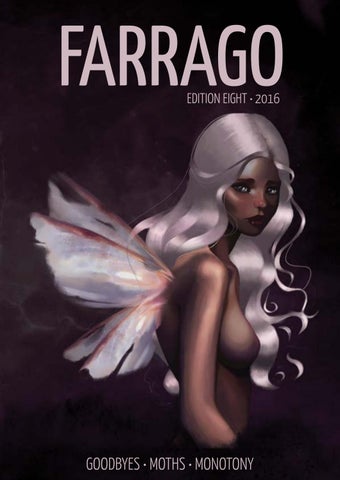
FARRAGO EDITION EIGHT • 2016
GOODBYES • MOTHS • MONOTONY
CONTENTS PAGE 41
PAGE46 PAGE 44
PAGE 23
PAGE 52
PAGE 19 4 • THANK YOU 7 • NEWS IN BRIEF 8 • SURVEYING THE SYSTEM // SOMETHING WICKED... 9 • AN AUCTION ON COLLEGE CRESCENT 10 • MORE! POLITICS 11 • BROUGHT TO YOU BY YOUR SSAF 12 • THE EXPLAINER: A MODERN PROPOSAL 13 • EXPLOSIVE INNOVATION 14 • HASTA LA VISA 15 • OB REPORTS 19 • DATING ADVICE FROM THE BACHELOR(ETTE) 20 • COUNSEL IN COUPLETS 21 • UNDERGRADUALISMS (COMIC) 22 • HAVE DICTIONARY, WILL TRAVEL 23 • SHANGHAI AWAKENING 24 • AUSTRALIARK 26 • THE FEMININE CRITIQUE: DIVERSITY PART 2 29 • PEOPLE NEED HOUSES 30 • FOR & AGAINST: GOODBYES 31 • WHITE NOISE 32 • RIO & EVIE (COMIC) 34 • NINETY-SIX
PAGE 48 35 • ENLISTING & ENCRYPTING 36 • AWAY WITH WORDS 37 • DO OUR BRAINS CREATE CONSCIOUSNESS? 38 • ANTHROPOLOGICAL NOTES ON SUMMONING A DEMON 40 • ONE OF US: CULT REVIEWS – REBOOTS 41 • INSTANT DEATH SYNDROME 44 • R G B (PHOTOGRAPHY) 46 • LAMP // MATCHES // NOTES ON A BLISSFUL BUS RIDE 47 • BUTTON MASHING: MY WAY INTO THE MACHINE 48 • BED TRAIN DESK TRAIN BED 50 • DEATH INDISCRIMINATE OF LADIES OR GENTS • WINDOWSILL 51 • STALEMATE 52 • SIXTH DATE // SWEAT STAINS 53 • ALBINO ALONE 56 • K+M+B 2010 // DEAD MOTHS, WISHFUL THINKING... 57 • ANONYMOUS TILL 59 • NOTES FROM THE WEIRD SIDE: THE NOTES THEMSELVES 60 • PLANS FOR THE FUTURE 61 • HAIRBRUSH 62 • THE DELUGE 64 • FLASH FICTION: CLICHÉ DESTROYER 88 • FLASH FICTION: OUT OF THIS WORLD
FINE PRINT Farrago is the student magazine of the University of Melbourne Student Union (UMSU), produced by the Media Department. Farrago is published by the General Secretary of UMSU, James Bashford. The views expressed herein are not necessarily the views of UMSU, the printers or the editors. Farrago is printed by Printgraphics, care of cool dad Nigel Quirk and the novel Nicholas. All writing and artwork remains the property of the creators. This collection is © Farrago and Farrago reserves the right to republish material in any format.
COVER ART BY TZEYI KOAY
FARRAGO 2016 • EDITION EIGHT • 1
MEDIA COLLECTIVE 2016
James Agathos Bori Ahn Holly Alexander Ayche Allouche Alexandra Alvaro Natalie Amiel Lucy Andrews Remus Ang Raina Angdias Callum Angus Britt Baker Bella Barker Ashley Barnwell Dena Barr Justine Benstead Georgia Bentley Tawney Bevilacqua Belinda Lea Bhatia Tosh Blakley Gabriel Block Cera Brown Luke Burns Edie M Bush Jordyn Butler Aaron Buxton Iryna Byelyayeva Duncan Caillard Louise Cain James Callaghan Raphael Canty Gabrielle Capes Julie Carli Mahalia Carter Carly Cassella Jessica Castro Sue-Ann Chan Kye-Lee Cheong Cara Chiang Stephanie Choo Chih-Yu Chou Ben Clark Ewan Clarke-McIntyre Amy Clements Caroline Clarke Colbran Noni Cole Jessica Comer Wunambi Connor Frances Connors Guy Coward Timothy Cox Gareth Cox-Martin Danielle Crocci Tom Crowley Chelsea Cucinotta
Daniel de Maria Danial De Santos Nicole de Souza Jacob Debets Kate Denver-Stevenson Martin Ditmann Scarlette Do Katie Doherty Cameron Doig Rose Doole Teresa Durham Lynley Eavis Simone Eckardt Billie Egan Oli Ekserdijan Tegan Evans Clare Exinger Adam Joshua Fan Simon Farley Angus Ferguson Gabriel Filippa Nathan Fiorittti Jessica Flatters Darcy Flemming Natalie Fong Hayley Franklin Jack Fryer Tiffany Gibbons Kyra Gillespie Danny Glattstein Tiffany Y Goh Zoë Goodall Lucas Grainger-Brown Amie Green Lucie Greene Sam Grigg Allen Gu Lord Gungl Isabella Rose Hanger Dylan Harris Ilsa Harun Jess Hast Ashleigh Hastings Andy Hazel James Anthony Hazeldine Otis Heffernan-Wooden Sorcha Hennessy James Henshall Rian Henshall Elena Heran Mishell Hernandez Jessica Herne Paloma Herrera Olivia Hides
2 • FARRAGO 2016 • EDITION EIGHT
Will Higginbotham Daniel Hill Brenden Hiskins Taliza Ho Tyan Ho Patrick Hoang Anwyn Hocking Emma Hollis Tyson Holloway-Clarke Marley Holloway-Clarke Morgan Hopcroft Kangli Hu Carolyn Huane Darby Hudson Angus Hughes Sebastian Hughes Lucy Hunter Jasmin Isobe Farah Iyer Venkat Iyer Emily James Candy James-Zoccoli Yasmin Jarkan Annabelle Jarrett Thiashya Jayasekera Emma Jensen Kerry Jiang Lily Jiang Claire Jobling Sarah Julian Audrey Kang Jess Kapuscinski-Evans Peter Karabatsos Eveleen Kay Rose Kennedy Jordan Kettle Angela Keyte Jack Kilbride Nicholas Kirkby Bradley Knight Jack Knight Tzeyi Koay Belinda Lack Jack Langan Monique Langford Kate Lawrence Kim Le Trung Le Dalia Lederberger Marina Lee Sarah So Eun Lee Charlie Lempriere Eliza Lennon Han Li Ken Lim
Sheri Lohardjo Mabel Loui Greta Low Georgie Lowe John Lowe Luke Lu Isabella Shue Vin Luk Yu Yang Luo Cassandra Lutzko Joshua Lynzaat Zoe Lyu James Macaronas Sean Mantesso Imogen Martin Samuel McAuley Eloyse McCall Maddy McCarthy Tegan McCarthy Eleanor McCooey Madison McCormack Callum McDermot Caitlin McGregor Thomas Mcintire Katie McIntyre Bede McKenna Hannah McKittrick Lilly McLean Harry McLean Campbell Mcmullin Doug McNeil Geoffrey Mead Helena Melton Ben Meurs Emma Michelle Claire Miller Pippa Mills Kyaw Min Htin Jennifer Morillas Tiernan Morrison Jack Francis Musgrave Jeremy Nadel Fergus Neal Sam Nelson Barbara Neves Jessie Newhouse-Rayson Clara Ng Alain Nguyen Kexin Ni Steven Nicolas Izu Nizam Mary Ntalianis Cormac O’Brien Kirkby Sam O’Connor Daniel O’Neil Kathleen O’Neill
Monique O’Rafferty Dominic Shi Jie On Darrel Osir Emily Paesler Simone Pakavakis Max Panek-Hudson Sophia Panther Jesse Paris-Jourdan Alanah Parkin Nick Parkinson Evelyn Parsonage Emily Peck Katia Pellicciotta Sarah Peters Elena Piakis Finbar Piper Ed Pitt Lara Porczak Anais Poussin Rebecca Poynton Alessandra Prunotto Signe Ravn Adriane Reardon Kit Richards Stephanie Riordan Bianca Roberts Seth Robinson Jo Rosochodski Frances Rowlands Jacob Sacher Kathy Audrey Sarpi Amelia Saward Danielle Scrimshaw Natalie Seiler Evrim Şen Elizabeth Seychell Fadhil Shaiful Eliza Shallard Raina Shauki Amy Shea Ella Shi Lachy Simpson Christian Slattery Felicity Sleeman Bonnie Smith Allan Smith Morgan-Lee Snell Anokhi Somaia Ellen YG Son Thea Stephenson Reilly Sullivan Sophie Sun Mindi Suter Greer Sutherland
Hania Syed Muni Tam Brendan Tam Alexander TB Hamish Taylor Ellie Taylor Alison Tealby Daena Teng Alexandra Teuben Anna Theris Sonam Thomas Erin Thomas Linus Tolliday Jean Tong Aisha Trambas Alexander Baky Tran Jessica Tran Ethan Tsang Jessica Tsintsi Christian Tsoutsouvas Peter Tzimos Jenny Van Veldhuisen Justin Villar Ben Volchok Jakob von der Lippe Trent Vu Dzenana Vucic Chloe Waddell Duncan Wallace Harriet Wallace-Mead Isabel Wang Caroline Wang Charlotte Ward Xavier Warne Shona Warren Sofie Westcombe Agnes Whalan Simone Williams Erica Williams Lucy Williams Aidan Williams Duncan Willis Laura Wilson Matthew Wojczys Brenna Xiang Jessica Xu Jialin Yang Mohamed Yaqzan Lotus Ye Reimena Yee Yusang Zhu Yan Zhuang Elijah Ziegeler
ARTWORK BY KERRY JIANG
FARRAGO 2016 • EDITION EIGHT • 3
To our Writers, Illustrators, Radio Presenters and Video Creators: Thank you. You make this media machine run like a dream. Thank you for trusting us with your work and for making the Media Office look great. We’re inspired by every piece of writing, artwork, radio show and video you bless us with. We’re so lucky to have been able to work with such talented, motivated and supportive people. We’ve learnt so much from you. To our Campus Reporters and the Executive: Thank you for being the eyes and ears of Farrago this year. You covered everything from student-run productions to the corrupt practices of a multi-million dollar organisation. We hope you’ve been inspired to continue covering the stories that make our student community so unique. To our Subeditors: Thank you for making all of the pieces in the magazine as good as they could be. Thank you for finding misplaced commas, spelling mistakes and for just generally making us look good. We are so grateful for your help handing out magazines, making bunting and taking on whatever odd jobs we had. Thank you for being there when we needed editing done to tight deadlines and when we were crying under our desks. To our Graphic Contributors: Thank you for putting up with our essay-long emails and complicated layout instructions. We are continuously inspired by the beauty and creativity that comes out of your minds. Thank you for making Farrago so goddamn gorgeous. To our Cover Artists: Thank you for the hours you spent creating the perfect front and back covers to encase Farrago and Above Water in – the hours you spent emailing us drafts, working with our relentless requests and sitting in our office playing with Photoshop. We have adored every edition and the uniqueness your artwork brought them. Thank you for creating the eye-catching glimmer that makes people pick up our baby. To our Web Officers: Thank you for wrangling with our shiny new website and thank you for trying to help us sort out all the kinks. We know it was a nightmare. To our Readers: Thank you for picking up this magazine; we couldn’t exist without you. We hope you enjoyed reading about mushrooms, drains, stealing and whatever other weird writing we managed to squeeze in. We hope Farrago has inspired you the way it has inspired us. Please read and write and create things of your own. Get involved next year – submit your work, come to launch parties and take that first shy step towards finding your people. Keep reading Farrago and supporting the students who create it; you are as much a part of this community as anyone.
4 • FARRAGO 2016 • EDITION EIGHT
To Ilsa, Monique and Lachy: Thank you for going above and beyond what your position description required – for sitting in our office making bunting, for being at every single launch party and Wordplay, for spreading the Farrago gospel to more students than ever before. Lachy, your tweets were witty, timely and personal – everything we want Farrago to be. Ilsa, you more than doubled our Instagram followers with your eye for #aesthetics – your dedication and talent has not gone unnoticed and we appreciate all that you do for us. Monique, our office pet, the initiative you took to start Snapchat blew us away while your management of our Facebook saw us hit 6,000 likes – thank you for loving Farrago with all of your heart. We couldn’t have done it without you three. To Doug, Fad and Justin: Thank you for being the dream team, churning out six incredible shorts for Farrago Video and inspiring us with your passion and talent. Your videos went so viral that at one point we were actually frightened. They were a huge part of the reason Farrago’s Facebook page reached a wider audience this year and for that, we could not be more grateful. Good luck with your production company next year, Table For One. To Jack ‘The Middle Name Is Totally Important’ Musgrave: Thank you for being Farrago’s #1 Fanboy/ Goblin. Thank you for always bringing the weird out in us and for your insistence on spelling magick with a ‘ck’. To Ella: Thank you for representing the interests of the Media Collective on Students’ Council and doing so with style. Thank you for drawing us as Simpsons characters and making us an A E S T H E T I C powerpoint of your lipstick collection. You inspire us. To Tzeyi: Thank you for helping us bring Radio Fodder’s marketing aesthetic into its teenage phase. Thank you for your patience when we decided halfway through designing a poster to change everything about it. Thank you for being open to every suggestion and tweak and for understanding every vague gesture. To Edie: Thank you for spending eight hours in our office learning Photoshop skills so you could create the delicate design for our Above Water posters. You are an angel and we are not worthy. To the Autonomous Departments: Thank you for reading through our articles and offering advice for when we weren’t sure – you had our backs and we are very grateful. To Goldie: Thank you for letting us borrow your spray and wipe all the time. Thank you for being our work mum, for listening to us complain, for gossiping with us and for helping us fix the printer. We wouldn’t know what was going on around here if it wasn’t for you.
To Ken: How can we even begin to explain how grateful we are for your existence? Thank you for donating so much of your time and energy to Radio Fodder – it would not have continued to exist without you. Thank you for your patience when teaching us the technical aspects of running a radio station, for helping us create IDs and sweepers, for rushing in to save the day whenever something fucked up and we couldn’t solve it. Thank you for training us, for inducting newbies, for updating the music, for letting us call you with every little problem we had. Thank you for loving Radio Fodder like your own baby, we promise we’re leaving it in good hands. To our Radio Team: Thank you for producing shows, answering presenters’ questions and running our social media. Thank you for making sure the station kept rolling when it began to grow and the schedule became full. To Sonny, Oli, Finbar, Charlie, Farah and Ken, thank you for playing music at the Farmers Market – we loved every song you played and every noise complaint we received. To Brad, you are an angel sent from heaven and were once described as “someone you would take home to meet your mother” – thank you for saving us. To Liv and Jack, we are so grateful to you for giving up your time to do radio training. Thank you for your devotion to Radio Fodder’s behind-the-scenes mess. Without you, we wouldn’t have been able to have as many programmes on the air as we did this year. To AV Melbourne: Thank you for improving our radio station, for loaning us your equipment and helping us each week at the Farmers Market. Since you took over control of the tech side of things, we’ve received zero complaints about the volume of our music. To Nigel & Printgraphics: Thank you for putting up with constant tardiness, our routine freak-outs before print and all the little commas and full stops we want to change when proofs come back. We couldn’t have done it without your patience and wisdom. You’re the best dad. To our Predecessors: Thank you for making us feel welcome when we first got involved with the collective. Your hard work and encouragement meant the world to us. To Lynley, thank you for being our Farrago office mum (and Nonna to the new team). Thank you for the advice, the cuddles, the love and support that you showered not only on us but on every person who came through the door. Thank you for listening to our ranting, for complaining to us and for ruining our whiteboard with a powerful cleaning substance that left it useless. To Seventeam: Thank you to Alex, Amie, James and Mary. The passion you’ve shown for the Media Office throughout this year fills us with joy and hope for next year. We really, really don’t want to go but we know our babies will be safe in your hands. Thank you for putting up with our overbearing suggestions and for your constant willingness to listen. Thank you for loving the office the same way we do.
To our Parents: Thank you for birthing such talented children so that we could run the Media Office so smoothly. Thanks for baking us sweet goods, commenting on our Facebook posts and putting up with the fact that we’ve barely seen or called you all year. We love you. To Misc: Thank you to anyone who has contributed artwork to THE OFFICE WALL installation and to anyone who has said something dumb enough to land a spot on our Quote Board. You guys made our office feel like a home. To our Plants: Nigel Thornberry, Childish Bamboono, Mint Eastwood and Crassula De Ville – thank you for not dying on us this year despite our occasional neglect. To Billy Bob Thornton – sorry you fell out the window. To the tree on South Lawn: Thank you for providing shelter and solace when we were stressed out of our minds during layout weeks. To Don Dons, Hohos, Prontos, Tsubu and New York Minute: Thank you for feeding us and our collective when we stayed late for layout or celebrated the launch of a new edition. We love you and we hate you. #notsponsored To the Rowdy Library: Thank you for loaning us your movies and your beanbags, and for being patient with us when we take too long to return them. Our butts are very grateful. To the Farragomobile: You came to us by accident and have carried the weight of Farrago on your back (literally). Thank you for helping us make distro bearable. Thanks for wearing our little flags with pride. Thank you for always finding your way back to us when other Office Bearers stole you. To Comms: Thank you for organising our ads and the Farmers Market gig. For more thank yous, please refer to the BaseCamp we’ve set up. To the Activities Officers: Thank you for your constant support of Farrago. It’s great to work in an environment where what we do is valued. We will miss your compliments, your respect for what we do and going on adventures with Tobias. To all the other OBs: Thank you for actually being lovely people. To the whiteboard in our office that doesn’t work: Thank you for being the ugliest piece of decor we didn’t ask for. To the butterfly that flew into the moving fan on our first day: You made a surprisingly loud noise and freaked us all out. We’re glad you survived and we hope you’ve gone on to find love.
ARTWORK BY DANIELLE, SEBASTIAN, BAYA AND CALEB. NOW YOU KNOW WHY WE NEVER DO OUR OWN GRAPHICS
FARRAGO 2016 • EDITION EIGHT • 5
EDITORIAL DANIELLE BAGNATO
F
arrago was the first magazine to publish my writing. It’s where I learnt to read and write and become a professional email sender. More than those things though, Farrago taught me what it means to be part of a community. It taught me how to be myself, how to feel confident in my ideas, how to raise my voice and how to learn from others. This magazine has been a way to find other strange, creative, oddballs at this university. We’ve used it to share our voices, to be creative, experimental and weird. Thank you to everyone who submitted work and was on our team this year, you have no idea what your hard work and dedication has meant to me. To Sebastian, Baya and Caleb, I wish I had the right words for how much I love you. Thank you for becoming my family. To Alex, Amie, James and Mary, good luck for next year. You’re a wonderful, strange team and I can’t wait to see what you do. To the readers, if you’re feeling too shy to get involved, know that I was too. Submitting my first piece to Farrago was scary as anything but it led me to a supportive community where I found what I’d been looking for. I’m so grateful to have had this opportunity and so honoured to have been able to work with such beautiful, talented people. I never would have thought that such a small magazine could have such a significant impact on my life.
SEBASTIAN DODDS
W
hen I try to remember the moments that have passed since our first day at the tail end of last year, everything seems very loud and very fast and very, very special. It’s like I’m in the middle of a whirlwind, marvelling at the sheer intensity of the thing. I’ve learnt more this year than I thought there was to know. I’ve met people I’ll never forget and read writing that has left an imprint on my soul. The incredibly talented people who have contributed to making this magazine, to broadcasting on Radio Fodder and to starting up a video platform are constantly awe-inspiring to me. I am so grateful to have had the opportunity to work for this community, to help students find a place to express themselves. To Danielle, Baya and Caleb, thank you. You’re more than I deserve and I’m so lucky to have worked with you this year. I’m so proud of what we’ve achieved together, so glad I got to know you. You three are going to do some fucking amazing things in the future and I can’t wait to be your number one fan. It has been a privilege. I can’t wait to see what next year brings, as Alex, Amie, James and Mary take over and lead us all to new heights. You’re gonna love them just like I do. They’re gonna need your help to make this media machine run, so get to work on your crazy ideas. Get to work on saying the things you need to say. And however you do it, stay creative.
BAYA OU YANG
W
hen I was 15 years old, I started my own magazine alone in my bedroom using a quirky combination of PowerPoint and MS Paint. I used to think that editing magazines for a job would be the greatest thing in the world. As it turns out, I was wrong. Making a magazine has been brilliant, don’t get me wrong. But the actual greatest thing in the world is belonging to a team of people who care just as much about something as you do. Every day I cannot believe the luck of my life that led me to my three co-editors. To D-bags, my literal soul sister: thank you for being the camera lens to my episode of The Office, you kept me sane. To Seabass, the coolest dork I’ve ever met: thank you for your dumb jokes, your me-mes and your beautiful way with words. And to Curly: I’ve never had a brother or a son but somehow you are both – thank you for letting me bully you, I hope one day you let me love you. I know the four of us always joked about doing a blood-pact but I believe there’s enough blood, sweat and tears (mostly from laughing) in our eight editions to pact us for life. There’s a reason I stopped making magazines by myself in my room and I think it’s the same reason you submit to and read Farrago: we don’t want to do any of this alone. Whether you’ve found a life-long friend through the Collective or read something in these pages to help you feel less lonely, I hope the Media Office has given you what you came here looking for. I know that it did for me.
CALEB TRISCARI
I
’ll be honest with you, I didn’t expect my job to include trudging through underground drains, risking the threat of defamation and stuffing yoghurt pouches full of gin down my underwear. I’ll let you figure out which ones were in the name of student media. But then again, I also wasn’t expecting to be trusted to handle the work of such talented and passionate students. To pour your heart and soul into something and then have it put on display for others to judge is a daunting process but I’m glad that each person who contributed did it. My job, if nothing else, has been worth it to witness the excitement which comes with being published – luckily it has been so much more. Danielle, Sebastian and Baya, I wouldn’t have wanted to spend this year with anyone else. Thank you for putting up with my arbitrary rules and incessant passive-aggressive nature. You’ve shown me new ways of looking at the world and I am undoubtedly a better person for having you in my life. If I could cry, I would. I’d also like to give a respectful nod to the University for making my job just that little bit more difficult. You’ve been a worthy opponent, let’s call it a draw. To my children Alex, Amie, James and Mary, it’s been inspiring to see what you can bring to this community. I know you’re going to do great things next year and I’ll be behind you every step of the way. Every copy of Farrago that has been picked up, every listener that has tuned into Radio Fodder, every ‘like’ on a video has made this little chapter of my life unforgettable. Although, I might look back on it with a few more Oxford commas.
6 • FARRAGO 2016 • EDITION EIGHT
PHOTOGRAPHY BY LYNLEY EAVIS
CAMPUS
NEWS IN BRIEF GONSKI GONE?
BIDDING ADIEUSUL
SCA DEAN RESIGNS
News has been circulated that corporate services provider and University of Melbourne subsidiary, Melbourne University Student Union Limited (MUSUL), will be changed drastically. These changes may include cuts to staffing and eventual closure.
Education Minster Simon Birmingham is considering alternate funding models to the Gonski proposals. The Australian Education Union has condemned this course of action.
Following pressure from student activists, the Dean of the Sydney College of the Arts has resigned. Students continue to occupy the college building.
The decision handed down by Finance Committee follows a substantial period of review. UMSU staff and office bearers have repeatedly expressed concern with the operations of MUSUL.
REFUGEE SCHOLARSHIP
The United Nations High Commission for Refugees is calling on universities to provide scholarships for refugees and greater government funding for refugee education programs.
FESTIVAL OF NATIONS
The Festival of Nations, run by UMSU International, was held on 22-23 September. The Festival showcased student talent, food stalls and a range of games.
COLLEGE DROPOUTS
PILL TESTING KITS
MELBOURNE IDEAS
Reports have shown that one in five students dropped out of university within their first year. The University of Melbourne is at the lower end of the scale with 7.5 per cent.
A motion tabled at the University of Melbourne Student Union Students’ Council supported the distribution of pill-testing kits on campus.
The University of Melbourne has launched its ‘Melbourne Ideas’ program. The project aims to directly seek out ideas from students in an online problem-solving environment.
PROPAGANDA MACHINES
Following the recent controversy over Labor Senator Sam Dastyari, Australian universities have been warned against becoming “propaganda machines” for foreign interests.
CROWDFUNDING COURSES A University of Melbourne student has had her education crowdfunded successfully after the risk of being expelled and deported for not paying her fees on time.
ARTWORK BY AMIE GREEN
The motion was put forth by UMSU student councillor Gulsara Kaplun in conjunction with the Students for Sustainable Drug Policy and supported across the board. The motion is expected to be ratified at the next Students’ Council meeting held on 6 October.
UNI #33
The University of Melbourne has retained its place as best university in Australia and #33 in the world according to the Times Higher Education World University Rankings.
QUALITY EDUCATION
The Australian has reported that Australian university students contribute far more to their education in comparison to other OECD countries, but earn far less.
GAYMOND PRIESTLEY
The Raymond Priestley building is being painted rainbow colours to promote the University of Melbourne contingent to the Midsumma Pride March held on Sunday 29 January.
TRIMESTERS The University of New South Wales will be implementing trimesters as of 2019. The University of Melbourne is currently considering the positives and negatives of a trimester calendar.
FREE SPEECH
SAFE SPACES
Baroness Valerie Amos, Director of the School of Oriental and African Studies, recently spoke at the University of Melbourne and called for a greater defence of free speech in academia.
British Prime Minister Theresa May has criticised safe spaces at university, claiming that they prevent debate, harm social development and “constrain innovation of thought”.
WHERE GREAT MINDS COLLIDE REPEATEDLY
An alarming number of severe head injuries have been reported on campus in the past year. When approached by Farrago for more information, victims explained that their actions were inspired by the ‘Collision’ campaign currently undertaken by the University of Melbourne. The University was asked if they’d consider scrapping the ‘where great minds collide’ slogan upon hearing about the injuries. A spokesperson simply put their head in their hands and sighed.
FARRAGO 2016 • EDITION EIGHT • 7
CAMPUS
SURVEYING THE SYSTEM PALOMA HERRERA REPORTS ON UNIVERSITIES TRYING TO IMPROVE SAFETY ON CAMPUS
T
his year all 39 universities in Australia are taking part in the National Sexual Assault on Campus Survey run by the Australian Human Rights Commission (AHRC). The results of the survey will provide an insight into the numbers of sexual assaults occurring on campuses. Results will be compared to the reports of sexual assaults received by universities and the police. The survey includes an open call for anonymous submissions by students who have experienced sexual assault or sexual harassment while at university. Adriana Mells, Women’s Officer at the University of Melbourne Student Union, is positive about the outcome for the survey. “This survey is going to be the first of its kind and its results hope to inform what Universities should be doing better, in terms of reporting procedure and support services for students who have experienced harassment and assault,” she says. The results of the almost $1 million survey will be published online, including accounts by students who have consented to have their submissions published. The University of Melbourne currently has programs running which hope to put an end to assaults on campus. Though the University of Melbourne’s description of sexual consent by the Safer Community Program is simply the legal definition, “free agreement to engage in a sexual act”, the reasons for not having free agreement listed are due to alcohol, fraud or force.
The national survey calls on students to report much broader and common harassment such as “inappropriate staring or leering” and “sexually suggestive comments or jokes that made you feel offended”. Women’s Officer for the National Union of Students Heidi La Paglia is hoping the AHRC survey will provide a clear picture of what the problem looks like in Australia. In a statement she says, “[It] will also provide data on how universities are responding to sexual assault, which will be analysed and used to develop best practice guidelines which we will be able to use to hold universities to account. Once the results are out, universities will no longer be able to provide excuses for why they are not acting on the issue”. A recent report by the National Union of Students found that 53 per cent of abuse victims were targeted on campus, either at a university event or in college with only 5 per cent reporting their harassment or assault to the police or the university. With university services being stretched more than ever, the results of the survey are likely to impact universities’ priority spending, particularly towards counsellors and support services. The survey will also provide a critique of the effectiveness of services at universities and how well current policies are affected.
SOMETHING WICKED THIS WAY COMES CHELSEA CUCINOTTA ON A MODERNISED SCOTTISH PLAY
“A
dark prophecy triggers the rise and fall of an ambitious couple whose wayward moral compass takes them in a deadly direction… What happens when we subvert the natural order of things? Things bad begun make strong themselves by ill. So pr’ythee, come with us.” William Shakespeare’s tragedy Macbeth takes on new meaning with Macbeth + Macdeath: A Coda, directed by Petra Kalive, Artistic Director of Union House Theatre. Having worked previously with Melbourne Theatre Company, Sydney Theatre Company and Red Stitch, Kalive is no stranger to “telling stories and staging theatre that helps understand the social and political realities of today”. Why Macbeth? In addition to the strong female presence in the play, Kalive was drawn to directing Macbeth because of its timeless theme of ambition. “It speaks to the invisible, unfathomable circumstances that make us do things that we never thought ourselves capable.” Its “narrative is tight and the play spirals in on itself until it tragically unravels”, Kalive said. Kalive warns audiences should not expect tradition but “a fresh perspective to a very well known story” with an entire
8 • FARRAGO 2016 • EDITION EIGHT
student cast and live sound throughout. Kalive’s Macbeth will bring a performance that is “stripped back and ensemble based”. It is not set anywhere in particular, making its message even the more universal. Amongst the student cast is Sian Lewis playing Lady Macduff, a character that traditionally has a small part in the play. In this production however, “everyone is important”, and her marriage to Lord Macduff (the Thane of Fife) who is played by a female, adds a modern twist to the play. Working with Union House Theatre “has been an incredibly valuable experience, as there are so many people with a variety of backgrounds, skills and knowledge” said Lewis. Lewis says that this production of Macbeth is “fast-paced and unforgiving. And with the addition of Jean Tong’s coda Macdeath, expect to see Shakespeare in a whole new light”. She adds that audiences should still expect “lots of blood and the exciting world of the supernatural”. Kalive hopes that by the end of this spiralling 90-minute production audiences will be left to “to fill in the gaps” and to question, “why we continue to tell the stories that we tell”.
PHOTOGRAPHY BY BEDE MCKENNA
CAMPUS
AUCTION ON COLLEGE CRESCENT LUCY WILLIAMS REFLECTS ON THE SALE OF WHITLEY COLLEGE
O
n Monday 29 August, the Whitley College community’s biggest fear came true as we received news from the Council that our affectionately nicknamed ‘Donut’ had been sold not to Melbourne University, as we had wished, but to Global Student Accommodation, a for-profit international corporation. The Council communicated via email details of the sale to the community. Notably, that Whitley College “will continue to operate in its current form as a Residential College of the University of Melbourne until the end of 2017”. The Council was pleased that Global Student Accommodation “intends to retain the historic building known as the Donut”. However, given the Council’s track record of ambiguous promises, we as a community are far from pleased. If you’ve walked past our funky exterior, you may know Whitley as ‘that ‘60s jail with palm trees’ or ‘that donut-looking place’. Whitley is by no means the largest, the most prestigious or the most well-known college, but it provides an invaluable community, particularly to rural and international students in need of a supportive base in a new home. Margie Welsford, the College Warden, expressed her disappointment at the Council’s decision, accusing them of having “such little regard for the people who live and work here, the parents who trust their sons and daughters to the care of the college and those who have lived and worked and made their home here during the last 51 years”. The Council’s most recent decision has followed a drawn-out process which started in September 2014 when members of the Council announced at a formal dinner their plans to cease the residential college’s function at the end of 2016. Olivia Stocks, 2015 President of Whitley, explains that they cited poor maintenance of infrastructure and the college “straying from the original vision” as the reasons for this decision. Briana Ellis, former Secretary and senior student, remembers that the Council members only stayed briefly after the dinner. “They did not see the full extent of reactions that occurred following their departure, with ex-residents from a range of years immediately rushing back to the college, joining staff and students to grieve.” Only weeks after this announcement, the Council released another statement informing the community that discussions regarding the closure were in a state of temporary suspension.
PHOTOGRAPHY BY JIALIN YANG
According to Stocks, “It was promised that the Council would meet further and keep the Residential College informed”. However, this promise was not kept. Despite a meeting between the Council and members of several student leadership teams, the community was met with little information on the future of Whitley. Just over a year later, in October 2015, the Council released a third statement, communicating their intent to find a new owner for the college. The Council specified that they were working to “achieve a preferred outcome: attracting a new owner who is intent on preserving the residential facility and giving recognition to its valued status within the community of University residential colleges”. Our community clung to this information and with what now seems naïve enthusiasm, we celebrated this announcement over in Princes Park with glow sticks into the night. Whitley and the Intercollegiate Council circulated a petition addressed to the Vice-Chancellor and Provost of the University of Melbourne, imploring them to take action and prevent Whitley’s closure. Despite the University’s interest, they were not the highest bidder. It seemed that the ‘preferred outcome’, at least for the Council, was based not on the continuation of Whitley as a residential college but rather on what they could get for the Donut. Many students have decided to stay on for the final year, which will balance the likely small numbers of incoming students. As for the staff, our Residential Leadership Team will be looking for new positions and homes, as will our residential tutors. Administration, cleaning, IT and kitchen staff will be out of a job at 2017’s conclusion. The night when we learned that Whitley had been sold also happened to be a 21st, which we always celebrate together. For the birthday boy, Caleb, Whitley has been a family affair. He’s the fourth sibling of his family to attend the college and his sister-inlaw was a former President. As we all cried, intermittently stuffing cake in our mouths, we realised the tremendous impact this place has had on so many people and mourned for the experience that will be denied to future generations. A person’s home is their castle. Its importance might not be understood by the world but that doesn’t matter. What matters is the family inside the castle. And if anyone thinks this family won’t keep fighting, they’re dreaming.
FARRAGO 2016 • EDITION EIGHT • 9
CAMPUS
MORE! POLITICS
JACK LANGAN EXPLAINS WHAT THE HELL HAPPENED IN WEEK SEVEN
F
rom 5-9 September the polls were open, signifying that the University of Melbourne Student Union (UMSU) General Elections for 2016 were taking place. During this week any student currently studying was eligible to run for a position in office and any student currently studying was allowed to vote. The elections are held annually to fill the UMSU Office Bearer positions and multi-member committees such as Students’ Council. All election proceedings are governed by the UMSU Constitution and UMSU Electoral Regulations. Throughout election week 3,540 students voted across polling booths on Parkville, Southbank and Burnley campuses. This represents only 5.5 per cent of students currently enrolled and eligible to vote. It is however a big improvement on last year’s turnout, where only 2,883 students voted. Students had the option of running for a role as an Office Bearer or committee member independently or under an official ticket. This year the two major tickets running were ‘More!’ and ‘Stand Up!’. Overall, More! dominated the election, obtaining all of the Office Bearer positions that they were contesting and claiming 12 of the 19 Office Bearer positions available, including President and General Secretary. Stand Up!, which has historically held a majority of UMSU Office Bearer positions, was driven out to the extent that it claimed none. The Students’ Council is comprised of 15 general positions and 6 representatives of special constituencies. Eight of the spots for general representatives were secured by More!, four by Stand Up!, one by Left Focus, one by Independent Media and one by Activate. In regards to the autonomous representatives, More! claimed all positions except for Indigenous Representative which was secured by The Biggest Blackest Ticket. More!’s resounding success can be attributed to a couple of factors. Firstly, More! had a larger number of student campaigners than Stand Up!. This resulted in them having an extensive reach across the University’s campuses. Secondly, in direct correlation with having more campaigners, More! was able to amass a larger voting base than Stand Up!, resulting in more students voting for More! as election week progressed. One interesting consequence of this Student Union composition is that all actions undertaken will be largely attributed to More!
10 • FARRAGO 2016 • EDITION EIGHT
given their strong presence. This means that all feedback and blame procured over the next year will undoubtedly be shouldered by the More! ticket. Time will tell how the Office Bearers will fare in their positions in 2017. The position of President was won by Yan Zhuang (More!) and General Secretary was won by Yasmine Luu (More!). The presidency was closely contested with 1,253 first preference votes going towards Zhuang and 873 going towards Adriana Mells (Stand Up!). The result was called in Zhuang’s favour late at night on Friday 9 September. “The main goal is to open up the student union to make it more inclusive, with more secondary postitions and volunteer opportunities available for students,” said Zhuang, when asked about her plans as President for next year, “making sure that all students feel like they can get involved if they want to.” Over the course of the election period, conflict arose that required the Returning Officer to hand down two rulings. Rulings are required when a complainant believes a respondent has broken the rules as outlined by the UMSU Electoral Regulations. The first ruling was brought about after a claim was made that More! candidates were using an event where pizza was given out for free to campaign before election week. Inducements are prohibited under the electoral regulations as they may unfairly swing a voter in a camp’s favour. Offering free pizza was seen as a violation of this rule. In response to these allegations, the Returning Officer sanctioned a two-hour campaigning ban on members of the More! camp at the start of election week. The second ruling surrounded controversy regarding the naming of particular tickets. When two tickets share a name that is believed to be too similar to each other, the ticket with prior claim is allowed to hold on to their original name. A complainant under the ticket Smore!, which was registered first, argued that the More! ticket was too similar in name. The Returning Officer quashed this claim, suggesting that the educated electorate would be able to see the difference in the two cases. Despite the results of this year’s elections, it is important to note that if you think there is an aspect of university life the Student Union can improve upon, please feel free to pay the Office Bearers a visit on level one of Union House.
PHOTOGRAPHY BY KATE DENVER-STEVENSON
CAMPUS
BROUGHT TO YOU BY YOUR SSAF JESSE PARIS-JOURDAN BREAKS DOWN WHERE YOUR MONEY IS GOING
T
he University of Melbourne has formally advised the student union about the allocations of the Student Services and Amenities Fee (SSAF) for the years 2017–19. From next year, students and staff at the University will be able to apply directly to receive SSAF funds for suitable projects, under a new flexible component of the funding formula. Ninety-five per cent of core SSAF funding will still go to the same handful of organisations but around five per cent – or $750,000 – will be held as a contingency amount. There will also be a substantial increase in funds granted to the University of Melbourne Student Union (UMSU). Next year, UMSU’s projected SSAF allocations are around $5.8 million. This figure represents an increase of over $600,000 on the projections of the current model. The SSAF is a compulsory fee that the University collects from all students annually. In 2016 the SSAF amounted to $290 for full-time student and $217 for part-time students. The money goes towards a number of student organisations and services. The three big ones are UMSU (which received 36 per cent of SSAF in 2016), Melbourne University Sport (20 per cent) and the Graduate Student Association (15 per cent). The SSAF also funds a number of services provided by the University, including childcare, counselling and career services. The University has collected the fee from students for the last five years, accumulating a significant surplus due to enrolments being consistently higher than estimated. Last year, a huge review of the SSAF found that many students weren’t aware of how the SSAF was allocated or even what it was. UMSU has attempted to address these concerns by using its ‘Brought to you by your SSAF’ logo, championed by the General Secretaries of last year and this year. Postgraduate students – particularly those studying Medicine – have also voiced concerns that they are overlooked by SSAF funds. Because they are off campus for large portions of their degrees, they are often unable to access the services offered by the University and so some consider it unfair that they have to pay the SSAF. Many students at non-Parkville campuses expressed similar concerns in last year’s survey. “The SSAF Consultative Group, which includes representatives from all SSAF-funded bodies, have agreed that there needs to be
GRAPHIC BY TALIZA HO
new goals and principles around the expenditure of the SSAF,” says UMSU President Tyson Holloway-Clarke, who is a member of the group. “We all came to the agreement that we must collectively engage with other campuses more in the delivery of services. This will most likely manifest in strong partnerships with both Faculties and other SSAF-funded groups to try and best meet the needs of non-Parkville students.” Holloway-Clarke says that there needs to be a greater emphasis on the equitable access to SSAF-funded programs. “This includes lower costs for students using sporting and gym facilities, more programs for the growing international and graduate student body and more well-funded targeted programs to support students,” he says. “We are fortunate enough to be able to deliver these programs without having to compromise on our current and ongoing services.” So who can apply to receive SSAF funds next year? Under federal government legislation, all projects funded by the SSAF must fall into one of 19 categories – for example, supporting debating, sports, or artistic activities by students. The full list of categories can be obtained from the website of the Australian Government Department of Education and Training. In the survey last year, the most popular suggestions for additional services included improved cultural facilities, such as tours around the various campuses and creative arts classes. Some also expressed a wish for more social events to help students make friends. Projects that have been developed in partnership with other SSAF recipients and University departments will be particularly encouraged to apply for funding. “SSAF funds support a wide range of important programs and services which enhance students’ experience of University,” explains Elizabeth Capp, Director of Students and Equity. “The University highly values working with students on the allocation of SSAF funds and we look forward to continuing collaboration with our student associations, UMSU and GSA, to get the best possible outcomes for all.”
FARRAGO 2016 • EDITION EIGHT • 11
CAMPUS
A MODERN PROPOSAL F
KYE-LEE CHEONG REPORTS ON THE PROJECTED FUTURE OF STUDENT SERVICES
rom the initial planning stages to turn Union House into a new ‘hub’, a contracted architecture firm has now presented a proposed student precinct area draft, which has designs that are currently being workshopped. The decision to abandon Union House was due to its outdated facilities and location, which limited student collaboration and interaction on campus. The new precinct will aim to be more accessible to students by bringing student activities closer to those studying south of Grattan Street and will accommodate clubs, groups and collectives affiliated with both the University of Melbourne Student Union (UMSU) and the Graduate Student Association (GSA). The Urban Design Framework Draft (UDFD) features suggested plans for the Precinct, with the proposal’s aim being to transform student services from a singular building to a village of buildings. The Proposed Student Precinct Area will consist of buildings within the space of Swanston Street, Grattan Street, Monash Road and Porters Lane. The buildings that will be affected are Sydney Myer Asia Center, John Smyth, 757 Swanston, Alice Hoy, Frank Tate, Lot 6, 1888, Doug McDonell, Building 138, Eastern Resource Centre, with the School of Engineering also a building of consideration. Each building will house a number of different student services with the aim to create a new, vibrant student precinct. UMSU President Tyson Holloway-Clarke confirms that the Precinct will improve accessibility of student services to all and affirms that accommodation of all student services and facilities is a priority of UMSU and the Student Precinct project team. “Services certainly will not be cut but with a new home and facilities, we have the opportunity to merge and improve current services. We want to make the student experience as straightforward as possible and that means potentially bringing together some of the front of house and reception functions.” With earlier concerns regarding the new Precinct involving capacity and confidentiality issues, it appears that the project team has found solutions with the draft, showing no issue with being able to accommodate student services and facilities. From student engagement activities conducted in May, the Project Team identified three major areas that students wanted from the Precinct. “Students want food and retail to be a big part of the Precinct; that there is more demand for informal study and social space than there is available; and that the Precinct should have a focus
12 • FARRAGO 2016 • EDITION EIGHT
on events, activities and opportunities that enable all students to get involved,” said a member of the Project Team. The UDFD demonstrates that these interests have been addressed with an increase in space allocated for food and retail, large areas and facilities being drafted for events and activities, and 24-hour informal study and meeting hub areas being proposed. The general response to the proposal from students around campus is enthusiasm. Second-year Science student, Sherry Du, told Farrago, “There’s definitely an air of excitement for newer facilities and expansion in retail and food as this has been longawaited for. One thing I hope the Precinct aims to maintain is a unified central district, like Union House, where all students feel welcomed. Following this expansion, hopefully the line for Egg will be shorter during the lunchtime frenzy”. There is, however, still a long way to go. Holloway-Clarke warns that at this stage, the proposals are all still hypothetical. “Things are still very much up in the air concerning the precinct. We are currently going back and forth to figure out the best configuration… we are keen to keep our minds open to the possibilities. It has not been easy but I am more confident having been able to go back and forth with the project team.” The next step for the project team is to continue their success with student engagement activities to ensure interest and needs are being met. With the launch of the Student Precinct Co-creation Community, the Project Team hopes to continue collaborating with students through Student Ambassadors, events and discussion forums, which will primarily take place online. Run by industry-leading co-creation experts, The Lab, the Community will be an avenue to further explore how the new student precinct design can better contribute towards creating a ‘vibrant centre’ for the on-campus and University of Melbourne student experience. As the project team is collaborating with both the University community and industry professionals, it appears that the key ideas of what students want and need from the Precinct will continually be addressed and considered throughout the planning stages. From what has been proposed so far in the UDFD, the future of the Student Precinct and the ambitious move to change Union House into a series of buildings looks promising.
PHOTOGRAPHY BY CALEB TRISCARI
CAMPUS
EXPLOSIVE INNOVATION SHERI LOHARDJO EXAMINES UNIMELB’S NEWEST AMERICAN IMPORT
I
n late 2014, the United States Department of Defense put into motion a critical new program: the Defense Innovation Initiative (DII). A memorandum circulated by then Secretary of Defense, Chuck Hagel, described the DII as a series of significant changes to Department operations aimed at maintaining and extending US military superiority. The changes involved plans for the development of new strategies and technologies, including improved weaponry and new techniques for warfare. The DII is driven by the desire to broaden America’s competitive edge over potential opponents. “We are entering an era where American dominance in key warfighting domains is eroding and we must find new and creative ways to sustain, and in some areas expand, our advantages even as we deal with more limited resources… Potential adversaries have been modernising their militaries… This represents a clear and growing challenge to our military power.” Unsurprisingly, the push for military growth has created lucrative opportunities for the government’s defence contractors. Lockheed Martin, its largest contractor, earned $36.2 billion USD through its work with the Department of Defense in 2015. Now furthering its involvement with the DII, Lockheed Martin has plans for a new collaboration with the University of Melbourne. The aerospace and defence giant will be opening a new multi-disciplinary research & development facility on campus by early 2017. The Science Technology Engineering Leadership and Research Laboratory (STELaR Lab) will be Lockheed Martin’s first outside of America. The move “will create premium jobs for science and technology graduates, with STELaR Lab anticipated to grow to over 20 employees within three years,” states the company’s press release. Part of the $13 million AUD investment will also go towards funding scholarships, research projects and internships. Representatives from the University of Melbourne and the Defence Science Institute, who is also involved in the project, have expressed enthusiasm about the collaboration. “The University has made no secret of its desire to both deepen and broaden its engagement with industry to have high impact and work together to solve some of the world’s most challenging problems,” says Professor James McCluskey, the University’s Deputy Vice-Chancellor (Research).
ARTWORK BY ELLEN YG SON
Lockheed Martin Australia’s Chief Executive, Raydon Gates, has echoed this sentiment, saying: “Lockheed Martin technologies and best practice capabilities ensure our local partners can meet the challenges and opportunities of an increasingly changing world.” However, news of the Lab has not been universally wellreceived. Minutes from a University of Melbourne Student Union (UMSU) Students’ Council meeting express disapproval for the University’s relationship with the company. “As an organisation UMSU is constitutionally bound to oppose militarism, for good reason,” writes UMSU President, Tyson Holloway-Clarke, who made a motion to denounce the project. “War and the violence of war are abhorrent and needlessly disrupts the lives of millions.” The concern is that the project will lead to the construction of a new generation of weapons that will be deployed by the U.S. military. UMSU fears that this will make the University complicit in the “death and destruction” caused by a foreign body. Indeed, in August, it was reported in The Age that one of the planned projects of STELaR Lab is to develop software for use in guided attacks. Furthermore, Lockheed Martin has controversially sold F-35 stealth jets to Israel. The University’s relationship with Lockheed Martin (and by association, the U.S. Department of Defense) has thus been interpreted as an expression of support for the underlying principles of the DII. Students’ Council passed the motion at its meeting, which was held on 13 September. Students’ Council called for key actors of the project, including Professor McCluskey and Vice-Chancellor Glyn Davis, to address the concerns raised in the agenda. The Council also requested more clarification on the relationship between the University and Lockheed Martin, encouraging the University to re-examine its ethical standards in research. A representative from the University has responded to the criticism, stating: “The University has research relationships with many international organisations and each of these partnerships are established after a full and considered review of the opportunities and outcomes they provide for the University’s staff and students.” “Universities should be known as a lively space for debate and argument and we’re proud that our students take an active interest in ensuring Melbourne upholds this ideal.”
FARRAGO 2016 • EDITION EIGHT • 13
CAMPUS
HASTA LA VISA PALOMA HERRERA AND THE GOLDEN TICKET
S
ince 1 July, increasing numbers of international students have struggled to have their study visas approved. Over the past 10 years, 500,000 international students have chosen to come to Australia and have made valuable contributions to Australian society and research. Yet in 2016, it has come to the attention of the University of Melbourne that some prospective international engineering and Science PhD students have been refused visas to study in Australia. As well as this, the new Simplified Student Visa Framework (SSVF) has caused delays for students currently undertaking foundation and pathway courses. Carefully selected research topics chosen by prospective international students seeking to study at post graduate levels in Australia have recently been rejected. The belief is that some research topics, primarily from the engineering and science faculties, are too closely related to weapons of mass destruction. Having made the Indian press as well as Australian media, the prospective supervisors have appealed on behalf of their students. These cases are currently being brought to the attention of the Federal Government by the Go8 (Group of Eight), the representative body of the top eight universities in Australia. For other students currently applying for student visas, there are expected to be greater delays due to the new Simplified
14 • FARRAGO 2016 • EDITION EIGHT
Student Visa Process. This follows the Federal Government’s replacement of the complex assessment level student visa framework. The primary change introduced by SSVF is reducing the visa sub-classes from eight to two and introducing a simplified single immigration risk framework for all international students. According to the Department of Immigration and Border Protection’s website, the changes have been implemented in order to make the framework easier to navigate and “deliver a more targeted approach to immigration integrity”. For current students, these improvements are untimely. Students undertaking or completing foundation programs are experiencing uncertainty as they wait for the backlog of applications to be addressed. Pathway programs such as Trinity and English language commencement dates may be pushed back. Over recent weeks, the Department of Immigration and Border Protection has processed a significant number of visas and it is hoped that this will continue. Deputy Provost and Deputy Vice-Chancellor International, Susan Elliot has said, “We are working very actively with the peak bodies as we believe this route is the one most likely to be effective in the shortest period of time. Government representatives have been responsive and we have good reason to believe that these issues are being addressed”.
UMSU
PRESIDENT
TYSON HOLLOWAY-CLARKE As the semester comes to a close we still have a great deal to look forward to. We have already started preparations and plans for next year! We have some grand plans for O Week next year that we can’t talk about yet but stay tuned! In the same vein we have been hard at work looking toward the future of a rapidly expanding UMSU and preparing to induct next year’s representatives. As this will be my last report I’d just like to finish with a thanks. Thanks to all the amazing staff at UMSU for your tireless work behind the scenes to keep us afloat. Thanks to all the representatives that have trusted me when the chips were down to pull us all through the year. Thanks especially to our General Secretary James Bashford for holding down the fort and going above and beyond in your role and as a friend. Best wishes to the team for 2017, UMSU’s future is in your hands.
GENERAL SECRETARY
ACTIVITIES
BURNLEY
JAMES BASHFORD I’m coming to the end of two years as an UMSU OB and I’m freaking out. UMSU has basically been my life for the past two years, now what am I supposed to do? Probably actually graduating would be a good first step... It’s been a fab two years as Gen Sec and Welfare Officer before that, from starting up a foodbank to all the early starts for the free breakfast and the constitutional changes this year. Most of all it’s been the greatest privilege to work alongside some amazing people who’ve made all the other bullshit worth it. Special thanks to our OB lord and saviour, Goldie, office glue, Tyson, heart of UMSU, Adriana, the amazing Stand Up! Team: Akira, Sarah & Dom & Hana, Allie, Shanley, Declan & Kara for getting me here. I’d write more about my Gen Sec work but Farrago cuts off our reports at
MEGAN POLLOCK & ITSI WEINSTOCK
ERANTHOS BERETTA
CLUBS & SOCIETIES
Hello dedicated readers. Unfortunately, this will be the last time we’ll be appearing in this wonderful magazine. We’ve loved our time and we hope you have too. It has been such a pleasure, no an honour, to be given the task of running Farrago. We can hardly believe how the time has flown by. Eight amazing magazines, and us blessed to be labelled as their creators. We’d like to extend a warm thank you to all our amazing sub-editors and contributors. Your reporting has been insightful, your poetry beautiful, your stories warming and your art illuminating. We are so sad to be leaving this position, but we’re sure that next year’s officers, Jacinta and Lydia, will do an excellent job of editing Farrago. Valete, sweet readers. Valete.
Trying to (re)build student representation for an entire campus, both on our satellite botanic island and at the mothership that is Parkville, while being a great challenge, is entirely rewarding. Even facing some of our hardest battles and biggest cuts to our campus, we have had greater student involvement than in any previous years and I am sincerely proud of what the Burnley Student Association has achieved. Plus, we are totally chuffed to announce current BSA committee member Jessica Peeler has been elected the new campus coordinator! So while I am sad to be leaving this incredible campus, I have a whole lot of confidence it is going on to bigger and better things. Congratulations Jess! I don’t know if you heard it on the grape vine but after our fruitful winery and viticulture tour last month we will be finishing off the year with a four day trip to Wilson’s Prom with overnight hikes, tent times and general bushland immersion. So with my last words to the UoM empire; you haven’t made it easy but it’s been real, don’t get too caught up in your #parkvilleprivilege and remember: there’s life beyond the world uni rankings. Adieu.
RYAN DAVEY & YASMINE LUU AND THE AWARD FOR BEST OB REPORT IN A FARRAGO GOES TO… CLUBS & SOCIETIES! You love us! You really love us! But in all seriousness, we had our first ever Clubs & Societies Awards Night, and although we had our doubts and fears it wouldn’t be a good night, it turned out amazing. Clubs from across the category spectrum were in Grand Buffet Hall listening to the crazy stories that had developed this year and all the hard work clubs put in. We look forward to seeing its continued success in the upcoming years. Speaking of the future, we’d love to welcome Kayley and Gulsara to the Clubs Department! They will be taking over for 2017 and have some great ideas! It’s been a great year for C&S and we are so proud to see what our amazing clubs have achieved. Thanks for everything Clubsters! xoxo Gossip Gunter.
FARRAGO 2016 • EDITION EIGHT • 15
CREATIVE ARTS JOSH LYNZAAT & JEAN TONG
“Legacy. What is a legacy? It’s planting seeds in a garden you never get to see,” or so we thought. After years of commitment to accessibility, we’ve seen one of our most inclusive years ever. We’ve had: a curated season of public art works; Tastings; Above Water; four Auslan-interpreted events; the resurrection of the Creative Arts Collective; a radio show (thank you Harriet & Guy!); Life + Botanic Drawing; five audio described events, five tactile tours; the inaugural Melbourne Uni Film Festival (MUFFest) (thank you Hayley, Kim & Sara!); a public blackboard; Talking Out of Your Arts; three captioned events, and two relaxed performances; Ensemble Assembly; and $10,000 worth of arts grants distributed. We’re looking forward to Harriet + Sara taking over our department for what we’re sure will be an extravaganza of brilliant, inclusive, accessible art in #Mudfest2017. Look out, world: art’s for everyone and it’s coming for you.
DISABILITIES JESS KAPUSCINSKI-EVANS & CHRISTIAN TSOUTSOUVAS
No report was submitted so take this space to write Jess and Christian a goodbye!
EDU (ACADEMIC) TOM CROWLEY & PAUL SAKKAL What a big year it’s been in Education (Academic) Affairs!!! Whether it be incessantly pestering those stubborn lecturers who refuse to record their drivel or fighting hammer and tong the introduction of the Big Brother-esque Cadmus technology, we’ve been out there fighting the good fight to ensure your navigation of the University’s academic terrain is as smooth and enjoyable as possible. The FlexAp could pose massive changes to the way our Uni works and rest assured this Department has its backside firmly placed on a seat in the all of the rooms where big decisions are being made; there are now student members on all University committees and working groups, including all of the FlexAp workstreams. We’ve been keeping the bastards honest and it’s been a pleasure doing so.
EDU (PUBLIC)
AKIRA BOARDMAN & DOMINIC CERNAZ Wow! What a fantastic year it’s been. But the year isn’t over and we are continuing to push for a better education standard with the Keep the Quality campaign. If you haven’t yet, check out Keep the Quality on Facebook. We want to keep people informed about what the University has planned. Additionally we keep pushing for better worker’s rights, working with key groups to ensure wide engagement with our campaign. If you haven’t picked up one of the orange Working While Studying booklets do it! There’s heaps of important information. To finish, we’d like to say we’ve had a fantastic time in the role as Education Public officers. We’ve continued to fight for an accessible education system, combatting government attacks and the University administration as they attempt to devalue degrees. We’ve had such a great time fighting for student’s rights on campus and will continue our work.
ENVIRONMENT ANISA ROGERS & ZACHARY POWER
The Sustainability Plan is now is due to be passed through Chancellery Executive on 11 October, so stay tuned to see if it is passed this first level of approval. Fossil Free MU will be holding a morning tea of that Tuesday to discuss where to from here depending on the result, so make sure you are there! The bike co-op is getting more popular as the sun comes out and our Tuesday morning free breakfast with the mechanic is very popular. The space is also open on other days so come by and say hi and learn to fix up your bike! Enviro Docos are going great, check out this week’s Another Country. And finally it’s been a great year and I would like to welcome Lizzie and Kate to the office!
16 • FARRAGO 2016 • EDITION EIGHT
UMSU
INDIGENOUS
QUEER
EMILY KAYTE JAMES & WUNAMBI CONNOR This year the Indigenous Department has seen plenty of change. Firstly, a change of Office Bearers, with Wunambi joining Emily following the election of Tyson as president. Next, the changes to Under Bunjil, including a design update thanks to our newest editors, Serena, our soon to be Head Editor, and Hope who joined for the upcoming edition. Additionally, the changes for the Indigenous University Games ensured that the largest team ever from Melbourne Uni competed in Brisbane. With the academic year almost complete we are starting to celebrate the collective achievements which you can do with us at the Under Bunjil launch party and the Murrup Barak gala night (see our social media for more details). Lastly, while it is sad that Emily is leaving the team we are very proud to have Marley taking on the role to continue the work we have achieved in the Indigenous Department this year. Find us on Facebook and Instagram @UMSU_Indigenous.
FRANCES CONNORS & LOTUS YE Hello! I’m sure it’s been a busy year for all of us. We hope you all had a bangin’ time at Pride Ball and aren’t panicking too much as the semester draws to a close. In these stressful times remember you are welcome to come to Queer Lunch and other events for free food and relaxation in the Queer Space! Frances and Lotus will now be moving on; Frances on her quest to pet the dog that was in The Room and Lotus to fulfil their dream of becoming a swamp hag slash cryptid and terrifying locals. However, we have left you in capable hands: we are proud to present Evelyn Lesh and Blake Atmaja as next year’s Queer Officers. We both know they will do an amazing job and wish them and the Queer Department bountiful prosperity for years to come.
VCA VAN RUDD It was great to be involved with the small but punchy pro-marriage equality activists on Wednesday, 14 September at the State Library – a rally called by the National Union of Students. After great speeches, we all marched around the block in the CBD, demanding marriage equality immediately be passed in parliament. “What do we want? Marriage equality. When do we want it? Yesterday!” was one of our catchy chants. We’ll keep VCA students in the loop for the next protest. The next major event to happen at the VCA will be the Spoken Word event planned for 18 October. We’ll be postering for that one soon and spreading the message on social media.
WELFARE
SARAH XIA & YAN ZHUANG It has been an immense privilege serving as your Welfare Officers for 2016! Our free breakfasts have been a big hit this year and Sarah will be ordering extra food for our last BBQ on Thursday 20 October. Sarah has been hosting the Anti-Racism Workshops with the UMSU Women’s Department on Tuesday nights and the last workshop will be held on 11 October at 5:30pm. The People of Colour Collective will be holding a Big Hero 6 film screening in Week 12. This is one of the last events that Sarah and the collective are organising ahead of the new People of Colour Department next year and we encourage all students to come along! Sarah is also organising free study packs for SWOTvac, so keep an eye out. Thank you for such a great year in UMSU Welfare, it’s been lovely!
WOMEN’S
ADRIANA MELLS Get excited because Judy’s Punch 2016 is coming out this week! Be sure to pick up a copy in the Women’s Room. A massive thankyou to the wonderful Amie Green and the Judy’s Punch collective for their hard work and enthusiasm. The work for safety on campus continues, with the sexual assault information guides to be released soon and distributed on all University of Melbourne campuses. This is my final OB report back for 2016 and I would love to thank all the wonderful people from the Women’s Department who I had the absolute pleasure of meeting over the past four years, it’s been an honour to be Women’s officer this year. Good luck to Hannah and Anju as they take on the Department in 2017. The Women’s Room is an incredibly special place and I hope that the Department continues to grow. See you all in the Women’s Room!
FARRAGO 2016 • EDITION EIGHT • 17
COMMENTARY
DATING ADVICE FROM THE BACHELOR(ETTE) ILSA HARUN AND MONIQUE O’RAFFERTY (MONILSA) ARE SOULMATES AND WILL HELP YOU FIND YOURS
W
inter is over. It’s time to shave your legs (or face), put away the onesie and venture outside into the dating pool. The arrival of spring marks the blossoming of new relationship opportunities and we are here to help you narrow down all of the potential Bachelors and Bachelorettes in your life. Here are a few tips and tricks to guide you along the way, with a little help from Chris Harrison and Osher Günsberg. Always make a good first impression, based on looks. Whether you walk out of a limo, a helicopter or on a horse to meet the future #loveofyourlife, first impressions are crucial. Potential suitors are likely to meet 20 or so other tributes in a night, so don’t be afraid to do something different. Sparkly dresses or heartfelt serenades accompanied by an acoustic guitar are perfect for this. So are red lips – but this could get messy since kisses on the first date are a must (see Always kiss on a first date). If all else fails, use awkward puns and forced laughter, although this technique is highly overused. Always kiss on a first date. Your potential significant other is currently hooking up with multiple other suitors. You need to step it up and slip it in – your tongue, of course. A passionate make-out sesh after a successful date isn’t just nice, it’s essential if you want your relationship to have a long, romantic future. If you want it to go really well, light some candles, hire a small orchestra, draw them a chocolate bath and get messy. Always keep your options open and have a backup (or 12). Whoever says less is more is wrong. You wouldn’t limit yourself to one type of pizza for the rest of your life, so why limit yourself to one partner? Once you get to know them all, mostly sexually, eliminate your options. One by one. Publicly. Pitting your suitors against each other is fun too. How else will you know who is willing to embarrass themselves the most for your affection? Get someone else to plan all of your dates (but make sure you take credit for it). Elaborate dates are essential. You need to wow your significant other(s) every time you spend time together because sometimes personality just isn’t enough. Hot air balloons are optional. Helicopters and hot tubs are essential. Maybe start off the date by conquering your biggest fear together. Start by scaling a building
ARTWORK BY LUCY HUNTER
and end the night by renting out a stadium, filling it with rose petals and professing your feelings through a poem. What could go wrong? Always act like someone is watching, because they probably are. Make sure every moment is as dramatic and drawn out as possible. You want your date to be sitting on the edge of their seat the entire time. Slip in a quick ad break just before you lean in for a kiss. Make every moment as Instagrammable and Snapchattable as possible because if it wasn’t on social media, did it really happen? Don’t forget to keep an eye out for cameras in the bushes and strategically placed ring lights. If they don’t get you flowers, specifically roses, you’re probably getting dumped. Material gifts are very important for showing love and affection, with roses being no exception. Traditionally, a red rose is a symbol of endless dedication and undying love. Therefore, they must present you with at least one red rose after every date in order to keep your constant attention and affection. If you don’t receive a rose, don’t bother seeing them again. Always use protection. You never know how many other people they are sleeping with. Or in some cases, you do. It is very likely that they are hooking up with multiple people at once. On the same day. Right after you. No matter how many times they say it’s only you, it’s not. Therefore the appropriate contraceptive and STI preventatives are essential. Otherwise you might be catching more than feelings and spending your next date at the doctor’s office. Never tell someone you love them until you’re engaged. Hook up all you want but never ever ever reveal your true feelings for them unless you are sure you are going to get married. Saving the big ‘I love you’ is essential. And when you do get engaged, make sure it’s at the beach, on live television. The stakes are high so turn on the water works and make sure you find the biggest, sparkliest ring possible. How else will the person you’ve been dating for two months know you love them? The good news is that at the end of all of this, you may find the love of your life. And if not, there’s always next season.
FARRAGO 2016 • EDITION EIGHT • 19
COLUMN NICK PARKINSON PRESENTS
COUNSEL IN COUPLETS A COLUMN OF POETIC PROBLEM-SOLVING
FROM: H GRANGER Dear Nick, I’m leaving my boyfriend to go on exchange. We’ve been dating for three months but really like each other. What the hell do I do? So the other day I was reminiscing about all things romo, Which called to mind the lyrics of Nelly Furtado. “Flames to dust, lovers to friends. Why do all good things come to an end?” It sounds like you’re having your Furtado moment, It’s a common problem, a wary lament. In my eyes you have three options and the third is the best, But for argument’s sake, I’ll outline the rest. First: stay together. Long-distance can work, Though the miles between may make you a jerk. Will you be happy with him back home? Can Skype maintain the feelings you’ve grown? Is Facebook chat enough to compensate for physicality? I can’t imagine so: that’s the harsh reality. You don’t want to be travelling with guilty chains, Testing the boundaries as your relationship strains. Which brings me to your second choice, One I doubt will give cause for rejoice. You could keep it casual while you’re away. Uncommitted and free: come what may. Dalliance with others, enjoy your time liberally – If you can swallow the guilt that bubbles up viciously. After all, it’s unfair on him: he’s at home bored, While you’re making friends and memories abroad. Jealousy means open relationships rarely thrive, Do you have the trust required for your love to survive? So, sadly, we arrive at option three: I wish there were another way it could be. You’ll have to break-up; it’s the smart thing to do. Unless you see a future with options one or two. Remember, you can always get back together. Be like JB: “Never Say Never”. If it’s meant to be, it’s meant to be. And if things don’t rekindle, it’s cause you’re happy. If he’s moved on, it means he likes them more, Which is important to know: you’re not what he’s looking for. If things are the same, then good, start anew, Knowing you’ve enjoyed your exchange and fulfilled a dream too! So maybe I’ve been too harsh in the way I’ve put things, And maybe this bluntness bites with bitter stings. But I think you need this realness to enjoy your remaining time, And look forward to your trip with a plan-of-action in mind. Exchange will be amazing: you’re gonna love it a lot, But such experiences mean you must leave what you’ve got. It’s when we step out of our comfort zones that we discover what’s essential. For you, this means knowing if they have long-term potential. So embrace the trip to come, Do what needs to be done. Assess your choices (I would take the third), Communicate: say what needs to be heard. And, once you’ve cleared things up with the beau, You can shelve that CD by Nelly Furtado.
20 • FARRAGO 2016 • EDITION EIGHT
ARTWORK BY LUCY HUNTER
COLUMN
COMIC BY XAVIER WARNE
FARRAGO 2016 • EDITION EIGHT • 21
COMMENTARY
HAVE DICTIONARY, WILL TRAVEL TIMOTHY COX MAKES THE MOST OF HIS EXCHANGE EXPERIENCE
I
f you’re in need of an escape from the familiarity of Melbourne and your regular university routine, there are few greater undertakings than an international exchange program. Having recently returned from a year-long stint in Tokyo myself, I can confirm that across the sea you are treated differently, the food is often unappealing and your bed is alien. However, this is all to be expected. It is another thing entirely for your language to lose its meaning and your personality to require adjustment. For those of you intending to study abroad in the future, I’d like to illustrate and advise on a few of the less-discussed hurdles of living and speaking away from home, as well as the precious triumphs provided by such a leap into the unknown. The inability to communicate will bring about a great deal of frustration. Your speech is your identity, after all. Displaying any emotion other than confusion is near-impossible when you’re scavenging your brain for a simple noun or verb. Conversations just don’t flow. They stop and start, stop and start; stutter here, stumble there. There are no textbook exercises; answer sheets and indexes won’t come to your aid. Even the most mundane interactions are tests of interpretation and endurance for both parties, but you’re additionally burdened by a faulty internal dictionary. There were so many times I wanted to argue but couldn’t! If you can’t properly express yourself, be it due to a lack of language ability, nerves or simply different cultural norms, your identity will take a beating. You’ve got to be open to criticism, to patronisation, to mocking and failure. On one day I proudly announced to a fellow dormitory resident that I was cooking a ‘pervert,’ mistaking it for the very similar word for ‘chicken.’ These mistakes are frequent and will leave you red in the face, but embarrassment is a good teacher. You won’t make the same mistake twice. As an outsider, you will effectively have the communicative ability of a small child. However, there is an upside: you also have a child’s malleability and power of absorption. Talk to locals about the weather, about coffee, about sports or about television; it doesn’t matter. You can’t be afraid of seeming foolish or boring. Don’t fret about being uninteresting – fortune favours the bold. Actually using a language in real conversations is the best way to improve. Enrol in university classes that you personally find interesting, relevance to career path be damned! Punching slightly above your weight academically is a sure-fire way to improve
22 • FARRAGO 2016 • EDITION EIGHT
language comprehension and enjoying the course content will ensure things stick. Following these recommendations will ensure improvement, but when all’s said and done – despite perhaps having recalled the vocabulary, conquered the syntax and perfected pronunciation – things do still go wrong. Cultural differences will steer your ship of success off course. I once tried to start a conversation by jokingly calling a mutual associate “a little strange”. All in good fun of course, as Australians are to do. My conversation partner laughed awkwardly and was conspicuously uncomfortable, despite my considering the criticism harmless. Politeness was prudent and I’d broken an unspoken rule. You will live and learn in this fashion, adjusting your social parameters accordingly. With privacy being less of a priority where I stayed, conversations in the shared showers were commonplace. I was quizzed on my home country and university frequently in that odd collective meeting place – small talk indeed. It is both tactful and of your own academic benefit to accommodate these strange situations by keeping your head (and eyes) up and soldiering on. Practice is practice. You won’t always be comfortable and won’t always feel in control. I regrettably elected for an accommodation overseen by a ‘dorm mother.’ The dormitory was installed with security cameras, and Big Mother was indeed watching. These frustrations, foreseen or otherwise, can be curbed by building a strong rapport with your neighbours. Nearby friends are indispensable aids for linguistic and moral support; they share in your humiliations and help dissipate your stress. Setting aside your own personal time and having an outlet, whatever that may be, is also a necessity. Ultimately, an exchange program is about independence and growth. There isn’t any handholding. Dive into the deep end without a second thought but have a support network to prevent you from drowning. Maximise your experience by interacting with as many people as possible. You will create invaluable friendships with people from all corners of the Earth. This gives you perspective and modesty (not to mention the benefit of having contacts in other countries). Inevitably there will be unforeseen frustrations. The pitfalls are plentiful and the mistakes will be many. Oh, but the victories – the victories provide a sense of accomplishment unrivalled by any exam score. It isn’t all fun but the end is worth the labour.
ARTWORK BY JAMES CALLAGHAN
COMMENTARY
SHANGHAI AWAKENING MISHELL HERNANDEZ FINDS HOME WHEREVER SHE IS
T
he putrid smell of trash met my nostrils when my mate and I arrived at the entrance of the alleyway in the middle of the night. Both tired from the flight and with no Chinese to speak of, we somehow arrived at our accommodation after a brief panic about where the hostel actually was. Luckily all we had to do was walk down the alleyway with our noisy suitcases clacking over the cobblestones until we saw the one out-of-place lit doorway leading into the cosy hostel. After putting our stuff away, we walked to the nearest Family Mart for smokes. Beat from the flight, we sat outside taking in the humid and polluted Shanghai air while further polluting our lungs. My banana yoghurt drink did not suit the taste of nicotine. I looked around and thought, Damn, I’m in China. Shanghai was never a travel destination for me. I’d heard stories from friends who travelled there to holiday, or study, or both even while I was still in DC and it simply never quite sparked an interest. This time, however, it was a no-brainer – I could do an intensive course with 10 of my mates while also getting a minivacation out of it. I was lucky to bump into my friend at the airport, ensuring I would have some company when I arrived in the unfamiliar country. Yep, as an American among mostly Aussie students I became an honorary Australian almost instantly. I was unbothered, since my identity is often debated anyway. Mexican, Mongolian, American – oh what the heck, I’m Aussie too. The name gave me comfort as I slathered Vegemite onto my toast in the mornings before class. We didn’t stay at the hostel, of course. The next day we met the rest of the gang at the actual hotel we were all staying at, near Fudan University. From the 11th floor or so, I had a decent view of the Wujiaochang side of town. The smog was incredible. I wished someone had told me that my coughing would get worse and that I wouldn’t see blue sky for days. Ah, blue skies. Looking into grey, I longed for the deep mesmerising blue that is the Mongolian sky. His text message interrupted the thought. "Did you get to Shanghai okay?" he asked. I hesitated. Anxiety slowly rose the way it does when I feel forced to do something I don’t want to do – in this case, reply. But I did. We’d never married but it sure felt like a divorce. It’d been months since we split and about a year or two since the relationship was broken, and the more time I spent away from him the more I realised all the ways we had held each other back – or that he held me back, at least. In the larger scheme of things, we weren’t together for long, a thought that comforted me on the bad days. But it was the longest either of us were with anyone – a necessary pain. Be careful who you get attached to. Shit, five years. I told him it might be a good idea if we don’t stay in touch for the rest of my time in Shanghai. He was hurt but it’s not like we stayed in touch back home anyway. I just didn’t see the point.
ARTWORK BY ANWYN HOCKING
The jigsaw puzzle of a city shunned me and yet beckoned me. It was exciting at first but melancholy began to catch up to me on about the sixth day. I blamed the heat. I was becoming Meursault, looking for my Arab under the sun. Between classes, Snow Flake beers and cigarette breaks with White friends, my frustration enabled me to open up to the gentle indifference of the world. I couldn’t decide if I was in an anxious dream, if I was a bug or if this was my heaven. I was comfortable and content with my academic opportunities, but petty and nauseatingly self-centred.
“As an American among mostly Aussie students I became an honorary Australian almost instantly. I was unbothered, since my identity is often debated anyway. Mexican, Mongolian, American – oh what the heck, I’m Aussie too.” Perhaps it was the city or perhaps it was the sun but I did eventually meet my Arab. I didn’t mean to but God has a strange sense of humour. The Arab and I became friends almost too quickly. I didn't withdraw though, as I have always liked the challenge of quick thinkers. I noted his pitch, tone, accent. With eyes that punctured the undercurrent, he spoke with intensity but then would let out a child-like laughter. He was a curious creature. And he had a way of smoking his cigarettes rather elegantly, with swift motions of the wrist and seemingly nimble fingers. Riding on the back of his scooter, I watched the silent streets zoom by. His dark brown curls tickled my face. He too was a gypsy. We attract who we are, I suppose. The afternoon back to Melbourne was lonely. Airports always fill me with a mixture of salty tears and guilty joy, plus I understood all too well the crossroads I was presented with. No longer a child, the decision was all mine. But the nagging thought that we forever become responsible for what we tame reminded me of the unfinished business back home: papers to write, bills to pay, a life to re-strategise, reality to confront. Innocence was stolen from me long ago and our youth never belongs to us, but I suspect that the bulk of adulthood is to find our way back to what is essential. "God-willing, mijita," my abuelita always says. Up in the sky, watching the sun rise, I missed her. I told her nieta that, God-willing, I would find for her what is essential. A still-wintery Melbourne welcomed me back with open arms.
FARRAGO 2016 • EDITION EIGHT • 23
COMMENTARY
AUSTRALIARK GARETH COX-MARTINON AUSTRALIA’S UNTAPPED POTENTIAL
S
ir Richard Attenborough died a few years ago. I, like many others at the time, saw a headline with the words “Attenborough” and “dead” in the same sentence and had a brief meltdown. I soon realised that it wasn’t my boy, Dave, who had passed, but rather his nobody older brother – not soon enough to stop myself from posting a heartfelt obituary on social media, sadly. That was an embarrassing time for me. Anyway, the point is that I love David Attenborough, and he turned ninety this year, and he has a pacemaker, and I’m worried about him. I’m sure the BBC shares my concerns and has him safely stored away in a hyperbaric chamber somewhere, in a deep state of suspended animation, being drip-fed a cocktail of stem cells and virgins’ blood to make sure he’s spry and ready for the next expedition to the Congo Basin. Still, he’s pretty fucking old, so we should probably expect him to focus more heavily on plants and insects as part of a series called The Life Of Things That Fit In The Studio Greenhouse (Because Dave Is Too Old To Chase Gorillas Around The Congo). This is bad news for all of the people like me, for whom it is imperative to receive regular updates on wildlife antics in the form of a well-made documentary presented by an erudite old Brit. With the great man on the wane, the inevitable cadre of vultures and jackals has formed, circling at a safe distance, but near enough to catch his scent – the smell of sweet, sweet opportunity (and stale pee). BBC’s chief rival, ITV, has been tentatively offering up the actor Martin ‘Johnny-come-lately’ Clunes (who kind of looks like a younger Attenborough but with the lips of Mick Jagger) as the new go-to guy for animal documentaries. Yeah, thanks but no thanks, Clunesie; we love Attenborough because he is a naturalist/broadcaster/father-figure – in that exact order – and not some kind of a washed-up actor/washed-up comedian/failed musician/Oh-by-the-way-I-like-animals guy. No, there is only one viable claimant for the succession and that’s Jane Goodall. But she’s nearly as ancient as Dave and if we’re being honest, kind of a one-trick pony due to her
24 • FARRAGO 2016 • EDITION EIGHT
pathological bias in favour of chimps. You’re not an honorary chimpanzee, Jane, get over it. So it looks like it’s goodbye to quality nature documentaries and hello to more garbage tossed out by hacks and sleazeballs, such as National Geographic. Ah, NatGeo. Only an organisation that roundly despises animals would produce so many documentaries themed, ‘When X goes wrong’: When Sharks Go Wrong; When Lions Go Wrong; When Snakes Fuck Up; When Birds Shit On Your Car; When Lizards Give You The Creeps; Colony Collapse: When Lazy Entitled Millennial Bees Don’t Know The Meaning Of A Hard Day’s Work. Given how much care and attention goes into their famously excellent magazine, one would think they were all about quality over quantity. I guess having launched their own cable network, they realised that their viewership is mainly housebound depressives and chronic insomniacs – an almost captive audience. When the standard of your programming menu need only be high enough to keep existential angst off the table, it would just be showing off in poor taste to serve something more than tawdry pabulum. But I digress. What’s clear is that we’re about to enter a time of scarcity in terms of quality animal shows. This tragedy is only compounded by the scarcity of quality animals available to be filmed. Indeed, by the time we manage to find a suitable Attenborough replacement, all of the good ones might be dead. I don’t want to play the blame game here but as an Australian I can’t help but think that this is everybody else’s fault. We have been outstanding stewards of our local fauna. Sure, occasionally you’ll hear some grumbling from a burrow, the odd squeak of dissent coming from the forest underbrush concerning the omnicidal habits of feral cats and foxes. But look at the great work we’ve done with kangaroos – you can drive all around this country and run into so many of them that you barely have time to wipe the blood from your windscreen! Meanwhile, the Western Black Rhinoceros went extinct this year on Africa’s watch and that’s just not good enough. Looking elsewhere – and I don’t know who exactly the Arctic belongs to, so I’ll just blame Canada – the Polar Bear debacle shows that there is a real lack of leadership on making sure they have enough ice. And how on earth did China let the Panda situation get so out of hand(a)? Yes, I know that their bamboo myopia is frustrating. But I’ll see your picky prick of a panda and raise you an unreasonable,
COMMENTARY
fussy-eating, chlamydia-having, sleeps-22-hours-a-day, asshole tree-curmudgeon of a Koala – we’ve got tons of them! These are showcase animals, people, and they need our help. They need a safe place to call home – somewhere with plenty of space for them to frolick and with great vantage points from which to record a video while a posh English voice softly calls the action. The kind of location you could propose to send a ninety-year-old mega-star and not be told to get the fuck out of the building down at the insurance company offices. You know exactly what I’m getting at: let’s bring the animals here! Before you all start your goddamned shrieking about cane toads, hear me out. Ever read a little book called the Bible? If so, you may recall that there was a certain ark built by a guy called Noah, who for a time was God’s best friend in the whole world. You know, God, that guy that 3.6 billion people believe in? And I’m sure a lot of haters at the time would have been saying to Noah, “Dude, a rickety old boat is the natural habitat of zero per cent of the animals on your list”. But God, who by definition only has good ideas, said to Noah, “Don’t listen to them bro. I can’t wait to drown the fuck out of these idiots as soon as this thing is ready. Just make sure you follow my instructions down to the cubit and get all of the animals on board, ’cause I CBF making new ones”. Well the sea levels are rising again, folks, and things are looking pretty floody. God is way more subtle these days but if I’m reading the signals right, it looks a lot like he’s got his holy marshalling wands out and is waving the apocalypse in to land. Of course, some of you edgelord mavericks out there will be keen to blow off any talk of God, on account of him ‘not being real’. All the more reason to go ahead with my plan! There is no legitimate reason to decide that animals must always stay in a prescribed habitat, other than the fact that they have no planes or boats of their own and we don’t want to share ours. I mean, what’s the natural habitat of human beings? Africa? Then what the hell are we doing up at the north pole, living in igloos? We didn’t put in the hard evolutionary yards to adapt to the surroundings, we just murdered some local animals who didn’t appear to be shivering, and then we wrapped ourselves in their cold-proof skin and suddenly felt right at home – if you’ve seen Silence of the Lambs, that thought should give you pause. It’s a little bit speciesist to deny some really decent animals a chance to graze on
ARTWORK BY CAROLYN HUANE
our fine Aussie grass or eat a couple of our tasty roos and camels! Yes, camels. Proof of concept. The problem with foxes and cane toads is that they’re way too small and elusive to keep an eye on. But the bigger animals seem to settle in just fine, as seen by our wild camel population that is the envy of the world! I’ll bet you anything that lions, tigers, jaguars – any of those guys – would all love to eat a camel. Moreover, I bet the camels, who are famously cantankerous, hate being so over-populated and would totally support a euthanasia policy for the weaker of their number, even by way of a prime-time-worthy mauling administered by 200 kilograms of primordial feline rage. And if the cats get tired of eating camel, maybe they’ll treat themselves to one of our five fucking million feral donkeys – that’s right, donkeys. Now, I don’t know what a donkey eats, but I’m sure as shit that rhinos eat it too, and I would gladly trade in a few million donkeys for a rhino upgrade. This is a gimme, people! We turned a handful of donkeys into five million donkeys, and all we had to do was open a gate, point toward the outback and tell them to have at it. You can’t tell me that the exact same technique wouldn’t work on a zebra. Or a hyena. Maybe not a sloth. Anyway, so many telegenic animals are dying for a chance to call Australia home and it would be a big missed opportunity on our part were we to do nothing while they sit around at home, waiting to die of global warming or from the misappropriation of their precious ivory and other such bodily treasures. So come on, Australia! 4,000 years ago some brave adventurers arrived on our shores with a vision: a vision of their dogs running away from the boat and over the horizon. Their descendants are known to us as dingoes and they’ve been cruising round the outback, eating babies and generally having a good time ever since. They’ve since been reunited with a few of their delicious friends from the Old World, such as goats, horses, water buffalo and pigs but a dingo can only eat so much. Unless we all start eating McDonkey burgers and Kentucky Fried Goat for dinner, we’re going to have to outsource the predation on this one. Let’s do the right thing. Let’s bring in some lions, tigers and bears, drop them on an unsuspecting herd of feral donkeys and let’s have David Attenborough film the whole thing for the grand opening of the new and improved outback! Outback 2.0! AustraliArk! Let’s show the world that we’ve got more to offer than snakes and spiders! Let’s put Australia back on the map!
FARRAGO 2016 • EDITION EIGHT • 25
26 • FARRAGO 2016 • EDITION EIGHT
COLUMN
THE FEMININE CRITIQUE: DIVERSITY PART 2
ADRIANE REARDON LOOKS AT DIVERSITY WITHIN THE FEMINIST MOVEMENT. SHE SPEAKS TO BLACK LIVES MATTER SUPPORTER, BESS ZEWDIE; LECTURER OF INDIGENOUS STUDIES, DR ODETTE KELADA; AND MURRUP BARAK OFFICER, KIRSTEN BONDS
T
he Black Lives Matter rally that took place in Melbourne earlier in July didn’t just demonstrate the global concerns surrounding systemic racism and police brutality. A large majority of protesters that raised their fists in support of peace and racial justice were in fact women; grandmothers, mothers and daughters marching together, demanding their voices be heard, signifying the enduring power of women to inspire, create and lead change. The rally served as a reminder of the importance of diversity in feminism. Bess Zewdie, an Ethopian Australian and Local Talks Manger at SYN Radio, was a supporter at the rally who noticed that the protest against racial-fuelled violence was complemented by a focus on the rights and representation of women of colour. “I was so impressed that a group of young women organised the march, managed to stop traffic and draw up to 4,000 protesters,” Zewdie says. “The event supported people of colour but more importantly, it gave voice to women of colour. It gave voice to the young female organisers to stand up for their rights and the rights of other women.” The Black Lives Matter movement started in 2012 in America with three African-American community organisers, Alice Garza, Patrisse Cullors and Opal Tometi, in response to the death of 17-year-old Trayvon Martin. Since then, their activism has gone global. This year marks the first time the protest was organised in Australia, though it wasn’t long before an opposition to the protests grew. “Those who opposed the protest argued that ‘all lives matter’ or ‘police lives matter’. Yes, that’s true but we’re focusing on the rights of a particular group,” Zewdie says. “It’s urgent that we focus on the rights and representation of people of colour.” This representation is especially vital in raising awareness of the importance of diversity within feminism. The concept of All Lives Matter parallels an issue in feminism in which the voices of the majority, namely White, western women, dominate the movement. It’s not simply a matter of empathising with women of colour in order to achieve diversity and respect in the feminist movement. According to Dr Odette Kelada, a lecturer in Indigenous Studies at the University of Melbourne, the study of Kimberle Crenshaw’s Intersectional Feminist theory (the overlapping of discrimination in the forms of gender, race, class, ability or sexual difference) goes beyond that of acknowledging diversity. “When people come to understand feminism and learn about women of colour, it’s still in the framework of learning about an ‘other’,” explains Dr Kelada. “Feminists, particularly White
ARTWORK BY ELOYSE McCALL
feminists, critique power, voice and agency but often don’t turn the lens around on themselves.” What Kelada is referring to is ultimately an act of self-reflection in its most disciplined form. It’s an investigation of your own upbringing, ideas and principles and how they influence your beliefs and position in the world. The All Lives Matter counter-trend is, ironically, an attempt to display a more cohesive movement. According to Dr Kelada though, ignoring intersectional differences for the sake of performing a unified movement is stifling the feminist movement. “To describe feminism as a ‘sisterhood’ erases history,” Dr Kelada says. “The fights and struggles of women of colour have not been the same to other women.” This is particularly evident when we look at Indigenous Australian women. It’s why Kirsten Bonds, an Indigenous Student Support Officer at Murrup Barak, found the Black Lives Matter rally in Melbourne vital to modern feminism in Australia. “Women of colour are the movers and shakers of our generation,” Bond says. “Although people of colour were the focus of the rally that day, the support from the wider public created a perfect display of diversity and acceptance.” Bond is an Indigenous Australian and African-American woman who also participated in the Black Lives Matter rally. During her experience, she found that amongst all the issues of diversity within feminism and racism in our society, the rally was the best example of cultures and backgrounds coming together to support each other. She left me with one piece of advice: “People of colour don’t want a pity party. Don’t tick a box and help,” explains Bonds. “Show up to a rally and show your support but most importantly, do it for yourself.” This piece of advice is invaluable. After producing eight articles about feminism, I’ve found myself lost, misunderstood and angry. Feminism is complex; it’s filled with women (and sometimes men) from different cultures and backgrounds with varying ideas and perspectives. The voices of these women are limited by each other and issues of representation, cultural appropriation and intersectionality cause them to break away from one another. There are times when you doubt feminism and its ability to unite women and effect change. But there is also hope. Although women identify with certain brands of feminism – ‘Intersectional’, ‘Black’, ‘Eco’ or ‘Radical’ – they fight, share and dream of achieving the same end goal: equality.
FARRAGO 2016 • EDITION EIGHT • 27
COMMENTARY
PEOPLE NEED HOUSES LOTUS YE TAKES AN INSIDER’S LOOK INTO THE BENDIGO STREET OCCUPATION
T
o the prospective house-hunter, Bendigo Street in Collingwood contains prime property with cosy-looking houses tucked next to each other. However, these houses aren’t just a piece of real estate. Pinned along the pristine white fences are large cloth banners with bold messages: ‘Melbourne’s Housing Crisis: 25,000 Homeless’ and ‘People need houses, not stock portfolios’. The Homeless Persons Union Victoria (HPUV) and other homeless people have occupied these houses for the past five months despite repeat attempted evictions by police. These houses are investment properties owned by the State Government and have been empty for the past 18 months. The HPUV states that this is a peaceful, political protest to raise awareness for how the properties they are currently occupying have been empty for over a year as Melbourne’s homelessness crisis grows. Ten-year-old Wren is one of the many vulnerable people living on Bendigo Street. When Wren and her family first started living there, there was no electricity or water until they were able to siphon some from a neighbour. Even now, water will sometimes still run out, “which is really bad when I’m the last one to take a shower” she says. Understandably, Wren doesn’t like her current situation. Previously, Wren had lived with her father and his girlfriend. Now she shares a room with her mother Anna and two siblings; other people in need occupy other rooms in the house. In addition, she says that people often yell at her. “What kind of people?” “The owners of the house and the police.” However, when I ask Wren where she prefers living – with her father or on Bendigo Street, she replies: ‘I prefer this place because I just want to be with my mum. When I was at that house, it was really bad.’
“Many homeless people also face tremendous obstacles such as PTSD and other mental health issues that prevent them from finding work and presenting as ‘clean’ enough to be a tenant. Wren and her brother have also been interviewed by the Department of Human Services because of their living situation. This is a point of concern for her because even at 10, Wren is aware of the sombre fact that “it’s really easy to get your kids taken away”. Wren and her family are Indigenous Australians; as of 2016, Indigenous children are 10 times more likely than nonIndigenous children to be living in out-of-home care (e.g. foster homes). Not only do these children face the trauma of being taken away from their homes, those who grow up in residential care grow up cut off from their community and culture with limited resources. Once they turn 18, they become legal adults and no longer have a ‘home’.
ARTWORK BY ELLA SHI
In the future, Wren hopes to live internationally, such as in London or Los Angeles. She is also considering living in outer space, possibly on a newly established planet colony as a pioneer of the stars. Wren’s mother Anna was forced to leave her previous home with her children due to domestic violence. Anna was unable to find accommodation, leaving them homeless until she came in contact with another resident on Bendigo Street. Anna says that if she hadn’t met the HPUV, she would have seriously considered going back to Wren’s father as her family had nowhere else to go. She states that many ‘resources’ for families and domestic violence victims are often just “not set up for women”. She described to me her difficulty in going to various help centres, cycling through them with increasing stress and panic as they were unable to help her family. Anna once went to a crisis accommodation centre called Launch. Launch could only offer temporary housing (one night or two) in an environment that was not considered safe for young children. Anna spoke particularly of her experience when she went to a domestic violence organisation and was turned away because she did not have a referral from a caseworker. When I ask Anna how her experience with the HPUV has been, she tears up. “They’re the kindest people… it makes me so happy, they’ve got good hearts and I’m glad to know them”. After months of stress and fear, Anna and her children have finally been offered public housing, something she says would not have happened without the attention drawn to Bendigo Street and her own opportunities to speak with media because of it. Sadly, Anna’s situation is relatively uncommon: there are currently over 30,000 Victorians on the waiting list for public housing. As most people know, securing housing in Melbourne is an exhausting process that includes inspections and document verification. Anna is lucky that she does have documents such as an ID and passport but many chronically homeless people do not and cannot afford to purchase any. Even worse, many homeless people also face tremendous obstacles such as PTSD and other mental health issues that prevent them from finding work and presenting as ‘clean’ enough to be a tenant. This includes domestic violence victims like Anna, trans people who are rejected from housing due to their gender identity and members of the Stolen Generation who were taken from their homes as children. Anna has strong words for the people who have been condemning the occupation: “People out there think we’re trying to get a free house and jump the queue; well I’ve paid rent for eight years, I quite like paying rent and I’m hard working. We had to move out for a reason and these coldhearted people who think we’re just bludgers and want everything handed to us; they need to look as if it’s their granddaughter out there one day, because it will be good-hearted people [like the HPUV] who will take care and help them.” More information about the HPUV and the Bendigo Street Occupation can be found at hpuvic.org or their Facebook page Homeless Persons Union Victoria. All names have been changed to preserve the anonymity of interviewees
FARRAGO 2016 • EDITION EIGHT • 29
COLUMN
FOR & AGAINST GOODBYES
BY DANIEL BERATIS
A
s defined by Wikipedia after a few quick edits from myself, it turns out that ‘goodbye’ is not only a parting phrase but is (amongst other things) an episode of Glee, a song from Bear in the Big Blue House and an album from ice-cream maker knockoffs Ben and Jason. How anyone could be against this incredible combination of people, places and things is honestly, literally, completely puzzling to me but I’m trying to understand what anyone could have against goodbyes anyway. I mean, sure, you could say that maybe they’re a little bit sad, that they’re endings, that they’re whatever. Let me tell you folks, endings are so overrated and so bad, you should be thankful for goodbyes. I was recently on a jaunt in America and one thing Americans love to do is give you unlimited soft drink. Sounds like an incredible thing, I know, and past me agreed 100 per cent since I have an actual addiction to Pepsi Max. The impact of unlimited soft drink, especially when you’re me and have a mouth way too big for your face and a throat full-throatedly (ha) demanding Pepsi down the gullet, is not so incredible. I knew a guy once who drank three litres of soft drink in an hour and puked straight after. That’s not a good place to be! That’s never a good place to be! We have to learn to say goodbye, otherwise things are just gonna have to keep going and going and going and going and going and goodbye. You see what I mean? Too much of a good thing is a real, clear and present danger, folks. You have to say goodbye. It’s sad to say goodbye, sure. But even the word ‘goodbye’ is just a collapsing of a longer phrase, ‘God be with ye’. How mint is that! When you say goodbye, you’re literally telling the other person that a/the/the only/one of several God(s) is literally right there, next to them. Walking with them. How radical is that. How tubular. How bloody gnarly. Goodbyes are literal fonts of divine power and there’s no reason to be scared of them. Because when you walk away, something new’s begun and now God’s there as well, so it can’t be that bad, right? Especially if it was good enough to be the name of an episode of Glee. Glee never has sad episode names.
30 • FARRAGO 2016 • EDITION EIGHT
BY AMIE GREEN
T
here’s nothing better than the swampy hug you receive from your friend (the human armpit) after a big night out. Nothing better than your old relative planting their sticky lips against your cheek as you, stuffed from a mediocre Sunday lunch, try to politely flee. Nothing better than being stuck at a random house party where left and right all are power-boffing and you don’t know how to tell your friend that the last train leaves in 30 minutes. At the root of all of these gross experiences are goodbyes. Goodbyes are nice theoretically – parting phrases, polite sentiments and generally announcing your exit are all nice. Casual waves, mini-hugs and the three light pats on the back you receive from your good acquaintance are all nice. But these are rare – in practice, goodbyes are nearly impossible to appropriately execute. Timing, tone, word choice, body language: all these variables can very easily turn the most sincere goodbye into a false, jarring bad bye. Your goodbye (no matter the number of times you have recited it in front of a mirror) could be received so badly that you will become a meme. The stakes are high in the game of goodbyes. Not saying goodbye isn’t an option either, unless you are happy with having a reputation as the flakiest slime-trail of a person ever. The first time you will get at least 12 messages from your friends asking why you left the party, bragging about the sick sausage rolls, the bangers that the DJ pumped, the shapes that they cut on the dance floor etc. The second time you slip out without a word, you may as well be dead. There is no Wikihow article on how to perfectly deliver a goodbye. There is no Goodbyes for Dummies™ that you can conveniently purchase. Goodbyes are hard and risky. Instead, don’t say goodbye at all. Don’t participate in the strange social dance of goodbyes. Goodbyes inherently mean loss, divide or parting ways. So hold close the things you treasure or alternatively just loiter until everybody else around you disappears. No goodbye is a good bye.
ARTWORK BY KATIA PELLICCIOTTA
COMMENTARY
WHITE NOISE LARA PORCZAK IS SICK OF TV’S REPRESENTATION PROBLEM
Y
ou come home from a long day at uni or work. You relax on the couch. You switch on the TV. White, White and more White. It’s as though Australian TV is awash with White faces. Despite Australia being one of the most multicultural countries in the world, our TV shows don’t seem to reflect this. In August 2016, Screen Australia released a report exploring diversity (or rather lack thereof) on Australian TV. It found that although over one third of people in Australia are from non-Anglo backgrounds, only 18 per cent of Australian TV characters are nonAnglo. The most under-represented ethnic minority groups were Asians, Africans, Indigenous Australians and Middle-Easterners. You don’t have to look very far to see the ‘White ceiling’ of Australian TV. Australian TV dramas are by far the worst at incorporating cultural diversity into their casts, with the 2016 casts of Neighbours and Home and Away being completely White. The hosts of Sunrise, The Morning Show, The Footy Show and most journalists on mainstream TV stations are also mascots for the #vanillalife. Children’s programmes and comedies are found to be the most culturally diverse – for instance, Dance Academy, Ready for This and The Family Law. However, the majority of these TV shows aren’t broadcast on mainstream commercial television stations, leaving a multicultural gap on our TV screens. Australian TV needs to be a genuine reflection of our multicultural society, not just broadcast programmes with tokenistic characters or cultural stereotypes. Television is a ubiquitous media form, with Australians watching an average of three hours of TV per day. Cultural representations on TV can shape social norms, reinforce stereotypes or show the complexities of modern-day multicultural Australia. That’s why it’s vital for Australian TV to broadcast accurate depictions of our communities. The lack of cultural diversity behind the scenes is one of the reasons for the multicultural gap on Australian TV. Only 15 per cent of Australian content producers and writers are from non-English speaking backgrounds. Yet, 93 per cent of writers agree that there needs to be more cultural diversity on Australian TV screens. An Australian TV writer, Alix Lee, told Screen Australia that “the advice is clear from producers: the [main characters] have to be White”. This is shockingly reflected in an experience of an Australian director who cut a character because they were Chinese. “[It] had nothing to do with the actor’s prowess or lack of, it was done simply because the character and actor were Chinese and considered to lack appeal because of that.” Waleed Aly’s Gold Logie acceptance speech highlighted how some aspiring actors Anglicise themselves to get more acting jobs. Aly referred to a young actor who told him, “my name’s Mustafa but I can’t use that name because I won’t get a job”. ‘Mustafa’ turned out to be Tyler De Nawi from The Principal and Here Come the Habibs. On a casting website, De Nawi Anglicised his name, yet kept the same resumé and was immediately given more job offers. In 2014, a study found very few examples of inter-ethnic couples on Australian TV dramas. Specifically, inter-ethnic
ARTWORK BY AISHA TRAMBAS
couples that did not involve at least one person of Anglo descent; for instance, a Chinese-Australian and an Indian-Australian. Additionally, on Australian TV it is more likely for interethnic couples to have casual sexual encounters or short-term relationships, rather than be written into storylines as married couples with children. One way to increase representation on Australian TV is to involve more people from ethnic minorities, not just in acting roles but in the behind-the-scenes process as well. A TV show that manages to do this successfully is ABC’s Redfern Now. Although 83 per cent of Australian TV shows have no Indigenous main characters, Redfern Now is a step in the right direction. This show involves Indigenous actors, characters, filmmakers, screen writers and is filmed in Indigenous communities. If Australia had more TV programmes that were centred on particular cultural communities, it would diversify the television industry and create more accurate cultural representations. Some TV writers and casting agents argue that the reason there isn’t a wide range of ethnicities on Australian TV is because there’s a shortage of non-Anglo actors. Yet if aspiring non-Anglo actors only see White, blue-eyed, blond bombshells in Ramsay Street or Summer Bay, they’re going to feel discouraged from entering the White-dominated Australian TV industry. Commercial TV stations aim to attract broad audiences to get higher ratings, so they often cast the big names in the industry. Yet, if actors from ethnic minority groups are rarely given the opportunity to be cast on TV, how can they gain experience and popularity to become TV stars? One answer is for the Australian TV industry to have more ‘colour-blind casting’. This refers to casting actors for roles, regardless of ethnicity. Colour-blind casting could help increase the number of non-Anglo lead actors and avoid actors from ethnic minorities playing cultural stereotypes. A female agent from the Screen Australia study said, “Children’s drama is very diverse but network TV will only rarely colour-blind cast. The character usually has to be written as diverse before they will see anyone not White”. The UK and US have far more colour-blind casting in comparison to Australia. This is because their casting agents often receive profiles for roles that say “send any ethnicity”. However, in Australia the culturally diverse characters tend to be part of the supporting cast, rather than lead roles. When a character’s ethnicity is not specified, it’s often assumed that they’re White and will cast Anglo-actors. If we can have Dami Im, a South-Korean Australian, represent Australia at Eurovision and award a Gold Logie to Waleed Aly (an Australian with an Egyptian background) surely this means times are changing. Producers and casting agents only need to walk through any Australian city to see multiculturalism at its best. It’s time to add more rainbow to the plain, White casts on Australian TV.
FARRAGO 2016 • EDITION EIGHT • 31
32 • FARRAGO 2016 • EDITION EIGHT
COLUMN
COMIC BY KERRY JIANG
FARRAGO 2016 • EDITION EIGHT • 33
COMMENTARY
NINETY-SIX CHARLIE LEMPRIERE COMMEMORATES THE 20TH ANNIVERSARY OF EVERYTHING BORN IN 1996
A
ccording to DJ Shadow, hip-hop sucked in 1996. I don’t believe that is true. But maybe at the time, with all the incredible music that had come before, 1996 didn’t seem to stack up in comparison. I was born that year in a humble hospital in Melbourne’s southeast. It doesn’t deal with maternity anymore. My brain was so small that it couldn’t cast a judgement on the state of hip-hop. I’ve heard from my parents that when I was a baby I cried very little, that I appeared to be happy-go-lucky. Perhaps deep within my subconscious, I was at peace with the world and knew that I had to embrace my ultra youth. In the years since I have looked back to the 1990s with reverence, not knowing what it was like to live through, yet reassured that I was briefly there with a little beanie covering my head. I suffer from the delusion that theorist Fredric Jameson termed “nostalgia-deco”. A weary man on the V/Line the other day kept on referring to the balance of life as a blanket explanation for the extremes of the human experience. Apparently he is a mean guitar player and invited me to his hotel room in the city to show off his skills. Blew some Irish backpackers’ minds. I got the sense that this man ritually spun his tales aided by the goon sack protruding from his backpack. Nonetheless, his insistence on acknowledging the yin and yang of one’s life rang true and too often I ignore it and work myself into unnecessary slumps.
“When we idealise the past as simple and elegant, we are really applying our lived experience as a naïve child – the individual’s most tangible signifier of past – to an entire pre-history, erasing its complexity and troubles.” What Would the Community Think (1996), the third album by Cat Power, powerfully captures what the bearded 60-year old tried to teach me. It’s WD-40 for the brain, coating my memories in lucidity, fixated on a fabricated past. I don’t recognise the world Cat Power is singing about – I was raised on broadband internet – but there is a perverse appeal to exploring its outsider affliction. My adoration for Cat Power’s music and her contemporaries from that time may have more to say about my internalised ‘Tall Poppy Syndrome’ than any superior experience of living then. After all, she did sing of being “at the bottom of a river,” a socially suffocating pain present in all eras. I’m also struck by mixed emotions when reading about artistic movements of the past. There is the exhilaration in learning about strange, distant periods populated by super cool people and their wild stories. But then there is the sadness in knowing that I will never be able to exist alongside those creators. The current Melbourne scene is seriously flourishing and people from around the world are taking notice. But it’s so difficult to shake the thought that what came before was somehow better. In the years to come we will look back at the
34 • FARRAGO 2016 • EDITION EIGHT
now with appreciation; many already do. Until then, I keep returning to the happenings occurring alongside my infancy in a juvenile attempt to establish some loose spiritual connection. Watching Breaking the Waves (1996) reminds me of my comfort living in a saturated technicolour society. Set a generation earlier in the 1970s on an isolated Scottish island, Lars von Trier’s early attempt at a Dogme 95 film is slathered in miserable grey. Thankfully I’m not trapped in the sinister puritan VHS nightmare that Emily Watson’s heartbreaking character finds herself battling. Fredric Jameson notes that when indulging in nostalgia, the individual only takes in the mythical positivity constructed by purposeful media representation and von Trier sought to deconstruct that in his film. 1996 was at a crossroads of cinematic aesthetic, caught between aging celluloid film and the high definition digital technology of today. The Eels song from The Mighty Boosh describes the moment perfectly: “elements of the past and the future combining to make something not quite as good as either”. 1996 was a period visually lost in the murky terrain of European art cinema. although I cherish memories watching recorded videotapes of ABC television shows with my grandma. When we idealise the past as simple and elegant, we are really applying our lived experience as a naïve child – the individual’s most tangible signifier of past – to an entire pre-history, erasing its complexity and troubles. I constantly convince myself that the 1990s espoused an attitude and aesthetic more closely aligned with mine of today. But in doing so, I critically gloss over the concurrent corporatisation that was at play, co-opting the ‘grunge generation’ for its own capital gain. MTV ruthlessly wringed the integrity out of the decade’s diverse subcultures and condensed them into a bizarre homogenous mass, voyeuristically displayed on shows like The Grind (search ‘MTV is so punk’ for a prime example). Neoliberal globalisation has dominated the culture industries since the 1970s, so setting a binary between now and then is inherently flawed. The internet provides historically unparalleled access to alternative media. It allows me to mine the past for sound and sight and then convert that inspiration into a better-informed present. Not everyone in the ’90s wrote underground zines or attended to cassette mailing lists and I’m still capable of doing both today. There is no “spirit of the times” and its total contemporary absence can be seen as a creative blessing, not a curse. Excessive nostalgia-gazing veers dangerously close to a culturally reactionary stance that I absolutely oppose. I’d rather listen to ‘My Woman’ by Angel Olsen, released only a few weeks ago, than pushing the systemic, rock canon continuum that traditionally sends interesting artists to the peripheries. This year marks the 20th anniversary for every single thing that occurred in 1996; the zodiac rats and pigs that were born and the art that was made. I can do things today that a 20-year old back then would simply scoff at. But we aren’t so different. Getting caught up in nostalgia-deco and fretting over the future are human phenomena not specific to my generation. I’m not such a Luddite anyway; I wrote this on a 21st century machine that has become an extension of myself. And if I can’t part with my ’90s bond I may well have to relocate to Portland.
ARTWORK BY DOMINIC SHI JIE ON
SCIENCE
ENLISTING & ENCRYPTING SHONA WARREN EXPLORES THE WORLD OF KILLER BYTES
E
ach year, more than $400 billion USD is lost from the global economy due to state funded, as well as private, attacks on global industries and infrastructure. These attacks are low risk and extremely high reward and the perpetrators are rarely called to court. Cybercrime and warfare is one of the fastest growing military frontiers. America, Iran, North Korea, Russia and China are all funding and expanding their ever-growing cyber armies. But what are their goals? What damage can they do? Unfortunately, ‘classified documents’ get in the way of a full understanding of the scope of current operations. However, this is a brief explainer of where we are and what the future holds. The Opening Ceremony of Cyber Warfare George W. Bush first carried the Olympic torch (so to speak) of cyber warfare. He swiftly passed it to Barack Obama, who then upped the ante and launched the first offensive act of cyber sabotage during peacetime. The name of the operation: Olympic Games. The target: The Iranian Nuclear Program. We know this because the virus that aimed to crash nuclear power plant machinery and burst oil pipelines went rogue and was transmitted via USB to more than 50,000 devices worldwide. However, the virus lay dormant on these devices as it was programmed only to target the computer switchboard of the centrifuges that spin nuclear material in Iran’s nuclear power facilities. This weapon was clever, targeted and expensive to develop; it had to have been funded by a state. In late 2010, the UN Nuclear Watchdog reported that Iran had suspended work at their nuclear facilities without explaining why. This was the first time a weapon had been created and released through computers entirely. It will not be the last. Iran responded to the attack by calling for hackers to join the Iranian Revolutionary Guard to launch counterattacks against the US and Israel, who they perceived to be the creators of the cyber weapon. To this day, neither the US or Israel have acknowledged their involvement in the creation of the weapon. However, various leaks from officials have confirmed both the knowledge and involvement of the two countries. Besides the questionable ethics of attacking a country’s infrastructure during peacetime, a huge concern that has come from Operation Olympic Games is how accessible the weapon now is. Due to its viral nature, the code of the weapon is freely available online to download, where there are even YouTube videos which show people sifting through the different lines of code and determining how it works. This weapon that was able to temporarily halt a country’s nuclear program, switch off oil pipelines and power grids is now as easily accessed
ARTWORK BY MABEL LOUI
as any album download or online film. We are yet to see which nation or criminal group will be the first to tweak the recipe and create a new and improved weapon What’s happening next? Cybercrime and cyber attacks are a rapidly growing industry, and with our dependence on the internet for both business and infrastructure services (such as energy and water systems), the opportunities for attacks only grows greater. Furthermore, the number of potential attackers has now expanded beyond nations to private collectives as well, with more than 20 cyber crime groups in Russia alone which, according to a European intelligence official, have the capacities of a ‘nation state’. The US has already allocated $35 billion USD to the newly-elevated Cyber Command Agency which is part of the Pentagon – signaling a huge increase and focus on cyber warfare techniques. Moreover, Iran is no longer the sole target of America’s cyber power; the Deputy Defense Secretary at the Pentagon confirmed that they have developed their program and are now ‘dropping cyber bombs’ against ISIS. While the use of cyber weapons is relatively new in the military landscape, the employment of these types of weapons will only increase and the damage will only become greater. Discussions between our world leaders are urgently needed to establish the boundaries of this new area of military. International laws for cyberspace are non-existent. After the invention of nuclear weapons and biological warfare, treaties were put in place to protect citizens and this needs to occur with cyber warfare. However, the current distrust between states is too great for any talks to even begin. After leaked classified documents proved that the United States had been hacking and conducting secret surveillance on high level officials in China, the Chinese President has refused to come to any truce agreements with the United States. Practically, if treaties and laws were developed, a country’s compliance would be near impossible to verify due to the ability to remain anonymous in the world of cyberspace and hacking. In the last 10 years, London’s Scotland Yard, the Pentagon, Interpol, US bank sites and Australia’s Bureau of Meteorology have all suffered from cyber attacks. While the scope and severity of these attacks may be difficult to grasp due to their contained and covert nature, as technology advances, the human effect of shut down energy grids and breaches of bank infrastructure will become more apparent. Whether or not Australia is recruiting for our own cyber army I am unsure – but the possibility is no longer farfetched or dystopian, but real.
FARRAGO 2016 • EDITION EIGHT • 35
COMMENTARY
AWAY WITH WORDS CHRISTIAN TSOUTSOUVAS LOVES BEING A WORD NERD
“S
o, what are you studying?” This is always a rather existential question, especially for an Arts student. Indeed, what am I studying? “Linguistics, French and Creative Writing?” is the answer that now rolls off the tongue as quickly as “Alvin, Simon and Theodore,” and always in that exact order. “French, Linguistics and Creative Writing” can be mistaken for “French Linguistics and Creative Writing” if I forget to elongate that little one-syllable word, ‘French’, and give it its very own bigkid intonation accent. Eventually, French became fed up with people asking her if Creative Writing or Linguistics was her mum just because was she was so short and asked me to always make it clear that she was her own independent noun phrase. Since then, I’ve always led with Linguistics – the one people always have questions about. “What languages are you studying?” is the classic one. “All of them!” I really want to say, since it’s technically true, but I prefer to be honest and say “none of them”. I don’t study languages as such: I study ‘language’. Linguistics is the search for the nature of language itself and everything that it is capable of doing. Such knowledge enables a person to do many things. Picking up languages more easily and translating from one language to another are only two of them but they tend to be the only two that society is interested in. Certainly, among the familiar figures on the silver screen I often see the handy interpreter sidekick or the flattering form of a genius who knows at least one tongue, sign language or writing system from each of the seven continents. Yet movies and TV shows tend to treat translating and language learning the same way they treat computer hacking: it just happens whenever (and if ever) it’s needed, without it ever being fully explored. It’s always assumed that linguistics is a purely technical occupation, devoid of human interest. Given that high school grammar classes leave memories of frustration and the sense of an impenetrable wall of jargon standing in front of what you already knew intuitively, the lack of popular enthusiasm for linguistics is understandable. So you can imagine my excitement when I saw the trailer for Arrival, an alien invasion film about linguists! Amy Adams’ character in the film, Dr Louise Banks, is a linguist-cum-hero called up by the US government because the military wants to communicate with the extra-terrestrials to find out what they want and what they know. What they’re not counting on are the huge physical, spiritual, cultural, and therefore linguistic differences between the aliens and human beings, making this whole communication business a very tall order. In fact, even fellow Earthling languages rarely line up as neatly as you would expect. I would love to see a scene in a Cold War espionage thriller where an American character wants to relay to a Russian counterpart an emphatic statement, “I’m going”. A comical anti-climax would ensue, as his interpreter would have to ask what mode of transport he will be taking and whether his trip will be one-way or return, information that is always revealed when using this verb in Russian.
36 • FARRAGO 2016 • EDITION EIGHT
The interpreter would have a similar problem even with something as simple as talking about a blue T-shirt. In Russian, there is a word for dark blue and a word for light blue, but no name for just blue. Meanwhile, English (unlike Mandarin and Japanese) has no word that covers both blue and green. Depending on the language you speak, you could well see no marked difference between red and pink or orange and brown. That said, you can of course still conceive of something that your language doesn’t have a specific name for. In Tim Chiang’s Story of Your Life, the short story that Arrival is based on, the aliens’ language has no words for left, right, forwards or backwards because the way their heads rotate makes these distinctions irrelevant. There are also real life languages, such as Sambali, that almost never talk about directions this way. Instead, they use compass points. That said, the Sambali word for east (baitan) literally means “going to the mountains” and libaba (west) literally means “going to the sea”, making them very specific to the geography of the Zambales province, unlike the English equivalents which are based more globally on the setting and rising of the sun.
“Depending on the language you speak, you could well see no marked difference between red and pink or orange and brown.”
This is often the point in the conversation where I have people hooked. Lots of people love hearing about etymology, about where words come from. (Some people don’t care about the history of the words they say, but personally, if I’m going to put something in my mouth I like to know where it’s been.) It’s always ironic when someone is fascinated by all the meanings that have been attached to ‘nice’ (foolish, clumsy, weak, poor, ignorant, dainty, precise, delightful, thoughtful) or ‘awful’ (everything from ‘worthy of respect or fear’ to ‘exceedingly’) but then they complain about how ‘literally’ has acquired the meaning of ‘figuratively’. Much stranger things have happened in the world of semantics and any interpreter of living languages has to keep track of all of these plot twists. Fortunately, Dr Banks doesn’t have to worry about this with the aliens but their language does present other, very exotic difficulties. She has to navigate a writing system that has almost nothing to do with the spoken form (very much like English, as she quips in the short story). The spoken form is practically impossible for her to work with, simply because it has been developed for an utterly non-human set of articulators and auditory receptors. People forget that, since speech (and signing of course) is a physical task, there are points where linguistics intersects with biology, anatomy and even physics (when you’re talking about acoustics). So, what am I studying? Quite a lot it would seem, even if I don’t speak ten languages.
ARTWORK BY SOPHIE SUN
COLUMN COLUMN
THIASHYA JAYASEKERA PRESENTS A COLUMN ABOUT THE BIG QUESTIONS IN SCIENCE
Y
our brain doesn’t care who you are. Your brain probably doesn’t even know you exist. So how does consciousness arise from the aggregate of trillions of cells, none of which (we think) are conscious? I’m no expert in psychology, philosophy, neuroscience or any other field for that matter. One, two or thirty Google searches later and I’m still no expert. It’s a real big banger of a question. It is ‘the hard problem’. Do our brains create consciousness? How do we have consciousness? First of all, what is consciousness? We only ever have access to one consciousness – our own. We can only see the physiological and behavioural correlates of others’ consciousness – attention, self-awareness, comprehension and so on. All consciousness that is not our own is inferred from behaviour. We consider other people as conscious only because they seem conscious. Consciousness is an immaterial thing, so we cannot observe it. Because it is an inherently subjective experience, it’s impossible to define it with third person objectivity. Our perception of colours and sensations differ vastly when fronted with the same stimuli. Take for example the dress which confounded the internet last year – was it blue and black, or white and gold? Studies have stressed the importance of ‘cortical integration’ in maintaining consciousness – processing and combining multiple stimuli and senses to create an experience. Your experience of chocolate is the combination of sight, smell, taste, touch and past experience. But a computing machine has the same capabilities, constructing, storing and processing information the way our brains do. So what’s the difference? Awareness is the difference – the ability to ascribe meaning to the interaction of many inputs. When you look out into the sky, your brain does not merely register, ‘that is blue’ like a wavelength detector. You are aware that it is blue. Does your brain produce that feeling of awareness? When we lose consciousness, we lose our comprehension of reality. Researchers propose that our consciousness is a result of a delicate balance of neural connectivity: too much or too little and consciousness slips away. Enzo Tagliazucchi, a German physicist, recorded data from participants during states of wakefulness, ongoing sedation, unconsciousness and recovery. He and his colleagues used an anaesthetic drug to induce unconsciousness in participants whilst they were in a functional MRI. The results showed that brain activity varies widely between unconscious and conscious states. During wakeful consciousness, participants’ brains showed the activation of many overlapping and integrated networks to create a ‘stream of consciousness’. When the propofol kicked in, their brain networks showed a significant reduction in connectivity and variability – it was using the same pathways over and over again. This monotonous pattern of activity during unconscious states could be why it’s so difficult to wake people from comas. It’s like mapping a city. If you were to repetitively take only one route from point A to B, you’d have no clue what was going on. But by thoroughly exploring all parts of the city; the highways, byways, alleyways – you get a pretty good overall picture. Their results suggest that there is an optimal point of connectivity to generate a meaningful construct of reality. Our brains construct a model of the world we experience and at some point, we gain awareness. Michael Graziano, a Princeton University professor of neuroscience, writes that most of the consciousness discourse is concerned with how a magical internal experience arises from, or is produced by, our neurons. These are questions that don’t lend themselves to science very well, if at all. Instead, Graziano asks ‘How, and why, does a brain attribute subjective experience to itself?’ In order to understand this complex phenomenon, there are two routes we need to acknowledge. Firstly, we must understand how consciousness arises from neurons and secondly, how consciousness feeds back to our brains to produce awareness. Graziano writes: ‘the most basic, measurable, quantifiable truth about consciousness is simply this: we humans can say we have it’. Consciousness must impact our neurons so that we are able to recognise and contemplate it. Very few theories are able to explain this. The most prevalent assumption in scientific literature is the idea that consciousness is an emergent property of the brain. It’s an ethereal, abstract feeling of sorts. It’s puzzling – we don’t know how this feeling arises or how it alters your neurons so that you are able to say that you have it. Graziano’s attention schema theory does both. When you’re holding an object. Your brain is focusing its resources on the object. That’s attention. So now you have a computation model with a large amount of information about the agent and the object. The model also contains information about the relationship between the two: your awareness. We can think about attention being a sort of data-handling method and awareness as being the brain’s means of keeping track of what it’s doing. Our brains insist we have subjective experience, because when it sifts through its data, it finds information pertaining to our being conscious. The heart of the attention-schema theory is that awareness is a model of attention and that computation errors can produce a strange, altered perception of reality – for example, the man who was insistent that there was a squirrel in his head. Consciousness can be a bleak topic. Why are we conscious at all? Some philosophers suggest it has no function at all but to make us feel better about ourselves. But the awareness-schema theory suggests that consciousness evolved because it had a practical benefit. By attributing awareness to ourselves, we control our own behaviour – and by attributing awareness to the others, we developed incredible social intelligence. It’s complex territory, that’s for sure. The idea that consciousness emerges somehow from the vast depths of our neuronal mish-mash is lacking and the attention-schema theory does fill in a lot of gaps. Dan Dennet, an American philosopher, says consciousness is a little like magic. By real magic, people mean miracles and supernatural powers, not magic tricks. But the magic that can be done isn’t ‘real magic’. And when the magician tries to explain their tricks, people often prefer not to spoil the mystery of it. Perhaps we prefer to revel in the mystery of our consciousness conundrum. Perhaps this hard problem is best left unsolved.
ARTWORK BY REIMENA YEE
FARRAGO 2016 • EDITION EIGHT • 37
ANTHROPOLOGICAL NOTES ON SUMMONING A SEX DEMON
SAM NELSON SAYS SUCCU-BYE TO OBJECTIVE REALITY
O
n Tuesday 30 August 2016, at approximately 3am, I performed a blood ritual designed to summon a succubus. On hearing this, generally people are so preoccupied either with laughter, terror or confusion that the question of what a succubus actually is doesn’t even come up. But for those of you who don’t know… A succubus is “a female demon believed to have sexual intercourse with sleeping men” and, as vague as this is, it seems to be about as much as the internet community can agree on. Historically, succubi have their roots in Medieval Kabbalah, a stream of Jewish mystical thought and were traditionally conceived of as horrific, life-draining seductresses. Fast-forward to today and you’ll find quite a different story. There are, of course, forums riddled with arguments regarding the nature of succubae – with little to no consensus on the specifics – but, in general, these creatures are no longer seen as so dastardly. At the very least they’re considered neutral, at best, positively amicable and always sexually insatiable. There has been an eruption of (largely misogynistic) popular interest surrounding succubi; tales of life changing experiences and blossoming friendships, desperate requests for legitimate information, books, pornography, eBay listings for ‘haunted’ items, all seemingly centred on a rampant desire to enlist a no-strings-attached, complicit, sex-slave. “Anything is acceptable [with a succubus]”, states the description of a possessed ring; experience “extreme hard-core demon-sex”, and “increased sexual powers”! Fortunately (and unsurprisingly), there is very little substance to these claims. If succubi do exist, I seriously doubt that they look like the ample-breasted, slightly purple, horny (in more ways than one) women that populate Google image search, and I’m hardly alone in my misgivings. Those more seriously entrenched in the happenings of occult spirituality tend to agree that succubi are a bit more ambiguous than most forums and every picture on DeviantArt would suggest. Not bound by form or gender, they are determined more by the imagination of the person interpreting them. It was with this latter understanding that I continued my experiment. So, ignoring the more obvious question of ‘why at all?’, you might find yourself wondering, ‘why a succubus?’ Well aside from the obvious appeal of ‘extreme hard-core demon-sex’ and ‘increased sexual powers’, when compared to the list of other possible candidates a succubus seemed like a good
38 • FARRAGO 2016 • EDITION EIGHT
entry-level demon. One likely to yield immediate results but not place my soul at any substantial risk should things go wrong. And so with the decision made I found myself awake at 3am sitting, in nothing but my underwear, on the floor of my bedroom preparing to bait a demon with my blood. Here’s how it went. I awoke suddenly, with an eerie amount of lucidity, at about 2:54am, and, with equal parts apprehension and resignation, rolled out of bed. I set up a pillow to sit on, turned on some binaural beats and (having been assured that the type of candle was largely inconsequential) lit my novelty kangaroo-shapedcandle to begin the ritual. After relaxing for a moment in the glow of the marsupial-fuelled flame, I began to write a letter of intent to Lilith, the mother of all succubi, requesting that she send one of her daughters to pay me a visit. I’ll leave the particulars of the letter to your imagination but needless to say it was classy. Once it was done I addressed Lilith directly (using a set phrase conveniently available on the internet) before jabbing myself with a needle and allowing no less than five drops of blood to soak into the letter. Once the blood settled, I set the letter alight and relaxed in the glow, preparing to enter the closest thing to a trance that I could manage. As I began to meditate I focused on things that I’d read a first time summoner could expect. These include (with varying degrees of rarity): a wind on your cheeks, a pressure on your chest, the sensation of being touched, mild to strong sexual arousal, mild kinetic activity and full blown manifestation. I experienced all of the above, other than actual manifestation, and a few other things too, such as mild bodily vibrations and a floating sensation. Additionally, I found that I could actually direct the sensation to different parts of my body by voicing, out-loud, commands to touch various parts of my body and every night of the week following the ritual I experienced similar phenomena (with varying degrees of intensity). And so all of this, finally, leads me to conclude – as at the outset of this experiment I had hoped it would – that demons are definitively and undeniably real. However, before you rush off to summon yourself a succubus, hear me out, because there’s a catch. Although I did experience everything that was to be expected, these demonic symptoms were things I’ve (mostly) felt before, and it’s likely that you have too, though you may not have been aware of it. This is because, as your body transitions into sleep, lots of weird and foreign feelings wash over you. However, at this stage you’re a bit too far gone to actually notice. But, if you enter this state consciously through meditation, you can experience it all in
COMMENTARY
a very real and very intense manner. Some of the effects include intense vibrations, euphoria, radical twitching and my personal favourite, orgasmic-full-body-soul-lightening™. Rumour even has it that if you make it to the end of the cycle you’ll find yourself in a lucid dream (though I tend to freak out before then). It’s around this liminal state of consciousness, in which the limits of your mind are far less defined, that the supernatural orients itself. In fact, you’d be hard pressed to find a single respectable supernatural pursuit that doesn’t require you to enter a trance of some sort. This may sound a lot like I’m saying that demons don’t exist but don’t be misled. Though for me these ‘spiritual’ phenomena can be explained in physiological terms, for many people they can’t,and for these people the necessary existence of demons has very real repercussions. These occultists do not mistakenly believe in demons. They’re not simply misinterpreting an objective world. It’s not even enough to allow that ‘for them demons are real’; that hegemonic reality deems this misinterpretation ‘legitimate’. ‘Objectivity’ arises only out of environmental interactions and consensus regarding the interpretation of sensual experience. ‘Truth’ is simply interpretation. Academically, the difference is that between epistemological and ontological perspectivism. The former states that there is a real physical world and that every living creature has a different or perspective of this world. Though these various perspectives depend on the nature of species’ biology and social environment – which both play roles in the creation of truth – epistemological perspectivism does not entail equality of perspectives. There is a hierarchy of validity in which some perspectives sit closer than others to the objective truth. It is epistemological-perspectivism that allows Western scientism (the popular over-confidence in scientific ‘truth’) to acknowledge other cultures’ world-views as legitimate, whilst still judging them as less valid than its own. To understand that religion and spirituality are true for those who believe in them, as science is true for those who don’t, all the while assuming that science is more true than religion – that western truth is more true than other truth. This is opposed by ontological-perspectivism, which suggests that objectivity is inextricable from socio-cultural formations and subjective interpretation. Simply put, this means that we can never know objectivity because we can never step outside of our interpretative mechanisms to view the world objectively. We can only ever understand the world through our personal and collective interpretations. It follows that the objective nature of our physical world is inconsequential, because
ARTWORK BY AMIE GREEN
seeing it for what it is is an impossibility that may as well never even be considered. By this logic, every reality is equal, though in society not all are considered to be so. If all the competing realities were groups of people standing around patting each other on the back, the dominant modes of thought, like scientism, and all major organised religions, are just the groups with the most people and the most back-patting. For me, my demon-summoning experience highlights the fragility of reality. Though I had experienced many similar things during non-demonic meditation, under the conditions of the ritual the sensations and my understanding of their origin were actually very different. By taking a frame of belief different to my own and using ‘irrational’ fear to diminish my scepticism, I was able to physically alter my experience of what I consider to be scientifically quantifiable physiological phenomena. In the trance – this space of mental liminality – not only did the meaning of these visceral physical sensations change but so too did the sensations themselves. In this space it is possible to take a small step back from one’s foundations and, in doing so, realise how tenuous the human framework of meaning and experience really is, and understand a little better how easily it could be rearranged or toppled entirely. Taken to its logical conclusion, this somewhat Cartesian philosophical stance entails that one can never know anything outside their own personal interpretation of biological sensations. Though this could seem a little isolating and bleak, it also reveals something quite incredible. If we truly are each trapped in our own subjectivity, with nothing objective to tie us together, then in order to maintain the illusion of a shared reality, humanity must all be phenomenally similar. Humans exist in an incredibly sophisticated and nuanced global web of interaction. Not only can we see each other and recognise each other as human but we can engage with one another. Together, humans shape and build worlds; construct meaning and truth. We perpetuate this meaning through education to form realities and foster purpose. How could these things be possible for a species of organisms that are forever destined to be trapped in their own heads? The only possible explanation is that we share, to a minute degree, a universal interpretative toolset – a common humanity. Cultural and social variations become utterly insignificant differences in the face of our vastly shared experience of reality and one can truly appreciate that, though we live in a world of monumental inequality, all humans are fundamentally the same. It’s pretty beautiful really.
FARRAGO 2016 • EDITION EIGHT • 39
COLUMN LOTTE WARD PRESENTS
ONE OF US: CULT REVIEWS
BACK TO THE FUTURE OF CULT IN THE STREAMING AGE
I
feel the need to begin this, my last dalliance with you, readers, on an apologetic note. There are many David Lynch films that belong in this column, and at least five that might be counted among some of the best and most dissectible in the cult canon – and so I have to be at least a little sorry for choosing to write instead about Twin Peaks: Fire Walk With Me. Twin Peaks, created by Lynch and Mark Frost, was one of the most-watched and talked-about television series of the ’90s. It seemed the logical small-screen progression for Lynch, whose films were constantly teetering on the edge of melodrama and psychological thriller, rebuffing linear narratives and thoroughly steeped in surrealism. Taking campy aesthetic cues from some of Lynch’s previous directorial work, the series was all polished pink and serene natural wonders on the surface; deeply unsettling beneath. In the wake of the murder of Twin Peaks’ high school not-so-sweetheart Laura Palmer, the show follows offbeat FBI agent Dale Cooper (Kyle MacLachlan) in his bid to unearth the disturbing secrets hoarded by its residents. While Twin Peaks’ first season boasted consistently high ratings, pressure from the network to prematurely solve the murder mystery and reluctant changes in plot direction (due to the demands of certain cast members) saw the second season take a sharp downturn in audience and critical reception. The show was axed after the season finale, leaving viewers on a cliffhanger. From this lack of resolution was born Twin Peaks: Fire Walk With Me, a 1992 part-prequel, part-sequel to the series based on the events leading up to Laura’s murder and resolving unanswered questions from the second season. Booed at Cannes and derided by even the most devoted fans of the series, the near-unanimously poor reception of Fire Walk With Me likely had more to do with audience expectations of the film than its merit as a standalone piece of media (more recent, retrospective criticism has been significantly kinder to Lynch’s efforts). Fire Walk With Me featured few of Twin Peaks’ best-loved characters. Cooper, its protagonist, played only a minimal role to placate MacLachlan’s fears of typecasting. The film doubled down on the series’ bleak tone, proving too dark and disturbing for its target audience, and Laura Palmer – barely a character in the original series – didn’t sufficiently pique the interest nor the nostalgia of fans of characters like Audrey Horne. Now, Lynch is being given yet another shot at reviving Laura Palmer’s corpse in an upcoming continuation of the series to air with many original cast members (excluding Lara FlynnBoyle because we all know how that went down, and The Man From Another Place, who has some pretty hectic and fairly racist conspiracy theories to share on his website). The limited-run series, which will be set in the present day and take account of the 25 years that have passed, has already excited considerable anticipation from critics and fans who are ready to forget that Fire Walk With Me ever happened. That Showtime picked up the mini-series revival shouldn’t shock anyone – Twin Peaks’ newest chapter falls in with a large number of cult hits being given a new lease on life. Check the stats on some of the most anticipated cult returns below.
The X-Files This cult sci-fi-horror classic of classics has been through several cycles of renewal. Its original series concluded (on a fairly low note) in 2002. In 2009, fans finally got their brooding FBI agents back in the form of I Want To Believe, the second film in the series (The X Files: Fight The Future aired between the fifth and sixth seasons of the show and was extremely well-received) and a somewhat bizarre departure from the overarching mythology of the original series that left many disappointed. Not to be Mulderand-Scullyless for long, though, legions of fans who had grown up watching The X-Files and writing about it on green and black screens covered in 0s and 1s (isn’t that what the internet looked like in the ’90s?) banded together with new generations of ‘philes’
40 • FARRAGO 2016 • EDITION EIGHT
to voice their support for the show’s renewal. Despite some truly unfathomable delays in signing both stars onto what would be the show’s tenth season (namely Gillian Anderson being offered half David Duchovny’s salary, a bizarre move not only because her recent successes so eclipse his), Fox went ahead with six episodes early this year. Now, it’s looking very likely that another season or feature film is on the horizon. Reboot, revival or re-imagining? Revival. Original cast and crew? Creator Chris Carter, stars Gillian Anderson and David Duchovny and various other original cast and crew members appeared in the recent revival series, joining a newer cast in what appeared to be a terribly misguided attempt to usher in a new generation of X-Files agents. Sadly missing was writer Vince Gilligan, who created some of the best and most classic episodes of the original series but was too busy cranking out Better Call Saul. Will it be good? Season Ten was decidedly hit-and-miss, emphasis on ‘hit’ for monster-of-the-week episodes like the second of the season, ‘Founder’s Mutation’, and on ‘miss’ for the Chris Carter-penned stereotype-laden cringe-fest ‘Babylon’. Regardless, the chemistry between Anderson and Duchovny manages to (mostly) overpower any shoddy writing and will no doubt be enough to secure the love of the fans, if not the critics, in any upcoming production. If Fox can get Gilligan on board and do something about keeping Chris Carter to the producing side of things, a new X-Files film has the potential to be almost as good as its source material. Xena, Warrior Princess In a time of ancient gods, warlords and kings, a land in turmoil cried out (in poorly disguised New Zealand accents) for Lucy Lawless knocking men unconscious in a leather kilt. In a time of internet sexism and Pokémon Go, more Xena can’t hurt, I guess. Reboot, revival or re-imagining? Reboot. Original cast and crew? Very unlikely. Will it be good? It’s early days, so it’s hard to tell. Pulling off the campy action sequences feels like more of a stretch in 2016 but sources say the very gay undertones between the original series’ Xena and Gabrielle will be blatant overtones in the reboot, which can really only be a step forward. Arrested Development It hardly feels fair calling the planned continuation of this series, which paused for breath in 2006 and resumed with a straight-toNetflix fourth season in 2013, a ‘revival’ but re-revived it will be. Both a fifth season of the cult comedy and a film are in the works. Say “Hey, brother,” to the Bluths. Reboot, revival or re-imagining? Revival. Original cast and crew? Heck ya. Will it be good? Surely.1 In an era where the classic cult situation is less and less likely (cult underdogs are rare due to streaming accessibility and internet word-of-mouth) is the future of cult cinema its own past? Was that the same black cat? Are we at the tail of the cult Ouroboros? One thing is certain: the streaming era of media consumption ushered in by Netflix et al. has changed the landscape of cult media materially. Subgenre fans need no longer peek out from subculture fringes to raise hell about premature cancelling or undeserved ratings bombs: tweet about it, hashtag it, Kickstarter about it and someone in Netflix/Hulu/Stan HQ is going to get dollar sign eyes. If your favourite piece of media has been left out in the cold, fret not: in the final words of The X-Files original series’ finale (but far from its true swan song): “Maybe there’s hope.”2 1 Honorable mentions: Ghostbusters, Gilmore Girls, MacGyver, Ocean’s Eleven, literally anything that might make as much or more money than its predecessor, Point Break, The Neverending Story, and Christ, is nothing sacred anymore? 2 Probably not for Firefly
ARTWORK BY AISHA TRAMBAS
CREATIVE
INSTANT DEATH SYNDROME BY JACK FRANCIS MUSGRAVE
T
hree days into September, having just left one of Morten’s coldest recorded winters into a spring that brought what we figured was the warmth of things looking up, my mate Rob carked it halfway between the pier and the local. He was found at the waterfront by some bloke in activewear who wasn’t exercising, which we’re told was a field day for his alibi. We didn’t find it all that funny at the time. Rob’s death was fairly painless, or at least that’s what the doctors told us. Though I’m not sure I can trust doctors in what happens after death, their expertise usually stops before that. His heart just gave up. A shutdown. Left-click on the big red button of the Windows task bar and oop, there goes Rob. For reasons I’m not too sure of, I thought it was called Instant Death Syndrome, but that turned out to be wrong. The official name is Sudden Unexpected Death Syndrome. We’d all vaguely heard of it at some point, at least in the sense that we were aware that it existed. It was never all that real though. It was a segment on A Current Affair or internet clickbait. Given how quickly he died, Instant Death Syndrome was a safe assumption to make. What I didn’t realise was that the name says nothing about how Rob died. ’Cos they don’t actually know is the thing. You expect your heart to explode, but it doesn’t even bother with that. It’s less of a how and more of a when. As in suddenly. ‘John died suddenly the other day.’ Suddenly in relation to… I dunno. I guess the amount of time he would’ve lived if it weren’t for just dying on us.
ARTWORK BY KATHY AUDREY SARPI
They called it SUDS. Like it was soap. I imagine some doctors out there having a conversation like: D1: oi D2, what happened to that shiela you wheeled in down at Emergency? D2: yeah nah mate, she’s SUDS. This isn’t I tragically and unexpectedly lost my mate Rob. This is whoops, shucks, teehee you’re SUDS. It doesn’t bring any closure. It doesn’t give any meaning. It’s a description. Fifteen years in medical school and you’re playing spot the difference between a corpse and someone waving at you. There’s stuff like SIDS as well: Sudden Infant Death Syndrome. If you happened to need an acronym to tell your hopeful grandparents-to-be that you’ll be needing therapy for the rest of your life. All we’d ever heard about SUDS was from those shock horror news articles made for no reason other than giving existential crises to people who don’t pay to get them at university. They’d show up every few news cycles with titles like YOUNG, FIT AND ABLE-BODIED MAN/WOMAN UPS AND FUCKING DIES. CAN IT HAPPEN TO YOU? DOCTORS SAY YES. That would leave me an alcoholic for the evening. They were always running somewhere. On a 12k track that they’d completed hundreds of times before. So everyone was pretty fucking shocked when it happened to Rob – Rob included, I like to think. I reckon that as a spirit rising from his body, or whatever you believe, he would’ve looked down
FARRAGO 2016 • EDITION EIGHT • 41
at his former body and just been like hold on a second. ’Cos Rob was not all that well-off of a person. I mean, he wasn’t awful (health-wise at least). He played thirds district hockey but he was pretty much in it to start fights. He was a unit, for whatever that’s worth. One thing he did do was his walks. Every other day, for about two hours, Rob would just walk. Not hiking or anything. Just through the suburbs. I asked him why once and he told me if you’d done it before you’d know why asking that doesn’t matter. ’Cos nothing really does, ey? Rob’s funeral took place three days later but everyone who heard showed up anyway, even those from interstate with 9 to 5 jobs who hadn’t even spoken to the old crowd in a while. It was in the grand redevelopment of one of those slightly new-agey churches that I don’t think Rob actually frequented, but his Gran did and he always liked making her happy. There was this fucking porcelain figure of Christ suspended above us – looming in a way that I didn’t feel the Son of God was ever meant to. It felt like he was mocking us. Jesus laughs as he downs tins with Rob. Now I haven’t been to many funerals – or at least when I did I was at that age where wearing a vest over an ill-fitting button-up and canvas shoes could pass off as ‘formal’ – but this one was unlike any I’ve been to. You know how people have been moving to that whole celebratory funeral service thing, like, don’t feel bad, smile and get wasted while letting off multicoloured balloons in the botanical gardens in honour of how great this guy used to be? This was the furthest you could get from that. No one was sad either. They were a very specific kind of angry. Everyone in that room felt ripped off. It was as though at any moment a riot could break out at the supermarket if someone only knew it meant we could have him back. We’d been charged gourmet bakehouse prices for frozen Coles homebrand sausage rolls and too bloody right did we want to see the manager. Even the crying seemed off. It was inaudible. The sprinkler was on but you couldn’t hear the clicking. They sat there, unable to see properly, arms crossed like the ref’s last call was just one more in a day of shit calls. All that was missing was someone’s dad muttering “unbelievable”. Leaving the funeral 15 minutes early because we’ve already lost, what’s the point? Then came Harvey, arguably Rob’s best mate (in the sense that since kindy every misdemeanour on the pair’s criminal records have been identical) to give his eulogy. He took to the podium and, in spite of it being the first time I’d heard him speak publicly since his ill-fated Morton Primary Year Six Sport’s Captain acceptance speech, he held me in a way no one has managed to since. “There will never be a story that sums up Robbo for me better than the time we went up the river a few years back. It was uh, the summer of ’12 I think, might be off. And yeah, um, it was me and Robbo, Trent… Sarah. Um. Oh yeah. Laura. Sorry about that Laura. Cheers for coming by the way, I know things got weird. Anyway, so we’d left the girls to go yabbying and just have some time, y’know, with the boys. Robbo would always pass the time by doing impressions of third place winners in Australian Idol.
42 • FARRAGO 2016 • EDITION EIGHT
This time it was Carl Riseley who was in Season Five apparently, played the trumpet or something. I know right? I didn’t realise he existed either. He used to say, “If I don’t remember them, who’s gonna?” He never did it for The Voice though, which is better viewing if you ask me. It was a bit of a laugh. So anyway, the sun’s just gone down and we’re about to enter the shack when we hear this massive shriek which sounded like the girls being dragged to Wolf Creek. So we rush in to see the girls cowering in the corner away from three of the biggest rats I’d ever seen. Like, [Harvey didn’t speak here, just held out his arms at a really concerning distance and went ‘oof’]. Before any of us could figure out what to do, Robbo went to the kitchen, grabbed a tea-towel and threw it over the nearest rat. Then, through the tea-towel, he punched the rat until it died. Without saying anything, just standing there, thumping away. When he was done he opened the window, chucked the corpse out and started on the next one. All in all it must’ve taken something like three minutes. After the last rat was gone he went to the sink, washed his hands and started cooking dinner. He never mentioned it again. That was always Robbo to me. Invincible. Deathless.” And with that I was gone. Rob and me weren’t even that close mates, but bloody hell. It made no sense. Makes no sense. I couldn’t even tell you who I was crying for anymore. I just wanted him back. Rob magically coming back to life would make more sense than him staying dead – somehow. Harvey came over and held me, stone faced while I rioted in the only way I really could. Recovery shafted me those next few months, like a torn ACL on a fifteen-year-old who’s never considered a future without professional sport. Walks left me in tears. Sleep brought Rob with it, looming like Jesus. My doona the tea-towel and me the rat. I couldn’t bring myself to talk to anyone ’cos Rob and I weren’t really that close. It felt like my feelings weren’t really justified. Eventually I reached a point where I was waking up to the fifth set of sheets for the wash that week, so I figured the best course of action was to visit Rob’s grave. Only I didn’t actually know where it was. Or how you would go about finding it. The internet has pretty much caused reading the obituaries to no longer be a thing (at least for the people young enough to assume that they won’t be in there anytime soon) and playing ‘Guess the Graveyard’ sounded a bit too morbid for the six o’clock news, which meant my pilgrimage would start with Kevin and Marge. Kev and Mag had the biggest pomegranate tree in Morton. They were famous for it. The kind of famous that gets you in local papers. Kevin was a mechanic; I’m not sure what Mag did. When I called around Kev wasn’t in, so I sat watching the tree while Mag made tea. There was a strong westerly cutting through the afternoon but the branches didn’t want to be moved. Stoic. Mag brought the tea out, smiling. “So... uh... how are you guys dealing with... y’know, the loss?” She looked back at me with what I think Americans call the ‘deer-in-headlights’ expression. “Y’know... Rob and all that.”
CREATIVE “We haven’t lost him darl.” I sat there staring into headlights of my own, wondering if there were excuses polite enough to get me out immediately. “He’s just over there,” she went on, pointing at the pomegranates. “His ashes, love. They’re with the tree,” she said after I couldn’t bring myself to respond. “Of course I bloody well know he’s dead.” She chuckled at this. “Aren’t you sad?” Mag shrugged. “Why should I be? He’s still around, in his own way.” We sat, sipping our tea. The tree waved at us. “Why the tree?” I asked. As I said this, her face shifted to the sort of seriousness I would expect from someone dealing with a dead son. She looked around as if to make sure that we weren’t being watched in her own backyard. Like there were ASIO agents hidden in the lilly pillies. Mag leaned in far enough for me to hear the wheeze of her chainsmoker lungs. “Would you like to hear the secret of the pomegranate tree?” What else could I do but nod. “Everyone thinks that the tree has just been a success since the beginning and that Kev and I are master gardeners. Truth is we’re awful. We know bloody well nothing about gardening and that tree used to know that more than anyone. We planted it two years before Robby was born. During that time it suffered. It never grew, never blossomed; one summer it didn’t even bear leaves. We were growing sticks – sticks no bigger than my arms. It was in a sorry state, not dead but sure not alive either. We were so awful we couldn’t even kill the blasted thing. It stayed like that right on through Robby’s birth. Now the thing with Robby was that toilet training him was a nightmare. He’d constantly piss on the floor just to get back at me for even suggesting he’d use the toilet, which at a certain point I think he must’ve known how to use it but I had no way of proving it. Then, a month or so before his third birthday, he waddled through the house, into the backyard and stopped himself smack bang in front of the pomegranate tree. He stood up, dropped his nappy and just started pissing all over the tree. From that day, he never pissed anywhere else. I swear, he never used our toilet in his entire life. He learned to at friends’ houses, but here? It was always the tree.” She paused here. It was the only time I saw her cry. “But the funny thing was that while Robby grew, the tree did too. We didn’t notice it at first, but sure enough, every year it got bigger and bigger. We had our first fruit on his thirteenth birthday. And it never stopped.” I think I might’ve been crying now too. “So Robby isn’t with the tree. He is the tree.” When she stopped, I saw the branches reach out for the afternoon sky. The lines on the trunk formed a smile. Pretty soon it was night time and since Mag was old and sensible she was going to bed early. I asked if I could stay a little longer to be with the tree, which she didn’t take any issue with. I stood in the quiet, long after the bathroom lights had switched off and the stars had almost broken through the light pollution.
ARTWORK BY KATHY AUDREY SARPI
“Rob, mate.” I asked. “You there?” And, with whistling tunes on the grass like an uncle on a gumleaf at the New Year’s Day lunch came, “Yeah mate, you’re looking right at me.” My instinct said scream but I couldn’t bring myself to disturb the neighbours. I climbed the back fence to check whether some kid was pulling off a perfect Rob impression in order to send me insane. With no one there, I turned back to the tree. Or Rob, I guess. “Rob, mate, 100 per cent truth if you could. Are you uh... are you a tree now?” “Yesss, I’m a tree ghost now. Here to haunt the gardens of sleepy old Morton, ooo, arr.” Then, the disembodied voice of Rob was cracking it, the leaves rustling along in time. “Nah, just joshin’ ya. Not a tree.” “What are you then?” “Beyond ya.” “Ah. Fair enough.” “Yea.” It took until about here for me to comprehend the fact that I was talking to a tree. I didn’t know it at the time but during my fruitful deep ‘n’ meaningful Kev had come home and seen me but went to bed without saying a word. “Rob, I know we weren’t the closest of pals but can I ask you a coupla questions?” “Sure whatever you need mate. Floating chairs? Get your future told? Tell you what, I’d stay away from bowling alleys if I were you.” “Well I –” “Wait. One condition.” “Yeah, sure. Uh... what is it?” “You heard Mum. Gonna need your piss.” To be honest, I wasn’t too thrown by this. Especially since I’d downed three cups of tea since coming here. So honouring Rob’s memory was pretty easy, if only a little dehydrating. “Alright uh... do you mind? Being dead and all that?” I have to assume he paused here to shrug but I couldn’t actually tell. “What am I supposed to feel?” “I dunno? Why I asked you.” “Not a lot I can do about it really.” I figured he could see me, so I tried to hide my disappointment. “Alright. What’s it like then? Being dead?” He laughed again. “Gonna make me say it again? If you’d done it before, you’d know why asking doesn’t matter.” Then he was gone. He just sort of left. The leaves blew a bit but for the first time that seemed coincidental. It took me a while to realise. I kept chatting to the pomegranates in the hope that I’d understand. Rob was right though. There was only one way to actually understand and I don’t think I wanted to know enough to go through with it. The ghost is done with me and now I have to haunt my own cupboards. The noose is hung from the pomegranate tree and yeah nah mate, I’m SUDS.
FARRAGO 2016 • EDITION EIGHT • 43
RGB BY DAENA TENG
44 • FARRAGO 2016 • EDITION EIGHT
CREATIVE
FARRAGO 2016 • EDITION EIGHT • 45
CREATIVE
LAMP BY EMILY PAESLER
I
am thinking about if I should get up and turn on a lamp for him. He’ll complain if I don’t. But I’m not the one who is out. I am in bed and about to go to sleep. And because I don’t need a lamp on, I won’t do it. He will come home later and turn on a bigger, brighter light and I know it will wake me up. I will groan and say ‘Hey! Turn off that light’ then he will turn it off and apologise.
MATCHES BY EMILY PAESLER
H
e is telling me about how he only lights his cigarettes with matches, he will not use a lighter. He flicks the black matches into his empty beer can one by one, unable to stop talking in time to get it to his cigarette. I take the can from him and place it on the ground. Then I light a match and lean forward. His cigarette glows orange, the smell rises up next to my cheek. I put the box of matches in my pocket and crush the can with my foot.
NOTES ON A BLISSFUL BUS RIDE BY EMILY PAESLER
T
he way she is sitting in front of me, her head sitting softly against the bus window, seems so blissful. Her hair, shiny and brushed back, caresses the glass, up and down, as we move over the bumps of the road. I want to lean forward and touch it. It looks like it would be static to my touch at first but then gentle and easy. We turn a corner and the sun lights up each strand of blonde hair. As we turn again, she moves back into the shade and I think about moving so I can see her face.
46 • FARRAGO 2016 • EDITION EIGHT
ARTWORK BY ANAIS POUSSIN
COLUMN
GABRIEL FILIPPA PRESENTS
BUTTON MASHING MY WAY INTO THE MACHINE
BUTTON MASHING IS A COLUMN ABOUT RELATIONSHIPS, VIDEO GAMES AND GROWING UP IN A DIGITAL WORLD
I
’m always thinking about the end. Maybe it’s my faulty heart. And stomach. And head. It would be nice to replace all these unrefined, bloody organs with shiny new gear. An i-heart. Intestinal Nexus 9. Maybe some quality new software for the brain. Positive thinking. Enhanced user self-control. Achievements unlocked in real-time. Rocking the Boat: ‘Disappointed your parents on their anniversary’. Money Bags: ‘Got fired from another restaurant’. Unruly Tongues: ‘Made out with your cousin’. How about Siri’s live stream ringing in my left ear so I didn’t end up missing a friend’s wedding because I was checking out the new Forza trailer on my phone. I’ve always had a plan for the end. Max out a few credit cards, hire a kombi van and a few prostitutes, buy a gun and some cocaine, then take-off into Australia’s Red Centre. I’m not going for anything literary here. Nothing like The Last of Us or Journey. Nothing transcendent. More like John Marston from Red Dead Redemption, shooting a bunch of cops in a barn somewhere. And then? The grieving of the future: People will populate my e-grave. There’ll be messages typed across my Facebook wall, “Dude – where did you leave my phone?” And you know what? I’ll fucking write back – “It’s smashed up in a public toilet near Alice Springs”. How? Because in the future, corporations will monopolise death. Companies like Google and Apple are going to own the e-graves we mourn over. It will be a physical space – like Apple stores – where retailers will offer the memories of those we’ve lost. Acne-ridden teens with brightly coloured shirts will serve those with running mascara. There’ll be a bunch of different packages for different prices. Come and experience Gabe’s first kiss in Virtual Reality. Would you like to race against his ghost in Burnout 2? How about a montage of his petty vandalism to the soundtrack of Thrasher: Skate and Destroy? Brands will hijack the memories and pay for native content. That jacket you wore to your Year 11 formal now has a Nike tick above its breast pocket. The car your parents dropped you off in on your first day of school is now a much newer model. And wait a second, I don’t remember dad ever smoking… These places will allow you to recreate the end for your loved one. Humiliated families will create neat, artificial narratives that give closure. The MH370 is on a tropical island. Harold Holt is living in an underwater secret society. My degenerate murder
ARTWORK BY EMMA JENSEN
spree will become a pagan spirit quest. I’ll now sit there crosslegged in front of Uluru running my fingers through my hair, sporting a knowing smile on my face. The idea of recreating the end is one of the greatest attributes of video games. But all bets are off in the real world. The end might come when you’re trying to uninstall some shitty app from your phone. Or you might bang your head trying to jump over something in the night. It might happen while you’re thinking about switching electricity companies or ruminating over the pathetic consistency of your hair. Or, if you’re lucky, while you’re on the toilet, lost in the drunken reveries of your youth. Perhaps in the future we’ll be able to orchestrate our endings by harnessing technology. Human battery low – cue Leonard Cohen; a red sunset; the faces of those you loved; a light breeze; a steady hand; the voice of God; the Garden of Eden; then, finally, an apple. Maybe, those in the gutter can look up at synthetic stars. Google creates a date they never had. A dinner they never bought. A fast car that never stopped. Who knows, maybe, like Elon Musk said earlier this year, we’re already part of a vast simulation program designed by artificial intelligence. A Sims-like platform. Playing The Sims was terrifying because of its ideological accuracy: Build a home in a box somewhere. Buy a TV and an IKEA catalogue of furniture. Cultivate relationships. Make your solid $50,000 to the soundtrack of the American Dream. The voices of your Sims were like the irrelevant, primordial drawls of someone unable to communicate true meaning. All you had at your disposal were those predetermined physical gestures generally leading to sex – kiss; hug; dance; back rub. It was unsettling because it peered into the abyss. Maybe the developers, Maxis, are the company of the future, the ones that Elon Musk refers to, and this was their way of offering a clue as to what life really was. This shit aint real – you get it? But then we loved nurturing these little digital entities so we got Tamagotchi, Pokémon and a myriad of other electric relationships. We gave ourselves over to this modality and now we spin amidst its rays. So, really, there’s no need for me to find a way to augment myself for self-improvement or artificial eternality. I’m already part of the machine. Anyway, thanks for being in here with me. Game on.
FARRAGO 2016 • EDITION EIGHT • 47
BED TRAIN DESK TRAIN BED BY DARBY HUDSON
MONDAY
I
t never quite makes sense. The act of turning up at a desk five days a week, followed by the arrival of money in my bank account seems strangely disconnected. As with birth and death – how wonderful it is to never truly understand the link between the two. I enter the building early. Photos of families enshrine coworkers’ desks like ‘missing persons’ portraits: husbands, wives, kids, pets. Memorials for a strange kind of dead.
WEDNESDAY The CEO of my company (who is on $10.7 million a year) performs a floor walk in the afternoon in shiny shoes. He fake smile glances at me for less than half-a-second. With no math brain, I calculate he’s on $41,000ish a day. Then decide his glance at me is worth about $7.80. That was a rip-off crap glance. Later, I uncomfortably relate to this human, this, CEO, realising I only have a limited number of real smiles each day. And as soon as I run out of real smiles I need to dip into fake smile credit that can only be repaid by cracking a beer under a tree.
TUESDAY bed train desk train bed train desk traine bed tr a in des trn be dd trann deks trnia bbe I’m nearly undone after the second day back at work. I’m spun by the dizzying, godless repetition of nine-to-five as I step back onto the platform for a train. Before long I’m forced to eat the tired reflection of my face (the opposite of a spew) in the shatterproof windows as the iron, steel and glass glide in to the station. I slide the reflection that passes for my face through the doors and ghost it into the crowd of other faces as we herd ourselves off to faceless organisations. In the carriage, I rest my eyes on my scuffed work shoes. How many pairs of shoes should I stay in a job? I should stay in a job for only the lifespan of two pairs of work shoes. Longer, and I’m walking in circles. How many pairs of shoes should I stay in a life? I don’t know.
48 • FARRAGO 2016 • EDITION EIGHT
THURSDAY I don’t get through the day – the day gets through me: its weather; its crowds; clouds; music; jobs; dreams; arguments; stray cat; news headlines; its unanswered phone call; its unopened bill; its spider in the shoe. The whole day tunnels through me then funnels out the other side in an exit-point spray of dust and stars. I’m not afraid of death but I’m afraid of dying.
CREATIVE
FRIDAY Modern work anxiety = Checking bank balance anxiety = Office workers seeing my computer screen from behind my back as they walk past my desk anxiety = Forgetting a name of a co-worker in a lift and calling them ‘mate’ anxiety when I don’t really care to remember their name anxiety, then thinking I’m an emotionless, corporate psychopath anxiety = Trying to look busy when there is actually no work anxiety, that doubles down as ‘you’re not taking the initiative’ anxiety = Seeing my face in the mirror on a Friday morning anxiety when I’ve decided to make Thursday night my ‘Friday night’ to get paid for a hangover anxiety. Oh shit.
FRIDAY AFTER 4:59PM Later that night – in a beer garden full of work people; robots; human asbestos. There’s a drunk Romanian girl with big boobs who repeatedly tells me how much money she’s made of. Millions apparently. Then there’s the Ralph Lauren catalogue couple: young, brand-new and shiny – the guy gives me a parting fistbump ‘handshake’ on his way out – a performance seemingly for his Disney-pretty girlfriend. Eventually the crowd clears. The lingering atmosphere of sex and money still shifts about the empty beer garden like a heavy slag of grey sea. Then out of the darkness, an angel arrives from above. A collarless, toothless, drooling, orange tabby cat drips right in front of me from the bar’s roof. This cat comes as a relief – water splashing over a dry earth. Its simple dignity brings the universe back from the brink. Follow me to my world, it seems to say. I follow the cat. I’m drunk. The moon wobbles and strays unanchored to the Earth, its light tangles through the black. Then the cat follows me. Someone says something, somewhere, somehow. Then a sea and tideline of beer as the froth pulls quick, tugging back around my ankles in the dark shallows, the optical illusion drags me over – a great ship belly up. Then that damn cat skits past again. Meow. I surf home. Then I fly asleep.
SATURDAY I fall awake. I discover I’ve posted on LinkedIn the night before: The more money I have, the more worried I get. Because the more I have to lose. And the feeling of losing something is always emotionally more powerful than gaining something. And loss is inevitable anyway (at some point) when I’m six foot under. I delete the post bleary eyed. An unfamiliar orange cat lies drooling and smiling at me from the end of my bed.
ARTWORK BY TIFFANY Y GOH
FARRAGO 2016 • EDITION EIGHT • 49
CREATIVE
DEATH INDISCRIMINATE OF LADIES OR GENTS BY ALEXANDER BAKY TRAN
I just saw a spider in the corner of my room It was scrunched up In a form of self-inflicted suffering In order to beg innocence So I blew on it just to make sure And saw its performance cease I grabbed a tissue box, within proximity, withdrew: Four pieces As one might four hundred dollars from an ATM Then I proceeded to form a flower with the weapon Then I just crushed it Absolutely No drama Long legs broken Cracked and shattered The goo all green… I wiped it clean. And went to the bathroom Where I released it, dead, into the toilet bowl Undid my pants And, before flushing it down I gave it a shower As if for a show Of my sincerity
WINDOWSILL BY ELENA HERAN
Three cups warming sweetly in retirement (harbouring, respectively, coffee, orange slices, and lemonade) Cat-hair curlicues catching sunlight casting shadow-flecks on old white paint. Impossible to categorise the feeling of late July on the finger-tips.
50 • FARRAGO 2016 • EDITION EIGHT
ARTWORK BY HAN LI
CREATIVE
STALEMATE BY ANONYMOUS Silence latches on To the ends of half-finished sentences Eyes dart towards the ground, Lips fumble to remedy The gap a locked gaze would wordlessly reveal This pause Another second would strangle us both Ticking, ticking, ticking, The clock chimes menacingly Winds fade to whisper as distance creeps in Ensnaring, encircling, He snakes in quietly ’Til mouths turn to stone And tongues taste resentment Did I say too much? Did I do something wrong? Tell me what I said. Tell me what went wrong. The marble hardens, The talons sharpen, The hush encases us in cold, shiny armour Insidious and snarling, He growls and he grows Your name now a set of senseless sounds Your face now an alien alignment Why won’t you say anything? Why won’t you do anything? Why don’t you care? Eyes meet, instinct Our defeated gazes loudly confess Those exhausted eyes too tired to dart Parched throats too worn to protest What happened? Why can’t we stop this? Why don’t you care? Finally, the clock strikes its last hour The ticking stops, The silence speaks Everything here lies unsettled, Unsolved And so I retreat Just say something, anything! Do you even care? Why don’t you care? Did you ever even care? With a sole, clean swipe, Warmth returns to my veins Tingling, violent Frozen fingers come unstuck The blood has been cleared, I flee without defeat And in my armour I lie, I will not wait for you to speak.
ARTWORK BY JIALIN YANG
FARRAGO 2016 • EDITION EIGHT • 51
CREATIVE
SIXTH DATE BY KATIE McINTYRE The night before we last met, I pulled Kodak packets from under my parents’ bed to leaf through sea-green garden parties with faded lipstick reds, & saw my mother’s young face mimic mine in grinning topographic skin. London summer evenings got dark at ten. I’d watch shadow assemblies under deciduous leaves proclaim Proudhon’s night-time parade of prowling cats over red-brick boundaries. I wanted you to know how carbon made the air smell sweet, & how on rare nights fluorescent pink would spill over the sky like eosin. We had a eucalyptus tree – the only one in the street. A titanic silhouette, it splayed shards of silver bark for my father to stockpile. If I tendered these negatives to you, I’m sure you would not enlarge them. Likewise, the book you lent me rests lonely on my desk, so perhaps now is an opportune time to tell you I’ve opened hearts. I know what’s in them. It’s strange how I want to share with a sharp-eyed vamp seraph like you how my carefully collected words are occluded at the throat.
SWEAT STAINS BY SARAH PETERS You ask me, “Where have you lived?” As you draw circles on my stomach trying to make me whole. I tell you, “In the sweat stains of every shirt I own.” You look at me like I’m trying to be poetic. You can see the worst and best days depending on the patch, tinged slightly brown, on each of my blue shirts. No matter how hard I try and scrub my anxieties from the places, they seep I say nothing at all.
52 • FARRAGO 2016 • EDITION EIGHT
ARTWORK BY REIMENA YEE
CREATIVE
ALBINO ALONE BY MORGAN-LEE SNELL
LAUNDRY
GRASS
he crams both arms with dripping laundry; wet cotton sliding down across her forearm, white on white. With a thud, she drops the damp mess into the plastic basket, heaves it through the kitchen, through the living room, through the front door. The basket objects, its brittle frame creaking under the weight of sodden clothes. Outside, her section of the Tanzanian sky was, as ever, electric blue. There is an old, fraying rope tied between two branches, hung as a makeshift clothesline. She begins hanging clothes, draping wet sheets of jersey and calico. She hums under her breath, a lilting tune. She reaches upwards, presses a wooden peg onto the fabric and rope. Across the yard, two pairs of brown shoulders glistening with sweat, exposed; her father and sister lay together on the hot dirt, playing tic-tac-toe in the orange dust. The green fibres on her long sleeved shirt are illuminated by the burning sunlight. She watches grey water drip from a sopping bed sheet. She turns to see her mother’s dark silhouette leaning against the doorframe. They smile at each other, her mother’s white teeth bared against dark skin. In four strides, her mother crosses their front yard, a tiny section of dried mud. The red dirt cracks outwards from the back door, a network of spider web lines. Her mother bends down to help with the laundry and the pair work together in a hypnotic rhythm, draping and pegging in silence. She watches her mother’s coffee-coloured lips. Leaning down in unison, they both grab for the same shirt. Their hands touch, her mother’s dark skin lingering on her pale flesh. Blue-green veins protrude through the white of her wrists. The girl averts her eyes, to the elongated ovals of her mothers’ fingernails, to the white scar on her left hand index finger, to the bead of dirty water still clinging to the bed sheet.
Gravel and dirt scratch against one another beneath her feet, and grassy yellow oceans billow outwards from either side of her hem. She watches her white ankles peek out from under her long purple skirt in time with the one-two rhythm of her footsteps. The pink sequins that line the hem bounce rosy hexagons up the path. She swats at a fly. In the distance, three children skip in her direction, the dark skin of their legs bared to the sun. Each skip brings them closer to her; each step brings her closer to them. She readjusts her wide-brimmed hat, tugging at the drawstring under her chin. A bead of sweat clings to the nape of her neck. She bends her head backwards, using the motion to wipe the wet against her collar. She tucks a wad of frizzy blond behind her ear and grabs purposefully at the leaves of a low hanging miombo tree, ripping them off and throwing them amongst the tall grass. She pretends she is the flower girl walking down an imaginary aisle or a zookeeper feeding the alligators green leafy flesh. She is raining confetti down upon the crowd of grass people, who are swaying side-to-side with music that can only be heard within her mind. The metallic clang of a can thrown against her shoulder reels her back to reality. She watches the red can roll along the dusty track, the children’s laughter accompanying the sound of tin hitting rock. She keeps her eyes downcast, staring at the scuffed toe of her sneaker. Six brown eyes stare into two watery pale ones. A single bird flies by at head height before shooting up among the clouds. Their vulpine faces smile at her with mismatched teeth and cracked, flaky lips. They spit their insults from a distance, afraid of getting too close. “Nyekundu jicho mapepo.”
S
ARTWORK BY LILLY McLEAN
FARRAGO 2016 • EDITION EIGHT • 53
SKIN Her fingertips brush against wrinkled knuckles, and she links her dainty hand into her sister’s hardened palm. The dry air sucks at their skin and the world seems still. Dust collects on the hem of her cargo pants, while her sister’s legs glow dark and fleshy beside her. Ahead, a cluster of children gather in the centre of the road, taking turns poking at the metallic cage with knotted twigs. A snake slides in circles around the cage’s base, flashing its glassy white skin between the rusted metal bars. “We caught him,” they gleefully proclaim. “We caught him!” There are eight children, ten including the girl and her sister. She hangs back. One of the eldest children rubs his hands across his shaven head. “Let’s kill it,” he suggests casually. The other’s turn to him, appalled. He justifies his proposal: “We’d get good money for him at the marketplace.” And so they take turns clapping it on the head with a gnarled branch. It hisses weakly, the fork of his tongue sliding in and out of its mouth, defeated. The broken saucer of his skull peeks out through the gash in his skin. The oldest boy opens the cage and grabs at the snake, gripping at its neck, pushing it into the dirt. A jagged rock in his other hand comes down hard against its head. Blooms of blood seep into the mud and the snake lays unmoving. The group moves off, dragging the length of white scales behind them. She sniffles and reaches up for her sister’s hand, watching the breadcrumb trail of blood they leave behind them.
SCABS She strips naked and lies down in the bathtub, cold porcelain against her back. She lies flat, turns on the water and allows it to creep up over her, enveloping her fingers one by one, plugging her ears, covering her nose until she is entirely submerged. Stinging water fills her eyes. She pictures herself from above: milky skin, a still face flickering under a film of water. There is a satisfying whulp as she pulls herself upwards. Hunched over in the tub, the water embraces every crevice and fold of pale skin. Knees pulled to her chest, she picks at flecks of black and brown with bitten down fingernails, the raw skin on her knee bubbling with blood. Asphalt has left lines like bloody lightening bolts, zigzagging down towards her shin, a new addition to her collection of scars. She counts them, the skinned elbow she obtained climbing a tree at eight years old, the scraped shin from a sister’s push at seven, the caterpillar scar crawling across her hairline, which she was too young to recall acquiring. She straightens her leg, allowing it to drop into the lukewarm water, watching the blood dissipate under the surface like red smoke. She fingers the dirty grout that peeks out amongst shiny peach tiles, absentmindedly tracing each square. Her legs, boney and long, are distorted under the lukewarm water. With a tug, she pulls the bath plug. When the water gets low she stands, watching it swirl like a cyclone down the drain. Across the room, a grimy basin sits beneath a dusty mirror. She can barely see her forehead in it, just a tuft of unruly hair escaping from one of several tight braids. Each white cornrow loudly proclaims I don’t fit in! She steps up onto the edge of the bathtub, wobbling slightly. Here, teetering on the porcelain, she can just make out her chest. Translucent skin and pointed pink nipples reflected back at her, neon lights flashing I’m not right! Tears cling to her silver lashes. She wipes at them angrily.
54 • FARRAGO 2016 • EDITION EIGHT
TELEVISION Her legs lay outstretched on the ragged blue carpet as discoloured pixels dance across the screen in front of her. She is watching a nature channel, a narrator droning on about fig trees. “The strangle fig, or ficus thonningii, begins as a small vine-like plant that climbs the nearest large tree and then thickens, producing a set of aerial roots and strangling its host tree.” The screen shows a gnarled tree with tangled vines. Its upper half is smoothed out like an old stone. Bored, she mutes the channel, sketches the tree’s twisted shape into the threadbare blue beneath her with a bitten down fingernail. She glances out the window and the blue sky beckons her. But it is midday. Her eyes follow her sister around the yard. She changes channels. When she redirects her attention to the television, a newswoman is staring into her living room. A tightly slicked ponytail pulls back a lined forehead. Her mouth is downturned, dark brown lipstick smeared just a little too far outside the natural lip line. The square television box flickers, signal lost for only a moment. When it returns, a whitewashed body flashes onto the television, splashed in shades of dark red, the newswoman’s voice inaudible over images of the albino body. With a flush of recognition she grabs for the remote. The picture switches again, a camera sliding through a forest track, branches and leaves strangling the pathway. A root knots out from the base of the tree, bumping up from the ground. Ficus thonningii. The camera zooms in on a spider’s web. She unmutes the television, flicks back to the news with a fearful curiosity. The newswoman reappears. “Some even believe that the witchcraft ritual is more powerful if the victim screams during the amputation, so body parts are often cut from live victims, especially children.” She covers her ears.
CREATIVE PLATES
UNINVITED
The girl absentmindedly pushes her dinner across her plate, scraping at the mess of congealed rice and cold snapper with her fork. Conversation permeates the air: “How was school? How was your walk? Are we all enjoying dinner?” The girl is not listening. She picks through pink flesh to reveal the white porcelain beneath. It stares back up at her like a mirror, sharing her milky complexion, sharing her fragility. She dances her fingers around the lip of her plate. It wouldn’t take much of a push to send either one of them careening off the edge. She looks up into her mother’s face, mirror image features against contrasting skin, a contradiction bound by walls of flesh. Her father asks her what is wrong. She glances across the table at her sister. Without looking down, she pushes her plate onto the ground below. The ceramic circle shatters against the hardwood floor. Her mother looks up from her dinner. The girl stares at the shards silently, scattered around the floor like fragmented eggshells.
She lies in her bed, under eyes pooling with dark blue, eyes burning dry in their sockets. But she does not let them slide shut. Bloodshot lines tell tales of the nightmares that have made her too wary to close her eyes. She stares at the ceiling of her darkened room, a crack creeping outwards from the wall. The use of children is likely linked to the pursuit of innocence. Across the room, her sister’s chest rises and falls in a lazy rhythm. Her own breath comes out syncopated and heavy. She does not pretend to be a flower girl anymore or the zookeeper feeding the alligators. She does not throw imaginary confetti to imaginary crowds. When she closes her eyes all she sees is the neon price tag on her forehead. There is a rattling outside, a rusted can blowing across the front path, jerking over the pebbles. She wonders if perhaps it was kicked out of the way. She pulls the covers up under her chin, trying to blend in with shades of white bed cloth. Her eyes are dry because she is too afraid to blink. They stare still locked on the crack in the ceiling. Children are more vulnerable to attacks. The moon lights her room, casting the shadow of a commiphora tree across cracked floorboards. Its branches are like limbs, reaching into her room, towards her rickety bed. They are easy to find and capture. A cricket sings its song on the windowsill. She is certain she can hear whispered plots, a bang against her window. Something outside flashes in her eyes like an SOS. She envisions strands of her gossamer blond hair tangled in passing brush. They do not have the physical strength to fend off their captors.
MARKETPLACE Dark bodies bustle up and down the aisle, the smells of fish and rotten fruit mingling in the hot air. A mother walks ahead, busty and fat, as a group of small children trail behind her. The littlest of them turns to stare at her, wide eyed. His mother angrily tugs at his skinny arm. The spaghetti strap on her dress falls off her shoulder. Her breasts wobble as she tugs. Her father leads her to the fruit aisle, rows of lychee and papaya piled on either side. Merchants shout into the air, all offering the same “bargain,” the same “low, low price”. She runs her hand over the orange and yellow, picking out an overripe mango. She squeezes it between her pale fingers, watching the skin burst to release orange flesh. She drops the squashed fruit to the ground before the shopkeeper notices. Her father pulls her along steadily. Stringy orange is caught under her blunt fingernail. Above her, silvery hooks suspend ribbons of raw, red flesh. A wooden plank holds rows of rabbits, stripped naked to reveal moist, pink skin: a visceral scene. A stallholder trails her with his dark, veiny eyes. She reaches up for her father’s hand. Her palms are transparent, fingertips dissolving. Someone with eggy breath asks for a leg of lamb. The stallholder’s eyes stay on her as he packages a fatty hunk of flesh. She tugs at her father’s arm, her heart beating fast, a grey fish with beady eyes occupying his attention. The stallholder whispers to another man. Her stomach turns, doing oily flips. Her father talks to a man with rotten teeth and a greasy upper lip about the price of meat. A silver cleaver rests between a bag of melting ice and the man’s calloused brown hand. Three flies circle a wilted whitefish with yellow eyes. She stares at the dirt floor, rusted with years of meaty blood.
ARTWORK BY LILLY McLEAN
DIRT She walks blindly through the night, the stars burning cold and noiseless above her. Heat lingers in the air, engulfing her. Grass tickles at her bare feet and green blades swallow her ankles. She limps barefoot through the bushes, branches and rocks shredding her soles, bushes clawing at her shins, prickles clinging to her ankles. She follows an overgrown track to her destination. Balanite trees reflect in the stillness of the watering hole. Long, wet grass reaches upwards to brush against her scabby knees. Mud wriggles up between her toes. She folds in half, plunging her fingers into the filth, letting them stew there momentarily. Then she drags the thick mud up her legs; tiny rocks scrape against her shins, calves, and thighs. Cupping the dark sludge in her pink palms, she buffs it into her arms, her fingers leaving jagged lines in her naked flesh. Aggressively, she rubs the dirt into her bare chest, across her arrowed nipples. She scrubs with a poignant conviction. Tears and blood mingle with the mud. She smears soil onto her chin, rubs it across her forehead and into her cheeks. A mask. She stains her skin dark. Above her, there is nothing but the empty void of space.
FARRAGO 2016 • EDITION EIGHT • 55
CREATIVE
K+M+B 2010 BY MATTHEW WOJCZYS
I
t was the hottest year on record again. The priest said something about the world ending in flames, mercy, taxes, running from the burning temple. I’m not one for holy experiences, but the cool wine at communion was divine. For the first time I felt the Lord in my blood. You must have felt Him too when you collapsed in the pews. The priest visited in the height of summer, he looked ready to burst. He chalked a talisman above the door: ‘Let Christ bless this house’. The blessing broke days later. The cicadas wouldn’t shut up. They thrum in Gregorian tongues for a few days before burying their nymphs. It must be cool underground, it must be a holy place where they can grow easily, sucking juices from wattle and eucalypt roots. After a few years they leave their exoskeletons behind. A pair of ribbed membranes (tymbals, they’re called), line the base of their abdomen. Males congregate and shake their tymbals to attract mates and deter birds. My uncles gathered in the heat of the day, buzzing quietly to ward off their grief. An aunt collapsed, the temperature was too much. Some brought roses. I scattered gumnuts in secret, the kind that only open after fire to take advantage of the nutritious ash. The cicadas wouldn’t shut up. But I am still a nymph and when I emerge from the earth, I’ll leave my bones behind to pry you from His greedy hands and greet you again, with greedy hands of my own.
DEAD MOTHS, WISHFUL THINKING AND A BOY I USED TO KNOW BY SUE-ANN CHAN
I
read somewhere that moths use moonbeams to guide them back to their nests at night – something to do with their internal navigation systems. This made me pity the lost ones, trapped like paper cutouts in the light fixtures of my childhood home. Home is far from here. I sympathise with the moths desperately looking for it in 10 dollar light bulbs. I, too, find myself searching for it in ginger tea and other people’s coat pockets. The moon hangs like a fluorescent lantern outside my window, but it’s a shade dimmer than the moon that would lick my cheeks while my mother howled at me to come in for dinner. We are standing in an elevator and I point at the dead insects forming patterns in the overhead panels. You nod, even though I’m not quite sure you really heard me. But your eyes look familiar, so I let you craft me wings, only to rip them off with your fingers later. Crouch and make myself small, so I fit in your mason jar. It’s 3am and we’re lying in bed. I press my ear to your chest like a child snuggled against the ground hoping to hear fairies. There are crowds of them sitting in your ribcage, and they’re humming Christmas carols because I see God every time I look at you. Even swathed in harsh light, I fail to see you for what you are: a boy wrapped in a cocoon of dirty sweater, and I, a moth circling a kitchen lamp it thinks is the moon.
56 • FARRAGO 2016 • EDITION EIGHT
ARTWORK BY BONNIE SMITH
CREATIVE
ANONYMOUS TILL BY NATALIE FONG
accents mark me like a childhood scar a secret birthmark the mole three finger spaces from my left eye – the very same I use to trace the sky, the stars, and a stranger’s lie, do you name your nature’s wealth? or does it only have meaning in sickness and in health? my feet drip, watering flowers, my head dips in the lemony scent of breeze sandy dust caught in braids and sneeze showering the gravel soft and padded with yesterday’s rain. I feel the waves pass by and shake me: violent, endearing and subdued, all kinds of shades, shapes and shores do you name water? or does it only have meaning in drinks and sinks? I hold the strings to my heart. It is but a puppet, listless with genes, furiously beating me into being – I am tourist of my own skin. Clouded in the vestiges of freedom, how am I supposed to wear them how am I supposed to pretend I like them – it – her? – him? – do you name your skin? or does it only have meaning in retrospect and poetry?
ARTWORK BY SAM NELSON
FARRAGO 2016 • EDITION EIGHT • 57
58 • FARRAGO 2016 • EDITION EIGHT
COLUMN
JAMES MACARONAS PRESENTS
NOTES FROM THE WEIRD SIDE NUMBER 363: THE NOTES THEMSELVES
I
forget the first day. You’d think I’d remember it but, truth be told, too many of the things have come through now for me to remember the first. And no, I don’t know where they come from. Only that they’re here and there’s precious little to be done about it. It’s strange that so many of them should foretell the end of the world, because I think the notes are going to end it themselves. I do remember that, at first, I found them in books. Like loose pages. But these were typed by hand – most of the time anyway. There was handwriting here and there and sometimes, whole sections torn out from other books and tacked on the back. Other books that I couldn’t find anywhere else, written by people that didn’t exist. And yes, they still don’t exist. Hardly makes the story convincing, does it? But what does that mean, ‘convincing’? Evidence is for experiments, proof is for judge and jury – people out here believe all kinds of things, real or otherwise. Eyes and minds are fragile organs. We talk about things being tricks of the light but I can’t help wondering if we’ve got it the wrong way around. After a time, I didn’t just find them in books. They’d be in newspapers or waiting on a park bench. I once opened a desk drawer and 30 or so pages spilled out, brushing over my hands like the skin of something else. I read them all, of course. How could I not? Looking back, that’s probably why I ended up here. Reading something I shouldn’t have. There’s that story about those guys who write about a world in such detail that it becomes real and swallows them up. These pages weren’t always detailed but they were enough, you know? The one about the fog, the one about the dead psychic, the one about the scarecrows with human eyes. They’re like jokes without a punchline. Unless it’s ‘something is coming’. I found them under the bed and in my pockets, falling out from behind opened doors. I found one in a cereal box. It was about these bees – only they weren’t bees because they could sing – and anybody who listened would go missing. A composer tried to take down the music and she went mad. I didn’t eat the cereal. I didn’t eat a lot of things – I was worried I might bite down on a scrap of paper. The one about the family that ate rocks didn’t help. The rocks changed them, you see, made them invulnerable to fire and stuff like that. If they touched someone, a bit of rock would burrow under the skin and change that person too. Like a crystal plague. Like ‘The Great Newspaper Plague’, that was another one. I could relate – I couldn’t move for the paper in my house, it just kept coming. But I had nowhere to go. Until, of course, they brought me here.
ARTWORK BY ELLA SHI
I would go out and see clocks running backwards and shadows moving on their own. A little boy once held out his hand to me and there was a mouth in it. A mouth! I ran back home, to the notes and found accounts of the things I was seeing. Had they always been there? Wouldn’t I have noticed skeletons waiting in the hollows of trees? Wouldn’t someone have mentioned the bees that could sing? Or the pages that came from out of nowhere and told you about ghost horses and missing astronauts and a cancer that deteriorated a person’s dimensions until they were just lines and angles? Drinking blood was the only cure for that last one. Yes, there were stories about vampires. Vampires and clockwork and things the colour of midnight. I started collating them when I realised they wouldn’t stop coming. I traced names and places between them, linking all these pages together. Like they were one big map of a hundred other worlds. I didn’t sleep. I didn’t eat… until you came to take me away. Who sounded the alarm, out of interest? The neighbours? My mother? Try calling them back. Or do you already know that they’ll have disappeared? Seems to be happening a lot these days... The pages didn’t follow me here, of course. Like in the movies, when someone says they’ve seen a monster and they lead everyone to the spot and – surprise! – there’s nothing there. But of course the monster is there, waiting, playing the game. If I went back home, I’d find more. I’m certain of it. Did you find any fresh pages when you went looking? Or did you just find the ones you think I wrote myself? I won’t tell you not to read them, not to print them if you really want to. I watch through the window here, and now I can see the shapes thrackling and brewstering just out of sight. I’m not the first person, to be brought in, am I? There’s the woman down the hall and the man you keep locked up downstairs and everyone else you interrogate. We’ve all read the notes and now we see the real world. The new world. It’s like I said: something’s coming. Something’s coming to cut you down or swallow you up or disappear you altogether. It’s out there, wide and dark and hungry but strangely beautiful. The vanishings, the lights in the sky, the music on the wind. It’s not at all cruel… it’s just the passing of something. And in its place, something different. Odd. Unorthodox. Weird. There’s poetry to a strange end. Or at least, I think there is. And sometimes, thinking is all we’ve got. Reality and unreality have no clear distinction in our present circumstances. – Doom Patrol #21, Grant Morrison
FARRAGO 2016 • EDITION EIGHT • 59
CREATIVE
PLANS FOR THE FUTURE BY HAYLEY FRANKLIN
Content Warning: Suicide
I’ve always thought I’d go out with a bang, an instant explosion of glitter and broken bones, vengeful gun against my powdered temple, collision of lust and late night rage. I’ve always thought I’d die in a car crash, a crépe paper crunch through a red light, tragic newscast so unknown mothers cry, one less car to choke up the Ring Road. I’ve always thought I’d end differently to everyone else. the only known case of waltzing into a stampede, cartwheeling into an unmapped volcano, asphyxiation by worn out typewriter ribbon. And if I could see my life dragging out, lacking the promise of martyrdom fame, I guess I’d just have to take care of myself, with a love note, a rope and a stool.
60 • FARRAGO 2016 • EDITION EIGHT
ARTWORK BY EDIE M BUSH
CREATIVE
HAIRBRUSH BY BELINDA LEA BHATIA
Most of the night and day i lie still quiet until a slender grasp takes hold. She is so close to my body but i cannot tell you her name she captures in violation of the NO One by one she moves my edges against the tough mind gently then harder and harder until i sp lit her to the ____________
end
i don’t have a choice but to surrender to the senses to the strokes along the tangled strings. The black knot remains embedded in me as if she won’t let me breathe again my externals are worthless. She tosses me back where i was to the trap door again i am not even clean yet. Dirty and tired skinned bristles and brittle locks but i lie still
still until a moment tomorrow and tomorrow
ARTWORK BY EMMA JENSEN
FARRAGO 2016 • EDITION EIGHT • 61
THE DELUGE BY REIMENA YEE
There was once a young man, who knew on the same day both Joy and Sorrow. They came down in waves upon him, and stripped him of warmth, smothering layer upon layer in a python-constricting womb, till his lungs were forced out of all air, and his screams became nothing more than silent bubbles, empty words that disappear above the line separating sea and sky. His fingers were pruned with the effort of escape; the seemingly tangible Memories, Hopes, Dreams slipping out of the hole-ridden container which he had shaped with his two hands. His legs, chained to the ocean, had desperately searched for shore, stepped on land-ho, only for it to liquefy under him, plunging him further away from the light, into the Tunnel of Darkness. He remembered on that day learning just one lesson: struggling only made the drowning worse. And so: he let the water embrace him, hug him like a long lost lover he let Neptune close the lid of his coffin; sky blue, ocean blue, blue he let the sirens and fishes weep; the salt of their tears made no difference and He let the world sink under over A broken ship A swallowed land A message in a bottle, warning its reader that love had looked like the sea, but regret was how it tasted.
62 • FARRAGO 2016 • EDITION EIGHT
CREATIVE
150 days it lasted, and 220 days it ended. When the animals had returned to land, when Spring flourished above the bodies of the drowned and the wicked, he stumbled fish out of water trepidatious onto land that felt like thin ice His clothes, now dry and stiff, had made him feel their watery weight as they pulled him down six feet under, twenty thousand leagues under. The air, which he so wanted before, had no more use to him. He no longer wanted to speak. He no longer wanted to breathe. In fact it burned him with this gift of life, undeserved. It didn’t take very long for him to realise that the sky was just a mirror of the same prison. Since that day, the sea never left him. The sea had become a part of him. Three-quarters worth. The blood in his veins. The salt in his tears. The taste of his tongue. The blue in his eyes. His body only a vessel neither half-empty nor half-full carrying fragments, shells of a long ago lifetime thrown down by the sea. He should have been a hero, coming back from the dead, but to be honest he never managed to end his quest. Over the years as he travelled from land to land, he doubted if the things that haunted him had truly happened. He only needed to turn around, to see if his nightmare had been real. But no. The words would anchor themselves into his ears again like siren song, luring him away. Don’t look back. Don’t look back.
ARTWORK BY JASMIN ISOBE
FARRAGO 2016 • EDITION EIGHT • 63
COLUMN
ELIZA SHALLARD PRESENTS
FLASH FICTION
WHEN EVERY STORY IS 100 WORDS, EVERY WORD COUNTS PROMPT 8 – CLICHÉ DESTROYER: KILL A CLICHÉ. KILL IT WITH FIRE DIAMOND
BY ELIZA SHALLARD
H
e was no diamond. He wasn’t clean cut, shaven or dressed. He had talent and passion but no clear future. Just a regular rock in the rough of life… “You want to know something kind of crazy?”…the kind of rock she never really had. That person who she could always call. She’d never had someone who was her first call before. “Sure.” Who needs diamonds? They’re shiny sure, but expensive and high maintenance and under all that pressure. She just wanted a best friend. “I think I’m probably in love with you.” As it turns out, she preferred rocks.
DOING IT
B
enson staggered down the hill, gasping for air, his suit in shreds and his spats spattered with dirt and clods of grass. Turning, he saw his Lordship appear over the top, brandishing an antique trident, while his Ladyship, wielding a sabre, followed close behind, with little Toby capering to and fro, carving knife in hand. Soon, the other guests were silhouetted against the moonlight, blades and spades held aloft, gleaming in awful anticipation. As they bore down upon him with the force of a screaming kettle, Benson the butler wondered what he had done to deserve such an ignoble end.
HUNTER BECOMES HUNTED
I
MEOW
BY MARLOW PERHAPS
BY JAMES MACARONAS
P
rom night was over. The dance floor was empty, save for Peggy Ann. Bobby Brown returned from the bathroom to find her, facing away from him, dress sparkling. Play it cool – this was the moment. “I guess it’s just the two of us,” laughed Bobby Brown. There was no answer. “What’s the matter? Cat got your tongue?” Peggy Ann turned and her jaw unhinged, blood red tendrils lashing out and encircling Bobby. As they pulled him toward the nigh unrecognisable Peggy Ann’s slavering maw, Bobby realised that, whatever it was that had her tongue, ‘cat’ didn’t even begin to cover it.
BY LINUS TOLLIDAY
used to be a bargain hunter. Used to set alarms so I could claim all the supermarket’s reduced prices for myself. Used to have an app that buzzed whenever certain stores were having sales. Used to do a lot of things. I’ve been holed up in a shed in Mozambique for seven months now, living on ants and a damp spot in the corner. It’s cheap; only price is my security. Crack! A bang on the door. Crack! Again. “We know you’re in there.” Stale breadcrumbs fall under the door and I can smell expired dairy.
64 • FARRAGO 2016 • EDITION EIGHT
STAR CROSSED LOVERS
T
BY STEPHANIE CHOO
he persistent Romeo kissed her hand. Juliet stared. “I love you and that’s all I really know.” “Really, original for a movie star.” Juliet rolled her eyes. “You’re the sun to my earth, you lovely star.” Juliet paused. Amber eyes looked into crystal blue. With a wicked smile she pulls him closer. “Ready for the solar flares of my heart?” Romeo stood horrified, those burning eyes and the idea of commitment engulfing him. “No!” He ran away. Juliet smiled and turned to a hiding Count Paris. “He was never a threat, il mio amore.”
ARTWORK BY EDIE M BUSH
UMSU and the Media Office is located in the city of Melbourne, situated at the heart of Wurundjeri land. A key member of the Kulin Nations, we pass our respects on to the Wurundjeri elders, both past and present and acknowledge the land we are on was never ceded.