November 2026
Good neighbours
Farmers putting their valley on the map
Ready for the dry
Preparing now for whatever summer brings
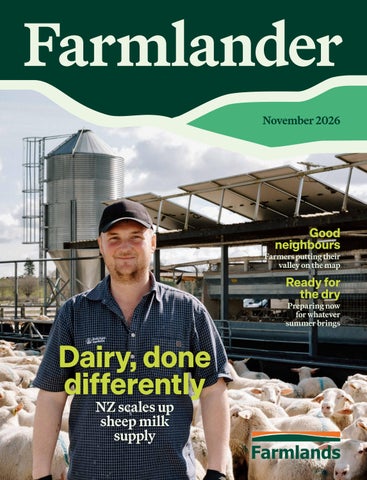
Dairy, done differently NZ scales up sheep milk supply
Rural never rests. Out here, there’s no off switch. The day starts well before the sun rises, and work carries on long after it goes down. And you wouldn’t have it any other way. Because progress doesn’t wait. Ideas don’t stay still. And tomorrow doesn’t come with an instruction manual. We get it. Because we’re rural, too.
Farmlands is 100% owned by farmers and growers – always has been. So no matter what’s keeping you up, what’s sending you down to the paddock, whatever plan you have for your business, we’ll be right there with you because rural never rests.
Save up to 15% In-store and online with your Farmlands Card. Exclusive discounts on selected items at Mitre 10 MEGA and Mitre 10 stores nationwide. Not in conjunction with any other offer or discount.
NEW
Outdoor Range Available Now
FARMLANDS PUBLICATION TEAM Deborah Allan Sally-Ann Fitzhardinge Susan Grey CONTACT Farmlands 535 Wairakei Road, Burnside, Christchurch Ph: 0800 200 600 Email: farmlander@farmlands.co.nz ON THE COVER Waikato farmer Ryan McPherson has doubled his flock to 1,200 as he focuses on sheep milk. Photo by Gilmour Studios.
CONTENT & DESIGN BY SCG Liza Hamilton LauraGrace McFarland Julian Pettitt PRINTED BY: SCG, a Toitu Net Carbon Zero certified organisation. This publication is printed on FSC ® certified MIX source pulp from well-managed forests and other controlled sources. We print using BIO-inks that contain materials which are based on renewable resources including wood resin (rosin, colophony), and vegetable oils, linseed oil and soy bean oil. The information contained in this publication is given in good faith and has been derived from sources perceived to be reliable and accurate. Whilst every effort is made to ensure the accuracy and correctness of the information, Farmlands gives no warranties, express or implied, regarding the information nor does it accept any liability for any opinion or information (including the accuracy or completeness thereof) or for any consequences flowing from its use. The information and views expressed in this publication are not necessarily the views or opinion of Farmlands, its editorial contributors, freelancers, associates or information providers. Independent advice is recommended before acting on information or suggestions contained herein. Readers who rely on this information do so at their own risk. Reference to any specific commercial product, process, or service whether by trade name, trademark, manufacture, or otherwise does not constitute an endorsement or recommendation by Farmlands. No part of this publication may be reproduced in any form without the prior written permission of the publisher. Prices and offers apply only in the time-period stated on the front cover of this publication and while stocks last. Not all products are available at all Farmlands stores. All prices include GST unless otherwise stated.
Pull up a chair
The end of the year is in sight, the days are getting longer and, if you're anything like us, so is the to-do list. So, we've filled this edition with stories worth stopping for. Inside you'll meet farmers milking sheep, a family whose hill country is now a mountain-bike destination, and our new Chief Sales Officer, Rachel Aldikacti, who always knew she'd end up at Farmlands. There's a new Trans-Tasman partnership, a plain-English guide to AI, and a tamarind ginger Christmas ham and tropical pavlova to get you in the festive spirit. Put the kettle on, find a comfy spot and dive in. Got a story worth telling, or feedback on what you've read? Send it through to farmlander@farmlands.co.nz. To stay up to date, follow us on Facebook Farmlands Co-operative and Instagram @FarmlandsNZ.
Sally-Ann & Deborah Got something to share with the team at Farmlander? Email farmlander@farmlands.co.nz Keep up-to-date with the latest news from across the co-operative via our website and social media. @farmlandsnz
@farmlandsnz
Farmlands Co-operative Society Limited
Farmlander • farmlands.co.nz
3
Picture perfect: Three neighbouring Waikato farms open their gates to hikers. Go to page 32 for the full story.
Photo: Gilmour Studios
Inside our November 2026 issue
Up front 3
Welcome from the Team
6
Word from the CEO
8
Clippings
14
Moving up
16
22
for 40 Bracing the big dry
Farmlands' new Chief Sales Officer on stepping into the role
Check out our rugby heroes
Farmlands experts on how to prepare
50
New flock on the block
Why Kiwi farmers are betting on sheep milk
28
32
In a spin
74
How a Canterbury farm became a mountain bike destination
Lessons from the fuel crisis
Why energy resilience matters on farm
70
The big picture 22
Lay of the land
56
Sunny side up
58
Bird flu fears
74
In the saddle
80
Why more dairy farms are going solar
On-farm biosecurity matters
Competitive rider profiles
Read the paddock
How to protect soil structure
with 90 Christmas Simon Gault
Walk this way
Q&A and recipes from the vault
Farmers join forces to create a 20km destination hike
90
WORD FROM THE CEO
Serving you today, while protecting tomorrow t Farmlands, our vision is to be the go-to for everyone connected to our land – meaning we focus on continually delivering value today, while looking ahead to create a stronger sector tomorrow. We were proud to release our Annual Report 2026 last month, highlighting how much progress we have made over the past year, continuing to grow strength across our Group. The results show that our strategy is paying off. The report covers the year to 30 June 2026, when conflict in the Middle East disrupted fuel and freight. By buying together and moving early, we secured supply and limited how much of the global cost increase reached the farm gate. We are making steady progress towards our ambition of reaching $6 billion in turnover and $100 million in profit, and becoming the most trusted brand for New Zealand farmers and growers. The numbers show continued growth. Farmlands Group turnover (Farmlands plus joint venture Fern Energy, which is not consolidated in the financial statements) rose 5.3% to $3.2bn and operating EBITDA (earnings before interest, tax, depreciation and amortisation) rose 5.8% to $35.4m. Profit before tax more than doubled to $4.5m, and net profit after tax rose to $21.2m, lifted by a one-off, non-cash deferred tax benefit. We are proud of this year’s result, and because we are owned by more than 81,000 shareholders, it is your result too. Head to farmlands.co.nz to read the full Annual Report. One lesson stands out from the year: forward thinking matters. As one of our experts says in our dry summer feature, “Drought isn’t a surprise event. It’s a known risk, which means planning is critical.” Horizon Lab founder Tim Ewing-Jarvie tells us in Last Word that volatility is the new normal, and that New Zealand’s rural sector is well placed for it. Fern Energy CEO Chris Gourley shares the lessons of the fuel crisis, and our Chief Digital Officer, Andre Scheepers, offers a plain-English approach to AI: define the real problem, start small and solve it well. In our community focus, meet our 14 Farmlands Rural Rugby Legends finalists. They mark the fields, coach the kids, cook the meals and quietly
6
Farmlander • farmlands.co.nz
help families through hard times. Several have given 60 years or more to their clubs. Rural communities run on people like this, who give far more than they ask for, and we are proud to celebrate them. Keep an eye out for the winner during November and follow us on Facebook and Instagram as we celebrate these legends. As summer approaches, it’s natural to reflect on the year and look ahead. If you need someone to talk to, Farmlands provides free online coaching, financial advice and wellbeing sessions with the Rural Support Trust for anyone in a rural community. Simply scan the QR code at right to book a session now – no waitlist, no referral, no cost. Ngā mihi nui,
Tanya Farmlands CEO Got a question for Tanya?
Reach out via asktanya@farmlands.co.nz
Photo: Radical
A
Making it easier to ask
Since free wellbeing support launched at Fieldays®, rural people have been putting it to use. Here’s what we’re learning.
T
here’s a particular kind of quiet that settles over a farm when someone’s struggling. Nobody says much. The work still gets done. And often the person carrying it just gets on with things, because that’s what you do. Farmlands is owned by farmers and growers, so we know what the job asks of people. The long days, the weather, the costs, the isolation. We also know what the numbers say. Rural communities are hit hard by suicide. According to Statistics NZ, suicide rates in rural communities are estimated to be 30 percent higher than in urban areas. Around 20 farmers, women and men, take their own lives every year. Behind every one of those numbers is a family, a crew and a community that feels the loss for a long time. Most of us also know why people don’t ask for help. Distance, cost and time off the farm get in the way. So does the feeling that you should be able to sort it out yourself. That’s why Farmlands teamed up with Rural Support Trust and ignite Aotearoa, and why we launched free, confidential wellbeing support at Fieldays® in June. It’s open to every farmer, grower and rural whānau in New Zealand, with counsellors, psychologists, career coaches, nutritionists and more, online, by phone or in person, at no cost. You can choose someone local, or someone who isn’t. Rural Support National Chair Michelle Ruddell has talked about people asking a question “about a friend” who turns Book a out to be themselves. That’s the kind of door we wanted to free session leave open. No stigma, no drive into town. Scan now to book your The first three months have told us a lot. Of those who free session or visit responded to the survey, 77 percent said their wellbeing had rural-support.org.nz improved afterwards. And 62 percent said they wouldn’t have sought help at all if it hadn’t been free and right there when they needed it. Not “might not have.” Wouldn’t have. One person put it in a line: “There is a huge unmet need out there.” That matches what we already suspected. Most people raise more than one thing, with anxiety and general life stress topping the list. That tracks with how farming stress actually works. It’s rarely one clean problem. Need to talk to And it’s not just for the bad days. The support is there for someone now? the ordinary, constant weight of the job, before anything tips Free call or text 1737 over. Plenty of rural people who could use it still don’t know any time, day or night. it exists, or assume it isn’t meant for them. If you’ve been Rural Support Trust meaning to talk to someone, now is a good time. And if you’ve is on 0800 787 254. In got a neighbour, a mate or a team member on your mind, pass it on. It’s free, it’s confidential, and it’s there for all of us. an emergency, call 111.
Clippings News from Farmlands and beyond
COMPETITION
Addiction Dog Food Winner Congrats to the Clotworthy family from Northland, lucky winners of our Fieldays® competition, taking home a full pallet of Addiction dog food. That's sure to keep the dogs happy!
Outstanding Service Recognition Congratulations to our Technical Field Specialist Megan Baldock, from our Farmlands Stratford branch, who took home the Best Service Person (Youth) prize at the Stratford Business Association's ROMEO Awards. The awards celebrate young people making a mark in local business, and Megan was nominated by one of our own shareholders, which says everything about the service she delivers. 8
Farmlander • farmlands.co.nz
COMPETITION
A Year at Awakino Station One lucky Farmlander reader has won a copy of Jaz Mathisen’s new cookbook A Year at Awakino Station. Jaz is station cook at Awakino, which is managed by her husband Dan. The book features a collection of family-friendly recipes and a slice of history from the spectacular farm in North Otago. Congratulations to Curt Thomas of Darfield, Canterbury, who won our giveaway from the June 2026 issue of Farmlander.
Annual Report and AGM announcement Join your Directors and Executive team at the Farmlands Annual General Meeting on Tuesday 24 November 2026 at 6:30pm at James Cumming Community Centre, 10C Ardwick Street, Gore. The 2026 Annual Report, financial statements and full Notice of AGM are available now at farmlands.co.nz/events/agm-2026, along with RSVP details and proxy information. Can't make it? Completed proxy forms must be received by 22 November 2026.
Stay on top of your water tank levels this summer The HiLo Cellular Water Tank Monitor sends your tank level straight to your phone, so a dry tank never catches you by surprise. Get peace of mind with alerts if levels drop faster than they should, helping you catch leaks, pump failures and other problems before your stock water runs out. Easy to install yourself on plastic and concrete tanks with no specialist installation required.
$699 incl.GST
Kellogg Rural Leadership Programme We are delighted to recognise Jacqui Hawtin, Card Partnership Lead, and Lisa Greene, Hokitika Branch Manager, who have recently completed the Kellogg Rural Leadership Programme. Since 1979, Kellogg has been one of the rural and agri-food sector's most prestigious leadership programmes, graduating over 1,200 scholars. It combines 18 days of in-person learning with six months of ongoing research, building strategic thinking, leadership capability, and decisionmaking skills. We're proud to have Jacqui and Lisa join this legacy and look forward to the impact they bring to their teams, our wider Farmlands community, and rural New Zealand. Ka mau te wehi!
SKU 1056836 HiLo Spark Monitor Shop in-store, on FarmlandsPRO or online at shop.farmlands.co.nz
Need extra space on the farm? Add accommodation, an office, or workspace for seasonal staff and contractors with MIZIN commercial cabins. With 4 cabin types, all with insulated comfort, you’ll find a MIZIN cabin to suit your needs. Farmlands shareholders receive an exclusive 5% rebate on hire.
Lisa Greene (left) and Jacqui Hawtin (right).
www.mizin.nz
Bird flu reaches our shores After spreading across the globe, highly contagious H5N1 bird flu has now been detected in migratory birds in New Zealand. This is the same strain responsible for serious poultry losses overseas. Officials are asking the public to stay alert and report sick or dead birds while they continue monitoring for further detections. With the situation continuing to evolve, staying informed and keeping biosecurity front of mind is more important than ever. Turn to page 58 for farm biosecurity advice, and visit farmlands.co.nz for the latest updates.
Generators fuel drone spraying success in Southland Farmlands Invercargill has helped a Southland agri-drone operator lift his game. Working alongside vendor White International during the recent generator promotion, the team secured the sale of three WC-P6000Si inverter generators to Specialised Agri Solutions, run by Mike Broomhall, better known as Krusty. Mike uses drones to apply liquid and solid fertiliser along with chemical spray. Two of the generators recharge his lithium-ion drone batteries in roughly five minutes between spray runs. The third powers a mobile fertiliser hopper. With engine hours mounting fast, repeat purchases are expected annually, and the Invercargill team is exploring a custom PTO generator option.
COMPETITION
WinePro Winner Congratulations to Andy Petherbridge, the winner of our WinePro competition. Blenheim based Technical Advisor, Dominic Missen, had the pleasure of presenting Andy with his new Bahco 15 IB Cordless Chainsaw Kit, which he'll be putting straight to work cleaning up vine heads around his vineyard. 10
Farmlander • farmlands.co.nz
Katikati Community Fun Run The Farmlands Horticulture team supported the 3rd annual Hume Pack N Cool community fun run in Katikati by manning the BBQ and cooking up a storm to feed competitors as they crossed the line. Awesome to see this event getting bigger each year, now with almost 800 participants.
Farmlander • farmlands.co.nz
11
Have your say at the 2026 Farmlands AGM Every voice counts. It’s your co-op, so make sure yours is heard.
F
armlands is owned by the farmers and growers who use it, and the Annual General Meeting (AGM) is where shareholders come together to vote on important decisions for their co-operative. The Farmlands Board sets the direction of Farmlands and makes decisions in the long-term interests of the shareholders who own it. This year’s AGM is on Tuesday 24th November 2026 at 6.30pm, in Gore and online, with a strategy session beforehand at 5.45pm so you can hear directly from us on our vision for your co-operative and provide your input. There are ten resolutions this year: four from the Board (resolutions 1 to 4) and six proposals from shareholders (resolutions 5 to 10). As your Board, we have a responsibility to clearly explain our position on each proposal being presented at the AGM, including what we believe the implications may be for the governance and operational management of your co-operative. Our aim is to ensure you have the information you need to make an informed decision about how you vote. We want this AGM to be representative of all shareholder views, not just those who have provided proposals. It’s your co-op, so have your say This year, we recognise that there are some strong views related to our decisions and we appreciate the high level of interest in our AGM from some shareholders. We want to ensure that the views of all shareholders are captured, so that the full range of shareholder perspectives informs the direction we take, which is why we are actively encouraging shareholders to cast their vote. Bigger voting turnout provides a result that represents all shareholders, and we want to hear all views.
12
Farmlander • farmlands.co.nz
Make an informed decision The Notice of Meeting sets out each proposal in the proposers’ words, with a reply from the Board. We explain plainly what each one means for how Farmlands is governed and run. The Board recommends a yes vote on resolutions 1 to 4, and a no vote on resolutions 5 to 10. You can read why in the Board’s response to each proposal in the Notice of Meeting at farmlands.co.nz/events/agm-2026. It’s easy to vote Everything you need is on our website at farmlands.co.nz/events/agm-2026, including the Notice of Meeting, who can vote and how to vote.
It’s your co-operative, and your vote matters Farmlands AGM Tuesday 24th November 2026 Strategy session 5.45pm, Annual General Meeting 6.30pm. In person at the James Cumming Community Centre, Gore, or online. • Read the Notice of Meeting at farmlands.co.nz/events/agm-2026 or by scanning the QR code • Check you can vote. You must be a Transacting Shareholder in good financial standing. Companies and other body corporates must appoint a representative through the proxy site • Choose how. Join online, attend in person in Gore (RSVP required), or appoint a proxy online by 6.30pm on Sunday 22nd November using the proxy link on the Farmlands website • Talk to us at Board@farmlands.co.nz. Questions about voting or proxies: AGM@farmlands.co.nz
The Card that never pays full price for fuel. Wherever the job takes you, from the yard to the highway, the farm to the freight run. Fuel keeps you moving. Your Farmlands Card delivers value every week at Z and Caltex Truck Stops nationwide. That’s more places to refuel, on the road and off it, all on the one account. Save on every litre. It adds up faster than you think.
Put it on your Farmlands Card.
‘Rural girl’ fulfils her Farmlands destiny She’s done everything from training racehorses to running a national ice cream franchise, but new Chief Sales Officer Rachel Aldikacti always thought she would end up at Farmlands.
R
achel has had a passion for all things rural ever since her childhood on a farm in Matangi, near Hamilton’s Mystery Creek where Fieldays® is held. She also brings vast experience to the CSO role, having held senior sales positions at businesses like Goodman Fielder, Bidfood and Fonterra. Her priority at Farmlands is to make it as easy as possible for customers to do business with the co-operative, whether they are farmers, growers or lifestylers.
14
Farmlander • farmlands.co.nz
“It can be about streamlining the way that we do things, reducing the cost as much as we possibly can so that that can get passed back to the farmer,” she says. “It can be about being super innovative from a technology perspective, and looking at creating different ways for customers to interact with us. “I would like price to become the last thing that they think of, because they have absolute trust that we will always be where we need to be on price.”
Rachel also sees a “massive opportunity” to help shareholders get even more value from the Farmlands Card and the more than 7,000 Card Partners nationwide. “There's a whole lot of unprecedented challenges that customers face, which we need to be ahead of to support them with.” ON THE RADAR Rachel says Farmlands was on her radar throughout her career, and it was a matter of when rather than if she ended up working for the co-operative. However, she may not have got into sales if it weren’t for a fall from a horse. “I started my life training racehorses, and that was originally where I was going to end up. Then I had a really bad accident not long into that career, and nearly lost the ability to even walk, let alone ride a horse,” she says. “That put an end to my planned career in the equine area, so I had to rethink my life at that point.” She worked with her father Maarten in his pet shop, then set up her own business as a dog groomer and trained in animal nutrition, predominantly around dogs and food allergies. “I've always been a rural girl, and I've always had a strong connection to animals,” says Rachel. After working for a premium dog food brand, Rachel kicked off her corporate career “by complete fluke”, taking over a friend’s role at a data communications company. “Six months later, they got taken over by Telecom [now Spark], so I suddenly ended up working for this massive
corporate. I got promoted very quickly through Telecom, ending up as their Corporate Billing Manager, where I actually restructured myself out of a job. “I was offered a role by Mark O'Donnell, who is now one of our board members at Farmlands. He was, at that stage, Head of Sales for Telecom. “Fonterra was still quite new, and broadband was still very new, and rural broadband didn't exist at all, so I was brought in to help them project manage the rural broadband rollout for Fonterra.” BRAND SWAP Off the back of that role, Rachel was head-hunted by Fonterra to look after their support services team for Mainland in Dunedin. When Mainland was included in a multi-billion-dollar ‘brand swap’ with billionaire Graeme Hart’s New Zealand Dairy Foods, Rachel found herself working for what became Goodman Fielder. “While I was at Goodman Fielder, I was asked to do due diligence on Mr Whippy because it was on the market,” she says. “I recommended that it was a good buy, but they decided not to go ahead with it, so myself and a couple of my colleagues on the senior leadership team went, ‘Well, we'll buy it then’. I was the Managing Director there for about three years.” After leaving Mr Whippy, Rachel had another stint at Fonterra before spending nine years at Bidfood. More recently, she was Managing Director of Groenz, which supplies sauces and condiments for the foodservice industry. Rachel admits the way her career has developed is “certainly not typical
“When people talk about what their superpower is, I think mine is probably the ability to read the room, and I think that that has worked for me not only in sales, but from a leadership perspective as well.”
in any sense”, but she has never been shy about taking a new path when it presents itself. “When people talk about what their superpower is, I think mine is probably the ability to read the room, and I think that that has worked for me not only in sales, but from a leadership perspective as well. I’m really down to earth, there’s no airs and graces with me.” ALSO A CUSTOMER Rachel is a key member of the Farmlands senior leadership team, but she also wears another hat at the cooperative: customer. Before joining Farmlands, she lived with her Turkish-born husband Metin on a small lifestyle block near Pukekohe that she describes as “the Kiwi version of Clarkson’s Farm”. “One day while I was away overseas for work, he built a whole chicken coop and I got home in the middle of the night to discover that we had chickens. Then one of them turned out to be
ABOVE: Rachel's Speckle
Park heifer Freckles, who she plans to breed next year.
a rooster, so our chicken population went from five to about 40.” They also ended up with sheep on a property with inadequate fencing, which led to one messy incident when a sheep got inside the house. Despite swearing off sheep entirely, they bought a 10-acre lifestyle block in West Melton that came with sheep (and similarly ineffective fencing) after Rachel took the job at Farmlands. “Week two of my job, I had to call my EA to say, ‘I need to cancel some appointments this morning. I'm going to be a little bit late.’ Because the sheep got into the creek, which was -1°C that morning,” Rachel says. “My husband and I both find the funny side of it. We love it and I don't think we will ever go back. If anything, we might even progress to a real farm at some point!”
Farmlander • farmlands.co.nz
15
Pauline Harawira
Rangataua Sports and Cultural Club – Bay of Plenty When Rangataua suggested nominating Pauline Harawira, she wasn't having a bar of it. Then she heard the club could win a prize worth $50,000. Her response? “Well, they better not bloody have to interview me!” Known as Mama Paul or Nana Paul, Pauline has spent a lifetime putting Rangataua first. She helped introduce netball in 1964, fought for the club as a pioneering female rugby delegate and served around 22 years as secretary. Today, she's still there on game day, scoreboard numbers in hand. Living next door, Pauline quite literally holds the keys to the club, and much of its history too.
Meet the 14 Farmlands Rural Rugby Legends finalists whose generosity, dedication and love of the game keep grassroots rugby thriving.
B
ehind every great rugby club are the people who turn up long before kick-off and stay well after the final whistle. They're the ones marking fields, washing jerseys, coaching kids and making sure there's always a place for everyone at the club. They give up weekends, dip into their own pockets and rarely expect anything in return. But ask their communities what these people mean to them, and the stories come pouring out. Meet the 14 Farmlands Rural Rugby Legends finalists, nominated by the people who know them best. 16
Farmlander • farmlands.co.nz
Billy Hogg
Melville Rugby & Sports Club – Waikato Billy Hogg joined Melville Rugby in 1957 and has spent nearly 70 years pitching in wherever he’s needed, from mowing grounds and collecting jerseys to finding ways to save the club a dollar. He's even convinced a staunch Hamilton Old Boys supporter to sponsor a Melville jersey. Billy has quietly paid players' fees and helped families in times of need from his own pocket. When Melville won the Waikato premiership in 2016, the players chaired him off the field. As Sky TV's Grassroots presenter Richard Mason once said, “Here's to all the Billy Hoggs.” A fitting tribute to the volunteers who keep grassroots rugby alive.
Rollo Dunlop
Ron Currie
Paula Clark
Rollo Dunlop first pulled on a Katikati jersey when he was six years old. More than 70 years later, rugby remains a huge part of his life. He played into his 40s and held just about every committee role going, including three stints as club president. So when Rollo turned 80 recently, where else would he celebrate but at the rugby club? Generations of players and supporters have come and gone, but Rollo remains a familiar face. His clubmates say Katikati Rugby simply wouldn't be the same without him.
Before anyone runs onto the field at Ōhaupō, Ron Currie has probably been there for hours. The nearly 80-year-old mows and marks all three pitches, puts out the flags and prepares everything for Saturday's games. Then there's the team bus to drive. Ron has given his time to the club since 1956, as a player, coach and administrator. During the week, he drives the local school bus. Come Saturday, he’s often cheering those same children on from the sideline. When everyone heads to the bar after the game, Ron's usually still packing up.
When Paula Clark saw that girls in Cromwell needed more opportunities to play rugby, she started a team. That was more than a decade ago. She later established the Central Otago Does, giving women another place to play, make friends and support each other. But Paula's contribution doesn't stop at the sideline. She cooks meals, cleans clubrooms, serves on committees and helps organise whatever needs doing. Now she's helping plan a new Cromwell sports club. Her nominator sums it up simply: “She doesn't do these things for recognition. She does them because she cares.”
Katikati Rugby & Sports Club – Bay of Plenty
Ōhaupō Rugby Sports Club – Waikato
Cromwell Rugby Club – Otago
Jono White
Kaitake Rugby Club – Taranaki Every Friday, Jono White marks Kaitake's rugby fields, picks up sausages for the barbecue and tackles whatever else needs doing. Come Saturday, he might be tying a five-year-old's boots or pulling on his own jersey when the senior team is short. As chairman, he's helped bring senior rugby back and secured more than 110 free hoodies for junior players. But it's the sense of belonging he's created that his clubmates value most. As their nomination puts it: “Jono doesn't just help run Kaitake Rugby Club. He is the rugby club!”
Les Inch
Oxford Rugby Club – Canterbury After 40 years on Oxford Rugby's committee and three decades coaching, you'd forgive Les Inch for putting his feet up. But he's still tailing lambs and splitting firewood for fundraisers, coaching the colts and keeping an eye out for the club's next generation of players. On Saturdays, he makes a point of catching up with everyone, from the newest recruits to the visiting referees, before delivering one of his famously entertaining after-match speeches that usually has the clubroom in fits of laughter. Three generations of the Inch family have helped shape Oxford Rugby, and Les shows no signs of slowing down.
Jason Smith
Nathan McDonald
There's always another job waiting on the farm, but for more than 25 years Jason Smith has made time for Pioneer Rugby. He's coached, recruited and helped wherever he's needed. But ask the players what makes Jason special, and they talk about how he looks after people. He's helped players find work, offered a listening ear and supported them through difficult times. One player remembers Jason being among the first to shake his hand when he joined, knowing nobody. Years later, he's still the first person that player looks for when he walks through the club doors.
Nathan McDonald has spent more than 20 years doing the jobs that keep a rugby club running. He organises uniforms, prepares the grounds, cleans the grandstand and even buys food and drinks for the referees out of his own pocket. Nine years ago, he helped bring Stratford and Eltham together, securing a future for local rugby and netball. He's served as chairman and now club captain, all while juggling work and farming commitments. Nathan is quick to acknowledge everyone else's efforts. As his nominator puts it, “it is time for Nathan to be acknowledged”.
Pioneer Rugby Football Club – Southland
18
Farmlander • farmlands.co.nz
Stratford Eltham Rugby & Sports Club – Taranaki
Dick McFarlane
Drummond – Southland Drummond's rugby ground bears the McFarlane family name, and Dick has spent a lifetime doing it proud. He played until nearly 40, served as club captain and president, kept the books for 25 years and managed the senior team for two decades. He's maintained the grounds, organised fundraisers and helped introduce touch rugby to the club. Even life membership hasn't earned him a free pass from the less glamorous jobs, including unblocking the clubroom toilets. His nominator calls him “the guy you call to sound out something or get stuff done”.
Michael 'Soody' Sood
Marist St Pats Rugby Football Club – Wellington If you need something at Marist St Pats, chances are Soody has it, can find it or has already fixed it. Since 1982, Michael Sood has coached, cooked, cleaned, fundraised and filled just about every role imaginable. He's also opened his home to more than 30 Marist players from overseas. One arrived for two nights and stayed two years! Soody was reluctant to accept his nomination until he heard the prize could help upgrade the clubrooms. As his clubmates put it, “Soody loves MSP. And MSP absolutely loves Soody."
Jim Barrett
Morrinsville Sports – Waikato Jim Barrett helped establish Morrinsville Sports 30 years ago, and he's barely missed a day since. He marks the fields, stocks the bar, sets up for functions and quietly gets on with the jobs nobody notices until they don't get done. But his fellow members value something else just as much. Jim is the person they turn to for advice, a hard conversation or simply someone to listen. He calls himself the club's “dogsbody”, but when members gave him a standing ovation at the Morrinsville Sports’ 30th anniversary, it was clear they saw him rather differently.
Craig 'Hilly' Hill Karaka Rugby Club – Counties Manukau
Craig Hill grew up on a dairy farm across the road from Karaka Rugby Club. Decades later, he's still a familiar face around the place. He's played 277 premier games, coached Karaka to its first Counties Manukau club championship and helped build a thriving touch rugby programme. Now a life member, treasurer and premier coach, he's just as happy painting changing rooms as he is talking rugby. His fellow members joke that Hilly hardly owns anything that isn't Karaka red. As one puts it, he's “humble as anything, practical as a gumboot” and the bloke who always shows up, helps out and never asks for anything in return.
Kelly Graham
Ōtāne Sports Club – Hawke's Bay Kelly Graham has played more than 600 games for Ōtāne, including an extraordinary 450 consecutive first-grade appearances. He's also been part of 23 championship-winning campaigns. But some of his biggest contributions have come long after the final whistle. Kelly has spent decades mowing fields, cooking meals, washing jerseys and helping improve the clubrooms. He served 20 years as president while making sure visiting teams and newcomers felt welcome. His nominators reckon his legacy isn't measured in trophies, but in the people, friendships and club he's helped build. “He understands that rural rugby is about far more than eighty minutes on a field – it’s about community.”
Farmlander • farmlands.co.nz
19
The big picture In this section
Big ideas often start close to home. We meet farming folk finding fresh value in their land, skills and communities – and creating new opportunities along the way. PHOTO: Gilmour Studios
22
28
32
Demand is growing in New Zealand’s young sheep-milk sector with doors wide open for farmers looking to diversify.
North of Kaikōura, one farming family is forging a new path by combining deer with a destination bike park.
Three farming neighbours have turned their properties into a two-day walking experience that brings visitors closer to the land – and creates a new income stream.
20 Farmlander • farmlands.co.nz
SHEEP COMES MILKOF AGE New Zealand’s sheep milk industry has laid strong foundations. Now, rising market demand is driving its next challenge – and opportunity: scaling up supply. 22 Farmlander • farmlands.co.nz
A
lthough sheep have been milked for thousands of years in parts of Europe and the Middle East, ovine dairy in New Zealand is about the age of an intermediate school student. The industry is largely confined to the Waikato and central North Island, with its two processors Spring Sheep (founded in 2015) and Maui Milk (founded in 2014) both headquartered in the Hamilton Innovation Park. Farmlands Technical Field Sales (TFS) Lisa Clark works closely with many sheep dairy farmers and has extensive experience of her own, having previously managed a sheep dairy farm and worked as a technician in the genetics team for Spring Sheep. Lisa says the way sheep are milked in New Zealand looks very different to how it is done in the Northern Hemisphere, where the animals are mostly kept indoors. “The one thing New Zealand does really well is dairy outside. When the industry started up, they started doing it indoors like they do over in Europe and quickly discovered it was just a whole lot of hard work and a whole lot of headaches,” she says. “I don't think there are any sheep dairy farms that are wholly indoors. There's a couple of older barns that get used in extreme weather events for ease of feeding, but mainly the bigger barns are just for the rearing.”
got to balance out that starch and protein, and you know instantly whether they have gone one way or the other,” she says. BOOSTING PRODUCTION Much of New Zealand’s sheep milk production is exported to Asia, where demand for premium sheep milk nutrition products continues to grow. Spring Sheep says it is one of a small number of sheep dairy companies registered to sell infant formula in China. “We’re seeing really positive momentum in our key markets, with growing demand across infant formula, adult nutrition and our ingredient products,” says Olivia Smith, Commercial Manager – Operations at Spring Sheep. Average milk production across Spring Sheep’s farming network has more than doubled from around 120 litres per ewe in 2015 to 320 litres last season.
NIKO KLOETEN
GILMOUR STUDIOS RADICAL ELESHA NEWTON
OPPOSITE: Ryan McPherson says Kiwi farmers are embracing diversification. BELOW: Katy Day oversees
Pāmu's sheep milking operation at St Kilda Farm, north of Taupō.
SMALLER SCALE Lisa says the setup for sheep milking is similar to what is used for dairy cows – with rotary and herringbone sheds – but on a much smaller scale. “It's quite cool to watch the milking because it’s so quick. They gobble their food, you get their milk out and they're gone.” Although individual sheep produce much less milk than cows, stocking rates are significantly higher, with as many as six times more animals per hectare. “You can run a dairy sheep operation on a much smaller area, and the environmental impact is much lighter,” Lisa says. “They're not damaging the soils and the pastures as much, especially in rough weather.” Like their cow counterparts, most New Zealand dairy sheep are grass-fed, getting an additional boost from supplemental feeds like maize. Lisa says getting the nutritional balance right is important, particularly as milk production increases. “It's important to get the feed balance right. Because their systems are so tiny, you’ve really
Farmlander • farmlands.co.nz
23
They are now placing greater emphasis on traits suited to the Kiwi pastoral system. “We’ve achieved fantastic gains in milk yield through the breeding programme, and we’re now placing increasing focus on the phenotypic traits that are important in a pastoral dairy sheep. That includes things like feet, udder conformation and structural soundness, alongside continuing to improve productivity.” Olivia says the company is looking to grow its milk supply to meet demand while continuing to improve on-farm productivity.
Olivia Smith, Commercial Manager – Operations at Spring Sheep.
THE PERFECT BLEND One of the biggest Spring Sheep suppliers is Pāmu’s St Kilda sheep milking operation near Taupō, which milks up to 1,100 ewes on 210ha and runs about 400 yearling replacements onfarm, as well as 200 carry-over cows. Farm Manager Katy Day has been at St Kilda for five years, and got her start in sheep milk over a decade ago, when the industry was still in its infancy in New Zealand. “I came across it after I'd done about five or six years milking cows. Having grown up on a dry stock farm, it was something that I jumped at when the opportunity presented itself, because it's an integration of sheep, dry stock and milk.” While she enjoys the unique combination of farming types, Katy says there are some big differences when compared to both bovine dairy farms and traditional sheep farms.
24 Farmlander • farmlands.co.nz
“We've still got to shear our ewes, so shearing is all put into an equation so that we don't have any milk loss. We don't empty out our ewes for shearing; we shear them straight off the pasture, compared to a dry stock farm that would put them in for 24 hours pre-shearing,” she says. HEALTH CHALLENGES As for the comparison with bovine dairy, Katy says the way sheep milk farms manage their animal health is quite different. “The biggest thing with sheep dairy is that we don't have a lot of treatments for issues like lameness, because it all has a 35-day milk withhold,” she explains. “We also don't have a preventative at this point that we can use for fly strike. But because we see our ewes every day in comparison to a dry stock farmer that probably sees them every few months, we're more hands-on with our treatments.” Katy says her favourite thing about milking sheep is the constant learning involved. “It's such a new industry in New Zealand that it’s fresh and you're always learning. It doesn't matter how long you milk sheep for, they teach you something new every day.” COVID-ERA INSPIRATION Ryan McPherson’s sheep milking journey began during Covid, which hit shortly after he graduated from the University of Waikato with a degree in business management, majoring in finance.
Ryan was managing the support blocks for his family’s dairy farming operation between Putāruru and Tokoroa, when his father Dave heard on the radio about a sheep milking conference hosted by Spring Sheep. “I went along to that the next day and got all the figures and info and I was pretty keen,” Ryan says. “And then about two weeks later I signed a contract to start supply for the next season.” Starting off with 500-600 sheep on 30ha of a 70ha former dairy support block, Ryan has since expanded to 1,200 sheep on 55ha, with three full-time staff. They also do on-site cropping, particularly chicory, which helps to boost protein intake. “Protein’s important because we get paid more for higher protein content,” says Ryan. STARTER FARMS Although Ryan has no current plans to expand his sheep milking business, he expects the industry to continue to grow in New Zealand, mainly from dairy farmers using parts of their farm for sheep milking rather than a wholesale conversion. “There's a lot of dairy farmers that are milking sheep already because they've got an old dairy shed shut down on their farm, and they
just ramp that up and milk a few sheep. They're doing 30-50ha, and it’s a diversification play.” Ryan sees another massive opportunity in young up-and-coming farmers using sheep milk to help them buy farms of their own, with blocks as small as 20ha being economically viable. While individual sheep produce much less milk than cows, this is offset by higher stocking rates and a higher payout per kg; Ryan’s farm is achieving over $18,000/ha in revenue. “Land prices in the Waikato are around $40,000-$50,000/ha. What young person can go out and buy a decent-sized dairy farm? I wouldn't say there's too many of them,” he says. “If you milk sheep, you can buy a small block and you're actually getting a relatively good income.”
OPPOSITE: Farm manager Katy Day keeps the flock well fed. BELOW: Sheep farmer
Ryan McPherson (left) and Farmlands Technical Field Sales Lisa Clark catch up among the flock.
FITTING THE SYSTEM Sheep and beef farmers are also embracing sheep milking, often fitting it within their existing systems, says Samantha Fogden, Milk Supply Manager at Maui Milk. “That is definitely something we are seeing a lot more. It's not a sole conversion straight to sheep dairy; it's becoming just another part of a farm business and they're getting a combination of income from the meat and the milk.”
Farmlander • farmlands.co.nz
25
BELOW: Allan and Toni
Browne's sheep milking parlour allows scope to expand as demand grows.
Maui Milk is actively seeking additional milk supply for next season and is considering suppliers in the Waikato, Hawke’s Bay and Wairarapa. The company has developed the Southern Cross® breed, a combination of East Friesian, Coopworth and the high-producing Lacaune breed from France. Samantha says many of Maui Milk’s farmers rear lambs on their mothers for the first six weeks rather than taking them off early and artificially rearing them, which increases milk production but also raises costs. “We try to support that and reduce the amount of workload that they're putting into these animals,” she says. “You want a ewe that's going to be a good mother, produce a good sturdy set of twins that they can rear on so that you're not investing a whole lot by artificially rearing these lambs; the mother's doing the hard yards.” Although Maui Milk and Spring Sheep are competitors, Samantha says there is a high level of co-operation in the industry.
“There's a lot of dairy farmers that are milking sheep already because they've got an old dairy shed shut down on their farm, and they just ramp that up and milk a few sheep.”
26 Farmlander • farmlands.co.nz
“With dairy cows, given it's so established, everyone's looking over the fence at the neighbour to compete and compare. Whereas our guys a lot of the time are trying to share information to build each other up.” ACHIEVING THEIR DREAM For Maui Milk suppliers Sean Nixon and Ruby Mulinder of Tihoi, sheep milk helped them achieve their goal of owning a farm. They have 150ha (130ha effective), of which they use 4060ha for milking during the season. “We were never going to be able to afford a 250-300ha sheep and beef property, so being able to buy a smaller block and turn that into a sustainable system that can generate a fair bit of revenue was key,” says Ruby. “We’ve always wanted to own some land. I love stock, so you won't catch me farming a bit of arable land ever.” Sean says sheep milk can help with one of the biggest challenges facing sheep and beef farmers: succession. “It’s becoming a bigger issue every day for sheep and beef with the ageing of the average farm owner,” he says. “Sheep milk gives a lot of cashflow, and that's why the dairy industry did so well with succession: because it's a better cashflow business than sheep and beef.”
BALANCED APPROACH Maximising milk production isn’t the sole focus for Sean and Ruby, who still make about 30% of their income from store and prime sales of their lambs. “We usually finish between 200 and 400 lambs as prime, and then the rest we sell at roughly 30kg onto the store market,” Ruby says. “Ideally, long-term, we would like to capitalise on all of them and take them all through to prime. The issue we have is we just need more scale; we don't have the landmass to do that at the moment.” With 1,700 lambs born on their farm each year, keeping the lambs on their mothers also reduces the need for additional labour. “We're in the middle of nowhere, so drive-in labour is not really an option, and equally, the idea of investing to be able to house four or five people on farm for a two-month busy period isn't realistic,” says Sean. “We've also learned from the goat industry, which was built off quite high-cost systems, so they had to get big volumes and they needed a strong payout. When the payout crashed after Covid, it's just been absolute carnage in the goat sector. So we have been focused on a profitable and resilient system.” PART OF THE PACKAGE Cambridge farmers Allan and Toni Browne are Maui Milk’s biggest suppliers, milking around 2,000 ewes on 70ha as part of a 600ha dairy and sheep and beef farming operation. They were introduced to sheep milking by Jake Chardon, a geneticist for Maui Milk, who happened to be their neighbour at the time. “Sheep milking is part of the whole package for this farm. We still have 3,000 lambs available for slaughter out of it, and the lamb price is quite nice at the moment,” Allan says. Sheep milk has further diversified their farming business, after they bought the dairy farm next door to their original sheep and beef farm a few years earlier. “There used to be wool cheques back in the day. A couple of wool cheques and a couple of loads of fat lambs and fat cattle and that was your whole income for the year. Now we see income every month.” COMPETING USES Most of their ewes with twins rear their own lambs, with only singles being taken off to be artificially reared. Allan says they tried fully artificial rearing one year and never repeated it.
“We took 3,500 lambs off and artificially reared them, and without the right people to handle young baby lambs, the outcome wasn't as good as we'd hoped for.” Allan says one of their challenges is that the sheep dairy platform is on the land where they used to fatten most of their lambs. “My best country is now used for milking the ewes, so you're trying to fatten the lambs on the hill country, which is still a work in progress.” Having farmed both dry stock and dairy cattle, Allan has one piece of advice for farmers from either background looking at sheep milking: “Sheep are sheep. They're not small cows,” he says. “This sounds funny to say, but a lot of the people come on dairy background just think they're small cows and they've discovered pretty quickly they're not. “There's as much work to take one lamb off as there is to take one calf off, and we’ve got 2,000 ewes. If there was a 2,000-cow dairy farm, you'd be pretty flat out.”
ABOVE: Allan Browne
doing the rounds with his dairy sheep.
Farmlander • farmlands.co.nz
27
On the (bike)
PATH TO SUCCESS
It was love at first sight when Genevieve King and Morgan Rigby discovered the rugged potential of Middle Hill. Today, mountain biking has become the main source of income from their North Canterbury property.
A
sk Kiwi farmers how they earn their income and you would expect most to answer ‘milk’ or ‘meat’. For Genevieve King and her partner Morgan Rigby, it’s something quite different: mountain biking. Located near Clarence, north of Kaikōura, Middle Hill MTB is a story of succession, diversification and ever-changing land use on a property where conventional farming has always been challenging. The land has been in the King family for three generations. Genevieve says their farming operation has constantly evolved throughout that time, before becoming what it is today: a mountain bike park. “My grandparents bought it in the 1960s and my dad Rick took it over when my grandfather retired. They had Merino sheep and started deer farming in 1975, live-capturing animals from the backblocks using traps and helicopters during the heyday of the live deer recovery. “My dad's farming career was mainly superfine Merino wool, deer and trophy hunting. He taught himself how to guide and hosted people for a week at a time through the Roar each year.” Although Middle Hill is surrounded by sheep and beef farms, Genevieve says it's a much more rugged, challenging block than their neighbours’ properties. 28 Farmlander • farmlands.co.nz
“We had to think outside the box to make it work. Previous owners didn’t last long due to different challenges like rabbits and drought. Each generation of our family has adapted what we’re doing on the farm to make it work.” SUCCESSION PROCESS The land was recently subdivided into three blocks, while much of the high country section from the original farm was returned to Crown ownership through tenure review. As part of the family's succession planning, they split off 70ha of flat land next to the Clarence River and converted it into a vineyard, run by Genevieve’s brother Will, who is based in Christchurch. “It’s a different thing for the Clarence Valley. Nobody's done that before,” Genevieve says. “We've got the remaining deer farming area, which is not that big anymore, and then the hill country we let regenerate into native bush and registered that in the Emissions Trading Scheme (ETS) and turned it into a mountain bike park.” She says it wouldn't have been viable to keep farming Merino sheep, as her father had previously done. “It's definitely land that loves to grow and regenerate. They were fighting to keep it clear and now we're encouraging it to grow.” The idea of turning the land into a mountain bike park may seem to have come out of left
NIKO KLOETEN
HENRY JAINE MIDDLE HILL MTB
field, but although Genevieve grew up on the farm, she began her career in adventure sports. “My background is mainly in the ski industry. That's my love, but snow is getting harder and harder to come by, so I thought I would ease out of travelling and chasing winters and get into mountain biking instead. “I started doing some of those multi-day adventures like the Old Ghost Road near Buller, and I thought ‘we could do something like this in our backyard’. Then I found out that farm tracks are not very fun to ride a bike on, so I had a go at making my own.”
RECORD-BREAKING QUAKE Genevieve had started “naively” building a trail on their farm when they were struck by one of the most significant natural disasters in the region’s history: the 2016 Kaikoura earthquake. The magnitude 7.8 quake has been described as the most complex ever recorded. Not only did it tear up her fledgling bike track, but Genevieve says it destroyed their farm’s fences, tracks, irrigation system, water supply and nearly all the buildings. “We've actually got the largest recorded uplift anywhere in the world on our property.
ABOVE: Out for a family
bike ride with a side of trail maintenance, with the Seaward Kaikoura Ranges in the background.
Farmlander • farmlands.co.nz
29
Genevieve says it was a monumental effort to get everything rebuilt, even though they ended up going in a different direction with the farm later. “In the weeks and months after the earthquake, there was just this flood of people who came rushing in to help,” she says. “There were no neighbours with deer sheds in the area. We were in the middle of velveting and needed a deer shed urgently, so it was rebuilt in what is now the middle of the vineyard. There wasn't clear thinking and forward planning happening at that time, it was just ‘get it all back up’. “Everything got re-fenced, and now that's all vineyard as well, but you couldn't have made those decisions at the time.”
Some of our trails are really gnarly, technical and tight, hand-built without a machine. Others are smooth, wide and flow like a rollercoaster. At the highest point, our land moved up 12 metres,” she says. “We didn't even realise that it was a fault line, but our homestead, deer shed, woolshed, and cottage were all built on that line, so all of that got split in half. All the deer fences shrunk or stretched, so all the animals got out. “We were in the middle of calving and all the water changed because there was so much uplift. All the natural waterways were gone and then they reappeared somewhere else in the coming weeks and months.” 30 Farmlander • farmlands.co.nz
THE PERFECT PARTNER The earthquake may have caused severe damage to their land, but it didn’t dent Genevieve’s vision of building a bike park. However, she needed the help of an expert to get it up and running, and she found that expertise – and romance – in the form of Morgan. “I was already thinking of doing something with the property to do with mountain biking, and then I met Morgan. He was already an accomplished trail builder and mountain biker – just what Middle Hill needed! “He's also a sheep farmer's son. When we met, he was building a trail on his dad's farm near Motueka as well.” Genevieve says Morgan’s number-one mantra when building bike trails is water management. “He's always thinking of where the water runs off, and he builds a trail like a ribbon going down the hill,” she says. “The other really important thing for him is for it to be fun and flowing for the rider and consistent. Some of our trails are really gnarly, technical and tight, hand-built without a machine. Others are smooth, wide and flow like a rollercoaster. Each trail has a different feel, but riders won’t encounter features they weren’t expecting.” DIFFERENT LEVELS Middle Hill MTB has about 25km of trails in different sections. Although some riders pedal up, many use the shuttle service to get to the top. Genevieve says they tried to build the park to cater to riders of all skill levels, but it didn’t work out that way at first. “Morgan is kind of an expert-level rider, so his idea of a ‘beginner track’, in hindsight, wasn’t. We quickly grew a really strong
reputation in the mountain biking community because it was really fun for people who knew what they were doing. “But we also grew a reputation for being a bit too scary for beginners, and we've been trying to break that stigma ever since, because we have since filled in the gaps and done a lot of work on the easier stuff. But it's hard to convince people when they see all this footage of people doing huge jumps!” ADDING ACCOMMODATION Middle Hill MTB has quickly become a popular destination for mountain bikers. During busy times of the year they host around 50 riders a day, and they hold an annual event that draws up to 300 people, most of them staying in tents. Genevieve says the next step for the park is to improve the facilities and add accommodation. “When we were starting, we definitely had the mantra ‘build good trails and the people will come’. Some places might start with a really nice base area and a café and accommodation, but we didn’t,” she says. “We've got a simple setup with a shipping container for the office. We've kept the facilities really basic and put the emphasis on the trails. “There's a great reputation among mountain bikers, but we're now looking at expanding it into other activities and getting a broader range of visitors. The big project is to create a new base area with a range of things to do, both on and off the bike.” The park is busiest during spring and autumn. Genevieve says expanding its offering would allow them to attract more visitors at other times of the year.
“There aren’t as many people around in the winter, so we close. But once we have our accommodation up and running, that won't be closing through winter because it's actually a pretty beautiful place to visit in the winter with the snow on the mountains.”
OPPOSITE: The Vale Inc crew: Hunter Paull, Matt Begg, Billy Meaclem and Nils Heiniger, filming their short film ‘Earned Turns’ on the track they created especially for the project last winter.
DEER TO HER HEART The bike park is now the main source of income for Middle Hill, but Genevieve says they still have a section of the property where they farm deer. “We farm red deer predominantly, with a little bit of elk in there. It was something that I was pretty keen to continue with the story of how the deer farm started at Middle Hill with my grandfather and my father catching them out the back. “We don't have enough space now to finish our own fawns, so we sell the weaners on for somebody else to finish.” Genevieve says they are taking a more regenerative approach based around building healthy soil, although she admits it’s not always easy to apply to deer. “They've got to be left alone when they're calving; you can't be going in there and moving them around. You also need to give the stags a bit of a wide berth during the Roar. There are a few challenges there.” Genevieve says the block of land where they farm the deer is unlikely to be suitable for anything else. “It gets a bit too wet in the winter for cattle and there's some really steep rocky limestone outcrops, which deer are well suited to. We like them, we think it's a great product and we’ll keep going with it.”
BELOW: The hinds have
got used to living next to the bike park.
Farmlander • farmlands.co.nz
31
LOVING LIFE in the valley Sian and Andrew Noble-Campbell’s picturesque farm in Waikato was a fixer-upper at first. Now it’s part of an agritourism venture showcasing Matahuru Valley to the rest of New Zealand.
W
hen Covid sent much of the world into lockdown in 2020, it had an unexpected upside for the NobleCampbell family: demand for lifestyle blocks surged, as city-dwelling Kiwis developed a sudden taste for open spaces. This helped them achieve a windfall on the sale of their property at Pukekawa, about 25 minutes south of Pukekohe, and set them up to finally own a fully fledged farm of their own. They found their dream farm on the opposite side of the Waikato River, a 200ha property in an area that feels secluded but is only a few minutes east of the Ohinewai exit on State Highway 1. Although Sian and Andrew adored the natural beauty that would eventually draw tourists to what became the Matahuru Valley Walk, the farm itself was a classic fixer-upper. “When we arrived, the property had been farmed in cattle for a number of years,” Sian says. “At first, we were only able to have cattle, because the fences were not set up for sheep. “We've completed extensive fencing in the past six years and we’re now able to contain a flock of 650 ewes, as well as around 200 cattle.” Andrew is a livestock scanner, which means he has a busy period of about four to five months each year (he also shears, which comes in handy on their farm). Meanwhile, Sian is the deputy principal and teaches Years 7 and 8 at nearby Mangatangi School. “My husband and I both work off farm, so we mainly do our farming at night and on the weekends.” 32 Farmlander • farmlands.co.nz
NEIGHBOURS TEAM UP While they were busy fixing up their farm, the Noble-Campbells came across an agritourism opportunity: working with their neighbours to create a catered scenic walk with accommodation. Launched in 2021, the Matahuru Valley Walk was a collaboration between Sian and her neighbours Mary Mickleson and Kirsten Evans. “There are more and more walks coming every year, but there are not many that are only an hour from Auckland. That's probably our biggest factor really, that we're so easy to get to,” says Sian. Fittingly for a trio passionate about the environment, the venture arose from a meeting at the local hall about trying to get a catchment group up and running in their district. “That sort of fizzled, but what came out of it is Mary and I were looking at all the different things that we could do to enhance our land. We obviously didn't know each other very well then, but she had an idea for a walk,” Sian says. “I'd just had the experience of a private catered walk on the Abel Tasman, so we talked about that. Then we realised we didn't have accommodation, so we enticed Kirsten to join us because they’d just bought their neighbour's farm and she had spare accommodation that she was going to use for Airbnb.” TIGHT TIMEFRAME The timeframe was as ambitious as the venture itself. They had their first meeting about creating a walk in May 2021 and decided to have it open by October that year.
NIKO KLOETEN
GILMOUR STUDIOS
RIGHT: Sian and Andrew Noble-Campbell on their farm in North Waikato.
Farmlander • farmlands.co.nz
33
ABOVE: The private walk
takes in three working sheep and beef farms.
Sian says they went “hell for leather” to be ready in time and had to pick up a host of new skills and learnings along the way. “You have an idea where you think the walk's going to go, but then you have the reality of building stiles and marking the whole track for people that don't know the land. You might think, ‘Oh, that's obvious.’ However, you can't assume that,” she says. “Then there was menu testing and creating websites from scratch. We had to learn skills that we'd never needed before. Marketing, creating a company, everything about running a business.” Just like the walk combines the best aspects of their three farms, the preparation made use of the strengths and skills of each of the three women behind it. “I'd been a cook in a previous life, so catering was the easy part for me. Kirsten took herself through creating a website and getting the online booking platform sorted,” Sian says. “Mary is very creative and arty, so she made a lot of the signs that we have on the walk and took care of all the email side of things and responding to customers. I take care of all the marketing and advertising.” MEMORABLE MOMENTS Day one of the walk is around 12km long. The route crosses the Mickleson farm and Waikahu, the Noble-Campbells’ farm, and takes anywhere from four and a half to six hours.
34 Farmlander • farmlands.co.nz
The second day’s walk across the Evans farm is shorter, at about 8km, taking two to three hours. There are plenty of landmarks, including a yellow door in the middle of a paddock, a pink seat and a selfie-style frame at the top of the bush. “We've also got a swimming hole on our farm that probably 75% of the groups stop at and have a swim,” Sian says. “It's a special spot, really.” Sian says most of their walkers are from Auckland, and the vast majority are female and over 40. “It’s an opportunity to showcase what real, normal Joe Bloggs farmers are doing and explain to them why they're doing it,” she says. “We often get loads of questions about our farming systems, ‘Why are you doing this?’ and ‘What's that for?’ So it's a good opportunity to educate as well as give a memorable experience.” The food is made with local ingredients where possible, and they have even created a Matahuru Valley Walk Cook Book. Sian says authenticity is a big selling point. “We're very clear that you shouldn't expect it to be like one of the Great Walks, where it's very much boardwalks and formed tracks and that sort of thing. It's a farm,” she says. “You'll quite often come across Andrew shifting a mob of sheep, with hopefully not too much swearing at the dogs. They're working farms and we definitely explain that it's going to be more of a real experience.”
FAMILY SUPPORT If setting up the walk has been a team effort with the neighbours, the Noble-Campbells have also had some help with their own farm from their daughter Emma and son James. James is head shepherd on a big station on the East Coast near Tolaga Bay, while Emma has a degree in agriscience from Lincoln University and does research and development for a genetics consultancy company. Although they have both left home and embarked on their own careers, they do pop in and help their parents out when they can. Their passion for farming is not surprising, considering they have spent their whole lives around animals. “When the children were little, we leased a bigger farm on the West Coast near Kāwhia, so they had their start on a real farm. But it was really isolated,” Sian says. “Then we moved to Pukekawa, where we bought a lifestyle block, so we still always had stock, but it wasn't like a real farm. That really was a hobby farm and we had more horses than anything else.” Although Emma’s job is based in Christchurch, she has recently been running a field trial in the North Island, not far from her parents’ farm, allowing her to spend more time with them. “She's very helpful,” says Sian. “When she was at university, she would come back during
the holidays and help on the farm. It was timely as university holidays usually coincided with when Andrew was really busy off farm or we were just about to start lambing.”
BELOW: Hikers will pass
cattle grazing in the paddocks along the trail.
USEFUL KNOWLEDGE Emma has put her expertise in genetics to good use helping her parents, especially with establishing their flock of sheep. “It's a Romney-based maternal flock, and then we have a terminal system, so we put a terminal ram over some of them and a Romney ram over the replacements,” Emma explains. “And then cattle-wise, we have quite a range: beef steers and heifers and dairy-cross bulls, which is just a mob. We've also bought an Angus bull from a local breeder up the road, so we’ve started breeding Angus cattle as well. This will be our first year with calves that we have bred.” Genetics-wise, Emma says there has been a big focus on health and resilience in the sheep they have selected to bring onto the farm.
Just like the walk combines the best aspects of their three farms, the preparation made use of the strengths and skills of each of the three women behind it.
Farmlander • farmlands.co.nz
35
SURE ABOUT SHEEP Sian says their farming system is now much more sophisticated than it was when they arrived six years ago. “When we first came, we had a fattening system where we were just trading cattle. We couldn't have the sheep because of the fences. But Andrew's very much into the sheep.” Sian admits that they might be bucking the trend by bringing in more sheep at a time when the national flock continues to decline. She says a lot of people have been getting out of sheep because they don’t like the work involved. “We've trialled it for the last 12 months and Andrew believes he is saving a lot of time on feeding, because we used to feed out to all these cattle and now we don't have to do that,” she says. “Our pastures are way cleaner. The farm looks way better. We used to spend hours spraying ragwort in October, November, December and it just kept going. Well, last year we didn't have to do any because the sheep eat it when it's young. “So if you actually worked it out, we think that we're spending less time on sheep than on cattle.” ABOVE: Andrew's sheep-
farming know-how is key to their success.
“We're trying to start in the right place so that we don't have to do a lot of breeding to get optimal health, because we’re in a hotspot for health issues such as eczema and worms. If we start with a good foundation flock, then we can improve.” One factor that has helped them at the start of their sheep journey is the relatively low parasite load. However, Emma expects this to become more of an issue now they have a greater age range among the flock. “We've been lucky because there haven’t been sheep here for a number of years. Sheep worms haven't been a huge issue, so we’re trying to keep it like that.”
Win a copy of Matahuru Valley Walk Cook Book Featuring the tried-and-true recipes used to feed visiting walkers, the Matahuru Valley Walk Cook Book could be yours. To enter the draw, email your name and shareholder number to farmlander@farmlands.co.nz using “Matahuru Valley Cook Book” as the subject line. Entries close 31 January 2027.
36 Farmlander • farmlands.co.nz
HAPPY CUSTOMERS Sian and Andrew are regular customers at Farmlands, with much of their spending going on animal health products. They also make good use of the Farmlands Card to get discounts from Card Partners. “Our main expense is fuel, because Andrew works off farm and so he loves getting that weekly email telling him what the week's fuel price is going to be. He goes to our local Caltex,” Sian says. “We also put our power accounts through the Farmlands Card with Meridian, and we are looking at doing a solar plan with Farmlands FLEX.” Between the farm, their day jobs and her work on the Matahuru Valley Walk, it might seem like there aren’t many hours left in the day for Sian and Andrew. She says his sheep expertise is a secret ingredient to their success. “Andrew has been around sheep his whole life. He loves sheep and loves being in the woolshed, so that does help. And James has been over to help Andrew with the shearing a couple of times too,” she says. “We won't be following the latest trend to chase the extra blade of grass – that's not us. But we're happy with what we're doing here and love our little farm up the beautiful Matahuru Valley.”
NEW COLOURS OUT NOW! As the days get warmer and the work ramps up, reach for a breathable shirt that’s earned its place in every rural wardrobe. Stoney Creek’s CheckMate, CheckChick, and CheckKid’s shirts are available in-store, on FarmlandsPRO or online at shop.farmlands.co.nz
Lay of the land
In this section
Fresh thinking, practical advice and a little inspiration for the season ahead – on the farm, in the business and around the table. PHOTO: Matt Cherubino
40
54
90
Our experts explain how to prepare feed, stock and infrastructure for a testing summer.
Start small, solve a real problem and discover how AI can make farm life simpler – not more complicated.
Simon Gault shares his kitchen secrets, ideal farmer’s lunchbox and three recipes for the Christmas table.
Farmlander • farmlands.co.nz
39
PREPARING FOR A DRY SUMMER Drought is a four-letter word for farmers, and it looks set to return in many parts of the country. We spoke to a panel of Farmlands experts about how to prepare.
NIKO KLOETEN
40 Farmlander • farmlands.co.nz
W
et weather has caused havoc for farmers across Aotearoa recently, with relentless cyclones and record-shattering deluges drowning paddocks and washing away vital infrastructure. Now, it’s the prospect of dry weather that has many worried. While farmers were busy preparing for lambing and calving or protecting their crops from winter frosts, Earth Sciences New Zealand announced in July that El Niño conditions had returned to the Pacific. In September they updated their forecast, saying El Niño conditions had strengthened since mid-winter and are likely to peak "as one of the strongest in recent history". This means eastern and northern areas of both islands (including Canterbury, Marlborough, the East Coast, Northland, and Auckland) face a greater risk of drought, although lower western parts of the South Island are likely to be wetter than usual. El Niño is also expected to bring stronger, more frequent westerly and southwesterly winds, raising the risk of wildfires in dry eastern districts. The combination of a hot, dry and windy weather forecast for much of New Zealand has implications for almost every aspect of farming, so we asked a panel of Farmlands subject matter experts for their advice on these key topics: • Nutrition – Dr Rob Derrick, Technical Product Nutritionist and Simon Butler, SealesWinslow Nutrition Extension Specialist • Agronomy – Dr Maria Elena Duter, Head of Agronomy • Animal Health – Tiffany Menzies, Technical Product Manager • Infrastructure – Annabel Barnett, Category Manager
Nutrition
START EARLY One of the biggest challenges from hot, dry summers is the feed pinch from reduced pasture growth and quality. This can affect growth rates for animals, reduce milk production on dairy farms, increase costs by requiring more supplementary feed, and in some cases can lead to stock being sold or culled.
Farmlander • farmlands.co.nz
41
ABOVE: Sheep may feel
increasing pressure on feed and water supplies if El Niño brings a hot, dry summer.
Although some regions won’t begin to see the full effects of El Niño until later this summer, Simon says farmers need to think ahead when it comes to potential feed shortages. “We need to get the farm where it needs to be and tick all the boxes we need to in the first half of the season,” he says. “That might mean importing more feed in the early stages, so that we can do things like locking more paddock up for silage and having more homegrown feed ready to go in the event that we are low in feed over summer. “If we pull a few levers now and lift some of that pressure off our pastures, we won’t rely as much on importing feed later in the season at the same time everyone else is trying to do it.” FIND YOUR LIMITING FACTOR Rob’s number one piece of advice to farmers is to know what their “limiting factor” is, regardless of where they are in the country or whether they farm dairy cows, young stock or sheep. “The basic checklist for limiting factors is energy, protein, fibre – too much fibre or not enough – and then you get to the major minerals and vitamins and trace elements,” he says. “One example is phosphorus, which links to protein, so as the protein level drops, the phosphorus level drops. That’s something you may need to think about in terms of supporting the young stock.”
42 Farmlander • farmlands.co.nz
Rob says farmers need to be testing their pastures to find out what nutrients their stock may be missing out on, and warns that even early on in the season when the grass is lush and green there may still be nutritional deficiencies they’re not aware of. “I did a meeting in Pleasant Point years ago and we tested the grass and it was only about 9% protein. None of the farmers expected it to be that low in protein.” Importing feed comes at a cost, but Rob says the equation of whether to feed animals or sell/ cull them may have changed since previous droughts, due to the current high prices for meat. “With the increased profitability in sheep and beef, farmers might be more inclined to keep some of those breeding stock on compared to a few years ago. I think the landscape’s changed quite a bit.” EVERY FARM IS DIFFERENT Simon says products like SealesWinslow’s range of mineral blocks can help address deficiencies. However, he advises against taking a onesize-fits-all approach to nutrition, as every farm is unique and has its own challenges. “The limiting factor in nutrition is going to be different for a lot of people, and so the products that you recommend are going to be different,” he says.
“How do you make a recommendation for everyone in New Zealand? It comes back to talking to the local person, and our specialists can help you figure out what’s actually missing.”
Agronomy PLANNING PIVOTAL Feed can be brought in on a truck if things go pear-shaped, but the agronomy side of farming doesn’t lend itself to spur-of-the-moment decision-making. Regardless of what system farmers use, Elena’s message heading into summer is the same: measure, monitor and mitigate. “It's key that farmers are doing checks on everything. For example, they need to know how to measure the moisture in soils and how to mitigate the loss of water, and to make sure they’re moving the animals to their right paddocks. It's a lot of planning; planning will be a big word.” When it comes to pasture management, Elena says farmers need to take a long-term view rather than just trying to get through the drought. “If you're going to go through a bad period, what's coming next? If you don't manage it properly now, it’s going to be much more expensive to fix later on. “You need to make sure that you're planning ahead because otherwise that grass that was supposed to last five or six years is going to last one.” CAREFUL WITH CROPS For many farmers, growing summer crops is a useful way to help keep their animals fed without having to buy in imported feed. However, Elena says farmers need to think carefully about which crops they choose heading into a dry summer, as some are more drought-tolerant than others. “We have to be mindful that some of those summer crops have high water requirements, so if you don't have irrigation, it can be tricky. You will need to be looking at more resilient pastures; ask your local Farmlands Agronomist or TFS for advice on what would be suitable for your area.” Elena says fungicides will come to the fore in the event of a drought, because rust will be prominent in grasses that are in poor health or experiencing slow growth. She also warns farmers to be careful grazing grasses that carry novel endophyte infections, such as many perennial ryegrass cultivars. Drought conditions can push up
the concentration of toxic alkaloids these endophytes produce, with the highest levels typically found at the base of the plant . In pasture that has been allowed to run to seed, elevated levels may also be present in the seed heads. “Try and avoid grazing these pastures, and if you must, don't let your animals graze it too low, as closer to the ground is where you will find the highest concentration of these toxins,” Elena says.
BELOW: Drought-tolerant
crops can help farmers maintain feed supplies when rainfall is limited.
Animal health
BEYOND FEED SHORTAGES Drought can affect far more than pasture growth, increasing the risk of disease and parasite challenges in livestock. Tiffany says her biggest concern heading into summer is the impact prolonged dry conditions can have on animal health and welfare. “Drought is a major welfare issue for animals, let alone the people managing them,” she says. “Farmers need to be mindful of how they handle stock during hot, dry conditions. Avoid moving animals in the middle of the day and minimise stress, dehydration and overcrowding in dusty environments, which can contribute to respiratory problems.” Dry summers can also affect the availability of essential nutrients. “Trace mineral deficiencies can become an issue, and even key macrominerals such as magnesium may be affected. If the green feed disappears early, vitamin levels can start to decline as well.” Hot summers associated with drought and a brief shower of rain can increase the risk of flystrike, particularly where sheep have dags or wounds. Sheep may be forced to graze harder and over a wider range of paddocks, increasing their exposure to skin injuries, weeds and irritants. In regions where liver fluke occurs, drought conditions can increase the risk if stock are pushed into grazing wetter areas that harbour the parasite. Vaccination programmes shouldn't be overlooked during a drought. When animals are under additional stress, maintaining herd and flock immunity becomes even more important. “Drought-related nutritional stress, sudden dietary changes, and reduced body condition during autumn may increase the risk of salmonellosis and other infectious diseases. “Reduced yields and changes in feed quality can affect animal performance. Brassica crops also require careful management to minimise the risk of animal health issues.”
Farmlander • farmlands.co.nz
43
Image courtesy of HiLo
need clear trigger points around feed, stock numbers and cash flow. "The other thing to remember is the recovery. Selling breeding stock might solve a shortterm problem, but rebuilding a herd or flock afterwards can be costly. You can't always replace years of breeding progress overnight.”
Infrastructure
GETTING SMART ABOUT WATER A big part of preparing for a drought is making sure you have the right infrastructure in place on your farm. Annabel says water is at the top of the list for most farmers when it comes to infrastructure needs this summer. “Depending on classes of livestock, have farmers got appropriate water storage? What contingency plans are there in place to protect water infrastructure, whether it's supplied by dams or creeks? “Because if it's dry, it will put more pressure on water systems, which can lead to more breakdowns or increased consumption. You need to understand your water system’s capability, and if there is a gap, do preventative work.” Annabel says there's another aspect to water infrastructure: thanks to improvements in technology, monitoring water is becoming easier than ever. “Having water tank monitoring solutions gives farmers peace of mind that they can check on water systems, even if they're geographically quite far away.” ABOVE: Managing
irrigation supplies is a key consideration for farmers when dry conditions develop.
SUMMER STRUGGLES, WINTER WOES While the impacts of drought are often most visible in summer, Tiffany says farmers need to keep one eye on winter and plan accordingly, particularly when it comes to parasite management. “During a drought, young stock sometimes require fewer drenches because dry conditions can reduce the number of infective larvae developing on pasture,” she says. “But it's still important to monitor FECs and keep pasture contamination as low as possible, especially for young stock. Once the rain arrives, parasite burdens can increase very quickly.” If dry conditions continue into winter, maintaining body condition becomes increasingly important. Unlike cyclones and other sudden weather events, Tiffany says droughts provide farmers with the opportunity to plan ahead. “Drought isn't a surprise event. It's a known risk, which means planning is critical. Farmers
44 Farmlander • farmlands.co.nz
RETURN ON INVESTMENT Water is important, but fencing is “a close second” heading into summer, as it can help farmers manage paddocks more efficiently, Annabel says. “It’s important to think about the return on investment (ROI) for infrastructure. Even if there's not a drought coming, a cost investment can give the value of peace of mind for a farmer. “If a farmer has one water tank breakdown and loses that water and has to spend half a day finding that leak and fixing it, the ROI on that on a normal day is high, and in a drought it’s going to be higher too.” Annabel’s top tip for infrastructure is to be prepared and buy what you need now, rather than waiting until a problem strikes. “Then when you need some troughs or pipes or some fencing gear to protect a waterway or a dam, you've already got it on hand. Come and chat with your team at Farmlands early on about what you think you may need, so that we can get it sorted.”
Are you ready for El Nino?
Get ready for summer Practical Water Solutions for Every Farm
See our full range at www.stallion.co.nz or scan this QR code
For more than 40 years, Stallion has been designing and manufacturing practical farm equipment for New Zealand farmers. Our water trough range is built to make providing reliable access to clean water simple, whether you're managing calves in pens or stock across the paddock. The range includes long troughs, round troughs, pen and paddock options, and Breakfence troughs, with different sizes and configurations to suit everything from smaller operations through to larger farming systems. Stallion water troughs are designed to withstand demanding NZ conditions while making cleaning, positioning and everyday water management easier. The range also features quality Hansen fittings and valves for reliable water control. From the pen, paddock, stables or stalls — Stallion has a water trough to suit your setup.
WT260
Volume: 260 litres
WT80
WT180
Volume: 80 litres
Volume: 180 litres
Featuring quality Hansen fittings and valves
PT10
WT600
Hook on water troughs
PD8
Volume: 600 litres
PT30
Hook on water troughs
Hook on water troughs
WPT200
Volume 200 litres
WT130
Volume: 130 litres
WT1000
Volume: 1000 litres
WT150
Volume: 150 litres
Shop in-store, on FarmlandsPRO or online at shop.farmlands.co.nz
Trans-Tasman team-up great news for farmers Farmlands has launched a strategic partnership with Australian agricultural supplier Bainbridge, giving Kiwi farmers access to quality products at competitive prices.
F
ounded in 1922, Bainbridge supplies almost 4,000 animal management products ranging from dairy thermometers to shearing accessories to chicken coops, many of them made in Australia and some even manufactured right here in New Zealand. The new agreement means Bainbridge will be available exclusively in New Zealand through Farmlands, joining other Farmlands-exclusive brands like Top Paddock (farm supplies), AgStar (ag-chem), Reliance (nutrition) and 1972 by Barkers (clothing). Ben Anderson, Head of Merchandise - Infrastructure and Retail at Farmlands, says the arrival of Bainbridge is exciting news for the cooperative and its customers. “It shows the benefits of Farmlands’ supply chain investment. With our extended reach and capabilities, we're partnering up with new people in the industry to bring great products and pricing under a trusted brand.” One benefit of working with Bainbridge is their products have been tested “on our side of the world”, Ben says. “Australia has very similar quality assurance standards to New Zealand and very like-minded people and, in some cases, similar farming systems. “These are products that have been tried and tested over a long time in Australia, so it's a strategic partnership that will really resonate with our shareholders.” Farmlands already stocks around 200 Bainbridge products. The range covers dairy, sheep and beef, poultry, farm supplies and even automotive products. More is on the way as 46 Farmlander • farmlands.co.nz
Farmlands and Bainbridge begin expansion into new categories and volume-sharing arrangements. “We’re bringing more competition to the New Zealand market in these product categories, which will help our farmers by reducing their input costs,” Ben says.
Bainbridge CEO Trent Williamson.
“It’s about identifying what shareholders need and then going out as a joint partnership to share volumes and do products we probably couldn’t do ourselves.”
Trent Williamson, CEO of Bainbridge, says he is excited to be working with Farmlands to deliver better value for Kiwi farmers. “We were in a similar situation in Australia where there were limited players, and we've made considerable investments to try and deliver value to support our retail partners and their customers.” Trent says the Farmlands-Bainbridge partnership is about investment from both sides, with Bainbridge supporting Farmlands to grow its range and have it all available in one spot. “That might mean that we're committing to large volumes of stock, but our partnership with Farmlands allows us to accelerate that and get into new markets and invest in new products. “It’s about identifying what shareholders need and then going out as a joint partnership to share volumes and do products we probably couldn’t do ourselves.” He uses Bainbridge’s dairy thermometer as an example of a product that wouldn’t be available on this side of the Tasman, if they weren’t working with Farmlands. “We wouldn't be able to import in our own right, but given the volumes that Farmlands have, we've shared the quantities and delivered a better price for the shareholders. There are exciting times ahead for our partnership as we create further value and solutions for Farmlands and its shareholders.”
To check out the Bainbridge range, shop on FarmlandsPRO or visit your local Farmlands store.
The Chook House BY BAINBRIDGE
Give your flock a home that looks as good as it performs. The Bainbridge Chook House Chicken Coop is a premium, low-maintenance chicken coop crafted from thick, durable UV-stabilised recycled plastic. It is designed to complement modern gardens in a white and grey colourway while delivering uncompromising functionality. This is poultry housing re-engineered for today’s backyard keeper.
RRP $999.00
Bainbridge Chook Tower Feeder Cut feed waste and keep pests out with this weather-resistant chook tower feeder, designed for flexible mounting and easy use.
RRP $79.80
Bainbridge Supreme Poultry Feeder 8kg
Bainbridge Poultry Drinker with Handle 5L
Bainbridge Automatic Poultry Waterer
Reduce feed waste with this 8kg poultry feeder, featuring adjustable levels and a durable UV-resistant design. Optional legs sold separately.
Keep larger birds hydrated with this 5L poultry drinker, featuring easy-fill design and durable UV-stabilised build. Optional legs sold separately.
Enjoy a constant supply of clean water with this automatic poultry waterer, connecting directly to a hose for easy, low-maintenance use.
RRP $49.94
RRP $39.91
RRP $129.00 Farmlander • farmlands.co.nz
47
Top Paddock adds tools and automotive range Top Paddock has expanded into automotive products and hand tools, giving farmers affordable options for vehicle care and odd jobs around the farm.
T
he Farmlands exclusive brand is stocking over 20 automotive products, including workshop floor cleaners and fleet wash, all sourced from a local supplier. “We are proud to have all of Top Paddock’s vehicle care range made right here in New Zealand,” Category Manager Emma Hinton says. “This includes the popular Ad Blue product, which we've had in the past, returning under the Top Paddock brand at a market-leading price.” Top Paddock has also introduced its own range of over 40 hand tools from wrenches to hammers. “These tools are competitively priced and perfect for your toolbox on your quad bike. If you lose one at the back of the farm, it doesn't break the bank to buy a new one,” Emma says. “Like the rest of Top Paddock’s products, our tools and automotive range offer competitive pricing without compromising on quality.”
Top Paddock Truck & Fleet Wash 5L
Top Paddock Wash and Wax 5L
Trade-strength cleaner for trucks, buses, heavy machinery, and building exteriors. Removes tough grime and mould with a streak-free rinse. Water-blaster ready.
All-in-one wash and wax for cars, trucks, boats and motorhomes. Cleans, shines and protects, leaving a glossy, streak-free finish.
RRP $42.00
RRP $35.50
Top Paddock Trade Strength Workshop Floor Cleaner 5L Water-based cleaner that removes oil, grease and grime from workshop floors, walls and benches. Also suitable for workshop equipment.
RRP $35.50
To check out the Top Paddock range, shop on FarmlandsPRO or visit your local Farmlands store.
Top Paddock Diagonal Pliers 175mm For clean, precise cutting of wire and materials. Suitable for cutting wire and cables, electrical and repair work, and general maintenance tasks. Comfortable handles offer a secure grip.
RRP $17.50 48 Farmlander • farmlands.co.nz
Top Paddock Ratchet Screwdriver Set 65 Piece
Top Paddock PVC Pipe Cutter 42 mm
A versatile 65-piece set with a wide selection of bits for everyday fastening tasks. The ratchet handle makes work faster and easier, while the storage case keeps tools secure and easy to access.
Designed for fast, clean, and controlled cutting of PVC pipes, a reliable tool for both DIY and trade use. Cuts through PVC and other plastic pipes up to 42mm. Ratchet mechanism provides controlled cutting with reduced effort.
RRP $41.50
RRP $22.99
WIN YOUR CHANCE TO
A BRAND NEW
Navigating the fuel supply squeeze When the Iran War hit global fuel supplies this year, Fern had to go the extra mile to get fuel to its customers. Here, Fern Energy CEO Chris Gourley reflects on the lessons from the fuel crisis, and what lies ahead.
I
t’s fair to say 2026 has been a year none of us in the fuel industry will forget. What started as tensions in the Middle East quickly turned into something much bigger, creating challenges right across global fuel markets and impacting fuel users here in New Zealand. So where are things at now, and what can we expect over the months ahead? 50 Farmlander • farmlands.co.nz
HOW THE FUEL CRISIS UNFOLDED Tensions between the US and Iran have been around for years, but when the situation escalated into military conflict on 28 February, events moved incredibly quickly. The closure of the Strait of Hormuz, a critical shipping route that normally carries around 30% of the world's crude oil, sent shockwaves through global energy markets.
Here in New Zealand, the immediate impact was panic buying at service stations, followed by fuel importers introducing supply allocations. That put pressure on distributors like Fern at what is typically one of the busiest times of the year for many of our rural customers. The biggest challenges were felt at some of the smaller regional ports, where storage capacity is
For now, supply is much more stable than it was earlier in the year. The challenge remains price. Until there is a permanent resolution in the Middle East and confidence returns to global markets, it's unlikely we'll see fuel prices settle back to the levels we were used to before the crisis. It's basic supply and demand. Global crude supply remains constrained while demand, particularly for diesel, continues to be strong. At Fern, we're doing everything we can to keep pricing as competitive as possible. However, we're the final link in a much larger supply chain, purchasing fuel daily at each port and adding only the cost of getting that fuel safely and reliably to your business.
more limited. Those ports are also important supply points for many of the communities and businesses we support every day. At Fern, having supply agreements with four different importers helped us navigate the disruption better than some. Even so, there were daily crisis meetings, constant communication with suppliers and customers, and plenty of teamwork across the business to make sure fuel got to where it was needed most. Normally, our model is simple: source fuel from the closest port and deliver it efficiently to local customers. During the height of the supply disruption, that wasn't always possible. We moved more than three million litres of fuel between ports to keep customers supplied. As supply pressures eased, the focus shifted from fuel availability to fuel price. Since then, we've seen ongoing price volatility, with markets
reacting to every development, ceasefire announcement and renewed outbreak of hostilities. WHERE ARE THINGS AT NOW? The good news is that the global petroleum industry has adapted remarkably quickly. Supply chains have adjusted and alternative sources of crude oil have been found to help fill the gap left by the Strait of Hormuz closure. One of our suppliers is now sourcing crude oil from more than 20 countries, which creates its own challenges given the different qualities and characteristics of crude from around the world. From a supply perspective, the biggest risks come from further disruptions to refining capacity. Recent attacks on some Russian processing facilities have highlighted how vulnerable global fuel supply can be when key infrastructure comes under pressure.
WHAT CAN WE TAKE AWAY FROM THE LAST EIGHT MONTHS? The biggest lesson is that volatility is likely to remain part of the landscape for some time yet. We know fuel is one of the largest operating costs for many rural businesses, which makes budgeting and planning more challenging. It's also a reminder to think about energy resilience more broadly. Many farms already have backup generation to keep vital operations running during power outages, with solar offering another way to build energy resilience. The events of the past eight months are a useful reminder to consider the reliability of all energy sources across your operation, not just electricity. Like everyone else, we're hoping to see a lasting resolution to the conflict and a return to more stable global energy markets. Until then, we'll continue focusing on what we can control: keeping fuel moving, supporting our customers, and helping businesses across rural New Zealand navigate whatever comes next.
Talk to Fern Energy, Farmlands’ strategic fuel partner, about your farm’s bulk fuel needs.
Farmlander • farmlands.co.nz
51
Quiet achiever: What an electric ATV means for the Kiwi farm Few vehicles matter more on a New Zealand farm than the ATV. It starts the day, does the stock work and tows the trailer in weather nobody would choose.
The arrival of the Can-Am Outlander Electric – Can-Am's first fully electric ATV, now available to customers here and across the Asia-Pacific – raises a simple question: is an electric ATV practical for a full day's work? The answer starts with what it isn't. Can-Am was designed for farmers, livestock producers and commercial operators, and it shares its chassis with the proven HD5 and HD7 Outlanders models. Despite its 52
Farmlander • farmlands.co.nz
completely different powertrain, its cargo capacity and practical layout are the ones farmers already know. Sheep farming great and Can-Am ambassador Sir David Fagan has put one through its paces. “As the first fully electric ATV, the 2026 Can-Am Outlander Electric is a game changer for agriculture globally,” he says, adding that it “delivers on all aspects with all the premium features the Canadian brand is globally recognised for”.
Underneath is BRP's Rotax E-Power system, delivering 47 horsepower, 72 Newton metres of torque and a top speed of 60km/h. Range is up to 80km in optimal conditions, or around 50km in Work mode, with regenerative braking putting energy back into the battery as you ride. A 20 to 80% recharge takes about 50 minutes – roughly lunch and a cuppa. The work numbers hold up. It tows 830kg while carrying 55kg on the
In association with Can-Am
front rack and 109kg on the rear. Three drive modes – Work, Normal and Sport – plus power steering, a handlebar-mounted speed limiter and push-button reverse cover most of a working day, and more than 120 accessories run from cargo systems and auxiliary lighting to a chainsaw holder, heated grips and seat, and tracks and ploughs for colder country. The biggest advantage on livestock country may be one you wouldn’t expect. The drivetrain is remarkably quiet, with far less vibration than a conventional petrol ATV. For mustering, checking stock, working around horses or hunting, that's a genuine edge. Programmable keys also let owners cap speed for younger or less experienced staff. Balanced against that are instant torque, strong towing capacity, considerably less noise and vibration, no tailpipe emissions and a fully charged machine every morning. The verdict is honest enough: it feels like a serious agricultural ATV that just happens to be battery-powered – and, on that basis, petrol is no longer the only option worth backing.
Save with your Farmlands Card. 2.5% off new Can-Am Side-by-Sides, 5% off new Can-Am ATVs, plus parts, labour and servicing. For more information including special offers for Farmlands shareholders, see your Can-Am dealer or visit canamoffroad.com/outlander-electric to register your interest.
Scan the QR code to watch the video.
Farmlander • farmlands.co.nz
53
Joining the dots on AI in farming AI is beginning to transform the way we do business, and its potential uses in the rural sector are almost limitless. But with margins tight and hands stretched thin on-farm, busy farmers and growers are asking a fair question: where do I even start?
Andre Scheepers Chief Digital Officer
I
t's a hard time to be adding complexity to your operation. Commodity prices are unforgiving; compliance requirements keep growing and finding good people has never been easy. Against that backdrop, "just add AI" is not obviously good advice – not unless it makes life simpler rather than harder. That tension was on my mind at Fieldays® this year. AI was everywhere and there's genuinely good technology out there for the rural sector, but it's still fragmented. Most outcomes need more than one solution stitched together and every time we ask a farmer to be the one doing the stitching, we've lost them – and rightly so. They're busy enough without taking on systems integration as an unpaid side job. The bar we should be holding ourselves to is the same one we expect from any other technology we use: plug and play. Farmers shouldn't need to understand what's happening inside their AI tools any more than they need to understand what's happening inside their banking app. It should simply start up, connect to what it needs to and work. Here's where I think AI genuinely changes the equation, rather than just adding to the pile: it's the thing that can do the joining-up for you. You don't need to understand every application and
54 Farmlander • farmlands.co.nz
dataset in your operation anymore – you need someone who understands AI well enough to build agents that do that understanding on your behalf. And increasingly, that person doesn't need to be a specialist at all. The tools have moved fast enough that non-technical teams can build useful agents themselves. We learned these lessons at Farmlands. We set out to build something ambitious – combining computer vision, voice and complex operational data into one solution. It failed. Not because the ambition was wrong, but because we tried to solve it as one big problem instead of many small ones. What worked was stepping back, breaking it into much smaller pieces, solving each of those properly, and then aggregating the results. One of those pieces, for example, is an agent that looks at inventory and location data and works out the most costeffective place to fulfil an order from. Small, bounded, useful on its own – and it's building blocks like that, not one grand solution, that eventually add up to the bigger outcome. That's exactly the lesson I'd pass on to any farmer or grower starting this journey, because it's the same lesson at a different scale. First: define the actual problem you're solving. Land, animal health, nutrition – there's no shortage of places AI could help, but trying to solve all of them at once, without a clear line of sight to the outcome, is how you end up with a big bill and not much to show for it. Second: start small, on purpose. Pick one thing. Solve it well. Then pick the next one. The pieces do add up – that's not a compromise, it's the strategy – but only if each piece is small enough to get right. The technology is arriving at a moment when NZ farmers can least afford complexity for its own sake. The opportunity in front of us is to make sure it doesn't ask for any.
In association with Delfast
A Kiwi legacy, moving forward For more than 30 years, Delfast has been helping New Zealanders get the job done. From fence lines and farms to building sites and workshops, our story has always been closely connected to the people doing the work. Delfast was founded in 1992 by brothers Andrew and Ian Currie, with family roots in farming stretching back even further. Farming, fencing and the practical realities of working on the land helped shape the way Delfast approached products, service and problem-solving from the beginning. Today, Delfast remains proudly New Zealand familyowned. Andrew’s sons, James and Jeremy, now own and lead the business, carrying that legacy into the next generation while continuing to grow the company around the needs of Kiwi customers. Farmlands has been part of that journey for more than a decade, helping connect Delfast fencing tools, fasteners and solutions with farmers and contractors throughout New Zealand. Those relationships matter. Delfast has always believed that the best improvements come from listening to the people using the products. That approach has helped shape our fencing range over the years, with solutions developed around real feedback, practical demands and New Zealand conditions. Our purpose today is simple: get the job done with speed.
Speed does not mean rushing. It means doing things right, with efficiency. Our values of empathy, humility, innovation and relentlessness guide the way we work. We care. We’re humble. We have solutions. We are fast. As the next generation takes Delfast forward, the focus remains clear. Stay close to our customers, keep improving, keep finding better solutions, and keep helping New Zealand farmers, contractors and tradespeople get the job done with speed. That is the Delfast legacy today: proudly Kiwi, proudly familyowned, and focused on moving forward with the people and industries we serve across rural New Zealand, every single day.
Andrew Currie (centre) with sons James (left) and Jeremy.
Farmlander • farmlands.co.nz
55
Chasing the sun Faced with a $30,000-plus annual power bill, Waikato dairy farmer Dave Swney turned to Farmlands FLEX solar. Eight months later, he’s not only generating the farm’s own power – he’s changing the way the farm operates to make the most of it.
T
here’s a new consideration influencing milking time on Dave Swney’s dairy farm just south of Te Awamutu: sunshine. Dave farms in an equity partnership, milking just over 400 cows in a System 5 operation. Like many farmers, he had become increasingly frustrated by rising electricity costs. “When we sat down and looked at our budgets and what we were doing on farm, there was $30,000 to $35,000 going out each year in power costs,” he says. “We saw it on the news all the time, you know, the country’s going to run out of power and power prices going up.” They decided to install solar through Farmlands FLEX. The system was initially modelled to 56 Farmlander • farmlands.co.nz
generate around 30% of the farm’s consumption. Eight months later, Dave says they are sitting just below 50% self-consumption. But the panels have also prompted Dave to think differently about when the farm uses electricity. Milking is one of its biggest loads, with the machines alone drawing around 25kW. The solar system reaches peak generation at about 1pm, so the team has brought afternoon milking forward to better match demand with the power being generated on the roof. “We started to adapt and change our farm system to match what’s actually being generated,” Dave says. The same thinking now applies elsewhere. Effluent irrigation is avoided
Dave Swney.
during dark morning milkings and shifted later where possible, while earlier afternoon milking gives the hot water cylinders – which need to reheat to 85°C – more opportunity to do so while solar power is still being generated. After gathering eight months of usage data, Dave has taken the next step, adding 50kW of battery storage. Having that data meant they could calculate how much storage the farm actually needed, rather than guessing. Surplus solar energy can now be stored for use when it’s needed instead of being sent back to the grid. Access to green lending also helped make the investment stack up. “On farm, we’ve all got so many things to spend money on,” Dave says. Financing options helped the partnership “jump in boots and all” and invest in both panels and batteries. For Dave, solar has turned electricity from a cost the farm simply pays into something the team can actively manage – right down to deciding when to milk the cows. To find out more about Farmlands FLEX, visit flexenergy.co.nz.
Make the most of the sunshine this summer. Daylight hours are increasing, and so are our power bills. Power your farm smarter with solar, batteries, and Farmlands FLEX. Talk to us today, enquire here flexenergy.co.nz
Before disease strikes Biosecurity protects your farm from every kind of disease, and H5N1 bird flu is a timely reminder to be prepared. Farmlands expert Tiffany Menzies explains how to keep disease out, contain it if it arrives, and protect animals, people and neighbouring farms. • Quarantining new or returning animals before mixing with other mobs • Managing feed and water sources • Keeping wildlife away from livestock and poultry • Fencing off water sources (apart from water troughs) • Monitoring animal health and reporting unusual signs of disease
Tiffany Menzies
Farmlands Product Technical Manager – Nutrition
A
s a livestock owner, you know that animal-health curveballs can strike at any time. Your best defence is a robust farm biosecurity plan prepared in advance to help reduce their impact. What is farm biosecurity? Put simply, it is anything you do to reduce the risk of diseases, pests or contaminants entering, spreading within or leaving your farm. Examples include: • Controlling who enters the farm and where they park • Regularly cleaning and disinfecting equipment and vehicles 58 Farmlander • farmlands.co.nz
In the context of avian influenza (H5N1) in New Zealand, farm biosecurity aims to reduce the chance of the virus being brought onto a property by wild birds, people, vehicles, equipment, feed or contaminated water. Depending on your farm operation or system, different levels of biosecurity will be tailored to suit your farm situation, whether low, moderate or high level. A useful way to think about it is:
Biosecurity = Exclude + Contain + Protect Exclude disease from entering the farm. Source any incoming stock from reputable suppliers, check vaccination histories and assess the health status of any animals being brought in. Give animals an appropriate parasite
treatment and quarantine them separately for a suitable period so you can monitor them closely and minimise the risk of introducing any novel disease. Practise good pest control for vermin and wild birds, preventing them from accessing water and feed troughs. Feral animals – including feral deer, pigs, goats and possums – can spread disease. Prevent them from entering your property and control any possums already present. Contain disease if it does get in. Setting aside a dedicated containment area may be necessary. Stringent cleaning and disinfection are pillars of managing an outbreak. This should cover buildings, yards and equipment, as well as carefully monitoring the movement of people and vehicles entering or leaving the property. Keep accurate records in case you need to refer to these later, and follow good management practices in accordance with published industry standards. Protect animals, people, production, and neighbouring farms. Implement an animal health plan for unwell animals and contact your local veterinarian and comply with any regulatory requirements.
In the context of avian influenza (H5N1) in New Zealand, farm biosecurity aims to reduce the chance of the virus being brought onto a property by wild birds, people, vehicles, equipment, feed or contaminated water. For a farm biosecurity plan, the key questions are: • What diseases or pests am I trying to keep out? • How could they get onto my farm? • What controls can I put in place? • What will I do if I suspect a disease outbreak? For further information about H5 bird flu, visit the Ministry for Primary Industries website mpi.govt.nz/biosecurity. VIRKON® S AND PREVENTATIVE BIOSECURITY PROTOCOL FOR AVIAN INFLUENZA Virkon® S is a broad-spectrum disinfectant that: • Is widely recognised and trusted for livestock and poultry biosecurity
Virkon® S To enhance biosecurity on the farm choose Virkon® S disinfectant, ideal for use by farmers including commercial livestock producers, in veterinary hospitals, and in horticulture. The formulation is fast-acting and can disinfect surfaces, in both hot and cold
programmes around the world. • Provides rapid disinfection in varying field conditions. • Has proven efficacy against more than 500 strains of viruses, bacteria and fungi. • Has been used globally for over 40 years, with no reported evidence of microbial resistance affecting its performance when it is used according to label directions. • Plays an important role in comprehensive farm biosecurity programmes and may be used routinely as part of a complete preventative disease-control strategy. • Can be used alongside appropriate cleaning protocols to help maintain effective on-farm biosecurity. • Is suitable for use around livestock and poultry when used according to label directions. • Remains effective under practical farm conditions, including in the presence of some levels of organic contamination.
Looking after the people, too Preparing for bird flu means thinking about people as well as animals. Worries about stock and income – and the prospect of an outbreak – can take their toll. If those concerns are weighing on you, support is available. A partnership funded by Farmlands connects rural New Zealanders with professional mental health and wellbeing support through the Rural Support Trust and the ignite platform. Farmers, growers, farm workers and their whānau can access up to three free sessions, choosing from professionals including counsellors and psychologists. Appointments are available online, by phone or in person, depending on the provider. You don’t have to wait until things reach breaking point to talk. Scan to book a free session.
Whether you manage a poultry farm, dairy operation, sheep and beef farm or mixed livestock property in New Zealand, make sure you have a biosecurity plan that can be implemented or scaled up as necessary.
temperatures, including in equipment, vehicles, aerial disinfection, and in water delivery systems. Powerful, proven performance against over 500 strains of viruses, bacteria and fungi including Foot and Mouth Disease (FMD), Avian Influenza, Salmonella and Campylobacter.
Features & Benefits • Independently proven in field trials to be highly effective against the most serious threat to livestock - the viruses. • Superior operator safety - Virkon® S is convenient for users. • Formulated with ingredients that have been carefully selected for their ability to degrade naturally within the environment. • Virkon® S is selected by governments worldwide for emergency disease control. • Available in 5kg, 2.5kg, 1kg and 50g sachets Virkon® S products are available in-store, through FarmlandsPRO or online at shop.farmlands.co.nz . Farmlander • farmlands.co.nz
59
Cherry production heading into harvest As cherry harvest approaches, the focus shifts towards protecting fruit quality, preparing for picking and ensuring trees remain healthy heading into the post-harvest period.
Andy Davis
Farmlands Product Technical Manager – Horticulture
P
est and disease management remain the priority, but the final weeks are also the time to complete foliar nutrition applications and make sure the orchard is practically ready for harvest. Maintaining fungicide coverage through the pre-harvest period is particularly important where wet or humid conditions increase disease pressure. Good disease control starts much earlier, with a tight fungicide programme through flowering and early fruit development key to keeping Botrytis and Monilinia pressure low. As fruit approaches maturity, the focus shifts to maintaining that protection through to harvest, particularly where rainfall increases disease risk. Final fungicide applications should be selected according to disease pressure, previous products used and resistance-management requirements. Products such as Compass (tebuconazole) or Luna Sensation (flupyram/trifloxystrobin) provide options for late-season disease protection where permitted by pre-
60 Farmlander • farmlands.co.nz
harvest intervals. At this time of the season, it is extremely important to check that your product choice isn’t going to inadvertently exclude your fruit from an important market. Pest monitoring should continue right through to harvest. Thrips can cause minor feeding damage to fruit, resulting in cosmetic marking and reduced fruit quality. More importantly, thrips are a quarantine pest for some export markets, meaning their presence on harvested fruit can have significant marketaccess implications. Regular monitoring in the lead-up to harvest is therefore important, particularly for fruit destined for overseas markets. Aphids have a slightly different impact. While their immediate effect on mature fruit may be limited, populations can damage foliage and reduce effective leaf area. Healthy leaves need to continue photosynthesising after harvest, helping to replenish carbohydrate reserves and supporting flowerbud development for next season. Protecting leaf health now therefore contributes to next year's crop. The right nutrition early in the season, particularly through flowering and early cell division, lays the foundation for good fruit development and quality. As harvest approaches, the final three to four weeks are an opportunity to complete the foliar calcium programme. These later applications help maintain calcium supply as the fruit matures, supporting cell wall strength, fruit firmness and skin integrity heading into harvest.
Good skin integrity is particularly important where rainfall occurs close to harvest. Calcium will not eliminate rain-induced cracking, but maintaining good fruit calcium status can help support stronger fruit tissues. Late applications require good fruit coverage while avoiding excessive concentrations or application conditions that could mark fruit. Alongside crop protection, now is the time to make sure the orchard and picking team are ready to go. Have plenty of drinking water, sunscreen, sun hats and shade available, along with first-aid supplies and suitable hand-washing and toilet facilities. Check picking ladders and other equipment before harvest begins to make sure everything is safe and ready to go. A well-prepared, well-lookedafter team is a happier and more productive team. The final weeks before harvest are about ticking off the last few jobs and bringing the season’s work together. Keeping disease and pests in check, completing final calcium applications, preparing the gear and looking after the picking team all play their part. With those boxes ticked, the focus can turn to what the season has been building towards: harvesting the best possible fruit, in the best possible condition, and setting the orchard up well for the season ahead.
Psyllids: a pesky potato pest Tomato potato psyllid (TPP) has become one of the key insect pests of potatoes in New Zealand.
W
hile the insect itself can damage plants through feeding, the bigger concern is its ability to transmit Candidatus Liberibacter solanacearum (CLso), the bacterium associated with zebra chip. Infection can affect crop yield and tuber quality, making good psyllid management an important part of protecting the value of the crop. Good psyllid control starts with knowing what is happening in the crop. Yellow sticky traps are an effective way of identifying the first influx of adult psyllids and tracking changes in adult numbers. Traps should be positioned slightly inside the crop, just above canopy height, checked regularly and replaced weekly. Sticky traps are only part of the picture. Regular crop scouting is important to determine whether psyllids have established within the crop and which life stages are present.
STAY AHEAD OF THE PEST Current NZ guidance recommends checking two middle leaves from different stems on 50 plants, giving a total of 100 leaves, while also looking further into the canopy for eggs and nymphs. Knowing whether adults, eggs or nymphs are present helps determine both when to intervene and which chemistry is best suited to the job. Once psyllid pressure begins to build, the aim is to keep populations under control rather than allowing numbers to increase and then trying to pull them back. A planned programme should use products with different Insecticide Resistance Action Committee (IRAC)
modes of action, considering the life stages being targeted and other pests that may also require control. Repeated use of the same chemistry places unnecessary selection pressure on psyllid populations and increases the risk of resistance. Current New Zealand resistance management guidance recommends rotating insecticide groups. Unless specifically directed otherwise by the label, allow at least one psyllid generation, around four weeks or more, before returning to the same mode-of-action group. COVERAGE IS CRITICAL Broad-spectrum chemistry is best used sparingly to preserve beneficial insects wherever possible. Choosing the right insecticide is only half the job. Getting it to the target is just as important. Psyllid eggs and nymphs can be found within the canopy and particularly on the undersides of leaves, making them increasingly difficult to reach as the potato canopy develops.
Adequate water rates, appropriate nozzles and good canopy penetration are therefore critical. Angled nozzles and air-assist technology can improve coverage, while appropriate adjuvants and products with systemic or translaminar activity can help reach more difficult targets. Water quality, including pH, should also be considered because it can influence the performance of some agrichemicals. MATCH CHEMISTRY TO THE TARGET TPP management doesn't have to mean automatically spraying every week. New Zealand research has demonstrated that programmes combining crop scouting, sticky-trap monitoring and action thresholds can substantially reduce insecticide use while maintaining effective management of TPP. Preserving beneficial insects and incorporating options compatible with integrated pest management can also help keep psyllid populations in check. Successful psyllid control is ultimately about staying ahead of the pest. Regular monitoring tells us when pressure is building, good product selection targets the life stages present, and careful rotation protects the chemistry available to us. Combine that with excellent spray coverage and the result is a programme that gives the crop the best chance of reaching harvest with both yield and tuber quality intact.
Tomato potato psyllid (Bactericera cockerelli).
Farmlander • farmlands.co.nz
61
In association with Nufarm
A new solution for Psa and Sclerotinia control Kiwifruit growers know all too well the pressure that comes with managing both Psa-V Pseudomonas syringae pv. actinidiae (Psa) and Sclerotinia sclerotiorum (Sclerotinia). Psa is still the most economically damaging disease the industry deals with, but Sclerotinia continues to pose a significant threat every season where it can cause infection during flowering, leading to scarring, rot, and fruit loss if it’s not kept under control. “Keeping both in control means having a programme that’s preventative, reliable, and fits easily into what’s already happening on orchard. That’s where the recent label extension for Botector® adds more value”, says Nufarm Technical Specialist, Celese Smit. Botector is a biological fungicide based on a naturally occurring microorganism (Aureobasidium pullulans). Rather than acting like a traditional chemical, its mode of action
Celese Smit.
62 Farmlander • farmlands.co.nz
is competitive exclusion. It works by simply getting there first and creating a physical barrier. Once applied, it colonises flowers, fruitlets, and plant surfaces, effectively crowding out the disease before it gets a foothold. “That approach works particularly well against Sclerotinia, limiting entry points. It tends to strike during warm, humid flowering conditions. Infection usually starts on flower parts and can move through to the developing fruit. By occupying those sites early, Botector helps interrupt that cycle and reduce the knock-on effects later in the season”, she says. Botector has an exciting new label extension for Psa. Botector should be used as part of a Psa management spray programme. It works by sitting over wounds and natural openings on the plant, limiting the entry points that Psa bacteria rely on. That makes it a useful addition alongside other tools, especially through spring, around pruning, after frost events, or ahead of high-risk weather. It contains two strains of A. pullulans, which helps it perform consistently across a range of conditions, in particular variable temperatures. “That reliability is key during flowering and early growth when timing really matters”, adds Celese.From a practical point of view, it fits neatly into existing spray programmes. It’s safe to use through flowering and fruit set, doesn’t carry resistance concerns, and doesn’t come with maximum residue limits (MRL) complications. It’s also compatible with a range of products, including copper, giving growers flexibility when building a Psa programme. “Like most protectant products, timing is everything. Getting applications on ahead of infection risk, particularly during flowering for Sclerotinia and around known Psa risk periods, will give the best results”. With activity on Sclerotinia and now a label claim supporting its use in Psa
programmes, Botector shapes up as a handy dual-purpose option. In a season where disease pressure can change quickly, having something that can back up both yield and fruit quality is well worth using.
For more information talk to your Farmlands Horticulture Technical Advisor today.
®Botector is a registered trademark of SAN group (IR-1008746)
Get F.A.R.M.ED for parasite management When it comes to managing parasites, every farm is different. A new set of guidelines will make it easier for farmers to work out where to focus their attention. Sean Daly
Donaghys Veterinarian
I
n 2005, Beef + Lamb New Zealand and the Ministry for Primary Industries (MPI) Sustainable Farming Fund launched the development of a national worm management strategy, Wormwise. The programme aimed to provide farmers and animal health advisers with clear, consistent advice on parasite management. The latest addition to Wormwise are the principles for effective internal parasite management, known as F.A.R.M.ED. As parasite management plans must be farm-specific; it would be impossible to roll out a national recipe for all farmers to follow. What I like about F.A.R.M.ED is that it covers the five major areas of parasite management and the impact of parasites on production and prevention of resistance. It is then up to you and your animal health adviser to work out what is most effective on your farm in each of these areas. This creates a plan you know will work for you. F.A.R.M.ED stands for Feeding, Avoid the worms, Refugia, Monitoring and use an Effective Drench. Feeding. Good nutrition enhances an animal’s ability to deal with worms. Fast-growing stock are on farm for less time and this reduces the amount of parasites shed onto pasture. Avoiding the worms. There are many ways we can prevent and/or reduce pasture contamination. Reducing the
time young stock are on farm, rotating different classes of stock (in age and species) and specialist forages can all reduce the number of parasites your young growing stock are exposed to. Refugia. This is a source of parasites on the farm that haven’t been exposed to drench. It is these parasites that we use to dilute any resistant parasites that have survived drenching. Sources of refugia can vary, and there are lots of ways to create refugia on farm. The trick is to find the simplest approach that works on your farm. Every parasite management plan in grass systems should include some form of refugia. Monitoring. Farmers should be monitoring. Although we instantly think about Faecal Egg Counts (FECs) when it comes to gastrointestinal parasites, I prefer to think more broadly. We should assess growth rates, body condition scores, pasture quality and allowances and how these interact with gastrointestinal parasites. For simplicity, in this article, I will concentrate on FECs, the easiest way to gauge parasite numbers, contamination of pasture and drench efficacy. Consider pre-drench, post-drench and day 28 FECs to see what is happening in your system. The questions you can answer with regular FECs include: • Do my sheep need drenching? • Has my drench worked? • What level of pasture contamination is present? • What level of pasture contamination am I creating for the next time I graze this pasture?
Effective Drenching. Using ineffective drenches undermines what we are trying to achieve with a parasite control programme. Drench checks are an easy way to find out if the drench you are using is working. This can be as simple as taking a pooled FEC 7–14 days after drenching. Drench checks should be carried out at different times of the year as the parasites on pasture can change with the seasons. Don’t rely on one test at one time of the year. If there are issues with an initial drench check, further investigation is warranted.
What I like about F.A.R.M.ED is that it covers the five major areas of parasite management and the impact parasites have on production. Regular monitoring turns the F.A.R.M.ED principles into action. Farmlands and FECPAK have developed a suite of tests that make it easier to check drench efficacy and identify the parasites present on your farm. Turn over for Sean’s practical guide to drench checks.
Talk to your TFS or Farmlands store staff about which FECPAK tests will provide the information you need for your farm. To see more detail about F.A.R.M.ED go to beeflambnz. com/wormwise or scan the QR code to download the handbook.
Farmlander • farmlands.co.nz
63
Testing is key for fighting drench resistance You can’t tell by looking whether a drench is working. Donaghys veterinarian Sean Daly explains how regular testing can help farmers identify resistance before it affects production.
Y
ou don’t have to follow New Zealand’s rural media closely to realise drench resistance is a serious concern for sheep farmers. Farmers need to know whether their drenches are working. Regularly using ineffective drenches will just make drench resistance worse at a rapid rate. New Zealand trial work showed that animals routinely treated with an effective drench had a 4.7kg increase in carcass weight and a 10.4% increase in carcass value compared with animals treated with an ineffective drench. The only way to ensure that the drench you are using is effective is with regular faecal egg count (FEC) testing – you can’t accurately diagnose drench resistance by eye. Drench resistance needs to be severe before you see visible production losses and by then the horse has already bolted. CHECK, DON’T GUESS Regular drench checks are the simplest way to find out where you are at. Working together, Farmlands and FECPAK are making this much easier for farmers. FECPAK has developed an Animal Health Multi Test Kit. It is available through Farmlands stores and FarmlandsPRO and includes everything to take a sample from the field and courier it to the lab for testing. Paying per test, the FECPAK Animal Health Multi Test Kit allows farmers to 64 Farmlander • farmlands.co.nz
choose up to four tests – including FEC and Worm ID – from the one sample. When a farmer picks up their drench they should also be picking up a FECPAK Animal Health Multi Test Kit to undertake FEC tests, to check the efficacy of their drench at the same time. Samples should be taken between seven and 14 days after drenching. They can be collected directly from the animal or by simply picking up fresh faeces off the ground after holding the animals in the corner of a paddock or yard. TEST ACROSS SEASONS Previously, full tests of multiple actives were undertaken to assess the resistance status of a farm. Called Faecal Egg Count Reduction Tests (FECRTs), this type of test is relatively complex and only undertaken every few years. By comparison, regular pre- and post-drench checks allow farmers to look at the resistance status at different times of the year. This is important as different species of worm have different resistance statuses and are present at different times of the year. A single FECRT may not capture them all. Farmers should complete a routine drench check for lambs around weaning, mid-summer and in the late autumn or early winter as a minimum.
This will cover all the species of parasite present on your farm and let you know if the drenches you are currently using are working. READING THE RESULTS The next question is what to do with the results. If no eggs are present postdrenching that is a green light – the drench appears to be working. If there are eggs present in the faecal sample, that is a red light and further investigation is needed. First, review how the drench was administered: • Were the sheep weighed correctly if at all? • Was the drench gun accuracy checked? • Were all the animals drenched? • Were any refugia animals included in the mob and not drenched? Once these variables have been checked, repeat the FEC testing with greater rigour. Take both pre- and post-drench samples and sample animals individually. Ideally, use another mob of sheep on the property that has not been drenched recently. If using the same mob, wait for egg counts to build up again. When drenching these animals, drench to individual bodyweight to ensure they are given the correct amount of drench. This means that you will need a good set of scales.
About the author:
SEAN DALY
Post-treatment FEC samples are taken again seven to 14 days later. Here the beauty of the FECPAK Animal Health Multi Test Kit comes to the fore; from a single faecal sample a farmer can choose up to four tests, including a FEC test and also the new Worm ID test, which identifies the worm genus present. When undertaking more detailed FEC testing, farmers can also include other drench combinations. If the current drench has a problem, consider testing the product you plan to use next. It is better to identify another issue now than discover it later. A problem with a drench at one time of the year does not necessarily rule out its use at another time, when the resistant parasite may not be present. LOOK BEYOND DRENCH Drenches are only one part of a farm’s parasite-management plan. Cross-grazing different stock classes and species alongside the
use of crops, high-quality forages and supplements, can help reduce production losses from parasites. Refugia should also be part of the plan. Refugia refers to the portion of the parasite population that is not exposed to drench. Maintaining a population of drench-susceptible parasites helps dilute resistant survivors and slow the development of resistance. Although this whole-farm approach to parasite management can appear confusing, the first step is simple: conduct a drench check using a FECPAK Animal Health Multi Test Kit. It is also the most important step because it tells you whether you’ve got a drench-resistance problem on your farm or not. Don’t assume everything is ok – do a drench check and find out. Reference: Miller, CM, TS Waghorn, DM Leathwick, PM Candy, AM Oliver and TG Watson (2011), “The production cost of anthelmintic resistance in lambs”, Veterinary Parasitology.
Sean grew up on a sheep, beef and cropping farm in Cheviot, North Canterbury. After attending Massey University, he spent four years in mixed practice across New Zealand and the United Kingdom. He has held roles in sales, marketing, R&D and technical services in New Zealand and overseas. His current role as veterinarian for Donaghys brings together all these areas of experience. Working with farmers, learning about their businesses and helping them achieve their productivity goals are what Sean enjoys most, whether through better management or the monitoring and use of new products. He enjoys working for a New Zealand-owned agriculture company that is owned by and focused on its shareholders. Sean lives in Invercargill with his wife, Kirstin, and two stepsons, Aidan and Benji. He enjoys duck shooting, fishing and harness racing.
Farmlander • farmlands.co.nz
65
Winning at weaning A calf may be thriving on milk, but the real test comes when it is time to go without. Getting the transition right can prevent growth from slipping after weaning.
Karen Fraser & Stacey Cosnett Farmlands Technical Specialists
M
ost calf rearers understand the importance of getting the early stages of calf rearing right. Farmers are increasingly embracing optimum milk-feeding programmes alongside early rumen development, as research continues to demonstrate the benefits of good nutrition during the first 12 weeks of life. This period is not simply about achieving impressive growth rates; it is when immune function, organ development, skeletal growth, rumen papillae development and gene expression are being established. Yet, despite all that effort, many of the biggest disappointments occur after weaning. One of the most important lessons is that we are effectively growing two animals at once: the milk-fed calf and the future ruminant. Milk nutrition drives exceptional early growth, but rumen development must occur alongside it. 66 Farmlander • farmlands.co.nz
A calf can look fantastic at eight weeks of age and still possess a relatively immature rumen. Once milk disappears from the diet, that weakness can become obvious very quickly. This is why early meal intake matters so much. Rumen development does not happen automatically. Calves require access to a high-quality calf meal from an early age. Research has shown that starch fermentation stimulates rumen papillae growth and supports development of the microbial population required for future digestion. By three to four weeks of age, calves are already benefiting from nutrients produced through rumen fermentation. The goal during the milk-feeding period is not simply to grow calves; it is to grow them while simultaneously building a rumen capable of supporting continued growth once milk is removed. THE POST-WEANING REALITY How often have you invested heavily in the first three months, only to see calves suddenly lose momentum? Daily weight gains stall, coats become rough, scours appear, disease challenges emerge or growth simply never reaches expectations, especially in the following three months. Now that optimum milk-feeding rates are commonplace, the inadequacies of many post-weaning rearing programmes are becoming more obvious. With correct supplementation,
we can support calves to perform better after weaning without extending the milk feeding period further. I prefer to reduce milk-feeding volumes gradually over at least two weeks – or, better still, three weeks. This gives a more consistent, gradual shift that supports growth, allows time for rumen microbes to adapt and provides an opportunity to monitor calves that may struggle once the extra support of milk stops. The term "accelerated growth" is often misleading. What we describe as accelerated is frequently biologically normal growth. Beef calves nursing their dams commonly receive highly digestible milk until six or seven months of age, allowing consistent development of the rumen, immune system, organs and skeleton with very few nutritional setbacks. Yet, on farms, we often provide the highest quality nutrition for only the first 12 weeks of life, then expect calves to maintain that growth trajectory on pasture alone – pasture that varies daily and often becomes less nutritious during the summer months. WHY THE SYSTEM CRASHES Dairy and dairy-beef calves have exactly the same biological requirements as beef calves. Removing milk at weaning does not reduce their need for energy, protein, minerals and other nutrients. The key challenge is that, by feeding high nutrient levels pre-weaning, the calf's metabolism and physiological system have been primed to function on that high plane of nutrition. If nutrition drops abruptly, growth can falter while the rumen and microbial population adjust to the new feeding system. This is where many growth setbacks begin. MANAGING THE TRANSITION, NOT THE CLIFF That transition off milk should never be treated as a cliff. Milk should be reduced gradually while meal intake is allowed to rise naturally. The objective is simple: do not remove milk faster than the rumen can compensate.
Many rearers assume the challenge is over once calves stop drinking milk. In reality, the following three weeks are often the most important period of all. During this time, the rumen’s microbial population is adapting to a much greater reliance on fibre digestion. Feed intake can fluctuate, nutrient extraction remains inconsistent, and calves become more vulnerable to nutritional stress.
With correct supplementation, we can support calves to perform better after weaning without extending the milk feeding period further. This is where close observation becomes important. Weighing calves two to three weeks after weaning often reveals whether they have successfully made the transition or whether growth has begun to fall away.
LOOKING BEYOND THE WEANING EVENT However, I think we often focus too heavily on the weaning event itself and not enough on the following three months. The industry often treats calf
Farmlander • farmlands.co.nz
67
THE ROLE OF CALF PELLETS This is where calf pellets, used as a balanced supplement, play an important role. They should not simply be viewed as a transition feed used immediately after weaning. In many situations, they are one of the most effective tools available for maintaining biologically optimal growth rates. Unlike pasture, pellets provide a consistent source of energy, protein, vitamins and essential minerals every day. They also allow farmers to continue supporting rumen development while helping protect calves against coccidiosis during a period when they remain highly susceptible. As hard-feed intakes increase, however, it is important to consider how much coccidiostat calves are consuming. Monensin remains an effective tool for coccidiosis control, but research and field experience suggest that when higher pellet feeding rates are used around weaning and during periods of summer pasture pressure, excessive monensin intake may reduce dry matter intake and potentially compromise growth performance. This is particularly relevant in systems where calves can, or need to, consume substantially more hard feed. For rearers seeking a wider safety margin, Reliance Calf Grower 20% and Reliance Calf Finisher 16% contain Deccox® (decoquinate), a
CARRYING THE TRAJECTORY THROUGH The calf-rearing journey does not end when milk feeding stops. In many respects, the most important phase is only beginning. The transition from milk to a fully functioning rumen, followed by the next three months of growth, is where a significant amount of future performance is either protected or lost. The goal is not simply to produce a well-grown 12-week-old calf. It is to carry that growth trajectory through to six months, so calves are well set up for the period ahead. Beef calves on their dams show us what biologically normal growth looks like. Our challenge is to replicate that consistency through careful weaning, effective rumen development, quality pasture and, when conditions require it, strategic use of nutrient-dense supplements, keeping calves moving forward every day rather than trying to reclaim lost ground later.
Fo
w
llo
68 Farmlander • farmlands.co.nz
non-ionophore coccidiostat with an excellent safety profile in both calves and non-target species. As supplementary feeding rates increase through weaning and into summer, it is worth reviewing coccidiostat intake levels and discussing the most appropriate option for your system with your Farmlands Technical Field Specialist or your SealesWinslow Nutrition Specialist. The biggest mistake is allowing calves to experience stop-start growth. Just as farmers would not expect pasture to perform well if it alternated between drought and flooding, calves perform best when growth remains smooth and uninterrupted.
k
THE FIRST SUMMER CHALLENGE This becomes particularly important during the first summer. Weather conditions vary by region – whether excessively wet or dry – and pasture quality often becomes the limiting factor. Wet conditions can reduce nutrient density and dry-matter intake, while dry conditions frequently create shortages
of energy, protein and pasture quantity. In both situations, calves are often expected to grow on feed that does not fully meet their requirements. Yet these weaned calves remain some of the most biologically efficient animals on the farm. Every kilogram of quality feed consumed can be converted into growth remarkably efficiently. For dairy-beef systems in particular, maintaining growth through the first summer can have major impacts on finishing performance and profitability. A calf that falls behind during this period often carries that setback all the way through the system, sometimes requiring an additional costly winter to finish.
oo
rearing as the growth phase, and postweaning as maintenance. The biology says otherwise. If we support biologically optimal growth through the first 12 weeks of life, we need to maintain that similar trajectory for at least the following 12 weeks as well. We may not target the same gains achieved during peak milk feeding, but growth should remain steady, consistent and uninterrupted. The goal should never be to grow calves rapidly before weaning and then hope they survive on average-quality feed afterwards, particularly because pasture quality is so heavily influenced by both management and weather. The first six months of life remain a critical developmental period. Frame size, skeletal development, organ growth, lean muscle deposition and immune function continue to develop rapidly during this stage. Once growth checks occur, it is expensive and difficult to ever recover the lost opportunity.
Th
eC
alf E xper ts on
c Fa
eb
What’s really in a calf feed pellet? A petrol car won't perform if it's filled with diesel. Likewise, young calves need the right nutrition to reach their full potential. During the first few months of life, every mouthful counts.
W
Tiffany Menzies
Farmlands Product Technical Manager – Nutrition
hile genetics set the potential for future performance, nutrition helps determine whether that potential is achieved. Early feeding influences growth, rumen development, feed efficiency, health and lifetime productivity. That's why choosing the right calf feed is about far more than simply hitting weaning targets. Because young calves have limited digestive capacity, calf pellets are specifically formulated to deliver concentrated energy, protein, vitamins and minerals in every bite. Quality pellets not only support healthy growth but also help stimulate rumen
What makes SealesWinslow Calf Max pellet a premium calf feed Protein Is the nutrient that builds the frame and is why a 20% calf feed is often preferentially fed. It is one of the most important nutrients for young calves, providing amino acids which support a healthy immune system, lean muscle and skeletal development, bone growth, and overall frame size. Soybean meal is an important source of highquality protein in calf pellets. Energy Most calf pellets contain grains such as barley, wheat or maize. These ingredients, aided by some molasses provide energy, starch and fibre, all of which are essential for growth and rumen development. Starch helps stimulate the growth of rumen papillae, (tiny structures responsible for absorbing nutrients generated by fermentation). Fibre When balanced correctly in a feed pellet, fermentable fibre and starch combine to accelerate the calf in its transition into a functioning ruminant. In addition to a calf feed pellet, functional fibre from forage helps strengthen rumen muscles, encourages rumination, and supports a healthy rumen microbiome and pasture digestion.
development, preparing calves for a successful transition to pasture. At birth, calves rely primarily on milk for nutrition. However, over the following weeks the rumen must develop into a fully functioning fermentation system capable of utilising pasture. This transition is critical in New Zealand's pasture-based farming systems and plays a major role in achieving smooth weaning and strong lifetime performance. A quality calf pellet is way more than a convenient feed. It is a carefully balanced package of energy, protein, vitamins and minerals designed to support growth, rumen development and long-term performance. Understanding what's in a calf pellet, and why it matters, can help set calves up for success from day one. For information about calf-feed options, scan the QR code to view the Farmlands Calf Guide, contact your SealesWinslow Nutrition Sales Representative or speak to the friendly team at your Farmlands store.
Fat Provides a concentrated source of energy for young calves. However, more is not always better. Excessive dietary fat can reduce starter feed intake and slow rumen development, making a balanced approach essential. Vitamins and Minerals Although required in relatively small amounts, vitamins and minerals play a vital role in calf health and development. Calcium and phosphorus are crucial for robust skeletal, teeth and metabolism development. While trace minerals such as zinc, copper and selenium contribute to immunity, metabolism and overall wellbeing. Unlike an adult ruminant, a pre-weaned calf lacks a mature functional rumen and must be fed adequate vitamins. Additional ingredients in SealesWinslow Calf Max pellets: Coccidiostat helps protect against coccidiosis, a disease that can significantly impact health and growth rates. Molasses sugars provide a ‘moreish’ sweetness that encourages early feed intake, while a prebiotic supports the development of a healthy gut microbiome. A rumen buffer helps balance rumen pH, support fibre digestion and promote efficient rumen development. Essential oils also support the establishment of a healthy gut microbiome and may benefit gut health, feed intake and overall calf performance.
Farmlander • farmlands.co.nz
69
Premium beef for the lifestyle block Given the high price of red meat, now might be a good time for lifestyle block owners to consider aiming for top-end beef. dogs I prefer to use a calf feed with Deccox than Bovatec or Rumensin because it is just so much safer. I later found reasons to buy a bulk bag of aged Sheep Triplet nuts that were discounted and then a bulk bag of soya hulls to ensure the pair rarely went hungry. Come rain or shine I was
taking them something except for short periods when the grazing was near perfect. The Wagyu cross was estimated to weigh about 800kg at 34 months of age with more than enough marbling for our tastes. Ending the life of something you have cared for is never easy especially when it has been hand-fed most of the time. I believe that better feeding made a difference to the Hereford cross and is worth considering to reduce the cost of carrying a near prime animal through a second winter. Possibly the Wagyu cross would have got even better with age, but we had a freezer full of pretty good beef which was, I think, worth the effort and expense of supplementary feeding. This could be an option for more people looking to put tender and succulent beef on their dining table.
Dr Rob Derrick
Farmlands Technical Product Nutritionist
S
urplus Wagyu cross calves are sometimes available; they offer the potential for exceptional eating quality but take longer to finish and may need a higher level of feeding than other crosses. Given the relatively high cost of lifestyle land and the Wagyu’s history of being pampered in Japan, first crosses offer an exciting opportunity for small grower-finisher operations. I had fallen into a pattern of buying a 100kg calf each spring which joined a yearling and two-year-old for a few months before the homekill service cut the herd back to two animals again. After one memorable meal in a Melbourne restaurant years ago and after repeatedly hearing about the superior eating quality of Wagyu we decided to give a Wagyu cross a try – knowing that finishing could take three years or more and put more pressure on our grazing. In spring 2023 we bought a pair of 100kg steers – a slightly tiger-striped Hereford cross and a beautiful Wagyu cross. Fortunately, by that time, we had developed Kiwi Calf 19% Non-GMO whose bag later went on to bear the image of our Wagyu cross; with three
70 Farmlander • farmlands.co.nz
The Hereford cross always carried more condition than the Wagyu cross despite getting the same pasture and supplementary feed.
Gradually, the Wag yu cross put some cover on his ribs. Although large and exuberant when given a new break, he was always exceptionally gentle to be around.
Because the Hereford cross enjoyed the same grazing as the Wag yu cross he was prime at 21 months of age so didn’t need a second expensive winter. We bought an RI Speckle Park cross to keep the Wag yu cross company.
Full, but not fully fed A cow can have a full rumen and still not be getting the nutrition she needs to perform. As pasture quality declines and temperatures rise, the two can combine to put real pressure on dairy cow performance over summer.
Simon Butler
SealesWinslow Nutrition Extension Specialist
A
cceptable residuals and cows with full rumens might look like a reassuring picture heading into summer. But appearances can be deceiving. As temperatures rise and soil moisture declines, pasture comes under stress and grass quality starts to change. Ryegrass begins its reproductive phase, developing seed head, and the stalk to support it. The pasture becomes more fibrous and less palatable, while its energy and protein levels fall. That creates one of summer’s less obvious nutritional challenges. A cow can be full, but not fully fed. WHEN FULL DOESN’T MEAN FED It sounds contradictory, but the explanation lies in what is filling the cow up. As pasture becomes more fibrous, it takes longer to pass through the digestive system. The cow feels satiated and her rumen can be physically full, but she may be consuming less dry matter overall. At the same time, the feed she is eating contains less energy and protein. 72
Farmlander • farmlands.co.nz
The result can show up in the vat. A cow in January on a summer pasture diet may be making less milk than she is biologically capable of. While her lower intakes or poorer quality feed still provides the necessary nutrients to maintain herself and her developing calf, milk production can be sacrificed if diet quality isn’t maintained. Then summer throws another challenge into the mix. FEELING THE HEAT Dairy cows are remarkably tolerant of cold, partly because microbial activity in the rumen generates considerable heat. Hot weather is another matter. Heat stress can begin affecting performance at surprisingly modest temperatures. Depending on relative humidity, mild heat stress can start from around 22°C. That means we don’t need an extreme heatwave before cows start feeling the effects. If we wait until cows are visibly struggling, we’ve already missed the opportunity to get ahead of the problem. Panting and sweating help cows lose heat, but they also mean greater losses of water and electrolytes. At the same time, heat suppresses appetite. So we have two problems arriving together. Pasture is becoming more fibrous and less nutritious just as the cow becomes less inclined to eat it. MAKE EVERY MOUTHFUL COUNT During summer, having good-quality forage available becomes particularly important. We can support dry matter intakes by supplying more highly digestible feeds that pass through the rumen faster, while also increasing the energy density of the diet.
That doesn’t necessarily mean loading the diet with high-energy grain. Good-quality silages and other forage crops can give cows something palatable to eat and ruminate on, while helping maintain energy and protein intake. Getting the fibre balance right matters too. When cows are heat stressed, they tend to favour more lush feeds over fibrous ones. This can compound the risk of acidosis as dry matter intakes and fibre levels may fall in tandem. Maintaining diet quality and therefore dry matter intakes is the best defence against heat stress induced acidosis. It also ensures the cows are receiving the nutrients they need to perform. Additionally, some feed additives can be particularly useful in mitigating the challenges of the summer environment, such as acid buffering matrices and prebiotics – these additives can be added to a mixer wagon or in-shed system and support the health of the digestive tract. TAKE SOME HEAT OUT OF THE DAY Nutrition is only part of the picture. It’s also worth thinking about what we ask cows to do during the hottest hours. Heat stress costs the cow huge amounts of energy as the cow mounts a systemic immune inflammatory response. Consider a typical afternoon milking. Cows leave the paddock and their water, walk along a hot, dusty race and then spend time standing together on concrete at the dairy. Unfortunately, all of that can coincide with the hottest part of the day. Depending on the farm system, once-a-day milking may be worth
considering. If milking twice a day, could the afternoon milking happen a little later, once temperatures have eased? Shade can also make a difference. Where possible, think about whether cows can be in a shady paddock during the hottest part of the day. Uncovered concrete feed pads are best avoided at peak heat because concrete absorbs and radiates heat, while sprinklers or misters around the milking yard can help cows cool down. And don’t overlook the most basic requirement of all: water. Heat-stressed cows need more of it, so summer is not the time to discover that trough flow rates or water infrastructure can’t keep up with demand. DON’T WAIT FOR WARNING SIGNS The key message with heat stress is to think prevention rather than reaction. By the time we see obvious clinical signs, we’re already past the point where preventative measures could have maintained a high level of milk production. Other cows in the herd may also be feeling the effects without making it quite so obvious. That’s why I’d encourage farmers to look at feed quality and diet formulation, not simply quantities of low cost supplement. A cow may refuse feed and have a full rumen, while her milk production falls. Make sure cows have access to good-quality digestible feed, adequate effective fibre and plenty of water. Think about where they’ll be during the hottest part of the day and whether milking, feeding and grazing routines can be adjusted to reduce their heat load. Because over summer, a full cow isn’t necessarily a fully fed cow.
For tailored advice on getting the most out of your feed, talk to the nutrition specialists at SealesWinslow. Visit sealeswinslow.co.nz to find an expert near you. Farmlander • farmlands.co.nz
73
Photograph: Kristal Merry Photography
Fit for a comeback Christchurch horsewoman Kirstin Wear is preparing for her first season with new mare Alouette MB and a return to competitive showjumping.
A
trip to the dentist isn’t usually cause for celebration. For Kirstin Wear, it has become a chance to see just how far her new mare has come. Alouette MB arrived very underweight, with significant dental problems. In three months, the 10-year-old gained 70kg, her progress recorded on the scales at each dental appointment. “Every time I take her, she’s put on more,” Kirstin says. “I’m just mind-blown with how much weight I’ve managed to put on her in such a short time.” After taking a break from competitive showjumping, Kirstin hopes Alouette will carry her back into contention. The mare, also called Frankie, has already won her over at home. 74
Farmlander • farmlands.co.nz
“I’d say she’s very sweet and soft and kind, unless she’s looking at a dog.” Bringing out the best in horses is Kirstin’s business. She runs Range View Sport Horses, a boutique sport horse breeding stud in Christchurch, and pre-trains racehorses for a trainer based at Riccarton Park. Some arrive straight from the breakers; others are coming back into work after a spell. Her job is to build fitness and condition before they return to the track. Horses needing extra attention are most satisfying. “It’s always nice when they’re a bit of a project and I can help turn them into a successful racehorse.” Alouette has been a project of her own. Alongside attention to the mare’s
ongoing dental issues, Kirstin credits McMillan Grain Free with helping her gain condition. A long-time McMillan-sponsored rider, she uses it as the base feed for most of her horses, adjusting for those already carrying plenty of weight. “It has such good natural fats in it. And I find that everyone loves it. It’s really palatable.” She watches coat shine, rib coverage and how horses develop with work to assess whether their feeding programme is delivering. Their workload ABOVE: Kirstin Wear with Dolly NZPH,
known as Dee, who competed up to 1.35m before an injury in 2019. She has since had five foals and remains with Kirstin.
also shapes what goes into their feed bin: her racehorses generally receive more electrolytes and higher-energy feeds to support their harder work. When other owners ask her for feeding advice, one question comes up more than any other – how to put weight on a horse. Alouette has given her plenty to talk about. Kirstin spent 14 years working with racehorses, schooling horses through her own business along the way, before deciding to go solo. “I don’t really know how it came about, but I just sort of made it happen,” she says. “I guess it was just determination and hard work.” Her competitive career took a less deliberate turn. Previously an eventer, she was preparing a much-loved thoroughbred for four-star competition when a significant tendon injury forced his retirement. The next horse she secured through an owner was bred to showjump – and wasn’t about to embrace a change of discipline. “She was hot and spicy.” La Riviere, known at home as Lucy, steered Kirstin towards showjumping. For a while she continued to compete
in both disciplines, but eventually the demands of juggling them persuaded her to choose. There have been enough setbacks along the way to leave her in no doubt about what horses teach better than anything else: resilience. “You get knocked down and you have to get back up and carry on.” These days, patience plays a bigger part in her approach. Becoming a mother has made her less inclined to rush a horse’s progress and more willing to enjoy the process. “I think I go a lot slower now. I take my time, I have a bit more patience and I’m not in such a rush to get to the other side.” Her four-year-old son James has different ideas about pace. He prefers his motorbike to riding, although his presence around the yard serves a useful purpose. “He really likes being around them and he’s very good at desensitising them. He’s a typical boy, loud, fast and hectic – he has no fear.” Kirstin is up at 6.15am, fitting in the kindy drop-off before feeding, mucking out and working horses.
When other owners ask her for feeding advice, one question comes up more than any other – how to put weight on a horse. “You never really finish work. If something happens to a horse or they need medication or something like that, you’re on the clock the whole time.” The financial rewards are hardly a shortcut to riches either. “Don’t get me wrong. This is the dream, and I am very lucky. But horses are expensive and it is hard to do them justice and make money out of it.” She hopes to keep pre-training two or three horses at a time while bringing on the young horses she has bred. Competing in the Lady Rider of the Year remains an ambition, and she would love to tackle the pro-am classes with Alouette. For now, she is looking forward to finding out what their first season together will bring. “I’m hoping to get really competitive again this season. I’ve got a nice horse to compete again.”
With the help of McMillan Grain Free, Alouette is back in top condition for a competitive season ahead.
Farmlander • farmlands.co.nz
75
After years of fitting showjumping around other jobs, Harry Feast has secured a rare opportunity to ride professionally full-time. Now he is building a young team with the long term firmly in mind.
H
arry Feast was 17 when four-yearold Double J Bouncer came into his life. Over the next six seasons, the pair progressed through the agegroup, junior and young-rider ranks before winning the Grand Prix series. Bouncer is still with Harry today, enjoying semi-retirement. Now 30, Harry is making a transition of his own. After years of fitting riding around jobs with Farmlands and SeaHorse Supplements, he has secured a rare opportunity to ride professionally full-time in New Zealand. His new role is with Hokonui Sport Horses, a boutique stud in Canterbury. The move comes at a natural rebuilding point. Harry sold his two leading horses earlier this year and will 76
Farmlander • farmlands.co.nz
now concentrate on producing a new group of young prospects. The work calls for patience and judgement. Horses that appear most promising at the outset are not always the ones that ultimately succeed. “I think it’s really important to keep an open mind when assessing young horses. Some show a lot early while others can take a little more time to mature and show their true talent,” he says. A McMillan sponsored rider for more than a decade, Harry values the partnership. “It’s been a really long relationship, which I think is pretty cool.” McMillan feeds form the base of his feeding programme. “My go-to, my baseline, is Cool Feed.”
Photograph: Sophie Simson
Making the jump
Harry Feast and Double J Bouncer.
Harry says a common mistake is feeding horses below the recommended feeding rate. “Then they just don’t get the nutrients they need.” When a horse needs more condition, he turns to Rapid Gain. “I find Rapid Gain amazing. It can really improve their condition quite quickly.” That measured approach extends to his riding. Like his friend and fellow McMillan sponsored rider Kirstin Wear, Harry is wary of rushing a horse’s progress. For him, success means developing competitive horses properly, “with the long term in mind, not just for shortterm wins”. Reaching the top level requires commitment, luck and good horsepower. Harry is prepared to wait for the right combination. “I’m not in a rush, but I’d love to get another horse back up to the higher levels at some stage. If the horse and the timing all line up.”
Heat management and electrolytes for horse owners New Zealand summers can be deceptively demanding on horses. Warm temperatures, high humidity – particularly in the north – and intense UV exposure combine to create real heat stress risk.
Luisa Wood
NRM Equine Nutritionist
U
nderstanding how horses manage heat, and how electrolytes support that process, is essential for every New Zealand horse owner. Horses dissipate body heat in three main ways: sweating, exhaling warm air, and vasodilation (widening of blood vessels near the skin to release heat). Sweating accounts for 25-30% of heat removal, while the respiratory tract contributes around 25%. However, in high humidity – common in Northland, Waikato, and the Bay of Plenty – sweat cannot evaporate efficiently, severely limiting the horse's ability to cool down. A horse's normal body temperature sits below 38.6°C. During exercise, rectal temperatures around 39.4°C are typical. Once temperature exceeds 40.5°C, the horse is in dangerous territory, and temperatures of 41.1-41.6°C can be fatal due to multiple organ failure. RECOGNISING HEAT STRESS Know the signs: rapid breathing, elevated heart rate, excessive sweating or unexpectedly little sweating, weakness, stumbling, and depression. In severe cases, seizures and coma can occur – this is a veterinary emergency
requiring intravenous fluids and immediate cooling. A practical tool for assessing risk is the heat index – simply add the ambient temperature in Fahrenheit to the relative humidity percentage: • Below 130: Low risk; horses can work normally. • Above 150: Moderate risk; work with caution, monitor closely. • Above 170–180: High risk; consider riding during cooler parts of the day or resting horses altogether.
thirst response. Equine sweat is particularly salt-rich, meaning horses can lose significant sodium and chloride rapidly. A 500 kg horse in moderate work can lose 5–7 litres of sweat per hour, rising to 10–12 litres in hot, humid conditions – equating to up to 120 grams of electrolytes per hour. When electrolyte losses are not replaced, dehydration follows. Performance declines, and the risk of conditions like tying-up and thumps increases.
If a horse does overheat, the most effective first response is to repeatedly pour cool water over the body and remove it with a sweat scraper.
GETTING IT RIGHT All horses should have free-choice access to loose salt or a salt block year-round. Good-quality forage generally provides sufficient potassium, calcium, and magnesium. Hard-working or heavily sweating horses need additional sodium and chloride supplementation, especially before and after events or long floats in summer heat. Electrolytes, such as KER Restore or McMillan Electrolyte are ideal for hard working and sweating horses. However, giving concentrated electrolytes to an already dehydrated horse can worsen the situation by drawing fluid into the gut rather than into circulation. Always ensure free-choice water is available alongside any electrolyte supplementation, as electrolytes stimulate thirst. With the right management and consistent electrolyte support, your horse can stay safe, hydrated, and performing well through the NZ summer.
THE ROLE OF ELECTROLYTES Electrolytes – primarily sodium, chloride, potassium, calcium, and magnesium – are critical for hydration, muscle function, and triggering the
Sources: Kentucky Equine Research – Heat Stress in Horses: An Overview (2024); Electrolytes for Horses: Just the Basics (2018).
Farmlander • farmlands.co.nz
77
In association with PermaPine
Putting sustainability to work From electric loaders and electric log deliveries to better use of wood residues, PermaPine is turning sustainability into practical changes across its Reporoa operation. At PermaPine’s Reporoa site, one of the clearest signs of change is an electric wheel loader quietly clocking up the hours. The first loader has now completed 5,000 operating hours in just 15 months operation making this Volvo loader the highest utiisation electric loader worldwide. This has given the team valuable real-world experience with electric equipment in a demanding production environment. The next step is already under way. A second electric loader has commenced operation, building on what PermaPine has learned from the first machine. That shift is also moving beyond the yard. Logs are now being delivered to PermaPine by Rotorua Forest Haulage using an electric logging truck, bringing electric heavy transport into a part of the
78
Farmlander • farmlands.co.nz
supply chain traditionally powered by diesel. Three BYD utes have also been added to the company fleet as transport options continue to evolve. But sustainability at PermaPine is not only about what can be plugged in. Based in the heart of the Central North Island forestry region, PermaPine manufactures roundwood, posts, poles and outdoor timber products from New Zealand radiata pine sourced from sustainably managed forests. The business continues to look across its
operation for practical ways to make better use of resources and reduce waste. Wood residues are a good example. Peel, sawdust and other clean timber residues generated through production are used as fuel in PermaPine’s biomass boiler, turning what would otherwise be a waste stream into useful energy for the site. Only surplus material that is not required by the boiler is directed to other beneficial uses, such as animal bedding. For a manufacturing business, the test for any sustainability initiative is whether it works in the real world. Equipment still needs to perform, product still needs to meet specification and customers still need reliable supply. PermaPine’s approach has been to make practical changes, learn from day-to-day operation and then build on what works. There is no single project that makes a business sustainable. It comes from steady improvement across sourcing, manufacturing, transport and waste. From electric loaders and log deliveries to making better use of wood residues, PermaPine is continuing to invest in practical changes while maintaining the strength, service and capacity its customers rely on.
Ask your local Farmlands team about PermaPine roundwood, posts, poles and outdoor timber products.
The ground game: wet or dry One paddock is cracking underfoot. Another still squelches when you walk across it. Whatever summer has served up, looking after your soil now can make all the difference when it’s time to sow.
Dr Maria Elena Duter Farmlands Head of Agronomy
A
cross the country, farmers are facing very different soil conditions this summer – sometimes even from one paddock to the next. Some paddocks are already turning hard and dry. Others are still carrying the legacy of a wet spring. One needs moisture conserved; the other needs a chance to dry out. But both come back to the same thing: protecting the soil structure that will help your next crop or pasture get away well. My advice is to let the paddock tell you what it needs. What you do now, while you still have some choice in the matter, can make a big difference when the next drilling window opens. DRY? DISTURB IT LESS When moisture is already disappearing, every cultivation pass comes at a cost. Turning over soil exposes more of it to evaporation and can leave you with a dry, cloddy seedbed just when you need moisture most. 80 Farmlander • farmlands.co.nz
This is where direct drilling can earn its keep. Seed goes straight into the undisturbed paddock, leaving stubble and trash on the surface to help hold moisture and protect against wind erosion. Fewer passes also mean less diesel, less machinery time and more flexibility if the drilling window is tight. There are a few catches. Slugs can enjoy all that retained trash too, and spray-out timing becomes important. Glyphosate needs actively growing plants with enough leaf area to work effectively, so a dry, stressed paddock may not spray out cleanly. Check the drill before you need it, too. Without a cultivated seedbed to help things along, good seed placement matters, so discs or tynes need to be in good condition and machinery properly calibrated. For row crops such as kale and fodder beet, strip-till offers a useful middle ground. Only the seed row is cultivated, giving the crop a warmer, looser place to establish while leaving most of the paddock undisturbed. WET? DON’T FORCE IT On wet ground, the challenge flips. Instead of hanging onto moisture, you’re trying to get air and structure back into the soil without doing more damage. A simple handful of soil can tell you a lot. Roll it into a ball. If it smears rather than crumbles, the paddock is still too wet to work. It can be frustrating to wait when the sowing window is closing, but taking machinery onto wet ground can smear
and compact the soil, causing damage that lasts far longer than the delay. Where waterlogging is a recurring problem, mole ploughing or subsoiling may help once conditions are suitable. Fewer machinery passes and flotation tyres can also reduce damage. The important thing is to be ready. Check drainage and machinery now so you can move when the soil does. A FEW JOBS WORTH DOING NOW Whatever the weather is doing, a few basics pay off. Deal with pugging, wheel tracks and other compaction where conditions allow. Compacted soil makes life harder at both ends of the moisture spectrum – worsening waterlogging when it’s wet and making it harder for roots to find moisture when it’s dry. Get soil testing underway early too. That gives you time to make nutrient and lime decisions based on what the paddock actually needs, rather than guessing when the drilling window is closing. Avoid leaving ground bare unnecessarily. A catch crop or shortterm cover can help protect soil structure and biology, whether the threat is baking sun or pounding rain. And don’t apply nitrogen out of habit. If pasture is too dry to grow, or sitting waterlogged, you’re unlikely to get the response you’re paying for. GIVE STRESSED PASTURE A CHANCE If summer does turn dry, resist grazing pasture right down to the
Photograph: Matt Cherubino
boards. Leaving the bottom three to four centimetres protects the energy reserves plants need to get growing again when moisture returns. Where pasture is under real pressure, using a sacrifice paddock and supplementary feed can help protect covers across the rest of the farm rather than spreading the damage everywhere. And that first flush of green after rain isn’t necessarily an invitation to send stock straight back in. Droughtaffected pasture needs time to recover – generally around three weeks, and ideally until tillers have reached at least 2.5 leaves. DON’T FORGET WHAT’S HAPPENING BELOW GROUND Summer pests won’t necessarily announce themselves straight away. Grass grub, porina, African black beetle and clover root weevil can all
be active over summer, so keep an eye on paddocks that aren’t performing as expected. Spotting pressure now can help inform autumn renovation decisions rather than waiting until the damage becomes obvious. The same goes for weeds. Getting on top of problem species before they set seed is much easier than dealing with a bigger population next season. READ THE PADDOCK If there’s one thing I’d encourage farmers to do this summer, it’s to read the paddock in front of you rather than automatically reaching for the programme you’d normally use. One paddock may need you to hang onto every bit of moisture you can. Another may need you to stay off it until it finally dries out. Whether the ground is cracking under your boots or still squelching beneath them, looking after its structure now
gives whatever you sow next a better chance of getting away well. If you’re unsure what the paddock is telling you, talk to your Farmlands Agronomist or Technical Field Sales representative. They can help assess your soil, update testing and work through a plan suited to your farm and region.
Want to dig deeper? Scan the QR code for more practical advice from Dr Maria Elena Duter on managing soil, pasture and seasonal challenges in the Farmlands Knowledge & Advice section. Farmlander • farmlands.co.nz
81
In association with Barenbrug
New forage rape stands up on farm Like any Farmlands Technical Field Sales representative, Kyla Elwin is always on the lookout for new options to help her farmers get the best out of their systems. And that includes exploring products that aren’t on the market yet. So last year, when she heard Barenbrug was looking for farmers to test-drive a forage rape that didn’t even have a name, she put her hand up for demo seed and got the new cultivar out on a handful of farms in time for spring sowing. Twelve months later, the Feilding TFS is confident about including Reviva in her summer cropping recommendations this season. Rape is an important summer feed crop for lamb finishers in Kyla’s region, and she says based on what she saw last year, Reviva offers a useful alternative to older options. “It was definitely leafier and more vigorous, and performed just as well as what those farmers were already using.”
82 Farmlander • farmlands.co.nz
Reviva is the first forage rape bred in New Zealand by Barenbrug. Selected for reliable yield, multiple grazings and good animal performance, it has a high proportion of leaf to stem and is ready for grazing 70-90 days after sowing. “It’s leafy right to the ground, which improves animal utilisation, especially for lambs with their smaller mouths,” says Barenbrug pasture specialist Graham Kerr. “It also means there’s less stem in the following grazing, and less residue left behind when it comes time to sow back into pasture or the next crop.” Guido Cousins was one of Kyla’s clients who tried it last spring. The Cousins family has used forage rape for many years to keep high quality feed coming through summer on a busy system breeding and finishing both lambs and bull beef.
Good re-growth is a priority, regardless of cultivar, he says: “We’re always aiming for a multi-graze crop, not a single bulk or one-off graze.” Last spring was difficult for crop establishment in general, and he did worry at one stage lambs wouldn’t eat Reviva because the ducks much preferred another cultivar next door, but as it turned out, palatability was not an issue. “Re-growth was good; we grazed it twice with the lambs, and then direct drilled oats into it to carry through as a bulk feed for our cattle. From what we’ve seen we would grow it again.” Seed for Reviva forage rape is available now. Talk to your Farmlands Field Sales team about how it might benefit your productivity this summer.
In association with Nufarm
New forage brassica solutions will help maintain feed availability Nufarm has expanded its forage brassica crop protection portfolio, providing farmers with a broader range of tools to support crop establishment, weed control and yield potential throughout the growing season. According to Mike Cox, Nufarm South Island Sales Lead and Business Development Manager for South Canterbury and North Otago, the additions reflect direct feedback from farmers seeking more crop protection options. “Growers asked, and we listened,” says Mike. The latest product to join the range is Omnia®, a selective systemic herbicide (Group 4) containing aminopyralid. Designed for use in forage brassica crops, Omnia adds another option for controlling problem perennial broadleaf weeds. Its introduction complements Nufarm’s existing brassica herbicide programme, which includes Director® CS for post-plant, pre-emergence applications, alongside post-emergence products Kamba® 750, Prestige®, Archer® 750, SeQuence® and Bonza® Gold. Nufarm has also secured a label extension for Crest® 520, allowing it to be used for post-emergence control of grass weeds and storksbill in kale and
84 Farmlander • farmlands.co.nz
late-maturing rape crops. Mike says further developments are in the pipeline, with another product expected to be registered for forage brassica use in the near future. “We’re pleased to be able to offer farmers a wider range of crop protection solutions for what is a critically important forage category, particularly in the South Island.” While in-crop weed control is important, Mike stresses that achieving strong forage brassica yields begins long before seed goes into the ground. Effective paddock preparation remains a key factor in successful crop establishment. Nufarm recommends a pre-plant application of CRUCIAL® and Pulse® Penetrant to remove existing vegetation and provide a clean seedbed. Companion herbicides can also be included where difficult-to-control weeds are present. Insect and slug management should also be considered before sowing. Where springtails are a risk, Dew® 600 can be tank-mixed with CRUCIAL ahead of planting, while SlugOut® is recommended in areas prone to slug damage. “The importance of early weed and insect control cannot be overstated,” says Mike.
“Any loss of yield potential during establishment cannot be recovered later in the season. The cost of growing a lowyielding crop is much the same as growing a high-yielding one, so it pays to get the fundamentals right from the start.” For best results, post-emergence herbicides should be applied when weeds are small, actively growing, and before canopy closure. In most situations, this means treatment within three to six weeks of sowing. Looking ahead, Mike believes forage brassica performance could be particularly important if dry conditions develop. “If El Niño conditions eventuate, pasture growth and supplementary feed supplies may come under pressure in some regions,” he says. “Forage brassicas can play a vital role in helping farmers maintain feed availability through both summer and winter.”
For more information on Nufarm’s extensive brassica range talk to your local Farmlands TFS or staff instore today.
In association with Ballance Agri-Nutrients
Get the best from less Conflict in the Middle East may have reduced your fertiliser purchasing power, but maintaining production and profit is still possible, and is better for your business. When fertiliser isn’t applied, production and pasture quality decline, and any savings from withheld fertiliser can be outstripped by lost production and profit. At optimal nutrient levels, there may be little impact from withholding fertiliser in the first year, but multiple studies indicate pasture production and quality will then progressively worsen. Animal production will also follow suit, unless feed supply or demand is managed to compensate for the decline in pasture. If budgets don’t allow full maintenance fertiliser inputs, a good approach is to focus on the nutrients and areas of the farm that generate the most revenue, with soil testing and prioritisation of productive areas key. Ballance AgriNutrients has some tips to help you get the most from your fertiliser investment when your spending is constrained.
1. PRIORITISE THE MOST LIMITING NUTRIENTS On pastoral farms, sulphur is often most limiting, followed by phosphorus and potassium. Annual sulphur inputs are generally needed, but soil test results will indicate if maintenance phosphorus inputs can be reduced. Nitrogen is almost always limiting in arable cropping and pastoral systems (where it’s best considered against other sources of short-term feed supply).
2. USE TEST RESULTS A robust soil-testing strategy helps identify where soil fertility can be reduced without impacting production. Farmers can compare soil test levels for key nutrients with the pasture response curve; responses are generally greater when starting soil fertility is low, and lower when it’s high. Herbage testing identifies if micronutrients such as molybdenum are limiting clover.
3. PRIORITISE THE MOST PRODUCTIVE AREAS Identify the areas and activities that produce the most feed (kg DM/ha) and value ($/ha). Flat and gently rolling areas typically produce two to three times more than steeper slopes. Better classes of land, crops, new pastures and hay/ silage areas are likely to be priorities.
unproductive areas and strategically redistributing it to areas of greater production response is good for the environment and your bottom line.
6. BEWARE OF ‘SNAKE OIL’
4. PROFIT OVER PRODUCTION
Approach any product that pushes production benefits at reduced cost with caution, and check its effects are well studied and predictable in a New Zealand environment.
Prioritise your fertiliser spend based on the economic optimum for different areas. The money made from the extra feed or crop yield from applying fertiliser should exceed the cost of applying the fertiliser.
Prioritising the right nutrients in the right areas and applying at least reduced rates of fertiliser leaves farms in a better place in the longer term.
5. USE AVAILABLE TOOLS Digital mapping, geospatial tools, and variable-rate application (both ground spread and aerial) can increase the return from fertiliser investments. Agri-technology is developing to allow variable application rates of fertiliser in relation to arable crop yield variation within the field. Excluding fertiliser from
For more information talk to your Farmlands Technical Field Sales representative today.
Farmlander • farmlands.co.nz
85
In association with Bene
Footwear and farm environment This article explains why farm conditions are tough on footwear, how Bene Footwear and Grisport support New Zealand farming needs, and which practical maintenance steps can help footwear last longer. WHY FARM CONDITIONS ARE TOUGH ON FOOTWEAR The working environment on farms is hard on footwear. Chemicals, sprays, mud, moisture, and animal waste are often part of daily conditions, and each can place extra stress on materials, soles, and stitching. Chemicals and animal waste can react especially strongly with footwear midsoles, which are designed to provide underfoot comfort. Over time, this can cause the midsole to break down or the stitching to fail. While there may be other contributing factors, this pattern reflects the experience of the team at Bene Footwear. BENE FOOTWEAR AND FARMLANDS Bene Footwear has a long-standing trading relationship with Farmlands and supplies a variety of footwear brands and styles. Whether the need is safety, non-safety, outdoor, women’s, or men’s footwear, Bene has it covered. 86 Farmlander • farmlands.co.nz
THE GRISPORT RANGE One of those brands is Grisport, a well-known footwear brand made in Italy in the foothills of the impressive Dolomites, an area where many footwear manufacturers are based. Grisport was founded in 1977 by two brothers, Graziano and Mano Grigolato. Today, it operates as a large, modern facility producing excellent-quality footwear that is distributed worldwide. Over the years, Bene has worked with Grisport to develop selected styles for the New Zealand market, including the slip-on Genoa and the side-zip Monza. The range now also includes the Tiber, a lower ankle-cut style with a side zip. Grisport footwear works well in farming environments and typically provides wearers with comfort as well as an acceptable footwear lifespan. FOOTWEAR MAINTENANCE When talking about footwear, we cannot overlook maintenance. It may
not be the most popular topic, but it is essential: footwear lasts longer when it is looked after properly. 1. Choose the right footwear for the job before use. 2. Clean footwear occasionally with lukewarm water. If the dirt is dry, use a brush first, then wipe away any remaining dirt with a damp cloth. 3. Dry footwear safely after wet weather, wet grass, or cleaning. Do not place footwear close to a fire, especially if it has a rubber rand; use a boot dryer overnight if needed. 4. Once the footwear is dry, apply a leather conditioner and a waterproofing spray or cream to help keep the leather in good condition. You look after your footwear, and your footwear will look after you.
MONZA
BROWN WP
OUR #1 SELLER NOW
WATERPROOF
Zip side, wide fit, steel safety toe, anti-penetration midsole
facebook.com/GrisportNZ/ @grisportnz www.grisport.co.nz
MONZA
SAHARA
Zip side, wide fit, steel safety toe, anti- penetration midsole
Shop in-store, on FarmlandsPRO or online at shop.farmlands.co.nz
In association with AgStar
Look after your lawn with AgStar Planning the perfect summer barbecue, but worried about your lawn being ruined by weeds and prickles? AgStar can help make your lawn legendary. Farmlands’ private label agchem brand now offers a full range of home and garden products, giving customers quality, affordable solutions for their home patch as well as their paddocks and orchards. If lawn care is a priority, a combination of AgStar Feed and Fix, AgStar Lawn Spray Ultra and AgStar Prickle Zap can keep it healthy and weed and prickle-free, says Alan Kerr, Category Manager – Horticulture at Farmlands. “You use your Lawn Feed & Fix first to get it going, then as the weeds come up, you go to your Lawn Spray Ultra and when it gets hot and dry, you need your Prickle Zap because that’s when Onehunga weeds are at their worst.” AgStar also has a glyphosate-free weedkilling option for the home and garden: Agstar Glypho Free Weedkiller. Its active ingredient is glufosinate, the same as in AgStar Thump, a weedkiller Alan says has quickly become popular in the horticulture sector. “We have it available in 1L for the home and garden market but commercial customers can purchase in the large pack sizes of both 200L and 1,000L. Last season it was so popular we sold out, so get your orders in early.”
AgStar Lawn Feed & Fix – 2L hose on bottle
Active ingredients: 15g/L MCPA and 2.3g/L Dicamba, both present as dimethylamine salts in a ready-touse solution. Also contains: Total Nitrogen (N) as Urea 115g/L 11.5% w/v and Iron (Fe) as chelated Iron 1.25g/L 0.13% w/v A selective lawn treatment that kills common broadleaf weeds while feeding and greening your lawn. 88 Farmlander • farmlands.co.nz
AgStar Lawn Spray Ultra – 250ml Active ingredient: 2,4-D 100g/L and Dicamba 50g/L
Controls many woody species and hard-to-kill weeds in lawns.
AgStar Prickle Zap – 1L
Active ingredient: Bentazone 72g/L An effective selective weedkiller for the control of prickle weed (Onehunga weed), thistles, plantains, daisies, cape weed and pennycress in grass lawns.
AgStar Glypho Free – 1L Active ingredient: 200g/L Glufosinate-Ammonium
A non-selective contact herbicide for control of a wide range of broadleaf and grass weeds in non-cropland areas.
AgStar Thump – 20L
Active ingredient: 200g/L Glufosinate-Ammonium A non-selective contact herbicide designed to control a wide range of broadleaf and grass weeds in orchards, vineyards, and non cropland areas.
For more information talk to your Farmlands Technical Field Sales representative today or visit www.agstar.co.nz/home-and-garden
Hands off the steak
Stop prodding the meat, rethink the salt and don’t judge a carrot by its shape. Former MasterChef judge Simon Gault serves up straight-talking cooking advice, favourite flavours and three recipes for the Christmas table. 90 Farmlander • farmlands.co.nz
S
imon Gault used to tell diners his Bluff oysters tasted so good because they did yoga. The real explanation was a tiny finishing touch – the sort of kitchen trick he calls “5% magic”. For Simon, great produce does most of the work. With plans for a new Auckland venue incorporating a pizzeria, the lifestyle-block owner is keen to hear from Kiwi farmers and growers doing something different. Here, Simon shares his kitchen secret weapons, the underrated cuts worth cooking and why good produce doesn’t have to be pretty. What food from your childhood still tastes like home? Lamb casseroles. Slow-cooked, comforting food. It was fantastic reheated. I think sometimes it even found its way into my school sandwiches. A treat was hogget chops. Both my mum and dad cooked. They were really interested in food and were always trying new and different things.
difference. I first discovered that when I was in Australia, cooking Flinders Island lamb that had grazed on a lot of lavender. It didn’t suddenly taste of lavender, but it was exceptional lamb. We need more of that storytelling in New Zealand. Not just producing it to go to a supermarket or offshore, let's tell the story. Where food comes from is huge for diners. That builds loyalty to the product. They’ll go looking for it.
it into a pan, then immediately start prodding it and pushing it. When you put meat in a pan, if you move it straight away, it starts sticking and you leave the seasoning on the bottom. Let it cook for a bit and it'll repel itself off the pan or the barbecue, ready for a flip. Then flip it regularly – every 30 seconds to a minute. You'll get a better crust and more even cooking, without that big grey band on the outside.
Which cuts of meat deserve more attention? I love shoulder cross-cut for beef. When I do steak masterclasses, I cut it thin, sear it quickly and serve it – it's as tender as a fillet but it's got way more flavour. It doesn't cost as much and it saves it going into mince. It’s sensational. For lamb, it’s oyster shoulder. I love the flavour and it’s great because sometimes you don't want to cook a whole leg of lamb. The oyster shoulder is smaller.
Do we put too much emphasis on how produce looks? Supermarkets need to take note. Why must a carrot be exactly straight or a banana perfectly curved? Who cares? The customer doesn't. I used to follow farmers' markets around in America to buy produce. It was all shapes, and customers loved it. They love that it's not perfect.
You've long championed local growers and producers. What does New Zealand do particularly well? Whether it’s produce or meat, our food tastes incredible. We excel at that. The fact that most of our meat is grass-fed is a big tick, and tourists are liking that. I’ve spent time cooking in America and all around the world, but when you buy carrots here, they taste like carrots. Even things like fennel – it’s got that lovely aniseed flavour.
You talk about adding 5% magic to a meal. What does that look like at home? It's having secret weapons. The first thing I would say is salt. Most Kiwis cook with iodised salt and it’s disgusting. Coincidentally, New Zealand has some of the healthiest salt in the world. There’s black garlic salt, gin salt, marjoram salt – many different flavours. Tiny things like that can do a massive job. Another secret weapon is balsamic vinegar. People used to say to me in my restaurant, “How come your Bluff oysters taste so good?” I would say, “They do yoga.” But in actual fact, I used to sneak on a drop of white balsamic. Chop up some mint from the garden and mix it with white balsamic and there's a mint sauce for lamb. Drizzle balsamic over a salad. Put it on ice cream. It’s the secret weapon.
How could our farmers and growers do better? Tell the story. Let chefs and restaurateurs know the point of
What mistake do New Zealand cooks make the most with a good cut of lamb or beef? They mess with it too much. They put
How have New Zealanders’ tastes changed since you started cooking? They’re way more adventurous. When I first started cooking, you could only get iceberg lettuce. Now you have every kind from rocket to frizzy lettuce. I still like iceberg best myself.
What would go in your ideal farmer's lunchbox? Some boiled eggs, for sure. You can cut them in half and mix a little mayonnaise with the yolks, maybe add some seasoning. Then a big, hearty sandwich with some leftover roasted meat and loads of pickles. Eggs, some fruit and a big flask of black coffee. How would you fare swapping the kitchen for a farm job? I’d be fired on day one. I've done a bit of farming. On the TV programme Chef on a Mission, I went to a highcountry sheep station called Bendigo and they put me to work. It soon became apparent while I was shearing the sheep that I would be better off just cooking for the shearers.
A taste for adventure Hungry for a holiday? Join Simon Gault on a foodie trip in Vietnam, with good food and a chef’s company on the menu. Email travel@simongault.com for dates, prices and details.
Farmlander • farmlands.co.nz
91
Summer Breeze Salad Sweet beetroot, smoky chorizo, grilled halloumi and ripe tomatoes make this substantial summer salad perfect for a relaxed lunch. Prep time: 25 minutes Cook time: 30 minutes Serves: 6 Storage: Best served immediately. The beetroot, chorizo and tomato mixture can be refrigerated separately for up to 2 days; grill the bread and halloumi just before serving.
4 baby beetroot 2 tablespoons pine nuts 150g chorizo, cut into cubes 2 tablespoons extra virgin olive oil, plus ½ cup extra ¼ teaspoon smoked paprika 6 slices sourdough bread 1 garlic clove, halved 3 ripe beefsteak tomatoes 1 cup basil leaves, torn 2 tablespoons capers 150g halloumi Orange balsamic vinegar or goodquality balsamic vinegar, to serve Cracked black pepper
Method
• Place the beetroot in a saucepan, cover with water and bring to the boil. Cook until tender, then drain and leave to cool. Rub off the skins, cut the beetroot into wedges and set aside. • Toast the pine nuts in a dry, nonstick frying pan over medium heat, shaking the pan regularly, until golden. Transfer to a large bowl. • Add the chorizo to the same pan. Drizzle with 2 tablespoons of olive oil and sprinkle with the smoked paprika. Cook for 2–3 minutes, until crisp on the outside but still tender in the centre. • Add the chorizo and its cooking oil to the bowl with the pine nuts. • Heat a grill pan over mediumhigh heat. Drizzle both sides of the sourdough with some of the remaining olive oil and grill until
92 Farmlander • farmlands.co.nz
“I’d love to hear your stories,” says Simon. Share yours on Simon Gault’s Facebook page: facebook.com/OfficialSimonGault golden. Rub each side with the cut garlic, then set aside. • Cut the tomatoes into evenly sized chunks and add them to the chorizo mixture. Add the basil and capers and gently toss to combine. • Cut the halloumi into 1cm-thick slices. Brush lightly with olive oil and season with cracked black pepper. Grill over medium heat until golden grill marks appear on both sides. • Place a slice of sourdough on each plate. Spoon over the chorizo, pine
nut and tomato mixture, then divide the beetroot and halloumi among the plates. • Spoon over the juices from the salad bowl and finish with a drizzle of orange balsamic or good-quality balsamic vinegar.
Notes
When grilling halloumi, resist the urge to move it too soon. Once a golden crust has formed, it should release naturally from the pan.
Food photography: Vanessa Lewis
Ingredients
Tamarind Ginger Christmas Ham Sweet, tangy tamarind and warming ginger give this festive glazed ham a delicious point of difference. Prep time: 30 minutes Cook time: 45–55 minutes per kilogram Serves: Plenty Storage: Refrigerate leftover ham promptly, well covered or in a clean ham bag, following the ham producer’s storage instructions.
Ingredients
Tamarind ginger glaze 200ml coconut nectar 1 tablespoon red wine vinegar 100ml ginger beer 1 tablespoon tamarind paste Ham 1 cooked Christmas ham, skin on ½ cup crystallised ginger, cut into matchsticks ¼ cup whole cloves
Method
• Place all the glaze ingredients in a saucepan. Simmer gently for about 5 minutes, or until reduced to a consistency thick enough to coat the back of a spoon. Set aside. • Preheat the oven to 180°C. Remove the ham from the refrigerator about 30 minutes before cooking. • Carefully remove the skin, leaving as much of the fat layer intact as possible. • Using a sharp knife, score the fat diagonally in both directions to create a diamond pattern. This is a two-person job as it helps to have someone holding the ham. Stud the ham with the crystallised ginger and cloves. • Place the ham in a large roasting dish, cover with foil and cook for 30 minutes. • Remove the foil and add a little water to the bottom of the roasting dish. Brush the ham generously with the tamarind ginger glaze. • Return the ham to the oven and continue cooking, basting frequently and allowing each layer of glaze to set before adding the next. Allow
45–55 minutes per kilogram in total, or cook until the ham is sticky and golden and its internal temperature reaches 62°C. • Remove from the oven and rest before carving.
Notes
Adding water to the roasting dish helps prevent the glaze from burning. If the ham colours too quickly, cover it loosely with foil for the remainder of the cooking time.
Farmlander • farmlands.co.nz
93
Coconut Pavlova A tropical take on a New Zealand favourite, topped with whipped coconut cream and two brightly flavoured fruit compotes. Prep time: 30 minutes, plus chilling and cooling Cook time: 55 minutes Serves: 6–8 Storage: Store the undressed pavlova in an airtight container at room temperature for up to 2 days. Refrigerate the compotes and assemble immediately before serving.
Ingredients
Pavlova 275g egg whites, approximately 9 eggs 400g caster sugar, divided into thirds 3 teaspoons cornflour 3 teaspoons red wine vinegar 2 cups UHT coconut cream, chilled for at least 2 hours Kiwifruit and passionfruit compote 2 kiwifruit, peeled and cut into 1cm cubes 250ml passionfruit purée Summer berry compote 3 cups fresh or frozen mixed berries ½ cup sugar 3 teaspoons cornflour 2 teaspoons water
Method
• Chill the coconut cream for at least 2 hours. This allows the solid cream to separate from the coconut water. • Preheat the oven to 120°C. Line a baking tray with baking paper. • Beat the egg whites and one-third of the caster sugar on high speed until soft peaks form. • Add the second third of the sugar and beat for 5 minutes, then reduce the mixer speed to low. • Combine the remaining sugar with the cornflour. Add this to the eggwhite mixture along with the vinegar, beating only until combined. • Spoon the mixture onto the prepared tray and shape it into a round approximately 23cm in diameter. • Bake for 55 minutes. Set aside to cool completely before carefully transferring to a serving plate. 94 Farmlander • farmlands.co.nz
Kiwifruit and passionfruit compote • Combine the kiwifruit and passionfruit purée. Refrigerate until required. Summer berry compote • Place the berries and sugar in a saucepan over medium heat. Cook until the sugar has dissolved and the berries have softened slightly. • Strain the berries, reserving the liquid. • Return the liquid to the saucepan and heat gently. Mix the cornflour and water, then whisk the mixture into the berry liquid until it thickens. • Return the berries to the saucepan. Cool, then refrigerate until required.
To assemble
• Scoop the solid coconut cream into a bowl, reserving the coconut water for another use. Whip for approximately 12 minutes, or until soft peaks form and the mixture resembles whipped cream. • Top the cooled pavlova with the whipped coconut cream and spoon over both fruit compotes. Serve immediately.
Notes
UHT coconut cream sold in cartons is recommended because it separates more reliably when chilled. Use only the thick coconut solids for whipping.
William Nutt won the ballot for 186 acres of the Fairfield Settlement in 1925.
T
he farmland lay eight miles from the Feilding Railway station and five miles from the Rongotea Dairy Factory. Its capital value was assessed at £3,100 with a further £300 attributed to improvements, including the dwelling and outbuildings. The total halfyearly payment on the 33-year lease amounted to £81 and nine shillings. William (Jack) was born in Somerset, England in 1885. In 1913 at age 27, he left London aboard SS Omrah bound for Fremantle, Australia to try his luck as a farmer. Finding the Western Australian weather oppressive, he travelled on to Sydney and then in 1914 sailed to Auckland onboard SS Niagara. Jack found his way to Waipiro Bay in Gisborne and commenced working for Puketoro Station as a station hand. He later recounted to his family that one of the highlights of the job was
Jack and Bessie, ca. 1930's.
being responsible for transporting bullocks by train from the Somes Island quarantine station in Wellington back to Gisborne. During his time in Gisborne, Jack also served as secretary and treasurer of the Waipiro Bay Athletics Club. In 1916, Jack enlisted at Trentham with the Otago Infantry Regiment – D Company. The following year, he was posted to Ypres, France, serving as a Quartermaster Sergeant during the Battle of the Somme. After returning from the war in 1919, he resumed work at Puketoro Station for a period. Following his marriage to Bessie Dawbin in 1924, the couple settled in Mangapipi in the Manawatu, where Jack worked as a farm manager. They had four children – Percy, John, Marjorie, and Audrey. Audrey later married Ian Campbell and they took over the Fairfield
C
M
The farmer who survived the Somme
NI AL F AR TEN EN NUTTCAMPBELL
RONGOTEA, MANAWATŪ
1925
NE
W ZE AL A ND
Settlement farm in 1973, following Jack’s death. They had two children – Megan and Hamish. The farm was renamed Chedzoy Land Company in honour of Jack’s ancestral village in England. With the purchase of neighbouring land, the property has since expanded to 688 acres. Originally a sheep and arable operation, the farm is now run by Jack’s grandson Hamish and his wife Michelle, who have developed it into a thriving dairy enterprise milking 500 cows, rearing their own replacement stock, and raising some supplementary beef animals. In recent years, extensive development has occurred including renewed fencing, upgraded cowshed and feedpad facilities, and improved tracks and laneways.
Farmhouse, ca. late 1950s.
Applications are now open for the 2026 year and any families that have farmed their land since 1926 or earlier are encouraged to apply. The deadline for this year’s applications is 30 November 2026. Visit our website www.centuryfarms.nz for an application form.
Farmlander • farmlands.co.nz
95
L AST WORD
Turning volatility into opportunity Events like the Iran war and Europe’s wildfires are not ‘shocks’; they’re the new normal. New Zealand’s rural sector is well-positioned for this changing world, writes Horizon Labs founder Tim Ewing-Jarvie.
Y
ou can't get through the news these days without hearing about the "shock" of the Iran war. If you rely on diesel or fertiliser to make a living, you won't need reminding. But words like "shock" and "disruption" can distort how we think about the world we do business in. Both suggest an anomaly that will come and go, after which things return to normal. Unfortunately, that is not the case. For the past 50-odd years, global trade and production have been unprecedentedly stable. We've had firm international rules and reliable 'just in time' logistics, so we built businesses around razor-thin margins, geared for efficiency. That encouraged 'hyperspecialisation': a handful of countries making the most of an input's global supply, carried to market by even fewer routes. That works beautifully while the system is stable. But introduce climate pressure, conflict, or both, and you get massive systemic risk. Current energy and fertiliser costs are the clearest example. But drought and wildfires in Europe have also just taken over 23 million tonnes of grain out of global supply. These pressures compound, driving countries to compete for supply or restrict exports. 96 Farmlander • farmlands.co.nz
In response, we're seeing a global trend towards ‘friendshoring’ (make it in Australia) and ‘onshoring’ (make it in New Zealand). That's one reason I think Farmlands' partnership with Donaghy's is a masterstroke. When you've got a company producing world class inputs locally, why go abroad? Another problem with words like “shock” is the idea that these events are unforeseeable; we can only react. That isn’t the case either. By deploying analytics like those used in the Pentagon and Silicon Valley, Horizon Lab detected a highly probable Middle Eastern war well before it happened. Very little stays concealed in the information age. Port activity, aircraft patterns, diplomatic messaging and capital markets all tell an important story with the right analysis. So adjusting to this 'new normal' means constantly scanning for the next “shock”. That's what our work with Farmlands does - giving the team better information for decisions on supply options, hedging and risk management. That kind of adaptation is why I'm optimistic about New Zealand’s positioning. Volatility brings risk, but also opportunity for those who move quickly.
Tim Ewing-Jarvie.
New Zealand's primary sector is already adapting well, and our organisations are working proactively together across the value chain. And reassuringly, we've actually come through this before. Today’s volatility would look familiar to farmers of the Cold War era. They capitalised on wool booms, pivoted from the UK to Asia and the Americas, traded meat for oil during supply shocks, and poured targeted R&D into productivity. We can do that again. So my advice to farmers? Take an interest in geopolitics, the way you would commodity prices and the weather. But keep a long-term view, and don't rush big decisions based on where prices sit today. Most importantly, don't get drawn into the doom and gloom of the news cycle. Good news makes bad headlines. Few countries are better placed for the bumpy years ahead!
Tim is the founder of Horizon Lab, an advanced data analytics company helping New Zealand companies like Farmlands manage geopolitical risks. A former senior officer in the New Zealand Army, he served in Iraq, Afghanistan, the Greater Middle East, Timor-Leste and was a strategic advisor in the Pentagon.
GEAR
AM.GALLAGHER.COM
TO UP
WIN AN AUTO
REDEEM YOUR ENTRIES
WEIGHER
Turn every paddock into a weigh station.
AM.GALLAGHER.COM
Every $500 spent on weigh gear earns an entry. Your scales, load bars and EID readers make the job easy on weigh day. The StrongBó Auto Weigher does the job on every other day. Run them together and you’ve got the full picture - the weigh day precision for compliance, drafting, and sale decisions, plus the visibility in between so you’ve got the decision power to stay one step ahead.
Valid purchase entries must be redeemed via Gallagher website to be in the draw. T&C’s apply. Offer valid Sep 01 - Nov 30.
Free wellbeing support for rural communities. You don’t have to sort it alone. It’s easy to connect Scan the QR code or visit ruralsupport.ignite.org.nz/providers