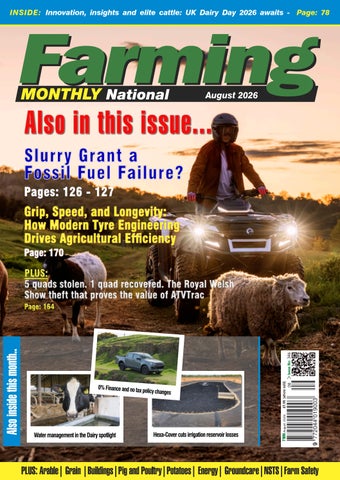
INSIDE: Innovation, insights and elite cattle: UK Dairy Day 2026 awaits - Page: 78
Farming
0% Finance and no tax
08
346
August 2026
policy changes £7.95
Also inside this month..
MONTHLY National
Water management in the Dairy spotlight
Hexa-Cover cuts irrigation reservoir losses
PLUS: Arable| Grain |Buildings|Pig and Poultry|Potatoes| Energy| Groundcare|NSTS|Farm Safety
Don't miss a thing! Tune in to our Farming Monthly Podcast every month for in-depth discussions on all the topics found in this month's magazine, available on all major podcast platforms listed below.
CONTENTS
A u g u s t 2026
FEATURES
24 Arable
170 Tyres
•
42 Sprayers 44 Grain 50 Mental Health & Well Being 54 Potatoes
FM REGULARS National
62 Groundcare 70 Farm Safety & Security 78 Livestock
6 News
130 Machinery
120 Pig and Poultry
66 Energy
154 ATV
124 Muck & Slurry
68 Buildings
172 Motors
Farming
•
Farming MONTHLY National
Agriculture. Covered. EDITOR editor@farmingmonthly.com EDITORIAL ENQUIRIES editorial@farmingmonthly.com ADVERTISING ENQUIRIES
Tel: +44 (0) 2476 353537 DIRECTOR Shona Beedham shona@farmingmonthly.com ACCOUNT EXECUTIVE Jennifer Mills jennifer.mills@farmingmonthly.com ACCOUNT EXECUTIVE Vicky Smith vicky.smith@farmingmonthly.com PRODUCTION production@farmingmonthly.com
Front cover credit:
BRP.com
Warm weather raises fly risk in pig units
Subscribe today!
Call us on 02476 353537 or visit our secure website at www.farmingmonthly.co.uk
Available in
DIGITAL & WEB
For editorial, general enquiries or to advertise please call +44 (0) 2476 353537 or email sales@farmingmonthly.com Farming Monthly National is published monthly in the UK by Farming Monthly Ltd, Tel: +44 (0) 2476 353537 UK based Digital Farming Magazine. No part of this magazine may be reproduced without permission from the publisher. Whilst every attempt is made to ensure accuracy, the opinions expressed in the magazine are not necessarily those of the Editor or publication. The Editor also reserves the right to alter or edit material as required and no responsibility is accepted for inaccuracies. Full copyright applies. All rights reserved. ISSN 2044-0190 (print) ISSN 2044-0200 (digital)
The Engineering Angle Farming
| News
Lloyds reinforces support for UK farmers as prolonged dry weather adds pressure to rural businesses
L
loyds is reinforcing its support for farmers as ongoing dry weather creates further pressure for the UK farming sector, affecting yields, feed supplies, water use and cashflow.
Through Lloyds and Bank of Scotland, specialist agriculture managers are working closely with farming businesses to understand the local conditions and consider tailored support to help manage short-term financial needs. Support for eligible customers may include working capital solutions, overdraft support, loan repayment holidays, interest rate reductions, temporary lending facilities or wider lending arrangements. Support for farmers Tom and Samantha Summerfield, who run Keele Dairies Ltd near Newcastle-under-Lyme, have worked with Lloyds to increase the farm’s cashflow facility, giving the business greater flexibility and buying power for essential inputs and to ensure future growth. The support is helping the farm respond to challenging conditions, including periods of drought and low market prices, while continuing to prioritise the welfare and productivity of its herd. The impact of dry weather The support comes as farm businesses navigate a range of seasonal pressures, with the impact of dry weather varying by region, crop and farm type. As the UK's largest lenders to the agricultural sector, alongside
immediate financial support, Lloyds continues to help farmers invest for longer-term resilience. This includes its Clean Growth Financing Initiative, which offers discounted lending for eligible green investments such as energy efficiency, renewables, water management and waste management, and Agriculture Transition Finance, which is designed to support UK farmers moving towards regenerative farming practices. Dry conditions can affect farming businesses in different ways, from reduced grass growth and higher feed requirements for livestock farmers to pressure on yields, harvesting patterns and water use for arable businesses. These challenges can quickly translate into cashflow and working capital pressures, particularly where farms are also managing wider cost pressures and planning future investment. Lee Reeves, UK Head of Agriculture at Lloyds, said: “Prolonged dry weather is creating real challenges for many farming businesses, from pressure on yields and feed availability to water use and cashflow. As the UK's largest lenders to the agricultural sector, our specialist managers are speaking with customers across the UK to help provide tailored support, including options to manage working capital, overdraft needs, or wider lending arrangements. “British agriculture is vital to food security and rural communities, and we remain committed to supporting farmers with the finance and expertise they need to grow and remain resilient.”
Hutton to host Climate-Positive Farming Taster Day at Glensaugh Research Farm as part of Climate Week North East
T
he James Hutton Institute is inviting those keen to learn about the future of agriculture to a Climate-Positive Farming Taster Day at Glensaugh Research Farm on Wednesday 23 September.
Organised as part of Climate Week North East, the taster will give visitors the chance to join the team behind the Hutton's Climate Positive Farming Initiative (CPFI) for a farm walk and indoor displays. Attendees will learn about the groundbreaking work being done at Glensaugh to address the climate and biodiversity crises through transformative farming and technological innovations. Hutton researchers will explain the details of the peatland restoration, green hydrogen-powered farming, agroforestry, greenhouse gas emission and natural flood management projects taking place at Glensaugh as they Farming
lead visitors up the glen, across the moor and through the fields. The guided walk will be followed by indoor displays with coffee and tea, during which visitors can discuss specific projects with the Hutton team. Two walks will take place on the day, one beginning at 10am and the other at 2pm. Each will last around 90 minutes, covering a distance of 3km. The route features steep inclines and may be muddy due to weather, so hiking boots are advised. The walk is family friendly; however, the route is not accessible for wheeled transport users - such as pushchairs, wheelchairs, motorised scooters. To find out more or register for the Climate-Positive Farming Taster Day, visit: Climate-Positive Farming – Taster day at Glensaugh Tickets, Wednesday, September 23 • 10 AM - 4 PM | Eventbrite
| News
The Wildlife Trusts respond to new support for farmers tackling drought
he Government are set to announce a package of support for farmers managing drought pressures this evening. The £65 million of funding is in response to the growing impacts of climate change driven extreme weather this summer, with prolonged heatwaves and drought impacting farm businesses, food production and nature.
T
Gemma Lane, land use policy manager at The Wildlife Trusts, says: "As extreme weather becomes more frequent, this additional funding for the Sustainable Farming Incentive is a positive step in supporting farmers to improve their resilience to the growing impacts of climate change. From adding more shade for livestock through
hedgerows and agro-forestry, to boosting grassland resilience by re-introducing floodplain meadows and species-rich grassland, this increased recognition of nature's role in tackling climate impacts is much-needed.
"However, lasting resilience will only come from sustained investment in healthy soils, nature-rich habitats, and Environmental Land Management schemes, including Countryside Stewardship, made available to all farms. It's vital that investment supports the long-term foundations of resilient farming and utilises nature-based solutions to help farmers hold more water in the landscape, reduce the impacts of drought and flooding, and strengthen food security."
Burnham must fix reservoir planning rules minister have ignored for years ight now, farmers face two hurdles to building reservoirs: getting permission to construct one and then getting permission to take the water to fill it (an abstraction license). Both can be slow and costly, with fees running into six figures. So much so, that only 34 on-farm reservoirs have been completed in the past five years.
R
Gavin Lane, President of the CLA, which represents 28,000 farmers said: "Today's emergency meeting has to mark a reset. For years, farmers have been watching crops die in the ground because there's not enough water. Yet every winter, rain pours down across fields that can be desperately short of water by summer. Farmers should be able to capture more of that when it's plentiful and store it for the dry months ahead. "Instead, planning rules make reservoirs slow and costly to build, while rigid restrictions on taking water to fill them can leave farmers short when they need it the most. Farmers are now spending £45K on average before they even put a spade in the
ground. With so much money at stake and no guarantee of an outcome, many simply can't afford to take the risk. "Burnham must take seriously an issue ministers have ignored for years, and start with the solutions we already know work, from cutting red tape around farm reservoirs to investing in healthier soils. Farmers have endured three droughts in five years. They are resilient people, but unless government act now, they might not come back from this harvest." The CLA is calling for three core changes: •
Reform permitted development rights and the abstraction licensing system to make it easier for farmers to build on-farm reservoirs
•
Extend the Annual Investment Allowance to structures and buildings, including farm reservoirs, replacing the current allowance, which is spread over 33.3 years
•
Allow land managers to conduct prescribed burning without a licence for each individual burn site, including on designated sites Farming
| News
Hot, dry weather driving salmonella risk: Three key areas poultry producers should focus on ith prolonged periods of hot, dry weather and harvest underway across many parts of the UK, poultry producers are once again experiencing the seasonal rise in salmonella outbreaks.
Practical measures may include monitoring harvesting activity near poultry houses, managing ventilation during particularly dusty periods and dampening down areas where appropriate.
While there is no single explanation, higher temperatures can help salmonella survive and spread, while dry conditions generate dust that may carry bacteria around the farm. Harvest activity can also disturb vermin and place additional pressure on environmental control systems, increasing overall disease risk.
While environmental conditions play a role, people remain one of the most common routes for disease introduction.
W
According to Dr Paul Talling, Biosecurity Advisor at Livetec, producers should focus on managing the seasonal risks they can control rather than searching for one specific cause. Vermin on the move As fields are harvested, rodents lose food sources and shelter, often driving them towards farm buildings. Vermin are a well-known disease vector and can increase the risk of salmonella being introduced onto poultry units. Manure spreading after harvest can also raise the bacterial load in fields surrounding poultry houses, increasing the potential for cross-contamination. Maintaining an effective vermin control programme is therefore essential. Amy Davies, Livetec Biosecurity Advisor, explains: "Harvest disturbs vermin. They don't want to stay where machinery is working and there is no cover, so they move towards buildings where they will try to find shelter. Also avoid spreading muck near your buildings, as this can increase the risk from vermin." Dr Talling adds that producers can often be caught out by how quickly vermin pressure changes during summer as food sources disappear. Dust, dry weather and an earlier harvest This year's exceptionally dry conditions have not only brought harvest forward but also created significant amounts of dust. Dust is more than an inconvenience. It can become contaminated with bacteria and be drawn into poultry buildings through ventilation systems. Feed delivery areas can also create dust that, if left unmanaged, may contribute to airborne contamination. "Hot, dry weather means the fans are working harder, pulling more air into the building," says Dr Talling. "If that air is carrying contaminated dust, it increases the risk. Minimising dust near vent inlets is important." Farming
Never underestimate the human factor
Contaminated footwear, clothing, visitors moving between sites and poor hygiene practices can all increase the risk of salmonella entering a poultry unit. The consequences of a positive result can be significant, making robust biosecurity procedures essential. Dr Talling highlights sampling procedures as an area requiring particular attention. "The consequences of a positive salmonella result are significant, so it's vital that anyone taking samples follows all procedures properly. Something as simple as poor hand hygiene or inadvertently touching dirty surfaces can contaminate a sample." Amy Davies also points to the importance of water hygiene during hot weather. "When temperatures rise, biofilm can build up more readily in water lines, creating an environment where bacteria can multiply rapidly. At the same time, birds experiencing thermal stress are more susceptible to disease." Regular flushing of water systems and protecting feed from contamination can help reduce these risks. Every action helps reduce risk While producers cannot control the weather, neighbouring harvest operations or every source of dust, strong everyday biosecurity remains the most effective defence against salmonella. From controlling vermin and managing dust to maintaining water systems and following strict hygiene procedures, every measure helps reduce the chance of disease entering the flock. As Dr Paul Talling concludes: "There are lots of contributing factors. You won't be able to control every one of them, but every risk you mitigate helps lower the overall chance of salmonella finding its way onto your farm and infecting your birds." Credit: Livetec Systems, www.livetecsystems.com
Farming
| News
Agrii appoints new managing director
C
hris Tye succeeds Ronan Hughes, who progresses to become Managing Director of Origin’s Ireland and UK Agriculture Division.
Agrii has announced that Chris Tye has been promoted to Managing Director of Agrii UK, effective 1st August. He succeeds Ronan Hughes, who moves into a new role for Agrii’s parent organisation, Origin, that will oversee the running of its agriculture businesses across Ireland and the UK, including Agrii UK. Chris joined Agrii five years ago as Head of Fertiliser and has taken on progressively broader responsibilities, most recently becoming its Commercial Director. "I am incredibly proud to be taking on the role of Managing Director of Agrii UK at such an important time for our business and our industry,” says Chris. “Having spent the last five years working alongside talented colleagues across the organisation, I've seen first hand the dedication, expertise and innovation that make Agrii unique. “Agrii has a proud heritage of leading the way in agricultural innovation, and I believe we have a tremendous opportunity to build on that strength. By combining our industry leading R&D, tools and expert advice, we can tel: 01724 850224 digital support our customers in driving fax: 01724 289317 sustainable, profitable and resilient farming businesses for the future.” Ronan had been Agrii’s Managing Director since 2010, when Agrii was formed following Origin's acquisition of UAP and Masstock, creating the UK’s largest agronomy services provider. His tenure has seen significant investment into the UK business, most notably the expansion of its research facilities at its Throws Farm Technology Centre in Essex, including the new £1m glasshouse in 2025. “I would like to thank Ronan Hughes for his leadership and support,” continues Chris. “I look forward to continuing to www.neilvessey.com work closely with him in his new role. sales@neilvessey.com Together, we will ensure Agrii remains focused on delivering value for our customers and helping UK agriculture thrive in a challenging environment."
Farming
| News
Cultivating Success: Award-Winning Student Innovator Secures Top University Offers
A
Talented Coleg Cambria student who designed an award-winning agricultural robot and secured offers from five leading universities is preparing for the next stage of his engineering journey.
Krish Lavan, 18, from Wrexham, has spent the last two years studying Maths, Physics, Further Maths and the Welsh Baccalaureate at Cambria's Yale Sixth Form, where he has excelled both academically and beyond the classroom. A former pupil of St Joseph's Catholic and Anglican High School, Krish has accepted an offer to study for a Master of Engineering (MEng) degree in Electrical and Electronic Engineering at the University of Sheffield, with a year in industry. His long-term ambition is to build a career in electronic engineering, specialising in areas such as digital electronics, embedded systems, semiconductors and robotics, with a particular interest in developing technologies that solve real-world problems. During his time at college, Krish embraced a range of opportunities to develop his skills and showcase his talent. He participated in UK Mathematics Trust competitions, the British Physics Olympiad and engineering challenges, earning recognition for both his academic ability and innovative thinking. Among his proudest achievements was receiving the prestigious Yale Sixth Student of the Year Award. Krish said: “I would like to say a massive thank you to (Head of Yale Sixth) Gareth Jones and my subject teachers, Alistair, John, Rob and Ekundayo, for their constant academic support and encouragement throughout my journey. “They have continually challenged me to push myself further and provided valuable opportunities to showcase my abilities, such as participating in the UK Mathematics Trust competitions, the British Physics Olympiad and engineering competitions. “I would also like to thank my family and friends for their ongoing support, both personally and in
helping me overcome challenges and obstacles I have faced.” He added: “I was incredibly grateful to receive the Yale Sixth Student of Year Award and to have been nominated by my Progress Coach Rebecca. Her support and willingness to recognise my achievements have been invaluable. I would also like to extend a big thank you to Nora Richardson, whose guidance helped me win an award in a major UK engineering competition, which was a significant contribution towards receiving the Student of the Year Award.” That competition was the nationally recognised Big Bang Competition, held at the NEC Birmingham. Alongside fellow learner Dylan Blackwell, Krish won the "Stantec Developing Future Communities" category with their innovative OMAA-Bot (Odometry Mapping Automatic Agri-Bot). Designed to support sustainable farming, the robot autonomously monitors plant growth using a sensor-based control system, hydrates plants via an integrated water pump and trac ks its movement to navigate predefined routes. Gareth Jones, Assistant Principal and Head of Yale Sixth Form, congratulated Krish, and said: “Krish is an outstanding learner who has consistently demonstrated academic excellence, determination and a genuine passion for engineering and technology. He has embraced every opportunity available to him, pushed himself to achieve at the highest level and been a fantastic role model for his peers. We are immensely proud of his achievements and have no doubt he will go on to enjoy great success at university and throughout his career.” Coleg Cambria supports learners across a wide range of academic and vocational pathways, helping them develop the knowledge, skills and confidence to progress into higher education, apprenticeships and rewarding careers in industries across the UK and beyond. Visit www.cambria.ac.uk for the latest news and information from Coleg Cambria. Farming
| News
From Germany to North Wales: International Butcher Brings Decades of Heritage to Rhug Estate
A
Talented butcher from a family with generations in the trade has joined Rhug Estate, bringing international experience to the North Wales organic food producer.
Food technician Uli Kappel has swapped rural Germany for the 12,500-acre estate near Corwen after a career spanning Europe and South America, joining the award-winning Farm Shop at one of its busiest times of the year. The appointment strengthens the team behind Rhug's renowned butcher's counter, which serves thousands of visitors annually alongside a growing online customer base, with Rhug's meat holding a prestigious Royal Warrant from His Majesty The King and Her Majesty The Queen. Farming
Born and raised in the rural Meschede region of Germany, Uli comes from a long line of butchers, with his grandfather, father, uncles and cousins all working in the profession. After building his career in countries including Croatia, Bulgaria, Romania, Switzerland and across South America before moving to Scotland, he was approached about joining Rhug Estate and immediately felt at home. "It feels very similar to where I grew up," said Uli. "We had a small village surrounded by mountains, rivers and streams, although perhaps the mountains there are a little bigger! "Butchery has always been part of my family. It's in our background and something I've loved
| News
from an early age, so to have the opportunity to join a place like Rhug Estate is very special. "I'm looking to put my own stamp on the role, develop new products and be creative while working with some of the finest organically produced meat anywhere in the UK. He added: "I've worked with all types of meat around the world, but North American bison is something completely new for me. The quality here is exceptional. "It's also fantastic that everything is produced here on the estate. Working so closely with the cutting plant means we're able to prepare fresh products every day and experiment with new ideas while keeping quality consistent from field to plate." Rhug Estate is one of Britain's leading organic farming businesses, spanning 12,500 acres near Corwen. Working closely with the estate's on-site cutting plant, Uli prepares everything fresh for the Farm Shop butcher's counter, from handcrafted sausages, burgers and stuffed chicken to barbecue favourites including steak skewers, while also helping develop new seasonal products. The cutting plant sits at the heart of Rhug Estate's celebrated operation, giving complete traceability and expert dry ageing before produce reaches customers in the Farm Shop, online and through leading restaurants, hotels and luxury retailers. "We've been incredibly busy from day one, especially with the barbecue weather," said Uli. "The burgers, sausages, stuffed chicken and beef skewers have been flying out. One customer wanted to buy every steak skewer we had, and some days we've sold out before the counter even closes. "The diced beef steak skewers with bell peppers have been especially popular. People love the quality of the meat here and we've
struggled to keep some products on the counter because demand has been so high. "It's exciting because I can blend traditional butchery with new ideas. That's exactly the kind of challenge I was looking for, and everyone has made me feel so welcome. "I'm looking forward to putting down roots in North Wales, making new friends and enjoying everything Wales has to offer." Lord Newborough, owner of Rhug Estate, said: "I'm proud when I walk into the shop now and see an exciting looking butcher's counter, full of incredible cuts ready to pop in the oven. “Uli brings a depth of experience to our counter, and it shows within weeks of him arriving. He understands our produce and our standards, and customers are already noticing the difference. It's exactly this kind of skill and dedication that keeps Rhug at the forefront of British organic food and also maintains Rhug Farm Shop as the number one farm shop in Wales." Amy Coleman, Managing Director of Rhug Ltd, added: "Bringing the butcher's counter back to life at Rhug Estate is a brilliant milestone for us. Our farm shop is all about connecting people with exceptional produce, and having our expert butchery team back at the centre of the shop floor elevates the whole experience for our visitors." The Estate also introduced vending machines to give customers 24/7 access to Rhug’s premium produce beyond traditional Farm Shop hours, offering a practical solution for busy visitors while also helping reduce food waste. For more news and information, visit www. rhug.co.uk and follow the Estate on social media @rhugestate. For more information on Rhug Wild Beauty, visit www.rhugwildbeauty.com or follow @rhugwildbeauty. Farming
| News
NFU Mutual Charitable Trust delivers more than £420,000 to UK rural causes
T
he NFU Mutual Charitable Trust has announced its first round of donations for 2026,totalling £424,000 and giving support to 13 rural causes across the UK.
This is the first of two rounds of funding which will be delivered across the year. The Trust expects overall donations to reach at least £1m by the end of the year. The NFU Mutual Charitable Trust is one of the main ways the UK's leading rural insurer provides charitable donations. Its work forms part of NFU Mutual's £4m charitable giving pledge to support its members and their communities during 2026. NFU Mutual is supported by the Trust's panel of Trustees, who provide their expertise to help ensure that farming and rural communities across all areas of the UK are represented and considered. The organisations set to benefit from these latest donations are: •
Addington Fund
•
Chasing the Stigma
•
Commonwork Trust
•
Farmstrong Scotland
•
The Farming Community Network (FCN)
•
Farms for City Children
•
Gareth Raw Rees Memorial Scholarship
•
Oxford Farming Conference
•
Nuffield Farming Scholarships Trust
•
RSABI
•
The Institution of Engineering and Technology
•
Tir Dewi
•
Wales YFC
The donations will be available immediately, allowing the organisations to continue to provide their crucial support services. Applications for the NFU Mutual Charitable Trust’s December round of donations are now open, and the closing date is 9th October. Full details can be found on NFU Mutual's website. Farming
Jim McLaren MBE, Chairman of NFU Mutual and the NFU Mutual Charitable Trust, said: "Farming and rural communities are at the heart of our heritage, and we are proud to support charities that help them thrive. This funding will make a meaningful difference to people and communities across the UK, supporting everything from rural poverty relief and farming resilience to agricultural education and wellbeing. Through the NFU Mutual Charitable Trust, we are honoured to champion organisations whose work is transforming lives and strengthening rural communities for the future." One of this year's recipients, Farms for City Children, is celebrating a special milestone – 50 years of inspiring young people through life on the farm. The charity will use its £50,000 donation to help more children discover the confidence, curiosity and connection that come from spending time in the countryside. Since 1976, Farms for City Children has given thousands of young people – many with little opportunity to experience rural life – the chance to live and work on farms, learn new skills, build confidence and create memories that last a lifetime. The NFU Mutual Charitable Trust is proud to have supported the charity for many years, donating more than £225,000 since 2009. Alongside this financial support, NFU Mutual employees have also volunteered their time on the farms, providing hands-on support and helping the charity create life-changing experiences for more young people. Seeing the impact of these experiences first-hand is what makes this longstanding partnership so meaningful. Corinna Csaky, Chief Executive at Farms for City Children, said: "This incredibly generous donation by the NFU Mutual Charitable Trust reflects a longterm relationship rooted in shared values and lasting impact. Together, through this gift, we are enabling children and young people to grow and thrive by connecting them with food, farming, and nature, while advancing our nature-friendly farming practices to ensure a positive impact for both young people and the environment. Thank you for your continued support of Farms for City Children and the children and young people we serve."
| News
Jump in farmers taking out protection to cover their families
M
ore farmers have been taking out protection insurance products to cover themselves or their families from unexpected events such as injuries or illness.
New research from NFU Mutual, the UK's leading rural insurer, found that the number of farmers who said they held protection products such as life assurance jumped to 51% in 2026 from 44% in 2025, with 19% of those farmers questioned naming protection as their most important financial management need. The annual Voice of the Farmer research questioned 1,652 farmers across the UK between March and May 2026. The trend comes as the latest data from the Health and Safety Executive in July underlines that agriculture remains one of the most dangerous professions in the UK with 22 worker deaths in the agriculture, forestry and fishing sector reported in 2025-26. The sector also continues to have the highest rate of fatal injury per 100,000 workers (at 8.09) of all main industry sectors. This compares to an average 0.37 fatal injuries per 100,000 workers across all industries combined. In addition, around 9,000 workers in the agricultural, forestry and fishing sector have suffered from work-related ill health over a five-year period from 2020-21 and 2024-25, according to Health and Safety Executive figures. Some 67% of work-related ill health related to musculoskeletal disorders, the HSE figures show. Farmers work with potentially dangerous machinery, vehicles and chemicals as well as working with animals and working at heights or near pits and silos. Agricultural work can also be physically demanding causing a range of health problems, including severe back pain. HSE has estimated that musculoskeletal injury in the sector is over three times the rate for all industries. Farming families often are reluctant to discuss what happens in the event of a farmer being diagnosed with a serious illness or suffering a fatal workplace injury. However unexpected events can hit production and, in some cases, could put the longterm viability of the farm at risk or leave farms exposed when succession plans and protection
arrangements have not been put in place. David Nottingham, protection expert at NFU Mutual, the UK's leading rural insurer, said: "Farmers know just as well as anyone how unexpected events and illnesses can have a considerable impact on the day-to-day running of an organisation, irrespective of size. "These unforeseen absences can put a strain on the farm – particularly if it is a small farm reliant on just a few people. "However, there are a number of ways to guard against those challenges and to help secure the future of the farm and keep things running smoothly." Protection products can help in the event of a serious accident - or worse. David added: "Many farms are set up as businesses. Business protection policies allow business owners to take out life or critical illness cover. This helps instances of small partnerships or businesses where the loss of a key individual could impact on the viability of the business." Protection insurance products include term insurance – a fixed term policy which pays a lump sum, commonly used to cover outstanding mortgage payments, if the policyholder dies unexpectedly or prematurely. It also includes 'whole of life' insurance offering a guaranteed sum at death - often used to cover inheritance tax costs, or to provide a financial legacy for family members. Income protection policies are designed to help fill income gaps when a person is unable to work due to illness or injury. Critical illness policies give a lump sum of cash if someone is diagnosed with a serious illness specified under the cover. This can be used to repay farm borrowings, pay for home adaptation or meet any other commitments that are needed. In the UK, around £1.42bn was paid out by insurers in 2025 in critical illness claims and £880m in income protection claims, according to figures from the Association of British Insurers (ABI) which also show that insurers paid out £7.84bn in individual and group protection claims in 2025 to customers suffering illness, injury and bereavement.
Farming
| News
Farming
| News
Farming
| News
Government drought package is 'important step' to building water and food resilience
T
he government's drought package announced today will help farmers better manage the severe pressures they are battling caused by sustained hot, dry weather and a continued absence of rain, said the
NFU today. England has now experienced three droughts in five years. It has led to an incredibly early harvest and historically low yields, stunted grass growth forcing livestock and dairy farmers to use winter stocks to feed their cattle and potatoes, sugar beet and other field crops failing because of lack of water. For those who can irrigate, many are facing abstraction restrictions or reservoirs are simply running low or empty. The drought will increase the cost of producing food for many farmers and growers, at a time when they are already facing a myriad of challenges, from midge-driven diseases such as bluetongue to high costs of fuel, energy and fertiliser. NFU President Tom Bradshaw said: "Providing this relief package and meeting with farmers to hear first-hand from them, it's clear that the Prime Minister has recognised the serious impacts this drought is having on farmers and on our ability to water crops, feed livestock and keep food production on track. It signals that investment in farming's resilience is an investment in the country's resilience. "We've all seen the brown, bleak fields, but the impacts on food production, and therefore on the 29 million households which all rely on three meals a day, goes much deeper. "The £65m of investment into the Sustainable Farming Incentive (SFI) and water infrastructure is very important strategic support that will benefit farmers. However, we are experiencing a huge crisis of cashflow and confidence across all sectors and urgent support will be needed for farmers who are feeling that pressure now, so they are still producing food next year. "This government has said food security is national security, a sentiment the Prime Minister has echoed. Securing access to water for food production is vital to this, and so is building resilience across our entire food system. "Today's announcement is welcome and includes many of the NFU's asks2, but more detail is needed to understand how these will work in Farming
practice. Investment in water is critical, it is the lifeline of our food system, and we must ensure the process is streamlined and that grants are accessible. "As we look forward, I hope we can build on the important steps taken today and work towards a resilient food system that delivers for farm businesses, families and communities, both now and for generations to come." The NFU has been making the case at the highest levels of government for action to build the UK's resilience to extreme weather, which is becoming increasingly common, to enable farmers to continue to produce the nation's food despite climatic challenges. NFU Deputy President Paul Tompkins said: "It's clear that our weather patterns here in the UK are changing. We can no longer always rely on rain throughout the year, and it's imperative that we invest in our national water infrastructure so we can capture and store water at times of plenty for use in times of shortage. "This announcement rightly recognises that it will take a combination of approaches: improved planning to remove unnecessary barriers and make it easier to build farm infrastructure, simplified abstraction arrangements so farmers can access water more easily and financial support to help invest in farm reservoirs and equipment to build long-term food resilience. "The NFU will continue to work with government and its agencies to achieve our shared ambition of plentiful water for producing food, which will make a real difference to farmers and our ability to withstand the current and future droughts." NFU Vice-president Robyn Munt said: "The derogations on SFI requirements will provide muchneeded flexibility for farmers in existing schemes; particularly those struggling to provide forage for their livestock and who want to protect their farm against wildfires. "Investment in the SFI scheme is crucial – supporting on farm practices, such as improving soil health, is what will underpin business resilience against the climate pressures we see today. We will continue to work with Defra to ensure this scheme delivers for both farm businesses and farmers' ambitions for the environment that supports them."
| News
New Prime Minister must recognise importance of farming to the nation
A
s Andy Burnham becomes Prime Minster today, the NFU has written to remind him of the essential role farmers and growers play in feeding the nation's 70 million people.
In the letter the NFU acknowledged the emphasis he recently gave to protecting the UK's sovereign manufacturing and production capabilities in critical sectors, including food and farming. It also urged the Prime Minister to prioritise the food supply chain's five-point resilience plan¹ as he further develops his agenda for government. The food sector's roadmap gives the government clear actions to strengthen the UK's food resilience, unlock investment, jobs and growth in every part of the country and ease the pressure on households. NFU President Tom Bradshaw said: "British farmers and growers are the bedrock of the nation's food security, putting food on the plates of 28
million households every day. Yet while governments rightly treat defence and energy security as national priorities, food security has too often been overlooked. "As he takes office, Prime Minister Burnham has an opportunity to turn Labour's commitment in its manifesto that 'food security is national security' into meaningful action. With the right policy framework, farmers and growers can drive growth in every constituency, strengthen the UK's resilience and help ease pressure on households. "As he further develops his plan for government, Prime Minister Burnham can take immediate action by backing a planning system that unlocks investment, regulation that drives innovation and growth and ensuring there's the workforce available farming and growing businesses need to thrive. Together, these measures would help build a more resilient food system and we stand ready to work with the government to deliver them."
Vaccination best form of defence as concern grows over spread of bluetongue virus
V
accination remains the strongest defence available to livestock farmers who are battling the growing threat of the bluetongue virus serotype 3 (BTV3) which is spreading at an alarming rate across the UK, the NFU has said.
More than 200 confirmed cases have already been recorded in England and Wales during the current vector season, with 31 new cases confirmed in England just yesterday (6 August). All were tested following reports of suspicious clinical signs. The South West, including Devon and Cornwall, is a particular hotspot for the disease. The hot, dry weather has created favourable conditions for biting midges, the insects that spread BTV-3. NFU Acting Livestock Board Chair Clare Wise said: "The past few days have been a stark reminder that bluetongue poses a serious and growing threat to the UK livestock sector and it's not going away any time soon. "This disease can have serious consequences for cattle, sheep and other ruminants, affecting animal health, productivity, movement and trade, while
also creating considerable stress and financial pressure for livestock farming businesses. "As the disease continues to spread at an alarming rate, it's important to assess the risks and consider all the tools available by speaking to the farm vet. Vaccination is proving to be the most effective shield against the disease, which is spread by biting midges, and may offer greater confidence and resilience as the industry navigates the challenges the disease presents. We welcome the push by manufactures to make more vaccines available. "To reduce the risk, farmers are also moving highrisk or non-vaccinated stock away from wet, lowlying, or sheltered areas. They are also keeping vulnerable animals housed during dawn and dusk when midge activity peaks, all of which is added pressure on farmers and forage stocks during this challenging dry weather period. "A coordinated approach across the industry will give us the best chance of reducing the impact of bluetongue. The NFU is continuing to engage closely with Defra, the devolved administrations and industry partners to ensure our members concerns are being heard." Farming
| News
Pitchup.com extends FCN partnership for a third year P itchup.com has committed its support for The Farming Community Network (FCN), Britain’s farmers and their families, for a third year.
Continuing the partnership for the third year, since originally joining forces in November 2023, Pitchup’s support will help the FCN to continue their vital work in helping improve the lives and wellbeing of the farming community.
In addition to donating money to the charity, Pitchup.com continues to share mental health resources with its farming customers, and Pitchup.com’s customerfacing team have been trained to understand the challenges farmers face, signposting them to the FCN’s support services if they need it. Dan Yates, founder of Pitchup.com, said farmers need as much support as they can get, especially with the dry hot temperatures causing additional pressure this year. He added that by supporting FCN, Pitchup.com’s hope is to help to relieve some of the pressures farmers are currently experiencing.
Pitchup, a UK-based global search and booking platform for outdoor accommodation, has steadfastly championed the rural economy since inception in 2009 and is passionate about supporting rural economies.
Mr Yates said: “Farmers have faced unprecedented challenges in recent years, from funding changes, to sustained price rises, and continuing extreme weather events. The farming community continues to plough on, despite these pressures, but sometimes the strain can become unmanageable.” “This is where FCN steps in. Their work is vital in ensuring every farmer has somewhere to turn when they need support the most. Pitchup.com is very happy to continue to support such an impactful organisation.” Georgina Lamb, Head of Partnerships at FCN, said she was delighted Pitchup.com had chosen to continue its support of the charity for another year. She said: “The team at FCN are extremely grateful for this extended support enabling us to continue our valuable work across the country and creating opportunities to raise awareness about the work of the charity.”
Farming
| News
Make reservoirs easier, urges CAAV he Government needs to expedite and improve its plans to make it easier for farmers to create reservoirs if it is remotely serious about food security. This year’s drought – after one of the wettest winters on record – has brought water management sharply into focus. And unhelpful legislation is preventing farmers from taking necessary action.
T
Accelerating the Structures and Buildings Allowance for Income and Corporation Taxes, so that it is of practical use for costs involved would also help with such substantial and necessary investment, he adds. “Alternatively, the Annual Investment Allowance could be increased and widened to cover such work.”
“July was the driest since records started in 1836,” says Jeremy Moody, secretary and adviser to the Central Association for Agricultural Valuers. “Some places have not seen rain for 60 days. Two thirds of England and all of Wales are now under drought orders.”
As periods of water scarcity become more frequent, increasing storage capacity and preventing wastage will become more important. “That may mean protecting stored water from evaporation and moving from rain gun irrigation to more effective technology.” A farm reservoir is also an on-site resource against wildfire – and of benefit to wildlife.
Crops have died in the field, with yields significantly down, and livestock are having to be fed their winter rations, leaving a shortfall for the winter ahead. In addition, heat stress has slashed milk production, with daily temperatures exceeding 30oC for 35 days this year, and likely to increase.
“With yet more extremes of weather to come, this is reshaping what we do and how we do it,” notes Mr Moody. “Farmers need to futureproof their businesses and food production, and the Government needs to make it easier for them to do so.”
“Having taken water for granted for so long, we should now learn from those who have always had much less and use it more carefully while still growing crops and keeping animals,” says Mr Moody. “We need to identify how to harvest and abstract water best, store it well and then use it most efficiently, taking advantage of when our extreme weathers bring long periods of rain instead.”
For more information visit www.caav.org.uk. Mr Moody’s full blog can be seen here - https://bit.ly/ 4iddg31
Despite warm words from the Government about making it easier for farmers to build reservoirs, the legislation remains restrictive. Environmental Impact Assessment (EIA) issues override permitted development rights (PDRs), while the latter also restrict development within 25m of a trunk or classified road, prevent farmers from taking any minerals extracted off site, and prohibit bringing waste materials onto the land save for providing a hard surface. “The frustrating interactions with both EIAs and the abstraction rights needed to fill reservoirs require a much more serious approach by government,” says Mr Moody. “It needs to ease the complexity, delay and cost of processes that depend on Natural England and the Environment Agency as well as planners. For Wales, where farm reservoirs are becoming useful, we can hope that the new John Davies review of Welsh farming bureaucracy can propose similar reforms.” Farming
| News
WELSH GOVERNMENT PROCASTINATES, WHILE WALES BURNS eform UK has declared the escalating wildfire crisis across Wales a matter of emergency, as fires continue to destroy farmland, wildlife habitats and vast areas of the Welsh countryside.
R
Reform UK Shadow Minister for Food, Farming and Rural Affairs Laura Anne Jones MS is calling on the Welsh Government to treat the situation as a national emergency, provide immediate financial support for affected farmers and landowners, and formally request Armed Forces assistance through Military Aid to the Civil Authorities (MACA). Ms Jones said: “While the Welsh Government procrastinates, Wales burns. Our firefighters and farmers have been battling these fires for weeks, they are exhausted, grazing land has been devastated and wildlife habitats destroyed. Reform UK is treating this as the emergency it is, and it is time the Welsh Government did the same. “Farmers whose land has been destroyed need emergency financial support now. The Government’s announcement of grants to help fund things like fire ponds and other preventative measures in the future is welcome, but it does absolutely nothing for farmers and landowners who have already lost grazing and face years of recovery. They cannot pay tomorrow’s bills with the promise of a grant for future resilience. “We also need every possible resource on the table. I’ve written to the Welsh Government and they should urgently submit a MACA request for Armed Forces support to help our exhausted emergency services and communities wherever military personnel, equipment or logistical expertise can make a difference. At the same time, the authorities must come down like a tonne of bricks on anyone deliberately starting fires. The utterly moronic TikTok arson trend must be investigated as part of the response to these outbreaks, and anyone caught deliberately setting fires during these
Farming
conditions should face the severest possible consequences.” Ms Jones concluded, saying: “Bad government policy has helped create the conditions for these fires to spread. Restrictions on controlled burning, reduced upland grazing and the failure to manage combustible vegetation have left our countryside like a tinderbox. Ministers were warned. They must now answer for it. We in Reform UK are calling for an urgent review of Welsh land management policy.”
| News
Farmers can build water resilience if planning doesn't get in the way he current drought has again exposed how vulnerable food production is when water becomes scarce – the current drought has been dominating farmhouse discussions for the last few weeks. "On a train back from London earlier this week it was clear to see how dry the countrside has become. The impact is immediate – farmers are having to use fodder to feed their animals, dairy production has suffered and harvest yields have taken a battering. Farmers are well used to managing weather risk and planning farming operations around the forecast. However, longer dry spells, hotter summers and more extreme weather through the year means that the weather is increasingly hard to predict; the availability of water is now a core part of farm business resilience and it needs to be considered and planned for. Many farmers know what the sensible answer looks like: capture water when it is available, store it safely, and use it efficiently when crops, livestock and soils need it most. That might mean rainwater harvesting, improved irrigation infrastructure or, for many businesses, an on-farm reservoir. What is not realistic is assuming that farmers pump more water from rivers, streams or boreholes once drought has already arrived. At precisely the point when farms most need water, river flows are low, groundwater levels are under pressure and regulators are rightly focused on protecting habitats, drinking water supplies and the wider environment. Even where abstraction remains lawful, the practical costs of pumping, storing, treating and distributing water across a farm can be significant. That's why the debate needs to move towards planned storage. On-farm reservoirs allow water to be collected during wetter periods (of which we have many as weather events tend to become more extreme) and then used during what seems now to be our dry season when demand is highest. Reservoirs offer a more responsible way of balancing farm production with environmental protection. For growers of potatoes, vegetables, fruit and other high-value crops, reliable access to water can be the difference between a viable crop and a failed one. For livestock businesses, water resilience is also an animal welfare issue. More broadly, if we want domestic food production to withstand a changing climate, we need to make it easier for farms to invest in the infrastructure that makes that possible. But building a reservoir is rarely simple. It will likely involve planning permission, abstraction licensing,
T
environmental surveys, ecology work, flood risk assessment, engineering design, reservoir safety requirements and significant capital expenditure. These are not minor farm improvements. For farmers trying to build resilience, the process of gaining the permissions needed can be slow, expensive and unpredictable. Reservoirs require long-term investment and, in many cases, external funding. Farmers cannot sensibly commit to major capital projects if the consenting route is unclear or if the timetable is open-ended. The industry and government need to come together to work out solutions and in my view there should be a presumption in favour of planning permission for small on-farm reservoirs or potentially even extended permitted development rights so that the administrative process does no more than is necessary to make sure that what is being proposed is appropriate. We have a habit of gold plating the administrative process and while no doubt each aspect of that gold plate has some justification and there is a need for proper scrutiny, the emphasis now should be on clearer guidance, faster decision-making and greater consistency between authorities. Pragmatic solutions rather than red tape is needed. If government wants farmers to adapt to climate challenges, support food security and reduce reliance on emergency abstraction, then on-farm water storage must be treated as strategic infrastructure and there should be a clear path to allow that to happen without undue delay and additional cost. Earlier this year we produced Food for Thought, which examines the future of British food security is here. Featuring insights from our Agriculture and Estates team and leading industry voices, Food for Thought sets out the current state of UK farming and what needs to change to shape sustainable futures. Farming
| Arable
Dry weather drives demand for co-products
C
o-products are moving rapidly up the feed agenda as prolonged hot, dry weather leaves many livestock farms facing immediate and future forage shortfalls.
With some producers already feeding first-cut silage intended for later in the year, these highly palatable feeds can help extend forage stocks, fill nutritional gaps and support performance at a competitive cost. "Many farms are seeing grazing pressure increase, while limited grass regrowth and reduced silage yield potential are raising concerns over forage availability later in the season," explains Paula Parker, Marketing and Communications Manager at CirQlar Nutrition, part of ForFarmers. "The current conditions are also affecting the quality of the grass that remains, with lower protein levels adding further pressure to livestock performance. "Co-products can provide a valuable nutritional buffer during this difficult period. Where forage quantity or quality starts to drop, co-products can offer a cost-effective way to maintain nutritional supply without compromising performance." With high levels of energy, digestible fibre and protein, co-products can also help to improve ration palatability and support feed intakes. That
is particularly important during hot weather, when intakes may already be under pressure. "Unlike bought-in forage, which can vary significantly in quality and analysis, co-products also offer a more consistent feed source," continues Paula. "This helps maintain ration stability and supports the rumen, which performs best when changes in diet are kept to a minimum. "Co-products such as SelcoPlus are manufactured to order and provide a fresh, consistent and reliable product throughout the year. SelcoPlus also contains a bespoke preservative, helping it retain quality during storage and cope well in hot conditions – it's a product in high demand." Demand is also increasing for Mash Filter Grains in southern England, a well-established coproduct providing a highly palatable source of digestible fibre and energy, alongside costeffective protein. In Scotland, supplies of Supergrains are also available, offering producers another practical option for supporting rations and extending forage stocks. For farmers already concerned about autumn and winter feed stocks, Paula says securing supplies now could provide valuable protection if dry conditions continue. "Clamping co-products now means producers know they have feed available if grazing and silage supplies come under further pressure," concludes Paula. "It can act as a practical insurance policy on farm and reduce the risk of having to source feed at short notice later in the year. "We're encouraging farmers to review forage stocks now and look at the options before the situation becomes more difficult. The CirQlar team can advise on suitable products, availability, storage and how best to incorporate co-products into individual rations." For more information, quotes or advice, contact the CirQlar Nutrition trading team on 01509 501060, or speak to your local ForFarmers account manager.
Farming
| Arable
Next level ultra-shallow tillage performance
50% higher intensity The new third disc axle front tool adds 50% more tools to the ground, delivering higher intensity, more mixing, and stronger emergence of weeds and leftover seeds. All while preserving soil moisture and structure. The third disc axle is available for Carrier XL 425-725, Carrier XT 425-625 and Carrier 925.
Where farming starts Farming
| Arable
Positive maize harvest expected, but keeping silage cool and stable is key rolonged hot, sunny weather this season has left most of the country’s maize crops looking promising – though crops in the East are showing signs of moisture stress and progressing quickly through the growth stages.
P
Lientjie Colahan, forage technical support at Lallemand Animal Health, says if the weather continues to be hot with scattered showers as forecasted over the coming weeks, most of the country can expect a very positive maize harvest, with good crop yields and high starch content. “If the maize reaches a dry matter above 35%, there’s the risk of heating during feed-out due to the abundance of starch and lactic acid,” she says. “Higher starch and the lactic acid required to conserve the crop mean there will be lots of nutrients for spoilage bacteria, yeasts and moulds to consume. These organisms grow in the microscopic gas voids in the clamp, and when the crop is dry it’s harder to compact, so the voids will be larger, exacerbating the issue,” Ms Colahan explains. “In these conditions, aerobic stability will be your biggest concern. If you don't treat it with an inoculant, the yeasts and moulds will remain active for longer as the crop ferments after closing the clamp, increasing the risk of mycotoxins which can significantly affect everything from cow productivity to fertility. “Ultimately, the best way to protect silage quality throughout the process is to treat it with an inoculant as it will inhibit yeast and mould growth, and therefore mycotoxin development,” she says. An inoculant acts as an insurance policy to smooth out uncertainty – giving you the maximum value from the crop when conditions are favourable and making the best of what you have in less ideal conditions, she adds. When choosing an inoculant, Ms Colahan advises farmers opt for a product with an antifungal component such as Magniva Platinum Maize, as Farming
those designed only to aid fermentation will likely increase heating at feed-out. “Farmers who use a homofermentative-only inoculant are at risk of seeing their maize clamps heating up very quickly once opened, so they will lose more feed value going to the cow. Whereas those who use the combination inoculant should see the clamp staying nice and cool, with more nutrients going to the cow.” However, Ms Colahan says the fact that maize ferments easily has led some growers to believe an inoculant is unnecessary. “Maize will ferment without an inoculant if conditions are favourable, but that's a false economy because the aim is not just to ensure fermentation, it’s to preserve nutrients and produce a higherquality feed for livestock, especially when then clamp is opened.” The bulk of the country’s maize crop is expected to be cut in September this year, though some may be as early as the first two weeks of August because of the dry weather. “The golden rule is that once the crop tassels; six weeks later will be the first indication of when to cut it for silage,” she says. “For conventional varieties, rather than stay-green varieties, the leaves at the bottom of the plant will start drying off and become crispy, while those towards the top will still be green. “You can also look at the ‘milk line’ on the cob, which grows throughout the kernel as the plant matures. When this is two-thirds of the way down the kernel, that's the ideal harvest stage where you have the balance of as much starch as you can get, but you still have a digestible plant.” Ultimately, strategic use of the right inoculant can reduce the risk of mycotoxins and ensure farmers capitalise on the nutritional value of this year’s maize silage crop.
CO NT AC TY OU R
AV DE AI MO LA S NE B AR L ES E T
DE AL ER
| Arable
KARAN TRAILED SPRAYER
Maximum performance with the efficient sprayer • Available with 4,500L, 6,000L or 8,000L tank capacities • Aluminium booms from 24 to 39m, with EAGLE boom height control • Hydraulic, electric or AUTOSPRAY pulse width modulation circulations • 280l/min or 560l/min pumps available
www.
.co.uk
RVW Pugh Ltd
RVW Pugh Ltd
RVW Pugh Ltd
Tel: 01588 620545
Tel: 01477 533560
Tel: 01695 816444
www.rvwpugh.co.uk
www.rvwpugh.co.uk
www.rvwpugh.co.uk
TR Machinery Ltd
Tel: 01952 936900 www.trmachinery.co.uk
Farming
| Arable
Farmers urged to review forage stocks as grass growth drops sharply
L
ivestock farmers are being urged to take stock of forage supplies and start planning winter rations now, as continued dry weather raises concerns over forage availability later in the year.
While early first-cut silage results suggest both quality and yields are stronger than those seen in 2025, the latest figures from AHDB's Forage for Knowledge (July 2026) show grass growth has fallen sharply. Current growth rates have dropped to around 31.8kg DM/ha/day, well below the five-year average of almost 50kg DM/ha/day for this point in the season, raising concerns that many farms may need to begin feeding conserved forage earlier than anticipated. Andrew Jones, independent ruminant nutritionist at ChewintheCud Ltd, said although many farms had made a promising start to the season, the outlook remained uncertain. "First-cut silage has generally tested well, with improvements in digestibility, fermentable energy and overall energy density compared with last year, creating good potential for milk from forage," he said. "However, there is considerable variation between farms, and with grass growth slowing significantly, it's vital that producers assess both the quantity and quality of forage they have available and begin budgeting for winter now." Mr Jones said no one could predict how the weather would develop over the coming weeks, making regular monitoring essential. "If you budget your forage stocks now, you can identify any potential shortfalls early and plan how you're going to fill those gaps before winter arrives." He stressed that maintaining a balanced ration should remain the priority. "The most important thing is ensuring diets remain correctly balanced. Regular forage analysis and ration reviews are essential to avoid over- or under-feeding as forage quality changes throughout the season." Where forage supplies are likely to be tight, Mr Jones said co-products could help bridge the gap. "Moist feeds are often viewed simply as forage Farming
alternatives, but they can also offer a cost-effective alternative to some dry blends, when compared on a dry matter basis. They improve palatability, encourage dry matter intakes and provide greater flexibility within the ration. "However, it's important to choose the right product for the nutritional requirement, whether that's starch, protein, energy or digestible fibre. Every ration is different, so maintaining the correct nutritional balance is key." Emily Keep, nutritionist at Duynie, said moist coproducts and liquid feeds could play an important role in supporting both dairy and beef rations where forage supplies are under pressure. "Products such as Brewers' Grains and C-Traffordgold® can act as effective forage extenders, supplying valuable energy, protein and digestible fibre while helping to maintain rumen function," she said. "Liquid co-products can also provide an effective way of supplementing forage shortfalls while improving ration palatability. Most liquid co-products have good nutritional value, but farmers should pay close attention to dry matter content. "Loch Lomond Gold, for example, has a dry matter of more than 32%, making it a useful feed option. It also provides around 14MJ ME/kg DM and approximately 33% protein, making it a valuable buffer feed. By comparison, liquid products with a dry matter of 20% or less contain much more water, meaning considerably higher feeding rates are needed to supply the same level of nutrients." "The improved palatability and intakes from moist feeds, combined with quality protein and energy levels, can support strong production gains, including more milk in the tank and higher milk protein levels in dairy herds, alongside improved daily liveweight gains in beef cattle and youngstock." To support greater use of liquid co-products, Duynie also offers a silo service that enables farmers to store liquid feeds without significant upfront investment. The service includes the supply and installation of a 50m³ fibreglass storage tank, with farmers responsible only for the concrete base and electrical connections. For more information, visit www.duynie.com
| Arable
BranValt Takes Effect as New Global Brand for Bushel Plus ushel Plus Ltd., a global leader in harvest optimization technology and innovation, has officially transitioned to its new global brand, BranValt™. First announced in January 2026, the name change is now in effect across the company’s operations, dealer network, communications, digital platforms, and industry presence worldwide.
B
The rebrand underscores the company’s transformation into a comprehensive provider of harvest optimization solutions, delivering integrated technologies, specialized training, and technical expertise that enable farmers to reduce grain loss, enhance combine efficiency, and safeguard crop value. “BranValt reflects both our current capabilities and our long-term vision,” said Marcel Kringe, Founder and CEO. “By bringing our innovations, knowledge, and global reach together under a single identity, we are strengthening our ability to help farmers protect every bushel and improve profitability at harvest.” Founded in Brandon, Manitoba, the company began with a practical solution for accurately measuring grain loss behind the combine. Today, BranValt offers a portfolio of harvest optimization solutions trusted by customers in more than 45 countries and supported by a global network of dealers and industry partners.
reduced crop damage, and lower operating costs. “Harvest is becoming increasingly measurable and connected,” Kringe said. “Farmers want to know where losses are occurring, how their combines are performing, and what tools will help them capture more of the crop. The growth of this category reflects a clear shift toward using technology and data to make every harvest pass more efficient and profitable.” Continuity in Products, People, and Performance Under the BranValt name, the company will continue to offer its proven product lineup, including the SmartPan™ System, MAD Concaves™, and MiniCombine™, as well as Harvest Academy™, an internationally recognized education and training program designed to help farmers and agricultural equipment professionals maximize harvest operations. Kringe emphasized that the company’s commitment to quality, technical excellence, continuous innovation, and customer success remains unchanged. “The same experienced team will continue to support the products, partnerships, and customer service that farmers and dealers around the world rely on,” he said.
A Brand Built for a Growing Global Category The company’s transition to the BranValt brand comes as harvest optimization emerges as a rapidly growing category within the global agribusiness sector. Farmers are increasingly adopting technologies that provide real-time performance insights, reduce grain loss, improve harvest timing and combine throughput, and optimize labor, fuel, and other operating resources. According to MarketsandMarkets™, the global precision harvesting market is projected to grow from $21.52 billion in 2025 to $29.79 billion by 2030, representing a compound annual growth rate of 6.7%. Growth is being driven by rising labor costs and labor shortages, increasing emphasis on yield optimization and waste reduction, smart farming initiatives, and the expanding use of GPS, automation, sensors, connected equipment, data analytics, artificial intelligence, and IoT technologies. Kringe said these systems provide farmers with greater visibility into harvest performance and can contribute to higher yields, improved grain quality,
RVW Pugh Ltd
RVW Pugh Ltd
RVW Pugh Ltd
Tel: 01588 620545 www.rvwpugh.co.uk
Tel: 01695 816444
Tel: 01477 533560
TR Machinery Ltd
www.rvwpugh.co.uk
www.rvwpugh.co.uk
+ 44 (0 ) 1759 319 90 0 SALES@SUMO1.COM
Tel: 01952 936900
WWW.SUMO1.COM
www.trmachinery.co.uk
Farming
| Arable
GLOBAL EXPERTS SHARE SIX TIPS FOR MAKING THE MOST OF MAIZE tilising cutting-edge technology and paying attention at every stage of maize production would help growers realise its full potential as “king of the forage crops.” That was the overarching message from Volac’s Maize Symposium which took place on 7th and 9th July at Exeter Sandy Park, Devon, and Harper Adams University College, Shropshire. Jackie Bradley, global product manager for Volac Forage Additives told delegates: “Maize delivers high yields of energy-rich, palatable forage which makes it an important part of many dairy diets and a valuable tool for increasing milk from forage. However, it is an expensive crop to grow so protecting that investment is essential.” Speakers highlighted how multiple management decisions influenced successful maize production and utilisation. Their six main tips for farmers were:
U
1. Prioritise crop nutrition Prioritising crop nutrition for optimal quality would translate into better milk from forage, said Thomas Turner, KWS technical advisor and regional sales manager. He advised treating maize like a cereal and applying fertiliser incrementally through the growing season using sap testing to identify key nutrients that were missing and replacing them accordingly. As nitrogen and sulphur were highly mobile and readily lost in the soil profile, front loading fertiliser at the start of the season could mean the nutrients were gone by the time the crop needed them. 2. Use a proven silage additive to prevent spoilage Spoilage in the clamp negatively impacted dry matter intakes and lowered NDF digestibility, leading to less milk in the tank, said Dr Mark Leggett head of R&D and technical for Volac. Aerobic spoilage could occur once the clamp was opened and exposed to air causing yeasts to proliferate leading to heating/spoilage and dry matter and energy losses. He advised using a proven silage additive such as Ecocool, which included L. buchneri PJB/1 to create acetic acid. This acid was a powerful inhibitor of yeasts and moulds, so could help tip the balance in farmer’s favours. 3. Consider using drones to monitor clamp management. Drones could be used to identify issues on top of Farming
the clamp that might not be visible from the ground but could be causing quality issues, said forage account manager for Vita Plus in the USA, Cody McCary. This information could then be used to improve clamp management. “If you have a drone, it’s something you can do if you can’t see the top of your plastic. Zip it around the top, take a look and see what you can see,” he said. “You want to see the tyres kissing, remember silage is a romantic process. You don’t want to see that plastic flapping around.” 4. Be mindful of increased mycotoxin risk All farmers needed to be mindful of changes in mycotoxin risk because of climate change, said Dr Hsueh-lui Ho, global technical manager for feed additives at Volac. Mycotoxins were produced by certain moulds which could grow on bought-in feeds and home-grown silages. These invisible toxins had wide-ranging effects including suboptimal yields and poor fertility. Dr Ho highlighted how the UK had traditionally been seen as low risk for Aflotoxins but hotter temperatures and imported feed could potentially raise that risk. Aflatoxins could result in Aflatoxin M1 (AFM1) in milk, which has a maximum permitted limit in the UK and EU. Issues had already been seen in The Netherlands where around 500 farmers were blocked from selling milk without additional stringent testing due to contamination caused by bought in French maize. To protect herds, Dr Ho advised analysing feed for mycotoxins and incorporating a Mycotoxin remediator, such as UltraSorb R, into diets to reduce mycotoxin risk. 5. Think about how you can increase starch availability to the cow To get the most from maize in the diet, think about how you could increase starch availability, said Limin Kung, Jr, Emeritus Professor at The University of Delaware. He advised visually monitoring silage processing score or corn “cracking” in freshly chopped maize to see if the crop was being harvested optimally to promote starch digestion in the diet. “95% of the kernels ought to be cracked or crushed and you’ve got to have 65-70% smaller than a third to a quarter of the kernel size,” he said. He also urged farmers to try and avoid opening maize clamps for a target 4-6 months to optimise starch digestibility. 6. Think about ration balance Iwan Vaughan, ruminant nutritionist at Dairy Diagnosis stressed it was important to get the balance of fibre correct in the diet to optimise throughput and utilisation. He said maize complemented quality, multi-cut grass well. Both had a relatively low total NDF to help increase total forage DM in the diet, but maize had a higher percentage of uNDF (undigestable NDF) to balance the passage through the rumen and optimise forage utilisation.
| Arable
SUPER SERIES
1 DRIVELINE SIDE SHIELDS Makes maintenance easier, increases safety.
6 DOUBLE FRAME Increased longevity – built for tough environments.
2 200mm LARGE LEVELLING BAR Connected to the packer so adjusts with you – aids soil refinement.
5
1
6
2 4
3
5 POWER HUBS Top and bottom bearings provide high load capacity, top bearing retainers prevent expensive repairs.
THE RANGE
4 FOUR ROTORS PER METRE AND TIMED ROTORS
TORO
GABBIANO
SUPER
AQUILA
FALCO
JUMBO
SUPER
SUPER
SUPER
5.0m-7.0m (110-240hp)
4.0m-6.0m (120-280hp)
Discover more about our range of Super Series Folding Frame Power Harrows here
Only one tool required, no pins or bolts to lose.
Provides greater soil refinement, lower power requirements.
SUPER
3.6m-5.0m (110-240hp)
3 EASY QUICK FIT BLADES
4.6m-6.0m (150-350hp)
BruceFindFarm Machinery your nearest
Bogauldy, King Edward, Banff, AB45 3LX Maschio Gaspardo dealer here
Tel: 01261 821659
6.0m-8.0m (270-550hp)
maschiogaspardo.com Farming
Your soil cultivation specialist With over 220 years of experience serving the agricultural world, Grégoire Besson offers a complete range of machines dedicated to soil tillage. Ploughs, disc implements, tine implements, soil preparation machines and subsoiling equipment: our range covers all the needs of the most demanding farmers.
Bruce Farm Machinery Bogauldy, King Edward, Banff, AB45 3LX Tel: 01261 821659
Grégoire Besson machines and parts are imported into the United Kingdom by Maschio Gaspardo UK. For further information, please contact your nearest Maschio Gaspardo dealer or call +44 1522 448161.
Optional Stocks Seeder
2.5m - 5m Working Width
Re-seed in a single pass
INVERSA STONE BURIERS Based on the Rotavator concept the Inversa differs by having a reverse rotation rotor followed by sorting tines which ensures stones and residue fall to the bottom and fine soils are left on the surface allowing seeds to be placed in a perfect seedbed. • One pass cultivation
• Creates the ideal seedbed
• Robust and reliable
• Compact for road transport
BEFORE
AFTER
A 240L or 400L Stocks Ag seeder can be fitted for precise seeding of grass, cover crops and SFI mixes.
www.alpego.co.uk
CONTACT YOUR LOCAL DEALER
RVW Pugh Ltd
RVW Pugh Ltd
RVW Pugh Ltd
TR Machinery Ltd
Tel: 01588 620545 www.rvwpugh.co.uk
Tel: 01695 816444
Tel: 01477 533560
Tel: 01952 936900
www.rvwpugh.co.uk
www.trmachinery.co.uk
www.rvwpugh.co.uk
OPICO Ltd. 01778 421111
ask@opico.co.uk www.opico.co.uk
| Arable
Should fertiliser take the blame for declining soil health? oil health has become one of farming's hottest topics, with the decline in organic matter often pinned on modern farming practices and decades of artificial fertiliser use, particularly nitrogen. But the reality is more complex says Mark Tucker, agronomist and Yara's Food Chain Business Manager for Europe. He argues that nitrogen use and soil health should be viewed as complementary, not competing.
S
"First and foremost, let's think about what soil health and quality actually is," says Mark. "It has a chemical element in terms of nutrient status, a physical aspect in terms of structure – how it's made up of sand, silt, clay and organic matter – and a biological fraction, which is very much where the definition of soil health sits." Mark is quick to address the accusation that fertiliser is to blame for declining soil health. He suggests that while there may have been over-reliance on fertiliser decades ago, data suggests UK farmers have a far more balanced use of fertiliser now. "Over the last 40 years, we've roughly halved nitrogen use as a sector across the UK." He explains. "Phosphate use is down 75%, from 40kg/ha to an average of 10kg/ha, and potassium is 66% lower than in the 1980s. It's a much more complex system than pinning the blame on one input." He emphasises. Fault with the farming system, not the fertiliser Mark believes the issue lies with historic farming systems rather than the nutrients themselves. "It's the system that's at fault – the monoculture, continuous cereal cropping of the past. We're now seeing a systems approach revitalised, which in some ways goes right back to Charles Townshend and the 1730s. That's really where Regenerative Agriculture started, with everything geared towards soil health and fertility, incorporating cover crops, livestock and wider rotations." Manures alone can't do the job Rebuilding organic matter is where the debate gets complicated. Manures and compost remain the most effective route, but Mark points out that supply is limited, or in the wrong place. "Over the same 40-year period we've been reducing fertiliser use, we've lost 30% of the national cattle herd, 12% of our sheep and 41% of our pigs." This means manure is scarce or isn't always where it's needed: phosphate from livestock manures is concentrated in the west, while the need arable farming is more concentrated in the east. One solution is digestate, and more anaerobic digesters are coming online, but targeting use is key. "It comes back to understanding your farm at field level," Mark explains. "Soil analysis is the benchmark for working out where organic material will have the greatest impact, whether that's for NPK fertility or for improving soil structure." Where manures, digestate or compost aren't available, cover crops and green manures offer a way to build organic matter from within the farming system itself. Quality matters too. "Check the source of any material coming onto the farm," Mark warns. "With concerns growing around forever chemicals in sewage-derived products, it's important to look at certification and analysis, so you know exactly what you're introducing. Otherwise, you could be building up an unintended Farming
legacy issue from what was a genuinely positive plan to improve organic matter." Straw, tillage and cover crops Incorporating straw brings its own short-term challenge. "When you load the soil with fresh organic material, it gets the bugs and soil biology going, and that activity consumes some of the available nitrogen." says Mark. Classically this can be seen as a yellowing in early established oilseed rape, where chaff spreading has been poor. "It can be concerning at the time but it's temporary," explains Mark. "The nitrogen cycle reestablishes within a few weeks and the crop greens up again." On reduced tillage, Mark points to on-farm evidence from the Allerton Project at Loddington, Leicestershire, which is researching the effects of different farming methods on wildlife and the environment. Although the Allerton Project is shifting to less and less tillage to improve organic matter, they've still had to plough occasionally to get a seedbed and establish a crop. However, data shows that this occasional ploughing hasn't been detrimental to the organic matter they've built. "Some soils tolerate zero-till easily, others are much more challenging, and farmers need to stay flexible. Light soils are genuinely difficult to build organic matter in, while heavier soils offer more opportunity. The direction of travel is towards minimal or zero-till, but the occasional plough, when the season demands it, isn't going to undo that progress." Cover crops require the same field-by-field thinking. "Picking the right cover crop for the soil type and the moment is essential, because establishment isn't free it costs time, money and labour," Mark says. He suggests cover crops are especially valuable after a disappointing yield, when growers expected to achieve 8-10 tonnes but only got 5 or 6. "Here there's likely to be surplus nitrogen in the field going into a typically wet August. Cover crops mop up that nutrient, reduce the risk of leaching and keep it working within the farm." Complementary, not competing Asked to sum up, Mark is clear that the two sides of the debate need to work together. "The number one message is that we shouldn't pitch nitrogen against soil health. A report by Nature highlighted that judicious nitrogen use and organic matter should be seen as complementary elements. Build organic matter through the right practices and you get a more successful, better-established crop with a bigger root system, which in turn improves nitrogen use efficiency." He also points to long-standing Rothamsted research showing that fertility built through organic matter is more available to an establishing crop than nutrients locked in the soil's chemical fraction. "Organic matter is fundamental," he adds. Drawing on his own Nuffield Scholarship findings, Mark recommends farmers develop an integrated soil fertility management plan spanning at least ten years. "These aren't quick fixes. Having that plan in place really focuses the mind on how you manage fertiliser use, soil fertility and organic matter together for the benefit of soil health."
| Arable
OTHERS GET
INSPIRED WE INSPIRE THE
MARKET
KRONE BiG X
Performance and efficiency - BiG X sets standards - With up to 1,156 HP, optimised driveline and crop flow efficiency. Comfort and visibility - Comfortable cab with excellent visibility and easy operation for long harvesting days. High versatility in cutting lengths - Choice of drum configurations enables flexibility in chop lengths. Agility and comfort - Independent wheel suspension ensures high agility and secure Scan me! traction.
JPM Agricultural
Compass Tractors Ltd
950 Tel: 01278 662836 stay #KRONECTEDTel: 01507 451#KRONEAGRICULTURE www.jpm-agri.com
Farming
www.compasstractors.co.uk
| Arable
Conditions, not calendar date, will dictate success of oilseed rape establishment
W
ith much of the UK experiencing exceptionally dry conditions, successful establishment of oilseed rape will be determined far more by soil moisture availability than by calendar date, says Corteva Agriscience.
For successful establishment, oilseed rape requires moisture, light, nutrition, space and suitable temperatures to grow. Encouragingly, soil temperatures remain well above average across many regions, supporting rapid growth and extending the potential drilling window. "In many situations, growers already have the space, light and temperature required. Moisture, however, remains the limiting factor," says Hugh. "Attention should instead be placed on the factors that can be controlled – variety selection, alleviating compaction, seed-to-soil contact, placing seed at 2-3cm depth, ensuring adequate nutrition, and conserving moisture." Oilseed rape remains a vital crop in the rotation for weed control. It's therefore key to build robust herbicide programmes whilst also supporting crop growth at key timings.
"After the extreme heat and drought that we've seen up and down the country, and while many fields are cleared and ready to drill, sowing into dry seedbeds can lead to uneven germination, patchy emergence and reduced crop vigour, leaving plants more vulnerable to cabbage stem flea beetle, slugs and weed competition," says Hugh Guinan, Corteva Field Technical Manager. "While waiting for rain can be frustrating, when it does arrive, the conditions are great for oilseed rape, and experience continues to show that some of the highest yielding crops are established later in the season, often well into mid-September, when conditions are favourable." Oilseed rape remains one of the most valuable and profitable break crops in the rotation, delivering strong financial returns while providing important agronomic benefits. Commodity markets are also strong for the crop, as uncertainty in Europe and the Middle East continue to buoy oilseed rape prices, with ex-farm prices averaging £423/t. The crop offers an opportunity to tackle resistant grassweeds, reduce weed burdens ahead of cereals and improve rotational performance. However, achieving its full potential starts with establishing a strong, even crop. Oilseed rape is not resilient and requires careful management in its early stages to establish. Farming
"Drilling date, establishment method, and cultivation strategy all influence weed populations," says Hugh. "The timing, depth and frequency of cultivations can affect both the composition and density of weed species present. Where possible, start with a clean seedbed and target both grass weeds and broad-leaved weeds carried over from the previous crop." Weed control decisions once the crop is drilled are often balanced against the uncertainties of establishment. As a result, many growers have moved away from traditional pre-emergence herbicide programmes and instead favour postemergence approaches. This strategy allows crop emergence to be assessed before further investment is committed. Weed control in early autumn is important in oilseed rape because the crop is relatively uncompetitive during its early growth stages. Minimising weed competition during these early stages is critical to a successful crop by helping plants root strongly, grow rapidly and make the most efficient use of available resources, as well as giving plants the best opportunity to achieve rapid, even establishment and develop a robust canopy. When conditions favour oilseed rape establishment, they also favour weed germination. Regular crop monitoring is therefore essential to identify emerging weeds and apply treatments before they become difficult to control.
| Arable
Controlling weeds early in the programme is often more cost effective and beneficial to the crop. Companion crops can play a valuable role in oilseed rape establishment, helping to suppress blackgrass while delivering wider agronomic benefits such as improved soil health, crop nutrition, pest management and support for beneficial insects. However, companion crops should complement, not replace, a robust herbicide programme. Herbicide strategies should be tailored to the weed spectrum, companion crop species, and intended lifespan within the crop. Belkar herbicide offers flexibility in both rate and timing, allowing growers to assess crop establishment before making weed control decisions. This enables applications to be tailored to individual field conditions, maximizing flexibility while maintaining high levels of weed control efficacy. "Belkar significantly reduces risk, by avoiding the use of residual herbicides, but instead controls weeds once the crop has germinated and any impact from cabbage stem flea beetle has been assessed. Belkar works independently of soil moisture and environmental conditions." says Hugh.
Belkar also provides control of a wide range of competitive broad-leaved weeds, including cleavers, cranesbill, poppy, fumitory, shepherd's purse and mayweed. Belkar can be applied from the two- to four-trueleaf stage as a single application, a sequence of applications, or as a later higher-rate treatment to suit crop development and weed pressure. Trials have demonstrated that earlier applications of Belkar, typically during September, not only improve weed control by targeting smaller weeds but also reduce competition during the critical establishment phase, helping crops achieve stronger growth before winter. Belkar can be followed with Astrokerb or Kerb Flo 500 to complete the programme by controlling blackgrass, ryegrass and other grassweeds later in the autumn. For more information, get in touch with the Corteva Technical Hotline at ukhotline@corteva.com or call 0800 689 8899 Visit Corteva's OSR hub for product information and resources at https://www.corteva.com/uk/ crops/oilseed-rape.html
Farming
| Arable
A fresh look at the value of soil health easuring and valuing soil health is becoming increasingly important – but it’s not easy to do. Now, one regenerative farming adviser has written a Centenary Scholarship paper for the Central Association of Agricultural Valuers entitled ‘The value of soil health’, setting out the practicalities of this complex area.
M
“Healthy soil is the foundation of our existence it’s crucial to food, water security, ecosystems and biodiversity.” With the advent of regenerative farming and trade for carbon credits and biodiversity net gain, there is increasing demand for both measurement and valuation of soil health. But both of those factors might vary according to the client’s objectives. “We can’t give the right advice if we don’t understand the vision, landscape, skills, soil, climate, social, financial and regulatory context.” For a farmer, healthy soil will increase profits and resilience; for a landowner it might command a higher rent; for the public, it could be flood mitigation. So when it comes to valuations, there are three areas of value to consider: Business, public, and asset.
For example, when valuing a field for sale, a field with healthy soil could perhaps command a higher price than degraded soil. But when valuing a field for an organisation seeking to sequester carbon and build biodiversity, they might see more value in a degraded soil that can be improved. And when it comes to tenanted land, soils are increasingly relevant to rent reviews, tenants’ improvement and dilapidation.
“Regenerative farming is driving changes, and farmers are now being paid to provide carbon and other ecosystem services,” explains report author Harry Epsom. “But we’re operating within legislation written decades ago I wanted to create a guide on soil principles and valuing soil health.” At a fundamental level, soil quality and soil health are different. “We have been destroying our soils slowly for years; our high input, high output focus has created these problems,” he says. “But soil can be healed quite quickly, which presents us with an opportunity.” Measuring soil health requires a multi-pronged approach including biological, chemical and physical assessments. It can include compaction testing, worm counts, organic matter and carbon measurement, nutrient analysis and plant health tests, says Harry. Farming
Clearly, measurements of soil health must be undertaken before and after any improvement projects, and land managers will need evidence to provide a direct link between management decisions and soil outcomes, notes Harry. Contracts also need to be carefully drawn up at the start, to avoid unexpected surprises. “What rights are you granting or reserving, and what compensation will be paid over what period of time? There’s a lot to be thought through at an early stage.” However, the opportunities are tremendous, and by working with a range of experts offering a holistic perspective, agricultural valuers will secure the best outcome for their clients, he adds. “We certainly have the potential to undo the damage that’s been done, and the truth is, it’s not that difficult.” The full report is available at https://bit.ly/ 4gd4DD5 and a podcast with Harry Epsom can be accessed at https://bit.ly/4g5Cmyh.
| Arable
Early maize harvest presents opportunity to bolster forage stocks ith some maize being harvested already in certain areas , farmers are being encouraged to take the opportunity to bolster forage stocks by getting a grass crop drilled, says Adam Simper, Agrii national grass, roots and environmental seeds manager.
W
hardy and will produce a good quality bulky silage crop in the spring.
"England has seen just 3% of the long-term average rainfall this July, according to the Environment Agency, severely restricting grass growth and forcing farmers to dip into their valuable winter forage stocks early," he says.
“Forage rye is another popular option for growers looking to produce large amounts of forage over the winter months, to front load supplies into spring and release pressure on any dry spring/summer growing conditions.”
“Westerwolds can also be used – however, as it is an annual plant, a hard winter will see the energy zapped from the plant, delaying the opportunity the take an early first cut.
In a mild autumn, Bulk Master and Westerwolds will grow quickly and could provide late grazing or even a cut this season, followed by early grazing or a cut of silage the following spring, Adam Simper adds. “However, this depends on weather conditions and farmers need to avoid poaching as this can cause long-term damage.
“The early maize harvest offers an extended window of opportunity to reseed, provided there is sufficient moisture. “Not only will a catch crop of grass protect the site from bad weather, improve soil structure, reduce soil erosion and reduce nitrogen leaching, it’ll provide useful forage options.” For farmers considering planting grass after maize, it’s important to select a mixture that contains suitable species, he stresses. “One option is Bulk Master, a two-year ley made up of 100% Italian Ryegrass. It's quick to establish and grows when soil temperatures are as low as 3⁰C, is winter
"If your cropping plans have changed, the early maize harvest along with adequate moisture can also present opportunities to drill a medium or longer term mixture using Perennial Ryegrass, however these need to be drilled by the end of September if conditions allow." After maize is harvested, grass reseeding is straightforward, he says. “One pass with the discs to ensure a fine and firm seedbed is usually sufficient prior to drilling and then rolling. With the lack of rain, some maize herbicides may still have some residual activity in the soil so check with your agronomist before drilling. “It’s important to utilise every acre to help maximise forage opportunities and minimise the reliance on costly purchased feed. Demand is building and it is advised to secure seed as soon as possible." Farming
| Arable
What underperforming soil is costing your farm ccording to a recent UK government environmental report, soil degradation is costing our economy £1.2 billion a year. And that bill is being settled by farmers, field by field. The lesson from farms that have already started measuring and improving their soil performance is a simple one: acting now is more cost-effective than reacting to declining yields in years to come.
A
Soil health: A new addition to the profit and loss account Soil health is usually filed under environmental stewardship. But according to SoilWorx Sales Director, Paul O'Hora, it should have a place in the farm P&L account. The £1.2 billion figure cited by the UK government is the aggregate of two things every arable business recognises: yields that come in below potential, and input bills that climb to compensate. "Multiple factors contribute to that figure, but simply put, reduced yields and higher input costs are driving it," says Paul. "On farm, that equates to an increasing cost of production and reducing profits, with research suggesting the cost of biologically depleted soil sits in the region of £220/ha. Compared to that, the cost of finding out whether your farm has a soil health problem is close to insignificant." Monitoring pays for itself The case for soil benchmarking is straightforward. By the time a problem shows up in the trailer or yield map, money is already lost via tonnes not harvested, and on the fertiliser applied to a soil that couldn't deliver it effectively to the crop. "Measuring beforehand costs a fraction of that," continues Paul. "And it turns a hunch into a diagnosis you can act on," says Paul. "Measuring needn't be expensive, and the method largely comes down to budget," he adds. At the higher end sits laboratory analysis such as the Solvita CO2 burst test, which measures carbon dioxide released through microbial respiration and gives an indication of the level of soil microbial activity. At the other end of the scale cost-efficient end is an earthworm count, which still delivers a useful overall picture of soil health. (Research by J.L. Farming
Stroud found that 42% of fields surveyed in 2019 had a sub-optimal earthworm population, with over-tillage identified as a potential contributor to the decline.) Between the two sit established frameworks such as the AHDB soil health scorecard, alongside standard laboratory testing for nutrients and pH. "The best guidance is to talk to your agronomist, use an established method and use it consistently throughout the seasons to show trends and improvements," Paul says. Where the nutrients actually go "Nutrients leave a degraded soil by three main routes, and, again, each one represents losing money that's already spent on inputs," says Paul. The first route is leaching. Nitrogen moves down through the topsoil and into groundwater, bypassing the roots of the growing crop entirely. The second is erosion: phosphorus binds to soil aggregates and is carried off the field during high rainfall events. The third is emissions, with nitrogen lost to the atmosphere through denitrification and the volatilisation of ammonia. "In a well-structured, biologically active soil, those losses are held in check," explains Paul. "Pore space allows water to move rather than pond, aggregates stay put, and microbial cycling keeps nutrients in circulation and available. Whereas in a compacted, loworganic-matter soil, the same fertiliser is applied and a materially smaller proportion of it reaches the crop." The misdiagnosis that costs growers twice One of the more expensive features of poor soil biology is how easily it's mistaken for something else. "Soil biology is a complex ecosystem which has taken millennia to perfect," explains Paul. "An imbalance in one aspect, such as chemistry, will have an effect on another, such as biology, and vice versa. If poor soil health is not allowing the cycling of soil nutrients, then the crop does not receive the nutrients it
| Arable
needs. That can be interpreted as a nutrient deficiency, leading to over-applying nutrients that might already be available." The result is a farm paying twice: once for the yield it does not get, and again for the fertiliser it did not need. "That's another benefit of soil testing," Paul says. "Because it directly reduces unnecessary spend. Without it, growers are working from RB209 average values that may bear little relation to the field in front of them, with the over-application and cost that implies." When conducting a nutrient management plan, "The right amount at the right time in the right place is the best advice" adds Paul. Not every soil is at equal risk UK soils vary enormously by geology, climate and land use but all the main arable regions share a common profile of problems: compaction, erosion and loss of organic matter. Light arable soils are typically most at risk. Our changing climate is also exposing problems in fields that had previously coped. The extremely wet 2024 season left ground under water for long periods through winter and early spring. Paul suggests that was a drainage and compaction signal rather than a purely meteorological one. In the drought of 2025 the pattern reversed, and fields with higher organic matter showed noticeably more resilience and performed better. Cost reduction and increased efficiency and resilience Many farmers are surprised by the savings they can make by measuring soil performance and improving fertility. The Irish Farmers' Association's "Smart Farming 2020 challenge" recorded a 29% saving through improved soil fertility, equating to roughly £21/ha. Farmers who were on this challenge tested soil regularly to understand what nutrients were already present and adjusted nutrient management plans to accommodate this, alongside adjusting the pH to increase the availability of the applied nutrient had the major effects demonstrated. There is a resilience dividend too. Soil Capital's 2023 study in France found that farms practising regenerative agriculture saw a yield drop of only 8% during drought, against 22% on the least regenerative farms. The practices involved were cover cropping, reduced tillage, residue retention and, significantly, the
application of organic matter. Soil microbes such as mycorrhizal fungi and nitrogen-fixing bacteria supply nitrogen and phosphorus at no cost, reducing the requirement for bought-in product. Biologically active soils hold more water and resist erosion, protecting crops through weather extremes without additional chemical spend. And active organic matter helps plants access residual minerals already locked in the ground rather than allowing them to wash away. Against the spike in fertiliser prices in 2026, and an uncertain 2027 season ahead, that arithmetic has rarely looked better. Where to start in challenging times Paul's advice for growers working in today's volatile economic climate is deliberately simple. "Start with the basic assessment of the soil health, which can be completed by walking the fields, and look for any trends in the soil sampling that's been conducted over the years," he says. "Then make small changes which can have a real impact, such as correcting the soil pH and starting to use organic manures." The next step follows from the data. Where the problem with soil health is a lack of organic matter, an organic fertiliser or soil conditioner as next season's first application of nutrients is a logical starting point. He points out that SoilWorx organic poultry manure pellets, for instance, carry 75% organic matter alongside macro and micronutrients. Where the issue is compaction, pH or erosion, autumn is an excellent window to address it. Soil health is a long-term game, and every farm and system will see results on a different timescale. The consistent message is to act sooner rather than later, and not to wait for the yield map or harvest results to make the case. "A healthier soil will have more resilience seen during extreme seasons, with better water holding capacity, better nutrient cycling, better soil structure, a store of carbon and organic matter and a potential reduction in the use of synthetic fertilisers." Paul adds. The key advice from Paul is to act sooner rather than later. Summing up, he quotes an old proverb: "The best time to plant a tree was 20 years ago, and the second-best time is now."
Farming
| Sprayers
New from BfS – PulZar low drift jet for Pulse Width Modulation sprayers
W
orking with Capstan and Case, BfS has developed a low drift nozzle for use with Pulse Width Modulation (PWM) nozzle bodies.
Since the early days of the introduction of PWM, BfS have been marketing PulZar nozzles throughout north America and Canada and now the PulZar nozzle systems are being offered on machines coming onto the UK market. PWM controls each nozzle separately, and the flow rate from each nozzle is managed by rapidly switching the nozzle control solenoid on/off. The duration that the nozzle is “on” is called the Duty Cycle and varying this duty cycle provides the
Flowgro Ltd Barton Tumns Farm Lichfield Road, Burton upon Trent, DE13 8ED TEL: 01283 712172 www.flowgro.co.uk
operator with the ability to control the volume output from each nozzle. The system pressure, spray quality and fan pattern remain consistent. The system can cope with a five-fold change in forward speed without affecting output. PWM bodies will enable the correct application from each nozzle even when going around a corner where the outer edge of the boom is ravelling much faster than the inner edge, so giving a lower rate of application. PWM corrects this by changing the duty cycle at each nozzle to compensate accordingly. For more information phone 01268 710237 or email stores@bfs.uk.com Credit: Simon Nichols – BFS www.bfs.uk.com
Farming
Farmstar Limited
Flowgro Ltd
Grove Farm, Church Lane, Marr, Doncaster, South Yorkshire, DN5 7AU Present in Yorkshire & Lincolnshire
Barton Tumns Farm, Lichfield Road, Burton upon Trent, DE13 8ED
Tel: 01302 786786 www.farmstar.co.uk
Tel: 01283 712172 www.flowgro.co.uk
Agrifit Machinery Ltd
Bavenhill Mechanics
Dave Lightowler Arglam Dairy Farm Arglam Lane Holme on Spalding Moor YO43 4HG
Preston Cross, Ledbury, HR8 2LJ
Tel: 07966 112629 www.agribuggy-yorkshire.co.uk
Tel: 01283 712172 www.bavenhill.co.uk Farming
| Grain
New CONVIO FLEX 1530 draper cutterbar with 15.30 m working width
ollowing a successful market launch in North America and Australia, CLAAS is now making the new CONVIO FLEX 1530 available to European LEXION customers. The flexible draper cutterbar has an effective working width of 15.30 metres and is equipped with a flexible knife bar as well as all the features and automatic functions familiar from the CONVIO FLEX series. CLAAS CONVIO and CONVIO FLEX draper cutterbars have proven themselves in numerous conditions of use and threshing crops worldwide since their launch in the 2020 season. In addition to their outstanding performance, the cutterbars impress with their ease of operation. For the European sales region, the product range is now being extended upwards with the CONVIO FLEX 1530 for LEXION high-performance combine harvesters. Versatile and practical with full rapeseed suitability While the CONVIO with a fixed knife bar is primarily used for conventional crops of cereals and rapeseed, the CONVIO FLEX with its flexible knife bar and ACTIVE FLOAT contact pressure, which can be infinitely adjusted at the touch of a button during operation, also achieves maximum Farming
performance when harvesting threshing crops close to the ground such as soya, peas and grass. When operated in FLEX mode, the cutterbar knife bar automatically adapts to ground contours by up to 90 mm upwards and up to 135 mm downwards in order to always achieve a uniform cutting pattern with minimised header losses. The hydropneumatically suspended stabiliser wheels fitted as standard keep the cutterbar stable and ensure improved ground contour following with a more even cutting height across the full working width. This ensures smooth cutterbar guidance at all times, even at high driving speeds or on uneven ground. The CONVIO FLEX 1530 works with a split, triplesuspended reel spider and a two-part knife bar. The two cutter bars are each driven by a powerful planetary gear and move synchronously in opposite directions for optimum smooth running. The power train of the CONVIO FLEX 1530 is divided into two areas. The mechanical section with gearboxes and PTO drive shafts drives the intake auger and knife bar, while the hydraulic section drives the side belts, centre belt, reel and rapeseed knives. Overload protection reliably protects the entire power train from damage. Like the smaller working widths, the CONVIO FLEX 1530 is fully suitable for rapeseed harvesting. The optional rapeseed equipment includes conveyor augers on
| Grain the right and left with a diameter of 425 mm in the upper area of the cutterbar rear wall and rapeseed knives that can be attached and removed without tools. In order to keep header losses to an absolute minimum, especially in rapeseed and similar types of crop, specially developed rubber lips on the CONVIO and CONVIO FLEX completely seal the side belts to the front knife bar and the rear cutterbar rear wall as well as to the centre belt. Raising the rear wall of the cutterbar also reliably prevents grain spray losses. State-of-the-art automatic functions: More power, more comfort. The CONVIO FLEX 1530 is equipped with a wide range of practical automatic functions for optimum performance with maximum driver relief. AUTOMATIC BELT SPEED automatically adjusts the belt speed to the driving speed of the combine harvester and thus the volume and mass of the crop flow. The crop flow is equalised, especially in heterogeneous crops. Thanks to the slip and standstill warning of the belts, the operator can intervene early if there is a risk of overloading and thus avoid critical conditions, even in poor visibility due to dust or at night. In combination with a FIELD SCANNER, the DLG silver medal-winning CEMOS AUTO HEADER is now also available for all CONVIO and CONVIO FLEX draper cutters from model year 2026, whereby the vertical and horizontal reel positions are automated in addition to the speed of the conveyor belts, further relieving the operator. This allows the operator to concentrate fully on monitoring all machine functions and overloading during operation, as well as keeping a focussed eye on the crop in front of the combine harvester. Two-section reel spider with tractive force control
Introduced in 2019, the unique flip-over concept reel spider with its innovatively shaped cam track enables optimum crop flow in all conditions. The reel tines pick up the crop in front of the knife bar and lift it before it is cut, which is particularly important in lodged grain to minimise header losses. Thanks to the flip-over cam track control, in which the tines in the upper area of the reel spider move gently and slowly out of the crop, this also effectively prevents the crop from wrapping around the reel. The reel spider is driven hydraulically. Thanks to the automatic tractive force control, the reel tractive force is automatically increased in difficult harvesting conditions such as lodged grain or very dense crops. Automatic height control of the reel spider, which is based on preset and adjustable values for pressure and sensitivity, also prevents the tines from dipping into the soil to maintain crop flow. Cutterbar and intake reversing: Powerful and gentle. The reversing function of the CONVIO FLEX 1530 offers two modes. At the touch of a button on the CMOTION multifunction handle, the centre and side belts reverse during operation to eliminate small problems in the field directly and easily. In the event of blockages, the reel, centre belt, intake auger and intake chute can also be reversed under load using a toggle switch in the armrest of the LEXION, whereby the reversing of the intake auger and intake chute is carried out mechanically and powerfully with a high starting torque. Once the blockage has been successfully removed, the infeed can be slowed down and restarted gently to avoid load peaks, completely thresh out the accumulated material and avoid causing another blockage.
Farming
| Grain
Oat growers to get whole-farm measurement as brands demand data following extreme weather group of oat growers supplying grain trader Robin Appel Ltd will have their farms measured across six environmental areas and receive tailored, independent advice, under a new partnership with Soil Association Exchange aimed at building resilience and developing best practice. Each of the 15 farms will create baselines across carbon, soil, water, biodiversity, animal welfare and social responsibility — a whole-farm picture rather than a carbon-only figure. Every grower then gets dedicated one-to-one time with an independent farm adviser to act on their own results, plus a hands-on workshop to share practical learning across the group. The programme funds collection and lab costs for farmers to assess their soils, as well as Exchange technicians to collect data on metrics such as plant species diversity, hedgerow quality and bird surveys. The Exchange software then pulls in complementary data from other third-party sources to complete the picture, making up a total of 40 metrics for farmers to interrogate. The partnership lands after several brutal seasons for arable growers. The Energy & Climate Intelligence Unit found that three poor UK harvests this decade resulted in a cumulative weatherrelated loss of £2.3bn across cereals, driven by extreme rainfall in 2020 and 2024 and extreme heat and drought in 2025. Tom Frampton is Operations Manager at J M Stratton & Co, a large, diversified arable farming business based at Codford in Wiltshire. He said: "We're seeing the effects of climate change first-hand, with increasingly wet winters and dry summers. It's becoming more important to understand how resilient our farm is, and that starts with our soils. For me, the value of this programme is having the data to show us how our soils are performing now, where improvements can be made, and how we can make them more resilient for whatever weather conditions we may face in the years to come." Oats are especially exposed to extreme weather. With the crop preforming best in wetter and cooler Farming
growing environments, grain traders like Robin Appel Ltd are predicting that oat production will be required to move further west if climate trends continue. Ensuring growers are equipped to produce top quality oats while coping with climate extremes is therefore a key aim of the partnership with Soil Association Exchange.
| Grain The processors and oat drink brands Robin Appel Ltd supplies increasingly want robust data on how oats are grown — to secure a more resilient British supply and to back their own sustainability claims. Robin Appel Ltd supplies oat groats to Somerset based processor Framptons Ltd who specialise in produce bases for the UK oat drinks market. Crucially for growers, the farm advice under the partnership is independent. Tom Wood, Trading Director at Robin Appel Ltd, said: "Our growers are some of the best in the country, and this gives them the tools to prove it. There's a lot of loose talk about sustainability in our industry, and I wasn't interested in green window-dressing or a box-ticking exercise. We backed this because it's genuinely rigorous: whole-farm measurement across six areas, plus advice that's independent, so growers can actually trust it because no one's trying to sell them something off the back of it. That's good for
the farmer first and foremost, and it's what our customers are asking for too." Soil Association Exchange Sales Manager Mike Bond said: "This is exactly the kind of supply chain leadership we want to see. Robin Appel Ltd has recognised the need to measure and provide farm level data, and how this will add value to the whole supply chain. With a key processor and brands in support, this is a great initiative supporting their supplying farmers. The Exchange metrics provide scientifically rigorous data, and by pairing this insight with independent expert advice for each farm, we can turn that measurement into change on the ground. The challenges for arable farmers are very real, and Robin Appel Ltd are rising to that challenge, supporting their farmers, building resilience, these 15 farms are just the start." The programme is up and running already, with results feeding both farm-level action plans and supply chain reporting.
Farming
| Grain
NUTRIMETER GRAIN for nutrient analysis and live yield mapping on the LEXION
he NUTRIMETER GRAIN is the first new transmissive NIR sensor for yield and ingredient determination available on the LEXION. This opens up new possibilities for sustainability-oriented and resource-efficient cultivation and the targeted marketing of high-quality grain, particularly with regard to the precise determination of protein and oil content and yield mapping. High-precision measurement thanks to transmission method There is growing demand for nutrient analysis using NIR sensor technology in grain harvest. From model year 2026 onwards, the new NUTRIMETER GRAIN from CLAAS will therefore make precise ingredient determination available on the LEXION combine harvester for the first time. The NUTRIMETER GRAIN is the first transmissive NIR measurement system for combine harvesters that enables online measurement of grain ingredients during ongoing harvesting operations. To achieve this, the cuvette transmission method for Farming
stationary centres, which has proven itself in laboratory equipment, has been further developed into a continuously operating throughput method. In contrast to the previously common reflection method, which only measures the surface of the centres, the transmissive method measures the ingredients homogeneously through all layers of the centres. The implementation on the LEXION is achieved via a bypass in the grain elevator, which continuously feeds a small amount of grain through a so-called integrating ball, in which the centre punches are completely illuminated. This enables extremely precise measurement of the protein content in grain and the oil content in oilseeds. The sensor can therefore be used for many types of grain. Qualitative separation already during harvest logistics and harvest storage The measured values are displayed in the CEBIS terminal in the cab of the LEXION and also transferred to the CLAAS connect portal.
| Grain The data documented there can be used for subsequent storage, marketing and process planning. Since the data is already available during harvest in the field, different quality batches with different protein contents can, for example, be sorted specifically during unloading, transported away from the field separately and stored in sorted batches. The greatly reduced mixing of qualities and the targeted formation of batches of different qualities means that better prices can be achieved during marketing – for example, for bread wheat production – especially since the transmissive measurement method is also used in the grain trade and is therefore recognised and accepted in the marketing chain.
machinery in CLAAS connect will in future allow variety-dependent yield evaluation with comparison options over several harvest years – not only for CLAAS harvesting machinery, but also across manufacturers.
Precise real-time moisture determination also enables even more accurate, site-specific yield recording and yield mapping. Mapping the nutrients also allows for even more sustainable, resourceefficient cultivation of high-quality grain – for example, through precise fertilisation and sowing depending on yield and protein or oil content.
The advantages of the NUTRIMETER GRAIN at a glance:
Variety-specific evaluation in CLAAS connect and real-time mapping on CEMIS 1200 Based on the NUTRIMETER GRAIN data, precise live mapping is also possible on the CEMIS 1200, providing an initial overview of the yield potential and quality differences within an area while harvesting is still in progress – important for both farmers and contractors. The data collected by the NUTRIMETER GRAIN is stored, evaluated and documented in CLAAS connect together with the LEXION machine data. The extended yield reporting for harvesting
Cost-effective technology Despite its higher precision, the purchase price for the NUTRIMETER GRAIN is only about half that of NIR devices previously available for combine harvesters ex works. This means that it is economical even for smaller areas of use. In addition to the cost of the sensor technology, there is a one-off licence fee for use on the specific machine.
•
Transmissive NIR sensor for harvesting grain and oilseeds.
•
New measuring method via bypass in the grain elevator of the LEXION.
•
High-precision, homogeneous measurement of protein and oil content as well as moisture content on the combine harvester.
•
Measuring method recognised in the grain trade.
•
Targeted sorting of different quality batches already in the field enables separate storage and marketing.
•
Economical use thanks to low acquisition costs.
Farming
| Mental Health and Well Being
Farming
| Mental Health
Farming
| Mental Health and Well Being
Farming
| Mental Health and Well Being
Farming
| Potatoes
Potato growers urged to submit store samples as CIPC monitoring deadline approaches B Potatoes and the CIPC Residues Monitoring Group (CRMG) are urging potato growers and store managers to prioritise store cleaning and to submit their residue sampling results before the 31 August.
The latest CRMG surveillance data shows that chlorpropham (CIPC) residues detected in potato stores remain within the current permitted limit. Residue levels are continuing to decline, demonstrating the progress made by the industry since CIPC was withdrawn in 2020. Around one in seven stores is still returning a detectable CIPC residue, compared with approximately one in four during the first year of monitoring. While these detections are within acceptable regulatory levels, the results show that historic residues can remain in stores and underline the importance of continued thorough cleaning. Adrian Cunnington, Chair of CRMG, said: "The
Farming
trend is encouraging and the industry deserves credit for the progress made. But we cannot be complacent. With around one in seven stores still showing a positive result, there is clearly more work to do, and thorough cleaning between storage seasons remains the single most important action growers can take." The CRMG is particularly encouraging growers and store managers supplying the fresh sector to participate in this season’s monitoring programme. The programme has received strong support from the processing sector, but fresh-sector stores remain less well represented. The deadline for residue sampling results submission is 31 August, with data then to be collated and submitted to the regulator by midSeptember. The current temporary Maximum Residue Level (tMRL) for CIPC stands at 0.35mg/kg. Monitoring results remain below this acceptable limit, but continued sampling and effective store cleaning are essential to demonstrate ongoing compliance and prepare the industry should regulatory thresholds tighten in future. More information, full store cleaning guidance and submission forms for sampling are available at www.gb-potatoes.co.uk/growersurged-to-submit-store-samples/
| Potatoes
GB Potatoes launches second year of Potato Industry Development Programme ollowing the success of the 2026 inaugural Potato Industry Development Programme, GB Potatoes, in association with the British Potato Trade Association has opened applications for 2027. Aimed at new entrants to the potato industry, the programme offers participants a comprehensive understanding of the sector, the latest industry insights and the chance to build lasting networks across the industry. Taking place across three sessions, the successful candidates will have the opportunity to engage with some of the leading packers, processors, researchers and scientists within the sector, as well as those who are helping shape future innovations. Three phases, three regions •
England, 15-18 February 2027 - starting in Scarborough, participants will be visiting leading brands in the industry including McCains, Branston, and Tayto, as well as potato processing machinery specialists Haith Manufacturing, to build a sound understanding of potato processing and production.
•
Scotland, 15-17 June 2027 – commencing at the James Hutton Institute, the focus shifts to commercial seed potato breeding, potato growing, blight, and PCN, with visits to GenTech Propagation, McCains Seed, a seed grower, and SRUC.
•
Alex Godfrey, Chair of GB Potatoes, said: "When we first developed this programme, back at the start of 2026, we wanted to support those who were at the start of their career and looking to grow their skills and knowledge. We were overwhelmed by the number of the responses, and the impact we are already seeing with the current cohort, has highlighted the need for a structured programme, that supports the development of our future leaders and encourages long-lasting connections. "With the sector facing many challenges, not least the current drought, it is more important than ever that we continue to invest in skills and training, so we continue to drive resilience, innovation and effective communications with our consumers.
Parliamentary visit, November 2027 – held in London, this phase gives participants insight into agricultural policy decision-making, how it can be influenced through lobbying, and why it matters for the next generation to get involved.
"I would encourage anyone looking to grow their career to consider applying for the next programme and would like to express my thanks to the BPTA for partnering with GB Potatoes to deliver this incredible opportunity."
Louise Greenhill, Contracts Manager for Agrico, and a participant in the inaugural programme, said:
The programme includes accommodation, meals, and minibus travel as part of each study visit. Participants must make their own arrangements for travel to and from the start and end point of each visit. The cost is £1,200 for GB Potatoes members and £1,700 for non-members.
"I've really enjoyed being part of the Potato Industry Development Programme, from visiting processing factories and farms in England to seeing the research, science and innovation taking place in Scotland. "It's been fascinating to see how all the different parts of the industry connect, and meeting other young people in the industry has been just as valuable. I'm looking forward to the remaining legs and hopefully playing a part in the future of the industry."
Applications close 2nd October 2026. With limited places available and strong interest anticipated, we encourage all applicants to submit a wellconsidered application – apply via the GB Potatoes website here – https://www.gb-potatoes.co.uk/gbpotatoes-launches-second-year-of-pidp/
Farming
| Potatoes
An(other) challenging storage season!! he 2025 crop in store seems to have bumped into almost every factor designed to create a difficult storage season. Early planting and emergence, followed by a (mostly) hot dry summer saw crops arriving in store in a state of considerable physiological age. The weather was also less than ideal for the application of MH for much of the key window. Harvest conditions were good (or perfect) for nearly everyone, so stores filled early, quickly and were warm. The weather kept them from cooling as swiftly as desired, and those crops, which had not sprouted in the field (plenty did), were opening their eyes much earlier than would normally be expected. Growers planning for early movement, and who would not normally expect to use a sprout suppressant, were scrambling for advice. On top of the physical challenges of a sprouting crop was a hangover of crop in store from the 2024 harvest, some of it still finding a way to a generally weak market. And then came the French and the Germans. In 2024, it is reported that the French grew their first 9m tonne crop, and then went one better in 2025, with a first 10m tonne crop. The German 2025 crop is reported to be the largest for a quarter of a century. The continent was (is) awash with potatoes – free-buy crops were bid at €15/t during the autumn. There are reports of large areas in Poland being ripped up with a chisel plough, rather than being harvested.
sprouting was addressed, some requiring a full 90ml/t first application to do so. For more fortunate growers, with sprouts coming slightly later in cool and well-cured crops, Biox-M has worked effectively to keep control. Growers, who have been obliged to hold crops in stores destined to receive seed for 2026, also have the reassurance that treatment of the preceding ware crop with Biox-M in the store will not cause a problem. Biox-M is the only 100% natural and sustainable sprout control for potatoes. •
Is a naturally occurring and truly sustainable product, in widespread use in the food industry
•
Is approved for use on organic potato crops,
•
Has no harvest interval or MRL beyond the one-day mandatory withholding period after treatment, and is thus ideal for use on crops for which the date of movement is uncertain,
Crops were sprouting and customers delaying movement, not just in the UK but across much of the continent. Significant (and early) demand for sprout suppressants put supply chains under pressure, with occasional reports of demand for product overwhelming availability.
•
Has substantial flexibility of timing of application,
•
Results in minimal weight loss in store,
•
Does not leave persistent residues in the fabric of stores and boxes used for storage,
The situation in the UK has not improved much in the new year. Crops are still in store, some with limited prospect of finding a market. Free buy is well-nigh impossible in the absence of strong relationships with end users. Crop quality in many stores, even with the good harvest, is deteriorating and sprouting continues apace. The season is proving to be hard for many growers, and now the weather seems to have turned in favour of some early planting on very light land.
•
And is therefore suitable for use in stores, which may subsequently be used for the storage of other crops or seed potatoes,
•
Is effective at higher storage temperatures, reducing the risk of acrylamide development when crop is processed,
•
Sequesters carbon during growth, removing 1t of CO2 for every 1,000t of potatoes treated,
The relatively flexible timing of application for BioxM places the product in a strong position to deal with most situations and keep crops secure. Early
•
And should be a component of the sustainability plan for every farm and every customer; effectively carbon neutral.
Farming
| Potatoes
Why
? The only completely natural product. Stand-alone.
Truly sustainable. Excellent efficacy.
Sequesters carbon during growth. Flexibility of timing. Minimal weight loss in store.
Curative and preventative. No MRL. One day withholding period.
No persistent residues on crops or in stores.
Technical Manual
Approved for use on organic crops. May be used in multi-use stores. The logical choice.
Peter Hall peter@junopp.com 07973 172 722
Nick Tapp nick@junopp.com 07775 785 748
MAPP 16021 www.junopp.com Farming
| Potatoes
AgVantage Brings SCANSTONE Root Crop Equipment To Yorkshire Growers! gVantage UK Ltd has strengthened its specialist root crop machinery offering following its appointment as an authorised SCANSTONE dealer for Yorkshire. The new partnership sees AgVantage supplying, servicing and supporting the complete range of SCANSTONE machinery, giving potato and vegetable growers across the region access to one of the industry's leading manufacturers of specialist soil preparation and root crop harvesting equipment. Available from AgVantage's Beverley depot, the SCANSTONE range includes destoners, bed formers, bed tillers, windrowers and toppers, all designed to help growers create optimum seedbeds, improve soil conditions and maximise crop quality and operational efficiency. To support the new franchise, AgVantage's experienced sales, parts and service teams are undertaking dedicated product training, while key replacement parts will be stocked locally to ensure customers receive the high level of backup and support the business is known for.
machinery is well established, and we believe the range is an excellent fit for growers across Yorkshire. Our focus has always been on supplying market-leading machinery backed by first-class aftersales support. SCANSTONE complements our existing product portfolio perfectly, and we're looking forward to introducing the range to both existing and new customers while providing the level of service they have come to expect from AgVantage." Gary Halliday, Territory Sales Manager for Yorkshire, added: "SCANSTONE has built an excellent reputation within the root crop sector for producing machinery that is robust, reliable and capable of delivering outstanding results in the field. Having spent time with the range, it's clear that every machine has been designed with the needs of professional growers in mind. I'm looking forward to demonstrating the equipment across Yorkshire and helping customers identify the right solutions for their businesses. I'm confident they'll be impressed by both the quality of the machines and the support AgVantage can offer behind them."
AgVantage will be backed by the existing SCANSTONE Brigg parts and service team, comprising of Steve Cooper, Karl Gladding, and Stephen Hesleden. Working closely together, the two teams will provide customers with an enhanced level of technical knowledge, parts availability, and service support across the region.
The appointment further reinforces AgVantage's commitment to supporting the potato and vegetable sectors with specialist machinery and expert local backup. Demonstration machines will be arriving in the coming weeks, giving growers the opportunity to see the equipment working in field conditions next season.
Andy Carse, Managing Director of AgVantage UK Ltd, said: "We're proud to be partnering with SCANSTONE and adding another premium brand to our growing portfolio. Their reputation for manufacturing high-quality, dependable root crop
For more information about the SCANSTONE range, or to arrange a demonstration, please contact the AgVantage team in Beverley.
Farming
01482 241077 - info@agvantage.co.uk
| Potatoes
Global partnership launches AI project to accelerate development of climate-resilient crops he National Potato Innovation Centre (NPIC) is pleased to be part of a global partnership that has launched a new international research initiative to accelerate the delivery of improved crop varieties to farmers facing climate change, pests and disease pressure. Genetic Acceleration through Artificial Intelligence for Root and Tuber Crops (GAIN-RT) combines world-leading expertise in crop breeding, artificial intelligence, gene editing and field-based research and aims to accelerate innovation from laboratory to farm. Partners include NPIC, which is hosted by The James Hutton Institute, the International Potato Centre (CIP) and key African partners, the Kenya Agricultural and Livestock Research Organisation (KALRO) and Egerton University.
accelerate the development of more resilient potatoes and other strategically important crops, supporting a more sustainable future and strengthening food security." "Breeding has traditionally taken many years to deliver improved varieties," said CIP Director General, Simon Heck. "But climate change and pests do not wait. They evolve rapidly. Artificial intelligence gives us the tools to catch up, helping breeders identify better varieties faster and reduce the risks farmers face." The strength of GAIN-RT lies in its integrated partnership. CIP brings global leadership in potato
Climate change, evolving pests, and emerging diseases are advancing faster than conventional crop breeding can keep up. This growing gap threatens farmer livelihoods, food security and nutrition, especially in vulnerable regions such as subSaharan Africa. GAIN-RT works to close that gap using advanced AI models to predict which crop varieties will perform best under climate stress, identify stronger, more durable disease resistance and improve breeding efficiency while reducing development timelines. By unlocking insights from large genomic, environmental and field datasets, AI can significantly shorten the time required to develop and release improved varieties, ensuring farmers have access to better crops sooner. Initially focused on potato, the project aims to speed up climate-resilient varieties, boost yields and reliability for smallholders, reduce chemical use through stronger resistance and enhance food and nutrition security. Building on the success of this first phase, sweet potato and other crops will follow. Professor Ingo Hein, principal investigator from the Hutton and Deputy Director of the National Potato Innovation Centre, said, "This collaboration harnesses the potential of AI and emerging technologies including gene editing to help
and sweet potato breeding along with strong links to farmers and national programmes. The Hutton contributes cutting-edge expertise in artificial intelligence, genomics, and plant science. KALRO and Egerton University provide critical regional knowledge, field validation and pathways for adoption in Africa. Together, these partners combine scientific innovation, real-world testing, and local delivery systems, increasing the likelihood that research results translate into tangible benefits for farmers. Beyond technology, the initiative will invest in training scientists, particularly women and earlycareer researchers, in AI-driven breeding and gene editing. This will help ensure that innovation capacity is built locally and sustained over time, strengthening national research systems and enabling long-term impact.
Farming
| Potatoes
PotatoEurope & SugarBeet Expo 2026: Europe’s L otatoEurope 2026 Returns to Germany – 9-10 September 2026 – Rittergut Gestorf 1 estate, Springe near Hanover, Germany –300 exhibitors expected – Around 50 machinery demo exhibits – DLG Spotlight "Digital Farming powered by FarmRobotix" – www.potatoeurope.de – www.sugarbeet-expo.de On 9 and 10 September 2026, PotatoEurope and the inaugural SugarBeet Expo, two trade fairs for root crop production, will take place jointly at the Rittergut Gestorf estate near Hanover, Germany, bringing together professional potato and sugar beet growers and experts. The organizer, the DLG (German Agricultural Society), expects around 300 exhibitors across the two specialized trade fairs, which include live operating equipment in the field. The extensive machinery demonstrations is a particular highlight for professional farmers who will be able to experience the equipment live in the field. With 50 demonstration exhibits including all leading industry manufacturers represented, the event will be one of the largest and most comprehensive practical meeting places for professional potato and sugar beet crop production in Europe. Farming
Across the two event days, the event will cover the complete production chain for potatoes and sugar beet under real operating conditions, ranging from planting and seeding technology to harvesting, transport, cleaning and loading, as well as modern crop protection solutions. The demonstrations will provide visitors with first-hand insights into the latest developments in agricultural engineering and enable direct comparisons in terms of performance, efficiency, precision and soil protection.
From Planting Technology to Loading Logistics In the potato sector, a total of 30 demonstration units will be presented. These include planting equipment, potato harvesters of various capacity classes ranging from trailed single-row machines to four-row harvesters, transport solutions, as well as cleaning and loading systems. Machines already signed up include the Grimme EVO 280 Multi Crop; the AVR Spirit 7200 and the Dewulf RA 3060. In the sugar beet sector, 10 machines and machinery combinations will demonstrate modern seeding technology, high-capacity sugar beet harvesters, and solutions for transport, cleaning and loading. The Ropa Tiger 6S is registered.
| Potatoes
Largest Live Showcase for Root Crop Machinery These demonstrations will provide visitors with a unique overview of the entire technical process chain for modern potato and sugar beet production over the course of two exhibition days.
Field Demonstrations on 9 and 10 September Potato and sugar beet machinery demonstrations will run in parallel on each event day from 10:00 to 12:30 and from 14:30 to 17:00. The demonstration "Innovative Crop Protection Technology for Row Crops" will take place daily from 14:00 to 14:30 and will be moderated in German by Harald Kramer, Chamber of Agriculture of North RhineWestphalia (LWK Nordrhein-Westfalen). Detailed schedules and comprehensive information about participating companies are available on the websites of both exhibitions.
DLG Spotlight: Digital Farming powered by FarmRobotix Another highlight for innovation- and technology-oriented visitors is the DLG Spotlight "Digital Farming powered by FarmRobotix". Here, DLG will present the latest developments in robotics, automation, artificial intelligence and data management for root crop production.
Live demonstrations, practical case studies and expert discussions will showcase how autonomous machines and digital systems can contribute to greater efficiency, precision and sustainability in crop production. Visitors will gain insights into technologies that are already transforming agricultural practice today and helping to shape the future of root crop farming. Through its FarmRobotix platform, DLG brings together farmers, manufacturers, research institutions and investors, creating a central meeting point for the exchange of knowledge on pioneering technologies and digital applications in crop production.
The State of Lower Saxony is the exclusive partner of both exhibitions The Union der Deutschen Kartoffelwirtschaft e. V. (UNIKA) is the institutional partner and initiator of PotatoEurope 2026, while Golden Geest-Kartoffeln Erzeugergesellschaft mbH serves as the regional partner. The institutional partner of SugarBeet Expo is the Wirtschaftliche Vereinigung Zucker e. V. (WVZ), with Nordzucker AG serving as regional partner. Case IH is the exclusive tractor partner of the event.
Farming
| Groundcare
PSD Groundscare to exhibit at GroundsFest 2026 SD Groundscare will return to GroundsFest on 16 and 17 September on stand number OSA660/OSA710, bringing an extensive line-up of specialist groundcare and landscaping machinery to Stoneleigh Park, providing solutions for landscapers, local authority’s and contractors. As a national distributor of high-performance equipment, PSD Groundscare works with a trusted network of specialist dealers and hire companies throughout the UK. At GroundsFest, visitors will have the opportunity to explore machinery from Canycom, EcoTech, ELIET, GRIN, Köppl and SABO, with the PSD team available throughout the event to offer practical advice and help professionals find the right machinery for their work.
For contractors and operators managing dense vegetation and challenging terrain, Canycom’s range of robust ride-on brushcutters provides exceptional performance, stability and manoeuvrability. Designed to tackle overgrown grass, scrub and demanding slopes, these machines are ideally suited to professional clearance work where conventional mowing equipment may struggle.
•
Remote-controlled technology will also be a major focus within the EcoTech range, led by the F27 Hornet tracked remote-controlled flail mower and H24 Lynx Tracked Remote Control Mower. Designed for tackling difficult and potentially hazardous terrain while allowing the operator to remain at a safe distance, these machines provide specialist solutions for steep banks, roadside verges, solar farms, dense vegetation and areas where conventional machinery can struggle to gain safe access. Visitors looking for innovative greenwaste and turf-care solutions can discover the ELIET range. From powerful shredders capable of processing demanding material to overseeders, scarifiers and topdressers designed to improve turf health, ELIET machinery combines intelligent engineering with practical, productive performance. The highly versatile Köppl range offers implement carriers and interchangeable attachments for year-round grounds maintenance. Its adaptable machines can be paired with specialist equipment for mowing, sweeping, soil preparation, vegetation clearance and winter maintenance, giving contractors, estates and professional groundcare teams the flexibility to complete multiple tasks with one versatile platform.
Taking centre stage from SABO will be the Mowit Pro, a battery-powered remote-controlled mower designed to bring a new level of efficiency, flexibility and operator safety to professional mowing. Available in remote-control and semiautonomous versions, the Mowit Pro reflects the direction in which professional groundcare is heading, combining battery power with intelligent mowing technology. It offers an exciting solution for contractors, local authorities and professional users looking to increase productivity while reducing the need for operators to work directly alongside machinery. Farming
GRIN’s specialist pulverising lawnmowers will also form part of the PSD line-up. GRIN mowers use a patented cutting system to finely shred grass clippings and return them to the lawn, removing the need for collection and disposal. The result is a faster, more efficient mowing process alongside a clean, professional finish. Visitors to the PSD stand will be able to discuss applications, technical queries and discover how PSD’s specialist range of equipment provides solutions for even the most challenging grounds care tasks.
n
•
Jim Price Machinery Ltd Farmore Mills, Craven Arms, Shropshire SY7 9QG 01588 673746 www.jimpricemachinery.com
| Groundcare
Southam Agricultural Services Station Road, Southam, CV47 2DH 01926 813426 www.southamagri.co.uk Veryard Machinery Sales Blackworthy Road Castle Cary, Somerset 01963 351089 / 07860 479700 richardveryardmachinery.co.uk
Mowing head-on with ease STIGA Park Front Mowers The ultimate combination of raw power, versatility and precision. Easy to manoeuvre, delivering best-in-class cutting performance, STIGA Park can handle large multi-level grass areas with ease. The position of the deck ensures control and visibility around every corner
stiga.com/uk
Farming
| Groundcare
Supporting The Open at Royal Birkdale: A Week to Remember for Turner Groundscare
efore celebrating the machinery, the golf, or the newly crowned Champion Golfer of the Year, it is only right to highlight the incredible people who made The 154th Open Championship possible. While spectators watched the world’s elite golfers take on the legendary links of Royal Birkdale, a tireless team of greenkeepers, agronomists, marshals, volunteers, and tournament staff were already hours into their working day. Their dedication and meticulous attention to detail kept the course in exceptional condition from the opening practice rounds to the final Sunday putt. The preparations at Royal Birkdale were led by Course Manager Sean McLean, who worked in close partnership with Adam Newton (Championship Agronomy Lead for The R&A) alongside an unmissable support crew whose vital efforts often happen away from the cameras. At Turner Groundscare, we were immensely proud Farming
to play a supporting role in keeping those tournament surfaces flawless. Supporting Elite Turf Management at Royal Birkdale The Open Championship holds a unique status in the golfing world, rich in history, heritage, and excellence. For its eleventh time, Royal Birkdale welcomed golf’s finest competitors to its globally respected links. Months before the first tee shot, preparations intensified across the property. No detail was too small. Turf density, surface consistency, technical logistics, and machinery reliability all had to align seamlessly to meet stringent championship demands. For Turner Groundscare, being chosen to provide equipment support to Royal Birkdale during this high-stakes preparation was a true privilege. As an established, regional John Deere dealer, we understand that
| Groundcare dependable machinery and responsive technical backup are critical when the pressure is on. The John Deere Machinery Powering the Championship Crafting major tournament conditions requires a robust fleet of commercial mowers and support vehicles working around the clock. Royal Birkdale relies heavily on its longstanding relationship with John Deere machinery to manage its greens, surrounds, fairways, and semi-rough. Past and present tournament fleets have utilised elite machines, including: •
John Deere 180SL walk-behind greens mowers for precision putting surfaces
•
8000A Series fairway and surrounds mowers for seamless contour cutting
•
8800A rough mowers to handle thick links turf
•
ProGator utility vehicles and Gator transport vehicles for heavy-duty course logistics
While specific fleet configurations adapt to the modern game, the core requirement remains unchanged: reliability is paramount. When tournament maintenance windows are squeezed into minutes between play, machinery must perform flawlessly. The world’s best players demand consistency, greenkeepers require precision, and John Deere commercial equipment continues to deliver both. A particular comment from Course Manager Sean McLean resonated strongly during the week. He emphasized that managing a prestigious venue like Royal Birkdale isn’t just about peaking for a Major tournament; it is about sustaining maximum quality year-round for members, guests, and future championships alike. The breathtaking presentation of the course throughout the week perfectly reflected that ethos. The immaculate conditioning drew universal praise from players, fans, and international commentators. Every single approach, fairway, and putting green stood as a testament to the hard work invested by Sean McLean and his team. As groundscare suppliers, we know that hitting this standard of consistency is no accident—it is the direct result of expert knowledge, teamwork, and relentless dedication.
A Thrilling Major Finale The stage was set for a spectacular golfing showcase, and the final round delivered immense drama. New Zealand’s Ryan Fox kept his composure through a chaotic back-nine battle. He secured a thrilling birdie on the 16th hole to tie for the lead before sinking a magnificent, final 12-foot birdie putt on the par-4 18th. Finishing at 10-under-par, Fox claimed a dramatic one-shot victory over American Cameron Young to hoist the iconic Claret Jug and secure his maiden Major championship. For golf fans, it was an unforgettable finish. For the turf specialists working behind the scenes, it was the ultimate reward for years of dedicated preparation, culminating in a tournament worthy of Royal Birkdale’s historic legacy. Thank You from Turner Groundscare The entire team at Turner Groundscare would like to express our deepest thanks to Sean McLean, the Royal Birkdale greenkeeping staff, The R&A agronomy team, the marshals, volunteers, and operational contractors who worked day and night. Their shared efforts set the perfect stage for worldclass golf. Finally, a sincere thank you goes out to our hardworking staff at Turner Groundscare. From our mobile service engineers and machinery technicians to our sales, administration, and parts support teams, everyone played a vital role. Though much of our dealer support happens quietly in the background, this unwavering commitment to our customers defines our business. Supporting Turf Professionals Across the North West From championship golf venues to local clubs, sports grounds, estates, and local authorities, Turner Groundscare proudly supports customers across Cheshire, North Wales, Shropshire, Staffordshire, Merseyside, Greater Manchester, Lancashire, and Cumbria with industry-leading John Deere machinery, genuine parts, expert servicing, and technical support. Whether you’re maintaining a golf course, sports turf, or amenity landscape, our experienced team is here to help keep your equipment performing at its best. Get in touch with Turner Groundscare today to discuss your machinery requirements. Farming
| Energy
EcoNomad Solutions secures funding to bring affordable waste-to-energy technology to small livestock farms
arpenden‑based startup EcoNomad Solutions has received £230,000 in funding from the British Design Fund (BDF) to help small livestock farms cut methane emissions, reduce rising energy and fertiliser costs, and turn organic waste into renewable energy. The investment forms part of a wider £400,000 funding round alongside an Innovate UK Investor Partnership grant and additional support from existing investor Beeches Group. Small and mid‑sized livestock farms across the UK and Europe face a triple challenge: rising energy and fertiliser costs, tightening regulations around slurry and waste management, and pressure to reduce methane emissions, with agriculture being one of the largest sources of man‑made methane globally. Yet most existing anaerobic digestion systems are built for large farms, making them too expensive, too complex, or simply too big for smaller operators. EcoNomad's flagship product, the BioNomad®, is Farming
designed specifically to close this gap. The patented system captures methane that would otherwise be emitted, converts organic waste into biogas for heating, cooking or electricity, and produces high‑quality biofertiliser that reduces reliance on chemical inputs. A typical smallholding of around 50 cows may reduce energy and fertiliser expenditure by several thousand pounds per year, depending on farm operations and usage. The idea for the BioNomad® originated in Latin America, where founder Dr Ilan Adler saw how simple, decentralised waste‑to‑energy systems could support rural livelihoods. After moving to the UK for his PhD at UCL more than 15 years ago, Dr Adler recognised that the core challenges around waste management were remarkably similar across both developed and emerging markets. This insight led him to design a system tailored for colder climates, smaller farms, and the regulatory landscape of the UK and Europe. With more than two decades of experience in environmental engineering, specialising in wastewater treatment, anaerobic digestion and renewable energy,
| Energy combined with entrepreneurial work overseas, Dr Adler was well‑placed to take the concept forward. A Royal Academy of Engineering fellowship supported the early development of the BioNomad®, culminating in a patented, commercially deployable system now operating on farms across the UK and internationally. Dr Ilan Adler, Founder & CEO of EcoNomad Solutions, said: "Small farms are under increasing pressure, yet they're often excluded from the renewable energy solutions available to larger operators. Our mission is to change that. The BioNomad® is designed to make waste‑to‑energy accessible, affordable and practical for even the smallest farms, helping them reduce emissions, lower costs and build resilience. The support from BDF, Innovate UK and our existing investors enables us to progress product development and scale our operations across the UK and Europe." EcoNomad's technology is already deployed on 10+ farms across the UK, with additional installations in Africa, and successful trials with insect farms, food waste streams, and integrated renewable systems combining biogas, solar and wind to charge batteries
for electric vehicles. The company's core focus is dairy, beef, pig and poultry farms, including off‑grid and rural communities, in the UK, Europe and beyond. Damon Bonser, CEO of the British Design Fund, said: "EcoNomad Solutions is addressing a major environmental and economic challenge with a solution that is both innovative and highly scalable. Their approach to decentralised anaerobic digestion has the potential to deliver meaningful impact for small farms globally. We're pleased to support Ilan and the team as they take this next step." Over the next few years, EcoNomad Solutions aims to evolve the BioNomad® into a fully automated, plug‑and‑play system, making operation even simpler for farmers. Alongside product optimisation, the company is focused on scaling commercial deployment across the UK before exploring expansion into Europe and emerging markets, with the long‑term ambition of making on‑farm waste‑to‑energy more accessible for small farms. More information can be found at www.economad. co.uk
Farming
| Buildings
Upgrade Your Crop Storage with Quality Concrete Panels ooking to improve your crop or silage storage? Concrete Panel Systems can help. As a leading UK manufacturer of UKCA-marked concrete products, they supply high-quality concrete panels to farmers across the UK. With over 14 years of industry experience, they’re large enough to deliver on time and at competitive prices, yet small enough to provide the personal service and expert advice you deserve. They stock a wide range of standard panel sizes and also manufacture bespoke lengths to suit your exact requirements. Built for Strength. Designed to Last. Concrete panels for: •
Silage clamps
•
Crop storage
•
Grain stores
•
Retaining walls
•
Agricultural walling
The interlocking concrete panel system provides a fast and efficient building solution. Each panel slots securely into the next using precisionengineered grooves and is fixed between galvanised steel posts with highstrength bolts, creating a robust, durable storage
clamp capable of withstanding demanding agricultural environments. They manufacture the panels in three thicknesses to suit different applications: 90mm – Ideal for livestock walling and general agricultural buildings. 140mm – Perfect for retaining grain, silage, earth and other bulk materials. 170mm – Designed for higher walls and heavyduty applications where greater load capacity is required. Quality You Can Trust Every concrete panel manufactured is produced to UKCA-approved standards, giving you complete confidence in the quality, strength and performance of their products. Whether you're replacing an existing clamp, expanding your storage capacity or building a brand-new facility, they have the products and expertise to help. Contact us today to discuss your crop storage project and receive a competitive quotation. concretepanelsystems.co.uk Tel 01270 258076 E-mail sales@concretepanelsystems.co.uk
Farming
| Buildings
Farming
| Farm Safety & Security
TyreSafe Promotes the Farmer's Five TyreSafe supports Farm Safety Week with practical advice for farmers, contractors and rural road users
s harvest season approaches and agricultural activity increases across the UK's rural road network, TyreSafe is urging farmers, contractors and agricultural businesses to prioritise tyre safety both in the field and on the road.
The Farmer's Five
Ahead of Farm Safety Week (20–24 July 2026), TyreSafe will be working alongside its agricultural safety partners to amplify important farm safety messages and raise awareness of the role tyres play in preventing incidents, reducing downtime and supporting safer journeys during one of the busiest periods of the farming calendar.
2. Tyre Type
With combines, tractors, trailers and agricultural vehicles travelling between fields, farms and storage facilities, tyre condition becomes increasingly important. The combination of heavy loads, long working hours, changing weather conditions and increased traffic on rural roads can significantly increase the risk of tyrerelated incidents.
Agricultural tyres operate under immense pressure. Overloading machinery or trailers can increase the risk of tyre damage, premature wear and potentially dangerous failures.
A
TyreSafe is encouraging the farming community to adopt its simple Farmer's Five approach to agricultural tyre safety
1. Tyre Pressure Maintaining the correct tyre pressure helps maximise traction, reduce fuel consumption, minimise soil compaction and improve overall vehicle performance both on and off road.
Using the correct tyre for the machine, application and operating conditions can improve efficiency, reduce wear and provide better grip across varying terrain. 3. Weight and Load
4. Inspection and Maintenance Regular inspections can identify cuts, bulges, embedded objects, uneven wear and other issues before they develop into costly breakdowns or safety-critical failures. 5. Storage Proper storage during periods of inactivity helps prevent degradation, cracking and deformation,
Farming
| Farm Safety & Security
extending tyre life and maintaining performance. Harvest Brings Increased Risks on Rural Roads While tyre safety remains essential in the field, TyreSafe is also reminding all road users that harvest season brings significantly more agricultural traffic onto rural roads. Tractors, trailers, telehandlers and other agricultural vehicles often travel between farms, fields, storage sites and processing facilities, creating additional hazards for motorists unfamiliar with rural driving conditions. Rural roads already present unique challenges, including narrow carriageways, blind bends, uneven surfaces, mud on the road, standing water and limited visibility. The presence of slow-moving agricultural vehicles can further increase risk, particularly during busy harvest periods. Tyres play a vital role in helping all road users maintain braking performance, vehicle control and stability when encountering unexpected hazards.
Andrew Donald, Enforcement Policy Manager at the DVSA, said: "Harvest is an incredibly intense time for farmers, but taking shortcuts on vehicle safety can have tragic consequences. Roadworthiness doesn't stop at the farm gate. Tyres are the only point of contact between agricultural machines and the road, making daily walkaround checks absolutely vital. DVSA is supportive of TyreSafe's 'Farmer's Five' campaign; maintaining correct tyre pressures, checking for damage, and avoiding overloading aren't just about avoiding costly downtime—they are life-saving habits that keep rural roads safe for everyone." Free Agricultural Tyre Safety Resources Available To support farmers, contractors and agricultural businesses, TyreSafe has developed a dedicated suite of agricultural tyre safety resources designed to provide practical, easyto-follow guidance. Resources available through the TyreSafe website include:
Stuart Lovatt, Chair of TyreSafe, said: "Harvest is one of the busiest and most demanding periods of the year for the farming community. Machinery is working hard, vehicles are covering significant distances and the pressure to make the most of favourable weather conditions can be immense.
•
The Ultimate Guide to Agricultural Tyres
•
The Farmer's Five agricultural tyre safety checklist
•
Downloadable information leaflets
•
Social media graphics and campaign assets
"Tyres are often overlooked, but they are fundamental to both safety and productivity. A tyre failure can create significant disruption, costly downtime and potentially serious safety consequences, whether in the field or on the road.
•
Practical tyre inspection and maintenance guidance
"At the same time, increased agricultural traffic means all road users need to be prepared for the challenges of rural driving. Good tyres are essential for maintaining grip, stability and control when road conditions become unpredictable."
TyreSafe is encouraging agricultural organisations, machinery dealers, contractors, rural businesses and industry stakeholders to download, share and promote these resources throughout Farm Safety Week and the wider harvest season. For more information and to access free resources, visit TyreSafe's Free Resources page.
Tel: 01455 891929 MID Business Centre/Sapcote Rd, Burbage, Hinckley LE102AU
http://www.multiindustrialdoors.co.uk sales@multiindustrialdoors.co.uk • Galvanised Roller Shutters
• Steel Fire Exit Doors
• Plastisol Colour Coated Roller Shutters
• Fast Acting High Speed Doors
• Insulated Roller Shutters
• Dock Leveller/Loading Bay Installations
• Sectional Overhead Doors
• PVC Strip Curtains
• Steel 10 Point Locking Security/Personnel Door • and many more products
INDUSTRIAL DOOR Specialists Manufacture - Service - Installation
Farming
| Farm Safety & Security
Farm Safety Week: Can-Am challenges farmers to rethink ATV safety n farms, there's no such thing as 'just a quick ride' as every journey on an all-terrain vehicle (ATV), whether across the yard or out in the field carries risk. As Farm Safety Week encourages the industry to put safety first, the message from Can-Am is clear; responsible riding is critical. Safety first is highlighted in Can-Am's Responsible Rider Charter, which has been developed using the knowledge and experience of the CanAm off-road team.
O
Can-Am's user guidance reinforces the importance of wearing the correct protective equipment, such as wearing a helmet, carrying out essential vehicle checks and using ATVs as they are designed to be used. Following these simple processes reinforces best practice and Can-Am is challenging users to rethink how they approach rider safety and safety on site, sparking discussions from all age groups in the industry about the importance of responsible riding.
Farming
Mike Loach, BRP commercial manager, says, "We believe no job is so urgent that it should come at the expense of rider safety. This is why we're committed to giving riders the knowledge and confidence to make safer decisions every time they get behind the handlebars. Through our Responsible Rider Charter, practical safety guidance and by encouraging users to complete recognised training with ATVEA or EASI, we're helping to build a stronger culture of responsible riding across agriculture. If every rider takes safety seriously and passes these habits on to colleagues, friends and family, we can make a real difference in reducing avoidable accidents and saving lives." Can-Am off-road rider safety top tips: •
Load it right. Ride it right - Secure and evenly balance everything you are carrying on the ATV, never exceed the ATV's load capacity and always follow the manufacturer's recommendations that are in the handbook.
| Farm Safety & Security
•
•
Stay alert as hazards can appear in a split second - Keep scanning your surroundings for livestock, obstacles, uneven ground and other people and vehicles. A two-minute check could prevent a serious incident - Before you start your ATV, inspect it to make sure it's safe, roadworthy and ready for the job at hand. In addition, preventative maintenance leads to safer machinery and less downtime due to breakdowns
•
Smooth is safe - Avoid sudden acceleration or harsh manoeuvres as rapid changes in speed are a common cause of rollovers.
•
Dress for the ride, not the weather - Every ride should start with the right PPE, including a helmet, sturdy boots, long sleeves and long trousers.
•
Let your body work with the terrain - Shift your weight to stay balanced, lean forward when ascending slopes, move back when descending, select a low gear and use engine braking to maintain control.
•
Walk it before you ride it - If you're working in unfamiliar ground, check the route or location on foot to identify
hidden hazards, ruts, ditches or obstacles that could be an issue. •
Expect the conditions to change - Weather can turn quickly. Be prepared to adapt your riding as changing ground conditions can affect grip, stability, towing and carrying loads.
•
Know your machine - Your owner's manual is one of the most valuable safety tools you have. Read it, understand it and refer back to it regularly.
•
Set a top speed – Use the DESS key to set a top speed for your ATV that is relevant to the job being carried out.
•
Get trained and ride with confidence - Professional training gives you the skills to handle your ATV safely, make better decisions in challenging conditions and reduce the risk of incidents. If you're new to ATVs or even an experienced rider, completing accredited training through LANTRA, EASI or other accredited training providers is one of the best investments you can make to ensure your safety. For more information about responsible riding visit - https://www.brp. com/en/sustainability/ responsible-rider.html Farming
| Farm Safety & Security
Farms warned of heatwave fire risk from tractor and telehandler faults
T
he UK’s record-breaking summer has dramatically increased the risk of fires caused by otherwise minor faults in tractors, telehandlers, and other agricultural vehicles.
That’s the assessment of CFTS, the voluntary accrediting scheme for LOLER and PUWER Thorough Examination providers, as it urges farmers and agricultural engineers to ensure every machine has been thoroughly checked. Overheating, degradation, and fire risk According to NFU Mutual, machinery fires cost UK farms an estimated £37m, even without 2026 heatwave conditions.
Accident and downtime risk also high
But, as temperatures soared earlier in the year, CFTS examiners reported a surge in wear and degradation to key parts and materials including hoses, seals, hydraulic systems, and electrics all areas where an undetected issue can pose a fire risk.
Alongside the elevated fire risk, the CFTS warning covers several further heat-related issues that could cause accidents and downtime: •
Overheating in engines, hydraulic systems, and drive units
Meanwhile, extreme temperatures multiply the risk from even small leaks, material buildup, or debris.
•
Accelerated tyre degradation and pressure imbalances
With the Met Office saying a further heatwave could coincide with harvest, CFTS believes this is a critical moment to confirm any telehandlers, tractors, and other machines have been properly tested.
•
Brake fade due to higher operating temperatures
•
Hydraulic fluid breakdown
CFTS Director Rob Fisher says: “The best time to have your vehicles inspected was before the heatwave began. The second-best time is now.
Crucially, the warning extends beyond the lifting components commonly inspected under LOLER tests, to include the whole machine.
“This extreme summer has pushed many components and compounds to the limit and beyond. It’s a situation where even a small flaw can have disastrous consequences including fire.”
Rob Fisher explains: “A LOLER inspection is a good start, but in many cases that only tests lifting components. Many of the greatest risks involve tyres, brakes, and electrical systems things that are overlooked disturbingly often in LOLER tests.
Whole-machine inspection essential
“Our strong advice is to check whether your last LOLER examination covered lifting parts only. If so, book a Thorough Examination that covers you for LOLER and PUWER together, so you know the whole vehicle is safe to use. Your local CFTS member will be able to help.” To find your nearest CFTS-accredited agricultural specialist, visit: https:// www.thoroughexamination.org/ postcode-search. Farming
| Farm Safety & Security
On Call for Farm Safety Rural GP Dr. Rebecca Orr Named Northern Ireland's Farm Safety Hero 2026
O
n the final day of Farm Safety Week, the UK's farm safety charity, the Farm Safety Foundation (Yellow Wellies) is proud to announce Northern Ireland's Farm Safety Hero 2026... Dr Rebecca Orr.
As the driving force behind the NI Agri-Rural Health Forum, Rebecca has helped unite farming organisations, charities and health professionals around a shared commitment to improving outcomes for those living and working in rural areas, using a gentle yet infectiously energetic and collaborative approach that inspires trust and engagement. Deeply embedded in the industry, Rebecca understands both the pressures and the culture of farming life and has consistently used that insight to advocate for practical, preventative action linking physical safety, mental wellbeing and community resilience. Through her leadership and ability to bring people together, Rebecca has played a pivotal role in
normalising conversations, helping to build a stronger, more connected and safety-conscious farming community across the Province. Stephanie Berkeley, Manager of the Farm Safety Foundation, said: "Choosing Dr Rebecca Orr as Northern Ireland's Farm Safety Hero was one of the easiest decisions we have made and one that was unanimously supported by the Northern Ireland Farm Safety Partnership. Rebecca brings a uniquely powerful voice shaped by her roots in farming, her experience with YFCU and her frontline role as a rural GP to champion the health and safety of the NI agricultural community." Known for her warmth, ability to bring people together and get things moving, Rebecca brings her unique energy to the farm safety agenda. She recognises that progress comes from collaboration, shared responsibility and keeping people at the heart of every conversation and her dedication, influence and authenticity make her a truly deserving recipient of this year's Farm Safety Hero Northern Ireland Award. Farming
| Farm Safety & Security
NFU Mutual offers free farm safety training places to equip farmers with confidence and practical knowledge FU Mutual's Risk Management Service (RMS), in collaboration with the Institition of occupational Safety and Health (IOSH), is offering 26 agricultural workers the chance to win a free place on a new farm safety training course.
N
Developed as part of NFU Mutual's support for safer farms, the IOSH Approved Managing Safely in Agriculture and Rural Industries course will help participants understand how to assess risks, identify workplace hazards, put practical controls in place, understand their legal responsibilities, investigate incidents and measure safety performance. The course is aimed at those with managerial responsibilities from overseeing large commercial farming operations to supervisors in small-to-medium agricultural businesses. The news comes during the Farm Safety Foundation's annual Farm Safety Week, which will be shining a light on an oftenoverlooked reality: while fatalities rightly demand attention, serious injuries on farms are leaving thousands of lives permanently changed every year and what can be done to prevent them. Helena Phillips, NFU Mutual RMS Technical Consultant, said: "Farming is a demanding and often high-risk industry, and has a shockingly poor safety record. Good health and safety management plays a vital role in protecting people, businesses and rural communities. By offering free places on the IOSH course, we hope to equip agricultural workers with practical knowledge and confidence they can take back to their businesses." Richard Bate, IOSH President said: "Farmers don't ne ed to be told that agriculture is a high-risk industry. They live those risks every day. What they need are practical tools and Farming
solutions that make a real difference on the ground. "IOSH Approved Managing Safely in Agriculture delivers exactly that, helping move the conversation beyond statistics and towards meaningful action that keeps people safe and healthy at work. "I am looking forward to welcoming the 26 lucky winners to grange and would like to thank NFU Mutual for their massive contribution in creating a course that will be industry standard for the agricultural sector and farmers alike." Stephanie Berkeley, Farm Safety Foundation Manager, added: "There is no shortage of noise when it comes to farm safety, and yet, despite the awareness, the reality remains the same – farming continues to have the poorest safety record of any occupation in the UK. "At the Farm Safety Foundation, we see this differently. Awareness matters, but awareness alone does not change behaviour. We are not here to simply add to the noise; we are here to drive action. "We are proud to support the action being taken by IOSH and NFU Mutual's Risk Management Services. Four days to learn how to manage safety in agriculture is a good investment for your farm business, for your people and for the future of the industry." The course will take place at The Grange in Leicestershire, scheduled between November and January, and available dates will be provided directly to the winners following the raffle draw. Farmers interested in securing a free place on the training course can enter the raffle here which opens on Friday 24 July and closes for entries at 23:59 on Friday 21 August.
| Farm Safety & Security
Prioritising farm safety from field to feed-out
M
anually opening silage bales and climbing under the bale to remove wrap is known to be one of the riskiest tasks on-farm, particularly when working alone and handling up to a tonne of baled silage.
Michael Dollard, UK and Ireland sales and support manager at Tanco, says that by reducing the number of times operators need to leave the cab when moving or feeding out bales could drastically improve farm safety.
He says: “Farmers handle bales all the time, but it’s often when people are busy and rushing ahead to the next job that complacency creeps in, increasing the risk of serious injury. “Once you’re out of the cab with livestock, slippery ground and machinery around you, the risk increases.” Safer handling Irish machinery manufacturer Tanco exports specialist machinery, including its i73 BaleShear. Mr Dollard says the company’s bale shear was originally developed in response to a farmer in Kilkenny, Ireland, who wanted a safer and more efficient way to handle wrapped bales. “The machine’s safety technology has been included within the farm safety category of the Targeted Agricultural Modernisation Scheme (TAMS), helping farmers invest in equipment that reduces the need for manual handling at feed-out. “Traditionally, when feeding out bales, the farmer would need to get out of the loader once to cut the bale and again to separate the net from the film to recycle,” he explains. “Tanco’s BaleShear cuts the bale and clamps the wrap for you, reducing the need to exit the cab.” Safety benefits of NRF wrapping He says that with traditional net wrap and outer wrap, it can be a two-person job involving somebody in the cab and somebody on foot, cutting the wrap open and separating the material. “There’s always added risk if someone is walking around your machine, dipping in and out of view,
disappearing behind the bale, an accident could easily take place. “The operator is safest in the seat of a tractor, not walking around machinery with a 600kg bale being held above them and carrying a knife to cut through the net.” To further reduce the risks, Mr Dollard recommends switching to a net replacement film. “The bale shear will slice through both layers at once, and the operator can then drop the waste material in one pile with no need to separate them, because the material can be recycled as one.” From a time-saving perspective, a farmer feeding 500 bales a year, that would mean avoiding 1,000 climbs in and out of the tractor. “When you put it like that, the reduced risk becomes hard to deny,” he adds. Reducing risk at feed-out Lloyd Dawson, sales director at Silotite, says “We’ve seen how switching from traditional net wrap to NRF, such as Baletite, can significantly reduce risk to operators, with the added benefit of increased forage quality. “There’s also less waste as the forage doesn’t get caught in the netting. Home grown forage is a precious commodity, a kilo here and there of every bale soon adds up to a tremendous amount of waste across the season.” Beyond this, Mr Dawson says it makes bale stacking safer too. “Bales bound and wrapped with film are more compact and uniform, making them easier to transport and stack safely, while their consistent shape helps reduce the risk of collapses that can cause serious injury or damage,” he says. When stacking round bales, he reminds farmers to follow HSE guidance. As farming remains one of the UK’s most dangerous professions, Mr Dollard and Mr Dawson agree small operational changes can deliver major safety gains, while also improving efficiency. Using NRF alongside BaleShear technology can improve forage quality, reduce waste and cut time spent on the ground, supporting safer bale handling and feed-out.
Farming
| Livestock
UK Dairy Day 2026: A Must-Attend Event for the Modern Dairy Industry s the dairy sector continues to navigate changing markets, evolving regulations, and rapidly advancing technology, opportunities to connect, learn and plan for the future have never been more important. That is why UK Dairy Day remains firmly marked in the calendars of dairy farmers and industry professionals across the country.
A
manufacturers and animal health specialists to veterinarians, milk buyers, equipment suppliers, professional service providers and agricultural charities. It is an ideal opportunity to meet suppliers face-to-face, compare products and discover the latest innovations shaping dairy farming. One of the major attractions is the prestigious cattle show, which will host the National Ayrshire, Brown Swiss and Holstein Shows, bringing together some of the finest dairy cattle in the country. For breeders and enthusiasts alike, it offers a showcase of exceptional genetics, livestock management and industry excellence. Beyond the exhibition halls, visitors can gain valuable insights through a programme of industry panels and seminars, tackling the challenges and opportunities currently influencing the sector. Practical demonstrations will bring technology and equipment to life, while the popular Sharing Knowledge Zone provides a space for discussion, learning and professional development. The event's careers board also highlights opportunities for the next generation entering the industry.
Taking place on Wednesday 16 September 2026 at The International Centre, Telford, Shropshire (TF3 4JH), UK Dairy Day has built an enviable reputation since its launch in 2014 as the UK's leading dedicated dairy industry event. Best of all, entry is completely free, with no pre-registration required. Created in response to feedback from dairy farmers who wanted a focused industry event at a key decision-making time of year, UK Dairy Day has become an invaluable platform for knowledge sharing, networking and business development. Whether you manage a large dairy enterprise, work within the agricultural supply chain or are simply passionate about the future of dairy farming, there will be something to capture your interest. Visitors can explore a vast range of trade stands spread across both the indoor and outdoor exhibition areas. Exhibitors represent every corner of the industry, from feed Farming
Innovation will also take centre stage with the much-anticipated UK Dairy Day New Product Competition, showcasing products and services designed to improve efficiency, productivity and sustainability on dairy farms. Organised by Holstein UK, with support from organisations including The Cattle Information Service, National Bovine Data Centre and numerous industry partners, the event enjoys strong backing from businesses throughout the dairy supply chain. At a time when many dairy businesses are planning for the winter months and considering future investments, UK Dairy Day offers the perfect opportunity to gather fresh ideas, make new connections and stay informed about the latest developments. Whether you come to do business, see the cattle, expand your knowledge or simply catch up with industry colleagues, Telford is once again set to become the meeting place for the UK dairy community this September.
| Livestock
High Cryptosporidiosis Burden in Calves Drives 143% Rise in Antibiotic Treatment Use ersistently high levels of cryptosporidiosis in calves¹, increasing antibiotic sales², and concerns over possible resistance³ are reinforcing calls for greater focus on prevention-led disease control and antimicrobial stewardship in youngstock systems.
P
According to the Government’s latest Veterinary Investigation Diagnosis Analysis (VIDA) report¹, cryptosporidiosis remains the second most common bovine diagnosis and the leading enteric pathogen in neonatal and pre-weaned calves. Sales data also show that use of the antibiotic paromomycin², licensed for the reduction in the occurrence of diarrhoea due to diagnosed C. parvum, has more than doubled over five years—from 96kg to 233kg, a 143% increase—reflecting sustained disease pressure in youngstock. The rise in cases and antibiotic sales comes at a time when concerns have been raised about increasing paromomycin resistance in young calves³, with experts warning that routine or widespread use may increase selection pressure and contribute to resistance development. Dr Kat Baxter-Smith, veterinary adviser at MSD Animal Health, said the trends are worrying and reinforce the need for prevention-led disease control to safeguard the effectiveness of antibiotics in the future. "Management of cryptosporidiosis requires a multipronged approach, as there is no silver bullet for its control. MSD has developed a Five-Point Plan for Cryptosporidiosis Control that focuses on stopping the spread of the microscopic parasite Cryptosporidium by focusing on diagnosis, colostrum Farming
management, environment and management, prevention, and treatment. “The Five-Point Plan for Cryptosporidiosis Control is a good starting point to help farmers and their vets identify the areas that need attention, whether that's improving colostrum management, changing or fine-tuning hygiene routines, prevention through vaccination, or implementing appropriate treatment protocols when infection pressure is high. Successful control depends on addressing each of those areas together," she said. A vaccine, Bovilis Cryptium®, is now available to help protect calves against disease caused by Cryptosporidium parvum. The vaccine is administered to the dam during the third trimester and works by stimulating antibody production in the dam, which is transferred via colostrum and transition milk, helping to reduce clinical signs in early life when calves are most vulnerable. Colostrum and transition milk from vaccinated animals should be fed for five days for maximum benefit. Dr Baxter-Smith added: "The vaccine is just one part of the Five-Point Plan for Cryptosporidiosis Control and when used alongside other elements of the plan, has been shown to help reduce disease impact in young calves, which can then help reduce reliance on antibiotics during the highest-risk period. "Every case of diarrhoea that can be prevented is potentially one less calf requiring treatment. Prevention isn't just good for calf health; it also helps protect the effectiveness of antibiotics for the future and saves money and time. If we are serious about improving calf health and tackling antimicrobial resistance, preventative management must remain the foundation of every herd health strategy." The news comes at a time when greater industry focus is being placed on antibiotic use in ruminants, with work underway to develop a UK Ruminant Antibiotic Stewardship Roadmap, which will influence how data is collected on antimicrobial resistance, how it is reported, and how progress is demonstrated across the country. The roadmap is expected to be launched later this year.
| Livestock
Farming
Turning Data Into Better Dairy Decisions Modern dairy farming demands more than good stockmanship. With increasing pressure on efficiency, labour and profitability, access to timely and reliable information has become an essential part of herd management. For Michael Gowing of Scorduff Farm in Ireland, the journey began with milk measurement. As the farm expanded, additional Afimilk technologies were introduced, creating a connected system that now supports fertility management, health monitoring and feeding decisions across the herd. Today, information from milk yield, conductivity, temperature, rumination and activity monitoring helps provide a clearer picture of cow performance and wellbeing. By identifying potential issues earlier and highlighting cows that require attention, the system supports faster and more informed decision-making. Feed-to-Yield has become another valuable management
tool, allowing feeding strategies to be tailored to individual
animals and groups according to production requirements. The result is greater control, more targeted feeding and improved management flexibility. As technology continues to evolve, ongoing software updates and remote support
G&A Wallac
Unit 17, Staint Barnard Castle Tel:01833 625 www.gaweng
Churchill Dai Goddards Far Dorset, DT10 Tel:078853717 office@churc
Danny O'Connor - Sales Manager UK & Ireland | +353 85 8621280 Farming Bostock - Country Manager UK & Ireland | +447806728790 Richard
ensure the system continues to deliver value while adapting to changing farm needs. Importantly, farmers can implement solutions progressively, starting with the areas that matter most to their operation and expanding over time as requirements grow. For Michael, this ability to build capability step by step has been one of the key advantages of working with Afimilk. What started with milk meters has evolved into a broader herd management platform that supports everyday decisions throughout the farm.
Afimilk has been a good fit. We have grown together. The technology is great. The backup is great and it has delivered a definite economic return
Today, Scorduff Farm continues to build on that foundation, using data-driven insights to support cow health, reproductive performance and long-term profitability.
ce Engineers Ltd
Mid-Ulster Dairy Services
Mill Dairy Service MDS
McCaskie
BoQuip
ton Grove industrial estate, e, DL12 8UJ 5 361 - 07828 532868 gineers.com
21a Donaghrisk Road Tullyhogue, Cookstown, Tyrone, BT80 8UU Tel:028 8676 5098 midulsterdairyservices.co.uk
Wood Farm, Newton Rd, Norwich, NR10 3LY Tel:01603 898963 - 07768 642654 www.milldairyservice.co.uk
4 Munro Road, Springkerse Ind Est. Stirling, FK7 7UU Tel:01786 474 481 www.mccaskie.store
Ballynolan, Stradbally, Laois, Ireland Tel:00 353 87 687 7344 info@boquip.com www.boquip.ie
iry & Parlour Services Ltd rm, Sturminster Newton, 2AZ 731 - 01258 818 233 chillsdairyandparlour.co.uk
MMT Services Ltd
Douglas Dairy Supplies Limited
Colin Dawson Ltd
S.M. McKee Ltd
Lukers Farm, Grittenham, Wiltshire, SN15 4JR Tel:01666 511100 - 07717781103 www.mmtservicesltd.co.uk
3 Woodlea Road, Blackparks Ind. Estate, Stranraer, DG9 7UE Tel:01776 703 392 - 07733 103 179 douglasdairysupplies@tiscali.co.uk
High Mill, Langwathby, Penrith, Cumbria, CA10 1NB Tel:01768 889 084 info@colindawsonltd.com
Unit 7 Maryland Industrial estate Tel:028 9044 9099 - 07836 227 082 sales@smmckee.com www.smmckee.com
Scott Henshaw- Sales Manager UK | 07394 198 613
Afimilk.com
Farming
| Livestock
Using rumen-protected fats to protect milk production as grass quality declines A s grass quality declines through late summer and autumn, maintaining energy supply without disrupting rumen balance becomes one of the biggest nutritional challenges facing grazing
dairy herds.
While mature pasture generally contains more structural fiber, supporting butterfat production, declining grass quality, lower dry matter intakes and reduced energy density can steadily erode milk yield if rations are not adjusted. However, seasonal changes in grass composition can create further nutritional challenges.
delivering enough energy to maintain milk production without compromising rumen health. Once rumen function is disrupted, feed efficiency falls and performance quickly follows." As pasture digestibility declines, many herds require buffer feeding to maintain energy intake. However, Dr Kirkland warns that increasing cereal inclusion too far can create further nutritional challenges.
"High-starch feeds ferment rapidly, increasing acid production in the rumen and lowering rumen pH," he explains. "That can reduce fiber digestion, increase the risk of subacute acidosis and ultimately compromise both milk yield and milk fat production." To maintain balance, Dr Kirkland recommends increasing dietary energy density with rumenprotected fat supplements, which are not fermented in the rumen and deliver concentrated energy directly to the small intestine. "Rumen-protected fats provide around 2.5-times the energy density of cereals without adding to the rumen acid load," says Dr Kirkland. "They allow producers to increase energy supply while maintaining fiber digestion and rumen stability."
According to Dr Richard Kirkland, Global Technical Manager for Volac Wilmar Feed Ingredients, flushes of leafy regrowth later in the grazing season can trigger similar rumen responses resulting in butterfat depression as seen in early turnout periods. "Throughout the end of the summer, the oil concentration in grass begins to increase as it comes out of the reproductive heading phase. The result is a leafier, higher-oil grass that can trigger a similar rumen response to early-season pasture," says Dr Kirkland. "Being prepared with an appropriate feeding strategy helps minimise the impact on milk quality." Protecting rumen function should remain the priority when supplementing grazing cows. "Late-season grazing isn't simply about adding more energy," says Dr Kirkland. "It's about Farming
Research also demonstrates the benefits of strategic supplementation. In grazing trials at the Tasmanian Institute of Agriculture's Dairy Research Centre, cows supplemented with 250 g/day of Megalac rumen-protected fat produced up to 2.1 kg of additional milk at peak lactation and maintained up to 1.5 kg/ day additional response at 200-days in milk, while maintaining high fertility. With energy supply becoming increasingly limiting as grazing conditions deteriorate, he believes rumen-protected fat should form a key part of lateseason buffer feeding strategies. "As grass quality and availability decline, buffer feeding with rumen-protected fat supplements helps meet energy demands without compromising rumen function. Combined with good grazing management, they allow producers to maintain milk production, protect milk quality and support herd performance right through to housing."
| INTRODUCING |
TOMAHAWK The UK’s market leading bale processor range.
Models to suit every farm: Up to 30% straw saved | As reported by users of our TOMAHAWK bale processors.
Value for money | Proven to reduce waste, improve TMR and boost yield.
Consistently even chop | Proven to reduce waste, improve TMR and boost yield.
2 year warranty* | Comes standard with all Teagle manufactured products.
Improved cow health and happiness | Uniformly chopped straw in TMR supports rumen activity, fertility, and butterfat production. Biomass pre-processing | Reliable, efficient performance for biofuel applications.
Bruce Hopkins Ltd
RVW Pugh
RVW Pugh
TR Machinery Ltd
Shenington Airfield, Banbury, Oxon, OX15 6NW Tel: 01295 680711 www.brucehopkins.co.uk
Mellington, Churchstoke, Montgomery Powys, SY15 6TQ Tel: 01588 620545 www.rvwpugh.co.uk
Oakwood Park, Holmes Chapel, Cheshire, CW4 8AX Tel: 01477533560 www.rvwpugh.co.uk
Oak Tree Works, NI Park, Newport, Shropshire, TF10 9LH Tel: 01952 936900 Farming www.trmachinery.co.uk
| Livestock
CowToilet Launch in UK Could Cut Farm Ammonia Emissions by a Third
groundbreaking new technology, the CowToilet, made its UK debut at Lamma 2026, offering dairy farmers a practical way to reduce ammonia emissions by up to a third, improve nutrient use, and enhance sustainability on-farm.
A
Developed by Dutch agri-tech company Hanskamp, the CowToilet offers a unique solution for reducing on-farm emissions by separating cow urine and faeces, which, when combined, produce ammonia. Using the simple fact that cows never urinate and defecate at the same time, the CowToilet collects urine directly from under the cow’s tail before it mixes with solid manure. Farming
The CowToilet integrates seamlessly into a free-access out-of-parlour feeding station which can be installed in most cattle sheds. As a cow enters to eat, the CowToilet gently rubs against the suspensory ligament of the udder, triggering a natural nerve reflex that encourages urination. The urine is then collected in a sealed receptacle, removed by suction, and stored in an airtight tank. Research by Wageningen Livestock Research shows that keeping urine and manure separate can reduce ammonia emissions by up to 38%, total nitrogen by 33%, and nitrous oxide by 18% compared with conventional housing systems “Ammonia is one of the biggest
| Livestock
environmental challenges facing the livestock sector,” explains Hanskamp founder Henk Hanskamp. “We wanted to create a system that works with nature, not against it – improving animal welfare and helping farmers meet environmental targets without adding to their workload. The CowToilet achieves this in a simple, natural, and effective way.” In addition to reducing emissions, the CowToilet transforms waste into a resource. Nitrogen-rich urine can be reused as a natural fertiliser or even sold, while the remaining solid manure retains phosphate and organic matter for soil health. This separation allows farmers to apply nutrients more precisely, improving crop performance and reducing reliance on artificial fertilisers. Separating cow faeces and urine also keeps housing cleaner and improves air quality, contributing to improved animal health and hygiene.
Developed in close collaboration with Dutch livestock farmers, engineers, and researchers – including Wageningen University’s Paul Galama – the CowToilet is already successfully operating on over 35 dairy farms in the Netherlands, delivering strong results and positive farmer feedback. Each CowToilet unit is designed to serve 25 cows, and costs approximately £28,000 per unit (excluding installation). “This technology is about more than compliance,” adds Mr Hanskamp. “It’s about giving farmers tools that make sense – improving the environment, animal health, and profitability. The CowToilet shows that innovation and sustainability can go hand in hand.” To see the CowToilet in action, visit: https://hanskamp.com/en/solutions/ cowtoilet/ Watch the demo video: https://www. youtube.com/watch?v=c7duvrYtEmk
Mid-Ulster Dairy Services 21a Donaghrisk Road, Tullyhogue Cookstown, County Tyrone, BT80 8UU Tel: 028 8676 5098 www.midulsterdairyservices.co.uk
Mcknight Dairy Services Ltd Glenmaquin, Letterkenny, Co. Donegal, Ireland, Eir F92 X8C1 Tel: +353 8764 81124 www.mcknightdairyservices.com
Clarkson Dairy Services East Witton, Leyburn, North Yorkshire, DL8 4SQ Tel: 01969 623522 / 07703 535043 www.clarksondairyservices.co.uk
Wessex Farm Installations Ltd www.hanskamp.com The Old Cobblers,Langport, TA10 9DJ
info@hanskamp.com Tel: 07867 507711 31314393797 www.hanskamp.com Farming
| Livestock
DRY SUMMER PUTS DAIRY WATER MANAGEMENT UNDER THE SPOTLIGHT s one of the driest summers in recent years continues to challenge farmers, cow health specialists are urging producers to pay close attention to one of the most overlooked drivers of herd health and milk production: water intake.
A
With prolonged dry conditions reducing grass growth, lowering moisture content in forage and increasing pressure on water supplies in some areas, ensuring cows have sufficient access to clean, drinkable water has never been more important. That is according to smaXtec, which produces a bolus-based health management system for cattle, after recent results from Irish dairy farms showed how the technology had improved the management of water consumption in dairy herds. For dairy farmer Paul Ruane, water monitoring prompted a management change which had discernible benefits. Following an on-farm review of his water intake data, an older, smaller drinking bowl was replaced with a larger, easy-to-clean tip-over trough. Average daily water intake increased from around 95 litres to 110 litres per cow. Paul says: “Within a couple of days, cows were up two to three litres of milk per day. Rumination also became more consistent over time, reflecting improvements in feed intake, digestion and rumen health.” On Donal Lyons' farm, smaXtec data highlighted
unexpectedly low water intakes while cows were housed indoors, averaging just 60 litres per cow each day despite apparently adequate water availability. Further investigation revealed elevated iron levels and E. coli contamination in the water supply. After switching to a treated water source, average water intake increased to approximately 90 litres per cow per day. Mastitis cases subsequently declined and overall herd health improved. Changes in drinking behaviour can provide an early indication of health, dietary or water-supply issues that may be difficult to detect visually. The in-rumen sensor technology therefore allows farmers and herd managers to continuously measure water intake and drinking behaviour from within the cow's reticulum. Robert Kirk, smaXtec country sales manager, added: “With dry weather placing additional pressure on both water availability and cow performance, monitoring drinking behaviour is becoming an increasingly valuable management tool. “The technology monitors drinking by measuring the temporary drop in reticulum temperature that occurs when a cow consumes cooler water, allowing changes individual intake to be identified. “In a summer when every litre of water matters, knowing not just how much water is available but how much each cow is actually drinking, could prove to be one of the most valuable insights on the farm.”
Farming
| Livestock
James Holding Dairy Engineering
Fernshire Ltd
Unit 18, The Gardens, Malton Road, York, YO32 9TN
Chapmans Farm Pristling Lane, Staplehurst, TN12 0HH
Office Tel: 01904 400449 James: 07807704884 info@jamesholdingengineering.com
Tel: 01580 891199 www.neguschaseltd.co.uk
Mcknight Dairy Services Ltd Glenmaquin, Letterkenny, Co. Donegal, Ireland, Eir F92 X8C1 Tel: +353 8764 81124 www.mcknightdairyservices.com
G&A Wallace Engineers Ltd Unit 17, Stainton Grove industrial estate, Barnard Castle, DL12 8UJ Office Tel: 01833 625361 Mobile: 07828532868 www.gawengineers.com
Farming
| Livestock
How microbiome-led breeding could reduce cattle methane emissions By Dr Emma McGowan, Genetics Specialist, Quality Meat Scotland (QMS)
ew research at SRUC suggests that ruminal microbiome-driven breeding could offer a practical way to reduce methane emissions from cattle while protecting, and potentially improving, growth rates and feed efficiency. By identifying microbial traits linked to both lower emissions and production efficiency,
N
methane. Therefore, there is a win-win situation when using microbiome-driven breeding to reduce the unnecessary byproduct methane, which is released through the mouth and nose into the atmosphere, while simultaneously improving cattle productivity. How does microbiome-driven breeding reduce methane emissions? The microbiome can be thought of as the root-cause trait that can be selected for instead of selecting for the output, namely methane emissions released into the atmosphere. In addition, selecting for the composition of the microbiome would be a better criterion because it is more cost-effective to determine than measuring methane emissions, which are hard and costly to obtain from large cohorts of individual cattle.
researchers are exploring how breeding decisions could support more climateconscious beef production without sacrificing animal performance. What is microbiome-driven breeding? Microbiome-driven breeding is a way to select cattle for low methane emissions using the composition of the microbes in the rumen. These microbes ferment fibrous roughage that is impossible for the cattle's own enzymes to digest, such as grass, into nutrients the animal uses to produce meat and milk. Therefore, it is more than just identifying low-emitting cattle, as the composition of microbes in the rumen is also linked to feed efficiency and growth rate. In particular, when these microbes are replicating very quickly, they produce substantial nutrients for the cattle and less excess hydrogen which the methanogenic archaea use to produce the by-product Farming
The SRUC studies investigating the role of the microbiome in methane emissions using respiration chambers at SRUC's Beef and Sheep Research Centre, which measure this highly potent greenhouse gas very accurately. Based on data from these chambers, high-emitting beef cattle have almost twice as much methane emission per kg dry matter intake as low-emitting animals under equal conditions, meaning they were fed the same diet, came from the same breed, and were born and raised on SRUC's farm. This indicates substantial variation in the trait, which has been shown to be heritable. Genetic selection requires genetic variation, which means this trait is something we can select for. How can it prioritise growth rates? Once it was established that the microbiome has an impact on methane mitigation, further research investigated what microbes, particularly the functional genes they carry, are beneficial for methane reduction. So far, the researchers have identified the
| Livestock
abundances of 3,600 microbial genes. They have identified which of these genes have abundances that are highly heritable and highly correlated to methane emissions. They also investigated the correlation between abundances of microbial genes and growth. The 41 microbial genes that were highly heritable in their abundances and most favourably genetically correlated with methane mitigation and growth rate were selected. The researchers then investigated the impact of two breeding strategies. In the first strategy, the goal was to reduce methane emissions and increase average daily gain using these 41 microbial genes. The second strategy was to only reduce methane production based on the abundances of the most informative microbial genes that solely impact methane emissions. These microbial genes were entirely different from those used in the first strategy. The predicted selection response to the second strategy showed that methane production can be substantially reduced by microbiome-driven breeding, but it comes at the cost of average daily gain, which decreases. Therefore, the better breeding strategy was the first one, which used the 41 microbial genes that were also favourably correlated to growth. The overall reduction in methane emissions is not as high, but it protects the average daily gain, and the methane reduction is still 14% per generation and can cumulatively decrease further over future generations. At present, in a practical selection trial with the breeding company Genus plc, 4 sires with high genomic estimated breeding values (EBVs) for methane emissions and 4 sires with low genomic EBVs were selected based solely on the composition of the microbiome of the first cohort of progeny. This first cohort of cattle was performance-tested for feed efficiency and was not measured for methane emissions. In the second cohort of progeny from these sires, there was up to a 24% difference in methane emissions between high- and low-emitting sire progeny groups measured using the gold-standard technique, respiration chambers. How possible is microbiome driven breeding at scale?
microbiome-driven breeding to estimate sire genomic EBVs and then use those sires via artificial insemination (AI) or natural service. It would be more effective using AI; however, the suckler sector doesn't use AI to the same degree as the dairy sector. It has to be remembered here that only 50% of the sire's genetic merit to reduce methane emissions is passed on to the offspring. Replacement rate is the determining factor for how quickly this would be integrated into the herd. Using Agrecalc, modelling emissions across a spectrum of real farms showed that within ten years, accounting for the initial implementation phase, the reduction in methane was 21%. Another faster option would be to use an animal genomic SNP key, developed based on SRUC's previous data on the rumen microbiome, for heifers or cows. This would allow farmers to select the best heifers and cull the poorest cows in the herd. Here, you would simply take a blood sample and a hair sample and then select suckler cattle without needing to measure methane emissions directly. By indirectly improving the efficiency of the rumen microbiome, this approach would also improve feed efficiency and growth rate. Key Takeaways Microbiome-driven breeding offers a practical route to lower cattle methane emissions by using rumen microbial traits, avoiding the need for costly direct methane measurements. Research shows meaningful genetic variation between high- and low-emitting animals, making methane reduction a trait that can be targeted through genetic selection. The most balanced breeding strategy reduces methane while protecting growth rates, with studies indicating around a 14% reduction in emissions without sacrificing average daily gain. Scaling this approach could involve estimating sire EBVs, using AI or natural service, and applying SNP-based selection in heifers and cows, with the rate of progress depending on replacement rates and industry uptake.
One way to implement this would be to use Farming
| Livestock
Revolutionary four-way milking technology he GEA IQ's revolutionary fourway technology ensures that you always have maximum milk quality, quantity and udder health. Using it is incomparably easy! Easier attaching, milking and maintenance.
T
The new milk guide piece has been designed following the natural structure of a cows udder. It is sub-divided into four guide chambers. The milk flows directly and quarter individual to the outlet. Thanks to the incline in the respective cluster chamber this process is faster and much more gentle.
Features & Benefits
clean your milk filters are with the IQ Milking Unit.
Maximum milk quality - smarter vacuum control significantly reduces milk contamination. Vacuum is greatly reduced when the liner is not attached, which means less manure and other soil/debris is sucked into the milk line. You won't believe how
Improved udder health - with four separate guide chambers there is no threat of teat-to-teat cross contamination of mastitis-causing bacteria. Unlike conventional milking units, the new IQ unit is subdivided into four quarters, and milk from each
Negus Chase Ltd Chapmans Farm, Pristling Lane, Tonbridge, TN12 0HH Tel: 01580 891199 www.neguschaseltd.co.uk GEA Rotary Milking Parlour DairyRotor T8900 Unbridled productivity and outstanding efficiency for animal-friendly milking in 24/7 operation. Developed for dairy farms worldwide that demand performance at the highest level. Whether it’s cow flow, milking process or milk transportation, the T8900 rotary milking parlour is designed for efficient processes and top performance. Mid-sized to very large herds are milked in 32-120 milking stalls with an outstanding ratio of manpower and milk yield. Without exception, all components are geared for maximum service life and highest reliability in 24/7 operation. Let the unequalled performance of the T8900 convince you!
gea-ad-280x200.indd 1
Farming
11/08/2025 18:18
| Livestock quarter is kept separate. Holds on any shaped udder the short milk tubes are longer which allows proper placement on virtually any udder shape. The unit weight is ideally distributed 80% on the teat and 20% in the claw. Plus, better unit alignment means fewer unit slips and squawks. Easy maintenance - unique and patented liner connection makes liner changes quick and easy. Shells, liners, and air dividers can be preassembled to allow liner changes in minutes instead of hours. Faster milk-out times - improved vacuum stability
unique in that it is fitted individually onto the IQ cluster! Take advantage of the optimum adhesion and flexibility on the udder! The well thought-out benefits of our IQLiner ensure animal-friendly milking together with the best possible teat conditions and the well proven rubber and silicone material works as reliably as ever. GEA and local GEA Dealers are offering a special offer on the IQ Milking Cluster this Autumn until 31st October 2025. Benefits from four-way technology to ensure you always have maximum milk quality, quantity and udder health by contacting GEA today for the special offer price. Contact your local GEA Dealer or visit www.gea. com for further information.
increases flow rates and the sharper angle of the milk chamber speeds flow to the milk line. Quieter operation - the automatic vacuum shifting system makes for virtually noise-free milking - even during attachment or during a kick-off. More reliable performance the slim profile of this unit is harder for cows to kick-off.
Components for IQ Milking Cluster For the milkers of today and tomorrow: The GEA IQLiner is Farming
| Livestock
Pearson Milking Technology The Smart Dairy Choice
stablished in 1948, Pearson Milking Technology is a third-generation Irish engineering company with over 76 years of experience designing and manufacturing milking parlours and dairy automation systems. From its headquarters in Athy, Co. Kildare, Pearson supplies herringbone, double-up, rotary, and rapidexit parlours to dairy farms in over 20 countries worldwide.
latest smart technology and data-driven innovation to help farmers improve herd performance, reduce labour, and enhance overall dairy efficiency.
At the heart of every Pearson system is a commitment to engineering excellence, cow comfort, and milking efficiency. The company combines decades of craftsmanship with the
Built on heritage, powered by innovation, and trusted by farmers globally, Pearson remains the farmer’s partner of choice — and The Smart Dairy Choice.
E
Farming
Through continuous product development and close collaboration with farmers, Pearson ensures that each system is tailored to meet the demands of modern dairy farming — balancing technology with reliability in every design.
| Livestock
James Holding Dairy Engineering Unit 18, The Gardens, Malton Road, York, YO32 9TN Tel: 01904 400449 www.jamesholdingengineering.com
Farming
| Livestock
Five Point Plan overhaul aims to tackle stalled progress in sheep lameness he industry-leading Five Point Plan for tackling sheep lameness is being refreshed to reflect changing disease pressures, new scientific evidence and the practical realities facing sheep farmers 15 years after its introduction.
T
Funded through the Farming Innovation Programme’s ADOPT initiative and delivered by Innovate UK in partnership with Defra, the 18-month project will update the Five Point Plan, develop free resources for farmers and vets, and explore the potential for a smartphone-based AI tool to detect lameness from video footage.
Dr Clements is working with Devon sheep farmers Bryan and Liz Griffiths, who are chairing and managing the project. They have been engaging farmers, vets and industry stakeholders across Great Britain to understand current disease challenges and the practical and behavioural barriers affecting adoption. This has been supported by a review of 15 years of research and evidence on sheep lameness. The findings will shape a refreshed Five Point Plan, with a stronger focus on CODD and improved practicality for commercial sheep systems. A suite of supporting resources for vets and farmers will also be developed and freely accessible via a central hub. The updated plan is expected to launch later this autumn. Bryan Griffiths said: “Lameness remains one of the biggest challenges facing sheep farmers. The Five Point Plan has delivered real impact, but it now needs updating to reflect current disease pressures and ensure it is practical and easy to adopt on farm.” Dr Ruth Clements added: “Since 2011, we’ve gained a much better understanding of sheep lameness, particularly CODD, and of the factors that influence how and why farmers adopt best practice. This refresh brings that together into an updated, practical and evidencebased plan for the future.”
Launched by Dr Ruth Clements in 2011, the Five Point Plan, which includes prompt treatment, culling persistently lame sheep, quarantining incoming stock, preventing disease spread and vaccination with Footvax, helped reduce national lameness levels to below 5%. While the plan has delivered significant gains, rising cases of Contagious Ovine Digital Dermatitis (CODD) and inconsistent uptake of all five measures have highlighted the need for a refreshed approach. Farming
Lameness remains one of the most significant health and welfare challenges in the UK sheep sector, driven mainly by Footrot and CODD. It reduces fertility, lamb growth and flock performance, while increasing antibiotic use and affecting animal welfare and productivity. The refreshed plan aims to support sustained reductions in lameness by combining updated science, farmer experience, behavioural insights and digital innovation, aligned with the ambitions of the Animal Health and Welfare Pathway.
| Livestock
M²ERLIN Churchill Dairy & Parlour Services
James Holding Dairy Engineering
G&A Wallace Engineers Ltd
Goddards Farm, Sturminster Newton, DT10 2AZ
Unit 18, The Gardens, Malton Road, York, YO32 9TN
Unit 17, Stainton Grove industrial estate, Barnard Castle, DL12 8UJ
Tel: 07885371731 office@churchillsdairyandparlour.co.uk
Office Tel: 01904 400449 James: 07807704884 info@jamesholdingengineering.com
Office Tel: 01833 625361 Mobile: 07828532868 www.gawengineers.com
The smart choice for robotic milking
Fernshire Ltd Chapmans Farm PristlingFULLWOODJOZ.COM Lane, Staplehurst, TN12 0HH Tel: 01580 891199 www.neguschaseltd.co.uk
Farming
| Livestock
A guide to bypass fats in dairy nutrition s margins tighten and production targets continue to rise, dairy farmers are under increasing pressure to maximise herd performance. Foundational to this is meeting energy requirements without disrupting rumen function, says Dr Richard Kirkland, Global Technical Manager for Volac Wilmar Feed Ingredients.
A
One nutritional tool that has helped producers achieve this balance is rumen-bypass fat – more commonly known as rumen-protected fat. Designed to deliver concentrated energy without interfering with rumen fermentation, rumenprotected fats have become an important component of modern dairy nutrition. “Fat is the highest-energy nutrient available to dairy cows, but the way it is supplied is critical,” says Dr Kirkland. “Rumen-protected fats allow producers to increase dietary energy density safely, without the negative effects that conventional fat sources (e.g. vegetable oils, or high-oil ingredients such as brewer’s grains) can have on rumen function.” What are rumen-protected (bypass) fats and how do they work? Bypass fats are fat supplements specifically manufactured to resist breakdown in the rumen, avoid negative interference with rumen fibre digestion, and pass into the small intestine for digestion and absorption. This allows cows to benefit from the energy and functional effects of fatty acids without disrupting the rumen microbes responsible for fibre digestion. In contrast, unprotected fats such as vegetable oils can create an “oil slick” effect in the rumen, coating fibre particles and reducing digestibility, feed efficiency and milk fat production. “Protection serves two purposes,” explains Dr Kirkland. “It protects the rumen from the fat to avoid negative effects on fibre digestion, and it protects the fatty acids from rumen biohydrogenation, ensuring they reach the small intestine where they can be absorbed and utilised by the cow in their active form.” How are bypass fats manufactured? One of the most widely used methods of producing rumen-protected fats is through calcium salts of fatty acids. In these products, fatty acids are reacted with calcium to create a rumen-insoluble compound that remains stable in the rumen before Farming
breaking down in the acidic conditions of the abomasum. Research by Volac Wilmar Feed Ingredients at the National University of Singapore, has also shown that particle size influences rumen protection. Results demonstrate that smaller granules break down more readily as they pass through the rumen than larger granules, reducing the effectiveness of the rumen-protection. “Selecting the Megalac calcium salt brand, which has been manufactured to contain a higher proportion of larger granules, is an effective way to optimise cow performance by minimising negative rumen effects and improving fatty acid supply,” says Dr Kirkland. Why do farmers use bypass fats? While bypass fats have traditionally been viewed as highly-effective ingredients to increase energy supply in the diet, for example Megalac has a proven ME of 33.3 MJ/kg DM, ongoing research has shown their benefits extend far beyond simply adding calories to the ration. “Fat is the most concentrated source of energy available to dairy cows, containing more than 2.5-times the energy of cereals,” explains Dr Kirkland. “A further advantage of rumen-protected fats is that they allow us to increase energy density without adding to the acid load in the rumen, helping cows meet their energy requirements safely and efficiently.” Research from Cornell University, USA, highlights the efficiency benefits of this approach. Supplementation with Megalac increased milk yield by 3.2kg per day while improving feed efficiency, meaning cows produced more milk and milk solids from each kilo of feed consumed, while also reducing methane production. The response depends largely on the fatty acids supplied. Oleic acid (C18:1), found in calcium salt supplements, improves total fat digestibility, supports body condition and promotes egg and embryo development, making it particularly beneficial for fertility during early lactation. In contrast, palmitic acid (C16:0) directs more nutrients towards milk fat production and milk solids. “Understanding fatty acids is just as important as understanding fat itself,” says Dr Kirkland. “Different fatty acids influence how nutrients are partitioned within the cow, allowing producers to evaluate products with different fatty acid profiles to target specific performance goals.”
| Livestock
by
Take control of your dairy
Automate
Smart, Simple, Powerful ElectroMech Agri Limited 7 Tulnagall Rd, Donaghmore, Dungannon, Co, Tyrone BT70 3LR tel: 028 8776 7376 - www.electromechagri.com
boumatic.com Farming
| Livestock
The modern calf feeder with individual calf feeding, whole milk system, intuitive control of the graphic display and many other features alfExpert is a calf feeder that has been developed to meet the latest standards in calf feeding. State-of-the-art feeding technology ensures that the milk for the calves is always freshly mixed. It does not matter whether milk replacer or pasteurised whole milk is used. CalfExpert prepares the milk automatically and individually for each animal.
modern feeding programmes (e.g. metabolic programming) require a higher CMR concentration (e.g. 160 g/l) at the beginning of rearing to stimulate performance. However, a lower milk replacer powder concentration (130 g/l) is necessary in the weaning phase. This individual animal feeding can only be achieved if the mix is prepared individually for each calf, as is the case with CalfExpert.
You, as farmer, remain completely flexible in your work schedule while calves are fed 24/7. The calf feeder takes your calf rearing management to a whole new level.
QuickChange logic for greater performance
C
Intuitive operation via the graphic display and the link to the CalfGuide mobile app make it easier for you and your team to monitor your animals. All the information about your calves, status reports and alerts are at your fingertips in the app and directly on the calf feeder at all times. Different feeding programmes form the basis of successful and performance-oriented calf rearing in automatic calf feeding. Labour savings and complete supervision included. Individual animal feeding Feeding a large number of calves with a fresh mix adapted to each individual calf is a major challenge. CalfExpert makes it child's play. Always freshly mixed The CalfExpert calf feeder mixes the milk fresh for each calf. Any residual milk is kept warm and flushed out of the system following longer drinking breaks. Other calf feeders work with a central milk supply. In milk stored this way at 40 °C, the bacterial count doubles every 20 minutes. In contrast, the CalfExpert guarantees maximum hygiene and feeding suitable for every individual animal. Individual adaptation
Milk is mixed quickly and can be called up at the feeding station after just 3 seconds. Once the milk meal is finished, a switch is immediately made to the second feeding station. Here, a second calf can be fed immediately while the first is still satisfying its need to suckle. In addition, priorities can be specified in the CalfExpert menu so that young or sick calves are given preferential treatment. The tried and tested flexitime programme ensures that meals are distributed very evenly throughout the day without clusters of visits to the stations. The result is reduced waiting times with high animal occupancy and a positive "visiting experience" for the calves. Enjoy calm and compliant calves Since CalfExpert does not restrict feeding to certain times of day, calves can come and feed at any time. Your calves will no longer see you as a nurse and will therefore remain calm when people enter the barn. Younger and weaker calves have all the time they need to consume their full ration. As the CalfExpert also works with an intelligent credit logic, all calves have a feeding credit at a different time. As a result, fewer animals crowd around the station. The anti-pirate milk valve ensures that stronger calves do not steal milk. The result: extremely uniform, relaxed groups of calves.
Puckington TA19 9JD Ilminster, UK +44 7714 846987∙colin@rumitechs.co.uk www.rumitechs.co.uk
A central milk supply has another major disadvantage:
We have accelerated the mixing process and the change of calves in the CalfExpert, thereby optimising utilisation of the HygieneStations.
Feed calves automatically. Organise feed changes gently: milk mixed freshly and precisely matched to the calf. For healthy and productive calves.
Clarkson Dairy Services
K&M Dairy and Refrigiation
East Witton, DL8 4SQ Leyburn, North Yorkshire
Trench, SY12 0LR, Ellesmere, Shropshire
Phone: 01969 623522 / 07703 535043 e-mail: info@clarksondairyservices.co.uk www.clarksondairyservices.co.uk
Phone: 07912 763051 e-mail: karlmarkdairy@gmail.com Mark mobile: 07895 341595
•
Farming
| Livestock QuadroFlex: simultaneous and yet flexible feeding With the new QuadroFlex system, four calves can feed at the same time at two PowerMixers. The CalfExpert mixes the milk freshly when calves wish to drink. This means no tank supply system is required. The feeding quantity is determined precisely for each calf by maintenance-free sensors. If a calf requires a special mix e.g. including medicine or electrolytes, only the sister stall at the same PowerMixer is switched off. Feeding continues at the second Power Mixer at both stations. This allows 120 calves to be fed at 4 HygieneStations. Thus the capacity of the CalfExpert has been increased by approx. 20 – 30 % compared to its predecessor H&L 100. Flexible feeding programmes Modern feeding programmes should always adapt to the age and breed, personally set rearing goals and state of health of the calves. CalfExpert allows you to do all this in the optimum way. Weaning process CalfExpert prepares your calves in a particularly gentle way for the intake of concentrate and roughage. It reduces the amount of feed at the end of rearing in small steps of 0.1 l per day and thus stimulates the development of the forestomach system. 8 feeding curves CalfExpert can be used to turn any feeding programme into reality. Feeding curves can be adjusted very flexibly in each of the 8 groups. Up to 16 "turning points" allow you to fine-tune your personal feeding concept down to the last detail. Or you decide in favour of one of the proven and pre-set CalfExpert feeding programmes. Metabolic programming Intensive feeding in the first few weeks of a calf's life will usually lead to significantly higher milk production later. However, the correct weaning of calves, for example after an ad libitum phase, poses particular challenges for every calf breeder. With CalfExpert, each calf is slowly weaned off high milk intake, in terms of volume as well as concentration. Effective mixing of milk replacer powder Flexible feeding also means that a wide range of CMRs and additives have to be prepared in an optimum and lump-free way. The continuously variable PowerMixer ensures a soft start to avoid splashing and then stirs the milk replacer powder thoroughly. This means the calf receives its freshly mixed milk directly at the teat in just 3 seconds. The feeding process can sometimes take longer where young or weak calves are involved. We prevent the separation of the milk replacer powder by slow permanent stirring. And if it gets colder, the heater in the mixer always ensures the mix is kept at a constant temperature, for no matter how long the calf needs. Second milk powder chamber The new option allows the CalfExpert to feed two different types of milk replacer (CMR). The milk powder compartment is at a 90° angle to the CalfExpert and feeds milk powder into the PowerMixer
of the machine via a dosing augur on the side. The volume of 50 kg of CMR can be supplemented by a further 25 kg via the additional powder chamber. This gives the CalfExpert the largest milk powder storage capacity of any automatic feeder on the market, with a maximum powder storage capacity of 150 kg (2 x (50 + 25 kg)). Ideally, this is done in such a way that one type of milk replacer slowly takes the place of the other. This can make sense, for example, if a high-quality skimmed milk replacer is to be used in the first few weeks of life in order to promote the early development of the calves with highly digestible CMR. Later, cheaper milk replacers can be used, whose ingredients (e.g. certain proportions of high-quality vegetable proteins) are intended to support the transition to ruminant. Specific additive feeding Minimal doses of feed additives can be added to the milk diet in order to stabilise the gastrointestinal system. Sick calves can be treated with medicines in the milk. You can use two powder dosing units and two liquid dosing units. As with the milk programme, you can set different feeding curves for these additives as well. This means maximum flexibility for top calf health. EvenMilk: intelligent whole milk feeding Whole milk is digested perfectly by the calf and results in the best performance. With the CalfExpert whole milk programme you can set whole milk proportions or supplement the whole milk in the feeing programme flexibly. What happens with your feeder when the whole milk supply has been used up? Does it then feed powdered milk? This causes changeover stress with your calves and is likely to cause digestion problems. "EvenMilk", our intelligent whole milk control, knows how much whole milk is available and how much is to be fed. It makes sure that whole milk and CMR are mixed in balanced proportions even when whole milk quantities fluctuate daily. Clean and reliable A calf feeder is designed to make your work easier and perform continually for 24 hours. To achieve this it has to work reliably under the rough conditions of a calf stall, like the CalfExpert does. Hose cleaning including the teat All hose systems used to have deposits of contaminated milk because they had not been cleaned often enough or thoroughly enough. The HygieneStation rinses the entire milk hose through to the teat during longer drinking breaks. In addition, the complete milk system is cleaned several times every day. If the DoubleJug milk tank is used, the supply line to the CalfExpert is also cleaned automatically. This will reduce a calf’s exposure to bacteria, improve the health of the calves and save on manual cleaning. Two cleaning agents To optimise cleaning even further, the CalfExpert can use two different cleaning agents: either alternate with each cleaning cycle or combine in one cleaning cycle (alkaline, rinse, acid, rinse). The cleaning agent pumps are fitted on the outside. They can thus draw directly from the tanks. This is safe and convenient. In addition, the CalfExpert generates automatic messages as soon Farming
| Livestock always sure that the calves have been fed correctly. Smarter work – better performance Kill two birds with one stone: CalfExpert not only frees you up from tedious and strenuous work. Intelligent software and smart operation also increase feeding quality. SmartKeys
as a canister is empty. Fly shield as standard Two large doors protect the critical area where the mixer bowls are located. This keeps flies away from the milk and avoids problems in the milk system. The doors can be locked so children cannot be harmed or injured. Integrated operating instructions The 7″ graphic display not only allows all calf data to be conveniently viewed. Pressing the key with the book icon opens help texts and information from the operating instructions at every level of the application. Ready to work whatever the weather Calves love the outdoor climate, your CalfExpert does too. It comes with a frost protection programme that is activated automatically as soon as there is a risk of frost. Sensors in every HygieneStation and in the CalfExpert mixing chamber measure the ambient temperature and then adapt the mixing temperature and intensity of the frost protection programme accordingly. You can clean the outer surfaces of the automatic feeder with water, since all the sensitive components are water spray-proof. Simple maintenance Regular inspection of the technology is easy: you can test all the important CalfExpert components quickly and easily in the maintenance menu. You can also carry out calibration quickly yourself, because the software always tells you exactly what to do. We recommend that you have your CalfExpert serviced by a qualified technician at least once a year. This provides you with the peace of mind that the automatic feeder will be ready for the next rearing cycle. Automatic calibration The CalfExpert checks the flow rate of milk and water at regular intervals. ensuring a consistent amount of water for the calves without your needing to actively worry about it. Although this unfortunately does not apply to the amount of powder, the machine will remind you as soon as calibration needs to be performed. However, with its Brix-TS option, CalfExpert compensates for deviations in the mix concentration, so that you are Farming
We deliberately avoid the use of touch technology and rely instead on the use of SmartKeys, meaning that a CalfExpert can be operated reliably even in frost, rain, with gloves or even dirty fingers. The illuminated SmartKeys guide you through the programme. The completely new control software offers maximum clarity and simple CalfExpert operation. All calf data with individual feeding curve, alarm lists, technical parameters etc. can be viewed on the 7" display. The Wi-Fi connection also allows you to retrieve individual items of data on mobile devices and to receive push notifications in the event of error messages. Higher income thanks to improved performance Calves supplied with a lot of energy start lactation at an earlier age and produce more milk later on. CalfExpert also provides you with the best prerequisites for optimum animal health. This means a lower death rate and more animals in the herd reared from your herd offspring. This in turn gives you the opportunity to select the offspring in a targeted manner and to sell surplus heifers at a profit. And last but not least: by saving working time, you are freeing up capacities on your farm that can be used profitably. CalfGuide app CalfExpert comes with a WiFi interface as standard. The CalfGuide app allows you to access important information directly on your mobile phone. This includes the general calf feeder data and details of the calf lists with the entire calf history. You can easily modify calf information and feeding curves in the app. The CalfExpert also sends messages when the cleaning containers are empty, for example. A particularly practical feature is a health check, which allows you to objectively assess the health of your calves. AmmoniaDetect Ammonia irritates the mucous membranes of calves, even in small doses. This can lead to bronchitis in the long run, which can soon turn into pneumonia. Ammonia is only perceived as an odour when it is already in the harmful range. AmmoniaDetect is an electrochemical sensor that permanently measures ammonia levels in the barn air. It is installed directly in the lying area, protected from the calves by a pipe. CalfExpert analyses the measured values continuously and documents them in a chart. This enables you to optimise the ventilation of the calf barn and determine the best time for mucking out.
James Holding Dairy Engineering
Wessex Farm Installations Ltd
Unit 18, The Gardens, Malton Road, York, YO32 9TN
The Old Cobblers, Langport, TA10 9DJ
Office Tel: 01904 400449 James: 07807 704884
Tel: 07867 507711
Farming
| Livestock
Survey shows sheep farmers are adapting as parasite risks shift
S
urvey of 360 sheep farmers has revealed that 41% are seeing a change in the timing of parasite challenges, and the majority are changing their approach as a result.
The results of the Elanco Sheep Parasite survey were released at this year’s NSA Sheep Event in Malvern on 28 July. The survey, which ran between March and April this year, explored the prevalence of key parasite threats, such as blowfly strike, worms, fluke, ticks and sheep scab – as well as how farmers are managing them. Over a quarter (26%) of farmers said they had seen a change in the level of parasite risk. Meanwhile, around a third (34%) reported sheep parasite challenges that they were not seeing, or not recognising, five years ago, with Haemonchus standing out as the clearest emerging concern. Most of those who responded (85%) said they had changed their approach to managing parasites in recent years. While visual signs remain the most widely used indicator for determining the worm control programme (76%), many farmers are using this in combination with other approaches, with 59% also regularly carrying out faecal egg counts (FECs) and 33% seeking vet advice. Other key tools used to make these decisions included previous treatment timings (29%) – while only a fifth currently used regular weighing to help inform worm treatments. Over half of the farmers who responded also said they are using group 4 and 5 wormers for quarantine treatments for new and returning sheep (66%), and 45% use them for a mid-season break dose in lambs. “The findings show farmers are seeing changes in
Farming
both timing and the nature of risks, and many are adapting their approach as a result,” says Elanco ruminant technical consultant Matt Colston.
“Using tools such as FECs and weighing can help farmers make more informed treatment decisions, protect flock performance and preserve the effectiveness of available treatments.” He adds: “It’s encouraging to see a good proportion of farmers are now strategically using group 4 or 5 wormers. “All of these elements in combination are supporting good worm control, keeping worm burdens in the green zone, while preserving the efficacy of available treatments.” The survey launch was followed by a Q&A session hosted on the Elanco stand, giving farmers the chance to ask questions and gain practical tips. Exmoor farmers Richard and Laura Stanbury, of Weston Farm, who have been part of a three-year project with Elanco to improve flock performance, said using scanning data, body condition scoring, daily live weight gain monitoring and regular FEC testing have all played a part. “We’ve made a policy of FEC testing one mob and dropping the samples off at the vet every Wednesday. Now the lambs are weaned, we’re also doing regular daily liveweight gain monitoring to help inform decisions about worm treatments,” Richard said. “We only treated a small percentage of the lambs last year, as opposed to a blanket treatment.” Group 4 wormer Zolvix™ is used on the farm as a quarantine drench for bought in sheep, and as a break dose at the end of the season for lambs that require worming. “We need to use wormers wisely, only when they’re needed to make them last for as long as we can,” Richard concluded.
| Livestock
REAL-TIME DRY COW MONITORING CAN PROTECT THE NEXT LACTATION
airy farmers are being encouraged to analyse health and behaviour data more closely during the dry cow period, as issues at this stage can provide an early warning of potential health, fertility and performance problems in the next lactation.
D
By prioritising dry cows and utilising real-time data, farmers and their vets can move from reactive treatment to earlier, evidence-led intervention. Dr Kerstin Duncker, smaXtec veterinarian, says dry cow are often the most underestimated group on the farm, despite the major influence dry-period management can have on postpartum health. “Dry cows should be the princesses; they are the most important animals on the farm and, in my opinion, they’re still often not given the attention they require,” she says. Monitoring total water intake, internal body temperature and rumination particularly can help farmers and their vets move from reactive treatment to earlier, evidence-led intervention. “It is about less gut feeling and more data-driven decisions,” says Dr Duncker. Water and feed intake are closely linked and reduced dry matter intake during the dry period can have a major influence on health after calving. Dry cows should typically drink around 60 to 70 litres of water a day. On one client’s farm, some were drinking just 22 litres a day, which was contributing to significant ketosis problems in early lactation. “Ketosis is usually the start of everything that comes after that, including metritis, ovarian cysts, lower milk yields and mastitis,” she says. Rumination patterns can also highlight cows coming under pressure. Low rumination curves or repeated rises and falls during the dry period may indicate an increased risk of fertility and metabolic problems in the following lactation.
Heat stress can add further pressure, particularly when cows are dried off. Heat-stressed cows may spend more time standing and less time lying, increasing lameness risk, while impaired intake can contribute to ketosis and poorer uterine health. The effects can also extend to calves, which may be born lighter, absorb less colostral IgG and show weaker immunity and slower growth. Controlled studies suggest the impact can persist into adulthood, with poorer survival and fertility, shorter productive lives and around 5kg less milk per day during the first lactation. The smaXtec bolus system continuously collects health and behaviour data from within the cow’s reticulum, with information available through an app or web dashboard. Changes in water intake and rumination can be identified within the first 1224 hours, giving vets and farmers an earlier indication that cows may be coming under pressure. The data can also help assess whether management changes, such as improved ventilation, sprinklers, ration adjustments or increased water access, are having the intended effect. “The dry period is not a holiday – it’s the training camp for the next lactation,” says Dr Duncker. “Every decision made during the dry period can influence the cow’s health, fertility, immune function and productivity throughout the next lactation, making dry-cow management a worthwhile investment.” Farming
| Livestock
The Engineering Angle
H
ow Bespoke Engineering Overcame Complex Challenges in a Dairy Parlour Overhaul.
1. This was your largest BouMatic installation to date. Can you tell us about the project and what made it so significant? While this wasn't actually our largest rotary installation we have completed 72-point rotary projects including the full parlour, racework and backing gate it was certainly one of the most demanding projects we've undertaken. What made this installation significant was the requirement to replace an existing rotary parlour within an extremely tight six-week deadline. Unlike a new-build project, we were retrofitting our INDY 360EX 60-point rotary platform into an existing structure and onto concrete groundworks that were already in place. That presented a number of engineering challenges. he basement levels were shallower than we normally design for and we had to develop bespoke solutions for pipework, drainage and services integration while ensuring the new platform operated exactly as intended. Every aspect of the design had to be carefully engineered around the existing infrastructure, Farming
making this a highly customised installation rather than a standard rotary build. 2. The installation took around six weeks. What were the biggest challenges, and how did your team overcome them? The project was scheduled for six weeks from start to finish, so precision and planning were critical from day one. One of the biggest priorities was ensuring the rotary platform was installed perfectly level. The rotary it replaced had suffered from alignment issues throughout its life, resulting in multiple replacements of tracks, drive components, Ibeams and rollers over a 19-year period. We understand how important accurate installation is to the long-term reliability of a rotary, so extensive laser levelling checks were carried out throughout the build process. Drainage was another challenge. We identified early on that the existing system wasn't capable of handling the volume of wash water required for the new installation. To resolve this, we removed part of the existing concrete and installed a bespoke 2m x 1.5m x 0.5m collection tank beneath the wash vat to provide additional capacity.
| Livestock
by
Take control of your dairy
Automate
Smart, Simple, Powerful ElectroMech Agri Limited 7 Tulnagall Rd, Donaghmore, Dungannon, Co, Tyrone BT70 3LR tel: 028 8776 7376 www.electromechagri.com
Wessex Farm Installations Ltd The Old Cobblers, Langport, TA10 9DJ tel: 07714 846987
Milkflo Dairy Systems Ltd
Elite Milking Systems Ltd
Trengove Farm, Illogan, Cornwall, TR16 4PS tel: 08450 944815 mob: 07828 409 442 www.milkflouk.com
Alwoodley, Edge lane, Endon, Stoke-on-Trent, Staffordshire, ST9 9DG tel: 01782 50 40 70 mob: 07812 221000 www.elitemilking.co.uk
boumatic.com
Farming
| Livestock
Cow flow was also carefully reviewed. We felt the existing exit bridge was too narrow to allow cows to leave the platform as comfortably and efficiently as possible, so we widened the exit area by the equivalent of one and a half stalls. Because this was a retrofit project, cable routing also required a different approach. Rather than traditional underground routes, we designed an overhead trunking system around the perimeter of the rotary to safely and efficiently bring services into the parlour. 3. What BouMatic equipment and Apollo technologies were installed, and how do they work together to improve the day-to-day running of the farm? The rotary platform itself was designed, manufactured and installed by ElectroMech Agri, while the milking and herd management systems were supplied through our partnership with BouMatic. The installation features BouMatic's latest Apollo herd management software, providing real-time animal monitoring and management information to support informed decision-making on farm. Milking equipment installed included ICARapproved milk meters, Pulse MD technology, EVO pulsators, FloStar Xtreme clusters, OptiFlo CF, cluster flushing, a Guardian automatic plant washer and twin AirStar oil-free vacuum pumps supporting the rotary operation. The strength of the system lies in how these technologies work together. Farmers have access to accurate milk production data, cow health information, milking performance monitoring and automated cleaning systems, all integrated into a single management platform. As a cloud-based system, Apollo can be accessed by operators from a PC, tablet or smartphone,
Farming
allowing them to monitor herd performance and farm data wherever they are. This combination of advanced milking technology, herd management software and automated system monitoring helps improve labour efficiency, animal performance and overall herd management while ensuring consistent milking routines every day. 4. From an installer's perspective, what impressed you most about the BouMatic system? We've been BouMatic dealers for decades, and one of the main reasons for that partnership is reliability. The equipment is designed to perform consistently in demanding dairy environments, and that's something our customers value highly. As installers and service providers, we also appreciate systems that are engineered for longevity, ease of maintenance and future development. One of the latest innovations that has particularly impressed us is Pulse MD. The technology dynamically monitors each milking point during milking, providing valuable insights into system performance and helping identify potential issues before they become larger problems. We're also excited about the introduction of Apollo. Apollo is an intuitive, modular automation ecosystem designed to seamlessly integrate with dairy operations and provide farmers with a smarter, more efficient way to manage their businesses. It centralises key dairy processes including herd management, feeding, sorting and real-time performance data, all through a modern and user-friendly interface. The cloud-based platform allows farmers and managers to access information from a PC,
| Livestock
between our engineering team, workshop, installation crews and external contractors. The experience has allowed us to further refine our project management processes and identify opportunities to streamline workflows. The lessons learned from coordinating multiple teams against a fixed deadline will undoubtedly strengthen our approach to future rotary installations and other large-scale dairy projects. 7. If another dairy farmer was considering a similar investment, what would you tell them about the benefits of a complete BouMatic installation? tablet or smartphone, giving them greater visibility and control whether they're in the office, the parlour or out on the farm. It's a significant step forward in making dairy data more accessible, actionable and valuable for day-today decision-making. For us, BouMatic's continued investment in technologies such as Pulse MD and Apollo demonstrates a clear commitment to helping farmers improve efficiency, animal performance and long-term profitability while keeping the focus firmly on the cow.
Every farm is different, and not every project will require the tight timescales involved in this installation. However, what this project demonstrated is that with the right planning, engineering and support team, even highly demanding projects can be delivered successfully. For farmers considering a major investment, one
5. How has the customer responded since the installation was completed? Have you already seen any noticeable improvements or feedback? It's still very early days as the herd has only recently started milking through the new rotary, so it will take time for performance data to build up. However, the customer's initial feedback has been extremely positive. They were particularly pleased that we achieved the six-week installation deadline despite the complexity of the project. Throughout the installation we were also able to identify and implement several additional improvements beyond the original scope of work, including rewiring the backing gate and upgrading sections of the race-work. Being able to provide those solutions while maintaining the tightly scheduled project which demonstrated the value of having design, fabrication, installation and service expertise all within one team. 6. What did you and your team learn from delivering a project of this scale, and how will that experience help with future installations? Projects of this nature reinforce the importance of communication, planning and coordination across every department. From the initial design concept through to fabrication, installation and commissioning, this project required a very high level of collaboration
of the biggest advantages of choosing BouMatic is the company's commitment to cow-focused technology. Everything is designed around cow comfort, milking efficiency and long-term herd performance. At ElectroMech Agri, we share that philosophy. We focus not only on the cow, but also on the farmer and the long-term return on their investment. Because we design, manufacture, install and maintain our milking parlours, handling facilities and backing gates in-house, customers benefit from a single point of responsibility throughout the entire project. When farmers choose ElectroMech Agri and BouMatic, they're partnering with specialists who can manage every stage of the project—from concept and design through to installation, servicing and ongoing support—ensuring the investment remains productive and future-proof for years to come.
Credit: www.electromechagri.com Farming
| Livestock
A catalyst for change - designing a farming life that works for you or many farmers and crofters, there comes a point where they pause to reflect on their business and its future – is it sustainable physically, mentally and financially? For siblings Dave and Ruth Sutherland, that moment came about 18 months ago. Together with their parents and brother Ian, the fourth-generation farmers from Hillhouse Farm in the Scottish Borders, had built a significant operation - 1,450 acres of upland farming, a 500-acre contract farming arrangement, a roadside café, five holiday cottages and a small agricultural engineering business. And on top of all that was a very large number of sheep. At its peak, Dave was managing 2,200 ewes so when a valued young team member left his role, the workload fell squarely back on Dave - and on their father Jim, now in his seventies, who was managing 1,000 sheep at the other farm. Unfortunately, compounding that, some of the flock then contracted a disease which meant the family couldn't sell any breeding stock from the affected farm. "Sheep can be a challenge at the best of times," says Dave. "When they've got an extra problem on top of that, and you're losing stock, it's pretty grinding." Add in two consecutive dry summers burning off the south-facing slopes, mounting feed bills and the relentless pressure of managing large numbers with a small team, something had to give. "The financial stress, the mental stress - all of that was really tough," says Ruth. "Having come through a few summers and winters of dealing with that, it became a bit of a catalyst for change." A moment of decision Ruth's path back to the farm had been gradual. After 12 years in banking, she had found herself drawn in - initially through the holiday cottages, then increasingly through
F
Farming
the potential she could see in agritourism. But with everyone so busy, it was hard to get any traction. Dave was exhausted. The farm felt stuck. "Dave and I hit a bit of a point where he was fed up with the sheep and I was frustrated because I could see so much opportunity but couldn't really get it going," says Ruth. "So, we had a discussion and said let's change the farming structure in place and work on the agritourism together. If we do that as a combined effort, we should be able to achieve an awful lot more." It was a bold decision. Sheep numbers have now been dramatically reduced to less than 450. An arable enterprise has been added to the operation - growing oats for Wildfarmed, a regenerative farming food manufacturer - cattle are on the way and areas of the farm are converting back to organic. And a new agritourism brand, Wild Hill, is taking shape - with 'harvest flower' picking experiences planned for later this summer, farm stays and a longterm vision to connect visitors with the story of the land. But beyond the practical changes, something more fundamental shifted. "You're going to make a better job of it if you're enjoying it," says Dave simply. Getting off the farm One of the most significant changes for both Dave and Ruth has been getting out away from the farm now and again and into networks of people doing things differently. Through the Scottish Agritourism network, they have been on learning journeys to Shropshire and Tuscany, attended conferences, joined Monitor Farm programmes and immersed themselves in how agritourism works at its best around the world. Every trip has sent them home with new energy and new ideas. "It's been really invigorating," says Ruth. "And I think that's true of any network. Find
| Livestock
one that works for you and treat it as a necessity, not an option. It's not normally on the farm, doing what you've always done, that things change. It's normally off the back of a conversation with someone else who's doing something differently." Dave agrees. "Talk about it. Farmers are really willing to share their experiences things that have worked, things that haven't. And farming is changing. People are much more willing to be open now about when they're struggling. I've seen it lately at meetings, where farmers have shared their recent challenges. That shift just needs to continue." A new farming purpose What strikes both Dave and Ruth most about the last 18 months is the sense of purpose that has come with making deliberate changes - not just to what they farm, but to why and how. From regenerative farming practices to creating species-rich wildflower meadows across the farm, they have found themselves with a much bigger story to tell - and a much stronger reason to show up every day. The meadows are part of a project with Butterfly Conservation to create new habitat for the Northern Brown Argus, a small butterfly at risk of extinction in the UK, in the hope that it will one day extend its range onto the farm. The family have also started a conservation beekeeping project with a local beekeeper, and two hives of Scottish black bees – Britain's native honeybee, hardy and well suited to the climate – have just arrived on the farm. Technology is increasingly part of the story too, and something the family genuinely enjoy. This year they have been measuring the farm's bird life with Chirrup AI bioacoustics monitors, with pollinator monitors from AgriSound to follow – AIassisted tools that help them understand more about the biodiversity already on the farm and how it changes over time. "Going from that place of peak sheep, where it was just relentless and Dave was on his own, to now - where we're genuinely excited about what we're building," says Ruth. "It feels a lot more positive. A lot more purposeful."
"We are the fourth generation of Sutherlands at this farm since 1933," adds Dave. "There are reasons behind why we want to do what we're doing. These changes we're making - they're all really good, positive stories. And we're very confident that people will be interested in hearing them." Their message to anyone who is finding the current way of farming unsustainable, whether financially, physically or personally - is to think about the long term. "You've got your whole future ahead of you," says Ruth. "Just because you've grown up farming one way doesn't mean you have to stay that way - if that's not going to make you happy, it's worth changing. Whether it's ten, twenty or thirty years. It's an investment in the rest of your working life. Farms are unique - it's not something you can just walk away from. So, you want to make sure you're doing something that works for you." Away from the farming decisions, both Dave and Ruth are deliberate about protecting their own wellbeing day-to-day. For Dave, it's the gym. "When things are getting on top of me, the best thing I can do is get off the farm and go," he says. "I come back a better farmer and a better family member." For Ruth, it's slowing down, riding ponies with her children, walking the dog, the occasional yoga session and, when she needs it, a couple of days in London catching up with friends. Ruth also has a list - ten things for wellbeing recommended by a GP on a podcast - pinned above her kettle at home. "When I look at it in the morning making my cup of tea, I think - yeah, I'm doing most of those things. And just reminding myself of that is actually really positive." It's a simple habit, but for Ruth it sets the tone for the day. It's a small daily reminder that sustainability, for Dave and Ruth, is not just about the land or the business, but about building a way of farming that they can keep doing, and enjoying, for the long term. To see Ruth's list, and all the other resources available from Farmstrong Scotland visit the Wellbeing Hub at www. farmstrongscotland.org.uk
Farming
| Livestock
Patience will pay dividends for drought affected grassland
W
ith large swaths of grassland suffering the effects of the UK’s ongoing drought, livestock farmers are being advised to play the long game when it comes to preserving the productivity and quality of existing forage swards.
“Despite the recent spell of hot and dry weather, the majority of livestock farms in the UK have access to decent crops of silage and hay which were safely gathered into sheds and silos during the favourable conditions at the start of summer,” explains James White, Barenbrug Account Manager. “Since then, however, the weather has been less than favourable, with the lack of rain and record-breaking temperatures putting grass and forage production at the mercy of Mother Nature and forcing many livestock farmers to break into their winter forage reserves.”
While there’s nothing farmers can do to make up for the lack of fresh grass growth while the drought endures, they should be thinking about how to mitigate any long-term damage to swards once more advantageous conditions return. “Other than practicing their rain dance routines and using winter feed reserves to bolster lacklustre summer grazing, there’s not much livestock farmers can do to alleviate the current situation,” James continues. “However, when the weather breaks and rain finally arrives, farmers should adhere to a few simple guidelines to maximise the potential of their existing swards.
resulting in less forage available later in the season,” James continues. In extreme circumstances, James advises farmers to choose a field, or fields, which can be sacrificed in the short-term so that the farm’s remaining grazing area has longer to recover. “Forfeiting a handful of fields by grazing them hard so that the remainder of the grazing platform has longer to recover could be the best option where swards have been under severe drought stress,” he explains. “Then, when the sacrificed swards have been completely depleted, they can be reseeded with a rapid establishing multi-species mixture of ryegrasses, fescue, clover, Timothy and Cocksfoot such as Barmix, or overseeded with a specialist mixture such as Barmix Renew. “Alternatively, to maximise protein production, an SFI mixture such as CSAM3 Barmix which also benefits from the inclusion of herbage species such as plantain and chicory, could be used to provide a more diverse rooting structure and extended growth curve.” Key to a successful reseeding season is to prioritise those fields most in need of renovation and, where possible, to introduce new seed while the ground is still warm from the summer’s hot weather. “But don’t be tempted to reseed too soon,” James cautions. “Wait until adequate soil moisture is available. That way, a fast-establishing mixture such as those mentioned will be ready to graze within a handful of weeks.
“For example, despite the temptation to graze new grass growth as soon as it appears, a safer option, and one which will safeguard the long-term productivity and quality of current swards, is to keep stock off the worst affected fields until fresh regrowth reaches the three-leaf stage.
“Only time will tell what the autumn will bring,” James concludes, “but with a bit of luck and help from Mother Nature, hopefully we’ll see an extended grazing window which will take the pressure off any winter forage stocks which have had to be used early. Either way, there’s no time like the present to start planning and to talk to your agronomist or Barenbrug seed rep to discuss the best seeding options for your farm and its unique set of circumstances.”
“Grazing too hard, too soon will be counterproductive, with future regrowth stunted
For more information visit the Barenbrug UK website at www.barenbrug.co.uk
Farming
| Livestock
COBALT DEFICIENCY THREATENS LAMB VIGOUR
S
heep farmers targeting a trouble-free lambing in 2027 should be mindful of cobalt as one of a number of key minerals where deficiencies can inflict often unseen constraints on performance.
According to Rumenco’s Technical Services Manager Dr Alison Bond, the complex and variable nature of cobalt levels in grassland soils makes its status hard to track, with environmental factors such as heavy rainfall, and high or low soil pH, affecting availability. She recommends routine soil and forage testing, to ascertain levels of cobalt and other essential minerals and trace elements, as an important base level action, along with adequate supplementation of ewes, particularly in the lead up to tupping, where there are any doubts over availability. “Whilst the situation with many of the important minerals is relatively easy to ascertain, cobalt is more difficult because levels can vary quite significantly on any given site,” she explains. “This may be due to changes in soil pH, perhaps due to liming for example, shifts in the soil organic matter content, or excessive cropping. Factors such as heavy rainfall, or severe flooding, can also cause a change in the soil cobalt status. “Cobalt is particularly important as it is required in the synthesis of vitamin B12 by rumen microorganisms. Where vitamin B12 is deficient, sheep can suffer poor growth rates, weight loss and anaemia.” Dr Bond also highlights some significant independent research, carried out by the SAC, that links sub-optimal cobalt status to less vigorous lamb behaviour in the first few days of life. The research measured overall lamb activity, exploration and how regularly they nosed the ewe in the first three days; all important indications of colostrum intake and longer term viability. “This work shows very clearly that lambs born from ewes with sub-clinical cobalt deficiency, which is typically without symptoms and goes unnoticed, had lower levels of activity, less exploration, and fewer instances of nosing. The ewes in the control group, with adequate cobalt status, produced lambs that were far more active, seeking the teat more regularly and with greater success. “In this instance, cobalt was making the difference between what many would see as trouble-free
lambing, with good results going forward, and a problematic situation with lambs less likely to thrive.”
With tupping getting closer, Dr Bond recommends supplementation of ewes up to and beyond tupping, where there is any doubt at all about cobalt status. “Well formulated feed blocks or mineral buckets are a good option for sheep farms where some form of supplementation is required,” she adds, “depending on the particular requirements of the flock. “Where no additional energy is required, I recommend Rumenco’s Supalyx 4-in-1 mineral, vitamin and trace element bucket. It is an ideal supplement for tupping time, providing an optimum balance of key nutrients to balance any deficiencies in grazing or conserved forages. “Most notably for those with concerns about cobalt, it contains vitamin B12, along with other important nutrients.” Where additional energy is also required in the diet, Dr Bond points to Rumevite Sheep Super feed block. Alongside energy, protein and fish oil, this also offers a balanced supply of minerals, trace elements and vitamins to supplement what may be missing from forages. . “Feed blocks and buckets also offer convenience and put very little strain on labour resources,” Dr Bond adds, “and in the case of Rumenco’s products, the formulations have been thoroughly researched and proven to deliver tangible benefits to farmers.” In conclusion, Dr Bond references recent weather extremes, which are affecting mineral levels and their availability, and urges more regular testing of soils and forages. “In the last two years alone, we have seen excessive rainfall and extensive flooding, which has increased the amount of nutrient leaching from soils,” she says. “We know from the results of forage sampling on a national scale that this is having an impact on mineral and trace element availability, and not just for important minerals like cobalt. “More regular forage analysis is advisable, in many cases, to identify any gaps in nutrient availability and ensure adequate supplementation is provided. “With the unprecedented weather events that we’re increasingly seeing, it is far safer to increase testing than to assume grazing and forage quality remains the same.” Farming
| Livestock
Dairy profits mask huge volatility he financial year ended 31 March 2026 was a stronger one for some UK dairy farmers, but the situation now is very different, with a significant drop in milk price alongside drought conditions. Alongside this, January 2027 may bring a large tax bill, according to the annual Milk Cost of Production report by Old Mill accountants and the Farm Consultancy Group.
T
Headline figures show that the cost of production averaged 42.38p/litre against a total income of 54.81p/litre, boosting profits to 12.43p/litre – more than double the five-year average. However, this masks considerable variability between farms and systems and doesn't reflect the current reality of sharply lower milk prices and extreme weather challenges.
Comparing the top and bottom 10% in terms of profit sees no clear definition between dairy systems; but technical performance and cost controls are key. "The top 10% are achieving the same milk production at a lower cost," says Allaster Dallas, a consultant at the Farm Consultancy Group. They are also commanding over 10p/litre more for their milk, bringing total income to 60.87p/litre against 50.19p/litre in the bottom 10%. Total costs came to 36.56p/litre versus 52.75p/litre, making for profits of 24.31p/litre against a loss of 2.56p/litre in the bottom 10%. "Farm management, and not just external market conditions, is important," notes Mr Dallas. "It is not enough to focus solely on production, as cost structure can be key to success. Meeting the requirements of the processors and contracts will become more important in the future, as well as more communication about where your business will be in 12 months or even five years." Looking ahead, 2026/27 is likely to see a massive drop in profits, to 3.96p/litre, driven by sharply lower milk prices and higher production costs. At the same time, producers could face a high Income Tax bill in January 2027, from the 2025/26 milk year.
"Spring calving systems may have been best suited to the market conditions of 2025/26 given the higher milk price in the first half of 2025," explains Bradley Causey, rural accountant at Old Mill, part of the national Kinbrook Group. "Interestingly, we may see a reversal of this in 2026/27, with spring calvers possibly being least suited to the financial environment given the lower milk price this spring." The report shows milk income rose to 46.38p/litre, while non-milk income (from calf and cow sales) rose to 8.43p/litre. However, all input costs increased against the five-year average, driven particularly by purchased feed. This is likely because the milk-to-feed-price ratio was extremely strong, encouraging farmers to feed for yield at a time of forage shortages. The figures also reveal that there is no correlation between milk yield and profit. "Extra litres can be expensive to produce, and it may be that controlling cost and hitting a profitable level of production is the better option," says Mr Causey. Farming
"Some in the industry may be concerned for the future," warns Mr Causey. This is not just due to volatile milk prices, but also increasing compliance requirements, political uncertainty and wider economic fragility. However, producers who have invested in technology; particularly to reduce energy costs and improve genetics, are starting to yield rewards in both efficiency and cash, says Mr Dallas. Many producers are also selling dairy and beef animals to supplement their income and insulate against milk market volatility. "There is some light at the end of the tunnel, and the UK remains a competitive place to produce milk," he adds. "Hopefully, this report will inspire producers to review their costings and implement practical changes to maintain profitability. Ask yourself: What do we do well, and what can we do better?" For more information visit www.om.uk or www. fcgagric.com/consultancy-offices/fcg-midwest/
| Livestock
NSA and SVS issue guidance as bluetongue cases expand rapidly approaching the sheep sales season he National Sheep Association (NSA) and the Sheep Veterinary Society (SVS) are working together to provide helpful, practical guidance for UK farmers as the number of bluetongue (BTV) cases continue to rise and we approach the time of year when breeding and store sheep sales peak.
T
High seasonal temperatures have meant that many UK farmers are struggling with both food and water supplies. These challenges have now been compounded by rapidly growing cases of BTV-3.
appreciate the risks. The focus here is buyer beware - your decisions could impact on your own flock health and that of your neighbours." •
It is clear that the disease is more widespread than the official figures, due to the lack of reporting and a delay in reported figures. This means the risk and spread is potentially greater than the figures suggest.
•
Unvaccinated animals, that are apparently healthy at the time of sale, may already have been infected with the disease, which can cause infertility, and bringing them onto farm could risk establishing new pockets of infectivity. We would encourage owners to consider high levels of quarantining, observation and fertility testing before using the rams this breeding season.
•
Animals vaccinated 28 days before the sale may still be a risk if they faced active disease before their vaccination has taken effect. So again, quarantine and observation is important.
•
Unvaccinated animals that are bitten by midges immediately before the sale, at the sale or immediately after the sale can develop disease in the following days or weeks.
•
Vaccination and completion of immunity build up periods before either the sale or being bitten by an infected midge is the best way to protect animals. Fully vaccinated animals are likely to be actively sought by buyers this season.
NSA Chief Executive, Phil Stocker and Phillipa Page, President Sheep Veterinary Society say in a joint statement: "The emergence of BTV-3 cases across the UK is rapidly growing. The south west is dealing with an unprecedented number of reported cases, and we also know that there is a time lag in reporting, so the situation is far worse than the figures suggest. It is unfortunate that the likely peak of the disease will coincide with the most active time for the trade of breeding stock across the UK. We must acknowledge that there are risks involved with moving animals in the face of a disease outbreak, even though the vector for disease transmission is a midge. Trade is important but so is the protection of our livestock from a disease that many are finding devastating, and we must find ways of being highly careful and responsible. "There is no risk of direct transmission of bluetongue from animal to animal. It is a notifiable disease and so all cases must be reported. This is a disease that could easily be confused with other BT variants and Foot and Mouth disease. "We have put together this clear guidance for buyers and sellers to understand and
NSA and SVS encourage you to discuss these points with your vet and make decisions to best protect your purchases and your home flock. Especially, if they have not yet been vaccinated. Concerns around vaccine supplies are appreciated and we encourage an early conversation with your vet to minimise risks.
Farming
| Livestock
UK industry unites to Make it Lamb for Love Lamb Week 2026 he UK's red meat industry is once again joining forces for Love Lamb Week, taking place from 1-7 September 2026, to celebrate the farmers, landscapes and food at the heart of lamb production.
campaign. We're also delighted to be working alongside The Farmer's Dog, whose commitment to showcasing quality British produce and supporting UK farming aligns perfectly with the aims of Love Lamb Week. Together, we're helping to shine a spotlight on what makes UK lamb so special."
Now in its 11th year, Quality Meat Scotland (QMS) is leading this year's campaign, working alongside the Agriculture and Horticulture Development Board (AHDB), Hybu Cig Cymru - Meat Promotion Wales (HCC) and the Livestock and Meat Commission (LMC).
Pip Gill, Marketing Manager at Hybu Cig Cymru (HCC) said: "Love Lamb Week is a fantastic opportunity to celebrate Welsh Lamb and the farmers who produce it. Wales' grass-rich landscape provides the ideal environment for rearing high-quality lamb, renowned for its flavour and quality both at home and abroad.
T
The campaign will also be supported by the National Sheep Association (NSA), the National Farmers' Union (NFU), NFU Scotland, the Ulster Farmers' Union and Red Tractor - as well as a wide array of industry supporters and stakeholders Using the established Make it Lamb campaign, Love Lamb Week 2026 will focus on two central themes: the people and process behind lamb production across the UK, and the wide variety of tasty and versatile meals that can be made using lamb. Content shared throughout the campaign will highlight the farmers and production methods at the heart of the industry, whilst also providing consumers with practical and inspiring ideas for enjoying lamb at home. Emma Heath, Director of Marketing at Quality Meat Scotland, said: "Love Lamb Week is always a fantastic opportunity to work alongside our fellow UK levy boards and organisations across Scotland's red meat supply chain to celebrate the quality and versatility of lamb. "Lamb from the UK has been known to be at its best in late Summer and Autumn, so we hope the campaign inspires more people to Make it Lamb and try some of our latest Scotch Lamb recipes for everyone to enjoy, which can be found on makeitscotch. com. When you spot the blue Scotch Lamb logo, you know it's lamb you can trust." Carrie McDermid, AHDB Head of Domestic Marketing, said: "Love Lamb Week is a fantastic opportunity to celebrate the naturally delicious taste and versatility of UK lamb, while recognising the dedication and hard work of the farmers who produce it. AHDB is proud to support this united Farming
''We're proud to support the Make it Lamb campaign and work alongside partners across the UK to showcase the care and expertise behind lamb production. Consumers looking for inspiration can discover hundreds of delicious Welsh Lamb recipes at eatwelshlamb.com." Also speaking of the campaign, Lauren Patterson, Head of Marketing and Communications at LMC added: "By standing proudly with UK levy bodies and industry partners we are able to deliver a powerful, united message that celebrates the value of local lamb. ''We have a fantastic opportunity to shine a spotlight on the farmers at the heart of our industry, whose dedication helps produce high quality lamb to exceptional standards for food safety, animal welfare and care for the environment. ''By championing provenance, we give consumers clear insight into where their food comes from while showcasing the versatility and nutritional benefits of lamb as part of a healthy balanced diet. This collaboration strengthens our voice, showcasing the vital role our industry plays in feeding the nation with high quality lamb. Our dedicated Love Lamb Week landing page will feature recipe inspiration throughout the week, www.beefandlambni. com/love-lamb-week." A campaign toolkit will be made available to levy bodies, farming organisations, retailers, processors and other industry stakeholders to help them take part in Love Lamb Week. The toolkit will include
| Livestock updated campaign messages, Make it Lamb logos and social media assets featuring farmers, landscapes and recipe inspiration. Participating organisations will be encouraged to share the materials through their own channels and networks in the lead-up to and throughout the week. Love Lamb Week was established by Cumbrian sheep farmer Rachel Lumley in 2015 to encourage consumers to enjoy lamb during its peak season and to improve understanding of the people and work involved in its production. Since its inception, the National Sheep Association has been a real driving force behind the Love Lamb Week campaign - with their social accounts being used extensively to spread the campaign's messages: @LoveLambWeek on Facebook and @LoveLambUK on Instagram. NSA Technical Communications Officer Anna Wilson says: "As Love Lamb Week marks its 11th year, we are proud to continue supporting and celebrating a campaign we value enormously. It provides an important opportunity for the sheep sector to showcase the hard work, dedication, and high standards of welfare that our farmers uphold every day to produce delicious, nutritious lamb. "This year, we will be encouraging our members to share their stories, connect with consumers and show pride in the work they do. Love Lamb Week is a fantastic chance to champion British sheep farming, build understanding of where our food comes from, and celebrate the people whose care and commitment help bring high-quality lamb to our tables." Farmers and others working throughout the sheep sector will be encouraged to get involved by sharing their own experiences, images and stories on social media. The campaign aims to help consumers better understand where lamb comes from while building recognition of the contribution sheep farming makes to food production, rural communities and the UK's landscapes. Each levy body will also deliver activity tailored to consumers and industry audiences in its respective nation. •
Scotland: QMS will place a Scotch Lamb focus across its Make it Scotch website and social media channels in the lead-up to and during Love Lamb Week. The Make it Scotch social channels will be rebranded as Make it Lamb for the campaign period, with content showcasing farmers, production and demonstrating different ways to prepare and enjoy Scotch Lamb.
•
England: AHDB will run a campaign through its Simply Beef and Lamb channels, supported by paid social media activity. Video content will showcase lamb production and farming,
alongside recipe and campaign materials designed to encourage consumers to consider lamb more often. A dedicated Love Lamb Week page will be hosted on the Simply Beef and Lamb website, while AHDB will make free campaign resources available to order, including farmgate banners. AHDB will also work with retailers to support Love Lamb Week through on-pack stickers and social media assets. Lamb-focused educational content will be promoted through the Food - a fact of life programme, alongside activity on AHDB's industry channels and website. •
Wales: HCC will support Love Lamb Week through television, video-on-demand and digital advertising. Activity will run across social media and press channels, featuring farmer stories and recipe content promoting the versatility of Welsh Lamb. HCC will also communicate with more than 30,000 subscribers through its consumer newsletter and is developing potential influencer, retail and on-pack promotional activity.
•
Northern Ireland: LMC will promote Northern Ireland Farm Quality Assured lamb through its Beef and Lamb Northern Ireland website and social media channels. A dedicated lamb landing page will feature recipe inspiration, while influencer activity will highlight the versatility and nutritional attributes of Northern Ireland Farm Quality Assured lamb. LMC will also showcase Northern Ireland sheep farmers and work collaboratively with ABP, the Ulster Farmers' Union and the Young Farmers' Clubs of Ulster. Activity will include a consumer sampling event at Belfast City Hall, supported by LMC representatives at the Ulster Farmers' Union trailer, alongside a launch event featuring a Northern Ireland Farm Quality Assured lamb farmer. Red Tractor will also back Love Lamb Week, encouraging consumers to look for the Red Tractor logo when purchasing British lamb and supporting farmers who meet its standards.
Red Tractor CEO, Paul McLaughlin, commented: ''Love Lamb Week is a valuable opportunity to celebrate the hard work, dedication and expertise of British sheep farmers. Across the UK, farmers are committed to producing high-quality food whilst caring for their animals and the British countryside. When consumers choose British lamb with the Red Tractor logo, they can be confident that it comes from responsible farms independently certified to world-leading standards for food safety, animal welfare and traceability. We're proud to support British sheep farmers by giving consumers trust in the food they produce.''
Farming
| Livestock
NSA awards open to acknowledge commendable members of UK sheep sector wo prestigious National Sheep Association (NSA) awards recognising outstanding contributions to the UK sheep sector are now open for nominations.
T
The NSA George Hedley Memorial Award and the NSA Bob Payne Memorial Award celebrate individuals who have made a significant impact on the UK sheep industry and are widely respected as two of the sector's highest honours. First presented more than 60 years ago, the NSA George Hedley Memorial Award recognises an individual who has made an exceptional contribution to the UK sheep sector. Often regarded as a lifetime achievement award, it honours highly respected individuals whose dedication has had a lasting influence on the industry. Previous recipients have made outstanding contributions across a wide range of areas, including sheep research and development, the provision of exceptional services to the industry, raising the profile of sheep farming, charitable work, training and education, and the promotion of best practice. Individual NSA members, NSA committees, major agricultural organisations, farming unions and NSA-affiliated sheep breed societies are invited to submit nominations in the form of a written citation of up to 200 words. Nominations submitted by individual NSA members must include both a proposer and a seconder. This requirement does not apply to nominations submitted by an NSA committee or other organisation. NSA Chief Executive Phil Stocker says: "The George Hedley award recognises the outstanding contribution of an individual to the UK sheep industry. The long and worthy list of past recipients of this award are testimony to the dedication of people Farming
within our sector. All at NSA are proud to present this award annually and we look forward to welcoming nominations this year." NSA is also inviting nominations from its committees for the NSA Bob Payne Memorial Award for an Unsung Hero. This award recognises an individual from within NSA's extensive network of officeholders, committee members, volunteers and staff who consistently goes above and beyond in support of the Association. It celebrates those whose dedication, commitment and efforts have made an exceptional contribution to the success of NSA and the wider sheep sector. Mr Stocker continues: "This award gives praise to those individuals who are often the unassuming, loyal and hard-working individuals that are key to the successful running of an area of NSA's work." Nominations must be submitted by Monday 12th October to NSA Support & Activities Officer via email fiona@nationalsheep.org. uk or via post sent to the NSA Head Office. For further details on both awards, previous winners and the nomination process please visit here to view the NSA George Hedley Award or here for the NSA Bob Payne Award.
| Livestock
RVW Pugh
RVW Pugh
TR Machinery Ltd
Cornish Tractors
Mellington, Churchstoke, Montgomery, Powys SY15 6TQ
Holmes Chapel, Oakwood Park, Holmes Chapel, Cheshire CW4 8AX
Oak Tree Works, Ni Park, Newport, Shropshire, TF10 9LH
Timberlake, Week St Mary, Holsworthy, EX22 6XG
Tel: 01588 620 545 www.rvwpugh.co.uk
Tel: 01477 533 560 www.rvwpugh.co.uk
Tel: 01952 936900 www.trmachinery.co.uk
Tel: 01288 341 326 www.cornishtractors.co.uk Farming
| Pig & Poultry
Farmlay recognised for strengthening Scottish egg production at the National Egg & Poultry Awards 2026 armlay has been named Egg Packer of the Year at the National Egg & Poultry Awards 2026, in recognition of the Aberdeenshire business's continued dedication to investment in innovation, business growth, and long-term partnerships with Scottish egg producers.
F
The Awards took place in London, bringing together the sector's leading people and organisations, to celebrate the influential leaders and revolutionary businesses within the industry, with a total of 14 awards presented. Iain Chapman, Managing Director said: "Winning Egg Packer of the Year is a tremendous honour, recognising the hard work and dedication of everyone involved in our business. From our 100 strong team members and 30 producer partners to our customers, this award reflects the strength and longevity of the retained relationships we've built over many years and our shared commitment to producing high-quality Scottish eggs."
this growth will continue through 2025 and 2026 – with the goal of reaching 1.45 million birds by October 2026. Alongside this growth, the Chapmans estimate that more than £650,000 is being returned into Scottish agriculture every week employing local people, local suppliers, maintenance companies and working with supplying producers. Iain added: "While the business has grown in output, we have also grown our team by 15%, and last year we developed and extended the existing offices, installing temperature control, with underfloor heating from biomass boilers and air conditioning to ensure that staff have a pleasant environment to work in. Each desk has a view from a window to the beautiful rolling landscapes of Aberdeenshire. "Moreover, in 2025 we invested over £3.5 million in our packing centre including £2.4 million in a second state-of-the-art egg packer to ensure we could fulfil our contracts and would have two machines running to avoid any disruption to this vital supply chain if there are machinery breakdowns or faults. "We've continued and will continue to invest in our facilities, technology and people, and we're incredibly proud to receive this award and grateful to everyone who has contributed to our success." As Farmlay celebrates its 80th anniversary this year, the business remains driven to deliver quality, focus on family values and team member welfare – all of which has underpinned its success for generations. Why Farmlay won Egg Packer of the Year: Significant investment in innovation - Farmlay has invested more than £4 million in its packing centre over the past three years, including a £2.4 million state-ofthe-art grading machine, robotics and automation to improve efficiency, resilience and capacity.
Founded in 1946, Farmlay is run by the Chapman family. Robert and Ethel Chapman have been at the helm of this growing enterprise until recently being succeeded by the next generation - their son Iain and his wife Debbie. Iain is now Managing Director and the third generation of the family to farm at West Cockmuir near Strichen. The business has now grown to producing approximately 350 million eggs annually and packs around seven million eggs a week, supplying Aldi, Lidl, Spar and other local retailers. Iain added: "We consider our relationship with our producers as very much a partnership with mutual respect built up over many years of successful trading. "Over the past year the producer group has greatly expanded. Several new farmers have joined, and six existing members have increased their bird numbers to help meet market demand." As a result, Farmlay, and their partner suppliers, total 1.2 million free range hens. The Chapman family say Farming
Supporting Scottish agriculture - The business works with 30 producer partners and has expanded its freerange flock to more than 1.2 million hens, returning over £650,000 every week to the Scottish agricultural economy. Investment in partnerships - Farmlay has grown its workforce by 15%, invested in improved staff facilities and training, and built long-standing relationships with producers. Growth in technology - Through investment in technology, Farmlay now packs around 7 million eggs each week, producing approximately 350 million eggs annually, to support supply chain reliability. Committed to the future - The Chapman family has and is continuing to invest in modern facilities, sustainable growth and long-term producer and retailer relationships, ensuring Scottish egg production remains competitive and resilient for years to come.
| Pig & Poultry
Warm weather raises fly risk in pig units
P
ig producers are being advised to review fly pressure in housing as prolonged warm weather creates ideal conditions for populations to build.
Dave Reece, Lodi UK pest control technical adviser, says fly numbers can rise rapidly during warmer periods, particularly where muck and moisture provide the ideal breeding environment.
“That’s why control needs to start at the breeding site, rather than focusing only on the adult flies you can see.” Hygiene should therefore form the foundation of any control programme. “The storage of muck is where flies breed, so the less time that material is sitting in the system, the less opportunity flies have to lay eggs,” says Mr Reece. “Once old bedding or muck has been removed, it’s important to wash and disinfect the building and, where possible, take muck away from the site. “That gives you a much better chance of breaking the breeding cycle.” Alongside hygiene, producers should consider larval control. “Larvicidal products, such as Lodi UK’s Larvenol or Maggots, have an important role in pig units because they target the population before adult numbers become a major problem,” he says. However, Mr Reece says producers may also be dealing with more than one fly species, including common house fly and stable fly, which can affect the choice of adult control product.
He says pig units, particularly slatted-floor systems, can suffer badly from flies because of the muck that accumulates there. “In warm conditions, larvae can hatch in as little as eight to nine days, so once maggots are present in muck, the problem can escalate rapidly,” he says. “Around 80% of the fly population is likely to be in the larval stage, so by the time large numbers of adult flies are visible, the problem is already well established.
“Not all flies behave in the same way, so producers need to identify the species present before deciding on the most appropriate adult control approach,” he says. “For common house fly, pheromone-based baits such as Sheila can be useful, but stable fly behaves differently. Using the wrong product for the fly present is unlikely to deliver the result producers expect. “The most effective approach is to combine good hygiene with targeted larval and adult control, based on where flies are breeding and the species present.” Farming
| Pig & Poultry
Poultry producers urged to maintain oultry producers are being encouraged to maintain robust biosecurity measures during periods of hot and dry weather, as these conditions increase the risk of disease spreading on farms.
P
This warning follows an early seasonal rise in Salmonella cases across breeder, broiler and layer sites. Whilst an increase in cases is normal as summer progresses, the early harvest and prolonged hot weather, may be contributing to it becoming a problem earlier than usual. While producers are rightly focused on keeping birds cool at this time, Livetec biosecurity advisor, Dr Paul Talling, warns that the consequences of hot weather extend beyond heat stress. “Birds suffering from heat stress can experience weakened immunity, compromised gut health and exhibit physiological and behavioural changes such as excessive panting and drinking, making them more vulnerable to disease,” he says. Additionally, warm conditions allow bacteria and other pathogens - especially Salmonella - to multiply more rapidly, significantly increasing the number of infectious organisms present. Dr Talling says that robust and consistent biosecurity remains the first and best line of defence to reduce the risk of birds succumbing to disease. “Where biosecurity is good, producers should not need to change what they’re doing but must be careful if normal routines or infrastructure have to be altered to work around periods of hot weather,” he says. The dry weather and early harvest, muck spreading and cultivation activity, also create challenges by increasing dust levels in the environment and disturbing vermin. Farming
“Diseases like Salmonella can be carried on dust, organic matter, soil particles and vermin, so it’s important to keep areas outside of sheds clean and tidy and to keep buildings rodent proof, by addressing any potential gaps in buildings where they could enter,” Dr Talling says. Inside sheds, high temperatures may lead producers to open catching or emergency doors, or windows, to help cool birds down. Dr Talling says open doors are an invitation for wild birds and rodents to enter and can encourage the uncontrolled movement of people in and out of sheds, which can facilitate disease spread. “Once a disease has entered a building, human mediated transfer is often responsible for disease spreading around the farm. “Where doors have to be opened, staff should maintain biosecurity by using only the entry and exit they normally use,” he says. While bird welfare must remain the priority, Dr Talling advises farms to check that fans, inlets and cooling systems are working effectively before relying on opening doors for additional ventilation. Drinking water hygiene also requires close attention as
| Pig & Poultry
biosecurity as Salmonella risk rises biofilm can develop quicker during warm weather. Producers should flush and disinfect lines every few days, particularly when misting or cooling systems are in use. High temperatures can also make personal protective equipment (PPE) less comfortable, but staff should continue to wear clean, shed-specific wellies and overalls.
“Keep routines in place and control what you can control,” says Dr Talling. “Use the dry weather to identify and rectify any weaknesses in structural biosecurity and engage with staff to reinforce expected biosecurity behaviour. “Take these practical steps now and you will significantly reduce your biosecurity risk going into the autumn.”
Farming
| Muck & Slurry
Hexa-Cover helps cut irrigation reservoir losses
ith hotter and drier summers increasing reliance on irrigation, farmers are being encouraged to look beyond simply increasing water storage to protecting what they already have.
drought conditions mean many farm reservoirs are already empty. For growers operating under restrictive abstraction licences, every cubic metre lost represents wasted money and water that cannot be used to protect yields or quality.”
Hexa-Cover, a proven floating cover system widely deployed on slurry lagoons, is now being promoted by UK distributor Tramspread as an effective solution for reducing evaporation losses from irrigation reservoirs, helping growers to make better use of valuable stored water.
Hexa-Cover’s hexagonal elements, which are made from 100% recycled plastic, form an interlocking floating barrier, dramatically reducing evaporation losses by up to 95% according to the manufacturer. Installation is quick and cheap the elements are simply tipped into the reservoir and position themselves.
W
Hexa-Cover is already used to protect reservoirs on the continent and further afield. John Tydeman believes the technology could now become an increasingly important part of future water management for British agriculture. “Hexa-Cover has an expected lifespan of more than 25 years, so it’s a long-lasting investment, and we believe that most businesses could recoup the cost in less than five years,” he says. Significant volumes of water held in irrigation reservoirs never reach a crop. Field experience shows that up to 800mm can be lost to evaporation each year, further increasing during prolonged periods of high temperatures and low rainfall such as those encountered this year.
Hexa-Cover elements are stable and do not rely on trapped air to float or liquid ballast to anchor them against wind. This means that even a damaged element will remain in situ and won’t block outlets or equipment.
“Preserving water collected during winter for use in the growing season is becoming increasingly important,” says Tramspread’s John Tydeman. “This year’s
In addition to reducing evaporation, the floating cover helps prevent algae growth. It is also suitable for use on drinking water reservoirs.
Farming
| Muck & Slurry
Farming
| Muck & Slurry
Slurry Grant a Fossil Fuel Failure?
t a time when farms are encouraged to invest in solar panels, wind turbines and biogas plants, where is the logic in a slurry grant that instead encourages farmers to use fossil-fuelled tractors to perform tasks that could be carried out using renewable energy? So says pump and mixer manufacturer Landia, who strongly question the grant eligibility criteria for mixing equipment for slurry stores over 1,200 m3, which they claim excludes all but one maker. ‘A pretty spectacular snub to all things environmental’ “Despite all the proven efficiencies that we and other manufacturers can provide,” said Landia’s Howard Burton, “the specification demands, for example, that an impeller’s diameter must be 600mm, and have upper and lower jetting nozzles. This doesn’t give farmers a fair choice. It is a total nonsense to discourage farms from selecting equipment that best Farming
| Muck & Slurry
Make it HOMOGENOUS with a proven Landia mixer
suits their needs and their budgets - and ties up their manpower and expensive tractors too.” He added: “Several farmers have told us that they do not want their tractor lumbered with these duties anyway. Tractor-driven mixing equipment might be cheaper to buy than electrically-driven alternatives, but a grant that very specifically demands a two-jetter machine (only available with a Power Take Off/PTO drive), run by a tractor is, in 2026, a pretty spectacular snub to all things environmental.
Then pump it EFFICIENTLY with a proven Landia pump
pper UoR ch rryO luK erEsC Su CpH A3T3 ...19 sin CcTeS sU p m u D p O R P k .uK .co.U iaO nd.C .lIaA w ww D N
LA
‘Being pushed to burn up fossil fuel’ “Unless that tractor uses Biodiesel (sadly, only in a very small number of cases), it will be burning fossil fuels. Even if it is running on renewable biodiesel, it still ties up the tractor and farm manpower. Compare that to a farm with wind turbines, biogas plant and/or solar panels that could use its renewable energy at source. We don’t understand why farms, rather than being helped to reduce their carbon footprint, are being pushed to burn up fossil fuel from a tractor that has far better uses!” He continued: “Farmers also want equipment longevity and value for money. In covered tanks containing pig slurry, the tractor-powered equipment’s galvanised steel will be attacked by H2S (hydrogen sulphide), leading to premature failure. This cannot happen with our mounting equipment, because it is made from stainless steel. Even in this aggressive environment, we would expect 20-plus years of service.” Burton also says that whilst the lower level of funding (£3800) will be available to farmers purchasing electric submersible propeller mixers, the higher-level grant (£8000) for tanks over 1,200m3 - needs – for the sake of all farmers – an urgent review.
www.landia.co.uk
Tel. 01948 661 200 Farming
| Muck & Slurry
SAMSON AGRO expands implement portfolio with new trailing shoe booms developed in collaboration with Vogelsang
ith the introduction of the new TSB2-C and TSB2-S series, SAMSON AGRO expands its trailing shoe applicator portfolio with a new lightweight implement platform for the SAMSON and PICHON brands.
W
The demand for precise slurry application continues to grow, but for many farmers and contractors, the weight of the implement remains a limiting factor. To address this challenge, SAMSON AGRO and Vogelsang have joined forces to introduce a new generation of lightweight trailing shoe booms that combine low weight, transportfriendly dimensions and high application precision. Farming
Available in working widths of 12, 15 and 18 meters, the new TSB2-C and TSB2-S ranges make it possible to equip smaller slurry tankers with trailing shoe technology while maintaining favorable drawbar loads and
| Muck & Slurry
maximising payload during transport. The result is a flexible solution that expands application possibilities without compromising spreading performance. The new range combines proven Vogelsang distribution technology with SAMSON’s well-known trailing shoe and nozzle design. This ensures reliable slurry distribution, effective soil opening and precise nutrient placement. – When developing this new implement segment, it was essential for us to combine low weight, transport efficiency, high application precision and operational reliability, says Thomas Rasmussen, Head of product management, SAMSON AGRO and continues: – We have had a good and long collaboration with Vogelsang about mounting their booms on our tankers and therefore they are the natural choice for this new range. By combining it with our trailing shoe and nozzle technology, we can offer the best of both worlds. Vogelsang share the same passion for strong, reliable machinery as we do, and here we will be able to deliver a full professional light weight solution for the middle segment between our TSB1 simple trailing shoe boom and the top professional TSB2. The launch of the TSB2-C and TSB2-S
ranges reflects the ambition of SAMSON AGRO and Vogelsang to deliver efficient, reliable and future-oriented slurry application solutions for professional agriculture. – We are pleased to see our ExaCut technology integrated into the new SAMSON and PICHON implement range. Farmers and contractors will benefit from reliable maceration, precise slurry distribution and high operational performance, says Dirk von Dohm, Product Manager spreading technology, Vogelsang. Technical highlights • Working widths: 12 m, 15 m and 18 m • Proven Vogelsang ExaCut distribution technology • SAMSON trailing shoe and nozzle technology • Flow capacity up to 5.800 l/min per distributor • Uniform slurry distribution and reduced blockage risk • Narrow transport dimensions and low own weight
Farming
| Machinery
Combine upgrades bring wide reaching benefits endt has further updated its IDEAL combine range to build on the success of the MY26 developments. The latest MY27 will feature increased cleaning capacity, a greater separation area and a lower total cost of ownership for UK and Irish operators.
F
Reflecting on the performance of IDEAL machines during the 2026 harvest, Fendt’s Ed Dennett says: “The new CyclonePlus cleaning system, that was implemented for MY26, has performed well this harvest. The system features a redesigned pre-sieve with 1.0 m² of concave area, 8% wider sieves and a revised airflow concept. Together, these changes increase cleaning capacity by approximately 25%.” Fendt has also reduced the number of IDEAL balance cleaning configurations from five to one, which simplifies crop conversion to enable switching from grain to maize with only a sieve change. “Customers using this new cleaning system
Farming
•
Bomford Hawk 7T
•
Proportional Controls
•
Power Slew
•
Telescopic Oil Cooler
•
4 Point Linkage Mouting
•
Electric Rotor Reverse
•
1.5m Pro Cut Head
have reported even better grain quality, with lower losses across a wide range of settings. An optional slope performance kit optimises crop distribution on the top sieve when harvesting on side slopes,” adds Mr Dennett. Fendt has removed all blanking plates from the Helix processor on the IDEAL 8 and IDEAL 9, replacing them with finger separation grates. This increases the total separation area by 27% on the Fendt IDEAL 8 and 12% on the Fendt IDEAL 9. All four Fendt IDEAL models
Bomford Kestrel 5.7 Power Plus
•
Bomford Kestrel 5.7 VFA
•
Variable Forward Reach
Proportional Electric Controls Power Slew 1.2m Head
•
Power Slew, Oil Cooler
•
3 Point Linkage Mounted
•
Electric Rotor Reverse
•
1.2m Pro Trim Head
Oil Cooler, 3 Point Linkage Mounted
| Machinery
now share the same rotor configuration. “The MY27 will feature a Hi-Wear package for the feed area and feed drum across the entire Fendt IDEAL range. Wear plates in the feed area have been upgraded from stainless steel to Hardox, and the front wear plate and bolt guard are also made from Hardox. These changes extend the service life of key wear components and reduce the machine's total cost of ownership,” he says. An expanded Hi-Wear option adds a stainless steel base plate for the crop elevator and hardchromed augers throughout the machine. Fendt recommends this option for operators harvesting large areas of maize and soya beans. The Fendt IDEAL also comes with a redesigned mounting system for wear plates on the front rotor scrapers. The new system uses self-locking nylon nuts and bolts of strength class 10.9, providing a more stable fix that withstands torque under demanding harvesting conditions without additional welding.
The MY27 also gets a new straw and chaff spreader kit which uses two hydraulically driven centrifugal discs with adjustable spread width to distribute crop residues without shredding. “This can be fitted in place of the straw chopper and spreader to help reduce unnecessary wear when working in maize,” adds Mr Dennett. Finally, a new standard radiator for the MotionShift transmission improves oil cooling performance, maintaining optimum temperatures during long road journeys and on steep gradients. "These updates reflect what our customers and operators tell us matters most; keeping grain quality consistent, reducing the time spent on machine adjustments, and lowering the cost of running the combine over its working life. The CyclonePlus cleaning system combined with the durability improvements for MY27, mean the Fendt IDEAL range is now a more capable and cost-effective machine for UK and Irish harvest conditions," concludes Mr Dennett, Farming
| Machinery
G
lobal Machinery Solutions has been appointed the official distributor for Willibald across England, Scotland and Wales.
The Nottinghamshire and Suffolkbased machinery dealer has added Willibald's range of high-speed shredders, screens and compost turners to its portfolio, which will compliment the existing recycling, forestry and construction machinery offering. Global Machinery Solutions Managing Director Edward Baker said: "Willibald already has a strong reputation across Europe, so to have been chosen to represent and grow their UK arm is a huge milestone for us.” Willibald owner Alexander Willibald said: "J. Willibald s continuing to expand its international sales network, and we're delighted to have secured such a strong partner for the UK market in Global Machinery Solutions.
Farming
"The company has extensive experience supplying and supporting high-quality machinery and is well established within the industry. Its expertise will help strengthen Willibald's position in the UK, particularly in shredding and processing technology for biomass, wood and composting applications. "For customers, this partnership means even better local support, with expert advice, faster service, strong technical backup and reliable access to spare parts. It also reinforces our commitment to supporting customers worldwide through innovative machinery and a strong partner network." Edward Baker continued: “Willibald's range includes both mobile and stationary equipment for recycling, biomass, composting and waste processing. Its machines are already proven in the field and renowned for their quality, durability, reliability and productivity. We’re delighted to offer this technology to our customers and looking forward to showcasing its capabilities.”
| Machinery
RVW Pugh – Montgomery
RVW Pugh – Holmes Chapel
Mellington,Churchstoke, Powys, SY15 6TQ Tel: 01588 620545 www.rvwpugh.co.uk
Oakwood Park, Cheshire, CW4 8AX Tel: 01477 533560 www.rvwpugh.co.uk
T R Machinery Oak Tree Works, NI Park, Newport, Shropshire, TF10 9LH Tel: 01952 936900 www.trmachinery.co.uk
Farming
| Machinery
How Cataclean is supporting agricultural machinery during peak season
L
eading fuel and exhaust system cleaner supports fuel efficiency, engine performance and reduced downtime when it matters most
With summer bringing some of the busiest months in the agricultural calendar, farmers and contractors are relying on their machinery to perform day after day without interruption. Whether it's silaging, spraying, baling, harvesting or transporting crops, tractors and agricultural equipment are often working long hours under heavy loads, making reliability and fuel efficiency more important than ever. While routine servicing remains essential, one area that is often overlooked is the build-up of carbon deposits within the fuel and exhaust system. Over time, these deposits can reduce combustion efficiency, increase fuel consumption and place additional strain on components such as injectors, EGR valves and diesel particulate filters (DPFs) - potentially leading to costly downtime at the worst possible time. That's why leading fuel and exhaust system cleaner Cataclean is encouraging farmers, contractors and agricultural workshops to incorporate fuel system cleaning into their preventative maintenance programmes during the peak working season. Mat Adams, National Sales Manager at Cataclean, explains: "Summer is when agricultural machinery is really put through its paces. During harvest and other peak farming activities, equipment can be operating for long hours under significant load, often in dusty conditions and with extended periods of idling between jobs. All of this contributes to carbon deposits forming throughout the fuel and exhaust system, affecting combustion efficiency and increasing fuel consumption." Adams added: "Cataclean offers a simple preventative maintenance solution. By Farming
cleaning the entire fuel and exhaust system, it helps restore engine performance, improve combustion efficiency and keep critical components operating as intended. For farmers and contractors, that means better fuel economy, improved reliability and, most importantly, maximum uptime when every working hour counts." With fuel representing one of the largest operating costs for many farms, even modest improvements in engine efficiency can deliver tangible savings over a busy season. Regular use of Cataclean also helps support the longevity of expensive components such as injectors and DPFs, reducing the likelihood of unplanned maintenance during peak periods such as harvest. Unlike many fuel additives that focus on a single area of the engine, Cataclean cleans the entire fuel and exhaust system in one treatment. Its easy 'pourand-go' application makes it simple to integrate into existing servicing and maintenance routines, whether carried out in-house or by agricultural engineers. As emissions regulations continue to evolve and modern agricultural machinery incorporates increasingly advanced aftertreatment technology, preventative maintenance is becoming just as important as routine servicing. Products that help maintain efficient combustion and cleaner exhaust systems can play an important role in maximising machine productivity while helping to reduce operating costs. For farmers looking to get the most from every litre of fuel and every hour of machine operation, Cataclean offers a practical, technician-approved solution that helps keep agricultural equipment working harder for longer. You can find out more about Cataclean at https://cataclean.com/
| Machinery
HEAD OFFICE Mellington, Churchstoke, Montgomery, Powys, SY15 6TQ Tel: 01588 620 545 www.rvwpugh.co.uk
HOLMES CHAPEL Oakwood Park,Holmes Chapel,Cheshire, CW4 8AX Tel: 01477 533 560 www.rvwpugh.co.uk
LATHOM Unit 2, Holland Business Park Spa Lane, Lathom, Lancashire, L40 6LN Tel: 01695 816444 www.rvwpugh.co.uk
TR Machinery Ltd Oak Tree Works, Ni Park, Newport, Shropshire, TF10 9LH Tel: 01952 936900 www.trmachinery.co.uk
Farming
| Machinery
Readman Mowers The Shed, Sand Lane, Wilberfoss, YO41 5PB Tel: 01759 380 231 or 07860 684 597 www.readmanmowers.co.uk
Kverneland has extended its portfolio with a range of fixed and variable chamber round balers. Built at the Group’s Ravenna production facility in Italy, models include the heavy duty Kverneland 6500F fixed chamber baler, the Kverneland Densus 7060 and 7090 variable chamber balers, and the Kverneland FastBale - a non-stop fixed chamber, baler wrapper combination.
F
“Adding balers to the portfolio gives the Kverneland dealer network a more complete range of forage products, alongside mowers, rakes, tedders and mergers,” explains David Perry, Kverneland product manager for grass equipment. “Dealers and customers have been asking for Kverneland balers, and we’ve responded, to increase those options to suit grass and straw crops.” The 18-roller 6500F uses 1.25in chains that are tensions using springs held under compression, and a 2.3m wide pickup complete with internal driveline enables the pickup wheels to sit within the overall width of the baler on 500/50 R17 tyres. This keeps overall width manageable in narrower lanes.
Farming
A parallelogram drop floor extends clearance under the front and rear of the intake rotor when lowered, simplifying unblocking, and bales are tied using a PowerBind net injection system that places the tail of the net directly into the bale chamber. The introduction of Kverneland balers also coincides with the introduction of a new heavyduty variable chamber baler model, called Densus. Available in two models – Densus 7060 and Densus 7090 – offering bale sizes up to 1.65m and 1.85m respectively, this new model features a 2.3m pickup with internal drive, and can be configured with either a rotor feed, or chop feed intake, with the latter comprising 15 knives. Its four bale formation belts are constructed from three plies bonded together, to create a belt thickness of 8mm – the toughest on the market boosting baler longevity and reliability. In addition, vertical storage for rolls of net has been incorporated, providing easier access for loading, and resulting in a cleaner machine compared to horizontally stored rolls that can carry a build-up of dust and debris. Prices start from £51,404 for the Kverneland 6500F fixed chamber baler with rotor feed.
£200 OFF!
THE ALL NEW FM PRO
Quote CHAP200 with your order VALID UNTIL 31/08/2026
Don’t settle for less. The Chapman FM PRO ATV Flail Mower comes fitted with a electric start Honda iGX800, fuel injected engine as standard, boasting a huge 25HP for maximum efficiency and performance. Now also featuring Wireless SmartCut engine controls for smarter, easier operation.
Contact Your Dealer
Cornish Tractors
Youltree Agricultural Engineering
Timberlake, Week St Mary Devon, EX22 6XG Tel: 01288 341326
Hartland, North Devon, EX39 6BY Tel: 07500 776708
www.cornishtractors.co.uk
www.youltreeagriculturalengineering.co.uk
FM PRO Flail MOWER
CHAPMAN INNOVATION. DESIGNED.
www.chapman.co.uk
Farming
| Machinery
hen it comes to investing in a new tractor, today's buyers expect more than just horsepower. They want reliability, versatility, operator comfort and outstanding value for money. That's exactly what has helped TYM become one of the fastest-growing tractor brands, with a range designed to meet the needs of everyone from smallholders and equestrian centres to professional farmers, estates and grounds maintenance contractors.
W
Whatever the task, there's a TYM tractor built to tackle it. The range begins with the compact yet capable Series 1 models, offering 19-25hp. These agile machines are ideal for mowing, paddock maintenance, landscaping, loader work and general property upkeep. Their compact dimensions make them easy to manoeuvre around buildings and confined spaces, while their impressive lifting capacity and versatility mean they're ready to work all year round.
Need something with even greater capability? The Series 2 range, delivering between 25 and 50hp, offers the perfect balance of power and practicality. Whether you're feeding livestock, maintaining equestrian facilities, transporting materials or carrying out routine farm maintenance, these tractors provide the performance to get more work done in less time. For customers looking for serious productivity, the Series 3 and Series 4 models step things up another level. With outputs ranging from 51 to 75hp, these tractors are built for heavier workloads, offering increased hydraulic performance, greater lifting capacity and the strength to handle larger implements with confidence. They're equally at home on busy farms, estates and commercial operations where dependable performance is essential every day. What really sets TYM apart is the incredible versatility of the range. A tractor is only as useful as the jobs it can
From routine yard work to challenging commercial jobs and everything in between, you’ll find the right sub-compact, compact utility or utility tractor with TYM Tractors UK Marches Machinery Ltd
Duncan Brassington Agricultural Sales Service Ltd
Farmore Mills, Shrewsbury road, Craven Arms, SY7 9QG Tel: 01588 671335 / 07342 887280 www.marchesmachinery.com
Banbury Lane, Burwarton, Bridgnorth, WV16 6QN Tel: 01746 787983 www.brassingtonagri.co.uk
Curtis & Shaw (Sussex) Ltd
Farming
Cowbeech, Hailsham East Sussex, BN27 4JE Tel: 01323 833441 / 07483 334448 www.curtisandshaw.co.uk
| Machinery perform, which is why TYM offers a comprehensive selection of genuine attachments designed to maximise productivity throughout the year. Front loaders transform your tractor into a highly capable materials-handling machine, making light work of muck, feed, soil, gravel and bales. A choice of buckets and loader accessories allows you to tailor your machine to the work you do most. When grass management is the priority, TYM's range of mower attachments delivers a professional finish across paddocks, parks, gardens and amenity areas. Add the right rear-mounted implements and one tractor quickly becomes a true multi-purpose workhorse, capable of replacing several dedicated machines while reducing ownership costs.
and that's another area where TYM continues to impress. Buyers benefit from high specifications, premium features and exceptional build quality, all at a highly competitive price. It's a combination that's winning over more customers across the UK every year. Whether you're maintaining a smallholding, managing an estate, operating a livestock farm or running a contracting business, there's a TYM tractor that's perfectly matched to your needs. Better still, with a wide range of genuine attachments available, your investment continues to work harder as your business grows and your requirements change.
It's this flexibility that makes TYM such an attractive investment.
The best way to appreciate everything a TYM tractor has to offer is to experience one for yourself.
Every tractor has been designed with operator comfort in mind, featuring ergonomic controls, spacious operator stations and excellent visibility to reduce fatigue during long days in the seat. Practical maintenance points and dependable engineering help minimise downtime, keeping your tractor working when you need it most.
Visit your local authorised TYM dealer to explore the full range, discuss the right model for your application and arrange a demonstration. Once you've seen the build quality, versatility and performance first-hand, you'll understand why so many operators are making the switch to TYM.
Of course, performance means little without value,
Power. Performance. Value. Discover the TYM difference today.
Farming
| Machinery
Unlock Flexible Finance on Merlo Telehandlers erlo UK is making it easier than ever for businesses to invest in premium agricultural equipment with its latest Retail Finance Schemes. Designed to help spread the cost while keeping cashflow healthy, the offer includes 0% APR options on selected agricultural telehandlers, so you can fix your finance and plan for growth with confidence.
M
Under the new terms, customers can choose from flexible payment options such as 1 + 2 annual payments or 4 + 20 monthly payments at 0% APR, available on up to 40% of the recommended retail price (RRP) on eligible models. There’s also an alternative 3 + 33 monthly payment plan at a competitive 1.99% APR for even greater flexibility. For smaller machines like the CINGO range, the finance deal is equally attractive, with low-deposit plans and 0% interest spread over simple instalments. Whether you’re expanding your fleet or upgrading to the latest Merlo technology, these retail finance options could make ownership more accessible and affordable than you think. Speak with your local Merlo dealer to explore the best package for your operation and see how you can benefit from this limited-time opportunity. Finance Terms & Conditions Retail customers only. Maximum balance
Farming
financed is 40% of RRP, subject to DLL terms and conditions. Finance offers exclude fleet deals of three or more machines. Model eligibility: •
P27.6 and TF27.6 models are eligible only for the 4 + 20 payment plan at 0% APR.
CINGO Retail Finance Schemes (0% interest): •
CINGO M500DM: £500 deposit, 50% payable after 6 months, 50% after 18 months
•
CINGO M700TD: £700 deposit, 50% payable after 6 months, 50% after 18 months
Finance for Merlo agricultural models is available through Merlo Finance, a trading style of De Lage Landen Leasing Limited (DLL). All finance is subject to status and approval. Applicants must be UK-registered businesses and aged 18 or over. VAT is excluded unless stated. Fees may apply. Finance cannot be combined with other campaigns. DLL is authorised and regulated by the Financial Conduct Authority in respect of agreements regulated by the Consumer Credit Act 1974. Merlo Finance Sales Desk: Agricultural: 01923 810078 Construction: 01923 810946
| Machinery
YEAR ROUND
TELEHANDLERS
Contact your local Merlo Dealer to find out more: Stubbings Bros Ltd.
TRVentnor Machinery Ltd Oak Works, IsleTree of Wight NIPO38 Park,2JN Newport, Shropshire Phone : 01983 551443 TF10 9LH www.stubbings-bros.co.uk Phone : 01952 936900 www.trmachinery.co.uk
RVW Pugh, RVW Pugh, Mellington, Churchstoke, Mellington, Churchstoke, Montgomery Powys. Montgomery Powys. SY15 6TQ SY15 :6TQ Phone 01588 620545 Phone : 01588 620545 www.rvwpugh.co.uk
www.rvwpugh.co.uk
RVW Pugh Unit 2, Holland Business Park, Spa Lane, Lathom, Lancashire, L40 6LN Phone : 01695 816444 www.rvwpugh.co.uk
TR Machinery Ltd Burnside Business Park Market Drayton Shropshire TF9 3UX Phone : 01630 653801 www.trmachinery.co.uk
D.A. Forgie Lisburn BT27 5QB Phone: 02832 677736 www.forgie.com
D.A. Forgie Co Londonderry BT49 9DW Phone: 02877 722375 www.forgie.com
Brian Robinson Machinery Ltd
D.A.Forgie Cooks Midlands Ltd. RVW Pugh, RVW Pugh, Co2,Londonderry, Unit 10 Horsepool Grange Oakwood Park, Holmes Unit Holland East Cowton, Northallerton BT49 9DW Elliotts Lane, Chapel, Cheshire Business Park, North Yorkshire Markfield CW40DX 8AX Spa Lane, Lathom DL7 Phone : 02877722375 LE67 9TW Phone :: 01477 533560 Lancashire, L40 6LN Phone 01325 378552 www.forige.com Phone : 01530 249191 www.rvwpugh.co.uk Phone : 01695 816444 www.brianrobinson.co.uk www.cooksmidlands.co.uk www.rvwpugh.co.uk Birkby Lane
RVW Pugh, Oakwood Park, Holmes Chapel, Cheshire CW4 8AX
D.A.Forgie Lisburn, BT27 5QB
Phone : 01477 533560 www.rvwpugh.co.uk
Phone : 02892677736 www.forige.com
Dealer Locator
Farming
| Machinery
John Deere awarded Royal Welsh Award of Merit for New Innovation for Weave Automation
J
ohn Deere has been awarded the Award of Merit for New Innovation at the 2026 Royal Welsh Show.
The award recognises the innovation with the greatest potential to improve agriculture in Wales, with John Deere receiving this achievement for the new Weave Automation technology on the V452R Round Baler. John Deere exhibited at the Royal Welsh Show from Monday 20th to Thursday 23rd July, showcasing John Deere's latest innovations, including its Weave Automation technology. Weave Automation, available on the variable chamber V452R and V462R Round Baler models, is an advanced feature that automatically guides an operator's baler left and right along the windrow, creating consistently well-shaped bales without constant operator input. The active hitch automatically follows curved windrows, even in corners. Precisely tracking the windrow, the V452R with Weave Automation eliminates missed crop and reduces tractor manoeuvres.
https://www.claas.co.uk The ARION 600 and 500 range - the new mid-range standard Assisting you, wherever it is needed. One of our most popular tractors has just got even better thanks to a host of new functions developed by our engineers in consultation with ARION drivers. After all, they work in the field every day, so they know exactly what they want.
For more information contact:
Sharnford Tractors Ltd Lodge Farm, Broughton Road, Frolesworth, Lutterworth, Leicestershire, LE17 5EH Telephone: 01455 209300 https://www.sharnfordtractors.co.uk
This innovative technology uses sensors and hydraulics to weave the baler back and forth as needed, ensuring the hay is distributed evenly inside the chamber, resulting in perfectly shaped, consistent bales every time, without the stress of constant manual adjustments. "John Deere's Weave Automation technology has proven to be leading edge technology for farmers," says Chris Wiltshire, John Deere Tactical Marketing Manager. "In streamlining the bailing process, Weave Automation reduces fatigue in operators as the machine can do everything for them. "This means reduced operator error, better documentation, and consistent bales."
www.brucehopkins.co.uk
Mobile: 07435 609580
Shenington air�eld, Banbury, Oxon OX15 6NW Farming
| Machinery
Barlows Farm Machinery Unit 2B, Yew Tree Works, Congleton Road (A34), Marton,Macclesfield, Cheshire, SK11 9HN Tel: 01625 422489 www.barlowsfm.co.uk
Farming
Greencircle Technology Ltd Grange Farm, 389 Worksop Road, Mastin Moor, Chesterfield, S43 3DH Mark: 07507 621 239
STRAIGHTFORWARD AND DEPENDABLE COMPACT TRACTORS
MF COMPACT SERIES | 20-65 HP HIGH LEVELS OF PERFORMANCE FOR SMALLHOLDINGS, GREEN SPACES, GROUNDSCARE & CONTRACTING BUSINESSES BUILT FOR DRIVER COMFORT Cab or platform options with ergonomic controls THE RIGHT DRIVELINE FOR A FUEL‑EFFICIENT OPERATION RVW Pugh Ltd Mechanical or hydrostatic transmissions WIDE CHOICE OF TYRES Agri, Turf and Mixed Services Tyres Visit www.masseyferguson.co.uk for more information is a global brand of AGCO Corporation.
RVW Pugh Ltd
0% FINANCE AC CS, CX & CK SER *SUBJECT TO TERMS & CONDITIONS
01480 401512 www.kioti-uk.com
CROSS THE RIES
G B Farm Services Ltd
Celtic Mowers Limited
| Machinery
Alvanley Agricultural Services Church House Farm, Manley Road, Alvanley, Cheshire, WA6 9DD Tel: 07860 530861
Robert Lee Plant Ltd Unit 10, New Road Industrial Estate, Hixon, Staffordshire, ST18 OPJ Tel: 01889 271 727
www.alvanleyagricservices.co.uk
www.robertleeplant.co.uk
J M Coles Ltd Brent House Farm Works, Edingworth Rd, Edingworth, Weston-Super-Mare, Somerset, BS24 0JA Tel: 01934 750104 www.jmcoles.co.uk Farming
| Machinery
ISEKI SXG327 185x131mm.pdf
1
08/01/2025
05:21
Cut and Collect
whatever the weather C
M
Y
CM
MY
CY
CMY
There’s not long left to take advantage of our 5 Year ProShield Warranty on the ISEKI SXG3 range. Buy any ISEKI SXG3 before 31st August and get a 5 Year ProShield Warranty as standard.
K
That’s five years of confidence, performance and peace of mind with every cut.
Offer ends 31st August don’t miss out! Whether you are mowing your lawn, an estate or numerous contracts, Available through your local ISEKI dealer the new ISEKI SXG324 and SXG327 ride-on mowers cut and collect superbly in wet or dry conditions leaving a superior finish. Designed and
engineered to offer the most reliable, high quality mower on the Built for reliability. Backed for the longdiesel haul. markert for the most demanding of users.
T&Cs apply.
Contact your local dealer to book a demo on your premises today!
RVW Pugh Mellington, Churchstoke, Montgomery, Powys, SY15 6TQ Tel: 01588 620545
RVW Pugh Oakwood Park, Holmes Chapel, Cheshire, CW4 8AX Tel: 01477 533560
RVW Pugh Unit 2, Holland Business Park, Spa Lane, Lathom Lancashire, L40 6LN Tel: 01695 816444
Web: www.rvwpugh.co.uk
Web: www.rvwpugh.co.uk
Web: www.rvwpugh.co.uk Farming
| Machinery
SANY UK & Ireland joins UK Plant Expo 2027 and backs 360 Excavator Challenge
S
ANY UK & Ireland has confirmed a major presence at UK Plant Expo 2027, joining the exhibitor line-up and sponsoring the highly competitive 360 Excavator Challenge.
The global construction equipment manufacturer will be at the Heart of England Events Centre, Warwickshire, on 11 and 12 June 2027, bringing its machines to an event built around live equipment, demonstrations and operators getting into the cab.
People can see the equipment in action, get into the cab, and decide for themselves how a machine feels and performs. "We're also really pleased to be sponsoring the 360 Excavator Challenge. It's going to attract some very good operators and should make for a great competition. "We won't be giving them too much of a head start though. The machine they'll be competing on is staying under wraps for now." For UK Plant Expo, SANY UK & Ireland is a significant addition to an exhibitor line-up that already includes manufacturers, attachment specialists, technology companies, training providers and suppliers from across the plant and construction equipment sector. Brian Coogan, co-organiser of UK Plant Expo, said: "Getting SANY on board is a big deal for UK Plant Expo. They are a major global manufacturer with a strong presence in the UK, and their commitment to the event and sponsorship of the 360 Excavator Challenge says a lot about what we are building for 2027.
SANY's involvement also sees the manufacturer put its name behind one of the key categories in the UK Plant Operator of the Year competition. The 360 Excavator Challenge will test operator skill, accuracy and machine control in front of a live audience, with some serious competition expected across the two days. One detail competitors won't get in advance. The SANY excavator selected for the challenge will be kept under wraps until the event. No advance homework for the operators. The UK Plant Operator of the Year competition will run alongside UK Plant Expo, with a £20,000 overall prize fund up for grabs and a series of challenges covering different machine types and operating skills. SANY will also use UK Plant Expo to showcase its wider equipment offering. Its excavator range spans diesel-powered machines alongside a growing electric line-up, giving contractors, hirers and operators a broader choice. Leigh Harris, Business Development Director at SANY UK, said: "UK Plant Expo is a great fit for us because it puts working machinery and operators together. Farming
"The 360 is always going to be highly competitive. Operators take a lot of pride in what they can do on an excavator, and nobody wants to be beaten, particularly with a crowd watching. "That is exactly what we want UK Plant Expo to be about. Great machines, very good operators and manufacturers prepared to put their equipment out there and let people see what it can do. "I'm looking forward to seeing what SANY brings to the show. And, like everyone else, I'll have to wait to find out which machine they choose for the challenge." UK Plant Expo is a new two-day outdoor construction equipment event putting live machinery and operator experience at its centre. Visitors will be able to see equipment working, watch demonstrations, meet manufacturers and suppliers and follow the UK Plant Operator of the Year challenges. Further details of SANY's presence at UK Plant Expo and the 360 Excavator Challenge will be announced in the run-up to the event. UK Plant Expo takes place at the Heart of England Events Centre, Warwickshire, on Friday 11 and Saturday 12 June 2027. https://ukplantoperators. com/uk-plant-expo-27/
| Machinery
THE BOSS Think big. Think smart. With the sixth generation Valtra S Series, no task is too big, no detail too small. The S pushes, lifts, and pulls through the toughest workdays with ease and does it with precision and intelligence. This is power and performance that reaps rewards.
valtra.co.uk/sseries
SCAN HERE TO GET YOUR QUOTE
Birkby Lane, East Cowton, Northallerton, N. Yorkshire DL7 0DX T: 01325 378552 enquiries@brmltd.co.uk
Chatford, Bayston Hill, Shrewsbury, Shropshire SY3 0AY T: 01743 718762 sales@edwardsandfarmer.co.uk
Henderson House, Acomb, Hexham, Northumberland NE46 4SA T: 01434 601966 valtra@hendersontractors.co.uk
Farming
| Machinery
The 2027 LAMMA Innovation Awards are open for entries Entries close 9th October 2026 he UK's premier agricultural event, LAMMA, is once again opening its Innovation Awards for entries. The LAMMA Innovation Awards, sponsored by Rural Asset Finance, were created to recognise and reward innovation and advances within the agricultural industry. The awards, available for LAMMA, Low Carbon Agriculture and CropTec exhibitors to enter, celebrate new technologies and provide exposure for agricultural manufacturers through eight categories including a new edition for 2027, the Future Fuel Innovation Award. In addition to this, the Innovation of the Year award will be presented to the best overall winner at the 2027 show.
T
For the first time, the LAMMA Innovation Award entrants will have an opportunity to demonstrate their innovations on centre stage during the show in the Innovation Live zone, this gives entrants access to over 40,000 visitors, looking to find groundbreaking technology powering the future of farming. Matthew Smart, Founder & Director, Rural Asset Finance commented on sponsoring the awards, "We are delighted and proud to sponsor the LAMMA Innovation Awards because we feel the industry deserves recognition for just how unbelievably resourceful it is. Our whole sector is brilliant, individually and collectively at thinking outside the box to work more efficiently or simply finding solutions to
Farming
the day-to-day challenges every farm faces. These awards are really important to showcase what a modern, hightech, ground-breaking industry we are." Introducing the categories for the 2027 Innovation Awards: *NEW for 2027* Future Fuel Innovation Agriculture and technology is evolving, we want to highlight the future fuel and drivetrains that are pushing agriculture into the future. Can include hybrid systems, hydrogen, biomethane, battery electric, fuel cells, EFuels and renewable fuels. The product or process must be able to demonstrate its significant benefit to the environment. Livestock & Dairy Innovation of the Year This award celebrates a piece of livestock kit, machinery or technology that provides advancement or innovation inside the Livestock/Dairy sector. Includes: Livestock/Cattle feeding and handling equipment, dairy machinery and technology, milking equipment, mixing equipment & fencing equipment. Grassland Innovation of the Year This award highlights a piece of grassland kit, machinery or technology that provides advancement or innovation inside the grassland/forage sector. Includes: Field machinery, including mowers,
| Machinery
tedders, rakes, balers, wrappers, bale handling or any machinery or technology that is specific to the life cycle of grass production. Digital Technology Innovation of the Year
innovation by a British or Irish manufacturer. The manufacturer must have shown consistent innovation and progression in the fields of new product development, sales growth, business sustainability.
This award showcases a product or service that uses digital technology and equipment to provide a service to farmers. It must fulfil a genuine business need of farmers and growers.
The manufacturer must be based within UK and IE; physical production has to take place within the UK and Ireland.
Includes: Apps, electronics & precision farming software.
The Innovation of the Year will be awarded to the best Gold-winning innovation from across all LAMMA Innovation Award categories; no application is required, as the winner will be selected from the Gold Award winners in the other eight categories.
Arable Establishment Innovation of the Year This award celebrates a piece of arable machinery or technology that provides advancement or innovation to the establishment of any arable crop. Arable Crop Care Innovation of the Year This award highlights a piece of arable kit, machinery, chemical or technology that provides advancement or innovation to the care of arable crops, at any point during their production lifecycle. Machine of the Year This award celebrates innovation within agricultural manufacturing. The machine can be made anywhere in the world, but it must be sold the UK & Ireland, and released after 1st February 2026, and must not have been shown at LAMMA before, even as a prototype. Includes: tractors, materials handling, harvesters and self-propelled sprayers/applicators British and Irish Manufacturer of the Year
The IAgrE Ivel Award - Innovation of the Year
"Farmers have innovated for centuries. Ours is an industry that naturally solves problems by coming up with genius solutions, fantastic inventions or sometimes simply a new way of completing a task that's never been done before. Every one of those ideas has the power to change our entire industry for the better, so please do enter your innovation into the awards. You might well win – but as importantly, sharing your innovation with the world could ultimately help thousands of your fellow farmers!" Matthew Smart, Founder & Director, Rural Asset Finance Event Details: •
Wednesday, 20 January 2027: 8.00am6.00pm
•
Thursday, 21 January 2027: 8.00am-4.30pm
•
Venue: NEC, Birmingham
Visitor Registration opens soon! Register your interest here for the UK's premier agricultural event. Don't miss the chance to explore the future of farming at LAMMA 2027!
This award champions the commitment to
Farming
LONCIN X-WOLF Work-ready ATVs. Serious spec. Serious
UK DEALER’S Quadfactors
Fra n c e A g r i
U n i t e , Ke l l s B u s i n e s s P a r k , Cavan Rd, Commons Of Lloyd, Ke l l s , C o . M e a t h , A 8 2 K 1 5 6
Pilling, L a n c a s h i re
Tel: 046 901 0222 www.quadfactors.com
Tel: 07575 594559 www.franceagri.co.uk
value.
Contact Loncin Quads On 01-9125027 From UK 00353-19125027 Sales@Loncinquads.ie www.
QUADS .ie
E .G . R a l p h & S o n s
E d w a r d s AT V S a l e s
Crickhowell
50 Cullion Road, Te m p o, E n n i s k i l l e n
Tel: 07399 437859 Tel: 07908 512321
Choose the Pathcross ATV 525/650/800/1000cc
PATHCROSS ATVS AND WORKCROSS UTVS Discover the exceptional from a global leading powersports manufacturer.
Unleash the power with V-Twin engines. Tackle the most rugged trails and rough terrain. Enhance your ride with advanced suspension and electronic fuel injection. Enjoy the comfort with a cab, heating and air conditioning.
Satisfy all your expectations with the Workcross 525/650/800/1000cc
GO BEYOND ROADS. GO TO YOUR DEALER Readman Mowers
Curtis & Shaw (Sussex) ltd
The Shed, Sand Lane, Wilberfoss, North Yorkshire. YO41 5PB Tel: 01759 380 231 www.readmanmowers.co.uk
Cowbeech, Hailsham East Sussex, BN27 4JE Tel: 01323 833441 / 07483 334448 www.curtisandshaw.co.uk
Distributed by: Farming
| ATV
For more information and to find your local Kawasaki dealer, visit WWW.KAWASAKI.CO.UK
Brute Force 750 / 750 SE S itting firmly at the top of Kawasaki’s ATV hierarchy, the Brute Force 750 range embodies everything the brand is known for: performance, real-world capability, and a no-nonsense, can-do attitude. Powered by a 749cc V-twin engine and equipped with electronic power steering, these flagship machines are designed to work hard, go further, and do it all with ease.
With an impressive 37.3 kW (51 PS) on tap and a classleading 58.1 Nm of torque, the fuel-injected V-twin delivers relentless pulling power and effortless acceleration. Whether towing, climbing, or pushing through challenging terrain, the Brute Force 750 feels unflappable. For 2026, Kawasaki expands the lineup with the introduction of the Brute Force 750 SE, a model that raises the bar on standard equipment and everyday practicality. Hand guards come fitted as standard, alongside a robust front brush guard and a chassismounted Warn VRX 25-S winch, providing serious pulling power when conditions turn demanding. It’s a specification that underlines the SE’s all-season, allterrain credentials.
Both standard and SE models benefit from electronically selectable two- and four-wheel drive, paired with double wishbone suspension at both ends. The result is a machine that combines automotive-style control with the compact agility only an ATV can offer.
Thoughtful details elevate the experience further. Variable front differential control improves traction in the toughest situations, while a practical handlebarmounted LED light is a small but telling example of Kawasaki’s attention to real-world usability. When it comes to all-round performance, durability, and sheer capability, the search for the ultimate ATV begins—and ends—with the Brute Force 750. The Brute Force 750 is available in Grayish Blue, while the Brute Force 750 SE is offered in camouflage colourways. Kawasaki’s current UK ATV range includes the Brute Force 750/SE, Brute Force 450 T-Cat, and the KFX90 ATV. For more information, visit www.kawasaki.co.uk or contact your local Kawasaki Utility Dealer.
Farming
| ATV
Farm Safety Foundation, Lantra and Logic launch 2026 ATV Bursary Scheme to help make safer riding standard practice on UK farms he Farm Safety Foundation, in partnership with Lantra and Logic, has launched the 2026 ATV Bursary Scheme, offering fully funded, industry-accredited training to help farmers and agricultural workers use all-terrain vehicles safely, confidently and responsibly.
T
ATVs remain an essential part of dayto-day life on many farms. They save time, support access to difficult terrain and help farm businesses keep moving. But as machines become more powerful and working days remain under pressure, the expectations around ATV use are changing. Training, helmet use and safer decision-making are no longer “nice to have”. They are a vital part of farm best practice. This year’s bursary scheme will fund 50 Lantra-accredited ATV training places for people working in agriculture or studying at a land-based college or university in the UK. Each successful applicant will also receive a Logic ATV helmet, reinforcing the importance of combining practical skills with the right protective equipment. The scheme builds on the first year of the ATV bursary programme and reflects a shared commitment from Farm Safety Foundation, Lantra, Logic and Lantra’s provider network to reduce the risk of serious and fatal incidents involving ATVs. The Farm Safety Foundation, the charity behind Farm Safety Week, says the bursary is part of its wider mission to challenge attitudes towards risktaking, encourage safer behaviours and reduce life-changing and lifeending injuries in farming. Stephanie Berkeley, Manager of the Farm Safety Foundation, said: “ATVs are part of everyday farming life, but Farming
familiarity should never make us complacent. These vehicles are powerful, practical, and often used in challenging conditions. Without the right training and protective equipment, things can go wrong very quickly.
“This bursary is about removing barriers and making accredited training more accessible to the people who need it. We want to support farmers and agricultural workers to build their confidence, refresh their skills and make safer choices every time they get on an ATV. “The culture around farm safety is changing. More people are recognising that training and helmet use are not signs of inexperience, they are signs of professionalism. Through this partnership with Lantra and Logic, we want to help make that message even stronger.
approved Lantra training provider, helping them access accredited, practical training at a suitable location. The course covers key areas including pre-ride inspections, understanding the vehicle, safe handling, basic manoeuvres and operating ATVs across varied and challenging terrain. Andrew Palmer, Industry Partner for Land, Food, and Farming at Lantra commented: “ATVs play an important role in agriculture, but they also carry very real risks when used without the right knowledge, preparation and judgement.
Successful applicants will be matched with an “At Lantra, we believe accredited training has a vital role to play in helping people work more safely and confidently. This bursary is a practical way to support farmers and agricultural workers with the skills they need, while also reinforcing a wider message that safe ATV use should be treated as a core part of modern farm practice. “We’re proud to continue working with the Farm Safety Foundation and Logic on a scheme that can make a tangible difference to individuals, families and farm businesses across the UK.” As part of the scheme, every participant who completes the course will receive a Logic helmet, supporting the message that wearing suitable head protection should be a normal part of ATV use. Applications for the 2026 ATV Bursary Scheme are open to people currently working in agriculture or studying at a land-based college or university in the UK. Applications are expected to close on Friday 25 September 2026, with successful applicants notified after the closing date. Farming will always involve risk, but tragedy should never be accepted as inevitable. By investing in training, equipment and safer behaviours, people can make better decisions and return home safely at the end of the working day. For more information and to apply, visit: https://survey.zohopublic.eu/zs/ LJBxnO Farming
| ATV
Taylors Tools (KL) Limited 43 Hempstead Road, Kings Langley, WD4 8BS Tel 01923 268 355 www.taylorstools.co.uk
Lindstead Farm & Garden Machinery The Garage, Linstead Parva, Halesworth, IP19 0AA Tel 01986 785272 www.polaris-halesworth.co.uk
Bruce Hopkins Limited Shenington Airfield Oxon, OX15 6NW Tel 01295 680 711 www.brucehopkins.co.uk
Taylors Tools (KL) Limited
| ATV
Highland Leisure Sport Named New Yamaha ATV Dealer for the Scottish Highlands
Y
amaha Motor UK has strengthened its dealer network in northern Scotland with the appointment of Highland Leisure Sport Ltd as an authorised ATV dealership serving customers across the Highlands.
Based at Unit 20, Cromarty Firth Industrial Park in Invergordon, the new dealership will provide a full range of Yamaha ATV services, including vehicle sales, workshop facilities, genuine parts supply and accessories. The move is intended to ensure continued support for existing Yamaha owners, while also improving access to the manufacturer's latest utility ATV models. The dealership appointment reflects Yamaha's ongoing commitment to supporting the agricultural, estate management and commercial sectors throughout the region. Owners will continue to benefit from local warranty support, servicing and maintenance, as well as ready access to replacement components. Highland Leisure Sport brings strong links to the local farming community and already operates established servicing facilities. Yamaha believes this local knowledge and infrastructure will help
deliver responsive customer support and maintain high standards of dealer service throughout the Highlands. Farmers, contractors, estate managers and fleet operators interested in viewing Yamaha's ATV range, arranging a demonstration, booking servicing work or sourcing genuine parts can contact Highland Leisure Sport on 01349 854620 or visit its premises at Cromarty Firth Industrial Park, Invergordon.
Kodiak 700 – A force of nature. From £11.520.00 Kodiak 450 – The beauty of work. From £8,640.00 RVW Pugh Ltd Oakwood Park, Holmes Chapel Cheshire, CW4 8AX Tel: 01477 533560 www.rvwpugh.co.uk
Stirling's Powersports East Fulton House, Darluith Road, Paisley, Linwood, PA3 3TP Tel: 01505 382222 www.stirlingspowersports.com
RVW Pugh Ltd Mellington, Churchstoke Montgomery, Powys SY15 6TQ Tel: 01588 620545
#DRIVENBYRESULTS Farming
CALL YOUR LOCAL DEALER TODAY
CFMOTO.CO.UK/FIND-A-DEALER
Highland Leisure Sport Unit 20, Cromarty Firth Business Park Invergordon, IV18 0LT Tel: 01349 854620 www.highlandleisuresport.co.uk
Duncan Brassington Agricultural Sales & Service Ltd Banbury Lane, Burwarton, Bridgnorth, WV16 6QN Tel: 01746 787983 www.brassingtonagri.co.uk
UFORCE 600 from £9,999 + VAT
0% FINANCE AVAILABLE ON SELECTED MACHINES* TRADE-IN’S WELCOME, TALK TO YOUR DEALER *Terms and Conditions apply
CFORCE ATV’s from £4500 + VAT
The UK’s #1 best-selling ATV/UTV brand Models pictured with fitted optional extras
Farming
| ATV
One Tracker, Five Stolen Quads, and SE a Recovery That Made the Difference
he theft of agricultural vehicles continues to be a growing concern for rural businesses across the UK, but a recent incident at the Royal Welsh Agricultural Show demonstrates how modern tracking technology can make the difference between losing a machine forever and recovering it within hours.
the tracked quad helped police identify a location connected to other stolen machines. Although those vehicles were not fitted with ATVTrac systems, the discovery of the site ultimately led to additional recoveries.
During this year's show, thieves targeted multiple exhibitors overnight, stealing five quad bikes from display stands. Among them was a CFMOTO ATV belonging to D G Thomas Agri, a leading machinery dealer based in Mid Wales.
"I would be mad not to be an ATVTrac dealer," he said. "ATVTrac comes as standard on agricultural ATVs. If we didn't fit these trackers, how embarrassing would that be?"
T
For Will Thomas, the discovery that the machine had disappeared came as a major blow in the middle of one of the agricultural calendar's biggest events. "Somebody broke into the show," he explained. "Multiple people were involved, and they went for multiple machines. They ripped the ignition barrel off ours but clearly hadn't worked out how to get it going. It's a massive pain to deal with in the middle of a show like that." Yet, remarkably, D G Thomas Agri's machine would become the only one of the stolen quads to be recovered quickly, thanks to one crucial piece of technology: an ATVTrac tracker. As soon as the theft was discovered, Will contacted ATVTrac, which immediately supplied tracking information showing a breadcrumb trail of the ATV's movements during the hours following its theft. Armed with the live location data, Dyfed-Powys Police were able to trace the vehicle to a wooded area nearby.
For Will, the experience reinforced something he already believed.
The incident also highlights a reality that many farmers are increasingly facing. Traditional security measures such as locks, chains and immobilisers remain important, but determined thieves are often prepared to overcome them. Recovery has become just as important as prevention. "We don't need this happening to farmers all over the UK," said Will. "That's exactly why we keep the recovered bike on site at shows, so people can see it and it raises a bit of awareness. Bottom line: get a tracker on your bike."
2
ATVTrac's appeal lies not only in its tracking capability but in the support behind it. The system combines GPS tracking, capable of locating a machine to within three to five metres, with RF technology that can narrow the search area to around one metre. Owners can monitor vehicle location and status in real time through the app, while a dedicated recovery team works alongside police in the event of theft. Additional features include rollover alerts sent to nominated emergency contacts, insurer recognition and a lifetime warranty on the hardware. At a starting subscription cost of £82.50 per year, ATVTrac's Rupert believes the investment is an easy one to justify.
R
"We track every single bike we sell, so ours was found and recovered thanks to Dyfed-Powys Police and the ATVTrac tracker," said Will. "Really good to get it back that quickly."
"Let's face it," he says, "that's less than most memberships these days."
to
The recovered ATV was far from untouched. Thieves had ripped out the ignition barrel and somehow managed to remove the parking lock mechanism as well. Nevertheless, the machine was back in its owner's possession, something that cannot be said for many stolen agricultural vehicles.
The events at the Royal Welsh Show provided a timely reminder that theft remains a threat wherever valuable machinery is found. But they also demonstrated that when the worst happens, the right tracker can mean the difference between writing off a loss and getting a machine home where it belongs. As Will puts it: "Get a tracker on your bike. It's the difference between getting it back quickly and not getting it back at all."
th
After just five to ten minutes of searching a copse, officers located the missing quad bike.
Perhaps even more significantly, the recovery of Farming
A
w
| ATV
TAKE MACHINERY ECURITY www.atv INTOtrac.co.uk YOUR OWN HANDS TAKE MACHINERY SECURITY INTO YOUR OWN HANDS
SEE YOUR ASSET ANYWHERE, ANYTIME 24/7
SEE YOUR ASSET ANYWHERE, ANYTIME 24/7
24/7 Real-Time GPS & RF Theft Response Monitoring Tracking Team 24/7 Real-Time GPS & RF Theft Response Monitoring
Tracking
Team
Recognised By Insurers Recognised
Lifetime Unlimited Notifications Lifetime Warranty Unlimited
By Insurers
Notifications
Warranty
NFU Mutual NFU MutualDiscount Discount
Customers who insure theirtheir vehicle Mutual Agricultural Vehicle Policy have a Thatcham Customers who insure vehicleon onan an NFU NFU Mutual Agricultural Vehicle Policy and have aand Thatcham CategoryCategory ST tracker suchsuch as ATVTrac getup uptoto 10% discount on their insurance policy. If customers have ST tracker as ATVTraccan can get 10% discount on their insurance policy. If customers have agricultural and construction securityequipment equipment registration, (marking scheme) they can get up can to 12.5% agricultural and construction security registration, (marking scheme) they get up to 12.5% discount on their NFU Mutual Agricultural Vehicle insurance policy NFL] Mutual too. These can be combined to discount on their NFU Mutual Agricultural Vehicle insurance policy NFL] Mutual too. These can be combined to receive up to 22.5% discount. Talk to us about your insurance today. Find out more at nfumutual.co.uk receive up to 22.5% discount. Talk to us about your insurance today. Find out more at nfumutual.co.uk The National Farmers Union Mutual Insurance Society Limited (No 1 11982)
The National Farmers Union Mutual Insurance Society Limited (No 1 11982)
Radio Frequency Tracking (RF)
ATVTrac uses GPS mainly which gives accuracy down Radio Frequency Tracking (RF)
to 3 metres. ATVTrac can also use RF (Radio Frequency)
ATVTrac uses GPS mainly givestoaccuracy down which allows us towhich locate down 1 metre in garages,
is accurate enough to gain warrants. o 3 metres.this ATVTrac can also use RFsearch (Radio Frequency)
which allows us to locate down to 1 metre in garages,
his is accurate enough to gain search warrants.
D G Thomas Agri Ltd Clarke 4x4 Ltd
GPS 3M
RADIO FREQUENCY 1M
GPS 3M
GPSWe 3M canRADIO FREQUENCY 1M see your ATV, UTV, 4x4,
GPS 3M
Dorn Hill Machine Services Ltd Farming Equipment and more
Old RAF camp Sprinks Barn Farm, Unit 1, Dorn Hill Farm, Moreton In Marsh, We can seeGL56 your ATV, UTV, 4x4, Llanbedr, LL45 2LS Dunstall, Burton Upon Trent Gloucestershire, 9QG TEL: 01341 241319 DE13 8BG Tel: 01608 239437 / 652653 To find your nearest ATVTrac dealer go toFarming www.atvtrac.co.uk Equipment and more www.dgtagri.co.uk TEL: 01283 711 610 www.dornhillmachineservices.com www.clarke4x4.co.uk
hello@alltrac.co.uk | +44 (0) 1327 317 980 (Lines open 9am - 5:30pm) Farming To find your nearest ATVTrac dealer go to www.atvtrac.co.uk
Richard Jones ATV
Range and Road LTD
Unit 5 The Old Foundry, Victoria Road, Kington, HR5 3DA TEL: 01544 350256 www.richardjonesatv.co.uk
Neaton Business Park Norwich Road, Watton IP25 6JB TEL: 01953 528053 www.rangeandroad.co.uk
Some call it premium. We call it standard. MADE FOR DIFFICULT CONDITIONS. BUILD THE PERFECT VEHICLE FOR YOUR LAND. • 95 hp, a 95 Nm Rotax engine • 454 kg Cargo Box Capacity • 1,111 kg Towing Capacity
THE 2026 TRAXTER MAX HD11 T
5% DISCOUNT for NFU members*
AVAILABLE ON ALL CAN-AM OFF ROAD VEHICLES MY23 AND UP (EXCL. OUTLANDER ELE
* Valid until 31st of January 2027. 5% discount off suggested retail price (excl. VAT & transport costs) for the purchase of a Can-Am Traxter MY23 and up. 5% discount off suggested retail price (excl. VAT & transport costs) for the purchase of a Can-Am Outlander MY23 and up (excluding Outlander Electric). This promotion cannot be substituted and only for NFU members. Offer valid at participating local dealers. © 2026 Bombardier Recreational Products Inc (BRP). All rights reserved. The BRP logos are registered trademarks of BRP or its affiliates.
ECTRIC).
| T YRES
Grip, Speed, and Longevity: How Modern Tyre Engineering Drives Agricultural Efficiency
A
scenso Tyres, design, manufacture and engineer tyres for hard working machinery that must perform over several challenging terrains and environments.
We produce tyres for tractors, sprayers, combine harvesters, farm trailers, material handlers & industrial loaders. Across our range of tyres we cater for the key off-road sectors, those being: Agriculture, Industrial & Construction, Material Handling, Earth Mover, and Forestry. At Ascenso we understand that efficiency is key to your businesses’ success, and choice of tyre plays a particularly significant role in that. This is why we spend hundreds of hours testing and evaluating our tyres before they go into production, all so that when you need them to perform, they will not let you down.
Without doubt in the last 10-15 years technology and modern production methods have changed the way in which we farm, for example GPS, driverless power units, smart sprayers etc have all helped with increased yields and efficiency. Tyres and in particular agricultural tyres have seen meteoric advances in rubber compounds, and computer aided design methods which has allowed designers and engineers to produce tyres which excel and their intended application. The steel belted Ascenso FTR170 agricultural trailer tyre has been engineered in such a way that whilst it provides incredible levels of traction it can manage the increasing demands of heavier loads and at speed. As the tyre will be working 50/50 in most cases in the field and on the road, the tread pattern works in such away as to provide grip without excessive heat build up found in many tyres when operating at speed on the roads. Excessive heat that builds up within a tyre leads to premature wear and an overall reduction in the life span of the tyre.
There is an age-old question that continues to divide. What is more important the tractor or the trailer. It is a bit like the, what came first the chicken or the egg. Whilst the increased horsepower and torque figures of a new tractor which manufacturer’s marketing departments grab all of the headlines, the simple fact is, as great as that new tractor would be at impressing all who see it, if you cannot get your produce out of the field, then your big gamble has failed to return on its investment. This is why at Ascenso we believe that every tyre that we conceive, design, test, and manufacture must work hard to justify your investment in both the tyre and the company. Modern farming has changed and the uncertain economic climate driven by recent world events has led more UK farmers, contractors, and managers to reduce their overheads and the equipment they have on hand. This strategy seemingly has many major advantages, as now one piece of machinery can now be shared with other farmers within a cooperative.
Farming
The Ascenso IMB 160 Implement tyre which primarily is designed for work in the field spent many months in development within our state-of-the-art production and testing facility in India to fine tune the rubber compound and tread pattern. The result is a tyre which reduces soil compaction and damage to grassland all whilst carrying a heavy payload. Every week we ship hundreds of Agricultural trailer tyres across the UK through our network of Ascenso Tyre dealers and that number keeps growing. At this year’s LAMMA show held at the Birmingham NEC it was evident that the Ascenso brand was gaining significant momentum within the Agricultural Tyre sector. More farmers and farm managers are choosing to fit the Ascenso brand. The largest farm in Europe, Staples Vegetables trialled Ascenso tyres and now fit them on all their UK farm tractors and trailers. We are enormously proud of our range of premium quality tyres, set at a price point which offers excellent value for money, therefore allowing you to benefit from the advances in modern tyre technology without adversely affecting your bottom line. www.ascensotyres.co.uk
| T YRES
Keeping it simple
Premium Trailer Tyres
Sensibly Priced
Providing farmers and farming contractors long-lasting tyres that are specially designed for a variety of farming applications and a variety of conditions.
5 year warranty
7year warranty
on Bias tyres
on Farm Radial tyres
BOSS
IMB 160
IMB 161
FTR 170
FTB 190
FCR 185
SPB 260
#NeverStopRising For Ascenso Tyres in the UK, contact your local tyre dealer or visit www.ascensotyres.co.uk Trade enquiries: enquiries@ascensotyres.co.uk | 01205 743163
Agricultural
|
Industrial & Construction
|
Earth MoverFarming | Forestry
| Motors
ISUZU UK IS THE ZERO HERO: ANNOUNCES 0% FINANCE ON ZERO EMISSIONS D-MAX EV, AND CONFIRMS ZERO CHANGE TO HMRC VAT RECLAIM AND VED POLICY ON ALL ISUZU PICK-UPs
suzu UK announces a 0% APR finance offer* on its D-Max Electric Vehicle. Orders for the zero-emissions pick-up must be placed before 30 September 2026 to qualify for the 0% APR offer, with a 50% deposit and 36 months’ interest-free payments on a Hire Purchase agreement. Isuzu UK also confirms ‘zero change’ to HMRC’s treatment of all Isuzu D-Max pick-ups for the purposes of VAT reclaim and Vehicle Excise Duty. Following HMRC clarification in July 2026, the policy on VAT input remains unaltered: VATregistered businesses can reclaim 100% of VAT on double and extended cab vehicle purchases as well as single cab models and commercial pick-up variants. HMRC has also confirmed that Vehicle Excise Duty (VED) is not affected by any changes to Benefit in Kind treatment for double and extended cab pickFarming
ups, which is charged at a flat rate of £360.00 per year on both EV and ICE models. “This month’s clarification by HMRC is extremely important for many businesses and industries,” said Alan Able, Managing Director of Isuzu UK. “Questions around how HRMC views double and extended cab pick-ups for the purpose of reclaiming VAT has caused some uncertainty. We confirm the full range of Isuzu D-Max in all cab layouts, both Electric Vehicle and ICE models, qualify for 100% reclaim of VAT by VAT-registered businesses.” Isuzu D-Max pick-ups, both EV and ICE models, have over a one-tonne payload and qualify as commercial vehicles. All models have a 3,500 kg towing capacity and selectable four-wheel drive. All new Isuzu pick-ups come with a five-year, 125,000mile warranty, five-year UK and EU roadside assistance, and 12-year anti-corrosion warranty.
| Motors
New Isuzu D-Max Electric Vehicle powers up its one-tonne-plus payload, 3,500 kg towing capacity and permanent four-wheel drive for VoltWorx26 he new Isuzu D-Max Electric Vehicle featured at VoltWorx26, an event organised jointly by Isuzu dealer Crawfords Group in Chelmsford and Plumpton College in East Sussex.
industry perspectives on sustainability and the adoption of electrified vehicles and machinery. Topics included charging infrastructure, total cost of ownership, workforce skills and the practical implementation of new technology.
The VoltWorx event at Plumpton brought together representatives from a broad range of manufacturers, technology providers, educators and sustainability specialists, with more than 150 delegates from local authorities, education, professional sport, ground care and fleet organisations.
“We’re delighted the new Isuzu D-Max EV continues to receive a high level of interest at events like this following its launch this year, with our zero-emission pick-up now being delivered to customers within diverse environments where sustainability, low operating costs and tax efficiencies are sought after,” said Alan Able, Managing Director of Isuzu UK. “Congratulations to Crawfords Group on their initiative in organising an event such as VoltWorx26.”
The first European production Electric Vehicle pickup to offer over a one-tonne payload as well as permanent four-wheel drive and 3.5 tonne towing capacity, the Isuzu D-Max EVs impressed visitors to VoltWorx26. Delegates enjoyed test drives with Crawfords Group Isuzu, West Sussex, and took the opportunity to discuss features such as lower running costs, ecologically considerate and quiet performance, and the tax efficiencies of an electric pick-up, including lower benefit-in-kind company car tax. With a focus on sustainability, guests networked and enjoyed keynote presentations from the Energy Saving Trust and Brighton and Hove FC. Panel discussions and breakout sessions explored
“The launch of the Isuzu D-Max EV pick-up is an important new option for businesses that want to reduce emissions without moving away from the capability they expect from a working pick-up,” said Wes Crawford, Managing Director of Crawfords Group. “With full-time four-wheel drive, a one-tonne payload and a 3.5-tonne towing capacity, it demonstrates that electrification can be practical for demanding commercial and fleet operations. VoltWorx 26 gave customers the opportunity to explore such developments and have honest conversations about where electric vehicles can work within their businesses.”
Farming
| Motors
CHERY STRENGTHENS ITS SEVEN-YEAR WARRANTY AS IT MARKS FIRST YEAR IN THE UK o mark a record first year in the UK market, Chery has enhanced its vehicle warranty policy, reflecting feedback from both customers and its fast-growing retailer network. The improvements signal the brand’s customer-first approach and long-term commitment to delivering one of the UK’s strongest ownership experiences. Among the key components now covered for seven years/ 100,000 miles are the air conditioning compressor, alternator, brake calipers, catalytic converter, infotainment unit, exhaust system, fuel injectors, fuel pump, oil pump, shock absorbers, starter motor, track rod ends, water pump, wheel bearings and electric window regulators – all were previously covered for three years/ 40,000 miles. In addition, the warranty cover on all bushes and rubber components is extended from three years/ 40,000 miles to seven years/ 60,000 miles, while cover for ball joints increases from three years/ 40,000 miles to seven years/ 60,000 miles. The enhancements provide both private and business customers with even greater peace of mind and help to reduce long-term ownership costs. Effective immediately on all new models, the enhanced cover is also applied retrospectively on every vehicle sold in the UK to date: customers do not need to take any action to benefit from the improvements, with the updated warranty terms applying automatically. Farrel Hsu, Managing Director, CHERY UK, said: “Over the past year, we have established a solid foundation in the UK, from our compelling range of TIGGO SUVs to our comprehensive retailer network. As we continue to grow and invest in the UK, our Farming
priority remains the same: making safe, advanced, efficient vehicles more accessible to modern families, and offering an outstanding ownership experience. The enhancements we’ve made to our vehicle warranty are an integral part of that, and reflect our commitment to always putting our customers first.” Having successfully established itself in the UK market less than a year ago, Chery had the best-selling 7-seater in June with the TIGGO 8, reached a 2% market share in July, and has opened more than 85 retailers with the ambition to reach 120 by the autumn. Every model offered in the UK – TIGGO 4, TIGGO 7, TIGGO 8 and TIGGO 9 – is offered with Chery Super Hybrid (CSH) plug-in hybrid powertrains. These combine all-electric running for day-today journeys with the convenience and flexibility of a highly efficient petrol engine for longer trips. To further support adoption of CSH technology, CHERY is offering 0% finance across on the TIGGO 7, 8 and 9 CSH models throughout August 2026*.
| Motors
Hyundai KONA Electric now eligible for full £3,750 Electric Car Grant yundai Motor UK today announces that the KONA Electric has been approved for the full £3,750 retail grant as part of the Electric Car Grant scheme. Previously approved at the Band 2 level of £1,500, customers from today now benefit from an additional £2,250. The enhanced grant follows a successful review of the environmental credentials of the KONA Electric’s supply chain and manufacturing process. Alongside the grant, Hyundai continues to support customers with its 0% APR finance offer. The KONA Electric is available to order now. Ashley Andrew, President, Hyundai Motor UK, said: “The KONA Electric has always offered one of the most compelling combinations of range, practicality and value in its class, and now it’s greater value than ever. The £3,750 grant is a meaningful contribution towards the cost of going electric, and the first step to welcoming more models from our line-up into the scheme as
the year progresses.” The KONA Electric is one of the best-selling electric SUVs in Europe, with over 100,000 examples sold across the continent since its launch in 2017. The current secondgeneration KONA Electric is available with two battery options: a standard range 48.4kWh powertrain delivering 156PS, and a long range 65.4kWh powertrain offering 218PS, with a WLTP range of up to 319 miles. Prices start from £35,000, reduced to £31,250 with the ECG applied. The Electric Car Grant scheme is run by OZEV, and provides point-of-sale discounts on the purchase price of eligible new electric vehicles. Band 1 eligibility – the highest level of support available under the scheme, now awarded to the KONA Electric – is applied to vehicles that meet the most stringent environmental supply chain criteria, in addition to standard price cap and vehicle eligibility requirements. For more on the Hyundai range, visit: www.hyundai.co.uk
Farming
| Motors
OMODA&JAECOO UK BECOMES THIRDLARGEST AUTOMOTIVE GROUP IN JULY MODA&JAECOO UK has posted another impressive sales performance, with 8,905 vehicles registered in July 2026*, according to figures released by the Society of Motor Manufacturers and Traders (SMMT). The performance saw the dual-brand house become the UK’s third-largest automotive group by registrations in July, while securing a 5.7%* share of the UK market during a buoyant month for new car registrations, up from 4.58% in June – an increase that highlights the pace at which OMODA&JAECOO UK continues to grow. The JAECOO 7 retained its position as the dual-brand house’s best-selling model, recording 2,709 registrations in July and finishing fourth among the UK’s best-selling cars for the month. Meanwhile, its compact stablemate, the JAECOO 5, also had a strong result, continuing its impressive momentum with 2,481 registrations, securing seventh place in the monthly rankings. The OMODA 5 also enjoyed another successful month, with 1,815 registrations across its diverse powertrain offering, including ICE, SHS-H full hybrid and fully electric variants. A standout achievement for the dual-brand house in July was seeing not one, but two models secure places in the UK's top ten best-selling cars list. The achievement reflects growing confidence from British customers and demonstrates the increasing appeal of both OMODA and JAECOO as more drivers look beyond established manufacturers for high levels of technology, design and value. With customer demand continuing to accelerate just two years after OMODA entered the UK market
Farming
and only 18 months since JAECOO's arrival, this latest monthly performance further underlines the ongoing success behind OMODA&JAECOO UK. In a remarkably short period, the dual-brand house has established itself as one of the UK's fastestgrowing automotive success stories, supported by an expanding retailer network and a growing range of petrol, hybrid, plug-in hybrid and electric models.
Commenting on the results, Victor Zhang, Managing Director of OMODA&JAECOO UK, said: “To see both the JAECOO 5 and JAECOO 7 enter the UK’s top ten best-selling cars, alongside the OMODA 5’s popularity, is a fantastic achievement and one that everyone across the business and our retailer partners should be incredibly proud of. These results demonstrate the strength of our product offering and show that more UK customers are recognising the value, technology and design that define both OMODA and JAECOO. “In the two years since we launched in the UK, we’ve established a strong presence in an incredibly competitive market. As our retailer network continues to support our customers and our model range expands, we remain focused on delivering outstanding products and an exceptional ownership experience for drivers across Britain.” With an expansive dealer network providing customers with comprehensive nationwide coverage, total OMODA UK registrations in 2026 now stand at 22,164*, while JAECOO UK has recorded 39,569* – with combined registrations for the two brands having now reached 61,733* in 2026. * SMMT, smmt.co.uk/vehicle-data/car-registrations
| Motors
BLACK IS THE COLOUR - KURO SPECIAL EDITIONS FOR VITARA AND S-CROSS HYBRID MODELS
his Summer, Suzuki offer two exciting Special Editions to the Vitara Hybrid and S-Cross Hybrid ranges. Badged as Kuro (meaning black in Japanese), the Special Edition models feature unique trim upgrades for both exterior and interior as well as a choice of standard dual-tone or single-tone metallic colour options.
for the manual transmission model which include current customer savings available on all Vitara Hybrid models until the end of September.
Moving up the range to S-Cross, Kuro is also based on Ultra ALLGRIP grade and available in three single-tone metallic colours which are Titan Dark Grey Pearl, Sphere Blue Pearl plus Savanna
Vitara Kuro is based on Ultra ALLGRIP grade and adds numerous design enhancements featuring black as the theme colour for the alloy wheels, roof rails, roof spoiler, exterior door handles, door mirrors and rear bumper and boot trims. For the interior, the theme continues with piano black finish to centre console, instrument panel and door trim plus orange detail stitching added to the interior door panels. Vitara Kuro is available as standard with Suzuki’s renowned ALLGRIP four-wheel drive and in three twotone metallic colours which are Ice Greyish Blue Pearl, Sphere Blue Pearl and Savanna Ivory with all three including Cosmic Black Pearl roof finish and available with 1.4-litre Mild Hybrid in either manual or optional six speed automatic transmission. Vitara Kuro ALLGRIP is competitively priced at £26,199
Ivory which is an all-new colour for SCross. S-Cross Kuro also features numerous design enhancements in black which include alloy wheels, door handles, roof rails and mirrors as well as front LED foglamps now included. Moving inside, orange detail stitching is added to the seat bolsters and piano black trims fitted to the centre console and door handle surrounds. As per Vitara, S-Cross Kuro is exclusively available with ALLGRIP with 1.4-litre Mild Hybrid with manual or optional six speed automatic transmission. S-Cross Kuro is priced at £28,699 for the manual transmission model which also includes current customer savings available on all S-Cross Hybrid models. Whichever Suzuki model is chosen in the range, customers can enjoy all the tech they need as standard along with the added benefits of up to 10 years / 100,000 miles service activated warranty. Farming
GET READY FOR THE NEW
2.2 ISUZU D-MAX
THREEWAYS GARAGE LTD
SHERWOODS ISUZU
STARTIN TRACTORS
01745 825 847 threewaysgarage.co.uk/isuzu
0191 4172 677 sherwoodsmotorgroup.co.uk
01827 880 088 startintractors-isuzu.co.uk
Faenol Avenue, Abergele, Conwy LL22 7HT
Crowther Road Ind. Estate Washington NE38 OAQ
Ashby Road, Twycross CV9 3PW
YORK VAN CENTRE
PROVEEDA
STAN PALMER
01904 470 170 yorkvancentre-isuzu.co.uk
01473 210 000 proveeda-isuzu.co.uk
01228 588 819 stanpalmer.co.uk/isuzu
Station Lane, York YO30 1BS
London Road, Ipswich IP2 0ST
Montgomery Way, Rosehill, Carlisle CA1 2RW
All fuel consumption and emission values are based on the new WLTP (Worldwide Harmonised Light Vehicle Test Procedure) test cycle, which uses real-world driving data. Official fuel economy f Low: 25.4 – 22.9 (11.1 - 12.3); Mid: 33.6 – 31.7 (8.4 – 8.9); High 38.7 – 37.7 (7.3 – 7.5); Extra-High 31.4 – 31.1 (9.0 - 9.1); Combined 32.8 – 31.4 (8.6 - 9.0). CO2 emissions 226 – 236g/km. Visit Isu
WE’RE JUST WARMING UP REGISTER YOUR INTEREST AT ISUZU.CO.UK OR VISIT YOUR LOCAL DEALER.
DUCKWORTH ISUZU
B&B TRUCKS
CULVERWELL CARS
01205 725 700 duckworth.co.uk/isuzu
01283 521 522 bandbtrucks-isuzu.co.uk
01580 880 567 culverwell-isuzu.co.uk
London Road, Boston PE20 1JH
Castle Point Park, Staffordshire DE13 9BA
Robertsbridge, East Sussex TN32 5DG
TREK TRUCKS SHEFFIELD
ASHBURTON MOTOR WORKS
CROWN GARAGE
0114 551 2000 trek-trucks.co.uk
01364 652 302 ashburtonmotorworks.co.uk
01353 720779 crowngarage.co.uk
Sheephouse Wood, South Yorkshire S36 4GS
Peartree Cross, Ashburton TQ13 7RB
1-5 High Street Soham, CB7 5HB
for the standard Isuzu D-Max range in MPG (l/100km): uzu.co.uk for more information.
Isuzu (UK) Ltd a subsidiary of International Motors Limited.
| Motors
AION KEEPS CUSTOMERS MOVING WITH UK DHL PARTS WAREHOUSE AND NEXT-DAY DELIVERY
s the first AION V SUVs are delivered to customers, AION is proving its commitment to ‘Effortless Electrification’ by appointing DHL Supply Chain to provide parts logistics. The partnership has prepared for AION’s UK launch over several months and is now ready to provide next-day nationwide parts distribution, ensuring that customer cars are back on the road without delay.
considering a new brand is whether spare parts are readily available should the worst happen. Even before we sold our first car, we partnered with DHL to establish and stock up a dedicated UK parts warehouse so we can respond immediately when a workshop needs us to ship parts to them. With over 1,250 part lines available from day one, the warehouse facility is a reflection of our long-term investment in AION and its customers, because a brand that earns public trust will grow sustainably.
DHL will manage parts storage, inventory management, order fulfilment and distribution through its UK logistics network. The operation launches with more than 1,250 genuine AION V part lines in stock and available for rapid nationwide delivery, providing retailers, repairers and accredited workshops with fast access to components when required. The fully digitised ordering system has been designed to minimise vehicle downtime and provide confidence to customers.
“That aftersales commitment also extends to our comprehensive eight-year warranty - part of the industry-leading AION Great 8 Promise – which provides reassurance beyond the offerings of our competitors, with extensive bumper-to-bumper coverage and transparency around any limitations,” he added.
The dedicated parts operation forms a key component of AION's industry-leading Great 8 Promise, which provides eight years of confidenceinspiring support across the vehicle’s warranty, servicing, roadside assistance and MOT. AION’s dealer network is expected to reach around 25 locations by the end of 2026, with ambitions to grow to approximately 100 by 2030. Ben Hurford, Aftersales Director at AION Auto UK, said: "We know that a common concern for drivers Farming
Paul Stone, Managing Director, Manufacturing Logistics, DHL Supply Chain UK & Ireland, said: "We're proud to support AION's entry into the UK market and to bring our experience working with automotive manufacturers and new market entrants to this partnership. Fast, reliable access to parts is one of the most important factors in delivering a strong customer experience. By combining our warehousing expertise with rapid nationwide distribution, we're helping AION build trust with retailers and customers from the very start." The AION V is available now from a growing network of official retailers across the UK. Prices for the electric family SUV start from £36,450 OTR.
| Motors
hery achieved a record 2% share of the UK new car market in July, registering 3,212 vehicles. This latest success comes less than a year since the brand launched in the UK. Electrified models led the way, accounting for more than 70% of Chery’s July registrations. These include the Chery Super Hybrid (CSH) models, whose plug-in hybrid powertrains combine allelectric running for day-to-day journeys with the convenience and flexibility of a highly efficient petrol engine for longer trips. The award-winning TIGGO 8 CSH was the brand's best-seller for the month by far, recording a total of 1,117 registrations. Designed with families in mind, this seven-seat SUV offers an electric-only range of up to 56 miles and CO2 emissions from only 31g/km (WLTP). Farrell Hsu, Managing Director at Chery UK, said: “Reaching a 2% share of the UK market in July is a significant milestone, and one we've achieved in less than a year. This reflects just how quickly UK customers have embraced Chery, and the exceptional value, usability, and quality our vehicles deliver. “This momentum is underpinned by the incredible strength of Chery Group. In the first half of this
year, the company ranked among the world's top 10 automotive groups, and became the first from China to surpass a total of 20 million sales globally. This scale gives us the resources and expertise to design and develop exceptional vehicles with all the features and technologies that customers want as standard, yet offer them at attainable prices – our latest record sales performance in the UK reflects this.” Chery Group's record-breaking July performance, with 202,533 international deliveries, means it has also become the first Chinese automaker to exceed 200,000 units in a single month. From January to July, total international deliveries reached 1.146 million units, a 71.2% year-on-year increase - meaning a Chery-manufactured vehicle heads to the global market every 16 seconds. Every Chery is backed by a seven-year vehicle warranty, with CSH models also benefiting from an eight-year hybrid battery warranty, reflecting the brand’s commitment to quality and customer confidence. Making the TIGGO 7 CSH, TIGGO 8 CSH, and TIGGO 9 CSH even more compelling is an exclusive 0% APR finance offer, available until 31 August. For full details and terms and conditions, customers should visit their local Chery retailer or the Chery Vehicle Offers Website. Farming
| Motors
Mercedes-Benz and ChargePoint partner to deliver seamless fleet charging solution for business customers
ercedes-Benz and ChargePoint are partnering to introduce a comprehensive end-to-end charging solution for fleet operators in the United Kingdom and Germany. Developed for businesses and fleets of all sizes, the partnership allows Mercedes-Benz business customers to electrify their fleets with greater confidence, efficiency and simplicity. The joint offering provides business customers with a fully integrated solution from initial planning through to installation, operation and ongoing service of on-site charging networks. MercedesBenz and ChargePoint bring together all the essential elements needed to support fleet electrification, creating a single streamlined customer journey and reducing complexity at every stage. “Our business customers expect solutions that extend far beyond the vehicle itself. With our new workplace charging offering, we are closing a key gap in the charging ecosystem for fleet customers, complementing both home and public charging. This enables companies to electrify their fleets in a cost-effective manner and accelerate their transition to electric mobility through a fully integrated, end-to-end solution.”
Farming
Nico Dettmer, Global Head of Mercedes-Benz Charging Solutions, Mercedes-Benz AG Following a detailed assessment of a customer’s requirements and site conditions, Mercedes-Benz and ChargePoint can develop tailored infrastructure concepts based on fleet size, operational needs, future scalability and a business’s sustainability objectives. The installation of state-of-the-art AC and DC charging hardware is carried out by ChargePoint specialists to ensure minimal operational disruption and maximum system reliability. Mercedes-Benz and ChargePoint’s charging solutions feature intelligent load management for optimal site performance, as well as automated energy reporting and cost analysis. Solar photovoltaic systems, battery energy storage and additional smart energy management solutions can also be integrated. By combining high-end electric vehicles with intelligent charging infrastructure and expert support, Mercedes-Benz and ChargePoint are making the transition to electric fleets simpler, faster and more effective for fleet operators. Customers can visit the Mercedes-Benz website for more information and to arrange a free consultation.
| Motors
Volkswagen adds Match trim to popular T-Roc line-up olkswagen is adding a Match trim to its popular T-Roc line-up in the UK. It will be available to order from 13 August 2026 with a choice of two frugal 1.5 eTSI mild-hybrid engines – 116 PS and 150 PS – paired with a seven-speed automatic direct-shift gearbox. Prices for the two TRoc Match variants are £32,135 and £34,200 (onthe-road recommended retail prices including VAT). Volkswagen’s Match trims are famous for offering generous levels of equipment at great-value prices, and these new T-Rocs are no exception. They cost just £500 more than entry-level T-Roc Life variants both of which have the same engines and transmission but benefit from attractive enhancements including: •
18-inch Torina silver alloys (one-inch larger than those on Life trim)
•
Heated front seats
•
Heated leather-wrapped multi-function steering wheel with shift paddles
•
Rear privacy glass
•
Digital Cockpit Pro
•
Navigation system
•
IDA voice assistant
The second-generation T-Roc is now available in the UK with Life, Match, Style and R-Line trims, with prices starting from £31,635 (on-the-road recommended retail price including VAT). It builds on the major success of its predecessor with expressive design details, bold new colours, a highquality interior and even more space for luggage and passengers. Assist systems and technologies from higher vehicle classes are included and, in the future, it will feature a completely new full hybrid powertrain.
Zero-per-cent APR finance offer All variants of the Volkswagen T-Roc are available until 30 September with a zero-per-cent APR Solutions personal contract plan (PCP) from Volkswagen Financial Services1. This offer is available at participating Retailers only; the maximum contract length is 24 months and there is no minimum deposit that customers are required to pay. See the Volkswagen.co.uk website for more information about this offer and to read full terms and conditions. Top-selling model for the UK’s number-one car manufacturer The T-Roc is one of the most popular models in the Volkswagen range. More than two million have been sold so far globally since the model made its debut in 2017 – making it Volkswagen’s most successful SUV after the Tiguan – and it has an impressive list of awards under its belt. This year alone the T-Roc has already picked up two awards from What Car? It was named Best Small SUV at the What Car? Awards in January – just two weeks after the new model went on sale in the UK – and in June it was named the Best Car for Caravans up to 1,300kg in the What Car? Tow Car Awards. Volkswagen is currently the biggest-selling car manufacturer in the UK – a position it has held for the past five years. A total of 178,607 new Volkswagen passenger vehicles were registered in the UK in 2025, which equated to a leading market share of 8.84 per cent. The T-Roc contributed 28,075 (including Cabriolet) to that total (figures supplied by the Society of Motor Manufacturers and Traders).
Farming
MAIDENHEAD MITSUBISHI STARTIN TRACTORS JEFFRIES OF A4 Bath Road, Littlewick Green, Maidenhead, Berkshire, SL6 3RQ Tel: 01628 822543 www.littlewick-green.co.uk
Ashby Road, Twycross, CV9 3PW Tel: 01827 880 088 www.startintractors.co.uk
Station Garage, B Stowmarket, IP14 Tel: 01449 781131 www.jeffriesofba
F BACTON YORK VAN CENTRE LTD
Broad Road, 4 4NF 1 acton.co.uk
Station Lane, Shipton by Beningbrough York, North Yorkshire, YO30 1BS Tel: 01904 470170 www.yorkvancentre.co.uk
WESTAWAY MOTORS LTD
CULVERWELL CARS
Boughton Green Road, Moulton Park, Northampton, NN2 7AH Tel: 01604 494121 www.westawaymotors.co.uk
Station Road, Robertsbridge East Sussex, TN32 5DG Tel: 01580 880 567 www.culverwells.co.uk
| Motors
INEOS GRENADIER OWNER TAKES ON 28,254-MILE GLOBAL EXPEDITION FROM KENYA TO LONDON
NEOS Grenadier owner and enthusiast, Becky Kim, has completed an unforgettable expedition in her Grenadier, leaving Nairobi on 13th February and travelling through more than 60 countries to end her journey at The Grenadier Pub in Belgravia, London on 12th June. Clocking 28,254 miles over the course of 122 days, Becky - with the help of co-driver/navigator Bonnie Koko – departed eastern Africa for South Africa’s Southern Cape and piloted the Grenadier back up the western coast across extreme terrains ranging from the harsh, dry climates of the Kalahari, Namibia and Sahara deserts to the bracing icy temperatures of the Arctic Circle. The epic adventure was completed without any expert intervention, relying only on traditional mapping to complete the expedition. For each of the countries crossed, a commemorative flag was added to the rear windscreen, including Mozambique, Malawi, Nigeria, Senegal, Republic of the Congo, Bulgaria, Greece, Switzerland and Denmark. It is believed that Becky is the first woman from Kenya to drive Cape to Cape, traversing over 28,000-miles from Cape Agulhas in South Africa, the southernmost point of Africa, to Nordkapp in Norway, the northernmost point of Europe. The pair then travelled back down to London to visit The Grenadier pub via meeting the High Commissioner to Kenya at the Kenyan Embassy. Farming
Speaking about the journey, Becky said “I can truly testify that INEOS have built the Grenadier to last a lifetime of adventure. I like to call it ‘The Wagon of Wonder’. From the BFGoodrich tyres to its overall capability, it copes tremendously. The car draws interest wherever it goes and I’m very grateful for the support from Jack at Wootton Automotive in Kenya (the supplying dealer) and Gilles (INEOS Automotive’s Business Manager in Africa).” Becky’s own Grenadier Trialmaster was unmodified and relied solely on its standard locking differentials (centre + front & rear axles), raised air intake, BFGoodrich T/A K02 all-terrain tyres and BMW B57 diesel engine for the epic expedition. INEOS Automotive has strategically mapped its support network to cover the iconic route through Africa, enabling simple planning around routine service requirements for extreme explorers. Jonathan Hill, CMO at INEOS Automotive, commented: “We congratulate Becky on this remarkable achievement, another epic adventure undertaken by a customer with an out-of-the-box Grenadier. To do something like this without a support crew is impressive. That’s one hell of a drive for a pint!” To find out more about the Grenadier, visit www. ineosgrenadier.com
| Motors
Farming
| Motors
BYD confirms pricing and specifications of its eagerly-anticipated first seven-seat SUV in UK – Ti 7 YD, the world’s leading manufacturer of New-Energy Vehicles (plug-in hybrid and fully electric), has confirmed UK pricing and specifications for its first seven-seater car in the UK - the Ti 7. With prices starting from £47,995, it also introduces a debut for BYD in the country: the first car in its range to launch with DM-p (Dual Mode performance) powertrain. The seven-seat arrangement for the Ti 7 has been developed specifically for the European and UK markets, while the high level of standard equipment and powertrain specification create an SUV that’s desirable both in terms of its looks and its value. DM-p POWERTRAIN COMES TO BYD IN THE UK FOR THE FIRST TIME A key to the Ti 7’s mechanical make-up is its use of DM-p Super Hybrid with DM technology. Consisting of three motors – one at the front and one at the rear – DM-p augments the electrical energy with a longitudinally mounted 1.5-litre turbocharged petrol engine. In total, this system produces 408PS, delivering performance that vastly exceeds the closest competition. As a result, 0-62mph is dispatched in only 4.8 seconds*, with a top speed of 118mph.
Farming
However, this performance has not come at the expense of efficiency – another key benefit of the DM-p powertrain. For the most part, the petrol engine uses its 150PS output to generate energy for BYD's 35.6kWh Blade Battery, blending electric response and refinement with petrol flexibility and range. On electric energy alone, it can cover up to 74 miles*. HIGH SPECIFICATION OF STANDARD EQUIPMENT The Ti 7 will be available in the UK solely in flagship Excellence AWD specification, offering a level of equipment that exceeds anything that its rivals can offer at this price point. But even in advance of studying its technical features, it offers a deeply desirable appearance. An unapologetically boxy profile delivers the imposing, chunky design that finds favour among SUV buyers, yet delivers a contemporary look. The rugged experience is boosted by 20-inch alloy wheels housed within chunky wheel arch extensions, plus privacy glass from the rear doors and beyond. Exterior illumination is provided both by LED lighting all round; the headlights feature a dynamic welcome animation, while door-mirror puddle lights offer extra visibility when approaching the car at night.
| Motors
Customers have six exterior finishes to choose from: Starlight Silver is a no-cost offering, while Mountain Green, Obsidian Black, Jade Green and Titanium Grey are available for a further £1,100. A final shade, the Matte Titanium Grey, costs an additional £2,000. The windscreen and front windows are made from acoustic glass to further improve occupancy refinement, while the full interior is bathed in light thanks to a panoramic glass panel in the roof. Leather upholstery features as standard, and is available in three finishes: black, light grey or brown. Seat heating and ventilation is available to the front seats and the outer seats in the second row, and three-zone climate control allows each row to maintain its own temperature. Further temperature control is offered for occupants’ drinks or snacks, courtesy of an in-car refrigerator and drinks warmer located between the driver and front passenger. As customers have come to expect from every BYD product, the Ti 7’s in-car technology comes to the fore. A 15.6-inch touchscreen is standard, while a 10.25-inch digital instrument cluster is positioned ahead of the driver. And an 18-speaker sound system provides immersive audio.
ABOVE AND BEYOND THE PRACTICALITY DEMANDED OF A SEVEN-SEAT SUV Beyond the interior equipment, occupants are treated to a sense of sophistication through all three rows of the spacious cabin. Middle-row passengers benefit from seats which can adjust in four different directions, with generous knee- and headroom across all three seats. The third-row seats add an extra dimension of versatility to the Ti 7, granting extra passenger capacity when required or, when folded away, offering a boot capacity of 970 litres. In seven-seat mode, boot capacity stands at 126 litres, while folding the second and third rows away increases the total capacity to 1830 litres. Ti 7 AVAILABLE TO ORDER NOW, WITH A £500 BYD CONTRIBUTION FOR EARLY ADOPTERS Full specifications of the Ti 7 will be confirmed in due course, while customers can expect first deliveries in January 2027. The Ti 7 is available to pre-order now from all BYD retailers, and customers who want to be among the first to take delivery can place a £500 pre-order which will be matched by a £500 contribution from BYD. *Final specs to be confirmed Farming
| Motors
Kia achieves record July as PV5 and Evs power continued UK growth
ia UK has achieved its strongest July performance on record, registering 9,870 vehicles across its passenger car and PBV (Platform Beyond Vehicle) ranges, according to the latest figures released today by the Society of Motor Manufacturers and Traders (SMMT). The result further strengthens Kia’s position as one of the UK’s leading automotive brands. Across the combined car and light commercial vehicle (LCV) market, Kia ranked third in July and remains third year-to-date. In the passenger car market alone, Kia secured second place for both the month and year-to-date, with 9,086 registrations in July and 71,931 registrations so far this year. The record month was driven by exceptional demand for Kia’s newest products, including the PV5 – the brand’s first dedicated fully electric PBV – and the brand’s rapidly expanding electric vehicle line-up. Commercial vehicles Kia’s entry into the UK commercial vehicle market continues to exceed expectations following the market introduction of the PV5 at the end of 2025. Farming
July marked the first time more than 1,000 Kia PBVs were registered in a single month, comprising 784 PV5 Cargo models and 235 PV5 Passenger models. Strong customer demand since launch has already seen year-to-date registrations reach 3,239 PV5 Cargo models and 1,141 PV5 Passenger variants, comfortably surpassing Kia UK’s original annual sales expectations. From a standing start at the beginning of the year, the popularity of the PV5 has propelled Kia into third place in the UK’s electric light commercial vehicle market both month- and year-to-date. The PV5 Cargo is also the UK’s best-selling electric van so far this year, excluding PV5 Passenger registrations. Across Europe and including the UK, the Kia PV5 has quickly become the most popular e-LCV, according to data released by the European Automobile Manufacturers’ Association (ACEA). Available as Cargo, Passenger and Chassis variants for businesses and private customers, the PV5 accounted for an impressive 37% of all electric vans sold in the small van (C-segment) in Europe,
| Motors and was number one in 12 countries, including the UK and Germany. The success of the PV5 highlights growing demand for Kia’s PBV proposition, which combines practical capability, a dedicated EV platform, competitive running costs and Kia’s reassuring seven-year/ 100,000-mile warranty. Electric vehicle leadership Kia continued its strong momentum in the UK’s transition to electrification, ending July as the nation’s best-selling EV brand with 3,731 fully electric vehicles registered during the month. A significant contributor to this success was the Kia EV3, which was the UK’s second most-registered electric vehicle in July with 1,691 registrations. The EV3’s monthly volume equated to around half of Sportage registrations during the same period, underlining the popularity of Kia’s electric cars and the growing customer demand of electric mobility. Year-to-date, Kia ranks second among all manufacturers in the EV market, behind only one pure-electric brand. Kia’s all-electric line-up now spans the EV2, EV3, EV4, EV5, EV6 and EV9, alongside the PV5, offering one of the most comprehensive EV portfolios available in the UK market. The strength of Kia’s EV range has also been supported by eligibility for the Government’s Electric Car Grant across a number of models, helping make electric driving even more accessible for customers. Sportage continues its success The Kia Sportage remains the cornerstone of Kia’s success in the UK and abroad, and continues form as the UK’s favourite family SUV. With 29,033 registrations so far this year, Sportage is currently the UK’s second best-selling vehicle overall and has increased registrations by 5.6% compared to the same period last year. Commenting on the results, Paul Philpott, Kia UK’s President and CEO, said: “Kia’s record July performance reinforces our position among the UK’s best-selling automotive brands. With strong demand across passenger cars, electric vehicles
and commercial vehicles, alongside the continuing success of Sportage and the rapid rise of the PV5 shows promise for the rest of 2026. Next this year, the full UK line-up of the Kia EV2 will soon begin customer deliveries, adding to the single grade ‘First Edition’ and further boosting our EV line-up.”
Farming
| Motors
DENZA confirms pricing of D9 seven-seat MPV ENZA has confirmed UK pricing and specifications of the D9, the first seven-seat premium MPV to benefit from game-changing FLASH Charging technology.
Available to order now, the D9 is offered in two trim levels; starting with the Elegance which is priced from £75,000 MRRP, while the range-topping Ultimate is priced at £85,000. Both models are supported by a Super Hybrid Dual Mode Intelligent and All-Wheel Drive (DM-i AWD) plug-in hybrid powertrain that blends refinement and efficiency in both hybrid and pure-electric modes. DM-i AWD powertrain matched with industryleading FLASH Charging technology
The D9 sets new standards for a plug-in hybrid powertrain in the segment, especially thanks to its compatibility with FLASH Charging technology. This means that the D9’s battery can recharge from 10-70% in just five minutes, 10-97% in nine minutes, while a 20-97% charge, even at -30°C, takes just 12 minutes. This is the equivalent of a maximum charging power of 559kW. At 58.5kWh, the D9 can travel up to 130 miles on a full charge, while the assistance of the petrol engine for longer journeys enables a range of 590 miles on a full charge and a full tank of fuel. First-class business travel in either specification Regardless of the trim level selected, the D9 offers an exceptional level of standard equipment.
The powertrain itself consists of two electric motors: a front-mounted unit produces 231PS, while a rear motor provides a further 61PS. In most situations, these two motors drive the wheels alone, but during greater torque demands, they are backed up by a 1.5-litre turbocharged petrol engine. However, in most driving situations, this 120PS four-cylinder engine serves as a generator for the battery and electric motors. The DM-i AWD powertrain allows the D9 to accelerate from 062mph in 8.6 seconds. Occupant comfort is assured, thanks to the DiSusC intelligent damping system. Integrated into the MacPherson strut front suspension and multi-link layout at the rear, the rates of compression and rebound damping adjust to deliver both assured body control through the corners with a supple ride on rougher road surfaces. Farming
This starts with the Elegance, where powered sliding doors make for easy ingress and egress for the second and the third-row passengers. All seats are trimmed in leather, while the cabin is bathed in daylight thanks to a 1.1m2 panoramic glass roof with an electric sunshade. An LCD armrest in each of the second-row seats allow their occupants to control climate and infotainment functions with incredible ease. A cooling and heating compartment for storing food and drinks, plus a Devialet sound system help to enhance comfort on every journey. Front occupants are superbly catered for, too, with the front seats equipped with heating, ventilation and a 10-point massage function. A heated steering wheel is also included, while a 15.6-inch touchscreen infotainment system, complete with
| Motors screen mounted to the back of the seats ahead. The premium features extend further than the middle row, however. All seven seats are finished in an even higher grade of Nappa leather, while seat heating and ventilation is available to all occupants. The driver benefits from a 12-inch head-up display, while an additional 10.25-inch display is added ahead of the front seat passenger, and rear visibility, even with a full complement of passengers, remains clear thanks to the addition of a digital rear view mirror display. The cabin is completed by wood trim inserts which span the dashboard and blend seamlessly into the door panels. Google built-in, and a 10.25-inch instrument panel ensure that the D9 provides a classleading level of in-car technology. The Ultimate trim builds on the standard specification of the Elegance with several features exclusive to the flagship trim level. Access is made even easier with a foot gesture activation for the sliding doors and tailgate, and once inside the second row becomes even more sumptuous. Zero gravity seats, which have 14-way adjustment, 16-point massaging and can recline up to 152 degrees for a true business classstyle resting position. Each of these occupants also benefit from their own 12.8-inch entertainment
The D9’s sevenseat layout offers exceptional cabin space across all three rows, yet also offers generous space for luggage. With all seven seats in place – and depending on their position – boot capacity ranges from 430 to 570 litres, while maximum load capacity in four seat mode is up to 2,310 litres.
Your new happy place Subaru Forester
£1,750 2.9%
Deposit Contribution APR Representative
We typically receive commission for introducing you to International Motors Finance Ltd Financial Services to provide funding for your vehicle. The commission will either be flat fee or a percentage of the amount that you borrow. Model shown includes optional special paint finish at £695.
Jeffries of Bacton
Culverwell
Station Garage, Stowmarket, Suffolk IP14 4NF Search: Jeffries of Bacton Subaru
Station Road, Robertsbridge, Easet Sussex TN32 5DG Search: Culverwells Subaru
01449 781131
Jeffries of Bacton Mr. P. Jeffries & MR. R. B. Jeffries. Trading as Jeffries of Bacton act as a credit broker and not a lender.
01580 880567
E.O. Culverwell LTD. (R/Breidge).Trading as Culverwells acts as a credit broker and not a lender.
SUBARU Forester fuel economy and CO2 results (WLTP): Combined 34.7 mpg, CO2 emissions 185g/km. Mpg figures are official EU test figures for comparative purposes & may not reflect real driving results. Fuel consumption achieved in real life conditions & CO2 produced depends on a number of factors including accessories fitted (post-registration), variations in weather, driving styles & vehicle load. Terms of Offer: Offers available until 30.09.2026. Stock subject to availability. Subaru reserves the right to amend or withdraw offers at any time without prior notice. Private customers only, not available in conjunction with any other offers. Excludes Personal Contract Hire and Business Contract Hire. Available at participating dealers only. £1750 Subaru Deposit Contribution (incl. VAT) on a 2.0i Limited, Field or Touring Forester. Minimum 25% deposit. Credit is subject to status. Must be 18+. This credit offer is only available through Subaru Finance provided by International Motors Finance Limited, St William Subaru (UK) Ltd is a subsidiary House, Tresillian Terrace, Cardiff, CF10 5BH. ^The Lithium-ion Traction Battery is covered by an 8 year / 100,000 miles (whichever is sooner) Warranty. A comprehensive 3-Year Recovery and of International Motors Limited. Assistance Programme is included, valid in the UK and Europe. For general terms and conditions visit Subaru.co.uk.
Farming
| Motors
Award-Winning Hyundai IONIQ 9 Rewrites the Flagship Rulebook with New Calligraphy Black Ink
yundai is expanding the awardwinning IONIQ 9 line-up with a distinctive flagship variant. The allelectric three-row SUV, built on Hyundai Motor Group's E-GMP architecture and defined by its signature ‘Aerosthetic’ design, gains an even more refined character through the new Calligraphy Black Ink trim. Further elevating its visual presence, Hyundai's flagship model is finished with a carefully curated
combination of black exterior and interior design elements enhancing its eye-catching appearance while retaining the luxurious feel, generous equipment levels and sophisticated driving experience that have earned IONIQ 9 recognition across Europe, including German Premium Car of the Year 2026, Best Seven-Seater at the 2026 Parkers New Car Awards, Best 7-Seater Electric SUV at the 2025 TopGear.com Electric Awards, and World's Best Large SUV at the 2026 Women's Worldwide Car of the Year (WWCOTY) Awards. “IONIQ 9 has established itself as an award-winning flagship EV recognised for its distinctive design, outstanding driving experience and comprehensive feature offering” says Christopher McKinnon, Vice President, Head of Product and Product Director Office for Europe at Hyundai Motor Europe. “With Calligraphy Black Ink, we have enhanced the vehicle's visual character of through carefully integrated design details, creating an even more distinctive interpretation of our flagship electric SUV while everything customers value most about the model across Europe.”
Farming
| Motors Key Highlights of Calligraphy Black Ink: •
Available for IONIQ 9 as a new flagship trim positioned above the current Calligraphy specification
•
Two exterior colours: Serenity White Pearl and Abyss Black Pearl
•
Distinctive black design package including a matte black front Hyundai emblem, modelexclusive 21-inch Calligraphy Black Ink alloy wheels and gloss black rear garnish
•
Premium interior featuring black Nappa leather seats, a black pure leather-wrapped steering wheel and black-finished real aluminium dashboard trim
What is already included in the existing Calligraphy specification? Calligraphy Black Ink builds on the already extensive specification of IONIQ 9's flagship Calligraphy trim, which includes features such as a Nappa leather interior, distinctive Calligraphy design elements, and an optional six-seat configuration with Universal Island 2.0 allowing customers to tailor the vehicle to their lifestyle and everyday needs. Which exterior elements distinguish Calligraphy Black Ink?
black Hyundai front emblem, dedicated 21-inch alloy wheels and a gloss black rear garnish. These elements create a confident and cohesive visual identity that complements the clean, aerodynamic proportions of IONIQ 9. Reflecting its distinctive character, Calligraphy Black Ink is available in just two exterior colours: Serenity White Pearl and Abyss Black Pearl. The result is a refined design that achieves a stronger visual presence through subtle detailing rather than unnecessary complexity. How does the interior reinforce the premium character? Inside, Calligraphy Black Ink continues the exterior design theme with a carefully coordinated black interior. Black Nappa leather seats, a black leatherwrapped steering wheel and black-finished real aluminium dashboard trim contribute to a more harmonious cabin that enhances the sense of craftsmanship, sophistication and luxurious atmosphere of the spacious architecture of IONIQ 9. When will IONIQ 9 Calligraphy Black Ink be available? The new IONIQ 9 Calligraphy Black Ink will be introduced across European markets in line with regional launch schedules. Pricing and availability details will be announced by the respective local Hyundai organisations closer to launch.
To ensure Hyundai's flagship model stands out, Calligraphy Black Ink is distinguished by a matte
Farming
| Motors
PAY LESS, GO FURTHER: DACIA LOWERS DUSTER AND BIGSTER HYBRID 155 PRICES
t a time when everything seems to be getting more expensive, Dacia is going the other way by cutting prices for Duster and Bigster hybrid 155 models by up to £1,750, making two of the UK’s toughest, most useful SUVs even better value for money than before. Across the Duster range, prices for hybrid 155 models have been lowered by £1,750, while Bigster hybrid 155 models have been reduced by £1,475. That means a Duster hybrid 155 is now available from £23,345 onthe-road, while Bigster hybrid 155 now starts from £26,715 on-the-road. There’s good news for Britain’s hard-working businesses, too, with Duster Cargo hybrid 155 now priced from £22,495 ex VAT. Both SUVs continue to be offered in a simple choice of Expression, Journey and rugged Extreme trim levels, making it easy for customers to choose the version that suits them best. Expression gives drivers everything they need day to day, Journey adds more comfort and convenience, while Farming
Extreme brings a tougher look and feel for those who like to get out there and make the most of the weekend. As a result of these changes, the jump into hybrid power is now smaller than before, while Dacia’s straightforward approach stays exactly the same: everything drivers need, and nothing they don’t. Lina Ribeiro, Dacia Brand Director for the UK, said: “Dacia has always been about giving customers the best value for money, and these new prices make Duster and Bigster hybrid 155 even more appealing. At a time when people are watching what they spend, cutting prices by this much makes a real difference. It means even more customers can enjoy hybrid power, strong equipment levels and the space and versatility these two SUVs offer.” It comes as the brand launches Dacia’s Everyday Explorer Event running until 24 August 2026. If the public order any Duster by that date, with registrations before 30 September, they will receive an additional £1,000 Dacia contribution.
| Motors
Westaway Motors Main Road, Maidwell Northampton, NN6 9JA Tel: 01604 686311 www.westawaymotors.co.uk
Farming
| Motors
ISUZU UK HELPS MISSION MOTORSPORT BENEFICIARIES EXPERIENCE THE NÜRBURGRING suzu UK assisted Mission Motorsport, the Forces’ Motorsport Charity, with the loan of two special edition Isuzu D-Max Arctic Trucks AT35 pick-ups, enabling six beneficiaries to experience an unforgettable Recovery Motorsport adventure at the Nürburgring. The charity makes an annual pilgrimage to the exclusive Destination Nürburgring private track day – an event that has proved life-changing for medically retired service veterans. The two highly capable Isuzu D-Max Arctic Trucks AT35s were provided to support Mission Motorsport’s journey to Germany, towing the charity’s adaptive race cars to one of the world’s most iconic motorsport venues, enabling access to remote parts of the circuit in the Eifel Mountains and helping deliver a life-enhancing experience for those taking part.
Farming
The Nürburgring trip formed part of Mission Motorsport’s wider programme of Recovery Motorsport activity, using sport, teamwork, travel and shared challenge to support service leavers, veterans and their families affected by military service. With six beneficiaries able to take part, the expedition provided an opportunity to build confidence, reconnect with a team environment and enjoy the unique camaraderie that sits at the heart of Mission Motorsport’s work. From long-distance road miles to towing duties and the practical demands of a busy motorsport programme, the Isuzu D-Max Arctic Trucks AT35s played a central role in making the trip possible. Built on the award-winning Isuzu D-Max platform and enhanced by Arctic Trucks, the AT35 combines towing strength, all-terrain capability and everyday usability. For Mission Motorsport, that combination proved invaluable for the journey to and from the Nürburgring.
| Motors
Just as importantly, their off-road abilities gave lower-limb disabled beneficiaries access to parts of the historic Nürburgring that would ordinarily have been difficult or impossible to reach, broadening the experience beyond the track time itself.
first trip overseas said “Genuinely impressed with the Isuzu D-Max Arctic Trucks AT35s over the whole trip. Comfortable and quiet for the drive from Berkshire to the Nürburgring and back, even with four adults on board.
Mark White, Mission Motorsport Head of Operations and Motorsport, said:
They effortlessly towed the race cars and trailers, with plenty of power and complete stability. Equally capable off-road, giving us easy access to some of the more remote areas around the Nürburgring.”
“The Isuzu D-Max Arctic Trucks AT35s were simply outstanding. They towed our track cars to the Nürburgring without missing a beat, giving our Mission Motorsport beneficiaries the confidence to enjoy an incredible Recovery Motorsport adventure. Reliable, capable, and completely faultless—they were the backbone of the entire trip.” James Cameron, Mission Motorsport’s Founder, said: “Brilliant trucks. They turned heads wherever we went, making light work of the long distances and towing. Trailers dropped off - their huge ground clearance and traction meant that we could help the group access parts of the track that few get to see.” Jon Rigby, Mission Motorsport Beneficiary, on his
The support reflects the practical difference that vehicle partnerships can make to the charity’s delivery. Reliable towing and transport are essential to Mission Motorsport’s ability to run high-impact experiences, particularly when events take beneficiaries across the UK and into Europe. For some, the experience was life changing. “I appreciate the importance and key role that support vehicles can play in a trip such as this.” said Brian Wheeler, PR Manager at Isuzu UK. “We have aided Mission Motorsport on several occasions and continue to support them with their important activities. I have seen first-hand the uplifting and inspiring work the charity provides, and the differences events such as this can make to people's lives and their recovery.” Farming
| Motors
The all-new Audi Q7 SUV: UK pricing and specification confirmed udi UK is introducing the next generation of its flagship sevenseat SUV, the Q7, with a comprehensive update that enhances its design, technology and everyday usability. Building on the strengths of its predecessor, the new Audi Q7 combines commanding road presence with a refined interior, advanced digital features and a highly efficient electrified diesel powertrain. On sale now, prices start from £81,665 (OTR). Available at launch with a 3.0-litre V6 TDI
Farming
engine featuring mild-hybrid (MHEV plus) technology, the Q7 delivers 299PS and 630Nm of torque, enabling acceleration from 0-62mph in 6.2 seconds. Standard quattro all-wheel drive, all-wheel steering and adaptive air suspension ensure confident performance and comfort across all driving conditions. “For over 20 years, the Audi Q7 has set the standard in the large Premium SUV segment for versatility, spaciousness, and technology,” says Audi UK director Jose Miguel Aparicio. “As Audi’s first SUV, it did not just enter a new segment, it paved the foundations for a whole
| Motors
family of models in our Q line up that would become central to the brand’s global success. With the latest Audi Q7, we are elevating a proven formula to an even higher standard.” UK trim structure: S line, Edition 1 and Vorsprung Three highly equipped specifications are offered on the Q7, starting with S line. It features distinctive S line exterior styling, 20inch alloy wheels and Matrix LED headlights with dynamic indicators, alongside a poweroperated tailgate and privacy glass. Inside, the cabin is both sporty and refined, with Dinamica microfibre upholstery elements, dark brushed aluminium inlays and ambient lighting including Audi’s dynamic interaction light strip. Three-zone climate control and electrically adjustable heated front sport seats ensure
comfort for all occupants. Technology highlights include the Audi panoramic display with an 11.9-inch virtual cockpit and 14.5-inch MMI touch display, complemented by a 12.3inch passenger display. A full suite of driver assistance systems, including adaptive cruise assist, surround-view cameras and park assist plus, is also included as standard. Edition 1 introduces a more distinctive design and additional comfort and convenience features. Exterior upgrades include larger 22inch Audi Sport alloy wheels, a black styling package, darkened exterior details and red brake calipers. It also adds additional selectable digital light signatures for greater personalisation. The interior is further upgraded with perforated Fine Nappa leather upholstery, contrast stitching and sport seats plus with integrated lighting elements. Front occupants benefit from seat ventilation and massage functions, while heated seats extend to the second and third rows for enhanced comfort throughout the cabin. At the top of the range, Vorsprung represents the most advanced and comprehensively equipped Q7, bringing together Audi’s latest innovations in lighting, assistance systems and luxury. It is immediately recognisable through its 23-inch Audi Sport alloy wheels – the largest ever offered on a Q7 – along with digital Matrix LED headlights and thirdgeneration OLED rear lights. These enable advanced functions such as selectable light signatures and projected warning symbols for enhanced safety. Additional exterior upgrades include an illuminated Singleframe grille and rear Audi rings, alongside a panoramic sunroof with adjustable transparency. Inside, the Bang & Olufsen 4D audio system is included as standard, delivering an immersive sound through 22 speakers and integrated seat actuators. Four-zone climate control, an air quality package and extended ambient lighting further enhance convenience and comfort. Driver assistance systems are also upgraded, with a head-up display, adaptive cruise assist plus and park assist pro with trained parking capability. Audi Q7 SUV pricing (OTR) •
Audi Q7 SUV S line - £81,665
•
Audi Q7 SUV Edition 1 - £88,965
•
Audi Q7 SUV Vorsprung - £101,665
Farming