$7.95
November December 2026
ENTREPRENEURS IN AGRICULTURE
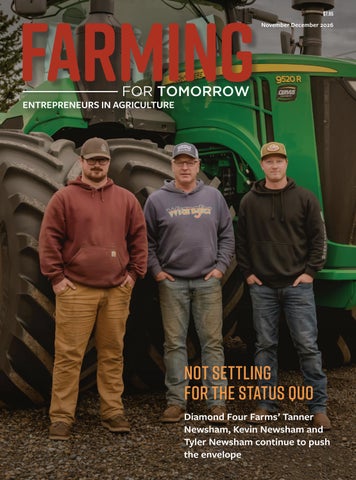
Not Settling for the Status Quo Diamond Four Farms’ Tanner Newsham, Kevin Newsham and Tyler Newsham continue to push the envelope
Tested by Canadia CAN-AM DEFENDER
BUILT WITH ROTAX RELIA JOBS THAT NEVER STOP.
Tested by generations of farmers, the C to handle real work day after day. Powe and backed by over a decade of real-w dependable performance, durability an job—with over 200 available accessor grow with your workload.
©2026 Bombardier Recreational Products Inc. (BRP). All rights reserved. ®, ™ and the BRP logo are trademarks of BRP or its affiliates. In the USA prices, designs, features, models or equipment without incurring obligation. Some models shown may include optional equipment. Products perfo through internal analysis and on published manufacturer specifications at time of creating or printing. This manufacturer suggested retail price ( Accessory installation costs might not be included. Depending on your geographic position, certain additional fees might be applicable. Dealers might not be available at the dealership. For full and accurate vehicle pricing information, contact your local dealer for a detailed quote and avai Safety Institute at 1-800-887-2887 (USA) or the Canadian Safety Council at 1-613-739-1535 (Canada). ATV and SSV can be hazardous to operate age 16 and older. Read the operator’s guide. Follow all instructional and safety material and observe applicable laws and regulations. ATV and SS passenger(s) must wear a helmet, eye protection and applicable protective clothing. Always remember that riding and alcohol/drugs don’t mix. N ride responsibly and safely. See your authorized BRP dealer for details and visit https://can-am.brp.com/.
an Farmers.
ABILITY FOR THE
Can-Am Defender is built ered by Rotax HD engines world use, it delivers the nd versatility to take on any ries and the LinQ system to
STARTING AT $15,499 LEARN MORE AT CAN-AMOFFROAD.COM
A, products are distributed by BRP US Inc. BRP reserves the right to discontinue or change specifications, ormance may vary depending on external factors. All competitive comparisons are based on 2025 models, (MSRP) is the one of the entry package and excludes freight, delivery charge, taxes and registration fees. s may sell for a different price. Vehicle may not be exactly as shown, and selected models and accessories ilability. BRP recommends that all ATV-SSV drivers take a training course. See your dealer or call the ATV e. Never exceed the ATV-SSV’s passenger capacity. All adult model ATV are meant to be used by drivers of SV are for off-road use only; never ride on paved surfaces or public roads. For your safety, the operator and Never engage in stunt driving. Avoid excessive speed and be particularly careful on difficult terrain. Always
new Vertical Fuel Tanks
“I wish I didn’t have that extra storage...”
said no one, ever. Market volatility and supply uncertainty aren’t new to farming, but they don’t have to control your operation. With on-site fertilizer and fuel storage from Meridian, you gain the freedom to buy when timing is right, secure product when it’s available, and keep your operation moving without disruption. Add in the convenience of having supply at your fingertips, plus the ability to protect and preserve your harvest, and it’s a smarter, more efficient way to run your farm. Contact us today to learn about our full line of high-quality storage products for your farm.
Find your local dealer at
meridianmfg.com © 2026 Meridian Manufacturing Inc. Registered Trademarks Used Under License. (09/2026)
®
Convey-All is proud to team up with Ritchie Bros.® and Flaman Sales to support STARS Air Ambulance! 100% of the proceeds from the December 2 auction will go directly to STARS. Scan the QR code to learn more and support this great cause.
30
10
Not Settling for the Status Quo BY ANGELA LOVELL
44
A Farmer’s Viewpoint
Email Questions from a Landlord by Kevin Hursh
Seed
New Canola Genetics Worth Watching in 2027 by Jaclyn De Candio
14
47
Every Last Cent
Putting Heat-Tolerant Canola in the Hopper for the Future
Grain Market Analysis
Gene Editing
by Scott Shiels
by Becky Zimmer
26
48
The Power of Written Agreements
Your Farm is a Success… Now What?
Farming Your Money by Paul Kuntz
Succession
by Nerissa McNaughton
38
51
Celebrating Wilger Industries at 50 Years
Growing More Than Oats
Spraying 101
by Tom Wolf
Grain Millers
42
52
Convey-All “Turns Back the Clock” to Support the Ag Industry and STARS
Playing in the Carbon Market
Philanthropy
KEVIN HURSH 6
PAUL KUNTZ
AgTech
by Becky Zimmer
SCOTT SHIELS
TOM WOLF
TITLE | SECTION
BUCK
GUNK.
When it comes to diesel engines, your injectors feed your horses. And hungry horses don’t run. Dieselex Gold’s exclusive blend of detergents helps restore lost horsepower and boosts efficiency by clearing away the carbon and gunk left behind on your injectors by lesser fuels. It’s another one of the eight performance-boosting benefits in every litre of Dieselex Gold.
Discover all eight benefits at UFA.com/DXG ©2026 UFA Co-operative Ltd. All rights reserved. 14563
7
Publishers
Pat Ottmann & Tim Ottmann
Editor
Lisa Johnston
Design
Cole Ottmann
Regular Contributors Kevin Hursh Paul Kuntz
Scott Shiels Tom Wolf
Copy Editor
Nerissa McNaughton
Sales
Pat Ottmann pat@farmingfortomorrow.ca 587-774-7619 Nancy Bielecki nancy@farmingfortomorrow.ca 587-774-7618 /farming4tomorrow /FFTMagazine /farming-for-tomorrow /farmingfortomorrow WWW.FARMINGFORTOMORROW.CA Farming For Tomorrow is delivered to 79,873 farm and agribusiness addresses every second month. The areas of distribution include Manitoba, Saskatchewan, Alberta and the Peace region of B.C. The publisher does not assume any responsibility for the content of any advertisement, and all representations of warranties made in such advertisements are those of the advertiser and not of the publisher. No portion of this publication may be reproduced, in all or in part, without the written permission of the publisher. Canadian Publications mail sales product agreement no. 41126516.
8
EMAIL QUESTIONS FROM A LANDLORD | A FARMER’S VIEWPOINT
Email Questions from a Landlord Hi Mr. Hursh,
Kevin Hursh, P.Ag. Kevin Hursh is one of the country’s leading agricultural commentators. He is an agrologist, journalist and farmer. Kevin and his wife Marlene run Hursh Consulting & Communications based in Saskatoon. They also own and operate a farm near Cabri in southwest Saskatchewan growing a wide variety of crops. Kevin writes regular columns for farm publications and can often be heard on Saskatchewan radio stations. In 2021, Kevin received a Distinguished Agrologist Award from the Saskatchewan Institute of Agrologists. In 2023, he was inducted into the Saskatchewan Agricultural Hall of Fame.
You may recall we spoke a couple of years ago regarding some questions on farmland rental by myself and my siblings. Each year, we try to stay informed about the agricultural land market and industry trends to make sound decisions regarding the property, deciding if renting the land remains sensible or if selling might be worth exploring now. If you have a few minutes, we would be grateful if you could answer a few questions to help us with our decision-making. 1.
What do you think is a fair 2026 cash rental rate per cultivated acre for land around our area? I’d only be guessing. Even within short distances, land quality and assessment vary dramatically. Plus, different areas have different levels of competition depending on how aggressively local producers are pursuing expansion. A farmer with land adjacent to yours may be willing to pay more than someone at a distance.
2.
What rates are you hearing about or paying for comparable land in this area? I don’t have specific information for all the various areas and communities. Land sale prices are public knowledge. Rental rates are not unless there happens to have been a land rent auction in the area. There’s no real advantage to farmers publicizing what they are paying. Lending institutions in the area may provide some insights based on what they are seeing and hearing. If you know some farmers in the area, they may be willing to share their thoughts.
X: @KevinHursh1
3.
For a good long-term tenant, would you choose a two-year or three-year agreement, and why? I think three years is more valuable for a tenant so they have a bit more certainty and can make appropriate decisions.
4.
If you were negotiating this lease, what would you consider a fair deal for both the landowner and the tenant? Beyond price, you may want to have stipulations for crop rotation. Canola stands out as the most profitable crop right now, but you don’t really want a tenant who grows canola two or three years in a row and then gives up the lease. 9
5.
Are rental rates generally increasing, holding steady or decreasing going into 2027? A lot of leases up for renewal probably haven’t been negotiated yet. Harvest is stalled in most areas (midSeptember) and declining crop quality is a concern. Expenses are up. Canola (and to some extent wheat) is a crop showing some price strength, but many other crops are disappointing. On the other hand, crop yields will be very good in many areas. I think land rental rates will be steady to lower in many instances, but that’s just a guess.
6.
Provincial average rent-to-price ratios are a useful benchmark, but there’s huge variability. While the average in Saskatchewan was 2.9 per cent in 2025 based on FCC analysis, the range was 1.6 to 4.4 per cent. Land prices have been increasing faster than rental rates on the Prairies.
INDUCTOR FLEX
The new Inductor FLEX Series by Pattison Liquid Systems is designed with flexibility in mind. The Inductor FLEX has the capacity to service todays demanding sprayer filling needs. As optimal spraying conditions are limited, it is important to keep your sprayer where you need it. In the field spraying. The Inductor Flex takes inducting chemical to a new level with a 220 liter per minute venturi, turning filling into a race day pit stop. The Inductor Flex System is offered with a Main Tank Assembly, a Tote Meter option and a 3 inch Pump option. The whole system is designed with versatility, allowing you to set it up accordingly to your sprayer deck configuration. All of the components of the Inductor Flex can be arranged on any side of the skid or mounted elsewhere to meet your needs.
Tote Meter Option
1-306-335-2215 admin@liquidsystems.net www.liquidsystems.net 10
Is the rent-to-price ratio a good tool to use to determine a good rental figure? (cash rental rate per acre divided by the value of cultivated land per acre)
7.
If these were your cultivated acres in our area, what rent would you ask? I’d be willing to take less than top dollar for a trusted tenant who is a good farmer. You don’t want a weedy mess or someone with so much land to farm that they can’t give yours proper attention.
8.
Last important question. As an example, say you are getting 10,000/qtr in rent which equals $20,000 annually (less land tax). If you sell that land at the current market value of $500,000/qtr, which equals $1 million, and invest at five per cent, you earn $50,000 annually. Is this a realistic scenario? What are your thoughts on this? There’s no doubt you could earn a larger immediate return by selling the land and investing the money at five per cent. However, I don’t think you could get a five per cent return without taking a degree of risk. The land rent in your example is a two per cent return before land taxes. For many years, land values have been escalating at rates far greater than five per cent while also providing a dividend (rental payment). Hard to see the future, but long term, most believe farmland will continue to increase in value. It’s certainly been a great investment for the past 20 or more years. However, the increasing value of land doesn’t provide cash for things landowners may want to purchase. You can live poor, but die rich owning farmland.
Hope these perspectives are of some use.
WE’LL BUILD GROWING BUSINESSES TOGETHER. Our industry stands ready to meet the challenges and opportunities of the future. With innovation and drive, we will find new approaches, develop new techniques and grow agriculture in Alberta.
PROUD TO GROW AGRICULTURE IN ALBERTA
AFSC.ca
11
FOUR NUMBERS, ONE COMMITMENT. 1909 is only four numbers, but with one strong commitment. We stand by our word and provide genuine value to you. Since 1909, UFA has built a hard-earned reputation for reliability, integrity and know-how. Combined with AgraCity’s offering of Canada’s largest selection of high-performance crop protection products, 1909 Crop Protection Solutions provides direct-to-farm delivery of the essential crop products that you want and need. You have our number, give us a call.
AgraCity is now 1909 Crop Protection Solutions.
12
1909.UFA.com
|
1 (844) 2MY- FARM
©2026 UFA Co-operative Ltd. All rights reserved. 14723
GRAIN MARKET ANALYSIS | EVERY LAST CENT
Every Last Cent Scott Shiels Scott Shiels grew up in Killarney, Man. and has been in the grain industry for 30 years. He has worked with Grain Millers Canada for over 10 years and manages procurement for both conventional and organic oats for their Canadian operation. Scott is an elected board member for Farm and Food Care Saskatchewan and sits on several other committees on both the organic and conventional sides of the oat industry. Scott and his wife Jenn live on an acreage near Yorkton, Sask. Find out more at www.grainmillers.com.
14
Rain, more rain, tariffs, war and more war … what more could possibly happen to affect the way you look at marketing your grain this year? With cost of production rising steadily due to increased fuel and fertilizer prices, it is becoming more important by the day for producers to wring every last cent out of the commodities they produce. Leaving money on the table is just not an option with the ever-escalating cost of production today. One thing that farmers have always considered to boost productivity is to reduce input costs. Now, simply reducing inputs will reduce input costs, but that reduction nearly always results in less production, and therefore less revenue on those acres, making this avenue less attractive for sure. This is where regenerative practices, and the potential for reduced inputs with near to negligible production loss, comes into play! Now I realize I am here to inform about markets and trends but bear with me as this unfolds. More and more consumers are demanding that the products they buy be produced more “sustainably” and for most companies that word goes hand in hand with the “regenerative” programs they have developed with their growers. Setting metrics that measure nitrogen reduction and water usage along with adding under-seeded cover crops and rotational grazing to farm plans has shown tremendous benefits over even short periods of time. We work with producers that are using and, in some cases, developing their own methods of building up the microbiology in their soils to enable plants to more easily access nutrients already located in the soil, thereby reducing the need for more costly inputs. Besides building the soil microbiology to
WHERE DO THEY GO? TO THE DEPOT. Keep them out of the basement. Out of the yard. And out of the landfill. More materials can now be recycled at your local depot, including antifreeze, windshield washer fluid, and DEF containers, along with old electronics, paint, tires, solar panels, and other used oil materials. Find a recycling depot near you. albertarecycling.ca
INSPIRING A FUTURE WITHOUT WASTE
15
GRAIN MARKET ANALYSIS | EVERY LAST CENT increase nutrient use efficiency, we have noticed that building up the soil organic matter also seems to help with productivity in lower-quality field areas. There are many resources available to assist producers who want to take a more regenerative approach to crop production and more will be coming down the pipe as we move forward. Now, many of you know I am not an agronomist, or in any way a “science” guy, so here is why I am putting this to you: money! Currently, there are companies out there (Grain Millers included) that will pay growers to implement new regenerative practices on their farms. Some, like ours, pay by the practice per acre, and some offer flat incentives to join their programs per year. In addition to these incentives, however, is the plain fact that these practices will reduce your input costs and benefit your land in the long run. Building up and improving soil health allows the crops to do more with less and in this day of extremely expensive fuel and fertilizer prices, everyone can benefit from that. If you haven’t yet done so, reach out to your grain buyers and see what programs, if any, they have, and do some digging for yourself on the benefits of the regenerative movement. Until next time…
16
If you haven’t yet done so, reach out to your grain buyers and see what programs, if any, they have, and do some digging for yourself on the benefits of the regenerative movement.
TITLE | SECTION
Put our financial expertise to work on your agri-food processing business.
atb.com/Agri-foodProcessing
17
18
The small moments that make farming worth it,
the small seeds that turn into big harvests,
and the “small” things you do day in and day out, that are anything but small.
The Raaens One of 177 CANTERRA SEEDS seed growers
PROUDLY FARMER-OWNED 19
The small things add up.
As farmer-owned seed companies, CANTERRA SEEDS and Alliance Seed care about the small things. Like the fact that even if you’ve never bought from us, you can call your local rep. That our varieties are available through trusted local seed growers. And most importantly, that they perform on your farm.
CS Breadwinner
CS Baker
CWRS
CWRS
There’s a reason it’s called CS Breadwinner.
Bred to make bread.
• High yield potential
• Short, strong straw (-5 cm)
• Excellent disease resistance, MR to FHB
• MR to stem rust, I to FHB
• Improved protein content
• Part of the Warburtons program
• High yield
• Average height with good straw strength
YIELD PERFORMANCE CS Breadwinner AAC Brandon
YIELD PERFORMANCE 108% 100%
N = 10, 2025 Commercial Cereals Trials
Performance may vary depending on environmental conditions and farming practices.
20
CS Baker AAC Brandon
106% 100% N = 10, 2025 Commercial Cereals Trials
We love to chat about seed! Give your local Territory Manager a call or text at 877.270.2890
CDC Evident
AAC Weyburn VB
Durum
Durum
What’s the highest yielding durum? It’s CDC Evident.
Resistant to both wheat stem sawfly and wheat blossom midge.
• High grain yield • Disease resistance; R to leaf, stem and stripe rust and common bunt
• High yields
• Excellent end-use suitability
• Solid stem sawfly resistance
• Midge tolerance, Sm1 carrier • Great standability • Medium height
YIELD PERFORMANCE
YIELD PERFORMANCE
CDC Evident
101%
AAC Weyburn VB
AAC Schrader
100%
AAC Schrader
Seed guides are used as a source of performance
102% 100% Seed guides are used as a source of performance
If you’re reading this, you’re just like us and notice the small things. As a Western Canadian company with 41 employees, we love this. Text SEED to 886.744.4321 so we can send you a token of our appreciation.
21
AAC Carver
AAC Beyond
Yellow Pea
Yellow Pea
Our earliest yellow pea. • Early maturity
Next earliest yellow pea after AAC Carver, with improved FRR tolerance.
• Suitable for all pea growing areas
• Very high yields
• Large seed size and easy handling at harvest
• Early maturity
YIELD PERFORMANCE
YIELD PERFORMANCE
• Very high yields
AAC Carver
102%
AAC Beyond
101%
CDC Amarillo
100%
CDC Amarillo
100%
Seed guides are used as a source of performance
Performance may vary depending on environmental conditions and farming practices.
22
• Improved Fusarium root rot tolerance
Seed guides are used as a source of performance
We love to chat about seed! Give your local Territory Manager a call or text at 877.270.2890
AAC Lariat
AAC Connect
2-Row Feed Barley
2-Row Malting Barley
Raising the bar-ley. • Very high yield
Connect to growing demand on the CMBTC Recommended List.
• Plumper seed
• MR to FHB
• Short, strong straw
• Midge tolerance, Sm1 carrier
• Excellent standability
• Solid stem sawfly resistance • Great standability • Medium height
YIELD PERFORMANCE AAC Lariat CDC Austenson
YIELD PERFORMANCE 104% 100%
Seed guides are used as a source of performance
AAC Connect
100%
CDC Copeland
100% Seed guides are used as a source of performance
If you’re reading this, you’re just like us and notice the small things. As a Western Canadian company with 41 employees, we love this. Text SEED to 886.744.4321 so we can send you a token of our appreciation.
23
YIELD PERFORMANCE
Want to know how our varieties performed in your backyard?
CS Baker
105% OF WESTKING
Scott, SK YIELD*** % of CDC Spectrum 106%
CDC Engage
101%
CDC 5791 CDC Spectrum
100%
CDC Lewochko
View Performance Results:
94%
CDC Hickie
92%
CDC 5845
92%
CDC Inca
88%
Scott, SK YIELD* % of CDC Nimble
Halkirk, AB
CDC 7208
YIELD** % of AAC Westking
CDC 6928
100%
CDC Nimble
100%
114%
CS Breadwinner AAC Brandon
109%
CS Baker
107%
CDC Envy
106%
AAC Wheatland VB
102%
CS Palisade
100%
AAC Westking
100%
Flame
99%
AAC Carver
105%
OF CDC SPECTRUM
CDC Proclaim
trials, and seed guides across Western Canada.
Our varieties are compared against leading competitors across a range of growing conditions, helping you choose what works best on your farm. 24
97%
CDC Impulse
96%
CDC 6956
95%
CDC 6930 CDC 7030
95% 92%
Swift Current, SK YIELD*** % of CDC Spectrum 130%
CDC Engage CDC Hickie CDC Lewochko
data from commercial trials, independent variety
100%
Rougeaux
CDC 5791
CANTERRA SEEDS evaluates performance using
103%
112% 112% 102%
CDC 5845
102%
CDC Spectrum
100%
CDC Inca
100%
TITLE | SECTION
Legend Wheat
Codette, SK YIELD*** % of CDC Spectrum
CDC 5845
102%
CDC Spectrum
100%
CDC Lewochko
97%
CDC Hickie
96%
CDC Inca
96%
105%
CS Baker
104%
CS Palisade AAC Wheatland VB
101%
AAC Brandon
101%
CS Breadwinner
100%
AAC Westking
100%
CDC Engage
126%
95%
CDC Envy AAC Oakman
Competitor variety
107%
CDC Engage
YIELD** % of AAC Westking
Peas
109%
CDC 5791
Saskatoon, SK
Lentils
CANTERRA SEEDS or Alliance Seed variety
OF CDC SPECTRUM
87%
Clavet, SK YIELD* % of CDC Nimble 117%
CDC 6956 107%
CDC 6930 CDC 7030
107%
CDC 6928
106%
CDC 7208
106%
CDC Impulse
100%
CDC Nimble
100%
Rougeaux CDC Proclaim
CS Breadwinner
113% OF WESTKING
95%
YIELD** % of AAC Westking
92%
CS Breadwinner
159%
106%
OF CDC SPECTRUM
106%
CS Palisade
103%
AAC Westking
100%
CDC Envy
99%
AAC Wheatland VB 98%
OF CDC NIMBLE
CDC 7208
Moose Jaw, SK
Regina, SK
YIELD* % of CDC Nimble
YIELD** % of AAC Westking 113%
CDC 6956
111%
CDC 6930
CS Baker
107%
CS Breadwinner
105%
110%
AAC Brandon
OF CDC NIMBLE
104%
AAC Westking
Rougeaux
103%
AAC Wheatland VB 98%
CDC 7208
102%
AAC Brandon
94%
CDC Nimble
100%
CS Palisade
92%
Redvers, SK
CDC Impulse
99%
AAC Oakman
90%
YIELD*** % of CDC Spectrum
90%
CDC Proclaim 84%
CDC Envy
98%
AAC Oakman 80%
CDC 7030
CDC 6928
110%
CS Baker
CDC 5845
CDC 7208
Brandon, MB
100%
86%
CDC 5791
112%
CDC 5845
111% 110%
CDC Engage
108%
CDC Lewochko CDC Hickie
105%
CDC Inca
104%
CDC Spectrum
100%
*Data source = Saskatchewan Pulse Growers RVTs from 2025 **Data source = 10 Commercial Cereal trials across Saskatchewan, Manitoba and Alberta from 2025 ***Data source = 7 Commercial Pulse trials across Saskatchewan and Alberta from 2025 Performance may vary depending on environmental conditions and farming practices. Trial results rounded to the nearest whole number.
25
SECTION |YOUR FARMING TITLE MONEY | THE POWER OF WRITTEN AGREEMENTS
The Power of Written Agreements Paul Kuntz Paul Kuntz is the owner of Wheatland Financial. He offers financial consulting and debt broker services. Paul is also an advisor with Global Ag Risk Solutions. He can be reached through wheatlandfinancial.ca.
What types of written agreements does your farm have now? What types should it have to prevent a future disaster? Let’s explore this topic further. When I was a banker, I had several clients who ran their farms in a partnership arrangement. It was almost always brothers farming together or a father-and-son team. I submitted a simple request for a machinery purchase, and my credit adjudication team asked me if they had a partnership agreement. I chuckled to myself and said, “No. Why would they need a partnership agreement? They are brothers who have always got along. They are not incorporated.” This seemed like an overreach by the credit department. When I had a discussion with my managers, they pointed out some glaring risks I had not realized. They asked me what happens if one brother wants to exit the partnership? What if one of them passes away and his wife needs money from his partnership share? What if one brother gets divorced and needs the equity from his partnership share to pay out his ex? I had no answers for my bosses. This is when I learned about partnership agreements. You may be farming in a full-on partnership arrangement. Or you may have a deal where you own a land roller with your neighbour. Or maybe your son or daughter is joining the farm operation soon. All these arrangements benefit from a written agreement. I must preface everything I say by admitting that I am not a lawyer. If you require legal advice, you should talk to a trusted lawyer who understands the type of agreement you need. What a written partnership agreement can do is define the partnership and lay out what will happen in the event of a split, death, divorce and/or new partners. The most common type of partnership I see is equipment ownership. You should have an agreement that states what will happen in the event someone wants out. You may have a major
26
Approved CCIA Tags tags.canadaid.ca
Allflex Destron Shearwell Leader Y-Tex Z-Tags Approved beef cattle indicators (tags) are available through your local dealer. Looking for a specific brand? Order online or ask your dealer to stock your preferred option! You can order direct anytime at tags.canadaid.ca, or contact CCIA at 1-877-909-2333 or info@canadaid.ca.
FARMING YOUR MONEY | THE POWER OF WRITTEN AGREEMENTS
falling out with your partner, and in the heat of the moment, one of the partners declares he’s done and wants his money right now. If I were helping you with a partnership agreement, I would recommend a clause that says, “In the event a partner wants out, the other partner has five years to pay them out.” This way, there is no undue harm or pressure on the remaining partner to come up with the money immediately. It also might help calmer heads prevail, knowing you cannot just demand your share of the partnership value immediately. Another topic an agreement should cover is death. If your partner dies, you should define what will happen to the partnership share and how the partnership will move forward. If I were advising a client, I would have a clause that states, “In the event of a partner dying, the share shall be purchased by the remaining partners.” It would also state that the remaining partners have one year or 18 months to pay for it. This will cover a few potential issues. First, there will be no new surprise partner. If you farm with your brother and he passes away, his partnership interest would go to his wife. Without an agreement, you would now farm with your sister-in-law. Eventually, if she remarries, you are now farming with a totally different person. The chances of this are rare, but they are easily preventable. Second, this will prevent undue financial pressure in having to come up with the money when a partner dies. If you have an agreement that states you have 18 months to buy out the partnership interest, this will allow you time to restructure. It will also give your banker comfort, knowing that an untimely death will not put your farm out of business. Another option to consider is cross life insurance. If three partners own $3 million in farm equipment, you can take out a $1 million life insurance policy on each other, with the other partners being the beneficiaries. If one partner dies, the others would receive $1 million to buy out the partnership interest. A partnership agreement also deals with how partners can enter the partnership. As mentioned above, if a partner dies, you might end up with a new partner who is a stranger to you. You can protect your farm from this occurrence by stating how a new person can enter the partnership. You can even have a clause that states there will be no new partners. If a partner wants to leave, the other partners must buy them out. You could also state that in the event a partner is no longer a partner, either by walking away or by death, the partnership shall be dissolved. That is a bit extreme, but it may be what everyone wants. The most helpful part of this entire process is getting the partners to sit down at a negotiation table and talk. It is always very revealing how differently they feel about certain things. I have worked with partners who have farmed together for over 10 years, and when we put an agreement in place, there are heated discussions. Most concern old grievances that have never been 28
The whole idea of these agreements is to take civil, agreeable people and have them put in writing how things should be handled in the event something bad happens.
Your Surplus Is a Lifeline. Donate It. Get Credited. Make an Impact.
worked out. The exercise of going through a sample partnership agreement can be very helpful and revealing. Partnership agreements can also decide and track how money is invested into the partnership, who has what percentage and how profits are split. If the partners are incorporated, you still need an agreement, but now you need a shareholders’ agreement. Another agreement that can assist a farm in the event of disaster is an inter-spousal agreement or a prenuptial agreement. There are a lot of misconceptions when it comes to property settlement in a divorce. I still run into old-timers who have a few quarters just in their name to prevent the wife from getting the land in a divorce. News alert: that does not work. I do not encounter a lot of actual prenuptial agreements. For the most part, two young, broke kids fall in love. When they get married, they have almost nothing. There is no need for a prenuptial agreement because all their wealth will most likely be generated within their marriage. In the event of a divorce, each is entitled to their share. What is more common is an inter-spousal agreement involving family money. Let’s say you have a daughter who is getting married. You want to give her $100,000 to help them buy a house. You can have them sign an inter-spousal agreement that states in the event of divorce, $100,000 of equity in that home is hers and not to be shared. I do not think this is a controversial matter that will upset anyone. As the husband in that situation, it is quite clear that this is your in-laws’ money put toward the house. In the event of a property settlement, she should get that back. These are just a couple of examples of agreements that can make your financial life a bit better. The whole idea of these agreements is to take civil, agreeable people and have them put in writing how things should be handled in the event something bad happens. This way, calmer heads create the future path. It is a smart way to do business.
Dealing with surplus or grade-outs? Whether it’s single trays or tractortrailer loads, Second Harvest can help connect your food to communities in need. We will manage all your donation logistics for free, return your bins and trays, and provide a donation receipt. We help farmers do what they do best — feed people.
Join hundreds of farmers already donating their surplus through Second Harvest. www.secondharvest.ca/fromthefarm fromthefarm@secondharvest.ca 1-833-640-3897
No Waste. No Hunger.
Take a look at your farm and see where written agreements can reduce financial risk. 29
COVER STORY | NOT SETTLING FOR THE STATUS QUO
Tyler Newsham and his wife, Amy, with their 10-month-old son, Rhett.
30
COVER STORY
Not Settling for the Status Quo BY ANGELA LOVELL PHOTOGRAPHY BY FORESTLAND PHOTOGRPAHY
Tyler Newsham likes to push the envelope on his farm near Innisfail, Alberta, and isn’t satisfied with just the status quo. “I love to try new things, so we do lots of trials with new varieties and different chemicals and fertilizers every year just to try to grow the best possible crop that we can,” he says. “We’re not happy with just status quo average; we’re shooting for the top every year and we like to change it up and try new things to see if we can get there.” Newsham and his wife, Amy, are the fifth generation to farm Diamond Four Farms Ltd., a mixed 150-head commercial Simmental-cross cow/calf and grain operation, alongside Newsham’s dad, Kevin. Innovation and diversification have been a constant theme on the farm through the generations. Newsham’s grandfather, ran an equipment dealership in the 1980s, and until last year the farm was involved in a Timothy hay export business. “Dad always said that it’s good to be diversified and have a little bit of everything, and not to just focus on one area completely,” says 30-year-old Newsham. 31
COVER STORY | NOT SETTLING FOR THE STATUS QUO
“I often wonder if technology is getting too far ahead of us right now and is maybe a little too complicated or involved. It has to pay its way and be practical, and I feel it’s getting away from some of that right now. We don’t want to be dependent on it, but there are a lot of good things about it too.” - Tyler Newsham Open to new technology That philosophy also extends to technology. Newsham conducts various trials each year, tracking all the data through their John Deere Operation Centre. This year, he brought in a friend to experiment with drone spraying of fungicide on the farm. It had some definite advantages. “I could see how that makes a lot of sense: there are no tracks in the field, you get every square inch of the field done, and you are still able to see the crop on the controller as you would in the seat of the sprayer. You can create a map of everything, and I think it makes a lot of sense especially for smaller acres
and smaller fields,” Newsham says. But despite being open to new technology, he’s cautious about its deployment. “I often wonder if technology is getting too far ahead of us right now and is maybe a little too complicated or involved,” he says. “It has to pay its way and be practical, and I feel it’s getting away from some of that right now. We don’t want to be dependent on it, but there are a lot of good things about it too.” Three years ago, Newsham joined the advisory board for Agri-Trade, a show he hasn’t missed since his first birthday, and this year he is serving on the Ag Innovations board.
In addition to raising cattle, the Newshams grow hay and grain on their land.
32
“It’s neat to see all the Ag innovations coming in, and it’s one of the biggest entries that they’ve had this year,” he says. “Being on the board is a great opportunity to expose yourself to new ideas, new people and different areas that you haven’t thought about before at the farm. I am also on the Innisfail Seed Cleaning Plant board, and it’s good to see younger members come onto these boards too.”
Protecting Prairie Producers Since 1983 Locally Owned in Saskatchewan
A focus on every acre The farm transition journey is well underway, as Newsham and his dad are equal partners in the decision-making. “Anything we do is pretty much a 50/50 split right now,” Newsham says. “I am more involved with the cows, and my wife, who grew up on a cattle operation, loves the cows too and helps out on that end.” Although the farm has grown significantly over the past decade from 2,500 to 4,500 acres, their focus now is on honing their management to get the most production out of every acre. “We are going for the highest yields we can and are not afraid to spend the extra dollars to make it happen,”
Claims Handling You Can Trust
Claims managed directly in conjunction with your dedicated broker — no runaround. 24-hour claims service available when you need it most. Fast, fair, and personal.
Brokers Who Know Agriculture Inside Out Our team brings real farming experience. We understand crops, equipment, livestock, weather risks, and the day-to-day realities of running a successful prairie operation.
Locally Owned. Community Focused.
Proudly Saskatchewan-owned and operated. We live here, farm here, and serve the communities we call home with integrity and personal attention. Serving You In: Yorkton • Humboldt / Lake Lenore • Stoughton / Regina & surrounding areas
GET PROTECTED BY BROKERS WHO UNDERSTAND YOUR FARM Contact Dave Nussbaumer, Managing Partner dnussbaumer@lakeviewinsurance.com 306-621-1611 Yorkton Office: (306) 782-5467 After Hours Claims: 1-844-897-1439 385 Broadway St E, Yorkton, SK S3N 3Z3
www.lakeviewinsurance.com • Lakeview Insurance Brokers (Yorkton) Ltd. • Independent Brokerage • Committed to Saskatchewan Farmers & Families
33
COVER STORY | NOT SETTLING FOR THE STATUS QUO
“We work closely with our agronomist, looking at soil samples every year and build a plan off of that. We usually try two to three new varieties each year. One thing that has helped us really push the yield, and works every year, is plant growth regulators, and we have also had good luck with variable-rate fertilizer on some variable land.” - Tyler Newsham Newsham says. “We work closely with our agronomist, looking at soil samples every year and build a plan off of that. We usually try two to three new varieties each year. One thing that has helped us really push the yield, and works every year, is plant growth regulators, and we have also had good luck with variable-rate fertilizer on some variable land. If it is a success or not is all determined by yield and if the input is profitable.” He’s very aware, though, that Mother Nature always holds the cards. “We try to take care of all the other variables, and if one year is successful, we try to build on that and do better again the next year,” he says.
A passion for agriculture Newsham is passionate about the future of Canadian agriculture but practical about the challenges young farmers like himself will face, and number one on the list: the unknowns in global politics and the economy, causing volatility that’s hard to navigate.
Tyler Newsham’s son, Rhett, may represent the sixth generation on the farm.
34
“It used to be that wheat went up five cents today or down two cents, and now wheat might be up 40 cents and down the next day, so the price swings are greater,” he says. “The way that input costs and the price of our commodities fluctuate every day is crazy, and it’s hard to know when to lock-in. Then you see government regulation coming down more and more. You just don’t know what’s going to happen next.”
NOT SETTLING FOR THE STATUS QUO | COVER STORY
Being diversified is one way to be more resilient to these influences, Newsham suggests, but it’s also important to keep a close eye on your numbers. “Not being too far in debt to where you can’t work your way out of it after a hard year or two, and not being over-leveraged is a big one right now,” he says. “With interest changes, a few percentage points could really change things for a lot of people. You want to be comfortable.” Agriculture is a resilient industry, and there will always be opportunities for the next generation, which is good news for the Newshams and their 10-month-old son, Rhett, who perhaps could be a sixth-generation farmer one day. (Newsham’s brother, Tanner, who is currently in school also helps on the farm when he can.) In the meantime, they will continue with their policy of continuous improvement and are taking a cautious approach to growth. “We have never wanted to go beyond our means or grow too big or too fast because it’s just my dad and myself and two full-time employees,” Newsham says. “I don’t want to be the guy not in the combine or the air drill or doing the day-to-day stuff; I want to be heavily involved in that and keep it at a family-run level operation. We want to do the best job we can on the acres that we have.”
Four generations of the Newshams represented by Tyler, Kevin and Elgar with baby Rhett.
Play a part in our Circular Economy. Find your nearest used oil drop-off location on our website Usedoilrecyclingsk.com
35
CONFERENCE HIGHLIGHTS
JANUARY 26-27, 2027
DOUBLETREE BY HILTON HOTEL WEST EDMONTON EARLY BIRD TICKETS JUST $179 + TAXES & FEES
CROSSROADSCROPCONFERENCE.CA
PRESENTED BY:
36
Keynote addresses from Gitane De Silva, Mark Redmond and Damian Mason. Valuable networking opportunities, including a dedicated lounge to connect with peers and industry leaders. Annual General Meetings of Alberta Canola, Alberta Pulse Growers, and Alberta Grains.
• Machines built from Generic and Domestic parts. • Parts available from local parts stores. • Ag Trucks wants you to be able to work on your own machines. • Large capacity systems: – Spray Systems: 2000, 2400 & 3000 Gal Boom Width 120,132,135 – Dry Fertilizer: 16 Ton Unverferth Spin Spreader
BUILT FOR AGRICULTURE BUILT TO LAST
Western Sales Rosetown, SK
37
SPRAYING 101 | CELEBRATING WILGER INDUSTRIES AT 50 YEARS
Celebrating Wilger Industries at 50 Years Tom Wolf, PhD, P.Ag. Tom Wolf grew up on a grain farm in southern Manitoba. He obtained his BSA and M.Sc. (Plant Science) at the University of Manitoba and his PhD (Agronomy) at Ohio State University. Tom was a research scientist with Agriculture & Agri-Food Canada for 17 years before forming AgriMetrix, an agricultural research company that he now operates in Saskatoon. He specializes in spray drift, pesticide efficacy and sprayer tank cleanout, and conducts research and training on these topics throughout Canada. Tom sits on the board of the Saskatchewan Soil Conservation Association, is an active member of the American Society of Agricultural and Biological Engineers and is a member and past president of the Canadian Weed Science Society.
38
After Wilfred Wilger graduated from the University of Saskatchewan with an engineering degree in 1969, he spent the next four years in South America as an oilfield engineer. On his return to Canada, he secured a job at the university under Professor Bill Reid, who was involved in designing and studying agricultural machinery. Wilf told his story at the celebration of Wilger’s 50th anniversary in Saskatoon in September and later provided additional details to me in his office. At the time, spraying was dominated by applications at five gallons per acre (gpa). Boom height wasn’t considered very important because the fine sprays of those low volumes tended to swirl around everywhere, filling any gaps. But Wilf noticed that there was a trend toward higher volumes of about 10 gpa. And sprayers of the day weren’t really equipped to handle that. “Sprayers made by the Sask Wheat Pool, George White and Versatile weren’t ready for the higher flows and bigger tanks and especially the plumbing that 10 gpa required. So, I decided to build a sprayer that could handle that sort of thing,” Wilf recalls. He completed his first prototype, which he built by hand himself, in 1975 and tested it on the family farm. This first venture into manufacturing sprayers went very well, but eventually the complexity of a totally new model nearly ended up bankrupting the company. Although the first venture didn’t end as planned, Wilf wasn’t finished. Instead, the experience became part of the learning curve that shaped the company. Undeterred, he travelled overseas to a farm machinery show in Paris. That’s where he saw a rotating nozzle body, and the idea for the Swivel-Jet nozzle body was born. Farmers could now equip their sprayers with two different nozzles at each location and simply rotate the one they needed into place.
CELEBRATING WILGER INDUSTRIES AT 50 YEARS | SPRAYING 101
“Sprayers made by the Sask Wheat Pool, George White and Versatile weren’t ready for the higher flows and bigger tanks and especially the plumbing that 10 gpa required. So, I decided to build a sprayer that could handle that sort of thing.” - Wilfred Wilger Wilf decided to equip the new nozzle body with his own caps. While it was common for a standard lug outlet to be used for nozzle bodies, there was some resistance when it came to using the exact same cap style by those already in the market. That may have been the end of it, but it turned out to be a blessing in disguise. Needing to design his own locking system, he started with a blank sheet. “Why not create a cap with a radial lock system, rather than lugs that require a push and turn, eventually wearing the lugs down?” he thought. “And while I’m at it, why not make the nozzle insert and cap into one piece? And why have a washer that can fall out? Embedded O-rings are less trouble.” He expanded the entire system with a longer snap-in screen,
keeping dirt out. Plugged nozzles and cumbersome cleaning and reassembly of each nozzle, cap, washer and screen were a thing of the past. During the 1985 Farm Progress Show in Regina, Kevin Hursh, an agricultural journalist, did a spotlight on the new ComboJet nozzle and Swivel-Jet body. At the show, farmers who had seen the new design on the TV broadcast crowded around the Wilger Industries booth wanting to learn about the new nozzle system. “The strong interest was a real rush,” Wilf recalls. “An amazing experience.” Sales were very good, with Combo-Jet nozzles and bodies featured on the majority of Prairie-built sprayers, including Flexi-Coil and Brandt.
PREMIUM PULSE WIDTH MODULATION SPRAY TIPS FROM
• Form spray patterns quickly • Deliver crisp on/off shutoff • Reach steady-state performance rapidly • Operate reliably at frequent pulsing
TURBO TEEJET ®
AIR INDUCTION ACCUPULSE ® TURBO ® TURBO TWINJET ® TWINJET TWINJET ® NO BETTER WAY TO SPRAY
www.teejet.com/pwm-nozzles
39
SPRAYING 101 | CELEBRATING WILGER INDUSTRIES AT 50 YEARS
“We would listen to producers and to sprayer manufacturers and design products they needed. We’d be able to ship new products fast. Sometimes the new moulded test piece was almost still warm when we boxed the shipment. Customers weren’t used to that kind of responsiveness, but they liked it.” - Wilfred Wilger Eventually, Wilf met Mark Bartel, who had been a Delavan rep in Tennessee. They formed a partnership in which Mark’s operation would machine the steel spray tip inserts, and Wilf’s Wilger Industries provided the injection moulded nozzle body designs. Nozzle assembly occurred in the country in which the nozzles were sold. The partnership remains strong, and they now employ 50 people between them. The sprayer industry was in for some big changes in the 1990s, and companies needed to be nimble to serve this dynamic sector. The move to higher water volumes necessitated bigger plumbing, with one-inch wet booms becoming standard. The appearance of self-propelled sprayers required higher flow-rate nozzles. The continuing
40
diversification of agricultural crops and herbicides, with herbicide-tolerant canola, for example, required low-drift sprays. And the introduction of pulse-width modulation (PWM) required a combination of all of these through wide-angled spray patterns. Wilger Inc. was able to respond to all these needs with speed. “Mark came to me with an idea for a low-drift tip. We assembled prototypes while travelling together, sometimes testing a new idea with pressurized water from a faucet or a showerhead,” he laughs. The resulting product lines – the Combo-Jet SR, MR, DR and UR – matched the air-induction tips for drift reduction and pattern
CELEBRATING WILGER INDUSTRIES AT 50 YEARS | SPRAYING 101 stability but were a simpler design. And importantly, they worked with PWM systems, which air-induced tips did not.
Tip Wizard, an innovative online nozzle selection tool, makes them the de facto standard for PWM machines.
Wilger worked closely with manufacturers as the move to self-propelled sprayers accelerated.
They’ve designed other innovative products and are expanding their offering of flange fittings and components for recirculating booms. They offer a lightweight version of stainless steel one-inch tubing. They were the first to offer a complete line of spot spray nozzles at three angles (20, 40 and 60 degrees), including angled adaptors.
“We would listen to producers and to sprayer manufacturers and design products they needed. We’d be able to ship new products fast. Sometimes the new moulded test piece was almost still warm when we boxed the shipment,” says Wilf. “Customers weren’t used to that kind of responsiveness, but they liked it.” Marketing manager Lucas Olenick makes sure the listening continues. He is active on The Combine Forum and AgTalk, answering questions and staying in touch with applicator needs to understand the problems requiring a solution. “I’ve met people at trade shows who recognize me from these forums,” he says. “It’s gratifying to be able to help.” Today, Wilger Industries continues to innovate and expand their product line. The Combo-Jet line of spray tips is offered in five different spray qualities, in flow rates up to two gallons per minute (higher in some cases), and in two fan angles (80 and 110 degrees). This huge matrix of choice, coupled with the
The innovation is ongoing. During occasional visits to the Wilger office for a meeting or to pick up samples, business manager Sean Georget will usually call me into his office to share some new prototypes or drawings. There is no standing still. New products like the Dual-Angle Max nozzles, and other products set to be released in the spring of 2027 like the Double-Down Max, are only some of the new things on the go at Wilger. The future looks bright for this creative and service-minded Saskatchewan success story. They’ve paid attention to the details and to customer service. They ship their products worldwide and make an effort to know their customers. As succession is slowly shifting ownership to Sean Georget and Lucas Olenick, their unofficial motto of “responsive ingenuity” will surely continue.
41
SECTION | TITLE | CONVEY-ALL® “TURNS BACK THE CLOCK” TO SUPPORT THE AG INDUSTRY AND STARS PHILANTHROPY
Convey-All® “Turns Back the Clock” to Support the Ag Industry and STARS A nod to the ’80s sparks a charitable campaign to support the communities that feed North America
Air Jordans. Sony Walkman. Big hair. Plastic neon bracelets. The Nintendo Entertainment System. These are just some of the hallmarks of the ’80s that leading companies in the agriculture sector fondly remember. Then there were the vehicles. The muscle cars. The souped-up trucks. The dragsters. The classics! Joining those heady times was Convey-All’s® first conveyor system, which hit the market in 1985. Convey-All, a Meridian Manufacturing brand, has been building conveyors for the agricultural market since 1985. Over the decades, the company introduced industry-changing innovations, including the first commercial seed tender and hydraulic drive conveyors, features competitors are only now promoting as new. Now, the company is channelling that history into a campaign that looks back to move forward – in a very unique and exciting way. “The median age of farmers in Canada is between 55 and 60, which means many of their formative years go back to the ’80s,” says Jacob Welde, marketing manager at Meridian 42
Manufacturing. “As we talked more about that era, we started noticing a lot of parallels with 1985 – the year Convey-All manufactured its first conveyor. When we discussed how to celebrate our company milestone, we drew inspiration from other milestones of that time, like the debut of Air Jordans and the release of Back to the Future. We kept digging into what else began in 1985, and that is when STARS Air Ambulance came onto our radar.” He continues, “The moment we realized that STARS started in the same era as all of these other iconic milestones, we knew we couldn’t pass up the opportunity to combine our celebration with supporting this cause. It just felt too perfectly aligned; almost destined.” The result? A chance to bid on and win a beautifully restored classic from the ’80s: a GMC C1500 truck. Throughout the year, Convey-All has been touring the restored truck to trade shows and other events. On December 2, 2026, Ritchie Bros. will auction the truck at its Saskatoon sale, with 100 per cent of the proceeds going to STARS.
CONVEY-ALL® “TURNS BACK THE CLOCK” TO SUPPORT THE AG INDUSTRY AND STARS | PHILANTHROPY
“Every farmer knows someone who’s alive today because of STARS, or they’ve experienced the emergency service themselves.The same is true in the oil and gas industry. There are a lot of people in the Far North who have relied on their services.” - Jacob Welde STARS was a natural fit. “Every farmer knows someone who’s alive today because of STARS, or they’ve experienced the emergency service themselves,” Welde says. “The same is true in the oil and gas industry. There are a lot of people in the Far North who have relied on their services.” The company is grateful to its partners for making the campaign possible. Ritchie Bros. is organizing the sale and waiving all auction fees, while Flaman Sales supplied an enclosed trailer to keep the truck in top condition. “It’s been trailered everywhere, so we are not adding miles or wear and tear on the truck,” Welde adds. There are two easy ways to take part in the campaign: • Bid on the truck. The 1986 GMC C1500 is listed at Ritchie Bros. and closes at the Saskatoon auction on December 2. Every dollar supports STARS Air Ambulance. Check it out at www.rbauction.com/pdp/1986-gmc-c1500-pickup/15590215. • Wear the ’80s-inspired merch and enjoy a fun trip down memory lane! The brand is handing out ’80s-style promo items such as sunglasses, fanny packs and hats at trade shows. Plan to stop by the booth at Agri-Trade, say hi and find out how to donate directly to STARS. Convey-All’s history shows a commitment to farming that outlasts trends. This campaign invites the agricultural community to look back on that legacy while giving forward to a service that has saved countless lives across Western Canada. Bid on the truck, wear the gear, celebrate Convey-All’s anniversary and help STARS keep delivering critical care where it’s needed most. 43
SEED | NEW CANOLA GENETICS WORTH WATCHING IN 2027
New Canola Genetics Worth Watching in 2027 By Jaclyn De Candio
Canadian canola growers have faced real disease pressure in recent seasons. Blackleg incidence in Saskatchewan hit an all-time high of 23 per cent in 2024 (up from 12 per cent the year prior), according to the province’s annual canola disease survey, with 92 per cent of fields testing positive for at least trace levels. While incidence eased to 11 per cent for 2025, agronomists predicted blackleg, verticillium stripe and sclerotinia pressure ahead of this year’s harvest, according to an interview on 620 CKRM with Alireza Akhavan, the provincial plant disease specialist. With decisions for 2027 on the horizon, seed companies – backed by research from SaskOilseeds and breeding infrastructure like BASF’s newly expanded Canola Breeding Centre of Innovation – are introducing a new wave of hybrids designed to combat them.
Today’s canola landscape Agronomists across Western Canada (and in Saskatchewan especially) are seeing more blackleg, verticillium stripe and sclerotinia this year than in recent seasons. Full results from the province’s disease survey won’t be in until after harvest, but the early read is already pointing toward another difficult year. “I think we are going to see a fairly big disease year again this year,” says Kaeley Kindrachuk, an agronomist with SaskOilseeds. “We saw blackleg just about everywhere [in 44
2024], and a lot of growers are on a two-year rotation.” Grower awareness of disease pressure is increasing, according to Kindrachuk. She and other extension agronomists make a point each fall of pushing growers toward disease-resistant varieties rather than defaulting to whatever yielded best previously. That said, yield remains a top priority for most growers, according to a Canadian Journal of Plant Science study on variety adoption decisions in Western Canada. “It’s historically the way it’s been,” Kindrachuk agrees. “In a lot of cases, disease resistance should trump yield.... We’re seeing varieties that are comparable in yield, anyway.” A similar issue, she adds, is that not every seed company labels blackleg resistance on the bag, which leaves growers guessing whether a variety matches the pathogen pressure in their fields. “Growers should be putting that pressure on the seed companies to be labelling correctly.” SaskOilseeds also runs a free disease-testing program, allowing growers or agronomists to send in stem samples, which are tested at Discovery Seed Labs for blackleg and verticillium stripe presence. The results help growers match resistance genetics to what’s actually circulating in their own fields rather than using a regional average. The deadline to submit samples each season is October 31. Saskatchewan recorded no new confirmed clubroot cases in
its 2025 survey, making it the second relatively quiet year in a row, but Kindrachuk notes that wetter conditions seen this year could change that. Provincial clubroot maps in Saskatchewan, Alberta and Manitoba are a resource she recommends growers check regularly, especially when considering resistance options for 2027 seed orders.
FASTER, CLEANER
GRAIN UNLOADING
What’s new on the market There are several options for the upcoming season that target some of the most poignant growing issues without sacrificing yield and other desirable traits. Canterra Seeds’ canola product manager Courtney Welch shares that the company will exclusively distribute a new TruFlex/LibertyLink stack trait hybrid via a third-party distribution agreement with Bayer Crop Science. “This provides a unique opportunity for flexible herbicide options in the field for growers, and we’re excited to help expand the acres and the options available of the TruFlex®/ LibertyLink® canola trait,” she says. This offering adds to their two new varieties introduced in 2026: CS3400 TF, a high-yield potential, mid-maturity TruFlex hybrid bred specifically with clubroot resistance and an excellent fit for Alberta’s clubroot zone; and CS4200 LL, a LibertyLink pod-shatter product with mid-late maturity, making it a great fit for the southeastern Prairies with strong pod-shatter tolerance.
Grain Baggers | Extractors FoldRight™ Grain Bags
Think outside the bin
®
1-866-497-5338 Neeralta.com Scan for more
“We’re continuing to work in that pod-shatter and pod-drop space,” Welch says of their overall breeding priorities. “Another really important one, primarily for the eastern Prairies, is verticillium stripe. That seems to be really affecting Manitoba and eastern Saskatchewan farmers right now.” Canterra Seeds likewise keeps focused on blackleg and clubroot and those other more common diseases. “[Variety selection] really comes down to performance in your local environment and talking with a trusted advisor,” Welch says. “Geographical and weather conditions year over year seem to be getting more extreme and variable as time goes on, so having a spread of different hybrids and maturities on the farm spreads out your risk.” Looking a year further out, BASF Canada Agricultural Solutions is preparing three new InVigor hybrids for 2027. Jeff Mansiere, North American breeding manager for InVigor at BASF, says the first, L342PC, brings greater clubroot resistance to highly variable regions like central and northern Alberta, where first-generation resistance is no longer enough for the tougher disease strains. L346PC succeeds L340PC as one of BASF’s main commodity 45
SEED | NEW CANOLA GENETICS WORTH WATCHING IN 2027
hybrids, bringing greater yield and stability with a strong blackleg and clubroot resistance. Finally, L347PC carries two herbicide modes of action: glufosinate and glyphosate tolerance, along with strong blackleg and verticillium stripe tolerance suited to perform well in eastern Saskatchewan and Manitoba but can also be grown across all regions. “It really gives the grower the option of choice for herbicide resistance if they’re battling some resistant weeds on their acreage,” Mansiere says, noting that all three hybrids meet BASF’s pod-shatter and pod-drop standards.
Other industry infrastructure investments Behind the scenes, BASF continues its infrastructure designed to keep canola innovations flowing via the company’s global canola hub, the Canola Breeding Centre of Innovation in Saskatoon. The CAD$27-million facility investment covered major upgrades, enabling greater research capacity with a new state-of-the-art glasshouse and controlled environment space. This will allow for more genotypes to be screened per cycle, automation via robotics for tasks like tissue sampling and transplanting, and genomic selection that utilizes artificial intelligence-driven models to forecast hybrid performance before field trials even begin. “This is really the foundational step to continue [InVigor’s 30 years of development] into the future,” Mansiere says. “The
46
ability to look through more genotypes to find the superior ones increases the throughput at the beginning stages of our program.” Mansiere describes the overarching goal to accelerate the rate of genetic gain by shortening the distance between a promising cross and a hybrid that growers can actually put in the ground. “We’re able to increase the fast trackness,” he says, “with the long-term goal of bringing new innovations and higher performance to the growers’ environment at a faster rate.” That push isn’t unique to BASF. A University of Saskatchewan and Agriculture and Agri-Food Canada team published work in 2021 using drone-based imagery to estimate canola flowering and seed yield. Around the same time, Bayer launched its Precision Breeding program, which uses drones equipped with advanced photo sensors to digitize phenotyping by tracking flowering, lodging, disease resistance and pod shatter across field trials. Over the last seven years, Bayer says it has shaved three years off its timeline from initial cross to commercialization, in part by doubling the number of field-testing sites across Canada and the U.S. For Canadian growers, such investments afford more future hybrid varieties with better performance predictability before they ever reach a Prairie field. Perhaps even more importantly, it provides researchers with a way to respond faster to new disease pressures and growing conditions.
PUTTING HEAT-TOLERANT CANOLA IN THE HOPPER FOR THE FUTURE | GENE EDITING
Putting Heat-Tolerant Canola in the Hopper for the Future By Becky Zimmer
Rising temperatures during peak flowering times are wreaking havoc for Prairie canola growers, but a relatively new technology may be the answer for heat tolerance in canola. Although still several years away, researchers are anticipating new options for Canadian canola growers sooner than predicted. Eric Gregory, director of marketing for BrettYoung, says CRISPR gene-editing technology could shave a few years off the breeding process by making it more efficient. Not only could this work for building heat tolerance in canola but also for disease and herbicide resistance in future varieties. For now, Gregory says the focus is on heat tolerance. Developed in 2012, Gregory suspects CRISPR technology could become a more widespread tool for many researchers in the coming years. Instead of copying and pasting a whole paragraph of text from one generation to another, CRISPR technology takes exactly the words the next generation needs and puts it directly where it’s needed. In terms of canola strains, researchers are taking plant types that have already proven to be effective agronomically, in this case for heat tolerance, and instead of starting from “ground zero” to develop new parents and new crosses, they can solve the offending problem by editing one specific gene and marketing it as a new variety. “It essentially has all the performance characteristics of the previous hybrid, but it’s been fixed,” notes Gregory. The genes themselves are coming from other sources of canola strains and are being put into other plants right at gene level. Announced in 2026, genXtraits and Mendel Biotechnology have formed a strategic partnership with Calgary-based AgGene to use gene editing to develop genetic traits that
“We try to use the full toolbox so that we can not only just discover and make a product, but we cut two or three years of time to get that product accepted into the marketplace.” - Logan Skori canola seed companies can utilize. Logan Skori, CEO and co-founder of AgGene, says DL and BrettYoung are two companies benefiting from these genes for their own canola breeding that will go to market in the early 2030s. Researching, identifying, developing and then commercializing canola varieties takes time, he adds, but gene editing can cut a few years off the process compared to conventional breeding techniques. From a marketing standpoint, modifying a single gene and using material from the same species of plant eliminates some of those regulatory questions associated with genetic alterations. This is not a GMO, notes Skori, which makes regulation, especially to markets like the European Union, more straightforward. “We try to use the full toolbox so that we can not only just discover and make a product, but we cut two or three years of time to get that product accepted into the marketplace.” For Gregory, Canadian farmers don’t care how the varieties are made, just that they work. 47
SUCCESSION | YOUR FARM IS A SUCCESS… NOW WHAT?
Your Farm is a Success… Now What? Part IV: The Wild West of Financial Advice – and Why Farmers Need Better By Nerissa McNaughton
This is part four of a series examining how Canadian farm families can build generational wealth through strategic planning, smart financial structures and expert guidance. Farming in Canada has changed almost beyond recognition. Over the past few decades, land values and farm values have climbed to heights few would have predicted a generation ago. A quarter section that once sold for a modest sum now represents millions in equity. For the families who built these operations through hard work and patience, that growth is a triumph. It is also a “growing” problem. With more value comes more complexity. More money, as the saying goes, brings more problems – and for Canadian farm families, those problems arrive in the form of substantial tax exposure, tangled ownership structures and succession decisions that will determine whether a lifetime of work passes cleanly to the next generation or gets carved up by capital gains tax. Most farmers are navigating this alone, coordinating a patchwork of local professionals with no one truly steering the ship. For those reasons, understanding the difference between a financial planner and a financial salesperson could be one of the most important decisions a farm family ever makes. Financial planning in Canada is, in many respects, the Wild West. The barrier to entry is relatively low. As Mark Davies, CFP®, CLU, CIM®, managing partner, Novel Wealth, describes, “A person can work at the bank or as an investment advisor after taking a course. Often, very limited requirements may stand between a person and the authority to advise families 48
on decisions worth millions.” He continues, “There are less than 15,000 certified financial planners in Canada, but there are more than 100,000 mutual fund advisors in Canada. That tells us that less than 10 per cent of people have actually done the course required to earn a certification in financial planning. Therefore, we have a lot of individuals in Canada who do not hold that certification but are giving advice to people about extremely critical matters.” For a farm family with millions of dollars in land and equipment on the line, that distinction matters. The trouble is that most people have no reliable way to judge who is qualified. Davies compares it to taking a car to a mechanic. “When I go to get my car fixed, I have no idea whether the mechanic is telling me the truth. I have no way to tell that. I know almost nothing about cars. Financial planning works the same way. There is such a big asymmetry of knowledge between you and the expert. You have to trust them. The way you do your due diligence is to make sure that you’re working with a certified financial planner.” This is why vetting matters so much for farmers, specifically. A general financial advisor, however well-meaning, may not understand the tax realities unique to agriculture. Farm families are often land-rich and cash-poor, which puts them outside the comfort zone of traditional firms. “Traditional firms often choose to work with people when they have investable assets,” Davies notes. “If you’re at a bank, you
YOUR FARM IS A SUCCESS… NOW WHAT? | SUCCESSION
“A person can work at the bank or as an investment advisor after taking a course. Often, very limited requirements may stand between a person and the authority to advise families on decisions worth millions.” - Mark Davies may receive a different level of service depending on the assets you have to manage.” That model leaves many farmers underserved, working with professionals who may be capable but rarely specialized. Davies knows this world from both sides. With nearly two decades of experience in financial planning, he grew up on 15 acres of farmland before moving to the city to learn the trade. He understands the farm and the financial planning it takes to run a large-scale, generational operation. The greatest gap he sees is not in day-to-day money management but in planning for the future. “Most farm families just aren’t getting a proper estate plan or continuity plan done,” Davies says, “and that’s something they really need to plan for because they have a special spot in the
tax code where they could pass farmland down in a really tax-preferred way. If it’s not set up properly, it’ll be subject to capital gains tax.” Succession planning is not a task to defer until later. It is essential to preserve generational wealth. Two forces have converged to make expert guidance more accessible than ever. The first is the sheer scale of the tax problem farmers now face. “Thirty years ago, farms were worth a lot less than they are today,” Davies says. “Now, everything has gone up. When you have millions of dollars in tax complexity, there will be more people coming in to try to help you with those problems – and that can get overwhelming.” The second force is technology. The pandemic, for all its hardship, changed how experts collaborate. “COVID, as terrible as it was, opened up a lot of opportunities for farmers to shop around and meet more people, and for experts to get together themselves online,” Davies explains. “Where a rural farmer was once limited to advisors within driving distance, high-quality virtual meetings now erase geography entirely. They can access people around the world.” That capability transforms what a farm family can expect from its advisory team. Davies describes his own network as a case in point – colleagues across Ontario able to “collaborate with somebody in Saskatchewan very easily,” something that “really didn’t exist five or six years ago.” 49
SUCCESSION | YOUR FARM IS A SUCCESS… NOW WHAT?
“Thirty years ago, farms were worth a lot less than they are today. Now, everything has gone up. When you have millions of dollars in tax complexity, there will be more people coming in to try to help you with those problems – and that can get overwhelming.” - Mark Davies His summary captures the new normal: “It’s a combination of land values and farm values increasing enormously and creating big tax problems, and the ability of teams to coordinate like they never could before. That is leading to way better services for farmers than just having to coordinate their own local people themselves.” Coordination is where most farm families quietly lose ground. Building a complete plan requires accountants, lawyers, insurance specialists and planners all pulling in the same direction. Doing that alone is a near-impossible task. This is the role Farmstrong fills, with Novel Wealth serving as one of its financial planning firms. There is a reason Davies finds the work rewarding. “All I do is help people reach their goals,” he says. “Sometimes that means guiding a family through a good decision. Sometimes it means helping them through a death in the family or another hard turn. I get to help them get to where they need to go.” The families who treat succession and continuity planning as optional are gambling with the very thing they spent their lives building. Those who work with vetted, certified professionals – advisors who understand both the land and the tax code – put their families and their farms on far firmer ground. In a field where not all advisors hold the accreditation that signals expertise for farmers, that one act of due diligence can protect generations of wealth. Your farm deserves nothing less. Learn more at www.novel-wealth.com and farmstrong.ca. Missed any part of the series? Catch up now at farmingfortomorrow.ca. 50
GROWING MORE THAN OATS | GRAIN MILLERS
Growing More Than Oats Grain Millers celebrates 25 years of Canadian operations
Eastern Saskatchewan has always grown a large portion of Canada’s oats, and thanks to the soil conditions and ideal climate, the region produces some of the highest quality oats in North America. As Grain Millers grew in the U.S., the ownership team saw an opportunity to expand into Canada. So, in 2001, it purchased the Yorkton mill from Popowich Milling. This acquisition gave Grain Millers a presence on the Canadian Prairies, right in the heart of oat country. One of Grain Millers’ greatest strengths that stands the test of time is its ability to establish and grow relationships with local producers. “Many of our producers across the Prairies have been growing us milling oats since we started operating out of Saskatchewan,” says Scott Shiels, grain procurement manager. “Grain Millers prides itself on being stewards of the oat industry, and that approach has taken us from being one of the smaller players in the game to being one of the largest industrial oat processors in North America – and the largest organic oat miller in the world today. “We also sit on various committees on both the production and milling sides of our industry,” he continues. “Staff members from Grain Millers take part in research on new oat varieties and are active on the committees that collectively decide which varieties will make it into the hands of producers. We work with various oat breeders across the country to help guide them as they look to produce the next best variety to hit the market and advise them on what traits we see as helpful in the future for our industry.” Grain Millers created a crop sciences division about 14 years ago in order to have “boots on the ground.” Its sole purpose is to work with farmers and researchers to help develop and move the industry forward, to provide R&D in agronomy, and to help farmers grow better and more productive oat crops.
This division has grown significantly over time and now has staff in both Canada and the U.S. “Our Yorkton facility proudly remains Grain Millers’ Canadian headquarters, and the past 25 years saw expansion and diversification into other locations in Canada,” Shiels says of how the company continues to grow sustainably. “We have entered the Canadian flax processing market, first in Saskatoon, SK, and more recently in a new facility in Delisle, SK. We also staked out a supply chain position in Rycroft, AB, constructing a grain elevator there in 2016. Prime Peace Country oats flow through our Rycroft elevator feeding, primarily, our milling assets in Eugene, OR, and also supplying our mills in Yorkton and the Midwest U.S.” Beyond business, Grain Millers is very involved in the communities in which it operates, helping with fundraising efforts and sponsoring nearly every project that comes their way. “From small, local kids’ sports teams to large events such as the Grain Millers Harvest Showdown (an agricultural show in Yorkton), we give back to the families and communities as much as they give to us by being both producers and consumers of our products,” Shiels adds. He concludes, “As the grain handling companies in northern Alberta understandably place focus on high-volume export commodities, we find it beneficial to step in with our Rycroft elevator to secure our supply and to help ensure oats remain a viable and profitable crop for northern Alberta growers. Whether working alongside Prairie oat or flax growers, we take the same relationship-building approach that has served us and our producers well over the years.” Learn more at www.grainmillers.com. 51
AGTECH SECTION| |PLAYING TITLE IN THE CARBON MARKET
Playing in the Carbon Market Agricultural industry key player in carbon sequestration as market continues to grow By Becky Zimmer
The carbon market is nothing new, especially to Canadian farmers. Canada’s Greenhouse Gas Offset Credit System has turned greenhouse gas (GHG) reduction and removal projects into tradeable units for the global carbon market. According to the Government of Canada, prices per tonne of CO2 equivalent emissions are projected to increase over the next decade, with expectations to reach $130/tonne in 2035 as millions in federal funding is directed towards carbon capture and clean technologies. Members of the agriculture sector are no strangers to this. Canada has been the leader in industrial carbon pricing for nearly 20 years, with Alberta being the first to develop industrial carbon pricing systems back in 2007. The focus on the agricultural sector has encouraged farmers to adopt agricultural practices that reduce GHG or build projects that remove GHG from the atmosphere, not only reducing the carbon footprint of their farm but also earning extra income, according to the government’s website. As technology continues to advance, monitoring and measuring agricultural carbon has become a vital player in the effectiveness of the carbon market, while farmers are 52
finding even more ways to participate. Ryan Eyre, product integration manager with SoilOptix, says they don’t directly participate in the carbon market, but many of their partners do. While based in southern Ontario, some western Canadian partners work regionally with agronomists and growers to properly measure active carbon through their soil tests, offering more accurate measuring and monitoring of soil carbon to take to the carbon market, says Eyre. The SoilOptix team provides a new level to soil mapping, not only using traditional methods like physical soil sampling but also gamma radiation-based sensor data. Using a noncontact sensor while driving 12 kilometres per hour through the field in 40-foot-wide swaths, their sensors get a readout on the radiation emitted from the soil’s natural decay. In general terms, Eyre says the amount of radiation tells its own story. Higher readings generally speak to higher clay content, while lower readings come from sandy soils. Going into more in-depth readings, Eyre notes they can then look at specific types of radiation: thorium-232, uranium-238, potassium-40 and caesium-137, as well as micronutrients collected from standard soil testing. It’s not uncommon for clients to get 30 layers of data in one soil test package, he
YOUR FARMPLAYING IS A SUCCESS… IN THENOW CARBON WHAT? MARKET | SUCCESSION | AGTECH adds, with 335 data points per acre (827 per hectare) making their way to the client’s inbox. This enables a more accurate analysis of soil behaviour by confirming carbon levels over time instead of relying on a single snapshot. “Say you have 300 cubic hectares, or something like that. Over X number of years, you can go back, take another set of samples, and then compare what it looks like, how much has changed in soil, and be able to build from there.” As CEO of the Canadian Agri-Food Automation and Intelligence Network (CAAIN) and a former farmer himself, Darrell Petras has seen how a lack of accurate carbon data can cause issues for those wanting to participate in the carbon market. While that is not something their members actively talk about participating in, CAAIN’s focus, especially with parallel funding opportunities through Innovation, Science and Economic Development Canada (ISED) and Agriculture and Agri-Food Canada (AAFC), has meant projects and companies are reducing their carbon footprint. Having the ability to quantify and verify where the carbon is – and measure the positive net carbon impact through a company like SoilOptix – is something Petras is excited about. “Producers appreciate this more than some of the other communities give them credit for,” he says. “If they don’t preserve that resource and they don’t manage their carbon impact, pollution [and] waterways, they’re going to put themselves out of business.”
According to Danner, Canadian agriculture is a fairly large contributor to GHG emissions, but there are plenty of opportunities for the sector to contribute to net-zero strategies. Finding ways to lock carbon back into the soil can be one of the best ways to offset emissions. Biochar is nothing new, he notes, and there hasn’t been much widespread adoption in the agriculture sector yet, but he can see change coming on the horizon. “The idea that Canada could be a carbon removal and sequestration leader could certainly be true. And if that does end up being the case, we’re going to have to sock a lot of carbon away in soils, and that’s going to help with sustainable agriculture, climate resilience and adaptation.” So far, research trials, both in-house at Carbon Lock and with Ag Canada and various agriculture partners in Manitoba and British Columbia, have been small scale, but Danner says they are looking at what biochar contributes to soils at small-scale implements; between two per cent to 10 per cent of soil content. There is a threshold to be reached where the biochar is detrimental to the soil (50 per cent, for example, would be too much, says Danner), but Carbon Lock is working on finding that optimal biochar application.
Kevin Danner, founder and chief executive officer of Carbon Lock Tech in Winnipeg, started his company about five years ago, from tinkering in his backyard to now operating with eight full-time staff, investors and funding. “Plants pull down 25 to 30 per cent of all our emissions each year,” he says, “but that harvest into our food, our building materials, our clothes, usually winds up as waste products that are burned or left to rot, contributing once again to our carbon footprint.” Through Carbon Lock, Danner and his team are about to take organic waste – including hemp, flax and canola crop residue, cattails and food waste – pyrolyze it and lock the carbon into biochar. Different biochar chemistries do different things in the soil, but in its general pelletized form, Danner says biochar is a great sponge, retaining water and micronutrients; even holding onto things like phosphorus and potassium in some cases so it doesn’t wind up in rivers or lakes as nutrient runoff during heavy rains or spring melt. Soil compaction is also a growing issue in Canadian farming, but biochar adds some porosity to the soil, he adds, limiting the negative impacts of impermeable soils. His company has also been researching the benefits of biochar in concrete and asphalt construction with promising results. 53
AGTECH | PLAYING IN THE CARBON MARKET
“There’s still a ton of research to be done in the sector, but ultimately, there’s going to be a lot of upsides for growers and producers, not just on yields, but also on the health of the soil.” As one of the Canadian companies removing GHGs from the environment, Danner says they can calculate how much carbon is coming from waste products and going into their biochar pellets. It’s just a matter of time before they participate in the Canadian carbon marketplace as soon as they can standardize measurements and verification of their carbon removal process. If everything goes right, they will eventually be able to expand their commercial carbonization facility, and they have applied to upcoming programs for federal carbon reduction funding. Andrea Gal, director of data and marketplace strategy for the Canadian Alliance for Net-Zero Agri-food (CANZA), admits this is one of the bottlenecks for agribusinesses, corporations and investors participating in the carbon market. Started in 2023, CANZA is a collaboration with farmers, organizations, food and beverage processors and retailers, and researchers to help them adopt, “climate-smart practices suited to their region and production system, building tools to measure and reward environmental outcomes, and fostering collaboration that drives both economic and environmental benefits.” CANZA’s Monitoring, Measurement, Reporting, and Verification (MMRV) framework promotes consistency and transparency within the carbon market space, but the alliance is working to address issues of cost and complexity for Canadian farmers.
54
One of their goals is to make soil testing for carbon reporting and verification easier, which has resulted in large-scale research projects, including a 2023-24 pilot project on 5,000 grain acres in Saskatchewan and 250 acres of potatoes in Manitoba. Through these projects, CANZA has noted a 50 per cent reduction in soil samples needed for accurate, high-quality soil data through better soil sampling protocols and finding a sweet spot between the best locations and the minimum number of samples needed to save on time and labour. The project also included developing hand-held spectroscopy, digital imaging and soil moisture sensing to support soil organic carbon measurements and then tying all the data together. Helping to streamline carbon data collection will make it easier for the agriculture industry to participate in the space, says Gal, but MMRV has gone beyond just carbon sequestration reporting. “While carbon markets are an integral component of this space, there is increasing work and interest in other environmental outcomes like water quality and biodiversity,” says Gal. “We are also starting to round out the MMRV to be able to support farmers in (this).” Located in Toronto, Ontario, CANZA partnered with Agriculture and Agri-Food Canada’s Agricultural Clean Technology Program, SoilTech, TheoryMesh, the University of Saskatchewan, the University of Guelph, Nutrien and Maple Leaf Foods for their Prairie projects, making it a Canada-wide effort.
Nufarm’s robust pre-seed burndown portfolio delivers performance, convenience and resistance management in a single jug. Pre-seed power without complexity, that’s Evolving Ag.
WEEDS EVOLVE. SO DO WE. 1.800.868.5444 | nufarm.ca
Always read and follow label directions. BlackHawk®, CONQUER®, GoldWing® and ThunderHawk® are registered trademarks of Nufarm Agriculture Inc. Duplosan™ is a trademark of Nufarm Agriculture Inc.
55
PTO GENERATORS
Pre-order your Baumalight generator or mini skid steer now for delivery in 8 weeks and get an 8% discount.
Locate A Dealer Online
Adair Sales & Marketing Company Inc. | 306-773-0996 | info@adairreps.com MANUFACTURING OF MINI SKID STEERS AND A VARIETY OF ATTACHMENTS INCLUDING BRUSH MULCHERS | ROTARY BRUSH CUTTERS | STUMP GRINDERS | PTO GENERATORS | FLAIL MOWERS AUGER 56 DRIVES | TRENCHERS | TREE SPADES | TREE SAWS & SHEARS | PTO POWER PACKS | LOG GRAPPLES BOOM MOWERS | TREE PULLERS | FELLER BUNCHERS | EXCAVATOR ADAPTERS | SCREW SPLITTERS