$7.95
January February 2026
ENTREPRENEURS IN AGRICULTURE
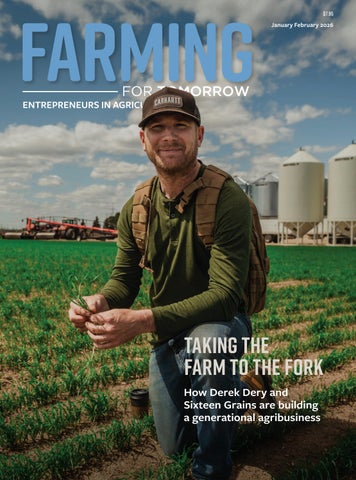
Taking the Farm to the Fork How Derek Dery and Sixteen Grains are building a generational agribusiness
in1985
the NES hit North American shelves
& the CONVEY-ALL conveyor
hit North American farms.
2
© 2025 Meridian Manufacturing Inc. Registered Trademarks Used Under License. (11/2025)
Built ahead of our time, since 1985. We started moving grain, seed, and fertilizer differently the moment we built our first conveyor. A decade later, we introduced the industry’s first Commercial Seed Tender. Then came our signature Hydraulic Drive in 2008- another benchmark the industry followed.
Others chase trends. We set them. And we’re not slowing down. Contact your local dealer to learn what sets Convey-All apart today.
find your local dealer at convey-all.com | (800) 665-7259
26
Taking the Farm to the Fork BY ANGELA LOVELL
05
36
Discerning Truth from Fiction
What’s Needed for Drones to be Approved for Pesticide Application?
Spraying 101
A Farmer’s Viewpoint by Kevin Hursh
by Tom Wolf
08
40
Grain Market Analysis
Burdensome Supplies
Grain Marketing
by Scott Shiels
Tariffs and Tactics by Teresa Zimmer
19
Seed Shop
New Genetics in the Seed World by Lisa Kopochinski
44
Farming Your Money
Barriers to Trade by Paul Kuntz
32
Succession
You Have Secured Your Family’s Legacy: Now What? by Nerissa McNaughton
KEVIN HURSH 4
PAUL KUNTZ
SCOTT SHIELS
TOM WOLF
DISCERNING TRUTH FROM FICTION | A FARMER’S VIEWPOINT
Discerning Truth from Fiction Kevin Hursh, P.Ag. Kevin Hursh is one of the country’s leading agricultural commentators. He is an agrologist, journalist and farmer. Kevin and his wife Marlene run Hursh Consulting & Communications based in Saskatoon. They also own and operate a farm near Cabri in southwest Saskatchewan growing a wide variety of crops. Kevin writes regular columns for farm publications and can often be heard on Saskatchewan radio stations. In 2021, Kevin received a Distinguished Agrologist Award from the Saskatchewan Institute of Agrologists. In 2023, he was inducted into the Saskatchewan Agricultural Hall of Fame. X: @KevinHursh1
Myths, half-truths and outright deceptions. The world has more than ever and agriculture has its fair share. The culling of over 300 ostriches at a British Columbia farm received national and international attention over an extended period of time. Those opposed to the cull came up with numerous justifications for why it wasn’t necessary. Interestingly, those same groups and individuals don’t say anything about the millions of chickens culled in Canada due to avian flu. Nor do they say anything about the thousands of cattle culled during recent cases of bovine tuberculosis. Either they don’t know about the long-standing disease control procedures or they think ostriches are somehow cuter and should be exempt. The Canadian Food Inspection Agency doesn’t do a good job of communicating, and it’s likely guilty of some missteps, but disease control rules are in place for a reason. Remember the story told over and over again for years about how the world population was increasing and incomes were improving and therefore the demand for food was going to be on an ever-increasing growth curve. Grain surpluses were going to be a remnant of the past. It couldn’t help but be the golden age for agriculture. Turns out that worldwide population growth is slowing dramatically, with the fertility rate in most advanced nations at less than the replacement level. In countries where immigration is limited, the population is aging and dwindling. India has already replaced China as the most populous country and it has a much younger demographic. Countries with the most population growth, particularly a number of African countries, typically don’t have the resources to be major importers. Some agribusinesses and politicians love to tell the population growth story, and in many cases continue to do so even when population growth statistics no longer support the contention. With tariffs and politics disrupting trade and with a desire by many nations to be more selfsufficient in food, the picture is much more complicated than the old, well-worn commentary. 5
A FARMER’S VIEWPOINT
In my opinion, the biggest scams come from the magic potions purported to fix saline soil. As soon as I see a company promoting a salinity solution in a jug, I wonder about all the other products they’re promoting. An ongoing commentary surrounds the advancing age of farmers and how most are ill-prepared for the transition out of agriculture that will inevitably happen. According to the oft-quoted statistic, the average age of Canadian farmers is 56 and untold billions worth of farm assets will have to change hands one way or another. While this is all factually correct, that average age is presented as something new, when for as long as I can remember, the average age has been around 55 or 56. Many farm families certainly procrastinate on transition planning, so accountants, lawyers, insurance companies, investment firms and farm lenders can perhaps be forgiven for trying to inject a note of urgency. However, transition planning is big business for all the aforementioned sectors, so the message is also a sales pitch. Speaking of sales pitches, as farmers, we’re absolutely bombarded with advertisements for new and wondrous crop inputs. Some of these will actually find a role in Prairie agriculture. Others – while useful in other climates and on very different crops – will fail to be useful here. Some (perhaps many) products promising amazing results will be absolute duds. In my opinion, the biggest scams come from the magic potions purported to fix saline soil. As soon as I see a company promoting a salinity solution in a jug, I wonder about all the other products they’re promoting. The salinity impact on crops varies from year to year depending upon rainfall amounts, soil saturation and type of crop grown. It takes carefully designed trials to measure whether a product is actually making the soil healthier. Instead of third-party verified tests, the companies tend to rely upon testimonials. That’s a red flag. It has never been harder to discern truth from fiction. 6
Publishers
Pat Ottmann & Tim Ottmann
Editor
Lisa Johnston
Design
Cole Ottmann
Regular Contributors Kevin Hursh Paul Kuntz
Scott Shiels Tom Wolf
Copy Editor
Nerissa McNaughton
Sales
Pat Ottmann pat@farmingfortomorrow.ca 587-774-7619 Nancy Bielecki nancy@farmingfortomorrow.ca 587-774-7618 Erin Dewsnap erin@farmingfortomorrow.ca 587-774-7620 /farming4tomorrow /FFTMagazine /farming-for-tomorrow /farmingfortomorrow WWW.FARMINGFORTOMORROW.CA Farming For Tomorrow is delivered to 79,873 farm and agribusiness addresses every second month. The areas of distribution include Manitoba, Saskatchewan, Alberta and the Peace region of B.C. The publisher does not assume any responsibility for the content of any advertisement, and all representations of warranties made in such advertisements are those of the advertiser and not of the publisher. No portion of this publication may be reproduced, in all or in part, without the written permission of the publisher. Canadian Publications mail sales product agreement no. 41126516.
FOR AN EASIER MIX
JUST ADD The emulsifiable concentrate formulation of Varro® FX mixes quickly and thoroughly so you can get in your wheat fields sooner. Varro FX controls your toughest weeds including Group 1-resistant wild oats and other grass weeds.
See if Varro FX is a fit for your farm at ExpertControl.ca
ALWAYS READ AND FOLLOW PESTICIDE LABEL DIRECTIONS. Bayer, Bayer Cross and Varro® are registered trademarks of Bayer Group. Used under license. Bayer CropScience Inc. is a member of CropLife Canada. ©2026 Bayer Group. All rights reserved.
7
GRAIN MARKET ANALYSIS | BURDENSOME SUPPLIES
Burdensome Supplies Scott Shiels Scott Shiels grew up in Killarney, Man. and has been in the grain industry for 30 years. He has worked with Grain Millers Canada for 10 years and manages procurement for both conventional and organic oats for their Canadian operation. Scott is an elected board member for Farm and Food Care Saskatchewan and sits on several other committees on both the organic and conventional sides of the oat industry. Scott and his wife Jenn live on an acreage near Yorkton, Sask. Find out more at www. grainmillers.com.
It has been quite an interesting time in grain markets recently. With continuing tariff games being played around the globe, making decisions on the farm – and honestly from our industry end as well – is more difficult than ever before. Situations like the ongoing negotiations with China that are holding canola back and India’s never-ending pulse tariffs are effectively turning a pretty decent crop into a burdensome supply situation as we go forward this year. First, let’s have a look at milling oats. With oats being a smaller market commodity, it takes smaller moves in seeded acreage and production to make a much larger impact on the annual supply and demand ratios. Going into this crop year, new crop pricing for oats was very strong; as high as $5 a bushel in some mills. This price versus canola, wheat and other competing commodities at seeding time led producers to increase oat acreage this year, some say by as much as 10 per cent over 2024. This increase in acreage wouldn’t have been any burden at all, but the August rains across the Prairies turned a very mediocre oat crop into a much better-than-average oat crop in most areas. Up to this point, the increased supply has pushed farm gate prices considerably lower as demand has struggled to keep up with the larger production. Grain companies and millers, as well as organizations such as POGA (Prairie Oat Growers Association) have been actively pursuing opportunities from around the globe to potentially open export markets outside of North America, but at this time, the U.S. remains the vast majority of our market for milling oats in Canada. Hopefully, domestic demand will increase somewhat, which it often does for oats throughout the winter, and we will chew through a little more of the supply before we look to plant next year’s crop, enabling us to keep prices from falling too much lower. Canola is the other crop, at least locally, where the tariff situation is holding back prices and delivery opportunities, according to the local crush plants and buyers. Again, we have a crop that saw an increase in seeded acreage, and one that was also poised to produce an average, or slightly below-average, yield. The August rains once again came through at the eleventh hour and helped the canola crop to be better than expected. This production, coupled with slower-than-normal exports, caused a significant drop in futures and cash prices on canola throughout the fall. We did start to see a rally in the middle of November when the USDA reported the soybean crop south of the border was smaller than earlier estimates, and hopefully those numbers stay there and are not revised upwards. At this point, there is not a lot of black ink on the bottom line of the canola ledger, and that has everyone concerned as we head toward seeding in 2026. With such a reliance on canola for cash flow on nearly every Prairie farm, could we possibly see a switch to crops like flax for some oilseed acres? Opportunities certainly are there for flax, and new varieties and a more robust market in the food sector have made it easier for growers to produce this crop, and to more easily secure a market for it. I realize that flax is not for everyone, but I do think that there is a really good case for switching some acres out of canola and into flax in the coming year. Until next time…
8
TITLE | SECTION
Meet broadleaf weeds’ apex predator Early-season broadleaf weeds beware, Huskie PRE is here Canada’s first Group 27 cereal pre-burn herbicide offers fast, reliable control of broadleaf weeds like lamb’s-quarters, cleavers, wild buckwheat and kochia, including those resistant to groups 2, 4, 5, 9 and 14. Enhancing permissible tank-mix partners like Roundup Transorb® HC herbicide, Huskie® PRE is equipped to manage the toughest early-season weed challenges in cereal production.
Bite back at HuskiePRE.ca
ALWAYS READ AND FOLLOW PESTICIDE LABEL DIRECTIONS. Bayer, Bayer Cross, Huskie® and Roundup Transorb ® are trademarks of Bayer Group. Used under license. Bayer CropScience Inc. is a member of CropLife Canada. ©2026 Bayer Group. All rights reserved.
9
SECTION | TITLE
CS4000 LL
Featuring 7+ PodProtect™ shatter rating and high yield potential. Excellent disease resistance with multigenic blackleg and 1st and 2nd generation clubroot resistance.
Featuring 6+ shatter rating and high yield potential. With blackleg and 1st generation clubroot resistance and excellent straight cut performance.
10
104% N=30, 2025 Strip Trials
vs:
InVigor L340PC
LibertyLink® Canola
YIELD
LibertyLink® Canola
108% N=5, 2025 Strip Trials
vs:
InVigor L340PC
CS3300 TF
CS2600 CR-T
High-yielding, early maturity canola hybrid featuring 7+ PodProtect™ shatter rating. With multigenic blackleg and 1st generation clubroot resistance.
TruFlex®️ canola hybrid with 1st and 2nd generation clubroot resistance and straight cut harvest option.
110% N=9, 2025 Strip Trials
vs:
Pioneer P1530G
TruFlex® Canola
YIELD
TruFlex® Canola
YIELD
Featuring the latest seed offerings and trusted performers for 2026
CS4100 LL
YIELD
YIELD SPOTLIGHT
CANOLA
109% N=4, 2023 Strip Trials
vs:
Brevant B4015
Canola shatter ratings, Canola Council of Canada. Shatter ratings are subject to change. Performance may vary depending on environmental conditions and farming practices.
0%
TITLE | SECTION
Interest-Free Financing Available
Ask your Retailer! Book by March 13, 2026
RESILIENCE A TRAIT WE SHARE
YIELD
PodProtect™, 8 shatter rating2 1st & 2nd Gen clubroot resistance Multigenic blackleg resistance Excellent early-season vigour
108% N=3, 2025 Strip Trials
vs:
InVigor L356PC
SEXSMITH, AB
A LOYAL CANTERRA SEEDS FARMER SINCE 2013
CS3400 TF
1
PodProtect™, 7+ shatter rating2 1st & 2nd Gen clubroot resistance Excellent early-season vigour Mid maturity
YIELD
CS4200 LL
SHELBY NYLAND
106% N=15, 2025 Registration Trials
Connect with your local CANTERRA SEEDS Territory Manager at 866-744-4321.
vs:
WCC/RRC Checks
True to Our Roots
Registration Pending. | 2 Canola shatter ratings, Canola Council of Canada. Shatter ratings are subject to change. Performance may vary depending on environmental conditions and farming practices. | LibertyLink®️ and the Water Droplet Design are registered trademarks of BASF. Used under license. | Always read and follow insect resistance management requirements (where applicable), grain marketing and all other stewardship practices and pesticide label directions. Scan the QR code or visit cropscience.bayer.ca/product-legal to review important stewardship and 11 product information including regulatory status, grain marketing requirements, herbicide and insect tolerance, pesticide use and product trial results. Roundup Ready®️ and TruFlex®️ are trademarks of Bayer Group. Used under license. ©️2025 Bayer Group. All rights reserved.
1
CDC Envy
CDC Evident
CDC Envy is an exciting new CWRS that is early maturing, high yielding semi-dwarf with good standability.
CDC Evident is the newest, highest-yielding CWAD currently registered and looks very strong in all durum growing areas.
3vs: AACDAYS Brandon
12
Durum Wheat
EARLIER
Data compiled from 2024 SKVPG trials
YIELD
MATURITY
Canada Western Red Spring
105%
vs:
AAC Schrader
Data compiled from 2024 SKVPG, Area 1 & 2
CS Accelerate
AAC LeRoy VB
An early maturing, very high-yielding semi-dwarf CPSR wheat with excellent rust resistance package and improved milling quality. Part of the Warburtons program.
AAC LeRoy VB CWRS has the amazing combination of high yields, disease resistance and midge tolerance, as well as consistent harvest quality that makes AAC LeRoy VB a go-to variety for farmers across Western Canada.
Canada Prairie Spring Red
108%
Canada Western Red Spring
vs:
AAC Penhold
Seed Guides are used as sources for performance
This is Canadian Certified Seed | ChooseCertifiedSeed.ca
YIELD
YIELD
WHEAT • YIELD SPOTLIGHT
WHEAT
102%
vs:
AAC Brandon
Data compiled from 2024 SKVPG, Area 3 & 4
It’s your responsibility to know https://seeds-canada.ca/en/seed-resources/plant-breeders-rights
Stale Yield?
Raise it with our newest
CWRS wheat
YIELD
Canada Western Red Spring Part of the Warburtons program starting 2026 Very high yield potential Short, strong straw (-5 cm)
106% 2025 LCRC COMC Trial, Avg
vs:
AAC Brandon
CS Breadwinner Canada Western Red Spring Very high yield potential Excellent disease resistance, MR to FHB Improved protein content Average height with good straw strength
YIELD
CS Baker
107% 2025 LCRC COMC, Avg
vs:
AAC Brandon
Connect with your local Seed Grower or call us at 13 877-270-2890 to speak to a Territory Manager.
CS Camden
CDC Endure
Grower and miller approved with exceptional yields, shorter stature, with better lodging resistance and improved quality.
CDC Endure sets the benchmark for yield and quality in oats across Western Canada and is the variety that growers will choose for many years.
YIELD
109%
White Milling Oat
vs:
Summit
Data compiled from 2024 SKVPG Program
YIELD
White Milling Oat
109%
vs:
Summit
Data compiled from 2024 SKVPG Program
AB Maximizer
AAC Lariat
AB Maximizer is a forage barley that is suitable for all areas of the Prairies. With high yield potential and solid disease resistance package brings a great combination of agronomic, disease and quality attributes.
A very high-yielding feed barley with shorter straw and excellent standability. High plump compared to checks and existing competing varieties.
102%
vs:
CDC Austenson
Seed Guides are used as sources for performance
This is Canadian Certified Seed | ChooseCertifiedSeed.ca
2-Row Feed Barley
103%
YIELD
2-Row Feed and Forage Barley
YIELD
OATS & BARLEY • YIELD SPOTLIGHT 14
OATS & BARLEY
vs:
CDC Austenson
Seed Guides are used as sources for performance
It’s your responsibility to know https://seeds-canada.ca/en/seed-resources/plant-breeders-rights
Get a Hold of
the Next Generation
of MILLING Oats
Kyron
YIELD
White Milling Oat Excellent yield potential Great protection to crown rust (MR rating) Multi-purpose variety suitable for grain, forage and silage growers
104%
vs:
Summit
Seed Guides are used as sources for performance
White Milling Oat Very early maturity High yield potential Excellent milling quality High leaf biomass suitable for the forage and silage growers
YIELD
Kalio
107%
vs:
Summit
Seed Guides are used as a source for performance
Connect with your local Seed Grower or call us at 877-270-2890 to speak to a Territory Manager.
15
CDC Engage
CDC 5845
The next yield engagement is here. CDC Engage boasts enhanced yields, improved protein content and reduced seed coat breakage over current checks.
CDC 5845 will provide growers with a boost in yield over typical yellow pea checks along with improved protein content and an improved seed coat breakage.
YIELD
107%
Yellow Pea
vs:
CDC Amarillo
Data compiled from 2024 SKVPG, Area 1, 2 & South 3
YIELD
Yellow Pea
106%
vs:
CDC Amarillo
Data compiled from 2024 SKVPG, Area 1, 2 & South 3
CDC 6928 CL
CDC 6956 CL
High yield potential suitable for all lentil growing areas. With Imidazolinone tolerance.
High yield potential and larger seed size suitable for all lentil growing areas. With Imidazolinone tolerance.
109%
vs:
CDC Maxim
Seed Guides are used as sources for performance
This is Canadian Certified Seed | ChooseCertifiedSeed.ca
Small Red Lentil
108%
YIELD
Small Red Lentil
YIELD
PEAS & LENTILS • YIELD SPOTLIGHT 16
PEAS & LENTILS
vs:
CDC Maxim
Seed Guides are used as sources for performance
It’s your responsibility to know https://seeds-canada.ca/en/seed-resources/plant-breeders-rights
Yellow Peas that Go Above and Beyond
AAC Beyond
CDC 5791
108%
Yellow Pea Very high yield potential High protein content Very low seed coat breakage vs:
CDC Amarillo
Seed Guides are used as sources for performance
YIELD
YIELD
Yellow Pea Very high yields High protein content Early maturity
107%
vs:
CDC Amarillo
Seed Guides are used as sources for performance
Connect with your local Seed Grower or call us at 877-270-2890 to speak to a Territory Manager.
17
SECTION | TITLE
Put our beef expertise to work on your operation.
Ag producers are the backbone of Alberta’s food production. ATB has stood with beef producers since 1938—helping them survive hard times and thrive in the good times. Let’s work together to see how ATB can support your beef operation for generations to come.
atb.com/beef 18
NEW GENETICS IN THE SEED WORLD | SEED SHOP
New Genetics in the Seed World Weather, tariffs and trade are shaking up the pulse market By Lisa Kopochinski
The global pulse market is all over the map right now. For example, India – the world’s biggest buyer – keeps changing tariffs on lentils, chickpeas and peas. Weather is hitting crops in Canada and Australia, and exporters like Kazakhstan are stepping in. All these shifts are changing prices, trade routes and what farmers in Alberta (and beyond) decide to plant next season. The seed market has shown positive growth over the past year due to a strong focus on leverage genetic and trait diversity. Farming For Tomorrow had the opportunity to sit down with Cole Ambrock, sales and marketing manager at KWS, and Eric Gregory, director of marketing at BrettYoung, to get their take on what is happening. Here is what they had to say. Farming For Tomorrow: The seed market has shown positive growth over the past year due to a strong focus on leverage genetic and trait diversity. What are some of the new fall rye genetics in the seed industry?
Cole Ambrock: Over the past few years, innovation in fall rye genetics has accelerated – driven by hybrid breeding. At KWS, our focus has been on developing hybrids that deliver consistent performance across Canada’s diverse growing regions. KWS Receptor represents the next generation of hybrid rye grain varieties – combining high yield potential, strong winter survival, short straw and excellent ergot resistance through our PollenPLUS™ technology. KWS Aviator, on the other hand, is bred for top forage yield with a tall structure and exceptional winter hardiness. These innovations are setting the stage for the next phase of hybrid rye breeding – focused on improved consistency, flexibility and market fit for all end uses. Eric Gregory: There are a lot of moving parts in canola genetics, and lately this has been truer than ever. Along with our primary germplasm supplier and partner in canola, DL Seeds, we recently entered the LibertyLink market with DL Seeds’ differentiated canola genetics. This has meant new 19
SEED SHOP | NEW GENETICS IN THE SEED WORLD choices for growers looking to explore options beyond what is offered by the multinationals, and the options available around yield performance, shatter tolerance and disease resistance traits in a BrettYoung bag. DL Seeds has made strong advancements in stacked clubroot resistance genetics that show control of a broad array of clubroot pathotypes, particularly in the pathotypes that are evading first-generation clubroot resistance. BrettYoung, along with DL Seeds, has also introduced a shatter tolerance trait that has proven to be a reliable performer, and new major blackleg resistance genes that offer tools to help growers dial in on blackleg issues. All these advancements are being bred into strong-yielding hybrids over a variety of maturities and herbicide groups that growers can choose from to suit their needs. FFT: Why should farmers invest in new genetics in the seed industry?
Cole Ambrock, sales and marketing manager at KWS.
CA: Genetics are the foundation of productivity. Investing in new genetics means investing in higher yields, better stress tolerance and stronger disease resistance, which directly impact profitability. In hybrid rye, the move from conventional open-pollinated varieties to hybrids can deliver 35 per cent to 40 per cent more bushels per acre, along with more uniform stands, improved harvestability and reduced risk of ergot. Modern genetics aren’t just about yield – they’re about predictability and peace of mind. Farmers today need innovative tools to manage risk, and genetic advancements through breeding are among the most powerful tools available to protect profitability. EG: Simply put, it comes down to improved yields and better adaptation to today’s challenges. There are the obvious benefits that new seed genetics deliver, like improved disease tolerance and, in particular, resistance to diseases where pathogen populations are shifting such as what’s going on with blackleg and clubroot. Stacked clubroot resistance and new blackleg major resistance genes are giving farmers new tools to effectively manage these issues. FFT: What are some of the biggest challenges farmers are currently facing with fall rye?
Eric Gregory, director of marketing at BrettYoung.
CA: One of the biggest challenges is awareness and understanding. Fall rye – especially hybrid rye – is still new to many growers. There’s sometimes hesitation because it is a fall-seeded crop, and that timing requires planning and logistics. If growers aren’t prepared to seed in the fall, it becomes an easy decision to skip fall seeding when time is tight. With spring crops, farmers are already in that mindset and will do what’s needed to sow the crop. Another ongoing challenge is managing ergot in traditional
20
NEW GENETICS IN THE SEED WORLD | SEED SHOP open-pollinated varieties. This is an area where hybrid breeding – combined with traits like KWS PollenPLUS™ – has made tremendous strides, helping farmers reduce ergot risk while improving grain quality. EG: Without a doubt, climate, weather variability and ballooning input costs are some of the biggest issues facing canola growers today. We have seen different weather patterns emerge over the last several years that represent a steep change in what we thought was “normal.” Prolonged periods of drought, hotter than normal, cooler than normal and microclimates that persist in relatively small geographies can make big impacts. There is sometimes little to be done that can take the edge off the impacts of these events, and it leads to growers taking a more defensive position on in-season management decisions like fungicides and other pest control choices. FFT: What are some of the measures that growers need to implement? CA: Being prepared and organized. Have your drill serviced and ready for the field, book seed and fertilizer well ahead of time, and coordinate logistics accordingly. On our own farm, we utilized two trucks (one for seed and one for fertilizer) on
WHEAT
DURUM
BARLEY
Gain a genetic advantage.
OATS
FLAX
PULSES
the Monday morning, planted Monday afternoon/Tuesday, and had trucks washed and ready for harvest duties by Tuesday evening. When you mentally commit to seeding a fall crop and are prepared, the “burden” goes away, and excitement enters with yourself and the neighbours wondering what you are up to. It is also important to take the time and do it right. Harrow the field before seeding for trash management, ensure your drill is calibrated correctly, seed shallow at three-fourths of an inch, and seed at a speed of five m.p.h. or less. Don’t chase moisture; rye can germinate with as little as three-tenths of an inch of rain. It’s a different and fun experience to seed in September – slow down, do it right and enjoy the process. EG: As a company that has regular contact with growers, we often see certain patterns emerge. We’ve seen that farmers tend to be all over the map when it comes to managing the basics. Some are very focused on certain aspects of production and may pay too much attention to those issues, but may not spend enough time on other issues that, if left unchecked, can have big consequences. Here is what our experience shows can be lacking in management or focus:
HYBRID FALL RYE
Farm on
Financing Available.
Purpose!
Visit fpgenetics.ca to connect and learn how. Call 877 791 1045 to speak with a Territory Manager or Product Specialist.
21
SEED SHOP | NEW GENETICS IN THE SEED WORLD • Scout regularly: Clubroot patch mapping, blackleg incidence scoring after harvest, and in-season weed monitoring. • Maintain sound crop rotations: A three-year break between canola crops significantly reduces disease severity. • Rotate resistance sources: Especially for clubroot and blackleg, do not rely on a single CR gene or hybrid for multiple consecutive years within the same field. Use stubble testing to identify the specific blackleg races where you have significant impacts from this disease. • Optimize fertility management: Base N, P, K and S planning on soil tests. Consider split applications of nitrogen or enhanced-efficiency N fertilizers. FFT: Is there enough funding being allocated by the province to contribute to variety development and competitive breeding programs? If not, what should be done?
Headquartered in Winnipeg, BrettYoung is an important player in Canada’s forage seed industry. Photo: BrettYoung
CA: Public investment remains an important foundation for Canadian agriculture, particularly when it comes to variety development and early-stage breeding. However, as new technologies emerge and farmer expectations evolve, there’s an opportunity to make funding models more collaborative. Rather than focusing on how much funding is available, the emphasis should be on how efficiently that funding is used – encouraging partnerships between public research institutions, private breeding programs and producer groups.
Providing high quality seed cleaning services since 1989. Seed Treating Processing Cleaning Optical Sorting Seed Analysis Office: 403-627-5010 605 Short St. Cell: 780-385-0825 Pincher Station, AB seedinfo@pcseedplant.com
https://pcseedplant.com/ 22
Programs that promote shared data, regional testing and co-development can create faster pathways from research to farm. The end goal should be to ensure Canadian farmers have timely access to world-class genetics that reflect both local conditions and global advancements. EG: When it comes to canola, in a word, no. With some key exceptions like clubroot resistance, provincial governments have not historically focused investment on germplasm or trait development in canola – this has been left largely to private sector breeders to make the investments that they feel will bring the most value to their customers. However, this is arguably working, as evidenced by the constant gains being made in canola yield performance and related disease control and other functional traits that have been introduced. Provincial governments have had impact on the information around production practices and with the recent changes at the Canola Council of Canada (CCC) and removal of their production specialists, this may be an opportunity for the provincial governments and commodity producer groups (SaskCanola, Manitoba Canola Growers and Alberta Canola) to increase their investment in both production and climate resilience research.
CONFERENCE HIGHLIGHTS
JANUARY 27 - 28, 2026 DOUBLETREE BY HILTON HOTEL WEST EDMONTON TICKETS JUST $199 + TAXES & FEES
CrossRoadsCropConference.ca
Keynote addresses from Lisa Ashton, Chris Scheetz & Andrew Coyne. Valuable networking opportunities, including a dedicated lounge to connect with peers and industry leaders. Annual General Meetings of Alberta Canola, Alberta Pulse Growers, and Alberta Grains.
PRESENTED BY:
Greenleaf Seeds Ltd. Ph: 306-873-4261 • Fax: 306-873-2438
www.greenleafseeds.ca • greenleafseeds@outlook.com
• Wheat - AAC Cameron VB, AAC Starbuck VB, AAC Leroy VB, CS Accelrate, AAC Stoughton VB, CS Breadwinner • Barley - AAC Connect, CDC Goldstar, AAC Synergy • Canola - CS4000LL, CS2800CL, CS2600CR-T, CS4100LL, CS4200LL, CS3300TF • Peas - AAC Julius, PS Boost,AAC Carver, AAC Beyond, CS Prostar
Our Mission Provide leadership in identifying and supporting research, market development and advocacy to maximize profitable and sustainable wheat production for Saskatchewan farmers.
• Oats - CDC Morrison, CS Camden, CDC Arborg, CDC Endure, CDC Anson • Faba Beans - Snowbird, Fabelle • Canary Seed - CDC Lumio • Flax - CDC Rowland
Production, Processing and Conditioning of Pedigrade Seed
KRIS MAYERLE 23
Specializing in annual forage grains for silage, swath grazing, greenfeed and grazing.
800-852-2638
www.winklerstructures.com
VARIETIES: • Gunner Spring Triticale • Flex Spring Triticale • Niagara Forage Oats • Prima Fall Rye • Renegade Forage Barley • Haymaker Forage Oats • Hairy Vetch INCLUDING SERVICES SUCH AS: Treating and Priming Blending
Available in bulk, bags or totes.
Pedigreed Seed Growers
MUELLER SEED
•Insulation Options available •Site Specific Engineering
We manufacture
Contact Darcy at (403) 820-4115 Muellerfarms@xplornet.com
We are the Seed Experts
Fedoruk Seeds Ltd.
Growers, Processors and Retailers of Pedigreed Seed Wheat, Barley, Oat, Pea, Faba Bean, Soybean and Flax Seed
Kamsack, Sask Phone: 306-542-4235 E: mike@fedorukseeds.com W: www.fedorukseeds.com
WWW.FEDORUKSEEDS.COM 24
•Equipment Storage •Aggregate Storage •Quick Set up
for all models of fabric buildings
NEW GENETICS IN THE SEED WORLD | SEED SHOP It is also fair to say that the canola producer organizations mentioned above have historically been strong contributors to R&D in canola. They have helped to expand disease resistance genes, improve understanding of plant-pathogen interactions and monitor for geographic distribution of pests. While these efforts don’t necessarily result directly in new hybrids, breeding companies like DL Seeds work closely with public researchers in Canada and internationally to incorporate the latest technology into new products. Identifying new resistance genes in related species is important work, and many years of research and development work has gone into incorporating new tools into adapted hybrids that are suitable for western Canadian farmers.
ability to scale new technologies. By fostering a strong publicprivate partnership model, the seed industry can ensure that both foundational research and market-ready innovation are supported. This balance gives farmers access to genetics that are not only competitive globally but also well adapted to their local agronomic and economic realities.
FFT: How important is it for the seed industry (in general) to transition away from heavy reliance on government funding?
EG: In canola, this has already happened. However, in other crops like cereals, and pulses to some extent, this is highly important, but of course there is nuance to this idea. The notion that the federal government is “getting out” of breeding has not been formally declared, but the trend of reduced emphasis on full-service public breeding is real and recognized by industry observers. The problem is that the industry has not yet landed on what can replace these federal investment dollars.
CA: It’s less about moving away from government funding and more about creating a balanced and resilient innovation system. Public breeding programs play a vital role in maintaining diversity, transparency and regional adaptation. At the same time, private companies can bring speed, specialization and the
The private sector will not fill the void because there is no incentive to do so. Down the road perhaps, seed companies, farmers and governments will be more aligned on the role of all parties and their responsibilities to each other to maintain a robust cereal and pulse breeding system.
25
COVER STORY | TAKING THE FARM TO THE FORK
TAKING THE FARM TO THE FORK
BY ANGELA LOVELL
How Derek Dery and Sixteen Grains are building a generational agribusiness
26
TAKING THE FARM TO THE FORK | COVER STORY Derek and Tricia Dery have a definitive goal in mind for their fifth-generation family farm. Since starting the transition from Tricia’s parents over a decade ago and giving up their off-farm jobs in 2022 to farm full time, the couple has been working to build a generational agribusiness that will provide opportunities for their children and other future stakeholders. “Our main goal is to create an entity that is more than a traditional farm,” says Derek Dery. “For us, the definition of a generational agribusiness is not just being a sustainable financial business, but to also create new roles for future generations, and for those in our organization currently who might want to do more activities than work in the fields.” The farm has grown to about four times the size it was when the Derys first began taking over in 2011, and now, at around 8,000 acres, the grain farm is still the core business, but they have expanded into other complementary business segments that have diversified the operation, while ensuring they maximize their full capacity. “Our goal is to farm as many productive acres as we can on one line of farm equipment,” Dery says. “But growth can be more than just acres, so we worked through a SWOT (strengths, weaknesses, opportunities and threats) analysis for our farm, and through some other marketing exercises, looking at different blue ocean options versus staying in the red ocean of high competition.”
“For us, the definition of a generational agribusiness is not just being a sustainable financial business, but to also create new roles for future generations, and for those in our organization currently who might want to do more activities than work in the fields.” - Derek Dery well, so we wanted to figure out how we could elevate the profitability of our lowest tier or rotational crop,” Dery says. After partnering with a local mill and co-packer, they launched their first Sixteen Grains-branded wheat product – a pancake mix based on Tricia’s grandmother’s recipe, using the resources at the Saskatchewan Food Industry Development Centre in Saskatoon to scale up the recipe for commercial production.
From these exercises, they defined two business segments they thought would be feasible: consumer packaged goods (CPG) and food ingredients, and agritourism.
“They helped us with our nutritional facts tables, mixing instructions and packaging, and the co-packer that we are using shared a lot of experience and support too,” Dery says.
Sixteen Grains is born
Turning challenge into opportunity
One of the first things they did was a complete rebranding to Sixteen Grains, hiring a professional web designer to build their new website and assist with marketing materials.
The Derys know that the business of farming in Western Canada is financially challenging, and they’ve learned that going back to the whiteboard to rethink their strategies, even on the grain side of things, helps them identify and take advantage of new opportunities.
“We are often asked, why is it called Sixteen Grains?” Dery says. “It aligns with the goal of creating a generational business. Since it’s often been the daughters who have taken over the family farm, the farm name has changed three times over the generations. So, step one was to create a name that was going to be generational, and 16 is a number that comes up a lot in our lives.” After taking a deep dive into the farm operation, they identified their ability to grow high-quality, high-protein, hard red spring wheat on their sandy loam soils as a strength. The weakness, however, is that it’s not a very profitable crop to grow. “When we looked at CPG, we started with wheat because it was one of the crops we knew we could grow consistently
“We had a challenging year in 2024, and so we asked ourselves, if we are only going to grow a 35 to 40-bushel crop on our dark brown soils around Saskatoon, what crops can we grow that are worth the most value for that yield?” Dery says. As a result, in 2025, they diversified their crop mix to include chickpeas, small green lentils, green peas, yellow flax, canola, spring wheat and silage corn, to provide different marketing options and the opportunity to innovate new food products. “We have gained a lot of knowledge through our experience with CPG in the last couple of years,” Dery says. “We have the confidence from this experience that if we want to 27
COVER STORY | TAKING THE FARM TO THE FORK
Derek and Tricia Dery have quadrupled the size of the farm since beginning to take over operations in 2011.
package pulses and get them on grocery store shelves across Canada, we know how to do that now. We can make that happen if there is a business case for it.”
environment, with the strong ‘Buy Canadian’ trend, has been positive for their business, and instrumental in securing a national Canadian distributor.
Getting into the CPG and ingredients business has meant investing a lot of time and energy to learn and understand the industry, and if Dery has advice for anyone else contemplating a similar venture, it’s being mindful about how much working capital to spend on the early stages of developing the business.
“From February through April 2025, there was an intentional effort from different industry partners to build their Canadian presence, so it opened up more doors for us for sure,” Dery says. “It’s interesting to look at the alignment of buyer sentiment in Canada today and the goals that we have on our website, which is to create high-value food moments for Canadians. That was written in 2022-23, but we have a product that’s perfectly aligned for the current consumer sentiment that’s out there today. Now we have to just see if the consumers actually follow through and buy our products.”
“You can spend a tremendous amount of capital so quickly when you start outsourcing and contracting different people to help you out,” he says. “Consumer packaged goods is such a low-margin business you have to sell a tremendous amount of product to recoup that investment. If I had to do it again, I would have more confidence in ourselves and not be so overwhelmed by the food industry. It’s a solvable process. So, when you do engage and outsource the support that’s needed, make sure you know what that runway looks like, because a lot of those arrangements can be very open-ended.”
While Dery has been pretty successful in getting the products on grocery store shelves, it’s staying there that is the biggest challenge.
Learning how to reach consumers
“Getting into shopping carts is the secret sauce to winning in this business,” Dery says. “You have to build brand awareness and brand trust and get people to try the product.”
The Derys have their products in all the major grocery chains across Saskatchewan as well as some independent stores, and offer an online shop as well. The current trade
How the Derys have approached that challenge is by getting hands on with the marketing and promotion, spending time flipping pancakes in grocery stores and giving away samples
28
TAKING THE FARM TO THE FORK | COVER STORY
A fifth-generation operation just outside Saskatoon, Sixteen Grains is a modern farm that brings people together through fresh Canadian-farmed ingredients.
CUSTOM MANUFACTURING TO SUIT YOUR SPECIFIC NEEDS Contact Michel’s Industries Ltd for a dealer nearest you
306-366-2184 Michel’s EZ Lift
www.michels.ca
sales@michels.ca
Michel’s EZ Lift TAKE THE CRANKING OUT OF YOUR TRAILER LANDING GEAR
Michel’s Camera Arm
• Quick. Easy Install • Use a 12V cordless drill to operate your landing gear • Can be used for the heaviest of loads such as oversize equipment • EZ Lift will lift as much as you can crank by hand • Michel’s offers 2 different brackets to cover most trailers. Some trailers may require specialized brackets that Michel’s will custom-build
Michel’s Camera Arm • • • • •
Safely monitor loading of graintrailer from inside your cab Less trips up and down a potentially slippery ladder Automatic lifts and lowers when rolling tarp system High-quality wireless camera and monitors Grain auger and conveyor kits, as well as cameras for all different applications
29
COVER STORY | TAKING THE FARM TO THE FORK for people to try, as well as working at the mill and packaging their own products to understand the process from start to finish. “As farmers, you can take for granted that you can sell pretty much any crop that you grow on your farm, maybe not at the price you would like, but there’s typically a market for a commodity every single day,” he explains. “In CPG, you have to earn the ability to sell your product. You can’t force people to buy your product, so you have to build a relationship with consumers, and part of that is knowing what they are going through. You know that’s their hardearned money they’re spending on your bag of flour, or your pancake mix. So, as a farmer who has been growing food my whole life, it’s neat to have a relationship with someone who uses that food in their kitchen.”
Venturing into agritourism This past year, the Derys also took their first journey into agritourism, offering farm experience tours to the public for a fee. “We’ve had some experience with doing informal farm tours over the years, and we participate in Saskatchewan Open Farm Days, so we started to think about how we could monetize farm tours,” Dery says. “It’s also another opportunity to build connection with consumers and tell our story. By creating our agritourism business, it’s created an opportunity to have a close conversation with a group of people, walk around the farmyard, provide a pancake breakfast to them and answer their questions one-on-one about farming.” It took about 18 months from concept to launching the agritourism business, and a $120,000 investment in a four-season building on the farm with a kitchen facility and proper washrooms. The plan for the future is also to offer farm-to-fork dining experiences on the farm. Tricia’s parents, Don and Diane Cote, remain active on the farm, as does Tricia’s brother, Josh, and they have three seasonal employees to help as well.
Two important business drivers The Derys’ two children, Penny (13) and Oliver (11), are learning the basics of entrepreneurship early, and love helping out on the agritourism end of things, doing a combine demonstration, where they act out all the parts of the combine – the most popular part of the farm tour. “We want to create a business, and have a role for the kids, but it starts now,” Dery says. “They are proud of their farm, and of being in the grocery store on a Saturday morning helping with the cooking demos as well.” 30
“We are trying to go against the grain of the model where we get our kids to go to university and then never see them again after that. The entrepreneurial benefit to me is in working hard, taking some risks and creating these business segments so there is opportunity to keep our kids closer in our lives.” - Derek Dery And the children are also the biggest driver of the couple’s whole business concept. “We are trying to go against the grain of the model where we get our kids to go to university and then never see them again after that,” Dery says. “The entrepreneurial benefit to me is in working hard, taking some risks and creating these business segments so there is opportunity to keep our kids closer in our lives.” Over the next three to five years, the goal is to focus on what is working well and continue to enhance their businesses. They have added other products to their lineup, including artisanal flour, cookies and pizza mix. “I’d like to increase protein inclusions into some of the mixes, so we will innovate and lean into products that are working for us,” he says. But they are always ready with the whiteboard to explore other diversification opportunities that may come along, because they believe it’s hugely important to show their kids and their families that it’s possible to build sustainable businesses by moving away from their comfort zone and taking a few calculated risks. “The flip side of that coin is just being in a stagnant place where you’re doing the same thing over and over again and you don’t know what day that’s going to come to an end,” Dery says. “Whereas now, we’ve built trust with our family and our kids and shown that it’s possible to put the work in and see some success of that. The biggest thing is building those foundation blocks through experience so there’s successful business models here to lean into.”
TAKING THE FARM TO THE FORK | COVER STORY
After partnering with a local mill and co-packer, they launched their first Sixteen Grains-branded wheat product: a pancake mix based on Tricia’s grandmother’s recipe.
31
SUCCESSION PLANNING | YOU HAVE SECURED YOUR FAMILY’S LEGACY: NOW WHAT?
You Have Secured Your Family’s Legacy: Now What? Welcome to part six of seven. This series is designed to help every farmer with affordable, easy, hassle-free continuity planning. By Nerissa McNaughton
Over the past five articles, you have learned that continuity planning doesn’t have to be scary. Many farmers feel like continuity planning is a burden to sandwich between planting and harvest, and they would rather hop on the combine than sit in an office with a lawyer, accountant and banker. Derryn Shrosbree of 33seven – the firm built on personal experience to help farmers from all walks of life seamlessly, painlessly and affordably secure the family farm for generations without alienating the siblings involved – is back to discuss what comes next. “So, you’ve leveraged insurance to secure the family farm and ensure all siblings – those on farm and off farm – are provided for. You have loved how it was just one call to a company that took care of it all, informing and educating you every step of the way. You still have plenty of life to live before the succession plan goes into effect, and you still love working on the farm, but you recognize the need to let the next generation step in and step up as you start to step back. You also realize that as a senior, you are incurring expenses above the daily costs of living. Making the house more accessible. Mobility aids. Short or long-term care ... these things add up.” What do you do now? Don’t panic! For seniors in this position, Shrosbree offers a stepping-stone 32
“The primary goal of succession planning was to unburden the farm from the financial needs of the retiring senior generation, thereby protecting its productive capacity.” - Derryn Shrosbree to ease the transition and help secure an even stronger financial future. “The primary goal of succession planning was to unburden the farm from the financial needs of the retiring senior generation, thereby protecting its productive capacity,” he says. “But the senior generation’s value is not just financial. They continue to add value as stewards of knowledge and experience. Financial independence helps them stay engaged.” Shrosbree continues, “Leveraged life insurance was presented as one method where farmers could access funds by borrowing against a policy, with the loan being repaid by the
YOU HAVE SECURED YOUR FAMILY’S LEGACY: NOW WHAT? | SUCCESSION PLANNING
SAVE YOUR FARM FROM THE IRS. Renouncing your US citizenship can be an important step in protecting your land and your livelihood. Make the best decision for you and your family. Contact Alexander Marino JD, LLM (US Tax) Director, US Tax Law | Leader, US Tax Practice Group 403.693.5114 | amarino@moodystax.com
moodysprivateclient.com
33
SUCCESSION PLANNING | YOU HAVE SECURED YOUR FAMILY’S LEGACY: NOW WHAT?
“While banks typically offer 80 per cent loan-to-value on your home, CMHC will give you 100 per cent loan-tovalue on your multi-unit residential real estate project. Don’t just take my word for it; the banks themselves are signalling that they perceive no risk in this asset.” - Derryn Shrosbree death benefit. Now, a secondary strategy that builds on this can take place. This is a unique real estate opportunity involving the development of multi-residential apartment buildings using 100 per cent financing from the Canada Mortgage and Housing Corporation (CMHC). “While banks typically offer 80 per cent loan-to-value on your home, CMHC will give you 100 per cent loan-to-value on your multi-unit residential real estate project. Don’t just take my word for it; the banks themselves are signalling that they perceive no risk in this asset.” Shrosbree pauses here because he knows that when most people hear “real estate investing,” they have the same reaction as hearing “life insurance.” With a heavy sigh he cautions, yet again, “Yup this is where people would rather light themselves on fire than hear me out, but hang in there. Just like with the first part of this long-term strategy, which turned out to be fast, easy, painless and net neutral in costs, part two is a way to build wealth with the same very low level of risk and involvement.” The strategy is to combine that leveraged life insurance with real estate investments through a firm that takes care of building properties, securing and managing tenants and everything in between. The best part? You are simply reinvesting the same dollars you started the continuity planning with – the dollars you have already got back that empowered your neutral investment. Apart from directing your dollars, there is nothing more to do. The property management firm handles it all and provides you with your share of the profits based on your level of investment. 34
YOU HAVE SECURED YOUR FAMILY’S LEGACY: NOW WHAT? | SUCCESSION PLANNING A property management firm like Generational Wealth Inc. is the key to enjoying a passive income stream of this nature. Professional firms like this can secure 100 per cent financing, as opposed to what an individual investor can do on their own. So, instead of permanently tying up $200,000 as a down payment, the firm will instead initially put it down knowing CMHC allows them to get that money back. Essentially, they recover the $200,000 while still retaining ownership of the building, and the investor gets their share. Simply put, you are making your dollar work for you by using one dollar twice. You get to own leveraged life insurance, and you own a multi-unit residential building, and you get your money back at the end of it. Shrosbree explains, “This is a unique real estate model because it allows investors to get their initial capital back after construction is complete. Then, if so desired, they may reinvest to build more properties as many times as they wish. This is what solidifies that cycle of generational wealth.” He urges families to not just stop after they have completed
continuity planning. By stepping into reinvesting the insurance benefit, families provide retirement income for the senior generation, have yet another equalization tool for off-farm children and are generating long-term disposable income through passive means. Why not make the money you earn and the assets you own work as hard as you do? With guidance from companies like 33seven and Generational Wealth, your investment of the time it takes to learn these strategies can easily turn into seamless continuity planning backed by a dedicated passive income stream. By being open to learning more and taking that first step, you can secure the farm, secure the family legacy, ensure both on- and off-farm children are taken care of, generate income for the farm founders’ senior years, and rest easy knowing your children, grandchildren and great-grandchildren are financially secure. Ready for peace of mind? Visit www.33seven.ca and www. generationalwealthcreators.ca to get started.
35
SPRAYING 101 | WHAT’S NEEDED FOR DRONES TO BE APPROVED FOR PESTICIDE APPLICATION?
What’s Needed for Drones to be Approved for Pesticide Application? Tom Wolf, PhD, P.Ag. Tom Wolf grew up on a grain farm in southern Manitoba. He obtained his BSA and M.Sc. (Plant Science) at the University of Manitoba and his PhD (Agronomy) at Ohio State University. Tom was a research scientist with Agriculture and Agri-Food Canada for 17 years before forming AgriMetrix, an agricultural research company that he now operates in Saskatoon. He specializes in spray drift, pesticide efficacy and sprayer tank cleanout, and conducts research and training on these topics throughout Canada. Tom sits on the board of the Saskatchewan Soil Conservation Association, is an active member of the American Society of Agricultural and Biological Engineers and is a member and past president of the Canadian Weed Science Society.
36
It is all but inevitable that Canada’s federal pesticide regulator, PMRA (Pest Management Regulatory Agency), will eventually approve the use of spray drones on all pesticide labels that are approved for aerial application, either fixed wing or rotary wing. The justification for this move is that Canada is lagging behind other countries in a host of regulatory domains, being among the last to approve new pesticides for use by farmers. It is also out of step with the U.S., where most states have opted to allow drones for agricultural spraying in the absence of a federal position, and Australia, where their federal regulator, APVMA, has likewise allowed any pesticide approved for crewed aerial spraying to be sprayed by drone. Advocates of drone spraying have made a case for what the new utility offers to producers. Being able to spray by air allows crops to be sprayed when the ground is wet. Wheel tracks can be avoided. Drones can do this at considerably lower capital costs than a crewed aircraft, and drones are also easier to deploy in remote areas where moving a ground sprayer is timeconsuming. Detractors from drone spraying point to the risk of drift, the need for frequent swath width testing, the lack of suitable training and certification for drone spray operators, and the generally unknown efficacy of many of the products when applied by drone. Some of the information that regulators require to make risk assessments is now coming together. Agriculture and Agri-Food Canada conducted pesticide residue studies on orchard crops and concluded that drone sprays did not result in higher residues than conventional applications. Recently, spray drift study results were submitted by the Unmanned Aerial Pesticide Application System Task Force (UAPASTF), an international consortium that conducted drone spray drift trials in Canada, the U.S., South Africa, Australia and Hungary. These studies indicated that drift from spray drones was more than from ground application, but less than air-blast application and similar to crewed aircraft. These studies allow for the creation of models from which risk can be quantified by regulators.
WHAT’S NEEDED FOR DRONES TO BE APPROVED FOR PESTICIDE APPLICATION? | SPRAYING 101
Some of the other important information includes operator, mixer-loader and bystander exposure. This information is beginning to be collected. One missing piece of the puzzle is efficacy. Countries differ in their efficacy data requirements for registration. In Canada, PMRA conducts an efficacy review as part of its commitment to register the lowest effective dose of a product. This policy serves two purposes: to protect the end user from being required to apply a higher than necessary dose, and to protect the environment from being exposed to such a dose. By contrast, in the U.S., an efficacy review is not part of a product registration. The rationale is that the market will sort out whether a recommended rate is sufficient, or excessively high, from user experience and independent research. The registrant has no incentive to recommend the wrong rate. Initial efficacy results from drone use are mixed. It turns out that the spray deposits from drones are highly variable. For pesticide efficacy, we need spray patterns to be uniform across the width of the spray swath. We measure uniformity with a parameter called “coefficient of variation”, or CV. In short, if we were to measure the deposit amount under a boom at 10 different locations, the CV of that deposit would be the standard deviation of the 10 measurements, divided by the average amount, expressed as a percentage.
Figure 1: Swath deposits from three consecutive passes of a DJI T50 drone, flight line at 8 m location. Flying height 3 m, 30 L/ha water volume, 18 mph flight speed, 250 µm droplet size. Note the change in swath location due to changed wind conditions and aerodynamics of drone downwash.
37
SPRAYING 101 | WHAT’S NEEDED FOR DRONES TO BE APPROVED FOR PESTICIDE APPLICATION? For boom sprayers, a CV of 15 per cent has been the goal, although with high booms and fast travel speeds, 25 per cent seems to be more realistic. For boomless and aerial sprayers, the calculation of CV is complicated because the swath width (and therefore the overlap) is unknown until measured in a test. Sprays from these types of sprayers spread out after release, and the amount of spread is governed by aerodynamic forces such as wind and downwash. Change the aerodynamic forces, and the spread changes. That’s why in trials, we saw swath widths from drones vary by about 30 per cent for any given application, and the CV was sometimes as high as 50 per cent (Figure 1).
It’s critical to know the swath width in advance of a spray operation, and to understand its dependence on water volume, droplet size, flying speed, canopy type, payload, and wind speed and direction.
Why is deposit uniformity so important? It’s mostly because pesticide efficacy is very dose-dependent. Too little dose, and pest control drops off. Too much, and crop tolerance is challenged, allowable crop residue limits may be exceeded, and greater soil residue may require longer re-cropping intervals. All of these are very important factors.
We have now run hundreds of swath tests with drones of all shapes and sizes. The issues of pattern uniformity and swath width appear in all these tests. It won’t be until we see some sort of redesign of drone sprayers – one in which the downwash does not affect swath deposition to the same degree – that we can expect to see these issues improved.
And why is a consistent swath width important? When one makes a drone application, the drone software needs to know the swath width so it can plan its mission. This swath width cannot be changed during a mission. With variable widths, there will be parts of the field that are missed, and other parts where there will be overlaps.
And that’s why it’s fair to say that the efficacy of drone operation may in fact be more important than all the other factors. The other factors can be managed. Spray drift can be managed with droplet sizes or setback distances or by limiting the weather conditions during which drone spraying occurs. Operator exposure risk can be mitigated with personal
38
Look at Figure 1 again. If you had these types of deposits from your ground sprayer, would you be happy? Let’s examine it another way. What would you need to do to your ground sprayer to replicate these patterns? Would you need to use larger nozzles in some locations? Plugged nozzles in others? Would you need to shut off your outer boom section every now and then? I would say yes to all.
It’s critical to know the swath width in advance of a spray operation, and to understand its dependence on water volume, droplet size, flying speed, canopy type, payload, and wind speed and direction. protective equipment. But efficacy risk seems to be an inherent characteristic of this spraying method. Efficacy is strongly related to yield, and therefore income. It’s a risk to be taken very seriously because at this time, we can not suggest reliable mitigating measures. Due to the time-sensitivity of pest management, we often have only one chance per season to control weeds, disease or insect problems. And it makes sense to use that one chance as wisely as possible.
Losing Heat out your Shop or Garage Door? SnirtStopper’s premium Kevlar door seals will seal your doors reducing your heating costs!!
Visit us at The Western Canadian Crop Production Show Booth A118
SnirtStopper Canada 306-292-9872 Warman, Sask
39
GRAIN MARKETING | TARIFFS AND TACTICS
Tariffs and Tactics Navigating Grain Market Volatility By Teresa Zimmer
Western Canadian farmers are facing a new era of uncertainty as tariffs and trade disruptions reshape global demand and pricing dynamics. With key export markets imposing restrictions on canola, peas and other crops, marketing analysts say the path forward lies in strategic planning, technical analysis and a clear-eyed view of profitability.
Tariffs Trigger Market Shocks and Misinterpretations The impact of tariffs on grain prices is not always straightforward. IntelliFARM Inc.’s president Brian Voth points to the confusion surrounding China’s tariffs on Canadian canola meal and oil last spring. “Canola futures dropped about $85/metric ton within the following week. However, canola itself was not even in the crosshairs from that tariff, but that is what people in the media and agriculture read it as,” explains Voth. “So, it made canola much cheaper than it was, which ultimately benefited anyone buying Canadian canola because they got a better deal on it.” Three months later, he adds, canola prices were $165/metric ton off those lows and $96/metric ton higher than when the tariffs were announced. Now that China has imposed a tariff on canola seed, the 40
export demand picture has a much bigger possibility of changing, and not for the better. “Unfortunately, the actual impacts won’t be seen until well down the road, and there is always the possibility that the tariffs get removed,” says Voth. “The bottom line is that these geopolitical events disrupt trade patterns and add uncertainty long before the actual impacts are known.” Ty Kehrig, vice president of Saskatchewan’s Exceed Grain Marketing, agrees that tariffs and import duties from key buyers have affected prices and export demand. “Restrictions on canola seed, canola meal, oil and peas have reduced access to some of our traditional high-volume markets, making shipments less (or not economical at all) under current conditions,” he says. As a result, Kehrig says exports are being redirected to alternative destinations, including markets with lower capacity to offtake the traditional export volumes, which can soften prices and shift typical seasonal demand patterns throughout the marketing year. David Drozd, senior marketing analyst at AgChieve, echoes this: “Recent tariffs have diminished the export demand for western Canadian crops and limited the upside price potential.”
GRAIN MARKETING
Brian Voth, president, IntelliFARM. Photo: IntelliFARM.
Strategies for Mitigating Price Risk In a tariff-volatile environment, all three experts emphasize the importance of proactive marketing strategies. “Know your cost of production and what you need to be profitable, and sell when you are at profitable levels,” says Voth. “The saying is ‘sell grain when you can, not when you have to,’ and ‘hope is not a strategy.’ You never know when a government will put a tariff or policy change in place, and there is no way to hedge against that besides pricing at profitable levels.” For crops with futures markets, Voth notes that farmers can manage price risk by using futures or option strategies; however these tools don’t hedge basis risk. Kehrig adds that a grain marketing plan doesn’t need to be complex, but it does require timely action and clear accountability. “Forward selling a reasonable portion at profitable levels remains one of the strongest ways to execute your plan,” he notes. When creating a plan, his team focuses on cash flow and cost-of-production management. “Having your next four to six months of cash flow mapped out provides a major marketing
David Drozd, senior marketing analyst, AgChieve. Photo: AgChieve.
41
GRAIN MARKETING | TARIFFS AND TACTICS farmers make smarter rotation decisions. According to Voth, commodities primarily used domestically for feeding livestock like feed wheat, barley and corn are less impacted by tariffs, compared to export crops like canola, peas, lentils and wheat for milling. Crops with broad market access are generally less exposed since losing a small portion of demand is far different than losing half of your export market. “Spring wheat, for example, has a wide range of buyers across multiple regions, helping spread that risk,” Kehrig says. “Even so, marketing decisions shouldn’t be based solely on tariff considerations. Planning a 2026 crop rotation remains more of an art than a science, balancing risk, opportunity and overall market potential.” Drozd notes that farmers tend to stick to their crop rotations, but swing acres may shift. “The sleeper crop is the one farmers are reluctant to grow next year,” he adds. Ty Kehrig, vice president, Exceed Grain Marketing. Photo: Exceed Grain Marketing.
advantage,” he says. Selling into profit, identifying what crops could be at risk, understanding market fundamentals and managing cash flow are key. Drozd recommends taking advantage of specials and using grain pricing orders to make incremental sales. “We’re seeing buyers pay higher prices when they need the grain.”
Short-Term Noise Versus Long-Term Trends Distinguishing between short-term reactions and long-term structural changes is critical for farmers trying to time their sales. “At AgChieve, we rely on charting and technical analysis to cut through the news noise,” says Drozd. “Long-term charts provide insight into the big picture, while short-term charts provide signals on when to make a sale at a market high. Chart patterns repeat and are a reliable predictor of the future because human nature never changes.” Exceed Grain Marketing takes a fundamentals and economicsbased approach. “We build internal supply and disposition forecasts and incorporate real-time market data,” explains Kehrig. “When fundamentals signal tighter supplies or strengthening demand from alternative destinations, we interpret market reactions very differently than when indicators point toward heavier stocks or weaker global demand.”
Crop Resilience and Rotation Planning Not all crops are equally vulnerable to tariff disruptions. Understanding which commodities are more resilient can help 42
Advice for Farmers: Focus on Profitability and Planning In the current volatile environment, the analysts agree farmers must prioritize profitability and long-term planning. Voth warns against getting caught up in media hype. “Don’t get sucked into the media vortex that likes to break stories rather than research facts. Panic selling is generally a terrible idea.” He reinforces the importance of selling for the right reasons. “If you sell and prices go higher, that doesn’t mean you made a mistake,” he says, noting selling for bin space, storage risk management, cash flow needs or at profitable levels are all valid reasons. Farmers may have to lower their expectations on market rallies, but Drozd cautions that tariffs are just one piece of the puzzle. “Larger crops and the prospect of ending stocks increasing in the 2025-26 crop year are also weighing on grain prices,” he says. “Price is important, but it’s also imperative to protect the bottom line. Think in terms of gross revenue and net income, not solely price.” Kehrig emphasizes knowing your numbers. “Where can you be profitable, and will it allow you to keep your cash flow where it needs to be?” he asks, adding, if a crop shows profit potential for 2026, consider opportunities to hedge your risk through some low-risk forward sales, AOG (act of God) contracts or other tools that align with your overall marketing strategy. Sometimes it makes sense to sell a commodity right after harvest to generate early liquidity, he adds, while waiting for stronger opportunities in other crops. “This can only be achieved if you know your profit target and your overall cash needs throughout the year.”
WE’LL BUILD THE NEXT GENERATION TOGETHER. The future of farming relies on the next generation to build on current successes and those still in the making. Planning now will put you and your farm on the right path. AFSC’s knowledge and understanding of the challenges in farm planning, risk mitigation and financing can help you get there. PROUD TO GROW AGRICULTURE IN ALBERTA
AFSC.ca
43
FARMING YOUR MONEY | BARRIERS TO TRADE
Barriers to Trade Paul Kuntz Paul Kuntz is the owner of Wheatland Financial. He offers financial consulting and debt broker services. Paul is also an advisor with Global Ag Risk Solutions. He can be reached through wheatlandfinancial.ca.
It is impossible to be a farmer in Western Canada and not be concerned about the current state of our exports from the agriculture sector. A lot of the attention has come because of the U.S. administration, but that is only one part of it. As farmers, we have dealt with tariffs and barriers to trade for decades. What we are experiencing now is not new. We have gone through President Obama wanting to label our beef differently, which caused problems. We had the U.S. border shut to beef and other animals with BSE. We have had ongoing issues with India regarding pulse crops over many years. China has accused Canada of dumping canola and causing phytosanitary issues in the past. The difference with what we are experiencing today is that all of our major trading partners are imposing trade barriers at the same time. We are bombarded with new problems every day. It is very confusing because when the U.S. president tells the world there will be a new tariff on Canada, it does not always come to fruition. When China accuses Canada of breaking a trade rule, the actual judgment and penalty are many months away. What comes immediately though is a market reaction, and it is always bad, never good. From a big-picture perspective, one can look at this situation and know that it will most likely resolve itself. Regardless of the country or the commodity, it will probably work itself out. The problem is that while it is getting worked out, we as producers have to sell our product to keep afloat, and if the market is down, we earn less money. As a financial analyst, it is beyond my scope of knowledge why these countries impose these tariffs or barriers. If India wants to encourage its own production of pulses, then just stop buying Canadian pulse crops. Why do they have to impose a tariff? Just stop buying it. Canada is over 11,000 kilometres from India. If we can grow the crop, get it to the ports, ship it all the way to India, have it unloaded at the ports and shipped to a processor cheaper than they can grow it, then they should buy it from Canada. If China does not want any canola, stop buying it. Why does there need to be a tariff? If they think canola needs to be cleaned to a specification that our handling system cannot meet, then stop buying it. Why does there need to be a tariff?
44
BARRIERS TO TRADE | FARMING YOUR MONEY
I am confident that the trade problems will be worked out. We have products that the world needs, and we can provide them at a reasonable price. It does not have to be a rock-bottom price; it can be at a price point that is fair to all. All of these questions lead me to wonder how Canada can turn this around. I pose this question: can we be less reliant on export trade in our industry? My small amount of research tells me it will be difficult.
Canada because of less expensive feed options. Some parts of Canada would import beef from the U.S. because it is closer. Regardless of the reason, the numbers are much better with the beef industry.
Statistics Canada reports that farmers seeded about 78.7 million acres in 2025 (technically this includes a little bit of summerfallow). Of these acres, 21.5 million were wheat, 26.9 million were canola, 3.5 million were peas and 4.3 million were lentils. These crops make up 71 per cent of all the land farmed in Canada.
According to StatCan, we produced 1.3 million tonnes of beef in 2024. We exported 494,000 tonnes and we imported 210,000 tonnes. If we net the difference, Canada only exported 21 per cent of the production. This industry is far less reliant on trade. It is still very reliant on a good relationship with the U.S. but that is mostly for the raising and processing of the animals, not so much for buying them. After BSE in 2003, we all know the impact of a closed U.S. border.
When we look at what we do with these crops grown on 71 per cent of all acres, we can start to see where the problem is. Here is a list of the crops and what we do with the production. Crop
Percentage Exported
Source
Canola
90%
CCGA
Wheat (All)
91%
AAFC
Peas and Lentils
90%
Sask Pulse
We take a majority of the acres farmed and we grow crops that we almost exclusively export to other countries. We are very reliant on export trade in our business. I am sure every farmer who reads this will react the same: “We know this. We all know that we grow our produce mostly for export.” But I am trying to look at the scope of this issue. If we want to be less reliant on trade, there will need to be a fundamental shift. The beef industry tells a different story. The Canadian Cattle Association reports that the cattle industry manages 52.2 million acres. I am going to guess there is some overlap in the 78.7 million acres grain farmed, but it does show that the beef industry employs a lot of acres in Canada. The beef export picture is not quite as clear as the grain. Canada does export beef, but we also import beef. Some of this has to do with the way cattle are managed and raised. Some of our cattle go to the U.S. because of feedlot space and slaughter plant capacity. Some U.S. cattle come to
Could the grain industry ever get to where the beef industry is? I do not see a pathway. Producers in Canada are very good at growing crops. Our research industry performs well. The infrastructure is there to get the product where it needs to go (I admit there needs to be a lot of work in this area). Billions of dollars are being spent on canola crush plants all across Western Canada. We will never eat that much canola oil and meal in Canada. We are a country of great agricultural abundance but not a lot of people. For our agriculture industry to remain viable, we need other countries to buy our goods at a price that can sustain our industry. At the moment, that is not happening. If this problem lingers, there will be damage. If we start to see producers exit, processors leave and support industries like machinery shrink, this will all have a negative impact. I am confident that the trade problems will be worked out. We have products that the world needs, and we can provide them at a reasonable price. It does not have to be a rockbottom price; it can be at a price point that is fair to all. Resolving these issues will not be easy, nor will it be permanent. As Canada works out trade deals with other countries, our prime minister will eventually change, as will the other world leaders. New administrations will have new ideas, and whatever successful agreements we have will be at risk. We may have to start all over again. We will need patience to get through this. Fortunately, as farmers, we are used to facing adversity. 45
NEWS & INNOVATIONS | A NEW ERA IN ROCK PICKING WITH THE HIGHLINE RP 800
A New Era in Rock Picking with the Highline RP 800 Across North America, farmers know that rocks aren’t just an inconvenience—they’re a constant battle. They damage equipment, slow down fieldwork, and steal valuable time from already packed seasons. That’s why innovations in rock-picking technology matter. And this year, Highline Manufacturing has delivered something that truly moves the needle: the next-generation RP 800 Rock Picker. What immediately stands out about the RP 800 is its 80-inch picking width paired with completely unobstructed forward visibility. Operators can finally see everything ahead of the reel, allowing for cleaner passes, faster picking speeds, and significantly fewer missed stones. It’s a design that feels like it was built with the operator in mind—because it clearly was. Capacity is another area where the RP 800 shifts expectations. The machine’s impressive 5.4-cubic-yard bucket reduces dump cycles, and the patented adjustable dump height—reaching up to 9.5 feet—makes loading rock trailers straightforward and efficient. Even better, the apron and bucket are engineered to keep dirt moving through the machine, minimizing the stops and clogs that can derail productivity on tough days. Durability also takes a front seat. Every tine, plate, and panel has been strengthened, while the heavy-duty, reversible reel bats and improved tensioning system ensure long service life. Paired with wide 550/45-22.5 flotation tires, which protect fields while carrying heavy loads, the RP 800 is built to work hard without working your land over. But the true centerpiece—the feature that sets the RP 800 46
apart—is Highline’s Guided Reel system. Instead of forcing rocks deeper into the soil, the guided reel uses bogie wheels on a precision track to move parallel to the ground, pulling rocks gently onto the apron. From there, they’re carried smoothly to the center of the bucket. The result is a remarkably consistent, efficient collection process that improves loading and produces cleaner fields with every pass. In short, the RP 800 isn’t just an incremental improvement— it’s a rethinking of what a rock picker should be. Stronger, smarter, and more operator-friendly, it’s the machine farmers will be talking about—and the one their neighbors will wish they owned.
TITLE | SECTION
March 17–19, 2026 REAL District, Regina, SK
Prepare for spring and a more productive growing season! Discover inspirational networking opportunities with industry leaders and access innovative ag products to improve the way you work now. Enjoy fun events and live entertainment. Canada’s Farm Show Regina, SK brings global insights to local farming, delivering an unmissable experience.
LEARN MORE CanadasFarmShowReginaSK.ca
47
PTO GENERATORS
NEED HELP T
A GENER
Ask Quest io
O SIZE
ATOR?
ns Online
Locate A Dealer Online
Adair Sales & Marketing Company Inc. | 306-773-0996 | info@adairreps.com MANUFACTURING OF MINI SKID STEERS AND A VARIETY OF ATTACHMENTS INCLUDING BRUSH MULCHERS | ROTARY BRUSH CUTTERS | STUMP GRINDERS | PTO GENERATORS | FLAIL MOWERS AUGER DRIVES | TRENCHERS | TREE SPADES | TREE SAWS & SHEARS | PTO POWER PACKS 48 BOOM MOWERS | TREE PULLERS | FELLER BUNCHERS | EXCAVATOR ADAPTERS | SCREW SPLITTERS