$7.95
August 2026
ENTREPRENEURS IN AGRICULTURE
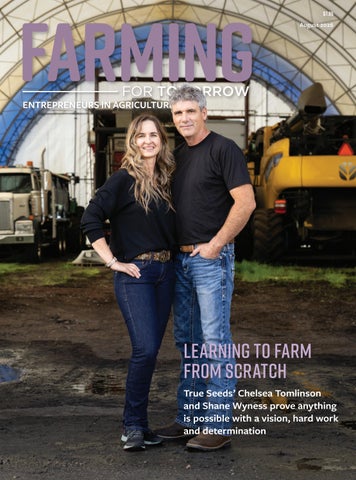
Learning to Farm from Scratch True Seeds’ Chelsea Tomlinson and Shane Wyness prove anything is possible with a vision, hard work and determination
When you can’t afford costly breakdowns, you can’t afford to compromise on your diesel fuel. That’s why every litre of Dieselex Gold is precision-blended with eight components that restore power, boost efficiency and help protect your engine. It’s fuel that doesn’t quit, and it’s exclusively available at UFA. See the difference at UFA.com/DieselexGold.
2
Publishers
Pat Ottmann & Tim Ottmann
Editor
Lisa Johnston
Design
Cole Ottmann
Regular Contributors Kevin Hursh Paul Kuntz
Scott Shiels Tom Wolf
Copy Editor
Nerissa McNaughton
Sales
Pat Ottmann pat@farmingfortomorrow.ca 587-774-7619 Nancy Bielecki nancy@farmingfortomorrow.ca 587-774-7618
08
Learning to Farm from Scratch
04
A Farmer’s Viewpoint
14
Precision Ag
18
Entrepreneurship
22
Equipment Upgrades
Old Farmers Don’t Die; They Just Go To Seed by Kevin Hursh
Commercialization and Networking by Becky Zimmer
/farming4tomorrow /FFTMagazine /farming-for-tomorrow
I Can Sleep Through a Storm by Evan Shout
/farmingfortomorrow WWW.FARMINGFORTOMORROW.CA Farming For Tomorrow is delivered to 79,873 farm and agribusiness addresses every second month. The areas of distribution include Manitoba, Saskatchewan, Alberta and the Peace region of B.C. The publisher does not assume any responsibility for the content of any advertisement, and all representations of warranties made in such advertisements are those of the advertiser and not of the publisher. No portion of this publication may be reproduced, in all or in part, without the written permission of the publisher. Canadian Publications mail sales product agreement no. 41126516.
26 28
Hope on the Horizon by Becky Zimmer
Government
Expanding Hands-On Agricultural Training Olds College
Olds College Recognizes Bob and Carollyne Collier as 2026 Partner of the Year
KEVIN HURSH 3
SECTION | TITLE A FARMER’S VIEWPOINT | OLD FARMERS DON’T DIE; THEY JUST GO TO SEED
Old Farmers Don’t Die; They Just Go To Seed Kevin Hursh, P.Ag. Kevin Hursh is one of the country’s leading agricultural commentators. He is an agrologist, journalist and farmer. Kevin and his wife Marlene run Hursh Consulting & Communications based in Saskatoon. They also own and operate a farm near Cabri in southwest Saskatchewan growing a wide variety of crops. Kevin writes regular columns for farm publications and can often be heard on Saskatchewan radio stations. In 2021, Kevin received a Distinguished Agrologist Award from the Saskatchewan Institute of Agrologists. In 2023, he was inducted into the Saskatchewan Agricultural Hall of Fame. X: @KevinHursh1
Who is the oldest active farmer you know? Do you know any situations where the older generation has retained control so long that the upcoming generation has never had a chance to become much more than an employee? Some farmers are still going strong as they approach 80. Others have had enough of the stress and risk and are happy to exit at 50 or 55. It’s interesting to visit with folks having retirement auctions. These aren’t usually in-person events anymore, but if you buy something you get to visit when you pick up your purchase. In most cases, these are farms not passed to the next generation. One retiring farmer told me his wife’s illness was the deciding factor for packing it in. Another had a breaking point during harvest. He was tired of trying to keep everything running and just wanted to quit. For yet another producer, he accidentally let his Class 1A driver’s licence lapse and not being able to drive the semi was going to be a major problem. I don’t know where the time has gone, but I’m only a couple of years away from 70. I’m still relatively healthy, but some of the physical tasks aren’t as easy as they used to be. How many years of reasonable health do I have left? How long before I can’t farm or the will to farm fades? No one can cheat Father Time forever. Like a lot of people my age, I struggle with the latest technology. My equipment is far from new, but with every equipment upgrade comes a learning curve. Younger members of farm teams are the ones most likely to accept the challenge of the computer software that’s increasingly central to newer machines. Farmers who quit cold turkey don’t usually have family members to continue the farm. Those with a transition plan to the next generation tend to retire gradually. They still want to be involved and
4
TITLE | SECTION
Buy SMART. Sell STRONG.
REAL ESTATE MADE EASY Your property is in good hands with our industry-leading team. Sellers trust our Real Estate people for their expertise and personal touch. Our knowledgeable and professional team has decades of experience and call their territories home, selling a wide variety of properties across Canada.
Learn more at rbauction.com/RealEstate
5
A FARMER’S VIEWPOINT | OLD FARMERS DON’T DIE; THEY JUST GO TO SEED
Old farmers aren’t typically comfortable talking about or even acknowledging their feelings, but emotions can be a big part of the retirement hurdle. If you’ve been a farmer all your adult life and that’s what has consumed your time and energy, who are you when you retire? there are tasks they like to do, but decision-making is increasingly in the hands of the “kids.” Old farmers aren’t typically comfortable talking about or even acknowledging their feelings, but emotions can be a big part of the retirement hurdle. If you’ve been a farmer all your adult life and that’s what has consumed your time and energy, who are you when you retire? Suddenly, there’s no purpose and your commonality with friends, neighbours and relations is dramatically altered. Some are happy to have the freedom to engage in other adventures, whether that be travel or just spending more time with grandchildren, but many find it hard to turn the page in their life story. People in the financial world try to inject a sense of urgency into farm transitions with statistics, pointing to over $50 billion in farm assets that are likely to change hands in the next few years. As well, supposedly 88 per cent of farms have no formal, written succession plan. Statistics about the aging farm population are often quoted. However, for as long as I can remember, the average age of farmers has been around 55. This isn’t a new development. What has changed is the value of farms, particularly the value of land. Non-farming children see the value of their parents’ assets. Farming children want to keep the farm viable. Families don’t always get along at the best of times. Succession planning can worsen family rifts and/or create new ones. Complicated tax rules necessitate advice from accountants and lawyers. The prospect of a huge tax bill can be a showstopper, delaying or derailing succession plans. Inaction can be the easiest path, leaving the younger generation in limbo. So, there are a lot of reasons why farmers often keep going well past normal retirement age. 6
The perfect time to plan ahead for
this year, is now! Expect MORE yield. MORE flexibility. MORE feed value. Early seed booking and preparing equipment this summer can make all the difference in the fall. Plan ahead now to simplify fall seeding and set your crop up for maximum performance. For best results: • Seeding rate: 1 unit/acre • Seeding depth: ¾ – 1 inch
www.kws.com/ca
Don’t wait until fall gets busy. Talk to your local KWS retailer today!
COVER STORY | LEARNING TO FARM FROM SCRATCH
Chelsea Tomlinson and Shane Wyness with their daughters Lexxi and Callie, who are always willing to help out.
8
LEARNING TO FARM FROM SCRATCH | COVER STORY
LEARNING TO FARM FROM SCRATCH BY ANGELA LOVELL PHOTOGRAPHY BY ANTHONY HOULE PHOTOGRAPHY
Growing up on a mixed farm didn’t help Chelsea Tomlinson much when circumstances dictated she diversify into a farm production system she knew almost nothing about. Initially, after her parents retired and sold the family farm, Tomlinson persuaded some neighbours to allow her to continue renting their land and secured a small line of credit to purchase some basic equipment so she could start out on her own. But two years later, she lost access to most of the rented land when the owners’ relatives came back to farm, prompting her to consider how she could succeed on just 270 acres. “I went into the seed business because I was working with a very small land base and I needed a niche,” she says, recalling the early days of True Seeds, her family-owned and operated pedigree seed farm located just outside of Redwater, Alberta. But as most of her experience was with the cattle side of the family farm, she had to start from scratch when it came to growing grain. “I didn’t know how to run a drill or a sprayer, so all those things had to be learned on the fly,” she says. “I got a lot of help from the equipment dealers; they were fabulous. I had gone six hours away to buy my tractor and drill because that’s where the affordable price was, and the dealer was great. They did a demo to show me how to hook it up and run it, and when I was ready to start, they sent someone who stayed in the area for two days to get me up and going. Same with the sprayer; John Deere sent a sales guy out, who sat with me in the sprayer to show me how to run it. I don’t think there’s a lot of people who learn to run equipment like that.”
The value of role models and mentors But she wasn’t totally on her own. Tomlinson’s mother, Terri – a strong role model for her daughter since day one – helped shuttle her amongst fields, made meals and even ran the auger to unload trucks. Meanwhile, her dad, Morris, who worked full time off the farm, would show up as needed to unload a truck or drive the combine. 9
COVER STORY | LEARNING TO FARM FROM SCRATCH
True Seeds differentiates itself from other seed growers by providing a personal service focused on seed purity and traceability.
She had other mentors along the way, including a longtime farmer in the area and fellow seed growers who were open to sharing their expertise on how to set things up from the basics like building a bin yard to what type of seed treatment system might work.
and make sure that you’re getting the coverage and the service that you need,” she says. “I have been fortunate that my bank and financing have been rock solid right from the start, and I am still dealing with the same person who believed in me 25 years ago. That has helped me hugely.”
“Having a mentor is big when you are starting out in anything new, in any industry,” she says. “Especially in those extremely stressful years, when making every decision on the farm can start to feel overwhelming. It’s good to have someone to bounce those big decisions off when you’re hesitant to spend the extra dollars on the crop or a piece of equipment.”
But one of the biggest obstacles Tomlinson had to overcome was convincing people she could actually make a go of it.
She has also had support from some unexpected places. “Another thing that was huge was the wealth of knowledge that my customers had,” she says. “I have learned probably 50 per cent of the things I know from my customers, where they offered suggestions, or changes, or things that I could try to make my farm better. It’s mutual learning from each other.”
Can she do it? There is no doubt Tomlinson had some big obstacles to overcome in the early stages, including building relationships and trust with everyone from input retailers to grain buyers. “When you are coming in as a rookie, it’s hard to develop trust 10
“I think one of the obstacles was getting people to take me seriously,” she says. “They would ask for my dad or my husband a lot. It did mean that I had to walk away from certain scenarios because they wouldn’t take me seriously or wouldn’t give me what I needed. There were some frustrations, but that is something that can happen to anybody who is new to the industry.” That said, being a first-generation seed grower has some advantages, among them the fact that Tomlinson started with a clean slate rather than being hampered by tradition or too many competing opinions. “The difficult piece that I see in multigenerational farms is that you are stepping into a role that’s probably already been determined for you,” she says. “Then there are multiple people involved in making every decision. Especially in a year that has some turmoil, when you have to pivot many times over the
LEARNING TO FARM FROM SCRATCH | COVER STORY
The family-owned and operated pedigree seed farm is located just outside Redwater, Alberta.
“Having a mentor is big when you are starting out in anything new, in any industry. Especially in those extremely stressful years, when making every decision on the farm can start to feel overwhelming.” - Chelsea Tomlinson course of the year, I can just imagine the challenges that would create. I could see a lot of pushback if you maybe wanted to try new things or make changes because of how things were traditionally done.”
Standing out by attending to the details To differentiate True Seeds from other seed growers, Tomlinson provides a personal service that focuses heavily on seed purity and traceability. “We have a very strict standard that we are trying to hit on our farm that is far beyond the regulations or requirements,”
she says. “For example, our oats hit a gluten-free protocol even though that’s not required of it. I want the customers to have confidence when they come into our yard, that they’re going to get a product that is 100 per cent pure.” Tomlinson’s husband, Shane Wyness, joined her full time in 2010, and despite having no background in farming, she says he has been integral to their growth, which has included the addition of a mobile seed cleaning plant three years ago and a full-time operator to run it. “Shane handles the yard and keeps track of all the rough grain coming in off the fields at harvest and where that grain is being stored, and does all grading off the seed plant,” she says. “At any time, we’re moving two or three seed lots within the yard, and they each have their own assigned auger systems. All the tractors, augers and trucks are labelled for each seed lot that they are handling. Then we use separate trucks and trailers to handle what is coming off the cleaning system versus what is coming off of the fields at harvest, so we ensure there is no contamination.” The system requires a lot of tracking and extra attention to details. “I have triple backups up on our farm in particular for tracking the bins. I will have a three-way system to make sure that I 11
COVER STORY | LEARNING TO FARM FROM SCRATCH know what is in each bin and on each field,” Tomlinson says. “I follow where our grain has come from right from the start, before it even comes onto our farm to be grown, and then every step along the way, it is tracked and traced, and there is a paper trail that follows it. It is digitally backed up and everything is labelled and identified in the yard as well.”
Changes in the industry Recent changes in the industry have made tracking and tracing seed through the whole supply chain much easier. “The Canadian Seed Growers’ Association (CSGA) has gone digital and that digital platform has made it a lot easier,” she says. “There is a digital footprint of what’s been on all of our fields so that we can pull them up quickly. All the seed can be tracked back to where it has travelled, and where it has been planted across Canada, so that is a very tight system. That has made it a lot easier to implement a traceability program.” Not all the changes in the seed industry have been quite so positive, and Tomlinson calls the recent cutbacks to Agriculture and Agri-Food Canada’s breeding programs ‘scary.’ “What the breeders provide to us is huge, having somebody that’s covering what might be coming down the pipeline at you for insects or weather or any other kind of environmental factors,” she says. “That has been taken care of for us for a really long time.” With the federal government now stepping back from that research, Tomlinson believes that leaves the agricultural industry, as a whole, at a pivotal point. “We have to understand the value that has been provided to us, and that has kept us economically competitive on a world market,” she says. “I don’t think there’s a farmer who can say he hasn’t seen a growth in his yields over the course of his career across crop types. Every farmer has experienced the benefit of that.” Tomlinson, who is also a CSGA director, says there are lots of meetings and discussions going on in the seed industry to try to develop a funding model going forward. But Tomlinson firmly believes it is going to come down to a decision by every individual farmer.
Chelsea Tomlinson had to diversify for success.
12
“Every farmer will need to decide if they are going to step forward and participate in whatever solution is put forward,” she says. “Farmers haven’t been required to spend a significant investment in the plant breeding side of research to date; the government has been facilitating and covering that off for us. But when you look at other aspects on our farms – like how equipment has come along, the technology advancements, the size, the efficiencies – because we saw the advantages of that, we were willing to pay more for those things. I think that’s the
LEARNING TO FARM FROM SCRATCH | COVER STORY
“Key now is trying to keep our grain moving and be ready for any opportunities that arise, whether that’s diversification of crops produced, bringing the next generation on board or handling the shifts happening in farm sizes.” - Chelsea Tomlinson step up that’s going to be needed when it comes to funding plant breeders.”
Looking to the future There are now three full-time employees on the farm besides Tomlinson and Wyness, as well as some seasonal employees, and their two daughters, Callie (13) and Lexxi (11), are keen to help out whenever they can. “The girls helped out providing the meals for spring seeding this last season for the whole crew,” Tomlinson says. “They definitely have a strong understanding of what it has taken to do what we are trying to achieve on the farm.”
Although there are challenges ahead in the seed industry without a doubt, Tomlinson believes if farmers can overcome them, there are real opportunities too. “Canada has done a good job of being a leader in strong genetics and the really pure seed that we distribute internationally,” she says. “Key now is trying to keep our grain moving and be ready for any opportunities that arise, whether that’s diversification of crops produced, bringing the next generation on board or handling the shifts happening in farm sizes. We want to move our farms forward, keep progressing and be the most efficient that we can be, and produce the best quality that we can while sustaining the land.”
As stewards of the land, Albertans know the value of using every resource wisely. We’re proud to support communities across the province by giving new life to old materials.
Together, we’ve kept over 275,404 tonnes of electronics, 39.07 million litres of paint, 154.5 million tires, and 2.4 billion litres of used oil out of landfills. Now, with Extended Producer Responsibility (EPR), and new initiatives exploring the recycling of solar panels, EV batteries, and wind turbine electrical components, Alberta is taking bold steps to reduce waste, protect valuable resources, and keep our land clean and productive for future generations.
INSPIRING A FUTURE WITHOUT WASTE FOR GENERATIONS TO COME FarmingForTom_Aug2026._7x4.75.indd 1
Learn more about what you can recycle at albertarecycling.ca
INSPIRING A FUTURE WITHOUT WASTE
13 2026-06-16 1:56 PM
PRECISION AG | COMMERCIALIZATION AND NETWORKING
Commercialization and Networking Keys to innovation success in the agtech world By Becky Zimmer
Getting technology from the drawing board to Canadian fields can be a challenge. Whether it’s finding funding to research and develop projects or finding farmers to test and adopt new technologies, success in the agtech world can be difficult to achieve and measure at a time when the market is saturated with new innovations. With these challenges come new opportunities for organizations to step in, step up and get people involved.
industry standard with some rigour.” Operating as a non-profit bridge between agri-food companies and technology firms, CAAIN is funded through Innovation, Science and Economic Development Canada and Agriculture and Agri-Food Canada. In the 2024-25 fiscal year, they awarded $32.4 million to 36 different agtech projects. An additional $40.5 million came from the industry, and another $11 million was provided as in-kind funding, according to its annual report.
According to Petras, developing a product with the end user in mind is the key to ensuring this broad success.
The Canadian agtech sector works diligently to research and develop technologies compared to the rest of the world, says Bioenterprise Canada’s Michael McGee, but he feels it falls short on commercialization success. The non-profit accelerator offers specialized programs designed to fast-track the growth and success of new ventures in the agricultural sector through a combination of funding, mentorship and crucial industry connections, providing a robust ecosystem where emerging companies can achieve their goals. Since 2003, Bioenterprise has distributed $35 million in funding to 375 projects.
“As soon as a new idea is under development, they should be talking to producers and ensuring that they’re solving a problem that matters,” he says. “As it develops and they get it into the hands of producers, engage the producers hands-on or have a farm that has capacity to test technology against the
At a time when concerns about food security, greenhouse gas emissions and farm ownership are growing ever more important, enhancing agricultural productivity is what drives both farmers and innovations, says McGee. He believes there are some unique elements to investing in agriculture, and over
Darrell Petras is always surprised at what piques the interest of farmers when it comes to successful innovations in the pipeline. Adoption is the measure of success, says the Canadian Agri-Food Automation and Intelligence Network (CAAIN) CEO. For technology to be successfully adopted in agriculture, he thinks it needs to function, fix a problem, not cost extra time or risk, and be serviceable in the field, barn or packing plant.
14
COMMERCIALIZATION AND NETWORKING | PRECISION AG
15
PRECISION AG | COMMERCIALIZATION AND NETWORKING
“The focus on customer success across any sector is ultimately what builds successful businesses and ultimately drives the kind of outcomes that support a healthy venture capital ecosystem.” - Graeme Millen “It is one thing to have all these funding opportunities available, but that doesn’t mean they’re successful if they can’t sell their products,” says Graeme Millen, who operated in the venture capital scene before becoming vice-president of strategic finance and business development with FCC. He has worked with entrepreneurs and venture capital investors across all sectors, including agtech, and is now actively involved with FCC’s project finance fund. According to Millen, there have been some “superficial headlines” about declines in venture capital investments in agtech that are “directionally accurate,” but he feels agtech is not a single sector – something most people don’t realize. While there has been a drop in investments into vertical farms and alternative protein, investments in bioscience remain strong, he adds. The ability to drive commercialization is key to success in all venture capital projects, and it’s no different for the agtech sector, but Millen believes there has been some hype that has made farmers skeptical about early adoption, and rightfully so. It’s a challenging environment to enter with a new innovation, but that is where the focus needs to be. If farmers won’t adopt their agtech, then who are innovators selling to? the last 10 years, he’s seen a lot of non-agriculture businesses try to sell to the agtech sector without success. Be it technology or otherwise, farmers want to see the return on investment for every dollar they invest, he adds, making them reluctant to spend money without confident proof of ROI. It can be difficult and costly from field to field, so providing technological testing in a non-commercial environment is critical. This is where organizations like CAAIN, as well as places like Olds College, come into play to help farmers try technology without losing their livelihood. Expansion into agtech through private equity investments, like venture capitalism, has been an important driver for agtech businesses, but there are some financial concerns that challenge innovators to keep the venture capital ecosystem thriving. 16
“The focus on customer success across any sector is ultimately what builds successful businesses and ultimately drives the kind of outcomes that support a healthy venture capital ecosystem,” he emphasizes. FCC’s partnership with EMILI and the Wabash Heartland Innovation Network to create the Agriculture Innovation, Validation, and Adoption Network provides a web of innovators, campaigns, commercial farmers and farmer alliance members in order to support and build capital projects. Venture capital funding is a useful tool for finding funding for agtech innovations, but Petras sees many clients just looking for better ways to stretch their dollars. For some, finding venture capital investors might mean losing some of their hard-earned control in their company as part of the
COMMERCIALIZATION AND NETWORKING | PRECISION AG investment deal. He notes not all farmers want that. According to the University of Waterloo’s 2024 report, the agtech world is dominated by small- to medium-sized businesses. The majority of the 247 agricultural technology organizations surveyed across the country have under 50 employees and under $10 million in annual revenue, and over half have been founded in the last 10 years. “Smaller and younger firms may be better positioned to respond to evolving market conditions and more readily able to meet specific customer needs,” states the report. Even so, long-term investments and competing with larger organizations can be a challenge. Farmers are seeing the benefits of adopting new technologies, and they are an important part of developing success in the agtech world, but sometimes they are the ones with the most to lose if the innovation doesn’t come through and provide some much-needed ROI. According to the Future Skills Centre, more digital tools in the toolbox have meant an additional $750 million to $1.5 billion in annual revenue for Canadian agribusiness, and agri-food innovation has the potential to support an additional $18.8 billion toward GDP. But small- to medium-sized businesses are being left behind
compared to larger businesses in terms of adoption rates. According to the 2025 report, “Eighty-one per cent of operations over 5,000 acres are using digital agriculture tools; comparatively, smaller farms under 2,000 acres lag at 36 per cent adoption.” What happens to farmers when their livelihood is on the line and a new venture fails? Other innovation sectors see a natural intersection between innovators and new technologies. That isn’t always the case in the agriculture sector, and farmers need help learning about tech and innovation in a non-commercial, non-threatening, lowpressure way, says Millen. That’s one thing CAAIN wants to fix, says Petras, and many early agtech adopters are receiving compensation for testing out new technologies on their farms in real-world situations. “The federal government sees the value of bringing the producers in, and they’ve given us flexible enough terms that we can support the producer as they test the technology…. We want to involve the producers in that development piece, and the government has allowed us to deliver that kind of flexibility.” When it comes to building the innovation web in the agtech sector, everyone has a role to play.
FOLLOW US!
HYBRID FALL RYE with PollenPLUS® technology
KWS Aviator
KWS Receptor
KWS Progas
KWS Trebiano
CONTACT US Office: 403-738-4517 | Sales: 403-634-5582 Email: Klaas@k3seeds.com | Website: K3seeds.com |Picture Butte, AB 17
SECTION | TITLE ENTREPRENEURSHIP | I CAN SLEEP THROUGH A STORM
I Can Sleep Through a Storm By Evan Shout, president of Maverick Ag and co-founder of Farmer Coach
Evan Shout Evan Shout is the co-founder of Farmer Coach, a business coaching and peer advisory program designed for farms that want to think bigger, lead better and build more resilient businesses. Farmer Coach helps producers step out of the day-to-day weeds and focus on the financial, strategic and leadership decisions that shape the future of their operations. Evan also co-hosts The Truth About Ag podcast with Kristjan Hebert, where they have candid conversations about what’s happening in modern agriculture and offer advice on growth, risk and mindset. He is also a CPA and co-founder of Maverick Ag, bringing a practical, numbers-driven perspective to the future of farm management.
18
I can sleep through a storm is a classic parable. It comes from a story about a farmer who hires a young farmhand based on one simple qualification: “I can sleep through a storm.” The farmer was initially annoyed with the sentiment but hired him out of necessity anyway. Weeks later, a violent storm struck in the middle of the night. The farmer woke up in a panic and went to check on the farmhand, only to find him sleeping soundly. Fuming, the farmer went outside to secure the property himself. To his surprise, he found that the barn doors were already locked, the firewood was perfectly stacked and all the animals were safe. It was at this point that the farmer understood: the farmhand could sleep through the storm because he had diligently done all his preparations while the weather was calm. A true lesson in the power of preparation. A small percentage of farmers behave like “true entrepreneurs.” They take calculated risks, aggressively scale, innovate and drive the bulk of commercial agriculture production. Most producers I talk to don’t want the stress and the risks that come with building, managing and multiplying businesses. Can you blame them? Only this year did the local universities offer a diploma in entrepreneurship. The problem is that there is a wide gap between the operators and the entrepreneurs in agriculture. While entrepreneurs will succeed or fail at a much faster pace, they also evolve, adapt and strategize. Ordinary farm operations often remain complacent and will fight change, along with anyone pushing it. Only when put in a position of fear or pain do farmers truly look at becoming entrepreneurs in the truest sense.
The Financial Scale The goal of a farm is a return on investment. The investment in the land was not because Grandpa homesteaded, but because the assets increased in value like the stock market. Working the land was worthwhile because of the wage and living earned. Somewhere along the way, we started acting as if agriculture owed a living to anyone in the bloodline. It doesn’t, and the farms that figure this out the fastest will remain sustainable.
I CAN SLEEP THROUGH A STORM | ENTREPRENEURSHIP TITLE | SECTION
True entrepreneurs: They take calculated risks, aggressively scale, innovate and drive the bulk of commercial agriculture production. Most producers I talk to don’t want the stress and the risks that come with building, managing and multiplying businesses. Can you blame them? Only this year did the local universities offer a diploma in entrepreneurship. I argued recently with a farmer over the merits of land ownership. I asked the question, “Would you have bought land 10 years ago if you knew you had to resell it today to 19
ENTREPRENEURSHIP | I CAN SLEEP THROUGH A STORM
In agriculture today, land equity has shielded a lot of poor margins and weak profits. If you look at the true return on investment on a farm, outside of real estate, you will see small to negative returns. This is why industry and large investors are not interested in farming; they are interested in the land we farm on. remain viable?” An honest question, but much more difficult for a farmer, where selling land is a biblical sin. The truth is that in many areas, land has increased dramatically 20
over the last decade, in some cases faster than the stock market. The return on investment of one quarter is more than most individuals in society will have over a lifetime. Yet many farmers would still say that if you have to sell land, you have failed. The other interesting dynamic: most farms are not profitable or sustainable. In agriculture today, land equity has shielded a lot of poor margins and weak profits. If you look at the true return on investment on a farm, outside of real estate, you will see small to negative returns. This is why industry and large investors are not interested in farming; they are interested in the land we farm on. When you start seeing private equity buy into an operating farm, you will know that returns from farm profitability are back. I won’t hold my breath.
The Operational Scale My barber ( yes, I still need a barber) is a true entrepreneur. He owns multiple locations and still cuts hair, but not out of necessity. While getting a cut the other day, we talked about business, and he asked me, “If you left your business for a week, a month, a year, would it
Direct Dealing vs Third Party
Serving Albertans for 60+ Years
Comprehensive Based Wording
Liability Limits up to $5 Million
Free Quotes
Simplified Flexible & Customizable Products
Farming is more than a business—it’s a legacy built on hard work, land, and the promise of the next season. Farm insurance should protect that legacy with coverage designed for the realities of modern agriculture. From crops and livestock to equipment, buildings, and liability, comprehensive farm insurance helps safeguard what matters most against unpredictable weather, and accidents. At MMI Insurance we offer tailored protection and knowledgeable guidance, farmers can focus on growing their operation with confidence, knowing their livelihood is protected today and for generations to come. • Livestock • Tractor • Quonset • Farm Equipment mmiab.ca/farm-insurance-alberta/ 1-866-222-6996 commercial@mmiab.ca Serving Alberta Only
remain as profitable, or would it grow?” My answer was “No,” and his reply was, “Then you don’t have a business, you have a job.” If you died today, would the farm operate tomorrow? I can count the number of farms that are self-managed on one finger – not one hand, one finger. This is why farms currently only sell for the value of their asset base. Until we see a farm sell on a multiple, or with goodwill attached, we are not sustainable or entrepreneurial. The fact that zero value is put on people, processes or intellectual property shows how far behind the industry remains. Very few farms have created a business with value beyond the asset base. Going back to the original story, almost all farms cannot sleep through a storm. They fear the weather, the markets, the government and the industry in ways that most individuals could not imagine. Sleeping through a storm is one thing; sleeping through your own mind is quite another. In the end, you can disagree. You can tell me farming cannot be built around processes and people. You can even tell me that most risks are uncontrollable. Just make sure you put on your raincoat before leaving the house.
FOOD is ESSENTIAL
Last year up to 720 million people around the world faced hunger. For over 40 years, caring Canadian farmers have been helping other farmers around the world. Be part of something lasting.
To learn more visit foodgrainsbank.ca
21
SECTION | TITLE EQUIPMENT UPGRADES | HOPE ON THE HORIZON
Hope on the Horizon Not all dark clouds as ag sector deals with volatility in equipment markets By Becky Zimmer
Farm machinery sales continue to be lower than expected over the last few years. The Association of Equipment Manufacturer’s (AEM) most recent report reveals a 17 per cent year-over-year drop in all tractor sales and a 56.5 per cent drop in combine sales across Canada. The report compares May 2026 sales of two-wheel-drive and four-wheel-drive farm tractors and combines with the year 2025. Drops in sales have been a long-term trend, with May numbers over the last four years consistently below the five-year average. But some industry professionals are seeing a light at the end of the tunnel. With the growing gap between new machinery costs and commodity prices, farmers are having to push back their replacement cycles, says Leigh Anderson, senior economist at FCC, but there will come a time when farmers need something newer for their operations. “Eventually they’re going to start coming back to the market,” says Anderson. “Where do we see that bottom, or things starting to turn again back to positive growth in the farm improvement market for new sales? Is that later in 2027? Probably more like 2028.” Farmers aren’t buying equipment for today or tomorrow but are making purchases that will last them five to 20 years, 22
according to Curt Blades. As the AEM senior vice president, Blades oversees advancing markets in agriculture, construction, mining and forestry equipment manufacturing through market intelligence, standardization and regulation reform – anything that can help their members sell their products and remove non-trade tariff barriers. Farmers put their seeds in the ground with a little bit of faith, and Blades has faith himself that the market will eventually pick up. It may take a while, and there are some dark clouds that are affecting farmers’ bottom lines, whether that be weather, input costs, trade or market demand. Trends ebb and flow, and Canada just happens to be in a machinery sales ebb right now. “We also know in agriculture things can turn very, very quickly,” he adds. “I don’t know whether we’re talking through the end of this year or until the beginning of next year, but I’m an optimist.” Anderson notes that in general, farm equipment has about a 20-year lifespan, and when farmers can’t buy new, they look for “older and gently used” equipment sales. But when breakdowns become more frequent with aging machines and out-of-field delays for repairs are taking away from farmers’ bottom lines, it could be time to invest in something newer to save money in the long run. When calculated at a cost-per-acre for their machine, some
Proudly Serving Western Canada
Drainage Is Our Business
BNQ Certified
4” available in 3200’ or 3800’ maxi coils 6” available in 1650’ maxi coils.
780.371.9528 weepingtiledirect.com
operate at over $100 an acre, but others are seeing even higher ratios, says Anderson, whether that is for a new, more expensive machine or the cost of repair bills adding up. Tack on high interest rates and some volatile geopolitical decisionmaking, and farmers are feeling the pinch when it comes to keeping their fleet running effectively. While an exact count can be hard to come by, Anderson is starting to see a growing balance between what’s available for both old and new stock in Canada. Farmers are looking to better manage their costs, he notes, and are seeking gently used machines that can provide them some relief from the high costs of new equipment. Whether running big operations or smaller acres, there has been stock available for those varying sizes of farm operations. Especially with declines in sales of new equipment, if, for example, some 2024 machines are staying on sales lots longer than they normally would, farmers could be finding some great sales opportunities to better their equipment assets, according to Anderson.
From fencing to field work, don’t dig blind. Know what’s below. Call or Click Before You Dig. Protect what matters.
When machine hours are low due to a lack of new equipment sales, that could mean big savings for farmers while machinery sales take the hit. “We are starting to see price cuts to try to move that equipment, because now you have more used equipment 23
EQUIPMENT UPGRADES | HOPE ON THE HORIZON coming in on the lot that’s competing, maybe with the same hours on it,” says Anderson. With the drop in sales, overall machinery inventories are creeping up a bit, but not to the point where Blades is concerned with an over-saturated supply. “Most manufacturers anticipated this current downturn, and so they matched the supply with the anticipated demand probably about three years ago.” This anticipation for the current sales dip included layoffs and a slowdown in production, says Blades, which was a short-term solution for not flooding the market with excess inventory that can’t be moved off the lots. However, this is not a long-term solution for the manufacturers, he adds. “You look at the tractor and combine sales, and they’re down about 20 per cent across the board. You can’t do that for very long without having an impact on manufacturing.” AEM released a report on the manufacturing sector’s impact in Canada, sharing data on agriculture, mining and construction equipment manufacturing in 2026. Looking specifically within the agricultural sector, equipment manufacturing generated a total of $10.3 billion in sales activity, contributed $3.9 billion to
24
Canada’s GDP (one per cent of the country’s total nominal GDP) and supported $4.8 billion in total labour income. On the employment side, the industry employed nearly 25,000 people in 2025 with a total of nearly 51,000 direct, indirect and induced industry positions across the country. Having most North American manufacturers in rural areas of the U.S. and Canada means these small, family-owned companies are integrated into local communities and have a history of minimizing disruptions and weathering the storm, says Blades. “The reality is the cost of making machinery has gone up over the last five to eight years,” he adds, “and trade and supply questions have dominated the true cost of machine production.” Declining demand has its own impact on the market, but an increase in the cost of raw materials makes things even more difficult for manufacturers. It’s hard not to pass the cost down the line to their customer base, Anderson says, but when you know your customer base can’t afford it, everyone is having to make some tough decisions. “Just generally speaking, you probably see a two to three per
HOPE ON THE HORIZON | EQUIPMENT UPGRADES
“The reality is the cost of making machinery has gone up over the last five to eight years. Trade and supply questions have dominated the true cost of machine production.” - Curt Blades cent sticker price increase almost on average every year, [and] on top of that, if there was the steel cost coming out of supply chain shortages from the pandemic. In 2022, we saw prices skyrocket as well, so it puts some of those manufacturers in a tough spot.” Upcoming talks between Canada, Mexico and the United States were set to begin in July 2026 with the review of the Canada-United States-Mexico Agreement, and the fact that these talks are moving forward is a positive from a manufacturer’s perspective, says Anderson. Integrated markets and supply, and product movement from north to
south, is something that needs to be negotiated to improve the machinery market. “We don’t need tariffs that compound the cost for manufacturing, because the end goal is to have less disruption going forward,” says Anderson. According to AEM studies, one piece of equipment crosses the north-south border 11 times on average during its production, which is why AEM has been a vocal supporter of free trade between the U.S. and Canada. Billable hours by manufacturers can be better spent innovating and researching rather than navigating the complexities and uncertainties of the current geopolitical climate, says Blades. Both Anderson and Blades welcomed the June 8 reduction in steel and aluminum tariffs on agricultural machinery. “Equipment sales numbers are a clear indication of the overall health of the farm economy and depressed commodity prices,” says Blades in a recent press release regarding changes to U.S.-Canadian tariffs, and North American farmers “need long-term trade certainty and public policies that help them stay profitable and resilient.”
25
SECTION | TITLE| EXPANDING HANDS-ON AGRICULTURAL TRAINING GOVERNMENT
Expanding Hands-On Agricultural Training Alberta government investing more than $7 million to expand hands-on training, helping students build careers close to home Rural communities thrive when students can learn, train and work in communities where they live. That’s why Alberta’s government is investing more than $7 million in 2026-27 to expand and modernize training at Lakeland College, ensuring post-secondary infrastructure keeps pace with growing regional workforce demand. Funding will support upgrades and expansion of the beef yard, along with the relocation of horse pen facilities at the Vermilion campus. These improvements will expand training capacity, modernize learning spaces and strengthen the connection between students, employers and the rural communities they support. “Institutions like Lakeland College keep rural communities strong by connecting Albertans to education and careers close to home,” says Myles McDougall, minister of advanced education. “This investment strengthens those institutions, expands modern training spaces and builds Alberta’s workforce.” The project will enhance animal welfare and student learning. Originally built for 60 students and 100 cows, the beef yard now supports more than 80 students and 220 cows. Upgrades will bring facilities in line with current demand while supporting future growth. The horse pen relocation will replace aging infrastructure with modern, purpose-built spaces designed to improve animal care, enhance safety and 26
strengthen the quality of hands-on training. “Alberta’s agriculture sector depends on skilled people, strong producers and practical training that reflects the realities of modern agriculture,” notes Tara Sawyer, minister of agriculture and irrigation. “This investment will help Lakeland College continue preparing students for rewarding careers while supporting innovation and long-term strength in rural Alberta.” This investment will also strengthen Lakeland College’s hands-on, student-managed learning approach and expand applied research that benefits producers and the broader livestock sector. “We are grateful to the Government of Alberta for its continued investment in Lakeland College and its commitment to strengthening the future of agriculture in our province,” says Alice Wainwright-Stewart, president and CEO of Lakeland College. “This support is instrumental in advancing the revitalization of our student-managed farm lab, including critical upgrades to our beef yard facilities and the relocation of our horse pens, ensuring our immersive learning environments reflect the needs of today’s industry. These investments will enhance the hands-on experiences that set Lakeland apart, equipping students with the skills, knowledge and confidence to lead the future of agriculture while supporting innovation and growth across Alberta’s ag sector.”
EXPANDING HANDS-ON AGRICULTURAL TRAINING | GOVERNMENT
Existing Beef Pens
Existing Beef Facility
New Turn Out Pen
New Beef Pens
New Beef Facility
New Horse Pens New Feed Alley Existing Horse Pens
Topographical map of the changes to Lakeland College.
QUICK FACTS • Lakeland College and external funders have invested $1.83 million in the beef yard upgrade and expansion and horse pen relocation project. • Project construction is scheduled to start in July, with completion anticipated in November 2028. • Lakeland College is a public comprehensive community college serving east-central Alberta through foundational learning, certificate, diploma and undergraduate degree programming, along with apprenticeship instruction and applied research.
URSA AG260 FRONT WHEEL
ASSIST TRACTOR PRICE STARTING FROM
$199,900
INCLUDES: 540/1000 PTO 3 YEAR WARRANTY OPTIONS: FRONT END LOADER FRONT 3 POINT HITCH FRONT PTO
• The college supports access to learning and training opportunities across the region and helps connect students to local industry and workforce needs. • In 2024-25, Lakeland College reported more than 4,000 full- and part-time students. In the same academic year, the college offered 908 apprenticeship seats across nine registered apprenticeship programs.
Contact Us Here: Phone: 403-991-0416 Email: ryan@ursa-ag.com
Visit our Website www.ursaag.ca
27
OLDS COLLEGE | OLDS COLLEGE RECOGNIZES BOB AND CAROLLYNE COLLIER AS 2026 PARTNER OF THE YEAR
Olds College Recognizes Bob and Carollyne Collier as 2026 Partner of the Year Olds College of Agriculture & Technology is proud to announce Bob and Carollyne Collier as the 2026 Partner of the Year. As the highest honour bestowed by Olds College, this prestigious award celebrates partners who demonstrate exceptional dedication to the vision of advancing agriculture for a better world. The announcement was made in midJune during Common Ground, Olds College’s first annual event dedicated to defining, leading and investing in agriculture. Bob and Carollyne Collier have been supporting the college since 2017. After experiencing the campus during an Alberta Flying Farmers Association tour, they were inspired by the entrepreneurship demonstrated by Olds College alumni Alex Villeneuve, and the support he was shown by the college to advance his ideas. The Colliers partnered with Old College, aiming to boost student success by honouring outstanding innovation, creativity and entrepreneurship in agriculture, which led to establishing the Bob Collier Award. The Bob Collier Award is open to students campus-wide, regardless of their program of study, and requires applicants to pitch an original idea – or a significant improvement on an existing one – to benefit the Canadian agriculture industry. The top five five students with the best ideas are awarded $6,000 each year, resulting in 50 students sharing $300,000 over the last 10 years. 28
Along with serving as a significant contribution towards a student’s education, the award’s impact reaches further. Fifty students with varying backgrounds and pursuing an assortment of programming at the college have pursued innovation, creativity and entrepreneurial spirit within the agriculture sector. The Colliers’ initial mission to drive student success has definitely been achieved through this partnership with Olds College. Beyond the award, the Colliers chose to expand their initial partnership with another significant contribution. In 2022, they donated $2 million to enhance the learning experience for students enrolled in the Werklund School of Agriculture Technology. They also donated an additional $100,000 over the past 10 years. These contributions allowed for the improvement of academic programming and amplified student engagement through an increase in applied research and the development of the Olds College Smart Farm. “Bob and Carollyne Collier have been tremendous partners,” says Dr. Debbie Thompson, president and CEO of Olds College. “This recognition is a culmination of 10 years of support. We are grateful to the Colliers for choosing Olds College to pursue their mission and are thankful for the impact it has had on our students. We are proud to work with Bob and Carollyne and look forward to further collaboration that advances agriculture for a better world.”
OLDS COLLEGE RECOGNIZES BOB AND CAROLLYNE COLLIER AS 2026 PARTNER OF THE YEAR | OLDS COLLEGE
Bob and Carollyne Collier at the Common Ground event.
“We would like the students to know they are so incredibly special in our lives.” - Carollyne Collier “We never went into a partnership with Olds College dreaming of receiving recognition like this. That’s not why we pursued this,” says Carollyne Collier, Olds College 2026 Partner of the Year. “We want to give a huge thank you to everyone at the college who had anything to do with us receiving this award. It was such an unexpected joy.”
FROM THE ROADS
TO THE FIELDS We Have You Covered! Transmissions • Differentials • Driveshafts • Steering Parts
C
DR
N
SE
IO
RE GROUP OF
IES
TA N D A R D I Z AT
NT
PA N
QUALITY R S
CE
T
AR
IZA
THE GE
NAL ORGAN
CERTIFIED
OF
FO
TIO
N
IN
NA
OM
ER
IO
Common Ground is a premier event that brings together producers, industry partners, elected officials and community leaders to celebrate the collective progress made in agriculture while showcasing the innovation that will carry it forward. It also offered an excellent opportunity to acknowledge the Colliers’ crucial role as partners, whose unwavering dedication is key to preparing and empowering students to lead the industry’s future.
T
She continues, “The students feel like family to us. We know they put so much effort into applying for this award. We would like the students to know they are so incredibly special in our lives.”
IVE
TRAIN EXPE
RT
I
For a Location Near You 1-800-661-8825 Edmonton • Calgary • Red Deer • Lethbridge Medicine Hat • Grand Prairie • Fort McMurray Surrey • Mississauga • Moncton GE A RCEN T REGROUP.COM
29
WHAT WOULD YOUR FARM LOOK LIKE
WITHOUT YOU?
Take control of your safety & your farm’s future with FALLS
AIR QUALITY
ROLL OVERS /RUN OVERS
MACHINERY /MOTOR VEHICLES
ENERGY
REMOTE WORK /WORKING ALONE
SECURE LOADS
CHEMICALS
Visit agsafeab.ca to get started.
ANIMALS
RESTRICTED /CONFINED SPACE
ELECTRICITY
Tote Meter Option
INDUCTOR FLEX
The new Inductor FLEX Series by Pattison Liquid Systems is designed with flexibility in mind. The Inductor FLEX has the capacity to service todays demanding sprayer filling needs. As optimal spraying conditions are limited, it is important to keep your sprayer where you need it. In the field spraying. The Inductor Flex takes inducting chemical to a new level with a 220 liter per minute venturi, turning filling into a race day pit stop. The Inductor Flex System is offered with a Main Tank Assembly, a Tote Meter option and a 3 inch Pump option. The whole system is designed with versatility, allowing you to set it up accordingly to your sprayer deck configuration. All of the components of the Inductor Flex can be arranged on any side of the skid or mounted elsewhere to meet your needs.
1-306-335-2215 | admin@liquidsystems.net | www.liquidsystems.net
BAUMALIGHT.COM
Locate A Dealer Online
Adair Sales & Marketing Company Inc. 306-773-0996 | info@adairreps.com MANUFACTURING OF MINI SKID STEERS AND A VARIETY OF ATTACHMENTS INCLUDING LOG GRAPPLES | BRUSH MULCHERS | ROTARY BRUSH CUTTERS | STUMP GRINDERS | PTO GENERATORS BOOM MOWERS | TREE PULLERS | FELLER BUNCHERS | EXCAVATOR ADAPTERS | SCREW SPLITTERS 32 AUGER DRIVES | TRENCHERS | TREE SPADES | TREE SAWS & SHEARS | PTO POWER PACKS | FLAIL MOWERS