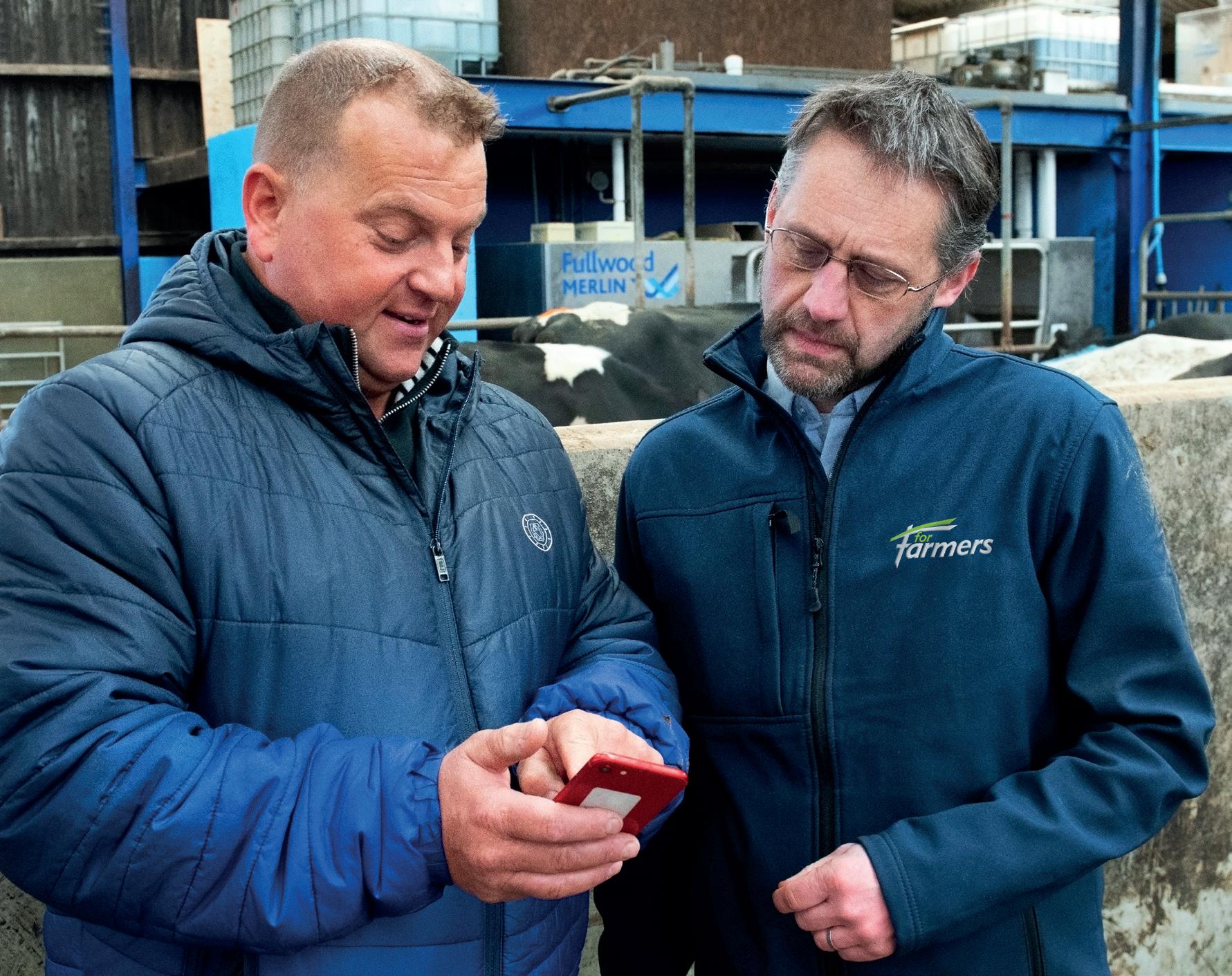
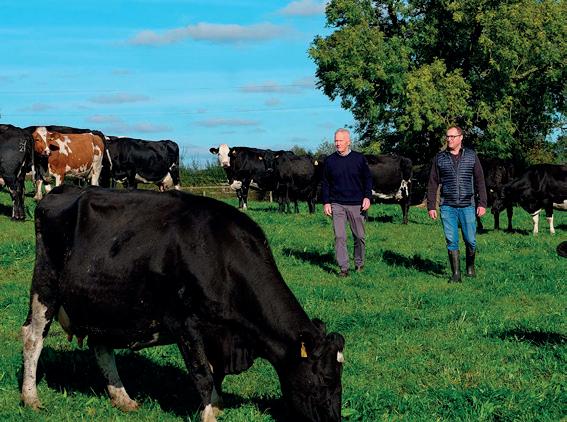
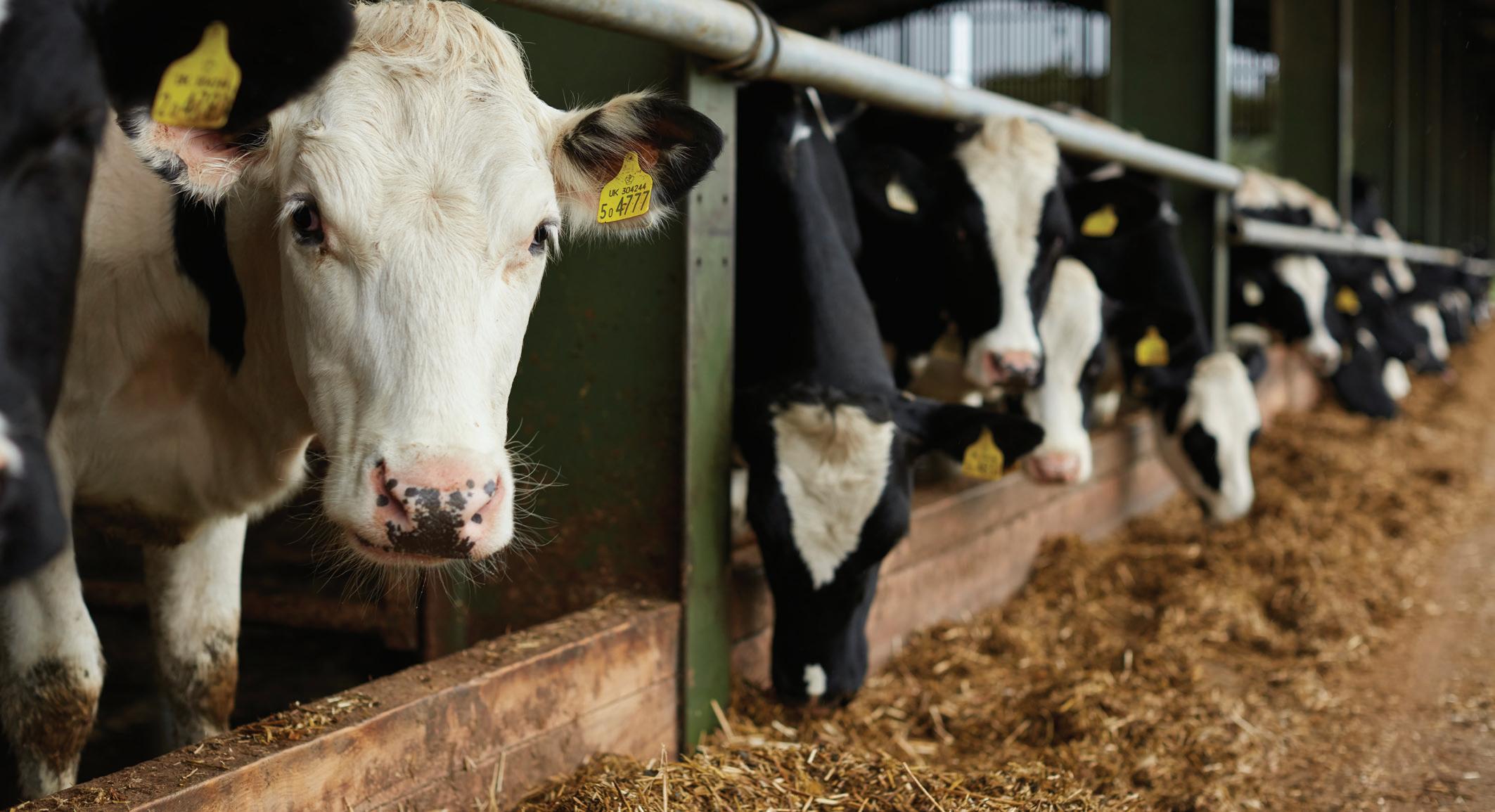
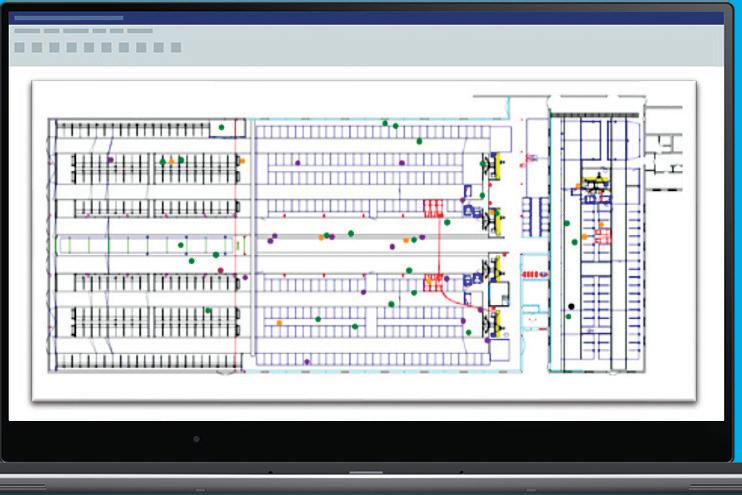
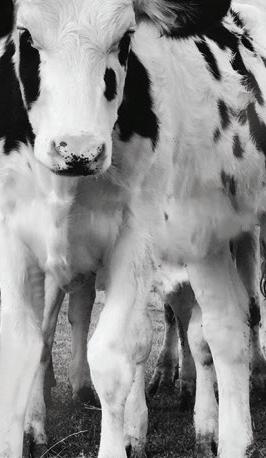
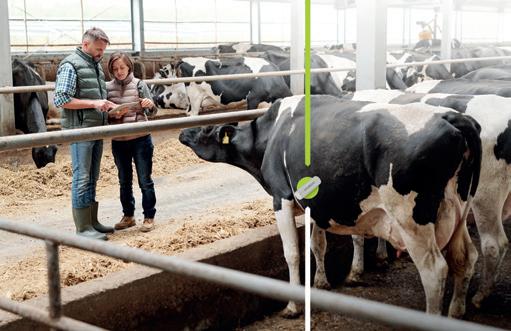
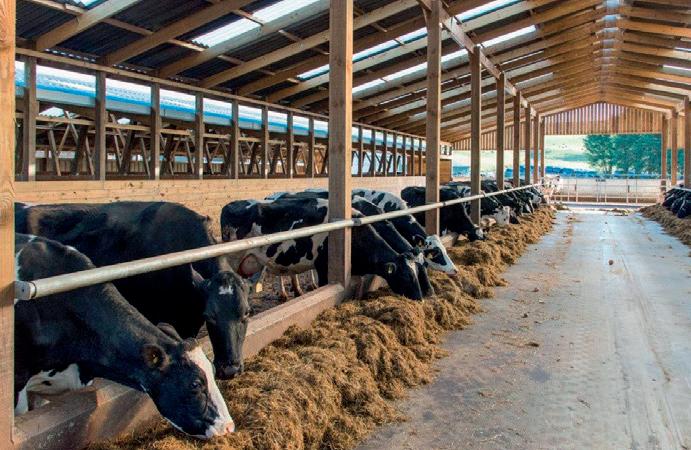
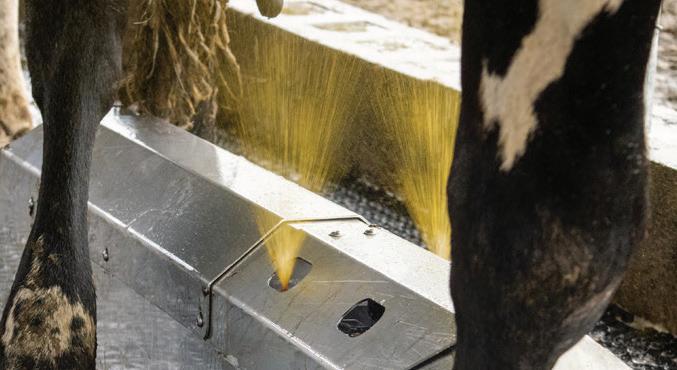
Using ForFarmers OptiRobot our Dairy and Robot Specialists are able to assess whether the interaction between robot settings, nutrition and health is optimal. It often turns out that small changes can make a big difference; Our Robot Specialists can help highlight areas where you can improve with the unique ForFarmers OptiRobot which provides:
9 Greater insight
9 More opportunities
9 Increased returns
For more information speak to your local ForFarmers Robotic Specialist or visit >
Highlights from the event and new products round-up
Pages 26-28
REGEN DAIRY
Producers on journey to ‘do dairy differently’
Pages 30-33
MILK PRICES Pages 52-54
INNOVATIVE
INSURANCE TO TACKLE HEAT STRESS –EXCLUSIVELY FROM NFU MUTUAL
UK farmers face growing challenges from extreme weather. NFU Mutual’s Dairy Heat Stress Insurance is a game-changing parametric solution that automatically helps to compensate dairy farmers when heat stress conditions occur. Helping you to stay financially secure, protect your herd, and invest in long-term heat stress solutions for your farm.
Scan the QR code to find out more, or speak to your local NFU Mutual Agent.
Contacts
Editor Katie Jones 07786 856 439 katie.jones@agriconnect.com
Dairy Farmer, Unit 4, Fulwood Business Park, Caxton Road, Preston, Lancashire PR2 9NZ
Origination by Farmers Guardian, Unit 4, Fulwood Business Park, Caxton Road, Preston, Lancashire PR2 9NZ. Printed by Warners Midlands, The Maltings, Manor Lane, Bourne, Lincolnshire, PE10 9PH. No responsibility can be accepted by Dairy Farmer for the opinions expressed by contributors.
The rst signs of spring are slowly starting to emerge, and while we can still have some bad weather yet, the lengthening days are starting to make all the di erence. Hopefully some good spring-like weather will see grass starting to move again, which for those producers who have limited silage stocks will be a welcome sign.
Grassland is month’s magazine has a grassland focus, so be sure to take a look at these articles, which feature farmers who are at the top of their game for grassland management. It was great to a end this year’s Dairy-Tech
recently, held once again at Stoneleigh Park. I’m always amazed at the sheer number of companies exhibiting at these sort of events, which rely to a greater or lesser extent on farming, and dairy farming in particular.
And while there’s no doubt there are challenges to our industry in terms of changes to taxation and Government policy, what was clear from speaking to farmers, trade stand exhibitors and listening to some of the seminar speakers, is that this is a forward-thinking industry with a huge amount of expertise out there. ese experts are eager to bring the latest thinking, science and technology to the fore and Dairy Farmer aims to play its part by bringing this information to you.
What’s inside?
8 DAIRY TALK
Updates from Becky Fenton and Dan Burdett 10 ON FARM
Decade-long journey of
Waking the sleeping giant of the RABDF
Udder
Cut
Generating additional farm income in the
Limousin
Doing
Consistency despite nitrogen source change
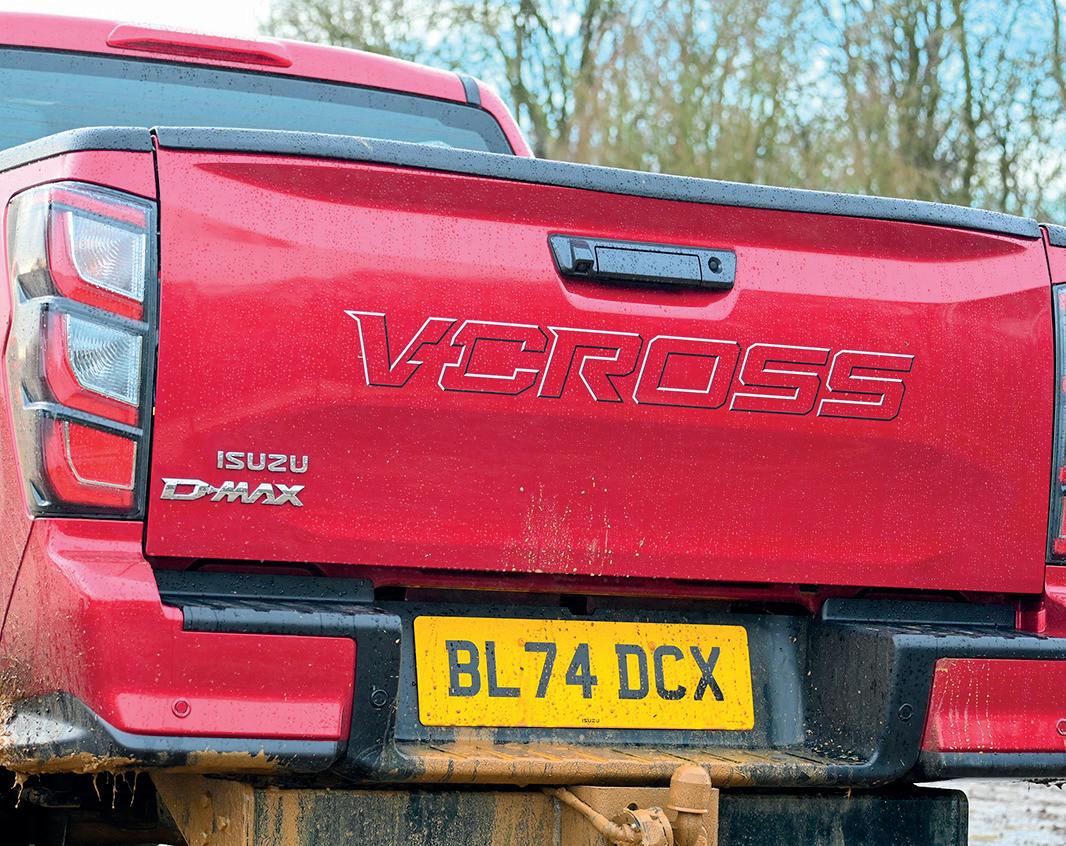
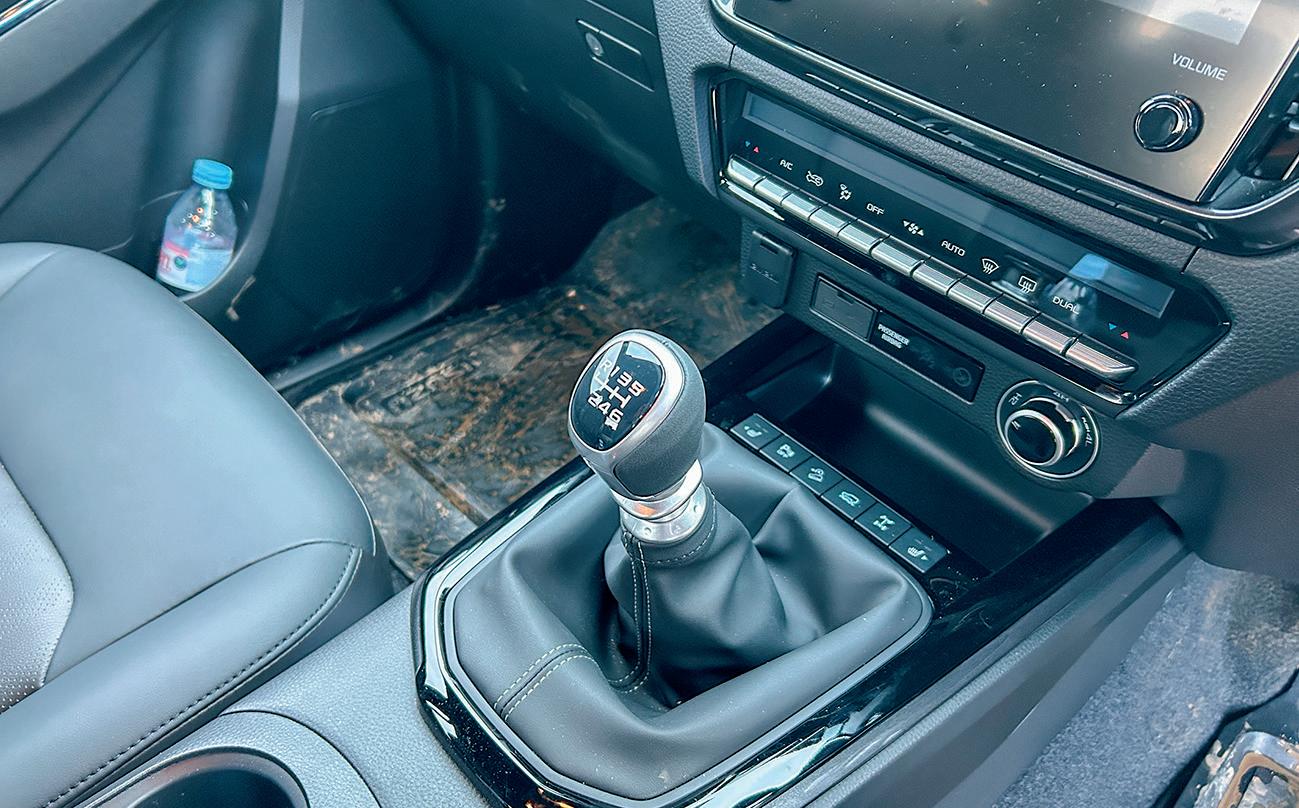
Isuzu’s new D-Max
A fundam farm assu
ARound-up
Everyone knows I haven’t got a heart”
Succession can be the beginning of a new era
Adapt in order to attract and retain staff
n independent review has called for a ‘fundamental reset’ of farm assurance schemes, with farmers feeling the strain from audits, but struggling to identify the benefits to their businesses.
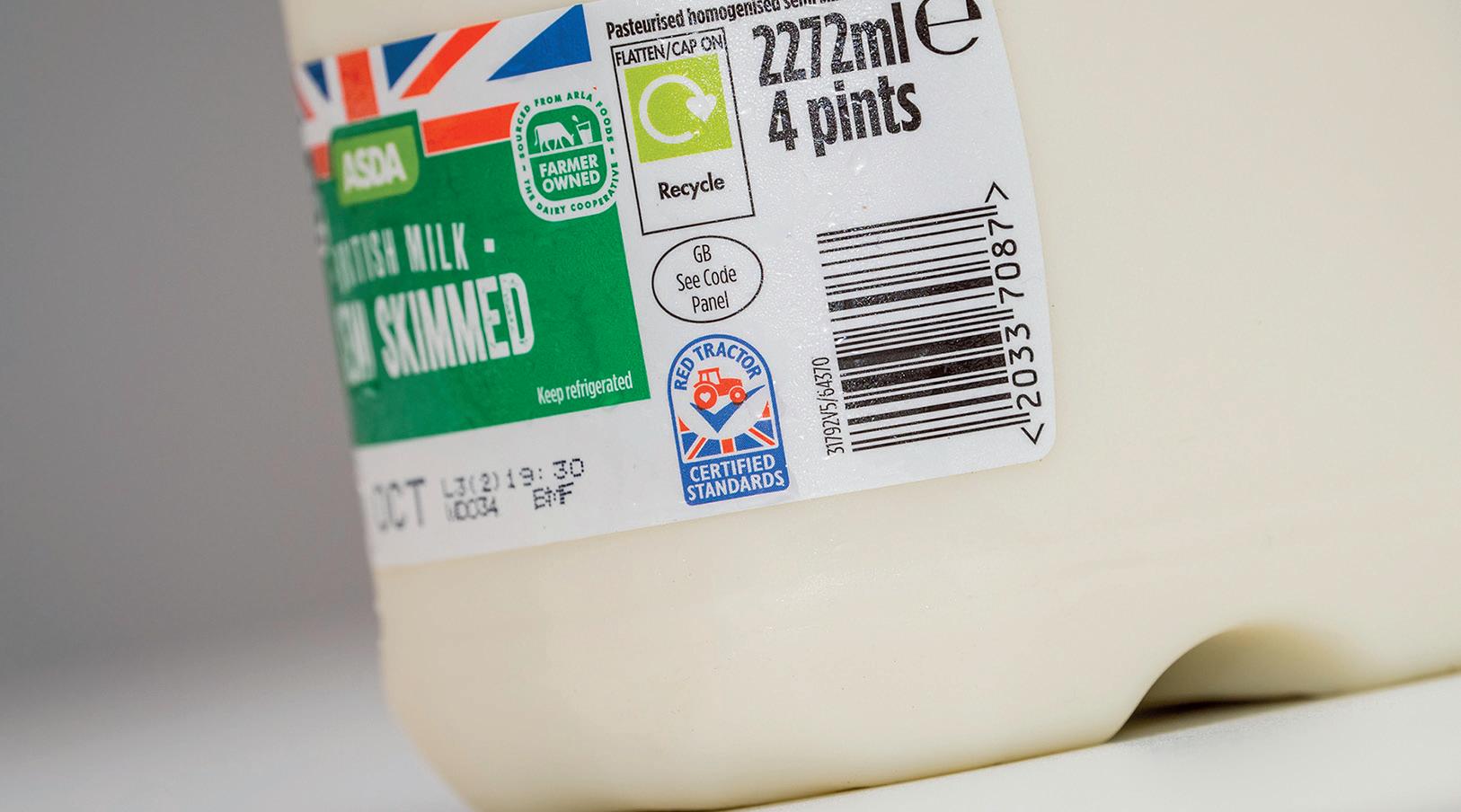
The UK Farm Assurance Review was published in January and highlighted schemes needed to ‘reset’ to rebuild trust and confidence with farmers.
It also placed onus on the owners of Red Tractor to take a more proactive stance to ensure changes are made.
It provided nine strategic recommendations to the way schemes are implemented in Great Britain which included reducing and simplifying on-farm audits and establishing
farmers as the ‘driving voice’ in standards development, with owners now required to be more proactive to ensure these changes are made in the future.
The report was commissioned by the four UK farming unions and AHDB after a sector-wide fallout to Red Tractor’s failed attempts to develop a Greener Farms Commitment module requiring farmers to ‘demonstrate sustainability, but in a single, practical and consistent way’.
Changes
Former Harper Adams University vice-chancellor, Dr David Llewellyn, lead commissioner of the report, said there must be significant changes in how assurance schemes are delivered to win back farmers’ confidence. One criticism he outlined
Scottish dairy herd numbers fall
JThere was a net decrease of 30 dairy herds in Scotland during 2024, bringing the total number of milking herds to 764, according to figures released by the Scottish Dairy Cattle Association (SDCA).
The figures represent a 23.7% decrease over the last decade. But despite these declines, the report showed the average herd size has increased to 236 cows, up by nine from the previous year.
According to the figures, Ayrshire experienced the most significant decrease with a net loss of 15 herds, followed by Dumfriesshire with a net loss of five. But, both saw new dairy herds start up, with more expected to begin operations in 2025.
Bruce Mackie, chair of the NFU Scotland Milk Committee, said it was ‘disappointing’ to see a yearon-year decline in the number of dairy herds, a trend which he said had ‘persisted over the past decade’. He said: “The continued struggle with labour shortages, rising input costs, increased regulatory pressures and market uncertainty all contribute to the challenges faced by our dairy farmers. Despite these challenges, Scottish dairy farmers are producing more milk from fewer, more efficient cows.” He added the industry was not carrying the carbon cost of unproductive animals, which is crucial to reducing the sector’s carbon footprint.
ental reset of rance needed
was the way in which farmers felt that schemes had provided a lack of reward or bene t.
“Over time, that has added complexity and stress for farmers, many of whom now struggle to identify any real bene ts to their business,” he said.
“Worse still, many feel they live in a permanent state of jeopardy with ‘make or break’ audits determining whether their businesses can operate or not.”
He also said farm assurance
schemes need to be trusted and successful in underpinning a pro table future for UK farming.
In a joint statement, NFU president Tom Bradshaw and NFU Cymru president Aled Jones said the report would be ‘critical’ in enabling assurance schemes to ‘deliver’ for the whole UK food supply chain.
NFU Scotland’s director of policy, Jonnie Hall, said that by setting out the importance of e ective farm assurance, the report makes it clear that currently there are ‘ aws
and weaknesses’ which need to be addressed.
AHDB said the review marked a ‘signi cant step forward’ for farm assurance, and added it was optimistic about the opportunities it could present in providing ‘meaningful change’ across the agricultural industry.
Red Tractor’s board has welcomed the report but added it will need time to ‘fully digest and discuss’ the meaning of the review ndings internally.
News in brief IHT campaigns continuing
JCampaigns to overturn proposed changes to Agricultural Property Relief continue.
The NFU has called on farming families to donate farm toys for a display to be go outside the conference in London on February 25.
A multi-generational farming family will then hand over farming toys to the Treasury. The NFU said this will be to show the toys come from the children of Britain’s farming families who are being ‘denied a future in the industry’.
Notices served
JThirteen dairy producers in the South West have been handed their 12 months’ notice by Saputo Dairy UK.
The dairy company, which owns the Cathedral City, Clover and Davidstow brands, has not made public the reasons behind the notices.
A spokesperson for Saputo Dairy UK said: “This is not something we have taken lightly; however, it is a necessary thing to do as we seek to ensure our milk pool is fit for the future.”
The Red Tractor scheme needs a reset to rebuild trust with farmers, a review has said.
Lameness manifesto launched for GB dairy
An ambitious plan to stamp out cases of lameness on British dairy farms over the next 20 years has been published.
e GB Dairy Cow Lameness Manifesto, developed by the Dairy Ca le Mobility Steering Group and supported by Ruminant Health and Welfare and the AHDB, outlines 21 action points to ensure cases of lameness become minimal in the national dairy herd.
Chair of the Dairy Ca le Mobility Steering Group Prof Martin Green, of No ingham University, says the industry’s e orts to reduce lameness have plateaued in recent years, with estimates suggesting the national herd has a lameness prevalence of about 30%.
Reduction
He says: “ e actions outlined in this industry-led manifesto should drive at least a 10% relative reduction in lameness prevalence yearon-year on a national scale until at least 95% of all British dairy herds achieve a lameness rate of less than
Efforts to reduce lameness have plateaued in recent years, with estimates suggesting the national herd has a lameness prevalence of about 30%.
5% by 2044. is will not only improve cow welfare, but also reduce the industry’s carbon footprint and safeguard the social licence of British dairy farming.”
Prof Green says the action points within the manifesto –which is backed by farmers, processors, and industry bodies – are spread across four key strat egy areas:
rIncluding all dairy herds, wher-
ever their starting point
rUsing farm-speci c preventive plans to empower farmers to act
rEnsuring that the implementation of all relevant knowledge and technology becomes the norm
rIncentivising farmers to achieve good foot health
Action points include encouraging every farm to record whole herd lameness prevalence and adopt a farm-speci c lameness
Sector unites against family farm tax at Dairy-Tech event
J e dairy sector showed its support for the NFU’s Stop the Family Farm Tax campaign, with businesses adding signatures to the campaign pledge at Dairy-Tech.
More than 20 processors, with a turnover of more than £7 billion, signed a joint le er to the Treasury to warn against changes to Inheritance Tax.
NFU Dairy Board chair Paul Tompkins said: “ is is a clear message from the UK dairy sector that the government must takeaction and work with industry to reduce the impact of this ill-advised policy.
“Dairy producers are already under extreme pressure from years of volatility, the impact of a
changing climate, increased regulatory demands and the need to continuously invest in their businesses.
“ is policy has far-reaching consequences across the whole industry and has already had a signi cant impact on producer con dence.”
rFor more from Dairy-Tech see pages 26-28
reduction action plan (such as the Healthy Feet programme), harnessing genetic gain by using sires with lameness-resistant traits, and sourcing milk from herds that can demonstrate lameness levels at least on a six-monthly basis.
“We are not expecting everyone to adopt every action point in the manifesto, but if we can get lots of parties from di erent areas of the industry working together – and everyone doing their bit – then overall, lameness in the national herd will reduce over the years,” says Prof Green.
“It is very possible to achieve minimal levels of lameness as we now have the tools to do so, including genetic improvements and a rise in the number of di erent technologies available to identify lameness.
“Working together is the best chance we have of substantially reducing lameness in our dairy cows – and that is important not only for cow welfare, but also for the pro tability and sustainability of our industry.”
THIS CHANGES
CRYPTOSPORIDIOSIS
COCCIDIOSIS
ROTAVIRUS, CORONAVIRUS, E. COLI
SALMONELLOSIS
In the event of a Cryptosporidium parvum outbreak Halocur® can help. Contact us to find out how we can help protect the long-term productivity of your herd or visit www.msd-animal-health-hub.co.uk
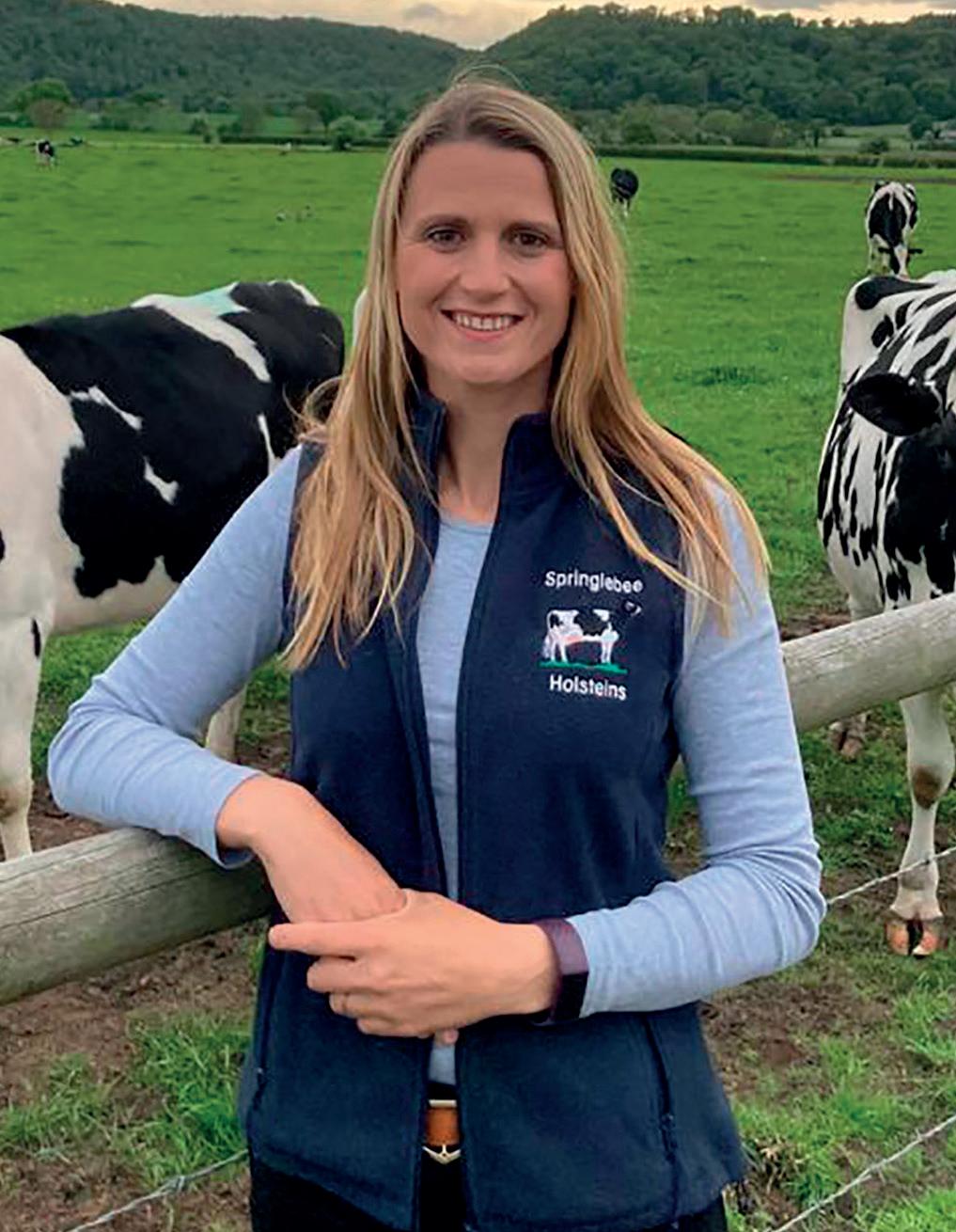
Becky Fenton and husband Paul milk 200 pedigree Holsteins under the Springlebee prefix at Centenary Farm, a Cheshire county council farm. In 2021, they bought a farm in Staffordshire and they plan to farm there once the new dairy set-up has been built.
“ Although our children are still young, we’ve already started looking into the future
As I write this at the start of February, it feels more like Spring here in Cheshire. For the first time in what feels like months, the concrete is dry.
The weather has been varied lately, which unfortunately led to pneumonia in the calves.
Sadly, we lost two calves last week, one of which was an older calf. We withdrew antibiotic powder a while back but with the current testing weather we have reintroduced it for now.
In November, I attended the farmer protest in London. It was an impressive sight, with thousands of farmers standing in solidarity. The march itself didn’t take place, which was disappointing.
Without stirring the pot too much, I believe we, as farmers, need to be more strategic and start planning for succession. We can’t afford to leave it too late. Although our children are still young, we’ve already started looking into the best course of action for the future of our farm.
I may be a bit naive, but with proper planning, we should be able to avoid IHT. Then again, perhaps Granddad doesn’t want the daughter-in-law running off with the farm! Our accountant mentioned that post-nuptial agreements are the new pre-nups.
Yet, I do feel for those families/businesses that unfortunately will fall short of the seven-year allowance.
Milkers
everyone gets to see! Here’s hoping for a good spring to get them back on track.
With the calf shed nearly finished, we’re now turning our attention to the next project – new cow collars. We’re hoping they’ll be included in the next round of grants, although who knows what the Government might do?
Back in 2016, when the milk price plummeted, we stopped classifying the cows. However, with our business of selling milkers, we’ve started classifying again.
At the end of last year, Holstein UK visited the farm and did a herd inspection. The classifier inspected 110 cows and heifers, and we were pleased with the results: 23 Excellent, 62 Very Good and 25 Good Plus (mainly heifers). We’re looking forward to the next visit, which is just around the corner.
Our early autumn reseeds are looking really good and healthy, but unfortunately, the late sown maize cover crop didn’t fare well. The snow really hit them hard. Of course, those fields are right next to the main road, so
Recently, we sold a Charolais bull calf at our local market, Barbers in Market Drayton. There were 535 calves through the ring that day, and our calf topped the market at £535. He was a cracking calf, one of the best continental calves we’ve bred, sired by Cogent’s Niagara. Trump recently announced new trade tariffs on Canada, Mexico and China. He also remarked that the UK was ‘out of line’. On the back of all this uncertainty we decided to order our fertiliser.
When we moved to Cheshire almost nine years ago, we didn’t know anyone. Now, we’ve made some brilliant friends – some outside of the industry. It’s refreshing to have a conversation that doesn’t revolve around farming. Some of our non-farming friends have just treated themselves to a caravan and boat, while we’ve just invested in a new 16-tonne silage trailer. The one thing we have in common? We are all hoping for a bit of sunshine.
Dan Burdett
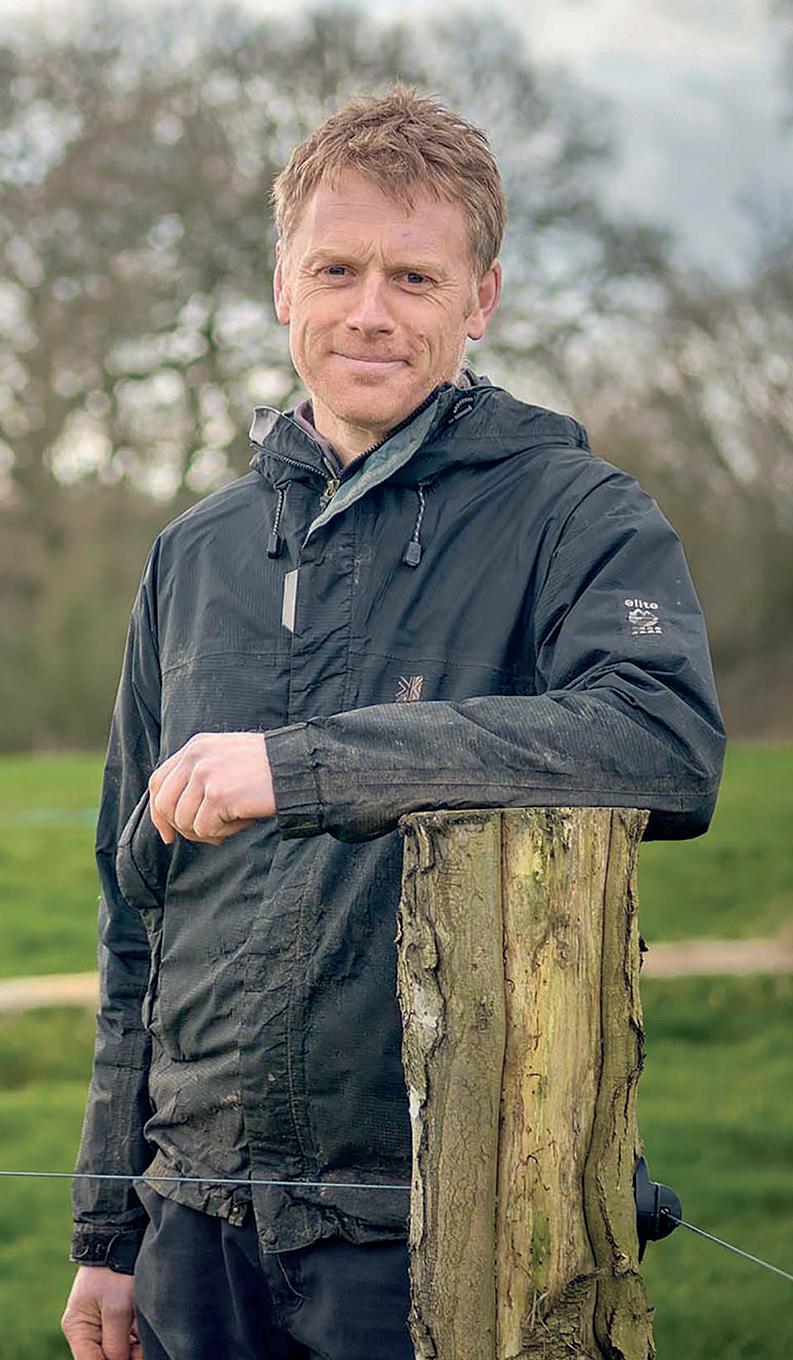
Dan and his family own and run the 300-hectare (741-acre) Cockhaise Farm, near Haywards Heath, West Sussex. The farm is home to an organic autumn-calving herd of 240 Holstein and Friesian crosses. He also contract farms another organic autumn-calving herd of 220 cows at Bore Place, near Edenbridge, Kent.
“ This winter has been a tale of two farms
We are now two thirds of the way through the winter, with day length slowly increasing and the grass looking increasingly tempting to the cows and to those wedded to the scraper tractor for the last few months.
We usually aim for a turnout somewhere early February, looking for at least a week to 10 days of potential grazing weather so that we don’t jump the gun and upset the cows’ rhythm.
We almost had those conditions a recently, but Storm Eowyn put paid to that, albeit we got off much lighter than many further north in the country.
This winter has been a tale of two farms.
Quality
At home the cows have milked reasonably well, with milk quality the best we’ve ever achieved and a really settled team keeping the cows happy.
Serving is nearly at an end and it has generally been a good season, with conception rates of around 70% across both cows and heifers, meaning we have a good base for the next lactation.
We have also found that by fixing the gutters and drains across most of the farm, we have managed to eek another five to six weeks of storage out of our lagoons, meaning we are able to leave the worms in peace to carry out their important winter work of aerating the soil, rather than running from excess slurry.
At the farm in Kent, we have been down on yield, with some of the forage we made last year, coupled with some of the bought-in silage not able to deliver budgeted figures.
The improved milk price will have made up for some of this, but we had hoped a drop in cows would help pick up yields.
Serving has gone okay, but I would’ve hoped for better results with the lack of yield.
Given the issues we have faced there over the past five years, we are now looking to find a route away from the farm.
When we set out in 2019, we didn’t budget for a farm lacking in productivity and certainly not one where we have come across numerous bovine TB challenges, both of which have made this decision a financial one more than anything else.
We are now putting together plans to further reduce the herd size and to find a new partner for the farm owners.
Someone looking to take a step up the cow management/ownership ladder and a desire to add value locally to the milk produced, while working in harmony with the farmed environment.
Hopeful
With all of the hard work put in to establish excellent milking, housing and grazing facilities, I’m still hopeful that one of my original goals of taking on the farm (to give opportunities to the other to grow) will come to fruition.
This should give me back the time and space to be able to carry on the journey at home of improving the diversity above and below ground that I started five years ago.
Royal Association of British Dairy Farmers/National Milk Records Gold Cup finalist Will Venn has expanded cow numbers over the last 10 years and aimed to make incremental performance improvements along the way. Wendy Short reports.
Decade-long journey of focused improvement
Following a 10-year expansion programme, cow numbers have reached the target number of 700 for Will Venn, who farms with his family at Newley Farm, near Taunton, Somerset. e herd, comprising 550 Holsteins and 160 Jerseys, is run by Will alongside his wife Kate and his father Tim.
Will says: “Cow numbers have expanded from 220 milkers in 2014 and we have only just reached the target, which was chosen to maximise e ciency.
“Progress has been hindered due to bovine TB losses and restrictions. e accommodation has actually been ready since 2020. Shortly a er, the new Boumatic 40:40 rapid-exit parlour was ed.
“ e Holsteins and Jerseys are pure-bred, although they are unregistered, with the Jerseys boosting bu erfat levels and maize [being] grown for milk protein content enhancement to achieve our contract bonuses.”
“ e Holsteins produce 10,132kg at 4.48% bu erfat and 3.58% protein, while the gure for the Jerseys is 7,224kg at 5.48% bu erfat and 4.17% protein.”
Progress
e strategy is to make small, incremental changes for performance progress.
“ e unit has been on a decade-long journey of focused improvement,” says Will.
“Bu erfat and protein payments pay the bills, and that is always at the
forefront of decision-making. It is essential to set production targets, but behind every average gure is a range of numbers.
“Our approach is to work towards narrowing that range. For example, within the 22-month heifer calving average there will be many heifers calving outside that timeline. We have managed to reduce the range from 19-27 months to 20-26 months, but there is obviously still work to be done.”
e two breeds are kept in separate cubicle groups in the fully housed herd, but they are run together at the youngstock and dry stages.
Feeding relies on a simple diet containing grass and maize silage; home-grown, caustic-treated wheat; and a purchased protein
The farm relies on a team effort to run the unit and maintain the policy of gradual improvement WILL VENN
blend, with concentrates o ered in out-of-parlour feeders.
Will says: “Concentrates are expensive, and we believe that [this] system allows a more targeted approach compared with in-parlour feeding. It means that
Will Venn says he aims to narrow the average range of first calving, which currently stands at 20-26 months.
The ration comprises grass and maize silage; home-grown, caustic-treated wheat; and a purchased protein blend.
the high-yielders have 24-hour access, rather than limiting them to the six to eight minutes twice a day during the milking period.
“ e allocation is fed according
to lactation stage and yield, and it is ne-tuned with the addition of body condition scores inpu ed in the so ware programme.”
e farm comprises 283 hectares (700 acres) owned, plus 81ha (200 acres) of rented land used for additional maize growing. e soil type is a silty clay loam and the main challenge is coping with summer
A match made for
droughts, as the unit lies in a rain shadow. e silage platform covers 81ha (200 acres) and six cuts are usually taken annually.
“ e cows used to be grazed,
Pair Baletite with SilotitePro1800’s longer reels* and convenient sleeve packaging for added efficiency and reduced silage losses.
Left to right: Tim, Kate and Will Venn.
PICTURES : Farlap Photography
ON FARM
but they had to be housed to meet regulations during the foot-and-mouth outbreak. It was then that we realised that preventing them from dunging, lying and walking on the grass had resulted in a grass yield increase of about 30%, so they have been kept inside ever since,” says Will. e average freshweight grass yield is ve to six tonnes/ha (12-14t/acre) over the season. However, 80% of the total harvest comes from cuts one and two due to a lack of soil moisture availability in June and July, when the grass all but stops growing, says Will. e silage ley mixes are made up of festulolium and Italian ryegrass.
Where possible, all eld tasks –including silage making – are carried out in-house to ensure timeliness of operations.
Holistic approach
“It is integral to our holistic approach where all aspects of soil, rotation, cost and labour-sharing across the enterprises are designed to complement each other,” says Will.
“My father has always said that timeliness is next to godliness when it comes to growing crops.
“Fertiliser is only applied for cuts one and two and the rest receive slurry. It does not make sense to put on valuable fertiliser in drought periods, because if there is no rain the majority would be wasted. e maize works very well to add bulk to the forage stocks as it has a higher yield per acre compared with the grass, producing about 18t/acre.”
e Holsteins average three calves over a lifetime and the team are always working to improve longevity. A pregnancy rate of 34% has been achieved across the herd.
Will says: “A dozen genomic Holstein bulls are used via DIY arti cial insemination over 12 months, and we are always seeking the latest genetics, so it is rare that the same sire is chosen for two consecutive years. Genomic testing is being considered for the herd in the near future.
“Females are not served beyond 200 days in order to keep a tight calving pa ern. Trying to prevent the cows from ge ing too fat and having an extended lactation has always been a challenge on this unit.
“ e heat detection collars are very useful, and the accompanying so ware is checked before every milking to highlight bulling females and provide a snapshot of herd health. Any individual with a low eating time gure will be physically checked to rule out an underlying health issue.”
Calf management is considered
extremely important, and Will credits chief calf rearer Chelsea Payne with maintaining high health status and growth rate goals to prepare heifers for service and calving.
“A new calving facility was built in 2018,” says Will.
“ ere was a four-year period of bTB restrictions and the herd is only seven months clear, so there have been no surplus heifers to sell. At present, there are about 200 females due to come into the herd over the next year and this will enhance our selection pool.
“ e lower end of the females are put to a Wagyu, British Blue or Angus sire and their calves are sold at under one month old.”
Efficiency
Will, who obtained a Higher National Diploma in agriculture at Harper Adams University and spent time on a New Zealand dairy farm before returning to work at home, describes himself as the ‘captain’ of the team of mainly full-time workers and is striving towards peak e ciency.
New cow accommodation was built in 2020 for the expanding herd.
The 160 Jerseys produce an average yield of 7,224kg at 5.48% butterfat and 4.17% protein.
Farm facts
rHerd calves all year round
rMilk is sold to Saputo on a manufacturing contract
rCurrent performance figures show a combined energy-corrected bulk tank yield of 34.2kg/cow/day
rNewley Farm has been in the Venn family for more than 100 years, starting with Will’s grandfather, Dennis, who purchased 20 hectares (50 acres) with his own father and increased the acreage while working with his two sons Tim and William
He says: “ e farm relies on a team e ort to run the unit and to maintain the policy of gradual improvement. I am keen on training, and all the sta have the chance to be involved in every aspect of management. I am very grateful to be given the opportunity to be involved in dairy farming by my family: both past and present.”
The Holsteins and Jerseys are pure-bred using genomic bulls.
DAIRYMatters
‘RABDF is a sleeping giant, and I’m here to wake it up’
Hayley CampbellGibbons, the recently appointed chief executive of the Royal Association of British Dairy Farmers (RABDF), outlines her ambitions for the organisation’s future.
It is a huge privilege to be appointed chief executive of one of the oldest dairy organisations in Britain, and to oversee its leadership at a time when the industry needs a strong voice. It is a very different industry to when I started my career at the NFU 18 years ago as a dairy adviser. While the dairy industry is constantly changing, there are certain constants – RABDF is one of those, and I see enormous opportunities.
We are the UK’s sole dairy charity, with an impressive legacy and the King as our Patron. It was founded in 1876 as an independent organisation dedi-
cated to the interests of dairy farmers, the improvement of dairy stock, dairy produce and the UK dairy industry, and the establishment of the Dairy Show. RABDF has served the industry successfully over the years and has undertaken many changes and reviews along the way. However, I fully acknowledge that the organisation has been living off its legacy for some time. If we are to play a meaningful part in British dairying’s future, we must reboot, refocus and reinvigorate this organisation.
My vision is not only for RABDF to regain its voice, but for us to be recognised by farmers, the Government, the media
and the industry as the only dedicated voice of British dairy farmers.
I want that voice to be credible, respected, sought after and one that champions the interests of the very best dairy farmers we have. By very best, I do not mean biggest, or defined by any type of system, I mean the most resilient, profitable, productive dairy farmers that see a bright and longterm future.
Mighty
Our ambition is to be a strong organisation, with a robust membership, a skilled, talented, knowledgeable and engaged team and council. We will remain small, but we will be mighty.
There are three areas where I believe we can drive better outcomes for British dairy farmers. The first is business capability. We should not, cannot and will not compete with the likes of NFU or AHDB for territory on policy and evidence. We do not have a quarter of their resource or expertise, but we do bring a laser-like focus on dairy, and only dairy.
We will represent the voices of our members on the issues that impact their ability to run successful, profitable businesses – from supply chain antics and financials to politics, regulation
Hayley Campbell-Gibbons
“ There is an appetite to hear from us again, our perspective on policy issues is sought after.
and everything in between. At times, that will be a voice that ampli es others, at times we may take the lead, and we will also have the con dence not to speak out on issues where others are be er quali ed to do so.
e second area is to act as a convener. We can bring together all parties that serve dairy – from the UK farming unions, AHDB, Dairy UK and others – and be the glue that keeps us all aligned, informed as to each other’s priorities and ensuring we are all pulling in the same direction – or aware of where and why we may not be – and deploy our collective voice and resources in the most e cient way.
We will harness the opinions and priorities of productive, progressive farmers and act as a conduit between them and the Government. I know from speaking to colleagues in Defra that
there is an appetite to hear from us again, and that our perspective on policy issues is sought a er. And we will continue to convene the industry every year at Dairy Tech – the largest showcase of technology and innovation available to dairy farmers in the country.
e third area where I envisage us having a role to play is people. From showcasing the very best in the business through our awards for innovation, industry contribution, student achievement and, of course, elite performance with our Gold Cup, to creating a sense of community within the dairy farming network. We will o er solidarity and support for farmers in what can be, let’s face it, a pre y lonely place at times.
at’s the o er. Now the ask. None of this comes for free. BDF has delivered an enormous amount with li le resource over the years. It has arguably spread itself too thinly and become invisible – not really known for anything beyond the events and awards it hosts.
I’m not damning things that were done or decided in the past, but I can recognise that it’s no longer working and needs changing.
BDF is a sleeping giant, and I’m here to wake it up. I’m energized to execute my vision of
a brighter future for this organisation – or, should I say, your organisation. Do you want this organisation to exist? If so, are you willing to support us?
None of this works without dairy farmers’ backing. By that
I mean membership – which extends to corporates and professionals too – participation in our structures, and heeding the call when we ask farmers to engage. It’s over to you then, to give it your support if you believe that BDF and its voice is needed.
Products Supported In Scotland, Wales & All Major Regions Of England
The RABDF will harness the opinions and priorities of productive, progressive farmers and act as a conduit between them and Government says Hayley Campbell-Gibbons.
New research has highlighted how breeding for good fore udder attachment and udder depth can help prevent cases of udder cleft dermatitis (UCD). Katie Fallon reports.
Udder conformation could help prevent UCD
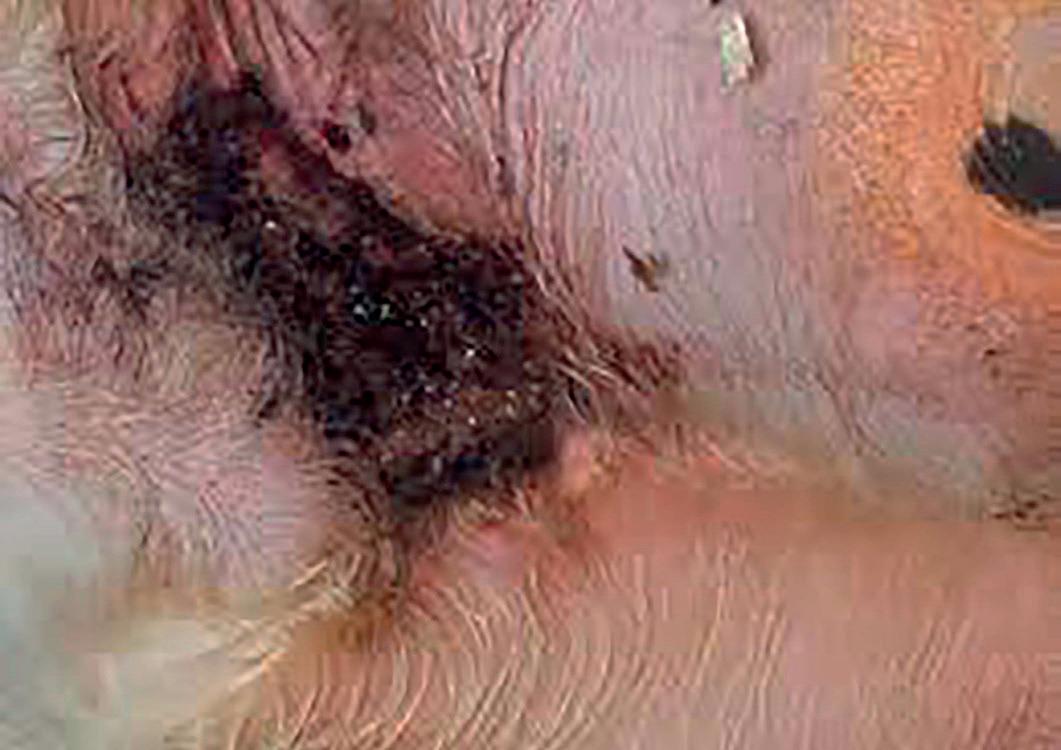
Acommon skin condition a ecting most dairy farms in the UK, udder cle dermatitis (UCD) is caused by bacteria entering a sore or area of abrasion on or around the udder cle . is results in ulcerative lesions, which in severe and chronic cases can be fatal due to the infection spreading to the milk vein and the lungs, so the control and prevention of UCD on-farm is key.
A lack of research into the condition means the cause of UCD is not always agreed upon, with several risk factors in uencing whether a cow will develop UCD or not.
Vet Will Gratwick, of LLM Farm Vets, says the prevalence of UCD will vary from farm to farm depending on a number of factors, including cow conformation and bedding type.
In response to the lack of research, Mr Gratwick and the team at LLM Farm Vets conducted a VetPartners-funded
Most farmers were surprised by how many cases there were, as they only see the severe cases WILL GRATWICK
research project in spring 2023.
As the rst UCD project in the UK, it took place across 28 client dairy farms, looking at the prevalence of the condition and the risk factors a ecting its development.
Working with the LLM vet tech team alongside two students from the Harper and Keele Veterinary School, Mr Gratwick says cows were examined during milking using an inspection mirror to look at the udder cle and assess the presence of any UCD lesions.
Data was gathered from individual cows, including the severity and location of any
lesions, body condition score, cleanliness of the cow and conformation of the udder. Herd level data was also collected using a questionnaire to look at the management and environment of the herd, including the type of bedding used, method of slurry scraping, foot bathing, size of herd and grazing system.
Disease presence
Mr Gratwick says: “ e whole project was designed primarily to estimate disease presence –so the proportion of cows that have it and how that varies from herd to herd. e secondary area was to look at what risk
factors there were – what cow and herd level factors a ect the risk of the disease.”
When looking at the prevalence of the disease across the 28 farms, Mr Gratwick says results showed 10.6% of cows had UCD lesions, which was in line with results found in similar studies conducted in Sweden and the Netherlands.
Results also showed the range of prevalence across participating farms, which ranged from 1.3% on the farm with the lowest prevalence to 26% on the farm with the highest prevalence of UCD.
Mr Gratwick says: “Most farmers were surprised by how many cases there were, as they only see the really severe cases when they start smelling or when they bleed [because the infection] eats into the milk vein and can cause heavy bleeding, which can be fatal. Farmers do not tend to spot the mild cases.”
Risk factors
Findings from the project also identi ed some of the main risk factors in the development of UCD, including udder conformation – particularly fore udder a achment and udder depth.
Mr Gratwick says: “Cows with a tight udder were four times less likely to have UCD than those with a deep udder.
“Similarly with fore udder a achment – which can be loose, intermediate or strong – those with a loose udder a achment were three to four times more likely to develop UCD than those with a strong udder a achment.”
Looking at risk factors on a herd level, Mr Gratwick says sand bedding and slurry scrapers were the two most signi cant risk factors identi ed throughout the project.
Results showed that in herds where sand bedding was used, cows were eight times more likely to have UCD than cows on other bedding materials.
Slurry scraping
Additionally, in herds which used automated scrapers, cows were two and a half times more likely to be a ected by UCD compared to herds where other methods of slurry scraping were used.
Mr Gratwick says: “ e combination of moisture, dirt and sand gets into the udder cle and causes abrasion.
“It [UCD] is not infectious, spreading from cow to cow; it has totally separate bugs to digital dermatitis. It happens
when you get that rubbing –it gets sore and then it gets infected.”
Based on the project ndings, Mr Gratwick says alternative methods of slurry scraping, such as robotic scrapers, could be an option to help prevent UCD, alongside breeding for be er udder conformation.
He says: “Udder conformation is something we can select for [by] choosing bulls which have good udder conformation scores, particularly fore udder a achment and udder depth.
“We did have one farm, the herd with the lowest prevalence at 1.3%, who said they used to have a lot of problems with UCD, so for a number of years they really focused on only selecting bulls with good conformation traits. And it really seems to have made a di erence over time.”
As a result, Mr Gratwick says the project has provided more
evidence to support the bene t of selectively breeding for good udder conformation long-term if there is a problem with UCD on-farm.
Unmeasured factors
However, Mr Gratwick says it is also important to note that only 11% of the variation between herds was explained by factors that were looked at as
DeLaval Plus - your new Performance Portal
part of the project. Due to this being quite a low proportion, it suggests there are other factors which can also a ect the development of UCD which were not measured in the project.
10.6%
Percentage of cows found with udder cleft dermatitis lesions across 28 farms.
Udder cleft dermatitis is caused by bacteria entering a sore or area of abrasion.
In the first of Dairy Farmer’s bi-monthly data detection series, Dr Tim Potter tells us how thinking about planning for the first breeding cycle is key to managing the cost of heifer production.
Cut heifer costs with timely first calving
Age at first calving is a well-established metric using easily accessible data, says Dr Tim Potter of Westpoint Farm Vets, part of the VetPartners group.
He says: “It gives us an idea of youngstock rearing performance, but there is a clear financial impact from letting it slip.”
The target should be to calve at 24 months and the majority of farmers are aware of this, he says.
“However, the data shows that 77% of herds recorded are falling into the 24-30 month slot,” he adds.
“It is easy to see how we creep into that slot with heifers incrementally calving a little later, then later again.”
Improving heifer returns starts early, says Dr Potter.
“We focus on age at first calving, but we need to take it a step earlier and have at the front of our minds that to calve at 24 months a heifer
needs to be ready to start breeding to conceive at 15 months at the latest,” says Dr Potter.
As well as the financial cost of older calving, hitting the 24 month target has wider benefits for farm businesses.
Research from the Royal Veterinary College has shown that heifers that calve at two years old produce more milk, have better fertility and survive longer in the
herd, improving overall farm sustainability and helping reduce the carbon footprint of production.
However, Dr Potter warns against taking things too far.
“To ensure the longevity of the animal, we need them to be large enough to carry the calf, give birth properly, and then adjust into the herd,” he says.
“So it is important not to be continually chasing younger calvings. Calving heifers too early – less than 21 months old – will have a negative impact on milk production and increase the risk of calving difficulties associated with them not being fully grown.
“When they calve for the first time, heifers should weigh between 85% and 90% of their mature body weight. If a heifer is calving below this target, she will continue to grow after calving but with a greater nutrient requirement to support growth, which can come at the expense of fertility.”
Percentage of herds for heifer age at first calving
Dr Potter recommends creating a roadmap for each heifer, with the objective of her growing well enough to hit puberty and be cycling in time for serving from 12 months.
This takes into account that conception rates will not be 100%, so a target of 24 months minus a nine-month gestation will not lead to an average age at first calving of two years old.
He says: “The gestation period is non-negotiable, so the factors that can be managed are getting the heifer ready to serve.”
He recommends working with a vet or adviser to focus on youngstock performance from birth.
“Make sure that colostrum quality and feeding protocols are good, heifers are growing to target, nutrition and disease management is correct, and heat detection is accurate when it comes to serving,” he says.
Any disease outbreaks or other health challenges will have a negative
Dr Tim Potter
impact on heifer development, adds Dr Po er.
“It is crucial to make your heifer management a priority; the most common problems occur when heifers are just turned out to grass and not monitored,” he says.
“You need to step in if required – for example, with supplementary feed if they are not achieving growth rates – and keep on top of parasite management. By se ing targets and working with your vet or adviser you can manage issues speci c to your farm.
“As the age at rst calving gure takes 24 months to get to, it is relatively slow to adjust, so it can take a while for the impact to come through. You need to regularly review progress to ensure that you are ge ing there.”
Age at first calving data
J Kingshay’s analysis of 464 UK herds, using their Dairy Costings service, has shown that only 10% of UK dairy herds are achieving the target age at first calving of 22-24 months.
Most herds (77%) calve heifers between 24 and 30 months of age, while the extremes range from 20.6-43.8 months.
Managing age of first calving has significant financial implications; Kingshay has calculated that the cost of rearing a heifer to first calving increases from £1,747 if she calves at 24 months to £2,207 for 30 months and £2,572 for 36 months.
The average herd in Kingshay’s analysis (milking 291 cows with 28.4% of cows leaving the herd annually) could save £37,996 per year by reducing age at first calving from 30 to 24 months.
What if you could reduce losses due to Mycoplasma bovis respiratory disease?
Protivity ®: the first modified-live vaccine for Mycoplasma bovis.
The days of relying on antibiotics alone to help control Mycoplasma bovis are over. It’s time to change the game for your herd with Protivity. Speak to your vet for more information
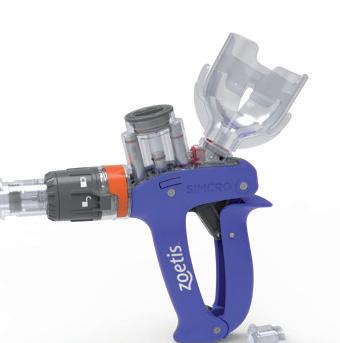
WIN a Simcro VS Injector
The most common problems occur in the rearing process when heifers are just turned out to grass and not monitored.
PICTURES : John Eveson
WORLD DAIRYING
A US dairy farm has added valuable income streams through the selling of cull cow meat and the hosting of farm tours. Chris McCullough reports.
Generating additional farm income
Adding value to dairy farms is a common trend across the world, with many selling milk, cheese and ice cream direct to the general public, usually via vending machines.
However, one farm in Michigan has gone a step further and sells ‘summer sausages’ (a sausage that can be kept without refrigeration until opened) and beef sticks from the meat of their culled cows.
at venture has proved quite popular, as has holding farm tours and sunset walks, but there are further dollar-generating ideas on the horizon.
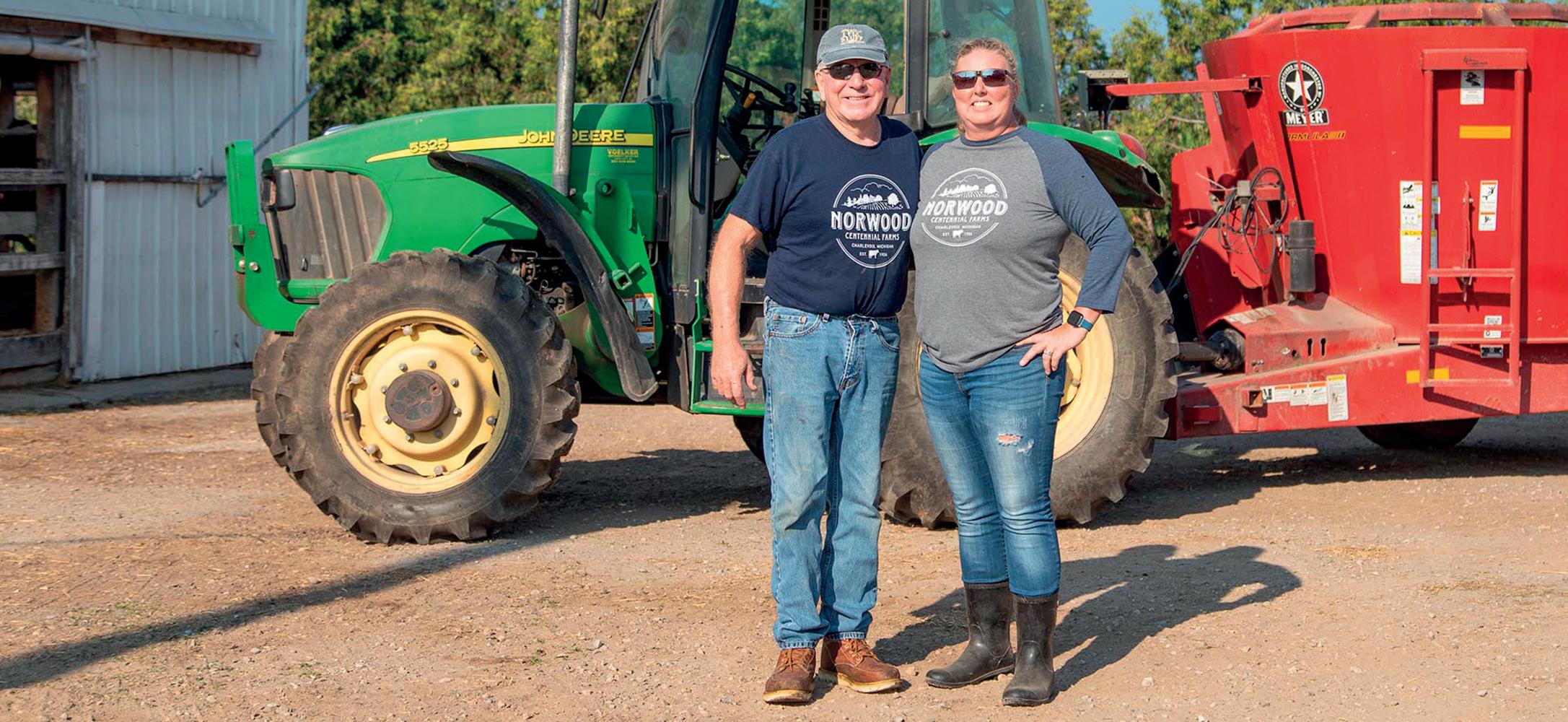
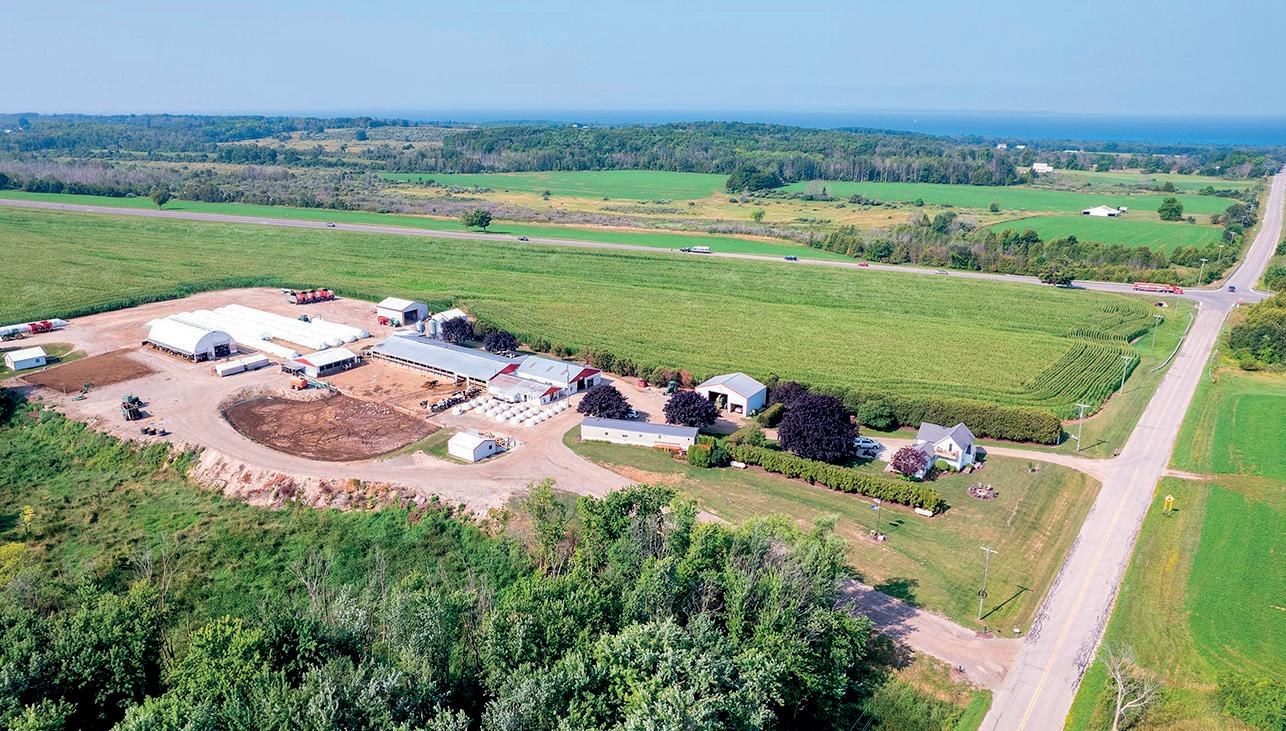
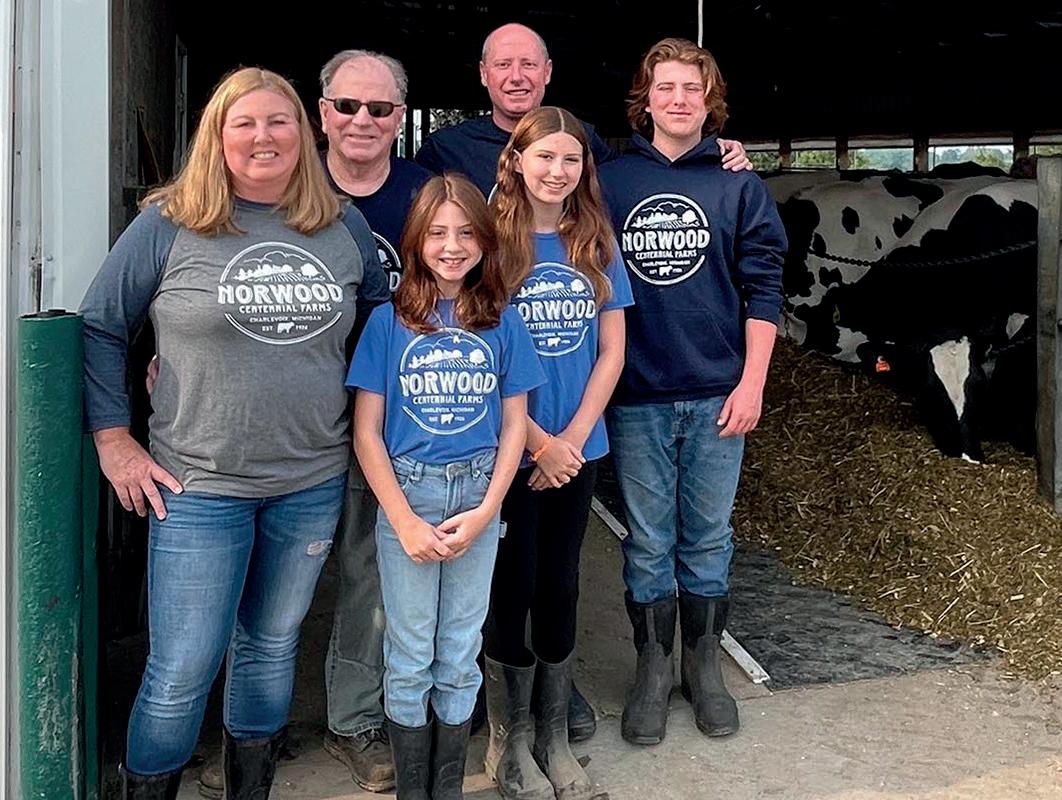
Sarah Roy and her dad Doug Warner run Norwood Centennial Farms near the resort town of Charlevoix, Michigan.
eir farm is a typical family dairy unit stretching back four generations and almost 100 years in operation.
Sarah says: “Our farm extends to 200 acres, 75 acres of which are tillable. We rent an additional 338 acres.
“From 1974 until 2021, my father owned and ran the farm on his own with some hired help. I then formed a partnership with him and took over the business side of the farm, le ing my dad focus on doing what he loves, farming.
“My husband Jason, and our kids, Parker, Temperance and Annabelle, help on the farm when they can.”
Currently there are 130 Holstein cows milking on the farm with another 204 followers and dry cows.
“We milk the cows three times per day,” says Sarah. “Our average yield per cow per day is 114.4lbs [51.89kg] and growing, with bu erfat at 4.1% and protein at 3.2%.”
e farm uses a double four Waikato herringbone parlour with automatic cluster removers to milk the cows.
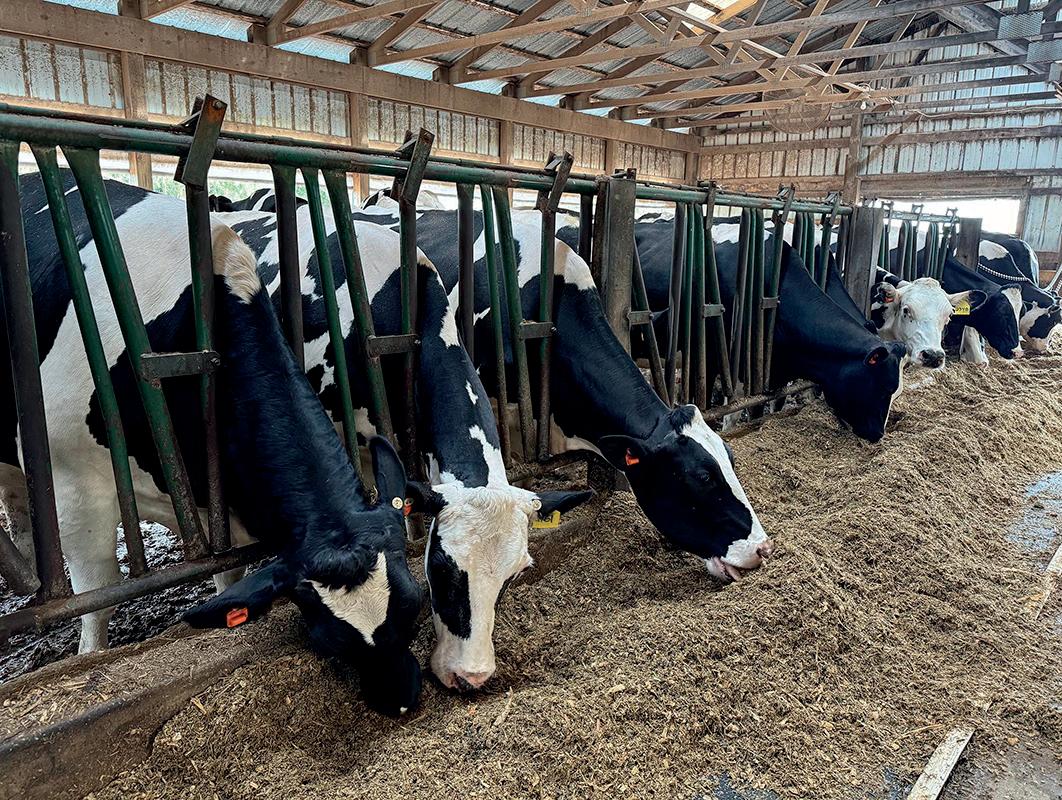
A belt feeder is used to feed the milk cows and all other stock are fed using a mixer wagon.
Sarah says: “We have four fulltime sta and three part-time. Our part-time guys look a er all the eld work and calf feeding.
“Our milk is sold to Michigan Milk Producers Association and Leelanau Cheese Company. e latest milk cheque we received shows we were paid US$23.40 [£19.21] per hundred weight [45kg].
“ e cows are fed a TMR speci cally formulated by our nutritionist from Renaissance Nutrition. We grow alfalfa, corn silage, and sorghum on the farm, and have a partnership with Short’s Brewing Company which enables us to use their spent grain as an ingredient in our TMR.”
Sarah sees the need to invest
Sarah Roy runs Norwood Centennial Farms in partnership with her dad, Doug Warner.
Norwood Centennial Farms is located near the resort town of Charlevoix in Michigan, USA.
Cows are fed a TMR formulated from home grown ingredients and spent grain from a local brewery.
in technology and in particular says herd management so ware, in this case CowManager, has been one of the best investments made to date.
She says: “I know a lot of farms are installing robots but we are currently quite hesitant to follow the same route, mainly because of the distance we are away from the dealer for service.”
In terms of generating more income from the farm, Sarah says any expansion in cows numbers would be di cult given the farm’s close proximity to the local town.
However, she is adding value to the milk income by a number of new ventures – with some more in the pipeline.
“Since my dad and I partnered, we have created two lines of value-added products,” she says. “ e rst line we developed was our beef sticks and summer sausage produced from the meat from our culled cows.
Farm facts
rCows are housed, with access to an outdoor loafing yard, and are fed a total mixed ration
rThe herd has been closed since 1978 and all breeding is done via AI r Over the past 12 years, the herd has been bred to A2 milk bulls and three years ago polled genetics were introduced into the breeding programme
“Next, we introduced our line of A2 cheese spreads made from our milk. In the future we are looking into adding other products from our farm for a farm shop, potentially, that would eventually stock ice cream and our milk.
Among the challenges the farm regularly faces being so close to the town is that the residents are not particularly im-
pressed when manure is being spread on the elds.
Sarah says: “We also are located on a major thoroughfare which we need to use to get to most of our elds. e tra c can be pre y busy during the summer, and it can be extremely dangerous driving down the road at times.
“Also, most of the equipment dealers are far away now as
farming in our area has dwindled so there is added expense for any service call.
“To overcome these issues we try and work with our neighbours as much as we can when spreading manure to not do it right before holidays if possible.
“ e tra c issue is di cult, but we work with the sheri ’s department to have them encourage people to slow down.”
Sarah’s husband Jason, and their children, Parker, Temperance and Annabelle, help on the farm when they can.
BREEDING BULLS
Limousin bulls are central to producing high-quality dairy-cross beef calves that consistently meet market demands on a Scottish farm. Dairy Farmer reports.
Limousin bulls drive dairy-beef success
AScottish dairy farmer is reaping the benefits of integrating Limousin genetics into his 150-cow Friesian dairy herd, providing an added income stream.
Producer Mark McKelvey, Burnside Farm, Lochmaben, Dumfries, has been using Limousin bulls on his dairy cows and heifers for 30 years and says it is a decision he would not stray away from, despite trying other breeds.
Currently, 80% of his cows and heifers are served by four Limousin bulls, with the remainder put to sexed semen. The resulting dairy-cross calves are reared and finished on-farm, with the majority sold direct to Highland Meats.
Mr McKelvey, who farms alongside mum Lorna, dad Roy, and brother-in-law Craig Bell-Metrier, says choice of bulls is fundamental. He chooses bulls with breeding back to Ampertaine, due to their easy calving, easy fleshing and good temperament.
He sources mostly bulls from Alan Myerscough of the Tally Rock Herd, occasionally
buying from Harrison and Hetherington, Carlisle.
Trooper
His latest bull, purchased from Carlisle for £5,500, has performed well and is ‘going like a trooper’ three years on.
“If you want a good bull, you have to pay,” he says, highlighting the importance of investing in quality genetics.
“We have had to up the price a bit,” he adds.
To maximise the working life
of his bulls, Mr McKelvey carefully manages them and does not buy them in a ‘pampered condition’, so they are able to perform on his grass-based system.
“We want a low-maintenance bull for our system,” he says.
When using young bulls, he ensures they are not put to too many heifers, with about 18 heifers being the optimum.
“You do not want to wreck a young bull by overworking him,” he explains.
This approach ensures bulls remain productive for several years, with some lasting upwards of six years in his system.
Dairy-bred calves are buffer-fed at grass with silage, wholecrop, and meal before housing in October. They are then finished on a diet of grass, wholecrop, dark grains, maize, and barley, with straights bought in.
Mr McKelvey has also established a small suckler herd of 15 cows, with offspring also sold deadweight to Highland Meats.
“I keep a couple [of heifers] every year for my own herd – they are so docile and quiet they would hardly walk into the road,” says Mr McKelvey.
He is also buying in about 250 stores, favouring Limousin genetics due to their ability to finish well.
JMilking 150 Friesian cows averaging 9,000 litres at 4.5% butterfat and 3.8% protein.
JMilk is sold to Meadow Foods.
J Heifers finish at 350360kg at 18-19 months and
typically grade R and R3. The last batch of heifers averaged 545p/kg.
JThe farm is also home to a flock of 50-60 pedigree Beltex and Blue Texels and 15 Cheviot cross Blue Texels.
Farm Facts
Mark McKelvey
Dairy-cross calves are reared and finished on-farm.
BRIGHTER ORANGE FOR OPTIMUM VISIBILITY
Receive a pair of overalls with all orders over 200 L
Synofilm GL is a Post-Milking Teat Dip Based on Lactic Acid and Glycolic By Neogen
BREEDING
Milk fever and ketosis prevention are usually top priorities for dairy farmers during the transition period.
However, taking care of your cows’ rumen microbiota is the ‘missing piece of the puzzle’ for successful transition management and should not be overlooked, says Mark McFarland, feed additive manager for Lallemand Animal Nutrition UK and Ireland.
“Cows experience signi cant dietary and physiological changes during the transition period, which all impact rumen functioning,” says Mr McFarland.
“ e shi from a high- bre, forage-based dry cow diet to a lactating diet that is high in rapidly fermentable carbohydrates, combined with rising metabolic demands, can put immense stress on the cow’s digestive system.”
He says this stress can lead to disruptions in the balance of the rumen microbiota – the diverse population of bacteria, protozoa, fungi, and archaea that reside in the rumen.
“ e microbiota play a crucial role in breaking down brous material into nutrients that the cow can absorb,” says Mr McFarland.
“ e balance and health of these microbial populations are essential for optimal digestion and nutrient uptake – especially during the transition period, which is the most important yet most challenging time in a dairy cow’s production cycle.”
When the microbial ecosystem is disturbed during the transition period, there can be a drop in bre
Supporting a cow’s rumen microbiota through the transition period can benefit its long-term health and performance. Dairy Farmer reports.
Spotlight on rumen microbiota
digestion, a ecting energy availability for the cow at a time when she needs it most, says Mr McFarland.
“In the rumen, the rate of feed passage will increase, and microbiota balance, fermentation pro les, and rumen pH will all change,” he says.
“ is can negatively impact the rumen’s absorptive and barrier functionality.”
He adds the imbalance can also lead to a low and unstable rumen pH, causing a cascade of digestive problems and rumen ine ciency.
Microbiota play a crucial role in breaking down fibrous material into nutrients
MARK MCFARLAND
He says this not only hampers nutrient absorption, but the resulting in ammation also increases the risk of potentially harmful bacteria and toxins passing through the rumen wall into the bloodstream.
“ e knock-on e ects compromise the cow’s immune system and contribute to conditions such as ketosis and displaced abomasum,” says Mr McFarland.
“Longer-term, compromised rumen health can lead to issues including sub-optimal milk production, low body condition, lameness and dips in fertility.”
Practical steps
Mr McFarland recommends that farmers take practical steps to address transition challenges, starting with the diet.
“Feeding the rumen-speci c live yeast Saccharomyces cerevisiae CNCM I-1077, commercially known as Levucell SC, helps manage the rumen microbiota during this critical period,” he says.
“It works by favouring bre-digesting microbes – cellulolytic bacteria and fungi – and limits the time the rumen spends at a low pH, as this causes acidosis.
“ e live yeast strain’s ability to in uence rumen microbial balance can enhance the integrity of the rumen itself.
“ is means the cow’s digestive system is be er prepared for the stress encountered around calving and is more resilient to in ammation and any associated problems.”
Minimising stress
To improve health and productivity post-calving, he says maximising rumen function and minimising stress in transition cows is crucial.
“ e rumen functions best when it is kept lled with well-preserved forage, maintaining the microbial populations needed to digest brous materials,” he adds.
“So, through the dry period, make sure you are encouraging high dry ma er intake by providing accessible, clean water and palatable, high- bre forages that are pushed up regularly throughout the day.
“At the very least, cows should have 0.75 metres of feed space; if not, then you will need to push up more o en.
“ is promotes good feeding and resting behaviour, the fermentation of nutrients, and the ability to produce high volumes of milk in early lactation while remaining healthy and disease-free.”
To improve health and productivity post-calving, maximising rumen function and minimising stress in transition cows is crucial.
Discussions at this year’s Dairy-Tech held at Stoneleigh Park focused on business resilience, new innovations and the future of technology. Katie Jones and Jonathan Wheeler report.
Resilient under pressure
Farming is well-placed to provide the solutions the country needs to combat climate change, but progress on the issue remains sluggish for multiple reasons, according to speakers at a seminar focusing on farm economics.
Key among those reasons was a reluctance to invest in technology and systems that might help improve productivity, said Sanjay Dhanda, senior economist at the NFU.
As a result he said he questioned whether the industry would reach Defra’s targets of a 4% improvement
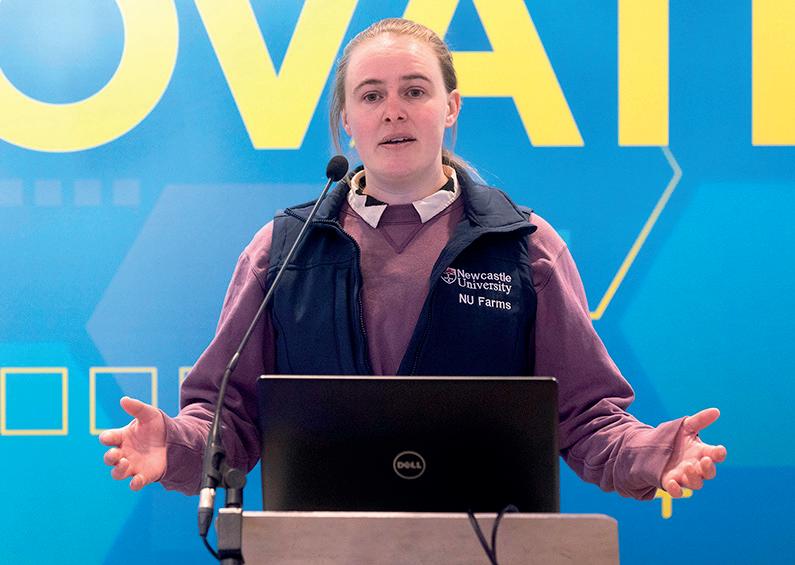
JData from inexpensive methane sensors in the milking parlour at Newcastle University’s Nafferton Farm is being used to look at the impact of breeding on emissions.
Megan Powell, from Newcastle University, said that the low cost ‘sniffer sensors’ had been installed on half the feed troughs in the farm’s 2:12 herringbone parlour in 2023. The gases are sampled when the cows are at the troughs, and this data is sent via a 5G network to a data warehouse.
Speaking at a seminar, Ms Powell said: “The aim is to quantify how much methane the cows are producing, find
in productivity between 2021 and 2025, and 15% by 2048.
While there were many income sources available, he said uptake remained low for multiple reasons.
Volatility
Key among them is that farming’s income is volatile and farmers have to consider how a range of in uences might a ect their business and their ability to pay back any nance they might access.
He also cited a lack of incentives to get involved.
He said: “Many sustainable farm
It can be difficult to justify the costs of investment in sustainable practices
SANJAY DHANDA
practices, such as actions on soil and waste management, require considerable initial investment and it can be di cult to justify those costs when they may only earn limited returns.”
Nervousness about future Government policy also played a role, he said, with Inheritance Tax uncertainty being the latest example.
And he added that ‘green markets’ were still in their infancy.
He said: “ ey have a long way to go. You could earn income from them, but they are still emerging and there is a lack of clear standards and payment structures.”
Greg Ricke s, from rural land and property specialist GSC Grays, de ned resilience as the ability to withstand and recover quickly from a shock and highlighted how vulnerable many dairy businesses were.
He said a dairy unit making a 9ppl margin might have to pay 2.3ppl tax, 3ppl drawings, 2ppl on loans, and 1.5ppl on hire purchase agreements, leaving a cash surplus of just 0.2ppl.
A business making an 11ppl
margin would face all the same costs and a higher tax bill (3.1ppl), leaving 1.4ppl pro t. But at a 7ppl margin the tax bill dropped to 1.5ppl, and if other costs stayed the same it resulted in a 1ppl cash decit, which was unsustainable. He quoted AHDB gures which showed the best units made pro ts four times those of the lowest. He said: “ at makes them much more resilient and they will ndnancing developments much easier.”
Diversification
Adam White, head of agriculture for Barclays Bank, suggested farmers should consider what the core of
Teamwork
out what is normal and how it varies by yield, stage of lactation, season, and physiological factors.”
Looking to future trials, Ms Powell said the research facility at the farm had the capability to look at the impact of feed additives and supplements on emissions. She said:
“Future trials could include within and between cow research looking at feed additive/ supplements and selective breeding.
“We also want to know whether supplementing cows with a product is going to impact on behaviour and welfare, so we are going to have cameras set up to monitor behaviours such as lying times and dry matter intakes.”
JDeveloping a team approach and empowering that team to adopt a ‘measure, manage and monitor’ mantra is key if improvements to mobility and foot health are to be made, said Ma Dobbs, chair of the Stride Mobility Technical Board.
Speaking at the Innovation Hub, Mr Dobbs said: “Firstly, we need to measure to get a picture of where a herd is in terms of mobility, and what the opportunities for improvement are.
“ en we can manage it to make change happen.”
However, Mr Dobbs added that for this to happen successfully it was important to allocate responsibility and a budget.
He said the Stride survey,
Methane sensor trial
Greg Ricketts
PICTURES : Tim
Megan Powell
DAIRY-TECH
Harper Adams University farm wins Gold Cup
University Future Farm, Newport, Shropshire.
Kate Robinson and her team manage the 400-cow Holstein herd at Harper Adams, which is part of the University’s Future Farm.
The dairy operates on 227 hectares (560 acres)
their business might be. While diversi cation was valuable to many businesses, he said, enterprises should be selected with care.
He advised farmers to take professional advice where possible,
and is run by five full-time staff. Although the dairy unit is involved in research and teaching activities, it is expected to perform commercially and achieve exceptional industry-based standards, and also to demonstrate good practice. Staff are a vital ingredient in achieving the unit’s goals.
especially if they were considering ge ing involved in green markets.
He said: “Get involved with a professional who understands the complexities and understand whether it ts your farm enterprise.”
needed for foot health
carried out in 2024, had shown that responsibility for managing mobility was o en poorly allocated and this could reduce the rate of progress. He advised giving one person the authority, budget and tools to
do the job, allowing them to set priorities and appoint support.
A er deciding who would have this responsibility, Mr Dobbs said it was then important to have a clear plan that was communicated to all involved with appropriate measurable targets.
“ ink about who needs to know when a lame cow is identi ed and set up communications so everyone on-farm can contribute –for example, through a WhatsApp group,” he said.
And nally, he said it was important to monitor in order to keep track of progress: “Develop systems to track day-to-day actions, keep records and set ways to identify when progress is o track.”
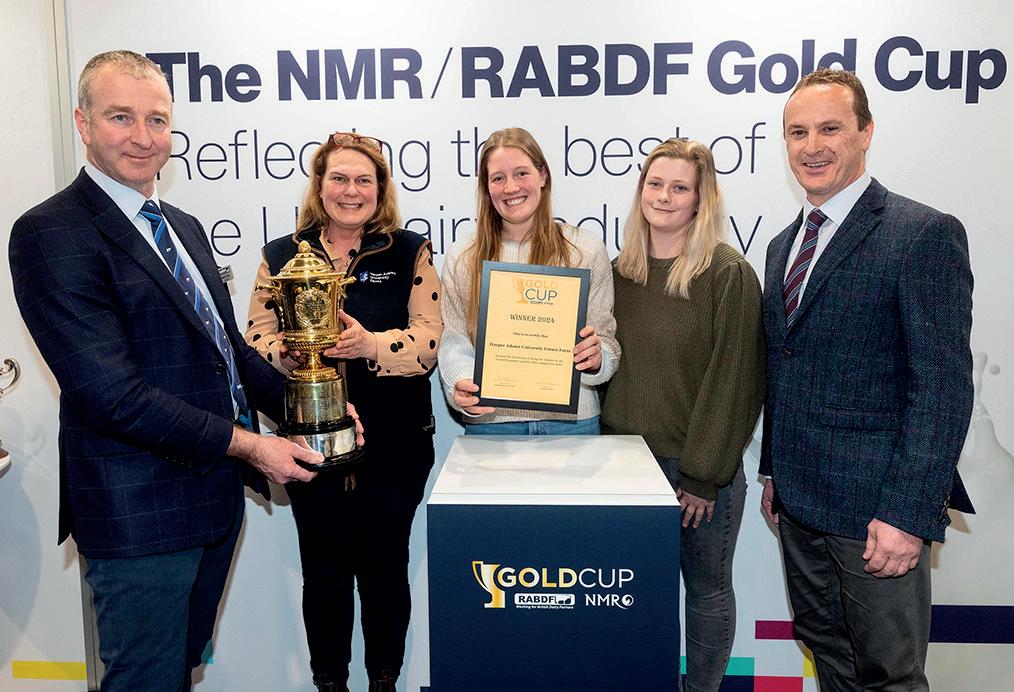
JThe winner of the NMR RABDF Gold Cup 2024 was Harper Adams
Left to right: RABDF chair Robert Craig, Kate Robinson, Alice Sault and Becky Yarnold (all from Harper Adams), and NMR managing director Mark Frankcom.
Matt Dobbs
There were a number of new products on show at the event covering animal health and welfare, manure and feed handling, parlour equipment and more. Toby Whatley reports.
New products unveiled
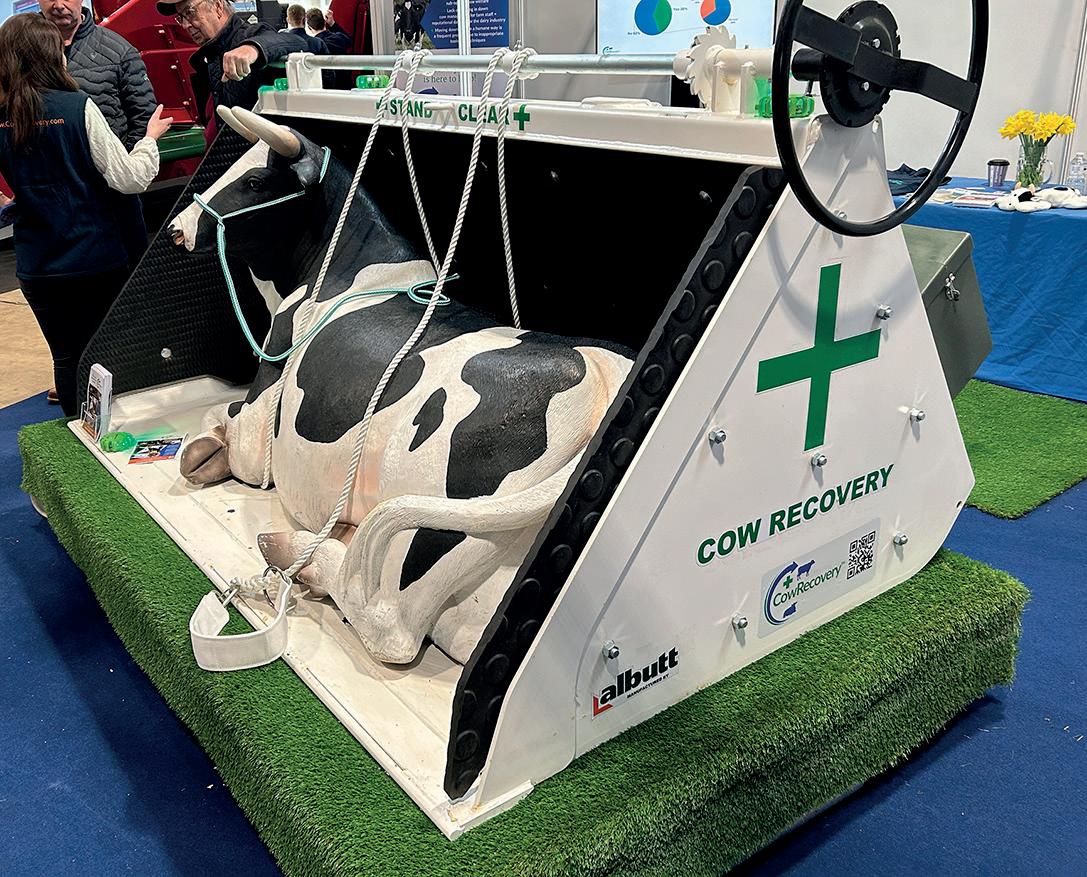
Cow Recovery bucket
JDeveloped to improve the recovery of down cows for both the safety of the cow and farm workers, the Cow Recovery uses a modified loader bucket with additional cow matting lining, changes to the bucket edges with rounded profiles on the front and sides and a manual winch to assist loading.
Solely distributed by Cow Recovery, the Albuttmanufactured bucket is only supplied with an additional veterinary training programme to use the product correctly.
Cow Recovery says the system has been a joint
development between a North Dorset dairy farmer and a large animal vet, with the attachment offered in widths of 2.1 and 2.3 metres and includes a
Peacock Technology IDS Pre Brush
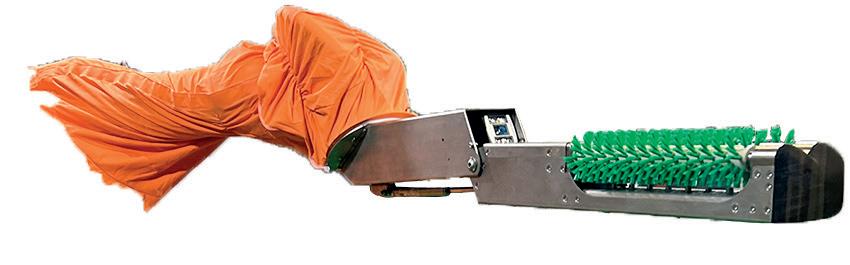
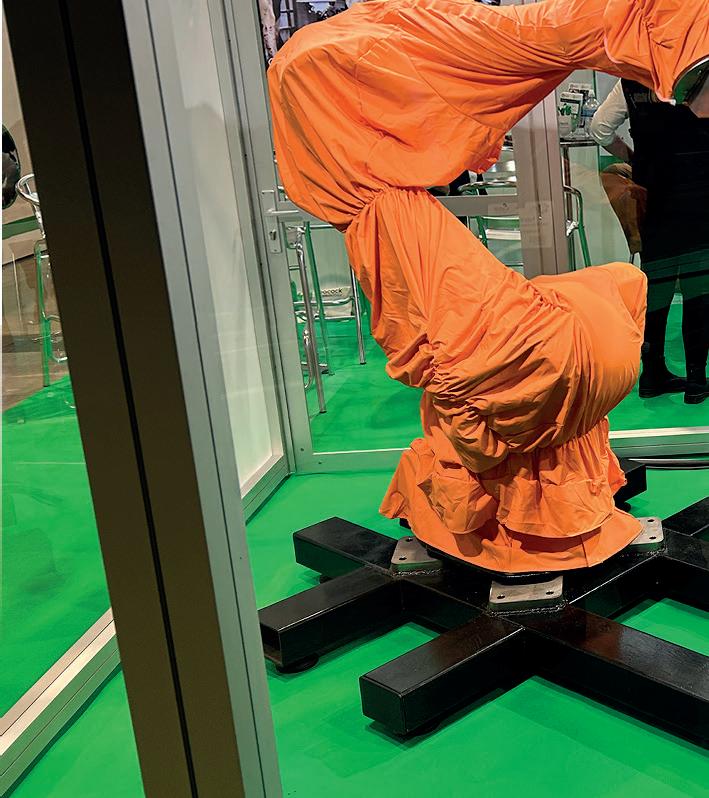
JInstalled to reduce labour requirements for teat prep on large rotary parlours, the six-axis manipulator arm from Peacock Technology uses vision technology to stimulate, clean and prepare cow teats before cluster attachment.
storage locker on the rear of the bucket to carry additional straps and equipment.
Prices start from £5,000 including operational training.
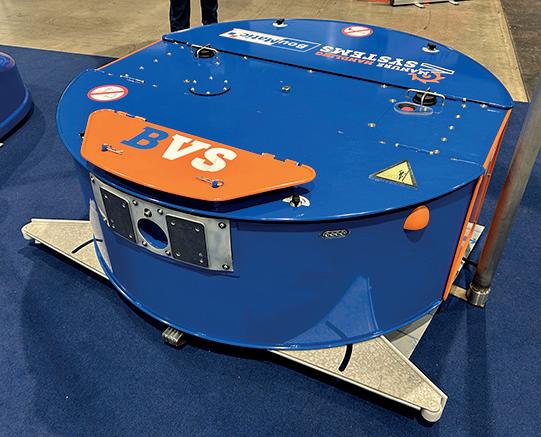
BouMatic BVS
Dairy Spares Comfy Brush
JThe Comfy Cow brush provides variable speed and direction brushing to ensure cows are always brushed in a downward motion.
The 230V single phase supply is inverted to a 24V three-phase system to provide variable speed and a claimed lower energy requirement of 0.12kWh.
The 390mm diameter single piece brush retails at £1,695.
Sveaverken Nimbo
JDeveloped in Sweden and manufactured in China, the Nimbo from Sveaverken claims to be the fastest working feed pusher on the market, and operates without a trace wire or steel strip.
Offered only as a five-year contract hire with service and support, the £2,950-a-month unit is designed to work with herds from 500 cows, however the unit’s ability to work continuously allows a single arm to comfortably work with herds of 1,000 cows.
JThis Vacuum Scraper, for herds of up to 100 cows, operates autonomously throughout the building using a laser guidance system and WiFi, and does not require additional wires or tracks.
with herds of 1,000 cows.
The pusher uses sensors to recognise the feed barrier and any fodder which requires moving, and operates from a predetermined farm map.
Prices start from £15,000, excluding installation.
RS Agri Atlas
The unit is powered by a 48V lithium or lead-acid battery with a claimed working time of 14.5 or 10 hours, respectively.
Slurry is sucked into the 360-litre tank using a 230V vacuum pump, with a secondary 70-litre fresh water tank used to provide washing water behind the unit.
Emptying is achieved through either a reception pit or through slatted floors depending on the building. Depending on site-specific requirements, on farm costs extend to £30,000-£32,000.
JBetter known for its mixer wagons and cubicle brushes, RS Agri has introduced a range of twin vertical beater muck spreaders with capacities from nine to 16 tonnes.
Standard spec includes a full-width slurry door with the machine on show featuring an optional gate-fold twin rear beater cover which allows the unit to spread finer products.
Options include a range of tyre sizes, IsoBus controls and weigh cells.
HOW THE USE OF DATA IS INFLUENCING DECISION-MAKING TO HELP DRIVE PERFORMANCE AND PROFITS
More promising milk prices are providing some comfort to dairy producers after a challenging year.
Nevertheless, a focus on small adjustments, improved feed e ciencies and maximising the use of homegrown forages, will be key to help increase margins, while maintaining herd health and performance.
FEED INTELLIGENCE
Making use of on-farm data is key to tailoring strategies, and one crucial principle is to apply feed intelligence to understand the baseline of rations and make the most out of homegrown forages.
Near Infra-Red (NIR) spectroscopy services, for example, provide accurate predictions of the nutritional components of feedstu s, to help optimise diet formulation and ensure quality control.
Forage quality represents a key parameter to maximising profitability, and the use of NIR technology for on-farm silage analysis is vital throughout the season.
Changes in silage quality can be vast, across not only the cuts but clamps or bales. The best quality forage should be targeted at the animals with highest performance requirements.
Regular analysis will highlight initial quality along with potential losses during storage. Not only does this allow the ongoing ration to be amended, but can also give opportunities to improve future stocks, by addressing harvesting and storage issues.
MYCOTOXIN TESTING
Assessing forages and feeds for mycotoxins is another vital part of data analysis on farm. With mycotoxins being invisible to the eye, it is easier to proactively assess for their presence than having to react to their negative e ects on performance and recoup the additional costs of this.
These e ects vary depending on which mycotoxin is present but can act on a number of areas of animal health including reproduction, digestive tract issues and milk related issues.
The minimal cost of sending a sample of forage or TMR for testing, far outweighs the costs of reduced litres across the herd, missed conceptions, veterinary bills and in the worst-case scenario, dumping of the milk tank.
MILK RECORDING DATA
Milk recording is one of the most valuable decision-making tools available to dairy farmers, and the producer can draw key findings from this data.
The most obvious is the prevention of the spread of contagious mastitis. Detecting new infections early, and monitoring trends in somatic cell count (SCC) is possible with regular milk recording.
It is also possible to make key decisions for selective dry-cow therapy, providing farmers and vets with valuable information to make accurate decisions for the sustainable use of antibiotics.
Another crucial benefit is the ability to help review overall nutrient e ciency, while the monitoring of milk urea nitrogen (MUN) gives an understanding of how e ciently cows are digesting dietary protein, and can provide an indication of the potential cause of hoof health and fertility issues.
Milk recording also allows for the development of breeding strategy on farm, both in selecting the most profitable cows to breed the best replacements, but also in identifying herd KPIs for improvement, to be considered during bull selection.
Increasing the herd’s productivity and e ciency, can reduce the carbon footprint of every litre of milk.
EFFICIENCY AND PROFITABILITY
By making best use of on-farm data to drive decision-making, dairy producers can take advantage of various data streams to help support feed e ciencies, herd health and responsible production, while meeting contract requirements and yield and performance targets.
NDF Distribution Autumn 2023 v Autumn 2024
Producing milk from cows regeneratively is tricky but not impossible, especially when selling direct to consumers, as dairy farmers Rebecca Mayhew and Mark Lee are finding out. Sara Gregson reports.
Doing dairy differently
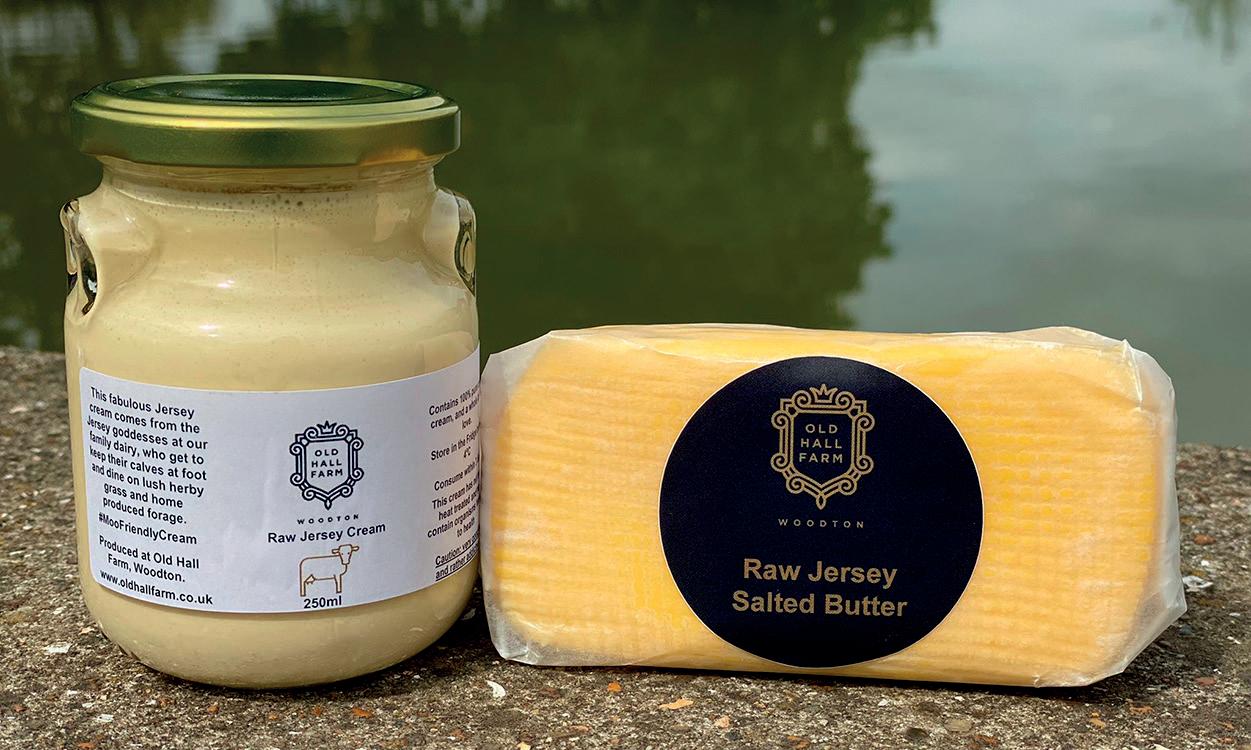
Value your products and know your worth by charging a high enough price from the outset. is is the advice from rst generation regenerative dairy farmers Rebecca and Stuart Mayhew, of Old Hall Farm, south of Norwich in Norfolk. ey are currently selling their high value, raw A2 Jersey liquid milk for £2.85 per litre and earning £4 per litre overall, when sales of their cream, crème fraiche, bu er, yoghurt and ghee (clari ed bu er) are taken into account.
e Mayhew family have farmed in Woodton since the mid-1940s,
mainly arable farming and pig rearing on 204 hectares (504 acres), but with increasingly stressful health problems with the pigs.
While on a family holiday in Scotland in 2016, Mrs Mayhew fell in love with the idea of having a herd of Jersey dairy cows and ge ing out of the never-ending pig cycle. ey came back home having bought one in-calf cow and three heifers and decided to make a fresh start.
“We started with a four abreast parlour and a portable mini-milker and learnt how to milk from YouTube videos,” says Mrs Mayhew. “We keep costs to an absolute minimum but are now milking 60
cows through a low-tech six abreast parlour put in eight years ago.
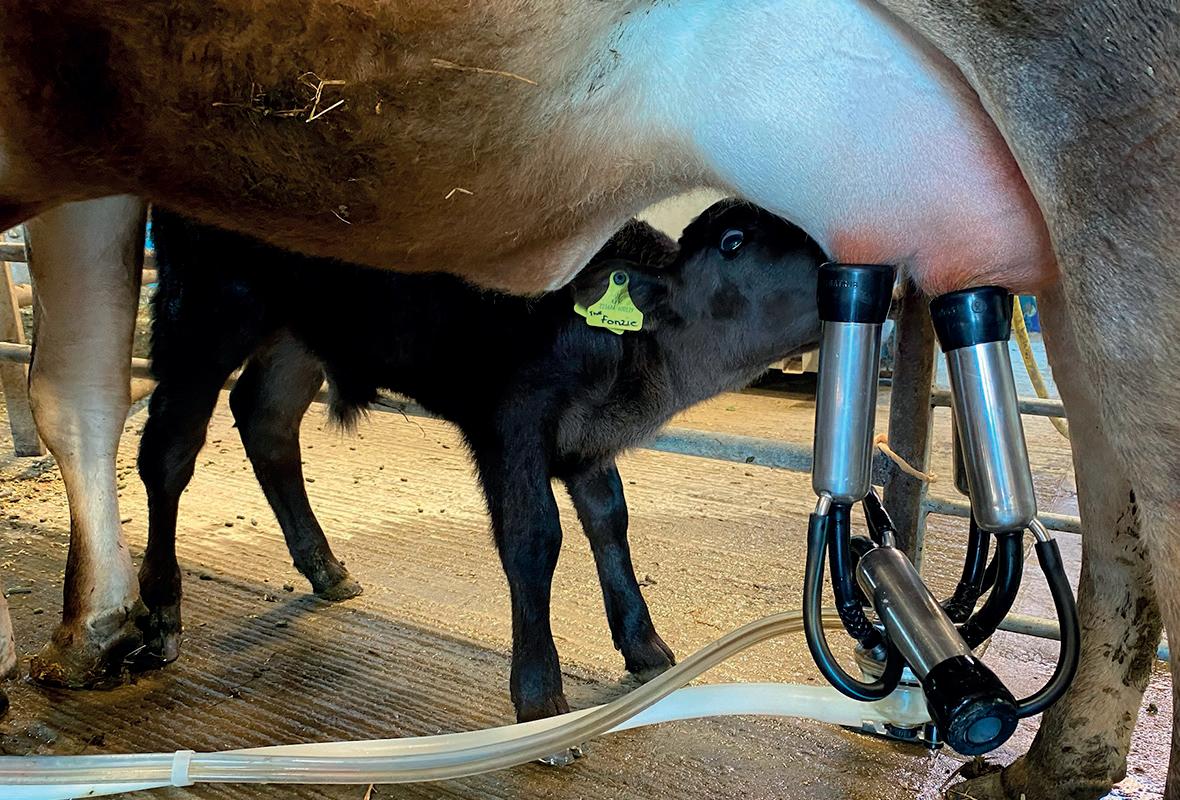
“ e calves are kept at foot with their mothers for at least the rst nine months, because this is the way I want it to be. e cows are milked once a day and everything is processed on farm and sold direct to consumers. I am very proud of that.”
Rebecca Mayhew’s reasons to be pasture-fed
rLower and more stable cost
rProduces nutritionally superior food
rHealthier cows
rMore natural system
rLow energy input
rImproved ecological services/wildlife
rUnique selling point
e journey to regenerative, agroecological farming started in earnest with a holistic management course with 3LM, completed in 2020 just before the rst Covid-19 lockdown. is gave the Mayhews a wholefarm plan with which to take things forward, including how to improve the health of their exhausted arable soils, by reseeding with multi-species leys under Countryside Stewardship Schemes, and mob grazing them. e herd is also 100% pasture-fed and they have been members of Pasture for Life for many years and are now working towards certi cation. e cows calve every 18 months with an average 60-day drying o
Calves are kept at foot with their mothers for the first nine months.
In 2016, the Mayhews switched to cattle after a stressful time with pigs.
period. e cows are served once night weaning has been established. In terms of milk yields, the aim from the start was to produce 10 litres a cow a day – which, now that the soils and quality of the pasture is improving, is almost being achieved. e calves are budgeted to be drinking around seven litres of milk a day. Some lucerne nuts are fed but the quantity is dropping. Haylage is on o er with a small amount of silage in ring feeders, at least 12 hours before milking.
To be able to sell dairy products from the farm gate requires a processing room, which Mrs Mayhew says can be as simple as a shipping container lined with a white, dampproof membrane staple-gunned to the wall with a supply of hot water.
Originally Mrs Mayhew started with an honesty shed and two fridges to sell from. Even now, selling 350 litres of milk a day, she cannot justify spending £16,000 on a vending machine. e dairy products, including high-value ice cream,
Also at Old Hall Farm
r100 native beef cattle
r50 sheep for meat
r20 goats for meat/on-site experiences
r25 rare-breed soya-free sows and progeny
r350 chickens for eggs
rFarm shop and butchery
rCafé
rVineyard
rPasture cropping on arable fields
are now sold through the farm shop and café and at times they sell out.
Health and safety is critical, and training is essential so that farmers have an inside-out knowledge of their farm’s Hazard Analysis and Critical Control Point (HACCP) report. Ge ing to know and working with the local environmental health o cer and dairy hygiene inspector is important. For those selling raw milk, the Raw Milk
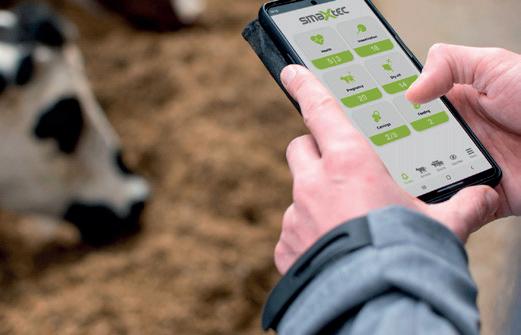
smaXtec helps detect potential diseases early, enabling preventive action to improve herd health and profitability. The unique bolus technology was showcased at Dairy Tech, where farmers and industry experts experienced firsthand how insights from within the cow’s reticulum can future-proof your dairy farm.
smaXtec measures the most reliable indicator of cow health – inner body temperature – with unrivalled accuracy (± 0.01°C), while also tracking drinking cycles, water intake, rumination, and activity. This comprehensive data enables the early detection of potential health issues and diseases, often long before visible symptoms appear, allowing for early intervention.
As a result, Martin Billington from Staffordshire has significantly reduced antibiotic use in his 260-cow herd, resulting in cost savings: “In terms of reduced antibiotic usage in the cows, I’d say I’ve reduced my intramammary usage by about a third. Obviously, it’s not just the cost of the tube; it’s the cost of the lost milk as well, so that’s certainly saving some money.” Robin White from Scotland adds: “Having that early warning of an issue, before there are any visual signs, allows us to treat the cow, keeping her healthy, keeping milk in the tank, and money in my pocket. With a reduction in antibiotic usage of nearly 66%, this alone has made the cost of buying the system well worth it.”
Got curious? Join the growing number of dairy farmers transforming their operations with smaXtec.
Contact us today at +44 1629 380 780 or info@smaxtec.com, or visit smaXtec.com to take the first step toward a healthier, more productive farm.
The Mayhews’ confidence in their high-quality products has grown.
Producer Association is also a good resource with an active forum and WhatsApp group.
Social media is critical for success, says Mrs Mayhew, with an up-todate website for back-up. Building relationships with consumers who want to see what is going on at the farm is key. Mrs Mayhew started doing social media years before, so they had customers coming up the drive from day one.
“ ere are both joys and challenges to direct selling and customers are hard work,” says Mrs Mayhew.
“But as the years go on, our condence grows. We are starting to value our products, and therefore pricing them for being the highest quality, most healthy and tastiest dairy products anyone can buy.”
More regenerative dairy over the page...
Cheesemaking and the future
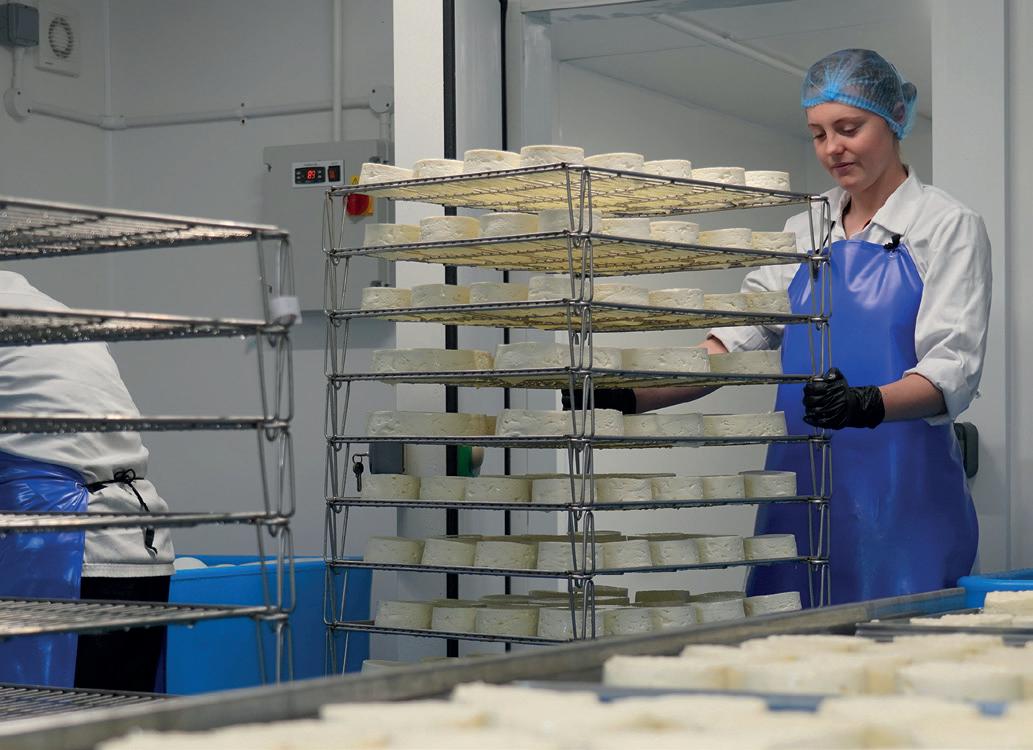
JThe Lees could not get an organic contract for their pasteurised milk because of their location north of the Lake District. So they started to make cheese, making one tonne during lockdown. They delivered this to people’s front doors and butcher’s shops, before putting in an honesty cheese hut at the top of the drive. Demand grew and the Torpenhow range of hard and soft cheeses expanded.
They bought milk processing equipment using an enterprise initiative scheme which attracted external investment and are now producing 25 tonnes of cheese a year.
“We have won awards, including a gold medal for our smoked cheddar at the World Cheese Awards, and we are incredibly proud of what we produce,” says Mr Lee.
“The trickiest thing is to decide how to price it. We sell our hard cheese for £27/kg
and six to eight litres of milk goes into each kilo. This means we are getting around £2.40/litre for our milk.
“We have also gone into a joint venture with a gelato maker. We made 35 tonnes last year and are aiming to make 75 tonnes this year, selling it direct locally.”
Mr Lee says there are many barriers to regenerative dairy farming, but adds that farmers wanting to go down this route might find it easier to start with fewer cows than the 200 they started with.
He says: “We have learned so much from Pasture for Life, they provide a huge amount of technical and educational resource. For instance, we have learned how to bale graze in winter and have started this for the first time this year. And we are also planting hundreds of trees for shelter with the aim of being able to keep our cows out for 365 days of the year, rather than the 320 we do now.”
Mark and Jenny Lee came to regenerative dairy farming from a di erent direction, taking on Mrs Lee’s family’s 143-hectare (353-acre) farm in Cumbria, with high yielding Holstein cows, milking three times a day, fully housed and being fed imported soya and grain from Ukraine.
“We had 220 cows each giving 10,000 litres a year but we were all nancially and psychologically living on a knife-edge,” says Mr Lee.
“ e milk price crash in 2015 saw us receiving 15p/litre of milk when it was costing us 28p/litre to produce. So we looked to see what other farmers were doing and discovered low cost spring block calving.
“We sold the Holsteins and bought 240 Jersey Friesian cross
Always continuing to learn, Mr and Mrs Lee have recently hosted a PhD student from Harper Adams University investigating the profitability of keeping calves at foot, which proved viable and is something the couple are going to try.
They are also involved in a Digital Dairy Chain trial in Cumbria and South and West Scotland, which is going to compare phytonutrient levels in Torpenhow
milk, cheese, butter and gelato to levels in milk from a conventional grazing farm, the SRUC fully housed herd and some supermarket milk.
“We are hoping the results will show how much better our products are nutritionally and we can then use that in direct marketing, hopefully allowing us to reach our target of selling our milk for £3/litre,” says Mr Lee.
Mark and Jenny Lee with their two children.
The ‘Made in Torpenhow’ range has been a success.
heifers from the Republic of Ireland and started grazing them.”
It took eight months to divide the elds into smaller paddocks with tracks and hedgerows and put in water infrastructure before they started rotational mob grazing, explains Mr Lee.
e cows are out for 24 hours and graze and then move, not returning to the same paddock for between 40 to 100 days, giving the elds a good rest.
In 2019 the farm went organic and started towards agroecological farming, stopping all applications of arti cial fertilisers and herbicides.
Mr Lee says the grass crashed for the rst two years, but by introducing new species, the soil has been invigorated – so much so that the farm is now yielding as much now as it did when it had 100 tonnes of fertiliser added to it.
In 2022, a er reading that cows can be gluten intolerant, Mr Lee wondered if their cows could perform without the 1kg of cake they were being fed in the parlour.
ey decided to stop feeding any cake and Mr Lee says they were surprised to see improved fertility and body condition in the cows and a rise in protein levels in the milk.
ey became certi ed with Pasture for Life, the organisation which
champions the feeding of ruminants wholly on fresh and conserved pasture.
Mrs Lee used to milk the cows twice a day, generating around 4,500 litres a year, but this has recently gone down to once-a-day
milking, with the cows giving an average of 3,000kg of milk solids.
Mr Lee is now making as much cheese (see panel, below le ) from 700 litres of milk as he used to from 1,100 litres of milk, due to the increase in milk quality.
Cows graze for 24 hours then move, not returning to the same paddock for between 40 to 100 days.
GRASSLAND & FORAGE
This special looks at advice for clamp design, options for bale wrapping and features farmers who have a laser focus on grassland management.
A Cumbrian dairy farmer has had consistent grassland performance despite changing his nitrogen source from ammonium nitrate to protected urea. Dairy Farmer reports.
Consistency despite nitrogen source change
Bill Somerville, who farms with his father
Tim and brother Joe at Newby, near Shap in Penrith, wanted to assess di erent nitrogen sources to o er the business more options when prices started to rise.
e subsequent switch to protected urea has also provided additional bene ts, including improved storage logistics and increased times between ll-ups thanks to a higher total nitrogen content in each bag.
Bill explains there has been no drop in performance.
“Some people might question
P36 BUILDING WORK
What to consider before installing a silage store
that protected urea can not match ammonium nitrate (AN) in terms of yield, but I have seen no yield decline in grassland or quality from changing to it. e performance is comparable and we have additional bene ts across the farm,” he says.
e family milks 300 Holstein
Friesians producing 10,000-litres a head on a twice-a-day milking system.
All cows are bred from the farm’s progeny and heifers are kept as replacements.
Alongside the dairy, the farm has 200 beef store ca le that are grazed on grass in the summer and nished
P44 MULTI-SPECIES SWARDS
Grassland options to combat dry conditions
on barley and grass silage. ere are also 500 white-faced Texel and Beltex ewes on the farm with lambs reared to nish.
e farm extends to 100 hectares (247 acres) of owned land, with a further 90ha (222 acres) of shared farming and 140ha (346 acres) of rented ground.
Bill used AN for many years and says he never had a reason to change, but as the price started to increase, he looked at alternatives in 2018.
He says: “ e farm used AN fertiliser for many years, applying high nitrogen products on grazing
P38 BIG BALES
Getting the right coverage and protection
P46 SOIL HEALTH
Importance of regular testing
land and AN with sulphur on silage ground. It worked well and I could not fault the performance, but I wanted to explore if di erent options could o er the farm comparable yield to allow us exibility.”
He wanted to avoid straight urea and was advised by Origin Fertilisers’ sales advisor, Ma hew Evere , who has been supplying the farm with fertiliser for several years, to try a protected urea fertiliser. is features a urease inhibitor coated on the fertiliser to block the activity of the urease enzyme, reducing losses from ammonia volatilisation, and allowing more of the
P40 LOW-INPUT SYSTEM
Achieving high milk from forage figures
Bill Somerville is aiming to grow higher quality grass that the animals can eat more of.
Bill Somerville.
Following the first application of OEN, a silage grade fertiliser is applied to fields following first and subsequent cuts.
nitrogen to be available to the plant for longer,” says Bill.
“We use slurry and manure on the elds we can access early in the season. is is dictated by the weather, but the products form a solid base to the elds and then we are guided by Ma hew regarding further inputs.
“To begin with, I wanted to test the water with protected urea, rather than jump straight in, so I opted for Origin Enhanced Nitrogen (OEN) 40-0-0 + 14 sulphur, alongside the AN grade I was using.
“ is allowed us to compare performance of both and how each product handled and spread. Crucially, we did not see any di erence, which gave us the con dence to use more OEN if the price dictated.”
Bill used this combination until 2021, when the cost per unit of nitrogen rose, he switched all fertiliser to OEN. His grades have adjusted slightly to accommodate various nutrients in the blend and account for soil de ciencies.
Nutrients
He has converted to a lower nitrogen grade, but included secondary nutrients – 38.5-0-2.5 + 7 sulphur + 3 calcium. e sulphur content is provided by polysulphate, which o ers an immediate and sustained release of sulphur compared to ammonium sulphate.
Across the farm, Bill takes regular soil samples and notes his grazing index. Following the rst application of OEN, he applies a silage grade fertiliser following rst and subsequent cuts – a 23-0-14 + sulphur, with the aim to raise quality.
Using Origin’s SweetSilage helps to lock in quality, and polysulphate, along with granular sodium, improves palatability and aids consumption.
Bill says: “If we can grow higher quality grass that the animals can eat more of, we are giving ourselves
the best chance to generate a be er milk price for the farm. We regularly reseed our elds and we like to keep key nutrients, such as potash and sulphur, at levels that can be easily accessed by the crop.
“One nutrient I would not be without now is sulphur. It is an essential part of our nutrition and we can apply it as polysulphate with the protected urea in OEN.”
Sulphur works alongside nitrogen to increase nitrogen utilisation and the plant’s access to nitrogen. Sulphur is also vulnerable to leaching and very mobile in the soil, so an application of polysulphate can supply crops with immediate and sustained release for up to 55 days.
Bill explains one unexpected bene t of the fertiliser change has been the extended periods between ll-ups during application.
He says: “ e higher nitrogen content in the OEN, compared to the AN I previously used, has allowed me to apply larger areas from the same hopper-full.
“ e higher nitrogen content means I can spread a lower rate and still apply the same total nitrogen content to the grass.”
e higher total nitrogen content in each bag also means that the farm needs less undercover storage space.
“Although it is a small bene t, we have noticed that we require less space to store the bags, which means we get our sheds back quicker once the spreading begins.”
Bill says he keeps a keen eye on his grassland nutrition and matches it to the needs of the farm to ensure that yields and quality are maintained.
Although he has not ruled out a return to AN in the future, the change to protected urea has brought about several logistical bene ts for the farm, maintained yields, and o ered more nutrition options going forward.
SINCLAIR MCGILL
Since we switched, we’ve had better grass as regards cutting and grazing, than we’ve ever had before.
STRONG ROOTS IN GRASS
Discover a complete range of high-performing grass seed mixtures, backed by comprehensive knowledge and the global experience of a partner you can trust.
Brian Rowley, Dairy Farmer, Derbyshire
SCAN to hear Brian’s story
For farmers thinking about building a new silage clamp, there are many considerations. Wendy Short speaks to an expert to get tips on siting, design and materials.
Anew build silage clamp requires careful planning and clamp siting is one of the rst considerations with relevant rules governed by the Environment Agency’s Storing Silage, Slurry and Agricultural Fuel Oil (SSAFO) regulations explains silage consultant Jeremy Nash.
He says: “Clamps must not be sited within 10 metres of an open watercourse, or within 50m of a protected water source, such as a borehole or a spring, for example.
“If there is absolutely no other option but to position the clamp close an open watercourse, the rules can be met by diverting the water via an underground pipe.
Avoid
“In addition, the construction industry body, the Construction Industry Research and Information Association, advises that producers should avoid building a silage clamp on what is described as ‘made up’ ground.’ erefore, digging down
Consider whether the design of your silage clamp can accommodate future expansion, perhaps by adding an extension or building a second clamp alongside
Tips for building a new silage clamp
to the subsoil and building up the soil to a raised position is not advisable, due to the risk of se ling and potential cracking of the structure.”
Mr Nash says that the ideal arrangement is for the parlour to be positioned at the highest level on the site, with the cows and forage storage at mid-level and the slurry at the lowest point.
“A gravity-fed system of handling slurry and silage e uent is desirable, because pumping any liquid adds expense and extra work, as well as causing issues if there is a power cut.
“Separating yard water and e uent will cut down on e uent handling volumes and positioning the clamp away from overhead
power lines will eliminate the risk of machinery coming into contact with them.”
Feedout practicalities must also be taken into account, he adds.
“Clamps should be accessible all year round and designs are increasingly moving towards doubleended access, which means leaving out the traditional back wall.
“Another element to consider is whether the design can accommodate future expansion, perhaps by adding an extension or building a second clamp alongside.
“An extra clamp can also be needed if the ration changes and a new ingredient requires separate storage.”
Forage densities can vary from
600-850kg per cu.m and measurement calculations will also depend on the requirement to access old and new crops and the various total mixed ration ingredients.
On some farms, up to three forages may have to be extracted from the same clamp all year round and dividing walls may need to be incorporated, he says.
“ e most economical clamp design might be square, but a rectangular clamp will have reduced losses and will work out cheaper in the long term.
“ ere is sometimes confusion over what we mean by losses. As well as visibly spoiled silage, losses include aerobic microbial activity which uses the forage feed value to
produce heat, CO2 and ethanol.
“When silage feeding was mainly limited to winter time, the general rule was to choose a clamp width to allow the face to be worked back by 2.1m per week, to minimise aerobic losses. However, with the growing popularity of year-round feeding and the warmer temperatures in recent years, I will o en use a gure of 3m.”
Most clamps built today are around 3.0 to 3.6m high, but there is no set height limit, says Mr Nash.
“Silage can be well preserved in clamps 6-7m high, although a 4-5m high wall generally represents the lowest cost per tonne stored for large clamps.
“For a self-feed silage situation,
the clamp height should be no more than 2m, unless the top level is to be removed for youngstock feeding.”
e SSAFO rules for clamp construction demand that the oor extends beyond the walls, says Mr Nash.
While there is no speci ed gure, he suggests that a oor extension of 300mm is normally su cient.
“Clamp oors must be impermeable and made from either asphalt or concrete, or a combination of the two materials,” he says.
“Asphalt is highly e ective as it does not require movement joints. Nevertheless, it is usually only cost e cient for larger areas and particularly suited to 500-cow-plus herds.
“Where concrete is used, it should be grade RC45 or similar and if possible, limestone should be avoided as an aggregate, with base and wall joints sealed with at least two barriers.
“Joint design is critical, so it is worth investing in high-performance products specially made to
Clamp floors must be impermeable and made from either asphalt or concrete
JEREMY NASH
withstand silage e uent.
“ e depth of the sub-base will be dictated by ground conditions.”
e whole structure needs to be designed for BS5502 loadings, so professional advice will be needed.
“As a guide, the usual minimum depths are 150mm of concrete, laid over a base of 150-200mm of compacted crushed stone,” he says.
Clamp walls must also be designed to BS5502, with pre-cast clamp walls generally cheaper than walls constructed in situ, he says.
“ e most critical issue when
choosing walls is the weight of the vehicle that will be used to ll and roll the clamp. It is vital that wall designers and suppliers have this loading information,” he warns.
“Clamp walls have been known to fail under pressure from high compacting vehicle weights and silage contractors are using much heavier tractors and loading shovels compared with a decade ago.
“ is warning also applies to steel columns and their foundations, since these too will be overloaded and compromised by loads that are heavier than the original weights submi ed at the outset.”
He advises the addition of a safety sighting rail too.
“It will minimise the risk of anybody falling o the clamp when sheets are being positioned or rolled back and when tyres or gravel bags are being added.
“A rail will also come into its own as a sight line, allowing the vehicle driver to clearly see the clamp edge during lling,” adds Mr Nash.
ULTRA LOW COST
We’re official distributors of leading industry manufacturers
The Imants spaders achieve a higher efficiency and a higher yield per acre with less passes for all soil types.
Tried and tested technology, grass seed is delivered precisely with 2 sharp discs that cut a V-shaped slit in the ground.
Grassland weeding harrow, levelling and harrowing in one pass plus it can also be used in combination with an overseeder.
Every Campey Agriculture new or used machine is backed up by our comprehensive after-sales service, technical back-up and a rapid delivery parts service. For more information call +44 (0)1260 224568 or visit www.campeyagriculture.com
Jeremy Nash
With an ambition to drive up silage quality, a Welsh dairy farmer has improved efficiency and reduced environmental impact, while maintaining a focus on milk from forage. Dairy Farmer reports.
Boosting silage quality with bale wrap solution
Producing milk from a home-grown forage diet is the focus for Eurig Jenkins, a h generation farmer, milking 425 spring block calving New Zealand Friesians at Pentrefelin Farm, Lampeter
e herd yields around 6,000 litres per cow, per year, achieving 4.8% fat content and 3.9% protein, and around 525kg of milk solids per cow, for a First Milk contract.
is focus on milk from forage has been enhanced in the last year by expanding silage production.
e farm has started to take three cuts instead of two, in an a empt to increase both quality and quantity.
Mr Jenkins says: “To increase our milk from forage, we implemented a multi-cut system to bolster our silage stocks and maintain high-quality, home-grown feed”.
“By cu ing a few days earlier than usual, the grass has a longer window for regrowth, so although we pick up less each time, the extra cut we achieved more than made up for it.”
For logistical reasons, the farm also bales all its silage, rather than pu ing it into a clamp. He says: “We rent some o -lying ground around the farm, so it is easier to
bale it rather than trying to get a forager and wagons in everywhere.
“Up until 2006, a contractor would do all the baling, until we took it partly in-house when we bought a Welger 235 baler.
“ en in 2012 we had our rst of three McHale Fusion balers, with our fourth due to arrive this year.
“Our most recent baler, a McHale Fusion 3 Plus, was our rst step into using net replacement lm and Film&Film wrapping.
“When the baler was due to be renewed in 2021, our local McHale dealer was really pushing the benets of a machine capable of using a net replacement lm, but at rst I was not sure if it would stack up nancially for our system.”
A er crunching the numbers, Mr Jenkins calculated that switching from applying net to lm was not going to cost any more in plastic.
While the ends of the bale naturally receive more than the recommended six layers of coverage in the wrapping process, the barrel of the bale bene ts from the additional layers of net replacement lm protection.
With this principle, Mr Jenkins dropped from six to four layers of outer bale wrap, combined with four layers of net replacement lm to achieve the desired protection.
He says: “We have now done four seasons using Baletite and have been really impressed with the results and how well the machine has held its resale value.
“ e lm has provided a more consistent shape bale compared to when we used net, making them easier to handle and stack.”
e extra layers of lm not only o er additional protection and compaction, but also provide an air barrier to prevent air permeation and mould, maintaining a higher energy silage.
Mr Jenkins says: “Our silage analysis showed we were achieving extra quality from taking a third cut, so it was important we did not lose any of that during the ensiling process.”
e increased variability in weather throughout the season means many farms will face a variation in silage quality, depending on when it was cut. But Mr Jenkins says baling everything makes it easier to manage these unavoidable di erences in quality.
He says: “It is more straight-
forward to separate the variation in cuts, with bales from di erent cuts being stored separately.
“ e herd grazes eight to nine months of the year, and we top up their diet with the baled silage as and when necessary, so we can be more speci c about what we feed and when.”
Feeding 27 bales a day during the housed period, Mr Jenkins uses a Keltec Bale Slice to simplify and speed up the feeding process.
He says: “ e system grabs, cuts and removes the plastic from the bale, all from the driver’s seat, making it easy to pull away. e net replacement lm peels away from the bale smoothly too, whereas net o en gets caught in the silage.
“Recycling is that much easier now too, because the lm can be recycled the same as bale wrap, unlike net, which needs to be split and disposed of separately.
“I expect regulations will tighten up soon on the recycling of farm plastics, so anything we can do now to get ahead of that and make our life easier is a bonus.”
Eurig Jenkins.
The farm’s most recent baler, a McHale Fusion 3 Plus.
Energy supply in early life has both immediate and long-term implications for animal survivability and productivity.
GRASSLAND & FORAGE
A simple, low input system for an 80-cow herd produces a 73% milk from forage figure for Philip and David Clarke of Co Tyrone, Northern Ireland. Wendy Short finds out more.
Father and son team, Philip and David Clarke, run a spring calving herd of New Zealand and Irish Friesians and cross-bred cows, near Augher in the Clogher Valley, to produce an average 5,700kg yield, with a milk solids gure of 490kg/cow.
Growing quality grass is a mainstay for the Clarkes, who were nalists in the British Grassland Society’s ‘grassland farmer of the year’ 2024 competition, and they are keen to experiment with clover mixes as a way of maximising their forage potential.
e home farm covers 27 hectares (67 acres), while two outlying farms are used for youngstock rearing and silage making.
Contractors are used for most eld operations and the father and son team largely work alone, supported by a couple of relief milkers.
eir baled and clamped silage has an average D-value of 70+,
Experimenting with clover mixes
metaboliable energy at 11.7 and a protein percentage of 14, while silage dry ma er falls between 20 and 30%, depending on the weather and cu ing times.
David says: “Surpluses taken from the grazing wedge usually increase silage stocks, but grass yields were down last year and the opportunity did not arise.
“Four cuts are taken from a combination of mid and late-heading perennial ryegrass.
“It is harvested at the leafy stage to maximise quality. e cut is taken down to about 6cm, to minimise recovery times.
“ e silage ground is grazed by
the youngstock in the spring and autumn, as the policy helps to extend sward life. e elds assigned for grass silage leys are down for at least ve years, with some still productive in year nine.”
Mainstay
Conventional grass silage has been the mainstay of winter production, but a red clover sward was established in 2023 with a seed mix per acre comprising 4.7kg of red clover, 1.4kg of white clover and 7.7kg of ryegrass.
e acreage received no nitrogen input in 2024 and has produced the same tonnage of silage as the
perennial ryegrass swards, where 200kg of purchased nitrogen/ha were applied. It is part of a zero chemical nitrogen project launched by AgriSearch, a farmer-funded organisation based in Northern Ireland.
“Our motivation to experiment with clover mixes is a combination of a response to the rising cost of purchased nitrogen, milk price sustainability incentives and the prospect of improving forage nutritional content,” says David.
“Fertiliser prices approaching £1,000 per tonne made us stop and think, and farming is going down the environmental route, so the
Left to right, Philip and David Clarke were finalists in the British Grassland Society’s Grassland Farmer of the Year competition in 2024.
GRASSLAND & FORAGE
Farm facts
rSoil type is mostly a medium loam, with areas of clay and peat and some variability within individual fields
rSoil samples are taken every second year to monitor nutrient status, and high-quality lime is applied where necessary, to maintain a pH of 6.5
rThe unit is in a moderately high rainfall area at an altitude ranging from 61-91 metres above sea-level
idea is worth investigating.”
e farm is one of a dozen taking part in AgriSearch’s ZeroNsile project and one eld will be reseeded every second year to create a rotation.
e seed is not signi cantly more expensive compared with standard ryegrass mix, he says.
David says: “High clover content swards have the potential to at least halve the current 200kg/ha standard nitrogen input for the grassland, although they will still receive a slurry application.
“ e red clover will need good management, as it is not tolerant of compaction and needs a cu ing height of 8cm. It may only last for about ve years, but it should leave behind a productive mix of perennial ryegrass and white clover.
“We have been told that a fouryear break in the rotation is needed before the red clover can be repeated in the same eld, due to the risk of pests and diseases.
“White clover has been stitched into some grazing areas this year, but the full e ect will not be apparent until this year, when we will evaluate its establishment and nitrogen contribution.
Compared
“ e selected areas for red clover will probably be reseeded with a similar mix in year 10 and the results will be compared with a perennial ryegrass eld of a similar size.”
e clover mix was established by spraying o the grass, followed by the plough, power harrow, land leveller and roller.
An Einbock pneumatic grass seeder was used for sowing and the elds were rolled for a second time, to achieve good seed-to-soil contact.
David Clarke weighs grass to get an estimation of dry matter content and grass availability.
GRASSLAND & FORAGE
Grass is the cheapest and most suitable feed for dairy cows in our situation
DAVID CLARKE
“Many milk buyers, including our own, are o ering enhanced payments for sustainability achievements and the clover will help to cut purchased fertiliser usage,” says David.
“ e farm’s carbon footprint was assessed in 2023 and showed an estimated gure of 1.05kg of CO2 per kilogram of combined bu erfat and protein.”
Meanwhile, the grazing season is weather dependent.
Housing
“ e cows usually go out by day in February and are brought into the cubicle housing in November, but this year they were housed by night a month earlier,” says David.
“Summer grass growth was below average because of the cold, wet conditions and the knock-on e ect went on into the autumn.
“Our rotational grazing system relies on measuring grass availability.
“One quadrant of grass is clipped and weighed, with an estimation of dry ma er content used to calculate the quantity of grass per
hectare. In spring, the cows might be on 12-hour breaks, but later in the season the timing could be increased to either 24 or 36 hours, with the strip wire moved accordingly.
“ e grazing period usually starts with a three-hour slot at the beginning of the season.”
e diet is balanced with concentrate feed o ered in the parlour at a rate starting at 3-4kg/cow.
Total dry ma er intakes are gradually increased as the lactation progresses, reaching a peak per head of 18-20 kg/day.
Demand is lled with grazed grass, wherever possible, although the cows are supplemented with high quality silage at intervals throughout the season.
Particular a ention is paid to body condition at drying o , and it is closely monitored throughout the year.
Investment has been made to the infrastructure to support the grazing programme explains David.
“Improvements have been made over the past couple of decades. ere is a comprehensive system of gateways and multiple water points,” he says.
“ e tracks have been designed to allow for the width of two cows and some gravel has recently been covered with astroturf.
“It is be er for the cows, and it has been noticeable that they walk on it more freely, compared with the gravel. e rain washes it clean, so it requires no maintenance.”
e family believes that grass is by far the best feed for dairy cows.
David says: “Grass is the cheapest and most suitable feed for dairy cows in our situation and it is important to keep our cows to a modest size to make the most of this type of system.
“We have been striving to maintain pro tability and now environmental outcomes have been added to the list of demands that govern our farming practices.
“ e clover mixes tick a lot of environmental boxes and it will be interesting to see how they perform in the coming years.
“ ey have added a bit of interest to running the farm business and we enjoy taking on a new challenge.”
The Clarkes run a herd of New Zealand and Irish Friesians and cross-bred cows.
Philip Clarke with a sample of silage which averages a D-value of 70+, metaboliable energy at 11.7 and a protein percentage of 14. Silage ground is grazed by the youngstock in the spring and autumn.
Using multi-species to combat dry conditions is proving a tonic for dairy farmer Martin Ryan. Dairy Farmer reports.
Multi-species swards deliver for Irish farmer
Incorporating multi-species swards on the 44-hectare (136acre) Nodstown Farm, Cashel, Co Tipperary, has helped Martin and Aine Ryan combat dry conditions and also lower nitrogen applications.
e Ryans are milking 140 spring calving cross-bred cows at Nodstown Farm and were previously milking another 100 cows on a second leased block. But they decided to consolidate cow numbers to alleviate pressure on labour and now use the second 36-ha (89- acre) block, Gaile Farm, for silage and out-wintering.
Mr Ryan’s home farm, which is 27km away from the dairy and made up of hill ground, is predominately used for extensively grazing heifers and making silage.
He rst a empted multi-species leys ve years ago.
“Gaile farm is extremely dry. It is on the side of a limestone quarry, and in 2018, we struggled with dry conditions,” he says.
In April 2019, he sowed a mix comprising 12kg of perennial ryegrass, 1kg of tonic plantain and 1kg of white clover.
We aim for an average opening farm cover of 2,250-2,350kg of dry matter per hectare
MARTIN RYAN
and Martin Ryan won the Responsible Dairy Grassland Manager of the Year title at the National Dairy Awards last year.
e previous grass ley was sprayed o with glyphosate applied and bales were made to remove dead material. en, the eld was power-harrowed twice and drilled.
Germinal’s tetraploid, high-sugar ryegrass AberGain and AberLasting DoubleRoot hybrid clover have been used alongside Germinal’s Tonic plantain and Puna II perennial chicory.
Mr Ryan has trialled di erent establishment techniques, but has returned to full reseeding following a break-crop of Redstart or drilling multi-species alongside arable crops. is is because he feels these o er a be er opportunity to tackle weeds.
Multi-species
“We sowed multi-species in the summer of 2019. We established the grass rst and used a post-emergence spray before scratching in clover, herbs, sainfoin and birdsfoot trefoil three weeks later, but these did not take as the post-emergence spray was still active in the soil.
“ e only places seed established was in the corners of the eld where the spray had been missed. We ended up scratching in plantain and
clover the following spring.
“Now, if we have an issue with docks, we will x them in the rst year by spraying them and then do a full reseed the second year, which negates the need for post-emergence spray.”
About 10% of the grazing platform is down to multi-species, and a further 3ha (7 acres) have been established at Gaile Farm.
Mr Ryan has tried under-sowing multi-species alongside an arable silage crop of peas and barley to help reduce weed burden.
“We sow the peas and barley one inch lower than the multi-species mix to avoid disturbing the seed,” he says.
Peas and barley are then cut in July/August.
“Once we take it o , the multi-species have access to all the light and establishes very well and then we graze the multi-species four weeks later and will try to get two grazings o it by the end of the year,” he explains.
Mr Ryan says he is ‘still learning’ when it comes to management.
“I am still making mistakes. We get two good years of chicory, but by
the third year it dies back. e original reseed we did in 2019 is now just grass and clover.”
When grazing multi-species, Mr Ryan tries to extend the rotation to 25 days rather than the typical 21 days to allow the herbs more time to recover and improve longevity.
Herbs and legumes grow at higher temperatures (8-10degC), so they are slower to get going in the springtime.
“Although plantain seems more tolerant to lower temperatures and will start to grow sooner in the spring,” he adds.
He says perennial ryegrass and plantain ‘tide them over’ until chicory and clover start to grow in early summer. For this reason, Mr Ryan advises bolstering mixes with good levels of perennial ryegrass.
Maintaining good covers during the winter is also crucial, he adds.
Covers
“We keep covers of 1,400-1,500kg/ ha of dry ma er over the winter, so we are not relying solely on multi-species in the spring.
“We aim for an average opening farm cover of 2,250-2,350kg of dry ma er per hectare,” he says.
Ensuring pH and soil indices are correct at establishment is also key and so Mr Ryan only applies slurry to elds that need a boost.
He says: “We will not take bales o the same paddock more than once in the year to limit draining P and K.
“It is di cult to maintain good levels of herb persistency, but if soil fertility is not right at the start, you are ghting a losing ba le.”
Mr Ryan has recently gone back to college at e Technological Uni-
Aine
Farm facts
rFarming 110ha (270 acres) across three units
rSupplying Dairygold Coop
rCalving 10 weeks in spring
rStocking rate on the grazing platform: 3.5 cows/ ha (1.4 cows/acre)
rCow size: 490-510kg
versity of Shannon to study agricultural science and sustainability.
He says: “It is an area I am curious about; I want to understand how we can be er manage and mitigate our environmental impact.”
Mr Ryan believes multi-species are a big part of the solution.
Not only are multi-species’ deeper taproots helping to improve soil health, but Mr Ryan has already lowered nitrogen applications.
“We applied 140kg of nitrogen
to grassland on average last season, but the multi-species swards only received between 20-50kg in the form of arti cial nitrogen and slurry. Since last year, nitrogen has been applied in foliar form to improve e ciency and reduce atmospheric losses too,” he says.
Challenges thrown at him by the changing climate mean Mr Ryan is used to adapting. Calving has been delayed two weeks and now starts on February 5, so that cows can
calve and go straight out to grass.
“We like to start the second round of grazing the end of the rst week of April and, if all goes well, we will still be grazing on November 15.”
e couple also trialled 10 in seven milkings in 2022 from the summer onwards, to alleviate labour pressure. In 2024, they milked twice daily up to August and have been once a day since then.
e herd is relatively young and Mr Ryan believes once-a-day milk-
r85% of cows calved in the first six weeks
rProducing 400kg of milk solids per cow per year
ing has bene ted heifers.
“First lactation in-calf rate has improved by 6%. I think they can put more energy into growth and the herd has stayed in be er condition.”
He wants to establish more multi-species going forward.
“ e plan is to get as much as possible into multi-species. Some of the land where it is wet and heavy is not suitable, but our target is to have 50% of the farm in multi-species.”
Mr Ryan aims to have a 25-day grazing rotation to allow the herbs more recovery time.
Samples highlight need to improve soil health
Many Welsh farms are missing out on grass yield potential because they fall short on pH and key macronutrients, a Farming Connect report of agricultural soils has shown.
More than 3,000 soil samples were collected by Farming Connect from grassland elds on livestock farms across Wales in the 12 months to March 2024.
Analysis of these has highlighted the opportunity for many farms to correct soil pH and indices needed for optimal grass production and environmental bene ts.
Siwan Howatson, head of technical at Farming Connect, says less than 50% were at pH 6.0 – 7.0 (the optimum range for grassland) with the majority (53%) of soil samples below the optimum pH range.
Ms Howatson says: “Soil pH is
phorus (P) and potassium (K), again with fewer than half of soil samples at the optimum indexes for these nutrients. In fact, a large proportion of soil samples were categorised as being below the optimum P and K indexes.
integral to forage productivity as inadequate levels can negatively in uence nutrient availability in soils and, as a consequence, forage performance.
Optimum pH
“Soils within an optimum pH range will bene t livestock performance and farm economics as well as delivering environmental
Germinal launches new Climate Smart products
JSeed specialist Germinal has launched a new range of forage products which the company says will make it easier for farmers to select seed to reduce emissions and meet environmental targets while protecting grass and forage production.
Germinal has released ve new Climate Smart seed products called Clean, rive, Adapt, Capture, and Restore.
Each product brings its own unique bene ts, from reducing emissions of greenhouse gases to lowering fertiliser usage and improving soil health and
biodiversity, with crossover benets between products.
Future plant breeding innovations being developed by Germinal Horizon will be added to the Climate Smart range as they come to fruition.
Ben Wixey, agricultural director of Germinal UK and Ireland, says: “Germinal is continually looking to the future to anticipate the pro tability and environmental challenges that farmers are facing now and in the future.
“Plant breeding already holds the key to unlocking the solutions farmers need and Germinal has many
bene ts through maximising resource e ciency.”
Reviewing lime and fertiliser applications may therefore be needed, says Ms Howatson, as a rst step to ensuring pH does not negatively a ect fertiliser utilisation while also reducing the risk of nutrient losses via run-o which will improve water quality. It was a similar picture for phos-
rClean contains varieties producing higher levels of soluble carbohydrates (sugar) scientifically proven to reduce ammonia and nitrous oxide emissions by allowing animals to capture more protein
rThrive contains grasses, herbs and clovers designed to support soil health, improve biodiversity and sustain growth
rAdapt comprises varieties with deeper roots and greater persistency that can survive
more exciting product developments in its pipeline.”
Germinal’s new Climate Smart
For P and K, altering the indices is no quick x, as industry advice is to build up depleted levels and to run down concentrations of nutrients that are higher than they should be.
A large percentage were higher than the optimum index for magnesium (Mg), which can cause soils to become di cult to work.
Mg concentrations at index 0 were also reported, and circumstances in which livestock risk hypomagnesaemia (grass staggers) are principal reasons for correcting levels of this nutrient.
Ms Howatson says: “ ese results indicate the importance of regular soil testing and targeted nutrient management on farms.’’
seed products
harsher weather conditions
rCapture contains atmospheric nitrogen-fixing clovers that require fewer nutrient inputs, supporting improved nutrient efficiency and providing environmental and livestock performance benefits
rRestore contains multispecies varieties designed for farmers participating in Government-supported environmental schemes
products will be available in grazing, silage/feed conservation and dual-purpose options.
Regular soil testing is important so that nutrient management can be targeted.
Germinal’s Climate Smart
Sulphur
Sodium
MACHINERY
Alongside cosmetic external upgrades and new lighting, the major changes to the new D-Max are found in the off-road system, which delivers a remarkable performance in difficult conditions. Toby Whatley reports.
First drive: Isuzu’s new D-Max
The combination of leaf-springs, bar axles, a ladder chassis and front-biased weight distribution has traditionally made the pickup good, but not excellent, o road.
Upgrading to improved tyres provides a claimed 15-20% greater grip and, for most users, this and some careful route planning can keep most drivers out of serious trouble.
Aiming to address this and provide a pickup with genuine o -road capabilities, the
driveline and control so ware updates introduced by Isuzu in its latest D-Max pickups, in the form of its Rough Terrain Mode, changes how the driveline power is managed through the four-wheel drive system and, when operated in low box, the system will also activate the rear di lock if required.
e existing 2WD and 4WD rotary dial, providing shi -onthe- y engagement remains, but as the additional mode works in conjunction to maximise the available grip, it does, in practice, deliver a remarkable
o -road performance, even with conventional road tyres ed and no additional rear payload for driveline weight.
Few issues
To demonstrate the pickup’s new capabilities, a particularly wet and sticky retired Leicestershire sand quarry provided a suitable proving ground, with both manual and automatic versions of the vehicle comfortably travelling around the site with very few issues.
From the perspective of the driver, once low box and the
new mode was engaged, all drive characteristics are managed by the car, with the driver required to press the pedals and steer.
Even on particularly saturated wet grass, the vehicle performed well, with notably very li le wheel slip or spinning.
Isuzu says the 2024 sales gures for D-Max extended to more than 6,500 units, with a 57/43% split in between automatic and manual transmission variations.
e range continues to cover four models of Utility, DL20, DL40 and the top spec V-Cross.
The new D-Max features a redesigned grill, new LED lights and more driver assistance features.
Potentially reflective of a continued desire by practical user for work-focused vehicles, 30% of 2024 sales were seen in the lower-spec Utility variants. External changes across the range include a redesign to the radiator grill, rear tailgate and
new rear lights and full Bi-LED headlights for higher spec DL40 and V-Cross models.
Expanded
Dealer fit high beam and driving light options have been expanded to include a full-width
Cowcare Rope Scraper System
Manufacturing & installing rope scrapers for over 25 years
• Ideal for sand laden slurry
• Timer clock to schedule cleaning
• Easy control system
• Lowest cost maintenance
• 5 year extended warranty available
For a no obligation quote or
information please contact:
LED light bar integrated into the roof rails, plus further grill lights and beacons for users escorting combines or harvesters. Existing users will notice a wider variety of changes to the internals and standard driver aids with a larger 9in display
with integrated wireless Android Auto and Apple CarPlay. A well-received function now offered in many vehicles, the use of the wireless system with the addition of a wireless charging pad in the centre console removes the need for connection
Major changes to the interior include new multimedia systems and improved switchgear.
An additional Rough Terrain Mode manages the 4WD system and provides the vehicle with remarkable off-road performance.
MACHINERY
cables which get dirty and lost down seats.
It also provides users with access to effective mapping and traffic updates, plus multimedia integration.
Unlike other suppliers, Isuzu has also chosen to fit the phone integrated touchscreen in its entry-level Utility vehicles too –in the guise of a smaller 8in unit, which replaces the dated system seen in previous versions.
Air conditioning is now also standard across all models, with optional climate control. V-Cross variants are provided with dual-zone climate control as standard.
The range of standard fitment driver aids has been increased with a redesigned forward stereo
camera system with a claimed 120 degrees of vision and an increased range to 150 metres, improved automatic emergency braking, more responsive lane departure prevention and the inclusion of adaptive cruise control which monitors the speed of the vehicle in front and automatically adjusts the vehicle speed to maintain a safe stopping distance.
Through the camera system, road, speed sign and pedestrian recognition has been added in addition to an automatic speed limiter to slow the vehicle when entering a lower speed limit.
Reflecting the integration of improved multimedia updates in the Utility-spec version, the complete suite of driver assist
DL40
DL40
systems is offered as standard across all models and variants.
Changes to the driver assistance and new additional airbags has given the new models a five-star NCAP crash test safety rating.
The same engine and trans-
mission has been retained from the previous D-Max range, with a 1.9-litre, four-cylinder 160hp diesel with either a six-speed manual or automatic transmission. Towing capacity remains at 3.5 tonnes for all four-wheel drive versions.
Additional dealer-fit lighting options are now available.
Changes to the rear tailgate and rear lights are included.
Tax changes from April 2025
JUnder HMRC’s updated legislation announced in the Autumn Budget 2024, doublecab pickups will no longer be classified as commercial vehicles for benefit in kind (BIK) and capital allowance purposes.
Instead, they will be treated as cars, leading to increased tax liabilities as the calculated values will be based on the vehicle CO2 emissions and potentially the existing luxury car tax annual supplement applied for five years to vehicles which cost more than £40,000 when new.
Eligible
Under the new legislation, Isuzu says that the status of single and extended cab vehicles will not change and will still be eligible as commercial
To retain the existing commercial benefits, double cab pickups will need to be ordered before April 1, 2025.
vehicles, with the same BIK and capital allowance provisions as is currently offered.
Users looking to purchase a new double cab variant and retain the existing commercial benefits must have ordered vehicles before April 1, 2025, to retain
the commercial entitlement, but in order to qualify for plant and machinery capital allowances, the unit must be delivered before October 1, 2025.
In light of the new changes, any users looking to purchase new vehicles to utilise the
commercial benefits should take advice from a tax accountant to ensure any intended purchase will qualify as a commercial vehicle to ensure that the purchase qualifies for as much tax relief as possible.
MILKprices
Wyke Farms addresses competion
JA properly run business will always be looking at ways to drive e ciencies and search out more lucrative markets. But when its competition is able to obtain major inputs from cheaper sources, it can prove to be quite a conundrum.
In the case of dairy this situation can easily manifest itself in the form of competition for recruiting or retaining milk producers within competing milk elds. At the same time the required level of funding for such competition does not necessarily translate into the required returns from every market.
totalling 8.59ppl since October 2023. e price is also 4.84ppl higher than the price the company paid for our manufacturing standard litre for March 2024.
Our liquid standard* decreases by 1.5ppl from 43.20ppl to 41.70ppl. Notifying suppliers, the company said with such di erentials of farm gate milk price compared with some of its nearest market competitors having now been established over a number of months, the situation had become unsustainable if it was to be competitive with its customers.
e company added that its preference would have rather been for those competing milk prices to have closed the gap by increasing their prices rather than them having to reduce the milk price.
At times this situation can reach a breaking point, one that obviously Wyke Farms has found itself having to wrestle in recent months, particularly as its milk eld has undergone such intense competition from rivals for producer recruitment since early last summer.
Subsequently, the business has found its current milk price is at unsustainable levels to market competition if it is to hold onto market share. erefore, the company has had no choice but to notify its producers of a 1.56ppl milk price cut based on our manufacturing standard litre*, taking their price down from 44.69ppl for February to 43.13ppl from March. e decrease comes a month a er the company added 0.2ppl to its sustainability bonus rounding o a run of 10 milk price increases
is decrease will likely have caught many Wyke milk suppliers looking in the wrong direction for milk prices, not to mention the number around the country who will now be wondering if their milk purchaser is next to reduce prices. With the last swath of milk price cu ing dating back to October and November 2023, any price corrections this spring will feel unfamiliar and unwelcome.
However, before too many blame the Somerset cheesemaker for dragging the market down, it is worth noting that even with a downward adjustment, its milk price still remains competitive or above
Milk price analyst Stephen Bradley on the latest milk industry developments.
Sainsbury’s increase 0.11ppl
JWith virtually every other milk price likely to be holding unchanged for March, the only other price mover to report on is the 0.11ppl increase for Muller Sainsbury’s suppliers.
The increase follows the 0.08ppl increase for February and the 0.05ppl decrease for January resulting in the total movement for the first quarter of 2025 of +0.14ppl to take our latest liquid price up to 40.70ppl. This price is just 0.06ppl higher than the retailer’s price paid 12 months
a good number of competitors. In other words, this brings its milk price back closer to its competitive set.
Perhaps more importantly, as we move closer towards spring, the question should be whether those milk buyers paying lower prices to their suppliers will allow enough latitude to not only Wyke but also other higher paying milk prices for cheese to close the gap, by foregoing the opportunity to take their own milk prices lower.
Granted this is easier said than done as undoubtedly there will be a certain amount of movement through basket mechanisms however, these baskets which gained on the back of the higher price movements would have gained further had all kept up with the pace of milk prices.
Despite the potential challenges
ago, during which time the price has risen as high as 40.77ppl for July and September 2024 to as low as 40.51ppl this January, a yearly price swing of just 0.26ppl.
Currently the retailers cost tracker for March 2025 puts feed, fuel and fertiliser cost at 15.31ppl, variable costs of 8.18ppl and overheads of 21.28ppl. Netting off other associated income of 5.69ppl before adding 1ppl for margin and 0.63ppl sustainability bonus brings the price up to the 40.70ppl quoted.
that lie ahead this year – possibly buoyant spring milk production, trade wars and diseases (such as bluetongue) – the outlook for UK milk prices seems remarkably stable.
Of course, there is the possibility of a moderate, perhaps healthy correction in some of the higher milk prices in the coming months.
With li le on the horizon at present to suggest any severe crash in prices, the majority of folk crave stability. erefore, rather than a tit for tat policy that threatens to drag prices lower, perhaps all that is called for is a li le price realignment to allow competitiveness.
But there will be those calling for healthy market competition to ourish, proving there are no easy answers for Wyke and its suppliers as there will be for others moving forward.
* Our Liquid standard litre is 4%b/f & 3.3% protein, for our Manufacturing 4.2%b/f & 3.4% protein and in both cases Bactoscans of 30,000/ml & SCCs of 200,000/ml, with Thermodurics of 500/ml, 1mltrs/yr on EODC (max vehicle accessibility) based on level supply and therefore, before seasonality, (but includes the winter premiums paid in NI) as well as monthly profile adjustments, balancing charges, capital deductions or annual / part annual growth incentive schemes or supplements not directly linked to dairy market price movement.
Enviroseal provide a complete range of products for slurry storage
SLURRY LAGOON LINERS
Comprehensive 25 year warranty
Materials meet EA and SEPA requirements Installed and tested by certified technicians
SLURRY LAGOON FLOATING COVERS
Keeps rainwater out of slurry Reduces odour from lagoons Covers comply with EA and SSAFO legislation
of 1.295ppkg (1.334ppl) based on our manufacturing std litre. UK Arla Farmers 2.53ppl increase for Nov'24 includes 1.638ppkg (1.687ppl) Sustainability Incentive and Guaranteed
Say goodbye to traditional bedding materials and hello to sustainable, hygienic solutions with the HBC Biocell. Our cutting-edge technology transforms slurry into comfortable, pasteurised bedding, guaranteed to deliver consistent quality and sanitisation—even in tough conditions.
Call us today to discover how the HBC Biocell can transform your farm’s operations!
Healthy cattle?
• Extremely energy-efficient: maximum only 530W/1A!
Will US tariffs affect cheese?
• Mains: 400V 50Hz
• High end motor technology
• Direct driven; no slipping
• No frequency control needed
• Built-in thermal safety switch
• No special wiring needed
• Perfect cooling
Tube ventilation Fresh air for calves
• Healthier calves
• Improved development
• Optimal air distribution without draughts
• Draws fresh, outside air into the barn
• Improved air quality
• No condensation due to use of fabric with micro perforations
Cheese exporters in the UK are facing nervy times as they wait to see whether US President Donald Trump will trigger a new global trade war as he threatens/enacts tari s on Canada, Mexico, China, the EU and potentially the UK.
Premium cheese exports from the UK to the US have been a success story in recent years, with Cheddar shipments growing from 4,500-5,000 tonnes on average between 2015 and 2020 to an average of over 6,000t between 2022 and 2024.
e value of those exports has averaged nearly £40 million over that period, equivalent to £6,500/t. is is two thirds more than the average UK spot price for mild Cheddar.
Territorial exports have also risen markedly, and are up from 730t in 2018 to about 1,250t in 2024, and worth another £15m.
e UK barely exports any butter to the US, but Ireland will definitely be concerned about what tari s might be levied on the EU.
e US is Ireland’s biggest agrifood export destination and its second biggest market globally. In 2023, Ireland exported 80,000t of dairy products worth €685m (£571m) to the US. Kerrygold
2024 prices finish at 41ppl
JDefra’s milk price ended 2024 on 47.09ppl at 4.40% fat and 3.43% protein, which was up 0.4ppl on November. For a standard 4% fat, 3.3% protein litre the price is about 43.5ppl. This means the average for 2024 is 41ppl, the second
highest after 2022’s price.
The outlook is stable, with the sentiment having picked up during January.
The latest AMPE and MCVE figures for January are 44.01ppl, which is down 1.38ppl on December. After
is its agship export brand – the second biggest bu er brand and the biggest imported brand, with 23,000t shipped to the US last year.
Tari s on EU products could have indirect implications on the UK if Irish exports to the US are reduced and they decide to send more products to the UK.
an allowance for a processor margin and processing costs, the farmgate equivalent is about 40ppl. MCVE is at 43.50ppl before costs and a margin, which is down 0.9ppl. The farmgate equivalent is just below 40ppl.
Ireland will be concerned about what tariffs US President Donald Trump might levy on the EU.
EU prices stable in January
JEU commodity prices had a positive January, with butter prices holding well in the €7,000 (£5,838) zone. In the UK, butter and cream averaged about £6,200 each. Unfortunately, SMP has continued to lag and is about £2,100. It is dragging down the AMPE price to approximately 38-40ppl, although most processors pay well above the AMPE price.
Cheese had a bad run in
December with some significant discounting, but manufacturers are reporting stronger sentiment and activity. Cheddar dropped to as low as £3,750, but some traders are saying it is now back at £4,000. Mozzarella dropped to £3,300, but that has also increased to £3,500.
Both Cheddar and mozzarella returns are significantly below what manufacturers are paying for milk.
GDT bounces at February auction
JThe first auction in February was up by a very decent 3.7% – the biggest gain since November.
Of the main commodities, WMP increased 4.1% and USD$180 (£145) to $4,170 (£3,356), and SMP increased by just over 4.7% and $100 (£80) to $2,835 (£2,281). This injection of positivity did not find its way to Arla’s SMP, though, which was broadly unchanged at $2,475, equating to €2,360
and £2,000. It is now nearly €500 (£417) lower than Fonterra’s. Butter increased 3.4% overall and $240 (£193) to $7,220 (£5,818).
The GDT commodities convert into an approximate UK milk price equivalent of 42.5ppl, which is up 0.7ppl on the previous auction. This includes a heavy weighting for WMP, which is not produced in the UK. The AMPE equivalent price from butter and SMP is 41.6p.
Brought to you by Farmers Guardian, FGBuyandSell is the platform for you to sell your items to a responsive farming community. From dairy cattle, milking parlours, calving equipment and everything in between, you’re sure to find what you need on FGBuyandSell.com . Start listing your items FREE today!
NEWProducts
This month’s new products section features a teat disinfectant for automated spray systems, the Series 6 tractor from Zetor and the introduction of two new herbicides for grassland management.
Zetor launches new tractor
Zetor is set to launch its new Series 6 tractor this year. e new model is said to include innovations in performance, e ciency, and comfort, as well as robust construction and advanced technologies, designed to meet the most demanding requirements
e Series 6 will replace the current Forterra model and will be equipped with four-cylinder Deutz 4.1 engines, delivering a maximum power of 171 horsepower at 1,900 revolutions per minute.
e engines feature common rail injection, a single turbocharger, and the option to set constant speeds at two levels.
e system also includes smart braking, which allows the tractor to start and stop simply by pressing the brake pedal, which is especially e ective for work with a front loader.
e tractor cabin includes a suspended front axle providing operators with maximum com-
fort, as well as air conditioning, radio and tiltable rear side windows for ventilation.
Ergonomic
e cabin also includes a new armrest with ergonomically arranged controls and a 24” touchscreen monitor for tractor se ings and function management.
e new model is designed to withstand extreme weather conditions, from summer heat to winter frost, and a pressurized cabin design minimizes dust and aerosol penetration,
making the tractor suitable for work with sprayers.
e sale and serial production of the new Series 6 are scheduled for 2025.
rFor more information, email zmedia@zetor.com
Got a new product?
JNew products are featured in each issue of Dairy Farmer. Please send details and pictures to Katie Fallon at katie.fallon@ agriconnect.com, or call 07815 003 227.
New solutions for grassland management
J Corteva Agriscience has gained approval from the UK’s regulatory authority for two new selective herbicides for use on grassland.
ProClova XL is a broadspectrum clover-safe weed control solution which will enable farmers to successfully establish and preserve
clover populations in grassland and realise the benefits of its inclusion such as nitrogen fixation, improvement of soil structure and biodiversity improvement.
Whereas ProGrass will bring long-lasting control of tough-tocontrol key broad-leaved weeds in established grassland.
Both products will be available this spring and represent innovations to help maximise the productivity of grassland and grass plus clover. More details on where and how to use the products will be available this spring.
rFor more information, call 07979 142159.
Innovative teat disinfectant for automated spray systems
JDeLaval has introduced Titan, a new teat disinfectant for automated spray systems that combines the convenience of a spray application with film-forming protection. Titan is DeLaval’s first teat spray to use this technology, and one of the first of its kind on the market.
The product represents a significant advancement in udder health management, as its innovative film-forming technology provides a barrier film for teats, helping to protect against environmental pathogens such as Strep. uberis and e.coli.
Delivered in an easy-to-use spray format, the advanced barrier offers longer-lasting physical protection, helping to maintain optimal udder health and reduce the risk of contamination.
rFor more information, email lisa. harris@ delaval.com
The Zetor Series 6 has a fourcylinder Deutz 4.1 engine.
Slurry inoculant proven to increase grass yields
JSlurryForSoil, a slurry inoculant from Sylgen Animal Health has been proven to increase fresh grass yields by 31.25% and dry matter yields by 26% in a separated slurry trial hosted by Harper Adams University.
Two separate slurry stores, fed from the university’s housed dairy herd, enabled the researchers to compare the performance of treated vs untreated slurry in a split field trial. Results showed that for every £1 spent on SlurryForSoil, the field yielded £18 worth of additional forage.
In the trial, a full dose of the inoculant was applied to one of two 5,000m3 tower silos on 14 December 2023, followed with a half dose 12 weeks later.
The resulting slurry was applied on one of two halves of a field that was later cut for silage.
Both the treated and untreated slurries were applied at rate of 50 tonne per hectare and grass samples were taken ahead of two of the three silage cuts and analysed by Sciantec labs. Visually, no real difference between the two halves of the field was seen, however, there was a 20% increase in dry matter yield. Using forage prices at the time of harvest, Sylgen Animal Health calculated that the inoculant offered a return on investment of £323.03/ha or £18.02 for every pound spend on the product.
rFor more information, go to sylgenanimalhealth.com
Longer warranty for Nofence
JNofence, the world’s first commercially available virtual fencing company, has announced an extended warranty period of five years, up from the current four years, for customers in the UK for all collars bought from 2024 onwards.
The five-year warranty reflects the company’s confidence in the durability and performance of its product.
The robustness of the product’s battery lifetime has also been improved as part of its investments in further increasing product quality.
Nofence has also lowered the price of its products
Tub Grinders
- Exclusive UK Distributor of Haybuster & Rotogrind Grinders.
- Range of models from 5t - 25t / hour output.
- New, used & refurbished machines available.
- Ideal for straw, hay, green waste, roots, biogas feeds etc.
Root Choppers & Cleaners
- Loader, 3 point linkage, free standing PTO and electric drive available
- UK Distributor of VDW range of choppers, cleaners & feed dispensing equipment
- Output from 10t/hour to over 120t/hour available
to broaden access to the technology within the UK market, with the price of a cattle collar reduced to £249 and to £199 for a sheep and goat collar.
rFor more information, email mathilde.chatin@nofence.no
Diet Feeders
- Largest stock of mixers in the UKover 50 machines in current stock
Breaking for parts -Trioliet 28, Shelbourne 11, 13, 19, Abbey 1500, Strautmann 1250, Siloking 22,
The agricultural landscape is constantly evolving. From market shifts to policy changes, technical innovations to weather impacts - staying connected to what matters has never been more important.
Driving the future of sustainable farming
Dairy farmers are on the front line of climate change, experiencing its e ects rst hand through unpredictable weather pa erns, shi ing growing conditions and increasing pressure to reduce emissions.
However, the dairy industry is uniquely positioned to make a positive impact.
With its ability to provide highly nutritious food while maintaining natural resources, the sector has an opportunity to lead the way in sustainable agriculture.
Challenges
The push toward net zero in dairy farming is gaining momentum, but challenges remain.
Land use, carbon reduction, and methane emissions continue to be major concerns and there is no single approach that works for every farm.
JThe show features an extensive conference programme, bringing together industry leaders to discuss pressing challenges and opportunities in sustainable dairy farming.
The show’s Opening Address, ‘Can Farming Save the Planet?’, will set the tone for two days of inspiring discussions, highlighting how sustainable farming practices are essential for mitigating climate change and fostering a circular economy.
Key topics include:
rAnaerobic digestion: Exploring how digesters
at is why events like the Low Carbon Agriculture Show 2025 are so valuable, providing tailored solutions, cu ing-edge technology and expert insights to help dairy
Expert insights and conference sessions
can be optimised to reduce emissions and generate renewable energy from farm waste.
rLand Use Framework:
Discussing the long-awaited Land Use Framework and its effectiveness in guiding farmers toward sustainable land use practices.
rMethane mitigation and feed additives: Understanding how dietary adjustments can lower methane emissions and improve animal health.
rSupply chain sustainability: Examining strategies for balancing productivity with environmental stewardship.
farmers navigate the journey towards sustainability.
e Low Carbon Agriculture Show 2025 is the UK’s only event dedicated to sustainable farming and carbon reduction practices.
Taking place at NAEC Stoneleigh on March 5-6, the show is an essential stop for forward-thinking dairy farmers looking to make informed decisions on reducing emissions, improving e ciency, and future-proo ng their businesses.
is event focuses on the bigger picture, rethinking how food is produced, sourced, and consumed to tackle global challenges such as climate change and biodiversity loss.
By a ending, dairy farmers gain access to practical strategies, real-world case studies, and the latest innovations that can help them meet environmental targets while maintaining pro tability.
e show brings together four major sectors, all of which have direct relevance for dairy farming including, environmental business, clean energy, low emission vehicles and farm technology innovation.
Dairy farming must continue evolving to meet both consumer demands and environmental obligations.
By a ending Low Carbon Agriculture Show 2025, you will gain valuable insights and tools to help you make informed, strategic decisions for the future of your farm.
Secure your free ticket today and be part of the movement driving the future of sustainable farming and energy solutions.
rFor more details visit: www.lowcarbonagricultureshow. co.uk or scan the QR code here with your smartphone.
Delegates at the Low Carbon Agriculture Show can get advice on a range of subjects.
Please email your order to sales@raytradeuk.co.uk and we’ll contact you for payment. Further information on Humane Slaughter products can be found at www.raytradeuk.co.uk/humane-slaughter If you have any other questions or wish to make a payment over the telephone please call us on 01635 253344
GOODEvans ‘My wife says ... everyone knows that I don’t have a heart’
This month, Roger Evans tells us about his recent health ‘MOT’ and an appointment at the hospital.
Ihave been lucky enough in my life thus far not to trouble the doctors too much.
So far I’ve had good health. However, I do like an annual check-up, which I call my MOT.
If once a year is good enough for my car, then it’s good enough for me.
I try to time this for the early autumn, September is a good time.
I have a dream that one day the doctor will tell me to spend the winter next to the Rayburn, keeping warm.
I last went to the doctors in September and he said: “I think you have a heart murmur, I’ll send you to see a consultant.”
To be honest, saying you have a murmur is a medical con.
Noise
What the doctor is really saying is: “Your heart is just a pump and it pumps blood around your body, this pump is making a strange noise, I can’t identify it so we’ll see if somebody else can.”
My heart wasn’t giving me any trouble and to be honest I’d forgotten all about the appointment.
My wife says it is a complete waste of time as everyone knows that I don’t have a heart.
So I go to the appointment, the hospital is undergoing considerable refurbishment, so we have to walk for miles.
When you arrive at a heart appointment, they measure your blood pressure, height and weight. Eventually I get to see the consultant and he sends me for a scan.
This scan is very much like the one they do for
unborn babies. They put a cold gel on your chest and they can see and hear your heart.
To me it sounds robust, so either it’s okay, or I’m having twins.
I think that some of the kit has broken down because suddenly the waiting room is filling up.
Some patients have booked in, they’ve had their blood pressure etc done and then they’ve done a runner.
I suspect it’s to do with their car parking arrangements.
Me, I’ve never minded waiting. It’s why they are called waiting rooms.
It’s a good opportunity for people watching.
It also means that the people in the clinic are doing their jobs properly despite the delay.
I’d much rather that.
Nurses are going around apologising. One nurse says she has lost a lady.
I think that back when I was single I lost several, but I don’t say anything as my daughter is with me.
Murmuring
The consultant tells me that my heart is still murmuring, but it is working fine and it is not bothering me.
He asks: “Is anything else not working?”
I reply: “My knees are all to sh*t.”
Now, sh*t is a technical term often used by dairy farmers.
I suspect that English is not the consultant’s first language so he doesn’t pick up on the ‘s’ word but I see the nurse put her hand over her mouth to stifle a smile.
My wife reckons that the trouble with my knees
is because I played too much rugby, but I reckon it’s because I spent most of my life wearing wellies and walking about on cold concrete. e consultant says he’ll have another look in two years time, which is good news.
When I get home to my wife, I can tell she is quite anxious. She says: “What did he say?” I tell her that he has put my name down for a place in a refuge for ba ered husbands, but she doesn’t believe me for long.
Inheritance Tax changes in the autumn Budget have created an accelerated need for succession planning, but farmers are reminded not to panic. Katie Fallon reports.
Succession planned well can be the beginning of a new era
Last year’s Autumn Budget was a blow to the agricultural industry in many ways and has shone a light on the importance of succession planning within farming families, an area which is o en overlooked or avoided.
is was the topic of discussion at a recent AHDB event in Brampton, Carlisle, where Rob Hitch, partner at Dodd & Co chartered accountants and
business advisors, told a endees that while there was still a lot of misunderstanding surrounding what the changes to Inheritance Tax (IHT) will mean for farming businesses, it remained important to plan ahead.
In response to the IHT changes, Mr Hitch said, in many cases, it is likely that people will be able to plan around the changes to IHT, through tools such as gi ing assets and life insurance.
However, he advised all farmers should start the conversation of succession with their families today and start to ‘line up the ducks’.
Put off
Mr Hitch said: “A lot of things have been put o for someone else to sort a er they have died. Whereas now, it has to be done before you are dead.”
For those farmers currently under 60 years old, Mr Hitch
A lot of things have been put off for someone else to sort after they have died
ROB HITCH advised taking out life insurance to cover the cost of Inheritance
Farming families have been urged to get together early to talk about succession planning.
Tax in the case of the unexpected.
He also encouraged these farmers to start thinking about succession, but reminded them it was important not to panic.
For those farmers aged between 60 and 75 years old, Mr Hitch also advised taking out life insurance, as well as gi ing assets and ensuring a will is in place and is up to date.
And in the case of farmers over 75 years old, he said it was about damage limitation.
Echoing Mr Hitch’s advice, Richard Miller and Heather Williamson, of Burne s Solicitors, told a endees that while the Budget had accelerated the need for succession planning, the important message was not to panic.
Audit
As a starting point, Mr Miller and Ms Williamson advised farmers to complete a detailed and thorough audit of all property owned and to analyse the current position of the business; what it is and where it is going.
And while it was important to start these conversations now, Ms Williamson said it was equally important to include everyone in the conversations, including those of a younger age.
She said: “No two scenarios are the same and there are so many aspects to cover, so it is important to include everyone.”
Mr Miller said: “ e traditional route of succession planning in agriculture has been to hang on for as long as possible and pass on when you have died, free of tax. Which is not great for moral.
“Succession when planned well is not the end; it is the beginning of a new era.”
Step two in succession planning is to look at the current business structure, explained Ms Williamson, looking at who is currently involved, who will be involved in the future, what the retirement plans are, who is coming into the business and who is stepping back?
Mr Miller said professional advisors including solicitors, accountants and bank managers should also be involved in these initial conversations, where possible, to avoid wasting time
discussing unviable options.
He also advised legal entities as something to consider surrounding succession planning, with partnership and shareholder agreements having evolved over the years to become a useful tool for ‘tidying things up’ and planning for what lies ahead.
He said: “Partnership agreements are a tool to delivering succession planning and there are ways to regulate the risk to assets when bringing new people into the partnership.”
Ensuring a will is in place and kept up to date is also important for succession planning, said Mr Miller, who advised keeping the will under regular review – every couple of years as a minimum.
No surprises
He said: “ ere should be no surprises with a will. e number of times we see people asked to leave a room when deciding who is le with what in the will.
“It is not right and one of the most important parts of doing the will is the process.”
Mr Miller also advised that when pu ing a will in place to also complete a power of a orney.
He said: “ ere is a misconception that power of a orney is for old people, but anyone with a nancial interest should have a power of a orney.”
Additionally, current and future banking needs should also
be considered, with banks more likely to support farmers with succession plans in place, said Ms Williamson.
The traditional route of succession planning in agriculture has been to hang on for as long as possible and pass on when you have died, free of tax
RICHARD MILLER
Rob Hitch of Dodd & Co
Richard Miller from Burnetts
Agricultural recruitment expert, Paul Harris, of REAL Success explores some of the common issues for farmers when it comes to recruitment, HR and succession.
Why will my staff not work the hours that farming requires?
Dear exhausted farmer, Ah, the eternal ba le between ‘how things were’ and ‘how things are now’. You are not alone, many farm owners feel exactly the same.
It can feel like today’s workers just do not have the same work ethic as you did. But here is the thing, they are not necessarily lazy – they are just di erent.
Many of today’s farm workers did not grow up in farming families, so the idea of working non-stop for weeks on end is not something they have grown up with.
Even those who do come from a farming background have seen their parents burn themselves out, sacricing family life, health, and happiness for the job. ey do not want to make the same mistake.
e reality is that farming is now competing for labour with Costa, Tesco and the hospitality sector, where workers get structured shi s, proper breaks, and weekends o .
If we want to a ract and keep good people, we need to adapt. So, let us talk about what you can do.
1Engage more part-time sta to reduce the pressure: Instead of expecting full-time sta to work
Dear Paul,
I’m at my wits’ end with my staff. When I was growing up on the farm, we worked seven days a week, 12 hours a day - because that is just what needed to be done. But now, the younger generation does not seem to want to put in the hours. They are always asking for time off, talking about ‘work-life balance’ and acting like it should be a normal job that fits into a 40-hour week. Are they just lazy, or is something else going on?
Yours, An exhausted farmer
excessive hours, consider hiring parttime local workers to help lighten the load.
Having a pool of part-timers –whether it is students, semi-retired farmers, or people looking for extra income – can help ensure the work gets done without exhausting your core team.
Some farmers have successfully built ‘ exible worker pools’, where part-timers can pick up shi s when needed, reducing the burden on full-timers while keeping the farm running smoothly.
2
Work with sta to accommodate their interests: Most
About the expert
JPaul Harris, founder and chief executive of Real Success, is a thought leader, inspirational keynote speaker and people management coach for agribusinesses, and the author of Happy Team, Happy Farm.
rDo you have a burning question which would benefit from expert advice? Submit it to katie.jones@agriconnect.com
done without exhausting your core team.
workers today do not just want a job, they want a life too.
Some might play sports, volunteer, or have young families, and if you can be exible with your rotas, they will appreciate it.
For example, if someone plays rugby on Saturdays, can you tweak the rota so they get Saturday mornings or a ernoons o ?
If another employee prefers early starts and early nishes, could you work around that?
Small changes can make a big di erence when it comes to job satisfaction.
3
Give proper rest – no more 12 days on, two days o : We need to face it, the days of working 10 or 12 days straight before ge ing a break are over.
If we want to keep good sta , we need to make sure they get regular breaks.
A fairer schedule would ensure that nobody works more than ve or six days in a row before ge ing a break.
is prevents burnout, improves productivity, and let us be honest, makes your farm a much more attractive place to work.
4
Invest in technology to shorten working days: If long hours are a problem, one solution is to nd ways to get the work done faster and more e ciently; this is where technology can help.
Could an automated calf feeder reduce the time spent feeding youngstock?
Would investing in a be er milking system speed up the process?
Yes, technology requires investment, but when it reduces labour hours, increases e ciency, and improves sta satisfaction, it quickly pays for itself.
5Give sta a variety of tasks:
One of the biggest complaints farm workers have is boredom.
Doing the same repetitive tasks every day can be draining.
If someone spends every day scraping out sheds, milking, or driving a tractor, they will get fed up.
Try rotating tasks so employees gain new skills, stay engaged, and feel like they are developing.
Workers who feel they are growing in their role are far more likely to stick around.
Yours supportively, Paul
Having a pool of part-time staff can help ensure the work gets
5th - 6th March 2025
NAEC Stoneleigh
The Land Use Framework: What does it mean for you and your land?
Join us for and interactive Q&A session on the 6th of March at the NAEC, Stoneleigh.
The UK Government has officially launched a consultation on a new Land Use Framework. For those eager to learn more about its implications and how it may affect farmers, landowners, and rural communities, join us at the Low Carbon Agriculture Show. Our Land Use Framework Panel on the 6th March will bring together experts to discuss the framework’s effectiveness and its role in guiding sustainable land use practices, before opening up to the floor for an interactive Q&A session.
With industry experts including:
Check our website for the full conference programme.