All rights reserved. No part of this publication may be reproduced or transmitted in any form or by any means, electronic or mechanical including photocopying, recording, or any information storage or retrieval system without the express prior written consent of the publisher. The contents of Dairy Farmer are subject to reproduction in information storage and retrieval systems.
Dairy Farmer, Unit 4, Fulwood Business Park, Caxton Road, Preston, Lancashire PR2 9NZ
Origination by Farmers Guardian, Unit 4, Fulwood Business Park, Caxton Road, Preston, Lancashire PR2 9NZ. Printed by Warners Midlands, The Maltings, Manor Lane, Bourne, Lincolnshire, PE10 9PH. No responsibility can be accepted by Dairy Farmer for the opinions expressed by contributors.
a word from the editor
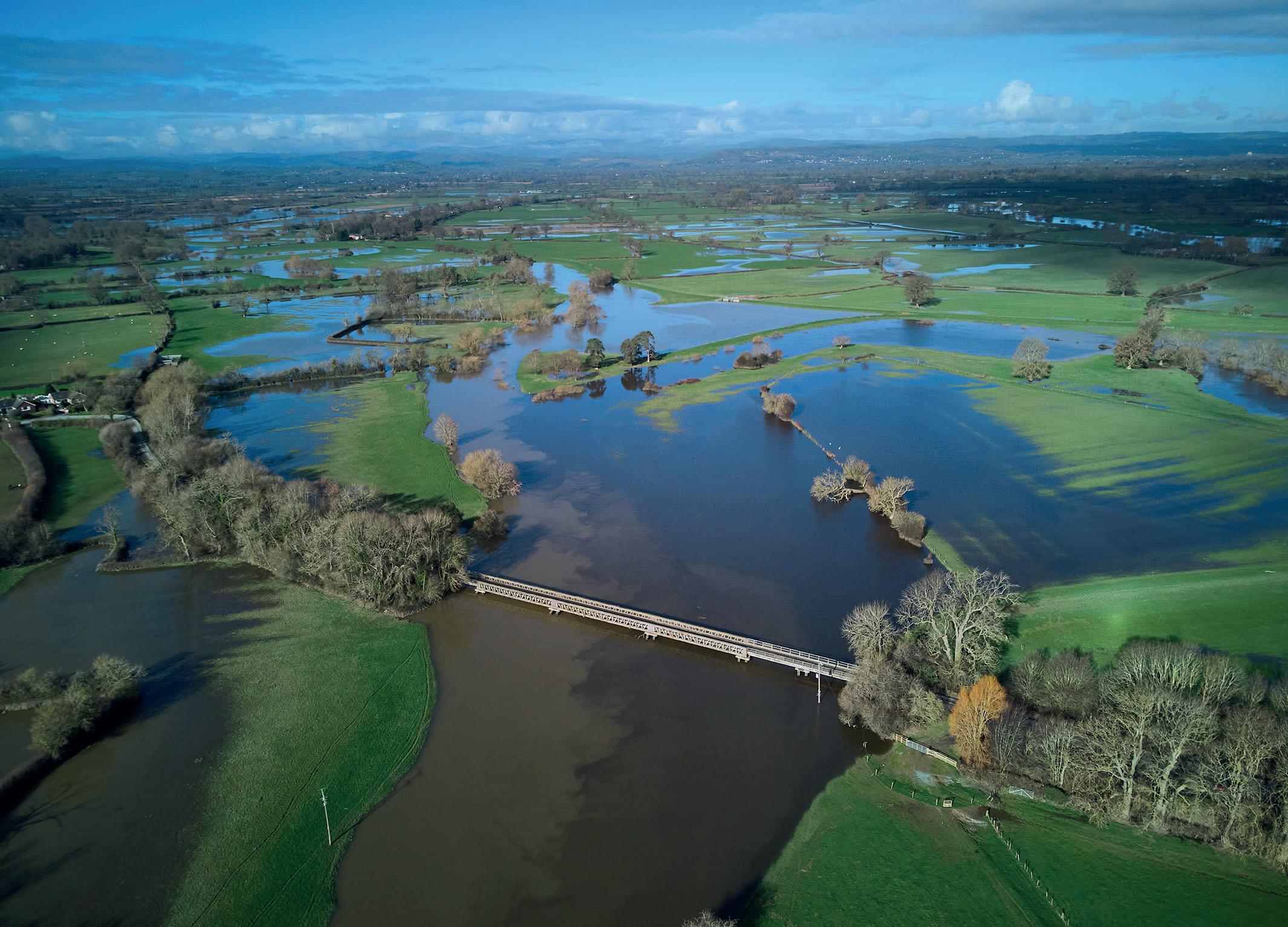
This year has been challenging in terms of grassland growth and management, with the wet winter followed by a very dry spring.
So with this in mind, our grassland special this month (beginning on page 36) focuses on first cut silage analysis and advice from the experts about resilience and planning as we continue to navigate increasingly tricky weather conditions.
As well as dealing with the day-to-day of running a farm, we also need to keep abreast of what is happening more widely in the world of politics and the news of late has been dominated by the recent Spending Review.
Overall, the announcment from Chancellor Rachel Reeves and HM Treasury was not as bad as had been previously predicted. As expected, there will be spending on environmental outcomes, with Defra prioritising air, water and biosecurity gains, but just exactly how this will play out for farmers remains to be seen.
The key area in terms of ‘support’ will be the new iteration of the Sustainable Farming Incentive, the current version of which was scrapped at somewhat short notice earlier this year.
Defra is promising more information on this will be forthcoming soon.
Number crunching
Other articles to look out for in this month’s edition is the deep-dive into Defra’s latest Total Income From Farming figures on pages 72-73.
It is fascinating to look at these numbers, particularly when you consider the figures in inflation-adjusted terms.
And finally, there’s a couple of great events coming up in the dairy farming calendar: firstly, Harper Adams University will open the doors of its Future Farm for the Gold Cup winner’s open day (page 68), and secondly the Miller family will host Holstein UK’s Premier Herd Open Day following their award win (page 28). Both events promise to be great days out.
of
antimicrobial use with early mastitis
underestimate how much right to roam will
Some relief despite Defra budget cuts
Health defence and education were the focus of Chancellor Rachel Reeves’ speech as she revealed her Spending Review, with no room for any mention of farming or rural communities.
Ms Reeves announced total departmental budget growth of 2.3% per year in real terms, although Defra’s settlement would represent a real terms cut for the department’s spending.
Central Association of Agricultural Valuers executive secretary Jeremy Moody said it looked
like a ‘slight cut’ to the Defra budget in cash terms and slightly larger one in real terms but the real question was ‘how that money will be spent’.
He highlighted farmers would also be impacted by other policies, such as transport projects and funding announced for the devolved nations.
NFU president Tom Bradshaw cautiously welcomed the settlement, but said the cut meant farmers and growers would have to do more with less.
“The devil will be in the detail. And it is essential that the Environmental Land Management
Muller to launch organic programme
JMULLER has announced it will create a tailored organic programme within its Muller Advantage programme to ‘drive security of supply by reinvigorating and protecting the long-term viability of its 60 organic dairy suppliers’.
With demand for organic milk increasing, the dairy said ‘the current offering does not deliver the stability, confidence and competitiveness required’.
There will be a new Muller-led pricing model taking into account new factors including fluctuating organic input costs, succession challenges, labour costs and investment required to help reduce on farm emissions.
The dairy said it was confident
it could help ‘supplying organic farmers become less exposed to price volatility and create the conditions to grow and invest in their business.
Richard Collins, head of agriculture at Muller Milk & Ingredients said: “The future of the British organic dairy sector is at risk.”
He highlighted the decline in production, adding they needed to find new solutions and their offering would provide ‘stability, competitiveness and long-term confidence’.
“If we get that right, it not only builds supply chain resilience, but creates the conditions for further investment and innovation across the sector.”
As part of the settlement, £4.2bn will be invested over three years in flood defences across the country.
schemes will be accessible for all farmers to get involved.”
Jason Beedell, rural research director at Strutt and Parker said it was ‘hard to decipher the exact implications’.
He hoped the cut would be offset ‘at least in part’ by spending to address historical IT challenges.
“It is interesting to note the Government’s ambition to drive efficiencies by introducing a common grants platform – and possibly a single grants delivery body – to handle grants and payment administration,” he said, adding while it made sense in principal experience showed new systems can cause ‘shortterm challenges’.
“Long-term clarity is what businesses now need to plan, invest, and build resilience.”
As part of the settlement,
News in brief Wales bans livestock movement
JUntested livestock from outside Wales will be banned from entering the country in a bid to hold back bluetongue for ‘as long as we can’, Welsh Government has announced.
paid to farmers will increase by 150% from £800m in 2023/24 to £2bn by 2028/29.
Overall farmers and land managers will benefit from an average of £2.3bn a year through the Farming and Countryside Programme.
Deputy First Minister and Cabinet Secretary for Climate Change and Rural Affairs Huw Irranca-Davies said although livestock moves to live will be permitted with a negative pre-movement test, he was ‘unwilling to risk the uncertain impact of the disease in livestock dense areas like the Welsh borders’.
The move is in response to the England-wide restrictive zone announced by Defra which is due to come into effect from July 1.
£4.2bn will be invested over three years in flood defences across the country – an average of £1.4bn each year and a 5% increase compared to the current Spending Review period.
Over £7bn will be invested in nature recovery, including environmental farming schemes, tree planting and peatlands.
Funding for the Environmental Land Management Schemes
The devil will be in the detail. And it is essential that the schemes will be accessible for all farmers to get involved
TOM BRADSHAW
Farmers on the borders will be particularly affected by the new rules which Welsh Government said apply to livestock only going into Wales. The measure does not restrict movement within the country nor for animals leaving Wales.
The decision has been met with disappointment by the Farmers’ Union of Wales which said the sheer number of cross-border holdings and trading activity will be vastly disrupted and midges which carry and spread the virus would not respect any such boundaries.
Agri-Kit Equipment
Rachel Reeves
Thousands of badgers vaccinated against bTB
Atotal of 4,110 badgers were vaccinated against TB last year as part of the Government’s major drive to increase vaccination rates and end the badger cull.
The increase to 24% is a ‘record high’, with Defra claiming it is part of significant progress to deliver on Labour’s manifesto pledge to end badger culling by the end of the Parliament.
The number of badgers culled in England in 2024 fell by 12% compared to 2023 and is now less than half the number culled at the peak of the policy.
The Government is also accelerating its plans further with the launch of a new Badger Vaccinator Field Force which is due to come into force next year.
This is expected to increase badger vaccination at pace in or-
der to drive down bovine TB rates.
In addition, projects supporting farmers to carry out vaccinations themselves are set to launch later this year, with a revolutionary new programme working with the
NFU and the Zoological Society of London (ZSL) in Cornwall.
Farming Minister Daniel Zeichner said bTB had ‘devastated British farmers and wildlife for far too long’.
DAIRY INDUSTRY WOMAN OF THE YEAR AWARD OPEN FOR NOMINATIONS
NOMINATIONS are now open for the 2025 Dairy Industry Woman of the Year Award.
Run by Women in Dairy, an initiative of the Royal Association of British Dairy Farmers (RABDF), the award recognises exceptional women making a real difference in the industry.
Now in its ninth year, the award is a key part of the Women in Dairy mission to bring together women from all roles in the sector through regional discussion groups and national networking.
Previous winners include artisan cheesemaker Mary Quicke, livestock consultant Dr
Jude Capper, dairy farmer and consultant Anna Bowen, dairy worker Lianne Farrow, and dairy farmer and industry representative Janette Prince.
Nominations must reflect the core values of Women in Dairy: connecting with others across the sector and the public, inspiring future generations and sharing knowledge and expertise.
Di Wastenage, dairy farmer and Women in Dairy patron, said: “There are so many inspiring women in our industry who play vital roles in its progress and innovation. This award is about celebrating their contributions and giving them the recognition they deserve.
“Nominees do not need to be farmers – they could be vets, consultants, technicians, researchers, or work elsewhere in the dairy supply chain. What matters is their impact.”
Nominations are open until July 25.
Finalists will be selected by a judging panel and invited to a short interview with the judges and a member of the Women in Dairy steering committee.
The winner will be revealed during the Women in Dairy Conference on September 17, 2025 at Chesford Grange in Kenilworth.
n More details at www. womenindairy.co.uk/award.
“We promised a comprehensive bTB eradication package, which will allow us to end the badger cull by the end of this Parliament, and this is what we are delivering – with today’s figures showing the clear progress we are making.”
Chief Veterinary Officer Dr Christine Middlemiss said bTB was on a ‘on a very positive downward trajectory following years of hard work’ and that the team remained committed to ‘take a dataled and scientific approach’ as the country transitioned to fully adopting non-lethal control methods for managing this ‘insidious disease’.
The news follows recent reports that badger culling is set to continue in 19 areas, following an extension of licensing agreements.
Permits
According to reports, cull permits have been reissued for nine areas of England, with a further 10 being given the go-ahead from September.
While Defra said it had not agreed any further authorisations, it is believed they have been agreed under the terms of the Environment Agency’s 2024 Supplementary Licensing scheme.
Cheshire dairy farmer Phil Latham said it was ‘exceptionally good news in the light of evidence’.
“For me it is straightforward,” he said.
“The cull supports the reduction in badger density which, in addition to measures in cattle, results in fewer cases of bTB. It makes sense to carry on any trajectory which aims to reduce bTB.”
Badgers have been vaccinated to help reduce bTB, and the culls, although decreasing, will continue in 19 areas.
CAREFUL MANAGEMENT KEY FOR TOP QUALITY SILAGE
The careful management of silage ground is key to maximising quality for optimal production from forage, and for making the most out of homegrown forages, for next winter, advises Trident MicroNutri.
SLURRY AND FERTILISER APPLICATION
“Consider timing and application rates of slurry and fertiliser. It can be tempting to prioritise emptying slurry tanks at the expense of over-application on silage ground,” says Anna Millar, Trident MicroNutri ruminant technical manager
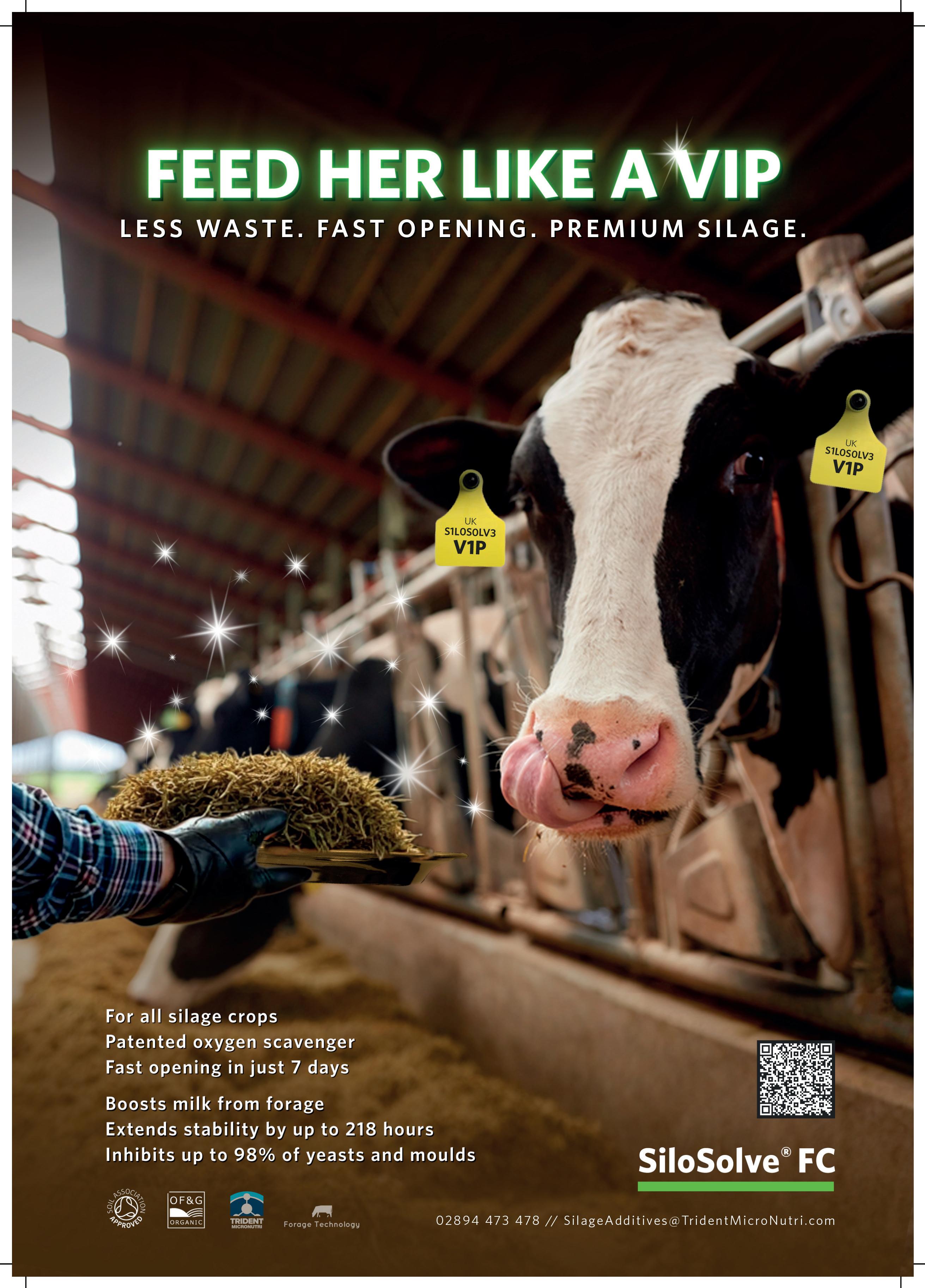
SiloSolve FC is an oxygen-scavenging inoculant, proven to create an oxygen-free environment for rapid, controlled fermentation. As a result, pits can be opened after just seven days. It inhibits up to 98% of yeasts and moulds, resulting in less waste and improved nutrient availability and palatability. This increases the opportunity to maximise milk from homegrown forage.
“If too much slurry has been applied, the risk of excess nitrogen in silage is increased, with negative e ects on fermentation and palatability,” she adds.
Additionally, if slurry has not washed into the ground properly, there is a risk of bringing it back in from the field, causing contamination.
“By analysing soil to understand the exact nutrient requirements of your ground, you can make informed decisions regarding appropriate fertiliser applications, so optimal levels are supplied,” says Ms Millar
TIMING OF CUTTING
Ms Millar also says it is key to think about what you want to achieve. While leaving first cuts later in the season increases bulk, it does sacrifice quality. It is better to cut earlier to capture quality and increase supply of energy and available nutrients.
“Over the last couple of years, first cuts have been stemmier than usual, and on some farms, second cut has been better quality than first cut. While early indications forecast positive growing conditions, the key is to regularly test grass for nutrient content, to understand its nutritional value,” she says.
Trident MicroNutri’s mobile NIR service provides instant NDF results for fresh grass, which can help you understand grass quality ahead of cutting.
PRE-MOWING NITRATE TESTING
Factoring in time for free nitrate testing is also advised. Samples of grass can be analysed to determine free nitrate levels, indicating how well fertiliser has been absorbed and used. Excess free nitrates can have an impact on fermentation and palatability of silage.
SILAGE INOCULANTS
Finally, Ms Millar advises on the application of silage inoculants.
“At Trident MicroNutri, we have three silage inoculants available, applicable to di erent silage situations. Understanding the challenges of the situation is an important first step, followed by correct application of the most appropriate inoculant,” she says.
SiloSolve MC is designed for use on forages which are particularly di cult to ensile, for example low dry matter (under 23%), high nitrogen, low sugar or those with suspected slurry or soil contamination. SiloSolve MC has additional benefits in limiting the growth of clostridia bacteria.
For issues with top-layer spoilage, SiloSolve OS is available. This is a powerful silage additive designed to reduce top-layer spoilage through preventing the growth of yeasts and moulds, resulting in improved aerobic stability at feed out.
Ifan Roberts
DAIRYTalk
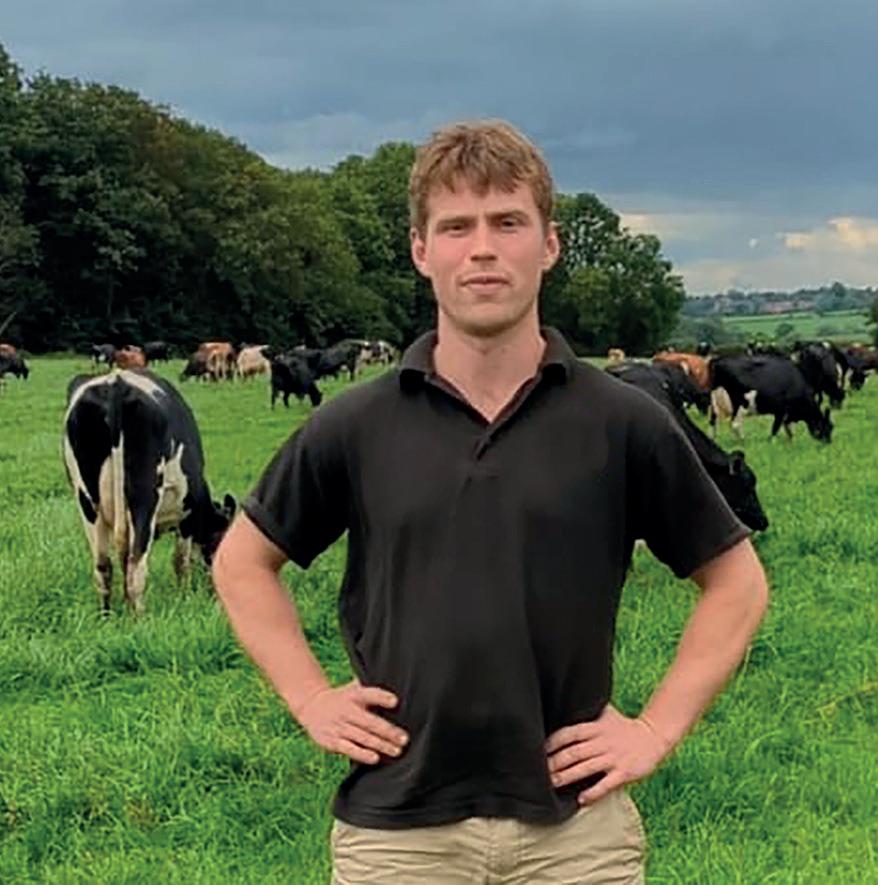
Ifan Roberts is a new entrant who has established a contract farming agreement milking 500 block calving cows in Cheshire, and is aiming to improve the land, encourage others to participate in the industry and deliver attractive returns to his stakeholders.
All in all, an expensive endeavour indeed, but which will hopefully pay dividends over our 10-year contract
We have reached the mid-way point of our first season at Brookhouse Farm.
The cows are holding their yields nicely at 23 litres/cow with 4.6% butterfat and 3.7% protein.
The team is also well into the mating season having submitted 90% of the herd for AI in the first three weeks with the majority of those cows receiving dairy sexed semen to front-load heifer replacements in our block.
We have also seen a comfortable return rate well below 50% in the cows’ second cycle, which should hopefully translate into an acceptable pregnancy rate.
Having had copious amounts of rain in the beginning of June, our grazing platform has now finally taken off and is growing at 105kg DM/day, but is rapidly going to seed post-drought which we will have to manage.
I also have had time to reflect on some of the decisions we made as we took on this contract farming agreement.
To date we have deployed £750,000 of capital including the 500 cows. The focus has been on spending capital to ultimately lower the cost of production for the future and save time when running the unit, while making it an enjoyable farm for everybody to run.
A budget was set out including a fixed size bank loan.
Fences
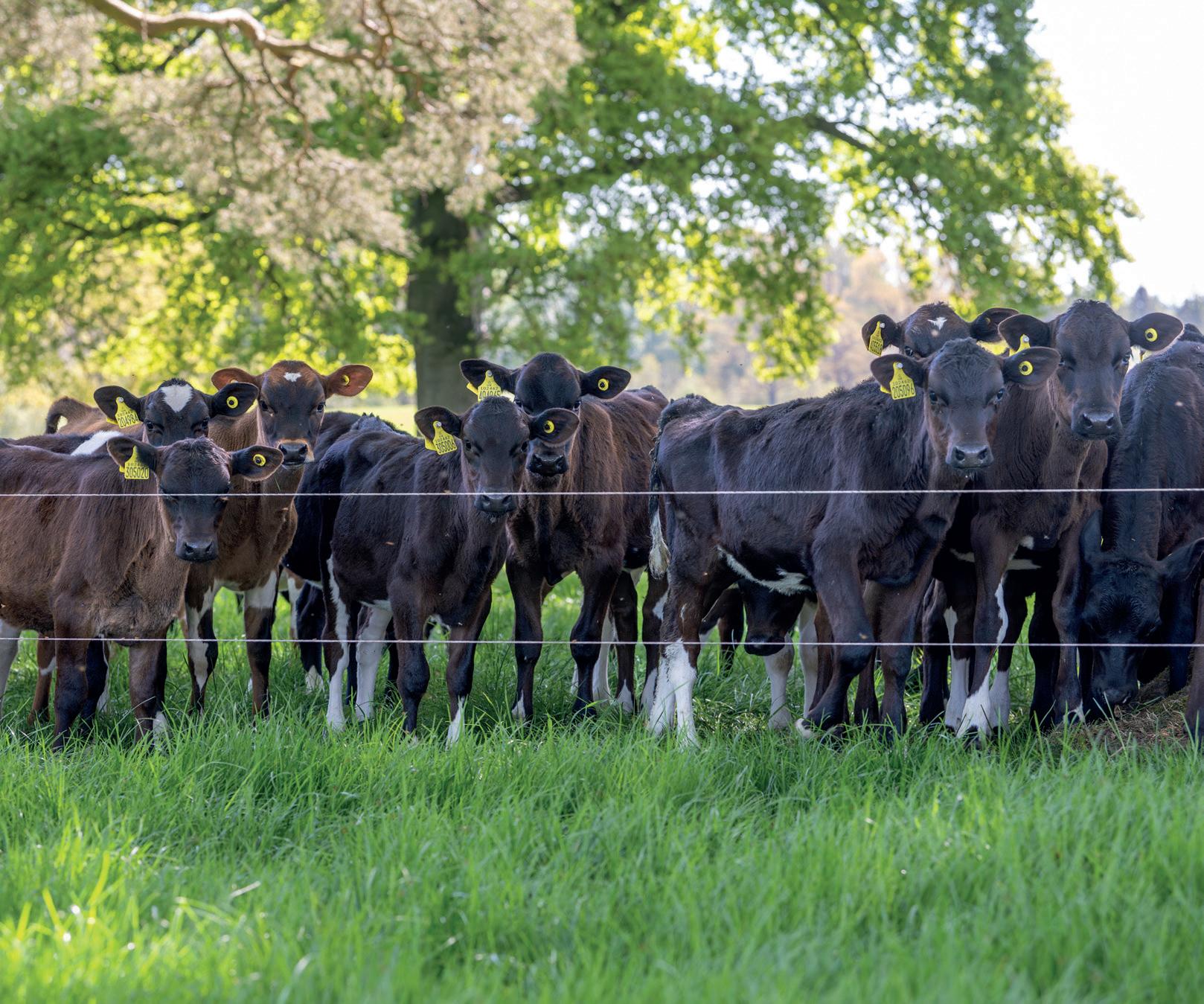
The first action was to re-fence all internal fences on the farm with single-strand electric wire. This was done at the cost of £30,000 which felt like a lot of money at the time, but has been a huge help in improving how efficiently the farm runs. Cows are now very well disciplined with correct power in fences and can be held to a rigid grazing rotation.
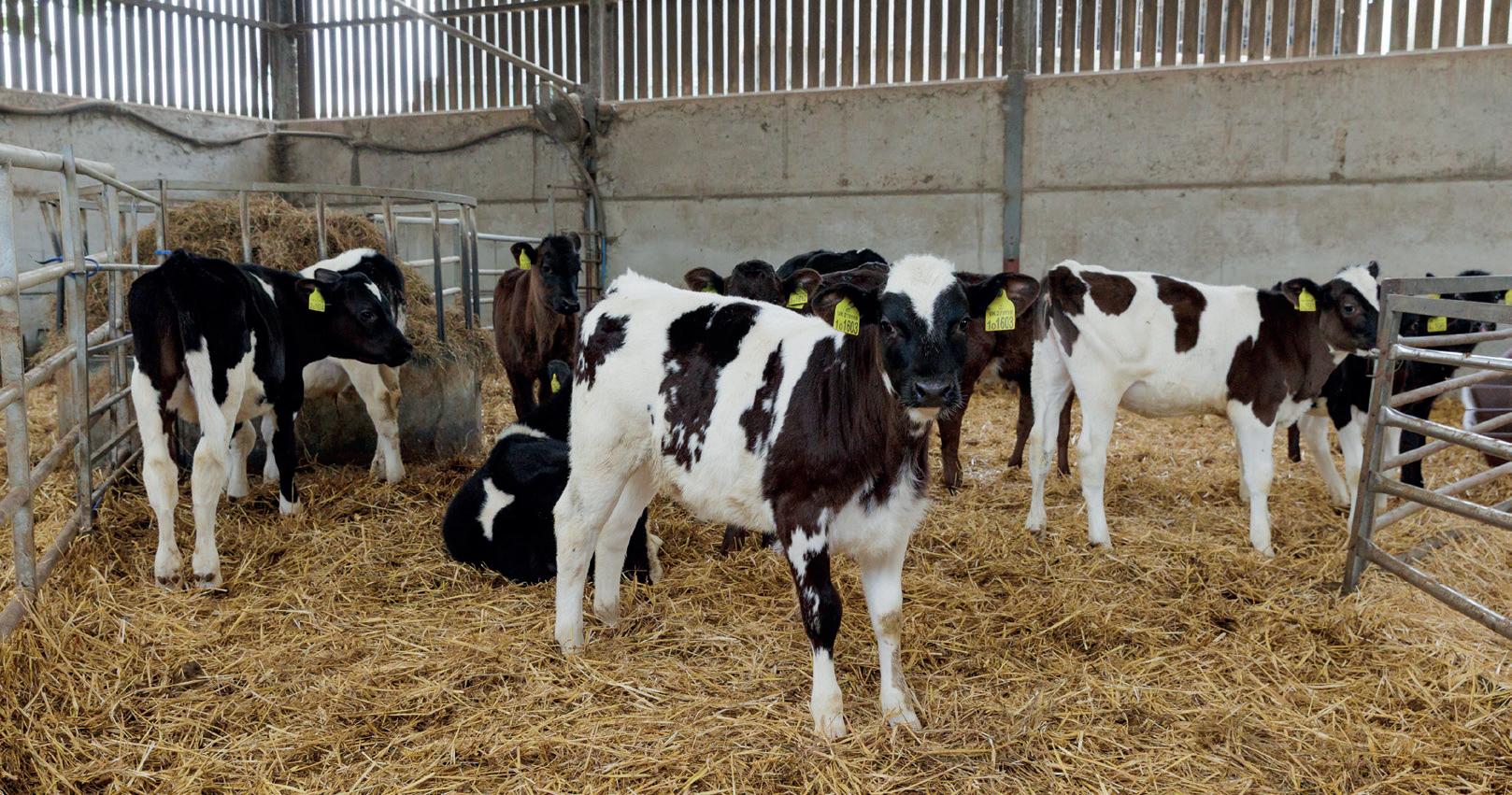
As calving loomed, we re-vamped an old steel frame shed into a purpose-built calf shed that was able to accommodate the 350 calves fed on milk at its peak.
This was done at the cost of £14,000 with a lot of the installation being carried out by skilled members of our farm team and includes a home-made stationary milk powder mixing and pump station which allowed our calf rearer to pump milk direct to calves around the shed.
This investment greatly helped our calf rearer to achieve a less than 2% loss rate in the calves and allowed her more time to tackle higher value tasks.
Following this, we decided to make alterations to the
existing 30-year-old dairy master 30/60 herringbone parlour. We replaced automatic feeders with simple pull feeders, replaced the five old vacuum pumps with a new variable speed pump, replaced claw pieces and wash line all at the cost of just over £40,000.
This allowed us to trim down our milking and wash down time to three hours in the morning and two hours 30 minutes in the afternoon, helped to reduce cell counts as cows are milked out effectively and improved morale.
We also installed a 20-cow herringbone rail in an old building to make the handling of large numbers off cows efficiently for £9,000.
With regards to machinery to run the farm, to begin with the Latham family kindly allowed us to use their existing fleet as we took our time to scour the country for the right items at the correct price.
We opted to obtain bank funding to secure these items and proceeded to buy a JD UTV, electric hoof trimming crush, a MF 150 hp loader tractor and a Toyota hilux second hand from facebook marketplace which so far seems to have delivered the goods.
We have also bought a brand-new simple disc mower to help to maintain pasture quality and mowing surplus grass for silage when needed.
These have all come in at the total cost of just over £80,000, but we have still around that amount again to spend as we add items to assist with the winter routine. All in all, an expensive endeavour indeed, but which will hopefully pay dividends over our 10-year contract .
Robert Reed
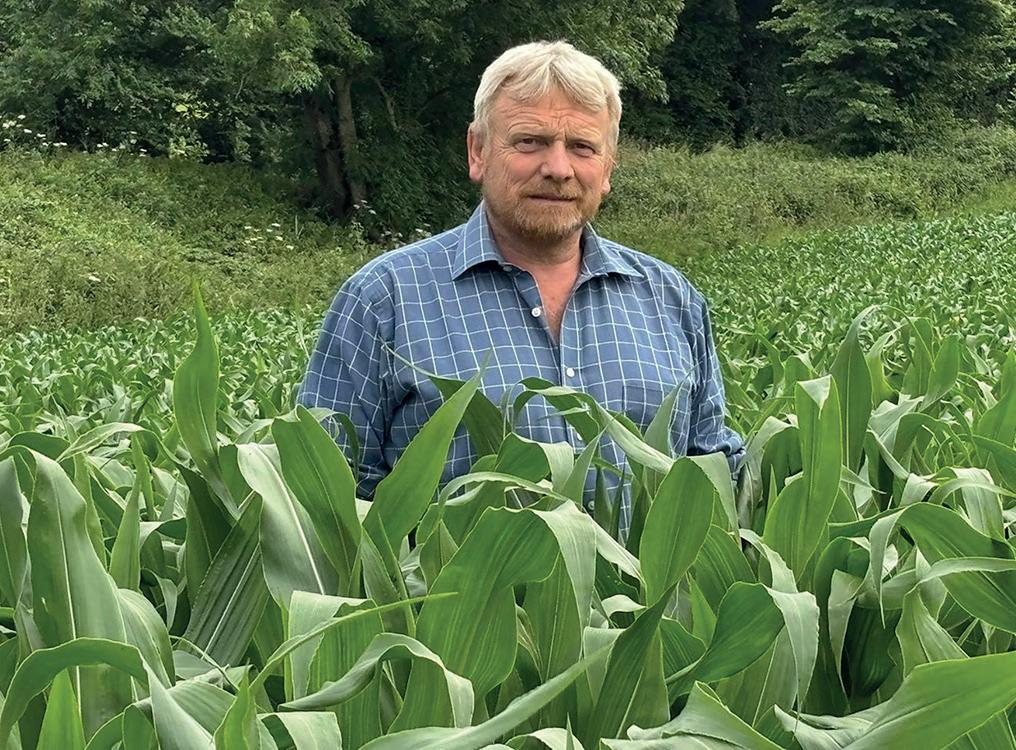
Farming 405 hectares (1,000 acres), a mix of tenanted and owned land at Gatcombe Farm, near Seaton, Devon, Robert Reed and his family milk 350 all-year-round calving Holstein cows via five robots and are achieving average yields of 12,000 litres.
Much to our
surprise,
we had a clear bovine TB test in our dairy cows six weeks ago. This has now given us 14 months bTB free
How many times do we hear, ‘Be careful what you wish for’?
We went through a wet winter and longed for some dry weather. The high winds and the sun early in April soon turned things around from a wet time to a dry time.
I must admit we got away a lot better than most here in Devon and Cornwall with wanted rain, having had 60mm over Easter which of lot of the country missed.
Having given up on all of the catch crop grass, we could start drilling maize on April 5 and all was finished within a week. Drilling this early always creates controversy, but everyone’s land is different and you normally know your own ground better than most.
Our arable land is around 150m above sea level and mostly with a light, thin soil. I have seen more crops fail due to lack of moisture than drilling too early on our land.
We drilled slightly deeper this year at about 2.5 inches because we seem to have had more trouble with bird damage in the past few years.
We have, in the past, drilled most of our maize under film. But the extra cost, harder to control weeds and not liking seeing the film in the fields for many years after, were reasons for changing.
Earlier
We have lost a small percentage of seeds, around 5% for one reason or another, but having most of the maize knee high on June 1, this more than outweighs the plants lost and gives us an earlier harvest date, which is normally two weeks later than the lower land around us.
A light first cut of grass was done on April 10 and a very good second cut was done a month later. We currently have just done a third cut, which was in need of some rain, but has made some nice silage.
We turned out some 12-month-old beef cattle in the middle of April on some of our low input rough grazing. We have had trouble in the past with blackleg on this land, so everything has to be vaccinated before turn out. These cattle went out and within a few days I could tell something was not right.
We realised we had a tick fever and, then later, red water problem. We have never had either on this land before – the weather had obviously triggered something.
All cattle since were given pour-on before going out.
Much to our surprise, we had a clear bovine TB (bTB)
test in our dairy cows six weeks ago. This has now given us 14 months bTB free.
You walk on eggshells the whole time, knowing you will go back down again at some point, as we don’t think we have removed all our bTB cows.
Dick Sibley (the vet) and myself are hoping to be able to roll out a trial for what we have done at Gatcombe. To achieve this, we will have to move mountains, but we are fighting the whole time. If we get anywhere with this, it will give me something to talk about going forward.
The milk price has been very good this spring considering milk production is so high. There is a shortage of milk in Europe which is holding up our milk price, how long before this will change, I do not know.
With the new milk contracts being drawn up by processors, they are starting to manage their supply better.
I understand that one processor has gone to the extent that if you are a certain percentage over your allocated litres, they will not be picking up the extra milk.
Maybe this is to the extreme and will not go down very well with some farmers, but if we as farmers buy X number of litres of diesel, tonnes of feed or fertiliser, we would not like it if the supplier was to impose more on us.
The processors and dairy farmers have to work together to manage their milk pools if we want a good stable milk price.
I wouldn’t want their headache of finding a home for the extra milk, I’ve got enough of my own some days. And we all know from experience the higher the price peaks the bigger the fall when it comes off the other end.
On Farm
After over 30 years as an arable unit, a Cumbrian farm is now carrying a herd of dairy cows, with milk from grass now the key focus. Wendy Short reports.
Arable farm converts to dairy production
The herd averaged a yield of 5,000kg at 8.9% solids last year, with late spring yields this year peaking at 27kg/head.
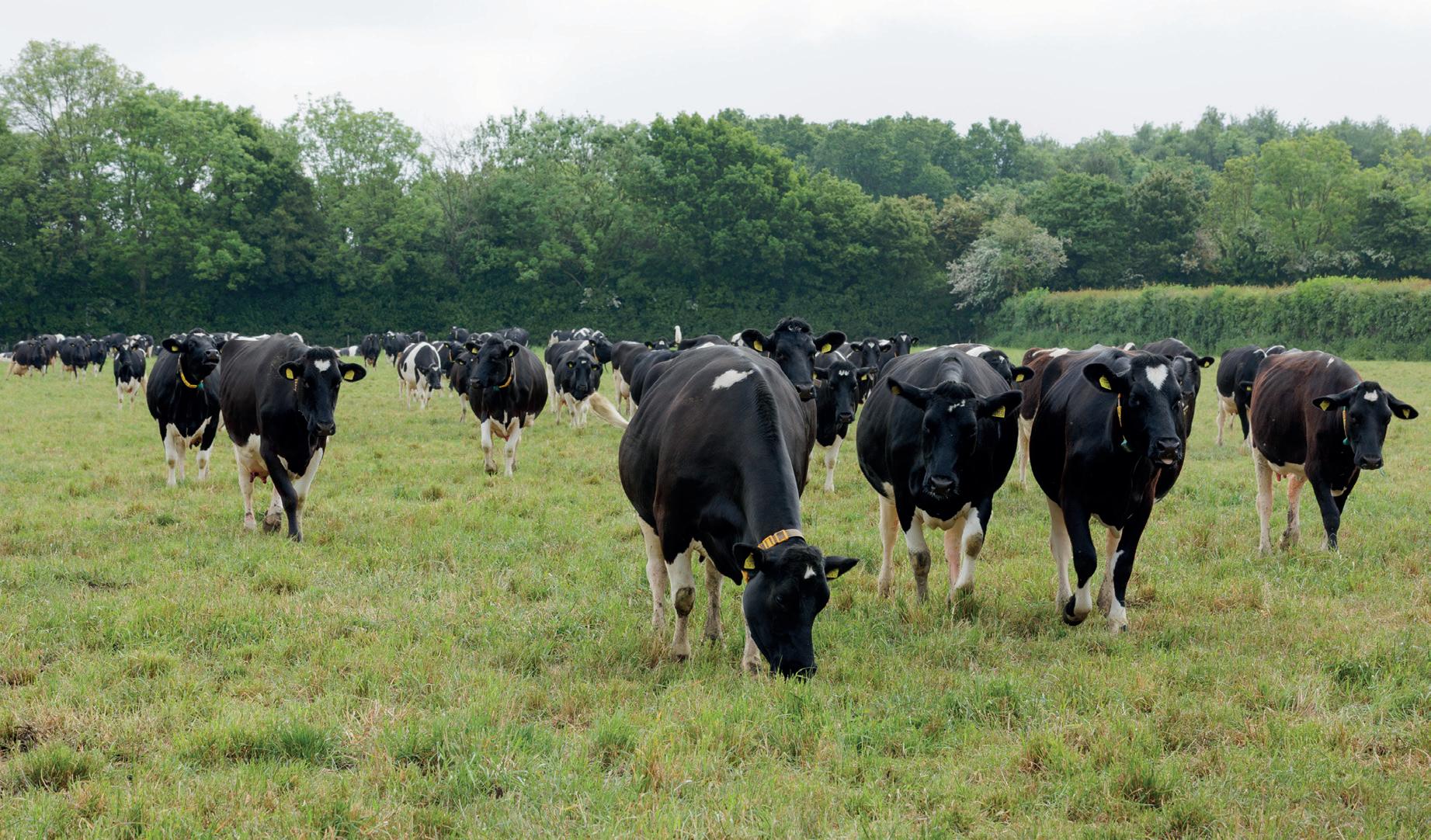
Established in 2022 on a former arable unit, Whitrigg Farm near Penrith, Cumbria carries 550 crossbred cows on a low input, grassbased system.
A ‘grazing-type’ cow was the main requirement when a group of heifers was sourced to set up the herd explains herd manager, Max Dunford.
“The Friesian cross Jersey cows were brought across from Ireland as heifers,” he says. “They are put to genomically-tested, New Zealand Holstein Friesian cross Jersey sires and they have fitted in very well, calving from February until April.
“The female type suits the general management policy, which requires a good all-rounder with high solids potential and the genetic ability to turn grass into milk. The average mature weight is about 500kg.
“Last year’s average yield of 5,000kg at 8.9% solids came from first and second calvers. It is reasonable to assume that production will rise in 2025 by comparison and late spring yields peaked at 27kg/head.”
Milk is sold to Arla on a constituents contract to supply Morrisons supermarket, so maximising butterfat and protein levels is a priority adds Mr Dunford, who took up his post shortly
after the herd was set up on a contract farming arrangement on Lord Inglewood’s estate, with the 257-hectare (550-acre) unit run by brothers, Richard and Grant Walker.
“One of the estate farms was previously occupied by another dairy herd, and the buildings are now used for rearing this unit’s youngstock,” says Mr Dunford.
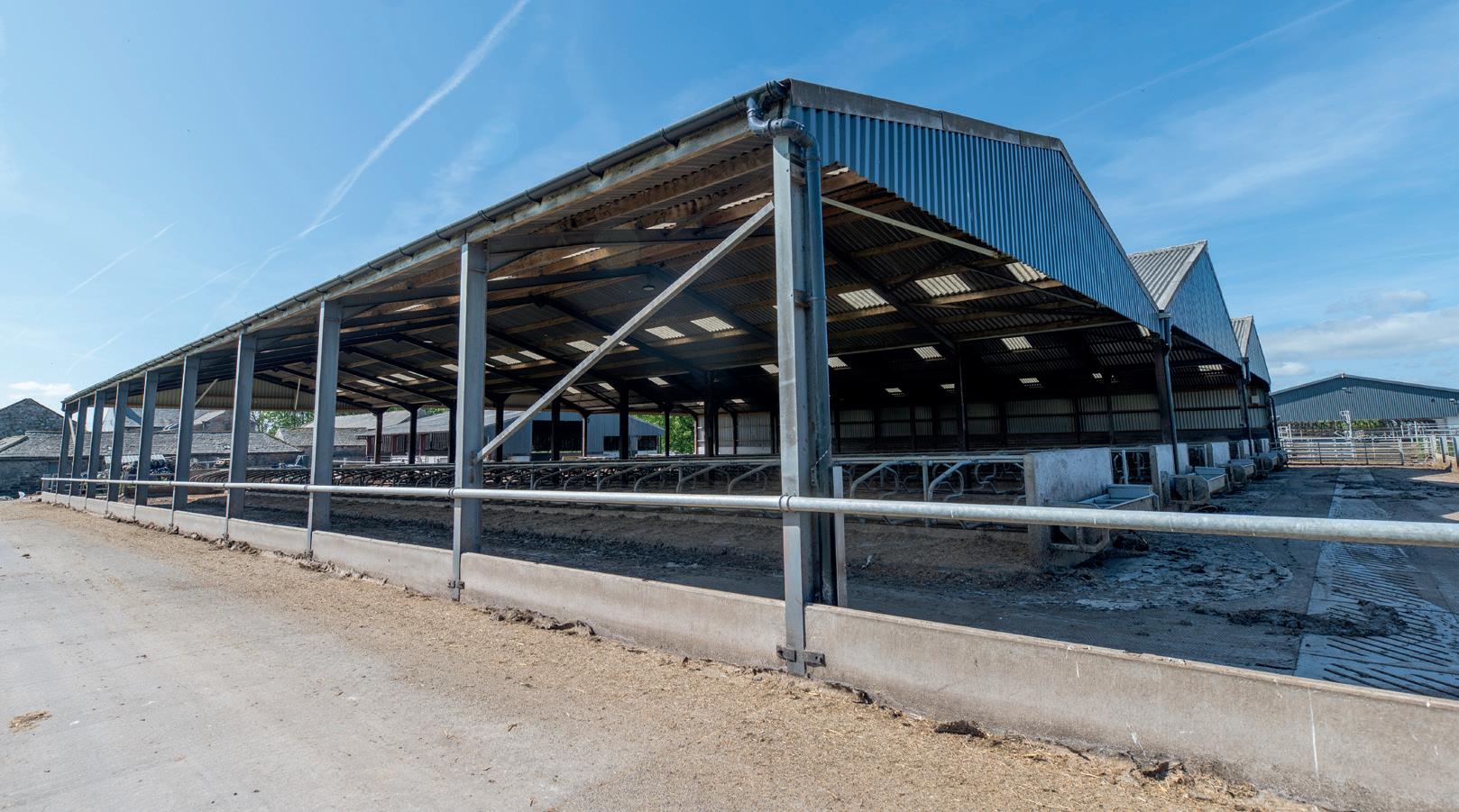
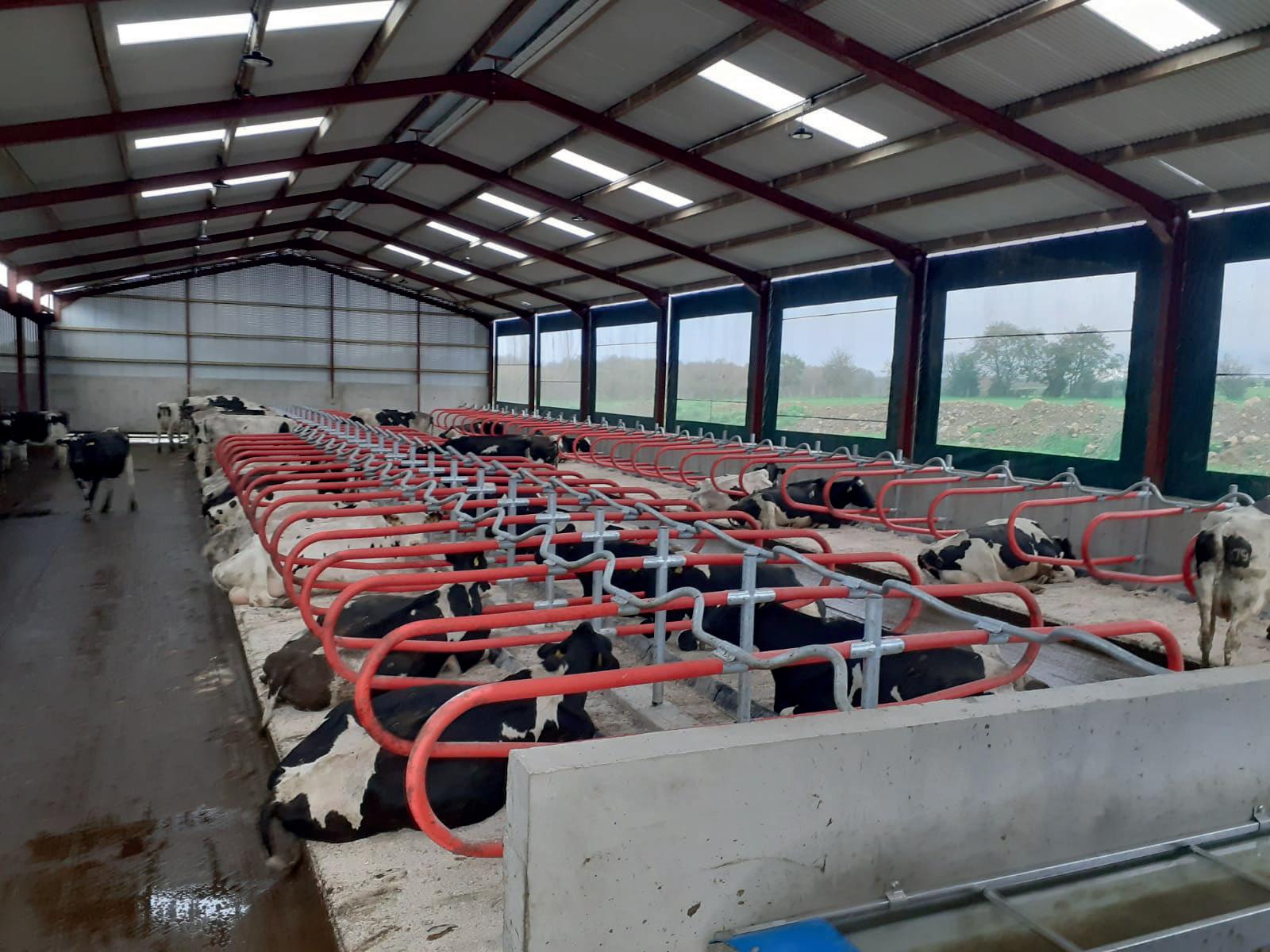
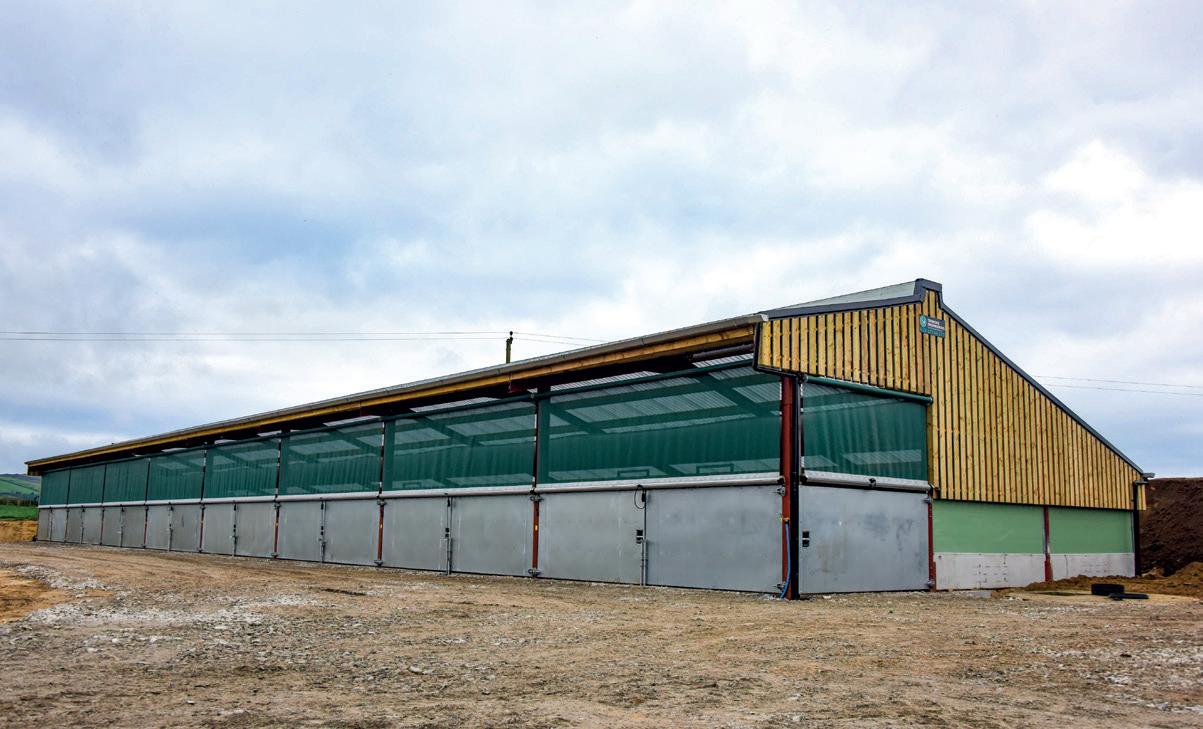
“The milkers are kept in a converted grain store that has been retrofitted with cubicles.
“The 54-bay rotary parlour was an addition, and it allows one man to milk 400 head in an hour. It has roller shutters on all sides and that has been really useful for controlling the ventilation. There
is also a straw-bedded building for the dry cows.”
Contracting
The business employs two other full-time staff, Adam Scott and Will Ingamells, and Mr Dunford says extra help is taken on at calving time. All the tractor work and the cattle feeding are carried out by contractors, so the only machinery tasks in house are feeding, scraping out and bedding up.
The conversion from 30-plus years of arable production to 100% grassland has not been without its challenges, he says.
“The soil is a heavy clay, and the farm lies in a high rainfall area. Careful management is
PICTURES: MARCELLO GARBAGNOLI
needed for the grass to consistently maintain high dry matter yields, and achieving target soil indices is a work in progress.
Soil fertility has already been lifted, and the lack of organic matter is gradually being addressed. Plenty of lime was added before the cropping land was reseeded with grass, so the pH fully meets the target.
“The whole farm is in its second year of over-seeding with herbal leys, as part of the Sustainable Farming Incentive agreement. This is very different from the former system, which used three tetraploid ryegrasses and white clover. The herbal species make a useful addition to the leys, in my opinion.”
The turnout period of February to November for the rotational grazing policy has to be balanced to minimise the risk of poaching, while at the same time maximising productivity, he says. The average stocking rate is 3.7 cows per hectare and grass weights are monitored once or twice a week.
Mr Dunford says: “The cows are grazed during the day as soon as they calve and they enter the 3-7ha paddocks at the three-leaf
stage. One square metre of grass is clipped and weighed, and productivity needs to reach about 2,800-3,000kg of dry matter per ha before grazing.
“The cows will be moved out at a residuals figure of 1,500kg, or when they show signs of restlessness. The aim is for a 21-day paddock rotation, but it is important to remain flexible and follow the grass growth curve.”
From left: Adam Scott, Will Ingamells and Max Dunford.
On Farm
The herd is walked up to four miles a day to and from the parlour, with the installation of cow tracks playing an important role in the routine.
“The furthest paddock is some distance away and a series of stone tracks put down on topsoil was laid as part of the initial infrastructure. Each paddock has been designed with several gateways and the tracks run alongside, to prevent damage to the grazing land. Every area has a fixed water trough that is fed by a ring main.”
Feeding
At grazing, the cows receive 3kg of a 15% protein blend in the parlour and the allocation is reduced to 14% as the season progresses.
Over winter, grass silage forms the basis of the ration, and the parlour-fed protein level is increased to 16%, with straw added to the diet in the run-up to calving.
The extra dietary fibre in late pregnancy is a measure to reduce the likelihood of milk fever cases says Mr Dunford. The cows are also given a small quantity of rape meal three weeks pre-calving.
Heat detection is managed via electronic collars, with the heifer cycles synchronised.
“Only 6% were empty after 12-weeks’ of breeding, and 90% of the heifers calved in the first month of the block,” says Mr
Farm facts
■ The whole farm is in its second year of over-seeding with herbal leys
■ Three cuts of silage are taken from 73-hectares (180-acres) and yields are boosted with the spreading of ammonium sulphate, slurry and farmyard manure
■ The grazing area is also cut for silage in high growth periods
■ AI bulls used last year included Burgess Plato and Paynes Predator.
Dunford. “However, there are no females beyond their third lactation and the cows are not pushed for yield, so there is an expectation that fertility, as well as health issues in general, might be lower than average.
“Only a 10% replacement rate was needed for the 2025 season due to the low culling, empty and mortality rates, but replacement numbers are likely to rise in forthcoming years.”
Calf management is centred on controlling disease risk and boosting growth rates.
The lower end of the herd is served with Aberdeen-Angus semen, and their calves are sold at three weeks old.
Meanwhile, the replacement heifers are grouped in pens of 10 and moved into groups of 20 as soon as they are drinking well from the multi-teat milk feeding system, before being weaned at eight to nine weeks.
Turnout is at 10 weeks, when they follow a similar rotational grazing pattern to the cows, although they are also given ad-lib access to the protein blend.
Mr Dunford says his long-term goal is to run his own unit on a contract farming agreement.
“I was born on a Somerset dairy farm and went on to obtain a degree in agriculture at Newcastle University before gaining some experience by working
on a couple of other dairy units. I would like to run my own contract dairy farm at some point; my employers are aware of my ambition, and they are fully supportive.
“One of the biggest pressures at Whitrigg is keeping top quality grass in front of the cows at all times. Any misjudgement will be reflected in the yield, so checking covers and moving cows form a large part of the day-today work.”
Mr Dunford adds he was delighted when the opportunity at Whittrigg Farm came up. He says: It has been very rewarding to join a herd at such an early stage in its development.”
that has been retrofitted with cubicles.
Replacement heifer calves are turned out at 10 weeks, when they follow a similar rotational grazing pattern to the cows.
The milkers are kept in a converted grain store
WE’VE HAD NO WASTE WHATSOEVER
Stephen Morse farms 400 acres with 240 cows in Carmarthenshire. His AYR housed cows currently average 11,500l, with milk supplied to First Milk.
“We started using MAGNIVA inoculants in 2024 because we liked the idea of using crop-specific inoculants.
“Previously, we had problems with secondary fermentation when using a different inoculant so wanted to change our approach.
“We use our own harvester from our contracting business and apply the appropriate MAGNIVA product for each type of forage – grass, wholecrop wheat or maize – at the recommended rate.
“When feeding out, we have all clamps open at the same time and use a Triolet robotic feeding kitchen to mix and feed the TMR.
“It takes 1 week to cross the face of the wholecrop clamp, and since using the MAGNIVA inoculant we’ve had no secondary fermentation at all. The clamp is completely cool from face to feed-out and we have had no waste whatsoever.
“At high starch and dry matter levels, we’re also delighted with our wholecrop analysis. We would 100% recommend MAGNIVA forage inoculants to others.”
“The clamp is completely cool from face to feed-out”
Using MAGNIVA crop- and condition-specific forage inoculants helps you get more from your crop and your cows, every time.
DAIRYMatters
‘Dairy farmers are at a crossroads’
This month, John Lancaster, head of EMEA and food consultancy at StoneX discusses the UK/EU trade deal and its realworld impacts.
When the dust settled after Brexit, UK dairy farmers faced a changed landscape – one where familiar trading patterns with Europe became entangled in new rules and red tape.
The much-discussed UK/EU trade deal, promoted as providing ‘free trade’, has nonetheless created new realities for dairy producers and exporters, realities that go well beyond simple tariffs.
Before Brexit, the movement of dairy products like milk, cheese, and cream between the UK and EU was smooth and seamless. Dairy shipments from Somerset to Paris or from Ireland to Liverpool required little more than a shipping manifest.
John Lancaster
But now, as the UK and EU view each other as third countries, every shipment needs a raft of new paperwork – sanitary and phytosanitary certificates, export health certificates, and additional customs forms.
For larger processors and exporters, absorbing these new requirements is challenging but manageable. For smaller farms and businesses, the sheer cost and administrative burden can make exporting to the EU unviable.
The result? A noticeable drop in exports: since 2018, UK agrifood exports to the EU have fallen by around 21%. When inflation is accounted for, the real impact is even starker.
Impacts
The impact of these non-tariff barriers is felt acutely in commodity pricing. Dairy markets are intricately linked, and even small barriers can send ripples through the supply chain.
When UK farmers produce a surplus, thanks, for example, to a good grass-growing season and healthy milk price, that extra milk and cream would traditionally find a market in Europe.
But post Brexit paperwork requirements and border checks slow down or prevent these exports, particularly for fresh products with a short shelf life.
Surplus cream that would
have fetched a strong price in France or Germany may now be worth far less in the domestic spot market. For processors, this means squeezed margins and sometimes having to pass through lower farmgate prices, especially for those who cannot easily shift their product overseas.
Price swings
Although UK and EU dairy markets generally move together, these new frictions are enough to make local price swings more frequent and more severe. Larger companies can adapt, but smaller operators risk being pushed out of international trade altogether.
Dairy is a classic example of an inelastic market. Small changes in supply or demand can lead to disproportionately large changes in price.
The post-Brexit trading landscape has amplified this reality. For example, strong milk production in the UK this year has lead to increased local surpluses. With exports to the EU hampered, these surpluses translated into downward pressure on spot prices at home.
Similarly, the added costs and administrative effort involved in exporting to the EU have to be absorbed somewhere. Often, they are deducted from the price paid to farmers, reducing the
The adaptability and resilience of UK dairy farmers [...] are essential qualities as the industry evolves
rewards for hard work and careful management.
Despite these headwinds, UK processors and dairy farmers continue to adapt. Some are exploring new domestic markets, developing value-added products, or diversifying their businesses. Others are investing in training and systems to manage the new export requirements, determined to retain access to the vital European market.
Nevertheless, many small and medium-sized enterprises have paused or abandoned EU ex -
ports, waiting for improved rules or more favourable conditions. A proposed common SPS zone between the UK and EU could, in time, ease some of these frictions – but implementation is not expected before 2027.
Resilience
In the meantime, the sector is focused on weathering the cur rent challenges while preparing for whatever the future holds. The adaptability and resilience of UK dairy farmers remain their greatest assets – essential qual ities as the industry continues to evolve in response to shifting global supply chains and trading relationships.
As the details of the trade deal continue to be worked out, the story of the UK dairy sector will be one of adjustment, adapta tion, and – above all – persever ance. For now, every lorryload of milk leaving a British farm is a testament not just to hard work, but to the ability to adapt in a changing world.
Early detection and prompt effective treatment (EDPET) is key to tackling lameness among the UK’s dairy herds. That was the message from Sara Pedersen, veterinary consultant at Farm Dynamics, when speaking at a recent AHDB event held at Crathorne Farms, Yarm.
Ms Pedersen explained how lameness is costing the UK dairy industry more than any other disease, including mastitis and BVD, with an estimated 30% of the national herd lame at any one time. Therefore, identifying lameness and managing foot health on-farm as early as possible is crucial not only to animal welfare, but farm productivity and performance.
As a starting point, Ms Pedersen said foot trimming and lesion data is really important in
Identifying lame cows early and treating cases promptly and effectively is crucial to reducing lameness on-farm and the associated costs to productivity. Katie Fallon reports.
Early lameness detection is key
understanding the impact of lameness on-farm and where to target changes. She said: “Identify the number of cows with each type of major lesion and then you can start putting costs to it.”
She explained that because lame cows are under a great deal of stress, the impacts of
lameness can be seen in many areas, including fertility.
Ms Pedersen said: “Even though feet have nothing to do with the reproductive tract, it is having a bigger impact [on fertility] than other diseases that directly impact the reproductive system.”
Other costs of lameness include culling and lack of production, with the highest yielding cows at an increased risk of lameness. Ms Pedersen explained a cow with white line disease could see a yield reduction of 370kg over a 305-day lactation and could spend 354
Sara Pedersen explains that due to the stress caused by lameness, an impact can be in many areas, including fertility.
days less in the herd, on average. That number rises to 570kg of milk production lost in the case of a sole ulcer, and 457 less days in the herd.
Therefore, detecting lame cows as early as possible is key to maintaining production and productivity, and Ms Pedersen shared some of the key signs of
It is having a bigger impact [on fertility] than other diseases that directly impact the reproductive system
SARA PEDERSEN
early lameness. She explained that a cow which is lame on its front foot, its head will come up, but if it is lame on the back foot its head will go down.
Ms Pedersen said that focusing on the movement of the dew claws (accessory digits) at the back of the foot can be a very useful early indicator of lameness. In
a normal cow these move up and down evenly as the cow walks.
She said: “Where there is some pain during weight bearing, this can result in the foot appearing ‘stiff’ with a lack of flexion. As a result, the dew claws do not drop as far as they would do if there was no pain.”
Mobility scoring
Ms Pedersen also advised mobility scoring cows fortnightly with daily lameness surveillance as best practice for picking up early signs of lameness. However, she said if farms are currently mobility scoring quarterly and move to monthly, that is an improvement and a small but incremental change. She also advised carrying out routine inspections for foot trimming at eight to 10 weeks before calving, 60 to 80 days in-milk and eight to 10 weeks before calving for in-calf heifers. “Lift the feet up between 60 and 80 days in-milk as this is the peak
Vet’s View
risk period, particularly for bruising and sole ulcers.”
To understand whether early lameness detection is working, Ms Pedersen said bruising is a good indication that lame cows are being identified in the early stages. She said: “Most lesions start with bruising, so we want to catch it at this stage.”
From the start of bruising to seeing visible signs of bruising in the horn, it takes roughly three weeks, said Ms Pedersen. She advised using hoof testers to identify early bruising in lame cows. Treating these cases with application of a block to the sound claw, followed by pain relief means they are likely to recover quicker and less likely to become lame in the future.
She added: “If you are seeing severe lesions, such as sole ulcers, in new cases of lameness, you are way too far behind. We need to be picking lame cows up at the bruising stage.”
Sara Pedersen
A two-step approach to calf milk replacer feeding has reduced the number of mortalities to just under 2% at a Leicestershire dairy farm, as well as decreasing the incidence of scour. Dairy Farmer reports.
John Greaves and his family run a herd of 220 all-year-round calving 9,000litre average yield
Holstein Friesians at Lodge Farm, a 324-hectare (800acre) mixed dairy, beef and arable farm, selling milk to Long Clawson Dairy.
Youngstock Beef cross calves thrive on two-step feeding regime
The business is self-sufficient in feed with grass, wheat, barley, and maize all grown on the farm. The team rears approximately 50 replacement heifers a year using sexed semen, and these calve from May to September
Calves
John explains: “Beef calves are produced from a Limousin bull or AI’d to British Blue and Aberdeen-Angus genetics, and are reared through to finishing at an average of 20-24 months old, sold to locally-based Foyle Foods or Pickstocks at 550kg for steers and 500kg for heifers.
“When housed, they are fed maize silage, grass silage, soya, brewers grains and sugarbeet pulp.”
All calves are fed their dam’s colostrum for the first four feeds and are then moved into pens of five. Black and white as well as beef cross calves are moved to a separate unit run by the family a couple of miles away and will be grazed on rented land over the summer months.
During the summer, all cattle over four months old are fully grazed with the milking cows given access to a total mixed ration (TMR) to supplement grazing. Dry cows are housed to ensure free access to a close-up dry cow ration.
John has 20 years of experience
of calf rearing and is the main rearer, while his father, Mark, and uncle, Steven, work across the business. John’s cousins, Georgina and Joe, operate the arable enterprise and the farm regularly hosts veterinary students from the University of Nottingham.
Rearing practices
A principal goal has been to improve calf rearing practices and this has been achieved over the last four years, via a series of small changes and tweaks
Central to this ambition, after previous outbreaks of cryptospor-
idium and rotavirus, has been reducing disease incidence rates and, as a consequence, enhancing calf performance.
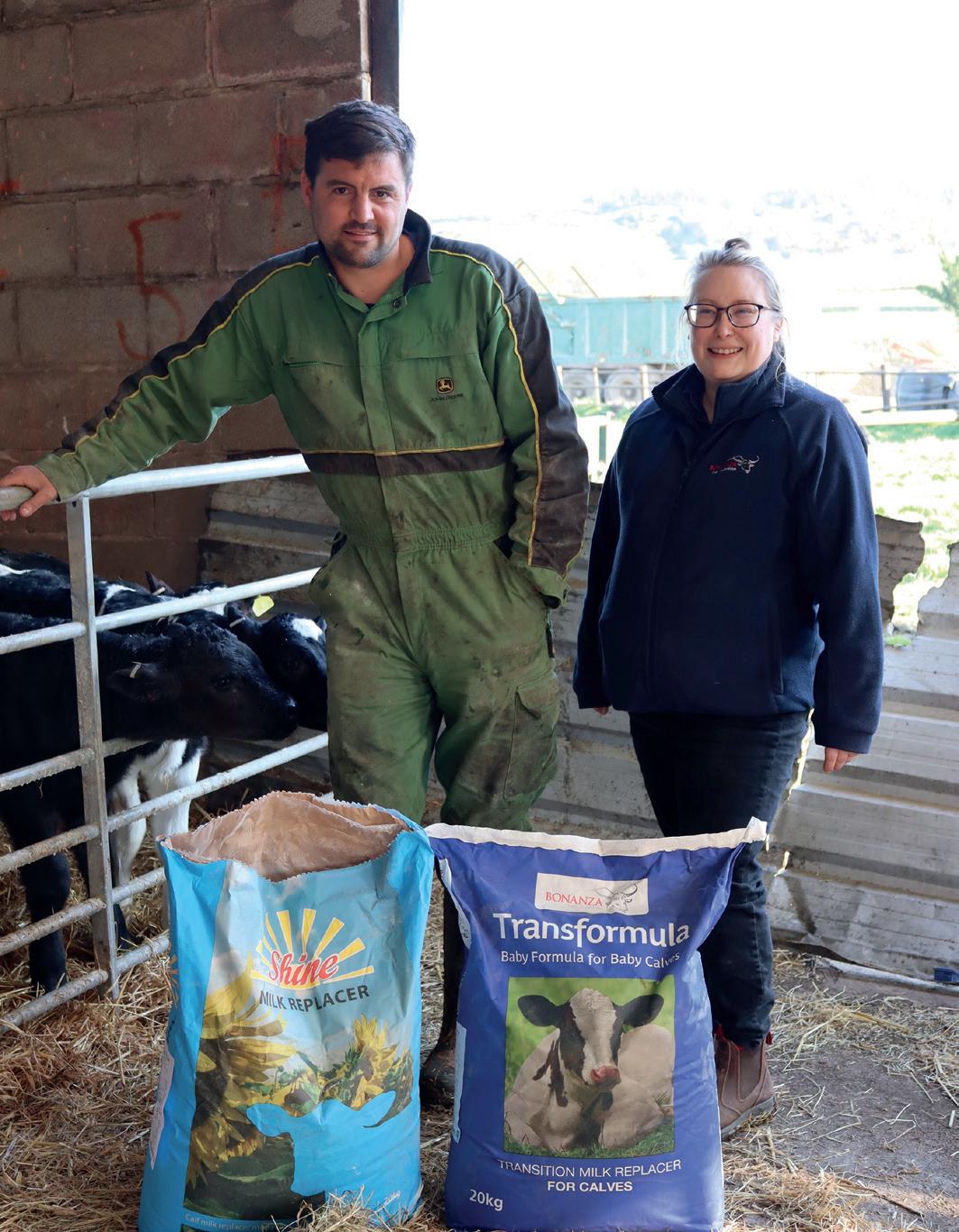
To assist John and the team, Mollie Phipps, of Bonanza Calf Nutrition, has helped to develop calf rearing protocols and feed plans.
As the first step in a series of changes, feeding was switched from whole milk to calf milk replace only to reduce the risk of Johne’s disease transmission and to improve consistency in the diet.
After receiving the first four feeds as colostrum, calves are introduced to a transition milk re-
Younger calves are fed first, to minimise the risk of teat-to-mouth transmission of pathogens.
placer, Transformula, that is specifically formulated to be fed after colostrum, fed to calves at three litres twice a day at 140g/litre.
Transition milk
Transition milk supports a calf’s immune and digestive systems. In recent trials at Harper Adams University farm, calves that were fed transition milk out-performed those that were not in their first four weeks, and beyond. As a transition milk replacer, it mirrors those developmental benefits and also the significant improvements seen in milk production in the first lactation.
For the Greaves family, the switch away from whole milk has played a key role in achieving their rearing targets as there has been
■ Beef cross calves all reared to finishing at 20-24 months
■ A review of calf feeding and revised protocol has reduced cases of scour
■ Selecting a milk replacer which contains no palm oil or soya components satisfied supermarket requirements.
fewer cases of calf scours and therefore less performance setbacks.
John says: “After 10 days on the transition milk-based calf milk replacer, the diet switches to Shine Twice-a-Day replacer, fed to calves at three litres twice a day at 125g/litre.”
Since introducing this two-step approach of feeding John has seen first-hand how it sets his calves up for a good start in life.
Calves are fed in age order, with the younger calves fed first, as this minimises the risk of teat-tomouth transmission of pathogens.
John says: “Rearing in groups of five means there is less competition for feed in this smaller group size and, crucially, it lowers the risk of disease transmission which makes it easier to monitor health and performance.
“There are strict hygiene protocols, with all feeding equipment cleaned twice a day and rigorous cleaning and disinfection of pens between batches.”
John weans at nine weeks according to dry feed intakes and calf performance. The weaning regime begins by reducing calf milk replacer feeding frequency to once a day at approximately eight weeks of age. After a week, the volume of calf milk replacer fed is reduced.
John Greaves, with Mollie Phipps.
World Dairying
With the impending threat of carbon emission taxes being introduced in Denmark, farmers are carefully assessing their futures in dairying. Chris McCullough reports.
Reluctance to expand due to carbon tax
While the Danish government continues to debate exactly how much the carbon tax will be, and how it will be administered, farmers are exercising caution over expanding or even making significant investments in land or equipment.
One such farmer is 39-year-old Anders Ring, who milks 600 cows near the town of Gredstedbro in the Esbjerg Municipality, and, significantly, just 3km from the North Sea on the southern coast of Denmark.
With four young children under 10 years old, Anders and his wife Mette say they would like to secure the future for the farm for the next generation, but the carbon tax could be a big hurdle in the process.
Anders bought his farm just six years ago from a bank following a series of bankruptcies.
He explains: “This farm was bankrupt in 2010, in 2016 and in 2018, a
total of three bankruptcies in eight years, under three different owners.
“I own 123 hectares on this farm but also rent other land to give me a total of 280ha. All the farm’s field work, including irrigation, is carried out by contractors.”
The farm’s 600 cows are milked via a 40-stall Boumatic rotary parlour installed in 2006 and the cattle are housed in three barns built in 2006, 2015 and 2020.
Anders says: “The cows are milked twice a day at 7.30am and again at 7.30pm. Each milking takes around four hours including startup and cleaning afterwards.”
The herd is yielding around 11,500kg of energy corrected milk (ECM) per cow per year with averages of 4.32% butterfat, 3.69% protein and a somatic cell count of 255.
Anders says: “Our milk is sold to Arla Foods and our current milk price is 4.05kr [46p] per kilogramme.
“Last year the profit was around
Anders plans to increase the space for dry cows and build more calving pens.
0.3kr (34p) per kg ECM, but at the moment it is a bit higher. My farm is too high in maintenance costs and too low in feeding efficiency.”
Half the herd is comprised of Holstein Friesians and the remainder are Viking Red, with a few breed crosses in the mix.
Anders says: “For now we focus on the Nordic Total Merit Index for breeding, but I would like to start using genomic testing. All our AI genetics is supplied by Viking Genetics.”
Herd management
Anders employs eight additional staff to work on the farm; one from Denmark, one from Ukraine, one from Bangladesh and five from Vietnam.
Six employees focus on milking the cows and feeding calves, one focuses on feeding the cows, pumping manure and machine maintenance and one is the herd manager.
Cows are fed a TMR consisting 75% maize silage, with grass silage,
sugar beet flakes, beer mash from Carlsberg Breweries, soya, rapeseed, rye and minerals added in.
All rations are fed with a 2013 Trioliet 30m3 feeder wagon operated by a Fendt 820, and loaded by a Volvo L90D wheeled loader fitted with a Rimach shear bucket.
Anders says: “We are currently making a number of investments on the farm including better storage facilities for concentrates. We are also constructing more space for dry cows and extra calving pens.
“I want to incorporate a new activity and health surveillance technology system for the cows that helps me monitor them more accurately.
“Later this year we will order a new mixer, and invest in cow comfort mattresses for the cubicles instead of the sand bedding that we have now. Next year the plan is to renovate the rotary parlour and update it.”
Due to the location of Anders’s farm being in close proximity to the sea, there are a number of
Anders Ring bought the farm off a bank after it went bankrupt a few times under different owners. Cows
Anders’s farm is located only 3km from the North Sea which presents some environmental restrictions on how he manages it.
environmental restrictions that prohibit any farm expansion.
Capacity
However, as they stand, his farm does have a maximum capacity allowance of up to 1,100 cows, and that is a goal he would like to reach.
“It is the carbon emissions tax that we have to be careful with,“ says Anders. “As the government has not yet fully setup the funding surrounding these taxes, or any details of how to officially implement them, that is a hurdle for us when considering expansion.
“Another major issue is water lying on the fields. I live in south western Jutland on the marsh lands, only one to two metres above sea level, so if the creeks and rivers are not maintained properly, then we cannot get the water off the fields.
“Sadly, we are not allowed to carry out this maintenance ourselves, so we need to make sure that the municipality does it, which can be another major issue.”
Managing the transition cow with foot health in mind is important in reducing lesions and lameness in the next lactation. Katie Fallon reports.
Focusing on foot health in the transition period
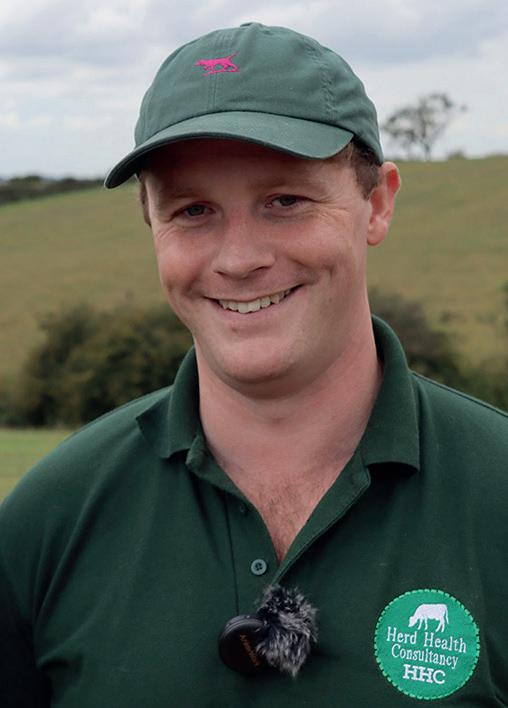
Foot health in the transition cow is becoming an ever-increasing area of attention, particularly relating to bruising in high-yielding Holsteins. Hoof health consultant at Herd Health Consultancy James Wilson explains the hormonal changes which cows undergo around calving can impact the hoof capsule, and predispose cows to hoof lesions and lameness.
Historically it was thought the
production of the relaxin hormone at calving had a role to play in altering the soft tissue which holds the bone to the hoof wall. However, Dr Wilson says it is now thought other hormones contribute to the slackening of the suspensory tissue, meaning the bone in the hoof is not well suspended. If the bone is not well suspended or supported, it can lead to an increased risk of lesions and lameness.
Dr Wilson says: “We also see
quite radical changes to the digital cushion. The transition period is the point where a cow becomes really metabolically active, so we see some change to how much digital cushion they have but also the cellular make-up of that digital cushion, meaning it is not as able to support the bone in place.”
He explains the management of transition cows can influence whether farms see changes to foot structure during this time. He says: “The hormonal changes
PICTURE: JOHN EVESON
that we see around calving means the cow is predisposed, but how we manage the cow also has a really important role to play and can offset most of this change.”
Social behaviours
In addition to the physiological changes the cow is experiencing, it is also going through a range of management changes. Dr Wilson says: “She will go through pen changes if she is going from a dry group to a close-up group to a fresh group. Those changes will challenge social behaviours and impact the pressures we see on the feet.”
After calving, cows will be going to and from the parlour to be milked, which presents challenges in relation to standing times and risks around walking surfaces and shearing forces. Dr Wilson says standing times are associated with hoof lesions such as sole ulcers and bruising, while shearing forces are associated with white line lesions.
He says: “There are so many dif-
A cow will go through pen changes if going from a dry group to a close-up or fresh group… which impacts foot pressures
DR JAMES WILSON
Science for Feed Efficiency
Help your herd achieve better performance, health & optimum production with Acid Buf!
Acid Buf’s
Smooth transition
Helps cows return to a positive energy balance more quickly
unique honeycomb structure helps to buffer changes in rumen pH caused by acidic forage or readily fermentable concentrate, bringing a host of benefits to your herd...
Control pesky endotoxins
Avoid ‘leaky gut’, which can initiate an inflammatory response
Healthier calves
Maximise calf starter intake for optimal growth & rumen development
Reduce inflammation
Avoid extra costs and increase energy corrected milk & solids
Foot health
ferent changes that are going on while we are trying to manage the cow in a completely different way.
“For housed herds, I tend to find that those with low stocked fresh groups do tend to see good results in relation to sole bruising. Minimising pen changes and being strategic with when and how we do that will also yield benefits.”
Inflammation at calving can also contribute to an increased risk of lameness, as the cow will experience systemic inflammation, where all of its systems will be inflamed to a certain degree. This is normal for lactation onset, but some cows experience this excessively.
Studies have found that administering anti-inflammatory treatment just after calving can substantially reduce the risk of lameness in
Survey help
THE University of Liverpool is asking for dairy farmers to fill in a survey to help them to understand what tools will be useful for them to improve hoof health in the future.
The results of this survey will help researchers and other industry groups to provide the best support possible for farmers across the country.
It should take approximately 10 minutes to complete. By taking part, you can enter into a prize draw to win either a £250 Mole Valley Farmers Voucher, or a £150 food hamper.
If you have any questions about the survey, or would like to discuss it further, then please contact James Wilson on j.p.wilson@liv.ac.uk or 07468 495 027.
high-yielding Holsteins, particularly in high-yielding heifers.
“So by treating them with what is effectively cow ibuprofen every time they calve into the herd, we saw one in 10 fewer cows having a mobility score of two or three. So in a 100-cow herd that is 10 fewer cows that I would be treating every year. Other studies have noted behavioural and production benefits.”
In a cost-benefit analysis of the same study where heifers were treated with anti-inflammatories after calving and at lameness events, the return on investment was £1.66 to every £1 invested.
Dr Wilson says: “A lot of that is cost-benefit seen through reducing the risk of culling over a three-year period, we pretty much halved the risk of culling by implementing that protocol.”
Management
When looking to manage lameness during the transition period, Dr Wilson says anti-inflammatory therapy does reduce the risk of lameness going forwards, however he says speaking with the farm vet before implementing this type of therapy is essential.
Other management methods include reducing the number of pen changes, keeping cows in smaller groups during the transition period, particularly fresh cows, and bringing cows to the parlour in smaller groups. “Look at reducing stocking rates wherever possible during the fresh period.”
Reducing heat stress is also important to reduce lameness risk during the transition period, as cows go from being not very metabolically active to very metabolically active. Dr Wilson says: “It creates such a change in the animal, and they can be really predisposed to heat stress in that environment.”
He suggests shifting grazing patterns to night time grazing (if not grazing continuously) and using fans for housed cows wherever possible.
TRIMMING
APPROPRIATE trimming is also important in managing lameness during the transition period, with modelling particularly important in housed herds. Dr Wilson says: “You want to get a really generous model into them because every millimetre we take off that model site is a week that we are buying that cow until there is going to be pressure exerted on that part of the foot again.
“So really taking your time to model these cows means that the cow is covered in that fresh period. I take a deep wide model in housed cows, and a slightly narrower and less deep model in a grazing cow.”
Sole thickness in the toe triangle is also an important aspect of the dry off trim to get right. Dr Wilson says: “If the dry off trim is just taking sole off
irrespective of toe length, we are compromising the thickness of the sole and that is a really important factor in reducing lesions in the future.”
Dry off foot inspections are a powerful tool to use as long as the trim is set up to do it correctly, says Dr Wilson: “It is about making sure that we take our time with modeling. Take the time to check the foot before trim.”
He adds: “Preserving sole thickness and the walls are the two most important things we need to do at that dry off inspection alongside modeling.”
Dr Wilson says dry cow foot inspections present a good opportunity to try and rectify challenges before the dry period takes place, as cows going into the dry period lame are more likely to calve in lame, or be lame in the next lactation.
I take a deep wide model in housed cows, and a slightly narrower and less deep model in a grazing cow
DR JAMES WILSON
For grazing and block calving herds, ensuring trackway infrastructure is as good as it can be before calving is important in managing lameness, and Dr Wilson advises grazing paddocks closer to the parlour for the first few weeks at least.
Managing heat stress in the grazing cow is also important and ensuring there is shade available in paddocks.
Managing the ration can also
Dr James Wilson
help to reduce lameness during the transition period. “Ensure the ration is maintaining body condition score throughout the fresh period, and throughout the lactation.”
Dr Wilson advises feeding biotin in rations throughout the year, at 20mg per head per day, to help ensure the horn quality is of a good enough structure. “Feeding biotin all year round including the dry period, means when the cow calves in she has a good robust hoof horn.
Monitor and measure are the two aspects of udder health management, according to veterinary consultant at the University of Nottingham, Dr James Breen.
Date and records: Your allies in udder health management
Dr James Breen says: “Managing udder health is an ongoing process and is best viewed as part of herd management, helping to optimise cow health, well-being, productivity and longevity.
“The days of a reactive approach, administering antibiotics when cases arose without, then reviewing patterns in new cases ought to be behind us.”
With pressure from many external sources to reduce antibiotic use on-farm, many farmers now favour selective antibiotic dry cow therapy (SDCT) and are also interested in how clinical cases during lactation are treated.
What does cure look like?
“How do we measure a cure? And how can attaining a good cure help in preventing further cases in a lactation?”
Dr Breen asks.
Good record keeping will help track cases of clinical mastitis for each cow, as well as identifying when in a lactation an infection was first seen. Supported with
Internal teat sealants
INTERNAL teat sealants have been increasingly used at drying off since work was published in 2018, outlining their role in udder health management as many producers looked for alternatives to antibiotic dry cow tubes. Since then, SDCT has become the norm on many farms.
The benefits of internal teat sealants for cows at drying off are well established; the reduced risk of new infections during the dry period results in fewer cases of mastitis in early lactation.
testing, be that cow-side tests or lab testing, likely pathogens can be identified.
Dr Breen says: “Armed with the information, your vet will be able to spot any trends, recurring infections and candidates unlikely to achieve a cure which may need to be removed from the herd.
“The first and probably most important question to ask on identifying a case of clinical mastitis ought to be ‘is this the first
How do we measure a cure? And how can attaining a good cure help in preventing further cases in a lactation?
DR JAMES BREEN
For some time now, mastitis experts have recommended teat sealants for every cow, every dry period.
Ubroseal Blue is the only blue teat sealant available in the UK; blue teat sealants have been popular for some time in other countries, such as the USA, and farmers find them easier to see, with no reduction in efficacy.
The blue colour can help you to be confident of best practice when it comes to teat sealant administration and removal.
event for this cow in this lactation?’ and, if it is, treat it rapidly with the aim of achieving a full cure
“It is best to avoid leaving it for a few days until visible clots clear up, as this approach may lead to more cases in that same lactation.
“And treat with a full course of antibiotics as prescribed by your vet to deliver a good cure. Work has shown that this approach can achieve 50-60% cure rates specifically for these first events and go on to reduce subsequent cases.”
Mastitis
Should second, third or even fourth cases of mastitis occur during a cow’s lactation, the chances of achieving a good cure decline with each case.
“It is important to understand the difference between clinical mastitis and a high cell count cow, with clinical being when you see visible signs of that infection and a high cell count cow having an infection but no symptoms.
“Reviewing your approach to the first clinical mastitis cases is an important step to ensure the chance of a recurrent case is reduced.
“While we achieve a good cure, we also
work to reduce the rate of first clinical cases by understanding likely sources of infection.”
An advocate of the role of data and evidence, Dr Breen recommends that even if cow-side tests are routinely and successfully used, mastitis samples should be stored and sent to an independent lab a couple of times a year, just to check that testing is running as it should be.
Available data
By working closely with your vet and reviewing all the available mastitis-related data, there are some key questions which
Key points
l Clinical mastitis case data is fundamental for monitoring the cure rate for treatment plans
l Cow-side or lab testing to identify problem pathogens provides good information for antibiotic prescribing
l The first clinical case of mastitis in lactation is the best chance to obtain a good cure
l Cure rates of 50-50% for first clinical cases in a lactation help reduce the likelihood of further cases For more information, go to ubroseal.com
can be answered, which will help with decision-making.
From where does infection most commonly originate – in lactation or during the dry period? What are the main problem pathogens?
When in lactation do first clinical cases typically occur? If less than 30 days in milk, dry period infections are the likely cause.
Cell counts
How do cell counts change during lactation and across the dry period?
Dr Breen says: “Dry cow management will need to be scrutinised with everything from cell counts to teat sealant and dry cow tubes, infusion technique, dry cow pen hygiene all having potential to impact on mastitis cases.
“Getting regular veterinary input to understand the mastitis challenges on your farm will really help.
“Ensuring you keep good records and that these are routinely scrutinised provides vital information on which to base treatment protocols.
“Achieving a high cure rate for the first clinical case and preventing as many first cases as we can through understanding sources of infection will reduce overall antibiotic use, something the UK dairy sector is striving for.”
The Millers’ Moorshard herd was crowned as winner of the 2024 Holstein UK National Premier Herd Award and the family is set to host the Premier Herd Open Day on July 16. Felicity Coates finds out more.
Moorshard to welcome guests for herd open day
Moorshard Farm near Bridgwater, on the edge of Somerset Levels, is home to the Moorshard herd, which has been synonymous for years with excellent breeding and a depth of cow families.
The herd is run by Randolph and Marlene Miller, as well as their son Brian, and was started by Randolph’s parents.
Then in the 1970s, Randolph and his bother Mike started to take pedigrees more seriously and started to invest in families, which included two of the original cow families, Rosa and Katey, which are still prevalent in the herd today. In the early 1990s, Brian returned home from Reading University, and the focus started to shift from a mixed farm to the cows.
Shortly after, Randolph’s brother Mike started to farm under his own right in Worcestershire under the Shanael prefix. Cow numbers have steadily increased from 160 in the 1990s to the current 275 milking cows, which also includes some Brown Swiss that Brian has under the Sedgemoor prefix.
The herd is on a Waitrose milk contract, which requires the herd to be grazed for six months of the year.
The herd is currently producing a rolling average of 10,200 litres with yields at present sat at 10,827 litres at 4.01% butterfat and 3.28% protein.
Along with grazing, the herd is also buffer-fed with a TMR diet, made up of a 40/60 split of grass and maize silage, mixed with rape, blend, molasses and chopped straw.
Calves are reared in twin hutches
Brian Miller runs the farm with parents Marlene and Randolph, as well as help from herdsman Martin.
■ Sale: The Cream of the Herd sale will follow the open day
■ For more details and to register for the event visit: holstein-uk.org
as per the guidance from Waitrose, and are generally weaned between eight and 10 weeks when they are moved to pens of eight animals and are fed ad lib concentrates and hay.
They are then moved to larger groups where they will stay through bulling age and to pre-calving.
Again fed a heifer rearer and hay, they are also moved on to a basic TMR. Brian is aiming to have the heifers calving in at 24 months on average.
At present the herd is milked twice a day though a parlour installed some 25 years ago, past its best, and the family have made the decision to move to robots.
Brian says he believes that the automation of farming will be the way forward when it comes to bridging the gap in labour needs and allowing farms to focus time and attention towards the cows more.
Despite this, Brian and his family
have a great team of staff behind them. Martin the herdsman with Brian, does most of the milking, and while his job will change by the end of the year, it will allow the pair to concentrate on the cows.
Other full-time staff include a herdsperson, Siawek, apprentice student Freddie, and three casual staff alongside them.
There is no genomic testing, with breeding decisions being made on classification, pedigree, conformation and CIS milk recording data. When it comes to sire selection for the Holsteins, Brian and Randolph generally rank the bulls by mammary system first, then knock out bulls that fail to meet their other criteria. As the herd makes the move to a robotic system, Brian says milking speed and rear teat placement will need to take a priority and already those changes have been partially factored in to the breeding decisions.
Bulls that are in current use are Sandy-Valley Tentastic and DG Alvin RC. Calves are currently being born sired by Tarmac, Zafar Red, Blakely, Blackburn and Bullseye.
Coming into calving at the moment are heifers sired by Eclipse Perennial and Koepen Shield-Red, which Brian is looking forward to calving. In the herd’s history, iconic bulls such as Hanoverhill Starbuck, To-Mar Blackstar and Roylane Jordan have all had a profound impact.
More recently, however, it has been animals sired by bulls such as DG NH Arrow, Siemers Lambda Haniko and Vogue Solarpower showing huge promise.
Cow families are at the forefront of the Moorshard herd, and between Randolph and Brian they have collected an impressive selection over the year and developed these into foundation cow families that have had a huge impact on their herd.
Premier Herd Open Day
Turning the Tide: How farmers can monetise their farm data and see British Agriculture escape the ‘Perma-crisis’
There’s no getting around it — farming across Britain is under intense pressure. Whether you’re in livestock, arable, dairy or horticulture, the challenges are piling up: rising input costs, labour shortages, unpredictable weather, post-Brexit market shifts, and constant policy change. For many, it feels like we’ve entered a “perma-crisis” — a state of near-permanent uncertainty that’s eroding margins, confidence, and long-term planning.
But on the horizon, a new farmer-focused initiative is being developed that could help bring some much-needed clarity. It’s called Nasda UK — and it’s set to offer a smarter, fairer way for farmers to monetise the value of their data, improve decisions and strengthen their resilience
Coming Soon: Nasda UK — A National Data Platform built for Farmers to Profit Farmers
Nasda UK (National Agency for Smart Data in Agriculture) is a not-for-profit platform currently in development by the Trinity Natural Capital Pro Council — a cross-sector group working to give farmers more control and income over the value of their farm data.
Due to launch September this year, the platform is being designed with one clear principle at its core: your data should work for you
Once launched, Nasda UK will enable farmers to:
• Join for free and contribute data securely and anonymously
• Stay in full control of what’s sold on their behalf and to whom
• Avoid duplication by linking data across platforms — one version of the truth
• Receive tailored insights and tools based on pooled national data
• Use internationally recognised standards to measure soil, carbon, water, and biodiversity
The aim? To simplify decision-making, unlock new income streams for farmers, and support significantly well informed and improved practical farm management — all while keeping farmers firmly in charge.
What Could It Mean for You?
When Nasda UK launches, farmers will be able to benefit from:
• New income to farmers through voluntary, personal ised data sales
• Sharper decisions, backed by wider benchmarks and AI-powered tools
• Simplified admin, with data stored once and used many times
• Greater resilience, with earlier warnings and smarter planning tools
• Stronger community learning, as patterns and solutions emerge from peer farms
The power of the platform lies in its scale — the more farmers who participate, the more useful and valuable it becomes for all farmers. But critically, every farmer remains in full control of their data and will be the financial beneficiaries.
Have Your Say — And Help Shape the Future
British farmers have seen cycles come and go — boom and bust, price shocks, shifting rules. But this prolonged “perma-crisis” is different. It’s eroding trust, confidence, and longterm vision.
What Nasda UK offers is a chance to take back some control. To build a system where farmers lead with evidence, not just instinct. Where nature and data work hand-in-hand. And where collaboration delivers real returns.
We want to hear from you.
This is your chance to shape a data system that works for you — one that protects your farm data, unlocks its full value, and puts you in control from day one.
• Join the consultation phase
• Help build a platform that truly benefits farmers
• Stay informed as NASDA UK develops
Plus — everyone who registers will be entered into a prize draw to win one of two £250 Mole Valley Farmers vouchers.
It only takes a minute to sign up — but your voice could help reshape the future of British agricultureVisit www.trinityncpc.com/nasda-uk
Artificial Intelligence
Artificial intelligence is no longer a distant concept only for Silicon Valley, but farmers need to know how to use this exciting tech. Dairy Farmer reports.
Why artificial intelligence belongs on your farm
From autonomous tractors to disease-predicting algorithms, artificial intelligence (AI) is already reshaping agriculture, and UK farms could stand to gain enormously.
But, according to Paul Horwood from IVC Vets, and co-organiser of the UK’s first AI in livestock farming conference, farmers need access to practical education and support in this fast-moving area of technology to unlock its full potential.
“AI refers to computer systems that can perform tasks normally requiring human intelligence, such as recognising patterns, learning from data, and making predictions,” he explains.
“On the farm, this translates into tools that can monitor livestock health, forecast yields, optimise feed, detect diseases, automate machinery, and reduce waste. These are not just ‘nice to haves’. They are fast becoming essential tools for farming in the 21st century.”
Rising input costs, climate change, labour shortages, and market volatility are all squeezing margins. Add to that growing consumer and regulatory demands for traceability, sustainability, and welfare, and traditional farming methods
alone will not be enough. He says this is where AI comes in – not to replace the farmer, but to empower them. “To quote Google, ‘AI will not replace you; someone using AI better than you will replace you’. It can bring significant benefits in many areas of dairy farming.”
He suggests AI systems can use cameras, sensors and wearables to detect early signs of lameness, mastitis, or respiratory illness before they are visible to the human eye. This not only improves welfare but also reduces antibiotic use and costly losses.
Feed remains the biggest cost of dairy farming, but Mr Horwood says algorithms can analyse real-time data to optimise rations for growth, fertility, or milk yield, ensuring each animal gets what it needs, when it needs it. This cuts waste and boosts efficiency.
“Dairy cow management can be improved if we can better predict what will happen. AI tools can be used to forecast disease out-
breaks, calving dates, or pasture growth to dramatically improve planning. AI does not get tired or miss signs, it sifts vast data sets to help make better decisions, faster.”
Increased accuracy
AI-powered machines also reduce labour demands and increase accuracy. Smart systems can even adjust based on weather, soil, or yield data. Finally, he adds that as net zero targets approach, AI precisely manages emissions, water usage, and nutrient runoff, not only to comply with regulations but also to foster a more resilient and regenerative agricultural system.
Mr Horwood stresses that AI is not just for high-tech mega-farms. Startups and innovators are now offering modular, affordable systems that scale to the size and needs of smaller family farms. Some use existing farm data or infrastructure, like CCTV or milking parlour software, to deliver insights without a huge upfront investment.
“The biggest barrier to adoption is
not cost, it is confidence and fear of the unknown. Many farmers simply do not have the time, training, or trusted sources to make informed choices about digital tools. This is why education is so vital.
“Understanding the basics of AI –what it is, what it is not, and how to evaluate it – puts power back into farmers’ hands. Producers need practical, grounded knowledge that helps them assess return on investment, risks, and relevance to their specific system.
“We need more workshops, demo farms, and farmer-led trials. Colleges and training providers should offer short, flexible courses on agritech fundamentals, tailored to livestock and arable settings. Peer learning, open data sharing, and trusted advisors will all play a crucial role in bridging the gap.
“Without investment in education now, we risk falling behind countries where AI is already transforming productivity and competitiveness.
“The future of farming will be shaped by those who are willing to adapt and learn. AI is not a silver bullet, but used wisely it can be a powerful ally in tackling the complex challenges facing British agriculture,” he says.
“The question is not whether we should use it. It is how we ensure every farmer, regardless of size or background, has the knowledge and tools to make the most of it.”
rAI(Live) is the first conference dedicated to AI in livestock farming, where speakers will discuss the future and how British agriculture can exploit the potential. For more, see www.ailive.farm
AI is fast becoming an essential tool for farming in the 21st century, says Paul Horwood.
Horwood
IVC Vets.
When looking at milking, Lean Farming UK uses a set process which identifies challenges, finds solutions, and starts a culture of continuous improvement.
What is lean management, how can it be implemented on your farm and what could the benefits be? Anna Bowen reports.
Using lean management to improve efficiency
Lean management is not a new concept, say Becky Miles and Phil Cooper, consultants at Lean Farming UK.
Jana Hocken’s The Lean Dairy Farm was published in 2019 and the system has existed in other industries for much longer. However, it offers an opportunity for dairy farms to benefit from more efficient time and resource management, improved team engagement, and better animal health and welfare.
“Lean is a process of small, continuous, and incremental change to a business,” says Mr Cooper.
“It is a way to identify opportunities that are there in your face. With any process on farm there are lots of ways to improve.”
Mr Cooper recommends starting through analysis of the farm’s management accounts, such as a comparable farm profit (CFP).
He explains: “By looking at the CFP you can identify areas with
opportunities for improvement through highlighting any individual costs that stand out.
“On one of our pilot farms labour costs were high. We considered what was the biggest use of labour
Improvements
Some examples of the outcomes that can be achieved through lean management:
■ Reduced standing times
■ Reduced electricity use through shorter milking time
■ More efficient labour use and reduced fuel and machinery costs through improvements to winter feeding routine
■ Higher calf growth rates through consistent feeding
■ Lower veterinary costs through clear protocols and organisation of drugs cupboard
on farm; milking. When we spoke to the team that was the process they had the biggest issues with, too.
“By linking the two together you can demonstrate the financial benefit to the business through
identifying the start point, implementing changes, and then measuring the change.”
Mr Cooper says it is not just about financial benefit. He says: “For the team it is also about feeling engaged
What is lean management?
Developed by Toyota in the 20th century, lean management is a system for identifying waste in processes, creating value, enhancing efficiency, and developing a culture of striving for continuous improvement.
Lean is based on five fundamental principles: 1. Identification of value 2. Value stream mapping 3. Creation of a continuous flow
4. Establishment of a pull system
5. Pursuit of perfection
Its core is identifying what the business produces that is of value
to the customer, and then removing waste from the process of creating that value.
While using lean management brings improvements in technical and financial output, the take homes for Mr Cooper and Ms Miles include changes in workplace culture.
“The farms that have gone through the process so far are now working as teams not as a group of individuals or the boss and the employees,” says Mr Cooper.
“They are empowered to work together and that results in a more positive working environment and saving money.”
Lean Management
and motivated and like they are having an impact by being listened to and having feedback and comments taken into account.
“The process can reduce pressure on each individual and give them more time off, and free up time in the working day to do other jobs.”
Lean can, and is, applied to any process on farm, but milking is a popular starting point says Ms Miles.
“Milking is an easy one to start with as it is done every day of the year on most farms,” she says.
“By having everybody follow the same process nothing is going to be missed. Protocols can be put in place
MILKING AND LEAN MANAGEMENT
n Time recording: Ms Miles suggests recording the start and finish time of every milking shift for a month.
“There will be the odd occasion where something goes wrong and we know why and that is fine, but you can also track when it is different people or if there is a specific day when milking takes longer.”
n Team input: The next stage is to get together everybody who is involved with milking.
Mr Cooper says: “We map out the process of milking from getting the cows in through to finishing. At every stage we ask the team what are the challenges with that part of the process and what are the opportunities to improve or standardise.”
He adds that by using coloured Post-It notes this value stream mapping can really highlight how many individual processes make up milking as well as where the issues and opportunities sit.
“Each person puts in their frustration points, and it does not matter if everybody has the same frustration – it amplifies them.”
During this stage, Mr Cooper
for lame cows or cows with mastitis, and there will be products on the shelf, in date, and in the right place.”
says it is important to note how long different processes currently take, and to set targets. These will vary seasonally.
The team should then be given some time to reflect on the activity and be encouraged to keep adding notes to the board.
n Making improvements: The mapping exercise will highlight key areas to improve on, although issues that are repeatedly mentioned may not be the easiest to address.
Mr Cooper says: “If there is an issue that several team members have identified it will be the logical place to start, but it may require a lot of investment and so will be a longer term resolution. There may be some other points that are quick and easy wins. If you can find a few of these the team start to see the benefit.
“One example is a laminated sheet with a check list of things that need to be done before going home, so that everything is ready for the following shift.”
n Continuous improvement: Lean management has no completion date, says Ms Miles with the emphasis being on constantly refining and improving processes.
“Ideally the team should have a 10-minute meeting every day, or at least a couple of times a week, next to the board,” says Ms Miles.
“You can then discuss how everyone is getting on with a change, what progress has been made, and are there any barriers. You can add in any new ideas and can keep tracking and moving in the right direction.
“Unless you are monitoring and measuring it, you cannot identify if what you have done so far has worked or not.”
n Protocols: Putting in place protocols and standard operating procedures is a key part of the process says Mr Cooper. And ensuring that processes are standardised and take the same time regardless of personnel will also avoid under or over doing tasks.
He says: “Having a third party facilitate these meetings can help keep conversations on track and make sure that all team members regardless of position have a chance to contribute.
“We have strict rules that everybody’s voice must be heard.”
“It should also speed up the milking process, which means cows have reduced standing times which brings improvements in health and welfare.”
When looking at milking, Lean Farming UK uses a set process
which identifies challenges, finds solutions, and starts a culture of continuous improvement. This can be done on farms of all sizes, including businesses using only family labour.
Phil Cooper
Becky Miles
New Zealand vet’s view
This month New Zealand vet, Rory Dean discusses the weather in Northland and the impact a prolonged drought has had on some of the herds he works with.
‘And then there was rain’
After a prolonged drought, Autumn has arrived in New Zealand and there has now been enough rain to drown out the crickets and start filling in some of the cracks remaining in the dry earth.
As I mentioned in my previous article, the high ME grass silage was essential for herds that wanted to capitalise on the high milk price from Fonterra ($10/kgMS).
Herds that grew crops such as chicory, turnips and raphno – a kale/ radish hybrid – really saw the benefits, maintaining yield and cow condition into the New Year.
I laughed on numerous occasions throughout the dry summer, watching herds skip towards their new break of crop after spending the morning on tough, straw-like kikuyu pasture. The urgency was a fascinating display of cows’ social hierarchy, with the matriarchs ensuring they were first to the luscious crop.
With that said, businesses with less drought tolerance built into their system ended up drying off early.
A friend of mine and client had his hand forced due to a high somatic cell count coupled with the paddocks containing the most feed being rela-
tively far from the shed on a hilly farm. In a horrible catch-22 situation, we could only get the best feed to the cows by asking them to walk several kilometres further everyday which in itself was energetically expensive.
With no in-shed feeding and no feed pad structure, it left us with the remaining option of seeing a drop in yield and keeping the herd handier to the shed, shifting them often and feeding silage in the paddock. However, the immediate drop in production caused the cell count to skyrocket.
This was a typical example of a farm poorly suited to drought paying the price and having to ‘pull the pin’ early, drying off cows in March. Fortunately, there will be more tools available to this client next year as this was his first year on that property. We live and learn.
Pregnancy testing
Pregnancy testing yielded some typical results for the region. The abundance of feed and kind spring weather seemed to be balanced by some herds having a hangover from the previous season with more late calving cows than I would have liked.
As you may well know, our preg-
As the team bathe themselves in disinfectant, the farmer and their vet will be crunching the data
RORY DEAN
nancy testing is considerably different to the UK practice, and often my colleagues and I will have tested a herd before breakfast.
I’ve learned to understand that I am a morning person, and that some of my colleagues are not. My business partner and fellow veterinarian Brian reminded me that I’m a bit of a pain when we tackle the big herds during morning milking, and that he finds it hard to concentrate with me yapping on excitably next to him.
He improves markedly after his morning coffee, and you certainly will not catch me comfortably chewing through admin work in the office late at night – we are all different.
Our team understand that pregnancy test day is one of the most important days in the farm calendar for our clients, and we really encourage all of our team to spend 10 or 15 minutes chewing the fat with the farm team after we’ve cleaned up.
As the team bathe themselves in disinfectant and waterproofs are scrubbed, the farmer and their regular vet will be crunching the data, working out six-week in calf
rates, empty rates, and three-week submission rates.
In an annual ritual, these will then be compared with next door, the herds that the vet has tested recently and the published regional average. This is all followed by a hearty dose of either attributing the positive result to something novel or blaming a poor result on some aspect that could have gone better.
Facetious though this may sound, this is reality, and in truth, both veterinarian and farmer will then go away and reflect on the result and possible contributory factors.
Personally, I find the next chat most useful – when I’m out for something completely unrelated, and the stress of pregnancy test day has dissipated, and we spend 10 minutes reviewing the data in a breezy manner, posing theories and discussing what could have gone better.
From a clinical perspective, we are now forever on our guard against facial eczema. This disease, caused by a fungal spore present in pasture, causes extensive liver damage and an inability to process photodynamic
Rory Dean
Autumn has brought much-needed rains to the New Zealand dairy herds.
pigments in the grass, leading to massive sunburn.
While the drought limited the presence of spores, with autumn rain coming we are seeing a slight rise.
Dairy herds are starting to add sources of zinc to feed and or water to help mitigate against the liver damage as there is no cure for the devastating disease.
Some high-risk herds will go through the task of orally bolusing each calf and heifer on the property to minimise the risk of liver damage.
We have been fortunate over the last few years in that we have not seen a lot of clinical facial eczema, but it is always a concern, and the spores can persist into May.
This leads to a double-edged sword because farmers take their minds off facial eczema prevention, coupled with the variability of weather in late autumn. A few warmer, wet days can lead to clients being caught off guard, with disastrous consequences.
Our technician team are busy
carrying out ‘spore counts’ on local hot spots free of charge to help provide a clearer picture and early warning sign for our clientele. Luckily, at the time of writing, we’ve not counted anything above 25,000 spores so far, but elsewhere in the region where they’ve had more rain, counts of 100,000 – well into the toxic level – are commonplace.
We’ve just had an ex-tropical cyclone (Cyclone Tam) move through bringing a fair bit of moisture and I wouldn’t be surprised if spore counts climb over the coming days.
Novel behaviour
To finish off, a little humour. I have a childhood friend who manages a farm in the Waikato, and we regularly catch up for a blether as we would say in our native Scots. He informed me recently that a neighbouring farmer purchased a hard-working herd from rugged Northland country and moved them onto the ryegrass growing plains of the Waikato. Thrilled with the price, he snaffled
the Northern herd whose owner was leaving the industry and trucked them down.
My mate caught up with him just a few weeks later, enquiring how the girls from over the Harbour Bridge were settling in. Agitated, he went on to explain to my friend that he couldn’t stop the cows sprinting down the race like racehorses after each milking, leading to queries from the neighbour and an uptick in lameness cases. This led to a phone call up North to the vendor, who sim-
With the rain comes an increased risk of diseases spreading through herds.
ply explained to him: “No wonder they’re running, they’ve never seen ryegrass before”
More information
Rory Dean is a veterinarian and director at Kaipara Farm Vets, a large animal clinic in Northland, New Zealand. He is also a committee member of the Dairy Cattle Vets branch of the New Zealand Veterinary Association.
Grassland
so we have
a
project latest
After a couple of years of chaotic weather, a focus on reseeding plans is crucially important to get prepared now, advises Janet Montgomery.
Taking on the establishment to get ready for autumn
To prevent a farm’s grass production from slipping below its potential, it is important that farmers get prepped for an autumn reseed now, says Janet Montgomery, agriculture product manager at Barenbrug.
And she says she is all too familiar with tales of reseeding plans
that went awry over the last couple of years.
“Collectively, the nation’s dairying fields have not had a good run recently,” she says. “We had ‘the dry’ in 2023, testing the resilience of many a ley and pasture. Then in 2024 we had ‘the wet’, which exacted a heavy toll on silage grounds.
We were operating on a ‘smash and grab’ basis – cutting when we
could, sometimes in less than perfect conditions.”
With pressure to fill clamps, Ms Montgomery says there was a temptation to cut a little lower and that more open sward gave other species a chance to populate, as did damage caused by taking silage while soil was in a less than perfect condition.
And she adds these were un-
avoidable consequences for many producers. “It is not worth beating yourself up about what you needed to do to get those clamps filled,” she says. But with many farms perhaps now in a place where the annual 15% reseeding target has not been reached for a couple of years, she says she iss keen to ‘get the nation reseeding’.
It is time to ‘get the nation reseeding’, says Janet Montgomery.
“Remember, home-grown feed should be your priority. In managing a profitable dairy enterprise, it is your most important goal. There is no better way to achieve that than by maximising your grass-growing productivity.”
Janet Montgomery
MAKING THE MOST OF AN AUTUMN RESEED
■ Goals: In the last couple of years, Ms Montgomery explains Barenbrug has introduced the concept of ‘Farm Fodder Flow’ to its UK customers. It is a simple concept, she says, which matches the farm’s productive capacity to your animals’ dietary needs.
“The simple concept delivers two key elements,” she says.
“First, we are moving away from a one-size-fits-all grass strategy, where simply maximising quantity was the overriding concern. Second, it achieves that through a more measured consideration of how we use our grass and how we can avoid using bought-in concentrates to fill the feed programme holes.”
Ms Montgomery’s advice is to assess your dairy model production goals – herd size, 300- or 365-day milking, litres per
cow, etc – and use this to work out your whole-farm demand: where volumes might fall short, where you might have excesses, whether you want to change winter housing strategies and so on.
■ Balance and index: So how does this information help with a reseed?
“Consider two aspects,” says Ms Montgomery. “Does your current grass strategy fulfil your production goals? Second, which fields are ‘pulling their weight’, which are ‘cruising’, which are ‘needing special measures’?”
Using a grass indexing tool will help identify the fields to prioritise for reseeding this year, Ms Montgomery explains, while the confirmed or revised production goals will guide grass use and therefore variety selection for those selected fields.
■ Mixtures and lifespan:
While production goals will be the primary driver for variety selection, changing weather patterns – as we have seen over the last three years – also underline the importance of resilience.
“The thread that brings these together is lifespan,” says Ms Montgomery. “How long should the field be in grass? Is it a short-term ley or are you making an investment for longevity? How do you want the grass to behave in spring? How will this reseed fit with operational plans for other fields?”
There is a risk of making things overcomplicated, says Ms Montgomery. “I often see people’s eyes glaze over when I get onto the merits of tetraploid versus diploid varieties, but being armed with the basics is important.
“Rarely is a field sown with one variety alone. We favour mixtures,
because the combination –particularly with herbal leys – can deliver true resilience over time.
“For example, a mix of tetraploid and diploid varieties provides digestibility, thanks to tetraploids’ bigger cells, packed with starch and sugar, combined with longevity and resilience from diploids’ heavy tillering and deeper roots.
■ Merchant value: Ms Montgomery says farmers should not be afraid of their merchant.
“Now is the best time to discuss your goals, work out how to achieve them, and make plans for autumn establishment. Their favourite, or default mixture, might not meet your needs.
“But if you go armed with ‘the knowledge’, you can come away with a mixture that will raise your grass game considerably.”
Flexibility is the key to managing herbal leys and they require a very different approach compared with traditional systems for maximising ryegrass sward yield and quality. Wendy Short reports.
A different approach to managing herbal leys
The conventional timings and management of ryegrass mixes do not apply to herbal leys, also known as multi-species leys, says independent consultant, Dr George Fisher.
Dr Fisher says: “A ryegrass mix is a relatively standard material, but the same cannot be said of herbal leys, which may contain a dozen or so individual species. Each has a different growth habit and for this reason they will perform best when managed using an integrated grazing and cutting system.
“This is the ideal and the regime does not have to be rigid. For example, it would be acceptable within one 12-month period to take two cuts in early season and then graze the sward in the autumn. However, I would advise against repeating the same pattern for the following year.
“As a rule of thumb, they should be grazed in the first half of the growing period and cut in later season.”
The recommendation is linked to the individual species’ growth habits, Dr Fisher explains.
“Some will benefit from grazing, while others will perform
well on a cutting regime. If one of these techniques is overused, it will result in some plants disappearing from the sward altogether and others flourishing. Overgrazing is particularly detrimental to species like red clover, which has a growing point above ground level. It will suffer from defoliation and will not regenerate if it is grazed too hard.”
Target figure
A standard plate meter is not calibrated for making grazing access and exit decisions, he adds. The target figure for grazing should not fall below 15cm, as leaving cows in
the paddocks until the plants are down to 10cm in height will cause species losses. Meanwhile, the minimum cutting height is 10cm.
Dr Fisher says: “The species lack the same ability as ryegrass mixes to recover over the season, because they have alternative traits and there is no option to manipulate their growth habits through nitrogen application.
“They may persist well in the longer term in some situations, and numbers for individual species will tend to fluctuate over a five-year period. One of my clients who had included bird’s-foot trefoil reported that not a single example could be found at the end of the first season, but it appeared in high densities in year five.”
Herbal leys will usually require an extended wilting period, he adds.
“A common practice for ryegrass is to cut when the sward has had some sunlight exposure, ted the crop twice and perhaps pick up the following day.
“That is not appropriate for herbal leys, which contain some plants with comparatively large leaves. They will take longer to dry out and should be left perhaps an extra 12 hours.
“Depending on the weather, they may even need to be wilted for an extra day. Tedding should be limited to one pass, to avoid shattering clover leaves and risking wastage. Crops made into hay will obviously require even longer.”
And he says care should be taken at the ensiling stage.
“The plants are not uniform like ryegrass and efficient com-
The mixture of species in a herbal ley requires less rigid management than ryegrass, says Dr George Fisher.
paction is essential for a good fermentation.
“There is a higher risk of air pockets, which in turn provide a favourable environment for moulds. An acid additive such as citric acid can be applied as a precaution, although a lactobacillus-based biological product offers an alternative. The recommended rates should be sufficient, assuming the correct compaction level. I would also aim for a target 4.5 pH, instead of the standard 4 to 4.2.”
Analysis
If herbal leys silages are to be analysed, the testing method is critical for producing accurate results says Dr Fisher.
“Most grass silages are analysed using the latest near infrared reflectance spectroscopy (NIRS) technology. It is not applicable for herbal leys, as the machines are calibrated for ryegrasses or grass/clover mixes.
Many producers were growing herbal leys
long before the relevant SFI option and they will continue to be included
DR GEORGE FISHER
This may change in the future as the industry catches up, but at present we have to return to the previous system known as ‘wet chemistry’. Unfortunately, it is significantly more expensive.”
Herbal leys have a proven ability to withstand drought, which affects large numbers of dairy farms across the country, he says. In addition, the deep-rooting hab-
Dr George Fisher
its of species like sainfoin and red clover can help to improve drainage and alleviate compaction, but the effect can be undone if the fields are ploughed and rolled multiple times thereafter. Another advantage is their beneficial impact on soil microbial activity.
Dr Fisher says the Sustainable Farming Incentive (SFI) scheme closure and subsequent lack of access to the support payment
option will have negatively affected the financial performance of herbal leys. Growers will also have to accept a potential 10-30% reduction in dry matter yield/hectare, compared with a standard ryegrass mix.
“Many producers were successfully growing herbal leys long before the introduction of the relevant SFI option and they will continue to be included in their plans. Minus SFI support, it is essential to adopt a flexible and forward looking approach to their management, together with a commitment to regenerative farming practices which recognises their wider advantages.
“It is difficult to give broad management advice, due to the wide range of options available for making up a seed mix. The starting point is to choose a combination of species that will suit the soil type and location, as well as matching the requirements for end use,” says Dr Fisher.
First cut grass silages are showing subtle shifts in fermentable nutrients, meaning careful balancing will be needed to get the most from this year’s crops which reflect the challenging growing season. Dairy Farmer reports.
Reporting on the results of more than 1,000 first cut grass silage samples analysed at the company’s laboratory in Ashbourne, Nacia Bonnick from Trouw Nutrition says the results show a familiar pattern to 2024 in terms of dry matter, energy and protein, but closer inspection reveals important changes in nutrient availability that will require fine-tuning to ensure optimal rumen efficiency and milk production.
“The winter weather has again significantly affected first cut silages,” she says.
“Overall farmers saw higher than usual grass growth throughout the winter due to warmer temperatures, especially in February. This strong growth resulted in more mature grass being cut.
“However, many farmers took advantage of the dry, warm harvest window in late April and ear-
Devil in the detail for first silage cuts
ly May which may have reduced the impact on quality.”
Ms Bonnick says the headline figures are similar to 2024 with 33.2% dry matter, down 0.5%.
Metabolisable energy (ME) content has declined slightly to 10.86MJ/kg DM while crude protein dropped from 14.4% to 14.1%.
Neutral detergent fibre (NDF) levels have increased from 46.6% to 47.7%, but the increase would have been greater had farmers not taken crops earlier.
‘Small differences’
She says: “At first glance the silages appear reasonably consistent year on year, but the small
differences will add up. For a herd feeding 12kg grass silage dry matter per day, the reduced ME will drop production from maintenance plus 9.4 litres to maintenance plus 9.1 litres, equivalent to 60 fewer litres per day for a 200-cow herd. That is before factoring in the rumen impact of the reduced fermentability.
“Diets will need additional supplementation to maintain production and the analysis indicates some fine tuning will be required by nutritionists as the season unfolds to support margins.”
Ms Bonnick says the results show a shift in the fermentability of carbohydrates and proteins.
While total fermentable carbohydrates have increased marginally, the proportion of rapidly fermentable carbohydrates, the fraction most readily available for rumen microbes, has decreased. This shift means that although cows may be consuming similar total carbohydrate levels, the speed and efficiency of energy release in the rumen is reduced. As a result, nutritionists will need to consider introducing more rapidly fermentable carbohydrates sources such as cereals or molasses to restore the synchrony between energy and nitrogen release in the rumen.
Analysis of first cut grass silage shows some differences to last year.
Meanwhile, both total and rapidly fermentable protein levels are down, which may limit rumen microbial activity and impact fresh cow performance unless diets are properly adjusted. Diets may require targeted supplementation with rumen-degradable protein sources like urea-treated grains or specific protein blends, as well as rumen-protected amino acids for improved post-ruminal absorption.
Synchronisation
To address these marginal shifts in nutrient availability, Ms Bonnick says rapidly fermentable carbohydrates will need to be synchronised with rumen-degradable protein to support microbial efficiency.
She adds that this may involve including fast-release starch sources such as rolled wheat or maize meal, alongside degradable protein feeds. Where protein
supply is limited, bypass protein or rumen-protected amino acids can help meet the needs of high-yielding cows.
Higher fibre levels also demand strategies to improve digestibility, such as using yeast or buffer additives.
Ms Bonnick says regular silage analysis will be essential to track changes in dry matter and fermentation quality, allowing timely adjustments.
Fresh cows, in particular, will require focused nutritional support to ensure sufficient energy and protein supply during this vulnerable period.
Ms Bonnick adds that while the first cut results are somewhat disappointing, there is still room for optimism.
Early cutting has allowed grass to recover quickly, aided by warm weather and rainfall, potentially
INITIAL FIRST CUT GRASS ANALYSIS, 2024 AND 2025
setting up a stronger second cut. However, she cautions that precision feeding will be vital going
forward, saying: “There is no room to rely on averages this year. Get clamps analysed fre-
quently and work closely with your nutritionist to adjust diets accordingly.”
New varieties added to Recommended Lists
TWO white clover, one red clover, two Italian ryegrass and eight perennial ryegrass varieties have been added to the Recommended Grass and Clover Lists for England and Wales 2025/26 (RGCL).
The 13 new varieties add strength to the options available to farmers, as they continue to improve production efficiency, as
well as environmental and economic sustainability.
The varieties were added following at least six years of independent and rigorous testing at trial sites across England and Wales, under a range of conditions, covering both conservation and simulated grazing management systems.
The trials assess many critical attributes, including seasonal growth and total annual yields, metabolisable energy (ME), ground cover, winter hardiness and disease resistance.
The new varieties have been granted provisional recommended status, after they demonstrated a clear improvement com-
pared with the varieties already on the lists.
These provisionally recommended varieties will be reassessed after five years. If they continue to perform well, they will be recommended for general use and reviewed every four years, until they are outclassed by other varieties.
Varieties of grass are only added to the list after at least six years of trials.
Ellie Roberts, forage crop specialist at NIAB, who co-ordinates the RGCL trial programme on behalf of the British Society of Plant Breeders (BSPB), says: “The RGCL is a mechanism that challenges breeders to continue developing grass and clover varieties with increased forage yield potential, nutritional quality and nitrogen use efficiency.
“With input from seed merchants, the lists can help farmers identify the best varieties and variety mixtures for specific farming systems, while considering growing conditions, animal nutritional requirements and economic efficiency.”
rFor more details, see ahdb.org.uk/rgcl
UK and Irish farmers must build resilience into their farming systems to insulate against shocks caused by climate change. Dairy Farmer reports.
In the past 30 years, temperatures have increased by 0.7degC and it has become 7% wetter, with farmers now experiencing hotter summers and wetter, milder autumns and winters.
Speaking at recent webinar, Dr Mary McEvoy, technical director Germinal Ireland, said these climate shifts pose a serious challenge to grass production and increase the prevalence of grassland pests and diseases.
She urged farmers to ‘prioritise robustness’ in their systems by matching stocking rates to production capacity and building buffers into winter forage budgets.
She said: “Based on a grassland utilisation of 85%, a dairy cow requires five tonnes of dry matter (DM) per hectare per year of grass
How to increase forage resilience
and silage, on top of concentrates. Therefore, a farm producing 10.5t DM/ha can sustainably carry 1.7 cows/ha. To increase stocking rates to 2.1 cows/ha, the farm must produce over 14t DM/ha to meet demand and avoid excessive reliance on external inputs.”
Increasing stocking rates places a greater dependence on artificial nitrogen unless legumes are incorporated into grassland to fix nitrogen naturally, she noted.
Dr McEvoy also stressed the im-
Species to improve grass resilience
Timothy:
■ Very persistent
■ Grows at lower soil temperatures than perennial ryegrass
■ Suited to wetter conditions
■ Performs poorly in dry conditions
Festulolium:
■ Fescue and ryegrass hybrid
■ AberNiche (Meadow fescue x Italian ryegrass): high yield and quality; lasts three to four years
■ AberRoot (on the RCGL): Atlas fescue x perennial ryegrass with deep roots for drought resilience. Yielded 13.5t DM/ha/year on average (Germinal Horizon trials 2021-23)
Chicory:
■ Deep taproot
■ Drought tolerant
■ Thrives in dry periods
■ Contains anthelmintic properties
AberLasting (DoubleRoot) clover:
■ World’s first hybrid white clover (white x Caucasian clover cross)
■ Features underground rhizomes
■ Highly drought-, cold(–30degC) and grazing-tolerant
Plantain:
■ Deep ball root scavenges moisture
■ Complements grass
■ High DM production
■ Shown to improve lamb weaning weights by 10-34%
Cocksfoot:
■ Tolerant of wet and dry conditions
■ Requires tight grazing to maintain quality
■ Older leaves become unpalatable due to silica hairs
■ Can inhibit the growth of other species such as clover via root exudates
portance of timely winter feed planning. “Winter feed budgets must be calculated after second cut. If there is a deficit, you still have time to plan for a third cut. The later you leave it, the fewer options you will have to address shortages.”
Surplus
She recommended building in a two-month surplus to buffer against unpredictable weather.
Dr McEvoy encouraged farm-
ers to utilise clover to maximise homegrown forage production and reduce emissions to help lessen the effects of climate change. Growing red clover with grass can help lower nitrogen requirements while producing high-quality forage.
She referenced research from Teagasc, Ireland’s Agriculture and Food Development Authority, showing red clover and grass could yield up to 15t DM/ha
A farm producing 10.5 tonnes of dry matter per hectare can sustainably carry 1.7 cows per hectare, Dr Mary McEvoy says.
without fertiliser. To enhance resilience, she also recommended sowing white clover or multi-species leys on part of the grazing platform.
Trials at Germinal Horizon in Wiltshire revealed a grass-white clover mix or a six-species mix (two herbs, two legumes, and grasses) both significantly outperformed grass-only and more
complex multispecies mixes.
Dr McEvoy said: “Perennial ryegrass yielded 8.9t of DM/ha on average over the four years. The addition of clover improved this to 11t DM/ha, while using a multi-species and herb mix produced 11.1t DM/ha, on average.
“The incorporation of different species contributes to growth at different stages of the year. Perennial ryegrass does well in the spring but slows down in challenging conditions compared to other species.”
Germinal area sales manager William Fleming advised farmers to have 20% of the grazing platform sown to multispecies leys, with the rest made up of clover and perennial ryegrass.
“While multispecies swards can be more difficult to manage, around 20% offers a good buffer when maintaining high-quality grass and clover swards on the rest of the platform,” he said.
SINCLAIR MCGILL
Since we switched, we’ve had better grass as regards cutting and grazing, than we’ve ever had before.
Brian Rowley, Dairy Farmer, Derbyshire
STRONG ROOTS IN GRASS
Discover a complete range of high-performing grass seed mixtures, backed by comprehensive knowledge and the global experience of a partner you can trust.
SCAN to hear Brian’s story
Dr Mary McEvoy
The
NUE-Leg project is now well underway, with crops now established on the trial farms and work now focusing on providing participating farmers with balanced nutritional inputs and monitoring performance. Dairy Farmer reports.
In 2024, the £4.7m Nitrogen Use Efficiency – Legumes (NUE-Leg) project was hailed by the partners involved as one of the most important research projects for the grassland sector in recent years, with the aim of optimising nitrogen from legumes to reduce emissions in grassland farming through targeted nutrition and modern clover varieties. A big task, and one that it maintained was, and still is, achievable.
The trial
So, what has happened so far?
NUE-Leg kicked off with 13 dairy, beef, sheep and mixed farms, nine conventional farms with four organic, taking part. By the end of September 2024, all these farms, which stretched from Cornwall to Northumberland, had clover and
NUE-Leg one year on – the story so far
grass mixes established onto trial plots. The farms joined NUE-Leg through four partners – Dovecote Park, Muller, Pilgrim
Understanding the nutrition requirements of clover allows us to tailor our inputs to benefit it
GUILLAUME FRANKLIN
and LEAF – with each farm applying multi-nutrient prescription fertilisers supplied by Origin Soil Nutrition. The aim is to maximise biological nitrogen fixation through using modern clover varieties and prescription nutrition. Each farm has different soil types, structures and nutrient deficiencies, along with weather patterns, and these insights will guide how to maximise modern varieties in the future, and what specific nutrition they require.
Guillaume Franklin
Rob Kynaston’s dairy cows are grazing the NUE-Leg trial plots at Great Wollaston.
In the field: Rob and James Kynaston, Great Wollaston, Shropshire
The 98ha (242-acre) mixed dairy and arable farm at Great Wollaston, Shropshire, run by father and son Rob and James Kynaston, is one the LEAF partner farms involved in NUE-Leg.
Running a 120-cow milking herd, they became part of NUE-Leg to understand more about how different legumes can improve the feed ration.
Rob says: “Our main aim is to reduce the reliance on inorganic fertilisers and ultimately use less bought-in nitrogen but maintain, and improve, yield and quality. If we can understand how
different legumes can increase protein levels in our silage and grazing land, we can start to challenge the traditional practices that we have become associated with.”
Rob and James grow peas and spring barley for dairy forage, along with winter barley and winter wheat on the arable cropping area. They are also looking at how the farm can build resilience during the project.
Guillaume Franklin is one of the Origin nutrition agronomists involved in the project. He says: “As always, the starting point when specifying crop inputs is to understand what soil nutrient deficiencies there are and how we can correct them. Broad spectrum analyses, testing for micro as well as macronutrients, were carried out on each farm to provide a detailed overview of the soil condition.”
Trustworthy, Effective, Reliable, High Work Rate, Agricultural Machinery
We’re official distributors of leading industry manufacturers
The Imants spaders achieve a higher efficiency and a higher yield per acre with less passes for all soil types.
Tried and tested technology, grass seed is delivered precisely with 2 sharp discs that cut a V-shaped slit in the ground.
Grassland weeding harrow, levelling and harrowing in one pass plus it can also be used in combination with an overseeder.
Every Campey Agriculture new or used machine is backed up by our comprehensive after-sales service, technical back-up and a rapid delivery parts service. For more information call +44 (0)1260 224568 or visit www.campeyagriculture.com
Rob assessing one of the trial plots.
“Looking after the soil and improving it on an annual basis is essential. By doing this, the farm can become more resilient to external weather patterns and the crops will be able to withstand fluctuations in temperatures,” says Rob.
Instead of using traditional input recommendations, Origin Soil Nutrition’s team of in-house advisors is developing a bespoke
Continues over the page...
Grassland
fertiliser rule set for the clover varieties in the trials. Significant research, with knowledge and learnings taken from RB209, along with similar trials in New Zealand, and Teagasc in Ireland, established an in-depth formula for prescription nutrition to maximise inputs.
Mr Franklin says: “This developing rule set is not just for macros such as nitrogen, phosphorus and potassium, but for the whole nutrient profile, which is an essential point. Understanding the nutrition requirements of clover allows us to tailor our inputs to benefit it.”
Vital catalysts
For example, molybdenum and cobalt are both catalysts in the biological nitrogen fixation process driven by the rhizobia bacteria in the root nodules of legumes. Applying nutrition, with-
Early results
Alongside soil data, tissue samples were taken from emerging crops in the autumn to influence spring prescription grades. All conventional farms received 40kg/ha (16kg/acre) of nitrogen applied as calcium ammonium nitrate (CAN) in the first spring dressing. Mr Franklin explains why this was required.
“We know clover is slow to wake up in the spring, and, to reduce the crops reliance on artificial nitrogen, we need to perfect timings and quantities of any nitrogen applications to maximise the clover performance.
“A few of the farms highlighted
out these two vital nutrients included, could reduce clover’s capacity to fix atmospheric nitrogen, so understanding the
an early nitrogen requirement, and we appreciate that we cannot cut it out altogether in the first year, but what we need to do is manage the quantity and timing.”
Nutrient requirements
As well as the nutrient requirement, the developing rule set also considers the best form of the nutrient. For example, Origin has created a matrix which takes account of the relationship between soil pH and phosphorus levels to determine the most appropriate source of phosphate fertiliser.
Some of the partner farms have highlighted how well the crops
demands of the crop is essential.
Molybdenum and cobalt were applied using Origin’s MicroMatch system, which electrostat-
have been grazed this spring, which can be attributed to the sodium salt from the prescription applications.
“Just like we add salt to our food, adding sodium to grassland increases its palatability to animals and will encourage them to eat more of the plant and graze swards shorter,” says Mr Franklin.
These small learnings over the project will feed into the bigger picture regarding clover nutrition and allow prescription fertiliser programmes, tailored to the crop’s requirements, to maximise production.
ically coats the micronutrient on the granules of the macronutrient before it is added to the bag.
“Micronutrients are required in small quantities, but it does not mean they are less important,” says Guillaume. “By applying them in this way, the quantity of landing sites is increased, and greater plant access is achieved. All crops had molybdenum, cobalt and selenium, with some also receiving copper in this way.”
Digital platform
Along with the practical work, Origin Digital is creating a platform for farmers to identify the potential nitrogen supply from grassland sward compositions based on the clover content.
From crop images, the platform will indicate the amount of nitrogen a certain crop can supply, allowing farmers to gauge what is needed to meet yield requirements and maximise the crop potential. It will also allow informed decisions for the following crops and the potential nitrogen reserves in the soil.
Optimising nitrogen from legumes to reduce emissions in grassland farming, through targeted nutrition and modern clover varieties, offers huge potential for the industry.
XSplit - the ultimate separation solution
XSplit - the ultimate separation solution
Separating makes slurry handling much easier and significantly reduces the amount of slurry needing to be stored. Vogelsang’s XSplit slurry separator can produce solids of up to 40% dry matter, making liquid slurry much easier to apply during spreading season.
Get in touch to arrange a demo today.
Separating makes slurry handling much easier and significantly reduces the amount of slurry needing to be stored. Vogelsang’s XSplit slurry separator can produce solids of up to 40% dry matter, making liquid slurry much easier to apply during spreading season.
Get in touch to arrange a demo today.
VOGELSANG – LEADING IN TECHNOLOGY
VOGELSANG – LEADING IN TECHNOLOGY
Contact us at: 01270 216 600 | sales.uk@vogelsang.info vogelsang.co.uk
Contact us at: 01270 216 600 | sales.uk@vogelsang.info vogelsang.co.uk
Breeding & Fertility
In this special we look at how best to inform genetic progress and feature herds which have made gains from a laser-like focus on breeding.
The move from continental genetics to Aberdeen-Angus has delivered multiple benefits for dairy farmer Chris Knowles. Dairy Farmer finds out more.
Moving from continental to Aberdeen-Angus genetics
Aswitch to Aberdeen-Angus genetics is delivering ease of calving and sought-after dairy cross beef calves for Cornwall dairy farmer Chris Knowles.
Mr Knowles runs Trink Dairy, near St Ives, with his wife Rachel and their daughters Naomi and Maddy.
The family milks 300 cows at the 202-hectare (500-acre) Trink Farm, where Aberdeen-Angus genetics have replaced British Blue and Limousin breeding in recent years.
The majority of the herd is Friesian, with a quarter of the
cows Jersey, and average annual yields of 5,250 litres at 4.9% butterfat and 3.9% protein are achieved.
Approximately 10% of the milk is processed and sold from a vending machine on the farm and to local coffee shops, with the rest sold to Arla.
System
“We run a spring block calving system and the herd is housed from the middle of November until the middle of February when they start calving,” says Mr Knowles.
Sexed dairy semen is used on 120 cows with the aim of produ-
cing 60 dairy replacements every year. The remainder of the herd is put to Aberdeen-Angus – either through bulls sourced from Cornwall breeder Mark Pilcher’s Gear herd, or served with Aberdeen-Angus semen through AI.
Mr Knowles runs an unusual milking regime, whereby the cows are milked 10 times a week on the farm’s 24/48 swingover parlour.
“We milk twice on a Monday, Wednesday and Friday, and once every other day,” explains Mr Knowles.
“The idea is that a cow will generate milk in her udder constantly for about 18 hours, after which
she will not generate any more, so you ideally want to milk her every 18 hours.
“However, that is obviously not very sociable or practical, so we have devised our own milking system to try and get as close to this as possible.”
A key draw to Aberdeen-Angus for the Knowles family was the market premium paid for Aberdeen-Angus sired calves.
“All our dairy beef is sold at a month old to local finishers and the farmers that buy calves from me have good outlets for Aberdeen-Angus whether that be selling them on as stores for finishing or keeping them as females that
Chris and Rachel Knowles have replaced Limousin and British Blue genetics with Aberdeen-Angus for their herd near St Ives, Cornwall.
Breeding & Fertility
Farm facts
■ 300-cow herd of mainly Friesian and Jersey cows
■ Cows milked 10 times per week through a 24/48 swingover parlour
■ Average annual yields of 5,250 litres at 4.9% butterfat and 3.9% protein
■ 10% of milk processed and sold on the farm through a vending machine enterprise run by Maddy and her boyfriend
could go on to work in suckler herds,” explains Mr Knowles.
“They have also got a bit of hardiness for outwintering, and two of the finishers that buy them from me outwinter them when they’re 10-11 months old.”
To cash in on this demand, the Knowles have trialled some Aberdeen-Angus sexed male semen –where they achieve a success rate of around 80% – because they know their buyers will pay up to 30% more for male Aberdeen-Angus crosses, than females.
“This is really important, especially when I’m breeding from a smaller cross-bred Jersey type cow, because if I can make sure that a male is coming out of that cow, it adds value for me,” explains Mr Knowles.
“In the past, some of these calves have sold for as little as £1-3 at two-weeks-old, but at the moment every calf is achieving quite a good value and my Aberdeen-Angus crosses are selling for an average of £200 at onemonth-old.”
As well as the market premium, Mr Knowles says the other driver for switching to Aberdeen-Angus was ease of calving.
“I used to use Limousin and British Blue, but they are just too big,” he explains.
“We have only got small cows – weighing around 525kg mature bodyweight – so the absolute number one priority for us is ease of calving.”
He says this not only makes life
Lawrence, with the rest sold to Arla
■ Spring-block calving herd
■ Aberdeen-Angus genetics introduced to bring ease of calving, with bulls and served with convention semen through AI on approximately 180 cows every year
■ Aberdeen-Angus cross calves sold at a month old for an average of £200 to regular buyers
easier at calving time, but also ensures the best possible performance from a cow once she is milking.
“Ease of calving means the cow is not stressed and she cleanses more quickly,” explains Mr Knowles.
“This is huge in terms of that cow’s future because it means she is on the road to being fit for breeding again.”
Since making the move to Aberdeen-Angus, Mr Knowles says he has only had to assist a handful of calvings – mainly with heifers.
Rare
“Some heifers can be a bit narrow in the pelvis and that would be the only time we would assist really, on a very rare occasion,” he explains.
Mr Knowles says the calves have noticeably more vigour than previous beef breeds he worked with.
He says: “They are very thrifty calves, and within five minutes of being born they are up suckling.
“This is really important for us when we are calving a lot of cows together, because knowing they will suckle the teat straight away is handy when you go to feed them with milk the next day.”
In the future, he plans to maintain Aberdeen-Angus as the beef breed of choice for his herd and may even finish some cross calves to produce meat to sell alongside milk from the farm.
With more than one out of two herds testing positive for Q Fever (in some areas of the UK), farmers can no longer afford to ignore this disease1,2
Cattle are mainly infected by breathing in air particles contaminated with the bacteria.
Infected cows, even if asymptomatic, shed C. burnetii mainly through birth or abortion products, but also in vaginal mucus, faeces and milk4
• Q Fever is endemic in GB dairy herds1
C.burnetii is able to travel up to 11 m carried by the wind and infect other herds in the process5 DID YOU KNOW
• It causes reproduction and fertility issues to cattle, sheep and goats2
• It is also a zoonosis, risking the health of those working with livestock
• It is caused by the bacterium Coxiella burnetti
• Animals shed bacteria at calving in vaginal mucous, also in milk and faeces, with infection caused through inhalation of the bacteria.
• Coxiella b. can be carried on the wind3,4,5
• Coxiella b. is persistent, surviving up to 5 months in soil6
Breeding & Feeding
Introducing superior genetics, combined with breeding from the best stock can be key drivers of profitability on dairy farms. Debbie James reports.
Taking the guesswork out of breeding decisions
Committing to strategies to enhance dairy cow genetics will not yield instant results, but economic payback can be achieved in less than three years.
Breeding has been proven to be the cheapest and most effective way to make permanent, long-term improvements to a wide cross-section of traits in dairy cows. But many milk producers would openly admit to genetics being a topic they find difficult to get to grips with.
It means that the majority are not making progress on genetic improvement in their own herds, despite the industry having tools in place to unlock that potential.
Genetics have the power to produce permanent and cumulative benefits as each new set of dairy replacements builds on the previous
generation’s genetics – but it is also a ‘slow burner’, said AHDB genetics expert Victoria Ashmore.
Ms Ashmore spoke recently at Sychpant Farm, a new AHDB strategic dairy farm near Newcastle Emlyn in west Wales, where she gave some pointers on how to remove the guesswork from breeding and management decisions.
Genetics
It all starts with milk recording and using that data in combination with the levy-funded AHDB Dairy Herd Genetic Report service to get a genetic evaluation on individual animals within the herd, both cows and replacements.
Farms need to record at least three times a year, which comes at a cost, but many milk buyers already insist on their supply farms fully
milk recording so this information is often already available.
Once AHDB receives the information, the farm can access its herd genetics report, which also has the herd standards report that allows the farm to compare its youngstock
Genetics have the power to produce permanent and cumulative benefits.
or lactation group against national breed averages.
It shows where the herd’s good genetics are – and its weaknesses –on traits such as fertility or mastitis, for example, said Ms Ashmore.
“The farm can then start to pinpoint more specifically their existing genetics and what they might need to do to improve these in the next generation.’’
Dairy cattle genetic indexes are expressed as Predicted Transmitting Abilities (PTA), which forecast how that trait will be passed on.
Consider the farm’s milk contract and production system when selecting which traits to address and select bulls that maintain strengths and correct weaknesses.
Sexed semen
Wider use of sexed semen means that dairy farms need to breed fewer animals to dairy sires to produce their required number of herd replacements.
This allows them to be more specific on which individual cows they want to breed their next generation of milking cows from.
“This is where we really start to drill down into individual animals and rank the herd – based first on the overall profit index but also the traits of interest so the next generation is being bred from the superior animals,’’ said Ms Ashmore.
She added it was important to choose the selection index that aligns with the farm’s system: Profitable Lifetime Index (£PLI), Autumn Calving Index (£ACI), or Spring Calving Index (£SCI).
According to a 2021 study undertaken by Promar on behalf of
PICTURE: JOHN EVESON
Victoria Ashmore
CASE STUDY
■ Marcus Ferraro, Sychpant Farm
AUTUMN milk producer Marcus Ferraro has historically only utilised milk recording to inform his drying-off strategy but is now fully recording to build individual cow data and a herd genetic report.
This, he said, would help him to identify ‘passenger cows’ in the 300-cow herd at Sychpant Farm and allow him to breed from his best animals.
Breeding is being used to transition the herd to a ProCross, a cow with a combination of Holstein, Montbeliarde and VikingRed genetics.
Farm business consultant Anna Bowen, of The Andersons Centre, said the business was achieving considerable yearon-year improvements, making
AHDB, the economic value of the £PLI is worth £1.58 in pre-tax profit for every point of £PLI.
Ms Ashmore said this data was being reviewed, with early indications that, based on current values, that figure would be closer to £2.
The £PLI is used to compare bulls within a breed, but both the £ACI and £SCI can be used to directly compare the genetic traits of animals from different breeds and their crosses.
Genetic evaluations purely assess the genetic merit of an animal, stripping away any influence that management has on her performance, said Ms Ashmore.
“This means the figures can be used by different farming systems, and allows animals to be compared on a level playing field; for example, the genetics of a high-yielding cow from a high-input herd can be compared with an animal producing less milk on a grassland system.’’
Genomics
Dairy farmers do not need to wait until a heifer calves and starts
Marcus Ferraro said he was now able to identify ‘passenger cows’.
a comparable farm profit (CFP) of 14.58 pence per litre (ppl) in the year ending March 2025 –up 15.45ppl on the previous 12 months.
This, she explained, had been helped by favourable market
milking in order to establish her genetic merit – taking a DNA sample from her as a young animal will provide that.
Using this information, certain heifers can be selected to breed future replacements that match a farm’s own strategy.
Ms Ashmore said UK farmers should expect to pay around £20£30 an animal for genotyping, depending on the provider.
Again it is another cost but that outlay will be recouped, she added.
“Where it is most valuable is in a situation where a farm has 50 heifer calves, for example, but only needs 40 replacements.
“Genotyping 50 has a significant cost associated with it but by doing that you can really find the weaker animals genetically, so you are only selecting the best 40 and the other 10 can potentially be sold to another herd or as younger calves so you don’t have the rearing costs.’’
Currently, only pure-bred animals can be genotyped but AHDB hopes to have a system in place for cross-breds later this year.
conditions but also by other actions, including more output per cow, up by an average of 837 litres/cow/year to 6,714, and an improvement in milk solids from 491kg/cow to 561kg.
Making greater use of
homegrown feed through actions such as measuring grass weekly and a greater focus on cow health, including through mobility scoring, had also reduced the farm’s purchased feed and veterinary costs.
Breeding & Fertility
The Castle family’s British Friesian
herd won a classification and production award this year. Their traditional system has served them well throughout their seven-generation history in dairy farming. Wendy Short reports.
Original bloodlines helping shape British Friesian herd
The 200-cow Petham herd was the 2025 winner of the British Friesian Breeders Club ‘Herd of the Year’ award, which is based on a combination of production and classification.
Tom and Carol Castle and their son, Richard, run an all-year-round calving herd at Debden Court Farm, near Canterbury, with the herd yielding an average of 8,000kg at 4.5% butterfat and 3.4% protein.
The family has been dairy farming at Debden Court since 1908, with the Petham prefix registered in 1954. The original bloodlines are still influencing the closed herd today, and some of the best-performing families include Camellia, Columbine, Cornflower and Crocus.
“A couple of our home-bred bulls have been sent to stud, although not in recent years,” says Mrs Castle. “The females are in-
seminated using individual matings, but there has been a challenge within the breed of late.
“A large number of outcrosses feature on the sire base, and many bulls are related within one or two generations. This significantly limits our choice, but the breed society is making a concerted effort im-
prove the situation.
“Two bulls on our current list are Oakalby Breakaway and Lismulligan Einstein.”
The British Friesian is renowned for its placid temperament, and this trait is a primary consideration when breeding stock is selected.
“We like to keep plenty of heifers
to give us a wide choice, and the rest are sold to other breeders,” she says. “Our lines tend to be very quiet to handle, and we are keen for them to remain that way because we spend so much time with the cows,” she adds.
The herd produces an average yield of 8,000kg at 4.5% butterfat and 3.4% protein.
“The ideal British Friesian will weigh 700-kg plus, as well as scoring 90 or above on classification and meeting the standard requirements on conformation, including good feet, legs and udder, of course.
“Our cows average about five or six lactations and are quite tall for the breed, but that has not been a target and rather just the way the breeding programme has progressed. Cattle showing is not part of our routine – maintaining the right stamp is partly a matter of personal pride.”
The farm covers a total of 121 hectares (300 acres), which includes 20ha (49 acres) of rented land.
“The annual summer droughts influence the feeding regime,” says
Richard, Tom and Carol Castle.
Breeding & Fertility
plus.
Mrs Castle. “In this region, it is not uncommon to have two or three consecutive months with virtually no rain. That means routinely feeding grass silage from July, and maize silage is fed all year round. The herd is given access to the forage before or after each twice-daily milking.
“The grazing season is comparatively short, starting in mid-March and finishing by the end of September at the latest. Therefore, a highfibre first-cut grass silage is the cornerstone for achieving butterfat bonuses, and the aim is to make a relatively dry material.”
At least two cuts are taken by contractor over the season, starting in May. In a favourable season, a third or even a fourth cut may be possible.
The fields are made up of three-
year Italian ryegrass leys. In recent years, the species has been over-seeded in the autumn. The fields will be allocated to make up the 40ha (99 acres) of maize land when grass production starts to decline.
A strip-grazed paddock system is adopted, while the winter ration is delivered via a simple, Dutchstyle feeder wagon, with rape meal, rolled barley and molasses added to the forage mix, and supplemented with concentrates fed to yield in the parlour.
Straw
The herd is kept on straw exclusively in a series of traditional buildings, which include a separate shed for the fresh calvers, and one for the dry cows.
Straw bedding is sometimes associated with high somatic cell counts, but it has never been an issue at Debden Court and the herd figure rarely rises above 200,000/ ml, says Mrs Castle.
“The bedding is topped up twice a day, alongside a specialist hygiene product, and cell count figures are given weight when it comes to bull selection.
“There is also a strict hygiene routine at milking and cows with poor track records are culled. Straw costs are kept down through an exchange with an arable producer in the area, who takes some of the farmyard manure.”
The farmland has a public footpath, and it is believed that it may have been the source of a short-
CAROL
CASTLE
The ideal Castle British Friesian cow will weigh 700kg
Breeding & Fertility
lived outbreak of neosporosis in a heifer group.
“A couple of other local farmers have also had cases, and we think that it may have been due to walkers letting their dogs defecate on the path,” says Mrs Castle.
“Half a dozen heifers were affected. They had been confirmed in-calf at 30 days and there were no signs that they were barren or had any disease problem until they aborted or were found to be empty in late-stage pregnancy.
“We are considering the idea of putting up extra fencing to keep
loose dogs from straying into the grazing areas, but it would be very expensive.”
Bulls
Bull calves are retained and finished at home. They are reared alongside the replacement heifers, with weaning at seven weeks, or at the point when they are drinking six litres of milk a day.
“The steers are reared on maize and grass silage, plus a small quantity of rape meal, and they will be grazed if there is plenty of availability. They go to a small local
abattoir on an arrangement that has been in place for the past 15 years,” she says.
The unit, which has not claimed support payments since the Single Farm Payment system was wound up, is ‘fairly heavily stocked’, says Mrs Castle.
“We try to avoid getting involved with any Government schemes, as far as possible, due to personal preference. The unit is carrying about 550 head of cattle and the workload, combined with a lack of rental land in the area, limits our options for expansion.
Fam facts
■ The farm covers a total of 121ha (300 acres), which includes 20ha (49 acres) of rented land.
■ 18 cows are classified EX, 61 VG and 71 classified as Good.
■ 80% of production is sold to the Freshways milk product distribution network, while the remainder goes to a local artisan cheesemaker.
■ First cut silage analysis for 2024 silage – 33% dry matter, 13% protein ad 71% D-value.
“We were delighted to hear about the award. The herd has never won anything similar before, so it came as very welcome news. It confirmed that the breeding programme is on the right track.
“The farm has come a long way since Tom’s father used to take milk churns to households in Canterbury, and customers would come out and fill up their saucepans. We have made a lot of progress since then and although our system could not be described as ultra-modern, it works well for us,” says Mrs Castle.
The Castle family likes to keep plenty of heifers for selecting replacements.
Calves are weaned at seven weeks old.
GO FURTHER, FASTER
Working with partners you can trust is critical to your business moving forward. At Semex, all our solutions are suited to where your business is today AND more importantly where you want it to be in five years.
Genetic Solutions worthy of a seat at your table. Methane Efficiency
The FETF grant scheme has been refined and reintroduced for 2025 with product changes and reductions to some item funding. Toby Whatley reports.
Changes to products and funding as FETF returns
The Farming Equipment and Technology Fund (FETF) has been reintroduced for 2025, with the list of eligible items divided into three funding groups of productivity, animal health and welfare and slurry management.
Significant cross-over between the three sections means potential applicants should review all the items to ensure that they are applying for, and making the best use of the funding options available.
Maintaining the change introduced in 2023, the fund has remained open to contracting businesses alongside farmers, forestry and horticultural businesses.
In total, £30 million will be available for productivity and slurry and £16.7m for animal health and welfare.
Farmers can apply for more than one grant for items that match the farm business needs and can apply for each of the three FETF 2025 grant themes of Productivity, Slurry and Animal Health and Welfare (AHW).
Only one application can be submitted per theme, with each application required to be a total value between £1,000 and £25,000.
The grant will always cover a percentage of the item cost, which
How to apply
■ The application window is opened for six weeks from May 29 and will close at midday on July 10, 2025.
Some products in the slurry management group have seen specification requirements change.
and Welfare grant is only available to those who farm beef cattle, dairy enterprises, sheep, pigs, laying chickens (including rearing and breeding farms), broiler chickens (including rearing and breeding farms).
Other types of livestock and poultry, including goats, ducks, turkeys, geese and gamebirds, are not eligible for funding.
will vary depending on the specific item chosen. The full value for each item will not be covered by a grant, even if the chosen item and associated specification are significantly less than the estimated value generated by the RPA.
Competitive
FETF 2025 is a competitive grant scheme with each theme having its own assessment criteria.
After the application window closes, all applications will be assessed and scored. This means not all applications will be successful
■ Applications to all sections of the FETF scheme are made online through the RPA website: https:// www.gov.uk/government/ publications/farming-equipmentand-technology-fund-2025/applyfor-the-farming-equipment-andtechnology-fund-fetf-2025
and applicants may not receive the full amount they have applied for.
All farmers can apply for a grant if their business is based and registered in England and they are a farmer, or a contractor carrying out services to the sector.
Applicants may be eligible to apply even if they have received money from previous FETF grants or the Countryside Productivity Scheme. The FETF Animal Health
PRODUCTIVITY ITEMS
■ Productivity items are offered across sections which include arable, livestock, resource management and general productivity.
Overall, the range of productivity items has been reduced and some streamlining of items to cover a wider range has taken place.
The business must be registered with the Rural Payments Agency and have a Single Business Identifier (SBI). If an applicant is involved in more than one business, or has made structural changes to the business, RPA may review the SBI and the eligibility for a grant.
The RPA may cap funding, if appropriate. For example, if multiple applications are made using the same Companies House number and VAT number, they are likely to be treated as a single business for and funding will be capped.
Farmers are not eligible for FETF if they choose to leave farming through the Lump Sum Exit Scheme, however, if they are a farmer who has been paid a lump sum, but are continuing as a contractor, they can apply for FETF.
Across several items, the specific requirements and the specification has been amended, which could allow a wider range of products to be eligible. Businesses applying for items missed in 2024 should check the chosen items are still eligible and may find competitive machines are now included.
FUNDING PROCESS AND CHANGES
■ Changes have been made to the funding values and percentages since 2024, which could impact the attraction or viability of the scheme for some items.
Previously the RPA would pay a grant to capital value of 50% or 60% based on an RPA-generated average cost for the items, with a maximum value awarded for productivity and slurry items capped at £50,000 and animal welfare items capped at £25,000.
For 2025, the RPA will pay a grant amount of 40% or 50% towards either the average cost of the item based on an RPA-generated average values which have not changed since the figures presented in 2024, even though product prices may have risen due in inflation.
In addition, the maximum grant value for productivity and slurry items has been reduced from £50,000 to £25,000, aligning with
the typically lower value items within the animal health and welfare section. In practice, the changes to the available grant value as a percentage of the items value has resulted in a sizeable reduction the overall value offered for specific items, particularly with higher value products.
Examples of this include FETF103 Robotic silage pusher which in 2024 was included with an expected average cost of £17,000 and a grant percentage of 60%.
Percentage
For 2025, the item value has remained the same, but the grant percentage reduced to 40%.
This means buyers of this autonomous machinery would receive a maximum grant of £6,800 - £1,700 less for the same item in 2025 compared to 2024, in addition to any inflation-based cost increases.
Other items to see percentage
Cowcare Rope Scraper System
Manufacturing & installing rope scrapers for over 25 years
• Ideal for sand laden slurry
• Timer clock to schedule cleaning
• Easy control system
• Lowest cost maintenance
• 5 year extended warranty available
For a no obligation quote or more information please contact:
Several items have seen reductions in the maximum grant value since 2024, including inter-row seeders.
reductions are FETF210 Inter-row companion drills 6m and FETF112 Grassland sward lifters system which have both seen a percentage change from 50% to 40% and the available grant reduced by £2,223 and £450 respectively.
The reduction in this percentage may be in part to reduce the overall grant value for some items to below £25,000 to align with the reduced upper limit.
The RPA will allocate funding after all applications have been received
and scored. Applicants can check an item’s expected score in the items and specifications lists.
Funding for each of the three grant themes will be allocated starting with the highest scoring applications until all funding is allocated.
This will set the minimum score that an application must meet to receive funding for each theme (also known as the minimum threshold).
Continues over the page...
Machinery
ELIGIBLE ITEMS
■ A full list of goods can be viewed on the individual Productivity, Slurry and Animal Health and Welfare items and specifications lists, as with previous rounds of the grand, all items must be new or ex-display and must meet the relevant specifications in each list. Used, ex-demonstration products, or eligible items already owned, are not available for funding.
Items must be purchased outright to receive funding, meaning higher value item cannot be purchased through hire-purchase or leasing schemes. Any items from a supplier or manufacturer which is linked, or are part of the applying farming business in any way cannot be funded, however if the applied item was a commercial competitor to the product manufactured or supplied by the linked business, this should be acceptable.
All businesses applying for a
grant must be financially viable. The RPA will look at supporting evidence to consider viability and will request a Spotlight check.
Applicants may apply for an item that they have applied for under previous FETF grants, but must be prepared to explain why they need the item. The RPA will say if this can be included or not. Applicants must keep items that have been funded by FETF grants for five years from the date the claim was paid.
The RPA has calculated an expected average cost for each item, based on prices from a crosssection of suppliers. The actual cost of the item may vary from this value, but the percentage paid towards to the final cost will remain the same.
The grant contribution does not cover the total cost of each item and the purchasing business or individual is responsible for funding the remaining cost.
Slurry items
■ Items for slurry application and management have retained a separate funding area with an sustained focus on improving application accuracy and understanding the nutrient content of applied products using real-time sensing.
Overall, the 2025 list of items has remained the same as 2024, but as with other sections, the specific funded value has been reduced for several items.
Maximum
withdrawn, which may increase the range of products eligible for potential applicants.
FETF29 Real time inline nutrient analysis of slurry using infra-red (NIR) spectroscopy has only seen changes to the total grant value.
This includes the FETF501 Mobile slurry separator with a 2024 maximum grant value of £32,748 reduced to £25,000 in 2025 and FETF27 Fixed slurry separator with a grant value reduced from £11,419 to £9,516. The 2024 specification requirement for both types of separator to remove 20% by volume as a stackable fraction from the slurry has been
However, manufacturers of this technology may also offer it for forage analysis which is included in the FETF48 Real time in-line forage crop analyser, however in the forage specification under productivity items is it offered with a maximum grant value of £6,800 compared to £10,803 in the slurry section.
Users of forage harvesting and slurry application machinery, including contractors, would be sensible to discuss any dual use options of this technology with the respective manufacturer before applying to maximise the grant support offered.
ANIMAL HEALTH AND WELFARE ITEMS
■ The Animal health and welfare items are the largest group of the three grant sections, extending to over 200 items.
The list is divided into stock types, with 69 items specifically focused on dairy and cattle enterprises.
Applications should make sure the correct code is used when applying.
Significant cross-over between all groups is seen, with items including three sizes of sheeted gate offered in each livestock type, with a individual code for each.
Several items for disease and herd performance management are covered, including FETF279CA Vaccine refrigerator with external monitor with a maximum grant value of £280 and FETF235A Automated mobility/body condition scoring system with a maximum grant value of £3,253.
Items such as vaccine fridges are low-cost additions which could have a significant impact on herd health.
PICTURE: TIM SCRIVENER
Tub Grinders
- Exclusive UK Distributor of Haybuster & Rotogrind Grinders.
- Range of models from 5t - 25t / hour output.
- New, used & refurbished machines available.
- Ideal for straw, hay, green waste, roots, biogas feeds etc.
Root Choppers & Cleaners
- Loader, 3 point linkage, free standing PTO and electric drive available
- UK Distributor of VDW range of choppers, cleaners & feed dispensing equipment
- Output from 10t/hour to over 120t/hour available
Most prices unscathed
J Looking back over the past few months and considering the higher volumes of milk supply compared with last year, spring 2025 has largely left milk suppliers unscathed from heavy milk price reductions.
Admittedly, those producers supplying milk destined for basic dairy commodity markets have not enjoyed the higher price levels. Neither have they enjoyed the stability of those producers who are supplying buyers who process milk either on to the liquid market or in the form of dairy product manufacturing that adds value.
The combination of the UK’s two largest milk buyers, Arla Foods and Muller, holding prices stable, combined with lower milk supply across parts of Europe helping to firm the
dairy commodity base level, has played a role in the overall stability. At the same time, the lower level of milk price movement will have done no harm in helping the supply chain to become more accustomed to higher prices.
Some buyers have wanted to cut prices, or cut them more, but have not done so due to their fear of competition for milk in their milk fields.
All this comes with a caveat. With milk price stability this spring, those producers that have not been subjected to large price cuts should not take things for granted. Something fundamental will need to change –either demand will have to increase or milk supply will fall back. At the moment, neither appear to be gearing up for a substantial move.
Diet Feeders
- Largest stock of mixers in the UKover 50 machines in current stock
- Finance available subject to terms - Nationwide delivery available
GRAHAMS INCREASE BY 0.25PPL
Current Used Stock:
Trioliet 8, 12, 14, 20
Strautmann 14, 20
BvL 15, 17, 20, 24
JF Kongskilde 12,14, 22
Kverneland / Siloking 14, 16,18,22
Keenan 10, 14, 16, 20, 24
Shelbourne 11, 22, CB150 bedder
Hi Spec 14 x 2, 16
Redrock 20
Seko Samaurai 14
Rotogrind x 4
Teagle C12 grinder
Farmhand 880
Profi freestanding root chopper x 3
VDW root bucket RS1800
Breaking for parts -Trioliet 28, Shelbourne 11, 13, 19, Abbey 1500, Strautmann 1250, Siloking 22,
J With only a couple of nonconventional black and white producers reported to be still deliberating the company’s new Fair Dealings Obligations (Milk) Regulations (FDOM) compliant contract, Grahams The Family Dairy has increased its milk price on the new black and white contract by 0.25ppl from May.
The increase follows its 2ppl increase from October last year and takes our liquid standard* up to 40.25ppl. The company is believed to be one of few milk buyers in the UK to have embraced the
new contract legislation by using a pricing formula to help set its monthly variable milk price for conventional black and white milk, the formula leading to the price increase for May.
The new contract being non-exclusive has also seen the re-introduction of A and B pricing, the company having previously given the scheme a run back in 2016. This time, it has opted to go down the route of an open-book policy from actual sales achieved from the market for setting the producer’s B price each month.
Milk price analyst Stephen Bradley on the latest milk industry developments.
BLACKMORE VALE DAIRY REDUCES BY 0.31PPL
milk price by 0.31ppl from June.
The decrease follows the 1.31ppl reduction for April and takes our liquid standard litre down to 42.88ppl. Our manufacturing standard* decreases by 0.33ppl to 44.57ppl.
WYKE FARMS INCREASE 0.4PPL
FROM JULY
J Milk price adjustments are not all in an upward direction, although most of the negative adjustments are coming in on competitive milk prices. One such is Blackmore Vale Dairy (First Milk) which reduced its pliers should be eligible for the bonus from time of introduction.
J Small price increases are trickling in and, coinciding with the launch of its non-exclusive contract, compliant with the FDOM, Wyke Farms has increased its milk price by 0.4ppl from July.
The increase comes in the form of a ‘new money’ top band bonus for thermoduric average count of 500 or under, based on a two-month rolling average.
The company is understood to have done quite a bit of work assisting producers in the run-up to the bonus becoming live, to the point where the majority of sup-
The increase follows the company’s tough decision to reduce the milk price by 1.56ppl from March this year, and takes our manufacturing standard litre up from 43.13ppl to 43.53ppl.
The new price compares with 41.06ppl paid for July last year, as well as 3.50ppl above its fiveyear July average of 40.03ppl.
With the increase being flat rate and not linked with constituents, our liquid standard also increases by 0.4ppl to 42.10ppl.
SAINSBURY’S MILK PRICE EDGES UP
J After the 1.34ppl upward revision from April, taking the total increase for the month to 1.88ppl, the Muller Sainsbury’s milk price continues to tweak upwards, with further small increases of 0.06ppl for June and 0.09ppl for July.
The run of three price increases since our last published price takes our liquid standard price up to 42.73ppl.
The retailer’s model forecast is projecting a small reduction through August and September of 0.13ppl.
* Our Liquid standard litre is 4%b/f & 3.3% protein, for our Manufacturing 4.2%b/f & 3.4% protein and in both cases Bactoscans of 30,000/ml & SCCs of 200,000/ ml, with Thermodurics of 500/ml, 1mltrs/yr on EODC (max vehicle accessibility) based on level supply and therefore, before seasonality, (but includes the winter premiums paid in NI) as well as monthly profile adjustments, balancing charges, capital deductions or annual / part annual growth incentive schemes or supplements not directly linked to dairy market price movement.
• Cow kennels
• Perfect Shelter
• Designed for Animal Health
• Excellent Ventilation
• Shelter from Wind & Rain
Telephone: 01772 785252 www.farmplus.co.uk
• Shade from the Sun
• Plenty of Fresh Air
• Ample Space
• Minimum Draught
• Many options available
RECRUITING REPS See website for details
Milk Prices
‘B’ Price Indicators
Notes to table
Prices for both Liquid & Manufacturing tables paid for a producer sending 1mltrs/yr on EODC (max vehicle size accessibility) with Bactoscans of 30,000/ml and SCC’s of 200,000/ml with Thermodurics of 500/ml. Excludes capital retentions or AHDB levies, profile adjustments from level supply, seasonality, balancing and A&B price schemes (includes the winter premiums paid in NI). Excludes annual / part annual growth incentive schemes or supplements
price for milk contains 4% b/f and 3.3% protein. Manufacturing price for milk containing 4.2%/b/f and 3.4% prot. All prices for non-aligned prices are before monthly retail supplements. (i) Feb’25 prices before seasonality or B pricing (ii) Mar’25 prices before seasonality or B pricing (iii) Table ranked on simple rolling 12mth average of monthly prices (Apr’24 to Mar’25). (i) v (ii) The difference Mar’25 compared with Feb’25. UK Arla Farmers 0.3ppl decrease for Jan’25 & hold for Feb’25 & Mar’25 includes 1.627ppkg
& Mar’25 includes 1.699ppkg (1.750ppl) Sustainability Incentive and Guaranteed minimum supplementary payment of 1.287ppkg (1.326ppl) based on our manufacturing std litre. Tesco have increased their TSDG price by 2ppl backdated to 1st March effective until at least the end of Apr’25. First Milk price includes 0.5ppl Member Premium accrued as a 13th payment paid Apr’25. First Milk Haverfordwest Tesco Cheese Group includes 2ppl retailer premium averaged as 1.5ppl based on seasonal profile. Fresh Milk Company price before Morrisons monthly cheese supplement (payment made in Nov’24 of 0.03ppl for supplies Aug’24 to Nov’24). MMG Direct price includes 1ppl Premium paid quarterly in arrears to Direct/Organic farms meeting specific Müller Direct criteria (Quarterly payments started from Apr’22). Crediton Dairy price includes FarmMetrics Scheme Bonus of 0.5ppl (paid monthly) with 0.1ppl increase for Jan’25 resulting from commencement of new carbon footprinting
UK milk volumes dip after flush but remain 5% up
Milk volumes in May look as if they will come in at 1,461m litres for the UK, and 1,186m litres for GB, although some of the figures might be revised.
They are 82m litres and 6.0% more than last year in the UK,
and 58m litres and 5.2% more in GB. They are also 78m litres and 5.7% more than the three-year average for the UK, and 52m litres and 4.6% more for GB.
UK volumes for the calendar year so far are 6,688m litres, which is 249.37m litres and 3.87% more than last year and, for GB, are at 5,442m litres, which is
153.18m litres and 2.90% more.
The past two weeks have seen UK milk volumes average 46.75m litres per day, some 2.59m litres and 5.9% more than last year.
CURRENTLY the futures prices for butter and SMP are pointing to slightly rising prices through to November, with the prices in farmgate equivalent terms varying from 37.5p now to just over 39p.
However, the current UK farmgate premium over the futures is nearly 5p, so if that is maintained going forward it points to milk prices between 42 and 44p – similar to current prices, therefore.
GB milk volumes have averaged 37.92m litres per day, some 1.79m litres and 5% more than last year. Northern Ireland volumes have averaged 8.83m litres per day, some 796,000 litres and 9.9% more. The huge volumes in May, twinned with a high milk price, means May is on course to set a new record for milk incomes, when defined as the Defra milk price multiplied by the total volume produced.
The actual figure will not be known until the milk price for May is released, and the volumes are confirmed in a month’s time.
Commodity prices hold firm
COMMODITY prices are holding firm, despite the amount of milk that has been produced in the UK recently.
It is not the same in Europe, however.
Spurred on by good prices on the GDT, low stocks and strong sentiment, Dutch butter was up €100 (£84) in the first week of June to €7,400 (£6,230). It took the gains over four weeks to €200 (£168).
Dutch food grade SMP also posted a decent €50 (£42) increase to €2,440 (£2,054) - the biggest rise since November, and that took the price back to March levels. The moves are positive, but are likely to be dependent on the
GDT sentiment.
Mild Cheddar is holding at £3,900/t, say traders, although there is talk of some cheap cheese being touted about, although how much is not known. It does not seem to be enough to rattle manufacturers, though, who remain calm and relaxed.
Curd is climbing and stronger prices on the futures points to the £4,000/t threshold for mild being crossed sometime soon.
Mozzarella is between £3,700/t to £3,800/t in UK.
Spot milk continues to track well below the farmgate milk price at between 25p and 30p, depending on who needs to buy or sell.
GDT DOWN BY BIGGEST AMOUNT SINCE MAY 2022
THE first GDT auction in June dropped 1.6%, the second decline in a row, with WMP leading the way down by 3.7% across all contracts with SMP moving down by just 1.1%.
Butter held steady overall, but there were some positive movements for EU butter.
However more significant is that the average price across all commodities is down for the first time since mid-March, and by the biggest degree since May 2022.
The average price dropped more
than $250/t (£184/t) and 5.6% compared to the previous event, for example, to $4,332 (£3,200).
Some traders think this means the market is now coming off the top and are taking action accordingly – be it offloading stock at these prices while they can, or sitting back and waiting for prices to fall further.
The next auction might act as the decider.
The commodity prices convert into a UK milk price of just over 41p.
PRICES BELOW 44PPL BUT STILL A NEW RECORD
THE latest official Defra milk price for April is 43.69ppl at 4.29% fat and 3.41% protein, which is down 1.18p on last month. It is the lowest since October, but the highest April price on record. When corrected for constituents to a standard 4% fat, 3.3% protein standard litre, the price
is around 42.6ppl. The estimated non-aligned average price for April is 43p, and May is slightly below that. The average fats for the month are 4.33% and proteins are at 3.42%, according to NMR, which points to a general milk price of 44.54, dropping down to 44p for May.
DAIRY SUPPLEMENT
NEW Products
This month’s new products section features a range of milking technologies and equipment, and the launch of a clover-safe herbicide product.
Got a new product?
JNew products are featured in each issue of Dairy Farmer. Please send details and pictures to Katie Fallon at katie.fallon@agriconnect.com, or call 07815 003 227.
NEW CLOVER-SAFE HERBICIDE LAUNCH
J Corteva has launched a new clover-safe herbicide ProClova XL, now available in the UK.
Containing a new active ingredient Rinskor, ProClova® XL aims to be a valuable addition to weed control, providing an easy and effective way to manage weeds while preserving the benefits of clover-rich swards.
For optimum levels of control, application is recommended in the spring and weeds should be actively growing, pre-flowering and stress-free.
ProClova® XL will resonate widely as many newly-sown leys are planted and then swamped with weeds which limit the ley’s potential on both quantity and quality of forage. . rMore from https://www. corteva.co.uk/products-andsolutions/pioneer.html. com
DeLaval unveils new robot model for 2025
The DeLaval VMS
V300 2025 model is said to make robotic milking smarter, faster, gentler, and more flexible, through the introduction of several key features.
The new model includes a more spacious milking robot, with a larger box to accommodate a wider range of dairy breeds and cow sizes.
One of the key new features is the introduction of flow-responsive milking, a new functionality
which maintains a steady pre-set teat end vacuum, resulting in a better milking experience for the cow and reduced milking time.
Results have shown an average time saving of 27 seconds per cow and a 50% reduction in kick-offs due to the technology also making milking more comfortable.
Sensor
DeLaval’s newly launched milk cell analysis (MCA) sensor can also be added as an optional feature, to monitor udder health and
count somatic cells in milk.
This will help improve udder health management, milk quality and detect subclinical mastitis early.
It also aids in making dry-off decisions and reducing unnecessary antibiotic treatments.
The new VMS V300 2025 model is available now, with the ability to add the flow-responsive milking feature to existing VMS V300 robot models later this year.. rMore information from amy. coyle@delaval.com
The DeLaval VMS V300 model aims to make milking smarter and better for the cow.
GEA DAIRYROBOT R9600 SERIES
JGEA is aiming to take batch milking to a new level, with the new DairyRobot R9600 series of milking robots, that combine the advantages of group milking with the performance of stateof-the-art milking systems.
The DairyRobot combines batch milking, a subway solution and intelligent herd management software to make milking more efficient, predictable and future-proof.
With the DairyRobot R9650 subway solution, GEA takes milking technology underground for a more efficient, quieter and cleaner operation. The core technical components are in a separate basement room.
For maximum cow comfort, the DairyRobot R9600 series milking box adapts to each individual cow, by identifying each cow and automatically adjusting the size of the box via
an adjustable feeding trough. This ensures that the teats and udders are perfectly positioned.
The optional DairyMilk M6850 cell counter measures the cell count of each individual teat in real time and detects irregularities at an early stage, allowing quick response to signs of udder inflammation.
GEA DairyNet software provides data analysis, automated notifications and easy control of all milking and feeding processes; accessible at any time.
The GEA CowScout activity monitoring system detects both oestrous behaviour and health anomalies by analysing each cow’s movement intensity. Farms receive targeted notifications when insemination is recommended or when a cow is unusually quiet.
rMore from gea.com
BOUMATIC MILKGENIUS IN-LINE MILK ANALYZER
JBouMatic has released the MilkGenius In-Line Milk Analyzer into its Gemini UP milking robot and other milking systems.
The In-Line Milk Analyzer measures milk composition for each cow that is being milked using an ultra-precise laser sensor to measure fat, protein, and lactose.
The analyser will be available
for integration in most of the BouMatic milking systems and the Gemini UP milking robot. It processes and gathers daily data in real-time to provide greater control and oversight.
Health disorders, such as a negative energy balance, milk fat depression and acute cases, are detected in an early stage, enabling the farmer to intervene with treatment and or feeding optimisation.
The diagnostic tool also aids in selecting the most profitable cows, ensuring optimal herd management.
rMore information from wfeikema@boumatic.com
Dairy farmers can visit one of the UK’s most advanced commercial dairy units when the 2024 NMR RABDF Gold Cup winner, Harper Adams University, hosts the competition’s open day on July 2. Dairy Farmer reports.
See winning innovation at Harper Adams open day
Home to a high-yielding 400-cow Holstein herd, Harper Adams University’s Future Farm is both a hub for teaching and research and a fully operational commercial unit.
The herd averages 13,489kg of milk at 4.01% fat and 3.12% protein on three-times-a-day milking, with 36% of milk produced from forage –equivalent to 4,856 litres.
It was the University’s first-ever entry into the NMR RABDF Gold Cup competition and the judges gave the business the top award in recognition of its outstanding technical performance, high herd health, and the seamless integration of teaching, research, and precision livestock management.
Innovation is visible right across the farm. Each cow is monitored using Cow Manager ear tags for tracking activity, feeding, rumination, and early signs of illness.
Cameras are installed to assess body condition and locomotion three times daily, while a Walk-Over-
OPEN DAY DETAILS
VISITORS to the NMR RABDF Gold Cup Open Day will be welcomed by RABDF chairman Robert Craig and can attend talks on milk markets, people management, profit maximisation from milk and feed, and disease control. These talk stations will be repeated throughout the day.
Attendees will also gain access to the University Future Farm’s cuttingedge infrastructure, including a
Weigher tracks weight changes.
New segregation gates use EID technology to automatically manage cow flow, enhancing efficiency. All data is streamed live across the University, enabling real-time access for researchers, students, and staff.
The NMR RABDF Gold Cup-winning farm is also a leader in sustainable dairy farming.
With a target to achieve net zero across the University’s Future Farm by 2030, the focus is shifting to improve grassland management and
40-point GEA internal rotary parlour milking three times daily, computerised cow ID for detailed yield and activity tracking, modern housing with rubber matting, automatic scrapers, fans and environmental enrichment
Attendance is free, but registration is essential: www. eventbrite.co.uk/e/rabdfnmr-goldcup-open-daytickets-1259540602849
forage and to introduce a more grazing-type cow, with sexed Montbeliarde and Viking Red semen used on a small proportion of the herd.
The team is using genetic improvements within the Holstein breeding to improve longevity, feed efficiency and overall health of the cow. Comparisons of health, fertility and production between the breeds will be made.
Water-saving initiatives have also been installed including parlour wash recycling and rainwater diversion. A borehole supplies most water needs, with treated water reserved for the milk plant.
Slurry is separated into solid and liquid fraction, with the solids sold as fertiliser and liquids used on-farm.
Welfare-driven enhancements,
GOLD CUP
ENTRIES for the 2025 Gold Cup are now open. Eligible herds will be contacted by their milk recording organisation in the coming weeks. Non-recorded herds can also be
■ Heat exchangers that recover energy from milk cooling
■ Energy-efficient pumps and ramping systems
■ Diets designed to reduce methane emissions and support health
■ Soya free diets since 2019
include the removal of feed yokes to promote natural eating behaviour and automated foot baths.
RABDF chair Robert Craig says: “This open day offers a brilliant opportunity for farmers to not only see what is possible on a modern, high-performing unit, but to take away ideas and inspiration they can apply on their own farms.
“We are proud to showcase this year’s winner and look forward to welcoming dairy producers from across the UK on July 2.”
Ben Bartlett, director at NMR, says: “The Gold Cup is about celebrating the best in British dairying, and Harper Adams University is a deserving winner. Its Future Farm is not just a showcase of technical excellence, but it is also a working example of how data-driven decisions can enhance herd health, efficiency and sustainability.”
nominated. For more, visit: www. rabdf.co.uk/gold-cup-comp or speak to representatives at the NMR or RABDF stands during the open day.
Left to right, Harper Adams’ Chris Ruffley, Kate Robinson and Alice Sault.
REGISTRATION IS NOW OPEN
Empowering farmers, landowners and agricultural professionals
Join
‘Don’t
GOODEvans
underestimate just how much the Right to Roam will affect you’
This month, Roger Evans discusses pain relief, cereal crops and greyhound racing.
I’ve read two articles recently, that have advocated the widespread use of pain killing injections. I’m all in favour of this.
The less the pain an animal is in, the quicker the recovery.
I wonder how many ‘down’ cows didn’t get to their feet because it was just too painful.
It could be lots, it could be all of them, no one knows.
Of course the cow herself could be largely to blame.
She rarely makes a noise if she is in pain. She is largely stoic in her reaction to pain and discomfort.
If you are working with pigs, for example putting a ring in a sow’s nose, she makes so much noise everyone in the parish knows what you are doing.
Your cow just grins and bears it.
Have I told you about my knees? Probably. I’ve told everyone else.
There’s about six inches of movement when I stand up that really hurts. I could do with pain killing injections.
Cereals
I don’t grow any cereals now, so, on a ‘need to know’ basis, I keep an eye on cereal crops – mostly over hedges – and I sometimes read articles about cereal growing.
I don’t know, for example, if growers still use growth regulators.
I know they used to, and I can remember a time when it used to be customary to graze winter wheat with sheep in the spring.
The sheep didn’t like it for about three days and then they used to eat the wheat with relish.
Was this doing the same job as regulators?
It’s a bit like when I used to grow stubble turnips for my cows.
For about three days the cows didn’t like them, they would wander about kicking them about indifferently and trying their best to turn them brown and then they would get a taste for them and would often fight over a bunch.
I don’t know if grazing winter wheat will do any good, but it’s one less pass with a tractor and it would save on spray.
In these green times that’s always worth considering.
So greyhound racing has been banned in Wales. That’s no big deal for most of you and there was only one venue where this took place.
It was part of a political deal to get the budget through the Senned.
But it could be a big deal. Why? Because it won’t have cost much.
In case you hadn’t noticed, there’s not much money about.
Legislation
Changes to legislation such as the Right to Roam could be achieved relatively cheaply. Lots of people would like that.
From a political point of view it would be cheap and popular.
A couple of years ago there were two local men wandering about our farm, who thought it was part of law already.
We didn’t confront them and, when we didn’t seem to mind them going into our fields, they started going into our buildings.
Confrontation was obviously important to them and when there was none, they were clearly disappointed.
Don’t underestimate how the Right to Roam affects you, you are looking over your shoulders all the time and there are extra eyes watching everything
you do, just hoping you make a mistake.
The life you were used to will be gone forever.
I’ve been greyhound racing twice, both times in Southern Ireland.
I enjoyed it, it’s a good night out. You sit in what was a stand.
It’s all glassed in and you have a good meal at a table. Ladies take your bets and if appropriate, bring you your winnings.
I’ve never been a gambler and, when we got to the last race I had £5 left.
I put all of this on a dog, if it won, I would have
some winnings.
If it lost, I would have an empty pocket, but I had had a good night out and I wouldn’t have profited from gambling.
So my host asks which dog I have backed. He’s a regular at this venue.
He says: “That’s a good dog Roger, but this trainer is a good supporter of this track and he hasn’t had a winner for weeks.
“They’ll give all the other dogs a good meal and his dog will romp home.”
It didn’t and my pocket was empty.
On the face of it, the UK dairy farmers are enjoying near record incomes from producing milk, but dig a little deeper into Defra figures and a slightly different story emerges. Cedric Porter reports.
Adjusting profits gives a clearer income picture
UK dairy production was worth £6.316 billion in 2024, according to Defra’s Total Income From Farming figures.
That is 5.5% more than 2023 and only beaten by the £6.665 billion figure in 2022.
However, Defra also publishes the value of production in inflation adjusted terms, using 2024 values as the reference. When judged on that criteria, the 2024 figure is not quite so impressive. The figure was 14.4% less than the adjusted 2022 total.
More importantly, the figures highlight a period of reduced value between 1996 and 2022.
In the 23 years before 1996 (Defra figures go back to 1973), there were only two years when the adjusted value was below the 2024 figure.
They were at their peak in 1977 when UK milk production was worth £10.302 billion in 2024 values, 38.7% more than the 2024 figure.
The year when UK dairy produc-
Inflation adjusted figures show dairy production value has fallen since 1996.
tion was at its least valuable was 2006 when it fell to £3.901 billion in 2024 terms and just £2.497 billion in actual terms.
Using Defra’s milk production figures alongside the dairy value figures allows you to look at actual and adjusted prices of milk over the past few decades. UK milk production data goes back to 1987.
OUTPUT AND INPUT INDEX
ANOTHER ongoing set of Defra data that is a useful guide to the profitability of dairy farmers is the output and input index.
It compares monthly prices and costs with averages from 2020.
In March (the latest month available) the milk price index stood at 160.9, which means the average price was 60.9% more than in 2020.
Cows and bulls for slaughter were more than double the 2020 price and calves were 64% more
expensive. On the cost side of the equation, overall input costs were 28% higher than in 2020, with compound cattle feed up by a similar amount – although in early 2023 they were 60% more.
Fertiliser was 70% more expensive than it was in 2020, with electricity costs 54% more than 2020. In late 2022 and early 2023 they were almost double the price they had been two years before after Russia’s invasion of Ukraine.
Last year was a standout year, as it was the first time that more than 15 billion litres of milk was produced in the UK. Milk quotas and poor returns had curtailed output, but better prices in 2022 meant producers invested in production.
In actual terms, the average farmgate price for UK milk in 2024 was 42 pence a litre, only 2022 was higher at 45ppl.
But again, a look at the adjusted prices is useful. They show that producers were paid an average of 50ppl in 2022, when adjusted for 2024 prices.
That was the highest adjusted figure on record, but current prices were routine and to be expected in the 10 years from 1987 to 1997 when adjusted prices were above 40ppl and rose as high as 49ppl.
While that may have been a golden decade, the one that followed was anything but. Adjusted prices fell to as low as 29ppl in 2006 and as re-
cently as 2016 they were at only 30ppl.
Despite record levels of production in the first few months of 2025, prices have so far held.
For instance, the Arla headline price for June is 48.02ppl for conventional milk, while the average Defra milk price in the first four months of 2025 was above 45ppl. Meanwhile, production in the first four months of the year was at 15.2 billion litres.
Record
If similar levels of production and prices are maintained, then the value of production could beat the 2022 record, although there is no guarantee that record levels of production will not lead to a price drop.
Most dairy farmers have other incomes. The value of UK beef production in 2024 was a record £4.148 billion, up 9.3% on 2023, but dwarfed by an adjusted value of more than £7
Value of UK milk production in actual and adjusted terms 1973-2024
billion a year in a couple of years in the 1970s.
Dairy producers relying on a cereal income might be worried. In 2024 the total value of UK cereal production was £3.510 billion. In adjusted terms that compared with a value of £9.346 billion in 1984.
It is worth noting that income is being shared among fewer farmers. In October 2024 there were 7,200 dairy producers in England, Scot-
land and Wales, according to the AHDB. In 1995 there were about five times that number. It can be no coincidence that period also saw severe pressure on milk prices and incomes.
High costs
The Defra income figures also detail the cost of inputs, although they are not on a sector basis.
In 2024 total UK spend on animal
HVLS - FANS
feed was £7.133 billion, which in real terms was the third highest after 2022 (£8.219 billion)and 2023 (£7.635 billion). However, in adjusted terms, UK livestock producers were spending the 2024 equivalent of more than £14 billion a year on feed in the mid-1970s.
UK farmers spent £1.725 billion on fertilisers in 2024, also the third highest actual total after 2022 and 2023. But in adjusted 2024 terms,
spend was regularly more than £3 billion a year up until the mid-1980s, demonstrating that farmers are more careful with their fertiliser use now.
UK farmers paid their staff £3.044 billion in 2024, 1.0% less than the record wage bill the year before. But in 2024 adjusted terms, total payment to staff was the lowest ever, highlighting the reduction in the number of people working on farmers.
The peak wage bill in adjusted terms was 1978 at £5.063 billion, but that was shared among a lot more people.
Spending on veterinary service was at an all-time high in 2024 at £561 million. That compared with an adjusted average of £518 million a year over the past 50 years.
UK farm support not linked to production was up 4.0% in 2024 to £2.978 billion, but that was £318 million less than the actual peak in 2020 and £1.130 billion less than the adjusted peak in 2017.
On-farm data collection and analysis will be a key part of driving productivity and efficiency on UK dairy farms going forwards. Katie Fallon reports.
Data will give dairy farming ‘the edge’ against decline
Speaking at a recent event hosted by smaXtec at Blackmoss Farm, Preston, Robert Morrison, head of farms at UK Agri-Tech Centre, discussed the future role of data within the UK’s dairy industry.
Mr Morrison explained that while the number of dairy farms in the UK has been declining, the dairy industry is still a fantastic place to be – but data is needed to give it ‘the edge’.
He said: “We hear a lot of information about the number of dairy farms declining and that it is not a great place to be. I would say the opposite, I would say it is a fantastic place to be for opportunists.
“But we can only do that by giving ourselves the edge. To drive our productivity higher and produce more with less we need something to do that, and data is the key to this.”
Mr Morrison explained a large part of UK Agri-Tech Centre’s work is focused on developing
technology to provide solutions to the industry’s challenges, a lot of which takes place at the South West Dairy Development Centre near Glastonbury.
The centre is home to a 200cow dairy herd which is milked through three Lely robots, and Mr Morrison said robotics are an intentionally a large part of the farm system. He said: “We are totally reliant on the data we produce. We do have people there, and we will never replace people, but the people follow instructions based on what the data is telling them.”
He explained that everything from inside the cow, on the cow and in the surrounding environment is measured across 18 different platforms, with data collected 300 times per second.
Three main tools are used within the herd to provide data; robotic milking, a GEA automated feeder and the smaXtec bolus system, which Mr Morrison said allows UK Agri-Tech Centre to see on-farm impacts during technology de -
velopment. He said this data allows them to produce a ‘digital twin’ where the farm can be forecast across the next 12 months, to understand potential productivity.
Currently, UK Agri-Tech Centre is working on how to layer data to provide a full picture of what is happening on-farm in a simple and effective way.
Mr Morrison said: “The biggest challenge you will have on dairy farms going forward is the amount of data you will get. It is very easy to get huge amounts of data, and
Technology to help collect and analyse data is being developed at the South West Dairy Development Centre.
you cannot actually do anything with it.”
He explained some of the technology currently being developed includes biomarker tools, which involves a tag containing a small laser being inserted into a cow’s neck. The laser then measures the bloodstream of the animal to pick up biomarkers.
“When there is a biological change inside the animal, we can see that change coming through, and we can detect what has happened. Effectively on a chemical level within the body we are seeing things happen before the cow even knows it is happening,” said Mr Morrison.
The data is then transmitted to an ear tag which contains a solar panel and picks up the data from the tag in the neck, which is transmitted to a satellite and transfers it to the cloud. “Things like this are going to be the next generation of sensors. After this technology has been used on cows, it will eventually find its way to humans.”
Mr Morrison said they are also trialling the use of satellites to predict grass growth, six months in advance. By flying satellites over the UK, grass growth measurements can be predicted and advice on turn out and when to move cows into new paddocks can be provided.
He said: “We use a virtual fence system and instead of giving cows a new break of grass every eight hours, we effectively move it throughout time. This technology, used alongside the smaXtec bolus to identify feed intakes and when the cow is ready to be milked, can help balance both nutrition in the trough and out at grass.”
Robert Morrison
DEFRA - approved dilutions: E ective against TB at 1:20, FMDv 1:1000, Bovine Rotavirus at 1:67 and Bovine Johne’s disease at 1:100