All rights reserved. No part of this publication may be reproduced or transmitted in any form or by any means, electronic or mechanical including photocopying, recording, or any information storage or retrieval system without the express prior written consent of the publisher. The contents of Dairy Farmer are subject to reproduction in information storage and retrieval systems.
Dairy Farmer, Unit 4, Fulwood Business Park, Caxton Road, Preston, Lancashire PR2 9NZ
Origination by Farmers Guardian, Unit 4, Fulwood Business Park, Caxton Road, Preston, Lancashire PR2 9NZ. Printed by Warners Midlands, The Maltings, Manor Lane, Bourne, Lincolnshire, PE10 9PH. No responsibility can be accepted by Dairy Farmer for the opinions expressed by contributors.
The start of 2026 has undoubtedly been tricky for dairy producers in terms of the milk price, and as we look ahead to the rest of the year, the focus needs to be on controlling the controllable, to coin a well-used phrase.
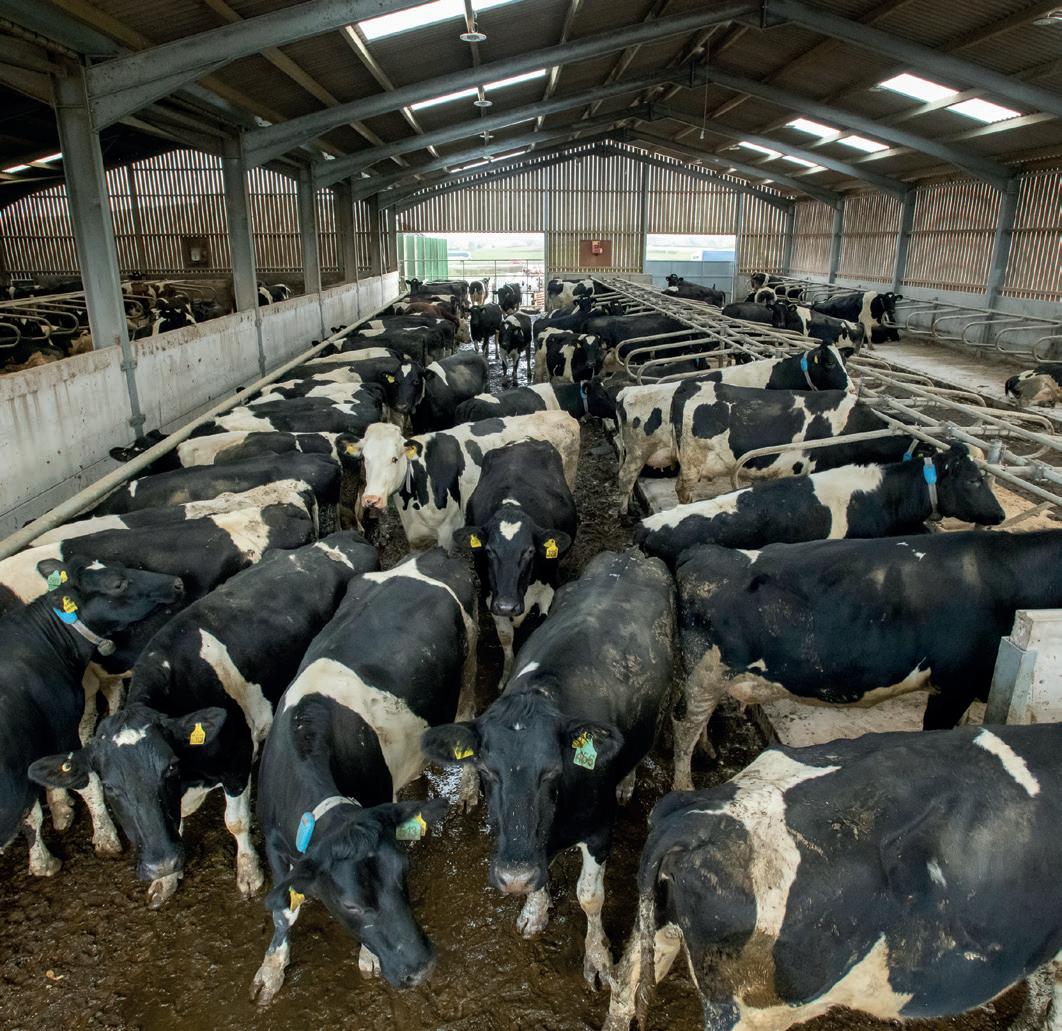
So, it is timely that this issue looks at breeding and fertility. As well as a focus on a British Friesian herd run by the Oulton family in Staffordshire (p32-35), we also spoke to three well-known breeders to find out what their breeding goals for 2026 are going to be.
And as pedigree Holstein breeder Andrew Rutter
succinctly put it on p30-31, his ambition is relatively straightforward, and something that many of you will relate to; and that is to stay in business and make money. This issue also looks at other areas where changes to business models can be made, and we have features on farmers who have moved to herbal leys to bring resilience to their grazing strategy (p26-27), others who have made minor alterations to shed infrastructure to bring about herd health and performance benefits ( p22-25 ) and a family who have looked to direct selling as a way to boost the bottom line (p10-12).
We hope you enjoy this issue.
Manage
Experts fear no milk price rises due for six months
ilk price reductions over the past few months mean UK dairy farmers are fa-
cing the biggest milk crash in history, with little chance of any uplift on the horizon.
Speaking at the Semex International Dairy Conference, in Glasgow, journalist and market analyst Chris Walkland said following a record year for income in 2025, UK dairy farmers are now facing the worst milk crash in history.
Mr Walkland said 2025 saw nine record producing months for UK dairy farmers. Additionally, a further 785 million litres of milk were produced last year compared to 2024, with 850m litres more than the five-year average.
And while this oversupply has contributed to price reductions, Mr Walkland said it had also highlighted the industry’s capabilities. He said: “I think it is a fantastic advert for milk production in the UK
There are short-term negatives, but I think there are long-term positives
CHRIS WALKLAND
and if we want to attract additional investment into our industry, we can go out and say ‘yeah, we will give you the milk’. There are shortterm negatives, but I think there are long-term positives.”
Looking at the cause of the recent price crash, Christophe Lafougere, chief executive at Gira, said the reductions in milk price were largely due to global oversupply, as a result of good farm prices over the last 18 months, the impact of bluetongue and increased butter exports from the US.
‘Perfect storm’
Mr Lafougere said: “Bluetongue has been hard for the dairy industry, we lost a lot of cows, production rate was down, abortion rate up and fertility rate down; to the point that we have seen a lot of calving postponed.
“This is part of the explanation why we have not seen these growths in production coming.” He added that all of this has created the
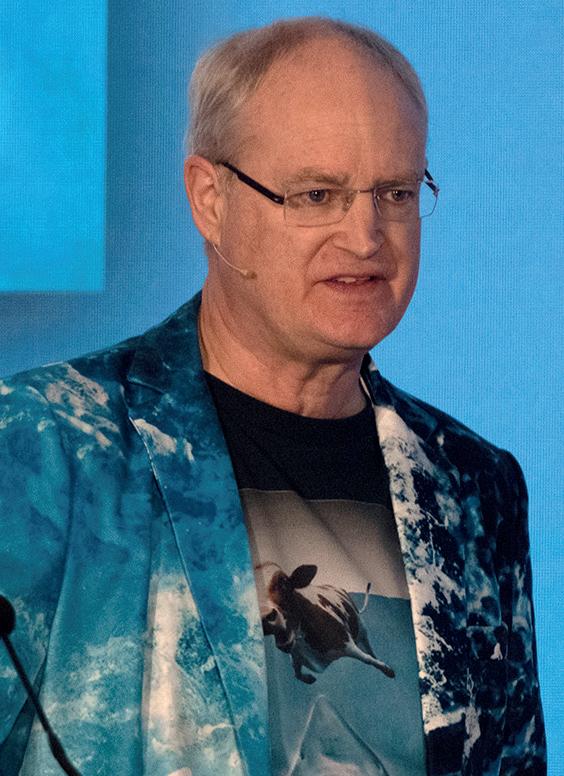
Market analyst Chris Walkland predicts there will be little uplift in milk prices over the the next six months.
‘perfect storm’, with a lot of milk now being collected globally.
And while Mr Walkland had suggested this time last year that prices would go down, he said that
nobody could have predicted what has actually happened.
Looking to the future, Mr Walkland said there was not a lot of uplift for the next six months.
He added: “Hopefully, the prices now for those at the bottom end of the table will have stabilised, and there will not be any further reductions.”
UK Government ‘does not recognise value of farming’
JALMOST 100% of farmers say the current Government does not recognise farming’s contribution to society, in what has been described as ‘a remarkable vote of no confidence’ in the Labour Party. According to a Farmers Guardian study, more than 85% of those questioned said they had changed or scaled back investment plans following Labour’s initial announcement on the family farm tax, with more than three-quarters
vowing to continue to fight the Inheritance Tax (IHT) changes which are due to be introduced in April.
Negative
More than 400 farmers responded to the post-Budget ‘Reality of Farming’ survey, which asked farmers for their views on a range of current industry issues.
While the results revealed a resoundingly negative response to Government actions, only 11% said
they would vote Labour at the next General Election even if the party changed the IHT legislation.
However, the study also showed that almost 70% had engaged with their local MP in the past year.
But the policy shift has had one positive impact, as the study also showed farmers have begun to make progress in terms of business preparedness – with 73% saying they had started succession planning.
JDAIRY Board chair Paul Tompkins will stand for election for an officeholder role in the NFU this month, with deputy president David Exwood to challenge incumbent Tom Bradshaw for the union’s presidency.
Mr Exwood will also stand for deputy again this year, with vice-president Rachel Hallos standing for deputy and vice.
Mr Tompkins is also standing for deputy and vice-president, alongside Robyn Munt, who has served the NFU for more than 10 years as county chair, South Board chair and in governance.
Mark Jeffrey, who represented NFU Wiltshire for six years on council, following a branch chair term of office and representing the NFU as an education ambassador during the last two years, will stand for the role of vice-president.
News in brief Tompkins runs for presidency of NFU against Tom Bradshaw Reader vows to make Welsh voices heard
J GLAMORGAN dairy farmer
Abi Reader is the next president of NFU Cymru, after securing the backing of all 11 Welsh counties.
Ms Reader succeeds Aled Jones as president and said she was ‘ready to take a leading role in shaping the future of Welsh agriculture’.
“As president, I will continue this great work and ensure that every sector, in every part of Wales, feels heard, valued and represented at the highest levels in Cardiff, Westminster and beyond,” she said.
pplications for the ‘reformed’ Sustainable Farming Incentive (SFI) will open in June, Defra Secretary Emma Reynolds has promised.
Reformed SFI will be opening in June A
According to Defra, the new-look SFI has been designed to simplify the scheme, level the playing field, and provide stable, predictable delivery for farmers.
It will be delivered in two phases with smaller farms, or those not already in a scheme, given priority. A second window will be opened in September for wider applications.
Defra Secretary Emma Reynolds made the announcement at the Oxford Farming Conference, where she also told the sector that there would be no more changes on Inheritance Tax.
Alongside SFI will be the launch of a new Farmer Collaboration Fund, providing £30 million over three years to support farmer groups in growing their businesses, building partnerships and sharing best practice.
There will also be £30m set aside for the extension of the Farming in Protected Landscapes scheme, as well as plans to transform England’s uplands, recognising the unique challenges facing the rural communities that depend on them,
The reformed Sustainable Farming Incentive has been welcomed, but calls have been made for more details.
from poor access to services to harsh farming conditions.
The Secretary of State also set her vision to work in partnership with farmers, as outlined following the publication of Baroness Minette
Batters’ Farm Profitability Review. NFU president Tom Bradshaw said it was ‘encouraging’ to see the Defra Secretary’s ‘real ambition for a thriving agriculture industry, demonstrated by her announcements made today, as well as her commitment to working collaboratively with farmers and growers’.
Christmas 2025: A boost for butter
J GROCERY sales reached a record £13.8bn this Christmas, with shoppers spending, on average, £476 at supermarkets during the festive month.
AHDB’s latest insights reveal there were an additional 504,000 occasions where cheese was purchased during the run-up to Christmas 2025.
Cow cheese had a particularly successful Christmas, with volumes up by 4.4% year-on-year. Cheddar (+6.3%), Stilton and British blue (+0.8%) and snacking cheeses (+26.7%) all contributed to this growth, likely used on cheeseboards, which AHDB had predicted
would be an important part of celebrations for a third of consumers.
Promotional support was strong for these varieties, and, as a result, encouraged more shoppers this year to make purchases in the runup to Christmas.
Notably, more than 663,000kg of Stilton and British blue, almost a fifth of total volumes sold in 2025, were purchased during this two-week festive window, underlining the importance of Christmas to these products.
Cow butter, in particular block butter, had a successful Christmas. Throughout much of 2025 there had been increased demand for
block butter. Shoppers were undeterred by higher price points than for other spread options and leaned into the taste and less-processed nature that block butter offers.
This ongoing trend appears to have also helped boost festive demand, perhaps for use on cheeseboards or Christmas baking, and more shoppers made purchases compared with Christmas 2024.
Promotional activity also increased in this period and likely encouraged the additional 898,000 purchase occasions this year.
Cows’ cream was also on shoppers’ minds this Christmas, and volumes purchased increased by 1.6%.
NFU deputy president David Exwood said it was positive to hear about ‘much-needed’ plans to reform SFI.
“But there remains a huge lack of detail that farmers and growers urgently need and this uncertainty continues to undermine farmers’ confidence, ability to invest and do the best for their business,” he said.
“We recognise that the farming budget is finite and that SFI has to be spread more evenly across the industry, with a particular focus on the coming 12 months, but for farming and growing businesses to deliver the public goods the scheme originally set out to achieve, it is vital that it is accessible and relevant to all food producing businesses, no matter the size.
“That is why if there has to be an SFI funding cap, we support a cap per hectare for SFI agreements on-farm.”
The ARION 500/600 CMATIC:
Seamless acceleration and deceleration between 0-50kph
Uninterrupted power for maximum productivity and fuel efficiency
3 simple drive modes
Auto trailer stretch brake
Unrivalled operator comfort
The original multifunction CMOTION joystick
DAIRYTalk
Stuart Sadler
Stuart Sadler is a fourth-generation farmer on the 56-hectare (138-acre) Yew Tree Farm just south of Chester in Aldersey. In partnership with his parents, Stuart milks 75 predominantly Friesian cows calving all year-round, supplying Arla C.A.R.E.
Plenty of projects still need doing on the farm […] but these will have to be put on hold until we start to see the markets turn
We had hoped for a steady Christmas period and in the main it was, albeit a phone call from our milk buyer on the eve of December 23 telling us they would not be picking our milk up for the following four days felt like a real kick in the teeth.
Unfortunately, there was nothing else we could do apart from sending the milk straight into the slurry towers. It is an extremely demoralising sight watching all our hard work quite literally go down the drain, even knowing you will be remunerated for it.
In this day and age, it just seems incredibly wasteful that there was no alternative option for us, along with the several hundred other farmers affected.
Back in early 2025, we had our biannual inspection from the Environment Agency (EA). Everything went smoothly and there were no non-conformances, a great success.
Or so we thought. A couple of months later we received notification that the EA were coming out again. We asked why another inspection so close to the first one and it turns out they had no recollection of coming out previously and were none the wiser as to who actually carried out the audit.
Unfortunately for us, we had discarded the original letter sent out, meaning we had no physical evidence that it had taken place either. So, second time around we were instructed to undertake some costly concrete yard renewal on the farm.
All being well this should be completed by the time you read this column and it will keep us in the good books for another year or so.
New kit
We are about to welcome a new piece of kit on the farm, updating the old open-top slurry tanker, which has served us well over the past 15 years, to a new vacuum tanker. This was ordered in the late summer, pre-milk price crash.
The old tanker could not be converted to attach a dribble bar so the new tanker has been purchased for when the day seemingly comes when splash plates are banned. Our milk buyers have told us we will not be able to use them from January 1, 2027.
I am not entirely sold on dribble bars yet. There seem to be more cons than pros in my opinion,
particularly from a practical point of view. You can probably wager a lot of money that those bringing in these rules have never actually spread slurry themselves.
So what challenges are we facing in 2026? Silage stocks are looking tighter than we would like, so a generously early spring would be well received.
Obviously, the main concern for us all will be the alarming rate at which the milk price has dropped and it does not seem to be slowing down just yet. Plenty of projects still need doing on the farm, updating sheds and renewing machinery, but these will have to be put on hold until we start to see the markets turn and head in a positive direction.
Farming with parents, you soon learn that they may actually know what they are talking about sometimes, as they will have been through tough times like this before and it is probably wise to take their advice on board. I am very lucky to farm with both parents still; they always seem to know when my ideas need reining in.
Luxuries will be put on hold this year; the focus will be looking after the cows and, in turn, hopefully they will look after us.
Ben Yates
Ben Yates manages Mells Park Estate, Somerset, where he oversees a 400-cow unit and manages the 405-hectare (1,000-acre) estate. Along with his wife and two sons, Ben has his own small herd of pedigree Holsteins under the Wowcow prefix. He joined the Holstein UK Board of Trustees in 2021.
The challenge will be trying to save costs without having a negative effect on the cows or production.
The New Year has started and the first couple of quarters could prove to be some of the most interesting and challenging the industry has seen, with the announcements of falls in milk prices.
It would be great to have a crystal ball to know when we are at the bottom of the trough, as the New Year is when I start working on the next financial year’s budgets for the businesses – and the dairy budget is really going to take some looking at.
The challenge will be trying to save costs without having a negative effect on the cows or production.
We have achieved near to a six-litre increase from the budgeted yield this year, potentially due to a little extra room for the cows as the barren cows went earlier and also due to fantastic forage.
Our current forage stocks look good and healthy, so we should not need to purchase any going forward.
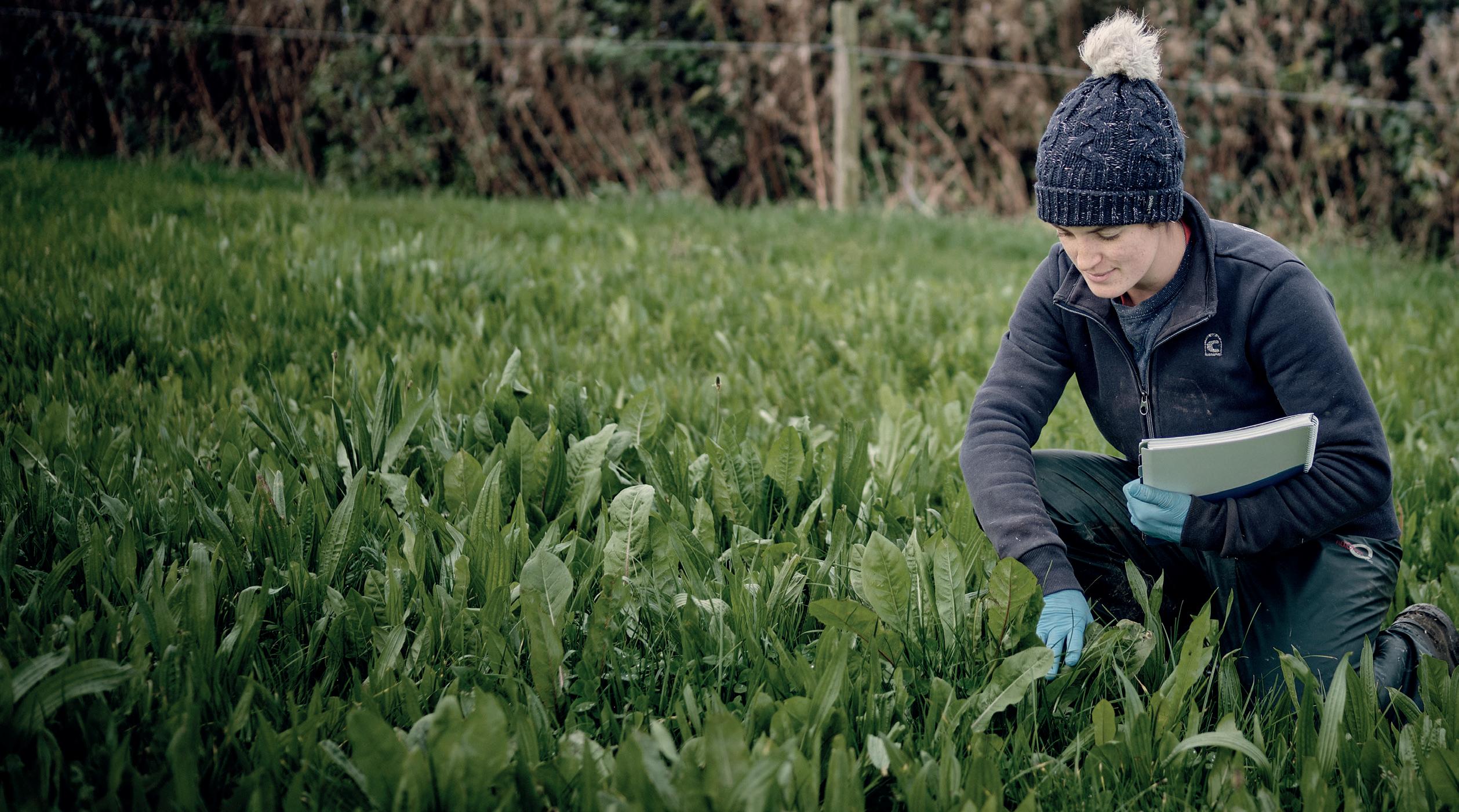
Out in the fields, all the autumn reseeds look fantastic, along with all the other leys. It is amazing how grass recovers from drought. The herbal leys have really come into their own, with their speed of recovery.
We did reseed more than originally planned, as some of the older leys did not look like recovering last summer.
Silage
A decision was also made not to bring any sheep on this winter, as a lot of the farm was cut for silage in late October which was a fantastic crop of fourth cut.
With a large portion of the heifers now in-calf, as soon as the weather conditions allow us, they will be turned out. Once we have a bit more day length, the cows will also be going out.
The estate has great infrastructure with cow tracks, many gateways to fields, and water troughs that are well positioned, so we can turn out without making a mess.
Part of my preparation for this year’s budget includes looking at whether we do our own umbilical slurry work.
Over the past few years, we have purchased pumps and a compressor, and we have been adapting underground pipe work to help service the whole farm.
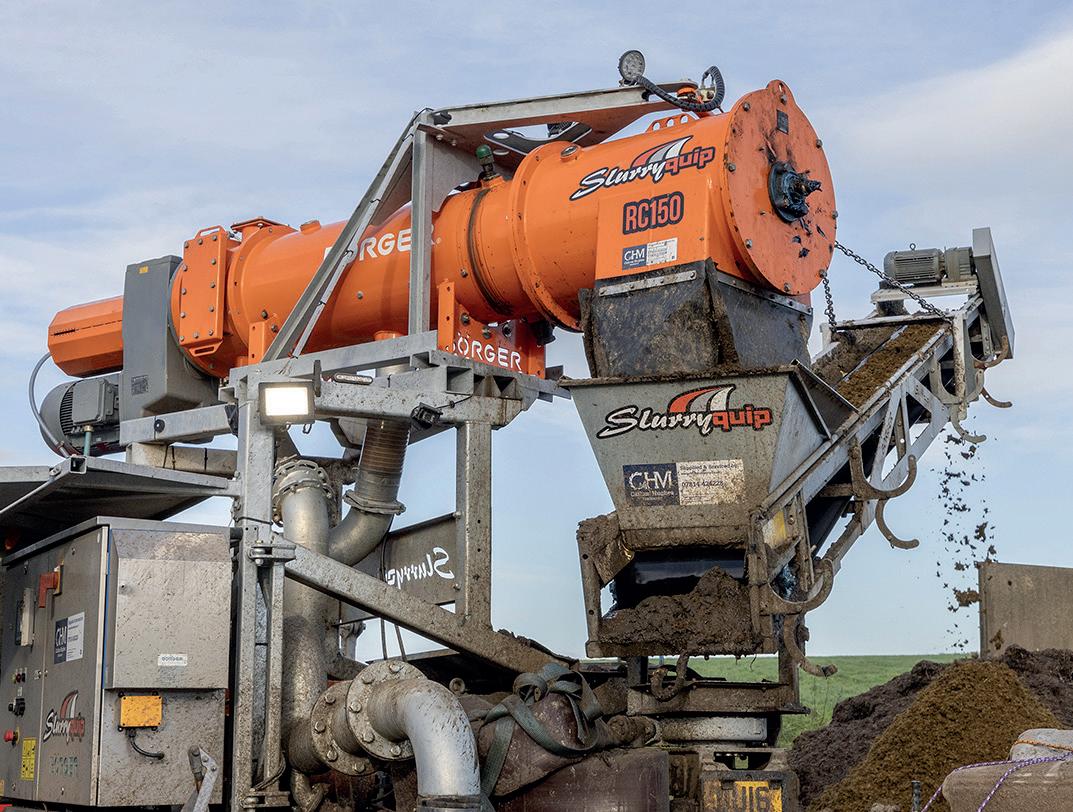
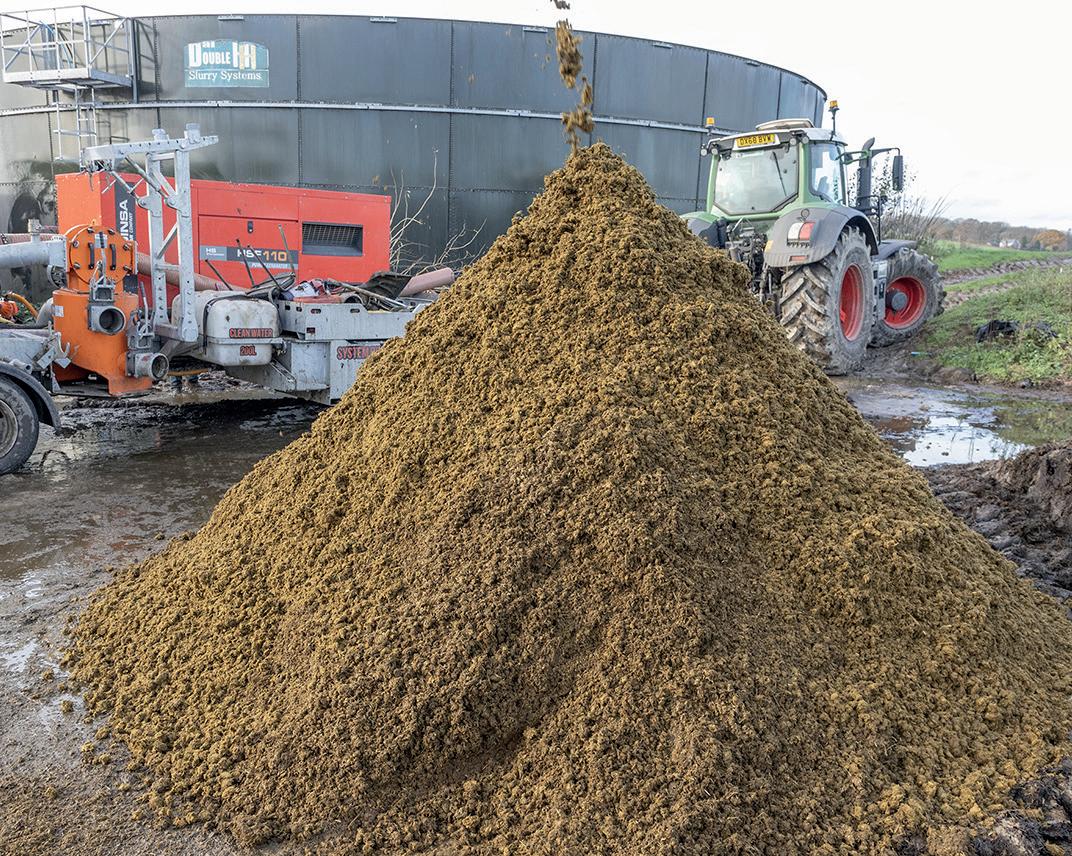
Coupling this with the separator system we put in in the autumn, we have an easier product to deal with as it is a more consistent liquor.
I am just trying to work out the saving on purchased fertiliser, against the application with a trailing shoe.
We have now completed the first five weeks of pregnancy diagnoses in the breeding season. We made some small changes to how we interpret our data from our heat detection system. Previously, we were using their service window, which we think may have been pushing them a little late for service. We have adjusted our interpretation of the data, and hopefully, we will be better off for it.
In October, my youngest son was chosen to be part of the team of four Holstein Young Breeder (HYB) members that went to compete in Italy at the Open Junior Show, held in Montichiari, representing Holstein UK.
The week included showmanship, clipping and stockjudging competitions, competing against other juniors from across Europe. It was a really great experience for him and his teammates. These opportunities are what make the HYB movement so special.
Daniel Weaver, from Staffordshire HYB, is also currently in Australia on the Australian Exchange programme that the society runs. The skills these members bring back to the UK are invaluable to the future development of the dairy industry.
Applications for the Sue Cope Bursary are open now.
This is an opportunity for HYB members aged between 18 and 26 to apply for a bursary of up to the value of £1,500 to support the development of their skills within the dairy industry, such as conference places, international study trips, or training.
A consistently poor milk price was the catalyst for the launch of direct raw milk sales on the Granville’s mid-Glamorgan unit. Wendy Short finds out more.
Raw milk vending machine offers profitability boost
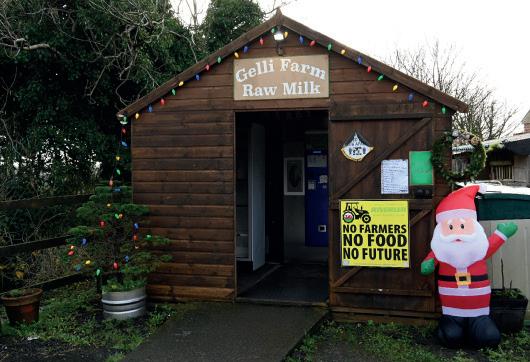
Araw milk vending machine, installed in 2017 at Gelli Farm, Bridgend, Glamorgan, is popular with customers from as far as 50 miles away, says Kath Granville, who also adds that the profitability boost it offers has allowed her to work on the farm almost full-time.
The vending machine takes about 30% of the milk produced by the 60cow closed herd, with the remaining milk volume going to First Milk.
“Our farm was the first in Wales to sell raw milk through a vending machine,” says Mrs Granville, who farms with her husband, Robert.
“In 2016, the milk price had dropped to 9.5ppl, and we were dependent on my income from work off the farm.
“Direct sales seem an obvious solution, especially as we have passing traffic, and the idea was supported by the Farming Connect agency.
“There were a lot of hoops to
jump through, but feedback from customers strongly indicates that they appreciate raw milk, as well as a product with good flavour and a cream line. They also like to sup-
port a traditional family farm in the locality.”
Pasteurisation was ruled out due to the extra cost, coupled with the potential advantages of offering a niche market product, she says.
The milk is sold in one-litre and two-litre plastic or glass containers.
“Some 150-200 litres of raw milk is sold through the machine on a daily basis,” says Mrs Granville.
“The machine has to be filled up three or four times and we enjoy the interaction with our customers.
“The diversification has made all the difference to farm profitability and my off-farm work has been reduced to a few hours every month as a milk recorder.”
The herd yield averages 9,000kg at 4.35% butterfat and 3.55% protein. Approximately 60% are pedigree ‘Gelli’ Ayrshires and the rest are
cross-breds, with the Jersey and Holstein Friesian bloodlines first introduced in 2018.
Mrs Granville says: “The Jersey and the black and white was brought in via artificial insemination as an experiment to boost milk production and quality, and we like the cross-breeding policy.
Replacement
“Sexed semen is used for replacement production and the lower end of the herd is put to British Blue or Aberdeen-Angus semen, with dairy beef calves sold at a young age.
“The aim is to breed a small-tomedium cow, with traits that suit the conversion of grass into high quality milk. Our females must also be fertile and have the ability to look after themselves.
“The Ayrshire herd is an integral
The vending machine was installed at the farm gate in 2017.
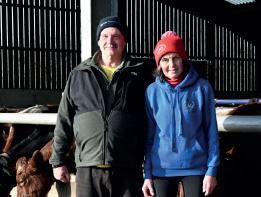
Robert and Kath Granville.
PICTURES: RUTH REES
On Farm
Farm facts
■ The herd yield averages 9,000kg at 4.35% butterfat and 3.55% protein
■ Cows fed a total mixed ration, which is made up of round bale grass silage taken from three annual cuts, plus straw and a protein blend
■ Milking robot installed in 2023
part of the farm. The breed is productive, with a very quiet temperament. It helps to maintain litres in the tank and we get great pleasure from exhibiting our pedigrees on the show circuit.”
The latest investment at the farm has seen the installation of a milking robot and solar panels will be added this spring.
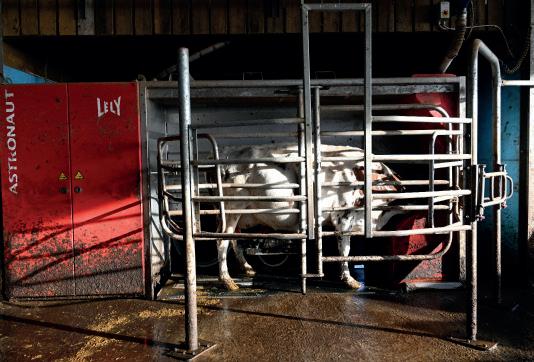
Installed in 2023, the single robot has enhanced cow performance and eased the workload on the 40-hectare (100-acre) unit.
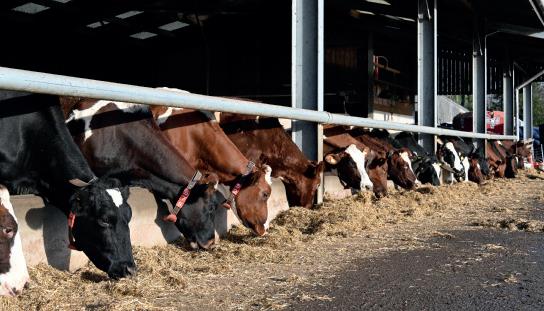
Cows are fed a total mixed ration made up of big bale silage, straw and a protein blend.
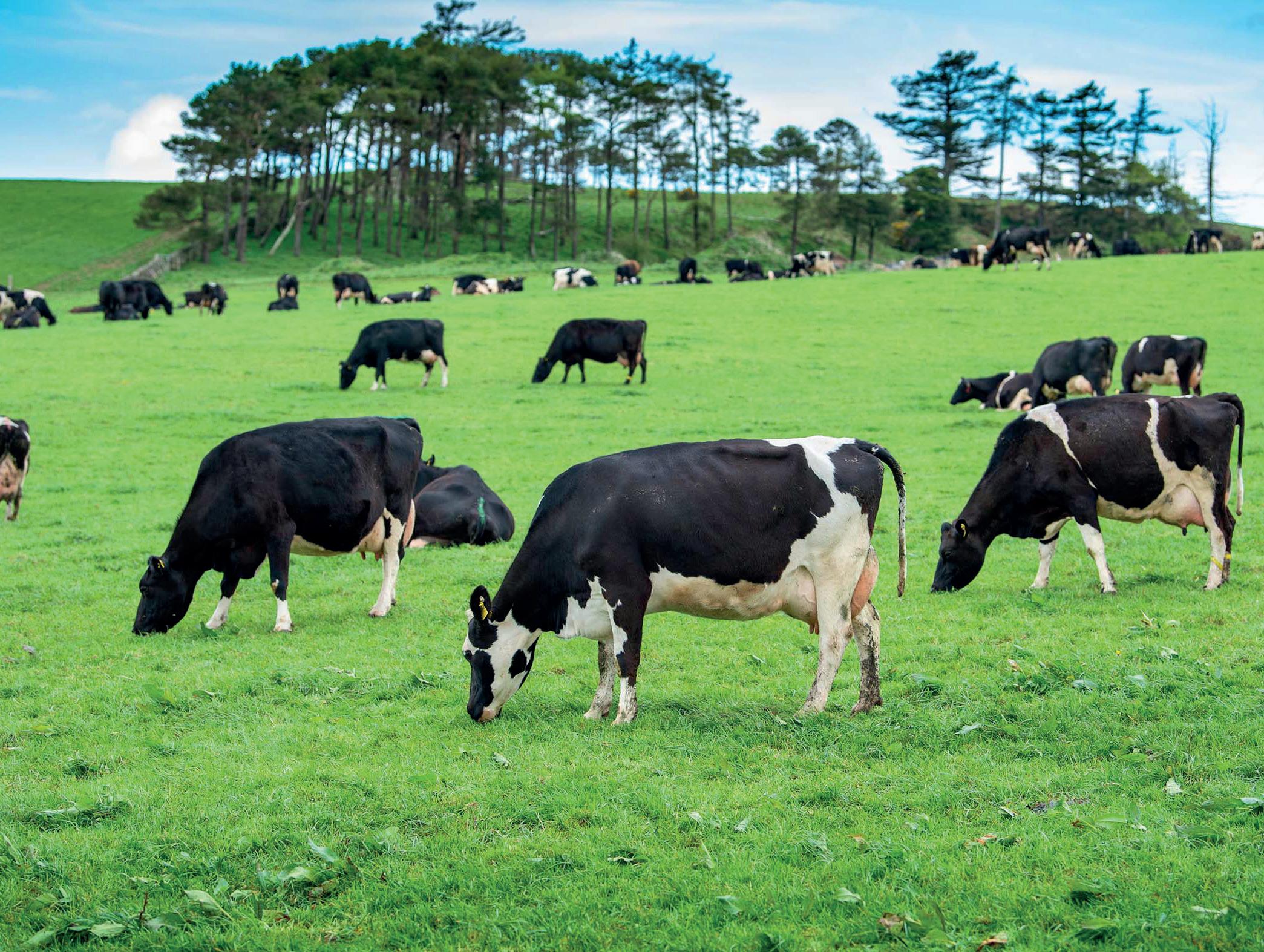
A further 8ha (20 acres) is rented. The cows are usually grazed from April until the end of October and fed to yield in the robot.
Mrs Granville says: “The average yield has risen by about 40% since the switch from parlour milking. The robot is largely responsible, although the result has also been influenced by the move away from spring calving and to allyear-round system, in order to keep the vending machine stocked.”
She adds the parlour had reached the end of its useful life and the robot has proved to be the right decision.
“Grazing gates were ruled out due to the field location, so instead the cows are let out in early morning,
Delivering top-tier nutrition from day one, Volac Milk Replacers’ formulas set calves on the path to success, ensuring strong growth, enhanced fertility, and superior milk production down the line. Feed for Growth, your partner for performance. feedforgrowth.com
On Farm
after the computer programme registers adequate milkings.
“The cows are usually brought back inside in the early afternoon and they have a pecking order when it comes to queueing for the robot and will eat the total mixed ration or lie quietly until it is their turn to be milked.”
Mrs Granville says cows visit the robot on average three or four times in a 24-hour period with most of the milkings taking place overnight, which helps to keep electricity costs down.
She also says the calving interval has increased to 400 days,
which is partly because of the production increase.
She explains: “The cows work harder in the robot and it is reflected in the fertility performance.”
The TMR is made up of round bale grass silage taken from three annual cuts, plus straw and a protein blend.
The herd is grazed rotationally on a standard grass mix overlying a clay-type soil which maintained productivity in last year’s dry conditions.
Over the summer, the youngstock are turned out on to an 8-ha (20acre) parcel of Site of Special Scientific Interest (SSSI) land.
Mrs Granville says: “The SSSI land has been left untouched since 1914, and it qualifies for some farm support due to its special features.
“It contains many different species and it is highly drought-resistant, although water is retained in some areas after heavy rainfall.
“The heifers are kept at a limited stocking rate on a strip-grazing system and they come back from it in peak condition.”
The couple’s only time away from the farm is during the cattle showing season, she points out.
The trips frequently pay off, with Gelli Garedig JC Crummie picking
up several breed awards at the 2025 Royal Welsh, for example.
The maiden heifer had a very good year altogether, also being crowned Ayrshire champion at the South Wales calf show, among other accolades.
Once installed, the solar panels on the cattle housing roof are expected to save an estimated 60% on dairy unit running costs, assuming that a battery system is included. It is predicted to produce a return on investment within four or five years.
Inheritance
However aside from the investment programme, uppermost in the Granvilles’ minds has been the changes to the Inheritance Tax rules for farmers. The couple’s three adult daughters live and work off the farm, but lend their support whenever it is needed.
Mrs Granville says: “Our farm is run solely by family labour, and we have always relied on our daughters’ input. They would willingly join us, but the farm size is a limiting factor. Nevertheless, we feel they have put in the hours and earned the right to retain their very keen involvement.
“The pedigree Ayrshire herd was established in 1946 by Robert’s grandfather, John Granville.
“He had a milk round, so the farm has come full circle. Thankfully, direct sales have offered a solution to the family business, which we all hope will thrive long into the future.”
A single robot was installed in 2023 when the parlour reached the end of its useful life.
Heifers are kept at a limited stocking rate on a strip-grazing system.
About 30% of milk produced is sold through the vending machine.
CRYPTOSPORIDIOSIS
COCCIDIOSIS
In the event of a Cryptosporidium parvum outbreak Halocur® can help. Contact us to find out how we can help protect the long-term productivity of your herd or visit www.msd-animal-health-hub.co.uk ROTAVIRUS, CORONAVIRUS, E. COLI SALMONELLOSIS
Mark Chatterton is the director and head of agriculture at Duncan & Toplis, which is one of the largest accounting and business advisers in the UK.
If the turbulence of the past year has reaffirmed anything, it’s that farming is a long game played in especially sporadic seasonal bursts. Few harvests in living memory have tested British agriculture quite like that of 2025, giving a stark reminder of how volatile the industry has become.
With this in mind, what might 2026 have in store? Early predictions tease a landscape that looks set to test both patience and planning for the nation’s farmers.
Self-sufficiency is a good litmus test for the resilience of UK farming, so let’s start with food production. When it comes to home-grown supplies, the UK is now 65% self-sufficient; this figure climbs as high as 77% for foods native to Great Britain, according to Defra. While this is a very respectable base, it should be stressed that it’s not a comfortable cushion. One underperforming year can knock cereal self-sufficiency sharply off its axis, so resilience needs to be seen as less of a buzzword and more of a business model – and one that needs to be firmly embedded.
Against that varied backdrop, this Autumn Budget cycle matters because it lands just as the last meaningful rungs of the old support ladder are removed.
Farmers have always been especially adept at reading the weather, but over the next 12 months, they will also need to read policy fine print with the same level of care.
Farmers are having to trudge through an ever
Mark Chatterton
more convoluted tax landscape following recent announcements. Earlier Autumn Budget proposals raised concerns about significant future Inheritance Tax (IHT) exposure, particularly around Agricultural Property Relief (APR) and Business Property Relief (BPR).
There was, however, some welcome relief just before Christmas. The Treasury has increased the combined APR and BPR valuation threshold from £1 million to £2.5m, or £5m for married couples. This eases what could otherwise have been a substantial IHT burden for many family farms and provides greater certainty when planning for the next generation. For some businesses, projected IHT liabilities had previously reached about £50,000 per year over a 10-year period, often exceeding the average annual farm profit of about £40,000. Against that backdrop, the revised thresholds represent a meaningful intervention.
Proactive planning
While larger and more diversified businesses will continue to feel the impact of wider tax pressures, proactive planning remains essential. Many farms now operate as small rural portfolios rather than single-enterprise businesses, which brings opportunity alongside added complexity.
Transferring assets down a generation, particularly between the ages of 60 and 80, can still be an effective strategy, with Capital Gains Tax holdover relief potentially available on qualifying business assets.
Defra has confirmed that delinked payments are reduced by 98% on the first £30,000 in 2026 and 2027, leaving a maximum payment of about £600. Put plainly, direct support stops being a meaningful income stream next year for the vast majority of businesses.
Money from the public purse is not disappearing, but it is changing shape materially. Environmental Land Management (ELM) and 2026 uptake of the Sustainable Farming Incentive (SFI) are now the main routes, and they are becoming mainstream rather than experimental. There were 32,200 live SFI agreements by early 2025, and for 2026 the
Money from the public purse is not disappearing, but it is changing shape materially
Let’s be clear that British farming has never been a fragile vocation. It is practical, adaptive and quietly innovative
question pivots from whether to engage to how to make agreements which work alongside meaningful production goals.
If support is thinning, margins need to fatten – or at least stop shrinking. Input costs will not offer us the mercy of standing still either. AHDB forecasts economic costs for winter wheat will rise about 3% for the 2026 crop to as high as £1,659 per hectare. Fertiliser prices are a major driver yet again, too.
Prepare
So, how do we prepare for 2026 without trying to predict the unpredictable?
Firstly, rework your cashflow for next year to account for not relying on the delinked Basic Payment Scheme. Treat the £600 maximum as what it is (pocket change by modern standards) and be sure to stress-test your business on average prices and slightly higher costs. If you can make that scenario work, you are not gambling on a good year; you are investing in staunch survivability.
Secondly, turn SFI and other ELM options into designed enterprises. The farms getting the best out of schemes are those that pick actions aligned with their agronomy and their labour capacity. In other words, if the measure improves soil, reduces risk or fits the rotation, it pays twice.
Thirdly, act early on succession and structure. The
transferable allowance is a genuine help, but only if plans are in place before April 2026. Review ownership, partnership arrangements and wills now.
Finally, treat climate adaptation as a productivity tool. Cover crops, drainage upgrades, water storage, and more resilient swards are not just ‘green’. They are insurance policies you can farm with. In today’s climate, that is not merely a moral argument – it is instead basic arithmetic.
The overall mood in the sector is understandably cautious. The Autumn Budget gives a welcome nudge on succession, but leaves complexity and tax pressure very much in play. Direct support all but vanishes, while earned schemes grow in importance. Costs tick upwards while climate risk is now a near-ubiquitous concern.
However, let’s be clear that British farming has never been a fragile vocation. It is practical, adaptive and quietly innovative, and 2026 will reward the businesses that plan early, measure honestly and build resilience into the very furrows of their operation.
Importantly, as tax continues to become ever more complex for farmers, then the case for clear, specialist advice is simple.
Farmers have always needed good neighbours, but next year, they may well need good accountants just as much.
As milk prices decline, along with recurring and emerging diseases and pressures to meet sustainability goals, Nantwich Farm Vets are working with agritech innovators to identify diseases sooner. Dairy Farmer reports.
Vets adopting agritech for earlier disease detection
This year will be a challenging time for the dairy industry, and Phil Cullinan, business development manager at Nantwich Farm Vets, says as well as milk price cuts farmers are also facing additional pressures with disease and targets. He says: “There is the constant challenge of things such as bovine TB and Johne’s, then there are emerging diseases, including bluetongue. There is also ever more pressure coming from a sustainability perspective in terms of what
processors and supermarkets are asking farms to do and how they can continually develop to achieve the broader industry goals handed down by the Government to retailers and processors.
“Juggling all of that is a massive challenge, along with the day-to-day on-farm challenges of staffing and weather.”
However, despite increasing challenges, Mr Cullinan remains positive that agritech innovations could lead to new ways of working, improving animal welfare and increasing efficiency.
When it comes to animal welfare, proactive measures can help detect disease earlier – which reduces suffering and contains infectious spread.
Diagnostics
Nantwich Farm Vets is using its Agri-TechE membership to partner with several companies to find new ways to take a preventive approach – from ‘sniffing’ out diseases in gases released from animals to taking tissue samples for on-farm diagnostics, and artificial intelligence (AI) body
monitoring. These tools offer various solutions to get an earlier handle on livestock disease.
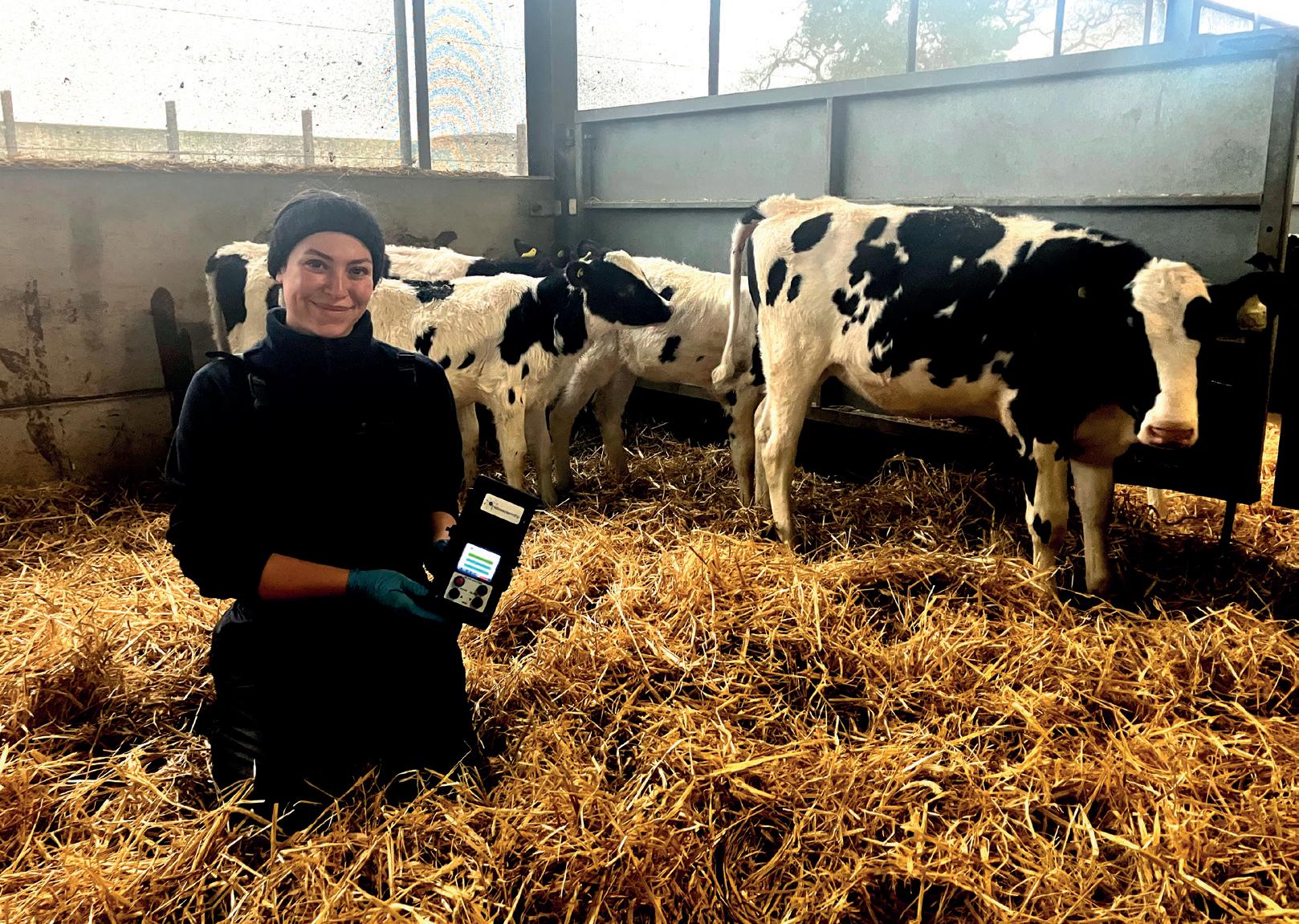
For example, the team is working with RoboScientific, a business that uses volatile organic compound sensors to detect diseases in livestock using breath samples. By matching the breath sample to on-farm vet assessments, Nantwich Farm Vets is working to corroborate and expand RoboScientific’s dataset.
A breath sample is taken automatically by a machine as the calves feed from automatic milk feeders.
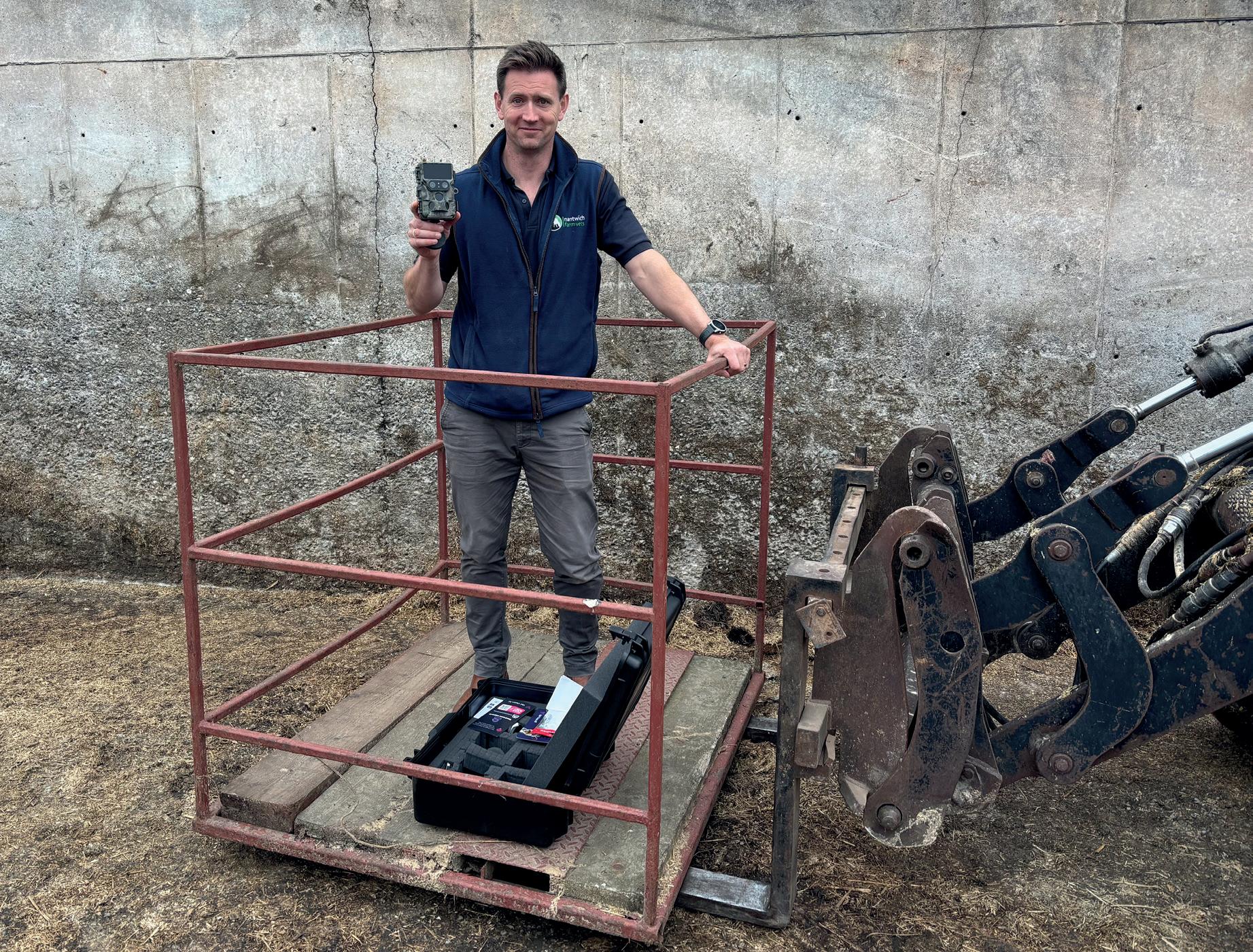
Phil Cullinan with one of the Vet Vision cameras that uses artificial intelligence.
Mr Cullinan says: “We are currently in a development phase, but the hope would be that the farmer gets an alert early on in the disease process enabling earlier, and therefore likely more successful, treatment, as well as fewer knocks on calf growth and less antibiotic use. There are lots of benefits.”
Nantwich Farm Vets has also been working with Vet Vision AI to use data to inform decision-making, with the aim of promoting this as a new service to their clients.
Mr Cullinan explains that on one of their farms, AI cameras have been installed to monitor different parameters between two sheds. The goal is to analyse the data to guide future investments, identify small improvements and enhance their business operations by caring for the cows and increasing efficiency.
Following the 2025 Agri-TechE REAP Conference, Mr Cullinan also connected with one of the
start-up showcase businesses, Proton DX, which has developed an on-farm rapid test to diagnose diseases in under 30 minutes.
The veterinary team has supported the start-up in assessing where the technology could be useful.
Mr Cullinan says: “In terms of disease identification and reducing antimicrobial use, that presents another challenge for farmers, which is connected to human health. Some of the new technologies can help farmers to farm more effectively.”
Buy-in
Looking ahead, Mr Cullinan emphasises that gaining consumer buy-in will be essential for both farmers and vets.
“Farmers, and vets, are going to have to make sure that we are able to deliver a product that is acceptable from the point of view of animal welfare, economics and environmental sustainability,” he says.
“The UK has committed to carbon targets and ultimately a legally binding target of net zero by 2050. So, there is going to be
more pressure on farmers, and as vets, we want to be best placed to advise them on the kind of things that we can help them with to
achieve the targets that are going to be put on them, ultimately, by the processors and the people that are buying their milk.”
Jodie Nutsford, of Nantwich Farm Vets, getting to grips with RoboScientific kit.
Maintaining body condition and promoting rumen fill and function in the dry period is key to preventing ketosis in fresh calved cows. Katie Fallon reports.
Manage feed availability to reduce the risk of ketosis
With studies suggesting that 27% of dairy cows in the UK will have sub-clinical ketosis between 10 and 20 days after calving, vet and clinical director at LLM Farm
Vets, Rob Hall, says the disease is effectively unavoidable in modern dairy cows.
However, the aim is to limit the number of cases seen among herds.
Mr Hall says ketosis in dairy cows is a negative energy balance, which happens when diet and feed intakes are not meeting a cow’s energy requirements.
This is generally due to milk yield increasing rapidly in early lactation, creating a gap between energy requirements and energy intakes. Cows are then required to mobilise their fat reserves to make up the deficit.
Mr Hall says: “By mobilising the fat, they are breaking it into ketone bodies. Those ketone bodies can then be used by the cow to meet some of its energy demand. Then we are able to measure how much
of a negative energy balance they are in.”
The disease is commonly seen in fresh calved cows, due to a sudden increase in energy demands.
Mr Hall adds: “They will have been ticking along quite nicely with quite moderate feed intakes when the cow is dry, then suddenly it calves and is needing a huge amount of energy to support milk production.
Demand
“So, its energy demand goes up massively, but the feed intakes do not increase as quickly, especially if other illnesses are affecting the cow. So, demand outstrips supply and we go into this negative energy state.”
Mr Hall says ketosis can present itself as a clinical case, where high ketone concentrations in the blood affect the cow’s nervous system, or
as a sub-clinical case, where there are no obvious outward symptoms.
He says: “Clinical ketosis is normally neurological and has behavioural signs. Cows can often have a tremor or can be a bit wild, and a bit unsteady on their feet.
“And they can often do weird and wonderful things, like furiously lick at steel bars or be found drinking in puddles.
“These are the sorts of behaviours that can be associated with mineral deficiencies too. But I would say we do not see that many clinical cases these days.”
Sub-clinical cases are likely to be picked up in routine monitoring of herds for the disease, via blood or milk samples.
Mr Hall says cows with elevated levels of ketones are likely to suffer from other diseases, reproductive
Ketosis is commonly seen in fresh calved cows, due a sudden increase in energy demands.
Rob Hall
Top tips for managing ketosis in the dairy herd
■ Monitor body condition score or blood ketone levels to establish the extent of the problem
■ Feed availability - is there feed available and can cows access it?
■ Water access is also key –especially in straw bedded dry cows where water troughs can easily be contaminated with a layer of straw
issues, twisted stomachs and reduced milk yields.
He says: “It is an iceberg disease; if you are getting clinical cases, you know you have got a whole load of sub-clinical cases that you are not picking up. Sub-clinical cases are quite subtle, quite long lasting, and as a result quite costly.”
While ketosis predominantly affects cows at the transition period at the start of lactation, new cases
can occur at any time, including at peak yield around 60 to 90 days in lactation.
Therefore, Mr Hall says for farms looking to carry out a herd monitoring programme for ketosis, he advises testing cows a week after calving.
He says: “Generally we would have farms monitor fresh calved cows as a representative batch.
“They might test a dozen or 10 cows a month, or a handful a week, to give them a feel of how good nutrition management is.”
When looking at treating ketotic cows, Mr Hall advises speaking with the farm vet, however a three- to fiveday course of a propylene glycol oral drench is known to be effective.
This is due to the compound being a readily available energy source, which ‘slots’ straight into the liver’s metabolic pathways. Other treatment add-ons include a glycerol drench, or a vitamin B12 injection, to help boost energy production.
Mr Hall says it is also key to understand if there any other
Real-time insights anytime, anywhere.
We see farming differently. Tru-Test Active Tag allows you to draft animals whilst seeing real-time heat and health data, right from your phone, whilst our Dairy Drafter enables autonomous drafting, making sure you get the right cow every time.
We strive to manufacture products and provide services that specifically make a measurable difference to you and your operation. Make farming more cost effective and efficient with accurate livestock tracking and data-driven decisions.
Scan the QR code to register your interest.
Making a measurable difference.
underlying health conditions with ketotic cows, as this can affect response to treatment.
In terms of prevention, Mr Hall says feed availability is key and is the biggest risk factor for ketosis and transition disease.
He says: “I am not a nutritionist, but my simple understanding of nutrition is that you cannot eat what is not there.
Balance
“It is really difficult to balance the dry cow around the transition period, as you do not want them gaining a massive amount of condition in the dry period, and you definitely do not want them losing condition.”
Therefore, as dry cows approach calving it is important to maintain body condition, while also promoting rumen fill and function.
Mr Hall also advises introducing some of the milking ration to the dry cow diet, to prime the rumen bugs and help with digestion after calving.
He says: “Controlling body
condition is really, really important. Ketotic cows are not going to perform as well, and they are going to take longer to get pregnant and produce less milk in the meantime.
“Controlling body condition is the same as controlling ketosis. If we can limit the amount of loss that we get between calving and peak yield in terms of body condition, then we are limiting the amount of ketosis.”
Mr Hall says there is also evidence that feeding certain amino acids to dry cows can help with overall energy metabolism, with chlorine and methionine supplementation both helping to minimise the negative effects of ketosis on cow health.
He also advises screening dry cows and peak yield cows at least once a quarter, to make sure diets are suitable and keeping cows well fed, which he advises being done via blood sampling.
He adds: “Ultimately, is there feed in front of cows? Because if there is no feed in front of them, we know they are hungry.”
A large-scale dairy business in Chile is looking carefully at future capital investment opportunities. Chris McCullough reports.
Careful allocation of budget within tight profit margin
When considering future plans for his family dairy farming business in Chile, Teofilo Grob says he does his research before decisions are made to make sure any investment will work well for the business.
Together with his father Augusto and his three brothers Rainer, Thomas and Duncan, the family runs a 2,000-hectare (4,942-acre) farm near the city of La Union in the Los Rios region of Chile.
The Grob family has five separate dairy farms and three breeding farms in their company, which is a member of the Colun dairy co-operative.
The farms are managed under the operational leadership of Cristian Codjambassis, chief adviser, and his son Francois, production manager.
Teofilo says: “Cristian began working with my father in the early 1980s and his son Francois joined the family business 10 years ago.
“Their contributions and technical knowledge have been invaluable
in the development of our business.
We currently milk about 2,100 Holstein cows across the units, with cows milked twice per day on our pasture-based dairy farms and three times a day on our housed units.”
He adds there are about 1,550
cows on pasture, divided into high and low producing groups, along with 550 cows in freestall barns fitted with DeLaval M45 mattresses.
For the past 25 years, the breeding strategy on the farms has been to genotype all calves with Clarifide and, based on that, inseminate all heifers with sexed semen. About 20% of the cows are inseminated with sexed semen, 10% with conventional and 70% with beef semen.
Costs
Teofilo says: “The reason for using beef is that we will limit growth for a couple of years to minimise costs and improve cashflow until we have a clear idea of the next project.
“Our selection indicators are milk solids production, smaller body size with greater feed efficiency and longevity.
“We primarily use net merit as an index.”
The family company employs about 100 people, with 10 assigned to each of the dairies.
The remainder work in forage production, breeding, concentrate production and administration.
All the dairies use DeLaval traditional herringbone parlours of various sizes to milk the cows – the biggest one with 30 stalls.
When constructing the parlours, the family focused on milking speed, putting a lot of emphasis on parlour design to ensure rapid entry and exit.
The biggest 30-stall parlour can milk up to 220 cows per hour with three people in the pit. In terms of feeding, Teofilo explains he aims to grow most of the feed on the farms as this helps control the quantity and quality of the ingredients.
Left to right, Teofilo Grob, Augusto Grob, Cristian Codjambassis and Francois Codjambassis.
The Grob family run five dairy farms, three breeding farms and employ 100 people.
Farm facts
■ Average daily production is 27 litres per cow on the pasturebased units and 42 litres per cow in the housed units
■ Average solids are 4.27% butterfat and 3.77% protein
■ During 2025, the average milk price was 430 pesos per litre (35ppl), and the cost of production was around 390 pesos per litre (32ppl)
■ Milk is sold to the Colun co-operative
“In recent years, our focus has been on producing enough corn and alfalfa to feed our cows for 400 days.
“We also produce the small grains, such as triticale and wheat, that make up the concentrate.
“We produce the concentrate in our own mill where we prepare the mixes for all the dairies and for rearing.
“The corn, salts and proteins are
purchased from co-operatives such as Cooprinsem or Colun.”
Teofilo and his family recognise that investing in new technology can boost milk production and profits, but they are careful and thoroughly research everything.
Teofilo says: “In this business, there is always something new that allows for increased litres, but we have to be very careful about how we allocate our budget as our profit margins are very tight.
Alternatives
“Investment alternatives are generally weighed according to the net present value of the investment over a 20-year period.
“During the past two years, we have focused on the freestall sheds, with things such as fans, a robotic feed pusher, the farm management platform, cow collars and solar panels. We believe that investing in animal welfare translates into better milk quality and is more sustainable in the long term.”
The milking cows in the housed units are yielding an average of 42 litres.
In the future, the Grob family wishes to continue expanding the dairy operations, with possible investment in robotic milking if growth is slow, or a rotary dairy system for more aggressive growth.
Teofilo says: “We do have our challenges here and the drier summers, and the lack of water, even in areas with as many rivers
and lakes as this one, is becoming a real problem.
“The growth of cities, which has taken away many hectares of arable land, forces us to be much more efficient with less.
“Young people have less attachment to the countryside, which forces us to be more creative in retaining young talent.”
Family Farm
An open mind to investment and expansion has seen the White family grow their thriving 500-cow dairy operation. Katie Fallon finds out more.
Investment reaps reward on Lancashire dairy farm
Originally sheep farmers from Hawes, the White family moved to the outskirts of Gisburn in 1948, where they made the switch to dairy.
Today, brothers Dan and Craig White are the third generation to milk cows at the 190-hectare (470-acre) Wedacre Farm, where
continuing investment and a forward-looking approach have been central to their success. Dan oversees the cow side of the business, while Craig manages the machinery and fabrication. Dan says expansion and investment have been consistent across the generations.
Dan says: “Every generation has done something, and there has been a lot of expansion. We try to
do something major each year – if you stand still, you get left behind.”
Expansion has applied to farm infrastructure over the years and also to cow numbers.
Breeds
From the original 40 British Friesian cows the family started with in 1948, the herd now stands at 520 cows, predominantly made
up of Danish Reds, with a handful of Fleckvieh, British Friesian and Brown Swiss cows. Dan says they have milked Danish Reds for the past 14 years, after switching from Holsteins.
He says: “We changed breeds for easier management, and we needed something more robust. We tried all sorts, including Montbeliardes, but the Danish Reds seemed to fit. We are still left with a really good cull cow at the end. We have girls in their 10th and 11th lactation now.”
Operating a flying herd, the family previously imported Danish Red heifers from Denmark. Due to recent bluetongue outbreaks, they have had to source other breeds more locally, such as Brown Swiss and British Friesian.
Dan says: “Before bluetongue, we were buying 35 Danish Red incalf heifers every four months, but we plan to carry on with the mix of breeds if the milk quality is there.”
The family transitioned to a flying herd more than 20 years ago and have continued with the system.
Dan says: “I am not focused on or interested in breeding cattle, and we are not geared up for it. Milk is white and meat is red –cow colour does not bother me.”
Sire
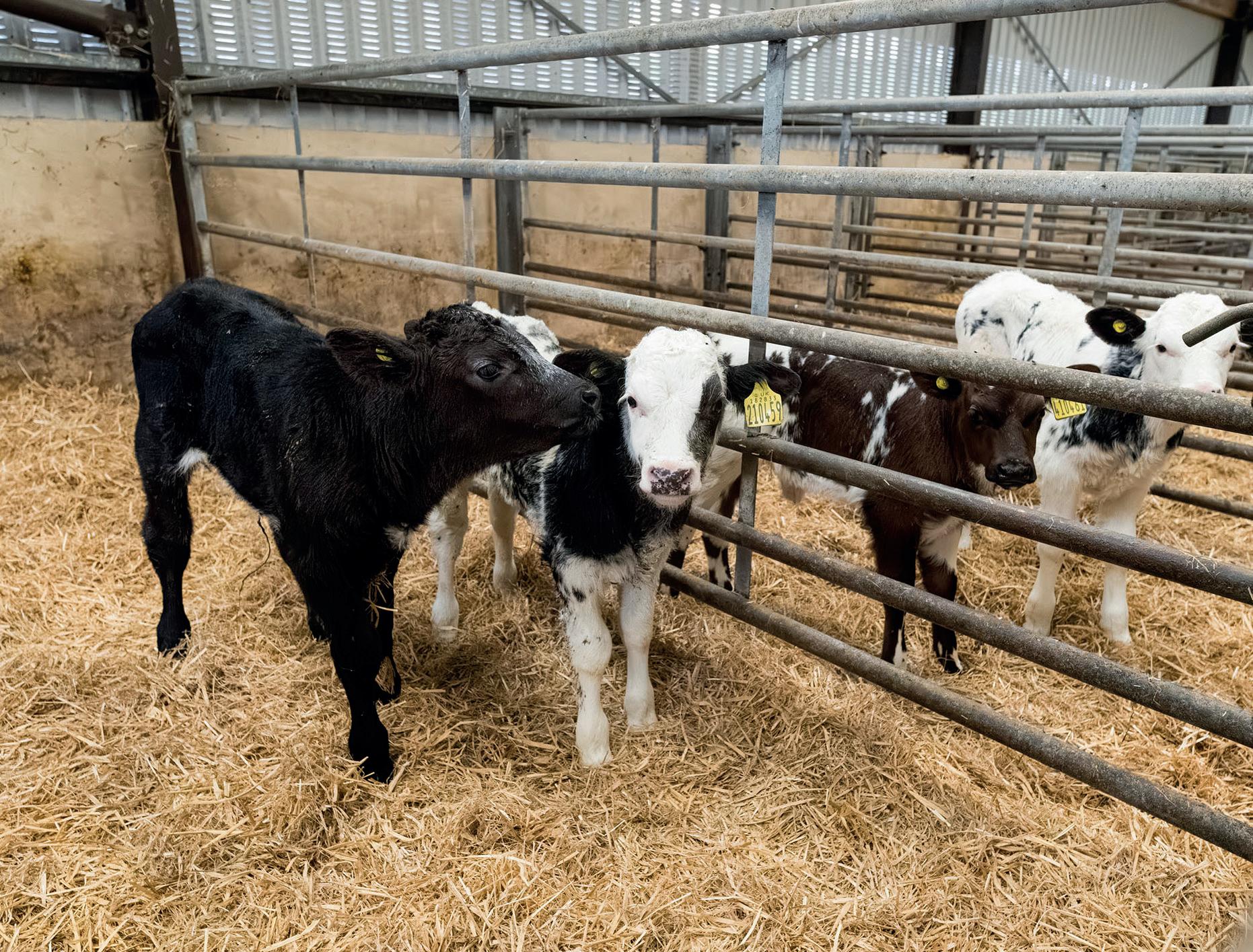
All cows are bred to a British Blue sire, with calves sold privately onfarm at a week old. Calves are tubed with four litres of colostrum for the first three feeds, then put straight on to milk replacer.
After supplying milk to Sainsbury’s for several years, the family moved to Dales Dairies three years ago and milk is now sold to
PICTURES: MARCELLO GARBAGNOLI
Dan White is part of the third generation, along with brother Craig, to milk cows at the site.
Family Farm
Farm facts
■ Pedometers are used for heat detection, with all breeding and artificial insemination done by Genus
■ A foot trimmer comes every three weeks for routine and dry-off trims, with Dan White doing foot trimming in-between
■ Recycled paper is used as bedding material in cubicles
■ The herd is housed all year and has been since the footand-mouth outbreak in 2001
■ All silage is clamped and done by contractors
Brades Farm Barista Milk. As a result, milk solids are particularly important when buying in cattle, due to higher protein milk producing a better froth, he says.
Dan adds: “We have a protein target of 3.6% and a butterfat target of 4.5%.”
The cows are milked twice a day
through a Dairymaster 50-point rotary, another example of the family’s approach to embracing investment and innovation.
Dan says: “We put the rotary in 18 years ago and were one of the first to install a first-generation rotary. We were milking 300
cows in a 30-aside herringbone parlour, which was taking five hours at each end of the day. We knocked that down to two hours
The cows are fed a total mixed ration of clamp silage, meal and Trafford Gold in the trough.
Family Farm
now planning on installing them on the other sheds as well.”
As well as the rooflights, a Lely Collector was installed in the old shed to aid cleanliness and introduce automation. Dan says this has been another great addition, and a further three collectors are on order for the other sheds, supported by the Farming Equipment and Technology Fund.
Slurry
The Whites have also invested in slurry management, with a 2.4 million gallon concrete slurry store put up in 2023.
Dan says: “We had outgrown the other slurry stores. With moving to a more multi-cut silage system, we did not have enough slurry for every crop. Now we use minimal fertiliser. This year, fourth and fifth cut silage was grown purely from slurry. We do not touch the slurry equipment from October to February.”
by putting the rotary in – milking now takes two and a half hours for 500 cows.”
Dan milks every morning, with help from his partner, Emma, and a team of relief milkers.
He says: “We usually have two people on the rotary and two pushing cows up and feeding calves.”
The cows are fed a total mixed ration of clamp silage, meal and Trafford Gold in the trough, with concentrate fed to yield in the parlour. The herd is milked as one group and is currently
averaging 8,900 litres, with a somatic cell count of 150.
Dan says the cows are ‘milking well’ for both output and breed and notes that the strong herd performance may be linked to their recent investments in infrastructure and, consequently, the health of the cow.
Investment
Continuing their focus on expansion and investment, the family built a new cubicle shed in 2018, as well as retrofitting an existing
cubicle shed with the Marlon CST Heatguard rooflights supplied by Brett Martin.
Dan says they previously used fibre cement rooflights, which had faded and turned green over time, leaving the shed dark and dingy, but, after seeing the Heatguard rooflights on display at local shows, they decided to try them on a section of the shed.
He says: “The roof was 20 years old and tired, but the new rooflights have transformed it and turned it into a pleasant environment. They help reflect the heat, and it is much lighter in the shed.”
Traditionally, September and October were difficult months for cow health in the old shed, says Dan, but since installing the new rooflights cow health during this period seems to have improved.
He says: “They have only been in one year, but we think they might be part of the puzzle that has helped improve overall cow health and performance.
“We installed them ourselves and they were easy to fit. We are
Slurrying is done in-house using an umbilical system, with a bubbler system used to mix slurry in the store. Two indoor silage clamps were built in 2014, then in 2020 the family bought 49ha (120 acres) of neighbouring grassland, which ring-fenced the farm.
Following this year’s favourable growing conditions, they have moved to more of a multicut silage system, with five cuts of silage taken this year in roughly four-week intervals.
The roof was 20 years old and tired, but the new rooflights have transformed it and turned it into a pleasant environment
DAN WHITE
Calves are sold privately on-farm at a week old.
A Lely Collector was installed to improve shed cleanliness.
He says: “We started to reseed 100 acres a year using an overseeding machine, with the whole farm now reseeded, which has also helped to achieve more silage cuts. We used to do three cuts and now do four, but the fifth was a bonus this year.”
A new calving shed was built in 2014, with the herd calving all year round, and Dan says the next investment will be in a new dry cow shed.
He adds: “We were hoping for a period of consolidation, but there is always something that needs doing. The parlour might also need an upgrade soon.”
There has been a boost in both cow numbers and infrastructure at the 190ha Wedacre Farm.
Installing new rooflights in an existing shed have contributed to improvements in cow health.
The herd is milked as one group and averages 8,900 litres, with a somatic cell count of 150.
Herbal Leys
At Rough Grounds Farm, Derbyshire, the Worsey family have transformed their milking platform by reseeding every acre into herbal leys. Dairy Farmer reports.
Building farm’s resilience with herbal leys
For Graham Worsey, the change to herbal leys has been as much about financial and business resilience as it has been about agronomy.
It has been a bold experiment driven by necessity, but one that is already delivering results: lower fertiliser use, improved soil structure and more resilient pastures that hold up when the weather turns dry.
Graham Worsey, who farms with his wife Justine and their daughter Jess, at Rough Grounds Farm, Derbyshire, says: “We wanted to see if we could build a system that would cope better through drier months and still maintain milk yields when conditions get tough.
“So far, the herbal leys have been a real experiment. In some fields, it has helped us keep a more consistent forage supply through the season and in other
areas of the farm, we have struggled to establish them.”
Since switching to herbal leys across their 96 hectares (237 acres), the Worseys have seen fertiliser use fall, with dry matter
(DM) yields remaining close to those achieved under conventional ryegrass leys.
Across their mixed soils – ranging from heavy clay to lighter loams – the diverse root structures have improved soil aeration and water movement.
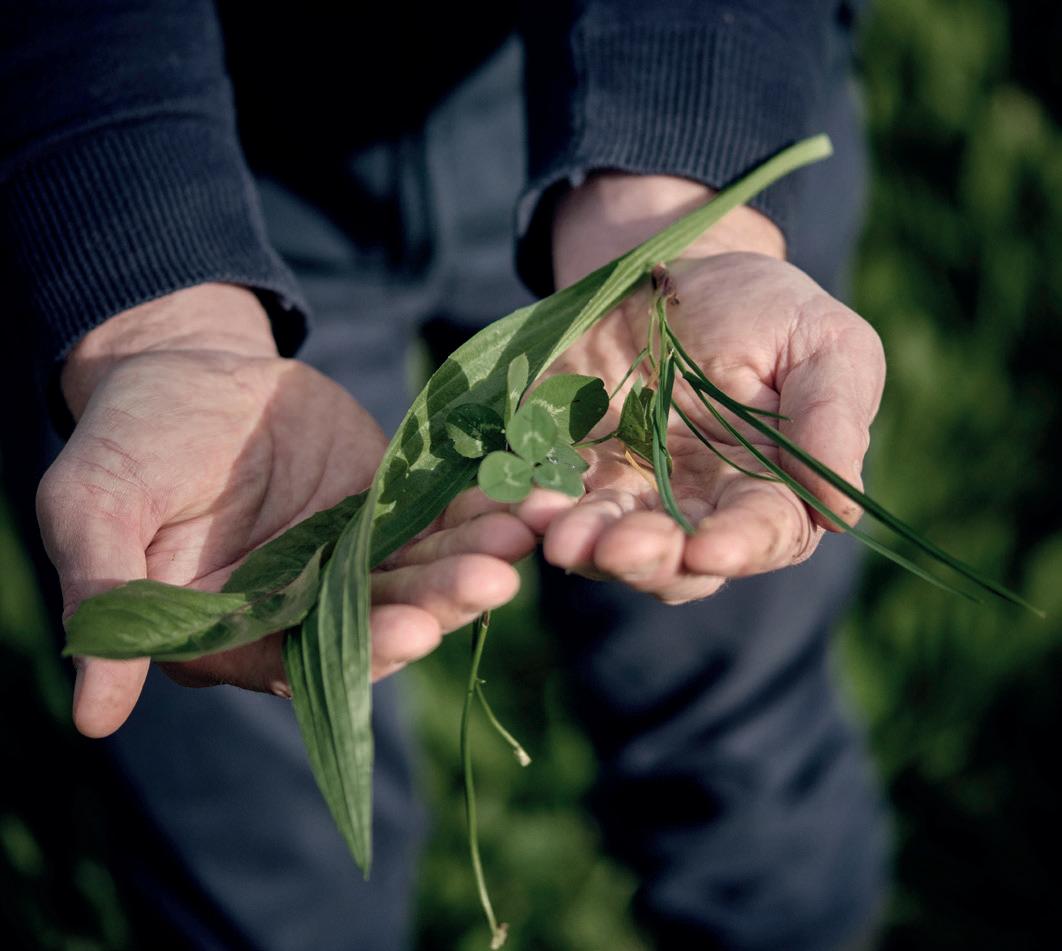
In their current mix, they have sown timothy, cocksfoot, red and white clover, chicory, plantain, ryegrass and festulolium.
‘Difficult’
“Grazing quality has generally remained strong, particularly through late spring and early summer when ryegrass would normally begin to fade.
“However, herbal leys have proved more difficult to establish and manage,” says Graham.
Chicory has been invaluable in dry conditions, but once rain returns and grass growth picks up, selective grazing can lead to bloat, poor residuals and reduced DM intake.
Plate meters also struggle to measure herbal leys accurately, and yields in 2025 were down by around two tonnes per ha (0.8t/
The Worseys have learned that not every species thrives on their clay-based Derbyshire soils.
Jess Worsey checks on the growth of the herbal leys.
Herbal Leys
Farm facts
■ Tenant farm located in Cubley, Derbyshire
acre) compared with the previous year, though it is hard to separate the impact of drought from the leys themselves.
Chicory tends to perform well in its first year, but declines by years two and three; earlier reseeds with higher rates of chicory and plantain left pastures too open by year three, so the family is now reducing sowing rates significantly.
Alongside this, they are trialling festulolium (AberRoot), with its deep rooting, as well as increasing the use of red clover.
The family’s continued focus on soil health – through regular testing and aeration – has improved structure and helped pastures recover more quickly after heavy rain.
This work was accelerated following advice from consultant Liz Genever as part of AHDB’s Strategic Dairy Farms programme.
Ms Genever highlighted standing water and high magnesium levels as key constraints and recommended a surveillance plan to assess root development.
The Sustainable Farming Incentive (SFI) provided a good opportunity to continue the trial, offering payments of £382/ha (£154/acre) under SAM3 for herbal leys.
“It gave us the breathing space to try something different,” says Graham.
“We wanted to make the most of the scheme, but also use it to build a stronger system for the future.”
At the same time, they entered a joint venture with Dan Jones, sharing enthusiasm, skills and management ideas.
The partnership has helped bring new energy to the business and a fresh perspective on grazing strategy. Cow numbers are ex-
pected to reach 340–350 within the next year as more heifers come through. Rough Grounds Farm now operates a rotational grazing system, aiming to turn cows out by February and keep them grazing until November.
Flexibility
Running a mixed sward of ryegrass alongside herbal leys has given the family flexibility to balance forage quality and persistence.
“We have had to learn how to manage it properly,” says Graham.
“It has meant that sometimes, we have had to do more pre-mowing to keep the quality right.”
Silage remains a cornerstone of the system. The farm typically takes five cuts per year. Despite the drop in fertiliser use, yields have remained comparable to their old ryegrass system.
The next test, however, will come as herd demand increases.
Graham says: “With more cows coming in, we are watching closely to see whether the herbal leys and ryegrass can meet demand.
“We have budgeted for extra forage and possibly some additional fertiliser, but the goal is to stay as self-sufficient as we can.”
The transition to herbal leys has been as much a mindset shift as a technical one.
The Worseys have learned that not every species thrives on their clay-based Derbyshire soils.
Some plants struggle to persist beyond a year, while others with deep root systems have flourished, helping to improve drainage and structure.
“We are still learning what works best for our soils,” says Justine.
“It is not a one-size-fits-all mix. You have to observe how it behaves through different seasons, talk to others, and keep tweaking.”
The family’s engagement with other farmers in the AHDB strategic programme has provided valuable insights and reassurance that the learning curve is part of the process.
Volatile prices
At the heart of the change lies a question many dairy farmers are now asking: can herbal leys really pay their way?
For the Worseys, the answer depends on looking beyond the short-term.
Lower inputs have reduced exposure to volatile fertiliser prices, and improved soil health
■ Farmed by Graham and Justine Worsey, and their daughter Jess
■ Split block-calving system
■ Mixed herd of 260 Jersey, Shorthorn, Friesian, and cross-bred cows
■ Yields of 6,500 litres per cow with 4,500 litres from forage
is delivering a more consistent forage base. The shift to herbal leys has made the farm less dependent on external inputs and more adaptable to future SFI changes.
Graham says: “Even if the scheme does not return next year, the benefits we are seeing in soil and forage quality make it worthwhile.”
The family will continue reseeding to maintain quality and species diversity, while refining grazing management to suit a larger herd. They will also keep investing in soil health, recognising it as the foundation of everything else.
For the Worseys, herbal leys have become more than a scheme requirement; they are central to a strategy that is building the business for the long-term.
Graham says: “This has been about making the farm work better, not just chasing payments. We have had to adapt. The herbal leys have given us resilience and that is something every dairy farm needs right now.”
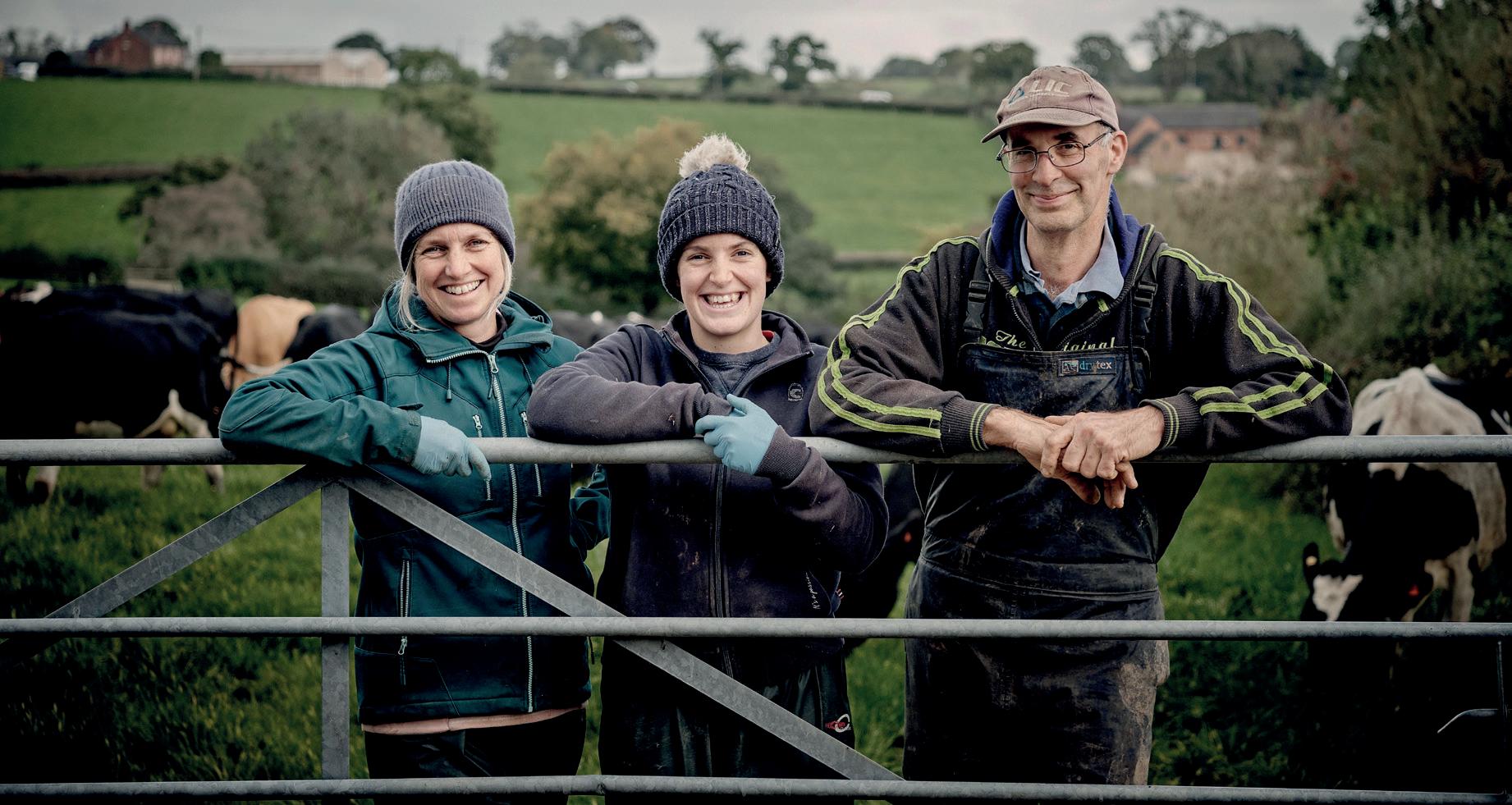
Left to right: Justine, Jess and Graham Worsey.
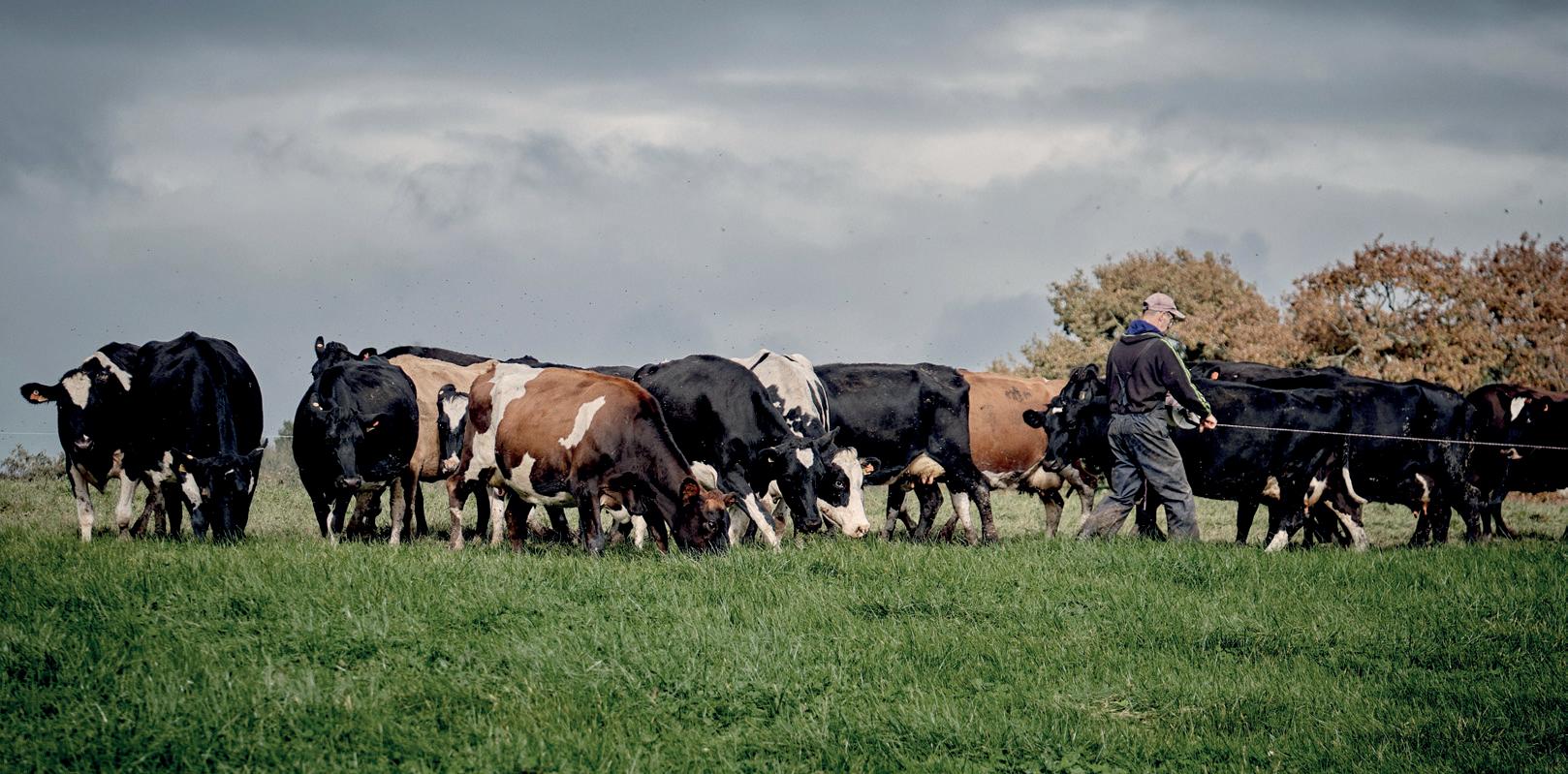
Grazing quality for the dairy herd remained strong in 2025, says Graham Worsey.
Galicia is Spain’s largest milk producing area, with 41.6% of the country’s total dairy production coming from the region. Natalie Noble joined a study tour to Galicia to find out more about the Spanish dairy heartland.
Dairy farming in Galicia
Dairy farming in the Galicia region has shifted toward intensification, with around 90% of dairy farms now housed, year-round calving and reliant on maize silage plus imported proteins such as soya and canola (rapeseed).
Milk prices sit at an average of 48.4 eurocents per litre (43ppl), which is below the national average of 50.1c/litre (44ppl).
Forestry-driven land competition, labour shortages, generational change, climate pressures and high costs have all shaped the sector.
Yet despite these challenges and declining farm numbers, milk deliveries still rose in 2025.
Galicia is recognised for its significant contribution to dairy genetics through the Confederacion de Asociaciones de Frisona Espanola (CONAFE, a Spanish organisation dedicated to the Holstein breed).
And genetics have influenced the 270-strong Holstein milking herd at SAT Candesa: a two-farm, twofamily partnership, which has focused in on genetics and raised average daily yields from 37 litres/cow to 45 litres. Its aim is to produce more milk with fewer animals.
One of the founding farms, Ganaderia Casa Caneda, had the second-best genetic merit in Spain in recent years, with one of its animals – Bos Caneda Naomi Storm ET – receiving the CONAFE Gold Medal.
Housed and milked three times daily through a conventional 12:12 parlour, averaging 3.55% protein and 4% butterfat, the milking herd’s somatic cell count sits at 250,000 cells/ml.
Dr Jesus de la Inglesia Barrientos,
who has been working with the two families for more than a decade, says that the production aim is quantity over milk solids, with high yielders achieving daily yields of 58 litres/cow.
The milking ration also reflects the herd’s high productivity with a 7kg inclusion of soya in the high-yielding ration, alongside 33kg of maize silage, 10kg of grass silage, 7kg of chopped barley straw, plus a bespoke blend to balance protein sources, minerals, and feed additives.
Unusual
Mr Barrientos says feeding that level of soya is unusual.
He says: “It is not the norm, we manage it carefully and make sure the whole ration is balanced to avoid any problems.”
Cows are grouped separately as high- and low-yielding groups on sand-bedded cubicles. The cubicle shed has 10 fans down each section as well as water droppers – kicking in at 24C° and 26°C, respectively.
An hour’s drive away is Laura
Seoane Novo and her family at Ugasma SL, in Boimorto, where Mr Barrientos says the focus is on longevity and a circular system. Holsteins are the choice breed, with 310 milking cows, plus 270 followers.
Housed and milked twice-a-day through a conventional 12:12 parlour, two people can milk 100 cows/hour. Daily milk yields average 36 litres/cow at 3.7% protein and 4% butterfat.
Differing to other units, Ms Seoane Novo rears her own replacements instead of sending them off-farm to be contract-reared.
Heifers are artificially inseminated to sexed Holstein semen, everything else is bred to conventional Belgian Blue. The heifer and dairy cross calves are separated; however, they are reared in the same way until weaning at 12 weeks.
Ms Seoane Novo says: “We take all of our animals through full production cycles. So, we want to make sure that all our animals get the best start – if we do not, it will pain us.”
Ugasma SL, in Boimorto, grows 25ha (62 acres) of alfalfa to add protein to the forage at the farm.
Dr Jesus de la Inglesia Barrientos and Laura Seoane Novo at Ugasma, in Boimorto, where the farm’s focus is on longevity and a circular system.
Calves are group-penned and peak fed up to 10 litres at 15% concentrate through automatic feeders, with step-down weaning at 12 weeks.
Heifers are then moved to a designated rearing shed, where they remain until they are served at 12 months old.
Dairy cross calves are moved to the farm’s on-site feedlot, where they are fattened at nine to 10 months old.
Alfalfa
The family is also taking a different approach to forage and feed; growing 25ha (62 acres) of alfalfa and contract buying raw materials to mill through its small onsite feed mill.
Alfalfa, a legume crop, provides a yield of 12,000kg/ha (4,858kg/acre) per cut which converts to 2,300kg/ ha (931kg/acre) dry matter at 20.6% crude protein and a good level of fibre – helping to reduce purchased feed costs.
With a five-year duration, the crop yields three to five cuts per
year and is ensiled for the milking cow ration. In the field, it improves soil structure and nitrogen fixation, providing agronomic benefit to the farm’s following maize crop.
Further east in Palas de Rei, Gavieiro e Hijos SL is a rapidly growing enterprise with 700 milking cows across four housed farms, and a turnover close to €8 million (£6.9m) in 2024.
The company’s director Ruben Castro explains that the ambition is to centralise the farm at Palas de Rei and increase milking cow numbers from 300 to 1,300 – achieved by building a state-of-the-art robotic dairy facility on site.
With ground already broken, Mr Castro hopes that the build will be complete by summer this year.
“What we want to achieve is an autonomous, high-welfare unit that is as sustainable and as self-sufficient as possible,” he says.
“The new unit will have a 16-robot batch milking system and a slurry
Genetics have influenced the 270-strong Holstein milking herd at SAT Candesa, raising average daily yields from 37 litres/cow to 45 litres.
treatment system, which will recycle the manure into a safe cattle bedding. Cow comfort is particularly important to us. We are paying close attention to cubicle design as well as cow space and flow.”
The business has already invested in solar panels – installed on the current unit’s roof and supplying 80-90% of the farm’s energy –which have reduced the energy bill by five to six times, to under €1,000 (£866) a month.
Mr Castro says that the new
facility will also have panels installed, as well as one-megawatt storage battery, making the farm completely energy self-sufficient.
rThe study tour to Galicia was organised by Ian Lindsey at LKL Services and Emma Millar at Zinpro, with delegates including freelance journalist Natalie Noble guided around farms in the region by independent vet and nutritionist Dr Jesus de la Inglesia Barrientos.
Breeding & Fertility
A new year prompts a fresh look at the genetics programme for three of the country’s top pedigree breeders, who review their goals for performance improvement in the 12 months ahead. Wendy Short finds out more.
New year: new goals for pedigree breeders
CLAYDEN HOLSTEINS
■ Run by: Andrew Rutter, Clayhanger Hall Farm, Crewe, Cheshire
■ Top achievement to date: Mr Rutter’s stepfather Dennis Hughes’ overall championship win at the National Holstein Show in the 1990s, with a home-bred cow. In 2025, Clayden Harmony Belle made the national top 50 on the Profitable Lifetime Index (£PLI).
ANDREW Rutter’s first step when making breeding decisions for the family herd is to study the genomic testing programme report.
“It is the equivalent of GCSE exam results for the cows,” says Mr Rutter, an AHDB dairy sector council member.
“The number one reason for animals leaving our herd is through sales, as farm income is boosted through the marketing of mostly second-calvers.
Culling
“In terms of involuntary culling, mastitis is probably the lowhanging fruit. It is not a problem as such, as the average somatic cell count is 130,000 cells/ml. However, it is an aspect that is always worth revisiting.
“Unfortunately, the unit is not geared up to handle sand bedding, so a combination of sawdust and lime is used. The cows are foamdipped pre-milking, with iodine post-dipping. To maintain a low mastitis level, I will look at a sire’s score in the sub-index, as well as its cell count figure.”
Selection
Other genomic sire selection criteria cover milk volume and quality, as well as feed efficiency.
The farm is committed to bulls from the Genus stud and among the recent selections are Hotshot, Coyote, Arcade, Java, Barker, Charisma, Charming and Mascot.
Mr Rutter says: “It is a question of seeking a balance between positive butterfat and protein scores without any loss of yield.
“While the business has a
Muller contract, it is critical to ‘future-proof’ against potential contract changes.
“£PLI is important, of course, but I tend to put more weighting on EnviroCow, as it suits our contract and goals better.
“Other priorities are good TB advantage scores, plus lameness advantage to retain the high mobility rating.”
He adds: “I have always been told that using too many genomic sires can have a negative effect on uniformity, but we use 20-30 new sires annually and have found the opposite to be true.
“Uniformity does not improve profits but, in fact, it has been achieved without trying.”
His ambitions for the unit’s future are straightforward: “I want the farm to make money and stay in business.”
PANDA HOLSTEINS
■ Run by: Molly Westwood, Molland Ridge Farm, Exeter, Devon
■ Herd size: 30
■ Pedigree herd established: December 2011
■ Top achievement to date:
Winning a Holstein UK Master Breeder award in 2024
MOLLY Westwood sells embryos and breeding heifers from her small herd, while also working as UK sales manager for artificial insemination company Blondin Sires. She has firm plans for the business.
She says: “Numbers will stay the same, but I feel it is important to spread Panda genetics as far as possible
PICTURE: MARCELLO GARBAGNOLI
Andrew Rutter
Breeding & Fertility
CRYSTALCLEAR HOLSTEINS
■ Run by: Mark and Anne Lee, Park Farm, Raskelf, North Yorkshire
■ Herd size: 200
■ Yield average: 11,000kg
■ Pedigree herd established: 2005
■ Top achievement to date: Herd shortlisted in the 2024 UK Premier Herd competition
THERE is a common theme to the bulls selected for the ‘type-orientated’ herd run by Mark and Anne Lee, who also own livestock auctioneers Norton and Brooksbank. The artificially inseminated sires chosen include Vogue A2P2, along with Westcoast Blakely, Duckett Diesel and Siemers Pazzle, Parfect and Comrie.
“These bulls all have high conformation traits, plus good figures for health, constituents and fertility,” Mr Lee says.
“About a quarter of the herd is red and white. There is no commercial angle, I simply like their appearance and have also used the red and white sires
Blondin Alpha and Trent-Way Altarodan. One particular favourite is Farnear Delta Lambda. It may be viewed as a bit outmoded, but its 80-plus daughters represent the type I am trying to achieve.
“Extremes are avoided. A negative chest width, for example, is undesirable to our surplus heifer buyers. They are looking for a powerful, durable female with the potential to thrive in a large herd environment.”
Functional
The primary aim is to produce a balanced cow that will go on to classify EX. This highlights a functional type that will also achieve the required longevity. Roughly one-third of the females are inseminated with beef semen, partly for cashflow reasons, but also due to the low replacement rate of 20%. Beef cross calves are sold at two weeks old.
Mr Lee’s involvement in auctioneering gives him a broad perspective on the industry.
“The big question is how long it will take before milk prices start
worldwide. I am trying to produce something different and unique.
“Fewer than 7% of Holsteins have the red and white colouring. If they can become more competitive in the world of black and whites it would be a great achievement. I aim for a correct, true model Holstein on type, but one also capable of doing the job it is bred for and producing at least 100 tonnes of milk.”
to rise. If the current climate persists until the autumn it will have a detrimental effect. However, my gut feeling is that it could turn around relatively quickly, fuelled by overproduction being corrected by a combination of high cull cow and beef prices and forage shortages.
“The progress of the modern Holstein, including the red and white, has been mind-blowing. It
Figures are given due consideration for genetic selection, but are not the deciding factor.
Faith
Molly Westwood
She says: “Ratings for the various traits hold sway, but I will not use a bull without having faith in his sire stack. That applies if he has even a single generational sire that is questionable.
“ A correct rump also goes a long way, as it benefits udder attachment and follows through to the front end.
“I think a lot of Lucky Absolute Awesome, as he sired my best foundation cow, Panda Autumn O’Kalibra Red EX95-4E. She has just completed 95,000kg-plus.
“The bull may be older and a
can carry condition, while at the same time maximising production. Historically, breeders have chased ‘dairy’ qualities, but they are no longer necessary for pushing milk production.”
He adds: “The breed is moving at a rapid pace on conformation, production, health traits and every other aspect that comes together to produce an unbeatable dairy animal.”
little lacking in stature but it is a real ‘cow-maker,’ siring durable brood females.”
Ms Westwood has a few long-term goals: “Breeding a winning female at the World Dairy Expo in the USA would be a dream come true. I have never bred an entry, but have recently sent over a couple of top-quality embryos, so I will keep my fingers crossed.”
She adds: “My other ambition is to produce the first-ever 97-point red and white Holstein in the UK. Three have reached a figure of EX96 and I have bred two 95-pointers to date.
“If I do ever manage to achieve that, however, it will only set the bar even higher.”
Mark Lee
Breeding & Fertility
An ‘easy care’ British Friesian with the potential for maximising milk from forage is the cornerstone of the Oulton family’s herd. Wendy Short reports.
An unwavering commitment to British Friesians
The 440-cow Domvilles herd run by the Oulton family at Domvilles Farm, near Stoke-on-Trent, produces 6,500-7,000kg of milk on a forage diet supplemented with parlour-fed concentrates.
About two-thirds of females calve in an autumn block, with the rest following on in the spring.
An uncomplicated system is a key element of managing the workload, says Tom Oulton, who farms alongside his father James, with a couple of relief milkers and help from his grandparents Jeff and Eileen, his mother Dawn and his fiancee Hannah Young.
“We have experimented with other breeds, but we have been loyal to the British Friesian for the past two decades and the Domvilles prefix was registered in 2019,” he says.
“The autumn calvers produce slightly more milk compared with the spring group, and we will occasionally move one into the spring group. That is not the case for barren spring calvers, and they will be sold on to keep the calving pattern under control.”
He says replacement heifers are selected only from calves born to autumn block cows that become pregnant on their first cycle.
“This rule is instrumental in
keeping fertility levels up to standard and it also means there is only one age group to manage for rearing. We are always very strict on frequent heat observation, although the introduction of heat detection collars has made life a little easier.
“I carry out all the inseminations and that helps to maintain precision when it comes to service timing.”
The autumn group is served with British Friesian semen for the first three weeks, followed by the British Blue.
A sexed semen policy is adopted for the younger portion of the herd, switching to conventional semen after their third calving.
“Artificial insemination is used for the autumn batch until Christmas,” says Tom.
“To improve the work/life
Left to right: Dawn, James and Tom Oulton, who run a 440-cow herd at Domvilles Farm.
Breeding & Fertility
balance, the next stage is to run them with the Hereford and Simmental sweeper bulls.
“The approach with the spring calvers is very different, because the group is limited to crossing with beef breeds. They will be inseminated with British Blue semen for the first six weeks before
the sweeper bulls are used for one cycle, ready for calving from mid-February.
“Black-and-white bull calves are sold alongside the beef crosses at the local auction mart.”
Replacements are usually chosen from females that ‘look the part’ and hold to the first
three weeks of the service period, to maintain fertility levels.
Cost-saving
Meanwhile, the maiden heifers in the autumn group are served at grass to the dairy stock bulls and housed at Christmas time, weather permitting. The family finds the routine a useful cost-saving
Farm facts
■ Milk is sold to First Milk on a constituents contract
■ Cows are currently averaging 4.72% butterfat and 3.6% protein
■ The 271-hectare (670-acre) lowland unit is mainly down to grass, aside from the 24ha (60 acres) of maize grown annually
■ The rotational grazing paddocks are utilised from early March until November
■ The winter ration comprises two-thirds grass and one-third maize silage, topped up with concentrates fed to yield in the parlour
■ Pre-calving minerals are offered in the run-up to calving
exercise and the cattle thrive in the outdoor environment, says Tom. The autumn group is calved on standing hay.
Bulls are selected from the Cogent stud, with recent choices including three with the Bradash prefix: Patriot Red, Trailblazer and Contender. Other examples are Goonhilly Carlyon, Inch Jake and Aintree Bombardier.
“These bulls offer the potential for high milk components to suit the contract without sacrificing yield,” says Tom.
“Profitable Lifetime Index is important, but I like to study pedigrees in depth and pay close attention to the dam line. The target is to breed a small-to-medium, robust
Replacement heifers are selected from calves born to autumn block cows that become pregnant on their first cycle.
A new cubicle shed was part of a recent investment.
Cows are expected to last six or seven lactations.
Breeding & Fertility
cow, with good chest width and body depth. This will give it plenty of forage capacity, and a tidy udder is needed for ease of milking.”
Tom says that the breeding policy at Domvilles may be viewed by some as a little old-fashioned as they are not worried about using a sire repeatedly, even if the bull is generally considered outdated.
He says: “The priority is to breed females that we know will suit the individual farm situation. They are expected to last for at least five or six lactations; the British Friesian really comes into its own as a third calver.
“Genomic herd testing has not been ruled out, and it is an issue for future family debate. The usual criteria of good temperament, legs and feet also apply, of course.
“In recent times, a move has been made to cut costs by rearing a small number of home-bred British Friesian male calves as stock bulls. It is a good test of their hardiness and durability,
because they spend a lot of time out in the paddocks.”
The calving pattern has been adjusted over the years to fit into milk contract requirements. In 2020, it was geared towards allyear-round production and it may change again, in order to bring even greater simplicity to the management system, says Tom.
“Block calving was introduced to give us all a break over the summer,” he adds.
Contract
“The First Milk contract was signed last autumn and the current aim is to transition to fully autumn calving over the coming year. That will allow the team’s attention to be focused on a time-limited calving period and is part of the general drive to keep things simple.
“The plan for this year’s spring calvers is to leave them empty until the autumn and to serve the whole herd slightly earlier than
normal in the autumn. That should ease the transition.”
The Oultons, who have been milking cows at Domvilles since the 1940s, have an unwavering commitment to the British Friesian.
Tom says: “There is no other
breed that will beat it, in our opinion. We feel that the British Friesian Breeders Club is going in the right direction and the trend towards low-input grazing systems has boosted the breed’s popularity, widening the choice for sire selection.
Four hybrids to raise your yields to new heights!
The bulling heifer group is housed in cubicles.
“Our British Friesian bull calves will often attract higher prices compared with the continentals at the auction mart, and five- or six-week-old calves have sold to a top of £420 apiece. The high cull cow value also makes a
significant contribution to the overall farm income.”
Several investments have been made in the recent past.
Tom says: “The 40:40 Fullwood herringbone parlour was updated in 2024 to include milk
Breeding & Fertility
Tom Oulton will be tightening his belt after the ‘worrying’ recent drop in milk prices.
meters, and the farm has signed up for milk recording. The slurry lagoon has been extended for compliance reasons, and an additional shed has been put up. The new building will allow the bulling heifer group to be cubicle-housed.
“The idea is to prepare them for entry into the milking herd, whereas they were previously
loose-housed. It has also brought cost savings on straw inputs.
“Given the worrying drop in milk prices, our strategy for the near future is to tighten our belts and be prepared to ride out the current rough patch. When the investment programme is started up again, the first task on the list will be the installation of a new handling system.”
An estimated 5–10% of UK dairy units use automated systems to deliver optimised lighting, with potential benefits linked to increased fertility and yield performance. Wendy Short finds out more.
Getting the right levels of lighting in sheds
Research shows that correct lighting is key to maximising housed dairy cow productivity, says lighting expert Torjus Baalack of DairyLight.
He explains that research shows fertility performance can be improved by more than 20% and average daily yields can rise by 1.5kg/head if lighting meets the industry standard of 200 lux for 16-18 hours a day through the use of LED units.
Dr Baalack says: “The cow is biologically programmed for optimised milk production and fertility in the spring and summer. Optimum lighting systems are designed to mimic this natural pattern during the lactation period. Day length and light strength control the circadian rhythm, also known as the ‘body clock’, which influences the physiology of all animals.
“Operating on a 24-hour cycle, the circadian rhythm regulates a range of processes such as sleeping, waking and eating patterns. To maximise results, the system
darkness and ‘switched off’ by daylight,” adds Dr Baalack.
requires the right light spectrum and intensity, programmed to the correct timing.
“This can be achieved using automated timing or a manually operated system. Another factor is light positioning, to ensure that installations fully cover relevant areas within the housing.”
When these goals are achieved the system will regulate the cow’s melatonin level, which is often described as the ‘sleep hormone’, for optimum productivity, he says.
“Melatonin is ‘switched on’ by
“Its levels are influenced by light entering through the retina of the eye, which controls melatonin release via the pineal gland.
“The hormone affects the cow’s body activity, alertness, fertility and milk yield. Reducing melatonin allows for increased circulating levels of another hormone called prolactin, which stimulates milk production in the udder. It has given an average 1.5kg per day response in trials, although figures of up to 3kg have been recorded.”
The key lighting types are blue-enriched white light for daylight hours and red light for night use.
‘Maximum potential’
Dr Baalack says: “Extensive studies have shown that 200 lux of blue-enriched white light at eye level gives scope for the cow to function at her maximum potential, by reducing circulating levels of melatonin. The gold standard is to use a blue spectrum of 465-485 nanometres.
“Meanwhile, utilising red lighting at the right wavelength at greater than 50 lux during nighttime hours provides sufficient lighting for the cows and for team observation and supervision.
Replicating a lighting pattern that follows the summer grazing period is believed to enhance the cow’s general wellbeing
DR TORJUS BAALACK
“It will not affect the cow’s melatonin secretion and staff will still be able to read tag or freezebrand numbers, for example.”
Defra grant aid for modern dairy lighting may be available through the Farming Equipment and Technology Fund, he adds, and new systems should be designed in consultation with a lighting specialist.
He says: “A modern LED system is extremely efficient and will supply the lighting demand. It is also cheaper to run than halogen units, and together with the yield
Modern LED systems can be more efficient to run than older lighting technologies.
response will offer a cost saving that should give a return on investment within seven months, following halogen unit replacement.
“Another bonus of the improved efficiency is to contribute towards reducing the farm’s carbon footprint. In addition, replicating a
lighting pattern that follows the summer grazing period is believed to enhance the cow’s general wellbeing, and blue light has been proven to limit fungal and bacterial growth in the environment.
“On beef units, it has been shown to have a positive effect on feed conversion rates, giving a 10% rise in daily liveweight gains.”
Intensity
“LED products developed for dairy units are often available with a five-year guarantee, although many systems will last for a decade or more. When they do fail, the entire unit will have to be replaced, and they should also be cleaned once or twice a year to remove dust and dirt from the lens.”
Standard white LED lighting and fluorescent lights do not offer the intensity required to have any significant effect on melatonin suppression, Dr Baalack explains.
A specialist using light design software will determine the number
Lighting
and type of lights required for a modern system.
“A typical installation will use LED batons measuring 1.2 metres in length to supply vertical lighting. This is preferable to a high bay system, as this will supply lateral light in most of the shed, which can lead to shadowing.
“The LED batons should be positioned above cubicles and feed barriers to deliver 200 lux at eye level. There is also the option of installing a light sensor, which will turn off the system if the indoor natural daylight exceeds the target 200 lux.”
Many units routinely experience a drop in productivity in the autumn, he adds.
“Some people are affected by seasonal affective disorder, and the same applies to cows unless shed lighting is optimised. The advantages extend further, because staff working in the buildings will also reap the benefits of enhanced lighting,” says Dr Baalack.
One
Shropshire contractor has invested in a Slurryquip RC150
mobile slurry separator to help dairy customers manage their winter storage volumes and make the most of separated materials. Geoff Ashcroft reports.
Mobile separation provides a flexible slurry solution
No stranger to umbilical and dribble bar slurry application systems, contractor Tom Robinson, of Shrewsbury-based TJ Robinson Group, was looking for ways to add value to slurry for many of his customers.
He says: “I could see an opportunity to increase the value of slurry, through the use of a mobile separator.
“By separating slurry into liquid and solids, the process has the potential to create an additional 20% of liquid storage capacity in towers and lagoons and also create
a dry, fibrous product that offers better nutrient absorption for use as a fertiliser and is both safe and easy to store.
“It is also much easier to accurately identify the nutrient value of separated slurry – both the liquid element and the fibre – and this is where dairy farms can gain added value from their slurries.”
Mr Robinson says that with the right equipment, a well-tuned separator can extract up to 25% of fibre from slurry.
“We use a 0.5mm screen inside the Borger RC150, but with a tighter screen – typically 0.25mm – we can separate additional
fibres from liquids that have already been passed through a 0.5mm screen, for example those already processed by AD operators,” he explains.
“But the finer the screen, the slower the output, and it is an upgrade that comes with a £20,000 additional cost for the RC150’s internal hardware.”
Separator
Previously the preserve of static processing plants and anaerobic digestion enterprises, the slurry separator has gained new traction since Northern Ireland-based Slurryquip developed its mobile RC150 – a
self-contained, trailer-mounted unit capable of processing 150m3/hour. Designed with the contractor sector in mind, the 11-tonne outfit is mounted on a low-height, purpose-built galvanised trailer. It comprises a Borger macerator with stone trap, twin lobe pumps, a Borger RC150 separator, unloading conveyor and a diesel generator to provide the stable electrical power needed to operate the unit.
With no customers lined up for the new service, but an informal business plan, Mr Robinson believed he could make his total £350,000 investment work.
Contractor Tom Robinson reckons mobile slurry separation can unlock more potential with nutrient use among the dairy sector.
His forecast was based on 1,250 hours in the first year, 1,500 hours in year two and the desire to make it work.
Bought in February last year through local dealer Callum Hughes Machinery, TJ Robinson Group’s outfit was the first to arrive in England and has so far clocked up 1,000 hours and is on target to meet the projected workload.
That first arrival was skid-unitbased and was transported on one of Mr Robinson’s tri-axle trailers until Slurryquip could provide a purpose-built galvanised chassis to refine the packaging of the RC150 mobile slurry separator.
He says: “The result is now a more compact set-up on a twinaxle, high-speed trailer that is closer to the ground, so it is much easier to attach flow and return
pipes when rigging the unit onfarm. It is also much lighter and easier to transport.”
A Fendt 824 Vario with 65km/h road speed capability affords a capable working radius to access dairy customers, with travel time charged at 50% of the hourly contract rate – not unreasonable given the investment, depreciation, fuel and labour involved.
Prime
In addition, a front linkage-mounted Applied Concepts compressor creates the air needed to prime pumps and clean pipes, pre- and post-separation.
With low-level connectivity on either side of the machine, setting up on-farm is flexible, using 150mm (6-inch) pipework.
A remote-controlled unloading
CALF DEFENDER is an energised Calf Milk with an extensive package of health promoting ingredients to stimulate the immune system and promote a health gut. For further information contact.
The Borger macerator sits above a stone trap, and can be fed from either side of the trailer.
Machinery
conveyor for the separated fibre can be swung through a 270° working radius and up to a height of six metres – enough to load into trailers for onward distribution or remote stockpiling.
The trailer carries an 800-litre system wash tank, a 200-litre clean water tank, plus storage compartments for pipes and fittings, creating an integrated solution for the contractor market.
An on-board 100kVa generator provides power to run the outfit, which is said to be a more costeffective process than relying on tractor pto or hydraulic power.
An electrically driven macerator with integral stone trap feeds slurry through to an electrically driven lobe pump, which feeds slurry upwards into the RC150 separator.
As slurry passes through the
auger-type separator, liquid drains freely through the tubular screen, enabling the fibrous material to be pushed towards a reinforced, wedge-wire screen by the auger.
Liquid is transferred to its designated storage site using the second electrically driven lobe pump. The remaining solids are pressurised to create a plug of fibre, which is pushed against a rotating multi-disc assembly that expels the squeezed solids on to a conveyor belt.
Output of the RC150 mobile separator is up to 150m3/hour, for which the Shropshire contractor is charging £150/hour.
Hitting those output figures comes with some demanding, but important, caveats that customers need to take on-board.
Mr Robinson says: “The productivity of the Borger separator is directly influenced by storage and stirring.
“So, to make the most of our time on site and to get the best value from the component parts of slurry, customers do need to make an effort to properly stir their towers and lagoons, before we arrive and during emptying.
Configuration
“Depending on the storage capacity and configuration, this could involve using a combination of stirrers and jetters to get crusts dissolved, and slurry thoroughly mixed and on-the-move.
“It is essential that we eliminate dead-spots in the corners of lagoons and ensure mixed slurry flows easily around a tower.”
Mr Robinson’s knowledge of agitation follows the application of his own on-farm basic tests, carried out using clear glass jars and a stop watch, to establish just how long the component parts of slurry are held in suspension, during the mixing phase.
He says: “We do need a consistent liquid if we are to hit our productivity rates when slurry separating.
“Slurry can be thin and runny, but it cannot be thick and crusty as it just will not flow properly.” He says that sand-based bedding systems are the most challenging and need constant, high-powered stirring to create a consistent liquid suited to the separation process.
“Sand will drop out of suspension in five minutes and sawdust can be
Remote control is used for conveyor height and slew, plus remote start-stop, increasing the unit’s operational flexibility.
Touch-screen terminal displays operational productivity, power consumption and system pressures.
Separating solids from slurry can create a high dry matter fibre that is nutrient-rich and easy to store.
The control box is hinged, providing easy access to the two electrically driven lobe pumps that sit behind.
The immediate need seems to come from freeing up storage capacity, as a direct result of high rainfall
TOM ROBINSON
equally as demanding, though it can stay suspended for a couple of minutes longer,” he says.
“In some of the larger towers and lagoons, it can take twice that time for slurry to travel all the way around, back to the stirrer. And that means the solids will drop out again and this reduces the amount of material that gets separated.”
The Slurryquip RC150 mobile separator is trailermounted and self-sufficient.
He says that so far, the RC150 has been gaining popularity among those dairy farmers who see the initial benefit as one that creates a buffer when it comes to slurry storage.
“There is, undoubtedly, some scepticism from potential customers on the effectiveness of slurry separation,” he says.
Cowcare Rope Scraper System
Manufacturing & installing rope scrapers for over 25 years
• Ideal for sand laden slurry
• Timer clock to schedule cleaning
• Easy control system
• Lowest cost maintenance
• 5 year extended warranty available
For a no obligation quote or more information please contact:
“And the immediate need seems to come from freeing up storage capacity, as a direct result of high rainfall contributing to
stored slurry volumes held in open towers and lagoons.
“It is certainly proving to be a cheaper solution for many farms when compared to buying additional storage capacity.”
The UK’s largest machinery show opened its doors on January 14-15 with crowds looking to get the first view of new machinery innovation. Jane Carley and Toby Whatley look at kit from the event.
LAMMA highlights
JCB COMPACT HANDLERS
n JCB has updated two of its compact telehandlers with the 526-60 replacing the existing 525-60, and the introduction of an all-new 530-60. The 526-60 gains an additional 100kg of lift capacity over its predecessor, offering a 2.6-tonne lift and six-metre reach, while the 530-60 provides a 3t lift to the same height.
The hydrostatic driveline remains unchanged, but the new cab platform delivers more storage, a
wider-opening door, foot-operated steering column adjustment, improved glass seals, and antivibration mounts to reduce noise.
A seven-inch touch-screen manages machine functions and allows operator and attachment profiles to customise hydraulic flow rates. Both are offered with full T1A tractor homologation, a feature in demand in the UK and Europe, providing an improved power brake system and twin-line trailer.
FENDT 500 VARIO
n A NEW 500 Vario will be available in the UK in 2026 and was previewed at the event alongside several other tractor updates.
The four-cylinder 144-174hp range claims a low overall weight of 11.75 tonnes and a payload of
CAN-AM OUTLANDER ELECTRIC
n SHOWN to UK buyers for the first time, the Can-Am Outlander Electric, is the manufacturer’s first fully electric T-homologated ATV. It is powered by a Rotax’s E-Power powerpack – also used in BRP’s electric motorcycles and snowmobiles – which delivers a claimed 47hp and 72Nm of torque and up to 80km of range in optimal conditions.
It features instant throttle response and selectable ride modes and charges from 20% to 80% in 50 minutes using a Level 2 charger.
The Outlander Electric offers 830kg of towing capacity as well as the same carrying capacities of the Outlander HD5 and Outlander HD7: 55kg on the front and 109kg on the rear.
POTTINGER LIQUIDO F TANK
n THE Liquido F front silage additive tank from Pottinger is designed for use with a wide variety of different brands of loader wagons and balers. The nozzle header is positioned between the pickup and the rotor, where it applies the silage additive directly and homogeneously to the flow of forage to produce high-quality silage.
The application rate is matched to
the flow of forage and the farm’s requirements. The Liquido F can also be used as a front bumper and as front ballast.
The silage additive tank is available in two versions: the Liquido F 2000 has an application rate of 40-245 litres/hour, while the premium Liquido F 3000 can be expanded to achieve up to 470 litres/ hour by adding two more nozzles.
up to 4.9t. This means that it can be flexibly ballasted front and rear, plus rear wheel weights can be used to help it act as both a field tractor with a drill combination and as a green harvest tractor.
KRONE COMBIPACK HDP
■ THE new Krone CombiPack HDP CV165XC baler-wrapper has been developed with large operational areas, tight weather and crop processing windows in mind.
A camlesss pickup, along with plastic scraper bands, delivers maximum durability and minimises power consumption.
The hydraulically-driven tines can adapt proportionally to vehicle speed and allow operators to adjust for different crop volume, ensuring material is fed into to the cutting rotor uniformly.
The cutting unit uses an integral rotor to ensure consistent distribution of crops along the entire cutting width.
The 530mm diameter Hardox
rotor feeds crop into the 41-knife bank which delivers a theoretical chopping length of 27mm and slides out to the side for serviceability.
A full-width single belt is driven by three rollers to maximise contact area and prevent slippage.
It allows for high bale density and eliminates crop loss, especially when making short chop length bales.
Rapid transition from the bale chamber to the wrapping table is offered by a kick arm and, with twin satellite wrapping arms rotating at 40rpm, the wrapper can handle bales at 40-second intervals.
Throughputs in the region of 90 bales/hour and bale densities of 470 kg/m³ are said to be possible.
TRIOLIET WP 2 600 FEED ROBOT
■ TRIOLIET introduced the WP 2 600 feed robot, which has a capacity of 6m³ (approximately 2,000kg), said to be suitable for farms with 600-800 cows and for using with the Trioliet Batch and Traffic Manager as part of a system with four robots, making automatic feeding accessible for farms with up to 2,500 cows.
Equipped with two vertical augers made of wear-resistant stainless steel for improved mixing, the robot minimises feed selection. With the help of counter blades in
the mixing tub and knives on each auger, the feed is also well chopped.
When dispensing, only the auger closest to the discharge gate is activated, the second auger being engaged when the feed amount falls below a certain level, saving energy and increasing capacity. Discharge is via a cross-conveyor belt. All settings can be entered directly via the large touch-screen on the robot, but also via a computer, smartphone, or tablet. The feed robot is loaded by a Trioliet feed kitchen.
LAMMA Show Machinery
HANSKAMP COW TOILET
■ COLLECTING a LAMMA Innovation Gold Award for Environmental Benefit, the CowToilet by Hanskamp is an innovative, animal-friendly system that claims to reduce the environmental impact of dairy farming by separating urine from solid manure before ammonia can form.
Using cows’ natural behaviour, it collects urine directly under the tail, preventing harmful emissions and significantly cutting nitrogen losses – research shows
reductions of up to around 30–40%. The separated urine becomes a valuable fertiliser, while solid manure remains nutrient-rich, improving soil health and offering economic benefits.
Developed by Hanskamp with farmers and researchers, the CowToilet supports stricter environmental rules without disrupting routines, turning manure management into a sustainable, practical, and profitable solution for modern agriculture.
MILKPrices What will spring have in store?
JAFTER another round of painful producer milk price reductions by milk buyers for February, it will not be long before focus will start to centre around what this coming spring may have in store in terms of milk production.
Some of the fierce milk price cuts from February should start to contract milk supply once they start to hit bank accounts.
positive footing as buyers come back into the markets after the festive period to restock and take advantage of lower prices.
At the same time, some milk buyers still have catching up to do, meaning that there will be some negative adjustments for March.
It is not unreasonable to presume the low prices might remain unchanged for March, especially if milk buyers can start to see a response with lower milk production and as the overall market has started the year on a slightly more
Worst-case scenario
JFRESHWAYS notified its producers that as a worst-case scenario the milk price would be cut by 2ppl to 29ppl. However, if conditions improved before February 1, everything possible would be done to minimise or even negate the decrease.
On the manufacturing side, more milk buyers are closing in or falling below the 30ppl level for our manufacturing standard. Leprino Foods has decreased 2ppl to 28ppl while South Caernarfon has dropped 2ppl to 30ppl.
First Milk’s 2ppl cut takes its price down to 30.25ppl and by the same amount to 31.75ppl for the Haverfordwest Tesco Cheese Group with its BV Dairy price down 2.4ppl to 32.31ppl.
These lower milk prices will not hit producers’ bank accounts until March, by which time favourable weather and ground conditions could see some producers take advantage of an early turnout to help reduce costs and solve any fodder shortage issues. The same conditions would also give a good start for spring calvers.
A couple of rungs up the price ladder, Belton Farm has cut 2.5ppl to 33.05ppl with Barber’s Cheesemakers down 2.06ppl to 34.01ppl.
On the retailer pool pricing front, Tesco increased its quarterly price from February by 0.41ppl to 44.51ppl for our liquid standard, including the average group sustainability incentive payment of 1.46ppl.
The Muller Co-operative quarterly price, which for one third of its price movement mirrors the Muller Direct price, decreased by 1.75ppl to 41.46ppl.
The Muller Sainsbury’s monthly price dipped a fraction for February by 0.02ppl to 45.84ppl, while the Muller M&S price for January increased by 1.02ppl to 46.16ppl.
Milk price analyst
Stephen
Bradley
on the latest milk industry developments.
Spring last year was a mixed bag for many milk producers around the country – while generally nowhere near as bad as 2024, there were some farmers in areas of the country who struggled with wet and cold weather.
Spring milk production this year could easily outdo last year from a weather perspective, which would not disadvantage milk volumes.
At the same time, a growing number of producers may naturally start planning for a market recovery at the end of quarter two to be in a good position to take advantage.
This might be a possibility, but if too many think this way, it could create a positive wave that might have an upward or stabilising effect on milk production, thereby stalling the market recovery.
And for some producers, especially those on manufacturing contracts, once higher milk solids and volume bonuses are taken into account it is possible that individual milk prices are less impacted, which may enable producers of higher-paying milk buyers to hold milk production at higher levels than last year to be ready to take advantage if the markets start to turn upwards after peak.
CRASHING BULK CREAM PRICES HURT
JTHE dramatic downturn in the value of bulk cream through December will have certainly stiffened the resolve of milk price reductions for February and for those milk buyers who give themselves the flexibility of declaring their milk prices on shorter notice than one month.
Dealing with the January price decreases, Arla Foods reduced by a further four eurocents per kg to take our manufacturing standard* down by 3.48ppl to 35.73ppl after quarterly currency movement of 0.1ppl and adjustments to the 2026 settlement parameters of -0.07ppl, with our liquid standard* down 3.86ppl to 36.64ppl.
With the company’s headline organic price remaining unchanged, the effect of currency movement takes our prices up 0.03ppl to 57.98ppl and 55.56ppl, respectively.
Following its 1ppl cut for December 2025, Saputo Dairy UK reduced its Davidstow price by 4ppl to take our manufacturing price down to 38ppl with its Wensleydale price decreasing by 2.93ppl to 34.75ppl.
Rounding up the January price decreases, Dale Farm decreased its GB Cumbrian price by 2.22ppl to 34.24ppl. The company’s NI milk price decreased by 3ppl for November 2025 to 35.88ppl manufacturing standard and 34.39ppl liquid standard, with both prices including the 2ppl winter bonus running from October to the end of December.
Moving on to February price adjustments, Muller reduced its Direct price by 3ppl to 35.5ppl while holding the organic price unchanged on 56.75ppl. Crediton Dairy reduced by the same amount to 35.1ppl.
* Our Liquid standard litre is 4%b/f & 3.3% protein, for our Manufacturing 4.2%b/f & 3.4% protein and in both cases Bactoscans of 30,000/ml & SCCs of 200,000/ml, with Thermodurics of 500/ml, 1mltrs/yr on EODC (max vehicle accessibility) based on level supply and therefore, before seasonality, (but includes the winter premiums paid in NI) as well as monthly profile adjustments, balancing charges, capital deductions or annual / part annual growth incentive schemes or supplements not directly linked to dairy market price movement.
HUMANE STUNNER
NO FIREARMS PERMIT REQUIRED SUITABLE FOR FARM ANIMALS OF ALL SIZES
Please email your order to sales@raytradeuk.co.uk and we’ll contact you for payment. Further information on Humane Slaughter products can be found at www.raytradeuk.co.uk/humane-slaughter
If you have any other questions or wish to make a payment over the telephone please call us on 01635 253344
Calf Jacket Calf Jacket
• Quality breathable/water repellent materials to maintain body heat
• Strong metal buckles for Longer life
• Crossover straps for secure fit
• Machine washable
Tub Grinders
- Exclusive UK Distributor of Haybuster & Rotogrind Grinders.
- Range of models from 5t - 25t / hour output.
- New, used & refurbished machines available.
- Ideal for straw, hay, green waste, roots, biogas feeds Root Choppers & Cleaners
- Loader, 3 point linkage, free standing PTO and electric drive available
- UK Distributor of VDW range of choppers, cleaners & feed dispensing equipment
- Output from 10t/hour to over 120t/hr available
Diet Feeders
- Largest stock of mixers in the UKover 50 machines in current stock
Prices for both Liquid & Manufacturing tables paid for a producer sending 1mltrs/yr on EODC (max vehicle size accessibility) with Bactoscans of 30,000/ml and SCC’s of 200,000/ml with Thermodurics of 500/ml. Excludes capital retentions or AHDB levies, profile adjustments from level supply, seasonality, balancing and A&B price schemes (includes the winter premiums paid in NI). Excludes annual / part annual growth incentive schemes or supplements not directly linked to dairy market price movement. Liquid price for milk contains 4% b/f and 3.3% protein. Manufacturing price for milk containing 4.2%/b/f and 3.4% prot. All prices for non-aligned prices are before monthly retail supplements. (i) Sept’25 prices before seasonality or B pricing (ii) Oct’25 prices before seasonality or B pricing (iii) Table ranked on simple rolling 12mth average of monthly prices (Nov’24 to Oct’25). (i) v (ii) The difference Oct’25 compared with Sept’25. UK Arla Farmers 0.84ppl decrease for Sept’25 includes 1.610ppkg (1.658ppl) Farm Ahead Sustainability Incentive and Guaranteed minimum supplementary payment of 1.220ppkg (1.257ppl) based on our liquid std litre. UK Arla Farmers 0.87ppl decrease for Sept’25 includes 1.681ppkg (1.731ppl) Farm Ahead Sustainability Incentive and Guaranteed minimum supplementary payment of 1.274ppkg (1.312ppl) based on our manufacturing std litre. UK Arla Farmers 1.59ppl decrease for Oct’25 includes 1.612ppkg (1.660ppl) Farm Ahead Sustainability Incentive and Guaranteed minimum supplementary payment of 1.220ppkg (1.257ppl) based on our liquid std litre. UK Arla Farmers 1.66ppl decrease for Oct’25 includes 1.683ppkg (1.733ppl) Farm Ahead Sustainability Incentive and Guaranteed minimum supplementary payment of 1.275ppkg (1.313ppl) based on our manufacturing std litre. First Milk price includes 0.5ppl Member Premium accrued as a 13th payment paid Apr’26. Regenerative variable bonus average payment for Sept & Oct’25 of 0.6ppl. First Milk Haverfordwest Tesco Cheese Group includes 2ppl retailer premium averaged as 1.5ppl based on seasonal profile. Fresh Milk Company price before Morrisons monthly cheese supplement (payment made in May’25 of 0.012ppl for supplies Dec’24 to Apr’25). MMG Direct price includes 1ppl Premium paid quarterly in arrears to Direct/Organic farms meeting specific Müller Direct criteria (Quarterly payments started from Apr’22). Crediton Dairy price includes FarmMetrics Scheme Bonus of 0.5ppl (paid monthly) with 0.1ppl increase for Jan’25 resulting from commencement of new carbon footprinting bonus. South Caernarfon price includes flat 0.25ppl annual member for 2024/25. * UK Milk Futures
Farmers 2.52ppl decrease for Nov’25 includes 1.612ppkg (1.660ppl) Farm Ahead Sustainability Incentive and Guaranteed minimum supplementary payment of 1.220ppkg (1.257ppl) based on our liquid std litre. UK Arla Farmers 2.63ppl decrease for Nov’25 includes 1.683ppkg (1.733ppl) Farm Ahead Sustainability Incentive and Guaranteed minimum supplementary payment of 1.275ppkg (1.313ppl) based on our manufacturing std litre. UK Arla Farmers 3.36ppl decrease for Dec’25 includes 1.611ppkg (1.659ppl) Farm Ahead Sustainability Incentive and Guaranteed minimum supplementary payment of 1.219ppkg (1.256ppl) based on our liquid std litre. UK Arla Farmers 3.50ppl decrease for Dec’25 includes 1.683ppkg (1.733ppl) Farm Ahead Sustainability Incentive and Guaranteed minimum supplementary payment of 1.275ppkg (1.313ppl) based on our manufacturing std litre.
A Landmark Year for LAMMA
This year marked a landmark moment as LAMMA joined forces with CropTec and Low Carbon Agriculture.
Covering 12 halls, with over 800 exhibitors, we were delighted to welcome tens of thousands of visitors for two days of knowledge sharing, exclusive launches and networking.
Pre-registration is now open for the 2027 event - a must-visit for anyone involved in farming.
Scan the QR code to register your interest and we will let you know when you can secure your ticket.
20-21 January 2027 NEC, Birmingham
Hosted by Powered by
GB herd now lowest ever
The good news is that milk volumes did drop over the Christmas period. The bad news is that it was almost certainly due to milk not being collected.
The latest data puts UK milk volumes at 43.35 million litres per day, which is 1.83m litres and 4.4% more than 2024 and 7.6% more than the long-term average.
GB milk volumes have averaged 35.47m litres per day, which is 1.16m litres and 3.4% more than 2024 and 5.7% more than the long-term average.
More
On the basis of the daily volumes in 2025, the UK produced 15.77 billion litres, which is 785m litres and 5.2% more than last year.
Cow numbers have fallen to 1.63m head, as of October 2025, AHDB says.
According to AHDB, the GB milking herd totalled 1.63 million head as of October 2025, the lowest October number recorded, and nearly 1% down on last year.
The herd as a whole totals 2.51 million head, a year-on-year decline of 1.3% and the data shows a fall across all age groups except
MARKETS START 2026 WITH MINOR POSITIVES
■ ASIDE from the Global Dairy Trade’s increase, there is some minor positive news from Europe. Dutch butter increased slightly in late December to bring a sixmonth run of declines to an end. And it held again early in January at €4,100/tonne (£3,549/t).
That is a positive, as spot prices have been well below the €4,000 (£3,462) threshold, and some traders are forecasting that for the flush still. But for now, spot prices are above it.
UK sellers say butter is between £3,500 and £3,700. Cream has increased nicely since Christmas. The price fell to as low as 85p over Christmas for distressed loads, but it is now between £1.25 and £1.3/kg.
There is a long way to go, however, and it is likely to stay
low for some months. SMP is still a hard-ish sell, but the low EU price in recent months has helped exports, and stock levels are apparently not an issue. Traders put the SMP price at around €2,050 (£1,800).
Before Christmas, cheese sellers were also a bit more bullish than they were, as stocks were tighter than expected on the back of curd exports and buyers seem a bit more interested in ordering.
Sellers are also firming their positions a bit. Mild Cheddar is at £2,850 to £2,950/t, with Mozzarella at £2,600 to £2,650 so there is a long way to go.
At the time of writing the spot price was between 18p and 21p/litre, again higher than before Christmas but well below farmgate prices.
the four to six years and six to eight year groups.
Heifers aged two to four years were down 28,000 head, followed by those under two years which
were down 19,000 head. The four to six years group saw an increase by 18,000 head and was mainly driven by calves born from the youngstock boom in 2021.
AMPE AND MCVE FIGURES AT LOWEST IN YEARS
■ AMPE and MCVE figures have dropped to the lowest in years. The latest AMPE figure for December is 29.88p, which is was down 3.73p on November. It equates to a price after an allowance for a processor margin and processing costs
of 21p–22p. It has not been as low as this since the autumn of 2023.
MCVE is at 31.56p, before costs and a margin, down 1.5p. The farmgate equivalent is around 26.21p, and the lowest since mid-2022.
UK Farmgate price v AMPE v MCVE
GDT POSTS RECORD HIGH JANUARY INCREASE
■ NOBODY expected the Global Dairy Trade Index for the first auction of 2026 to soar by 6.3%.
It brought a run of nine consecutive losses to an end and is the biggest jump at a single auction since March 2021, and the biggest rise in a January auction ever.
Quite why the auction surged is not clear, with many global factors in play now that were not at the time of the last auction possibly having an impact.
Spoils
The Southern Hemisphere got most of the spoils, with WMP driving the increase and up more than 7% to $3,400 (£2,525), but EU product sold for the equivalent of around €3,000 (£2,597), which is roughly where our market is anyway.
SMP was up 5% to $2,560 (£1,900), with Arla’s SMP up a decent €75 (£56) to bring the
price up to €2,050 (£1,522).
Butter increased 3.8% to $5,200 (£3,862), but most importantly, perhaps, EU origin butter is on a rising plane from €4,100 (£3,548) for February through to €4,200 (£3,635) for April.
Auction
The danger has been that the ‘official’ EU butter price (as assumed from the Dutch Dairy Board quotation) would drop below €4,000 (£3,462) and this auction will boost the prospects of its staying above it now.
This, even though some traders are trying to talk it down still.
The GDT commodities convert into an approximate UK milk price equivalent of 30p, which is 1.5p more than the previous auction. Forward prices do not vary much from this 30p base.
UK H1+Q3 Cheddar imports and exports
CHEESE EXPORTS FLAT AS IMPORTS FALL AGAIN
■ THERE was some muchneeded positive news at the end of 2025 on curd exports, which have been good in recent weeks and which will help to keep mild Cheddar stocks low.
The final data on this will not be declared for a few months, however.
Exports
What we do know is that UK cheese exports for H1+Q3 of the year totalled 151,000 tonnes, which was 820t down and within 1% of last year.
Cheddar exports to the EU accounted for 54% of total sales, but were down 5.8% at 62,500t.
Total Cheddar exports
were 81,245t, which is some 3,350t and 4% less than last year.
The rest was accounted for by mozzarella and curd.
Cheddar imports for H1+Q3 were down significantly.
Down
They totalled 49,083t, which is down 3,800t and 7.2% compared to last year.
Irish imports were 40,539t and down 1,450t and 3.5%, and represent 83% of the total.
Total cheese imports were 351,800t, which is 12,975t and 3.8% more than last year.
The trend line for exports as a percentage of imports continue to increase, which is a positive situation to be in.
NEW Products
This month, we feature a calf milk replacer, an on-farm antibiotics tester, a rations additive to tackle mycotoxins and endotoxins, along with a tool for calculating the value of amino acid imbalances.
ANTIBIOTIC MILK TEST DELIVERS SPEED AND FLEXIBILITY
JPROGIENE Dairy Hygiene is launching COMET8, a new on-farm antibiotic milk testing kit, which offers a more rapid, flexible and easy-to-interpret solution to on-farm antibiotic milk testing.
COMET8 allows additional samples to be added over time and gives a clear green for a pass and red for a fail result, either at the test point or via notification on an app or through an email.
The COMET8 can test up to eight milk samples at any one time, with results available within two and a half hours, and is sensitive to the full range of antibiotics used in milking cows.
Results can be stored on a spreadsheet or CSV file to upload to the farm’s management software.
Retailing at £1.69/test/cow, COMET8 also comes with a two-year warranty and service back up.
rMore information from progiene-dairy.com
Calf milk replacer boosts growth
Calf rearing partner
Feed For Growth, from Volac Milk Replacers, has developed a new precision-formulated calf milk replacer product, to improve healthy growth in pre-weaned beef calves, sourced from commercial dairy units.
The new Olympian Instant has a 22% crude protein level plus 20% oil content and comes with a balanced protein and energy profile and an innovative gut health package.
The new formulation incorporates a new gut health additive, Proguta Extra, designed to help drive healthy beef calf growth and development.
The replacer also incorporates high-quality vegetable oils, including a mix of palm, coconut and rapeseed to help deliver
enough energy from fat and sugar, to fuel optimum growth.
The addition of garlic-derived Gardion health supplement, which has antiviral activity and antibacterial properties, the gut health improver butyrate, and the
balance of vitamins and minerals, completes the pre-weaned beef calf nutrition package offered by the new product.
rMore information from 07989 660 385 or s.sampson@feedforgrowth.com
NEW TOOL SHOWS TRUE VALUE OF AMINO ACID NUTRITION
JA NEW decision-support tool, Milksmart, is to be launched at Dairy Tech, to help UK dairy producers quantify the benefits of amino acids.
Backed by more than 30 years of Adisseo research and nutritional expertise, Milksmart calculates the short- and long-term financial impact of correcting amino acid imbalances in diets.
The web-based tool factors in responses from milk
production, fertility and health to demonstrate performance and economic benefits, supporting producers as they look to further improve efficiencies and reduce greenhouse gas emissions.
Milksmart has been developed to show farm-specific return on investment (ROI) when diets are formulated to amino acid requirements with methionine supplementation.
Recognising that methionine requirement varies across
lactation, the calculator has been developed to be tailored to different cow groups, including far-off, close-up, fresh, early mid, and late lactation.
Health
Milksmart calculates ROI across three key areas, including milk performance, reproductive performance, and health. Herd-specific data can be input to reflect individual systems, including cow
Olympian Instant aims to boost the healthy growth of beef calves.
NEXT GENERATION MYCOTOXIN REMEDIATOR AND ENDOTOXIN BINDER LAUNCHED
JVOLAC has launched a new triple-action mycotoxin remediator and endotoxin binder – designed to help protect cow health and milk production against losses from toxins produced by moulds and bacteria in feed rations.
UltraSorb R 3.0, which is added to rations at the point of feeding, builds on the success of earlier generations of UltraSorb, by covering a wider spectrum of mycotoxins and endotoxins.
Binding
It also delivers improved binding and transformation of the most common mycotoxins, plus the addition of dedicated endotoxin-binding activity.
UltraSorb R 3.0 includes a triple action protection, where specially selected minerals bind to mycotoxins and endotoxins, yeast fractions transform and detoxify, or bind to other more
Got a new product?
JNew products are featured in each issue of Dairy Farmer. Please send details and pictures to Katie Fallon at katie.fallon@agriconnect.com, or call 07815 003 227.
complex mycotoxins, and biological active agents degrade mycotoxins that cannot be bound, into safe forms.
UltraSorb R 3.0 also includes a live yeast which supports gut health.
Where dairy farmers identify a particular mycotoxin or endotoxin problem, UltraSorb R 3.0 can be added to feed rations at a dose of 20g/cow/day.
In low-risk situations when targeting sub-clinical effects, a lower maintenance dose of 10g/ cow/day can be used. UltraSorb R 3.0 is available for ruminants in 25kg bags.
rMore information from Stephanie.Doherty@Volac.com
numbers, milk price, pregnancy and loss rates, as well as the incidence of mastitis and ketosis.
Alongside user-entered data, there are fixed parameters and costs based on robust evidence from university-led research, independent consultants, and Adisseo’s technical team.
This ensures credible and relevant outputs on ROI.
rMore information from. adisseo.com/eu
New Zealand Vet’s View
This month, New Zealand vet Rory Dean discusses the silage season, an increase in spending at some of his farms and his sporting endeavours.
It often strikes me just how talented the people I work with are. There is something about rural, farming people that never ceases to amaze me.
Not only are they very competent in their work, but when they aren’t servicing tractors, fixing fences or calving cows many of them can also be found on the sports field.
At one of our early pregnancy test jobs recently, I sparked up a conversation about rugby. I soon realised I was the only one in the group who hadn’t represented Northland at some sporting endeavour and I felt truly humbled.
As our shy, modest veterinary technician (and local dairy farmer) scooted along on the dairy trolley behind me, she answered questions about her impressive handicap and her upcoming trip to the South Island, representing the region at golf.
She would then only be matched by my remembering that the young woman recording the pregnancy test results had been playing for the regional representative women’s rugby team until a recent knee injury.
After I got over my ego being bruised a bit, I felt very grateful to work with these talented young women. Be it the UK or NZ, farmers and rural people often have these abilities and are so quietly unassuming about it all.
Silage season is well under way here. Friends that work as contractors are perpetually on the brink of exhaustion, but are worryingly happy about it all.
Crops have been strong on the whole, but some farmers have seen a drop in pasture quality.
It has been a kind growing season and I think the fall in pasture quality on some farms is due to a combination of factors.
Despite the recent fall in projected pay-out after several unsettling global dairy auctions, there have been increases in spending on local
‘Some farmers saw a fall in pasture quality’
farms over the past year. The 2024-25 pay-out was a healthier NZ$10.16 (£4.36) per kg of milk solids, and this translated to a cautious re-investment in farm infrastructure and increased spend on nutrition.
We then see substitution, where cows end up eating more of their diet proportionally as supplement.
For example, one large client recently increased in-shed (milking time) feeding from 2kg of straight palm kernel expeller to a 3kg blend of palm kernel expeller, distillers’ dried grains and tapioca, as well as a mineral mix.
This combination of increased dry matter intake in supplements as well as more energy-dense feeds being fed has led to less careful grazing management on certain farms. Pasture quality then drops – an interesting knock-on effect.
Another area where money is being spent is on the rejuvenation of cattle tracks across the district. Most herds that I work with that have a problem with lameness either have issues with stockmanship (generally larger operations with itinerant labour) or crumbling races.
NZ cows typically spend a lot less time on concrete so we see a lot fewer solar ulcers. These improvements in the tracks will lead to reduced lameness and better cow flow in the future, and despite the slight uptick in solar penetration we see as the cows adapt to the new stone, it is a strong positive overall.
Dog vaccines
We have been fairly busy in the practice over the last couple of months.
The annual dog vaccine runs are being finished as I write. We tootle
on around the farms, checking in on the working dogs, talking about their ailments and vaccinating them.
We vaccinated 46 animals on our first day and still managed to enjoy the gorgeous scenery as we drove around the western Kaipara.
As a vet, this work is truly satisfying. By getting the chance to observe the dog in its home environment, we can suggest some minor changes that often really benefit its health and welfare.
A lot of collie and herding dogs are prone to sunburn with their exposed noses, and there is always the stiff older dog that just will not stop working, but feels the effects for a few days after the muster.
So, my super technician and I arrive, dispense some canine zinc sunblock, some joint supplements, talk about bedding and maybe make the dog a little more comfortable. Our clients seem to really appreciate it.
Away from work, the local senior rugby team has resurfaced after
some years dormant and I have been training with the local lads for the 2026 season.
Community footy – as rugby is called here – is something to behold in NZ, and to think of our little village of a few hundred people with a senior team again is fabulous.
We have been raising money for the club in the off-season, and after some generous donations from local farmers as well as a community raffle, we are all set.
I have reluctantly migrated from openside flanker to centre. Somehow, I don’t think I will make the regional side.
rRory Dean is a director at Kaipara Farm Vets in Northland New Zealand and member of the Dairy Cattle Vets Committee of the New Zealand Veterinary Association. He is also an initial investigating veterinarian for disease incursions with Asure Quality.
Vet Rory Dean looking after a calf in New Zealand.
Are you getting the most out of your farm mineral?
Choosing a farm mineral containing Selko IntelliBond:
• Reduces carbon footprint*
• Improves fibre digestibility for a healthy rumen environment
• High bioavailability = maximum absorption and less waste
Are you still feeding copper sulphate?
Copper sulphate is an effective anti-microbial used in footbaths. Data has shown that sulphate based minerals have a negative impact on the rumen’s fermentation capabilities and rumen bugs.
Selko IntelliBond does not harm rumen bugs.
‘It
This month, Roger Evans discusses the value of milk, work ethic and hare coursers.
GOODEvans
says little for the value of milk’
Imet a farmer the other day who had a digester. He told me that he had a load of milk every other day to put into the digester.
I didn’t ask him how much he paid for it and he didn’t tell me, but it’s hardly a good sign is it?
It’s a bit like antibiotic milk. If a tanker goes down, its load can soon be sold.
They just put it into a bigger silo until it is so diluted it passes the test.
Putting good milk into a digester has to be as low as you get.
What’s next, take to Ireland, or dump it in the sea?
The former is expensive and you are probably not allowed to do the latter.
Whatever, it says little for the value of milk.
Job
When I left school, which wasn’t lately, you either got a job, or you entered full-time education, college or university.
There was no middle ground.
These days, the cost of welfare is one of the big political topics of the day and there are thousands of young people who neither work, nor go into further education, but who have to be supported.
Perhaps jobs were easier to get when I left school.
Perhaps you didn’t like the job but just had to get on with it.
Doing nothing carried a stigma. That stigma doesn’t seem to exist today.
Just imagine the conversation; your boy leaves school soon, so what is he going to do?
Your parents would never say ‘nothing’, would they?
They would soon find you something to do. They wouldn’t take a chance on being embarrassed again.
High land
Around here there is a lot of high land, some of it is around the 1,000 feet mark.
This land is mostly used to grow cereals and is usually in big fields.
These fields are mostly very quiet and although
they are very busy when a new crop is sown, apart from the occasional visit from a sprayer they are quiet until harvest time.
There’s not much wildlife up here, there’s the odd pheasant and some deer. Rabbits are rare, I think it’s too stoney, but it’s a good place for hares.
And where you get hares, you also get hare coursers. They’ve been coming here for years.
Some estates have shot most of the hares.
The theory being, that if you don’t have hares then you don’t have hare coursers.
They do so much damage, they often drive though hedges to save opening gates.
I’m sure they act as ‘spotters’ for others as, after the coursers have been, all sorts of things are stolen.
The police tell you one thing repeatedly, don’t approach them under any circumstances.
They can use those high fields fairly easily without fear of detection, but so audacious are they, they have moved to lower ground.
Close to where I live is a field of about 40 acres. This field is sown with winter wheat and it is also quite wet.
Fire
The coursers have been in there, they got stuck, so they set fire to their vehicle.
Now the burned out carcase of the vehicle sits there in the middle of the field as a sort of monument to hare coursers’ activities.
You would make a hell of a mess if you tried to move it now so I expect it will be there until the ground dries out in the spring.
On another subject, I see that animal rights activists have been busy around pig farms.
They seem to have side-stepped the hare coursing issue completely.
These people are really cruel. They’re really cruel to the hares.
They are cruel to their dogs; there have been instances of dogs abandoned and tied to bales and fences without food or water.
Now that’s real cruelty, I know it’s difficult to stop, but hare coursers seem to be a law unto themselves.
The strong reputation abroad for British dairy produce is driven by high standards and quality, but what is the future outlook for this important market? Dairy Farmer reports.
Americans get a taste for British Cheddar
The US market is an increasing opportunity for those exporting Cheddar and other cheeses from the UK, with American consumers getting a taste for British produce.
Dairy exports saw a strong year in 2025, with hopes for continued growth in 2026. Total exports for 2024 were at £1.8 billion, but £1.6bn had been made in the first nine months of 2025, meaning the industry was well on the way to beating the previous year’s figures.
Rachael Speed, AHDB senior international trade development manager for the dairy sector, said sometimes returns in export markets could be higher than at home in the UK, with British produce having a reputation for high standards and quality around the globe.
“It helps processors not to put all of their eggs in one basket,” said Ms Speed.
UK cheeses were particularly in demand around the world.
“We know that we do territorial cheeses really well and no other country really has similar production profiles,” she said.
For example, in France, while
the country is known for its high-quality cheese, it does not make Cheddar, and exporters from the UK were helping to fill demand for it.
“We produce fundamentally different things than they do,” added Ms Speed.
In the US, where they do produce Cheddar, it is made differently to the UK, meaning it has a different flavour profile – so there were opportunities for UK Cheddar on US supermarket shelves. Waxed truckle cheeses were particularly in demand.
Momentum
Looking ahead, Ms Speed was optimistic that the UK could continue its positive momentum into 2026.
Barber’s has been farming and making Cheddar just 14 miles from Cheddar itself for almost 200 years. It is a farmhouse Cheddar-maker, meaning it owns its own cows – more than 2,000 of them. There also has to be an element of hand turning of the Cheddar, known as ‘Cheddaring’, within the processing.
Its Cheddars are still made with natural Cheddar starter cultures,
with heritage going back more than 100 years – rather than just being reliant on freeze-dried starters, which most still use.
With Barber’s farming themselves, the focus has always been adding value to milk.
Provenance has become increasingly important, with no traded milk purchased and only milk from within a 32-mile radius of its two cheesemaking processing sites in the South West used. All milk comes from 150 farmers from Somerset and Dorset.
Michael Masters, of Barber’s, said: “The US is our largest export market, with customers who wish to purchase Cheddar with tradition, provenance and authenticity.
“We make a variety of Cheddars, plus our additions cheeses often encased in coloured wax in different colours, to add drama and interest to a dairy fixture.”
Despite the current downturn in dairy markets, Mr Masters said Barber’s continued to pay an ‘attractive’ milk for cheese price, with its average milk price paid for December still in excess of 41.5ppl.
Challenges
But there were also challenges with trading with the US, particularly in the current political environment.
Mr Masters highlighted tariffs, which were at 10%, but had been at 25% during Donald Trump’s first presidency in 2019.
“As in 2019, initially there was disruption, but trade flows have now settled,” he said.
US retail giant Costco, one of the largest Barber’s customers in the US and elsewhere, launched a lawsuit against President Trump, looking to secure a full refund of
Barber’s has been farming and making Cheddar just 14 miles from Cheddar itself for almost 200 years.
Cheddar, 1057, following rapid growth in sales and nationwide distribution across the US.
We know that we do territorial cheeses really well and no other country really has similar production profiles
RACHAEL SPEED
import duties if the Supreme Court rejected the President’s authority to impose tariffs without congressional approval.
Millbrook Dairy has reported strong international momentum for its premium Scottish Mature
Launched earlier this year, distribution now exceeds 1,000 stores nationwide. The product’s consistent quality, distinctive Scottish provenance and premium flavour profile have driven strong repeat purchase and growing brand recognition within the world’s largest cheese-consuming market.
Millbrook Dairy works with expert producers across the UK, Ireland and beyond, sourcing high-quality cheddars, retail formats and premium butter ranges with clear provenance and consistent taste.
The success of 1057 in the US reflects Millbrook’s focus on developing products which meet international demand for premium British cheese.
Growth has also been seen in
Millbrook Dairy has reported strong international momentum for its premium Scottish Mature Cheddar, 1057.
the Australian market, where sales of Millbrook’s 1057 Scottish Cheddar have continued to increase within the retail sector, underlining rising appetite for high-quality British dairy across multiple global markets.
Collaboration
Millbrook’s international expansion has been supported by collaborative export partnerships, including with Somerdale International, which provides market expertise and access to established retail and foodservice customers worldwide.
Kevin Beer, director at Millbrook Dairy, said: “The response from US customers and consumers has been hugely encouraging, and given the scale of the American cheese market, we see significant opportunity to further grow the brand and expand Millbrook’s international presence.”
Somerdale International exports more than 250 British cheeses to more than 50 countries worldwide, working with leading retailers, distributors and foodservice operators to champion the best of British dairy on the global stage.
Alan Jenkins, director at Somerdale International and head of sales for the US, added: “1057 has quickly established itself as a premium Scottish Cheddar with strong appeal in the US.
“Its quality, provenance and flavour profile are resonating well with specialist customers, and we are pleased to support its continued growth across the market.”
£1.6 billion
Amount generated by exports in the first nine months of 2025.
A new case report has found inadequate passive transfer in more than three-quarters of calves tested despite colostrum quality testing 22% Brix or above. Dairy Farmer finds out more.
Ahigh proportion of calves on some farms are still failing to receive adequate protection even when colostrum quality appears good, according to a new case study report published in Vet Record.
The study was on a seasonal calving dairy farm in Northern Ireland where inadequate passive transfer was found in more than three-quarters of calves tested, despite colostrum quality at 22% Brix or above. All calves went on to develop scours.
The findings underline the importance of assessing not just colostrum quality at feeding, but also how effectively that immunity is being absorbed by the calf, by blood testing total serum proteins at two to seven days old.
The case study, authored by Dr Ryan Davies, of Veterinary Technical Consulting, and Dr Katie Denholm, of Glasgow University, highlights concern for farmers investing in dry cow vaccinations.
Even when colostrum tests well using a Brix refractometer, calves will not benefit fully from
vaccine-derived antibodies if passive transfer fails.
Dr Davies says: “It can often be a case of farmers jabbing the dry cows and thinking the job is done and, when they then see diarrhoea in calves, they assume the vaccine is not working.
“As the case study in our paper has shown, that was not the case at all. Calves were still getting scours caused by bovine rotavirus A (BRV-A) genotype G6P11, despite being vaccinated, as a result of inadequate colostrum management protocols. We know this because when the colostrum was tested, it had sufficient protective antibodies to BRV-A, demonstrating successful vaccine efficacy, but the protocols on-farm were not facilitating optimal transfer of passive immunity to many calves.”
Passive transfer on the case study farm was compromised for several reasons. One of the main being because as part of Johne’s disease control measures, all
colostrum was fed dam-to-calf after being pasteurised.
Limited pasteuriser capacity caused delays in feeding, with calves often receiving their first colostrum too long after birth. The target is for calves to receive their first feed ideally within the first two hours of birth.
Colostrum quality also varied between cows, with a range of 2030% Brix. These factors combined led to widespread failure of passive transfer.
Changes
In response, the farm made changes to improve passive immunity in newborn calves. These included reducing time to first feed, improving colostrum Immunoglobulin G (IgG) via enrichment and extended colostrum feeding.
Dr Davies also said that when feeding colostrum and transition milk, hygiene is a critical factor, particularly when storing colostrum.
He says: “Bacteria interferes with IgG absorption, so if your hygiene is
poor, you will not see the benefits of colostrum or extended feeding.
“Unfortunately, there is not a current widely available pen-side test for bacterial loads. It is essential to scrub and clean all equipment with hot water, brushes and detergents.”
Dr Denholm adds that passive transfer is a complex process.
She says: “It is not just about quality – timing, volume, cleanliness, cow health, speed of collection and storage conditions all play a role – it is the 5 Qs of colostrum quality. A weakness in any part of the chain can undermine the whole system.
“Simple adjustments such as reviewing collection practices, checking feeding speed and volumes, logging timings, or re-evaluating storage methods – could make the difference between successful passive transfer and costly disease outbreaks.
“It is important you work with your vet to look at your own farm protocols and find a protocol that works for you.”
Dr Katie Denholm
Hygiene is a critical factor when feeding colostrum and transition milk.