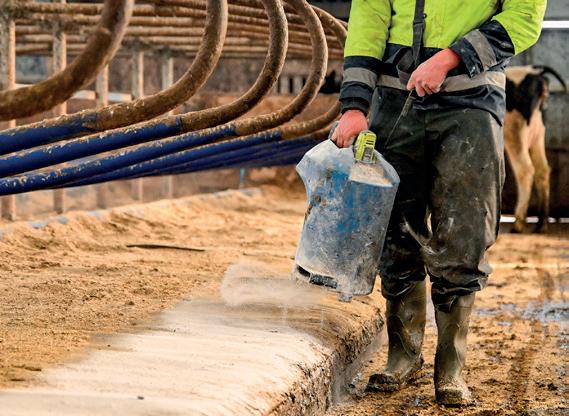
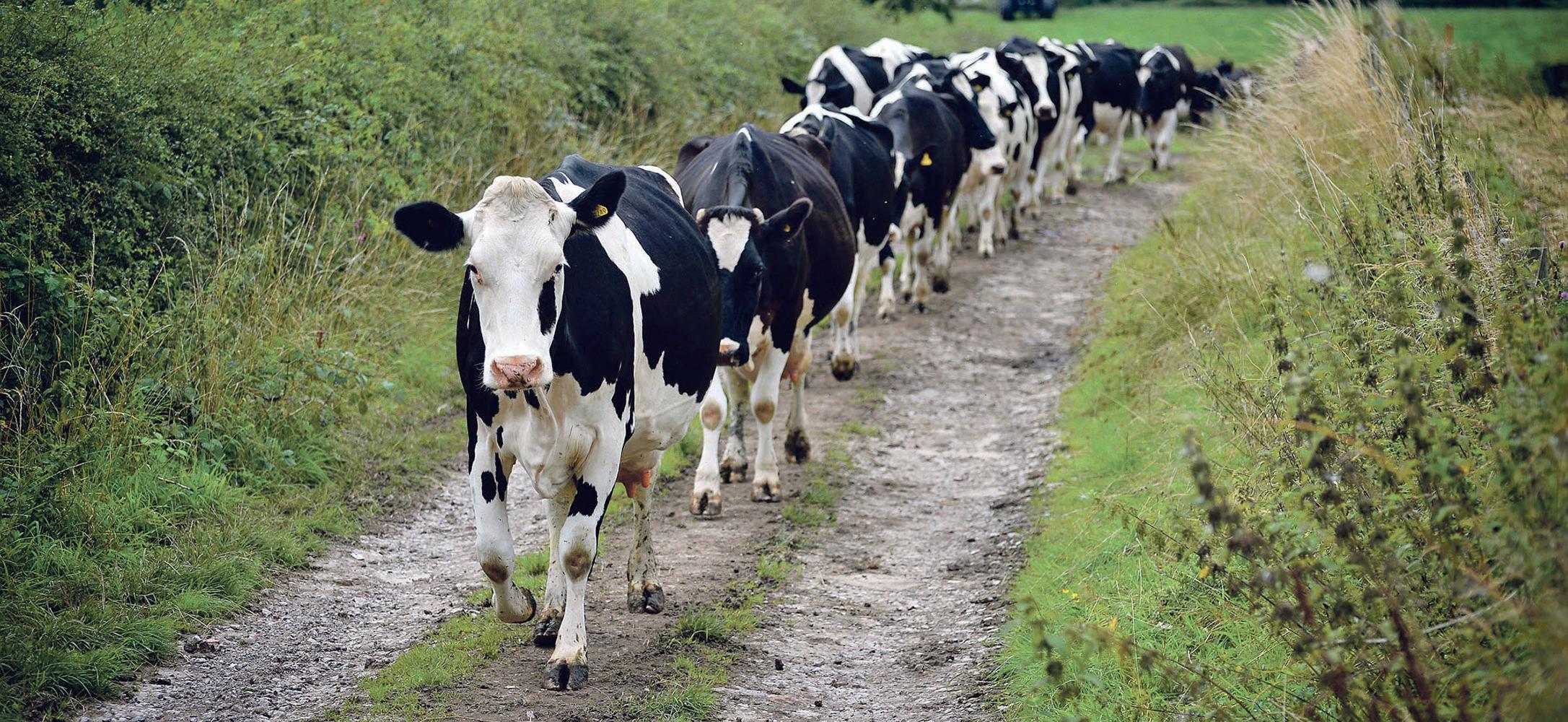
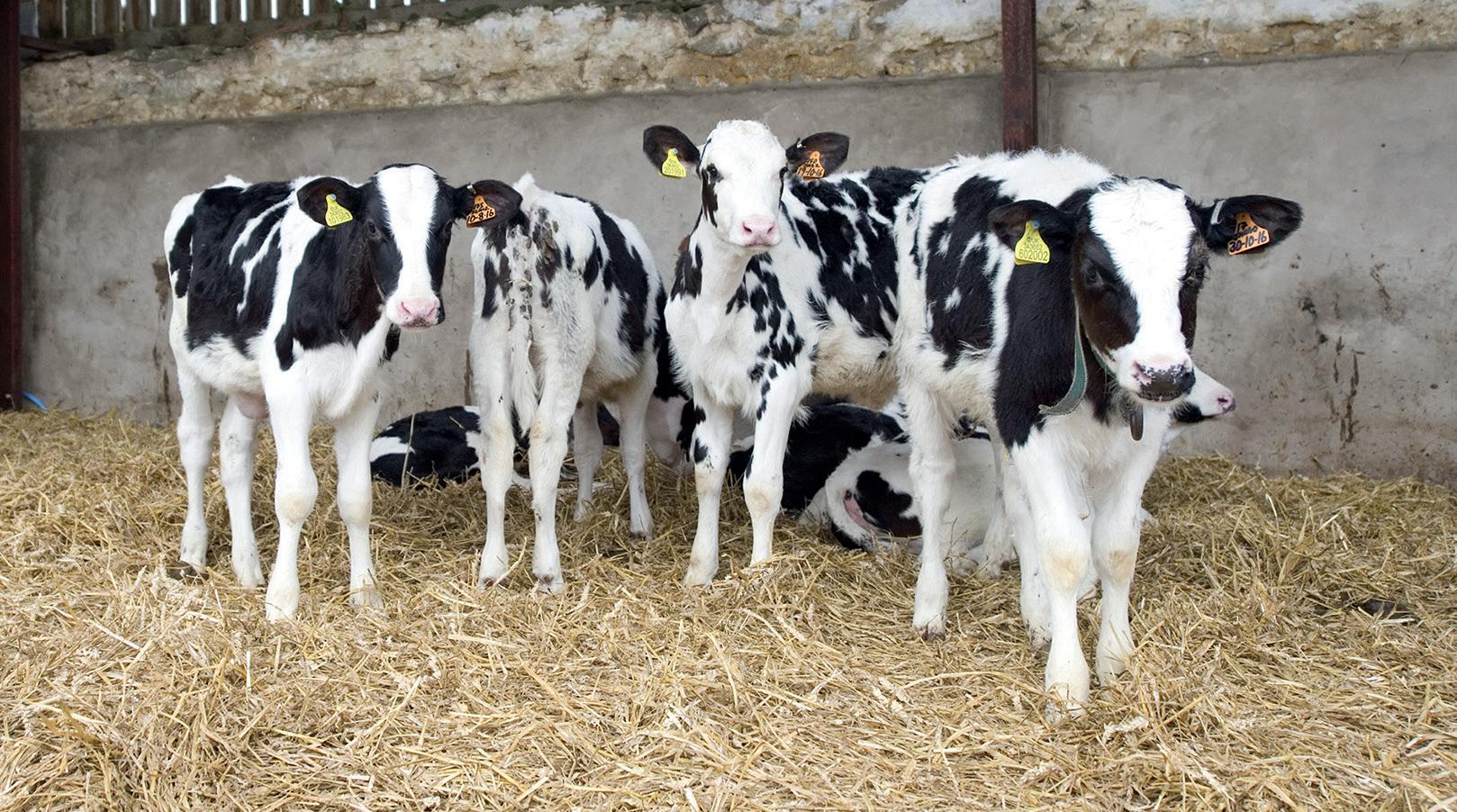
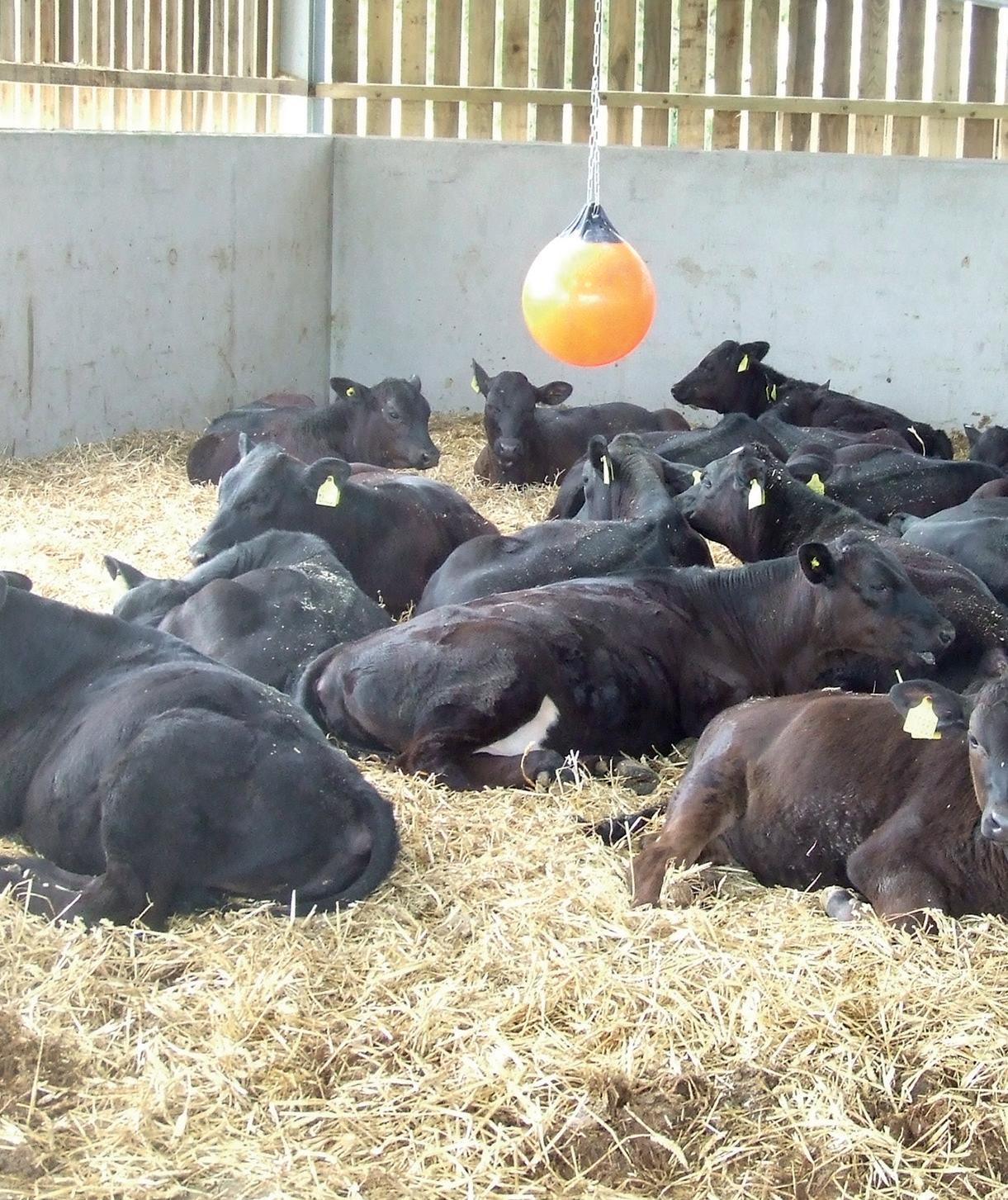
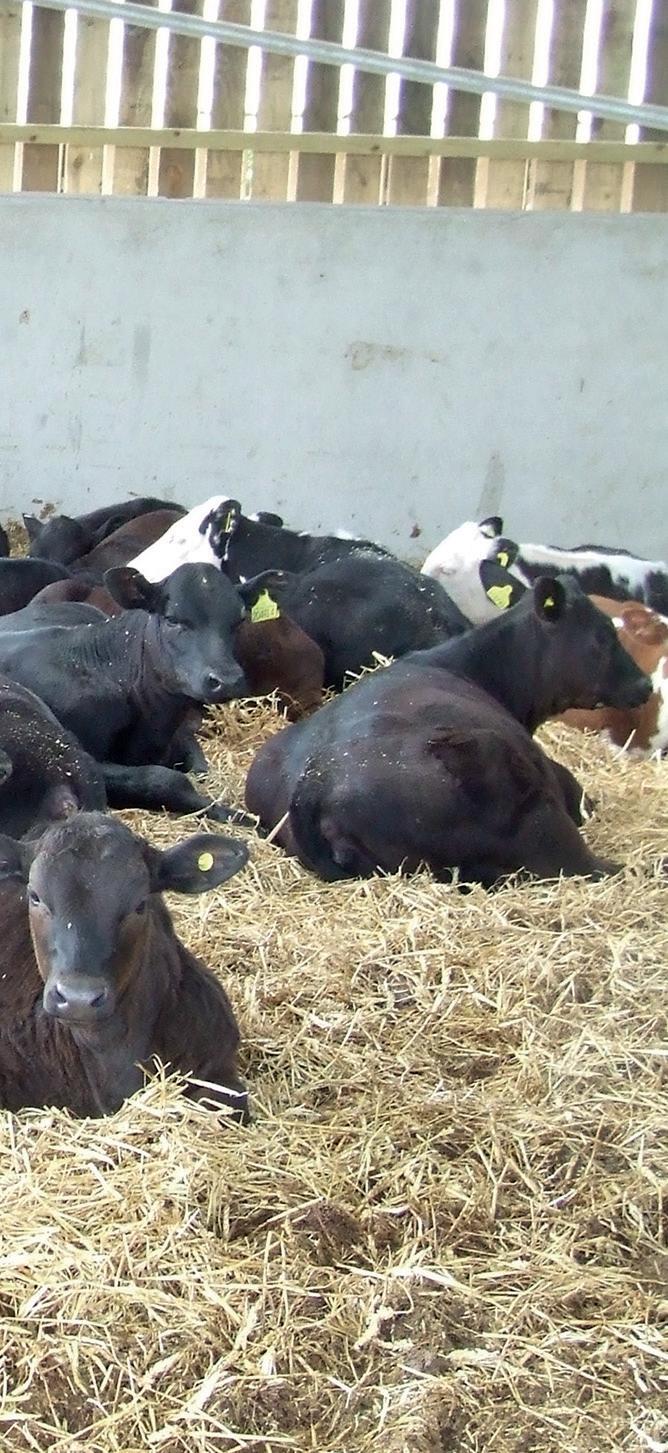
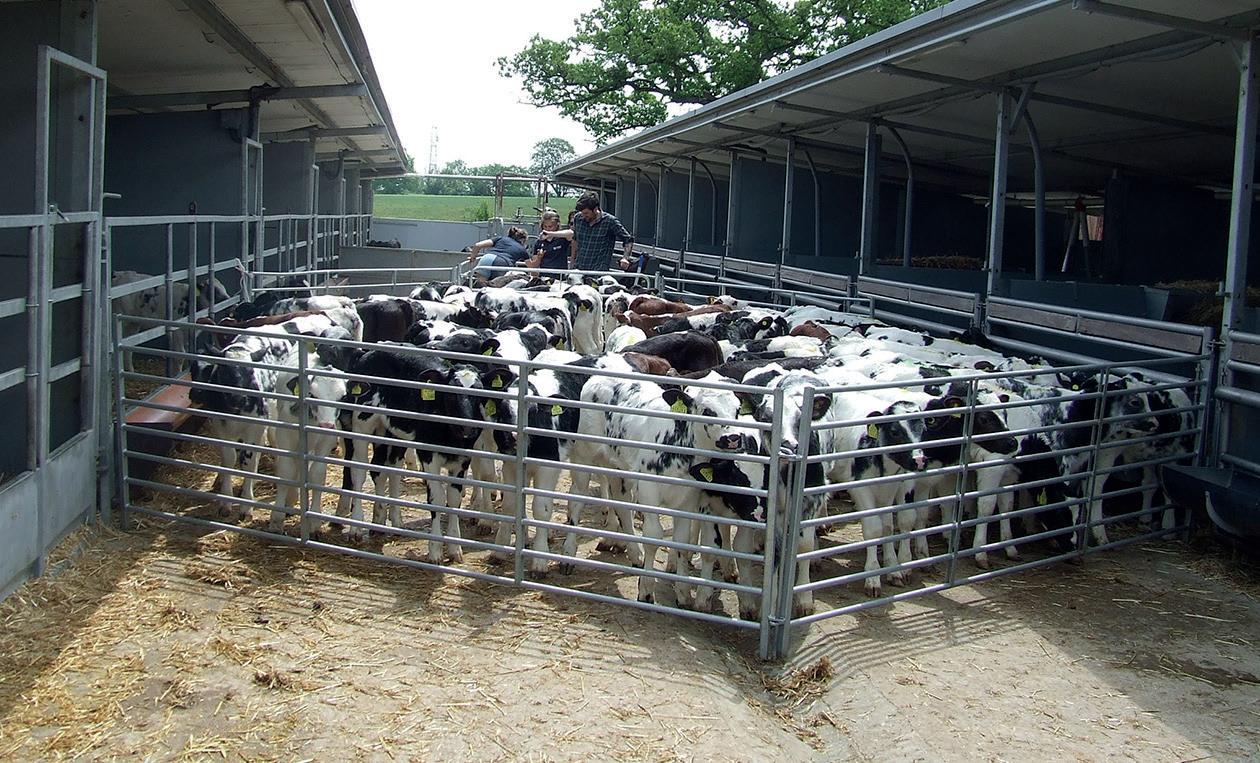
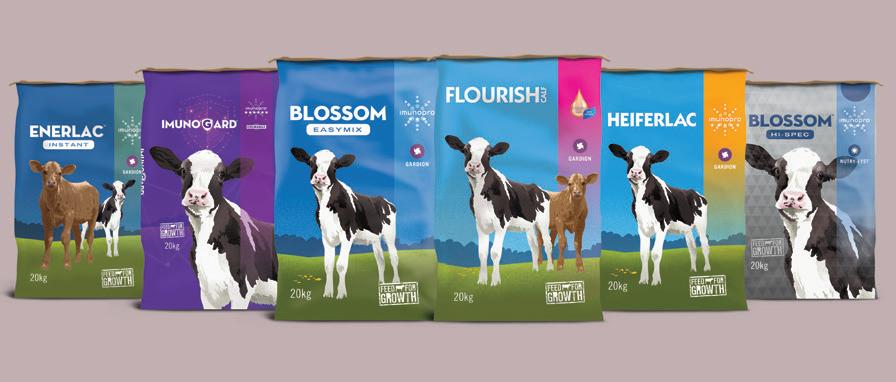
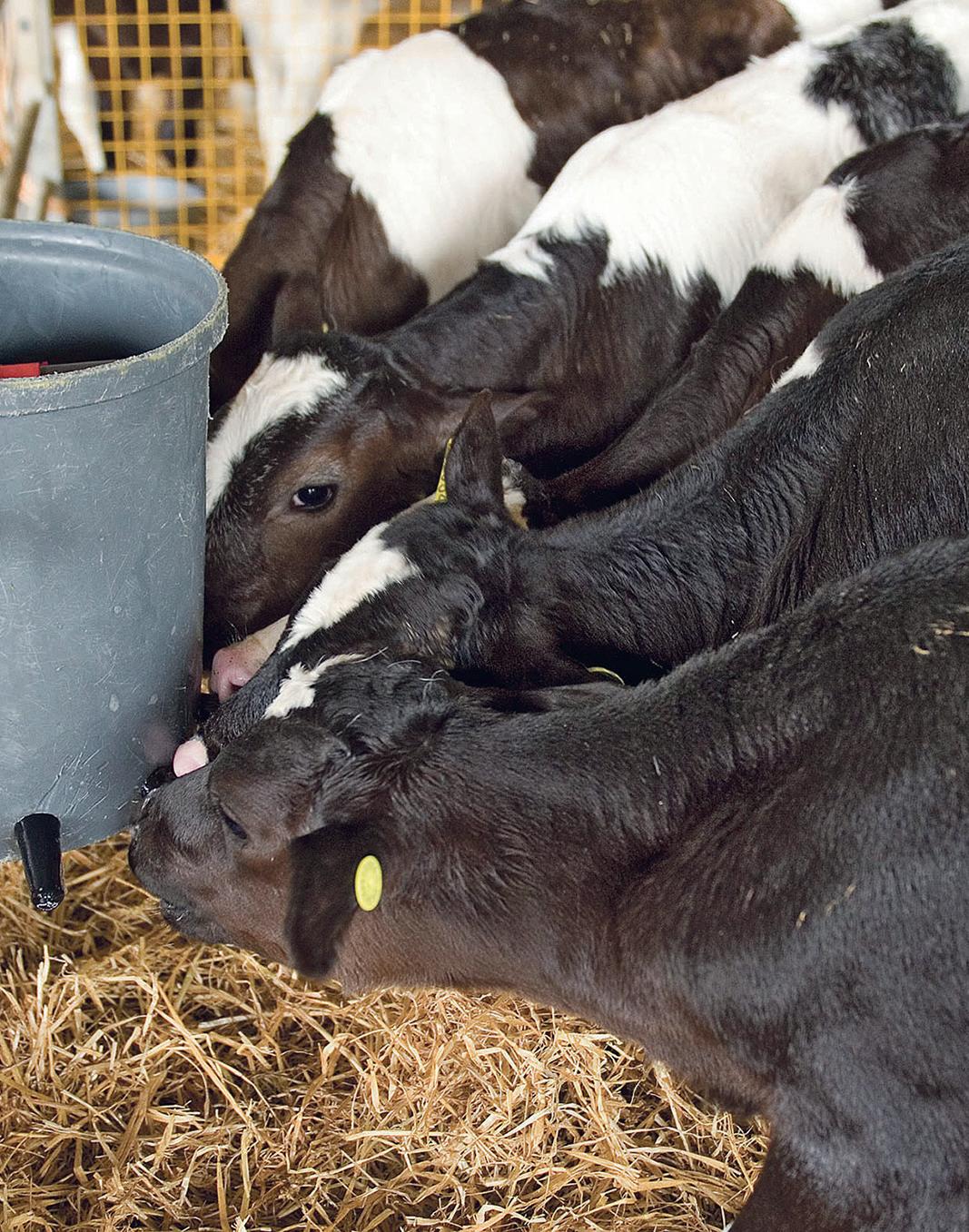
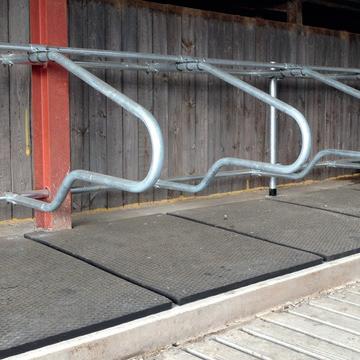
Heifer mobility, calf housing and milk powder advice
Pages 36-46
Housing & Slurry
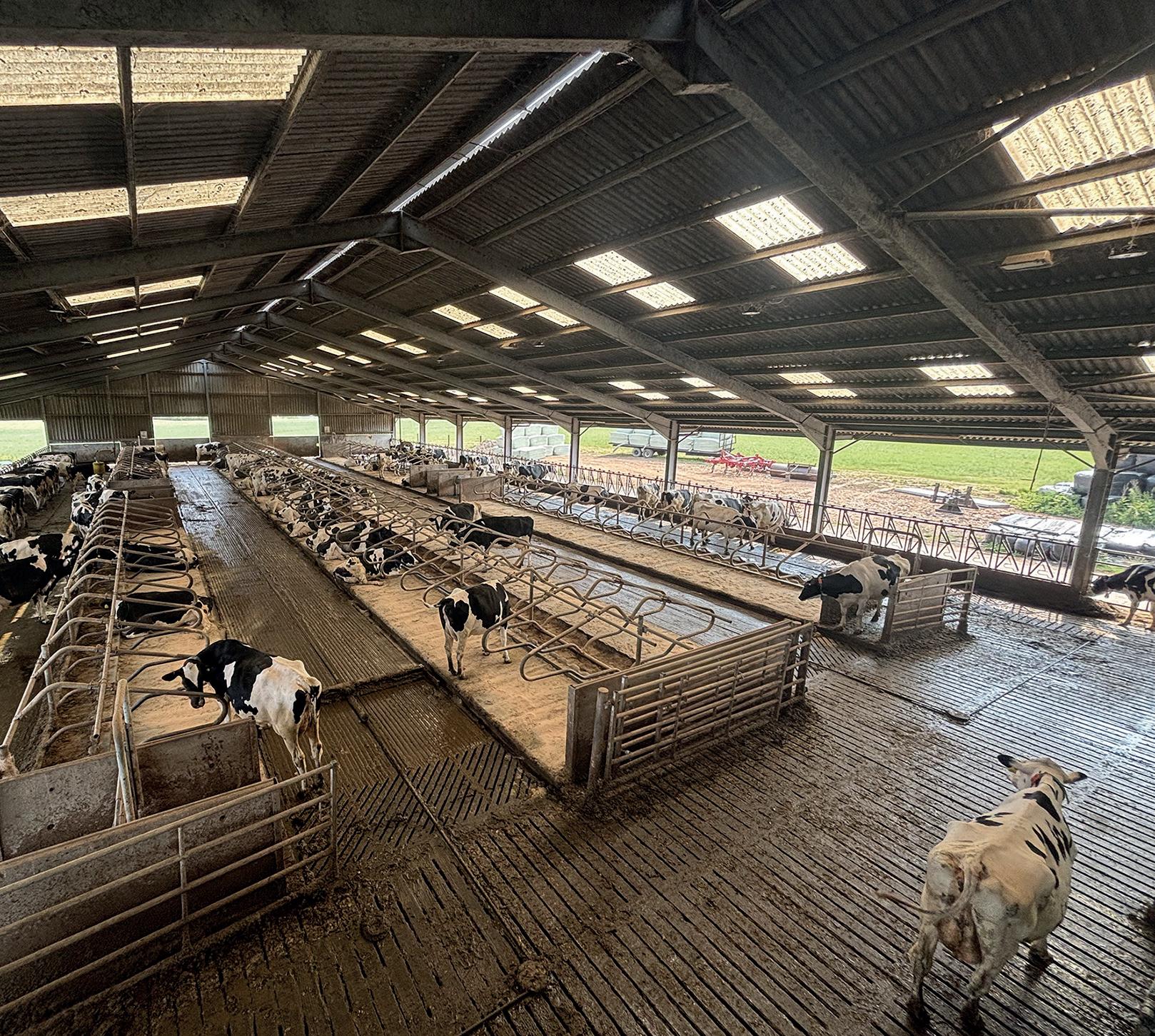
Cubicles sheds, bedding conditioners and slurry kit
Pages 48-57
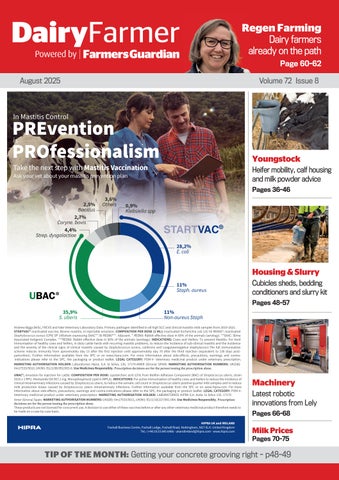
Andrew Biggs BVSc, FRCVS and Vale Veterinary Laboratory Data Primary pathogen identified in all high SCC and clinical mastitis milk samples from 2019-2021. STARTVAC® Inactivated vaccine, Bovine mastitis, in injectable emulsion. COMPOSITION PER DOSE (2 ML): Inactivated Escherichia coli (J5) 50 RED60*; Inactivated Staphylococcus aureus (CP8) SP 140strain expressing SAAC** 50 RED80***. Adjuvant. * RED60: Rabbit effective dose in 60% of the animals (serology). **SAAC: Slime Associated Antigenic Complex. ***RED80: Rabbit effective dose in 80% of the animals (serology). INDICATIONS: Cows and Heifers: To prevent Mastitis. For herd immunisation of healthy cows and heifers, in dairy cattle herds with recurring mastitis problems, to reduce the incidence of sub-clinical mastitis and the incidence and the severity of the clinical signs of clinical mastitis caused by Staphylococcus aureus, coliforms and coagulasenegative staphylococci.The full immunisation scheme induces immunity from aproximately day 13 after the first injection until approximately day 78 after the third injection (equivalent to 130 days postparturition). Further information available from the SPC or on www.hipra.com. For more information about side-effects, precautions, warnings and contraindications please refer to the SPC, the packaging or product leaflet. LEGAL
CATEGORY: POM-V- Veterinary medicinal product under veterinary prescription. MARKETING AUTHORISATION HOLDER: Laboratorios Hipra, S.A la Selva, 135, 17170-AMER (Girona) SPAIN MARKETING AUTHORISATION NUMBERS: UK(GB): Vm17533/5010, UK(NI): EU/2/08/092/003-6. Use Medicines Responsibly. Prescription decisions are for the person issuing the prescription alone. UBAC®, emulsion for injection for cattle. COMPOSITION PER DOSE: Lipoteichoic acid (LTA) from Biofilm Adhesion Component (BAC) of Streptococcus uberis, strain 5616 ≥ 1 RPU. Montanide ISA 907.1 mg. Monophosphoryl Lipid A (MPLA). INDICATIONS: For active immunisation of healthy cows and heifers to reduce the incidence of clinical intramammary infections caused by Streptococcus uberis, to reduce the somatic cell count in Streptococcus uberis positive quarter milk samples and to reduce milk production losses caused by Streptococcus uberis intramammary infections. Further information available from the SPC or on www.hipra.com. For more information about side-effects, precautions, warnings and contra-indications please refer to the SPC, the packaging or product leaflet. LEGAL CATEGORY: POM-VVeterinary medicinal product under veterinary prescription. MARKETING AUTHORISATION HOLDER: LABORATORIOS HIPRA S.A. Avda. la Selva 135. 17170 Amer (Girona) Spain. MARKETING AUTHORISATION NUMBERS: UK(GB): Vm17533/5011, UK(NI): EU/2/18/227/001-004. Use Medicines Responsibly. Prescription decisions are for the person issuing the prescription alone. These products are not licensed for concurrent use. A decision to use either of these vaccines before or after any other veterinary medicinal product therefore needs to be made on a case-by-case basis.
HIPRA UK and IRELAND Foxhall Business Centre, Foxhall Lodge, Foxhall Road, Nottingham, NG7 6LH. United Kingdom Tel.: (+44) 0115 845 6486 · ukandireland@hipra.com · www.hipra.com
Machinery
Latest robotic innovations from Lely
Pages 66-68
Milk Prices Pages 70-75
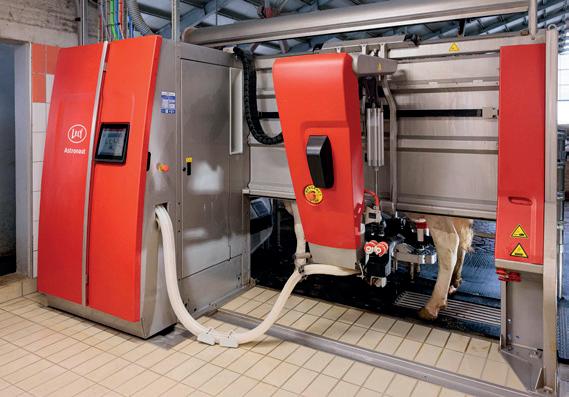
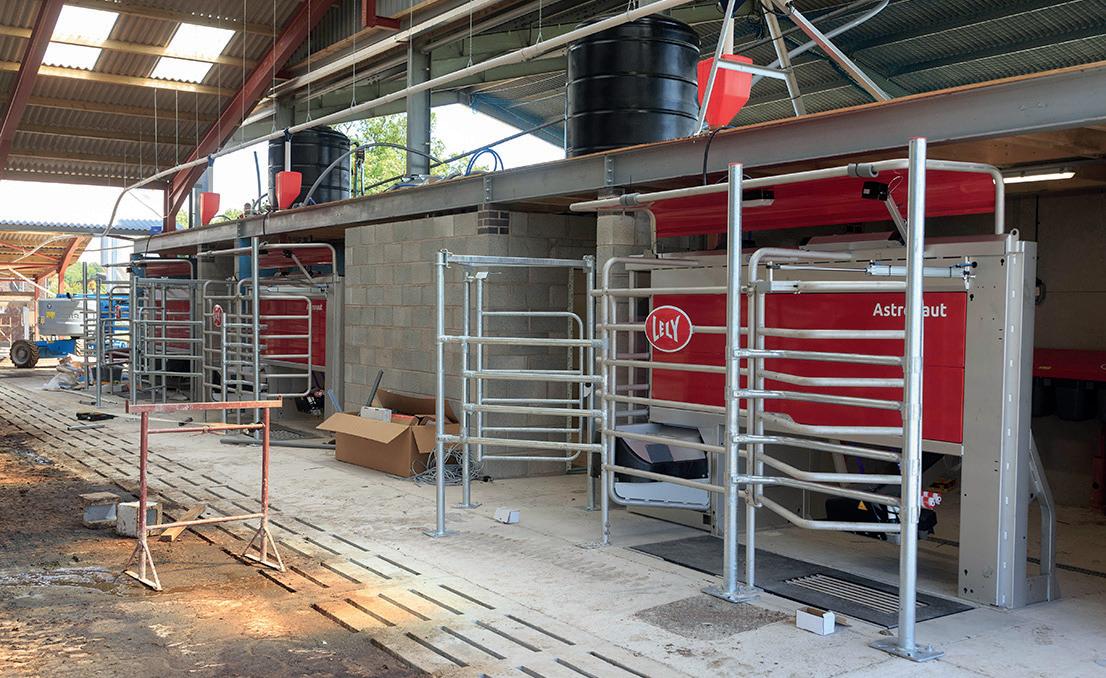
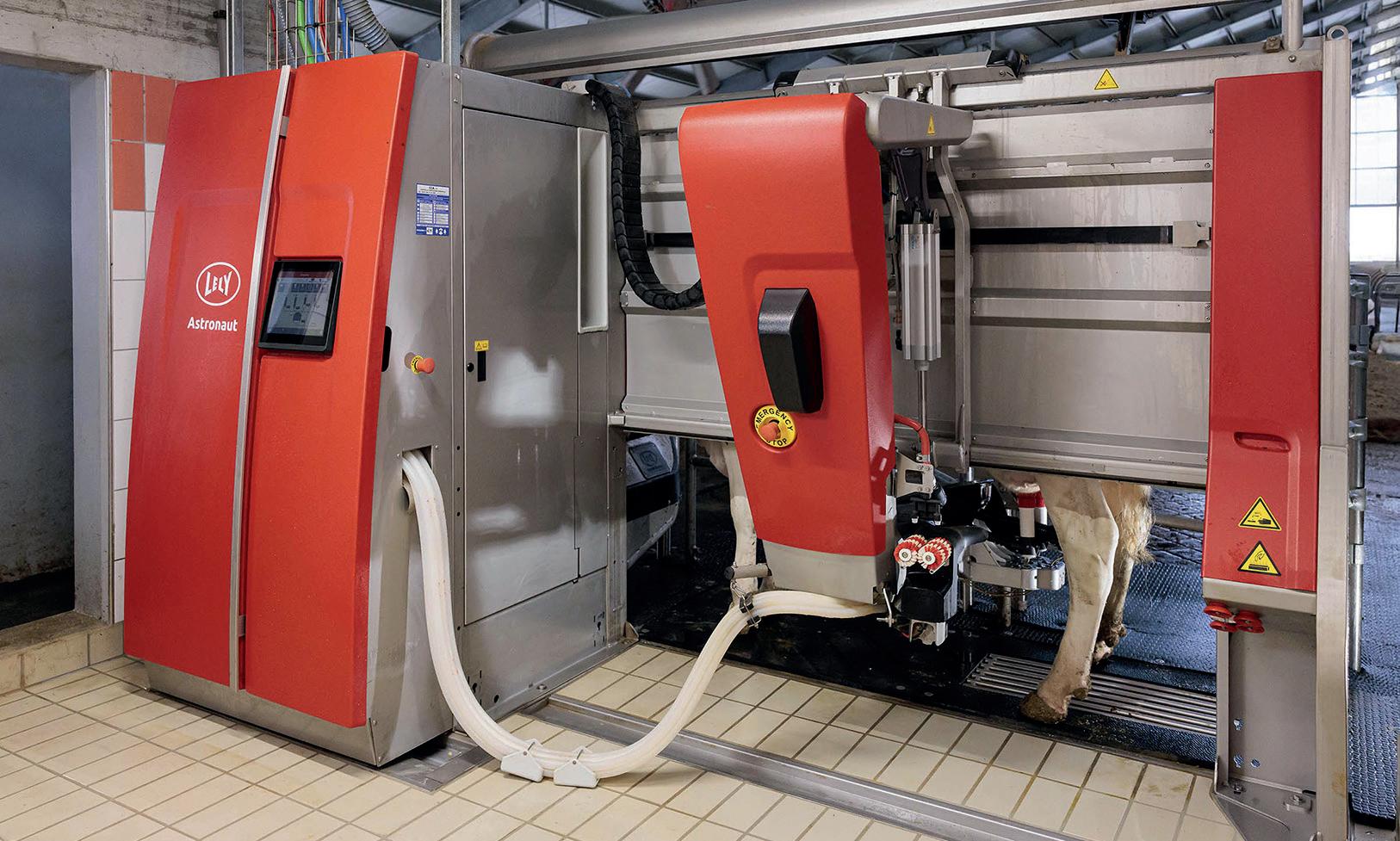
Discover the Astronaut A5 Next
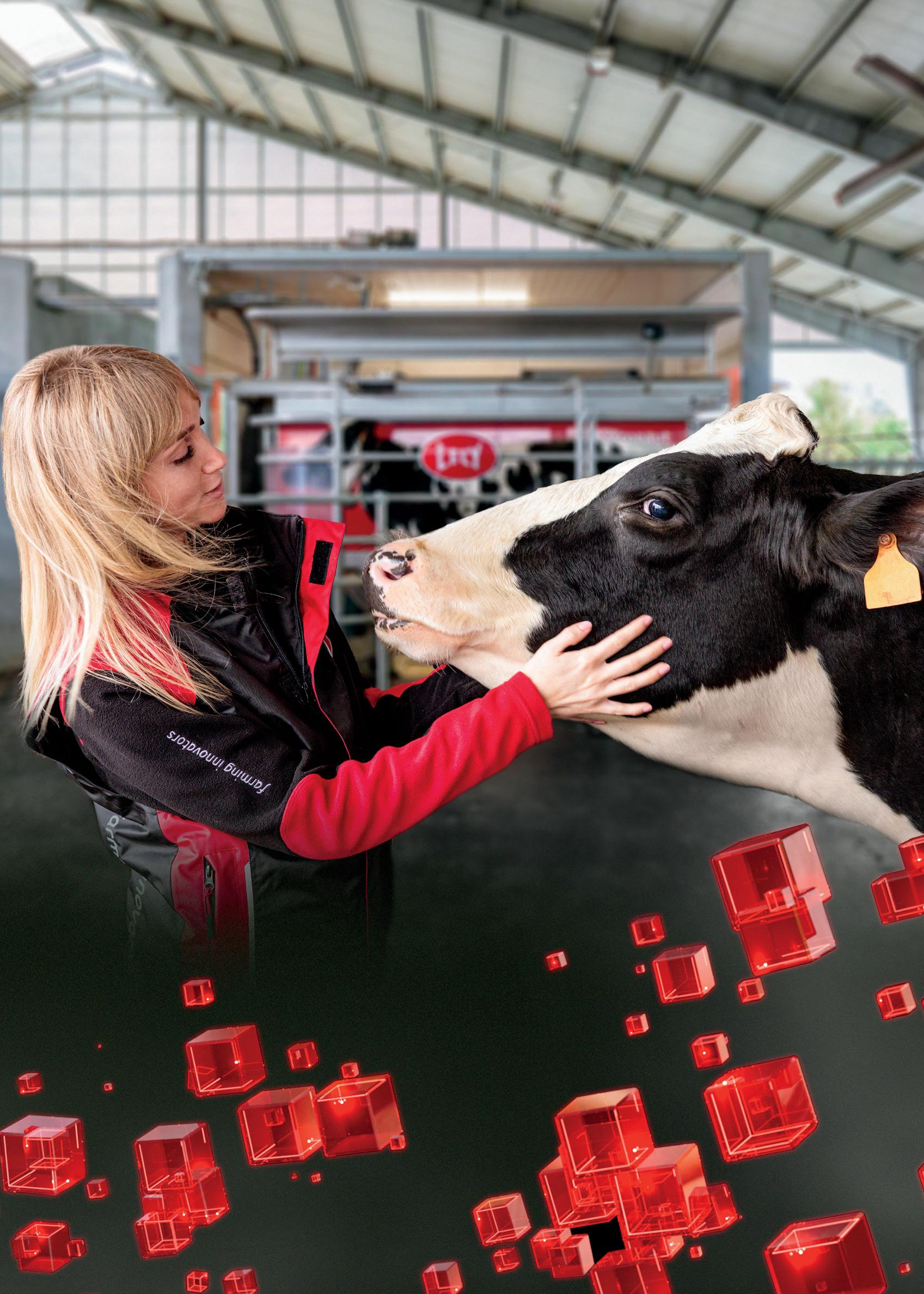
How do you stay in touch with your cows? Understand your herd on a deeper level with the Astronaut A5 Next. Lely's new automatic milking system.
The next step in optimizing your life as a farmer. Our improved milking robot combines over 30 years of experience with the latest technologies. The Astronaut A5 Next offers great ease of use, reliability, better insights into your cows' health, and a solid return on investment.
Bright farming is yours by choice
Scan & Discover Astronaut A5 Next
Contacts
Editor Katie Jones 07786 856 439 katie.jones@agriconnect.com
Dairy Farmer, Unit 4, Fulwood Business Park, Caxton Road, Preston, Lancashire PR2 9NZ
Origination by Farmers Guardian, Unit 4, Fulwood Business Park, Caxton Road, Preston, Lancashire PR2 9NZ. Printed by Warners Midlands, The Maltings, Manor Lane, Bourne, Lincolnshire, PE10 9PH. No responsibility can be accepted by Dairy Farmer for the opinions expressed by contributors.
a word from the editor
This last month, industry news has been dominated by the Fair Dealing Obligation Milk (FDOM) regulations finally coming into effect, the new phase of the Dairy Roadmap and the opening up of the Capital Grant scheme.
There is, as usual, a fair bit going on in the world of dairy at the moment and, as our Dairy Talk writer Claire Eastham points out on p9, dairy farmers are having to keep up-to-date with all this at the same time as farming amid heatwaves and droughts.
Grant schemes
When you are battling flies in the parlour, moving electric fences on parched ground, or covering silage clamps in the searing heat, the goings on in Defra may seem the least of your worries.
However, the opening of the Capital Grant scheme is good news.
But as the Government has previous form in
closing these schemes unexpectedly, there is an obvious dose of cautiousness along with a nervous eagerness to get applications in quickly before the money runs out.
Cow trade
The latest AHDB producers figures and the analysis of dairy cow trade on p80-81 also make interesting reading. It’ll be no surprise to hear that more producers have left the industry, but milk volumes are still on the up and cow prices stand firm.
With the current milk price staying steady, it is heartening to hear that despite the high prices being paid for dairy cows at market, the costs do add up.
However, as I write we are in the midst of yet another heatwave which could put pressure on grassland stocks going into the latter half of the summer and early autumn. Some well-needed rain on the forecast will be a welcome relief but it looks set to be a summer dominated by weather extremes as well as grant applications.
Q&A: Be
Attention to detail key for
Design
Round-up of products and updates hitting the
‘In those days farming was done with Fordson Majors and grey Fergies’
Cow prices hold on to
Data shows benefit of reduced stress at drying off
Dairy farmer numbers are down but milk volumes rise
airy producer numbers have continued to fall, alongside larger milk volumes, suggesting further consolidation in the sector. In AHDB’s latest survey of milk buyers, it was estimated there were 7,040 dairy producers in Great Britain as of April 2025.
This was down 190 year on year, with the majority of people leaving over the winter months.
has been an ongoing trend, with industry exits typically occurring before winter housing and additional input requirements, such as feed, become seasonally higher.
“The 2024 winter period also saw changes to government support and additional supply chain requirements introduced for some producers.”
However, the average milk volume per farm in GB has now risen to an estimated 1.77 million litres per farm for the year, from April 2024 to April 2025.
Government opens Capital Grants offer
J A NEW round of the Government’s Capital Grants offer has opened with £150 million in new funding.
Four new items have been added including assessing woodland condition, creating wildfire management plans, repairing drystone walls and hosting educational visits.
More information on these new items will be available later this summer on the Grant Finder tool.
Funding limits were also being introduced, which Defra said would maximise the number of farms benefitting while allowing it to manage funds more effectively.
This includes funding limits to four of the six groups of capital
items in this Capital Grants offer. An application can include items from each of the six groups. The funding limit for four of the groups is £25,000 maximum for each of the water quality, air quality, and natural flood management groups and £35,000 maximum for the group covering boundaries, trees, and orchards.
Defra said it will also listen to feedback from farmers and use it to improve the offer ahead of the next round, planned to open in 2026. This round will close to applications when the available funding is committed, with Defra saying it will aim to give reasonable notice of scheme closure, but this may not be possible.
Compared to the previous year, volumes were up by 4% showing the continued shift towards fewer but larger farms.
According to the Defra June 2024 census, the average cow population on a commercial dairy farm (farms with over 10 cows) in the UK stood at 165 head. This has increased by four cows per farm from 2023 and up by nine cows per farm when compared to 2022.
Ms Twinberrow added: “Our latest forecast for the 2025/26 milk year is set to record a new high at 12.83 billion litres, 3.1% more than the previous milk year.”
It comes as milk prices remain
steady, with Arla holding its price for July and Muller and Saputo holding in August.
Chris Walkland, dairy analyst said: “I was not expecting prices to hold as they have. It has been a big, pleasant surprise.
“The prices have been steady because, unlike here and in Ireland, milk volumes in Europe have been pretty mediocre. Nothing to shout about.
“So, commodity prices have stayed high there on the back of that and we have ridden on the back of it.
“I think we are in for a continuation of what has been one of the most stable periods of time for milk pricing in years.”
LISTEN TO THE PODCAST
SCAN the QR code to hear a podcast with Dr Robert Graham of Graham’s Family Dairy as he discusses the journey of growing the family business, his dedication to quality Scottish dairy, and what it takes to balance his beef, dairy and sheep enterprises at home.
Dr Graham also offers advice for the next generation of farmers and discusses new product innovations, from protein trends to evolving consumer tastes.
News in brief Minister sparks outrage
JTHE Welsh First Minister sparked outrage after suggesting the benefit farming brings to the economy does not warrant the amount the industry receives in support payments.
Responding to a question asked in the Senedd by Shadow rural affairs spokesperson Samuel Kurtz about an update to the Sustainable Farming Scheme (SFS) and budgets, she said: “Yes, the agricultural community needs to be supported, and boy are they supported – over £250 millionworth of support on an annual basis. That is quite a big amount of support for a sector that contributes less than 1% to the GDP of the country.”
FUW president, Ian Rickman said the funding had ‘far-reaching multiplier effects’.
“Welsh farm funding should not be seen as a burden.”
NFU Cymru president Aled Jones described Ms Morgan’s words as ‘frustrating’, highlighting farming underpinned the food and drink sector.
The Welsh Government said: “Farmers play an essential role in Wales’s economy as the First Minister has repeatedly made clear.
“They provide food, care for our environment, support rural communities and help protect the Welsh language.”
Average milk volume per farm has risen to an estimated 1.77 million litres per farm for the year
Safety ‘must always be at the forefront’ for farmers
By Mia Willemsen
Safety must be the first thing farmers think about, not the last, if the industry wants to stop people dying on farms.
That was the message from NFU deputy president David Exwood as the Health and Safety Executive (HSE) published its latest annual fatality statistics, covering the period from April 2024 to March 2025.
The industries with the highest number of deaths were construction with 35, and agriculture, forestry and fishing with 23.
Agricultural deaths were down from 27 the previous year (20232024) but still higher than the year before that (2022-2023), where 22 deaths were recorded.
Mr Exwood said: “These figures are an improvement on last year, but you are still far more likely to die as a farmer than in any other job.
“A culture change has started, but if we want the numbers to keep reducing, we all have much more to do and we cannot leave it to others to worry about.”
Stephanie Berkeley, manager at Farm Safety Foundation, said that these figures were not just numbers, they were fathers, mothers, sons, daughters, families shattered, businesses broken and communities grieving.
Prince of Wales backs regenerative approach
J THE Prince of Wales has backed a regenerative approach to farming as he delivered the ‘thought for the day’ at the Groundswell Festival in July.
The royal visitor revealed the Duchy of Cornwall ‘planned to go on that journey’.
During his visit, Prince William also paid tribute to farmers and said: “To the farmers here today,
I offer my respect and my encouragement.
“You are the heart of this transition. Yours is a profession of huge consequence and uncomplaining graft. If we as a society are to progress it is by learning from the land and from those who tend it.”
For more from Groundswell, see p64-65.
She said July had marked the 13th annual Farm Safety Week.
“Thirteen years of stories. Thirteen years of heartbreak. Thirteen years of lives changed forever. So, we must ask, why is farming still ‘unlucky for some’?”
“Change does not come over-
A culture change has started, but if we want the numbers to keep reducing, we all have more to do and we cannot leave it to others
DAVID EXWOOD
A culture change is needed if farming’s safety record is to improve.
night. But it begins with one decision, one action, one conversation,” Ms Berkeley added.
“We owe it to those we have lost. We owe it to those living with the consequences and we owe it to the next generation of farmers across the UK. Because every life lost is one too many.”
Tragedy
HSE chief executive Sarah Albon said: “Great Britain is one of the safest places in the world to work, but we must remember each of these deaths represents a tragedy for families, friends and communities.
“Despite the stability in numbers, we cannot accept that fatal accidents are an inevitable part of working life. We are encouraged by the long-term trend, but urge against complacency on workplace safety.”
DAIRYTalk
Ben Yates
Ben Yates manages Mells Park Estate, Somerset, where he oversees a 400-cow unit and manages the 405-hectare (1,000-acre) estate. Along with his wife and two sons, Ben has his own small herd of pedigree Holsteins under the Wowcow prefix. He joined the Holstein UK Board of Trustees in 2021.
The highlight has been two Wowcow calves standing as champion and reserve calf at the Royal Bath and West Show
What started out as a very easy spring is now turning out to be a difficult summer, as the drought is really starting to bite with us.
Great grass growth was achieved early on, with nearly the whole platform having grown two tonnes, by April 30.
First cut was taken in April, the earliest we have ever cut on the farm, which was of fantastic quality.
Since then, with very little rain, grass yields have diminished drastically.
For the second half of May into the start of June, the cows were buffered to conserve the grass we had and to get us to when we started drying off.
During this time, the whole herd was foot-trimmed –this is the only time we bring a contractor in for feet now.
The herbal leys yielded similarly to the first cut grass leys, but are starting to come into their own with their deeper roots, now we are experiencing the dry period.
The wholecrop wheat has been harvested in the first week of July and we took the opportunity to purchase a little more than we first planned, to ensure we have plenty of winter forage, with the outlook being uncertain at the moment.
Consistency
With the dry weather, has come a great level of consistency in the grass for the cows, so much so, that for the past three months we have 4.5% fat, 3.7% protein, which has set us off to a great start with our new milk buyer on a regenerative contract.
As part of the move of milk buyer, we have been busy creating our Regenerative Plan, which has set some good targets for us to achieve.
This winter will see us planting up gaps and adding more trees into hedgerows.
May and June are the ideal times for a building project, as milking is usually finished by 6am and cow jobs are minimal.
This year has seen us finish our ring drainage around the yards to catch any run-off before it gets to the concrete. We are also putting in a slurry separator system with two months of covered storage for the separated product.
We have enjoyed several local shows so far this season. It has been great to see the boys taking full control of all
aspects of showing their calves, with me becoming just the haulier.
The highlight has been two Wowcow calves standing as champion and reserve calf at the Royal Bath and West Show, and my eldest son, Oscar, winning champion handler.
My wife and I have just returned from five days at the Glastonbury Festival, where we volunteered in aid of the boys’ old primary school.
It is always a highlight of the year and an interesting insight into what else goes on in the world. We steward in the area that comes to life after the main stages have finished, which is known as the naughty corner.
The local agricultural industry is well represented at the festival with many tractors and tankers in use.
Glastonbury Festival brings a tremendous amount to the local economy, whether it be contributions for stewarding to local charities such as ours, or using local businesses.
I was pleased to learn that all catering outlets are required to use milk from the most local creamery.
Claire Eastham
Claire Eastham farms with her husband Martyn in Dorset, where they milk 120 spring calving cows. After gaining knowledge and experience working for other businesses, the couple started their own dairy farming journey in 2015 by taking on a share farming agreement before progressing to their current county council farm.
We need a system that supports us, not one that drains the very people it’s meant to uplift
Welcome to July. The season of sunshine, more sunshine, and administrative hell.
Right now, we are not just dealing with the reopening of the Capital Grant. Oh no, we are also in the middle of a full-blown policy pile-on. The Farming Equipment and Technology Fund (FETF), Capital Grant, and Sustainable Farming Incentive (SFI) are all open at once.
If Defra’s goal was to test the rural collective blood pressure, I would say they are smashing it.
As a grant agent and a farmer, I get the need for these schemes. They are important, valuable and they can unlock serious improvements, but why must they all be open at the same time?
Clients are all rushing to get applications in before their neighbour beats them to the last of the funding pot. Every day has been a blur of phone calls, FETF lists and maps, all while watching the application numbers rise.
Overlapping
In theory, the idea is to empower farmers to take up multiple schemes at once and create more resilient businesses. In practice, it is panic-filing grant applications not wanting anyone to miss out, especially if they were caught in November’s Capital Grant closure.
If we are the system’s gatekeepers, we need gates that actually open. The irony? These schemes are supposed to help ease the pressures of farming. But the way they are being rolled out – clumped together, poorly timed, with overlapping rules and shifting deadlines – is doing the opposite.
We need a system that supports us, not one that drains the very people it’s meant to uplift. Give us staggered windows, clearer guidance, actual time to think, not just react.
The way it currently stands it is not sustainable, and we are in what I can only describe as ‘Grantageddon’ with a triple threat of paperwork, portal crashes, and eager clients.
If you have submitted something recently – congrats. You deserve a drink and a nap.
And if you are in Defra reading this, please, for
the love of rural sanity, co-ordinate your calendars next year.
Drought
Some of us are trying to function and farm in the midst of a drought. A measly 3mm last week is all we have seen in rain for months and there are now cracks you can fit your arm down.
The cows have been eating bought-in feed. The milk price is helping but the silage clamp is already open.
Daily UK milk deliveries are still over 2 million litres up on last year, meaning a milk price increase seems, as yet, unlikely.
Hopefully the ground can take plenty of it when the rains come and there will be autumn cuts galore as the forage situation is looking pretty desperate.
Hay yields were about two thirds, if we are being generous. Maize, although we do not grow any, is variable around us to say the least, but with an early harvest and what looks like good straw yields at least that should be reasonable.
Heat stress has meant yields have been down, but cows are hopefully holding in calf. Our PD date and TB test is just around the corner.
But I must not be too British and complain about the weather.
At least the sea is warm. I thoroughly recommend a quick dip and beach barbecue to forget about any concerns, at least for a moment.
The addition of a second unit in 2005 took the Pennington family’s herd to 800 head of commercial Holstein Friesians. Wendy Short finds out more.
On Farm Herd expansion through a second milking site
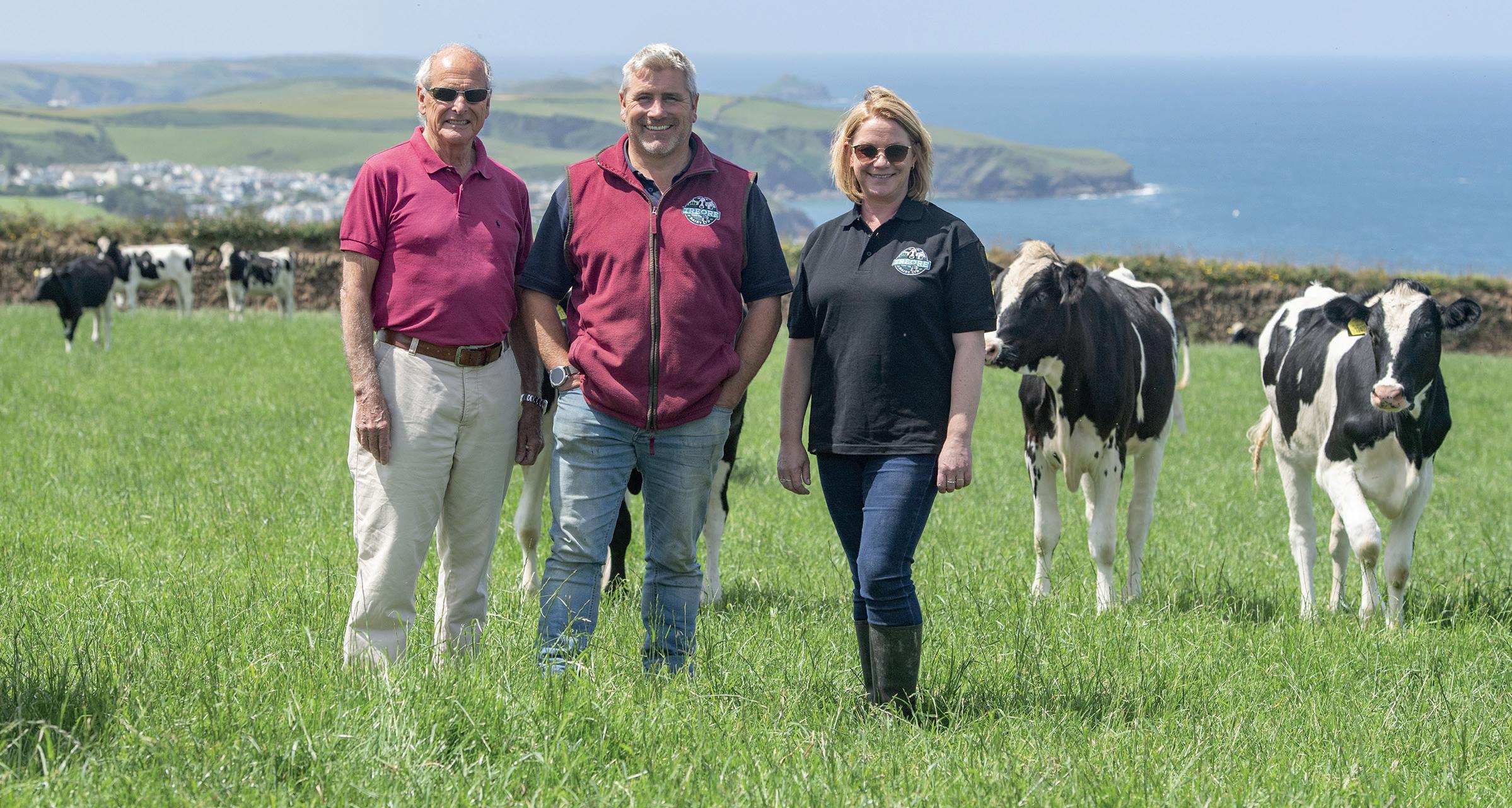
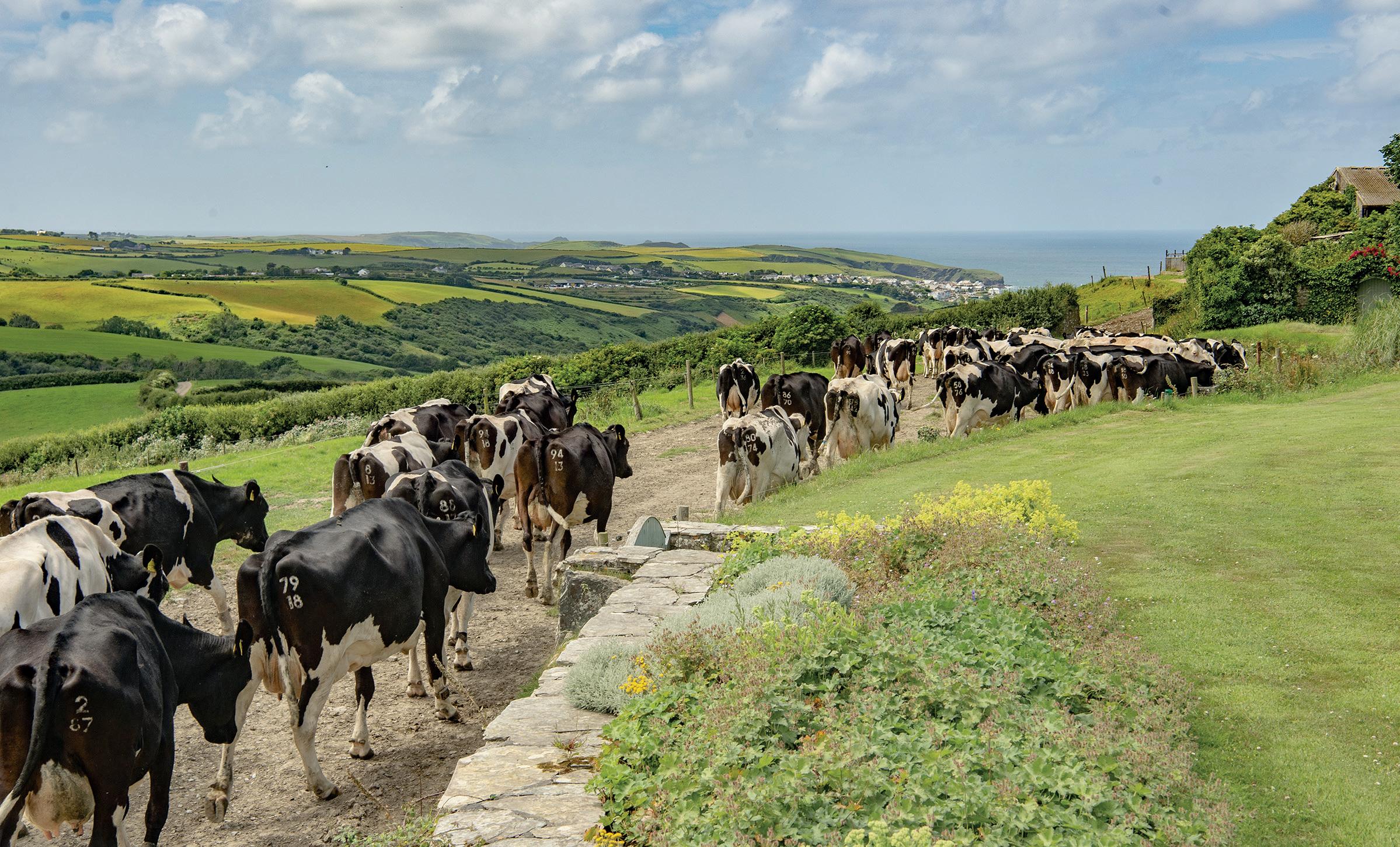
Split evenly between two sites, the 800 cows run by the Pennington family are managed on a grazing system on their farm near Port Isaac in Cornwall.
The undulating terrain, with its steep valleys, was behind the decision to set up a second site at Treore Farm when the herd was being expanded, explains Richard Pennington, who farms with his wife, Jaime, and his parents, Frances and John.
“If we had increased numbers on the existing site, the walking distance from the grazing to the parlour would have been up to 3km at certain times of the year,” he says. “That would have been difficult to manage, not to mention taking a toll on cow health, and at least a percentage of the herd would have had to be fully housed.
“An indoor system was not the
route that we were aiming for, as the primary focus is to maximise milk from grass. Another option would have been to change the calving pattern, but that would not have fitted in so well given the low summer grass yields on the unit.”
Sawdust or sand
Situated one mile apart, the two bases have the same Waikato parlour, but the cubicle bedding material differs.
“One unit uses sawdust on mattresses, and the other has a deep sand system,” he says. “Sand is preferred, but it generates large quantities of waste which have to be spread on the land. Our approach means that sand waste can be targeted to the most appropriate fields and excess levels can be avoided.”
The majority of the herd is calved in a 12-week block begin-
Farm facts
■ Milk is sold on a constituents contract to Saputo for cheesemaking and the herd achieves a yield average of 7,800kg at 3.6% protein and 4.6% butterfat
■ The cows are fed a total mixed ration (TMR), with a milk from forage figure of 3,800kg
■ Alongside the grass and maize silage, the TMR comprises Hipro soya, maize distillers’ grains, soya hulls, ground wheat and rapemeal
■ A bespoke mineral blend is added to the TMR with reference to the grass silage analysis
ning in early August, with a small group calving within six weeks from mid-April to make the most of the autumn flush of grass.
Treore Farm itself covers 340
hectares (840 acres) and runs down to the shoreline, while an additional 263ha (650 acres) of rented ground has been added over the years as opportunities arose. Only 61ha (150 acres) falls outside the ring fence, and it is located a couple of miles away.
“The soil type is mainly a light loam over shillet that is prone to summer drought,” says Richard. “Getting a good first cut of grass silage is very important, because a dry June may mean that second cut cannot be taken until September, although that did not apply this year.
“Maize was always grown in the past, but as cow numbers increased it was found that yields could not be relied upon, following a couple of poor harvest years. Having taken on some extra acres a couple of years ago, it is being tried again.
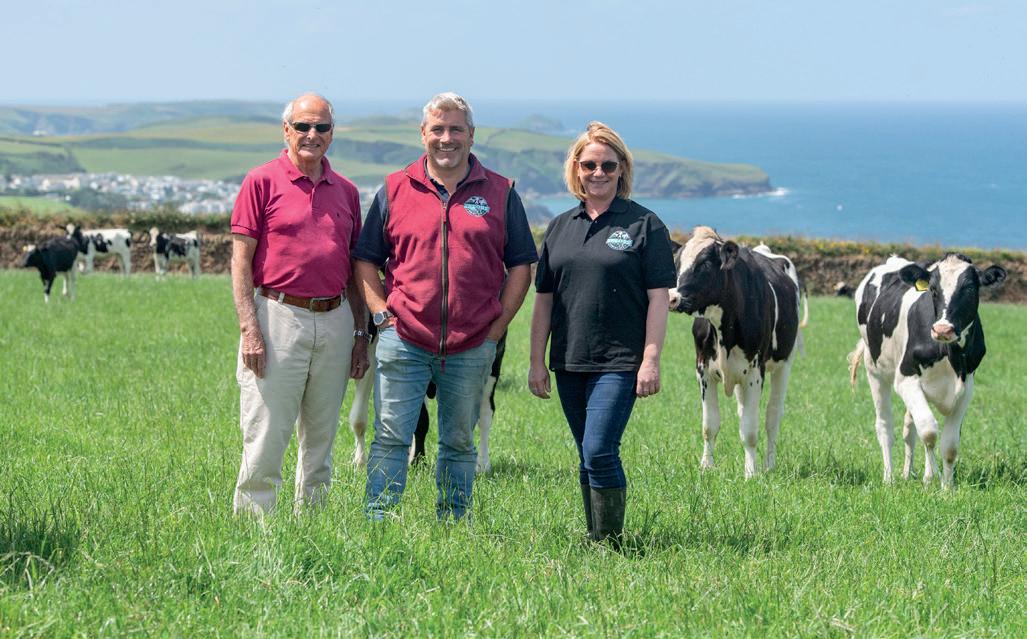
John, Richard and Jaime Pennington in Cornwall.
“Although the location is probably marginal for producing a decent crop, the results have been successful.
“The 57ha of maize in the ground this season is looking reasonably good. There is fierce competition for maize rental land in this region, especially from potato growers, and it pushes up prices. Winter cereals cannot be grown on some of the more exposed fields, as they are vulnerable to salt burn.”
Dry spring
The location and soil type allow for an extended turnout period.
“The target is to have the cows out at grass in February or March, although they may have to be brought back into the cubicles if the weather is too wet,” says Richard. “This year, the dry spring allowed for full turnout from February, and they are usually brought inside during October.
“The rotational grazing system
uses electric fencing, and the paddocks vary in size because they follow the land contours. The farm has a Sustainable Farming
Incentive [SFI] agreement, so herbal leys went in last autumn after overseeding about 163ha [66 acres] of the grazing land. The
area will be stocked fairly tightly, and we are keen to see how it fares over the winter. The silage area has remained in perennial
RAKE, SEED AND ROLL
Düvelsdorf
Grassland Maintenance and Silage Clamp Compaction
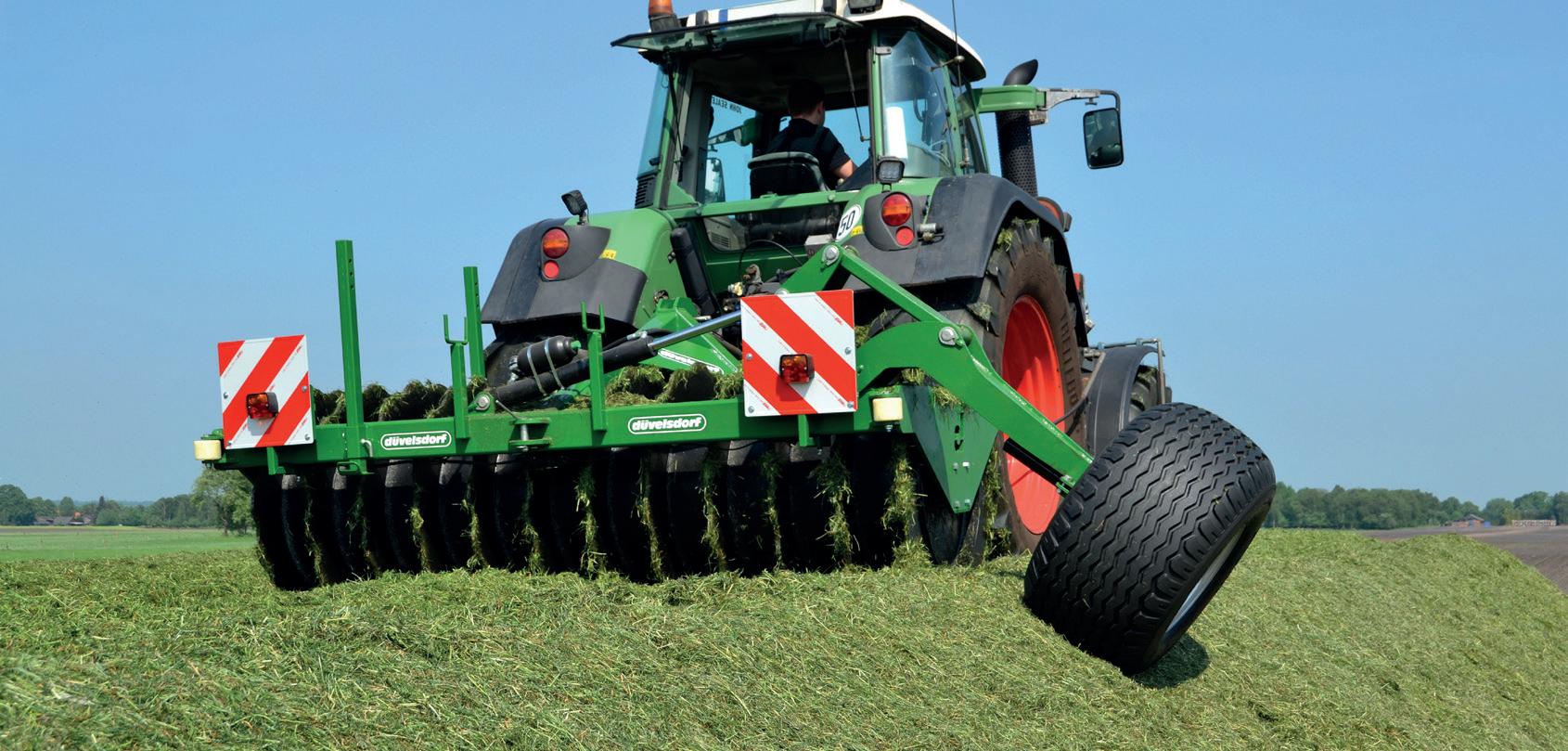
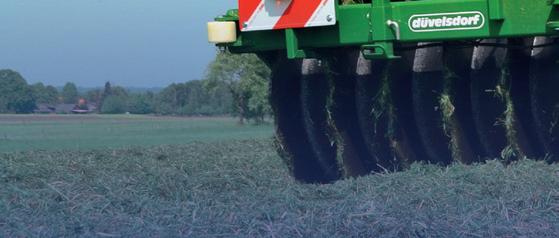
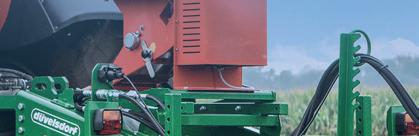
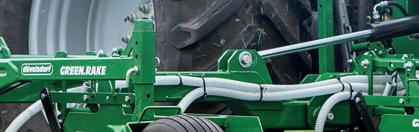
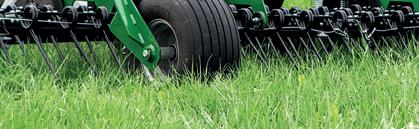
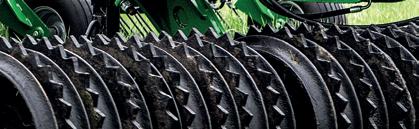
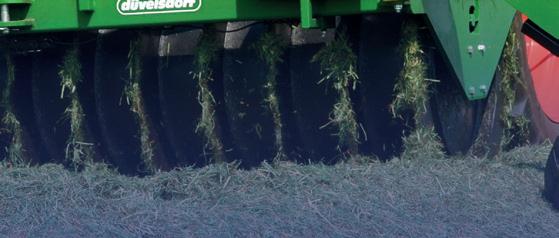
Preparing for quality yields demands quality kit. The Düvelsdorf Green Rake with contour following takes out yield-inhibiting weeds, mosses and plant residues. Combined with the consolidating Terra Roller with even weight distribution and an optional Seeding System with smartphone control interface, Düvelsdorf offers a complete grassland maintenance package.
Working with silage? The Düvelsdorf Silage Roller offers deep, effective compaction. Available with optional wheel kits for side rolling on drive-over grass clamps or maize silage.
Beef sired youngstock graze ground not suitable for dairy replacements.
On Farm
ryegrass and white clover, to protect silage stocks.”
Sexed semen is used to breed replacements, with sires selected via a mating programme and heifers calved at 24 months. Longevity is considered a highly desirable trait, and one cow has recently left the herd at the age of 16.
Richard says: “My best cows are in the group that never comes to my attention. Some will go on for many lactations without needing treatment for mastitis or remedial foot work.
“Good legs, feet and locomotion are important on every dairy farm, but these traits are especially critical on our unit, due to the distances that sometimes have to be walked. This type of management regime also requires a compact type of cow.”
The lower end of the herd is put to a range of continental and native beef breeds. The cross-bred steer and heifer calves are reared as stores or finished, mainly in order to utilise the farm’s most chal-
lenging areas that are unsuitable for the dairy cows.
“The beef cattle are kept on a part of the farm that is high risk for a tick which can carry red water fever,” he says. “It is a disease with the potential to cause abortion, and even death in extreme cases. Youngstock will develop immunity if they are exposed at an early age, but the grazing is too rough and too steep to be suitable for the dairy replacements.”
Increased cattle
The Penningtons moved to the farm in 1990 with 260 black and white cows, as well as sheep and beef enterprises which have since been replaced to allow for the increased cattle numbers.
Richard studied agriculture at college, followed by 12 months spent working on a New Zealand dairy farm.
He says: “I returned to the farm in 1998 and by the year 2000 we had 350 cows on the main stead-
ing. The second set-up in 2005 has allowed for 400 cows to be managed on each site, but we have now reached the limits of parlour capacity.”
His role has changed over the years, and the reintroduction of maize for silage has ‘taken the pressure off’, he says.
“In the past it has been a juggling act to maintain enough winter feed. Fodder beet had to be bought in, or the straw allocation increased in the diet. The maize silage has been useful, and it was a good move to bring the crop back into the rotation.
“Nowadays, my time is mainly spent on overseeing the farm and managing the 10 full-time and two part-time staff.
“I try to stay off the rota, where possible, because the most critical job is to keep the farm running smoothly by making sure that sufficient people are available and that they have everything they need to carry out their tasks efficiently. I also do my best to make
Good legs, feet and locomotion are especially critical on our unit due to the distances that sometimes have to be walked
RICHARD PENNINGTON
sure that the entire team enjoys a decent quality of life when I am planning the workload.
“Some employees have been with us for many years, but we also have some younger people who are very highly motivated. I do miss day-to-day contact with the cows, but it has been interesting to take on a different type of challenge,” says Mr Pennington.
Richard Pennington says his best cows are in the group that never come to his attention.
DAIRYMatters
‘Focus mainly on things under your control’
Former cowman and agri-marketing contractor Phil Christopher discusses ‘psustainabilityfor-psurvival’ where the silent ‘p’s are for profit.
Aside from milk price holding up reasonably well, despite a massive spring and indeed summer flush (according to Chris Walkland at the RABDF Gold Cup open day) you are probably feeling besieged, betrayed even, by at least two of our Government’s policy announcements: IHT and the SFI hiatus.
When such decisions are so far beyond your control or even influence, but with huge potential consequences for your farm and family, what can you do to protect your interests? Wait and see? Hope for the best? Wish that something will turn up? Feeling angry, helpless or hopeless is an understandable reflex. While industry lobbying goes on without you knowing whether it will succeed, the problem can be summed up as ‘false hope’.
There is little doubt that this can have serious consequences for your own and your family’s well-being. Writing in Psychology Today, Dr Leon F Seltzer says: “When your hopes are unrealistic, you can end up feeling not simply frustrated or disappointed, but also angry and resentful… and possibly embittered too.” To what extent, I wonder, does this contribute to UK farming’s undoubted and alarming incidence of mental ill-health?
Legendary World War II US Army general George Patton once said: “A good plan violently executed now is better than a perfect plan next week.” So my obvious next question is: “What’s your plan?”
Phil Christopher
While it is understandable to be dispirited by current events, time is of the essence and if you do not have a plan, or you do but want to strengthen it, here is a good place to start that will cost you nothing except time and effort. By the way, I found this purely by chance while looking for something else entirely.
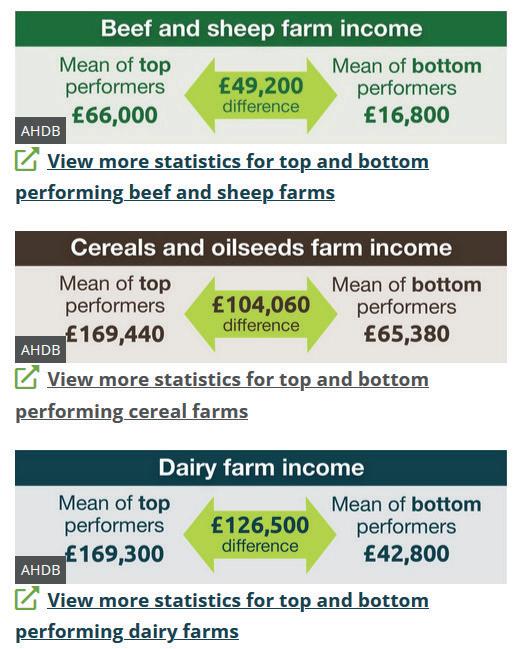
It is your very own AHDB’s excellent ‘Characteristics of top-performing farms 2024’, where I have lifted a graphic from. The data source is Defra’s annual Farm Business Survey. I expect eagle-eyed readers have already spotted the huge difference between top and bottom 25% farm incomes shown here. Where does your farm sit on this spectrum? Of course, being AHDB’s work, you have already helped cover the costs of compiling this highly detailed and highly readable report.
It includes a seriously useful crib sheet headed ‘50 Ways To Be Outstanding’. The outstanding merit of this
work is that 100% of the report’s 50 suggestions cover things under your direct control. Every single one of these that you apply successfully should improve your farm business. In turn, this will improve your self-reliance, regardless of Government decisions in your favour (ha bloomin’ ha) or not.
Suggestions
The more you focus on and do things with the factors under your control – rather than mere influence, concern or, worst of all, distractions – the greater probability there will be of your farm business becoming stronger and the well-being of everyone involved being maintained. What you will find is that you are doing some of the 50 already. For example, one says: “Be part of a discussion group that meets regularly to cover business and technical aspects of farm management… learn from other top performers and strive for improvement.” If already a discussion group member, you will be thinking ‘how bl**dy obvious!’ But what percentage of Dairy Farmer readers are NOT in a discussion group? You would be surprised, I’m sure.
Another peach urges: “Any data collected on farm is made use of to monitor trends and take action on forage,
animal health or milk quality. Time is not spent gathering information for no purpose.”
One more: “Be open-minded about transferrable skills and recruit entry-level staff based on potential rather than fixating on previous skills. This may mean having staff members from non-farming backgrounds who bring fresh ideas and outlooks to the farm.”
At the aforementioned RABDF Gold Cup, Kate Robinson, dairy unit manager at Harper Adams, said not only were a significant number of her team from non-farming backgrounds, but about 80% were female.
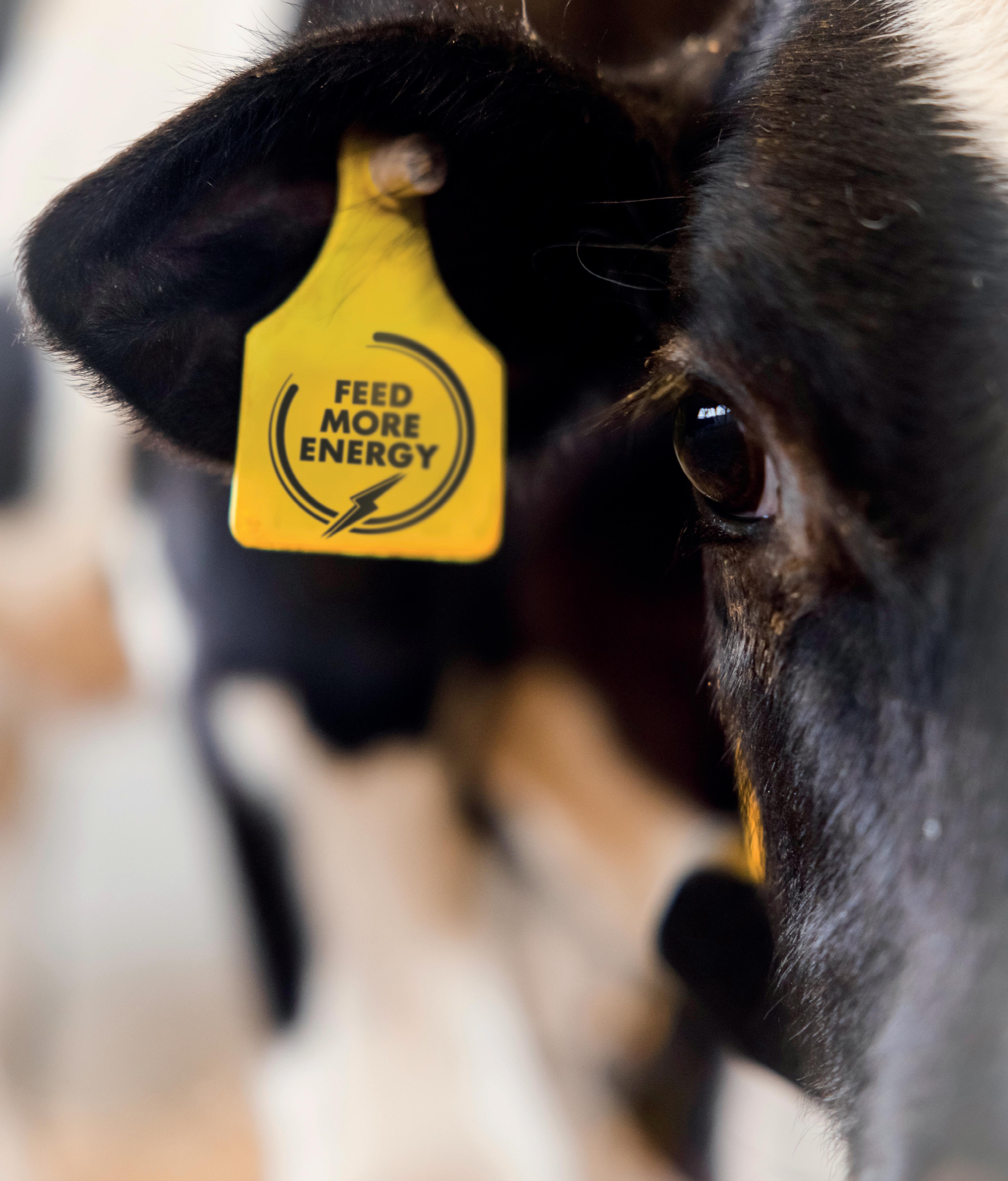
“They insert into the ear effortlessly, with no need to tug to detach the BVD sample. The tag numbers are exceptionally clear and easily visible from both the front and back”
Kedzlie farms - Scottish Borders
And this was purely on merit and certainly not the result of positive discrimination.
Bubble
As a parting shot, there is one more seriously important advantage from this focus on things we can control: it reduces the likelihood of falling into a victim’s mindset. Despite what we might hear from some of our farming leaders, this industry is not alone in facing adversity. Just take a good look outside our bubble at other owner-managed businesses such as corner shops and cafes, sports shops and fashion boutiques, or single-location fitness centres and fuel stations. All operate on wafer-thin margins against rising costs (including, of course, employers’ National Insurance) and competition from powerful large-scale corporations.
Despite the Government’s apparent parsimony, there remains £2.3 billion funding currently available to farming annually.
One more of the 50, then I’m nearly done: “Be open-minded about the contribution that environmental schemes can make to the bottom line. Do the sums like it is another potential enterprise to build into the business. There will probably be some easy gains within them.”
To which I would add leave none of these stones unturned and, having seen only recently the SFI drawbridge being raised without warning, get on with it.
With some areas of the country seeing a rise in lungworm cases this year, Dairy Farmer looks at the impact of infections and best practice in terms of treatment and prevention.
Q&A: Be on lookout for lungworm this summer
While not as common as gut worm infections, lungworm can have serious impacts on productivity within the milking herd and youngstock, and in serious cases can result in death.
Vet Emma Greaves, from Stapeley Veterinary Practice in the Shropshire Hills, shares her advice on the causes of lungworm infections, signs and symptoms to look out for, treatment and prevention.
Q
Wh at is lungworm and what causes it?
ALungworm is a parasite found in the res piratory tract and is caused by the bovine lungworm dictyocaulus viviparus,
extra stage where the larvae migrate to the lungs and grow into adult worms to produce eggs.
Ms Greaves says: “The eggs are then coughed up out of the lungs into the trachea, then swallowed and passed out in the faeces again.”
still occur and can be severe when they do.
says Ms Greaves. The infection causes parasitic bronchitis, more commonly known as ‘husk’.
QWhat causes lungworm and what are the main risk factors?
ALike gut worms, the animal has to eat contaminated grass to ingest lungworms. However, a lungworm infection has an
Lungworm typically affects cattle during their first grazing season, but other risk factors include very wet areas and heavy stocking densities. However, outbreaks have been seen in adult cattle due to lack of immunity and no prior exposure.
QHow common is lungworm within the UK’s dairy herds?
AWhile lungworm infections are less common than gut worms, outbreaks of lungworm
Ms Greaves says: “While outbreaks are difficult to predict day to day, they are normally associated with wetter summers.With the extreme weather we have had this year in certain areas of the country, there is an increased risk as the larvae will spread in the dung and will have chance to mature into infectious larvae at a rapid rate. It does tend to be worse around the west of the UK, as they do tend to have wetter weather.
“There are definitely endemic areas where the infection is very common, with the west of the country being classed as an endemic zone for lungworm.
Lungworm infections are less common than gut worms, but outbreaks can be severe when they do occur.
“This summer, grass growth has been slow due to the hot weather, therefore, grass is being grazed at a much shorter length than normal, meaning the likelihood of grazing on contaminated ground is much higher.”
QWhat are the main signs and symptoms of lungworm?
AThe main symptoms include widespread coughing, sometimes known as a ‘husk’ cough. Ms Greaves says animals may also display a long and low neck with their tongue out, as well as difficulty breathing, loss of condition and death in severe cases.
She says: “In adults you may see cows coughing in the parlour, as they can suffer from respiratory issues due to secondary disease, as well as a reduction in milk yield.”
Emma Greaves
Lungworm typically affects cattle during their first grazing season.
QWhat are the impacts of lungworm on animal health and production?
ALungworm can be very costly, with average reduced milk yield losses up to 4kg per cow per day. This can add up to around £150 of losses per adult cow in the milking herd.
“The main impacts in youngstock include an increased respiratory rate and a reduction in feed intake, meaning in some cases growth rates can complete-
ly drop off. If long-term inflammation develops in the respiratory system, growth rates could be impacted for months,” says Ms Greaves.
“There is a surge of inflammation where the worms are building up in the respiratory tract which means the immune system is working overtime, leading to immunosuppression. This can lead to secondary bacterial infections and ultimately pneumonia in severe cases.”
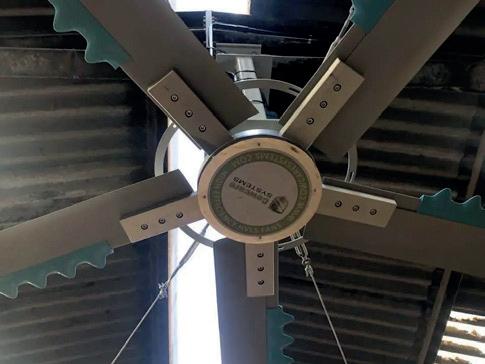
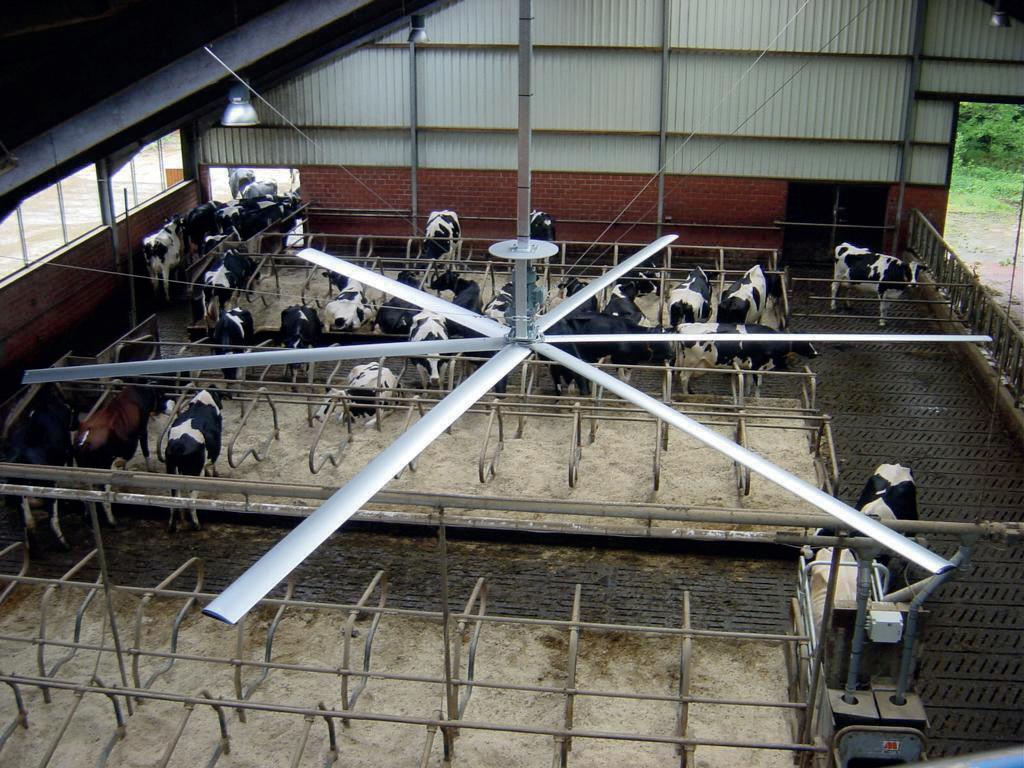
HVLS - FANS
Lungworms are susceptible to the three major classes of wormers and in an outbreak all stock should be treated
EMMA GREAVES
She adds: “Fertility is also thought to be an issue with replacement heifers that have struggled with lungworm, whether this is due to the lack of weight gain we are unsure, but it has been noted they normally take a few more services than normal.”
Dairy farmers also believe milk quality and quantity from an animal following a lungworm infec-
tion is poorer later in life, resulting in impaired fertility and longevity, but it is not proven, says Ms Greaves.
Q Can lungworm be treated and if so, how?
A“Lungworms are susceptible to the three major classes of wormers,” says Ms Greaves. “In the face of an outbreak all stock should be treated, as it is impossible to differentiate between pre-patent and patent period.”
Q Can lungworm be treated and if so, how?
A Ms Greaves says: “Prevention is always better than cure. Purchased cattle should be isolated and wormed as per your herd health plan and vaccination is key.
“You can vaccinate over eight weeks, with two doses given at an interval of four weeks and calves grazed two weeks after.”
Breeding cows with longevity and ensuring sustainable livestock development are two of the most important goals for Uzbekistan dairy farmer Nuriddin Hojabekov.
As more consumers in the central Asian country demand food that cares for both the environment and the animals, Nuriddin sees his strategy as the only way forward.
Nuriddin’s farm is in the Syrdarya district, quite close to the Kazakhstan border, with just five hectares (12 acres) of land at the main unit. In addition, he has a second farm with 700 hectares (1,730 acres) of cultivated land.
“My father Sultanmurad Hojabekov founded Sulton farm in 1993 and now the third generation, my son Asliddin, works here,” he said. “Since starting off with just 10 cows, the farm has changed and grown and we are currently milking 404 cows, with a further 266 dry cows and heifers. We also run 29 bulls.”
Yield
The herd’s average milk yield is 33.7 litres per cow per day and the fat content runs from 3.6% to 4.2%, depending on the season and stage of lactation.
Nuriddin says: “My breeding strategy is based on sustainable livestock development and productive longevity of cows. I am aiming for the healthiest and highest yielding cows we can breed. There are cows already in their fifth lactation, which is a result of our good welfare conditions.”
By setting new goals for sustainable milk production, Nuriddin Hojabekov hopes to mitigate challenges faced by farmers in Uzbekistan. Chris McCullough reports.
World dairy Sustainable farming aims in Uzbekistan
The milking facilities at Sulton Farm were newly built in 2021, when a DeLaval system was installed after a few years of planning. Until 2017, the farm focused on crop production, growing cotton while maintaining a herd of 50 dairy cows. But in 2019, a five-year leasing contract was signed between Sulton Farm, DeLaval, and Tetra Laval Credit for a new dairy. Due to logistical problems during Covid-19, the new dairy was delayed and finally completed in October 2021.
The farm uses a DeLaval HB30 14-a-side milking parlour,
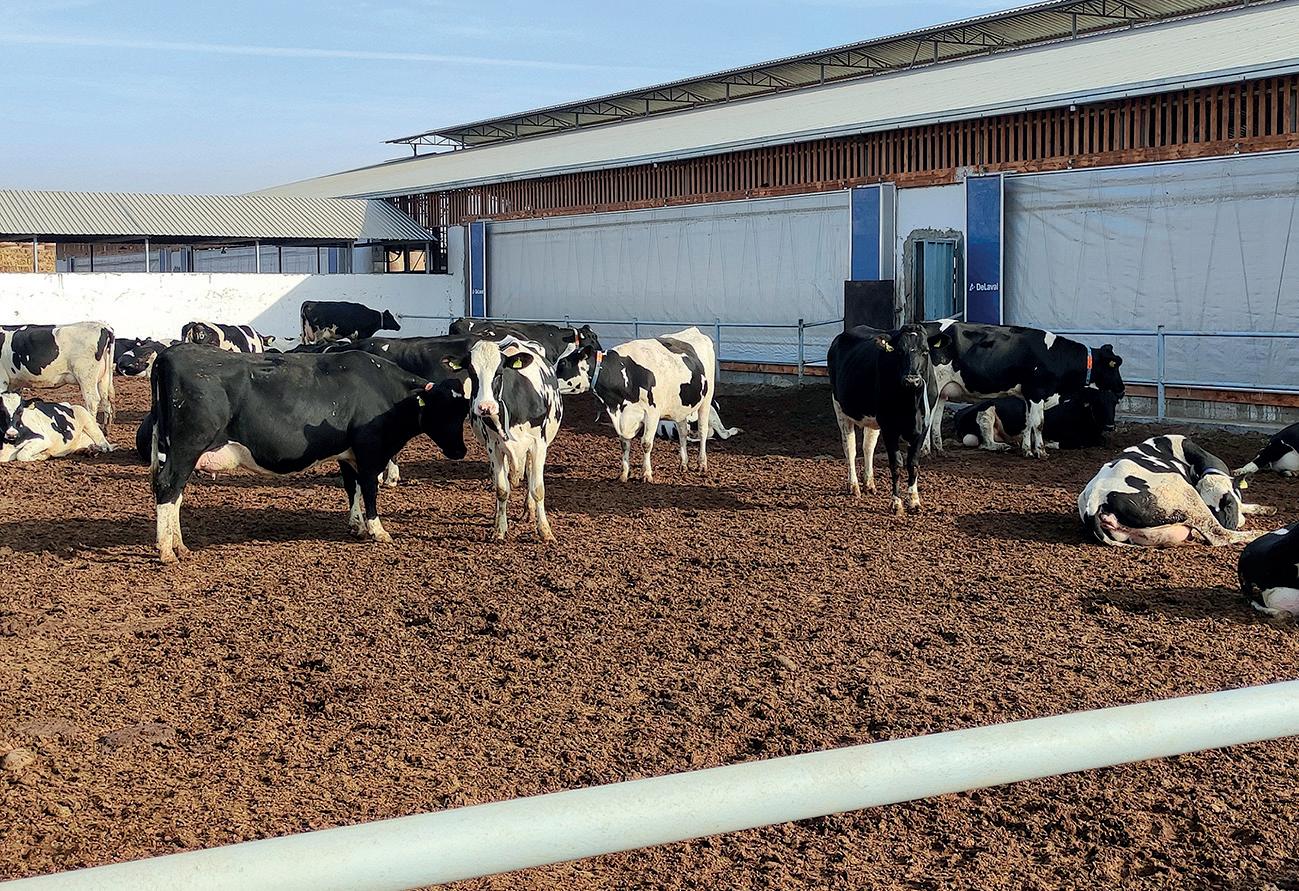
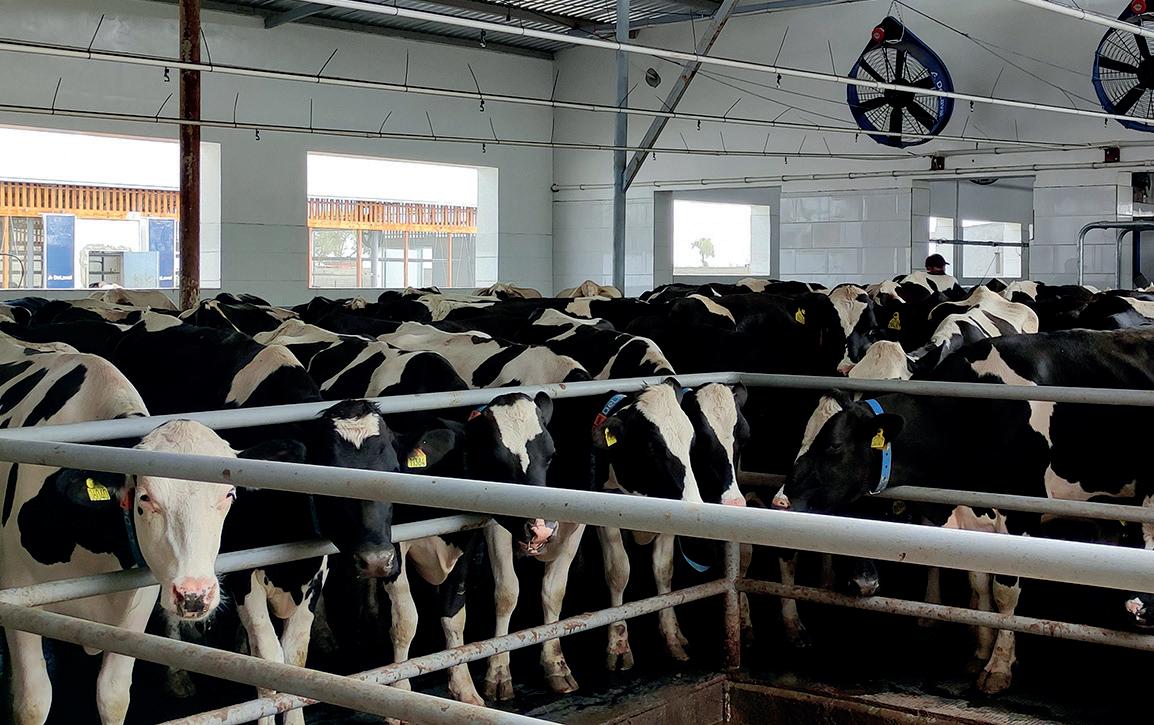
equipped with DelPro herd management software and a sorting gate, to milk the cows. The cubicle sheds, which are fitted with cooling fans, are divided into four areas for the various stages of lactation: freshly calved, high milkers, medium milkers and low production cows. Each group has access to an outdoor area.
In addition to the main shed, there is a maternity ward, which is also divided into sections for various calving stages.
After calving, all cows are milked for three to seven days on mobile milking machines to obtain colostrum. Calves are kept in another separate building, housed in specific age groups.
In order to increase his farm’s
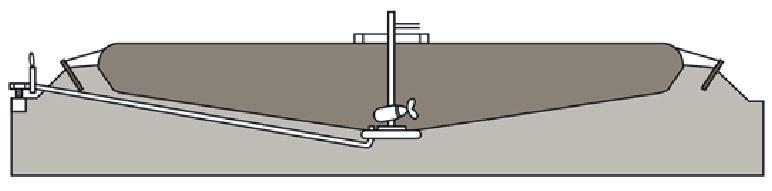
sustainability, Nuriddin uses a manure separation system in the cow barns. He also installed solar panels and uses efficient water management techniques, such as drip irrigation.
Prices
The average milk price in Uzbekistan is 7,000 soums per litre (41ppl) but the higher-quality milk produced by Nuriddin’s means he is receiving a milk price of 8,400 soums/litre (49ppl).
He says: “Our cost of milk production is around 6,000 soums [35ppl]. We use the best quality feed and feed additives to achieve good results. However, it was very difficult from 2023 to 2024 when the price of milk fell to 4,500 to
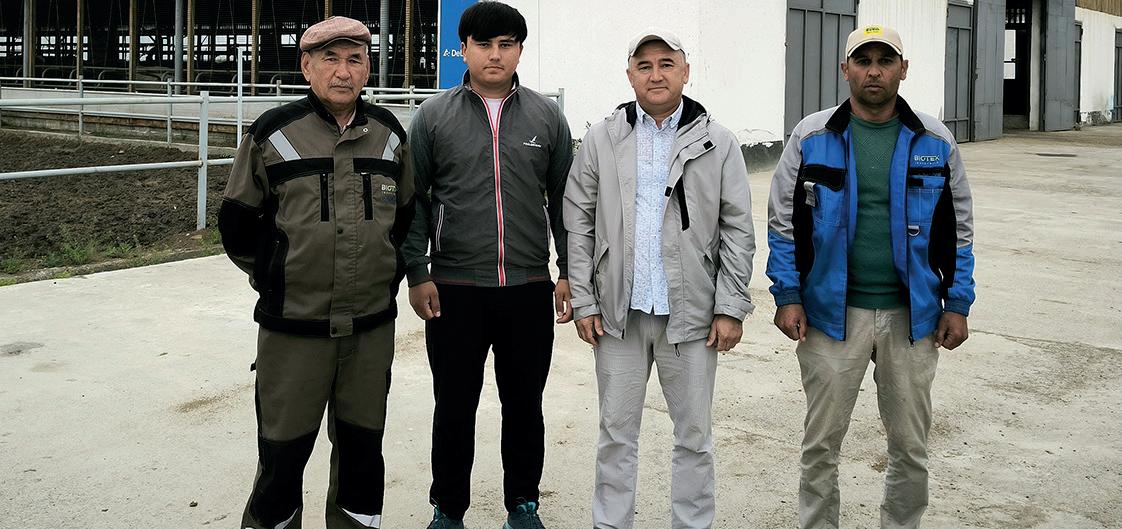
Nuriddin Hojabekov, second right, runs the farm with son Asliddin, second left, and staff members.
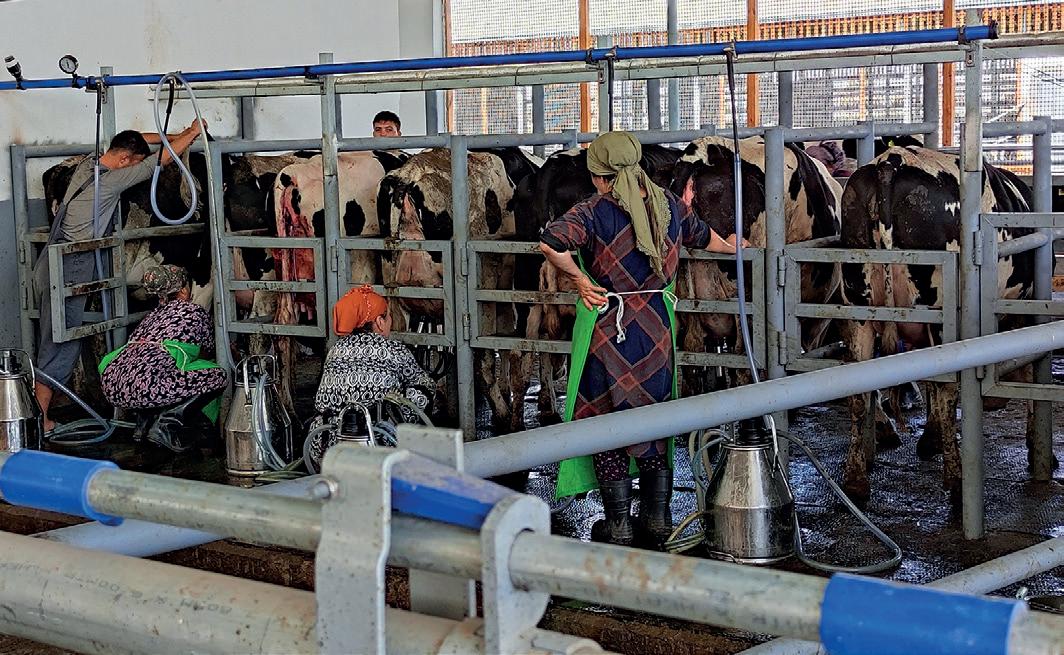
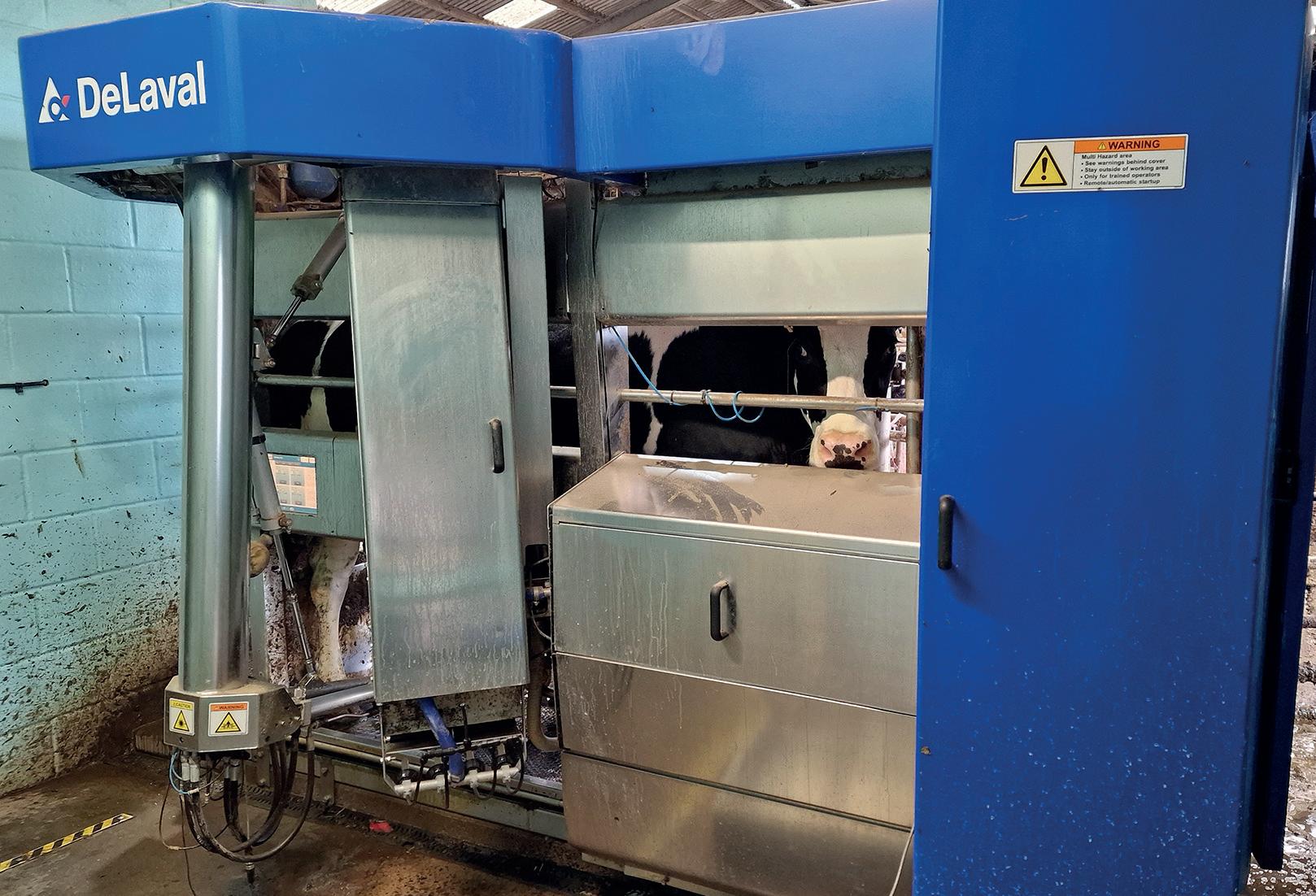
Cows are milked through a DeLaval parlour.
Cows have access to small paddocks beside their barn for exercise and sunlight.
Uzbekistan World dairy
5,000 soums [26-29ppl].
“The reason for the fall was our dairies bought cheaper milk powder from Belarus, forcing our prices down. Many dairy farms could not withstand these difficulties and closed down.”
Nuriddin says the main problems with dairy farming in Uzbekistan are a lack of fodder and gaining finance.
“We have a real lack of fodder
Farm facts
■ The farm was winner of the Eco-Farm Award at the 2024 Uzbekistan Business Awards.
■ Nuriddin became the first farmer in Uzbekistan to import 300 Holstein Friesian cattle from Denmark.
■ The farm employs 17 staff.
■ Nuriddin uses both AI and bulls on his cows, choosing sexed semen from some of the world’s leading breeders.
crops here, which pushes prices up. Fodder crops account for only a small percentage of sown areas. With these higher costs, obviously our costs of milk production are higher too, higher than other countries in the region.
“But we also have high costs of total mixed ration raw materials, as importing ingredients such as soybean and rapeseed meal are high.
“Another issue is the limited access to finance, and farmers can find it difficult to obtain affordable credit. Diesel prices can also be quite high.
“We are not escaping the effects of climatic factors, and droughts can exacerbate fodder and water supply problems.”
Looking ahead, Nuriddin is planning further expansion with a new farm for 500 dairy cows. He also plans to adopt new technologies, including the installation of biogas equipment and a cow activity detection system to improve herd management.
Disinfectants are regulatory biocides. Use biocides safely. Before use read the label and product information.
Cows are milked using a DeLaval parlour.
Fans keep the cows cool when awaiting milking.
Multi-cut
Agriculture director at Germinal UK and Ireland, Ben Wixey, shares his advice on getting the most out of a multi-cut silage system. Katie Fallon reports.
Attention to detail key for multi-cut silage systems
Usually involving four to six cuts of grass per season, with cutting taking place every four weeks, multi-cut silage systems can be a beneficial option for farmers trying to get more from forage.
However, the system must be well managed, with attention to detail crucial to its success.
That is the advice from agriculture director at Germinal UK and Ireland, Ben Wixey, who says it all starts with the right grass species.
For multi-cut systems, Mr Wixey advises using perennial rye grass leys to produce the best quality silage, due to their positive response to nitrogen and long-term swards.
He says: “Other grasses do not respond to nitrogen as well as perennial rye grasses, in whatever form you put it on, so you are on a bit of a loser financially from the start.
“You can do it from Italian rye grasses which are the short-term grasses, but it is much more difficult because they move through their physiological stages so much quicker, so your timings have to be absolutely spot on.
“And in a situation of hot dry weather they will go to head quickly and we do not want to be cutting stemmy plants, that is not what multi-cut is about.”
Mr Wixey says farmers should begin walking their silage fields in autumn to check the content of perennial rye grasses.
He adds: “You want about 70% perennial rye grass in the sward. It is easily identified as you pull it up from the base and it has got a purple tinge to the bottom of the plant and is
shiny on the back of the leaf.”
Mr Wixey advises swards with 70% perennial rye grass should produce good quality silage, but anything less than 70%, the quality of digestibility, the energy and the protein levels of silage will be impacted.
He also advises that during the autumn months, silage fields are grazed down, tight to the ground by the end of December.
This is to prevent dead material in the bottom of the sward reducing the nutrient value and overall quality, which is one of the biggest losses in making quality multi-cut silage.
He explains there will be a small amount of growth each day during winter which needs to build up.
He adds: “If you keep the stock on all through the winter, you are starting from a negative point in January and February when you need to start feeding the grass to get it going.”
Grass mixtures
In terms of grass mixtures, Mr Wixey says multi-cut systems require grasses that have a tight heading date range, which is the date the ear will emerge out of the leaf.
He says: “If you have four grasses in the mixture then those heading dates need to be within 10 days ideally. If you think about how a grass plant grows, you need all of the grass growth to be at the same rate, so you have cut all the plants at their maximum potential with the right yield.”
Timings
To achieve a successful multi-cut system, Mr Wixey advises first cut should be taken around the end of April and then ideally cut every four weeks after that.
He says: “We are trying to make every cut identical to the last, because if we have a big first cut that is very stemmy, the fibre content is much higher and the intake is down.
“If we can keep the grass cutting and silage making identical every time, then we are putting the same quality, leafy material into the pit and when you are feeding it over the winter months, every tonne that you feed will be identical to the last one.
“That way balancing the cows over the winter is so much easier, and that to my mind is one of the biggest benefits of a multi-cut system.”
Fertiliser
Fertiliser applications is another area of multi-cut systems which requires attention for best results.
Mr Wixey says the industry still generally works on an application rate of two units a day and therefore, advises farmers to work back from their cutting date to work out their own individual application rates.
He says: “The days of putting far
too much fertiliser on and having a higher protein silage are gone.
“We need to put the right amount on at the right time, whether you are using slurry over the winter or bagged fertiliser, you need to calculate it and apply it in advance of the cutting period.
“The rule with multi-cut silage is little and often, but you have got to get on and spread it the day after or the day the silage is cut.
“You cannot leave it for four or five days because you have only got four weeks before the next cut.”
Cutting height
For best results, Mr Wixey advises raising the cutting height by approximately 7cm or ‘a hands width’. He says: “We are not looking to take the bottom of the plant because that is the most fibrous fraction, full of lignin to hold the plant upright. Lignin is the only part of the plant that the animal cannot digest. ”
Wilting and clamping
Due to multi-cut systems generally not containing the ‘big bulk’ of grass seen in first cuts, wilting is a quick process and grass can often be cut in the morning and picked up at night.
Mr Wixey says: “The traditional message that comes across is to cut in the afternoon because the sugars are higher. But if you have got a younger, tender plant that is more energy efficient, then you are going to get more energy in the cut and do not need it to wilt for as long.”
He advises grass is clamped in thin layers, is well rolled and well compacted, with a good additive applied to quicken fermentation and ensure a stable pH.
Ben Wixey
IT’S ALL THERE - YOU JUST NEED TO TEST FOR IT!
With Semex Elevate you get a genetic prediction based on fact. Add the benefit of identifying high immunity females together with feed and methane efficiency scores and you really are proving sustainable farming practices - for every animal genomically tested in your herd.
Field trials have shown a new natural plant biostimulant made from Welsh seaweed increases dry matter content in silage yields. Katie Fallon reports.
Seaweed biostimulant boosts silage yields
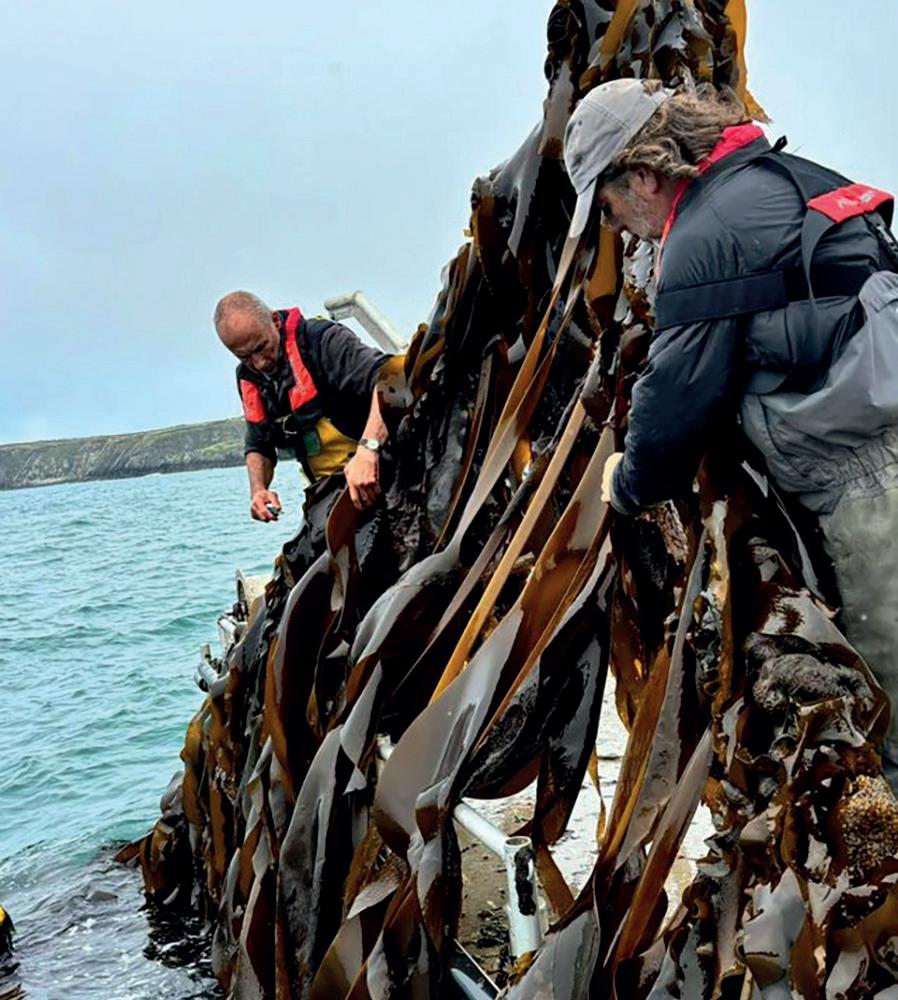
Originally launched to help fisherman find a new revenue stream, Wales’ first regenerative seaweed farm, Câr-y-Môr is now producing a natural seaweed biostimulant for use within the agricultural sector. While some farmers close to the coast have been using seaweed as a natural fertiliser for generations, by spreading it on the land and allowing it to decompose, Câr-y-Môr, have now developed a liquid seaweed biostimulant to use alongside standard fertilser applications on grassland and arable systems.
Director at Câr-y-Môr, Dom Burbridge, explains field trials have shown positive results in terms of grass and crop yields, due to four main benefits of using seaweed, including increased nutrient availability and nutrient use efficiency, enhanced plant resilience and improved nutrient density.
Mr Burbridge says: “Seaweed helps with nutrient use efficiency. If you apply seaweed over the top of fertiliser applications, it will improve the nutrient uptake of the fertiliser by the crop. It therefore, also gives you the option to use less fertiliser.”
In terms of nutrient availability, seaweed will stimulate the natural nutrient cycling processes of the plant by nurturing the soil microbiome. This allows the soil to draw down nitrogen out of the atmosphere and make phosphates more available, explains Mr Burbridge.
He adds: “The third thing is that seaweed also strengthens the plant, whether that be grass or any crop. Prompting more and longer roots, it also strengthens the natural plant defences and response to stressors,
such as drought or flooding. By making the plant stronger it helps them to be more resilient to weather, pests and diseases.”
And while it may be the more difficult benefit to prove, Mr Burbridge says that by improving the plant’s strength and vigour, the biostimulant will naturally create more nutrient dense foods. He says: “Rather than just fertilising the soil and the plant, the seaweed is stimulating it.”
Grassland trials
In Câr-y-Môr’s 2024 grassland trials, the biostimulant was sprayed using normal spraying equipment with a typical application rate of 5 litres per hectare (2 litres per acre) per silage cut or graze.
Mr Burbridge says because seaweed farming is still in its infancy, it is relatively expensive and currently the biostimulant tailored for this type of use typically costs £25/l, for smaller volumes of the higher concentrated batches.
However, Mr Burbridge says the biostimulant is easy to apply and can be used throughout the year from early growth, giving farmers a practical, readily available alternative to synthetic inputs.
He says: “Because we only need to apply relatively low volumes, drone spraying is a viable option for giving crops a quick and efficient boost in situations where farmers cannot get onto their fields in the case of water logging for example.”
Return on investment
Field trial results in 2024 at Daniel Evan’s Ceredigion-based beef and sheep farm have shown a positive return on investment. Results showed an 18% increase in dry mat-
ter in silage yields, equivalent to a £92/ha (£37 per acre) saving and a 15% increase in crude protein, when the biostimulant was added to the existing fertiliser programme.
Mr Evans says: “We used the biostimulant on around 1.5 acres (0.6 ha) in total, with a portion of the fields left untreated to compare results, which I was very pleasantly surprised by.”
Mr Burbridge adds: “Mr Evans said he could not really see much difference to grass crops, but a lot of the stimulation is going into root growth, below the ground, and that is what is giving you your resilience and grass quality improvements seen in the silage analysis.
“And it was not that the growth was faster, but the dry matter was higher, and this is something we are seeing across all crops.” With 30 farms across Wales now using the seaweed biostimulant including dairy, beef and sheep farms, arable farms, potatoes growers and market
gardeners, Mr Burbridge says positive results have been seen across the board.
“The way we structured our farmer-led trials is that it has got to fit in with the current farming system, we kept it very light touch, with some simple soil testing to make sure the two parts of the field are similar and then did a simple side by side test.”
Câr-y-Môr are now running more farmer-led trials with Farming Connect, WWF and Terrafarmer as well as a second year of Co-op Innovation Fund 2 (CIF2) funded agronomist-led trials, looking at reducing bagged fertiliser applications by 25 to 50% alongside applying the biostimulant, to see whether they can get the same yields with less fertiliser.
Mr Burbridge advises farmers to speak with their agronomist about the trial and the benefits of using a seaweed biostimulant, or go to carymor.wales/biostimulant for more information.
Câr-y-Môr is Wales’ first regenerative seaweed farm.
Sponsored Editorial
With a mixed bag of grass silage this season, Volac experts around the country share their views on the role forage maize could play.
How maize could help make up for this year’s grass
England – Midlands England – South
VOLAC technical business manager across the Midlands, Amanda Clements, says a drought-induced shortage of early grass silage on many farms means maize silage could be something of a lifeline for many farmers in her region. Especially with maize crops generally looking well.
Amanda says: “As well as a lot of people having to open this year’s first-cut grass clamps early, the extended dry spring meant regrowth for second cuts was slow. By contrast, rain arrived just in time for maize in many places. If short of forage, it will be crucial to look after maize properly at harvest and in the clamp.”
Wastage
Historically, Amanda says some wastage around the top and shoulders of maize clamps used to be tolerated. But with herd sizes having expanded, she says those days are gone.
“If you have six inches of waste at the top of the clamp you are potentially losing half the dry matter [DM] in that layer, and the DM remaining will be lower in nutritional value and potentially less palatable.
“Plus, there are likely to be hidden losses below this layer that you cannot see. If you multiply this all the way back through the clamp, you are looking at huge losses.
“DM is lost when spoilage bacteria, yeasts and moulds feed on the
most nutritious parts of the maize silage, turning it into unwanted compounds including carbon dioxide [CO2].
“If farmers could only see the amount of CO2 produced there would be a lot more focus on preservation.
“If silage is mouldy, there is also a substantial risk of mycotoxins.”
In response, Amanda says it is crucial to remove all the air from clamps to aid fermentation and reduce the risks of yeast and mould growth.
The dual-acting additive Ecocool has been proven to reduce DM losses in both these areas, she says.
“Traditionally, farmers might not have used an additive on maize. But more are now realising its value. With decent milk prices, there is also extra financial headroom to try an additive to protect this year’s maize silage.”
Amanda Clements
Ken Stroud
IN southern England, Ken Stroud says the dry spring has taken its toll on both grass and maize crops.
Although there was some rain, he says it came too late to help growth of third-cut grass and some second cuts. And while maize planted early into moist seedbeds got away well initially, the June heat caused it to suffer and meant any later planted maize really struggled, he adds.
Ken says: “Any rain that did arrive was localised. The upshot is we need a great maize harvest because some grass crops are not good, but also do not take your focus off grass silage because some maize could end up disappointing.
“In addition, where maize fields were planted at different times, we are likely to see a range of maturities.
“If this happens on the same farm,
there will be a temptation to pick an average harvest date.
“But that could compromise DM and quality because under-ripe crops will not have produced maximum starch yields, and over-ripe, drier crops will be more difficult to consolidate and at greater risk of heating and mycotoxins.
Choice
“As always, correct additive choice for maize will be crucial. Look for a dual-acting one with the power to reduce heating but also aid fermentation of greener material.
“The other reason to minimise DM losses is for silage carryover. We have no idea how late turnout might be next spring and therefore how long this year’s silage needs to last. Few farms have 20% carryover of silage stocks but they should have.”
Wales and the Welsh borders
VOLAC technical business manager for Wales and the borders, Peter Smith, says on-farm grass silage stocks are generally good in his region, but quality will be variable.
Farmers who took first-cut early, while there was moisture, achieved good second cuts, he says, but those who waited to take heavier first-cuts saw aftermaths struggle to recover. Having seen this trend over several seasons, he believes more farmers will cut earlier next year.
Peter says: “Although quite a lot of maize was drilled in dry conditions, producing backward growth, some did go in early when there was moisture.
“Either way, maize could help to make up for this year’s lower energy grass silage. Two keys to maximising maize’s energy content are to harvest it at the correct time and to make sure
Scotland
ALTHOUGH maize growing is edging further into Scotland, grass is still the main winter silage, says technical business manager in the region, Freya Webber.
But a common problem this year has been grass ensiled drier than expected due to the warm weather, which underlines the need to wilt to the correct %DM for remaining cuts, she says.
Freya says: “In warm conditions,
clamp management is spot on. A lot of farmers are moving towards harvesting maize while still green. Provided the cob is ripe, this is perfect for maximising energy because green tissue is more digestible. Dead maize foliage is pretty much like feeding straw.
Consolidation
“Equally, make sure consolidation and clamp sealing are done properly. The other big risk in maize silage is mycotoxins. But research has shown that, as well as improving fermentation efficiency and reducing heating, ensiling with Ecocool can significantly limit the build-up of mycotoxins in maize silage.”
Expanding on this, Peter says without an additive levels of the mycotoxins, mycophenolic acid and roquefortine C, increased from zero at ensiling to more than 5,000 and 8,000 parts per
billion, respectively, by the time the crop had been ensiled for 95 days then exposed to air for 12.8 days.
By comparison, with Ecocool applied at ensiling, accumulation of both mycotoxins was controlled to levels 98% lower than in untreated silage, he adds.
Peter says: “There was clear evidence of Ecocool significantly improving the hygienic quality of the silage due to its action against yeasts and moulds.
Digestibility
“The research also showed that neutral detergent fibre digestibility [NDFD] in the treated silage exceeded that of the untreated silage by as much as 4% after air exposure. This is significant because increasing NDFD is associated with improved milk yield.
”Clearly, if mycotoxin levels are already high in the crop at harvest, neither good
ensiling practice nor the additive can remove this. In this case, a separate specialist mycotoxin remediation treatment, such as Ultrasorb, is needed.”
over-wilting increases spoilage organisms on the sward, reduces quality and makes consolidation difficult. So be prepared to shorten wilting times and modify techniques if needed to achieve the optimal 28-32% DM.
“Alternatively, if there is no dry window in sight, do not be tempted to leave cut grass out to ‘dry’ longer.
“The longer it is left out in wet conditions, the greater the risk of soil contamination and spoilage organisms.”
Peter Smith
Freya Webber
Mastitis
Building design and water quality were some of the topics at the British Mastitis conference in Worcester. Jonanthan Wheeler reports.
IT takes only a few relatively minor tweaks to building design and management to reap huge benefits for the welfare of cattle using them.
Zoe Barker, of the University of Reading, said rising temperatures were already changing how cattle behaved, and could affect their breeding success in future.
Research completed at the university’s Centre for Dairy Research (Cedar) and commercial farms in south east England has shown that cattle tend to bunch together as temperatures increase. Other collaborators include University of Essex (bunching behaviour) and University of Cardiff (climate and building modelling).
Design tweaks can improve welfare
Cattle in the unit and the buildings themselves were fitted with sensors to monitor the environment and track how the animals moved. And farmers also revealed they had observed cattle bunching and remaining standing, which meant less lying time, lower feed consumption and increased respiration and panting.
Farmers also reported a range of
SMALL CHANGES MAKE A BIG DIFFERENCE
A FEW key changes around the milking parlour have helped one Cumbrian dairy farming family make significant progress in controlling mastitis.
Johnny and Emmie Bland have 220 Jersey cross Friesian springcalving cows at Arnside Towers Farm. Most of the herd calve in a six-week block in February and March, and the couple aim to dry off the cows at the start of December. Cows average 5,000 litres/head with 420kg of milk solids.
The cross-bred cows replaced Holsteins and, at around 450kg each, are significantly smaller than their predecessors, enabling the
Blands to make several changes.
One was recruiting a new herdsperson, whom Mrs Bland described as ‘very meticulous, thorough and self-motivated’.
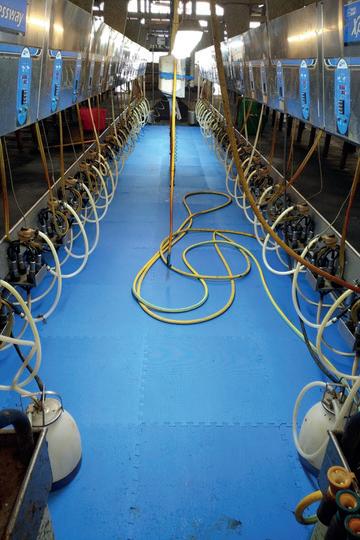
They also reviewed all parlour routines, which meant spending time to see whether each job was being done properly. One thing they noticed was their clusters were hanging too low, which they solved by shortening the pipes. This prevented them from falling off and avoided the danger of kinking the pipes themselves. And they installed rubber matting for the cows throughout the parlour.
Mrs Bland said: “That produced an instant and dramatic improvement. We laid
health impacts, said Ms Barker, including increased somatic cell counts and clinical mastitis; a spike in klebsiella cases; increased problems with lameness; slower horn growth; and thinner soles to the feet.
She said: “Any treatment applied for other conditions is likely to be less effective, and animals that have suffered low feed intake might gorge on clover and suffer
the matting during the winter dry period. We tested it on the heifers during their training period and they galloped straight through.
“The cows now follow in easily and staff no longer have to go out to encourage them in. As a result, milking times are much quicker.”
The couple have taken advantage of the smaller size of cow to tighten up the milking stalls so they are more end-on to the pit. In addition, they have added a rail across the cow’s breast, so that they stand closer to the pit, which makes the milkers’ work disinfecting and attaching the clusters easier.
Between March and May this year, new infection rates were
bloat. Longer term fertility may also suffer, with reduced oestrous and observable heat, as well as delayed conception or cows returning to service.”
Hygiene
On the hygiene front, it can also mean the area in which they bunch becomes much dirtier. Bunching behaviour can vary, she added, and
comfortably under 5%:
Mrs Bland added: “We did struggle with high cell counts in previous years. This year, we had daily cell counts of 200 during the calving season, but are currently averaging 90 in the bulk tank.”
Another innovation is the installation of a ‘bat latch’, which opens at 3am and 1pm and allows cows to buffer feed in the collecting yard before milking.
Emmie Bland
start at any time of the day. Once it starts, it tends to persist for the rest of the day, or until another event interrupts it.
Research has shown that cattle tend to bunch together as temperatures increase. are many reasons for cattle changing position – seeking shade, avoiding sunshine or flies, accessing ventilation fans, or moving to parts of the building with better airflow – but there could be other, as yet unidentified, reasons, added Ms Barker.
One theory is that the bunching may be caused by flies, and tends to get worse later in the day and persist well beyond the end of the heat stress event that triggered it.
At Cedar, cattle have been observed bunching even if there is no measurable variation in temperature across the building. There
Cedar observed one milking parlour, located on the south side of the unit and in direct sunlight for afternoon milking. The temperature in the main unit was 30.2degC, and 36.2degC in the parlour, a potential problem for both cows and staff.
IMPROVING WATER QUALITY BRINGS BENEFITS
ADDING chlorine dioxide to a water supply could reduce the levels of a range of undesirable contaminants, according to trials conducted at a Devon farm.
Introducing the idea, Phil Elkins, of FarmWater, said the chemical – widely used as a disinfectant in the food industry –was effective because it breaks down organic materials and
biofilms, achieving a highly effective kill of pathogens.
The farm had a mains water supply and two boreholes, one known to be contaminated with bacteria, a high total visual count and coliforms. The chemical was introduced at a high rate to stabilise the water system and clear out pipework, before being reduced to a much lower maintenance level.
Possible solutions include solarreflecting paint, improving airflow by opening doors, installing ex-
Significant reductions were noticed over the first year, notably mastitis itself, where cases fell from 27 to 17 (a 37% reduction), although other factors may have played a role.
Results for other milk cleanliness and health parameters also showed improvements.
haust fans, using a hybrid ventilation system or deploying a combination of all of the above.
Zoe Barker
Phil Elkins
Lameness
Recent events organised by Stride, the national dairy mobility initiative, stressed the importance of management to prevent lesions. Dairy Farmer reports.
Prevention still priority to improve mobility
Mobility issues remain stubbornly high in UK dairy herds, averaging 3040 cases per 100 cows and being implicated in around 7% of all culls. Delegates at a recent event held at Harper Adams University were advised that reviewing preventative measures could contribute to reductions in compromised mobility and poor foot health.
Gill Whitehurst stressed the importance of the early detection and prompt effective treatment (EDPET) methodology when meeting the challenge of increasing mobility and foot health.
“The sooner a lesion is identified and treated, the lesser the consequences will be,” she said. “Regular or automated mobility scoring will help spot the early signs of discomfort which signal a
Mobility scoring will help identify lesions quicker, reducing the impact.
potential problem. Once a cow has been identified, the foot should be examined within 48 hours, and a correct programme of effective treatment actioned depending on the lesion type. But success has its foundation in better prevention of lesions.”
Ms Whitehurst said there needs to be a shift in attitude towards mobility scoring.
“It must be seen as an effective way to pick up changes in mobility quickly, and not just as a benchmark or to fulfil the requirements of the milk processor.
Frequency of mobility scoring needs to be increased too,” she said.
As technology moves forward, so new developments will increasingly play a role in helping improve foot health by preventing problems developing.
Georgia Thresh from HerdVision suggested that data is the key to
identifying the key areas where investment might be required.
“No farm has an unlimited budget with numerous demands for capital, so it is essential that return on investment is maximised,” she said. “For example, investing in automated mobility scoring will help provide the data to identify the principal causes of mobility issues, allowing targeted treatment.”
Investing to improve
The 2024 Stride survey showed that farmers are open to the principal of investing to improve mobility with respondents reporting investment in technologies including mobility cameras, powered crushes, automated footbaths and improvements to cubicles and passageways.
Almost half (45%) of respondents said they were likely to continue to invest in ways to help
prevent mobility issues and to more effectively treat foot health issues, with interest in a wide range of technologies.
“Reducing lameness can only be addressed by making the right long-term decisions and investing in the right technology, management and building improvements to address the specific problems,” said Ian Byrne of Teemore Engineering.
“Probably the biggest question
Georgia Thresh said data can help farmers identify where to invest.
on many farms is where best to invest as there will be several options which means you must be methodical.
“It might be investing in something new or an upgrade to existing facilities. Take guidance from your team, your vet and foot trimmer and your cows to identify the pinchpoints and key issues.”
He added investing in technology that makes undertaking tasks easier will ensure they become part of the routine, such as automating footbathing or mobility scoring.
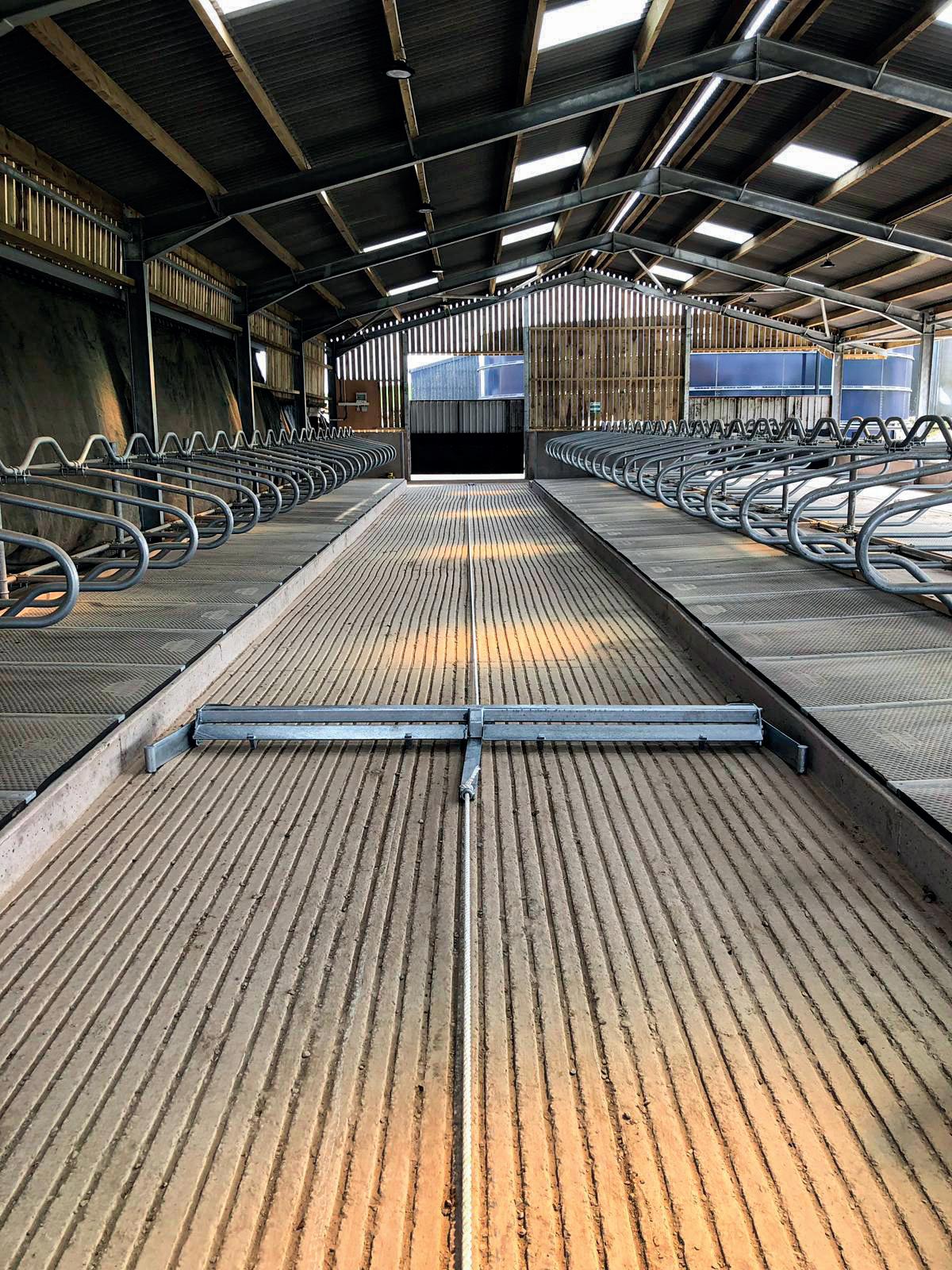
“Prevention starts with the cow’s environment. Do the buildings allow cows to spend less time on their feet and move around easily and freely? Are there bottlenecks which increase the risk of foot damage? Watching the cows will tell you a lot about the buildings.
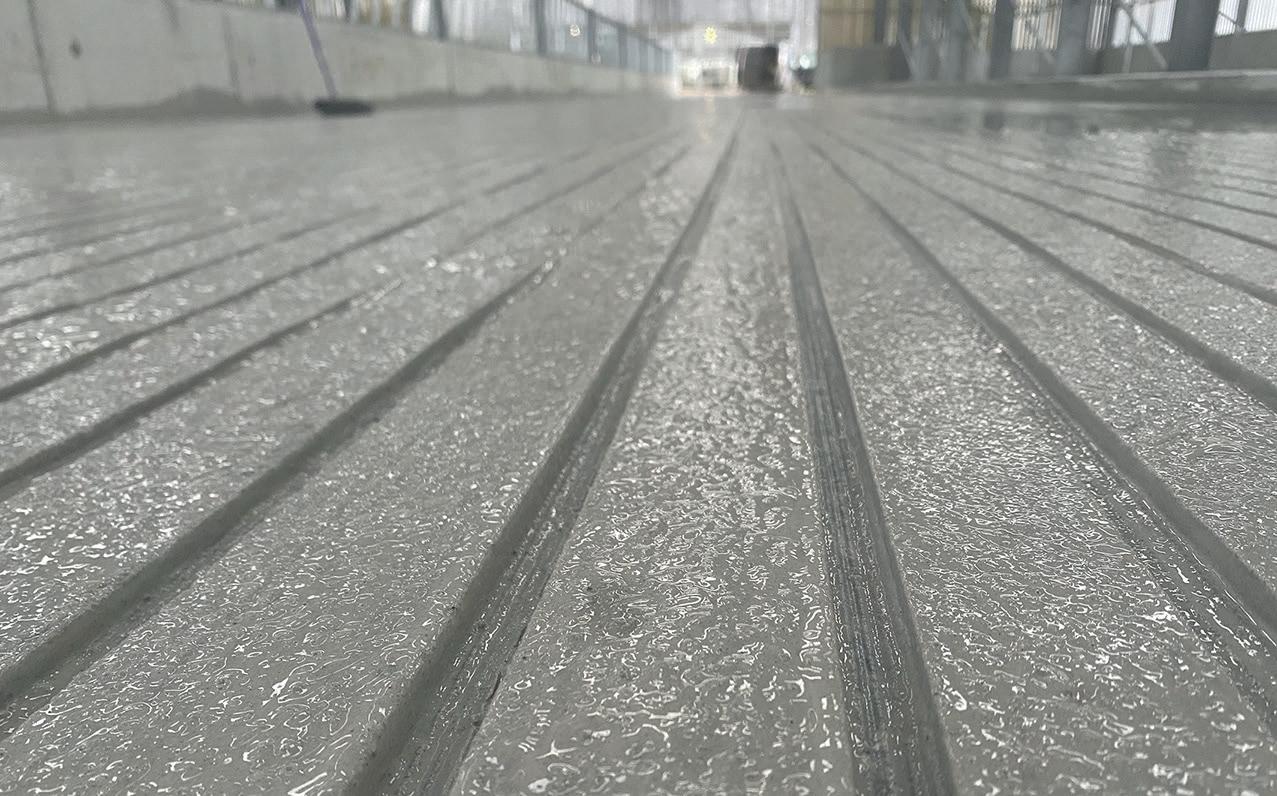
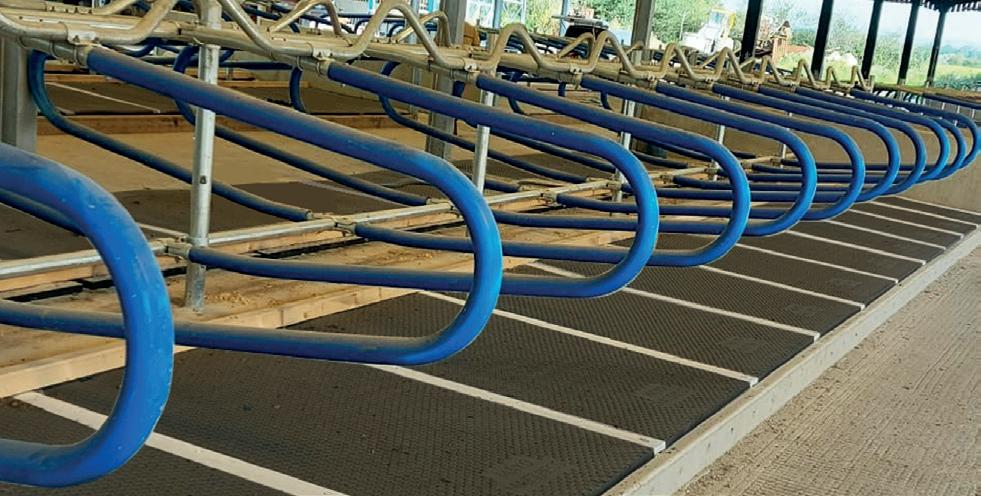
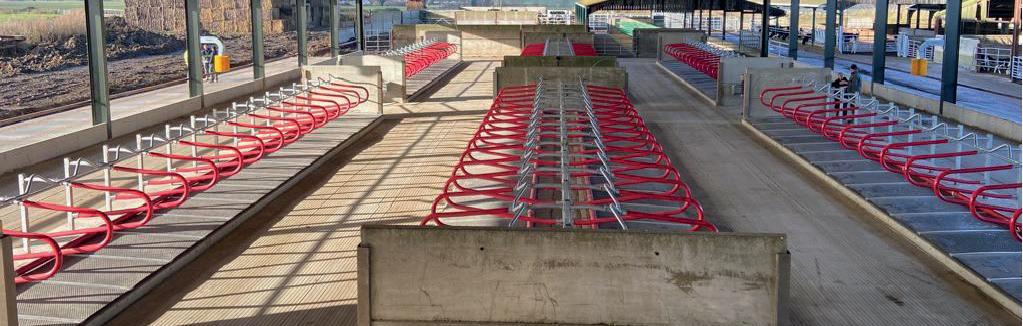
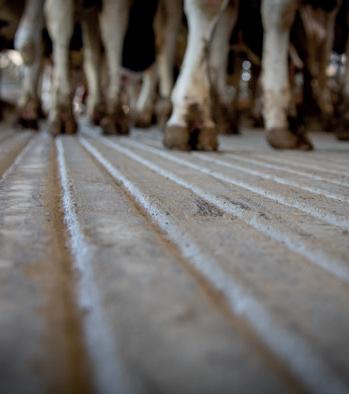
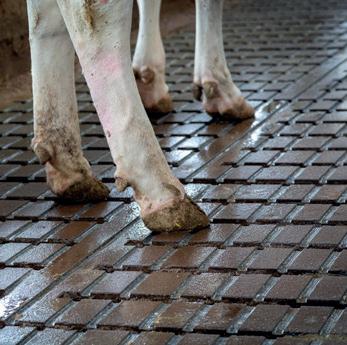
“If bruising and ulcers are a problem then it may pay to invest in cow comfort and the cubicles or changing the routine to increase lying. Rubber matting on flooring will reduce these problems while concrete grooving will prevent cows slipping. It will pay to keep an eye on grant schemes and take advantage of any available grants.”
Transition disease
Preventing foot lesions needs to be a priority across all cow groups. One stage of lactation that is often overlooked when reviewing mobility is transition.
Emma Miller of Zinpro told delegates that cow comfort is crucial in the transition period in helping reduce the consequences of compromised mobility.
She advised that lameness is a transition disease and that you will see increased lameness in cows that do not transition well. Compromised mobility in transition cows will result in lower dry matter intakes in both preand post-calving cows.
“If dry matter intake is reduced, cows will mobilise body fat, including fat from the foot pad which will predispose cows to foot prob-
lems. If we manage transition cows better we can ensure better dry matter intakes and prevent loss of the footpad.”
Ms Miller said transition cows need plenty of space and advised no more than 80% occupancy in transition cow housing. Cubicles should be larger to accommodate the increased size of heavily pregnant cows.
“If cubicles are too small, cows will find it harder to get in and out, increasing the stress on the ankles, hooves, tendons and ligaments resulting in a greater risk of compromised mobility.
“Set a target of zero lameness in dry cows. Carry out a hoof check two weeks before going dry and rectify any problems at this stage. Then putting cows in a good environment
NEW
What if you could reduce losses due to Mycoplasma bovis respiratory disease?
with reduced stress will give them the time to rest and recover.
“It will also be important to footbath dry cows as they enter the dry cow group to help reduce the prevalence of digital dermatitis causing bacteria.”
Ms Miller also stressed the importance of trace element nutrition in maintaining foot condition.
In particular, she highlighted the role of manganese in strengthening ligaments and tendons, copper which helps maintain the collagen fibres that support the pedal bone, and zinc which is essential for overall hoof strength.
Biotin plays a crucial role in helping harden the hoof.
Protivity ®: the first modified-live vaccine for Mycoplasma bovis.
The days of relying on antibiotics alone to help control Mycoplasma bovis are over. It’s time to change the game for your herd with Protivity. Speak to your vet for more information
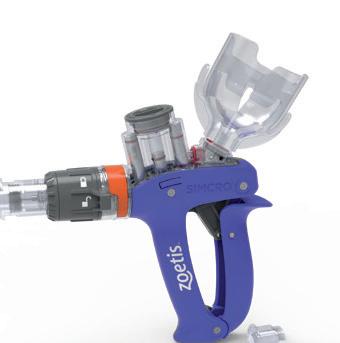
WIN a Simcro VS Injector
Ian Byrne
Water
An increasing number of dairy farms are installing boreholes to minimise water costs. And while they are generally equipped with a filtration system, a breakdown or lack of adequate maintenance can lead to problems further down the line.
Ben Bartlett, of National Milk Records (NMR), says if you have performed all the usual checks and measures on cow cleanliness and parlour hygiene when high bactoscan persists, it might be worth looking at other factors, including problems with contamination of the borehole water supply.
“A simple sampling and testing process can help to rule it out as the reason behind elevated bacterial and thermoduric counts in milk samples,” he says. “But it is also good practice to routinely test borehole water, to make sure that filtration equipment is working effectively and that no new issues are developing, particularly after a spell of very high rainfall.
“Manure and slurry must legally be stored a minimum of 50 metres from a borehole supply, but extreme conditions can increase the risk of run-off entering the water system. One simple measure is to switch to the mains water supply. If a follow-up bulk milk test shows improvement, attention should next turn to examination of the private water supply, to eliminate contamination as the cause.”
Water storage tanks are another
Top tips for water testing
THE water-sampling process itself must be followed according to the guidelines, says Mr Bartlett.
“Service users will receive sterile pots to contain the samples, and it is worth checking that the seals have not been
Many farms use water from borehole supplies, and where persistently high milk bacterial and thermoduric counts are failing to respond to treatment, it may be worth testing the source. Wendy Short reports.
Keep an eye on borehole supply
potential area for testing, says Mr Bartlett. It is extremely rare for mains water supplies to be affected, although it can pose a risk if it is held for too long in storage tanks.
“Some units have rainwater-harvesting systems and store the water in large tanks. They are fully secure when new, but wear and tear and damage may occur over time and the contents can become polluted. Most water quality issues occur through faecal contamination, but decomposing leaf litter
broken. The first step is to gather the necessary equipment, which is the supplied packaging, a clean jug and a frozen freezer pack.
“The sample should be taken at the point of use of the water, which can be in the parlour, or at a trough. The water must flow for at least 30 seconds before the sample is taken, and the outlet must not come into contact with the inside of the pot. It is also important to
and other debris can also lead to bacterial growth in faulty tanks. Another possible cause in a severely damaged tank is wild bird faeces.
“In a prolonged dry spell, producers may choose to stockpile borehole water in large tanks as a precaution. This practice can increase the risk of a developing issue.”
Investigation
The Red Tractor Assurance Scheme requires further investigation where water sampling indi-
avoid overfilling. Once the cap has been secured, the contents should be gently inverted three times to make sure it is thoroughly mixed before it is submitted.”
Samples must reach the laboratory within 24 hours of being taken on farm via the ‘next day’ postal delivery service, he adds. In the meantime, they should be stored in the refrigerator at 3-5degC.
cates E. coli contamination in water at levels exceeding 100 colony forming units per millilitre (CFU/ml), he points out. This accords with the presentation of the results in the NMR water test certificate, which confirms whether enterobacteria or faecal coliforms are present, either at or above the threshold figure.
“The test report includes quantification of the result, if the figures exceed 100 CFU/ml,” Mr Bartlett says. “It is rare to find a sample with a figure of zero for the presence of bacteria because, despite all precautions, a borehole supply is not chlorinated like mains water. Nevertheless, a well-maintained borehole is perfectly safe to use.
“The level of risk indicated by the results will help to determine the future course of action to address the source of contamination. Once it has been identified, it is recommended that further testing is carried out, to confirm that any remedial measures have been effective,” said Mr Bartlett.
Dairy Roadmap
Collaborating for nutrition and building a resilient dairy supply chain are some of the key drivers behind the new phase of the Dairy Roadmap. Dairy Farmer reports.
First launched in 2008, the Dairy Roadmap aims to improve the environmental footprint of the entire dairy supply chain and support continuous progress across the industry.
The initiative sets goals and targets in areas including on-farm emissions, energy efficiency, water usage and waste management.
It pledges zero contributions from the dairy sector towards global warming by 2050.
As part of its commitment to improving the UK’s dairy supply chain environmental impact, the Dairy Roadmap has launched a new phase of the initiative, which sees retailers and food service companies unite, in achieving the industry’s sustainability goals.
The collaboration is believed to be the first-of-its-kind in the UK and Europe and will ensure farmers will have an equal voice working alongside major retailers, foodservice and wholesale organisations and processors to meet key climate, nature and water goals, while upholding high standards of animal welfare.
Responsibility
The new coalition will drive collaboration and, for the first time, ensure shared responsibility for environmental progress at every step of the supply chain, from the farm gate right through to the kitchen table.
The changes see the dairy value chain operate under one governance structure, with a new steering group established.
The group, comprised of AHDB, Dairy UK, NFU, Arla Foods UK, Dale Farm, First Milk, Lactalis UK and Ireland, Müller UK and Ireland, Tesco, Sainsbury’s, Morrisons, McDonald’s and Sysco GB, will work as one to collectively set the strategic direction of the Dairy Roadmap.
The Dairy Roadmap will oversee the creation of a new independently conducted, Sustainable Dairy Pathways Report.
Roadmap brings retailers and food service into the fold
The report will highlight targets needed to achieve the industry’s sustainability goals, practices which industry can use to achieve these goals and the funding required to action the targets.
The report will be published in 2026, with the whole industry invited to contribute.
Bas Padberg, the new chair of the Dairy Roadmap and managing director of Arla Foods UK, said: “We have to find ways of feeding a growing population and providing nutrient-dense foods that nourish people.
“Dairy has a key role to play in this, but we know that as an industry, we also need to ensure that we limit our impact on the environment and bring down emissions.
“Collaborating across the industry and with the biggest retailers and foodservice partners shows the commitment that we have in our sector
to create a more resilient and sustainable future for our food.
“As a natural source of nutrition, the future for dairy is bright and I look forward to steering the collaborative effort that will drive real change.”
Judith Bryans, chief executive of Dairy UK, says: “This new collaboration is a major milestone for the Dairy Roadmap.
Challenges
“We are so excited to see the initiative evolving to meet the challenges of the future; uniting the value chain to move forward as one in reaching Net Zero, while protecting and enhancing nature along the way.
“The Dairy Roadmap is one of the longest standing sustainability initiatives in the food sector, beginning in 2008 and with nearly 18 years of hard work and successes to its name, including impressive achieve-
ments by dairy processors on water, energy and waste reduction.”
Paul Tompkins, NFU national dairy board chair, says: “For many years, The Dairy Roadmap has served as a valuable platform to highlight continuous improvement in our sector.
“As customer and regulatory expectations continue to evolve, it is clear that the entire sector must rise to this growing challenge to maintain our valued place in baskets.
“The costs and complexities of compliance are significant, and dairy farmers cannot meet them alone.
“We are pleased to be embarking on a refreshed, collaborative approach to driving environmental performance.”
In the coming months, dairy farmers and other industry stakeholders across the UK will be invited to help shape the independent Sustainable Pathways Report.
Bas Padberg is the new chair of the Dairy Roadmap project which aims to reduce the industry’s environmental impact.
Artificial Intelligence will have a major impact on dairy farms in the near future, but what does the industry need to do to make sure the impact drives improvement? Dairy Farmer reports.
Industry needs to engage with artificial intelligence
Artificial intelligence (AI) refers to computer systems that can perform tasks normally requiring human intelligence, such as recognising patterns, learning from data, and making predictions.
Systems are being developed rapidly across all sectors of the economy, including farming and food production, but no-one fully understands the full benefits that AI will bring and there is no current consensus on the best direction for development to support producers.
“AI can bring huge benefits, but will never be a full replacement for human expertise on farms,” says Matt Dobbs, chief executive of Herdvision and co-organiser of AI(Live), the UK’s first AI in livestock farming conference.
“AI can help farmers to become more proactive, spotting opportunities and early signs of problems, rather than being reactive and dealing with the consequences.
“However, it is vital that from the onset that systems are controlled and that risks are managed.
“Given the rate at which AI systems are developing, it is vital the industry gets organised and engages with developers, taking time to understand the benefits and contributing to governance and oversight.”
Mr Dobbs says early AI systems are already having an impact.
Wearable devices and cameras are collecting and aggregating data to analyses herd trends to improve the precision with which they highlight events. Tractor GPS systems are being used with AI to improve efficiency of fertiliser applications.
He says: “At HerdVision we use AI to check the cameras on farm are working correctly and are spotting enough cows. We use AI with the data collected to produce the benchmarking reports and to improve the accuracy of predictions.”
Proactive
As the rate of development increases, he says farmers and representative organisations must be more proactive to help ensure that the AI systems being developed address their priorities, rather than leaving it to developers to decide the future.
He maintains that if systems are developed that help with real problems and opportunities, then the farming industry will be more willing to engage with technologies that can enhance production and health.
He says: “The industry needs a clear voice explaining what the current pinch points are and where help is going to be beneficial to drive efficiency, productivity and profitability.
“The issues might be to do with welfare, with early identification of disease, or with predicting animal
AI can make use of information gathered from dairy collars and other devices on-farm.
performance, growth and health.
“It could be that feed efficiency could be improved, or that AI could help reduce some of the challenges surrounding recruiting and retaining labour and freeing up time across the team to tackle other aspects of management.
“Fundamentally, any area where data is collected is a possible area where AI systems can be developed. The key will be to make sure developers have a clear understanding of what farmers really need.”
The one thing AI developers need is data, amalgamating data from as many systems as possible.
They need data to create and enhance intelligent systems that provide human level insights. They need quality and quantity of data to maximise the precision and reliability of the AI systems they produce.
But Mr Dobbs also says that the data needs to be UK relevant.
AI systems based on US data and dairy farming systems may not be relevant to the UK and allow AI to
contribute positively. The developers need access to UK farm data, but this opens up debate about how data is accessed, used and protected.
Mr Dobbs continues: “Farmers rightly show frustration that systems that access their data struggle to conveniently share it with other platforms. But using AI, if the rules for data use are clearly understood and focused on producing systems that improve farming businesses, it should be possible for the industry to move forward rapidly.
“There is a need for the farming industry to take a lead role in a constructive cross-industry conversation about how data is used to develop systems and how the value of the data is recognised.
“We need to ensure AI does not become an income stream for the tech giants only, without delivering a cost-benefit to the dairy industry.”
rFor more details about AI Live or to book your ticket go to https://www.ailive.farm/
Matt Dobbs
The power of mother nature
Milkivit ONE
Our latest innovation in Energized Calf Milk, featuring patent-pending LactoFat Pro technology to level up calf health and resilience.
Youngstock
This youngstock special looks at all aspects of rearing from choosing a milk replacer, calf accommodation and reducing emissions.
38 MOBILITY
Lamness prevention starts in heifer group
40 RESEARCH
Buitelaar farm achieve industry leading results
42 MILK REPLACER
How to find the best fit for your calves
44 HERD SUCCESS
Focusing on the future of the herd
High levels of health and welfare management throughout a calf’s first 12 months are critical when looking at long-term survivability. Dairy Farmer reports.
Improving survivability rates of your youngstock
While many farmers invest heavily in early calf care, recent calf survivability data from Kingshay Dairy Manager shows why every month of a calf’s first year carries equal weight for its long-term survivability.
Richard Simpson, development director at Kingshay dairy consultants, part of the VetPartners group, says that for herds home-rearing replacements, young dairy heifers are the future.
“Any calf losses represent a drain on the business, making it an important area of focus for both sustainability of the business and health of the herd,” says Mr Simpson.
“Using data from services such as
Kingshay Dairy Manager, you can easily track herd health metrics and benchmark how your herds are doing to compare them to other producers on similar production systems.”
Recent analysis of cattle movement records shows heifer calf survival challenges persist throughout
all three critical age periods of a calf’s life – six weeks, six months and 12 months – not just in early life.
The average results show that 97.2% of calves survived past six weeks (42 days of life), 94.7% passed six months and, overall, 93.9% survived past 12 months of age,
explains Mr Simpson.
“Although within these groups a natural range of results is to be expected, the better performers provide a comparison for what others could achieve and the spread of results serves as an indicator of how important it is to be consistent in youngstock management at all stages in the first year,” he adds.
“Specifically, it highlights how there is potential for improvement through targeted management.
“This evaluation of survivability data aligns with previous research, which identified that environmental conditions played a significant role in calf survival rates.”
Richard Simpson
Care for calves should be optimised during the first 12 months of life.
Youngstock
VET COMMENT
LAURA Roberts, a vet at LLM Farm Vets in Shropshire, says the Kingshay data reinforces the message that all of the first 12 months of life are critical for calves and they should not be forgotten about after weaning.
She says: “Pre-weaning losses are often due to scours or pneumonia, while losses after the weaning period may be due to pneumonia, coccidiosis, or poor growth rates associated with disease or poor nutrition – any of which meaning they will not make a productive animal in the future.
“Excellent colostrum handling and feeding, good hygiene throughout the rearing period and adequate nutrition are all key factors in producing healthy calves that go on to thrive.”
She recommends pulling together calf survival data to
discuss with your vet ahead of calving, to see if any management changes can be introduced to improve survival rates.
Mrs Roberts adds: “Autumn calvers might want to do this in summer before the calves are on the ground to have an action plan to reduce risk of pneumonia when the conditions get colder and wetter.”
Top tips to support calf health in the first year
■ Even in year-round-calving systems, maintain recommended stocking densities when bringing cattle in for winter to reduce pressure on calves
■ Use the University of Nottingham’s herd health toolkit when temperatures drop to calculate the correct increase in milk powder concentration required to improve calf nourishment, immunity and growth rates
■ To reduce risk of rotavirus, Johnes, IBR, salmonella, keep adult cattle away from youngstock
■ Keep youngstock in similar age groups to prevent older calves challenging younger calves with pneumonia and scour pathogens
■ Feed calves in order from youngest to oldest and ensure any sick animals are fed last to avoid disease spread between groups
■ Evaluate moving youngstock to other places temporarily or consider using calf housing grants to invest in improving the
dynamics of your housing – such as installing ventilation tubes.
Baby calves do not generate enough heat to push the dirty air up and out of the shed so investing in a positive pressure ventilation tube can improve this and reduce risk of pneumonia
■ Keep calves well bedded so they are warm and dry, aiming for nesting score three; enough straw to cover their legs when they lie down
■ Disinfect calving pens between groups and between calvings with a suitable disinfectant
■ If youngstock are grazing, have a suitable parasite plan in place so calves do not get knocked back while at grass
■ Finally, review your dry cow and calf vaccination protocol with your vet and ask them to assess current pathogen threats compared to previous years.
This will help to make sure your vaccination programme targets the most relevant diseases
Laura Roberts
As lameness remains one of the largest bottlenecks holding back productivity, how can producers spot early warning signs to help prevent lameness right from the start? Dairy Farmer reports.
Early lameness prevention helps shape heifer success
Latest figures from AHDB report that lameness is costing producers £30 per incidence and a reported 30% of cows in the national dairy herd experienced lameness issues last year. While many are starting to focus on cow mobility, heifers and youngstock are often overlooked.
Annabelle Staveley, from Advanced Ruminant Nutritions says this is a missed opportunity. She says: “Lameness is one of the top three reasons why heifers are
INFECTIOUS DISEASE
RESEARCH shows that heifers experiencing even a single case of digital dermatitis before calving are 45% more likely to develop the condition during their first lactation.
Ms Staveley says: “It is important to analyse data for the whole herd to see where lameness issues may be.
“If we take the example of digital dermatitis, when finding high prevalence in one group, and with the knowledge that the disease incubates for seven days before we
culled early. The knock-on effects can be costly and include poor fertility at first service, more days open, vet costs and reduced milk yield.”
Analysing herd data is a key part of her on-farm strategy and a way to identify where mobility issues begin.
She says: “Walking through the heifer facilities with the client often proves invaluable and helps pinpoint any issues, alongside the data. While there is not always an instant fix, we can prioritise which areas will deliver the best return, with a mediumterm plan to “retro fix” the facilities.”
can see visible lesions, we will then look at the previous group or shed to implement prevention strategies to stop the spread to the next group.
“As well as analysing the data, we also look at preventing common risk factors which include a moist environment, poor foot hygiene, inconsistent footbathing, and a high stocking density.”
She adds that protocols for prevention include introducing footbathing to heifer groups.
REDUCE STRESS AROUND CALVING
THE period around calving is a critical time for lameness prevention in heifers. Ms Staveley says the aim is to ensure as few aspects of their environment are new or unfamiliar. Changes in social groups, diet adjustments and increased time spent on concrete, all contribute to stress at an already unfamiliar time.
She says: “We therefore need to think about walking surfaces postcalving and if heifers are expected to be on concrete, that they are gradually acclimatised to these conditions beforehand. To minimise risks, heifers should be introduced during the rearing phase to cubicles, feed barriers and yokes.”
ASSESS THE HEIFER ENVIRONMENT
ASSESSING heifer environments is essential and includes checking walking surfaces in sheds, bedding quality, and stocking densities.
The feed fence is one area Ms Staveley regularly sees as placing unnecessary pressure on heifers’ front feet, which can lead to longterm mobility issues.
“When neck rails are set too low, heifers are forced to adopt unnatural postures to access feed,
HEIFER FOOT CHECKS
RECENT research carried out by Sara Pedersen highlights the benefits of pre-calving foot checks to cut lameness in early lactation.
Ms Staveley advises that producers check heifers at five to eight weeks before calving.
She says: “Around calving, major physiological changes occur to prepare for birth, ligaments and connective tissues loosen throughout the body and this
placing excessive strain on their front legs,” she says. “Combine this with feed that is not regularly pushed within reach, and animals are left stretching, shifting their weight forward repeatedly.
“Over time, this avoidable pressure can lead to mobility problems such as corkscrew claw.
“Addressing simple infrastructure and routine changes can make a significant difference to hoof health.”
includes the support structures within the hoof. As a result, the hoof becomes less stable and more prone to damage. The pedal bone can shift or sink, and this displacement can cause irreversible changes to the shape of the bone, once the bone is damaged it cannot return to its original form, leading to chronic lameness.”
Early intervention, good nutrition, and sound management is essential.
Annabelle Staveley says producers should focus on heifer foot health.
Energy supply in early life has both immediate and long-term implications for animal survivability and productivity.
At a recent open day at Buitelaar’s Long Lane Development Farm, attendees heard how the company achieves industry-leading calf rearing results. Phil Christopher reports.
No secrets to exceptional calf rearing
Industry sources estimate calf mortality from birth to four months at 8% (AHDB) and as high as 13% ( NADIS).
However, at Long Lane Development Farm in Somerset, operated by Buitelaar Group, calf survival stands at 98% for the 8,000 calves reared a year.
These calves are sourced from more than 60 dairy farms in five counties.
At a recent open day at the farm, the company’s owner Adam Buitelaar, told the farmer delegates, vets and industry professionals, that
rearing calves from multiple farms did present an inherent health risk.
He said: “It is not unlike the wellknown ‘chicken pox party’ analogy. Without good protocols, the results can be disastrous.”
Mr Buitelaar explained the results at Long Lane were down to attention to detail and ‘doing the same thing every day. He added there were ‘no shortcuts’.
What makes this possible are two critical things, according to Mr Buitelaar – clear protocols and training to implement them.
At Long Lane, calf sheds have
evolved over more than 10 years of trials and refinement.
He said: “We are constantly chasing every extra gramme of calf growth possible.”
There are currently seven shed designs on site, three of which are newly built since last year.
With insulated roofs and cavity walls regulating temperature, easyto-clean and hygienic walls, and roofs designed to maximise ventilation, while preventing draughts and rain ingress, the focus is clearly on health, comfort and performance.
MAIN POINTS FOR SUCCESSFUL REARING AT LONG LANE DEVELOPMENT FARM
■ Before arrival: Supplying dairy farms are given training and guidance, especially around colostrum management
■ Arrival day: Each calf is weighed, assessed and batched. Close observation for early signs of illness.
Calves are not fed milk on arrival. Lateral flow test for colostrum absorption with the results fed back to supplying farms
■ Day two: First milk feed, with staff training calves to drink from troughs (80-90% success by day three, 100% in next two days.)
■ Day three: First intranasal respiratory vaccine administered
■ Feeding protocols: Milk fed twice-a-day in easy-clean troughs at 150g/litre of powder (13% milk solids).
Three litres per feed for three weeks; then two litres per feed for one week and one more week at one litre per day.
This uses 25kg of milk powder in total per calf. Scrupulous twicedaily cleaning of milk feeding equipment. Calf pellets and fresh water are available from day one
■ Daily: Close visual inspection of every pen for calves showing early signs of illness, with
temperature monitoring
■ Three weeks in: Anticoccidiosis preventative and second respiratory vaccine on day 21 exactly. Calves re-batched on visual assessment
■ Six weeks in: Second anticoccidiosis preventative, top lines clipped, pour-on fly control. Calves weighed, significant outliers moved accordingly to matching slower or faster growing groups
■ 10 weeks in: IBR vaccine, TB test, toplines clipped again and repeat fly control pour-on. Weighed again
“All shed designs are trialled using the same staff, feed and genetics, isolating the shed environment as the only variable, a UK-unique approach,” said Mr Buitelaar.
“The result is that calves in the newest sheds grew 187g/day faster than those in the original ones.
“That is an extra 16kg of liveweight over 12 weeks with no additional feed, purely from superior environment and air quality.”
Committee
The unit is also home to Buitelaar’s research and development committee, which includes vets (Synergy Farm Health), animal nutrition experts (Duffields) along with the company’s own data and livestock specialists.
The Development Farm has conducted a range of calf health and
Adam Buitelaar
Calf survival rates at Long Lane Development Farm are at 98%.
welfare trials, including 10 feed trials – one of which demonstrated a 20% improvement in growth from specific milk or formula combinations.
Specific calf health trials include pneumonia vaccination across 1,500
calves, which saw minimal impact during rearing, but a £40-£50/head benefit at slaughter.
Another was a lung scanning trial which found 30% of calves had undetectable lesions on arrival. This led to early treatment, improved growth rates and reduced medication use.
“We do not trade in opinions here, it is evidence-based facts that drive every decision” said Mr Buitelaar.
Buying about 70,000 calves a year from more than 400 dairy farms, the company has contract rearing units throughout the UK and Ireland and provides farmers with full support for both calf supply and grower-finisher contracts.
Calves leave the rearing units after 12 weeks at a minimum 140kg and are transferred to finisher farms across the company network.
These include some run on a bed-and-breakfast model where the farmer is paid for liveweight gain while Buitelaar retains ownership – reducing the working capital requirement and
Youngstock
Above, arrival day at the farm for the new calves. Below right, the farm uses easy-clean milk troughs to feed the calves.
financial risk for farmers.
Mr Buitelaar said: “From milk powders to calf buildings, our philosophy is the same: evidence-based facts, not marketing claims.
“Every building, feed and protocol is stress-tested, with only proven outcomes adopted and we certainly do not keep results behind closed doors.”
Delivering top-tier nutrition from day one, Volac Milk Replacers’ formulas set calves on the path to success, ensuring strong growth, enhanced fertility, and superior milk production down the line. Feed for Growth, your partner for performance. feedforgrowth.com
Youngstock
High quality calf milk powder could pay dividends in herd performance, but a clear idea of youngstock goals is needed to complement this. Dairy Farmer reports.
Top tips on choosing a calf milk powder
The objective of using a calf milk replacer (CMR) is to provide calf nutrition, resulting in equal growth and performance as that achieved with whole milk, but
ESSENTIAL NUTRIENTS: VITAMINS AND MINERALS
“AN inadequate supply can cause poor growth rates, increased risk of diseases and health challenges, and go on to impact reproductive and conception challenges later in life,” says Ms Padfield..
The exact mineral content varies between brands, so look for a CMR with a well-balanced and easily absorbed nutrient profile.
“Key microminerals to watch out for include magnesium, potassium, calcium, sulphur, sodium chloride and phosphorus,” she says. “These are needed in larger quantities for strong bones, organ health and overall metabolic function.”
Although required in smaller quantities, trace minerals such as iron, manganese and copper are just as important, playing critical roles in supporting growth, immunity, and development in young calves.
with less cost and greater biosecurity.
But the milk powder market is highly saturated, making it difficult to know where to begin.
So, Hannah Padfield, calf and youngstock manager at Wynnstay gives her top tips on what to look for in CMRs.
A calf milk replacer should suit the calves’ age environment and specific growth goals.
PROTEIN: QUANTITY MEETS QUALITY
PROTEIN plays a vital role in giving calves the best possible start in life – but it is not just about how much protein they receive; the quality and digestibility of that protein are equally as important.
“Choosing a CMR with the right type and level of protein is crucial, not only to meet basic needs, but also to unlock the full growth potential of youngstock from day one,” says Ms Padfield.
While young calves have relatively low maintenance needs – around 40g of crude protein per day for a 40kg calf –these requirements, however, increase with larger feeds and greater energy intake, says Ms Padfield.
Protein is in high demand for tissue development, skeletal
growth, and immune function during the early stages of life.
In the first weeks, the calf’s digestive system is adapted to milk feeding.
The oesophageal groove closes during suckling, thus allowing milk to bypass the underdeveloped rumen and flow directly into the abomasum.
Here, calves produce a large supply of enzymes designed to break down dairy proteins and milk sugars, making milkderived proteins (such as whey) highly digestibility and efficient for early growth.
“This is why CMRs formulated with all-milk protein are beneficial in the early weeks, as calves are biologically equipped to absorb and utilise them more effectively than plant-based alternatives”, says Ms Padfield.
FAT CONTENT: FUELLING GROWTH AND WARMTH
NOT only does fat support a calf’s growth and energy levels, but it also helps them maintain their body temperature.
Most high-quality CMRs contain between 15-22% fat –although the ideal level is farm dependent.
Animal-derived fats tend to be more digestible for young calves than some vegetable oils, though blends are common. Alongside lactose, fat helps provide a balanced, sustained energy supply to fuel development.
Ms Padfield says: “When choosing a CMR, it is important that the fat content is appropriate for the calf’s energy demands, especially during periods of stress, cold, or rapid growth.”
Youngstock
LACTOSE CONTENT: EASILY DIGESTIBLE ENERGY
“IN high-quality, milk-based CMRs, lactose typically makes up around 35-45% of the dry matter,” says Ms Padfield.
“This level ensures calves receive a steady supply of easily digestible energy, which is especially important
in the first few weeks of life.”
Low-lactose formulations may be used in certain cases, such as for older calves or during digestive upset, but for young calves, adequate lactose levels are vital to their healthy development and optimal weight gain.
MIXABILITY AND SOLUBILITY
“MIXABILITY and solubility are essential qualities in a good CMR, as they directly affect how well the nutrients are delivered and absorbed,” says Ms Padfield.
“A high quality CMR should
BEYOND THE BASICS
WHEN selecting a CMR, it is important to choose a product that matches the calves’ age, environment, and specific growth goals says Ms Padfield.
Beyond the core nutritional components, some CMRs include additives or functional ingredients that can provide extra health benefits.
Ms Padfield says: “For instance, probiotics and prebiotics help support gut health and improve digestion,
dissolve completely and quickly in warm water, forming a smooth, lump-free solution.”
Poorly mixed powder leads to inconsistent nutrient intake, blockages in feed equipment, and even digestive upsets.
Feed barriers with built in access gates to make calf rearing easier
while organic acids assist in maintaining optimal gut pH and controlling harmful bacteria.
“Ingredients such as immunoglobulins or antioxidants can also offer added immune support, especially during periods of stress and disease risk.
“A well-formulated CMR can give calves stronger, healthier start to life, ultimately contributing to improved longterm herd performance.”
Choosing a CMR
■ Choose a CMR that suits the calves’ age, environment, and specific growth goals
■ Prioritise CMRs with good mixability and solubility
■ Adequate lactose levels are key to healthy development and optimal weight gain
■ The fat content of the CMR must be appropriate for the calf’s specific needs
■ CMRs formulated with allmilk protein are beneficial in the early weeks
Plastic Panels to prevent cross-contamination between batches.
Galebreaker Roller Screen and Teemore Sheeted Doors allows each pen to be accessed individually
Hannah Padfield
A range of investments and innovations are helping a Warwickshire dairy farming family to
future-proof their business from both commercial and environmental standpoints. Jonathan Wheeler reports.
Investing in the future of the herd and the business
Ladywood Farm near Nuneaton is home to the Rowland family and their Ladywood pedigree dairy herd, which comprises 150 Holsteins and 30 Ayrshires.
Cows calve all year round with an autumn calving bias, which includes the majority of the heifers, and yield an average of around 10,000 kg/year at 4.5% butterfat and 3.4% protein, with their milk going to Muller.
The business runs as a partnership between Mark Rowland, his son Paul, Mark’s brother John, and Mark and Paul’s wives, Pat and Mollie.
With the older generation in the partnership all aged over 60, the family’s latest innovation is installing three milking robots, which are due to go into service later this year. This follows on the heels of many other improvements, with one of the key areas to receive
attention in recent years being their heifers’ age at first calving.
Mollie says: “Heifers were calving at between 27 and 28 months old and we have concentrated on pulling that back.”
The aim now is to serve heifers
for the first time at 13 to 14 months old at a weight of 400-450kg.
“We changed our colostrum protocols in 2020,” says Mollie, who harnessed her experience working as a nutritionist for Bonanza Calf Nutrition to good effect.
Farm facts
■ The 90 hectare (220-acre) farm is mostly heavy clay soils, and used to be owned by the National Coal Board.
Calves are now fed a transition milk replacer, Transformula, and the calf milk replacer (CMR) Shine Original before weaning.
Emissions are analysed using Muller’s carbon footprint system, and this shows that this feeding process is producing greenhouse gas emissions (GHG) of 284.2 kg/ CO2, while at 2024 prices the feed cost was £102/head.
Both figures were a significant reduction on those produced by feeding whole milk, which were 358.8 kgs CO2 per heifer reared, and £150.80/head, based on a milk price of 40p/litre.
So by opting for CMR, the busi-
■ Much of it is in mid-tier Stewardship, and they also work with Catchment Sensitive Farming.
■ The land owned is supplemented with a further 27ha (67 acres) that they rent.
■ They try to take five grass silage cuts each season, aiming to make 1,000 tonnes from the first cut, with the target being metabolisable energy (ME) of 11.5 or more and protein above 17%.
■ Also try to make 1,000 tonnes of forage maize, aiming for 32% dry matter and good starch levels.
The cows yield an average of 10,000kg/year at 4.5% butterfat and 3.4% protein.
Dry cows, heifers and calves are all bedded in straw yards when housed.
ness is cutting GHG emissions by 74.6kg CO2/calf and saving £48.90/calf in costs.
At 28 days, the calves move on to a once-a-day feed, which helps them to grow and wean better.
Another important aspect Mollie identifies is that the CMR is made in a ‘closed loop’ system:
“The milk comes straight from the farm to the factory at Bonilait Proteines in France and is then sent straight back out to farms. The GHG figures can be accurately measured and the company has full traceability over its products. That is a contrast with other manufacturers that might purchase raw dried materials that have passed through several owners.”
Mollie says following this feeding regime has helped to improve the calves’ rumen development and gives them a smoother transition when milk is removed at weaning.
As well as improving performance as desired, it has also cut cases of scour, pneumonia and
cryptosporidium parvum.
To back this up, she adds some holistic touches to the regime, which include using garlic and charcoal boluses. Taken together, all these moves play a role in reducing antibiotic use.
“We aim to breed 50 replacements a year using sexed semen from a selection of bulls with the best cows,” Mollie says.
Quirk
One statistical quirk the farm enjoys is an unusually high proportion of twins. This year, they have 17 sets from 180 calvings.
“If animals do not hold to first service, heifers are inseminated to an Aberdeen-Angus and cows to British Blues, with calves going to two local farmers when three weeks old,” adds Mollie.
The family says the move to milking robots has primarily been driven by three main pressures: the ages of the older generation; the milking parlour is of not dis-
similar vintage, with parts of the 10/20 parlour, originally installed to service 50 cows, dating from 1968; and the issue of availability of labour to carry out the milking, which takes three-and-a-half hours, twice a day.
Mollie says: “We would need more staff if we did not switch to robots, which is hard because there are so many other employment opportunities in this region.
We also anticipate that the cows could give a lot more milk when they switch to the robots.”
‘Barney’
However, they do have one ever-attentive and efficient employee – their new automatic scraper. Affectionally named ‘Barney’, it runs 24 hours a day clearing muck from the cattle’s housing, and is playing an important
contact Katie on
799 500 or email fgclassified@farmersguardian.com
Ladywood Farm is home to the Rowland family.
Youngstock
role in maintaining cleanliness of both the housing and the cattle.
Handling the muck and optimising its use has been a focus of the family for some 15 years. They started by installing a slurry separator in 2010, a move that has simplified management of both liquid and solid portions, and enhanced the nutrients supplied in the liquid.
“Analysis shows it contains around 3kg nitrogen per cubic metre more than slurry. We estimate it saves us 20 tonnes of artificial fertiliser a year,” says Mollie.
The liquid is spread between silage cuts, while the manure goes on ground before maize planting.
“Separating the liquid portion also gives us more flexibility and wider spreading windows, and means we can use it on the silage land without fear of contamination,” she adds. In a dry season
like the current one it also adds some valuable liquid. They initially used a tanker to apply the liquid to the fields, and moved to a trailing shoe system in 2021 to help improve accuracy of application and utilisation of its nutrients.
Storage
Another benefit of separating the liquid and solid portions is it relieves pressure on their storage.
“That could be a serious issue if we did not have the separator,” Mollie says. “Now we can store the solid portion under cover in the shed and our existing slurry store is big enough to take the liquid portion.
“Separation also removes the need to stir the slurry, which cuts power usage.”
And they expect to further reduce power purchases by installing 49kv of solar panels on build-
ing roofs. Other improvements include building roofs over both the manure store and silage clamp, and a floating cover installed over the slurry lagoon.
They have also redesigned the drainage in the farmyard so that rain falling on the yard and roofs does not enter the slurry lagoon but runs directly into ditches from where it flows into Bourne Brook. And they have worked with the local Wildlife Trust to improve that as a habitat by installing leaky dams to help control peak water flows and reduce flooding risks downstream.
The cattle housing is mainly in a range of traditional buildings, to
which they have made significant improvements. Cows are bedded on sawdust in cubicles. High yielders are housed year-round, and lower yielders and youngstock are at grass from May through to November.
Dry cows, heifers and calves are all bedded in straw yards when housed. Heifers receive baled silage – made from later cuts – with the aim being to provide 35% dry matter and 2kg of a 17% protein blend.
To ensure cow comfort they have installed climate-controlled ventilation fans and back-scratching brushes. They aim to produce as much feed as possible at home, with grass and maize silage being the bedrock of the ration.
They installed a slurry separator to simplify management of both liquid and solid portions.
The Rowland herd comprises 150 Holsteins and 30 Ayrshires.
Three milking robots have been put in place.
Turbofarmer 30.7
Compact, Manoeuvrable, Powerful
Measuring only 2m x 2m the TF30.7 is the ultimate compact telescopic handler. Despite its dimensions the new TF 30.7 packs a punch when it comes to performance, powered by a 100hp Deutz TCD 4-cylinder Stage V diesel engine this new model offers almost 7 meters of lift height and a 3-ton lift capacity.
Housing & Slurry
Concrete grooving techniques to improve cow safety have progressed since the practice was introduced in the 1970s. Wendy Short looks at how modern methods offer enhanced grip and comfort.
Some units continue to operate with smooth concrete floors in the cow housing, but Simon Wookey of Cowhouse Grooving explains surface grooving has the potential to significantly reduce cow lameness and casualty numbers.
Extensive research in the USA has helped to pinpoint the most effective techniques and he recommends diamond-tipped blades for achieving the best and most durable results.
“The traditional grooving method used tungsten flails to carve out a line about 3-4mm deep,” says Mr Wookey.
“However, diamond-tipped blades work to a depth of roughly 1013mm, giving greater accuracy and producing a more long-lasting effect.
New-build
“Until about five years ago, concrete grooving tended to be booked following a problem with cows slipping on the floor surface.
“ Today, it is more common to find it used routinely and being incorporated into new-build designs.”
Concrete grooving will cost about £6 per square metre, says Mr Wookey, who is based in Monmouth. He fabricates his own machines for the task.
“I always work in straight lines, moving in the direction of cow flow. Historically, the industry favoured a crosshatch method. However it creates cobbles, and the uneven surface causes the foot to rock and is generally uncomfortable for the cows.
Grooving advice
■ 18mm groove
■ 10-13mm depth
■ 62mm flat surface
■ 80mm centre-to-centre (ensures foot is always in contact with groove)
How to get concrete grooving right
“Any form of pattern, such as squares, diamonds and cobbles, will form pressure points on the cows’ feet.
“By contrast, diamond-tipped blading in straight lines produces an even surface, so the foot is fully supported.
“Another problem with the crosshatch effect is that the slurry scraper will fall into the groove and create splashing. The overriding aim is to provide sufficient grip without producing a rough surface.
“Over time, some floors can be-
come extremely smooth, due to slurry scraper activity and general wear and tear.”
Mr Wookey says when concrete grooving was first introduced, the aim was simply to prevent cow injuries, but more recently cow comfort has been taken into account.
He says: “As a general rule, a person walking across the floor in boots should not be able to feel the grooving pattern.”
Longevity he says will depend on several factors, including bedding material and floor construction.
“Bedding material will affect wearability and the abrasive qualities of sand may mean that the surface will need to be treated after three or four years, with an extended interval on units which use straw bedding for the cubicles.
“A floor constructed with granite aggregate is more durable compared with limestone and mixing the concrete with granite aggregate is the optimum, although a lot will depend on price and local availability.”
Concrete grooving is straightforward in a new building says Mr
Simon Wookey says the use of concrete grooving is becoming more routine to improve cow health and comfort.
Wookey, but some preparation may be needed in existing housing.
“A badly textured floor with a very uneven surface may mean that the concrete has to be shaved prior to using the grooving machine.
“In some cases, the condition of the concrete is so poor that it may be better to take it up and put down a new surface.
“Otherwise, the treatment will not offer good value for money. Some 90% of grooving is applied to cattle housing, but it can also be used for collecting yards and parlour exits.”
Previous techniques did not permit grooving on slats because of the risk of surface damage, but modern machines can be successfully used to create a ‘corduroy’ effect says Mr Wookey.
“Traditional concrete grooving machines used a hammering motion to produce the grooves and there was a risk of causing irreparable damage.
“The precision offered by diamond-tipped blading solves the
issue, but the groove dimensions must be relatively shallow to preserve the strength of the metal, in comparison with the figures used for the general floor surface.
“The grooving pattern is different for slats, with the grooves placed closer together, as the slat surface area tends to become highly polished.”
Concrete grooving is carried out in sections if the cows are present and it should be accompanied by a water sprayer, to minimise dust levels.
He recommends that new concrete floors are given a brush finish and allowed to set for at least seven days before the grooving machine appointment is booked.
Most existing concrete floors can be simply scraped out as usual on the day of booking, although any dry muck should then be lifted off the floor. The process leaves behind a residue, which can be scraped into the slurry system.
He points to the most common
Cowcare Rope Scraper System
Manufacturing & installing rope scrapers for over 25 years
• Ideal for sand laden slurry
• Timer clock to schedule cleaning
• Easy control system
• Lowest cost maintenance
• 5 year extended warranty available
Housing & Slurry
Grooving should be in straight lines in the direction of cow flow.
mistake that is made when laying concrete for cow housing.
“I have seen examples where a rough texture has been introduced to the floor surface in an effort to prevent slipping, but this only leads to one problem being replaced by another, resulting in damage to the cow’s feet and more serious injuries if they do fall.
“Producers who have their con-
crete grooved give very positive feedback and one study showed that a farm where more than a dozen cows had been culled due to slipping accidents reported no losses once the surface had been treated.
“It also allows the cows to more fully express their natural behaviour, especially when it comes to demonstrating signs of bulling,” says Mr Wookey.
Housing & Slurry
Research into calf accommodation that is designed to reduce respiratory disease in youngstock is currently underway on a farm in Dumfries and Galloway. Dairy Farmer finds out more.
Cost effective housing solution for dairy calves
Livestock environment specialist, Galebreaker is working with researchers from Scotland’s Rural College (SRUC) alongside a Scottish dairy farmer on a project to help reduce respiratory disease in youngstock through the design of an innovative, purpose-built calf rearing shed.
The project, Cost Effective Ventilated Environment for Calves (CEVEC), has been funded and co-ordinated by Digital Dairy Chain and seeks significant cost savings and productivity improvements for the dairy industry.
The newly developed CEVEC system has been constructed on Ross Vance’s High Skeog Farm in Whithorn, Dumfries and Galloway.
The new calf building has been designed with a calf centred approach, meaning ventilation and an optimised environment is at the core
of the design. Many of the devices in the building are controlled by the Galebreaker VentLogic control system, ensuring optimal conditions for calf health and growth by regulating air quality and ventilation based on real-time weather conditions.
Chloe Rodriguez, Galebreaker’s
WHY CARRY OUT THIS RESEARCH?
CALVES from dairy herds are the foundation animals for both dairy farms and for the dairy-beef industry.
However, there are several major health and welfare issues suffered by these animals.
Pneumonia is a major problem for young calves, with an estimated 11% suffering from this problem.
A case of pneumonia causes distress and ill health in the affected animal, but also has wider consequences including long-term adverse effects on growth, health
and fertility in that animal, along with over-use of antimicrobial drugs.
Poor ventilation and air quality in calf housing is known to be a major factor that increases rates of pneumonia.
To address this challenge, CEVEC will design and deliver a low-cost purpose-built calf rearing building, with real-time monitoring, and automated environmental control to ensure high health, welfare, and productivity of calves, while reducing labour costs associated with calf management.
animal welfare specialist, has been involved in the integration of the company’s advanced Smart Control System technology in the design.
“The holistic approach we are adopting in CEVEC addresses all five critical aspects with the calf environment: fresh air, air speed, temperature, moisture and hygiene,” says Miss Rodriguez.
“By balancing all five aspects we hope to ensure the best possible outcomes for both animal welfare and set new standards in farm productivity.”
SRUC researchers, led by Prof Carol-Anne Duthie, are gathering and analysing data to assess animal performance.
Daily liveweight gain is monitored for every calf using the auto feeder and animal behaviour is being monitored through WellCalf’s sensor records which provide an early indicator of disease. All this will be assessed alongside lung scanning and farm treatment records.
The challenge of respiratory disease in youngstock has implications for all dairy herds, with up to 25% of calves estimated to be affected by respiratory issues during their first year of life.
Slower growth rates, delayed weaning, increased susceptibility to other diseases and reduced fertility at first calving are all contributory factors that can result in long-term productivity losses.
Miss Rodriguez says: “Our aim is for CEVEC not only to support calf health, but also to reduce the labour and running costs associated with calf management, making it a cost-effective solution for modern dairy farms.
“This project could pave the way for widespread adoption of such systems, potentially transforming calf rearing practices across the dairy industry.”
The CEVEC project runs until September 2025 after which findings will be made available.
High Skeog Farm in Dumfries and Galloway is trialling a purposebuilt calf rearing shed.
SLURRY STORAGE
XSplit - the ultimate separation solution
XSplit - the ultimate separation solution
Separating makes slurry handling much easier and significantly reduces the amount of slurry needing to be stored. Vogelsang’s XSplit slurry separator can produce solids of up to 40% dry matter, making liquid slurry much easier to apply during spreading season.
Get in touch to arrange a demo today.
Separating makes slurry handling much easier and significantly reduces the amount of slurry needing to be stored. Vogelsang’s XSplit slurry separator can produce solids of up to 40% dry matter, making liquid slurry much easier to apply during spreading season.
Get in touch to arrange a demo today.
VOGELSANG – LEADING IN TECHNOLOGY
Contact us at: 01270 216 600 | sales.uk@vogelsang.info vogelsang.co.uk
VOGELSANG – LEADING IN TECHNOLOGY
Contact us at: 01270 216 600 | sales.uk@vogelsang.info vogelsang.co.uk
The introduction of
a biological bedding conditioner, alongside a change in milking procedures, has helped a Devon farming family resolve a mastitis breakdown in their herd. Dairy Farmer reports.
Amajor mastitis breakdown in early 2024 sparked a change in milking and bedding protocols at Newlands Farm in Devon.
The 101-hectare (250-acre) farm, located near Bideford, is home to the 200-cow Tamarrise herd of pedigree Holstein Friesians.
The farm, which is an AHDB Strategic Dairy Farm, is run by Dave Luxton and his partner Sarah Haworth, alongside her parents Robert and Elizabeth.
A new dairy unit, including a
Change in bedding helps tackle farm’s mastitis breakdown
DeLaval guided robotic milking system, was built six years ago as part of efforts to increase yields from the herd, which was giving approximately 8,500 litres/cow at the time.
A further 28ha (70 acres) of rented land was also taken on, and this is mainly used to grow maize.
“When we built the new dairy unit, we went from being a traditional grass-based system to everything, including the youngstock, being fully housed,” says Mr Luxton.
“We never wanted to go down the zero-grazing route, so we embraced the multi-cut silage system and cut five times a year. We are in quite a
high rainfall area so this helps keep the ground in better heart.”
He says the herd is calving allyear-round to ensure a continuous supply of milk for their manufacturing contract with Saputo, which produces various cheeses including Cathedral City and Davidstow.
Average annual yields have since increased to 11,500 litres at 4.5% butterfat and 3.5% protein, with approximately 4,000 litres coming from forage.
The herd was hit with a major spike in mastitis cases in early 2024, and Mr Luxton says they were experiencing around 10-15 cases per
100 cows at the time.
“We saw a huge rise in our somatic cell counts [SCC] to around 300 and our bactoscans were anywhere from 40-100,” Mr Loxton says.
“To try to resolve this, we changed things on the robots and started preand post-spraying with a premium product. It was at that point that Steve Symons from Lallemand Animal Nutrition also suggested we try a biological bedding conditioner instead of lime.”
The biological bedding conditioner used, EazyBed DRY, contains a mix of bacteria and enzymes which has been formulated to pro-
A biological bedding conditioner has helped cut mastitis incidences at Newlands Farm in Devon..
Dave Luxton
mote the development of beneficial microorganisms in the cows’ bedding.
Mr Luxton says these changes have more or less eradicated mastitis from the herd, with the SCC now down below 100, bactoscans below 10, and the herd’s mastitis incidence rate down to three to four cases per 100 cows.
As well as helping improve udder health and eradicate the mastitis challenge on the farm, Mr Luxton says the bedding conditioner has improved conditions for staff and reduced costs.
“Previously we put lime down for the cattle with their sawdust every
Housing & Slurry
day, and it was never a very nice job to do because it was very dusty and you needed a mask,” he explains.
“Now we brush the beds off and add fresh sawdust each day and just apply the bedding conditioner once a week before putting the sawdust on.”
He says cows are visibly cleaner and, although application of the bedding conditioner takes longer than it would to apply lime, not hav-
ing to apply lime every day has saved about two hours every week.
“It is also costing less overall than the lime,” he says.
“Although it costs more per tonne, we are using a lot less and I estimate that we are saving in the region of £2,000 per year.
“The switch to a biological bedding conditioner has improved herd health, while also being a product that is a lot nicer to use.”
The conditioner has improved conditions for cows and staff.
A new dairy unit was built at Newlands Farm six years ago.
Housing & Slurry
Investment in milking robots and a new cubicle shed to accommodate them 14 years ago has worked well for David Merrett, who is now looking at what the next 14 years might have in store. Dairy Farmer reports.
Pioneer reflects on 14 years of robotic milking system
As an early adopter of milking robots, David Merrett has milked 100 cows with two DeLaval Classic robots for 14 years. On the cusp of investing in the latest VMS V300 robots, he suggests that robots offer flexibility, higher yields and cow health benefits that cannot be ignored.
The family partnership farms 97 hectares (240 acres) in Gloucestershire. Oldbury Farm includes 8ha (20 acres) of wheat and 14ha (35 acres) of maize, with 36ha (90 acres) of permanent pasture land for the farm’s beef herd and 38ha (95 acres) of grass, some of which is zero-grazed to feed the dairy herd.
“Before we moved to robots we
milked in a 10/20 DeLaval swingover parlour. The cows were bedded in sand cubicles and grazed for as long as we could manage,” he says.
The cycle of twice-a-day milking, difficulties finding good staff, and a desire to improve the system led Mr Merrett to explore different options for the dairy operation.
“I did not want to be chained to a parlour twice a day and my father was not in a position to continue indefinitely, so we had to find an alternative. Robots were pretty rare at the time and our dealer, TH White, took us to Devon to view a farm that had installed robots,” he says.
He deemed his existing shed too cramped to simply install ro-
The cows took to the robots well – probably more easily than we did, because it took a few weeks to get used to being on call
DAVID MERRETT
bots, and instead decided to make a bolder decision to build a new shed that would accommodate the new machines.
“We were sold on the DeLaval
robots because of the four-quarter milking and TH White explained the guided system to us, which suited us when we started out. The new shed was a big investment, but we immediately saw health, fertility and yield benefits,” he says.
A new 130-cubicle shed with rubber mats, better ventilation, automatic scrapers and head locking yokes was built to house the cows and robots.
Guided system
“We housed the herd and implemented the guided system, which was easier than we anticipated, and the cows took to the robots very well – probably more easily than we did, because it took a few weeks to get used to being on call rather than milking in the parlour,” he says.
The old shed is now used to house dry cows and heifers. The old parlour pit was filled in and is now used for rearing calves.
“At the beginning, we felt somewhat alone because there were not many robot systems, and nutritionists and vets were not that familiar with helping cows in a robot system. TH White has been supportive and much more so as the number of robot farms has grown,” he says.
Prior to the robots, the farm had 60 cases of mastitis per 100, but now sees almost no clinical mastitis in the cows.
“The way the robot attaches, the teat spraying and the four-quarter milking have almost made mastitis issues a thing of
The DeLaval Classic robots were installed in a new shed built for the purpose.
the past for us. It really was a big change and one that has helped cow health, longevity and milk yield,” he says.
Digital dermatitis was also a significant issue before the robots because passages were only scraped twice a day, and cows were standing longer to be milked through the parlour.
“Having automatic scrapers, a drier atmosphere and rubber matting all helped with foot health. The big change was that the cows were not waiting and, while we did
not see lying time increase dramatically, it was clear that the robot system had made a difference.
“We also installed footbaths, and following this we have had hardly any cases of digi and sole bruising,” he says.
The farm started with a guided system and maintained this for 10 years. However, following a review of foot health with the vet and AHDB, Mr Merrett decided to change to a free access system.
“We removed the permission gates on one side of the shed and let the cows adapt to a free access system. Waiting time reduced, the cows had more space to move freely, and we saw an increase in visits to the robots, so we extended it to the whole shed and we have kept it ever since,” he says.
After the robots were installed, milk prices dropped and the farm was forced to find a more efficient way to feed the herd. The aim was to make more milk from forage and to do so Mr Merrett turned to
David Merrett says the switch to robotic milking has improved health, longevity and yield.
Housing & Slurry
a multi-cut silage system and zero grazing.
“With the cows housed, we had the time to focus on forage. I went to France to see how farms were using zero grazing to improve milk from forage and saw how it would suit our system. We now have better control over the grass and cut three or four times for silage. The zero grazer will manage six or seven cuts each season,” he says.
Labour-saving
In 2017 Mr Merrett added a DeLaval OptiDuo feed replenishing and pushing robot to the shed.
The robot, called George, has been a welcome time- and labour-saving addition and has improved forage intake.
The farm also invested in a tanker and plans to use the latest round of grants to buy a dribble bar.
“Making better use of slurry is an important cost saving, especially with a multi-cut system, because it enables us to get more slurry down to improve soil health and stimulate grass growth,” he says.
He suggests the robots have been very reliable over the 14 years and that the backup from TH White has been reassuring.
“I accept that there are cheaper ways to milk cows, but we have
After a review of foot health, Mr Merrett switched to a free access system in the shed.
seen an uplift of over 1,000 litres per cow per year, which I think has more than helped justify the cost,” he says.
The farm is on a full-service contract, only paying for parts that cost less than £100 and the
associated labour. “The contract helps us to budget and gives us the security of knowing there is help at hand if we need it. We have grown to accept that we are on call 24/7 but thankfully the robots do not throw up too many problems
and most are quickly dealt with,” he adds.
Despite his contract working well and the robots showing few signs of anything but general wear and tear, he is looking at the option of upgrading to the new VMS V300 robots.
The farm has shifted to a zero grazing system with ‘better control’ over grass.
“I have a big decision to make. I have considered selling the herd, but we have some new and enthusiastic young staff who have embraced the robots. Upgrading to the latest robots is an attractive proposition because running costs will be reduced significantly and maintenance will drop by £400-500 per month,” he says.
The farm’s shed is in good shape and, with no plans to grow, the herd is more than suitable for another 14 years of milking.
“We have a lovely shed, a nice farm environment and what we need to sustain a profitable milking system. I have a good team and, with the system running as it is, I could feasibly invest in new robots and take a step back,” he adds.
Housing & Slurry
All-in-one pumping
rigs are not an uncommon sight these days with many contractors taking advantage of the system’s ease of transpor. But with many lengthy twinaxel set ups, tight access routes can make some of the bigger outfits a challenge to manoeuvre.
This formed the basis of Tramspread’s new single axle variant of the Contractor Trailer engine-driven pump unit, with the unit carrying a fully contained umbilical spreading system with a self-contained engine-driven pump unit, compressor for blowing out the drag hose, a hose spool carrying cradle and storage for tools, couplings and sundries.
The system is customisable, with Bauer Magnum SX2000 slurry pump as standard with the option of Doda HD 35 or Cri-Man pump.
Compressor output options include 140 or 180 cubic feet per minute units. Remote control and monitoring unit for one-person operation can
James Huyton looks at Tramspread’s latest launch – a single axle variant of the Contractor Trailer engine-driven pump unit.
New compact slurry management system
also be specified with the Tramspread GSM or SIL remote control. The unit is also equipped with a 175hp six-cylinder FPT engine with the option of 238hp output variant.
To make the system more compact the manufacturer has repositioned the 900-litre fuel tank underneath the engine and pump.
Fitted with a single sprung axle, the unit is rated up to 50km/h, with 435/50R19.5 tyres and air brakes.
The single operator system has a drawbar configuration to allow the towing tractor to carry a dribble bar on the linkage, while the 1,000-metre hose spool unit can be
loaded into the transport cradle. Further options include a suction hose transport kit, sponge ball (pig) launcher and 360-degree camera which was introduced this year.
Terry Baker managing director of Tramspread says: “We always aim to
support our customers with products tailored to their specific needs, so we have developed a compact and manoeuvrable Contractor Trailer which still incorporates all of the well-liked design features but carries one hose reel rather than two.”
The single-axle Contractor Trailer carries a single 1,000m hose reel rather than two.
Diversification
Dairy farmers who are wanting inspiration and advice on how to future proof their businesses can explore their options at the upcoming Farm Business Innovation Show this November. Dairy Farmer looks ahead to the event.
Unlocking new income: How business innovation can help dairy farmers to diversify
As pressures on traditional farming incomes continue to mount, especially for dairy farmers facing tight margins, the need to future proof farm businesses is more urgent than ever.
One practical solution is right on your doorstep – repurposing underused farm buildings. With the right guidance, funding, and inspiration, these spaces can be transformed into new income-generating assets. And there is no better place to explore your options than the Farm Business Innovation Show this November.
From redundant to revenue
Dairy farms often have outbuildings that are no longer used for milking or livestock housing. These structures can become liabilities – or they can be turned into valuable assets.
Here are four smart ways to diversify your farm buildings:
■ Renewable energy
Converting building roofs into solar energy hubs or adding biomass boilers and battery storage can slash energy bills and generate income through grid export schemes.
A Welsh hill farm installed solar panels on an old cattle shed, paired
with battery storage. Part-funded by a grant, the system now powers the farm and sells surplus energy, dramatically cutting electricity costs and increasing their revenues.
■ Wellness retreats or community hubs
Turn unused cow sheds into wellness spaces for yoga, therapy, or support groups. These ventures meet local needs and can attract funding from councils or charities.
A Somerset farmer converted a livestock shed into a mindfulness space, now hosting weekly mental health workshops with strong local engagement and support from health organisations.
■ Outdoor recreation
Using land for horse riding schools, clay pigeon shooting, or adventure courses creates seasonal income and draws in rural tourists.
In Norfolk, a dairy farm added a clay pigeon range and riding school using existing barns – attracting enthusiasts and creating employment.
■ Studios or rural workshops
Converted parlours and stores can be leased to artists or crafters, creating a cultural hub and delivering reliable rental income.
A Shropshire farm now houses potters and leatherworkers in an old milking parlour – boosting footfall and community connections.
Farmer’s Guardian editorial director Olivia Midgley, holding a live Q&A at last year’s event with (left to right) Andrew Shirley, chief surveyor at the CLA; Samuel Nobbs, senior surveyor at Bidwells and Chris Coupland, partner at Bactotech.
Diversification
Case study
PLAY@ Lower Drayton Farm – Richard Bower, Staffordshire
In Staffordshire, Lower Drayton Farm stands as a shining example of how repurposing farm buildings can turn diversification into a family-led success story.
Led by the Bower family, the farm has evolved from a traditional operation into PLAY@ Lower Drayton Farm – an award-winning visitor attraction offering interactive learning, play facilities, and immersive farm experiences.
Ray Bower, the farm’s founder, originally envisioned the shift, while his son Richard
Funding and practical support
Building conversion often requires upfront investment, but help is available. Key options to consider include:
• Local Enterprise Partnerships: Business development grants
Bower, a graduate in Agri-Food Marketing, now spearheads operations and innovation as Managing Director. Since 2018, the team has modernised old agricultural buildings into vibrant indoor play areas, classrooms, and event spaces, creating a multi-functional venue that remains resilient through economic uncertainty and seasonal shifts. With educational visits, animal encounters, and community events, the farm has positioned itself as both a local landmark and a rural business success.
• Rural lenders: Tailored diversification loans
• RABI (Royal Agricultural Benevolent Institution) –financial and wellbeing support for farming families, diversifying can be tough and that support is here for you.
The Farm Business Innovation Show brings all these options together under one roof – with free seminars, case studies, and direct access to funding experts, rural planners, architects, and successful farmers who have already diversified.
Overcoming barriers
Of course, not every building conversion is straightforward. Common challenges include planning permission, high startup costs, and a lack of experience in non-farming ventures. The key is to:
• Start small with phased rollouts or pilot projects
• Speak early to rural planning consultants
• Engage your local community for support
• Use available training and mentoring schemes from groups like RABI, AHDB, and Farming Connect.
Your next steps
Do you want to explore how your farm buildings could help generate extra income?
1 Audit your underused buildings and services
2 Define your goals – shortterm cashflow, long-term legacy, or community support
The show offers inspiration, advice, and direct connections to experts and funding bodies.
3 Research the demand in your area
4 Visit the Farm Business Innovation Show, November 5–6, NEC Birmingham.
This free event offers inspiration, advice, and direct connections to the experts and funding bodies that can help make your ideas reality. Whether you are interested in renewables, wellness, tourism, or creative spaces, you will leave with actionable insight tailored to the dairy sector.
Let your buildings work for you. The next big opportunity for your dairy business might be standing right behind the parlour. Register free for the Farm Business Innovation Show at farmbusinessshow.co.uk
Please scan the QR code to register your interest, or visit
With grass firmly at the centre of the system, dairy farmers are already satisfying one of the most important tenets of regenerative farming, but what about taking the next step? Dairy Farmer reports.
Dairy on the path to regen
If you are swayed by the mood music around regenerative agriculture, but wondering how it works for a dairy farm, there is good news – you are already on the regen path, says Janet Montgomery, Barenbrug UK product manager.
Even the food ads on TV are extolling the virtues of regenerative agriculture. And that’s despite, findings from a recent survey carried out by Dairy Farmer’s sister title Farmers Guardian, that found only around a third of consumers claiming to have heard of the term. Nevertheless, when figures from regen agriculture’s flagship event –
Groundswell – reveal that attendance has increased 16-fold since its inception in 2016, there is a real sense that there is no time like the present to adopt practices that just a few years ago would have been regarded as ‘alternative’ agriculture.
“If you are thinking that it is time to take the plunge but do not know where to start, then I have some good news for you,” says Ms Montgomery.
“As a dairy farmer who has grass at the centre of your production system, you have satisfied one of the most important regen tenets: the importance of livestock integration, and its effects on soil
health,” she adds.
From this position, moving towards a fully regenerative system is less a leap, more of a step.
“You do not need to be 100% regen 100% of the time for your actions to be effective,” she says.
Forwards
As someone who spends a lot of time talking with farmers and advisers across the country, Ms Montgomery says she has a good grasp of the deliberations that many people consider when weighing up how they go forward.
“No matter what you are thinking and why, I would say the most
important questions that you need to answer are these: why do you want to go regen, and how does that look for you?”
While that first question is the easier one to answer – perhaps cost is a consideration or environmental ambitions – it is the second that is the most important, warns Ms Montgomery.
“Where will the shifts in practices occur? Are changes to physical infrastructure required? How flexible is your system – and can it accommodate these changes?
“Crucially, how will the necessary changes affect your production goals? Or look at it this way: if
Livestock integration is an important part of regen farming.
PICTURE:
you are to maintain your production goals, where will the changes need to come?”
The likelihood, she says, is that you will find yourself making only small tweaks, rather than requiring wholesale change.
“That is because of the significance of livestock integration within regen ag. Three of the remaining four principles – minimising soil disturbance, keeping soils covered, maintaining living roots year-round – happen as a direct consequence of a good grazing policy, while the fourth – crop diversity – can be easily adopted.”
Objective
All these tenets contribute to the ultimate objective of regenerative agriculture: the optimisation of soil health.
“Manage your pastures to optimise the plant population – not only in terms of performance, but also the diversity and variety of species – and you will find yourself
Costs of adoption
Moving into a regenerative management style need not be costly, says Ms Montgomery.
“In making your plans, it is unlikely that you will find yourself needing to reseed immediately. Instead, think how your revised production goals and management objectives will influence your reseeding policy
in a virtuous circle, where your grassland is improving your soil, and, in turn, the soil is further improving your grassland.
“And, of course, a healthy plant population helps with healthy stock,” says Ms Montgomery.
Regenerative agriculture is not prescriptive, she stresses.
“What works on one farm will not necessarily be right for another. We talk about ‘plotting your own path’ – how you do that will be dictated by your
over the next five to six years.”
In the short term, Ms Montgomery says it is best to manage what you already have.
“The easiest thing you can do tomorrow – even before you set yourself on the regen path – is to learn your pastures.
“Index them with a critical eye and remember that not
production goals.”
The primary production goals of dairy farmers will be measured in litres of milk, accepts Ms Montgomery, but there will be other factors too: breeding, genetics, labour availability, and the need to include any other livestock in the grass production plan.
“If the move to regen is prompted by a desire to reduce reliance on external feeds, then perhaps you could think about outwintering more stock. If you want to
everything green is gold.
“Better still, team up with a friend or a neighbour, and index each other’s fields. No bias, no preconceptions – just objective observation.
“Then link the index result to your commercial objectives, and you can project your plan for the next five to 10 years.”
You do not need to be 100% regen 100% of the time for your actions to be effective JANET MONTGOMERY
Regen
Rethinking the lay – do you need to?
Much depends on the aggregation of indexing results, production goals and soil type, explains Ms Montgomery.
“Unavoidably, you might be in a system where some levels of soil disturbance are necessary; for example, maize.
“But even there, you have an opportunity to undersow, to maximise both the root diversity and also protect the soil at harvest.”
She says soil disturbance could be further minimised, over the long term, by exploring options for a five-year-plus ley.
“And in choosing that, you could reseed with a herbal ley
increase the amount of grass taken ‘in’ the field, then perhaps you are looking to change quality. You might also want to change the peaks of your grass production.”
Whatever the objective, Ms Montgomery advises growers to make the plant population the centre of attention. Production
that would bring multiple different benefits.”
Selection
In such situations, Ms Montgomery says Barmix often proves a sensible selection. A blend of perennial ryegrasses, tall fescue, cocksfoot, timothy and white clover, she says advisers often recommend it because of how it brings biodiversity both above and below the ground.
“Barmix is also popular because of how well it fits across different environments. It performs well under typical conditions, but proves eminently suitable for more challenging
goals will influence variety choice, but so too will the way that grass population is managed.
Three-leaf
“Go regen, go three-leaf theory,” she says. “Even in ‘conventional’ systems it is something that we should see more widely adopted.”
environments where soils might struggle to support a straight ryegrass mix.
“And the beauty of this is that it is those soils – exhausted, or just lacking vitality – that will benefit so much from the regenerative approach. While regen is not the magic bullet to transform a poor soil into a good one, it will nevertheless help to restore soil function to its top performance.”
Longer term, Ms Montgomery explains that Barenbrug UK is using its breeding expertise to develop future varieties that are bred for lower inputs.
“Just remember that virtuous circle: good soil health promotes good plant health, leading to better soil health and so on.
“Our breeding objective is not to try to try to draw out of the soil what it cannot easily give to you.”
Ms Montgomery refers to the concept that a ryegrass tiller supports only three leaves at a time. Tillers vary in the time taken to produce those three leaves so to get peak grass performance the concept seeks to maintain grass growth in what is known as the ‘linear growth phase’.
“It is at this point when photosynthesis is fully powering leaf development and thus biomass increase,” explains Ms Montgomery. She says it is a far better way of proactively managing grass for the best results, rather than being bound by conventional thoughts on timing or intervals.
To get peak grass performance, growth should be maintained in the ‘linear growth phase’.
• Network with industry leaders
• Mingle over dinner and drinks
• Cheer on the best in British agriculture
RETHINKING DAIRY
ASKED to ‘rethink dairy for animals, people and the planet’, a panel of farmers with different systems agreed on several points. Top of the list was the need to rebuild soil health.
JJ Wilcocks, a dairy farmer on a 300-hectare (741-acre) tenanted farm in Cornwall milking an autumn calving herd of cross-bred cows, said: “We try to keep things simple and we are learning every day. Enjoyment underpins everything we do.
“We have experimented applying a humate-infused fertiliser with a Tow and Fert foliar liquid spray machine. It seemed like a leap of faith but after 10 years, a detailed soil analysis showed we now have very high health soils.
“We have reduced all inputs by 65-85% and we have a very clean crop. In the longer term we hope to increase soil organic matter so we can begin to monetise our carbon.”
The consensus from all panel members was herbal leys were an effective way of increasing resilience within a system.
Livestock nutrition consultant Tom Tolputt, a former dairy farmer who now farms beef and arable on a 242ha (600 acre) holding, said: “Make sure you are growing what is suitable for your ground; a pH of 6.2 is fine for herbal leys but when selecting an appropriate mixture, ensure your seed merchant is working for you.
“If using a festulolium grass, select a deep rooting one. If including chicory, do not use too much as it easily becomes dominant within the sward.
“When grazing a herbal ley, going into it and coming out slightly earlier than you would a conventional ley, at around 2000kg/ha, will help milk yield.”
Speakers at Groundswell shared a positive message for cows, customers and the environment. Chloe Palmer reports.
Cows’ milk is the ‘original miracle’
Sequestering carbon, supporting biodiversity and producing a superfood were just some of the benefits from dairy farming talked about at this year’s Groundswell.
Matthew Evans, an Australian farmer and author, announced ‘milk is transformative’, describing the process by which the dairy cow converts soil, sunlight and water to milk as ‘the original miracle’.
“Milk has all the macronutrients we require and it also has immune-building properties. When we contrast it to products claiming to be ‘dairy without the cow’, there are big differences.
“Many of the non-dairy ‘milk’ products contain just six proteins, compared to 4,654 different proteins found in cows’ milk over the period of lactation. These proteins include alpha-lactalbumin
which is known to aid cognition, sleep and memory, and can reduce stress levels.
“Another protein in milk is lactoferrin which encourages bone growth, stimulates immune func-
Matthew Evans
tions and is both antibacterial and antiviral. The milk we drink from the day we are born affects our lives,” Mr Evans added.
Genetics
Mr Evans provided a brief history of humans drinking cows’ milk, pointing out that early in history humans were originally lactose intolerant.
“For 6,500 years, humans milked cows but were not able to digest the lactose in it. Then, 3,500 years ago, a genetic mutation appeared for lactose tolerance in five different parts of the world.
“This mutation spread very rapidly, indicating a significant genetic advantage to those who had it. Now, six billion people rely on dairy for a substantial part of their nutrition.”
While many non-dairy milk substitute products are now avail-
able, Mr Evans said these did not match up to the nutritional status of cows’ milk.
“You can add other milks to tea and make it white and creamier but it does not replace the nutrients in milk. It requires six glasses of oat milk or 20 glasses of soya to gain the same amount of calcium as is in one glass of cows’ milk.”
Grazing livestock ‘key to soil and ecological health’
MAINTAINING and enhancing soil health and biodiversity is dependent on grazing livestock in many situations, concluded a panel at the Groundswell Festival.
Independent farm advisor Niels Corfield rebutted the myth that improving the ecological value of grassland is at odds with increasing yield.
He said: “We should be looking to create a healthy ecosystem which is functionally biodiverse with good hydrology and high net primary productivity in terms of dry biomass production per unit. This will increase the amount of invertebrate abundance a site can support.
“There is a strong correlation between net biomass productivity and biodiversity. Grazing is always better than cutting and
carrying capacity will increase as biomass productivity increases.
“Selective repeated grazing will unlock the potential of the land.”
Bird species
This observation was backed up by Noah Walker of Rothamsted Research Centre, who highlighted the relationship between birds and livestock.
“Many bird species are directly dependent on grazing livestock. Yellow wagtails and swallows are highly reliant on insects on dung. Large flocks of juvenile birds need to build their fat reserves before migrating and they rely on insects for doing this,” Mr Walker said.
“Birds need differing vegetation structures and composition in close proximity. For example, ground nesting birds such as curlew require
tussocky grassland for nesting next to open swards for feeding.”
The panel was unanimous regarding the importance of dung beetles to soil and ecosystem health.
Clive Turner, an entomologist, described them as ‘nature’s workers’.
He referred to his recent research on Dartmoor, which looked into the size and diversity of dung beetle populations reliant on different grazing species.
“Sheep support the largest dung beetle populations at 358 beetles per litre of suspended dung compared to horses with 186 beetles and cattle with six. Sheep dung supports 28 dung beetle species whereas the figure for horses is 27 and for cattle it is 17.
“The more we all do differently, the better it is for nature and diversity.”
Perennial weeds in regen systems
MANAGING perennial weeds in regenerative and low input systems was an issue many farmers in the audience were keen to tackle.
Lynn Tatnell, principal research scientist at agriculture consultant ADAS, described the morphology of perennial weeds as ‘their best attribute’ with the large amount of seeds produced and
deep rooting making them very competitive.
She said: “Stopping the lifecycle of these weeds is key to control. Many exploit bare soil and are not very competitive in the germination phase so maintaining a dense sward and avoiding poaching and bare soil will help to prevent establishment.
“Cutting a weed when it has pro-
duced a flower can be effective as the plant reserve is low because it has put all its energy into producing a flower.
“Mob grazing and rotational grazing are brilliant for controlling perennial weeds but do not graze the sward right down. Improving drainage also helps as these species do not thrive in dry conditions.”
Machinery
The Astronaut A5 Next features practical upgrades set to benefit robotic dairy farms, with the last manual process now fully automated. Katie Fallon reports.
Upgraded Astronaut A5
Three new products were unveiled at the Lely Future Farm Days 2025 event held at the Lely campus in Maassluis, South Holland, with Lely’s latest innovation in robotic milking taking centre stage.
The Astronaut A5 Next includes new features which are claimed to be both practical and functional additions.
ASTRONAUT A5 NEXT
FIRST launched in 2018, the Astronaut A5 currently has a claimed 29,000 units in operation globally, and the newly upgraded Astronaut A5 Next is the latest addition to Lely’s milk proposition.
What looks almost identical to the A5 on the outside, Lely describes as a completely different system underneath and the most ‘powerful brain’ they have designed yet.
With upgrades including a new operating system, automatic milk filter and redesigned robot arm, the Astronaut A5 Next includes several new features which will be both practical and functional additions for robotic dairy farms.
Perhaps the most beneficial upgrade is the automation of the last manual task; changing the milk filters.
Current A5 users are required to manually change the milk filters three times per day, but the new A5
Next removes this last manual step.
The fully automatic milk filter features a stainless-steel membrane which removes the need for filter socks.
This upgrade alone will certainly be welcomed by existing A5 users, which presents both a saving in time and money in replacing filter socks.
Integrated with the Astronaut heat cleaning process, the filter is automatically cleaned during every
main cleaning, with an automatic backflush taking place in the event of a clog caused by bedding material or mastitis.
The filter is compatible with up to four robots, has no requirement for consumable products and supports the majority of bedding types with the exception of sand bedding.
The filter will also be integrated with Lely’s management system, Horizon, allowing farmers to keep
track of filter function.
Another practical upgrade which promises to help with attachment and teat health is the redesigned robot arm.
Now featuring the 2+ teat detection system, which includes both a laser and a 2D camera, the upgrade provides a real time view of teat positioning to improve attachment time and reduce stress at first milkings.
Improvement
Lely claims field trials have shown improved first time milkings in heifers with a 2.5% improvement in connection attempts, something that will undoubtedly be a welcomed addition for many farmers.
The camera also allows for every cow’s teats to be measured at every milking and produces data on teat health and size that Lely Centers can
Continues over the page...
The automatic filter replacement removes the need for sock changes.
Machinery
ASTRONAUT A5 NEXT
use to advise farmers on the right liner for their system for optimal cow comfort.
A new operating system is another feature of the A5 Next and will allow technicians to diagnose issues and perform software upgrades remotely. As a result, Lely said technicians can be more prepared ahead of farm call outs.
Field trials across 71 farms claimed the top 10% performing systems achieved more than 30 days between alerts which required farmer action, as well as a 10% increase in milkings between alerts.
Compatible
The A5 Next will also be compatible with electronic ear tag identification (EID), something which is set to become mandatory for newborn calves in the UK from 2027.
Lely believes the integration with EID would increase the accessibility of robotic milking to a wider range of farm businesses, by providing a lower cost option.
Depending on what farmers hope to achieve through a robotic milking
LELY MAX
THE final new product in the line-up is the Lely Max, a centralised control room for large robotic dairy farms.
Commercially available from 2026 on dairy farms with between eight and 18 robots, the Lely Max centralises cleaning, cooling, and milk pumping, reduces labour and saves shed space by replacing robot rooms.
Currently one robot room is required per two robots.
Milking and cleaning are performed independently using separate lines, meaning robots can remain operational during servicing and cleaning.
Lely estimated this will increase milk capacity by 5% on average due to shorter cleaning
LELY HUB
The redesigned cluster arm includes improved teat recognition.
system and the depth of data they wish to record, the EID tags can be used as an entry level option in replacement of management collars, for those simply wanting cows milked.
For those wanting more data from robotic milking, the management collars will remain an option, or farmers can choose to upgrade EID tags to include a monitoring tag for a greater depth of cow data.
Finally, the A5 Next also includes an improved milk for use system, including a single rotating lowpressure nozzle, to reduce foam and slow down milk flow to preserve colostrum quality.
A new bucket design includes a seal to protect against insects, a new bucket shape for easier pouring, and measurements on the bucket exterior
which will be a helpful addition when feeding calves.
When asked which part of the upgrade will benefit farmers the most, Lely product manager, Rik Aukes said: “For the short-term I think the automatic milk filter will have a great impact the day it is installed, however, for a long-term business the new software will give our customers reliability and easier operating, so that will really make a difference.”
The A5 Next will be available in the UK from July 2025, with existing A5 users able to upgrade to the new software, automatic milk filter, teat detection system 2+, EID tag and improved milk for use in 2026. In time, the A5 Next will replace the current A5 model.
ALSO launched at the event was the Lely Hub, a digital resilience server specifically designed for dairy farms; set to become commercially available from 2026.
With the increasing threat of cyber-attacks, the need to protect farm data is growing and, while many businesses may believe their data is of no value to cyber hackers, if the data is of value to you, as farmers, it is valuable to the hackers.
For farmers using Horizon with A3 Astronaut or newer models, the Lely Hub offers advanced data protection by acting as a shield between the robots and the farmer’s computer or mobile. This secure server-processor protects farm data from cyberattacks, power outages, and hardware failures. It stores data securely, enables automated backups and allows remote monitoring, support and upgrades. In case of power loss, an external battery ensures Horizon remains active, safeguarding data integrity. If a computer is hacked or crashes, the Hub can quickly recover and restore the data.
The Lely Max is designed to centrally operate between 8 and 18 robotic units.
cycles and reduced waiting times for cows to be milked.
As part of the design, chemicals are stored in a fire-proof side
room with colour-coded containers and no-touch levers for enhanced safety.
Multiple vacuum pumps ensure
system continuity; if one fails, others take over, minimising downtime and easing maintenance.
MILKPrices
Tub Grinders
A new contract era begins…
JAs we enter the new era whereby every milk producer should now be supplying milk to their milk buyer via a supply contract that is legally compliant with the Fair Dealings Obligations (Milk) Regulations 2024 (FDOM 2024) it is going to be fascinating to see what impact this may have on the milk pricing behaviour by the milk buyers moving forward.
Covid. Whether it is because of FDOM or lower producer numbers there is certainly a different air around milk price reductions these days.
Processing Specialists
- Exclusive UK Distributor of Haybuster & Rotogrind Grinders.
- Range of models from 5t - 25t / hour output.
- New, used & refurbished machines available.
- Ideal for straw, hay, green waste, roots, biogas feeds etc.
Root Choppers & Cleaners
- Loader, 3 point linkage, free standing PTO and electric drive available
- UK Distributor of VDW range of choppers, cleaners & feed dispensing equipment
- Output from 10t/hour to over 120t/hour available
Diet Feeders
In what has been the largest contract shake-up since deregulation in 1994/5, our hand goes up in favour of future positive outcomes, while some might say it has already started to have a bearing, with a good number of milk buyers wanting to reduce their milk price this spring with the onslaught of milk but not having the courage to pull the trigger.
Some of those that did pull once would have liked to have a second barrel but feared to do so from the lack of support for the first shot.
On the other hand, if producers were expecting to see an instant positive response in milk price as a result of new contracts, they were always likely to be in for disappointment unfortunately, even before the wave of milk brought by the good spring weather and favourable milk prices that is still having to be dealt with coming off farms.
In the last 12 months, many a milk buyer and producer alike have heralded the whole FDOM process and upheaval to have been a complete waste of time and money.
- Largest stock of mixers in the UKover 50 machines in current stock
In our experience, most milk buyers today take a lot more deliberation over milk price reductions than previously once taken, certainly pre-
Well, it is now law regardless, although it perhaps should be remembered that the new legislation was probably brought about by the actions of a minority of milk buyers, not necessarily of the majority.
Folks should not be too quick to judge, it truly is early doors – admit-
Current Used Stock:
Trioliet 8, 12, 14, 20
Strautmann 14, 20
BvL 15, 17, 20, 24
JF Kongskilde 12,14, 22
Kverneland / Siloking 14, 16,18,22
Keenan 10, 14, 16, 20, 24
Shelbourne 11, 22, CB150 bedder
Used Diet Feeders always wanted
Hi Spec 14 x 2, 16
Redrock 20
Seko Samaurai 14
Rotogrind x 4
Teagle C12 grinder
Farmhand 880
Profi freestanding root chopper x 3
VDW root bucket RS1800
Breaking for parts -Trioliet 28, Shelbourne 11, 13, 19,
Abbey 1500, Strautmann 1250, Siloking 22,
Please visit www.enegis.co.uk for more photos or call 01789 205132 or 07721 442979
Processing Specialists or
SAPUTO DAIRY UK PUT A FLOOR IN THEIR PRICE
JSAPUTO Dairy UK, having held their Davidstow milk price at 43ppl for our manufacturing standard for August since the penny increase in November 2024, have also confirmed this price level as a guaranteed minimum until at least the end of October 2025.
In the meantime, the company have increased their Wensleydale milk price for July by 0.35ppl to
43.25ppl based on our manufacturing standard, the increase following the 0.59ppl reduction from April.
Blackmore Vale (First Milk) also increased its July milk price by 0.13ppl to 43.01ppl (liquid standard) following their 0.31ppl decrease from June.
Our manufacturing standard increases by 0.14ppl to 44.71ppl.
Milk price analyst Stephen Bradley on the latest milk industry developments.
ARLA PRICE DIPS ON CURRENCY MOVEMENT
JWITH the majority of milk buyers holding milk price unchanged for August, Arla Foods amba, reporting that with commodity markets increasing the market outlook is firm, has also announced a July hold for its on-account milk price for both conventional and organic owners making this the seventh
tedly not every part of GB has the same level of competition for milk supply, but some producers have already exercised their right to cancel newly signed contracts no questions asked under the mandatory 21-day cooling off period that all new contracts must have, while it is understood some have already used the complaints service for producers set up by The Agricultural Supply Chain Adjudicator (ASCA), which can be contacted in confidence or to make a formal complaint. Make no mistake, this legislation is serious and breach can have ser-
consecutive month of no change in price.
However, UK owners have received a small reduction of 0.15ppl (including organic) on the back of quarterly currency movement which takes the total decline for the year to date linked to currency to 0.67ppl.
ious consequences, while at the same time it is a big stride forward from what was previously the Voluntary Code of Conduct.
Whether it has provided a more level playing field between milk buyers and especially the co-ops (because the latter are farmer-owned) is still somewhat of a bone of contention for the former.
That aside, hopefully over time –as parts of the legislation and guidance become clearer – it should continue to drive best practice into the working relationship between milk buyers and their suppliers.
SAINSBURY’S DOWN 0.13PPL
JMULLER Sainsbury’s suppliers have seen their price reduce slightly by 0.13ppl to 42.60ppl for August while Tesco has held its Muller Tesco Sustainable Dairy Group price at 42.25ppl. With the current cost model highlighting a reduction of 0.14ppl to 41.23ppl, the retailer continues to top up the value to the Muller headline price of 42.25ppl up to a maximum level 43.23ppl while Promar continues to reassess the
Cost of Production mechanism which is scheduled to be completed ready for the next review in September.
Waitrose continue to hold their conventional milk price steady for their Muller suppliers at 45ppl for our liquid standard for July while organic suppliers are to receive a further 0.5ppl uplift taking their milk price up to 58.25ppl. M&S Muller suppliers continue to enjoy price stability for July at 44.27ppl.
* Our Liquid standard litre is 4%b/f & 3.3% protein, for our Manufacturing 4.2%b/f & 3.4% protein and in both cases Bactoscans of 30,000/ml & SCCs of 200,000/ml, with Thermodurics of 500/ml, 1mltrs/yr on EODC (max vehicle accessibility) based on level supply and therefore, before seasonality, (but includes the winter premiums paid in NI) as well as monthly profile adjustments, balancing charges, capital deductions or annual / part annual growth incentive schemes or supplements not directly linked to dairy market price movement.
Milk Prices
Notes to table
Prices for both Liquid & Manufacturing tables paid for a producer sending 1mltrs/yr on EODC (max vehicle size accessibility) with Bactoscans of 30,000/ml and SCC’s of 200,000/ml with Thermodurics of 500/ml. Excludes capital retentions or AHDB levies, profile adjustments from level supply, seasonality, balancing and A&B price schemes (includes the winter premiums paid in NI). Excludes annual / part annual growth incentive schemes or supplements not directly linked to dairy market price movement. Liquid price for milk contains 4% b/f and 3.3% protein. Manufacturing price for milk containing 4.2%/b/f and 3.4% prot. All prices for non-aligned prices are before monthly retail supplements. (i) Mar’25 prices before seasonality or B pricing (ii) Apr’25 prices before seasonality or B pricing (iii) Table ranked on simple rolling 12mth average of monthly prices (May’24 to Apr’25). (i) v (ii) The difference Apr’25 compared with Mar’25. UK Arla Farmers hold for Mar’25 includes 1.627ppkg (1.676ppl) Sustainability Incentive and Guaranteed minimum supplementary payment of 1.238ppkg (1.275ppl) based on our liquid std litre. UK Arla Farmers hold for Mar’25 includes 1.699ppkg (1.750ppl) Sustainability Incentive and Guaranteed minimum supplementary payment of 1.287ppkg (1.326ppl) based on our manufacturing std litre. UK Arla Farmers 0.24ppl decrease for Apr’25 and hold for May & Jun’25 includes 1.616ppkg (1.664ppl) Sustainability Incentive and Guaranteed
payment of 1.230ppkg (1.267ppl) based on our liquid std litre. UK Arla Farmers 0.25ppl decrease for Apr’25 and hold for May & Jun’25 includes 1.687ppkg (1.738ppl) Sustainability Incentive and Guaranteed minimum supplementary payment of 1.278ppkg (1.316ppl) based on our manufacturing std litre. Tesco have increased their TSDG price by 2ppl backdated to 1st March effective until at least the end of Apr’25. First Milk price includes 0.5ppl Member Premium accrued as a 13th payment paid Apr’25. First Milk Haverfordwest Tesco Cheese Group includes 2ppl retailer premium averaged as 1.5ppl based on seasonal profile. Fresh Milk Company price before Morrisons monthly cheese supplement (payment made in May’25 of 0.012ppl for supplies Dec’24 to Apr’25). MMG Direct price includes 1ppl Premium paid quarterly in arrears to Direct/Organic farms meeting specific Müller Direct criteria (Quarterly payments started from Apr’22). Crediton Dairy price includes FarmMetrics Scheme Bonus of 0.5ppl (paid monthly) with 0.1ppl increase for Jan’25 resulting from commencement of new carbon footprinting bonus. South Caernarfon price includes flat 0.25ppl annual member for 2024/25. M&S prices in all UK regions equalised once again from Apr’25 due structural changes to the Green Fertiliser Payment, which has been rolled into a new 2025 Impact Zero order, which sits outside the milk price payment structure and applicable to all suppliers. Sainsbury’s have revised their COP model adding an additional 1.34ppl to their Apr’25 milk price increase of 0.54ppl making an overall increase of 1.88ppl compared with Mar’25. * UK Milk Futures Equivalent (UKMFE) net to producer includes 5% processor margin and allowing 3.33ppl ex-farm haulage for Mar’25 and 3.32ppl for Apr’25. (iv) Latest confirmed milk price at the time of going to press. UK Arla Farmers 0.14ppl decrease for Jul’25 includes 1.610ppkg (1.658ppl) Farm Ahead Sustainability Incentive and Guaranteed minimum supplementary payment of 1.220ppkg (1.257ppl) based on our liquid std litre. UK Arla Farmers 0.15ppl decrease for Jul’25 includes 1.681ppkg (1.731ppl) Farm Ahead Sustainability Incentive and Guaranteed minimum supplementary payment of 1.274ppkg (1.312ppl) based on our manufacturing std litre. MMG Direct Premium for Direct/Organic
Global milk volumes continue to expand
The latest data shows that UK milk volumes in the last week of June and first week of July
averaged 44.72m litres per day, some 2.71m litres and 6.4% more than last year and some 6.3% more than the long-term average.
GB milk volumes have averaged
36.33m litres per day, some 2.05m litres and 6% more than last year and some 4.1% more than the long-term average.
Northern Ireland volumes averaged 8.39m litres per day, some 660,405 litres and 8.5% more than last year.
Irish milk volumes in May were 1,183.2m litres, which is 75.80m and 6.8% more than last year and
37.46m and 3.3% more than the five-year average. Cumulative volumes for the calendar year are now 3,569.8m litres, some 264.9 litres and 8% more than last year.
International
EU plus UK milk volumes in May were 14,496m litres, which is 27m litres and 0.18% more than last year, and 142m litres and 1% more than the three-year average. Cumulative volumes are 66,657m litres, which is effectively the same as last year, and up 246m litres and 0.4% versus the last three-years.
New Zealand set a new record volume for May, at 993,000
Defra milk price drops to lowest since August
THE latest official Defra milk price for May is 43.12ppl at 4.18% fat and 3.38% protein, which is down 0.6p compared to last month. It equates to around 42.65p at 4% fat, 3.3% protein. It is the lowest price since last August.
GB milk volumes averaged 36.33m litres per day as July began.
COMMODITIES SLIP DUE TO THE GDT AND SUMMER LULL
BUYERS are looking for cheaper prices as the holiday lull sets in. It is a time when demand sags, trades dry up and prices generally fall, until they pick up again in August.
At the start of July spot butter trades were heading down to as low as €7,000/tonne (£6,034) –the weakest price in months. But the Dutch Dairy Board quotations were showing an element of resilience, being down just €20 (£17) to €7,360 (£6,346).
Butter futures are pointing to further drops, though, with August through to December prices trading at €7,200 (£6,208), and thus similar to the GDT.
Cream is looking more robust, though, thanks to the good summer weather across Europe.
Traders are quoting prices between £2.80/kg and £2.90. In normal times this could well predicate small milk price increases for liquid processors, but few, if any, will want to raise their price in case it sends out the wrong message to their farmers.
SMP is stable at below €2,400 (£2,069), with the prospects continuing at a similarly poor level as global demand is still very weak.
Cheese is also weakening on the back of the market malaise –an inevitable consequence of butter sliding. Cheddar fell nearly 3% on the GDT auction to €4,200 (£3,600), but all of that is southern hemisphere cheese and none comes to the UK.
PICTURE: JOHN EVESON
The estimated non-aligned average price for May is 42.89p and for June it is 0.1p less.
AHDB’s latest AMPE and MCVE indices has the former at 42.64p for June, which is 0.6p more than in May. This equates to around 38.6p after an allowance for a processor margin and processing costs.
The gross MCVE price is at 42.41p, down 0.54p, with the farmgate equivalent at 38.41p.
The UK mild price is £3,900, with efforts briefly succeeding to lift it to £3,950 in the last two weeks, but then ultimately failing. Traders put the mozzarella price at around £3,750, with supplies tight due to hefty early season forward sales.
Spot milk continues to track around the 30p mark.
tonnes and up over 8%. However May is the 10th lowest production month in the year after June and July.
Nevertheless the early season volumes have already had an impact on markets, with the GDT dipping on the back of the posi-
tive milk production and further prospects.
The latest US data shows volumes in May were 9.04m tonnes, which is 139,000 tonnes and 1.6% more than last year. Cumulative volumes are now 43.53m tonnes, some 426,000 tonnes and 1.0% more.
GDT FALLS SHARPLY IN JULY
THE first GDT of July is rarely anything to write home about. The summer lull means its nearly always down. The last time the index increased was back in 2020, for example, with last year being down nearly 7%. This year’s drop of 4.1% does not look so bad in comparison.
Sellers should also steel themselves for further reductions over the coming weeks too - the second July and first August auction are always bad too, with the biggest increase in the last five years
being just 0.4% for July and 0.5% for August.
The auction gets more positive after that, though, with September through to December usually having a liberal splash of green for positivity.
This time around WMP took the heaviest beating, with a 5.5% drop to $3,860 (£2,840). The last time the price dropped below $4,000 (£2,944) was in January, and it is now at its lowest level since last November.
SMP dropped 1.7% across all contracts and 2% on a like-for-
like comparison to the last auction, settling at $2,718 (£2,000). This is its second lowest price of the year.
Butter dropped just over 4% and $370 (£272) to $7,520 (£5,534).
However New Zealand butter took
the biggest fall, with European supplies much less impacted and down just 2%. All prices stayed above €7,250 (£6,250) through to October – significantly higher than EU spot butter prices were trading for at the time.
WMP Butter SMP Cheddar Average
NEW Products
This month’s new products section features an insecticidal pour on designed for larger dairy herds, a new digital solution from Herdwatch and a smaXtec bolus update.
POULTRY SUPPLIER LAUNCHES INTO DAIRY SECTOR
JOne of the leading suppliers to the poultry industry, Intemax, has launched in the dairy sector with a range of products and services which are aimed at optimising milk yield and herd health.
The dairy sector will now have the option of products and services which are designed to boost health and resistance with targeted nutrition, pure water supply and effective biosecurity measures.
Sales and marketing director at Intemax, Warwick Grinnell, said: “Expanding our expertise into the dairy sector is a logical progression for Intemax.
“Ultimately, our goal is to help intensive farmers optimise their yield and profitability and we are really looking forward to working with dairy farmers across the UK.”
rMore information from sales@intemax.co.uk
Semex UK becomes official ColoQuick distributor
Semex UK and ColoQuick have announced a new partnership, where Semex UK will become a distributor for the ColoQuick colostrum system in the UK.
Invented in Denmark, ColoQuick is a science-based colostrum management system designed to optimize colostrum handling.
Following simple protocols, the ColoQuick colostrum system ensures each calf receives high quality colostrum straight after birth, to strengthen calf immunity, reduce early-life diseases and boost future milk yields.
As an official partner, Semex customers can gain local access to the technology, support and knowledge of ColoQuick. rMore information from 07725 629181 or jsloan@semex.com
Semex UK will distribute ColoQuick’s colostrum management system.
Got a new product? SMAXTEC BOLUS UPDATES
JNew products are featured in each issue of Dairy Farmer. Please send details and pictures to Katie Fallon at katie.fallon@agriconnect.com, or call 07815 003 227.
JThe smaXtec rumen-bolus based health management system has been updated to make it easier for farmers to tailor the system to the individual needs of their business.
The system, which operates via a bolus, provides insight into a cow’s internal body temperature, water intake, drinking cycles, rumination and activity levels, by taking
continuous measurements directly from the reticulum.
The latest update includes a redesigned and modernised user interface which displays information in a clearer format, with improved overall usability.
The digital assistant provides lists of recommended actions based on the data and alerts.
r More information from smaXtec.com
NEW INSECTICIDAL POUR-ON FOR LARGER HERDS
JElanco Animal Health has launched a new five litre pack of its leading insecticidal pouron, Flypor, for greater convenience and better value when treating larger herds.
The permethrin-based pouron provides long-lasting protection for cattle against biting flies, horn flies, lice and mange, in a single application that offers up to eight weeks’ protection.
The new larger pack size joins the existing three litre option to meet the needs of a wider range of commercial dairy and beef herds and can treat up to 125 cattle over
300kg body weight.
Flypor ensures even distribution across the animal’s whole body and offers effective protection against a range of ectoparasites, including controlling biting and horn flies, sucking and biting lice, which are common pests over the housed period. It also treats sarcoptic and chorioptic mange in the winter months
The product has a short meat withdrawal period of just three days and a milk withhold time of only six hours.
HERDWATCH AI-POWERED INSIGHT SOLUTION
JHerdwatch has launched Enterprise Suite to digitalise and connect the agri-food supply chain and support sustainability goals.
The new Herdwatch Enterprise Suite, an advanced agri-analytics and AI-powered insight solution, is designed to streamline the agri-food supply chain, enhance sustainability, and provide real-time insights.
The new offering enables a fully integrated supply chain, connecting farmers, with their permission, to their entire supply chain from feed to fork.
Key features of the Herdwatch Enterprise Suite include real-time visibility into antimicrobial use to support stewardship and audits, sustainability insights including carbon, water and on-farm
rMore information from https:// bit.ly/4mAqczO or speak to your farm vet efficiency data, tools to forecast trends and drive decision making, as well as integration with processors, assurance schemes and thirdparty analytics.
Farmers will retain full control over who accesses their data and the system is fully compatible with quality assurance schemes and processors.
rMore information from enterprise@herdwatch.com
‘In
GOODEvans
those days farming was done with Fordson Majors and grey Fergies’
This month, Roger Evans discusses a surprise family gathering, house moves and health and safety issues in years gone by.
Ishould have been more suspicious at the start, I normally am. It’s my son, he says: “We’re all going for a meal, do you want to join us?
There’s a restaurant we occasionally use that’s open all day, and he says we’re going there.
I reply: “Yes, please, what time?” And he says 4.30pm. I think that’s a funny time, but he tells me it’s to fit in Elsie’s bedtime.
Elsie is our great granddaughter and she lives nearby, so that’s fair enough with me.
Elsie is not sure about me, she greets me with a scowl or a frown, mostly both.
At the moment I am winning her around with £1 coins and chocolate and making some progress. It isn’t difficult because she likes both. She is two now so there’s no rush.
So on the day of the meal, we are one minute late because there is a crash on the main road. I can’t do with being late, it really winds me up.
The waiter says: “I’ve put you on the big table in the alcove.”
There are two people already there, the sun is behind them so I can’t see their faces.
Niece
My first reaction is that there are two buggers at our table, but it is my niece and her husband and I haven’t seen them for years.
She is the daughter of my sister.
My sister died during the Covid pandemic, not of Covid-19, and I hadn’t seen her for 18 months because I wasn’t allowed to.
I will always resent that.
Talking to lots of people, I don’t think folk would ever do lockdown again.
My niece lives more than 100 miles away in Cardiff, so it was good to see her.
Distance is a barrier, but we shouldn’t let it be a reason not to stay in touch.
My niece has two grown-up children of her own now, but when she was a little girl she used to stay with us a lot.
A lot of our time was spent reminiscing. She said: “My abiding memory of you is that, on occasion, you would put your overalls on, and go off to milk.”
That’s a part of dairy farming most of us are familiar with, it’s part of the job, funny a child should remember that.
Her husband works in a very different industry. The only bit of farming he knows is the bit I have told him, but he doesn’t miss much.
He tells me: “As far as I can see and listening to the media, farming in this country is finished.”
Moved
We’ve just moved house. I thought I would be a good packer, but I spent too much time reading and looking at things.
I soon got swept along with the frenzy of it all. I found things I thought I’d lost, but not to worry I can’t find anything now.
I found some old notes from when I was in college. In those days most farming was done with Fordson Majors and grey Fergies and these didn’t have cabs on or crash bars.
In order to make your tractor safe when going across steep slopes it was recommended that you should chain a pole under the belly of your tractor, very much like aircraft wings.
The idea was that if you had two wheels come off the ground the tractor couldn’t turn right over because the pole would hit the ground first.
I never saw a tractor fitted with a pole and just how you got it from there after I have no idea, perhaps you needed another tractor also fitted with a
pole. Anyway, that was the advice at the time.
I have two thoughts.
I
Firstly, after a scary day on the tractor you would have to walk home because the pole wouldn’t go through the gates.
And secondly, I wonder what Health and Safety would make of it now.
The grey Fergie in particular had a fearsome reputation for ploughing rough, steep, land.
This was probably because you could fit it with a deep digger single (14 inch) furrow plough.
I’ll always remember that years ago I was flicking through the TV channels and I came across a programme about grey Fergies.
They were interviewing a man in North Wales who had been a dealer.
He was asked about some of the steep land that his clients ploughed.
He said: “Sometimes I couldn’t look. They got up in the morning, ate their breakfast, and then left the empty plate and their brains on the table and went off to plough for the day.”
Despite dry weather, disease pressure and record levels of
While cow prices ‘softened’ in early June, according to Derek Bliss, farm sales partner at GTH’s Sedgemoor centre in Somerset, he said they had bounced back to near their strongest ever trade at the beginning of July.
He said: “Prices at the top end have not moved much because there are few buyers prepared to pay more than £3,000 for the best cows.
“But prices of lower value cows have moved up with more buyers prepared to pay £2,500.”
Barren cow prices are at £1,800 a cow, which along with strong calf prices, are not only providing a floor in the market, but also the funds to invest in
new prices, he added.
“Milk prices are holding up with talk of shortages on the continent giving some confidence. The ban in imports of heifers is also supporting the market.”
Mr Biss’s part of Somerset and further west into north Devon and Cornwall have escaped the worst of 2025’s dry conditions, but it is very dry in a swathe of the west country from Exeter to Gloucester.
“Farmers got good first cuts of silage and are covered for the moment, but it will be a different story if it continues to be very dry for the next month,” said Mr Biss.
There was a similarly strong market along the English and Welsh border, according to Jason Brown, dairy cattle consultant with Gwilym Richards.
“We thought that the relaxing of bluetongue restrictions might lead to a price dip, but there has been no change,” he said.
“Basically it is a question of tight supply with strong demand. We think that prices might have peaked and stabilised.”
Strength
This strength saw cow prices top £3,600 in a recent Gwilym Richards sale, with plenty of others at £2,800.
Mr Brown reported demand for high output intensive cattle and lower yielding grass-fed lots.
He reported a mixed weather picture, although there has been more rain in the area where there are more dairy cows, including Wales, which has helped fuel demand. It is much drier east into
the Midlands, but there are fewer cows there.
Susie Stannard, lead dairy analyst at the AHDB, agreed that it was a very patchy regional weather picture.
“While first cuts of silage were OK, there a lot fewer second cuts and forage is becoming short for many producers.
“However, the picture is very regional with some producers seeing much more rain than others. The amount of rain we get in the next few weeks will be crucial.”
The drought may impact the volume of cereal straw available, adding to costs, said Ms Stannard. At the end of June, the average big barley bale price was £83/ tonne, according to the AHDB based on information provided by
Cow prices bounced back in July to near their strongest level.
DOING THE MATHS
CURRENT dairy cow prices are high, but buying more cows can add up. If a cow costs £2,000 and the average milk price is 44ppl, then that is 4,545 litres of milk, or six months of milking in many cases.
Of course, there are plenty of other ongoing costs, including feed, breeding services, veterinary and medicine bills and sundries such as bedding.
The Agricultural Budgeting and Costing Book, takes the example of an autumn-calving Friesian herd producing 7,000 litres of milk per cow per year.
At a milk price of 46.5ppl and after the value of a calf is added and
depreciation subtracted, the annual output would be £3,153/cow.
Variable costs amount to £937, with a margin over concentrates of £2,657/cow and a gross margin of £2,005/cow once the value of forage is taken into account.
The costing book also predicts the return for the average dairy herd in the 2025/26 milk year.
Total output is expected to be the equivalent of 46.8ppl when the milk and calf value are added together.
Variable costs are 21.5ppl, with 18.5ppl for overhead costs and 3.7ppl for rent and finance. That is a total cost of production of 43.8ppl and a net margin of 3.0ppl.
putting pressure on supply.
“A plus for dairy producers is the affordability of feed, allowing them to stock more dairy cows even if forage availability is constrained,” said Ms Stannard.
“Producers are currently benefiting from relatively strong milk prices and constrained feed prices.”
In March 2025, the feed-toprice ratio was 1.49, according to the AHDB using data from Kingshay, Promar, Defra and Daera in Northern Ireland.
That was down from 1.51 in February and 1.53 in November 2024. The highest ratio was 1.66 in late 2007.
ducers falls. AHDB estimates that the number of GB dairy producers as of April 2025 was 7,040.
That represented a drop of 160 since the previous survey in October 2024 and a 190 or 2.6% decline on the year before.
That is a loss of 1,680 producers since October 2019, a 19.3% decline.
Average
With record milk production and falling producer numbers, the average production per GB farm rose by 4% in the year to the end of March 2025 to 1.770 million litres, according to AHDB calculations.
the British Hay and Straw Merchants Association.
That was 14% less than the year before, but 66% more than two years ago. The average big wheat bale was £74/tonne at the end of June, 16% down on the year before, but 73% more than in June 2023.
The UK cereal area is getting smaller over the long-term, with alternative uses for straw also
The latest rate compares with a five-year average of 1.25. The lowest rate recently was 1.06 in June 2023 when producers were hit by high feed prices and falling milk prices. The higher the ratio the more affordable feed is.
And there are fewer buyers of dairy cows as the number of pro-
It is forecasting national GB production of 12.830 billion litres this milk year.
If the number of producers falls to 7,000 then that would equate to average production per dairy producer of 1.833 million litres, a 3.6% increase on the 2024/25 figure.
Trial work in the USA has looked at the role of cortisol at drying off, and how reducing this stress hormone during this important event can have an impact on cow wellbeing and performance. Katie Jones reports.
New data shows benefit of reduced stress at drying off
The very process of drying off cows can be stressful for both the animal and the farm team, but as Clayton Pereira, international sales director for FerAppease, says, this is the start of a very important period in a cow’s lifetime.
He says: “Managing the nutritional changes from dry-off into transition and back to milking is critical for success.
“Metabolic issues are commonly encountered at transition, but many of these begin in the early dry period. Negative energy balance contributes to future metabolic disorders like milk fever and ketosis, whilst reducing fertility.
“Feeding a specific dry cow ration with appropriate nutrient density, including minerals and vitamins, to support the cows’ metabolic needs are essential.
Meanwhile regular body condition scoring should ensure everyone enters the dry period neither over fat or too thin.”
Research study
This latest research which took place at the University of Florida, looked at how administering FerAppease, a synthetic analogue of maternal bovine appeasement substance, which is known to reduce the impact of stress and the production of cortisol, at drying off alters dairy cow behaviour and in particular how it alters rumination and eating time.
Mr Pereira says: “A total of 1,202 cows were enrolled over three farms with 588 negative
FerAppease is applied to the muzzle and poll and a single application reduces cortisol for at least 14 days.
controls versus 614 having the product applied.”
Following calving, the animals were checked for metritis and antibiotic treatments alongside milk yields to 35 days in milk.
The results showed that rumination was significantly higher for the group that had FerAppease applied across the 14 days since dry off with 428.7 compared to 401.9 average events per day.
Mr Pereira says: “This suggests the treated animals were more relaxed and spent more time lying down and cudding, with better rumen health an outcome.”
Time spent eating was markedly raised in the treatment compared to the control group with 304 vs 286 minutes. Mr Pereira says the added eating time allowed for more drymatter intake,
which is important to offset energy balance changes and reducing rumen challenge.
He adds: “Post-calving the test group produced 1.6lb/day [0.7kg/ day] of extra milk across the first 35 days in milk compared to the control group.”
Yield benefit
Applying Ferappease reduced the rate of metritis post-calving by 54% (9.2% vs 20.0% of animals), antibiotic treatment by 38% (15.5% vs 25.5% of animals) and culls or mortality by 100 days in milk by 25% (4.1% vs 5.5% of animals).
Mr Pereira says: “Taking the benefits of additional milk sales over 35 days shown in this study would suggest 3:1 return on investment (ROI) based on 40ppl. How-
What is FerAppease
FerAppease is already widely used in US dairy and beef production systems, with over 16 million applications sold in the last 12 months. It has been available in the UK since January. It is available without prescription from vets. It is applied to the muzzle and poll and a single application reaches peak activity in 30 minutes and continues to reduce cortisol for at least 14 days.
Mr Pereira says it should be used whenever a stressful event is expected including moving pens, disbudding or weaning in young calves, entering transition and calving down first lactation heifers, even TB testing or herd level vaccination.
An application of FerAppease works out at a cost of around £3.80/head for an adult cattle, or £1.90/calf application.
ever, as other studies have shown the additional yield benefit continues long past this stage.
“Reduced antibiotic treatment, dumped milk and culling at 100 days should be considered as potentially higher returns. Added dry matter intake and rumen health through the dry-period should impact fertility and longer term culling. Further analysis of these data sets will follow as the University of Florida team continues its research.”