on cap aption on cap.
JobsInAgriculture.com
Careers
Edited by Emily Ashworth emily.ashworth@agriconnect.com 07977 706 711
Special
In association with
In this careers special, we look at how to attract fresh talent and build a diverse and thriving future workforce.
C
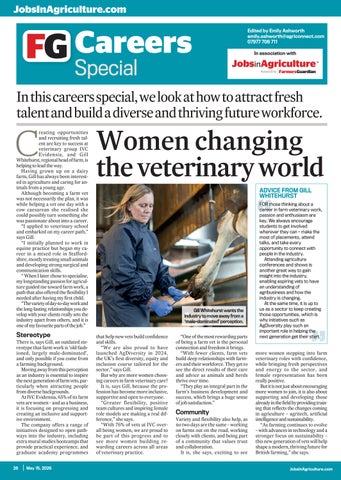
reating opportunities and recruiting fresh talent are key to success at veterinary group IVC Evidensia, and Gill Whitehurst, regional head of farm, is helping to lead the way. Having grown up on a dairy farm, Gill has always been interested in agriculture and caring for animals from a young age. Although becoming a farm vet was not necessarily the plan, it was while helping a vet one day with a cow caesarean she realised she could possibly turn something she was passionate about into a career. “I applied to veterinary school and embarked on my career path,” says Gill. “I initially planned to work in equine practice but began my career in a mixed role in Staffordshire, mostly treating small animals and developing strong surgical and communication skills. “ When I later chose to specialise, my longstanding passion for agriculture guided me toward farm work, a path that also offered the flexibility I needed after having my first child. “The variety of day-to-day work and the long-lasting relationships you develop with your clients really sets the industry apart from others, and it is one of my favourite parts of the job.”
Stereotype There is, says Gill, an outdated stereotype that farm work is ‘old-fashioned, largely male-dominated’, and only possible if you come from a farming background. Moving away from this perception as an industry is essential to inspire the next generation of farm vets, particularly when attracting people from diverse backgrounds. At IVC Evidensia, 65% of its farm vets are women – and as a business, it is focusing on progressing and creating an inclusive and supportive environment. The company offers a range of initiatives designed to open pathways into the industry, including extra mural studies bootcamps that provide practical experience, and graduate academy programmes 28
| May 15, 2026
p28 29 May15 R EA.indd 2
Women changing the veterinary world ADVICE FROM GILL WHITEHURST
Gill Whitehurst wants the industry to move away from a ‘male-dominated’ perception.
that help new vets build confidence and skills. “We are also proud to have launched AgDiversity in 2024, the UK’s first diversity, equity and inclusion course tailored for the sector,” says Gill. But why are more women choosing careers in farm veterinary care? It is, says Gill, because the profession has become more inclusive, supportive and open to everyone. “Greater flexibility, positive team cultures and inspiring female role models are making a real difference,” she says. “With 76% of vets at IVC overall being women, we are proud to be part of this progress and to see more women building rewarding careers across all areas of veterinary practice.
“One of the most rewarding parts of being a farm vet is the personal connection and freedom it brings. “With fewer clients, farm vets build deep relationships with farmers and their workforce. They get to see the direct results of their care and advice as animals and herds thrive over time. “They play an integral part in the farm’s business development and success, which brings a huge sense of job satisfaction.”
Community Variety and flexibility also help, as no two days are the same – working on farms out on the road, working closely with clients, and being part of a community that values trust and collaboration. It is, she says, exciting to see
FOR those thinking about a career in farm veterinary work, passion and enthusiasm are key. We always encourage students to get involved wherever they can – make the most of placements, attend talks, and take every opportunity to connect with people in the industry. Attending agriculture conferences and shows is another great way to gain insight into the industry, enabling aspiring vets to have an understanding of agribusiness and how the industry is changing. At the same time, it is up to us as a sector to keep creating those opportunities, which is why initiatives such as AgDiversity play such an important role in helping the next generation get their start.
more women stepping into farm veterinary roles with confidence, while bringing fresh perspectives and energy to the sector, and female representation has been really positive. But it is not just about encouraging more women to join, it is also about supporting and developing those already in the field by providing training that reflects the changes coming in agriculture – agritech, artificial intelligence and sustainability. “As farming continues to evolve – with advances in technology and a stronger focus on sustainability – this new generation of vets will help shape a modern, thriving future for British farming,” she says. JobsInAgriculture.com
12/05/2026 2:06 pm
JobsI
.com
Call Call 01772 01772 799454 799454 and and place placeyour yourad adtoday today In association with
Careers
Progressive Young Farmer scheme boosts the next generation of agriculture.
McDonald’s gives youngsters chance to see full supply chain
W
ith the aim to create a strong workforce throughout every aspect of its supply chain, the McDonald’s Progressive Young Farmer scheme allows its cohort of youngsters to get hands-on throughout every part of the supply chain, from food processing to customer service. Whether from a farming background or not, the scheme welcomes young farmers from all walks of life. For Ashleigh Yates, agriculture was not an obvious career choice, but after joining a Young Farmers’ Club (YFC) and receiving her first calf to rear, she soon found her farming feet. She says: “Young Farmers gave me exposure to agriculture, opening a door into an industry I had not considered before. After leaving school I joined the Weald of Kent YFC, where I found a strong sense of community and access to new opportunities. This inspired me to join an agricultural college to gain more experience and my lecturer recommended I progress further to Harper Adams University, where I am currently studying agriculture with animal science. “I am privileged to be one of McDonald’s Progressive Young Farmers, working alongside the UK’s largest egg supplier, Noble Foods. “I was initially hesitant to accept, I had no exposure to the poultry
industry and was not sure if I would be a good fit. “However, my perception has quickly changed in the first half of my placement; from innovation and efficiency to high welfare standards, it is a far more advanced sector than I realised, with a diverse range of progression routes.”
Passion Hamish Landale also fell into agriculture. During the Covid-19 pandemic, he managed to secure a job on a neighbour’s farm, sparking his passion for agriculture, enjoying ‘the diverse nature of the work – interacting with livestock, working outdoors, and being surrounded by passionate and knowledgeable individuals’. Gaining a placement with Cranswick on an outdoor breeding farm, Hamish quickly realised the level of skill and attention to detail needed in pig farming. He says: “If you had told me a few years ago that I would be learning the intricacies of one of the UK’s most exciting supply chains and gaining practical experience in it, I would not have believed you. “You do not need generations of farming behind you to find your place in the industry, especially with companies like McDonald’s and Cranswick. What matters the most is being willing to learn, ask questions and throw yourself into all available opportunities.”
Ashleigh Yates is working with Noble Foods on her McDonald’s-backed placement.
Hamish Landale was drawn to the ‘diverse nature’ of agricultural work.
JobsInAgriculture.com
p28 29 May15 R EA.indd 29
May 15, 2026 |
29
13/05/2026 15:58
JobsInAgriculture.com
Careers
I
t was Albert Einstein who said: “We must not only learn to tolerate our differences. We must welcome them as the richness and diversity which can lead to true intelligence.” And that is certainly true of farming, particularly when it comes to the progressive conversation around diversity. Over the last few years, that conversation has certainly become louder, but to allow new people to see the opportunities – and themselves – within farming, real change on the ground must happen. There are now a number of events and initiatives that champion inclusivity, and that give those outside the industry a chance to experience the agricultural world. But to make a tangible difference, a more joined-up approach is needed. Navaratnam Partheeban, regional head of farm at IVC Evidensia and co-founder of the British Veterinary Ethnicity and Diversity Society, says: “While grassroots conversations and community-led efforts to make agriculture a sector for everyone have always existed, diversity and inclusion has only more recently become part of the mainstream conversation across the industry, although in a limited capacity. “Most agricultural conferences and organisations in our sector still marginalise these conversations, which does little for progress.
In association with
How are we encouraging inclusion and attracting new people to the sector? Emily Ashworth finds out more.
Agriculture and the road to diversity “The problem is, how is change measured, and what forms of diversity are included? Performative efforts are aplenty. Barriers to diversity in the sector are systemic and historical, so therefore need many uncomfortable truths to be realised, examined and dismantled. Agriculture has been, and continues to be, the least diverse sector in the country. Diversity cannot come on its own and must be accompanied by equality, equity and justice.”
Awareness The diversity of roles within farming should – and could – attract more people, and individuals and organisations
alike can help to harness change through training, awareness and quite simply a curiousness to understand others, their needs and their cultures. Engagement, says Navaratnam, is a key factor. Culture Roots Collective, which is dedicated to amplifying the voices of Black and People of Colour in UK food and farming, is an example of the fact that people from racially underrepresented backgrounds do have a close connection to food and farming in the UK, but they are rarely included or engaged with in a ‘meaningful way’. “As individuals and organisations, we can make a difference. Have in-
tention and authenticity to create a space where everyone is welcome, respected and equal. Go to where people are and spend time. The biggest way to break down barriers is to engage with people who are different to you. Currently, as a sector, we are ineffective in how we communicate and connect with people. This all must change,” says Navaratnam. “If we connect with people authentically, taking time to learn, engage and converse in a way that means we are all equals, then [that] would be a start.” The term ‘diversity’ is something that also needs to be aligned on, and it means so much more than the age-old gender debate.
Acceptance It is a case, says Navaratnam, of accepting the combination of people – cultural identities, skills, education and experiences. He says: “Everyone brings something to a space, conversation or situation, and with change, we need this diversity to be able to learn, grow and thrive individually, as a sector and in what we are trying to achieve in life.” Dairy farmer Liz Haines focused on neurodivergence for her Nuffield Navaratnam Partheeban is co-founder of the British Veterinary Ethnicity and Diversity Society.
30
| May 15, 2026
p30 31 May15 R EA.indd 2
JobsInAgriculture.com
12/05/2026 2:09 pm
JobsI
.com
Call Call 01772 01772 799454 799454 and and place placeyour yourad adtoday today
Barriers to diversity in the sector are systemic and historical, so therefore need many uncomfortable truths to be realised NAVARATNAM PARTHEEBAN Scholarship titled Great Minds Don’t Think Alike: Neurodiversity in Agriculture. Travelling to Scotland, Ireland, the USA and Australia, she was able to find examples both within agriculture and other industries that were doing positive work on neuroinclusion in both workplaces and education. But currently, is the UK farming
industry set up to support neurodivergence? Yes and no, says Liz. She adds: “There is no doubt that farming is a natural fit for many neurodivergent people – working outdoors, be it with crops, animals or machinery, in a practical, hands-on way that allows people to problemsolve and work independently can be a great fit. The flexibility of a less formal working environment without some of the rigid structures of an office, for example, or simply working in a smaller, quieter team, can work really well. “Many of the people I met were keen to stress things along the lines of ‘we do not care about people’s labels; anyone is welcome here as long as they are prepared to work hard and get stuck in’. “And that is where it gets a bit more complicated.”
‘Knowledge gap’ Although this may sound like an inclusive approach, there is ‘a knowledge gap’ about what neurodivergence actually is, and the complex ways it impacts people’s lives. Without the right individual support, it could have the opposite effect when it comes to securing or retaining a job.
In association with
Careers
There is still stigma about neurodivergence, says Liz, and a fear of labelling – perhaps because it is believed ‘special treatment’ will be given or that you will have to make accommodations for people. Liz says: “I hoped that my Nuffield Scholarship would start a conversation about neurodiversity and what it really is – not just being bad at spelling, or a bit disorganised, or socially awkward – and highlight the strengths and talents of neurodivergent people, while also acknowledging that people do experience genuine challenges. “You do not need to focus on a ‘label’ or diagnosis – it is just about understanding people’s skills, strengths, preferences, weaknesses and areas where they might need support. “That applies to everyone, not just neurodivergent people.” Liz says it is about focusing on people’s skills and strengths rather than traditional expectations of what a good farmworker looks like. While travelling for her Nuffield, Liz visited SunPork Farms in Australia, which ‘was the standout example of a neurodiversity hiring programme on a commercial farm’. As Australia’s largest pig integrator,
the business launched its groundbreaking Autism and Agriculture Programme in 2018, which Liz believes to be the only commercial neurodiversity hiring initiative in animal agriculture globally. Neurodiversity training is given to all staff, plus practical assessments which were adapted with visuals and simplified materials. There are mentors, quiet spaces and daily check-ins which created psychological safety.
Communication One of Liz’s main learnings from her scholarship was about communication – that there are many neurodivergent people in agriculture but who are not connecting, plus there are not many places to go for support. To try to combat this, Liz has joined forces with friend Karen Fisher, who is a farming adviser at the Soil Association and a neurodiversity coach, to create a network. She says: “It is initially on WhatsApp, where neurodivergent people and allies can connect, share experiences, and make friends. If anyone would like to join, all are welcome, and you do not have to have a diagnosis or even be neurodivergent.”
Watch the replay
Sell or Sit Tight?
New Crop Grain Price Outlook
Scan the QR code to watch the replay for FREE In partnership with
JobsInAgriculture.com
p30 31 May15 R EA.indd 31
May 15, 2026 |
31
13/05/2026 15:57
JobsInAgriculture.com
Careers
In association with
Motivational speaker Nigel Risner challenged rural professionals to improve focus, communication and leadership to drive business performance. Ash Ellwood reports.
Steps to take control of your professional success on-farm
A
t a time when many rural businesses are juggling rising costs, staff pressures and an uncertain future, motivational speaker Nigel Risner urged delegates at the Cultivate 26 conference to look closer to home and analyse their own habits, mindset and communication style. Speaking at Heaton House Farm on April 29, he delivered a highenergy session focused on helping professionals make meaningful changes within their businesses through practical, actionable steps.
Nigel Risner told delegates at the Cultivate 26 conference to rethink traditional SMART targets.
Distract Opening the session, Nigel asked attendees to reflect on the things that distracted them from being ‘fully present’ at work. Suggestions from the audience ranged from phones and laptops to childcare arrangements, errands and even a fear of speaking up. He said: “What are we having for dinner, who is picking the children up, do I need to ring the garage? “These are all things that are stopping you from being in the room and being 100% engaged in the task at hand.” He added that in work environ-
ments, opportunities were often missed because people were physically present, but mentally they were elsewhere. “If you are in the room, be in the room,” he said. He also said giving full attention to meetings, conversations and
ARE YOU A LION, DOLPHIN, ELEPHANT OR MONKEY? ACCORDING to Nigel Risner, communication challenges in the workplace often come down to personality differences. He said that most people tended to fall into one of four communication styles: monkey, lion, dolphin or elephant. Each animal represents a different approach to work and communication. Monkeys are energetic and spontaneous, lions are driven and resultsfocused, dolphins are empathetic and relationship-led, while elephants are steady, patient and detail-oriented. Problems arise when different personalities fail to understand one another. “If you are a ‘lion’ managing a
32
| May 15, 2026
p32 May 15 EA AE KJ R.indd 2
‘dolphin,’ or a ‘monkey’ working alongside an ‘elephant’, miscommunication can easily creep in,” said Nigel. “What motivates one person might frustrate another and what feels clear to you might feel overwhelming or lacking to someone else.” Rather than expecting staff to adapt to one leadership style, Nigel encouraged managers to become more like ‘zookeepers’ and recognise the different personalities within their teams and adjust their communication style accordingly. “It is about recognising what drives people, how they process information, and what they need to perform at their best,” he said.
learning opportunities was essential for both personal growth and for business success. Encouraging delegates to think beyond the farming sector, Nigel challenged the audience to identify successful ideas from well-known businesses that could be adapted to their own operations. Examples put forward included the Tesco Clubcard loyalty scheme, Specsavers’ upselling of hearing tests and Apple’s connectivity between products. He said: “Modelling from successful companies is so important, each of you should take something home to your businesses from these ideas and model off the best. “You should be scheduling time to assess other businesses and see which of their good qualities will fit your business.”
Needs Nigel also talked about the importance of understanding what motivates employees beyond salary. He said: “Managers must know the top five personal needs of each of their employees. “This is how you create real motivation, when employees feel lis-
tened to and understood. A pay rise is great for a couple of months, but is soon forgotten. “It is meeting the personal needs that really motivates a person.” For farming businesses, where teams often work closely together and relationships can span generations, he suggested that stronger communication and understanding could have a major impact on staff retention and workplace culture.
Ideas While motivation and ideas were important, Nigel said that action was what delivered results. “Action is the bridge between intention and results,” he said, challenging delegates to implement one new idea from the session within 30 days. He also encouraged attendees to rethink traditional SMART (specific, measurable, achievable, relevant and time-based) targets by adding two additional elements: enjoyable and rewarding. “You should be making SMARTER targets, including ‘enjoyable’ and ‘rewarding’, which goes back to understanding yours and your employees’ personal needs,” he said. JobsInAgriculture.com
13/05/2026 11:11
ll.com sell.com
Call 01772 799500 and place your ad today
WE ARE SEEKING….
Join the future of Farming at Rothamsted Research Rothamsted Research is one of the UK’s most prestigious and historic scientific institutes, offering a unique opportunity to contribute to pioneering work shaping the future of resilient agriculture. Your skills will support innovative field trials and practical farming solutions with real-world impact. Based at Harpenden Farm in Hertfordshire (AL5 2JQ), you’ll join a supportive, skilled team where your experience is valued and development encouraged. This is a modern, research-driven farm where you will build your expertise while helping advance resilient farming practices.
Farm & Field Trials Operator – Harpenden Farm Salary: £31,165 to £38,956 depending on experience Contract: Full-time (37 hours per week), plus overtime & below-market-rate accommodation options Are you an experienced arable operator looking for your next step? This role combines commercial farming with cutting-edge research field trials, offering real variety and purpose What you’ll be doing: • Supporting safe, efficient operations across commercial and trial areas • Contributing to field trial delivery and maintenance • Working closely with researchers and technical teams What We’re Looking For • An experienced Arable Operator confident with modern farming practices • Solid IT skills to maintain accurate records (eye for detail) and follow protocols • Strong awareness of Health & Safety • A practical, problem-solving mindset with openness to innovation
AUCTIONEER Thirsk Farmers Auction Mart
Thirsk Farmers Auction Mart Co Ltd are seeking an experienced Auctioneer to take a full-time position at our Livestock Market and continue to drive the business forward. Based in North Yorkshire, this offers a fantastic opportunity for someone who enjoys working with people and livestock in a comparatively new auction mart which saw 163,500 head of stock sold through the ring in 2025. We Are Looking For: • Proven experience in livestock auctioneering with good recommendations • In depth knowledge of the livestock industry and its dynamics • Management skills to ensure smooth running of Auctions • Excellent communication skills at all levels • A strong work ethic and willingness to adapt to new systems • A confident and reliable individual who is prepared to commit to the role offered We Offer: • Competitive salary and benefits • The scope to put your own stamp on new ventures • A supportive, and experienced team prepared to listen to new ideas Is this you? If so, please send your CV to sarah@thirskmarket.co.uk or for more information and an informal confidential discussion please call Ian Woodhead (Chairman) on 07970 981513 (Evenings preferred) Closing date for applications: Friday 19th June 2026 All applications will be dealt with in the strictest confidence
Agricultural Mechanic – Harpenden Farm Salary: £37,191 – £46,489 depending on experience. Contract: Full-time (37 hours per week), plus overtime & below-market-rate accommodation. Are you a skilled agricultural mechanic looking for a role with real impact? Do you have experience and passion working with tractors, trailers, cultivators and general farm equipment? We would like to hear from you. What you’ll be doing: As a key member of the research farm management team, you’ll ensure our fleet of commercial and trial machinery operates safely, efficiently and at peak performance. You’ll be the go-to expert for all machinery, ensuring machinery health, maintenance and safety, helping the farm team deliver vital research outcomes. • Maintaining a wide range of farm and trial equipment, including daily machinery checks, ensuring compliance across the farm • Promoting Health & Safety standards and ensuring best practice • Working closely with farm colleagues and research teams to enable research activity • Providing hands-on support to the team through busy periods • Line management responsibility, including training for the Agricultural Mechanic Farm Technician (where applicable) What We’re Looking For • An industry-recognised agricultural engineering qualification • Experience with rough terrain handlers • Strong positive communicator and team-focused attitude
YOUNG BRITISH FARMING AWARDS
THE NEXT GENERATION NEED YOU, AND WE CERTAINLY NEED THEM.
12
awards to enter
What Rothamsted can offer you • 30 days annual leave plus bank holidays • Generous Pension scheme / Life assurance • Employee Assistance Programme • Cycle to Work Scheme • Shopping discounts • On-site and local cultural and recreational amenities • Opportunities for further training and qualifications relevant to the role on the Harpenden Farm. To apply and find out more, go to: www.rothamsted.ac.uk/careers-rothamsted For an informal discussion, please email ian.shield@rothamsted.ac.uk
FGbuyandsell.com FGbuyandsell.com
Issue.indd 33 Training Version.indd 57
Headline Headline Sponsors Sponsors
Nominate a future farmer
britishfarmingawards.co.uk /YOUNGBFA 2026 || 33 15, 2026 May 15, May 33
13/05/2026 13/05/2026 14:48 15:04