Rural Scene
THE
BUILT FROM THE GROUND UP
PATRICK FAIR'S STEADY PATH TO BUILDING HIS OWN OPERATION
OUTSMART THE SCAM
KNOW THE WARNING SIGNS BEFORE YOU BUY OR PAY
FARM CREDIT FAMILY ROOTS
ONE FAMILY'S FARM CREDIT STORY CONTINUES THROUGH MULTIPLE GENERATIONS
A NEW CHAPTER
HONORING RON HUBBARD AND WELCOMING NEW DIRECTOR SCOTT HUNTER
FALL 20 26
Rural Scene
THE
PUBLISHED BY
Farm Credit of Western Arkansas is a customer-owned financial cooperative providing financing and related services to farmers, ranchers, rural homeowners, agribusinesses and timber producers in 41 western Arkansas counties. With a loan volume of over $2 billion, Farm Credit of Western Arkansas is a member of the 110-year-old Farm Credit System, a
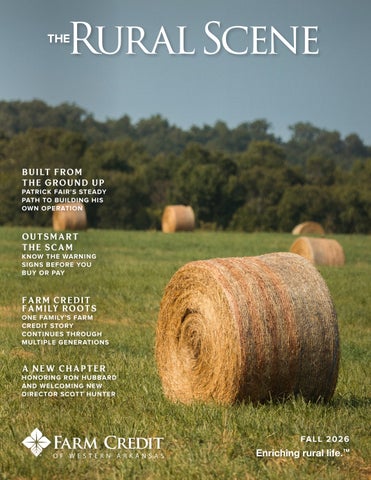
ON THE COVER With a little help, a lot of hard work, and a willingness to take a chance, Patrick Fair has spent 16 years building a farming operation of his own. Story starts on page 10.
nationwide network of borrower-owned lending institutions
5 6
Your Voice, Your Vote Meet this year’s director candidates and find important dates and information for casting your vote. A Legacy of Leadership After more than two decades of service, retiring outside director, Ron Hubbard, reflects on his advocacy, leadership, and commitment to Farm Credit.
Scott Hunter 8 Meet Incoming outside director, Scott Hunter, brings more than 40 years of agriculture, finance, and executive leadership to the Farm Credit board.
14
More Than a Lender Loan officer Rex Dollar’s agricultural roots help him understand the farmers and ranchers he serves.
Built Across Generations 16 AForLegacy Allison Fox and her family, agriculture and Farm Credit have been intertwined across generations. Scholarship Recipients 18 2026 Meet the 35 students receiving a 2026 Farm Credit of Western Arkansas scholarship.
20 2
Artificial Intelligence, Real Life Scams Learn how to recognize common buying scams and protect yourself.
OFFICE LOCATIONS AND LOAN OFFICERS
IN THIS ISSUE
providing more than $456 billion in loans to rural America.
Alma 641 Hwy 71 North (479) 430–7287 Daniel Keeton, Joyce Ridenour Arkadelphia 2858 Walnut (870) 246–8061 Benton 15227 1-30 South (501) 860–6391 Dylan McDaniel Bentonville 3600 SW Regional Airport Blvd. Suite 16 (479) 273–3311 Charlie Holder, Catherine Nguyen
Magnolia 1703 Pittman St. (870) 234–8611 Caleigh Watlington, Milly Lindsey Mena 1607 Hwy 71 North (479) 394–1027 Rex Dollar Morrilton 1329 Hwy 9 (501) 354–2377 Hank DeSalvo Nashville 302 W Bishop (870) 845–2221 Kara Sharp, Kyle Webb
Clarksville 1007 Interstate Dr. (479) 754–2876 Shelby Bradley, Baxter Wallis
Ozark 1808 Farm Credit Dr. (479) 667–3855 Israel Lopez
Danville 302 E 5th St. (479) 495–2711 Kevin Morrison
Paris 3772 W Hwy 22 (479) 963–2841 Kathy Schluterman
De Queen 800 E Magnolia Ave. (870) 584–3113 Jordan Pearce
Prairie Grove 1181 E Heritage Pkwy (Hwy 62) (479) 400–6160 BJ Kirk
Fort Smith 12907 Hwy 71 South (479) 434–4040 Daniel Keeton, Joyce Ridenour Greenbrier 89C N Broadview St. (501) 679–5464 Kori Kimes, Emily Lemieux Harrison 129 W Industrial Park Rd. (870) 741–2020 Brad Matlock, Brady Willis Hope 1722 E 3rd St. (870) 777–6704 Clay Lance, Trevor Pipkin Huntsville 14238 Hwy 412 (479) 738–6622
Russellville 2797 E Parkway (479) 968–5030 Shelby Bradley, Baxter Wallis Siloam Springs 4970 Hwy 412 East (479) 524–6754 Texarkana 2305 Trinity Blvd. (870) 772–1882 Colton Hewitt, Brady Jackson, Wyatt Wooten Tontitown 1091 W Henri De Tonti Blvd. (479) 717–6740 Charlie Holder
LETTER FROM THE CEO
Brandon Haberer Inflation impacts each operation in its own way, but it is hard to overlook. Producers have seen big increases in the cost of feed, fuel, fertilizer, equipment, livestock, and building materials. These higher costs have squeezed margins and made it harder to plan for the future. Many families are also feeling the pinch from higher grocery, utility, and housing expenses. To fight inflation, the Federal Reserve raised interest rates more aggressively than it has in decades. These higher rates were meant to slow down the economy and ease inflation. As borrowing became more expensive, many business owners and consumers put off investments, refinanced less often, and became more cautious about growth. Thankfully, inflation has come down a lot from its highest point, and interest rates are starting to level out. Recent rate cuts show progress against inflation and give hope that borrowing costs may improve in the next few years. The war in Iran has caused inflation to rise again and created uncertainty about the Federal Reserve’s next move, but these trends should not last once the conflict ends.
BOARD OF DIRECTORS
For agriculture, moving forward means focusing on good financial management and smart decisions. Producers who keep their
Chair Steve Young, Paris
Ron Hubbard, London
Vice Chair Gerald Strobel, Subiaco
Cody Jones, Mansfield
Steve Burke, Prescott
Julie Lively, Fulton
Jennifer Cook, Wooster
Carol "Ann" Russell, Greenwood
Renny Chesshir, Alma
Elizabeth Walker, Horatio
Kim Hogan, Ozark
President and CEO Brandon Haberer
balance sheets strong, manage working capital wisely, and look for financing opportunities ahead of time will be ready for whatever comes next. Interest rates will always change, but successful operations focus on long-term productivity instead of short-term market swings. At Farm Credit of Western Arkansas, we’re here to help our members handle these changing economic times with confidence. As a cooperative lender, we know that agriculture works on a different schedule than most industries. Decisions about crops, livestock, land, and farm improvements often take years, not months. Our financing options are built to help members find the right loan structures and interest rates for their goals and comfort with risk. Even with economic uncertainty, agriculture is still one of the most resilient parts of our economy. People still need food, fiber, timber, and rural housing, and our members’ entrepreneurial spirit is as strong as ever. Across our 41 counties, we see producers investing in their farms, creating new opportunities for the next generation, and preparing for future success. No one can say for sure where inflation or interest rates will go next, but history shows that careful planning, strong partnerships, and a long-term outlook help weather economic changes. Farm Credit of Western Arkansas is committed to giving our members the financial tools, expertise, and local support they need to succeed at every stage of the economic cycle. Together, we will keep working to build a strong and successful future for rural Arkansas.
Brandon Haberer President and CEO
ABOUT THE RURAL SCENE
Over the past few years, producers, rural homeowners, and agribusinesses have dealt with one of the toughest economic periods in recent memory. Rising inflation, higher operating costs, supply chain issues, and fast-changing interest rates have created uncertainty throughout the agricultural economy. Despite these challenges, rural America has shown real strength, resilience, and adaptability.
The Rural Scene is produced for members and friends of Farm Credit of Western Arkansas. Address comments and story ideas to: Editor, The Rural Scene Farm Credit of Western Arkansas 5177 US Hwy 64 W • Russellville, AR 72802 Editor Lindsey Holtzclaw • Lindsey.Holtzclaw@myaglender.com Contributing Writer & Photographer Abby Scruggs • Abby.Scruggs@myaglender.com myaglender.com Article quotes have been edited for content and appropriateness.
FOLLOW US ON SOCIAL MEDIA! Find us at “Farm Credit of Western Arkansas” on Facebook, and @FarmCreditWEAR on X and Instagram.
© 2026 Farm Credit of Western Arkansas.
Farm Credit of Western Arkansas is an equal opportunity employer and does not discriminate on the basis of race, color, religion, gender, sexual orientation, gender identity or expression, national origin, age, disability, genetic information, marital status, amnesty, or status as a protected veteran in accordance with applicable federal, state and local laws.
3
DIRE C TO R SC E N E
LETTER FROM THE BOARD CHAIR Hello everyone, I’m thankful for another opportunity to share what the board is doing to serve our association and to provide an update on your cooperative. We have been busy this spring and summer attending the Steve Young Premier Governance Series through FCCS. This training is offered to help directors network across the Farm Credit System and strengthen leadership and governance. I appreciate that we, as farmers and board members, have opportunities like this to make us a better board.
In this issue, you will meet newly appointed outside director, Scott Hunter from Fort Smith. We look forward to serving with Scott and the agriculture and leadership experience he brings to the table. By the time you receive this magazine, voting in our 2026 Director Election will be underway. One of the things that makes Farm Credit unique is that you, our members and stockholders, have a voice in who represents you on the board. Our directors play an important role in guiding our association and ensuring we continue to serve agriculture and our rural communities. I encourage you to take a few minutes to learn about this year’s candidates and cast your voice. It’s an important part of being a cooperative, and your voice matters. Thank you, farmers, for all you do! What a blessing it is to serve you. Please feel free to reach out to me if there is anything I can do.
Several of our board members also attended the Farm Credit Fly-In in Washington, D.C., in July, where they met with Arkansas legislators and discussed issues important to Arkansas agriculture. We’re thankful to have a seat at the table in policy and decision-making at the legislative level. I would love to take this time to thank Ron Hubbard for his years of service to our board as an outside director and congratulate him on his retirement. He has been a great friend and mentor to our board members, and we have valued his knowledge of Farm Credit and the political landscape.
Steve Young Chair, Board of Directors Farm Credit of Western Arkansas
MAKE YOUR VOTE COUNT TWICE. Your ballot helps shape Farm Credit leadership and supports youth in agriculture. For ever y ballot returned, Farm Credit donates $10 to FFA and 4-H.
DIRE C TO R SC E N E
2026 Annual Director Election Ballots will arrive in your mailbox, voting is your right and responsibility as a cooperative member Ballots have been mailed for the 2026 Farm Credit of Western Arkansas Director Election. Here are some things you should know as a member: • Director candidate information and ballots were mailed on September 4, 2026. Ballots will be addressed to voting stockholders as of date of record – July 31, 2026. • To vote: Review candidate information, complete the ballot, and return the ballot in postage-paid envelope provided. You may vote for one director in each area up for election. • Voting stockholders are responsible for electing directors and nominating committee members annually. • Ballots must be received by 4:30 PM on October 5, 2026. Results will be announced October 6 and posted at all branch offices and at myaglender.com. Postcards will also be mailed to members. • For every eligible ballot returned, Farm Credit of Western Arkansas will donate $10, split evenly between the Arkansas 4-H Foundation and Arkansas FFA Foundation.
2026 Director Candidates Listed Alphabetically (All positions are a four-year term.)
AREA 1
Cody Jones Sebastian County
Bradley Woodward Washington County
AREA 2
Jennifer Cook Faulkner County
Christopher Heiser Johnson County
AREA 3
Julie Lively Hempstead County
Caleb Plyler Hempstead County
Nominees for 2027 Association Nominating Committee (All areas for a one-year term.)
AREA 1A
Chad E. Amos • Benton County Johnny L. Gunsaulis • Benton County
AREA 3A
Cody R. Askew • Hempstead County Melanie S. Glass • Lafayette County
AREA 1B
Nathaniel W. Sterling • Sebastian County Jason W. Thompson • Sebastian County
AREA 3B
Jake Cornelius• Nevada County Judd Milam• Nevada County
AREA 1C
Kevin Hightower • Crawford County Michelle Pass • Sebastian County
AREA 3C
Rainna K. Ghormley • Hempstead County Tracy McLelland • Clark County
AREA 2A
Robert W. Caldwell • Yell County Ernest "EJ" J. Neissl • Franklin County
AREA 2B
Ronnie R. Whitley, Jr. • Logan County Wade Wiedower • Faulkner County
AREA 2C
Troy L. Weatherley • Faulkner County Rodney A. Wiedower • Faulkner County
5
RON HUBBARD RETIRING DIRECTOR LONDON, AR
6
Ron Hubbard has served as an appointed outside director since 2004, fulfilling the vital role of a legislative and public relations expert. Over the past 22 years, he has seen a lot of changes in the association, agriculture, and the political climate. As he retires from the board after more than two decades, he shares some of his memories and insights from his time with Farm Credit.
How did you first become involved with Farm Credit? Looking back over more than 20 years of service, what are you most proud of?
What unique perspective did you bring to the board?
How has the board changed during your 22 years of service? What is one of the biggest legislative challenges for farmers right now?
What opportunities do you see for the future of Farm Credit? What will you miss most about serving on the board?
7
SCOTT HUNTER
APPOINTED DIRECTOR FORT SMITH, AR
8
Recently appointed to the Farm Credit of Western Arkansas Board of Directors, Scott Hunter brings more than four decades of experience in agriculture, finance, and executive leadership. We sat down with him to learn more about his career, vision, and passion for serving rural communities.
Can you walk us through your professional experience?
What advice would you give to young professionals who aspire to leadership roles?
What inspired you to join the Farm Credit board?
What are your priorities as you begin your service on the board?
If you could have dinner with any business or agricultural leader, past or present, who would it be and why? If you could speak directly to our members, what would you tell them?
9
Slow an d Steady With a little help, a lot of hard work, and a willingness to take a chance, Patrick Fair has spent 16 years building a farming operation of his own.
10
At 36 years old, Patrick Fair has already spent nearly half his life building a farming operation.
the cooperative, and his dad financed their poultry farm through Farm Credit as well.
If you ask Patrick about the first few years, he won’t sugarcoat it.
When 20-year-old Patrick wanted to borrow money to start building an operation, his dad gave him simple advice: go talk to Rex.
“I thought I was going to go broke,” he said with a laugh. Thankfully, that didn’t happen. Instead, little by little, Patrick built a life doing what he loves in the same Montgomery County community where he grew up. These days, Patrick runs a cow-calf operation on about 400 acres near Pencil Bluff, most of it rented ground. He does custom hay work, hauls cattle, and takes on other jobs when he can. The days are long, the to-do list never ends, but he says he wouldn’t change a thing. “If you like what you’re doing, it’s not really a job,” he said. “I don’t really consider it a job. It’s kind of like a hobby.” Of course, this hobby is also his livelihood he’s spent 16 years shaping, one season at a time.
Coming Home Patrick grew up on a poultry and cattle farm where chores, responsibility, and long days were just part of life. Still, staying home to farm wasn’t always the plan. After high school, Patrick headed off to welding school, but it didn’t take long for him to realize that home was where he truly wanted to be. “I didn’t think I really wanted to stay here until I left,” he said. After graduation, he started hauling cattle and working at sale barns while searching for a way to start his own farm. He began small, running stocker cattle on about 10 acres at his dad’s place. Then, when 50 acres came up for rent nearby, Patrick saw his opening. He just needed someone to help him take that next step. His family already had an established relationship with Farm Credit. His grandparents had done business with
Rex Dollar, a loan officer in Farm Credit of Western Arkansas’ Mena branch, knew Patrick’s family and the kind of work ethic that had been instilled in him. “Patrick was raised in an environment that gave him a good foundation to be successful,” Rex said. “Character is one of the first things you look for in lending, and I felt like Patrick would do everything within his power to make it work.” At first, Patrick’s parents co-signed his loans. As he grew his farm and became more financially stable, he started borrowing with his own signature. His first loan was a leap of faith. Patrick knew it then, and he knows it now, but looking back, not taking the chance would have been the bigger risk. “If I hadn’t taken it, I wouldn’t be where I am now,” he said. “I wouldn’t have gotten started. My dad always says you’ve got to stick your neck out to get anything in life.”
11
A Little at a Time For young farmers, “sticking your neck out” can feel especially intimidating. With land prices, equipment costs, and everything else on the rise, getting started is sometimes the hardest part. “It would be a hard go,” he said of starting from scratch today. “Especially to buy the cattle and pay for the land.” Patrick’s answer has been to grow slow and steady, instead of trying to own it all at once. Most of the 400 acres he works today are rented, which has let him expand without the heavy burden of buying land outright. He has also found additional sources of income. Alongside his cattle, Patrick does custom hay work, once cutting about 3,000 bales a year for others and now closer to 1,000. He also hauls cattle, making runs to sale barns and feedlots all over the region. On Thursday nights, that usually means a 300-mile trip to the Oklahoma National Stockyards in Oklahoma City, where he markets his own cattle, too. That kind of diversity has helped make full-time farming possible for Patrick, along with knowing when to hold onto a dollar.
Rex believes that patience has been one of the biggest factors in Patrick’s success.
“I’ve seen so many people see a large check after selling cattle or chickens and then get in a bind,” Patrick said. “You have to save and plan for unavoidable expenses. Equipment is going to break. Things are going to get old. You have to be prepared to replace them.”
“He doesn’t live beyond his means, and he has a purpose behind the business decisions he makes,” Rex said. “Before Patrick calls about something, he has usually already thought about it from multiple angles. He has considered what could happen and what he’ll do if things don’t go as planned.”
Patrick credits his parents for teaching him how to be a good steward of his finances.
That slow and steady approach helped Patrick weather the years when cattle prices were a lot lower than they are today. He’ll tell you there’s no magic formula. You handle what you can, brace for what you can’t, and keep moving forward.
“My dad’s kind of like me. We don’t live out of our means,” he said, noting that both still drive trucks that are nearly 20 years old.
“Just stay steady and work at it,” he said.
Worth the Work Ask Patrick his least favorite job on the farm, and the answer comes quickly: building fence. Ask for his favorite, and he talks about something much simpler. It’s watching things grow. “I just like coming out and watching the calves grow,” he said. “When you come out to your pasture and really start to see progress.” It’s the same feeling with a good hay field. After investing in fertilizer and spraying, seeing a healthy stand of grass makes the work and expense feel worthwhile.
Progress looks a little different here than in other jobs. It’s a healthy calf, a field of thick grass, paying off a piece of equipment, or sometimes simply making it through another year. After 16 years, what makes Patrick most proud is looking around at what he’s built and realizing just how far he’s come. Rex has had a front-row seat. For him, working with young farmers like Patrick is one of the most rewarding parts of his job. “You watch someone start with very little and gradually build an operation,” Rex said. “It’s not that Farm Credit is responsible for their success. They’re the ones doing the work. But there is a sense of pride in knowing you helped provide some of the capital that allowed them to chase their goals.”
Patrick, however, is still there. He still spends most days in the pasture or on a tractor. He still hauls cattle on Thursday nights and builds fence when it needs fixing. When he’s not on the farm, Patrick likes to ride his motorcycle, sometimes heading out with friends through the Colorado mountains. After every adventure, all roads lead to Montgomery County, where there are cattle to tend, work to do, and still plenty of room to grow. He hopes the future brings more cattle, more land, and the chance to spend less time working for others and more time on his own place, even if he’s not sure yet what that will look like.
For Patrick, the relationship is just as straightforward. “Anytime I call Rex, he’s always willing to help me figure out the best way to make it work,’” Patrick said. “He’s always been easy to deal with.”
“You never know what God has planned,” Patrick said. That kind of uncertainty comes with farming. Markets shift, weather changes, land gets sold, equipment breaks, and plans rarely go exactly as expected.
That kind of trust doesn’t happen overnight. It’s the kind of relationship Farm Credit hopes to build with more young and beginning farmers through programs like AgStart, which help make financing a little easier as producers start and grow their farms.
Patrick has learned that success means taking risks, having people who believe in you, making a good plan, and having the patience to build things one step at a time. Most of all, it means showing up every day.
But financing is just one part of the story. The rest is up to Patrick.
Still Growing Pencil Bluff has changed since Patrick was a kid. More people now buy rural land for recreation or as a getaway, and fewer families make their living from the land itself.
“Work hard and try your best. Don’t give up,” Patrick said. “I don’t know any other way to do it. Unless you just throw your hands up and quit, it’s all going to work out.” Sixteen years ago, a 20-year-old from Pencil Bluff decided to stick his neck out and take a chance. Now, he can look out across his pastures and see just how far that leap of faith has carried him.
Photos and story by Lindsey Holtzclaw
13
More Than a Lender
Long before Rex Dollar was a Farm Credit loan officer, Farm Credit was already part of his family’s story.
For Rex, understanding agriculture means more than just knowing about cattle, forage, or farm finances. It also means knowing what a piece of land means to the family who cares for it. He remembers hearing stories about his grandparents buying land in the 1950s, working hard to clean it up, and building the farm that his family has called home for generations.
In the November/December 1977 issue of Farming magazine, the Ouachita Production Credit Association featured Dollar Farms. The 223-acre farm in eastern Montgomery County was run by Rex’s grandparents and parents. The Production Credit Association that served Rex’s family in 1977 would eventually become part of what farmers know today as Farm Credit of Western Arkansas.
“What might appear to be just another piece of real estate to some is a lockbox of memories and important stages of life to the farmer and their family,” Rex said.
Back then, the family raised stocker cattle, broilers, and hay. Almost 50 years later, agriculture and that same farm are still a big part of Rex’s life.
Those lessons tie together both sides of Rex’s life, whether he’s caring for his own cattle or working as a Farm Credit lender alongside producers like Patrick.
“My parents and brother Ricky and his family still raise cows and hay on the same farm today,” Rex said. “We all also background our calf crops each year on the farm.”
“The legacy to me is the pride, honor, and tradition of caring for what God made and passing the farm on to the next generation,” Rex said, “so they can build their own set of memories on the same dirt as previous generations of the same family.”
The connection goes even deeper. One of the homes shown in the old article was home to several generations of the Dollar family. Rex lived there as a child with his parents and brother, and later moved back with his own family.
Rex says his perspective comes from the values his grandparents and parents taught him: integrity, hard work, and the Golden Rule.
Today, Rex runs a crossbred cow-calf operation on leased land not far from his parents’ Pine Ridge farm. His parents still pitch in, especially when it comes time to put up hay in the summer. Rex brings his firsthand experience with him to his job at Farm Credit. “I think it’s beneficial to be able to talk with a customer and relate to their day-to-day work and tasks,” he said. “There is a real benefit to being able to relate and empathize with a customer, because it is likely you have been in a similar situation yourself. Farmers have a real ability to sniff out someone who isn’t authentic.”
Loan officer Rex Dollar’s family was featured in a 1977 issue of Production Credit Association’s Farming magazine.
Photos and story by Lindsey Holtzclaw
Now offering programs made for young and beginning farmers. Contact your local branch and see how AgStart can help you grow! Learn more at myaglender.com/agstart
A Legacy Built Across
Generations
Allison Greb Fox's story is a powerful reminder of what has made Farm Credit different for more than a century: relationships that grow across generations. The family's Farm Credit story spans more than five decades. Allison's great-grandfather, Francis Jones, received his first Farm Credit loan in 1973: $133,000 for two dwellings, two poultry houses, and equipment. In 1978, Allison's grandparents became Farm Credit members, and her grandfather, F. Ray Jones Jr., later served as a long-standing member of the Farm Credit Board of Directors. Years later, Allison's parents continued the tradition, building a successful broiler operation in Logan County and earning Legacy Member status after more than 25 years of membership. Inspired by the generations before her, Allison began building her own future in agriculture in 2016 when she purchased her first 10 heifers. In 2019, she and her husband, Hayden, purchased 46 acres and a home with the help of an FSA loan through Farm Credit while continuing to grow their cattle herd. Soon after, they welcomed their daughter, Stella. Last year marked another meaningful milestone when Allison and Hayden purchased land from her grandparents, the same family members who began their Farm Credit journey with their first loan in 1978.
16
Today, they manage 125 head of cattle and lease nearly 500 acres, all while balancing full-time jobs off the farm.
Stories like Allison's illustrate how agriculture is rarely built in a single generation. Farms and ranches grow over decades through hard work, careful planning, and a commitment to investing in the future. Along the way, families navigate changing markets, rising costs, weather challenges, economic downturns, and opportunities for expansion. Through every season and stage of life, Farm Credit has remained focused on helping rural families achieve their goals and continue building on what previous generations started. For many families, that journey begins with a first operating loan or the purchase of a few acres. Over time, it may include financing a home, expanding an operation, purchasing equipment, adding livestock, or preparing for a transition to the next generation. As needs evolve, Farm Credit grows alongside its members, providing local expertise and reliable financing from one chapter to the next. From great-grandparents to grandparents, parents, and now the next generation, Allison's story reflects the enduring legacy of agriculture and the role Farm Credit plays in helping farm families grow, invest, and build for the future. For more than 100 years, we've been proud to help make farming and rural homeownership possible, supporting rural families through every decade, every challenge, and every generation.
17
2026 Scholarship Recipients Announced Farm Credit of Western Arkansas is proud to announce the recipients of its 2026 scholarship program, awarding a total of $40,000 to 35 outstanding students across western Arkansas. Since the program’s inception in 1996, Farm Credit of Western Arkansas has awarded more than $480,000 in scholarships to support the next generation of leaders.
The scholarship program recognizes students based on academic achievement, demonstrated leadership, extracurricular involvement, volunteer activities, and financial need. Recipients must be full-time students enrolled in an accredited college, university, or trade program for the 2026–27 academic year and be Farm Credit members or the children or grandchildren of members.
Emma Ashlock of Jerusalem
Lochlyn Bridges of Greenwood
Kathryn "Kate" Cheatham of Van Buren
Ava Ruth Fields of Mena
Channing Ashworth of Prairie Grove
Madilyn Brinkman of Ozan
Jewel Cheely of Fort Smith
Troy "Bryce" Gregory of Ozark
Michael "Mikey" Boyd of Waldo
Joe Burton of Branch
Sara Davis of Conway
Grace Gunther of Bigelow
Kade Braeutigam of Dover
Taylor Chapman of Quitman
Kenna Elliott of El Dorado
Canaan Hudson of Jasper
Elizabeth "Ellie" Johnson of Mountainburg
David "Dax" McMellon of Mena
Addison Robins of Gentry
George "Grant" Wiggins of Magnolia
Addilyn "Addie" Layes of Scranton
Allison Ober of Clarksville
Keely Sheppard of Dover
Ava Young of Casa
Quinton Lyons of Bradley
Addison Porter of Prairie Grove
Kendra Simon of Conway
Jacob "Jake" Martin of De Queen
Reese Prince of Center Ridge
Laney Slate of Greenwood
Chloe Matthews of Amity
Jolee Robberson of Paris
Chesley Walker of Ashdown
Congratulations to our scholarship recipients! 2027 scholarship information will be available on myaglender.com beginning January 2027.
Artificial Intelligence, Real Life Scams Warning signs to help you spot scams in the digital age As the use of artificial intelligence (AI) grows, so does the sophistication of scams. Selling scams are becoming more popular, tricking people into buying cars, tools, electronics, and even farm equipment that isn’t real but can convince even the most tech-savvy buyer. Knowing the warning signs can help you avoid a costly loss.
Red flags to watch for: • Prices that seem too good to be true or priced significantly below standard market value • Seller pressures you into making an immediate decision • Seller or dealership information that doesn’t match official records or contact information that doesn’t match the ad description (For example: Advertisement states location is in Arkansas; however, when inquiring about the equipment, the contact phone number is not an Arkansas area code.) • Underdeveloped websites, broken links, or pages that look unfinished • Requests to talk or pay outside normal channels, such as private messaging apps • Sellers who avoid phone calls or won’t show items live on video • Listings using stock or stolen photos • Demands for fast payment through wire transfers, crypto, or gift cards • Logos or product images that look AI generated, including weird spelling or details that feel “off” Ways to protect yourself: • Verify the seller or dealership independently • Check their contact information against official sources • Inspect equipment in person or ask for a trusted live video showing the actual item • Never send money before verifying the item exists
Remember, the goal for the scammer is to trick their victims into paying for equipment or goods, sight unseen and never deliver the goods. By slowing down and checking for these signs, you can protect yourself from scams and make sure your money goes toward real, trustworthy purchases.
Spark, our employee engagement group, demonstrated the Concern for Community cooperative principle on their visit to the Ronald McDonald House in Fort Smith. Located on the campus of Mercy Fort Smith hospital, the facility houses families nearby when their ill or injured child is in one of the hospital’s critical care units. Volunteers from Spark signed up to cook a meal through the Meals from the Heart program.
C O M M U N IT Y SC E N E
Concern for Community
Advocating for Agriculture In July, representatives from our Board of Directors visited Washington, D.C. and met with the Arkansas delegation to advocate for farmers and rural communities.
Ag Youth Leadership Summit Farm Credit provided lunch for participants of the Ag Youth Leadership Summit hosted at Southern Arkansas University. During lunch, our team had the opportunity to visit with students about careers in agriculture, leadership opportunities, and the many ways they can make an impact in rural communities.
State Officer Dinners We’re proud to support Arkansas FFA and 4-H as they grow young leaders. Farm Credit continued the annual tradition this summer of enjoying dinner with the state officer groups from both organizations to hear about their plans for the year and encourage them as they lead FFA and 4-H.
21
C O M M U N IT Y SC E N E
Adam McClung Scholarship The Farm Credit Adam McClung Leadership Scholarship is awarded annually at the Arkansas Cattlemen's Association Convention. This year, two recipients were awarded the scholarship – Grace Gunther (not pictured) and Sara Hinson. Grace will attend Arkansas Tech University to study education. Sara will attend the University of Arkansas, where she plans to major in Agricultural Communications.
Community Involvement Program Donations We’re proud to recognize employees who are committed to strengthening the communities they call home. Our Community Involvement Program was created to honor those who step forward, lead, and dedicate their time to organizations making a meaningful impact.
Tori Brock Shelby Bradley
Consumer Loan Officer, Russellville Rotary Club of Russellville
22
Loan Processor and Title Review Specialist, Greenbrier Mount Vernon-Enola FFA Foundation
Kasandra Tajchman
Financial Relationship Specialist, Bentonville Benton County Fair
Jo Williams
Rachel Glass
Loan Processor, Hope Women in Prescott
Post Close Support Specialist, Huntsville Huntsville Kiwanis Club
New Faces KARA HABERKAMP joined Farm Credit in August as a financial relationship specialist in De Queen. A native of Glenwood, Arkansas, Kara brings four years of banking experience, having previously served as a loan assistant. Growing up with a strong agricultural background, she was active in FFA and showed market hogs, helping develop her appreciation for agriculture and rural communities at an early age. A 2021 graduate of Kirby High School, Kara is excited to continue building her career while serving customers across southwest Arkansas. Outside of work, Kara enjoys spending time with friends and family, running, and being outdoors. She is also the proud owner of two dachshunds, Cooper and Piper, who keep life entertaining at home.
MADISON HARRISON joined Farm Credit in July as a compliance support specialist. Originally from Branch, Arkansas, and now living in Altus, she holds both a bachelor's degree in agricultural business and a master's degree in agricultural economics from the University of Arkansas. Madison was active in FFA, serving as chapter president and showing market hogs at the county, district, and state levels. Before joining Farm Credit, she worked as a research assistant studying consumer perceptions of FDA nutrition labels. Madison and her husband, Holt, were married in December, and she enjoys spending time at the lake, being with family and friends, and cheering on the Razorbacks.
BROCK LIPPE joined Farm Credit in June as an ag lending associate in the Prairie Grove branch. Brock graduated from the University of Arkansas in December 2025 with a bachelor’s degree in agribusiness and a concentration in marketing. He is originally from Valley Springs, where he grew up on his family’s cow calf operation in Boone County, and now lives in Fayetteville. Brock previously served as a Farm Credit summer intern in 2025. In his spare time, he enjoys duck and turkey hunting, spending time outdoors, helping on the family farm, and being with friends and family.
CARLA SHEELEY joined Farm Credit in June as part of the loan accounting team supporting capital markets. She has been part of the Farm Credit System for three and a half years, previously serving in similar roles at AgCountry and Farm Credit Services of America. Carla grew up on a dairy farm and holds a bachelor’s degree in accounting from Minnesota State University–Moorhead, along with her CPA. She and her husband, Chad, have been married for 35 years and have two sons. Carla enjoys all things volleyball, gardening, baking, golfing, and spending time outdoors.
HANNAH TURNER joined Farm Credit in May as a financial relationship specialist in the Prairie Grove branch. She is originally from Ozark and holds two associate degrees from Arkansas Tech University–Ozark: one in Banking and one in Business Technology. Before joining Farm Credit, Hannah worked for a commercial bank as a Reg E dispute specialist. She and her husband, Kyle, have been married for a year and a half and share their home with three cats. In her free time, Hannah enjoys reading, diamond painting, watching hockey, and cheering on Arkansas gymnastics.
W E ST E RN SC E N E
KISHANDA BEASLEY joined Farm Credit in June as a financial relationship specialist in the Hope branch. Kishanda has lived in Hope for most of her life and holds an associate degree in criminal justice. She brings more than 22 years of experience from a credit union and an additional year with USDA. She and her husband run a cow calf operation, and her daughters showed cattle throughout their youth. In her free time, Kishanda enjoys being outdoors, working on the farm, and trail riding or overlanding in her Jeep. She serves as secretary for the Hempstead County Cattlemen’s Association and is an alumna of the Hempstead County Leadership Program.
Changing Places VICKIE CORMIER transitioned from controller to vice president of loan accounting products and development.
MISTIE DUNCAN transitioned from post close support specialist to risk assets specialist.
ALLIE MCCONNELL transitioned from financial relationship specialist to post close support specialist.
Summer Interns
Retirements CATHY BYRD retired in June after nearly 41 years of service to Farm Credit. Cathy began her career as branch secretary in the Fayetteville office of the Federal Land Bank of Northwest Arkansas in September of 1985. After the merger to form Farm Credit of Western Arkansas, she continued serving as the secretary, later becoming regional services coordinator, and finally serving as risk assets specialist until retirement. She is looking forward to more time with family, spoiling her grandson, and traveling.
KARA TIPTON transitioned from financial relationship specialist to ag lending associate, still serving in the De Queen branch.
JP FREYALDENHOVEN Field Services Intern, University of Arkansas
LOGAN PAYTON CARSTON POOLE Field Services Intern, Field Services Intern, University of Arkansas Southern Arkansas University
23
5177 US Hwy 64 W Russellville, AR 72802
Let Farm Credit’s industry-leading knowledge, competitive products, and more than 110 years of agricultural and rural financing experience help you. • Farms of all sizes • Livestock • Country home and home construction • Land
• Recreational land • Timber tracts • Forestry products and processing
1 vote = $10
For every eligible ballot returned in the director election, Farm Credit of Western Arkansas will donate $10, split evenly between Arkansas 4-H and Arkansas FFA.