WINTER 2017
Montana Farm Bureau Federation
WE CARE FOR THE COUNTRY
MFBF POLICY BOOK PAGE 11
MEET THE NEW MFBF PRESIDENT PAGE 6
PREVENT FROZEN WATER PIPES PAGE 10
A publication for the more than 22,000 member families of the Montana Farm Bureau Federation
Montana Farm Bureau Federation
WE CARE FOR THE COUNTRY
From The President THINGS ARE CHANGING IN THE UNITED STATES
5
The EVP Message LEGISLATORS ROLL INTO HELENA
6
Hearty Hello MEET MONTANA FARM BUREAU’S NEW PRESIDENT
Having A Voice
4
10
8 RANCHING IS OUR LIFE Safety Topics 10 CONSERVE ENERGY OR DEAL 11 27
28 Published by: Montana Farm Bureau Federation 502 S. 19th Ave, #104 Bozeman, MT 59718 406-587-3153 | www.mfbf.org Publisher | John Youngberg Editor | Rebecca Colnar Managing Editor | Sue Ann Streufert Advertising Sales | Rebecca Colnar 406-223-4106 Production Services Provided by: Bobbi Burow, CreativityTank LLC
W I N T E R
2 0 1 7
TABLE OF CONTENTS
WITH FROZEN PIPES POLICY BOOK
PONSOR THANK YOU & S PHOTO CONTEST WINNERS
28 CONVENTION MEMORIES 30 AG CHAT Beyond The Fencerows 34 F ARMERS AND RANCHERS
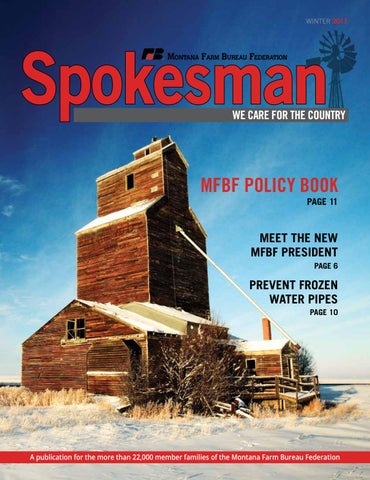
ON THE COVER: An old grain elevator stands tall in Lothair, MT. Photo by Todd Klassy, www.toddklassy.com.
MAKE THEIR VOICES HEARD
© Copyright 2017. Montana Farm Bureau Federation Spokesman. All rights reserved. The contents of this publication man not be reproduced by any means, in whole or in part, without prior written consent of the publisher. While every effort has been made to ensure the accuracy of the information contained herein and the reliability of the source, the publisher in no way guarantees nor warrants the information and is not responsible for errors, omissions or forward looking statements made by advertisers. Articles and advertisements in this publication are not solicitations to buy, hold or sell specific securities; they are for information purposes only. Opinions and recommendations made by contributors or advertisers are not necessarily those of the publisher, its directors, officers or employees. Investors should be aware that risk is associated with any security, strategy or investment and are advised to seek the counsel of a competent investment advisor before making any investment, or utilizing any information contained in this publication. Subscription, advertising and circulation information can be obtained from the publisher.
For publishing and advertising information contact:
Rebecca Colnar Montana Farm Bureau Federation 406-223-4106 rebeccac@mfbf.org Printed 1/2017
Winter 2017 | Montana Farm Bureau Spokesman
3
FROM THE PRESIDENT
Things are changing in the United States
F
Representative for Montana, and if his past irst of all, I would like to thank the actions are representative of his future, there delegates who voted for me and is real hope for the state and the western showed their support for me as their United States. Issues like free roaming bison, new president. I am excited and humbled “wild” horses and burros, water rights on to be able to represent you all and work on Federal Lands, grazing rights and so on, may your behalf. I appreciate your confidence finally see a turn for the better. in me and I will do all that I can to earn that There’s one other change that needs to confidence. I am humbled by the immense be realized and it’s much closer to home. task that lies before me. I am looking forward The Montana Farm to working with you all Bureau Federation has to do what’s best for experienced growth for agriculture in the state the past 30 years and in and nation, our great many years, the growth organization, and for the has been substantial. farmers and ranchers who Unfortunately, that work every day to feed growth has slowed and and clothe the nation and is nearing a halt. When I world. I truly believe that was campaigning, I told when we all work together you all that membership we will accomplish more growth was one of my than we ever imagined priorities. It should possible. not come as a surprise Things are changing that I am ready to get in the United States and membership growth people are ready for it, moving again. You are as the 2016 presidential probably going to get election demonstrated. Things are tired of hearing it, but I believe there are we are ultimately a great opportunities for changing in the United membership organization agriculture with this States and people are and if we are not change, especially on the growing, we are dying. regulatory front. Over the ready for it, as the 2016 Now is not the time to past eight years, it wasn’t presidential election die. Now is the time to so much the laws that thrive. I look forward to were being passed or not demonstrated. working with all of you to passed, in Congress that put programs, incentives, were hurting us, but the and motivation in place regulations being handed Hans McPherson, President, to help member to down from unbridled Montana Farm Bureau Federation member growth become regulatory agencies. There a regular, and enjoyable, is a chance to really make part of your Program of Work. Just think, some impactful regulatory change that if every one of our delegates at the MFBF benefit agriculture and other natural resource Convention recruited just one member, industries, not just now, but into the future, we would be well on our way to amazing no matter who has control of Congress or the growth. When our active members recruit Oval Office. We will be asking members to other voting members, those are the ones share input as bills start to come out. Here’s who are likely to stay with the organization some evidence of the hope we have for the and contribute to making it great. Our future; even as this article is being written, organization has always been great. Let’s our Congressman Ryan Zinke, has been make it greater! nominated to the position of Secretary of the Department of Interior. He has been a great
4
Montana Farm Bureau Spokesman | Winter 2017
THE EVP MESSAGE
Legislators Rolled into Helena
T
he 65th Legislative Session for the state of Montana is just around the corner. The session convened Jan. 2, 2017. While a portion of the state’s population will be nursing the hangover from New Years Eve 2016, legislators rolled into Helena to begin making policy for Montana’s future. But, to say the process began Jan. 2 is a mistaken perception. Meetings have been going on throughout the interim on specific policy issues, and legislators have been traveling to Helena since the election for training, committee appointments and election of leadership of each house and party. Not a lot has changed in the political landscape of the legislature. The Republicans will again have a significant, although not veto proof, majority in each house, while Democratic governor Steve Bullock will still reside in the Chief Executive’s chair. The big changes of the election occurred in the other statewide offices, where Republicans have replaced Democrats as the Commissioner of Securities and Insurance, Secretary of State and in the Office of Public Instruction. For the first time in recent history, four of the five members of the State Land Board will be Republicans. Perhaps we will see slight change in policy on management of State Lands from this new makeup. Another change occurred when the Governor announced changes in leadership of several departments. Most significant to agriculturalists is the news that Ron de Yong will resign from the Department of Agriculture and Jeff Hagener will be leaving Fish Wildlife and Parks. Thanks are in order for both for their service to Montana. Although their replacements have not been named, fresh faces and ideas should be welcomed. To date there have been more than 2,100 bill draft requests submitted to legislative services. Although many of those are place holders, it looks like a lively session is in store.
The majority of the conversations will most likely center around the budget, with severe decreases in revenue projected in corporate income tax as well as mineral taxes and royalty payments. The Governor’s recently released budget cuts several programs and services that will have an effect on everything from law enforcement to sage grouse to the wildland firefighting fund. Those cuts are intended to pay for increases for prekindergarten education, infrastructure and several other programs. It also shows an increase in taxes for those who make more than $500,000, a tax on medical marijuana and e-cigarettes. The Montana infrastructure coalition has proposed several suggestions for long term funding of infrastructure projects, including a 10-cent increase in the gas tax, a local option tax among others. Montana Farm Bureau has been working with a coalition of groups to come up with a solution to the exempt well issue that has been dogging us for years. We have made progress, so we should see a bill that protects our senior water rights yet allows for development. I am sure we will see other issues arise during the course of the session, so be sure to watch the Montana Farm Bureau website, social media and your e-mail for updates. With more than 40 freshmen members in the House of Representatives and several new faces in the Senate, it is vitally important that everyone become engaged in the process. Try to meet your legislators, let them know that you are a part of Farm Bureau in order to put a face on the organization. MFBF’s Chelcie Cargill and Nicole Rolf will be in Helena full time, so if you have questions please don’t hesitate to contact them. Remember, if you complain but don’t try to be part of a solution, it is whining. The world is run by those who show up!
Montana Farm Bureau Spokesman (ISSN 08863075) Published quarterly by the Montana Farm Bureau Federation at 502 S. 19th Ave., Suite 104, Bozeman, MT 59718. Periodical postage paid at Bozeman, MT and additional mailing offices. Subscription rates $4 a year covered by annual dues to Montana Farm Bureau Federation members. Non-member subscription $25 per year. Advertising rates available upon request. The Montana Farm Bureau Federation Spokesman reserved the right to reject any advertisements. POSTMASTER: Send address changes to: Montana Farm Bureau Federation Spokesman, 502 S. 19th Ave., Suite 104, Bozeman, MT 59718
Montana Farm Bureau Federation Officers Hans McPherson – President Cyndi Johnson – Vice President John Youngberg – Executive VP Diana Bailey – Exec Sec/CFO Montana Farm Bureau Board Troy Kurth – District 1 Rhonda Boyd – District 2 Jennifer Bergin – District 3
John Youngberg Executive Vice President, MFBF
Montana Farm Bureau has been working with a coalition of groups to come up with a solution to the exempt well issue that has been dogging us for years.
Lee Boyer – District 4 Gary Heibertshausen – District 5 Wes Jensen – District 6 Tom DePuydt – District 7 Cindy Denning – District 8 Ken Johnson – District 9 Patti Davis – District 10 Gilmen Gasper – YF&R Gretchen Schubert – Women’s Leadership Comm.
Winter 2017 | Montana Farm Bureau Spokesman
5
HEARTY HELLO
Meet Montana Farm Bureau’s New President BY REBECCA COLNAR
I
f you’re driving around Stevensville, Speaking chances are you’ll see Hans McPherson up at our heading down the road with his tractor, annual rounding up some cows in a small pasture convention. or visiting with folks at the local cafe. The McPherson family is known in the area for their diversified farming practices, whether it’s cows, hogs, corn or potatoes. “We’ve been in the Bitterroot Valley since family operation. “My mother February 5, 1953 and is 85 and still comes out to moved to our current make sure I do the right thing farm in 1958,” McPherson every day, and that the cattle says. “Before that, we are all doing well. I’ve been farmed in Idaho. When taking care of the farming and we moved here, the cattle for the past 20 years,” McPherson’s were McPherson chuckles. “I live in primarily dairy farmers, my grandfather’s house with but we’ve transformed my wife, Suzanne. Our farm is into a cow-calf operation. McPherson wears many hats. a fun place.” We’ve always been Not only does the Bitterroot Valley diversified with pigs and chickens, although boast stunning scenery, the downside is now we only raise chickens for our family. the large number of people who build My dad figured his kids needed chores, houses everywhere and call the valley so we started fruit and vegetable farming home. “I tell people we’re urban farmers,” focusing on raspberries and sweet corn. says McPherson. “We farm small parcels Even today, we sell sweet corn and other of ground scattered around. It takes a lot produce at a roadside stand, which is of those put together to make a sizeable primarily run by my sister, nieces, nephews farm. You need to have a sizeable farm and other family members. My dad was to have good machinery due to the instrumental in growing potatoes. Since he economy of scale. We spend a lot of time passed away, we have kept growing them hauling cows around in trailers to different in his memory. I have two brothers who are pastures. Trying to move farm equipment involved with the farm, although they work along our busy roads is very challenging.” off the farm.” The family perseveres, and one of the McPherson admits the farm is truly a ways to deal with challenges is belonging to Farm Bureau. The McPherson family is Hans McPherson watches Farm Bureau proud, having been involved as urban kids bottle feed in Farm Bureau for many years. “Farm bum calves. Bureau is a big part of our lives. It’s been a family tradition and we see it as a service to the community. I’m very much looking forward to serving all Montana Farm Bureau members,” McPherson says. “I became active as a youth and attended some farm camps in Bozeman and would go to meetings with my mom and dad,” McPherson continues. “Twentyfive years ago, I became active at the state level, and served on Ravalli County’s board as well as county president. Next, I served
6
Montana Farm Bureau Spokesman | Winter 2017
on the Montana Farm Bureau Board, then as vice president, and now, president.” What does McPherson like best about Farm Bureau? “It has a family feel and addresses a diversity of commodity issues. It’s not just a grain organization or a beef organization, but addresses the concerns of the farmer raising beets or beef, as well as beekeepers,” McPherson notes. “I love that our grassroots policy comes from the counties. When I was participating in the Policy Development Committee in Washington, D.C., we were following some policies that originated from Montana Farm Bureau county Farm Bureau members. Policy developed at county Farm Bureaus has the chance to become policy at American Farm Bureau. That’s what grassroots is all about.” As for national challenges, McPherson explains that government agencies have continued to pile on regulations. “Agriculture has been burdened by those regulations, and we hoping to see those excessive regulations rolled back. Another challenge is finding markets and ensuring we expand our agricultural products export market. Still another challenge is producing sufficient food with the same amount— or even less—water. We are going to have to have every tool that the agricultural research develops to produce more food.” While attending the new president’s training in Washington, D.C. in December, McPherson and MFBF State Affairs Director Nicole Rolf had the opportunity to meet with Montana’s Congressional delegation. “Nicole met with Congressman Zinke shortly after he was nominated as Secretary of the Interior. We met with Senator Steve Daines and Senator Jon Tester and both are very excited to work with the new administration and with Farm Bureau.” McPherson notes his passion for farming stems from feeding people. “I enjoy that I’m growing food for people to eat. It bothers me as a farmer that there are people across the world going to bed hungry. I’d like to see everyone with a full belly. If everyone had a good meal before they went to bed, there would be a whole lot less problems in the world.”
HAVING A VOICE
Ranching is our life
Mariah Shammel and her cows.
BY MARIAH SHAMMEL
W
hen a person finds out where we live and what we do for a living, it takes approximately four seconds for their brain to process the information and another two seconds for the questions to start spouting out. Like clockwork, every time. Do you get to ride horses? How do you get your groceries? What happens if it snows? Is it just like we see in the movies? What’s life like out there? I love it when people show interest in what we do and as long as none of my children are tiptoeing around me doing the potty dance or on the verge of a breakdown, I do my best to answer all their questions. They always look at me with wonder in their eyes and I can tell they’re envisioning all those romantic Western movies and how awesome life out here must be. And I must admit, it is! Until it isn’t.
In all honesty, life out here is just like life everywhere else—it’s absolutely wonderful, everything you dream about and more. For me, ranching never loses most of its appeal but I would be lying if I said it’s easy to maintain my level of excitement about our lifestyle four months into winter. It gets really hard because cows need to be fed every day, regardless of how cold it is or deep the snow is. Playing in water when it’s 20 below becomes a regularity because of freezing waterers and blocked waterways. You have to prepare for not being able to get to town for days at a time if roads are impassable. When calving takes over, every semblance of a normal life is completely lost. Then there are the kids! For kids who spend the
8
majority of their time outside (and those of us who have to entertain said kids), below-zero days are excrutiating. You can only paint so many pictures and make so many plates of spaghetti out of Playdoh. It gets to a point where you might as well stick a fork in me because I’m done. Over it. Just when I think I can’t take it anymore, the snow melts, the flowers come out, calves dot our pastures and warm weather is upon us. Before I can blink, it’s August and I’m dreaming about our annual trek up the mountain to find our perfect Christmas tree, the promise of a fresh start with a new year and visions of Mom’s fudge and Mabel’s Almond Roca start dancing in my head. So when people ask me what it’s like to live on a ranch in the middle of nowhere, Montana, I think most of my answers are pretty close to what they expect. On a dayto-day basis, things out here are probably vastly different than they are within the urban lines of city living. Most of us do ride horses, 4-wheelers, or a similar equivalent on a regular basis. Instead of hitting the grocery store on the way home from work every day, we fill the cart once every week or two. When it snows, life goes on so we make sure the cows are fed, check for calves, stay warm and have a snowball fight here and there. Some of it is like you see in the movies and some of it isn’t even close! But when they get to that last question
Montana Farm Bureau Spokesman | Winter 2017
that always gets asked, “What’s life like out there,” I’m pretty sure they don’t get the answer they expected. In all honesty, life out here is just like life everywhere else—it’s absolutely wonderful, everything you dream about and more. Until it’s not. But then it gets wonderful again. In other words, it’s just life. It doesn’t matter where you live, how much money you make, or how many abbreviations you have behind your name. No matter where you look, you’ll always find the same thing—people have good times and people have bad times. It’s easy to live those awesome days but then those not-so-great moments hit, and that’s when we have to remember everything we have that’s good in our lives, no matter how small or insignificant they may seem, and know that even more good things are waiting just around the corner. So here we are, partway through winter—past the lighting of the Christmas tree and the toasting of the New Year, and into the time of year when calving is imminent and I would give anything for just one day where I didn’t find at least one swipe of snot or poop (cow or child, I’m not picky) on my clothing at day’s end. But before I know it, summer will be upon us and I’ll be dreaming about being snowed in with nothing to do but staying warm and drinking hot chocolate. Oh well, such is life.
SAFETY TOPICS
Conserve Energy or Deal with Frozen Pipes
T
his dilemma has been around for a number of years. How do I save money and conserve energy when I am away from home? We have all been taught that water freezes at 32˚F and 0˚C. So logic dictates that if we set our thermostat at anything above that temperature our pipes won’t freeze. Unfortunately, this logic fails and when we arrive home, we are met with frozen pipes. Not a good welcome home. There are so many other factors that can contribute to frozen pipes, so the best rule of thumb is to set your temperature at a minimum of 65 degrees. This is the recommendation by most power companies as well as the U.S. Department of Energy. We recommend leaving the temperature set at the level you keep it at when you are home. Lowering the temperature does
10
not save money on the heating because the system still cycles as heat is lost at the same rate. In the event of a loss, your deductible will be more than your savings on your utility bill. There are unexpected temperature changes as well as wind chill to consider. Appliances are especially susceptible to freezing as they have smaller water lines and many are enclosed along an outside wall or in cabinets where heat does not reach. Computers, electronics, and other types of personal property can sustain damage from condensation or humidity. There are several options that will assist you when you are away to prevent damage to your dwelling or personal property. 1. Ask someone to check on your home daily if possible.
Montana Farm Bureau Spokesman | Winter 2017
2. Close your blinds or curtains to keep the heat in and assist with maintaining a consistent internal temperature. 3. Open cabinets where water pipes are located to allow warm air circulation. 4. Disconnect all outside hoses from water spigots. 5. Look into freeze-sensing or internet based systems that will alert you when inside temperatures drop, or if water is detected. You have enough to do when you get home from your travels without adding the extra burden of water damage from frozen pipes.
Montana Farm Bureau Federation
2017 Policy Book
PURPOSE OF FARM BUREAU Farm Bureau is an independent, non governmental, voluntary organization of farm and ranch families united for the purpose of analyzing their problems and formulating action to achieve educational improvement, economic opportunity and social advancement and, thereby, to promote the national well being. Farm Bureau is local, county, state, national and international in its scope and influence and is non partisan, non sectarian and non secret in character. Farm Bureau is the voice of agriculture producers at all levels.
3. CONSERVATION RESERVE PROGRAM
FARM BUREAU BELIEFS America’s unparalleled progress is based on freedom and dignity of the individual, sustained by basic moral and religious concepts. Economic progress, cultural advancement, ethical and religious principles flourish best where people are free, responsible individuals. Individual freedom and opportunity must not be sacrificed in a quest for guaranteed “security.” We believe in government by legislative and constitutional law, impartially administered, without special privilege. We believe in the representative form of government a republic as provided in our Constitution, in limitations on governmental power, in maintenance of equal opportunity, in the right of each individual to freedom of worship and freedom of speech, press and peaceful assembly. Individuals have a moral responsibility to help preserve freedom for future generations by participating in public affairs and by helping elect candidates who share their fundamental beliefs and principles. People have the right and responsibility to speak for themselves individually or through organizations of their choice without coercion or governmental intervention. Property rights are among the human rights essential to the preservation of individual freedom. We believe in the right of every person to choose an occupation; to be rewarded according to his/her contribution to society; to save, invest or spend; and to convey his/her property to heirs. Each person has the responsibility to meet financial obligations incurred. We believe that all citizens and non citizens alike should abide by the laws of the United States and those of the States in which they reside or visit. We believe strong domestic manufacturing and production sectors are necessary to ensure U.S. economic and technological leadership as well as ensuring individual freedom and national security. (2005)
4. CONSTITUTION
POLICY DEVELOPMENT Each year, each county Farm Bureau holds an annual meeting at which the members of that county pass policy resolutions and elect delegates to the state’s annual meeting. Policy resolutions passed by the county for the Montana Farm Bureau Federation and the American Farm Bureau Federation policy books are forwarded by the county to the state for review and consideration by the state Policy Development Committee, composed of a member from each District and chaired by the MFBF Vice President. Resolutions passed by the majority of delegates present at the state convention become the policies contained in this booklet and provides guidance and direction to the officers and staff of MFBF in the following year. Those resolutions that are national in nature and are passed by the delegates of the annual meeting are forwarded for consideration by the delegates duly elected by the state to represent the membership at the AFBF annual convention.
We Support: 3.1 Implementation of mandatory firebreaks on all present and future Conservation Reserve Program contracts. (1997) We Oppose: 3.2 The Conservation Reserve Program (CRP). (2006)
Other: 4.1 We believe in the American capitalistic, private, competitive enterprise system in which property is privately owned, privately managed and operated for profit and individual satisfaction. 4.2 Centralization of powers in the various branches of government will threaten our freedom. We, the people, should accept a greater responsibility in government. 4.3 The former constitutional limit of bonded indebtedness of states, counties, cities and schools should be part of our Constitution. 4.4 Industry and recreation are making greater demands on our water resources. We advocate constitutional protection for water rights and adjudicated water rights. 4.5 We favor a constitutional amendment that will: (1) Remove the federal government from doing any direct business in competition with private enterprise unless specified by the Constitution, (2) That the Constitution or law of any state or the United Sates shall not be subject to the terms of any foreign or domestic agreement which would abrogate this amendment, (3) The activities of the U.S. Government which violate the intent and purposes of this amendment shall, within a period of three years from the date of ratification of this amendment, be liquidated and properties and facilities involved shall be sold, (4) Three years after ratification of this amendment, the 16th Article of Amendments to the Constitution shall stand repealed and thereafter Congress shall not levy taxes on personal income, estates and/or gifts. We Support: 4.6 A Montana Constitutional Amendment on Article VII, Section II which would change the composition, chairmanship and access to the Judicial Standards Commission. 4.7 An Initiative Proposal to amend Article VIII of the Montana Constitution to remove the responsibility or certain property tax assessments from the state and restore it to the counties under the policy direction of a State-County Equalization Commission. 4.8 Efforts to demand a balanced federal budget, without increased taxation, by a Constitutional amendment by the Congress of the United States. 4.9 Legislation which will allow organizations to require a continuing membership as a condition of participation in organizationally sponsored casualty insurance programs. 4.10 Maintaining the current federal electoral-college election process. (2012) We Oppose: 4.6 A Constitutional Convention.
1. ANIMAL AND POULTRY CARE
5. COURTS & JUDICIARY
We Support: 1.1 The initiation of legislation making it a felony for any unauthorized release of experimental laboratory animals or confined domestic agriculture animals. 1.2 An aggressive, comprehensive educational program presenting the facts within our school system and to the general public. 1.3 The right of livestock producers to administer necessary vaccines and antibiotics for treatment and prevention of disease. (2012) 1.4 Legislation that designates as an illegal act, any person acquiring a job under false pretenses with intent to obtain information for special interest groups to use for defamation of agriculture. (2013)
General Statements: 5.1 We believe financing of agricultural lands should continue to be protected by mortgages which require District Court proceedings for foreclosure. (2007)
We Oppose: 1.5 Any legislative or regulatory actions which would tend to prohibit good poultry, livestock and fur bearing animal husbandry practices and increases costs to consumers. 1.6 Any attempt to ascribe legal or constitutional rights to animals. (2004)
2. APIARY We Support: 2.1 Maintaining the Montana statutory distance of three miles separation from commercial apiaries. (2013)
We Support: 5.2 The judicial function being performed by the judicial branch and not by executive agencies. (2005) 5.3 Judges interpreting laws as legislative bodies intended and oppose courts legislating from the bench. (2005) 5.4 Requiring the courts to defer and remand questions of reform and social change to the legislative branch. (2005) 5.5 Reinstating the right to a jury trial in federal magistrate courts. (2006) 5.6 Individuals, corporate officers, LLC members or partners being able to represent the sole proprietorships, corporations, LLCs, or partnerships in administrative hearings and processes, including the MT Water Court and MT DNRC contested cases. (2007) 5.7 Legislation that will limit the time allowance for objections to be raised against proposed business projects to one year after all permitting has been completed and approved. (2009) 5.8 Limiting the Montana Supreme Court’s use of “non-citable” decisions to matters of routine family law. (2010) 5.9 Tort reform in all forms, including any health care legislation. (2011)
5.10 Limiting lawyer fees, under the Equal Access to Justice Act, in cases involving special interest groups suing States or the Federal Government, excluding cases involving civil liberties. (2011)
6. CRIME CONTROL General Statements: 6.1 We favor local control of police by local government and oppose any national police force. 6.2 The development and enforcement of laws controlling the manufacturing, importation and distribution of narcotics should be supported as deterrents to crime. Penalties should be commensurate with the crime severe enough to act as a deterrent to further criminal acts. 6.3 Imposition of sentence should be certain. 6.4 As a deterrent to crime, we recommend on conviction of theft, arson or vandalism, full restitution can be made by the person convicted to the person or persons who suffered the expense of the crime as a part of the sentence imposed. 6.5 Crimes committed with deadly weapons, against people, should require a mandatory sentence without parole. 6.6 We favor a state law to prevent parole boards and judges from releasing violent criminals from prison before they have served their sentences. When released the victims and the prisoner’s home community will be given advance notice. 6.7 We favor the adoption of a habitual criminal law. 6.8 We urge Farm Bureau members to seek the support of the general public and media producers in an effort to stamp out this pornographic menace to the moral fiber of our nation. We also demand strict enforcement of our anti-pornography laws with extremely severe penalties imposed when children are used in production or pornography of any kind. 6.9 We favor minimum security prisoners be required to work on highways, prison farms or other public projects to help defray the cost of their food and support. 6.10 We favor accepting offers from Mexico and other foreign countries to board hardened criminals for a fee that is much less than the cost of keeping them in American prisons. 6.11 We believe that it should be a felony for persons to release those animals on the ‘endangered species list’ or their hybrids which are predators of domestic animals. Persons who raise these animals should be registered, licensed, owner bonded and held liable for all damages done by said animals. (2004) 6.12 Illegal aliens should not be eligible for non-emergency state and local government services. (2011) We Recommend: 6.13 Any arrests required by a federal government agency will be made in cooperation with the sheriff of the county where the arrests are to take place. 6.14 Stronger enforcement against non-licensed aerial hunting which creates harassment of livestock and wild game. 6.15 The sentence for every crime be carried out quickly. 6.16 Stronger laws to get the drunken drivers off the road. (2002) We Support: 6.17 Legislation making it a felony for any person to destroy or vandalize private property. 6.18 Making public the identity of a juvenile convicted of a felony. 6.19 Legislation requiring permanent individual identification of privately owned canines containing any amount of wolf blood. These animals will be registered with the appropriate state or county agency. 6.20 The enforcement of the death penalty in crimes on first degree murder convictions. 6.21 Legislation that would limit the amount of time that the Montana Supreme Court may have in making a decision in cases involving first degree murder. We support limiting the number of court appeals for convicted felons. 6.22 Greater involvement by parents and communities in the war on drugs. 6.23 Increased security and policing of national borders. (2001) 6.24 Our Governments’ fight against terrorism. (2001) We Oppose: 6.25 The current practice of the judicial system issuing the minimum sentence imposed on an offender and then suspending the sentence.
7. DAIRY General Statements: 7.1 The dairy industry is a vital part of agriculture in the state and producers should be protected from undue regulations that may present an economic hardship. 7.2 We urge the Milk Control Board to allow more producer input in establishing the freight costs for raw milk in Montana. We Support: 7.3 Having a full-time Extension Dairy Specialist to work at Montana State University. 7.4 The appointment of one dairy producer on the State Milk Control Board. 7.5 The Milk Control Board in its efforts to improve the quality of milk by adjusting the pull dates on the milk on shelves in the stores. 7.6 Amending dairy rules to include sheep, yak and goat milk, where guidelines are applicable to facilitate the needs of this industry in Montana. (2016)
We Oppose: 7.7 The federal assessment on milk. 7.8 Federally subsidized dairy programs that operate to the detriment of the beef cattle industry.
8. EDUCATION General Statements: 8.1 We believe that guidelines should be made available for a minimum standard to be taught in basic courses which are covered by standardized testing requirements at all grade levels, as established by the State Board of Public Education and the Office of Public Instruction. We support the present accreditation standards set at the state level which allows local control by school boards. 8.2 Self-supported private schools have an important place in a free society. We insist that all levels of government recognize the right of private groups to organize and operate educational institutions and the importance of maintaining conditions which permit such institutions to operate. The Internal Revenue Service should be prohibited, by legislation if necessary, from interfering with the enrollment practices of private schools. 8.3 Actual travel distance, road conditions, and terrain which must be traversed by the students should be the basic consideration for isolation status, and not the distance between school buildings. 8.4 We feel that the students should be allowed to go to the school closest to their homes regardless of district boundaries. 8.5 The education structure that allows our rural people to have local elementary rural schools, locally administered, should be maintained. 8.6 The University system and vocational centers must become more efficient to minimize duplication of curriculum and overlapping facilities. Audits of individual units of the University system should be made available to the public 8.7 We believe that mandating school funding equity will not enhance education quality or opportunity. 8.8 We believe that school financing should be simplified. 8.9 Environmental education in public schools in Montana shall be based on proven science. (1997) 8.10 Teaching the basics of our free enterprise system, the importance of God, and the role of citizens with their freedoms and responsibilities must receive greater importance in the classroom if this nation is to retain its strong constitutional form of government. (2004) 8.11 We encourage the review of the implications of “No Child Left Behind” on the children and public schools in Montana. (2005) 8.12 We believe free education should not be granted to illegal aliens. (2006) 8.13 The selection process in Montana needs to be in the hands of a Montana committee with preference for students pursuing rural-mixed production animal practice. (2012) We Recommend: 8.14 All elementary and high school students be required to pass the desired level of competency before receiving a diploma of graduation, the tests to be written and administered by the State Department of Education. We are opposed to a certificate of competency for hours of attendance in lieu of a high school diploma, except in the case of a student who has been tested and certified for special education. 8.15 Emphasis on a disciplined teaching and learning environment that encourages academic excellence. 8.16 American History and government courses be maintained in the required curriculum of Montana secondary schools. 8.17 English be declared the national language and oppose mandatory bilingual education in the public school system. 8.18 Administrators, local school boards and the Board of Regents concentrate on providing quality education at the lowest possible cost, rather than attempting to maximize per student costs. 8.19 That the legislature fund the Agricultural Research and Extension Service to ensure improved future performance to allow us to keep up in our race for economic survival. 8.20 That all credits transfer readily between all schools in the University system at full value in the accredited courses. 8.21 Students seeking college loans and grants not be penalized for their individual earnings and achievements. We Support: 8.22 The establishment of a voucher system for Montana’s K-12 educational system to achieve school funding equalization. This voucher could be used at any accredited school in the State of Montana. 8.23 The concept of “Merit Pay” for public school teachers. 8.24 The teaching of both evolutionary and creation theory in public schools. These two disciplines must be presented in an equal and impartial manner. 8.25 Replacing the payments made to the Montana University System based on the numbers of Full Time Equivalent (FTE) students with a “voucher” system. Montana residents maintaining at least a 2.00 Grade Point Average could use these vouchers at any accredited college, vo-tech or university in the State of Montana. 8.26 Legislation to secure adequate state funding for the maintenance of quality in Montana’s vocational agricultural programs in our public schools. 8.27 The Agriculture in Montana Schools voluntary check-off program. 8.28 Veterinary education for Montana students in the new one and three year program with veterinary students completing the first year at MSUBozeman, and the next 3 years at the Washington State University veterinary school. 8.29 Legislation that would: (1) consolidate curriculum, (2) streamline
8.30 8.31 8.32 8.33 8.34
8.35 8.36
8.37 8.38 8.39
administration (State Office of Education and University system), and (3) place emphasis on core courses that parallel the state basic industries. The 6 mill levy for the support of our state colleges and universities. Requiring all units of the Montana University system to honor the requirements for graduation listed in the institution’s then current catalog at the time the student declared a major. A balanced education of environmental issues being taught in the schools and the University systems. Local school boards’ authority to set dress codes. (2000) Legislation to secure adequate funding for the maintenance of quality schools in Montana. We feel there should be a holistic approach to the revenue for the state funding for education, rather than relying solely on property taxes. (2005) Providing improved ag education facilities for ag education and extension students at Montana State University in Bozeman. (2006) The updating and expansion of agriculturally oriented materials which educate students in all phases of agriculture from the farm to the consumer in the classrooms of Montana and support the efforts of the “Agriculture in Montana Schools” organization. (2007) Increasing the number of schools offering agricultural education and the National FFA Organization. (2007) Implementation of a 2 year Associates of Applied Science program to provide veterinary technicians through the Montana University system. (2011) Implementation of an economics education at the high school level. (2016)
We Oppose: 8.40 Any effort to add pre-school to the public school system. 8.41 Tuition and transportation charges between school districts as long as those schools receive funding from the state. 8.42 The introduction of the “Political Correctness” History Standards. (2004) 8.43 To the requirement that a specific minority cultural heritage be taught in public schools. (2009) 8.44 Mandatory consolidation of school districts. (2010)
9. EMINENT DOMAIN General Statements: 9.1 Units of government at all levels should strictly adhere to the intent of our eminent domain laws. 9.2 The appraised value, legal description and plot of any property proposed for acquisition by a public agency, federal, state or local should be made available to the property owner during the initial phase of negotiations for purchase and the need for condemnation must be established at that time. 9.3 Landowners must be fairly compensated for all use or damage to their land. If there is an additional use of the land condemned the developers must negotiate with the landowner. (2000) 9.4 Property should not be condemned in fee title if a lesser interest will suffice. (2000) 9.5 In cases of partial takings of real property, loss in value of any remaining real property should be recognized, and compensation paid for any damages which result. (2000) 9.6 A landowner or tenant shall not be held liable for any accidental or inadvertent breakage or disruption of service of any lines, cables or pipelines. (2000) 9.7 Eminent domain laws shall not be used to take private property for wildlife enhancement or recreational purposes. (2003) 9.8 Private property shall not be taken for resale to another private owner even if the new ownership will result in increased financial benefit to the governing body involved. (2003) We Recommend: 9.9 A mandatory 90 day negotiation period prior to condemnation and require a condemner to have completed all condemnation proceedings, administrative and judicial, prior to taking control of the property. 9.10 That when the powers of eminent domain are exercised to obtain easement or right-of-ways through privately owned land, the land owner should have the options of accepting a lump sum payment or an annual rental and such rentals should be adjusted periodically for inflation. We Support: 9.11 Legislation which would prohibit current eminent domain rights utilized for drilling, development and transmission of surface and ground water. 9.12 Legislation prohibiting the use of funds made available from the Land and Water Conservation Fund for acquisition of private property by condemnation. (2001) 9.13 Legislation that will limit the use of eminent domain to those uses that are truly public, not private and not for public benefit. (2005) We Oppose: 9.14 The concept of environmental easements and are strongly opposed to the use of eminent domain to create environmental easements.
10. ENDANGERED SPECIES General Statements: 10.1 In the event wolves and/or grizzly bears are removed from the Endangered Species List, we urge the Montana Legislature to direct the Montana Fish, Wildlife and Parks and/or the Department of Livestock to manage these animals in a manner that livestock and other domestic animals, private and public property, and humans will be protected. (1997)
We Recommend: 10.2 More consideration be given to those directly affected at the local level by a species to determine whether or not it should be listed as endangered. 10.3 The hunting season of sage grouse be restricted to the last week of October or the first week of November each year, with a one-bird daily limit. (2005) We Support: 10.4 Compensation for probable wolf damage by the appropriate state or federal agency. (1997) 10.5 The removal of wolves and/or grizzly bears from the Endangered Species list and place them under the supervision of the states where they are found. (1997) 10.6 The value of human life and safety above any other species, whether endangered, threatened, or not listed. (2001) 10.7 The enhanced management of grizzly bears, including relocation from farmsteads, homesteads and other public settlements with emphasis on public notification of problem bears. (2013) We Oppose: 10.8 The introduction or reintroduction of grizzly bears, gray wolves or any other wild animals into any area. 10.9 Listing Prairie Dogs on the threatened or endangered species list. (2000) 10.10 Grazing restrictions on any lands because of Prairie Dog listing or delisting. (2000) 10.11 Any implication that livestock grazing affects sage grouse habitat. (2001) 10.12 The reintroduction of wolves in the continental United States. (2004)
11. ENERGY General Statements: 11.1 Where mining occurs adjacent to streams, consideration should be given to incorporating reservoir design into placement of coal overburden. We Recommend: 11.2 The State of Montana grant a tax reduction on all gasoline that contains at least ten percent ethanol and on all diesel which contains at least 10% vegetable oil. (1999) 11.3 CRP acres be allowed out of contract without penalty to grow oil seed that will be used toward fuel energy or bio-diesel production. (2005) We Support: 11.4 Research, production, sale and development of export markets of ethanol, methanol and other renewable energies. 11.5 Energy exploration in wilderness areas. 11.6 Changing the strip mining act to allow restoration to a more productive state than just its original state, if feasible. 11.7 Continued cooperation with other farm organizations to develop alternate energy forms. 11.8 The free market system establishing fuel economy standards. 11.9 Small power producers’ (less than 50KW) right to carry over credits for electricity produced from month to month so that net metering is figured on an annual basis. (2002) 11.10 The development of Montana coal resources in a way which maximizes benefits to the people of Montana while protecting the environment. (2004) 11.11 Wind power as a renewable alternative energy source. (2004) 11.12 Increased research for farm grown bio-fuel & lubricants. (2005) 11.13 Energy and transmission developers be bonded for reclamation to include weed control including but not limited to noxious weeds. (2008) 11.14 Hydraulic fracturing (fracing) as a viable method of energy extraction as long as usable water, not used in the process, is not contaminated. (2011) We Oppose: 11.15 Expansion of net metering mandates. (2016)
12. ENVIRONMENTAL CONTROL General Statements: 12.1 The detrimental effects of any chemical must be compared with its beneficial value. Agricultural chemicals, tools by which the producer reduces costs both to the consumer and producer, should be evaluated on the basis of research and scientific data so that the interest of the farmers as well as those of the general public are protected. 12.2 We favor immunity from prosecution based on voluntarily identified environmental problems in an environmental audit. 12.3 Predatory animal control, including use of 1080, strychnine and license aerial hunting, is necessary in order to achieve proper livestock, wildlife and land management. It is also necessary to control predators that are carriers of infectious diseases such as rabies. 12.4 We believe normal farming and ranching practices on both private and public land should be exempt from providing Environmental Impact Statements. 12.5 Strict enforcement of our litter laws is necessary to protect our environment. We recommend that the legislature address themselves to the over-all litter problems, rather than a discriminatory policy on alcoholic and soft drink containers. 12.6 Oil well waste should be disposed of by the producer with the least possible damage to the existing environment. 12.7 We urge the Environmental Protection Agency desist from its ill-advised effort to ban or restrict the use of wood preservatives. 12.8 We favor continued study of proposals to import garbage into Montana
so that an educated rather than emotional decision can be made. A vote by the people in each county affected would determine the issue for that county. We Recommend: 12.9 The Environmental Protection Agency (EPA) be required to file an environmental and economic impact statement with the Montana Department of Natural Resources and Conservation or other interested state and federal agencies before imposing new regulations. 12.10 Montana underground storage tank rules be amended to conform to Environmental Protection Agency rules concerning exemption of tanks with less than 1,100 gallon capacity. 12.11 The repeal of the containment systems requirement around farm fuel storage tanks and also recommend the repeal of heat shut-off systems on such tanks. 12.12 A personal warning be given before any fine is levied on any violation pertaining to the above farm storage tanks. 12.13 The statewide open burning season be extended until later in the year. 12.14 MEPA (Montana Environmental Policy Act) be removed from the Montana Code Annotated (MCA). (2003) 12.15 That federal and state Clean Water and Stream Preservation Acts be modified to exclude normal farming practices, and provide for simpler and faster action for applying for project permits and approval. (2004) 12.16 Montana mercury emission standards not be more rigid than Federal EPA standards. (2006) We Support: 12.17 The implementation of 208 programs of federal or State agencies on a voluntary basis. If the 208 studies provide ample proof for the need of new laws, let this be done by Congress and the State Legislature and then allow the citizenry to comply with law and due process, not regulation. 12.18 Voluntary recycling whenever feasible and research to improve recycling technology. 12.19 Legislation to require tankage and removal of sludge from oil well locations to an approved disposal facility; or use of a solidification process to prevent seepage of sludge. 12.20 A limitation on the number of times the Environmental Protection Agency and government regulations can hinder or change the standard for any particular development. 12.21 The Tongue River petition, which would prevent disruption of agricultural units from the cumulative affect of mining in the Tongue River drainage, due to the detrimental affects of salts and sodium in the water and the soils of the Tongue River drainage. 12.22 A prairie dog control program. 12.23 The “right to emit carbon” and priority consideration of agriculture impacts from any climate change legislation or policies. (2008) 12.24 State of Montana control of legislation related to Waters of the United States. (2016) We Oppose: 12.25 The Environmental Protection Agency ruling that requires farmers and/or applicators of pesticides to place re-entry signs on sprayed fields. 12.26 The seeding of clouds for the purpose of the control of rainfall by any entity. 12.27 The ratification of the proposed Bio-diversity Treaty. 12.28 Cap and trade policies and classifying life cycle gases as pollutants. (2008) 12.29 Any climate change legislation that would adversely affect any sector of agricultural production or the production of energy. (2009) 12.30 The banning of R12 refrigerant currently used in refrigeration units. (2009) 12.31 The Environmental Protections Agency’s directives on dust control in matters affecting any aspect of agriculture. (2010) 12.32 Further restrictions on the purchase, transportation and use of agricultural fertilizer. (2011) 12.33 The expansion of EPA’s Clean Water Act and Waters of the U.S. rules. (2014)
13. EQUINE General Statements: 13.1 Individuals or operations who derive their primary source of income from the use of or production of equines in a wilderness, rural, or farm and ranch environment should be considered agricultural operations. (2004) We Recommend: 13.2 Horses continue to be considered “livestock” and oppose any differentiation between them and other livestock. (1999) We Support: 13.3 And encourage domestic ownership, control, and location of horsemeat processing facilities. (2003) 13.4 Horse racing in Montana. (2006) 13.5 The use of vaccine to prevent cycling in mares to help slow the growth of the wild horse population. (2012) 13.6 And encourage legislation and rulings that allow the sale, possession, processing and transport of horses intended for slaughter, disposal or human consumption. (2016) 13.7 There be an equine seat on the Board of Livestock to be held by a representative who derives a substantial portion of their income from the equine industry. (2016)
13.8 The Montana Department of Livestock ensuring that brand laws are being enforced and health paperwork is being inspected on traveling horses at all public horse events. (2016) We Oppose: 13.9 Any law, regulation, or veterinary ruling that would define animal husbandry activities including chiropractic massage, light therapy, and farrier services as the practice of veterinary medicine. (2013) 13.10 Any law, regulation or veterinary board ruling that would define equine reproduction activities including stallion semen collection, mare artificial insemination and non-surgical embryo retrieval and impact as the practice of veterinary medicine. (2005) 13.11 Any taxes, fees, check-offs or tariffs on equine feeds, supplements or veterinary products to support any existing or new state or federal feral equine programs. (2010) 13.12 The relocation of wild horses or burros from outside Montana onto public land. (2013) 13.13 Government funding for the boarding of wild horses and burros and suggest the use of processing or sale of these animals. (2014)
14. FEDERAL & STATE INDIANS We Support: 14.1 Legislation to halt the purchase, by tribal governments, of land, outside the reservations, and putting such land in “trust” status.
15. FIELD CROPS General Statements: 15.1 We believe Farm Service Agency grain acreage allotments be based on past grain operations. 15.2 New land just broken for farming should be farmed at least five years before it can be considered for government programs. 15.3 We encourage MSU to establish at each experimental station a dedicated acreage in an organic system for the purpose of yield trials and other research projects. (2004) 15.4 We believe acres planted for conservation programs, like cover crops, designed to promote soil health should be considered “fallow” for the following year’s crop, including fall planted crops. (2016) We Recommend: 15.5 The State Inspection Lab retain all grain samples for ten (10) days to allow producers time to appeal. 15.6 The protein content of wheat be measured on a dry matter basis. 15.7 Grain elevators and warehouses be required to follow recommended procedures in obtaining protein samples and secure them in such a manner that they cannot be tampered with and that farmers be given much better recourse if the protein returns are in question. 15.8 Reducing the time lapse between binding and coverage on crop hail insurance to one midnight. (1998) 15.9 GMO (genetically modified organisms) wheat not be introduced into Montana until there are acceptable markets available. (2003) 15.10 Committee persons for the Wheat and Barley Committee be elected by those people who pay the Wheat and Barley assessment, that the executive director and staff of the Wheat and Barley Committee be hired by the Wheat and Barley Committee, and that the Committee have complete authority over the assessment funds. (2005) 15.11 The Federal Crop Insurance deadline for northern tier states be May 15 on spring planted crops. (2006) We Support: 15.12 Continuation of and promote the use of the Montana State Grain lab. 15.13 GMO (genetically modified organisms) research. 15.14 Policies and practices that encourage the production of high protein, high gluten content wheat with good milling and baking quality, so that Montana farmers can retain their export market for high quality. (2004) 15.15 Adjustments to the Farm Bill commodity title, using USDA cost of production data to provide equitable support between program crops. (2006) 15.16 The establishment of reasonable allowances for the adventitious presence of GMO in non-GMO crops. (2010) 15.17 The use of peer-reviewed science as the major criteria for introduction or restriction of GMO crops. (2010) 15.18 Producer-generated Global Positioning System data be allowed to supplement Farm Service Agency and Crop Insurance purposes. (2011) 15.19 Re-evaluating the “Pack Factor” method for the measurement of commodity for Federal Crop Insurance. (2012) We Oppose: 15.20 Government subsidies being paid to plow virgin sod on fragile lands. 15.21 The use of DHV (dark, hard, vitreous kernels) and HVAC (hard, vitreous, amber color kernel) quality test for all spring and durum wheat. We recommend the development of a more consistent and objective test for determining their quality. (2008)
16. FIRE ARMS We Support: 16.1 The right of people as individuals to keep and bear arms without registration or control. (2000)
16.2 The right of the people to purchase and possess ammunition and/or ammunition components without registration, restrictions, control or punitive taxes. (2000)
17. FISH, WILDLIFE AND PARKS General Statements: 17.1 An Environmental Impact Study (EIS) by Montana Fish, Wildlife and Parks shall be required before they poison fish in natural streams, lakes or public impoundments within the State of Montana to insure those living downstream will not be affected. (1999) 17.2 We believe any wildlife species, outside of a protected park or preserve, can be legally harvested during the regular hunting season with a current Montana hunting license for that species. (2002) 17.3 All county governments and affected private landowners must be notified prior to the release of any wildlife within the county boundaries and the location of such release shall be disclosed. (2004) 17.4 We favor keeping the Department of Fish, Wildlife and Parks and the Department of Natural Resources as separate units of State government. (2004) We Recommend: 17.5 Placing a disclaimer on Wildlife Conservation Licenses which when signed absolves the landowner or agent from all liability. 17.6 It be mandatory that all county court costs and fines be paid by the violator of the Department of Fish, Wildlife and parks laws. 17.7 That fire arms or bow hunting of any kind not be allowed without landowner permission, in regards to hunting within stream beds. 17.8 That at least two members of the Department of Fish, Wildlife and Parks Commission be farmers or ranchers actively engaged in agricultural production. 17.9 The income from the sale of fishing and hunting licenses in the State of Montana be put directly into the general fund. 17.10 A legislative oversight committee review the promulgated rules of the Montana Fish and Game Commission. 17.11 40% of wildlife habitat acquisition money be used to provide landowner compensation for allowing public hunting on their property. 17.12 The Montana Department of Fish, Wildlife & Parks develop a Block Management Plan (BMP) for fishing access similar to the hunting BMP. (1997) 17.13 Montana resident hunters contribute to the block management programs. (1998) 17.14 The Department of Fish, Wildlife and Parks offer qualified landowner preference to all game species. (1999) 17.15 Management plans adopted for sage grouse on public or private lands use range management practices and guidelines already approved for livestock grazing. (2001) 17.16 Gamebird Shooting Preserves release only NPIP (National Poultry Improvement Program) certified gamebirds that are fully feathered and at least 12 weeks old. (2002) 17.17 Strengthening the law prohibiting feeding bears and wild ungulates. (2007) 17.18 Administrative personnel within the Department of Fish, Wildlife and Parks be limited to their January 1, 2011 numbers or less. (2011) We Support: 17.19 Legislation that any farmer or rancher who suffers a loss due to big game animals or predators be compensated by the Department of Fish, Wildlife and Parks of the State of Montana, whomever assumes ownership and/or control of game animals or predators; with preference given to the farmer or rancher who allows reasonable hunting on his land, where feasible. 17.20 Continued harvest of wild fur bearing animals, including the processing, sale and use of the resulting product. 17.21 Quarantining the wildlife in Yellowstone Park until it is certified free of brucellosis and tuberculosis. 17.22 Legislation which will require the Department of Fish, Wildlife & Parks to operate on a budget under direct state administered laws the same as any other branch of state government. 17.23 State regulation of the Fish & Game Commission to make sure that game quotas are agreed upon by the Game Commission as well as the active regional game biologists. 17.24 Efforts of the Fish, Wildlife and Parks to update population goals of elk, based on carrying capacity of the land for the combined populations of wild and domestic grazing animals. (1997) 17.25 The development of effective strategies for maintaining wildlife populations within realistic goals. (1997) 17.26 Legislation requiring Fish, Wildlife and Parks to reimburse counties or individuals for impact incurred by Fish, Wildlife and Parks programs and policies. (1999) 17.27 Implementation of a comprehensive predator management program, linking population goals to the availability of a sustainable non-domestic prey base. (2000) 17.28 Allowing only vaccinated or sero-negative bison in and “Special Management Areas” (SMA’s) approved by the State of Montana to provide additional winter range for bison. (2000) 17.29 Legislation requiring Montana Fish, Wildlife and Parks Commission to set harvest quotas and regulate the harvest of wildlife in a manner that represents biologically sound management of big game populations of deer, elk, and antelope to control the impacts those game animal populations have on private property. (2002) 17.30 Legislation requiring the State of Montana to manage wildlife in a sustainable manner, not causing serious economic hardship to private
property owners. (2002) 17.31 Requiring the hunter or fisherman to obtain permission from the landowner before entering private property. (2002) 17.32 Private property owners’ representation on the “rules-making” committee of the block management program. (2004) 17.33 Continued funding for the block management program. (2004) 17.34 Maximum hunting harvest opportunity on federal lands to relieve over use of private lands by wintering big game herds. (2006) 17.35 Management of wildlife numbers within national park boundaries including but not limited to bison, and wildlife management areas consistent with range carrying capacity as developed using standard range management analysis. (2006) 17.36 Enforcing the YNP Bison Management program in place, maintaining the border as is without a buffer zone. We support the National Park Service capturing, testing for brucellosis and either vaccinating, tagging and releasing, if negative, or harvesting if infected by brucellosis of bison outside or inside the Park. (2007) 17.37 Allowing FWP to haze and/or harvest wildlife for disease control and/or crop depredation. (2008) 17.38 Management of FWP’s property, accesses and conservation easements to comply with “best management practices”. (2008) 17.39 Requiring FWP to address weed management on all property under their management. (2009) 17.40 FWP maintaining an agricultural grazing component on acquired properties equivalent to historic rates. (2009) 17.41 A policy of zero land growth for FWP. (2009) 17.42 Directing funds from the sale of wolf hunting licenses to the Department of Livestock for the reimbursement to livestock owners for damages caused by wolves. (2009) 17.43 Transfer of land management activities on FWP controlled land to DNRC. (2010) 17.44 Local government approval prior to any state, federal or any tribal agency transplanting into counties any wildlife posing negative impacts on local economies and private property rights. (2013) 17.45 The initiation of a more positive coyote and predator control policy by the Department of Fish, Wildlife and Parks in cooperation with other agencies. (2014) 17.46 Requiring Montana Fish, Wildlife and Parks to have at least one radio collared wolf in all wolf packs as required by statute. (2014) 17.47 The use of lighted arrow nocks. (2016) 17.48 Continued legal trapping and snaring of fur-bearing and non furbearing animals, pests, and predators as a legitimate wildlife management tool on all public and private lands. (2016) We Oppose: 17.49 Wildlife depredation on private land and consider it uncompensated takings and Fish, Wildlife and Parks or the State of Montana will be held liable for damage. 17.50 Efforts to prohibit the use of Conibear, leg hold traps and snares. (2000) 17.51 Excessive increases in hunting license fees. (2004) 17.52 A drop dead zone and any expansion of the Yellowstone Park buffer zone for bison. (2006) 17.53 The Department of Fish, Wildlife and Parks purchasing agricultural land. (2008) 17.54 Any further reduction of livestock AUM’s on the C.M. Russell National Wildlife Refuge. (2008) 17.55 The planting of prairie dogs, wolves, bears, and coyotes, on public and private lands. (2009) 17.56 Fish, Wildlife and Parks prohibiting private landowners from obtaining trout stocking permits for private ponds and/or lakes. If a permit is denied, Fish, Wildlife and Parks must provide scientific proof of adverse effects to water rights or wild trout populations. (2009) 17.57 The establishment of wild or free roaming bison. (2010) 17.58 Any effort by Fish, Wildlife and Parks to expand their own police force. (2010) 17.59 Requiring training or certification through Fish, Wildlife and Parks to be licensed to trap wolves, predators or other fur bearing animals in Montana. (2013) 17.60 Any government funding or research for any alteration of the natural predation or disease of prairie dog populations in the United States. (2014)
18. HEALTH & SAFETY General Statements: 18.1 We believe that health care is primarily the responsibility of the individual. 18.2 We believe basic health insurance coverage should include routine preventive health care and be portable or transferable for the individual holder and/or family. 18.3 A health insurance company shall not deny benefits otherwise provided under the plan or coverage for the treatment of an injury solely because such injury resulted from the participation of the plan participant in a legal transportation or legal recreational activity. (2004) We Recommend: 18.4 Greater use of non-physician providers to help relieve personnel maldistribution in the medical profession; non-physician providers include nurse practitioners, physician’s assistants, nurse midwives and nurse anesthetists. We also urge the establishment of additional educational programs for these professions (non-physician providers). 18.5 All medical schools (1) be required to have a family medicine department, (2) direct additional funds toward family medicine departments, and (3)
provide more support to family practice residences. 18.6 All landowners and public permittees be offered the “standards for survival” firefighting course annually. (2000)
most efficient method of production. 22.2 We favor County Planning Boards rather than City-County Planning Boards.
We Support: 18.7 The right of the individual to choose both physicians and medical facilities. 18.8 Research for the prevention and treatment of West Nile Virus. (2011)
We Recommend: 22.3 All rural subdivisions operate under mandatory special improvement districts for their internal operation and we support present occasional sale provisions for legitimate agricultural operators. 22.4 That gifting of parcels of agricultural land to heirs in portions less than 160 acres not be subject to review unless it is diverted from agricultural use. 22.5 All subdivisions be required to conform to local planning board standards. 22.6 That the development of land use plans and regulations promulgated by the Department of Fish, Wildlife and Parks with land under their control should come under the jurisdiction of the County Planning Board. 22.7 That any land use legislation provide that the individual land owners be included in the final decision on the use and disposition of their property. 22.8 That property owners be justly compensated for any reduction in the value of their property due to involuntary zoning or the granting by the legislature or courts of general public easements on or across private lands. 22.9 That agriculture farms larger than 40 acres be exempt from uniform codes on buildings other than housing and commercial type buildings. 22.10 Right to Farm legislation be passed to prevent farming and ranching operations being classified as a nuisance. (1998) 22.11 Streamside setbacks be limited to new residential and commercial structures and they be determined at the local level, in lieu of a fixed state-wide distance for rivers and streams. (2008) 22.12 That major or cumulative minor subdivisions in rural areas have an adequate operating permanent water source for fire protection in place before the subdivision is approved by county commissioners. (2013)
We Oppose: 18.9 The practice of using different fee schedules based on whether or not a patient has insurance, higher for the insured, known as “price gouging” by hospitals, clinics, other medical practitioners and facilities. 18.10 Employer mandates for insuring employees. 18.11 The forced sale of assets of the surviving spouse for Medicaid coverage during admission to a nursing home. (2004) 18.12 Any mandatory government sponsored national health insurance program. (2009)
19. INCOME TAX Other: 19.1 We urge the State of Montana to implement legislation necessary to adjust the tax exemption with the cost of living, and the exemption should increase proportionately with the cost of living index. We Recommend: 19.2 That income tax modifications be revenue neutral or a reduction of total revenue. 19.3 That we continue to have the State Investment Credit and Depreciation schedules. We Support: 19.4 100% deduction of health insurance premiums and unreimbursed health care costs. 19.5 Indexing capital gains to the consumer price index so that no tax revenue is derived from inflation. 19.6 The right to defer payment for agricultural products and to be taxed on that money the year the money is received. 19.7 Removing Section 1, line (e): “board, lodging, rent, or housing if it constitutes a part of the employee’s remuneration and is based on its actual value” from Montana Code Annotated 39-71-123 “Wages Defined”. (2016)
20. INHERITANCE General Statements: 20.1 It should be the inherent right of any person to pass the fruits of his labor to the person or persons of his choice. 20.2 We favor enactment of legislation to simplify inheritance proceedings. 20.3 To preserve family farms and businesses and maintain family ownership, we believe it necessary that inheritance taxes be eliminated.
21. LABOR General Statements: 21.1 County and local governments should be exempt from State prevailing wage law when only locally generated funds are used. 21.2 Unemployment benefits should not be available to able bodied workers who choose to remain unemployed. (2003) We Recommend: 21.3 That labor unions be prohibited from restraining trade. 21.4 That the Montana Legislature enact a Right to Work Law. 21.5 Support of the following principles: (1) farm workers be guaranteed the right of secret ballot elections, (2) prohibit the boycott as a device to force farm workers into an organization not of their own choice, (3) provide means of arbitration to settle farm labor disputes without loss of the crops to farmers, jobs to workers and the inevitable high costs that interruptions of production bring to consumers. 21.6 Unemployment laws be strengthened to require the unemployed accept whatever jobs are available. (2003) 21.7 That private contractors be allowed to maintain their right to trade as self-employed individuals for all purposes including taxation, liability and insurance. 21.8 The governments of the State of Montana and the United States enforce immigration laws. (2010) We Support: 21.9 Legislation that would enable the Montana Prevailing Wage Law for public construction to be administered to reflect actual conditions in each local community. We Oppose: 21.10 Cost of living indexing in conjunction with the minimum wage. (2006)
22. LAND USE PLANNING General Statements: 22.1 Due to migration, agriculture should move quickly to ensure their right to continue to have sufficient land to: (1) ensure an adequate supply of food and fiber for consumers, (2) have an economical unit to ensure the
We Support: 22.13 Action by the State of Montana in initiating a suit to require the Federal Government to relinquish all land not required for government operations, as outlined in the Constitution. 22.14 Locally controlled programs that will reasonably ensure orderly planning with admonishment to agricultural people that they must become involved if they expect to have agriculture’s interest incorporated in the overall plan. 22.15 Legislation to clarify the determination of ownership and maintenance of boundary fences if a mutual agreement is not obtainable. We Oppose: 22.16 Any decertification land study by Federal Land Use Planning groups. 22.17 Any further court use of the public trust doctrine or “theory of exaction” in Montana. 22.18 Rails-to-trails and similar programs and believe the land and/or right of way originally purchased by the railroads should be offered for sale to the adjacent land owners. (2004) 22.19 Any grazing exclusions included in conservation easements sponsored by state or federal agencies (2004) 22.20 The Attorney General’s opinion allowing city residents to vote on county wide zoning. (2008) 22.21 Development of “The Big Open” game preserve and any reserves eliminating lands from production agriculture. (2016)
23. LIVESTOCK General Statements: 23.1 Since the hot brand is the only proven means of positive identification we favor the continuation of this method as a deterrent to rustling. 23.2 Health requirements of breeding livestock transported across the U.S. Canadian border should be equal and reciprocal. 23.3 We favor a legal brand inspection on livestock hauled between summer and winter range when more than one county line is crossed and favor a grazing permit when crossing only one county line. 23.4 We favor closer cooperation with surrounding states in the verification of trip permits and inspection papers to halt interstate transportation of stolen livestock. 23.5 We favor retaining the Montana Department of Livestock and the Montana Department of Agriculture as separate entities. 23.6 We are in favor of a disease control plan and oppose the “split state” proposal for brucellosis status management. (2007) 23.7 We believe the Montana Bison Quarantine Area should be maintained as is and Fish, Wildlife and Parks not be allowed to transfer those bison to other public, private, government or tribal property. (2011) 23.8 We believe that all bison in Montana outside Yellowstone National Pak and the National Bison Range at Moiese should be classified as livestock and subject to regulation by the Montana Department of Livestock. (2011) 23.9 We propose that the Montana Department of Livestock’s present rules on importing livestock be reviewed, at least annually, by the Board of Livestock. (2015) We Recommend: 23.10 Strong enforcement of livestock brand inspection laws and urge the Department of Livestock to continue its program of educating and upgrading deputy brand inspectors. 23.11 All livestock entering the United States be permanently identified as to country of origin. The incoming live or dressed and processed weight of cattle and hogs should be charged against the exporting country’s quota. 23.12 That control of the diagnostic center at Bozeman be retained by the State Board of Livestock.
We Support: 23.13 Legislation that will provide adequate funding for the Department of Livestock in a fair and equitable manner. 23.14 The retention of the State of Montana meat inspection program. 23.15 Programs utilizing multi-species grazing; i.e. sheep, goats, cattle, for enhancement of rangeland management. (2004) 23.16 The use of existing State Livestock Departments and current brand inspection systems and laws as a model for development of any imposed animal ID program. (2004) 23.17 A voluntary national identification system of United States livestock and animals that maintains producer privacy and producer’s ownership of their data. (2006) 23.18 A voluntary premise identification program that maintains producer privacy and producer’s ownership of their data. (2006) 23.19 The right of Montana land owners to operate legal and disease free alternative livestock operations without undue government control. (2007) 23.20 Policy to keep the Yellowstone National Park bison in the park borders in compliance with the Memorandum of Understanding (MOU). (2007) 23.21 Changing the Montana Department of Livestock’s agreement with USDA Wildlife Services to allow livestock owners to contract directly for services in counties which do not have a predator levy on livestock or in counties where predator levy funds have already been expended. (2009) 23.22 A program to contain and eradicate infectious livestock and/or wildlife disease outbreaks. (2008) 23.23 Keeping the livestock brand renewal on a 10 year rotation. (2010) 23.24 Enabling online renewal of livestock brands. (2010) 23.25 Volunteer and deputy brand inspection duties being limited to brand inspection and beef check-off collection. (2010) 23.26 Trichomoniasis testing by local veterinarians for in-herd use and grazing associations. (2010) 23.27 Legislation that requires any allegation of animal cruelty to be reported within 10 days following the end of the investigations of the incident. (2012) 23.28 Producers electing Montana Board of Livestock members by districts. (2012) 23.29 Local government approval prior to any state, federal or tribal agency transplanting into counties bison or other livestock posing negative impacts on local economies and private property rights. (2013) 23.30 Mandatory Country of Origin Labeling, with minimal adverse effects to U.S. producers. (2013) 23.31 A resolution to oppose the amendment from the USDA (APHIS) that will allow imports of fresh, chilled or frozen beef from countries where hoof and mouth disease has been found. (2014) 23.32 Formation of a statewide team of veterinarians, veterinary technicians, extension agents, and livestock producers, to be organized, educated, and supported by the State to provide an organized, coordinated response and plan in the event of a foreign animal disease outbreak or natural disaster, to protect our livestock, livestock producers, and cloven hoofed wildlife from devastation. (2014) 23.33 All bison be brand inspected before being transported between counties to assure disease traceability. (2014) 23.34 Funding for the State Animal Diagnostic Lab in Bozeman come from sources in addition to per capita livestock fees. (2014) 23.35 The continuation of the State Animal Diagnostic Lab in Bozeman. (2014) 23.36 Requiring additional sources of funding, other than the Department of Livestock or producers, for brucellosis testing due to exposure of domestic livestock to diseased wildlife. (2014) 23.37 Application of specific animal health requirements for game farm animals and alternate livestock as defined by Montana code and administrative rule. (2015) 23.38 Montana’s Open Range laws as regards to fencing requirements for livestock. (2016) 23.39 Funding for the Livestock Loss Board for depredation, preventative measures and education. (2016) 23.40 Requiring an environmental impact statement be done any time bison are moved between tribal and public lands. (2016) 23.41 Requiring the Department of Interior complete an environmental impact statement, including a management plan; prior to bison entering Glacier National Park. (2016) We Oppose: 23.42 The federal government’s attempt to require identification of each and every individual animal with implant identification pellets. 23.43 Reclassifying domesticated bison as free roaming or wildlife in need of management and using them in relocation efforts by all government agencies, sovereign nations, private individuals or non-profit organizations. Domesticated is defined as: held in captivity or treated as livestock. (2013) 23.44 Brand inspection fees being used to support the State Animal Diagnostic Lab. (2014)
24. MARKETING & BARGAINING General Statements: 24.1 We urge the vigorous enforcement of the Packers and Stockyards laws and regulations and the Sherman Anti-Trust Act. 24.2 We propose that farm imports and exports be published in units of measurements and monetary value. 24.3 We favor helping financially distressed farmers and ranchers with programs that are not detrimental to the general agricultural community. 24.4 Tampering with the proceeds or custodial funds will be considered a
felony. 24.5 Any action by Congress to offer financial assistance for depressed grain prices should encourage movement or sales of grain, not storage. (1998) 24.6 We favor expanding foreign markets to full potential. 24.7 Livestock packers who process more than five percent (5%) of the national daily slaughter should be required to report all cash and contract prices and terms of sale to the Federal Market News Services. (1999) 24.8 We promote Trade Promotion Authority. (2001) 24.9 We do not support mandatory labeling of food products that contain Genetically Modified Organisms (GMO’s). (2013) We Recommend: 24.10 That Automated Import Inspection System (AIIS) randomly choose the sides of meat on inspected truckloads of swinging carcasses. 24.11 An audit of the Meat Inspection System to insure regulations are being followed. Rejected lots of meat should be tracked. 24.12 That all imported meats be clearly labeled at the retail level as to country of origin. 24.13 That Montana Department of Agriculture monitor rather than attempt to regulate storage rates for grain in elevators. 24.14 That the burden of proof of whether an operator is in compliance with a regulatory order should be with the agency who issued the order rather than the operator. We further recommend that a manner of appeal on the order of a regulation board be provided. 24.15 All meat served in Montana school lunch programs and at Montana State institutions be meat of U.S. origin. 24.16 Unrestricted export of farm commodities except in times of national emergency and then only if similar restrictions are made on the export of manufactured goods and technology. 24.17 Uniform state and national standards for marketing all ag commodities including hay. 24.18 That before Congress approve Fast Track authority that the President will guarantee direct input from all agriculture and agricultural commodity groups. (1997) 24.19 The United States Department of Agriculture quality stamp only be used on U.S. born, raised and processed livestock. (2002) 24.20 A $.25 per head increase (for a total of $1.25 per head) in the state beef checkoff assessment to be used by the Montana beef Council. (2012) We Support: 24.21 The Beef Promotion and Research Act. We believe it should be producer controlled. 24.22 Improved quality standards for export grain inspection. 24.23 Grain quality preservation from the producer to the final destination. 24.24 Efforts to protect the cattle industry from unfair trade. (1999) 24.25 An opportunity to petition for a referendum. The beef referendum process should be revised to provide producers the opportunity to petition every five years for a referendum on continuing the checkoff. Ten percent of beef producers signing the petition at county offices will trigger the USDA to conduct a vote within a year. (2006) 24.26 An adjustment of the checkoff rate. To assure strong demand-building initiatives for the beef industry in the future and to offset 20 years of inflation, adjust the per head checkoff rate. The 50-50 split between State Beef Councils and Cattlemen’s Beef Board would remain the same. The industry will need to approve any checkoff rate change through a referendum. (2006) 24.27 Enhanced understanding of the Federation of State Beef Councils. Improving the identity and awareness of the Federation of Beef Councils is a top priority. (2006) 24.28 Making the checkoff more inclusive. Any reference to the charter date of established national non-profit industry governed organizations should be eliminated from definition (1260.113c) in the Beef Promotion and Research Order. (2006) 24.29 Collection and distribution of producer checkoff dollars by the most efficient means. (2010) 24.30 The establishment of a system within the Montana Department of Agriculture to provide for mediation and arbitration services for the resolution of disputes among or between Montana agriculture producers, agriculture suppliers, buyers, handlers, or merchandisers. The costs of such services shall be borne by the parties involved in the mediation. (2010) 24.31 Enforcement of collateral requirements when a lienholder’s name is required to be included on the checks for one share of a crop share lease. The lienholder’s name must not be included on the share where it is not required. (2010) 24.32 Montana Bureau of Weights and Measures certifying scales on a regular basis. If unable to complete certification in a timely manner, an extension should be granted. (2012) 24.33 An increase in bonding levels required for grain dealers to an amount equal to 5% of a dealer’s total commodity sold in a 12 month period, with a $3 million cap per dealer. (2012) 24.34 Inclusion of information in grain purchase contracts which details the availability of bonding or insurance on deferred-payment agreements. (2012) 24.35 Legislation to protect producers from being forced to deliver grain contracted to a bankrupt elevator. (2012) 24.36 A wheat classification and inspection system that is uniform across the USA-Canadian border. (2014) 24.37 A voluntary and uniform labeling system for GMO designated products. (2015)
We Oppose: 24.38 Any merger or acquisition which tends to create a monopoly of production and/or marketing in the livestock industry. 24.39 The establishment of a National Industrial Policy Board. 24.40 Price differentials on chemicals between countries. (2001) 24.41 The formation of Free Trade America Agreement (FTAA) with South America. (2001) 24.42 The importation of meat, raw or cooked, whose origin or handling of product does not recognize or comply with USDA standards. (2013) 24.43 To the implementation of a new supplemental Beef Check Off program that would operate under the 1996 Commodity Promotion Research and Information Act, separate from our current 1985 Beef Promotion and Research Act. (2014)
25. NATURAL RESOURCES General Statements: 25.1 Development of generating plants, gasification and liquefaction plants should be directed toward use of water and sites adjacent to existing dams and reservoirs. We Recommend: 25.2 That Oil and Gas Commission have accurate information on the bit direction on horizontal oil wells to protect the rights of mineral owners. 25.3 That the Oil and Gas Commission enforce the Administrative Rules of Montana, including, but not limited to flaring of gas at oil well sites. (2003) 25.4 That hard rock miners have proof of ownership or lease of mineral rights and authorization to enter upon the surface, to obtain a permit from the State, BLM (Bureau of Land Management), or Forest Service to mine that property. (2003) 25.5 Government agencies use all available means, local resources and landowners to stop wild fires. (2003) 25.6 Underground pore space belong to the surface owners after minerals have been extracted. (2008) We Support: 25.7 Legislation to reduce severance taxes on Montana’s natural resources. 25.8 Government agencies having to comply with all the requirements that a private citizen must in the water reservation process. 25.9 Mineral extraction and reclamation by safe industry accepted means. (1998) 25.10 Legislation clarifying landowners’ rights to fight fires on adjoining public lands. (2000) 25.11 The continued utilization of some monies from the Natural Resources Legacy program for soil, range and water programs that benefit agriculture. (2003) 25.12 Legislation that will promote the orderly development of all natural resources, including all metals and minerals, on all public lands while protecting the quality of surface water and ground water. We ask the protection of the water quality as is found in all water aquifers in the areas of development. (2003) 25.13 Legislation to facilitate the rehabilitation of the St. Mary facilities and the Milk River Project. (2004) 25.14 The production of coalbed natural gas with the disposal of water to be determined by the surface owner abiding by the laws of the State of Montana. If water produced can be completely contained on surface land, the landowner determines its disposal. (2006) 25.15 Wind energy development rights remaining with the surface owner. (2009) 25.16 The building of infrastructure to move oil and natural resources while protecting private property rights. (2011) 25.17 Requiring the monies collected for the Oil and Gas Damage Mitigation Account from the sale of oil, gas, and hard rock minerals and metals be used for reclamation projects as originally intended. (2014) 25.18 Maximizing water production in state or national forests with management and protection plans, policies, and programs. (2015) We Oppose: 25.19 Any additional allocation of water from Bowdoin National Wildlife Refuge and oppose the downstream flushing of salts from Bowdoin Lake. (2002)
26. NATURAL RESOURCE TAXES General Statements: 26.1 Net proceeds tax should be returned to the county of origin. We Recommend: 26.2 That industry causing a social impact include in their plans of development, provisions for the supplying of services required for their people. We Support: 26.3 Distribution of Natural Resource Tax back to the counties on each county basis instead of on the per capita basis. 26.4 Attempts to lower taxes on oil produced by a tertiary recovery method (carbon dioxide). 26.5 Legislation to use a portion of the coal tax severance monies on a state wide equitable basis for the construction and maintenance of Montana’s primary and secondary highways and bridges with preference to impacted areas. (2000) 26.6 Equalization of property tax on wind parks and biodiesel generation systems to levels now in effect for coal and gas generation systems. (2004)
26.7 A reclassification of commercial wind turbines and commercial biofuel generators from class 13 (assessed at 6%) to class 8 (assessed at 3%). (2004) 26.8 Tax incentives in the state’s tax structure to explore and develop all energy sources. (2011) We Oppose: 26.9 The reclassification of agricultural land as industrial for extraction of minerals.
27. OUTFITTING & TOURISM We Support: 27.1 Legislation which would continue to allow private landowners the privilege of outfitting and guiding on their own private property as well as continue to maintain license set asides for landowners and outfitters. 27.2 MT FWP using river guide use fees, on the river where they were collected, for maintenance and weed control. (2007) 27.3 Improved trailheads on state and federal land to encourage tourism. (2013)
28. PERSONAL LIABILITY General Statements: 28.1 Property owners should not be liable for injuries to trespassers or uninvited persons or to persons using their property, including along the stream portions, for recreational purposes with or without permission. We recommend this protection be maintained. We also favor liability exemption for rendering aid to injured persons. 28.2 Any person should be free to take any reasonable action he deems necessary to protect himself, his family, his property or other people without risk of prosecution or liability. 28.3 Any insurance company licensed in the State of Montana shall be required to notify the county treasurer’s office of cancellation of any vehicle liability policy with twenty (20) days. License holder shall then be required to show proof of re-insurance or license will be revoked. 28.4 Judges should be more stringent with their fines on uninsured motorists. We Support: 28.5 Legislation to limit the amount of liability and punitive damages that may be awarded through the court system. 28.6 Legislation to set limits on claims of pain and suffering. 28.7 Legislation that establishes a truly fault-based liability system as a first step in tort reform. 28.8 Legislation that encourages structured settlements that disburse payments over time. 28.9 Legislation that forbids joint and several liability judgements that force a marginally responsible defendant to pay the entire claim. 28.10 Legislation that penalizes parties who force frivolous cases into lengthy court proceedings. 28.11 Legislation to limiting settlements in medical malpractice suits and subsequent attorney fees. 28.12 Limiting punitive damages to $1,000,000 (one million dollars) above medical costs. (2003) 28.13 The environmental cleanup of illegal drug manufacturing, such as methamphetamine labs, being paid for by perpetrator restitution and/or seizures of drug proceeds and property. (2006) We Oppose: 28.14 The Judicial Branch’s interpretation and implementation of liability insurance stacking. (2003) 28.15 Legislation which would mandate the use of personal safety equipment in any livestock handling, rodeo or equine sporting and recreational events. We further oppose any legislation or judicial action which would result in a livestock or property owner being liable for injury sustained by another person who elected to forego the use of personal safety equipment while participating in a livestock handling, rodeo or equine activity. (2009)
29. PREDATORS We Support: 29.1 The right of the landowner to protect themselves, their families, livestock and properties from all predators such as grizzly bears, mountain lions and wolves, including those listed as threatened or endangered under the Endangered Species Act. 29.2 Amending Montana Code Annotated 87-3-127 (1999) to include wolves and grizzly bears in the definition of stock killing animals. (2000) 29.3 Owners of domestic livestock killed by predators be reimbursed for the full replacement cost. (2009) 29.4 Directing additional dollars toward timely wolf and grizzly bear predation mitigation. (2010) 29.5 Simplification and enhancement of the Livestock Loss Reduction Program in order to provide broad unambiguous access to those indemnification resources. (2010) 29.6 Increasing funding for predator control for Wildlife Services. (2013) 29.7 Primary authority for predator control residing with the Department of Livestock and/or County Predator Control Districts. (2014) 29.8 Counties adopting their own predator control policies. (2014) 29.9 The definition of livestock loss to include livestock losses as defined by the Department of Livestock’s per capita fee and working dogs killed or injured by wolves, mountain lions, black bears, or grizzly bears. (2014)
29.10 Including livestock depredation by wolves, mountain lions, black bears, and grizzly bears in the Livestock Loss Reduction Program. (2014) 29.11 Continued state classification of the wolf as a species in need of management, so that wolves may be hunted, trapped, and otherwise controlled. (2014) 29.12 County Commissioners having the authority to set bounties on predators within their counties and use funds from the predatory animal control fund to pay such bounties. (2016) 29.13 The continuation of local “derbies” for coyotes and other unregulated predators and varmints. (2016) 29.14 Montana Fish, Wildlife and Parks managing bears to where human safety is priority; utilizing all tools and methods of aversive conditioning as directed in the NCDE (Northern Continental Divide Ecosystem) Grizzly Conservation Strategy (April 2013) and Interagency Grizzly Bear Guidance from 1996. (2016)
30. PRIVATE LANDS General Statements: 30.1 We believe that property rights are a necessary right for a free people and are protected under the fifth amendment of the U.S. Constitution. Any infringement on property rights without just compensation, by any government, public group or private citizen weakens all of our rights. 30.2 We urge the Legislature to enact clear constitutional ethics legislation covering public officials and employees to prevent their participation in efforts to undermine or seize private property rights, particularly when a conflict of interest is present. 30.3 Private ownership and operation of the major portion of the state’s land resources is in the best interest of the public. Any judicial, legislative or other governmental action forcing access on or across private land to public land or surface waters is contrary to this concept and we oppose it. 30.4 Energy companies should divest themselves of agricultural land when reclamation is completed following mining or drilling for energy fuel. 30.5 The matter of surface damages should remain a matter to be negotiated between the producing company and the surface owner. 30.6 We favor legislation which will provide for annual negotiated payments to surface land owners affected by oil and gas production. The annual negotiated payments are to cover the costs of surface land damages incurred by oil, gas and mineral exploration and development and for loss of agricultural production due to the same exploration and development. 30.7 We favor legislation which will provide for annual negotiated payments to surface land owners whose property is used for transmission lines, both aerial and surface. Such annual negotiated payments are to cover surface land damages and loss of agricultural production due to development and continued use of such transmission lines. 30.8 We favor total repeal of the 1902 acreage limitation law as amended. 30.9 We urge stronger trespass legislation which will insure that private property will be free from public use except with permission of the owner. This would include all privately held land including that under stream beds, ponds, sloughs and other surface waters. 30.10 We favor limitations on excessive real estate acquisition by foreign entities or self-serving organizations whose precepts of operation are not in agreement with the provisions of the U.S. Constitution. 30.11 Fossils found on private land, or existing or future private archeological or paleontological collections should remain free of government restrictions. 30.12 Native American tribes should be prohibited from governing or regulating, in any way, lands owned in whole or in part by non-Native Americans or a non-member of the tribe. (1998) 30.13 We request that Congress pass legislation to waive sovereign immunity of Indian tribes in cases where the proposed action impacts or threatens the use of private property and allows lawsuits against tribes in state or federal courts. (1998) 30.14 Farmers and ranchers must retain the right to fence their property legally and in a manner which best suits their needs. (2002) 30.15 We believe local, county, state, and federal employees should notify a landowner and obtain permission prior to entering or crossing private property for any reason other than an emergency. Failure to do so should be considered trespassing. (2003) 30.16 We resolve that when dogs or other domestic animals come onto private property and injure or kill domestic livestock, fowl, or pets, the property owner or lessee, on whose property the offense occurred, should have the right to kill the trespassing animal and be paid compensation by the owner of the offending animal for damage to property, including veterinary bills for the injured animal. (2004) 30.17 We believe sub-surface mineral rights are independent of above surface wind energy production rights. (2008) 30.18 We believe that DNRC determination of navigability on streams that were not delineated in the federal land survey is a takings of private property. Change of streams courses should require certified land surveyors to determine appropriate ownership boundaries. Ownership of the abandoned channel along with surface rights and mineral rights should revert to an adjacent private landowner. (2008) We Recommend: 30.19 That a portion of real estate tax be assessed against severed mineral rights owners. If that portion of the tax is unpaid, redemption procedure should be the same as that presently given priority in reclaiming mineral rights. 30.20 Abolishment of a tax on the “right of entry” and all separated “right of entry” be joined to the mineral rights. 30.21 That royalty owners receive payment without formal request.
30.22 That no overnight camping or creation of any permanent duck blind, boat moorage, seasonal objects or any other object be allowed on private land without landowner permission. 30.23 That ‘valuable consideration’ in the law be defined to be an amount in excess of a minimal administrative charge. 30.24 Existing trespass laws be more strictly enforced and a mandatory minimum $2000 fine be imposed. (2004) We Support: 30.25 A policy of “no net loss of private property”, acreage and no loss of private property rights. 30.26 Legislation that would require government agencies to review their actions for possible takings of private property rights, require that takings be minimized, and provide just compensation for unavoidable takings. 30.27 Legislation that would make government agency officials personally liable when by abuse of their authority they infringe on private property rights. 30.28 Legislation which would legally abandon any county road which has not been maintained by the county for a period of at least 20 years and is not used as an access by a private property owner or leaseholder or their agency. 30.29 The property owners rights to control the outdoor recreational use on private land. 30.30 Legislation that clearly protects private property rights along all streams and rivers in Montana. 30.31 The right of a producer to use conservation easements, but oppose the use of a perpetuity time frame. (2002) 30.32 Legislation strengthening laws which protect landowners’ and renters’ surface rights. (2003) 30.33 Legislation requiring oil, mineral and gas development companies to make a good faith effort to reach a surface agreement prior to moving forward with exploration. (2009) 30.34 Additional oversight of land trust organizations with regard to conservation easements. (2012) 30.35 Landowners being included in making fire suppression decisions when it involves private property. (2012) 30.36 Programs, incentives and education to keep farms and ranches in agricultural production without any separation of private property rights, which may occur with conservation easements. (2012) 30.37 Legislation that all surface mineral rights are the possession of the land owner and no other entity can lay claim to said surface mineral rights. (2013) We Oppose: 30.38 Any Family Farm Act that infringes on any individual property right or the production of agricultural products. 30.39 Recreational prescriptive easements on or across private lands. 30.40 State and federal agencies gaining jurisdiction over roads outside the lands of that agency unless right of way is purchased. 30.41 Any government agency or organization using government funds from entering the marketplace in competition against private enterprise in the purchase or acquisition of conservation easements. 30.42 Any influence or control by the United Nations upon any private land owned by a U.S. citizen. 30.43 Any action that infringes on an individual’s right to own and manage private property, including stream beds, stream banks, water rights, wetlands, mineral rights and adjacent private lands. To this end, if a stream bed has not become excluded from their property by some legal conveyance and the taxes are currently paid then a fence may be legally installed across a stream or waterway. (2002) 30.44 The use by state government agencies of legal theories in a manner that seeks to limit or take away private property rights, i.e. the “Public Trust Doctrine”. (2003) 30.45 Federal or state agencies using aerial surveillance as the sole source of evidence to prosecute or issue penalties for alleged violations by legal agricultural entities. (2012)
31. PROPERTY TAX General Statements: 31.1 Property tax relief should be a part of any tax reform. 31.2 We believe the appraisal, assessment and taxing authority should be the responsibility of county government and any tax derived should be used in the county of origin. 31.3 We favor replacement of the property tax as the principal source of funding for primary and secondary education with a broader based alternate tax. 31.4 Land which is subdivided, platted, recorded and removed from the agricultural use classification should be taxed at the non-agricultural subdivided rate. 31.5 For tax purposes the appraisal of improvements should be made on the original costs of such improvements rather than on replacement cost. 31.6 We prefer property tax credits over rebates. (2006) 31.7 Until agricultural personal property taxes are eliminated, we urge agricultural inventories be taxed on an equitable basis with other business inventories. (2009) 31.8 Owners of private property should not be required to report inventory of their tax exempt personal property to the Montana department of Revenue. (2011)
We Recommend: 31.9 That livestock assessment on an average yearly inventory basis be optional. 31.10 Game farm animals be taxed as domestic livestock. 31.11 That mill levy and bond issue elections be limited to no more than two per issue per year. 31.12 That all federal and state properties should contribute in lieu of taxes as these properties require tax supported services. 31.13 That any person who receives benefit directly or indirectly from federal taxes should be required to pay their fair share of state and local taxes. (2000) 31.14 Conservation easements be annually taxed based on the purchase value of the right. (2004) 31.15 Agricultural land continue to be assessed on the basis of its productivity and net income. (2005) 31.16 That privately owned land occupied by a county road should not be excluded from taxation if the change in the taxable status diminishes the private ownership rights. (2010) We Support: 31.17 A Montana Property tax system that allows Montana resident to remain in their homes and to own property without having the costs of ownership become prohibitive due to significantly increasing property taxes. 31.18 Legislation to allow taxpayers who pay only personal property taxes to pay the tax in two separate, equal payments. 31.19 The present right of property owners to buy or sell mineral rights an surface rights of land separately. In case of untraceable ownership or abandonment, the mineral and oil rights should revert back to the surface owner rather than to the state or federal government. 31.20 The present right of property owners to buy or sell mineral rights and surface rights of land separately. In case of untraceable ownership or abandonment, the mineral and oil rights should revert back to the surface owner rather than to the state or federal government. 31.21 The elimination of business equipment taxes including farm grain storage facilities, machinery, and all farm production items. We support keeping Montana business equipment inventory consistent with existing (2011) IRS depreciation procedures. We oppose the inventory of business equipment with a component costs or value of under $1,000. (2001) 31.22 Any property tax revenue collected by the State in excess of what is owed be refunded with accrued interest. (2010) We Oppose: 31.23 Any amendments to the present Greenbelt law which are detrimental to agriculture. 31.24 Any effort to tax domestic and agricultural water use, water wells and septic systems. 31.25 Direct taxation of appropriated water rights. 31.26 A standing timber tax or any timber tax proposed on or before a timber harvest. We oppose any timber tax being applied to a landowner for using timber for his own personal use. We oppose any recommendation for the extraction of standing timber from the agricultural classification based on its production value. 31.27 A state tax on holders of property leases or rentals if declared a privileged or special use by the department of Revenue. 31.28 The designation “highest taxable value” when appraising land for either property or estate taxes. (2006) 31.29 The reclassification of land under streams and lakes and its exemption from taxation without deeds conveying title to the state. (2008) 31.30 Exempting nonproductive parcels within agricultural land from taxation so that the nonproductive parcel retains its agricultural classification. (2010)
32. PUBLIC LANDS General Statements: 32.1 Until these public lands do move into private ownership, their management is a responsibility and an obligation of each generation and sound conservation practices are of vital importance for their maintenance. Therefore, we believe that multiple use and proper management of public lands is in the public interest. The permit holder or lessee should be informed of persons seeking entry to public lands while being used for agricultural purposes. The livestock industry has traditionally used public lands and should be recognized for its continuing contribution to the total economy. 32.2 Easements for access roads is an efficient and economical method of preserving land in the hands of private ownership and should be used whenever practicable. 32.3 We recognize the need for sustainable economic self-sufficiency of rural communities through the best use of the Public Domain Lands natural resources; whether for timber harvest, grazing, mining, recreation, or aesthetics. Therefore, we support making no changes to the Agricultural Reapportionment Act of 1908 as amended, and the O&C (Oregon and California grant lands) Acts of 1937 & 1939 as amended, and the Department of Interior Appropriations Act, 1952 (645 stat. 252), specifically, no “decoupling” of payments from actual gross forest receipts. (1999) 32.4 State, local, and federal governments must comply with the same fire laws and regulations and realize the same liabilities on the public lands they control as private individuals or businesses do on their private lands. (2005) 32.5 We believe the practice of “cherry stemming” roads and trails into
roadless and wilderness areas is contrary to the original intent of roadless or wilderness legislation. Furthermore, it should be considered prima facie evidence that the areas containing “cherry stemmed” trails and roads do not meet the legal standards for roadless and/or wilderness areas. (2005) We Recommend: 32.6 All governmental agencies be liable for their actions or lack of action for fire damage to private land and property. 32.7 All federal lands, except those essential to federal operations, be transferred to the state government in which these lands are located. The preference rights and long time leases of state lands should be retained by farmers and ranchers who presently hold them. 32.8 That the current funding formula for PILT (Payment in Lieu of Taxes) be changed for the State of Montana to a flat cents per acre rate. (1997) 32.9 A multiple-use definition should include and protect historical use and resource harvesting practices. (2005) We Support: 32.10 Road building activity of the Forest Service for the development of logging on Forest Service property under the approved current Forest Service Plan, with strict control of noxious weeds by the Forest Service. 32.11 The concept of private ownership of federal lands. Due consideration must be made to prior history of production value of the land. The capitalization into private base property values of attached grazing permit values must be fairly and equitable recognized as prior partial payment of the permitted land. 32.12 Shelter wood or select cuts as opposed to clear cutting except where clear cutting is consistent with sound silvicultural practices, provided the same amount of timber (over a larger area) is harvestable. 32.13 Full payment of PILT (Payment in Lieu of Taxes) money. (1999) 32.14 Legislation and rulings that preserve and facilitate the use and access of pack and saddle stock animals on public lands, including wilderness areas, national monuments, and other specifically designated areas. (2004) 32.15 Policy requiring multiple-use language in all federal and state land use plans, roadless area documents and statues. (2005) 32.16 A definition of federal land rights-of-way, as “any road, trail, access or way upon which construction has been carried out to the standard in which public rights-of-way were built within historic context.” (2005) 32.17 Legislation requiring meaningful coordination and concurrence with local governments prior to the closure and/or obliteration of roads, trails and/or ways where the local government may have a possible RS-2477 right-of-way claim. (2005) 32.18 Yearly permits for motorized access being made available for Forest Service permittees. (2010) 32.19 Federal land agencies including the U.S. Forest Service, Bureau of Land Management, National Park Service, Fish & Wildlife Services, and state agencies be liable for damages on private lands resulting from prescribed burns and wildfires, person-caused, and lightning-caused that are managed for resource benefit in lieu of full suppression that escape federal and/or state owned lands that damage and/or burn onto private lands. (2010) 32.20 County Commissioners being involved in the decision to close roads on public lands. (2013) 32.21 All agencies that mange public land adopting strict ordinances and regulations, which may require a cash or performance bond for large group gatherings, to protect public and adjoining private lands, the managing agency, local government and local public service districts. (2013) 32.22 Lengthening the comment period on Bureau of Land Management Resource Management Plan. (2013) 32.23 That farmers or ranchers leasing allotments on state and federal lands be able to exercise their leases or be reimbursed by the state or federal government for the prevention of their right to exercise their lease. (2015) We Oppose: 32.24 The U.S. Forest Service “Ecosystem” Resource Planning Act (RPA) Long Range Plan. 32.25 Further private land acquisition by the state and federal government unless it sells or trades land of equal value within the area involved. This includes lands under streams whether the acquisition is by legislative or court action. 32.26 The federal government plan to sell off federal lands now leased to farmers and ranchers unless a preferential policy is adopted which will favor agriculture and allow the present lessees and/or adjacent ranchers and farmers to purchase the land at a reasonable interest rate and payment period at a price based on the land’s historical agricultural production. 32.27 The degree to which Bureau of Land Management regulates lessee’s management policies. 32.28 The Forest Service and Bureau of Land Management using the process of competitive bidding for any grazing permits, guide and outfitter’s permits, and any other permits on public lands. 32.29 Mandatory transfer of abandoned county roads to other agencies such as the Forest Service, Bureau of Land Management, etc. 32.30 Any further expansion of the wilderness system until such time as agricultural concerns over water rights, grandfathered irrigation dam maintenance, and other items are resolved to agricultural satisfaction. Any increase in the wilderness system should be of minimal size and not an infringement of the rights of private property owners in the affected areas. (2013) 32.31 Federal agencies permanently closing established roads. (2006) 32.32 To the “let it burn” policy. (2007)
32.33 The Bureau of Land Management allowing the conversion of traditional cattle grazing leases to wild bison leases without an Environmental Impact Study and assurances that the wild bison will be managed as livestock and controlled according to permit requirements. (2009) 32.34 The designation or expansion of any national monument without state and federal legislative approval. (2010) 32.35 The use of the Antiquities Act by the President of the United States without the support and authorization of local county commissioners and legislators. (2010) 32.36 Federal land and forest land planning rules that are climate change based, encompass adjoining private lands, and/or introduce non-native flora and fauna that would prove detrimental to private property. (2011) 32.37 Any net gain in land ownership by state and/or federal agencies and object to the acquisition of agricultural productive land in the name of conservation or public use. (2016)
33. PUBLIC UTILITIES General Statements: 33.1 We favor the construction of hydroelectric plants and transmission lines to areas within the State of Montana and that where feasible multiple circuits be required and no more corridors. We Recommend: 33.2 The Public Service Commission resist the rate increases asked by the various utilities in the state and they should be asked to justify their rate increases. We Support: 33.3 Legislation that will aid in the continuation of rural telephone and electric companies being able to provide reasonable rates to rural customers. 33.4 Changes to the Montana Facility Siting Act which would provide a reasonable and more realistic regulatory climate under which any needed and desirable facility or facility changes could be effectively and feasibly completed. 33.5 The creation of a Basin Management Plan to augment the Yellowstone Compact and provide a forum for a negotiated resolve to the conflicts over the Powder River and other tributaries of the Yellowstone. 33.6 Upgrades of all existing power transmission lines in order to accommodate electrical production from alternative sources. (2008) We Oppose: 33.7 The diversion of patron or cooperative funds to finance political or legislative activities, directly affecting the cooperatives. 33.8 The creation of Public Utility districts. 33.9 The State of Montana entering the business of power generation. 33.10 Rates that are discriminatory against production of agricultural products. 33.11 Any utility company charging a higher rate to customers because they have developed another source of energy, such as solar, wind, water or otherwise. 33.12 Legislation requiring more stringent reporting requirements and fines by utility companies on construction activities by landowners on private land. (2001)
34. RESEARCH General Statements: 34.1 Livestock diseases continue to be a serious problem. We urge provision of adequate funds for research and program implementation necessary to eradicate or control these diseases. We Recommend: 34.2 Funding be allocated for research and control of noxious weeds. 34.3 That the legislature make a long term commitment to adequately fund the Montana Ag Experiment Stations and Extension Service. We Support: 34.4 Research efforts for biological control of noxious weeds and insect pests. 34.5 Research to control ground squirrels, pocket gophers and moles. 34.6 Legislation for new funding of the Montana Ag Experiment Stations biocontrol and integrated weed management research positions. (2005) 34.7 Increased research for farm produced green manures and other fertility systems which can replace commercial fertilizer. (2005) 34.8 Research into finding cleaner methods of producing energy, with emphasis on clean coal technology. (2009)
35. SALES TAX We Support: 35.1 A sales tax or discretionary tax if it is at least revenue neutral with respect to agriculture. (1998)
36. SHEEP & GOATS General Statements: 36.1 Environmental concerns by the public must be addressed and costs of compliance must not be a detriment to the sheep and goat industry. (2004) 36.2 Animal welfare issues must be addressed in a manner not detrimental to the sheep and goat industry. (2004) 36.3 Meat animal identification costs must be borne by the public sector, including radio frequency identification devices (RFID’s). (2004)
We Recommend: 36.4 Sheep have a round trip pasture shipping permit and records be kept of shipping and markings when sold. (2005) We Support: 36.5 The National Scrapies Eradication Program for traceability and animal ID to make Montana a scrapie-free state. (2004) 36.6 A mandatory sheep and goat check-off for promotion of their respective industries. (2004) 36.7 The designation of sheep and goats as minor species, so that cattle research data can be used to approve animal health products for use in these species. (2004) 36.8 An effective ked (sheep tick) eradication program and support effective Blue Tongue eradication programs and research. (2008) 36.9 The Montana Sheep Institute and its goals and activities and the Montana Sheep Extension Specialist. (2008) 36.10 Effective mechanical and chemical control of predator numbers. (2008) 36.11 The use of livestock protection animals on public and private lands. (2010) 36.12 A bounty on all problem predators. (2012) 36.13 Requiring Fish, Wildlife and Parks to obtain affected private landowner/ lessee consent prior to the transplanting of Bighorn Sheep into areas where domestic sheep have historically grazed or are presently located. (2012) 36.14 The continuation of a functional Montana Wool Lab managed by the state Sheep Extension Specialist located at a permanent residence associated with Montana State University in Bozeman. (2012) 36.15 Marketing of lamb on a quality grade and yield grade basis. (2013) We Oppose: 36.16 Any further identification program outside the scrapie eradication program in place for sheep, unless it is implemented under the existing scrapie eradication program. (2005)
37. STATE & LOCAL GOVERNMENT General Statements: 37.1 Responsible state and local government is imperative to the preservation of self-government and individual freedoms. We support the constitution of the United States and will actively reject those ideologies in conflict with these beliefs. 37.2 We favor the assumption of responsibility by the state and local units of government for the exercise of their appropriate functions and oppose forced consolidation of counties and other government units. 37.3 We believe that if a person is sued in a civil action and is victorious, the person or agency bringing the suit should have to pay both attorneys’ fees and court costs. 37.4 Retirement benefits of our elected government officials and tax paid employees should require full funding of their pension, ban spiking, be defined contribution plans rather than defined benefit plans. Retirement age should be the same as in the private sector. 37.5 Wherever a merger of government units is proposed, such as city and county, a separate vote by the electorate of the city and by the electorate of the unincorporated portion of the county should be held. These elections should require a majority of each unit involved. 37.6 All county commissioners should have the option of determining whether their counties should have full-time or part-time county attorneys. 37.7 We believe that each county government request notification by the Forest Service and the Bureau of Land Management so that they be given the opportunity to participate in all Federal activities that will or may directly or indirectly affect the citizens or the tax base of their county. 37.8 We believe that county officials’ wages should be determined by the respective counties. 37.9 Indian tribes should not be allowed to collect a severance tax accruing to their tribes’ private interest after they have sold their coal to developers. 37.10 We favor privatization of state agencies and/or programs as long as it doesn’t decrease essential services, and saves money for agricultural producers. (2003) 37.11 We favor standard time in Montana. (2012) We Recommend: 37.12 That government automatic pay raises be eliminated. 37.13 A constitutional amendment that would reinstate sovereign immunity to state, county, municipal governments and school boards. 37.14 That no governing body in Montana shall be permitted to sell industrial bonds without first receiving a favorable vote of the people in the city or county affected. 37.15 That “dedicated county roads” be defined as roads constructed, repaired, and regularly maintained by a county government, and for which the county receives a share of gasoline tax monies, excluding all roads designated on official government maps as “primitive roads”, “unimproved roads”, “unsurfaced or soil-surfaced roads” or “trails”. 37.16 The appraiser be appointed by the commissioners of each county and are responsible to the commissioners and taxpayers they are serving. 37.17 That county assessors (a) be elected by county voters; (b) be responsible to the voters of the county and their commissioners; (c) have their authority returned to the county level; (d) have their salary paid by local government and not by the Montana Department of Revenue. 37.18 That the offices of city-county planner and civil defense director be multicounty employed by the respective counties where applicable. 37.19 The same state law enforcement jurisdiction over non-Indians and Indians alike within the boundaries of Indian reservations in Montana. 37.20 That in-state financial institutions be given priority in investment of state funds when investment opportunities are equal.
37.21 That the State of Montana vigorously oppose unfunded federal mandates and federal intrusions into state rights. 37.22 The Montana election ballots be printed only in English. 37.23 Each county and land management agency have a standing emergency response list of people who are well acquainted with topography, geography (roads & trails), climate, and human resources to be called upon to assist with public emergencies, such as fire, storm, flood, etc. (2000) 37.24 Fire coverage be added to the State Hail Insurance policies. (2001) 37.25 A legislative session every two years and are opposed to a unicameral legislature. (2005) 37.26 State agencies be required to zero base budget one division of each agency, each biennium, to promote transparency. (2009) We Support: 37.27 The investigation and prosecution of fraud in all agencies of government. 37.28 Legislation which would allow game wardens, brand inspectors, and other public safety employees to work those hours which they feel are necessary to do their job, rather than work a prescribed 40 hour week. 37.29 Legislation on reapportionment that will hold representation of common interests as the priority for establishing representative districts of any governmental ruling body. 37.30 Legislation returning authority to county commissioners to administer county government with available tax money. 37.31 A bonding and lien law giving the producer first lien on products sold and/ or accounts receivable in the case of bankruptcy or failure to pay by buyers of agricultural products. 37.32 The termination of all government programs and agencies every 6 years unless re-authorized by the U.S. Congress or the Montana Legislature. 37.33 Lower insurance premium rates for married couples. (1998) 37.34 Legislation which would limit the number of bills introduced per member per legislative session. (2005) 37.35 Legislative fiscal notes estimating a bill’s individual and cumulative direct impacts and compliance costs for taxpayers and business owners. (2009) 37.36 Limiting units of government to the scopes of their constitutionally delegated powers, and prohibiting all state agencies from creating their own laws by virtue of rulemaking. (2010) 37.37 Requiring legislative approval of state regulatory agencies’ budgets, spending and regulations. (2011) 37.38 The state and local governments’ use of coordination and cooperator status to participate effectively in federal planning processes. We support including the process of coordination and cooperator status in Montana law. (2011) 37.39 Revisions to the Montana Administrative Procedures Act (MAPA), the Montana Environmental Policy Act (MEPA) or other administrative statutes, which require that administrative rules and procedures being developed by agencies consider the impacts to agriculture. (2011) 37.40 Eliminating racial identification on all government forms. (2011) 37.41 Requiring person(s) or organizations filing appeals to stop natural resource use and agricultural activities on public lands to provide to news media their name, home address and occupation. (2012) 37.42 Efforts for full accountability and disclosure of all organizations and incidental committees participating in the sponsorship or funding of any and all political or election issues. (2013) 37.43 The creation and maintenance of a Montana Animal and Agriculture Disaster Preparedness Plan. (2014) 37.44 That appointees to state advisory committees consist of individuals from all groups directly affected by the committee recommendations. We support these meetings be recorded for public record. (2015) 37.45 Requiring any alternative chosen under a “programmatic” state Environmental Impact Statement (EIS) that requires further action be followed by a full EIS in accordance with the Montana Environmental Policy Act (MEPA). Public comments must be taken on the specific action and location chosen. (2015) 37.46 State pre-emption law, that no county can ban or limit the use of production agriculture technologies that are approved by a federal government agency, without the ban being approved by the Montana legislature first. (2016) We Oppose: 37.47 Strikes by all public employees. 37.48 Any federal or state law or regulation which would control the sale of food items (exclusive of school lunch programs) in all Montana schools. Such control of food sales should rest with the local school boards. 37.49 The State Legislature mandating spending by county and city governments without providing funding. 37.50 The Unisex Insurance law and recommend its repeal. 37.51 Limiting the terms of lobbyists participating in the Montana Legislature. 37.52 Individuals receiving federal fuel assistance when they are members of a corporation or a colony that is responsible for the bills. 37.53 Any action which would make dynamite unavailable for agricultural uses. 37.54 The consolidation of county government offices to the state level. (1997) 37.55 Term limits. (1997) 37.56 Poll booth registration and recommend removal of names from the voter registration list of those not voting in the general election every four years. (1999) 37.57 Counties paying the state an easement fee across state lands for existing county roads. (2003) 37.58 Any legislator making laws that they are not required to abide by. (2004) 37.59 The closure of county FSA offices when there is an NRCS office in that county. (2005) 37.60 Government departments and agencies becoming members of the
International Union for the Conservation of Nature (IUCN) or forming a public/private partnership with organizations that are members of the IUCN. (2015)
38. STATE LANDS (PUBLIC LANDS & SCHOOL TRUST LANDS) General Statements: 38.1 We believe the lessees of state lands should have the right to obtain water rights on livestock water which they have developed on that land, during the tenure of their lease. 38.2 The present lessee should be given the right of first refusal to purchase the state lands that they lease if offered for sale. 38.3 If other entities, such as recreationalists are allowed to use our state lands along with agriculture, they should also share the responsibility for the control of noxious weeds. 38.4 When a bidder submits a bid for a state lands lease, they should be required to post a bond equal to the buyout value of the previous lessees’ improvements. (2004) 38.5 When school trust lands are sold, the lessee should be paid replacement cost for improvements including range improvements. (2004) We Recommend: 38.6 The agricultural lessee of state lands have the first option to lease the recreational rights of that land if they are separated from the agricultural lease. 38.7 State grazing leases be tied to the price of livestock, and patterned after the federal Public Range Land Improvement Act formula. 38.8 All school trust land used for agricultural production should be offered to the prior lessee and he be granted a hearing with the right of last refusal after the hearing. Lessee retains all current rights and privileges. 38.9 That when non-agricultural interests obtain leases on state lands, that they bear the responsibility of fencing the leased land out of privately owned property. 38.10 Recreational permits to school trust lands be restricted to specific parcels of land identified by legal description. 38.11 That the State not sell or transfer to private ownership any school trust lands on which there are agricultural or mineral leases, unless the lessee petitions to put the parcel up for bid, sale or trade, and unless the proceeds are used to replace the parcel with other land and/or investments of equal or greater revenue producing potential for the school trust. We recommend the State sell or lease unused parcels of non-school trust land. 38.12 The Department of State Lands encourage a range improvement incentive program on their grazing leases. (1997) 38.13 State lands removed from traditional lease should be required to return an equal amount of revenue to the State Trust as those leased for “like” tradition leases. (2001) 38.14 The performance bond for all bidders on state trust lands leases be 100% of the amount bid, as is required of an incumbent lessee to match the high bid. (2004) 38.15 State land in agricultural use be given first preference to stay in agricultural use. (2004) 38.16 School trust cropland be leased on a cash basis; however, if there are no competitive bids, crop share leases shall be allowed to continue. The cash lease must be comparable to other agriculture crop cash leases in the area, contain provisions for lease preference, allow negotiated payment schedules, and cannot be inflated to obtain the land for uses other than agriculture. (2005) We Support: 38.17 Policy that requires leaseholders of all public lands and/or school trust lands be either American citizens or corporations with less than 20% foreign ownership. 38.18 Legislation, rules and policy which will preclude the trespass or use of leased public lands and school trust lands for any purpose, except by permission of the lessee. 38.19 The management and control of pine beetle infestation on DNRC lands. (2010) We Oppose: 38.20 Expanded public recreational use of legally accessible leased school trust lands without reasonable management control by the lessee. 38.21 Public access to leased school trust land through private property. 38.22 Corner crossings as a form of legal access. (2005) 38.23 Allowing the conversion of traditional cattle grazing leases on state lands (school trust) to wild bison leases without an environmental impact study and assurances that the wild bison will be managed as livestock and controlled according to permit requirements. (2011) 38.24 The trade of State School Trust Lands within the Missouri River Monument boundaries for Federal Lands outside the Monument. (2011)
39. STREAMBED ACCESS General Statements: 39.1 The Montana Streambed Access Law should not be expanded to include diverted water. (2006) 39.2 Where necessary and when absent from the existing road easement, we support acquisition of “bridge recreation access” through existing methods. We oppose expanding by declaration, existing easements to include “bridge recreation access” where the original intent did not include it. (2008) We Recommend: 39.3 That the “high water mark” be defined as where the vegetation starts and
that dry stream beds do not qualify for public access in implementation of Stream Bed Access Laws. 39.4 The present water line or high water mark, whichever is lower, be the limit of use for recreational purposes without landowner permission. 39.5 The land owner not be held liable for accidents or injuries in the case of public use of stream bed access and/or across private property. We Support: 39.6 Legislation curbing activities of government agencies who favor public stream bank access on private lands. 39.7 The Stream Bed Preservation Act. (2001) 39.8 FWP, County Commissioners, affected landowners and resource managers collaborating to determine the appropriate site specific “bridge recreation access� method and FWP assuming the legal liability and the cost of installation and maintenance of the access device and adequate parking. (2008) 39.9 Allowing land owners to petition the decommissioning of abandonment of an access at a bridge. (2008)
and other types of agricultural use inputs. (2007) 41.19 New, burdensome and excessive accounting requirements associated with taxes, including filing 1099 Misc. income forms. (2010) 41.20 Government agencies using funds to promote policy and programs with any bias against agriculture. (2010)
42. TECHNOLOGY General Statements: 42.1 We encourage manufacturers work together for universal compatibility standards for precision agriculture technologies and equipment. (2015) We Support: 42.2 Landowner permission for the use of gathering data with remote surveillance devices. (2016) 42.3 A commercial exemption for farmers for FAA registered, unmanned aircraft use in agricultural purposes on their own managed property. (2016)
We Oppose: 39.10 Scenic and wild river bills where they interfere with the multiple use concept or where they conflict with property rights or any reclassification which puts the Yellowstone or similar rivers under study for admission as wild, scenic and recreational rivers. 39.11 The American Heritage Rivers Initiative and the draft preferred alternative environmental impact statement for the Columbia River Basin. (1997)
We Oppose: 42.4 Any Agriculture Technology Provider (ATP) from selling, transferring or using any data to third parties without written or documented consent from the farmer/rancher owning that data. 42.5 Increasing regulations on drone use for agricultural purposes.
40. SUGAR
General Statements: 43.1 Speed limits on unpaved county roads should be no more than 55 mph unless otherwise posted. (2004)
We Support: 40.1 A program to protect the interests of domestic sugar producers and recommend that any appropriate legislation should include a sugar title with provisions that ensure a strong and economically viable domestic sugar industry. 40.2 Retention of the current loan rate as a minimum. 40.3 Elimination of the marketing assessment fee(s) or loan forfeiture penalties. 40.4 Increased research and development funding for bio-based energy and biobased products utilizing sugar crops. (2006) 40.5 Including sugar in WTO agreements while not penalizing one agricultural commodity in favor of another. (2006) 40.6 Including sugar in WTO agreements while not sacrificing agricultural production in favor of other economic activities. (2006) 40.7 Including sugar in WTO agreements and excluding it from all Free Trade Agreements (FTAs). (2006)
41. TAXATION General Statements: 41.1 All proposed bonds issued to build public buildings must include estimated costs of normal operations of said buildings for the duration of the bond issue. 41.2 Due to inflationary trends and the increasing pressures brought to bear on monetary resources, any revenue law should be considered in its entirety before it is amended; voting on bond or levy issues shall require at least 51% participation. 41.3 We favor legislation that would protect the tax base in counties where conservation easements are granted, donated or sold. 41.4 Retail sale of dyed diesel fuel at self-service pumps should be restricted to discourage unlawful dispensing into vehicles used on public roads. (2000) We Recommend: 41.5 That the State Department of Revenue be prohibited from taxing anything not specifically authorized by the State Legislature or the county governing body. 41.6 All fuel and gasoline used for off-road agriculture have the fuel tax refunded to the user. Documentation may include credit card receipts, cardtrol receipts, or bulk fuel statements. (2016) We Support: 41.7 Legislation to reduce taxes and government expenditures and to require a balanced budget. 41.8 Legislation mandating all net revenues received from the lottery support primary and secondary education. 41.9 A reduction of Montana capital gains tax. (2002) 41.10 Incentives including, but not limited to, tax incentives aimed at recruitment and retention of volunteer fire fighters and EMTs in Montana. (2006) 41.11 Keeping the Montana Tax Code parallel to the Federal Tax program regarding the policy for a 1031 property exchange. (2007) 41.12 Real property owner’s right to sell or transfer any real property without additional assessments, sales taxes, or real estate transfer taxes. (2010) We Oppose: 41.13 The restructuring of any tax system that would result in increased total tax burden. 41.14 The use of tax money to pay membership dues of organizations or associations that hire professional lobbyists. 41.15 The increasing of or the addition of new user fees, permits, licenses or other revenue enhancements as a form of deficit reduction. 41.16 The adoption of a recreation-land tax or surcharge on lands where a recreation fee is charged or where outfitting occurs. 41.17 Tax assessments that result in a surplus in the state general fund. (2000) 41.18 The State of Montana imposing any type of carbon tax on fuels, fertilizers
43. TRAFFIC CONTROL
We Recommend: 43.2 That speed control be enforced through rural towns. (2004) We Support: 43.3 Legislation to penalize improper use of safety lights, beacons and signs. (2016) We Oppose: 43.4 Split speed limits on Montana highways. (2009)
44. TRANSPORTATION General Statements: 44.1 Considerable interest is being shown in the possibility of barge transportation on the Missouri River to the head of Fort Peck Lake. Considering the impact that such a project would have on the entire Montana economy, it is essential that aspects be given full consideration including water requirements and availability. Studies have been made by the Missouri River Basin Commission and Corps of Engineers regarding this project. We pledge cooperation provided the transportation rates will cover the construction and maintenance of the project. The available information should be brought to the attention of the general public. 44.2 Any pipeline or power line operating intrastate by a company enjoying eminent domain shall be required to make excess capacity available for hire. 44.3 Size of ranch signs on private property should not be restricted because of proximity to a primary or interstate highway. 44.4 Farmer owned equipment used to transport farm machinery from field to field on public roads should not require a license. (1997) We Recommend: 44.5 Farm trucks, trailers and semi-trailers be exempt from commercial taxes unless used for commercial purposes. 44.6 Agriculture be exempted from compliance with the Federal Motor Carrier safety regulations. 44.7 That bandwagons and anhydrous ammonia trailers be exempt from license, Gross Vehicle Weight (GVW) and brakes when being transported by the farmer or owner of the trailer from the place of filling to the field. 44.8 That overweight livestock trucks be allowed to proceed to the nearest public livestock market, on their designated route, before reducing the weight of their load. 44.9 Any large agricultural farm-to-market truck be allowed on automatic 20% over weight allowance and that axle weight be averaged. 44.10 Railroads charge uniform rates for like commodities that are in direct proportion to the distance the commodity is hauled. 44.11 That all gasoline powered state owned vehicles be required to use a motor fuel that contains a substantial portion of a fuel that is derived from an agricultural product. This rule or law is to be implemented at any time such an agricultural product is being commercially produced in Montana in a quantity sufficient and economically feasible to fulfill this requirement. 44.12 That ag related equipment up to 16 feet wide on a public road not require flagmen. (2001) 44.13 The Surface Transportation Board (STB) end the practice of railroads charging higher rates in captive markets than they do in competitive markets. We recommend railroads which serve captive markets be forced to open their trackage to competing carriers. (2006) We Support: 44.14 The multi-origin loading to meet the 52 car or lesser car numbers relating to the Burlington Northern rate structure. 44.15 Extending the period of license plate replacement. (2001)
44.16 The development of spur lines or the utilization of track rights to connect to the Canadian Pacific Railroad. (2005) 44.17 The State of Montana developing a sound, long-range transportation policy encompassing all modes of transportation and provide development of a comprehensive, competitive economical and energy efficient way of meeting Montana’s transportation needs for the future. (2006) 44.18 Mediation and arbitration of rate and service issues between producers and railroads. (2008) 44.19 State and county designation on all license plates. (2010) 44.20 Removing the restrictions on the distances a vehicle can travel within the State of Montana under existing farm tag exemptions without a CDL. (2010) 44.21 The Gateway Pacific terminal at Cherry Point, Washington. (2015) We Oppose: 44.22 Allowing any government agency access to scale tickets or bills of lading for the purpose of enforcement of truck weight laws. 44.23 Any railroad construction which would disrupt any irrigable land in the Tongue River drainage. 44.24 Any railroad construction which would disrupt any on-going range research studies on the United States Department of Agriculture Livestock and Range Research Station at Miles City, MT. 44.25 The use of Montana water in coal slurry pipelines. 44.26 Burlington Northern Santa Fe’s proposed reduction in loading time of rail cars from 48 to 24 hours prior to charging demurrage. (1997) 44.27 Laws requiring mandatory headlight usage on all vehicles during daylight hours. (1998) 44.28 Off-highway vehicles and machines coming under the jurisdiction of a regular compulsory vehicle inspection law. (2001) 44.29 Legislation transferring gas tax funds to uses other than roads. (2001) 44.30 The requirement of agricultural drivers to have a commercial driver’s license. (2004) 44.31 The railroad requiring permits on existing crossways. (2012)
45. UNITED NATIONS General Statements: 45.1 Any influence or control by the United Nations upon any public land or waters owned by the U.S. Government or its territories. 45.2 Any action of the United Nations which supersedes the constitution of the United States. (2001) We Support: 45.3 Reforming the United Nations to improve integrity, efficiency and accountability. 45.4 Defining the United Nations’ purpose as consistently advocating representative governments, the rule of law and human rights. If these reforms cannot be made, we recommend the United States withdraw as soon as possible from the United Nations and the United Nations relocate outside the boundaries of the United States of America. (2005)
46. WATER ADJUDICATION General Statements: 46.1 We feel that the Department of Natural Resources and Conservation should be responsible for water claimant’s attorney’s fees incurred as a result of Department of Natural Resources and Conservation’s unsuccessful objections to water rights. 46.2 We object to any grounds other than time and essence being used to adjudicate water rights. (1997) 46.3 We believe all water users including agricultural, municipal, state and federal agencies and the Indian tribes should share the cost of adjudication. (2004) We Recommend: 46.4 That the Water Court, Department of Natural Resources and Conservation or any entity which may be responsible for the general adjudication of Montana’s waters use the comprehensive Supreme Court Rules of 1987 in a fair and equitable manner to all. 46.5 That the Chief Water Judge and other designated water judges be permitted to continue to preside over the adjudication procedure until it is duly completed. We Support: 46.6 Legislation that will validate the original priority dates for all existing water rights, including late claims or forfeited rights, provided the water claimant (s) can prove to the water court that the water has been continuously used. 46.7 Legislation that would prohibit water courts from reducing the flow rate, volume or season of use of any legitimate water right that was used before 1973. 46.8 The present system of appropriation of water rights through state water law and oppose any federal domination or pre-emption of state water resource distribution formulas. 46.9 The implementation of a petition-based procedure which allows owners of pre-1973 exempt domestic and stock water wells, or pre-1973 exempt surface water claim(s) for the same purpose that are exempt from filing to submit their claim(s) and evidence of seniority date, volume and flow to DNRC for investigation and subsequent inclusion in the adjudication process of the water court. 46.10 Full public disclosure of water rights negotiations between the federal government, state government and tribal governments. (2011) 46.11 A petition-based procedure that provides for a reasonable filing period with
a concrete filing deadline, does not significantly hinder the adjudication process and provides protection of senior surface and groundwater rights. Otherwise no late claims should be filed with a pre-April 30, 1982 priority which were passed over and not granted on a previous adjudication. (2012) 46.12 The constitutionally guaranteed prior appropriation water right doctrine and also reaffirm our opposition to any attempt to pre-empt, modify, or replace this doctrine in Montana Water Law through the use of the Public Trust Doctrine, or any other judicial, legislative, or executive branch vehicle. 46.13 A negotiated water agreement between: the State of Montana, the federal government, the irrigators of the Flathead Indian Irrigation Project and the Confederated Salish and Kootenai Tribes. (2013) 46.14 The expeditious water rights adjudication for agriculture including the imposition of a maximum adjudication fee of $10 per right per year, not to exceed $200 per year per agricultural user, used only to finish adjudication and sun setting in 2028. We support the EQC oversight of these funds through the adjudication process, providing that the adjudication process meets set benchmark criteria and provides yearly public reports on progress. Any funds left in the adjudication process in 2030 should be put in the administration and enforcement of water rights fund. We support completing the adjudication of reserved water rights at the same time. (2015) We Oppose: 46.15 Requiring mandatory water measurement on diversions of any drainage including but not limited to creeks, streams, and rivers that are not under a court ordered decree. (2014)
47. WATER QUALITY General Statements: 47.1 Underground fresh water should not be used in oil field flooding. 47.2 In identifying water quality limited segments (WQLS) total maximum daily loads (TMDL), the responsible agency must use scientifically sound criteria, verified by current field tests. 47.3 The Natural Resources Conservation Service should have the primary function of providing educational and technical assistance and not be a regulatory agency enforcing compliance with environmental regulations. Natural Resources Conservation Service should also serve as a private landowner advocate in working with other federal, state and county agencies in overseeing compliance with environmental regulations. 47.4 We urge careful monitoring of numerical standards concerning SAR (Sodium Absorption Rate) levels in coal bed methane discharge. (2002) We Recommend: 47.5 That hydro modification not be defined as pollution. 47.6 Streams be checked by the Water Quality Division of the Montana Department of Environmental Quality using scientific data before sending out a list calling them impaired. (2013) We Support: 47.7 An educational program to increase knowledge of underground water quality. 47.8 Maintaining acceptable water quality as defined by the 1995 Legislature. Authority for determining impaired waters, establishing standards and criteria, and developing and implementing appropriate response programs and plans should remain the responsibility of the state. Development of state plans should rely heavily on local input. Furthermore, efforts to address non-point runoff and improve water quality programs should be targeted toward impaired watersheds, using a “worst case first” approach. 47.9 The concept of Mixing Zones as it appears in the Montana Code Annotated as passed by the 1993 Legislature. 47.10 Legislation of studies assuring coal bed methane is developed without harming existing operations or beneficial uses of water. (2003) We Oppose: 47.11 Mining companies drilling water wells to remove underground water to dry up mining pits. We favor the old method of pumping the pits to leave the underground water as undisturbed as possible. 47.12 Any water quality decisions which adversely impact established water uses by agriculture or other interests. 47.13 Discharge of contaminated water from methane production into waterways. (2000) 47.14 The removal of the limitation of “navigable water” from water quality regulations or otherwise broadening the reach of water quality regulations to non-navigable waters. (2012)
48. WATER RIGHTS General Statements: 48.1 The Department of Natural Resources and Conservation should be responsible for guaranteeing that all water permits issued by them do not cause expense or problems to those who had water rights prior to 1973. 48.2 We are dedicated to the protection of existing water rights and future water availability for agriculture and domestic use. 48.3 We believe residence on federal lands within the state shall not be grounds for exemption from the Montana water adjudication process. 48.4 We recognize the importance of riparian zones and therefore we urge governmental agencies and environmental organizations to use reason and caution in any proposed management. 48.5 Landowners should be alerted to any attempt to manage these zones by government.
48.6 Any public use must be acquired by purchase or appropriation in the proper court of law. 48.7 We understand “conjunctive” water rights to be the legal recognition of a connection between ground and surface water and/or the application of a single priority system to both ground and surface water in a basin or aquifer. We believe conjunctive water rights should not be used to diminish the legal theories of prior appropriation doctrine, diversion and beneficial use. (2005) 48.8 Domestic users should be encouraged to conserve to the same degree as other users. (2008) We Recommend: 48.9 Prior to the leasing or sale of water the following conditions be met: (a) All water rights are protected, (b) The water actually leased or sold is not available for re-use by other appropriators, (c) The transaction takes place between willing parties, (d) The autonomy of stream reaches is guaranteed (e) The use of water for instream flow does not jeopardize any valid existing water right (f) The only way to get a water right for instream use is to purchase or lease water from a pre-1973 water right or to utilize “salvage water” and /or new storage 48.10 When a water right is leased for instream flow, the point of measurement remain as near as possible to the recorded point of diversion. 48.11 An examination of county records by the Water Court and the Department of Natural Resources and Conservation to help determine the validity of the claims. 48.12 Beneficial use water claims be so stated, field investigated by the Department of Natural Resources and Conservation and verified by the court before being validated. The methodology used in field investigations must be consistent basin to basin, as well as within each basin. 48.13 Legislation to clarify “navigable streams and rivers” and confirm the commercial standard for navigability. 48.14 That any development in or recreational use of Montana river or stream drainages not interfere with the existing rights or future needs of agriculture and that the State of Montana as well as the Montana Farm Bureau shall vigorously defend the agricultural water rights within the state and especially those water rights challenged in court by other interests including recreational interests. We further recommend that industrial companies of any type shall store adequate water to serve their needs during periods of inadequate stream flow. 48.15 The Department of Natural Resources and Conservation require the Farm Service Agency maps to accompany any new application for irrigation water rights. These maps should indicate all ground water developments within one mile of the proposed diversion. Any landowner within one mile shall be notified by mail of such application. (1999) 48.16 Extensive study of all possible adverse effects caused by sodium or other elements present in disposal water from methane wells. (1999) 48.17 Exempt status be given for stock water when stock water is diverted to protect riparian zones in compliance with riparian fencing requirements. (2006) We Support: 48.18 The efficient use of water. 48.19 Defining “salvage water” as water that is saved by more efficient use, the use of which would not adversely affect existing appropriators and source of supply. Salvaged water would belong to the person holding the water right. The priority date would be the same date as the original water right. The irrigator would have the options of expanding his irrigated acres or otherwise benefiting from salvaged water provided that all existing water rights are protected. 48.20 Extensive research and study on the effects of methane gas extraction on water tables in areas surrounding the sites to insure all existing water supplies are maintained and sustained. 48.21 Legislation assuring landowners or purchasers access to irrigation water to which they are entitled. Further, sub dividers/developers will be legally responsible to provide appropriate legal access to irrigation water associated with water rights on that property and on adjacent or neighboring properties whose irrigation water flows through the development. (1998) 48.22 The prior appropriation doctrine, including the requirements of notice of appropriation, diversion from the source and beneficial use of water. (2005) 48.23 Requiring permits from the DNRC in closed basins of all new surface and ground water for development of major subdivisions, municipal, industrial, landscaping, and recreational use. (2006) 48.24 Requiring short term, then medium term water leases be successfully completed and the adjudication process for the entire basin be completed before long term leases and/or sales of water rights are allowed. (2006) 48.25 The temporary closure of Beaverhead and Madison Counties to new appropriations of surface and ground water until the re-adjudication process is complete. Exempt from the closure: (a) Domestic and stock wells consuming 30 gallons per minute or less, (b) Changes that would not adversely affect existing water rights, (c) Reservations granted under the recent Upper Missouri water reservation process for irrigation and municipal uses, (d) New structural and non-structural storage. (2006) 48.26 The following process to determine adverse effect of ground water appropriations in closed basins: (a) Applications determined by DNRC to have an adverse effect are subject to augmentation of consumed water, (b) Applicants requiring augmentation being granted a hearing with DNRC
prior to rejection of permit application. (2006) 48.27 Augmentation as a beneficial use of water. (2006) 48.28 Municipalities and state agencies being subject to Montana water law and oppose federal pre-emption of Montana water law through state and local government. (2008) 48.29 The legislature designating the Department of Natural Resources and Conservation to record exempt 35 gallon per minute wells, regulate and mediate problems that arise among landowners. (2008) 48.30 The current system of parties to a water decree petitioning the local district court for a water commissioner to administer that decree, and to protect the water rights in the decree. (2008) 48.31 The Montana Water Court providing Water Masters for technical assistance to local district courts administering water decrees. (2008) 48.32 Legislative relief for all owners of Federal Land Allotments through a statute that awards and confirms that previously exempt water rights, not filed on during the 1973-1982 period on federal lands, are owned by the federal allotment holders and that the statute also impose and enforce estoppels on the Federal Government. (2010) 48.33 Definitions for both the terms “ditch” and “diverted water” be developed and passed into Montana State Law. (2011) 48.34 Allowing but limiting exempt water right appropriations until the Montana Bureau of Mines and Geology (MBMG) has completed hydrogeology models in the area for the purposes of protecting senior water rights and affirming the prior appropriation doctrine. We support using methods including well spacing, number of acres irrigated, and/or flow rate as a means of limiting new exempt water rights. (2016) 48.35 The Montana Water Court as an appellate court for administrative water use decisions and its continuation after adjudication is complete. (2016) We Oppose: 48.36 Federal water rights in designated wilderness areas. 48.37 The reservation of water as applied for by Fish, Wildlife & Parks on all unadjudicated water. 48.38 Reach-of-flow as a means of measuring any water right. 48.39 Any government agency’s ability to object to, or attempt to appropriate, properly filed private individual water rights for government use. (1997) 48.40 DNRC employees being appointed as presiding officers in contested water rights case hearings. (2007) 48.41 DNRC requiring the reduction of irrigated acres because a producer has installed an irrigation system that increases his irrigation efficiency and/or production. (2008) 48.42 Relocation or alteration of an irrigation ditch or canal without ditch or canal easement owner permission. (2013) 48.43 Any effort to revoke or reduce the flowrates and volumes of all water reservations held by Conservation Districts. (2016) 48.44 The use of satellite or aerial imagery of agricultural water usage for government enforcement purposes. (2016)
49. WATER STORAGE General Statements: 49.1 We favor using a portion of the coal severance tax to develop a comprehensive water storage plan with storing input from Montana’s agricultural interests. The multiple use concept should be used in choosing storage sites with consideration given to future agricultural, municipal, industrial and recreational uses of water. We Recommend: 49.2 Acceptance of flood control as a major concern in the management of federal dams during winter and early spring. 49.3 Defining the following as non-consumptive uses of water: (a) Structural storage, (b) Non-structural storage resulting from flood irrigation (return flows) (c) Stream flow hydro-power developments We Support: 49.4 Improved or additional water storage to increase availability of water for agriculture and recreational use as well as to increase instream flow. 49.5 All efforts to obtain power at Western Area Power Administration’s (WAPA) firm power rate from the federal government through the PickSloan program for use on existing and proposed private, state and federal irrigation projects in Montana. 49.6 The reparation, preservation and protection of existing irrigation dams from demise or destruction. (2016)
50. WEED CONTROL General Statements: 50.1 Conservation access and other easements should specify who is responsible and define what noxious weed control obligations are necessary on affected property. 50.2 Appropriations and work projects designated for rehabilitation of fire damaged areas should consider the threat of noxious weed infestations on burned and disturbed land. (2000) 50.3 The control of plant pests and diseases is an important factor in reducing farm costs. Agricultural interests should cooperate with the existing Weed Control Law and work for its improvement and city, county, state and federal agencies, railroads, public utilities and industrial forests wood users should pay their own share. (2004)
50.4 We encourage county weed board and conservation districts to review their invasive species list when research supports that designation. (2013) We Recommend: 50.5 Any grass seed imported or sold in Montana be labeled for the varieties and percentage of weed seed it contains. 50.6 Agencies administering the Crop Reserve Program acres be more stringent in controlling weeds and insects generated by the program. 50.7 Secondary school students be made aware of weed problems and how it will affect them. 50.8 That programs put on by chemical companies and certified by the Extension Service be acceptable for acquiring points toward pesticide license re-certification. 50.9 The State Highway Department and railroads improve their weed control program. 50.10 That the county weed boards enforce their programs to more effectively control noxious weeds. 50.11 That cities, towns and subdivisions be required to control noxious weeds. 50.12 All public land agencies be required to control noxious weeds on their lands and prohibit planting of noxious weeds for reclamation. 50.13 Protection of the Noxious Weed Trust Fund from dispersions to interests that would divert funds toward areas not in noxious weed management. (2002) 50.14 Agricultural producers, county weed control supervisors, government land managers, and agricultural organizations become very active in urging Animal and Plant Health Inspection Service (APHIS) to approve the petitions for release of bio-control agents. (2004) 50.15 The use of certified, weed-free seed for reclamation. (2004) We Support: 50.16 Legislative action making it illegal to sell or advertise noxious weed plants or seeds for private use, including birdseed, garden or ornamental seeds. 50.17 Requiring any government agency, private landowner, industrial land user, or public utility making the control of noxious weeds a top priority. (2004) 50.18 The development of incentive programs and rewards for farms using good weed control and encourage existing incentive programs and tax rewards to incorporate weed control as criteria. (2004) 50.19 Use of sheep, goats, and other livestock as a tool for noxious weed control and the education of the public that it is an environmentally friendly method of integrated weed management. (2005) 50.20 Giving county weed boards the authority to close fishing access sites if onsite noxious weeds are not controlled. (2007) 50.21 Notification by certified mail, to the landowner and/or the landowner’s agent, of any action intended or requested by a weed district. (2012) 50.22 County weed boards providing more education, identification and management of aquatic weeds. (2012) 50.23 Continued and expanded boat and watercraft inspections for noxious weeds. (2012) 50.24 Further research on Eurasian Water Milfoil and other aquatic invasive species that are potential hazards to agriculture. (2012) 50.25 Continued research into integrated pest management of agricultural invasive species in Montana. (2013) 50.26 A permanent fund for the prevention and control of aquatic invasive species. (2014) 50.27 The administration of private agricultural pesticide licenses remaining on the state level. (2016) We Oppose: 50.28 Listing the Russian Olive tree or bush as a regulated noxious weed. (2007)
51. WELFARE General Statements: 51.1 As responsible citizens we want to provide help for those who cannot help themselves. We need stringent guidelines for the distribution of food stamps, and the agent should be in some way answerable to the county. We object to helping those who do not wish to help themselves. 51.2 We encourage programs to train persons to work at productive jobs to improve job opportunities, but oppose the retraining of any person who has had prior job skill training through a government agency unless such retraining is necessary as a result of debilitating injury or sickness. 51.3 Any able bodied person in receipt of welfare and failing to contribute his services to work programs shall have the entitlement to welfare terminated. Persons on strike should be ineligible for food stamps, unemployment compensation and welfare. (2003) We Support: 51.4 Requiring drug testing for anyone receiving welfare, unemployment or food stamps. (2011)
52. WETLANDS General Statements: 52.1 We insist on the exclusion of prior converted croplands and man-made wetlands, and also the exemption of normal farming and ranching activities on farmed wetlands. 52.2 We insist on realistic wetlands definitions that require the presence of all three wetlands criteria (soil type and condition, natural vegetation, and presence of water) before land can be classified wetland. 52.3 We urge the federal agencies and Congress to balance wetlands protection with protection of private property rights, including requiring compensation for regulatory takings of private property or property rights. (2015)
We Support: 52.4 Efforts to revise the wetlands manual that are cognizant of the needs of agriculture. We Oppose: 52.5 Early spring imagery being used in the determination of additional wetlands. (2015)
53. WORKER’S COMPENSATION We Recommend: 53.1 That all family members under the age of 21 of all agriculture operations, officers or owners of Sub-Chapter S Corporation or any family corporation receiving most of its income from raising agriculture products, continue to be allowed to reject Worker’s Compensation and be treated as partners in a business partnership. 53.2 That the State Worker’s Compensation Insurance keep its fund actuarially and basically sound through its premium scale and that the agriculture benefits be brought in line with other State Worker’s Compensation Laws. (2001) We Support: 53.3 Legislation providing for a reduction in the amount paid in a worker’s compensation disability settlement if a lump sum payment is required. 53.4 Legislation making it mandatory that employers and claimants receive an itemized listing in Worker’s Compensation claims including medical costs.
54. ZOONOTIC DISEASES General Statements: 54.1 Since brucellosis is a dangerous disease agent transmittable from wildlife to domestic livestock and humans, we support the enactment of a mechanism and the appropriation of funds to require federal agencies in custody of wildlife to compensate livestock owners and other aggrieved entities for actual expenses and losses brought about by conflicts from these wildlife when such losses can be substantiated. We Recommend: 54.2 The Department of Livestock continue to monitor brucellosis so that Montana can maintain its certified brucellosis free status. 54.3 All Yellowstone Park bison testing positive for brucellosis be harvested. (2007) 54.4 All bison captured or migrating from Yellowstone Park be tested for brucellosis. If they test negative they should be electronically tagged in each ear and vaccinated before release. (2007) 54.5 Non-brucellosis vaccinated female cattle may be imported under a hold order of vaccination or spaying within 30 days of arrival as determined by the state veterinarian. (2008) 54.6 Non- brucellosis vaccinated female cattle, from those brucellosis class free states or provinces approved by the Montana Board of Livestock, be ineligible for importing. (2008) 54.7 Mandatory brucellosis vaccination of all replacement heifers and breeding females in the State of Montana. (2010) We Support: 54.8 An effective brucellosis eradication program for domestic and wild animals. 54.9 Updating state and federal rules regarding vaccination of cattle to coincide with RB51 vaccine science versus Strain 19 vaccine, including mandatory vaccination of heifers for breeding, and possible adult cattle. (2008) 54.10 Bison being subject to the same brucellosis standards as cattle. (2009) 54.11 Reimbursement, by the state and/or federal government, to producers who are required to complete the brucellosis blood testing. (2010) 54.12 Local governments’ right to coordination status for input into management plans proposed by the Interagency Bison Management Plan (IBMP) Committee. We believe the IBMP’s management decisions must consider the economic wellbeing, health and safety of the citizens living in the counties adjacent to Yellowstone National Park. (2010)
CONTRIBUTING
97th Montana Farm Bureau Federation Annual Convention November 13-16, 2016 Northern & Double Tree Hotels, Billings
s n o p S r u O o t s Ma ny Th a n k
o rs !
PRIMARY
Northwest Farm Credit Services Yellowstone County Farm Bureau Tractor & Equipment Co. BNSF Railway Mountain West Farm Bureau Mutual Insurance Co. GM, Official Sponsor of the Montana Farm Bureau Participating Montana Polaris Dealers Montana Farm Bureau Foundation
Northwest Counties Farm Bureau Yellowstone Boys & Girls Ranch Monsanto TransCanada Corporation WipFli, LLP Northern Ag Network Wilbur Ellis Billings Farmhand Inc. Cascade County Farm Bureau Frontline Ag Solutions Little Horn State Bank Montana Livestock Ag Credit, Inc. Montana Wheat & Barley Committee MSU College of Ag/MAES Southwest Counties Farm Bureau Stockman Bank Tintina Resources, Inc. Northwestern Energy MDU Resources Group, Inc. Cunningham, Gillaspie, Purchio & Sivertson Farm Bureau Insurance Agencies Vaskey Water Consulting Dude Rancher Lodge
Women’s Leadership Committee
and 2016 Photo Contest Winners The Montana Farm Bureau Federation Women’s Leadership Committee Photo Contest was held during the MFBF annual convention November 13-16, 2016 in downtown Billings. Photos were on display and voted on by popular vote.
Theme: Spacious Skies 2016 Photo Contest Winners: 1ST PLACE: Tonya Liles
PC
2ND PLACE: Sheri Gardner 3RD PLACE: Bonnie Jones FARM BUREAU PEOPLE’S CHOICE: Tonya Liles Winter 2017 | Montana Farm Bureau Spokesman
27
97th Montana Farm Bureau Federation Annual Convention November 13-16, 2016 Northern & Double Tree Hotels, Billings
M
ontana Farm Bureau members traveled to Billings November 13-16 to participate in the Montana Farm Bureau Annual Convention. Attendees enjoyed a diverse offering of workshops, excellent keynote speakers and informative trade show booths. Two outside events included the Young Farmer and Rancher Committee’s “Meet A Farmer” at Albertson’s in Billings and the YF&R and Women’s Leadership Committee’s Accurate Ag Book Reading of Peas to the Table at McKinley School. Many county Farm Bureaus received recognition for their hard work during the MFBF Awards Banquet. In addition, the Polaris Ranger was presented to the winner of the YF&R Discussion Meet and there was a lucky winner in the Chevy Silverado Giveaway. Voting delegates spent hours discussing and voting on what will become MFBF 2017 Policy. For press release and more information visit www.mfbf.org/ newsroom and check out our Montana Farm Bureau Federation Facebook page.
CHANGING OF THE GUARD
TRADE SHOW
Everyone loves the ice cream social!
Chele Harrington visits with Leslie Doely at the Dept. of Livestock booth.
Gail Staffanson shares a laugh at the Bobcat booth.
ACTIVITIES
Joy DePuydt helps a student make a pea flower following the Accurate Ag Book reading.
28
Montana Farm Bureau Spokesman | Winter 2017
Bob and Helen Hanson thank members for years of support.
Young Farmer and Rancher members tell their story to consumers at their “Meet A Farmer” event. New MFBF President Hans McPherson and his wife, Suzanne.
SPEAKERS
Vance Crowe, Monsanto, who spoke about telling your story, visits with Margaret Hebel.
Karen Budd-Falen talks to members following her presentation at the Century Club Breakfast.
Ag’s funny man Damian Mason, had the crowd laughing at the Awards Banquet.
AFBF Women’s Leadership Committee Chair Sherry Saylor, right with AFBF WLC Western Rep Lillian Ostendorf and MFBF WLC Chair Gretchen Schubert.
MEDIA
Cargill’s Greg Page, who spoke on climate change, on Voice of Montana.
Lane Nordlund, KTVQ, interviews outgoing MFBF President Bob Hanson.
DELEGATES
Sweet Grass County delegates.
Cyndi Johnson, MFBF’s new vice president, Front Range County, at the Delegates Session.
Yellowstone County Delegate Audrey Walleser.
WINNERS
Long-time Farm Bureau member Jules Marchesseault received the Distinguished Service Award from outgoing MFBF President Bob Hanson.
Chouteau County Farm Bureau member Karen Bowen had her name selected from 25 finalists to win the 2015 1500 Chevy Silverado.
YF&R Chair Gil Gasper, left, presents a check for $7500 raised from Hoofin’ it for Hunger to Bill Mathews, Montana Food Bank Network.
Winter 2017 | Montana Farm Bureau Spokesman
29
AG CHAT
Young Farmer and Rancher News Gil Gasper shows the keys to the Polaris Ranger.
Circle Young Farmer wins a Polaris Ranger Gil Gasper who serves as chair of the Montana Farm Bureau Young Farmers and Ranchers Committee, was named winner of the YF&R Discussion Meet during the Montana Farm Bureau Awards Banquet Nov. 15. Gasper won a 2016 570 Polaris Ranger as well as an all-expense paid trip to Phoenix to compete in the national competition in January during the American Farm Bureau Annual Convention. How is the Ranger faring? “It’s been great. We use it every day doing chores and at our meat shop,” noted Gasper. “It was a great prize for an excellent contest. We really enjoy the versatility, as it’s useful for everything on our farm and best of all, we don’t have to start a pickup. I am very grateful to all of the Polaris dealers who made this possible. I encourage other young farmers and ranchers to participate in the contest in 2017.”
30
Montana Farm Bureau Spokesman | Winter 2017
YF&R Calling on the Capitol Young farmer and rancher members, mark your calendar for January 24-25 for the YF&R Calling on the Capitol in Helena. This event is a unique opportunity for you to sit down with some of Montana’s top ranking leaders in both the Legislature and state agencies. The agenda will be packed full of meetings, tours and trainings on how the process works and what are the hottest issues for agriculture during the 65th Legislative Session. Watch your inbox and Facebook for more information on the event and how to register, or contact Sue Ann Streufert at sueanns@mfbf.org.
YF&Rs to attend national leadership conference February 11-13, Montana Farm Bureau members and collegiate Farm Bureau members will travel to Pittsburgh, PA for the 2017 FUSION Conference. FUSION is a joint leadership conference that will bring together nearly 1500 Young Farmer & Rancher members, Women’s Leadership members and Promotion & Education members. Workshops and events will focus on developing advocacy and communication skills, learning about new technologies and business management practices as well as networking with other members from across the country. Exceptional keynote speakers and area ag tours are also a highlight for attendees. Registration is open until January 20. For more information contact Sue Ann Streufert at sueanns@mfbf.org.
The 2015 Council of Presidents at the Capitol.
It’s Legislative Session Time When the Montana Legislative Session convenes Jan. 2, 2017, Montana Farm Bureau will be well-represented by Montana Farm Bureau’s Director of National Affairs, Nicole Rolf and Director of State Affairs, Chelcie Cargill. Being involved Farm Bureau members is critical to making sure agriculture’s voice is heard in the state’s capital. As Montana Farm Bureau Executive Vice President John Youngberg explains in his editorial in this issue, with so many new people elected, it’s important to be active, contact your legislator on issues of concern to the agricultural and the rural communities, and travel to testify in Helena. The Century Club has a new level of membership – Platinum, $1,000. As a Century Club member, you are supporting MFBF’s legislative and legal efforts, and an important part of this is staying informed. Century Club members receive regular Legislative Updates before the general membership does. In order to get these, the Legislative Team needs your email addresses. If you are a current Century Club member but don’t receive these emails, please send your email address to Chelcie Cargill, chelciec@mfbf.org. Not a Century Club member yet? Upgrade today to receive important news straight from Montana’s Capital. Other membership levels are Century Club
Plus - $125; Silver - $250 and Gold - $500. Call 406-587-3153.
There are several events for members during the Session: January 24-25 – Young Farmers and Ranchers Calling on the Capitol March 7-8 – Council of Presidents March 8-9 – MFBF Board Meeting March 21-22 – MFBF Calling on the Capitol For more information on any of these events, contact Sue Ann Streufert, 406-587-3153, sueanns@mfbf.org. Visit our website and Facebook page regularly for legislative information or contact: John Youngberg – johny@mfbf.org – 587-3153 Nicole Rolf – nicoler@mfbf.org – 587-3153 Chelcie Cargill – chelciec@mfbf.org – 587-3153
Winter 2017 | Montana Farm Bureau Spokesman
31
AG CHAT
Foundation News Foundation Mini-Grants The Montana Farm Bureau Foundation has awarded a $1,000 Foundation mini-grant to the Luther School. In 2016, they were approved for a mini-grant for Ag Month and held comprehensive ag education programs that included hands-on activities for the community. In Spring 2017, the school plans to have activities for kindergarten through 12th grade including a Montana Wheat Intensive, Sheep Ranching in Carbon County, Jobs in Ag Tech and Business, and an FFA Education Session. Some activities with the program will include wheat milling into flour and cooking; touring a sheep ranch to understand the importance of wool and marketing; an MSU educator talking about ag business and world food production, and educating kids about their upcoming competition projects.
Foundation Memorials Montana Farm Bureau Foundation receives a number of memorial donations to recognize departed members. What an appropriate way to remember someone to whom Farm Bureau has been an important part of their life. This charitable remembrance perpetuates their belief in the future of agriculture.
32
Montana Farm Bureau Spokesman | Winter 2017
The Foundation supports the ag community in many ways including: • Youth ag education & leadership development • Young Farmers and Ranchers Programs • Mini grants to elementary & high school student projects relating to agriculture • Scholarships • Youth speech contest • Public education about agricultural issues Next time you ponder how to express your appreciation for a friend or acquaintance who has passed away, consider a memorial that promotes agriculture and will have a meaningful impact. Consider a codicil in your own will leaving a small percentage of your success to the Montana Farm Bureau Foundation. It will help pave the road for future generations of farmers and ranchers.
Recent Memorial Donations Lew and Sarah Zimmer …in memory of M. E. “Mark” Marquardt Tom and Sherri Cunningham …in memory of M. E. “Mark” Marquardt For more MFB Foundation information visit https://mfbf.org/about/ foundation/ or contact Scott Kulbeck, 406-587-3153, scottk@mfbf.org.
Montana Farm Bureau elects officers during annual convention in Billings Hans McPherson, a diversified rancher from Stevensville, was elected as president of the Montana Farm Bureau Federation during the organization’s annual convention November 13-16 in Billings. McPherson takes the reins from Bob Hanson, who retired after 30 years of service to Farm Bureau. Cyndi Johnson, a Conrad small grains farmer, was elected as vice president. Newly elected to the Montana Board of Directors were Rhonda Boyd, District 2, a rancher from Alder; Lee Boyer, District 4, a rancher from Bridger; and Cindy Denning, District 8, a rancher from Sun River. Re-elected to the board were Wes Jensen, District 6, and rancher from Circle and Patti Davis, District 10, a rancher from Belgrade. Gretchen Schubert from Huntley was re-elected as the MFBF Women’s Leadership Chair with Gil Gasper, from Circle, was re-elected as the MFBF Young Farmer and Rancher Chair.
Thanks You To Our Booth Sponsors! Agriculture in Montana Schools Agri-Best Feeds Bank of the Rockies Bobcat of Big Sky Cargill Fence Company GM, Official Sponsor of the Montana Farm Bureau Great Falls Development Authority Lund Law Montana Beef Council Montana Department of Agriculture (2) Montana Department of Livestock Montana FFA Foundation Montana GLCI
Montana Rangeland Partnership Mountain West Farm Bureau Mutual Insurance Co. Northwest Farm Credit Services Norwex Sales Consultant - Tammy Walker MSU Steer-A-Year Program Powerhouse Equipment LLC St. Vincent Healthcare - HELP Flight Program Tractor & Equipment Co. USDA - NASS - Montana Field Office USDA - NRCS WipFli, LLP
Montana Farm Bureau’s immediate past president, Bob Hanson (center) poses with the new MFBF vice president, Cyndi Johnson, and new president, Hans McPherson.
Hans McPherson working with the American Farm Bureau Public Policy Committee in Washington, D.C.
Winter 2017 | Montana Farm Bureau Spokesman
33
BEYOND THE FENCEROWS
Farmers and Ranchers Make their Voices Heard
A Zippy Duvall President, American Farm Bureau Federation
No matter what we raise or how we do it, we must work together to protect our farms and strengthen our rural communities.
34
s the dust settles on a long election season, now is the time for the real work of addressing the critical issues facing America’s rural communities. Our elections are decided by those who show up, and that’s just what rural Americans did. As we move forward, we expect the new administration and Congress to support the rural Americans who supported them. Farmers, ranchers and rural business owners deserve a seat at the table when it comes to shaping policy that impacts our livelihoods and our way of life. I’m proud of how seriously our grassroots members take their civic responsibility. That duty doesn’t just fall on Election Day. We must hold our elected leaders accountable to make good on their promises to agriculture and rural America. The communities of America’s heartland aren’t just stops on a campaign tour: they are the backbone of our economy. President-elect Trump has promised a profarmer administration, and Farm Bureau will hold him to that. America’s farmers and ranchers have made great strides in our sustainability thanks to hard work and innovation. We need our elected leaders to recognize the value of tools like economies of scale and biotechnology, and then to lead the way in setting policies that promote science and common sense. We need regulatory and tax reforms that address the unique challenges of agriculture. Farmers and ranchers take great care to preserve their land and protect
Montana Farm Bureau Spokesman | Winter 2017
their businesses for future generations, but regulatory overreach, like EPA’s Waters of the U.S. rule, threatens to stamp out our ability to produce. We need to protect natural resources, but that work is done best by the people who know the land, not bureaucrats thousands of miles away. And we need to ensure our farm and ranch families can pass their operations on to the next generation, without having to sell assets that are critical to the farm just to pay the tax bill. Too many problems still hang in political limbo. Agriculture faces a real labor crisis, but we can have meaningful reform only if we come together to address the need for both a workable visa system and a secure border. “American farmers are the best in the world at growing food and other products that people need to flourish,” President-elect Trump said. We couldn’t agree more. We will work with his administration and Congress on issues like the farm bill, energy and trade to boost American agriculture and increase access to American-grown food, fuel and fiber. Our elected leaders come at these issues with different points of view, but they all have one thing in common. Each ran on a platform to make America better and improve this country for all of us. That same unity of purpose drives us at Farm Bureau. We can learn from each other as we respect our differences. No matter what we raise or how we do it, we must work together to protect our farms and strengthen our rural communities.