S
U
M
M
E
R
2
0
1
5
THIS ISSUE:
2015 Summer Conference Guests Welcome Why We Use Antibiotics REAL Montana
A publication for the more than 21,000 member families of the Montana Farm Bureau Federation
Growing Communities TOGETHER
Operating Loans & Lines of Credit Real Estate Livestock & Equipment Loans Deferred Payment Contracts*
*Available through Stockman Exchange. Contracts are not FDIC insured and not bank guaranteed. Consult a tax advisor.
© 2015 Stockman Bank
| NMLS ID# 440094 | Member FDIC
WWW.STOCKMANBANK.COM
Agricultural Buildings • Call for FREE Estimates
Agricultural Offerings Ag 50x80x16 $36,000 Ag 60x100x16 $48,000
*Prices Includes* 1-entry door and 1-split sliding door
Ag 70x120x16 $70,000 Ag 80x152x16 $99,000
www.mqsbarn.com • (855) MQS BARN (677-2276) Prices based on a 40 lb. snow load - Delivery fees may apply
S U M M E R
Published by: Montana Farm Bureau Federation 502 S. 19th Ave, #104 Bozeman, MT 59718 406-587-3153 www.mfbf.org
2 0 1 5
Publisher John Youngberg Editor Rebecca Colnar Managing Editor Sue Ann Streufert Advertising Sales Kim Morgan 800-761-5234 Ext. 205 Production Services Provided by: Northern Directory Publishing
14
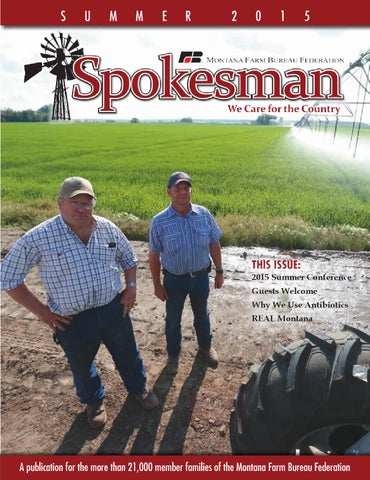
Cover Photo Don Steinbeisser, Jr., with Russel Steinbeisser, talk about the necessity for pivot irrigation on their farm near Sidney. Photo by Laura Nelson.
A REAL Experience
© Copyright 2015. Montana Farm Bureau Federation Spokesman. All rights reserved. The contents of this publication man not be reproduced by any means, in whole or in part, without prior written consent of the publisher. While every effort has been made to ensure the accuracy of the information contained herein and the reliability of the source, the publisher in no way guarantees nor warrants the information and is not responsible for errors, omissions or forward looking statements made by advertisers. Articles and advertisements in this publication are not solicitations to buy, hold or sell specific securities; they are for information purposes only. Opinions and recommendations made by contributors or advertisers are not necessarily those of the publisher, its directors, officers or employees. Investors should be aware that risk is associated with any security, strategy or investment and are advised to seek the counsel of a competent investment advisor before making any investment, or utilizing any information contained in this publication. Subscription, advertising and circulation information can be obtained from the publisher.
For publishing and advertising information, call Kim Morgan at Northern Directory Publishing 800-761-5234 Ext. 205 Printed 7/2015
Guests Welcome
18
4 This Country Needs
5 My Science vs.
6 An Ode to Summer
8 Youth Spring into Safety
9 Why We Use Antibiotics
a Few More Statesman Your Science
16 Energizing the Grassroots 2015 MFBF Summer Conference 23 YF&R Spring Tour – Sheep, Bees and Wine 26 Ag Chat 30 Book Review: Great Horse Stories
eet District 10 Director 12 M Patti Davis
Montana Farm Bureau Spokesman
•Summer 2015
3
EDITORIAL
This Country Needs a Few More Statesman By Bob Hanson, President, Montana Farm Bureau Federation
W
hen one serves his or her country or state, one should be a statesman. The Merriam-Webster Dictionary defines statesman this way: One versed in the principles or art of government; especially: 2: A wise, skillful, and respected political leader. Unfortunately, it seems today in politics that the definition “a wise, skillful and respected political leader” has gone by the wayside. It used to be that our Congressmen and legislators were statesman who would address a problem, develop policy, work with others, and get it done. The key to that statement is “work with others” and “get things done.” Today, unfortunately, if a legislator or Congressman reaches across the aisle to work something out, the rest of the party lambastes them. How dare someone try to reach a comprise that may not fall along party lines—even if that legislation is for the good of the state or the good of the country. I believe if you are elected to office, you need to know your mind before you serve. Does your duty lie in your own ideology? Does it lie with the party you belong to? Or, should your duty be to your state or to the people in your district who elected you? These need to be worked out in your mind before you even run for office and especially before you sit down to vote. When you have nobody working together you have votes forced through by one party or another even if that legislation is more harmful than
4
Montana Farm Bureau Spokesman
helpful. Even among a political party there tend to be ideological differences. What might be on the mind of Democrats in Massachusetts is not what Montana Democrats believe. (I saw a bumper sticker on a Wyoming vehicle—“Proud to Be a GunToting Wyoming Democrat.” That would make any Massachusetts Democrat shudder.) What Republicans in one part of Montana may support, Republicans at the other side of the state may have a different view. Therefore, if an elected official votes strictly along party lines, they may not be representing their constituents. Look at the roll call for votes and you’ll see more often than not everybody in one party voted the same way. There is no compromise. There is no working across the aisle. We used to have elected officials like Mike Mansfield, Jack Galt, Francis Bardanouve and J.D. Lynch who could argue a point and not take it personally. They would vote for what was best for the people of Montana. We need to get back to where our governing bodies are there to serve their constituents. The parties play a role, but they can’t be the ultimate voice. It’s discouraging to see that too often the vocal minority of a party are the ones driving that party’s ideology. Farm Bureau’s policy comes down to what is best for agriculture and best of our state. We are a non-partisan organization. We do not always support legislation that is along the same party lines every time. Yes, in general our membership tends to
•Summer 2015
be of a more “conservative” nature; however, look at legislation we have supported or opposed and you will see that Farm Bureau has supported policy and legislation that was introduced on each side of aisle. We want to thank our members who serve in a political office and especially thank those who understand that always voting along party lines is not what is best for our state. Have a great summer.
Montana Farm Bureau Spokesman (ISSN 08863075) Published quarterly by the Montana Farm Bureau Federation at 502 S. 19th Ave., Suite 104, Bozeman, MT 59718. Periodical postage paid at Bozeman, MT and additional mailing offices. Subscription rates $4 a year covered by annual dues to Montana Farm Bureau Federation members. Non-member subscription $25 per year. Advertising rates available upon request. The Montana Farm Bureau Federation Spokesman reserved the right to reject any advertisements.
POSTMASTER
Send address changes to: Montana Farm Bureau Federation Spokesman 502 S. 19th Ave., Suite 104, Bozeman, MT 59718 Montana Farm Bureau Federation Officers Bob Hanson – President Hans McPherson – Vice President John Youngberg – Executive VP Diana Bailey – Exec Sec/CFO Montana Farm Bureau Board Troy Kurth – District 1 Harris Wheat – District 2 Jennifer Bergin – District 3 Ronda Johnston – District 4 Mack Cole – District 5 Wes Jensen – District 6 Tom DePuydt – District 7 Ed Bandel – District 8 Ken Johnson – District 9 Patti Davis – District 10 Jenny Stovall – YF&R Gretchen Schubert – Women’s Leadership Comm.
EDITORIAL
My Science vs. Your Science By John Youngberg, Executive Vice President, Montana Farm Bureau Federation
I
just returned from the Strategic Policy, Advocacy, Resources and Communications Conference in Charlotte, North Carolina. I was impressed by the caliber of speakers that American Farm Bureau puts together. One of the most notable was Mark Lynas, an author and environmentalist from London. He has authored several environmental books and speaks around the world on climate change, biotechnology and nuclear power.
was climate change were also telling him that GMOs were safe. He found it hypocritical that he should go around the world espousing the dangers of climate change because of the work of those scientists while speaking out against modern technology in crops that those same scientists had deemed safe. He spent many months doing his own research and reached the conclusion that he had been in error when he had preached the evils of GMOs.
The main topic of the talk was him changing his mind on Genetically Modified Organisms or GMOs. He had been an environmental protester that had been arrested for his part in protesting GMOs by destroying crops and research plots in England. Mr. Lynas had two enlightening moments that brought about the change. First, he travels to many Third World countries where the life expectancy still averages 35-40 years. Malnutrition in these populations is rampant due to lack of locally produced foods. The primary reasons for lack of production are pests and drought. He cited two examples of local crops—eggplant in Bangladesh, and bananas and cassava in Uganda. In both instances, crops can be modified to resist the pests and viruses that limit production. Pesticide use could be reduced and production increased, yet the governments of those countries banned or limited the use of the technology. Secondly, and more telling to me was the fact that the very scientists that were telling him that there
Perhaps as important as him changing his mind is that science, which was at one time considered to be above reproach, has now become the battle of your science vs. my science. I think some of the fault lies in computer models. Years ago, before computers, science was the art of using facts and research to reach a conclusion. It was then peer reviewed by duplicating the research several times to make sure the same results were achieved each time. Now we develop computer models that take the place of years of research and which are only as good as the inputs to the model. The results can vary greatly with little change in inputs and are seldom verified before being released to the public. This has allowed special interest groups to pick the result that they want, and then claim that scientific research has proven their point. I will admit, Farm Bureau may not be above criticism in this arena. Although we try to sift through the facts, there is so much information available at ones fingertips that it is extremely difficult
Like most folks, we find people or groups we trust and listen to their advice, but we also must keep looking at other points of view. to determine what is the truth. This does not only apply to GMOs but also to pesticides, water quality, endangered species, climate change and air quality. Like most folks, we find people or groups we trust and listen to their advice, but we also must keep looking at other points of view. If we continue to listen to the same preacher we may miss an important part of the message much like Mark Lynas. In the words of Ronald Reagan “We must trust but verify” if we are to continue to be the “Voice of Agriculture.”
Montana Farm Bureau Spokesman
•Summer 2015
5
AN ODE TO SUMMER By Mariah Baumann Shammel
A
h, summer. The time of year when kids get to sleep in, good old-fashioned porch-sitting is at its peak, and vacations fill the calendar. At least that’s what I hear...but if you’re anything like us, summer has a different meaning.
The latest our kids have ever slept in was 8:30 and I was so worried, I kept checking on them to make sure they were still breathing. Even though we hang out on the front porch, it’s usually Mariah (foreground) on a fun-filled to get the dog hair family vacation in Germany. off the porch furniture and to deep breathe while Little Lady attempts to navigate our century-old stone steps with her not-sostable Thumbelina feet. As far as the “getting away” part goes, however, Favorite Farmer and I are making a real effort to schedule some getaways for our family this summer. It’s hard to find time in between haying, harvest and everything in between but even one day away from the pressures of the ranch staring us in the face does our family good. I’ve always loved traveling and for the amount of money my family didn’t have growing up, we were able to do a lot of it. I was born in Washington so my family always made trips home to Montana to visit grandparents but at the age of two, my horizons broadened immensely when my dad’s job moved our family to Bad Soden, Germany. We were only in Germany for three years but because of its proximity to the rest of Europe, we were able to drive to Austria, France and other surrounding countries like we drive to Wyoming and Idaho nowadays, and everything we did, everywhere we went, our family was together. I don’t think we have added any more stamps to our passport as a collective family upon returning stateside (though we’ve each done our fair share separately) but our parents still made it a priority to get us on the road/plane as much as financially possible throughout the remainder of our childhood and I am so grateful. I realize that ranching is an all-in type of living and that moving our family overseas isn’t a likely option but I also realize that the memories I have of our road trips, day-long excursions and spur-of-the-moment getaways during my teenage years are just as poignant as the picturesque adventures we took overseas.
6
Montana Farm Bureau Spokesman
•Summer 2015
One of the things I love about my family is even though we haven’t taken any extravagant trips as a family unit of late, we always make it a priority to get together. Within a month of Little Man and Little Lady entering this world, and my sister’s three kids being born, my entire family had made their way out to Hilger and Nashville, respectively, to visit the newest additions to the Baumann clan. When my sister and her husband went on a ten-year anniversary trip, the rest of us congregated in Billings to join forces and watch her three children. When Dad turned 60, I met my brother and sister at the airport, who had flown in as a surprise for the occasion. I can’t remember a Thanksgiving or Christmas where we all haven’t gotten together since my brother graduated from high school in 1994. (With my brother in Washington, D.C. as a legislative director, my sister a busy mom of three in Nashville, TN and our crazy farming/ranching schedule, that really says a lot.) The overwhelming sense of family and togetherness that my parents instilled in all of us is something I want our children to grab onto. I always think of how gratifying it must be for my parents to see all of their children and grandchildren make such an effort to willingly spend as much time as possible together, even when (occasionally) they themselves can’t make the trek. I hope that in thirty years it will be Favorite Farmer and me listening to our kids and grandkids argue over who gets to host the next Shammel Shindig and if we are, I bet we’ll have grins on our faces. I feel very lucky to have been able to explore places and togetherness that my parents most people will instilled in all of us is something never get to visit and someday, I want our children to grab onto. I would love to take my better half and the kids across the pond to show them around my old stomping grounds. If that never happens, though, it will be okay because even adventures like barbecues on the mountain, spending a weekend at the cabin and random road trips to dig for fossils will fill our little ones with memories too. I doubt they’ll always be good memories but at least they’ll know that everyone had to suffer through it together.
The overwhelming sense of family
We may spend our summers a little crabby from being awakened by the sun too early, by being a touch sunburned from not spending enough time on the covered front porch, and from having to delay a weekend getaway, but at least we’re doing it as a family.
One Agent for Life and Annuities and Farm/Ranch Succession and Estate Strategies
All from one agent. We take simple seriously. Learn more at FBFS.com.
Farm Bureau Life Insurance Company*/West Des Moines, IA. *Company provider of Farm Bureau Financial Services M121 (1-15)
F131-040080-02_PrintAd_MT.indd 1
5/29/15 2:25 PM
YOUTH SPRING INTO SAFETY In the spring, at the end of the day, you should smell like dirt. ~Margaret Atwood
S
pring is the beginning of the Farming Cycle, and the feeling of being outside and starting the cycle is refreshing. However, there are a lot of hazards due to working with Mother Nature, livestock, and motorized equipment. Most farming activities are done by the farm or ranch owner and their families or seasonal workers. A lot of the seasonal workers are youth under the age of 20. Statistics estimate there are 749,000 youth nationwide employed by farm and ranches. Of that number 230,000 are considered seasonal. According to the National Children Center 2014 Fact Sheet; Every three days a child dies in an agriculturalrelated accident (73% from vehicles and machinery), and 38 are injured daily.* Farm injury prevention starts with instructions and guidance from the farm or ranch owner. Take the time to make them aware of the dangers present when working with machinery, tools, or animals. Since motorized equipment tops the list of injuries and death, here are some helpful reminders to pass on to your young workers. Recognize some common hazards:
• Pinch points are where two parts move together. Don’t wear loose clothing around these points and never reach into this area. • Wrap points are exposed rotating shafts. Once any material or digits are caught by the shaft—there is no escape. • Shear points are where the edges of two parts move against each other like scissors, i.e. rotary mowers or sickle bars. • T hrown objects are any machinery that can propel objects or debris. • Freewheeling are parts that may continue to rotate for a few more minutes after the power is off such as blower fans or flywheels. • Crush points are when two objects move toward each other or an object moves towards a stationary object. Examples are jacked-up equipment, overhead garage doors, or hitching implements to the tractors. The best way to prevent the injuries is to take the time to walk around the equipment and explain these hazards and the parts they must be cognizant of avoiding. A good rule of thumb is to tell them the most important thing you can do when working is to think about the action before you do it – good advice for all of us. Have a safe and fruitful spring, summer, and fall. * National Ag Safety Database was referenced for this article.
Providing farmers and ranchers personalized insurance services for over 65 years. Trust experience.
SEASONS CHANGE AND SO DO YOUR INSURANCE NEEDS 931 Boulder Drive • Laramie, WY 82070
8
Montana Farm Bureau Spokesman
•Summer 2015
Contact your local agent today or visit us online at www.mwfbi.com
Why We Use Antibiotics By Travis Choat
When our children get sick with an ear infection, strep throat or other bacterial illness and their doctor prescribes antibiotics, we are thankful to be able to give them antibiotics to help stop their pain. It’s our job to use the best pharmaceutical technology available to keep our children healthy – and we treat our cattle no differently.
The Choat Family.
T
here are three primary reasons we use antibiotics in our herd health program at Homestead Cattle Company, a cattle backgrounding and farm business near Terry, Mont., owned by my wife, Tamara, and I.
General Animal Health and Welfare First and foremost we use antibiotics to improve the health and welfare of the cattle under our care. We don’t look at a sick animal or a high risk group of calves and decide to use antibiotics to improve their performance – we use them to get them healthy. A healthy animal will be a better performer and antibiotics are needed to keep them healthy.
We believe strongly the technology and science are sound and that the use of antibiotics are effective, safe for the animal, safe for the environment and safe for the people that consume the meat. There are three reasons why we believe this: 1) We work with professional veterinarians whose job it is to be familiar with the science and process by which these products are made available to us.
Montana Products
POWDER RIVER MEAT COMPANY
P
owder River Meat Company was established in 2013 by Travis and Tamara Choat when they bought a custom butcher shop in the small town of Terry. Bill Klunder works as operations manager and oversees the day-to-day management of the shop. The majority of their business is custom livestock processing for area ranchers, but they process wild game and operate a retail meat counter. The business has grown from operating with two previous owners to employing two full-time, several part-time and additional seasonal employees, adding approximately five full-time jobs to the small town of Terry. The customer base ranges from the Montana Hi-Line to the Dakotas and Wyoming, and many out-of-state hunters.
2) We educate ourselves on the science and process as well so that we can properly communicate with our veterinarian. 3) Through experience we observe positive outcomes in animals treated with antibiotics and we observe no negative side effects for the animals themselves or the people that consume the meat. Continued on page 10
Anitbiotic use can make the difference between life and death when cattle face illness or extreme weather.
The Powder River Meat Company crew: Grant Klunder (former employee), J.C. Corneliusen, manager Bill Klunder, and owners Travis and Tamara Choat with children Karity and Will.
Working with the Montana Department of Agriculture Growth Through Agriculture program and the Red Ants Pants Foundation matching grant programs, as well as personal investments, they have made extensive improvements to the facility to improve food safety and overall efficiency. They rebranded the store with signage and installed a new retail meat counter and waiting area. They have purchased new equipment, rebuilt the harvest facility livestock handling system, installed a compressor/cooler unit and remodeled the cutting floor, and purchased a set of refrigerated trailers to begin converting into a mobile processing unit. Continued from page 10
Montana Farm Bureau Spokesman
•Summer 2015
9
Why We Use Antibiotics By Travis Choat
Continued from page 9
We believe strongly the technology and science are sound and that the use of antibiotics are effective, safe for the animal, safe for the environment and safe for the people that consume the meat. Business Sustainability We need to keep our cattle and our customers’ cattle alive and healthy or we simply wouldn’t be in business. We depend upon technology such as
antibiotics to do this. At our feedlot we got into a wreck a few winters ago with some sustained -40 degree weather in November and December at the same time we had a Somnus outbreak in a group of calves. Had we not had access to professional veterinarians and nutritionists, as well as technology such as antibiotics and vaccines, we would likely not still be in business today. With the value of calves these days, you just can’t afford to lose them at the rate you would without pharmaceuticals.
Continued from page 9
The goal for the business is to gain USDA Federal Inspection so the Choats can process and sell their own beef as retail meat. All retail product currently sold is purchased as boxed product that has been killed in an inspected facility. “We feel the custom livestock processing business provides a very valuable service to this ranching area,” said Travis Choat. “However, we would like to continue to build on that business model by adding inspection. It will open many more doors for our own feedlot and other ranchers who market quality Montana beef.”
Technology Helps Feed a Hungry World We may not see it every day, but the population around the world continues to grow and with that more and more people are rising out of poverty, as they do they are going to want more meat, milk and eggs in their diet. Safe technologies and practices such as: using new, innovative tools and products; and technologies and genetics that enhance desired traits in plants and animals, will play a key role in meeting this need. J.C. Corneliusen bones out a leg of beef at Powder River Meat Company.
BILLINGS • GREAT FALLS
Quality for Life The highest quality homes in the region for over 40 years. Largest Display | Best Selection | Best Service
PierceHome.com | Billings 888-868-3936 | Great Falls 888-632-1023
10
Montana Farm Bureau Spokesman
•Summer 2015
Montana Farm Bureau Spokesman
•Summer 2015
11
Meet District 10 Director Patti Davis
T
rying to catch up with Patti Davis poses unique challenges. This busy rancher/realtor/ hostess/volunteer is on the go, and this November she was voted to the Montana Farm Bureau Board of Directors during the MFBF Annual Convention. Davis is no stranger to agriculture. She was raised on her family’s Rollin’ Rock Angus Ranch in Belgrade where she learned all about livestock, business and hard work. She graduated from Western Montana College, did some graduate work in elementary education and started teaching. “Then I got married and started having kids, so there went my career as a school teacher,” Davis states. Davis kept close ties with her family ranch. “In 1976 my dad, Dale Davis, sold the Rollin’ Rock Ranch to my brother, Bill. In 1986, I went into partnership with my dad and the PAPA Ranch. We raised registered Angus until we sold that herd in 1998,” explains Davis. “That herd actually went to Texas, so then I did consulting and herd management until I was able to bring some cattle back to Montana. I still own cattle and my son runs them in Wyoming. I have five grandkids, so of course I go travel to Wyoming to help as much as possible.” The Belgrade resident stayed active in the cattle business not only by owning cattle, but studying and planning genetic mating for the Angus industry. “I would examine the genetic makeup of a herd and choose the best bulls for the rancher to breed his cows. It was very interesting,” Davis says. Davis continued to stay busy, becoming a real estate broker in 2005, running her own company, PEDE & Associates, which not only sells real estate, but also offers land management servies. Davis, who has served on both the Gallatin County Open
12
Montana Farm Bureau Spokesman
Lands Board and Planning Board, is an accredited land consultant. “It’s important in the Gallatin Valley that farmers and ranchers have enough property to have sustainable operations. This often means leasing property from out-of-state landowners. I manage some of those properties and I try to give good advice. It’s important to talk to landowners and convince them livestock is good. That’s a huge challenge. They need to know we use livestock to control weeds and manage forage. The wildlife like the green grass, too. If you don’t graze forage and it tents, the only thing that will grow are weeds.” Davis believes in working with young people on several levels, from assisting younger farmers and ranchers make their operation viable and sustainable, as well as educating youth on the importance of agriculture. “I love helping with the Gallatin Valley Farm Fair, and I will help with anything the organizers need,” Davis says. “It’s important to be involved in activities like the Farm Fair to get the knowledge to the kids about where their food comes from. It’s an eye-opening event for a lot of little kids. They don’t have a clue. If you haven’t been involved in one, I recommend it. At our Farm Fair for fourth graders, we work with the FFA students to lead the kids around. These kids are at the age where they will go home and tell mom and dad what they learned. We need to tell our story.” “I want to tell my story. That’s why I’m involved in Farm Bureau, as well,” says Davis. “It’s so important not only for kids to hear about agriculture, but to speak out at the legislature. It’s important to have a voice at that level. Farm Bureau has a strong voice in the legislature. I want to make a difference. I am especially interested in private property rights and livestock issues.”
•Summer 2015
Montana Farm Bureau District 10 Director, Patti Davis. Davis was elected to the board at the MFBF Annual Convention in November 2014.
In addition to being active with agricultural organizations, Davis does volunteer work through the Belgrade Chamber of Commerce, and was active in the sports scene when her children were involved. Along with being involved in your local community, she believes one should take advantage of what the world has to offer and have an open mind. “I traveled to Argentina and Brazil on a tour. It was the best. Ag is everywhere. The world today is smaller than it used to be. Get out there and see what farmers and ranchers in others states and other countries are doing,” Davis advised. (At the time of writing this story, Davis was in Scotland looking at black cows.) Davis hosts plenty of gatherings at her lovely country home. One time she might be holding a graduation party or the PEDE Christmas party. On June 13, she hosted a picnic with the Gallatin County Farm Bureau and the Gallatin Beef Producers. If you don’t catch up with Davis at her home or at a community event, look to the open road. You just might see her with her camper or cruising past on her motorcycle.
Meet Mountain West Agent Matt Korell
M
att Korell grew up in Lovell, Wyoming in a rural setting with an appreciation of agriculture. His career path began differently than most insurance agents—he has a degree in Mortuary Science. Following graduation he was headed north for a job with Stevenson Funeral Home in Miles City, where he worked for four years. “However, I was having some health issues and needed to go into Billings for treatment, so I ended up driving with someone who was an insurance agent for another company. While we were driving, he’d talk about insurance, and he said if I decided to make insurance a career, to go with Farm Bureau,” says Korell. “I met with Terry Sivertson, heard about Farm Bureau Insurance, and decided that was the path I wanted to take. That was seven years ago.” Korell opted to stay in Miles City to set up an office which now includes his office manager Ashley Lee, and recently hired agent Justin Venn. Korell’s office can handle all of their clients’ insurance needs, not only in town, but on many farms and ranches across the area. Their territory covers Miles City to Broadus as well as the Colstrip area. “I’m working to get the Farm Bureau name out in Garfield County,” notes Korell. “I know the Federation is trying to grow some new county
Farm Bureaus (Phillips County being recently added to the Farm Bureau family), and I’m hoping to get some interest on the insurance side. I am advertising in Garfield County, and it would be great to see that area grow with Farm Bureau members and I admit, it’s great to go there as it’s on the way to the lake!” Korell is busy with work and raising three kids, but he helps with Federation projects, such as hanging up MFBF’s animal care signs during the Miles City Bull Show, as well as attending county Farm Bureau meetings. “I really enjoy working for Farm Bureau and meeting new people,” says Korell. “I enjoy taking care of people’s needs and putting their minds at ease that they are insured properly. I learn a lot from policyholders on farms and ranches. I didn’t grow up in agriculture, but I certainly have gained a wealth of knowledge. I’ll tease my customers by telling them that I didn’t grow up on a farm or ranch so when they tell me they just bought a John Deere 7330, I have to Google it. I know what a John Deere tractor is, but as far as the model, not so much!” Korell urges his clients to participate in the annual insurance review. “A lot of companies don’t do it, but it’s very important. Farmers and ranchers are so busy they will buy equipment or put up a building and forget to insure it. So at the review,
Matt Korell, MWFBMIC Agent
they suddenly remember to tell me they bought a tractor six months ago.” The agent explains although property and casualty play a huge role in insurance, so does life insurance and estate planning. “We encourage everyone sit down and have an honest conversation on estate planning to ensure the family farm stays the family farm. We have access to intelligent minds within Farm Bureau Life who do this day in and day out and can advise on a full range of different scenarios. We’re happy to talk to people about it.” Korell says when he gets questions about Farm Bureau policy, he always lets his clients know that Farm Bureau is on agriculture’s side. “I tell them MFBF is doing what’s best for our farmers and ranchers. “
Montana Farm Bureau Spokesman
•Summer 2015
13
A REAL E xperience By Rebecca Colnar
W
hen Cindy Denning signed up for REAL Montana, she didn’t quite imagine herself standing in Tiananmen Square or seeing the Great Wall of China. What she did realize was that she would be honing her leadership skills, gleaning a new perspective on Montana business and meeting new people. “After seeing the advertisement for REAL Montana and noting that Montana Farm Bureau was a sponsor, I suggested that my husband should check it out,” explains Denning. “He said he didn’t have time and I should check it out. With 20-plus years in farming and ranching and 10 years in construction that included wind farm and oilfield work, I thought it would be a great program for me to learn more about Montana with leadership skills and included international travel.”
and global trade. REAL Montana addresses energy development, leadership development/mentoring, communication skills, economics and policy, international trade, urban/ rural relationships, labor and production costs, regulations and permitting and transportation and water issues. Montana Farm Bureau is a major sponsor, and several Farm Bureau members were in the first program. The program features eight in-state seminars held in rotating locations across Montana. In Year One, participants also travel to Washington D.C. for a four-day national seminar. Year Two includes a 10-day international trip. Each in-state seminar is approximately two days in length. “I learned a tremendous amount about the other industries outside of agriculture and how important they are outside of our state,” said Blain. “It seems that everyone involved in the natural resource industries are fighting the same battles.”
Former Carbon-Stillwater County Farm Bureau President Scott Blain applied because the former teacherturned-full-time farmer wanted to keep learning. “I wanted to keep building on what I did when I was teaching,” noted Blain. “I missed being involved in the learning process, and the international travel aspect was especially appealing.” The Resource Education and Agriculture Leadership (REAL) Montana is a comprehensive two-year program offering in-depth education and training in the agriculture and natural resource industries. The program was developed for the purposes of educating leaders and future leaders about resource industries which are facing unprecedented change due to new technologies, consumer preferences, environmental concerns, government regulation,
14
Montana Farm Bureau Spokesman
Blain found the media training to be extremely helpful. “We learned how to do a good interview, and how to handle the media which is very important if you want to get the word out about your industry.” He adds, “It was interesting to hear what representatives for the logging industry in Kalispell had to say. We learned about the advocacy they’ve needed to promote their industry that has been under attack from the environmental movement for 20-30 years. As for other seminars, the legislative one in Helena was excellent. We learned about how state government works and had a very good, genuine meeting with Governor Bullock.” Denning, who currently serves as Cascade County Farm Bureau Secretary/Treasurer, chuckles, saying she “was not wild about the media training in Billings but can say I use that training all the time. Not that I’m in the media all the time but I have gained valuable skills for speaking up when I am called upon.
The REAL Montana class at the Freedom Statue at the U.S. Capitol in Washington, D.C.
•Summer 2015
“I learned a tremendous amount about the other industries outside of agriculture and how important they are outside of our state. It seems that everyone involved in the natural resource industries are fighting the same battles.” Blain. “However, I also learned how important is it to be a better member in my community, whether it’s helping with fundraisers or planning an event. It’s essential to, get people engaged. When you hear that the world is run by those who show up, it’s true. I plan to be one of those showing up.” Farm Bureau member Breahna Lawrence, front left, at the media workshop at KTVQ in Billings.
Really, every seminar I went to was my favorite as we went along.” “As the seminar leader in Sidney, seeing all of the new innovation at the drill rigs where ‘flare’ gas is being used to power the drilling rig and how the excess gasses are being injected into foam pellets and shipped to China for energy sources were exciting to see,” noted Denning. “To add value to waste products only proves that the oil and gas industry is forward thinking with a conscience to world demands.” Of course, a trip to China in January was the pinnacle of the two-year program. “Everything about China was incredible,” said Blain. “It really was a unique and interesting country.” Denning found the trip to be amazing. “The one aspect about China that I found particularly interesting was how friendly the people were and how they are very interested in the United States. They knew more about the USA than we did about China but their knowledge is from TV,” chuckles Denning. “Wherever
our group went someone would ask for a picture with one or more of us, we obliged them but I did wonder who they thought we were from American television. With beautiful, well stocked grocery stores and “wet” and dry markets, the city dwellers can shop daily or dine out but the rural folks are on a quest daily to secure their food. To have to concentrate that intently just for survival made me thankful for the food security in our country.”
“Being in REAL Montana was a valuable experience for me,” noted Denning. “With each seminar, I could see firsthand the thread of commonality each industry has including regulations, permitting and constantly changing rules. The coal industry, malting plant, timber, oil and gas, grain and cattle producers are all being choked by similar regulations. To see that and learn from the ‘Best of the Best,’ plus gain the knowledge to go toe-to-toe with the naysayers—REAL Montana gave me so much more than I signed up for.”
“The Great Wall of China was a once in a lifetime moment and meeting four ladies from Texas there was funny. We asked them to take our picture with the Montana flag and we took theirs with the Star of Texas!” Denning remembers. Being involved in REAL Montana made a true impact on attendees. Both Blain and Denning took away lessons to last a lifetime. “I will always be active in the agricultural industry, and this program taught me that those people in the resource industries outside of agriculture need to work together,” said
Cindy Denning points out The Bund in Shanghai.
Montana Farm Bureau Spokesman
•Summer 2015
15
TOURS
2015 MFBF Summer Conference Highlights
T
he 2015 Montana Farm Bureau Summer Conference in Sidney proved successful with everyone learning in the workshops, enjoying the tours and having a great time raising money for the Foundation at the Baron’s Ball and the golf scramble. The theme “Energizing the Grassroots” reflected the energy boom taking place in the northeastern part of the state and was addressed by some of the seminar topics.
Ed Bandel and Bruce Yanzick warily inspect the Mormon Cricket. The USDA ag research facility is doing research on Mormon Cricket and grasshopper eradication.
The Baron’s Ball saw members purchasing shares in railroads, timber, cattle and land, with the shares often changing in price. Members had to stay alert and make wise investment decisions! In addition, each Farm Bureau District had a basket full of great stuff that was auctioned off later in the evening. Thursday’s Foundation Golf Scramble was also deemed a big success. The tours included stops at Safflower Technologies, the U.S. Department of Agriculture Northern Plains Agricultural Research Laboratory and Rambur Charolais.
WORKSHOPS AND COMMITTEE MEETINGS
T
he main purpose of the Summer Conference is for issues advisory committees to discuss concerns and make policy recommendations to their county Farm Bureaus for potential policy resolution development in the fall during county annual meetings.
The Animal Health/Livestock Committee covered industry topics such as COOL, livestock buyer bonding and raw milk.
Richland County Commissioner Shane Gorder talked about the pros and cons of the oil boom in the Sidney area including infrastructure concerns. Don Steinbeisser, Sr., Greg Breuer and Patrick Hackley shared their experiences on how the boom has affected their businesses and farm/ranch operations.
16
Montana Farm Bureau Spokesman
Ben Larsen, Safflower Technologies International, explains how 80 percent of the safflower produced by his company goes to the wild bird seed market, where only 20 percent is used for oil.
Howard Rambur, owner of Rambur Charolais, explains how they breed bulls for temperament and calving ease. Their RC Feedlot specializes in feeding bulls.
MEDIA
Veterinarian Jeanne Rankin demonstrated how a contagious disease such Foot and Mouth can rapidly spread across farms, and talked about how Agro-Security Planning can minimize the spread of a disease.
•Summer 2015
Lane Nordlund, Northern Ag Network, inte bein. Rehbein, a past MFBF Board Member,
PEOPLE
BARON’S BALL
M
embers were urged to dress up in “turn of the century” garb for this fun Foundation fundraiser.
Montana Ag Safety trainer Jim Larson visits with Judith Basin County Farm Bureau member Pat McNulty.
Jim and May Ann Steinbeisser and Charlene and Larry Switzer take a break at the Baron’s Ball.
Costume contest winners Lane Nordlund and Kayla Bandel.
North Dakota Farm Bureau President Doyle Johannes visits with MFBF President Bob Hanson during Tuesday evening’s dinner.
Two wild and crazy patriots: Patrick Hackley and Gil Gasper
GOLF TOURNAMENT
T
he MFB Foundation Golf Scramble and Calcutta, along with the Ag Tours and Baron’s Ball raised over $14,000 for the Foundation. Thanks to the support of our amazing members!
Darcia Patten shows her investment of shares.
The winners Erick Arens, Tom Cunningham, Kevin Gillaspie. Not pictured is team member Lew Zimmer.
Ken and Cyndi Johnson get in the spirit of the occasion.
Helen and Bob Hanson with Jenifer and Wayne Lower.
erviews Don Steinbeisser, Sr. and Bill Rehr, helped recruit speakers for the event.
Not admitting their golf scores are John Youngberg, Patti Davis, Tom DePuydt and Todd Wolff. Harris Wheat and Bruce Yanzick bid on baskets.
Montana Farm Bureau Spokesman
•Summer 2015
17
Guests Welcome Spokesman Editor Rebecca Colnar looks at two agricultural operations that welcome guests. The multi-generational Sweet Grass Ranch near Big Timber combines a working cattle ranch with a guest ranch to create an amazing experience for people all over the world. Bret Aye, Aye Pumpkin Patch, offers an opportunity to pick your own asparagus and pumpkins, and catapult pumpkins at a junk car.
GUESTS IN THE SWEET GRASS
M
any ranchers have the rich heritage of running sheep and cattle across the wide-open spaces and majestic mountains of Montana. However, not as many can claim generations of operating a successful guest ranch. The Sweet Grass Ranch, which sits near the base of the Crazy Mountains, has been taking in guests since the 1920s and its sixth generation of “dude wranglers” is coming on strong. The family ranch began in the 1880s, with the guest ranch story starting in 1922 when the Van Cleves started one of the first guest ranches in Montana. “My great grandmother came from New York. She had a lot of friends come out to visit so my grandpa told her that had to stop or people would have to start paying. It actually became a reality,” says Page Dringman, who is the fourth generation and who, along with her husband, is instrumental in the smooth running of the guest ranch. (The Van Cleves were founders of the National Dude Ranch Association.) Developing the guest ranch into what it is today took work and ingenuity. “In the 1950s, my grandfather owned land south and north of the Crazy Mountains,” explains Dringman. “The Brannin Ranch, which is where we have our guest ranch today, came up for sale and my grandfather bought it to use for grazing. The Brannins had a short spell of running a guest ranch, but it didn’t work very well for them. There was a big family house and smaller cabins, so it seemed a natural for us to run it as a guest place.”
18
Montana Farm Bureau Spokesman
•Summer 2015
Guests have the option of helping move cattle to summer pasture.
In addition to acquiring the Brannin Ranch, Dringman’s grandfather bought the buildings (some are on the National Register of Historic Places) at the Lazy K Bar K Guest Ranch in Big Timber. “At that time, my mom and dad, Shelly and Bill Carroccia, were teaching in Alaska, but grandpa told them he had acquired a guest ranch and buildings and didn’t know what to do with them so they should come home,” explains Dringman. “In 1965, my parents not only started their own guest ranch in Sweet Grass Canyon but bought my grandparents ranch.” The history of Sweet Grass Ranch is not only part of the family, but of their guests, as well. “When we first started our guest ranch, we took unchaperoned teenagers for 12 years. As times changed, Bill and Shelly began taking adults and families in the mid-1970s in addition to the teenagers. When the Carroccias purchased the neighboring Otter Creek Ranch in 1972, they opened their doors to allow guests to take part in the experiences of a working ranch. With Otter Creek Ranch serving as an established cattle operation, and Sweet Grass as a guest ranch, the two ranches complement one another. The cattle graze on the Sweet Grass Ranch lands in the summers, and Sweet Grass guests take part in the everyday cattle operations and cattle drives. “Initially, the former guests from the Lazy K sent their kids to us. Today, some of those kids have come back as adults with their children,” explains Dringman. “Most
of our guests hear about us by word of mouth or they are repeat guests. We have some people who come every year. We still do some magazine advertising and also market through our website.” Dringman explains that having guests is natural for the family. “My dad says that the best cross that ever happened was a mama cow and a guest,” Dringman chuckles. “It provides a great opportunity to educate people about ranching. Taking in guests also helps us survive the ups and downs in agriculture.”
A Great Vacation A ranch package includes lodging (either a cabin or a room in the main house), meals, a horse and entertainment in addition to fishing, hiking and camp trips. At certain times of year, guests can participate in a cattle drive as the family takes cattle from the home ranch to summer pasture. This experience offers a three-night campout complete with wall tents and a chuck wagon. Horses play a large part in the ranching operation. “We try very hard to match riders and horses from all skill levels and we offer horsemanship clinics,” says Dringman. “We have 60 horses and 25 guests per week. Many of our activities revolve around riding.” Unlike dude ranches where people ride horses nose-totail trails and see nary a cow, there are opportunities for guests to move cattle and come along while the family goes about their daily ranch chores, whether putting out mineral, fixing fence, spraying weeds. Some even take a strong interest in seeing how a pivot works. “This experience provides a great opportunity for us to discuss issues of concern,” explains Dringman. “They learn about elk damage and about the tension swirling around private and public lands. They realize that we don’t overgraze our land, and that we work hard to be good stewards. They hear about rotational grazing and the fact that cows need to graze to gain weight. We just don’t move cows to move them. They begin to understand how we live and gain a real appreciation for what we do.”
Guests at the Sweet Grass Ranch can choose to stay in the main lodge or in a cabin.
own that much land, and you can ride all day and not see anyone,” Dringman says. “The way we handle our horses is so different, as well. They’re not kept in stalls, the horses don’t get a bath when we get done riding, and in the winter they basically run wild. They are amazed the horses survive the winter.” Shelly Carroccia explains that most of the horses the Sweet Grass ranch has are good natured. “Our horses like people. We primarily get our horses from our Melville neighbors. We’re different from a dude ranch in that we get people working with their horses. “ If the beautiful scenery and good horses keep people coming back, but not far behind those reasons is the good food. “We use a lot of local food including field mushrooms and rhubarb and local meats. We buy quite a bit from our neighbors,” says Carroccioa “We even have fresh cream and homemade bread and pastries. Folks can order lunch sandwiches, and we have a big breakfast buffet and hearty dinners.” Running a guest ranch takes plenty of help. The Sweet Grass Ranch hires 10 people per season including two cooks and wranglers, along with a few volunteers and Continued on page 20 family help.
Dringman notes the appeal of their ranch to many guests is that there are multiple generations for the family involved. “One of the reasons people return is because of the sense of family we have here, as well as the stunning scenery. “They are overwhelmed by the mountains and the open spaces. We don’t have a lot of restrictions on what they do. “ Agricultural education not only reaches guests who hail from the U.S., but overseas, as well. Foreign visitors come from the United Kingdom, Germany, France, Italy, Belgium, Russia and South Africa. “Our foreign visitors appreciate the concept of space and private ownership of land which is so different from what they know. It’s difficult for them to believe people
Everybody loves spending some time around a campfire.
Montana Farm Bureau Spokesman
•Summer 2015
19
Guests Welcome Continued from page 19
When the families—and their kids—aren’t working on the guest ranch, Dringman is an attorney in Big Timber, her husband, Pat, is the Sweet Grass County Attorney. Her brother Tony has a log construction business and works on fire hazard reduction (he also provides entertainment at the guest ranch), while brother Rocco and his wife, Annie, primarily run the cattle ranch. Her other brother, J, is in the military and lives in California with his wife and kids. “You have to be diversified,” says Dringman. “You can’t just depend on the guest ranch as your only business, but the guest ranch business has saved our cattle ranch and has made everything pay.”
the cattle ranch in Melville. The place will sit empty for 8 months, but as the guest season looms (first visitors show up in early June), buildings are repaired, horses get shod and the place comes to life with the arrival of excited guests. “It’s a great business and has been so much fun. We look forward to it every year.” To find out more about Sweet Grass Ranch visit www.sweetgrassranch.com.
CATAPULTING PUMPKINS—AND OTHER PRODUCE
For others thinking they want to add a guest component to their ranch, Dringman cautions to start slowly. “We were fortunate that we grew up with it so we had the buildings and facilities,” she explains. “If you are starting from scratch, it will be a real endeavor. Start small and see if you like it. There is a real draw to the west and there is romanticism to ranching. Keep in mind that this is a customer service business and you need to be patient. You will need to address liability, so make sure you work with an insurance company to have the appropriate disclosures and forms acknowledging the risk. Make sure you do a safety analysis of riding abilities and have a variety of horses for different levels.” Dringman explains that having good neighbors is important, as well. “We couldn’t do this without our amazing neighbors. They are very supportive. We help them and they help us.” Through the years, Dringman has been active in Farm Bureau and the legislature. “I have lobbied on some Farm Bureau bills and have worked with our Sweet Grass County Farm Bureau. There are a lot of issues with our ranch and the guest ranch—liability issues, water rights and property rights. Farm Bureau is a great organization and it’s important to have the leadership they provide in Helena and Washington, D.C.” Dringman explains that as the guests learn, they take a personal interest in those issues. “We’ve had a number of guests say they’d be happy to write letters or testify on a bill that we’re supporting or opposing. Having this guest ranch provides a fabulous opportunity to educate people and let them know things like why we are not enthusiastic about free-roaming bison.” After the season end, shoes are pulled off horses, buildings are winterized and the family heads back home to
20
Montana Farm Bureau Spokesman
•Summer 2015
Bret Aye and his old John Deere.
P
icture large orange pumpkins sailing through a blue sky, then landing with a crash on a junk car. Is it some crazy movie? No, it’s October at the Aye Pumpkin Patch in Miles City. Every year, pumpkin patch owner Bret Aye ponders new ways to have some fun with his pumpkin crop. The “pick your own pumpkins” is fun for the family, with kids dashing around the field selecting the very best for jack o’lanterns but once that fine pumpkin is selected, it’s time to carry a few less worthy ones over to the trebuchet and let ‘er rip. (Aye’s over-an-acre patch averages 33,000 pounds of pumpkins, so sending a few to thunk and splat on the hood of car is not a bad thing.) “Every year Frank’s Auto Body donates a junk car we lob pumpkins at,” explains Aye. “Last year I had the idea to get a crane to come in and drop a really large pumpkin on a car. The problem was that the release on the rope on the crane didn’t quit release as quickly as I had planned, so the pumpkin didn’t free fall from 50 feet high. It was more of a slow drop. I have a few ideas to make it work this year.”
The Miles City farmer is no stranger to truck farming. His father started selling sweet corn when Aye was 10 years old. Although the family had a wheat farm north of Kinsey, they sold it during the drought years and Aye began operating heavy machinery. But when his son turned four, Aye decided it was time to bring the Aye Pumpkin Patch back to life. “I’ve been growing pumpkin ever since for 30 years,” explains Aye. “Pumpkins need plenty of water to start, but once the vines get matted then you don’t have to pull weeds anymore. I’m surrounded by water on three sides so there is plenty to use pulled by a pump out of the Tongue River.” Aye grows pumpkins from mini to giant. Last year he grew an 800-pound pumpkin and is hoping to top the state record this year of 1,200 pounds. “We start October 1 with our pumpkin harvest. Pumpkins grow the best when it’s 80-90 degrees, but once you hit 110, things go south in a hurry. Our pumpkins sell for .25 cents a pound no matter how many pumpkins or what size someone gets,” says Aye. “I have an antique scale to weigh the pumpkins. I really try to make the harvest last until Halloween, but last year I ran out. It’s very true that most pumpkins are worthless after Halloween. I grow some pie pumpkins, but mainly, they are for jack o’ lanterns or Halloween decorations.” Although the pumpkins might be the most entertaining of the produce grown by Aye, he has one other pickyour-own crop: asparagus. “I planted asparagus six years ago. It takes three years before you can start picking on it,” notes Aye. “Its biggest drawback is it’s inconsistent. It might be perfect one day and then stops growing. If you don’t have a customer selected the day its ready to pick, it won’t keep its quality, and I don’t have the refrigeration needed to keep it fresh. I’m hoping to find someone at the Farmer’s Market who has refrigeration and would be able to pick it and keep it fresh for the Farmer’s Market.” Aye says this year has been an extended growing season for the asparagus because it came up early. “Usually it’s ready to pick around Bucking Horse Sale (third weekend in May), but this year it was producing spears a month earlier. Of course, being April, we had one night where it got to 26 degrees and it turned to rubber, so we had to start over.” In addition to the you-pick asparagus and pumpkins, Aye grows sweet corn, potatoes, peppers, cucumbers, cantaloupes, and early maturing Norland Red potatoes for the Miles City Farmers Market. “Generally speaking, sweet corn is ready by the end of July and early August. People have wanted me to do a corn maze, but I don’t have the gear or market for field corn. I could grow sweet corn and then try to make corn maze out of it. This year I’m trying a new variety that will grow eight-feet tall. The ears are almost three feet off the ground, and I’m
Families enjoy a Fall stroll looking for the perfect jack-o-lantern.
thinking that might make a good maze.” Aye only plants four rows of corn at a time—that way he will have product for Catapult for hurling pumpkins. customers for several weeks during the Farmer’s Market season. “Once those four rows start coming up, we plant four more. This year we didn’t plant until Memorial Day because we were getting big freezes until then.” Truck farming is hard work. It takes all day to pick a load of sweet corn and get the vegetables in the truck to go to Saturday’s Farmers’ Market. Aye has a few friends who help out during the market, helping unload trucks and running the sales. He is pleased he doesn’t need to take the pumpkins into town anymore. “When we lived on Valley Drive East in town, it was a main road so it worked well to have them in our yard,” explains the farmer. “However, I’d have to pick them at the farm, haul them into town, unload them, pick them up to put on the scale and finally carry them to the customer’s car. Once we built a house on the farm, it made sense to have a pick-your-own business. Besides, it has really saved my back!”
Marketing
The Aye Pumpkin Patch has the reputation for pumpkins in the fall, but Aye is trying ways to generate continuous interest, along with ag education on Facebook. “We’ll do Facebook promotions with photos so people can see how the various plants are progressing. I’m going to work this year on getting a pumpkin cam at the patch so people can do a time lapse and see the pumpkins growing. “ Marketing means new ideas to promote their product, and certainly flying pumpkins are unique. “I watched a pumpkin-chucking event on TV. There’s a big one Continued on page 22
Montana Farm Bureau Spokesman
•Summer 2015
21
Guests Welcome Continued from page 21
in Delaware and those people came up with all kinds of ways to see who/what can fling a pumpkin the farthest. It gets pretty creative, but here, we’re still medieval, using the catapult. The best size for launching is 4-6 pounds. We usually have plenty.
Wilson Trailer...A Good Name to Have Behind You for 125 Years!
Even though Aye isn’t against insecticides to keep insects at bay, he admits he doesn’t have many pests. “The only pest I need to worry about is the potato bug. Last year I was able to control the potato bug with about five ounces of Seven, an insecticide spread over a third acre. One doesn’t need much to kill the bugs. Seven is the safest as it’s not systemic. It doesn’t go into the roots.” The Custer-Fallon Farm Bureau member spends time at the Farmer’s Market teaching people about food production. “You tell them how food is grown; you just don’t go into a store to get it. I explain why I have to use a minimal amount of insecticide on my potatoes which really just affects the leaves, not the potato. If I didn’t use something, the potato bugs would really hurt our yield. We get about a ton of potatoes a year.”
WILSON’S SUPERIOR QUALITY Innovative, Pioneering, Genuine • The RollerTrap® – The industry’s easiest to use and longest lasting trap. • Open King Pin design eliminates cross bracing which would otherwise collect debris, add weight and lead to corrosion. • Full length inside wall skin eliminates area for material to build up and add weight to the king pin and tandem areas. • Stronger hoppers with 2 stiffeners per side plus corner bracing means less bulge and sag causing rivets to loosen or pop. • All Wilson Commodity trailers are engineered to maximize even weight distributions from steer axle to rear axle – You’ll feel confident in achieving your best payload.
See This Authorized Wilson Dealer
48 Years of Wilson Quality Experience! 1705-1709 Old Hardin Road • Billings, Montana 59101 406-259-2053 • Fax 406-259-4587 Email: krrauch@krrauch.com kevinrauch@krrauch.com
22
Montana Farm Bureau Spokesman
•Summer 2015
One insect Aye does like is the honey bee. (Fortunately, Aye’s brother raised bees in the past and has been a good source of information.) “We just started beekeeping this year, and we’re doing it with a new twist. Instead of using honey bears or jars, we’re using the Ross Rounds system. This provides raw cone honey. Right now we only have one hive, but we have gear for 20 hives. We have some really nice bees, as they are quite tame as long as you don’t bother the queen—if you do, then you will make someone angry. Ours is a new hive, so the brood is not yet up to complete strength.” Aye admits he keeps on planting because, “I just love growing things. I have an old John Deere tractor I still use for farming. To me, farming provides a chance to really relax.” Be sure to “Like” the Aye Pumpkin Patch on Facebook. A truckload of sweet corn bound for the farmers market.
The YF&R Spring Tour Sheep, Bees and Wine By Jenny Stovall
Y
oung Farm Bureau members locally and from across the state came together for the Montana Farm Bureau YF&R Ag Tour May 8-9 in Yellowstone County. Turk and Jenny Stovall hosted the first stop at Stovall Ranches, LLC. Guests learned what it takes to be a cattle rancher on the Crow Reservation and what the Stovall’s do to be as diversified as possible to capture marketing opportunities in the industry. Guests toured the feedlot and the new heifer calving facility. This spring Turk, Jenny and their crew calved 1,450 two-year old heifers. One of the main focal points in the calving barn was the “command center” which has a map of every
pen, jug, and full details of each individual animal from the “tail kink” stage to “paired out to pasture.”
The bus then traveled south to ORIgen, Inc. ORIgen is a breederowned bull stud in which 180–200 bulls are housed and tested to produce some of the highest quality semen to ship around the world. Visitors had a first-hand look from manager Jared Murnin regarding the collection process, semen quality control, packaging, freezing and the logistics of sending beef genetics out with quality as their number-one priority. Unique to ORIgen is the fact that its marketing program is open to any breeder. Guests took home their beef sire directory which is full of the hottest bulls in the country.
Montana Farm Bureau Federation Young Farmers and Ranchers Committee Chair, Jenny Stovall.
The next stop: Yellowstone Cellars and Winery. Owner Clint Peck motivated young farmers and ranchers to be passionate about
Montana Farm Bureau Spokesman
Continued on page 24
•Summer 2015
23
The YF&R Spring Tour Continued from page 23
what they are doing and be willing to take a risk in order to be successful financially and emotionally. He explained how he got started in the wine making industry at a more mature age and that you are never too old to create new goals. Wine making has brought Peck much joy from selecting some of the best grapes in the northwest region (specifically the Yakima Valley in Washington) to aging, bottling, labeling and serving at his wine bar and at several locations throughout the state. He is meticulous about quality control and his customer service is unsurpassed. From his long list of wines, the Summer Blend and Malbec were available for tasting and very popular. On Saturday morning, the tour continued at the Hollenbeck Ranch where lambing was underway. YF&R members Charlie, Henry and Sarah Hollenbeck showed visitors their progressive lambing barns and explained the logistics of creating “family” units. A ewe and her lamb
or lambs will go from just themselves in 24 hours to 3-5 head for 72 hours to 10 head for 5-7 days to 40 head then to the flock. This procedure ensures the ewe and her lamb are “mothered up” before going out on their own. These young ranchers have purchased a sheep chute from New Zealand that runs on an electric eye and can identify each individual animal based on its Electronic Identification tag. It sorts lambs within five pounds of each other, which is very handy for Henry when he’s marketing his 150 percent lamb crop from their 2,600 mother ewes. Molt is home to one of the Safflower Technology facilities that can be found across the state. Dan Story hosted a wonderful stop all about alternative crops (safflower, yellow peas, chick peas and sunflowers) and their byproducts. Dan is responsible for buying and selling crops from several thousands of acres around the region. One item that someone may buy in the store not knowing it came from Safflower Technologies is bird seed. Another
one of their products is safflower cooking oil, which boasts lower total saturates and higher oleic fatty acids than olive oil. Did you know that Montana is fifth in the nation in honey production? This was just one of the fun facts gleaned from Drange Apiary in Laurel. Bees are not just a hobby in Montana and are becoming a big business. The Drange family has a notable honey production facility and bee inventory. Their bees make a remarkable trip around the western United States each year in crops from California and Washington until they end up in the Yellowstone Valley and beyond. The bees pollinate a variety of crops including almonds, apples, sunflowers and alfalfa. The bees spend their dormant period in potato caves in Idaho where the temperatures are perfect for hibernation. Honey that is produced from Drange bees is collected in the hives and brought back to the production facility in screens of honeycombs. After the honey extracted from the comb, it is stored in 55 gallon drums and shipped to Texas for packaging and retail sale. The final stop was the Special K Ranch near Columbus. The Special K Ranch is a working ranch for adults with developmental disabilities. The focus was on their successful greenhouses. With more than 60,000 feet of foliage, flowers and some of the most beautiful tomato plants one can imagine, the residents can enjoy the fruits of their labor with their merchandising efforts in hardware stores, grocery stores and farmers markets throughout Billings. The tour was a fun, educational and a wonderful networking event. Next year it will be held during May in Lewistown, so mark your calendars for this annual event.
Sara Hollenbeck talks with Nicole Hackley, holding the lamb, during our tour of the Hollenbeck Ranch. The lamb loved the attention.
24
Montana Farm Bureau Spokesman
•Summer 2015
Montana Farm Bureau Spokesman
•Summer 2015
25
Ag Chat COUNTY NEWS Chouteau County Farm Bureau had a float in the Big Sandy All-Class Reunion Parade where they handed out 1,000 bottles of water custom labeled from Chouteau County and Mountain West Farm Bureau Mutual Insurance Company agent Jared Vielleux. The following Saturday they handed out water to viewers of the Fort Benton Summer Celebration Parade. Prior to the parade, the county Farm Bureau held a member appreciation pancake breakfast at the Fort Benton Farm Bureau office.
a Young Farmer and Rancher Committee Generational Mixer along with a concert by the Ringling 5. Meagher County Farm Bureau held a barbeque June 18 in Springs Park in White Sulphur Springs.
Meagher County Farm Bureau members enjoying a barbeque social in White Sulphur Springs.
Chouteau County Farm Bureau hosted a float in the Big Sandy All-Class Reunion Parade.
Fergus County Farm Bureau will hold their annual picnic July 26 at the Jenni Cabin near Lewistown, with their annual meeting slated for Sept. 24. The picnic begins at 1 p.m. with a river float following. Powder River/Carter County Farm Bureau has a busy day planned for August 6. As a sponsor of the Powder River County Fair, their daytime activities include an all-day ATV safety program as well as an Alive at 25 driving safety program. That evening, they are hosting
WHAT WILL YOU ENTER IN THE 2015 PHOTO CONTEST? The American Farm Bureau Federation, in conjunction with the American Farm Bureau Foundation for Agriculture, recently announced the 2015 Farm Bureau Photo Contest. The contest is open to all state and county Farm Bureau members and staff above 18 years of age at the time of entry, including professional photographers. Photo submissions will be used to accurately portray today’s agriculture and the safe practices of farmers and ranchers, and also for future publications,
26
Montana Farm Bureau Spokesman
•Summer 2015
Dawson-Wibaux County Farm Bureau held a picnic June 21, with brats and burgers provided by Farm Bureau. Judith Basin County Farm Bureau held a meeting July 7. Richland County Farm Bureau is having a picnic July 16. Lewis and Clark County Farm Bureau will serve dinner July 25 at the 4-H Livestock Sale. The Gallatin County Farm Bureau Young Farmers and Ranchers is hosting a social and dinner July 31 at the ranch of MFBF District 10 Director Patti Davis. The event includes a BBQ along with a workshop on “How to Talk to the Family about Transition Planning.” Following dinner will be music by the Rocky Mountain Pearls. Mark your calendars today and don’t miss this free, fun event. RSVP to Gallatin County Farm Bureau President Brent Poppe, brentmpoppe@gmail.com.
promotions and social media by AFBF and related companies. All photos submitted must exemplify safe practices on the farm or ranch. The contest runs through March 31, 2016. Photos may be entered in four categories: Farm Families, Farm Labor, Technology and Consumer Outreach. Read the AFBF news release for details on how to enter, prizes, etc. Visit: newsroom.fb.org for the latest news releases, statements from President Bob Stallman, Newslines (podcasts), FBNews, videos, columns and more about AFBF policies and programs.
Ag Chat SCHOLARSHIPS The Montana Farm Bureau Women’s Leadership Committee awarded two $1,000 scholarships: one to Todd Lackman of Forsyth and one to Rylee Hoyem of Wilsall. Hoyem, daughter of Gary and Patti Hoyem, plans to attend Montana State University (MSU) in the fall and pursue a career in the medical field. Lackman, son of Scott and Audrey Lackman, plans to major in crop science at MSU. Olivia Ramstad of Columbia Falls was awarded the MFB Foundation Bernard Greufe Honorary Scholarship. Ramstad graduated from Columbia Falls High School, attended Flathead Valley Community College and plans to attend the University of Montana to pursue a degree in Business Administration/Merchandising. Dawson/Wibaux County awarded a $500 scholarship to Katie Rice for the upcoming school year at Dawson College. The Southwest Counties Women’s Leadership Committee presented two $750 Scholarships to Emilie Schroder and Emily Stosich, both of Lima. Custer-Fallon County Farm Bureau awarded the Mark Allen Memorial Scholarship, in the amount of $250 each, to Harley Dowse and Wyatt Carda. Continued on page 29
Todd Lackman receives a $1000 scholarship from MFB Women’s Leadership Committee District 5 Chair Lillian Ostendorf at the Forsyth High School gymnasium. Todd was valedictorian of his class.
E Licensed to practice in Montana State and Federal Courts, U.S. 9th Circuit Court of Appeals, U.S. Court of Federal Claims, and the U.S. Supreme Court
xperienced attorneys practicing in the areas of water rights, BLM and Forest Service grazing leases, easements, wind leases, oil and gas leasing on behalf of landowners, condemnation and eminent domain, general property rights and agricultural law representation.
Over twenty years of experience working on behalf of landowners. LUND LAW PLLC 662 S. Ferguson Ave., Suite 2, Bozeman, MT 59718 Phone 406.586.6254 • Fax 406.586.6259
Hertha L. Lund • lund@lund-law.com Breeann M. Johnson • Johnson@lund-law.com Alison P. Garab • Garab@lund-law.com
Montana Farm Bureau Spokesman
•Summer 2015
27
28
Montana Farm Bureau Spokesman
•Summer 2015
Women’s Leadership Committee
2015 PHOTO CONTEST
T
he Montana Farm Bureau Federation Women’s Leadership Committee Photo Contest will be held during the MFBF Annual Convention. Photos will be on display and voted on by popular vote. The winners (first, second, and third prize) will be announced at the Awards Banquet, Tuesday, November 10. First prize is $75, second prize $50, and third prize $25. The top three winning photographs become the property of MFBF to be used for display and publicity purposes.
The entry deadline is October 30, 2015
The contest theme for 2015 is:
“Traditions and Innovations” The committee encourages members to enter photos that capture what the theme means to them. The rules of the contest: – The entrant must be a current MFBF member. – Open to amateur photographers only. – Photos must be taken by entrant. – B&W or color photos, 3x5 or 5x7 or panoramic 4x12. – Name, address and membership number must be on back. – No more than three photos per entrant. – No matting or framing.
Send photos to: Beth Blevins PO Box 735, Ronan, MT 59864 raftere@ronan.net.
Include SASE for return of photos. For any questions contact: Beth at (406) 676-2819 or raftere@ronan.net.
Ag Chat Continued from page 27
HOOFIN’ IT FOR HUNGER The MFB Young Farmers and Ranchers Committee is once again collaborating with USDA/ARS Fort Keogh Research Station, to host the 2015 Hoofin’ It for Hunger Trail Run. This year’s race has been scheduled for Sunday, October 11 and will include a 5K, 10K and half marathon course to be run on Fort Keogh property just outside of Miles City, through farm fields, pasture land and along the Yellowstone River. Registration is open, and all interested parties are encouraged to visit www.mfbf.org to register. Early bird registration ends July 31 so register today to save some money. You can also request a printed registration form by calling 406-587-3153. There will be a pre-race dinner and packet pick-up held on the evening of October 10 at the Range Riders Museum in Miles City. Many prizes will be offered for overall winners, as well as winners by age group. All proceeds from the race will benefit the Montana Food Bank Network, an organization that raises funds and gathers food to share with food banks and food pantries across the state. The MFBF YF&R Committee started the Hoofin’ It for Hunger Race in 2011, with the goal of raising funds for the Montana Food Bank Network as a part of their partnership with Harvest for All and as a way to promote agriculture to the general public.
FARMLAND NOW ON NETFLIX.COM Academy Award-winning filmmaker James Moll’s feature-length documentary, Farmland, is now available for streaming on Netflix.com. Farmland provides viewers with a firsthand glimpse inside the world of farming and ranching by depicting the lives of six young farmers and ranchers. In addition to streaming on Netflix, the film is currently screening on major college and university campuses across the nation. The film continues to be available for rent and purchase at Walmart retail locations nationwide, Walmart.com, and via digital download on iTunes, Amazon Instant Video, Blockbuster On-Demand, Sony PlayStation, Vudu.com, Xbox and YouTube. This is a great movie about ag. Don’t miss it, and if you’ve seen it, share it with others.
Montana Farm Bureau Spokesman
•Summer 2015
29
BOOK REVIEW GREAT HORSE STORIES Montana Farm Bureau member Rebecca Ondov has published another book in her series of horse tales. Great Horse Stories: Wisdom and Humor From Our Majestic Friends continues the theme of her other books—horses and people overcoming challenges. As the back cover of the book states “The horses (and even a few mules and a donkey) exhibit amazing love, inspiring trust, surprising personalities, natural wisdom and, yes, even moments of sparkle-in-the-eye humor.” Each of Ondov’s stories are brief (there are 48 tales) with four or five pages at the most. Following each horse tale, which Ondov writes in a friendly, easy-to-read style, Ondov shares wisdom from the Bible, offers a short prayer, then gives the reader “Thoughts to Ponder.” For instance, after a story about a foal that was injured, a mare that had abandoned it, and the work her owners did to reunite the estranged pair, Ondov offers, “Lord, when disappointments in life look overwhelming, remind me to see the blessings that surround me.” Her Thoughts to Ponder include “Have disappointments in life ever hung over you like a dark cloud? Have they overtaken you so they are all you think about and see? When you focus
on them, you’re not fully able to experience the blessings of God. How can you cultivate a grateful heart?” This is a good book to read before you call it a night or when you first wake up in the morning. Ondov’s uplifting, true stories (there are photos of some of the critters) will appeal to horse enthusiasts although anyone with an appreciation of the humananimal bond and God’s love will enjoy these tales. Since Ondov spent 15 years in the saddle working backcountry pack trips and patrolling wilderness areas as a forest ranger, she’s no stranger to the trials and tribulations of horses and nature. Montanans will enjoy the descriptions of the Bitterroot Mountains, the Flathead Valley and other locales. For more information about the author or to order Great Horse Stories visit RebeccaOndov.com – Book review by Rebecca Colnar
Travel with Others in the AG Industry!
THANK YOU SUMMER CONFERENCE SPONSORS
Hawaii Four-Island Agricultural Tour 13 days from $1999*
Departs Wednesdays & Fridays in January 2016. Experience a true tropical paradise with perfect climate, stunning scenery and exquisite beaches while visiting the islands of Oahu, Kauai, Maui and the “Big Island” of Hawaii. Sightseeing includes Pearl Harbor and Waikiki Beach on Oahu; enjoy an entertaining cruise on the Wailua River to romantic Fern Grotto and visit a Noni Fruit Plantation on Kauai; visit Lahaina, the old whaling capital and Maui Gold Pineapple Plantation on Maui; and on the “Big Island,” a Macadamia nut factory, Orchid Nursery; Volcanoes National Park, Fish Farm, Mountain Thunder Coffee Plantation and more. PPDO. Plus $199 tax/service/government fees. Add-on airfare available.
*
Call Toll Free! 1-877-763-5248 www.ymtvacations.com
30
Montana Farm Bureau Spokesman
Promo code
EM145513
•Summer 2015
Tourism Business Improvement District, Sidney, MT Stockman Bank Action Auto B and B Builders Border Steel & Recycling Crop Production Services FarmLink & MachineryLink Gem City Motors High Plains Vet Clinic Meadowlark Brewery Microtel Inn & Suites, Sidney MWFBMIC: Cunningham, Gillaspie, Sivertson & Purchio Agencies MWFBMIC Sidney Agents: Cara Nelson, Mark Martin & Peggy Errecart Nortana Grain Company Northwestern Energy R&J Ag Supply Sidney Livestock Sidney Sugars Sunrise Equipment Inc Tri County Implement Inc
Alphagraphics Bill & Jennifer Bergin BNSF Railway C Wayne Lower, LUTCF District 2 County Farm Bureaus District 4 County Farm Bureaus District 5 County Farm Bureaus District 7 County Farm Bureaus District 8 County Farm Bureaus District 10 County Farm Bureaus Grainger KMON - Sarge in the Morning Lew & Sarah Zimmer Lund Law Mountain West Farm Bureau Mutual Insurance Co. MSU College of Agriculture Northern Ag Network Ravalli County Farm Bureau Tintina Resources – Black Butte Copper Project Western Ranch Supply Wipfli LLP
Montana Farm Bureau Spokesman
•Summer 2015
31
Free estimates and ranch delivery available. Call for details. 866.601.6646
DISCOVER YOUR POTENTIAL P RO F I T S using our
FEED CALCULATORS at
ag rib estfeeds.co m
1
2
Premium
3
Plus
SweetPro
Mineral EX
Expect additional .4 lbs ADG Additional Profit per Calf @ $240cwt
Expect additional .2 lbs ADG Additional Profit per Calf @ $240cwt
$93
(150 days)
866.601.6646
(150 days)
agribestfeeds.com
g ™ n s i c ube u d
o r t n
I
c
&M
a C ubes
v Calf C o B va
s o B s s Ne Nes
Mc
$54
™
GS D D in 0% rote 0 P 1 % at 8 2 F 8%
Calf Creep
4
Loose Mineral
W NEMcNess Bova Calf Cubes™ Red Edge Beef Mineral Mix
Expect up to .56 lbs ADG per lb creep consumed. Avg 2.3 lbs consumed.
Day Cost: $0.08 • Improved Herd Health • 60+ Trace Minerals in their natural balance in crystalloid form (75%+) • Vitamin & Mineral Package
We’re Social! 3/4” Cow Pellets 7/16” Calf Pellets