Fall 2026
Montana Farm Bureau Federation
WE CARE FOR THE COUNTRY
MFBF CONVENTION TIME p15 FOOD AS MEDICINE p10
ASK A FARMER. FEED A FAMILY. p12
COUNTY ANNUAL MEETING HIGHLIGHTS p26
A publication for the more than 19,000 member families of the Montana Farm Bureau Federation
FOCUSED ON MOVING YOUR GRAIN THROUGH HARVEST AND BEYOND
Whether your harvest is ready now or in the months ahead, BNSF is focused on moving your grain safely, reliably and efficiently. With a dedicated agricultural team, ready crews and a strong rail network, we connect your grain to key markets through harvest and beyond.
bnsf.com
CONTENTS Montana Farm Bureau Federation
WE CARE FOR THE COUNTRY
FALL 2026 ISSUE Published by:
Montana Farm Bureau Federation 100 Red Mountain Drive, Suite 101 Bozeman, MT 59718 406-587-3153 | mfbf.org Publisher Scott Kulbeck Editor Rebecca Colnar Managing Editor Sue Ann Streufert Advertising Sales Rebecca Colnar 406-223-4106 Production Services Provided by: Bobbi Burow, CreativityTank LLC
© Copyright 2026. Montana Farm Bureau Federation Spokesman. All rights reserved. The contents of this publication may not be reproduced by any means, in whole or in part, without prior written consent of the publisher. While every effort has been made to ensure the accuracy of the information contained herein and the reliability of the source, the publisher in no way guarantees nor warrants the information and is not responsible for errors, omissions or forward looking statements made by advertisers. Articles and advertisements in this publication are not solicitations to buy, hold or sell specific securities; they are for information purposes only. Opinions and recommendations made by contributors or advertisers are not necessarily those of the publisher, its directors, officers or employees. Investors should be aware that risk is associated with any security, strategy or investment and are advised to seek the counsel of a competent investment advisor before making any investment, or utilizing any information contained in this publication. Subscription, advertising and circulation information can be obtained from the publisher.
04
8
FROM THE PRESIDENT
Lessons From an Interrupted Season
06
EXEMPT WELLS
Homeowners Express Concerns
08
About Exempt Well Proliferation AG SAFETY
Back on the Job: Why Return-to-Work
10
Programs Benefit Ranchers and Crews
10
PRODUCER PROFILE
“Food as Medicine” Vision Aims
12
To Heal Rural America and Empower Farmers
ASK A FARMER
Ask a Farmer. Feed a Family
14
THE ZIPLINE
Why We Need a Farm Bill
15 MFBF Convention Information 18
12
SUPREME COURT Q&A
The Future of Montana’s Judiciary:
20
Questions and Answers with the Supreme Court Candidates ACE LEADERSHIP PROGRAM
ACE Class Shares Thoughts
22
On Program
22
DC FLY-IN
Advocacy Fly-In
23
WOMEN’S LEADERSHIP COMMITTEE
T wo Initiatives on the Horizon For
24
The Rest Of 2026
YOUNG FARMERS & RANCHERS
Cultivating Growth: YF&R Wraps Up
Summer & Gears Up for Convention
26 Ag Chat 30 Book Review
Fall 2026
Montana FarM Bureau Federation
WE CARE FOR THE COUNTRY
For publishing and advertising information contact:
Rebecca Colnar Montana Farm Bureau Federation 406-223-4106 rebeccac@mfbf.org Printed 9/2026 mfbf.org
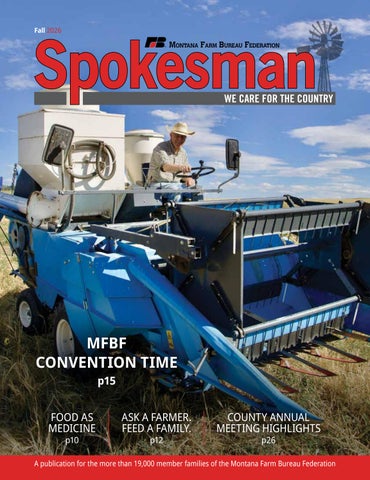
ON THE COVER: Bob Quinn, Quinn Institute, promotes the Food as Medicine concept. He is pictured on his small test plot combine. Photo by Haley Droogsma, MFBF Digital Communications Director
MFBF CONVENTION TIME p15 FOOD AS MEDICINE p10
ASK A FARMER. FEED A FAMILY. p12
COUNTY ANNUAL MEETING HIGHLIGHTS p26
A publication for the more than 19,000 member families of the Montana Farm Bureau Federation
Fall 2026 Montana Farm Bureau Spokesman
3
FROM THE PRESIDENT
Lessons From an Interrupted Season
CYNDI JOHNSON President, MFBF
S
pring in Montana comes with a relentless tempo: spraying, planting, hauling equipment, and racing the weather. Just when our seasonal momentum peaked, disaster struck my world, and everything came to a screeching halt. It’s a scenario played out hundreds of times across the Big Sky Country. Whether it’s a sudden equipment accident or the cumulative toll of decades spent pushing our physical limits, an unexpected injury halts the gears, disrupts the best-laid plans, and strips away our ability to do what we love. What I didn’t fully anticipate was the immediate strain my absence put on our operation. On our farm, I wear many hats: cook, bookkeeper, organizer, parts-runner, combine driver, and sprayer operator. Following my accident, my family immediately stepped up. Chores were finished, meals were prepared, and the garden thrived—even my strawberry patch survived the extra “help.” Eventually, I reclaimed most of my responsibilities in a modified way, and we navigated the rest of the season together. Yet, recovering from a physical setback is deeply frustrating. For those of us accustomed to managing everything independently, depending on others feels unnatural. But learning to accept a helping hand isn’t a sign of weakness; it’s a necessity. Listen to your care team, do the physical therapy, rest when
Montana Farm Bureau Spokesman (ISSN 08863075) Published quarterly by the Montana Farm Bureau Federation at 100 Red Mountain Drive, Suite 101, Bozeman, MT 59718. Periodical postage paid at Bozeman, MT and additional mailing offices. Subscription rates $4 a year covered by annual dues to Montana Farm Bureau Federation members. Non-member subscription $25 per year. Advertising rates available upon request. The Montana Farm Bureau Federation Spokesman reserved the right to reject any advertisements. POSTMASTER: Send address changes to: Montana Farm Bureau Federation Spokesman, 100 Red Mountain Drive, Suite 101, Bozeman, MT 59718
4
Montana Farm Bureau Spokesman Fall 2026
required, and avoid taking shortcuts. You will mend faster, and you can always return the favor down the road. Equally critical is recognizing when your mental health needs attention. Agriculture remains one of the most demanding callings on the planet. We operate at the mercy of unpredictable weather, volatile input costs, equipment breakdowns and labor shortages. While we cannot control the elements, we can control how we handle the pressure. Gone are the days when we had to carry our burdens in silence. Pride shouldn’t keep us from reaching out. Pick up the phone and call a friend, neighbor or family member when the weight gets heavy. We are in this together, and dedicated resources are more accessible than ever. The Northern Broadcasting System and the Montana Department of Agriculture jointly sponsor "Beyond the Weather," an outstanding program designed to destigmatize rural mental health. You can find valuable tools and support at beyondtheweather.com. Additionally, the American Farm Bureau provides excellent nationwide resources through its "Farm State of Mind" initiative at fb.org/initiative/farm-state-of-mind. Full recovery—whether from a physical injury or a period of mental strain—is always the ultimate goal. There is no better feeling than climbing back up that combine ladder or putting a foot in the stirrup, taking your place right where you belong. Wishing you all a safe, productive, and accident-free autumn. I look forward to seeing you at the Montana Farm Bureau Federation State Convention this November! ◾
Montana Farm Bureau Federation Officers Cyndi Johnson – President Casey Mott – Vice President Scott Kulbeck – Executive VP Linda Leslie – Director of Finance Montana Farm Bureau Board Beth Blevins – District 1 J.M. Peck – District 2 Ashley Descheemaeker – District 3
Greg Gabel – District 4 Darcia Patten – District 5 Don Steinbeisser, Jr. – District 6 Mike Lang – District 7 Ed Bandel – District 8 Karl Christians – District 9 Jim Willis – District 10 Lauren Kett – YF&R Heidi Brewer – Women’s Leadership Comm.
mfbf.org
h Be t
e
O R eve i l E e H dy b
rea RE. l a A y the YOU
them Pr o t e c t with u ra n c e Life Ins
The people who count on you don’t need you to have superpowers, just a plan for their future. Life insurance helps shield your loved ones from financial uncertainty, protecting the life and dreams you’ve built. Coverage may be available for as little as a dollar a day, so whether you’re looking for a first policy or need to add more coverage, we can help. Contact your Farm Bureau agent today.
Individual eligibility for all product promotions is subject to underwriting review and approval. Estimated premium payment is for 20-year Income Guard Term Life Plan; Standard; 30-year-old Male or Female; Non-Smoker. Amount is for demonstrative purposes only. Contact your Farm Bureau agent for a quote on your actual monthly premium payment. Mountain West Farm Bureau Mutual Insurance Company/Laramie, WY. Farm Bureau Life Insurance Company*/West Des Moines, IA. *Company providers of Farm Bureau Financial Services. LI221 (7-26)
EXEMPT WELLS
Homeowners Express Concerns About Exempt Well Proliferation BY REBECCA COLNAR, EDITOR, MFBF SPOKESMAN
In the past two issues of the Spokesman, our private property rights series featured an article on the importance of property rights and challenges surrounding corner crossings. In this issue, the topic centers around the need for a change in exempt well permitting.
C
ommercial and residential subdivisions have been spreading across the Gallatin and Helena Valleys like a patchwork quilt replacing open land. Concerns range from increased traffic to the loss of open space, but the gravest issue centers on water, both its quantity and quality. Increasingly, longtime residents and senior waterrights holders are finding themselves in conflict with rapid development fueled by Montana’s “exempt well” loophole. Developers have used a loophole in Montana water law to build subdivisions using exempt wells, allowing each home to have its own individual well and septic system rather than connecting to centralized infrastructure. What was originally intended for minimal rural use has, over the past three decades, become a tool for large-scale residential growth. Sue Duncan and her husband purchased 60 acres west of Belgrade in 1979, where they built a home and small farm before later expanding their acreage. Their water rights date back to 1888 and 1872. Duncan has closely monitored growth pressures since suburban sprawl first began creeping west of Belgrade. Under Montana law, an exempt well is defined as pumping less than 35 gallons per minute or 10 acrefeet of water annually. These wells were originally intended for “de minimis use”—watering livestock and supplying water for a rural home. However, Duncan said developers have spent the last 30 years “sticking more straws in the ground” by using exempt wells to serve dense housing developments without undergoing the state’s normal water permitting process. The River Rock subdivision south of the Duncans began development in 1993. That same year the Department of Natural Resources loosened the rules around combined appropriation to only include wells 6
Montana Farm Bureau Spokesman Fall 2026
that were physically manifolded together. This change expanded the use of the exemption for development. “Developers don’t think big enough,” Duncan said. “They look at everything through a telescope, not at the overall picture. They don’t look at the history of that area, and they don’t look to the future. The numberone challenge is how to finance the water and sewer infrastructure.” In November 2025, the Montana Farm Bureau joined a diverse coalition of municipalities, farm and ranch families, landowners, and conservation organizations in filing a legal challenge against the Montana Department of Natural Resources and Conservation and the state of Montana over continued implementation of the exempt well loophole. The lawsuit argues that the loophole allows unregulated groundwater development outside the state’s permitting system and does not adequately protect senior water rights holders and Montana’s long-term water security. In a state where water is limited and essential, Montana law guarantees that senior appropriators, those with older, established rights, are first in line to use available water. Yet the exempt well loophole has allowed developers to drill thousands of groundwater wells without permits, even in basins legally closed to new appropriations. Critics argue the unchecked proliferation of exempt wells has reduced streamflows, impaired senior water rights, and undermined the state’s constitutional obligation to protect Montana’s waters for the benefit of its people. For Duncan, the issue is deeply personal. “We never thought we would have to think about running out of water because these exempt wells are for de minimis use,” she said. “We never dreamed developers would use exempt wells for large-scale subdivisions.” Duncan added that water quality tops the list of concerns especially involving septic tank drainage. In mfbf.org
EXEMPT WELLS many places where there is an exempt well there is a septic tank, which contributes to nutrients in surface waters and increases the threat of polluted water. While senior water-rights holders have been among the first to raise concerns, homeowners in these developments are increasingly feeling the consequences as well. In the Helena Valley, rapid development in an area with a shallow and limited water table has left many homeowners struggling with unreliable wells. Dustin Gillaspie moved into the Emerald Ridge subdivision in 2022 in a home built in 2004. “Our bylaws read that you must have an acre of grass around your house,” Gillaspie said, “Because of the limited available water, nobody does it. There just isn’t enough water.” He said water shortages have become a routine part of life in the subdivision. “Everyone above us has water issues,” he explained. “Talking with our neighbors, if someone takes a shower, it depletes the well and they need to wait 30 minutes before someone else can shower. Homeowners are constantly drilling new wells. One drilling rig was at a neighbor’s house for two weeks.” Many wells in the subdivision are approximately 200 feet deep, but as groundwater levels decline, homeowners are being forced to drill deeper wells, an expensive and time-consuming process that often costs tens of thousands of dollars. The problem extends beyond water availability. Gillaspie, a local Farm Bureau Insurance agent, noted
Property owner Sue Duncan, who has a small farm west of Belgrade, worries about losing the quality and quantity of her water if exempt wells continue to proliferate.
(Photo Rebecca Colnar) mfbf.org
that insurers once required homes to be located near a reliable hydrant before issuing policies. Although that is not currently the case, in rural subdivisions dependent on individual wells, fire protection and water reliability are becoming increasing concerns. Unfortunately, Duncan said, homeowners are often the ones left dealing with the unintended consequences of poorly planned growth. Centralized water and sewer systems can cost millions of dollars to construct, but municipalities are able to spread those costs across large numbers of users. Exempt well subdivisions allow developers to avoid paying for that infrastructure entirely by shifting the burden onto individual homeowners and neighboring communities. The result, Duncan argues, is that existing residents and taxpayers ultimately shoulder the costs of unregulated growth. As developers build high-density projects on the edges of towns using exempt wells, they bypass municipal systems that rely on user growth to offset infrastructure expenses. That leaves cities and longtime residents paying a larger share for maintaining and upgrading water and sewer systems while also coping with the depletion of shared groundwater resources and potential decline in water quality. “There must be site assessments,” Duncan said. “Developers need to know where the wetlands are, what to do with the drier spots. They need to design a system to fit the capabilities of the land without damaging it.” The Montana Farm Bureau dispels the myth that if the loophole is closed, there will be no new water development. Even without exempt wells, options remain. These include adding a stock tank to an existing source (a process that was simplified in the last legislative session), replacing existing wells, hooking up to city sewer and water or working through the permitting process to develop new water while ensuring that any impacts to existing water users are addressed. Additionally, there have been no efforts to take any actions that would be retroactive to existing exempt well users. “We believe that this loophole needs to be fixed to protect senior water rights owners as well as protecting future homeowners in subdivisions,” noted MFBF Executive Vice President Scott Kulbeck. “We want to see the permitting system work for all new responsible water uses. We are working with other senior water right users to develop legislation that would streamline water permitting and protect senior water rights for all Montanans.” ◾ Fall 2026 Montana Farm Bureau Spokesman
7
AG SAFETY
Back on the Job: Why Return-to-Work Programs Benefit Ranchers and Crews Implementing a Return-to-Work program helps injured employees heal faster while protecting your operation’s bottom line. BY DANA JANSEN, DIRECTOR, MONTANA AG SAFETY PROGRAM
W
hile the goal is keeping employees at work – happy, healthy, and uninjured – the next best thing is getting them back to work after an injury has occurred. Depending on the nature of the work and severity of the injury, that may not always be possible. However, research has shown that returning to work, even on a modified or light duty assignment, speeds healing, reduces depression, and helps alleviate some of the stress common among injured employees. Worker’s compensation payments only cover two-thirds of an injured employee’s pay, returning to work allows the employee to receive their
8
Montana Farm Bureau Spokesman Fall 2026
normal compensation, minimizing lost wages. Not to mention, most employees are eager to continue contributing to the work of the business! For many farms and ranches, these treasured employees are more like family than anything else, so getting back on the job is about more than just a paycheck. A Return to Work (RTW) program is just that. Return to Work plans provide for transitional duties that are temporary until the employee is able to return to full pre-injury job duties. As an employer, a RTW not only helps manage the impact of claims on your policy premium, but it, most importantly, helps retain good employees. Developing a RTW is a critical component of risk management for your operation. Development of a Return to Work program begins with an assessment of each job or task that employees are expected to complete. That analysis and description will be the basis for what is considered normal duty. Sample job analyses and descriptions are available from Montana State Fund at www.safemt.com and are an excellent starting point. From there, transitional or light-work duties can be identified. An important consideration is that these duties must still fall within the scope of the work normally completed and be meaningful. In many cases, these transitional duties include office work, organizational, and training or supervisory roles, when we consider the physically demanding mfbf.org
AG SAFETY nature of agricultural work. As an injured worker’s healing progresses, their work limitations often decrease, meaning additional tasks can be added back to their role. It is critical for both employee and employer to remain in constant communication during the transition period to ensure that tasks are not only medically appropriate but also fulfilling the needs of the employee and business. The healing journey is far from linear, though, so sometimes tasks may need to be further reduced or changed entirely. To make implementation of a Return to Work program easier, Montana State Fund has created a Gran N Go Kit that will help communicate the RTW with the injured employee, medical providers, and the claims examiner. This kit can be customized to meet the needs of your unique operation. The kit includes: ◾ A letter to the medical provider that outlines your RTW policy and commitment to your employee’s return to work ◾ A medical status form that helps identify the physical activities the employee is able to
mfbf.org
perform. This form should be used at each medical appointment and is not intended to share sensitive medical information with the employer but, rather, is simply to function as a communication tool for determining medically appropriate tasks. ◾ A job description for the injured worker’s role that highlights common tasks and activities performed during their work. ◾ The First Report of Injury (FROI) form. This important document is required by law and should be completed as soon as possible after an injury occurs. ◾ An incident investigation report. Understanding the causes of the incident can help prevent a similar event in the future. Involving the injured worker in this process not only creates a clearer picture but also empowers meaningful change. Return to Work programs are simply one tool your operation can use to mitigate risk. For more information on RTW or assistance in developing one for your operation, visit www.safemt.com or contact Dana Jansen with the Montana Ag Safety Program. ◾
Fall 2026 Montana Farm Bureau Spokesman
9
PRODUCER PROFILE
“Food as Medicine” Vision Aims To Heal Rural America and Empower Farmers BY REBECCA COLNAR, EDITOR, MFBF SPOKESMAN
W
hen Bob Quinn looks back on his hometown of Big Sandy, Montana, he remembers a bustling community of over 1,000 people. Today, that population has contracted to around 600, and like many main streets across rural America, several storefronts sit quiet and boarded up. "Three-quarters of the neighbors I grew up with are gone," Quinn recalls. "They went broke, told their kids not to come back, or sold out. We lost our population— and when farmers disappear, Main Street disappears." It is a paradox at the heart of modern American agriculture: the United States produces the most abundant, affordable food supply in world history, yet family farms face relentless financial strain while public health metrics decline. According to the CDC, roughly 76% of Americans live with at least one chronic disease, with a significant portion driven by diet and ultraprocessed foods. For Quinn—a lifelong Montana farmer, pioneer in organic agriculture,
Above: Quinn in dry land test plot of Arizona Gold potatoes. Right: Bob Quinn and Jake Jared, research coordinator at QI, examining Kamut wheat harvested from a test plot.
10
Montana Farm Bureau Spokesman Fall 2026
Chouteau County Farm Bureau Board Member and presenter at the Montana Farm Bureau Federation Annual Convention in Billings in November—the problem isn't that farmers aren't working hard enough. It’s that the current system measures success purely by the volume of cheap commodities, rather than the nutrient density of the food produced. To address this challenge, Quinn retired from active production, rented out his main acreage to the next generation, and set aside 800 acres to establish The Quinn Institute. Its mission? Prove that growing "Food as Medicine" can restore public health while simultaneously delivering higher returns to family farms. THE TRUE COST OF "CHEAP FOOD" "People often brag about having the cheapest food in the world," the Chouteau County board member says. "It’s a major technical accomplishment, but there is a hidden cost. Farmers are paying for it because they can’t make a decent living on low commodity prices without relying on off-farm income to survive." Quinn emphasizes that farmers have done a magnificent job responding to the signals they were given: yield more bushels per acre. However, as raw crops move through processing, vital nutrition—such as the fiber, bran, and essential micronutrients found in whole grains—is often stripped away or diverted, leaving consumers with heavily processed foods. Rather than criticizing farmers for using conventional tools or chemicals to keep their operations afloat, Quinn’s framework shifts the focus to the value of the crop itself. "Farmers are growing good-quality products, but the current market treats everything as a bulk commodity," Quinn explains. "If a farmer grows food that actively heals people and prevents disease, they should be compensated like pharmacists. They deserve a fair return for the fruits of their labor." ANCIENT GRAINS, MODERN SCIENCE The Quinn Institute isn't built on wishful thinking; it’s grounded in rigorous scientific research. Over the years, Quinn has co-authored mfbf.org
PRODUCER PROFILE
Above: No-till garden with paths covered with clover. Right: A sample of bindweed infected with fungus which might be used to manage this perennial weed.
37 peer-reviewed studies examining ancient grains like Khorasan wheat (marketed as Kamut®) and their impacts on human health. Unlike modern wheat, which has been intensely bred for high yield and industrial baking qualities, un-manipulated ancient varieties show marked anti-inflammatory properties. Research indicates these grains significantly reduce markers for cholesterol, blood sugar, and irritable bowel syndrome (IBS). "We changed wheat in a dramatic way," says Quinn. "Nobody set out to cause a problem—breeding for high yield was a noble cause to feed a growing world. But we didn't look at how those changes affected human digestion. When people eat ancient grains that haven't been altered, some find they can digest them without issue." Currently, the Institute is turning its attention to crop varieties that can be grown profitably on the Northern Great Plains including hard white winter wheat and hulless barley. Hard white winter wheat is naturally high in carotenoids and polyphenols (antioxidants with anti-inflammatory properties), offering a premium crop opportunity. Hulless Barley is exceptionally high in beta-glucans, which actively lower cholesterol. Quinn’s team is collaborating with research institutions to determine if daily dietary servings of hulless barley could eventually reduce reliance on cholesterollowering statin medications. "If we can substitute nutrient-dense barley and ancient grains for expensive drugs, public health improves and farmers get paid a premium for growing a specialized, high-value crop," says Quinn. "Everybody wins." mfbf.org
BUILDING A LIVING CAMPUS IN BIG SANDY To turn these concepts into scalable practice, The Quinn Institute is constructing a learning campus on a homestead in Big Sandy. The center will feature student housing, visitor accommodations, research laboratories, a teaching kitchen, and community gardens. A core focus of the campus will be teaching hands-on nutrition— from how to cultivate and cook fresh produce to home-milling whole grains for maximum freshness and digestive health. The Institute is also partnering with neighboring communities, including the Rocky Boy’s Reservation, to promote local food independence and garden education. Out in the fields, the Institute demonstrates a diverse 12-year crop rotation featuring nine cash crops tailored to the shortgrass prairies of eastern Montana, Alberta, and Saskatchewan including the grains mentioned above, oilseeds and pulse crops such as peas, lentils and chick peas. “These regional crops are viable in our region,” noted Quinn. “It makes sense to plant the crops that do well here.” This rotation shows how diversification can rebuild soil biology, reduce dependence on manufactured fertilizers and pesticides, and build financial resilience against market volatility. As Montana Farm Bureau members prepare to gather in Billings this November, Quinn’s message is one of opportunity, collaboration and rural revitalization rather than division. "We need to move away from strictly growing lowmargin bulk commodities toward growing highnutrition food—and making sure the farmer is paid fairly for that nutrition," Quinn asserts. "It’s about starting where we can, helping everyone we can, and giving the next generation of farmers a reason to stay on the land resulting in keeping our small rural communities thriving." ◾ Fall 2026 Montana Farm Bureau Spokesman
11
ASK A FARMER
Ask a Farmer. Feed a Family. BY REBECCA COLNAR, EDITOR, MFBF SPOKESMAN
S
hoppers at the Smith’s Grocery store in Great Falls took a double take this past summer when they spotted local farmers and ranchers sitting at an informative booth in the entryway. The event—part of the new Montana Farm Bureau Young Farmer & Rancher Committee (YF&R) Ask a Farmer. Feed a Family initiative— offered a hands-on way to engage directly with consumers while collecting food for local pantries and selling raffle tickets to benefit the Montana Food Bank Network. The Ask a Farmer. Feed a Family initiative was developed by the YF&R Committee in partnership with MFBF’s Promotion & Engagement Committee. Together, the committees provided consumer engagement materials and relied on Farm Bureau member volunteers to staff events and connect directly with shoppers, giving farmers
and ranchers an opportunity to share their stories while making a difference in their communities. Through these events, the MFBF YF&R Committee has already collected approximaely 1,650 pounds of food and raised more than $3,000 in raffle ticket sales alone. Reynolds Market amplified the effort by hosting a register round-up campaign that raised nearly $1,300 in just a week and a half—funds that will stay directly in local community food bank charge accounts. Several county Farm Bureaus have also pledged supporting donations. Karissa Eddy, who runs a small cattle herd with her husband in Ulm, jumped at the chance to bring the initiative to life when the idea surfaced during a summer YF&R committee meeting. “Smith’s Grocery was happy to let
us set up our Ask a Farmer, Feed a Family booth inside their store,” Eddy explained. Cascade County Farm Bureau President Merrill McKamey joined the effort at Smith’s, as did MFBF staff member Alena Standley’s daughters. District 8
Left: Patty Mott and Fiona Hankins, Custer/Fallon County Farm Bureau, collected food at at Reynold’s Market in Baker. Above: Karissa Eddy sells raffle tickets for a $500 gift certificate to Sheel’s. The raffle raised $3,000 for the Montana Food Bank Network.
12
Montana Farm Bureau Spokesman Fall 2026
mfbf.org
ASK A FARMER YF&R Committee member, Hattie Baumgarner, sat at the booth a few days later and continued to collect food donations. “Setting up a booth like this raises awareness about the food our farmers and ranchers produce, while bringing attention to hunger in our communities,” said Eddy. “Summer is a time when food banks and pantries run low, so the timing to collect food was ideal. The personal interaction was fantastic, and we ended up with a pickup truck loaded to the brim— front seat, back seat, and bed—all taken to the Sun River and Cascade food banks. The generosity of shoppers was incredible.” Reynolds Market stepped up in a big way, hosting Ask a Farmer. Feed a Family booths at stores in Baker, Glasgow, and Glendive. YF&R Committee member Tienna Canen noted that fellow committee member John Walker (Glasgow) and MFBF YF&R Coordinator Jasmine Evans first approached Reynolds'
mfbf.org
Right: YF&R Chair Lauren Kett with friend Sage LeBlanc answer questions at Town & Country in Livingston. Far Right: The crew at Ask a Farmer. Feed a Family at the Town & Country in Dillon included Keelyn Hall, Cady Brown, Makae Reed and Margaret Hebel.
corporate office. The grocery chain not only welcomed the booths but also implemented the register round-up program for shoppers. Canen mentioned that shoppers were genuinely curious, with questions ranging from general agriculture to fundamental distinctions like the difference between a farmer and a rancher. “Everyone needs to understand where their food comes from and the real factors behind retail food costs. Having clarity and
transparency with consumers is essential,” Canen said. Town & Country Foods joined the campaign as well, hosting booths at locations in Lewistown, Livingston, and Dillon to gather food donations and raise funds. YF&R Chair Lauren Kett spearheaded the Livingston event and reflected on the broader mission of the project. “This event is important because it provides a new avenue for YF&R to bridge the gap between consumers and agriculture,” Kett said. “Being there in person allows us to answer questions, host meaningful conversations, serve as a trusted source of information, and share a friendly smile as folks walk in to shop.” Kett added that the initiative strengthens statewide support for the Montana Food Bank Network while deepening local roots across each district. “In District 10, many people were curious about what we were doing and wanted to learn more about Farm Bureau,” Kett noted. “We even answered plenty of questions about growing backyard tomatoes, which made for some fun, engaging conversations.” ◾ Fall 2026 Montana Farm Bureau Spokesman
13
THE ZIPLINE
Why We Need a Farm Bill
ZIPPY DUVALL President, AFBF
F
armers are persistent, especially when it comes to our commitment to our families, our communities and our nation. We are not giving up on the farm bill because we know America’s families are counting on us to be persistent in growing the food, fiber and fuel that keeps our country running. That’s why farmers are counting on Congress to finally and fully deliver a new farm bill this year. America’s farmers and ranchers are ready to meet the growing demand for products grown and raised on our soil. But rising pressures continue to shrink the agricultural landscape of our country. Over the past decade, more than 200,000 family farms have gone out of business. From rising costs on the farm to shifting markets to the lack of a stable workforce, it’s getting harder for the American farmer to hang on through the tough times.
America needs farmers. Farmers need a modernized and complete farm bill. That’s why the farm bill continues to be critical to the survival and success of our nation’s farmers. We rely on the programs that help us weather the storm, we improve our sustainability through conservation programs, and we drive into the future with innovative research. We appreciate the updates to risk management and some farm programs in H.R. 1 but recognize that there are a lot of farm bill programs left on the table that haven’t been updated since 2018. 14
Montana Farm Bureau Spokesman Fall 2026
Congress last passed a bipartisan farm bill in 2018 and has extended that bill three times since it first expired in 2023. The clock is ticking down with the last extension about to expire at the end of September. The farm bill has a long history of bringing lawmakers together from both sides of the aisle to support America’s farmers and ranchers and secure a safe, healthy food supply for America’s families. Now is the time for Congress to do just that. This task will take persistence in calling on our lawmakers to come together and get the job done. That’s what brought farmers and ranchers from across the country to our nation’s capital this week, including Montana Farm Bureau members for their annual Washington, D.C. Fly-In. Now is the time for every one of us to make our voices heard. We all depend on the success of American agriculture, whether you farm every day, work in a rural community, or support your family in the city. I urge you to join in with the thousands of Farm Bureau members who have reached out to their lawmakers and called on them to deliver a farm bill. Farm Bureau shines, when we speak up together with a united voice to strengthen our farms and rural communities. Be that voice for your farm, your family and your community. ◾ mfbf.org
SUPREME COURT Q&A
The Future of Montana’s Judiciary: Questions and Answers with the Supreme Court Candidates
F
lathead County District Judges Amy Eddy and Dan Wilson are vying for a seat on the Montana Supreme Court this November. To help members evaluate the candidates, MFBF asked each judge a series of questions regarding their judicial philosophy and background. Read the full Q&A at (mfbf.org/news).
Q: What is your background? Eddy: I grew up outside of Stanley, Idaho with my parents and two younger sisters. We were snowed in during the winter. When I started kindergarten, I cross-country skied 2.5 miles to catch the school bus to take me into town. I started school in a K-8 elementary school with ten students. That type of Flathead County District upraising gives you a unique Judge Amy Eddy type of independence. I started working in the kitchen of a family restaurant with my dad when I was 12, and I have been working ever since. I graduated from the University of Montana School of Law in 2001 and spent the next 15 years representing everyday Montanans in court— individuals, small business and working families who needed their voices to be heard. I have now spent more than a decade as a District Court Judge and have handled more than 10,000 cases across the State. The Montana Supreme Court appointed me in 2017 to also establish the Asbestos Claims Court to resolve the claims of thousands of individuals exposed to asbestos in Libby, Montana. Other than dating the son of an alfalfa farmer in college and cooking for the crew during harvest, my agricultural experiences have primarily focused on food. Wilson: I am a fourth-generation Montanan born in Billings in 1964. My parents, grandparents, and 18
Montana Farm Bureau Spokesman Fall 2026
great grandparents lived in Phillips County. I attended college at Penn State University, where my father was a professor of veterinary science. His early research at MSU in Bozeman produced an effective vaccine for a common infection in cattle, which later led to his teaching at Penn State. After college, I attended law school and graduated from the University of Minnesota Law School. After passing the Montana bar exam in 1993, I worked Flathead County District as a prosecutor in Great Judge Dan Wilson Falls, Chinook and Kalispell before going into private law practice. My great grandfather homesteaded south of Malta in 1913, and my grandfather farmed the land until his retirement. As a kid, I helped on the family farm. After moving to Kalispell in 1995, I married into a farming and ranching family and have spent years working with both crops and livestock. Q: Why do you want to be a Supreme Court Justice? Eddy: I am running for the Montana Supreme Court because Montanans deserve a Supreme Court Justice who is experienced, fair and impartial. They deserve a Justice who believes in independent, nonpartisan courts and the rule of law; a Justice who will keep politics out of the courtroom, who is not afraid to protect individual freedoms, and hold criminal defendants and other wrongdoers accountable. They need a Justice who will interpret and apply the law with rigor, clarity and consistency so our communities are safe and stable. The Montana Supreme Court is not legislature. It is a court of law, and it must remain a place where every Montanan—regardless of background, income or political belief—can expect a fair shake. mfbf.org
SUPREME COURT Q&A Wilson: The Montana Supreme Court makes rulings every day that shape the lives of Montanans across our state; more than most people realize. I was raised with deep reverence for the law and the fundamental principle of playing by the rules. While the Montana Constitution grants the judiciary significant authority, Supreme Court Justices must respect the power of the people and their elected representatives to make our laws. The bench is meant to interpret the law, not create it. Q: As a candidate, what are your top three priorities? Eddy: The most important issues for the judicial branch are to remain independent, maintain the public’s trust, and, unless the law changes, maintain its nonpartisanship. Nonpartisan judicial elections are a Montana tradition for a reason. It has been, and remains, the policy of this State that judges should not be held captive by political parties. We do not want our judges to take loyalty oaths to political party platforms. Before a judge makes a decision, we do not want them to ask whether the decision will jeopardize a political party endorsement or political party campaign contributions. This is the first election cycle in Montana during which political parties have been allowed to contribute directly to judicial candidates. I firmly believe that judges who accept political party contributions undermine both nonpartisan judicial elections and public confidence in the judicial branch. I have traveled all around the state and I have not spoken to a single person who believes we should have more partisanship, let alone partisanship in judicial races. Wilson: 1. Ensure the Supreme Court does not exceed its authority or legislate from the bench. 2. Make common-sense decisions that follow the true intent of the Montana Constitution and our laws. 3. Make the Montana Supreme Court more accessible and transparent to all Montanans by holding more public hearings and by publishing summary explanations of cases, particularly where the rulings have state-wide impact. Q: In your view, what are the three most important issues facing Montana agriculture? Eddy: While I am not directly involved in the agricultural industry, the issues would vary by sector. mfbf.org
Stagnant commodity prices combined with increasing costs of machinery and chemicals, labor shortages and access to predictable loans, grants and insurance policies are issues impacting the industry as a whole. Wilson: 1. Maintaining economic viability of family farm and ranch operations through tax laws and policies that allow operations to pass down to succeeding generations. 2. Balancing environmental standards with property rights to prevent burdensome overregulation of land use and stewardship practices. 3. Protecting and growing markets for agricultural commodities and finished ag products. Q: What was the general nature of your practice? Indicate any areas of practice in which you concentrated. Eddy: I was in private practice for 15 years, focused on a plaintiff-oriented complex civil litigation practice. Towards the end of my practice, I was primarily handling constructive defect cases on behalf of homeowners, and one school district. Wilson: My law practice was as wide and varied as I could make it. I represented people in every kind of legal issue and dispute, covering everything from contracts, estate planning and disputes, construction law, family law, banking and finance, personal injury, criminal law, and bankruptcy matters. My goal was to be in the courtroom as much as possible and to see how the law operates from the perspective of everyone involved in the legal system. ◾
Montana Supreme Court Seat 4 Amy Eddy and Dan Wilson express their opinions on the role of judges during the candidate forum September 21 in Billings. Yellowstone County Farm Bureau and Montana Farm Bureau hosted the informative event.
Fall 2026 Montana Farm Bureau Spokesman
19
ACE LEADERSHIP PROGRAM
ACE Class Shares Thoughts On Program
T
he ACE Leadership Program is in its ninth year of empowering Farm Bureau members to become confident and effective leaders in their local communities, for Montana agriculture and for their county Farm Bureaus. ACE successfully does this by focusing on leadership development, engaging local communities and issues advocacy.
CHRIS KOLSTAD, LEDGER HILL/LIBERTY/BLAINE COUNTY FARM BUREAU I am a self-employed dry land farmer from Liberty County. My wife and I farm with our son and his wife. We have three daughters, two of whom also farm on the Hi-Line. I grew up on this farm and live in the same house I lived in when I was in high school. I attended Montana State University where I got a degree in ag business. Besides Farm Bureau I have been involved in Montana Grain Growers and was a member of the Montana Wheat and Barley Committee. ACE helped me learn how to be a more confident leader. The one message that keeps surfacing is that we need to invest our time and our talents to keep our rural communities thriving. In Farm Bureau, I hope to encourage our younger members to step up into leadership roles. They have so much to offer and are full of energy and enthusiasm.
AMBER ELLIOT, ROBERTS CARBON/STILLWATER COUNTY FARM BUREAU I grew up in Steamboat Springs, Colorado, and was introduced to agriculture through my grandfather’s cow-calf operation. I went to Colorado State University for Animal Science, focusing on beef production and bovine reproduction. After college, I moved to Montana to work at a bull stud for a couple of years. I’m now an Agriculture and 4-H Extension Agent in Carbon County, where I work with livestock producers, youth and their families. 20
Montana Farm Bureau Spokesman Fall 2026
I got a lot out of the communication and active listening sessions because so much of what I do involves working with people from different backgrounds and perspectives. Learning how to listen better and communicate more effectively are skills I can use every day, both professionally and personally. I see ACE helping me be more involved in my community and with my local Farm Bureau by giving me more confidence and tools to communicate about issues affecting agriculture. I want to use what I learned to help connect producers, young people, and community members, and encourage more people to get involved and have a voice in the future of agriculture.
VERN HANKINS, MILES CITY CUSTER/FALLON COUNTY FARM BUREAU I grew up in central Montana on the family farm. My wife and I are currently adjacent to the family ranch in Eastern Montana on a lease we secured. We are also active on the family ranch. The session held during the Montana Farm Bureau Summer Conference was the most inspirational to me. The community building seminar and presentations were intriguing. The information and proof of concept that was presented was a testament to how important being active in rural communities truly is. I believe bringing awareness on hot topic issues to our rural communities is extremely important. Everyone gets so busy it is difficult to keep up with what's happening in our state.
ROBERTA TILLEMAN, CASCADE CASCADE COUNTY FARM BUREAU I grew up in Great Falls and now live in Cascade with my farmer husband, Eric. I serve as state director for a career and technical organization called SkillsUSA Montana. It is extremely hard to pick just one session I gained mfbf.org
ACE LEADERSHIP PROGRAM the most from. Every session offered something different that left a lasting impression and added something to my leadership resume. The sessions were well thought out and strategically planned, and there was something for everyone. I hope to remain active in monthly Farm Bureau meetings and find new ways to connect agriculture with the broader community. I would like to explore an agricultural advocacy day connected to a local book sale with the goal of staring conversations about farming and ranching. It could help students see that agriculture has opportunities for them, even if they do not see themselves as farmers or ranchers.
CHRIS GARTNER, SIDNEY RICHLAND COUNTY FARM BUREAU I grew up in Sidney. My family owns and operates a mixed operation consisting of small grains production and a small herd of commercial
mfbf.org
Red Angus cow/calf pairs. I work as a sales associate for a Mountain West Farm Bureau Insurance agent in Sidney and I run a few cows of my own with my family. One session that inspired me was Bruce Vincent's presentation. He's a logger from Libby who brought facts, science and crucial context to the conversation of managing forests responsibly. The 'Social License to Operate' he talked about really hit home to me. The lessons I learned during this year's ACE program will stick with me for the rest of my life. It has made me more self-aware of my leadership style. I envision a future in which I'm leading a team toward a common goal. On a community level, I intend to be more involved in issues that directly influence the agriculture industry. ◾ The Montana Farm Bureau is currently accepting applications for the ACE (Advocate. Communicate. Educate.) premier agricultural leadership program. For additional information, including the dates of the 2027 seminars, and for an application visit https://www.mfbf.org/a-c-e. Applications are due by December 7, 2026.
Fall 2026 Montana Farm Bureau Spokesman
21
DC FLY-IN
Advocacy Fly-In
S
eptember 2026 has been a busy month in the nation’s capital, and in September Montana Farm Bureau Federation (MFBF) members experienced that energy firsthand during the organization's annual Washington D.C. Fly-In. Participating members Makae Reed, Justin Miller, Lee Jensen, Darcia Patten, and Bill McLean were accompanied by MFBF Senior Director of Governmental Affairs Nicole Rolf and Senior Director of Organization Sue Ann Streufert. The three-day event featured face-to-face visits with each member of Montana’s congressional delegation, as well as high-level meetings with leadership at the Bureau of Land Management (BLM), the Department of the Interior, and the U.S. Department of Agriculture (USDA), including Research, Education, and Economics (REE) and National Ag Statistics Service (NASS). The fly-in kicked off with comprehensive briefings from American Farm Bureau Federation (AFBF) governmental relations and economics staff. Justin Miller, a wheat and pulse crop farmer from Gildford, praised the depth of the preparation and the agency dialogue, highlighting efforts to reduce administrative burdens on agricultural producers. “We are always filling out forms for different agencies, and at some point, the paperwork becomes overwhelming,” Miller said. “Being able to sit down with these agencies to discuss interlinking their systems will help everything run much more efficiently.” Miller added that the briefings from American Farm Bureau staff built strong momentum for Capitol Hill visits. “Sitting down with our elected officials actually restored my faith in government—they were truly willing to listen to our concerns.” Darcia Patten, a rancher from Broadus and MFBF District 5 Director, echoed the value of direct dialogue with elected leaders. “They want to hear from boots on the ground,” Patten said. “Our congressional delegation was incredibly receptive and thanked us for coming. They reiterated how critical it is for us to share how these issues directly affect agriculture and rural communities, reminding us, ‘We work for you.’” Patten raised key regional concerns during her
22
Montana Farm Bureau Spokesman Fall 2026
Top: Montana Farm Bureau members on Capitol for the organization’s annual Fly-In included Makae Reed, Bill McLean, Darcia Patten, Justin Miller and Lee Jensen. Above: Meeting with House Committee on Agriculture staff.
meetings, including cattle market impacts from beef imports and the need to address ongoing coal seam fires in eastern Montana. Trade and regulatory reform were equally paramount for Lee Jensen, who grew up on a ranch and now works for an agronomy company in Circle. “Canada accounts for 85 percent of our state's trade— it truly makes or breaks our agricultural economy,” Jensen stated. “Trucks bring fertilizer south down to us and load back up heading north with our peas, lentils, and chickpeas. It’s tough to secure fertilizer shipments when those drivers don't have a reliable backhaul load.” Between Capitol Hill appointments and agency roundtables, delegation members took opportunities to tour the U.S. Capitol, walk the National Mall, and visit national landmarks. “The DC Fly-In is a special part of what we do at MFBF. The importance of getting real-life farmers and ranchers out to meet with our elected officials, professional staff and regulators is paramount because no one can tell their story more effectively than the farmers themselves,” said Rolf. Read the full story at mfbf.org/news. ◾ mfbf.org
WOMEN’S LEADERSHIP COMMITTEE
Two Initiatives on the Horizon For The Rest Of 2026 BY HEIDI BREWER, CHAIR, MFBF WOMEN’S LEADERSHIP COMMITTEE
T
he Montana Farm Bureau Women’s Leadership Committee (WLC) is currently working on two initiatives for the remainder of 2026. WLC’s provide support to Ronald McDonald Houses across the country. Montana Farm Bureau WLC is no exception. In 2025, the Montana Farm Bureau WLC donated $500 to the Ronald McDonald House in Billings, and the committee intends to continue their donation efforts in 2026 through a “stocking stuffing” during the delegate session at the 2026 Montana Farm Bureau Annual Convention November 15-18, 2026, in Billings. The purpose of the “stocking stuffing” is to provide needed items for the parents and siblings of the patients while the family is staying at the Ronald McDonald House. The idea is for the stockings to bring a little joy to the families while they are away from home. Anyone interested in providing a donation to buy the stockings and items for the stockings may send
mfbf.org
a donation to the Montana Farm Bureau, 100 Red Mountain Drive, Suite 101, Bozeman, MT 59718. Please make the donation check to: MFBF. Put WLC RMH in the memo line. The deadline to send donations is November 10, 2026. The stockings will be “stuffed” during the Montana Farm Bureau annual convention and presented to the Ronald McDonald Houses following convention. Another key project for the WLC was establishing the 2026 Woman Farmer/Rancher of the Year award to honor an outstanding Montana Farm Bureau member. With 2026 designated as the International Year of the Woman Farmer, this is a fitting time to recognize the extraordinary women within our membership who excel in production agriculture or agribusiness. Our committee looks forward to reviewing nominations and presenting the award at the Montana Farm Bureau Annual Convention. I look forward to seeing everyone there. For more information about the WLC, please contact Heidi Brewer at Hbrewer4026@icloud.com. ◾
Fall 2026 Montana Farm Bureau Spokesman
23
YOUNG FARMERS & RANCHERS
Cultivating Growth: YF&R Wraps Up Summer & Gears Up for Convention BY LAUREN KETT, STATE CHAIR, YF&R COMMITTEE
A
s we reach the end of summer, the Young Farmers & Ranchers Committee is wrapping up our June–September program, Ask a Farmer. Feed a Family, while preparing for fall programs and the 2026 MFBF Annual Convention. Join us October 15, 2026, at 7 p.m. for our Cultivating Growth Call. This virtual tour will take us behind the scenes at Windrift Hill, a family-operated business in Conrad, Montana. Learn how they turn their own fresh goat milk, herbs and oils into a collection of soaps,
Win the YF&R Discussion Meet. Take home Polaris Ranger The Discussion Meet is a competition promoted by the American Farm Bureau Federation Young Farmers & Ranchers Committee. Farm Bureau’s strength depends on its members’ ability to analyze agricultural issues and decide on solutions that best meet their needs. The competition is designed to simulate a committee meeting where discussion and active participation are expected from each committee member. The Montana Farm Bureau Discussion Meet will be held Monday, November 16 during the MFBF Annual Convention in Billings. The winner receives the keys to a Polaris Ranger and an all-expense paid trip to compete in the American Farm Bureau Discussion Meet in January 2027 in Charlotte, NC. For more information on the Discussion Meet, visit https://www.mfbf.org/young-farmers-ranchers. There is also a collegiate competition through which students can earn an expense-paid trip to the National Young Farmer & Rancher Leadership Conference. Pre-recorded conference calls that include additional information and expert insights on each of the six Discussion Meet topics are available upon request. Contact Jasmine Evans at jasmine@mfbf.org to receive those calls electronically. 24
Montana Farm Bureau Spokesman Fall 2026
lotions, and body butters. It’s a great opportunity to learn about agricultural entrepreneurship and the many ways agriculture connects to the products we use every day. We are promoting and recruiting participants for the YF&R Discussion Meet at the 2026 MFBF Annual Convention in Billings. This competition will take place on Monday, November 16. Competitors will discuss the hot issues that are affecting the ag industry and work together to identify practical solutions. Did you hear? The winner takes home a brand-new Polaris Ranger 570. A huge thank you to our participating Polaris dealers, who have sponsored the Ranger for the past 12 years. Do you want to take the next Ranger home? Apply at: https://form.jotform.com/242847084545161. YF&R is continuing to advocate for agriculture through an essay contest, connecting youth to agriculture by exploring the topic of environmental stewardship. This contest will open early next year with a cash prize of $500 for the winning essay. Interested in learning more about what your local YF&R group is up to? Connect with your local district chairs and see what they have in store. ◾
2027 Discussion Meet Quest
ions
1. Growth in rural areas can strain rural energy infrastructu re. How can Farm Bureau work with stakeholders to advocate for proactive planning at the local, state and national levels that safeguards affordable, reliable energy access for farme rs and ranchers as well as their rural neighbors while protecting farmland from unnec essary eminent domain? 2. Rural and large animal veteri nary practices and professional s continue to decrease in numbers across the country. How can Farm Bureau help attract and retain rural and large animal veterinarians for memb er communities? 3. With the continued ripple effect of supply chain challenges related to meat processing, how can Farm Bureau levera ge its grassroots network to reduc e barriers and create pathways for the developmen t of local USDA certified meat processing? 4. How can Farm Bureau and its young leaders leverage relatio nships with agricultural youth organizations to attract more young leaders to the Young Farmers & Ranchers program? 5. Increased public concern over healthy diets and chronic childhood disease has raised questions, as well as criticism, about modern agriculture and the food system. How can Farm Bureau effectively engage in this discussion and advocate for the critical science-based tools and research farmers need to fulfill their commitment to grow healthy, sustainable food, fiber and fuel? ____ These questions will be used for the YF&R Discussion Meet held during the AFBF Annual Convention in Charlotte, North Carolina and the Collegiate Discu ssion Meet held during the AFBF FUSION Conference in New Orleans, Louisiana.
Scan QR Code
to access registration and information sheet.
mfbf.org
AG CHAT
County News County Annual Meetings The Farm Bureau County annual meeting season was in full swing when the Fall Spokesman went to press. Look for more photos and information about county meetings on Montana Farm Bureau’s Facebook page. Cascade President Merrill McKamey talks about being involved in the Ask A Farmer. Feed A Family event during their annual meeting September 8 in Great Falls.
Wheatland/ Golden Valley County met September 15 at The Barnison near Harlowton where they had a guest presenter who demonstrated the first-aid techniques to “Stop the Bleed.”
James Malchow, MSU Collegiate Young Farmers & Ranchers president, talks about their plans for the year during the Gallatin County breakfast meeting at the Land of Magic Supper Club in Manhattan.
At their annual meeting on September 13 in Billings, Yellowstone County Farm Bureau selected Northern Ag Network as their first Friend of Farm Bureau Award. Northern Ag Network’s Courtney, Jonathan, Jac & Nia Kibblewhite accepted the award from the board.
Other News
Prairie County members covered a variety of resolutions which were surfaced during their September 16 meeting in Terry.
Dawson-Wibaux County members met September 15 at the 17 Club in Glendive where they developed resolutions and elected Stetson Sarrazin as their new president.
MFBF Executive Vice President Scott Kulbeck spoke on upcoming Farm Bureau events during the Fergus County meeting.
26
Montana Farm Bureau Spokesman Fall 2026
Sweet Grass County is offering a limited number of free registrations to the Montana Farm Bureau Convention this November for people new to Farm Bureau who are curious about convention. Southwest Counties is holding their own Hoofin’ it for Hunger race Saturday, October 17 in Dillon to raise money for their local food pantry. Northwest Counties has a grizzly bear management update event October 6 at Somers Fire Hall. mfbf.org
AG CHAT
Celebrate at Fall Fest
G
ather your fellow producers for an unforgettable evening at the 5th Annual District 6 Farm Bureau Fall Fest. The event will be held October 17 at the Eastern Plains Events Center in Glendive. “This event is to give our farmers and ranchers a welldeserved evening out so they can gain new insights from our keynote speaker and celebrate autumn and the harvest,” said Tienna Canen who has been spearheading the event since its inception. Hear from nationally recognized author and Wyoming native Ron Rabou as he shares inspiring, real-world experiences in agriculture and entrepreneurship. There will be hundreds of dollars in door prizes including two tickets to the National Finals Rodeo in Las Vegas. Don’t miss this event! Visit Facebook at District 6 Farm Bureau Fall Fest for tickets and up-to-date information. ◾
mfbf.org
Fall 2026 Montana Farm Bureau Spokesman
27
Farm Bureau Members Receive a
$500
Exclusive Cash Reward
1,2
on an Eligible New1 Ford Truck or Ford Blue Advantage™ Certified Used2 Vehicle.
The Farm Bureau Exclusive Cash Reward1 is now compatible with AXZD-Plans.
Ford F-150®
Visit FordRecognizesU.com/FarmBureau today for complete offer details! 1 Available on the purchase or lease of an eligible new 2025/2026/2027MY Ford Maverick®, Ranger®, F-150, Super Duty® or F-150 Lightning®. Not available on any other Ford or Lincoln vehicles, or F-150 Raptor®, F-150 Raptor R™, Ranger Raptor or F-650® and F-750® Super Duty. Vehicle eligibility may change at any time. Available to U.S. residents only. Place a new retail order or take new retail delivery from an authorized Ford Dealer’s stock by 1/04/27. Limit of five purchases/ leases per household during the program offer (PGM# 32900). Offer subject to dealer participation. May not be used/combined with most other Ford private offers. See an authorized Ford Dealer or go to https://www.fordrecognizesu.com, for complete details and eligibility (PGM# 32900). 2 Available on the purchase of an eligible certified used 2021-2027MY Ford Blue Advantage Gold, EV (F-150 Lightning only), or Blue Certified, Ford Maverick, Ranger, F-150, Super Duty or F-150 Lightning with under 80,000 miles. Not available on any other Ford or Lincoln vehicles, or F-150 Raptor, F-150 Raptor R, Ranger Raptor or F-650 and F-750 Super Duty. Vehicle eligibility may change at any time. Available to U.S. residents only. This offer is not eligible for customers purchasing a vehicle in the state of Arkansas, Hawaii, Idaho, Louisiana, Maryland, Mississippi, Oklahoma, and Texas. Take delivery from an authorized Ford Dealer’s stock by 1/4/2027. Limit of five purchases per household during the program offer (PGM# 32902). Offer subject to dealer participation. May not be used/ combined with most other Ford private offers. See an authorized Ford Dealer or go to https://www.fordrecognizesu.com, for complete details and eligibility (PGM# 32902).
AG CHAT
United States Postal Service
Statement of Ownership, Management and Circulation (All Periodicals Publications Except Requester Publications)
1. Publication Title 4. Issue Frequency i-Monthly� JanuaryApril� &S �eptemberDecember,� �
Montana Farm Bureau Federation Spokesman
2. Publication Number
0
8
8
6
3
3. Filing Date
0
7
09/21/2026
5
5. Number of Issues Published Annually
Quarterly - April, July, October, January
6. Annual Subscription Price
Four
$25.00
7. Complete Mailing Address of Known Office of Publication (Not printer) (Street, city, county, state, and ZIP+4)
Contact Person
Rebecca Colnar
100 Red Mountain Dr. Suite 101 Bozeman, Montana 59718
Telephone
406-587-3153
8. Complete Mailing Address of Headquarters or General Business Office of Publisher (Not Printer)
Same As Above Addr 2: City, State ZIP:
9. Full Names and Complete Mailing Addresses of Publisher, Editor and Managing Editor (do not leave blank) Publisher (Name and complete mailing address)
Scott Kulbeck Addr 1: 100 Red Mountain Drive Suite 101 Bozeman, Montana 59718
MFBF Annual Convention
Editor (Name and complete mailing address)
November 15-18, 2026 | Billings, MT
Rebecca Colnar 100 Red Mountain Dr. Suite 101 Bozeman, Montana 59718
AFBF Annual Convention
Managing Editor (Name and complete mailing address)
Sue Ann Streufert 100 Red Mountain Dr. Suite 101 Bozeman, Montana 59718
January 9-12, 2027 | Charlotte, NC
10. Owner (Do not leave blank. If the publication is owned by a corporation, give the name and address of the corporation immediately followed by the names and addresses of all stockholders owning or holding 1 Percent or more of the total amount of stock. If not owned by a corporation, give the names and addresses of all the individual owners. If owned by a partnership or other unincorporated firm, give it's name and address as well as those of each individual owner. If the publication is published by a nonprofit organization, give it's name and address.)
Full Name
MFBF FUSION Conference
Complete Mailing Address
Montana Farm Bureau Federation
100 Red Mountain Dr., Suite 101, Bozeman, MT 59718
February 6-7, 2027 | Helena, MT
Calling on the Capitol
February 8-9, 2027 | Helena, MT
AFBF FUSION Conference
March 13-15, 2027 | New Orleans, LA 11. Known Bondholders, Mortgagees and Other Security Holders Owning or Holding 1 Percent or more of Total Amount of Bonds, Mortgages, or Other Securities. If none, check box Full Name
MFBF Summer Conference
June 14-16, 2027 | Great Falls, MT
None X
Complete Mailing Address
Stay up to date with the MFBF Spokesman and News Brief.
12. Tax Status (For completion by nonprofit organizations authorized to mail at nonprofit rates) (Check one) The purpose, function, and nonprofit status of this organization and the exempt status for federal income tax purposes: x Has Not changed During Preceding 12 Months Has Changed During Preceding 12 Months (Publisher must submit explanation of change with this statement below)
PS Form 3526, July 2014
13. Publication Title
Montana Farm Bureau Federation Spokesman
15.
Extent and Nature of Circulation
14. Issue Date for Circulation Data Below
Summer 2026
Average No. Copies Each Issue During Preceding 12 Months
No. Copies of Single Issue Published Nearest to filing Date
a. Total Number of Copies (Net press run)
b. Paid and/or Requested Circulation
Mailed Outside-County Paid Subscriptions Stated on (1) PS Form 3541 (Include paid distribution above nominal rate, advertiser's proof copies, and exchange copies) Mailed In-County Paid Subscriptions Stated on PS (2) Form 3541 (Include paid distribution above nominal rate, advertiser's proof copies, and exchange copies) Paid Distribution Outside the Mails Including Sales (3) Through Dealers and Carriers, Street Vendors, Counter Sales ,and Other Paid Distribution Ouside USPS Paid Distribution by Other Classes of Mail Through (4) the USPS (e.g. First-Class Mail)
c. Total Paid Distribution
[Sum of 15b. (1), (2), (3), and (4)] Free or Nominal Rate Outside-County (1) Free or Nominal Copies Included on PS Form 3541 Rate Free or Nominal In-County Copies Included (2) Distribution (By on PS Form 3541 Mail and Free or Nominal Rate Copies Mailed at Other (3) Classes Through the USPS (e.g. First-Class Mail) Outside the Free or Nominal Rate Distribution Outside the Mail Mail) (4) (Carriers or other means) e. Total Free or Nominal Rate Distribution (Sum of 15d. (1), (2), (3) and (4)) d.
f. Total Distribution (Sum of 15c. and 15e.)
69,736
16,342
69,736 953
16,342 658
0
0
0
0
953 70,689
658 17,000
70,689
17,000
98.65%
96.13%
g. Copies not Distributed (See Instructions to Publishers #4 (page #3)) h. Total (Sum of 15f. and g.) Percent Paid i. (15c. Divided by 15f. Times 100) * if you are claiming electronic copies, go to line 16 on page 3. If you are not claiming electronic copies, skip to line 17 on page 3. 16. Electronic copy Circulation If present, check box
x
364 70,100 71,053 98.66%
a. Paid Electronic Copies b. Total Paid Print Copies (Line 15c) + Paid Electronic Copies (Line 16a) c. Total Print Distribution (Line 15F) + Paid Electronic Copies (Line 16a) d. Percentage Paid (Both Print & Electronic Copies (16b divided bt 16c x 100)
91 16,433 17,091 96.15%
I certify that 50% of all my distribution copies (electronic and Print) are paid above a nominal price 17. Publication of Statement of Ownership Publication required. Will be printed in the 18. Signature and Title of Editor, Publisher, Business Manager, or Owner Rebecca Colnar
Fall 2026
issue of this publication.
Publication not required
Title
Date
Editor
09/19/2026
I certify that all information furnished on this form is true and complete. I understand that anyone who furnishes false or misleading information on this form or who omits material or information requested on the form may be subject to criminal sanctions (including fines and imprisonment) and/or civil sanctions (including civil penalties)
PS Form 3526, July 2014
mfbf.org
Fall 2026 Montana Farm Bureau Spokesman
29
BOOK REVIEW
Our Christmas Tree Farm Written by Lisa L. Amstutz
Illustrated by Christina Forshay REVIEWED BY REBECCA COLNAR, EDITOR, MFBF SPOKESMAN
W
ith the holiday season fast approaching, autumn is the perfect time to share a story with young readers about where their Christmas trees actually come from. Our Christmas Tree Farm offers an engaging, behind-the-scenes look at the dedicated year-round labor required to cultivate the perfect holiday centerpiece. Narrated by seven-year-old Kate, whose family operates a Christmas tree farm, the book highlights the care and management essential to growing healthy trees. Kate explains the hands-on work involved in raising evergreen crops—from annual shearing and shaping to
monitoring for pests and disease. Readers follow the process all the way through harvest, as families select their trees, which are then cut and baled for transport ("tied up like a package"). At the center of the story is a special tree Kate’s father planted the year she was born. Now seven years old and fully grown, it is ready for Kate and her family to fell with a crosscut saw, bring home, water, and decorate. The storyline wraps up with a generational touch as Kate’s grandmother teaches her how to plant a new seedling for her baby brother, ensuring the cycle continues. The back of the book features valuable educational resources, including fun facts (such as how 93% of real Christmas trees are grown on farms), hands-on activities like starting a tree from a twig, ideas for recycling trees for wildlife habitat or erosion control, and a seasonal overview titled Around the Year on a Christmas Tree Farm. Our Christmas Tree Farm is published by Feeding Minds Press, an imprint of the American Farm Bureau Foundation for Agriculture dedicated to providing accurate, engaging children's books about modern agriculture. ◾ To order a copy or learn more, visit www.feedingmindspress.com.
30
Montana Farm Bureau Spokesman Fall 2026
mfbf.org