SUMMER 2016
Montana Farm Bureau Federation
WE CARE FOR THE COUNTRY
A LIFETIME SPENT FARMING PAGE 14
SUMMER CONFERENCE
PHOTO GALLERY PAGE 24
WHY WE GROW ORGANIC PAGE 9
STORM DAMAGE FRAUD PAGE 8 A publication for the more than 21,000 member families of the Montana Farm Bureau Federation
ü 5 year/100,000-mile powertrain warranty ü 3 year/36,000-mile bumper to bumper warranty ü 2 year/24,000 miles of scheduled maintenance* 3900 10TH AVENUE SOUTH • GREAT FALLS, MT
406-761-4900 • 800-761-4998 www.CityMotor.com PROUDLY SERVING CENTRAL MONTANA FOR 62 YEARS!
Check us out on Facebook at City Motor Company *Covers only scheduled oil changes with filter, tire rotations and 27 point inspections, according to your vehicle’s recommended maintenance schedule for up to 2 years or 24,000 miles, whichever comes first. Does not include air filters. Maximum of 4 service events. See participating dealer for other restrictions and complete details.
Montana Farm Bureau Federation
WE CARE FOR THE COUNTRY
From The President
4 WHY EVERYONE IS
INVOLVED IN AGRICULTURE
The EVP Message THE HANDS OF THE FARMER
6
AFBF President TIDE BEGINNING TO TURN ON EPA
Safety Topics STORM DAMAGE FRAUD
5
8
0 2 24
Producer Profile MINDING THE STORE
Insurance Agents MIKE MARTIN AND COMPANY
FBF SUMMER CONFERENCE M PHOTO GALLERY
26 28 AG CHAT 34 PAC-PRIMARY ELECTION
S u m m e r
2 0 1 6
TABLE OF CONTENTS
REPORT
Sharing An Opinion
9 WHY WE LOVE BEING ORGANIC FARMERS
10
New Board Member MEET GIL GASPER
12
Having A Voice PREACHING TO THE CHOIR
Producer Profile A LIFETIME OF FARMING WITH VICTOR WAGNER
14
Published by: Montana Farm Bureau Federation 502 S. 19th Ave, #104 Bozeman, MT 59718 406-587-3153 | www.mfbf.org Publisher | John Youngberg Editor | Rebecca Colnar Managing Editor | Sue Ann Streufert Advertising Sales | David Goettel 800-761-5234 Ext. 205 Production Services Provided by: Bobbi Burow, CreativityTank LLC
20 © Copyright 2016. Montana Farm Bureau Federation Spokesman. All rights reserved. The contents of this publication man not be reproduced by any means, in whole or in part, without prior written consent of the publisher. While every effort has been made to ensure the accuracy of the information contained herein and the reliability of the source, the publisher in no way guarantees nor warrants the information and is not responsible for errors, omissions or forward looking statements made by advertisers. Articles and advertisements in this publication are not solicitations to buy, hold or sell specific securities; they are for information purposes only. Opinions and recommendations made by contributors or advertisers are not necessarily those of the publisher, its directors, officers or employees. Investors should be aware that risk is associated with any security, strategy or investment and are advised to seek the counsel of a competent investment advisor before making any investment, or utilizing any information contained in this publication. Subscription, advertising and circulation information can be obtained from the publisher.
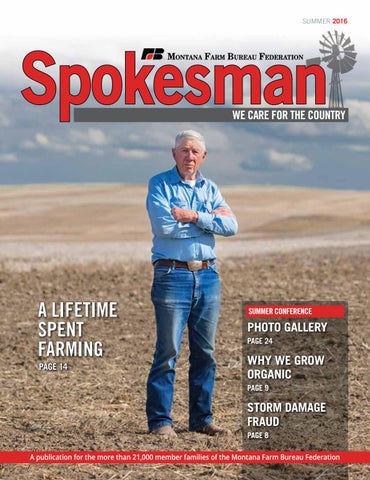
ON THE COVER: Victor Wagner, a Circle wheat farmer. Photo by Todd Klassy www.toddklassy.com
For publishing and advertising information, call David Goettel at Northern Directory Publishing 800-761-5234 Ext. 205 office dgoettel@ndpub.com Printed 6/2016
Summer 2016 | Montana Farm Bureau Spokesman
3
FROM THE PRESIDENT
Why everyone is involved in agriculture
W
conversations about food. You probably elcome to the Montana Farm have questions about the policies and Bureau Summer Spokesman. people involved in agriculture. Know what? Some of you might be asking, Farmers and ranchers are eager to talk ‘Why do I get this magazine? I’m not to you, too. It is my hope that the news involved in agriculture!” Part of my answer and feature stories within these pages will is simple. You receive this magazine answer some of your questions and give as a benefit of your Montana Farm you an accurate look at Bureau Federation the people involved in membership. For agriculture. One of our those not involved concerns is there are in production people and organizations agriculture, this with an aggressive membership agenda opposing often goes hand American agriculture. in hand with Unfortunately, many being a packaged of these groups are policyholder with extremely well-funded Mountain West and continue to spew Farm Bureau Mutual out misinformation Insurance Company, and have created their with discounts own fiction about only afforded to agricultural production. members. However, I challenge you to be for thousands truth seekers. Reject the of farmers and fear mongering. Read ranchers across It is my hope that this magazine and follow Montana, they us on Facebook, Twitter are members the news and feature and Instagram. These because by joining stories within these avenues will give you an the state largest opportunity to learn more ag organization, pages will answer some about the industry that they can make a of your questions and feeds you and allows you greater impact for agriculture and rural give you an accurate look to get to know many of Montana’s great farm and Montana. at the people involved in ranch families. However, there Agriculture is more than is more. You are agriculture. food. Count the number part of agriculture. What binds us all Bob Hanson, President, of ways in an average day that America’s farms together is food. Montana Farm Bureau Federation and ranches touch your We all care greatly life. The cotton sheets about ensuring you sleep on, the wood floors you walk that our food supply is safe, healthy, on, soaps made with cattle byproducts, affordable and sustainable. More than toothpaste and cosmetics made with ever, consumers are eager to engage in
Montana Farm Bureau Spokesman (ISSN 08863075) Published quarterly by the Montana Farm Bureau Federation at 502 S. 19th Ave., Suite 104, Bozeman, MT 59718. Periodical postage paid at Bozeman, MT and additional mailing offices. Subscription rates $4 a year covered by annual dues to Montana Farm Bureau Federation members. Non-member subscription $25 per year. Advertising rates available upon request. The Montana Farm Bureau Federation Spokesman reserved the right to reject any advertisements. POSTMASTER: Send address changes to: Montana Farm Bureau Federation Spokesman, 502 S. 19th Ave., Suite 104, Bozeman, MT 59718
4
Montana Farm Bureau Spokesman | Summer 2016
Montana Farm Bureau Federation Officers Bob Hanson – President Hans McPherson – Vice President John Youngberg – Executive VP Diana Bailey – Exec Sec/CFO Montana Farm Bureau Board Troy Kurth – District 1 Harris Wheat – District 2 Jennifer Bergin – District 3
corn, soybean and mint byproducts, your clothing made from cotton, or wool from sheep, your morning coffee…and this is just the list that I pulled together of things you use before you sit down to eat your breakfast. Once you are out the door the list goes on: corn used in the production of rubber tires, printer ink made from soybeans, your baseball and glove made with cotton and cow hide, to name a few. Although less than 2 percent of the population is involved directly in production agriculture, agriculture employs 22 million people in industryrelated jobs. Agriculture is one industry that touches everyone’s life, each and every day. This is why you are involved and why you should care. Farmers and ranchers will be asked to produce more food for more people under more government regulations with fewer inputs (fertilizer, crop protectants) on decreasing available land. We need opportunities to advance just like any other industry through science and technology. I am incredibly passionate about promoting and protecting this industry and this way of life and I ask you to join me in being an informed advocate for agriculture that provides all of us with so much. On a different note, although I have enjoyed being your Montana Farm Bureau president and representing you on the American Farm Bureau Board of Directors, I have decided to retire after 28 years of being part of Farm Bureau leadership. It’s been an honor to work with the largest agricultural organization in Montana and meet many farmers and ranchers across our fine state. Agriculture is Montana’s number-one industry. I am confident agriculture has a very bright future. Be part of it!
Ronda Johnston – District 4 Gary Heibertshausen – District 5 Wes Jensen – District 6 Tom DePuydt – District 7 Ed Bandel – District 8 Ken Johnson – District 9 Patti Davis – District 10 Gilmen Gasper – YF&R Gretchen Schubert – Women’s Leadership Comm.
THE EVP MESSAGE
The hands of the farmer
W
hile attending a recent conference, I had the opportunity to enjoy breakfast in the coffee shop of the hotel. A young, obviously well educated urban couple seated near me noticed the Farm Bureau logo on my shirt, so the conversation naturally turned to agriculture. I was shocked by the lack of understanding of modern agriculture that was evident through our discussion. These weren’t radical anti-everything advocates but what I would consider to be an upper middle class couple that is a microcosm of a large portion of consumers today. Their vision of farming was a rustic rural setting where a cornucopia of fruits and vegetables are picked daily by spotless, though weathered, hands. They imagined that perfectly clean eggs are laid by free-roaming chickens on unsoiled straw, placed in quaint wooden baskets to be marketed on checkered tablecloths in roadside stands. They perceive urban gardens providing vegetables for their consumption as well as providing for their “not as well off” neighbors. The perception of animals being processed into meat products was hard for them to comprehend. When pressed on how meat gets to their table, they indicated they hadn’t given that concept much thought as they purchase their meat from Whole Foods. To people involved in production agriculture, those ideas seem comical. Ask anyone growing broiler chickens or running a large vegetable farm and they will tell you although farming is rewarding, it’s not run like the farms of the 1920s. The local food movement has allowed some farmers to develop niche markets. At our MFBF Summer Conference in June, we visited Prairie Heritage Farms in Power where Jacob and Courtney Cowgill have started an organic vegetable farm and have a Community Supported Agriculture program where consumers receive a basket of just-picked veggies each week. The couple admits going small and organic was the only way they could afford to get into agriculture, so they developed a niche market. We realize there is a place for locally grown and marketed products and recognize that local production is an important part of agriculture. Then there’s MFBF’s Young Farmer and Rancher Chair Gil Gasper. He’s a young person in farming but owns modern
machinery and is growing wheat and peas to sell on the world market. (See the story about Gil in this issue.) He and the Cowgills are young farmers, yet each has very different ways they farm. Conventional farming and farm-to-table farming exist separately and for very different reasons. They don’t even really compete. The truth is food availability would be very scarce if it weren’t for the modern tractor. Tractors, sprayers, combines and other machinery allow us to grow enough food and glean enough calories from the dirt to feed the billions of people on the earth. Being a farmer or rancher is not easy. A balance sheet that may show millions of dollars might net a farmer or rancher $50,000 in a good year. They are producing a commodity that sells for the same price today that it did in the 1980s while at the same time paying for the world’s most advanced mechanical and biological technologies which allow them to continue on with food production. Yet conventional farmers are criticized because they move farther from the fantasy farm that is the ideal of the urban elite. The young people I visited with envision weathered but clean hands tending their farms; the reality is those hands have groundin dirt and grease from decades of hard work. We need to remember that those hands are connected to people who for all the criticism of their livelihood most likely wouldn’t want any other job in the world.
➲ Don’t miss the story in this issue about wheat farmer Victor Wagner who is still farming at 80 years old. He typifies a farmer who has transitioned to modern farming practices as they made his farm more productive. He’s been through lean and flush times; even in the lean times, he never gave up his love of working the land.
John Youngberg Executive Vice President, MFBF
Ask anyone growing broiler chickens or running a large vegetable farm and they will tell you although farming is rewarding, it’s not run like the farms of the 1920s.
Summer 2016 | Montana Farm Bureau Spokesman
5
AFBF PRESIDENT
Tide Beginning to Turn on EPA
T Zippy Duvall President, American Farm Bureau Federation
Farmers shouldn’t be left in limbo wondering if regulators can shut down our farms over an everyday farming activity. It shouldn’t take a Ph.D. in hydrology to determine if there’s “navigable water” on our land.
6
he Environmental Protection Agency and the Army Corps of Engineers are finally getting a much needed check on their runaway overreach. A unanimous ruling by the Supreme Court in May means farmers and ranchers can take the federal government to court immediately after an agency determines it can regulate part of their property. This ruling--United States Army Corps of Engineers v. Hawkes--is among the most important court opinions we have seen. Along with other groups, including the National Cattlemen’s Beef Association, AFBF was proud to contribute a friend-of-the-court brief; in support of the Hawkes family and the Pacific Legal Foundation. Before this ruling, the Army Corps would tell farmers they had no right to challenge its decision that it had legal authority over what it had determined to be “navigable waters” on their land. Landowners would have to apply for a permit to work their land, or they could farm without a permit and wait for the government to sue them. Either of the government’s approaches could bankrupt many farmers. Just applying for a permit takes months or even years, piles of technical studies and many thousands of dollars in consultant and legal fees. Many permit applications die on the vine-neither rejected nor denied by the Corps, but abandoned by frustrated landowners after years of delay and requests for more data. It wasn’t hard for the Justices to see the injustice and abuse in the government’s approach. Justices Kennedy, Thomas and Alito did not mince words about the Clean Water Act, either. They warned it “continues to raise troubling questions regarding the Government’s power to cast doubt on the full use and enjoyment of private property throughout the Nation.” This isn’t news to Farm Bureau: For more than a decade, we have been battling overreach by both the Corps and the Environmental Protection Agency, which share limited jurisdiction under the Clean Water Act. We weighed in several years ago in the socalled SWANCC case when the Corps claimed jurisdiction over any water body (no matter how small and isolated) where migratory birds might land. The Supreme Court said no to that scheme. EPA also tried to impose federal permitting on any livestock farm with the
Montana Farm Bureau Spokesman | Summer 2016
“potential” to discharge pollution, even if the farm never had a discharge and even though the law only regulates “discharges” to waters. Farm Bureau filed suit together with the pork industry. The court ruled against the EPA: livestock farms don’t need a federal permit to operate. But both EPA and the Corps keep trying to push the boundaries--to regulate by any means possible, no matter how they have to stretch logic and the law. Again, Hawkes isn’t the first time EPA has been caught overstepping its bounds. Take, for example, the case of Andy Johnson, a Wyoming farmer who recently won a long battle with EPA over an environmentally friendly stock pond for cattle on his property. Besides watering Johnson’s cattle, the pond fostered wetland grasses and provided habitat for herons and a stopping place for the local population of eagles. Johnson had a state permit to construct the pond on his property. But the EPA later claimed that pond violated federal law. They threatened him with a daily fine of $37,500 for failure to follow their order to remove the pond. Johnson wasn’t having any of it. He and attorneys eventually wore down the EPA. The agency settled out of court and let the pond stay as it was, rather than face certain defeat. Lois Alt, together with the Farm Bureau, also beat back the EPA. Regulators insisted she apply for a Clean Water Act permit for nothing more than the stormwater that ran off her welltended farmyard. And again, the Army Corps of Engineers threatened fines of $37,500 a day if she didn’t comply. It defied common sense. The courts agreed and sent the EPA packing. Farmers shouldn’t be left in limbo wondering if regulators can shut down our farms over an everyday farming activity. It shouldn’t take a Ph.D. in hydrology to determine if there’s “navigable water” on our land. Opaque, confusing and shockingly expensive regulation by the Army Corps of Engineers and EPA has hamstrung farmers’ and ranchers’ ability to work with and care for the land. Hawkes, SWANCC, Johnson and Alt: These legal battles have won real victories for private landowners across the country and for agriculture. We will continue to work through the courts and with Congress to control unlawful overreach by agencies that seem incapable of self-control.
SAFETY TOPICS
Storm Damage Fraud
S
torms don’t last forever, but getting scammed or victimized by unscrupulous vendors will make it feel like it is forever. Poor quality contractors can cause permanent damage or leave unfinished work. Per NOAA records, Montana has experienced 800 hail storm occurrences in the past three years. In the rush to get your home repairs completed so you can enjoy the rest of the summer, be sure to take the time to educate yourself and avoid contractor scams. Work with only licensed and insured contractors and ask for their credentials. Be wary of contractors selling door-todoor and think twice about high pressure sales tactics. Make sure the contractor secures required permits. Do not pay in full or sign a completion certificate until the work is complete and you have taken the opportunity to inspect it. Payment schedules should be based on completed work only.
8
Never sign a contract with blanks and make sure all conditions are noted in the contract. These should include the cost, work to be completed, time schedules, guarantees, payment schedule and other items discussed outside the original contract. Don’t let the work begin until you are satisfied with the contract. Check Out the Contractor: • Ask for local references. • Verify with your local BBB and/or Montana Insurance Commissioner Office. • If you use an out of state contractor, ask if they have a relationship with a local contractor who will do any warranty repairs. Once an out of state contractor leaves, any problems, issues or warranties may not get handled. Your insurance company will inspect your property when a claim is submitted. Avoid contractors who pressure you to let them do an inspection, write a bid for you to give to your insurance company, or offer to take care of business with your insurance company.
Montana Farm Bureau Spokesman | Summer 2016
They may make it sound like it is one less hassle for you this summer, but unfortunately it may create additional concerns or headaches that your insurance company cannot handle. Keep in mind, it is your property that has been damaged. You are responsible for your insurance policy and you need to remain involved and consulted on any damage and subsequent repairs. If you believe you have been approached by an unlicensed contractor or adjuster, or have been encouraged to fabricate an insurance claim, contact either the Montana Insurance Commissioner http://csimt.gov/ or contact the National Insurance Crime Bureau at www.nicb.org.
SHARING AN OPINION
Why We Love Being Organic Farmers BY BOB QUINN
I
a little oat hay for the cows. In 1983 I started was not born an organic farmer. I was Montana Flour & Grains to market our grain raised on a conventional wheat and directly to whole grain bakeries in Southern cattle ranch near Big Sandy in North California. Even though that helped with Central Montana. The ranch was started better prices, we were still falling further by my grandfather, Emmet Quinn, and his and further behind in repaying our annual new bride, Alice, in 1920. My father, Mack, a operating note for the farm. In 1984, former state president of the Montana Farm Montana Flour & Grain’s largest customer Bureau, took over the ranch in 1948 and ran asked us to find organic grain for them and it until I returned home in 1978. I had been through that effort gone 12 years I first made contact since graduating with organic farmers. from high school, I was surprised by the spending most of enthusiasm they had my time at college. for organic farming At Montana State and by all the positive University I studied things they said it had botany and plant done for their farm. pathology and My training in received a PhD college as well as my from the University upbringing had taught of California at me that a plant could Davis in plant not tell the difference biochemistry. I between nitrogen started a small coming from a sack of business in chemical fertilizer, or a California but after manure pile. However, a couple years, I soon learned a new we decided to concept: The focus of sell our business organic agriculture is and return to not feeding the plant, Montana. My wife, I soon learned a new as I had been taught, Ann, and I raised concept: The focus of but rather feeding five children and the soil. The idea is to now my youngest organic agriculture is not feed and build up the daughter, Bridgette, feeding the plant, as I had soil and let a healthy, has returned with vibrant soil nourish her husband, been taught, but rather the plant. This is done Andrew Long, to feeding the soil. with crop rotations, run a vegetable oil including legumes that business on our are not harvested as a cash crop but turned farm (The Oil Barn®). My son, Adam, who is back into the soil to add needed nutrients. now studying food science at Brigham Young The diversity created also breaks up disease, University, is interested in returning to help pest and weed cycles. On principles of run a snack food business (Kracklin’ Kamut®) diversity and soil building, the organic we have recently started in Big Sandy. system is built and is therefore successful When I returned to the farm, our 2,400 without reliance on costly chemical inputs. acres was evenly split between pasture land I was astonished by this concept and for our cattle and crop land. We ran a cow/ it peaked my curiosity. By 1986 I had calf operation of about 50 head of Polled designed and initiated my first on-farm Herefords and raised wheat and barley and
organic experiment. It consisted of working up 20 acres that had been in alfalfa for about 3 years. I did soil tests for nitrogen in the fall of that year and added chemical fertilizer to the adjoining 20 acres so that each plot would have the same amount of nitrogen. Winter wheat was planted that fall. The organic plot was seeded using 7-inch spacing between the rows while the chemical plot was seeded using 14inch spacing. The chemical plot also had the normal herbicide (2,4-D) sprayed on it the following June to control weeds. I was very surprised to see that the narrow spacing in the organic plot controlled the weeds better (by crowding them out) than the herbicides used in the sprayed plot. When harvest came the yields and protein for both plots were nearly identical. I was very excited about that result and began to convert my whole farm to organic production methods. By 1991 the farm was 100 percent certified organic. The economic improvement of the farm was astounding. I reduced the input costs in my operation significantly (about 75 percent) and increasing the value of the grain I grew due to organic premiums. At that time, we received 50-75 percent more for our organic wheat. This year that gap is at an all-time high as prices for organic wheat are $18-$22/bushel for multi-year contracts. I was thrilled to completely eliminate my burdensome operating note within four years. Farming became fun for me again and I was starting to make money from it. Over the past 30 years my whole farm has become my laboratory as we have continued to learn and adapt to changes in climate, market and in the fields themselves. We have had our share of frustrations and setbacks but all in all we have never been sorry we made the change to organic farming. We are more than happy to share the details of our success and what we have learned with any who might be interested in converting some of their land to organic production. Our blog, bobquinnorganicfarmer.com, as well as farm tours (July 9 this year), phone calls and personal visits provides us with many opportunities to accomplish this goal. This outreach continues the joy and satisfaction we find in organic farming. Bob Quinn is a long-time Farm Bureau member and organic farmer from Big Sandy.
Summer 2016 | Montana Farm Bureau Spokesman
9
NEW BOARD MEMBER
Meet Gil Gasper
I
Gil Gasper MFBF Young Farmers and Ranchers Committee Chair
I believe that being involved on the financial side of production agriculture gave me a different perspective, as I now have the knowledge from the other side of the desk.
10
f you want to locate Gil Gasper, your best way is to drive into a field outside of Circle and catch him expertly operating a large piece of farm equipment. Gasper, who was elected as the Montana Farm Bureau Young Farmer and Rancher Chair at the 2015 MFBF Convention, is all about agriculture. “Our farm is where my grandparents homesteaded,” noted Gasper proudly. “I do most of the farming—wheat, peas, alfalfa—and running cows.” Gasper was away from full-time work on the farm during college, and while working for CHS and Northwest Farm Credit. However, that was a time he feels was well spent. “I believe that being involved on the financial side of production agriculture gave me a different perspective, as I now have the knowledge from the other side of the desk.” Five years ago, he had the opportunity to return to the family farm, a lifestyle he finds extremely rewarding. Gasper, Inc. mainly grows wheat and grows pulse crops (lentil, peas, chick peas) along with grass and alfalfa hay. In addition to his own farming, Gasper supplements his income by custom work, from seeding and spraying to harvesting. He also manages Conservation Reserve Program (CRP) hay for absentee owners to help them meet their CRP contracts. Not only does he grow crops, but raises cattle. “We’ve worked on building a better herd with Black Angus cows and Red Angus bulls. I like the disposition and the genetics,” the enterprising young farmer explains. Gasper smiles when asked about his involvement with Farm Bureau. “It’s just by sheer luck I got involved,” he says. “When I first graduated from Montana State University, I worked at CHS. Dawson-Wibaux board member Gene Evans had heard I attended the “Follow the Grain Tour” and asked me to speak at their
Montana Farm Bureau Spokesman | Summer 2016
annual meeting, which I did. Slowly I became more and more involved. I have received many opportunities thanks to the MFBF Young Farmer and Rancher program. I believe in the Farm Bureau’s values and its mission.” How the younger farmer is coping with lower grain prices can be summed up in one word: diversity. “You need to be diverse and flexible to succeed in agriculture,” Gasper wisely notes. “You can no longer get by with the ‘that’s the way we’ve always done it” attitude. There are opportunities but you must look for them. If the cost of producing your crop is too high, research other options. My custom seeding, custom cutting and cows help offset low commodity prices.” If his own farming and custom work weren’t enough to keep him busy, the motivated young man plans to open a meat shop for custom processing domestic livestock, and possibly wild game in the future. “Currently, we’re working through the process of following the rules for planning the building and following the health guidelines. I will not be selling meat products to the public, but processing livestock for producers.” Although some young people have difficulty convincing their parents to turn over the operation of the ranch to younger family members, the Gaspers were progressive. “I am fortunate my parents said even though they love the farm, they want me to have it. I feel honored my parents had the confidence in me to take over the family business. I know some families find it difficult to make that transition.” Gasper feels social media can range from well-known online platforms such as Facebook, Twitter and Instagram to talking to people you meet. “It’s important to have the conversation.” On June 11 Gasper married Tracy Krause and the young couple looks forward to a life based in agriculture. This young farmer certainly has a bright future.
HAVING A VOICE
Preaching to the Choir BY MARIAH SHAMMEL
O
n my way home from town the other day, I found myself in a really rare situation—I was by myself! No chattering kids in the backseat and no Favorite Farmer noticing every noxious weed that “should really be taken care of” along the route home. For the first time since giving birth to our three-month old son, I was alone with my thoughts. I wasn’t even two miles out of town when I found myself full on sobbing with tears running down my face. It had finally hit me. The week leading up to this point was one I would never want to repeat—I had to explain to our kids (on the way to the crawl space) what would happen if the tornado being created above our house were to touch down; hail storms were blowing through every night, annihilating fields all around us; our calves had sold at a price that was almost half of what we got last year and the shooting at a nightclub in Orlando hit my family way too close to home. Every morning at 7 AM I turn the
12
The Shammel clan. television on to get caught up with the news around the world. Since our kids tend to get up with the sun, they’re usually lingering nearby during my ten-minute kick-off to the day but over these past few weeks, I haven’t been able to turn on any form of media if our kids are anywhere within earshot. To be completely honest, it’s sickening to watch the news anymore—people
Montana Farm Bureau Spokesman | Summer 2016
are getting gunned down, politicians are segregating our nation, countries are destroying their own people and unfortunately, the list goes on and on. It’s hard to ignore these types of things when I can’t change radio stations fast enough and our kids ask questions about why people hurt other people. I’m not usually at a loss for words but during these instances, I am. If my five-and
HAVING A VOICE two-year-old children understand how to work together, keep your mouth shut if you can’t say anything nice and try to love everyone, regardless of differences, why doesn’t the rest of the world? Apparently everything had culminated in my head and I finally had the chance to really think about things. When life gets really bad out “there” it’s pretty easy to hunker down at our Little Slice of Heaven and focus on my world—the hunky farmer in the tractor seat, our three troublemaking hooligans and the beautiful bovines dotting our fields. But this time, I wasn’t able to do that. Battles are being fought around here, too. Just a few miles down the road, ranchers are struggling with how to handle the recent land transaction that takes almost 50,000 acres out of production agriculture and turns it into a buffalo refuge within the ever-growing American Prairie Reserve. From the outside, this seems like just another story where neighbors are pitted against each other because of a difference in opinion of which four-legged creatures should be
grazing the prairies, which is partly true. Wandering bison and potential disease outbreaks are definitely valid fears but what really has communities all across the rural West on edge is the reality that ranch after ranch, farm after farm that goes up for sale is being bought by wealthy out-of-town investors and nonprofit groups who can meet any asking price with no questions asked. It isn’t that we, the local farmers and ranchers don’t want to buy it. It isn’t that we don’t have any money to be competitive with—as long as a piece of land is being sought after by fellow ag producers, it’s generally an even playing field. But as soon as the investor whose income has no connection to agriculture gets involved, it’s game over. No matter how much we’re able to pay, they can pay more and there’s absolutely nothing we can do about it. It’s hard to blame our neighbors when they market their place to those with no limit in the bank account; every good businessman knows you take the most money you can and don’t ask questions. When this happens though, the
rest of us are forced to sit on our hands and watch acre after acre pulled out of food production, see our communities lose families because of jobs lost when farms turn into hunting properties and wonder what this means for our way of life. So while this land deal is just one more in the books to most, to us it’s so much more than that. After my sobfest, I dried my face and returned to the noisy life that I’m used to. I nursed our newest addition with the giggles of the other kids in the background. He turned his big blue eyes up to mine with a hint of a smile and I couldn’t help but join in the laughter. These kids know something I don’t; it’s obvious there are big things waiting for them down the road. There will always be battles, some we can ignore and some we have to fight but if we can look around and find a little seed of hope somewhere, it’s a lot easier to carry on. When all else fails, there’s always Plan B—who wants to join hands and sing a rousing chorus of “Kumbaya” with me?
Summer 2016 | Montana Farm Bureau Spokesman
13
PRODUCER PROFILE
A lifetime of farming with Victor Wagner BY REBECCA COLNAR PHOTOS BY TODD KLASSY
H
eading towards Wolf Point from Circle you can’t help but notice the immaculate red and white buildings nestled down from the road. This is the home of long-time Farm Bureau member Victor Wagner. “My father bought this land in 1942 and it was $1.25 an acre,” the wheat farmer remembers. “The main part of the house and barn were three miles west and he moved them here. I grew up helping with the farming. In the early 1960s after I got married, there was ground west of here for sale so I started buying land and farming more. Through the years I kept adding on until I had enough land for our two sons. Although my one son didn’t pursue a career in agriculture, my son, Bruce, did and we farm together today.”
I believe the peas go to India. I listen to the trade deals, but have to admit they are very complicated. “I seed and my son Bruce sprays,” explains Wagner. “We primarily grow wheat and dry peas. Fifteen years ago, we grew barley. One time it was extra heavy so I took it to an elevator and they said it would be good for human consumption, so we grew malt barley for a while.” Wagner stays informed on trade deals as he comments that the yellow peas grown by Wagner farm are exported. “I believe they go to India. I listen to the trade deals, but have to admit they are very complicated.”
Changes in farming “When I was growing up, we would bind the grain and thrash it in the fall,” Wagner says. “There was a lot of neighboring. They would help you and you would help them. When I was 10 years old I helped drive a buck rake with a horse on each side during haying. We had heavier draft horses for field work and used horses for cow work.” Like most mid-century farms, the Wagners had chickens, pigs and milk cows. “When I was first married we had milks cows for our own use and we made a little money off the cream. It would be shipped in five gallon cans to Mandan, North Dakota. There was a truck that collected dairy products from Circle to Glendive every day.”
14
Montana Farm Bureau Spokesman | Summer 2016
PRODUCER PROFILE
The Circle farmer says his tractor that was an International M was used for planting corn and cultivating the land to keep the weeds under control. When they started farming additional fields, they acquired a Minneapolis G tractor that could pull a five bottom plow and a drill. The family progressed to a John Deere tractor followed by a combine with a Global Positioning System (GPS) as well as a John Deere tractor with GPS. “Yields have increased thanks to quality seed and fertilizer. When we first started fertilizing our fields, we had a box on the back of the drill to put granules of fertilizer in at 50 pounds per acre. Now we are use 170 pounds per acre plus urea and phosphates,” Wagner notes. “We are getting 40-50 bushels per acre, which is
Victor at 11 years old working on the farm. good for this area. A few years back if we got 25 bushels per acre we thought it was good. That shows how production has increased thanks to inputs and equipment.” Wagner, who farms about 6500 acres,
Yields have increased thanks to quality seed and fertilizer. When we first started fertilizing our fields, we had a box on the back of the drill to put granules of fertilizer in at 50 pounds per acre. Now we are use 170 pounds per acre plus urea and phosphates. credits the variety of wheat that has been bred for higher yields and wheat developed to resist the wheat stem sawfly. “We’ve found that rotating our wheat crop with peas really helps prevent pests and disease,” he says. He explains that when he first started
Summer 2016 | Montana Farm Bureau Spokesman
15
PRODUCER PROFILE farming with his father, the name of the game was strip farming with plowed summer fallow. “As we went along, we started to plant half and summer fallowed half. Then we started leaving more stubble,” noted Wagner. “Next we invested in a weed sprayer so now we are able to spray ahead of the drill when we seed. We went minimum-till in 1992. We used to have to spread the urea and phosphate in the fall or winter because we didn’t have time to spread it during seeding. Now our tractors can fertilize, spray and seed a crop.” Are the low wheat prices today concerning this seasoned farmer? “Wild price fluctuations didn’t come until recently. In the 1970s and 1980s, wheat was in the $3 range and stayed there,” Wagner says. “Wheat hit higher prices when they changed the commodity title. It’s now more of a free market. Right now prices are a little low so I’ve opted to keep quite a bit of my crop. Most years I sell to Columbia Grain in Wolf Point.” Wagner offers advice on remaining solvent in the bad price years. “When wheat hit $8-$10 per bushel a couple of years ago, it allowed us to buy larger, more efficient equipment. However, it’s also important to save in the good years so if you run short in the bad year, you have something in reserve,” he adds. Having his son in the business has been rewarding, as they share equipment and land. (Wagner has three daughters but they are not involved in the day-to-day farm operations.) Not only is green equipment on the farm, so are black cows. “We run a small herd of Black Angus,” he says. “I primarily run the cows. When my wife passed away, taking care of my cows really gave me something to do and they’re bringing a pretty good price.”
For a young person today, trying to buy land and machinery to get started in farming is almost impossible. Young people who want to farm but are not born into agriculture can face daunting challenges. “For a young person today, trying to buy land and machinery to get started in farming is almost impossible. I got started by farming my dad’s land and when I had money I bought land a little at a time,” the farmer says. His advice? Try to
➲ Farm Bureau Connection Victor Wagner remembers when Melvin Johnson got the McCone County Farm Bureau started. “It was about 1955, and Melvin visited with me about Farm Bureau. I thought it sounded like a good organization so I joined. It’s a more conservative group and they do a great job working on bills that are geared toward farmers and ranchers. I have been a Century Club member since 1989 and carry Farm Bureau insurance on my farm as well as have life insurance,” he says proudly. The 80-year-old has served as McCone County Farm Bureau’s vice president, been a board member and often serves as a voting delegate at MFBF Convention in November. “I really enjoy the delegate session because you can hear different viewpoints on the proposed policy and vote on it. It truly is a grassroots process.”
16
Montana Farm Bureau Spokesman | Summer 2016
find someone retiring who is willing give a potential young farmer a chance. What keeps him going year after year when many people his age are playing golf in Arizona? “I enjoy working the ground and being outside. I got started that way and have stayed with it. “I guess as long as I can and am healthy enough to farm, I will keep it up. I love farming.”
Start farming If you’re a beginning farmer, resources are available to help get your started. Visit Montana Farm Link, http://farmlinkmontana.org/, Northwest Farm Credit, www.northwestfcs.com, and the Montana Department of Agriculture, http://agr.mt.gov/programs.
TAME MARKET THE
Lock in gains and never lose money
1
OUR Y B GRA RE BY U FUT ORNS. H THE R YOU T C TA U CON BUREA ! FARM T TODAY AGEN
1 Surrender of the contract may be subject to surrender charges. Withdrawals before age 59 ½ may result in a 10% IRS penalty tax. Additionally, there is a charge for the Simple7 Income Rider once it is activated. Farm Bureau Life Insurance Company*/West Des Moines, IA. *Company provider of Farm Bureau Financial Services A144 (6-16)
PRODUCER PROFILE
Minding the store
Sidney couple enjoys challenges of retail BY REBECCA COLNAR
H
ead off of Central Avenue in the small town of Sidney, Montana and you’ll find R&J Supply. Haying equipment, a fabric storage shed full of livestock lick tubs, and a hydraulic calf table fill the yard. This isn’t your glossy farm-supply-store-turned-western wear store, but a feed and farm supply store serving area farmers and ranchers. The real assets to R&J Supply are Karli and Ben Johnson, remarkable young people accepting the challenge of the retail sector. “My grandfather started this feed store about 50 years ago,” says Ben, a fifth generation rancher. “I started working here when I was 15, making deliveries and
running the warehouse. When my grandad was getting his second round of cancer treatments, I ran this place. In addition, I was still helping my dad and uncles with the cows and farming.” Ben headed to Montana State University (MSU) where he earned a degree in agricultural education and animal science. He graduated in 2014 and moved back to Sidney to officially take over the business. Karli was the 6th generation working on her family’s ranch in Choteau and met Ben while attending MSU. After completing her degree, she worked for Dow Agro-Science servicing their crop protection products. “I was covering 11 counties from Havre to Glendive. I really enjoy it, but I wanted to be home more. That was when it was
impossible to find any help in Sidney, so I decided to work at the store full time.” In the short time the couple has bought into the business, they’ve increased business significantly over the past four years. “High cattle and oil prices helped us, as people spent money, we attracted new customers, and were able to offer new products,” Ben explains. “We’ve changed the dynamic. It used to be that Russell, my grandfather, traveled around in a truck with a cell phone and did most of his business that way. Karli and I have added
Ben and Karli Johnson at their North Dakota ranch.
20
Montana Farm Bureau Spokesman | Summer 2016
PRODUCER PROFILE to the space and have many more walkin customers. Although we don’t offer a huge variety of animal health supplies, we have products for a rancher who needs something right away, like a vaccine gun and ear tags. We carry a lot of branding supplies. Being near the stockyards also helps business.” The store carries custom mineral supplements and Crystalyx, a cattle supplement along with pig and sheep feed. Russell brings years of animal nutrition experience, especially in feeding hogs on his own farm, to the business, and the couple works with experts in animal nutrition. As they work to grow their business, they look for niches to fill. When Ben realized ranchers wanted a hydraulic calf table but couldn’t afford the expense, he purchased one ranchers can rent, providing a real service to his customers and adding some dollars to the store’s bottom line. “If they realized they really like it and want one of their own, I can sell them one,” he smiles. Karli laughs when asked about their marketing strategy. “We don’t have one other than we have a strong knowledge base and provide high-quality products and good customer service. We use Facebook
➲ S age Advice Ben and Karli offer tips for young people wanting to be involved in agriculture: • Have a goal in mind • Know your values • Find a mentor • Be conservative with purchases • Don’t get overextended on machinery, cattle or land • Challenge your way of thinking • Read, read, read
Karli Johnson loading salt to take to their leased pasture. to advertise our calf table and we’ve received a board spectrum of phone calls.”
They’re ranchers, too When they’re not busy with the store, the Johnsons spend considerable time with cattle. Ben’s family’s home place is 10 miles north of town and they have a lease in North Dakota which is made up of a small amount of private land and a grazing allotment in one of the 15 pastures in the National Grasslands. Each pasture is an entity of the McKenzie County Grazing association that holds the leases and enforces the rules. The 60-section lease has few interior fences, with everyone in the grazing association running cattle in common.
Both are grateful for the opportunity to stay involved in agriculture. “I was fortunate to have this option to come home and run a feed store and I was hoping to run a farm and ranch. Ranching is what I know, and it’s always been my dream,” Ben says. Karli echoes Ben’s sentiment, adding, “I want our kids to be able to have the childhood we had,” she says. “The great thing about agriculture is your children go to work with you. You can put them in the back seat of the pickup and head off to feed cows.”
Summer 2016 | Montana Farm Bureau Spokesman
21
PRODUCER PROFILE The couple value ag education, sponsoring and judging FFA and 4-H shows and hiring young people to help at the store. “We want to have an environment where we can teach young people about agriculture,” Karli explains. Ben notes that one of the challenges for him is being young and telling older ranchers what to do. “My customers trust me, so that helps. We had a rancher come in and tell us he had the best cow breed back he ever had using our recommended supplement program.”
Advocating for ag Karli notes another challenge is keeping active on social media. “When you’re busy, it can be hard to find the time, but make promoting agriculture one of your chores. It’s as important to the longevity of agriculture as feeding your cattle. I use Facebook and Instagram as much as I can to advocate for agriculture.”
Make promoting agriculture one of your chores. It’s as important to the longevity of agriculture as feeding your cattle. Ben admits that he doesn’t do much public advocacy, but is involved by serving on the state Farm Bureau Young Farmers and Ranchers Committee and being a board member of the Richland County
22
Ben Johnson stand by the hydraulic calf table that he rents to local ranchers. Farm Bureau. “It’s important to be involved in our organization. I feel I bring a young voice to our Farm Bureau. Many of our customers have asked me about how their kids and grandkids can be involved, and I tell them Farm Bureau.” Despite the challenges, they love the life. “I love cows,” Ben says smiling. “I would go crazy if I didn’t have them. Because I am a rancher, I have a good connection to customers and I can relate with my own herd. The same things have happened to
Montana Farm Bureau Spokesman | Summer 2016
me that have happened to my customers. I’m in the game with them.” “Nothing is more centering than spending an afternoon with cows,” Karli says. “When you spend all day with people, it’s nice to just be with the cows!”
Wrapped bales to be used for baleage.
Montana Farm Bureau Federation Summer Conference
June 7-9 | Best Western Heritage Inn | Great Falls
FOUNDATION FUNDRAISERS The MFB Foundation held two fundraisers: they recreated the “Ozark Room” at the Great Falls History Museum with jazz band entertainment, tasty food from Cattleman’s Cut with a live auction. The Foundation Golf Scramble was held at the Hickory Swing Golf Course near Great Falls. The auctions and golf tournament netted $16,500 thanks to all of the generous donors and buyers.
COMMITTEE MEETINGS Advisory committees met to discuss current agricultural issues and concerns, and surface ideas for policy development.
Dennis and Kris Descheemaeker and Sarah and Lee Boyer at the museum.
Cliff Cox and Lee Signalness at the Water Committee meeting.
The Membership Committee strategizes about ways to attract new members.
MEDIA Gil and Tracy Gasper listen intently to MFBF’s Scott Kulbeck explaining the cork pull fundraiser.
MFBF Vice President Hans McPherson interviews with KRTV-TV.
Russell Nemetz, Northern Ag Network, interviews Mike Honeycutt, Department of Livestock, about the new direction of the department. Full house at the museum.
24
Montana Farm Bureau Spokesman | Summer 2016
WORKSHOPS
PEOPLE
The conference theme Impact. Influence. Innovate. was reflected in the educational workshops.
Heather Dye, Jim Dye, Elizabeth Maclay and Alan Knudsen.
MFBF President Bob Hanson visits with Johnna Miller, American Farm Bureau. Miller gave a workshop on ag advocacy in the Influence workshop.
Innovate Workshop: John Helle talks about his development of Duckworth Clothing line using wool from his sheep.
GOLFING
MFBF District Director Tom DePuydt with Walt Anseth, Montana Department of Agriculture.
Sen. Rick Ripley, Rep. Christy Clark, and Rep. Jeff Welborn provide insights for constituents on communicating with elected officials in the Impact workshop.
Darcia Patten and John Olson diligently posting to social media.
TOURS Thursday tours included stops at Prairie Heritage Farm, Giant Springs Fish Hatchery and Mighty Mo Brewing Company.
Bill and Edie Wright visit with Jacob Cowgill at Prairie Heritage Farm. The Cowgill family grows organic produce for farmers’ markets and Community Supported Agriculture.
Talking about malt barley at the Mighty Mo Brewery.
Jules Marchesseault, Bruce Yanzick and Earl Bricker admire an antique tractor during the farm tour.
Checking out trout at the fish pond at the Giant Springs Fish Hatchery.
Wes Jensen, MFBF District Director and Kris Descheemaeker on the links.
Summer 2016 | Montana Farm Bureau Spokesman
25
INSURANCE AGENTS
Helping clients in eastern Montana BY REBECCA COLNAR
F
ederation Members in eastern Montana know the names Mark Martin, Cara Nelson and Peggy Errecart as their team of agents at the Farm Bureau Office in Sidney. Each agent takes pride in what they do and in helping protect what matters most to Federation Members; the Family, the Farm, the Ranch, the Home. “We work with clients on more than just property and auto insurance. Our job is to protect people and their futures, too. As fully licensed agents we want to protect people by providing Life Insurance, Retirement Planning and Estate Planning services,” explains Nelson. The three agents enjoy working together in the same office. “We support and help each other, although we all have different clients and different ways of working with them,” notes Martin. Mark Martin joined the agency in 2010 after a long career running the Pizza House with his wife, Mary Martin. “Little did I realize the 22 years I spent building and working the restaurant allowed me
to build relationships and good referrals for my current career with Farm Bureau.” After selling the Pizza House Martin became the home inspector in the area under a pilot program with Mountain West Farm Bureau Mutual Insurance Company. Martin notes, “Because of the referrals I was drumming up for the office as home inspector, Terry Sivertson, who is now agency manager, said I better become an agent.” Martin believes being an agent is his perfect job. “I like to help people. Because I live and work in this community, I really felt good taking care of people’s insurance needs. The most valuable thing our customers can have is an agent in their corner.” Cara Nelson has a passion for what she does, and it shows. She has been with the agency for 10 years and counting. “I love working with people and feel that through this business I’ve not only been able to help my clients, but many of them have become good friends,” Nelson says. This career was a perfect fit for Nelson because
Cara Nelson, Agency Manager
26
Montana Farm Bureau Spokesman | Summer 2016
Peggy Errecart, Montana Agent
it allowed her to be flexible with her time so that she would not have to miss any of her kids’ activities. Peggy Errecart enjoys her job because she likes to help people understand the benefits of insurance and that Farm Bureau offers more than the traditional property and auto coverage. “I am grateful for all of the services we offer,” she explains. “People in our community and members of the Federation might not realize we handle investments and life insurance along with property and casualty insurance. In addition, we offer a unique service by having an attorney comes to our office quarterly to work with people on wills, trusts and estate planning. It’s a service that everyone needs.” Estate planning is an important service the office is offering to the community and strikes a personal cord with Martin. Martin shares, “The lack of estate planning and my dad dying right after I graduated from college left me with no chance to come back to the family farm in Glasgow. Due to the lack of estate planning the family farm was sold.” Martin is willing to share his personal experience of how the lack of estate planning caused him to lose his chance to come back to the farm with clients. “It’s so important to have a plan and a vision for transferring your estate and assets. If you don’t, the state of Montana has a plan which includes all of your heirs. It’s hard to get your heirs to agree on what is best for your farm and ranch or business. Some owners of farms and ranches have a vision to keep the business intact, but many don’t. It’s so important to get a plan before someone dies so that a farm or ranch can continue to be a successful family business.” Errecart appreciates the agriculture community and notes that it is the economic life line of our area. “Agriculture is the root of our community and it’s important to get people involved in Farm Bureau,” notes Errecart, who was raised on a farm in North Dakota. All the agents speak highly of the Farm Bureau Federation. “We try to attend as many county Farm Bureau Federation
INSURANCE AGENTS meetings as we can, and we show up for events they have,” Martin says. “We respect the federation with its many membership benefits. We explain to the farming and ranching community that the Farm Bureau Federation provides a unified, pro-agriculture voice in Helena and Washington, D.C. and we encourage them to get involved.” Being involved with the Federation and agricultural side of the community is important to all the agents. They have all found their own way to give back to the community. They sponsor the rodeo, sponsor community events, and get involved in organizations they are passionate about. Nelson says, “I help with the Lonsdale Methodist Church Booth every summer for the Richland County Fair. I’m an active member of the church and for the past 11 years have dedicated many hours to the Richland Youth Hockey program.”
Errecart is very involved in Lions’ community activities and holds the office of Secretary. She is very involved in her church and loves spending time with her grandkids. Martin is a member of the Sidney
Hospital Board and is very proud of what the hospital brings to the community and that it strives to bring more quality services to the rural area. He is very active in the Sidney Planes Folks. “I’ve always been interested in aviation and about 30 years ago I found out about remote controlled airplanes. I have a lot of fun with them” he says. If you’re attending a remote control airplane event, you will probably see Martin. “It’s a great way to get connected to people all over the state. I build the planes, which range from two feet wing spans to eight feet. I have slow ones, and I race the fast ones,” he says. All of the agents enjoy living in the Sidney community and being a part of bringing awareness of the Farm Bureau Federation through the many services the insurance agency can offer farmers, ranchers, and homeowners.
Montana’s Largest Ag Bank
We Know and Live Agriculture I N M O N TA N A !
Operating Loans & Lines of Credit
Livestock & Equipment Loans
Deferred Payment Contracts*
Ag Real Estate Loans
*Available through Stockman Exchange. Contracts are not FDIC insured and not bank guaranteed. Consult a tax advisor.
© 2016 Stockman Bank
| NMLS ID# 440094 | Member FDIC
W W W. S T O C K M A N B A N K . C O M
Summer 2016 | Montana Farm Bureau Spokesman
27
AG CHAT
COUNTY NEWS
Wheatland/Golden Valley County Farm Bureau worked with local grocery stores in Harlowton, Ryegate and Lavina to provide grocery bags to local customers during an event May 27. The re-usable and eco-friendly bag had farm and animal care facts printed on the sides as well as additional farm fact materials, Farm Bureau “producer spotlight” of local MFBF members and their connection to agriculture and the community. A few lucky customers at each location received grocery gift certificates in their bag as well.
Chouteau County Farm Bureau members held a pancake breakfast June 25 as part of the Fort Benton Summer Celebration. They also handed out bottled water to parade goers.
Northwest Counties Farm Bureau held Young Farmer and Rancher Poker Ride July 9 at the Meuli Ranch in Dayton, MT.
Cascade County Farm Bureau handed out bottled water to 4-H members at the Cascade County Fair July 9-10.
Powder River/Carter County Farm Bureau held a YF&R social/generational mixer June 18. During this social, members enjoyed the fun of cribbage games, horseshoes and corn hole. The guest speaker was Farrah McGregor, Northwest Farm Credit Services, who talked about young farmer loans. A piñata provided great fun for the kids.
Custer-Fallon County Farm Bureau held their annual Lewis & Clark County Farm Bureau held a board meeting on June 15 and made plans for upcoming summer events. They will have the Chevy Silverado Giveaway Pickup at the Last Chance Stampede & Fair July 29-30.
28
picnic June 21. There was an ag safety presentation. The Chevy Silverado Giveaway Pickup pulled a big grill which was used for cooking hamburgers and hot dogs.
Montana Farm Bureau Spokesman | Summer 2016
Meagher County Farm Bureau held their picnic June 23 where they provided the food and good camaraderie. Members were encouraged to bring potential members with hopes of getting in the MFBF Chevy Silverado raffle.
Win a 2015 Chevy Silverado 1500 Z71 Crew Cab pickup!
• Fill out an entry form. • Test-drive a Chevy pickup at a participating dealer and get a
bonus entry form. • Voting Farm Bureau members and Century Club members are eligible for a bonus entry for every new member they recruit. New members receive an additional entry form. Upgrade your membership and receive a bonus form. • Twenty-five entries will be drawn prior to the MFBF annual meeting in November 2016. Those 25 win free registration to the 2016 Annual Convention, and the winner will be drawn from those 25 entries at the awards banquet. • For more information, including a list of participating Chevy dealers, visit http://mfbf.org.
Dawson-Wibaux County is holding their picnic July 10. Rosebud Treasure County Farm Bureau will have a booth at the Rosebud County Fair July 21-24.
Gallatin County Farm Bureau and the Gallatin Beef Producers are hosting a summer picnic at 6 p.m. Saturday, July 16 at Patti Davis’ house in Belgrade. The evening will include a prime rib cook-off competition, catered side dishes, cash bar and a presentation on changes to the veterinary feed directive by Rachel Endecott. RSVP to the Gallatin County-MSU Extension office 388-3213 by Wednesday, July 13.
Summer 2016 | Montana Farm Bureau Spokesman
29
AG CHAT
Cheers to Scholarship Winners The Montana Farm Bureau Women’s Leadership Committee presented two $1,000 scholarships to Elizabeth French of Huntley Project and Kacie Cummings of
Scholarship. She plans to continue her education at UM-Western in Dillon. She is
Addie Nesbit receives the Gallatin Count Farm Bureau Scholarship from Gallatin County President Brent Poppe. Cascade County and WLC scholarship winner Kacie Cummings with Cascade County’s Marjie Pribyl. Cascade. French plans to attend Montana State University. She was valedictorian of the Huntley High School Class of 2016. She competed in Montana High School Rodeo events as well as being active in FFA. Her community service included teaching Sunday School for five years. She is the daughter of James and Debbie French. Cummings plans to attend Washington State University with the scholastic goal of becoming a Physician Assistant. She was valedictorian of her class, was active in FFA and her community, including volunteering at Benefis Hospital in Great Falls, Great Falls Boys and Girls Club, Cascade Food Bank and more. Cummings competed in cross country, volleyball and track & field events. She is the daughter of Richard and Nanette Cummings. Cummins was also winner of the Cascade County Farm Bureau Scholarship. Seth Kichin of Dutton was the recipient of the $1,000 Bernard Greufe Memorial Scholarship. Kichin graduated from Power High School and plans to attend Montana State University-Bozeman where he will major in biology and pre-medicine on his path to becoming a medical doctor. He was valedictorian of his class and was active in basketball and football.
Northwest Counties Farm Bureau
awarded two $1,000 scholarships to Ethan Blevins from Ronan and Aidan Fromm from Missoula. Addie Nesbit of Willow Creek has been selected winner of the $1,000 Gallatin County Farm Bureau
30
Montana Farm Bureau Spokesman
the daughter of David and Nancy Nesbit.
Powder River/Carter County Farm Bureau awarded scholarships to Lydia
Lynch (daughter of Dan and Lisa Lynch) of Powder River County High School and Katy Negaard (daughter of Dustin and Shannon Negaard) of Carter County
Winner of the Powder River/Carter County Farm Bureau scholarships were Lydia Lynch and Katy Negaard pictured with Powder River/Carter County President Darcia Patten. High School. The county Farm Bureau increased the scholarship amount to $500 thanks to MWFMBIC agents Matt Korell and Justin Venn. Janessa Haynie received the $500
McCone County/Mountain West Farm Bureau (Wanda Robinette) scholarship. The 2016 graduate of Circle High School is planning to major in Business/
Hospitality and Tourism Management at MSU-Bozeman. Janessa is the daughter of Elliot and Sherri Haynie of Vida.
Janessa Haynie receives the $500 McCone County/ Mountain West Farm Bureau (Wanda Robinette) scholarship presented by Cheryl Jensen, McCone Co. Farm Bureau secretary.
Richland County Farm Bureau awarded a $1000 scholarship to Ashton Handy. Handy graduated from Culbertson High School where she was involved in 4H and FFA. She plans to major in Ag Business at Northwest College in Powell, Wyo.
A Lasting Memorial Montana Farm Bureau Foundation receives a number of memorial donations to recognize departed members. What an appropriate way to remember someone to whom Farm Bureau has been an important part of their life. This charitable remembrance perpetuates their belief in the future of agriculture. The Foundation supports the ag community in many ways including: • Youth ag education & leadership development • Young Farmers and Ranchers Program • Mini grants to elementary & high school student projects relating to agriculture • Scholarships • Ag research • Youth speech contest • Public education about agricultural issues Next time you ponder how to express your
appreciation for a friend or acquaintance who has passed away, consider a memorial that promotes agriculture and will have a meaningful impact. Personally consider a codicil in your own will leaving a small percentage of your success to the Montana Farm Bureau Foundation. It will help pave the road for future generations of farmers and ranchers.
Rod & Ronda Johnston …In memory of Jim Pile
Southwest Counties Farm Bureau …In memory of Ray Gallik
Sweet Grass County Farm Bureau …In memory of David Leigh Anderson …In memory of Joan Claire Langford
Lew and Sarah Zimmer
…In memory of Garfield Linde
Summer 2016 | Montana Farm Bureau Spokesman
31
AG CHAT
Hoofin’ It for Hunger
Look For This
Whether you’re a walker or a runner, don’t miss the Montana Farm Bureau Young Farmers and Ranchers Hoofin’ It for Hunger Trail Race Saturday, Oct. 8 at Fort Keogh in Miles City. Plan to participate in the half marathon, 10K, 5K or the one-mile walk. This scenic trail run takes you through fields, pastures and along the banks of the Yellowstone River. Get into town early and enjoy dinner from 5-7 p.m. Friday, October 7 at the Range Riders Museum in Miles City. It is free to all race registrants and packet pick-up will be available. Bring a friend too, as it’s a freewill donation for guests. All proceeds go to the Montana Food Bank Network. The MFBF YF&R Committee has donated $29,000 to this worthy cause. For registration fees (including early bird rates), race times and to sign up, visit Hoofin’ It For Hunger Facebook page or www.runsignup.com. Questions? Contact Sue Ann Streufert, sueanns@mfbf.org.
32
Montana Farm Bureau Spokesman | Summer 2016
Look for this Farm Bureau pro-agriculture message on a bus traveling around the west end of Billings.
Women’s Leadership Committee
and
2016 Photo Contest Montana Farm Bureau Federation Women’s Leadership Committee Photo Contest will be held
The
during the MFBF annual convention November 13-16 in downtown Billings. Photos will be on display and voted on by popular vote. The winners (first, second, and third prize) will be announced at the Awards Banquet, Tuesday, November 15. First prize is $75, second prize $50, and third prize $25. The top three winning photographs become the property of MFBF to be used for display and publicity purposes.
The entry deadline is October 31, 2016.
The contest theme for 2016 is SPACIOUS SKIES. The committee encourages members to enter photos that capture what the theme means to them. The rules of the contest: • The entrant must be a current MFBF member. • Open to amateur photographers only. • Photos must be taken by entrant. • B&W or color photos, 3x5 or 5x7 or panoramic 4x12. • Name, address and membership number must be on back. • No more than three photos per entrant. • No matting or framing.
Send photos to:
Carla Lawrence 270 Boyd Cooney Dam Rd., Roberts, MT 59070 carla.at.the.ranch@gmail.com
2015 Photo Contest Winners Theme: Traditions and Innovations 1st Place – Jodi Miner 2nd Place – Helen Meadows 3rd Place – Marjorie Pribyl
Include SAS for return of photos.
Summer 2016 | Montana Farm Bureau Spokesman
33
FARM BUREAU PAC-PRIMARY ELECTION REPORT
Independent Expenditures The Farm Bureau PAC supports candidates that support agriculture and the values of rural Montanans. Farm Bureau PAC maintains very high moral and ethical standards when considering engaging in any political action. We take seriously the responsibility of representing agriculture and strive to positively advocate for Montana’s farm and ranch families.
This table contains the names of candidates the Farm Bureau PAC did independent expenditures for. Expenditures were all positive, voter advocacy mailers encouraging people to vote in the primary election. Farm Bureau PAC also made a contribution to the Jobs for Montana PAC. They sent voter advocacy mailers on behalf of a slate of candidates supported by the Farm Bureau PAC. Name
Party
Office
FB PAC
Tom Richmond
R
Senate District 28
$384.79
Jeff Welborn
R
Senate District 36
$285.92
Pat Riley
R
House District 40
$265.88
Walt Sales
R
House District 69
$381.45
Ray L. Shaw
R
House District 71
$192.40
Jobs for Montana PAC
$2,500.00
Monetary Contributions This table details the contributions made to candidates running for the State House, State Senate, or other statewide seat during the primary election. First Name
Last Name
Party
Office
FB PAC
First Name
Last Name
Party
Office
FB PAC
Don
Kaltschmidt
R
Senate District 03
$100.00
Wendy
McKamey
R
House District 19
$170.00
*Steve
Fitzpatrick
R
Senate District 10
$170.00
James
O'Hara
R
House District 27
$100.00
Hertha
Lund
R
Senate District 15
$100.00
Dan
Bartel
R
House District 29
$100.00
Ryan
Osmundson
R
Senate District 15
$100.00
Joel
Krautter
R
House District 35
$100.00
Mike
Lang
R
Senate District 17
$170.00
Luther
Waterland
R
House District 37
$100.00
Jason
Small
R
Senate District 21
$170.00
*Geraldine
Custer
R
House District 39
$100.00
Donald
Roberts
R
Senate District 26
$100.00
Pat
Riley
R
House District 40
$170.00
Terry
Gauthier
R
Senate District 40
$100.00
John
Bedford
R
House District 45
$170.00
Daniel
Salomon
R
Senate District 47
$100.00
Sue
Vinton
R
House District 56
$100.00
Steve
Gunderson
R
House District 01
$100.00
*Ray
Shaw
R
House District 71
$170.00
Greg
Hertz
R
House District 12
$100.00
Gordon
Pierson
D
House District 78
$100.00
Ross
Fitzgerald
R
House District 17
$100.00
Scott
Ralston
R
House District 85
$170.00
*Rob
Cook
R
House District 18
$100.00
Adam
Hertz
R
House District 96
$170.00
Elsie
Arntzen
R
Superintendent of Public Instruction
$250.00
* Denotes the check was returned because the candidate had already reached their contribution limit allowed under state law.
Endorsements This table contains a list of Farm Bureau PAC endorsements made to candidates running for the State House, State Senate, or other statewide seat during the primary election. First Name
Last Name
Party
Office
FB PAC
First Name
Last Name
Party
Office
FB PAC
Robyn
Driscoll
D
Senate District 25
Endorse
Zach
Brown
D
House District 63
Endorse
Gene
Vuckovich
D
Senate District 39
Endorse
Kelly
Flynn
R
House District 70
Endorse
Fred
Thomas
R
Senate District 44
Endorse
Ron
Ehli
R
House District 86
Endorse
Brad
Hamlett
D
House District 23
Endorse
Ed
Greef
R
House District 88
Endorse
Wylie
Galt
R
House District 30
Endorse
Nate
McConnell
D
House District 89
Endorse
Austin
Knudsen
R
House District 34
Endorse
Shane
Morigeau
D
House District 95
Endorse
Kenneth
Holmlund
R
House District 38
Endorse
Willis
Curdy
D
House District 98
Endorse
Donald
Jones
R
House District 46
Endorse
David
Moore
R
House District 100
Endorse
Forrest
Mandeville
R
House District 57
Endorse
Vince
Ricci
R
House District 55
Endorse
Seth
Berglee
R
House District 58
Endorse
Tim
Fox
R
Attorney General
Endorse
Alan
Redfield
R
House District 59
Endorse
Greg & Lesley
Greg for Montana
R
Governor & Lt. Governor
Endorse
Jim
Hamilton
D
House District 61
Endorse
34
Montana Farm Bureau Spokesman | Summer 2016