FALL 2016
Montana Farm Bureau Federation
WE CARE FOR THE COUNTRY
‘WE’RE YOUR FARMER’ PARTNERS IN THE PULSE BUSINESS PAGE 20
MFBF CONVENTION REGISTRATION PAGE 24
WHY WE USE CATTLE TRUCKS PAGE 12
WIN A POLARIS PAGE 32 A publication for the more than 21,000 member families of the Montana Farm Bureau Federation
Montana Farm Bureau Federation
WE CARE FOR THE COUNTRY
4 REFLECTING ON FARM
20
Producer Profile THE STREIT FAMILY & STRICKS AG, LLC
5
The EVP Message ELECTION TIME IN MONTANA
PAL Program PAL AND PAPAYAS
AFBF President CRAFTING A 2018 FARM BILL TO PROVIDE SHELTER FROM THE STORM
From The President BUREAU
6
Safety Topics
9 FALL
Having A Voice
12
Sharing An Opinion WHY WE USE CATTLE TRUCKS
14
Insurance Agent MEET MWFBMIC AGENT WAYNE LOWER
Producer Profile THE PATTEN FAMILY
10 FEELING THE LOVE
16
Published by: Montana Farm Bureau Federation 502 S. 19th Ave, #104 Bozeman, MT 59718 406-587-3153 | www.mfbf.org Publisher | John Youngberg Editor | Rebecca Colnar Managing Editor | Sue Ann Streufert Advertising Sales | Rebecca Colnar 406-223-4106 Production Services Provided by: Bobbi Burow, CreativityTank LLC
23 24
F a l l
2 0 1 6
TABLE OF CONTENTS
FBF CONVENTION M REGISTRATION
28 AG CHAT 34 MFBF PHOTO WOMEN’S
LEADERSHIP COMMITTEE PHOTO CONTEST
16 © Copyright 2016. Montana Farm Bureau Federation Spokesman. All rights reserved. The contents of this publication man not be reproduced by any means, in whole or in part, without prior written consent of the publisher. While every effort has been made to ensure the accuracy of the information contained herein and the reliability of the source, the publisher in no way guarantees nor warrants the information and is not responsible for errors, omissions or forward looking statements made by advertisers. Articles and advertisements in this publication are not solicitations to buy, hold or sell specific securities; they are for information purposes only. Opinions and recommendations made by contributors or advertisers are not necessarily those of the publisher, its directors, officers or employees. Investors should be aware that risk is associated with any security, strategy or investment and are advised to seek the counsel of a competent investment advisor before making any investment, or utilizing any information contained in this publication. Subscription, advertising and circulation information can be obtained from the publisher.
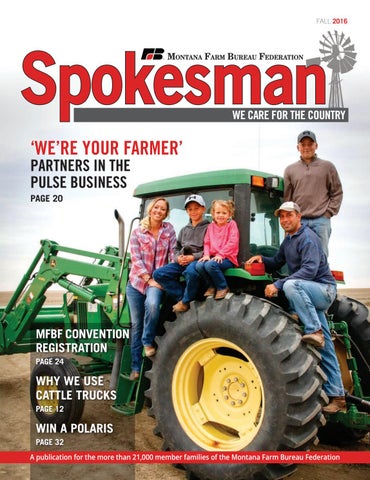
ON THE COVER: Jillien and Tyler Streit with their children on Flat Acre Farms in Chester, Montana. Photo by Laura Nelson.
For publishing and advertising information contact:
Rebecca Colnar Montana Farm Bureau Federation 406-223-4106 rebeccac@mfbf.org Printed 9/2016
Fall 2016 | Montana Farm Bureau Spokesman
3
FROM THE PRESIDENT
Reflecting on Farm Bureau
A
fter almost three decades of United States doesn’t get in on the TPP, I involvement in Farm Bureau can assure you that China will, and that leadership, I will be stepping off won’t be good for our country. the train of this amazing journey which What’s going on in government over the started in 1988. That year I was elected next six months that will affect agriculture to the Montana Farm Bureau Board of is huge. The TPP might pass, and for our Directors. I later became vice president state’s sake, I hope it does. We need to and served for 13 see that the Gateway years in that position. Pacific Terminal at Cherry I was elected as your Point does get developed president in 2007. to ship our goods It’s been quite a efficiently overseas. ride. I have traveled The ports are jammed and getting products the state, the shipped overseas is country and the world, and it has slow. We need to see been rewarding that our Colstrip power to meet hardplant continues being working farmers able to provide us with and ranchers clean and inexpensive everywhere. It’s energy. These all have an been eye-opening enormous impact on the economy of Montana. on the international trade trips to meet Speaking of economics, people who want times on the farm and Montana grain and ranch are hard as we beef. I’ve traveled see prices plummet I have always to South America, from extreme highs to believed in riding for several Pacific Rim dangerous lows. One countries, along way to help farmers and the cause, not the with an interesting ranchers hang onto their applause! trade mission to business is getting the meet with officials inheritance tax axed. I’m at the European Bob Hanson, President, proud of the work I did Union in Belgium with Senator Max Baucus Montana Farm Bureau Federation and the World Trade to get the death tax Organization in exemption to $5 million Switzerland. per person, indexed for inflation. That I can’t reiterate how important trade is might seem like a lot of money, but when to Montana, especially with countries in the land you are farming and ranching on the Pacific Rim, as well as with Canada and has increased in value so much that your Mexico. I have presented those figures corn field is worth $10,000 an acre, your time after time how trade agreements like heirs need a way to keep it in agriculture. I the Trans Pacific Partnership are essential don’t think there should be an inheritance to having markets for our products. If the tax at all, and Farm Bureau will keep
Montana Farm Bureau Spokesman (ISSN 08863075) Published quarterly by the Montana Farm Bureau Federation at 502 S. 19th Ave., Suite 104, Bozeman, MT 59718. Periodical postage paid at Bozeman, MT and additional mailing offices. Subscription rates $4 a year covered by annual dues to Montana Farm Bureau Federation members. Non-member subscription $25 per year. Advertising rates available upon request. The Montana Farm Bureau Federation Spokesman reserved the right to reject any advertisements. POSTMASTER: Send address changes to: Montana Farm Bureau Federation Spokesman, 502 S. 19th Ave., Suite 104, Bozeman, MT 59718
4
Montana Farm Bureau Spokesman | Fall 2016
Montana Farm Bureau Federation Officers Bob Hanson – President Hans McPherson – Vice President John Youngberg – Executive VP Diana Bailey – Exec Sec/CFO Montana Farm Bureau Board Troy Kurth – District 1 Harris Wheat – District 2 Jennifer Bergin – District 3
working towards that. But at least this exemption is permanent. I’d imagine everyone in agriculture or even trying to run a business in the private sector finds the continued onslaught of government regulations staggering. So many rules are made without input of the people they are affecting. This is why it’s critical to be involved. Everyone reading this editorial should vow to get involved in your county Farm Bureau. You can make a difference when you work with others towards a similar goal. Farm Bureau is with you every step of the way in Helena and Washington, D.C. Our Montana Farm Bureau sends three lobbyists to Helena every session who work hard to inform legislators on issues important to our members. In Washington, D.C. American Farm Bureau has 19 lobbyists and four lawyers. You can bet they are constantly pushing to see good bills pass and bad bills fail. I have seen the power of grassroots in Farm Bureau in policy and in our volunteers. A county Farm Bureau young farmer and rancher can end up as president of the country’s largest and most powerful agricultural organization. I wouldn’t have been able to do my job as your president without all of our volunteer leaders. I want to thank everyone who has been involved in Farm Bureau over my years in the organization. I want to thank the Montana Farm Bureau staff who has done an amazing job and who are admired by all other ag organizations. I especially want to thank my wife, Helen, who has been with me every step of the way on this journey. In closing, it has been quite a ride but I have always believed in riding for the cause, not the applause! See you down the trail.
Ronda Johnston – District 4 Gary Heibertshausen – District 5 Wes Jensen – District 6 Tom DePuydt – District 7 Ed Bandel – District 8 Ken Johnson – District 9 Patti Davis – District 10 Gilmen Gasper – YF&R Gretchen Schubert – Women’s Leadership Comm.
THE EVP MESSAGE
Election time in Montana
T
his is my favorite time of the Farm Bureau year. I enjoy attending county annual meetings across the state. It’s an opportunity to meet old friends, make new ones and listen to the policy development process at the local level. I am always impressed by the depth of research and knowledge that goes into the majority of the policy discussions at county meetings. As most members know, Montana Farm Bureau policy comes from the members. This ensures that when our staff or members represent Farm Bureau policy you can be assured it’s derived from agricultural producers around the state. As I have been driving around the state it is evident this is an election year. Local parades are longer and advertisements more often than not announce the despicable actions of an opponent instead of touting the strengths of a candidate. The fastest growing crop in Montana seems to be the yard sign. When you drive by a desirable location (one that more than five cars go by a day) one can see the political bent of the property owner as what we term as “sign farms spring up.” We can only hope when we harvest these in November we get a good crop of leaders to steer us into the future. I have noted in recent years that after the primaries there seems to be fewer signs for legislative races around the state. I see sign farms that feature all of the statewide candidates for both parties but not as many for our local legislative candidates. My predecessor and old friend always preached “all politics are local” which made me think this might be a phenomenon worth examination. My research found that we have less than 20 contested races for legislative seats in
Montana. In the House of Representatives there are 14 seats out of 100 that could go to either party in the general election. On the Senate side there are five races out of nearly 30 that have the potential for competition. Granted, both parties have done a good job of recruitment and have candidates in nearly every position, but because of gerrymandering of legislative districts, very few of the races are really competitive in the general election. For most races, the contest is over after the primary. This situation not only applies to Montana but also affects Legislative and Congressional races nationwide. What the ultimate affect this has on the election of leadership in our state or country is, I am not sure. I do believe since there is no pressure to appeal to the “middle” in elections, it drives candidates to the fringes of the ideology of both major parties in the primaries. Although I do not believe that’s good for our cities, state or country, it makes for good press as has been demonstrated by the presidential candidates in the current election. I encourage each of you to get to know your candidates on the local as well as the state and national level. Montana is not such a big state that we don’t have the opportunity to make contact with most of the folks on our ballot. Try to determine which candidates most closely align with your political beliefs and support those candidates. I have long encouraged members to vote, but that is not enough anymore. We have to support candidates financially and personally in order to get them elected. Our election system may have a few wrinkles but has worked well for decades. Please make your voice count and vote in the upcoming elections.
John Youngberg Executive Vice President, MFBF
I have long encouraged members to vote, but that is not enough anymore. We have to support candidates financially and personally in order to get them elected.
Fall 2016 | Montana Farm Bureau Spokesman
5
AFBF PRESIDENT
Crafting a 2018 Farm Bill to Provide Shelter from the Storm
I Zippy Duvall President, American Farm Bureau Federation
t has been said that if it takes five weeks to build a barn, a wise carpenter should spend the first three drawing up plans, gathering material and preparing the site. In Farm Bureau’s mission to advance sound public policy that helps America’s farm and ranch families earn a living from the land, we know essential spadework must be tackled before any nail can be driven and any rafter hoisted into place. In the vast barnyard of national issues that affects agriculture in one way or another, one structure rises above all others in offering shelter from the storm – the farm bill. As the 2018 farm bill approaches, we have already begun preparations. This barn raising is one of the biggest events coming up on the ag calendar, and it’s important that we do everything in our power to make sure Congress gets it right – with squared-up corners and leveled-up beams.
Change is Constant While the 2018 farm bill is still on the horizon, it really is time to sound the bell for preparation for this great American barn raising.
6
No farm bill is ever perfect. The challenge is that in the life cycle of all farm bills, complete with shifting weather challenges, drifting market patterns and unpredictable global economics, defects can come to light after the law is approved. There have been unforeseen commodity sector and regional challenges in the current farm bill, and as we draw up our plan for what we would like to see in the 2018 farm bill, it is clear that Congress needs to address program shortfalls for cotton and dairy producers. We also need to consider ways to overcome discrepancies in how some programs offer vastly different levels of support, sometimes even to neighboring farmers. Make no mistake, we are going through challenging times in farm country right now and many farm families are dipping into reserves as they face prices at breakeven levels or below. The good news is that productivity over the last couple years has topped the charts, but in many cases, that has not been sufficient to offset prices that have taken a historic tumble. The riskmanagement function of crop insurance and the basic economic safety net offered by farm programs are more important than ever.
Montana Farm Bureau Spokesman | Fall 2016
Function and Form Farm bills are written for times like these— the challenging years. Our farm bill is like an insurance policy. Benefits are paid when the situation warrants. In the case of the farm economy in 2016, the barn has caught on fire. According to USDA estimates, net farm income for 2016 is at $54.8 billion, compared to $123.3 billion in 2013. Anyone who criticizes the amount of risk management funds going to farm families at this critical time should remember that’s what the farm bill is designed to do. To make sure the farm bill continues to work as intended, those of us in agriculture are beginning to design the next one. AFBF has appointed an advisory group of state Farm Bureau farm bill specialists to discuss what’s working in the current farm bill and what isn’t. A group of agricultural economists from farm and commodity groups soon will get together to determine what factors might come into play and what the budget for this construction project might look like.
Grassroots Gatherings At county and state Farm Bureau annual meetings across the land, farmers and ranchers are gathered to add their voices to the policy development process we will follow in advocating for the 2018 farm bill. We need this grassroots input. Using this blueprint, we will encourage Congress to craft the 2018 farm bill within the economic projections and budget parameters. We will focus on securing the best possible shelter from the storm. To do that, we must have input from inside agriculture. Only then will we be able to best help America’s farm and ranch families manage their many risks, make sure we are investing in research for a brighter tomorrow, provide programs aimed at conserving our most important resource—America’s farmland—and help feed Americans who need a helping hand to benefit from the bounty we produce from the land. While the 2018 farm bill is still on the horizon, it really is time to sound the bell for preparation for this great American barn raising.
8
Montana Farm Bureau Spokesman | Fall 2016
SAFETY TOPICS
It’s Fall–Don’t Fall!
F
all is that wonderful time of the year when vibrant colors are displayed in nature; the harvest moon is seen in the crisp evenings; and plans for the hunting trip or football games are underway. The leaves and temperatures fall and sometimes so do people. According to the Center for Disease Control, one in five falls result in broken bones or head injuries, and falls are the leading cause of traumatic brain injuries. One leading cause of falls is cleaning gutters of leaves and other vegetation that accumulates during the spring and summer months.
●
Tips: U se a sturdy ladder that will extend above the gutter. Don’t reach up and over to clean the gutters. This not only increases the risk of falling, but you cannot see what is in the gutter. ● D on’t get on the roof and reach over.
E nsure the ladder is on a firm area. C lear the area of objects around the base of the ladder in the event you fall. ● D on’t lean over the side of the ladder. Move the ladder as you advance through the gutter. ● N ever stand on the top rungs of the ladder. This can cause you to lose your balance and fall. ● H ave someone spot for you while you use the ladder. If this is not feasible, contact someone to let them know what you are doing and give a time frame if you don’t check in. Other safety suggestions include wearing safety glasses and heavy gloves. There are several gutter handymen that will assist with this fall chore. Check their references and ask if they have both liability and health/workers compensation insurance prior to hiring them. Enjoy the fall season and be safe. ●
●
Your center of gravity is off, creating a greater exposure to falling head first off the roof.
Fall 2016 | Montana Farm Bureau Spokesman
9
HAVING A VOICE
Feeling the Love BY MARIAH SHAMMEL
W
e recently headed to Lavina to meet my family for the open house of the historic Adams Hotel and Slayton Mercantile. Favorite Farmer was madly trying to finish harvest at home so I had all three hooligans in tow, which means there were a lot of things I should have been thinking about (like controlling the children) but all I had on my mind as I wandered through the century-old buildings was Granny Ruth. Granny grew up in Lavina and was the granddaughter of D.W. Slayton, one of the town’s founders. She would tell stories about hanging out in the mercantile, smoking driftwood behind the brick house, stealing her first kiss from Louie Lehfeldt and how broken hearted she was when they had to move to Billings after several bad years on the ranch and unpaid debts to the Slayton-owned bank left the family hard-pressed for cash. She loved to go to Lavina for day drives, just to see her old stomping grounds. Every time we went she would get a twinkle in her eye and I always knew she was reliving the past, probably remembering things she wasn’t about to tell her granddaughter about. I always loved hearing the stories about her as a little girl but as I got older, and Granny approached her eighties, and then her nineties, I started to really appreciate everything she went through and how she became the stubborn, smart-talking lady she was. She survived two husbands, one who died at the age of 43 and left her alone with four kids, the youngest only four years old. She made ends meet by boarding college students and working at the courthouse, eventually remarried and became Gallatin County Treasurer. She saw a lot of things in her life, persevered through events I can’t even imagine and always knew how to cheer me up when I was having an especially bad day. My siblings and I had five grandparents, only three of which I knew but Granny is the only one I was able to spend time with as an adult. My time with her became so special that it made me think about what I would discuss with my other grandparents had they still been alive. I would ask Grandpa Fred which parts of him my mom inherited and how it felt to receive a Silver Star for his service in World War II. I would badger Grandpa Carl for his gardening secrets and listen to him tell stories about my dad as a teenager; if it was Freddie, I would have to ask about my dad as a toddler and would make sure he knew Granny had a certain smile reserved only for thoughts about him (and I would tell them that Granny spent the last decade of her life debating which husband would be buried with the top half of her body and which one would get the bottom half). If I could share a table with Grandma Mary Jane, I picture us sharing laughs over her escapades with all the neighborhood kids and tears about everything she saw and heard while serving as secretary of the Nuremberg Trials. It’s a blast to watch our kids call tag numbers and work the chute with Grandma Peacock and Grandpa Tractor and when we head to Billings for doctor’s appointments, it’s nonstop chatter about what we’re going to do with Grandma School Bus and Grandpa Fire Truck once we get there. Not everyone is able to have grandparents in their lives but
10
Montana Farm Bureau Spokesman | Fall 2016
My Granny, Ruth Baumann Stucky.
Our kids may not fully appreciate all the extraordinary people in their lives… whether it’s an aunt or uncle, neighbor or good friend, positive relationships that span generations and family lines add something special that you can’t get anywhere else, not even from your parents. Granny wasn’t the only person who made a big impact on me, Uncle Lanny was one and Mabel another. Our kids may not fully appreciate all the extraordinary people in their lives and everything they have to offer just yet but as their toy tractors switch to real ones and they have families of their own, realizations will eventually take place. Granny passed away just shy of her 93rd birthday, one week after Favorite Farmer and I got engaged. I wish she were around to see what we have made of our life together but am glad she was there when it all began. Somehow I ended up with the sunglasses that she constantly wore during the last years of her life and even though I can never find them when I actually look for them, they always seem to turn up when I’m having an especially bad kind of day. I know she’s smiling.
We’re Social!
Connect with us on your favorite social media sites. /MontanaFarmBureau
@montanafarmbureau/
@MTFarmBureau
https://goo.gl/Cbhctd
SHARING AN OPINION
Why We Use Cattle Trucks BY DUSTY HAHN
T
he new snow on the mountaintops surrounding my valley reminds me that fall is right around the corner and with that, so is the “fall run.” It’s that time of year when livestock haulers will drive across Montana, day and night, transporting stock across the nation. You’ve seen the big shiny trucks and silver trailers with all their lights. They can have one to four decks and transport cattle, horses, pigs, sheep and goats. They’re known by different names locally: bullracks, pots, liners, wagons… the list goes on. However, please, don’t refer to them as “slaughterhouse trucks” and try to have the toy versions of them banned from toy aisle shelves. Yes, this actually happened last year around this time, which is ludicrous. It got me thinking, however, that people really don’t know about bull racks. Our ranch owns two livestock trailers,
12
which we primarily use to transport our own cattle. However, I do have commercial experience hauling cattle,
Montana Farm Bureau Spokesman | Fall 2016
pigs, sheep, and goats. Many of you have seen livestock trailers, but may not know why we use them, or
SHARING AN OPINION how we ensure the welfare of the livestock being transported. Since most of my experience is related to hauling cattle, the points I will address relate mostly to bovines. Many points, however, cross over to other types of livestock.
Why we haul livestock: M oving stock back and forth from pasture to the ranch (cow/calf pairs, calves, cows, yearlings, bulls) ● M oving stock to a scale, livestock market, or another livestock operation for sale (calves, yearlings, bred females, cull livestock) ● M oving livestock purchased from an auction or private treaty to the ranch (yearlings, bred females, cow/calf pairs, breeding stock) ● M oving stock to and from a feeding facility (calves, yearlings, cull livestock, custom fed livestock) ● M oving livestock from a ranch, feedlot, or auction market to a processing facility (finished livestock, cull livestock) Livestock are transported in a careful and humane manner. They are not ●
crammed in on top of one another in unsafe, inhumane conditions.
How and why we ensure the well-being of transported livestock: M ultiple floors and compartments are used to ensure the comfort and safety of transported livestock and optimize the load weight distribution to ensure legal load limits on the highways. For example, a standard load of 100 calves weighing 620 pounds may be separated into groups of 10-15 head, filling all available (8 or more) compartments in the trailer. Properly distributed livestock ride better and suffer minimum amounts of stress. ● L ivestock are handled in a manner that minimizes stress. This includes handling them quietly, driving carefully, and following Transportation Quality Assurance (TQA) protocols. Properly handled livestock arrive in the best condition possible meaning less shrink (moisture and tissue loss during transit), higher conception rates in pregnant ●
females and fewer dark cutters (carcass flaws) at the processing facilities. ● L ivestock spend the minimum amount of time in a livestock trailer as possible. Federal law prohibits livestock being confined in transit for longer than 28 hours without access to food, water and rest. Commercial livestock haulers cannot drive more than 11 consecutive hours without switching drivers, or stopping for a rest period. It is critical for livestock health and well-being that they arrive at their destination in the minimum amount of time possible. There are over 250,000 professional drivers committed to transporting livestock in the U.S. Although processing is one aspect of food animal agriculture, don’t always assume that every livestock trailer you see is headed to a processing facility. Many trucks are hauling cattle to, literally, greener pastures. Dusty Hahn ranches with his family in Townsend, MT. Hahn Ranch operates a cow/calf ranch, irrigated farm, feedlot and trucking company.
Fall 2016 | Montana Farm Bureau Spokesman
13
INSURANCE AGENT
Meet MWFBMIC Agent Wayne Lower BY REBECCA COLNAR
F
arm Bureau members may recognize Lower got a degree in ag Wayne Lower for his auctioneering business from MSU and worked skills. Many time he’s stepped in for Farm Credit as an ag loan front of the crowd to raise money for officer for six years in Dillon the Montana Farm Bureau Foundation, and Townsend. He then went to Women’s Leadership Committee or Young work for the First Bank of Butte Farmers & Ranchers Committee. His love as an ag loan officer. Although he for agriculture is one enjoyed Butte, he reason he sought a job wanted to return with Farm Bureau. to Dillon so he “I was born in Ennis found a job as an at the Madison Valley insurance agent Hospital,” explains with Mountain Lower. “My grandfather West Farm Bureau started the Fourth of Mutual Insurance July Rodeo in Ennis Company. as a fundraiser for “I started with that hospital. I came Mountain West in 1990 and have from a 400 cow ranch. We left there in 1960 worked for them ever and moved to British since,” says Lower. “I Columbia to the Gang can’t imagine working Wayne Lower Ranch, the largest ranch for any other insurance in the world at that time. It was 100 miles x company because I really appreciate that 80 miles. There were 40 workhorse teams Farm Bureau is a grassroots organization. I and we had a D-4 Cat. It was primitive. saw the benefits not only of the insurance, We came back to Ennis in 1970 where I but of what the Federation does.” graduated from high school.” He figured out early on that what
14
Montana Farm Bureau Spokesman | Fall 2016
Wayne Lower at age seven riding at the Gang Ranch. he really liked, and that was making a difference in peoples’ lives. “Property and casualty insurance is very important, but generally, it’s not life changing. However, life insurance and estate planning really can
INSURANCE AGENT make a difference. I encourage people to look ahead and start planning now to avoid estate taxes. I want to make sure nobody loses their business because of a death in the family. Wise estate planning leaves a family that still can visit with each other at Thanksgiving when their parents are gone.” Lower works from his office in Dillon. “I have great help in that office which has allowed me to work with other agents on estate planning in Missoula, Lewistown and Great Falls.” His ag background led him to gravitate towards being involved with the Federation. In 2005, he was part of a trade mission to Kumamoto, Japan to promote and open the borders to U.S. Beef after the “mad cow” scare of 2003 that halted trade to the Pacific Rim. The agent currently sits on the Montana Farm Bureau Foundation Board, which was formed to promote agricultural education. “Because there are fewer farmers and ranchers in production every year, we need a strong voice to put forth our values and promote agriculture. This concept is becoming more and more important. I see building the Foundation
as a way to keep ag in the forefront in Montana. I like our focus being on education of young people. That’s how you can make the greatest difference.” Lower helped get the popular Foundation mini-grants started, and his goal is to see the Foundation become $5 million entity. “Remember, your Foundation donation is tax deductible. In fact, you can make the Foundation part of your estate planning. As my good friend and mentor Lew Zimmer always says, ‘In estate planning, you have three choices: you can give your estate to your children, a charity or government; pick two.’” The agent says there is something “in the works” with the Foundation to bring
another service to members that will enhance the Foundation. “I’m hoping we will be able to reveal that by the MFBF Annual Meeting. I am working closely with Foundation Coordinator Scott Kulbeck and MWFBMIC’s Tom Cunningham.” Lower enjoys wake surfing and boating, golfing and spending time with his wife, Jenifer, and grand kids. He’s a member of NAIFA (National Association Insurance and Financial Advisors) in Montana, a professional association. He still helps at the family ranch when time permits. In addition, look for Lower in the stands during the MSU football season. “I love to go to Bobcat football games,” he says with a smile.
NOTICE
Annual Policyholders’ Meeting
Mountain West Farm Bureau Mutual Insurance Company December 1, 2016 – 8 a.m. Farm Bureau Center 931 Boulder Dr., Laramie, WY 82070
Fall 2016 | Montana Farm Bureau Spokesman
15
PRODUCER PROFILE
The Patten Family Teaching life skills with lambs BY REBECCA COLNAR
A
ttend fairs around the state in the summer and chances are a champion 4-H lamb has come from 7-Up Club Lambs in Helena. Jeff Patten and his wife, Tolly, have 36 ewes at their farm north of Montana’s capital city. From their sheep pen, one can see Helena stretched out below. Not quite where you’d expect to find sheep breeders, but the Pattens are good at adapting. Neither Jeff nor Tolly are strangers to agriculture or Farm Bureau. Tolly grew up on a 1000-acre diversified farm in southeast North Dakota. She says that she and her twin brother got 10 sheep for their 10th birthday. When he was in Junior High in Granite Falls, Minnesota, Jeff showed sheep and started raising them with his dad, as well as showing them in 4-H shows. (Tolly was raised in a Farm Bureau family, they were past YF&R couple when they lived in ND and currently, Jeff serves on the MFBF Sheep and Goat Committee.) Although Jeff enjoyed agriculture, he steered his career in another direction, majoring in construction management. He admits to gleaning considerable knowledge about raising sheep from working for five years in the sheep barn while attending North Dakota State University. “I was the only non-animal science guy. I learned so much. We did
The Patten family.
everything with the sheep—working with nutrition, breeding, lambing, and competing in national shows.” “Out of college I got a job with the North Dakota Department of Transportation and then in 2000 took a job with Federal Highway Administration in Washington, DC. However, Tolly and I managed to raise
and show sheep between 1992 and 2000 across North Dakota and Minnesota. We moved to Virginia from 2000-2004, and although we didn’t have sheep, we were active in the Virginia Farm Bureau. We moved to Montana in 2004, and found
The Patten’s farm overlooks the city of Helena.
16
Montana Farm Bureau Spokesman | Fall 2016
PRODUCER PROFILE
Justin Patten gets ready to feed the sheep.
ourselves back in the sheep business in 2009,” Jeff explained. “We decided that showing sheep would be a good way to carry on a tradition and raise our kids (Christine, 21; Teresa, 19; Justin, 16; Elaina, 14 and Philip, 11) so they would be knowledgeable about livestock. They have all competed in sheep shows since they were very young,” Jeff said. Since
We decided that showing sheep would be a good way to carry on a tradition and raise our kids so they would be knowledgeable about livestock. the family lives near Helena on 20 acres, they realized there was a way they could still raise and market livestock—club lambs. These are animals purchased by families with kids in 4-H who have a sheep project. “When we were in North Dakota there were many opportunities for 4-H kids to
get show experience in the neighboring country purebred shows,” Jeff noted. When the family moved to Montana they found a lack of showing opportunities
besides their county fair, state fair and Montana Fair. Five years ago, Lewis and Clark 4-H started their own Jackpot show. This low-key but educational show allows
➲ B AAA…Sheep facts What is lamb? Lamb is considered anything under one year of age. Mutton is considered anything older than one year. Lamb is an excellent source of protein, B12, iron and zinc. On average, a 3 oz. portion meets the FDA standards of being considered a lean meat. Why are tails docked? Tail docking is a necessity for flock health and hygiene. Without tail docking, fecal matter can accumulate on the tail where flies can lay eggs. Sheep can develop a disease called fly strike, which can lead to death of the animal. Why shear sheep? Sheep do not shed their fleece naturally and so annual shearing is a necessary for their physical well-being. Sheep are usually shorn a few months before lambing season as it helps ramp up the ewes’ metabolism in preparation for lambing and for the health of the lamb. Lambs can find its mothers teats easier when there is no excess wool. In addition, an unsheared sheep may lie on her lamb because she couldn’t feel it About wool? Sheep are also sheared for their wool. Some people think wool is itchy, but not all wool is the same. Some breeds, such a Merino and Rambouliet, have very fine wool, while some breeds, such as Hampshire and Suffolk, have coarse wool. Very fine wool can be worn next to the skin and is used for socks, suits and athletic items. (Check out Farm Bureau member Helle Ranch clothing website, www.duckworthco.com.) Coarse wool is made into rugs or batting for quilts.
Fall 2016 | Montana Farm Bureau Spokesman
17
PRODUCER PROFILE young people to bring whatever animal they are working, whether it’s a heifer, steer, pig, sheep or goat. The participants show the animal for composition and showmanship, and there is money paid for placing as incentive to do a good job. Jackpot shows are a great way for the animals to get accustomed to being at a competition, gives the kids practice, and lets them learn from each other. There are Jackpot shows across Montana throughout the summer. By the time the county fairs, Montana State Fair and Montana Fair roll around, both animals and students can present a polished picture. The Champion Lamb Camp was added to the Lewis and Clark Jackpot show this year to teach youth about showmanship. “As part of our Lewis and Clark Jackpot show, we have someone from Ohio come and do a training that covers selecting an animal, feeding, training, showmanship and shearing. Teaching kids to shear their
(Above left) Justin Patten captured the Reserve Champion Market Lamb, and was named Senior Champion Showman at the 2015 Lewis and Clark County F4-H Fair. (Above right) Christine Patten showing the Champion Market Lamb at the 2015 Lewis and Clark 4-H Fair. (Left) Patten’s ewes are mothers to many club lambs.
The family is all about ag education. I encourage kids to come to our farm and help us lamb in January.
own lamb is great for me as one year I sheared 30 lambs before our county fair. Since I have started teaching the kids how to shear, the number I have to shear have dropped drastically!” chuckles Jeff. The Pattens sell their HampshireSuffolk cross sheep in April. Jeff is the sheep superintendent for the Lewis & Clark County Fair and is in contact with a number of the families who need club lambs. The family is all about ag education. “I encourage kids to come to our farm and help us lamb in January. Once we have lambs on the ground, it’s great to have them help tag, vaccinate, castrate and dock tails. It’s especially good for kids who want to go into animal science or veterinary medicine,” Jeff indicates. “We have a workshop on lambing covering nutritional changes and what to look for when they are going to lamb. We
18
talk about the gestation cycle, when they cycle, what happens during lambing and vaccinating.” In March, the Patten’s host a workshop on caring, feeding and selection of sheep with a feed company representative discussing nutrition. In April is the club lamb sale as most 4-H kids around the state need their lambs in possession by May 1 and June is the Champion Lamb Camp and start of the jackpot shows. At the end of June, kids can attend a mini-showmanship workshop when lambs are weighed and kids get more great showing tips. “Kids need to find a lamb that suits them,” Jeff explains. “Of course you want a square butt and sound feet, as well as a good topline, but it’s important to find out what each kid needs. Younger children will need a smaller, more manageable lamb. I tell them not to focus on having a Grand Champion lamb right away, but instead focus having a lamb they are comfortable
Montana Farm Bureau Spokesman | Fall 2016
with and one they can have a good experience with.” In 2016, the Pattens sold 26 club lamb as well as a yearling ram and few ewes. Sheep projects are great for kids interested in showing because they’re easy to work with. “They make a nice beginner 4-H project, and sheep give the kids the basic concepts not only of showing, but of animal husbandry,” Jeff explains. “I see our trainings—which generally reach about 100 kids— as a way to teach life skills. Kids learn money management. They watch their lambs grow and learn to observe every day changes along with every day chores such as checking the water often. Showing provides a great way to set yourself apart from the next person.” The Pattens agree their love of farming and ranching keeps them moving ahead. Tolly is a dietitian and is always promoting the industry by encouraging everyone to eat “real” food. Jeff says, “Since I was a kid I have loved red tractors. Even in my job with the construction industry I often promote farming and ranching to coworkers. It’s an amazing vocation.”
PRODUCER PROFILE
Pulling together to push for a brighter future New pulse processing facility adds another layer of diversity to value-added farming BY LAURA NELSON
“W
e’re your farmer.” At Stricks Ag LLC in Chester, Montana, that’s more than a company trademark. It’s a cooperative mindset, a way of doing business, a family of rural lifestyle supporters working together to help the next generation of a small farming community survive and succeed. “We say, ‘We’re your farmer’ because we are farmers,” co-owner Tyler Streit says. “‘We’re your farmer because we’re just working the way we’d like it done.” That was the basis when they started the commodity business with partners Patrick and Whitney Wicks three years ago. They were frustrated with traditional farm
20
Richlea green lentils from the bin at Flat Acre Farms.
markets, marketing and merchandising, and decided it was time to follow their product through the process and handle it like farmers would prefer. To be more accurate today, the
trademark for the commodities business might be, “We’re your farmer… and your seed provider. And your commodities merchandiser. And your grain elevator. And your marketing resource. And now, your value-added pulse crop processor.” Add in the other Streit family businesses and partnerships, and they’re your trucking company, your custom harvest crew, your real estate agent, and the list continues. “Every opportunity we can fathom, we’ve taken,” his wife and co-owner Jill Streit says. “You can’t expect to just come back to the family farm anymore. We knew we would have to diversify to make it sustainable.” Between all the businesses and pursuits,
Cooper (8), Tyler, Brant (14), Jill and Brooke (5) Streit.
Montana Farm Bureau Spokesman | Fall 2016
PRODUCER PROFILE
Stricks Ag, LLC in Chester, Montana is in its third year as a commodities business and will add a pulse processing facility this fall.
Brant Streit (front) and Brazer Erasmus prepare a flex draper header for chickpea harvest.
the young couple, their family, friends and business partners hold one common, driving goal: To keep a viable agriculture community alive for the next generation in north-central Montana.
STRICKS AG / ADDING VALUE FOR THE FARMER “We were looking for a more direct route for our product to get to end users. We found end users really wanted a connection to where their food is coming from, and we want that, too,” Jill says. Three years ago, in partnership with the Wicks, Stricks Ag LLC was founded. They originally purchased the elevator for their own grain storage, but soon realized an opportunity to help themselves would also be an opportunity to help their community with another business and employment opportunity and meet similar needs for other farmers. “We believe we grow some of the highest-quality products in the world in North Central Montana. We were very frustrated we weren’t getting paid for the quality we produced,” Jill says. “We’re doing this so our local farmers can find ways to stay in business in the future.” The prime location on the BNSF mainline for weekly railcar service and Highway 2 to connect the highline allows their nearly 250 farmer-customers’ 1.2 million bushels of pulse crops and cereal grains to quickly access both large international and regional niche markets. The trucking company came along shortly after the commodities business in order to provide on-site pickup to deliver products directly to the elevator and connect farmers with millers, exporters and direct end users.
Family, friends and business partners: Patrick, Hadley, Whitney and Lane Wicks; Tyler’s parents’ Brenda and Leonard Streit; Brant, Brooke, Cooper, Tyler and Jill Streit. When they began to fill fallow wheat ground on their own farm with pulse crops, they soon saw another opportunity to add value to that product and to their customers. “We watched those pulses go past us on the rail twice,” Tyler said, once when they leave the field, and then again after processing when they’re ready for market. “That transportation cost and handling it twice is money coming directly out of the farmers’ pockets.” This October, they’ll open the doors and fulfill the first Stricks Ag contracts in their new pulse processing facility, where they’ll clean and bag chickpeas, lentils, peas and more to load on rail cars. In the tiny town of 847 people, they are the second pulse crop processor, with Columbia Grain in operation just down the road. “We’re lucky in this county to have lots of competition, and good things going on for farmers. This area has really become a mecca for the pulse business, which has been great for our little town, and we’re trying to build on that,” Jill said.
The pulse market in Montana doesn’t look to be slowing any time soon, Tyler pointed out. “With the demand that’s out there to handle these crops, if we want to capture that market to process them right here in our own state, there’s so much room for growth.” Their goal is to find the right markets for the right products for each of their customers. From Campbell’s Soup and Bush’s beans to small, upscale specialty restaurants in New York to pet food markets, there’s a home and a use for every product. “The more tools we put in the farmers’ toolbox, the more success they will have,” Tyler says. Jill finishes his sentence: “The more success our farmers have, the more success we have in helping them. We’re all in this together.”
ON THE FARM / DIVERSITY MAKES A DIFFERENCE “When we have international or even domestic trade groups here, they
Fall 2016 | Montana Farm Bureau Spokesman
21
PRODUCER PROFILE don’t want to see the elevator or the commodities business. They want to see the farms, the fields and our families,” Tyler says. Tyler and Jill farm with his parents, Leonard and Brenda Streit on Flat Acre Farms and own and operate Flat Acre Trucking and Bootlegger Realty together. They partner with the Wicks on S&W Ag. While Tyler and Jill take the lead at the commodities business, Patrick and Whitney run point on the joint farm and ranch. “When both of the younger generations came back, we could have tried it more traditionally, but this was the best way we could figure to do it where we could all have a place and make it work,” Patrick says. “Plus, four heads are better than one,” Whitney adds. “We have two families with different resources and expertise.” They primarily raise spring wheat, winter wheat, durum, barley, chickpeas, lentils, sunflowers, green peas and yellow peas on land that ranges from Browning to Glasgow. Patrick’s private pilot’s license allows them to cover more ground and add geographic diversity. “The plane becomes a really important tool for us,” Whitney says. “Browning could be droughted out, but the grass is still good in Glasgow. The plane makes the state small.”
Jennifer Habets at the Stricks Ag LLC office in downtown Chester, Montana.
22
Adding the pulse crops into their traditional 50/50 cereal grain/fallow rotation adds diversity to their marketing portfolio while the pulses put nitrogen back into the ground to boost soil diversity. “We grow crops a lot of people don’t grow,” Patrick says. “The diversity of crops is what makes it successful. When commodity prices are low, it gives us more options, plus it’s breaking disease cycles and making our soil healthier and more productive.” Tyler says while “value-added” is the big buzz word in the commodities business, it starts at the farm. What was traditionally wheat and barley only now supports 12 different crops. They’ve shifted to a 70/30 rotation with the pulses, adding 20 percent more production on fallow ground without adding land. “The thing about the partnership is the cost of doing business goes down when we can do it all together,” Jill says. Tyler adds: “We have such an amazing team in everything we do. We all trust each other and know that we’re all working toward that one common goal.”
A COMMUNITY APPROACH / OPPORTUNITIES FOR THE NEXT GENERATION Their family business plan expands far beyond just the Streits and the Wicks. The 12-person team that keeps each of the overlapping businesses running consists of six couples, primarily young people looking for opportunities to stay in a small town and enjoy the rural lifestyle they were raised in. “There’s a value that’s added just by the people we get to work with,” Jill says. “Our crew at Stricks Ag is comprised of farm boys. These are people who love agriculture but for whatever reasons, it just wasn’t in the cards for them to stay on their farm. We want to keep more of these young people here. They’re absolutely the best.” Jennifer Habets manages the Stricks Ag office and takes the lead in the seed business. “We’re all working parts to the same unit. There’s just an overwhelming feeling of pride in our team. It’s a big family atmosphere.” The families have also found strength in numbers as Farm Bureau members. Jill was recently elected president of the Hill,
Montana Farm Bureau Spokesman | Fall 2016
Tyler and Jill Streit in a large kabuli chickpea field on their farm in Chester, Montana.
Liberty, Blaine County Farm Bureau, and Tyler and Patrick will represent the county as voting delegates at the 2016 Annual Convention in Billings. “At Farm Bureau, we’re a small part of the whole. But as a small part, we can start moving and shaking, and pretty soon, you’re all moving and shaking together and making a difference,” Jill says. “We look at Farm Bureau as another partner in our business.” Being a part of the policy making process at the local and state level with Farm Bureau not only gives them a voice in issues that impact their businesses, it opens their eyes to new perspectives from a diverse farming background. “There are no other organizations that we’re a part of where we can take an issue from our local, town meeting all the way to Washington, D.C. and make a difference,” Tyler says. “It doesn’t matter where you sit, if you’re a part of the Farm Bureau, you have a voice in agriculture,” Jill says. Just like in the commodities business, farmers making decisions and forming policy for themselves and their peers is the only way to keep the industry strong enough to face the future, Tyler says. The grassroots, Farm Bureau policy development process works because “we’re your farmer.”
PAL PROGRAM
PAL and Papayas BY JENNIFER BERGIN
T
he PAL (Partners in Ag Leadership) program has taken me many new places and allowed me to experience opportunities that I never would have imagined I’d see or learn about. In August I had another experience in GMO papayas resist disease. the PAL program. I spent five days learning about Hawaiian agriculture and the activities of Hawaii Farm Bureau and its members, as well as the interaction of the Hawaiian government, agricultural companies, and agriculture-based education with the entire industry and consumers. I truly believe that I am lucky to live in a state where all forms of agriculture are practiced and treated equally. Hawaiian farmers face attacks daily either by voice, cyber and politically. We met with individuals from the Monsanto Seed Company who explained how their operations in Hawaii work and they explained the work done at their facility. I was amazed that their seed work on Oahu is not GMO based. That GMO seeds were a tiny portion of their seed production which was completely opposite of everything I had thought or read. This opened my eyes to the fact that if I, as a farmer, was wrong about the Oahu Monsanto facility, there was little chance those outside the agricultural industry knew it, either. It showed me how biased the perception of something can be. In relation to the GMO issue, we met with Joni Kamiya, a daughter of a GMO papaya farmer and a vocal activist for agriculture. Joni posts a blog almost daily, working to dismiss inaccurate facts on GMOs, but she also uses the blog to support agriculture. It was amazing to hear her stories. Their family has had trees destroyed and the entire family has been harassed and publicly attacked as trying to harm people. She has an amazingly optimistic outlook on her role as an agricultural activist, one that makes you want to join her. Besides touring those places, we spent hours learning more about how to be a leader for agriculture and how to discuss, promote and protect agriculture, and how to work toward agreements with entities that have different beliefs on the value of agriculture. Part of that training came from meeting with the Hawaiian Farm Bureau staff as well as university professors who discussed the atmosphere in Hawaii toward agriculture in general. By the time we were done, I felt better about Montana and the fact our legislators, leaders and organizations all do to work together. I had the chance to stay a few extra days with my husband, Bill, and flew to the Big Island, which has an amazing agricultural landscape. We toured macadamia nut farms and plants, a coffee farm and plant as well as ranches in the area. We took a tour to see the volcano actively releasing lava, (seeing glowing red at night is a little spooky), but on this tour I had the opportunity to use my PAL education. Our driver was very anti-GMO, conventional
The group at the Kamiya farm discuss GMO papaya. and any type of agriculture if it disturbed the natural habitats of Hawaii. While in the end we still did not agree, it was the first time that he had visited with someone regarding conventional agriculture views. He still had his difference of opinion, but at least after our visit, he realized the benefits of conventional agriculture. Success! I feel privileged to have had this and all of the experiences PAL has provided me. I feel confident that I am becoming a better agricultural advocate and I look forward the challenges ahead.
Jennifer Bergin is Montana Farm Bureau’s District 3 Director and ranches in Melstone with her husband and three sons. She was selected to serve on the two-year American Farm Bureau Partners in Ag Leadership program.
Free Hearing Assessment for members and their loved ones Discount on Hearing Aids Statewide Network of Hearing Professionals 60 Day Trial Period 2 Year Manufacturer Warranty with Loss & Damage Free Batteries (1 Box per Aid, with Purchase) Do you hear, but not understand? Schedule your Free Hearing Assessment Today!
Call Today - 1-888-680-3740 www.clearvaluehearing.com
Fall 2016 | Montana Farm Bureau Spokesman
23
AG CHAT
COUNTY NEWS Thirty county Farm Bureaus across the state held annual meetings in September. They discussed important issues, voted on policy to be presented at the Montana Farm Bureau Annual Convention, elected county officers and selected delegates to attend the convention. The annual meeting truly shows Farm Bureau’s grass roots at work.
Cascade County Farm Bureau and Lewis & Clark County Farm Bureau had amazing attendance—90 and 30, respectively—at their annual meetings. Cascade had a representative from the Montana Trappers Assn. speak on I-177. Lewis & Clark had speakers Kristen Juras, candidate for Montana Supreme Court and Lesley Robinson, candidate for Lieutenant Governor. Prairie County Farm Bureau had almost half of its total members attending its annual meeting. Sept. 14 in Terry. Although that county Farm Bureau is small with 48 members, it’s also mighty and they got plenty accomplished during their meeting. Cheers for long-time Carbon/ Stillwater County Farm Bureau member Theo Yanzick who recruited her neighbor, Sandra Miller-Peck, to become a member of Montana Farm Bureau during the Carbon/Stillwater meeting September 19 in Red Lodge. Look for more up-to-date county news on the Montana Farm Bureau Facebook page.
Mountain West Farm Bureau Mutual Insurance Agents Mark Martin, Cara Nelson and Peggy Errecart sponsored a chute at the Richland County Fair and Rodeo in Sidney. Pictured are the 4-H kids. Photo by: Erin Ellingson.
28
Montana Farm Bureau Spokesman | Fall 2016
Theo Yanzik, left, poses with newly recruited MFBF member Sandra-Miller Peck at the Carbon/Stillwater County meeting.
Prairie County had a large turnout for a small Farm Bureau.
The Silverado Giveaway! Even Zippy can’t believe it “Montana Farm Bureau is giving this pickup away? I just don’t believe it,” were the words of American Farm Bureau President Zippy Duvall when he rode in the 2015 Chevy Silverado 1500 Z71 Crew Cab pickup. Yes, that’s the same pickup MFBF—and participating Chevrolet dealers—are giving away during the Awards Ceremony Tuesday, Nov. 15 at the Montana Farm Bureau Convention in downtown Billings. There are lots of ways to get in the drawing. Just fill out an official entry form (visit http://mfbf.org for a form) then be at the convention when your name is drawn. Voting Farm Bureau members and
Century Club members are eligible for a bonus entry for every new Voting or Century Club member they recruit. The new member will receive one bonus entry form, and if you upgrade to a higher Century Club membership, you also get a bonus entry form. Test drive a Chevy at a participating dealer and get another bonus form. Twenty-five entries will be drawn prior to the MFBF annual meeting in November 2016. Those 25 will not only win free registration to the 2016 Annual Convention, but the winner of the Chevy Silverado will be drawn from those 25 entries at the awards banquet Tuesday night of the convention. But time is running out. October 31 is the last day to get in your entries, so do so today. This promotion is thanks to the following participating Chevrolet dealers! Show your support for their investment in Farm Bureau by stopping by and test driving a Chevy.
• D enny Menholt Chevrolet –
American Farm Bureau President Zippy Duvall loves the Chevy Silverado.
Billings • R essler Motors – Bozeman • K arl Tyler Chevrolet – Missoula • C ity Motor Company – Great Falls otbohm Motors – Miles City •N • D anhof Chevrolet – Manhattan • Tilleman Motor Company – Havre
• Beaverhead Motors – Dillon • D ee Motor Company – Anaconda
ildenberger Motors – •M
Hamilton • D uane Sparks Chevrolet – Lewistown • Jim Taylor Motors – Fort Benton
RELATIONSHIPS AREN’T BUILT ON
GREAT BANKS GREAT BANKS ARE BUILT ON
RELATIONSHIPS No other bank understands the landscape like we do. We’re ready to prove it to you with competitive loan rates and local decision making. Let’s get to know each other. Belt Valley Bank. Growing relationships since 1936.
406.277.3314 beltvalleybank.com
Fall 2016 | Montana Farm Bureau Spokesman
29
AG CHAT
Foundation News Foundation Mini-Grants The Montana Farm Bureau Foundation offers up to $1,000 in mini-grants for educational projects. They recently awarded a grant for The Bovine Connection event to take place November 29 in Sidney. The Bovine Connection is a program developed to inform, educate and challenge cattle industry people in northeast Montana and northwest North Dakota. It’s designed for area producers as well as agri-business. This program will include speakers on beef quality and stewardship, pasture health, Ranching for Profit, heifer efficiency and Veterinary Feed Directives. The committee will showcase value-added beef cuts and healthy eating.
Foundation Memorials Montana Farm Bureau Foundation receives a number of memorial donations to recognize departed members. What an appropriate way to remember someone to whom Farm Bureau has been an important part of their life. This charitable remembrance perpetuates their belief in the future of agriculture. The Foundation supports the ag community in many ways including: • Y outh ag education & leadership development • Y oung Farmers and Ranchers Programs
30
Montana Farm Bureau Spokesman | Fall 2016
•M ini grants to elementary & high
school student projects relating to agriculture • S cholarships • Y outh speech contest • P ublic education about agricultural issues Next time you ponder how to express your appreciation for a friend or acquaintance who has passed away, consider a memorial that promotes agriculture and will have a meaningful impact. Personally consider a codicil in your own will leaving a small percentage of your success to the Montana Farm Bureau Foundation. It will help pave the road for future generations of farmers and ranchers.
Recent Memorial Donations Broadwater County Farm Bureau …in memory of Elaine Clark Dorothy Hlad-Larson …in memory of Lawrence Hlad Dorothy Hlad-Larson …in memory of Lloyd Eide For more MFB Foundation information visit www.mfbf.org/ foundation or contact Scott Kulbeck, 406-587-3153, scottk@mfbf.org.
AG CHAT
Talk smart, Win Big The winner of the 2016 MFBF Young Farmer and Rancher Discussion Meet can head out on their ranch in a Ranger® 570 EFI, thanks to participating Montana Polaris dealers. Just ask Jennie Anderson of Big Timber who won the event— and the Polaris—during the 2015 MFBF Convention in Missoula. “We use the Polaris all the time on the ranch,” notes Anderson. “We already had one side-by-side so this is handy because we now have his and hers. I don’t think we could go back to having only one. I use it to put out salt and mineral and go upcountry to check on the cows. We used it a lot for calving last spring.” “We have a great relationship with Polaris and Polaris dealers,” says YF&R Chair Gil Gasper. “Their involvement has really expanded our Young Farmer and Rancher program. Last year when they offered their sponsorship, we had a record number—13—competitors in the Discussion Meet. Not only was participation up, so was the number of people who came to watch the event. We’re looking forward to its continued success and popularity this year. We truly appreciate that Polaris has seen the value of investing in our program.” The Discussion Meet, which is open to Farm Bureau members age 18-35, is meant to simulate a committee meeting with ideas discussed and solutions developed. This year, the Discussion Meet will take place Monday, November 14 during the MFBF Annual Convention in downtown Billings. For those considering participating, Anderson offers, “Just go for it. It’s not as intimidating as you’d think. It really is
32
Montana Farm Bureau Spokesman
a friendly discussion, not a debate. It’s very approachable.” This fall, several county Farm Bureaus will again host county or regional Discussion Meets so participants can glean more discussion experience before tackling the state competition. Not only will the winner of the Montana Discussion Meet receive a Polaris, but an all-expense-paid trip to compete in the national Discussion Meet in Phoenix, AZ in January. The winner of the national event wins a new Chevrolet pick-up truck. For DM questions and more, visit www.mfbf.org or contact Sue Ann Streufert, 406-587-3153, sueanns@mfbf.org.
➲ P articipating Dealers for Polaris Ranger YF&R Prize are:
• Adventure Cycle & Sled INC – Dillon • JESCO Marine & Power Sports – Kalispell • Kurt’s Polaris – Missoula • Kurt’s Polaris, INC – Seeley Lake • Redline Sports, INC – Butte • Pure Bliss Cycle – Conrad • Gallatin Recreation – Bozeman • Helena Cycle Center – Helena • Hi-Line Polaris – Havre • Lewistown Honda & Polaris – Lewistown • Riverside Marine and Cycle – Miles City • Sports City Cyclery – Great Falls • Yellowstone Polaris – Billings
Ag Business AFBF Rural Entrepreneurship Challenge Three Montana businesses have sent in their applications for the third annual American Farm Bureau Rural Entrepreneurship Challenge. AFBF received 355 applications from 39 states. The competitors are vying for $145,000 in startup funds. Businesses from Montana include KRose Cattle Company, Pulses of Montana and Universal Select A Catch. Karoline Rose, Gallatin County Farm Bureau, owns KRose Cattle Company, a marketing firm that helps rural American agriculturalists reach their target customers by using new marketing tools. Pulses of Montana, owned by Scott Blain, Carbon/ Stillwater County Farm Bureau, adds value to pulse crops: dry peas, dry beans, lentils and chickpeas. Select-A-Catch, with Mike Hoggan and Alen Denzer, Front Range County Farm Bureau, is a foot snare device designed to humanely and selectively capture nuisance animals in rural and agriculture areas which cause billions of dollars in agricultural losses. (See MFBF’s On the Trail blog for more details on these companies.) The top 10 teams will be announced in October with the final four teams advancing as finalists in a live competition at AFBF’s 98th Annual Convention in Phoenix on Jan. 8. For the full story visit: www.strongruralamerica.com/challenge.
Agri-Best Feeds grew from his vision into a successful family business that continues to grow and expand. Although there is plenty of competition with other mineral supplements and liquid feeds, according to Scott Anderson, operations manager and Irv’s son-in-law, no one is doing what Agri-Best Feeds is doing: offering a program that blends animal health, forage utilization and producer profits. Most
supplements stimulate appetite so the cattle eat more, but this product claims to help the livestock utilize their feed better so that they actually eat less. Keeping in line with their innovative products, Agri-Best Feeds team continues to reach out to their customers, producers and distributors using new technologies like webinars and social media. For the full story visit agribestfeeds.com.
Family Business Award Montana Farm Bureau members Cooper Herefords of Willow Creek was one of six businesses that received awards during the 2016 Montana State University Jake Jabs College of Business & Entrepreneurship Family Business Day, Oct. 7. Cooper Herefords of Willow Creek won the “Old Business” category, (operating at least 50 years). The Montana Family Business program is in its 23nd year.
Agri-Best Feeds Celebrates 10 Years of Business Agri-Best Feeds will be celebrating its 10th year of business during the Northern International Livestock Exposition (NILE) Oct. 15-22 in Billings. At the NILE in 2006, rancher Irv Haidle introduced SweetPro to the Montana and Wyoming cattle market.
Fall 2016 | Montana Farm Bureau Spokesman
33
Women’s Leadership Committee
and
2016 Photo Contest Montana Farm Bureau Federation Women’s Leadership Committee Photo Contest will be held
The
during the MFBF annual convention November 13-16 in downtown Billings. Photos will be on display and voted on by popular vote. The winners (first, second, and third prize) will be announced at the Awards Banquet, Tuesday, November 15. First prize is $75, second prize $50, and third prize $25. The top three winning photographs become the property of MFBF to be used for display and publicity purposes.
The entry deadline is October 31, 2016.
The contest theme for 2016 is SPACIOUS SKIES. The committee encourages members to enter photos that capture what the theme means to them. The rules of the contest: • The entrant must be a current MFBF member. • Open to amateur photographers only. • Photos must be taken by entrant. • B&W or color photos, 3x5 or 5x7 or panoramic 4x12. • Name, address and membership number must be on back. • No more than three photos per entrant. • No matting or framing.
Send photos to:
Carla Lawrence 270 Boyd Cooney Dam Rd., Roberts, MT 59070 carla.at.the.ranch@gmail.com Include SAS for return of photos.
34
Montana Farm Bureau Spokesman | Fall 2016
2015 Photo Contest Winners Theme: Traditions and Innovations 1st Place – Jodi Miner 2nd Place – Helen Meadows 3rd Place – Marjorie Pribyl