Winter 2026
Montana Farm Bureau Federation
WE CARE FOR THE COUNTRY
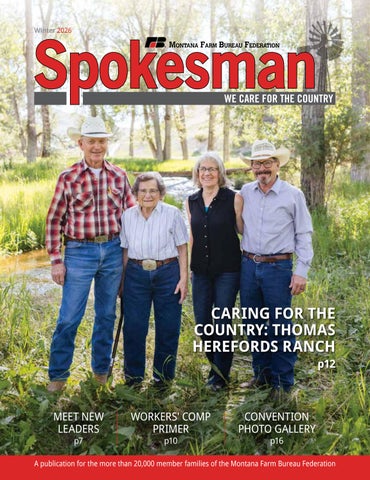
CARING FOR THE COUNTRY: THOMAS HEREFORDS RANCH p12
MEET NEW LEADERS p7
WORKERS' COMP PRIMER p10
CONVENTION PHOTO GALLERY p16
A publication for the more than 20,000 member families of the Montana Farm Bureau Federation
We know ag financing like you know how to onboard new employees.
For over a century we’ve supported the people who are the heart of ag. You deserve a financial partner who works as hard as you do. AgWestFC.com
Equal Housing Lender This institution is an equal opportunity provider and employer.
CONTENTS Montana Farm Bureau Federation
WE CARE FOR THE COUNTRY
WINTER 2026 ISSUE Published by:
Montana Farm Bureau Federation 100 Red Mountain Drive, Suite 101 Bozeman, MT 59718 406-587-3153 | mfbf.org
10
04 THE EVP MESSAGE
The Voices of Agriculture
06 GUEST EDITORIAL
A n A.C.E. Graduate's Mission to
Launch a Farm Bureau Legacy Mentorship Program
07 NEW YF&R CHAIR
Publisher Scott Kulbeck
Bronya Willmore: Leading the Next
Editor Rebecca Colnar
08 SAFETY TIPS
Managing Editor Sue Ann Streufert Advertising Sales Rebecca Colnar 406-223-4106 Production Services Provided by: Bobbi Burow, CreativityTank LLC © Copyright 2025. Montana Farm Bureau Federation Spokesman. All rights reserved. The contents of this publication man not be reproduced by any means, in whole or in part, without prior written consent of the publisher. While every effort has been made to ensure the accuracy of the information contained herein and the reliability of the source, the publisher in no way guarantees nor warrants the information and is not responsible for errors, omissions or forward looking statements made by advertisers. Articles and advertisements in this publication are not solicitations to buy, hold or sell specific securities; they are for information purposes only. Opinions and recommendations made by contributors or advertisers are not necessarily those of the publisher, its directors, officers or employees. Investors should be aware that risk is associated with any security, strategy or investment and are advised to seek the counsel of a competent investment advisor before making any investment, or utilizing any information contained in this publication. Subscription, advertising and circulation information can be obtained from the publisher.
12
Generation of Montana Agriculture
Protecting Livestock, Equipment
& Your Bottom Line for Winter
10 AG SAFETY
Workers’ Comp Explained
12 LEOPOLD CONSERVATION AWARD
Thomas Herefords
16
14 TRADE MISSION
Trade Mission To The Pacific Rim
15
WATER REPORT
A New Legal Push for Responsible
Water Development in Montana
16 MFBF Convention Happenings 22 ACE LEADERSHIP PROGRAM
25
Montana Farm Bureau announces
2026 ACE Leadership Class
23 NOTABLE EVENTS
Montana Farm Bureau in D.C.
24 Young Farmers & Ranchers Events 25 WOMEN’S LEADERSHIP COMMITTEE
Heidi Brewer: Leading with
Experience and Passion
26 Ag Chat 30 Book Review
Winter 2026
Montana FarM Bureau Federation
WE CARE FOR THE COUNTRY
For publishing and advertising information contact:
Rebecca Colnar Montana Farm Bureau Federation 406-223-4106 rebeccac@mfbf.org Printed 12/2025 mfbf.org
ON THE COVER: Richard and Shirley and Tammy and Bruce Thomas received the Leopold Conservation Award. Photo by Sand County Foundation.
CARING FOR THE COUNTRY: THOMAS HEREFORDS p12
MEET NEW LEADERS p7
WORKERS' COMP PRIMER p10
CONVENTION PHOTO GALLERY p16
A publication for the more than 20,000 member families of the Montana Farm Bureau Federation
Winter 2026 Montana Farm Bureau Spokesman
3
THE EVP MESSAGE
The Voices of Agriculture
SCOTT KULBECK Executive Vice President, MFBF
F
or more than 100 years, Farm Bureau has been the unified Voice of Agriculture, not only in Montana, but in all of America. “The Voice of Agriculture®” so aptly describes Farm Bureau, that it’s a registered trademark of the American Farm Bureau Federation. During our annual meeting this November in Missoula, Montana Farm Bureau Federation (MFBF) members voted to open new seats at our table and offer more Montanans an opportunity to have their voices heard. Each year, MFBF’s delegate session is the culmination of 365 days of policy development work by our grassroots farmers and ranchers. Producer Members, commonly referred to as “voting” members work to surface issues and define policy resolutions aimed at improving agriculture and rural Montana. Only Producer Members can participate in this process. Furthermore, Farm Bureau only takes a stand on an issue according to this policy. This year, our voting delegates made a small but important change to our bylaws altering the definition of a Producer Member to include members from a business directly related to production agriculture. By including agricultural business leaders as voting Producer Members, we acknowledge that leadership isn’t confined to the farm gate. These individuals are invested in strengthening rural economies, supporting producers, and navigating complex issues
Montana Farm Bureau Spokesman (ISSN 08863075) Published quarterly by the Montana Farm Bureau Federation at 100 Red Mountain Drive, Suite 101, Bozeman, MT 59718. Periodical postage paid at Bozeman, MT and additional mailing offices. Subscription rates $4 a year covered by annual dues to Montana Farm Bureau Federation members. Non-member subscription $25 per year. Advertising rates available upon request. The Montana Farm Bureau Federation Spokesman reserved the right to reject any advertisements. POSTMASTER: Send address changes to: Montana Farm Bureau Federation Spokesman, 100 Red Mountain Drive, Suite 101, Bozeman, MT 59718
4
Montana Farm Bureau Spokesman Winter 2026
like labor, markets - all areas where strong leadership is essential. Their involvement enriches our policy dialogue. This change isn’t just symbolic; it’s a strategic response to one of Montana’s most pressing realities. According to a Montana State University publication Montana currently has the second-highest demand for leaders per capita in the United States. The report estimates that one in every 13 Montana adults must hold a leadership position to sustain the state’s existing government, nonprofit, and civic infrastructure. In some rural Montana counties, this number is one in every five adults. Opening voting seats to agricultural businesses expands our leadership pipeline at a time when agriculture needs broader engagement. This shift doesn’t weaken Montana Farm Bureau’s identity; it strengthens the organization by ensuring that our governance reflects the full breadth of agriculture in our state. It makes room for more voices, fosters deeper cross-sector collaboration, and positions Farm Bureau to better meet today’s leadership demands. As you look at your community and see the same dedicated people serving on your county Farm Bureau board, your volunteer fire department, your county commissions and more, it’s easy to see Montana’s high demand for leaders. The only sustainable answer is to empower more Montanans to step forward. Broadening our membership to include agricultural businesses is a forward-looking step toward building a better tomorrow, where agriculture leads with cohesion and the collective strength of all its voices. ◾
Montana Farm Bureau Federation Officers Cyndi Johnson – President Casey Mott – Vice President Scott Kulbeck – Executive VP Diana Bailey – Exec Sec/CFO Montana Farm Bureau Board Beth Blevins – District 1 J.M. Peck – District 2 Ashley Descheemaeker – District 3
Jese Stetson – District 4 Darcia Patten – District 5 Don Steinbeisser, Jr. – District 6 Mike Lang – District 7 Ed Bandel – District 8 Karl Christians – District 9 Jim Willis – District 10 Bronya Willmore – YF&R Heidi Brewer – Women’s Leadership Comm.
mfbf.org
Your future self will thank you. When it comes to planning for the future, sometimes getting started is the hardest part. That’s where we come in. From life insurance and annuities to retirement planning and more, we’ll help you get started and stay with you every step of the way. Contact your local Farm Bureau agent, and together, we’ll make your future self proud.
Farm Bureau Life Insurance Company*/West Des Moines, IA. *Company provider of Farm Bureau Financial Services. LI218 (6-25)
GUEST EDITORIAL
An A.C.E. Graduate's Mission to Launch a Farm Bureau Legacy Mentorship Program BY RILEY LARSON, 2025 ACE PROGRAM GRADUATE
I
’m a 23-year-old, fourth-generation rancher, and like many young producers across Montana, I’ve been incredibly fortunate enough to have a built-in mentor. My dad, now 63, is a lifelong rancher, and from him, I’ve learned invaluable lessons that go beyond any university course or textbook: the essential wisdom that only comes from decades of managing land and livelihood. But I know that not every young person stepping into agriculture has this relationship. For too many, gaining this critical, hands-on wisdom happens purely by chance, if it happens at all. The biggest threat to our agricultural future isn't just climate change or market volatility, but the silence between two generations that keeps decades of hardwon knowledge from being passed on. With the average age of the American farmer approaching 60, this knowledge gap is the one thing the long-term viability of our ranches simply cannot afford.
Let's work together to cultivate the next generation of leaders, one meaningful relationship at a time. Recognizing this critical challenge and my own need to move beyond simply caring about issues to effectively solving them is what drew me to the Farm Bureau’s 2025 A.C.E. (Advocate. Communicate. Educate.) Leadership Program. I realized that passion is vital, but it’s not enough; you need the platform and the skills to create practical influence. A.C.E. provided the techniques required to craft messages that truly resonate with diverse audiences and helped me understand how to strategically approach challenging conversations. The program taught me how 6
Montana Farm Bureau Spokesman Winter 2026
to bridge the gap between the reality of production and the perspectives of decision-makers. That experience was transformative, leading me to focus my leadership goals on one core mission: to intentionally invest in our own operational wisdom. My primary goal post-A.C.E. is to put those advocacy and communication skills to work by strengthening our local Farm Bureau community through a formal solution: a Farm Bureau Legacy Mentorship Program. We need a proactive, organized approach. This program is designed for simplicity and effectiveness, positioning the Farm Bureau as the crucial bridge. We would establish a straightforward list of willing mentors and mentees, carefully outlining their specific areas of expertise and their goals. The Farm Bureau could then facilitate meaningful, purposeful matches. These would not be random pairings, but strategic connections based on shared sectors, geographical proximity, or specific operational challenges like navigating succession planning or expanding a direct-to-consumer enterprise. The framework would be flexible and lightweight, focusing entirely on the ease of use for busy producers. We are simply asking for a commitment to authenticity: a monthly phone call, a periodic visit to the mentee’s operation to offer practical advice, or a sit-down over coffee. At its heart, this initiative is about ensuring that the hard-won legacy of our agricultural way of life is not only preserved but actively passed on. By intentionally creating this mentorship program, we can directly bridge the existing knowledge gap, significantly strengthen our community bonds, and build a more resilient and prosperous future for Montana agriculture. Whether you are an experienced producer or just getting started, I encourage you to consider how a mentorship like this could benefit you and the future generations of Montana agriculture. Let's work together to cultivate the next generation of leaders, one meaningful relationship at a time. ◾ mfbf.org
NEW YF&R CHAIR
Bronya Willmore: Leading the Next Generation of Montana Agriculture
Bronya Willmore and her family on their Roy ranch.
BY REBECCA COLNAR, EDITOR, MFBF SPOKESMAN
B
ronya Willmore may have grown up on a small acreage in Iowa, but her roots in agriculture and the western lifestyle run deep. A former high school rodeo competitor and dedicated 4-H and FFA member, Willmore followed her passion for the industry to Bozeman, where she graduated from the Montana State University College of Agriculture. It was there she met her husband, Casey, eventually joining him on his family’s multi-generational ranch north of Roy. Life for Willmore is a balancing act. In addition to being a mother of four young girls, she serves as a Mountain West Farm Bureau Insurance sales associate in Lewistown. "My role on the ranch looks a little different these days with four small children and my career with Mountain West," Willmore says. "I don’t get to go riding and gathering cattle as much as I used to, but I’m still there for the major events. I love loading the side-byside with my girls to go out and put out salt and mineral while Casey is working. We find those little ways to stay helpful and involved as a family." At 34, Willmore is no stranger to the Montana Farm Bureau Federation (MFBF). Her journey began over a decade ago in the Collegiate Young Farmers & Ranchers (YF&R) program. By 2022, she was representing Fergus County on the state YF&R committee. She credits the ACE (Advocate. Communicate. Educate.) leadership program with preparing her for her new role as State YF&R Chair. "The ACE program taught me to approach situations from different perspectives," she explains. "As a leader, it’s vital to be open to other viewpoints. We all have different backgrounds and life experiences; understanding where someone else is coming from helps us make better decisions that move the whole group forward."
mfbf.org
GOALS FOR THE YF&R COMMITTEE As she steps into leadership, Willmore has a clear vision for her two-year term: ◾ Strengthening County Ties: "I want to see more communication at the county level. I want to work with county boards to identify young members and help them get involved early." ◾ The YF&R Leadership Conference: Willmore remains a strong advocate for the annual conference held in early spring. "It offers such valuable experience and information for those who attend. It’s a huge motivator for our younger members." ◾ Statewide Giving: While the committee has long supported the Montana Food Bank Network, Willmore is looking for ways to make their charitable efforts more encompassing across the entire state. HOW TO GET INVOLVED Willmore’s message to anyone aged 18-35 is simple: just reach out. "The simplest step is to talk to your local county board members," she suggests. "They can put you in touch with a district director, or you can reach out directly to me or the MFBF staff. Attending the leadership conference is one of the best ways to see what we’re all about." "I am really excited about this opportunity," she adds. "We have a great group of people to work with and amazing staff to support us." ◾ Winter 2026 Montana Farm Bureau Spokesman
7
SAFETY TIPS
Protecting Livestock, Equipment & Your Bottom Line for Winter
W
hen the first frost settles and mornings turn crisp, most people think about cozy fires and warm coffee. But for farmers and ranchers, the change in seasons signals something else entirely, it’s time to get the farm or ranch ready for winter. From machinery maintenance and livestock care to protecting grain storage and managing liability, preparation now can make all the difference when the snow starts to fall.
1. MACHINERY MAINTENANCE BEFORE THE TEMPERATURES DROP Winter can be tough on machinery. Cold weather thickens fluids, weakens batteries, and makes engines harder to start. Before temperatures take a dive, take time to inspect, service, and store equipment properly so it’s ready when you need it. Check fluids and filters. Replace oil and hydraulic fluids with winter-grade versions and change filters to prevent buildup or freezing. ◾ Inspect belts, hoses and tires. Cold temperatures make rubber components more brittle. Look for cracks or wear that could lead to breakdowns later. ◾ Test batteries as cold can drain power quickly. Make sure your tractor, truck, and other equipment batteries are fully charged and stored in a dry, insulated location if possible. ◾ Clean and lubricate equipment. Removing dirt, grease and residue helps prevent rust, and lubrication keeps moving parts in top shape. ◾ Store indoors and machinery indoors or cover when possible. Protecting machinery from the elements extends its life and reduces costly repairs. 2. LIVESTOCK SHELTER AND FENCING PREP Your livestock depend on you to keep them safe and comfortable when the mercury dips. Wind, ice, and cold can take a toll on animals’ health, weight and productivity. Preparing shelter and fencing before the deep freeze hits ensures your herd stays protected. Inspect and repair barns or windbreaks. Check roofs, walls, and doors for leaks or drafts. Even small cracks can cause significant heat loss. ◾ Ensure good ventilation. While blocking wind is 8
Montana Farm Bureau Spokesman Winter 2026
essential, proper airflow helps reduce moisture and prevents respiratory issues. ◾ Check water supplies. Make sure heaters and insulation are working, and test automatic waterers regularly to avoid freezing. ◾ Reinforce fencing. Winter winds and drifting snow can damage or weaken fences. Replace rotted posts, tighten wires, and make sure gates latch securely. ◾ Plan for feed storage. Keep extra hay and grain accessible in case storms delay deliveries or access to fields. Healthy, well-protected animals mean a healthier bottom line. Consistent shelter, nutrition and water access are key to surviving winter without unnecessary losses. 3. GRAIN STORAGE AND SPOILAGE RISK Winter brings moisture, temperature swings, and sometimes long periods where grain sits untouched. Without proper monitoring, those conditions can lead to condensation, mold, and spoilage. Before winter sets in, take a few steps to keep your stored grain—and your profits—safe: ◾ Clean bins thoroughly. Remove old grain, debris and dust that can harbor insects or mold. ◾ Inspect for leaks and seal openings. Moisture is your biggest enemy in grain storage. Check seams, roof vents, and doors for signs of rust or gaps. ◾ Monitor temperature and moisture levels. Use aeration fans and temperature cables to regulate conditions inside your bins. ◾ Check grain regularly. Even during winter, make it part of your routine to inspect grain condition every few weeks. And don’t forget—grain storage systems are valuable assets. Ask your insurance agent if your current policy adequately protects your storage equipment and contents. 4. INSURING BACKUP GENERATORS AND HEATING SYSTEMS When the power goes out during a blizzard or ice storm, backup generators and heating systems are a lifeline. They keep barns warm, waterers working, and essential operations running. However, they represent mfbf.org
SAFETY TIPS a significant investment. Make sure your generator is listed on your insurance policy. Many farmers assume it’s automatically covered, but separate equipment endorsements are sometimes required. Check that heating systems are covered for breakdowns or damage. If you rely on heaters for livestock or crop storage, verify that your policy protects you in the event of equipment failure. Practice safe operation. Always run generators in well-ventilated areas and follow manufacturer safety recommendations to prevent fire or carbon monoxide risks. A well-maintained and insured backup power system provides peace of mind that your operation can weather the storm—literally. 5. LIABILITY TIPS IF VISITORS COME TO THE PROPERTY Even in winter, farms and ranches often have visitors—feed deliveries, maintenance crews, neighbors lending a hand or even agritourism guests. Snow and ice increase the risk of slips, falls and accidents, making liability coverage especially important.
mfbf.org
Here’s how to minimize your exposure: ◾ Keep pathways clear of snow and ice by using sand, salt or traction mats where needed. ◾ Post warning signs. Mark icy areas, livestock pens, and active work zones clearly. ◾ Maintain proper lighting. Shorter days mean darker evenings—make sure walkways and driveways are well-lit. ◾ Review your liability insurance. Verify that your farm policy covers visitors, temporary workers or on-site contractors. A quick review with your insurance agent can ensure your policy fits your operation’s size, season, and activity level. PREPARE TODAY FOR A STRONG WINTER SEASON Your insurance agent can help farmers and ranchers prepare for every season. For more information, contact your local Mountain West Farm Bureau Insurance agent to review your farm insurance and make sure your farm or ranch is protected, productive and prepared for whatever the season brings. ◾
Winter 2026 Montana Farm Bureau Spokesman
9
AG SAFETY
Workers’ Comp Explained BY DANA JANSEN, DIRECTOR, MONTANA AG SAFETY PROGRAM
I
f we’ve ever had a chance to talk ag safety, you’ve likely heard me say that “in this industry, it’s not if you get hurt, it’s when and how badly”. Unfortunately, agriculture is high-risk and wildly unpredictable. The good news is we can minimize the frequency and severity of incidents in agriculture. The even better news is there are ways we can help minimize overall risk to our operations when these incidents occur. This is where workers’ compensation insurance comes into play. In Montana, businesses have three options for sourcing workers’ compensation coverage. 1. Self insurance (Plan 1) 2. Purchase from a private entity (Plan 2) 3. Purchase from Montana State Fund (Plan 3) Workers’ compensation insurance is mandatory for all businesses with employees. There are some exemptions for those businesses that utilize licensed independent contractors and those businesses that only “employ” immediate family members or themselves. However, coverage is still available to those whose employees are family members, themselves, temporary or volunteer. While there are three plan choices for obtaining workers’ compensation insurance, many in Montana (and agriculture, in particular) find that Plan 3 provides the most cost-effective means of insurance as Montana State Fund is considered a guaranteed market. Those in agriculture will find that they pay a significantly higher premium for their workers’ compensation insurance regardless of source due to the high-risk nature of the industry. Over the next few articles in the Spokesman, we will explore some of the basics of workers’ compensation, but before we delve into things like return to work plans it is important to understand one of the cornerstones of workers’ compensation – the Montana Safety Culture Act. The Montana Safety Culture Act was enacted in 1993 and encourages workers and employers to develop a positive workplace safety culture. The Montana Safety Culture Act outlines six requirements all employers must meet and three additional requirements for those employers with more than five employees. 10
Montana Farm Bureau Spokesman Winter 2026
Requirement 1 – Provide each new employee with a general safety orientation containing information common to all employees and appropriate to the business operations, before beginning their regular duties. This should include information such as work site hazards, emergency procedures, accident reporting, and other workplace polices/procedures/expectations. Requirement 2 - Provide job or task-specific safety training appropriate for employees before they perform that job or task without direct supervision. Farmers and ranchers excel at lessons taught in the school of ‘figure it out’ but intentional, thorough instruction is crucial. Other employees knowledgeable in the task at hand can conduct the training. Training should include specific safety rules or procedures, hazards associated with the task, and the employee’s and employer’s responsibilities. Requirement 3 – Offer continuing regular refresher training. This is arguably one of the most important pieces of the Montana Safety Culture Act. Even though it feels like “everyone should know,” a reminder can go a long way. Before beginning work – Spring/Fall cow work, haying, harvesting, hauling crops to the elevator, fencing – gather the crew and mfbf.org
AG SAFETY review the expectations and key safety points. Work in agriculture is seasonal, and it is easy to forget important information as we change from season to season. Requirement 4 - Provide a system for the employer and their employees to develop an awareness and appreciation of safety through tools such as newsletters, periodic safety meetings, posters, and safety incentive programs. Programs like the Montana Ag Safety Program can help develop a plan for you to share safety information in the workplace. Safety signs and posters or even articles like these found in the MFBF Spokesman are great ways to develop an awareness and appreciation for safety. Task specific safety sheets, like those found at www.mtagrisafety.com, can be used for initial trainings, refresher trainings, or serve as the basis for conversation at a safety meeting. Requirement 5 - Provide periodic self-inspection for hazard assessment when the safety program is implemented, new worksites are established, and thereafter as is appropriate to the business operations, but at least annually, which:
mfbf.org
◾ Identifies hazards and unsafe work practices or conditions
◾ Identifies corrective actions needed; and ◾ Documents corrective action taken Requirement 6 - Include documentation of performance of activities listed in (1) through (5) above. This documentation must be kept by the employer for three years. Documentation should include topic discussed, date/time/location of training or action, and a list of those in attendance. Employers with more than five employees are required to have a safety committee. This committee should be comprised of employees at all levels of the company and from a variety of interests. The safety committee takes a leading role in defining the safety culture of the workplace and assists the employer in developing and maintaining a safe workplace. For more information regarding the Montana Ag Safety Program or task-specific safety visit www.mtagrisafety.com or contact danaj@mtagrisafety.com or 406-850-9978. ◾
Winter 2026 Montana Farm Bureau Spokesman
11
LEOPOLD CONSERVATION AWARD
Thomas Herefords Ranch
S
ustainable is a word that’s bandied about today with vague meaning, but farmers and ranchers live the word sustainable. If you don’t care about the land, you won’t own it for multiple generations. The Thomas Ranch, located in stunning Gold Creek, Montana, embodies the word sustainable. Founded by Richard and Shirley Thomas in 1957, the ranch not only remains in the family, but it also continues to evolve with its world-renowned Hereford genetics and its extensive conservation practices. In June 2013, Spokesman Editor Rebecca Colnar interviewed Richard and Shirley Thomas, where Shirley shared ranch history. Shirley’s parents came to Gold Creek in 1928, and the original log cabin that was Shirley’s first home still sits on the ranch. Part of the farmhouse the Thomases live in today was built a few miles up the road in Pioneer and rolled down to its current location using logs. Since then, the home has been added onto, sided and is still the center of the family. When she and Richard got married in 1957, she had a few registered cows, and Richard had a few commercial cattle. “We first lived across the highway and were helping my father with this place. We helped him and ran our cattle and started to put together some machinery. In 1971, this place became our sole operation,” says Shirley. “Ever since then, we’ve been building that herd of registered polled and horned cattle.” At the time of the interview, earlier in the year, at the prestigious National Western Stock Show in Denver, they had the Grand Champion Horned Hereford Bull and Supreme Champion Hereford. In November 2011, they shipped 6 bulls and 30 heifers to Kazakhstan, and still have cattle breeders across the world interested
(Above) The Thomas Family accepted the Leopold Conservation Award during the Montana Farm Bureau Convention. (Right) Richard and Shirley Thomas shared their story in the 2013 Montana Farm Bureau Summer Spokesman.
in their breeding stock. They continue to send breeding stock and their genetics overseas and are still top Hereford breeders in the country. Second-generation Thomas Bruce explained that the ranch started an overhaul in 2000 when the family made a conscious effort to improve their soil and watershed, which in turn has allowed them to have more forage and hay for their cattle. Bruce and his wife Tammy prioritized conservation practices that could improve biodiversity and water quality, leading to healthier cattle, fish, and wildlife. Their vision was set into motion in the early 2000s by enrolling land into an Environmental Quality Incentives Program (EQIP) contract and collaborating with several public agencies and private non-profits. Gold Creek is a Clark Fork River tributary that runs through the ranch. Like other ranchers, their ancestors built their first corrals next to the creek to easily water their cattle. Overgrazed riparian areas led to soil compaction and degradation, as well as creek contamination. Loss of riparian vegetation led to warmer water, impacting native
Cattle are generally worked traditionally horseback on the Thomas Hereford Ranch.
12
Montana Farm Bureau Spokesman Winter 2026
mfbf.org
LEOPOLD CONSERVATION AWARD fish populations and reducing wildlife habitat. With EQIP’s financial and technical assistance new cattle pens were designed to direct runoff into filtration areas on the ranch’s uplands. Grazing was ceased along the creek’s riparian area for five years to allow native vegetation to recover. As a result, the creek was cleaner thanks to a reduction in runoff of manure nitrates. The herd’s daily weight gain also improved from a new watering system. Converting from flood irrigation to pivot irrigation also benefited Gold Creek by diverting 50 percent less water. Other environmental benefits like enhanced in-stream flow, cooler water temperatures, and drought mitigation are being studied at Thomas Herefords by the Montana Department of Natural Resources and Conservation (DNRC) and other local and state organizations and agencies. This year, Thomas Herefords, who are Lewis & Clark Farm Bureau members, received the prestigious Leopold Conservation Award for their work. Given in honor of renowned conservationist Aldo Leopold, the award recognizes farmers and forestland owners who inspire others with their dedication to environmental improvement. In his influential 1949 book, A Sand County Almanac, Leopold advocated for “a land ethic,” an ethical relationship between people and the land they own and manage. Bruce noted that if other farmers/ranchers wish to work on conservation plans, the best way is to connect with a local watershed or conservation groups, and educate yourself on conservation practices. “Call the Montana Natural Resources and Conservation Service,” Bruce said. “Sadly, too many in our industry see that agency as challenging. It’s true they have their job responsibilities, but I found if you partner with them and talk through win-win solutions, they can really help.” The Thomases have found that they have been able to increase their forage and are able to run more cattle. As for the cattle side of the equation, they market their cattle and genetics around the world. “Things are changing so fast with genomics in the
mfbf.org
beef cattle industry, although the beef industry is still behind swine and dairy. We do work with one of the major companies, Select Sires, globally.” The rancher explained that agriculturalists need to get the word out about the work they do for land and soil conservation. “Receiving the Leopold Conservation Award is wonderful publicity that tells that story,” Bruce said. “I know as ranchers, none of us are comfortable talking about ourselves, as it’s not how we were raised. But it’s so important to convey those practices, whether it’s what we are doing to save the fisheries or improving our pastures. Whenever you’re out in public or at a function, tell that story. You may need to answer some hard questions, but that’s all part of the learning.” Like other ranchers, Bruce hopes to see his family continue the work. He has three children, scattered from Missoula to North Dakota to Texas, and all have a passion for cattle and conservation work. Grandchildren come out to help with calving and other work, and are very involved in the process. As for the Thomas Herefords Ranch receiving the Leopold Conservation Award, Thomas said, “I’m all but at a loss for words. It’s such an honor. I wasn’t exaggerating in the video when I said there is a lot of blood, sweat, and cattle that went into all the work we did on our ranch to receive this award.” ◾ The Montana Leopold Conservation Award is made possible through the generous support of American Farmland Trust, Montana Department of Natural Resources and Conservation, Rangeland Resources Program, Sand County Foundation, AgWest Farm Credit, Montana Grazing Lands Coalition, USDA Natural Resources Conservation Service, Montana Farm Bureau Federation, Ranchers Stewardship Alliance, Soil and Water Conservation Society, Western Landowners Alliance, Western Sustainability Exchange, and World Wildlife Fund. Visit www.mfbf.org/media/news to read more about the Thomas Herefords winning the Leopold Conservation Award.
Winter 2026 Montana Farm Bureau Spokesman
13
TRADE MISSION
Trade Mission To The Pacific Rim
T
rade in Asia plays a critical role in agriculture, so when Montana Farm Bureau President Cyndi Johnson had the opportunity to travel on the Governor’s trade mission to South Korea and Japan as an agricultural organization leader; she enthusiastically accepted. This trade mission underscores Montana’s commitment to strengthening international partnerships, growing exports, and attracting highvalue foreign investment across key sectors. "Farm Bureau Federation has a great reputation for being a conduit for relationship building. I know we’re here to support all the commodity industries in their efforts to develop new trade partners or relationships or help strengthen old relationships," said Johnson.
Montana Farm Bureau President Cyndi Johnson served with a Montana delegation to South Korea and Japan.
The first stop for the Montana delegation was Seoul, South Korea, where the group met with representatives from the Korea International Trade Association and surfaced ideas for additional imports of Montana products. Korea was Montana’s second-largest trading partner in 2024, totaling $335 million in exports. Tours on the trip included the impressive Incheon Port, is a harbor that boasts an impressive lock system that controls the water inside the port so the ships coming in can proceed regardless of the tide. The group saw a flour mill where Montana wheat is processed into bread. Johnson noted that pulse crops Montana grows, especially green peas, are popular because they are 14
Montana Farm Bureau Spokesman Winter 2026
used in the popular condiment, wasabi. Beef is also popular in that country. “They want to get meat from Montana and the U.S. as they love the quality. Since the USMEF always has a relationship with us, we spent time strengthening those relationships,” Johnson noted. Heading out of Seoul, the group landed in Tokyo, Japan, by lunchtime, where the entourage met with members of the Japan Flour Millers Association and the U.S. Meat Export Federation. Arriving in the city of 37 million people, lunch allowed Montana’s wheat producers to share news about the wheat and barley harvest and discuss the condition of the wheat. Montana’s largest and most consistent export to Japan and Korea is hard wheat, totaling $38 million in sales last year. While in Japan, a meeting with U.S. Meat Export Federation officials at their office, including being with Tom Castitani, USMEF’s liaison with the U.S. and Japan. Castitani took them to a four-story market and straight to the food section where they saw large loaves of bread as well as beef. “Living quarters are small, and people don’t have space for larger refrigerators or freezers, so people go to the market daily. For instance, bread—many using Montana wheat—was packaged with only six pieces,” Johnson shared. The final stop on the trade tour was to Kumamoto Prefecture, which has been a sister-state of Montana since 1982. The visit included more trade talks, a tour of Kumamoto Castle, as well as visiting with the governor of the prefecture and a lunch that included meeting with students from U.M. Western who were there on an exchange program. “A lot of the trade centers around the higher-quality beef and wheat coming from the United States and especially Montana. We are competing against cheaper, lower-quality products coming in from other countries. However, the Japanese especially appreciate the high quality of our wheat and beef. I think South Korea will get there, too, once more of their population becomes middle-class.” Johnson said that everyone felt very valued, and they hope to see more trade with both countries in the coming year. ◾ President Johnson spent four days in Washington, D.C. to attend meetings at American Farm Bureau, and meeting with federal agencies and with Montana’s Congressional delegation. See page 23 for the story. mfbf.org
WATER REPORT
A New Legal Push for Responsible Water Development in Montana
O
n November 12, 2025, the Montana Farm Bureau Federation along with groups and individuals representing a diverse coalition of municipalities, farm and ranch families, landowners, and conservation organizations, filed a legal challenge in District Court against the Montana Department of Natural Resources and Conservation (DNRC) and the state of Montana over its continued implementation of the state’s “exempt well loophole,” which allows unregulated groundwater development outside the state’s permitting system. The lawsuit seeks to protect Montana’s senior water rights holders and restore fairness and accountability to the state’s water administration system. What is an exempt well? They were originally intended for minimal water use, but have evolved into a method for development in Montana. What are known today as “exempt wells” are appropriations of Montana’s underground water resources that allow a party to use up to 10 acre-feet of groundwater per year at a flow rate of 35 gallons per minute without first applying for a water right to do so. These appropriations are called “exempt wells” because they fall outside of and are exempt from Montana’s regular water right permitting system. Unlike appropriating water under the regular water right permitting system, which requires you to give notice to other parties relying on the same source for their water, the party relying on the “exempt well” exception can merely drill a well and start taking water for their needs. Under the current system, exempt wells can allow up to 35 gallons per minute (10 acre-feet) of water without proper permitting, bypass the analysis of impacts on senior water rights, lack public notice requirements, and operate outside the prior appropriation doctrine that is the underpinning of Montana water law. mfbf.org
Because of the surge in subdivision developments, between 128,000-191,000 exempt wells have been drilled in Montana over the past 50 years which could potentially draw up to 662 billion gallons of water each year. Montana Farm Bureau’s policy to rein in the use of exempt wells dates back to at least 2008. Since then, our organization has worked to find solutions that would allow the use of exempt wells to continue while still protecting senior water rights. These efforts have resulted in vast improvements to the permitting and change process to ensure that applications for new water rights can be reviewed and granted in a timely fashion, and have created effective processes to protect senior water rights. While the hope was that these efforts would be effective at reducing the reliance on the exempt well loophole, there has not been a meaningful reduction in its usage After hearing from members who have been left with only costly and perhaps ineffective options to protect their senior water rights, such as suing to stop development or paying the extremely high cost of placing a call on surrounding subdivisions’ exempt wells, the MFBF Board of Directors voted to support the lawsuit challenging the constitutionality of exempt wells in Montana. Under the advisement of its legal counsel, Ryan McLane, and in consultation with member attorneys Hertha Lund and Peter Taylor, MFBF joined as a plaintiff in the lawsuit filed in Lewis and Clark County. The lawsuit would not affect existing exempt wells; retroactive application has not been requested. Should the lawsuit be successful, people will still be able to drill wells, but would need to go through the proper permitting process. To learn more about the lawsuit visit mfbf.org/ media/news. ◾ Winter 2026 Montana Farm Bureau Spokesman
15
CONVENTION HAPPENINGS
T
he Montana Farm Bureau Federation (MFBF) 106th Annual Convention from November 17-20, 2025, proved inspiring, educational and entertaining. This year's convention provided Montana's farmers and ranchers a critical opportunity to reconnect, gain market-leading insights, and shape the grassroots policy that guides the organization and influences state and national agriculture. The high-impact speakers addressed the most pressing issues, including Dr. Marissa Hake, DVM, Calf Vet, whose energetic presentation covered finding a balance in modern November 17-20, 2025 - Hilton Garden Inn, Missoula agriculture and how to bridge the gap between the farm and the dinner table. Terri Moore, vice president of communications for the American Farm Bureau Federation, talked about the Make America Healthy Again (MAHA) movement. She pointed out that in surveys, farmers are highly trusted—the pressure consumers are under to make the right food choices comes down to trust. On the global scene, Jacob Shapiro, director of research at The Bespoke Group, gave a thought-provoking presentation on Geopolitics and the Future of American Agriculture. “Currently, the world is multi-polar, and there isn’t one dominant country like we had even 30 years ago,” Shapiro noted. “The United States used to be the top manufacturing power; today, we have forgotten how to make things. However, we are in a new era; it’s time to invest in our country and be profoundly optimistic.” Workshop topics included agritourism, taking control of your finances, promoting agriculture on social media, innovation through generations and an update on ag programs and policy at the federal level. County Farm Bureaus received awards for their hard work during the year, and several counties earned the prestigious president’s awards for their work in Public Relations, Membership Development, Public Policy, Ag Promotion & Engagement, and Leadership Development. The Young Farmer and Rancher Discussion Meet held Tuesday included a preliminary round and the Final Four. Cady Brown, Southwest Counties Farm Bureau and a senior at U.M. Western took home a Polaris Ranger. (See page 24.) Members had a grand time Tuesday evening at the Missoula County Fairgrounds during the Great Montana Get Together. Everyone enjoyed socializing with friends, eating delicious food, and dancing to the Tanner Laws Band. Wednesday marked the beginning of the crucial MFBF Voting Delegates Session. This is where the true grassroots process takes center stage, as members discuss, debate, and vote on resolutions that will become the organization’s official policy for the upcoming year. ◾
Speakers
Dr. Marissa Hake, DVM, told the crowd that the “future belongs to ag producers who run their farms like CEOs.” 16
Montana Farm Bureau Spokesman Winter 2026
Jacob Shapiro, The Bespoke Group talked about geopolitical changes happening in the world today.
American Farm Bureau VP of Communication Terri Moore shares ways farmers and ranchers lead the conversation in the Make America Healthy Again movement. mfbf.org
CONVENTION HAPPENINGS
Delegate Session
Scott Sielstad receives recognition from President Cyndi Johnson for his many years serving on the Credentials Committee.
Delegates from county Farm Bureaus discuss and vote on Farm Bureau policy for the coming year. Klayton Lohr speaks up on the delegate floor.
FFA Parliamentarians keep delegate session running smoothly.
Broadwater County members Cliff Cox along with Barbara and Dave Clark.
Media President Cyndi Johnson interviews with Colter Brown, Northern Ag Network.
Montana Director of Agriculture, Jill Streit interviews with KTMF/Missoula.
AFBF Policy Director, Brian Glenn, discusses trade issues with Victoria Traxler, Montana Public Radio. mfbf.org
MFBF Vice President, Casey Mott, chats with Montana Talks host, Aaron Flint, about Farm Bureau policy.
Western Ag Network’s Russell Nemetz interviews Terri Moore about MAHA concerns.
Andy Schwab, Northern Ag Network, interviews fellow ACE class members Riley Larson and Mackenzie Serrano.
Winter 2026 Montana Farm Bureau Spokesman
17
CONVENTION HAPPENINGS
Montana State University Collegiate Cleo Dunn visits with Jim Fitzgerald, Yellowstone Boys & Girls Ranch.
Trade Show
Scott Anderson, Agri-Best Feeds, explains about an innovative device to keep water from freezing to Dennis Descheemaeker.
Riley and Matthew Slivka visit with Brent Turner about his book “Peace of Land” and how to keep a farm in the family.
Bernard Evans and Greg Gabel catch up on farm news. Elena Struker and her dog, Bubbles, a runner up in the AFBF People’s Choice Farm Dog of the Year competition.
District 5 Director, Darcia Patten, and MFBF President, Cyndi Johnson, get ready for the Ice Cream Social.
Gene Curry visits with Nicole Erickson at the Montana Grape & Wine Association booth.
Social Nicole Rolf, Brian Glenn, Nick Jerke and Terri Moore.
Above Susan and Jack Lake enjoy dancing to the Tanner Laws Band (right).
18
Montana Farm Bureau Spokesman Winter 2026
Retiring board members were recognized which included District 3 Director Kris Descheemaeker (above left), District 7 Director Wayne Stahl (above right) and YF&R Committee Chair Nick Courville. Not present was Women’s Leadership Committee Chair Carla Lawrence. The Missoula Fairgrounds Hall was packed Tuesday evening for the high-energy social.
mfbf.org
CONVENTION HAPPENINGS
Distinguished Service Award Les Graham posthumously received the Montana Farm Bureau Distinguished Service Award during the 106th Montana Farm Bureau Convention. Many Montana Farm Bureau members will remember Les Graham for the numerous safety workshops he conducted during the organization’s November convention and June summer conference. Graham, a long-time member of the Gallatin County Farm Bureau, coordinated and administered the Montana Ag Safety Program for eight of Montana's agricultural organizations, helping numerous farms, ranches, and small businesses with workers' compensation issues. Les, along with Gene Surber, traveled the state of Montana providing Ag Safety presentations for 10 years. Les continued with the Ag Safety program after Gene left, conducting presentations with Jim Larson. President Cyndi Johnson presents the Distinguished Service Award for Les Graham to Gallatin County Farm Bureau President Brent Poppe who had nominated Graham for the award.
Many Thanks To Our Generous Sponsors! STEWARD LEVEL Montana Farm Bureau Foundation AgWest Farm Credit Northwest Counties Farm Bureau CKP Insurance Montana Ag Safety Program Rainmaker Technology Bank of the Rockies Mountain West Farm Bureau Insurance Participating Polaris in Montana and Wyoming LEADER LEVEL Bayer Crop Science Beyond the Weather BNSF Railway Cascade County Farm Bureau Montana Ag Business Association Montana Department of Agriculture Montana DNRC Rangeland Resources Program Montana Livestock Ag Credit Montana Renewables Montana Wheat & Barley Committee NextEra Energy Northern Ag Network mfbf.org
Northwestern Energy Pinion Global Producer Partnership Ravalli County Farm Bureau Stockman Bank Torgerson’s Equipment LLC Western Ag Network Yellowstone Boys and Girls Ranch Yellowstone County Farm Bureau CONTRIBUTOR LEVEL AgriBest Feeds Ambrook Big Sky Land Management CHS Nutrition Agri-Generational Marias River Farms Montana Beef Council Montana Grape & Wine Association Montana Fish Wildlife and Parks Montana Invasive Species Council USDA Farm Service Agency Yellowstone Boys & Girls Ranch
Winter 2026 Montana Farm Bureau Spokesman
19
CONVENTION HAPPENINGS
Leaders Elected During Convention
C
yndi Johnson, a wheat farmer from Conrad, was re-elected as president of the Montana Farm Bureau Federation during the Montana Farm Bureau 106th Annual Convention which took place November 17-20, 2025, in Missoula. Voting delegates from 29 county Farm Bureaus elected the new leaders during their Delegate Session. Delegates re-elected Vice President Casey Mott, a cattle rancher from Custer, and welcomed several new members to leadership roles: ◾ Bronya Willmore, a rancher from Roy, was elected to replace outgoing Young Farmers & Ranchers Committee Chair Nick Courville. ◾ Heidi Brewer from Bozeman replaced retiring Women’s Leadership Committee Chair, Carla Lawrence. ◾ Ashley Descheemaeker, a cattle rancher from Lewistown, was elected as District 3 Director. ◾ Mike Lang, a production ag retailer from Malta, was elected as District 7 Director. The following members were also re-elected to the MFBF Board of Directors:
◾ District 1 Director Beth Blevins, a large animal veterinarian and rancher from Ronan.
◾ District 5 Director Darcia Patten, a cattle rancher from Broadus.
◾ District 9 Director Karl Christians, a cattle rancher from Helena. WOMEN’S LEADERSHIP COMMITTEE District 2 – Rhonda Boyd, Alder; Cady Brown, Dillon District 4 – Kathy Teter, Huntley; Carla Lawrence, Boyd District 6 – Britta Brenner, Glendive; Paula Steinbeisser, Sidney District 8 – Marjorie Pribyl, Cascade; Jeanne McKamey, Great Falls District 10 – C arole Plymale, Townsend; Rose Sande, Three Forks YOUNG FARMER & RANCHER COMMITTEE District 2 – Makae Reed, Dillon; Mark Boyd, Alder District 3 – Riley Slivka, Lewistown, replaced Bronya Wilmore District 4 – Stryker Anderson, Laurel; Jacob Stenberg, McLeod District 6 – Tienna Canen, Circle; Britta Brenner, Sidney District 8 – Hattie Bumgarner, Belt; Karissa Floerchinger Eddy, Cascade District 10 – L auren Kett, Livingston; Jeremiah Peterson, Bozeman
THE POWER OF LOCAL Convenient, innovative financial solutions, backed by the power of local management and decision making. This commitment empowers our team to make quick, informed, local decisions, ensuring you receive the services you need, when you need them.
Montana’s Brand of Banking 20
Montana Farm Bureau Spokesman Winter 2026
Member FDIC | Equal Housing Lender
mfbf.org
Farm Bureau Members Receive a
$500
Exclusive Cash Reward
1,2
on an Eligible New1 Ford Truck or Ford Blue Advantage™ Certified Used2 Vehicle.
Ford Super Duty®
The Farm Bureau Exclusive Cash Reward1 is now compatible with AXZD-Plans.
Visit FordRecognizesU.com/FarmBureau today for complete offer details!
Montana Farm Bureau Federation 100 Red Mountain Dr. Ste, 101 Bozeman, MT 59718 406.587.3153 mfbf.org
1 Available on the purchase or lease of an eligible new 2025/2026/2027MY Ford Maverick®, Ranger®, F-150®, Super Duty or F-150 Lightning®. Not available on any other Ford or Lincoln vehicles, or F-150 Raptor®, F-150 Raptor R™, Ranger Raptor or F-650® and F-750® Super Duty. Vehicle eligibility may change at any time. Available to U.S. residents only. Place a new retail order or take new retail delivery from an authorized Ford Dealer’s stock by 1/04/27. Limit of five purchases/ leases per household during the program offer (PGM# 32900). Offer subject to dealer participation. May not be used/combined with most other Ford private offers. See an authorized Ford Dealer or go to https://www.fordrecognizesu.com, for complete details and eligibility (PGM# 32900). Due to high demand and global supply chain constraints, some models, trims, and features may not be available or may be subject to change. Check with your local dealer for current information. Offer subject to confirmation of eligibility. 2 Available on the purchase of an eligible certified used 2021-2027MY Ford Blue Advantage Gold, EV (F-150 Lightning only), or Blue Certified, Ford Maverick, Ranger, F-150, Super Duty or F-150 Lightning with under 80,000 miles. Not available on any other Ford or Lincoln vehicles, or F-150 Raptor, F-150 Raptor R, Ranger Raptor or F-650 and F-750 Super Duty. Vehicle eligibility may change at any time. Available to U.S. residents only. This offer is not eligible for customers purchasing a vehicle in the state of Texas. Take delivery from an authorized Ford Dealer’s stock by 1/4/2027. Limit of five purchases per household during the program offer (PGM# 32902). Offer subject to dealer participation. May not be used/combined with most other Ford private offers. See an authorized Ford Dealer or go to https://www.fordrecognizesu.com, for complete details and eligibility (PGM# 32902). Due to high demand and global supply chain constraints, some models, trims, and features may not be available or may be subject to change. Check with your local Ford Dealer for current information. Offer subject to confirmation of eligibility.
ACE LEADERSHIP PROGRAM
Montana Farm Bureau announces 2026 ACE Leadership Class
T
he Montana Farm Bureau Federation announces their ACE (Advocate. Communicate. Educate.) Leadership Class for 2026. This is the ACE Leadership Program’s ninth year of empowering Farm Bureau members to become confident and effective leaders in their local communities, for Montana agriculture and for their county Farm Bureaus. The program provides its participants with skills to communicate industry issues and represent Farm Bureau interests at the local, state and national level. ACE successfully does this by focusing on leadership development, engaging local communities and issues advocacy. The year-long program will kick off in January in Bozeman followed by five more seminars across Montana. During these trainings, ACE participants will hear from agriculture advocates, media professionals, communications specialists and policymakers. In
between seminars, they’ll participate in a book clubstyle discussion about Montana Farm Bureau’s “Legacies” history book. THE 2026 ACE CLASS: ◾ Mikayla Connelly, Lewis & Clark County ◾ Amber Elliott, Carbon/Stillwater County ◾ Chris Gartner, Richland County ◾ Shaylee Hance, McCone County ◾ Vern Hankins, Custer/Fallon County ◾ Chris Kolstad, Hill/Liberty/Blaine County ◾ Catherine McNeil, Lewis & Clark County ◾ Travis Stuber, Gallatin County ◾ Roberta Tilleman, Cascade County ◾ Wyatt Ullery, Southwest Counties To learn more about the ACE Program, visit: https:// mfbf.org/Programs/ACE-Program.
ACE Graduates Honored At MFBF Convention The Montana Farm Bureau Federation celebrated the Class of 2025 graduates of their ACE (Advocate. Communicate. Educate.) Leadership Program November 17, 2025, during the MFBF’s Annual Convention in Missoula. This was the ACE Leadership Program’s eighth year of empowering Farm Bureau members to become confident and effective leaders in their local communities, for Montana agriculture and for their county Farm Bureaus.
22
Left to right: Makae Reed, SW Counties, Kayla Christians, Lewis & Clark County, Amanda Martin, Cascade County, Mackenzie Serrano, SW Counties, Lauren Kett, Park County, Riley Larson, Northwest Counties, Kasydi Lucas, Lewis & Clark County, Cody Shick, Front Range Counties, Kim Woodring, Front Range Counties and Andy Schwab, Yellowstone County.
Montana Farm Bureau Spokesman Winter 2026
mfbf.org
NOTABLE EVENTS
Montana Farm Bureau in D.C.
O
ne of the premier benefits of Montana Farm Bureau Federation (MFBF) membership is the direct line it provides to the American Farm Bureau Federation (AFBF) and key decision-makers in Washington, D.C.
During the week of December 15, MFBF President Cyndi Johnson, Executive Vice President Scott Kulbeck, and Senior Director of Governmental Affairs Nicole Rolf traveled to the capital to ensure Montana’s farmers and ranchers have a seat at the table. SHAPING NATIONAL POLICY President Johnson participated in the AFBF Committee of the Whole, where state presidents refine the resolutions that guide the organization's national advocacy. “Montana Farm Bureau’s largest win in the policy development committee was successfully convincing my fellow presidents to forward our request to oppose the Union Pacific/Norfolk Southern merger,” said Johnson. “We took this stand due to the potential detrimental impact such a merger could have on agricultural transportation and competition.”
Nicole Rolf, Senator Steve Daines, Cyndi Johnson and Scott Kulbeck.
DIRECT ENGAGEMENT WITH FEDERAL LEADERS The week kicked off with a high-level meeting with Karen Budd-Falen, associate deputy secretary at the Department of the Interior. The MFBF leadership team also met with Montana’s entire Congressional delegation to discuss several critical priorities. ◾
Exciting Insurance News
T
he Boards of Directors of Mountain West Farm Bureau Mutual Insurance Company and IFB Mutual Insurance Holding Company approved a strategic transaction to merge Mountain West into IFB Mutual Insurance Holding Company, the parent company of Farm Bureau Insurance Company of Idaho. This transaction strengthens the Farm Bureau family of companies, enhancing our competitive position, financial strength, and long-term stability. Upon completion of the merger, Mountain West will be converted into a stock insurance company wholly owned by IFB Mutual Insurance Holding Company. Mountain West will continue to do business under its current brand in the states it serves today. The combined organization will support policyholders across five states—Idaho, Washington, Montana, Wyoming, and Colorado—serving more than 130,000 members with mfbf.org
over $800 million in annualized premiums. Together, more than 450 employees and 250 local agents and their team members will continue serving Farm Bureau members and communities across this expanded geography. “This merger positions us for long-term success, creating efficiencies and growth opportunities while reinforcing our strong capital position,” said Todd Argall, CEO of IFB Mutual Insurance Holding Company and Farm Bureau Insurance Company of Idaho. “Together, we are stronger and better prepared to serve our members today and into the future.” The merger process is expected to be completed in the first quarter of 2026 and is subject to regulatory approval. Both companies—each with more than 75 years of service to members—look forward to combining their strengths while maintaining their strong local roots and commitment to policyholders. ◾ Winter 2026 Montana Farm Bureau Spokesman
23
YOUNG FARMERS & RANCHERS DONATIONS TO MONTANA FOOD BANK NETWORK TOP $100,000 The Montana Farm Bureau Federation Young Farmers and Ranchers (YF&R) Committee presented a check for $8,000 to the Montana Food Bank Network (MFBN) Monday, November 17 at their new warehouse location in Missoula. Especially Montana Food Bank Network’s notable this year was that Bill Mathews with members of the the total donation amount MFBF Young Farmer & Rancher and ACE Program. The donation came since 2011 pushed to over from money raised during YF&R’s $100,000. Hoofin’ it for Hunger Race in Dillon. The donation came from proceeds raised during the 15th YF&R Hoofin’ it for Hunger race September 20 in Dillon, thanks to generous local sponsors, participants and county Farm Bureaus. Celebrating its 15th year, in-person participants competed in a 5K and 10K on a scenic trail through the Wheat family ranch. Virtual runners made up a portion of the proceeds to the Montana Food Bank Network. MFBN Chief Development Officer Bill Mathews noted, “The Hoofin' it for Hunger event has created awareness for hunger relief in Montana since 2011, and it has raised a total of $104,550 for Montana Food Bank Network, including this year's donation of $8,000. That amount has provided at least 418,200 meals for those in need. Donations like this have a significant impact on those facing food insecurity on a day-to-day basis.” SOUTHWEST COUNTIES FARM BUREAU MEMBER WINS YF&R DISCUSSION MEET — MSU STUDENT FIRST IN COLLEGIATE DISCUSSION MEET Cady Brown, a Southwest Counties Farm Bureau member topped three other competitors to win the Montana Farm Bureau Young Farmer and Rancher Discussion Meet. She received the keys to a Polaris Ranger® and will be eligible to compete in the national competition which will be held during the American Farm Bureau Convention in January in Anaheim, California. The three other contestants were Joe Lackman from Hysham, Fiona Mott Hankins from Miles City and Riley Slivka from Lewistown who received coolers from Polaris. The Final Four competition of the Discussion Meet was held November 18, 2025, during the 106th 24
Montana Farm Bureau Spokesman Winter 2026
(Above) Discussion Meet Winner Cady Brown participating in the Final Four of the YF&R Discussion Meet. (Right) Cady drives her Polaris near Three Forks.
Montana Farm Bureau Annual Convention in Missoula. The Discussion Meet, which is open to Farm Bureau members ages 18-35, is meant to simulate a committee meeting with ideas discussed and solutions developed. Brown was raised in Three Forks, Montana, and is a senior at University of Montana-Western pursuing a degree in business with a minor in equine management. She was the Collegiate Discussion Meet winner in 2024. Although she was not raised in agriculture, she was involved with 4-H and FFA and has been working on ranches since she was 14 years old. She is currently president of the UM-Western Collegiate Chapter. Brown enjoyed participating in the Discussion Meet. “The Discussion Meet helps you learn about agricultural issues and teaches you how to listen. It highlights developing solutions and is an incredible way to hone your communication skills.” Brown added, “I am so grateful to the Polaris dealers for understanding the importance of the Young Farmers and Ranchers Committee and generously donating the Ranger to the winner of this competition.” Helen Darlington, Montana State University (MSU) freshman, won the Collegiate Discussion Meet held November 19 during the MFBF Convention. The three other contestants were Ian Plutt and Aleena Maycumber from UM-Western and James Malchow from MSU. ◾
Don’t miss the MFBF Young Farmers and Ranchers Leadership Conference January 23-25, 2026 Holiday Inn, Great Falls, MT
For details visit: https://mfbf.org/Article/2026-Montana-Farm-BureauYoung-Farmers-Ranchers-Leadership-Conference.
mfbf.org
WOMEN’S LEADERSHIP COMMITTEE
Heidi Brewer: Leading with Experience and Passion BY REBECCA COLNAR, EDITOR, MFBF SPOKESMAN
H
eidi Brewer, the newly elected chair of the Montana Farm Bureau Federation (MFBF) Women’s Leadership Committee, brings a lifetime of agricultural expertise and agency knowledge to her role. Her roots run deep in Montana soil; she grew up near Powderville on a ranch homesteaded by her grandfather in 1910, spending her summers working cattle and putting up hay. In 1980, following her marriage and move to Roundup, Brewer began her professional journey as the Administrator for the Lower Musselshell Conservation District. This role served as a bridge to the Soil Conservation Service (now the NRCS). With the agency’s support, Brewer earned both a Bachelor of Science and a Master’s in Agricultural Education from Montana State University. Over the next 30 years, Brewer became a staple in agricultural policy and public relations, serving as a Public Affairs Specialist for both the NRCS and the Farm Service Agency (FSA). She capped off her distinguished career as the FSA’s Chief Program Specialist from 2013 until her retirement in 2017. Though a long-time collaborator with agricultural
Heidi Brewer, left, and past MFBF WLC Chair Carla Lawrence participate in an exercise during the AFBF ACE Summit last March in Washington, D.C.
mfbf.org
Going, Going, Gone! During the MFBF Convention, the WLC raised $1500 in a quilt auction, with the lucky bidder being Broadwater County’s Carole Plymale.
groups, Brewer officially joined the WLC State Committee in 2020. Encouraged by former chair Carla Lawrence, she expanded her involvement by attending the American Farm Bureau National Convention and the ACE Summit in Washington, D.C. "The more I became involved, the more I enjoyed it," Brewer says. "This committee plays a vital role in helping women gain the skills and confidence to speak about agriculture—especially as Montana’s landscape changes. Women have a unique opportunity to educate newcomers about the dedication our farmers and ranchers have for the land." VISION FOR THE FUTURE As Chair, Brewer is focused on expanding the committee's impact through several key initiatives: ◾ Community Support: Strengthening the partnership with Ronald McDonald Houses through food drives and fundraising. ◾ Education: Promoting agricultural literacy in schools through "Ag Mags," Accurate Ag Books, and the popular Ag in Color contest. ◾ Investment: Supporting scholarships for high school students pursuing higher education. A mother of three and grandmother of six, Brewer encourages women of all ages to engage with the Farm Bureau at the county level and consider running for state positions. "Attending conventions is a wonderful way to meet new people and enhance your communication skills. The AFBF Convention dedicates a whole day to women’s leadership,” Brewer notes. She specifically urges women to apply to the AFBF Women’s Spring Boot Camp, taking place April 20-23, 2026, in Washington, D.C., as a premier opportunity for growth. ◾ Winter 2026 Montana Farm Bureau Spokesman
25
AG CHAT
Property Tax Relief Explained Montana residential property owners may be eligible for significant property tax relief through the Homestead Reduced Tax Rate enacted by the legislature in 2025. Homeowners who claimed a property tax rebate in 2025 are automatically enrolled to receive the homestead reduced tax rate for 2026. All other principal-residence property owners must enroll to qualify. The enrollment period opens on December 1, 2025, and closes on March 1, 2026. We invite your organization to assist property owners in the enrollment process, ensuring that all eligible Montanans receive the property tax relief to which they are entitled. WHO QUALIFIES? Homesteads (principal residences): You qualify if you live in the property for at least seven months of the year and are current on the payment of property taxes. Eligible ownership includes properties owned by an individual, couple, or grantor revocable trust.
Long-term Rentals: You qualify if: ◾ The property is rented to a residential tenant for 28+ days at a time, ◾ The property is rented for 7+ months of the year, and ◾ You are current on the payment of property taxes. ◾ Eligible ownership includes properties owned by an LLC, corporation, irrevocable trust, individual, couple, or grantor revocable trust. HOW TO ENROLL? Property owners should visit Homestead.mt.gov to enroll online. This site provides more information on qualification criteria and includes answers to frequently asked questions. Those who need additional assistance can call the support line at 406-444-6900. Property owners who claimed a property tax rebate in 2025 are automatically enrolled and can verify their enrollment by visiting Homestead.mt.gov.
DON’T MISS OUR PODCASTS HIGHLIGHTING MANY MONTANA FARM BUREAU MEMBERS Farm Bureau has featured a fantastic list of members on our podcasts hosted by MFBF Digital Communications Lead Haley Droogsma and immediate past chair of the Young Farmer & Rancher Committee Nick Courville. Every episode is enjoyable to hear and you will certainly learn something when MFBF members share their lifestyles and thoughts. The first week of the month features a young farmer or rancher in Field Notes. The second and fourth weeks of the month will cover our MFBF digital newsletter and the third week is Pros and Producers which features a variety of guests involved in agricultural pursuits including researchers, ag influencers, farmers, veterinarians, ranchers and more! To date, the program has featured Cady Brown, Casey Mott, Buddy Cheff, Jess Smith, Ella Billmayer, Ty Young, Zack Weimortz, Merrill McKamey, Ryan O'Halloran and Quintin & Jennifer Aune. American Farm Bureau President Zippy Duvall also joined Droogsma for a podcast—a real honor!
The podcast is available on Spotify, Amazon and the Montana Farm Bureau YouTube Channel at youtube.com@MTFarmBureau.
26
Montana Farm Bureau Spokesman Winter 2026
mfbf.org
AG CHAT
County News
Dawson/Wibaux held their potluck Christmas Party December 14 at the Carney Conference Center in Glendive where they judged their Ag in Color entries. On December 1, Lewis and Clark County hosted a pie potluck at the home of Gary and Loretta Burnham in Helena. This was the county’s annual Christmas party/program of work/budget setting meeting for the new year. County president Scott Stoner explained. “At our previous board meeting, my wife, Louise, said she would bring pies for dessert. Someone said, ‘Let's make it a pie-themed dinner.’ We had shepherd’s pie, pizza pie, meat pasty pies, tortilla pie and dessert pies including sour cherry, pecan cream, sour cream pear and pumpkin." The Cascade County Board of Directors held their Christmas dinner with (pictured) Tom Cummings, Margie and Paul Johnson, Kayla and Ed Bandel and Todd Standley.
Fergus County held their Christmas Party December 4 at the Farm Bureau office in Lewistown. mfbf.org
Richland County held their Christmas Party December 9 at the ABC Lanes in Sidney. They judged their Ag in Color entries, had a tasty supper and enjoyed bowling to round out the evening. (Above left) Richland County President and his wife, Jaycie. (Above right) The group shows off their stylish bowling shoes. Winter 2026 Montana Farm Bureau Spokesman
27
Losing Critters To Predators? Montana’s Livestock Loss Board is now accepting 2026 loss prevention grant applications. These grants fund projects to help prevent or reduce depredations on livestock caused by wolves, grizzly bears, black bears, or mountain lions. Over $380,000 is available for this grant cycle. Selection criteria prioritize applicants with a history of livestock depredation. Previous projects receiving awards have included range riding, carcass composting, fencing, fladry, and livestock guardian dog purchase/support. Grant recipients are required to provide and document a 30% cost share (cash and/or in-kind contributions). Complete requirements are available in the application. Applications are due January 30, 2026. The Livestock Loss Board will meet in late February 2026 to award grants. Grant applicants will be notified of the meeting date and are encouraged to attend. Get an application online at www.llb.mt.gov or by contacting the board office at livlossboard@mt.gov or (406) 444-5609.
Per Capita Fees Due Whether you own 2,000 head of cattle, 50 hogs, six chickens or one horse, livestock owners are required to pay an annual per capita fee to the Department of Livestock. The Board of Livestock annually sets the livestock per capita fee rates which are per-head fees charged on livestock. Authorized by Montana Code Annotated 15-24-921, per capita fees are assessed on "all poultry and honey bees, all swine three months of age or older, and all other livestock nine months of age or older." The fees help fund the department's animal health programs, brands enforcement, theft investigation and recovery, and predator control. You must report your livestock in the county where the livestock are located on February 1, 2026. The report and payment are due by March 1, 2026. For additional information, current per capita fee rates and the livestock reporting form, go to https://liv.mt.gov/Centralized-Services/ Per-Capita-Fees.
NOTE! PAY 2026 DUES
This is the last Montana Farm Bureau Spokesman you will receive if your 2026 dues are not paid. Don’t know for sure? Call 406587-3153 or log in to your MFBF account at https://mfbf.org/user/login to check your membership status. If you haven’t previously logged into your account, click on the upper right “Login” button and follow instructions. From there you can easily renew your dues if not current.
28
Montana Farm Bureau Spokesman
AG CHAT
Win Your Election! A two-day, interactive, comprehensive campaign seminar takes place February 26-27, 2026, at the Montana Farm Bureau State Office in Bozeman. The training covers everything from selecting a campaign theme to setting up a campaign structure, and how to raise, manage and report money. Participation in this seminar provides attendees with the tools to win an election. Mike Sistak with American Farm Bureau, who conducted the class in 2024, will facilitate the seminar which is designed for candidates running for public office, their spouses, their managers and individuals considering running. This seminar is open to all candidates running or considering running for any political office whether local, state or federal. Montana Farm Bureau members receive a discounted rate of $150; other participants pay $200. Candidates are welcome to bring a spouse or campaign manager for an additional fee. To register, visit https://mfbf.org/Article/2026-Campaign-Training-Seminar. The hotel room block deadline is February 1, 2026. Call the Bozeman C'mon Inn, 406-587-3555, and request the MFBF room block rate. Questions? Contact Karli Johnson at (406) 868-1233, karlij@mfbf.org or Sage Zook at (406) 853-1571, sagez@mfbf.org.
American Farm Bureau Annual Convention January 9-14, 2026, Anaheim, California
MFBF Young Farmer & Rancher Leadership Conference January 23-25, 2026, Holiday Inn – Great Falls
American Farm Bureau Young Farmer & Rancher Conference March 13-16, 2026, Portland Oregon
Mark Your Calendar
International Year of the Woman Farmer ACE Summit June 1-3, 2026, Washington, D.C.
MFBF Summer Conference June 15-17, 2026, Kalispell
Stay up to date with the MFBF Spokesman and News Brief. Follow us on Facebook and Instagram. mfbf.org
Winter 2026 Montana Farm Bureau Spokesman
29
BOOK REVIEW
Our Christmas Tree Farm By Lisa J. Amstutz
and illustrated by Christina Forshay
O
REVIEW BY REBECCA COLNAR, SPOKESMAN EDITOR
ften the public doesn’t associate Christmas Trees with agricultural pursuits but growing a beautiful tree takes the knowledge and skill of a farmer with added patience. Our Christmas Tree Farm follows 7-year-old Kate and her multigenerational family on their Christmas tree farm as they trim, mow, and inspect for diseases, caring for their saplings until they're big enough to be Bonafide Christmas trees. After a busy day popping corn, setting up sleds, and helping customers choose their perfect evergreen, it’s time to bring in the very special tree Kate’s papa planted when she was born: this year, the tree is finally 7 years old - just like Kat. Together, the family decorate the tree until it brightens their home. Aglow with joy and the light
from her tree, Kate has an idea. With her grandmother's help, she breaks off a twig and plants it for her little brother so they can care for it together as it grows, and one day he will have a special Christmas tree of his very own. Drawing on Amstutz’ own childhood experiences from her family's farm, catchy onomatopoeia and vibrant illustrations are interwoven with family traditions and scientific facts that teach young readers about the life cycle of a Christmas tree. Extensive back matter teaches budding horticulturalists how to grow their own tree from a twig and introduces easy, eco-friendly ways to reuse, recycle, or compost Christmas trees. Even though this book review will appear in the magazine after Christmas, this ag accurate book will educate as well as delight kids and adults throughout the year. It is published by Feeding Minds Press, the publishing arm of the American Farm Bureau’s Foundation for Agriculture. ◾
Our Christmas Tree Farm is available from amazon.com or order from your local bookstore.
30
Montana Farm Bureau Spokesman Winter 2026
mfbf.org
Your Voice Matters
At BNSF, we support Montana’s farmers, ranchers and the Montana Farm Bureau Federation in opposing Union Pacific’s proposed merger with Norfolk Southern.
For more info, visit www.bnsf.com and to voice your objection, contact the Surface Transportation Board at www.stb.gov.