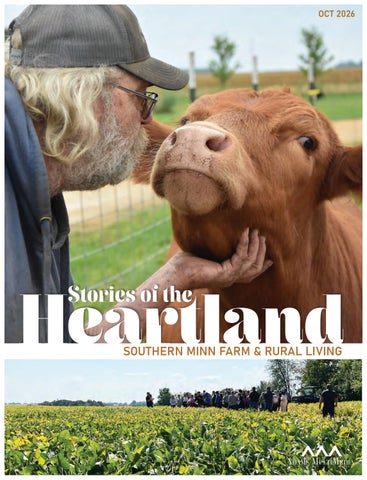
OCT 2026
Heartland Stories of the
SOUTHERN MINN FARM & RURAL LIVING
Southern Minn Stories of the Heartland | October 14 & 15, 2026 | PAGE 2
LET’S BANK TOGETHER.
We are proud to honor our local
Family Farms! Your reliable community bank, supporting our community since 1878.
Northfield 507-645-4441 Also in Cannon Falls, Faribault and Roseville
www.CRB.bank Member FDIC
Southern Minn Stories of the Heartland | October 14 & 15, 2026 | PAGE 3
CONTENT: Pleasant Grove’s unique business model combining pizza and rural atmosphere stands tall
3
In ‘the land of milk and honey,’ a local beekeeper wants you to buy local
6
OHS students get first-hand ag experience on district-owned farm land
8
From farm to market, Triple E Farms remains family-focused Emily Knudsen poses with her cat in front of her garden. Her husband, Bill Bartz, said at the peak of the season, 30% of the ingredients used in their pizzas come from the garden.
Pleasant Grove’s unique business model combining pizza and rural atmosphere stands tall
10
Power to flowers: Heartland Blooms-n-Berry Farm continues growth after 5 years
13
Harvest season goes on at local apple orchards, despite weather setbacks
16
STORY & PHOTOS BY MARCO RIVERO LUNA marco.luna@apgsomn.com
E
mily Knudsen looked out from her barnyard door into the emerald-green clover lawn. Two alpacas laze around near a wooden stage for outdoor performances, and smoke billows from inside the barn where a portable brick pizza oven gets up to temperature. Over a decade ago, the same spread of land was a horse ranch, then empty and overgrown with the natural grasses and trees that overtook the 55-acre property. “This was all just pasture, and all overgrown and weeded too. My husband being a bachelor at the time, he was barely mowing his front lawn,” she said. “But he talked about how he knew this property was special — that there was something magical about it. He was definitely correct.” On the road to Pleasant Grove Pizza Farm in Blooming Grove Township near Waseca, its hard to find anything that isn’t farmed. To get into the property, you follow a dirt road next to fields of corn until you come to a spot where the land clears, and the pizza farm waits. Knudsen’s now-husband, Bill Bartz said he originally bought the farm in 2007. Before he turned it into a house farm, the land was used for row crops. He
We’re
L likeCAL you
Heartland Stories of the
SOUTHERN MINN FARM, & RURAL LIVING REGIONAL MANAGING EDITOR: TIM ZYLA
Kenny the goat and Lena the alpaca are two of the five animals living in the farm. Knudsen said they don’t use the animals for any products, most are just rescues.
built a home and horse barn there, but after his first marriage ended and he sold the horses, the barn went unused. Bartz always had it in the back of his mind that the land could be used for something special. His first thought was a wedding venue. It was Knudsen who told him about a pizza farm she used to visit in her early 20s in Stockholm, Wisconsin called A to Z.
“He was like, ‘I got it! I know what I’m gonna do, a wedding venue,’ and I was like, ‘Ooh, I don’t know about that.’ I had gone to school for event planning and a wedding is a ton of work,” she said. “So I just said, ‘Well, what about a pizza farm?’ And of course, he’s like, ‘What’s a pizza
PLEASANT GROVE continued on page 4
SALES DIRECTOR: ROSS ULRICH ADVERTISING OPERATIONS COORDINATOR: DEANNA BOLAND ADVERTISING: KATHLEEN DAVIES, LOGAN DUNSMOOR, CRYSTAL MCKINZIE, MO MORAN, ALEXIS O’CONNELL & JIM PODRACKY DESIGN & LAYOUT: KATE TOWNSEND-NOET Southern Minn Stories of the Heartland is distributed to subscribers and readers of the Owatonna People’s Press, Faribault
Daily News, Northfield News, Kenyon Leader, Waseca County News, St. Peter Herald and Le Sueur County News. ©2026 This publication is copyrighted by the APG Southern Minnesota and no content can be reproduced without permission.
Southern Minn Stories of the Heartland | October 14 & 15, 2026 | PAGE 4 Knudsen spent a whole year clearing brush, setting up their seating areas, and investing in the equipment necessary to make their dream a reality. The farm wasn’t without controversy. Bartz said neighbors were worried the project would be something disruptive and loud. “There was actually a lot of protest against it initially. But that’s because people didn’t quite understand what it was, and there was a select few that misled a lot of people saying it was going to be loud, that neighbors weren’t going to be able to sleep at night, and then it’s not true at all. It’s very family friendly,” he said. “We don’t really have a true close time, but we take orders till 8, and there’s no lights out here, so when it’s dark, people kind of have to leave. I’m sure there’s a couple people out here that don’t like what we’re doing, but most of the neighbors love it now.” Knudsen said it took some time and patience to get people on board, but ten years after the fact, their neighbors know their intention was to create an idyllic atmosphere to enjoy nature and live music. Today, the farm is open weekends from late-Spring till October. Hours and events can be found on the event’s website. Inside the barn are two massive brick ovens that look as if they’ve been there decades. Bartz, a carpenter by trade, said he put them together by hand. Both came in a kit, and were thousands of dollars apiece. The pair have another pizza oven sitting Pleasant Grove Pizza farm opened in 2015. The property was a horse barn before then, and used for row farming before on top of a truck bed. This is the oven that’s that. billowing smoke through the barn ThursPLEASANT GROVE day morning as Bartz feeds it to get it up continued from page 3 to temperature. He has an event later that day at a winery. farm?’ And With the mobile here we are oven set-up he’s now.” “Emily and I were both into able to take the So not oven to different food. That’s kind of how we long after, venues to do started dating. We were the the two were outdoor events. driving across couple that instead of saying let’s He didn’t the Wisconhave any prior go on a date, we would say I want sin border to experience makStockholm to to cook for you tonight. Come ing pizza before check out the over. To us, it was like, ‘Well, starting the setup. Bartz farm, but Bartz pizza can’t be that hard.’ It kind said it didn’t said it was a of turns out pizza is hard and it take long for natural fit since him to warm is complex and there’s a whole he and his wife up to the always loved world there, but we’ve slowly idea. About food. just been training ourselves and good a year and “Emily and I a half later, were both into grown with the company.” they opened food. That’s their doors - Bill Bartz kind of how we as Pleasant started dating. Grove Pizza We were the couple that instead of saying let’s go on a Bill Bartz grabs more wood to use on the mobile brick pizza oven. The mobile Farm in 2015. date, we would say I want to cook for you oven is used for outdoor events at different bars and wineries. But the setup wasn’t easy. Bartz and
When the air isn’t being fair choose Faribo Air! (507) 334-6408 www.fariboair.com
WE OFFER 24 HOUR EMERGENCY SERVICE
Southern Minn Stories of the Heartland | October 14 & 15, 2026 | PAGE 5
Emily Knudsen said she wanted to start selling bouquets of flowers from her Bill Bartz shows off the mobile pizza oven. He said the oven was a great way to garden soon. She’d call it the pink bouquet club featuring only the pink flowers. make money during the farm’s off-season.
tonight. Come over,” he said. “To us, it was like, ‘Well, pizza can’t be that hard.’ It kind of turns out pizza is hard and it is complex and there’s a whole world there, but we’ve slowly just been training ourselves and grown with the company.” Bartz said his favorite pizza on the menu is the Buster. It has a wild mushroom-andsage olive oil base, caramelized onions, basil, sausage, mushrooms and mozzarella. Just outside of the seating area for the farm is a little nook where walking through a wooden bridge reveals a garden filled with different varieties of flowers, herbs and veg-
etables. Bartz said 30% of the ingredients come from the garden during peak season. Since opening, Knudsen said she and Bartz have grown with the company, learned new ideas, invested in new equipment and continue to find new ways to make money in the offseason. The COVID-19 pandemic ended up being a big growth moment for the company as counter-based ordering and outdoor-setting turned out to be the perfect business model. “We were COVID friendly before COVID. At first, COVID had us a little
nervous. But then as time went on, Emily and I are like, ‘Oh s---! I think we can operate just fine,’” Bartz said. “We were open when nothing else was open, so COVID really was a bit more of a launching point for us than it was a hindrance.” Up next, the couple want to develop a frozen pizza line, create a mobile pavilion for outdoor events, and Knudsen wants to start selling bouquets of flowers from her garden — only the pink ones of course. Knudsen said she always wanted to own a pizza farm back when she’d go to the one in Stockholm. Now, she says she’d do it all
over again. “I had someone ask me that just recently. I was on a food and egg tour down in Blue Earth County, and I was kind of complaining about my job and this gentleman looks at me and he goes, ‘But would you do it again?,’” she said, “And I was like, ‘Yeah, I would.’” Marco Rivero Luna is a reporter for the Faribault Daily News. Reach him at 815-981-5389. © Copyright 2026 Adams MultiMedia of Southern Minnesota. All rights reserved.
Well Drilling & Septic Systems • Complete Well Systems: Single, Shared, & Irrigation Waterlines & Hydrants • Septic Systems: Design, Install, Compliance Inspection, Pumping/Cleaning • Well & Septic Pump Repair
45823 State Highway 22, Kasota • spwell2@gmail.com St. Peter Mankato (507) 931-1340 • (507) 388-8531
Running the farm is your number one priority. You need an Ag Banker and a loan that works for you in every season. For fast, flexible service and local decision making, visit the team at First National Bank Minnesota about how we can help your operation grow.
Matt Wallskog 507.931.5202
• Ag Loans • Ag Real Estate Loans • Lines of Credit • Equipment Financing Craig Bode 507.931.5204
Proudly serving you in St. Peter, Mankato, Belle Plaine & Gaylord
www.fnbmn.bank
2411 W. Bridge St., Owatonna MN 55060 507-451-7340 • 800-526-3514 info@swce.coop • www.swce.coop
Southern Minn Stories of the Heartland | October 14 & 15, 2026 | PAGE 6
Local beekeeper Andy Murray holds a bottle of his honey near his hives as bees fly around him Friday afternoon in Castle Rock.
In ‘the land of milk and honey,’ a local beekeeper wants you to buy local STORY & PHOTOS BY COLTON KEMP colton.kemp@apgsomn.com
“I
’m like a nefarious criminal who gives away free samples, and then you get addicted. But this is a good addiction.” Andy Murray keeps bees in Rice, Dakota and Scott counties. Some are behind an old dairy operation in Castle Rock. Others sit in the woods along the Cannon River near his home in Dundas. The hives change with the season and the forage. What doesn’t change is his argument: southeastern Minnesota makes some of the best honey in the world, and almost nobody here buys it. Murray, who is 70, owns Limberlost Farm in Dundas and sells somewhere between 2,000 and 10,000 pounds of honey a year. He doesn’t have a brand or a grocery store shelf. Customers text him and bring their empty Mason jars he supplies, which he fills at $6 a pound.
TASTE OF HOME Murray’s case for local honey starts with a number: less than 25% of the honey
consumed in the United States is produced here. The rest comes from India, Vietnam, Argentina and Brazil. “You can buy it cheaper,” he said. “But they paid $1.50 for the honey to come from India, and they carried it from the southern Asian continent to the middle of North America, and 30-40 cents of that is freight.”
Bees flow in and out of one of Andy Murray’s hives Friday afternoon in Castle Rock.
He argues the difference is obvious in taste. “I challenge you: Go to Family Fare or Cub and buy the cheapest honey, and
compare it to what I’m going to show you today, and you’ll go, ‘Why would anyone buy this?’” Minnesota is a good place to make that case. Murray said the state is among the top honey producers in the country, and he puts southeastern Minnesota honey up against any in the world. “There’s Tupelo honey, there’s sourwood honey from the Appalachians. They’re great and they’re unique,” he said. “But our honey is very, very tasty and flavorful.” Murray spent his career in shelf-stable food. He graduated from Purdue, worked for a canning company in central Illinois, then for Pillsbury in Minneapolis, then ran operations for a smaller food business for 19 years. After that, he started a consulting company with a partner, ran it for 15 or 16 years, and sold it.
AN EXCLUSIVE SORORITY Murray has been keeping bees for more than 20 years, starting with a friend who had a couple of hives. “I’d always been interested in insects — social insects in particular,” he said. That interest shows. Ask him about honeybees and he’ll walk through the dif-
ference between summer bees and winter bees, explain why pollen is baby food and point out the “guard bees” loitering at the hive entrance checking IDs. “They’re waiting for someone to show up who’s not one of their colony,” he said shortly before a honeybee dragged a yellow jacket out of the hive, picked it up and flew it away. This time of year, Murray said, the colony turns on its males. Drones get evicted. Those who don’t leave get chewed up and hauled out. “It’s a sorority house. It is a serious sorority house,” he said. “Oddly enough, in nature, if you go into the hives in the winter, occasionally you’ll find a drone in there who’s walking around kind of pretending to be a worker, and he got away with it all winter long. Nature is like that. Anyone who says nature isn’t like that is wrong.” He also noted the sobering arithmetic of a hive at peak season: the queen lays 1,000 to 3,000 eggs a day, which means 1,000 to 3,000 bees die every day. In summer, workers spend their final days foraging away from home. In fall, they die inside and get carried out by their sisters. “They carry their dead out,” he said, gesturing to the thousands of bee carcasses littering the concrete in front of the hives.
Southern Minn Stories of the Heartland | October 14 & 15, 2026 | PAGE 7
A bee clings to a piece of beeswax used to seal one of Murray’s hives after it was opened for inspection.
Those aren’t leaves or sticks littering the concrete in front of Andy Murray’s hives Friday afternoon in Castle Rock. They’re dead male bees, evicted from the hive before winter. Those that don’t leave are chewed up and dragged out.
ADAPTATION AND POLLINATION Murray raises Russian bees, a strain developed in eastern Russia and brought to the U.S. by a USDA lab in Louisiana. He writes the year and origin on the lid of each hive box. The ‘26 Russian queens are descendants of that germplasm. Russian bees are immune to varroa mites. The parasite arrived in the U.S. in the mid-1980s, but Russian bees had coexisted with it for a century along the Trans-Siberian Railway, where Ukrainian settlers brought European honeyAndy Murray points out a yellow jacket that snuck into one of bees. They adapted. his beehives shortly before the bees pushed it back out. Murray has also adapted. He builds some of his own equip“They need every beehive they ment. He uses six-pack wine car‘THE LAND OF can get to come out and pollinate riers to deliver 2-pound squeeze those, because there aren’t native MILK AND HONEY’ bottles to coffee shops, then takes pollinators to do the job,” he said. Murray sells to coffee shops them back and sanitizes them “The large commercial guys, the and restaurants, including for refills. He also sells beeswax, guys who are in the business of Boonies in rural Rice County and which is what bees use to make semi trucks of bees going all over, Hideaway Coffeehouse in Northhoneycombs. that’s all they do. That is more field. He also sells to “I don’t have any downtown Northfield’s waste in packaging,” Cottage Tearoom & Fare, he said. where owner Lisa Bolduc While Murray’s uses his honey in “almost operation makes all” their menu items and him a self-described recipes. “sideliner” — a step “It’s great, just wonabove a hobbyist derful honey,” she said. and a step below a “It’s full of health beneregional operation fits. … We use it in the — there are major cinnamon honey butter operations with that we use in a popthousands of hives in overs, and people just go the area as well. nuts over it. We use it in For those operthe house dressing. The ations, the majority of income doesn’t Layers of plastic and natural beeswax form the honey in there makes all the difference.” come from honey. It honeycomb inside one of Murray’s hives. Murray says he doesn’t comes from polliwant a brand or a shelf at nation. Each year, Murray said, profitable. That is a bigger source a grocery store. What he wants is 50-75% of the nation’s beehives go of income for them than the honfor people in southeastern Minneto California to help pollinate the ey is.” almonds. sota to realize they have some-
Bees crowd together inside one of Murray’s hives.
Honey glistens beneath a layer of beeswax inside one of Murray’s hives.
Bees remain on a full frame of honeycomb as honey fills the cells and spills around its edges.
thing worth buying right here. “Here we are in the land of milk and honey, basically, and we buy our honey from India,” he said. “Unknowingly. ‘It’s just honey,’ and then we take it home and we put it in our tea or our coffee or in our recipe, and we feel pretty good about it. But if you tasted that (and local honey) side
by side, you would say, ‘I would never buy that again because it tastes like old socks.’” He paused. “But people don’t know.” Reach Associate Editor Colton Kemp at 507-645-1115. © Copyright 2026 Adams MultiMedia of Southern Minnesota. All rights reserved.
Southern Minn Stories of the Heartland | October 14 & 15, 2026 | PAGE 8
Courtesy of Owatonna Public Schools.
OHS students get first-hand ag experience on districtowned farm land
T
Courtesy of Owatonna Public Schools.
OHS students getting practical agricultural experience.
he Owatonna School District is making use of its assets in an effort to offer educational opportunities for the farmers of tomorrow. Some may be unaware that the district owns roughly 30 acres of farmland by Turtle Creek but fret not as it is not sitting idle. For the past four years, Owatonna High School teacher and Future Farmers of America adviser Liz Tinaglia said her class has maintained a small half-acre garden with the goal being to educate students in grades 9-12 and give them practical experience in the techniques and methodology employed in outdoor farming. “We have a little garden that’s used for my greenhouse and introduction to plants classes,” Tinaglia said. “We gather soil samples, do soil testing, and when it comes time to plant, the students do the planning, planting, tilling and weeding. So, while we’re doing all that
Southern Minn Stories of the Heartland | October 14 & 15, 2026 | PAGE 9
UPCOMING AUCTIONS Online Only Semi-Annual Sportsman & Recreational Consignment Auction in Kenyon, MN Bidding Opens: Friday, October 9, 2026 at 8 am Bidding Starts Closing: Monday, October 19, 2026 at 4 pm Property Address: 930 Red Wing Ave., Kenyon, MN 55946
Modern & Collector Firearms, Handguns, Rifles, Shotguns. Hunting & Fishing Gear, Ammo, Safes. Side-By-Sides, ATV’s, Snowmobiles, Boats, Campers, RV’s. All Types of Recreational Equipment. Courtesy of Owatonna Public Schools.
gardening kind of work, we have the oppor- ‘Our Farm’ account,” Tinaglia said. “We tunity to talk about growing crops outside. hope to use the proceeds for starting a In the past we’ve done a little garden sale school farm. We’re in the planning process and what isn’t sold was given away.” right now.” Their garden is pesticide- and herbiIn addition to their aspirations of estabcide-free and in past years students have lishing an Owatonna High School student planted pumpkins, ornamental corn, tomafarm, Tinaglia also said that they are in toes and peppers. With OHS students farming roughly one talks with the Steele County Free Fair. half of an acre, equivalent to half a football “We’re trying to work with the Steele field, what is happening with the rest of County Free Fair to have a building put the plot? Tinaglia explained that a local on the fairgrounds that will be part of our farmer cultivates crops, primarily corn and school farm,” Tinaglia said. soybeans, on the acreage on behalf of the There is currently no timetable for the school and has assisted in educating the fairground building but Tinaglia hopes to students. “We have a local farmer doing custom see it come to fruition sometime in the next planting and harvesting on the remaining three to four years. 29 acres which is sublet to the Owatonna Scholastic business ventures aside, TinaFFA chapter,” Tinaglia said. “The farmer glia said that the most important aspect of also works with my students to explain corn the project is the students and what they are and soybean planting, harvesting, yields, able to take away from the experiences the irrigation and marketing. They can see the land affords. huge combine that goes out in the field and understand “We hope how that comthat by having bine works. We direct inter“We hope that by having direct also bring in action with different types interaction with agriculture the agriculture of soils which students will be able to see a the students make a differwill be able to future for themselves in an agence for what the fertilizer is related career. Hopefully it helps see a future used and crop them to recognize that there are for themselves that is chosen in an ag-relots of opportunities for them.” to be grown lated career,” there.” Tinaglia said. - Liz Tinaglia Tinaglia “Hopefully it estimated the helps them to annual revenue from the land at around $30,000 after recognize that there are lots of opportuniexpenses, which is then squirreled away for ties for them.” the future. “We bear all the expenses but the inReach reporter Tim Messenger at 507-444-2376. come from the harvest is put into a special © Copyright 2026 Adams MultiMedia of Southern account, aside from the FFA, called the Minnesota. All rights reserved.
Call us today to schedule and advertise your items at 507-789-5421.
Online Only Year End Area Farmers & Contractors Consignment Auction In Dexter, MN Bidding Opens: Friday, December 4, 2026 at 10 am Bidding Starts Closing: Tuesday, December 15, 2026 at 10 am Property Address: 130 State Hwy 16, Dexter, MN 55926
Online Only Area Farmers Consignment Auction, Tractors, Combines, Semi’s, Trailers, Construction Equipment, Planters & Tillage Equipment, Livestock Equipment, Pickups, Cars, Atvs And Farm Support Items. Call Now To Consign Your Clean Farm And Construction Equipment - 507-584-0133.
Online Only Year End Area Farmers & Contractors Consignment Auction In Kenyon, MN Bidding Opens: Tuesday, December 8, 2026 at 8 am Bidding Starts Closing: Thursday, December 17, 2026 at 10 pm Property Address: 930 Red Wing Ave., Kenyon, MN 55946
Online Only Area Farmers Consignment Auction, Tractors, Combines, Semi’s, Trailers, Construction Equipment, Planters & Tillage Equipment, Livestock Equipment, Pickups, Cars, Atvs And Farm Support Items. Call Now To Consign Your Clean Farm And Construction Equipment - 507-789-5421 Matt Maring Lic# 25-28 | 507-951-8354 Kevin Maring Lic# 25-70 | 507-271-6280 Adam Engen Lic# 25-93 | 507-213-0647 Bill Hilton Lic# 50-24 | 507-279-9600 Andrew Hamilton Lic# 55-051925 | 507-438-6693 Dylan Kallemeyn Lic #46-94 | 507-236-6223 PO Box 37, Kenyon, MN • 130 State Hwy 16, Dexter, MN 507-789-5421 or 507-584-0133 Mike Munroe, Sales Rep | 507-517-1875
Go to HMauction.com for bidding & more details or call 507-584-0133
Southern Minn Stories of the Heartland | October 14 & 15, 2026 | PAGE 10
Tim Enz offers beef by the truckload at the St. Peter Farmers Market.
From farm to market, Triple E Farms remains family-focused STORY BY CARSON HUGHES carson.hughes@apgsomn.com
Tim’s brother Tom, Tim’s eldest son Nathan and his wife Christa as well as Tim’s youngest son Leighton, who operates a parallel farm in Gaylord with his wife Jenny. n a Saturday morning at the Like many Minnesota farms, corn and St. Peter Farmers Market, it soybeans are Triple E’s bread and butter, does not take long to find but for patrons at area farmers markets, the Triple E Farms. Enz’ are best known for high-quality Black For six years, the famiAngus beef. What began with booths at the ly-owned beef producer has been a mainSt. Peter and Mankato Farmers Market has stay at the market. With a semi-truck filled grown to seven farmers market locations with cuts of beef, pork and poultry parked a week, including five Twin Cities markets outside the St. Peter Co-op, the Enz family’s under the St. Paul presence is impossiGrowers Association. ble to miss. With operations Located five miles too small to keep up “They know where it’s west of St. Peter, the with retail demand, Enz farm is a small coming from.They know farmers markets have operation around become the primary exactly what they’re 400 acres in size, but space where Triple E getting. We can tell them Farms connects with it boasts a growing footprint. exactly what the animal customers. It gives Dating back family a uniquely gets from birth to finish.” the to 1948, when the personal contact land was first sold with consumers. - Leighton Enz to family patriarch Patrons can talk with Larry Enz, the farm the Enz’s directly is currently managed about how they raise by Larry’s son Tim Enz and his wife, Lisa, their cattle, ask questions and even see the
O
grandchildren grow up as they assist with the booth year-to-year. This personal touch has allowed Triple E to cultivate a clientele that follows them from market to market. The Enz’s reported that they even have out-of-state customers from Iowa, Wisconsin and Nebraska that
regularly make the trip to Minnesota for fresh cuts of beef. “They know where it’s coming from. They know exactly what they’re getting,” Leighton said. “We can tell them exactly what the animal gets from birth to finish.” Leighton credited their customers’ sup-
Southern Minn Stories of the Heartland | October 14 & 15, 2026 | PAGE 11 “It makes me feel fabulous when you sit out there because they don’t hold a grudge against you,” said Tim. “Even some of the ones that are timid come up and they’re sniffing you, and they’re taking their tongue and licking you, and pretty soon they’re becoming your friend.” More and more the farm is taking on a hands-on role in raising cattle from birth to slaughter. While Triple E has traditionally relied on purchasing feeder cattle — calves old enough to be weaned off the bottle — the business has transitioned towards including more bottle-fed calves. Central to Triple E Farms’ goal of expanding their herd is a parallel facility operated by Leighton and Jenny in Gaylord. The site would not only host its own heifers, but is planned to eventually include a farm country store where customers can buy meat directly from the source.
MORE THAN CATTLE
“It makes me feel fabulous when you sit out there because they don’t hold a grudge against you. Even some of the ones that are timid come up and they’re sniffing you, and they’re taking their tongue and licking you, and pretty soon they’re becoming your friend.” - Tim Enz port for family farms as well as Triple E’s dry-aging techniques to enhance the flavor of the beef before its packaged in cultivating a dedicated customer base. For the family, that customer base is a point of pride. The farm may have grown over the decades, but it remains a family operation in a very literal sense. Even with some family members spread out across the state, multiple generations of the Enz family pitches in where they can.
ONE GENERATION AT A TIME The story goes back to 1948, when Larry was a young boy and his parents purchased a field across from where Triple E Farms is located today. As Larry grew older, he began assisting a neighbor who was leasing the farmland and living there by himself. According to the family, the farmer didn’t have many people willing to help him, but Larry did.
Eventually, that relationship led to the owner of the land to offer to sell the property to Larry. He accepted, starting what would become a family farm cultivated by four generations of Enzes. The farm was initially centered around crops and dairy cattle. The regular work of harvesting, feeding and milking shaped the family’s days, until the 1980s when the Enzes sold their herd to the federal government during the first dairy buyout. While most of the herd was sold off, Tim kept eight Holstein heifers, which became the beginning of his beef herd. More than four decades later, the family’s cattle herd has grown to about 50 heads. Eventually, Triple E Farms aims to increase their supply to somewhere between 120 and 150 beef cattle. For Tim, taking care of what he affectionately refers to as his “900-pound cats” is one of the great highlights on the job. Growing up surrounded by cattle, he’s become intimately familiar with their unique
personalities and there’s no better way to relax than to join the heifers in the pen for some “cattle therapy.”
Although cattle have become an increasingly visible part of Triple E Farms, crops remain the foundation of the operation. The farm raises corn, soybeans, wheat, rye, alfalfa and grasses, using those crops both for sale and feed. The family regularly combines up to 1,200 acres. Around 400 of those acres includes land that the Enzes run themselves, with the rest coming from custom farming neighboring lands. Much of Triple E’s work supporting other farmers comes from custom round baling. The family regularly aids farms stretching across the area around Cleveland, Courtland, Mankato, Gaylord and Union Hill. The farm’s diversity is intentional. The cattle business acts as a kind of cushion when the crop side of farming takes a hit. A severe hailstorm, the “big white combine” as Tim calls it, can easily wipe out a corn crop and the year’s potential profits. Insurance often isn’t enough to cover the loss, but having cattle on-hand ensures that even damaged crops can be put to good use. “That’s why I got cattle. So if I do get a hailstorm and I have poor corn, I could chop it for silage for the cattle,” said Tim. The same philosophy has carried into the family’s increased use of cover crops and minimum tillage. Tim said cover cropping has been around for years, but the family has been paying more attention to it and has seen good results. If a cover crop
TRIPLE E FARMS continued on page 12
…andthisthis…and …and fix this this …and this! this We fix thisWe…and
Wet Basements
Sump Pumps
Wet
Structural Problems
…and this!
✓ Waterproofing ✓ Crawlspaces ✓ Foundation Repair Crawl Spaces ✓ Sump Pumps
Sump Pumps 4 Waterproofing Basements 4 Crawlspaces 4 Waterproofing 4 Foundation Repair
Structural Problems
FREE ESTIMATES
Crawl Spaces
507-387-0500
MyCompleteBasement.com
Southern Minn Stories of the Heartland | October 14 & 15, 2026 | PAGE 12
TRIPLE E FARMS continued from page 11 grows too tall, the family can cut it for hay and feed it to cattle. It is a recurring theme at Triple E Farms: little gets wasted, and few things are allowed to serve only one purpose.
MAKING A LIVING FROM THE MARGINS In an industry where yields and returns can rise and fall with the seasons, being resource savvy is an essential skill for small family farms like Triple E. The family aims to find savings and potential revenue streams wherever they can, such as with the farm’s own maintenance shop. Tim, who has been welding since he
6EfTHETD-D0'5
lD·DONE
was 12, puts his mechanic skillset to use on the farm, rebuilding transmissions, working on tractors and combines, repairing semis and rebuilding trailers. The family has not only aided other farms, but saved substantial amounts of cash by fixing up equipment themselves rather than taking broken pieces to dealers or replacing them. In one case, the family discovered a cracked component in a combine. Replacing the needed parts cost a little less than $2,200. Having the dealer perform the work, the family estimated, would have cost about $15,000. Without savings like these, Tim said it was unlikely the family would still be farming today. That same willingness to do difficult work has helped shape the family’s businesses outside the farm. With the assistance of other family
WE DIG DIRT
CK 5ERIE5 ••••••• •• • • • • • • • • • • • •••• • • • • • REDESIGNED I □ �O, 35 AND IJD HP EN61NE5 □ 3 TRAN5Ml551DN CHOICES □ ADP5 IIR CAB MODELS □ Ei15Y TO HAUL WE DIG YOUR DREAMS
members, Nathan runs Split Enz Construction, which primarily serves St. Peter and the surrounding area, aiding with projects like building basements, maintaining township roads and demolition. Until recently, Leighton has managed a fleet of six semi-trucks under TLE Trucking, Inc. However, current economic conditions have taken their toll on the businesses. Much of Split Enz work involves assisting residential customers, but with prices rising, Nathan said more homeowners are hesitating to fund major renovations on their properties. TLE Trucking, on the other hand, has been rendered defunct by the rising fuel costs. With trucking rates failing to keep up, Leighton said it was more feasible to keep the trucks parked. Given the long nights and time away from family involved in trucking, Leighton said he was unsure if he would return to the road even if prices did come down. “I’m enjoying my sleep,” Leighton said when asked whether the trucking business might return. Fuel costs have also cut into the beef side of farming, as Triple E Farms spends plenty of time on the road bringing meat to customers in the St. Peter-Mankato area and the Twin Cities. Between the expenses associated with transportation and processing, Leighton said it costs roughly $2,000 extra per animal to bring the sellable cuts to farmers markets. Figuring out just how much beef to make available is one of the biggest challenges, said Leighton. A farmer can spend months raising an animal or a crop only to face chang-
ing prices when it comes time to sell. On the beef side, the family has to calculate not only the market value of an animal but whether its weight and the resulting amount of sellable meat will justify the costs involved. One year, the family found itself trying to meet customer demand while sending lighter animals to processing. The result was less meat coming back than expected “That’s one of the growing pains, trying to figure all that out and make sure you’re doing good,” said Leighton.
LOOKING TOWARD THE NEXT GENERATION For all the challenges that come with farming, keeping the family together hasn’t been much of an issue for the Enzes. Many of the Enz family’s youngest members are already growing up to be enthusiastic farmers. There’s seven kids, Emma, Oliver, Brianna, Livvy, Luke, Ella and Owen on the farm and two — Oliver and Luke — are already learning how to drive tractors. Many of the children assist with daily farm chores, selling meat at the farmers markets and spend their free time playing on the hay bales, feeding the animals and wrangling the many farm cats that populate the grounds. Larry’s hope after seeing his children and grandchildren dedicate themselves to the farm is that this young crop will continue the legacy of the farm into the future. Reach Reporter Carson Hughes at 507-931-8575. © Copyright 2025 Adams MultiMedia of Southern Minnesota. All Rights Reserved.
Farming is your livelihood, and it’s our business to protect that. Our companies were founded more than 80 years ago to serve the needs of farmers and ranchers. Today we’re the #1 ag insurer, delivering Smarter Insurance for Agriculture.®
Call me today to see how I can help protect your operation, family and future.
2250 AUSTIN ROAD | OWATONNA, MN
Dan Pumper 1220 7th Street Ste A Faribault, MN 507.331.2345 danpumper.com
507-451-3131 NORTHLANDFARMSYSTEMS.COM FIND US ON FACEBOOK, INSTAGRAM AND YOUTUBE
No. 1 ag insurer across our 8-state territory; 2019 SNL P&C Group - Farm Bureau Property & Casualty Insurance Company direct written premium. Securities & services offered through FBL Marketing Services, LLC,+ 5400 University Ave.,West Des Moines, IA 50266, 877/860-2904, Member SIPC. Farm Bureau Property & Casualty Insurance Company,+* Western Agricultural Insurance Company,+* Farm Bureau Life Insurance Company+*/West Des Moines, IA. +Affiliates. *Company providers of Farm Bureau
Southern Minn Stories of the Heartland | October 14 & 15, 2026 | PAGE 13
Kristi (left) and Kevin Schuldt look at their dahlias while taking a break from harvesting.
POWER TO FLOWERS: Heartland Blooms-n-Berry Farm continues growth after 5 years kinds of flowers on a third-generation, 160-acre farm. The other 90 acres are rented out to a local dairy farm. The farm at 12945 Heartland risti and Kevin Drive belonged to Kevin’s family, Schuldt are “flower which he and Kristi took over “when freaks.” the time was right” in 2020. It was “We grow flowers Krist’s grandparents who instilled for every season,” her love of gardening into the Kristi said while Schuldt operation. Kristi and Kevin taking a break from harvesting her wanted to grow their own flowers for dahlias. “I like to make it hard on their wedding on us.” the farm. The Schuldts “We left it up run Heartland to my parents to “We grow flowers for Blooms-n-Berry care of them every season. I like to take Farm in Caledowhile we went nia, where Kevin make it hard on us.” back to Chicago,” and Kristi raise Kevin said. - Kristi Schuldt their son Henry, When the 9, daughter couple began Emma, 7, two running the dogs, 28 chickens, two lambs and farm, Kristi bought more and more several barn cats. flowers, and Heartland Blooms-nWhat started in Chicago, a few HEARTLAND houses down from Wrigley Field, continued on page 14 bloomed into about 70 acres of all STORY & PHOTOS BY KAITA GORSUCH kaita.gorsuch@apgsomn.com
K Kristi Schuldt picks raspberries that she grows at Heartland Blooms-n-Berry Farm.
Southern Minn Stories of the Heartland | October 14 & 15, 2026 | PAGE 14
Kristi, Kevin and their children.
next to the road would have to back out on the highway, and the couple wanted to give a safe space for cars to turn around. Berry began. “We did seem to lose some of our men The farm – which Kristi said got its customers,” Kevin joked. “When they saw name because, “Our road’s named Heartit on the side of the road, it’s like ‘I’ll stop land Drive and we sell blooms and berries,” right now.’” – grows Both Kevin flowers for and Kristi said baby and they lived in bridal showrural areas but ers, anniverleft for work, sary parties, where they met. events, Kristi has a weddings degree in envior “just ronmental and because.” water resource They also engineering, put flowers, and she worked eggs and with a comvegetables pany based in in a farm Chicago as a stand for senior technipeople to cal consultant. buy off the Her job was to road. create blue“That prints to extract pollutants from started in the earth to COVID. bring life back. It was pay Kevin’s job what you was to make can,” Kevin those things said. “We happen. He had vegetawent to school bles in there to be a diesel and Kristi mechanic and put some ended up in flowers in construction, there. Lots The farm stand is stocked with flower bouquets, where he were comeggs, merchandise and dried evergreen arrangebrought Kristi’s ing for the ments. restoration flowers.” blueprints to life. When they came back to This year, the Schuldts moved the farm the farm that Kevin grew up on, they knew stand from by Highway 76 to further down from experience firsthand that they wanted the property, for safety reasons. Kristi said people who would stop when the stand was to keep things all natural.
HEARTLAND continued from page 13
her “normal” job. “This helps me do that,” Kristi said, pointing to the house. Keeping things natural can be difficult, simply because the Schuldts don’t know everything. “Last week, we had a group of Iowa Master Gardeners out here,” Kristi said. “It was fun talking to them and learning about different ways they do things.” The couple spends a lot of time researching new techniques, talking to other farmers, trying things and ultimately failing. “It’s a part of life,” Kevin said. “You’re gonna fail, and that’s how you learn.” Something on the farm that hasn’t been a failure is the drip-irrigation system Kevin installed. Instead of relying on well water, Heartland Blooms-n Berry uses rainwater to keep the crops growing. Although the flooding in July did give the couple some trouble on the farm, Kevin said “rain water is the best” for their flowers. The couple are big into composting. Kevin’s uncle runs a lawn care business and he will drop the clippings off at the farm when he’s done. The Schuldts go through the grasses and separate the ones that may have had pesticide residue, to keep up with the all natural practices. Their chickens, which Kevin raised from birth, help to improve the farm’s soil health by moving around the fields to fertilize when the crops rotate. The chickens do have coops to go in at night to keep predators at bay, but during the day they’re free “It’s a peace of mind thing,” Kevin said. range. “You know what’s going into the food that “They follow us when we pick raspberyou’re eating.” ries,” Kristi said. Heartland “The other night Blooms-n-BerI had an overry has been a “Sometimes there will be flowing bucket labor of love, the and I kept tossing an order that we can’t fill, Schuldts said, them berries.” so we send them to (MarySparky and with much trial Pillow, the lambs Ann’s Florals in Caledonia). and error. Kevin their chilworks full-time Sometimes there’s something that dren named, are on the farm while she can’t do and she’ll call us. doing their part Kristi works to help with farm It’s a win-win situation.” part-time at the upkeep. Chicago-based “That whole Kevin Schuldt company from area over there, home. The goal is they cleared out,” for both Schuldts Kevin said, pointing to a grass field next to to work on the farm only, but the relaxation the 7-month-old lambs’ pen. “You’d think of planting and harvesting helps Kristi with
The drip-irrigation system that Kevin Schuldt installed collects rainwater for the flowers.
Southern Minn Stories of the Heartland | October 14 & 15, 2026 | PAGE 15
The Schuldts grow a variety of flowers on their farm, but dahlias and tulips are so popular that the farm hosts festivals in their honor.
Kevin and Kristi with Pillow and Sparky, the lambs their children named.
they were goats or something.” Not only are the Schuldts running a farm, but they are running a business as well. “About 30% of the time is spent on computers,” Kristi said. “There’s a lot of
Ann’s Florals in Caledonia). Sometimes there’s something she can’t do and she’ll call us,” Kevin said. “It’s a win-win situation.” Outside of their fields, Kristi enjoys interacting with the community. The farm hosts two big events: Tulip Fest in the
planning.” While there are other flower shops in the area, the Schuldts don’t feel the pressure to compete. “Sometimes there will be an order that we can’t fill, so we send them to (Mary-
spring and Dahlia Fest in the fall. Kristi also leads workshops on flower arranging. “I like to be around people,” she said. “I like seeing what everyone else does.”
Daily News FARIBAULT
localmatters
Northfield News localmatters
LIVE. WORK. PLAY.
Argus The Caledonia
We’re
L likeCAL you
Southern Minn Stories of the Heartland | October 14 & 15, 2026 | PAGE 16
Owner Chrissy Trump stands in her apple orchard at 1020 St. Paul Ave in Faribault.
Harvest season goes on at local apple orchards, despite weather setbacks
Apples are king at Trumps Orchard in Faribault.
H
STORY & PHOTOS BY MILES SCHIFFER miles.schiffer@apgsomn.com
arvest season is underway at Trumps Orchard in Faribault, with apples, squash, pears, plums and pumpkins among this year’s crop. The apples, which the orchard is best known for, are available to be picked by hand, in addition to being sold at the orchard’s storefront at 1020 St.
Southern Minn Stories of the Heartland | October 14 & 15, 2026 | PAGE 17
Local syrups and apple sauce among are among the appealing products sold at Trumps Orchard.
Caramel apples with Abdallah caramel are always hits at Trumps Orchard.
Paul Ave. and at Hy-Vee locations through- er-related setbacks this year, with frost marring some of the plum blossoms, and out southern Minnesota. hail in April making growing apples harder “We’ve done the SweeTango, now the as well. honeycrisp, the Haralson, so people look forward to that,” owner Chrissy Trump “The hail was so dense that it knocked said. the fruiting spurs off, so our blossom was considerably less, which led to considerably In addition to the apples, pumpkins are less apples to form,” Chrissy said. available to be hand-picked by customers. Trumps The orchard isn’t the only was founded in 1954 by orchard in the Chrissy’s grand- “When the early spring came and Faribault to weathparents-in-law, then it froze again afterward, the have Herman and er-related istrees all blossomed. If the flower sues, however. Eileen Trump, Apple Creek who started on the tree dies, the fruit never by selling Orchard at grows, so we have 17,000 trees apples out of 5524 W. 185th that are pretty barren.” their garage. St. has also felt Chrissy and her the brunt of - Tamera Theis husband, Scott, poor growing are the third weather. generation of “When the ownership at the orchard, and they receive early spring came and then it froze again even more help running it from inside the afterward, the trees all blossomed,” owner family. Tamera Theis said. “If the flower on the tree dies, the fruit never grows, so we have “Now our kids are actually the fourth 17,000 trees that are pretty barren.” generation that help here. So yeah, it’s four generations, all in the Trump family,” The opportunity to pick your own Chrissy said. apples or to buy at the orchard’s storefront has still been available at Apple Creek this The orchard has suffered some weath-
season, but Theis said she has not been able to sell apples wholesale like the orchard has done in the past, and has planned to end customer apple-picking two weeks early. “When the frost hits the tree, the bottom dies first,” Theis said. “And so, there are apples at the tops of all the trees, but the you-pickers aren’t allowed to go up that high to get to them.” The decreased wholesale apple sales do create a knock-on effect for other orchards, including Trumps, as Theis said she would sell to them if she had the apples to do so. “With their crops being low, they really needed us to be able to supplement them, but we just can’t, or we won’t have any for our own retail,” Theis said. The poor harvest this year has unfortunately not been a unique phenomenon for Apple Creek. “We’ve owned this for five years, and three or four of our seasons, we’ve lost the crop,” Theis said. Apple Creek still has other means of making income. The orchard does wagon rides on weekends and for field trips, in addition to having a corn maze, an inflatable obstacle course, a playground and yard games to attract people to the orchard, as part of their annual fall festival, which runs from Labor Day weekend until Halloween
Mike’s REPAIR Ag & Truck Tire Sales & Repair 870 32nd Avenue NW, Owatonna • 507-455-0388 Emergency ndor on the Farm Repair Available
weekend. The extra activities have led to more business at the orchard according to Theis, but it has been mainly to make up for a decreasing harvest. “When I say our numbers are better, it’s because we’re doing all the other stuff,” Theis said. “As far as the crop goes, it has not been great for apple orchards.” Despite the weather, Chrissy is ready to sell this year’s crop at Trumps. “Everything we have has been really nice, so we’re grateful and blessed that we have a crop when we didn’t know for a while there,” Chrissy said. As for Theis, while she hopes next year will be more fruitful, she’s also. been able to acknowledge the struggle that comes with growing apples. “The one thing about farming is it’s hard, and you don’t know what you’re going to get,” Theis said. “You can do everything right science-wise, but Mother Nature at the end of the day is going to have the final say, and we’re all at her mercy.” Miles Schiffer is a reporter for the Faribault Daily News. Reach him at 507-323-2379. © Copyright 2026 Adams MultiMedia of Southern Minnesota. All rights reserved.
Steele County Free Fair • August 17-22, 2027
Southern Minn Stories of the Heartland | October 14 & 15, 2026 | PAGE 18
COMING SOON!
CONTEST STARTS IN NOVEMBER 2026 WATCH SOUTHERNMINN.COM FOR MORE INFO.
Southern Minn Stories of the Heartland | October 14 & 15, 2026 | PAGE 19
PEOPLE PEOPLE CARING FOR THE WAY YOU
ARE TREATED PEOPLE is JUST AS THE WAY YOU IMPORTANT as the ARE TREATED TREATMENT THE WAY YOU is JUST AS YOU TREATED RECEIVE. ARE IMPORTANT as the is JUST AS TREATMENT IMPORTANT as the YOU RECEIVE. At River’s Edge Hospital, TREATMENT you are more than a YOUEvery RECEIVE. patient. person who receives care is treated At River’s Edge Hospital, with compassion and you are more a respect. You’ll than receive patient. who a ofEvery attention that Atlevel River’s Edgeperson Hospital, receives care is treated goes well beyond your you are more than a with compassion and expectations. patient. Every person who respect. receives You’ll care isreceive treated a level of attention that with compassion and goes wellYou’ll beyond your respect. receive expectations. a level of attention that goes well beyond your expectations.
1900 North Sunrise Drive | 507-931-2200 www.REHC.org
From Design to Done and every step in between. Get started now… 507-931-3200 200 S Front St Saint Peter, MN 56082 Mon - Fri 7:30am - 5:00pm
1900 North Sunrise Drive | 507-931-2200 www.REHC.org
1900 North Sunrise Drive | 507-931-2200 www.REHC.org
River’s Edge Hospital is an equal opportunity employer and provider.
Southern Minn Stories of the Heartland | October 14 & 15, 2026 | PAGE 20