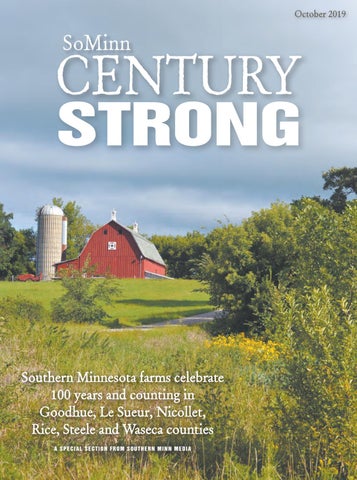
STRONG
A Special section from Southern Minn Media
www.fleetsupplymn.com
Your Head Quarters for All Your Hardware – Farm – Home Paint – Feed – Clothing – Needs
FARIBAULT 80 Western Ave
(507) 334-3232
Mon – Fri 8am-8pm, Sat 8am-6pm, Sun 10am-4pm Since 1905
Jacobson farm a marker of dairy life in decades gone by.............................................................3 Lurken farm’s history includes upgrades, tragedies, unclear future..............................................6 Cordes preserves lifelong home, old traditions on century farm................................................10 Couple’s farm ownership lasts more than half its 100 years in the family..................................15 150 years later, Eckberg family farm remains integrated with Bernadotte history......................18 Anthonys feel responsibility, pride in keeping 150-year-old farm going....................................21 Trotman family still on the farm after 130 years.......................................................................25 Coming home to the Ruedy family farm..................................................................................28 Family trust now owns Wenzel family farm..............................................................................31
STRONG
so minn Century strong A special publication of the Faribault Daily News, Owatonna People’s Press, Northfield News, Kenyon Leader, Waseca County News, Le Sueur County News and St. Peter Herald Publisher: Chad Hjellming Cover Photo: Suzanne Rook
SoMinn Century Strong is distributed to subscribers and readers of the Faribault Daily News, Owatonna People’s Press, Northfield News, Waseca County News, Kenyon Leader, Le Sueur County News and St. Peter Herald at no additional charge. All rights reserved. ©2019 All advertising contained herein is the responsibility of the advertiser.
PAGE 2
Century Farms
Tuesday, October 1, 2019
Joint Replacement Surgery
Important Choice, Easy Decision
For quality care, close to home, it’s OrthoEdge. The OrthoEdge Joint Replacement Program features two of the most experienced orthopaedic care providers in the area, The Orthopaedic & Fracture Clinic and River’s Edge Hospital. • • •
3,000 successful hip, knee and other orthopaedic surgeries 245 years of combined orthopaedic surgery experience 1 of 13 hospitals in the nation accredited as a hip and knee replacement center of excellence
Getting the care you deserve and trust, close to home, makes OrthoEdge the right choice for joint replacement surgery. Learn more at OrthoEdgeMN.com
Recognized for Being the Best! River’s Edge Hospital has been recognized as a DNV GL Healthcare certif ied Hip & Knee Replacement Center of Excellence. Plus, River’s Edge Hospital is top rated for patient experience!
Tuesday, October 1, 2019
Century Farms
PAGE 3
Arthur Jacobson, left, and son Joe, now owner of his family farm, prepare for a fishing trip in 1951. (Photo courtesy of Cindy Jacobson)
Jacobson farm a marker of dairy life in decades gone by By ANNE KOPAS akopas@thekenyonleader.com When asked to reflect on the centennial anniversary of his family’s farm, Joe Jacobson simply answered, “A hundred years is a hundred years.” In many ways, it’s a reflection on the ways that, despite all of the change in the world since 1919, Jacobson’s Nerstrand farm has stood the test of time by remaining mostly unchanged. Joe was born in the farmhouse, where he’s lived his entire 88 years and counting.
He bought the farm in 1967 from his father, Arthur, who had bought it from his father, Adolph, 40 years earlier. The son of Norwegian immigrants, Adolph had moved from Wisconsin in 1919 to purchase the farm, a 77acre parcel, for just under $10,000 — about $143,000 in today’s dollars. The parcel was later expanded to its current 105 acres. Arthur Jacobson farmed the land with his two sons, Arthur Jr. (known by his middle name, Eugene) and Joe. “My dad had everything: a few cows, a few pigs, a few sheep, a few chickens,” said Joe.
His earliest memory is riding with his dad on a grain drill at age 4 and breaking his leg, which he remembers now with a touch of humor. Today, the wheel of that drill is still in Joe’s machine shed. He also remembers being the last area farm to switch from horses to tractors for farm work in the late 1930s. The family’s Norwegian heritage was, and still remains, an important aspect of life. Joe and Eugene spoke Norwegian with their parents at home. Most of the community was also Norwegian, though classes at the local Continued on page 4
PAGE 4
Century Farms
Tuesday, October 1, 2019
Joe Jacobson stands near the barn on his Nerstrand farm where he spent decades raising dairy cattle, carrying on the family farm legacy from his father and grandfather. (Anne Kopas/The Kenyon Leader)
Continued from page 2 country school were taught in English, since a few students also came from the nearby community of German immigrants. Joe has passed a few Norwegian traditions, like eating lutefisk at Christmas, to his own children and grandchildren. Joe grew up milking cows on the farm, and as an adult, he made his living milking 30-35 cows until his retirement in 1995. His
late wife, Marcelyn, helped out, along with his daughter, Cindy, and sons Keith and Mark, until their teenage years. “They got into high school and that was the end of it,” said Joe. Cindy, who now lives in Eden Prairie, remembers her childhood as a busy — but formative — time. “There was always something to do on the farm. No matter what time of year it was,
I always remember my dad being busy. He never sat around,” said Cindy. “I’m really glad that I grew up on a farm; I had a lot of good experiences.” Throughout her farm years, Cindy said the biggest change was automation. When she was young, they’d have to carry the milk by hand to the bulk tank. Later, they installed a pipeline to make transportation easier, along with other new equipment like a barn cleaner.
Joe Jacobson, the farm’s current owner, built the silo, and helped his father Joe Jacobson greets Speck, one of the nine cats that roams Jacobson’s build other barns and sheds on the 105 acres. During his busiest years, Ja- farm. Jacobson said he often sits outside in front of his garden, meditating cobson milked around 30 cows with his wife, Marcelyn, who died six years and speaking to the cat. (Anne Kopas/The Kenyon Leader) ago. (Anne Kopas/The Kenyon Leader)
Tuesday, October 1, 2019
Century Farms
PAGE 5
Joe Jacobson’s tool shed contains hundreds of antique tools and a few old tractors he’s collected over the years. (Anne Kopas/The Kenyon Leader)
Outside of his farm work, Joe also spent years serving on the boards of Vang Lutheran Church, Kenyon Holden Warsaw Mutual Insurance and the Holden Township Planning Commission. Today, the Jacobsons rent the fields to local farmers to grow corn and soybeans. Joe lives alone on the farm with his nine cats, spending his days gardening, maintaining the old farm buildings and carving wood figurines. The house, which still sits on its original foundation, is covered in the products of his carving hobby. Joe’s shelves are full of small Scandinavian-style horses, collies (his wife’s favorite) and mechanical toys made of wood from around the farm. More sit inside Joe’s tool shed, which also houses his collection of hundreds of antique tools bought at auctions. “I have just about every kind of them,” he said. “They’re all made in the USA.” In the old dairy barn, Joe still keeps a variety of tools once used on the farm, which look little like what dairy farmers use today. He pointed out a milk dipper, used to stir the milk in a can; a bell for signaling milking time to the cows; an old-fashioned lantern serving as the barn’s only light. Cindy visits her father on the farm about
Snow covers the Jacobson farm in this 1970s photo. (Photo courtesy of Cindy Jacobson)
once a week (her brothers live out-of-state). The two spend their time together gardening, with Cindy still learning from her father’s expertise. “I think he really appreciates it, and my brothers do get back here a couple times a year, but I come since I’m the closest,” she said. This year’s weather hasn’t led to an easy vegetable growing season, said Joe. But even when the going is tough, gardening is an
exercise in mindfulness for him. “I like to come down here and meditate. This kitty always comes down, and we talk to each other,” said Joe, patting his affectionate outdoor cat Speck. For Joe, the farm is more than a piece of history — it’s part of his identity, and he has no intention of leaving. “The farm is all I’ve ever done. I’ll stay as long as I’m able to sustain myself,” said Jacobson. n
PAGE 6
Century Farms
Tuesday, October 1, 2019
Deanna and Steve Lurken have owned the family farm since 1997. The property, now a century farm, was first purchased by Steve’s great-grandfather Dietrich Lurken. (Michael Hughes/Northfield News)
Lurken farm’s history includes upgrades, tragedies, unclear future By MICHAEL HUGHES mhughes@northfieldnews.com Throughout 100 years of history at the Lurken family farm in Kenyon, there’s been a fair number of changes. When Dietrich and Margaret Lurken first purchased the property in 1919, the pair did so for $13,000. Now, current owner Steve Lurken, Dietrich and Margaret’s great-grandson, said he wouldn’t sell for anywhere close to that number. “This farm here, I wouldn’t let it go for a
million and a half,” Lurken said. That’s partially due to the renovations Steve and his wife, Deanna, have made since they bought the property from Steve’s father, Ronald, in 1997. As buildings around the property have become outdated, like the barn, or destroyed, like the garage, they’ve been replaced. Now the farm features grain bins, two machine sheds and a shop, in addition to numerous trees that have been planted around the property. “We have so many people comment when
they come by, ‘Oh, your place looks so nice,’” said Deanna, who was two grades below Steve at Kenyon High School. That work included the tiling of all the property’s farmable land, which has allowed the soil that both Steve and Deanna say is the best in the state to consistently produce solid gains no matter the weather. All those upgrades will most likely be for the benefit on someone without the Lurken name, eventually. Larry Lurken, Steve’s brother who owns a plot next door, is the father of three
Tuesday, October 1, 2019 daughters, none of whom’s futures figure to include farming and who all live in Kansas. Steve and Deanna’s three children — Brent, Kristina and Marissa — have all graduated college and started lives that don’t include the family profession. “I think it’s going to end,” Steve said. “If they don’t want to do it you can’t just push them.”
Start with farming Originally, Steve wasn’t drawn to the farming life. His brother, Jeff, and especially his younger brother, Randy, loved the family business, though, so their father, Ronald, periodically started acquiring land surrounding the main farm. Ronald would work odd jobs at the surrounding properties and befriended the owners, while gauging their interests on whether they were inching toward selling. When he sensed an opportunity, he pounced, often buying the real estate for less than market value. “He kind of figured us boys wanted to farm,” Steve said. “He knew to do that he needed to get more land and that’s how he shoved the trucking on us, too, with sweet corn. We’d drive a truck and that’s extra
Century Farms money. The first farm, he knew the guy and said, ‘Here, he wants to sell.’ And then kiddy corner Larry bought one next year.” While Larry and Randy appeared set on farming, Steve had other fascinations. He helped sparingly around the farm growing up, but he was more interested in heading into town and playing whichever sport was in season. He particularly excelled on the baseball diamond, and at the start of his senior year, had plans to play at Augsburg College in Minneapolis. Then, on homecoming weekend of his senior year, that changed. “The fall of ‘75, my younger brother (Randy) and I, he was Deanna’s age, and two neighbor boys were coming home,” Steve said. “These two guys were out coon hunting and they came out of the gravel road and hit us. My brother got killed. The neighbor boy got killed. His brother got beat up pretty bad. I got scarred up and all this, but I came out of it pretty good.” While Steve escaped the accident, it changed his life. Instead of enrolling in college, he stuck around Kenyon to help the family in the aftermath of the accident. He started driving trucks, hauling corn and eventually fully immersed himself into farming.
PAGE 7
Dietrich Lurken, left, who bought the farm in 1919, immigrated to the United States from Germany in 1894, went back to Germany in 1900 and returned with his wife Hilka Margaretha, right, in 1901. (Photo courtesy of Deanna and Steve Lurken)
Continued on page 8
LONG LIVE THE
FAMILY
FARM
PAGE 8
Century Farms
Tuesday, October 1, 2019
Steve purchased the farm from his father, Ronald Lurken, far left. Also pictured are Ronald’s siblings and father Henry, front row second from right, and mother Ewanna, front row far right. (Photo courtesy of Deanna and Steve Lurken)
Continued from page 7 “It was tough,” Steve said of the times after the accident. “I just figured I’d stay around to help and I started hauling corn and got into farming and never went to college. Sometimes I kind of regret and wish I could have, but it worked out fine.”
Living on the farm When the farm house on the family’s current property burned down in 1977, a new structure was built. On Sept. 23, 1978, the day after Steve and Deanna were married, the couple moved in to the new house and took over the farming operation. They raised their three children, who Steve and Deanna are more proud of than any particularly bountiful season. All have followed in Deann’s career path. She’s worked for 25 years at Kenyon-Wanamingo Elementary School as a paraprofessional. Steve talks glowingly about Brent, who will turn 37 in September, winning a basketball state title in 2001 with Kenyon-Wanamingo High School, playing in college at Gustavus and then coaching the K-W girls team to state title game in 2014. “He took the girls to the state finals and they got beat by Carlie Wagner with New Richland in the finals,” Many of the structures on the farm in the 1950s, pictured, are no longer standing. (Photo courtesy of Deanna and Steve Lurken) Steve said. “We had two losses that year.” He has that same look in his eye when discussing Kristina, now 33, who played basketball at Augsburg
Tuesday, October 1, 2019
Century Farms
PAGE 9
Ronald Lurken, Steve’s father, purchased the farm from his father in 1972. Ronald still lives on a property next to the original farm. (Photo courtesy of Deanna and Steve Lurken)
and has coached the girls basketball team at Belgrade-Brooten-Elrose to three straight section finals, and Marissa, now 29, who played basketball and softball at Augsburg and now lives in Apple Valley with a newly acquired teaching license. “They love bringing people home to the farm,” Deanna said. “For a few years there, we had ‘Fun on the Farm,’ every year in August. This was after they graduated, in college and after college even. They’d bring their friends from Lakeville, the Cities and all over and bring them down.”
What’s next for the farm? While Steve has accepted the family farm will likely end with his generation, he has no plans on giving it up just yet. He still operates the farm on his own, although there are plenty of interested parties that want to pay a fair amount to rent the land from Steve. He’s still driving a truck, which Deanna said is what they primarily live off of, with any farming profits a nice bonus.
“I just don’t know what I’d do every day,” Steve said of possible retirement. His father, Ronald, still lives in the next property over from his, although his mother, Marlene, died in 1999 when her car was struck in an intersection on her way into town from the farm.
“She got nailed by a big pickup with a big water tank and it killed her,” Steve said. “They say you die pretty close to home a lot of time. It’s always something you think about. You never know when your last day comes around.” n
Over 75 Years of Combined Experience
12980 Dennison Blvd, Dennison
Licensed * Bonded * Insured
· Complete Residential, Commercial & New Construction Plumbing · Master Plumbing License # PM05898
Call: 877-414-1915 Phones Answered 24/7
PAGE 10
Century Farms
Tuesday, October 1, 2019
Joyce Cordes’ father, George Cordes, bought this 1963 Allis-Chalmers tractor when Joyce was a little girl. She continues to display the tractor near her driveway. (Misty Schwab/Faribault Daily News)
Cordes preserves lifelong home, old traditions on century farm By MISTY SCHWAB mschwab@faribault.com Joyce Cordes knows no other life than the one she’s lived on her family farm, on Ibson Avenue in Richland Township. From the time she was just a little girl, she followed her dad around in the barn and even played “farm” with her brothers.
“I was born in Faribault at the hospital, but they moved me here, and I stayed,” said Joyce. Although she lives by herself, the Cordes farm keeps Joyce engaged in work and hobbies that revolve around her animals and garden. It’s not a lonely lifestyle for Joyce, who considers the farm a special place.
Early years Joyce’s grandparents, Henry and Sophia Cordes, purchased the farm in 1919. Originally from Germany, the couple met in Deerfield Township and initially farmed a mile and three quarters from the land where Joyce grew up. Henry and Sophia raised nine children on the farm, one of them Joyce’s father, George
Tuesday, October 1, 2019
Century Farms
PAGE 11
Taking care of her chickens is one of Joyce Cordes’ favorite reasons to get out of bed in the morning. (Misty Schwab/Faribault Daily News)
Cordes. George bought his parents’ farm with his wife, Gertrude, on April 1, 1947. George’s brother Herbert had taken over the farm first but left to purchase a different farm in 1936. Joyce recalls Gertrude, her mom, saying there was no electricity or running water when they first moved to the farm. For many years, even Joyce remembers when Ibson Avenue was merely a dirt road without a name. Joyce grew up with two older brothers, George Gary Cordes and Lawrence Giefer. She recalls playing under a big maple tree and going to country school. In the winter, they played where it was warm, behind an old cookstove. They rode tricycles and bicycles, and George Gary had a motorbike. There were always plenty of cats running around the farm along with the kittens and dogs, and Joyce had three ponies for several years. In the early years, Joyce said the Cordes farm was quite diversified. Her dad milked cows and canned cream for shipment. The milk production operation lasted for 70 years
— from 1947 to 2017. George Sr. also raised pigs, and for several years, ducks and sheep. He even kept bees for a while and sold their honey. Out in the fields, the Cordeses raised corn, oats, spring wheat, and later beans. George Sr. also raised certified seed oats for Warner Farm Seeds. Joyce remembers her mom taking care of the chickens and sometimes the cows. As a farmer’s wife, Gertrude never worked off the farm. She kept a large garden, canned and baked. Joyce best remembers her mom’s homemade bread.
Being a farmer Joyce began farming with her dad in 1974. She tried her hand working as an accounting clerk in town for six years, but in the end she returned to farm work. She continued partnering with her dad until he died in 2004. And while she believes two heads were better than one, she learned how to stand on her own two feet.
Her brother, George Gary, started helping Joyce out after their father died, keeping procedures basically the same as George Sr’s. Although they rent out all the land, the siblings hay together and make small squares they mostly sell for horses. “If I need something I just holler, and hopefully he comes across,” said Joyce. “He comes for breakfast and supper.” When it comes to manual labor, Joyce said she and her brother are “kind of behind the times” as they stack and layer hay into a mound. But if anyone in the family experienced big changes in farming, she believes it was her dad, who grew up during an era when his father farmed with horses. “[Dad] and his brother had one of the first balers around here,” said Joyce. “We still kept making small squares, and we don’t have a thrower either on the baler.” Joyce said she’s not necessarily attached to traditional farming ways, but if something worked before, she finds it easiest to continue Continued on page 12
PAGE 12
Century Farms
Tuesday, October 1, 2019
This corn sheller is a machine Joyce Cordes’ mother, Gertrude Cordes, bought many years ago. Joyce continues to use it to shell corn for her chickens. (Misty Schwab/Faribault Daily News)
changed since Joyce grew up. The house where she currently lives was moved on the doing a task the way she knows best. land in 1991, and it’s slightly bigger than the One farm relic from her childhood Joyce first. displays proudly near her “It’s more house than one driveway is a 1963 Allisperson needs, that’s for Chalmers tractor with a sure,” said Joyce. “But I’ll side rack. She thinks her fill it with my plants come dad bought it “for his little fall.” girl.” Like her mother, “That little tractor ran Joyce also keeps her own every day of its life,” said garden with vegetables Joyce. and flowers. She plants Another piece of fam-Joyce Cordes tulips and bleeding hearts ily history, a corn sheller in the spring, daylilies and Gertrude bought many other perennials. During the fall, she brings years ago, is something Joyce now uses to her plants indoors where there’s plenty of shell corn for her chickens. Her dad mounted space. a motor on the machine, which removes the kernels off a corn cob with the crank of a Alone, but not lonely handle. The farmhouse is one farm feature that’s After George Sr. died, Gertrude lived with
Continued from page 11
“I guess they’ll have to carry me away. I’ve had a good life here.”
Joyce until her death in 2010. Joyce said she’s gotten used to living alone since then, and cell phones make it especially easy to connect with people. “I have friends I call, and they call me,” said Joyce. For animals these days, Joyce has cats, dogs, chickens, baby chicks and two heifers. It’s not nearly as many animals as she used to own, but it’s enough to keep her company. “You need cats and kittens on a farm, and you need a good dog,” said Joyce. Her border collie, Jay Zee, eagerly greets guests who drive up the gravel driveway. Joyce bought him from an Amish family in Iowa and said he has a long time before he outlives her last dog, Jasper, who lived to be 15 years old. With only animals inhabiting the farm and no descendants of her own, Joyce suspects someone outside the family will buy the
Tuesday, October 1, 2019
Century Farms
PAGE 13
Joyce Cordes keeps a flower garden outside her home, a century farm in Richland Township. When it’s cold outside, she brings some of her plants indoors. (Misty Schwab/Faribault Daily News)
land after she stops farming. And as long as she lives, there’s nowhere Joyce intends to go. “I guess they’ll have to carry me away,” she said with a laugh. “I’ve had a good life here.” n
Cats and kittens keep Joyce Cordes company on her century farm. (Misty Schwab/ Faribault Daily News)
Joyce Cordes displays an aerial shot of her farm and the Century Farm certificate she received at the Rice County Fair this year. (Misty Schwab/Faribault Daily News)
PAGE 14
Century Farms
Tuesday, October 1, 2019
LOCAL PERSONAL CARE
River’s Edge Hospital in St. Peter is nationally recognized for superior patient satsifaction, quality, and employee engagement. You have a choice in where to receive care. Visit us at www.REHC.org to learn more about all the services offered at River’s Edge Hospital.
24/7 Emergency Department Urgent Care | Surgical Services | Lab Services | Imaging Services Physical Therapy | Occupational Therapy Cardiac Rehabilitation | Live Well Fitness Center OrthoEdge Joint Replacement We’re Growing! Visit www. REHC.org for project updates
1900 North Sunrise Drive | 507-931-2200 www.REHC.org
Tuesday, October 1, 2019
Century Farms
PAGE 15
David and Phyllis Derscheid stand next to a building on the family farm in Kenyon. The couple raised two children on the farm, which is entering its 100th year of operation. (Nick Gerhardt/Northfield News)
Couple’s farm ownership lasts more than half its 100 years in the family By NICK GERHARDT ngerhardt@northfieldnews.com One hundred years of farming the same plot of land within the family is no small feat. It should go without saying that farming is tough work that requires an inventive mind as well as an admirable stick-to-itiveness. All of those qualities are certainly apparent at the Derscheid farm in Kenyon, which entered its 102nd year recently. David Derscheid is the latest in the line of three
generations of farmers of the land in Richland Township in Rice County. David and his wife, Phyllis, have owned the land for the past 53 years, further cultivating the farming fabric within the family. David’s grandfather, George, found the land through a real estate agent more than a 100 years ago and David’s father, Maurice, came into the land a year after returning from service in World War I. David grew up on the farm and learned farming from his father, who gained all of his knowledge from grow-
ing up on the family farm in Eagle Grove, Iowa. David’s father, Maurice, took over the farm in 1918 from his father and at that time it was only about 280 acres but it had a threeyear-old house along with a few buildings. It wasn’t until David took over in 1966 that the farm saw some big renovations. David focused on a bit of livestock, primarily hogs and some steer, along with raising crops to carve out a niche with farming. He Continued on page 16
PAGE 16
Century Farms
Tuesday, October 1, 2019
David and Phyllis Derscheid stand outside their home on their farm. The home was built in 1915 and the Derscheid family bought the farm in 1918. (Nick Gerhardt/Northfield News)
Continued from page 19
David and Phyllis Derscheid stand outside a building on their farm in Kenyon. The family farm, where David and Phyllis raised beans and hogs, turned 100 this year. (Nick Gerhardt/ Northfield News)
eventually expanded the farm to 335 acres and raised hogs, along with crops to continue the farming legacy. The land proved not only a fertile place to farm but also an ideal spot to raise a family as David and Phyllis raised their children Daniel and Lynette. Daniel spent time with FFA and later became an engineer with John Deere in Ottumwa, Iowa, and Lynette became a pharmacist who lives in Eagan. David and Phyllis have five grandchildren to dote on and watch them participate in sports. David and Phyllis met in Minneapolis after both moved there shortly after high school. David moved to the cities to attend the University of Minnesota and Dunwoody to learn more about agriculture and mechanics while Phyllis found work with Pillsbury as a secretary. David got to know her through his roommate, who went to school with Phyllis back in their hometown of Appleton, Minnesota, on the western edge of the state. David worked at Atlas Manufacturing, a sheet metal factory for a time, before returning to farming in Rice County. David returned to the family farm and ran it while sharing it with his sister Lois. His brother, George, also moved nearby. David jokes that George lives in the next county over — Goodhue County — but it’s only about a half mile. The two partnered and shared farm equipment as they both embarked on farming
careers. At the time David came back to the farm he had to deal with a pasture that garnered a lot of the land. He decided to start farming the pasture acreage and add more livestock to turn a profit. He even added 40 acres of land after his father sold off the acreage. The pasture transformation meant adding tileage in that spot and it ended up taking about four years to complete. “That pasture was maybe a third of it,” David said. “This is heavy ground out here. Black soil and some of it you couldn’t drive through so you had to put it into pasture.” The diversion into mechanical school came somewhat out of necessity since David’s father grew up using horses in the field and the family needed someone to fix machinery. “My dad wasn’t really a good fixer,” David said. “He could fix horse harnesses and things like that. They relied on me to do some shop work.” “David can fix anything,” Phyllis is quick to add. David’s brother, Harvey, also got into farming, though he returned to Iowa to work on his grandfather’s farm. Harvey lives in Eagle Grove. Phyllis grew up a family farm in Appleton and didn’t shy away from the tough farm work. “I always enjoyed being outside,” she said. “I grew up on a farm so I knew what I was getting into.”
Tuesday, October 1, 2019
Century Farms
PAGE 17
A member of the Derscheid family drives a team of horses on the family farm back in the 1920s in Kenyon. The family has owned the farm for 100 years. (Nick Gerhardt/Northfield News)
“She knew what the hogs smelled like,” David added. They turned out to be a perfect farming couple and a drive by the farm today reveals an idyllic southeastern Minnesota farm that remains well kept, though the couple started renting the land more than a decade ago. David was 69 when he and Phyllis decided to hold an auction at the farm and he doesn’t miss the work except when he sees a new tractor passing by. “Every time I see a nice new tractor I think ‘why didn’t I hang on to the one I had,’” he said. n
TOP RIGHT: An aerial photo of the Derscheid farm in Kenyon shows what the farm looked like in the 1980s. The house dates back to 1915, three years before the Derscheid family bought the farm. (Nick Gerhardt/Northfield News) BOTTOM RIGHT: An aerial photo of the Derscheid family farm from the 1980s shows the growth of the farm since David took over. David is the third generation of Derscheids to own the farm. (Nick Gerhardt/Northfield News)
PAGE 18
Century Farms
Tuesday, October 1, 2019
Duane and Melva Eckberg pose with sesquicentennial certificates awarded to them for their ownership of the 150-year old Eckberg family farm. Duane is the fourth generational owner of the farm that his great-grandfather Sven Swenson bought in 1869. (Carson Hughes/Le Sueur County News)
150 years later, Eckberg family farm remains integrated with Bernadotte history By CARSON HUGHES chughes@leusuercountynews.com
The farm’s history begins with Sven Peter Swenson, his wife Maria and their children August, John, Ida and Jennie. Because of the The historic Eckberg family farm dates poor farmland in Smoland, Sweden, at the back to when the Bernadotte Township was time, the family searched for opportunity in first founded in 1869. 150 years after its estab- the United States. Between 1864-1867, the Swlishment, the now 130-acre farm has stood as ensons arrived in New York City and moved to the home for five generations of Eckbergs and what would become Bernadotte Township in was at the forefront of agricultural innovations Minnesota to homestead. in the township. After arriving in Minnesota, Sven Swen-
son changed the family’s surname to Eckberg, because there were “too many Swensons” in Minnesota. Eckberg means “corner of a mountain” in German. The Eckberg family farm was then established in 1869 after Sven Eckberg purchased 120 acres at a sale of school lands in Nicollet County. Eckberg purchased the land at $5 per acre and named the farm Shady Lawn Farm. The farm took received the name after Eck-
Tuesday, October 1, 2019
Century Farms
PAGE 19
Charlie Eckberg, the second generation owner of the Eckberg farm sits in a horse drawn wagon with his wife Emma Eckberg and Emma’s sister Christine Swenson in the back. Charlie and Emma’s children Kenneth and Florence sit in front. Kenneth would take over the farm after his father. (Photo courtesy of Duane and Melva Eckberg.)
berg’s son, Carl Eckberg planted trees in the yard. Eckberg continued to purchase land and expand the farm and became involved in the Bernadotte community. In 1875, Eckberg became the first of four generations to serve on the Bernadotte Township Board of Supervisors and remained on the board until 1882. Along with supervisors John Frederickson and Micheal Jensen, Eckberg purchased one of the first ditching machines in the area for
$375. The year of 1875 also brought Eckberg his youngest son, Carl Hanson Eckberg, better known as Charlie or C.H. Charlie and his brother John would continue to work the farm after their father’s death in 1883. The brothers split up the farm and Charlie received 90 acres of what would become the present-day Eckberg family farm. Like his father, Charlie Eckberg added acreage to his farm and built a house on the
Randy Tatge Price Risk Managment Advisor, Grains & Livestock 9719 Nerstrand Blvd Nerstrand, MN 55053 randy@tatge-ag.com Office: 507-.332.2590 Cell: 507.838.5248
land in 1904. In building his farm, Charlie also looked to new technologies. He was the first in the township to install a convenient, automatic water system. The system provided to water to the house, barns and lawn through a pump that could automatically stop and start. The Lafayette Ledger reported on the installation in 1915. The family farm eventually changed Continued on page 20
PAGE 20
Century Farms
Tuesday, October 1, 2019
The Eckberg family farm dates back to 1869. Since then the farm has changed hands through four generations of Eckbergs. (Photo courtesy of Duane and Melva Eckberg)
Continued from page 19 hands from Charlie to his son Kenneth. Kenneth Eckberg was one of three children, along with Florence and Curtiss, to be born to Charlie and his wife Emma. Kenneth was born in 1905 and married his wife Annie Lou Gray on Christmas Day, 1931. In addition to farming, Kenneth notably had a passion for music. He played the trombone and baritone, served as the director of his church choir and Lafayette Band and was president of the Minnesota After 60 band. Kenneth wasn’t alone in his musical talents. His father Charlie played the violin, his wife the piano, and he passed down his love of music to his children, Duane, who plays the trombone, and Lou Ann who plays the piano, cornet and serves as the church organist.
Basic or Bold, Plain or Fancy, Small or
“We are a very musical family,” said Melva Miller Eckberg, who currently owns the farm with her husband Duane. Melva plays the cornet and her daughters Sandra, Barbara and Cynthia play the piano. Duane and Melva have owned the farm for nearly 50 years. The two wed in 1956 and lived on the Roger Pierson farm until moving to the family farm in 1970 after Duane’s parents had retired to live in Lafayette. In 1967, prior to Duane and Melva taking ownership of the farm, the area was scorched in a fire that burned down some large machinery and two farm sheds. Duane and Melva remodeled the farmhouse once they took over, turning the homestead into what it is today. The Eckberg farm has been host to a variety of crops and animals over the years including alfalfa, corn, soybeans, beef cows, chicken, hogs and feeder cattle. When they took over the farm, Duane and Melva also started raising Holstein dairy cattle. “At one time we were feeding around 300 cattle,” said Duane Eckberg. “We used to have a cattle yard in the southwest part of the farm, but it’s all green now.” The future of the Eckberg family farm is uncertain at this point. Duane and Melva retired from farm life and moved to Winthrop in 2006 and their daughters have long moved out and started families of their own. Whatever the family chooses to do with the farm, it will remain under Eckberg name, Duane Eckberg said. “We plan on keeping it in the family,” said Duane. n
Large,
St. Peter Lumber Company can help you create just the right metal building to meet your needs. Durability • Longevity Economical • Maintenance Free High Quality Visitusustoday! today! Visit 507-931-3200 507-931-3200 200 200South SouthFront FrontStreet Street www.stpeterlumber.com www.stpeterlumber.com
The Eckberg farmhouse was built in 1904 by Carl (Charlie) Eckberg after splitting the farmland with his brother John. Charlie Eckberg would build one of the most convenient water pump systems in the township in 1915. (Photo courtesy of Duane and Melva Eckberg)
Tuesday, October 1, 2019
Century Farms
PAGE 21
Karen and Willis Anthony run a farm outside St. Peter that has belonged to Willis’ family for several generations, starting in the 1800s. (Philip Weyhe/ St. Peter Herald)
Anthonys feel responsibility, pride in keeping 150-year-old farm going By PHILIP WEYHE pweyhe@stpeterherald.com More than 150 years ago, a pregnant woman and her husband did something that probably wouldn’t be advised under the best of conditions today. They took their six children and boarded a boat to ride across the Atlantic Ocean from Europe to the United States. It was hardly a vacation cruise, but the family made it over, eventually traveling along the St. Lawrence River and through the Great Lakes. After all
that, there were still paddle boats, train rides and horse and wagon lifts to come. “We know they came and we know they got here,” said Willis Anthony, a descendant of the Norwegian Olsen family that made the trip. “We continue to be pestered by the two questions: why did they leave? And why did they come here?” ‘Here’ being just outside St. Peter, Minnesota, where the family eventually started a farm. That same farm the Olsens settled years ago has remained in the family for generations. It switched over to another last name,
Anthony, when one of the female descendants took over with her husband. Today, Willis, 82, and his wife, Karen, 83, run the farm, which has grown many times in size. Potentially waiting in the wings are the couple’s son, Peter, 43, and his wife Katey, 43, who have two children of their own: Jorgen, 7, and Anders, 4. While great change has occurred on the farm, some things will always be the same. “I would say that work is a way of life,” Continued on page 22
PAGE 22
Century Farms
Tuesday, October 1, 2019
The Olsen family held a family reunion in the second half of the 1900s, a tradition that has continued periodically on the farm site. (Photo courtesy of the Anthony family)
Continued from page 21 said Rachel of lessons on the farm. “It’s not something you do for eight hours and then come home to relax and recreate. And there is a lot of responsibility that comes with living on a farm that gets passed down — whether it’s to the land or the livestock.”
Finding a home Olsen and Anthony family members have put great work into charting the family’s history, all the way back to when the first Olsen family made its way to America in the early 1860s. It’s not completely clear why the family left, but there are some general ideas. “Conditions were difficult in Norway,” Rachel said. “Farms were divided among many children and divided again and again until families lived on tiny plots. There was also apparently some fear that the young people moving to the city would suffer degeneration of morals.” Willis added, “The other part is that the promoters of immigration in Norway and land agents in the US were producing some materials with significant hyperbole about (America) being the Garden of Eden with huge opportunities and wonderful soil.” So there may have been a number of reasons why the family traveled across the ocean, but why they came to St. Peter, “We don’t
know,” Willis said. Regardless, they got there. And they got there right when the Norwegian population in Minnesota was starting to grow. According to Olsen/Anthony family research, in 1850 there were 12 Scandinavians in the whole state Minnesota. By 1860, there were 240 Norwegians in Nicollet County alone. And by 1870, there were over 1,000. After the family arrived, they lived in St. Peter from 1865-1869, as the father worked for Kline, making caskets and other funeral home supplies. In 1869, they found land in Prairie Township in Nicollet County. The home they built there still stands today. “All we have in the abstract is the name, but my understanding of history is that there were government grants awarded for a variety of reasons — some who might have been in military and some for other reasons,” Willis said of the Olsen family’s original purchase. “I think it was pretty common for people who had those awards to resell it and get the cash, rather than occupying.”
Staying in the family Mathias and Martha Olsen were the patriarch and matriarch who made the journey all those years ago; they are the great grandparents to Willis. The son Martha was pregnant with during the journey was Peter Olsen. That is Willis’ grandfather.
Peter had Marian, who married George Anthony, and had three kids of their own: Willis, his sister Lois (Annexstad) and his brother Harold. For many years, Harold, the eldest brother, was set to take over the farm. “It was probably assumed I would do something else, so I went to college, which was a pathway to something else, I suppose, and what that was, I have no idea,” Willis said. “I got my PhD at (the University of Minnesota) and was working there, first teaching and then in Extension.” Willis was still working within the agricultural field and still had ties to the farm, even if he wasn’t planning to take over. He was born and raised there, after all. He remembers enjoying the farm work that came with his childhood. “The first jobs were carrying in wood for the cook stove and then feeding pigs,” he said. “My father always had a few cows that were milked, so I did that, too. As I got older, I worked in the field with a little tractor doing tillage. As I grew older, it was cultivating corn with the two-row tractor and feeding the cattle.” After moving away from home, he met Rachel and the two married in 1966. Rachel also grew up on a farm — hers in Wantonwan County and then Atwater — and so she wasn’t afraid of that life. Still, the Anthonys may have had another
Tuesday, October 1, 2019
Century Farms
The Olsen family had six kids and another on the way when they made the journey to the United States. (Photo courtesy of the Anthony family)
direction, if it wasn’t for the tragedy that took place in 1980. Willis’ brother Harold, who had kept the farm going, was killed in a farming accident. In addition to mourning a loss, Willis and Karen had a major decision to make. It was either ‘drop everything and move back to St. Peter’ or ‘keep on the same path and let the family farm fade away.’ With Karen’s support, Willis chose the former. “I felt a sense of responsibility, yes,” Willis said. But there are no regrets. “We feel happy about the decision today,” Karen said. Continued on page 24
100 OFF
$
PER WINDOW
with the purchase of 4 or more
or interest free financing till 2023*
Replace the Windows in Your Home for $84 per Month. (based on 5 double hung window white/white)
• Energy Efficient • 8x Stronger than Vinyl • Low Maintenance • Installed for you • Stainable EverWood® Interior option • Fiber Glass Frame
2104 N. Riverfront Dr., Mankato 507-625-5064 866-625-5064 www.lacinasiding.com .com
Serving you in Southern MN since 1996!
LIC#20272178
*Interest will be charged to your account from the purchase date if the purchase balance is not paid in full within the finance period. OAC
PAGE 23
PAGE 24
Century Farms
Tuesday, October 1, 2019 Karen Anthony looks through a photo book of the Olsen/Anthony family, which has owned the same farm outside St. Peter for generations. (Philip Weyhe/St. Peter Herald)
ABOVE: The Olsen family farmhouse built on the homestead in the 19th century still stands today. (Photo courtesy of the Anthony family) LEFT: The Anthonys keep cattle on the farms, in part, to ensure their grandchildren understand the value of responsibility. (Philip Weyhe/St. Peter Herald)
Continued from page 23
Keeping it going When the farm was first established by the Olsen family all those years ago, it was 155 acres, with oats and what the most likely crops. Today, Willis and Karen oversee about
3,000 acres (some of it rented), growing primarily corn and soybeans, but also rye, wheat and a number of interest crops and cover crops. “Our keen interest is exploring alternative interest crops,” Willis said. “We’re getting more and more concerned with soil health,
so we have an interest in crop rotation. We’re also starting to grow cover crops. We have a mixture now of oats, some rye, radishes, peas.” In addition to feeling a responsibility for caring for the land once established by Willis’ ancestors, the Anthony family feels a responsibility for how they treat the land and Earth in general. “We feel very strongly that we have an important stewardship responsibility,” Willis said. “For years, the primary concern in agriculture was what’s going to show income, and that’s important, but for longer term sustainability, we feel we have to be much more mindful of the soil.” Their son Peter finished a PhD in soils and has developed a great deal of interest in the field, according to his parents. Peter and his wife, Katey, live on the farm with their two kids much of the year, but also travel to Fairbanks, Alaska, where Katey does her own scientific research. Though the goals and aims of the original family, who came from so far away, may have changed over time, the respect for farm and family has never died, whether it’s been the Olsens or the Anthonys on the land just outside St. Peter. Willis said he hopes grandson Jorgen and/ or Anders can celebrate 200 years of the family farm in 2069, though he won’t be pressuring anyone into it. For now, 150 feels good. “I think there is something very special about feeling and knowing that we’re tilling the same soil as our ancestors, we’re living among the same trees our ancestors planted,” Willis said. “The sense of attachment is quite strong.” n
Tuesday, October 1, 2019
Century Farms
PAGE 25
Elaine and Tom Trotman stand next to a field of corn next to their rural Steele County home. The Trotman family farm is more than 300 acres and has been in the family since 1888. This year it was named a Century Farm. (Jeffrey Jackson/People’s Press)
Trotman family still on the farm after 130 years By JEFFREY JACKSON jjackson@owatonna.com As the crow flies, Tom and Elaine Trotman live about ¾ of a mile from the house he grew up in and the house that has been in his family for well over a hundred years, but in many ways they are even much closer than that. The family farm, named one of two century farms in Steele County in 2018, sits on 300 acres in the Aurora Township, close to Bixby and about halfway between Blooming
Prairie and Owatonna. There were no century farms in the county in 2019. The size easily exceeds the 50-acre requirement to earn the century farm designation. And it also easily exceeds the other major requirement — to have been in continuous family ownership for at least 100 years. The farm, in fact, has been in the Trotman family for 140 years, having originally been purchased in 1888 by Tom Trotman’s greatgrandparents, William and Jane Trotman. “When he was 18 years old, he came west, we think from England, though we’re not
positive,” Tom Trotman said of his greatgrandfather William. “Gloucester, England,” added Elaine. And, indeed, the family history bears her out. “William Trotman was born December 11, 1852, in Gloucester, England,” the history reads. “Jane Farrell was born June 6, 1861, in Newry Township.” In a history of the county, William Trotman is listed as a “liquor dealer” rather than a farmer, and it tells the route by which he came Continued on page 26
PAGE 26
Century Farms
Tuesday, October 1, 2019
The Trotman family farm near Bixby in Steele County has been part of the family since 1888. (Submitted photo)
in Blooming Prairie. “The story goes that since liquor could not be sold on Sunday, a bottle would be put to Steele County. under a hat at Jane’s shop, and the customer “ At the age of eighteen he came to New would be told what color hat it was under,” the York City and for one year was in the employ family history says. of Kelly, once the Democratic leader of that William Trotman was quite the entreprecity,” the county history reads. “After remainneur, even beyond the liquor stores he owned, ing in New York, a year he came farther said Tom, owning several farms around west, and for some time was engaged upon Blooming Prairie and Kenyon. the lakes, sailing out of Buffalo. After this he Among the property that he purchased came to Detroit, was 160 acres Mich., where he north of Bloommade his home ing Prairie in for three years. 1888 — the land In 1877 he came that would beto Blooming come the nucleus Prairie, Steele for the Trotman County, Minn. family farm — Here he has since for Edwin, their resided, having older son, and been engaged in another 160 acres -Tom Trotman the liquor busifor George, their ness. In 1884 Mr. younger son. Trotman was married to Jane Farrell. By this According to the family history, the house marriage they have two children.” that sat on Edwin’s land was moved off its Exactly what brought either William or foundation and “set to the south. ” The TrotJane to Blooming Prairie is absent from the mans then built a new house on the original family history and the county history. And foundation. those histories have scant information about Of course, Edwin didn’t immediately the early years of their marriage other than move onto the land that his parents had purtheir marriage date — June 22, 1884 — and chased for him in 1888. He would’ve been a the fact that while William owned two liquor bit young since he was born in 1885, meaning stores — the one in Blooming Prairie and he would have been just 3 years old when he another in Kenyon — Jane owned a hat shop
Continued from page 25
“As of now, there’s no reason to sell it. We plan on keeping it in the family, but things change. I’m not one to rule from the grave. I wouldn’t do that.”
became a landowner. Instead, his parents rented out the land — as they did with George’s land south of town as well — with the idea that renters could stay there until the boys were out of college. In addition to the 160 acres that William and Jane Trotman had purchased for Edwin, there was an additional 141 acres that sat directly adjacent to that land — between Edwin’s farm and the railroad — that was owned by Jane. That land together formed what is now the Trotman family’s century farm.
Back on the farm There’s a little confusion in the Trotman family history about Ed Trotman, Tom Trotman’s grandfather. “Ed” — is it short for “Edwin” or “Edward”? The answer, it seems, depends on where you look. The earliest photos and documents list him as “Edwin,” but later documents — including the newspaper accounts of his gruesome death — call him “Edward” or in some cases just “Ed.” After Ed Trotman graduated from high school, he went on to college — specifically, what was then St. Thomas College in St. Paul, Minnesota, where he studied accounting and business. He excelled in his studies and received an appointment to West Point. His mother had other ideas, “Grandma Jane was a rigid lady,” said Tom Trotman. “She said, ‘You’re on the farm.’”
Tuesday, October 1, 2019 And so, heeding his mother’s directive, Ed Trotman came home to farm. As for his brother George, who was barely a year younger than Ed, Tom Trotman just shrugs, not knowing exactly what happened to his great-uncle. “He took off for the city,” Tom said. After Ed’s and George’s father, William Trotman, died of a heart attack in September 1909, his wife, Jane, moved onto Ed’s farm. She stayed there until Ed married Margaret Tierney in 1913. Though Edwin — or Edward — had wanted to attend West Point, his life on the farm and in the Steele County community was a successful one. In addition to his work on the farm, he served as secretary of the Oak Glen Creamery Association of Bixby for 15 years and as the manager of the Bixby Cooperative Livestock Selling Association for eight years. He also was involved with the Steele County Guernsey Breeders Association and the Steele County Association for Tax Justice. He died tragically in 1935 after being gored and trampled by an enraged bull on his farm. The newspaper accounts of the day say that he had just gone into the barn after putting up a load of hay when the bull attacked. His son James, who was just 16 at the time, heard the commotion inside the barn, went inside and saw the bull attacking his father. James — who would later become Tom Trotman’s father — grabbed an iron bar, hit the bull on the head and drove the bull out. Although medical personnel came to the scene, they discovered his right lung and his diaphragm had been pierced by the bull. He also had chest wounds, the newspapers reported. According to Tom Trotman, his grandfather’s last words — spoken to his sons, James and William — were, “It looks like you boys will have to make the harvest this year.” He was transported to the Owatonna Hospital where he died the next morning. Six years later, when he was 22, James Trotman, Tom’s father, married Blanche Seykora. In 1949, they bought the farm, where they raised their four sons — Thomas, James Jr., Timothy and Terrance. James and Blanche Trotman, who had purchased the farm from James’ mother in 1949, stayed on the farm until they retired in 1989. By 1982, the farm business was about to enter one of its most difficult eras. “It was not pleasant,” said Tom Trotman. “You didn’t know from day to day how it was going to be.” His brothers — Jim, Tim and Terry — decided it was time and got out of the business that year. But Tom, the oldest brother, stuck
Century Farms
PAGE 27
William and Jane Trotman and their two sons, George and Edwin, pose for a photo circa 1889, a year after William and Jane purchased the land that would become the Trotman family farm in rural Steele County. (Submitted photo)
around, thankful that they had a “good herd of dairy cows” to see them through. Tom and Elaine Trotman kept the dairy until 1988 when they sold the cows. “With the price of milk, it was ridiculous to keep,” Tom said of the dairy business at that time. The prices were dropping, the help was disappearing and it was becoming increasingly difficult. But it made them wonder what was next. “Is there life after cows?” Elaine asked. “Yes, there is,” Tom answered. “A better life,” she echoed. In 1989, just a bit more than a century after the Trotman family first purchased the land north of Blooming Prairie, Tom and Elaine purchased it and began a new life as
crop farmers. “Corn, soybeans, some oats, occasionally wheat, but no hay,” said Tom. “I’m so tired of making hay.” They continued on the farm — with Elaine also working as the director of therapeutic recreation at Prairie Manor in Blooming Prairie — until 2008 when they retired after purchasing the farm 20 years before. None of their children — they have three boys — have ever expressed interest in the life of a farmer, so for the time being they rent the land out. “As of now, there’s no reason to sell it,” Tom Trotman said. “We plan on keeping it in the family, but things change. I’m not one to rule from the grave. I wouldn’t do that.” n
PAGE 28
Century Farms
Tuesday, October 1, 2019
Jeff Ruedy stands near a bin on the Rudy Family Farm. The farm was named a Century Farm for 2019. (Jeffrey Jackson/People’s Press)
Coming home to the Ruedy family farm By JEFFREY JACKSON jjackson@owatonna.com Jeff Ruedy has never lived far from the family farm where he now lives and that he now farms. “I came home to this house from the hospital,” said Ruedy, who was born in 1952. And the farthest away that he ever lived from that house in rural Waseca County was
about a half mile. But the same cannot be said for his forefathers and –mothers, some of whom came from half a world to establish the family farm that would house their family for a century. The Ruedy Family Fame was recognized this year as a century farm because it has been in the family for 100 years. However, you have to go back several generations to see how they got there.
The trek started in Switzerland with Ruedy’s great-great-great-grandfather who came to the United States, with his family eventually winding up in Sauk County, Wisconsin. From there, his great-great-grandfather, Christian Ruedy, made the move to Waseca County in 1866 to a farm not far from where the Ruedy Family Farm sits now and near to what is old Highway 14 in the Woodville Township the east of Waseca County.
Tuesday, October 1, 2019
Century Farms
PAGE 29
An aerial view of the Ruedy Family Farm as it appeared in 1990. (Submitted photo)
Helping in the move was Valentine Ruedy, Jeff Ruedy’s great-grandfather. “He was just a kid at the time,” Jeff Ruedy said. Cemetery records show that he was just 3 years old when the family made the move. According to the obituary of Florian Ruedy, Valentine’s older brother Florian, the Ruedy family made the sojourn to Waseca County in a covered wagon. Valentine Ruedy grew up on a farm in Waseca County, though it was not the farm on which the Ruedy family now lives. When he grew older, he married Louise Korupp, and to that union two boys were born — Wallace and Ward. “There were two sons, but only one farm,” said Jeff Ruedy. Wallace was the older of the two boys, so when it came time for what was then the family farm to be passed on to Valentine’s heir, that farm went to Wallace. But that doesn’t mean that Valentine left his other son without a place. According to Jeff Ruedy, when Ward Ruedy got married to Magdalena Beck in 1919, his father, Valentine, made a down payment on a second farm — 160 acres not far from the first farm. Ward Ruedy was Jeff
Ruedy’s grandfather, and that second farm — Over the years, the farm has seen a lot of the one on which Valentine made the down changes, which is to be expected in 100 years payment when Ward married Magdalena — of history. would become the Ruedy Family Farm. For one thing, the farm has grown from The two brothers, Wallace and Ward, its original 160 acres to just over 600 acres worked both farms, with both brothers connow, Jeff Ruedy said. tributing together to pay off the second farm, “Grandpa bought a couple of farms, and Jeff Ruedy said. Dad bought some more,” he said, adding that “That was the old way of doing it,” he said. he, too, had added more land to the family Ward and Magdelena Ruedy had two chil- farm. “Each of us added some.” dren, both boys But the additions weren’t the — Warren and only changes that Laurence. Ward he’s seen. sold the farm to his son Laurence At first, he said, in 1977, though the farm was a Laurence and his “traditional” farm bride Georgena with chickens, had been farming hogs and dairy -Jeff Ruedy on the land since cows in addition the time they to the crops the were married in 1948. family raised. Laurence and Georgena Ruedy had four “The chickens were the first to go,” he children, daughter Loretta and sons Jeff, Craig said, adding that the family stopped raising and Brad. Laurence continued to farm the chickens when he was a little boy back in the land until 1991, when he turned 61, selling 1950s. the farm to his eldest son, Jeff, though Jeff and The family suspended its dairy operahis wife Ann have lived and worked on the farm since they were married in 1973. Continued on page 30
“I’m not a big beliver in the totally confined hog set up. When I had mine, they’d go out in the sunshine.”
PAGE 30
Century Farms
Tuesday, October 1, 2019
A small sign outside the Ruedy Family Farm in rural Waseca County proudly proclaims the farm’s designation as a “Century Farm.” (Jeffrey Jackson/ People’s Press)
“Back then you figured if you cracked 100 bushesl, you did good. Now if you get 100 bushes, you wonder, ‘What did I do wrong?’” -Jeff Ruedy Continued from page 29 tion in 1979, he said, and ceased raising hogs sometime in the 1990s. And given today’s way of raising hogs, he’s not sure he would ever go back. “I’m not a big believer in the totally confined hog set up,” he said. “When I had mine, they’d go out in the sunshine.” And, of course, the farm itself has seen the rise of technology that has forever altered farming. When his grandfather started farming there, the farm still used horses to power whatever equipment they had. Over the years that has changed to farm machinery that comes with much advanced technology. “I’ve seen machines that are much bigger and come with computers,” he said. Then there have been the changes in genetics, especially the improvement in genetics in corn and soybeans, the only crops he raises
daughter who heads up the alternative learnnow. “The average yield today is much higher,” ing center for New Prague public schools. he said. “Neither of them seems interested in He recalled when he was young and in farming,” he said, then paused. “It’s a way of school, he used a few acres of his father’s land life, but there are a lot easier ways to make a for an FFA project. living.” “Back then you figured if you cracked 100 There have been other family members — bushels, you did good,” he said. But that has a nephew on his wife’s side, a cousin — who changed with advances in genetics that has have expressed an interchanged. “Now if you get est in renting the land to 100 bushels, you wonder, farm, as has a neighbor, ‘What did I do wrong?’” he said. And if they rent Jeff Ruedy doesn’t the land out, the farm know what the future will still stay in the famholds for the family farm, though he’s fairly certain ily. -Jeff Ruedy that he and his wife will But even as Jeff Ruedy be the last ones with the nears 70, he’s not ready to Ruedy name to actually give up farming yet. farm the land. Jeff and Ann have two children, “I’ll keep going as long as I feel good and a son who is an attorney in Alaska and a enjoy farming,” he said. n
“I’ll keep going as long as I feel good and enjoy farming.”
Tuesday, October 1, 2019
Century Farms
PAGE 31
The Wenzel Family Farm as it appeared in the 1920s, shortly after the patriarch of the family, Frank Wenzel, purchased the land and moved his family to the farm outside of New Richland in Waseca County. (submitted photo)
Family trust now owns Wenzel family farm By JEFFREY JACKSON jjackson@owatonna.com When Frank and Emma Wenzel first came to the United States from their native Germany, they didn’t immediately wind up in Minnesota, let alone rural Waseca County. It was 1887 when the Wenzels emigrated from their native land. He was 28, she 22. And it would be another 31 years before they purchased the farm just outside of New Richland in the Byron Township. “They bought the farm in New Richland in 1918, but they moved to the farm in 1919,” said Annette Wenzel, the trustee of the William W. Wenzel Family Trust.
It is the family trust that now owns the farm — 160 acres off of Highway 30 west of New Richland. The trust was established after the death of William Wayne Wenzel 24 years. William W. [Wayne] Wenzel was the husband of Annette Wenzel. She and everybody else called him “Billy.” Everyone calls her Ann. But we’re getting ahead of ourselves. Frank and Emma’s migration to southern Minnesota came with sojourns first to Wisconsin and Fonda, Iowa, where they farmed and raised a family. A big family. A very big family. They had 10 children as well as two children who died in infancy. When they made the move to Minnesota, not all of the children — many had grown up
by that time — made the move with them. Herman, Frank, Bill, Clara, Clarence, Anna, and John came to Minnesota, while three other children — Paul, Richard and Emma — remained in Iowa. The seven who made the trek north — Herman was the oldest at 27, John the youngest at 8 — were what Ann Wenzel calls “built-in farmhands” for their father. The patriarch, Frank Sr., purchased 160 acres of farmland outside of New Richland for $125 per acre on March 8, 1918, according to information supplied by Ann Wenzel on their century farm application. The land Continued on page 32
PAGE 32
Century Farms
Tuesday, October 1, 2019
The Wenzel Family Farm outside of New Richland in Waseca County as it appeared in 1954. (Submitted photo)
Continued from page 31 was purchased from Joseph Bartosh. “They were regular small farmers,” Ann Wenzel said of the Wenzel clan, adding that they raised oats and hay for the livestock, as well as corn and soybeans. Frank Wenzel’s wife, Emma, died just two years later on Aug. 6, 1921. She was 56. Frank Wenzel continued to farm the land until his death a decade later on Aug. 30, 1931. They are buried in Calvary Cemetery in New Richland. Upon Frank Wenzel’s death, the farm was sold to his son, William Henry Wenzel, who was 31 years old at the time. “He was my father-in-law,” said Ann Wenzel. William Henry Wenzel — “Bill,” everybody called him — continued to farm the land until 1974, when he was 74 years old. At that time, after 43 years of farming that land, he sold the farm to his son William Wayne Wenzel, or “Billy.” Bill Wenzel died two years later at the age of 76. Billy Wenzel was 40 years old when he purchased the farm from his father, though that doesn’t mean that he wasn’t farming all along. On Sept. 2, 1956, when he was 21 years old, Billy married Annette Herum. The two continued to farm with Billy’s father in New Richland even after 1966 when Billy and Ann bought their own place in Martin County. “We spent a long time on the road,” said Ann Wenzel about their commutes back and forth from Martin County to Waseca County. And if they purchased new equipment for their Martin County farm, they would make sure to transfer the older equipment to the family farm outside of New Richland. Billy Wenzel died in 1995 in Martin County. At the time of his death, the family established the William W. Wenzel Family Trust for which his and Ann’s children — Dean, Steven, Darlene and Kent — are beneficiaries and for which Ann is the trustee. None of the children, however, farm the land, though the farm remains in the family name and is farmed by a family member. The farm is rented out to Mary Routh of New Richland, who is the daughter of Billy’s sister, Lorraine Alma Wenzel Evenson. According to Ann Wenzel, Mary Routh and her husband farmed the land until his death,
at which time she took over the farming operations. The Rouths have farmed the land since Billy Wenzel died and the trust established. None of the original buildings remain on the land, but there is a building site on the land that is owned by Craig Wenzel and his wife, Lesley. Craig Wenzel is the nephew of Lester Wenzel, Billy’s brother. Ann Wenzel believes that even after her death, her children will continue to hold on to the land, even though they will rent it out. “I think it will stay in the family,” she said. n
Thank you, farmers.
Your friends at Professional Pride Realty.
Trust your home to the Professionals who care.
Proud to be your Realtor
®
Office (507) 663-1100 www.ProfessionalPrideRealty.com 203 3rd Street West Northfield, MN 55057
Bob Cross – 507-321-1060 John Kelly – 651-238-5649 Deanna Cross – 507-581-2945 Laurie Larson – 612-418-1822 Steve DeBus – 612-423-6057 Pete Mergens – 612-741-4257 Larry Defries – 507-321-1431 Rob Schanilec – 507-301-1772 Sandy Deutsch, office manager – 507-663-1100
Congratulations CENTURY FARMERS
Thank you for all you do for our communities & our economy. Guardian Energy appreciates you!
Guardian Energy 4745 380th Avenue Janesville, Mn 56048 Main number: 507-234-5000 Corn Buyer: 507-234-5003 guardiannrg.com