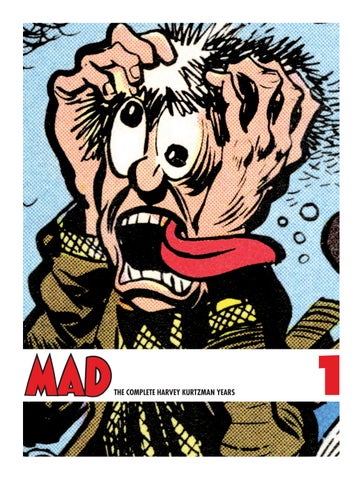
THE COMPLETE HARVEY KURTZMAN YEARS
1
MAD | The Complete Harvey Kurtzman Years | Volume 1
INTRODUCTION DEPT:
METHOD TO THE MADNESS
H
arvey Kurtzman didn’t mean to revolutionize satire and reshape American society. He was just trying to make his serious job a little easier. After breaking into comics as a jobbing illustrator in his teens, taking a break to use his art skills in the army, and hustling for five years as an advertising artist, children’s book designer, and sometime cartoonist, he had finally found regular work in comics. And not just that: at the one publisher that everyone in the business knew had the best artists. EC Comics had transformed themselves toward the end of 1949, dropping their cowboy, romance, superhero, and Bible-reprint series to focus on an entirely new line of horror, science fiction, and hardboiled crime titles. With four short stories per issue, every comic was a showcase for some of the best artists in New York. Most were plotted by publisher Bill Gaines with editor Al Feldstein, and scripted by the latter. Feldstein had begun drawing for EC early in 1948, then started writing as well, and through his efficiency, he earned Gaines’ respect enough to revamp the company creatively. Kurtzman’s art stood out from the more illustrative, detailed work of the other EC artists: gestural and figurative, expressive rather than detailed.
OPPOSITE: Kurtzman original
art pages or color guides for stories in Weird Fantasy #13, Haunt of Fear #15, and Weird Fantasy #16, all from 1950. Drawing board at RIGHT from Weird Science #5.
vi
But comics aficionados could tell that the apparent simplicity was in fact painstakingly come by, and in service of telling the story more fluidly: drawing the reader panel-by-panel into the drama, rather than having them stop and appreciate individual drawings. Feldstein and Gaines, on the hunt for talent, could tell too. Kurtzman quickly proved himself an able and productive workhorse. Having illustrated five horror and sci-fi scripts he was assigned, he requested to write one himself, and that saw print too — all in just his first two months at the “New Trend” EC. The artist wrote all his own material thereafter, pushing at the formula of EC’s house style, and varying both his drawing and his visual storytelling from story to story. He still worked on horror and crime titles, but leant more towards the sci-fi series, where he eschewed space adventure and alien invasions. Science fiction gave him the chance to say something about the culture around him, through parable or character study. More and more, each story became a distinct work, with its own tone and look, every page considered as a discrete work adding up to a whole.
Method to the Madness
vii
MAD | The Complete Harvey Kurtzman Years | Volume 1
RIGHT: EC Comics covers had
a consistent brand identity, regardless of genre. Vault of Horror cover by Johnny Craig, Weird Science and Modern Love by Al Feldstein.
OPPOSITE: Following the
progression of Kurtzman’s original ink-brushed line art, painted color guide, and a printer’s proof for the first TwoFisted Tales cover shows how the bold design was conceived as a whole in terms of design, framing, and color — and breaking the house style of EC’s covers. (While numbered #18 for Nov–Dec, this was the first issue, and on sale in July 1950. Comics publishing was weird in the 20th century. Don’t worry about it.) A year later, with the publisher’s regular lineup of illustrators firmly established, EC published “Artist of the Issue” biographies of the main contributors, with new examples appearing every month or two. Kurtzman’s ran shortly before the announcement of Mad, with the two war books on his plate.
viii
Within another three submissions, Bill Gaines had given up asking Kurtzman to submit plots in advance. By the end of the year, Gaines had seen enough: Kurtzman might as well be able to edit a title, too. The series Two-Fisted Tales had been Kurtzman’s pitch, to expand EC’s palette with an adventure series: more grounded than the Feldstein books, mixing modern and historical explorers, pirates, cowboys… maybe some war stories? It might just have been suggested by Kurtzman to get away from drawing more horror. If so, it worked. Gaines let him draw the first cover, and he seized the opportunity — scrapping the standard format in terms of layout, typography, wordiness, drama, and expressive color. By the third Two-Fisted Tales, on shelves just 11 months after his first freelance story for EC, Kurtzman had firmly found his footing. Credited as editor, his role included writing and visually designing all four stories, drawing one of those himself, color-designing at least his own art, drawing and coloring the cover… and choosing the artists. Wallace Wood, now coming into his own after starting at EC as part of a team, had been appointed to the first issue by Gaines and Feldstein, and Kurtzman kept him on. For the second issue, he’d written an additional story, and brought in an outside team he knew to draw it: John Severin on pencils and Will Elder on inks. With the third, he snapped up an artist whose first work for EC had appeared the month that Two-Fisted debuted: Jack Davis. The roster was locked: he’d found his squad. Next, he expanded his vision. Many of the EC artists were World War II veterans, and all members of the Two-Fisted team had been enlisted. Harvey entered the service at 18, and had seen the boom in jingoistic comics for kids
continue apace after wartime. While he hadn’t seen combat, he thought readers deserved better. And not only the kids: if the comics respected the intelligence of the audience, then maybe adults would appreciate them too. Two-Fisted Tales began leaning more toward war stories, spanning from the Roman Empire to the present day. The United States’ entry into the Korean War, under the pretext of a “police action,” sharpened the focus: a potential audience of young men he might have reached were now being sent unprepared into an uneven and illegal conflict. Kurtzman’s dedication to telling the truth went beyond the principles of the story: he burdened himself with deeply researching every detail of the conflicts he was covering, from drapery and button position on uniforms to schematics of troop movements. His “scripts” for the artists were also drawn as strict panel layouts, and he could be demanding if details were skipped. This effort paid off: Two-Fisted Tales was enough of a success that after a few issues, Gaines appointed the obsessive auteur another war book to write, edit, layout, research, and draw a story for. Frontline Combat launched just 14 months after his first, hopeful freelance job as illustrator for EC. For the next year, Kurtzman juggled his two bimonthly books, proud of the work and responsibility, but becoming more and more a victim of his own standards. He dropped his contributions to the science fiction and crime books, then stopped drawing stories for his own war titles. Filling the gap, John Severin started drawing one piece solo for each war comic, in addition to his collaborations with Elder. As a publisher who wanted to be proud of the material his company issued, Bill Gaines appreciated the mature and artful work in the war books. As a
Method to the Madness
ix
MAD | The Complete Harvey Kurtzman Years | Volume 1
x
Method to the Madness
OPPOSITE: Original art page
by Wallace Wood for “Atom Bomb!” (Two-Fisted Tales #33, 1953), the Severin / Elder team for “Checkers!” (Two-Fisted #28, 1952), Kurtzman himself for “Prisoner Of War!” (Frontline Combat #3, 1951) and Jack Davis on “Ambush!” (Two-Fisted #21, 1951). All stories were written and visually designed by Kurtzman. Comparing these originals shows how much of their own style and detail each illustrator was trusted to add to Harvey’s layouts, while retaining the thoughtful clarity of his visual storytelling. LEFT: Panels from the last
businessman, he was happy that they made enough profit to keep going. As both a boss and friend to Kurtzman, he understood his employee’s frustration that Feldstein, with his stable of books that were largely plotted in a morning and scripted in an afternoon, was making so much more money. He made the obvious point that if Kurtzman wanted to edit another book, it would have to be much easier to put together. Something fast and uncomplicated, to subsidize Kurtzman’s perfectionism over the research, the detail, the nitpicking over panels. Humor was the obvious choice. It was Kurtzman’s true favorite, the genre in which he’d created most of his own pitches before EC, and where he’d had his biggest successes. Indeed, he was still doing short comedy strips for other publishers on the side, to make some quick and easy money. So doing a whole humor comic for EC should also be quick and easy, right? Kurtzman set himself up to turn out Mad smoothly. He brought the trusted team of Davis, Wood, Severin, and Elder — with Severin and Elder now separated, letting Elder’s gift for comedy be
shown for the first time — and his small support staff from the war titles. A humor book for EC readers would simply need to goof on the genres they published: horror, sci-fi, crime, and… soldiers or historical adventure? Severin loved drawing westerns, so give him one for the first issue, and figure out something else next time. Job done. As long as Kurtzman could keep from thinking of ways to expand his approach, improve his skills, reach for a wider audience, or setting himself a higher standard than anyone expected and then drive himself crazy trying to keep to it, this throwaway parody title should just about manage to keep his focus on the main job of his two sensitive, detailed war comics.
page of “Big ‘If’!,” published in Frontline Combat #5 (April 1952), which was the last published story completely written and drawn by Harvey Kurtzman for EC Comics. After this, Kurtzman transitioned primarily to writing and providing layouts for other top artists while focusing on his editorial duties and creating Mad.
xi