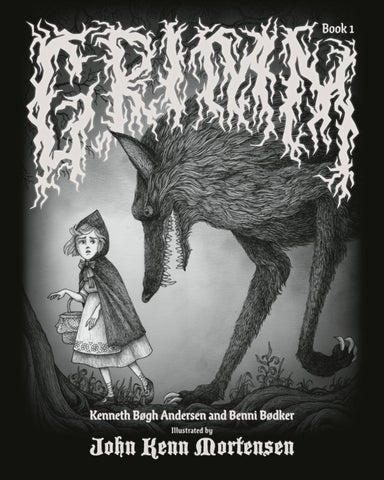
Book 1
Kenneth Bøgh Andersen and Benni Bødker Illustrated by
John Kenn Mortensen
Grimms_Indhold.indd 30
29/01/2019 10.50
The Singing Bone By the Brothers Grimm • Retold by by Benni Bødker Translated from the Danish by Jennifer Russell • Illustrated by John Kenn Mortensen
Once upon a time, long, long ago — or actually, now that I think about it, perhaps it wasn’t so long ago — Back when animals could speak and humans could understand them, back when the mountains were given their names, the fields had not yet been cultivated, and the vast forests were the world’s mightiest towns, back when magic was not simply illusion and sleight of hand but the art of bending the world to one’s will, pulling the stars down to Earth, and changing the way the wind blew. Back when humans were few and defenseless and always had to be wary of the natural powers that rule the world around us, in the branches and roots of the trees, in the big boulders of the backcountry, in the murky depths of the forest lakes and the endless ravines of the mountains — Back then, which perhaps wasn’t so long ago after all, there was a land tormented by a wild boar. Naturally, this was no ordinary boar, because boars were common in the land with the vast forest. The boars kept to themselves, living in large herds among the old trees where they would root up the ground in search of food. And although it was best to keep one’s distance, they rarely posed any danger to humans. If you came too close when they had piglets, the sows might charge through the forest and attack, but otherwise they were harmless, and when the time came, people sometimes managed to kill a couple of the beasts, ensuring plenty of meat for the long winters. And so, boars and humans had lived side by side for as long as anyone could remember, as it was meant to be. But it would not be so any longer. An old boar had begun to ravage the land within the vast forest. This boar was bigger than any other. Its tusks were longer and more sharply curved, and its fur and bristles were gray with old age. This beast would destroy the 19
GR IM M • B O OK 1
farmers’ fields in its hunt for food and kill the cattle and sheep that got in its way. If you went into the forest to gather nuts and berries, you were risking your life. People began leaving food out for the gruesome boar at the edge of the forest in the hopes that it would stay among the trees. It did not. The boar continued to wreak havoc, and no one could do anything about it. Hunters who ventured too far into the forest in the hopes of slaying it didn’t return alive. The gray boar would rip them to shreds, because neither bows nor spears could take down this beast. Rumor had it that the boar’s curved tusks were as big and sharp as daggers. The tip of one tusk had once broken off in a fight against three hunters who had attacked the boar all at once, but even that didn’t make the creature any weaker. To the contrary, it was as though each wound the hunters inflicted on this horrible beast made it even stronger and madder with rage. Finally, the king who ruled the land with the vast forest was forced to offer a reward. “Whoever captures and kills the wild boar will receive the greatest reward of all,” the king proclaimed far and wide. “Whoever brings me the head of the ferocious beast will marry my daughter.” h h h
At the outskirts of the forest lived three brothers, all of whom volunteered to go hunt for the boar as soon as they got word of the king’s reward. The oldest of the brothers was the strongest and was accustomed to hunting in the forest. The middle brother was the shrewdest and always knew how to work things out in his favor. The youngest was always cheerful and therefore considered naïve, but perhaps it was simply his young age that made people think so. While the three brothers differed in disposition, all three wanted to earn respect by killing the beast, and who wouldn’t want to marry a princess? And so, in spite of the perils, all three brothers set out in search of the boar. Naturally, they were armed. The oldest had taken the best weapon they had in their little house — a big bow the brothers had inherited from their father. The middle brother carried the short sword he had brought home with him from the war. The youngest brother had to make do with an old 20
T H E S I N GI N G B ON E
knife, even though it was useless against a boar capable of bringing down even the biggest men. “Enter the forest from opposite sides,” ordered the king. “That way, you’ll have a better chance of finding the loathsome beast. Remember, whoever kills the beast will win the princess’s hand in marriage.” “But that’s not all,” whispered the middle brother to the oldest. “When the king dies, whoever is married to the princess will inherit the crown.” h h h
The three brothers set out at sunset, because wild boars are most active at night. In the dark is where they hunt for food, and in the dark is where you can find them and catch them — unless they catch you first, that is. The youngest brother entered the forest from the eastern side. He was in good spirits while still at the outskirts of the woods, where bright moonbeams twinkled through the trees’ bare branches. He even whistled to himself as he walked along. He was generally cheery, and when he was cheery, he couldn’t help but whistle a shrill, off-key whistle that could be heard from miles away. But soon the forest became denser, and it grew dark among the branches where the moonlight could no longer reach. He could hardly see a thing, and gradually he was gripped by a fear of the dark forest and what awaited him. Without realizing it, he had stopped whistling. The two oldest brothers had chosen the western side, but they didn’t enter the forest. They were well aware of how dangerous the terrifying boar was. They knew that even hunters far better than they, carrying weapons far better than theirs, had lost their lives to the boar. Instead, the two brothers sought refuge at a nearby tavern that was usually crowded with people from all across the land who came to drink and make merry or simply because the tavern’s beer was better than the bitter brew most of them made at home. But nowadays, people were too afraid to go out at night due to the ravaging boar, which meant that the tavern was quite empty. That suited the two brothers just fine, because they needed peace and quiet so they could hatch a plan. They knew there was no way they’d be able to kill the boar, because no one could kill the boar, so what to do? “Maybe we should just find a hunter and buy a boar off him,” suggested the oldest brother once they had sat down, each with their pint of beer. “We’ll 21
GR IM M • B O OK 1
bring it to the king and tell him it’s the dangerous beast and that we caught it. What do you think of that plan, brother?” And the middle brother answered, “I think I like the way you think, and I always did.” “But what do you think of my plan?” the oldest repeated. “I think we need another beer,” said the middle brother. “The beer here is excellent for thinking.” h h h
While the two oldest brothers were scheming in the cozy tavern, the youngest brother had ventured even farther into the dark forest. He had made it all the way in to where no one ever went, because it was as dark as night all day long. He had made it so far into the forest that he would have turned back, if only he knew the way out. This was the very oldest part of the forest, where the tree trunks were thick and gnarled and where all the growth was so ancient and withered that there was no telling whether it had long since decayed or would stand there until the end of time. His eyes were just beginning to adjust to the darkness when he spotted someone among the old trees up ahead. Creeping as close as he dared, he came upon a little man with a face as furrowed as the bark of a tree and a big gray beard as bristly as a thornbush. He was clutching a long black spear. The man somehow knew the youngest brother was there, turned to him, and spoke. “The boar is deeper within these woods,” said the little man and handed him the weapon. “Take this spear and attack it fearlessly. Nothing you fight can survive its blade.” Perhaps the youngest brother truly was naïve, because he accepted the weapon and thanked the little man without asking even a single question. Surely, he should have stopped to consider why a person would give away something that valuable for free and whether anything in life comes without a price. If he had paid heed to all those stories about elves and other such mystical folk rather than dismissing them as myths and tall tales from olden times, perhaps he would have been more cautious. But as it was, he was grateful to his benefactor, because the black spear was a great deal better than his blunt knife. 22
— 37 —