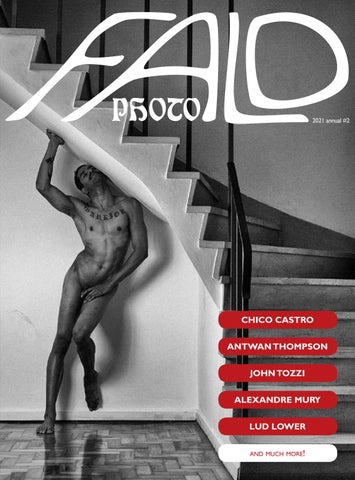
PHOTO
2021 annual #2
1
CHICO CASTRO ANTWAN THOMPSON JOHN TOZZI ALEXANDRE MURY LUD LOWER and much more!
FALO PHOTO© is a annual publication. january 2022. ISSN 2675-018X version 20.01.22
editing, writing and design: Filipe Chagas editorial group: Dr. Alcemar Maia Souto, Guilherme Correa e Rigle Guimarães. cover: photo by Chico Castro, 2019 (model: Tinho Sherman).
Care and technique were used in the edition of this magazine. Even so, typographical errors or conceptual doubt may occur. In any case, we request the communication (falonart@gmail.com) so that we can verify, clarify or forward the question.
Editor’s note on nudity:
Please note that this publication is about the representation of masculinity in Art.There are therefore images of male nudes, including images of male genitalia. Please approach with caution if you feel you may be offended.
Rights and Commitment:
This magazine is committed to artists retaining copyright of their own work. All rights are reserved and therefore no part of this magazine may be reproduced mechanically or digitally without the prior written permission of the artist. We have been careful to ensure that the images used in this publication have been provided to us by the creators with copyright permission, or are copyright free or are being used under the “fair usage” protocol shared over the internet (images are low resolution, attributed to their creator, not for profit and used only to illustrate a relevant article or story). If, however, you feel your image has been used by us unfairly and your copyright breached, please contact us at falonart@gmail.com and we will proceed in the best way possible.
Submissions:
If you are interested in participating in the magazine either as an artist, model or journalist, please contact us via e-mail falonart@gmail.com.
Editorial
C
urating artists is much more difficult than you might think. Of course, the aesthetic result is relevant, but it’s not just inviting anyone who does something beautiful and that’s it: the artist needs to have a discourse and a project around male nudity to participate in the magazine. And when it comes to photography, it gets even more complicated. It’s quite possible that if you just look at the images in this issue (which includes the photographers who passed by Falo Magazine in 2021), you’ll think “wow, it all looks the same”. It is really a very big challenge to achieve innovative visual results in artistic nude photography – a genre that has been around for at least 130 years. Therefore, I invite you to go beyond the images and read the texts. So you can see the manifestos and beauty behind each photo, or even be surprised to learn that the photographer is hearing impaired or is a woman making content for women. Understand photography as a platform, medium, vehicle, tool and inspiration. Remember that it saves a unique moment in time, which may have been obtained through conversation or pure spontaneity. The artist’s gaze is much more than a simple click. It is about time to acquire more knowledge and intellectual capacity. Take advantage of the opportunity you have in your hands. Filipe Chagas, editor
FC Design R. Mario Portela 161/1603 C, Laranjeiras Rio de Janeiro – RJ 22241-000 Brazil
Summary Chico Castro Antwan Thompson John Tozzi
4 22 34
Alexandre Mury
46
Lud Lower
58
Bruna Pegurier OTHER’S PHALLUS Hache by Enique Soto PHALLOGERIA D+Z PHALLOGERIA Helder Amorim PHALLOGERIA Darrell J. Dinges moNUments
66 76 82 96 108 120
Chico Castro by Filipe Chagas
Record of the play Anatomy of the Faun, by Teatro da Pombagira.
A
s much as he has always appreciated erotic art, Chico Castro did not imagine that this would become the reference of his work. Several coincidences took him from Crato, a city in the interior of Ceará, to Portugal, in 2001, where he fell in love with photography and studied at two renowned schools in Lisbon.
As he didn’t really like the result of his pictures with people dressed, he decided that his final course project would be made from nude self-portraits (“officially my first artistic nude project”). The work was so well received that Chico was selected by the professors for the important Biennial of Photography in Vila Franca de Xira. Returning to Brazil eight years later, he settled in São Paulo, participating in group exhibitions with well-known photographers, such as Sebastião Salgado and Araquém de Alcântara. In 2015, he understood himself as a photographer specialized in nude, being invited to record plays by Teatro da Pombagira.
6
I can’t say for sure when my passion for the nude started. A project I did in 2013 comes to mind to portray members of my own family, which I wasn’t as close as I would have liked. I used photography as an excuse for a rapprochement, a redemption.When I realized it, my aunts, some in their 60s, were posing half-naked for me. From then on, I felt more and more like asking my subjects to go beyond clothing, entering this unknown but familiar terrain, shifting but cozy.Today, when I see dressed models, I feel like I’m looking at a verdant landscape covered by cars and buildings that interfere with the vision of what’s behind.
Voal photoshoot, with Ricardo Sil.
Tree of life photoshoot.
Collective photoshoot, with Sidney Teodoro in the spotlight.
7
Record of the play Demons, by Teatro da Pombagira.
8
On this page, records of the play Demons; on the next page, records of the Digital Skin performance, both by Teatro da Pombagira.
9
The photographer says that his ideas come as insights when he is observing the work of other artists who inspire him, such as Francesca Woodman, Robert Mapplethorpe, Diane Arbus, Cindy Sherman, Helmut Newton, Irwing Penn, Richard Avedon, among others. Then he either invites someone to materialize the idea or tries to fit it into a contracted essay. When looking at his finished work, he sees the process, what he lived and learned while doing it. Hardly my original idea comes out in the photo.The grace is in mixing my feelings, my inspirations, what the models bring within themselves and the unexpected.
10
11
Photoshoot with Cadu Torres and Tinho Sherman.
12
13
Photoshoot with Mickael Veloso and André Araújo.
All bodies are welcome in your photography, especially those who aren’t happy with what they see in the mirror (“I still see problems accepting non-standard bodies”). He even likes to talk a lot with the models before rehearsals with the aim of seeing not only a body, but also a human being who feels, enjoys and suffers.
I want to look and see beyond.This is my focus: freeing, being freed and doing Art. 14
15
On the previous page, photoshoot with Wesley Limaz. On this page, photoshoot with Paulo Pinheiro.
16
Photoshoot The crown of Petros, with Petros Santos.
Peaceful photoshoot, with Flavio Pacato.
17
18
However, he knows that his portfolio is mostly cis gay men. Regardless of your personal preference, the photographer realizes that these models have greater freedom in posing, incorporating characters, dancing and being naked without strings or prejudices. The downside of this is the eternal confusion of your job with sexual availability (“it’s already happened, but it’s good to avoid regret later”). The presence of the penis, whether flaccid or erect, in his work will depend on the idea and the source of inspiration:
19
The hard cock shines, reflects, even drools on occasion. It refers to a virility, a readiness. It makes the viewer think about how the model got that way, which can automatically generate a sexual trigger.The photo of a hard cock is almost like a photo of a well-ordered plate of food, the ones you look at and feel hungry.The soft stick, on the other hand, is like a photo of the food before it goes into the oven, where the spectator looks at it and maybe doesn’t feel so hungry, but even so, he will imagine that dish ready.
Photoshoot with Samuel Kavalerski.
Whether because of bodily standards or because of this sexualization, Chico believes in the importance of normalizing nudity. He usually says that there are only two paths for viewers that relate to his production: Love or Pain. However, in addition to personal satisfaction, he seeks joy and reflection for those who observe his work. Today, when he’s not drawing, studying about spirituality, conspiracy theories, ufology and quantum physics – or creating controversy on Instagram – he remains developing copyrighted works with an artistic nude. In a way, it brings to light the child who, back in the interior of the Brazilian Northeast, was already making art without knowing it was art. 8=D
20
Flesh photoshoot, with Rony Hernandes, Hugo Godinho, Marco André Lucca and Rod.
y r e g r u s c i t s a Pl ! u o y for Dr. Alcemar Maia Souto CRM 5246681-1
+55 21 97395 8000
alcemarmaiasouto@gmail.com
21
Antwan Thompson by Filipe Chagas
22
23
A
s a child, Antwan Thompson was always drawing, writing poetry and taking pictures. Winning a photography competition at his school in Maryland sparked the young artist’s passion for a possible career.
With a studio at the university, Antwan says he learns as he creates, inspired by Robert Mapplethorpe and Herb Ritts. At first, he struggled with the technique, but became comfortable and started to trust the process. Today he uses different cameras to find the “magic” of male nudity:
24
I have the opportunity to grow my voice through nudity.This is my art.
25
This idea gains a new perspective when we know that Antwan is hard of hearing and prefers to work with deaf models not only because of the ease of communication (“I use ASL, the American Sign Language, and I don’t need to rely on my hearing aids”), but also to show everyone that people with disabilities exist: I want to show that we have flaws and imperfections, but we are desirable as much.We are equal in terms of sex appeal. I’ve never seen a deaf guy appear on the cover of Playgirl. And even if he did, no one would know he was deaf! We have a long way to go and we can’t rely on Nyle DiMarco* to break barriers.
26
By the way, breaking barriers is the essence of the photographer. Feeling the excess of attention to female nudity and the closure of the gay universe in publications for specific bodies standards, Antwan started to use his art as a manifesto for the people of color in the LGBT+ community. He has written for magazines to declare his position against these injustices without cancelling or overcoming any other identity. His creation process is based on the model’s daily life and the environment he seeks to work on. Social media can also be a source of inspiration to explore how far models he chooses are willing to go.
* Nyle DiMarco is an American deaf model, actor, and activist. In 2015, he was the second male winner and the first deaf winner of America’s Next Top Model. The following year, he won the Dancing with the Stars competition.
27
28
29
30
31
I carefully selected based on the body and the open minded they are. I think it’s important to showcase the body as it is. If the model is comfortable doing the frontal nude, I gave the platform for that. I don’t force it, I let it be as natural as possible.
Antwan sees a growth in the acceptance of the male figure as an art object and even an equality with the female image, but he knows that there is still a lot to do, especially with the guidelines he brings in his work. While waiting for better opportunities, he follows his own advice to seek better professional relationships and spaces to extend the boundaries of his Art and the society’s ones. 8=D
Self-portrait.
So, did you identify who is deaf and who is not?
32
33
John Tozzi by Filipe Chagas
34
Dichotomy.
35
T
heatre, dance, stand-up comedy, journalism, fashion...Former New Yorker now Seattlite John “JT” Tozzi has done a bit of everything, always in creative areas. But it was in photography that he found his passion.
His first photographs were mostly in color, but he found that the results of the black and white images brought him more satisfaction, especially, having male nudity as a point of interest. JT tells that he started long before this topic became a regular occurrence in the mainstream media: Men still looked apprehensive about being naked in front of the cameras and society still didn’t seem to have fully caught up to the idea. Most commercial work, on cards and calendars, at that time featured muscular men with large dicks. I knew that there was a whole section of the community not being represented and I wanted to represent it. I knew it would be important to show that all men were equally worthy of being subjects of art. 36
Finally at peace with myself.
Tranquility.
37
Barriers.
38
Above: The mirror looks back. Below: Service request and Sleepy bear.
However, the first year was difficult. The only real experience most “normal guys” had with photographic nudity came from pornography, meaning everyone had the wrong idea both about what happens (and doesn’t happen) during a shoot and how to behave in front of the lens. JT recalls that many “great guys” refused to pose because they were afraid it would be exactly like what they saw in porn (“it took me a long time to get people to see that porn is a fetishized idealism, not based on reality”). For this reason, the photographer sets up a meeting and a modified screen test* before agreeing to do a photoshoot with someone for the first time. In these conversations, in addition to getting to know the models’ personality better, JT asks them to move, pose or remove an article of clothing so that he can identify possible ways of direction and interpretation. Only after that does he feel better able to determine the best location and outfits for the shoot. This process also gives firsttime models a chance to experience it in advance and understand how it will work without fear (“it’s a win-win situation”). Even so, many are still nervous because they don’t feel enough, whether because of the muscles or the size of their penises (even more in the flaccid state, image preference of the photographer).
* Modified screen test is a remote camera test, like an audition for actors, but for models.
39
Open invitation.
40
Sweet dreams.
41
In his manifesto, the photographer recalls that today there is a constant media reinforcement for the idea of “if I don’t have the perfect body, I’m not desirable as a person” and criticizes the very art system that supports this speech and causes damage to everyone. No wonder JT’s work covers a wide range of bodies, colors and sizes. He doesn’t look for professional models or types represented to exhaustion. His “normal guys” are a few pounds more or less, have scars, have tattoos, have piercings, have hair all over their bodies, they are out of the so-called “standard”. Many of the subjects I shot for the first time came to see themselves in a new light.That’s the greatest satisfaction of all: being able to improve someone’s self-image. Undressed in leather.
42
Ch’an-Ting.
JT believes that we have finally reached an era where men are more accepting of their body shapes (“we’re inching our way there, no pun intended”). However, he points out that the biggest obstacle to his work is still the selfconscious ideal around penis size. Even if he tries to capture a story or an emotion, he still sees people judging the image by the bodies that appear and not by the aesthetics, narrative, technique or photographic composition. There is a huge taboo on nudity, especially if it is frontal.When someone tells me that a piece made them feel something or that they relate to a piece on many levels, I know I have overcome the taboo. People aren’t just paying attention to the model, they are paying attention to the overall photo in all of its details.That is a wonderful experience.
Earthly delights.
43
Adam and Steve.
This kind of experience also led JT to recognize himself as an artist. At his first exhibition (at a Seattle restaurant), he saw his work outside his own walls, hanging for all to see. As it was not a traditional exhibition environment and he was not a well-known artist, he ended up listening to comments while having dinner and this gave him a certain legitimacy. Thinking about making digital publications about his work, JT advises that every artist who decides to work with male nudity needs not only to think about their creative process, but also to offer support, professionalism and respect to the models that will face the judgment of a society in a slow transformation. 8=D
44
My only self-portrait..
Reflection.
45
46
The Creation of Adam, 2011. Cover of Michelangelo’s work (c.1511).
Alexandre Mury by Filipe Chagas
T
he reinterpretation of works of Art in photographic selfportraits led Alexandre Mury to a great media exhibition: from TV programs, museums and galleries throughout Brazil to the Wikipedia entry and nomination for the 2016 PIPA Award*. However, he is a multimedia visual artist that goes beyond that.
47
What do I do is photography? I do not know. I make my body available in a complex structure – often large sets, almost an installation – that transforms into a sculpture at the moment of the click. interview for the 2016 Pipa Award.
His works are not just photographs, but temporary installations and performances that end up being captured by the camera. It is a current aesthetic that defines the heterogeneity of contemporary art. – Vanda Klabin, curator of her first individual.
48
* The PIPA Award is an initiative of the PIPA Institute, which seeks to support, help document and promote the development of art and contemporary Brazilian artists with a maximum of ten years of career, independent of the media. The award was created in 2010 to be the most relevant Brazilian award for visual arts.
Mury had already shown his artistic side since he was very young (“the teacher Dolores from the kindergarten called me Van Gogh”), but he says that it all started as a play at home, in the 1990s, where he photographed with a borrowed analog camera and improvised production – costumes, scenery and make-up with manual skills that he learned from her carpenter father and seamstress mother in São Fidélis, in the interior of Rio de Janeiro. From his background in Communication and his love for cinema, he gained tools to understand lighting, staging and directing. A certain dissatisfaction with the models’ interpretations of his ideas led him to prefer self-portraits. With this, the exercise of putting himself in the other’s shoes ended up becoming both a challenge for his own identity and a provocation to the spectator through a very particular aesthetic experience: Mury was rebuilding the memory of classic works from their materiality, without use of digital software, aiming to highlight the imperfections of the artificial and the artisanal. Nothing more antropophagic!
Boy with a Cat, 2011. Cover of Renoir’s work (1868).
The production of his Monalisa required physical transformations: he removed his beard, hair and even his eyebrows (“this is my most performing work”). All documented in his first art video (Lisa, 2013). In Study for Seurat, Mury transformed the pointillist technique into a shower of confetti (“my nephew and sister helped me in this”), enhancing the essence of the original work and the artistic movement in a simple, inventive and fun way. His nudity in this work (and in others, such as The Creation of Adam and Laocoon and his children) reveals not only the constant presence of the body in his artistic production, but also his understanding that the trivialization of the male nude through art is an act political, which serves for reflections on the sexuality and freedom of each body.
Monalisa, 2013. Cover of a work by Leonardo Da Vinci (1503). Click and watch the video Lisa (2013).
49 His creative process is part of an intense imagery research: for the work Ganimedes, for example, the artist says that he reached around ten thousand reference images to get his original result. Then, he starts the entire production process, which goes from makeup and scenographic objects to finding the ideal location. His famous Abaporu took three days, between searching for a cactus and a place where the sunset was exactly in line, referencing the composition of the elements, as in the original work. However, Mury makes it clear that everything is part of “a web of connections with the past, with the iconic and with the canonical, a courtship with the popular and a flirtation with scholarship”:
Study for Seurat, 2011. Cover of a study for the work The models of Seurat (1887).
50
Abaporu, 2010. Cover of a work by Tarsila do Amaral (1928).
Once, a curator was very interested in seeing my studio... and I said that my studio was inside my head. Another time, a young artist asked to watch my creative process… I said that the most he could see would be my process of executing the work. Many of the things I create are not born out of discipline or self-determination. Ideas come up all the time, even in dreams and each work has its own time. Between motivation and achievement many months can pass.
Intrigued (and instigated) by the narcissistic universe of the internet, he started posting his artistic production online:
Above: The Birth of Venus, 2010. Cover of a work by Botticelli (1485). Below: Oxumaré, 2014.
I had a channel on the old Fotolog and posted different photos because I didn’t want to show myself. In fact, I wanted to hide, express myself creatively. And I enjoyed it a lot: buying wigs, making the clothes, creating the sets, inventing makeup – like honey to simulate a tear, for example – and turning myself into several, in a solitary experimentation process, in front of a mirror. – interview for Revista DASartes. The return was so great and positive that he was discovered by an art dealer. From there (after some resistance), Mury left his advertising career to devote himself to Art. His works ended up in private collections and exhibited for the first time in a cultural institution**. His work on the orixás revealed to the public that Mury was not just that kitschy humor that the reinterpretations brought, but was always looking for pictorial and symbolic discussions through an experimental and authorial production. ** In the group show New Acquisitions 2007/2010 at the Museum of Modern Art in Rio de Janeiro. In 2013, his first solo show, Historical Frictions, took place at Caixa Cultural in Rio de Janeiro.
51
52 Above: Neptune, and The Three Graces. Below: Nude descending a staircase. Cover of Marcel Duchamp’s work (1912).
Laocoon and his sons, 2010. Cover of a Hellenistic statue (c. 40 BC).
53
54
Above: Leviathan, 2014. Cover of engraving by Abraham Bosse for the cover of Thomas Hobbes’ book (1651) and Leviathan, sculpture in mixed media, 2020. Beside: Saci Cafuçu, sculpture in mixed media, 2020.
In 2015, Mury took a break from self-portraits and began to explore possibilities of fragmented narratives fed across different platforms and media. One of her projects presents the legends of Brazilian folklore in sensual sculptures that explore different media, materials and craft techniques, unfolding in drawings, paintings and embroidery.
Simultaneously, inspired by the Superflat and Neopop movements of Takashi Murakami,Yoshitomo Nara and Kaws, he created Ivo Caralhactus, a “triple phallic” cartoon character (as he likes to point out), as an act of revolt with the censorship of many of his self-portraits in social networks: I wanted to mock the algorithm and spell out something possibly embarrassing to puritans and censors... that was unobjectionable! So I geometrized the phallus, the pubis and the scrotum and, as I did, I realized I could read “IVO”, a contraposition to Eve. Cartoons were never my preference, not even in childhood, but I drew a body in this style to contextualize. As I always liked mythology and symbology, I thought about creating an attribute to accompany the character and facilitate identification... something like Minerva’s owl, Monica’s rabbit, the Little Prince’s rose. I went to sleep and dreamed of a hybrid between animal and plant that was born from a cactus.That’s why Ivo doesn’t have a navel. He is a cactus that walks, is mute and has fur. Eve was born from the rib of Adam; Ivo was born from a piece of cactus. I drew a cactus as a pet plant that he could take for a walk. To continue the debauchery, a fusion between “cock” (caralho) and “cactus” defined the name.
Above: Cactus Man, 2014. Below: Ivo Caralhactus and his name / brand.
55
56
Above: Abapiru. Beside: Ivo in various media. Below: Great Brazilian Nude, cover of Tom Wesselmann’s Bathtub (1963).
Above: Mona Ivo / Ivoconda. Below: various graphic compositions with the letters I,V and O.
Enchanted by the human body and classical sculptures (“I love drawing and sculpting butts since I was little from a Greek art book”), Mury has always tried to balance male and female figures in his artistic production. However, Ivo’s universe addresses what he calls “masculinism”, which, unlike machismo, has a humor and a perversity that makes him naive, uncommitted and so captivating that he has won many fans around the world and at home: “My family considers him to be a real son. My nephews call him cousin”, he reveals. The character entered the commercial circuit as an artistic action with multiple interventions: people everywhere can purchase personalized objects with Ivo Caralhactus stamped or unique objects handcrafted by the artist. Undoubtedly, having taught a Visual Communication course for three years gave him a glimpse of the letters I,V and O, which, in the end, became a brand, a visual identity. Despite finding it difficult to keep control of the character’s welldefined aesthetics, Mury believes that Ivo Caralhactus started to function as an escape valve and a possible alter ego “IVOlved”. From him – both Mury and Ivo – we can only expect multiplicities, provocations and a lot of Art. 8=D
Alexandre Mury Ivo Caralhactus
MYBOYTOYS
Lud Lower artist’s text edited by Filipe Chagas
M
y name is Ludmila, but people generally call me Lud. I’m a solo mom – my baby is the most beautiful thing in my world! – Capricorn with ascendant in Aquarius and moon in Cancer. I was born on the last day of the year and I think that’s when I started to swim against the current: while everyone celebrates the end of the year, I celebrate my beginning. I have no academic training. I am self-taught in photography, editing and almost everything in my life. And Art has always been present in my life. In fact, I’ve never done anything that wasn’t related to Arts. When I was nine I made a bead bracelet and sold it at the school and in the building. At thirteen I dreamed of having a camera and used my knowledge of perspective drawing in my photographic compositions.
58 In my early years of photography, I made portraits with a photojournalistic touch, rehearsals for bands, groups and subcultures from São Paulo. One day I met a girl who was a sensual model and I did the first photoshoot of that type. I had never imagined myself in this market, but after I posted this first shoot, there were so many clients and opportunities that I found myself working only with that. In these shoots I like to talk first with the person I’m going to photograph. I pay attention to him/ her, all gestures and quirks. I’ve tried to work on scripting and following ideas, but at the time I don’t do anything. It’s very important for me to respect people’s emotional and physical limits. Therefore, it is useless for me to create something in advance and, sometimes, the person is completely the opposite of everything I thought or has physical and emotional limitations. Of course there’s inspiration from Terry Richardson and Estevan Oriol, but I don’t follow an artist faithfully. I admire many, many photographer
59
friends as well, but I try not to get too attached or see too many works and photos before photoshoots to let my creations go free. The MyBoyToys project emerged after three years, in 2016, when I got divorced, and that’s how it is too. Sometimes we drink a beer, we exchange ideas, and everything happens naturally.
60
I say that my photography is a sensual lifestyle, because I like to show sensuality in a natural way, in real environments, real lights, simple and real productions. However, my approach is more political than poetic. Actually, I don’t know if it would be possible to provoke the poetic atmosphere in images. I think poetry is more in the spectator’s set of experiences and emotions than in the artist’s, as it can be poetry for one person and something shallow for another. It’s that thing, right: art is in the eyes of the beholder. My goal is to show a new way for man to see himself, free from machismo! With sensitivity, I want to prove that sensuality is not an attribute only for women. Men are sexy too! Their bodies have lines, shapes and curves! It is very important to present this especially to the heterosexual man who has a strong barrier (I don’t even say aesthetic) against his own body and excludes parts of himself for considering that he can “compromise his sexuality”. Manhood is very fragile. Macho culture has given man the only view that his body is only good if it is strong, that his dick is only good if it is hard. The woman showing that the man is more than that can be liberating! The MyBoyToys project is the first project about male sensuality and nudity in the first person made by a woman and aimed at a female audience. I love men, I love their bodies, their features, I think the male body is beautiful and I’ve done portraits of
61 friends for a long time, but my inspiration is not the man himself: it’s the change I want to bring in men’s lives based on pleasure, a good and liberating content for those like me, love men. And for that I needed to understand the complexity of the relationship between the heterosexual man and his own body, a nonsexual connection impacted by machismo and by the patriarchal system that fills him with neuras. I started to see men differently. In photoshoots, I notice a mixture of curiosity, relief, surprise and satisfaction. I realize that models want to see themselves in a sensual and sexual way without being the sex machine, the alpha. I think it’s very important for a man to deliver the “stick of decisions”, when he was taught to be dominant in all aspects of life. It’s a
lot of weight that I take off them, because in my shoots I lead, I make the decisions, I manipulate their bodies in poses and movements. It’s not a fight for position of power, woman vs. man, but it’s giving in, relaxing and letting yourself go with the moment. It is often during these times that they realize that being sensual had nothing to do with what he imagined. Discovering that one is desired in the simplest lifestyle, wearing a sweatshirt, reading a book, lying on the bed or on the floor, it’s awesome, right? I always hear from boys “oh, I’m not sexy” or “I’m not like your models” comparisons. When they see the increase in popularity, in the number of fans, they always come and say “didn’t it work?”, “wow, the chicks really enjoyed it, right?”. Let’s not be hypocrites: an ego massage is good! Some who posed for me even became agency models later.
62
63
64
Reaction to the project was mixed. To a large extent, I received the ecstasy of women seeing something made for them, something to be inspired in moments of pleasure or seeking pleasure! However, on the male side... Hate, macho verbal aggressions, attacks by homosexuals for thinking it was absurd for me to do something aimed at women and not include them... these improved with communication, as part of gays understood that it is not exclusion, but that women need something for them, since the sensual, nude, erotic, porn industry is always aimed at men’s pleasure regardless of sexual orientation. Even the male nude is extremely accepted as long as it is for the pleasure of men. When are they going to normalize women’s pleasure, women’s desire in this entire industry? When are women going to start consuming shamelessly and without taboos erotic art, sensual art, that represent female pleasure? We women also like men’s bodies! I love noses, back, shoulder, neck, mouth, eyes, smile, hips, penis, hands… almost everything, right? I think it’s essential to show the nude in a natural way, not just sexual… show soft, hard, half-way… normalize the penis as a part of the body and not just as an object of pleasure, a machine in constant power, the protagonist of sex and of male sensuality. So I don’t take offense if a model has an erection. I deal with it naturally because I think I’m beautiful,
but not to the point where I think the guy is excited for me! In the project, I participate: touches, licks, kisses, hugs. It is natural in the friction of two bodies for an erection to occur. But it must be clear that not every erection is sexual. I know that freedom, vulnerability and self-knowledge can have the same effect. And everything is fine! The penis exists and it’s important, but the ass is there too, the chest, legs, belly, hands and feet, the look, the smile, the tongue. It is a big step for a man to get out of that orbit around the penis and understand that we women like and are aroused by other parts of the male body. The penis is not the protagonist of my project: the whole body matters and excites.
It is necessary to normalize this type of content. Most women are embarrassed to consume or pay for art with nudity. It’s unbelievable how many followers or subscribers I lose because they started working or someone in the family saw it! I still get messages explaining to me or asking me to make my Instagram profile public because they can’t follow me! It’s sad and revolting! And look, not all my essays contain nude. In fact, for two years, that wasn’t even the focus. Even a little slow with world chaos and a baby, I have been organizing to launch the crowdfunding campaign for the MyBoyToys project’s digital magazine, which will have not only essays, but also erotic stories written by women, as I understand the need for sorority. Come on, women: throw yourselves! Free yourselves! Free the men! Normalize the woman’s pleasure! Our pleasure! 8=D
65
LASCIVIA PROJECT
Bruna Pegurier artist’s text edited by Filipe Chagas
P 66
eople look at my Instagram and there’s a white woman, supposedly middle class, with a French surname... but few people suspect that I was born in the backlands of Ceará, that my mother came to Rio de Janeiro to be a cleaner, that I studied in public school my whole life and I didn’t graduate in fashion despite being known for my accessories and having worked in reputable fashion brands in Rio. There are several layers. Having crossed all these social barriers for me is an incredible gift. I am so grateful. When people ask me where this passion for art came from, I can’t explain it. I feel that I was born with a restless, questioning, curious look, always weighing and considering seeking some expression of beauty, some alignment, a harmony even in chaos! I try to think beyond what I can see right away, regardless of how I want to express myself. But that never made me claim that I’m an artist. Whenever I hear someone calling themselves an artist, it sounds strange to me, and often pedantic. I see myself only as a medium that, at times, allows art to manifest itself through. And it’s usually when I try to get my anxieties out and sometimes it works and sometimes it works badly.
Art, for me, is not a craft: it is greater than the artist; the artist is a means for Art to happen. About 15 years ago, I took a photography course almost casually as a listener and ended up absurdly enchanted by the magic of revelation. I understand the need to know the history of photography and the great names in the area, but for me the important thing was to know how the image appeared on paper, and that was perhaps the greatest magic. I was amused by the photographic process and this was certainly one of the ways to train my gaze, as I have a habit of looking at things as if everything were a photo, looking for composition, framing, as if registered on an imaginary paper. At some point in my life, I decided that I needed to visit my friends in Berlin. I lived in the German city for 15 days and I went crazy! Like all tourists, we arrive at a new place and have a tendency to look for what we want. And as freedom for me is something very important, I was very impressed as it is a free place even with an underground atmosphere. In general, people live their lives very freely… especially if we compare it to hypocrisy in Brazil. According to one of the models (which is a historian), as they are mostly Protestant, the Germans don’t even want to sin. The
so-called Christians, on the other hand, sin and then pray to apologize. This translates a lot into this “behind the scenes” behavior that we live in Brazil, a country with the ass off at Carnival and on the beaches, where we emphasize what suits us. How to return home after seeing this other world? I returned with my head transformed to an evangelical Rio on the imminence of the presidential election of a family of militiamen. I felt that I needed to do something… I needed to get out my feeling of “I don’t want to be conniving”. I was tired of objectifying the woman’s body in magazines, movies and advertisements, while the male, especially straight, always seemed to have his nudity protected. Even the porn industry is made for men whether straight or gay, but rarely for women! My whole life has been built in gay environments and I think this saved me, allowing me to have a more open and receptive look at the differences designated by traditional society! So I started talking to friends about this need to express myself. I could make a sculpture of a dick, say “I’m revolted” and - bam! - hit the table with it. But this gesture felt empty… anyone could do it and I wanted something deeper. I thought about taking my instant camera, photographing the dicks and then making a sculpture, but that wasn’t it yet. I had the technique, but I lacked direction. With the help of therapy and my friends, I realized that I wanted to understand what it’s like to be a man, what it’s like for a man
C.Z. (São Paulo), the first photographed of the project, 2017.
67
The situations where I get naked are always very specific around a woman, since I’m gay.We are in the habit of associating nudity with sex in an immediate way. I think it’s very important that we break down these barriers in our microspaces to treat nudity in a more natural way. – P.B. Rio de Janeiro (2017)
to be photographed naked by a woman without the possibility of having sex with her, what it’s like to know that there will be a sculpture of what can be a extreme pride and, at the same time, an absurd vulnerability.
The dick is the man’s Achilles heel.
68
I was never a submissive person, to accept a lot of what is already pre-established and divergent from what I believe. With this trip and the desire to start the project that I ironically called the Lascivia Project, I felt that I needed a conjugal space too and, in common agreement, I decided to open up my marriage so that I could express myself in my entirety. That’s when the discovery of a power that was asleep, which was there protected inside a box covered by a traditional wedding. The whole possibility of being desired by other people and being able to desire other people without guilt... that’s very powerful! And it was important – even though the marriage ended shortly afterwards – for me to understand my limits and what limits I would like to establish in a sexual/affective relationship. So, the first person who came to me for the project was a guy that I had a quick relationship with. It was extremely difficult, because I didn’t want that connection, however small, to interfere with the result. And that became a question of the project: removing the sexual component from the
I liked seeing my naked body in a non-sexualized way and being able to play with it. As a gay man, my naked body is always sexualized and the fact that I was photographed by a woman made me more artistic. – R.M. São Paulo (2017)
photographer/model relationship, the nonfulfillment of desire. Of the thirteen men who participated in the project, most were gay, where the kind of tension, when it existed, was more about exposing yourself naked to an acquaintance than any component of pentup desire. In Brazil I photographed friends, friends of friends... people who arrived through people I already knew, that is, they already had a natural filter. The project was never about “who was the fittest guy?”, “who was the guy with the biggest dick?”. That was completely secondary. I really wanted to know “who are you? Tell me your story? Why are you interested in participating in this project?”. So, in my Image Usage Agreement, I asked a few questions that generously and genuinely enriched what I was trying to present. Every time I was asked “How do you want it? Do you want to take a picture of my hard cock?”, immediately my answer was “I want you to show yourself how you want to be seen”. And that disarmed them, because it’s not an easy thing. I imagine the social weight of a man (mostly straight) to be showing himself naked to a woman with a flaccid penis, without it ending in sex. It was such a vulnerable situation, such a mental confusion, that most of them couldn’t get an erection. Not even with the ambiance that I created – music, light, drinks... For this reason, some sent a photo later, since, for the sculptures, it was actually easier to represent them erected.
69
I felt naked, but not weird. I felt comfortable, like I was alone in my room. Participating in the project made me feel more comfortable and secure being naked especially in front of other women. – J.S. Belgium/Rio de Janeiro (2017)
70
After about five photographs, I decided that I would have an exhibition in Berlin. Even before arriving in Germany, my friends had already come up with the idea for my project to circulate and it ended up arriving at a Brazilian who worked in a gallery (CoGalleries), who agreed to receive me. Suddenly, I realized that what was supposed to be a vacation-slash-I’ll-try-to-do-anexhibition trip would also be to better develop my artistic production, taking advantage of that local freedom. Even in my group, in my most enlightened bubble, supposedly more open to seeing other specters, I sensed the micro-judgment of photographing nude men. But none of that stopped me. However, how was I going to find models so quickly since I was in a city where I knew few people and my circle of friends there was super reserved? All I could think about was Tinder. I made a profile talking about the project: “Hi, my
name is Bruna, I’m from Rio de Janeiro and I’m doing a photographic project about male nudity”. I put age between 18 and 80 years old and spent weeks and weeks reading profiles, one by one, of every man who showed up. Those that I found most interesting, I tried to match. From then on, a long conversation began to explain the project in detail, because, as open as they were, straight men apparently have little variation in goals… With many I talked, talked, talked, and nothing came of it. With others I was able to set up a conversation. The process was like this: I booked a coffee shop, took my sculptures under my arm, a lot of nude man photos, and tried to clear up any doubts so that the seriousness of the project would not be questioned. I thought a lot about telling my story through interesting people and hearing their point of view was the moment where I could plant a seed, where I showed my gaze
71
D.J. (Berlin), the “champagne guy”, 2018.
72
on the machismo-feminism binomial, my perception of the woman’s place. in society and my perspective on men. Without raising flags, because I understand their importance, but I have my reservations. It’s all very subtle, you know? For example, women are also part of the mechanism that perpetuates machismo, especially in a country where there are still single women taking the family by the nail and yet believing that happiness and success lies in getting married and having a lot of children to become complete from a man. Nowadays, in most social spheres, women no longer need it. It no longer makes sense. For me, the greatest freedom we still need to achieve as a woman is emotional freedom. To understand that it’s okay if you don’t have a guy, or even another woman, or if you don’t have kids. It is possible to find yourself, to realize yourself through the things you produce for yourself. When people interview me about the accessories I produce, I always find a way to talk about the Lascivia Project because I think it causes disruption. After all, I photographed naked men in their houses! By myself! And I didn’t suffer any kind of violence! Of course there was a risk, but in my head I was so sure of my sensitivity that not for a moment, while I was alone with them, did I feel afraid of suffering any violence. This, of course, did not stop me from going through curious situations, such as when I made an interview appointment without noticing at a restaurant on Valentine’s Day. For me, the choice of drink (I asked for tea) and the way to put the project would save me from being misinterpreted. However, each one has their own fantasy (thankfully, within the limits of the other, always) and, days later, when I went to this guy’s house for the photos, I was greeted with champagne. I just thanked him and said I didn’t drink at work for everything to
73
Living in this contemporary visual culture dominated by the male gaze, I literally grew up surrounded by images of nude women, somehow objectified, more or less autonomous in their representation. It took me a while, however, to realize that pictures of nude men were somewhat less popular and that this imbalance not only reflects macho heteronormativity, but also makes us a much poorer society aesthetically and emotionally. Naked male bodies are beautiful, captivating and exciting each in their own way, and I would like to help represent them. – C.K. Berlin (2018)
It definitely made me realize that getting naked with a woman in a non-sexual situation is quite natural as it’s not part of my everyday life. It was great to expand my horizons. – TC Belgium/Berlin (2018)
flow as it should. Or when I needed to make it clear on social media (Instagram profile closed with almost a thousand followers that existed for a year before being taken down) that I didn’t want to keep getting unsolicited photos and videos of cocks and masturbations, but if I continued I would go repost and reveal identities.
74
Working with ceramics, making sculptures, is also another process. Modeling emerged as an alternative to the fabrics of my work, as well as a way to reconnect with my history, with the clay of the Sertão. It ended up unpretentiously becoming a professional and artistic way of life. It is a great apprenticeship in time, in delicacy. The phallus sculptures are intended to show the beauty and power of vulnerability in the stories I met with the Lascivia Project. Today I think a lot about building relationships, which are ones of growth and expansion, instead of neuroses and violence in the worst cases. And the pandemic makes us think about being alone, about loneliness, about how to deal with it. I also look at social media censorship and think about how to circumvent the algorithm. For example, I took advantage
of a frame filter to show nipples of both genders and, surprisingly, that action is still on my Instagram feed today! I don’t know what it’s going to be like from now on, how I’m going to want to express myself beyond the things I do. The only thing I can guarantee is that it will always be a question of the status quo. And how can it not be? 8=D
75
Zine photos.
OTHER’s FALO
Artists talking about Artists Hache
by Enrique Soto
A
nyone who sees the homoerotic photographs of Hache – a pseudonym for Henry Narváez Perlaza – can only look at the fine line between pornography or narcissism. However, his production is an arduous work of a lot of time and personal dedication that comes before the Art itself.
Young Henry had to deal with physical (arthropathies) and emotional (shyness) issues given his condition as a hemophilia patient. Upon discovering the importance of physical activity as a treatment, he dedicated himself to keeping his muscles and joints strong through a strict exercise and diet routine: healthy body, healthy mind.
76
Hache Studio. Cali, Colômbia, 2021.
The Adams of the Valley of the Nymphs series. Tequila, Mexico, 2007.
77
Also very young, Henry used to draw or paint on the bedroom walls. He took pleasure in fulfilling his school’s Arts tasks, expressing his interest in the area early on. So, upon finishing his training in marine biology, he realized that something was missing. By having contact with the works of artists of the caliber of Ruven Afanador, Ever Astudillo, Miguel Ángel Rojas, David LaChapelle, Pierre et Gilles, Bob Mizer, Tom of Finland, Herbert List, Luis Caballero, Robert Capa, George Quaintance, among many others, understood that it was time to return to producing artistically.
78
Put these two personal trajectories together and it is easy to understand that the male figure became his reference – and his own body, his tool – when he began to study fine arts: My catharsis began to leave behind fears that hindered processes in my life, such as being “Hache”, being Henry Narváez Perlaza, being gay, being a Marine Biologist and being a visual artist. His daily sculpted body is a tribute to all his personal effort and not an aesthetic reason. It has become a political act in which he can express himself before society and before himself as an artist:
Above: Garden of Eden. Below: Eat me. Both taken in Cali, Colombia, 2021.
We see each other in secret. Cali, Colombia, 2021.
The art categories taught me that everything is beautiful, from the sublime to the horrendous, from the bitter to the sweetest.Thus, the language of how to express myself has always been in constant search, because beautiful is a big penis as it is small, beautiful is a robust body as it is slender, beautiful is a big nose as a small nose. Beautiful is youth, fantastic is adulthood.
79
80
Tefra. Cali, Colombia, 2021.
Let’s go to the edge. Cali, Colombia, 2021.
For Hache, the two possibilities of the penis – erect or asleep – both create different reflections on power and enter into the possibility of desire, virility and sensuality. In this way, voyeurism also plays an important role. Hache invites and urges the public to observe and explore his privacy. He mastered his image to know how to seduce and conquer, but also to surprise the viewer with his honesty and security. 8=DO=8
Henry Narváez Perlaza (Hache) Enrique Soto (Galería El Garaje)
What do you want from me?. Cali, Colombia, 2021.
81
82
Ph all og eri a
D+
+Z
Photo: Endemmic. Art: Daniel Fdez. Cámbara.
83
I
f you follow many artists who work with male nudity, you must have noticed that the same couple always appears being portrayed. So, let’s get to know a little about these “muses” of Art!
[FALO] Hi guys! Let’s start with you telling me a little about you. [Z] So we are Zeljko (38) from Zagreb, Croatia and Daniel (41) from Essen, Germany.We have been a couple for 5 years now, living and loving all the time on long-distance – which means a lot of traveling between our two countries.
84
We met more or less by incident on Instagram in 2016. It simply started with a like here, a like there, then we started to chat and discovered how much we have in common, how much we love to talk with each other and more and more we started actually developing feelings. It was very weird because we haven’t met in real life yet and falling in love over the internet seemed very abstract to both of us. Well, there we were suddenly in the middle of a heavy virtual romance, so after nearly 5 months of chatting we decided to meet in real. Daniel flew to Croatia and the moment we saw each other it was like all the feelings we developed till then were finally confirmed. Since then we try to spend as
much time together as possible. I am working as an environment consultant for a company in Zagreb and can do a lot of my work from home, so I am able to be in Germany more often. Daniel is working in the gastronomy and hotel business in Essen and that’s obviously more difficult to manage from home or abroad. However, after 1,5 years of pandemic now we finally decided to take the next step and to move together to Zagreb.That means that Daniel will move south.
And what led you to take nude pictures? [D] That was a process, starting a bit out of fun and curiosity.The more we got into it we understood the joy but also the importance of it. We both were in relationships before where it was not so common to be naked, either in photography or in everyday life, like on nude beaches or so. Each of us on the contrary had the desire to be more open about nudity and sexuality.
I was for a long time very unsure about my body. I also went through some body changes and always longed for a moment of liberation.With Zeljko I actually experienced for the first time feeling good in my own skin, feeling good about sexuality and also getting motivation from each other. Zeljko was always a bit more of a kink and loved being nude since he dropped out of the womb. Being nude is the most natural state for him. There is no shame between us, we can talk about anything and everything feels natural.Taking nude pictures was and still is definitely an important part of self-acceptance and self-love for myself and sharing it with the man I love makes it each time an experience to remember.
What led you to be models for Art? [D] To be honest we weren’t thinking of modeling at first, but as more and more artists approached us and suggested collaborations, we started to enjoy the work as well as becoming close friends with many of
them.With every collaboration we also got to know more about the artists’ lives and their way of working, their struggles and especially the importance of visibility of queer art. Seeing the on-going censorship of queer art is definitely something that doesn’t make the work easier for them. Many forget that this is a paying job and not a hobby, and with the pandemic it all became even harder with markets being closed or even their stores.
Do you see yourselves as artists? [Z] That’s a difficult one! When we work with artists, the collaboration is always very different. Some want us to be involved 100%, meaning they ask for opinions or let us decide the direction of the photo shooting. Others on the contrary have a clear and direct vision and we as the models are there to achieve it. It’s both exciting and creative in it’s own ways, so we see ourselves somewhere between a model, a muse and an artist. 85 Photos: Self-portraits. Art: Magió.
How does it work? Do you approach the artists or do they invite you? Is it a live model session (virtual these days), a photo taken by you or a professional photo? [D] Mostly we are approached by artists, but also when inspired by their work we are getting in touch hoping for a delightful collaboration. The artwork is often based on existing photos, either from professional shootings or selfies that we made ourselves. If a collaboration request is made, the first thing we ask is about the idea, what are the preferences concerning poses and then a selection of an appropriate image that gives inspiration to the artist.The photoshoots that we had so far happened live and we only had one virtual shooting. [Z] One of the best things about social media is the possibility to connect around the world. So we were able to collaborate with artists from all over the world, for example Japan, Oman, Brazil, USA, Malaysia, Canada, Russia, Argentina and many more. 86
Photo: CERF.
Do you remember the first work? [D] Of course we do! That was a beautiful experience! We are talking here about our first partner session with Cerf Photography. It put everything in motion, actually! It was very exciting and surprisingly very natural, to be naked and intimate in front of the camera.We met Cerf in this beautiful hotel room in Liege, Belgium and the chemistry between us worked perfectly. He was aware of it being our first shooting of this kind and he was giving us gentle directions, never pushed us to be something that we felt uncomfortable with and gave us also the space we needed.The photos made that day tell the story.This shooting to this day has a very special meaning for us, looking forward to the next one!
Photo: Manel Ortega. Art: Kajetan von Kazanowsky.
87 Photo: Wild Boar Photography. Art: Auston L.
88
What is the importance of showing the male frontal nude?
Photo: Berlinlandscapes. Arts: John Jeffries and Ramón Tormes.
[Z] Imagine any classical male statue with a chipped penis. Isn’t that disappointing!? We think it’s very important to show the male body in its fullness – genitals included – in all it’s beauty and diversity.The penis is often censored today, to make it appropriate for the viewers, but we question 100% the real reasons here. Ask yourself: who made penis more of a devil than for instance your nose? Of course we had to get used to being naked for artists but it became more of a natural state as long as the chemistry felt right. An erection or even going further into sexual intercourse flows easily that way.There are more than dicks when it comes to expressing male erotica, but then again… let’s be honest... it’s also one of the most compelling parts too, isn’t it?
89
90
91
Photo: Manel Ortega. Art: Tristor Blue.
Photo: Self-portrait. Art: Stevie-Ray Smith.
92 Photo: Self-portrait. Art: Paul Muresan.
Photo: Manel Ortega. Art: ManuKro.
93 Photo: Manel Ortega. Art: Paul Muresan.
94
Photo: Self-portrait. Art: Guelmo Rosa.
Do you see any change in the acceptance of the male figure as an object of art?
Any plans for the future of this kind of work you are doing?
[D] Frontal male nudity is still very much a taboo. As soon as there is a dick visible, the censorship police strikes and it’s flagged as something obscene and unacceptable. In addition homo erotic art is not only suffering from the censorship of nudity but also from the general homophobic prejudices. Most people do not still accept seeing guys being sensual, tender, wild or passionate with each other.
[D] Well, after settling in Zagreb and hopefully when the pandemic stops being a threat, we wanna go back to photo shootings ASAP.We really miss the excitement and the creative process behind it.
Furthermore as if above stated isn’t enough, the view on male erotica within the gay/queer community is unfortunately still driven by numerous stereoptypes. The diversity in male bodies, shown in common porn is often lacking and showing common clichees: masculine, straight acting, heteronormative, top etc. So sharing our intimacy in this way, sometimes even explicit but always emotional, is very important to show the depth of it all.We do this in hope to inspire, but also in hope to change the way people look at nude male body and queer erotica.
[Z] Truly hoping to convince artists to visit us in Croatia and also shooting here.We have beautiful natural places as well as many inspiring “lost places”. We could as imagine making an artistic erotic video one day, feeling very experimental here, hehe… we’ll just have to see what comes along the way. One of the things on the bucket list is making a calendar, collaborating with different artists, and all to show diversity in art and the beauty of the male nudity.
Thank you so much, guys! It’s a pleasure to follow your work! [D] Thank you for having us! [Z] It’s our pleasure!
95
8=D Do you have any advice for people who seek to work with Art and Nudity? [D+Z] JUST DO IT! [D] Start by NOT comparing yourself to others. The most important thing is that you feel comfortable with what you want to achieve, and then to communicate it to the artist! Never go into anything you don’t feel comfortable with, setting boundaries is a must. [Z] Reach out to a skillful artist or a model and just talk about experiences, try to find what works best for you. For us the chemistry with the artist is the crucial factor that will give best results. [D] Don’t be afraid to reveal yourself to the artist, if you have insecurities or doubts. A good artist will know how to deal with it.
D+Z
Kajetan von Kazanowsky Magió
Auston L.
Manel Ortega
Berlinlandscapes
ManuKro
CERF
Paul Muresan
Daniel Fdez. Cámbara
Ramón Tormes
Endemmic
Steve-Ray Smith
Guelmo Rosa
Tristor Blue
John Jeffries
Wild Boar Photography
Ph all og eri a
Helder
96
Authorial art in engraving (rubber matrix and serigraphic printing) from self-portrait.
Amorim 97
A
nd when the artist is also the model? And when is he inspiration for other artists as well as himself? Let’s get to know this production that comes from the inside out and from the outside in!
[FALO] Hello Helder! Tell us a little about yourself. [H] Hi! I’m Helder Amorim. I was born and live in Goiânia and I am 44 years old. I have two dogs that I love – Tarsila and Cora – and I share custody with my ex-husband. On the days they are with me, my leisure is based on them. My first training was in Animal Science, I’m even a specialist in Animal Production, but I never followed the area. In 2008 I joined the Degree in Visual Arts at UFG and found myself in my professional life. In 2010 I took the Engraving Studio course and, since then, I have never left that studio. I did a Masters in Art and Visual Culture and now I’m in the final stretch of my PhD in the same area.
What kind of Art/Poetics do you produce?
98
I’m a consumer of images. I’m an image producer. The main language in my productions is Engraving, but I also go through transpositions between the language of Photography and Drawing, having the male body as a poetic reference. But I haven’t always worked/researched this topic. I started making rubber stamps engraved with gouges. Then I started testing wooden matrices.With my first training in Animal Science, I ended up seeing its reflections in my engravings: the first decent woodcut I made was the movement of a horse’s head. Do you know that work that makes you proud and makes you think of a frame for it? That’s exactly what it was. Right at the beginning of one of the doctoral semesters, I heard the phrase “We don’t just photograph with our camera, we photograph with our culture”, by photographer Sebastião Salgado. I started to look at my printmaking production from a different perspective. I don’t develop my prints only with tools, pigments and paper: I do it with my culture.
Engraving from self-portrait (below).
When and how did you recognize yourself as an artist? We are born an artist. I was a children’s teacher for so long and I understood that children express themselves through the visual arts.The child draws for you, makes greeting cards, scribbles surfaces at home... It is an autonomous being, a critic and an artist.
Engraving from self-portrait (below).
I think it took us all a while to break the taboo on this theme of “being an artist”. It is always a crisis for many people to say “I am an artist”. I saw it in me. I see this in my students. It is still very recent that, when asked about my profession, I say “I am an artist” and only then complete: “I am a visual artist and a teacher”. In 2016, during the Master’s, I participated in an exhibition with a work that I said: “Wow! This is an artwork.” It was my Heaven’s Diary. I spent approximately three months recording photographs of the sky with my cell phone, of days that, for some reason, marked me, and I transformed these records into drawings with dry pastel. It was the first time I saw myself expressing poetry plastically. There is a romanticization of the artist profession: “Are you an artist? Wow! You have an aura of inspiration; you work for free; you smoke marijuana all day...” All that stereotype constructed of one whose behavior or reasoning denotes alterations in mental faculties or one whose actions and words seem extravagant, unreasonable, the drug addict, the problematic… A construction based on the History of Art! What I find in my daily life is the opposite of this: it is the art scholar and/or researcher.When I stopped finding being an artist so sublime, I understood myself as a scholar, a worker in culture, I perceived myself as a class. But I can’t ignore that this came with some legitimation. It was when I returned to producing in 2019 and participating in exhibitions – such as La Fête de l’estampe à Bordeaux metropolis (Engraving Festival in Bordeaux) and Atentxs e Fortes in Brasília – that I felt validated. For a person to recognize themselves as an artist, it is almost as if they needed others to recognize them as an artist!
99
100
Brass engraving and graphite drawing from self-portraits.
Charcoal art by Wilton Oliveira, 2021.
101
Why is the male form important to your work? Ah... I am a true masculine connoisseur, everything that involves this universe – shapes, tastes, smells, textures, colors... everything! It urges me to create from there. In the master’s, material research led me, kind of intuitively, to develop a series of male portraits from male photography books I have at home. After the photographs in the books, my poetic references started to come from the internet. At first nothing very judicious. I was looking for “male portrait”, but the looks of the men I selected began to repeat specific characteristics.
102
I was never attracted to princes. And as much as I tried to engrave them, men who were too perfect didn’t look interesting in the stains on my prints. Inevitably “my boys”, as I call the men in my images, were (and still are) “adultfaced” men: bigger noses, well-defined chins, wide necks, fur... a set of signs that imprint virility. But, in my studies, I came across the questions: What is the criterion for expressing male virility? What is virile in my engraving? Would it be virile whoever was represented as performing activities “naturally” related to male identity? Beauty, strength, activity position in the sexual act, the provision and defense of your social group, would they be aspects that would guarantee the recognition of the “virility” expressed in my plastic production? In my research, then, I highlight two points of tension: the virility that is commonly associated with robustness, constitution, vigor versus a fragile media that breaks, is recorded, that tears. My productions focus on visual elements that structure a particular reconfiguration of what I learn as “manly”, including from artists such as Wilton Oliveira, Rafael Dambros, Saul Lyons, Rene Farias, Daniel Jaen, Alfonso Del Moral, Arthur Scovino,Thiago Muniz , among others (as well as Paula Bonet, an artist who does not research the masculine, but who, for me, is a complete artist).
Digital art by Thiago Muniz for the project Meninos que vi, from Helder’s selfportrait, 2021.
Yellow Room (embroidered with red fabric sewing thread and plastic frame, 2021) and Virility (ballpoint pen on paper, 2021), both by Rafael Dambros based on Helder’s self-portraits.
103
Global warming – Brazil 2.0, digital art of Bronceado Nuclear from Helder’s selfportrait, 2021.
104
Handsome artist, digital art from I’m a Punk Sex Toy from Helder’s self-portrait, 2021.
105
What is it like to work with nudity? How important is it to show the male frontal nude? For me it’s very peaceful. I work with photographs, since it is impossible to have a model stopped for hours or days to produce a print. So, I take my time to study and plan the best technique. The change from the portraits that started the Virilities series to the current bodies in their intimacy was very gradual. I was thinking about what I would like to see printed – and I think the penis is a beautiful part of the body! – and I opened the “framing” of the images.When I saw it, “my boys” already appeared in one piece and that made a lot of difference in my compositions. I also felt safer and more confident to invite men to pose nude because I had acceptance from those close to me.
What is it like to switch sides, that is, to be the nude model?
106
I think it’s beautiful to see myself through the eyes of each artist. And when I say “beautiful”, it’s not just for the plastic result, you know? It’s beautiful to see me in the poetics, in the stroke, in the brushstroke, in the click, of each one of them.These are artists that I like and follow their projects and research, that I consume and publicize their productions. So, seeing me participate in this brings me very close to who I admire.There’s no way not to thrill me when they send me the results. I share the work in which I appear and the artists who see this work, when they find it interesting, invite me. I accept every invitation I receive! Haha! I’m embarrassed to offer myself, because I think about when someone offers to me. It’s not often that a person fits your research, so I stay with mine. The vast majority of my entries were from a photograph I uploaded. In three projects (two in photography and one in drawing) I participated in posing, but in a video call. Only once was I photographed naked in person and it was… unlike anything I’ve done before! Hehe! I was embarrassed. I was uncomfortable because of the foreskin that changed “the face of things”, I was tense because the artist didn’t comment on whether it was ok, I got excited sometimes... Anyway, it was different.
Digital art by Osetes en su Habitat from Helder’s self-portrait, 2021.
You also do a lot of nude self-portraits. What is it like to photograph nude, then transform it into your Art and exhibit on the networks?
Rubber matrix from self-portrait.
It’s an easier and calmer experience than generating a poetic reference for another artist. Maybe because I know my body, because I know what I can express posing for a photo and, mainly, because I understand the plastic possibilities that each material allows me within the language of engraving and/or drawing. In self-portraits, my technical demand is even greater. So the chance that, at the end of it all, I (also) like the result, is huge. I’m very comfortable seeing myself naked on social media, not only because of the exposure and vanity which I won’t say there isn’t, because there is -, but it thrills me to think that just as I like to consume this topic, my body it could be poetry in someone else’s subjectivity.
Do you see any change in the acceptance of the male figure as an art object? Yes, I see many. Until recently, we didn’t have so many artists who studied/researched the masculine. I even lack a theoretical framework in my doctoral research. Nowadays, the consumption of the male image is much higher. But do you know what I’m seeing in art consumption, not capitalist consumption, but consumption as reception? That a large part of society is not looking for anything that generates conflict, that generates questions. Apparently, most of them look only for what decorates, what is visually beautiful. And this worries me because I see a lack of knowledge of what art actually is. I also have my “beauty standards” in my productions, but currently, at this stage in which I’m assuming myself as an image, I also intend to generate questioning with those who do not think/thought about art.
Do you have any advice, then, for those who want to study, research or produce from male nudity? I think who you are as an artist is who you are in life. You carry your life experience to your profession, to what you are creating and researching. So, instead of advice, I want to thank all those who choose this path.Thank you very, very much for being poetry in our subjectivity.
What are your projects for the future? Return to the engraving studio because, since the beginning of the pandemic, I have been physically away from the university. I miss so much. I want to continue my material research from the self-portrait series and – of course! – finish my doctorate.
Thank you so much, Helder! May your images continue to reconfigure masculinity! Thank you!
8=D
Helder Amorim Wilton Oliveira Thiago Muniz Rafael Dambros Bronceado Nuclear I’m a Punk Sex Toy Osetes em su Habitat
107
Ph all og eri a 108
Darrell J. Dinges
Photo: Wes Taylor, 2019.
109
F
rom the shapes of the world to the shapes of the body, Darrell found himself. With generosity and Art!
[FALO] Hi Darrell! Tell me a little about you. [D] Hi! I’m an architectural designer living in Michigan, USA for all of my 54 years. I enjoy the four seasons here but mostly summer for cycling. I enjoy music immensely, mostly American music but also Brazilian music very much – Caetano Veloso is one of my favorites! I also enjoy art of all kinds, visiting galleries, meeting artists, learning about their work and motivation. Photography is a hobby of mine that I’ve pursued more seriously since creating an Instagram account at the suggestion of my former college roommate.
What led you to take nude pictures? 110
I really enjoyed viewing the creative photographs on Instagram, and decided that I would use Instagram to publish interesting, unusual and artful photographs. As an architect I have always enjoyed making photos of buildings – old, new, under construction, in decay – but artful nudes also attracted me. And as I was approaching 50 and had been in good physical condition from cycling, I wanted to document that condition and experiment with my rediscovered hobby. I started to make nudes of myself inspired by what I’d seen – with minimal backgrounds, some contre-jour, and some focusing on specific parts of my body – arms, hands, legs, feet and face. It was an awakening for me – making the nude photographs helped me see myself in ways I had never expected- and they became part of my process of coming out.
Do you see yourself as an artist? Yes, I see myself as a photographic artist. Some of my photos are spur of the moment, casual shots, taken as I am struck by a view, or an opportunity. Others, I’ve planned, studied, considered, and edited several times to create the mood, or focus on the aspect, project the feeling I’m looking to express.
And what led you to be a model for artists? It was also on Instagram that I found artists making and posting portraits of men – many nude. I followed the ones I admired and was able to chat with those that were open to express my appreciation and to learn about their work, their inspiration, and their process. Some of them offered to draw me and I was intrigued, and of course honored to be asked to model.
Darrell’s photos and self-portraits.
111
Colored pencils by Brian Lloyd Baxter, 2021.
112
113 Charcoal and watercolor by J. Carino from a virtual session, 2020.
How does it work? Do you approach the artists or do they invite you? Is it a live model session – virtual these days – a photo taken by you or a professional photo? I almost always wait for an artist to offer to draw me because if they have the interest, if my look, my photographic work, my body images have intrigued them, then it is a more creative work and an honest creation. Most of the artists I’ve posed for work from photographs which allows them to take the time that they need – whenever and wherever the desire or inspiration strikes them.
I’ve modeled live for American artists mostly but also one in Britain – only virtually. I’ve enjoyed that very much; being able to talk to the artists as they create, and often see progress as it’s being made. Depending upon where they are located it can be difficult to arrange sessions because of time differences and work schedules – working from a reference photo allows me to collaborate more freely with artists around the world, regardless of time zones, and allows me a bit more control of the image because I’ve created the post.
Do you remember the first work? I’m not sure but I believe it was an artist who was censored off of Instagram. I wish I knew if he’s returned. It’s so silly when you see the work: it’s a simple line drawing of me standing nude. It’s Art and nothing less. I do remember the first (and only) photographer I posed nude for:Wesley Taylor in Chicago. I was a bit nervous but he made me feel very comfortable. I started out fully clothed and he took several shots.Then I took off a few items, and he took more shots until I was nude. It was gradual, gentle and I enjoyed it very much. I look forward to doing it again.
114
What is the importance of showing the male frontal nude? Well, we are all human and we have the parts that we have. One half the world has a penis, and what’s the big deal, really? Of course they’re all different and that makes them interesting, but there are different beliefs around the world about nudity. I believe that nudity is natural, and so yes, I am a man and my penis has been drawn or painted several times – sometimes the focus of the work, other times, just another part of my body. I mean of course we all have our tastes, our likes and dislikes, but if you admire the human body, you surely enjoy the intricacies, the curves, the profiles, the textures, and the differences. I definitely do.
Color pencil drawing by Matthias Neu, 2020.
Digital illustration by El Marica que dibuja, 2021.
Ink on paper by Pinch Illustrations, 2020.
115
Fuchsia Road, mixed media on paper by William Donovan, 2021.
116
Do you see any change in the acceptance of the male figure as an object of art? I think the male figure has been accepted as art for centuries in various cultures.Why now it seems controversial, I don’t fully understand. I suppose it has to do with the patriarchy and the insecurity of those who want to enforce it. I find censorship such as Instagram’s very arbitrary, random and stifling to artists. Surely, we are driven to create within the sketchy limits of any social media “guidelines”.We create because we desire or need to express ourselves, and whether there is an audience, I don’t think really matters. Of course it’s rewarding to receive recognition, encouragement, and constructive criticism is appreciated from those you trust, but in the end, the tree still falls in the forest.
Digital illustration by Quicky Booty Pleasure, 2021.
Do you have any advice for people who seek to work with Art and Nudity?
117
Be yourself, love yourself, create for yourself. I’ve not made any money from my nudes – and just a little from my architectural photographs. That’s not going to reduce my desire to express myself through art.
Any plans for the future of this kind of work you are doing? I will continue to make my own photographs, learning and growing as I go, and would love to publish a book of photographs, perhaps a gallery show. And I will pose for artists as long as they are interested in making art with me.
8=D Darrell J. Dinges Wesley Taylor
El Marica que dibuja
Brian Lloyd Baxter
Pinch Illustrations
J. Carino
William Donovan
Matthias Neu
Quickly Booty Pleasure
BE MORE BE A COLLABORATOR! www.benfeitoria.com/falomagazine Falo Magazine has as its main principle the knowledge for free. It was always thought that way through online platforms, where the reach could be maximum and timeless.
118
The work is hard. A single person is the editor, the reporter, the researcher, the writer, the translator, the proofreader, the designer, the marketing advisor, the social media manager, the janitor etc etc ... without any financial gain. The advantage is that the cultural, social and personal gains are immeasurable. However, it is necessary that the magazine become selfsustainable and can invest in itself. You are already our collaborator just because you access the magazine, the social networks and have made it this far. If you want to collaborate a little more to leave quality material as a cultural and social legacy, choose one of the monthly subscriptions!
FALO’S FRIEND R$ 10.00 / month Name on the magazine.
FALO’S PARTNER R$ 15.00 / month
Name on the magazine and you will receive by email a spoiler of the next edition.
FALO’S VIP
R$ 20.00 / month Name on the magazine and you will receive the next issue by email before the public launch.
FALO’S PATRON R$ 50.00 / month
Thanks to you who believe in the magazine and the transformative power of Art! Alcemar Maia, Alexandre Teixeira, Edgar Silva, Felipe Natali, DUOCU, Fabio Ibiapina, Gabriel França, Giovanni Ravasi, Luiz Gustavo Silva, Marcelo Reider, Orlando Amorim, Rafael Nogueira, Silvano Albertoni and anonymous benefactors.
Name on the magazine, receiving bimonthly editions before the public launch and the special editions that are made.
R$ = Reais (Brazilian money)
You can also SHOP ONLINE falo-magazine.redbubble.com
119
moN Um e n t s
120
Model: Steven B. Photo: Hugo Faz.
121
Model: anonymous. Photo: self-portrait.
122
ISSN 2675-018X
falonart@gmail.com