PHOTO
2018 annual #2
1
OMER GA’ASH JANSSEM CARDOSO GUILHERME CORRÊA ANDREW GRAHAM LEANDRO TUPAN Body struggles statements Brazil’s natural nudity
#ForFreeArt
2 #ForFreedomOfBeing
#ForCivilRights
#ForResilience
#ForTheRight ToExist
#ArtForDemocracy
#ForFreedomOf Expression
#ForSocialEquality
#ForTheRightToLove WhoeverWeWant
#ForFreeBody
#ForLess Intolerance
3
#ForTheRightOf FreeSexuality
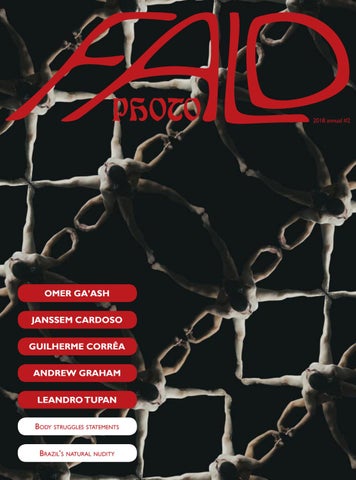
FALO© is a bi-monthly publication. january 2019. editing, writing and design: Filipe Chagas editorial group: Dr. Alcemar Maia Souto, André Guimarães and Guilherme Correa. cover: Fabric of life, photo and design from Omer Ga’ash
Editorial
H
ow about the first edition, hun? Did you like it? Did you learn something new? You better be, cause you must be prepared for
more: this second edition brings all the
Care and technique were used in the edition of this magazine. Even so, typographical errors or conceptual doubt may occur. In any case, we request the communication (falonart@gmail.com) so that we can verify, clarify or forward the question.
Editor’s note on nudity:
Please note that publication is about the representation of masculinity in Art.There are therefore images of male nudes, including images of male genitalia. Please approach with caution if you feel you may be offended.
Rights and Commitment:
This magazine is committed to artists retaining copyright of their own work. All rights are reserved and therefore no part of this magazine may be reproduced mechanically or digitally without the prior written permission of the artist. We have been careful to ensure that the images used in this publication have been provided to us by the creators with copyright permission, or are copyright free or are being used under the “fair usage” protocol shared over the internet (images are low resolution, attributed to their creator, not for profit and used only to illustrate a relevant article or story). If, however, you feel your image has been used by us unfairly and your copyright breached, please contact us at falonart@gmail.com and we will proceed in the best way possible.
photographers from 2018! First you will see a photographic manifesto from Chris The Red that opens and finishes this edition. A quick explanation: the artist made this manifesto during the elections last year here in Brazil. We had two options: a candidate that would be the continuity from a corrupt government or a candidate with a hate speech against the LGBT+ community, women, indigenous and black people... so we have to choose being robbed (but could fight) or shut up and die. The choice was obvious BUT the hater won... Now the next four years will be for resistance! So. when you look to the photos of naked men from Brazilian photographers here on this magazine or anywhere else, please send good vibes. Here you will see Janssem Cardoso and his beautiful project Other Colours, the amazing photos from Guilherme Correa and Leandro Tupan. They(We) need your support.
Summary You will also appreciate the incredible work from Omer Ga’ash and Andrew Graham. Both works with the shapes of male body. Andrew goes with BW in dramatic forms while Omer explores the images through graphic design to creat fractal beauties. This magazine have two very important articles. One talks about the body struggle every single men have at least in one moment of their lives. Even you! Yes, you! If you stop for a second you will remember a situation that your personal image wasn’t the best. The other article is now a good statement for what is going on here. It’s about the real nudity from Brazilian native people, the natural one, not the fake-samba-soccer-sexturism one. It’s about our roots, what we are forgetting. At least I wrote about it... You will also read about the magazine’s graphic project and its connections with Art Nouveau, and will see two models for the moNUment session (one is new!)! Oh... and talking about new... some of the photos here are different from the portuguese version! If you like a photographer, download the issue where he is and see the photos!
PRESENTATION Phallus nouveau Omer Ga’ash
10
Janssem Cardoso
20
Guilherme Correa
32
Andrew Graham
46
Leandro Tupan
58
HUFFPOST 21 men go shirtless and share their body struggles PHALLORRHAGIA Brazil’s natural nudity
In fact... just have a good time! Filipe Chagas, editor
6
moNUments
68 78 86
PRESENTATION
Phallus nouveau NEW ART Art nouveau was an international decorative style that flourished for about two decades (c. 1890-1910). It went through all the design arts – architecture, furniture and product design, fashion and graphic arts – and consequently covered posters, packaging and advertisements. The specific visual quality of the style is an organic line, similar to botanical features: free of roots and gravity, it could curl energetically or flow with elegant grace as it defines, modulates and decorates a certain space. The term art nouveau emerged in a parisian gallery, opened in 1895 as the Salon de l’Art Nouveau. In addition to Japanese art (the greatest inspiration of the period), the “new art” of Europeans and Americans was exhibited and sold there. More ephemeral and timely, graphic design began to change rapidly towards art nouveau as Jules Chéret, Eugène Grasset and Toulouse-Lautrec developed their designs. It was in Alfons Mucha’s work that style found its most complete statement. Its main theme was a female central figure surrounded by stylized forms derived from plants and flowers, byzantine mosaics and even magic and occultism.
6
Illustration by Alfons Mucha.
When the art nouveau arrived in Germany, it was called Jugendstil, “young style”, due to the name of the magazine Jugend (youth), that was published from 1896 to 1940 in Munich. Known for most of its existence by the libertarian and aesthetically daring posture, the Jugend is admired to this day. Created by journalist George Hirth, the journal’s editorial orientation to text contributors was that they should be “short and sweet”. The ornaments should be virtually on every page, bringing a rich diversity that was halfway between visual material and text. Jugend’s use of typography, with hand-drawn fonts and fusions of letters and images – often to the detriment of readability – had a great influence on later graphic arts and advertising. An unseen editorial policy was to allow each week the cover designer to draw the title that would accompany his illustration. Over a year, the Jugend brand appeared variably, often mingling with the winding lines of the style. To despise art nouveau, relegating it to superficial decoration, is to ignore its central role in the evolution of all aspects of design. It is a transitional style that evolved from the historicism that dominated design throughout most of the 19th century and became the initial stage of the modern movement, paving the way for the 20th century. It bridged the victorians that were looking for preestablished solutions and the moderns who adopted elegant motifs in harmony with nature.
7
HARMONY IN DESIGN You must be wondering what art nouveau has to do with male nudity when, in fact, it was a movement that sought the sinuous sensuality of natural forms as a feminine reference and main image. This style – which changed the direction of graphic design – was the inspiration of all visual identity and graphic design of Falo. Let’s go to the brand. Its creation was only possible after a study on the Jugend magazine and the typographic works on the covers. In the first moment, the more attentive to the logo realized that the sinuous forms of the letters did not only form a word, but also a very peculiar image: a phallus. Didn’t you see? Just notice how the different format of the letter ‘O’ resembles a glans with the letter ‘L’ serving as foreskin (who accompanies the magazine on Facebook had a much more visual tutorial like this one down here!).
8
It is interesting to note that this design came immediately with the name of the magazine. However, because it is almost literal even other names have been thought of. Nu Art or only NU were two of them that were almost the definitive ones, with even logo studies using triangular forms with the tip to the top (who has seen/read The Da Vinci Code knows that this form represents masculine) or semicircular geometries that induced repetition of the phallic form. But how to escape such a perfect name (in portuguese “falo” is also the verb “talk” in present tense) or a brand so perfectly harmonious with the project? It would not be possible to create a generic brand with a generic name that could serve any kind of nudity. No. The essence of Falo is the male nudity in Arts. That should be translated into all its details.
Thus, the graphic design followed easy. Without lose legibility or carry on the ornamentation and the sinuosity that art nouveau would ask, the idea was to use small devices that maintained these characteristics: 8=D Most text boxes and photos have rounded edges: Even if tips may have semiotic references to masculinity, they can also bring feelings of aggression and authority. But a blunt tip is much more connected with the magazine. 8=D Lines with balls: Only this item would be enough to explain. The idea is the simplification of phallus’ form. Is or isn’t it a line with two balls? Therefore, they are two elements that appear as ornamentation worthy of art nouveau. And it still has another representation... note the text box of the Summary that has a line coming out. Is or isn’t it an ejaculation? 8=D Color of the flesh: Red and rosy are colors extremely attached to the feminine. But I say no. It is known that historically there was a religious orientation (tiring, as always) for blues to be boys and girls red. It turns out that color has no gender and the colors attached to red are part of all of us. We are carnal, visceral. We are skin, we are blood. This is the magazine’s color palette that varies in sessions.
9
8=D Small and important details: The title boxes appear to penetrate the sides of the page, as well as the page numbering. In the Phallus in History session, a frame (created with lines and balls), gives the tone of antiquity. And did you notice the typographic composition that marks the end of all articles (and starts these items)? Do you see a smiling emoji on his side or a little typographic phallus? One of the premises of the magazine is to bring knowledge and, for that, readability would be fundamental. Bodoni and Gill Sans were the typographical families chosen, escaping from art nouveau. Of course not at all... note that the capitular letter of the Phallus in History session (that big letter that starts the text) and the page numbering are a curvilinear font. It is Eckmann typography, created by Otto Eckmann, German painter who followed the young style and worked at the beginning of the magazine Jugend. I believe it now made sense to you to know the art nouveau. I hope your experience with the magazine becomes more complete and harmonious. 8=D
ABC abc
Heart yourself. Nude Texture project.
10
Omer
O
mer Ga’ash is almost a nomad. Born in February 1983 in the city of Haifa, Israel, he moved countless times throughout his life, whether it was the army, his studies in Design and Architecture or his professional life. Today he has his own studio (OMG Studio) in Israel, where he works with graphic design, UX / IX design, startups, technology and more.
11
Ga’ash
He had a happy childhood, but he was never satisfied with his skinny body, his glasses and his hair. By the age of 18 he decided to begin documenting the changes of his body through photos without any artistic intent. Over time he has been testing light, angles and different places to get a better understanding. Then he realized the value and freedom of being naked, sensations magnified when the photos were taken outdoors. Gradually he became more and more immersed in compositions, lightning and art direction, causing him to start looking for models and developing a language of his own to express his passion for male nudity in his art. He prefers the models to be dancers because he knows that they - in addition to take good care of their bodies - know how to move their bodies and are interested in taking part of creative process.
12
Photography with the dancer Maxime Bordessoules.
13
Photoshoot Awards NUDE 2018 finalist photograph.
14
The male body is Omer’s choice not only because of his sexual orientation, but because he considers his familiarity with its forms and his ability to make the most out of them: “It is easier for me and I feel more comfortable, but I don’t necessarily want to work only with male body. I wanna work with everybody.”
15
His current project “Nude Texture” aims to eliminate the fear of nudity. For Omer:
“It will always be weird to be the only one naked in a crowed but once everyone around you are naked it’s less awkward.”
16
17
In this way, by multiplying nudity, Omer eliminates sexual questions and returns it to its everyday naturalness. The forms created by bodies become modulated patterns and alter our perception. It takes a metonymic look, where the part represents everything. The application of these textures is made in everyday objects: phone cases, bags, cushions, bathroom curtains, towels etc. to emphasize its main message: “nudity is not an issue”. The interesting thing is that the frontal nude does not appear in Omer’s work. The aesthetics of the body is more important than sexuality, so he prevents focus at the penis. However, it makes clear that if the photographic composition or texture asks for the frontal nude, he will use it.
18
Photoshoot of Nude Texture project (photo: Xnet) that results, for example, in a cushion.
Canvas the Movement project.
Despite the religious burden, Israel is a place of good acceptance of individual and collective expression forms, facilitating the artistic development of Omer. He recently made a partnership with the singer and painter David D’Or in the project “Canvas the Movement”: D’or painted on large canvases on the floor and on them was placed a male model that was also painted; meanwhile, Omer was directing and photographing the entire composition from top view. The photographs were printed on glass and acrylic in large formats for an exhibition that toured several countries. Omer intends to continue the “Nude Texture” project, extending it to Architecture and Interior Design. He likes to think that he is an artist, but believes that this “position” also comes from the viewer who also sees him as a photographer and designer. 8=D
Plastic Surgery for you!
Dr. Alcemar Maia Souto CRM 5246681-1
+55 21 97395 8000
alcemarmaiasouto@gmail.com
20
Janssem Cardoso
21
A
s a child, in the city of Benjamin Constant, on the Amazon, bordering Peru, Janssem Cardoso really liked art, but he still didn’t think he could do it for life. When studied digital painting, he returned to drawing, animation, design and the images production in photography and video. A time-consuming but necessary process.
People are his inspiration. For him, a chat is essential to establish an intimate and artistic relationship that will generate the images. The nude appeared in the Other Colors project, with different genres and - of course - colors, but the first time was with a man. He tells: We went to a waterfall on a day that had everything to go wrong. It was raining and cold and we went into the unknown. It was the first time someone was naked in front of me to be photographed and I tried to act naturally, to notice his time for the photos. It ended up being very calm, despite the cold and the rain.
22
23
24
In this project, Janssem wants to portray the person without pose, clothes or armor, so that he recognizes himself as he is in his own inner “colors�. To do this, he frees itself of his own desires and prejudices to focus on the best image. Male frontal nudity, therefore, naturally appears:
At that moment my gaze is beyond the naked. Of course, for those who see, it may have a different interpretation from mine, but I cannot control it. I seek that people first see the idea and then the rest. 25
26
27
28
29
Models: Renan Oliveira, Bruno Ribeiro, Hudson Ribeiro, Gael Gramaccio, Sidney Teodoro, Carlos Henrique Almeida, Petros Santos, Julio Peixotto. Tiago Ramos, Fabio Lopes e Thiago Moura.
30
Although he recognizes the uprising of excessive puritanism, Janssem realizes that self-knowledge allows discussion about the themes he proposes. He knows that it is through mutual respect that one makes the best advertisement for the opening of new paths. Paths of liberation and acceptance. 8=D
NY
SIGHTSEEING TRANSFER PHOTOGRAPHY VIDEO
31
We truly LOVE what WE do and WE want to serve YOU whenever YOU want.
w w w. t o u r g o r d o n . c o m tourgordon212@gmail.com
+1 551 221-0341
Mehmet
32
Ensaio Nutopiastardust. Performer: Luan Machado
G
uilherme Correa born literally at the premiere of Generation Y, January 1980 in Rio de Janeiro. He lived there until he was 18 years old, but his first job was in SĂŁo Paulo, where he spent 15 years traveling the world as flight commissar.
Guilherme Correa
33
At 30 he felt that his artistic side and an indistinct sensation of discomfort was pushing him out of the comfort zone. He ended up deciding to drop everything to dedicate exclusively to the performing arts. At that time, the most important experience was his participation in the opera Carmen de Bizet in the Municipal Theater of SĂŁo Paulo.
34
From the analysis of himself and his colleagues in the stage photographs, there was an interest in capturing the emotion and energy of scenes and movements. He began to study and photograph, at first with borrowed cameras, mixing colors and effects. In 2015 he returned to Rio and did a photography college, intending to work for real, when he set up his first studio in the city center and began to make money from photography. Currently Guilherme produces photoshoots, varying the themes between naked, sensual photos and fashion works. The techniques, he says, vary according to the proposal, inspiration and even situations dictated by chance and improvisation: backlighting, flash, long exposure, window light... From various cross processes, he talks with several people at the same time, trying to identify who fits the story better.
I believe that as someone who makes a song uses verses and poetry I use people’s looks and gestures to make art.
Photoshoot Demons. Model: AndrĂŠs Vallejos.
He tries to know as little as possible about the model and what he brings to add to the line of work, such as if he dances, do sports, etc. However, knowing how delicate it is to work with the ego and the people’s expectations, he is very demanding and, when clicking, pay attention to everything that can make a difference. His ideas can also change during the post-production long hours, in which he transforms what he calls his “photorrhage” into prints, secret paintings, fashion catalogs, composites, model books, participation in contests, zine or copyright works. For him there has always been the certainty of working with the male nude, even when he encountered barriers of teachers, friends and clients. The difficulties, in fact, led him to have even more desire to move forward, giving the work a tone of militancy, a political act, a way of participating in the counterculture. What is “forbidden” has always caught my attention.To say “don’t do” is the same as saying “do” to a 1980 born. I believe that talking about the male nude is a way of transform neofascist thinking and the castrating socioeconomic model we live in. His biggest barrier is still the front nude because 90% of people do not want to do it. He believes in the importance of
Photoshoot Mascot. Model: Luke Bigatti.
35
36
Photoshoot Boyfriend. Model: MaurĂcio de Quieroz.
37
Photoshoot Feather. Model: JosĂŠ Pennafort.
this paradigm break from something natural, and then he acts normally, as if he were photographing the person in clothes: eye to eye all the time. If there is an erection and some embarrassment, he readily leaves the model at ease and moves on, because the focus is the facial and body expressions.
38
I can not stop what there is no control and I think it’s beautiful when it happens, because it reflects a desire to be there. At first, he had to act almost hidden so that he could survive financially in the profession. He then created the Nutopia project, where he approaches the new aesthetic forms, both physical and of gender, without adhering to standards. For him what matters is the identification of the audience with the diversity of the characters in the photographs.
Photoshoots Lover (Model: Cleber Henrique) and Strong Base (Model: Leandro Tuke). Next page: photoshoot Conected.
39
In 2017, with the repercussion of the Queermuseu exhibition and the events at the Museum of Modern Art, he noticed a lot of people going to the same place. He instinctively discovered references such as Robert Mapplethorpe, Alair Gomes, Terry Richardson, Helmut Newton, Rodin, Hopper. For him, “no one forgets a photo of Mapplethorpe, nor does it remain the same after seeing it”. It is the shocking visual effect and the courageous record that awakens hidden subjective singularities. As well as the sensuality and melancholy in Alair’s photos, that has in his obsession with the subject and the use of this tool to entertain people as his greatest motivation for recognition.
Photoshoot The Alair in me. Anonymous models.
40
After all, which artist doesn’t want applause? Maybe only Alair, who saved everything and left it to us to treasure and study the homoerotic culture.
41
42
Photoshoot Nutopiastardust. Performer: Luan Machado.
43
The responses he received throughout this process became strong links and partnerships, such as participation in the collective exhibition at the Behring Factory, “O Pau na mesa� (curated by Lula Duffrayer), with the work Nutopiastardust. However, he already had an account blocked in social networks, he was invited to withdraw from the places... and not because of the nude itself, because he also works with models of underwear or swimwear, but because he speaks openly of masculine sensuality.
Above: Self-portait Below: Daniel
44
I am beginning to find it amusing, but when I go out on the field, more and more my rituals of faith and protection increase every day.We live depressed, sick...We need to know and help before criticizing, saying more Yes than No to unite our work fronts, a great shock treatment. I believe that disseminating art is the antidote to hatred. 8=D
45
Andrew Graham 46
A
t the age of six, Andrew Graham received his first camera from his parents, and it all began. He has been a graphic artist in Connecticut, USA, for over 40 years, but photography as true art has come to him in the past 20 years. He is basically a self taught photographer and relies on his artistic sense to make art. He often says his drug of choice is people:
47
My passion is photographing the human form.The unclothed body is an amazing art form, so changeable with pose, light, mood, the energy of the day.What better way to make art but by connecting to people in their most vulnerable state? I believe it is the connection and the trust I build with the model that makes for good art! There has to be respect on both sides to photograph the nude in art.
48
Andrew works in the studio, and occasionally in nature. During a session he takes many, many photos, as he wants to capture a magical moment that can happen in a mere second. Photographer Sally Mann speaks of the magic of getting a good photograph as “a moment as fleeting as the touch of an angel’s wing.” I truly believe this is so! I believe that art comes through us, and we are lucky when it happens!
49
50
He cares about the honest portrait, the one which says something beyond the image. He searches not only the body shapes but also its relation to the space. This creates a work full of intensity and drama enhanced by the monochromatic choice, which often comes close to the work of Robert Mapplethorpe. Sometimes he explores digital manipulations in order to create surreal images with the same intensity (or more). As a gay man, Andrew knows there is a wonderful tension when the model stands before his lens. But he feels there is fear around the male nude because it has been discouraged by our society. His full non-censored male nude photos are rarely chosen for exhibitions even when it is needed: 51
52
There are times when the phallus, flaccid or erect, can be distracting to art. I understand that. As well, there are times when the phallus is what makes an image! To not show it is being untrue to the art! I want to explore and hope to push my boundaries further and see where that takes me! Art is a magical journey, and needs to be explored openly by everybody!
53
54
55
Living in nature with his partner, a dog, a rooster and 15 hens, Andrew knows how hard it is for the audience often to accept his work. He is honored that people are willing to further his art by being naked before his lens. With all humility, he has accepted that his art depends on the generosity people and is grateful for those who wish to create art together. For Andrew, it is time to celebrate a man’s naked body in art and share in expressing our deeper selves. Being honest with your desire of expression and silencing the voices which may be criticizing your exploration, it’s what he thinks to be vital for art to move forward. 8=D
56
57
58
Leandro Tupan Landscape, 2017.
U
nder construction. This is the most repeated expression in the speech of photographer Leandro Tupan and must be understood as a lesson. It is possible that his graduation in Architecture made him develop this thought about his work, because that took him to the photograph. During an internship at the FAUUSP library, he had the opportunity to focus on books and photo magazines and ended up working in the area of ​​ conservation/restoration of photography.
59
About three years ago, from the experiments with historical photographic processes of printing, he began to think of photography as a process of thinking and an artistic expression on the body, not only associated with sex and the desire for other men, but also with his identity, to time and finitude, central themes in his production. This coincided with a period of personal crisis when he experienced a change in the dynamics of his affective relationships while accompanying the transformations of his father’s body until his death.
Élcio, 2016.
60
Castaway, 2017.
I began to produce portraits as a way to know the bodies of my partners, to go through skin, muscles, scars and stories, to retain images and sensations in my memory. Gradually the practice of this photography was gaining strength and autonomy and began to happen from sessions with scripts or pre-defined elements.Thus, the new trials took place in another context where sexual contact was no longer the starting point or approach. Hug, 2016.
61
62
Flavio, 2016.
In his search (or should I say “construction”?), he found John Dugdale, an American artist who, as a result of HIV, began losing sight in the 1990s until he became blind in 2010, and during that time he used 19th century photographic processes (in particular, cyanotype) to present autobiographical elements in a production of images that blend dream, death, desire and poetry. The sculptural male bodies in the photographs of George Dureau and Robert Mapplethorpe have become another reference, in contrast to the portraits of Arno Rafael Minkkinen and John Coplans, who resignify the body as space, form, continent and landscape in itself. All this research led him to observe more closely how the body is approached in the work of Gal Oppido, Lia Chaia, Mário Cravo Neto, Chris Bierrenbach and other Brazilian visual artists, as well as in other artistic languages, such as performers who use their own body as an instrument and message. In this course, he turn himself into a body-agent for other artists while doing the training offered by Juliano Hollivier’s Living Model School and posing as a model in workshops and drawing courses. Knowing that social media is an important tool of information and propagation, Leandro warns of censorship and, in this direction, points out that social networks also modify processes related to artistic creation, the circuit of the arts and the legitimation of what is art and what is not recognized as art:
It is still difficult to approach sex and the homoerotic desire in those spaces. Even with nude body censorship and hate speech, social networks are very important for the recognition and strengthening of groups that have always been silenced by traditional media, and need to be occupied to give visibility to other narratives that help create other circuits, contacts and spaces, not just virtual ones.
William, 2016.
63
Because of the machismo that objectifies the woman’s body and which has reduced almost exclusively to men recognition as artists until very recently, he believes that it is important to naturalize masculine nudity to find beauty in the phallus without looking away, understand it as shape and volume in its relaxed and erect states without denying its sexual charge or even being restricted to the homoerotic universe. However, he knows that phallocentrism can “steal the scene” from an image, causing other aspects to be ignored. Therefore, he understands that the absence of the phallus or a suggestion of its presence can often be more interesting in the construction of an image.
64
Above, the dialogue between male body and architecture. Beside, the phallus in the first edit of the image. (Model: Fábio, 2018)
Élcio, 2016.
65
In the midst of questions and practices that reformulate these values, Leandro maintains the construction speech in a collective way. For him, the sharing of ideas removes the process of creating from its solitary path and extends his possibilities of boosting. When he meets other artists and reflects on their practices, he recognizes that he has a lot to learn and, therefore, not close himself: Corpo de Quinta is an artistic networking meeting that takes place in the NU studio on a Thursday every month, aimed at artists from all areas whose work relates to the body.
In this sense, I am very grateful to participate in the organization of the Corpo de Quinta, a space that has the purpose to facilitate the meeting and exchange between artists that have the body as a theme and/or medium of expression. I consider myself as an artist under construction, who, until now, has only become aware that is in search and is discovering his language, his identity. I still have much to learn and experience, and I hope that this desire to learn continues to move me. 8=D
66
Hug, 2016.
67
21 men go shirtless and share their BODY STRUGGLES
T
68
he fruitless quest for a “perfect” body isn’t unique to women, though based on the body image conversations we tend to hear, it’s easy to think so.
Rather than obsess over attaining thinness, however, men are more likely than women to consider themselves underweight, and focus on getting more muscle tone, studies suggest. But there is a range of expectations for what a “masculine” body should look like – and negative associations with the ones that fall short. One study found that men linked being fat with “weakness of will,” while being lean and muscular was associated with “feelings of confidence and power in social situations.” According to mental health experts, men may have a harder time accessing communication tools to express their insecurities and work through them. While there’s recently been more cultural celebration of a diverse range of body types for men and women, for men to communicate openly about body concerns still carries a stigma.
by Rebecca Adams
Published in 2015 August 14th. (Photos by Damon Dahlen / HuffPost US). * The last two testimonies were add for this magazine.
In an effort to demonstrate that men of all ages and sizes struggle with body image, HuffPost Women photographed 19 men, from those in their 20s to their 60s, without their shirts and spoke candidly with them about their body hang-ups. 8=D
I don’t like sitting down with my torso hunched over my legs -- it makes me feel gross the way my stomach reaches over my belt. Similarly, if I have my shirt off, I try to stay lying down or reclined so that my torso is elongated. I also flex my arms and abs almost constantly. The soreness and tension from working out makes me feel better. I’ve always wanted a much leaner body type, so even as small as I am, it makes me wish I was thinner. Many of these conversations have brought me to the conclusion that I may have some minor type of dysmorphia.
I’m realistic about my body. I take care of myself and exercise vigorously and regularly, but know that I’m not 30 anymore. I see a lot of guys my age whose bodies look, well, sad, and I am determined not to let that happen.This is embarrassing, but I will sometimes press my fingers on the side of my stomach to try to convince myself my abs are ‘tight.’ I don’t talk to my friends about body concerns very often. I do notice that most of my friends are married and overweight -- not sure if there’s a correlation between those two facts, but as a result, we don’t talk much about body issues.
I feel terrible about letting my body go as I have aged. In my younger years, I was really into weight-lifting, and I know first hand the costs of letting your body go and the uphill battle I face now from doing so. My son repeatedly asked me if I was pregnant when he was younger and now knows that I am very unhealthy, because he is taught in school to not eat what I eat or ‘I will become fat like daddy.’ I would say I have just given up. Its almost comical. I would be embarrassed to mention it [to my friends]. I am worried what they would think, not only because I am actually very fat, but how weird it would be to mention something like that in a man-to-man conversation? It’s simply not acceptable.
69
My relationship with my body has changed a lot over the years. I struggled with self-esteem as a young, chubby child. But I had a few important experiences -- like having to use communal Japanese baths and swimming competitively -- that made me quite comfortable with bare skin by the time I got to high school. Recently, I’ve been struggling more with that confidence. I often feel somewhat weak and flimsy and wish I had a more powerful body. I’m really grateful to have people around me who are very open about their own body issues -which is the key. Once one friend starts sharing, it sets the space for everyone else to do so as well.
70
I’ve always been very comfortable with my body, even when I was an awkward squishy pre-teen. But nowadays, I really like how I look. I’m also definitely more focused than ever on how my body feels.
I hated my body for a lot of my life. Part of that came from being a ‘husky’ adolescent / teen and part of that came from being queer and feeling like I didn’t have a body that was attractive to other men in the ways it was supposed to be. But getting heavily tattooed and working out hugely changed the way I think about it. So many of the stories that were hidden inside of me -things I loved, things I was scared of, things that haunted me -- were finally visible, and my body finally felt like it belonged to me because I had a hand in making it the way I wanted it to be. Now, when I take my shirt off, I’m happy with what’s there.
I feel comfortable and free when shirtless. I feel that my body is a form of art.There are some areas I wish to improve upon, but I definitely love my body type.
I feel much better about my body than I used to. Until I was in late college, I had an unbelievably fast metabolism, which I realize for many would be a blessing. For me, it left me looking, as my friends once described, ‘like a Holocaust survivor.’ Since then, my metabolism has slowed to a crawl. I occasionally go to the gym, which I think has helped my confidence somewhat.
Being 59-ish years old, things aren’t as firm as they use to be or even in the same places, but I have no problems about my body now or ever. I do chat with friends about how I should get back to a gym and get more exercise, just because I’m not getting any younger.
71
I’m OK with my body now. I’m still aware of where I can improve and personal ‘imperfections,’ but for the most part, I’m OK. [My friends and I] mostly talk about how we need to tighten up and get in the gym.
72
When I take my shirt off in public, I am extremely aware of my body. It feels unnatural to be shirtless. I feel as though all eyes are on me and no one is liking what they see. I’m 6’4’’ on the outside and 5’4’’ on the inside. I feel better about my body now than I did in the past. I don’t want a perfect body. I want my body to look fit, but also lived in. Having said that, I run 18 to 20 miles per week and do bodyweight exercises six days per week – and feel as though if I miss a day, it’s all going to fall apart. So, there’s that.
I have always been comfortable with my body. Due to my skinny lankiness, I have always received the opposite kinds of comments, with most telling me to eat lots of cheeseburgers every day.When I was younger, it annoyed me. Now I just smile and tell them I absolutely would if it wouldn’t kill me.
I feel good about my body overall, especially given my age of 55.With that said, I decided after doing the photos that I want to get back to my college ‘fighting weight’ of 199 not only for health reasons, but feeling better about myself as well. I keep my shirt on, in no small part because, now that I am single again, I think most women prefer a guy in a nice shirt versus shirtless.
I feel like I’ve disappointed my body. In high school, it was, ‘I’m so skinny, I need to bulk up,’ but now it’s, ‘I’m still so skinny, but I have a belly.’ My insecurities have doubled in that sense. Having skinny arms and a post-college beer belly is far from the muscular male archetype. I talk to my girlfriend sometimes, but with friends, not really. Straightguy friend groups aren’t immediate sources of empathy and consideration, from my experiences. My closest Asian male friend works out a lot and has an incredible body, so sometimes I feel ashamed when I’m around him. He has my ideal body, and as an Asian male, his own masculinity makes me feel inadequate.
I always felt like I was inadequate. Lately, working [in media] has made me more comfortable in my own two shoes than any other time in my life. I have no idea why, but it seems learning about these spaces and ideas helps.With women I [discuss body image].They’re always quite fruitful.With men, on the other hand, I avoid these discussions as men are constantly trying to avoid looking weak. It sucks.
73
I feel like I could be healthier in how I exercise and eat, and the byproduct would be a healthier body and mind. Being healthy is the goal, and my body looking better is a perk. I can eat pretty unhealthy and not gain a ton of weight. People get angry about that, so I try not to talk about it.
74
I’m usually pretty fine without my shirt off, because I learned how to position myself about things I’m insecure about. My feelings haven’t changed about my body -- I’ve always been pretty comfortable. Although I have realized I have to workout these days to maintain the same shape.
Now, today, I’m not feeling great about my body. In the past, I really didn’t think much about how I looked shirtless -- I just did it. But when I moved to New York, I found myself in a much more body-conscious community than my small college campus. So, I got a gym membership, worked out a lot, ate well and felt good about how I looked. But I’ve fallen out of that routine over the past year, and I’m having a hard time getting back into it. I’ll wear my pants higher to tuck things in, and wear oversized or boxy shirts that hide my stomach and upper arms. If I’m really not feeling so hot, I just don’t go to certain places where I know people will be shirtless. So being a gay man in New York in the summer can be difficult.
I typically feel like no one can tell I have a belly when my shirt is on, so I feel like I’m exposing a secret when my shirt comes off. I don’t remember a moment in my life when I felt totally comfortable with my body. It’s been especially bad since leaving college, possibly because of the insecurity that comes with new life style. I rarely open up about it.The few close friends I do talk to always give me the same reaction: Oh, you’re not fat! It’s nice to hear, but I just don’t believe it. It’s not that I’d rather them say “yeah, you could stand to lose a few”, but it makes it more difficult for me to process my insecurity against friends’ reassurance.
You surely have identified yourself with any of these statements. While reading, you may have thought about yourself and your relationship to your body, or at least if you talk (or not) to your friends about it. Then, FALO invites you to an exercise: Go back to the testimonials and notice those who: (1) are very close to what you think and feel about yourself; (2) left you with pity of the guy; (3) made you find the guy arrogant; (4) opened your ming. Think about the reasons for this, about what made you feel close or away. Now, write yours. Make it like the ones you read: short and on point. When you finish, save it and, only the next day, reread it to make sure you write what you feel. The exercise of write down on paper (or computer) is a way of putting out what we do not usually do.You do not need to save what you wrote, however, feel free to talk to FALO (falonart@gmail.com). The following two statements are the results of this exercise.
75
I was a skinny child, but after the first grade, at age 7, I gained weight and was chubby until I was 16, when for a platonic love I went on a diet and lost weight. I never had a very good relationship with my body until I changed my mind about it and started to love myself.Today I’m fat again, but now I have respect. For those who in youth never took off the shirt in front of anyone, today leaves the body naked and free, regardless of who is around, that is the freedom that I have with my body.
76
I suffered a lot of bullying in my childhood... even within my family.The result? Body Dysmorphic Disorder diagnosed. Every time I look myself, I see something different, never in the same way. I have an absurd insecurity that interferes with social and emotional relationships. I go to the gym only as health prevention, because I no longer have the expectation of achieving a utopian body. Friends say I look great and some even think I’m cute, but I’ll never believe them.The damages of the past seem irreversible and still reverberate, but I reach the 40s wanting to change. Little by little I’ve been trying to embrace the diversity of human forms to find my place... to like myself.
77
PHALLORRHAGIA
Brazil’s natural nudity
78
T
he natives found by the Portuguese because of the “discovery” of the Island of Vera Cruz (Brazil) in 1500, were naked.
Indigenous Apiacás, part of Taunay’s illustration (16th century).
The Discovery of Brazil, oil on canvas by Cândido Portinari, 1956.
79
“Their appearance is to be brown, [a] way of reddish, good faces and good noses, well made. They walk naked, without any cover, nor do they expect to cover anything, nor show their shame: about this, they are as innocent as it is to show their faces.” – Pero Vaz de Caminha They did not know white man’s pudency and the “shame” described by Caminha. They came naked to this world and so they should remain like all other beings in the forest. Identified with nature, the native men and women lived in aware display of the way in which they were molded, without the state of nudity provoking any “shame”. The German adventurer Hans Staden considered it natural to be naked as he was a slave for nine months of the Tupinambá tribe, said cannibal:
“The men walk naked. In the part of the land that lies between the tropics [...] They are beautiful people of body and stature, both men and women, in the same way as the people here, except that they are tanned by the sun, for they are all naked, young and old, and also do not bring anything in the pubic parts.”
Tiger hunt, by Rugendas, 19th century.
80
Family from a Camacã chief preparing for a party, by Debret, 19th century.
The natives also painted their bodies as a social code that said more than any dress, because it indicated a situation or status: war, birth, mourning, spiritual rites, marriage, etc. It also facilitated communication between tribes who did not speak the same language. In some cultures, belts, necklaces, feathers, thongs and other accessories used, acted as an element of seduction, attraction. When the man covered up the glans or the whole phallus, he was embellishing to arouse the curiosity, the desire of the companion. Some scrubbed venomous caterpillars on their genitals to swell it in exaggerated proportions, appearing to be able to give more pleasure. The Portuguese Gabriel Soares de Sousa came to Brazil on an expedition and was enchanted by the land, becoming one of the first scholars of local behaviours. In his Descriptive Treaty of Brazil of 1587, he writes that “men cover their genitals with something for gallantry, and not for just cover”. The woman could also cover herself to make herself desired, indicating her virginity or marking her forms. So, opposite of everybody imagines (and preaches), the visibility of the genitalia was not the cause of desire! The canons of European beauty came here through the gaze of the colonizers, calling the native nudity of innocent – at first – since they didn’t know evil. However, the visual representations of those born here have not favored the natural nudity found. Unlike the allegories in European and Asian arts with fine fabrics, jewels and exotic treasures, the Brazilian natives looked thin and miserable, without possessions. The interpretations passed
81
Indigenous Korubos from the Amazon. (Photo: SebastiĂŁo Salgado).
19th century photos. from purity and innocence to the anthropophagic poverty and horror of this “people who probably eat people”.
82
As they resisted foreigners, their demonization deepened through religiosity. Early in the Colonization, the Jesuit priests fought against nudity and what it symbolized. Ordinary river baths were banned and penalized, meaning, even hygiene was recriminated. The natives were compared to animals because they were not ashamed (but to them that was correct, however, without any connotation of malice or morality) and to clothe them was to ward them off from evil and sin. The Jesuits ordered cotton cloths in Portugal to dress those who attended their catechetical schools and often created comic situations such as that reported by Father Anchieta: “The Indians of the land usually walk naked and at most wear some cotton cloth or low cloth, and in this they use primers in their own way, because one day they leave with a cap or hat on the head and nothing more; the other day they leave with their shoes or boots and the rest naked [...] and if they go only with the cap on the head without another clothes and it seems to them that they go very gallant. André Thevet, a Franciscan monk explorer who came to study the brazilian riches for the installation of a French colony in Brazil, called France Antarctica, described the natives and their customs in a direct and – how not to say – incorrectly arrogant way:
“[...] this land was and is still inhabited by prodigiously strange and savage people, without faith, without law, without religion, without any civility, who lives like the irrational animals, in the way that nature did them, eating roots, walking always naked (both men and women), and this, perhaps living with the Christians, gradually stripped themselves of this brutality and began to dress in a more civilized and human way. [...] As if it were not enough for them to live naked, to paint their bodies in different colors and to pull their hair out, the savages also become even more deformed because, when still young, they stick their lips with a certain very sharp plant.�
Xingu. Photo:Valdir Zwetsch.
83
With the Renaissance repositioning the man in the center the world, the nakedness of Adam before being expelled from Paradise was questioned. If, only after the fruit, he and Eve were tempted by evil, then, was free nudity pure and natural? In this way, nudity and nude were separated: nudity referred to those who were without or were stripped of their garments, while nude referred to the balanced and self-confident body. The word was incorporated in the 18th century to the Academies of Fine Arts, where painting and sculpture made the nude the essential motif of his works. In the coexistence with the white man, the natives gradually moved away from what was natural and instinctive for them. Gradually, the garments were being used by imitation (and imposition), since decency was acquired, forced, taught and learned. Today, the nudity of the Brazilian natives is practically in extinction with the support of the Internet censors. This causes more damage than it’s imagined, since it hinders the diffusion of these autochthonous customs through the new technologies of knowledge. Indian* Ysani Kalapalo talks about her banned Facebook page for spreading her culture: “Since when is our way of being incitement to pornography?”. Not even the famous photographer Sebastião Salgado was free of the virtual censorship and had his photographs of Amazonian tribes deleted. “It’s not easy to find the right balance between allowing people to express themselves creatively and maintaining a comfortable experience for our globally and culturally diverse community”, the social media press office said in a statement.
84
The original nudity of this country was replaced by the social nude established in carnival and beach situations, a hypocritical morality governed by individual religious interpretations that took root from the colonial period. Those who lived here – like Adam in a Paradise before the fruit – were obliterated by an illusory superior civility. We can only read the poem by Oswald de Andrade that opens a parallel reality natural to our national essence:
I avoided using the term “Indian” or “Indigenous” because they were used by the Portuguese who believed they had arrived in the India, when, in fact, they arrived here. The concept of “Indian” is therefore a European invention.
When Portuguese arrived Under a rough rain He dressed the Indian What a pity! If it was a sunny morning The Indian had undressed The Portuguese 8=D
85
moN Um e n t s
86
Untitled. Marco Polo (selfie).
87
Untitled. JosĂŠ Lopes (selfie).
#ForTheFreedom OfChoice
#ForBlackPeople
#ForLGBTQIA+ Visibility
88#ForFreedom
#ForLife
#RespectFor Differences
#ForNortheastern Roots
#ForDemocracy
#ForLove
#ForResistance
#ForHope
89
#ForPeace
90
falonart@gmail.com