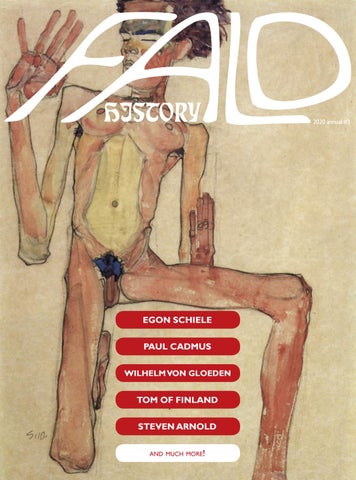
HISTORY
2020 annual #3
1
EGON SCHIELE PAUL CADMUS WILHELM VON GLOEDEN
TOM OF FINLAND STEVEN ARNOLD and much more!
2
Alex by Jenifer Custodio, ECCE HOMO I series, digital collage in Hahnemühle photo Rag by Ramón Tormes, 2017.
3
John Thomas, ECCE HOMO II series, digital collage in Hahnemühle photo Rag by Ramón Tormes, 2020.
FALO ART© is a annual publication. january 2020. ISSN 2675-018X version 30.01.20
editing, writing and design: Filipe Chagas editorial group: Dr. Alcemar Maia Souto, Guilherme Correa e Rigle Guimarães. cover: Nude kneeling with raised hands (self-portrait), charcoal and watercolor on paper by Egon Schiele, 1910.
Editorial
Care and technique were used in the edition of this magazine. Even so, typographical errors or conceptual doubt may occur. In any case, we request the communication (falonart@gmail.com) so that we can verify, clarify or forward the question.
Editor’s note on nudity:
Please note that publication is about the representation of masculinity in Art.There are therefore images of male nudes, including images of male genitalia. Please approach with caution if you feel you may be offended.
Rights and Commitment:
This magazine is committed to artists retaining copyright of their own work. All rights are reserved and therefore no part of this magazine may be reproduced mechanically or digitally without the prior written permission of the artist. We have been careful to ensure that the images used in this publication have been provided to us by the creators with copyright permission, or are copyright free or are being used under the “fair usage” protocol shared over the internet (images are low resolution, attributed to their creator, not for profit and used only to illustrate a relevant article or story). If, however, you feel your image has been used by us unfairly and your copyright breached, please contact us at falonart@gmail.com and we will proceed in the best way possible.
Submissions:
If you are interested in participating in the magazine either as an artist, model or journalist, please contact us via e-mail falonart@gmail.com.
FC Design R. Mario Portela 161/1603 C, Laranjeiras Rio de Janeiro – RJ 22241-000 Brazil
I
don’t know if you remember, but the pandemic started in 2019 in China and in the same year it started to spread around the world. In 2020 COVID went global. It was not just this lethal virus that hit mankind, but also the virus of ignorance, fanaticism and sociopathy... that are just as lethal as the corona. Those who believed in this event as a resignification of the meaning of collective and solidarity, today find themselves perplexed in the face of medieval and egotistical thoughts. Producing annuals in English that revisit the texts published in 2020 ends up being a bittersweet process. The bitter part comes from having the notion that 2021 is still a continuation of what we experienced in the previous year. Not even the beginning of global vaccination is capable of completely rekindling hope. The sweet part comes without modesty: the quality of the material published last year
Summary
is really high! If you’ve read the previous two annuals, you know what I’m talking about.You’ve seen jaw-dropping artists, read exciting testimonials, discovered subjects kept hidden but closer to us than we think. This edition is part of this. Here are some of the most important names in Art History when it comes to male nudity, artists who really changed the world panorama on the subject and deserve a broader look. In addition to bringing more art by Ramón Tormes, this edition also proposes to open our mind regarding our body, as it has a text on the aesthetics of the penis and on male pleasure through the prostate. This magazine is a vaccine against several of these social viruses that we are seeing spread out of control. It is able to immunize our brain and then make us envision a better future. It is in one shot only, but can be taken as often as you feel the need. Filipe Chagas, editor
Egon Schiele
6
Paul Cadmus
20
Wilhelm Von Gloeden
38
Tom of Finland
56
Steven Arnold
74
SPECIAL Penile aesthetics SPECIAL The history of underwear PHALLORRHAGIA Where’s the P-spot? moNUments
94 98 110 118
6
Nude self-portrait, 1916.
Egon Schiele 1890 - 1918 by Filipe Chagas
7
I
n his early years living humbly with his family at a railway crossing in a small Austrian town, Egon Schiele (1890-1918) showed an evident talent for intricate designs of locomotives and tracks. However, his frustrated father ended up destroying his sketchbooks when he saw that he was not interested in pursuing his career as a station master. Schiele was a shy and reserved child. He didn’t do very well in his studies – only in Arts and physical exercises – and ended up repeating the years. At 15, Schiele saw his father being considered crazy because of syphilis acquired in brothels. Many historians believe that his father’s death in 1905 unleashed a fierce curiosity about sexuality and mortality in the young artist. Against his mother’s wishes, Schiele was taken in by a maternal uncle who recognized his artistic side and enrolled him in a state craft school. However, at the insistence of several teachers, he was transferred to the traditional Academy of Fine Arts in Vienna in 1906. The boy quickly sought out those involved in the Vienna Secession* and ended up finding a mentor and friend in Gustav Klimt. Impressed
8
Sketches of his notebooks (c.1900-1904).
Self-portrait in graphite (1906).
by the intensity of the young man, Klimt bought his works, introduced him to collectors and important critics and found him models. Klimt’s colors and elongated lines are noticeable in Schiele’s work between 1907 and 1909. The friendship between the two lasted as long as Klimt was alive. Dissatisfied with the conservatism of the art academy, Schiele abandoned his studies and, together with other colleagues, like Max Oppenheimer and Oskar Kokochka, founded the ambitious Neukunstgruppe (New Art Group, of which he wrote the manifesto).
9
The hermits, oil on canvas, 1912. It is believed to be a portrait in honor of Schiele and Klimt’s friendship. The friendship between the two lasted as long as Klimt was alive.
* The Vienna Secession (1897-1920) was a movement by a group of young Austrian artists, designers and architects, led by Gustav Klimt, who protested against traditional norms coming from the Association of Austrian Artists. The group’s manifesto, published in the magazine Ver Sacrum (the group’s official vehicle), recognized the need to unite Vienna’s artistic life with the progress of Art in other countries (in particular, Art Nouveau and the German movements), without just being in a representation of commercial interests. Half-naked self-portrait with draped fabric, oil and metallic paint on canvas, 1909.
Naked young man lying in printed fabric (Masturbation), gouache, metallic ink, ink and pencil on paper, 1908.
10
Young man naked on his knees, crayon on paper, 1908.
Nude study (Self-portrait), oil on cardboard, 1908.
Even though he painted countless landscapes, in the group’s first exhibitions in 1909, he began to explore the human form and it was through nudity that he created an unmistakable mark in the expressionist figurative painting of the time. Unlike Klimt or Picasso, Schiele faced nakedness without taboos, full of deformed musculature, contorted extremities and exacerbated eroticism, whether of women or of himself, contemplating male nudity and its own existence. Schiele is believed to have used Auguste Rodin’s continuous drawing technique to create fluid sketches. This technique required constant visual contact with the living model, making the process a much more intimate experience.
11
Above: Mime van Olsen with crossed arms, 1910. Beside: male nude studies (self-portraits) in watercolor and gouache, 1910.
Vienna was under the weight of the pessimistic thinking of the philosophy of Kierkegaard, Schopenhauer and Nietzsche, and also by the emerging psychoanalytic theories of Sigmund Freud. Artists across Europe – like Edvard Munch, Jan Toorop and Vincent van Gogh – expressed the general feeling of existential anguish at the precariousness of the human condition and its irremediable finitude. Schiele started using a bold mix of colors (green, red, yellow and orange) to create almost unnatural bodies in emotional tones. The decorative elements have been completely replaced by exaggerated and expressive contours. In the second half of 1910, Schiele became more somber, both figuratively and literally, and the artist came to say: “my work has value only for me”.
12
Naked man sitting (self-portrait), oil and gouache on canvas, 1910.
13
Next: Self-portrait nude, Male nude standing on his back and Male nude standing on his back with his arm raised. Previous page: two male nudes reclined in watercolor and gouache, Male lower torso and Torso on blue cloth. All works in black chalk, watercolor and gouache, 1910.
14 Nude self-portrait making a face and Nude self-portrait with a twisted arm above the head, watercolor and charcoal, both from 1910.
In 1911, he met Walburga “Wally” Neuzil, a 17-year-old girl (possibly Klimt’s former lover) with whom he began to live and use as a model. Their studios commonly became a meeting place for young criminals and their work was seen as pornographic, attracting animosities. The painting of prostitutes and teenagers had a negative impact: Schiele and Wally had to change cities more than once. In 1912, a judge even burned his drawings when he sentenced him to prison for seducing minors and pornography exhibition. The following year, his biggest supporters began to abandon him on the premise that his work was no longer well accepted. When the heir to the Austro-Hungarian throne Francisco Ferdinando first visited an exhibition by the painter, he recommended to his father, the emperor Francisco José, that he prohibit such an event from being published in the press, as he believed that no one should come into contact with “such obscenity”.
Studies of naked boys in various techniques (1910).
Masturbation, pencil and watercolor on paper, and Eros, charcoal, gouache and watercolor on paper, both from 1911.
15
16
Above: Nude self-portrait in gray with open mouth and Selfportrait, both in black chalk and gouache on paper, 1910. Beside: Self-portrait with twisted arm above the head, watercolor and charcoal on paper, 1910.
This whole situation – and even so, with two international solo exhibitions on the curriculum – made Schiele not only reduce the amount of nudity in his works but also choose to marry, in 1915, with his neighbor Edith Harms (for being socially acceptable, without wanting to abandon Wally, who ended up leaving him). Three days after his marriage, he was ordered to report for active service in the army on account of the First World War. His artistic ability earned him respect from the officers, who allowed him to continue painting while performing basic tasks and watching Russian prisoners (who became his models). Then, he managed to avoid the battlefront and, in 1917, was back in Vienna to focus on his Art.
Egon and Edith (1917).
His features progressively became more precise, less dramatic. His drawings were relatively little colored, relying only on the line to convey its essence. His oils were extremely pictorial and expressionist, however, with increasingly realistic effects. Crouching man, 1913.
17
18
Two men, gouache and pencil on Japanese paper, 1913.
Preacher, gouache and pencil on Japanese paper, 1913.
Man on his back, Fighter and The dancer, all in gouache and pencil on paper, 1913.
Having 50 works on display in the main room of the 49th exhibition of the Viennese Secession, in 1918 – in addition to making the event poster –, he achieved great success with the consequent increase in economic value and participation in exhibitions in Zurich, Prague and Dresden. However, in the same year, at the age of 28, the painter succumbed to the Spanish flu, three days after drawing his six-month pregnant wife also on his deathbed. Because it was considered “degenerate art” in the Nazi period, some of its works were destroyed while others are being auctioned off to private collections around the world.
Still, for my art and my loved ones, I will be happy to persevere. Schiele revealed the urgency to tirelessly investigate corporeality and sexuality as existential issues. Although short, his approach found an echo in the crisis of the individual that surrounded the Arts, Literature, Philosophy and Psychology in Europe in the early 20th century and seems to be extremely important to be revisited in the early 21st century. 8=D
Male nude crouched, oil on canvas, 1917.
19
20
What I believe, temper, 1948.
Paul Cadmus 1904 - 1999 by Filipe Chagas
21
P
aul Cadmus (1904-1909) was an American painter, best known for his art of a social, satirical and, often, erotic nature in almost grotesque and cartoonish urban environments. Interested in the art of the Italian Renaissance Luca Signorelli and Andrea Mantegna (also called “masters of the muscles�), Cadmus emphasized the musculature of his models in a style similar to magical realism, offering a level of intricate details beyond observable life.
22
Born on December 17, 1904 in New York, he decided to pursue an artistic career as his parents (children’s book illustrator Maria Latas and lithographer and watercolorist Egbert Cadmus) when he was still young: he left school at the age of 15 and enrolled in the Academy National Design Museum in New York City (now the National Academy Museum and School of Fine Arts), where he studied until 1926. In his third year, he received a bronze medal for his excellence in living model design and, in 1923, already published illustrations weekly in The New York Herald-Tribune. In 1927 and 1928, he studied at the Art Students League and then went to work in an advertising agency doing commercial illustration. YMCA Locker Room, temper, 1933.
23
24 Jerry, temper, 1931.
Between 1931 and 1933, he lived with the artist Jared French. The two traveled to the island of Mallorca, Spain, where Cadmus created the well-known paintings Shore Leave and YMCA Locker Room (both in 1933). Cadmus considered the portrait he painted of Jared in 1931 to be his first mature work as an artist. The portrait reveals a very different intimacy from all his work, however, by placing French holding a copy of Ulysses, by James Joyce – a book considered controversial at the time –, Cadmus built his satirical positioning. Cadmus and French’s relationship was one of love and friendship. Cadmus revealed that the four male figures in Gilding the acrobats (1935) were inspired by French, as well as the figure of John Smith on the 1939 mural, Pocahontas Saving the Life of Captain John Smith, at the Court House Library in Richmond,Virginia.
Gilding the acrobats, temper, 1935.
With no money, Cadmus returned to the United States and, on the advice of his sister Fidelma, got a job at the Public Works of Art Project, where he created several murals for government buildings, including The Fleet’s In! (1934), a work of social satire that describes sailors on shore leave and contains elements of prostitution, homoeroticism and drunkenness. The work infuriated naval officers and was removed from an exhibition at the Corcoran Art Gallery in Washington, DC in 1934 and was not shown publicly until 1981. Cadmus even said that he owed the start of his career “to the admiral who tried to suppress it “.
Pocahontas saving the life of Captain John Smith, mural, 1938.
25
The fleet’s in!, temper, 1934.
The “sordid and ordinary man” controversy surrounded several other Cadmus paintings, such as Coney Island interpreted by realtors as an insult to the neighborhood and a post office mural project that was canceled because of the cynical humor of the illustrated scenes. This publicity ended up fascinating the public and, in 1937, more than 7,000 people went to see his first individual exhibition in New York, where he also launched a manifesto in French in which he declared himself a satirical propagandist to correct the moral ills that used “subversive, selfish and derogatory expressions” of people to convey a “destructive malignancy”.
Coney Island, oil, 1934.
The shower, temper, 1943.
26
27
The bath, temper, 1951.
Although the post-World War II artistic world turned to abstract expressionism and paid little attention to Cadmus, he continued to work steadily, adding lyricism and self-reflections to his repertoire. However, because he worked with the time-consuming egg tempering technique, his painting production is not very extensive. He compared the delicate strokes of the temper to “heartbeat, each equally important, but almost invisible or imperceptible�.
28
On the previous page, on this and on the next two pages, drawings in graphite, crayon, pastel and charcoal throughout Paul Cadmus’ career.
29
30
31
32
Finistere, temper, 1952.
His work has been presented in most American art museums and included in several group exhibitions over the years. Among his other notable works were Sailors and Floosies (1938), the series The Seven Deadly Sins (1945-1949) and his greatest painting, Subway Symphony (1976). Although it brought some publicity, the satirical style, the practice of tempera, the insistence on the figurative and the homoerotic theme made him almost a pariah in the History of Art, and only in his later years did he begin to receive attention. In 1980, Cadmus became an academic at the National Academy of Design. He died in Connecticut on December 12, 1999. 8=D
PajaMa In 1937, the same year as his first exhibition, Paul Cadmus again joined Jared French and his wife, Margareth Hoening, to form the photographic collective PaJaMa (PAul, JAred and MArgareth). For approximately eight years, the trio took several collaboratively authored photographs with their friends, young artists, dancers and New York writers, such as George Platt Lynes, George Tooker, Glenway Wescott and Jensen Yow. On one occasion, Cadmus explained: After working most of the day, we went out late and photographed when the light was better.The results were just games.We distributed these little pictures when we went to dinner, like playing cards. The black and white photos were taken on the beach (Cape Cod and Fire Island) or indoors, wearing improvised clothes and building sets and props from the architecture and objects found. Cadmus preferred to stay behind the camera, while French and Margareth were constant models. The almost dreamlike images used to serve as a study for the artists’ paintings. Much of the collective’s photographic collection is at the Smithsonian American Art Museum. Next, relics taken from the museum’s photographic contacts.
33
34
35
36
37
Wilhelm vo 38
on Gloeden 1856-1931
by Filipe Chagas
39
Tierra del Fuego (c. 1895). One of the most famous and republished images of Von Gloeden, where it is possible to see Vesuvius of Posillipo (Naples) from the terrace of Villa Barbaja, used by the photographer and his cousin Wilhelm von Pluschow. The bottom of Vesuvius was heavily retouched, almost repainted, on the glass negative.
T
he son of an officer* who died when he was still a child, Wilhelm Iwan Friederich August von Gloeden (1856-1931) was raised in northern Germany by his mother, who later married a conservative politician and journalist, a friend of kaiser Wilhelm I. Finishing the school of the Prussian elite, Von Gloeden studied Art History at the University of Rostock, but soon afterwards he left the course to study painting in Weimar.
Self-portrait, 1891.
40
In 1878, at the age of 22, he moved to Italy with the hope of obtaining a cure for the tuberculosis he had contracted and left him bedridden in a Polish sanatorium for a year. He was first in Naples, where he met his cousin “Guglielmo” Plüschow**, before heading permanently to Taormina, a small coastal town in Sicily with ancient Greek ruins. When he managed to restore his health, he started to call the city “Paradise on Earth”.
* Von Gloeden’s past is considered a mystery. Although he claimed to be a Baron of Mecklenburg, the aristocratic heirs of the Gloeden family always insisted that this person did not exist in the records: the baronate would have been extinguished in 1885 with the death of Baron Falko von Gloeden. Wilhelm is believed to be the son of forest engineer Carl Hermann Gloeden (1820-1862) and his wife Charlotte Maassen (1824-1901).
** Wilhelm von “Guglielmo” Plüschow (1852-1930) was a German photographer who moved to Italy and became known for his photographs of naked boys in Naples. He had problems with the law because he was gay - he spent eight months in prison for “seducing minors” – but his artistic merits were recognized. He is generally considered inferior to Von Gloeden, due to his little concern for lighting and some strange poses of his models. The musician (Portrait of Guglielmo Plüschow), photo by Von Gloeden (c. 1890).
Marveled by the Sicilian landscapes and above all by the wild and raw beauty of the young peasants,Von Gloeden started in photography, helped by his cousin, the mayor of the city – the painter Otto Geleng – and by the local photographers, Giovanni Crupi and Giuseppe Bruno. At first, he sold postcards with landscapes, monuments and people, but two years later,Von Gloeden was already famous in the region with his photos of half-naked boys with wreaths of flowers or amphorae, inspired by the ideal of Arcadia, the paradise of antiquity Classic.
The Greek forms attracted me, as did the bronze-colored descendants of the ancient Hellenes. I tried to resurrect the old and classic life in images...The models generally remained cheerful, lightly dressed and at ease in the open air, following the flutes and lively conversations. Von Gloeden in 1898.
Nude reclining beside vase (s.d.).
41
42
Male nude with vases (s.d.).
43
Faun (c. 1898).
44
Above: Two naked boys, one holding a torso and the other wearing a bandana (c. 1880) and Two naked young men (c. 1890). Below: Portrait of two naked boys on a garden path (c. 1900) and The three graces (c. 1900).
Without the purpose of serving for documentary record or guide for paintings – such as the exercises of Muybridge and Eakins, for example –,Von Gloeden’s photographs were considered the first male nudes with a pure and simple artistic goal. Photos in which boys between the ages of 10 and 20, and occasionally older men, were totally naked and, due to visual or physical contact were more sexually suggestive, were marketed between close friends of the photographer or in a clandestine manner. However, there was no explicit pornography.
45
Two young men at the door (c. 1890).
Above: Two young men in a column (c. 1900) and Two young men talking with a boy (s.d.). Below: Fighters (c. 1885).
46
Above: Two naked young men (c. 1890) and Two young men holding Greek vases (c. 1900). Below: Young naked Sicilians (c. 1890).
47
The failure of his stepfather due to a political scandal, caused Von Gloeden to lose his financial support and need to be helped by the local population. That was when his childhood friend and great admirer, Grand Duke Friedrich Franz III of Mecklenburg-Western Schwerin, started to buy his photos as a help. The collector also sent a special camera that improved the quality of the results and made him look for a way to professionalize his photographic work. In time, he again received visits from royalty (King Edward VII of England and King Alfonso XIII of Spain), from noble merchants (the steel industrialist, Frederich Alfred Krupp), photographers and celebrities (writer Oscar Wilde and composer Richard Strauss).
48
Von Gloeden’s excellent photograph was published in magazines (such as National Geographic) and appeared in international art exhibitions (London, Cairo, Nice, Philadelphia, Berlin, etc.), as it became a reference in outdoor photography with use of filters and transparencies; including, in 1899, the Berlin Photographic Society invited him to speak on the subject*. His neoclassical look at the male nude was also revolutionary, as was the special body makeup (a mixture of milk, oil and glycerin) that he used to highlight the lighting and reduce skin blemishes.
* It is worth remembering that the first photograph was recognized in 1826, just over 60 years before the work of Von Gloeden, that is, everything related to the photographic universe was considered innovative.
Two young people on the beach (c. 1890).
Two naked men on the coast (c. 1895).
Caino (1902).
49
50
Above: Neapolitan boys by the sea (c. 1895) and Two young men naked by the sea (c. 1890). Below: Naked men in the garden (c. 1890) and Naked young man and column (c. 1890).
Above: Two naked young men on the rock (c. 1885) and Neapolitan boys by the sea (c. 1880). Below: Three naked young men (c. 1890) and Two naked boys, one with an amphora and the other with a passion fruit wreath (c. 1895).
51
Despite the homophobic atmosphere of the time, it is believed that the inhabitants tolerated Von Gloeden’s photographs – and the late night orgies – because he paid the models and gave them due credits. The money allowed many young people to start businesses, buy boats for their livelihoods, or seek education in the city. Many Taorminese families owe their current level of prosperity to a grandfather or great-uncle who was a model for Von Gloeden. In addition, his photographs of the local landscape and the documentary record of the damage caused by the 1908 earthquake in Messina helped to popularize tourism in Sicily.
52
Above: Academic male nude (c. 1895). Beside: Two naked boys in Villa Barbaja, Naples (c. 1890). Below: A naked young man from Abruzzo (c. 1890).
53
Naked man with staff and crucifix (c. 1885).
Snake charmer (c. 1890).
54
Naked young man lying (1899).
With the entry of Italy in the First World War,Von Gloeden was forced to leave the house he lived with his sister Sofia and his assistant Pancrazio Buciuni (Il Moro)*. Many of his models lost their lives during the war and his Arcadian utopia lost its charm, causing the demand for his works to decrease. He returned to Taormina after the war and remained productive. Il Moro inherited more than 3,000 photographs taken by the photographer after he died in Taormina. He kept them as regards and refused to sell them. However, most were lost when, in 1936, the Mussolini police destroyed more than 2,500 photographs and negatives and arrested Il Moro on the grounds of pornography – which he managed to reverse with a speech about understanding Art.Von Gloeden’s work was rediscovered in the 1970s and never forgotten. 8=D
55
* Pancrazio Buciuni’s story is linked to Von Gloeden. At the age of 14 he was hired to be one of the servants of the baron’s mansion. With a darker skin and big eyes, he was called by Wilhelm of Il Moro, “The Moor” and fell into his graces and affections.The boy personally took care of the photographer’s health and organized evening meetings with local youth. The ties were so close that, even in bankruptcy, Il Moro remained with Von Gloeden and, apart during the war, the boy kept the photographer’s belongings organized.
56
Tom of
57
Finland 1920-1991
by Filipe Chagas
ATTENTION All images of works were taken from the David Kordansky Gallery website.
58
T
ouko Valio Laaksonen (1920-1991) was a Finnish designer considered one of the most influential artists of the 20th century for his innovative representation of the homoerotic male figure. He is often considered Finland’s most famous artist at an international level. But you don’t know Touko: you know Tom of Finland! Touko was born on May 8 (touko means “in May” in Finnish) in the small village of Kaarina, on the southwest coast of Finland, a country that had become independent in 1917, three years before his birth. His parents were teachers at an elementary school, where the family lived in an annex. While his father Edwin had a dedicated interest in music and directed a local choir, his mother Suoma encouraged his five children with his crafts and drawings. Some Finnish cities remained rustic and wild with men who worked in the fields and forests, farmers and lumberjacks who carried a certain harshness. Touko was born among these men, but he was not part of them: he was educated at home and, at the age of five, he already played the piano. He loved art, literature and music as much as those rude men and accepted it as an innate and secret part of him - he had good reason to hide his desires: homosexuality was punishable by prison in Finland.
Graphite on paper, 1964.
59
A very particular story says that also at the age of five, Touko started spying on a muscular boy who worked on a neighboring farm whose name, Urho, means hero. Urho would have been the first man to get his attention (and some say, then the school bus driver). Drawing became an important outlet and he produced his first comic strip at the age of eight. At ten, with puberty approaching, Touko started drawing the lumberjacks and workers who aroused his desires. After graduating from high school in Turku in 1939, Touko moved to Helsinki and started studying advertising and marketing at an art school. The port city introduced him to new masculine ideals, such as police, workers and sailors. Uniforms and the powers they confer began to gain a special place in his fantasies.
60
When, in the early 1940s, Stalin invaded Finland (in the so-called Winter War or Russian-Finnish World War II), Touko was enlisted in the Finnish army and had to destroy his secret drawings. As an excellent pianist, he organized a choir in his anti-aircraft artillery unit, where he became a lieutenant in 1943. While stationed near Helsinki, Touko had a chance to attend the classical music concerts that the capital offered. The city’s blackouts during the war allowed him to enjoy the company of other lonely men – especially German soldiers allied with Finland against the Russians – eager for sex. It was an opportunity to satisfy desires that would otherwise have been repressed for years.
Sailor’s dream, graphite on paper, 1959.
He found the impeccable German uniforms with their shiny black boots extremely attractive. In fact, Touko’s passion for tall leather boots started in childhood. At age 10, he convinced his parents to buy him a pair, which he secretly wore in bed until his mother found out. He continued to find men in boots attractive, but nothing he had seen among the rustic Finnish shoes was compared to the brilliant perfection of German boots.
All of my first sexual experiences were with German soldiers. Nobody made uniforms like the Germans. And boots! – he said in the 1991 documentary Daddy and the Muscle Academy.
Graphite sketch on paper, 1944.
61 Touko spent almost five years in the military, from basic training until his unit was transferred in 1944 to engage in important and brutal battles that eventually stopped the advance of enemy forces. During that time, there were few opportunities to draw, but boots, uniforms, homoeroticism, everything was etched in his mind. After the end of the war, he completed his advertising course while studying musical composition and piano at the famous Sibelius Academy in Helsinki.
Gouache on paper, 1947.
In times of peace (without the blackouts at night), he lived his fantasies in the solitude of his room in an apartment subleased with his sister and a classmate. By day he worked as a freelance designer for advertising and fashion, designing campaigns and shop windows; at night he played the piano at parties and cafes, thus becoming a popular member of Helsinki’s bohemia. Touko’s works from that period are considered more
romantic and softer with middle class men, compared to later works that ended up being better known, especially because he was sexually lost in the postwar period.
62
Underground gay culture in Helsinki at the time considered effemination a requirement, something far from the nature of Touko, who had lived among lumberjacks and soldiers. This cultural conflict can be seen in the first comics he created in 1946, where the main character is noticeably more feminine compared to the vigorous men he would later create. So he chose to live out his “deviant” fantasies, meeting men on rare occasions in the capital’s parks and public venues and on his frequent trips. In 1953 Touko met Veli “Nipa” Mäkinen (1932-1981) – with whom he would live for the next 28 years – on a corner a few blocks from his home. The Laaksonen family liked Veli and never asked questions about their relationship; they called him Touko’s “roommate”. Touko even reached the art direction of McCannErickson, a famous network of advertising agencies, however, he was not completely fulfilled for not being able to make his “dirty drawings” – the way that he referred to his sexualized compositions. He decided to create exclusive (and very explicit) stories as gifts for his friends in Finland, much more faithful to his personal taste. As they were distributed in private circles, some remain unpublished to this day.
I always knew that a drawing was good if I had an erection.
TOUKO BECOMES TOM In late 1956, convinced by a friend, Touko sent some of his drawings to Physique Pictorial, a popular American magazine for muscular men, careful to use the pseudonym Tom. Editor Bob Mizer immediately saw the talent of that unknown artist and the cover of the 1957 spring edition brought two of his lumberjacks. In the winter edition of the same year, Mizer named it “Tom of Finland” to emphasize his Finnish roots and make him look as exotic as the men he drew. The name Touko Laaksonen was kept for family members and colleagues; friends and fans started to call him simply Tom: the story of Tom of Finland has started. Tom’s first drawings for Physique Pictorial showed his childhood passions, lumberjacks and rural bullies. It is believed that he was afraid to send the drawings that would reveal his fetish for the uniform of the high command of aeronautics and the German army. Gradually he was introducing the image for which he would become known worldwide, however, he ended up receiving some criticism for apologizing to Nazism. His luck was the launch of the movie The Wild One (1953) with Marlon Brando as the rebel biker who would become a cultural icon of the 1950s. Then Tom’s soldiers became bikers, that is, an image without the moral baggage of a German officer. Later in his career, Tom made a point of dissociating himself and his work from fascist or racist ideologies: I do not make political statements or ideologies in my drawings. I think only of the image itself.The whole Nazi philosophy, racism and everything, is hateful to me, but I designed them anyway: they had the sexiest uniforms!
The saddle thief XIII, graphite on paper, 1958.
63
64
Physique Pictorial cover with the debut drawing by Tom of Finland.
The demand for his “dirty drawings” grew so quickly that he had to stop playing the piano. However, erotic art was not well regarded or well paid – much less homosexual art –, but Physique Pictorial continued its activity with Tom being the main artist of all editions. His first consecutive stories (from The Tattooed Sailor series) appeared in the August 1961 issue. In the mid-1960s, the magazine market began to suffer strong censorship. Tom responded by publishing even more explicit drawings and exaggerating some physical aspects of his figures (particularly genitals and muscles). In 1965, he began to flirt with the idea of a recurring character for his stories, his definitive man, who emerged in 1968 with Kake, a brunette with a mustache and leather who became the reference image of Tom’s work. Tom came to work for publishers in Denmark and Sweden concurrently, however, only in 1973, he managed to quit his job in advertising to devote himself full time to homoerotic drawings. “Since then I have lived in jeans and my designs” is how he described the change in lifestyle. He started to use photographs as inspiration to create more realistic images, almost in motion, with convincing and active postures and gestures, where he applied his ideal of male beauty and sexual fascination. He combined realism with his wildest fantasies in pencil representations that sharpened the desire of observers.
Diving, sequence in graphite on paper, 1968.
65
66
TV repair, complete sequence of images from episode 11 of Kake, pen, ink, gouache on paper, 1972.
1973 was also the year of his first international art exhibition in a small bookshop “for adults� in Hamburg, Germany. However, this experience was so negative (almost all of his original drawings were stolen!) that he only agreed to hold another one-man show in 1978 in Los Angeles on his first trip to the United States. The big leap in his career came when Canadian-American Durk Dehner became his manager, and Tom held a series of exhibitions in the USA that transformed the reclusive Helsinki artist into an international gay celebrity, with friends like Robert Mapplethorpe. In 1979, Tom and Durk founded the Tom of Finland Company to preserve the copyright to their art, which had been widely pirated.
67
Tom spent six months in Helsinki with Veli and six months in Los Angeles with Durk, working on exhibitions in Europe and America, publications, commissioned artwork and his own fantasies. Until, in 1981,Veli died of throat cancer at the same time that the AIDS epidemic spread to several cities. Tom then decided to stay more in the US from 1984 when, together with Durk, he founded the Tom of Finland Foundation* in his three-story home in Los Angeles, run by his partner until today:
68
I promised him that it would be my personal commitment to do everything I can to keep him part of popular culture. And I have managed to make it transcend generations, because his work is timeless. I can’t think of a better ambassador for Finland than Tom! – Durk Dehner
The Tom of Finland Foundation is a non-profit organization with the proposal to document the artist’s work (collecting lost works and restoring them) over six decades of male erotic art. By receiving information and works from all categories of artists dedicated to erotic art and whose works were treated without seriousness, the foundation expanded its proposal to include, in its project, all areas of erotic art. In the foundation’s plans is the creation of a Museum of erotic art, contemplating all possible diversities throughout history, with a space to encourage the development of contemporary artists. This was a dream of the artist Touko.
After diagnosing emphysema in 1988, Tom was forced to cut back on his travels, but continued to draw. When illness and medication left his hand shaking and prevented him from performing the detailed work for which he became famous, Tom returned to the technique he liked as a child, using pastel to perform a series of very colorful nudes. On November 7, 1991, at the age of 71, the artist died of a stroke due to his chronic obstructive pulmonary disease. Graphite on paper, 1984.
Comrades, gouache on paper, 1973.
69
Graphite on paper, 1969.
70
TIMELESS WORK Despite having produced more than 3,500 works in his lifetime – not counting the ones he had to destroy – Touko had to wait over thirty years to see his art recognized, without ever giving up doing what he most believed in: showing the world that there are other ways to be happy and get pleasure.
As an artist, he was excellent, as an influence he was transcendent. – Harvey S. Shipley Miller, curator of the Judith Rothschild Foundation. Tom’s work has been considered much more than “dirty drawings” because of its importance in changing the self-image of the gay world. At the time Tom’s first work was published in Physique Pictorial, homosexuals were seen as imitations of women and often sought to live in anonymity. In addition to being one of the most responsible for spreading the fetish for leather and uniforms, Tom showed a highly masculine image in homosexual fantasy with the simple message gay is good.
Graphite on paper, 1969.
71
There are intense discussions about the representation of “supermen” (muscular characters with huge genitalia) and the sadomasochistic culture. According to Tom, well-made faces, with mustaches, mouths and seductive looks, sought to show the satisfaction of such men with their bodies and their desires. When asked if he was not ashamed to draw men while having sex, Tom emphatically stated: “I worked hard to make sure that the men I draw are proud of the sex they have and are happy to do it!” For Tom, shame had become the suppression of fantasies.
From the 1950s onwards, he was a dedicated activist in favor of gay pride – first to please himself and then to inspire men around the world. Their fantastic and fetishist representations reaffirmed sexuality and the centrality of the body in all areas of human activity, and in them we can follow seduction (or abduction) through consummation until the end of affection. His speech helped fuel the liberation movements and allowed gays to access a new cultural force. Tom’s art contributed significantly to the way minorities perceived themselves. Susanna Luoto, one of the foundation’s representatives, says that “he has reached a field other than purely sexual: Tom represents tolerance in general today, far beyond homosexuality.”
In spite of that, apart from the already alleged apology for Nazism, his drawings were also analyzed from the angle of fetishization of the black body, causing some works to be omitted from anthologies and exhibitions. On the black body, critics disagree with the controversy as he portrayed white men with the same “hypersex” characteristics. Tom’s technique is another point that divides opinions. An art critic from a Dutch newspaper went so far as to say that “Tom’s illustrations are all the same, without expressiveness”, but the consensus is to treat him as a pencil master for the amount of details and textures he was able to create.
72
Graphite on paper, 1986.
The Tom of Finland Foundation keeps the public aware of all this incredible work with countless actions and constant applications in products, whether in bags, sheets, stationery, clothing, etc. The Posti (Finnish postal service) online store was congested in April 2014 due to pre-orders for 70,000 stamps from 178 countries: all thanks to a set of three stamps in honor of Tom of Finland, the first in world to have homoerotic art. In 2017 – the year that same-sex marriage became officially legal in Finland – the artist won a biopic, a musical and an emoji. In 2020, his foundation celebrated 100 years of the artist with an official biography in book, events and virtual exhibitions, and in 2021, 30 years of his absence will be remembered. 8=D
73
74
Steven
75
Arnold 1943-1994
by Filipe Chagas
Angel of night, 1982.
F
ilmmaker, photographer, set and costume designer, painter, illustrator... Steven F. Arnold (19431994) was a multidisciplinary artist known also for his connection with Salvador DalĂ.
Steven Arnold by Don Weinstein.
76
At four or five years old, he found a chest of theatrical costumes and make-up belonging to his uncle in the attic of his parent’s house and started to transform himself to amuse his family. His seamstress mother and his hardware clerk father encouraged his fantasies and allowed him to build sets and puppets to put on shows for the neighborhood children.
77
Heal-A-Zation Swathe a la Glob Ba, 1981.
78
In the fall of 1958 Arnold entered Oakland Technical High School, where he met not only his lifelong friend, muse, and collaborator, Pandora, but also his mentor and source of inspiration, the art teacher Violet Chew. He was introduced to Chinese methods of using art as a means of exploring and solving problems of the soul that had a great impact on his artistic production. Chew saw his potential and got him to spend more time with her so that she could teach him about art history, fashion, antique and junk shopping and also Eastern spiritual traditions. After graduating in 1961, Arnold won a full scholarship to the San Francisco Art Institute. Three years later, after getting perfect grades for two years at the institute, he decided to study at the École des BeauxArts in Paris. However, the rigidity of traditional French teaching made the artist choose to spend a period on the coast of Spain with friends, living in a hippie community and experimenting with LSD in his paintings and fantasies.
Lighting the path, 1983.
This new drug was so euphoric and visionary, so positive and mind expanding‌ I ascended to another dimension, one so beautiful and spiritual that I was never the same. Arnold resumed his studies at the San Francisco Art Institute in 1965 with a focus on film production and, in two years, wrote, directed and designed three short films. By late 1967, about to receive his BFA, his student film, Messages, Messages (starring Ruth Weiss) caught the attention of critics and was invited to participate in important international festivals, such as Cannes and the Chicago and Toronto festivals. This led Arnold and collaborator Michael Wiese to rent the Palace Theater in North Beach, San Francisco, to premiere the film, along with a selection of films by Man Ray, George MÊliès and some old French animations. The night was such a success that the theater owner offered to allow Arnold to continue holding screenings and, in 1968, he opened the
79
Nocturnal Dream Shows poster.
80 Nocturnal Dream Shows, the first of the weekly midnight movie showcases that became nationally popular in the 1970s. His film Luminous Procuress went on to win him the 1972 New Director’s award at the San Francisco International Film Festival, also an extensive exhibition at the Whitney Museum of American Art and a second invitation to the Cannes Directors’ Fortnight. Salvador Dalí was so impressed by the film that he arranged for a private screening for an elite in New York, including Andy Warhol, who also praised the film’s genius. Arnold became one of Dalí’s favorites and, in 1974, went to study with the painter in Spain. Dalí dubbed Arnold the “prince” of his Court of Miracles, which included other icons of the counterculture, such as Andy Warhol, David Bowie and Mick Jagger.
Art is revolution, or it’s nothing. – Steven Arnold
Untitled (Cracks), 1983.
81
82
Bowl of boys, 1985.
83
Untitled (Couple), 1985.
Failing to make any progress on other film projects, Arnold was driven to find new modes of expression. With a Surrealist’s eye for proliferating detail and a cheeky approach to myth and mystery, he transformed his subjects, nearly all of them nudes, into winged, crowned, and levitating gods and goddesses. So he established his photography studio in Los Angeles, where, from 1982 to 1989, he produced thousands of photographic tableaux-vivants* that brought him back to fame.
* French expression for “living painting” a type of theatrical and static staging used by visual artists as a model. It is a synthesis of multiple art forms combining painting, assemblage sculpture, theatre, ballet, filmmaking, video, drawings, operas, and writings as a reflection of the culture.
Connecting to the infinite, 1986.
84
Transmitigating inspiration, 1986.
85
86
Untitled (Wand), 1985.
His collection of sketchbooks – started on his psychotropic journeys – were growing. Arnold worked all night and woke each afternoon to sketch his dreams inspired by world religions, sexualities, fine art masterpieces, Jungian archetypes, social attitudes and much more. In an attempt to reach a universal audience, he used this set of symbologies to create reliquaries or shrines. Thus, he became an icon of queer underground culture in the USA, expanding his polymathic visions of photography to both painting and sculpture.
Black Jesus, 1989.
87
Double holymen, 1988.
88
Brother arc, 1989.
89
90
At the height of his popularity in 1988, Arnold was diagnosed with AIDS and died in 1994. His vast artistic catalog is in major museums around the world and was the subject of a documentary in 2019, Heavenly Bodies. The Steven Arnold Museum and Archives, a non-profit organization dedicated to the preservation, exhibition and study of the artist’s work was created in 2014.Vishnu Dass, director of the documentary and director of the organization, said in an interview for Huck Mag that “rather than focus on the impending doom of the loss of a generation, Steven created images of male angels ascending into the cosmos”. Dass tends to call Arnold Queer Mystic, not only because of his ideas of a non-binary fusion of gender in consciousness, but also due to his deep desire to bring those parts of human expression and sexuality that have been shamed or closeted into the larger spiritual dialogue: “he unabashedly chose love and recognised the divinity in everything”. I interview myself all day long. Doesn’t everyone? Rant and rave about bliss, the creative process, angels, listening to a higher message, appreciation of ones gifts...The best way to elevate consciousness? Do the work with love. Love is sharing. Sharing the message. – Steven Arnold, 1987. 8=D
91
Triplets, 1990.
92
y r e g r u s c i t s a Pl ! u o y for Dr. Alcemar Maia Souto CRM 5246681-1
+55 21 97395 8000
alcemarmaiasouto@gmail.com
93
SPECIAL
Male genital plastic by Dr. Alcemar Maia Souto
Plastic Surgery has the main objective of returning to the individual the functions of a compromised limb or organ, eliminating a congenital defect and improving self-esteem and living conditions. This medical-surgical specialty is believed to have started with Sushruta, an Indian physician from the 6th century BC – considered by many to be the “father of surgery” – who repaired the faces of adulterous women who had their noses amputated by their husbands. Technology has improved the approach to plastic surgery as well as all areas of medicine, while the pharmaceutical industry has brought countless revolutionary drugs and products. New concepts and new trends are constantly signed at the pace of the modern world. Particularly in cosmetic plastic surgery, biocompatible products are available to everyone to be used with medical criteria and wisdom. 94 The correct indication of the use of substances such as botulinum toxin (better known as Botox) or filler products such as hyaluronic acid is fundamental for a good aesthetic result, since where and how these substances will be used already has well-defined protocols and destination right. Therefore, spreading the use of these substances by unqualified professionals is a crime. The particular interest of men in plastic surgery, in the vast majority of cases, is aimed at improving their bodies through liposuction and gynecomastia* or improving their eyelids when the eyes are already looking tired. In 2015, the International Society for Aesthetic Plastic Surgery (Isaps) reported that more than 400 Brazilians seek surgical procedures for penis enlargement annually.
*Gynecomastia is the abnormal growth of breast tissue in men. There is not excess fat located in the male breast. In the pictures, pre and postoperative of the patient. (Source: Private collection)
But, after all, what can plastic surgery really do for the male genitalia? Liposuction in the pubic region can give the appearance of penis enlargement by removing the fat near the base that leaves it “embedded”. Associated with urology, a lot can be done to improve the genitals, such as: 8=D if a penis is curved upwards or downwards by a genetic malformation characterized by fibrosis in the corpora cavernosa (Peyronie’s disease); 8=D abnormal opening of the urethra, either in another part of the body of the penis (hypospadias) or in the form of slits (epispadias);
Peyronie’s disease (Photo: Internet)
8=D reconstruction of the entire penis and scrotum in severe situations of infection or mutilation due to accidents or burns; 8=D absence of one or both testicles (cryptorchidism), whether due to genetics, disease or accident, when specific silicone prostheses are used to restore the internal volume of the scrotum. There is also surgical correction of phimosis, which improves hygiene and prevents future diseases. However, this surgery usually comes to plastic surgery as an aesthetic issue. But... if the problem is to think that your penis is small and/or thin, the solutions that circulate there are not consecrated in the medical environment due to the excess of risks. Releasing ligaments at the base of the penis (phalloplasty) can even increase about 2 centimeters in length, but it can compromise the erection or the angle of support of the phallus. Injecting substances such as hyaluronic acid or fat taken from the patient himself into the penis in order to thicken it can cause phlebitis, thrombosis or deformities. The internet brings countless solution websites for these cases, from the use of miraculous medicines to dubious surgical techniques... A dangerous territory.
95
96
* See 2019 Falo Photo.
Questions have been circulating about the use of botulinum toxin in the scrotum to rejuvenate it (called a scrotox), since the toxin relaxes the muscles of the sac and thus it becomes smooth, flabby and relaxed. But be careful: the scrotum is a dynamic organ that works physiologically all day, sometimes relaxing or contracting, to favor the production of sperm and keep the testicles healthy.* Interfering with this mechanism is looking for future problems. There is no urological research to prove the effectiveness of this procedure. A group of researchers at the University of Munich believes they have found the answer to a question that has plagued men for centuries: “what, after all, does the ideal penis look like?” According to the study done with women, the most important criterion is “the aesthetic appearance in general”. Next comes the appearance of pubic hair, the condition of the skin and the circumference. Size – the center of men’s concerns – appears only sixth on their list of priorities. The least important feature is the position and shape of the urethra outlet. Of course, this result would be different if the study was done with gay men or even if it was the men themselves talking about their genitals. Therefore, the scientific conclusion is:
No penile aspect can be considered individually essential for a penis to be considered attractive. 8=D
Sexual Reassignment Surgery It is a complex surgical procedure by which the sexual/genital characteristics of an individual’s birth are changed to those socially associated with the gender he/ she recognizes. It is also called Gender Reassignment Surgery, Sexual Reconstruction Surgery, Sexual Adequacy Surgery, Genital Reconstruction Surgery, Gender Confirmation Surgery, Sex Affirmation Surgery and Transgenitalization. The commonly used terms “sex change” or “sexual operation” are considered to be inaccurate. The terms Feminization or Masculinization Genitoplasty are used in the medical literature. It must be clear that Sexual Reassignment Surgery is part, or not, of the physical transition of transsexuals and transgenders. For trans men (FtM, Female to Male), removal of the breasts (mastectomy), uterus and ovaries (total hysterectomy) is included, while for trans women (MtF, Male to Female) also involves the placement of breast implants (breast augmentation). In both cases, many also opt for facial surgery and liposuction to suit the appearance they desire. Current genital reconstruction techniques for trans men use skin grafts, muscles, vessels, nerve endings from the patient’s forearm or thigh and prostheses to create the neopenis. However, they do not yet create a genitalia with satisfactory aesthetic and functional quality. For this reason, many opt for methoidioplasty, which is a surgery performed after the growth of the clitoris through hormonal treatment with testosterone. In trans women, a “modified penile inversion” is performed, maintaining both the prostate and the bulbourethral gland to enable lubrication in the neovagina. The first Sexual Reassignment Surgery took place in 1931, in Austria, and had its story told in the 2015 film The Danish Girl. In Brazil, the first one took place in 1959 in an intersexual who identified with the male gender. The first surgery performed on a transgender took place in 1971, surrounded by a series of controversies that ended with the doctor imprisoned for two years. In 1997, the Federal Council of Medicine of Brazil regulated the performance of experimental surgeries for sex change in university hospitals and, only in 2008, the government finally made sex reassignment surgeries official in the public health system. The minimum age to perform the surgery is 18 years, after a minimum social experience of two years is proven as the gender with which the patient identifies. In addition, the patient must have psychological, psychiatric and endocrinological monitoring and support from a social worker. This procedure seeks to identify whether the surgery is really adequate, since it is irreversible.
97
SPECIAL
The history of underwear by Filipe Chagas and Marcos Rossetton
Ah... the underwear! The male clothing that accommodates the man’s genitals goes beyond a simple protective suit. It has undergone adaptations over time according to the needs of those who wore it, which, contrary to what most think, were never always the same. In this way, the man of the past accommodated his “jewels” in different models, names and materials. Underwear is the evolution and path of humanity: it is manifest. As a fetish, for example, it transitions from an object of desire to a gastronomic product (food, literally) in exclusive, more original and daring models.Yauzza! How delicious! How much in a underwear! 98
But does everything fit inside? After all, what does the history of underwear hide? Let’s go back a little bit to the past because the underwear is also “stuffed” with culture!
THE FIRST UNDERWEAR According to the Catholic religion, Adam was the inventor of underwear since, after eating the forbidden fruit, he would have realized he was naked and used a fig leaf to hide his private parts*. However, archaeological discoveries confirmed that the prehistoric man used a piece of animal skin tied around his hips (the first archaeological record of something covering the body dates from 3,300 BC, was found in the Alps protecting the lower abdomen of “Ötzi, the iceman”.) It is possible that this started to happen around 1.5 million years ago when there was loss of body hair and the male genitalia of Homo erectus started to externalize. In several civilizations, as well as many tribes in Africa, these “prehistoric thongs” have dressed man for centuries, evolving in material. It is known that in Ancient Egypt, a long linen triangle with strips at the ends was tied around the hips and laced between the legs; then, with the straps, he was tied again on the hips (chanti). King Tutankhamen, who died in 1324 B.C., was buried with dozens of beautifully crafted silk thongs. This model lasted for Western civilization from Rome, with linen being the only washable material. With the barbarian invasions, there was contact with the braies, a type of long shorts worn by the Celtic and Germanic tribes made of leather or wool, which was tied to the knee or calves. Then they were adopted by the Romans and called braccae, to protect the body from the rough metal of medieval armor, after an armorer invented “steel underpants” and caused unpleasant accidents. We can use a poetic license to say that it was the ancestor of long underpants** that we know today.
* Read more about the fig leaf in 2019 Falo History. ** It lacks precise information, however, long underwear is said to have been invented in the 13th century by Leonardo da Vinci.
Above, the egyptian chantis; below, the braies.
99
100
Codpiece in the Portrait of Pier Maria Rossi di San Secondo (oil on canvas by Parmigianino, 1538) and in the armor of Fernando I of the Holy Roman Empire (1549).
* In Portugal, the piece was called “penis-holder”. ** Today we hear the expression “pair of pants” because of this composition of two legs joined by the waist that was called “pair of underwear”.
It was during the Renaissance that a revolutionary and curious piece that we need to know appeared: the codpiece* of the English lords – or the braguette of the refined French. It was like a bag on the front of the men’s trousers – which were, in fact, two very tight stockings that went up to the groin, with no accommodation for the genitals** –, secured by ties, buttons, pins or clips. In addition to giving space and making it easier to go to the bathroom, the piece changed the fashion between the 14th and 16th centuries: the long vests used to hide the absence of fabric in the region could be shortened. Over time, the pieces were shaped and padded to expose male virility, to emphasize the penis instead of hiding it. Even cavalry armor received this piece of clothing to provide more space and protection. Between 1540 and 1560, a model was designed to hold the penis in a position that implied that it was constantly erect. It was even a support for small jewels and small belongings… literally, the documents were kept there, meaning, a penis was a document! From the 18th century onwards, the Industrial Revolution brought new inventions – such as the spinning, weaving and sewing machines – to increase the production of clothes in series. Flannel and cotton became popular for underwear from the 1830s, especially in gray and red.
101
In 1820 a type of scrotal brace was developed to better accommodate the genitalia of the jockeys on the saddle of the horses. This was the first athletic support – the first jockstrap! – which only gained the shape we know today in 1874, when cycling on cobblestone streets called for greater testicle protection. From then on, men’s underwear would undergo several adjustments in its modeling, emphasizing the contemporary.
Jockstrap ad guarantees the “bike quality” (1941).
CONTEMPORARY PLURALITY In the first decade of the 20th century, a kind of mesh jumpsuit started to be used as men’s underwear. Some models had a D-shaped buttock opening, fastened with buttons or that remained more or less closed due to overlapping fabrics, but had the disadvantage of being very hot in the summer. Advertising of men’s underwear also emerged. Oil paintings by the American J. C. Leyendecker depicted men in onesies or shorts with buttons on the fly and elastic waist (boxers) that were common during the First World War.
102
Portrait of Charles Beach, illustration by J. C. Leyendecker.
Below: 1940s underwear ad. On the next page: 1970s underwear ad.
103
The history of clothing was revolutionized after the Second World War: the fashion industry and consumer culture began. Women – who had been indispensable in the labor market during the war – established a new social status quo that affected masculinity as a whole. Underwear became an issue not only of comfort and practice, but also of aesthetics and social strata. Jeans replaced the traditional fabric pants in everyday life and the models of shorts as underwear lost space, as they wrapped around the thighs. The Y shape of women’s underwear arrived for men’s clothing, emulating sports swimwear, and dominated
the market as a slip model. A wide range of colors, geometric patterns, prints and shorter models without fly appeared in advertisements that satirized the old models (such as boxers) and needed to reach the post-war man. In the 1970s, tighter boxers became a format option again, while swimwear decreased and brought the thong back to the underwear world. The athletic body of men and the presence of celebrities began to be used to insert power and sensuality in advertisements. Striking slogans of emblematic brands made history and stirred us! Underwear became fashionable!
Famous CK ad with Mark Wahlberg (1992).
In photoshoots it is commonplace to see the protagonism of this little costume, stealing the scene and dimensioning volumes and breathtaking ways! It is worth observing the compositions of images, with bulges, underwear in colors contrasting to the tones of the skins, hairs and pubes of the models, making it the precious jewel. The phallus is evidenced in a well-resolved underwear, handpicked where sensuality, eroticization reaches its best expression. Did anyone there remember the codpiece? Of course, veiling, covering up, camouflaging or even hiding causes and arouses curiosity and can bring more eroticism – which, in the case of underwear, expands your image and function and makes your role over dressing broader and more fundamental! – however, designers and stylists – such as the pioneer Calvin Klein – also discovered marketing solutions for brand exposure in the elastic bands around the waist, a strategic space for product differentiation and market loyalty, a signature for men’s fashion.
104
We must not forget in essence that underwear is a piece of clothing and, therefore, over time it adapts to social and behavioral issues. Thus, in the 21st century, we see the clothing industry adapting to the trans man so that this public feels confident and enhances their autonomy in their intimacy. The differential of the modeling is in the frontal cavity where the packer (a kind of penis and/or rubber dildo) is inserted, which creates not only volume, but also gives more emotional security and understanding of the male body itself.
Briefs with front cavity for packer or cup.
Therefore, we suggest here a small adaptation in the famous phrase “tell me who you are with and I will tell you who you are!”: tell me which underwear you wear and I will tell you what you want! 8=D
MODELS Stylists usually indicate underwear models for specific body types, but let’s make it clear: underwear does not have a “dress code�! Choose the one that makes you feel good, makes you feel sexy and comfortable. Some tips, however, are quite interesting. For those who are overweight, for example, every model can be used, but it is worth paying attention to colors (lighter colors give the impression of a larger volume, not only of
the penis but of the whole body) and elastics (the tighter, the more accentuated fat). The suggestion is to look for plus size models or try one size up. This tip of the size up can also offer comfort. Attention also to seams as they determine shapes and even volumes (yes, there are underwear with internal support, or fake bulge): some says that seamless models are extremely comfortable.
Slip It is the reference model for what is called underwear today. The Y-shape (with elastic in the groin and without fabric in the thighs) gives greater support to the male genitalia by keeping it in a fixed position and separated from the thighs, and guarantees greater freedom of movement, making it ideal for sports. Some doctors say that the tighter models force the testicles against the body and this increases the local temperature, affecting the production of sperm. The traditional slip model has an opening in the front made with overlapping fabrics without button closure so that you can go to the bathroom to pee without removing all your underwear (also called kangaroo pocket). It is said that this opening was designed for right-handed people and, for this reason, the overlapping of fabric makes the opening on the left side to facilitate the removal of the penis. This may have influenced how the man positioned the penis for decades: to the left. Today the models have a cut similar to swimwear without an opening, so the positioning of the penis is free, since it is usually removed from above. It is a model suitable for any type of body, however, by leaving the thighs fully exposed, it provides a visual stretch of the legs and favors short men or with long torso. As it does not mark under the pants, it has good use with social clothes and or tighter pants.
105
Boxers During the First World War, the first shorts with buttons and elastic waist appeared to be worn under heavy uniforms. Over time new models have been patented with smaller buttons for greater comfort and accessibility. The name boxer is believed to have two fonts: the square shape (“box�) of the model and having been inspired by fighters’ shorts.
106
The model called boxer today is closer to the body. It does not mark under clothing, but tends to tangle on the legs if the pants are too tight or if the thighs are too thick, forming a horizontal marking at the beginning of the thigh. Because it gives a shortening effect to the legs by visually dividing the thigh in half, it ends up being more suitable for tall people. However, several researches say that this model is the most acquired and preferred by both men and women. It has to be purchased in the ideal size: smaller ones are too tight and larger ones are too loose. The looser boxer shorts are for those who seek extreme comfort and wear looser clothes, since it is almost certain to be completely tangled up in very tight clothes. Today this model has been used more as pajamas. Designers recommend it to people who are overweight or have very thick thighs. There are also so-called midway briefs, a boxer model that covers the entire thigh to the knee, reminiscent of the new models of competitive swimwear. They are good for those with thick thighs, as it gives an elongated look, reduces the chance of tangling and softens the entrecoxal friction (ideal for sports). It is indicated for tall men, but should be avoided by those with thin thighs, as it will highlight thinness.
Swimsuit It is the garment worn by men for public bathing on beaches, pools and spas or saunas. For sports competitions, the swimsuits are very tight and made of materials that provide better aerodynamics, are heat resistant and quick-drying. In classical antiquity and in most cultures, the public bath was naked. Throughout the Middle Ages public bathing was discouraged and, in the 18th century, swimming was considered to be of dubious morality and had to be justified on health grounds. At the end of the 19th century, the bathing suit was complete: shorts and tank top in a single piece made of mesh called maillot. Only at the beginning of the 20th century, swimming came to be considered a legitimate leisure or hobby activity, with the necklines on the back becoming prominent. In the 1930s, the male torso was exposed and only the shorts remained – usually called a swim brief (“swimming shorts” or “swimming trunks”). In 1956, during the Melbourne Olympics, the American company Speedo removed the legs and lowered the waistband of its swimming trunks, creating the hydrodynamic Y shape that dominated the swimming sports market, invaded the changing rooms and influenced the modeling of men’s underwear. In some parts of the world, speedo is the name of the garment. In the 1970s the models were getting more and more dug and several materials were used, including an internal lining to avoid transparencies. The side was so narrow that it was called a loincloth, compared to men’s first intimate garments. From the 1990s, the model stopped being so dug and became more square, being called trunks. This square and tight model was taken to the underwear world, as an intermediary of the slip and boxer models that became a wildcard that usually goes well with any type of body.
107
G-string, Thong and Bikini
G-string.
The cut called g-string comes from women’s bikinis, protecting the genitals but exposing the buttocks with fine fabric running between them to structure. In Japan, the fundoshi, a g-string made of natural fabrics, has been used for centuries.
It is necessary to differentiate the g-string from the thong or bikini. The three models are considered “male lingerie� because they get closer to female models: bikini is like a very dug slip model, meaning, with cover on the back; while, both the thong and the thong expose the back and the difference is in the amount of fabric on the sides.
Thong.
108
Bikini.
Despite the feeling of freedom because they have less fabric, these models are not usually practical models for everyday life. They are little used by men and have been linked to fetishes. However, its use is common for sportsmen, bodybuilders and fighters as it provides better adaptation to anatomy, lightness and freedom of movement; and also by trans women, transvestites and drag queens who do tucking (a way to internalize the testicles and put the penis down between the legs to reduce the volume).
Cup and Athletic Support The cup is a genital protector (penis and testicles) placed inside the underwear and used mainly by practitioners of contact sports and other vigorous physical activities. It is usually made of rigid plastic or metal with a soft lining for contact with the body and some versions have holes for ventilation. To stay in place, an athletic support (jockstrap) is used, a type of thong without a back cover, with an internal front pocket for the cup and an elastic structure that usually lifts the package upwards. As the back is non-existent, it causes a very strong feeling of freedom, however, the elastic bands in the groin can cause discomfort. Some supports are designed for specific sports: hockey athletes, for example, may have adjustable elastic straps and even alloy clips that attach to the socks, while the bulky goalkeeper protector has genital and abdominal foam padding. Classical ballet dancers also started to use a very flexible and soft support with very thin elastic straps and a cup to avoid the bulge marked in extremely tight costumes. The bodybuilding and athletic magazines of the early 20th century popularized jockstraps as gay clothing. The front internal pocket where the cup is placed is now used to position the male genitalia higher and more forward. The term “jock� ended up becoming slang for both athlete and genitalia. 8=D
109
PHALLORRHAGIA
Where’s the P-spot? by Filipe Chagas
110
Call me by whatever name you want, but call me!
I
ncredible as it may seem, the G-Spot still remains a mystery to many people in the 21st century. It is true that the globalized and connected world has already established that it stays on the female clitoris (still controversial), but from there to find it and knowing how to give pleasure to a woman is another story. In men, the thing is more explicit: the similar embryological origin of the clitoris with the penile glans and the sensitivity of both makes it clear that the male genitalia leaves the male pleasure point well exposed (or “hooded” by the foreskin). However, the bodies have several erogenous zones that go beyond the genitalia. For those who don’t know, erogenous zones are parts of the body that can function as “triggers” for sexual pleasure and arousal because they are extremely rich in nerve endings and, therefore, extremely sensitive to stimuli. Nipples, nape, feet or even elbows... Find your(s) with a lot of body exploration, whether in masturbation or with one (or more) partner(s). Just don’t forget: the biggest erogenous zone is the brain! That’s right! Without demagogies but with cliché: it is in our mind that the thing intensifies or not.
111
Ok… but so what? What is this P-spot anyway? We are such a phallocentric and heteronormative society that the penis receives all the spotlight of male sexuality, ignoring countless other points of pleasure. Even a lick on the nipple is at risk of being censored and a blow to the testicles can end up in a fight for proximity to the “forbidden regions”. The point is there is the P-spot.
Shiver, baby!
Male anatomy.
P from Prostate (and more!) 112
First, let’s understand one thing: prostate is not the anus. Everyone knows what an anus is, where it is and what it is for (is it?). Because it is entirely unnerved, the anus is also an intense erogenous zone for any gender and/or sexual orientation – not least because the excess of taboos around it accesses a series of brain reactions that, as previously said, may increase (or not) the pleasure on the spot. The prostate is a gland in the male reproductive system that produces a milky-looking alkaline fluid that serves as a conduit for sperm and is emitted during ejaculation. In short: it produces your cum. The size of a walnut, its location is below the bladder, with the urethra passing through it. Its venous network receives blood from the bladder, penis and rectum, which already reveals to us not only its sensitivity for vascularization, but also its erogenous possibilities.
The anus is the easiest access route to the prostate. To locate it, it is necessary to insert the finger in the anus, in the anterior wall (towards the penis) in a depth equivalent to 2 or 3 cm*. This procedure became fundamental for the prevention of male health through the famous – and foolishly feared – digital rectal examination. There are scientific reports of men who described sensations similar to the stimulation of the female G-Spot after massaging the prostate with a finger or the aid of a sex toy properly cleaned and protected. This intense orgasm indicates that they found the P-spot.
* Hey, you there! Did you read this measurement here? You only need 2 or 3 cm to reach P-spot, meaning, those 20 cm so desired are, in fact, totally unnecessary. Go enjoy who knows how to give you pleasure: size definitely means NOTHING!
Perineum: you are here!
The dreaded and necessary examination of touch.
Anatomically, it is easy to understand that massaging an extremely vascularized and sensitive area responsible for “cum” through another extremely vascularized and sensitive area that is loaded with social and emotional issues is a huge source of pleasure. However, psychologically we already know that the “hole is really lower”, especially in a world where the paradigms of masculinity are being overturned and the ignorance of the Information Age expands almost inexorably (for those who think I am exaggerating, know that there are men who don’t wipe their ass so they don’t touch their anus). There is a non-invasive way to stimulate the prostate by massaging another P: the Perineum, the space between the scrotum and the anus, exactly in the middle of the legs of all human bodies, composed of a set of muscles and tendons. When massaging it with light pressure, the musculature gently pushes the prostate and then stimulates it. Because it is in such a “forbidden region” it also activates the large cerebral erogenous zone and, because it is not penetrating, the game can be super fun (if the alpha male side allows it).
113
An English study at the University of Sheffield showed a 63-year-old man who started using a stimulator on medical advice to relieve pain caused by inflammation of the prostate. Even without having sexual fantasies during use, the man became “addicted” to the equipment for having become highly orgasmic. Precisely for this reason, he abandoned the use, however, he realized that, when lying down and staying in the same position as when he used the massager, he was able to reach orgasm just by contracting the muscles of the perineum. From then on, when he masturbated or had sex, he found himself multiorgasmic: he was able to come up to 10 times before the final ejaculation!
114
This contraction of the muscles of the perineum is another P that needs to be known: Pompoarism, an ancient tantric technique that consists of the contraction and relaxation of the pubococcygeal muscle, located on the pelvic floor... in the perineum. For the mastery of the technique, ben-wa – small Thai balls connected through a string – is indicated and can be used by both men and women. For men, “weightlifting” exercises using the erect penis, such as hanging a towel on it, are also suggested. It is also said that pompoarism can be beneficial against urinary incontinence and premature ejaculation. In 1948, Arnold Kegel decided to take the ancient technique and call it Kegel Exercises. American colonizer thing… Until the 1960s, massages were indicated in the treatment of prostatitis with antibiotics, but without guarantee of effective results (it seems some places in China still indicate). What is known is that regular ejaculation (3 to 5 times a week) keeps the prostate functioning and reduces the chances of disease in the region. Did you notice the amount of benefits from taking good care of the “forbidden region”? If you are not excited to adopt the practice (not even alone, in the bath, without anyone seeing or knowing), at least go to the doctor and check your health.You deserve this! 8=D
And to think that ET already warned that a little finger would cure everything...
Ben-wa balls.
115
BE MORE BE A COLLABORATOR! www.benfeitoria.com/falomagazine Falo Magazine has as its main principle the knowledge for free. It was always thought that way through online platforms, where the reach could be maximum and timeless.
116
The work is hard. A single person is the editor, the reporter, the researcher, the writer, the translator, the proofreader, the designer, the marketing advisor, the social media manager, the janitor etc etc ... without any financial gain. The advantage is that the cultural, social and personal gains are immeasurable. However, it is necessary that the magazine become selfsustainable and can invest in itself. You are already our collaborator just because you access the magazine, the social networks and have made it this far. If you want to collaborate a little more to leave quality material as a cultural and social legacy, choose one of the monthly subscriptions!
FALO’S FRIEND R$ 10.00/month
Name on the magazine.
FALO’S PARTNER R$ 15.00/month
Name on the magazine and you will receive by email a spoiler of the next edition.
FALO’S VIP
R$ 20.00/month Name on the magazine and you will receive the next issue by email before the public launch.
FALO’S PATRON R$ 50.00/month
Thanks to you who believe in the magazine and the transformative power of Art! Alcemar Maia, Carlos Torres, Daniel Caye, DUOCU, Fernando Oliveira, Heráclito Vilaça, Júlio Lima, Leandro Guimarães, Marcelo Augusto, Miguel Casafont-Broutin e Orlando Amorim.
Name on the magazine, receiving bimonthly editions before the public launch and the special editions that are made.
R$ = Reais (Brazilian money)
You can also SHOP ONLINE falo-magazine.redbubble.com
117
Rocky and Hudson are the famous gay cowboys of AdĂŁo Iturrusgarai. In addition to a book, they recently gained animation on Canal Brasil.
moN Um e n t s
118
Model: Taynan Mazzoni. Photo: self-portrait.
119
Model: Anonymous. Photo: self-portrait.
120
Allen King by Mano Martinez, ECCE HOMO I series, digital collage in HahnemĂźhle photo Rag by RamĂłn Tormes, 2017.
121
Raphaël, ECCE HOMO II series, digital collage in Hahnemühle photo Rag by Ramón Tormes, 2018.
122
ISSN 2675-018X
falonart@gmail.com