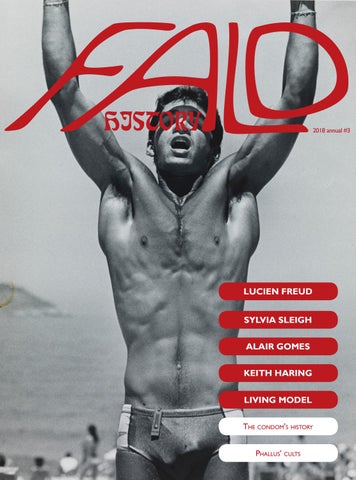
HISTORY
2018 annual #3
1
LUCIEN FREUD SYLVIA SLEIGH ALAIR GOMES KEITH HARING LIVING MODEL The condom’s history Phallus’ cults
FALO© is a bi-monthly publication. january 2019. editing, writing and design: Filipe Chagas editorial group: Dr. Alcemar Maia Souto, André Guimarães and Guilherme Correa. cover: Photo from Beach tripych nº 7 by Alair Gomes. Ipanema, Rio de Janeiro, 198-. Collection from Fundação Biblioteca Nacional - Brasil.
Care and technique were used in the edition of this magazine. Even so, typographical errors or conceptual doubt may occur. In any case, we request the communication (falonart@gmail.com) so that we can verify, clarify or forward the question.
Editor’s note on nudity:
Please note that publication is about the representation of masculinity in Art.There are therefore images of male nudes, including images of male genitalia. Please approach with caution if you feel you may be offended.
Rights and Commitment:
This magazine is committed to artists retaining copyright of their own work. All rights are reserved and therefore no part of this magazine may be reproduced mechanically or digitally without the prior written permission of the artist. We have been careful to ensure that the images used in this publication have been provided to us by the creators with copyright permission, or are copyright free or are being used under the “fair usage” protocol shared over the internet (images are low resolution, attributed to their creator, not for profit and used only to illustrate a relevant article or story). If, however, you feel your image has been used by us unfairly and your copyright breached, please contact us at falonart@gmail.com and we will proceed in the best way possible.
Editorial
H
ere is the third and final part of the annual english version of Falo Magazine: FALO HISTORY! Woohoo!
The idea of the magazine since its beginning was not only show contemporary artists that work with the male nude but also show through exemples from the past that this theme is very important to Art History. So this annual brings incredible names like Lucien Freud, Sylvia Sleigh, Alair Gomes and Keith Haring. It also brings a chronicle about the institutionalizaton of Art explaining all the procedures of learning and teaching art, specially through the living model classes where nudity was allowed. Because of this chronicle I knew a profesional model that gave me a new prespective about his work and profesion itself. I think it is mindblowing! My column Phallorraghia talks about the culst of the phallus and how ancient societies had a different view about the penis. The journalist André Guimarães signed the column Phallocampsis (this name is explained in the end of it) with the interesting story of the condom.
Summary PRESENTATION In public domain As usual the session moNUment brings two models. This time I invite you not only to look at bodies but also the composition of the spread. Look that the photos are almost the opposite: head up and head down, tall and short, BW and colors, hairy and smooth, more posed and more regular. The idea is to show everybody the diversity of shapes and images a male body can express through Art. And the model with colors is Allan Lucena, one of the collaborators of the magazine. In 2018 he wrote poems and texts. Now he gives us his opinion about the cycles of life in the matter of nudity. That’s it. Don’t forget to take a look at the first two parts (FALO ART and FALO PHOTO). In March the new issues will return. I really hope you enjoyed this project. It’s almost a life savior for me and I know its potential to help and teach everywhere. Please forgive me about the english cause it’s not my first language and I had to translate everything by myself (and Google of course). Thank YOU so much! See you soon! Filipe Chagas, editor
Lucien Freud
Sylvia Sleigh
Alair Gomes
Keith Haring
The Living Model Teaching SPECIAL To be a living model PHALLOCAMPSIS The condom’s history PHALLORRHAGIA Phallus’ cults OPINION Cycles to break and to keep moNUments
4 10 22 32 46 58 74 86 94 100 102
PRESENTATION
In public domain On July 15, 2017, the performer Maikon K was presenting his DNA de DNA at the square of the National Museum of the Republic in Brasília, when police officers took him arbitrarily to the police station: he was detained for an obscene act, apparently based on moral scandal of some random people, even though he had an authorization for the presentation. They used violence. A sergeant grabbed me with an arm-wrench and didn’t let me carry my shoes and documents. No one was able to join me in the car, I was punched in a trunk with a spare tire.
4 DNA de DAN performance, realized in 2016 at Paraná. Photos: Guto Muniz.
Both the Military Police of the Federal District and Sesc (the art institution) manifested themselves in a note about what happened. In the PM version, they went to the scene after being told by passers-by that they had seen “a naked man” around the museum. The police officers were informed that it was an artwork, but no documentation/authorization was presented. The note issued by Sesc says that “the prohibition of the performance in Brasilia, the material damages to the work and the arrest of the artist constitute an arbitrariness that puts at risk not only the freedom of expression, assured by the Brazilian Constitution and by international documents of which Brazil is a signatory, but interferes with the cultural rights of the public.”
DNAde DAN is a dance-installation created by the artist in 2013, where Dan is the African ancestral snake that origins all forms and represents the body rituals of passage, symbolized by the skin change of the snakes. Inside an inflatable environment created by the artist Fernando Rosenbaum – in which the public can enter and remain –, Maikon stands still and breathes minimally with the naked body covered by a liquid substance (developed by Faetusa Tezelli) that, when dries, becomes a kind of second skin. Then, when it is no longer possible to breathe so little in the plastic bubble, he begins a dance to make the stiffen “skin” looses from the body. In 2015, DNA de DAN was selected by the Serbian artist Marina Abramovic to join the “Eight Performances” show, in the exhibition Terra Comunal. After his release, Maikon stated: My body confronts your clogged channels, your contained hate, even when standing. Because you’ll never control me and I’ll pay the price, I know, I always paid. Because standing there, naked, motionless in the
middle of the square, your voices pierce me, your stupid jokes try to knock me down, your indifference makes me laugh, your embarrassment pitiates me, but I still stand. This work reverberated in the art world. Brazil saw a growth of “art critics” defining the frontiers of art in a radical way, supported by tools of social networks and fundamentalist political-religious dogmas. In September, Santander Cultural of Rio Grande do Sul canceled the exhibition Queermuseu - Cartografias da Diferença na Arte Brasileira after violent demonstrations against an art called “intolerant” and “zoophile”, capable of corrupting children. With 270 works by artists such as Alfredo Volpi, Adriana Varejão, Cândido Portinari and Ligia Clark, among others, the exhibition aimed to explore the diversity not only of the expression of gender, but also of creeds and ethnicities. What the exhibition revealed was a clear unpreparedness of the public before the Art itself. Perhaps because of arrogance, elevating
5
itself as conceptual and independent of its relation with the public for its existence, Art has forgotten its History and increased the abyss between the production and its spectators. Only provoking or causing any feelings is no longer sufficient in a world where indiscipline and lack of education are slogans. However, it is Art’s role to extend discussion and test boundaries for collective reflection.
6
In the same month, one more case: a video spread on the internet showed a little girl accompanied by her mother touching the feet of a naked performer. The torches of morality lit up.Virtual sticks and stones became death threats to the artist, and Art as a whole became degenerate. The militias of hatred, in the service of themselves (and of some politicians and religious people), made an ignorant scene of lynching and reproduction of lies and slanderous paradoxes, creating evidence against themselves. The performance La Bête, created in 2005 by the artist Wagner Schwarz, is a new look over the series Critter, the geometric figures with hinges considered an art classic by the Brazilian artist Lygia Clark. The artist begins the performance by manipulating a plastic replica of a Critter. After some time, he asks the audience – until then just spectator – if they want to participate and offers his naked body to them as if it were the replica of the replica. Each presentation becomes different from the other because it is the audience that tells a story created collectively. The event took place within the 35th Panorama of Brazilian Art, in the Museum of Modern Art of São Paulo, in a closed
Images from the exhibition Queermuseu, at Porto Alegre: Travesti da lambada e deusa das águas (Bia Leite, 2013), “A”, Not “I” (Cibelle Cavalli Bastos, 2016) and Cena de interior II (Adriana Varejão, 1994). Photos from divulgation.
Still from the video filmed during La Bête performance of Wagner Schwartz, at MAM-SP, where Elisabete Finger and his daughter are shown. Photos: Internet.
presentation with notices about the artist’s nudity. The mother – performer Elisabete Finger – took her daughter to see the perfirmance, but the (criminally) publicized video turned her into an “irresponsible” while Wagner became the “MAM pedophile”. Both were treated as criminals and had to testify. In his first interview, five months after the incident, Wagner said: Art is a territory out of control, but the fragment of the performance – not THE performance – disconnected from our proposal has been recontextualized to articulate conservative ideological labels such as “the Brazilian family” or “our children”.This performative act also exists as an experience, but instead of expanding the relationship of people in the world, it silences it through fear.This performative act does not propose emancipatory images, but doctrines and reduces an open concept to the private property of the beliefs of a specific group of people. [...] In the image of a fragment, what exists is a brief clipping that can no longer be called performance. In the image of a fragment it is not possible to understand the context of a performance. A cut, the result of a personal choice, can become authoritarian, when it takes the place of everything it does not show.
7
In October, Maikon K returned to the street, armed with all the necessary authorizations to defend DNA de DAN, in Londrina, Paraná. The plot repeated itself: the police arrived, threatening to take him. “I looked around and asked the audience if they were going to let that happen again”, he says. They did not. The public made a cordon of isolation that protected Maikon from the police approach. It might seem like a fresh start, but the campaign against Art and the artists is nothing innocent. Also in October, the mayor of Rio de Janeiro, Bishop Marcelo Crivella, made a video of his veto on the coming of the Queermuseu exhibition for the city using a moral justification (religious) to achieve popular support that would sustain the reduction of investments in Culture. That means it is the victory of ignorance when, instead of the population asking for more investment in Culture, part of it attacks the Art, practically claiming the narrowing of its own life and the life of its children. At least this time the shot backfired. The School of Visual Art of Parque Lage, in Rio, decided in January 2018 to bring the exhibition through crowdfunding. Whether for an act contrary to the mayor or for much of the population have noticed the return of censorship, the exhibition hit the collection goal and set a record in crowdfunding. Besides the exhibition, the School decided to use the surplus to establish dialogues with the population about everything that has been happening in the Art.
8
Also in January, Maikon, Wagner and Elisabete, together with Renata Carvalho (the transvestite actress who continues to have her play canceled for interpreting Jesus), were invited by the curators of the Curitiba Festival, Guilherme Weber and Marcio Abreu, to give an artistic response to the occurred in the previous year. In March, they presented Public Domain, a play that speaks of art, more specifically the Mona Lisa painting by Leonardo Da Vinci. Throughout the history of its theft of the Louvre, the four actors stand before the public – without the intermediation of digital platforms, computer screens or cell phones – and point out situations that make us reflect what happened to them: the function of art and artist in society, the fabrication and manipulation of history, information and truth, and the consequences of ignorance, such as intolerance and violence. Image of divulgation.
Those who expected a more aggressive response and explicit nudity as a political act had the impact of a direct and very didactic presentation. The in-between lines and ambiguities were dissolved in the (sur)reality of an ironic humor from historical facts loaded with doubts and mysteries. For example, would Mona Lisa be a man? Renata asks if the famous face would be the lover of Da Vinci or a self-portrait of the painter, becoming a transgender representation. Wagner compares the pejorative nicknames that received Vincenzo Peruggia, called a “thief” for having taken the Mona Lisa from the Louvre in 1911 and taken it to its homeland Italy, believing it to be a patriotic act. It is easy to assume that the incident caused a commotion because it was “the most famous painting in the world”, but at that moment it was not: it was the media coverage of the robbery that turned it into a celebrity as movie stars and singers. Its image began to appear on film newscasts, chocolate boxes, postcards and commercials. Crowds began to go to the Louvre just to see the empty space where the picture used to be. Before that, a lot of people had never seen it. This void is seen in the play’s scenario that counts only with a projected image of the masterpiece. The negative repercussions also transformed all involved. Their names became more known, the works in the Queermuseu are searched and reproduced throughout the Internet with a probable increase in their values. Together they faced the traumas of the past and became stronger. It is in this place that Art should not settle but continue to strengthen in the collective, teaching as in the play and understanding itself as an object of public domain. 8=D
Photo: Annelize Tozetto
9
Informations from: Blog do Arcanjo, Fecomercio’s website, Jornal Nexo, Cena Contemporânea’s website, Bocas Malditas’s website, Trip Magazine, El País, Festival de Teatro de Curitiba, O Globo online, Folha de São Paulo e Revista Continente, between 2017 and 2018.
10
Lucien
11
Freud 1922 - 2011
Naked man with a rat, oil on canvas, 1977.
S
on of Jewish parents – the architect Ernst Ludwig Freud and Lucie Brasch –, Lucien Michael Freud was born in Germany in 1922. To escape Nazism, his family fled to London in 1934 and obtained British citizenship in 1939. And yes... the surname is the same as his grandfather, Sigmund Freud!
12
He studied until 1942 at the Central School of London and, in the following years, already illustrated a book of poems and set up an exhibition at the Lefevre Gallery. Freud’s early paintings are often associated with German Expressionism (which he always refused to accept) and Surrealism for presenting people and plants in unusual juxtapositions. However, there is a Reflection (self-portrait), oil on canvas, 1985. general consensus among critics that he has absorbed the avant-garde developments of Berlin and modernist Vienna from an early age. In fact, comparisons were made between his works and the blunt figuration of the members and the pale coloring of Ferdinand Hodler, the frigid eroticism of Gustav Klimt, the macabre portrait of Oskar Kokoschka, and Egon Schiele’s appreciation of the flexible human form.
Naked man on a bed, oil on canvas, 1987.
13
Painter and model, oil on canvas, 1987.
His works were done in a very delicate and linear way until the beginning of the 1950s when he began to paint with a strong inclination towards expressionist realism. He became part of a collective called the London School, alongside Francis Bacon, which was actually a group of artists who knew each other and worked figurative painting in the midst of the boom of abstract painting. His brushstrokes became thicker because he wanted to work with textures. He even cleaned his brush with every stroke, making the colors constantly different, but typically pale.
14
Two men in the studio, oil on canvas, 1989.
Freud’s portraits usually represented the models, sometimes naked on the floor or in bed with a pet, from a “higher view”, for he always painted standing or sitting in a high chair. For him, nudity was the person as he is, in his vulnerability and sensuality, describing it at last in his inner form:
I paint people not by the way they look, not exactly regardless of who they are, but how they eventually look like. As he demanded the presence of the models while he was painting even the background, he ended up known for long periods and only his friends accepted to model for him. It is known that a nude made in 2007 took sixteen months and the model was every night with Freud. The painter only finished when he felt that he was “painting the work of another person”. Along with his well-reserved and antisocial style (once he slept in a stable for preferring horses to people), his themes were generally of people in his life: friends, family, love, children, whether men or women.
15
Sunny morning - Eight legs, oil on canvas, 1987.
16
Painter working, reflection, oil on canvas, 1993.
The subject is autobiographical, everything has to do with hope and memory and sensuality and involvement, for sure. The recumbent posture of his portraits could come either from this excessive painting time or from a direct relationship with his grandfather’s divan, which is not certain, but art critics tend to push this psychological connection. Over time, he sought the almost complete exclusion of everything around in forgettable, almost irrelevant scenarios, as the color of the skin stood out to the detriment of the rest of the painting. In the 1980s, friends took him to Taboo nightclub hoping to make Freud abandon his monotonous colors. There he met Leigh Bowery and “Big” Sue Tilley and both became their models because Freud believed they were “perfectly beautiful” in their bodies. Freud even asked that Leigh shave his whole body and often portrayed him in feminine poses to bring the unusual to the conventions of the male portrait. In 1995, one of the paintings with Sue naked on a sofa was sold for more than 30 million dollars, beating a record sale to a work of a living artist.
Freud and Leigh at his studio, photo from Bruce Bernard, 1992.
Man with leg up, oil on canvas, 1992.
17
18
Naked man, back view, oil on canvas, 1992.
19
Leigh Bowery seated, oil on canvas, 1990.
David and Eli, oil on canvas, 2004. Below: Portrait of the miserable (or hound), oil on canvas, 2011.
20
Both are portraits from David Dawson, his assistant for 20 years. The pain below, his last piece, was not complete.
He received the Turner Prize in 1989, but did not escape the criticism. “Extremely uncomfortable” is what is most talked about in Freud’s work, because of the crude nudity of absent sexuality that seems to penetrate intimately into the desires and fears of the spectators. He died in July 2011, not without first becoming one of the best-known British artists because of his perception of human form. 8=D
Plastic Surgery for you!
Dr. Alcemar Maia Souto CRM 5246681-1
+55 21 97395 8000
alcemarmaiasouto@gmail.com
Sylvia Sleigh 1916 - 2010
22
23
Imperial nude: Paul Rosano, oil on canvas, 1975.
S
ylvia Sleigh (1916-2010) was a realistic painter born in Wales and naturalized American. She studied painting at Brighton Art School at a time when art students were, as she recalled, “treated in a second-class way”. After finishing her studies, she worked at a women’s clothing store and said she was proud of undressing Vivien Leigh. She opened her own shop in Brighton, making hats, coats and dresses, but closed when World War II began.
The bride (Portrait of Lawrence Alloway), oil on canvas, 1949.
24
Paul Rosano reclined, oil on canvas, 1974.
She moved to London in 1941 after his first marriage to Michael Greenwood and returned to painting. Her first exhibition took place in 1953 at the Kensington Art Gallery with still lifes, landscapes and portraits, in oil or watercolor, but remained in obscurity. She met his second husband, curator and art critic Lawrence Alloway (who gave name to Pop Art), while she had evening classes at the University of London
Turkish bath, oil on canvas, 1973.
25
and he was her muse; they married in 1954 and moved to the United States in 1961. Together they created a house that received artists, writers and musicians, many of whom Sylvia painted in works that radiate a sense of friendship and emotional attachment between the artist and his assistants, besides presenting a series of significant cultural figures of the time. Around 1970, from feminist principles, Sylvia painted a series of works reversing stereotyped artistic themes by placing men in traditionally feminine positions, such as a reclining Venus or an odalisque. Some of her works alluded to existing works, such as her version (1973) of Ingres’s Turkish Bath (1892), where she portrayed her husband and other art critics. Her husband, reclining and looking at the painter – and, consequently, at the viewer – offers us an intimate look, a glimpse of his personal relationship.
26
Philip Golub reclined, oil on canvas, 1971.
Reclining Philip Golub (1971) refers to The Rokeby Venus, by Velázquez. This work also presents a reversal of the Western canon and it’s central to reflect on the position of women throughout the history of art. Throughout her career, Sylvia has painted more than thirty works that feature her husband as the theme, reversing the woman as an artist rather than model or muse. In her male nudes, the subject is portrayed as a vehicle for expressing erotic feelings, just as male artists represented the female nude. In the pieces Paul Rosano reclined and Imperial Nude: Paul Rosano it is possible to see the individual portrayed in feminized positions to speak of these sexualized preconceptions. Other works equate the role of men and women like Concert Champêtre (1976) in which all figures are naked unlike their namesake made by Titian, where only women are naked. As she explained:
Next page: The court of Pan, oil on canvas, 1973.
I feel that my paintings show the equality between men and women, between women and men. I wanted to give my perspective, portraying the two sexes as intelligent and thoughtful people with dignity and humanism who emphasized love and joy. It was very necessary to do this because it has always been difficult to have any profession of prestige in our patriarchal chauvinist society. Even more so for ambitious painters who wished to work the most respected subjects, such as painting nude models, whether they were female or male. When I became aware of this situation in the 1960s, I made a point of finding male models and painted them as portraits, not as sexual objects, but sympathetically as intelligent and admired people, not as women were so often portrayed as idealized virgins with no personality or objects of desire in humiliating poses. I do not care about the “desire” part, it’s the “object” which is not very cool. 27
28
Concert ChampĂŞtre, oil on canvas, 1976.
At a time when feminist discourse was emerging, her painting highlighted social and historical gender inequalities at the level of what is or is not considered acceptable representation. She used it as a tool to induce, through the memory of famous paintings, an effect of estrangement (or detachment) to show that what we perceive as natural is, in fact, an ideologically charged convention. His painting Lilith (1976), for example, created as a composition of a collaborative installation, depicts the overlapping bodies of a man and a woman to elucidate the fundamental similarities between genders. But it was not only this reversal of roles that highlighted Sylvia’s art. Her paintings brought back 19th century Realism through her habit of registering body hair in meticulous details, marks of tanning and fashionupdated attire such as ripped jeans and slippers. The backgrounds of her paintings did everything to highlight the bodies. The use of patterns (as part
29
Lilith, oil on canvas, 1976.
30
of the fabric of furniture, wallpaper, or a lush and mature garden) becomes an optical effect of almost abstraction from perspective, with the clear intention of working against the idealization of beauty.
universities documenting the rise of the feminist art movement. In an interview in 2007, it was asked whether gender equality issues in the mainstream art world and in the world at large, had changed for the better. She answered:
In 1999, she completed his most ambitious work that had lasted 20 years: a large-scale pastoral that reminded Watteau. Invitation for a trip: The Hudson River at Fishkill consisted of 14 continuous panels that extended to a length of 20 meters, representing a group of friends gathered on the banks of the Hudson River near the train tracks, some picnicking on the grass, others walking or resting on the arcade of the river.
I think things have improved for women in general, there are a lot more women in government, law and corporate jobs, but it’s much harder in the art world.There’s more that needs to be done to make men and women treated as equals in the world of art.
Sylvia was the founder of SOHO Art Gallery and participated in the Artists in Residence Gallery, two women-only cooperative galleries. She painted a series of portraits of female artists (naked and dressed) and even taught at American
Her feminine gaze on the perfect imperfections of both genres has until today a strong impact on the viewers and the formal qualities of her painting are touchingly contemporary. She passed away in 2010 because of the consequences of a stroke, but in the last two decades of her life she has gained recognition in the artistic community and feminist movements. 8=D
Invitation to a voyage:The Hudson River at Fishkill, oil on panels, 1979-1999.
NY
SIGHTSEEING TRANSFER PHOTOGRAPHY VIDEO
31
We truly LOVE what WE do and WE want to serve YOU whenever YOU want.
w w w. t o u r g o r d o n . c o m tourgordon212@gmail.com
+1 551 221-0341
Mehmet
32
Alair Gomes 1921 - 1992
33
Symphony of Erotic Icons: Fragment nº 3. Collection from Fundação Biblioteca Nacional - Brasil.
D
espite his intellectual work in several areas, Alair Gomes (1921-1992) is best known for his photographs of seminaked male bodies with homoerotic load, taken in the 1970s and 1980s. Hervé Chandès, director of the Cartier Foundation for Contemporary Art, said in 1991:
In male nudes, there is nothing comparable today in the world of photography to the work of this Brazilian artist.
But Alair de Oliveira Gomes was much more than that. He was born into a middle-class family in Valença, moving to Rio de Janeiro as a child. He graduated in Civil and Electrical Engineering from the National School of Engineering of the University of Brazil (now Federal University of Rio de Janeiro) in 1944 but from his youth he wanted to become a writer, mirroring himself in names such as Arthur Rimbaud and D.H. Lawrence, whose works he admired for boldness in the treatment of intimacy. In 1946, he founded the magazine Magog, next to the poet Marcos Konder Reis. In 1948 he left engineering to devote himself to the autonomous research of Philosophy of Science, Aesthetics and History of Art. He began his Erotic Diaries, intimate diaries written by hand and in english (to “hide information” as he felt exiled), in which he related his erotic-loving experiences in detailed descriptions or, as he usually said, “pre-photographic” .
34
Intimate Diary EX-ALTO I, [198-]. Font: Exhibition “Alair Gomes, muito prazer”. Collection from Fundação Biblioteca Nacional - Brasil.
The erotic is a kind of supreme affirmation of existence! From 1958 he was assistant professor of the Biophysics Institute Carlos Chagas Filho of the Federal University of Rio de Janeiro. In 1962, with a one-year scholarship from the Guggenheim Foundation, he studied and taught at Yale University in the United States.
Symphony of Eroctic Icons (self-portrait). Collection from Fundação Biblioteca Nacional - Brasil.
35
Only in 1965, at the age of 44, the artist venture into art and architecture photography while in Europe, charmed by the look of the classical Greco-Roman statues that became his main imagery resource.
36
Symphony of Erotic Icons: Fragment n.10 and/ or Adoremus n.10, from Opus Three. Collection from Fundação Biblioteca Nacional - Brasil.
The final resolution to start practicing photography systematically must have been mainly due to the need to pay homage to what I understand as the central theme of my photography, which is the image of the young man, the image of the male body.This fascination, of course, was much earlier than my beginning in photography. And precisely because it was a visual fascination, he attempted initially through more conventional visual arts. [...] And my attempts were meant to be always mediocre. However, I felt a kind of obsessive need for a homage that I would also call expression. [...] I had a desire to produce more and more images of this genre.The image of the male body, young and beautiful, almost suffocated me. (In an interview with Joaquim Paiva, published by Revista Zum in 1983) Alair began obsessively producing images of boys in long sequences that would make him one of the forerunners of photographic homoerotism in Brazil. He took models (from boys on the beach to prostitutes) to the improvised studio in the living room of his apartment, daring more and more to portray erect penises and used condoms (Symphony of Erotic Icons series with almost 1800 photos).
37
Symphony of Erotci Icons [From Opus Three]. Collection from Fundação Biblioteca Nacional - Brasil.
38
Symphony of Erotic Icons: From Book of Erotic Icons. Collection from Fundação Biblioteca Nacional - Brasil.
39
Symphony of Erotic Icons: Fragment n.10 and/or Adoremus n.10, from Opus Three. Collection from Fundação Biblioteca Nacional - Brasil.
40
Sports series. Rio de Janeiro, 1968. Collection from Fundação Biblioteca Nacional - Brasil.
Sports series, Lagoa Rodrigo de Freitas, Rio de Janeiro, RJ, 1968. Collection from Fundação Biblioteca Nacional - Brasil.
Burle Marx’s grange,Vargem Grande, Rio de Janeiro, 1968. Collection from Fundação Biblioteca Nacional - Brasil.
41
In the series Sports, he extracted an iconography that emphasizes the beauty, the physical force and the sensuality of masculine bodies in physical activities. Alair also methodically annotated all his photographic work: type of lens, film, time of exposure, time of revelation; the contemplation of his images was to relive the process pleasantly. However, his photographic work went beyond the male bodies. In 1968, for example, he was hired by Burle Marx to register botanical species of his grange. He portrayed the 10th São Paulo Art Biennial in 1969, did a series on the Rio de Janeiro Carnival for twelve years, and until the 1980s worked as a theater photographer. In 1977 he created and was coordinator of the Photography Area of the Visual Arts School of Parque Lage, where he also taught. For him, it is in static images sequence that photography differs from painting and cinema, creating its autonomous artistic language, as he did in the Non-story of a chauffeur series.
Next page: 18 photos from Non-story from a chauffer series. Rio de Janeiro, RJ, 1975. Collection from Fundação Biblioteca Nacional - Brasil.
42
43
The images obtained secretly from a window of his apartment in Ipanema in a voyeuristic aesthetic were called Sonatinas Four Feet. “My window gives a true flow of boys who go to the beach and come from it”, he wrote in his diary. “I’m always looking”. Over time, as he got over the shyness, Alair began portraying the Ipanema Beach gymnasts from the sidewalk and then from the sand itself, in the Beach Triptychs.
44
He produced about 170,000 negatives and 16,000 enlargements from the 1960s to the end of his life in 1992. He played a role in his production by developing theories about intimacy and the exercise of pleasure as political acts. He made his first solo show – Sequential Photography – at Galeria Cândido Mendes only in 1984 in Ipanema and only came to obtain international acclaim in 2001, nine years after his cruel murder: he had been strangled in circumstances unrecorded to date (it is believed that the probable killer was one of his models, for whom the artist was in love).
Beach tripych nº 7. Ipanema, Rio de Janeiro, 198-. Collection from Fundação Biblioteca Nacional - Brasil.
Sonatina, four feet nº 6. Ipanema, Rio de Janeiro, 198-. Collection from Fundação Biblioteca Nacional - Brasil.
45
Most of Alair Gomes’s estate is in the National Library of Rio de Janeiro, but the artist is also part of the collection of the Modern Art Museums of Rio de Janeiro and São Paulo, Itaú Cultural, the Pirelli / MASP Collection, the Cartier Foundation, Paris and MoMA in New York. 8=D
46
Keith 1958 - 1990
47
Haring Keith Haring, photo from Annie Leibovitz.
K 48
eith Haring (1958-1990) was an American graphic artist and social activist, considered an icon of street art and underground culture in New York in the 1980s.
He was born in Pennsylvania, United States, into a middle-class family, and his interest in art came early because of his father, an amateur engineer and cartoonist, and classic cartoons by Walt Disney, Charles Schulz and Dr. Seuss. After high school in 1976, Keith enrolled in a graphic design school in Pittsburgh, however, showed no interest in its commercial direction and preferred to study independently. He then knew the work of two artists who led him to think of a visual language in greater proportions: the Belgian Pierre Alechinsky and the Bulgarian Christo. From Alechinsky, Keith gained the confidence to create more calligraphic images, while Christo made him see the possibilities of involving the general public in his art. In 1978, he made his first solo exhibition at the Arts and Crafts Center in Pittsburgh. That same year he moved to New York and entered the School of Visual Arts, where graffiti scattered throughout the city and the study of semiotics had a profound impact on his creative process. It did not make sense for him to be a studio artist to present the works in the closed circuit of the galleries. With the subversive idea that art is for everyone, he challenged himself to use the space of the street where everyone passes by and can see. In 1980 he began making white-chalk drawings on the empty black panels reserved for advertising at New York subway stations.
He developed his own vocabulary, which followed some of the precepts laid down by Warhol, Liechtenstein and Rauschenberg’s Pop Art in the 1960s. He used thick, continuous and simplified but extremely intuitive lines, forming silhouettes devoid of detail. His figures were bold and dynamic and entertained viewers, such as the “Barking Dog” and the “Radiant Baby.” Some critics said that Keith modernized rock painting, taking it out of the cave into the urban subsoil and offering a means of expression to the younger generation. Quickly his flying saucers, people intertwined or with holes and other mysterious designs were gaining notoriety, since some saw him create his works or being arrested for doing it.
The variety of people who saw the work brought with it a variety of answers, different ideas about what I was doing.Then the subway became the perfect environment, a laboratory for the work I had been developing. The flying saucers, the pyramids... became a vocabulary of universal archetypes. I was trying to use images that permeated every culture in history. (Documentary of 1989)
Self-portrait as an homage for Liechtenstein, the “Barking Dog” and the “Radiant Baby”.
49
50
Above: Glory Hole, acrilic on canvas, 1980. Below: Self-portrait with Juan, acrilic on canvas, 1988.
51
In 1981 Keith Haring held his first solo exhibition in New York and the following year made his grand debut in a gallery in Soho. Quickly he was a friend of Warhol and Basquiat, and participated in exhibitions and performances in the avant-garde Club 57 with great media repercussion. Among the most approached concepts by the artist were birth, death, war and sexuality (mainly homosexuality and prostitution). The replacement of the positive astral from the beginning of his production to works of strong political appeal within these controversial subjects made him one of the most celebrated and controversial artists of the time.
52
As I began to understand how I was communicating, I became more aware of what exactly I was talking about and stopped making only illustrations with abstract features to try to guide people to see certain things related to society. (Documentary of 1989)
53
His international recognition came with the exhibition at Documenta 7 in Kassel, Germany (1982), the Biennial of São Paulo (1983), the Biennial of the Whitney Museum in New York (1983), and the painting of the West Berlin Wall in 1986. In these international trips, Keith came into contact with other cultures and realized the universality in his artistic language when seeing African and Aboriginal works. He also created luminous panels in Times Square, stage sets, advertising campaigns (for Absolut vodka, for example) and developed a series of products based on his art (such as Swatch watches). In 1986 he opened Haring’s Pop Shop (photo below), a store where he sold toys, t-shirts, pins, mugs, and various objects with his art applied in it, realizing that the commercial direction he had abandoned at the beginning of his career was, in fact, a potential enhancer of his artistic messages. 54
I needed to follow the path that my art went: to become part of mass culture rather than to return to the closed art world from where I came out from the very beginning. (Documentary of 1989)
Throughout his career he devoted much of his time to the elaboration of public works – whether murals or sculptures – who often passed on social messages to charities, hospitals, nurseries and orphanages. In 1988, in an interview to the Rolling Stone Magazine, Keith stated that he had the HIV virus. He then created the Keith Haring Foundation with the goal of supporting children who are victims of AIDS. In 1989, Keith made one of his last works, a mural titled Tuttomundo, dedicated to the peace and harmony of the world, installed on the south wall of the church of St. Anthony in Pisa, Italy.
55
All the things you do are a kind of quest for immortality. Because you are doing these things that you know have a different kind of life.They do not depend on breathing, so they last longer than any of us.What is an interesting idea, is a kind of extension of your life to a certain extent. A more holistic and basic idea of ​​wanting to incorporate [art] into all parts of life, less as a selfish and more natural exercise in some way. I can not explain it exactly. Taking off the pedestal. I’m giving back to people, I guess. (1988 interview at Columbia University) He died in New York, a city he chose and consecrated at age 31 due to HIV-related complications. 8=D
Tuttomondo, mural at Pisa, 1989.
56
57
58
The Living Model Teaching
59
Interior from David’s studio at Collége des Quatre-Nations, oil on canvas from Léon-Matthieu Cochereau, 1814.
L
iving model is understood as the artistic productions whose main object is the direct study of the human figure, almost always nude. The term doesn’t refer to a specific and isolated genre of painting, but to one of the most important stages of a method of learning formalized in European art academies from the second half of the 17th century and kept intact by most of them until, at least, the 19th century. However, the interest in the record of the human figure can be traced from the beginning of the earliest prehistoric visual expressions in caves or clay. All ancient civilizations also have their representations of the human figure with specific characteristics, such as the Egyptian Frontality Law. The difference lies in the act of posing, meaning, in the act of being placed as an object of observation for an artist.
60
The drawing class, oil on canvas from Michael Sweerts, 1658.
The history of living model’s teaching is directly linked to the institutionalization of art and therefore to the transition from the arts into guilds sanctioned by the Church into a state-sponsored teaching system. It was a change not only pedagogical, but also social and conceptual, in which education went from the private to the public, from practice to theory.
Sculpture workshop, relief in marble from Nanni di Banco, 1416.
CHANGE AND LEARNING The classical arts had their theories and forms of teaching (Mathematics, Naturalism, etc.), but the few records make historians believe in an absence of regulation. Centuries later, the Church reassigned the teaching of art to a private technical system, relegating art to the “manual” plan (the Crafts). At first the purity of human creation in Paradise was portrayed in the nakedness of Adam and Eve. The nude body, formerly glorified in antiquity, then became impure and intolerable. In the Middle Ages, by the 11th century, the commercial renaissance gradually replaced the familiar model of production for subsistence by a production for the market. It was in this context that guilds began to emerge, bringing together professionals of the same specialty who could only perform their activities within a specific locality – it was forbidden to work or sell in other cities. Generally, the production was done by an independent master craftsman who sold in his workshop/house to a small market. If the master craftsman became known, he would have the opportunity to live by his craft and even have helpers to increase his production.
Becoming an apprentice was fundamental to the one who wanted the artistic career, because it was necessary to be linked to the guilds of the desired craft to receive the appropriate learning. To this end, an agreement was made between the apprentice’s father and the master craftsman: the secrets of the workshop would be passed on for a small sum of money, food, effort and obedience. The apprentice then served the master for years, while learning all about the craft through practical training, such as – in the case of painting workshops – preparing pigments for the composition of the paints, putting the linen cloths on the chassis and washing and repair brushes. He also received rudimentary teachings of reading, writing and arithmetic. After years, by master’s decision, the apprentice began to participate more directly in the artistic work, transferring the sketches to the screens and executing bases and less relevant parts of the pieces. Finally, he performed complete works from instructions and reached the assistant level. To become a master, it was needed to have a work approved by the guild through a formal request.
61
RENAISSANCE IN HUMAN ANATOMY In the 14th century, society was steeped in a whirlwind of new conceptions, motivated in part by the substitution of dogmatic knowledge for the scientific one. The geniuses of the Renaissance wanted to measure, compare, dissect, draw, smell, elaborate new theories and advance the frontiers of knowledge where their ancestors did not dare, even over death.
Engraving from Jan Stephen van Calcar for the De humani corporis fabrica, 1543.
62
It was necessary to discover the mechanisms that kept men alive and it was not enough to follow the work of the ancient Greek scholar Galen of Pergamus (129-217) who since the 2nd century had guided human anatomical knowledge. However, Galen had based his conclusions on the study of mammals (supposedly dogs, pigs and monkeys) since human dissection was taboo in ancient Greece. This practice was resumed and exerted decisive influence not only on medicine, but also on the art then produced, forging a surprising partnership between the two areas. Finding a scalpel in the studio of some painter or sculptor was common. Some eventually became part of the medical and pharmaceutical associations, drawing to scientists their findings. This interest was reflected in a wave of publications about the theme throughout Europe which culminated in the 1543 edition of De humani corporis fabrica, the anatomy atlas of Belgian Andreas Vesalius (15141564) until now admired by the combination of content and image, regarded as one of the greatest contributions to the medical sciences. Among the renaissance geniuses were Leonardo da Vinci (1452-1519) and Michelangelo Buonarroti (14751564). Both obtained permission to dissect bodies at the Florentine Monastery of the Holy Spirit. Human dissection was forbidden and considered a desecration of the dead
63
during the pontificate of Boniface VIII (between 1294 and 1303), but Sixtus IV (who pontificated from 1471 to 1484) had authorized the practice in the bodies that would be buried in the churches with the guarantee that they were buried decently after that. Most of the bodies were executed criminals, but some came from religious hospitals. This collaboration ended up being one of the few legal accesses to corpses, since many were simply stolen by those interested. Da Vinci became famous as the great artist/anatomist of the Renaissance precisely because his illustrations presented a technical detail that impresses to this day. There is a hypothesis that places Vesalius’s work as a plagiarism of the anatomy manual that was being prepared by Marcantonio della Torre, a professor at the Medical School of Pavia, and Leonardo da Vinci. The doctor did the analysis and Leonardo, the figures. After the death of Della Torre and the launch of the Fabrica, the duo’s manual was not continued, but some of Da Vinci’s illustrations included the Trattato della
The anatomy lesson of Dr. Tulp, oil on canvas from Rembrandt van Rijn, 1632.
Frontal male nude. Highlight from a study for “Adam’s creation”, sanguine from Michaelangelo to the Sistine Chapel, 1510.
Pintura, a post-mortem collection of the artist’s writings on drawing and painting.
64
Under the patronage of Lorenzo de Medici, Michelangelo came in contact with scientists who whetted his curiosity, leading him to dissection sessions. At eighteen he was not only a trained artist but also an anatomist who was fully versed in the techniques of dissection. In his early twenties, he was already a famous sculptor. If Michelangelo had not destroyed most of his studies, he might have been considered an anatomist more impressive than Leonardo. However, it is necessary to know that Da Vinci and Michelangelo could only reach their potential because the virtuous Italian architect and poet Leon Battista Alberti (1404-1472), between 1435 and 1462, had launched three treatises of theoretical foundation of art – Della Pittura (1435), De re aedificatoria (1454) and De Statua (1462) – where he placed geometry as the basis of figurative art and pointed out the paths of perspective and human proportions. It recommended the scientific study of human
anatomy and divided the teaching into three parts: circumscriptio (or disegno), the drawing of strokes and contours; compositio (or commensuratio), the design of the relations between the parts of the drawing; and receptio luminum, drawing of color, light and shadow. When painting the nude, it begins with the bones, the muscles are joined, and then the body is covered with flesh in such a way as to make visible the position of the muscles. It may be objected that a painter should not represent what we can’t see, but this process is analogous to drawing a nude and covering it with plans. (Alberti) His treatises influenced all Renaissance works, most notably Antonio Pollaiuolo (1432-1498) for being considered one of the artists who best used the knowledge acquired in dissections to represent the human movement. The nude became a certificate of professional competence and, perhaps for that reason, it appears in so many compositions of the time without the least thematic justification.
THE INSTITUTIONALIZATION OF ART BY THE LIVING MODEL In 1563, the painter Giorgio Vasari (1511-1574), under the protection of Prince Cosimo de Medici (1519-1574), organized in Florence the Academia del Disegno with the aim of supervising the cultural patrimony and establishing art as an intellectual activity differentiating Art and Craft and raising the social status of the artist. However, it still did not intend to replace the training acquired in the studios by academic courses. The artistic corporations, then, began to face difficulties. Francis I of France (1494-1547), for example, ignored the corporate system and invited Italian artists – some without adequate learning – to enjoy royal protection and become brevetaires, painters of the French nobility. Only in the middle of the 17th century that the guilds were able to restrict the brevetaires to the king and queen, limiting their number and prohibiting other services. However, some “free” Italian
artists along with a handful of dissident artisans from the guilds obtained royal permission to work and teach. In 1648 Louis XIV (1638-1715), as a child, founded the Académie Royale de Peinture et de Sculpture in Paris and, on the direction of the court painter, Charles Le Brun (16191690), perfected the corporate teaching system, surpassing the guilds in power and prestige. The formal structure of the French Academy still followed some corporate precepts, such as the concept of work approval (chef d’oeuvre) as an open form of entry and recognition of talent. However, the program included theoretical classes of perspective, geometry, anatomy and ancient history. The artistic principles were transmitted in lecture and practical classes, with prizes (the Prix) and exhibitions (the famous Parisian Salons). A rigid hierarchy of painting genres was established for themes of cultural
Study of a drawing class with living model at French Academy, 18th century.
65
66
importance and a definition of “correct style”, based on the morphological patterns of classical Greek-Roman antiquity present in the work of French master Nicolas Poussin (1594-1665). The compositions should preserve the balance of the “perfect” classical forms in harmony and unity with the expressions without Baroque dramaticity. In 1654, Le Brun made the living model classes an Academy’s monopoly, which was a fatal blow to the guilds of painting and
sculpture. Drawing became the central axis of formation in academic art, which led to the later period called the Neoclassical, led by JacquesLouis David (1748-1825) and carried forward by Jean-Auguste-Dominique Ingres (1780-1867). The relationship of the living model with the academic method of artistic teaching became so narrow that these productions became historically known as académie and the Academy was called École Du Modèle.
67
Art school, engraving from Benoit-Louis Prevost, 1763.
The living model classes were daily. The pose was defined by the teacher who, at each interval, checked the drawings and made his considerations. To the model was offered some special conditions, such as his appointment as a petit fonctionnaire of the government, which gave him some privileges and tried to free him, in a way, from the moral obstacles common to the profession. With time, the models were being hired to pose in the workshops of artists, for the freedom of composition and light arrangement.
In 1793, during the French Revolution, the Academy was closed down by its associations with the aristocracy (David became the official painter of Napoleon). Two years later, the Institut de France was created, in charge of maintaining French cultural life with two sectors directed to the Arts: the AcadÊmie des Beaux-Arts for administrative subjects and the École de BeauxArts for pedagogical subjects. To be admitted to the School of Fine Arts, it was necessary to enroll in one of the private studios administered
by the masters of the institution. The admission test (concours de place) was the execution of a drawing from a living model. The living models – the vast majority of men, since the female presence within educational institutions was very rare, whether as a student or model, until the end of the 19th century – often assumed poses inspired by the statuary of classical Greece. The artist should “correct” the body he was observing, creating an image not of what he was, but of an ideal, in an effort to perfect nature, as he repeatedly defended in art treatises.
68
The painting curriculum was composed of the following sequence: dessin au trait (drawing of lines and contours) and dessin ombré (drawing of volumes and shading) from the observation of engravings and plaster molds, drawing with living models and copy of works of the great masters. After this sequence, the student was initiated in the painting instruction, also obeying a series of steps, from conception to execution, from the sketches to the demi-teintes (half-tones) of the ébauche (preliminary base for painting). Academic ideology emphasized the final result (fini) respectfully ended and with a carefully polished surface so that the drawing had an ethical and aesthetic foundation, very similar to Alberti’s Italian treatises.
MODERNITY’S PUNCH In the 19th century, recurrent criticism of academies would question the validity of their methods and objectives for artistic production, including contestations about the lack of naturalness of living models. In Italian academies, the living model classes – called the scuola del nudo – continued to be strong, however, studies on the old statutes of the Renaissance Quattrocento took on the importance of using models, considering that the works of the great masters surpassed the study of the real. In Spain, the Academia de Bellas Artes of San Fernando, created in 1752 from the French model, had passed, in 1820 and 1823, by some modifications in the administrative and didactic system. Even considering the use of masculine models as indispensable, the sin involved by nudity was feared to the point of reducing (till its exclusion) these models of their teaching. Around 1840, the French painter Horace Lecoq de Boisbaudran (18021897) taught the subject through the method of “gradation of difficulties in exercises,” meaning, by drawing memory, by placing the model in motion. In his work, Éducation de la mémoire pittoresque, published in 1862, he presented his innovative method:
Some models, hired for the expedition, had to walk, sit, and finally indulge in various movements freely and spontaneously; sometimes nude like old fauns, sometimes dressed in curtains of different styles and colors... Our poor pose mercenaries, left to themselves in this invigorating and splendid environment, seemed to really be transfigured. In 1863, the French architect Eugène Viollet-le-Duc (1814-1879) proposes a reform in the teaching of the living model from the ideas of Lecoq de Boisbaudran. He believed that the hourly models posed tiredly and repetitively in closed rooms, and students repeated their drawings with few variations, treating the living model as an inanimate figure. Students and models had to be taken from the atelier and copy environment, taking them into nature, including physical types different from classic conventions. His proposal stated: The real designer is not a photographer reproducing a model posing in front of him, but an observer studying this model, so as to know the form, the reason to be, to move, the various appearances according to the external circumstances.That when he closes his eyes he can represent him in any aspect, not vaguely, but clearly, with his plans, the shadows’ game, the colours’ effects, the movement transmitted to him by a feeling, a need or a passion. The questions were amplified with the revelation of the already saturated side of the living model profession and the constant humiliation suffered by them. From 1880, with the inclusion of the female model and physical types considered exotic, the profession loses the previous importance. There are reports in the Le Figaro newspaper of 1889 that the process of selecting models put professionals and amateurs naked in a room. Professionals were usually chosen because amateurs eventually revealed ignorance of poses and resemblance to mannequins. Those who had “luck” earned by fourhour days, with intervals. However, the thought of Lecoq de Boisbaudran and Viollet-le-Duc found an opponent to the height: the Photograph. Even if it perpetuated the enduring non-expressive pose that they criticized so much, artists continued to advance in the studies of photography as a method for portraying the human figure. At the end of the 19th and beginning of the 20th century, photography of the nude model is increasingly developed through specialized publications such as catalogs of nude studies, with diverse poses, male and female, fat Male nude study, charcoal on paper from Pedro Weingärtner, 1878.
69
and thin, children and the elderly, for the artist’s choice. As the female nudes began to gain erotic connotations, these publications used to have male and female models, dressed or semi-naked (with unseen genitalia). In the meantime, the increasing appreciation of other genres – such as landscape and still life – and other ways of treating objects in a more realistic and less “idealized” way transformed the interest of countless artists for the human figure and for the study of the living model. Even if kept in the curriculum, anatomy – and the academic teaching of drawing and perspective – became less important. New studies on light and selftaught painters have forever transformed the world of art. From naive art to the German Die Brücke, from Impressionism to Cubism, the record of the human figure was simplified, geometrized and fragmented in the name of the various forms of expressiveness that culminated in the explosion of the avant-garde of the 20th century.
DIFFERENTLY EQUAL IN BRAZIL
70
In Brazil, the French Artistic Mission arrived in 1816 with the aim of introducing an academic system in the French neoclassical molds. The foundation of the Imperial Academy of Fine Arts in 1826 established the living model as a fundamental guideline for the teaching of young local artists, although it was only implemented in 1834, during the direction of Félix-Émile Taunay (1795-1881). Some difficulties made the practice of the living model somewhat inconstant, such as the absence of professional models in the country, the recurrent lack of funds for the payment of sessions and the problem of finding men whose appearance was compatible with a European ideal of beauty – since many of the employed models were slaves and it would be morally wrong in epic to use a black man for a study on the male nude. The master recommended one more time to the teachers that they should not neglect to look for a man who wants to serve as a living model, even if he was a black man, since there are individuals with artistic forms. (Minutes of March 1837 of the Royal Drawing and Figure Classroom of Rio de Janeiro, created in 1800 and directed by Manuel Dias de Oliveira) Only in the management of Manuel de Araújo Porto-Alegre (1806-1879), between 1854 and 1857, with the substantial increase of the annual funds of the institution, the practice of the living model became effective in the academy.
71
Seated male nude, oil on canvas from JoĂŁo Zeferino da Costa, 1871.
After the proclamation of the Republic, the Imperial Academy of Fine Arts was the scene of intense debates between groups of teachers and young students who proposed alternative ways of teaching art. The fight was against the norms of French heritage. In 1890, the academy was converted into the National School of Fine Arts, directed by Rodolfo Bernardelli (1852-1931). The teaching of the living model was maintained: it is believed that even the Brazilian modernists – Tarsila do Amaral (1886-1973), Anita Malfatti (1889-1964), Di Cavalcanti (1897-1976) and Candido Portinari (1903-1962) – whose productions are generally quite divergent from the academic tradition of the country, have dedicated themselves to the use of the living model.
72
Although the ways of teaching have changed significantly in the course of the 20th century and many institutions have abandoned it as a compulsory curricular component, the practice of living model survives everywhere as an optional activity and continues to integrate the pedagogical systems of diverse prestigious institutions of artistic education, mainly in places of academic tradition, such as Italy and France. In Brazil, the taboo of nudity and low investment in culture, reduced the amount of classes to almost zero. The technology – photography or the internet – also contributed to the reduction of living model lessons in person. 8=D
Male torso, oil on canvas from Rodolpho Amoedo, 1880.
73
SPECIAL
To be a living model Juliano Hollivier has been a living model, actor and performance writer since 2006. He combines the artistic exhibition of the naked body with his sensorial, scenic, musical and poetic repertoire, transforming the classic sessions of observation drawing into true artistic performances.
74
The human figure has been represented since prehistory in some way. There are records of its representation in caves or in the statuette “Venus of Willendorf”. Although at that time man did not play the role of “object of observation”, his body was reproduced for registration. Painting and sculpture were the main solicitors of the exhibition of people’s bodies. It is true that ancient Egyptian sculptures and drawings were sketched from the observation of bodies, but it is in the Renaissance that the performance of the models of the human figure became so evident and attained its excellence. Observing the body and expressions of a model was no longer just the knowledge of the anatomy in its proportions or the relation of the body to space. The individual-collective relations became full of questions that culminated in understanding and respect for human individuality, directly influencing the works through a more complex and necessary learning for the Art.
THE NUDE PROFESSION The activity of the living model is done by diverse people and reasons. There are those who exhibit their love of art and their understanding of their role and importance. There are those who are exposed by the idle time in which they are in their profession, by the money, complement of budget or unemployment. Whether it is to test the courage, to acquire a detachment of the body and inhibition, or for the pleasure of exhibition linked to sex or voyeurism, no doubt there are those who only want to know the work, so mythologized by the taboo of nudity and by the history of art itself, since little is known and is recorded on the work of the models observed by the great artists. There are artists themselves who do so for the sake of knowledge. Just as there are those who are exposed as chosen profession and who are also pertaining to the arts of the body. Therefore, we see posing actors, dancers, musicians, circus artists, painters, designers, sculptors, photographic and fashion models, yoga or pilates practitioners, physiotherapists, gymnasts, executives, sex workers, among many others.
Backstage from the photoshoot with Franklin Maimone. (Photo: Gustavo SĂŠrvio)
75
Health course of Universidade Anhembi Morumbi. Painting: Kazuyo Yamada.
I often say that we get naked at home, in the bath, in the sex, in the sauna, sometimes in beaches, sometimes in swimming pools. I often say that my friends get naked, my relatives get naked, the students get naked and the teachers get also naked. We live models never get naked when we introduce ourselves. We get nude. “Being naked” is an expression that carries preconceptions and meanings that do not correspond with the act of posing nude. “Being naked” is to be passive, to be without something, to be the target of determinations of value (minor, wrong, shameful, sexual, generalized, careless, miserable, needy). Definitely Art is not made with naked people.
76
To be nude, as a living model, is to be active and proposer of mediations and alterations. It is to be always with something to be said, to be shown through the body. It is putting yourself not in one but in infinite positions of judgments. We remain nude so that the observation falls on the body and so that the countless consequences of it contaminate the spectator, without the interference of the relations that the word “naked” causes. Usually the sessions of observation of live model happen with the professional (or beginner) placed nude to the center of a group of people who set out to portray him (or her). The model is placed in a position chosen by him (or her) or, generally, by the participants and remains in pause (ranging from 30 seconds to 20 minutes, up to 40) while they make the artistic recording. The sessions usually last from 1 to 4 hours, where, passively, the silent and motionless model receives the looks of the artists who record what they can express through their media and technical knowledge. The interaction between model and artists is limited, in most cases, to the results obtained through drawings, paintings, sculptures and photographs.
Photo: Gabriel Fox
It is a work that is usually veiled only to the people who participate in the experience, being segregated and often hidden by the professionals themselves and the people who carry it out, without understanding their power and importance. More than exhibitors of anatomical forms and proportions derived from geometric comparisons, the living model is able to interfere in the body conception of the one that investigates it closely with the eyes. It shares not only traces, scattered throughout the living lines of matter, but also its references and stories. In addition to observing the physical characteristics, the artist can also use the expressions to enter higher levels of his study. Through the nude, the quest for knowledge is enhanced. It allows the observer to be able to follow the inherent lines and volumes of the body without the interruption of clothing, without having to assume or imagine what those parts are when they are covered by textiles. This provides results that are closer to the real and farther from the ideal. In addition, the visual contact with the corporeal reality of others, at the moment of observation, usually also provides a confrontation of meanings, questions and comparisons that may contribute to the study. Interest in the activity of the living model is very common because it sounds like an easy money, since “anyone is able to stand still and do nothing�. However, it must be known that one does not make much money with this profession, because it is not seen or valued as it should. It is still believed that taking off clothes and showing oneself
77
78
Photo: Lucas Marques
to people is something that is done because you do not do anything else or out of pure exhibitionism. In this way, the payment for the exposure of the body becomes relative. If the model really is only there to show off his (her) skin, let him (her) receive the equivalent of his (her) intention. However, if there is a larger proposal, the value is given by time, quantity and/or difficulty of poses, number of students or artists present, place where the session is happening, among other variables. Of course the market uses the “beginners who want a change” (and exhibitionists) to lower the value of the activity. To experience this work without charging anything to acquire some experience and later to earn some money supports the wrong concept of the naked over the nudity, impoverishing the artistic results coming from its observation. It takes job opportunities from professionals and undermines the credibility of the craft itself. There is a physical and intellectual preparation to carry out the activity that must be understood not only by the contractors, but also by the teachers, coordinators and directors of the courses of art. Ideally, the live model should be seen not only for the exhibition, but also for the sharing of everything proposed in a performance where people observe and learn. Of course, factors such as time, place and purpose can and should influence cost, but they are not decisive, since it should also be considered the possibility of observing so attentively a human being who is completely available there with all that he (she) is and has to be observed. To realize the art of being a nude model, it is necessary to have all the skins present, as a friend said one day, “more alive and present than ever, therefore never naked.”
MOBILE AND MUTANT BODY During a session, it is requested that, for the record to be as accurate as possible, the model remains completely static in space. This pause serves for the adaptation of the body to space while the observer creates relations of direction, structure, leveling, proportions, volume, luminosity and shading and, mainly, focus on the expression that the model proposes at that exact moment, time and place of the pose. Everything is related to the physical, psychological and intellectual environment of those who are present in a session, and therefore, linked to this motionless motion of the body in relation to space. However, the pose is the consequence of a movement, a fast frozen situation of the body that moves toward a goal from a stimulus. When you stop at a certain moment, the continuity of the internal movements is increasingly intense and true. When an artist, for example, observes the illusorily motionless body of his(her) model as an “object” of study, the illusion that this body is stopped is determinant and stimulating in the proposition of his art. A body that constantly proposes new discourses activating mediations, as the body of a living model, certainly moves differently, acts in an active and conscious way. Its movement ceases to be the consequence of a stimulus and becomes the stimulus itself, which moves with small pauses towards a transformation, and no longer to a “place”. Thus any initiative of immobility, for the observation of the spectator, becomes illusory and also subject to change. Moving is the object of life-seeking pursuits.
Photo: Paola Geoffroy
79
Photo: JoĂŁo Mussolin
80
It is superficially understood that having a myriad of distinct bodies and biotypes for the teaching of Art is a way of expanding knowledge and visual references. Lean or fat people, athletic or not, low or tall, blond or brunette, black or yellow, male or female, etc, is undoubtedly the ideal of diversity and representativeness, if the teaching is only anatomical. It is necessary to understand the living model beyond human anatomy, as this is insufficient and replaceable. The human being is an incessant source of expression and this is what makes the exercise of observation so necessary in Art. Ar a certain occasion, a student who had been drawing me for months in a university course asked what had changed in my body, because she perceived something different. I replied that everything was different, just as I had been in all the previous classes in which she had observed me. It was her look that had changed, being able to identify the endless expressions that my body (or any body) is capable of producing. There is no completely immobile pose, even if the body is still. There are only pauses, short or
long, so that we can review our modes and concepts and learn from our observations. We are repeatedly different by the minute. A body never repeats itself, although the model is the least creative and professional possible. That is why immobility and diversity must be understood in a more complex and dynamic way. This is important not only for those who perform some artistic activity, such as drawing, photographing and also performing characters on stage or dancing, but for anyone who has or needs the least sensitivity to deal with the other, from professional to personal relationships. And that is also why we are there as living models.
AND I? Analyzed by the artist minutely, inch by inch, from head to foot, my body in space and from my interference in this space, I think: do I need to know myself? After all, what I think, what I feel, how I see myself and how I express myself in a certain pose, reflects on what the artist captures and registers in his work. So standing motionless and nude in front of people is undoubtedly an exercise in self-knowledge. Everyone always asks what I am thinking. These are long moments where I see myself out of myself, as if I am out from my own body. I watch my feet, where they are, if they are clean, if I cut their fingernails, if they are contracted or relaxed. I see their veins jumped and I think they are the basis of everything. Immediately, I think whether I am “planted” entirely on the ground or what would happen if the pose were another. I see my eyes. Where they look, what they see, whether they are shining or tired. If they blink a lot or if I can keep staring at a chosen point. Does my look say anything? How do I think, how do I feel, what do I want and where do I go in the next pose? Do the artists realize this? Suddenly I find myself in a process of internalization and reflection. From my eyes I open the plan to the whole body. I see if its aesthetic matches what I mean to express. If arms, hands, trunk and head are in the same vibration as I proposed when I “fell” in that position. The seconds that separate the poses are sufficient for the proposition of the following pose, without script, dealing almost totally with the improvisation of the moment, with the action-reaction of the movement, with the response of
81
the body to the creations of the mind. There is a coefficient of idealization versus achievement that should be considered. It is difficult to calculate it accurately, and once you “fall” wrong in the pose, meaning, when you miss this calculation, you will have to endure the pain for the pre-set time. And how difficult and suffered that error! In it you learn to deal with the unbearable, with your limits of physical and psychological endurance, with a logic that borders on stubbornness and masochism. The exercise of self-knowledge requires observation and concentration, and the work of the living model requires silence, or at least an environment conducive to meditation (with appropriate music, for example). Any noises and parallel conversations make it difficult to get the job done. This concentration begins earlier, with stretching and breathing exercises. But we must make it clear that we should never generalize the results of what we have learned. Even self-knowledge needs to be balanced.
82
To be a living model is not just to undress and put yourself “immobile” in a position. It is to expose your imperfect forms, your quests, your certainties and uncertainties, your most obscure and veiled side to morality. Therefore, noone gets “naked”, but nude, without the clothes of society, morality, examples copied, references taken as own, but never questioned. To be nude before many is to be conducive to an infinite evolution, based on the courage to live.
LUST FOR LIFE “No nude, even the abstract ones, must cease to awaken in the spectator some vestige of erotic feeling, even if it is a slight shadow – and if it doesn’t, then it is bad art and false morals.” (Kenneth Clark, Art Historian) Sexual desire and its consummation may be perhaps one of the only moments of existence in which man totally strips himself of morals. I believe that is the real reason for so much concern about others’ sexual desire, since we are there in the hands of them, completely unprotected. Eroticism manifests itself through sexuality, but also in other areas of everyday life, such as doing the work you love with the same brilliance, with
the same drive, yes, with the same desire. It is the delight to do what you love, to bring about good and joy in people. There is in the erotic a lot of greed, no doubt, but untie the sexual object of it and you will find so many other forms of pleasure that justify you to live. At this point that eroticism converges for the Art. When the English master historian, Sir Clark, points out as bad the art that does not arouse this feeling is probably about all these possibilities of pleasure to which he refers. And the nude has this property, thank God! Of course, without any hypocrisy, that lust of the flesh is part and, please, let continues to exist; and I still wait for the day when our view on sex ceases to be this arguing monster, meticulously restored by the church. So, yes, there is the erotic content in living model work. Many ask me what I do when I see someone desiring me as they draw me. I transform into new stimuli and meanings. I try to say that they should use this desire in their strokes, in their paints, to place this desire in the movements of their arms and the whole body while they represent me, that transpose the will to fuck to the clay or to the lens of the camera, cause I am sure that the result will be surprising. When things are done horny, the result is much better.
83
Of course, sex also comes through the head of the model, in positions not only good for the drawing, but also for a good sex.You might suddenly think of how beautiful or how good an artist or other artist is. Particularly, I never think of making love to any of them, because I am in the exercise of my profession. If by chance a sexual excitement begins to want to appear, I have several techniques that bring me back to my activity. But nothing to remember about my grandmother in the bathroom or the day I threw up in a friend’s face unintentionally did not solve almost immediately. I think that if we put ourselves in front of the observer(s) with this sole purpose, that of awakening sexual desires, this attitude limits the creative process of the one who observes us and also of ourselves as we pose. The erotic and sexual interpretation of nudity is just ONE possibility. There are several other feelings and sensations that the nude is capable of arousing, or at least, leading to reflection on some of them. That is why artists will always be those who will be ahead in human thoughts, because we work and produce what enables the world to know other, new and infinite realities.
Photo: Ana Noda
Photo:Vivian Marques
CONCLUSION To observe the other to represent it in the form of Art is to become, then, a better human being, more understanding of human differences and particularities, recognizing in the other his own abilities and limitations, learning from the other the feelings expressed through the body observed. It is to put yourself at the disposal of intellectual and human growth; to allow yourself to see in the other what you don’t allow to discover in yourself. This practice, if carried out frequently and planned with people who think the body artistically, transforms and enriches man and artistic teaching.
84
I saw in the other the quests I left, I saw in the other the speeches that I quieted, I saw in the other the gifts I kept, I saw in the other the poems that I tore, I saw in the other the kisses that I didn’t give, I saw in the other the directions that I came back, I saw in the other the passions I refused, I saw in the other fears that I didn’t face, I saw in the other desires I denied, I saw in the other the gates that I closed, but I also saw in the other the mirror in which I saw myself. (J.Hollivier) 8=D
85
PH AL L 86
M A C O
S I S P
The condom’s history
by André Guimarães
O
il-lined silk wrap; penis protectors made from flax and animal intestines; glove of Venus; lightweight fabric sheath; animal guts; condom; sheep cecum; English topcoat; rubber; latex. These were some of the names and materials used since 1850 BC to protect the penis against branches, insect bites, sexually transmitted diseases (STDs) – now sexually transmitted infections (STIs) –, AIDS, and used primarily as a contraceptive method. The use of condoms in antiquity is still the subject of debate among archaeologists and historians. It is known that in Ancient Egypt, women used crocodile feces, gums and a mixture of honey and baking soda in the vagina as a contraceptive method. Men, however, covered their organs against branches and insect bites during hunting with linen protectors or from animal intestines without any contraceptive function. In Asia prior to the 15th century, among the upper classes, there are records of the use of condoms for contraceptive purposes that only covered the glans penis. In China, that these condoms were probably made from oiled silk paper or from lamb intestine.
87
Egyptian papyrus showing penile preparation.
88
THE MYTH OF THE CONDOM
Greek mythology introduced the idea of condoms. King Minos, son of Zeus and Europe, was known by his numerous lovers. By the work of his wife Pasiphae, Minos began to ejaculate serpents, scorpions and cacti, which killed all those who lay with the sovereign. Only she was immune to the spell that made the king incapable of having children. Minos, however, fell in love with Procris. To prevent his relationship with Minos from bringing him to death, Procris introduced a goat bladder into her vagina, where the poisonous beings were imprisoned.
In the 16th century Europe was plagued by sexually transmitted diseases – known at the time, and still today, as venereal diseases, name in reference to the priestesses of the temples of Venus, who practiced prostitution as a form of worship to the Goddess of Love. Then the anatomist and surgeon Gabrielle Fallopio made a “tailor-made lightweight sheath to protect against venereal disease”, which was a glans-lined linen lining, soaked in herbs and secured in place by a lasso. He called it De Morbo Gallico, in an article written in 1564, while Shakespeare called it “Venus glove”. By the end of the century, the precursor chemical solutions of modern spermicides appeared, where condoms became soaked and dried. The use of animal entrails as preservatives appears in two historical episodes. Between 1630 and 1685, King Charles II of England had many illegitimate children and, to avoid further problems in the succession of the throne, English Doctor Condom created a penis protector made from animal guts, eventually giving his name to his creation. In the
Latin page of De Morbo Gallico (The French disease) describing one of the first uses of the condom, 1564.
89
90
The cautious lover, litography by Octave Tassaert, 1860.
following century, the end of Spanish Succession War, leaders of the major European nations met in the city of Utrecht to celebrate with the local maidens. To avoid venereal diseases, they asked a local craftsman to use a ram’s cecum to make an anatomical sheath of the penis. The term “condom” appeared for the first time in the advertisements of the prostitution houses of Paris in 1780: “In this house high-quality condoms, bandages and toiletries are made”. It was soon replaced by a curious expression, redingote Anglaise, which meant “English topcoat”. In 1839 Charles Goodyear discovered the process of vulcanization of raw rubber, meaning its transformation into a resilient elastic structure. The first rubber condoms were thick and expensive, but were reused several times after washing, until the rubber broke. Evolution emerged with latex condoms in the beginning of 1880. In 1901, the first
Condoms of animal viscera.
Man ties his condom in illustration of the 18th century.
91 condom with sperm reservoir appeared in the United States, however, gained popularity only from the 1930s. In the following decades, with the advancement of pharmacological research and the emergence of the contraceptive pill, the condom was falling into disuse as a contraceptive method. But the rise of AIDS in the 1980s has forever changed the world mentality and human sexuality, since one of the forms of contamination by the HIV virus, which causes the disease, is through sexual contact. Until then, safe sex was a matter treated with reservations and modesty for public health. Within this new context, talking about unprotected sex and promiscuity (regardless of the gender) became an obligation of health professionals, educators and parents. The condom has become the great weapon – it still is today – and has been re-marketed on a large scale. It is the only one capable of bringing together both the contraceptive method and the prevention of Condoms made of vulcanized rubber.
sexually transmitted diseases, respecting the choice and sexual desires of each. In this way, it allows for safe sexual relationships and minimizes the effect of exposure to risk factors suffered by one partner. It is estimated that today more than five billion condoms are consumed annually. The presentations have also diversified: there are condoms of different sizes, thicknesses and colors, with aromas, flavors and textures to enhance the act. In some cases of premature ejaculation, it can even be used successfully to increase ejaculation time. The AIDS Healthcare Foundation (AHF) is an international NGO that supports the treatment of 1 million people with HIV or STIs in 41 countries. He has been working in Brazil since 2015 to defend human rights and HIV / AIDS prevention, testing and treatment projects in partnership with civil society and public authorities in SĂŁo Paulo, Recife, Manaus, Parintins and Rio de Janeiro. One of their strategies is the distribution of condoms at large events such as Carnival and LGBTI Pride Parades, or occasional events such as shows and parties. 8=D
92
PHALLOCAMPSIS is the name given to the penis’ curvature when in erection. This column takes the name to bringing subjects that touch on male nudity in Art.
93
PHALLORRHAGIA
Phallus’ cults
94
Hail the Phallus!!!
F
or millennia man’s participation in procreation was ignored. Fertility was considered to be exclusively female. It was believed that life began in the waters, in the rocks, in the trees or in the caves, before they were blown into the womb of their human mother. But when man began to tame the animals, he understood his important role in procreation. From then on there was a rupture in the history of humanity: man was transformed into the fertilizer of the earth, controller of Nature, while the woman only carried the life placed in her. Thus began the construction of phallocentric societies, where the penis became a natural object of worship and religious faith. The phenomenon of phallicism (worship of the phallus) has spread throughout the ancient world. Some civilizations placed images of penises on tombs, believing in them as a force of rebirth. In some temples dedicated to phallic deities, a wooden carved penis was so often visited by sterile hopeful women that it was worn out by handling (including kisses, rubs and suctions). To solve the problem, priests made a very long phallus that emerged from a hole. When the tip was worn, they hammered behind the statue, pushing the penis a little. Ancient Egypt celebrated the creator Min, the god of male sexual potency. He was honored during coronation rites when the pharaoh was expected to sow his seed – generally thought to have been Egyptian lettuce seeds which the Egyptians believed to be a powerful aphrodisiac for being tall, rectilinear and releasing a milky substance when rubbed, although it is believed that the pharaoh was expected to demonstrate that he could ejaculate – and thereby secure the annual flood of the Nile. At the beginning of the harvest season, an image of the blackskinned god with his erect penis in his hand was taken out of the temple to bless the fields, while nude games were performed in his honor. Many of his statues and images were destroyed with the arrival of Christianity.
Relief of the god Min in the Temple of Karnak, Egypt.
95
Isis in a dove form flies over the phallus of Osiris with the ankh, symbol of life.
Also in Egypt, the phallus of the god Osiris was revered as the resurrection force, the soil that makes the vegetation grow, and later the god became the inventor of agriculture and the creator of civilization. The legend tells that Set, brother of Osiris, tricked him so that he was imprisoned in a sarcophagus and thrown in the Nile. Isis, wife of the god, goes desperate in search of her husband and finds that the sarcophagus was embedded in a tree in Phenicia, which had been cut to make a column in a royal palace. Isis manages to recover the body of Osiris, but Set discovers, tears his brother in several pieces and spreads it all over Egypt. Tireless, Isis is able to recover all parts of her husband’s body except the penis (which some versions say would have been devoured by fish). The goddess then created an artificial phallus with vegetable stems (or gold) to replace the missing one and performed the first mummification so that Osiris could reign in the afterlife. By the way, Phenicia loved the sun as a phallus. The priests said that the sacralization of the penis came after a boar had injured the genitals of Adonis (unlike his famous Greek namesake) and he had healed quickly. In Hierapolis (Turkey), a large solar temple dedicated to Apollo had two phallic obelisks at the entrance where priests received offerings and performed prayers.
96
Amphora with a phallophoria image. (c.560 a.C.)
Possibly brought by Egyptians, phallus-worship celebrations have become commonplace in Ancient Greece. Called phallophorias, the fertility of Nature was celebrated with men spreading their semen by the cultivated fields. One of the oldest festivals was the Dionysias, celebrated in midDecember in honor of Dionysus, the god of ecstasy and wine, a drink believed to inspire men for poetry and music and relieve their daily tensions. The central ceremony (komos) consisted of a cheerful and noisy rural party with masks of animals, dances and obscene chants around a phallic statue. Finally a sacrifice of a bull or a goat to the god was made. Over time, the ceremony was enriched with
contests of comedies and tragedies. It is said that the Dionysias became urban after a statue of the god was rejected by the Athenians. Dionysus would then have launched a plague that attacked the penis (possibly some venereal disease) and was only appeased after acceptance of the cult of the god. From that moment, a procession was carried out by people carrying phallic amulets. The well-known Roman bacchanals were celebrations for the god Bacchus, syncretized with Dionysus after the conquest of Greece by the Roman Empire. Bacchus was also linked to Liber, the Italic god of the fertility of the fields and the fecundity of animals represented by a mutinus, an erect phallus. Large phallic statues were placed on the plantations as a way to drive away thieves with the threat of irrumation, that means, if there were robbery, the thief would be required to practice oral sex on the owner. The Liberalia was the festival consecrated to the god that marked the passage of a young Roman to the adult life. In the first phase of the ritual, the young had his genitals inspected, his hair cut and his beard made, before he wore the civilizing robe. In festivals to the goddess Venus, parents took their daughters to sit on a mutinus made of a fig tree and thus avoid sterility. That’s how the figa was created as a symbol of protection: the thumb symbolizing the phallus between two fingers that symbolized the vagina. Among the Nordic peoples, we find – especially in Sweden – erotic statues and amulets related to Frey, the divinity of prosperity, good harvests and agriculture, marriage and fertility, joy and peace.Very beautiful, Frey was represented with the phallus on display as a form of sovereignty over the light elves who tended the vegetation. In India, the penis of the supreme god Shiva was a representation of the divinity itself, mainly used as an amulet in the attempt to drive away evil spirits or any other plague due to some misfortune or enchantment. However, of course, it also served those who sought sexual fruitfulness and happiness, and for this they performed phallic rituals, so that he would be generous and give a gift or favor. The handsome Frey and his shinny phallus.
97 Who thought that the figa would be an obscene gesture of protection?
The ancient Siamese in Thailand lost many children for lack of medical knowledge, yet they believed in evil spirits who were always ready to take their children away before they reached adulthood. Then, to deceive these spirits, they would make a wooden notch in the form of an adult circumcised penis and tie it to the boys’ waist so as to stand in front of the uncircumcised penis. After adults, some continued to carry the amulet around the neck to maintain protection. Temples came to be built. In the 18th century, Thai phallicist cult began to be reduced to its extinction in the mid-twentieth century. Today, it is just a tourist attraction.
The penis of Shiva.
98
Siamese amulets that were tied around the boys’ waists.
The celebration that continues to this day with great exposure is the Kanamara Matsuri, a festival dedicated to a Japanese deity known as “The Phallus of Steel”, lord of fertility, sexuality and human reproduction, which brings abundance and healing to impotence and the sterility. One legend tells that a demon with sharp teeth fell in love with a young woman and decided to hide in her vagina, castrating two of her suitors on their wedding night. The young woman sought help from a blacksmith, who decided to forge an iron phallus to break the demon’s teeth and drive him out. It is possible that the demon is a representation of some venereal disease (as in the legends of urban Dionysias) and Kanamara, the name of the blacksmith. Prostitutes then began praying for a metal penis, calling for business success and protection against sexually transmitted diseases. The festival (matsuri, in Japanese) occurs annually since 1969 in the Japanese city of Kawasaki, Kanagawa Prefecture, to celebrate the arrival of spring, the fertility season, on the first Sunday of April. The main attraction is a procession with three giant penises (a pink and a black one), that are carried in a mikoshi by women and men dressed in feminine clothes until the temple constructed more
than 150 years ago, in the called Period Edo (1603-1867). Approximately 10,000 people among locals and tourists gather for spiritual help to have prosperity, healthy children and avoid disharmony in marriage around huge images of the male sexual organ. Japan also has, in the city of Komaki, Honen Matsuri, a harvest festival celebrating prosperity with lots of sake and a procession around a large wooden phallus. Today, besides selling all type of object with phallic form – in sweets, amulets, illustrations, vegetables etc. – to stimulate the economy, the Japanese government takes advantage of these events to campaign against HIV. Let’s celebrate! 8=D Wanna a turnip?
99
OPINION
Cycles to break an to keep Thinking while I was listening to a dead “boy band” that is announcing a come back, I just realized our cycles.Yes, we live in cycles, each and every one of us, but more than that, we are well aware that our world has it’s cycles and so does our society, it’s ideals of right and wrong, dos and don’ts, acceptance and denials, all cycles, all moving and changing.
100
Nudity has never been out of our society, but as wide as their cycles can be, the acceptance of nudity by society is always changing. After long years and the effort of artists, naturalists and support from independent media our society was embracing nudity and the nature of our bodies. Although often confused with pornography, nudity was again getting the attention of people all over the globe. There it is, the cycle of the nudity coming back,Yey! But the cycle is being broken. Conservadorism is growing faster and with startling strength to prevent the cycle of censorship to end and the new freedom of nudity and naturalism to come back. It is our time to break the chains of conservadorism and censorship, to be able to walk free again, the word we need to use is love and not fight. It’s time to break the cycles and create a new reality, where every one can live together respecting each other’s particularities, taste and freedom once and for all. Respect. Acceptance. Understanding. Empathy.
Love! I know it is a long way to go and I am little by little doing my part to bring the freedom every one want and every one deserve. To accept and respect that you have no power over the feelings, actions and the tastes of other people, so we can all face the consequences and the joy of being who we are! Understanding that you are only responsible for your own actions and no one should tell you what to do, so why should you tell other people who and what they should be and do? Empathy is the key to understanding.
101
Understanding gives you freedom and helps to accept and respect. That’s how love acts, that’s how you can love for good and break the cycles creating a new reality. If you want to, of course! No one is trying to tell you what to do, just a different possibility... Agreeing or not, we are all here for a reason, we accept that it is time for change, and just that is already a victory for a new reality. Go on and don’t let your cycles end without closure, nor start without a smile. Nudity is coming back with love. Love is the only cycle that was never broken. And never will be. Graduated in Digital Communication, Allan Lucena found in the Word’s Art his form of expression. He had the opportunity to publish short stories and poetry in online magazines and newspapers. He writes on the Umikizu blog (www.umikizu.art.br) since 2010 and, published the book Essays Umikizu by Editora Madrepérola.
moN Um e n t s
102
Model: Rafael Wonsick. Photo: Gustavo Bresciani.
103
Untitled. Allan Lucena (selfie).
104
falonart@gmail.com