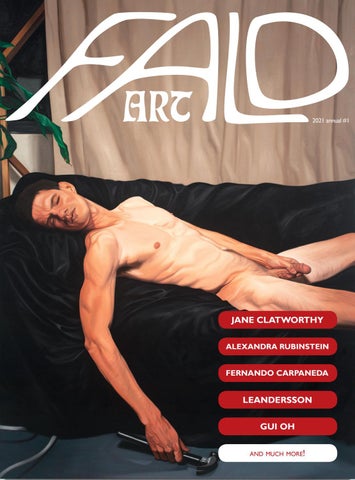
ART
2021 annual #1
1
JANE CLATWORTHY ALEXANDRA RUBINSTEIN
FERNANDO CARPANEDA
LEANDERSSON GUI OH and much more!
FALO ART© is a annual publication. january 2022. ISSN 2675-018X version 10.01.22
editing, writing and design: Filipe Chagas editorial group: Dr. Alcemar Maia Souto, Guilherme Correa e Rigle Guimarães. cover: Handy man, oil on canvas by Alexandra Rubinstein, 2019.
Care and technique were used in the edition of this magazine. Even so, typographical errors or conceptual doubt may occur. In any case, we request the communication (falonart@gmail.com) so that we can verify, clarify or forward the question.
Editor’s note on nudity:
Please note that this publication is about the representation of masculinity in Art.There are therefore images of male nudes, including images of male genitalia. Please approach with caution if you feel you may be offended.
Rights and Commitment:
This magazine is committed to artists retaining copyright of their own work. All rights are reserved and therefore no part of this magazine may be reproduced mechanically or digitally without the prior written permission of the artist. We have been careful to ensure that the images used in this publication have been provided to us by the creators with copyright permission, or are copyright free or are being used under the “fair usage” protocol shared over the internet (images are low resolution, attributed to their creator, not for profit and used only to illustrate a relevant article or story). If, however, you feel your image has been used by us unfairly and your copyright breached, please contact us at falonart@gmail.com and we will proceed in the best way possible.
Submissions:
If you are interested in participating in the magazine either as an artist, model or journalist, please contact us via e-mail falonart@gmail.com.
Editorial
A
nother year of pandemic, isolation and global political lack of control. When we thought it couldn’t get worse, new variants emerged to keep us alert and with reduced hope. Comparisons with the Middle Ages are no coincidence. We can only hope that, just as after the Black Death we had the Renaissance period, there will soon appear a period of great light – with a lot of Art – in the midst of so much darkness. Falo’s production challenges remained and intensified. I started the year 2021 right away with a different proposal: to bring the female voice to the artistic representation of the male body in an incredible edition (which you’ll see a large part of in this annual) where the speech is theirs, not the editor’s. These are fundamental manifestos for understanding the sexist construction of our society and the necessary deconstruction of the perception of body and gender. Furthermore, they serve to make it clear that Falo Magazine has no gender or sexual orientation: IT IS FOR EVERYONE! The year followed and two new columns were created: Other’s Phallus, where the magazine invites an artist or curator to talk about the work of another artist; and Phallogeria, where the focus is on the model as an inspiration for various types of art. It was an interesting diversification process that opened doors, but also required more work. So, you have in hand the first collection (wait for the other two) with several very high quality artists who were present in the 2021 editions of Falo. For those who have seen the editions in Portuguese, take the opportunity to read and see new images. Also take the opportunity to gain knowledge and be a vector of possibilities for that period of light we wish for.
FC Design R. Mario Portela 161/1603 C, Laranjeiras Rio de Janeiro – RJ 22241-000 Brazil
Filipe Chagas, editor
Summary Jane Clatworthy
4
Alexandra Rubinstein
18
Laura Williams
34
Grace Allison Perkins
48
Marta Jedlinska
60
Raphael Perez
72
Fernando Carpaneda
86
Leandersson Gui Oh OTHER’S PHALLUS Larry Buller by Marcos Rossetton OTHER’S PHALLUS Anderson Morais by Rafael Dambros moNUment
100 112 122 130 138
Wrong mythologies, oil on canvas, 2020.
Jane Clatworthy artist’s text edited by Filipe Chagas
I
was born in the north of England but most of my childhood was spent in Zimbabwe. As an adult I have lived in South Africa and then for a few years, the British Virgin Islands. It was in 2009, on the Caribbean island, that I rediscovered my love for art and creating. I currently live and work in London were my life is dedicated entirely to art 24/7 (well almost entirely).
Jean, oil on paper, 2021.
6 It’s how the light gets in, oil on canvas, 2018.
In the first couple of years out of art school there was a battle between the voices in my head (tutors, family, friends) and how I approached the painting process. I can honestly say that my work began to improve when I finally allowed my own unique voice to be heard and I started to believe in the value of what I was doing. It happened quite organically: I was painting a self-portrait and I realised that I hadn’t heard any dissenting voices telling me I was doing it ‘wrong’. Finally, it was just me, the paint and the canvas, and I didn’t give a damn what anyone thought about how or what I was doing. It was an empowering realisation. My creative process most often starts with my own emotional state which inspires the content of the work and the direction it will take. Ideas for a painting often appear fully formed in my mind, the trick then is to backward engineer them to break apart the ‘why’ and then the ‘how’ of their existence. Connection is intrinsic to my process so I collaborate with models who I feel can channel the emotion and energy I’m
seeking to explore. I prefer to work with models who are sensually aware of their bodies, rather than those who can only show me stiff academic poses. A lot of the poses I require are too dynamic to be held for more than a few moments, so I take reference photos, nothing too professional. Artists such as Lucien Freud, Jenny Saville and Rembrandt inspire me and the way Rodin explores the sensual experience of being in this human body never leaves my mind. Music too is intrinsic to my process, and I’m sure I drive my studio neighbours mad as I pretty much have the same playlist on repeat, and it’s made up of both classical and contemporary work. For the practical side of the process, I don’t really over plan anything, as I like to work things out on the canvas in a more spontaneous fashion, unless a particular theme needs a more careful approach. When working directly from life, I’ll mostly just go straight to the canvas and roughly draw in paint. It’s a much more dynamic fight as the sitter always moves, but this makes for a livelier portrait. Inevitably, over the course of the project, the painting develops in emotional content as the artist and sitter get to know one another. When I work from a photo reference, I’m a little more exact in terms of form, but because I’m not interacting with another person in the room, I go deep into my own psyche as I paint. I probably reveal more of myself in these paintings as I unconsciously unmask myself.
The last echo of feeling, oil on canvas, 2020.
7
As for materials, I work with oil and sometimes cold wax as a medium. I love the texture that comes from the many brush strokes, so I very seldom scrape off something that is wrong. I’ll just work over it, laying down a record of the fight, giving the painting a history like strata in the landscape. I like my bodies to feel as though they are solid enough to caress and hold, so much so I often wonder if I’m not a frustrated sculptor.
Everything in the moment, I dream of you and The solitude you occupy, all in oil on canvas, 2019.
8
Burning with surrender, oil on canvas, 2018.
9
I predominantly paint the male figure because I see an imbalance in the world at large and the art world in particular. Art is often both a response to prevailing cultural attitudes but also a creator of them. Through the dialogue of a painting, questions can be asked, answers found, attitudes shifted. Choosing the nude male was never going to be an easy road to traverse, but from one of the very first paintings I ever
created, it was always going to be my path. From the perspective of a cisgender heterosexual female I can use my art to create spaces for the masculine to be seen, and see itself, as vulnerable, desirable, beautiful, I can disrupt “the gaze” that falls so strongly on the female form, and push back against the idea that ‘beauty’ of the human form is found predominantly in the feminine.
10
De Profundis Clamavi, oil, cold wax, gold leaf on canvas, 2019.
11
I say with all honesty that being present with a naked human (male or female) is as normal to me as breathing. I engage with no sense of shame or shyness and that in turn allows the models, professional or not, to fully settle into their skin and simply “be themselves” fully authentically. This is very important to me and at the heart of what interests me. Unfortunately, the viewing public isn’t quite there yet.
12
In a world where censorship rules still insist that the penis should not be seen, even in a painting, it’s an uphill struggle to get the work out into the public arena. I’d like to sell my work but people are reluctant to have a male nude in the house, even though my work cannot be called erotic. People are often surprised and shocked. Often, they look, then quickly look away. Self-censorship takes over which then prevents them from engaging with the entirety of the painting. I believe that one day we will have a world where our ability to have the full experience of our humanity won’t be defined by gender. In the meantime, (female) artists can start by challenging the implicit bias against the male nude, and courageously look back at the entirety of the male body. I say “courageously” because women have been programmed to look away, the penis has been veiled for so long in taboo we have to root out and banish that inherent sense of shame we feel for looking (and perhaps desiring). The world does not need more women “beating the men at their own game”, proving they are just as capable of Jesse standing, oil on MDF board, 2016.
wielding all the weapons of masculinity as a man. It needs a new game with new rules and equal players across the spectrum. It is also necessary for the viewer to question and explore their implicit bias against the male nude. Why do we look away? The ‘gaze’ of the heterosexual male still predominates Western cultural norms and this male-centric focus means women are kept from expressing and experiencing their own reality, one that might include men as objects of desire. From birth women are bombarded with a barrage of material designed to stimulate male sexual urges, constant messages of how women should ‘present’ herself for male pleasure. Seldom is there a reciprocity and nearly every form of media is complicit in this regard. Most pornography, for example, is not aimed at women. Given these circumstances, it is hardly surprising that women turn their gaze, narcissistically upon themselves, suppressing and denying the same urges that have prompted male artists to lovingly depict their own muses throughout history. Women have absorbed a heterosexual male centric view and the rhetoric that the male nude is less aesthetic; they have suppressed their own desire to look at the nude male body and in doing so suppressed the gaze that would be a powerful weapon in reintroducing balance between genders. I’m suggesting that the ‘patriarchy’ has so thoroughly programmed women to look away and to suppress their own erotic desire, unless geared towards pleasing a man, that many women (artists) are disconnected from themselves and all the power of their own female gaze. What ‘the patriarchy’ has sought to control is their own vulnerability. To be vulnerable is perceived as relinquishing power; to be revealed (in art) would be to have that power diminished further.
All I ask, oil on Hahnemühle paper, 2020. A moment of grace, oil on Hahnemühle paper, 2020. Lacrymosa, oil on board, 2019.
13
14
The pain that alters, charcoal and oil on canvas, 2020.
15
If the penis has been hidden to protect it from the female gaze, it is partly because man is uncomfortably aware that, from his birth and infancy, through illness and death, woman, as a mother, lover, and nurse knows the male body in all conditions, from tiny penis to erect sexual organ to the limp bloodless appendage of the aged father or husband. Mira Schor in Wet: On Painting, Feminism, and Art Culture.
The ache of absence and desire, oil on canvas, 2018.
The entirety of male body is important to my work as it is generally the whole emotion of a pose that engages me. I don’t specifically put the penis as a focal point, I simply relocate it back to being just a normal part of the human experiencing that emotion. Without shame, without fanfare. I don’t seek to hide it, nor glorify it. 16 We live in a phallocentric culture, yet the concept of the “phallus” as the centre of power is much diminished if separated from the physical reality of the penis itself. Take away the conceptual power and all you are left with is a very vulnerable piece of human anatomy. That’s why I personally will not paint an erection, even though I think it’s an equally valid subject for others to engage with. The erect penis is too
close to the concept of the phallus and it’s that I’m attempting to disempower. Whilst I recognise that my subject matter may at times skirt the edges of erotic art, to paint erections would place it fully in a genre that would not help to unmask and normalise the male body. I want to remind the viewer of the humanity of the male body; I want to disentangle it from the burden of the idea that it is the image of a god. I want to open up a space through art where everybody can see the male in a rare state of intact vulnerability and from there to start a broader conversation about the forgotten strength of a feminine that is no longer subservient to the masculine. I am attempting a “reintegration” at a time when men and boys are breaking down under societal pressure.
The eloquence of silence, oil on canvas, 2020.
The frustrations of being forced to conform to a singular ‘manly’ ideal finds an outlet in the pervasive culture of ‘toxic masculinity’, a masculinity that is a danger not only to women and girls, but to any human who does not conform to socially constructed gender norms. Therefore, I believe that we need a world where the feminine is not defined in terms of lacking (a penis), but where feminine values are as equally powerful, desirable and revered as the masculine. Only once we are all able to powerfully embrace all aspects of our divine nature will the gender wars be at an end.
Untitled, oil on linen, 2021. All the uncried tears, charcoal and oil on paper, 2020.
I believe the current generation is on its way, but we are still up against so many entrenched cultural paradigms. I’ve encountered a full range of reactions, from celebration, curiosity, offence and outright anger. To have a painting or drawing in the public arena generally causes a stir of some sort. For example, I am often shadowbanned from social media; when my art was on show in London last year, Westminster council politely asked the gallery owner to remove it from the window because they had received furious complaints (he declined); at my graduation show an art collector told me how much he loved my work, but he would never have a male nude in the house. So for my own small part as an artist and a woman, I am looking back, stepping into my own powerful gaze, returning the penis to its original humanity, not to objectify, not to diminish, but simply to love, to desire and to celebrate the beauty of a form that is not my own. Anyone who wants to paint this subject should approach it with authenticity and integrity. Be true to your own values and paint with compassion to demystify, to unveil, to celebrate the entirety of another’s being. 8=D
17
Alexandra 18
Draw me like one of your French girls, oil on canvas, 2019.
Rubinstein artist’s text edited by Filipe Chagas
19
I
was born in Ekaterinburg, Russia in 1988 to a Russian-Jewish father and a Russian mother. Because Russians are anti-semitic, we were able to migrate to America in 1997 as refugees seeking asylum. I’m sure being white and educated in the right field helped.
The first years in America were very traumatic and lonely. It took me a long time to learn the language and assimilate and to go through puberty, and my parents were too busy trying to establish new careers and dealing with their own challenges to offer the emotional support that I needed. My mom however, had always pushed me to pursue art, which eventually landed me at Carnegie Mellon University. I have had some formal training in the form of figure drawing, basic color theory, and other introductory courses while in school, but the program at Carnegie Mellon mostly focused on conceptual development. There I found my voice, where I truly felt like an artist. I’m not sure if it was the space away from family, or the support and validation of some of my professors, but I finally saw art as my purpose. 20
I became interested in exploring the politics of power, especially in how it relates to gender. My experiences and traumas have been closely connected to my body and my identity as a cis woman. My appearance and sexuality and femininity or lack thereof have been used against me in attempts to strip me of my power. My work fights to reclaim said power and question the social systems, including patriarchy and the white supremacy, that have shaped western society. My style is not particularly conscious. My draw toward realistic representation is most likely internal pressure to adhere to traditional ideas of what makes art, as well as desire to create work that’s accessible to more people and optimize my opportunity for validation. What artist doesn’t rely on external validation, amirite?
Napoleon Complex 1 and 2, charcoal and graphite on paper, 2020.
The creation of Adam’s dick, charcoal and graphite on paper, 2019. In 2021, after the US presidential definition, the artist posted the above image on social media with the title “Peaceful transitions of power in history”.
21
22
23
Don’t worry about anything they said, oil on canvas, 2020.
24
I am constantly thinking about different images, word combinations, materials, and have many notes on all my devices. I used to do this much more when I was younger, and it was a great way to get my 10,000 hours in and get really good at drawing and painting. Nowadays, I’m more selective and try to think my ideas a bit more throughly. When I have specific ideas for paintings and drawings, I mock them up in Photoshop. I am also able to create a good reference for color, as mixing colors is its own art. When I moved to New York. Retouching and printing have definitely influenced my color sensitivity, as well as enhanced my knowledge of the human body. After I have the reference, I stretch the canvas, mix the paints, and go to town.
I didn’t always paint men, and even now I wouldn’t call them an object of inspiration. For me, honestly, nothing stands out. There are plenty of visual representations of men in Art but they’re not usually nude and vulnerable and objectified. That’s due largely to the way we view and internalize beauty and sexuality. In additon, art is ruled by who buys it, and while most of the wealth is held by old, mostly straight or closeted white dudes, we’re gonna continue to see way too many cis female bodies.
Previous page: Tell me I’m pretty, oil on canvas (2019). Beside: Rosé all day, oil on canvas (2018).
25
26
27
mecanvas, now (2019). Talk to me,Show oil on 2019.
A treachery, oil on canvas, 2018.
28
29
I started painting men because I was tired of this system... women’s bodies and faces being exploited historically by male artists, but currently by all artists, fashion photographers, movie producers, etc. Our society places too much weight on women’s appearance and sexuality, not only minimizing us to those attributes but also using them to oppress us. Trying to regulate and control us through beauty standards, slut shaming, rape, and birth control and abortion restrictions. As long as we and our bodies are the object, we’re not the consumer or the artist, the one that holds power. Giving men visibility as the subject in art, places them under similar scrutiny and judgement, while also shining light on their vulnerabilities and insecurities that reinforce this damaging social structure. 30 White american nude, oil on canvas, 2020.
Tough guy, oil on canvas, 2019.
Being in the presence of any nude when it’s intended for figure drawing and painting is purely professional. Penises have a long history of being symbols of oppression. They are often unwelcome reminders of male entitlement and privilege in a patriarchal system, and by censoring them or not allowing us to see them in other contexts strengthens their power. By depicting them in different ways, I hope to take away their power, and use them to explore male vulnerabilities and fragility instead. And to make dick jokes, of course.
Thirsty serie (Greg, Rob e Max), oil on board, 2016. These works were painted on panels with bottle openers, which are exactly in place of the penis image, to adorn a functional device and objectify the male form.
31
32
Above: No meat shortage here, oil on mask, 2020 (It’s the artist using it). Below: poster Have you seen? – The case of the missing skin (charcoal and graphite on paper, 2019) and Anti-cutting boards (oil on wood, collaboration with Michael Beitz, 2020).
33
Eu só quero me encaixar, óleo sobre tela, 2020.
Despite the fact that I haven’t encountered any personal difficulties (only internet trolls that tell me I should “100% be going to hell”), it does sometimes feel like the fine art world is hesitant to accept my work based on my content. I think it can be easy for people to write off graphic work as purely “erotic” and less than, and it’s harder to show and sell nudity that doesn’t adhere to a traditional script (tits). So I’m more
interested in what men can do for female artists in the art world, without expecting anything in return. I’m sure all of us insecure artists feel that way. However, we should survive this pandemic and just keep working to change this world. 8=D
34
Judas’ kiss, acrylics on board, 2020.
Laura Williams artist’s text edited by Filipe Chagas
I
was born in New Zealand, I am the youngest of four and I have three older brothers. My mother and father immigrated here separately in the early 1950s, my mother was from Dublin and my father from Cardiff. My childhood was strongly Catholic, and I was taught by nuns until I was 18.
35
While the schools I went to didn’t teach art I was fortunate that my mother always worked in bookshops and kept me continuously supplied with books about art, design and illustration. She passed on to me her love of literature and biographies. She was always reading and talking about her heroes who were predominantly gay men: Noel Coward, Joe Orton, Kenneth Williams, Dirk Bogarde, David Hockney and Christopher Isherwood. I still have several of the books she gave me, including one on 20th Century Art that featured the collage Just what was it that made yesterday’s homes so different, so appealing? by Richard Hamilton. I was obsessed with this work as a child and looking at it now I can see its influence on my current work. All of these writers, theorists, designers, illustrators and artists helped to consolidate my artistic style and appear in some way in my works.
36 Hell mouth, acrylics on board, 2021.
I majored in Sociology, and my master’s thesis was on emotional labour and emotions in the workplace. Since I graduated in 2005 I have worked in unions ever. I always painted as a hobby until I put together my CV to apply for an artist residency in 2018. Upon reviewing the list of my exhibitions since 2013, I realized I could call myself a working artist, not just a union organiser who paints. While one has to balance full time work with painting, I find advocating for people in their workplace balances the introspection my painting practice requires. I also find a regular paycheque means that I can insulate my practice from market demands. I create my naïve figurative representations from personal and societal memories. Many of my paintings are literally a palimpsest of art once found in many mid-century living rooms and in an act of artistic demur to Walter Benjamin’s essay, The Work of Art in the Age of Mechanical Reproduction Art. I often utilize mid-century art prints adhered to board, flipping them over and repurposing them as a canvas, returning the work to the original frame once finished. Subsequently, on the reverse of many of my paintings are the mass-produced prints that mainstreamed the works of artists such as Gainsbourg, Rousseau, Picasso and Van Gogh. I have more ideas than I can paint and/or keep up with. So it’s part of my creative process to collect a random mix of flowers, classical art, modernist works, antiquities, ceramics, beefcake pictorials, fabric, birds and small animals. I was disappointed when Tumblr became puritanical as I lost a lot of source material. Taking the Pastiche* was the name of one of my early exhibitions and has now become my Instagram moniker. This name reflects not only my intent and approach to the subject matter but also hints at my irreverent attitude.
Bringing home the Bacon, acrylics on board, 2019.
Upon beginning a new body of work, I like to think of a title, often a thoughtfully constructed pun or a topic. After researching from books and online and collecting the material, I sketch directly on the board and then start painting that I separate into the following defined streams: still life, room portraits and subverted gardens of Eden. The subverted Eden paintings are my take on the classical artistic practice of painting groups of young women, usually nude, frolicking in pastoral settings. I show adult men enjoying an idyllic paradise, free from normative codes for behavior and attire. Fruit from the tree of knowledge has been eaten, and an Arcadian community has ensued, whilst shame, puritanical beliefs and admonishment are banished. My expectation is that viewers are confronted by the gentle normalcy of the scene, and that the reversal of gender prompts the query, even if unwitting, about the reasons for naked women in rural settings are for the benefit of the voyeuristic male observer, while my paintings are most commonly read as a collective of gay men.
* Pastiche is a literary or artistic work in which the style of other writers, painters, musicians, etc. is openly imitated, without urge to criticize. It is a kind of collage or montage.
37
38
Coming to the end of the Phallus Sea, acrylics on board, 2020.
39
Eden’s Garden: Big apples, acrylics on board, 2019.
40
Happy trout, acrylics on linen, 2018.
41 Being a woman over 50 painting male nudes means I am asked many puérile questions and on the receiving end of much jokey teasing about why I choose to paint so much cock. I am sure men who paint nude women don’t receive the same level of derision. While I paint flagrantly naked romps in gardens with abundant phallic imagery, it is my aim that viewers enjoy my work not so much as an erotic resource, but rather because they see the love and normalcy I strive to capture. I rarely paint men and women together because the whole point is to make people question their unacknowledged assumptions: that a naked man can only be read as sexual while a naked woman is submissive and there solely for the viewer to gaze at. I am a woman who seeks to question this by actively reversing what the viewer might
expect to see. In saying this, my work is not an attempt to objectify men, rather to paint them with the love and respect any person may wish to see themselves depicted. I wish I could say I started with a lofty purpose but no. In the 1990s I broke up with a boyfriend and after he moved out, I discovered a box he’d left full of pornographic trading cards. I didn’t feel kindly towards him after the breakup, so I cut them up and started making keyrings which I called Beaver Rings. They sold extremely well and so a couple of my brother’s friends gave me several old Blueboy, Mandate and Honcho magazines, so that I could branch out and make male versions. I called them Rim Rings and they were once again, a great success. I wish I still had those magazines as a resource for paintings.
Above: St. John the Baptist in the Palace of Herod, acrylics on board, 2020.
42
Below: Garden of Steven, acrylics on board, 2016.
By the waters of Babylon, acrylics on linen, 2017.
gay porn as my source material, so am literally just painting what I see.
My focus on the male nude evolved naturally as I instinctively paid homage to my heroes. One of my earliest paintings was a naked St Francis of Assisi covered with birds and surrounded by rabbits and chickens, inspired by Tom of Finland and Bob Mizer. I want the men I paint to emote love, acceptance and community. I achieve this through attitude, positioning and posture. The naked body is vulnerable, even a buff strong male body, when depicted alfresco amongst a lush paradise. At their core, my alternative Eden works aim to challenge dominant tropes in a way that engenders love and joy. I am often asked why I paint my men with such large cocks. I answer that, firstly, women have seen impossibly idealized representations of themselves for millennia, and so I am returning the favor. And, secondly, I often use vintage
It has always seemed perverse to me, especially growing up in the 1970s and being engrossed by the counterculture art of that time, that a patriarchal society which has spanned thousands of years, still has such a prudish fear of the penis, both erect and flaccid. I do occasionally paint erections on my models as I see no reason as to why the physical state of male arousal shouldn’t be represented in art. I don’t believe an erection being depicted by an artist renders a painting pornography, rather, it is the artistic rendering of the male body captured at a specific moment in time. I hope that by normalizing the male full-frontal, people will realize that the sky won’t fall, and society won’t be destabilized. I was delighted that a painting titled Meadow Larks was selected to be exhibited as a finalist entry in a national art competition in 2019. The painting has at its center four men, three of whom were holding semi and erect dicks. Subsequently the work was on display at the Waikato Museum for four months and Art New Zealand Magazine reviewed this particular work and stated: Closer scrutiny revealed an Edenish circle jerk, surrounded by alligators and turkeys, looking like dislocated Renaissance symbols of danger and fecundity.
43
44
Meadow Larks, acrylics on board, 2019.
45
The annunciation: Mary gets pregnant, acrylics on board, 2020.
46
Beloved son, acrylics on board, 2019.
Early on I loved people’s reactions to my work. I enjoy how it seemed to discombobulate both men and women who didn’t like seeing the male nudity and/or references to male erotica, however, they would have had no problems viewing naked women in art. I want to bring awareness to these double standards of nudity in art. Most people want to look but are afraid of seeming to be overly interested. The audience is already acclimatized to the naked female form but less so with the nude male. I actually stopped exhibiting with a gallery because they were filtering my work: they pixilated the genitals in paintings on social media and refused to publicly display some of my works. I am now with a gallery that shows my work in all its glory. I have noticed an increase in people sending positive messages regarding my work along with an increase in women liking my work. In the last two years I have been selected as a finalist in several national art awards; I have also been included in three selected group exhibitions in New York and been awarded a couple of artist residencies in the USA. For me, these achievements point to a wider acceptance of the male nude, especially in New Zealand, which is typically quite conservative and dismissive towards self-taught and figurative art and artists. However I still haven’t encountered many other artists here painting male nudes, let alone full frontal. I firmly believe it is possible to make a statement that normalizes the male nude. I hope that my works demonstrate my affection for men that I paint and the deep respect I have of the people who have inspired me. 8=D
y r e g r u s c i t s a Pl ! u o y for Dr. Alcemar Maia Souto CRM 5246681-1
+55 21 97395 8000
alcemarmaiasouto@gmail.com
47
Morning, digital illustration, 2021.
48
Grace Allis
M
y name is Grace Allison Perkins. I am a child of Caribbean parents – my father is from Puerto Rico and my mother is from St. Croix, in the U. S.Virgin Islands – but I was born and raised in central Texas, where I now reside. I have honestly recognized myself as an artist since I was very young. I’ve been fixated on drawing and painting for as long as I can remember. Around the age of 12 I started to learn to draw from online tutorials and I understood that my goal in life was to create art. I wanted to learn more about art and I graduated from Savannah College of Art and Design in Atlanta, Georgia earning my BFA in Illustration with a minor in Printmaking.
49
son Perkins artist’s text edited by Filipe Chagas
I have been focusing on human form for at least 10 years, as I have been trying to make representation as emotional and expressive as possible in my work. Conveying emotions and sensations is absolutely critical in my drawings. I’ve learned that’s why I like drawing legs so much, because I think that along with the arms they are able to express the body language I want in a distinctly tender way.
50
So I asked myself: “how do I make gestures and interactions look and feel real without relying on realism?”. I looked for a unique style capable of making expressions, gestures and interactions appear natural, expressive and fluid in all types of bodies, regardless of the technique, but it depends on the emotion or moment I’m trying to register. For example, I would not use thick, broad strokes for a piece that would perhaps call for softer and more delicate lines to create a dreamy or cloudy look. In commissioned work, I usually spend a lot of time writing or sketching ideas as they come and use them when I’m ready to start working on the final design or narrative. On the other hand, in personal drawings and some comics, I go straight to drawing the idea that is basically floating in my head. Some processes are longer and more cautious, especially when it comes to projects that are closer to me. The more rigid or strict my process seems, the worse I feel about the creation, and the end result is not always so satisfactory. If I ever get stuck in a pose, gesture or just don’t know what to draw, I use the reference of photos
or maybe watch or read something that gives me some positivity. I feel that I’ve always drawn so much better with the help of reference and other observations and not only relying on what I see in my imagination. For me, the most important part of my creative process is being aware of how much an idea can change as you work on it. I never get attached to my thoughts and stories because I believe I will be inauthentic if I focus only on my own interests and environment. So I have the mentality that discovering inspirations and consuming other information can boost my initial draft. I love cartoons and comics, and I extract a lot of these art forms for my drawings. Much of my style is derived from the early 2000s cartoons, particularly “Samurai Jack”. When it comes to history and drawing of people, my inspiration in general comes from the work of E. K. Weaver, creator of the series The Less Than Epic Adventures of T. J. and Amal. One of my artistic goals is to normalize positive queer narratives in comics and other forms of media. I believe it is important to write stories that people can connect with, regardless of their sexuality, gender, race, ethnic origin or economic situation. I like to share representations of queer relationships that emphasize love, intimacy and companionship without the use of harmful clichés and stereotypes. All types of bodies, genders, sexualities and personalities must be celebrated!
Above, Untitled (2021) and, beside, Cuddles (2019), both digital illustrations.
51
52
Ready, digital comics, 2020.
53
Untitled, ink and digital illustration, 2018.
I think it is valid for me, a non-binary person that presents as more feminine to represent two men in love with each other in the most positive and authentic way possible, without being visibly masculine or having specific genitals (I came out after the initial printing of this issue). For me, it was never purely about the sex or physical sex of my characters. They are characters who feel comfortable with their different body types while exploring various forms of intimacy and connect physically, emotionally and sexually in healthy ways. However, I do not think that the voices and representations of male forms by women or people that aren’t visibly masculine are more intimate and superior in any way. There is no single way that makes a man or what makes
manhood. The representations of men have changed in art due to the increased visibility of perspectives other than those considered socially acceptable forms of masculinity. I probably never would have thought that I would feel comfortable drawing male forms with feminine traits and behaviors if I didn’t see other artists (of various genres) showing evidence of gender fluidity in their work. By offering a varied and supportive artistic perspective, women and those of other varying genders can help to review the concept of masculinity as well as generate representation for those who seek space and validation. Drawing masculine forms and people within relationships greatly helped me to not feel distressed and isolated as someone who had been questioning my gender identity since childhood.
54
Keep the glasses on, digital illustration, 2021.
Laces, ink, 2018.
55
I provoke people to wonder: why are representations of masculine intimacy and nudity viewed as uncomfortable or indecent compared to feminine intimacy and nudity? The purpose of this question is to think critically about the existence of this strange double standard... mainly due to the homophobia and normalization of the sexualization of feminine forms.
56
I love to draw feminine forms, but I was so afraid to confront what I felt about my own appearance that I allowed it to influence the way I drew female bodies. It took me years to get over the hatred of my own body and criticism about how masculine my female characters appeared and vice versa. For example, those that are critical of my work often say that my male characters have big lashes and that feminizes them... I still receive some homophobic comments in drawings that show intimacy between men or when they consider the representation of a flaccid penis unacceptable, but accept feminine nudity... evidence of how rooted binary thinking is. I will express that I gravitate towards the masculine form because, although I currently present as more feminine, I feel that parts of my personality usually gravitate towards male traits and representations of male bodies because I aspire to blur the lines between what the binary is.
So I took criticism from those who could not think outside the binary scope of gender as an opportunity to fully embrace how I was drawing people. This led me to other artists eager to discuss the state of masculine nudity and gender in art. Even with the varied and particular interpretations of my work, those who are interested in the concept tend to be satisfied with the clarity of the message I produce. I’m always so grateful for the varied conversations and perspectives from those that were eager to be constructive towards my work. Non-sexual nudity in art should be considered natural, regardless of the viewer’s gender or sexual orientation and representation. We must confront this with a purely open mind. As much as I encourage all visual and thematic possibilities, I don’t think people are ready to deal with an erection, as it would automatically bring something sexual to the image even if the model was doing nothing in particular or related to sex. Acceptance is likely to come when more people are able to disconnect physical sex and gender in the way we perceive the bodies represented in Art.
Opposite page above, Cluster of warmth, ballpoint pen and digital illustration, 2019; and, below, Cluster of warmth II, ballpoint pen. On this page above, Cluster of holding, ballpoint pen and digital illustration, 2019; and, beside, Cluster of passion, ballpoint pen, 2015.
58
Sunlight, digital illustration, 2021.
59
Lay, graphite, 2017. Just to be clear: my personal feelings are far removed from what common representations of women/feminine bodies tell us to feel about our bodies, specially internalized misogyny or any other self-hatred that comes from objectification and unrealistic standards of beauty. It is entirely possible and valid for men to exhibit feminine traits and behavior while still looking masculine (according to common standards). It is entirely possible and valid for women to exhibit more masculine traits and behaviors and still be women, no matter what culture or rigid standards tell us what they should be. I will always be doing art and comics that, I hope, will bring some kind of positivity to people - regardless of gender or sexual orientation - who get involved with them. 8=D
60
Marta Jedlińska artist’s text edited by Filipe Chagas
61
D
rawing and Arts have been my passion for my whole life. I drew as a child, I graduated in fine arts when I was young, I worked as a graphic designer as an adult. My style has changed over time and with my need for expression, but it was social media that made me see myself as an artist.
62 Even though I was constantly drawing, I didn’t appreciate my results, I didn’t believe in myself. Here in Poland, especially in the 1990s in a provincial town, family, teachers, society... everything made it difficult for a woman to be an artist. Social media has allowed my work to go from here to the world. I started receiving extremely positive feedback that fed my ego and made me – why not? – famous! Gradually, I got rid of other people’s opinions and opened my mind until I felt the freedom to express myself the way I wanted. After a break-up in 2017, I created a Tinder account and many men sent me their intimate photos without my consent. I didn’t know what to do with that, with this masculine need to show the penis, as if society was so oppressive with them about this that they always manage to show what should be hidden.
I think that in our patriarchal culture, the penis has a special place, a special role. It makes you have more money, better jobs, more respect, more power. At the same time, it is a symbol of vulnerability, of violence. Meanwhile, we women have learned that we need to be aware of our body, weight, presence in society, in addition to being extremely careful with the penis, as it has all this power and can still hurt us. I still haven’t had an answer from the men who send me pictures of why they do it and to always be a close up on the penis instead of the whole body. I know it has the desire factor, the macho flirt just to see me naked. However, I still have some difficulty understanding this, as I see the human body as a complete person, with good and bad things. A penis or a vagina does not determine a person’s beauty or character, much less keep the deepest secrets.
However, I believe that men feel complete in their bodies, meaning, each part of them is a representation of the whole. So, showing their dicks is like showing everything about themselves, all their masculinity, all their personality. Women, on the other hand, seem incomplete, divided in two parts – mind and body – as if they are an object for sale. So... after talking to some friends from my yoga course and showing some sketches I had made of the photos I received, in May 2018, I decided to create an anonymous Instagram account so I could share the results… and my life changed! In addition to enjoying the drawings, people, whether men or women, straight or gay,
63
64
wanted me to draw them – even trans people (with the same male social behavior)! Gradually I opened up and let people know who I was. Even my mother has come to accept what I do! Since I work from photos, I need to deal with both the two-dimensionality of the media and the threedimensionality of the gaze. I usually don’t like when someone says that I make realistic or even hyperrealistic drawings, because they are not. In fact, it is a resizing process that ends up giving this idea: I get small, low-resolution photos on the phone; I make the scales, adapt the proportions of the details, the saturation of the colors in the larger format drawing; and, when I publish it on the social media, the size is reduced again, creating the illusion of verisimilitude.
65
66
67
At the moment, this is the artistic style that, besides earning money, gives me pleasure to work. I had to learn to talk to men, be more assertive and show that there will never be sex in my artistic production, so, it was – and still is – fundamental to establish limits. Of course, I would like to produce other kinds of arts and sometimes I even try new media when I draw other artists. I prefer to think that I am in an “artistic period”, much like Picasso had his blue, pink, etc. period, and I will not force a change. Let it come naturally.
68
69
70
Soon after turning 50, I created another account on Instagram. Our society seems to say that after 50 women are no longer attractive, but this age bias does not affect men so deeply. So, I started to post not only nude photos of myself, but also arts made by me and other artists of my body. Few women understood my action. I believe it is because of this feeling of incompleteness, division and competition that exists among women. But I know that everything is a process and I don’t have to please everyone. Today I have thousands of followers – who come and go according to the censorship of social media – from various parts of the world and I want to share some stories related to these drawings. I have already produced some books with my Art and I think that writing something about these dynamics of gender and sexuality can reduce this cyclical wave of censorship that plagues the planet. 8=D 71
Raphael 72
Perez by Filipe Chagas
73
R
aphael “Rafi” Peretz was born in the conservative city of Jerusalem in 1965 and moved at the age of 30 to the liberal Tel Aviv. This geographical change was also a total life change.
Couple in the street, acrylics on canvas, 1999.
Since he was a child, he had contact with the works of great painters, which his father presented to him and his brothers. In 1989, he entered the College of Visual Arts in Beersheba and started painting. For 15 years, he worked with preschool children, defining himself as an “educator who painted as a hobby”. Having as reference the painters Henri Matisse, David Hockney and Nahum Gutman, his works shift between a realism full of contrasts about relationships and love (“I drew heterosexual couples with a view of incomplete relationships when I related to women”) and a naïve style that he applied, mainly, in urban landscapes, inspired by the children he worked with and his old notebooks.
The two realistic and naive styles are the central axis of my work but within each style I am constantly evolving and asking questions from one artwork to another. Hug, acrylics on canvas, 1998.
74
Gays at Tel Aviv port, acrylics on canvas, 2011.
Rafi’s works are said to contribute to a sense of identity and belonging that Israeli society has always sought, as he transforms cities and communities into objects of love. His desire to paint the beautiful and modern Tel Aviv – one of the most gay friendly cities in the world – made him realize that it was time to accept his impulses, since he always saw man as “beauty”
and woman as “strength” (“in nature, the peacock, the lion and other animals, the male is the glorious and the female does the job”). At the age of 32 he decided to live off his art and called himself a painter, maintaining hyperrealism and naïf as a style in a more LGBT+ theme. And, at 37, he came out for his traditional family.
75
Dancing and kissing on Tel Aviv roof, acrylics on canvas, 2011.
76 The painter and the model, acrylics on canvas, 1999.
77
I fantasized that in a relationship with a woman I could fly in the sky, love. However, I was choked up, hidden behind a mask, as if there was an internal scream wanting to come out. From the moment that self-oppression and repression ceased, he began to express himself in works of large formats and vivid colors, especially red (“symbolizes masculinity, passion and dominance”). He considers that his initial view of gay life was naive and idealistic, but, over time, he understood its complexity. In search of an emotional closeness in his art, most of his models are men with whom he had a relationship, but he also addresses other subjects such as couples, LGBT+ families, activists and even soldiers.
78
The most important thing for me is to describe the emotional world that exists between couples. When it is a painting of a single character – who is usually my partner –, then I am interested in the expressions of love that exist between us, the portrait, the face and the body of course, but no erections, because the focus is the intimacy.
Eitan sleeping on bed, oil on canvas, 2000.
Kobi on chair (Red Room), acrylics on canvas, 2000.
79
Couple, acrylics on canvas, 2004.
80
Assaf, acrylics on canvas, 2017.
81
Combat. March after Matisse. Soldiers. Men in a row. Male parade. Army.
It is interesting to note that the geographical change also made the artist see the West so liberally that, for him, male nudity is received in an open and friendly way today. However, he still prevents his mother from seeing his homoerotic works, even though he describes his art as “a reflection of the entire gay community.
March soldiers series in acrylics on canvas, 2003.
Couple at the park, acrylics on canvas, 1999.
82
83
Gay nation, acrylics on canvas, 1999.
84
Planning to live a peaceful and creative life with his beloved, Rafi gives some tips for those who intend to be artists: 1. Bring your personal story. 2. Present thoughts and the emotional world (psychological expression). 3. Promote an idea (philosophical expression). 4. Consider the place where you live, as each environment is different and unique (physical expression). 5. Be relevant within context (temporal expression). 6. Formulate a language exclusively for you and keep it constantly evolving. Rafi believes that, following these, it is possible to touch people’s souls in some way. 8=D
Rafi at his studio (2012).
Couple in bed, acrylics on canvas, 2000.
85
86
Fernando Carpaneda by Filipe Chagas
Adam, acrylics on canvas, 2020.
87
M
any seek certainty throughout their lives and don’t even come close. However, Fernando Carpaneda took control of his decisions from an early age: he learned to write and speak English in a self-taught way, had his first boyfriend at age 11 and set up his first art exhibition at age 13 in Taguatinga, Brasília. In this early trajectory, he became fascinated by the male body, which directly influenced his creations.
He began painting nude portraits of his lovers in the early 1980s, when it was so difficult to exhibit homoerotic works in Brazilian art galleries that he was even beaten and stabbed. He then chose to show his pieces in gay bars, which were also totally marginalized at the time, becoming one of the pioneers in the homoerotic theme.
88
Beside: 2021. Below: Luke, acrylics on canvas, 2017.
Beggars, prostitutes, drug addicts, punks and the underground scene which he was a part of as a musician - became objects not only of his painting, but also of the assemblages he produced for almost 15 years before he started to sculpt: It was kind of a natural process. My drawings have led to paintings and sculptures that are experimental works about materials and feelings. Usually Carpaneda works on multiple platforms at the same time, using photography or live models in his hyperrealistic creative processes. He brings Tom of Finland’s art attitude and eroticism to his work as he considers him “the number one queer artist”. The artist believes that this technical diversity allows him to explore new possibilities of seeing the male body in a positive and healthy way: I think it’s important to paint and sculpt the penis, scrotum and pubis. I think the male body should always be in evidence, and be shown on television, and on billboards on the street. God created the penis, the scrotum and the pubis. Even Jesus had one! So there’s nothing wrong with that.
Love God, love creation (2017) and Tony (2021), both in acrylics on canvas.
89
Homophobia kills: case number 17, acrylics on canvas, 2020.
90
91
Pig-Boy, acrylics on canvas, 2020.
92
Just Penis series: 24 of the 50 graphite and ink drawings with pubic hair of male models, including executives, beggars and skinheads, who responded to online advertisements inviting them to have their phallus drawn.
93
Carpaneda always wanted to create a work with strong personal appeal, like a public diary, where he could record his ideals and his love experiences, portraying the male body in a unique way. Thus, his sculptures are a kind of reliquary, where it is possible to identify various references to models (phrases, poetry, human hair, cigarette butts, condoms, beer cans, underwear, semen, etc.) to create works that had so much meaning for him as a connection with the portrayed and, consequently, echoed his memories.
Adam and Steve, diorama in clay, mixed technique, human hair and acrylic paint, 2019.
94
Forbidden fruit, diorama in clay, mixed technique, human hair and acrylic paint, 2020.
95
96
Punk Rodin, reinterpretation of the sculpture “The Bronze Age”, by Rodin, made in clay using a mixed technique, the artist’s blood, the artist’s hair and acrylic paint, 2015.
97
The rebirth of punk, reinterpretation of Michelangelo’s sculpture “Dying Slave”, made in clay using a mixed technique, the artist’s blood, the artist’s hair and acrylic paint, 2015.
Bacchus anarchist, reinterpretation of the sculpture “Bacchus”, by Michelangelo, made in clay using a mixed technique, the artist’s blood, the artist’s hair, rabbit fur and acrylic paint, 2017.
98
Still-life, acrylics on canvas, 2021.
Today, he already sees greater acceptance of the male figure in galleries and museums outside Brazil (he has been living in the US since 1995), but even so, he knows that it depends a lot on who the curators and those responsible for the institutions are. His works are included in numerous art collections, galleries and museums, having exhibited in biennial exhibitions around the world. I like to make works that do not fit into the contemporary art circuit, going against the standard imposed by art institutions. In addition to continuing to produce for future exhibitions, his desire is that his works reach an audience that appreciates Art, regardless of sexual orientation (“my works speak of freedom, of being what you are, without fear of assuming your ideals”). As advice, Carpaneda says that good proposals in quality work are needed so that it is possible to expand the conception of contemporary LGBT+ art. 8=D
* He has works at the Leslie Lohman Museum, the main queer art reference in the world, since 2005 and has had works in the historic Back to Bowery, an exhibition that brought together remnants of Andy Warhol’s Factory with new artists who portrayed the underground scene in New York in the gallery CBGB (Country, Bluegrass, and Blues and Other Music For Uplifting Gormandizer). In 2012, his work was seen on the screens of Times Square by more than half a million viewers and, in 2020, he was the only Brazilian at the Long Island Biennale.
99 Freedom equality, clay sculpture with mixed technique, artist’s blood, artist’s hair and acrylic paint, 2017.
100
Leandersson by Filipe Chagas
L
eandersson is the signature of selftaught artist Leandro Cunha, born in Caçapava, in the interior of São Paulo. Avant-garde (“even when resurrecting old things”), fascinated by issues of gender, electronic music, pornography and ancestral cultures, he uses manual and digital illustration techniques in various formats to reference – and revere – his multimedia masters: I make contact with my previous muses. None of this would be possible without the wonder caused in me by Andy Warhol,Van Gogh, Picasso, Ron Athey, David Bowie, Bryan Ferry, Marc Bolan, Lou Reed, Brian Eno, Elizabeth Fraser, Chance’s samba do morro, Dead Can Dance, Nico and Billie Holiday. I go into alpha and open up to do the job. Sometimes I have an idea of what to do but I constantly realize that art has a life of its own and I kind of obey the imperatives of drawing and materials. I don’t always like it, but I always respect it.
101
Whether because of the strong lines and hachures – which can refer to the aesthetics of woodcuts and comics, as Roy Lichtenstein did – or because of the strong colors and repetition of images – very characteristic of Andy Warhol’s most famous works – it is possible to see some relationships between the production of Leandersson with Pop Art, including using his art in advertisements for carnival blocks, events and artistic collectives. His compositions create shamanic provocations between the sacred and the profane, between symmetry and imbalance, through hybrid figures of artifices created by man and elements of nature that match the way one understands in the world:
102
There was never a day that I didn’t recognize I was weird and disagreed with almost everything around me. Admiring art and kind people, however, makes me very happy. I look at nature and feel peace. I’ve always felt rich, because from the little I have, I’ve always tried to make the most of it.
103
104
105
He says that for some years now he has been able to live a fully assumed life as an LGBT+ artist, but since childhood his desire and libido have turned to male nudity as a source of main interest. In a reading of the old Delta Junior Encyclopedia, he saw sketches of half-naked Greek gods and little Leandro kept wrapping himself in towels the way he had seen it in the publication (“Fag stylist child YES!”). So, when he started to draw, he naturally incorporated into male bodies something that could dialogue, for example, with the art of ancient civilizations.
106
Leandersson prefers to use photos to draw, as he needs time and space (“I think it’s a little too intimate to have a natural model”) in his creative process. As a normal constitutive part of the portrait-body, the penis may appear, but it is not an exact priority, as the whole body is important to it. Hands and feet are what catch his eye both for the level of artistic difficulty and for the sensuality (“a man with beautiful hands and feet is very sensual”).
There are moments when I want to portray a transparency of the individual, an essence, a soul, and the dick can appear flaccid or erect. I’ve even done some erotic work. I don’t like taboos and I don’t see why there’s such a problem... as far as I’m concerned, people could walk around naked at any time of day and night anywhere. I really think that in adult life there is room for a lot, especially for demystifying old taboos and dogmas that conservatism still demands. Respect for spirituality accompanied by responsibility. Herd thoughts were never for me. I like Oscar Wilde!
The artist thinks a lot about the cyclical movement of art regarding male nudity. He knows that the acceptance of this theme has already occurred in other centuries, but it is subject to the tides of History in constant movements now pro and contra. Thus, he understands the role of the artist in generating as many constructive discussions on the subject as possible.
107
108
Art serves to elevate.
109
110
It is also all this transience that Leandersson respects all identities and wants to take advantage of what life has to offer. He continues as an independent artist and carefully and lovingly analyzes all the opportunities that lead him to achieve his personal goals, such as having illustrations on the cover and pages of the second Poetic Anthology of Revista Cult (2019). 8=D
111
Gui Oh by Filipe Chagas
112
blessed be the fruit.
113
M
asculinity has been questioned since the first feminist wave in the early 19th century. Two centuries later, the entire conception of gender has become an open question, resulting both in conservative, traditional and obscure forces and in new identities and freedoms of being. The clash became undeniable, because, instead of being questioned by others, the male figure itself entered a process of (self)recognition and deconstruction. That’s where Gui Oh’s Art (alter ego by Guilherme Oliveira) was born.
Growing up in a Brazil that insists on sticking to powerful macho roots, Guilherme found himself constantly looking for answers to “what is being a man anyway?” whether in oneself or in others. This led him to a real and particular interest in representing the visible characteristics of the male body that denote gender and virility, such as the chest, armpits, and the way in which the hair covers the skin and almost talks, insinuates, suggests and proposes conceptions – such as the pubis, which directs the gaze and activates the imagination indirectly (“The penis and
gallant nudity.
114
the scrotum are details, parts, not the whole result”). The artist sees an immense expectation in measuring masculinity and power from the size of the penis and erection, but it is in the normal state that true courage and strength are found in showing oneself vulnerable. Therefore, he asked the models to, above all, write their experiences about “becoming men”, from the negative interactions and egos claiming space to the friendships and bravery that ran over fears and weaknesses.
In the definitions of “being a man” I felt like a big excluded. Drawing, painting, sculpting and disarming the male form was a way to understand how this builds up inside the subject.When I think of the naked man’s body that I sketch, it’s not an objectification: it’s the graphic record of an experience that ends up marginalized, sometimes part of a segregated community. And it was in this process of investigation and deconstruction that I obtained the best reflections for such complex questions about masculinity.
From there begins his broad creative process, which is as experimental as his personal professional trajectory. With backgrounds related to Multimedia Production, Fine Arts, Design and Japanese Gastronomy, Gui Oh brings together a little of everything – painting, illustration, cuttings, textures, audiovisual media, Tom of Finland, Egon Schiele, David Hockney, Manabu Mabe, Salvador Dalí, Ingres, Oliver Sin – and, in this process of visual construction, he seeks different solutions, conversations, experiences, times and reflections for each work.
more than silence.
115
116
construction idealized.
There are elements that remain persistent in my work, such as the line, which is the most imposing graphic element. Just as writing tries to define itself and announce its nature, little by little I was enticing this element so full of life within my work so that it would break, gain another dialectic or, at least, seek new ways to express itself.
117
veracity of his own self.
His stubborn questioning side also makes him reluctant to see himself as an artist. He even produced anonymous plays and poems with little sharing. Gui Oh believes that it was during his academic life, when he needed to persist and defend his queer-themed work, his motivations and issues about gender, sexuality and virility, that security and understanding came. Despite
the bittersweet reaction of some people who even questioned his mental health for not knowing how to separate the artist’s work or even knowing how to confront what they saw, he maintained the firm decision to voice his concerns and, as a result, had the opportunity to exhibit, communicate, know other lives. His work came to life and asserted itself in exhibition
118
Above: manic stasis. Below: pre-programmed meanings and perverse gratification.
Above: bromance and I would always... Below: all the saints be praised.
119
spaces in Italy and Portugal, in film promotion (Wretched Things, by Oxygen Films) and in international publications (Boner Magazine). Involved in numerous projects, Gui Oh wants to take advantage of the issues that society has been debating in recent years to continue with reflections on his concerns, on the construction of the masculine and on his own life, which he understands as an extension of his constantly changing production. 8=D
120
Beside: disseminated lies, the thrill of loving the unknown and distance. All works are in watercolor, pastel and colored pencils on canson paper, drawing and digital editing. Below: self-portrait.
121
OTHER’s FALO 122
Artists talking about Artists Larry Buller
by Marcos Rossetton
FAR BEYOND A SET OF TEA!
W
hen we think of pieces made from ceramics, our collective imagination compels us to visualize conventional items such as cups for a tea set, an ornament on our grandma’s dining room shelf or an ornate rococo-style flower vase adorning the table. I propose here the combination of these classic, traditional and vintage elements and references with something more contemporary and subversive in the use of this technique; all of this to present the ceramics made by artist Larry Buller. He is one of those creative artists who have mastered ceramic techniques for years and then masterfully subverted it! Buller is from Nebraska and completed his MFA in Ceramics from the University of Nebraska-Lincoln, through the School of Art, Art History and Design program. Buller worked as a pottery teacher for about 18 years in public schools, teaching ceramics throughout this academic and artistic trajectory.
Beefcake plate #1, 2019.
Beefcake plate #2, 2019.
Fancy phallic centerpiece on red plate, 2019.
123
CLAY ALCHEMY The use of clay as a raw material has Neolithic origins. Even in Biblical quotations we find references to the nobility of raw clay! “And the LORD God formed man of the ‘dust’ of the ground, and breathed into his nostrils the breath of life; and man became a living soul.” (Genesis 2:7) In many other versions of the biblical text, the word “dust” in this verse is translated as “clay”. Regarding Larry this is no different. However, embedded in his clay work is a sense of latent activism, a subversion of beliefs, values and modesty! This makes his artistic expression somehow contemporary, authorial and peculiar.
124
Blue rose phallic centerpiece, 2019. Phallic centerpiece with peaches, 2020.
Larry uses whites earthenware clay, press molds and slip casting techniques to create handcrafted figurines, plates, sexual fetish items and other components that are often assembled into centerpieces or larger installation work. He is an alchemist who uses his own hands to transform earth into completed works of art. Lots of trial and error allow him to explore possibilities throughout the creative process, working with the clay and creating new work in a highly focused manner. Passionate about ceramics, Buller has been working with clay since he was 13 years old. He was always curious about a wide variety of craft practices, but he found himself an artist in the transition between the creative child and the man with a Master’s in ceramics.
THE CLAY, THE PHALLUS, THE IDENTITY Larry came out of the closet at the age of 19 in 1978 and has since carried the LGBTQIA+ identity in his DNA. Today, at the age of 63, he explores his creativity with the insites and understanding of a mature gay man. Larry has been witness the evolution of the fight for “gay rights” which stated with the Stonewall riots in New York City in 1969. Many of these past experiences serve as inspiration for his current work. The content of his works are interpolated: right away one’s notice the enchantment and preciosity of the ceramic pieces, always skillfully decorated, however, after closer inspection, the subversive nature of his work is apparent and consequently the presence of his affirmation and place of speech in the construction of his identity. Buller makes an
Large dildo with gold roses, 2019.
Butt plug flower brick, 2019.
125
126
Fancy Figurines, 2021.
analogy, saying that, just as the moth is attracted to a flame, he seeks to attract viewers for a closer look through his highly adorned surfaces . Upon closer inspection a more transgressive and subversive intent becomes clear: the artist’s ceramics address the fetish. Sadistic icons, dominating object shapes, pieces such as chains, phallic figures and penile dildos compose pieces that are both disturbing and full of poetry. There is a balance between the classicism present with glazed pottery and male fetishistic voyeurism in his works. Buller is pleased to present this dichotomy that confuses the fine line between functional and non-functional ceramics, sometimes usual and traditional, sometimes more subversive and transgressive.
Diminutive Toys, 2019.
By giving sexual attributes to ceramic objects and knickknacks, Buller seeks to make fun of the domestic scenario, the ordinary everyday life and spices up the domestic space of traditional heteronormative families. By doing so, he seeks to question what is considered “good taste” in the traditional home environment. Could you tell us?
Peach and Eggplant centerpieces, 2021.
The male genitalia is often not explicit in Buller’s work, but the phallic form is there, like a trap, camouflaged, waiting for its prey to pounce it. The artist creates objects that have double meanings: peach and eggplant compotes that function as centerpieces, but also with attributes and meanings that suggest sexual preferences such as “top or bottom.” The phallic is an ornament placed on the table before dinner time. Pure fetish!
THE CLASSIC vs. THE TRANSGRESSOR AND THE RELIGIOUS The saints that decorate Buller’s altar are made of glazed ceramics, gold luster, gemstones, fur and foil papers in a highly ornamental manner, having baroque splendors and appliqués of showy floral decals; everything selected and appreciated in the repertoire of faith. However, his sacred images transgress religious altars when they are presented on penile dildos, anal plugs and phallic shaped toys, objects of the classic repertoire of sexual practices. A scandal! Thank God! In fact, there is a “communion” between the sexual fetish and the domestic nature of his objects, religiosity and, of course, the masculine forms presented in his works. A fusion of elements result in sumptuous and phallic sculptural objects. Worthy of being present in any domestic oratory!
Jesus butt plug, 2019.
127 Assorted butt plugs, 2020.
128
Phallic triptych, 2017.
Buller knows this and exploits pottery to provoke the most unwary! While challenging beliefs that resonate with more conservative dogmas, he presents his personal experiences with the nature of gay sex, fetishism and masculinity, seeking primarily to break stereotypes of sexual minorities. For the artist, currently in the US, the exposure of the naked male body is beginning to become naturalized and more accepted, whether in the eroticism of the arts or in the movies; and within this contemporaneity, many artists feel more comfortable in exploring the beauty of the male body in the most diverse languages of the visual arts. In Buller’s case, his work takes the sexual charge subtly to be displayed in the traditional family’s china cabinet and proudly occupy its place among collectibles. In this way, Buller follows his intuition, inspired by the insights of his own LGBTQIA+ existence. Without rules, he experiences and explores saints, demons, dildos, chains, objects of sexual practices, fetishes, the male body and human desire, all of it surrounded by poetry and made out of glazed ceramic ware to be contemplated in a sunny afternoon while having tea with biscuits. 8=DO=8
Queen size butt plug with yellow roses, 2019.
129 Larry Buller
Marcos Rossetton
Toy trio, 2017.
OTHER’s FALO
Anderson Morais
by Rafael Dambros
A
nderson Morais’s art does not fit into any artistic style, but it moves between them - influenced by Klimt, Schiele, Rodrigo Mogiz, Alair Gomes and Paulo Jorge - to create its own poetics that speaks of things that are natural to us: the body, desire, sex, affection, always looking for the naturalness they really have. The artist appropriates the sheets of a book to elaborate drawings and weave narratives about these (and other) themes that he researches from a monochromatic line filled with blue and black colors. The idea of using book pages as support came even when he was studying History at the University, since there was no visual arts course in Sobral, his city. Book pages became her artistic outlet during classes. Experiments with graphic signs, interferences in page numbers, relationships created between lines and colors with texts became a language that guaranteed to anyone who saw the results a free interpretation.
130
Frederico and Dali, permanent pen over book page, 2021.
Late afternoon meeting III, permanent pen over book page, 2016.
131
132
Late afternoon meeting I, permanent pen over book page, 2016.
133
Late afternoon meeting II, permanent pen over book page, 2016.
134
The artist reveals that he was a child who expressed himself through drawing and, for this reason, his creative process went through several phases and techniques while growing up as a person. He even worked on landscape and abstraction, until, in 2010, he included gay kissing in his theme and got to know other artists who were developing the same themes. So, love encounters became the direction of the image bank created, either from their stories or from the men through social networks that attract Anderson’s eyes. The male body is the main object of its production and the penis appears as an element that represents countless issues of affection, desire, pleasure and sexuality. The artist has already suffered from the conservative wave that has swept the country (and the world!). He even exhibited a series of gay kisses in a public library without any controversy, but, in 2018, he was the target of an assault attempt at an opening because of a series of cartoons about the affection between two men. The aggressor, a retired military man, was restrained by the other artists in the collective exhibition with scathing arguments about the importance of the work. In the same year, the work “What can a gay marriage do”, by artists Eduardo Bruno and Waldirio Castro, was censored by the Banco do Nordeste Cultural Center. Today, he already identifies an appreciative public that is even interested in acquiring works that have the male body as a theme. In addition to having a degree in History, he is finally studying Visual Arts, in addition to having already specialized in Music and Cultural Management. With several exhibitions and awards in his artistic trajectory, Anderson remains attentive to relevant discussions that expand the scope of his production. 8=DO=8
Meeting cartography (2021) and another from Late afternoon meeting (2021) serie, both in permanent pen over book page.
* EDITOR’S NOTE: In 2017 and 2018, numerous acts of censorship against the Arts – mainly focusing on male nudity and gender identity – took place in Brazil. From the arrest of performers (Maikon K) to the cancellation of exhibitions (Queermuseu). Also in 2018, Rafael Dambros underwent attacks on his Sanctified exhibition. It is worth remembering that these acts were also the trigger for the creation of Falo Magazine (March 2018).
Anderson Morais
Rafael Dambros
135
BE MORE BE A COLLABORATOR! www.benfeitoria.com/falomagazine Falo Magazine has as its main principle the knowledge for free. It was always thought that way through online platforms, where the reach could be maximum and timeless.
136
The work is hard. A single person is the editor, the reporter, the researcher, the writer, the translator, the proofreader, the designer, the marketing advisor, the social media manager, the janitor etc etc ... without any financial gain. The advantage is that the cultural, social and personal gains are immeasurable. However, it is necessary that the magazine become selfsustainable and can invest in itself. You are already our collaborator just because you access the magazine, the social networks and have made it this far. If you want to collaborate a little more to leave quality material as a cultural and social legacy, choose one of the monthly subscriptions!
FALO’S FRIEND R$ 10.00/month
Name on the magazine.
FALO’S PARTNER R$ 15.00/month
Name on the magazine and you will receive by email a spoiler of the next edition.
FALO’S VIP
R$ 20.00/month Name on the magazine and you will receive the next issue by email before the public launch.
FALO’S PATRON R$ 50.00/month
Thanks to you who believe in the magazine and the transformative power of Art! Alcemar Maia, Alexandre Teixeira, Edgar Silva, Felipe Natali, DUOCU, Fabio Ibiapina, Gabriel França, Giovanni Ravasi, Luiz Gustavo Silva, Marcelo Reider, Orlando Amorim, Rafael Nogueira, Silvano Albertoni and anonymous benefactors.
Name on the magazine, receiving bimonthly editions before the public launch and the special editions that are made.
R$ = Reais (Brazilian money)
You can also SHOP ONLINE falo-magazine.redbubble.com
137
moNUm en t
138
Modelo: Tim Christian. Foto: Jay Jorgensen.
139
Model: Sam S. Photo: self-portrait.
140
ISSN 2675-018X
falonart@gmail.com