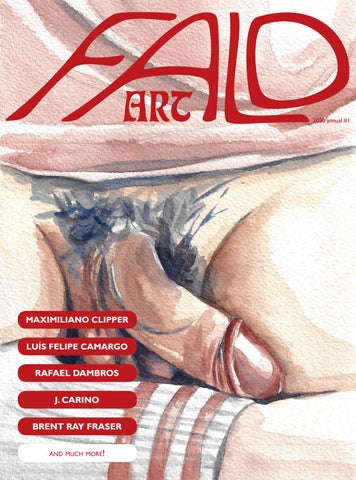
ART
2020 annual #1
1
MAXIMILIANO CLIPPER LUÍS FELIPE CAMARGO
RAFAEL DAMBROS J. CARINO BRENT RAY FRASER and much more!
2
Chema by Chema Alonso, ECCE HOMO I series, digital collage in Hahnemühle photo Rag by Ramón Tormes, 2017.
3
Tim Krueger, ECCE HOMO II series, digital collage in Hahnemühle photo Rag by Ramón Tormes, 2019.
FALO ART© is a annual publication. january 2021. ISSN 2675-018X version 10.01.21
editing, writing and design: Filipe Chagas editorial group: Dr. Alcemar Maia Souto, Guilherme Correa e Rigle Guimarães. cover: Self-portrait, watercolor, by Fefo Reyes
Care and technique were used in the edition of this magazine. Even so, typographical errors or conceptual doubt may occur. In any case, we request the communication (falonart@gmail.com) so that we can verify, clarify or forward the question.
Editor’s note on nudity:
Please note that publication is about the representation of masculinity in Art.There are therefore images of male nudes, including images of male genitalia. Please approach with caution if you feel you may be offended.
Rights and Commitment:
This magazine is committed to artists retaining copyright of their own work. All rights are reserved and therefore no part of this magazine may be reproduced mechanically or digitally without the prior written permission of the artist. We have been careful to ensure that the images used in this publication have been provided to us by the creators with copyright permission, or are copyright free or are being used under the “fair usage” protocol shared over the internet (images are low resolution, attributed to their creator, not for profit and used only to illustrate a relevant article or story). If, however, you feel your image has been used by us unfairly and your copyright breached, please contact us at falonart@gmail.com and we will proceed in the best way possible.
Submissions:
If you are interested in participating in the magazine either as an artist, model or journalist, please contact us via e-mail falonart@gmail.com.
FC Design R. Mario Portela 161/1603 C, Laranjeiras Rio de Janeiro – RJ 22241-000 Brazil
Editorial
W
e all agree that 2020 is one of the worst years in the history of humankind. Not only because of this crazy virus that isolates everybody from their loved ones and kills millions around the globe, but also because of political craziness that brought back medieval thoughts and acts of pure hate. It was not an easy task to produce Falo Magazine in this scenario. Suddenly my whole life was confined to a room with a computer where I gave endless hours of Art classes for my students and also worked as a freelancer (yes, I work as graphic designer because I need to earn some money to live). To do a totally free magazine in the middle of this pandemic shit and deal with new rules of censorship on social media was hard.Very hard. I got even paranoiac and decided to go back to therapy. I am sharing this because we all need to understand that we are not in the same boat but we are all in the same storm. Each one of us is dealing with huge emotional stuff. That’s the reason Falo kept me going. I know that this magazine is not only sexy images of nude men. I know the power it has. I know its ability to unite, to teach, to share, to enlight. Art is the media.
Summary So here you will see the amazing artistic production. Sculptures in bronze and plasticine, drawings in graphite and ballpoint pen, paintings in acrylics and watercolor made with a brush or… a penis! I must thank all these artists who were extremely kind and patient. With an addition: Rafael Dambros and Marcos Rossetton accepted my challenge to create a brand new piece from an old tale (check the article “The king is naked”). That was really important to me as an Art Curator/Editor and to this magazine because it gained another layer of relevance in the Art universe. For these two: I will be forever grateful. It’s important to remember that I can’t put every single page of Falo on the English annuals. But... if you think that you already saw the works cause you downloaded the portuguese editions, you are wrong! Here you will see some new stuff! From the cover to the artist’s articles (and the moNUment session has a repeated photo and a new one!). The endpapers bring Ramón Tormes’ digital collages from Ecce Homo series: a must see (with some known faces from social media)! Hopefully this massive magazine will help you to spend these weird days with more knowledge and culture. Don’t forget: in a couple of weeks you will have the second annual, Falo Photo, and later the third one, Falo History. Stay safe and healthy! Filipe Chagas, editor
Maximiliano Clipper
6
Dmitry Bitjukov
24
Luís Felipe Camargo
36
Adan
48
Rafael Dambros
62
Fefo Reyes
80
J. Carino
96
Beny Alonso
118
Brent Ray Fraser
138
SPECIAL The king is naked! moNUment
156 166
Maximiliano Clipper by Filipe Chagas
King, black ink, black markers, watercolors, color pencils on canson thick paper, 2019.
M
aximiliano Clipper never called himself an artist because drawing is such a passion, a common thing for him. His creative process is still the same as he was a kid that obsessively drew dicks all the time everywhere: an idea, few sketches, pencils, markers and watercolors to reproduce what comes to his fruitful mind. Sometimes I just draw with no ideas and improvise on paper.
That Chilean kid grew and started to create dream worlds full of manhood and sweetness that blend naturally. After he used Instagram to publish some work, the response was so good that he realized that he was in fact an artist. Walking around the city, cooking, seeing his friends, listening to some music, a good book, people in the streets or at the gym‌ life in general triggers him. Do you want a funny example of this? When Max was giving the name of his Instagram account, he was drinking papaya juice. And then Jugo de Papaya was born.
8
Elixir, black ink, black marker 0,05, pencil colors on canson thick paper, 2019.
Max says the men have always been represented in Art as strong and virile image. Now is more open to put the male figure in another(s) perspective(s), even in a feminine way or with a vulnerable look. As he is always been a skinny and delicate boy, that probably made him built a style where it’s possible to see hairy giants relating to small young people:
I make a difference in size because I like when someone so big and imposing looks after or admires something so small.To see these big brute men in my drawings mixed with delicate elements, like dry flowers, changes the concepts. A giant becomes an object of desire, of something lustful that you can touch but it’s not yours, almost like a small trophy.
9
Peach tree, black markers, pink watercolor on canson thick paper, 2018.
Love, worn down black markers, pencil colors on canson thick paper, 2018.
10
11
Quick sand, black ink, markers and watercolor on canson thick paper, 2018.
12
Somniferous, black sharpie, black ink, black markers, pencil colors on canson thick paper, 2020.
13
Just want strawberries, worn down markers, black ink, watercolor on canson thick paper, 2019.
Although his characters don’t smile that much, they have some expressions in the eyes and eyebrows because Max believes that the face shows the whole personality. He usually likes a teasing censorship, giving the imagination something to (desire) think about. I’m not a big fan of showing the entire thing at once.When it is too explicit (some of the work is) is a bit boring to me. And if he is erected, he’s horny and that’s it. A normal phallus when the male is just doing his stuff at his comfort zone, relaxed, gives more space to see other character’s layers.
Taion, black markers, watercolor on canson thick paper, 2020.
14 Alpha, black ink, black markers on canson thick paper, 2018.
Tobias, worn down makers, black ink, watercolor, graphite pencil on canson thick paper, 2019.
Zeal, black ink, black markers on canson thick paper, 2018. Belladonna, black ink, black markers, graphite, chinese ink on canson thick paper, 2018.
Spring dust, black markers, watercolor, pencil colors on canson thick paper, 2018. Brutus, black ink,black markers on canson thick paper, 2019.
15
Breeze, black ink, black rotulators, pencil color on canson thick paper, 2019.
16
17
Tournament, black ink, watercolor on canson thick paper, 2019.
As he takes a lot of time in one illustration, it’s better to work with his own mind (or photos) than with live models. And it’s very clear the influence of a Japanese style on his drawings, specially Suehiro Maruo’s ero guro*.
18
Ukiyo-e, chinese ink, black markers, watercolor, pencil color on canson thick paper, 2019.
* Ero guro is a japanese artistic genre that focuses on eroticism and grotesque, creating surreal or bloody situations. Its roots go back to 1920, pre-Second War Japan, still used nowadays in mangas, movies and even songs.
A bit of kindness, chinese ink, black marker, watercolor and pencil colors in canson thick paper, 2019.
19
Eunbi, chinese ink, black marker, watercolor and pencil colors in canson thick paper, 2019.
20
CMYK, black ink, watercolor on canson thick paper, 2018.
21 From the time he was studying Visual Arts and Graphic Design he kept some inspirations, like the idea of primary colors creating millions of possibilities (he uses the CMYK color model for print as a parameter for his works) or strong lights and hard shadows for fragile figures with vigorous souls (usual for fashion photographers from the 70’s).
Garden, black markers, watercolor, dry flowers on canson thick paper, 2019.
22
Max advises other artists to be truthful to their abilities, to believe and enjoy that line the hand makes because that is very personal. We can also read that as “let the kid inside you live the present, slowly but surely�. 8=D
Tournament, black ink, watercolor on canson thick paper, 2019.
23
24
Neoclassic, acrylics on canvas, 2016.
Dmitry Bitjukov by Filipe Chagas
25
T
he main theme of Dmitry Bitjukov’s Art is the beauty of male body, gay love and sexuality saturated with eroticism and passion. He began early (“probably in my teens”) when he studied at an art school in Riga, capital of Latvia, and drew different fantasy characters from computer fantasy games, both male and female, often half-naked and erotic. Always interested in creativity, Dmitry became an architect with a degree in interior design.
He felt the first years of the 2000s brought more freedom and nudity did not shock anyone so much. The owner of a Dutch gallery even became interested in his works, but he know that something is changing now:
Next page: Cube and Masculinity symbol, both in acrylics on canvas, 2019.
It seems to me that a certain puritanization of society is happening, and this is connected not only with the male body, but also with nudity in general. Religion, conservatism and nationalism give their marks. Artists like Sergey Sovkov, Douglas Simonson, Enrique Toribio and Troy Schooneman embody what he aim showing that his inspirations come from various sources, from the Renaissance to contemporary pornography because he likes to change the way he works. Dmitry’s style is mostly based on acrylic and watercolor to create a combination of soft and diffuse colors with clear and precise graphic lines. Sadness, acrylics on canvas, 2019.
26
27
He has a series of paintings that resemble stained glass windows on religious themes but not moving away from his main theme (“I dream to decorate a church with those”). As he doesn’t have a studio to work with live models, usually an idea, a picture in his head first turns into a sketch. Then he let it “mature” for the time it needs (“it can last several days and sometimes half a year or even longer”).
28
Dior (2019).
Below: Dmitry (2015) and Sanctus Sebastianus (2018), both in acrylics on canvas. Next page: Sanctus Pantaleon, watercolor, black ink and acrylics on canvas, 2018. Following pages: Composition nº8 (2014), Composition nº 4 (2013), Composition nº 11 (2015), Composition nº 1 (2013) e Composition nº 9 (2015), all watercolors, black ink and acrylics on canvas.
29
Show me now (2019).
30
31
Coyote, acrylics on canvas, 2019.
32
Rider, acrylics on canvas, 2018.
33
Male torsos – chest and back shoulders – concentrates the male beauty that Dmitry likes to portrait but he is also interested in the erected penis:
I take it positively. It is more picturesque, has more details. Scenes with a male erection or sexual intercourse attract me as an artist. Trying to bring his techniques to perfection, he plans to continue with his artistic vision to rise his career to a new level. His motto should be followed to every artist: “don’t be afraid to experiment”. 8=D
34
Dmitry painting muscles and his self-portrait (2018) in acrylics.
y r e g r u s c i t s a Pl ! u o y for Dr. Alcemar Maia Souto CRM 5246681-1
+55 21 97395 8000
alcemarmaiasouto@gmail.com
35
LuĂs Felipe Camargo by Filipe Chagas
36
Sugar bear, watercolor on canson paper, 2019.
37
A
t first glance, the work of Luís Felipe Camargo – also known as Fepe – impresses us for his artistic manufacture, that is, only by technique we already see his talent and call him an artist. Despite being reticent with the term “artist” (“I think this is something that others recognize, not me”), Luís Felipe began to understand himself as a creative professional when he felt satisfied with his works that caused positive impacts on most people.
Self-taught and workaholic by nature, he graduated in Fine Arts from UNESP and specialized in Illustration and Surface Design, mixing fashion and scientific illustration in unique and versatile pieces, whether on paper or fabric. After experimenting with various techniques – graphite, acrylic, oil, gouache – he made watercolor the basis of his work (“I like watercolor’s time”) and developed a perfectionist technique with a strong identity that, however, fits the most different proposals of job.
38
G.L’amour project, watercolors, 2010.
Luís Felipe photographs his own models and uses numerous visual references to give realism to a surreal universe: My creativity is very stimulated by the visual, so I collect many references of poses, bodies, ethnicities and images that I find inspiring to fine-tune what I’m working on at the moment. His work with male nudity began in 2010 with an investigation into “sanitization” in Art History, as several social issues associated the male body with lust and pornography. From there it came the G.L’Amour project, from photographs received via the internet.
G.L’amour project, watercolors, 2010.
39
Adan, watercolor, 2018.
40
Saint Sebastian, watercolor, 2018.
41
42
Eros, the senseless love, cover for the Greek magazine Exostis, watercolor, 2012. Maturity and identity, watercolor, 2015.
Myth series, watercolor, 2012.
In memorian series, watercolor, 2014.
I want to offer another view. I try to portray stories. I am interested in the individual and his personal universe. I stick to what is recognized as masculine because I believe it is my place of speech and is a topic that needs to be worked on, deconstructed and reframed. When trying to put myself in the other’s place, as an illustrator, I also deconstruct myself. I think it is essential to embrace the whole, sensualize and desensualize the male body and represent things as they are. I believe that precisely through censorship, taboos and stigmas perpetuated, for example, related to the phallus.
Then the set of the male body is material for the artist. Chest and butt attract attention, but Fepe knows that a look and a smile are capable of captivating. The penis, whether flaccid or erect, has its moment, its message and, therefore, must be relevant to the pictorial construction. For this reason, he usually advises that artists be objective and professional, whether art or pornography, that they are clear with the message and the purpose.
Hazlotu, for Yorokobo Mag, watercolor, 2018.
43
Muffin, watercolor, 2019.
44
45
Cookie, watercolor, 2019.
46
Scent of passion, watercolor on canson paper, 2019.
He has following photography projects that have been demystifying the naked man in art and facing strong censorship. He tries to use his work as activism, introducing diversity even when the briefing doesn’t ask. Having worked with Brands, Editorial Houses and Designers from all over the world, Luis Felipe intends to produce material that tells his artistic process and, thus, adds something to the discussions on gender, sexuality and Art. 8=D
47
Fabiano Foppa for the photographer Alef Ghosn, watercolor, 2018.
LuĂs Felipe in his studio.
48
Walking man, clay and patina, 2018, side view. Front view at the top of the next page.
Adan by Filipe Chagas
O
ne winter weekend a friend asked 40-year-old French engineer Adan if he would like to take a sculpture class. As he already enjoyed creative endeavors, he accepted and voila! Love at first modeling!
Adan is not necessarily comfortable talking about techniques or processes since he didn’t have a formal education in Art or Sculpture (“I don’t feel targeting a specific style, just doing what is on my mind”). Inspired by artists like Pablo Picasso, Josep Maria Subirachs and Pierre Soulages, he is attracted by geometric shapes, lines, movements and lights to turn his ideas into reality. He considers gravity his greatest challenge for a “living” material like clay (“that teaches me to remain humble until the end”), and often uses unconventional tools. To convert two-dimensional images that he uses as a source of inspiration into volumes are also challenging. His artworks is all about playing with male shapes and body lines, under various partial and deliberated angles, generally in the search for movement, light and emotion; thus the male torso becomes a preponderant graphic factor:
My very first sculpture was already a male nude. It has always been intuitively inspiring, a natural beauty in shapes and lines that deserves to be highlighted.
49
Lost in dreams, clay and patina, 2016.
50
Black diamond, clay and patina, 2016.
51
Sensual curve, clay and patina, 2016, front and back view.
52
53
Mysterious, clay and patina, 2017.
54
55
Shadows, clay and patina, 2018. Upper view and side views.
The representation of gay love is also an essential driving force of his work. From figurative to more cubist styles, these masculine evocations reveal both the strength and the sensuality of the male body. In regards to the phallus, Adan understands it as part of the male body, and therefore there is no reason to hide or ignore it. He prefers to reproduce it in its natural flaccid state to gain movement and sensitivity instead of the tense sexuality that an erection brings:
Lovers, clay and patina, 2017.
The phallus often gives impact and personality to the work.When I am sculpting penises I am amused to think it won’t let most people be indifferent. It’s kind of provocative. It contributes to the feeling of having a work closer to reality.
Love wins, clay and patina, 2019.
Athlete, bronze, 2019.
56
Intimacy, clay and patina, 2019.
57
58
Might and light, clay and patina, 2018.
59
Totem, clay and patina, 2018. Brazen, bronze, 2019.
60
He is surrounded by wonderful people who provide positive feedback about his creations, yet he also knows that he will not please everyone. He says that he is attempting to rebalance Art History: to bring back the representation of the masculine, somehow neglected since the antique and classical ages.
He is proceeding with numerous projects, and advises that artists should do what they want without regard to criticism or censorship (including self-censorship). However, Adan still finds it difficult to put himself in the position of artist. He considers himself a “lucky guy who can do what he likes to do�: Art is for me is anything that moves you and lets you feel reality differently. In this respect, art is relative and it is up to the individual to decide whether what they see is art, or not. 8=D
Adan. Dancer, clay and patina, 2017.
Third day, ballpoint pen on paper, 2020.
62
Rafael Dambros
by Filipe Chagas
Being an artist is not easy. Being an artist in Brazil, well... And what about being a teacher in this country? Now do you imagine being a passionate art teacher? This is Rafael Dambros, who, in addition to all this, has faced the wave of censorship that has hit art hard in recent years (the same one that triggered this magazine). In 2018, his exhibition Sanctified was canceled and then relocated, where he suffered verbal intimidation, virtual lynching and uneducated politicians published defamatory videos. There was even a prayer group outside the exhibition! Therefore, his words should be read first: I was encouraged to work with art since I was a child by my whole family in all possible ways, from courses to homemade mini exhibitions.This gave me courage to seek what I wanted. I started my studies in Arts in Caxias do Sul, but gave up to spend a great seven years in Rio de Janeiro. I studied audiovisual production, returned home and finally came out as an artist. Being an artist is like being gay.You are born an artist, but you have to assume that for yourself at some point. And it is as difficult as assuming homosexuality, since, from that moment on everyone demands quality, concepts, opinions, exhibitions and whatever. It took a long time to understand what I really wanted to produce and I still “came out� with drawings, an art seen as inferior close to other techniques. I sought a balance between the masculine and the feminine, more by the opinion of others than by my own will. So, I had to create a sincere dialogue with art, which involves a great deal of honesty with yourself. Knowing your qualities and your flaws and accepting the flow of that into art is quite complicated. I was brave enough to produce only what I find interesting and today I feel safe with my art, research and failures.
63
Creation, ballpoint pen and acrylic on canvas, Sanctified series, 2017.
64
Last Supper 2, ballpoint pen on paper, Sanctified series, 2017.
65
Saint Sebastian, ballpoint pen on paper, Sanctified series, 2017.
66
Sanctified series (2017). Above on this page, Baco and Sergio (ballpoint pen, coloured pen and gold leaf on paper) and on the next page, St. John The Baptist (ballpoint pen on paper).
67
Below, St. Roch (acrylics and PVA on canvas), St. Francis (ballpoint pen on paper), St. Jude the Apostle (ballpoint pen on paper), St. George (ballpoint pen on paper) e St. Expeditus (ballpoint pen, acrylics, PVA and gold leaf on canvas).
After becoming known for his work using a ballpoint pen – where the shape is created by the expected effects of the technique – many people began to offer to pose for Rafael. But of course he gained fame as a horny voyeur when he started looking for models... after all, nothing could be easy in the artist’s trajectory. Both women and men were restricted from showing certain parts of their bodies for fear of others’ opinions, but male models had less discomfort because they were naked in the presence of another man. The reactions to the results were also similar: for the female drawing he heard “what a beautiful drawing!”, while for the male drawing it was “look, a penis!”
68
Above, Ecce homo (2013) and, next, Embrace (2014), both in ballpoint pen on canvas, from Ballpoint Human series.
69
Thirsty, ballpoint pen on paper, from Ballpoint Human series, 2013.
Original love, ballpoint pen and watercolor, from Mine series, 2020.
70
Past, ballpoint pen and watercolor, from Mine series, 2020.
71
Ă?ndigenous, Conqueror and Invader, ballpoint pen and watercolor, from Mine series, 2020.
72
73
Despite the obstacles, Rafael credits his hyperrealistic speech with naturalness. He portrays people in the maximum reality that his technique allows, while removing interference from landscape or environment so that their characters are seen for what they are from his point of view.
74
The male figure came to him as a form of primary inspiration, whether by desire (“it is where my gaze is most easily laid) or to mark a questioning homoerotic identity. When he creates a feminine image, it is because that shape is necessary, like some reinterpretations of the Catholic iconography of Sanctified.
The artistic universe is historically macho.The male nude has always been seen as vulgar or secondary, while the woman has been objectified in all possible ways and also within art. I insist on the image of the man because I seek the representation of the masculine with all its nuances and, sometimes, I want to create the opposite way, that of objectifying it.
Sin, acrylic on MDF, 2017.
Men series (2015/2016). Above, Red number 1. On the side, Pink. Below, Yellow number 1. All in balpoint pen, posca markers and acrylic on canvas.
75
76
Pop Porn series (2014/2015). Above, Wilhelm Von Gloeden 1900(02). Below, Wilhelm Von Gloeden 1900 and A. Calavas (detail) 1895. All in acrylic on canvas.
Look number 2, ballpoint pen on paper, from Mine series, 2019.
For this Rafael created two lines of work: in one, he draws from received photos; and, in the other, based on research and studies, he elaborates mental sketches for his own creations, where the face and the look stand out, regardless of the body (“many times a naked body is only support for the look”). Then he prefers to portray the flaccid penis, so that an erection does not break the harmony of the composition (“I am a little Greek or Renaissance in that point”). He also believes that the normalization of the representation of the penis and the male body in art inevitably goes through social networks, since, although there is still censorship in them, it is this new form of sharing and communication that ends up bringing together and also expanding the reach of artists. It is with images from Instagram, for example, that the artist has used embroidery as an unfolding of his art with drawing and lines.
77
78
This history of prejudice and censorship does not surprise Rafael, who continues to produce, increasingly linked to social, cultural, political and religious questioning. “Do what you feel like doing� is his biggest advice, very libertarian and extremely subversive for the times we live in. 8=D
Embroidery series (2020). Clockwork from above: Solitude, Sea, B, Man on his knees and Black jacket.
79
80
Fefo Reyes by Filipe Chagas
81
I
t is known that Art is something essential, that makes our lives full. It makes us review concepts about the world and ourselves in relevant and even therapeutic ways. This goes for both spectators and enthusiasts, as well as artists like Federico Reyes, or Fefo.
Foreskin, watercolor, 2017.
Born in Uruguay, surrounded by canvases, brushes, paints and art books, a family of amateur painters, Fefo understood the Art power from an early age and used it to reflect on his body and his sexuality. I always stuck to the representation of the human figure, but for a long time I drew women to hide my feelings.Today I no longer hide them. I try to express my feelings, my sexuality. Art has been a way of liberation, of losing my fears.
82
Always shy, Fefo says he had an early body development, as he matured before his schoolmates. In this period when bodies change and are placed under the observation of others, he had difficulties with his body image, either due to being overweight or because of his hollowed chest. However, one day, his colleagues saw him naked and Fefo received several compliments directed at his penis (“I was called ‘horse’ and ‘thick’, even though he was normal”), which were building his confidence and security from the phallus .
Self-portrait 3, pencil, 2019.
Self-portrait 1, pencil, 2018.
Fefo and his Nikes, watercolor and pencil, 2019.
83
Since self-portrait is an exercise in both technique and self-knowledge, he began to emphasize the shape and anatomy of the penis (“above all, erect or morcillona�) in his process of understanding and working on his complexes.
Having friends as models makes everything more relaxed, but self-portrait is part of the process of accepting my body, of how it is with all the characteristics that I have had a problem with, but I don’t care anymore.
84
Social construction of penis, watercolors, 2018.
85
Impudico, watercolor, 2018.
86
Journalist, watercolor, 2018.
87
88
Lovers, watercolor, 2019.
89
Inspired by Tom of Finland, Harry Bush and Ismael Ă lvarez, Fefo tested various techniques, from digital illustrations to watercolor, where he best developed his figurative homoerotic art. He believes that this type of art is being increasingly accepted (“it causes the most varied reactions, from dislike to enchantmentâ€?), however, much needs to be done in terms of dissemination. He remembers that he was very happy when a friend framed and hung one of his paintings.
For me, the penis is something very normal and I think it should be that way.Why does it have to be different from drawing a face, a chest or feet?
A like for my cock, watercolor, 2018.
Rain, digital collage, 2018.
90
Fefo Phallus 1, 2 e 3, digital collage, 2019.
Above, Pitufo Bruno; below: Pitufo Fefo, both digital art, 2016.
91
92
Lovers (nยบ2), pencil on paper, 2020.
Lovers (nยบ1), oil on linen, 2020.
93
Filipe, pencil, coloured pencil and charcoal on paper, 2020.
94 William, pencil on paper, 2020.
Miguel, watercolor, 2020.
Gradually, he finds his space through themes that he likes to portray, such as, the fetish for tennis (a variation of foot fetishism). With the development of a book and the search for diversity, Fefo says he is still in the process of recognizing himself as an artist and, for that, he follows his own advice of creating free from prejudice. 8=D
95
17+97, pencil and color pencil, 2019.
Air, oil, 2020.
96
J. Carino by Filipe Chagas
97
A
t the end of the 19th century, symbolist and post-impressionist artists paved the way for a vanguard that changed art completely by expanding both its perception and the forms of pictorial representation. Inspired by this flow of creativity that went through history, J. Carino grew up using line, color and abstraction for the love of Art.
We piece ourselves back together, acrylic and collage on canvas, 2020.
He entered a liberal arts college and realized that he could pursue the career he always wanted if he moved to a specific design background at Parsons. Pieces by Bonnard, Redon, Picasso, Bearden, Stella, Magritte, Basquiat then joined textile patterns, decorative arts and art deco to frequently change his style in a variety of mixed-media.
I like to play with distortion and abstraction, losing and rediscovering the figure as I work on a piece.
The flood, pastel and charcoal on paper, 2020.
98
He says this is his spontaneous way of interacting with and processing the world and his own thoughts. Whether from everyday life, a simple landscape, a model or his own image, this incredible visual artist and illustrator from New York uses the specificity of observation to bring his drawings to life: There is an immediacy and a commitment involved in drawing. Once you put something down on paper, it remains, even if you smudge it out or draw over it, the history of it remains, which I think is beautiful and is a reflection of how we live our lives. Some of my work is more narrative or symbolic, but I always try to root it in the authenticity and honesty of the drawing.
Flame, watercolor, charcoal and pastel on paper, 2019.
99
100
101
Dragon, gouache on paper, 2020.
However, J. Carino is a pseudonym. His artistic work centered on the masculine form was an enterprise that he kept private and intentionally separated from his award-winning professional work. For him, this reflects the way that many of the LGBTQ + community express themselves in society: a dichotomy between what is exposed and what is hidden, between wanting to be seen as a whole person and the fear of becoming vulnerable.
102
The self-portrait was his initial relief to distance himself from the heteronormative academic practice that preaches the notion of the female nude as a standard of beauty. Dealing with his own nudity and, later, with male models was a new experience that gave his drawings less rigid and more fluid, sensual tones. By making the male form part of his artistic world, Carino went through phases of exaggerated sexuality and also of non-sexual observation.
Above: Boundaries, charcoal and pastel on paper, 2020. Beside: Ignudo, oil pastel and crayon on toned paper, 2020.
103
Haze, gouache on paper, 2020.
104
Falling, acrylic on canvas, 2020. Boxed, watercolor, crayon, charcoal on paper, 2019.
105
As his work evolved, he realized the intensity of the reaction to portraying the penis. He even enjoyed the emotion of drawing it and the reactions it provoked, but he learned that it instantly becomes the first thing seen in the work regardless of what else is going on.
There is an excitement and a taboo of seeing dicks in art. An erection is like a lightning rod for attention! Nowadays I am more judicious about when I expose them in my work, because I want to make sure the piece as a whole is provoking the reaction I want. I use abstraction and narrative to make sure that although the attention will inevitably fall on the dick, there is enough to hold the rest of the image together.
106
The wolf, oil pastel, pastel, and charcoal on paper, 2020.
107
Embrace, gouache, oil pastel and crayon on paper, 2020.
108
Above: Red,White, Blue, Gold, pastel and charcoal on paper, 2020. Below: Eden, pastel and charcoal on paper, 2020.
109
Knot, pastel and charcoal on paper, 2020.
Since the self-isolation/quarantine period began, I have been drawing portraits of queer people (primarily men) all over the world through Skype and FaceTime. It offers a sense of connection and intimacy in a time when we are all separated.The subjects are in their own environment, and as an artist, I am subject to the limitations and freedoms of that environment, the forced and flattened distance and cropping of the scene, and the perspective of the camera. But pushing through those limitations, to find dimension, color, space, and personal energy becomes a unique and specific challenge for each drawing session. It is a process of opening up and expanding, while we are subject to the claustrophobia of self-isolation. 110
111
112
113
114
115
New beginnings, gouache on papel, 2020.
116
Carino seeks to explore “the complicated influence of intimacy, sexuality and exposure, especially as it relates to gay relationships and our ability to connect with one other and ourselves”. Despite recognizing a shift in acceptance of the male nude in Art and having received a warm and welcoming response from the LGBTQ+ art community, he believes that the answer would have been different if he had not created his pseudonym. For this reason, he advises that artists be very frank in their artistic representations, without any censorship, allowing themselves to investigate their own reasoning behind their creations. He himself intends to continue exploring nudity and male sexuality in a journey of growth and transformation that he is “looking forward to see where it goes”. So do we! 8=D
Arch, gouache on paper, 2020.
117
Plasty Selfie (2018).
118
Beny Alonso by Filipe Chagas
P
lasticine. That’s right: the modeling compound that children use. This is the material that led the Spanish graphic designer and photographer Beny Alonso to create the BodyPlasty project.
119
Foot – The beginning (2017).
First of all, let us remember that the history of sculpture in humanity began with the modeling of clay and then moved on to stone and metals. Marble and bronze were considered – and still are – the most noble materials, but modeling has always been present, even for pre-sculptural studies. In the 1960s, new materials from everyday life invaded the world of (Pop)Art and expanded the sculptural scope. So, why not the plasticine? Combined with his photographic techniques, Beny harnesses the material’s potential.
After photographing the pieces, I destroy them and reuse the material. At the end, it’s like our body: the images will be the only thing that will remain of it.
Thus, in the BodyPlasty project, Beny treats the male body in a playful and erotic way at the same time. His pieces gain a touch of humor that take away the traditional seriousness of general art and lead the viewer to contemplate a body that is exposed in front of him without complexes, like a toy to fantasize and have fun.
Stay strong... stay safe (2020).
120 Ups... HoHoHo!! (2018).
The human body has always been a constant fascination for the artist, who considers the drawing of a naked model “a fantastic basis for any type of art, since capturing strength, expression and life, especially the life of a body, is one of the most complicated things in art “The focus on the male body comes from the intention of changing the gaze, traditionally directed towards the female body, recognizing the sensuality and sexuality of male representations.” I am interested in looking at the male body without that majesty halo of traditional art... a more everyday look, but with the same erotic charge that has been regularly applied to the female body. I think it’s important that we treat sex in a more normalized way... only then we will be able to move towards a healthier society in many ways.
Reading time... or not (2020).
121
Stay at home, but not alone (2020).
122
123
Proud old generations (2020).
On several occasions, as a photographer, he worked with models, and he believes that the relationship produced in a photo shoot can be very interesting – “sometimes there is a fantastic harmony since the beginning, other times it appears while you are working with him or her, and at other times it does not come at all... in any case everything is reflected in the work”. However, for BodyPlasty, he doesn’t work with models because he focuses on the sensual game between the plasticine and the ideas in his head: Plasticine is a very sensitive material that records any gesture and, therefore, dictates its shapes to me. I often intend to do one thing and it proposes another. Gradually I discover the identity of the piece, its personality.The faces pop-up... sometimes, a simple gesture of the toothpick makes the expression come out... or get lost. It’s like sex: I enjoy a lot while discovering the body shapes. Few men have surrendered to me as much as the ones I model.
Men in black (2018).
124
Black power / Black Lives Matter (2020).
Another point of view / lying down (2018).
125
All the body parts are relevant to the artist because he considers that the movement is only fully achieved as a whole. Despite the small size of his sculptures, that makes it difficult to detail (“but it forces me to be more concrete and synthetic), Beny likes to work the hands and feet, since they provide a lot of strength and expressiveness to the figure. Another important element in his pieces is the body hair, that texturice the piece, and helps to define the shapes of the muscles.
Nice to see you / Celebration 2000 (2019).
126
Although some pieces of the project are focused exclusively on the phallus, pubis, testicles and even the dripping semen – “Ejaculation is a natural part of male sexuality. Why not show it in an artistic way?” – the penis is naturally integrated into his works: flaccid it accompanies the dynamics of the piece, while erect it becomes more raw, even violent.
A flaccid phallus has the eroticism of the possibility of erection, and an already erect phallus shows the strength of the male member in its splendor.
127
Teddy / Octobear (2018).
128
Without touching / Celebration 1000 (2018).
Morning wood (2018).
129
The photographic process comes after modeling when Beny treats the figure as if it were a real body. Lighting, framing, point of view... all techniques aim to give the work a different dimension, to give it life, since our brain has the habit of processing the photographic image as real.
Modelling processo (five phases) of Summer love 2020.
130
131
Summer love 2020 (2020).
132
Here comes the sun (2019).
133
Resurrection (2019).
Ready for the party / Happy & Sexy 2019 (2018).
134 Wake me up when September ends (2018).
This led him to post the results on Instagram, the main image platform today. At the same time that he vibrates with the interaction with his followers, and the inspiration from works shared on this network, also introduced him to a conflict, which, although it seems, it is not new: exposure vs. censorship. He has already had its profile deleted (later recovered) and knows that he lives with the constant threat of being blocked by “inappropriate content”. Beny believes that this cynic conflict comes from the political and religious manipulation of aesthetic canons, both male and female, throughout the history of art. What conditions the relationship of man with his own body, his sensuality and eroticism and also with the body of other people. I believe that the internet and social networks can contribute to improving the acceptance of the male body thanks to a greater exposure of users to it, and through the different creative approaches that we shared. I think it’s important that we claim the right to publish this and other types of artistic content that only offend a few, using our work as an invitation, for all of us, to reflect on why some are so offended. If you don’t want to see nudity, don’t, but I think too, if social media has the technology to detect and block a nipple, they can also use it to protect these users from content they don’t want to see, rather than blocking it for everyone.
135
Following the master / @Macksturgis (2019).
Beny puts his work above his identity (“the protagonists are my boys, not me.”) in search of more direct feedback between the viewer and each piece, that doesn’t come from a link with the artist (“How many times we liked something just because we follow or know who shared it?”). He prefers to be called “creative”, not “artist” – a word he finds “bloated” – because he enjoys the experimentation, the process, the error and the surprise without caring about the result. Currently, he is working on other techniques and ideas, about the human body, and testing other more stable materials than plasticine to make pieces that can be preserved and displayed or distributed. But his goal is always to live enjoying his work, experimenting and being surprised, away from the conventions. 8=D Big Blue Daddy – Following the master / @adamgraphite (2018).
136
COLORS / Pride 2018 (2018).
137
Brent Ray Fraser by Filipe Chagas
138
139
P
ainting with the penis is an artistic reality for Canadian Brent Ray Fraser. Even though he used to hate having people watch him draw when he was a child, fate ironically led him to travel the world showing his enormous talent (read with a double meaning) to paint completely naked in front of large audiences.
140
Fourty years, acrylic on canvas, 2020.
Brent remembers that since he was three years old he wanted to live a creative life and, therefore, started to engage in a wide variety of activities that would take him on this path (“I eat, sleep, shit, piss and breathe art”). It was also in childhood, when he painted his dreams with his fingers and a wild imagination (“I still remember how the paint felt squishing through my little fingers”), that he realized the importance of the sense of touch in his creative process (“I fell in love with making art the very first time I touched paint”). At one point in his artistic career, he wanted to capture his sexual arousal as art and decided to masturbate with paint, pressing his erection on a canvas. After five years and hundreds of these paintings, Brent thought about trying to use his penis as a brush and started to recreate works of art on large murals.
141
The penis is the most unique object on the planet. Every single cock has its own characteristics and personality. It’s the most creative tool in history, as it spreads the seed of life.Whether erect or flaccid, it provides a different effect and requires unique strategies. Now my penis is involved in a wide variety of art forms and media.
Previous page and below: Just the tip 8 and 24, acrylic on canvas, 2018.
Above: Into the pink depths, acrylic on canvas, 2020. On the side: Koi pond, acrylic on canvas, 2020.
142
Below: Playing on purple clouds, acrylic on canvas, 2020. All abstract paintings made with his penis.
143
144
145
To viewers, it may seem like a simple act of adding paint to the penis, but it’s more complicated than that: in addition to using a barrier cream to prevent ink toxins from entering his blood stream, Brent not only needs to adjust the amount of paint to ensure that his skin does not rub off on the surface and cause bleeding (“I’ve had many scares in the past due to the repeated rubbing on rough surfaces”), but also deals with a tool “connected” to his body.
Above: Virgin Mary, acrylic on canvas (background with hand prints and imagem made with his penis), 2015. Previous page: David 1, 2 e 3, acrylic on canvas (background painted with fingers and image made with his penis), 2015.
146
Above: JFK, acrylic on canvas (background painted with hands and imagem made with his penis), 2014. On the side: I have walked in fields of thorns, acrylic on canvas (background painted with his penis and flowers made my testicles impressions), 2018. Below: Trump in red, acrylic on canvas (background paited with hands and image made with his penis), 2016.
147
Then he developed techniques and equipment that demand his physical power. Speed penis painting was the most challenging, but he has managed to establish a safe and effective way to do this over the years. For some mural works, for example, Brent is suspended in full front splits a la Van Damme between two ladders fixed to the ground and uses special handles fixed to the wall. He usually says that “it’s like watching a circus act with paint”, which, in fact, we can associate to Jackson Pollock’s pictorial performances that transformed the act of painting into something as or more important than the final artistic result. 148
It is important to be clear that despite this picturesque image that we can have seeing a man painting with his penis, Brent is an excellent artist! His abstract work - especially his “selfportraits” (the impressions of his penis, which he called Monoprints, and of his body, the Body Rituals) - bears a resemblance to Yves Klein’s Anthropometries*.
* In 1960, French artist Yves Klein held a performance event where naked models were smeared with a blue paint created by the artist and “printed” their painted bodies on canvas. These “Anthropometries” were repeated a few times, even in the presence of an audience and with an orchestra.
Acima: Self love 1, acrylic on paper, 2020. Previous page: Ritual 8, acrylic on canvas, 2016. On the side: Iluminate 2, fluorescent pigment with acrylic mediumb on black paper, 2020. Below: Ritual 3, acrylic on canvas, 2016.
149
150 Acima: Floating as one, acrylic on wood (background painted with hands and penis impressions), 2013. Below: Monoprints 20, 31 and 74, acrylic on art board, 2019.
Above: Balls 1, 10 and 34, acrylic on wood, 2019. Below: Peering wondrous, mellow, bright, a hidden delight, acrylic on canvas, 2014.
151
It’s redundant to say that Brent celebrates the human body regardless of size, shape or age. However, he sees the mainstream media and social networks both increasing the exhibition space and restricting artistic freedom.
Western society is not as free as we may think. Sexuality is something that is swept under the rug, but if you take that away we will cease to exist. Kanamara Matsuri in Japan it’s a festival with parents wearing penis sunglasses, while their kids suck penis popsicles! Monks carry massive cock sculptures in a parade celebrating the Phallus of Steel! However, here it is all taboo. Frontal nudity should be embraced, not controlled.
152
Above: Love (Self-portrait), granite and hard plastic cast replica of the artist’s erection, combined with a pistol revolver mounted to a custom hand-made oak wooden stand with metal signature plate, 2020. On the side: Pain nourishes courage, replica cast of the artist’s erect penis, hand plated with 100% pure 24 Carat Gold, showcased on a custom hand-made oak hardwood stand with gold brass aluminum signature plate, 2015. and Phallus bloom, replica of the artist’s erect penis, hand crafted colourful rock-hard plastic with silk floral explosions, 2020. Next page: The Rainbow Masterpiece, interchangeable hard plastic colour replica of the artist’s erect penis, each shaft is mounted with a metal detachable bracket on a round wood panel, glazed with high gloss resin, 2020.
153
Because he grew up very shy, he uses his exhibitionism as a way to counteract the unwanted feelings of introversion as well as he breaks barriers and expands the acceptance of the human body as Art. Thus, one of his missions as an artist became to travel around the world participating in famous TV programs to show his work, even in countries where frontal nudity is prohibited. People react in many ways: from shame to excitement, from jokes to offenses; however, for the most part, the feedback is positive, inspired and liberating. Our fears are constant, as our minds swirl with a myriad of thoughts and emotions. Using only my bare vulnerable body, I create each painting to obliterate my fears, and celebrate life in all its diverse glory. I become a free and expressive human being when I make art and my audience feeds off this energy. Painting like this is liberating not only for me.
154
Colour eruption (Self-portrait), acrylic on canvas, 2013.
Brent Ray Fraser by Steven Menendez, 2019.
Brent believes that we all have the freedom to create and express ourselves however we want, but not everyone has had the opportunity to feel inspired to create or even know how to tap into that intuition. In his case, his art is a balance of everything that is sexual. When somebody asks for advice, he always says not to let the fears prevent from expressiveness and to enjoy artistic processes safely, with body and soul. 8=D
155
Multi-shaft 8, acrylic on canvas, 2018.
SPECIAL
“The king is naked” by Filipe Chagas
The emperor’s new clothes is a Danish folktale written by Hans Christian Andersen, published in April 1837 (with “The Little Mermaid”) about a vain emperor who is exposed before his subjects. It is believed that the tale was inspired by a story found in Libro de los ejemplos (or El Conde Lucanor, from 1335), a Spanish medieval collection with moral tales from various sources and diverse origins, compiled by the writer Don Juan Manuel (1282-1348). The story would already be an adaptation of an Indian tale that appeared in an anthology of fables (now lost), Nirvanalilavati by Jineśvara (1052).
156
In the Spanish tale – called What happened to the king and the three imposters – a king receives a costume from three malicious weavers that would be invisible to all but those who are legitimate children and everyone pretends to see, even his “adulterous children”. In the Indian tale, however, a single and dishonest merchant offers the king a garment that could not be seen or touched by anyone of illegitimate birth. When the king is supposed to be wearing the garment, the entire court pretends to admire it. In a parade through the city to show off the dress, the people asked him if he had become a naked hermit; he realized he had been tricked, but the swindler had already run away. The similarity between the two is clear. Andersen did not know the originals, as he would have read a version of the medieval collection translated into German entitled So ist der Lauf der Welt (“This is how the world works”), and changed the focus from illegitimate parenting to courteous vanity. However, it is known that Andersen decided to write his story after remembering a passage in his childhood, when in a parade in the presence of King Frederick VI, he realized that the king was nothing more than a man and had been severely reprimanded by his mother. So, his story went like this:
A
bandit (in some versions there are two), fleeing from another kingdom, decided to hide and pretend to be a tailor in the lands of an emperor known for his high spending on clothes.Very rascal, the “new tailor” conquered everyone and even managed an audience with the Emperor. “In the distant lands where I came from, I invented a way to weave the best of all clothes!” said the fake tailor. He continued, “I can weave a garment that only intelligent people can see!”. The vain emperor liked the proposal and asked the bandit to make such a suit for him. The bandit received several chests of wealth, rolls of gold thread, silk and other rare and exotic materials, required by him for the making of clothes. He kept all the treasures and stayed on his loom, pretending to weave invisible threads. Everyone passed in front of the tailoring shop and he kept doing his performance: he pulled cloths, cut the air, looked like he could do better, redoed and hung nothing on the hanger. And he did so for weeks, while receiving money from the emperor. Of course, everyone who passed by the window claimed to see the fabric so as not to look stupid.
Illustration from Vilhelm Pedersen, Andersen’s first illustrator, 1849
157
Until one day, the emperor got tired of waiting and wanted to see the progress of the supposed “tailor”. When the false weaver showed the empty work table, the emperor exclaimed: “What beautiful garments! You did a magnificent job!”, Although he saw nothing but a simple table, since to say that he saw nothing would be to admit in front of his subjects that he did not have the necessary capacity to govern.
158
The nobles around them let out false sighs of admiration for the bandit’s work, none of whom wanted them to think he was incompetent or incapable. The bandit guaranteed that the clothes would soon be complete and the emperor decided to schedule a big parade in the city for him to show off the special robes. During the event, however, a innocent and sincere child shouted “The king is naked”. The scream paralyzed the event, and the child’s sincerity and gaze touched those present. The buzz started and everyone started to confess that they didn’t see the emperor’s new clothes. Bothered by not feeling the weight of the clothes, the emperor shrank for a second in his vulnerability and then decided to flaunt his nakedness with such conviction that he left everyone in doubt as to whether or not there was an outfit. Some even called the child a liar, and the bandit had already fled with attention on the parade.
The king is naked, artist’s embroidered underwear on canvas, by Rafael Dambros (@rafaeldambros), 2020.
It is said that in the first version of the story, Andersen punished the bandit(s), however, when the manuscript was in the graphics, he would have altered the ending. This change would have occurred due to a passage in the author’s life: either a reference to his acceptance in the snobbish Danish bourgeoisie or the reading of the manuscript to a child who gave a different answer. The emperor’s new clothes has become one of Andersen’s best-known tales and has acquired the status of a global icon and standard metaphor for anything that comes to pretense, pomp, social hypocrisy, collective denial, empty display and no questioning of standards. Numerous adaptations for TV, cinema and theater were made. The short story established the author as a writer capable of transmitting moralizing messages and – especially in
this case – of “romanticizing” children, giving them autonomy and courage to challenge authority based on truth and simplicity. Because of this reputation with the children and young people, the 19th century illustrations do not show the emperor’s nakedness: he is usually portrayed wearing the undergarments of the time, as if it were a nightgown or boxer briefs.
For this reason, I teased artists Rafael Dambros and Marcos Rossetton to give their views to the story. In these pages, you see the work of Dambros, who produces the embroidery of the naked king in an underwear used to hide his nudity and turns it into a canvas. And on the following pages, you’ll see Rossetton’s fashion and photography production, featuring a 21st century monarch.
159
The Miss King is naked!
160
161
162
Creative conception (photography, cosumes and styling) Marcos Rossetton @rossettonjobs
Studio lighting Antonio Rogério Cazzali @arcazzali
Non-binary Model Vinny Pariz @vinnypariz
Make-up Vitor Figueroa
@vitorfigueroabeauty
Support Brechó Minha Avó Tinha @minhavotinha
163
BE MORE BE A COLLABORATOR! www.benfeitoria.com/falomagazine Falo Magazine has as its main principle the knowledge for free. It was always thought that way through online platforms, where the reach could be maximum and timeless.
164
The work is hard. A single person is the editor, the reporter, the researcher, the writer, the translator, the proofreader, the designer, the marketing advisor, the social media manager, the janitor etc etc ... without any financial gain. The advantage is that the cultural, social and personal gains are immeasurable. However, it is necessary that the magazine become selfsustainable and can invest in itself. You are already our collaborator just because you access the magazine, the social networks and have made it this far. If you want to collaborate a little more to leave quality material as a cultural and social legacy, choose one of the monthly subscriptions!
FALO’S FRIEND R$ 10.00/month
Name on the magazine.
FALO’S PARTNER R$ 15.00/month
Name on the magazine and you will receive by email a spoiler of the next edition.
FALO’S VIP
R$ 20.00/month Name on the magazine and you will receive the next issue by email before the public launch.
FALO’S PATRON R$ 50.00/month
Thanks to you who believe in the magazine and the transformative power of Art! Alcemar Maia, Carlos Torres, Daniel Caye, DUOCU, Fernando Oliveira, Heráclito Vilaça, Júlio Lima, Leandro Guimarães, Marcelo Augusto, Miguel Casafont-Broutin e Orlando Amorim.
Name on the magazine, receiving bimonthly editions before the public launch and the special editions that are made.
R$ = Reais (Brazilian money)
You can also SHOP ONLINE falo-magazine.redbubble.com
165
moNUm en t
166
Model: Daniel Ruzic. Photo: Pawel Spychalski.
167
Model: Dre Booker. Photo: Black Mansion.
168
La putana cรณsmica, ECCE HOMO I series by Ramรณn Tormes, 2017.
Following an ideal similar to the geometries of rose windows and Gothic stained glass, the Spanish visual artist Ramón Tormes creates paradises that only exist in his imagination. The ECCE HOMO* series began to take shape after seeing the digital collages of his friend and also photographer Fernando Bayona. From there, Ramón contacted other photographers and models to ask for permission to use an image for his project. The creation of an ECCE HOMO does not have a preconception (“I place the nude model on a white background and it gradually appears there”), but the landscapes are composed in a dreamlike way, surrounded by fauna and flora, one of the artistic characteristics more identifiable in this project. The protagonists are all chosen by visual force, not by anatomy 169 (“my choice has a lot to do with the person’s expressions or character”). The first series consists of 21 digital collages. However, the second series is much longer: Ramón has already passed 100 pieces and continues to work on it – he has even created a subseries called SIRENOS. 8=D
* Ecce Homo are the latin words used by Pontius Pilate in the Gospel of John when he presented a scourged Jesus Christ to a hostile jew crowd. The sentence means “Behold the man”.
Daniel & Zeljko, ECCE HOMO II Sireno series by Ramón Tormes, 2019. Aridane & Jesus, ECCE HOMO II Sireno series by Ramón Tormes, 2020.
170
ISSN 2675-018X
falonart@gmail.com