RESILIENCE HUBS
The Six Core Components A true Resilience Hub is for, by, and in the community. It is a community node of connectivity, care, resources, supplies and safety. Thus, a Resilience Hub must consider and include at least a portion of each of the six core components. The Resilience Hub Collaborative has developed and refined these Six Core Components for over 15 years; they are intended to be comprehensive and to ensure community needs are not bypassed for infrastructure upgrades. The core components are the foundation any Resilience Hub. They enable a Hub to function year-round, in the event of any disruption, and throughout recovery.
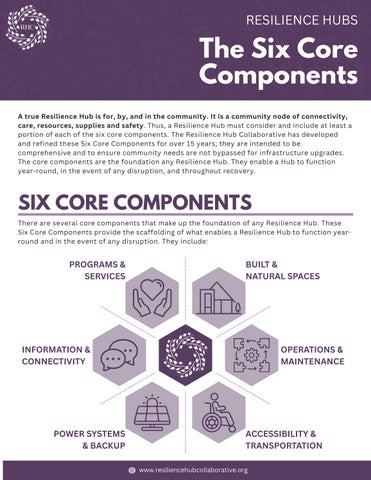
SIX CORE COMPONENTS There are several core components that make up the foundation of any Resilience Hub. These Six Core Components provide the scaffolding of what enables a Resilience Hub to function yearround and in the event of any disruption. They include:
PROGRAMS & SERVICES
BUILT & NATURAL SPACES
INFORMATION & CONNECTIVITY
POWER SYSTEMS & BACKUP
OPERATIONS & MAINTENANCE
ACCESSIBILITY & TRANSPORTATION www.resiliencehubcollaborative.org
PROGRAMS & SERVICES These are the heart of a hub. This includes yearround offerings and activities that address the community’s specific needs such as workforce training, childcare, youth and elder programs, and health services. These programs build the daily trust required for the Hub to be effective during a crisis. During a crisis, these transition to emergency services like food distribution or medical aid.
POWER SYSTEMS & BACKUP
SIX CORE COMPONENTS
To remain functional when the grid fails, Hubs integrate resilient energy and battery backup systems to ensure the facility remains operational during power outages. This typically involves solar-plus-storage (batteries) that can provide electricity for critical needs such as refrigeration, device charging, communications, and lighting without relying on fossil fuel generators.
OPERATIONS & MAINTENANCE
INFORMATION & CONNECTIVITY
This is the “how” of a Hub and is critically important. This component includes clear governance structures, staff training, Resilience Hub Ambassadors, and volunteer management to help support the site. It covers the long-term sustainability of the site and includes having a dedicated management team, clear emergency protocols, and a diverse funding strategy to keep the doors open and the building maintained.
Hubs ensure that reliable and accurate information flows to the community and is accessed easily. This includes providing Wi-Fi and computer access, maintaining community bulletin boards and communication systems (like satellite internet or radio) and utilizing alternative communication strategies such as emergency radios that remain functional when the grid is down. This ensures all members of the community are well informed and have a trusted source of information
ACCESSIBILITY & TRANSPORTATION
BUILT & NATURAL SPACES
A Hub must be accessible and reachable to everyone in its service area. This includes accessibility compliance, proximity to public transit, ride shares, and infrastructure like walkable paths and bike lanes that connect the neighborhood to the hub. Additionally the Hub can support “active transportation” like bike repair stations or EV charging. During recovery conditions, the Hub may serve as a transportation node for resource and supplies delivery and ride coordination support.
This component focuses on the physical integrity, function of the Hub, and its surrounding landscape. This involves retrofitting structures to withstand local hazards (seismic upgrades, air filtration for smoke, cooling and warming capacity, etc.) and utilizing natural features like community gardens, tree canopies, or bioswales to manage heat and water. www.resiliencehubcollaborative.org
The Six Core Components are critical because they transform a building from a static shelter into a dynamic ecosystem of community connectivity and power. Without all six working in tandem, a Resilience Hub is merely a service center—a temporary fix that provides resources without addressing the systemic vulnerabilities of the people it serves. In a true Resilience Hub, the Six Core Components must function as a unified system to shift the paradigm from reactive top-down disaster response to proactive community-led and community-centered autonomy and self-determination.
OPERATIONS & MAINTENANCE
PROGRAMS & SERVICES
POWER SYSTEMS & BACKUP
BUILT & NATURAL SPACES
ACCESSIBILITY & TRANSPORTATION
INFORMATION & CONNECTIVITY
To continue your learning journey, please click on one of the following: Resilience Hubs: Resilience Defined Resilience Hubs: What is a Resilience Hub? Resilience Hubs: Three Resilience Conditions
CC BY-ND 4.0: This work is licensed under a Creative Commons Attribution-NoDerivatives 4.0 International License (CC BY-ND 4.0). You are free to share, copy, and redistribute this material in any medium or format for any purpose, provided you do not alter, transform, or build upon the material and you give appropriate credit. Please cite this work as follows: Baja, K. (2026) Six Core Components. Resilience Hub Collaborative. www.resiliencehubcollaborative.org
www.resiliencehubcollaborative.org